Digital Health From Assumptions to Implementations 2nd Edition Homero Rivas
Digital Health From Assumptions to Implementations 2nd Edition Homero Rivas
Digital Health From Assumptions to Implementations 2nd Edition Homero Rivas
Digital Health From Assumptions to Implementations 2nd Edition Homero Rivas
Digital Health From Assumptions to Implementations 2nd Edition Homero Rivas
1.
Digital Health FromAssumptions to
Implementations 2nd Edition Homero Rivas install
download
https://ebookmeta.com/product/digital-health-from-assumptions-to-
implementations-2nd-edition-homero-rivas/
Download more ebook from https://ebookmeta.com
2.
We believe theseproducts will be a great fit for you. Click
the link to download now, or visit ebookmeta.com
to discover even more!
Digital Health Entrepreneurship 2nd Arlen Meyers Ed
https://ebookmeta.com/product/digital-health-
entrepreneurship-2nd-arlen-meyers-ed/
Health Promotion Programs From Theory to Practice
Jossey Bass Public Health 2nd Edition Carl I. Fertman
https://ebookmeta.com/product/health-promotion-programs-from-
theory-to-practice-jossey-bass-public-health-2nd-edition-carl-i-
fertman/
Digital Experiences of International Students
Challenging Assumptions and Rethinking Engagement 1st
Edition Shanton Chang (Editor)
https://ebookmeta.com/product/digital-experiences-of-
international-students-challenging-assumptions-and-rethinking-
engagement-1st-edition-shanton-chang-editor/
Develop Your Presentation Skills: How to Inspire and
Inform with Clarity and Confidence, 5th Edition Theo
Theobald
https://ebookmeta.com/product/develop-your-presentation-skills-
how-to-inspire-and-inform-with-clarity-and-confidence-5th-
edition-theo-theobald/
3.
A Cabinet ofCuriosity Conjunctions 71 Bradford Morrow
https://ebookmeta.com/product/a-cabinet-of-curiosity-
conjunctions-71-bradford-morrow/
A Shaft of Sunlight Barbara Cartland
https://ebookmeta.com/product/a-shaft-of-sunlight-barbara-
cartland/
system design at google 1st Edition Unknown
https://ebookmeta.com/product/system-design-at-google-1st-
edition-unknown/
Designing the City of People 4.0: Reflections on
strategic and sustainable urban design after Covid-19
pandemic (The City Project, 1) Costi
https://ebookmeta.com/product/designing-the-city-of-
people-4-0-reflections-on-strategic-and-sustainable-urban-design-
after-covid-19-pandemic-the-city-project-1-costi/
The Plan for the Gingerbread House 1st Edition Darcy
Pattison
https://ebookmeta.com/product/the-plan-for-the-gingerbread-
house-1st-edition-darcy-pattison/
4.
Claimed by theBillionaire An Enemies to Lovers Romance
1st Edition Gia Bailey
https://ebookmeta.com/product/claimed-by-the-billionaire-an-
enemies-to-lovers-romance-1st-edition-gia-bailey/
This series isdirected to healthcare professionals leading the transformation of
healthcare by using information and knowledge. For over 20 years, Health
Informatics has offered a broad range of titles: some address specific professions
such as nursing, medicine, and health administration; others cover special areas of
practice such as trauma and radiology; still other books in the series focus on
interdisciplinary issues, such as the computer based patient record, electronic health
records, and networked healthcare systems. Editors and authors, eminent experts in
their fields, offer their accounts of innovations in health informatics. Increasingly,
these accounts go beyond hardware and software to address the role of information
in influencing the transformation of healthcare delivery systems around the world.
The series also increasingly focuses on the users of the information and systems: the
organizational, behavioral, and societal changes that accompany the diffusion of
information technology in health services environments.
Developments in healthcare delivery are constant; in recent years, bioinformatics
has emerged as a new field in health informatics to support emerging and ongoing
developments in molecular biology. At the same time, further evolution of the field
of health informatics is reflected in the introduction of concepts at the macro or
health systems delivery level with major national initiatives related to electronic
health records (EHR), data standards, and public health informatics.
These changes will continue to shape health services in the twenty-first century.
By making full and creative use of the technology to tame data and to transform
information, Health Informatics will foster the development and use of new
knowledge in healthcare.
8.
Homero Rivas •Thomas Boillat
Editors
Digital Health
From Assumptions to Implementations
Second Edition
v
1
An Introductionto Digital Health: Current and Future Trends�������� 1
Homero Rivas and Thomas Boillat
2
How Mobile Technologies Are Changing the Life
of Physicians and Patients in Hospitals�������������������������������������������������� 13
Frederic Ehrler and Katherine Blondon
3
The Future of Telemedicine After Covid-19������������������������������������������ 35
Homero Rivas
4
Introducing Computer Vision into Healthcare Workflows������������������ 43
Candelaria Mosquera, María Agustina Ricci Lara,
Facundo Nahuel Díaz, Fernando Binder, and Sonia
Elizabeth Benitez
5
Technology-driven Solutions in Mental Health and Physical
Well-being������������������������������������������������������������������������������������������������ 63
Reem AlGurg, Faisal A. Nawaz, and Ammar Albanna
6
Present Capabilities of Artificial Intelligence
in Surgical Oncology�������������������������������������������������������������������������������� 77
Raja R. Narayan
7
Machine Learning for Decision Support Systems:
Prediction of Clinical Deterioration ������������������������������������������������������ 85
Farah E. Shamout
8
Mixed and Augmented Reality in Healthcare:
When Will It Deliver Its Promises?�������������������������������������������������������� 101
Natalia Wrzesińska
9
Why Healthcare Needs Blockchain�������������������������������������������������������� 115
Stewart Southey and Mehran Zarrebini
Contents
11.
vi
10
Nudging toChange, the Role of Digital Health ������������������������������������ 137
Aditya Kumar Purohit, Sofia Schöbel, Olivier Bill,
and Adrian Holzer
11
The Role of Design in Healthcare Innovation and Future
Digital Health ������������������������������������������������������������������������������������������ 155
Carlos Montana-Hoyos, Marianella Chamorro-Koc,
and Lisa Scharoun
12
Medical Schools and Digital Health ������������������������������������������������������ 177
Thomas Boillat, Farah Otaki, and Catherine Kellett
13
Opportunities and Challenges of Digital Global Health���������������������� 189
Julian Euma Ishii-Rousseau and Shion Seino
14
Future Landscape in Digital Health������������������������������������������������������ 205
Homero Rivas and Thomas Boillat
Index�������������������������������������������������������������������������������������������������������������������� 213
Contents
2
1.1 Introduction
In our firstbook, “Digital Health – Scaling Healthcare to the World” (Rivas and Wac
2018), we described the opportunity offered by Digital Health Technologies (DHT)
to improve the delivery and quality of care and wellbeing, and to reduce healthcare
costs. In this regard, we explained the role of mobile health and wearable technolo-
gies in tracking quality of life, the use of augmented and virtual realities to treat
mental diseases, the implementation of 3D printing in medical education and clin-
ics, and the use of drones to deliver care to areas that are difficult to access. The
book also includes discussions on existing challenges in the healthcare system and
initiatives that use DHT to redesign it. When the book was written, the Apple Watch
celebrated its first anniversary. To date, more than 100 million units have been sold
(Rogerson 2021); moreover, few years back, the smartwatch demonstrated its abil-
ity to detect atrial fibrillation in one of the largest clinical trials, involving almost
half a million participants (Perez et al. 2019). Similarly, in the U.S. between 2019
and 2020 alone, amid COVID-19, the volume of telehealth delivery increased by 38
times, allowing medical professionals to maintain a relationship with their patients
by delivering care remotely (Bestsennyy et al. 2021). When it comes to artificial
intelligence, 80% of the algorithms used for health-related applications were
approved by the U.S. Food and Drug Administration (FDA) between 2018 and 2021
(The Medical Futurist 2021). The creation of the Digital Health Center of Excellence
by the FDA in 2020 also marked the increasing development and role that digital
health plays in the healthcare system (Health C for D and R 2021).
Defined by the World Health Organization (WHO) as “the use of information
and communications technology in support of health and health-related fields”
(WHO 2017), DHT encompass a wide range of technologies from electronic medi-
cal records to telehealth, mobile health, wearables, augmented and virtual realities,
and also paradigms such as blockchain and artificial intelligence. To understand the
adoption and impact of DHT compared to traditional health innovation such as
X-ray, Magnetic Resonance Imaging (MRI), or ultrasound, it is important to look at
the origins and types of the aforementioned technologies. On one hand, technolo-
gies such X-ray, MRI, and ultrasound were designed specifically for healthcare
based on thoroughly analyzed needs, and sold and installed by specially trained
personnel. On the other hand, DHT such as mobile health, wearables, or virtual real-
ity, were designed for serving multiple industries with unclear needs and expecta-
tions. These differences are also highlighted by the way some researchers and
practitioners compare the evolution of health technologies with those of the four
industrial revolutions (Li and Carayon 2021). In this vision, healthcare 1.0 includes
traditional patient encounter, diagnosis, and treatment; healthcare 2.0 relies on med-
ical equipment, such as ultrasound, CT scans, and surgical and life support equip-
ment including ventilators as well as monitoring devices such as continuous EKG
H. Rivas and T. Boillat
14.
3
and pulse oximeteramong many others. Healthcare 3.0 encompasses the use of
electronic medical records, patient portals, telemedicine, and virtual visits. Finally,
healthcare 4.0 utilizes the Internet of Things (IoT), wearables, cloud computing.
and artificial intelligence to deliver personalized medicine. When comparing health-
care with industrial revolutions, it is clear that from revolutions 3.0 upwards, the
technologies used become increasingly less specific to the industry. For companies
and hospitals in particular, this means that additional work is required to understand
how the identified needs can be addressed by a technology, a task that is not required
by specific devices used in revolutions 1.0 and 2.0. In addition, though hospitals and
clinics had the pressure from other institutions to acquire medical equipment, with
healthcare 4.0 the demand comes from patients and medical professionals. Before
healthcare 4.0, hospitals and clinics were the innovation-driven forces, with equip-
ment and know-how to which only a few people had access. To describe changes in
industry forces, researchers and practitioners use the term “consumerization” or
“bottom-up innovation” whereby customers are pushing industry to adopt a new
technology (Moschella et al. 2014). Nowadays, many patients use mobile applica-
tions to track their food or wear activity trackers to measure their number of steps
or amount of sleep, thereby collecting health-related information that hospitals do
not have access to and do not know how to trust or use (Ho et al. 2017).
1.2 Current Trends
DHT are increasingly used in healthcare by different stakeholders from clinicians to
administrative staff and patients. To contextualize the impacts DHT have on the
health system, in this section we present the latest technologies alongside the
“Quadruple Aim” for healthcare optimization. This framework was initially devel-
oped for the delivery of high-value care (i.e., Triple Aim) and then revisited as the
Quadruple Aim in 2014 (Berwick et al. 2008; Bodenheimer and Sinsky 2014). The
Quadruple Aim framework suggests four dimensions for the delivery of high-value
care (Bodenheimer and Sinsky 2014): (1) improving the individual experience of
care; (2) improving the health of populations; (3) reducing per capital cost of health-
care; and the newly added d) improving the experience of providing care. The latter
dimension not only includes work recognition but also dignity and respect with
which the medical staff is (should be) treated as well as the requirements addressed
in terms of education, training, tools, financial support, and encouragement. The
Quadruple Aim framework is often represented as a circle to highlight the continu-
ous required improvement of each dimension and their relationship with one another
as shown in Fig. 1.1.
1 An Introduction to Digital Health: Current and Future Trends
15.
4
C
a
r
e
p
r
o
v
i
d
e
r
s
e
x
p
e
rience
C
o
s
t
o
f
h
e
a
l
t
h
c
a
r
e
Health
o
f
p
o
p
u
l
a
t
i
o
n
s
E
x
p
e
rience of care
Fig.1.1 Quadruple Aim
framework
1.2.1
Improving the Health of Populations
The first step in improving the health of populations lies with connecting with peo-
ple. With social media platforms, information has no temporal or geographical bar-
riers unlike traditional media such as radio, newspapers, or TV. Take Mikhail
“Mike” Varshavski, a family medicine doctor practicing in New Jersey (USA). Dr.
Mike publishes short videos on YouTube and Instagram mostly to demystify medi-
cine and simplify medical concepts. Since 2016, his videos have been viewed more
than 1.2 billion times on YouTube (Varshavski 2021) alone. While many find his
work controversial and more medical entertainment than true medical education, he
has been successful in effectively communicating to the masses through a video
digital platform. Not only do social media platforms empower the voice of their
content creators, but they also create a communication channel with their viewers
by means of comments that viewers can post. During the first months of the
COVID-19 pandemic, an important number of physicians relied on social media
platforms to fight against misinformation, relying on scientific evidence to provide
a neutral analysis of the situation (Topf and Williams 2021). Another technology
that has been increasingly leveraged for digital health purposes is the smartphone.
Smartphones, also called mobile devices, are used by more than 6 billion people
around the world (Statista 2021), offering them opportunities to better understand
their behavior and health, or toward changing “bad” habits. Additionally, data col-
lected from mobile device users open new avenues for medical professionals to
connect and gain understanding of people’s lifestyle, behaviors, and conditions
H. Rivas and T. Boillat
16.
5
Fig. 1.2 Exampleof an
alert message sent by the
police to all citizens’
mobile devices during
COVID-19
(Bradway et al. 2017). The combination of mobile devices and health is defined as
mHealth and described by the World Health Organization as “medical and public
health practice supported by mobile devices, such as mobile phones, patient moni-
toring devices, personal digital assistants (PDAs), and other wireless devices”
(WHO 2011). Definitely, COVID-19 helped people understand the value of mHealth
with the use of apps to inform the population of new decisions and restrictions
(Fig. 1.2), and to trace people with whom a COVID-positive person was in contact
and forecast areas that will be most prevalent to see clusters emerging based on the
number of close contacts, people’s movement, and density of living (Kamalov
et al. 2021).
Looking at the last years, the number of mHealth apps has not increased much,
with 318,000 in 2017 (IQVIA 2017) against 350,000 in 2020 (Olsen 2021) in both
Android and Apple stores. There are, however, more interesting facts to discuss. In
2019 alone, 100,000 new mHealth apps were published, demonstrating an impor-
tant turnover and potential market saturation. In addition, the nature of mHealth
apps is evolving from apps covering general needs such as tracking exercises, fit-
ness activities, and eating diets to apps that support specific diseases such as mental
health, diabetes, hypertension, or women’s health (IQVIA 2017). Second, over the
last 5–10 years, mHealth apps have become more active in the way they support
their users. Not only do they collect and monitor data, but they also suggest inter-
ventions in order to help the user change his or her behavior. For instance, a group
of researchers demonstrated that sending customized text messages was efficient to
help patients suffering from coronary heart disease change their behavior when it
comes to reducing the amount of smoking and increasing physical activities (Chow
et al. 2015). Over the last 5 years, an increasing number of mHealth apps have lever-
aged machine learning algorithms to provide a higher level of data analysis, thus
offering new opportunities. For instance, a small Swiss startup developed a mobile
1 An Introduction to Digital Health: Current and Future Trends
17.
6
app that canmeasure blood pressure from data collected from a mobile device’s
camera (Schoettker et al. 2020). With so many available apps, the bigger challenge
for users lies in finding the most appropriate ones. The growth in health apps is
poorly aligned with the capacity of evaluation of such apps. A few years back, the
FDA had approved much less than 1% of those apps for clinical use. Most innova-
tors and entrepreneurs of health apps purposely target the “wellness market” in
order to bypass the legal challenges and strict regulation processes required for
FDA-regulated apps or digital devices. Moreover, customer reviews may in theory
represent some helpful feedback to prospective app customers although very often
their content is superficial and of no real value. One might think that it would be of
some benefit if the application stores would categorize mHealth apps that have
undergone systematic evaluation, even when there is only a paucity of apps. In a
2017 study, out of the 3296 mHealth apps analyzed, only 11 had been analyzed for
their effectiveness (Buechi et al. 2017).
Another technology that has been shown to have a big impact on improving the
health of populations is wearable and comprises all devices whose embedded sen-
sors and analytic algorithms can track, analyze, and guide the wearers’ behavior
(Schüll 2016). Activity trackers and smartwatches are most probably the most com-
mon and known wearable technology. In one of the largest clinical trials ever con-
ducted, involving 400,000 participants and published in the New England Journal of
Medicine, a group of researchers demonstrated the ability of the Apple Watch to
detect atrial fibrillation (Perez et al. 2019). With an increasing number of embedded
sensors, such as oxygen saturation, electrocardiogram, and blood pressure monitor-
ing, wearables have shown great potential in remotely monitoring mildly symptom-
atic patients during COVID-19 and will most probably continue to do so beyond the
pandemic (Islam et al. 2020). Wearables have been shown to help children suffering
with autism recognize the emotions of other children. The researchers used the
affordances of a pair of smart glasses (i.e., Google Glass) to analyze the facial
expressions of children in the field of view of the child suffering from autism and
then display in his or her screen whether the children are smiling and being happy,
sad, or angry to name of few (Daniels et al. 2018).
1.2.2
Reducing the Cost of Healthcare
Chronic diseases such as obesity, cancer, and diabetes account for a majority of
healthcare costs of developing countries along with lifestyle choices (e.g., alcohol,
tobacco, food). Lately, researchers and governments have been leveraging machine
learning algorithms and data science in general to predict early obesity using data
collected during medical visits (Triantafyllidis et al. 2020). These predictions have
allowed governments to create targeted interventions such as awareness campaigns
as well as changes in policies. When it comes to cancer prevention, the combination
of mHealth and machine learning has allowed for the screening of skin cancer. From
a picture taken with a mobile device, a machine learning algorithm is able to
H. Rivas and T. Boillat
18.
7
identify whether themole is malignant or benign. Already used by millions of peo-
ple, not only can these mHealth apps save people’s life, but they also reduce treat-
ment costs by identifying skin cancer at an early stage (SkinVision 2021).
1.2.3
Improving the Experience of Care
When broken down, experience of care often includes elements of scheduling (e.g.,
how and when can a specialist be booked), accessing the medical facility, registra-
tion, waiting, reception of the care by medical professionals, discharge, and recep-
tion of medication. Until recently, this traditional model of care delivery requiring a
patient to visit a physician in a clinical setting had been prevalent in the majority of
the world. It did not change due to new technological advancements, but mostly due
to the restriction of movement caused by the COVID-19 pandemic. Within a very
short amount of time, governments and hospitals chose telemedicine to permit
mildly ill patients to get the supportive care they need while minimizing their expo-
sure to other acutely ill patients (Portnoy et al. 2020). The pre-identified barriers
that prevented a larger scale adoption of such technology, including a breakdown in
the relationship between the patient and the physician, had a much lower impact
than expected (Hollander and Carr 2020). An increasing number of hospitals have
integrated telemedicine as part of their portal, allowing patients to search and find a
specialist, book an appointment based on their preferences, run a telemedicine con-
sultation from their personal computer or mobile device, receive an electronic pre-
scription, and access their discharged report from the comfort on their home.
1.2.4
Improve Care Provider Experience
Though to date digital health has primarily targeted patients, some technologies
have had indirect and direct impacts on the care provider experience. These impacts
can be at the same time positive and negative. Electronic Medical Records (EMR)
is most probably the technology that has been researched and discussed the most.
On one hand, many concerns have been raised with regard to the impact of EMR on
medical professionals’ wellbeing due to their lack of usability (Shanafelt et al.
2016); on the other hand, they have allowed care providers to access, trace, share,
and analyze data of multiple patients with limited effort, leading to better care
(Khalifa 2017; Rathert et al. 2019). Telemedicine is a technology that has had more
direct impact by allowing physicians and other medical professionals to save time
by more efficiently sorting patients and redirecting them to specialists (Mahtta et al.
2021). For physicians practicing home visits or living in rural areas, this allows
them to consult more patients while reducing risks linked to driving (Mahtta et al.
2021). As described above, telemedicine has been key to delivering care but also to
protect care providers from infection (Hoffman 2020). During the COVID-19
1 An Introduction to Digital Health: Current and Future Trends
19.
8
pandemic, several DHTwere used in several studies to better understand the amount
of stress on care providers and to preventively identify people at risk of burnout or
mental and physical breakdowns (Goodday et al. 2021). Several techniques were
used to collect objective and subjective data from surveys, mobile applications,
activity trackers, smart rings, and video calls with specialists.
1.3 Future Trends
Aligned with the title of this book, “Digital Health: From assumptions to implemen-
tations,” the trends presented below leverage existing DHT and are foreseen to be
implemented within 3 years (Fig. 1.3). With the increasing adoption of DHT by the
population, patients will play a bigger role in the health system, first through the
amount and variety of data that patients will be collecting but most importantly by
sharing that data with medical professionals. Though to date many people already
use activity trackers to collect physical activity level, sleep, and heart rate, future
activity trackers will be able to collect blood glucose levels, detect toxins, vitamins,
or micronutrients, and perform molecular diagnostics through biosensors among
others (Parkhey and Mohan 2019). In addition, we foresee an increasing use of
home testing triggered in most countries by different types of COVID tests. By
monitoring diagnostic test results sent from devices worn by patients at home, the
clinic or general practitioner will decrease the cost and risk of cross infection while
improving the comfort of the patient. All data collected by the patient will be either
automatically or manually transferred into his or her Personal Medical Records
(PMR). PMR or PHR (Personal Health Records) capture health data entered by
individuals and provide centralized and easy-to-access information related to the
care of those individuals (Tang et al. 2006). Until recently, maintaining a PMR
mostly meant copying information from one or more Electronic Medical Record
(EMR). However, with the increasing amount of data collected by patients, there is
now an incentive for hospitals and clinics, in addition to software vendors, to cen-
tralize that data and share it. Big players, such as Amazon and Microsoft, have
developed such centralized PMR that can be shared with hospitals and clinics in
some countries only. In the meantime, researchers look into more decentralized and
traceable solutions by leveraging blockchain (Chen et al. 2019). From a medical
professional perspective, an increasing number of tests will be performed in local
clinics or health hubs located in malls, train stations, or in high-density living areas.
Tests requiring more advanced technologies and skills will be performed by regional
hospitals. On-demand, data will be integrated in a national EMR and synchronized
with the patient’s PMR. Both will be connected to a data analysis layer that will use
deidentified health data to provide recommendations to the patients and the medical
professionals. Such service is, for instance, being offered by Microsoft and Amazon
but at a local (hospital) level only. By using PMR and EMR data at a national level,
the recommendations will gain in relevance and efficiency. Such recommendations
will promote preventive routines and quality of life through personalized and
H. Rivas and T. Boillat
10
action-
based digital interventions.The data analysis layer will support medical pro-
fessionals’ interventions by leveraging artificial intelligent-based decision making.
Medical professionals’ decisions will, therefore, be seconded for safer and more
accurate medicine. Remote interventions, such as telemedicine and surgery, will be
leveraged to ensure that the patient is treated under the best conditions. The use of
3D-printed drugs will be more common to deliver personalized treatment. With the
recent commercialization and certification (e.g., FDA for the U.S.) of non-proprie-
tary 3D printers dedicated to drugs such as the FabRx M3DIMAKER, one might
expect a high use of such techniques for very specialized treatments.
Deliberately, we did not mention some key advancements such as precision med-
icine or precision nutrition, which are without doubt shaping predictive, preventive,
personalized, and participatory medicine (Moore 2020). We argue, however, that
precision medicine does not really fall under the DHT category although some ser-
vices such as 23andMe leverage mobile health as a communication channel between
the customers and the company.
Ultimately the adoption of DHT will depend on the ability of the medical sector,
the government, and the technology companies to understand the needs of patients
and of each other. Tech companies now have chief medical officers to identify clini-
cal needs and constraints. Governments are pushing hospitals to adopt and integrate
their EMR while the average U.S. hospital has 16 different EMR (Sullivan and Why
2018). Digital Health Technologies are, without doubt, disrupting medicine—but
the journey is only at its beginning.
References
Berwick DM, Nolan TW, Whittington J. The triple aim: care, health, and cost. Health Aff.
2008;27(3):759–69.
Bestsennyy O, Gilbert G, Harris A, Rost J. Telehealth: A post-COVID-19 reality? [Internet];
2021. Available from: https://www.mckinsey.com/industries/healthcare-systems-and-services/
our-insights/telehealth-a-quarter-trillion-dollar-post-covid-19-reality
Bodenheimer T, Sinsky C. From triple to quadruple aim: care of the patient requires care of the
provider. Ann Fam Med. 2014;12(6):573–6.
Bradway M, Carrion C, Vallespin B, Saadatfard O, Puigdomènech E, Espallargues M, et al.
mHealth assessment: conceptualization of a global framework. JMIR mHealth and uHealth.
2017;5(5):e7291.
Buechi R, Faes L, Bachmann LM, Thiel MA, Bodmer NS, Schmid MK, et al. Evidence assessing
the diagnostic performance of medical smartphone apps: a systematic review and exploratory
meta-analysis. BMJ Open. 2017;7(12):e018280.
Chen Y, Ding S, Xu Z, Zheng H, Yang S. Blockchain-based medical records secure storage and
medical service framework. J Med Syst. 2019;43(1):1–9.
Chow CK, Redfern J, Hillis GS, Thakkar J, Santo K, Hackett ML, et al. Effect of lifestyle-focused
text messaging on risk factor modification in patients with coronary heart disease: a random-
ized clinical trial. JAMA. 2015;314(12):1255–63.
Daniels J, Haber N, Voss C, Schwartz J, Tamura S, Fazel A, et al. Feasibility testing of a wearable
behavioral aid for social learning in children with autism.Appl Clin Inform. 2018;9(01):129–40.
H. Rivas and T. Boillat
22.
11
Goodday SM, KarlinE, Alfarano A, Brooks A, Chapman C, Desille R, et al. An alternative to the
light touch digital health remote study: the stress and recovery in frontline COVID-19 health
care workers study. JMIR Form Res. 2021;5(12):e32165.
Health C for D and R. Digital Health Center of Excellence [Internet]. FDA. FDA; 2021 [cited 2021
Nov22].Availablefrom:https://www.fda.gov/medical-devices/digital-health-center-excellence
Ho K, Yao C, Lauscher HN. Health apps, wearables, and sensors: the advancing frontier of digital
health. B C Med J. 2017;59(10):503–6.
Hoffman DA. Increasing access to care: telehealth during COVID-19. J Law Biosci.
2020;7(1):lsaa043.
Hollander JE, Carr BG. Virtually perfect? Telemedicine for COVID-19. N Engl J Med.
2020;382(18):1679–81.
IQVIA. Digital Health Apps [Internet]. 2017 [cited 2021 Dec 11]. Available from: https://www.
iqvia.com/insights/the-iqvia-institute/reports
Islam MM, Mahmud S, Muhammad LJ, Islam MR, Nooruddin S, Ayon SI. Wearable technol-
ogy to assist the patients infected with novel coronavirus (COVID-19). SN Comput Sci.
2020;1(6):1–9.
Kamalov F, Cherukuri A, Sulieman H, Thabtah F, Hossain A. Machine learning applications for
COVID-19: a state-of-the-art review. arXiv preprint arXiv:210107824. 2021.
Khalifa M. Perceived benefits of implementing and using hospital information systems and elec-
tronic medical records. In: ICIMTH; 2017. pp. 165–8.
Li J, Carayon P. Health Care 4.0: A vision for smart and connected health care. IISE Trans
Healthcare Syst Eng. 2021;11:1–10.
Mahtta D, Daher M, Lee MT, Sayani S, Shishehbor M, Virani SS. Promise and perils of telehealth
in the current era. Curr Cardiol Rep. 2021;23(9):115.
Moore JB. From personalised nutrition to precision medicine: the rise of consumer genomics and
digital health. Proc Nutr Soc. 2020;79(3):300–10.
Moschella D, Neal D, Opperman P, Taylor J. The “Consumerization” of Information Technology.
In: Leading Edge Forum [Internet]. 2004 [cited 2014 Jun 9]. Available from: http://www.
smaele.nl/edocs/Taylor-Consumerization-2004.pdf
Olsen E. Digital health apps balloon to more than 350,000 available on the market, according
to IQVIA report [Internet]. MobiHealthNews. 2021 [cited 2021 Dec 10]. Available from:
https://www.mobihealthnews.com/news/digital-health-apps-balloon-more-350000-available-
market-according-iqvia-report
Parkhey P, Mohan SV. Biosensing applications of microbial fuel cell: approach toward minia-
turization. In: Mohan SV, Varjani S, Pandey A, editors. Microbial electrochemical technol-
ogy [Internet]. Amsterdam: Elsevier; 2019 [cited 2022 Jan 3]. pp. 977–97. (Biomass, Biofuels
and Biochemicals). Available from: https://www.sciencedirect.com/science/article/pii/
B9780444640529000406
Perez MV, Mahaffey KW, Hedlin H, Rumsfeld JS, Garcia A, Ferris T, et al. Large-scale assessment
of a smartwatch to identify atrial fibrillation. N Engl J Med. 2019;381(20):1909–17.
Portnoy J, Waller M, Elliott T. Telemedicine in the era of COVID-19. J Allergy Clin Immunol
Pract. 2020;8(5):1489–91.
Rathert C, Porter TH, Mittler JN, Fleig-Palmer M. Seven years after Meaningful Use:
Physicians’ and nurses’ experiences with electronic health records. Health Care Manag Rev.
2019;44(1):30–40.
Rivas H, Wac K. Digital health. Cham: Springer; 2018.
Rogerson J. Apple Watches are used by over 100 million people, but that’s just the beginning
[Internet]. TechRadar; 2021 [cited 2021 Nov 22]. Available from: https://www.techradar.com/
news/apple-watches-are-used-by-over-100-million-people-but-thats-just-the-beginning
Schoettker P, Degott J, Hofmann G, Proença M, Bonnier G, Lemkaddem A, et al. Blood pressure
measurements with the OptiBP smartphone app validated against reference auscultatory mea-
surements. Sci Rep. 2020;10(1):1–12.
1 An Introduction to Digital Health: Current and Future Trends
23.
12
Schüll ND. Datafor life: wearable technology and the design of self-care. BioSocieties.
2016;11(3):317–33.
Shanafelt TD, Dyrbye LN, Sinsky C, Hasan O, Satele D, Sloan J, et al. Relationship between cleri-
cal burden and characteristics of the electronic environment with physician burnout and pro-
fessional satisfaction. In: Mayo Clinic Proceedings. Amsterdam: Elsevier; 2016. p. 836–48.
SkinVision. SkinVision | Skin Cancer Melanoma Detection App | SkinVision [Internet]. 2021
[cited 2021 Dec 14]. Available from: https://www.skinvision.com/
Statista. Smartphone users from 2016 to 2021 [Internet]. Statista. 2021 [cited 2021 Dec 5].Available
from: https://www.statista.com/statistics/330695/number-of-smartphone-users-worldwide/
Sullivan T. Why EHR data interoperability is such a mess in 3 charts [Internet]. Healthcare IT
News. 2018 [cited 2022 Jan 3]. Available from: https://www.healthcareitnews.com/news/
why-ehr-data-interoperability-such-mess-3-charts
Tang PC,Ash JS, Bates DW, Overhage JM, Sands DZ. Personal health records: definitions, benefits,
and strategies for overcoming barriers to adoption. JAm Med InformAssoc. 2006;13(2):121–6.
The Medical Futurist. FDA-approvedA.I.-based algorithms [Internet]. The Medical Futurist. [cited
2021 Nov 22]. Available from: https://medicalfuturist.com/fda-approved-ai-based-algorithms/
Topf JM, Williams PN. COVID-19, social media, and the role of the public physician. Blood Purif.
2021;50(3–4):415–21.
Triantafyllidis A, Polychronidou E, Alexiadis A, Rocha CL, Oliveira DN, da Silva AS, et al.
Computerized decision support and machine learning applications for the prevention and
treatment of childhood obesity: A systematic review of the literature. Artif Intell Med.
2020;104:101844.
Varshavski M. Doctor Mike -YouTube [Internet]. 2021 [cited 2021 Dec 9]. Available from: https://
www.youtube.com/c/DoctorMike
WHO. mHealth: new horizons for health through mobile technologies. Geneva: World Health
Organization; 2011.
WHO. Global diffusion of eHealth: making universal health coverage achievable: report of
the third global survey on eHealth. World Health Organization; 2017. p. 156. Report No.:
9789241511780.
H. Rivas and T. Boillat
14
chronic conditions, whocan spend up to 2 hours each day dealing with health issues
(Jowsey et al. 2012). Mobile devices, which are kept within reach throughout the
day, offer a privileged channel to reach people at any times (Vo et al. 2019). It also
offers new opportunities to reach individuals of lower socio-economic status, who
have more prevalent chronic diseases (Lowry et al. 1996). The healthcare sector has
witnessed the rapid emergence of many new tools involving mobile technologies to
support health care professionals with many important tasks (Ventola 2014a; Mosa
et al. 2012), such as: information and time management; health record access and
updates; communication and consulting; information gathering and researching ref-
erences. Mobile tools have also demonstrated the potential to support patients’ self-
management for many chronic diseases such as hypertension, diabetes and cancer
(Lalloo et al. 2017). New medical apps are created and launched daily and contrib-
ute in many ways to transform the way patients and providers deal with the health-
care continuum (Smahel et al. 2019). The World Health Organization global
observatory of eHealth defines mobile health (mHealth) as “medical and public
health practice supported by mobile devices, such as mobile phones, patient moni-
toring devices, Personal Digital Assistants (PDAs), and other wireless devices”.
MHealth includes different subcategories such as telemedicine that has become
well-established amid COVID-19 restrictions and defined as “the communication or
consultation between health professionals about patients using the voice, text, data,
imaging, or video functions of a mobile device. But it can be applied to other situa-
tions; the management of chronic diseases of patients living at home is one example”.
In hospital settings, mobile technologies offer numerous opportunities for
change: they can modify the way clinicians work and practice medicine (Ventola
2014b), empower patients, and improve patient-provider communication (Lu et al.
2018; Krohn 2015). This evolution started with the digitalization of the clinical
documentation process that was initially supported by paper records. These records
were initially designed to fulfill billing and legal requirements. The evolution toward
the first electronic medical records systems often kept the same approach rather than
being designed to facilitate and optimize clinician workflows (Evans 2016). As a
result, the clinicians were forced to adapt their workflow to the electronic tools
rather than having the tools adapted to their needs (Sieck et al. 2020). With the
advent of mobile technologies and the rise of user-centered approach, the paradigm
is slowly changing in the attempt to provide personalized tools adapted to the real
need of the providers, rather than being considered as a support for administrative
processes (Saparamadu et al. 2021; Molina-Recio et al. 2020; Bruce et al. 2020).
These new tools provide ways for health professionals to more easily access their
patients’ data, as well as to explore larger databases to access the latest practice
guidelines. Furthermore, mobile technology has deeply changed the role of patients
in the care process and its relationship with healthcare professionals. It bolsters
patient empowerment by enabling patients to be informed about their diseases,
guided, prompted and reminded about self-management tasks, and helps keep track
of their health. The evolution of this trend has led to the rise of several channels of
communication between patients and providers, such as patient portals, emails or
texting, all of which are more readily accessible with mobile technologies.
F. Ehrler and K. Blondon
26.
15
Even if mHealthis full of promises, the deployment of a sound mobile ecosys-
tem improving providers and patients’ collaboration at the level of a healthcare
institution is not as simple as it seems. Allowing the introduction of these tools in
the hospital without a proper strategy can led to a fragmented landscape and engen-
ders problematic situations. For instance, providers may need to carry several
devices, use unreliable apps, jeopardize data security or adopt heterogeneous prac-
tices. It could also lead care provider to develop the feeling of being overwhelmed
by patient-generated data as well as losing control of the patient trajectory. To avoid
these drawbacks, the challenges of mHealth implementation must be anticipated
from the provider’s and patients’ perspectives to fully benefit from its potential.
2.2 At An Institutional Level
2.2.1
Enabling the Use of Hospital Health Data
To construct a rich ecosystem of apps for care-providers and patients, a clinical
information system (CIS) must meet several requirements. CIS must support the
deployment of multiple client applications without jeopardizing the integrity of the
data. An important ingredient of success is to choose a software architecture that
enables the easy creation of multiple apps that can be used to support specific user
experiences, while limiting redundancies and facilitating reutilization (Fig. 2.1). An
adapted architecture should favor the exposure of numerous and product-
agnostic
application programming interfaces (API) that allow an app to easily combine dif-
ferent functionalities. Optimally, these interfaces must comply with the data models
proposed by existing standards such as Fast Healthcare Interoperability Resources
(FHIR) or Integrating the Healthcare Enterprise (IHE) profiles to ensure the com-
patibility with other systems in the care network (Bent et al. 2021). Another recom-
mendation is to minimize the amount of business logic contained in the front-
end to
UI
Business Logic
Monolith Service Service MS MS MS MS MS
DB
DB
DB
DB
DB
DB2
DB1 DB
DB
monolithic Service oriented microservice
UI UI UI UI UI
Fig. 2.1 Schematic diagram of clinical informations system architecture
2 How Mobile Technologies Are Changing the Life of Physicians and Patients…
27.
16
ensure coherent behaviorin each application using the back-end services. Finally,
relying on numerous small-sized, loosely coupled business services should be privi-
leged, as it is a good way to ensure a smooth lifecycle of the whole system. It allows
the modification of a component with limited impact on the rest of the system, and
therefore increases the system’s agility.
Unfortunately, many of the actual CIS architectures are often monolithic or rely
on an enterprise service bus and are maladapted to provide the required flexibility to
support a rich application ecosystem leading to additional challenges for the deploy-
ment of mobile apps for care-providers.
2.2.2
Security, Trust and Legal Aspects
Apps are subject to many regulations constraining to ensure privacy, confidentiality,
and security of the collected data (Martínez-Pérez et al. 2015). Mobile technologies
can collect a lot of data unobtrusively, which is a blessing if it can avoid having to
transcribe data in the app (e.g., syncing blood glucose results rather than having to
enter them one by one manually). This ease of data collection also triggers several
privacy concerns, however. Some of these data may lead to considerable unexpected
consequences, such as when the Internet service Strava allowed its users’ geo-
localization data to be publicly available, causing havoc when app users from the
military revealed patrol routes and bases. Although users should be attentive to how
their data is used, this example also illustrates how many do not consider this point
when choosing which app to use.
Concerns about trust and security issues can be a barrier for using mobile tech-
nologies, especially among older patients (Wilson et al. 2021). Some patients are
very sensitive about their privacy and are reluctant to let private companies use their
health data, even sometimes with public authorities (Trinidad et al. 2020; van
Haasteren et al. 2019). This tendency was observed during the COVID pandemic,
where people were very suspicious about symptom-tracking apps as well as contact-
tracing apps (Dowthwaite et al. 2021; Simon and Rieder 2021). For apps recom-
mended by or developed within a health institution, all the guarantees must be given
to ensure the trust of the patient, because it reflects the trust the patient is placing in
the institution (van Haasteren et al. 2019). It implies defining a clear disclaimer,
which specifies who has access to the data, and for which duration. Ensuring a
secured storage of the patient data usually prevents the use of a cloud solution if the
storage is not done on the same country as the service provider.
Also, a strong guarantee must be given regarding access to the data. An account
must be created for each patient to ensure that they will be the only one to have access
to their personal data. Connecting to these accounts rely usually on dual-
factor iden-
tification such as a password and an SMS challenge and must be created through a
process that validates the patient’s identity. Managing these accounts is a heavy
responsibility for the healthcare institution and requires having dedicated human
resources that can deal with the enrollment process and offer support when required.
F. Ehrler and K. Blondon
28.
17
Authentication is anadditional challenge when designing mobile applications
for healthcare. Whereas desktops or mobile computers that access sensitive data are
physical machine that are generally dedicated for clinical use, mobile devices are
portable, and can be easily stolen, lost or left in a public area (Martínez-Pérez et al.
2015; Medical and Bromwich 2016). The problem is not so much what happens to
the device itself, but the concern about potential access to patient data that the insti-
tution needs to keep confidential. Costly (though not yet foolproof) strategies had to
be put into place when deploying tablets for patients in our institution, to avoid theft
and “misplaced” accessories. Although mobile devices in hospital settings may be
shared in a care team to reduce cost, exploitation costs are even lower with a “bring
your own device” (BYOD) strategy, which is increasingly favored currently (Wani
et al. 2020). A BYOD strategy reduces the cost of maintenance of device as well as
the need for the clinicians to carry multiple devices. Owners of a device will also
take better care of the device and its accessories (charger and cable, for example),
than if it is considered an institutional device. The constraint of this BYOD strategy
is the necessity to ensure sufficiently strong security (Al Ayubi et al. 2016). If insti-
tutional devices can be easily enrolled on a mobile device management system
(MDM) that will control the access and limit its connection to a private and secure
network, a BYOD, on the other hand, is, by definition, completely open and con-
nected to public networks. It is therefore necessary to put several safeguards into
place. First, an appropriate authentication strategy must be implemented to ensure a
secure connection. However, if the connection process is too cumbersome, or is
required repeatedly throughout the day with short time-outs, user adoption will be
low. Also, institutional liabilities imply that no sensitive data can be stored on the
device, in case the device is stolen. Finally, since apps are accessible from an exter-
nal network, all security breaches must be corrected. For this purpose, an external
audit by cybersecurity specialists must be performed.
2.3
At the Provider’s Level
2.3.1
Transforming the Way to Deal with EHR
Patient records have undergone a transformation from paper to virtual files stored in
large clinical information systems. In the beginning, these digital systems barely
contained numeric versions of paper documents; rapidly, however, the collection of
information has become structured, allowing a better use of the data. New technolo-
gies for imaging and wider access to patient information over a patient’s lifetime,
rather than being limited to the last hospital stay, have led to huge increases in the
amount of data available for each patient. Modern medicine seeks to manage these
large amounts of data with continuous information flow: providers need easily
available tools with decision support capabilities, analytics and visualization of
these data, as well as communication channels to exchange information about these
data between healthcare professionals.
2 How Mobile Technologies Are Changing the Life of Physicians and Patients…
29.
18
Unfortunately, despite thenumerous advantages of EHR digitalization, one of
the drawbacks of this transformation was the loss of mobility that previously existed
with paper as well as an increased time spent on documentation (Ammenwerth and
Spötl 2009). Indeed, whereas clinicians could carry their paper files with them,
consulting electronic medical records requires a computer. Requirements for docu-
mentation have increased considerably, and has become a time-consuming process
with suboptimal tools (e.g. dispersed data to review, difficulty of documenting in
real time or at the point of care), that can sometimes lead to provider exhaustion or
even burn out (Tajirian et al. 2020). Obviously, accessibility was improved with the
apparition of laptops and computers on wheels, but remained limited in some situa-
tions, such as for protective isolation rooms for immunocompromised patients,
where such equipment is prohibited (Jen et al. 2016).
Mobile devices provide a ubiquitous access to electronic medical records and
can be useful to support bedside documentation. Instead of jotting notes down on a
piece of paper, bedside documentation on a mobile device can help avoid transcrip-
tion errors, additional delays in entering clinical data such as vital signs, and
decrease the number of interruptions in clinical documentation, which can also lead
to errors (Sowan et al. 2019).
Besides improving the documentation process, mobile devices provide a new
opportunity to combine the benefits of accessibility and digital capabilities, such as
quick searches for just-in-time information, checking emails, and text messaging.
2.3.2
From Standardized to Personalized System
Operating the transition from system running on desktop computer toward mobility
is not only a question of having an adapted system architecture. Indeed, clinical
information system (CIS) interfaces are designed to be run on computer screens and
cannot be visualized without change on a mobile screen (Alnanih and Ormandjieva
2016; Huang 2009). In traditional CIS interfaces, it is not uncommon that a lot of
information is displayed on the screen often leading to some problems (Nijor et al.
2020). These problems are further emphasized on the small size of mobile screens
limiting the amount of information presented. The design of smartphone interface
requires careful consideration of what information to focus on for a user in each
context. Therefore, traditional CIS interfaces can apply a one-system-for-all system
on computers, whereas mobile device designs need to tailor the interface for each
type of user. Another difference between desktop computer and mobile device is the
way one interacts with the device. With desktop computers, users interact through a
keyboard and mouse, whereas mobile devices rely on a tactile gesture. Consequently,
the interface must be redesigned, given this constraint. It is much more time con-
suming and complex to enter free text on a mobile device, and therefore predefined
F. Ehrler and K. Blondon
30.
19
options must befavored. A study by Ehrler et al. compared data entry of vital signs
with different interfaces, and found differences in precision and efficiency. Various
types of errors occurred, which ranged from 0.7% for the most reliable design to
18.5% for the least reliable one (Ehrler et al. 2015). Choosing an inappropriate
interaction widget not only reduces the capacity of care-providers to interact effi-
ciently with the system, it also increases the risk of error. User-centered design with
close collaboration with the various types of care-provider users is a key process in
understanding and supporting the different needs and workflows for mobile devices
(Johnson et al. 2005). For example, doctors need to see the vital signs in a patient’s
chart, whereas the nurses need to have a reliable way to enter these types of data.
Likewise, doctors need to be able prescribe tests and treatments, while nurses need
to document what medications are administered, and so on. Addressing the needs in
a way that is specific to each type of user is a key process for better usability and
satisfaction, while keeping the tool simple and efficient. Users need to understand
that the mobile CIS is not meant to address all a user’s needs but should rather be
complementary to the desktop CIS.
For example, the “Bedside” app in our institution (Fig. 2.2) was designed for
nurses to document short, structured data such as vital signs at the bedside, whereas
they preferred to type the longer daily progress notes at a desktop in the nurses’
office (Ehrler et al. 2018a). This demonstrates the high importance of designing
application with user at the center to ensure adoption and to focus on features
adapted for mobile context. If the users develop the need for writing longer progress
notes away from their computer, we will then need to consider the right type of
device (computer on wheels vs smartphone vs tablet), the right sensor (typing vs
voice recognition) and type of support (suggested nursing targets, based on vitals,
labs or physician-entered medical problems).
Switching from a computer screen to a mobile device not only enables better
mobility but also unleashes new capabilities with the use of sensors that are inte-
grated in mobile device. One of the most useful sensors is the camera: for example,
scanning the patient bracelets to open a chart ensures that a user is accessing the
right chart. Besides reducing the risk of selecting the wrong chart, these sensors can
help improve care-provider efficiency. Using the camera also facilitates documenta-
tion and data entry. Documenting the follow-up of wounds (Biagioni et al. 2021)
become more convenient when the camera is in one’s pocket, for instance, espe-
cially if the picture taken is directly imported in the patient’s chart. However, inte-
grating sensor’s data in healthcare process must be done with particular care. Indeed,
relying on devices’ sensors often open security breaches (Kumar and Lee 2011).
Data is often transferred through cloud solutions that have their own policies regard-
ing data management. Therefore, it is important to verify and guarantee that the
software chosen to support the care workflow does not send data outside of the
desired secured channel.
2 How Mobile Technologies Are Changing the Life of Physicians and Patients…
31.
20
Fig. 2.2 Screenshotof the
Bedside mobility app. The
screens shows all the tasks
to be done by a nurses
during her shift
2.3.3 Communication and Notification
Besides all the functionalities offered by mobile devices, its core purpose is to be
used as a communication channel. Care-providers have long been equipped with
pagers and feature phones, which require almost synchronous connections.
Information exchange is of high importance in healthcare teams, and texting and
chats have become common nowadays (Vermeir et al. 2015; Pourmand et al. 2018).
This channel of communication has been demonstrated to be especially useful in the
context of emergency department where clinicians loose often precious time to find
F. Ehrler and K. Blondon
32.
21
their colleague toexchange information (Nittas et al. 2019). Again, security con-
straints need to be considered for these types of communication, which is why many
companies have appeared with secure channels for healthcare (Nikolic et al. 2018).
Direct access between the chat system and the electronic chart is recommended, as
clinicians often send images of a scan or ECG to their colleagues for a second opin-
ion. E-mails are also widely used, but can also easily lead to overload, since alert
systems may also use this channel. Several papers have reported how excessive
emails from EHRs and patients can contribute to provider burnout (Gardner et al.
2019; Armstrong 2017).
Besides benefits in communication, mobile devices can also help care-providers
be more aware of data arriving in the electronic medical system. Smartphones allow
alerts to be directed to one or two individuals, rather than a pop-up for all who
access a given patient’s chart. For example, a highly abnormal lab results may go
unnoticed unless an alert is triggered in the medical chart (Kuperman et al. 1999;
Slovis et al. 2017). Notifications and alerts have much greater potential with smart-
phones, with a lower risk of alert fatigue. Alert fatigue is a well described phenom-
enon where the user becomes less responsive to alerts when alerts are too numerous
or overwhelming (Backman et al. 2017). Mobile devices allow alerts to be targeted
to an individual, therefore decreasing the risk of alert fatigue. For example.
Designing alert systems require careful consideration of user needs, especially for
the choice of thresholds that trigger alerts. For example, oncologists will have many
patients with very low white blood cell count due to chemotherapies, and may there-
fore not want to have that alert, whereas this same result in a patient elsewhere in the
hospital may lead to many new considerations for her care.
2.4
At the Patient’s Level
2.4.1 Patient Empowerment
Digital technologies, and especially mobile devices, have revolutionized the way
patients get involved in their care (Marcolino et al. 2018). Many digital interven-
tions empower the patient both through better access to information (Crondahl and
Eklund 2016) and by the ability to act during the care trajectory. Apps can provide
information about a disease, helping users to understand practical aspects in daily
management (Anshari et al. 2021). For example, after a recent diagnosis of diabe-
tes, a patient will need help to interpret the blood glucose results, or to decide how
much insulin is needed (Gómez-Velasco et al. 2019). An app can provide guidance
about food choices, or about what parameters should be tracked. It can help record
data, and provide reminders for medications or stimulate the user to exercise with
motivational messages. The patient is empowered for better self-management. The
latter improve patients’ autonomy and freedom of choice, for instance by allowing
them to make their appointments themselves, to choose their menus during
2 How Mobile Technologies Are Changing the Life of Physicians and Patients…
33.
22
hospitalization and tomonitor certain parameters, including reporting the results
directly to the providers. Finally, digital technologies enable better communication
between patients and their healthcare team. Mobile apps provide a ubiquitous tool
to support patients all along their journey, helping them to learn about their disease,
to understand different aspects for management, to suggesting what, when and how
to collect relevant data, with reminders and prompts for medication and other
health-related tasks.
Patient empowerment has been associated with improved health outcomes and
lower adverse events (Powers and Bendall 2003; Hibbard and Greene 2013).
Patients can participate in their care during a hospital stay in many ways: they can
keep track of their daily progress (vitals, lab results, etc.), discuss daily goals with
the care team, or be aware of the planned activities of the day. Knowing what medi-
cations have been prescribed and why can help them monitor the drugs they receive
(Graffigna et al. 2017) (Fig. 2.3).
They can play a role in detecting possible side effects, adverse events and may
even prevent medication, shared daily goals and higher awareness of scheduled
events each day allow patients to organize their day around these (family visits,
walks, etc.)
The ever-growing number of mHealth applications available on the market
makes the choice difficult for patients. As mentioned above, patients often receive
little guidance about apps from their care-providers and do not have the time to keep
up with the rapidly changing app market. Patients find themselves in front of a huge
choice of applications, not knowing what criteria to use to find a “good” app: how
do they judge the quality of medical information, and can they tell whether their
personal data will be used for a commercial purpose by the app company?
Despite the wide selection of apps, a gap may remain for patients with chronic
diseases. Indeed, many health problems require a multi-pronged approach for self-
management. For example, individuals with coronary heart disease need to improve
their medication adherence, eat more healthily, exercise regularly and for smokers,
to quit smoking. There are many medication management apps (Pérez-Jover et al.
2019; Park et al. 2019), as well as many diet and exercise apps. Yet how many
address all these issues in a single app? Habit changing apps are starting to integrate
goal setting to help individualize the functionalities for each user. Other approaches
such as gamification have also increasingly applied for health and self-management
goals (Ehrler et al. 2018b) (Fig. 2.4).
There are several main challenges that result from having to use several apps to
manage one’s health. If a patient must use one app for medications, another to track
his blood pressure, and a third to exercise regularly, the dispersed information
makes it difficult for the user to get an overall picture of their health and self-
management status.
Furthermore, all these applications often possess their own authentication sys-
tem and do not communicate easily with each other. So, one app may need the same
data as another, and the user can either enter it twice, or else not be able to benefit
fully from the second app with missing data. These data in silos are also barriers to
sharing data with the user’s healthcare team. All these interoperability issues also
F. Ehrler and K. Blondon
34.
23
Fig. 2.3 Screenshotof the
swiss-Meds homescreen
allowing the patients to
validate her intake
lead to limitations in implementing artificial intelligence tools to help guide the
user, either analyzing whether results are normal, or predicting future actions that
need to be taken.
Finally, apps are generally not adapted to help individuals with more than one
chronic disease, when there are multiple self-management needs. Besides
2 How Mobile Technologies Are Changing the Life of Physicians and Patients…
35.
24
Fig. 2.4 Homescreen of
the gamified Swiss-Meds
apps. The screen present a
path were the user
progresses each time she
report accurately her
medication intake
potentially needing several apps to help manage coronary heart disease (for medica-
tion, diet, exercise, blood pressure monitoring, etc.) the patient may also have other
diseases such as diabetes, renal failure and so on. Each app will address one or two
health issues, and may do it very well, but not in coordination with the rest of the
patient’s health concerns. Ideally, an interoperable and coordinated app in an eco-
system would be able to avoid having to enter data twice, as well as prevent poten-
tial contradictory recommendations from different apps. For example, the exercise
app may recommend that the patient stay hydrated, while his kidney disease app
may suggest a water restriction strategy. Complex health issues and multiple chronic
diseases are unfortunately not uncommon: although improving interoperability
F. Ehrler and K. Blondon
36.
25
issues between healthapps will address some aspects, it is only a fully integrated
system (or ecosystem) that will allow the patient to receive personalized, contextu-
alized and safe care.
2.4.2
Challenges of Long-term Engagement
with Health Technologies
After receiving a diagnosis of a chronic disease like diabetes, patients seek support,
and need to learn how to manage their disease. They may test websites and apps,
and if they like a tool and find it helpful, will use it for a while. When data entry is
tedious, or the decision aids are no longer useful because the patient now know
more about the disease, these tools are no longer used (Middleton et al. 2016). In
other words, the perceived effort outweighs the perceived benefit of the tool. This
relationship has been clearly demonstrated through the technology acceptance
model that shows clearly the link between intention to use and perceived usefulness
and ease of use (Holden and Karsh 2010). And this is the challenge in designing
support tools for the long-term: patients’ needs for support change over time. Rather
than simply not using a tool any longer, we should start examining how the patient’s
needs change over time to provide an adaptive tool. It should be able to have remind-
ers when it isn’t used but should also be able to “move to the next level of use” and
stop providing the “basic” information that the patient no longer needs, and move to
more subtle adjustments of self-management, that are adapted to the user’s context.
For example, a patient with experience in diabetes self-management will have mas-
tered how her body responds to physical activity and travel and can adapt her insulin
doses. She does not need further help to calculate insulin doses and may in fact not
even be documenting all the ingested foods and glucose values. But the day she
decides to hike in the Himalayas or go deep sea diving, the app should detect a
change in a new parameter (altitude) and pop back into action, with explanations of
how this context will affect her metabolism.
2.4.3 Communicating in Both Way
Patient portals have become widespread to help provide support for patients, both
during hospital stays and for out-patients (Baldwin et al. 2017). Portals allow
patients to communicate with their providers through emails or texts. They can eas-
ily be accessed through smartphones and websites (Fig. 2.5).
Electronic patient records, which are records that belong to the patient, and that
can be shared with whomever they choose, are also being implemented in
Switzerland for instance. They provide a way for patients to access their medical
reports and prescriptions, and in some cases, will allow inter-professional care
2 How Mobile Technologies Are Changing the Life of Physicians and Patients…
37.
26
Fig. 2.5 Homescreen of
the Concerto app, the
patient portal of the
University Hospitals of
Geneva, allowing to
interact directly with the
clinical information system
teams to document shared progress notes (e.g., between a doctor and the home
nurse team). All these shared records help to agree on care objectives: for example,
which parameters should be monitored for M. Smith (e.g., weight)? What is his
normal weight range (e.g. 65 ±2 kg) and what action needs to be undertaken outside
F. Ehrler and K. Blondon
38.
27
of that range?Since M. Smith controls the access to his chart, he can also give his
wife and daughter access, allowing them to be involved in his care.
Designing portals and electronic patient records for patients on their smartphones
lead to the same challenges as for care-providers for considerations about screen
size, or usability of smartphone for data entry, for example. Additional consider-
ations are health literacy and numeracy, as well as readability (e.g. font size), and
the digital divide. Some individuals may not have access to mobile devices or may
not have data plans; others may find apps too difficult to see or may not understand
how to use it easily.Yet interestingly, access to portals from smartphones is allowing
minorities to be connected and more involved in their own care. Chat may also
facilitates asynchronous communication through text messages. And finally, for
healthcare use, some individuals may be worried about how their data may be mis-
used by companies or insurances, for example.
The deployment of patient portals along with the widespread adoption of smart-
phones, tracking devices and connected devices enable the capability for the patients
to collect vast amounts of data about their health. PGHD include several types of
data. Some require patient inputs such as clinical parameters (e.g., blood pressure or
glucose measurements), or patient-reported outcomes (typically surveys or ques-
tionnaires). In fact, the definition of patient-generated health data by the Office of
the National Coordinator for Health Information Technology (ONC) (Shapiro et al.
2012) also includes health data collected from family members or other caregivers.
Healthcare providers may encourage their patients to collect and share their health
data to help manage a medical issue. They may send questionnaires before or after
a medical visit or may want to help patients with their self-management (Nittas
et al. 2019).
Since PGHD can potentially generate vast amounts of data, providers worry
about receiving too much data from their patients, and not having time to process or
manage these data (Lavallee et al. 2020). This leads to concerns about subsequent
liability for abnormal findings that may be missed. One approach to address this
concern is to implement analytical tools for PGHD that can support health profes-
sionals’ work by for instance creating alerts if anomalies are detected. Integration of
PGHD in electronic health records or in larger databases requires addressing
interoperability issues from the various sources of data (Tiase et al. 2019). One
approach to help detect abnormal findings would then be to use artificial intelli-
gence analyses of these large dataset. Although the interest in using the information
from PGHD to improve healthcare is growing rapidly, we will not discuss this fur-
ther as it is beyond the scope of this chapter.
2.4.4
Assessing Apps for Quality and Safety: Use Case
Mobile app markets for patients have grown exponentially over the past decade, yet
it is still difficult for patients to know whether an app is trustworthy in terms of
medical advice, whether the decision support aids are sound and up to date, and
2 How Mobile Technologies Are Changing the Life of Physicians and Patients…
39.
28
how their datais stored or used by the app company. In fact, mobile apps are
appearing so fast, that patients sometimes know more about available apps than
their care-
providers do (Klasnja et al. 2015). Providers do not have the time nor the
expertise to be able to provide a thorough assessments of apps. Several initiatives
to assess apps for quality and safety of use in healthcare, because these are not
evaluated by the app stores (Agarwal et al. 2021; Boudreaux et al. 2014). These
initiatives are difficult to maintain over time. Furthermore, legal aspects and other
criteria may differ from one country to another, so the analyses only have a
local value.
In 2019, our institution created a mHealth/consumer health committee with rep-
resentatives of physicians, nurses, patients, legal services, cybersecurity specialist
and informatics. The aim of this committee is to evaluate apps and connected
devices (blood pressure device with app and/or website to visualize data for exam-
ple) for patients and providers, according to usability, confidentiality, quality and
safety criteria. This committee also provides guidance and support for apps that are
developed within our institution. With the rapidly changing landscape of apps, all
assessments are limited to a year, or until the next major change of an app. Legal
constraints also change rapidly in this field, and therefore require a yearly revision
of the assessment criteria. Regular, yearly reassessments of previously approved
apps are also needed to ensure the validity of the results.
Community-based healthcare also needs to have this type of expertise available
for patients and private practices. While sharing the results of our institution’s com-
mittee can partially address this need, creating a larger structure to handle regional
needs or even a country’s needs, leads to other difficulties. Country boundaries are
imposed with the legal criteria for mobile apps that differ from one country to
another. Other issues to consider are sources of funding (e.g., should it be institu-
tional, governmental or by the app developers), ensuring reassessments of all the
apps to ensure that new versions of the app remain compatible with the assessment
criteria. Several different models have been tested internationally (e.g. Appscript),
with several lists of criteria used for assessment e.g., (examples available at the
European Hub).
2.5 Conclusion
There is no doubt that mobile technologies are changing the way patients manage
their health and the way providers take care of their patients. In this currently
increasingly large market of apps for health, we underline the importance for health
institutions to consider not only the potential benefits but also to anticipate some of
the challenges with the implementation of mHealth. Mobile apps provide clinicians
with easy, ubiquitous access to patient data and to resources to guide patient man-
agement; it can also play a role for patient safety with targeted alerts and improve
F. Ehrler and K. Blondon
40.
29
patient care throughfacilitated documentation. Yet implementing such solutions in
an institution need prior considerations of cybersecurity, legal constraints, develop-
ment capabilities and cost.
While patients have much to gain with mHealth, individuals with chronic dis-
eases, especially multiple disease, may not yet find the perfect support tools: despite
advances with sensors, and connected devices, several apps may be needed to address
the various self-management tasks, leading to fragmented data in different systems
with low interoperability. This makes it difficult for the user to have an overview of
their health and limits the possibility of using artificial intelligence tools for now.
The vast amount of data generated and gathered by patients provides an opportunity
to improve healthcare but raises concerns about accountability and liability for the
institution that integrates these large data. Current approaches include pattern recog-
nition and screening tools with artificial intelligence-based analysis methods.
Both patients and providers need guidance about which apps are reliable, trust-
worthy, and respect privacy and legal constraints. Some institutions and interna-
tional structures have arisen to provide this service, using different assessment
criteria. Although country laws limit the extent of this collaboration, shared findings
can help improve the effectiveness of these app reviews.
Besides all the organizational, regulatory and technological aspects, one of the
most important challenges ahead is certainly the way mHealth will transform the
relationship between the patient and the care-provider. By offering an unprece-
dented access to information, a monitoring and decision-support tool, mHealth
allows the patient to become the main actor in his own care trajectory, hopefully
leading to a collaborative approach with more optimal patient activation.
The future of mHealth is bright and lively and emphasizes the importance of
considering both patient and provider’s needs. Reviewing prior findings and recom-
mendations to propose amendments and modified solutions is needed to be more
effective in moving forward; the speed of change in all areas (app markets, legal
constraints, analytics, etc.) prohibits us from starting from scratch. We should also
seek to improving collaborative efforts in our research to optimize the efficiency of
the work in this field.
References
Agarwal P, Gordon D, Griffith J, Kithulegoda N, Witteman HO, Sacha Bhatia R, et al. Assessing
the quality of mobile applications in chronic disease management: a scoping review. NPJ Digit
Med. 2021;4:46.
Al Ayubi SU, Pelletier A, Sunthara G, Gujral N, Mittal V, Bourgeois FC. A mobile app devel-
opment guideline for hospital settings: maximizing the use of and minimizing the security
risks of “Bring Your Own Devices” policies. JMIR mHealth uHealth [Internet]. 2016;4:e50.
Available from: http://ovidsp.ovid.com/ovidweb.cgi?T=JSPAGE=referenceD=premNE
WS=NAN=27169345.
2 How Mobile Technologies Are Changing the Life of Physicians and Patients…
41.
30
Alnanih R, OrmandjievaO. Mapping HCI principles to design quality of mobile user inter-
faces in healthcare applications. Procedia Comput Sci [Internet]. 2016;94:75–82. https://doi.
org/10.1016/j.procs.2016.08.014. The Author(s).
Ammenwerth E, Spötl H-P. The time needed for clinical documentation versus direct patient care.A
work-sampling analysis of physicians’ activities. Methods Inf Med [Internet]. 2009;48:84–91.
Available from: http://www.ncbi.nlm.nih.gov/pubmed/19151888.
Anshari M, Almunawar MN, Younis MZ, Kisa A. Modeling users’ empowerment in e-health sys-
tems. Sustain. 2021;13:1–18.
Armstrong MJ. Improving email strategies to target stress and productivity in clinical practice.
Neurol Clin Pract. 2017;7:512–7.
Backman R, Bayliss S, Moore D, Litchfield I. Clinical reminder alert fatigue in healthcare: a sys-
tematic literature review protocol using qualitative evidence. Syst Rev. 2017;6:1–6.
Baldwin JL, Singh H, Sittig DF, Davis T. Healthcare Patient portals and health apps: pitfalls, prom-
ises, and what one might learn from the other symptoms. Healthcare [Internet]. 2017;5:81–5.
https://doi.org/10.1016/j.hjdsi.2016.08.004. Elsevier Inc.
Bent B, Sim I, Dunn JP. Digital medicine community perspectives and challenges: survey study.
JMIR mHealth uHealth. 2021;9:1–9.
Biagioni RB, Carvalho BV, Manzioni R, Matielo MF, Brochado Neto FC, Sacilotto R. Smartphone
application for wound area measurement in clinical practice. J Vasc Surg Cases Innov Tech
[Internet]. 2021;7:258–61. https://doi.org/10.1016/j.jvscit.2021.02.008. Elsevier Inc.
Boudreaux ED, Waring ME, Hayes RB, Sadasivam RS, Mullen S, Pagoto S. Evaluating and select-
ing mobile health apps: strategies for healthcare providers and healthcare organizations. Transl
Behav Med. 2014;4:363–71.
Bruce C, Harrison P, Giammattei C, Desai SN, Sol JR, Jones S, et al. Evaluating patient-
centered
mobile health technologies: definitions, methodologies, and outcomes. JMIR mHealth uHealth.
2020;8:e17577.
Crondahl K, Eklund KL. The nexus between health literacy and empowerment: a scoping review.
SAGE Open. 2016;6. https://journals.sagepub.com/doi/full/10.1177/2158244016646410.
Dowthwaite L, Fischer J, Vallejos EP, Portillo V, Nichele E, Goulden M, et al. Public adoption of
and trust in the nhs covid-19 contact tracing app in the united kingdom: quantitative online
survey study. J Med Internet Res. 2021;23:1–18.
Ehrler F, Haller G, Sarrey E, Walesa M, Wipfli R, Lovis C. Assessing the usability of six data entry
mobile interfaces for caregivers: a randomized trial. JMIR Hum Factors [Internet]. 2015;2:e15.
Ehrler F, Weinhold T, Joe J, Lovis C, Blondon K. A mobile app (BEDSide Mobility) to sup-
port nurses’ tasks at the patient’s bedside: usability study. JMIR mHealth uHealth [Internet].
2018a;6:e57. Available from: http://mhealth.jmir.org/2018/3/e57/.
Ehrler F, Gschwind L, Meyer P, Christian L, Blondon K. SMART-MEDS: development of a medi-
cation adherence app for acute coronary syndrome patients based on a gamified behaviour
change model. AMIA Annu Symp Proc. 2018b;2018:413–21.
Evans RS. Electronic health records: then, now, and in the future.Yearb Med Inform. 2016:S48–61.
https://doi.org/10.15265/IYS-2016-s006.
Gardner RL, Cooper E, Haskell J, Harris DA, Poplau S, Kroth PJ, et al. Physician stress and burn-
out: the impact of health information technology. J Am Med Inform Assoc. 2019;26:106–14.
Gómez-Velasco DV, Almeda-Valdes P, Martagón AJ, Galán-Ramírez GA, Aguilar-Salinas
CA. Empowerment of patients with type 2 diabetes: current perspectives. Diabetes Metab
Syndr Obes Targets Ther. 2019;12:1311–21.
Graffigna G, Barello S, Bonanomi A. The role of Patient Health Engagement model (PHE-model)
in affecting patient activation and medication adherence: a structural equation model. PLoS
One. 2017;12:1–19.
Hibbard JH, Greene J. What the evidence shows about patient activation: better health outcomes
and care experiences; fewer data on costs. Health Aff. 2013;32:207–14.
F. Ehrler and K. Blondon
42.
31
Holden RJ, KarshB-T. The technology acceptance model: its past and its future in health care. J
Biomed Inform [Internet]. Elsevier Inc.; 2010 [cited 2014 Jan 10];43:159–72. Available from:
http://www.pubmedcentral.nih.gov/articlerender.fcgi?artid=2814963tool=pmcentrezrende
rtype=abstract.
Huang K. Challenges in human-computer interaction design for mobile devices; 2009;I.
Jen M, Cho T, Rudkin S, Wong A, Almassi N, Barton E. Mobile COWs (Computer on wheels):
Hamburger or VEAL? West J Emerg Med. 2016;17:527–30.
Johnson CM, Johnson TR, Zhang J. A user-centered framework for redesigning health care inter-
faces. J Biomed Inform. 2005;38:75–87.
Jowsey T, Yen L, Mathews W P. Time spent on health related activities associated with chronic
illness: A scoping literature review. BMC Public Health [Internet]. BMC Public Health;
2012;12:1. Available from: BMC Public Health.
Klasnja P, Kendall L, Pratt W, Blondon K. Long-term engagement with health-management tech-
nology: a dynamic process in diabetes. AMIA Annu Symp Proc. 2015;2015:756–65.
Krohn R. mHealth: a pathway to the intelligent hospital. mHealth [Internet]. 2015;1:16. Available
from: www.themhealth.org.
Kumar P, Lee H-J. Security issues in healthcare applications using wireless medical sensor
networks: a survey. Sensors [Internet]. 2011;12:55–91. Available from: http://www.mdpi.
com/1424-8220/12/1/55.
Kuperman GJ, Teich JM, Tanasijevic MJ, Ma’Luf N, Rittenberg E, Jha A, Fiskio J, Winkelman
J, Bates DW. Improving response to critical laboratory results with automation: results of a
randomized controlled trial. J Am Med Inform Assoc. 1999;6:512–22.
Lalloo C, Shah U, Birnie KA, Davies-Chalmers C, Rivera J, Stinson J, et al. Commercially avail-
able smartphone apps to support postoperative pain self-management: scoping review. JMIR
mHealth uHealth. 2017;5:e162.
Lavallee DC, Lee JR, Austin E, Bloch R, Lawrence SO, McCall D, et al. mHealth and patient
generated health data: stakeholder perspectives on opportunities and barriers for transforming
healthcare. mHealth. 2020;6:8–8.
Lowry R, Kann L, Collins JL, Kolbe LJ. The effect of socioeconomic status on chronic disease risk
behaviors among US adolescents. J Am Med Assoc. 1996;276:792–7.
Lu C, Hu Y, Xie J, Fu Q, Leigh I, Governor S, et al. The use of mobile health applications to
improve patient experience: cross-sectional study in chinese public hospitals. JMIR mHealth
uHealth. 2018;6:1–9.
MacGregor JCD, Wathen CN. My health is not a job’: a qualitative exploration of personal health
management and imperatives of the ‘new public health. BMC Public Health. 2014;14:1–10.
Marcolino MS, Oliveira JAQ, D’Agostino M, Ribeiro AL, Alkmim MBM, Novillo-Ortiz D. The
impact of mHealth interventions: systematic review of systematic reviews. JMIR mHealth
uHealth. 2018;6:e23.
Martínez-Pérez B, de la Torre-Díez I, López-Coronado M. Privacy and security in mobile health
apps: a review and recommendations. J Med Syst. 2015;39:181.
Medical C, Bromwich M. Privacy risks when using mobile devices in health care.
CMAJ. 2016;188:855–6.
Middleton KR, Anton SD, Perri MG. Long-term adherence to health behavior change. Am J
Lifestyle Med. 2016;7:395–404.
Molina-Recio G, Molina-Luque R, Jiménez-García AM, Ventura-Puertos PE, Hernández-Reyes A,
Romero-Saldaña M. Proposal for the user-centered design approach for health apps based on
successful experiences: Integrative review. JMIR mHealth uHealth. 2020;8:1–18.
Mosa AS, Yoo I, Sheets L. A systematic review of healthcare applications for smartphones.
BMC Med Inform Decis Mak [Internet]. BMC Medical Informatics and Decision Making;
2012;12:67. Available from: http://www.biomedcentral.com/1472-6947/12/67.
Nijor S, Katz L, Gokcen E. Patient safety issues from information overload in electronic medical
records: A systematic review; 2020;1–15. https://doi.org/10.21203/rs.3.rs-23424/v1.
2 How Mobile Technologies Are Changing the Life of Physicians and Patients…
43.
32
Nikolic A, WickramasingheN, Claydon-Platt D, Balakrishnan V, Smart P. The use of communica-
tion apps by medical staff in the australian health care system: survey study on prevalence and
use. JMIR Med Inform. 2018;20:1–7.
Nittas V, Lun P, Ehrler F, Puhan MA, Mütsch M. Electronic patient-generated health data to
facilitate disease prevention and health promotion: scoping review. J Med Internet Res.
2019;21:1–19.
Park JYE, Li J, Howren A, Tsao NW, de Vera M. Mobile phone apps targeting medication adher-
ence: Quality assessment and content analysis of user reviews. JMIR mHealth uHealth.
2019;7:1–12.
Pérez-Jover V, Sala-González M, Guilabert M, Mira JJ. Mobile apps for increasing treatment
adherence: Systematic review. J Med Internet Res. 2019;21:1–14.
Pourmand A, Roberson J, Gallugi A, Sabha Y, O’Connell F. Secure smartphone application-based
text messaging in emergency department, a system implementation and review of literature.
Am J Emerg Med [Internet]. 2018;36:1680–5. https://doi.org/10.1016/j.ajem.2018.06.067.
Elsevier Inc.
Powers TL, Bendall D. Improving health outcomes through patient empowerment. J Hosp Mark
Public Relations. 2003;15:45–59.
Saparamadu AADNS, Fernando P, Zeng P, Teo H, Goh A, Lee JMY, et al. User-centered design
process of an mHealth app for health professionals: case study. JMIR mHealth uHealth.
2021;9:e18079.
Shapiro M, Johnston D, Wald J, Mon D. Patient-generated health data - white paper. prep off
policy planning, off natl coord heal inf technol res triangle park NC RTI Int [Internet].
2012;35. Available from: http://www.healthit.gov/sites/default/files/rti_pghd_whitepaper_
april_2012.pdf.
Sieck CJ, Pearl N, Bright TJ, Yen PY. A qualitative study of physician perspectives on adaptation
to electronic health records. BMC Med Inform Decis Mak. BMC Medical Informatics and
Decision Making; 2020;20:1–8.
Simon J, Rieder G. Trusting the Corona-Warn-App? Contemplations on trust and trustworthiness
at the intersection of technology, politics and public debate. Eur J Commun. 2021;36:334–48.
Slovis BH, Nahass TA, Salmasian H, Vawdrey DK, Kuperman G. Asynchronous automated
electronic laboratory result notifications: a systematic review. J Am Med Inform Assoc.
2017;24:1173–83.
Smahel D, Elavsky S, Machackova H. Functions of mHealth applications: a user’s perspective.
Health Informatics J. 2019;25:1065–75.
Sowan AK, Vera A, Malshe A, Reed C. Transcription errors of blood glucose values and insulin
errors in an intensive care unit: Secondary data analysis toward electronic medical record-
glucometer interoperability. J Med Internet Res. 2019;21:1–9.
Tajirian T, Stergiopoulos V, Strudwick G, Sequeira L. The influence of electronic health record use
on physician burnout: cross-sectional survey. J Med Internet Res. 2020;22(7):e19274.
Tiase VL, Hull W, McFarland MM, Sward KA, Del Fiol G, Staes C, et al. Patient-generated
health data and electronic health record integration: Protocol for a scoping review. BMJ Open.
2019;9:1–5.
Trinidad MG, Platt J, Kardia SLR. The public’s comfort with sharing health data with third-
party commercial companies. Humanit Soc Sci Commun [Internet]. 2020;7:1–10. Springer
US. https://doi.org/10.1057/s41599-020-00641-5.
van Haasteren A, Gille F, Fadda M, Vayena E. Development of the mHealth App Trustworthiness
checklist. Digit Heal [Internet]. 2019;5:205520761988646. Available from: http://journals.
sagepub.com/doi/10.1177/2055207619886463.
Ventola CL. Mobile devices and apps for health care professionals: uses and benefits.
PT. 2014a;39:356–64.
Ventola CL. Mobile devices and apps for health care professionals: uses and benefits. PT [Internet].
2014b;39:356–64. Available from: http://www.pubmedcentral.nih.gov/articlerender.fcgi?arti
d=4029126tool=pmcentrezrendertype=abstract.
F. Ehrler and K. Blondon
44.
33
Vermeir P, VandijckD, Degroote S, Peleman R, Verhaeghe R, Mortier E, et al. Communication in
healthcare: a narrative review of the literature and practical recommendations. Int J Clin Pract.
2015;69:1257–67.
Vo V, Auroy L, Sarradon-Eck A. Patients’ perceptions of mhealth apps: meta-ethnographic review
of qualitative studies. JMIR mHealth uHealth. 2019;7:1–20.
Wani TA, Mendoza A, Gray K. Hospital Bring-your-own-device security challenges and solutions:
systematic review of gray literature. JMIR mHealth uHealth. 2020;8:1–13.
Wilson J, Heinsch M, Betts D, Booth D, Kay-Lambkin F. Barriers and facilitators to the use of
e-health by older adults: a scoping review. BMC Public Health. 2021;21:1–12.
2 How Mobile Technologies Are Changing the Life of Physicians and Patients…
36
Historically, the mostprevalent barrier for adoption of innovative technologies has
been the fixed mindset of care practitioners and their risk aversion towards
innovation.
During the surge of the COVID-19 pandemic, there was a true crisis and need for
expanded access to healthcare, which rendered telemedicine as an ideal way to
extend care to the masses with literally no risk of infectious contagion. Suddenly,
many of those previously described bureaucratic challenges were relaxed globally
as reactive emergency measures were implemented to expand care. This included
the immediate universal adoption of virtual care practices during the acute phase of
the COVID-19 pandemic. This chapter evaluates the landscape of telemedicine
before, during, and after the COVID-19 pandemic.
Keywords Telemedicine · Virtual care · Licensing · COVID-19 pandemic ·
Healthcare systems · Digital health
3.1
The Calm Before the Storm
For years, telemedicine has been implemented in all different medical specialties. It
is estimated that up to 78% of doctors’ visits can be handled safely and effectively
using some form of telemedicine, from a simple phone call to more sophisticated
technology. The same is true for up to 40% of emergency room visits (American
Telemedicine Association n.d.; Rivas 2018; Beck 2016; NHS 2018). Undoubtedly,
there are some medical specialties that better lend themselves to the use of telemedi-
cine than others. Medical specialties such as psychiatry, endocrinology, rheumatol-
ogy, gastroenterology, and some others can be very suitable for virtual care
provider–patient encounters, whereas others, such as any surgical specialties, have
inherent challenges to the implementation of telemedicine practices (Cordina et al.
2021). However, until recently, the adoption of telemedicine in most healthcare sys-
tems around the world, especially those in developed countries, has been limited
despite all its promising benefits. In places like the U.S., legislation, licensure bar-
riers, insurance, and reimbursement challenges have been probably the most perva-
sive reasons to explain telemedicine’s limited adoption. On the other hand, during
the last 10 years, there has been great technological innovation in all different realms
of digital health including wearables, improved telecommunications, blockchain,
internet of things, mobile networks in addition to the implementation of artificial
intelligence and neural networks (Rivas 2018; Beck 2016; NHS 2018; Cordina et al.
2021). Stakeholders of the telemedicine market have been a bit ambivalent as
patients have always pushed the envelope and have been very welcoming of innova-
tion including telemedicine. On the other hand, care providers, third-party payers,
and regulators have always been very risk-averse and not full proponents of the
H. Rivas
47.
37
universal adoption oftelemedicine (Rivas 2018; Blumenthal 2020; Zenooz 2020).
Even then, the global telemedicine market before the COVID-19 pandemic was
estimated to be almost 50 billion U.S. dollars (Cordina et al. 2021; Krasniansky
et al. 2021; Bestsennyy et al. 2021).
3.2
The Perfect Storm and Its Surge
At the end of 2019, the world witnessed an epidemic that changed the way we live
our daily lives. A true global health crisis challenged even the most prepared health-
care systems to the extreme. Due to the highly infectious nature of this epidemic and
the inherent need for isolation practices, many patients in need had no adequate
access to immediate health care.As telemedicine can overcome most of the physical
barriers that resulted from the pandemic, it became immediately instrumental in the
delivery of daily clinical practice (Cordina et al. 2021; Krasniansky et al. 2021;
Bestsennyy et al. 2021; Chwistek 2020; Hamza et al. 2020; Hollander and Carr
2020; Houchens and Tipirneni 2020; Keesara et al. 2020; Macedo 2020; Mehrotra
et al. 2021; Werner and Glied 2021). Different stakeholders responded very well to
this situation. Regulators immediately removed many of the restrictions that had
been present for many years, allowing temporarily care providers to expand their
access to care across states or even borders where otherwise their medical license
would not be allowed (Keesara et al. 2020; Mehrotra et al. 2021; Werner and Glied
2021). Insurance plans and reimbursement fee schemes adjusted to compensate for
virtual evaluation of patients through telemedicine platforms. A clear example of
these temporary reforms in the U.S. is the Centers for Medicare Medicaid
Services’ expansion of reimbursable telehealth codes for the 2021 physician fee
schedule. All different medical specialty societies around the world immediately
endorsed telemedicine practices and encouraged most of their associates to adopt
them in their daily clinical practice; most importantly, they promoted research in
telemedicine delivery and education on telemedicine. Care providers in general
responded well by adopting telemedicine practices as much as possible. Healthcare
systems and hospitals implemented into their electronic medical record systems
platforms that would allow for virtual care provider–patient engagements. Innovators
around the world invested great efforts in designing novel ways to improve current
telemedicine platforms and to leverage in multiple other digital health technologies
to be used in tandem. Entrepreneurs have continued to implement innovative busi-
ness models to promote telemedicine practices. Medical educators adopted telepres-
ence teaching for all their core courses, but also identified the need to include
telemedicine as part of their medical school curriculum. Lastly, investment in digital
health and telemedicine has skyrocketed to record the highest levels since the pan-
demic, with a growth of at least three times the level seen in 2017.
3 The Future of Telemedicine After Covid-19
48.
38
3.3
The Quiet Afterthe Storm
A recent McKinsey and Company report estimated that the use of telemedicine in
the U.S. during the early peak of the COVID-19 pandemic in April 2020 was 78
times that in the pre-pandemic period (Bestsennyy et al. 2021). Since then, the ini-
tial spike in telemedicine use has subsided and has been maintained at around 38%
among all medical specialties. This represents an overall 32% of office and outpa-
tient visits occurring via telehealth in April 2020 and utilization levels that have
largely stabilized, ranging from 13% to 17% across all specialties. Consumer will-
ingness to use telemedicine services has increased accordingly from 11% pre-
pandemic to up to 76% after the pandemic despite some general concerns regarding
information and technology security (Cordina et al. 2021; Bestsennyy et al. 2021).
Pre-pandemic clinical case mix use of telemedicine involved urgent but low-
complexity issues, e.g., colds, sore throats, urinary tract infections, rashes, etc. On
the other hand, post-pandemic virtual care aims to include a much broader spectrum
from preventive health, wellness programs, integrated management of chronic dis-
eases along with ongoing behavioral health therapy and others; therefore, the bur-
den of travel and opportunity costs from presential doctors’ visits could be reduced
to a minimum. Wearable technologies—many of which were initially catered
directly to consumers as mere instruments of wellness promotion—have morphed
into true remote patient monitoring technologies. Their adoption continues to rise
and, more importantly, many of them have adapted interoperability with some tele-
medicine software systems. There is still only a paucity of FDA-approved health-
related devices/wearables specific for clinical use although a myriad exists in the
wellness market. Today, one-third of consumers are more likely to choose care pro-
viders that allow them to share data from a wearable, which in theory promotes
more positive outcomes. However, currently, there is very little type I evidence that
wearable devices would improve clinical outcomes.
During post-pandemic times, many governments and regulating bodies around
the world relaxed quite dramatically many of the historically imposed restrictions
on telemedicine (Mehrotra et al. 2021; Werner and Glied 2021). In the U.S. alone,
state licensing limitations were temporarily removed, allowing licensed physicians
in a single state to virtually care for patients in all U.S. states and territories. In addi-
tion, in-person, direct supervision of physician extenders was relaxed so their super-
vision by physician leaders could be done remotely through videoconference
platforms (Mehrotra et al. 2021; Werner and Glied 2021). Many additional clinical
problems were deemed adequate to be evaluated and managed via virtual care and
reimbursed by either Medicare of by third-party payers. While most of these emer-
gency changes took place during the pandemic, only a few of them may be perma-
nently adopted and severe limitations, such as state licensing barriers, will prevail as
in the pre-pandemic era. Nevertheless, such emergency measures have fueled and
jump-started extensive adoption of telemedicine by multiple stakeholders; without
the pandemic, this would likely not have happened.
H. Rivas
49.
39
Investment in digitalhealth and virtual care continues to accelerate. The total
venture capital investment into the digital health space in the first half of 2021 was
nearly USD 15 billion, which is more than the investment in 2020 ($14.6 billion)
and nearly twice the investment in 2019 ($7.7 billion) (Krasniansky et al. 2021;
Bestsennyy et al. 2021). This investment was expected to double by the end of 2021.
Since the pandemic, government and non-government organizations (NGOs) around
the world have also invested significant resources in funding research related to
telemedicine and digital health. Additionally, government, industry, and academia
continuously promote innovators from different walks of life to create innovative
businesses, revenue streams, and clinical models that are adaptable to the nature of
telemedicine and digital health. This has strengthened a global ecosystem for the
widespread introduction of telemedicine and digital health technologies.
3.4
The Future of Telemedicine and Final Thoughts
We are still far from the end of the pandemic; even with improved vaccinations,
therapies, and preventive health strategies, and perhaps more than ever, healthcare
systems will rely greatly on digital health and virtual care practices going forward.
Patient-centered strategies should be designed by multi-disciplinary teams that
include not only stakeholders in healthcare but also others such as engineers, design-
ers, computer scientists, entrepreneurs, investors, regulators, and payers among oth-
ers. The epidemic has leveled the world and even many powerful nations have
struggled enormously. Some countries, big and small, which have proved to be
nimble and agile, have adopted telemedicine and virtual care-friendly practices, and
are being more successful in prevailing over the pandemic challenges. Even for
them, they would have hardly ever considered adopting those practices only a few
years ago.
In many ways, we design our future, and it has become clear to most healthcare
leaders that telemedicine is a core pillar of any future healthcare system; hence,
strategies must be crafted to support virtual care practices. Only innovations that
make economic sense will have universal adoption and become self-sustainable
(Rivas 2018; Rivas 2020). Therefore, only if achievable reimbursement strategies
are implemented can telemedicine and digital health innovations be maintained.
Unfortunately, many seem to forget this lesson as in the case of preventive care not
being funded, resulting in suboptimal preventive care. We hope that virtual care will
be reimbursed universally as well as in-presence clinical care. Only then will wide-
spread adoption become a reality.
All insurance care plans, even basic ones, will include virtual care and digital
health coverage, and even some incentives for telemedicine visitations as opposed
to in-presence ones. These schemes would also offer lower premiums but, most
importantly, greater patient convenience. Those programs will also include a much
3 The Future of Telemedicine After Covid-19
He taught ina little log
schoolhouse on a hill south of
the village, just across Green’s
Rocky Branch. Among his pupils
was Ann Rutledge, and the
school was often visited by
Lincoln. In 1845 Mentor Graham
was defendant in a lawsuit in
which Lincoln and Herndon
were attorneys for the plaintiff,
Nancy Green. It appears from
the declaration, written by
Lincoln’s own hand, that on
October 28, 1844, Mentor
Graham gave his note to Nancy
Green for one hundred dollars,
with John Owen and Andrew
Beerup as sureties, payable
twelve months after date. The
note not being paid when due,
suit was brought. That Lincoln,
even as an attorney, should sue
Mentor Graham may seem
strange; but it is no surprise
when it is explained that the
plaintiff was the widow of
Bowling Green—the woman
who, with her husband, had
comforted Lincoln in an hour of
grief. Justice, too, in this case
was clearly on her side. The
lawsuit seems never to have
disturbed the friendly relations
between Lincoln and Mentor
Graham. The latter’s admiration
for the former was unbounded to
the day of his death. Mentor
Graham lived on his farm near
the ruins of New Salem until
1860, when he removed to
Petersburg. There he lived until
1885, when he removed to
Greenview, Illinois. Later he
went to South Dakota, where he
52.
died about 1892,at the ripe old
age of ninety-odd years.
Lincoln showed soon that if he was unwilling to indulge in
“woolling and pulling” for amusement, he did not object to it in a
case of honor. A man came into the store one day when women
were present, and used profane language. Lincoln asked him to
stop; but the man persisted, swearing that nobody should
prevent his saying what he wanted to. The women gone, the man
began to abuse Lincoln so hotly that the latter finally said, “Well,
if you must be whipped, I suppose I might as well whip you as
any other man;” and going outdoors with the fellow, he threw
him on the ground, and rubbed smart-weed in his eyes until he
bellowed for mercy. New Salem’s sense of chivalry was touched,
and enthusiasm over Lincoln increased.
MODEL OF FIRST PLOUGH
MADE IN MENARD COUNTY,
ILLINOIS.
Reproduced by permission from
“Menard-Salem-Lincoln
Souvenir Album,” Petersburg,
Illinois, 1893.
53.
His honesty excitedno less admiration. Two incidents seem to
have particularly impressed the community. Having discovered
on one occasion that he had taken six and a quarter cents too
much from a customer, he walked three miles that evening, after
his store was closed, to return the money. Again, he weighed out
a half-pound of tea, as he supposed. It was night, and this was
the last thing he did before closing up. On entering in the
morning he discovered a four-ounce weight on the scales. He saw
his mistake, and, closing up shop, hurried off to deliver the
remainder of the tea. This unusual regard for the rights of others
soon won him the title of “Honest Abe.”
A NEW SALEM CHAIR.
This chair is now in the
collection of Mr. Louis Vanuxem
of Philadelphia. It was originally
owned by Caleb Carmen of New
Salem, and was once repaired by
Abraham Lincoln.
55.
LINCOLN STUDIES GRAMMAR.
Assoon as the store was fairly under way, Lincoln began to look
about for books. Since leaving Indiana, in March, 1830, he had
had, in his drifting life, little leisure or opportunity for study,
though he had had a great deal for observation. Nevertheless his
desire to learn had increased, and his ambition to be somebody
had been encouraged. In that time he had found that he really
was superior to many of those who were called the “great” men of
the country. Soon after entering Macon County, in March, 1830,
when he was only twenty-one years old, he had found he could
make a better speech than at least one man who was before the
public. A candidate had come along where John Hanks and he
were at work, and, as John Hanks tells the story, the man made a
speech. “It was a bad one, and I said Abe could beat it. I turned
down a box, and Abe made his speech. The other man was a
candidate, Abe wasn’t. Abe beat him to death, his subject being
the navigation of the Sangamon River. The man, after Abe’s
speech was through, took him aside, and asked him where he had
learned so much and how he could do so well. Abe replied,
stating his manner and method of reading, what he had read. The
man encouraged him to persevere.”
He had found that people listened to him, that they quoted his
opinions, and that his friends were already saying that he was
able to fill any position. Offutt even declared the country over
that “Abe” knew more than any man in the United States, and
that some day he would be President.
Under this stimulus Lincoln’s ambition increased. “I have talked
with great men,” he told his fellow-clerk and friend Greene, “and
I do not see how they differ from others.” He made up his mind
to put himself before the public, and talked of his plans to his
friends. In order to keep in practice in speaking he walked seven
or eight miles to debating clubs. “Practising polemics” was what
he called the exercise. He seems now for the first time to have
begun to study subjects. Grammar was what he chose. He sought
56.
Mentor Graham, theschool-master, and asked his advice. “If you
are going before the public,” Mr. Graham told him, “you ought to
do it.” But where could he get a grammar? There was but one,
said Mr. Graham, in the neighborhood, and that was six miles
away. Without waiting for further information, the young man
rose from the breakfast-table, walked immediately to the place,
and borrowed this rare copy of Kirkham’s Grammar. From that
time on for weeks he gave his leisure to mastering its contents.
Frequently he asked his friend Greene to hold the book while he
recited, and when puzzled he would consult Mr. Graham.
Lincoln’s eagerness to learn was such that the whole
neighborhood became interested. The Greenes lent him books,
the school-master kept him in mind and helped him as he could,
and the village cooper let him come into his shop and keep up a
fire of shavings sufficiently bright to read by at night. It was not
long before the grammar was mastered. “Well,” Lincoln said to
his fellow-clerk Greene, “if that’s what they call a science, I think
I’ll go at another.”
Before the winter was ended he had become the most popular
man in New Salem. Although he was but twenty-two years of age
in February, 1832; had never been at school an entire year; had
never made a speech, except in debating clubs or by the roadside;
had read only the books he could pick up, and known only the
men of the poor, out-of-the-way towns in which he had lived, yet,
“encouraged by his great popularity among his immediate
neighbors,” as he says, he announced himself, in March, 1832, as
a candidate for the General Assembly of the State.
57.
CHAPTER X.
LINCOLN’S FIRSTANNOUNCEMENT TO
THE VOTERS OF SANGAMON COUNTY.—HIS
VIEWS ON THE IMPROVEMENT OF THE
SANGAMON.—THE MODESTY OF HIS
CIRCULAR.
he only preliminary expected of a candidate for the
legislature of Illinois at that date was an
announcement stating his “sentiments with regard
to local affairs.” The circular in which Lincoln
complied with this custom was a document of about
two thousand words, in which he plunged at once
into the subject he believed most interesting to his
constituents—“the public utility of internal improvements.”
58.
LINCOLN’S FIRST VOTE.—
PHOTOGRAPHEDFROM THE
ORIGINAL POLL-BOOK. AND
NOW FIRST PUBLISHED.
Note: Lincoln’s First Vote.—
The original poll-book from
which the vote as shown on page
126 is reproduced, is now on file
in the County Clerk’s office,
Springfield, Illinois. Lincoln’s
first vote was cast at New Salem,
“in the Clary’s Grove precinct,”
August 1, 1831. At this election
he aided Mr. Graham, who was
one of the clerks. In the early
days in Illinois, elections were
conducted by the viva voce
method. The people did try
voting by ballot, but the
experiment was unpopular. It
required too much “book larnin,”
and in 1829 the viva voce
method of voting was restored.
59.
The judges andclerks sat at a
table with the poll-book before
them. The voter walked up, and
announced the candidate of his
choice, and it was recorded in his
presence. There was no ticket
peddling, and ballot-box stuffing
was impossible. To this simple
system we are indebted for the
record of Lincoln’s first vote. As
will be seen from the facsimile,
Lincoln voted for James Turney
for Congressman, Bowling Green
and Edmund Greer for
Magistrates, and John
Armstrong and Henry Sinco for
Constables. Of these five men
three were elected. Turney was
defeated for Congressman by
Joseph Duncan. Turney lived in
Greene County. He was not then
a conspicuous figure in the
politics of the State, but was a
follower of Henry Clay, and was
well thought of in his own
district. He and Lincoln, in 1834,
served their first terms together
in the lower house of the
legislature, and later he was a
State senator. Joseph Duncan,
the successful candidate, was
already in Congress. He was a
politician of influence. In 1834
he was a strong Jackson man;
but after his election as
Governor he created
consternation among the
followers of “Old Hickory” by
becoming a Whig. Sidney Breese,
who received only two votes in
the Clary’s Grove precinct,
afterward became the most
conspicuous of the five
candidates. Eleven years later he
defeated Stephen A. Douglas for
60.
the United StatesSenate, and for
twenty-five years he was on the
bench of the Supreme Court of
Illinois, serving under each of
the three constitutions. For the
office of Magistrate, Bowling
Green was elected, but Greer was
beaten. Both of Lincoln’s
candidates for Constable were
elected. John Armstrong was the
man with whom, a short time
afterward, Lincoln had the
celebrated wrestling match.
Henry Sinco was the keeper of a
store at New Salem. Lincoln’s
first vote for President was not
cast until the next year
(November 5, 1832), when he
voted for Henry Clay.
At that time the State of Illinois—as, indeed, the whole United
States—was convinced that the future of the country depended
on the opening of canals and railroads, and the clearing out of
the rivers. In the Sangamon country the population felt that a
quick way of getting to Beardstown on the Illinois River, to which
point the steamer came from the Mississippi, was, as Lincoln
puts it in his circular, using a phrase of his hero Clay,
“indispensably necessary.” Of course a railroad was the dream of
the settlers; but when it was considered seriously there was
always, as Lincoln says, “a heart-appalling shock accompanying
the amount of its cost, which forces us to shrink from our
pleasing anticipations.”
“The probable cost of this contemplated railroad is estimated at two hundred
and ninety thousand dollars; the bare statement of which, in my opinion, is
sufficient to justify the belief that the improvement of the Sangamon River is
an object much better suited to our infant resources.
“Respecting this view, I think I may say, without the fear of being
contradicted, that its navigation may be rendered completely practicable as
high as the mouth of the South Fork, or probably higher, to vessels of from
twenty-five to thirty tons burden, for at least one-half of all common years,
and to vessels of much greater burden a part of the time. From my peculiar
61.
circumstances, it isprobable that for the last twelve months I have given as
particular attention to the stage of the water in this river as any other person
in the country. In the month of March, 1831, in company with others, I
commenced the building of a flatboat on the Sangamon, and finished and took
her out in the course of the spring. Since that time I have been concerned in
the mill at New Salem. These circumstances are sufficient evidence that I have
not been very inattentive to the stages of the water. The time at which we
crossed the mill-dam being in the last days of April, the water was lower than
it had been since the breaking of winter, in February, or than it was for several
weeks after. The principal difficulties we encountered in descending the river
were from the drifted timber, which obstructions all know are not difficult to
be removed. Knowing almost precisely the height of water at that time, I
believe I am safe in saying that it has as often been higher as lower since.
“From this view of the subject, it appears that my calculations with regard to
the navigation of the Sangamon cannot but be founded in reason; but,
whatever may be its natural advantages, certain it is that it never can be
practically useful to any great extent without being greatly improved by art.
The drifted timber, as I have before mentioned, is the most formidable barrier
to this object. Of all parts of this river, none will require as much labor in
proportion to make it navigable as the last thirty or thirty-five miles; and
going with the meanderings of the channel, when we are this distance above
its mouth, we are only between twelve and eighteen miles from Beardstown in
something near a straight direction, and this route is upon such low ground as
to retain water in many places during the season, and in all parts such as to
draw two-thirds or three-fourths of the river water at all high stages.
“This route is on prairie-land the whole distance, so that it appears to me, by
removing the turf a sufficient width, and damming up the old channel, the
whole river in a short time would wash its way through, thereby curtailing the
distance and increasing the velocity of the current very considerably, while
there would be no timber on the banks to obstruct its navigation in future; and
being nearly straight, the timber which might float in at the head would be apt
to go clear through. There are also many places above this where the river, in
its zigzag course, forms such complete peninsulas as to be easier to cut at the
necks than to remove the obstructions from the bends, which, if done, would
also lessen the distance.
“What the cost of this work would be, I am unable to say. It is probable,
however, that it would not be greater than is common to streams of the same
length. Finally, I believe the improvement of the Sangamon River to be vastly
important and highly desirable to the people of the country; and, if elected,
any measure in the legislature having this for its object, which may appear
judicious, will meet my approbation and receive my support.”
Lincoln could not have advocated a measure more popular. At
that moment the whole population of Sangamon was in a state of
62.
wild expectation. Somesix weeks before Lincoln’s circular
appeared, a citizen of Springfield had advertised that as soon as
the ice went off the river he would bring up a steamer, the
“Talisman,” from Cincinnati, and prove the Sangamon navigable.
The announcement had aroused the entire country, speeches
were made, and subscriptions taken. The merchants announced
goods direct per steamship “Talisman” the country over, and
every village from Beardstown to Springfield was laid off in town
lots. When the circular appeared the excitement was at its height.
Lincoln’s comments in his circular on two other subjects on
which all candidates of the day expressed themselves, are
amusing in their simplicity. The practice of loaning money at
exorbitant rates was then a great evil in the West. Lincoln
proposed that the limits of usury be fixed, and he closed his
paragraph on the subject with these words, which sound strange
enough from a man who in later life showed so profound a
reverence for law:
“In cases of extreme necessity, there could always be means found to cheat the
law; while in all other cases it would have its intended effect. I would favor the
passage of a law on this subject which might not be very easily evaded. Let it
be such that the labor and difficulty of evading it could only be justified in
cases of greatest necessity.”
A general revision of the laws of the State was the second topic
which he felt required a word. “Considering the great
probability,” he said, “that the framers of those laws were wiser
than myself, I should prefer not meddling with them, unless they
were attacked by others; in which, case I should feel it both a
privilege and a duty to take that stand which, in my view, might
tend most to the advancement of justice.”
Of course he said a word for education:
“Upon the subject of education, not presuming to dictate any plan or system
respecting it, can only say that I view it as the most important subject which
we as a people can be engaged in. That every man may receive at least a
moderate education, and thereby be enabled to read the histories of his own
and other countries, by which he may duly appreciate the value of our free
institutions, appears to be an object of vital importance, even on this account
alone; to say nothing of the advantages and satisfaction to be derived from all
63.
being able toread the Scriptures and other works, both of a religious and
moral nature, for themselves.
“For my part, I desire to see the time when education—and by its means
morality, sobriety, enterprise, and industry—shall become much more general
than at present, and should be gratified to have it in my power to contribute
something to the advancement of any measure which might have a tendency
to accelerate that happy period.”
The audacity of a young man in his position presenting himself
as a candidate for the legislature is fully equalled by the humility
of the closing paragraphs of his announcement:
“But, fellow-citizens, I shall conclude. Considering the great degree of modesty
which should always attend youth, it is probable I have already been more
presuming than becomes me. However, upon the subjects of which I have
treated, I have spoken as I have thought. I may be wrong in regard to any or
all of them; but, holding it a sound maxim that it is better only sometimes to
be right than at all times to be wrong, so soon as I discover my opinions to be
erroneous, I shall be ready to renounce them.
LINCOLN IN 1860.
From an ambrotype in the
possession of Mr. Marcus L.
Ward of Newark, New Jersey.
64.
This portrait ofMr. Lincoln was
made in Springfield, Illinois, on
May 20, 1860, for the late Hon.
Marcus L. Ward, Governor of
New Jersey. Mr. Ward had gone
to Springfield to see Mr. Lincoln,
and while there asked him for
his picture. The President-elect
replied that he had no picture
which was satisfactory, but
would gladly sit for one. The two
gentlemen went out
immediately, and in Mr. Ward’s
presence Mr. Lincoln had the
above picture taken.
ABOVE THE DAM AT NEW
SALEM.
Reproduced, by permission,
from “Menard-Salem-Lincoln
Souvenir Album,” Petersburg,
Illinois, 1893.
“Every man is said to have his peculiar ambition. Whether it be true or not, I
can say, for one, that I have no other so great as that of being truly esteemed of
my fellow-men by rendering myself worthy of their esteem. How far I shall
succeed in gratifying this ambition is yet to be developed. I am young, and
unknown to many of you. I was born, and have ever remained, in the most
humble walks of life. I have no wealthy or popular relations or friends to
recommend me. My case is thrown exclusively upon the independent voters of
65.
the county; and,if elected, they will have conferred a favor upon me for which
I shall be unremitting in my labors to compensate. But, if the good people in
their wisdom shall see fit to keep me in the background, I have been too
familiar with disappointments to be very much chagrined.”
THE KIRKHAM’S GRAMMAR
USED BY LINCOLN AT NEW
SALEM.—NOW FIRST
PUBLISHED.
From a photograph made
especially for this work. The copy
of Kirkham’s Grammar studied
by Lincoln belonged to a man
named Vaner. Some of the
biographers say Lincoln
borrowed it; but it appears that
he became the owner of the
book, either by purchase or
through the generosity of Vaner,
for it was never returned to the
latter. It is said that Lincoln
learned this grammar practically
by heart. “Sometimes,” says
Herndon, “he would stretch out
at full length on the counter, his
head propped up on a stack of
calico prints, studying it; or he
would steal away to the shade of
some inviting tree, and there
spend hours at a time in a
determined effort to fix in his
66.
mind the arbitraryrule that
‘adverbs qualify verbs,
adjectives, and other adverbs.’”
He presented the hook to Ann
Rutledge, and it has since been
one of the treasures of the
Rutledge family. After the death
of Ann it was studied by her
brother Robert, and is now
owned by his widow, who resides
at Casselton, North Dakota. The
title page of the book appears
above. The words, “Ann M.
Rutledge is now learning
grammar,” were written by
Lincoln. The order on James
Rutledge to pay David P. Nelson
thirty dollars, and signed “A.
Lincoln for D. Offutt,” which is
shown above, was pasted upon
the front cover of the book by
Robert Rutledge.
Very soon after Lincoln had distributed his handbills,
enthusiasm on the subject of the opening of the Sangamon rose
to a fever. The “Talisman” actually came up the river; scores of
men went to Beardstown to meet her, among them Lincoln, of
course; and to him was given the honor of piloting her—an honor
which made him remembered by many a man who saw him that
day for the first time. The trip was made with all the wild
demonstrations which always attended the first steamboat. On
either bank a long procession of men and boys on foot or horse
accompanied the boat. Cannons and volleys of musketry were
fired as settlements were passed. At every stop speeches were
made, congratulations offered, toasts drunk, flowers presented.
It was one long hurrah from Beardstown to Springfield, and
foremost in the jubilation was Lincoln the pilot. The “Talisman”
went to the point on the river nearest to Springfield, and there
tied up for a week. When she went back, Lincoln again had a
conspicuous position as pilot. The notoriety this gave him was
67.
probably quite asvaluable politically as the forty dollars he
received for his service was financially.
While the country had been dreaming of wealth through the
opening of the Sangamon, and Lincoln had been doing his best to
prove that the dream was possible, the store in which he clerked
was “petering out”—to use his own expression. The owner,
Denton Offutt, had proved more ambitious than wise, and
Lincoln saw that an early closing by the sheriff was probable. But
before the store was fairly closed, and while the trip of the
“Talisman” was yet exciting the country, an event occurred which
interrupted all of Lincoln’s plans.
A NEW SALEM CENTRE
TABLE.
This table is now owned by W. C.
Green of Talula, Illinois.
Originally it was part of the
furniture of the cabin of Bowling
Green, near New Salem.
68.
A CLARY’S GROVELOG CABIN.
—NOW FIRST PUBLISHED.
From a water-color by Miss Etta
Ackermann, Springfield, Illinois.
“Clary’s Grove” was the name of
a settlement five miles southwest
of New Salem, deriving its name
from a grove on the land of the
Clarys. It was the headquarters
of a daring and reckless set of
young men living in the
neighborhood and known as the
“Clary’s Grove Boys.” This cabin
was the residence of George
Davis, one of the “Clary’s Grove
Boys,” and grandfather of Miss
Ackermann. It was built in 1824,
seventy-one years ago, and is the
only one left of the cluster of
cabins which constituted the
little community.
69.
CHAPTER XI.
OUTBREAK OFSACS AND FOXES.—
LINCOLN VOLUNTEERS AND IS MADE A
CAPTAIN.—INCIDENTS OF HIS SERVICE AS
CAPTAIN.—STILLMAN’S DEFEAT.
ne morning in April a messenger from the governor
of the State rode into New Salem, scattering
circulars. These circulars contained an address from
Governor Reynolds to the militia of the northwest
section of the State, announcing that the British
band of Sacs and other hostile Indians, headed by
Black Hawk, had invaded the Rock River country, to the great terror
of the frontier inhabitants; and calling upon the citizens who were
willing to aid in repelling them, to rendezvous at Beardstown within
a week.
70.
NANCY GREEN.
Nancy Greenwas the wife of
“Squire” Bowling Green. Her
maiden name was Nancy Potter.
She was born in North Carolina
in 1797, and married Bowling
Green in 1818. She removed with
him to New Salem in 1820, and
lived in that vicinity until her
death, in 1864. Lincoln was a
constant visitor in Nancy Green’s
home.
The name of Black Hawk was familiar to the people of Illinois.
He was an old enemy of the settlers, and had been a tried friend
of the British. The land his people had once owned in the
northwest of the present State of Illinois had been sold in 1804 to
the government of the United States, but with the provision that
the Indians should hunt and raise corn there until it was
surveyed and sold to settlers. Long before the land was surveyed,
however, squatters had invaded the country, and tried to force
the Indians west of the Mississippi. Particularly envious were
71.
these whites ofthe lands at the mouth of the Rock River, where
the ancient village and burial place of the Sacs stood, and where
they came each year to raise corn. Black Hawk had resisted their
encroachments, and many violent acts had been committed on
both sides.
Finally, however, the squatters, in spite of the fact that the line of
settlement was still fifty miles away, succeeded in evading the
real meaning of the treaty and in securing a survey of the desired
land at the mouth of the river. Black Hawk, exasperated and
broken-hearted at seeing his village violated, persuaded himself
that the village had never been sold—indeed, that land could not
be sold.
“My reason teaches me,” he wrote, “that land cannot be sold. The Great Spirit
gave it to his children to live upon, and cultivate, as far as is necessary for their
subsistence; and so long as they occupy and cultivate it they have the right to
the soil, but if they voluntarily leave it, then any other people have a right to
settle upon it. Nothing can be sold but such things as can be carried away.”
JOHN A. CLARY.
John A. Clary was one of the
“Clary’s Grove Boys.” He was the
son of John Clary, the head of
the numerous Clary family which
settled in the vicinity of New
72.
Salem in 1881.He was born in
Tennessee in 1815 and died in
1880. He was an intimate
associate of Lincoln during the
latter’s New Salem days.
Supported by this theory, conscious that in some way he did not
understand he had been wronged, and urged on by White Cloud,
the prophet, who ruled a Winnebago village on the Rock River,
Black Hawk crossed the Mississippi in 1831, determined to evict
the settlers. A military demonstration drove him back, and he
was persuaded to sign a treaty never to return east of the
Mississippi. “I touched the goose-quill to the treaty and was
determined to live in peace,” he wrote afterward; but hardly had
he “touched the goose-quill” before his heart smote him. Longing
for his home, resentment at the whites, obstinacy, brooding over
the bad counsels of White Cloud and his disciple Neapope—an
agitating Indian who had recently been East to visit the British
and their Indian allies, and who assured Black Hawk that the
Winnebagoes, Ottawas, Chippewas, and Pottawottomies would
join him in a struggle for his land, and that the British would
send him “guns, ammunition, provisions, and clothing early in
the spring”—all persuaded the Hawk that he would be successful
if he made an effort to drive out the whites. In spite of the advice
of many of his friends and of the Indian agent in the country, he
crossed the river on April 6, 1832, and with some five hundred
braves, his squaws and children, marched to the Prophet’s town,
thirty-five miles up the Rock River.
As soon as they heard of Black Hawk’s invasion, the settlers of
the northwestern part of the State fled in a panic to the forts; and
they rained petitions for protection on Governor Reynolds.
General Atkinson, who was at Fort Armstrong, wrote to the
governor for reënforcements; and, accordingly, on the 16th of
April Governor Reynolds sent out “influential messengers” with a
sonorous summons. It was one of these messengers riding into
New Salem who put an end to Lincoln’s canvassing for the
legislature, freed him from Offutt’s expiring grocery, and led him
to enlist.


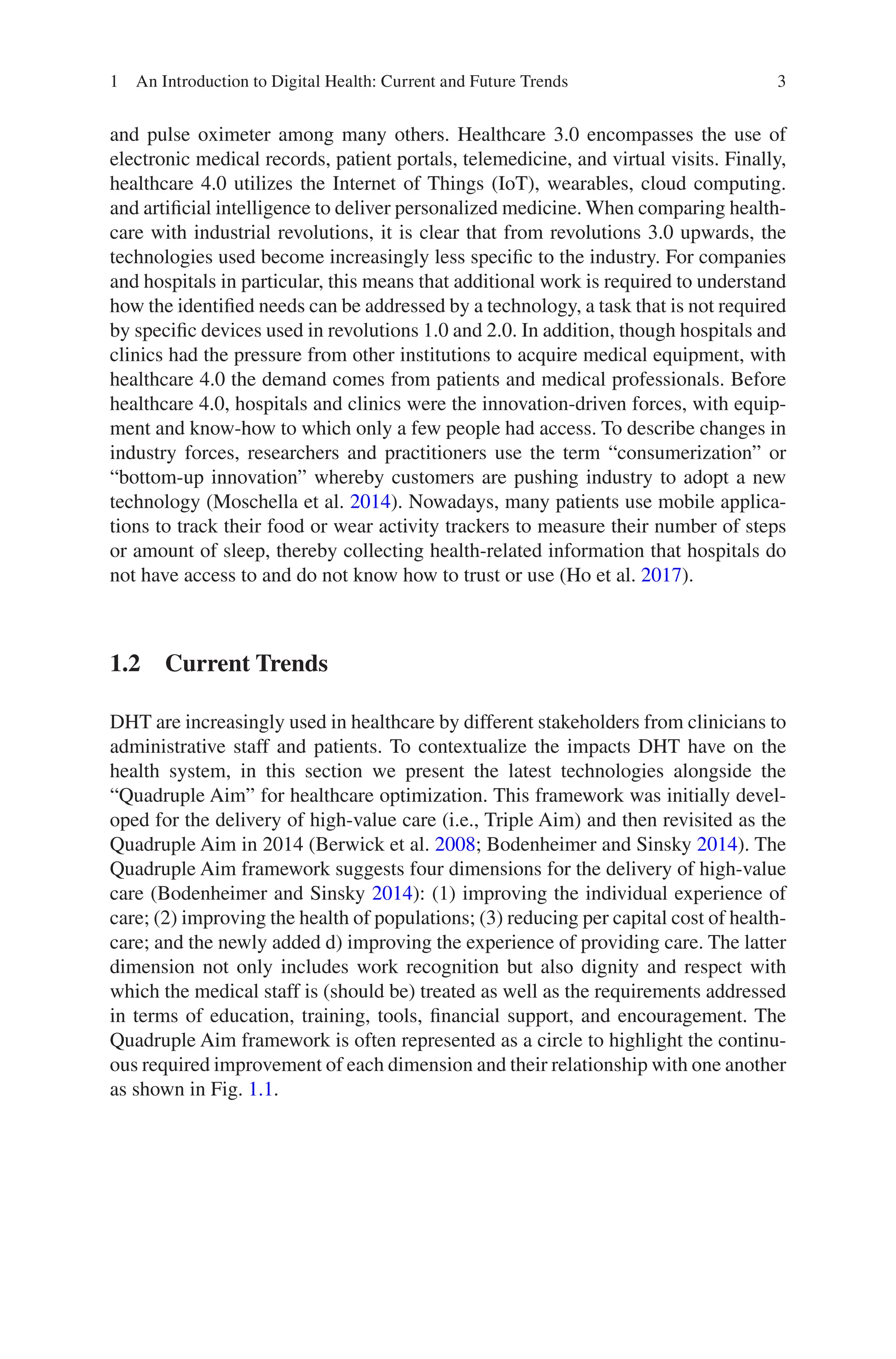
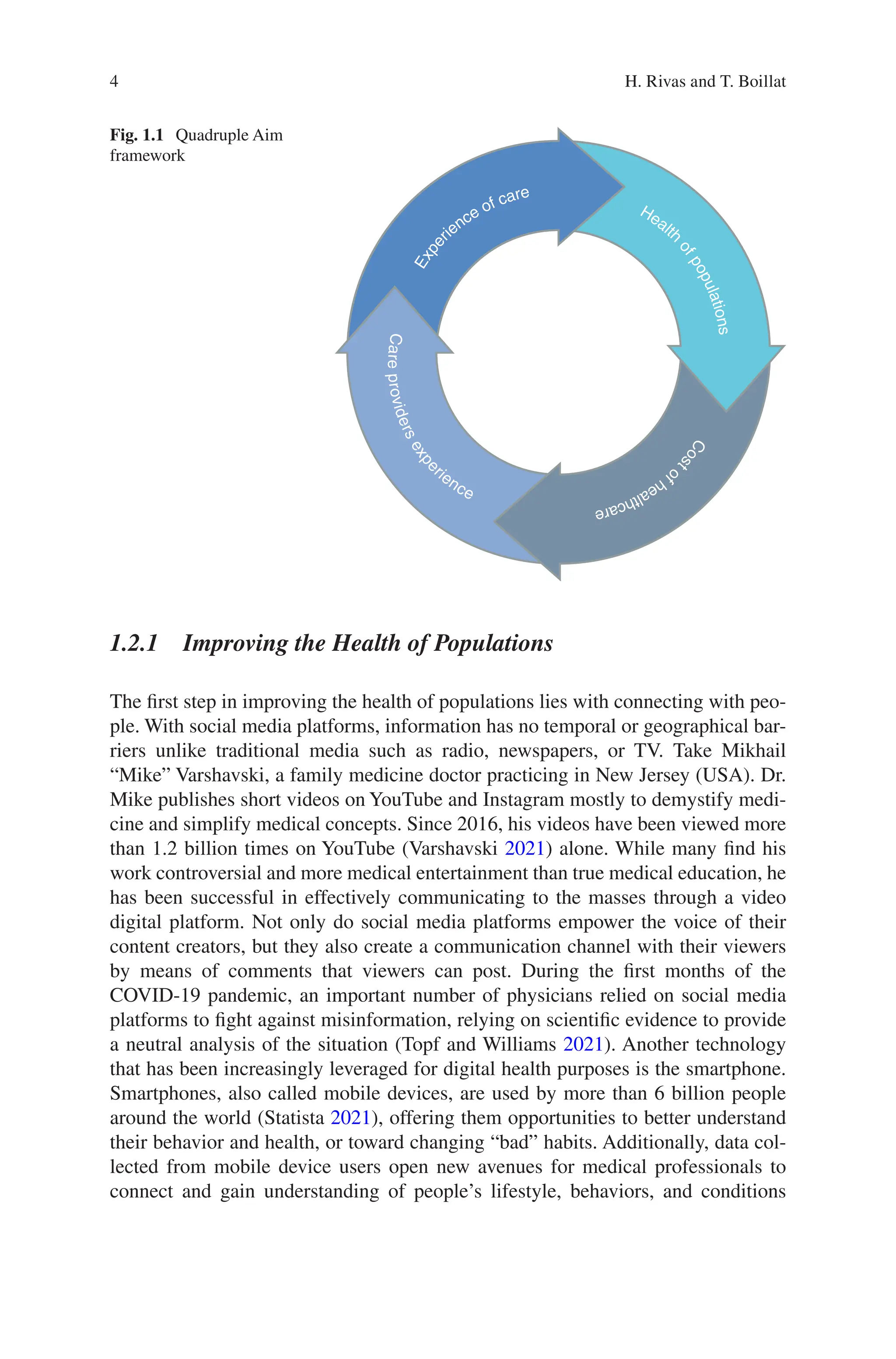
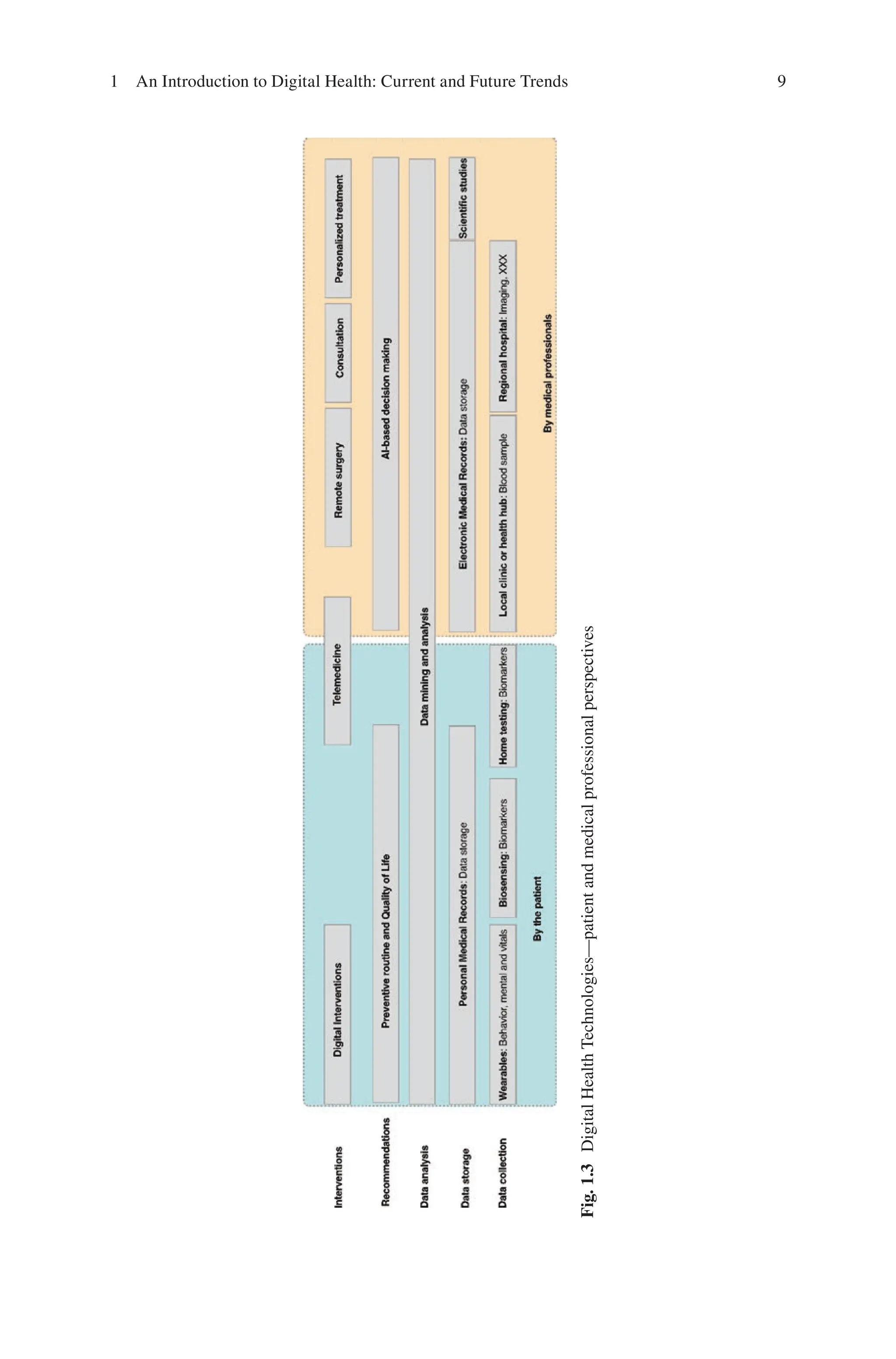
![10
action-
based digital interventions. The data analysis layer will support medical pro-
fessionals’ interventions by leveraging artificial intelligent-based decision making.
Medical professionals’ decisions will, therefore, be seconded for safer and more
accurate medicine. Remote interventions, such as telemedicine and surgery, will be
leveraged to ensure that the patient is treated under the best conditions. The use of
3D-printed drugs will be more common to deliver personalized treatment. With the
recent commercialization and certification (e.g., FDA for the U.S.) of non-proprie-
tary 3D printers dedicated to drugs such as the FabRx M3DIMAKER, one might
expect a high use of such techniques for very specialized treatments.
Deliberately, we did not mention some key advancements such as precision med-
icine or precision nutrition, which are without doubt shaping predictive, preventive,
personalized, and participatory medicine (Moore 2020). We argue, however, that
precision medicine does not really fall under the DHT category although some ser-
vices such as 23andMe leverage mobile health as a communication channel between
the customers and the company.
Ultimately the adoption of DHT will depend on the ability of the medical sector,
the government, and the technology companies to understand the needs of patients
and of each other. Tech companies now have chief medical officers to identify clini-
cal needs and constraints. Governments are pushing hospitals to adopt and integrate
their EMR while the average U.S. hospital has 16 different EMR (Sullivan and Why
2018). Digital Health Technologies are, without doubt, disrupting medicine—but
the journey is only at its beginning.
References
Berwick DM, Nolan TW, Whittington J. The triple aim: care, health, and cost. Health Aff.
2008;27(3):759–69.
Bestsennyy O, Gilbert G, Harris A, Rost J. Telehealth: A post-COVID-19 reality? [Internet];
2021. Available from: https://www.mckinsey.com/industries/healthcare-systems-and-services/
our-insights/telehealth-a-quarter-trillion-dollar-post-covid-19-reality
Bodenheimer T, Sinsky C. From triple to quadruple aim: care of the patient requires care of the
provider. Ann Fam Med. 2014;12(6):573–6.
Bradway M, Carrion C, Vallespin B, Saadatfard O, Puigdomènech E, Espallargues M, et al.
mHealth assessment: conceptualization of a global framework. JMIR mHealth and uHealth.
2017;5(5):e7291.
Buechi R, Faes L, Bachmann LM, Thiel MA, Bodmer NS, Schmid MK, et al. Evidence assessing
the diagnostic performance of medical smartphone apps: a systematic review and exploratory
meta-analysis. BMJ Open. 2017;7(12):e018280.
Chen Y, Ding S, Xu Z, Zheng H, Yang S. Blockchain-based medical records secure storage and
medical service framework. J Med Syst. 2019;43(1):1–9.
Chow CK, Redfern J, Hillis GS, Thakkar J, Santo K, Hackett ML, et al. Effect of lifestyle-focused
text messaging on risk factor modification in patients with coronary heart disease: a random-
ized clinical trial. JAMA. 2015;314(12):1255–63.
Daniels J, Haber N, Voss C, Schwartz J, Tamura S, Fazel A, et al. Feasibility testing of a wearable
behavioral aid for social learning in children with autism.Appl Clin Inform. 2018;9(01):129–40.
H. Rivas and T. Boillat](https://image.slidesharecdn.com/89030-250521223606-cc3feca4/75/Digital-Health-From-Assumptions-to-Implementations-2nd-Edition-Homero-Rivas-21-2048.jpg)
![11
Goodday SM, Karlin E, Alfarano A, Brooks A, Chapman C, Desille R, et al. An alternative to the
light touch digital health remote study: the stress and recovery in frontline COVID-19 health
care workers study. JMIR Form Res. 2021;5(12):e32165.
Health C for D and R. Digital Health Center of Excellence [Internet]. FDA. FDA; 2021 [cited 2021
Nov22].Availablefrom:https://www.fda.gov/medical-devices/digital-health-center-excellence
Ho K, Yao C, Lauscher HN. Health apps, wearables, and sensors: the advancing frontier of digital
health. B C Med J. 2017;59(10):503–6.
Hoffman DA. Increasing access to care: telehealth during COVID-19. J Law Biosci.
2020;7(1):lsaa043.
Hollander JE, Carr BG. Virtually perfect? Telemedicine for COVID-19. N Engl J Med.
2020;382(18):1679–81.
IQVIA. Digital Health Apps [Internet]. 2017 [cited 2021 Dec 11]. Available from: https://www.
iqvia.com/insights/the-iqvia-institute/reports
Islam MM, Mahmud S, Muhammad LJ, Islam MR, Nooruddin S, Ayon SI. Wearable technol-
ogy to assist the patients infected with novel coronavirus (COVID-19). SN Comput Sci.
2020;1(6):1–9.
Kamalov F, Cherukuri A, Sulieman H, Thabtah F, Hossain A. Machine learning applications for
COVID-19: a state-of-the-art review. arXiv preprint arXiv:210107824. 2021.
Khalifa M. Perceived benefits of implementing and using hospital information systems and elec-
tronic medical records. In: ICIMTH; 2017. pp. 165–8.
Li J, Carayon P. Health Care 4.0: A vision for smart and connected health care. IISE Trans
Healthcare Syst Eng. 2021;11:1–10.
Mahtta D, Daher M, Lee MT, Sayani S, Shishehbor M, Virani SS. Promise and perils of telehealth
in the current era. Curr Cardiol Rep. 2021;23(9):115.
Moore JB. From personalised nutrition to precision medicine: the rise of consumer genomics and
digital health. Proc Nutr Soc. 2020;79(3):300–10.
Moschella D, Neal D, Opperman P, Taylor J. The “Consumerization” of Information Technology.
In: Leading Edge Forum [Internet]. 2004 [cited 2014 Jun 9]. Available from: http://www.
smaele.nl/edocs/Taylor-Consumerization-2004.pdf
Olsen E. Digital health apps balloon to more than 350,000 available on the market, according
to IQVIA report [Internet]. MobiHealthNews. 2021 [cited 2021 Dec 10]. Available from:
https://www.mobihealthnews.com/news/digital-health-apps-balloon-more-350000-available-
market-according-iqvia-report
Parkhey P, Mohan SV. Biosensing applications of microbial fuel cell: approach toward minia-
turization. In: Mohan SV, Varjani S, Pandey A, editors. Microbial electrochemical technol-
ogy [Internet]. Amsterdam: Elsevier; 2019 [cited 2022 Jan 3]. pp. 977–97. (Biomass, Biofuels
and Biochemicals). Available from: https://www.sciencedirect.com/science/article/pii/
B9780444640529000406
Perez MV, Mahaffey KW, Hedlin H, Rumsfeld JS, Garcia A, Ferris T, et al. Large-scale assessment
of a smartwatch to identify atrial fibrillation. N Engl J Med. 2019;381(20):1909–17.
Portnoy J, Waller M, Elliott T. Telemedicine in the era of COVID-19. J Allergy Clin Immunol
Pract. 2020;8(5):1489–91.
Rathert C, Porter TH, Mittler JN, Fleig-Palmer M. Seven years after Meaningful Use:
Physicians’ and nurses’ experiences with electronic health records. Health Care Manag Rev.
2019;44(1):30–40.
Rivas H, Wac K. Digital health. Cham: Springer; 2018.
Rogerson J. Apple Watches are used by over 100 million people, but that’s just the beginning
[Internet]. TechRadar; 2021 [cited 2021 Nov 22]. Available from: https://www.techradar.com/
news/apple-watches-are-used-by-over-100-million-people-but-thats-just-the-beginning
Schoettker P, Degott J, Hofmann G, Proença M, Bonnier G, Lemkaddem A, et al. Blood pressure
measurements with the OptiBP smartphone app validated against reference auscultatory mea-
surements. Sci Rep. 2020;10(1):1–12.
1 An Introduction to Digital Health: Current and Future Trends](https://image.slidesharecdn.com/89030-250521223606-cc3feca4/75/Digital-Health-From-Assumptions-to-Implementations-2nd-Edition-Homero-Rivas-22-2048.jpg)
![12
Schüll ND. Data for life: wearable technology and the design of self-care. BioSocieties.
2016;11(3):317–33.
Shanafelt TD, Dyrbye LN, Sinsky C, Hasan O, Satele D, Sloan J, et al. Relationship between cleri-
cal burden and characteristics of the electronic environment with physician burnout and pro-
fessional satisfaction. In: Mayo Clinic Proceedings. Amsterdam: Elsevier; 2016. p. 836–48.
SkinVision. SkinVision | Skin Cancer Melanoma Detection App | SkinVision [Internet]. 2021
[cited 2021 Dec 14]. Available from: https://www.skinvision.com/
Statista. Smartphone users from 2016 to 2021 [Internet]. Statista. 2021 [cited 2021 Dec 5].Available
from: https://www.statista.com/statistics/330695/number-of-smartphone-users-worldwide/
Sullivan T. Why EHR data interoperability is such a mess in 3 charts [Internet]. Healthcare IT
News. 2018 [cited 2022 Jan 3]. Available from: https://www.healthcareitnews.com/news/
why-ehr-data-interoperability-such-mess-3-charts
Tang PC,Ash JS, Bates DW, Overhage JM, Sands DZ. Personal health records: definitions, benefits,
and strategies for overcoming barriers to adoption. JAm Med InformAssoc. 2006;13(2):121–6.
The Medical Futurist. FDA-approvedA.I.-based algorithms [Internet]. The Medical Futurist. [cited
2021 Nov 22]. Available from: https://medicalfuturist.com/fda-approved-ai-based-algorithms/
Topf JM, Williams PN. COVID-19, social media, and the role of the public physician. Blood Purif.
2021;50(3–4):415–21.
Triantafyllidis A, Polychronidou E, Alexiadis A, Rocha CL, Oliveira DN, da Silva AS, et al.
Computerized decision support and machine learning applications for the prevention and
treatment of childhood obesity: A systematic review of the literature. Artif Intell Med.
2020;104:101844.
Varshavski M. Doctor Mike -YouTube [Internet]. 2021 [cited 2021 Dec 9]. Available from: https://
www.youtube.com/c/DoctorMike
WHO. mHealth: new horizons for health through mobile technologies. Geneva: World Health
Organization; 2011.
WHO. Global diffusion of eHealth: making universal health coverage achievable: report of
the third global survey on eHealth. World Health Organization; 2017. p. 156. Report No.:
9789241511780.
H. Rivas and T. Boillat](https://image.slidesharecdn.com/89030-250521223606-cc3feca4/75/Digital-Health-From-Assumptions-to-Implementations-2nd-Edition-Homero-Rivas-23-2048.jpg)
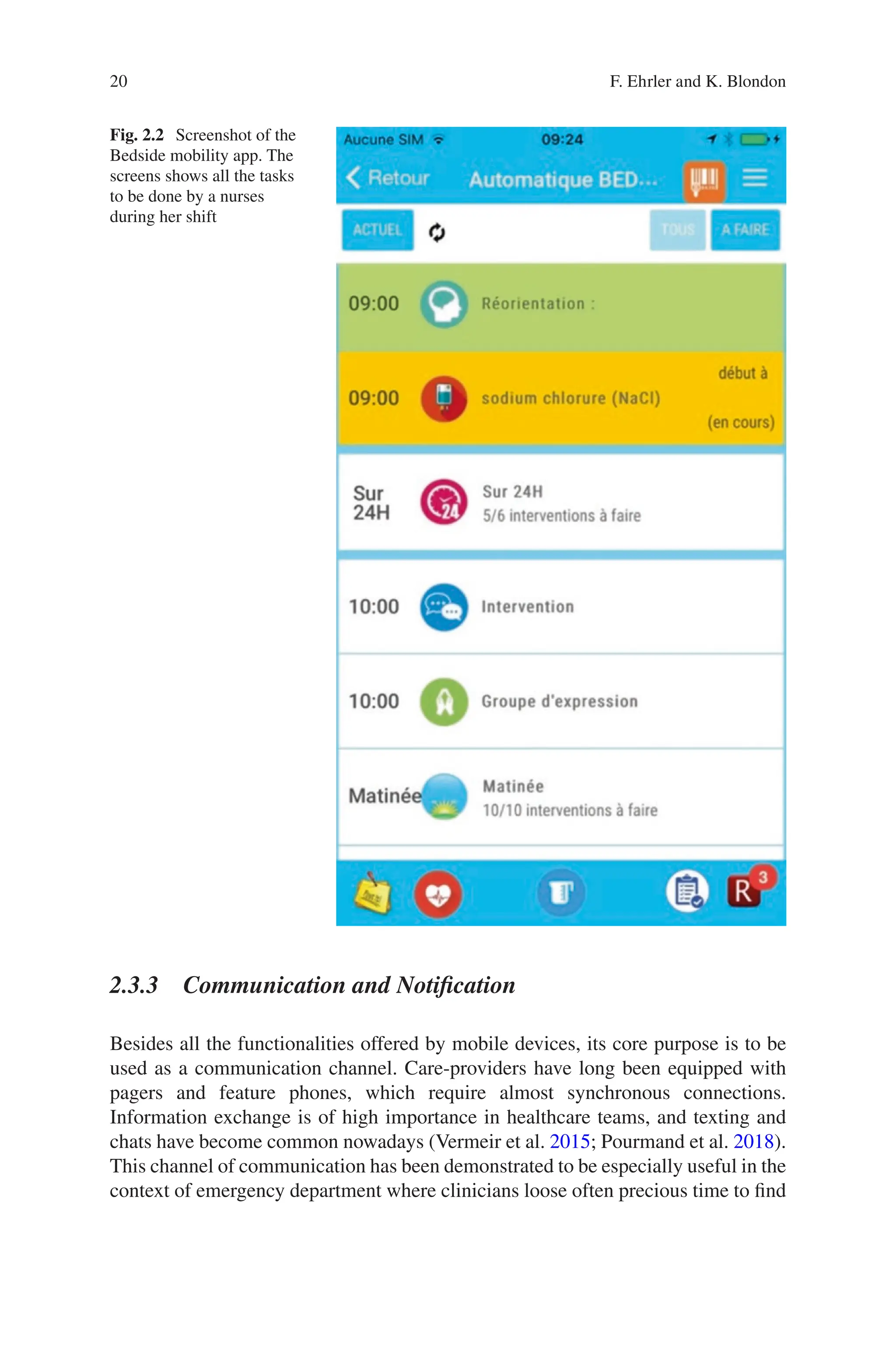
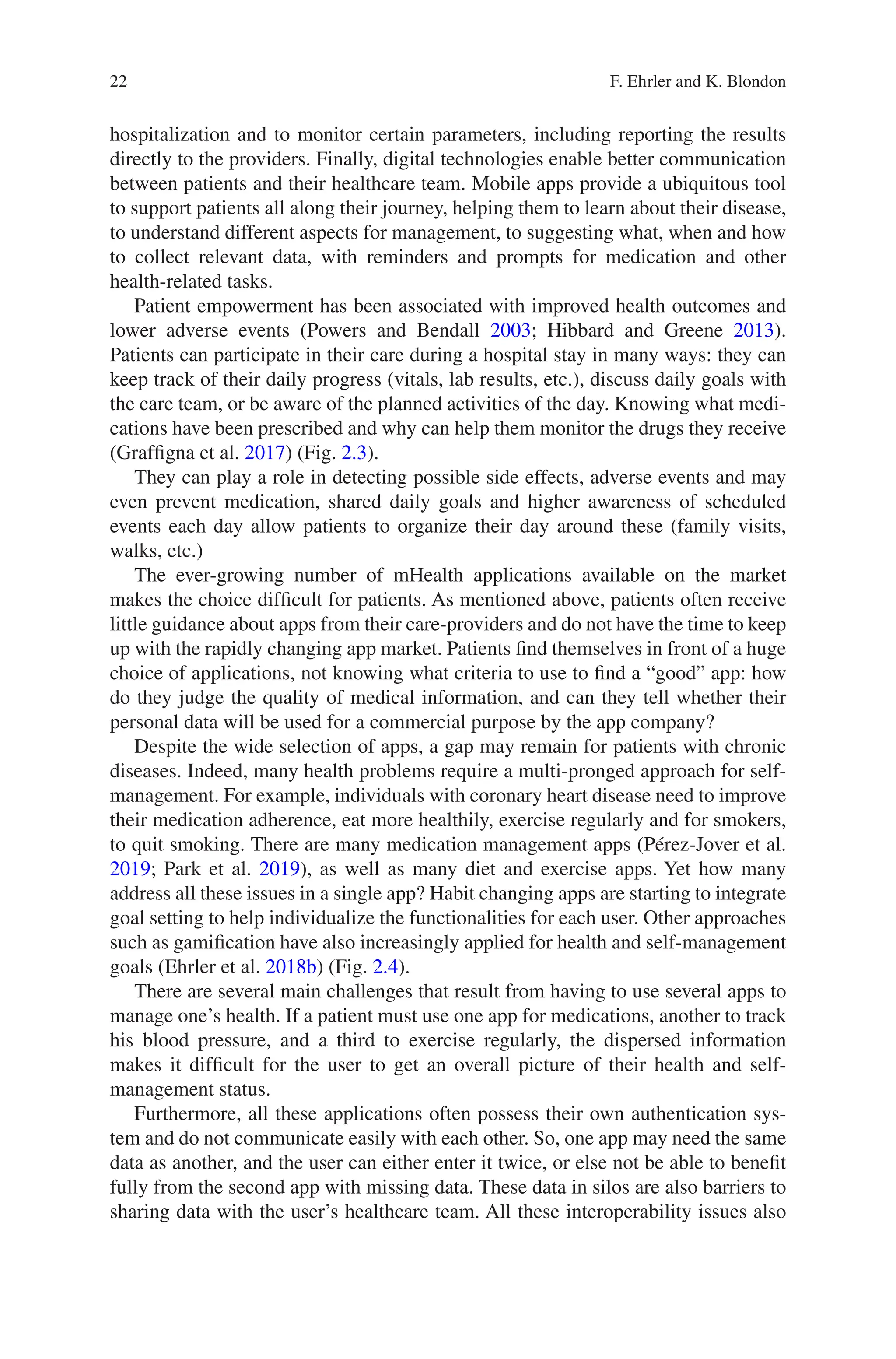
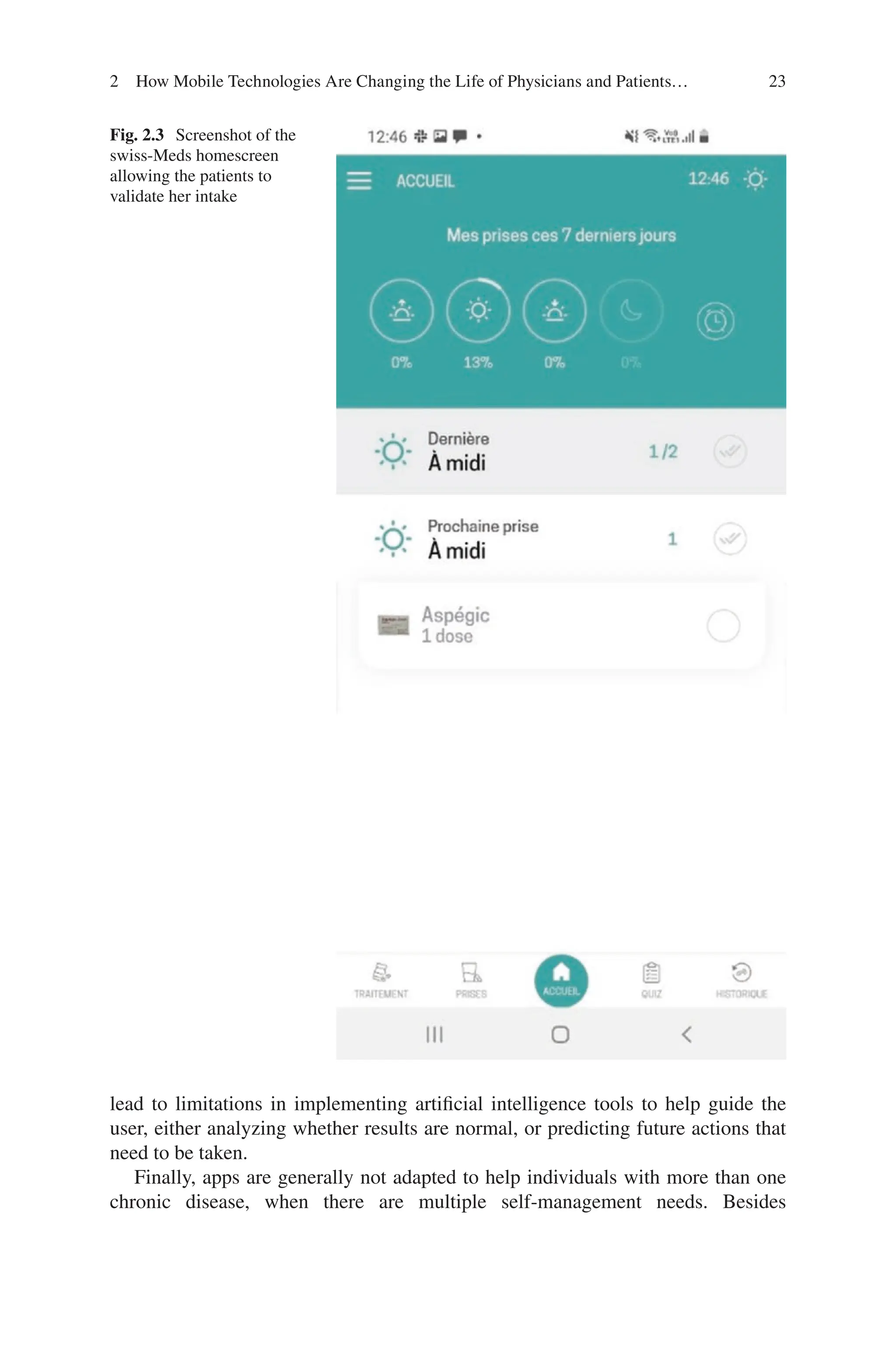
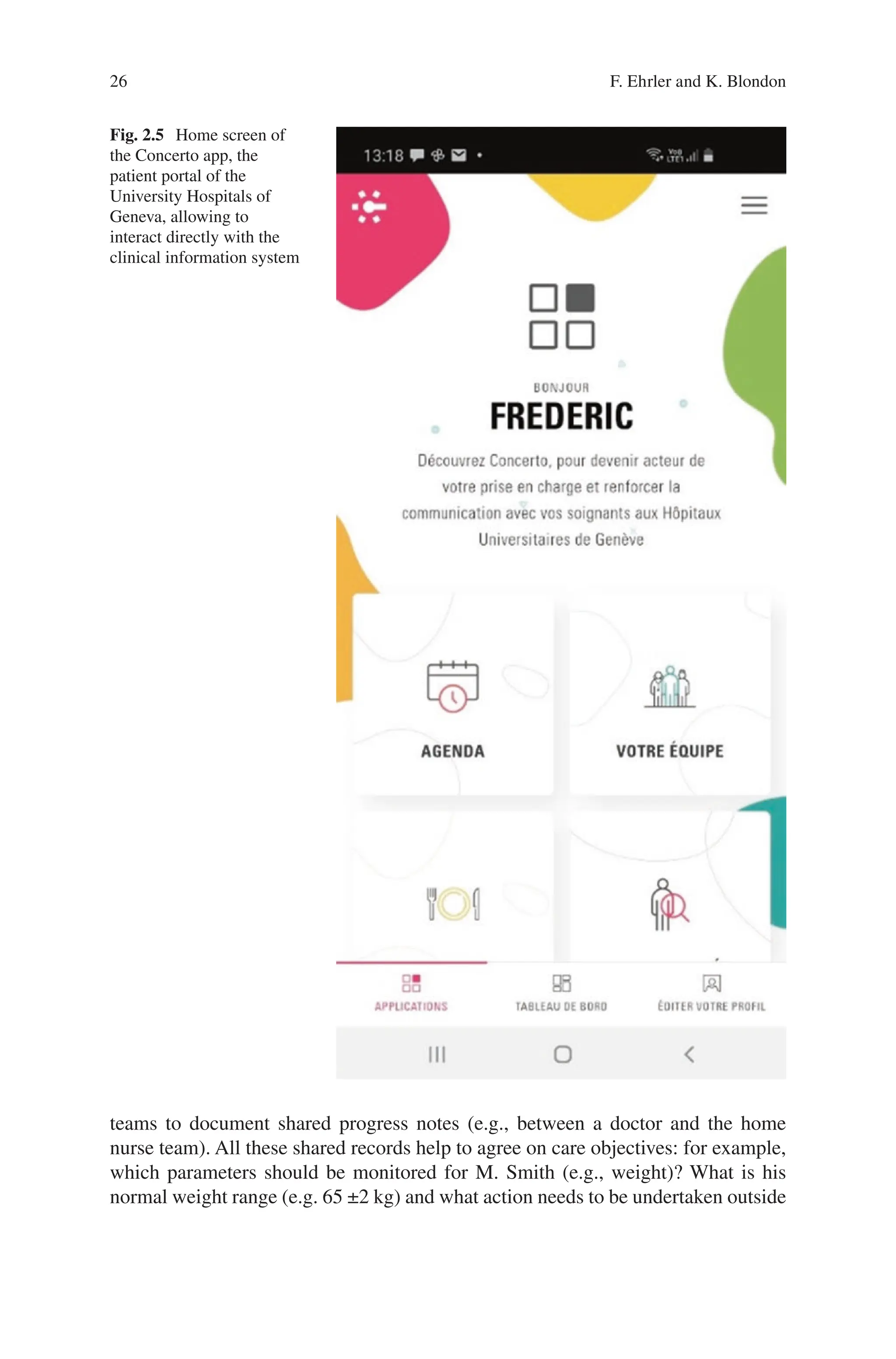
![29
patient care through facilitated documentation. Yet implementing such solutions in
an institution need prior considerations of cybersecurity, legal constraints, develop-
ment capabilities and cost.
While patients have much to gain with mHealth, individuals with chronic dis-
eases, especially multiple disease, may not yet find the perfect support tools: despite
advances with sensors, and connected devices, several apps may be needed to address
the various self-management tasks, leading to fragmented data in different systems
with low interoperability. This makes it difficult for the user to have an overview of
their health and limits the possibility of using artificial intelligence tools for now.
The vast amount of data generated and gathered by patients provides an opportunity
to improve healthcare but raises concerns about accountability and liability for the
institution that integrates these large data. Current approaches include pattern recog-
nition and screening tools with artificial intelligence-based analysis methods.
Both patients and providers need guidance about which apps are reliable, trust-
worthy, and respect privacy and legal constraints. Some institutions and interna-
tional structures have arisen to provide this service, using different assessment
criteria. Although country laws limit the extent of this collaboration, shared findings
can help improve the effectiveness of these app reviews.
Besides all the organizational, regulatory and technological aspects, one of the
most important challenges ahead is certainly the way mHealth will transform the
relationship between the patient and the care-provider. By offering an unprece-
dented access to information, a monitoring and decision-support tool, mHealth
allows the patient to become the main actor in his own care trajectory, hopefully
leading to a collaborative approach with more optimal patient activation.
The future of mHealth is bright and lively and emphasizes the importance of
considering both patient and provider’s needs. Reviewing prior findings and recom-
mendations to propose amendments and modified solutions is needed to be more
effective in moving forward; the speed of change in all areas (app markets, legal
constraints, analytics, etc.) prohibits us from starting from scratch. We should also
seek to improving collaborative efforts in our research to optimize the efficiency of
the work in this field.
References
Agarwal P, Gordon D, Griffith J, Kithulegoda N, Witteman HO, Sacha Bhatia R, et al. Assessing
the quality of mobile applications in chronic disease management: a scoping review. NPJ Digit
Med. 2021;4:46.
Al Ayubi SU, Pelletier A, Sunthara G, Gujral N, Mittal V, Bourgeois FC. A mobile app devel-
opment guideline for hospital settings: maximizing the use of and minimizing the security
risks of “Bring Your Own Devices” policies. JMIR mHealth uHealth [Internet]. 2016;4:e50.
Available from: http://ovidsp.ovid.com/ovidweb.cgi?T=JSPAGE=referenceD=premNE
WS=NAN=27169345.
2 How Mobile Technologies Are Changing the Life of Physicians and Patients…](https://image.slidesharecdn.com/89030-250521223606-cc3feca4/75/Digital-Health-From-Assumptions-to-Implementations-2nd-Edition-Homero-Rivas-40-2048.jpg)
![30
Alnanih R, Ormandjieva O. Mapping HCI principles to design quality of mobile user inter-
faces in healthcare applications. Procedia Comput Sci [Internet]. 2016;94:75–82. https://doi.
org/10.1016/j.procs.2016.08.014. The Author(s).
Ammenwerth E, Spötl H-P. The time needed for clinical documentation versus direct patient care.A
work-sampling analysis of physicians’ activities. Methods Inf Med [Internet]. 2009;48:84–91.
Available from: http://www.ncbi.nlm.nih.gov/pubmed/19151888.
Anshari M, Almunawar MN, Younis MZ, Kisa A. Modeling users’ empowerment in e-health sys-
tems. Sustain. 2021;13:1–18.
Armstrong MJ. Improving email strategies to target stress and productivity in clinical practice.
Neurol Clin Pract. 2017;7:512–7.
Backman R, Bayliss S, Moore D, Litchfield I. Clinical reminder alert fatigue in healthcare: a sys-
tematic literature review protocol using qualitative evidence. Syst Rev. 2017;6:1–6.
Baldwin JL, Singh H, Sittig DF, Davis T. Healthcare Patient portals and health apps: pitfalls, prom-
ises, and what one might learn from the other symptoms. Healthcare [Internet]. 2017;5:81–5.
https://doi.org/10.1016/j.hjdsi.2016.08.004. Elsevier Inc.
Bent B, Sim I, Dunn JP. Digital medicine community perspectives and challenges: survey study.
JMIR mHealth uHealth. 2021;9:1–9.
Biagioni RB, Carvalho BV, Manzioni R, Matielo MF, Brochado Neto FC, Sacilotto R. Smartphone
application for wound area measurement in clinical practice. J Vasc Surg Cases Innov Tech
[Internet]. 2021;7:258–61. https://doi.org/10.1016/j.jvscit.2021.02.008. Elsevier Inc.
Boudreaux ED, Waring ME, Hayes RB, Sadasivam RS, Mullen S, Pagoto S. Evaluating and select-
ing mobile health apps: strategies for healthcare providers and healthcare organizations. Transl
Behav Med. 2014;4:363–71.
Bruce C, Harrison P, Giammattei C, Desai SN, Sol JR, Jones S, et al. Evaluating patient-
centered
mobile health technologies: definitions, methodologies, and outcomes. JMIR mHealth uHealth.
2020;8:e17577.
Crondahl K, Eklund KL. The nexus between health literacy and empowerment: a scoping review.
SAGE Open. 2016;6. https://journals.sagepub.com/doi/full/10.1177/2158244016646410.
Dowthwaite L, Fischer J, Vallejos EP, Portillo V, Nichele E, Goulden M, et al. Public adoption of
and trust in the nhs covid-19 contact tracing app in the united kingdom: quantitative online
survey study. J Med Internet Res. 2021;23:1–18.
Ehrler F, Haller G, Sarrey E, Walesa M, Wipfli R, Lovis C. Assessing the usability of six data entry
mobile interfaces for caregivers: a randomized trial. JMIR Hum Factors [Internet]. 2015;2:e15.
Ehrler F, Weinhold T, Joe J, Lovis C, Blondon K. A mobile app (BEDSide Mobility) to sup-
port nurses’ tasks at the patient’s bedside: usability study. JMIR mHealth uHealth [Internet].
2018a;6:e57. Available from: http://mhealth.jmir.org/2018/3/e57/.
Ehrler F, Gschwind L, Meyer P, Christian L, Blondon K. SMART-MEDS: development of a medi-
cation adherence app for acute coronary syndrome patients based on a gamified behaviour
change model. AMIA Annu Symp Proc. 2018b;2018:413–21.
Evans RS. Electronic health records: then, now, and in the future.Yearb Med Inform. 2016:S48–61.
https://doi.org/10.15265/IYS-2016-s006.
Gardner RL, Cooper E, Haskell J, Harris DA, Poplau S, Kroth PJ, et al. Physician stress and burn-
out: the impact of health information technology. J Am Med Inform Assoc. 2019;26:106–14.
Gómez-Velasco DV, Almeda-Valdes P, Martagón AJ, Galán-Ramírez GA, Aguilar-Salinas
CA. Empowerment of patients with type 2 diabetes: current perspectives. Diabetes Metab
Syndr Obes Targets Ther. 2019;12:1311–21.
Graffigna G, Barello S, Bonanomi A. The role of Patient Health Engagement model (PHE-model)
in affecting patient activation and medication adherence: a structural equation model. PLoS
One. 2017;12:1–19.
Hibbard JH, Greene J. What the evidence shows about patient activation: better health outcomes
and care experiences; fewer data on costs. Health Aff. 2013;32:207–14.
F. Ehrler and K. Blondon](https://image.slidesharecdn.com/89030-250521223606-cc3feca4/75/Digital-Health-From-Assumptions-to-Implementations-2nd-Edition-Homero-Rivas-41-2048.jpg)
![31
Holden RJ, Karsh B-T. The technology acceptance model: its past and its future in health care. J
Biomed Inform [Internet]. Elsevier Inc.; 2010 [cited 2014 Jan 10];43:159–72. Available from:
http://www.pubmedcentral.nih.gov/articlerender.fcgi?artid=2814963tool=pmcentrezrende
rtype=abstract.
Huang K. Challenges in human-computer interaction design for mobile devices; 2009;I.
Jen M, Cho T, Rudkin S, Wong A, Almassi N, Barton E. Mobile COWs (Computer on wheels):
Hamburger or VEAL? West J Emerg Med. 2016;17:527–30.
Johnson CM, Johnson TR, Zhang J. A user-centered framework for redesigning health care inter-
faces. J Biomed Inform. 2005;38:75–87.
Jowsey T, Yen L, Mathews W P. Time spent on health related activities associated with chronic
illness: A scoping literature review. BMC Public Health [Internet]. BMC Public Health;
2012;12:1. Available from: BMC Public Health.
Klasnja P, Kendall L, Pratt W, Blondon K. Long-term engagement with health-management tech-
nology: a dynamic process in diabetes. AMIA Annu Symp Proc. 2015;2015:756–65.
Krohn R. mHealth: a pathway to the intelligent hospital. mHealth [Internet]. 2015;1:16. Available
from: www.themhealth.org.
Kumar P, Lee H-J. Security issues in healthcare applications using wireless medical sensor
networks: a survey. Sensors [Internet]. 2011;12:55–91. Available from: http://www.mdpi.
com/1424-8220/12/1/55.
Kuperman GJ, Teich JM, Tanasijevic MJ, Ma’Luf N, Rittenberg E, Jha A, Fiskio J, Winkelman
J, Bates DW. Improving response to critical laboratory results with automation: results of a
randomized controlled trial. J Am Med Inform Assoc. 1999;6:512–22.
Lalloo C, Shah U, Birnie KA, Davies-Chalmers C, Rivera J, Stinson J, et al. Commercially avail-
able smartphone apps to support postoperative pain self-management: scoping review. JMIR
mHealth uHealth. 2017;5:e162.
Lavallee DC, Lee JR, Austin E, Bloch R, Lawrence SO, McCall D, et al. mHealth and patient
generated health data: stakeholder perspectives on opportunities and barriers for transforming
healthcare. mHealth. 2020;6:8–8.
Lowry R, Kann L, Collins JL, Kolbe LJ. The effect of socioeconomic status on chronic disease risk
behaviors among US adolescents. J Am Med Assoc. 1996;276:792–7.
Lu C, Hu Y, Xie J, Fu Q, Leigh I, Governor S, et al. The use of mobile health applications to
improve patient experience: cross-sectional study in chinese public hospitals. JMIR mHealth
uHealth. 2018;6:1–9.
MacGregor JCD, Wathen CN. My health is not a job’: a qualitative exploration of personal health
management and imperatives of the ‘new public health. BMC Public Health. 2014;14:1–10.
Marcolino MS, Oliveira JAQ, D’Agostino M, Ribeiro AL, Alkmim MBM, Novillo-Ortiz D. The
impact of mHealth interventions: systematic review of systematic reviews. JMIR mHealth
uHealth. 2018;6:e23.
Martínez-Pérez B, de la Torre-Díez I, López-Coronado M. Privacy and security in mobile health
apps: a review and recommendations. J Med Syst. 2015;39:181.
Medical C, Bromwich M. Privacy risks when using mobile devices in health care.
CMAJ. 2016;188:855–6.
Middleton KR, Anton SD, Perri MG. Long-term adherence to health behavior change. Am J
Lifestyle Med. 2016;7:395–404.
Molina-Recio G, Molina-Luque R, Jiménez-García AM, Ventura-Puertos PE, Hernández-Reyes A,
Romero-Saldaña M. Proposal for the user-centered design approach for health apps based on
successful experiences: Integrative review. JMIR mHealth uHealth. 2020;8:1–18.
Mosa AS, Yoo I, Sheets L. A systematic review of healthcare applications for smartphones.
BMC Med Inform Decis Mak [Internet]. BMC Medical Informatics and Decision Making;
2012;12:67. Available from: http://www.biomedcentral.com/1472-6947/12/67.
Nijor S, Katz L, Gokcen E. Patient safety issues from information overload in electronic medical
records: A systematic review; 2020;1–15. https://doi.org/10.21203/rs.3.rs-23424/v1.
2 How Mobile Technologies Are Changing the Life of Physicians and Patients…](https://image.slidesharecdn.com/89030-250521223606-cc3feca4/75/Digital-Health-From-Assumptions-to-Implementations-2nd-Edition-Homero-Rivas-42-2048.jpg)
![32
Nikolic A, Wickramasinghe N, Claydon-Platt D, Balakrishnan V, Smart P. The use of communica-
tion apps by medical staff in the australian health care system: survey study on prevalence and
use. JMIR Med Inform. 2018;20:1–7.
Nittas V, Lun P, Ehrler F, Puhan MA, Mütsch M. Electronic patient-generated health data to
facilitate disease prevention and health promotion: scoping review. J Med Internet Res.
2019;21:1–19.
Park JYE, Li J, Howren A, Tsao NW, de Vera M. Mobile phone apps targeting medication adher-
ence: Quality assessment and content analysis of user reviews. JMIR mHealth uHealth.
2019;7:1–12.
Pérez-Jover V, Sala-González M, Guilabert M, Mira JJ. Mobile apps for increasing treatment
adherence: Systematic review. J Med Internet Res. 2019;21:1–14.
Pourmand A, Roberson J, Gallugi A, Sabha Y, O’Connell F. Secure smartphone application-based
text messaging in emergency department, a system implementation and review of literature.
Am J Emerg Med [Internet]. 2018;36:1680–5. https://doi.org/10.1016/j.ajem.2018.06.067.
Elsevier Inc.
Powers TL, Bendall D. Improving health outcomes through patient empowerment. J Hosp Mark
Public Relations. 2003;15:45–59.
Saparamadu AADNS, Fernando P, Zeng P, Teo H, Goh A, Lee JMY, et al. User-centered design
process of an mHealth app for health professionals: case study. JMIR mHealth uHealth.
2021;9:e18079.
Shapiro M, Johnston D, Wald J, Mon D. Patient-generated health data - white paper. prep off
policy planning, off natl coord heal inf technol res triangle park NC RTI Int [Internet].
2012;35. Available from: http://www.healthit.gov/sites/default/files/rti_pghd_whitepaper_
april_2012.pdf.
Sieck CJ, Pearl N, Bright TJ, Yen PY. A qualitative study of physician perspectives on adaptation
to electronic health records. BMC Med Inform Decis Mak. BMC Medical Informatics and
Decision Making; 2020;20:1–8.
Simon J, Rieder G. Trusting the Corona-Warn-App? Contemplations on trust and trustworthiness
at the intersection of technology, politics and public debate. Eur J Commun. 2021;36:334–48.
Slovis BH, Nahass TA, Salmasian H, Vawdrey DK, Kuperman G. Asynchronous automated
electronic laboratory result notifications: a systematic review. J Am Med Inform Assoc.
2017;24:1173–83.
Smahel D, Elavsky S, Machackova H. Functions of mHealth applications: a user’s perspective.
Health Informatics J. 2019;25:1065–75.
Sowan AK, Vera A, Malshe A, Reed C. Transcription errors of blood glucose values and insulin
errors in an intensive care unit: Secondary data analysis toward electronic medical record-
glucometer interoperability. J Med Internet Res. 2019;21:1–9.
Tajirian T, Stergiopoulos V, Strudwick G, Sequeira L. The influence of electronic health record use
on physician burnout: cross-sectional survey. J Med Internet Res. 2020;22(7):e19274.
Tiase VL, Hull W, McFarland MM, Sward KA, Del Fiol G, Staes C, et al. Patient-generated
health data and electronic health record integration: Protocol for a scoping review. BMJ Open.
2019;9:1–5.
Trinidad MG, Platt J, Kardia SLR. The public’s comfort with sharing health data with third-
party commercial companies. Humanit Soc Sci Commun [Internet]. 2020;7:1–10. Springer
US. https://doi.org/10.1057/s41599-020-00641-5.
van Haasteren A, Gille F, Fadda M, Vayena E. Development of the mHealth App Trustworthiness
checklist. Digit Heal [Internet]. 2019;5:205520761988646. Available from: http://journals.
sagepub.com/doi/10.1177/2055207619886463.
Ventola CL. Mobile devices and apps for health care professionals: uses and benefits.
PT. 2014a;39:356–64.
Ventola CL. Mobile devices and apps for health care professionals: uses and benefits. PT [Internet].
2014b;39:356–64. Available from: http://www.pubmedcentral.nih.gov/articlerender.fcgi?arti
d=4029126tool=pmcentrezrendertype=abstract.
F. Ehrler and K. Blondon](https://image.slidesharecdn.com/89030-250521223606-cc3feca4/75/Digital-Health-From-Assumptions-to-Implementations-2nd-Edition-Homero-Rivas-43-2048.jpg)