IMPACT
Improvement in learning outcomes of
Grades 6-8 students in DE schools
as compared to non-DE schools
17%
Increase in students' classroom
engagement
66%
Students know how to operate
a computer independently
70%
Teachers used technology as a
pedagogic tool
92%
Teachers integrated ICT
in lesson plans
96%
India, despite its unprecedented growth, faces a daunting challenge in the
provision of equitable, quality education that prepares its youth for participation
in the digital age. The majority of rural India’s government schools lack basic IT
infrastructure for computer-aided learning. In schools with technology resources,
computer-aided learning primarily focuses on teaching 'computers' as a subject
rather than as a tool for enhancing the quality of teaching and learning in
classrooms.
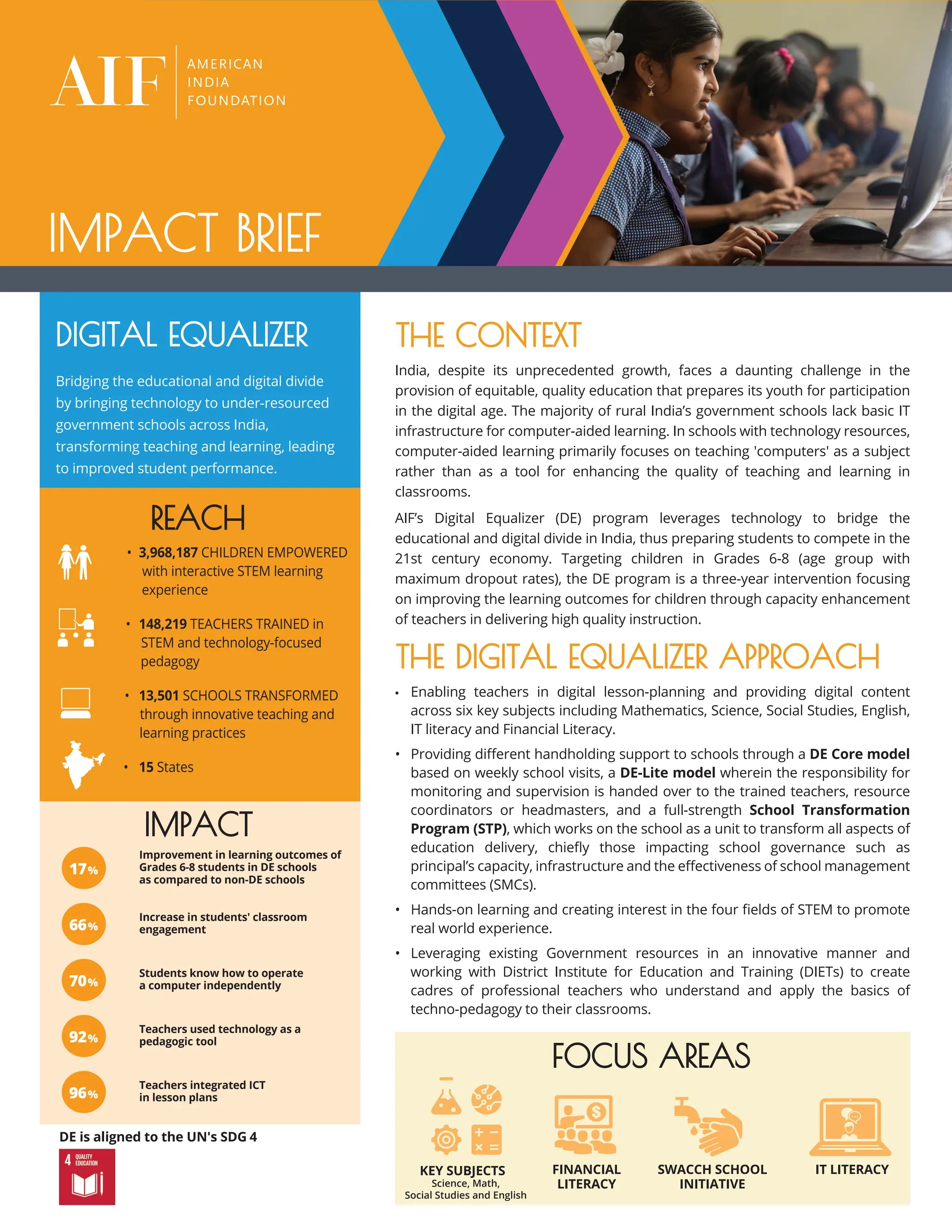
AIF’s Digital Equalizer (DE) program leverages technology to bridge the
educational and digital divide in India, thus preparing students to compete in the
21st century economy. Targeting children in Grades 6-8 (age group with
maximum dropout rates), the DE program is a three-year intervention focusing
on improving the learning outcomes for children through capacity enhancement
of teachers in delivering high quality instruction.
THE CONTEXT
• Enabling teachers in digital lesson-planning and providing digital content
across six key subjects including Mathematics, Science, Social Studies, English,
IT literacy and Financial Literacy.
• Providing different handholding support to schools through a DE Core model
based on weekly school visits, a DE-Lite model wherein the responsibility for
monitoring and supervision is handed over to the trained teachers, resource
coordinators or headmasters, and a full-strength School Transformation
Program (STP), which works on the school as a unit to transform all aspects of
education delivery, chiefly those impacting school governance such as
principal’s capacity, infrastructure and the effectiveness of school management
committees (SMCs).
• Hands-on learning and creating interest in the four fields of STEM to promote
real world experience.
• Leveraging existing Government resources in an innovative manner and
working with District Institute for Education and Training (DIETs) to create
cadres of professional teachers who understand and apply the basics of
techno-pedagogy to their classrooms.
THE DIGITAL EQUALIZER APPROACH
KEY SUBJECTS
Science, Math,
Social Studies and English
FINANCIAL
LITERACY
SWACCH SCHOOL
INITIATIVE
IT LITERACY
FOCUS AREAS
REACH
• 3,968,187 CHILDREN EMPOWERED
with interactive STEM learning
experience
• 148,219 TEACHERS TRAINED in
STEM and technology-focused
pedagogy
• 13,501 SCHOOLS TRANSFORMED
through innovative teaching and
learning practices
• 15 States
DIGITAL EQUALIZER
Bridging the educational and digital divide
by bringing technology to under-resourced
government schools across India,
transforming teaching and learning, leading
to improved student performance.
IMPACT BRIEF
DE is aligned to the UN's SDG 4
54.20%
36.90%
17.30%
INCREASE IN LEARNING OUTCOMES STUDENTS PARTICIPATION IN PROJECT OR
ACTIVITY
DE Schools
Non-DE Schools
Difference
DE Schools
Non-DE Schools
Difference
75%
50%
25%
U.S. 216 E.45th Street, 7th Floor, New York, NY 10017 • 530 Lytton
Avenue, Palo Alto, CA 94301 INDIA: 1003-1005, DLF City Court,
M.G Road, Near Sikanderpur Metro Station, Gurgaon- 122002
www.AIF.org
info@aif.org
888.AIF.4IND
@AIFoundation
May 2019
Evidence from the evaluation shows that DE Program has been successful in significantly
improving learning outcomes on key subjects (Maths, Science & Social Studies) as well as ICT
(Information, Communication & Technology) competencies among students. Programmatic
interventions have played a key role in motivating the teachers to adopt technology as a
pedagogic tool. Despite infrastructure constraints in some schools, teachers are using the
new Teaching-Learning methods in classes in lesson-planning, leading to higher student
attendance rates in schools, better quality of teaching in school and improved student
performance. Considering the achievements of the program, the next logical step would be
expansion to non-DE schools in other locations, in partnership with the government and
other stakeholders.
1
Evaluation Report on DE Program, KARVY INSIGHTS, 2019
Base- Students: 4381 (Program 2836; Comparison: 1481); Teachers 198 (Program: 149; Comparison: 49) of 147 schools
2
Karnataka, Odisha, Punjab, Tamil Nadu, Telengana; Delhi and Haryana
CONCLUSION
EVIDENCE
The key findings of a mixed-methods external evaluation1
conducted among students
through learning assessment tests and interviews with teachers, in 147 schools across
seven States2
of India, are:
STUDENTS
• Improvement in Learning Outcomes
• Students from DE schools scored 17 percentage points higher in academic tests than their
counterparts in non-DE school. Composite scores of DE school students showed 20.1%
improvement in Science, 17.6% improvement in Maths, and 14.2% improvement in
Social Studies.
• Increase in Class Engagement
• 66% of government school teachers supported by DE reported increased students’
engagement through DE Way of Teaching (DEWoT).
• Every three of four students had participated in a group project or activity related to any of
their subjects in class as compared to two of four in non-DE schools.
• Enhanced Conceptual Clarity
• 96-98% of students exposed to DE content (video/animation), felt that it made it easier for
them to understand topics, was more interesting to learn, and made learning fun.
• Technology Use
• 70% of students knew how to operate computer independently in DE schools as compared
to 39% in non-DE schools.
IMPACT STORIES
AIF IMPACT BRIEFS
This Impact Brief is part of a suite of Impact Briefs which
provide evidence about the impact of AIF’s programs,
available at
www.AIF.org/our-work/knowledge-center/
TEACHERS
• ICT Integration
• 96% of DE school teachers integrate Information Communication and Technology (ICT)
while making lesson plans as compared to 55% of non-DE school teachers.
• Use of Technology as a Pedagogic Tool
• 92% of teachers in DE schools used visual aids to explain topics almost on a daily basis
as compared to 61% in non-DE schools.
• Quality of Teaching
• 85% of teachers in DE schools reported that the program helped them to improve
their quality of teaching.
96%
55%
41%
DE Schools
Non-DE Schools
Difference
TEACHERS INTEGRATING ICT WHILE MAKING LESSON PLANS
Thanks to Digital Equalizer,
I rely less on memorizing
answers, and concept clarity has
improved. Ever since the teach-
ers started using animations
and videos in class, my concen-
tration and enthusiasm started
increasing”, says Kalyani Mahab-
hoi, Grade 8 student of Govern-
ment ME School in Odisha (Pic 1).
Kalyani’s exposure to Digital Equalizer (DE) started
two years ago when she was in Grade 6. She used to
average 70-80% scores and her teachers would
urge her to try harder. Through DE Way of Teaching,
students were assigned more group activity and
project work. Digital Equalizer ensures that
students in public/government schools have access
to quality education and a robust learning environ-
ment. Now in Grade 8, her academic performance
has improved significantly. “I didn’t solely rely on
memorizing the syllabus to perform well, I started
understanding what I was being taught. My marks
in Science improved from 81% during half-yearly
exam to 95% during the end-term examinations
and I topped my class. Now my friends and I spend
all the free time we get in the computer lab. I just
feel I have so much more to learn and I cannot wait
for my next DE class to take place.”
Digital Equalizer has resulted
in better retention rates among
students of Government ME
School. Even teachers acknowl-
edge the positive impact created
by the integration of technology
as a pedagogical tool.
“I used to work hard at teaching
Science and Mathematics in
a way that makes it interesting
for the students. They were not concentrating in
class and thus performing badly in tests. The
biggest help I received was when we started the
Digital Equalizer program in our school, it helped
greatly in lesson planning”, shares Mitaswini Panda,
Assistant Teacher for Maths and Science in Kalyani’s
school (Pic 2).
Digital Equalizer has not only equipped the school
with a computer lab, edukits and flipped
classrooms, it has also delivered digital content for
Science, Mathematics, Social Studies, English, IT
literacy and Financial literacy. She adds, “I started
seeing gradual improvement, not just in the
students who studied well but also among the
bottom performers of my class. I also noticed that
they participated more freely in class and even
attempted to answer questions that were asked of
them.”
Pic 1
Pic 2

Digital Equalizer (DE): AIF’s Flagship Nonprofit Education Program

  • 1.
    IMPACT Improvement in learningoutcomes of Grades 6-8 students in DE schools as compared to non-DE schools 17% Increase in students' classroom engagement 66% Students know how to operate a computer independently 70% Teachers used technology as a pedagogic tool 92% Teachers integrated ICT in lesson plans 96% India, despite its unprecedented growth, faces a daunting challenge in the provision of equitable, quality education that prepares its youth for participation in the digital age. The majority of rural India’s government schools lack basic IT infrastructure for computer-aided learning. In schools with technology resources, computer-aided learning primarily focuses on teaching 'computers' as a subject rather than as a tool for enhancing the quality of teaching and learning in classrooms. AIF’s Digital Equalizer (DE) program leverages technology to bridge the educational and digital divide in India, thus preparing students to compete in the 21st century economy. Targeting children in Grades 6-8 (age group with maximum dropout rates), the DE program is a three-year intervention focusing on improving the learning outcomes for children through capacity enhancement of teachers in delivering high quality instruction. THE CONTEXT • Enabling teachers in digital lesson-planning and providing digital content across six key subjects including Mathematics, Science, Social Studies, English, IT literacy and Financial Literacy. • Providing different handholding support to schools through a DE Core model based on weekly school visits, a DE-Lite model wherein the responsibility for monitoring and supervision is handed over to the trained teachers, resource coordinators or headmasters, and a full-strength School Transformation Program (STP), which works on the school as a unit to transform all aspects of education delivery, chiefly those impacting school governance such as principal’s capacity, infrastructure and the effectiveness of school management committees (SMCs). • Hands-on learning and creating interest in the four fields of STEM to promote real world experience. • Leveraging existing Government resources in an innovative manner and working with District Institute for Education and Training (DIETs) to create cadres of professional teachers who understand and apply the basics of techno-pedagogy to their classrooms. THE DIGITAL EQUALIZER APPROACH KEY SUBJECTS Science, Math, Social Studies and English FINANCIAL LITERACY SWACCH SCHOOL INITIATIVE IT LITERACY FOCUS AREAS REACH • 3,968,187 CHILDREN EMPOWERED with interactive STEM learning experience • 148,219 TEACHERS TRAINED in STEM and technology-focused pedagogy • 13,501 SCHOOLS TRANSFORMED through innovative teaching and learning practices • 15 States DIGITAL EQUALIZER Bridging the educational and digital divide by bringing technology to under-resourced government schools across India, transforming teaching and learning, leading to improved student performance. IMPACT BRIEF DE is aligned to the UN's SDG 4
  • 2.
    54.20% 36.90% 17.30% INCREASE IN LEARNINGOUTCOMES STUDENTS PARTICIPATION IN PROJECT OR ACTIVITY DE Schools Non-DE Schools Difference DE Schools Non-DE Schools Difference 75% 50% 25% U.S. 216 E.45th Street, 7th Floor, New York, NY 10017 • 530 Lytton Avenue, Palo Alto, CA 94301 INDIA: 1003-1005, DLF City Court, M.G Road, Near Sikanderpur Metro Station, Gurgaon- 122002 www.AIF.org info@aif.org 888.AIF.4IND @AIFoundation May 2019 Evidence from the evaluation shows that DE Program has been successful in significantly improving learning outcomes on key subjects (Maths, Science & Social Studies) as well as ICT (Information, Communication & Technology) competencies among students. Programmatic interventions have played a key role in motivating the teachers to adopt technology as a pedagogic tool. Despite infrastructure constraints in some schools, teachers are using the new Teaching-Learning methods in classes in lesson-planning, leading to higher student attendance rates in schools, better quality of teaching in school and improved student performance. Considering the achievements of the program, the next logical step would be expansion to non-DE schools in other locations, in partnership with the government and other stakeholders. 1 Evaluation Report on DE Program, KARVY INSIGHTS, 2019 Base- Students: 4381 (Program 2836; Comparison: 1481); Teachers 198 (Program: 149; Comparison: 49) of 147 schools 2 Karnataka, Odisha, Punjab, Tamil Nadu, Telengana; Delhi and Haryana CONCLUSION EVIDENCE The key findings of a mixed-methods external evaluation1 conducted among students through learning assessment tests and interviews with teachers, in 147 schools across seven States2 of India, are: STUDENTS • Improvement in Learning Outcomes • Students from DE schools scored 17 percentage points higher in academic tests than their counterparts in non-DE school. Composite scores of DE school students showed 20.1% improvement in Science, 17.6% improvement in Maths, and 14.2% improvement in Social Studies. • Increase in Class Engagement • 66% of government school teachers supported by DE reported increased students’ engagement through DE Way of Teaching (DEWoT). • Every three of four students had participated in a group project or activity related to any of their subjects in class as compared to two of four in non-DE schools. • Enhanced Conceptual Clarity • 96-98% of students exposed to DE content (video/animation), felt that it made it easier for them to understand topics, was more interesting to learn, and made learning fun. • Technology Use • 70% of students knew how to operate computer independently in DE schools as compared to 39% in non-DE schools. IMPACT STORIES AIF IMPACT BRIEFS This Impact Brief is part of a suite of Impact Briefs which provide evidence about the impact of AIF’s programs, available at www.AIF.org/our-work/knowledge-center/ TEACHERS • ICT Integration • 96% of DE school teachers integrate Information Communication and Technology (ICT) while making lesson plans as compared to 55% of non-DE school teachers. • Use of Technology as a Pedagogic Tool • 92% of teachers in DE schools used visual aids to explain topics almost on a daily basis as compared to 61% in non-DE schools. • Quality of Teaching • 85% of teachers in DE schools reported that the program helped them to improve their quality of teaching. 96% 55% 41% DE Schools Non-DE Schools Difference TEACHERS INTEGRATING ICT WHILE MAKING LESSON PLANS Thanks to Digital Equalizer, I rely less on memorizing answers, and concept clarity has improved. Ever since the teach- ers started using animations and videos in class, my concen- tration and enthusiasm started increasing”, says Kalyani Mahab- hoi, Grade 8 student of Govern- ment ME School in Odisha (Pic 1). Kalyani’s exposure to Digital Equalizer (DE) started two years ago when she was in Grade 6. She used to average 70-80% scores and her teachers would urge her to try harder. Through DE Way of Teaching, students were assigned more group activity and project work. Digital Equalizer ensures that students in public/government schools have access to quality education and a robust learning environ- ment. Now in Grade 8, her academic performance has improved significantly. “I didn’t solely rely on memorizing the syllabus to perform well, I started understanding what I was being taught. My marks in Science improved from 81% during half-yearly exam to 95% during the end-term examinations and I topped my class. Now my friends and I spend all the free time we get in the computer lab. I just feel I have so much more to learn and I cannot wait for my next DE class to take place.” Digital Equalizer has resulted in better retention rates among students of Government ME School. Even teachers acknowl- edge the positive impact created by the integration of technology as a pedagogical tool. “I used to work hard at teaching Science and Mathematics in a way that makes it interesting for the students. They were not concentrating in class and thus performing badly in tests. The biggest help I received was when we started the Digital Equalizer program in our school, it helped greatly in lesson planning”, shares Mitaswini Panda, Assistant Teacher for Maths and Science in Kalyani’s school (Pic 2). Digital Equalizer has not only equipped the school with a computer lab, edukits and flipped classrooms, it has also delivered digital content for Science, Mathematics, Social Studies, English, IT literacy and Financial literacy. She adds, “I started seeing gradual improvement, not just in the students who studied well but also among the bottom performers of my class. I also noticed that they participated more freely in class and even attempted to answer questions that were asked of them.” Pic 1 Pic 2