The Digital Commons
Jason M. Kelly PhD FSA
Director, IUPUI Arts & Humanities Institute
Associate Professor of British History, IUPUI
jaskelly@iupui.edu | @jason_m_kelly
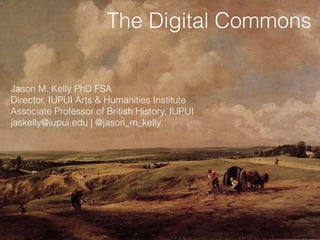
John Constable. Branch Hill Pond, Hampstead Heath. ca. 1820.
Oil on canvas. 54 x 76.9 cm. Fitzwilliam Museum, Cambridge
“Picture a pasture open to all. It is to be expected that each herdsman
will try to keep as many cattle as possible on the commons. Such an
arrangement may work reasonably satisfactorily for centuries because
tribal wars, poaching, and disease keep the numbers of both man and
beast well below the carrying capacity of the land. Finally, however,
comes the day of reckoning, that is, the day when the long-desired goal
of social stability becomes a reality. At this point, the inherent logic of the
commons remorselessly generates tragedy.
As a rational being, each herdsman seeks to maximize his gain.”
Garrett Hardin, “The Tragedy of the Commons,” Science 162, no. 3859 (December 1968): 1243-48
John Constable. Branch Hill Pond, Hampstead Heath. ca. 1820.
Oil on canvas. 54 x 76.9 cm. Fitzwilliam Museum, Cambridge
“Although tragedies have undoubtedly occurred, it is also obvious that
for thousands of years people have self-organized to manage common-
pool resources, and users often do devise long-term, sustainable
institutions for governing these resources.”
Elinor Ostrom, et al., “Revisiting the Commons,” Science 284, no. 5412 (April 1999): 278-82
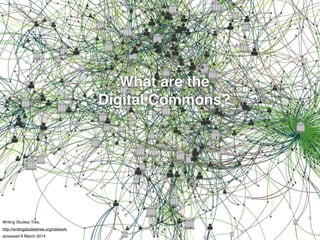
What are the
Digital Commons?
Writing Studies Tree,
http://writingstudiestree.org/network,
accessed 6 March 2014
The Digital Commons are those spaces, principles, and
practices that allow the free exchange of knowledge in the
digital environment.
This free exchange of information is often referred to as open
access. However, the term open access often elides the
complex material and cultural infrastructures that both create
and maintain the digital commons.
A Short History of Open Access and the Digital Commons
Richard Cumberland
uses the term “open
access” to refer to
access to
information through
the press
1787
“Open Access” to
stacks debated at
the meeting of the
American Library
Association
1899
1900
As part of the anti-
copyright
movement, Tolstoy
supports a publisher
who printed his work
with “no rights
reserved”
The Open Source
begins with the GNU
Manifesto
1983
2001
Budapest Open
Access Initiative
2003
Bethseda Statement
on Open Access
Publishing and
Berlin Declaration
Johann Peter Hasenclever. Das Lesekabinett (The Reading Room). 1843. 71 x 100 cm. Nationalgalerie, Staatliche Museen zu Berlin
“The bourgeois public sphere may be conceived above all as the
sphere of private people come together as a public; they soon
claimed the public sphere regulated from above against the public
authorities themselves, to engage them in a debate over the general
rules governing relations in the basically privatized but publicly
relevant sphere of commodity exchange and social labor.”
Jürgen Habermas, The Structural Transformation of the Public Sphere: An Inquiry into a Category of Bourgeois Society, trans. Thomas Burger (Cambridge
Massachusetts: The MIT Press, 1989), 27
William Hogarth, “An Election Entertainment” from The Humours of an Election series, 1755. Sir John Soane Museum, London
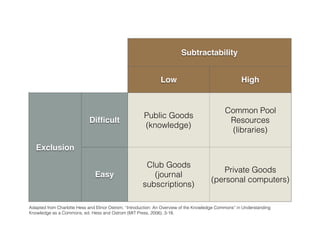
Adapted from Charlotte Hess and Elinor Ostrom, “Introduction: An Overview of the Knowledge Commons“ in Understanding
Knowledge as a Commons, ed. Hess and Ostrom (MIT Press, 2006), 3-18.
Subtractability
Low High
Exclusion
Difficult
Public Goods
(knowledge)
Common Pool
Resources
(libraries)
Easy
Club Goods
(journal
subscriptions)
Private Goods
(personal computers)
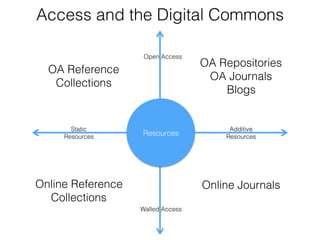
AdditiveStatic
Open Access
Walled Access
G
overnance
O
w
nership
Regim
e
Econom
y
SocialNetw
orks
SocioculturalStructures
Open
Knowledge
M
aterialInfrastructure
The Ecology of
the Knowledge
Commons
Resources
Additive
Resources
Static
Resources
Open Access
Walled Access
OA Repositories
OA Journals
Blogs
Online Reference
Collections
Online Journals
OA Reference
Collections
Access and the Digital Commons

Digital commons

  • 1.
    The Digital Commons JasonM. Kelly PhD FSA Director, IUPUI Arts & Humanities Institute Associate Professor of British History, IUPUI jaskelly@iupui.edu | @jason_m_kelly
  • 2.
    John Constable. BranchHill Pond, Hampstead Heath. ca. 1820. Oil on canvas. 54 x 76.9 cm. Fitzwilliam Museum, Cambridge “Picture a pasture open to all. It is to be expected that each herdsman will try to keep as many cattle as possible on the commons. Such an arrangement may work reasonably satisfactorily for centuries because tribal wars, poaching, and disease keep the numbers of both man and beast well below the carrying capacity of the land. Finally, however, comes the day of reckoning, that is, the day when the long-desired goal of social stability becomes a reality. At this point, the inherent logic of the commons remorselessly generates tragedy. As a rational being, each herdsman seeks to maximize his gain.” Garrett Hardin, “The Tragedy of the Commons,” Science 162, no. 3859 (December 1968): 1243-48
  • 3.
    John Constable. BranchHill Pond, Hampstead Heath. ca. 1820. Oil on canvas. 54 x 76.9 cm. Fitzwilliam Museum, Cambridge “Although tragedies have undoubtedly occurred, it is also obvious that for thousands of years people have self-organized to manage common- pool resources, and users often do devise long-term, sustainable institutions for governing these resources.” Elinor Ostrom, et al., “Revisiting the Commons,” Science 284, no. 5412 (April 1999): 278-82
  • 4.
    What are the DigitalCommons? Writing Studies Tree, http://writingstudiestree.org/network, accessed 6 March 2014
  • 5.
    The Digital Commonsare those spaces, principles, and practices that allow the free exchange of knowledge in the digital environment.
  • 6.
    This free exchangeof information is often referred to as open access. However, the term open access often elides the complex material and cultural infrastructures that both create and maintain the digital commons.
  • 7.
    A Short Historyof Open Access and the Digital Commons Richard Cumberland uses the term “open access” to refer to access to information through the press 1787 “Open Access” to stacks debated at the meeting of the American Library Association 1899 1900 As part of the anti- copyright movement, Tolstoy supports a publisher who printed his work with “no rights reserved” The Open Source begins with the GNU Manifesto 1983 2001 Budapest Open Access Initiative 2003 Bethseda Statement on Open Access Publishing and Berlin Declaration
  • 8.
    Johann Peter Hasenclever.Das Lesekabinett (The Reading Room). 1843. 71 x 100 cm. Nationalgalerie, Staatliche Museen zu Berlin “The bourgeois public sphere may be conceived above all as the sphere of private people come together as a public; they soon claimed the public sphere regulated from above against the public authorities themselves, to engage them in a debate over the general rules governing relations in the basically privatized but publicly relevant sphere of commodity exchange and social labor.” Jürgen Habermas, The Structural Transformation of the Public Sphere: An Inquiry into a Category of Bourgeois Society, trans. Thomas Burger (Cambridge Massachusetts: The MIT Press, 1989), 27
  • 9.
    William Hogarth, “AnElection Entertainment” from The Humours of an Election series, 1755. Sir John Soane Museum, London
  • 10.
    Adapted from CharlotteHess and Elinor Ostrom, “Introduction: An Overview of the Knowledge Commons“ in Understanding Knowledge as a Commons, ed. Hess and Ostrom (MIT Press, 2006), 3-18. Subtractability Low High Exclusion Difficult Public Goods (knowledge) Common Pool Resources (libraries) Easy Club Goods (journal subscriptions) Private Goods (personal computers)
  • 11.
  • 13.
    Resources Additive Resources Static Resources Open Access Walled Access OARepositories OA Journals Blogs Online Reference Collections Online Journals OA Reference Collections Access and the Digital Commons