A
PROJECT REPORT
A
PROJECT REPORT
ON
DIGITAL BRANDING
Submitted in partial fulfillment of
Bachelor of Management Studies
To
Sanpada college of Commerce and Technology
Under the Supervision of
Mr. Abdul Rahim
Submitted By
DEEPAK P. SHETTY
(Bachelor of Management Studies)
2014-15
2
ACKNOWLEDGMENT
The Market study for DIGITAL BRANDING. has been given to me as
part of the curriculum for Bachelor of Management Studies (BMS). I
have tried my best to present this information as clearly as possible
using basic terms that I hope will be comprehended by the widest
spectrum of researchers, analysts and students for further studies.
I have completed this study under the project guidance of Prof.
Abdul Rahim; I will be failed in my duty if I do not acknowledge the
esteemed scholarly guidance, assistance and knowledge I have
received from them towards fruitful and timely completion of this
work.
My acknowledgementmay not redeem the debt I owe to my parents
for their direct/indirect support during the entire course of this
project.
I also thankful to my friend who helped me a lot in the completion of
this project.
Deepak P. Shetty
3
TABLE OF CONTENTS
Sr.No Particulars Pages
DIGITAL BRANDING
1.0 Introduction 6
2.0 GROWTH OF INTERNET AS A MARKETING
MEDIUM
8
3.0 MARKETING TO THE DIGITAL CONSUMER 39
4.0 BUILDING DIGITAL BRANDS 44
5.0 Building Trust in Brands 56
6.0 CASE STUDY - C2W & Hungama 68
7.0 RESEARCH METHODOLOGY and
limitations
72
8.0 SUGGESTIONS 88
9.0 Conclusion 89
10.0 Bibliography 91
11.0 QUESTIONNAIRE 92
4
1.0 INTRODUCTION
Online has always taken a back seat to offline in brand building. Yet
online offers the best options for building a meaningful brand,
options that didn't exist only a few years ago. Companies without a
solid digital brand strategy are literally being left behind as leaders
build new digital brands.
Reflecting on the current state of online advertising, the majority of
online marketers are doing a terrible job of building their digital
brands. Advertisers are fighting tooth and nail to produce the
world's worst advertising, actually destroying their existing offline
brands in the digital realm.
For the most part, if one looks at ads that run during top TV
programs or that appear in top magazines, one will find quality in
the advertising (even if the ads are a bit dry and boring). But if one
looks at a top web site and views a few dozen ads, it will be very
difficult to find quality advertising. In effect, the bulk of the ads
online do more harm than good to the brands they are trying to
build.
In one industry after another, aggressive Internet upstarts are
putting established brands at risk, creating very strong brand
recognition and enjoying explosive visitor growth. The reason may
have less to do with the established brands themselves than with
their managers. Marketers know what a brand is in the physical
world: the sum, in the consumer’s mind, of the personality,
presence, and performance of a given product or service. These "3
5
Ps" are also essential on the World Wide Web. In addition, digital
brand builders must manage the consumer’s on-line experience of
the product, from first encounter through purchase to delivery and
beyond. Digital brand builders should care about the consumer’s
on-line experiences for the simple reason that all of them—good,
bad, or indifferent—influence consumer perceptions of a product’s
brand. To put it differently, on the Web, the experience is the brand.
If a consumer buys lipstick from a retailer in the physical world and
has an unpleasant in-store experience, she is more likely to blame
the retailer than the manufacturer. But if the consumer purchases
that same product from Procter & Gamble’s Reflect.com Web site,
her wrath is more likely to be directed at P&G. Thus the on-line
marketer’s objective shifts from creating brands—at least as
defined in the off-line world—to creating Internet businesses that
can deliver complete, and completely satisfying, experiences. Yet
many marketers, particularly those whose experience is limited to
the off-lineworld, lack a coherent framework and concrete methods
for achieving the broader objectives of on-line brand building.
These marketers need an approach for aligning the promises they
make to consumers, the Web design necessary to deliver those
promises on-line, and the economic model required to turn a profit.
These three elements—the promise, the design, and the economic
model—together form the inseparable components of a successful
Internet business, or what might be called a digital brand.This
project is an attempt to propose to the industry the right approach
to build and sustain their brand in an online environment.
6
2.0 GROWTH OF INTERNET AS A MARKETING
MEDIUM
How much impact is the Internet really having on advertising and
marketing? Is it just another emerging niche medium with some
peculiar creative capabilities and constraints? Or might it transform
consumer marketing in the same way that network television
revolutionized consumer culture and commercial practice four or
five decades ago?
Interviews with marketers reveal that few believe the Internet will
change their approach to advertising. Most see it as little more than
a complement to traditional marketing practices, and don’t expect it
to reduce expenditure on broadcast and print media or change the
form, pricing, or delivery of advertisements. Their view is probably
a reaction to the early hype about the Internet and the World Wide
Web, which created unrealistic short-term expectations among
marketers and frustration with the
inadequacies of the delivery technologies
among consumers.
We take a contrary view. We believe that
Internet advertising will account for a
growing proportion of overall advertising expenditure. Moreover,
advertising — and marketing in general — will adopt practices first
developed or deployed on the Internet. As the technology improves,
the impact of Internet advertising will increase and become easier
to measure, and the gap between this new precise, interactive
7
marketing capability and conventional "fuzzy" passive media will
widen. Over the next few years, advertising agencies and consumer
marketers willbe under pressure to change their whole approach to
marketing communications.
Marketers will become more accountable for their results, and they
will pay more attention to building a total customer relationship.
Offering consumers value in return for information will become
vital in eliciting their preferences, which in turn will be critical to
customizing advertising. And companies’ entire marketing
organizations will be progressively redesigned to reflect
interactions with consumers on the Internet.
For ad agencies, fees based on results will become standard. The
economics of Internet advertising are likely to make current
business models obsolete. New capabilities will be required as
creative production speedsup and becomes more closely integrated
with marketing activity. A deep understanding of enabling
technologies will become a prerequisite for fresh forms of
advertising.
Our views on the evolution of Internet advertising and its impact on
traditional marketing may seem provocative to some, premature to
others. But the intriguing marketing experiments taking place on
and off the Internet suggest it is time for consumer marketers to
begin looking to networks for new ways of thinking about the
marketing theories and approaches on which they have long relied
8
— and to begin capturing the lessons Internet advertising holds for
all their advertising practices, online and conventional.
2.1. CAUTION: CHANGES AHEAD
Looking at today’s Internet advertising to predict what tomorrow
will bring is about as helpful as using a rear-view mirror to watch
the road ahead. But a point of view about what online advertising
will look like in three to five years’ time can and should influence
currentmanagementA number of fundamental forces are currently
reshaping Internet advertising: the near-daily emergence of new
technologies that improve measurement, targeting, and data
interpretation; the strenuous efforts of primarily entrepreneurial
marketers to make business use of the Web; and the establishment
of patterns in consumers’ use of these new interactive networks.
Thanks to the impact of these forces, tomorrow’s ads will differ
from today’s in the shape they take, in the metrics available for
gauging their effectiveness, and in the pricingstructure that governs
their purchase and sale.
I. New Shapes
The first and most obvious change in advertising will be in what
consumers see on their screens. Ads are likely to change in terms of
their content, the type of customization they employ, and their
delivery to the consumer.
9
II. Content
Aspirations to transcend today’s form of Internet advertising will
first be realized in the content of ads. The development of new
technologies such as virtual reality and chat, coupled with
consumers’growing preference for material that is directly valuable
to them, is driving the emergence of new forms of content. Three
main types are on the horizon: experiential, transaction-oriented,
and sponsored content.
Experiential content will allow consumers to "experience" the
ownership of a product, service, or brand. The best current
Examples let the user test out a product. Sharp’s Web site offers a
personal tour of the Zaurus personal digital assistant in which
consumers can input calendar or address information exactly as
they would if they used the product in real life. At The Gap’s site,
customers can "try on" outfits and mix and match separates from
the current range. In the future, technologies such as virtual reality
will make ads even more experiential: customers will feel as though
they are test-driving a new car, or walking down the aisles of a
grocery store.
Transaction-oriented content will invite consumers to make a
purchase directly from an ad. Advertising content will become
increasingly oriented toward transactions. Indeed, the Internet may
already be changing consumers’ buying behavior, particularly for
considered purchases such as cars. Prospective car buyers who are
looking for product information before making a decision can
10
obtain more information more quickly through the Internet than by
any other means currently available. Having done their research in
advance, they are more ready to buy at the point when they actually
encounter a manufacturer or seller.
The implication for marketers is simple: they need to make it
possible for consumers to carry out transactions easily and
seamlessly, or risk losing sales to competitors. Consider Casio,
which uses Virtual Tag technology developed by First Virtual to
enable customers to make purchases from an Internet banner ad.
An Internet user can learn about Casio products, purchase a watch
on line, and select the means of delivery without ever leaving the
banner.
Sponsored content will blur the line between editorial matter and
advertising. A lot of sponsored content already exists on the
Internet — for Example, Nissan sponsors weekly soccer tips on
Parent Soup in association with the American Youth Soccer
Association — but by and large it tends to resemble the "brought to
you by ABC" model familiar from traditional media. The emergence
of advanced forms of hybrid commercial–editorial content will be
driven by consumers’ ability to "tune out" straightforward
commercial messages, be they banners, interstitials (ads that pop
up while users wait for a requested Web page to appear), or
standard forms of sponsorship, and by advertisers’ desire to
influence attitudes in more subtle ways.
11
By way of analogy, consider the growing use of product placement
in films and television (James Bond drives a BMW Z3 in his latest
movie) as marketers seek to make their offerings stand out from the
clutter of ads and break through the cognitive filters that allow
consumers to discount ordinary commercials. The network
environment offers ample scope for hybrid content: entire sites can
be funded and co-managed by advertisers (as with Procter &
Gamble and Parent Time), while avatar technologies bring
advertisers into chat rooms. However, the issue of editorial
independence and the possibility of consumer rejection or backlash
may ultimately set limits on the pursuit of this approach.
III. Customization
Anyone who has been offered a credit card they already hold can
appreciate the need for greater customization or "addressability" in
mass-market advertising, and even in direct mail. Indeed, the level
of responsethat advertisersreceive largely depends on the accurate
and timely targeting of messages, as do the number of transactions
and the degree of loyalty that are generated.
The Internet is supposed to enable marketers at last to target their
offers to that elusive "segment of one." Yet advertising on the
Internet has so far been targeted mainly on the basis of editorial
content, just as it is in traditional media. Part of the reason is
technical, though the development of tracking software that allows
ads to be delivered only to target audiences is overcoming this
obstacle. Consumers’ reticence has been a further barrier, but as
12
2.1 Internet Advertising Objectives
Internet users grow more willing to provide information about
themselves, two types of customized content will emerge.
First, content will be customized by means of information inferred
about users. The Ultramatch technology recently launched by
Infoseek, to take one Example, makes it possible to target those Web
users who are most likely to respond to a given ad. Based on neural
networking technology, Ultramatch observes users’ behavior when
they put out queries and explore subjects, collecting the results in
its database. Advertisers using the service can select individuals
according to their interests and thus pitch their campaign to a
receptive audience. Ultramatch also allows them to ascertain which
individuals are responding to ads, and to move the ads to places
where they will attract similar users.
Second, ads will be customized on the
basis of information voluntarily
provided by users. The key to making
this approach work will be to
overcome consumers’ desire for
privacy or anonymity by offering
them rewards for personal details in
the form of special information,
discounts, or promotions. On Parent
Time, for Example, users who enter
the ages of their children receive
relevant care information as well as
13
Pampers ads geared to those age groups. Experience suggests that
consumers are willing to release information about themselves as
long as they are the prime beneficiaries. Organizations such as
etrust (an initiative sponsored by leading companies to develop
electronic commerce) and the Internet Marketing Council take a
similar view. The IMC requires marketers to provide a "giveaway"
or discount before they can gain certification. This scheme is
specifically designed to preventinformation provided by consumers
from being misused in e-mail.
14
IV. Delivery
The recent hype about "push" technology on the Internet might
suggest that this will be the dominant vehicle for delivering
advertising on the Web. We believe the reality will be more
integrated, combining today’s "pull" format Web sites with "push"
technology such as PointCast to deliver ads to people according to
their interests. Triggered banners (ads that appear when certain
key words are mentioned) and interstitials are early Examples that
point the way. Consider how one automaker’s ads are pushed to
chatroom participants when the topic of cars comes up, or how a
user waiting for content to be downloaded is sent an ad related to
that content.
Marketers must ask themselves a number of questions: What is the
right balance? Where can push technology be exploited most
effectively? How much push are users willing to take before they
begin to tune out?
As online advertising develops, advertisers will discover that the
Internet is the only medium that can deliver certain types of
message, such as multi sensory and interactive ads. These new
formswill allow advertisers to achieve several objectives — some of
them unattainable via conventional media — simultaneously
(Exhibit 2.1). They are likely to make Internet advertising more
important in the overall marketing mix as marketers capitalize on
their unique capabilities. At the same time, our glimpse of the
emerging future casts doubt on the merit of current heavy
15
investments in big brand sites that require content to be "pulled," or
in banner ads that — like most on the Internet today — merely
replicate the forms of advertising that exist in the physical world.
V. New Metrics
The Internet affords marketers an unprecedented opportunity to
measure the effectiveness of their advertising and learn about their
viewers. The capacity to measure impact sets the Internet apart
from other media. Measurements available for television, for
Example, estimate the total size of an audience; what they don’t do
is tell an advertiser how many people actually saw an ad, or what
impact it had. On the Internet, by contrast, marketers are able to
track click-throughs, page views, and leads generated in close to
real time. The result: measurements those are more precise and
meaningful than anything available in traditional media.
The emergence of these new metrics will affect not only ads
themselves, but also the way that marketers and agencies develop
them. First, more precise measurements will yield better insights
into the effectiveness of advertising spend. It will be easier to
identify ads that don’t work, and to find out why. Advertisers will
also start to expect the content of ads to be renewed more
frequently in response to audience reaction.
A new product from Infoseek offers a hint of things to come. Copy
Testing in a Box is a tool that combines the immediate feedback of
the Internet with sophisticated targeting technology to allow
16
marketers to refocus their Internet campaigns to the most
responsive customer segments within a matter of days.
Second, advertisers will be able to assess the impact of their ads
earlier in the spending cycle. As a result, they will have the
flexibility to launch and roll out a campaign in such a way that it can
be changed before most of the money is committed. This will affect
the very process of creating Internet ads, and perhaps spur
advertisers and agencies to devise new ways of organizing around
it.
VI. New Pricing
Whereas marketers tend to have fairly uniform objectives in
traditional media, such as shaping attitudes in television or
obtaining responses in direct mail, the Internet, as we have seen,
allows them to pursue several different goals simultaneously. In the
same way, the standard types of pricing used in traditional media,
such as CPM (the cost of exposing a message to a thousand viewers
of TV or readers of print), will give way on the Internet to pricing
that varies as widely as the objectives of the ads themselves. Indeed,
the technology can supportseveralpricing mechanisms at once: pay
per click-through, lead, transaction, dollar spends, or conventional
CPM. This kind of variegated pricing is already appearing in the
marketplace: P&G has pushed for pricing per click-through; CD Now
pays Web sites commissions on the transactions they generate; and
Destination Florida pays according to leads generated. Similarly,
DoubleClick is introducing an advertising network, DoubleClick
17
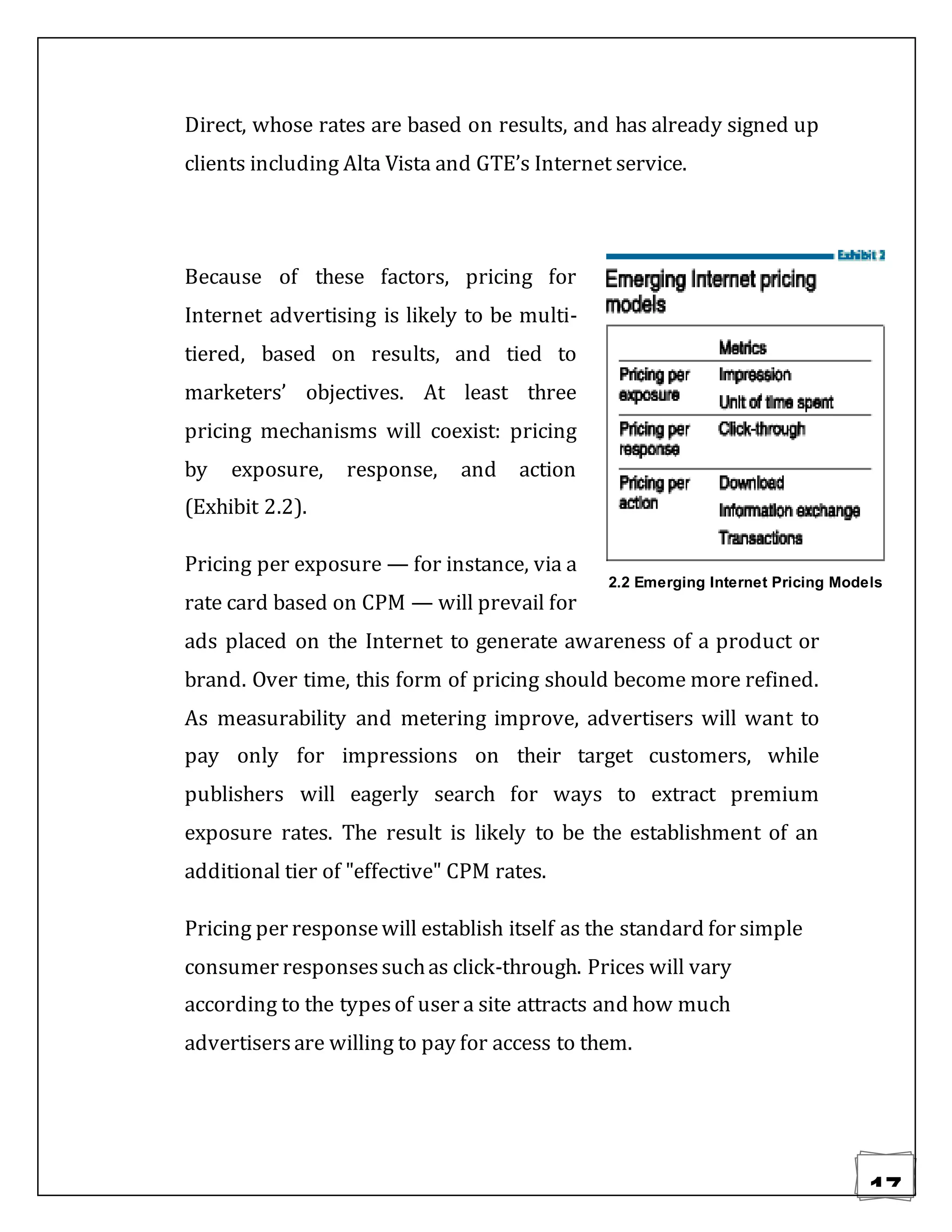
2.2 Emerging Internet Pricing Models
Direct, whose rates are based on results, and has already signed up
clients including Alta Vista and GTE’s Internet service.
Because of these factors, pricing for
Internet advertising is likely to be multi-
tiered, based on results, and tied to
marketers’ objectives. At least three
pricing mechanisms will coexist: pricing
by exposure, response, and action
(Exhibit 2.2).
Pricing per exposure — for instance, via a
rate card based on CPM — will prevail for
ads placed on the Internet to generate awareness of a product or
brand. Over time, this form of pricing should become more refined.
As measurability and metering improve, advertisers will want to
pay only for impressions on their target customers, while
publishers will eagerly search for ways to extract premium
exposure rates. The result is likely to be the establishment of an
additional tier of "effective" CPM rates.
Pricing per responsewill establish itself as the standard for simple
consumer responsessuchas click-through. Prices will vary
according to the typesof user a site attracts and how much
advertisersare willing to pay for access to them.
18
Pricing per action is similar, but more elaborate. A site publisher
might charge an advertiser more for a consumer who downloadsa
piece of softwareor providessomedemographicinformation, say,
than for onewho merely clicks on a banner. We believe that the
ability of Web publishersto charge advertisersfor the true value
they receive is likely to makethe differencebetween profitand loss.
The pricefor a lead generated, for instance, could reflect the
prospect’spotential lifetime value; if it did, sites would charge
automotiveOEMs and white goods manufacturersdifferentprices
for prospect leads. As a result, a fee per action or sales commission
is likely to emerge as a major pricing mechanism for Internet
advertisingover time.
How quickly and how far these models take hold in the near term
will depend on how risk is shared between marketers, agencies, and
sites. Results-based pricing gives marketers the opportunity to shift
some of the risk of failure to sites or agencies. Publishers and
broadcasters in traditional media have usually been loath to take on
this kind of risk. However, Internet publishers should find risk
sharing attractive if it is appropriately priced, as it could boost the
advertising revenues on which their success depends.
Pricing in general is fraught with issues. Will site publishers
demand a degree of control over the creative execution of ads to
ensure quality, for instance? We believe that the sharing of risk in
Internet advertising will ultimately be determined by the prevailing
balance of power, which will vary from advertiser to advertiser and
19
site to site, and shift over time. Large, well-known, "safe"
advertisers may be able to secure results-based pricing more easily
than others, particularly at times when site publishers are
struggling to make their economics work.
It will be in the best interests of marketers, site publishers, and even
agencies to prevent the lowest common denominator setting the
industry’s pricing standard. To settle for a simplistic,
unsophisticated, "one size fits all" pricing scheme would mean
leaving a lot of money on the table. The widespread acceptance of
multi-tiered, performance-based pricing will make the Internet both
distinctive and highly lucrative as an advertising medium.
2.2. THE SPILLOVER EFFECT
The changes now taking place in the shape, measurement, and
pricing of advertising on the Internet may seem dramatic enough in
themselves, but we believe they will have a much broader impact on
marketing practices in general. This spillover effect will occur for
four reasons.
First, new ways of advertising on line will inspire new creative
approaches elsewhere. Second, the Internet will prompt marketers
to reevaluate their use of traditional media. Third, Internet
advertising will help marketers to improve their understanding of
consumers’ needs, preferences, and product usage. Finally, once
marketers get a taste for the measurability of Internet ads and the
tailored pricing it enables, their expectations of the effectiveness
and measurability of other media will rise.
20
I. New Creative Approaches
The timeliness and direct tone of advertising on the Internet will
increasingly inspire marketers operating in other media. Seeing the
daily updates of information that the Web makes possible and the
lengths to which online advertisers must go in order to keep users’
interest (for instance, renewing banners weekly) may sharpen their
appetite for replicating Internet practices on TV and in print.
The notion that creative approaches pioneered on the Web will spill
over to moretraditional media should surprise few. Historically, the
emergence of new media has always prompted content changes in
existing media. Consider how print changed after radio, and later
television, arrived on the scene.
Fidelity Investments recently attempted to mimic the immediacy of
the Internet in its television advertising. It refreshed its ads on a
daily basis by incorporating current news headlines. However, the
campaign met with mixed success, perhaps because it lacked a
distinctive point of view.
Marketers’ adoption of creative techniques pioneered on the
Internet will grow as technologies like broadband, WebTV, and
virtual reality begins to influence traditional media. Wink and
Worldgate are developing technologies that allow viewers to "save"
a commercial to watch later, or to obtain more detailed information.
These technologies are in their early test stages on television.
21
The enormous creative flexibility offered by the Internet will
increase pressure for more choices of delivery in traditional media.
The (probably apocryphal) story of Helena Rubenstein asking to
buy an extra three seconds for a 30-second spot to realize her
creative vision suggests how we may start to question accepted
standards and constraints in traditional media.
Marketers may also need to reexamine the theories that underpin
their advertising practices. As we noted, online advertisers have
found that banners must be renewed frequently if consumers are to
keep clicking. Their experience defies the conventional wisdom in
advertising that any ad must be seen at least four times to make an
impression. On the Internet, greater impact can be achieved by
showing a wider range of ads that are repeated less often. Insights
like this cast doubt on the effectiveness of current television
campaigns, most of which are still based on old ideas of frequency.
II. Reevaluating Media Investments
Everyone has heard the advertiser’s lament: "I know 50 percent of
my advertising is working; I just don’t know which 50 percent." The
greater measurability of Internetadvertising will prompt marketers
to reevaluate all their investments in media, especially in the
addressable categories of print and direct marketing. Not only are
response rates often higher in Internet advertising, but the cost of
reaching target customers can be lower, with better information
received in return. As a result, we may well see a migration of
22
targeted marketing spending from direct mail and other traditional
media to the Internet.
Consider a recent Example. AT&T used the Internet to generate
awareness of and shape attitudes toward its toll-free collect-call
service, which is mainly targeted at 16- to 24-year-olds. The
company had previously found this audience difficult to reach cost-
effectively through print or broadcast media. The results of the
online effort were excellent. Top-of-mind awareness increased by
over 30 percent, and AT&T opted to replace its print advertising
with an Internet campaign.
The traditional approach to customer response and lead generation
has been to use ads in trade magazines and customer response or
"bingo" cards. However, findings announced by one large publisher
of trade titles indicate that more than two-thirds of bingo cards
either go unanswered or are not responded to promptly because of
the time it takes to qualify and manage leads. The study suggests
that the Web is an excellent tool for generating quality leads and
may even supersede bingo cards in time.
Migration of this kind will reallocate the slices of the advertising pie.
Interviews we conducted with marketers reveal that most believe
their initial spending on the Internet did not come at the expense of
other media (in other words, their overall advertising budget grew).
But many expect that future increases in their Internet expenditure
will be taken from other areas, probably print and/or direct
23
marketing. They also see their Internet advertising budgets growing
much faster than their traditional media budgets.
24
Migration may also take place in non-addressable media spending.
Striking levels of media displacement are already evident among
Internet users. Most notably, TV viewing has declined among a third
of adult Internet users (Figure 2.3). Similarly, in a recent Wall Street
Journalpoll, 21 percentof respondentscited spendingmore time on
their computer or in using online services as a reason for watching
the major TV networks less than they did five years earlier. When
marketers accept the idea that brand building can be accomplished
on line, some spending on TV, radio, billboards, and other non-
addressable media may migrate to the Internet.
2.3 Declines in Usage of Traditional Media
25
III. Getting Closer To The Consumer
We believe marketers will soon start to use the Internet as a kind of
testbed for campaigns planned for print, TV, or radio. One leading-
edge marketer, London International, the maker of Durex condoms,
is already trying out advertising concepts on its Web site before
transferring them to other media where their effectiveness is
harder to track. It is testing three concepts ultimately destined for
conventional media: "On-line Lovers," "Dr Dilemma," and "The
Nurse." By monitoring pages selected, click-throughs, responses
generated, and other indicators, the company is able to discover
which parts of a prospective campaign work and which don’t,
thereby reducing the risk of launching the equivalent of a box-office
flop.
Conducting market research and obtaining feedback from
consumers can be expensive and difficult. The Internet offers cost-
effective alternatives to conventional methods, and may yield more
revealinginformation. Several of the marketers we interviewed said
that their presence on the Web had taught them a tremendous
amountabout their customers’ views of their products and services.
They maintain that the Web offers a non-judgmental way of
providing feedback and ideas, and is less intimidating for
consumers to use than standard toll-free numbers.
Marketers at Fidelity, London International, and Coors found that
users of toll-free numbers mainly called to ask questions about
26
products. On the other hand, Internet users, even when given
answers to the most frequently asked questions, would often
provide feedback about the quality of a product, new variations on
it, and ways that it might be changed. To be sure, some of the
additional interaction may be down to the different demographic
profile of Internet users, but gathering information of this kind is
becoming an increasingly important way to use the Web.
To gather deeper feedback, marketers are experimenting with
Internet focus groups. LiveWorld has already hosted several
sessions for NFO, a company specializing in this area. The advantage
of conducting a focus group on line is that participants are
anonymousand can speak their mind without worrying what others
in the group think. In addition, geographically dispersed
participants can be assembled at a fraction of the usualcost. London
International is planning to conduct an online focus group to assess
the effectiveness of its Web efforts in the near future.
Finally, the opportunities for testing new product ideas on the
Internet are legion, particularly for electronic or intangible items
such as magazine covers, entertainment concepts, and personal
financial services. The possibilities are just beginning to be
exploited.
IV. Rising Expectations
Two features of Internet advertising — the measurability of its
impact and the probability of some form of results-based pricing
27
emerging — are likely to raise marketers’ expectations of
traditional media. If they do, pressuremay build for a more accurate
measurement system or a shorter measurement cycle. The demand
for greater accuracy in measurement is already coming from the
broadcast networks in any case. The coding technology tests being
carried out by SMART (the emerging competitor to Nielsen), by
Nielsen itself, and by its joint effort with Lucent to develop Media
TraX indicate that improvements are technically feasible.
In fact, it would not be surprising if new measurement tools and
techniques originally designed for the Internet were to spill over
and be applied to traditional media in the not so distant future.
Moreover, in those traditional media that are already more
measurable, such as print, we foresee increasing pressure from
advertisers for results-based or tiered pricing like that offered on
the Internet.
The developments we have described are necessarily speculative,
and may not materialize as broadly or as quickly as we suggest. All
the same, they are worth watching out for because of their
implications. Mostof the mediaindustry is affected by the billions of
dollars spent every year on consumer marketing. If key advertisers
were to reallocate their media budgets, the impact on traditional
media could be profound.
As the aspirations, techniques, and expectations associated with
Internet advertising spill over into traditional media, both
28
marketers and advertising agencies will have to rethink the
capabilities they bring to bear on selling products and services.
2.3. IMPLICATIONS FOR MARKETERS
The growing importance of Internet advertising and its effect on
conventional marketing will have profound implications for
practitioners. First, the Internet model will set new standards for
building relationships in the physical world, challenging many
current practices and expectations. Second, a new concept, value
exchange, will emerge as a core marketing capability. Finally, the
move toward organizational structures and processes designed
around consumers’ experiences with specific products or services
will accelerate further.
I. New Standards In Relationship Management
The Internet will set new standards for total relationship
management in both breadth and depth. "Breadth" means that a
relationship will increasingly last for the entire ownership
experience, including the time before and after the purchase of the
product or service. Consider Coors, which used consumer feedback
received via the Web during both the development and promotion
of its beverage Zima — thus involving customers at all stages in the
product life cycle.
"Depth" reflects the degree of interaction with consumers at any
given point in their experience of a product. The book retailer
Amazon.com, for instance, is beginning to use the information it
29
gleans from customers to create value-added services such as
suggestions about books that a particular reader might enjoy. This
raises the bar for competitors on the Internet and in the physical
world, posing a challenge that other players must meet if they are to
retain customers’ loyalty.
The Internet’s role in consumer relationship management has
importantconsequences for marketers. Network-based interactions
must be integrated into the rest of a business, with all that this
entails.
If car purchasers make fewer trips to the showroom, say, doing
their own online research into different models instead of talking to
salespeople, dealers will need to rethink the way they manage the
whole consumer relationship. Eventually, customers may go to
them only to place an order; at this point, the role dealerships play
may no longer justify their cost, and they will have to find new ways
to offer buyers value if they are not to disappear. Moreover, as
consumers’ behavior changes, so will the skills that salespeople
need. And how are those salespeople going to be compensated
when consumers make their purchases through channels other than
dealerships?
Design and funding is another key area. If the Internet’s role is to
grow beyond advertising, the design of online activities should
probably not be constrained by the priorities of a single functional
area such as marketing, or by the limitations of the marketing
communications budget.
30
II. Value Exchange As A Core Capability
Much of the Internet’s potential relies on the creation of a dialogue
between consumer and marketer in which information is exchanged
for value. Marketers need to develop the new skill of rewarding
consumers for giving them access to personal information such as
who they are, what they like, and what they buy. This reward may
take the form of discountstoward futurepurchases, or benefits such
as valuable information or a personalized product or service.
This process of value exchange will become critical as new
standards are created to protect consumers’ privacy. The proposal
announced by Netscape in May 1997 to capture information on
consumers’hard drives rather than on marketers’ computers marks
a step in a new direction with its implicit acknowledgement that
consumers will "own" information about themselves and control
the release of that information to marketers. The demand for value
among consumers is likely to grow as they become aware of how
highly marketers prize their demographic profiles, product
preferences, and transaction histories.
A few marketers are beginning to manage this process effectively. In
exchange for basic information such as name, address, age, and
income, Vogue provides readers with discounts, special offers, and
previews of forthcoming articles. Saturn’s approach is to offer
convenient access to information. Consumers who reveal a small
amount of information about themselves are able to use Saturn’s
31
interactive pricing center to research new cars, saving them trips to
a showroom.
III. Organizations Centered On Consumers
As the Web merges marketing with other business processes such
as customer service, it will putmorepressure on the organization of
most marketers. The coming of age of interactive networks will
accelerate the move toward new organizational models in which
marketers willstructure their variousfunctionalcapabilities around
an integrated customer front end.
For a real-life Example, take the insurance company USAA. Its
customer center receives and manages all communications with
consumers, whether direct via telephone, mail, and the Internet, or
indirect via intermediaries. The rest of the organization revolves
around the customer center. Sophisticated information systems
help the company to process interactions and maximize their value.
The benefits are many. Customers feel that USAA knows them
better, and the company is quick to respond to a complaint or learn
about important market changes such as a cut in a competitor’s
price in a particular territory.
As more and more companies reorganize themselves around their
customers, intranets linked to the Internet will become crucial. They
will make it economically feasible for managers within an
32
organization to have more information about consumers — and
more interactions with them — than ever before.
2.4. IMPLICATIONS FOR AGENCIES
The rise of Internet advertising, with its unique economics, may
well call the validity of current business models and processes into
question. It will also compel agencies to rethink the way they create
and develop campaigns, and the skills and capabilities they need to
survive.
I. New Business Model
So different are the revenues generated by conventional and
Internet advertisements that traditional agencies will have to think
carefully about their approach to online advertising if they are to
pursue it profitably. At present, most agencies incur high fixed costs
in developing campaigns. Big creative teams and the like were fine
in the days when agencies could rely on the commissions they
earned from large media buys associated with a small number of
creative executions. On the Internet, however, this cost structure is
inverted: the creative element of the total advertising cost is much
larger in relation to the media element. The resulting commissions
will no longer be sufficient to cover agencies’ high operating costs.
We believe that traditional agency business models simply will not
work for Internet advertising. A trend toward retainer
compensation is already emerging. Agencies may well seek to
enhance their revenue streams by taking a cut of the results of their
33
efforts in the shape of a commission on leads or sales generated. In
future, agencies will increasingly share in the risk of their
advertising instead of — as they do today — leaving all of it to be
borne by marketers.
II. Compensation models will be transformed. The measurability
of Internet advertising makes results-based pricing more
feasible than in any other media, as we have seen. Some
Examples are already in evidence. Site Specific is using
performance-based contracts for clients including Duracell,
CUC International, and Intuit’s TurboTax division. Though
these arrangements are not yet making it any money, they are
expected to do so as advertising effectiveness increases. In
time, results-based compensation will probably spill over into
traditional media as the measurement of advertising impact
improves. It will then have its most profoundimpact, affecting
agencies’ core business and revenue source.
III. New Capabilities
This vision of the future calls agencies’ current capabilities into
question. Many have seen themselves as the guardian angel of the
brands they represent. But agencies have a patchy record of
orchestrating brand-building activities across the full range of
marketing disciplines: media advertising, direct mail, promotions,
and so on.
34
The emergence of interactive media means that agencies must not
only manage a broader and more complex mix of marketing tools,
but also master radically different skills. Three main gaps will need
to be filled:
1. Inform creative execution with a deeper understanding of
enabling interactive technologies. Such an understandingscarcely
exists in agencies today, except in some of the more specialized
enterprises such as Site Specific and AGENCY.COM. Traditional
agencies may find their technological and creative skills are not
sufficiently integrated to compete with the specialist Internet ad
agencies, which enjoy a higher profile and more confidence
among marketers in this area of work.
2. Integrate one-way and response-oriented campaign design
skills. Interactive advertising blurs the boundaries between
traditional advertising, direct marketing, and customer services
— normally separate preserves run by different individuals.
Agencies will need to learn to integrate these skills in their design
efforts.
3. Increase the speed and responsiveness of creative production.
The immediacy of interactive networks will make growing
demands on the pace and frequency of creative production.
Agencies are currently organized around work processes with
relatively generous cycle times. Today, it is acceptable to take
three to six months to design onecampaign, and to run it for up to
two years. Tomorrow, a campaign with 300 one-on-one
35
executions will have to be designed in two to three months, and
adapted continuously in response to real-time consumer
feedback.
In summary, the future holds many challenges for agencies. The
emergence of new business models and the need for new
capabilities are likely to shake up an industry that has been under
pressure for some time. Some agencies have shown that they can
customize their processes and economics to specific industry needs
like those of grocery retailers or auto dealers. Now they must learn
to institutionalize these capabilities within their organizations or
spin off a cluster of flexible, technology-savvy boutiques with low
fixed costs. Viewed another way, the emergence of Internet
advertising may represent an opportunity for renewal — a chance
for agencies to reclaim the high ground of brand stewardship that
some marketers argue they have let slip away in the past two
decades.
The emergence of Internet advertising is likely to have wider
implications for business than many imagine. Its effects will not be
confined to the online world, but will extend to traditional
marketing activities and processes. For those who look closely,
Internet advertising holds many more opportunities and risks than
is commonly assumed. And the payoff waiting for those who rise to
the challenge will more than justify the efforts required.
36
3.0 MARKETING TO THE DIGITAL CONSUMER
Many companies are waking up to the potential of the interactive
consumer market. Not only are the numbers of users of on-line and
Internet services soaring, but the majority of people who are
subscribing to these services tend to be young, well educated, and
richer than average. In short, they make particularly good
marketing targets.
Interactive media is likely to revolutionize marketing for many
consumer companies because it allows marketers to deliver real-
time, personalized services and content, one consumer at a time. It
is what we call digital marketing. Digital marketing leverages the
unique and powerful characteristics of interactive media: it is
addressable, meaning that each user can be identified and targeted
separately; it allows for two-way interaction; services can be
tailored for each individual customer; and purchases can be made
and influenced on line. However, to capture the benefits of digital
marketing, companies must integrate interactive media into their
existing businesses and marketing programs. And that is difficult to
achieve.
Most consumer companies are struggling to know what to do and
how. The old models of marketing simply do not work in this new
world, and as a result most of today's digital marketing applications
are uninspiring (as anybody who has ever been on the Internet can
probably attest), falling far short of the potential of interactive
media. Research is being conducted to define a new marketing
37
model that will help build and evaluate digital marketing
applications.
3.1. TYPES OF DIGITAL MARKETING
Several broad types of attractive digital marketing opportunities
already exist, and there is evidence that marketer who aggressively
pursue one or more of these opportunities are starting to make
profits.
First, marketers can use interactive media to provide better service
at lower cost by delivering information about a product or service.
UPS, for Example, uses an Internet-based service to allow customers
to track the whereabouts of their packages.
A second opportunity is to build relationships with on-line
consumers. Interactive media can be used to identify attractive
users or prospects (an automotive company can learn the names of
interested car buyers and forward them to the closest dealer); it can
enhance customer loyalty by providing extra services; and
marketers can use what they learn about their consumers to cross-
sell new products or services.
Third, marketers can use interactive media as a new channel. In
1995, Hot Hot Hot, a small company that produces sauces,
generated some 30 percent of its revenue from sales through its
Web site. And using interactive media, airlines are increasingly
bypassing travel agents to sell tickets, thus saving significant
commission costs. For Example, United Connections, a disk-based
38
service allowing travelers to make their own bookings, is estimated
to save airlines up to $50 for a typical $500 round-trip fare.
Digital marketing is an attractive proposition for many more
categories than is commonly assumed. We would argue that digital
marketing can play an important role in any category in which it
makes good business sense to build relationships one consumer at a
time.
3.2. NEED OF A NEW MARKETING MODEL
The traditional 5P-marketing model — price, product, promotion,
package, place — is not particularly helpful to marketers seeking to
capture the benefits of digital marketing. It assumes, for Example,
that communication is one way (from the marketer to the
customer), when interactive media so clearly offers an opportunity
to establish a dialog; it assumes a mass-market environment, when
interactive media allows interaction with individual consumers.
The digital marketing model that has been developed is based on a
pragmatic assessment of what seems to work, and what does not, in
the interactive age. It is built around five apparent factors for
success:
1. Attracting users
2. Engaging users' interest and participation
3. Retaining users and ensuring they return to an interactive
media based service
39
4. Learning about their preferences
5. Relating back to them to provide the sort of customized
interactions that represent the true "value bubble" of digital
marketing (Exhibit 3.1).
This last point is critical as in most cases it will require marketers to
make their digital marketing initiative part of the existing business
system. This presents important internal and external challenges,
such as how to integrate the digital marketing initiatives with
3.1 Attractive Characteristics of Media
40
existing marketing programs or information systems, or how to
manage potential channel conflicts with the sales force or
traditional distributors.
Each of the five success factors suggests a number of issues that
marketers must address.
Example
What are the most effective means to attract users to an interactive
application?
What is the role of branding? How should you choose an Internet
address?
What is the optimal "linking" strategy for a particular marketer?
While the answers to many of these issues will be specific to a given
marketer, research is beginning to identify the factors that allow
companies to get more from their digital marketing efforts.
Over the next three to five years, digital marketing is likely to
become an increasingly significant part of the consumer marketing
landscape. For many marketers it will present formidable
opportunities. For those who cannot keep pace, it might pose a
serious threat. It is therefore imperative that marketers begin to
think about the role of interactive media in their industry, and
prepare to take appropriate action.
41
4.0 BUILDING DIGITAL BRANDS
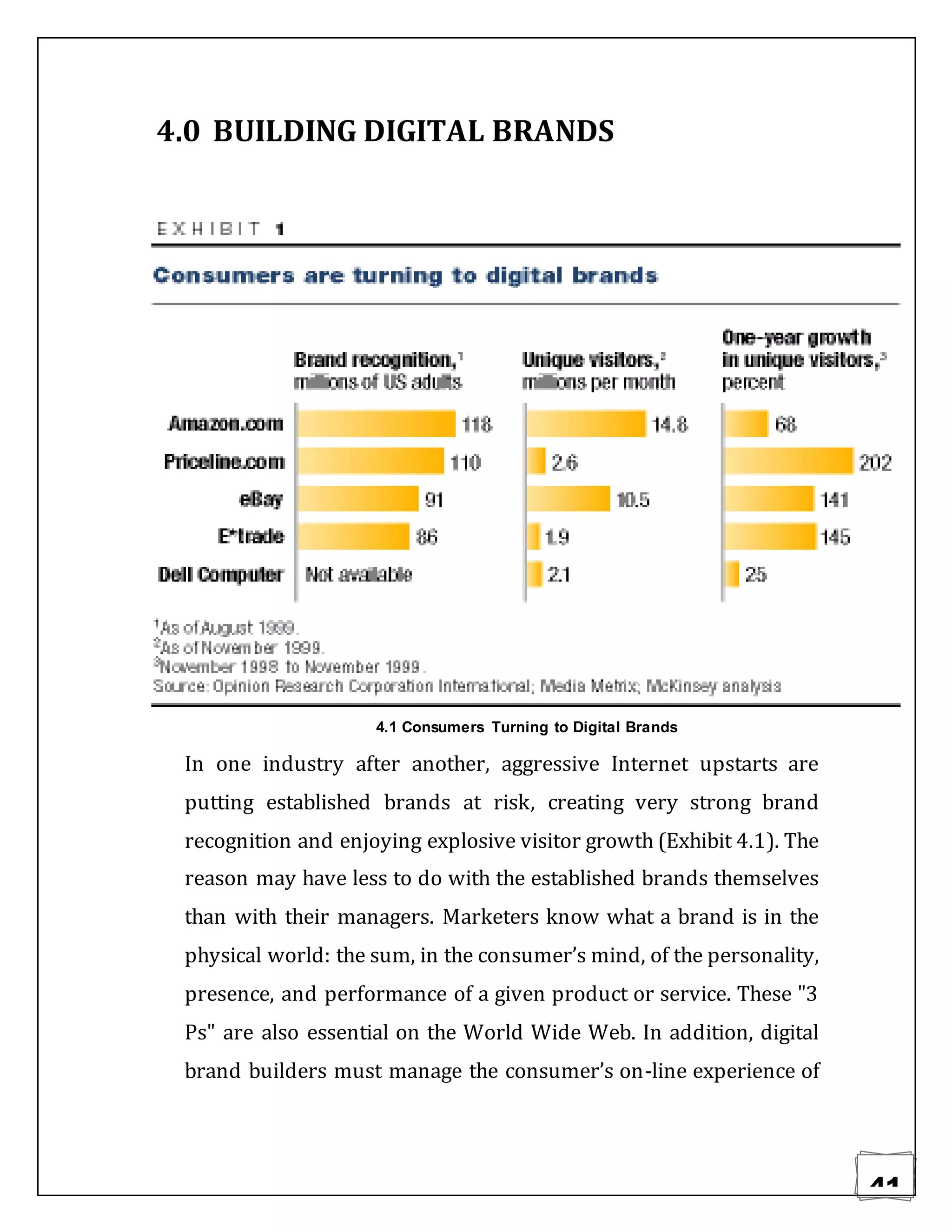
In one industry after another, aggressive Internet upstarts are
putting established brands at risk, creating very strong brand
recognition and enjoying explosive visitor growth (Exhibit 4.1). The
reason may have less to do with the established brands themselves
than with their managers. Marketers know what a brand is in the
physical world: the sum, in the consumer’s mind, of the personality,
presence, and performance of a given product or service. These "3
Ps" are also essential on the World Wide Web. In addition, digital
brand builders must manage the consumer’s on-line experience of
4.1 Consumers Turning to Digital Brands
42
the product, from first encounter through purchase to delivery and
beyond.
Digital brand builders should care about the consumer’s on-line
experiences for the simple reason that all of them—good, bad, or
indifferent—influence consumer perceptions of a product’s brand.
To put it differently, on the Web, the experience is the brand.
Example
If a consumer buys lipstick from a retailer in the physical world and
has an unpleasant in-store experience, she is more likely to blame
the retailer than the manufacturer. But if the consumer purchases
that same product from Procter & Gamble’s Reflect.com Web site,
her wrath is more likely to be directed at P&G. Thus the on-line
marketer’s objective shifts from creating brands—at least as
defined in the off-line world—to creating Internet businesses that
can deliver complete, and completely satisfying, experiences.
Yet many marketers, particularly those whose experience is limited
to the off-line world, lack a coherent framework and concrete
methods for achieving the broader objectives of on-line brand
building. These marketers need an approach for aligning the
promises they make to consumers, the Web design necessary to
deliver those promises on-line, and the economic model required to
turn a profit. These three elements—the promise, the design, and
the economic model—together form the inseparable components of
a successful Internet business, or what might be called a digital
brand.
43
4.1. HOW TO BUILD AND MANAGE DIGITAL
BRANDS?
How do marketersbuild and manage digital brands? The marketer’s
first goal should be to select the core promise for a truly distinctive
value proposition appealing to the target customers. Five of these
promises are especially effective.
Digital brands that make tasks—from buying a book to searching
for the best price—faster, better, and cheaper offer the promise of
convenience. Amazon.com, like most first-generation electronic
businesses, is fundamentally built on this promise.
Brands that make people feel like winners in whatever activities
engage them offer the promise of achievement. E*trade, for
Example, promises to help consumers manage their finances
successfully. It has gone beyond the basics—a portfolio of financial
tools and research—to offer many helpful innovations, such as
securities-tracking and -alert services.
Games and other activities designed to engage (and even thrill)
consumers offer the promise of fun and adventure. Often these
activities make use of "immersive" technologies, which, for
Example, allow electronic spectators of a marathon to hear a
runner’s heartbeat. Digital brands such as Quokka Sports are
building their entire businesses around immersive technologies.
Such companies as GeoCities (which helps consumers express
themselves by building and displaying their own Web pages) offer
44
the promise of self-expression and recognition. Ralston Purina Dog
Chow’s site allows consumers to create home pages that display
pictures of and stories about their pets.
Clubs or communities offer the promise of belonging, as well as
concrete advantages. Women, for Example, can exchange stories
and tips with one another at the iVillage.com site. Mercata.com
provides a more tangible benefit by aggregating the purchasing
power of its community of users and thus helping them get better
prices for a broad range of merchandise.
4.2. FROM PROMISE TO DELIVERY
The promises made by digital brands are not unique to the Internet,
but the medium’s interactive capabilities make it easier for digital
brands to deliver on their promises quickly, reliably, and
rewardingly. They often do so with a scope that their landed
counterparts would be hard-pressed to match. In practice, this
means that promises must be translated into specific interactive
functions and Web design features collectively giving consumers a
seamless experience. Such design features as one-click ordering and
automated shopping help deliver the promise of convenience;
collaboration tools such as chat rooms or ratings functions make it
possible to realize the promise of belonging.
Managers shouldn’t underestimate the challenges of this translation
process. What, for instance, does it mean to build a digital brand
around a promise of convenience in the grocery industry? What
kind of content, if any, do you need? And how about chat rooms,
45
personalization, one-click ordering, and collaborative filtering?
Digital brand builders can’t afford to fall short of what they have
promised, since competitors are always a click away, but they waste
capital if they offer more than is necessary to make sales and keep
customers.
Technology dramatically differentiates digital brands—for both
customersand shareholders—in ways that will become increasingly
clear as they enter their second and third generations. To be certain
of identifying all of the designs that make it possible to deliver on a
promise and to build a viable economic model, today’s digital brand
builders must explore at least six groups of design tools. These tools
are sufficiently robust technologically to help create a distinctive
and relevant user experience, and they are beginning to
demonstrate their ability to make money for the digital brand
builders using them.
I. Personalization Tools
Tools such as the software that creates personalized interfaces
between e-businesses and customers hold tremendous promise for
value exchange and contextual commerce. To be sure, the value of
personalization has yet to be fully demonstrated in practice. (Fewer
than 15 percent of visitors to Yahoo! have chosen to set up a "My
Yahoo!" page for themselves.) Personalization tools also present
risks, as well as real operational challenges, such as managing
privacy, intrusiveness, and opportunity costs. For that reason, many
46
practitioners still question the short-term return on investments in
personalization tools.
I. Collaborative Tools
They facilitate word of mouth, or what might be called "branded
person-to-person communications"—for instance, the ratings that
buyers offer sellers on eBay, the Lands’ End "shop with a friend"
feature, Raging Bull’s discussion boards, and Pert’s viral marketing
(which encourages consumers to e-mail their friends instructions
for obtaining free Pert Plus samples). Collaborative tools such as
consumer ratings, though essential for content- and community-
oriented digital brands, are underutilized.
II. Purchase-process Streamlining Tools
They eliminate such physical-world constraints as the need to walk
into a store to purchase a product. Amazon’s one-click ordering
system, for Example, eases transactions by sparing repeat
customersthe inconvenienceof inputtingtransaction data. Peapod’s
shopping lists save consumers time by recording the products they
purchased previously. The fact that most e-shoppers drop out of the
buying process during the last clicks suggests that improvements
along these lines might be very worthwhile.
III. Self-service Tools
They allow customers to obtain answers and results without
the delays and inconsistencies that more often than not
47
characterize human efforts to provide assistance. Such tools
include software for tracking orders, preparing statements,
and changing addresses on-line. Although incumbents often
have difficulty integrating these Web-based tools with legacy
systems, the tools are indispensable for banks, retailers, and
other e-businesses that handle large volumes of transactions.
IV. Do-it-yourself product design tools
They allow consumers to customize products and services, either
with the help of configuration options or from scratch. Dell
Computer, for Example, lets customers design their own systems
on-line by choosing from a range of options; customers of
Music.com and Listen.com can download the music of various
artists onto a single compact disc. But the need to create
manufacture-to-order systems to capture the potential of these
tools may make them uneconomical in industries that, unlike
software and music, are not based on information.
V. Dynamic-pricing tools
They overthrow the tyranny of the fixed retail price, allowing prices
to fit the particular circumstances of individual transactions. Such
tools, which come in many forms, includeeBay’sand uBid’sauctions
and Priceline’s offer to "name your own price." Dynamic pricing, a
potential "killer application" in many categories, could permit
customers to make a wider variety of trade-offs between price and
48
value than is possible in the current world, where most sellers offer
a single fixed price to all buyers.
49
4.3. RETHINKING THE BUSINESS MODEL
As digital brand builders align the promise and the design, they
must also align the economic model that will sustain their
businesses. For most managers of established brands, the very
process of taking them on-line will force a fundamental
reconsideration of the business. Digital brands offer a richer
consumer experience than their physical-world counterparts, so
they can and should make money by tapping into broader revenue
and profit pools than any single physical-world business might
enjoy. Fortunately, the range of economic opportunity for a digital
brand expandsdramatically as it drawsfrom traditionally unrelated
revenue and profit pools.
The economic model must be expanded because building digital
brands around consumer experiences is expensive. A number of
different sources of revenue ultimately makes it possible for a
digital brand—and the e-business that supports it—to deliver a
richer experience to the consumer. Since on-line consumers expect
combinations of product types and functional benefits different
from those expected by off-line consumers, marketers must adopt
several different economic models to succeed.
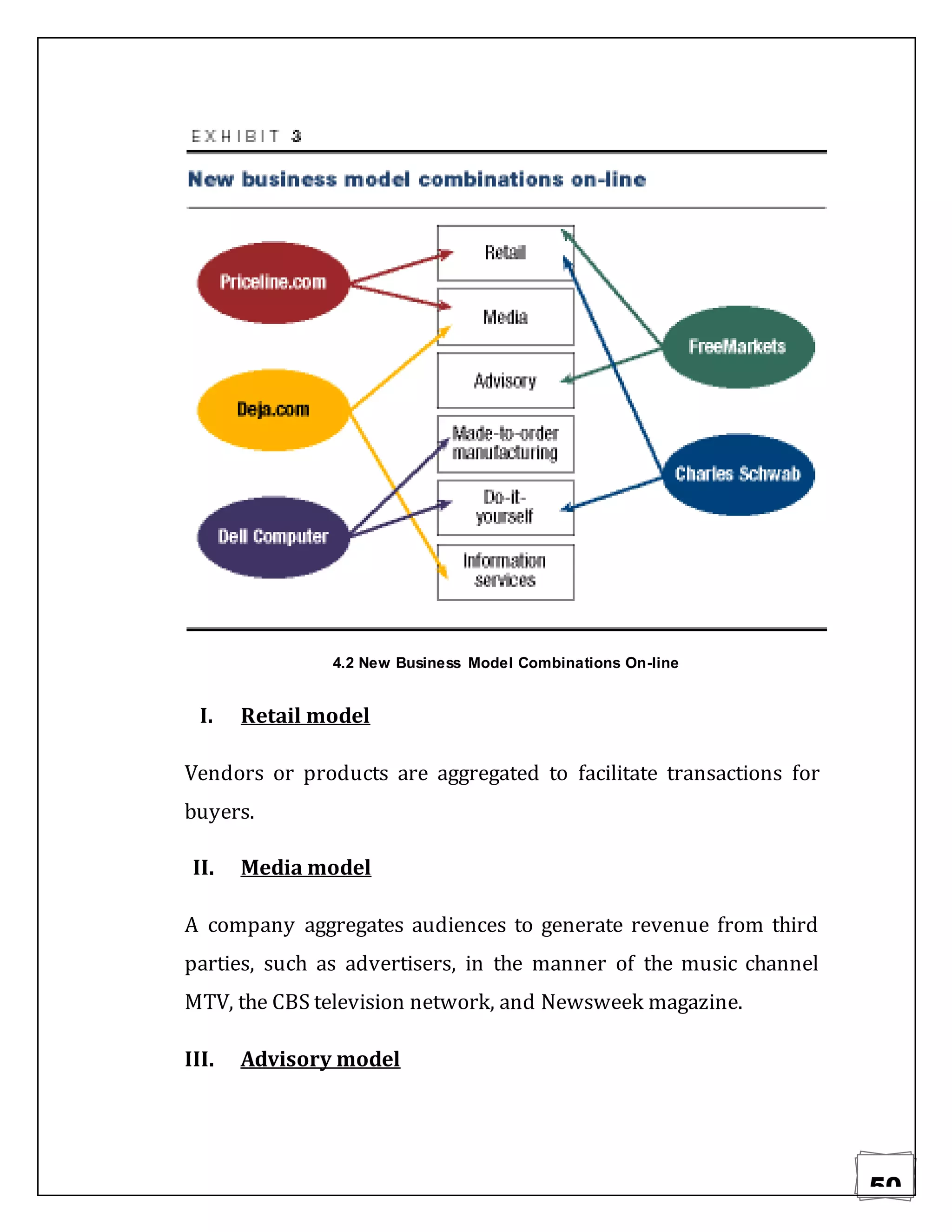
There are six basic economic models (Exhibit 4.2). The success of an
Internet brand rests on the skill with which it combines two or
more of them.
50
I. Retail model
Vendors or products are aggregated to facilitate transactions for
buyers.
II. Media model
A company aggregates audiences to generate revenue from third
parties, such as advertisers, in the manner of the music channel
MTV, the CBS television network, and Newsweek magazine.
III. Advisory model
4.2 New Business Model Combinations On-line
51
An expert (such as an investment adviser or a personal shopper)
offers consumers unbiased advice for a fee.
IV. Made-to-order manufacturing model
A business manufactures customized products,
such as locomotives, in one-time production runs.
V. Do-it-yourself model
A business (such as McDonald’s or IKEA) provides for or facilitates
consumer self-service.
VI. Information services mode
A business (such as ACNielsen or J. D. Power and Associates)
collects, processes, and sells information.
Priceline, for Example, combines the retail and media models and
therefore enjoys economics that are vastly superior to those of
other travel agencies, both on- and off-line. Applying the retail
model, the company aggregates suppliers of travel services, such as
airlines. Applying the media model, it "monetizes" its audience to
third-party advertisers by suggesting products and services to its
customers.
Dell also combines two models—the made-to-order manufacturing
and do-it-yourself models. The company offers computer shoppers
an unparalleled choice of features and permutations. In addition, its
on-line menu and instructions guide consumers through a selection
52
process that is speedier and less proneto error than one handled by
live customer service representatives. For Dell, the superior process
is also less costly.
Creating winning digital brands requires managers to reconsider
how they view both the Internet and branding. Off-line brands have
long thrived by delivering narrow solutions to limited customer
needs. On-line, however, customers have learned to expect that the
companies they patronize will meet a much fuller spectrum of their
needs and desires. To succeed on-line, those companies will have to
create full-fledged Internet businesses, or digital brands, that can
fulfill this expectation.
53
5.0 BUILDING TRUST IN BRANDS
Can a marketer be trusted with sensitive personal and financial
information? Consumers increasingly expect their identity and
personalinformation to remain confidential when they go on-line to
shop, and that, coupled with fear of on-line fraud, is what stops
many consumers from even considering digital transactions.
The Georgia Institute of Technology, in its "Tenth WWW User
Survey,"found thatonly 4 percentof on-lineusers routinely register
at Web sites, and at some sites two-thirds of those not registering
report a lack of trust as one of their reasons. They will become
buyers only when marketers overcome the lack of trust that
paralyzes many would-be Net shoppers. In response to those
security concerns, marketers are working to build trust with
consumers through their on-line interactions. The level of trust
grows as marketers and consumers engage in a gradual "value
exchange," through which consumers provide marketers with
personal information and are rewarded in turn with products they
actually want.
McKinsey research on more than 50 e-businesses shows that the
on-line marketers pacing their industries do so by embedding trust
into their interactions with consumers. They are forging a broad
logic of trust based on constant and interactive value exchange
between the buyer and seller. A company that creates and nurtures
trust finds that customers return to its site repeatedly. CDnow,
Amazon.com, and Onsale generate well over half of their sales from
545.1 Building Trust: Creating Site Loyalties
site loyalists. Contrast this with a typical underperforming retail
site, where only a quarter of sales come from repeat buyers. Sites
without a core of loyal customers must devote more capital to
acquiring customers and eventually may find it difficult to survive.
5.1. CLIMBING THE TRUST PYRAMID
Building trust that leads to satisfied customers is complex—but
essential—for marketing executives. We have identified six
elements that build a "trust pyramid" (exhibit 5.1). The base of the
pyramid shows the three core elements needed just to be in the
game: state-of-the-art security, merchant legitimacy, and robust
order fulfillment. Winning marketers move well beyond the basics
with more subtle trust builders that differentiate them from the
also-rans: consumer control, tone and ambience, and, at the highest
level, consumer collaboration. As the baseline level of trust and
security rises, these points of distinction become more critical.
Taken together, the six elements of trust create the confidence
needed to turn browsers and ordinary customers into site loyalists.
55
I. State-Of-The-Art Security
Use the best security measures on your site, and tell your
consumersaboutthem in easily understandablelanguage. Shoppers
at Netmarket are assured of "guaranteed safe shopping" with a no-
compromises promise: "At Netmarket, you can shop with
confidence. We use the latest encryption technology, digital
certificates, secure commerce servers, and authentication to ensure
that your personal information is secure on-line." Marketers at
Lands’ End also understand how to reassure their customers on
security issues. Its site states, "You have no credit card risk. Period."
II. Merchant Legitimacy
Brandsare important on the Web. They help shoppers sort out their
choices when they have a limited range of clues as to the quality and
function of a product. Familiar names with established records of
performance go a long way toward building trust—so long as
marketers continue to deliver that performance through their Web
ventures. If your company lacks a recognizable consumer brand,
three tactics can get you in the game:
1. Sell branded products. Netmarket, for Example, depicts
thousands of brands on its site, from Panasonic DVD players to
Reebok shoes. The site’s tag line is "name brands at warehouse
prices."
56
2. Ally your product or service with an established brand. Tel-Save,
an unknown phone service provider, secured a privileged position
on America Online, a brand recognized by 40 percent of US
households. Now known as Talk.com, Tel-Save signed up 1.8
million new customers in the year after the deal was signed in
December 1997. Its sales increased by 47.2 percent from 1997 to
1998.
3. Encourage prospective customers to sample your services through
low-risk trials and creative offers. E*trade lets prospective
investors take part in contests without risking real money. The Wall
Street Journal offers a two-week free trial of its interactive edition.
If consumers like it, an annual subscription costs $59 (print-edition
subscribers pay $29 for it).
III. Fulfillment
Great security and brands can go only so far; a trust-building site
mustalso fulfillorders efficiently and with minimal hassles. Nothing
alienates a buyer more than getting thrown off-line, finding the site
frozen, or making a wrong entry that causes the loss of pages of
entered information. And at some sites, prospective buyers must
slog through a lengthy registration process before discovering that
sales taxes, shipping, and handling charges greatly increase the total
price of their purchase. The best practice: explain all costs, and have
an infrastructure that gets the right product to the right buyer in a
reasonable period.
57
Leading Web companies are streamlining the purchase and
fulfillment process. Amazon.com has led the industry with a "1-
click" mechanism, through which buyers enter an address and
credit card information for the first sale only. After that,
Amazon.com remembers the details. Marketers also are beefing up
customer service to provide fast and accurate answers to queries
arriving on-line and through call centers.
In practice, even the best companies will sometimes stumble in
fulfillment. But a mishap can be an opportunity for a company to
show its best face and build trust with its clientele. Consider the
experience of Hastings Entertainment and its gohastings.com site.
The company announced its site with newspaper ads offering a
package of three popular video movies for $9.99. The trouble was
that buyers reaching the site found a notice saying it was still under
construction. By afternoon, the message had been replaced with a
toll-free number through which users could place an order for the
videos. Buyers also got a T-shirt as part of gohastings.com’s apology.
What could have been a marketing meltdown was transformed into
a reasonably happy story.
IV. Control
Even with credit card security assured, consumers learn to trust the
marketers they deal with only when they know that they—not the
marketers—control access to personal information. Marketers who
ask permission for personal details are taking the smart approach.
E*trade, for Example, discusses the benefits provided by cookies on
58
a user’s hard drive (the cookie ensures that preferred settings
appear without the customer logging in each time), then asks the
user for permission to place a cookie.
Some marketers are recruiting consumers to serve on panels that
independently audit privacy policies. Others use third-party audit
services such as those of the Council of Better Business Bureaus
(BBB). Sites may qualify for the BBBOnLine seal when they adopt
robust privacy policies and agree to consumer-friendly dispute
settlement procedures. More broadly, consumers like to feel that
they are in control of the buying process. Accordingly, marketers at
the GMBuyPower site provide consumers with comparative
information on competitors’ cars. After all, consumers will go
somewhere to find that information. GM builds trust by letting
consumers know that it understands that they have a choice and
that they control the buying decision.
V. Tone And Ambience
Trust building encompasses more than the strictly technical aspects
of a Web site. Consumers want to know that marketers will handle
their personal information with sensitivity. Without ironclad
confidentiality, consumers will never move ahead with a value
exchange. Leading marketers post an easy-to-read privacy
statement and explain how they collect and handle customer
59
information. Lands’ End addresses this issue on its Landsend.com
site, stating, "We’ll never misuse the information you provide us."
Design and content are other critical elements. "E-CommerceTrust,"
a January 1999 study by Cheskin Research and Studio
Archetype/Sapient, points to the importance of ease of site
navigation as one influence. A site’s appearance also says a great
deal about a marketer. Value America, a virtual retailer, stresses the
importance of "white space" and presents products in an
uncluttered, friendly setting that shoppers find appealing.
Drawing on the next wave of personalization technologies,
marketers will be able to customize the on-line store ambience for
each consumer. For Example, on a music site, a classical music
aficionado might receive an audio selection and visual
merchandising that would reflect that sensibility; a heavy-metal fan
would enjoy a more raucous presentation.
Marketers set the right tone with their customers when they are
straight about all aspects of the relationship, such as how they
deliver services. Amazon.com now lists all its "publisher-supported
placements" and explains its acceptance of co-op funds after
controversy over its unstated policies. Other marketers carefully
indicate that pricing may vary according to the channel through
which a product is sold. The home page of Tower Records notes,
"Pricing at towerrecords.com applies for on-line purchases only.
Sale pricing may not apply in Tower retail stores."
60
VI. Collaboration
A site nurtures trust when it encourages its customers to inform
each other about the company’s product and service offerings. A
Yankelovich Partners survey reveals that consumers consider other
users of a product to be the most trusted source of advice when
considering a purchase of that product. Thus, chat groups let
consumersquery each other about their purchases and experiences.
Amazon.com customers, for Example, have posted hundreds of
wildly divergent opinions about a single book.
One site that built an entire business and brand by innovatively
collaborating with consumers is eBay. Its governing model of trust
is its feedback forum, where buyers and sellers rate each other. The
detailed records of transaction histories show eBay users what they
can expect from other users. The Web site also uses its network of
users to spread the word about its activities, a tactic known as "viral
marketing." That is, users can e-mail auction notices to their friends.
Corporations also can choose to separate themselves from the
opinion process by linking customers to external sites. Auto
manufacturer Saturn has links to auto magazines and price and
ratings guides.
5.2. BUILDING TRUST
Bringing the six elements of trust to your Internet value
proposition, though, does not automatically lead to deep, trusting
relationships. That comes through a step-by-step process in which
61
the consumer and marketer exchange value. Each time the
consumer volunteers some personal information, the marketer
rewards the consumer with a more personalized service. This
mutual give-and-take eventually leads to an advanced collaboration
based on trust.
62
The research has identified four stages of trust building:
I. Attraction
At the first stage, the consumer browses the site and even makes a
transaction. No real relationship exists between the marketer and
the consumer, and none may be warranted. The best strategy is to
provide the consumer with information, without demanding any in
return. At first blush, this may seem like an imbalance between
what marketers give and what they get back. But what the
consumer is giving the marketer is something quite valuable: time
and attention, along with a view of how the site is traversed.
The time and attention translates into the "mind share" needed to
create a brand preference. The average consumer on Ralston
Purina’s Dog Chow Web site, which offers no product for sale,
spends more than six minutes per session learning how to care for
pets. That’s far more time—and concentration—than consumers
devote to a 30-second TV ad.
II. User-Driven Personalization
At the second stage, consumers start shaping Web pages to their
specific tastes. For Example, CDnow customers can personalize
their home pages with favorite artists and wish lists. The company
shows that it is willing to deliver some value to the consumer before
gaining financially. Charles Schwab now invites users to set up a
personal page through the MySchwab service, where users can not
only track stocks but also get customized sports news, weather
63
information, and even cartoons. Users aren’t required to open a
Schwab account to do so.
III. Marketer-Driven Personalization
In the third stage, marketers begin using insights provided by
consumers to beam information back to them. Thus, CDnow uses its
knowledgeof consumers—developed at the earlier stages of trust—
to suggest products they might like which consumers then rate as
either on- or off-target. As the process continues, CDnow learns
consumers’ preferences and zeroes in on what they really like. It is
worth emphasizing that marketers should rein in their urge to make
immediate use of data and personalization technologies. This
approach takes patience, a trait lacking at many marketing
organizations. Too often they bombard consumers with
promotional offers as soon as they get their hands on an e-mail
address. We suggest a gradual approach, as nothing aggravates
many Internet users more than unsolicited e-mail.
A best practice is to let the user set the pace of personalization and
contact from marketers. User-driven personalization should
precede marketer-driven offers. Recent research by Professor
Youngme Moon of the Harvard Business School has shown that
premature personalization can backfire. Moon found that
consumerswere less likely to buy products pitched to them through
messages if the messages were based on information they had not
given to the marketer themselves. According to "Is Your Web Site
Socially Savvy?"a May–June 1999 Harvard Business Review article,
64
consumers were more likely to buy when the message was
personalized and based on information they had volunteered.
IV. Trust-Based Collaboration
At the final stage, the marketer and the consumer work together
closely. The consumer gives the marketer access to the most
sensitive personal information (family, finances, or health) and in
turn gains customized experiences and consultative problem-
solving assistance. In our view, very few on-line marketers have
reached this level of trust with their consumers.
The pace of value exchange varies by industry and situation. For
Example, mortgage shoppers may provide financial information in
their very first interaction if they need a quick answer. In other
situations, the process moves more slowly. And because costs rise
as marketers go up the trust staircase, they mustdecide just how far
they need to go to create the most profitable relationships. Trust
building at a basic level may be enough for some marketers,
particularly if greater trust does not bring greater spending by
consumers.
Only by sustaining trust can marketers expect to establish enduring
relationships with consumers, and it is by keeping a central focus on
that idea that marketers build a value exchange that delivers
consistent and progressive mutual benefits. With the six building
blocks of trust in place, marketers should be able to chart a course
for building great on-line businesses.
65
6.0 CASE STUDY - C2W & HUNGAMA
The first full-fledged website in the Indian market to start broadcasting
to cater to this need was Contest2Win (www.contest2win.com), now
simply c2w.com, keeping in mind the impatience levels of users online.
C2W edged its way slowly but steadily into the minds and onto the
fingertips of Indian users by striking barter deals which involved their
URL (Internet address) being mentioned in traditional media in
exchange for hosting contests and promotions on their site. With
enthusiasm that ran deep, but pockets that didn't, Alok Kejriwal, CEO,
did not spend on the traditional advertising and PR channels from the
time they went live in November 1998. On the other hand,
Hungama.com took the other route, living upto its name when it
launched in March 99. Online advertising, professional PR, and
attractive promotions in prominent net-savvy community hangouts
like night clubs and cybercafes in Bombay, Bangaloreand Delhiall went
towards literally raising a hungama about this new website in almost
no time at all!
The business model of sites like C2W and Hungama is simple - they
believe in the Internet maxim: "content is king". And they keep that
content fresh. Of course, content for them is not news and features, but
contests, promotionsand incentivesrewardingusers for spending time
on their sites. And there are four steps involved in making this business
model pay off for them:
66
6.1. CREATING CONTENT
Both Hungama and C2W have aggressive teams that interact with
various brand and marketing managers to get more brands on their
sites, with hundred of big brands like Philips, HLL, UDV and Sony
already enticed by what the medium has to offer. Contests and
promotions are either created exclusively for the Net, or are online
adaptations of existing traditional world contests.
6.2. ATTRACTING USERS
C2W has emblazoned its brand - their URL - into the minds of current
and potential members by cross promotion in traditional media like
outdoor, print, television, and even on product packaging. Hungama
chose to storm the market and create an identity and brand through
physical contact in the real world where their target audience cannot
miss them. Special incentives to cybercafe owners also ensures
prominent display and rewards for getting their members to sign up.
6.3. KEEPING USERS
By constantly adding new contests and promotions to their sites, C2W
and Hungama ensure that their visitors keep coming back.
Hungama.com has even gone to the extent of giving away prizes every
hour, by the hour, with over 100 prizes being distributed daily from
their office!
67
6.4. SELLING EYEBALLS
Today, C2W has a database 35,000 strong(growingat 35% per month),
all with authentic registration details - after all fake details means that
your prize may never reach you. Hungama, though a recent entrant, is
fast catching up. As these numbers grow, these eyeballs will attract
advertisers to the sites, bringing in advertising revenue, either for
banners or for paid promotions. C2W already has Intel advertising on
their pages, while the Hungama pages are still banner-free.
6.5. THE FUTURE
C2W has already finalised plans for Pan Asian reach, and are looking
for strategic partners for the American and European market, to
become the world's contest portal - a one-stop site for contests and
promotions. "Free" seems to be a four lettered f-word for Neeraj Roy,
CEO, Hungama.com who emphatically states that his site is not a
contest freebie site - it is an ePromotions site that will continue helping
brands get their message to online customers through incentives.
Whatever tag you put on them - be it freebies, incentives, contests,
promotions, or brand-building exercises in cyberspace, there are more
eyeballs being attracted, and slowly but steadily, more brands being
attracted by these eyeballs.
68
69
7.0 RESEARCH METHODOLOGY
7.1. MARKETING RESEARCH:
Definition of marketing research research as approved as by the board
of directors of the association of American marketing association is:
“Marketing research is the function which links the customer and
public to the marketer through information – information used to
identity and define marketing opportunities and problems generate
define and understanding of marketing as process”.
Simply, marketing research is the systematic design collection
analysis and reporting of data finding relevant to a specific marketing
situation facing the company. Carefully planning through all stages of
the research is a necessity.
Objectivity in research is all-important. The heart of scientific
method is the objective gathering of the information.
The function as marketing research with in the company as to
provide the information and analytical necessary for effective.
 Planning of the future marketing activity.
 Control of the marketing operation in the present.
 Evaluation of marketing results.
A research may under take any of the three types of research
investigation depending upon the problem. These type of research
included:
1. Basic research
2. Applied research
3. Designated Fact Gathering
70
7.2. STEPS IN RESEARCH
Research process can be out through following
steps.
Define the problems and research objectives
Develops the research plan
Collect the information
Analysis and interpretation
Present the finding.
7.3. PRIMARY DATA:
It consists of information collected for the specific purpose, survey
research was used and he all the details of Ford and their competitors
were contacted. Survey researchis the approached gathering
description and information.
71
7.4. ANALYSIS AND INTERPRETATION OF
PRIMARY DATA
Analysed Survey Report
Totalparticipation in survey=20
1. How often you use internet?
a) Frequent user
b) Less frequent
c) Non user
Data
CUSTOMER PREFRENCE % of customers
Frequent user 7
Less frequent 8
Non user 5
Total 100%
Interpretation:
From this question we get to know number of user of internet that effect
digital branding as above data show as maximum people are Less frequent
0
1
2
3
4
5
6
7
8
Frequent user
Less frequent
Non user
72
2. What do you like most about your digital market ?
a) Easy to get information
b) Time saving
c) Larger variety at home
Data
CUSTOMER PREFERENCES % of customers
Easy to get information 5
Time saving 9
Larger variety at home 6
Total 100%
Interpretation:
As in his question show what does people like about digital market as most
of the people think that its time saving also liking towards variety available
0
1
2
3
4
5
6
7
8
9
Easy to get information
Time saving
Larger variety at home
73
3. What do you feel better?
a) Digital market
b) Physical market
Data
CUSTOMER PREFERENCES % of customers
Digital market 11
Physical market 9
Total 100%
Interpretation:
The above question show how does a local people feel about the digital
market that they are willing to purchase but still due to no less access
digital does turn out to more physical purchase
0
2
4
6
8
10
12
Digital market
Physical market
74
4. How do you do your shopping?
a) Online
b) Visit shop
Data
CUSTOMER PREFERENCES % of customers
Online 7
Physical market 13
Total 100%
Interpretation:
As above data shows that still people are moreattached to visit shop
that the still feel better see productand have a live demo
0
2
4
6
8
10
12
14
Online
Physical market
75
5. Do you research and get information through internet for purchasing
products?
a) Yes
b) No
c) Sometimes.
Data
CUSTOMER PREFERENCES % of customers
YES 9
NO 5
UNKNOWN 6
Total 100%
Interpretation:
Now a days due to higher access to the internet people prefer toonce lookand
compare the product that the customer want to purchase.
0
1
2
3
4
5
6
7
8
9
YES
NO
UNKNOWN
76
6. Do you think that brands are getting more closer to consumer?
a) Yes
b) No
Data
CUSTOMER PREFERENCES % of customers
YES 15
NO 5
Total 100%
Interpretation:
Yes as a good influencecan be seen as moreand more brandsis giving
information apartfrom that it is providingand getting mor closer o the
consumer by the digital branding.
0
2
4
6
8
10
12
14
16
YES
NO
77
7. Do you trust online market?
a) YES
b) NO
Data
CUSTOMER PREFERENCES % of customers
YES 9
NO 11
Total 100%
Interpretation:
As the onlinetransaction is still considered as a risky one so still
peopledon’tfully trust for the transaction for any purchase .
0
2
4
6
8
10
12
YES
NO
78
8. To which media do you get expose regularly?
a) Televisions
b) Internet
c) News papers
d) F.M/Radio
Data
CUSTOMER PREFERENCES % of customers
Televisions 8
Internet 5
News papers 5
F.M/Radio 2
Total 100%
Interpretation:
Peopleseems to be moreexposed towardstelevision at their daily
basis and then other medium busstill digitally brandingthemselves is
very appropriateas television and then followed by internet and
newspaper
0
1
2
3
4
5
6
7
8
Televisions
Internet
News papers
79
9. What kind of internet user are you?
a) casual
b) Information purpose
c) Official purpose
d) Social networking
Data
CUSTOMER PREFERENCES % of customers
casual 5
Information purpose 6
Official purpose 5
Social networking 4
Total 100%
Interpretation:
As above data people that is using for casual, information and social purpose
are more than can be used for digital branding.
0
1
2
3
4
5
6
casual
Information purpose
Official purpose
Social networking
80
10. What kinds of offers do you like or expect from the online dealer ?
a) Free insurance
b) Special discount
c) Extending the service period
d) Finance availability with 0% interest
Data
CUSTOMER PREFERENCES % of customers
Free insurance 4
Special discount 9
Extending the service period 2
Finance availability with 0%
interest
5
Total 100%
Interpretation:
Digital dealer need to penetrate the market by lower price or discount to
built their brand.
0
1
2
3
4
5
6
7
8
9
Free insurance
Special discount
Extending the service period
Finance availability with 0%
interest
81
11. What’s your opinion about importance of Digital Branding?
a) Very necessary
b) Not needed
Data
CUSTOMER PREFERENCES % of customers
Very necessary 9
Not needed 11
Total 100%
Interpretation:
As still the peoplein Indiahas not moreuse to the onlineand digital
Indiaas still peopleis unawareaboutthe digital needsin the near
future
0
2
4
6
8
10
12
Very necessary
Not needed
82
12. Can you share your experience with after sale service support given by
digital market?
a) Very much satisfied
b) Satisfied
c) Ok
d) Not satisfied
Data
CUSTOMER PREFERENCES % of customers
Very much satisfied 3
Satisfied 10
Ok 3
Unknown 5
Total 100%
Interpretation:
As above data a decent number of peopleis satisfied but still to go for a
long run a there is a need for improvementin services
0
2
4
6
8
10
Very much satisfied
Satisfied
Ok
Unknown
83
84
7.5. SECONDARY DATA COLLECTION:
The secondary data consists of information that already existing
somewherehaving been collected for another purpose. Any researcher
begins the research work by first going through secondary data.
Secondary data includes the information available with company. It
may be the findingsof research previously donein the field. Secondary
data can also be collected from the magazines, news papers, internet
other service conducted by researchers.
Books
1. E- Brands by Philp carpenter
2. Global E-commerce and online marketing by Nikhilesh Dholakia
3. Internet marketing researchby OOk Lee
4. Principles of marketing by Philip Kotler
Magazines
1. Business & Economics
2. Advance E’dge MBA
3. Global Educator
4. Global Educator
5. Business & Economy
Internet
1. Thomsonlearning.com
2. Bloonet.com
3. www.infotech.com/MR/Industry%20Center/Wholesale%20and
%20Retail/Governance/Building%20Digital%20Brands.aspx
4. www.mckinseyquarterly.com/
ab_g.aspx?ar=860&L2=16&L3=16
5. www.ceoexpress.com/asp/mckinseyalls4.asp?id=m0173
85
7.6. Over all Interpretation
As the projectdigital brand project I Deepak P. Shetty has
prepared a questionnaireand other secondary information as
above with an objective to know what is the currentstatus of
digital brandingas a modelfor a businessto come up according
questionnaireand other secondary information Ifound few
things as follows:
 In India internet user are very less frequent and less access to
internet.
 More over youth is more influenced towards digital market.
 Consumer those purchase online with an expectation of offers
and discounts.
 By above question we come to know that people need more
satisfaction with respect to service.
 And consumer in general don’t trust due to fraud by few
Defaulters.
 As few of them thing the brands are getting more closer to the
consumers as the update different information digitally.
As wesaw that peopleis having a mixed perception for digital
brandingwith differentneeds
86
8.0 SUGGESTIONS
 Need to improve service.
 India can be seen has a good market for digital branding.
 Digital brands should try to build trust among consumers.
 As major population does not access internet but there is a
higher scope for digital brand to grow as a market.
 Need to penetrate market with higher quality and lower price.
 And have a special team to know needs of the consumers that
may help branding.
 And as can be considered the future market.
 Customer should be educated about about the brand and its
advantage.
 Regular feedback should be taken by the consumers.
 Should keep an eye on defaulters or unwilling brand that may
effect the trust of consumers for whole of the market.
 Should take a responsibility to make trade safer.
87
9.0 CONCLUSION
The world of consumer products is quickly changing and developing
through new technology and an evolving knowledge of what
consumers really prefer – both online and in the real world.
The explosion of Web content has grown faster in the last year than
Web usage. As a result, it is actually harder to get noticed and have
people stay around a site than it was three years ago. Marketers not
only must get people to their site, they must get them comfortable
enough to place an order. As a result, one of the biggest challenges on
the Net is creating brands-strong ones like E Bay, Yahoo, or Amazon
that achieve an image of quality, trust, and familiarity.
Online building brands has presented us with a whole new kind of
channel. The concept of the brand building has taken on a new, more
experiential shape—the ability to surprise and delight in the moment.
That is the really important aspect of the medium that’s not yet as
prevalent in more traditional advertising and offline direct marketing
models. But fundamentally, there is no difference between an offline
and an online relationship. Consumers are still people, and they still
form relationships with brands by making emotional connections,
regardless of the channel.
88
I. One thing is for sure
The Internet is changing the methods of product selling day by day.
Instead of having a supermarkets and malls the days are not far when
the basic goods will be sold through Internet and these will create a
true millennium generation and hence at that moment of time we can
show our little one a perfect, “Generation Gap”.
89
10.0 BIBLIOGRAPHY
10.1. INTERNET
1. Thomsonlearning.com
2. Bloonet.com
3. www.infotech.com
4. www.mckinseyquarterly.com
5. www.ceoexpress.com
6. www.themanagementor.com
7. www.yahoo.com
8. www.google.co.in
9. www.rediff.com
10.www.timesofindia.com
11.www.hinduonline.com
12.www.indiainfoline.com
13.www.cavindia.com
14.www.mouthshut.com
90
11.0QUESTIONNAIRE:
Name :
Address:
Contact no.
E-Mail address:
1. How often you use internet?
a) Frequent user
b) Less frequent
c) Non user
2. What do you like most about your digital market ?
a) Easy to get information
b) Time saving
c) Larger variety at home
3. What do you feel better?
a) Digital market
b) Physical market
4. How do you do your shopping?
a) Online
b) Visit shop
5. Do you research and get information through internet for purchasing
products?
a) Yes
b) No
c) Sometimes.
91
6. Do you think that brands are getting more closer to consumer?
a) Yes
b) No
7. Do you trust online market?
c) YES
d) NO
8. To which media do you get expose regularly?
a) Televisions
b) Internet
c) News papers
d) F.M/Radio
9. What kind of internet user are you?
a) casual
b) Information purpose
c) Official purpose
d) Social networking
10. What kinds of offers do you like or expect from the online dealer?
e) Free insurance
f) Special discount
g) Extending the service period
h) Finance availability with 0% interest
11. What’s your opinion on a Digital Branding?
c) Very necessary
d) Not needed
92
12. Can you share your experience with after sale service support given by digital
market?
e) Very much satisfied
f) Satisfied
g) Ok
h) Not satisfied

Digital branding

  • 1.
    A PROJECT REPORT A PROJECT REPORT ON DIGITALBRANDING Submitted in partial fulfillment of Bachelor of Management Studies To Sanpada college of Commerce and Technology Under the Supervision of Mr. Abdul Rahim Submitted By DEEPAK P. SHETTY (Bachelor of Management Studies) 2014-15
  • 2.
    2 ACKNOWLEDGMENT The Market studyfor DIGITAL BRANDING. has been given to me as part of the curriculum for Bachelor of Management Studies (BMS). I have tried my best to present this information as clearly as possible using basic terms that I hope will be comprehended by the widest spectrum of researchers, analysts and students for further studies. I have completed this study under the project guidance of Prof. Abdul Rahim; I will be failed in my duty if I do not acknowledge the esteemed scholarly guidance, assistance and knowledge I have received from them towards fruitful and timely completion of this work. My acknowledgementmay not redeem the debt I owe to my parents for their direct/indirect support during the entire course of this project. I also thankful to my friend who helped me a lot in the completion of this project. Deepak P. Shetty
  • 3.
    3 TABLE OF CONTENTS Sr.NoParticulars Pages DIGITAL BRANDING 1.0 Introduction 6 2.0 GROWTH OF INTERNET AS A MARKETING MEDIUM 8 3.0 MARKETING TO THE DIGITAL CONSUMER 39 4.0 BUILDING DIGITAL BRANDS 44 5.0 Building Trust in Brands 56 6.0 CASE STUDY - C2W & Hungama 68 7.0 RESEARCH METHODOLOGY and limitations 72 8.0 SUGGESTIONS 88 9.0 Conclusion 89 10.0 Bibliography 91 11.0 QUESTIONNAIRE 92
  • 4.
    4 1.0 INTRODUCTION Online hasalways taken a back seat to offline in brand building. Yet online offers the best options for building a meaningful brand, options that didn't exist only a few years ago. Companies without a solid digital brand strategy are literally being left behind as leaders build new digital brands. Reflecting on the current state of online advertising, the majority of online marketers are doing a terrible job of building their digital brands. Advertisers are fighting tooth and nail to produce the world's worst advertising, actually destroying their existing offline brands in the digital realm. For the most part, if one looks at ads that run during top TV programs or that appear in top magazines, one will find quality in the advertising (even if the ads are a bit dry and boring). But if one looks at a top web site and views a few dozen ads, it will be very difficult to find quality advertising. In effect, the bulk of the ads online do more harm than good to the brands they are trying to build. In one industry after another, aggressive Internet upstarts are putting established brands at risk, creating very strong brand recognition and enjoying explosive visitor growth. The reason may have less to do with the established brands themselves than with their managers. Marketers know what a brand is in the physical world: the sum, in the consumer’s mind, of the personality, presence, and performance of a given product or service. These "3
  • 5.
    5 Ps" are alsoessential on the World Wide Web. In addition, digital brand builders must manage the consumer’s on-line experience of the product, from first encounter through purchase to delivery and beyond. Digital brand builders should care about the consumer’s on-line experiences for the simple reason that all of them—good, bad, or indifferent—influence consumer perceptions of a product’s brand. To put it differently, on the Web, the experience is the brand. If a consumer buys lipstick from a retailer in the physical world and has an unpleasant in-store experience, she is more likely to blame the retailer than the manufacturer. But if the consumer purchases that same product from Procter & Gamble’s Reflect.com Web site, her wrath is more likely to be directed at P&G. Thus the on-line marketer’s objective shifts from creating brands—at least as defined in the off-line world—to creating Internet businesses that can deliver complete, and completely satisfying, experiences. Yet many marketers, particularly those whose experience is limited to the off-lineworld, lack a coherent framework and concrete methods for achieving the broader objectives of on-line brand building. These marketers need an approach for aligning the promises they make to consumers, the Web design necessary to deliver those promises on-line, and the economic model required to turn a profit. These three elements—the promise, the design, and the economic model—together form the inseparable components of a successful Internet business, or what might be called a digital brand.This project is an attempt to propose to the industry the right approach to build and sustain their brand in an online environment.
  • 6.
    6 2.0 GROWTH OFINTERNET AS A MARKETING MEDIUM How much impact is the Internet really having on advertising and marketing? Is it just another emerging niche medium with some peculiar creative capabilities and constraints? Or might it transform consumer marketing in the same way that network television revolutionized consumer culture and commercial practice four or five decades ago? Interviews with marketers reveal that few believe the Internet will change their approach to advertising. Most see it as little more than a complement to traditional marketing practices, and don’t expect it to reduce expenditure on broadcast and print media or change the form, pricing, or delivery of advertisements. Their view is probably a reaction to the early hype about the Internet and the World Wide Web, which created unrealistic short-term expectations among marketers and frustration with the inadequacies of the delivery technologies among consumers. We take a contrary view. We believe that Internet advertising will account for a growing proportion of overall advertising expenditure. Moreover, advertising — and marketing in general — will adopt practices first developed or deployed on the Internet. As the technology improves, the impact of Internet advertising will increase and become easier to measure, and the gap between this new precise, interactive
  • 7.
    7 marketing capability andconventional "fuzzy" passive media will widen. Over the next few years, advertising agencies and consumer marketers willbe under pressure to change their whole approach to marketing communications. Marketers will become more accountable for their results, and they will pay more attention to building a total customer relationship. Offering consumers value in return for information will become vital in eliciting their preferences, which in turn will be critical to customizing advertising. And companies’ entire marketing organizations will be progressively redesigned to reflect interactions with consumers on the Internet. For ad agencies, fees based on results will become standard. The economics of Internet advertising are likely to make current business models obsolete. New capabilities will be required as creative production speedsup and becomes more closely integrated with marketing activity. A deep understanding of enabling technologies will become a prerequisite for fresh forms of advertising. Our views on the evolution of Internet advertising and its impact on traditional marketing may seem provocative to some, premature to others. But the intriguing marketing experiments taking place on and off the Internet suggest it is time for consumer marketers to begin looking to networks for new ways of thinking about the marketing theories and approaches on which they have long relied
  • 8.
    8 — and tobegin capturing the lessons Internet advertising holds for all their advertising practices, online and conventional. 2.1. CAUTION: CHANGES AHEAD Looking at today’s Internet advertising to predict what tomorrow will bring is about as helpful as using a rear-view mirror to watch the road ahead. But a point of view about what online advertising will look like in three to five years’ time can and should influence currentmanagementA number of fundamental forces are currently reshaping Internet advertising: the near-daily emergence of new technologies that improve measurement, targeting, and data interpretation; the strenuous efforts of primarily entrepreneurial marketers to make business use of the Web; and the establishment of patterns in consumers’ use of these new interactive networks. Thanks to the impact of these forces, tomorrow’s ads will differ from today’s in the shape they take, in the metrics available for gauging their effectiveness, and in the pricingstructure that governs their purchase and sale. I. New Shapes The first and most obvious change in advertising will be in what consumers see on their screens. Ads are likely to change in terms of their content, the type of customization they employ, and their delivery to the consumer.
  • 9.
    9 II. Content Aspirations totranscend today’s form of Internet advertising will first be realized in the content of ads. The development of new technologies such as virtual reality and chat, coupled with consumers’growing preference for material that is directly valuable to them, is driving the emergence of new forms of content. Three main types are on the horizon: experiential, transaction-oriented, and sponsored content. Experiential content will allow consumers to "experience" the ownership of a product, service, or brand. The best current Examples let the user test out a product. Sharp’s Web site offers a personal tour of the Zaurus personal digital assistant in which consumers can input calendar or address information exactly as they would if they used the product in real life. At The Gap’s site, customers can "try on" outfits and mix and match separates from the current range. In the future, technologies such as virtual reality will make ads even more experiential: customers will feel as though they are test-driving a new car, or walking down the aisles of a grocery store. Transaction-oriented content will invite consumers to make a purchase directly from an ad. Advertising content will become increasingly oriented toward transactions. Indeed, the Internet may already be changing consumers’ buying behavior, particularly for considered purchases such as cars. Prospective car buyers who are looking for product information before making a decision can
  • 10.
    10 obtain more informationmore quickly through the Internet than by any other means currently available. Having done their research in advance, they are more ready to buy at the point when they actually encounter a manufacturer or seller. The implication for marketers is simple: they need to make it possible for consumers to carry out transactions easily and seamlessly, or risk losing sales to competitors. Consider Casio, which uses Virtual Tag technology developed by First Virtual to enable customers to make purchases from an Internet banner ad. An Internet user can learn about Casio products, purchase a watch on line, and select the means of delivery without ever leaving the banner. Sponsored content will blur the line between editorial matter and advertising. A lot of sponsored content already exists on the Internet — for Example, Nissan sponsors weekly soccer tips on Parent Soup in association with the American Youth Soccer Association — but by and large it tends to resemble the "brought to you by ABC" model familiar from traditional media. The emergence of advanced forms of hybrid commercial–editorial content will be driven by consumers’ ability to "tune out" straightforward commercial messages, be they banners, interstitials (ads that pop up while users wait for a requested Web page to appear), or standard forms of sponsorship, and by advertisers’ desire to influence attitudes in more subtle ways.
  • 11.
    11 By way ofanalogy, consider the growing use of product placement in films and television (James Bond drives a BMW Z3 in his latest movie) as marketers seek to make their offerings stand out from the clutter of ads and break through the cognitive filters that allow consumers to discount ordinary commercials. The network environment offers ample scope for hybrid content: entire sites can be funded and co-managed by advertisers (as with Procter & Gamble and Parent Time), while avatar technologies bring advertisers into chat rooms. However, the issue of editorial independence and the possibility of consumer rejection or backlash may ultimately set limits on the pursuit of this approach. III. Customization Anyone who has been offered a credit card they already hold can appreciate the need for greater customization or "addressability" in mass-market advertising, and even in direct mail. Indeed, the level of responsethat advertisersreceive largely depends on the accurate and timely targeting of messages, as do the number of transactions and the degree of loyalty that are generated. The Internet is supposed to enable marketers at last to target their offers to that elusive "segment of one." Yet advertising on the Internet has so far been targeted mainly on the basis of editorial content, just as it is in traditional media. Part of the reason is technical, though the development of tracking software that allows ads to be delivered only to target audiences is overcoming this obstacle. Consumers’ reticence has been a further barrier, but as
  • 12.
    12 2.1 Internet AdvertisingObjectives Internet users grow more willing to provide information about themselves, two types of customized content will emerge. First, content will be customized by means of information inferred about users. The Ultramatch technology recently launched by Infoseek, to take one Example, makes it possible to target those Web users who are most likely to respond to a given ad. Based on neural networking technology, Ultramatch observes users’ behavior when they put out queries and explore subjects, collecting the results in its database. Advertisers using the service can select individuals according to their interests and thus pitch their campaign to a receptive audience. Ultramatch also allows them to ascertain which individuals are responding to ads, and to move the ads to places where they will attract similar users. Second, ads will be customized on the basis of information voluntarily provided by users. The key to making this approach work will be to overcome consumers’ desire for privacy or anonymity by offering them rewards for personal details in the form of special information, discounts, or promotions. On Parent Time, for Example, users who enter the ages of their children receive relevant care information as well as
  • 13.
    13 Pampers ads gearedto those age groups. Experience suggests that consumers are willing to release information about themselves as long as they are the prime beneficiaries. Organizations such as etrust (an initiative sponsored by leading companies to develop electronic commerce) and the Internet Marketing Council take a similar view. The IMC requires marketers to provide a "giveaway" or discount before they can gain certification. This scheme is specifically designed to preventinformation provided by consumers from being misused in e-mail.
  • 14.
    14 IV. Delivery The recenthype about "push" technology on the Internet might suggest that this will be the dominant vehicle for delivering advertising on the Web. We believe the reality will be more integrated, combining today’s "pull" format Web sites with "push" technology such as PointCast to deliver ads to people according to their interests. Triggered banners (ads that appear when certain key words are mentioned) and interstitials are early Examples that point the way. Consider how one automaker’s ads are pushed to chatroom participants when the topic of cars comes up, or how a user waiting for content to be downloaded is sent an ad related to that content. Marketers must ask themselves a number of questions: What is the right balance? Where can push technology be exploited most effectively? How much push are users willing to take before they begin to tune out? As online advertising develops, advertisers will discover that the Internet is the only medium that can deliver certain types of message, such as multi sensory and interactive ads. These new formswill allow advertisers to achieve several objectives — some of them unattainable via conventional media — simultaneously (Exhibit 2.1). They are likely to make Internet advertising more important in the overall marketing mix as marketers capitalize on their unique capabilities. At the same time, our glimpse of the emerging future casts doubt on the merit of current heavy
  • 15.
    15 investments in bigbrand sites that require content to be "pulled," or in banner ads that — like most on the Internet today — merely replicate the forms of advertising that exist in the physical world. V. New Metrics The Internet affords marketers an unprecedented opportunity to measure the effectiveness of their advertising and learn about their viewers. The capacity to measure impact sets the Internet apart from other media. Measurements available for television, for Example, estimate the total size of an audience; what they don’t do is tell an advertiser how many people actually saw an ad, or what impact it had. On the Internet, by contrast, marketers are able to track click-throughs, page views, and leads generated in close to real time. The result: measurements those are more precise and meaningful than anything available in traditional media. The emergence of these new metrics will affect not only ads themselves, but also the way that marketers and agencies develop them. First, more precise measurements will yield better insights into the effectiveness of advertising spend. It will be easier to identify ads that don’t work, and to find out why. Advertisers will also start to expect the content of ads to be renewed more frequently in response to audience reaction. A new product from Infoseek offers a hint of things to come. Copy Testing in a Box is a tool that combines the immediate feedback of the Internet with sophisticated targeting technology to allow
  • 16.
    16 marketers to refocustheir Internet campaigns to the most responsive customer segments within a matter of days. Second, advertisers will be able to assess the impact of their ads earlier in the spending cycle. As a result, they will have the flexibility to launch and roll out a campaign in such a way that it can be changed before most of the money is committed. This will affect the very process of creating Internet ads, and perhaps spur advertisers and agencies to devise new ways of organizing around it. VI. New Pricing Whereas marketers tend to have fairly uniform objectives in traditional media, such as shaping attitudes in television or obtaining responses in direct mail, the Internet, as we have seen, allows them to pursue several different goals simultaneously. In the same way, the standard types of pricing used in traditional media, such as CPM (the cost of exposing a message to a thousand viewers of TV or readers of print), will give way on the Internet to pricing that varies as widely as the objectives of the ads themselves. Indeed, the technology can supportseveralpricing mechanisms at once: pay per click-through, lead, transaction, dollar spends, or conventional CPM. This kind of variegated pricing is already appearing in the marketplace: P&G has pushed for pricing per click-through; CD Now pays Web sites commissions on the transactions they generate; and Destination Florida pays according to leads generated. Similarly, DoubleClick is introducing an advertising network, DoubleClick
  • 17.
    17 2.2 Emerging InternetPricing Models Direct, whose rates are based on results, and has already signed up clients including Alta Vista and GTE’s Internet service. Because of these factors, pricing for Internet advertising is likely to be multi- tiered, based on results, and tied to marketers’ objectives. At least three pricing mechanisms will coexist: pricing by exposure, response, and action (Exhibit 2.2). Pricing per exposure — for instance, via a rate card based on CPM — will prevail for ads placed on the Internet to generate awareness of a product or brand. Over time, this form of pricing should become more refined. As measurability and metering improve, advertisers will want to pay only for impressions on their target customers, while publishers will eagerly search for ways to extract premium exposure rates. The result is likely to be the establishment of an additional tier of "effective" CPM rates. Pricing per responsewill establish itself as the standard for simple consumer responsessuchas click-through. Prices will vary according to the typesof user a site attracts and how much advertisersare willing to pay for access to them.
  • 18.
    18 Pricing per actionis similar, but more elaborate. A site publisher might charge an advertiser more for a consumer who downloadsa piece of softwareor providessomedemographicinformation, say, than for onewho merely clicks on a banner. We believe that the ability of Web publishersto charge advertisersfor the true value they receive is likely to makethe differencebetween profitand loss. The pricefor a lead generated, for instance, could reflect the prospect’spotential lifetime value; if it did, sites would charge automotiveOEMs and white goods manufacturersdifferentprices for prospect leads. As a result, a fee per action or sales commission is likely to emerge as a major pricing mechanism for Internet advertisingover time. How quickly and how far these models take hold in the near term will depend on how risk is shared between marketers, agencies, and sites. Results-based pricing gives marketers the opportunity to shift some of the risk of failure to sites or agencies. Publishers and broadcasters in traditional media have usually been loath to take on this kind of risk. However, Internet publishers should find risk sharing attractive if it is appropriately priced, as it could boost the advertising revenues on which their success depends. Pricing in general is fraught with issues. Will site publishers demand a degree of control over the creative execution of ads to ensure quality, for instance? We believe that the sharing of risk in Internet advertising will ultimately be determined by the prevailing balance of power, which will vary from advertiser to advertiser and
  • 19.
    19 site to site,and shift over time. Large, well-known, "safe" advertisers may be able to secure results-based pricing more easily than others, particularly at times when site publishers are struggling to make their economics work. It will be in the best interests of marketers, site publishers, and even agencies to prevent the lowest common denominator setting the industry’s pricing standard. To settle for a simplistic, unsophisticated, "one size fits all" pricing scheme would mean leaving a lot of money on the table. The widespread acceptance of multi-tiered, performance-based pricing will make the Internet both distinctive and highly lucrative as an advertising medium. 2.2. THE SPILLOVER EFFECT The changes now taking place in the shape, measurement, and pricing of advertising on the Internet may seem dramatic enough in themselves, but we believe they will have a much broader impact on marketing practices in general. This spillover effect will occur for four reasons. First, new ways of advertising on line will inspire new creative approaches elsewhere. Second, the Internet will prompt marketers to reevaluate their use of traditional media. Third, Internet advertising will help marketers to improve their understanding of consumers’ needs, preferences, and product usage. Finally, once marketers get a taste for the measurability of Internet ads and the tailored pricing it enables, their expectations of the effectiveness and measurability of other media will rise.
  • 20.
    20 I. New CreativeApproaches The timeliness and direct tone of advertising on the Internet will increasingly inspire marketers operating in other media. Seeing the daily updates of information that the Web makes possible and the lengths to which online advertisers must go in order to keep users’ interest (for instance, renewing banners weekly) may sharpen their appetite for replicating Internet practices on TV and in print. The notion that creative approaches pioneered on the Web will spill over to moretraditional media should surprise few. Historically, the emergence of new media has always prompted content changes in existing media. Consider how print changed after radio, and later television, arrived on the scene. Fidelity Investments recently attempted to mimic the immediacy of the Internet in its television advertising. It refreshed its ads on a daily basis by incorporating current news headlines. However, the campaign met with mixed success, perhaps because it lacked a distinctive point of view. Marketers’ adoption of creative techniques pioneered on the Internet will grow as technologies like broadband, WebTV, and virtual reality begins to influence traditional media. Wink and Worldgate are developing technologies that allow viewers to "save" a commercial to watch later, or to obtain more detailed information. These technologies are in their early test stages on television.
  • 21.
    21 The enormous creativeflexibility offered by the Internet will increase pressure for more choices of delivery in traditional media. The (probably apocryphal) story of Helena Rubenstein asking to buy an extra three seconds for a 30-second spot to realize her creative vision suggests how we may start to question accepted standards and constraints in traditional media. Marketers may also need to reexamine the theories that underpin their advertising practices. As we noted, online advertisers have found that banners must be renewed frequently if consumers are to keep clicking. Their experience defies the conventional wisdom in advertising that any ad must be seen at least four times to make an impression. On the Internet, greater impact can be achieved by showing a wider range of ads that are repeated less often. Insights like this cast doubt on the effectiveness of current television campaigns, most of which are still based on old ideas of frequency. II. Reevaluating Media Investments Everyone has heard the advertiser’s lament: "I know 50 percent of my advertising is working; I just don’t know which 50 percent." The greater measurability of Internetadvertising will prompt marketers to reevaluate all their investments in media, especially in the addressable categories of print and direct marketing. Not only are response rates often higher in Internet advertising, but the cost of reaching target customers can be lower, with better information received in return. As a result, we may well see a migration of
  • 22.
    22 targeted marketing spendingfrom direct mail and other traditional media to the Internet. Consider a recent Example. AT&T used the Internet to generate awareness of and shape attitudes toward its toll-free collect-call service, which is mainly targeted at 16- to 24-year-olds. The company had previously found this audience difficult to reach cost- effectively through print or broadcast media. The results of the online effort were excellent. Top-of-mind awareness increased by over 30 percent, and AT&T opted to replace its print advertising with an Internet campaign. The traditional approach to customer response and lead generation has been to use ads in trade magazines and customer response or "bingo" cards. However, findings announced by one large publisher of trade titles indicate that more than two-thirds of bingo cards either go unanswered or are not responded to promptly because of the time it takes to qualify and manage leads. The study suggests that the Web is an excellent tool for generating quality leads and may even supersede bingo cards in time. Migration of this kind will reallocate the slices of the advertising pie. Interviews we conducted with marketers reveal that most believe their initial spending on the Internet did not come at the expense of other media (in other words, their overall advertising budget grew). But many expect that future increases in their Internet expenditure will be taken from other areas, probably print and/or direct
  • 23.
    23 marketing. They alsosee their Internet advertising budgets growing much faster than their traditional media budgets.
  • 24.
    24 Migration may alsotake place in non-addressable media spending. Striking levels of media displacement are already evident among Internet users. Most notably, TV viewing has declined among a third of adult Internet users (Figure 2.3). Similarly, in a recent Wall Street Journalpoll, 21 percentof respondentscited spendingmore time on their computer or in using online services as a reason for watching the major TV networks less than they did five years earlier. When marketers accept the idea that brand building can be accomplished on line, some spending on TV, radio, billboards, and other non- addressable media may migrate to the Internet. 2.3 Declines in Usage of Traditional Media
  • 25.
    25 III. Getting CloserTo The Consumer We believe marketers will soon start to use the Internet as a kind of testbed for campaigns planned for print, TV, or radio. One leading- edge marketer, London International, the maker of Durex condoms, is already trying out advertising concepts on its Web site before transferring them to other media where their effectiveness is harder to track. It is testing three concepts ultimately destined for conventional media: "On-line Lovers," "Dr Dilemma," and "The Nurse." By monitoring pages selected, click-throughs, responses generated, and other indicators, the company is able to discover which parts of a prospective campaign work and which don’t, thereby reducing the risk of launching the equivalent of a box-office flop. Conducting market research and obtaining feedback from consumers can be expensive and difficult. The Internet offers cost- effective alternatives to conventional methods, and may yield more revealinginformation. Several of the marketers we interviewed said that their presence on the Web had taught them a tremendous amountabout their customers’ views of their products and services. They maintain that the Web offers a non-judgmental way of providing feedback and ideas, and is less intimidating for consumers to use than standard toll-free numbers. Marketers at Fidelity, London International, and Coors found that users of toll-free numbers mainly called to ask questions about
  • 26.
    26 products. On theother hand, Internet users, even when given answers to the most frequently asked questions, would often provide feedback about the quality of a product, new variations on it, and ways that it might be changed. To be sure, some of the additional interaction may be down to the different demographic profile of Internet users, but gathering information of this kind is becoming an increasingly important way to use the Web. To gather deeper feedback, marketers are experimenting with Internet focus groups. LiveWorld has already hosted several sessions for NFO, a company specializing in this area. The advantage of conducting a focus group on line is that participants are anonymousand can speak their mind without worrying what others in the group think. In addition, geographically dispersed participants can be assembled at a fraction of the usualcost. London International is planning to conduct an online focus group to assess the effectiveness of its Web efforts in the near future. Finally, the opportunities for testing new product ideas on the Internet are legion, particularly for electronic or intangible items such as magazine covers, entertainment concepts, and personal financial services. The possibilities are just beginning to be exploited. IV. Rising Expectations Two features of Internet advertising — the measurability of its impact and the probability of some form of results-based pricing
  • 27.
    27 emerging — arelikely to raise marketers’ expectations of traditional media. If they do, pressuremay build for a more accurate measurement system or a shorter measurement cycle. The demand for greater accuracy in measurement is already coming from the broadcast networks in any case. The coding technology tests being carried out by SMART (the emerging competitor to Nielsen), by Nielsen itself, and by its joint effort with Lucent to develop Media TraX indicate that improvements are technically feasible. In fact, it would not be surprising if new measurement tools and techniques originally designed for the Internet were to spill over and be applied to traditional media in the not so distant future. Moreover, in those traditional media that are already more measurable, such as print, we foresee increasing pressure from advertisers for results-based or tiered pricing like that offered on the Internet. The developments we have described are necessarily speculative, and may not materialize as broadly or as quickly as we suggest. All the same, they are worth watching out for because of their implications. Mostof the mediaindustry is affected by the billions of dollars spent every year on consumer marketing. If key advertisers were to reallocate their media budgets, the impact on traditional media could be profound. As the aspirations, techniques, and expectations associated with Internet advertising spill over into traditional media, both
  • 28.
    28 marketers and advertisingagencies will have to rethink the capabilities they bring to bear on selling products and services. 2.3. IMPLICATIONS FOR MARKETERS The growing importance of Internet advertising and its effect on conventional marketing will have profound implications for practitioners. First, the Internet model will set new standards for building relationships in the physical world, challenging many current practices and expectations. Second, a new concept, value exchange, will emerge as a core marketing capability. Finally, the move toward organizational structures and processes designed around consumers’ experiences with specific products or services will accelerate further. I. New Standards In Relationship Management The Internet will set new standards for total relationship management in both breadth and depth. "Breadth" means that a relationship will increasingly last for the entire ownership experience, including the time before and after the purchase of the product or service. Consider Coors, which used consumer feedback received via the Web during both the development and promotion of its beverage Zima — thus involving customers at all stages in the product life cycle. "Depth" reflects the degree of interaction with consumers at any given point in their experience of a product. The book retailer Amazon.com, for instance, is beginning to use the information it
  • 29.
    29 gleans from customersto create value-added services such as suggestions about books that a particular reader might enjoy. This raises the bar for competitors on the Internet and in the physical world, posing a challenge that other players must meet if they are to retain customers’ loyalty. The Internet’s role in consumer relationship management has importantconsequences for marketers. Network-based interactions must be integrated into the rest of a business, with all that this entails. If car purchasers make fewer trips to the showroom, say, doing their own online research into different models instead of talking to salespeople, dealers will need to rethink the way they manage the whole consumer relationship. Eventually, customers may go to them only to place an order; at this point, the role dealerships play may no longer justify their cost, and they will have to find new ways to offer buyers value if they are not to disappear. Moreover, as consumers’ behavior changes, so will the skills that salespeople need. And how are those salespeople going to be compensated when consumers make their purchases through channels other than dealerships? Design and funding is another key area. If the Internet’s role is to grow beyond advertising, the design of online activities should probably not be constrained by the priorities of a single functional area such as marketing, or by the limitations of the marketing communications budget.
  • 30.
    30 II. Value ExchangeAs A Core Capability Much of the Internet’s potential relies on the creation of a dialogue between consumer and marketer in which information is exchanged for value. Marketers need to develop the new skill of rewarding consumers for giving them access to personal information such as who they are, what they like, and what they buy. This reward may take the form of discountstoward futurepurchases, or benefits such as valuable information or a personalized product or service. This process of value exchange will become critical as new standards are created to protect consumers’ privacy. The proposal announced by Netscape in May 1997 to capture information on consumers’hard drives rather than on marketers’ computers marks a step in a new direction with its implicit acknowledgement that consumers will "own" information about themselves and control the release of that information to marketers. The demand for value among consumers is likely to grow as they become aware of how highly marketers prize their demographic profiles, product preferences, and transaction histories. A few marketers are beginning to manage this process effectively. In exchange for basic information such as name, address, age, and income, Vogue provides readers with discounts, special offers, and previews of forthcoming articles. Saturn’s approach is to offer convenient access to information. Consumers who reveal a small amount of information about themselves are able to use Saturn’s
  • 31.
    31 interactive pricing centerto research new cars, saving them trips to a showroom. III. Organizations Centered On Consumers As the Web merges marketing with other business processes such as customer service, it will putmorepressure on the organization of most marketers. The coming of age of interactive networks will accelerate the move toward new organizational models in which marketers willstructure their variousfunctionalcapabilities around an integrated customer front end. For a real-life Example, take the insurance company USAA. Its customer center receives and manages all communications with consumers, whether direct via telephone, mail, and the Internet, or indirect via intermediaries. The rest of the organization revolves around the customer center. Sophisticated information systems help the company to process interactions and maximize their value. The benefits are many. Customers feel that USAA knows them better, and the company is quick to respond to a complaint or learn about important market changes such as a cut in a competitor’s price in a particular territory. As more and more companies reorganize themselves around their customers, intranets linked to the Internet will become crucial. They will make it economically feasible for managers within an
  • 32.
    32 organization to havemore information about consumers — and more interactions with them — than ever before. 2.4. IMPLICATIONS FOR AGENCIES The rise of Internet advertising, with its unique economics, may well call the validity of current business models and processes into question. It will also compel agencies to rethink the way they create and develop campaigns, and the skills and capabilities they need to survive. I. New Business Model So different are the revenues generated by conventional and Internet advertisements that traditional agencies will have to think carefully about their approach to online advertising if they are to pursue it profitably. At present, most agencies incur high fixed costs in developing campaigns. Big creative teams and the like were fine in the days when agencies could rely on the commissions they earned from large media buys associated with a small number of creative executions. On the Internet, however, this cost structure is inverted: the creative element of the total advertising cost is much larger in relation to the media element. The resulting commissions will no longer be sufficient to cover agencies’ high operating costs. We believe that traditional agency business models simply will not work for Internet advertising. A trend toward retainer compensation is already emerging. Agencies may well seek to enhance their revenue streams by taking a cut of the results of their
  • 33.
    33 efforts in theshape of a commission on leads or sales generated. In future, agencies will increasingly share in the risk of their advertising instead of — as they do today — leaving all of it to be borne by marketers. II. Compensation models will be transformed. The measurability of Internet advertising makes results-based pricing more feasible than in any other media, as we have seen. Some Examples are already in evidence. Site Specific is using performance-based contracts for clients including Duracell, CUC International, and Intuit’s TurboTax division. Though these arrangements are not yet making it any money, they are expected to do so as advertising effectiveness increases. In time, results-based compensation will probably spill over into traditional media as the measurement of advertising impact improves. It will then have its most profoundimpact, affecting agencies’ core business and revenue source. III. New Capabilities This vision of the future calls agencies’ current capabilities into question. Many have seen themselves as the guardian angel of the brands they represent. But agencies have a patchy record of orchestrating brand-building activities across the full range of marketing disciplines: media advertising, direct mail, promotions, and so on.
  • 34.
    34 The emergence ofinteractive media means that agencies must not only manage a broader and more complex mix of marketing tools, but also master radically different skills. Three main gaps will need to be filled: 1. Inform creative execution with a deeper understanding of enabling interactive technologies. Such an understandingscarcely exists in agencies today, except in some of the more specialized enterprises such as Site Specific and AGENCY.COM. Traditional agencies may find their technological and creative skills are not sufficiently integrated to compete with the specialist Internet ad agencies, which enjoy a higher profile and more confidence among marketers in this area of work. 2. Integrate one-way and response-oriented campaign design skills. Interactive advertising blurs the boundaries between traditional advertising, direct marketing, and customer services — normally separate preserves run by different individuals. Agencies will need to learn to integrate these skills in their design efforts. 3. Increase the speed and responsiveness of creative production. The immediacy of interactive networks will make growing demands on the pace and frequency of creative production. Agencies are currently organized around work processes with relatively generous cycle times. Today, it is acceptable to take three to six months to design onecampaign, and to run it for up to two years. Tomorrow, a campaign with 300 one-on-one
  • 35.
    35 executions will haveto be designed in two to three months, and adapted continuously in response to real-time consumer feedback. In summary, the future holds many challenges for agencies. The emergence of new business models and the need for new capabilities are likely to shake up an industry that has been under pressure for some time. Some agencies have shown that they can customize their processes and economics to specific industry needs like those of grocery retailers or auto dealers. Now they must learn to institutionalize these capabilities within their organizations or spin off a cluster of flexible, technology-savvy boutiques with low fixed costs. Viewed another way, the emergence of Internet advertising may represent an opportunity for renewal — a chance for agencies to reclaim the high ground of brand stewardship that some marketers argue they have let slip away in the past two decades. The emergence of Internet advertising is likely to have wider implications for business than many imagine. Its effects will not be confined to the online world, but will extend to traditional marketing activities and processes. For those who look closely, Internet advertising holds many more opportunities and risks than is commonly assumed. And the payoff waiting for those who rise to the challenge will more than justify the efforts required.
  • 36.
    36 3.0 MARKETING TOTHE DIGITAL CONSUMER Many companies are waking up to the potential of the interactive consumer market. Not only are the numbers of users of on-line and Internet services soaring, but the majority of people who are subscribing to these services tend to be young, well educated, and richer than average. In short, they make particularly good marketing targets. Interactive media is likely to revolutionize marketing for many consumer companies because it allows marketers to deliver real- time, personalized services and content, one consumer at a time. It is what we call digital marketing. Digital marketing leverages the unique and powerful characteristics of interactive media: it is addressable, meaning that each user can be identified and targeted separately; it allows for two-way interaction; services can be tailored for each individual customer; and purchases can be made and influenced on line. However, to capture the benefits of digital marketing, companies must integrate interactive media into their existing businesses and marketing programs. And that is difficult to achieve. Most consumer companies are struggling to know what to do and how. The old models of marketing simply do not work in this new world, and as a result most of today's digital marketing applications are uninspiring (as anybody who has ever been on the Internet can probably attest), falling far short of the potential of interactive media. Research is being conducted to define a new marketing
  • 37.
    37 model that willhelp build and evaluate digital marketing applications. 3.1. TYPES OF DIGITAL MARKETING Several broad types of attractive digital marketing opportunities already exist, and there is evidence that marketer who aggressively pursue one or more of these opportunities are starting to make profits. First, marketers can use interactive media to provide better service at lower cost by delivering information about a product or service. UPS, for Example, uses an Internet-based service to allow customers to track the whereabouts of their packages. A second opportunity is to build relationships with on-line consumers. Interactive media can be used to identify attractive users or prospects (an automotive company can learn the names of interested car buyers and forward them to the closest dealer); it can enhance customer loyalty by providing extra services; and marketers can use what they learn about their consumers to cross- sell new products or services. Third, marketers can use interactive media as a new channel. In 1995, Hot Hot Hot, a small company that produces sauces, generated some 30 percent of its revenue from sales through its Web site. And using interactive media, airlines are increasingly bypassing travel agents to sell tickets, thus saving significant commission costs. For Example, United Connections, a disk-based
  • 38.
    38 service allowing travelersto make their own bookings, is estimated to save airlines up to $50 for a typical $500 round-trip fare. Digital marketing is an attractive proposition for many more categories than is commonly assumed. We would argue that digital marketing can play an important role in any category in which it makes good business sense to build relationships one consumer at a time. 3.2. NEED OF A NEW MARKETING MODEL The traditional 5P-marketing model — price, product, promotion, package, place — is not particularly helpful to marketers seeking to capture the benefits of digital marketing. It assumes, for Example, that communication is one way (from the marketer to the customer), when interactive media so clearly offers an opportunity to establish a dialog; it assumes a mass-market environment, when interactive media allows interaction with individual consumers. The digital marketing model that has been developed is based on a pragmatic assessment of what seems to work, and what does not, in the interactive age. It is built around five apparent factors for success: 1. Attracting users 2. Engaging users' interest and participation 3. Retaining users and ensuring they return to an interactive media based service
  • 39.
    39 4. Learning abouttheir preferences 5. Relating back to them to provide the sort of customized interactions that represent the true "value bubble" of digital marketing (Exhibit 3.1). This last point is critical as in most cases it will require marketers to make their digital marketing initiative part of the existing business system. This presents important internal and external challenges, such as how to integrate the digital marketing initiatives with 3.1 Attractive Characteristics of Media
  • 40.
    40 existing marketing programsor information systems, or how to manage potential channel conflicts with the sales force or traditional distributors. Each of the five success factors suggests a number of issues that marketers must address. Example What are the most effective means to attract users to an interactive application? What is the role of branding? How should you choose an Internet address? What is the optimal "linking" strategy for a particular marketer? While the answers to many of these issues will be specific to a given marketer, research is beginning to identify the factors that allow companies to get more from their digital marketing efforts. Over the next three to five years, digital marketing is likely to become an increasingly significant part of the consumer marketing landscape. For many marketers it will present formidable opportunities. For those who cannot keep pace, it might pose a serious threat. It is therefore imperative that marketers begin to think about the role of interactive media in their industry, and prepare to take appropriate action.
  • 41.
    41 4.0 BUILDING DIGITALBRANDS In one industry after another, aggressive Internet upstarts are putting established brands at risk, creating very strong brand recognition and enjoying explosive visitor growth (Exhibit 4.1). The reason may have less to do with the established brands themselves than with their managers. Marketers know what a brand is in the physical world: the sum, in the consumer’s mind, of the personality, presence, and performance of a given product or service. These "3 Ps" are also essential on the World Wide Web. In addition, digital brand builders must manage the consumer’s on-line experience of 4.1 Consumers Turning to Digital Brands
  • 42.
    42 the product, fromfirst encounter through purchase to delivery and beyond. Digital brand builders should care about the consumer’s on-line experiences for the simple reason that all of them—good, bad, or indifferent—influence consumer perceptions of a product’s brand. To put it differently, on the Web, the experience is the brand. Example If a consumer buys lipstick from a retailer in the physical world and has an unpleasant in-store experience, she is more likely to blame the retailer than the manufacturer. But if the consumer purchases that same product from Procter & Gamble’s Reflect.com Web site, her wrath is more likely to be directed at P&G. Thus the on-line marketer’s objective shifts from creating brands—at least as defined in the off-line world—to creating Internet businesses that can deliver complete, and completely satisfying, experiences. Yet many marketers, particularly those whose experience is limited to the off-line world, lack a coherent framework and concrete methods for achieving the broader objectives of on-line brand building. These marketers need an approach for aligning the promises they make to consumers, the Web design necessary to deliver those promises on-line, and the economic model required to turn a profit. These three elements—the promise, the design, and the economic model—together form the inseparable components of a successful Internet business, or what might be called a digital brand.
  • 43.
    43 4.1. HOW TOBUILD AND MANAGE DIGITAL BRANDS? How do marketersbuild and manage digital brands? The marketer’s first goal should be to select the core promise for a truly distinctive value proposition appealing to the target customers. Five of these promises are especially effective. Digital brands that make tasks—from buying a book to searching for the best price—faster, better, and cheaper offer the promise of convenience. Amazon.com, like most first-generation electronic businesses, is fundamentally built on this promise. Brands that make people feel like winners in whatever activities engage them offer the promise of achievement. E*trade, for Example, promises to help consumers manage their finances successfully. It has gone beyond the basics—a portfolio of financial tools and research—to offer many helpful innovations, such as securities-tracking and -alert services. Games and other activities designed to engage (and even thrill) consumers offer the promise of fun and adventure. Often these activities make use of "immersive" technologies, which, for Example, allow electronic spectators of a marathon to hear a runner’s heartbeat. Digital brands such as Quokka Sports are building their entire businesses around immersive technologies. Such companies as GeoCities (which helps consumers express themselves by building and displaying their own Web pages) offer
  • 44.
    44 the promise ofself-expression and recognition. Ralston Purina Dog Chow’s site allows consumers to create home pages that display pictures of and stories about their pets. Clubs or communities offer the promise of belonging, as well as concrete advantages. Women, for Example, can exchange stories and tips with one another at the iVillage.com site. Mercata.com provides a more tangible benefit by aggregating the purchasing power of its community of users and thus helping them get better prices for a broad range of merchandise. 4.2. FROM PROMISE TO DELIVERY The promises made by digital brands are not unique to the Internet, but the medium’s interactive capabilities make it easier for digital brands to deliver on their promises quickly, reliably, and rewardingly. They often do so with a scope that their landed counterparts would be hard-pressed to match. In practice, this means that promises must be translated into specific interactive functions and Web design features collectively giving consumers a seamless experience. Such design features as one-click ordering and automated shopping help deliver the promise of convenience; collaboration tools such as chat rooms or ratings functions make it possible to realize the promise of belonging. Managers shouldn’t underestimate the challenges of this translation process. What, for instance, does it mean to build a digital brand around a promise of convenience in the grocery industry? What kind of content, if any, do you need? And how about chat rooms,
  • 45.
    45 personalization, one-click ordering,and collaborative filtering? Digital brand builders can’t afford to fall short of what they have promised, since competitors are always a click away, but they waste capital if they offer more than is necessary to make sales and keep customers. Technology dramatically differentiates digital brands—for both customersand shareholders—in ways that will become increasingly clear as they enter their second and third generations. To be certain of identifying all of the designs that make it possible to deliver on a promise and to build a viable economic model, today’s digital brand builders must explore at least six groups of design tools. These tools are sufficiently robust technologically to help create a distinctive and relevant user experience, and they are beginning to demonstrate their ability to make money for the digital brand builders using them. I. Personalization Tools Tools such as the software that creates personalized interfaces between e-businesses and customers hold tremendous promise for value exchange and contextual commerce. To be sure, the value of personalization has yet to be fully demonstrated in practice. (Fewer than 15 percent of visitors to Yahoo! have chosen to set up a "My Yahoo!" page for themselves.) Personalization tools also present risks, as well as real operational challenges, such as managing privacy, intrusiveness, and opportunity costs. For that reason, many
  • 46.
    46 practitioners still questionthe short-term return on investments in personalization tools. I. Collaborative Tools They facilitate word of mouth, or what might be called "branded person-to-person communications"—for instance, the ratings that buyers offer sellers on eBay, the Lands’ End "shop with a friend" feature, Raging Bull’s discussion boards, and Pert’s viral marketing (which encourages consumers to e-mail their friends instructions for obtaining free Pert Plus samples). Collaborative tools such as consumer ratings, though essential for content- and community- oriented digital brands, are underutilized. II. Purchase-process Streamlining Tools They eliminate such physical-world constraints as the need to walk into a store to purchase a product. Amazon’s one-click ordering system, for Example, eases transactions by sparing repeat customersthe inconvenienceof inputtingtransaction data. Peapod’s shopping lists save consumers time by recording the products they purchased previously. The fact that most e-shoppers drop out of the buying process during the last clicks suggests that improvements along these lines might be very worthwhile. III. Self-service Tools They allow customers to obtain answers and results without the delays and inconsistencies that more often than not
  • 47.
    47 characterize human effortsto provide assistance. Such tools include software for tracking orders, preparing statements, and changing addresses on-line. Although incumbents often have difficulty integrating these Web-based tools with legacy systems, the tools are indispensable for banks, retailers, and other e-businesses that handle large volumes of transactions. IV. Do-it-yourself product design tools They allow consumers to customize products and services, either with the help of configuration options or from scratch. Dell Computer, for Example, lets customers design their own systems on-line by choosing from a range of options; customers of Music.com and Listen.com can download the music of various artists onto a single compact disc. But the need to create manufacture-to-order systems to capture the potential of these tools may make them uneconomical in industries that, unlike software and music, are not based on information. V. Dynamic-pricing tools They overthrow the tyranny of the fixed retail price, allowing prices to fit the particular circumstances of individual transactions. Such tools, which come in many forms, includeeBay’sand uBid’sauctions and Priceline’s offer to "name your own price." Dynamic pricing, a potential "killer application" in many categories, could permit customers to make a wider variety of trade-offs between price and
  • 48.
    48 value than ispossible in the current world, where most sellers offer a single fixed price to all buyers.
  • 49.
    49 4.3. RETHINKING THEBUSINESS MODEL As digital brand builders align the promise and the design, they must also align the economic model that will sustain their businesses. For most managers of established brands, the very process of taking them on-line will force a fundamental reconsideration of the business. Digital brands offer a richer consumer experience than their physical-world counterparts, so they can and should make money by tapping into broader revenue and profit pools than any single physical-world business might enjoy. Fortunately, the range of economic opportunity for a digital brand expandsdramatically as it drawsfrom traditionally unrelated revenue and profit pools. The economic model must be expanded because building digital brands around consumer experiences is expensive. A number of different sources of revenue ultimately makes it possible for a digital brand—and the e-business that supports it—to deliver a richer experience to the consumer. Since on-line consumers expect combinations of product types and functional benefits different from those expected by off-line consumers, marketers must adopt several different economic models to succeed. There are six basic economic models (Exhibit 4.2). The success of an Internet brand rests on the skill with which it combines two or more of them.
  • 50.
    50 I. Retail model Vendorsor products are aggregated to facilitate transactions for buyers. II. Media model A company aggregates audiences to generate revenue from third parties, such as advertisers, in the manner of the music channel MTV, the CBS television network, and Newsweek magazine. III. Advisory model 4.2 New Business Model Combinations On-line
  • 51.
    51 An expert (suchas an investment adviser or a personal shopper) offers consumers unbiased advice for a fee. IV. Made-to-order manufacturing model A business manufactures customized products, such as locomotives, in one-time production runs. V. Do-it-yourself model A business (such as McDonald’s or IKEA) provides for or facilitates consumer self-service. VI. Information services mode A business (such as ACNielsen or J. D. Power and Associates) collects, processes, and sells information. Priceline, for Example, combines the retail and media models and therefore enjoys economics that are vastly superior to those of other travel agencies, both on- and off-line. Applying the retail model, the company aggregates suppliers of travel services, such as airlines. Applying the media model, it "monetizes" its audience to third-party advertisers by suggesting products and services to its customers. Dell also combines two models—the made-to-order manufacturing and do-it-yourself models. The company offers computer shoppers an unparalleled choice of features and permutations. In addition, its on-line menu and instructions guide consumers through a selection
  • 52.
    52 process that isspeedier and less proneto error than one handled by live customer service representatives. For Dell, the superior process is also less costly. Creating winning digital brands requires managers to reconsider how they view both the Internet and branding. Off-line brands have long thrived by delivering narrow solutions to limited customer needs. On-line, however, customers have learned to expect that the companies they patronize will meet a much fuller spectrum of their needs and desires. To succeed on-line, those companies will have to create full-fledged Internet businesses, or digital brands, that can fulfill this expectation.
  • 53.
    53 5.0 BUILDING TRUSTIN BRANDS Can a marketer be trusted with sensitive personal and financial information? Consumers increasingly expect their identity and personalinformation to remain confidential when they go on-line to shop, and that, coupled with fear of on-line fraud, is what stops many consumers from even considering digital transactions. The Georgia Institute of Technology, in its "Tenth WWW User Survey,"found thatonly 4 percentof on-lineusers routinely register at Web sites, and at some sites two-thirds of those not registering report a lack of trust as one of their reasons. They will become buyers only when marketers overcome the lack of trust that paralyzes many would-be Net shoppers. In response to those security concerns, marketers are working to build trust with consumers through their on-line interactions. The level of trust grows as marketers and consumers engage in a gradual "value exchange," through which consumers provide marketers with personal information and are rewarded in turn with products they actually want. McKinsey research on more than 50 e-businesses shows that the on-line marketers pacing their industries do so by embedding trust into their interactions with consumers. They are forging a broad logic of trust based on constant and interactive value exchange between the buyer and seller. A company that creates and nurtures trust finds that customers return to its site repeatedly. CDnow, Amazon.com, and Onsale generate well over half of their sales from
  • 54.
    545.1 Building Trust:Creating Site Loyalties site loyalists. Contrast this with a typical underperforming retail site, where only a quarter of sales come from repeat buyers. Sites without a core of loyal customers must devote more capital to acquiring customers and eventually may find it difficult to survive. 5.1. CLIMBING THE TRUST PYRAMID Building trust that leads to satisfied customers is complex—but essential—for marketing executives. We have identified six elements that build a "trust pyramid" (exhibit 5.1). The base of the pyramid shows the three core elements needed just to be in the game: state-of-the-art security, merchant legitimacy, and robust order fulfillment. Winning marketers move well beyond the basics with more subtle trust builders that differentiate them from the also-rans: consumer control, tone and ambience, and, at the highest level, consumer collaboration. As the baseline level of trust and security rises, these points of distinction become more critical. Taken together, the six elements of trust create the confidence needed to turn browsers and ordinary customers into site loyalists.
  • 55.
    55 I. State-Of-The-Art Security Usethe best security measures on your site, and tell your consumersaboutthem in easily understandablelanguage. Shoppers at Netmarket are assured of "guaranteed safe shopping" with a no- compromises promise: "At Netmarket, you can shop with confidence. We use the latest encryption technology, digital certificates, secure commerce servers, and authentication to ensure that your personal information is secure on-line." Marketers at Lands’ End also understand how to reassure their customers on security issues. Its site states, "You have no credit card risk. Period." II. Merchant Legitimacy Brandsare important on the Web. They help shoppers sort out their choices when they have a limited range of clues as to the quality and function of a product. Familiar names with established records of performance go a long way toward building trust—so long as marketers continue to deliver that performance through their Web ventures. If your company lacks a recognizable consumer brand, three tactics can get you in the game: 1. Sell branded products. Netmarket, for Example, depicts thousands of brands on its site, from Panasonic DVD players to Reebok shoes. The site’s tag line is "name brands at warehouse prices."
  • 56.
    56 2. Ally yourproduct or service with an established brand. Tel-Save, an unknown phone service provider, secured a privileged position on America Online, a brand recognized by 40 percent of US households. Now known as Talk.com, Tel-Save signed up 1.8 million new customers in the year after the deal was signed in December 1997. Its sales increased by 47.2 percent from 1997 to 1998. 3. Encourage prospective customers to sample your services through low-risk trials and creative offers. E*trade lets prospective investors take part in contests without risking real money. The Wall Street Journal offers a two-week free trial of its interactive edition. If consumers like it, an annual subscription costs $59 (print-edition subscribers pay $29 for it). III. Fulfillment Great security and brands can go only so far; a trust-building site mustalso fulfillorders efficiently and with minimal hassles. Nothing alienates a buyer more than getting thrown off-line, finding the site frozen, or making a wrong entry that causes the loss of pages of entered information. And at some sites, prospective buyers must slog through a lengthy registration process before discovering that sales taxes, shipping, and handling charges greatly increase the total price of their purchase. The best practice: explain all costs, and have an infrastructure that gets the right product to the right buyer in a reasonable period.
  • 57.
    57 Leading Web companiesare streamlining the purchase and fulfillment process. Amazon.com has led the industry with a "1- click" mechanism, through which buyers enter an address and credit card information for the first sale only. After that, Amazon.com remembers the details. Marketers also are beefing up customer service to provide fast and accurate answers to queries arriving on-line and through call centers. In practice, even the best companies will sometimes stumble in fulfillment. But a mishap can be an opportunity for a company to show its best face and build trust with its clientele. Consider the experience of Hastings Entertainment and its gohastings.com site. The company announced its site with newspaper ads offering a package of three popular video movies for $9.99. The trouble was that buyers reaching the site found a notice saying it was still under construction. By afternoon, the message had been replaced with a toll-free number through which users could place an order for the videos. Buyers also got a T-shirt as part of gohastings.com’s apology. What could have been a marketing meltdown was transformed into a reasonably happy story. IV. Control Even with credit card security assured, consumers learn to trust the marketers they deal with only when they know that they—not the marketers—control access to personal information. Marketers who ask permission for personal details are taking the smart approach. E*trade, for Example, discusses the benefits provided by cookies on
  • 58.
    58 a user’s harddrive (the cookie ensures that preferred settings appear without the customer logging in each time), then asks the user for permission to place a cookie. Some marketers are recruiting consumers to serve on panels that independently audit privacy policies. Others use third-party audit services such as those of the Council of Better Business Bureaus (BBB). Sites may qualify for the BBBOnLine seal when they adopt robust privacy policies and agree to consumer-friendly dispute settlement procedures. More broadly, consumers like to feel that they are in control of the buying process. Accordingly, marketers at the GMBuyPower site provide consumers with comparative information on competitors’ cars. After all, consumers will go somewhere to find that information. GM builds trust by letting consumers know that it understands that they have a choice and that they control the buying decision. V. Tone And Ambience Trust building encompasses more than the strictly technical aspects of a Web site. Consumers want to know that marketers will handle their personal information with sensitivity. Without ironclad confidentiality, consumers will never move ahead with a value exchange. Leading marketers post an easy-to-read privacy statement and explain how they collect and handle customer
  • 59.
    59 information. Lands’ Endaddresses this issue on its Landsend.com site, stating, "We’ll never misuse the information you provide us." Design and content are other critical elements. "E-CommerceTrust," a January 1999 study by Cheskin Research and Studio Archetype/Sapient, points to the importance of ease of site navigation as one influence. A site’s appearance also says a great deal about a marketer. Value America, a virtual retailer, stresses the importance of "white space" and presents products in an uncluttered, friendly setting that shoppers find appealing. Drawing on the next wave of personalization technologies, marketers will be able to customize the on-line store ambience for each consumer. For Example, on a music site, a classical music aficionado might receive an audio selection and visual merchandising that would reflect that sensibility; a heavy-metal fan would enjoy a more raucous presentation. Marketers set the right tone with their customers when they are straight about all aspects of the relationship, such as how they deliver services. Amazon.com now lists all its "publisher-supported placements" and explains its acceptance of co-op funds after controversy over its unstated policies. Other marketers carefully indicate that pricing may vary according to the channel through which a product is sold. The home page of Tower Records notes, "Pricing at towerrecords.com applies for on-line purchases only. Sale pricing may not apply in Tower retail stores."
  • 60.
    60 VI. Collaboration A sitenurtures trust when it encourages its customers to inform each other about the company’s product and service offerings. A Yankelovich Partners survey reveals that consumers consider other users of a product to be the most trusted source of advice when considering a purchase of that product. Thus, chat groups let consumersquery each other about their purchases and experiences. Amazon.com customers, for Example, have posted hundreds of wildly divergent opinions about a single book. One site that built an entire business and brand by innovatively collaborating with consumers is eBay. Its governing model of trust is its feedback forum, where buyers and sellers rate each other. The detailed records of transaction histories show eBay users what they can expect from other users. The Web site also uses its network of users to spread the word about its activities, a tactic known as "viral marketing." That is, users can e-mail auction notices to their friends. Corporations also can choose to separate themselves from the opinion process by linking customers to external sites. Auto manufacturer Saturn has links to auto magazines and price and ratings guides. 5.2. BUILDING TRUST Bringing the six elements of trust to your Internet value proposition, though, does not automatically lead to deep, trusting relationships. That comes through a step-by-step process in which
  • 61.
    61 the consumer andmarketer exchange value. Each time the consumer volunteers some personal information, the marketer rewards the consumer with a more personalized service. This mutual give-and-take eventually leads to an advanced collaboration based on trust.
  • 62.
    62 The research hasidentified four stages of trust building: I. Attraction At the first stage, the consumer browses the site and even makes a transaction. No real relationship exists between the marketer and the consumer, and none may be warranted. The best strategy is to provide the consumer with information, without demanding any in return. At first blush, this may seem like an imbalance between what marketers give and what they get back. But what the consumer is giving the marketer is something quite valuable: time and attention, along with a view of how the site is traversed. The time and attention translates into the "mind share" needed to create a brand preference. The average consumer on Ralston Purina’s Dog Chow Web site, which offers no product for sale, spends more than six minutes per session learning how to care for pets. That’s far more time—and concentration—than consumers devote to a 30-second TV ad. II. User-Driven Personalization At the second stage, consumers start shaping Web pages to their specific tastes. For Example, CDnow customers can personalize their home pages with favorite artists and wish lists. The company shows that it is willing to deliver some value to the consumer before gaining financially. Charles Schwab now invites users to set up a personal page through the MySchwab service, where users can not only track stocks but also get customized sports news, weather
  • 63.
    63 information, and evencartoons. Users aren’t required to open a Schwab account to do so. III. Marketer-Driven Personalization In the third stage, marketers begin using insights provided by consumers to beam information back to them. Thus, CDnow uses its knowledgeof consumers—developed at the earlier stages of trust— to suggest products they might like which consumers then rate as either on- or off-target. As the process continues, CDnow learns consumers’ preferences and zeroes in on what they really like. It is worth emphasizing that marketers should rein in their urge to make immediate use of data and personalization technologies. This approach takes patience, a trait lacking at many marketing organizations. Too often they bombard consumers with promotional offers as soon as they get their hands on an e-mail address. We suggest a gradual approach, as nothing aggravates many Internet users more than unsolicited e-mail. A best practice is to let the user set the pace of personalization and contact from marketers. User-driven personalization should precede marketer-driven offers. Recent research by Professor Youngme Moon of the Harvard Business School has shown that premature personalization can backfire. Moon found that consumerswere less likely to buy products pitched to them through messages if the messages were based on information they had not given to the marketer themselves. According to "Is Your Web Site Socially Savvy?"a May–June 1999 Harvard Business Review article,
  • 64.
    64 consumers were morelikely to buy when the message was personalized and based on information they had volunteered. IV. Trust-Based Collaboration At the final stage, the marketer and the consumer work together closely. The consumer gives the marketer access to the most sensitive personal information (family, finances, or health) and in turn gains customized experiences and consultative problem- solving assistance. In our view, very few on-line marketers have reached this level of trust with their consumers. The pace of value exchange varies by industry and situation. For Example, mortgage shoppers may provide financial information in their very first interaction if they need a quick answer. In other situations, the process moves more slowly. And because costs rise as marketers go up the trust staircase, they mustdecide just how far they need to go to create the most profitable relationships. Trust building at a basic level may be enough for some marketers, particularly if greater trust does not bring greater spending by consumers. Only by sustaining trust can marketers expect to establish enduring relationships with consumers, and it is by keeping a central focus on that idea that marketers build a value exchange that delivers consistent and progressive mutual benefits. With the six building blocks of trust in place, marketers should be able to chart a course for building great on-line businesses.
  • 65.
    65 6.0 CASE STUDY- C2W & HUNGAMA The first full-fledged website in the Indian market to start broadcasting to cater to this need was Contest2Win (www.contest2win.com), now simply c2w.com, keeping in mind the impatience levels of users online. C2W edged its way slowly but steadily into the minds and onto the fingertips of Indian users by striking barter deals which involved their URL (Internet address) being mentioned in traditional media in exchange for hosting contests and promotions on their site. With enthusiasm that ran deep, but pockets that didn't, Alok Kejriwal, CEO, did not spend on the traditional advertising and PR channels from the time they went live in November 1998. On the other hand, Hungama.com took the other route, living upto its name when it launched in March 99. Online advertising, professional PR, and attractive promotions in prominent net-savvy community hangouts like night clubs and cybercafes in Bombay, Bangaloreand Delhiall went towards literally raising a hungama about this new website in almost no time at all! The business model of sites like C2W and Hungama is simple - they believe in the Internet maxim: "content is king". And they keep that content fresh. Of course, content for them is not news and features, but contests, promotionsand incentivesrewardingusers for spending time on their sites. And there are four steps involved in making this business model pay off for them:
  • 66.
    66 6.1. CREATING CONTENT BothHungama and C2W have aggressive teams that interact with various brand and marketing managers to get more brands on their sites, with hundred of big brands like Philips, HLL, UDV and Sony already enticed by what the medium has to offer. Contests and promotions are either created exclusively for the Net, or are online adaptations of existing traditional world contests. 6.2. ATTRACTING USERS C2W has emblazoned its brand - their URL - into the minds of current and potential members by cross promotion in traditional media like outdoor, print, television, and even on product packaging. Hungama chose to storm the market and create an identity and brand through physical contact in the real world where their target audience cannot miss them. Special incentives to cybercafe owners also ensures prominent display and rewards for getting their members to sign up. 6.3. KEEPING USERS By constantly adding new contests and promotions to their sites, C2W and Hungama ensure that their visitors keep coming back. Hungama.com has even gone to the extent of giving away prizes every hour, by the hour, with over 100 prizes being distributed daily from their office!
  • 67.
    67 6.4. SELLING EYEBALLS Today,C2W has a database 35,000 strong(growingat 35% per month), all with authentic registration details - after all fake details means that your prize may never reach you. Hungama, though a recent entrant, is fast catching up. As these numbers grow, these eyeballs will attract advertisers to the sites, bringing in advertising revenue, either for banners or for paid promotions. C2W already has Intel advertising on their pages, while the Hungama pages are still banner-free. 6.5. THE FUTURE C2W has already finalised plans for Pan Asian reach, and are looking for strategic partners for the American and European market, to become the world's contest portal - a one-stop site for contests and promotions. "Free" seems to be a four lettered f-word for Neeraj Roy, CEO, Hungama.com who emphatically states that his site is not a contest freebie site - it is an ePromotions site that will continue helping brands get their message to online customers through incentives. Whatever tag you put on them - be it freebies, incentives, contests, promotions, or brand-building exercises in cyberspace, there are more eyeballs being attracted, and slowly but steadily, more brands being attracted by these eyeballs.
  • 68.
  • 69.
    69 7.0 RESEARCH METHODOLOGY 7.1.MARKETING RESEARCH: Definition of marketing research research as approved as by the board of directors of the association of American marketing association is: “Marketing research is the function which links the customer and public to the marketer through information – information used to identity and define marketing opportunities and problems generate define and understanding of marketing as process”. Simply, marketing research is the systematic design collection analysis and reporting of data finding relevant to a specific marketing situation facing the company. Carefully planning through all stages of the research is a necessity. Objectivity in research is all-important. The heart of scientific method is the objective gathering of the information. The function as marketing research with in the company as to provide the information and analytical necessary for effective.  Planning of the future marketing activity.  Control of the marketing operation in the present.  Evaluation of marketing results. A research may under take any of the three types of research investigation depending upon the problem. These type of research included: 1. Basic research 2. Applied research 3. Designated Fact Gathering
  • 70.
    70 7.2. STEPS INRESEARCH Research process can be out through following steps. Define the problems and research objectives Develops the research plan Collect the information Analysis and interpretation Present the finding. 7.3. PRIMARY DATA: It consists of information collected for the specific purpose, survey research was used and he all the details of Ford and their competitors were contacted. Survey researchis the approached gathering description and information.
  • 71.
    71 7.4. ANALYSIS ANDINTERPRETATION OF PRIMARY DATA Analysed Survey Report Totalparticipation in survey=20 1. How often you use internet? a) Frequent user b) Less frequent c) Non user Data CUSTOMER PREFRENCE % of customers Frequent user 7 Less frequent 8 Non user 5 Total 100% Interpretation: From this question we get to know number of user of internet that effect digital branding as above data show as maximum people are Less frequent 0 1 2 3 4 5 6 7 8 Frequent user Less frequent Non user
  • 72.
    72 2. What doyou like most about your digital market ? a) Easy to get information b) Time saving c) Larger variety at home Data CUSTOMER PREFERENCES % of customers Easy to get information 5 Time saving 9 Larger variety at home 6 Total 100% Interpretation: As in his question show what does people like about digital market as most of the people think that its time saving also liking towards variety available 0 1 2 3 4 5 6 7 8 9 Easy to get information Time saving Larger variety at home
  • 73.
    73 3. What doyou feel better? a) Digital market b) Physical market Data CUSTOMER PREFERENCES % of customers Digital market 11 Physical market 9 Total 100% Interpretation: The above question show how does a local people feel about the digital market that they are willing to purchase but still due to no less access digital does turn out to more physical purchase 0 2 4 6 8 10 12 Digital market Physical market
  • 74.
    74 4. How doyou do your shopping? a) Online b) Visit shop Data CUSTOMER PREFERENCES % of customers Online 7 Physical market 13 Total 100% Interpretation: As above data shows that still people are moreattached to visit shop that the still feel better see productand have a live demo 0 2 4 6 8 10 12 14 Online Physical market
  • 75.
    75 5. Do youresearch and get information through internet for purchasing products? a) Yes b) No c) Sometimes. Data CUSTOMER PREFERENCES % of customers YES 9 NO 5 UNKNOWN 6 Total 100% Interpretation: Now a days due to higher access to the internet people prefer toonce lookand compare the product that the customer want to purchase. 0 1 2 3 4 5 6 7 8 9 YES NO UNKNOWN
  • 76.
    76 6. Do youthink that brands are getting more closer to consumer? a) Yes b) No Data CUSTOMER PREFERENCES % of customers YES 15 NO 5 Total 100% Interpretation: Yes as a good influencecan be seen as moreand more brandsis giving information apartfrom that it is providingand getting mor closer o the consumer by the digital branding. 0 2 4 6 8 10 12 14 16 YES NO
  • 77.
    77 7. Do youtrust online market? a) YES b) NO Data CUSTOMER PREFERENCES % of customers YES 9 NO 11 Total 100% Interpretation: As the onlinetransaction is still considered as a risky one so still peopledon’tfully trust for the transaction for any purchase . 0 2 4 6 8 10 12 YES NO
  • 78.
    78 8. To whichmedia do you get expose regularly? a) Televisions b) Internet c) News papers d) F.M/Radio Data CUSTOMER PREFERENCES % of customers Televisions 8 Internet 5 News papers 5 F.M/Radio 2 Total 100% Interpretation: Peopleseems to be moreexposed towardstelevision at their daily basis and then other medium busstill digitally brandingthemselves is very appropriateas television and then followed by internet and newspaper 0 1 2 3 4 5 6 7 8 Televisions Internet News papers
  • 79.
    79 9. What kindof internet user are you? a) casual b) Information purpose c) Official purpose d) Social networking Data CUSTOMER PREFERENCES % of customers casual 5 Information purpose 6 Official purpose 5 Social networking 4 Total 100% Interpretation: As above data people that is using for casual, information and social purpose are more than can be used for digital branding. 0 1 2 3 4 5 6 casual Information purpose Official purpose Social networking
  • 80.
    80 10. What kindsof offers do you like or expect from the online dealer ? a) Free insurance b) Special discount c) Extending the service period d) Finance availability with 0% interest Data CUSTOMER PREFERENCES % of customers Free insurance 4 Special discount 9 Extending the service period 2 Finance availability with 0% interest 5 Total 100% Interpretation: Digital dealer need to penetrate the market by lower price or discount to built their brand. 0 1 2 3 4 5 6 7 8 9 Free insurance Special discount Extending the service period Finance availability with 0% interest
  • 81.
    81 11. What’s youropinion about importance of Digital Branding? a) Very necessary b) Not needed Data CUSTOMER PREFERENCES % of customers Very necessary 9 Not needed 11 Total 100% Interpretation: As still the peoplein Indiahas not moreuse to the onlineand digital Indiaas still peopleis unawareaboutthe digital needsin the near future 0 2 4 6 8 10 12 Very necessary Not needed
  • 82.
    82 12. Can youshare your experience with after sale service support given by digital market? a) Very much satisfied b) Satisfied c) Ok d) Not satisfied Data CUSTOMER PREFERENCES % of customers Very much satisfied 3 Satisfied 10 Ok 3 Unknown 5 Total 100% Interpretation: As above data a decent number of peopleis satisfied but still to go for a long run a there is a need for improvementin services 0 2 4 6 8 10 Very much satisfied Satisfied Ok Unknown
  • 83.
  • 84.
    84 7.5. SECONDARY DATACOLLECTION: The secondary data consists of information that already existing somewherehaving been collected for another purpose. Any researcher begins the research work by first going through secondary data. Secondary data includes the information available with company. It may be the findingsof research previously donein the field. Secondary data can also be collected from the magazines, news papers, internet other service conducted by researchers. Books 1. E- Brands by Philp carpenter 2. Global E-commerce and online marketing by Nikhilesh Dholakia 3. Internet marketing researchby OOk Lee 4. Principles of marketing by Philip Kotler Magazines 1. Business & Economics 2. Advance E’dge MBA 3. Global Educator 4. Global Educator 5. Business & Economy Internet 1. Thomsonlearning.com 2. Bloonet.com 3. www.infotech.com/MR/Industry%20Center/Wholesale%20and %20Retail/Governance/Building%20Digital%20Brands.aspx 4. www.mckinseyquarterly.com/ ab_g.aspx?ar=860&L2=16&L3=16 5. www.ceoexpress.com/asp/mckinseyalls4.asp?id=m0173
  • 85.
    85 7.6. Over allInterpretation As the projectdigital brand project I Deepak P. Shetty has prepared a questionnaireand other secondary information as above with an objective to know what is the currentstatus of digital brandingas a modelfor a businessto come up according questionnaireand other secondary information Ifound few things as follows:  In India internet user are very less frequent and less access to internet.  More over youth is more influenced towards digital market.  Consumer those purchase online with an expectation of offers and discounts.  By above question we come to know that people need more satisfaction with respect to service.  And consumer in general don’t trust due to fraud by few Defaulters.  As few of them thing the brands are getting more closer to the consumers as the update different information digitally. As wesaw that peopleis having a mixed perception for digital brandingwith differentneeds
  • 86.
    86 8.0 SUGGESTIONS  Needto improve service.  India can be seen has a good market for digital branding.  Digital brands should try to build trust among consumers.  As major population does not access internet but there is a higher scope for digital brand to grow as a market.  Need to penetrate market with higher quality and lower price.  And have a special team to know needs of the consumers that may help branding.  And as can be considered the future market.  Customer should be educated about about the brand and its advantage.  Regular feedback should be taken by the consumers.  Should keep an eye on defaulters or unwilling brand that may effect the trust of consumers for whole of the market.  Should take a responsibility to make trade safer.
  • 87.
    87 9.0 CONCLUSION The worldof consumer products is quickly changing and developing through new technology and an evolving knowledge of what consumers really prefer – both online and in the real world. The explosion of Web content has grown faster in the last year than Web usage. As a result, it is actually harder to get noticed and have people stay around a site than it was three years ago. Marketers not only must get people to their site, they must get them comfortable enough to place an order. As a result, one of the biggest challenges on the Net is creating brands-strong ones like E Bay, Yahoo, or Amazon that achieve an image of quality, trust, and familiarity. Online building brands has presented us with a whole new kind of channel. The concept of the brand building has taken on a new, more experiential shape—the ability to surprise and delight in the moment. That is the really important aspect of the medium that’s not yet as prevalent in more traditional advertising and offline direct marketing models. But fundamentally, there is no difference between an offline and an online relationship. Consumers are still people, and they still form relationships with brands by making emotional connections, regardless of the channel.
  • 88.
    88 I. One thingis for sure The Internet is changing the methods of product selling day by day. Instead of having a supermarkets and malls the days are not far when the basic goods will be sold through Internet and these will create a true millennium generation and hence at that moment of time we can show our little one a perfect, “Generation Gap”.
  • 89.
    89 10.0 BIBLIOGRAPHY 10.1. INTERNET 1.Thomsonlearning.com 2. Bloonet.com 3. www.infotech.com 4. www.mckinseyquarterly.com 5. www.ceoexpress.com 6. www.themanagementor.com 7. www.yahoo.com 8. www.google.co.in 9. www.rediff.com 10.www.timesofindia.com 11.www.hinduonline.com 12.www.indiainfoline.com 13.www.cavindia.com 14.www.mouthshut.com
  • 90.
    90 11.0QUESTIONNAIRE: Name : Address: Contact no. E-Mailaddress: 1. How often you use internet? a) Frequent user b) Less frequent c) Non user 2. What do you like most about your digital market ? a) Easy to get information b) Time saving c) Larger variety at home 3. What do you feel better? a) Digital market b) Physical market 4. How do you do your shopping? a) Online b) Visit shop 5. Do you research and get information through internet for purchasing products? a) Yes b) No c) Sometimes.
  • 91.
    91 6. Do youthink that brands are getting more closer to consumer? a) Yes b) No 7. Do you trust online market? c) YES d) NO 8. To which media do you get expose regularly? a) Televisions b) Internet c) News papers d) F.M/Radio 9. What kind of internet user are you? a) casual b) Information purpose c) Official purpose d) Social networking 10. What kinds of offers do you like or expect from the online dealer? e) Free insurance f) Special discount g) Extending the service period h) Finance availability with 0% interest 11. What’s your opinion on a Digital Branding? c) Very necessary d) Not needed
  • 92.
    92 12. Can youshare your experience with after sale service support given by digital market? e) Very much satisfied f) Satisfied g) Ok h) Not satisfied