Online International Learning Project
- digital collaboration for students in Finland,
England and Belgium
Dr Nicole Keng
Nicole.Keng@uva.fi
Outline
• Background
• Project aims
• Participants
• Project design
• Conclusion
15.9.2016 2
Autonomous Learning
• Students engagement in authentic tasks with the
support of their teachers to build new understandings,
is time-consuming and demanding but hopefully will
lead to development of autonomous learning, flexibility
and strategies for collaboration.
15.9.2016 3
Pegrum (2009)
Intercultural Competence
• Developing intercultural competence is defined as “the
ability to communicate effectively and appropriately in
intercultural situation based on one’s intercultural
knowledge, skills, and attitudes”.
15.9.2016 4
Deardoff (2006:247-48)
Internationalising Curriculum
• To “prepare graduates to live in and contribute
responsibly to a globally interconnected society”
15.9.2016 5
HEA (2016)
Project Aims
By taking part in this project, students will have opportunities:
• To collaborate with students based in other parts of the
world
• To develop key communication skills in simulated
business context
• To use relevant subject-specific language
• To enhance employability skills
• To raise intercultural awareness
• To improve communication skills in English
15.9.2016 6
The Global Product Pitch OIL (Online International Learning) Project
Participants
• Malaysian and Chinese students at Coventry University,
England
• Belgium students VIVES university college, Belgium
• Finnish students at the University of Vaasa, Finland
15.9.2016 7
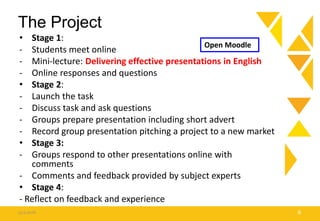
The Project
• Stage 1:
- Students meet online
- Mini-lecture: Delivering effective presentations in English
- Online responses and questions
• Stage 2:
- Launch the task
- Discuss task and ask questions
- Groups prepare presentation including short advert
- Record group presentation pitching a project to a new market
• Stage 3:
- Groups respond to other presentations online with
comments
- Comments and feedback provided by subject experts
• Stage 4:
- Reflect on feedback and experience
15.9.2016 8
Open Moodle
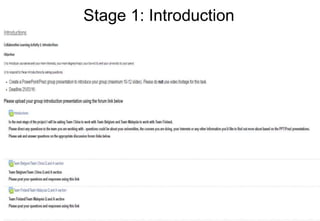
Stage 1: Introduction
15.9.2016 9
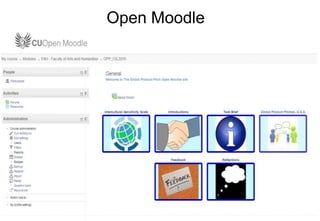
Open Moodle
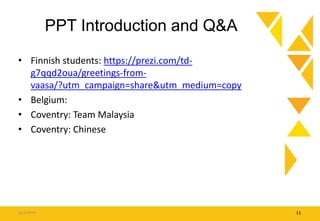
PPT Introduction and Q&A
• Finnish students: https://prezi.com/td-
g7qqd2oua/greetings-from-
vaasa/?utm_campaign=share&utm_medium=copy
• Belgium:
• Coventry: Team Malaysia
• Coventry: Chinese
15.9.2016 11
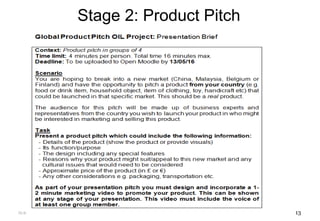
Stage 2: Product Pitch
15.9.2016 13
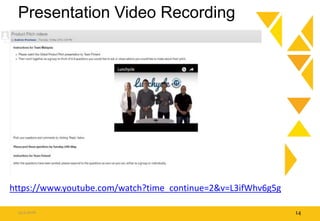
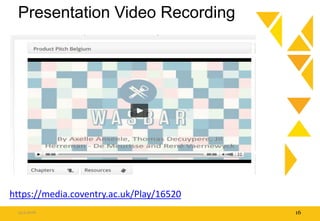
Presentation Video Recording
15.9.2016 14
https://www.youtube.com/watch?time_continue=2&v=L3ifWhv6g5g
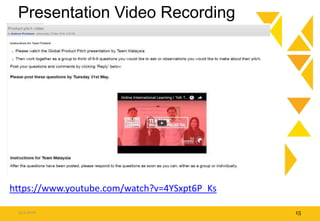
Presentation Video Recording
15.9.2016 15
https://www.youtube.com/watch?v=4YSxpt6P_Ks
Presentation Video Recording
15.9.2016 16
https://media.coventry.ac.uk/Play/16520
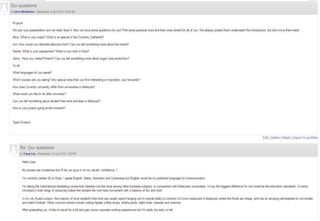
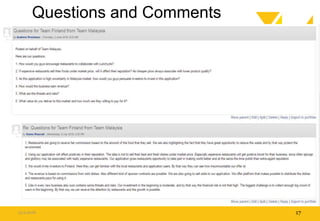
Questions and Comments
15.9.2016 17
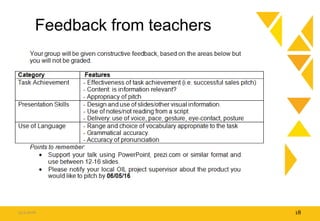
Feedback from teachers
15.9.2016 18
Conclusion:
Pedagogical Impact
• An opportunity for students to learn and use English
• Global product pitch: integrating business knowledge
and English
• To enhance communication skills
• To digitalise learning: video recording; online
discussion; interacting with students from other
countries
• To develop an innovative internationalised curriculum
15.9.2016 19
Kiitos!
15.9.2016 20
References
• Deardorff, D.K. (2006). Identification and assessment of
intercultural competence as a student outcome of
internatinalisation. Journal of Studies in International
Education, 10(3), pp.241-266.
• Higher Education Academy (2006). Framework for
internationalising higher education. Avaiblable at:
https://www.heacademy.ac.uk/enhancement/framew
orks/framework-internationalising-higher-education
• Pegrum, M. (2009) From Blogs to Bombs: The Future of
Digital Technologies in Education. Western Australia: UWA
Publishing.
15.9.2016 21

digital 2016.09.05

  • 1.
    Online International LearningProject - digital collaboration for students in Finland, England and Belgium Dr Nicole Keng Nicole.Keng@uva.fi
  • 2.
    Outline • Background • Projectaims • Participants • Project design • Conclusion 15.9.2016 2
  • 3.
    Autonomous Learning • Studentsengagement in authentic tasks with the support of their teachers to build new understandings, is time-consuming and demanding but hopefully will lead to development of autonomous learning, flexibility and strategies for collaboration. 15.9.2016 3 Pegrum (2009)
  • 4.
    Intercultural Competence • Developingintercultural competence is defined as “the ability to communicate effectively and appropriately in intercultural situation based on one’s intercultural knowledge, skills, and attitudes”. 15.9.2016 4 Deardoff (2006:247-48)
  • 5.
    Internationalising Curriculum • To“prepare graduates to live in and contribute responsibly to a globally interconnected society” 15.9.2016 5 HEA (2016)
  • 6.
    Project Aims By takingpart in this project, students will have opportunities: • To collaborate with students based in other parts of the world • To develop key communication skills in simulated business context • To use relevant subject-specific language • To enhance employability skills • To raise intercultural awareness • To improve communication skills in English 15.9.2016 6 The Global Product Pitch OIL (Online International Learning) Project
  • 7.
    Participants • Malaysian andChinese students at Coventry University, England • Belgium students VIVES university college, Belgium • Finnish students at the University of Vaasa, Finland 15.9.2016 7
  • 8.
    The Project • Stage1: - Students meet online - Mini-lecture: Delivering effective presentations in English - Online responses and questions • Stage 2: - Launch the task - Discuss task and ask questions - Groups prepare presentation including short advert - Record group presentation pitching a project to a new market • Stage 3: - Groups respond to other presentations online with comments - Comments and feedback provided by subject experts • Stage 4: - Reflect on feedback and experience 15.9.2016 8 Open Moodle
  • 9.
  • 10.
  • 11.
    PPT Introduction andQ&A • Finnish students: https://prezi.com/td- g7qqd2oua/greetings-from- vaasa/?utm_campaign=share&utm_medium=copy • Belgium: • Coventry: Team Malaysia • Coventry: Chinese 15.9.2016 11
  • 13.
    Stage 2: ProductPitch 15.9.2016 13
  • 14.
    Presentation Video Recording 15.9.201614 https://www.youtube.com/watch?time_continue=2&v=L3ifWhv6g5g
  • 15.
    Presentation Video Recording 15.9.201615 https://www.youtube.com/watch?v=4YSxpt6P_Ks
  • 16.
    Presentation Video Recording 15.9.201616 https://media.coventry.ac.uk/Play/16520
  • 17.
  • 18.
  • 19.
    Conclusion: Pedagogical Impact • Anopportunity for students to learn and use English • Global product pitch: integrating business knowledge and English • To enhance communication skills • To digitalise learning: video recording; online discussion; interacting with students from other countries • To develop an innovative internationalised curriculum 15.9.2016 19
  • 20.
  • 21.
    References • Deardorff, D.K.(2006). Identification and assessment of intercultural competence as a student outcome of internatinalisation. Journal of Studies in International Education, 10(3), pp.241-266. • Higher Education Academy (2006). Framework for internationalising higher education. Avaiblable at: https://www.heacademy.ac.uk/enhancement/framew orks/framework-internationalising-higher-education • Pegrum, M. (2009) From Blogs to Bombs: The Future of Digital Technologies in Education. Western Australia: UWA Publishing. 15.9.2016 21