Instructor: Dr. MOHAMMED ABDUL AMEER ALHUMAIRI
MISAN UNIVERSITY
COLLEGE OF ENGINEERING – PETROLEUM DEPARTMENT
PRODUCTION ENGINEERING II
dr.alhumairi@uomisan.edu.iq
DIFFUSIVITY EQUATION
There are two solution for the diffusivity equation :
1constant terminal rate solution: the flow rate will be
constant and radial flow.
2constant terminal pressure: constant terminal
pressure such water influx in oil and gas reservoir ,
and radial system.
For constant terminal rate solution we have two
solutions:
1 EI function.
2 Dimension less PD solution.
DIFFUSIVITY EQUATION
Constant terminal rate solution: such as drawdown and pressure build up analysis when
producing the well at constant flow rate and recording the flowing pressure as a function of
time P( rw, t)
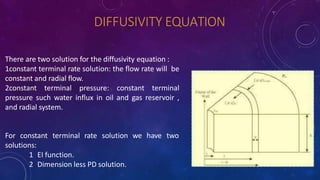
EI function solution ( line source solution ):
Assumption :
1 Infinite acting reservoir.
2 The well produce at constant rate.
3 Uniform Pi, when production start.
4The well is centered in a cylindrical reservoir re, rw ( the well has zero radius).
5- No flow across the outer boundary.
DIFFUSIVITY EQUATION
𝑄𝑜 = 0.00708
CONSTANT TERMINAL RATE SOLUTION: THE FLOW RATE WILL BE CONSTANT AND RADIAL FLOW.
DIMENSION LESS PRESSURE DROP SOLUTION:
𝐾 ∗ ℎ ∗ (𝑃𝑒 − 𝑃𝑤𝑓)
𝜇𝑜 ∗ 𝐵𝑜 ∗ 𝑙𝑛
𝑟𝑒
𝑟𝑤
AND THIS EQUATION CAN BE REWRITE AS FOLLOWS:
𝑄𝑜 ∗ 𝜇 ∗ 𝐵𝑜
𝑜
0.00708 ∗ 𝐾 ∗ ℎ
= 𝑙𝑛
𝑃𝑒 − 𝑃𝑤𝑓 𝑟𝑒
𝑟𝑤
𝑃𝐷 = 𝑙𝑛
𝑟
𝑒
𝑟
𝑤
PD DIMENSION LESS PRESSURE DROP
𝑃𝐷 =
𝑃𝑒−𝑃𝑤𝑓
𝑄𝑜∗𝜇𝑜∗𝐵𝑜
0.00708∗𝐾 ∗ℎ
𝑟
𝑒
𝑟𝑒𝐷 = 𝑟𝑤
𝑓𝑜𝑟 𝑟𝑒
𝐷
𝑟 =
𝑟
𝑟
𝑤
𝑓𝑜𝑟 𝑎𝑛𝑦 𝑟
DIFFUSIVITY EQUATION
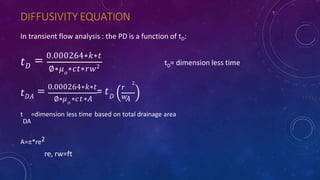
In transient flow analysis : the PD is a function of tD:
𝑡𝐷
= 0.000264∗𝑘∗𝑡
𝑜
∅∗𝜇 ∗𝑐𝑡∗𝑟𝑤2 D
t = dimension less time
𝑡
𝑜
= 0.000264∗𝑘∗𝑡
= 𝑡
𝐷𝐴 𝐷
𝑟
𝑤
2
∅∗𝜇 ∗𝑐𝑡∗𝐴 𝐴
t =dimension less time based on total drainage area
DA
A=*re2
re, rw=ft
DIFFUSIVITY EQUATION
𝑝 𝑟𝑤, 𝑡 = 𝑃𝑖 −
𝑄𝑜∗𝜇𝑜 ∗𝐵
𝑂
0.00708∗𝑘∗ℎ
*PD
The diffusivity equation can be introduce in form of dimension less
𝜕2𝑝 1 𝜕𝑝 1 𝜕𝑝
𝜕2𝑟
+
𝑟 𝜕𝑟
=
𝛿 𝜕𝑡
𝜕𝑟2
𝐷 𝐷
𝜕2𝑝𝐷 1 𝜕𝑝𝐷 𝜕𝑝𝐷
+ =
𝑟 𝜕𝑟𝐷 𝜕𝑡𝐷
DIFFUSIVITY EQUATION
Van Everdingen and Hurst (1949) proposed an analytical solution to the above
equation by assuming:
 Perfectly radial reservoir system
 The producing well is in the center and producing at a constant production
rate of Q
 Uniform pressure pi throughout the reservoir before production
 No flow across the external radius re
DIFFUSIVITY EQUATION
Two cases for the above diffusivity equation dimension less:
1- infinite acting reservoir reD=.
2- finite radial reservoir.
1 infinite acting reservoir: ( infinite cylindrical reservoir with line source well):
Assumption:
 The reservoir system is perfectly radial.
 The producing well is in the center and producing at a constant production rate of Q.
 Pressure pi is uniform throughout the reservoir before production.
 No flow occurs across the external radius re.
DIFFUSIVITY EQUATION
Two cases for the above diffusivity equation dimension less:
1- infinite acting reservoir reD=.
2- finite radial reservoir.
1- infinite acting reservoir:
For an infinite-acting reservoir, i.e., reD = ∞, the dimensionless pressure drop function
pD is strictly a function of the dimensionless time tD, or pD=f(tD)
“ Chatas and Lee”, tabulated the pD values for the infinite-acting reservoir as shown
in Table below.
DIFFUSIVITY EQUATION
PD=f(tD)
For tD < 0.01 𝑃𝐷 = 2
𝑡𝐷
𝜋
+ 0.80907
For tD > 1000 𝑃𝐷 = 0.5 ln 𝑡𝐷
For 0.01 <tD < 1000 from table
𝑝 𝑟, 𝑡 = 𝑃𝑖 −
𝑄𝑜∗𝜇𝑜∗𝐵𝑜
0.00708∗𝑘∗ℎ
*PD
Reference …Tarek Ahmed chapter three
DIFFUSIVITY EQUATION
2-finite radial reservoir:
The arrival of the pressure disturbance at the well drainage boundary marks
the end of the transient flow period and the beginning of the semi-steady
(pseudo-) state.
During this flow state, the reservoir boundaries and the shape of the drainage
area influence the wellbore pressure response as well as the behavior of the
pressure distribution throughout the reservoir.
DIFFUSIVITY EQUATION
2-finite radial reservoir:
For a finite radial system, the pD-function is a function of both the dimensionless time and
radius, or
PD = f( tD, reD)
where
reD= (external radius )/( wellbore radius) = re /rw
Table below presents pD as a function of tD for 1.5 < reD < 10 range.
Reference …Tarek Ahmed chapter three

diffusevity equation dimension less pressure drop lecture #2(1).pptx

  • 1.
    Instructor: Dr. MOHAMMEDABDUL AMEER ALHUMAIRI MISAN UNIVERSITY COLLEGE OF ENGINEERING – PETROLEUM DEPARTMENT PRODUCTION ENGINEERING II dr.alhumairi@uomisan.edu.iq
  • 2.
    DIFFUSIVITY EQUATION There aretwo solution for the diffusivity equation : 1constant terminal rate solution: the flow rate will be constant and radial flow. 2constant terminal pressure: constant terminal pressure such water influx in oil and gas reservoir , and radial system. For constant terminal rate solution we have two solutions: 1 EI function. 2 Dimension less PD solution.
  • 3.
    DIFFUSIVITY EQUATION Constant terminalrate solution: such as drawdown and pressure build up analysis when producing the well at constant flow rate and recording the flowing pressure as a function of time P( rw, t) EI function solution ( line source solution ): Assumption : 1 Infinite acting reservoir. 2 The well produce at constant rate. 3 Uniform Pi, when production start. 4The well is centered in a cylindrical reservoir re, rw ( the well has zero radius). 5- No flow across the outer boundary.
  • 4.
    DIFFUSIVITY EQUATION 𝑄𝑜 =0.00708 CONSTANT TERMINAL RATE SOLUTION: THE FLOW RATE WILL BE CONSTANT AND RADIAL FLOW. DIMENSION LESS PRESSURE DROP SOLUTION: 𝐾 ∗ ℎ ∗ (𝑃𝑒 − 𝑃𝑤𝑓) 𝜇𝑜 ∗ 𝐵𝑜 ∗ 𝑙𝑛 𝑟𝑒 𝑟𝑤 AND THIS EQUATION CAN BE REWRITE AS FOLLOWS: 𝑄𝑜 ∗ 𝜇 ∗ 𝐵𝑜 𝑜 0.00708 ∗ 𝐾 ∗ ℎ = 𝑙𝑛 𝑃𝑒 − 𝑃𝑤𝑓 𝑟𝑒 𝑟𝑤 𝑃𝐷 = 𝑙𝑛 𝑟 𝑒 𝑟 𝑤 PD DIMENSION LESS PRESSURE DROP 𝑃𝐷 = 𝑃𝑒−𝑃𝑤𝑓 𝑄𝑜∗𝜇𝑜∗𝐵𝑜 0.00708∗𝐾 ∗ℎ 𝑟 𝑒 𝑟𝑒𝐷 = 𝑟𝑤 𝑓𝑜𝑟 𝑟𝑒 𝐷 𝑟 = 𝑟 𝑟 𝑤 𝑓𝑜𝑟 𝑎𝑛𝑦 𝑟
  • 5.
    DIFFUSIVITY EQUATION In transientflow analysis : the PD is a function of tD: 𝑡𝐷 = 0.000264∗𝑘∗𝑡 𝑜 ∅∗𝜇 ∗𝑐𝑡∗𝑟𝑤2 D t = dimension less time 𝑡 𝑜 = 0.000264∗𝑘∗𝑡 = 𝑡 𝐷𝐴 𝐷 𝑟 𝑤 2 ∅∗𝜇 ∗𝑐𝑡∗𝐴 𝐴 t =dimension less time based on total drainage area DA A=*re2 re, rw=ft
  • 6.
    DIFFUSIVITY EQUATION 𝑝 𝑟𝑤,𝑡 = 𝑃𝑖 − 𝑄𝑜∗𝜇𝑜 ∗𝐵 𝑂 0.00708∗𝑘∗ℎ *PD The diffusivity equation can be introduce in form of dimension less 𝜕2𝑝 1 𝜕𝑝 1 𝜕𝑝 𝜕2𝑟 + 𝑟 𝜕𝑟 = 𝛿 𝜕𝑡 𝜕𝑟2 𝐷 𝐷 𝜕2𝑝𝐷 1 𝜕𝑝𝐷 𝜕𝑝𝐷 + = 𝑟 𝜕𝑟𝐷 𝜕𝑡𝐷
  • 7.
    DIFFUSIVITY EQUATION Van Everdingenand Hurst (1949) proposed an analytical solution to the above equation by assuming:  Perfectly radial reservoir system  The producing well is in the center and producing at a constant production rate of Q  Uniform pressure pi throughout the reservoir before production  No flow across the external radius re
  • 8.
    DIFFUSIVITY EQUATION Two casesfor the above diffusivity equation dimension less: 1- infinite acting reservoir reD=. 2- finite radial reservoir. 1 infinite acting reservoir: ( infinite cylindrical reservoir with line source well): Assumption:  The reservoir system is perfectly radial.  The producing well is in the center and producing at a constant production rate of Q.  Pressure pi is uniform throughout the reservoir before production.  No flow occurs across the external radius re.
  • 9.
    DIFFUSIVITY EQUATION Two casesfor the above diffusivity equation dimension less: 1- infinite acting reservoir reD=. 2- finite radial reservoir. 1- infinite acting reservoir: For an infinite-acting reservoir, i.e., reD = ∞, the dimensionless pressure drop function pD is strictly a function of the dimensionless time tD, or pD=f(tD) “ Chatas and Lee”, tabulated the pD values for the infinite-acting reservoir as shown in Table below.
  • 10.
    DIFFUSIVITY EQUATION PD=f(tD) For tD< 0.01 𝑃𝐷 = 2 𝑡𝐷 𝜋 + 0.80907 For tD > 1000 𝑃𝐷 = 0.5 ln 𝑡𝐷 For 0.01 <tD < 1000 from table 𝑝 𝑟, 𝑡 = 𝑃𝑖 − 𝑄𝑜∗𝜇𝑜∗𝐵𝑜 0.00708∗𝑘∗ℎ *PD
  • 11.
  • 12.
    DIFFUSIVITY EQUATION 2-finite radialreservoir: The arrival of the pressure disturbance at the well drainage boundary marks the end of the transient flow period and the beginning of the semi-steady (pseudo-) state. During this flow state, the reservoir boundaries and the shape of the drainage area influence the wellbore pressure response as well as the behavior of the pressure distribution throughout the reservoir.
  • 13.
    DIFFUSIVITY EQUATION 2-finite radialreservoir: For a finite radial system, the pD-function is a function of both the dimensionless time and radius, or PD = f( tD, reD) where reD= (external radius )/( wellbore radius) = re /rw Table below presents pD as a function of tD for 1.5 < reD < 10 range.
  • 14.