Lesson 2
Functions vs.
Relations
At the end of this lesson, the learner should be able to
 clearly define relations and functions;
 correctly differentiate a function from a relation; and
 accurately determine whether a given scenario is a
function or not.
 What is a relation?
 How will you distinguish a function from a relation?
In this lesson, you will learn how to distinguish functions
from relations. One way to do that is by observing their
graphs!
Let’s take a look at this short video to have some background
about the different types of relations.
LegaC. “Correspondence between Variables.” Youtube (June
2016). Retrieved 20 February 2019 from
https://www.youtube.com/watch?v=em_KshLsCxU
● In the video, what are the two types of test used to
determine the correspondence between variables?
● Among the types of correspondence, which of them
represents a function? Why do you say so?
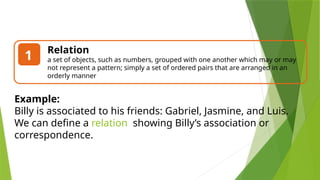
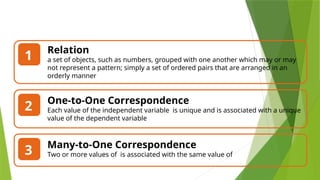
Relation
a set of objects, such as numbers, grouped with one another which may or may
not represent a pattern; simply a set of ordered pairs that are arranged in an
orderly manner
1
Example:
Billy is associated to his friends: Gabriel, Jasmine, and Luis.
We can define a relation showing Billy’s association or
correspondence.
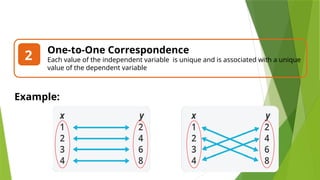
One-to-One Correspondence
Each value of the independent variable is unique and is associated with a unique
value of the dependent variable
2
Example:
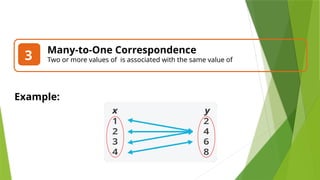
Many-to-One Correspondence
Two or more values of is associated with the same value of
3
Example:
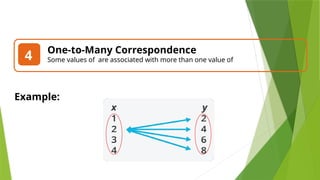
One-to-Many Correspondence
Some values of are associated with more than one value of
4
Example:
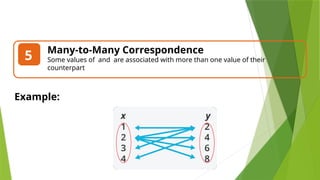
Many-to-Many Correspondence
Some values of and are associated with more than one value of their
counterpart
5
Example:
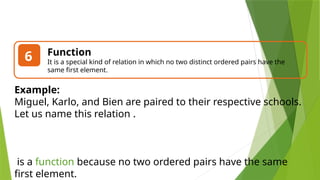
Function
It is a special kind of relation in which no two distinct ordered pairs have the
same first element.
6
Example:
Miguel, Karlo, and Bien are paired to their respective schools.
Let us name this relation .
is a function because no two ordered pairs have the same
first element.
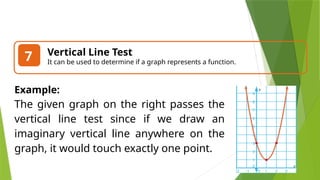
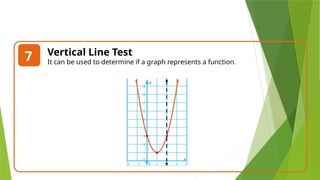
Vertical Line Test
It can be used to determine if a graph represents a function.
7
Example:
The given graph on the right passes the
vertical line test since if we draw an
imaginary vertical line anywhere on the
graph, it would touch exactly one point.
Example 1: Determine whether the following set is a
function.
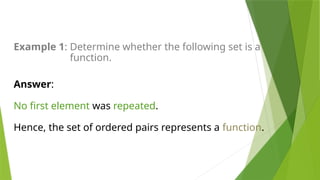
Answer:
No first element was repeated.
Hence, the set of ordered pairs represents a function.
Example 1: Determine whether the following set is a
function.
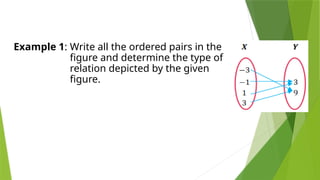
Example 1: Write all the ordered pairs in the
figure and determine the type of
relation depicted by the given
figure.
Example 1: Write all the ordered pairs in the
figure and determine the type of
relation depicted by the given
figure.
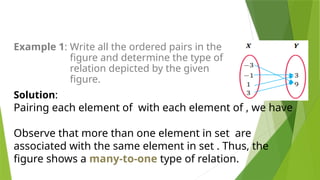
Solution:
Pairing each element of with each element of , we have
Observe that more than one element in set are
associated with the same element in set . Thus, the
figure shows a many-to-one type of relation.
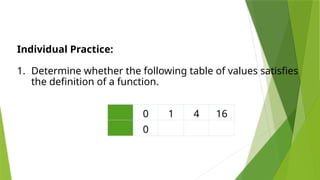
Individual Practice:
1. Determine whether the following table of values satisfies
the definition of a function.
0 1 4 16
0
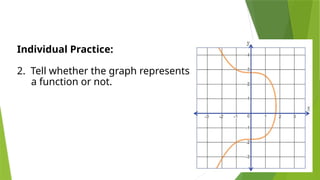
Individual Practice:
2. Tell whether the graph represents
a function or not.
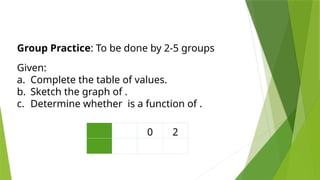
Group Practice: To be done by 2-5 groups
Given:
a. Complete the table of values.
b. Sketch the graph of .
c. Determine whether is a function of .
0 2
Relation
a set of objects, such as numbers, grouped with one another which may or may
not represent a pattern; simply a set of ordered pairs that are arranged in an
orderly manner
1
One-to-One Correspondence
Each value of the independent variable is unique and is associated with a unique
value of the dependent variable
2
Many-to-One Correspondence
Two or more values of is associated with the same value of
3
One-to-Many Correspondence
Some values of are associated with more than one value of
4
Many-to-Many Correspondence
Some values of and are associated with more than one value of their
counterpart
5
Function
It is a special kind of relation in which no two distinct ordered pairs have the
same first element.
6
Vertical Line Test
It can be used to determine if a graph represents a function.
7
● What is the difference between a function and a relation?
● Why is it important to know that there are a lot of ways to
represent a function?
● How do we make use of functions to solve real-life
problems?

Differentiation Functions Relations.pptx

  • 1.
  • 2.
    At the endof this lesson, the learner should be able to  clearly define relations and functions;  correctly differentiate a function from a relation; and  accurately determine whether a given scenario is a function or not.
  • 3.
     What isa relation?  How will you distinguish a function from a relation?
  • 4.
    In this lesson,you will learn how to distinguish functions from relations. One way to do that is by observing their graphs! Let’s take a look at this short video to have some background about the different types of relations. LegaC. “Correspondence between Variables.” Youtube (June 2016). Retrieved 20 February 2019 from https://www.youtube.com/watch?v=em_KshLsCxU
  • 5.
    ● In thevideo, what are the two types of test used to determine the correspondence between variables? ● Among the types of correspondence, which of them represents a function? Why do you say so?
  • 6.
    Relation a set ofobjects, such as numbers, grouped with one another which may or may not represent a pattern; simply a set of ordered pairs that are arranged in an orderly manner 1 Example: Billy is associated to his friends: Gabriel, Jasmine, and Luis. We can define a relation showing Billy’s association or correspondence.
  • 7.
    One-to-One Correspondence Each valueof the independent variable is unique and is associated with a unique value of the dependent variable 2 Example:
  • 8.
    Many-to-One Correspondence Two ormore values of is associated with the same value of 3 Example:
  • 9.
    One-to-Many Correspondence Some valuesof are associated with more than one value of 4 Example:
  • 10.
    Many-to-Many Correspondence Some valuesof and are associated with more than one value of their counterpart 5 Example:
  • 11.
    Function It is aspecial kind of relation in which no two distinct ordered pairs have the same first element. 6 Example: Miguel, Karlo, and Bien are paired to their respective schools. Let us name this relation . is a function because no two ordered pairs have the same first element.
  • 12.
    Vertical Line Test Itcan be used to determine if a graph represents a function. 7 Example: The given graph on the right passes the vertical line test since if we draw an imaginary vertical line anywhere on the graph, it would touch exactly one point.
  • 13.
    Example 1: Determinewhether the following set is a function.
  • 14.
    Answer: No first elementwas repeated. Hence, the set of ordered pairs represents a function. Example 1: Determine whether the following set is a function.
  • 15.
    Example 1: Writeall the ordered pairs in the figure and determine the type of relation depicted by the given figure.
  • 16.
    Example 1: Writeall the ordered pairs in the figure and determine the type of relation depicted by the given figure. Solution: Pairing each element of with each element of , we have Observe that more than one element in set are associated with the same element in set . Thus, the figure shows a many-to-one type of relation.
  • 17.
    Individual Practice: 1. Determinewhether the following table of values satisfies the definition of a function. 0 1 4 16 0
  • 18.
    Individual Practice: 2. Tellwhether the graph represents a function or not.
  • 19.
    Group Practice: Tobe done by 2-5 groups Given: a. Complete the table of values. b. Sketch the graph of . c. Determine whether is a function of . 0 2
  • 20.
    Relation a set ofobjects, such as numbers, grouped with one another which may or may not represent a pattern; simply a set of ordered pairs that are arranged in an orderly manner 1 One-to-One Correspondence Each value of the independent variable is unique and is associated with a unique value of the dependent variable 2 Many-to-One Correspondence Two or more values of is associated with the same value of 3
  • 21.
    One-to-Many Correspondence Some valuesof are associated with more than one value of 4 Many-to-Many Correspondence Some values of and are associated with more than one value of their counterpart 5 Function It is a special kind of relation in which no two distinct ordered pairs have the same first element. 6
  • 22.
    Vertical Line Test Itcan be used to determine if a graph represents a function. 7
  • 23.
    ● What isthe difference between a function and a relation? ● Why is it important to know that there are a lot of ways to represent a function? ● How do we make use of functions to solve real-life problems?