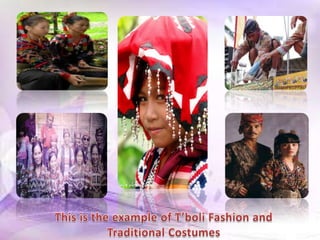
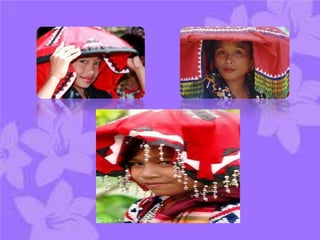
•T'boli are known for their bright
colored costumes, which they wear
daily, unlike other tribes who wear
their costumes during tribal feasts or
presence of visitors.
•Women Wear K’gul yaha soung (plain
black or dark navy blouse, tight fitting,
waist length, with opening down the front
or the back), and their luwek (ankle-
length tube skirt). Other traditional
garbs include K’gal nisif (embroidered
blouse), fan de (skirt of red and/or black
cloth), K’gal binsiurt (embroidered could
with triangular shell), and tredyung
it consists of several strands of
tiny, colored beads, suspended
under the chin, from the left ear-
lobe to the right. It frames the
face of the women like a veil.
hikef (choker of pure beadwork, in black, red and while), l’mimot
(hangs against the woman’s chest, with strands of back and red
tiny black beads), lieg (long, thick necklace with double-triple
linked brass chain, has wide tassels and beads at the ends. The
most difficult accessory to acquire because this is considered an
heirloom.
hilot (3-inch wide brass chainmail),
hilot t’noyong (a regular hilot With
hawk bells) that makes tinkling sound
as a girl wearing it walks, and hilot
l’minot (a solid beadWorK, With tiny
red-white-back-yellow beads in
dazzling designs).
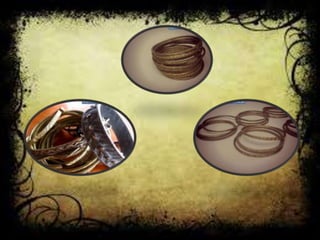
blonso (plain brass bracelet worn loosely on the wrist)
and kala (also brass, worn tightly on the arm).
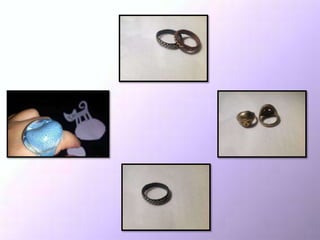
t’sing (rings) comes in sets of five – the first,
third and fifth of plain brass, and the second
and fourth in carabao horn.
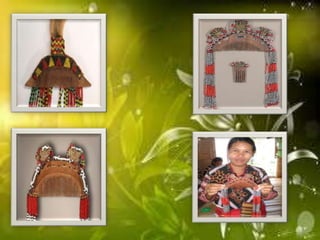
worn on the head to crown a
woman’s hairstyle -- su’wat blakang
(bamboo).
kayab (a yard long wrapped loosely around their hairdo),
s’long kinibang (a round salakot made of bamboo strips,
worn when working in the field), and bangat s’laong (2 long
bands of solid beadwork, with thick horsehair tassels at
their ends, worn on special occasions and sometimes part
of the T’boli girl’s bride price).
thick wooden ear plugs, worn onto men’s
ear lobes
worn usually by the Datus, which is a
piece of special cloth, gathered into a
thick band and worn across the chest.
tablos (made of bamboo and used for hunting board, deer,
monkeys and big birds), senofil (looks like a centipede at the
end), slufang (used for smaller birds), and husong (think
bamboo reed).
coat of woven bark-strips
buyus (made of rattan, with brass tip), soit (used for
fish and snakes), and klouit (made of rattan, with
end like the sinofil.
rectangular wooden shields of about 16 by
30 inches.
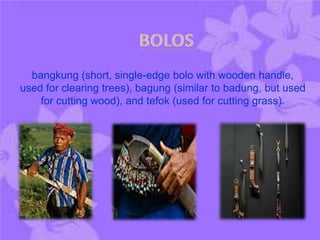
bangkung (short, single-edge bolo with wooden handle,
used for clearing trees), bagung (similar to badung, but used
for cutting wood), and tefok (used for cutting grass).
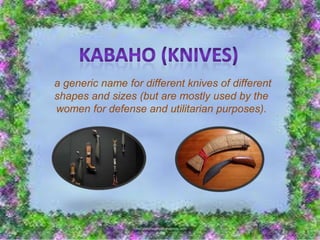
a generic name for different knives of different
shapes and sizes (but are mostly used by the
women for defense and utilitarian purposes).

different kinds of indigenous

  • 3.
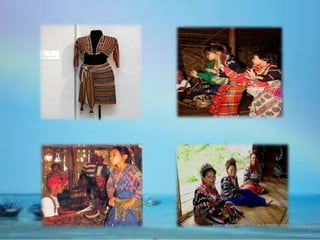
    •T'boli are knownfor their bright colored costumes, which they wear daily, unlike other tribes who wear their costumes during tribal feasts or presence of visitors. •Women Wear K’gul yaha soung (plain black or dark navy blouse, tight fitting, waist length, with opening down the front or the back), and their luwek (ankle- length tube skirt). Other traditional garbs include K’gal nisif (embroidered blouse), fan de (skirt of red and/or black cloth), K’gal binsiurt (embroidered could with triangular shell), and tredyung
  • 7.
    it consists ofseveral strands of tiny, colored beads, suspended under the chin, from the left ear- lobe to the right. It frames the face of the women like a veil.
  • 8.
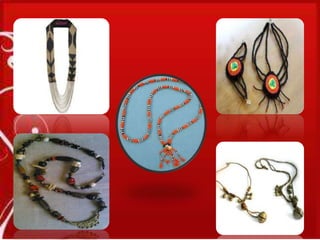
    hikef (choker ofpure beadwork, in black, red and while), l’mimot (hangs against the woman’s chest, with strands of back and red tiny black beads), lieg (long, thick necklace with double-triple linked brass chain, has wide tassels and beads at the ends. The most difficult accessory to acquire because this is considered an heirloom.
  • 10.
    hilot (3-inch widebrass chainmail), hilot t’noyong (a regular hilot With hawk bells) that makes tinkling sound as a girl wearing it walks, and hilot l’minot (a solid beadWorK, With tiny red-white-back-yellow beads in dazzling designs).
  • 12.
    blonso (plain brassbracelet worn loosely on the wrist) and kala (also brass, worn tightly on the arm).
  • 16.
    t’sing (rings) comesin sets of five – the first, third and fifth of plain brass, and the second and fourth in carabao horn.
  • 18.
    worn on thehead to crown a woman’s hairstyle -- su’wat blakang (bamboo).
  • 20.
    kayab (a yardlong wrapped loosely around their hairdo), s’long kinibang (a round salakot made of bamboo strips, worn when working in the field), and bangat s’laong (2 long bands of solid beadwork, with thick horsehair tassels at their ends, worn on special occasions and sometimes part of the T’boli girl’s bride price).
  • 23.
    thick wooden earplugs, worn onto men’s ear lobes
  • 24.
    worn usually bythe Datus, which is a piece of special cloth, gathered into a thick band and worn across the chest.
  • 25.
    tablos (made ofbamboo and used for hunting board, deer, monkeys and big birds), senofil (looks like a centipede at the end), slufang (used for smaller birds), and husong (think bamboo reed).
  • 26.
    coat of wovenbark-strips
  • 27.
    buyus (made ofrattan, with brass tip), soit (used for fish and snakes), and klouit (made of rattan, with end like the sinofil.
  • 28.
    rectangular wooden shieldsof about 16 by 30 inches.
  • 29.
    bangkung (short, single-edgebolo with wooden handle, used for clearing trees), bagung (similar to badung, but used for cutting wood), and tefok (used for cutting grass).
  • 30.
    a generic namefor different knives of different shapes and sizes (but are mostly used by the women for defense and utilitarian purposes).