IFS
Lecture !!
Alana Dixon
Kristu Jayanti College Autonomous
Forensic
Ballistics
Forensic Ballistics is a branch of
forensic science that deals with the
examination of firearms, bullets, and
the effects of their use. It involves
studying the behavior of projectiles
(like bullets) and the damage they
cause, helping to link a bullet to a
specific firearm and determine what
happened during a shooting.
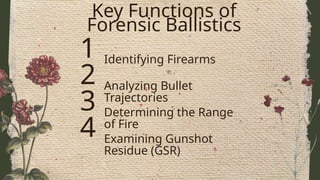
Key Functions of
Forensic Ballistics
Identifying Firearms
Analyzing Bullet
Trajectories
Determining the Range
of Fire
Examining Gunshot
Residue (GSR)
1
2
3
4
Imagine a situation where a suspect is involved in a drive-by
shooting. The police recover several shell casings from the
scene. Forensic ballistics experts analyze these casings and
match them to a gun found in the suspect’s possession.
They also reconstruct the bullet trajectories to determine
the position of the car during the shooting. This evidence
plays a critical role in securing a conviction in court.
Forensic
Psychology
Forensic Psychology is the
intersection of psychology and the
legal system. It involves applying
psychological principles and
methods to understand the minds of
criminals, victims, and others
involved in legal cases. Forensic
psychologists help in profiling
suspects, assessing mental health,
and providing expert testimony in
court.
Key Functions of
Forensic Ballistics
Criminal Profiling
Expert Testimony
Risk Assessment
Victim Support and
Counselling
1
2
3
4
Imagine a case where a serial arsonist is terrorizing a
community. The police have little evidence to go on. A
forensic psychologist is brought in to create a profile of
the arsonist based on the patterns observed at the
crime scenes. The profile suggests that the arsonist is
likely a young male with a history of mental health
issues related to anger. This leads the police to focus
their investigation on a specific suspect, who is
eventually caught and convicted.
Forensic Questioned
Documents
Forensic Questioned Documents is a
branch of forensic science that deals
with the examination and analysis of
documents that are in dispute.
These documents can include
handwriting, signatures, printed
materials, alterations, and more. The
goal is to determine their
authenticity, origin, or to detect any
tampering or forgery
Key functions
Handwriting and
Signature Analysis
Ink and Paper Analysis
Detection of Alterations
and Erasures
Examination of Indented
Writings
1
2
3
4
Imagine a scenario where a business owner
discovers that a contract has been altered, favoring
the other party. The owner suspects foul play and
consults a forensic document examiner. The
examiner analyzes the ink, paper, and signature on
the contract, discovering that the document was
altered after it was signed. This evidence is
presented in court, helping the business owner win
the case.
Digital Forensics
Digital Forensics is a branch of
forensic science that focuses on the
recovery, analysis, and investigation
of data from digital devices. This
includes computers, smartphones,
tablets, and other electronic devices.
The goal is to uncover and preserve
digital evidence that can be used in
legal investigations.
Key Functions
Data Recovery
Analysis of Digital
Footprints
Examination of Digital
Devices
Preservation of Digital
Evidence
1
2
3
4
Imagine a situation where a company
experiences a data breach, and sensitive
customer information is stolen. The company’s IT
team is unable to trace the source of the breach.
Forensic digital experts are brought in to
investigate. They analyze the company’s network
logs, recover deleted files, and trace the hacker’s
digital footprint back to a disgruntled former
employee. This evidence is used to prosecute the
individual responsible and strengthen the
company’s security systems
Forensic Toxicology
Forensic Toxicology is a branch of
forensic science that involves the
study of toxins, drugs, and other
chemicals in the human body. It
helps in determining whether these
substances contributed to or caused
harm or death.
Key Functions of
Forensic
Toxicology
Determining Cause of
Death
Detecting Drug Use
Identifying Poisoning
1
2
3
Thank You

Different Forensic branches and its key functions

  • 1.
    IFS Lecture !! Alana Dixon KristuJayanti College Autonomous
  • 2.
    Forensic Ballistics Forensic Ballistics isa branch of forensic science that deals with the examination of firearms, bullets, and the effects of their use. It involves studying the behavior of projectiles (like bullets) and the damage they cause, helping to link a bullet to a specific firearm and determine what happened during a shooting.
  • 3.
    Key Functions of ForensicBallistics Identifying Firearms Analyzing Bullet Trajectories Determining the Range of Fire Examining Gunshot Residue (GSR) 1 2 3 4
  • 4.
    Imagine a situationwhere a suspect is involved in a drive-by shooting. The police recover several shell casings from the scene. Forensic ballistics experts analyze these casings and match them to a gun found in the suspect’s possession. They also reconstruct the bullet trajectories to determine the position of the car during the shooting. This evidence plays a critical role in securing a conviction in court.
  • 5.
    Forensic Psychology Forensic Psychology isthe intersection of psychology and the legal system. It involves applying psychological principles and methods to understand the minds of criminals, victims, and others involved in legal cases. Forensic psychologists help in profiling suspects, assessing mental health, and providing expert testimony in court.
  • 6.
    Key Functions of ForensicBallistics Criminal Profiling Expert Testimony Risk Assessment Victim Support and Counselling 1 2 3 4
  • 7.
    Imagine a casewhere a serial arsonist is terrorizing a community. The police have little evidence to go on. A forensic psychologist is brought in to create a profile of the arsonist based on the patterns observed at the crime scenes. The profile suggests that the arsonist is likely a young male with a history of mental health issues related to anger. This leads the police to focus their investigation on a specific suspect, who is eventually caught and convicted.
  • 8.
    Forensic Questioned Documents Forensic QuestionedDocuments is a branch of forensic science that deals with the examination and analysis of documents that are in dispute. These documents can include handwriting, signatures, printed materials, alterations, and more. The goal is to determine their authenticity, origin, or to detect any tampering or forgery
  • 9.
    Key functions Handwriting and SignatureAnalysis Ink and Paper Analysis Detection of Alterations and Erasures Examination of Indented Writings 1 2 3 4
  • 10.
    Imagine a scenariowhere a business owner discovers that a contract has been altered, favoring the other party. The owner suspects foul play and consults a forensic document examiner. The examiner analyzes the ink, paper, and signature on the contract, discovering that the document was altered after it was signed. This evidence is presented in court, helping the business owner win the case.
  • 11.
    Digital Forensics Digital Forensicsis a branch of forensic science that focuses on the recovery, analysis, and investigation of data from digital devices. This includes computers, smartphones, tablets, and other electronic devices. The goal is to uncover and preserve digital evidence that can be used in legal investigations.
  • 12.
    Key Functions Data Recovery Analysisof Digital Footprints Examination of Digital Devices Preservation of Digital Evidence 1 2 3 4
  • 13.
    Imagine a situationwhere a company experiences a data breach, and sensitive customer information is stolen. The company’s IT team is unable to trace the source of the breach. Forensic digital experts are brought in to investigate. They analyze the company’s network logs, recover deleted files, and trace the hacker’s digital footprint back to a disgruntled former employee. This evidence is used to prosecute the individual responsible and strengthen the company’s security systems
  • 14.
    Forensic Toxicology Forensic Toxicologyis a branch of forensic science that involves the study of toxins, drugs, and other chemicals in the human body. It helps in determining whether these substances contributed to or caused harm or death.
  • 15.
    Key Functions of Forensic Toxicology DeterminingCause of Death Detecting Drug Use Identifying Poisoning 1 2 3
  • 16.