Cooking Methods
Amedeo Vallati
Amedeo Vallati
You cook food because…
• Cooking kills bacteria: Some foods
cannot be served raw, like poultry.
• Cooking makes food easier to
digest.
• Cooking changes the taste, aroma
and appearance of food.
Amedeo Vallati
Food is made up of…
• Water, which evaporates when cooked.
• Fats, which melt when cooked.
• Proteins, which coagulate, or become firmer
when cooked.
• Nutrients, such as vitamins and minerals which
are destroyed by cooking.
• Carbohydrates
– sugars, which caramelize or become
brown when cooked.
– starches, which gelatinize or absorb
water and swell when cooked.
Amedeo Vallati
Heat transfer
Heat travels to food from its source in a number
of ways:
• Convection means currents of air, steam,
water or fat carry the heat to food.
Like when currents of hot air heat the food in
an oven.
• Conduction means something hot touches the
food. Like when a steak is cooked in a hot
frying pan.
• Radiation means heat radiates from a heat
source to the food. Like when heat radiates
from the coals on a barbeque to the food.
Amedeo Vallati
Cooking methods
Cooking methods are the techniques we use in
the kitchen to get the results we want. For
example, you could boil or poach a steak but
that would not get the result you want, which
is probably a brown tasty crust with a pink
interior.
Cooking methods are classified as either:
• Dry heat methods, which means no moisture is
added…
• Moist heat methods, which involve either
water or steam…
• Combination methods, which involve dry heat
and then a moist heat.
Amedeo Vallati
Dry heat methods
Dry heat methods mean cooking without
any water or steam, although some kind
of cooking oil is often used. Dry heat
methods are for foods which are
naturally tender.
Amedeo Vallati
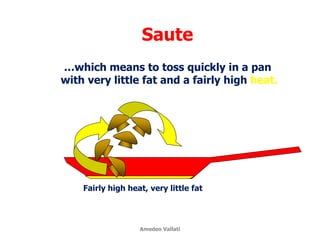
Saute
Fairly high heat, very little fat
…which means to toss quickly in a pan
with very little fat and a fairly high heat.
Amedeo Vallati
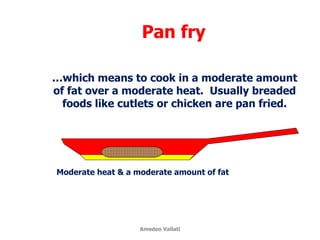
Pan fry
Moderate heat & a moderate amount of fat
…which means to cook in a moderate amount
of fat over a moderate heat. Usually breaded
foods like cutlets or chicken are pan fried.
Amedeo Vallati
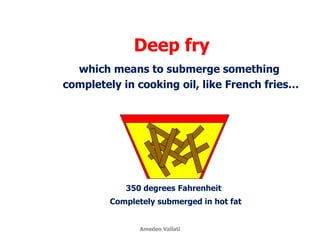
Deep fry
350 degrees Fahrenheit
Completely submerged in hot fat
which means to submerge something
completely in cooking oil, like French fries…
Amedeo Vallati
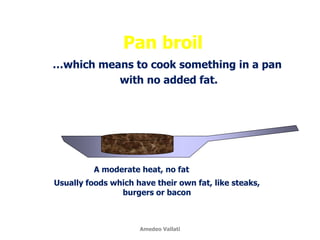
Pan broil
A moderate heat, no fat
Usually foods which have their own fat, like steaks,
burgers or bacon
…which means to cook something in a pan
with no added fat.
Amedeo Vallati
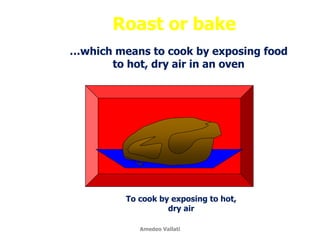
Roast or bake
To cook by exposing to hot,
dry air
…which means to cook by exposing food
to hot, dry air in an oven
Amedeo Vallati
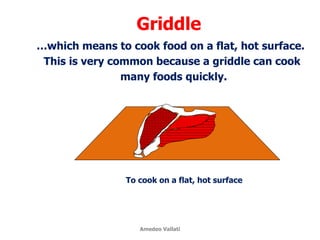
Griddle
To cook on a flat, hot surface
…which means to cook food on a flat, hot surface.
This is very common because a griddle can cook
many foods quickly.
Amedeo Vallati
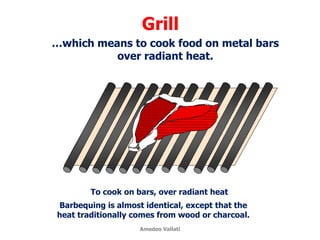
Grill
To cook on bars, over radiant heat
…which means to cook food on metal bars
over radiant heat.
Barbequing is almost identical, except that the
heat traditionally comes from wood or charcoal.
Amedeo Vallati
Moist heat methods
Moist heat methods mean cooking food in
water or steam.
Amedeo Vallati
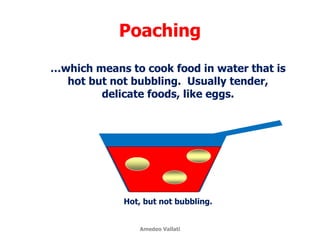
Poaching
…which means to cook food in water that is
hot but not bubbling. Usually tender,
delicate foods, like eggs.
Hot, but not bubbling.
Amedeo Vallati
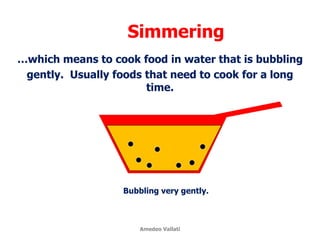
Simmering
…which means to cook food in water that is bubbling
gently. Usually foods that need to cook for a long
time.
Bubbling very gently.
Amedeo Vallati
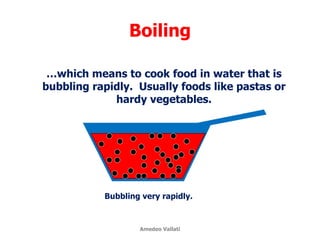
Boiling
…which means to cook food in water that is
bubbling rapidly. Usually foods like pastas or
hardy vegetables.
Bubbling very rapidly.
Amedeo Vallati
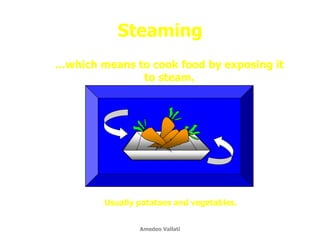
Steaming
…which means to cook food by exposing it
to steam.
Usually potatoes and vegetables.
Amedeo Vallati
Combination methods
Combination methods mean cooking
food using first a dry heat and then
adding liquid or steam.
Combination methods are used to
tenderize tough cuts of meat.
Amedeo Vallati
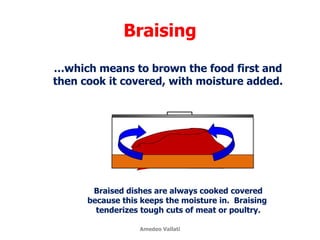
Braising
…which means to brown the food first and
then cook it covered, with moisture added.
Braised dishes are always cooked covered
because this keeps the moisture in. Braising
tenderizes tough cuts of meat or poultry.
Amedeo Vallati
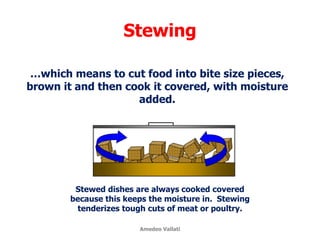
Stewing
…which means to cut food into bite size pieces,
brown it and then cook it covered, with moisture
added.
Stewed dishes are always cooked covered
because this keeps the moisture in. Stewing
tenderizes tough cuts of meat or poultry.
Amedeo Vallati
Cooking terms
• Reduce means to simmer a liquid so some of it
evaporates. This concentrates the flavors.
• Parcook means to partly cook food.
• Parboil means to partly cook by boiling.
• Parbake means to partly cook by baking.
• Blanch is to partly cook by boiling or steaming.
• Glaze means to add a shine to the food.
• Deglaze means to swirl a liquid in a pan to
dissolve cooked particles of food.
• Sweat means to cook in fat over low heat.
• Sear means to brown the surface of a food
quickly, usually by sauteeing or pan broiling.
• Season means to enhance the natural flavors.
• Flavor means to add a new taste to food.Amedeo Vallati
THANKS
• Amedeo Vallati
Amedeo Vallati

Different Cooking methods by amedeo vallati

  • 1.
  • 2.
    You cook foodbecause… • Cooking kills bacteria: Some foods cannot be served raw, like poultry. • Cooking makes food easier to digest. • Cooking changes the taste, aroma and appearance of food. Amedeo Vallati
  • 3.
    Food is madeup of… • Water, which evaporates when cooked. • Fats, which melt when cooked. • Proteins, which coagulate, or become firmer when cooked. • Nutrients, such as vitamins and minerals which are destroyed by cooking. • Carbohydrates – sugars, which caramelize or become brown when cooked. – starches, which gelatinize or absorb water and swell when cooked. Amedeo Vallati
  • 4.
    Heat transfer Heat travelsto food from its source in a number of ways: • Convection means currents of air, steam, water or fat carry the heat to food. Like when currents of hot air heat the food in an oven. • Conduction means something hot touches the food. Like when a steak is cooked in a hot frying pan. • Radiation means heat radiates from a heat source to the food. Like when heat radiates from the coals on a barbeque to the food. Amedeo Vallati
  • 5.
    Cooking methods Cooking methodsare the techniques we use in the kitchen to get the results we want. For example, you could boil or poach a steak but that would not get the result you want, which is probably a brown tasty crust with a pink interior. Cooking methods are classified as either: • Dry heat methods, which means no moisture is added… • Moist heat methods, which involve either water or steam… • Combination methods, which involve dry heat and then a moist heat. Amedeo Vallati
  • 6.
    Dry heat methods Dryheat methods mean cooking without any water or steam, although some kind of cooking oil is often used. Dry heat methods are for foods which are naturally tender. Amedeo Vallati
  • 7.
    Saute Fairly high heat,very little fat …which means to toss quickly in a pan with very little fat and a fairly high heat. Amedeo Vallati
  • 8.
    Pan fry Moderate heat& a moderate amount of fat …which means to cook in a moderate amount of fat over a moderate heat. Usually breaded foods like cutlets or chicken are pan fried. Amedeo Vallati
  • 9.
    Deep fry 350 degreesFahrenheit Completely submerged in hot fat which means to submerge something completely in cooking oil, like French fries… Amedeo Vallati
  • 10.
    Pan broil A moderateheat, no fat Usually foods which have their own fat, like steaks, burgers or bacon …which means to cook something in a pan with no added fat. Amedeo Vallati
  • 11.
    Roast or bake Tocook by exposing to hot, dry air …which means to cook by exposing food to hot, dry air in an oven Amedeo Vallati
  • 12.
    Griddle To cook ona flat, hot surface …which means to cook food on a flat, hot surface. This is very common because a griddle can cook many foods quickly. Amedeo Vallati
  • 13.
    Grill To cook onbars, over radiant heat …which means to cook food on metal bars over radiant heat. Barbequing is almost identical, except that the heat traditionally comes from wood or charcoal. Amedeo Vallati
  • 14.
    Moist heat methods Moistheat methods mean cooking food in water or steam. Amedeo Vallati
  • 15.
    Poaching …which means tocook food in water that is hot but not bubbling. Usually tender, delicate foods, like eggs. Hot, but not bubbling. Amedeo Vallati
  • 16.
    Simmering …which means tocook food in water that is bubbling gently. Usually foods that need to cook for a long time. Bubbling very gently. Amedeo Vallati
  • 17.
    Boiling …which means tocook food in water that is bubbling rapidly. Usually foods like pastas or hardy vegetables. Bubbling very rapidly. Amedeo Vallati
  • 18.
    Steaming …which means tocook food by exposing it to steam. Usually potatoes and vegetables. Amedeo Vallati
  • 19.
    Combination methods Combination methodsmean cooking food using first a dry heat and then adding liquid or steam. Combination methods are used to tenderize tough cuts of meat. Amedeo Vallati
  • 20.
    Braising …which means tobrown the food first and then cook it covered, with moisture added. Braised dishes are always cooked covered because this keeps the moisture in. Braising tenderizes tough cuts of meat or poultry. Amedeo Vallati
  • 21.
    Stewing …which means tocut food into bite size pieces, brown it and then cook it covered, with moisture added. Stewed dishes are always cooked covered because this keeps the moisture in. Stewing tenderizes tough cuts of meat or poultry. Amedeo Vallati
  • 22.
    Cooking terms • Reducemeans to simmer a liquid so some of it evaporates. This concentrates the flavors. • Parcook means to partly cook food. • Parboil means to partly cook by boiling. • Parbake means to partly cook by baking. • Blanch is to partly cook by boiling or steaming. • Glaze means to add a shine to the food. • Deglaze means to swirl a liquid in a pan to dissolve cooked particles of food. • Sweat means to cook in fat over low heat. • Sear means to brown the surface of a food quickly, usually by sauteeing or pan broiling. • Season means to enhance the natural flavors. • Flavor means to add a new taste to food.Amedeo Vallati
  • 23.