Soft computing(IT-701)
Activity-1
Difference between Iaas Saas Paas
Submitted To: Submitted By:
Mrs. Manali Singh Harsh Agrawal
Asst. Profesor (IT Dept.) 0905IT191027
Outlines
• Introduction
• Infrastructure as a Service (IaaS)
• Platform as a Service (PaaS)
• Software as a Service (SaaS)
• Difference between IaaS, PaaS, and SaaS
• Advantages
IaaS is also known as Hardware as a Service (HaaS). It is a computing
infrastructure managed over the internet. The main advantage of using IaaS
is that it helps users to avoid the cost and complexity of purchasing and
managing the physical servers.
Characteristics of IaaS
• Resources are available as a service
• Services are highly scalable
• Dynamic and flexible
• GUI and API-based access
• Automated administrative tasks
Example: DigitalOcean, Linode, Amazon Web Services (AWS), Microsoft
Azure, Google Compute Engine (GCE), Rackspace, and Cisco Metacloud.
Introduction
• The cloud is a hot topic for small businesses all the way to global
enterprises, but remains a broad concept that covers a lot of online
territory. As you begin to consider switching your business to the cloud,
whether it be for application or infrastructure deployment, it is more
important than ever to understand the differences and advantages of the
various cloud services.
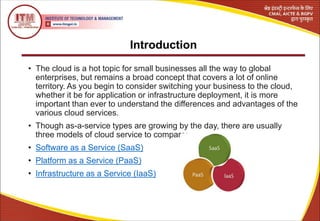
• Though as-a-service types are growing by the day, there are usually
three models of cloud service to compare:
• Software as a Service (SaaS)
• Platform as a Service (PaaS)
• Infrastructure as a Service (IaaS)
Advantages
• The resources can be deployed by the provider to a
customer’s environment at any given time.
• Its ability to offer the users to scale the business based on
their requirements.
• Programmers need not worry about what specific database or
language the application has been programmed in.
• It offers developers the to build applications without the
overhead of the underlying operating system or infrastructure.
• It is a cloud computing service category providing a wide
range of hosted capabilities and services. These can be used
to build and deploy web-based software applications.
Subject Code 6
Subject Code 7
CS-505 8

Difference between Iaas Saas Paas.pptx

  • 1.
    Soft computing(IT-701) Activity-1 Difference betweenIaas Saas Paas Submitted To: Submitted By: Mrs. Manali Singh Harsh Agrawal Asst. Profesor (IT Dept.) 0905IT191027
  • 2.
    Outlines • Introduction • Infrastructureas a Service (IaaS) • Platform as a Service (PaaS) • Software as a Service (SaaS) • Difference between IaaS, PaaS, and SaaS • Advantages
  • 3.
    IaaS is alsoknown as Hardware as a Service (HaaS). It is a computing infrastructure managed over the internet. The main advantage of using IaaS is that it helps users to avoid the cost and complexity of purchasing and managing the physical servers. Characteristics of IaaS • Resources are available as a service • Services are highly scalable • Dynamic and flexible • GUI and API-based access • Automated administrative tasks Example: DigitalOcean, Linode, Amazon Web Services (AWS), Microsoft Azure, Google Compute Engine (GCE), Rackspace, and Cisco Metacloud.
  • 4.
    Introduction • The cloudis a hot topic for small businesses all the way to global enterprises, but remains a broad concept that covers a lot of online territory. As you begin to consider switching your business to the cloud, whether it be for application or infrastructure deployment, it is more important than ever to understand the differences and advantages of the various cloud services. • Though as-a-service types are growing by the day, there are usually three models of cloud service to compare: • Software as a Service (SaaS) • Platform as a Service (PaaS) • Infrastructure as a Service (IaaS)
  • 5.
    Advantages • The resourcescan be deployed by the provider to a customer’s environment at any given time. • Its ability to offer the users to scale the business based on their requirements. • Programmers need not worry about what specific database or language the application has been programmed in. • It offers developers the to build applications without the overhead of the underlying operating system or infrastructure. • It is a cloud computing service category providing a wide range of hosted capabilities and services. These can be used to build and deploy web-based software applications.
  • 6.
  • 7.
  • 8.