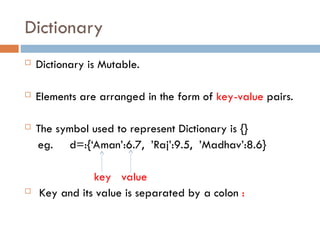
Dictionary
Dictionary isMutable.
Elements are arranged in the form of key-value pairs.
The symbol used to represent Dictionary is {}
eg. d=:{‘Aman’:6.7, ’Raj’:9.5, ’Madhav’:8.6}
key value
Key and its value is separated by a colon :
3.
Keys mustbe immutable (may be string, tuple,
number).
Values may be immutable or mutable.
General syntax of dictionary is as follows:-
d={key1:value1,key2:value2,…….keyn:valuen}
Elements are ordered (After 3.7 Version)
It does not have the concept of numeric indexing,
but it has the concept of key indexing.
eg. print(d[key])
4.
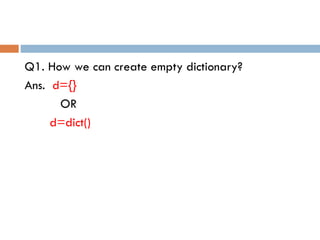
Q1. How wecan create empty dictionary?
Ans. d={}
OR
d=dict()
Dictionary is Mutable
Addingelements in Dictionary
d[key]=value
d1.update(d2)- Adds the elements of d2 to the
elements of d1.
d1={‘Aman’:6.2, ‘Ajay’:8.2}
d2={‘Madhav’:5.5, ‘Manav’:6.6}
d1.update(d2)
7.
Deleting elements fromdictionary
d.pop(key [, defaultvalue]) :- In this, it will delete the
key-value pair based on provided key.
2nd
parameter is optional, If it is there, it will return if
key does not exist.
d.popitem() :- It removes the item that was last inserted
into the dictionary. In versions before 3.7,it removes a
random item.
The removed item is the return value in the form
of tuple.
8.
d.clear() :-It will empties the dictionary.
del d[key] :-It will delete the key-value pair based
on key.
Methods of Dictionary
d.copy()
d.get(key[,value]): To access value of dictionary.
d.keys():- It will give list of all keys present in dictionary.
d.values():-It will give list of all values present in
dictionary.
d.items():- It will give list of all keys,values present in
dictionary. Return List of tuples.
d.has_key(key):-It works in Python 2.x version.
Use in operator in Python 3.x
11.
d.fromkeys(seq[,value]):- Thiswill help in creating a
dictionary
d.setdefault(key,value)
len(d)
sorted(x):- x may be d.keys() or d.values()
zip(l1,l2) :
dict()
12.
Looping over aDictionary
d={‘amit’:6.5, ‘raj’:9.1,’madhav’:7.8}
for i in d:
print(i)
for i in d:
print(i,’ ‘,d[i])
for i, j in d.items():
print(i,’ ‘,j)
for i in d.items():
print(i)
Programs
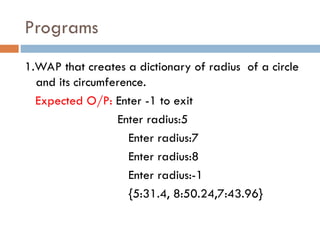
1.WAP that createsa dictionary of radius of a circle
and its circumference.
Expected O/P: Enter -1 to exit
Enter radius:5
Enter radius:7
Enter radius:8
Enter radius:-1
{5:31.4, 8:50.24,7:43.96}
15.
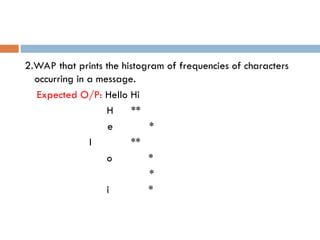
2.WAP that printsthe histogram of frequencies of characters
occurring in a message.
Expected O/P: Hello Hi
H **
e *
l **
o *
*
i *
16.
3. WAP toinvert the dictionary( i.e keys becomes
values and vice-versa)
4.WAP that has dictionary of names of students and a
list of their marks in 4 subjects. Create another
dictionary from this dictionary that has name of the
students and their total marks. Find out the topper
and his/her score.
17.
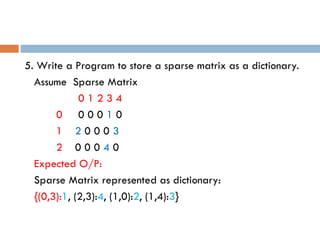
5. Write aProgram to store a sparse matrix as a dictionary.
Assume Sparse Matrix
0 1 2 3 4
0 0 0 0 1 0
1 2 0 0 0 3
2 0 0 0 4 0
Expected O/P:
Sparse Matrix represented as dictionary:
{(0,3):1, (2,3):4, (1,0):2, (1,4):3}
18.
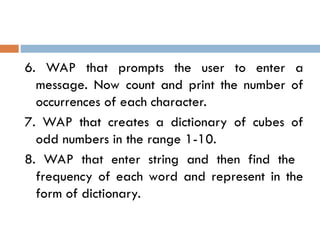
6. WAP thatprompts the user to enter a
message. Now count and print the number of
occurrences of each character.
7. WAP that creates a dictionary of cubes of
odd numbers in the range 1-10.
8. WAP that enter string and then find the
frequency of each word and represent in the
form of dictionary.
19.
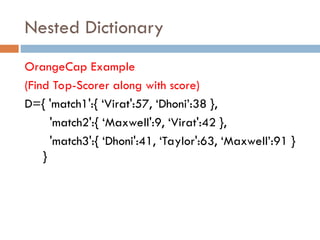
Nested Dictionary
OrangeCap Example
(FindTop-Scorer along with score)
D={ 'match1':{ ‘Virat':57, ‘Dhoni’:38 },
'match2':{ ‘Maxwell':9, ‘Virat':42 },
'match3':{ ‘Dhoni':41, ‘Taylor':63, ‘Maxwell’:91 }
}
20.
Solution
D={ 'match1':{ 'Virat':57,'Dhoni':38 },
'match2':{ 'Maxwell':9, 'Virat':42 },
'match3':{ 'Dhoni':41, 'Taylor':63, 'Maxwell':91 } }
x=D.values()
D1={}
print(x)
for i in x:
for j in i:
if j in D1:
D1[j]=D1[j]+i[j]
else:
D1[j]=i[j]
print(D1)
k=max(D1,key=D1.get)
print("Player Name is ",k)
print("Score is ",D1[k])
21.
Some More Programs…..
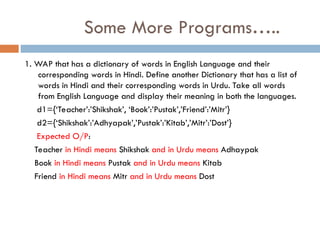
1.WAP that has a dictionary of words in English Language and their
corresponding words in Hindi. Define another Dictionary that has a list of
words in Hindi and their corresponding words in Urdu. Take all words
from English Language and display their meaning in both the languages.
d1={‘Teacher’:’Shikshak’, ‘Book’:’Pustak’,’Friend’:’Mitr’}
d2={‘Shikshak’:’Adhyapak’,’Pustak’:’Kitab’,’Mitr’:’Dost’}
Expected O/P:
Teacher in Hindi means Shikshak and in Urdu means Adhaypak
Book in Hindi means Pustak and in Urdu means Kitab
Friend in Hindi means Mitr and in Urdu means Dost
22.
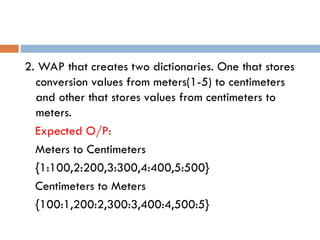
2. WAP thatcreates two dictionaries. One that stores
conversion values from meters(1-5) to centimeters
and other that stores values from centimeters to
meters.
Expected O/P:
Meters to Centimeters
{1:100,2:200,3:300,4:400,5:500}
Centimeters to Meters
{100:1,200:2,300:3,400:4,500:5}
23.
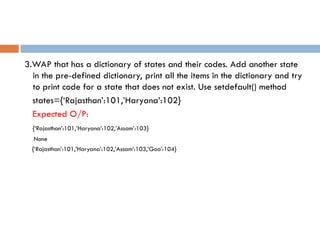
3.WAP that hasa dictionary of states and their codes. Add another state
in the pre-defined dictionary, print all the items in the dictionary and try
to print code for a state that does not exist. Use setdefault() method
states={‘Rajasthan’:101,’Haryana’:102}
Expected O/P:
{‘Rajasthan’:101,’Haryana’:102,’Assam’:103}
None
{‘Rajasthan’:101,’Haryana’:102,’Assam’:103,’Goa’:104}
![ Keys must be immutable (may be string, tuple,
number).
Values may be immutable or mutable.
General syntax of dictionary is as follows:-
d={key1:value1,key2:value2,…….keyn:valuen}
Elements are ordered (After 3.7 Version)
It does not have the concept of numeric indexing,
but it has the concept of key indexing.
eg. print(d[key])](https://image.slidesharecdn.com/dictionary-250722010040-47357e7d/85/Dictionarys-in-python-programming-language-ppt-3-320.jpg)
![Accessing Values
d={‘Aryan’:8.5, ’Madhav’:9.5, ’Dev’:6.5}
print(d[‘Aryan’])
print(d.get(‘Dev’))
print(d[‘madhav’])
O/P: 8.5
6.5
Error](https://image.slidesharecdn.com/dictionary-250722010040-47357e7d/85/Dictionarys-in-python-programming-language-ppt-5-320.jpg)
![Dictionary is Mutable
Adding elements in Dictionary
d[key]=value
d1.update(d2)- Adds the elements of d2 to the
elements of d1.
d1={‘Aman’:6.2, ‘Ajay’:8.2}
d2={‘Madhav’:5.5, ‘Manav’:6.6}
d1.update(d2)](https://image.slidesharecdn.com/dictionary-250722010040-47357e7d/85/Dictionarys-in-python-programming-language-ppt-6-320.jpg)
![Deleting elements from dictionary
d.pop(key [, defaultvalue]) :- In this, it will delete the
key-value pair based on provided key.
2nd
parameter is optional, If it is there, it will return if
key does not exist.
d.popitem() :- It removes the item that was last inserted
into the dictionary. In versions before 3.7,it removes a
random item.
The removed item is the return value in the form
of tuple.](https://image.slidesharecdn.com/dictionary-250722010040-47357e7d/85/Dictionarys-in-python-programming-language-ppt-7-320.jpg)
![ d.clear() :- It will empties the dictionary.
del d[key] :-It will delete the key-value pair based
on key.](https://image.slidesharecdn.com/dictionary-250722010040-47357e7d/85/Dictionarys-in-python-programming-language-ppt-8-320.jpg)
![Modifying the value of dictionary
d[key]=value](https://image.slidesharecdn.com/dictionary-250722010040-47357e7d/85/Dictionarys-in-python-programming-language-ppt-9-320.jpg)
![Methods of Dictionary
d.copy()
d.get(key[,value]): To access value of dictionary.
d.keys():- It will give list of all keys present in dictionary.
d.values():-It will give list of all values present in
dictionary.
d.items():- It will give list of all keys,values present in
dictionary. Return List of tuples.
d.has_key(key):-It works in Python 2.x version.
Use in operator in Python 3.x](https://image.slidesharecdn.com/dictionary-250722010040-47357e7d/85/Dictionarys-in-python-programming-language-ppt-10-320.jpg)
![ d.fromkeys(seq[,value]):- This will help in creating a
dictionary
d.setdefault(key,value)
len(d)
sorted(x):- x may be d.keys() or d.values()
zip(l1,l2) :
dict()](https://image.slidesharecdn.com/dictionary-250722010040-47357e7d/85/Dictionarys-in-python-programming-language-ppt-11-320.jpg)
![Looping over a Dictionary
d={‘amit’:6.5, ‘raj’:9.1,’madhav’:7.8}
for i in d:
print(i)
for i in d:
print(i,’ ‘,d[i])
for i, j in d.items():
print(i,’ ‘,j)
for i in d.items():
print(i)](https://image.slidesharecdn.com/dictionary-250722010040-47357e7d/85/Dictionarys-in-python-programming-language-ppt-12-320.jpg)
![Solution
D={ 'match1':{ 'Virat':57, 'Dhoni':38 },
'match2':{ 'Maxwell':9, 'Virat':42 },
'match3':{ 'Dhoni':41, 'Taylor':63, 'Maxwell':91 } }
x=D.values()
D1={}
print(x)
for i in x:
for j in i:
if j in D1:
D1[j]=D1[j]+i[j]
else:
D1[j]=i[j]
print(D1)
k=max(D1,key=D1.get)
print("Player Name is ",k)
print("Score is ",D1[k])](https://image.slidesharecdn.com/dictionary-250722010040-47357e7d/85/Dictionarys-in-python-programming-language-ppt-20-320.jpg)