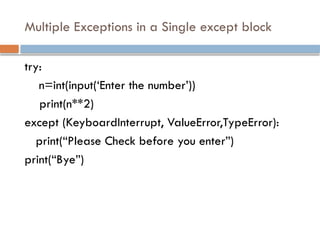
Multiple Exceptions ina Single except block
try:
n=int(input(‘Enter the number’))
print(n**2)
except (KeyboardInterrupt, ValueError,TypeError):
print(“Please Check before you enter”)
print(“Bye”)
9.
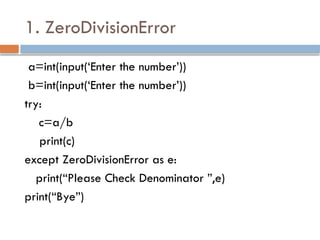
1. ZeroDivisionError
a=int(input(‘Enter thenumber’))
b=int(input(‘Enter the number’))
try:
c=a/b
print(c)
except ZeroDivisionError as e:
print(“Please Check Denominator ”,e)
print(“Bye”)
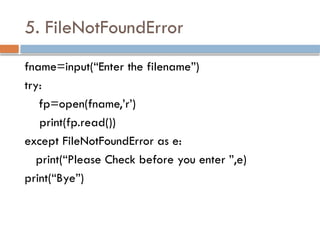
5. FileNotFoundError
fname=input(“Enter thefilename”)
try:
fp=open(fname,’r’)
print(fp.read())
except FileNotFoundError as e:
print(“Please Check before you enter ”,e)
print(“Bye”)
14.
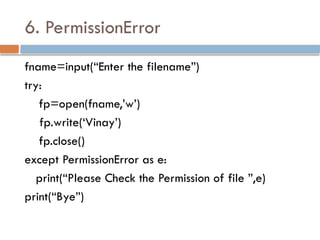
6. PermissionError
fname=input(“Enter thefilename”)
try:
fp=open(fname,’w’)
fp.write(‘Vinay’)
fp.close()
except PermissionError as e:
print(“Please Check the Permission of file ”,e)
print(“Bye”)
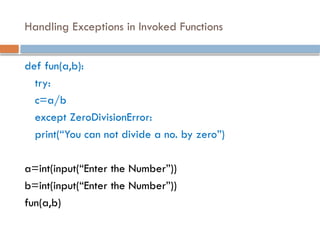
Handling Exceptions inInvoked Functions
def fun(a,b):
try:
c=a/b
except ZeroDivisionError:
print(“You can not divide a no. by zero”)
a=int(input(“Enter the Number”))
b=int(input(“Enter the Number”))
fun(a,b)
Programs
1. WAP thatprompts the user to enter a number. If the
number is positive or zero, print it, otherwise raise an
exception ValueError with some message.
2. WAP which infinitely print natural numbers. Raise the
StopIteration exception after displaying first 20
numbers to exit from the program.
3. WAP that prompts the user to enter his name. The
program then greets the person with his name. But if
the person’s name is “Rahul”, an exception is thrown
explicitly and he is asked to quit the program.
23.
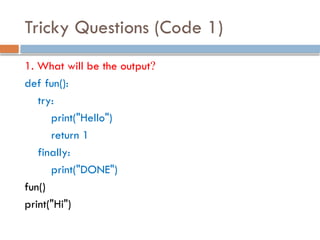
Tricky Questions (Code1)
1. What will be the output?
def fun():
try:
print("Hello")
return 1
finally:
print("DONE")
fun()
print("Hi")
24.
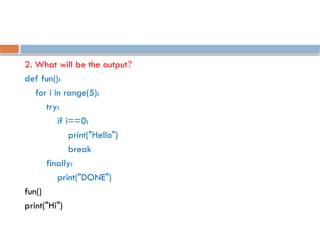
2. What willbe the output?
def fun():
for i in range(5):
try:
if i==0:
print("Hello")
break
finally:
print("DONE")
fun()
print("Hi")
25.
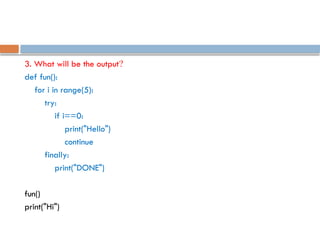
3. What willbe the output?
def fun():
for i in range(5):
try:
if i==0:
print("Hello")
continue
finally:
print("DONE")
fun()
print("Hi")


![4. TypeError
(1) print(2+’Hello’)
(2) a=5
print(a())
(3) L=[1,2,3,4]
print(L[‘1’])
(4) a=45
for i in a:
print(i)](https://image.slidesharecdn.com/exceptionalhandling-250722010239-7be70480/85/Exceptional-Handling-in-the-python-pptx-12-320.jpg)
![7. IndexError
L=[1,2,3,4]
try:
print(L[9])
except IndexError as e:
print(“Please Check the index ”,e)
print(“Bye”)](https://image.slidesharecdn.com/exceptionalhandling-250722010239-7be70480/85/Exceptional-Handling-in-the-python-pptx-15-320.jpg)
![9. KeyError
D={1:1,2:8,3:27,4:64}
try:
print(D[5])
except KeyError as e:
print(“Please Check the key exists or not ”,e)
print(“Bye”)](https://image.slidesharecdn.com/exceptionalhandling-250722010239-7be70480/85/Exceptional-Handling-in-the-python-pptx-17-320.jpg)
![Raising Exceptions
We can deliberately raise an exception using the raise keyword
Syntax
raise [Exception [args]]
Example:
try:
n=10
print(n)
raise ValueError
except:
print(“Exception Occurred”)](https://image.slidesharecdn.com/exceptionalhandling-250722010239-7be70480/85/Exceptional-Handling-in-the-python-pptx-18-320.jpg)




![FL Studio Producer Edition Crack 24 + Latest Version [2025]](https://cdn.slidesharecdn.com/ss_thumbnails/errorsandexceptions-250421182350-30f33fcd-250521053959-84fd5ecb-thumbnail.jpg?width=640&height=640&fit=bounds)


