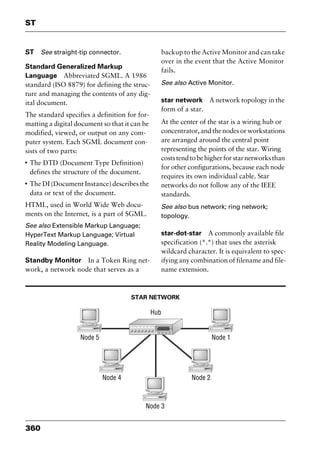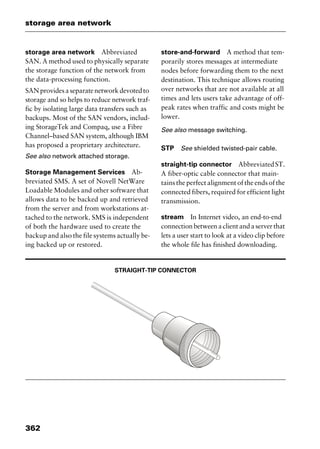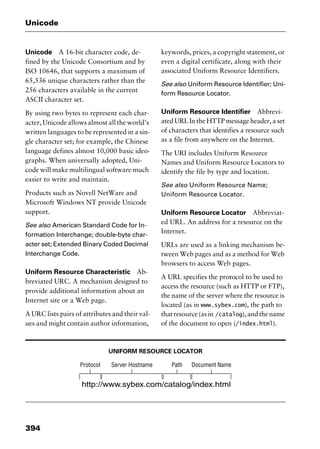

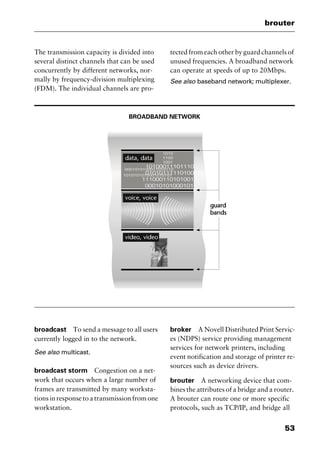
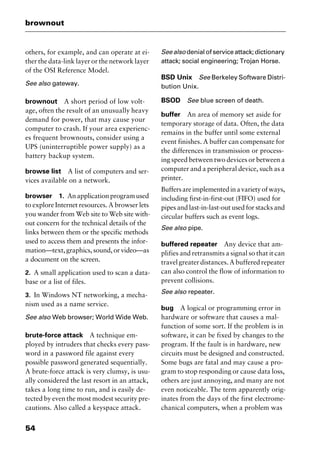
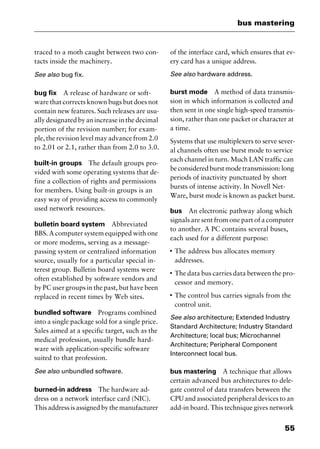
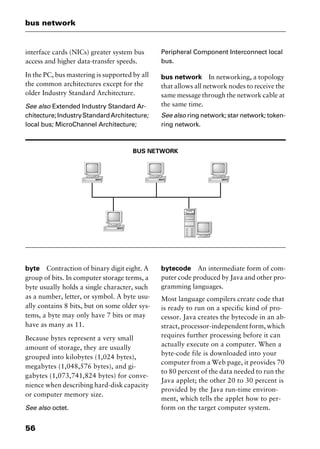

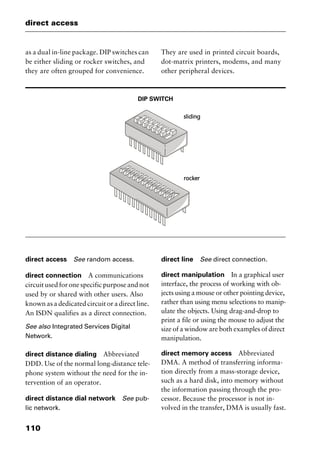


Introduction
Networks are currently one of the fastest growing and most important developments in
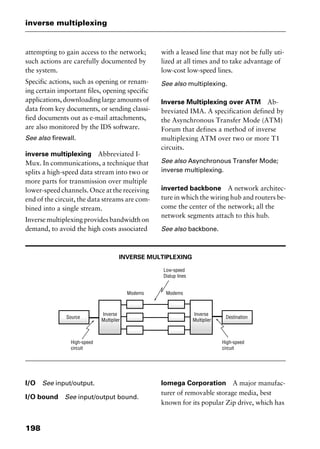
the computer industry. Not only are more and more PCs becoming parts of networks, but
networked PCs are being incorporated into larger enterprise-wide applications so that ev-
eryone in a company can access and share data.
With the expanding technology of networking comes the terminology to describe it.
This Dictionary of Networking provides definitions for all the terms you will encounter
when dealing with networks of any type.
Who Should Use This Book?
This book is designed to meet the needs of people who work with networks, communica-
tions, and mobile computing systems. Whether you are networking previously uncon-
nected computers or downsizing from a mainframe, this book is for you. And if you are
studying for one of the network certification exams, you will find this book to be an es-
sential reference.
Network users of all levels are barraged with an almost bewildering array of terms, ab-
breviations, and acronyms in books, magazine and newspaper articles, advertisements,
and their day-to-day conversations. Jargon is a useful shorthand, but it can easily become
incomprehensible and unmanageable, even to the most seasoned network administrator.
What You’ll Find in This Book
Along with clear explanations of the jargon and slang associated with networking, you’ll
find definitions of more than 3,000 networking technical terms, abbreviations, and acro-
nyms. The list that follows gives you a brief overview of the topics that this book covers:
I
Acronyms and abbreviations
I
Active Directory
I
ActiveX
I
Application software
I
Cables, cards, and connectors
I
Certification schemes
I
Chips, memory, and adapters
I
Communications
2461book Page i Thursday, May 4, 2000 11:59 AM
Copyright © 2000 SYBEX Inc., Alameda, CA. www.sybex.com
Introduction
ii
I
Connectivity tools, products, and equipment
I
Disks and storage media
I
E-mail
I
Hardware
I
File systems
I
Industry standards
I
Internet organizations
I
Internet terms and abbreviations
I
Intranet terms and abbreviations
I
Java
I
Leading hardware and software companies
I
Linux, Free Software Foundation, GNU
I
Microprocessors
I
Microsoft Windows
I
Microsoft Windows NT and NT Server
I
Microsoft Windows 2000
I
Mobile computing
I
Networking theory and concepts
I
Novell NetWare
I
Novell Directory Services
I
Operating systems and environments
I
The OSI Reference Model
I
Popular networking products
I
Protocols and interfaces
I
Security and network administration
I
System architectures
I
Trade associations
2461book Page ii Thursday, May 4, 2000 11:59 AM
Copyright © 2000 SYBEX Inc., Alameda, CA. www.sybex.com
iii
Introduction
I
Unix shells, tools, and utilities
I
The World Wide Web
I
Workstations
How This Book Is Organized
This book is organized for easy reference. Entries are arranged in letter-by-letter alphabetic
order, ignoring punctuation and spaces, with terms that begin with an uppercase letter (or
are all in uppercase) before those in all lowercase letters. So Internet comes before internet,
and link level comes before link-state routing algorithm. Numbers and symbols are listed
at the beginning of the book in ascending numeric order. If an entry begins with a letter or
letters, but contains a number, it is listed alphabetically according to the letter, and then ac-
cording to numerical order, so V.42 bis comes between V.42 and V.54.
The information within each entry is always presented in the following order:
I
Entry name
I
Abbreviation or acronym
I
Pronunciation, if it isn’t obvious
I
Definition, written in clear standard English
I
URL pointing to further resources available on the Internet.
I
Cross-references to other entries that provide additional or related information on the
topic; more on the cross references in a moment.
If an entry has multiple definitions, each one is numbered to separate it from the next,
and some of the entries also contain illustrations.
Extensive Cross-Referencing
The Dictionary of Networking is the most extensively cross-referenced dictionary of com-
puting and networking terms available today. It contains two kinds of cross references:
I
A See reference points to another entry that contains the information you are looking
for. Thus, you can start with an abbreviation, such asPPTP, or with the complete term,
such as Point-to-Point Tunneling Protocol, and be sure that you will arrive at the cor-
rect definition. You don’t have to know what an abbreviation stands for to be able to
look up a term. Some terms or concepts can be referred to by more than one name, such
as dialback modem and callback modem; you will find both here, so you can always
find your way to the appropriate definition.
2461book Page iii Thursday, May 4, 2000 11:59 AM
Copyright © 2000 SYBEX Inc., Alameda, CA. www.sybex.com
Introduction
iv
I
A See also reference points to one or more entries that contain additional information
about a topic. This kind of cross-reference allows you to follow through a related set
of entries, broadening your search as you move from entry to entry.
We have also added an extra element in this dictionary to help you find information,
and that is the pronunciation of an acronym or abbreviation that is pronounced differ-
ently from the way it is spelled. For example, if you are reading a magazine article and
come across the abbreviation SCSI, you can look up the abbreviation, which will point
to the main entry term, Small Computer System Interface. But if you are discussing hard
disk interfaces with a colleague and hear the term scuzzy, you can look that up too, and
you will also find your way to the main entry, Small Computer System Interface.
The Appendices
This book contains four appendices to provide additional reference material:
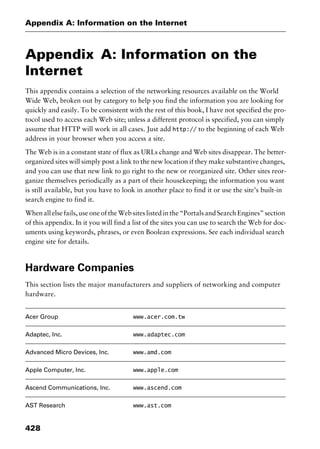
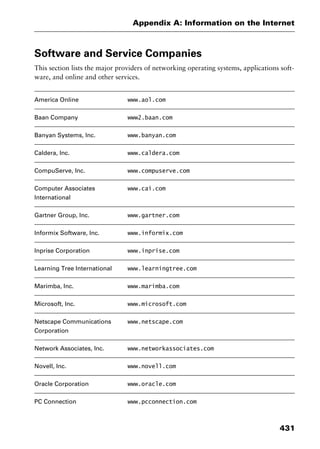
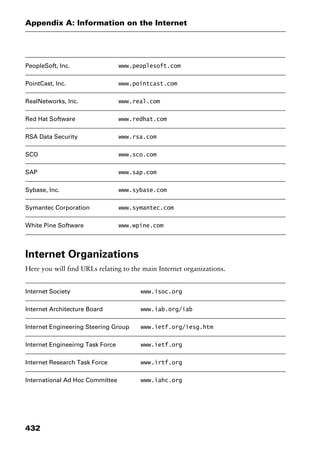
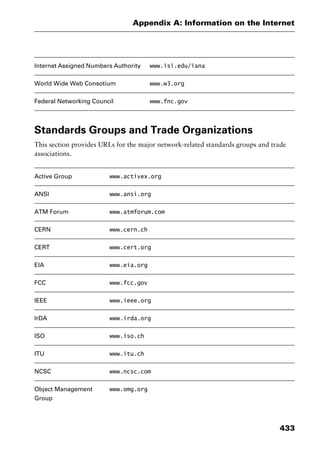
Appendix A: Internet Resources Collects together URLs under a wide variety of head-
ings to cut down on the amount of time you have to spend with your favorite search en-
gine. Using this appendix, you can go straight to the right Web site every time.
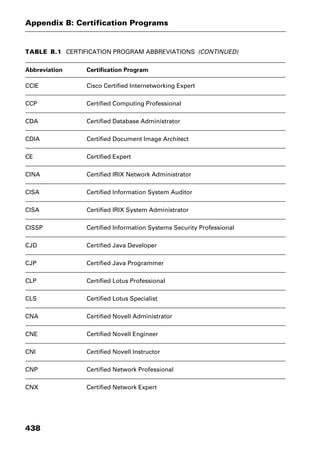
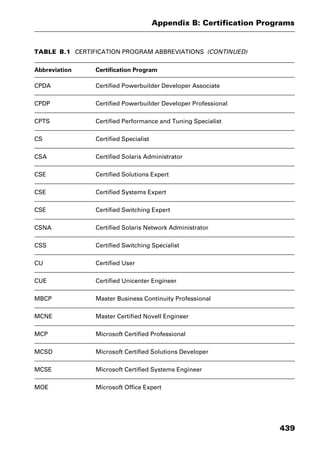
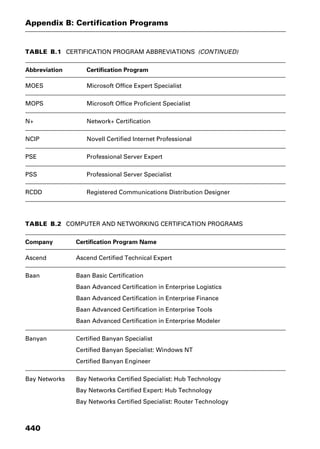
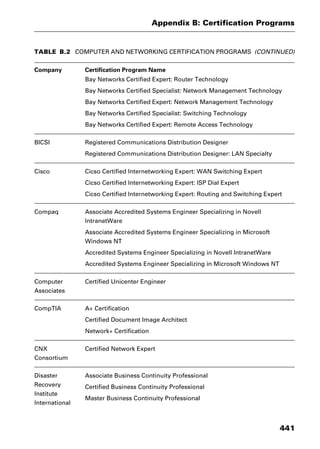
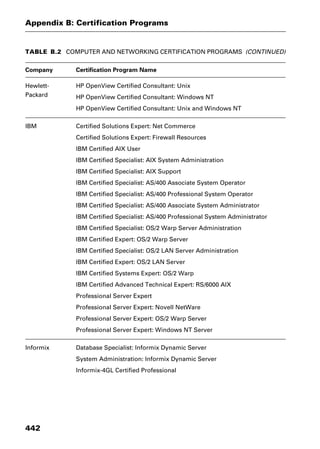
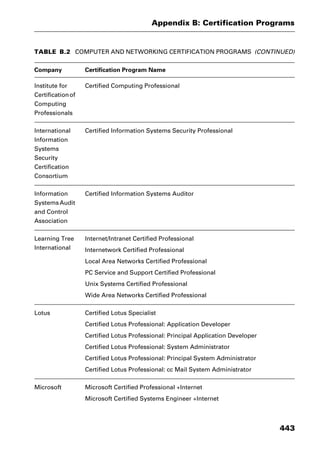
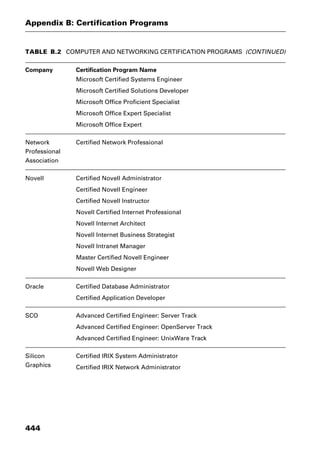
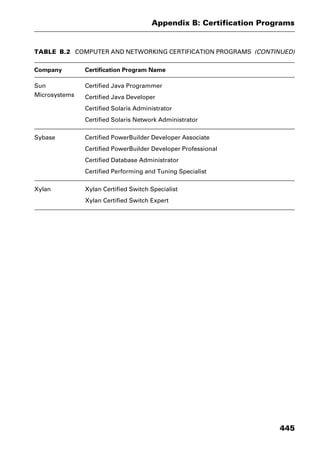
Appendix B: Certification Resources Provides a guide through the complex and con-
fusing world of computer and networking certification programs.
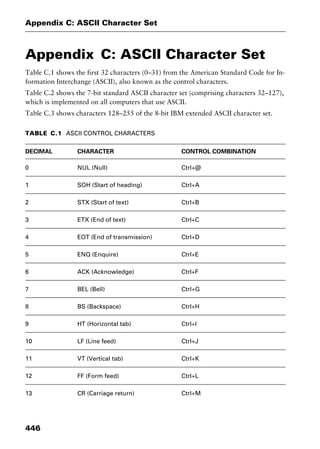
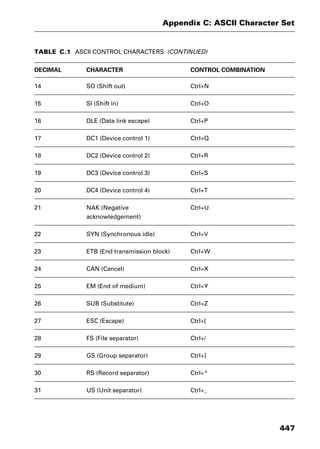
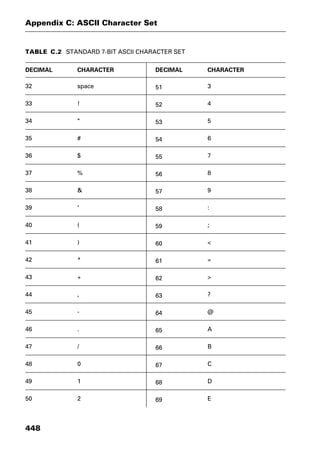
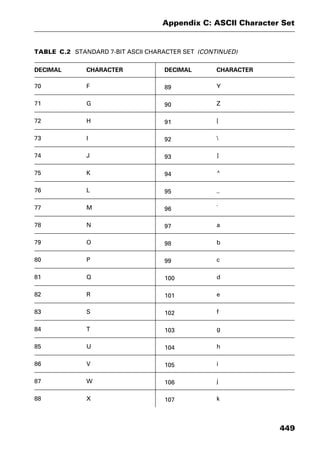
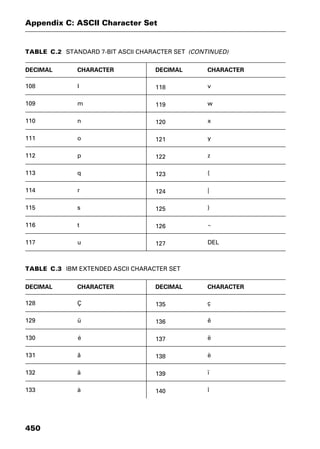
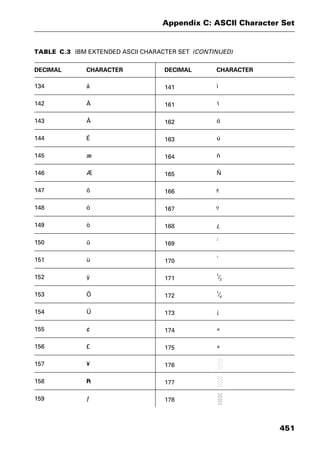
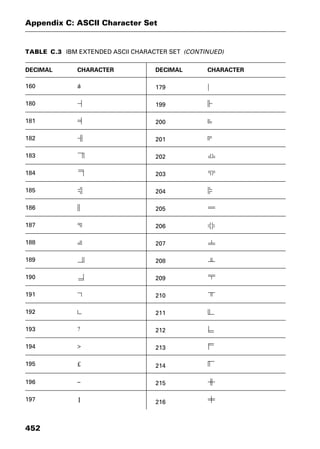
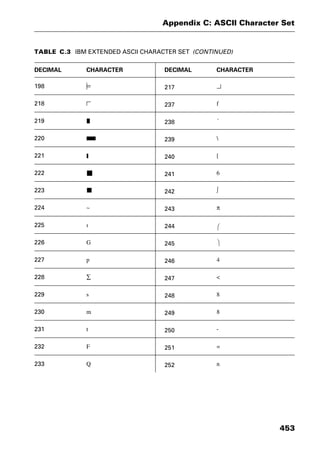
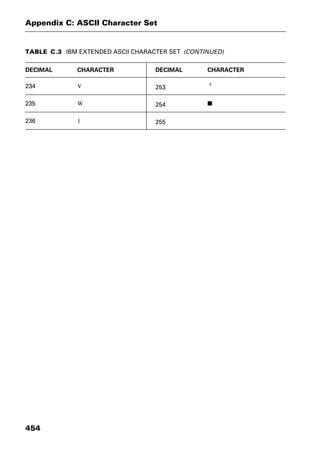
Appendix C: ASCII Charts Contains both the standard and the extended American
Standard Code for Information Interchange charts.
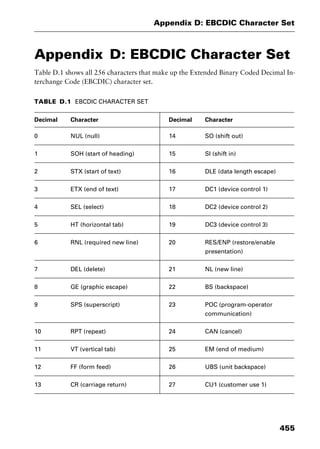
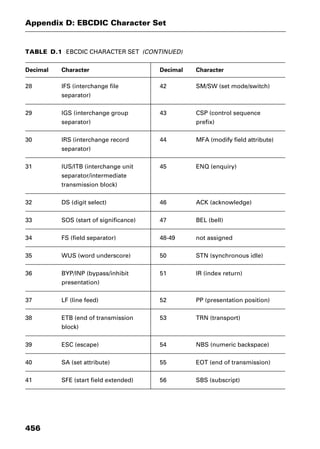
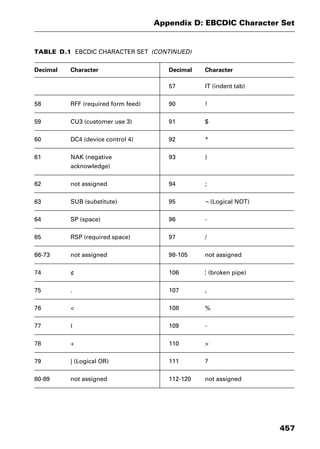
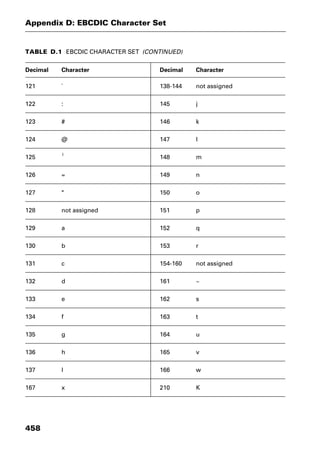
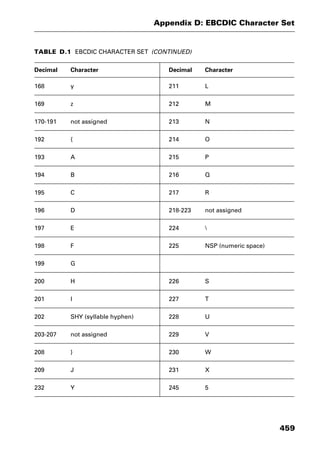
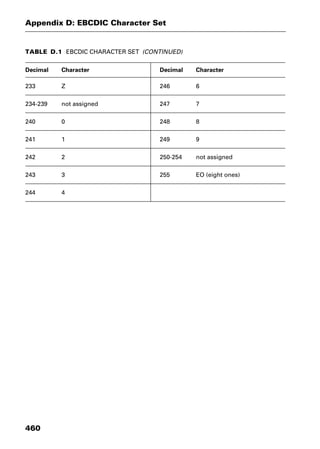
Appendix D: EBCDIC Chart Contains the most widely accepted Extended Binary
Coded Decimal Interchange Code chart.
A Note about the URLs in This Book
Nothing is more annoying than a dead URL, and link rot is all pervasive. (If you don’t
know what link rot is, go look it up.) All the URLs in this book have been individually
checked by our Technical Editor; and at the time of writing, they are all active, they all
work, and they all contain the information that I say they contain. But that is not to say that
some of them won’t have changed by the time you try them out.
The better-organized sites will simply post a link to the new site if they make substantive
changes, and you can use that new link to go right to the new or reorganized site. Other
sites, such as the Microsoft Web site, reorganize themselves periodically as a part of their
housekeeping; the information you want is still available, but you have to look in another
place to find it, or use the site’s built-in search engine to find it.
2461book Page iv Thursday, May 4, 2000 11:59 AM
Copyright © 2000 SYBEX Inc., Alameda, CA. www.sybex.com
v
Introduction
Some of the sites that contain the most advanced technical information belong to the
.edu domain and are usually computer science departments at the major universities. I have
tried to keep the number of such sites to a minimum in this book. Although they can be ex-
tremely useful, they usually have a lifespan that closely resembles that of the average grad-
uate student. Once the student maintaining the information graduates, the site becomes
neglected and is usually removed soon after. Another dead URL.
To be consistent with current usage, I have not specified the protocol used to access each
Web site; unless a different protocol is specified, you can simply assume that HTTP will
work in all cases. Just add http:// to the beginning of each Web address in your browser
when you access a site.
And finally, we have tried very carefully not to break a URL across a line; you should
be able to type the characters you see without having to worry about whether to type that
hyphen. If a URL has to break, the break is before a period (.) or after a slash (/).
About the Companion CD
The companion CD contains an electronic version of this entire book. You can use it to find
entries quickly and follow cross-references without a great deal of page flipping.
And Finally…
Through more than 25 years of hands-on involvement in practical computer applications,
including the management of minicomputer systems, PC-based networks, large-scale data
communications systems, software development, and technical support, I have become in-
timately familiar with computer and networking terminology. TheDictionary of Network-
ing is a direct result of that experience, and it represents a practical and down-to-earth
approach to computers and computing.
Everyone who has worked on this dictionary has tried to make sure that it is as complete
and accurate as possible. But if you think that we have missed a word or two that should
be included in a future edition, or if you think that an entry doesn’t contain enough infor-
mation, please write to the following address:
Dictionary of Networking
c/o SYBEX Inc.
1151 Marina Village Parkway
Alameda, CA 94501-1044
USA
2461book Page v Thursday, May 4, 2000 11:59 AM
Copyright © 2000 SYBEX Inc., Alameda, CA. www.sybex.com
1
4.4BSD Lite
Symbols and Numbers
! See bang.
& See ampersand.
* See asterisk.
*.* See star-dot-star.
. See period and double-period
directories.
.. See period and double-period
directories.
/ See slash.
// See double-slash.
: See colon.
<> See angle brackets.
> See right angle bracket.
? See question mark.
@ See at symbol.
 See backslash.
| See vertical bar.
1/4-inch cartridge See quarter-inch
cartridge.
2B+D Common abbreviation for Basic
Rate ISDN, which has two B, or bearer,
channels and one D, or data, channel.
See also 23B+D; Basic Rate ISDN.
3+ A network operating system, originally
developed by 3Com, that implemented Xe-
rox Network System (XNS) transport pro-
tocols and Microsoft MS-Net file sharing.
3Com Corporation One of the largest
manufacturers of network hardware in the
world, particularly known for LAN and
WAN products, including remote access
products, hubs, network interface cards,
Gigabit Ethernet, and multimedia over net-
works. The company’s PalmPilot hand-
held computer has proved to be extremely
popular, with more than one million units
sold to date. In 1997, 3Com merged with
U.S. Robotics in a deal worth $6.6 billion.
For more information on 3Com, see
www.3com.com.
4B/5B encoding A data-translation
scheme used to precede signal encoding in
FDDI (Fiber Distributed Data Interface)
networks. In 4B/5B, each group of four bits
is represented as a five-bit symbol, which is
then associated with a bit pattern, which in
turn is encoded using a standard method,
often NRZI (non-return to zero inverted).
See also Manchester encoding.
4.4BSD Lite A version of the 4.4 Berke-
ley Software Distribution (BSD) Unix from
which all the AT&T code has been re-
moved in an attempt to avoid licensing
conflicts. It is not possible to compile and
then run 4.4BSD Lite without a preexisting
system because several important utilities
and other files from the operating system
are missing.
The 4.4BSD Lite version has served as the
basis for several other important Unix
implementations, including FreeBSD and
NetBSD.
2461book Page 1 Thursday, May 4, 2000 11:59 AM
Copyright © 2000 SYBEX Inc., Alameda, CA. www.sybex.com
5B/6B encoding
2
See also Berkeley Software Distribution
Unix; FreeBSD; NetBSD; Unix.
5B/6B encoding A data-translation
scheme used to precede signal encoding in
100BaseVG networks. In 5B/6B, each
group of five bits is represented as a six-bit
symbol, which is then associated with a bit
pattern, which in turn is encoded using a
standard method, often NRZI (non-return
to zero inverted).
See also Manchester encoding.
9-track tape A tape storage format that
uses nine parallel tracks on 1/2-inch, reel-
to-reel magnetic tape. Eight tracks are used
for data, and one track is used for parity in-
formation. These tapes are often used as
backup systems on minicomputer and
mainframe systems; digital audio tapes
(DATs) are more common on networks.
See also quarter-inch cartridge.
10/100 A term used to indicate that a de-
vice can support both Ethernet (at a data
transfer rate of 10Mbps) and Fast Ethernet
(at a data transfer rate of 100Mbps).
See also Ethernet.
10Base2 An implementation of the 802.3
Ethernet standard on thin Ethernet (RG-58)
coaxial cable; sometimes called thinnet or
cheapernet wire. The 10Base2 specification
has a data-transfer rate of 10Mbps and a
maximum cable-segment length of 185
meters (610.5 feet). A T-connector attaches
the thin coaxial cable to the BNC connector
on the Ethernet adapter.
10Base5 An implementation of the
802.3 Ethernet standard on thick Ethernet
coaxial cable; sometimes called thicknet.
The 10Base5 specification has a data-trans-
fer rate of 10Mbps and a maximum cable-
segment length of 500 meters (1650 feet),
over a bus topology. The cable attaches to
the Ethernet adapter with a vampire, or
piercing, connector and a transceiver.
See also bus network.
10BaseF An implementation of the
802.3 Ethernet standard over fiber-optic
cable. This specification allows throughput
of a maximum of 10Mbps and is separated
into these three categories:
I
10BaseFP (fiber passive) Used for desk-
top connections
I
10BaseFL (fiber link) For intermediate
hubs and workgroups
I
10BaseFB (fiber backbone) Used for
central facility lines between buildings
10BaseT An implementation of the
802.3 Ethernet standard over UTP wir-
ing—the same wiring and RJ-45 connectors
used with telephone systems. The standard
is based on a star topology, with each node
connected to a central wiring center and a
maximum cable-segment length of 100
meters (330 feet).
See also star network.
23B+D Common abbreviation for Prima-
ry Rate ISDN, which has 23 B, or bearer,
channels and 1 D, or data, channel.
See also 2B+D; Primary Rate ISDN.
24/7 Abbreviation for round-the-clock
availability, implying that the service is
available 24 hours a day, 7 days a week.
2461book Page 2 Thursday, May 4, 2000 11:59 AM
Copyright © 2000 SYBEX Inc., Alameda, CA. www.sybex.com
3
802.x
56K modem standard See V.90.
100Base-FX A specification for Fast
Ethernet over fiber-optic cable.
See also Fast Ethernet
100Base-T4 A specification for Fast
Ethernet over four pairs of Category 3, 4, or
5 untwisted-pair wiring.
See also Fast Ethernet
100Base-TX A specification for Fast
Ethernet over two pairs of Category 5
unshielded twisted-pair or Category 1
shielded twisted-pair cable. The 100Base-
TX specification requires two pairs of
wires.
See also Fast Ethernet
100VG-AnyLAN A term applied to the
IEEE 802.12 standard, originally developed
by Hewlett-Packard and supported by Nov-
ell, Microsoft, AT&T, and many others.
The 100VG-AnyLAN specification modi-
fies the existing Ethernet standard to allow
speeds of 10 or 100Mbps and uses the
demand priority access method rather
than Carrier Sense Multiple Access/Colli-
sion Detection (CSMA/CD). A speed of
100Mbps transmission is supported over
Category 3 four-pair unshielded twisted-
pair cabling.
See also demand priority; Fast Ethernet.
680x0 A family of 32-bit microproces-
sors from Motorola, used in Macintosh
computers and many advanced worksta-
tions. The 680x0 is popular with program-
mers, because it uses a linear-addressing
mode to access memory, rather than the
segmented-addressing scheme used by Intel
coprocessors.
Several models have been developed:
I
68000 The first microprocessor in this
family, which used a 32-bit data word
with a 16-bit data bus and could address
16MB of memory. It was used in the first
Apple Macintosh computers as well as in
Hewlett-Packard’s LaserJet printers.
I
68020 A 32-bit microprocessor that
runs at 16MHz, 20MHz, 25MHz, or
33MHz and is capable of addressing as
much as 4GB of memory. The 68020 was
used in the Macintosh II computer, but
has been replaced by the 68030.
I
68030 Has a paged memory manage-
ment unit built-in and, therefore, does not
need external hardware to handle this
function. The 68030 is used in the Mac-
intosh II and SE computers.
I
68040 Incorporates a built-in floating-
point processor and memory manage-
ment unit, along with independent 4KB
data and instruction caches. It can per-
form parallel execution by using multiple,
independent instruction queues. The
68040 is used in the Macintosh Quadra
line of computers.
See also PowerPC.
802.x A set of communications standards
defining the physical and electrical connec-
tions in LANs, originally defined by the In-
stitute of Electrical and Electronics
Engineers (IEEE).
A number followed by an uppercase letter
indicates a stand-alone standard; a num-
ber followed by a lowercase letter indicates
2461book Page 3 Thursday, May 4, 2000 11:59 AM
Copyright © 2000 SYBEX Inc., Alameda, CA. www.sybex.com
802.1
4
either a supplement to a standard or a part
of a multiple-number standard.
Many of the IEEE standards have also been
adopted by the International Organization
for Standardization(ISO), whose standards
are accepted all over the world; IEEE stan-
dards 802.1 to 802.11 are now also known
as ISO 8802.1 to 8802.11. You will see
both designations in networking books and
magazines; it will take a while for everyone
to get used to these numbers.
See also IEEE standards.
802.1 An IEEE standard that specifies
the media-access-control level for bridges
linking 802.3, 802.4, and 802.5 networks.
It includes a spanning-tree algorithm for
Ethernet media-access-control layer bridg-
es and the heterogeneous LAN manage-
ment specification for Ethernet and token-
ring hubs.
See also IEEE standards.
802.2 An IEEE standard that specifies the
logical linksublayerof the data-link layer in
the OSI protocol stack. The data-link layer
in the OSI protocol stack is divided into the
logical link layer and the media-access-con-
trol layer. The logical link layer provides
framing, addressing, and error-control
functions.
See also IEEE standards.
802.3 An IEEE standard for CSMA/CD
(Carrier Sense Multiple Access/Collision De-
tection) LANs, including both baseband and
broadband networks. The baseband version
is based on the Ethernet network, originally
developed by Xerox Corporation.
The 802.3 standard includes the following:
I
10Base2 An implementation of the
Ethernet standard on thin Ethernet cable,
with a data-transfer rate of 10Mbps and a
maximum cable-segment length of 185
meters (600 feet).
I
10Base5 An802.3Ethernetstandardon
thick Ethernet cable, with a 10Mbps data-
transfer rate and a cable-segment length
of a maximum of 500 meters (1650 feet),
over a bus topology.
I
10BaseT Establishes a standard for
Ethernet over UTP wiring, the same wir-
ing and RJ-45 connectors used with tele-
phone systems. The standard is based on
a star topology. Each node is connected to
a wiring center, with a cable-length limi-
tation of 100 meters (330 feet).
I
1Base5 A 1Mbps network standard
with twisted-pair cable based on AT&T’s
StarLAN.
I
10Broad36 Defines a long-distance
Ethernet with a 10Mbps data-transfer
rate and a maximum cable-segment
length of 3600 meters (11,880 feet).
I
10BaseF Explicitly specifies fiber-optic
cable in three settings; 10Base-FP (fiber
passive) for desktops, 10Base-FL (fiber
link) for intermediate hubs and work-
groups, and 10Base-FB (fiber backbone)
for central facility lines between buildings.
I
100BaseVG A 100Mbps Ethernet net-
work developed by Hewlett-Packard and
AT&T Microelectrics.
I
100BaseT A 100Mbps Ethernet devel-
oped by Grand Junction Networks.
See also 100VG-AnyLAN; Ethernet; Fast
Ethernet; Gigabit Ethernet; IEEE standards.
2461book Page 4 Thursday, May 4, 2000 11:59 AM
Copyright © 2000 SYBEX Inc., Alameda, CA. www.sybex.com
5
1394
802.4 An IEEE standard for bus topolo-
gy networks that use token passing to con-
trol access and network traffic, running at
10Mbps a second. Token-bus networks
are sometimes used in manufacturing set-
tings, but they are not often found in office
networks.
See also ARCnet; IEEE standards; Techni-
cal and Office Protocol.
802.5 An IEEE standard that defines ring
networks using token passing to control ac-
cess and network traffic, running at 4 or
16Mbps. It is used by IBM's Token Ring
network over STP, UTP, or fiber-optic
cabling. Also known as ANSI 802.1-1985.
See also IEEE standards.
802.6 An IEEE standard for metropoli-
tan-area networks (MANs). It describes a
DQDB (Distributed Queue Dual Bus) used
for transmitting voice, video, and data over
two parallel fiber-optic cables, with signal-
ing rates in excess of 100Mbps per second.
See also IEEE standards; Switched Multi-
megabit Data Services.
802.7 An IEEE Technical Advisory Group
(TAG) report on broadband networks car-
rying voice, data, and video traffic.
See also IEEE standards.
802.8 An IEEE Technical Advisory
Group (TAG) report on the use of fiber op-
tics as alternatives to copper-based cable in
LANs.
See also IEEE standards.
802.9 An IEEE advisory committee on in-
tegrated data, voice, and video networking.
The specification has been called IVD (In-
tegrated Voice and Data), but is now more
commonly referred to as Iso-Ethernet.
See also IEEE standards; Iso-Ethernet.
802.10 An IEEE Technical Advisory
Group (TAG) working on the definition of
a standard security model for use over a va-
riety of network types that incorporates au-
thentication and encryption methods.
See also IEEE standards.
802.11 A proposed IEEE standard that
will define wireless LANs, including
spread-spectrum radio, narrowband radio,
infrared transmission, and transmission
over power lines.
See also IEEE standards.
802.12 An IEEE working group defining
the 100Mbps Ethernet 100VG-AnyLAN
originally developed by Hewlett-Packard
and several other vendors.
See also 100VG-AnyLAN; IEEE standards.
802.14 An IEEE working group defining
standards for data transmission over tra-
ditional cable TV networks using cable
modems.
See also IEEE standards.
1394 An IEEE standard for a digital plug-
and-playbus,originallyconceivedbyApple
Computer in 1986. The 1394 standard sup-
ports a maximum of 63 nodes per bus and
a maximum of 1023 buses.
Three speeds for device connections are
available:
I
100Mbps
2461book Page 5 Thursday, May 4, 2000 11:59 AM
Copyright © 2000 SYBEX Inc., Alameda, CA. www.sybex.com
3270
6
I
200Mbps
I
400Mbps
All devices are hot pluggable, and both self-
powered and bus-powered devices can be
attached to the same bus. Also known as
FireWire, 1394 uses six-pair shielded
twisted-pair cable and is intended for high-
end applications such as digitized video.
See also Universal Serial Bus.
3270 A general description for the family
of products from IBM that includes termi-
nals, printers, and terminal cluster control-
lers.Theseproductsallcommunicatewitha
mainframe computer using the SNA (Sys-
tems Network Architecture) protocol.
80286 Also called the 286. A 16-bit mi-
croprocessor from Intel, first released in
February 1982, used by IBM in the IBM PC/
AT computer in 1984. Since then, it has
been used in many other IBM-compatible
computers.
The 80286 uses a 16-bit data word and a
16-bit data bus, with 24 bits to address
memory. It has two modes:
I
Real mode effectively limits performance
to that of an 8086 microprocessor and can
address 1MB of memory.
I
Protected mode prevents an application
from stopping the operating system be-
cause of an error and can address 16MB
of memory.
80386 Also called the 386DX and the
386. A full 32-bit microprocessor intro-
duced by Intel in October 1985 and used in
many IBM and IBM-compatible comput-
ers. The 80386 has a 32-bit data word, can
transfer information 32 bits at a time over
the data bus, and can use 32 bits in address-
ing memory. It has the following modes:
I
Real mode effectively limits performance
to that of an 8086 microprocessor and can
address 1MB of memory.
I
Protected mode prevents an application
from stopping the operating system be-
cause of an error, and it can address 4GB
of memory.
I
Virtual 8086 mode allows the operating
system to divide the 80386 into several
virtual 8086 microprocessors, all running
with their own 1MB of space, and all run-
ning a separate program.
80486 Also called the 486 or i486. A 32-
bit microprocessor introduced by Intel in
April1989.The80486addsseveralnotable
features to the 80386, including an on-
board cache, a built-in floating-point pro-
cessor, and a memory management unit
(MMU), as well as advanced provisions for
multiprocessing and a pipelined execution
scheme.
2461book Page 6 Thursday, May 4, 2000 11:59 AM
Copyright © 2000 SYBEX Inc., Alameda, CA. www.sybex.com
7
accelerator board
A
A+ Certification Acertificationprogram
from the CompTIA (Computer Technology
Industry Association) designed to measure
competence in basic computer repair and
aimed at the computer technician. Certifi-
cation requires passing two tests: a core
exam to test general knowledge of PCs, in-
cluding configuration, installation and up-
grading, diagnosis, repair, maintenance,
customer interaction, and safety, and at
least one specialty exam that tests operating
system knowledge.
A+B signaling A type of in-band signal-
ing used in T1 transmission; 1 bit from each
of the 24 subchannels in every sixth frame is
used to carry dialing and other control infor-
mation. A+B signaling reduces the T1 band-
width from 1.544Mbps to 1.536 Mbps.
See also T1.
a-b box A switching box that allows two
or more computers to share a peripheral de-
vice such as a printer. It can be switched
manually or through software.
A/UX A version of the Unix operating
system that runs on the Macintosh. A/UX is
based on the System V release 2 of Unix and
includes a number of Apple features, such
assupportfortheMacintoshToolbox.This
support allows applications running under
A/UX to use the familiar Macintosh user in-
terface. You need a Macintosh II with a
Motorola 68020 or higher microprocessor
and at least 4MB of memory to use A/UX.
See also Unix.
AAL See ATM Adaptation Layer.
AASE See Associate Accredited
Systems Engineer.
ABCP See Associate Business
Continuity Professional.
abend Contraction of abnormal end. A
message issued by an operating system when
it detects a serious problem, such as a hard-
ware failure or major software damage.
ABI See Application Binary Interface.
ABR See Available Bit Rate.
ABUI See Association of Banyan Users
International.
accelerator board An add-in, printed
circuit board that replaces the main proces-
sor with a higher-performance processor.
Using an accelerator board can reduce up-
grading costs substantially, because you
don’t need to replace the monitor, case,
keyboard, and so on. However, the main
processor is not the only component that af-
fects the overall performance of your sys-
tem. Other factors, such as disk-access time
and video speed, contribute to a system’s
performance.
See also graphics accelerator board.
2461book Page 7 Thursday, May 4, 2000 11:59 AM
Copyright © 2000 SYBEX Inc., Alameda, CA. www.sybex.com
access
8
access To use, write to, or read from a
file, or to log in to a computer system or
network.
AccessBuilder Remote access software
from 3Com Corporation that lets you ac-
cess network resources over a dial-up con-
nection from a remote location.
access control entry Abbreviated
ACE. The basic unit of security in Mi-
crosoft Windows 2000 that controls access
to the file system, to Active Directory ob-
jects, to printers and other network re-
sources, and to the Registry.
An ACE consists of a security identifier
(SID) and an access mask that defines the
access rights of that SID. A collection of
ACEs that control access to an object is
known as an access control list.
See also access control list; security
identifier.
access control list Abbreviated ACL. A
list or table containing information about
the users, processes, and objects that can ac-
cess a specific file or object. ACLs are usu-
ally attached to file-system directories, and
they specify access permissions such as
read, write, execute, delete, and so on.
ACLs are implemented in Novell NetWare,
Microsoft Windows 2000, and Unix:
I
In Novell Directory Services, ACLs are as-
sociated with every object in the NDS tree,
storing the list of rights for each trustee
that can access the object.
I
In the Unix Network File System, ACLs
include the name of the user or group,
along with the rights granted to that user
or group.
I
InWindows2000, everythingisanobject,
and every object has an associated ACL.
See also Active Directory; authentication;
NDStree;NovellDirectoryServices;rights;
security.
access method The set of rules that de-
termines which node in a network has ac-
cess to the transmission media at any
moment.
Attempts at simultaneous access are either
managed by a collision detection mecha-
nism such as CSMA/CD or prevented by
use of a token-passing method.
access protocol The set of rules that
workstations use to avoid collisions when
sending information over shared network
media. Also known as the media access con-
trol protocol.
access rights See rights.
access server A computer that provides
access for remote users who dial in to the
system and access network resources as
though their computers were directly at-
tached to the network.
See also communications/modem server;
mobile computing.
access time The period of time that
elapses between a request for information
from disk or memory and the arrival of that
information at the requesting device.
Memory-access time refers to the time it
takes to transfer a character between mem-
ory and the processor. Disk-access time
2461book Page 8 Thursday, May 4, 2000 11:59 AM
Copyright © 2000 SYBEX Inc., Alameda, CA. www.sybex.com
9
ACF
refers to the time it takes to place the read/
write heads over the requested data. RAM
may have an access time of 80 nanoseconds
or less, while hard-disk access time could be
10 milliseconds or less.
access token In Microsoft Windows
2000, an object that contains the security
identifier (SID) of a running process.
When a process is started by another pro-
cess, the second process inherits the starting
process’s access token. This access token is
then checked against each object’s access
control list to confirm that the appropriate
permissions are in place to permit any ser-
vices requested by the process.
See also access control list; permissions;
process; rights.
account OnLANsormultiuseroperating
systems, an account is set up for each user.
Accounts are usually kept for administrative
or security reasons. For communications
and online services, accounts identify a sub-
scriber for billing purposes.
See also user account.
accounting The process of tracking the
resources on a network. The network ad-
ministrator can charge for files accessed,
connect time, disk space used for file stor-
age, and service requests by assigning ac-
count balances to users. The users can then
draw from their account balances as they
use network services.
account lockout In Microsoft Windows
2000 and other operating systems, a count
of the number of invalid logon attempts al-
lowed before a user is locked out.
See also authentication; user account.
account policy On networks and mul-
tiuser operating systems, the set of rules
that defines whether a new user is permitted
access to the system and whether an exist-
ing user is granted additional rights or ex-
panded access to other system resources.
Account policy also specifies the minimum
length of passwords, the frequency with
which passwords must be changed, and
whether users can recycle old passwords
and use them again.
Accredited Systems Engineer Abbre-
viated ASE. A certification from Compaq
designed to evaluate and recognize exper-
tise in installing and administering Compaq
workstations and servers running both Mi-
crosoft Windows 2000 and Novell Net-
Ware network operating systems.
See also Associate Accredited Systems
Engineer.
ACE See access control entry.
Acer Group One of the top five PC mak-
ers in the world, with factories in Malaysia,
the Netherlands, the Philippines, Taiwan,
and the United States. The Acer Group
bought Texas Instrument’s notebook com-
puter business in 1997 and has formed busi-
ness alliances with companies, including
3Com and Hitachi, for the development of
advanced digital consumer products such
as PC-ready televisions and DVD systems.
For more information on the Acer Group,
see www.acer.com.tw.
ACF See Advanced Communications
Function.
2461book Page 9 Thursday, May 4, 2000 11:59 AM
Copyright © 2000 SYBEX Inc., Alameda, CA. www.sybex.com
ACK
10
ACK See acknowledgment.
acknowledgment Abbreviated ACK. In
communications, ACK is a control code,
ASCII 06, sent by the receiving computer to
indicate that the data has been received
without error and that the next part of the
transmission may be sent.
See also NAK.
ACL See access control list.
ACONSOLE A Novell NetWare 3.x
workstation utility that controls a modem
attached to the workstation. ACONSOLE is
used to establish an asynchronous remote
console connection to a server. The RS232
NetWare Loadable Module (NLM) must be
loaded on the server to which you want to
connect. In NetWare 4.x, use RCONSOLE
to perform this function.
acoustic coupler A modem that in-
cludes a pair of rubber cups that fit over the
mouthpiece and earpiece of a standard tele-
phone handset (to prevent external noise
from being picked up). An acoustic coupler
allows you to connect your computer to a
telephone system that does not have the
standard RJ-11 connections used with con-
ventional modems.
ACPI See Advanced Configuration and
Power Interface.
ACR See Available Cell Rate.
across-the-wire migration A method
of migrating file-server data, trustee rights,
and other information to a Novell Net-
Ware server using the NetWare Migration
utility. You can also use across-the-wire
migration to upgrade from LAN Manager,
LAN Server, and earlier versions of Net-
Ware; a similar process known as BMI-
GRATE allows users to migrate from
Banyan VINES.
ACS See Advanced Communications
Service.
ACTE See Ascend Certified Technical
Expert.
Active Desktop In Microsoft Windows,
a user interface feature that makes the Desk-
top look and behave just like a Web page,
with underlined icons and a hand mouse
pointer. Active Desktop is offered as an al-
ternative to the classic Windows user inter-
face; you can use Active Desktop, you can
use the classic Windows interface, or you
can swap back and forth between the two.
Active Directory InMicrosoftWindows
2000, a system for large-scale network
management that views the network as a hi-
erarchy of objects. Active Directory does
the following:
I
Provides a hierarchy for the management
of all network objects, including users,
servers, services, file shares, Web pages,
printers, and so on.
I
Divides administration and security into
subdomains, domains, and trees of
domains.
I
Scales to 10 million users per domain.
I
ImplementsMIT’sKerberosauthentication
systembasedonprivatekeyencryptionand
also supports public key encryption for
authentication of clients and business
partners.
2461book Page 10 Thursday, May 4, 2000 11:59 AM
Copyright © 2000 SYBEX Inc., Alameda, CA. www.sybex.com
11
active termination
I
Emulates Windows NT 4.x directory ser-
vices for backward compatibility.
I
Uses DNS rather than WINS, and requires
all user and host names to be in DNS
form.
I
Uses LDAP rather than a proprietary pro-
tocol so that non-Microsoft applications
can query the name database.
I
Interoperates with Novell NetWare Di-
rectory Services.
See also forest; Kerberos; Lightweight Di-
rectory Access Protocol; NetWare Directo-
ry Services; Microsoft Windows 2000; tree.
Active Directory Service Interface
Abbreviated ADSI. In Microsoft Active Di-
rectory, an application programming inter-
face (API) designed to simplify access to
Active Directory objects.
See also Active Directory; application pro-
gramming interface.
Active Directory Users and
Computers Abbreviated ADUC. In Mi-
crosoft Windows 2000 Server, the main ad-
ministrative tool used to manage user
accounts, security groups, organizational
units, and policies.
ADUC is a Microsoft Management Con-
sole (MMC) snap-in and replaces Windows
NT User Manager.
See also Active Directory; Microsoft Man-
agement Console; snap-in.
active hub A device that amplifies trans-
mission signals in a network, allowing sig-
nals to be sent over a much greater distance
than is possible with a passive hub.
An active hub may have ports for coaxial,
twisted-pair, or fiber-optic cable connec-
tions, as well as LEDs to show that each
port is operating correctly.
See also repeater.
Active Monitor The first station to be
started on a Token Ring network. The Ac-
tive Monitor is responsible for passing and
maintaining the token and detects error con-
ditions. The Active Monitor’s performance
is constantly monitored by the Standby
Monitor
See also Standby Monitor.
Active Server Pages Abbreviated ASP.
In Microsoft Internet Information Server, a
script interpreter and execution environ-
ment that supports VBScript and Java-
Script and is compatible with other script-
ing languages such as Perl, REXX, Tcl, and
Python through add-ins from third-party
developers.
ASP allows you to combine HTML, scripts,
and ActiveX components on the same Web
server; all the code runs on the server and
presents the results of this dynamic process
to the client browser as a standard HTML
page.
See also JavaScript; Perl; Tcl; VBScript.
active termination A technique used to
terminate a SCSI. Active termination reduc-
es electrical interference in a long string of
SCSI devices.
See also forced perfect termination; pas-
sive termination.
2461book Page 11 Thursday, May 4, 2000 11:59 AM
Copyright © 2000 SYBEX Inc., Alameda, CA. www.sybex.com
active window
12
active window The window currently
accepting mouse clicks and keyboard input.
The title bar of the active window is always
a different color from that of the other open
windows.
ActiveX The latest development of Mi-
crosoft’s COM, the foundation that sup-
ported OLE. By adding network capabilities
(and so creating DCOM, or Distributed
COM) and by reducing the scope of OLE to
create ActiveX, Microsoft has created a
comprehensive set of component-based
Internet- and intranet-oriented applications.
In an attempt to promote ActiveX as a stan-
dard, in 1996 Microsoft turned over con-
trol of ActiveX to the Open Group to
manage future developments.
See also ActiveX control; Distributed Com-
ponent Object Model; Java.
ActiveX control The basic building
block of Microsoft’s ActiveX specification.
An ActiveX control is a software module
that cannot run by itself, but requires an Ac-
tiveX container such as a Web browser, a
word processor, or a spreadsheet. Each
control delivers a specific function such as
database access, user-interface elements, or
file access and can communicate with an-
other ActiveX control, an ActiveX contain-
er, or the underlying Windows operating
system.
Unlike Java applets, which for security rea-
sons run in a sandbox designed to protect
the file system from unauthorized access,
ActiveXcandirectlyaccessfiles.Toprovide
a measure of security, ActiveX controls are
packagedwithdigitalcertificatesthatprove
the origin of the control.
See also ActiveX; certificate; Java; Java
applet; Java Virtual Machine; sandbox.
AD See Active Directory.
Adaptec, Inc. A leading manufacturer of
high-performance networking and connec-
tivity products, including SCSI adapters,
RAID products, Fast Ethernet adapters,
ATM network interface cards, and server
management software. In 1998, Adaptec
acquired Ridge Technologies, a manufac-
turer of RAID and other storage solutions
for Microsoft Windows 2000.
For more information on Adaptec, see
www.adaptec.com.
adapter A printed circuit board that
plugs into a computer’s expansion bus to
provide added capabilities.
Common adapters include video adapters,
joy-stick controllers, and I/O adapters, as
well as other devices, such as internal mo-
dems, CD-ROMs, and network interface
cards. One adapter can often support sev-
eral different devices. Some of today’s PC
designs incorporate many of the functions
previously performed by these individual
adapters on the motherboard.
adaptive equalization See adaptive
speed leveling.
adaptive routing A mechanism that al-
lows a network to reroute messages dynam-
ically, using the best available path, if a
portion of the network fails.
See also alternative route.
adaptive speed leveling A modem
technology that allows a modem to respond
2461book Page 12 Thursday, May 4, 2000 11:59 AM
Copyright © 2000 SYBEX Inc., Alameda, CA. www.sybex.com
13
address classes
to changing line conditions by changing its
data rate. As line quality improves, the mo-
dem attempts to increase the data rate; as
line quality declines, the modem compen-
sates by lowering the data rate. Also known
as adaptive equalization.
ADCCP See Advanced Data Communi-
cations Control Procedures.
address 1. The precise location in mem-
ory or on disk where a piece of information
is stored. Each byte in memory and each
sector on a disk has its own unique address.
2. The unique identifier for a specific node
on a network. An address may be a physical
address specified by switches or jumpers on
the network interface card hardware, or it
can be a logical address established by the
network operating system.
3. To reference or manage a storage
location.
4. In Unix, an IP address as specified in the
/etc/hosts file.
5. Information used by a network or the In-
ternet to specify a specific location in the
form username@hostname; username is
your user name, logon name, or account
name or number, and hostname is the name
of the Internet Service Provider (ISP) or
computer system you use. The hostname
may consist of several parts, each separated
from the next by a period.
See also address bus; Domain Name Ser-
vice; e-mail address; Internet Service Pro-
vider; IP address; memory address.
address bus The electronic channel,
usually from 20 to 64 lines wide, used to
transmit the signals that specify locations in
memory.
The number of lines in the address bus de-
termines the number of memory locations
that the processor can access, because each
line carries one bit of the address. A 20-line
address bus (used in early Intel 8086/8088
processors) can access 1MB of memory, a
24-line address bus can access 16MB, and a
32-line address bus can access more than
4GB. A 64-line address bus (used in the
DEC Alpha APX) can access 16EB.
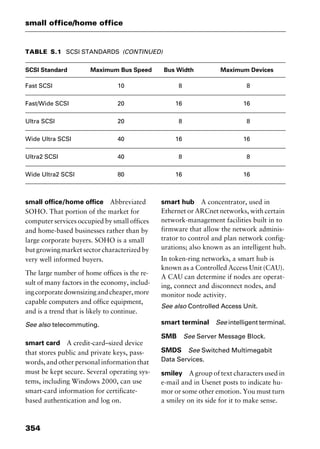
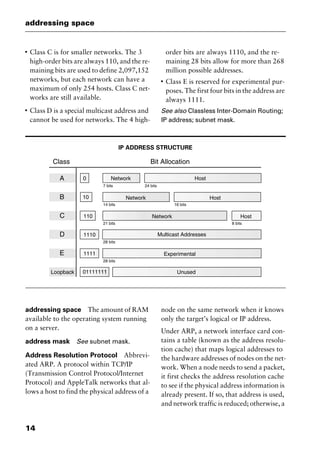
address classes In a 32-bit IP address,
which is shown in the accompanying illus-
tration, the number of bits used to identify
the network and the host vary according
to the network class of the address, as
follows:
I
Class A is used only for very large net-
works. The high-order bit in a Class A
network is always zero, leaving 7 bits
available to define 127 networks. The re-
maining 24 bits of the address allow each
Class A network to hold as many as
16,777,216 hosts. Examples of Class A
networks include General Electric, IBM,
Hewlett-Packard, Apple Computer,
Xerox, Digital Equipment Corporation,
and MIT. All the Class A networks are in
use, and no more are available.
I
Class B is used for medium-sized net-
works. The 2 high-order bits are always
10, and the remaining bits are used to de-
fine 16,384 networks, each with as many
as 65,535 hosts attached. Examples of
Class B networks include Microsoft and
Exxon. All Class B networks are in use,
and no more are available.
2461book Page 13 Thursday, May 4, 2000 11:59 AM
Copyright © 2000 SYBEX Inc., Alameda, CA. www.sybex.com
addressing space
14
I
Class C is for smaller networks. The 3
high-order bits are always 110, and the re-
maining bits are used to define 2,097,152
networks, but each network can have a
maximum of only 254 hosts. Class C net-
works are still available.
I
Class D is a special multicast address and
cannot be used for networks. The 4 high-
order bits are always 1110, and the re-
maining 28 bits allow for more than 268
million possible addresses.
I
Class E is reserved for experimental pur-
poses. The first four bits in the address are
always 1111.
See also Classless Inter-Domain Routing;
IP address; subnet mask.
IP ADDRESS STRUCTURE
addressing space The amount of RAM
available to the operating system running
on a server.
address mask See subnet mask.
Address Resolution Protocol Abbrevi-
ated ARP. A protocol within TCP/IP
(Transmission Control Protocol/Internet
Protocol) and AppleTalk networks that al-
lows a host to find the physical address of a
node on the same network when it knows
only the target’s logical or IP address.
Under ARP, a network interface card con-
tains a table (known as the address resolu-
tion cache) that maps logical addresses to
the hardware addresses of nodes on the net-
work. When a node needs to send a packet,
it first checks the address resolution cache
to see if the physical address information is
already present. If so, that address is used,
and network traffic is reduced; otherwise, a
2461book Page 14 Thursday, May 4, 2000 11:59 AM
Copyright © 2000 SYBEX Inc., Alameda, CA. www.sybex.com
15
Advanced Communications Service
normal ARP request is made to determine
the address.
See also IP address.
address translation gateway Abbrevi-
ated ATG. A function in Cisco DECnet
routing software capable of establishing a
user-specified address translation mecha-
nism for certain selected nodes on the net-
work.
adjacency A term describing the rela-
tionship formed between certain neighbor-
ing routers for the purpose of swapping
routing information. Adjacency is based on
the use of a common network segment.
administrative alerts In Windows
2000, informational messages sent to spe-
cific accounts, groups, or computers to an-
nounce security events, impending
shutdown due to loss of server power, per-
formance problems, and printer errors.
When a server generates an administrative
alert, the appropriate message is sent to a
predefined list of users and computers.
See also Alerter service.
administrative distance A term used
by Cisco Systems, Inc., to express the
integrity of a routing-information source.
Administrative distance is expressed as a
value in the range 0 through 255; the higher
the value, the lower the quality of the rout-
ing information.
Administrator account In Microsoft
Windows 2000, a special account with the
maximum authority and permissions that
can assign any permission to any user or
group.
The Administrator account cannot be delet-
ed, but it can be renamed, which is probably
a good security policy.
See also permissions.
ADMIN object A NetWare Directory
Services User object, created during the in-
stallation of NetWare, that has special priv-
ileges, including the supervisory rights to
create and manage other objects.
ADMIN has Supervisor rights and can,
therefore, manage the NetWare Directory
Services tree and add or delete Directory
objects.
ADSI See Active Directory Service
Interface.
ADSL See Asymmetric Digital Sub-
scriber Line.
ADUC See Active Directory Users and
Computers.
Advanced Communications
Function Abbreviated ACF. A set of
program packages from IBM that allows
computer resources to be shared over
communications links using the concepts of
SAA (Systems Application Architecture).
For example, ACF/TCAM (Advanced Com-
munications Functions/Telecommunica-
tions Access Method) and ACF/VTAM
(Advanced Communications Functions/Vir-
tual Telecommunications Access Method)
allow the interconnection of two or more do-
mains into one multiple-domain network.
Advanced Communications Service
Abbreviated ACS. A large data-communi-
cations network established by AT&T.
2461book Page 15 Thursday, May 4, 2000 11:59 AM
Copyright © 2000 SYBEX Inc., Alameda, CA. www.sybex.com
Advanced Configuration and Power Interface
16
Advanced Configuration and Power
Interface Abbreviated ACPI. An inter-
face specification developed by Intel, Mi-
crosoft, and Toshiba for controlling power
use on the PC and all other devices at-
tached to the system. A BIOS-level hard-
ware specification, ACPI depends on
specific hardware that allows the operat-
ing system to direct power management
and system configuration.
See also Advanced Power Management.
Advanced Data Communications Con-
trol Procedures Abbreviated ADCCP.
A bit-oriented, link-layer, ANSI-standard
communications protocol.
See also High-level Data Link Control.
Advanced Interactive Executive
Abbreviated AIX. A version of Unix from
IBM that runs on its RS/6000 workstations
and on minicomputers and mainframes.
Although AIX is based on Unix System V
Release 3, it contains many of the features
available in System V Release 4, is
POSIX-compliant, and meets the Trusted
Computer Base (TCB) Level C2 security.
One of the major enhancements of AIX is
Visual Systems Management (VSM), a
graphical interface into the older Systems
Management Interface Tool (SMIT). VSM
contains four main elements: Print Manag-
er, Device Manager, Storage Manager, and
Users and Groups Manager.
Advanced Micro Devices, Inc. Abbre-
viated AMD. The fifth largest manufactur-
er of integrated circuits, flash memory, and
microprocessors, specializing in clones of
Intel’s popular PC chips, including the
AMD386, AMD486, AMDK5, and the
AMDK6.
For more information about AMD, see
www.amd.com.
See also Cyrix; Intel Corporation; Pentium;
Pentium II; Pentium III.
Advanced Mobile Phone Service Ab-
breviated AMPS. Currently the cellular
telephone standard in the United States; an
analog, cellular communications system de-
veloped by AT&T. AMPS uses frequency-
division multiplexing (FDM) and operates
in the 825 to 890MHz range.
See also Cellular Digital Packet Data.
Advanced Peer-to-Peer Internet-
working An SNA routing scheme pro-
posed by Cisco Systems and eventually
abandoned.
Advanced Peer-to-Peer Networking
Abbreviated APPN. IBM’s SNA (Systems
Network Architecture) protocol, based on
APPC (Advanced Program-to-Program
Communications). APPN allows nodes on
the network to interact without a main-
frame host computer and implements dy-
namic network directories and dynamic
routing in an SNA network.
APPN can run over a variety of network me-
dia, including Ethernet, token ring, FDDI,
ISDN, X.25, SDLC, and higher-speed links
such as B-ISDN or ATM.
See also Asynchronous Transfer Mode;
Customer Information Control System;
Systems Network Architecture.
Advanced Power Management Ab-
breviated APM. An API specification from
2461book Page 16 Thursday, May 4, 2000 11:59 AM
Copyright © 2000 SYBEX Inc., Alameda, CA. www.sybex.com
17
Aggregate Route-Based IP Switching
Microsoft and Intel intended to monitor
and extend battery life on a laptop comput-
er by shutting down certain system compo-
nents after a period of inactivity.
See also Advanced Configuration and
Power Interface.
Advanced Program-to-Program
Communications AbbreviatedAPPC.A
set of protocols developed by IBM as a part
ofitsSNA(SystemsNetworkArchitecture),
designed to allow applications running on
PCs and mid-range hosts to exchange data
easily and directly with mainframes. APPC
can be used over an SNA, Ethernet, X.25,
or Token Ring network and is an open,
published communications protocol.
APPC/PC is a PC-based version of APPC
used over a Token Ring network.
advanced run-length limited
encoding Abbreviated ARLL. A tech-
nique used to store information on a hard
disk that increases the capacity of run-
length limited (RLL) storage by more than
25 percent and increases the data-transfer
rate to 9Mbps.
See also RLL encoding.
Advanced Technology Attachment
Abbreviated ATA. The ANSI X3T10 stan-
dard for the disk-drive interface usually
known as Integrated Drive Electronics
(IDE).
See also Integrated Drive Electronics.
advertising The process by which servic-
es on a network inform other devices on the
network of their availability. Novell Net-
Ware uses the Service Advertising Protocol
(SAP) for this purpose.
AFP See AppleTalk Filing Protocol.
AFS See Andrews File System.
aftermarket The market for related
hardware, software, and peripheral devices
created by the sale of a large number of
computers of a specific type.
agent 1. A program that performs a task
in the background and informs the user
when the task reaches a certain milestone or
is complete.
2. A program that searches through ar-
chives looking for information specified by
the user. A good example is a spider that
searches Usenet articles. Sometimes called
an intelligent agent.
3. In SNMP (Simple Network Manage-
ment Protocol), a program that monitors
network traffic.
4. In client-server applications, a program
that mediates between the client and the
server.
Aggregate Route-Based IP
Switching Abbreviated ARIS. A scheme
from IBM used to establish switched paths
through networks that act as virtual cir-
cuits, transmitting data packets through the
network without the need to make routing
decisions at every step. ARIS uses tagging
techniques to add information to the data
packets that can be used to guide the pack-
ets through the virtual circuits based on in-
formation already established by protocols
such as Open Shortest Path First (OSPF)
and Border Gateway Protocol (BGP).
2461book Page 17 Thursday, May 4, 2000 11:59 AM
Copyright © 2000 SYBEX Inc., Alameda, CA. www.sybex.com
AIX
18
AIX See Advanced Interactive
Executive.
alert log In Microsoft Windows 2000, a
System Monitor log used to monitor
counters that exceed user-specified limits.
When such a limit is exceeded, the event is
logged into the alert log.
See also counter log; System Monitor;
trace log.
Alerter service A Microsoft Windows
2000 service that warns a predefined list of
users and computers of an administrative
alert. The Alerter service is used by the
Server service and requires the Messenger
service.
See also administrative alerts; Messenger
service; service.
Alias object In Novell NetWare, a leaf
object that references the original location
of an object in the directory. Using Alias ob-
jects, one object can appear in several con-
tainers at the same time, allowing users to
locate and use the object quickly and easily.
See also leaf object.
Allowed Cell Rate See Available Cell
Rate.
alphanumeric Consisting of letters,
numbers, and sometimes special control
characters, spaces, and other punctuation
characters.
See also American Standard Code for
Information Interchange; Extended Binary
Coded Decimal Interchange Code;
Unicode.
alpha testing The first stage in testing a
new hardware or software product, usually
performed by the in-house developers or
programmers.
See also beta testing.
alternative route A secondary commu-
nications path to a specific destination. An
alternative route is used when the primary
path is not available.
See also adaptive routing.
alt newsgroups A set of Usenet news-
groups containing articles on controversial
subjects often considered outside the main-
stream. Alt is an abbreviation for alternative.
These newsgroups were originally created
to avoid the rigorous process required to
create an ordinary newsgroup. Some alt
newsgroups contain valuable discussions
on subjects ranging from agriculture to
wolves, others contains sexually explicit
material, and others are just for fun. Not all
ISPs and online services give access to the
complete set of alt newsgroups.
See also mailing list; moderated
newsgroup; newsgroup; unmoderated
newsgroup.
AMD See Advanced Micro Devices, Inc.
American National Standards
Institute AbbreviatedANSI.Anonprofit
organization of more than 1000 business
and industry groups, founded in 1918,
devoted to the development of voluntary
standards.
ANSI represents the United States in the In-
ternational Organization for Standardiza-
tion (ISO) and is affiliated with CCITT.
2461book Page 18 Thursday, May 4, 2000 11:59 AM
Copyright © 2000 SYBEX Inc., Alameda, CA. www.sybex.com
19
analog
ANSI committees have developed many im-
portant standards, including the following:
I
ANSI X3J11: Standard for the C pro-
gramming language, including language
semantics, syntax, execution environ-
ment, and the definition of the library and
header files.
I
ANSI X3J16: Standard for the C++ pro-
gramming language.
I
ANSI X3J3: Definition of the Fortran pro-
gramming language compiler.
I
ANSI X3.131-1986: Definition of the
SCSI standard. The X3T9.2 standard con-
tains the extensions for SCSI-2.
I
ANSI X3T9.5: The working group for the
FDDI definition.
American Standard Code for Informa-
tion Interchange Abbreviated ASCII,
pronounced “as-kee.” A standard coding
scheme that assigns numeric values to let-
ters, numbers, punctuation characters, and
control characters to achieve compatibility
among different computers and peripheral
devices. In ASCII, each character is repre-
sented by a unique integer value in the range
0 through 255. See Appendix C.
See also ASCII extended character set;
ASCII file; ASCII standard character set;
double-byte character set; Extended
Binary Coded Decimal Interchange Code;
Unicode.
American Wire Gauge Abbreviated
AWG. A measurement system that specifies
copper wire by thickness; as thickness
increases, the AWG number decreases.
Some common conductor gauges are:
I
RS-232-C: 22 or 24 AWG
I
Thick Ethernet: 12 AWG
I
Thin Ethernet: 20 AWG
See also cabling standards; EIA/TIA 586;
Type 1–9 cable.
America Online, Inc. Abbreviated
AOL. The world’s largest online service,
headquartered in Vienna, Virginia, with
more than 15 million subscribers. AOL
provides a gateway to the Internet, as well
as its own news, sports, e-mail, chat rooms,
and other fee-based services. In 1997, AOL
bought CompuServe, and in 1998,
Netscape Communications.
For more information about America On-
line, see www.aol.com.
ampersand (&) 1. In Unix, a command
suffix used to indicate that the preceding
command should be run in the background.
2. In Unix, a root user command used to
start a daemon that is to keep running after
logout.
3. In HTML, a special character entry in a
document.
See also daemon; HyperText Markup
Language.
AMPS See Advanced Mobile Phone
Service.
analog Describes any device that repre-
sents changing values by a continuously
variable physical property, such as a volt-
age in a circuit. Analog often refers to trans-
mission methods developed to transmit
voice signals rather than high-speed digital
signals.
2461book Page 19 Thursday, May 4, 2000 11:59 AM
Copyright © 2000 SYBEX Inc., Alameda, CA. www.sybex.com
Andrews File System
20
Andrews File System Abbreviated
AFS. A protocol developed at Carnegie
Mellon University; used to share remote
files across systems using TCP/IP.
AFS has certain advantages over NFS in
that it only allows users to access files
linked to AFS rather than giving access to
all files, it has a built-in cache that helps to
reduce the demands made on the system,
and system administrators can allocate disk
space on the fly as required.
See also Distributed File System; Network
File System; Transmission Control Proto-
col/Internet Protocol.
angle brackets The less-than (<) and
greater-than (>) symbols used to identify a
tag in an HTML document.
Also used to identify the return address in
an e-mail message header.
See also HyperText Markup
Language; tag.
ANI See automatic number
identification.
anonymous FTP A method used to ac-
cess an Internet computer that does not re-
quire you to have an account on the target
computer system. Simply log on to the In-
ternet computer with the user name anon-
ymous, and use your e-mail address as your
password. This access method was original-
ly provided as a courtesy so that system ad-
ministrators could see who had logged on
to their systems, but now it is often required
to gain access to an Internet computer that
has FTP service.
You cannot use anonymous FTP with every
computer on the Internet, only with those
systems set up to offer the service. The sys-
tem administrator decides which files and
directories will be open to public access,
and the rest of the system is considered off
limits and cannot be accessed by anony-
mous FTP users. Some sites only allow you
to download files; as a security precaution,
you are not allowed to upload files.
See also File Transfer Protocol; Telnet.
anonymous posting In a Usenet news-
group, a public message posted via an anon-
ymous server in order to conceal the
identity of the original sender.
anonymous remailer See anonymous
server.
anonymous server A special Usenet
service that removes from a Usenet post all
header information that could identify the
original sender and then forwards the mes-
sage to its final destination. If you use an
anonymous server, be sure to remove your
signature from the end of the message; not
all anonymous servers look for and then
strip a signature. Also known as an anony-
mous remailer.
ANSI SeeAmericanNationalStandards
Institute.
answer mode A function that allows a
modem to answer an incoming call, detect
the protocol being used by the calling mo-
dem, and synchronize with that protocol.
See also auto-answer; auto-dial.
2461book Page 20 Thursday, May 4, 2000 11:59 AM
Copyright © 2000 SYBEX Inc., Alameda, CA. www.sybex.com
21
Apple Computer, Inc.
antivirus program A program that de-
tects or eliminates a computer virus. Some
antivirus programs can detect suspicious
activity on your computer as it happens;
others must be run periodically as part of
your normal housekeeping activities.
An antivirus program locates and identifies
a virus by looking for characteristic pat-
terns or suspicious activity in the system,
such as unexpected disk access or .EXE files
changing in some unusual way. It recogniz-
es the virus by comparing information from
the system against a database of known vi-
ruses, which is kept on disk.
Be sure you test an antivirus program care-
fully on your network before you employ
it everywhere; some programs impose an
enormous overhead on normal network
operations.
See also file-infecting virus; macro virus;
multipart virus; polymorphic virus; stealth
virus; Trojan Horse; vaccine; virus.
AnyNet A family of gateway products
from IBM used to integrate SNA, TCP/IP,
and NetBIOS networks with products run-
ning on IBM’s AIX/6000, OS/2, and OS/
400 and with Microsoft Windows.
AOL See America Online, Inc.
Apache HTTP Server A freeware Web
server, supported by the Unix community,
in use on almost half of the Web sites on the
Internet. So called because the original uni-
versity-lab software was patched with new
features and fixes until it became known as
“a patchy server.”
Apache dominates the Web because of its
low cost, excellent performance, good scal-
ability, and great flexibility. Don’t expect
easy graphical configuration programs and
hypertext help; you’ll get the command line
and the man pages instead, so it certainly
helps to have staff with Unix experience.
Apache Server is available as part of the Red
Hat Software Linux distribution, which
also provides developers with full support
for CGI, Perl, Tcl, a C or C++ compiler, an
Apache server API, and a SQL database.
For more information on Apache Server,
see The Apache Group Web site at
www.apache.org.
See also Linux; Red Hat Software.
API See application programming
interface.
APM See Advanced Power
Management.
app See application.
APPC See Advanced Program-to-Pro-
gram Communications.
APPI See Advanced Peer-to-Peer Inter-
networking.
Apple Computer, Inc. Manufacturer of
the successful Macintosh and Quadra series
of computers based on Motorola chips. The
company was founded by Steve Wozniak
and Steve Jobs in a garage on April 1, 1976.
In 1993, Apple entered the consumer elec-
tronics marketplace with a personal digital
assistant known as Newton, combining
fax, electronic mail, and other functions
into a unit small enough to fit into a pocket.
2461book Page 21 Thursday, May 4, 2000 11:59 AM
Copyright © 2000 SYBEX Inc., Alameda, CA. www.sybex.com
Apple Desktop Bus
22
In 1994, Apple launched a new series of
computers called the Power Macintosh (or
Power Mac), based on the PowerPC, capa-
ble of running either the Macintosh operat-
ing system or Windows programs under
software emulation.
Apple always kept the architecture of the
Mac proprietary, a move that has cost the
company considerable market share; never-
theless, Apple has always had a strong fol-
lowing among musicians and graphical
designers.
In 1997, Steve Jobs rejoined Apple and, af-
ter realigning Apple’s product line, led the
development and launch of the popular and
capable Internet-ready iMac computer.
For more information on Apple Computer,
Inc., see www.apple.com.
Apple Desktop Bus A serial communi-
cations link that connects low-speed input
devices, such as a mouse or a keyboard, to
the computer on the Macintosh SE, II, IIx,
IIcx, and SE/30.
Light pens, trackballs, and drawing tablets
may also be connected via the Apple Desk-
top Bus. Most Apple Desktop Bus devices
allow one device to be daisy-chained to the
next, up to a maximum of 16 devices.
Apple Macintosh See Macintosh.
AppleShare Network software from
Apple Computer that requires a dedicated
Macintosh computer acting as a central-
ized server and includes both server and
workstation software. AppleShare uses the
AppleTalk Filing Protocol (AFP).
AppleTalk AnAppleMacintoshnetwork
protocol, based on the OSI Reference Mod-
el, which gives every Macintosh network-
ing capabilities. AppleTalk can run under
several network operating systems, includ-
ing Apple Computer’s AppleShare, Novell
NetWare for the Macintosh, and TOPS
from Sun Microsystems.
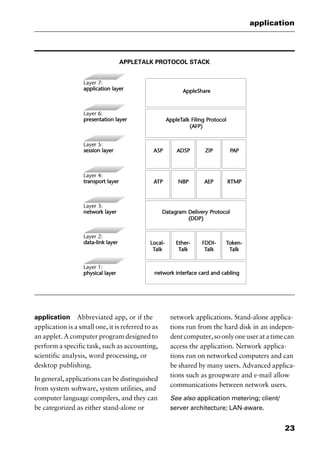
AppleTalk includes specifications for the
data-link layer as LocalTalk, EtherTalk,
FDDI-Talk, or TokenTalk, and the network
layer as Datagram Delivery Protocol. The
transport layer contains four protocols:
I
Routing Table Maintenance Protocol
(RTMP)
I
AppleTalk Echo Protocol (AEP)
I
AppleTalk Transaction Protocol (ATP)
I
Name Binding Protocol (NBP)
The session layer includes
I
AppleTalk Data Stream Protocol (ADSP)
I
AppleTalk Session Protocol (ASP)
I
Printer Access Protocol (PAP)
I
Zone Information Protocol (ZIP)
The presentation layer adds the AppleTalk
Filing Protocol (AFP) for access to remote
files on shared disks.
AppleTalk Filing Protocol Abbreviat-
ed AFP. AFP is located in the presentation
and application layers of the AppleTalk
protocol stack. AFP lets users access remote
files as though they were local, as well as
providing security features that can restrict
user access to certain files.
2461book Page 22 Thursday, May 4, 2000 11:59 AM
Copyright © 2000 SYBEX Inc., Alameda, CA. www.sybex.com
23
application
APPLETALK PROTOCOL STACK
application Abbreviated app, or if the
application is a small one, it is referred to as
an applet. A computer program designed to
perform a specific task, such as accounting,
scientific analysis, word processing, or
desktop publishing.
In general, applications can be distinguished
from system software, system utilities, and
computer language compilers, and they can
be categorized as either stand-alone or
network applications. Stand-alone applica-
tions run from the hard disk in an indepen-
dentcomputer,soonlyoneuseratatimecan
access the application. Network applica-
tions run on networked computers and can
be shared by many users. Advanced applica-
tions such as groupware and e-mail allow
communications between network users.
See also application metering; client/
server architecture; LAN-aware.
2461book Page 23 Thursday, May 4, 2000 11:59 AM
Copyright © 2000 SYBEX Inc., Alameda, CA. www.sybex.com
Application Binary Interface
24
Application Binary Interface Abbrevi-
ated ABI. A specification that aims to ensure
binary compatibility between applications
running on the same family of processors or
CPUs using Unix System V Release 4.
Applications developed using ABI can run
on hardware from different manufacturers
without being recompiled; any system calls
needed for specific hardware are main-
tained in libraries.
The specification was originally developed
by AT&T and Sun Microsystems and in-
cludes a test and verification suite used to
determine if a system complies with the
standard.
See also application programming
interface.
application layer The seventh, or high-
est, layer in the OSI Reference Model for
computer-to-computer communications.
This layer uses services provided by the
lower layers but is completely insulated
from the details of the network hardware. It
describes how applications interact with
the network operating system, including
database management, electronic mail, and
terminal emulation programs.
See also OSI Reference Model.
application-level filter A category of
firewall that provides a high degree of secu-
rity but at the cost of lower speed and great-
er complexity. Typical application-level
filters can provide proxy services for appli-
cations and protocols such as Telnet, FTP,
HTTP, and SMTP.
See also firewall; packet-level filter; state-
less filter.
application log In Microsoft Windows
2000, a system log that contains events gen-
erated by applications or by alert logs. You
can use the Event Viewer to display the con-
tents of the application log.
See also Event Viewer; security log; sys-
tem log.
application metering The process of
counting the number of executions of the
copies of an application in use on the net-
work at any given time and ensuring that
the number does not exceed preset limits.
Application metering is usually performed
by a network management application run-
ning on the file server. Most application
metering software will allow only a certain
number of copies (usually that number
specified in the application software li-
cense) of an application to run at any one
time and will send a message to any users
who try to exceed this limit.
See also concurrent license.
Application object In Novell Directory
Services (NDS), a leaf object that represents
a network application in a NetWare Direc-
tory tree.
See also Computer object; container ob-
ject; leaf object; Novell Directory Services.
application programming interface
Abbreviated API. The complete set of all
operating system functions that an applica-
tion can use to perform such tasks as man-
aging files and displaying information.
An API provides a standard way to write an
application, and it also describes how the
application should use the functions it pro-
vides. Using an API is quicker and easier
2461book Page 24 Thursday, May 4, 2000 11:59 AM
Copyright © 2000 SYBEX Inc., Alameda, CA. www.sybex.com
25
archive file
than developing functions from scratch and
helps to ensure some level of consistency
among all the applications developed for a
specific operating system.
In operating systems that support a graphi-
cal user interface, the API also defines func-
tionstosupportwindows,icons,drop-down
menus, and other components of the inter-
face. In network operating systems, an API
defines a standard method that applications
can use to take advantage of all the network
features.
application server A special-purpose
file server that is optimized for a specific
task, such as communications or a database
application, and that uses higher-end hard-
ware than a typical file server.
See also superserver.
application-specific integrated
circuit Abbreviated ASIC. A computer
chip developed for a specific purpose, de-
signed by incorporating standard cells from
a library rather than created from scratch.
Also known as gate arrays, ASICs are found
in all sorts of appliances, including mo-
dems,securitysystems,digitalcameras,and
even microwave ovens and automobiles.
APPN See Advanced Peer-to-Peer Net-
working.
ARB See Area Border router.
arbitration The set of rules used to man-
age competing demands for a computer
resource, such as memory or peripheral de-
vices, made by multiple processes or users.
See also contention.
Archie A system used on the Internet to
locate files available by anonymous FTP.
Once a week, special programs connect to
all the known anonymous FTP sites on the
Internet and collect a complete listing of all
the publicly available files. This listing of
files is kept in an Internet Archive Database,
and when you ask Archie to look for a file,
it searches this database rather than the
whole Internet; you then use anonymous
FTP to retrieve the file.
See also anonymous FTP.
architecture 1. The overall design and
construction of all or part of a computer,
particularlytheprocessorhardwareandthe
size and ordering sequence of its bytes.
2. Theoveralldesignofsoftware,including
interfaces to other software, the operating
system, and to the network.
See also client/server architecture; closed
architecture; complex instruction set com-
puting; open architecture; reduced instruc-
tion set computing.
archive 1. To transfer files to some form
of long-term storage, such as magnetic tape
or large-capacity disk, when the files are no
longer needed regularly but must be main-
tained for periodic reference.
2. On the Internet, a site containing a
collection of files available via anonymous
FTP.
3. A compressed file.
archive file A single file that contains one
or more files or directories that may have
been compressed to save space. Archives are
often used as a way to transport large num-
bers of related files across the Internet.
2461book Page 25 Thursday, May 4, 2000 11:59 AM
Copyright © 2000 SYBEX Inc., Alameda, CA. www.sybex.com
ARCNet
26
An archive file created under Unix may have
the filename extension .TAR (for tape ar-
chive), .GZ (for gzip), or .Z (for compress or
pack). Those created in Windows may have
the filename extension .ZIP from the PKZIP
or WinZip programs. Archive files created
on a Macintosh will have the filename exten-
sion .SAE or .SIT from the StuffIt program.
An Internet host that provides access to
large numbers of archive files is known as
an archive site.
ARCNet Acronym for Attached Resourc-
es Computing Network. A network avail-
able from the Datapoint Corporation and
other vendors that can connect a wide vari-
ety of PCs and workstations (up to a maxi-
mum of 255) on coaxial, twisted-pair, or
fiber-optic cable. ARCnet uses a proprietary
token-passing access method at speeds of
2.5Mbps. ARCNet Plus is Datapoint’s pro-
prietary product that runs at 20Mbps.
ARCNetwaspopularforsmallernetworks,
because it is relatively easy to set up and to
operate and also because the components
are inexpensive and widely available. These
days, however, it is showing its age and is
no longer sold by the major vendors.
See also Token Ring network.
Area Border router Abbreviated ARB.
In an internetwork that uses link state rout-
ing protocols such as Open Shortest Path
First (OSPF) protocols, a router that has at
least one connection to another router in a
different part of the internetwork. Also
known as a Border router.
See also Autonomous System Border
router; Open Shortest Path First.
ARIS See Aggregate Route-Based IP
Switching.
ARLL See advanced run-length limited
encoding.
ARP See Address Resolution Protocol.
ARPAnet Acronym for Advanced Re-
search Projects Agency Network. A re-
search network funded by the Defense
Advanced Research Projects Agency
(DARPA) to link universities and govern-
ment research agencies, originally built by
BBN, Inc., in 1969. It was the backbone
for the now huge Internet. TCP/IP proto-
cols were pioneered on ARPAnet. In 1983,
the military communications portion was
split off into the MILnet.
article An e-mail message posted to one
of the Usenet newsgroups, accessible by
anyone with a newsreader and a connection
to the Internet. Also called a post.
See also newsreader.
AS/400 A series of mid-range mini-
computers from IBM, first introduced in
1988, that replaces the System/36 and Sys-
tem/38 series of computers. The AS/400
can serve in a wide variety of network con-
figurations: as a host or an intermediate
node to other AS/400 and System/3x com-
puters, as a remote system to System/370-
controlled networks, or as a network serv-
er to a group of PCs.
ASBR See Autonomous System Bor-
der router.
Ascend Certified Technical Expert
Abbreviated ACTE. A certification scheme
from Ascend Communications, Inc., aimed
2461book Page 26 Thursday, May 4, 2000 11:59 AM
Copyright © 2000 SYBEX Inc., Alameda, CA. www.sybex.com
27
ASP
at technical professionals with experience
in installing, configuring, and trouble-
shooting Ascend remote-access products.
Two written exams, the Networking and
Telecommunications exam, and the Re-
mote Access exam, are followed by a hands-
on lab test administered at Ascend’s head-
quarters in Alameda, CA.
Ascend Communications, Inc. A lead-
ing provider of solutions for telecommuni-
cations carriers, ISPs, and corporate
customers, Ascend manufactures products
for remote access, for wide area network-
ing, and for linking telephone switches, net-
work connections, and videoconferencing
facilities to phone company networks.
Ascend recently acquired Cascade Commu-
nications, establishing the company as one
of the largest suppliers of frame-relay and
ATM equipment. In 1999, Ascend was
bought by Lucent Technologies.
For more information on Ascend, see
www.ascend.com.
ASCII See American Standard Code for
Information Interchange.
ASCII extended character set The sec-
ond group of characters, from 128 through
255, in the ASCII character set. The extend-
ed ASCII character set is assigned variable
sets of characters by computer hardware
manufacturersandsoftwaredevelopers,and
it is not necessarily compatible between dif-
ferent computers. The IBM extended char-
acter set used in the PC (see Appendix C)
includes mathematics symbols and charac-
ters from the PC line-drawing set.
See also American Standard Code for In-
formation Interchange; ASCII file; ASCII
standard character set; double-byte char-
acter set; Extended Binary Coded Decimal
Interchange Code; Unicode.
ASCII file A file that contains only text
characters from the ASCII character set. An
ASCII file can include letters, numbers, and
punctuation symbols, but does not contain
any hidden text-formatting codes. Also
known as a text file or an ASCII text file.
See also American Standard Code for In-
formation Interchange; ASCII extended
characterset;ASCIIstandardcharacterset;
binary file.
ASCII standard character set A char-
acter set that consists of the first 128 (from
0 through 127) ASCII characters. The val-
ues 0 through 31 are used for nonprinting
control codes (see Appendix C), and the
range 32 through 127 is used to represent
the letters of the alphabet and common
punctuation symbols. The entire set from 0
through 127 is referred to as the standard
ASCII character set. All computers that use
ASCII can understand the standard ASCII
character set.
See also American Standard Code for In-
formation Interchange; ASCII file; ASCII ex-
tended character set; double-byte
character set; Extended Binary Coded Dec-
imal Interchange Code; Unicode.
ASCII text file See ASCII file.
ASE See Accredited Systems Engineer.
ASIC See application-specific
integrated circuit.
ASP See Active Server Pages.
2461book Page 27 Thursday, May 4, 2000 11:59 AM
Copyright © 2000 SYBEX Inc., Alameda, CA. www.sybex.com
assembly language
28
assembly language A low-level pro-
gramming language in which each program
statement must correspond to a single ma-
chine language instruction that the proces-
sor can execute.
Assembly languages are specific to a given
microprocessor and, as such, are not porta-
ble; programs written for one type of pro-
cessor must be rewritten before they can be
used on another type of processor.
You use assembly language for two reasons:
I
To wring as much performance out of the
processor as possible
I
To gain access to specific characteristics
of the hardware that might not be possible
from a higher-level language
See also compiler; interpreter; machine
language; microcode
Associate Business Continuity
Professional Abbreviated ABCP. A cer-
tification from Disaster Recovery Institute
International (DRII) that covers basic in-
formation on business continuity planning
and disaster recovery.
See also Certified Business Continuity
Professional; Master Business Continu-
ity Professional.
Associated Accredited Systems
Engineer Abbreviated AASE. A certifica-
tionfromCompaqdesignedtoevaluateand
recognize basic knowledge of PC architec-
ture and operations. An AASE may choose
tospecializeinMicrosoftWindows2000or
Novell NetWare operation.
See also Accredited Systems Engineer.
Association of Banyan Users
International Abbreviated ABUI. The
Banyan user group, with 1700 members
worldwide, concerned with all hardware
and software related to the Banyan system,
including Banyan VINES.
See also Banyan VINES.
asterisk In several operating systems,
you can use the asterisk (*) as a wildcard
character to represent one or more un-
known characters in a filename or filename
extension.
See also question mark; star-dot-star.
AST Research One of the world’s top
ten computer manufacturers, AST Re-
search makes desktop, laptop, notebook,
and hand-held computers, as well as moni-
tors, graphics cards, and memory products.
A subsidiary of Samsung Electronics Com-
pany Limited.
FormoreinformationonASTResearch,see
www.ast.com.
asymmetrical multiprocessing A mul-
tiprocessing design in which the program-
mer matches a specific task to a certain
processor when writing the program.
This design makes for a much less flexible
system than SMP (symmetrical multipro-
cessing) and may result in one processor be-
ing overworked while another stands idle.
SMP allocates tasks to processors as the
program starts up, on the basis of current
system load and available resources. Need-
less to say, asymmetrical multiprocessing
systems are easier to design, code, and test
than symmetrical multiprocessing systems.
2461book Page 28 Thursday, May 4, 2000 11:59 AM
Copyright © 2000 SYBEX Inc., Alameda, CA. www.sybex.com
29
asynchronous transmission
Asymmetric Digital Subscriber Line
Abbreviated ADSL. A high-speed data
transmission technology originally devel-
oped by Bellcore and now standardized by
ANSI as T1.413. ADSL delivers high band-
width over existing twisted-pair copper
telephone lines. Also called Asymmetric
Digital Subscriber Loop.
ADSL supports speeds in the range of 1.5 to
9Mbps in the downstream direction (from
the network to the subscriber) and supports
upstream speeds in the range of 16 Kbps to
640 Kbps; hence, the term asymmetric.
See also Digital Subscriber Line; High-Bit-
Rate Digital Subscriber Line; Rate-Adaptive
Digital Subscriber Line; Single-Line Digi-
tal Subscriber Line; Very-High-Bit-Rate
Digital Subscriber Line.
Assymetric Digital Subscriber Loop
See Assymetric Digital Subscriber Line.
asynchronous communications See
asynchronous transmission.
asynchronous communications
server A LAN server that allows a net-
work user to dial out of the network into
the public switched telephone system or to
access leased lines for asynchronous com-
munications. Asynchronous communica-
tions servers may also be called dial-in/dial-
out servers or modem servers.
asynchronous time-division
multiplexing Abbreviated ATDM. An
asynchronous and adaptive version of time-
division multiplexing in which time slots are
allocated dynamically based on demand.
See also time-division multiplexing.
Asynchronous Transfer Mode Abbre-
viated ATM. A method used for transmit-
ting voice, video, and data over high-speed
LANs and WANs. ATM uses continuous
bursts of fixed-length packets called cells to
transmit data. The basic packet consists of
53 bytes, 5 of which are used for control
functions and 48 for data.
ATM is a connection-oriented protocol,
and two kinds of connections are possible:
I
Permanent virtual circuits (PVCs), in
which connections are created manually
I
Switched virtual circuits (SVCs), in which
connections are made automatically
Speeds of up to 2.488Gbps have been
achieved in testing. ATM will find wide ac-
ceptance in the LAN and WAN arenas as a
solution to integrating disparate networks
over large geographical distances. Also
known as cell relay.
See also permanent virtual circuit;
switched virtual circuit.
asynchronous transmission Amethod
of data transmission that uses start bits and
stop bits to coordinate the flow of data so
that the time intervals between individual
characters do not need to be equal. Parity
also may be used to check the accuracy of
the data received.
See also communications parameters;
data bits; synchronous transmission.
2461book Page 29 Thursday, May 4, 2000 11:59 AM
Copyright © 2000 SYBEX Inc., Alameda, CA. www.sybex.com
ATA
30
ASYNCHRONOUS TRANSMISSION
ATA See Advanced Technology
Attachment.
AT command set A set of standard in-
structions used to activate features on a mo-
dem. Originally developed by Hayes
Microcomputer Products, the AT com-
mand set is now used by almost all modem
manufacturers.
See also modem.
ATDM See asynchronous time-division
multiplexing.
ATG See address translation gateway.
ATM See Asynchronous Transfer Mode.
ATM25 A low-cost version of Asynchro-
nous Transfer Mode (ATM) that runs on
Category 3 unshielded twisted-pair cable
and provides 25Mbps transmissions in
both directions.
See also Asynchronous Transfer Mode; IP
over ATM; LAN Emulation; Multiprotocol
over ATM.
ATM Adaptation Layer Abbreviated
AAL. A service-dependent layer in Asyn-
chronous Transfer Mode (ATM) that pro-
vides the protocol translation between
ATM and the other communications servic-
es involved in a transmission.
AAL has several service types and classes of
operation to handle different kinds of traf-
fic, depending on how data is transmitted,
the bandwidth required, and the types of
connection involved.
See also convergence sublayer; segmen-
tation and reassembly sublayer.
ATM LAN Emulation An Asynchro-
nous Transfer Mode (ATM) variation that
uses software to make the network operat-
ing system see an ATM adapter as an Ether-
net or Token Ring adapter.
See also IP over ATM; LAN Emulation;
Multiprotocol over ATM.
2461book Page 30 Thursday, May 4, 2000 11:59 AM
Copyright © 2000 SYBEX Inc., Alameda, CA. www.sybex.com
31
AUDITCON
at symbol The separating character (@)
betweenaccountnameanddomainnamein
an Internet e-mail address.
See also bang path.
AT&T The parent company of Bell Labo-
ratories, the original developers of Unix.
For many years Bell Labs was one of the
two major development centers for Unix
(the other being the Computer Systems Re-
search Group at the University of Califor-
nia at Berkeley), but in 1990, AT&T
formed Unix Systems Laboratories, or USL,
to continue the development of Unix. In
1993, USL was sold to Novell, and in 1995,
Novell sold the rights to SCO (Santa Cruz
Operation).
See also Baby Bells; Regional Bell Operat-
ing Companies.
attach To establish a connection be-
tween a workstation and a network file
server; particularly, to access additional
servers after logging on to one server.
attachment See enclosure.
Attachment Unit Interface Abbreviat-
ed AUI. A 15-pin socket used by some
Ethernet devices. AUI connections adapt
between two different cabling types and
work with a wide range of wiring schemes.
Also known as a DIX (for Digital, Intel,
Xerox) connector.
attack An attempt to circumvent the se-
curity measures in place on a network either
to gain unauthorized access to the system or
to force a denial of service.
See also brute-force attack; dictionary at-
tack; social engineering.
attenuation The decrease in power of a
signal with increasing distance. Attenua-
tion is measured in decibels, and it increases
as the power of the signal decreases. The
best cables (those exhibiting the least atten-
uation) are fiber-optic lines, and the worst
cables are unshielded, untwisted-pair lines,
such as the silver, flat-satin cables used in
short-run telephone and modem lines.
In a LAN, attenuation can become a prob-
lem when cable lengths exceed the stated
network specification; however, the useful
length of a cable may be extended by the use
of a repeater.
attribute 1. A file attribute is a tech-
nique for describing access to and proper-
ties of files and directories within a file
system. You may see the termattribute used
interchangeably with the term property.
2. A screen attribute controls a character’s
background and foreground colors, as well
as other characteristics, such as underlining,
reverse video, and blinking or animation.
3. In operating systems, a characteristic
that indicates whether a file is a read-only
file, a hidden file, or a system file or has
changed in some way since it was last
backed up.
4. InmarkuplanguagessuchasHTMLand
SGML, a name-value pair within a tagged
element that modifies certain characteris-
tics of that element.
5. In a database record, the name or struc-
ture of a field.
See also tag.
AUDITCON A Novell NetWare and In-
tranetWare workstation utility that creates
2461book Page 31 Thursday, May 4, 2000 11:59 AM
Copyright © 2000 SYBEX Inc., Alameda, CA. www.sybex.com
audit policy
32
a log file to allow an independent auditor to
verify that network transactions are accu-
rate and that confidential information is se-
cure. When auditing is enabled, an auditor
can track when files or directories are cre-
ated, deleted, modified, salvaged, moved,
or renamed. Changes to security rights can
also be tracked.
audit policy In Microsoft Windows
2000, the policy that defines the security
events to track and report to the network
administrator.
See also security log.
audit trail An automatic feature of cer-
tain programs or operating systems that
creates a running record of all transactions.
An audit trail allows you to track a piece of
data from the moment it enters the system
to the moment it leaves and to determine
the origin of any changes to that data.
auditing The process of scrutinizing net-
work security-related events and transac-
tions to ensure that they are accurate,
particularly reviewing attempts to create,
access, and delete files and directories and
reviewing security violations. Records of
these events are usually stored in a security
log file, which can only be examined by us-
ers with special permissions.
AUI See Attachment Unit Interface.
authentication In a network operating
system or multiuser system, the process that
validates a user’s logon information.
Authentication may involve comparing the
user name and password to a list of autho-
rized users. If a match is found, the user can
log on and access the system in accordance
with the rights or permissions assigned to
his or her user account.
See also authorization; Kerberos; pass-
word; user; user account.
authoring The process of preparing a
multimedia presentation or a Web page.
This involves not only writing the text of
the presentation or Web page, but also the
production of the slides, sound, video, and
graphical components.
authorization The provision of rights or
permissions based on identity. Authoriza-
tion and authentication go hand in hand in
networking; your access to services is based
on your identity, and the authentication
processes confirm that you are who you say
you are.
See also authentication.
auto-answer A feature of a modem
that allows it to answer incoming calls
automatically.
See also answer mode; dialback modem.
auto-dial A feature of a modem that al-
lows it to open a telephone line and start a
call. To auto-dial, the modem sends a series
of pulses or tones that represent a stored
telephone number.
See also callback modem.
AUTOEXEC.BAT A contraction of Au-
tomatically Executed Batch. A special
MS-DOS batch file, located in the root di-
rectory of the startup disk, that runs auto-
matically every time you start or restart
your computer. The commands contained
2461book Page 32 Thursday, May 4, 2000 11:59 AM
Copyright © 2000 SYBEX Inc., Alameda, CA. www.sybex.com
33
Available Cell Rate
in AUTOEXEC.BAT are executed one by
one, just as if you typed them at the system
prompt. An AUTOEXEC.BAT file can be
used to load hardware device drivers, set
the system prompt, change the default
drive to the first network drive, and log the
user in to the file server.
In OS/2, you can select any batch file to be
used as AUTOEXEC.BAT for a specific
MS-DOS session, so you can tailor specific
environments for separate MS-DOS sessions,
each using a different AUTOEXEC.BAT file.
SeealsoAUTOEXEC.NCF;boot;bootstrap;
CONFIG.SYS.
AUTOEXEC.NCF A Novell NetWare
batch file usually located on the NetWare
partition of the server’s hard disk, used to
set the NetWare operating system configu-
ration. AUTOEXEC.NCF loads the LAN
drivers, the NLMs, and the settings for the
network interface boards and then binds
the protocols to the installed drivers.
Automatic Client Upgrade A mecha-
nismusedtoupgradeNovellclientsoftware
during the logon process by executing four
separate programs called by the logon
script. Automatic Client Upgrade can be
very useful when all client workstations use
standard configurations.
automatic forwarding A feature of
many e-mail programs that automatically
retransmits incoming messages to another
e-mail address.
automatic number identification Ab-
breviated ANI. A method of passing a call-
er’s telephone number over the network to
the recipient so that the caller can be iden-
tified. ANI is often associated with ISDN
and is sometimes known as caller ID.
automatic rollback In a Novell Net-
Ware network, a feature of the Transaction
Tracking System (TTS) that abandons the
current transaction and returns a database
to its original condition if the network fails
in the middle of a transaction. Automatic
rollback prevents the database from being
corrupted by information from incomplete
transactions.
See also backing out.
Autonomous System Border router
Abbreviated ASBR. In an internetwork that
uses link state routing protocols such as
Open Shortest Path First (OSPF) protocols,
a router that has at least one connection
to a router in an external network.
See also Area Border router; Open Short-
est Path First.
AutoPlay A feature of Microsoft Win-
dows that automatically executes an appli-
cation from a CD-ROM or automatically
plays an audio CD when the disk is inserted
into the CD-ROM drive.
Available Bit Rate A Type 3 or Type 4
Asynchronous Transfer Mode Adaption
Layer (AAL) service designed for non–time-
criticalapplicationssuchasLANemulation
and LAN internetworking.
See also Constant Bit Rate; Unspecified Bit
Rate; Variable Bit Rate.
Available Cell Rate Abbreviated ACR.
A measure of the bandwidth in Asynchro-
nous Transfer Mode (ATM) networks. The
ACR value represents the number of ATM
2461book Page 33 Thursday, May 4, 2000 11:59 AM
Copyright © 2000 SYBEX Inc., Alameda, CA. www.sybex.com
avatar
34
cells available or allowed per second for a
specific quality of service (QoS) class.
Available Cell Rate is also known as Al-
lowed Cell Rate.
See also Asynchronous Transfer Mode;
Minimum Cell Rate; Peak Cell Rate; Sus-
tainable Cell Rate.
avatar 1. In Unix, another name for the
superuser account; an alternative to the
name root.
2. A visual representation of a user in a
shared virtual-reality environment.
AWG See American Wire Gauge.
2461book Page 34 Thursday, May 4, 2000 11:59 AM
Copyright © 2000 SYBEX Inc., Alameda, CA. www.sybex.com
35
back-end system
B
Baan Advanced Certification Abbrevi-
ated BAC. A certification from Baan avail-
able in four specialties covering the Baan
IV suite of products: Enterprise Logistics,
Enterprise Finance, Enterprise Tools,
and Enterprise Modeler.
See also Baan Basic Certification.
Baan Basic Certification Abbreviated
BBC. A certification from Baan designed to
evaluate basic proficiency with the Baan IV
suite of products; a prerequisite qualifica-
tion to taking the Baan Advanced Certifica-
tion exams.
See also Baan Advanced Certification.
Baan Company A leading provider of
enterprise and inter-enterprise business
software used for managing finance, man-
ufacturing, inventory, distribution, trans-
portation, and administrative functions for
large companies.
For more information on Baan, see
www2.baan.com.
Baby Bells A slang term for the 22 Re-
gional Bell Operating Companies (RBOC),
formed when AT&T was broken up in 1984.
See also Bell Labs.
BAC See Baan Advanced Certification.
backbone That portion of the network
that manages the bulk of the traffic. The
backbone may connect several locations or
buildings, and other, smaller networks may
be attached to it. The backbone often uses
a higher-speed protocol than the individual
LAN segments.
back-end processor A secondary pro-
cessor that performs one specialized task
very effectively, freeing the main processor
for other, more important work.
back-end system The server part of a
client/server system that runs on one or
more file servers and provides services to
the front-end applications running on net-
workedworkstations.Theback-endsystem
accepts query requests sent from a front-
end application, processes those requests,
and returns the results to the workstation.
Back-end systems may be PC-based serv-
ers, superservers, midrange systems, or
mainframes.
See also client/server architecture.
2461book Page 35 Thursday, May 4, 2000 11:59 AM
Copyright © 2000 SYBEX Inc., Alameda, CA. www.sybex.com
background
36
BACKBONE
background 1. On a computer screen,
thecoloronwhichcharactersaredisplayed;
for example, white characters may appear
on a blue background.
2. In an operating system, a process that
runs in the background generally runs at a
lower level of priority than a foreground
task and does not accept input from the us-
er. Only multitasking operating systems
support true background and foreground
processing, but some applications can mim-
ic it. For example, many word processors
can print a document while still accepting
input from the keyboard. In older systems,
a process spends its entire existence in either
thebackgroundortheforeground;innewer
systems, you can change the processing en-
vironment and move foreground programs
into the background, and vice versa.
See also ampersand; foreground;
multitasking.
background authentication The pro-
cess used to give a workstation access to a
particular server. For example, in Novell
2461book Page 36 Thursday, May 4, 2000 11:59 AM
Copyright © 2000 SYBEX Inc., Alameda, CA. www.sybex.com
37
backup
NetWare, password authentication uses a
public key encryption scheme to protect
password information before it is transmit-
ted over the network. All this activity takes
place in the background, and all the user
has to do is enter his or her password.
background noise Any unwanted sig-
nal that enters a line, channel, or circuit; for
example, electrical interference on a tele-
phone circuit.
See also noise.
backing out The process of abandoning
the current transaction and returning a da-
tabase to its original condition if the net-
work fails during the transaction. This
process prevents the database from being
corrupted by information from the incom-
plete transaction.
See also automatic rollback; Transaction
Tracking System.
backlink In Novell Directory Services, an
attribute used by a directory to indicate the
external references to a property.
backslash 1. In MS-DOS, OS/2, and
other operating systems, you must use the
backslash character () to separate directory
or subdirectory names in a path statement
or when changing to another directory.
2. A shorthand name for the root directory.
Sometimes called the reverse slash or
backslant.
See also slash.
backup An up-to-date copy of all your
files. You make a backup for several reasons:
I
Insurance against possible hard-disk or
file-server failure. Hard disks often fail
completely, taking all your work with
them. If this failure occurs, you can reload
your files and directories from the backup
copy. A backup is your insurance against
disk failure affecting the thousands or
possibly tens of thousands of files you
might have on your file server.
I
Protection against accidental deletion of
files or directories. Again, if you mistak-
enly delete a file or directory, you can re-
trieve a copy from your last backup.
I
Protection against the new version of soft-
ware you are about to install not working
to your expectations; make a backup be-
fore installing new software.
I
As an archive at the end of a project, when
a person leaves your company, or at the
end of a financial period such as year-end
close.
Your decision when or how often to make
a backup depends on how frequently im-
portant data on your system changes. If you
rely on certain files always being available
on your system, it is crucial that you make
regular, consistent backups. Here are some
backup tips:
I
Keep multiple copies; redundancy should
be a part of your backup plan.
I
Test your backups to make sure they are
what you think they are before you bring
the server into service, and make sure you
can reload the information you need.
I
Store your backups in a secure off-site lo-
cation; do not leave them right next to the
computer (if the computer is damaged by
an accident, the backup may be damaged
as well).
I
Replace your backup media on a regular
basis.
2461book Page 37 Thursday, May 4, 2000 11:59 AM
Copyright © 2000 SYBEX Inc., Alameda, CA. www.sybex.com
backup browser
38
I
Consider making incremental backups of
critical data at more frequent intervals.
It all comes down to one very simple rule:
back up all the files that you cannot afford
to lose. Do it now.
See also archive; differential backup; disk
duplexing; disk mirroring; full backup; in-
cremental backup.
backup browser InMicrosoftWindows
2000 Server, a computer that maintains a
list of computers and services available on
the network. This list is provided by the
master browser and distributed to a work-
group or a domain by the backup browser.
See also browser; master browser.
backup domain controller In Micro-
soft Windows NT, a server containing ac-
curate replications of the security and user
databases.
The backup domain controller receives a
copy of the domain’s directory database,
containing all the account and security infor-
mation for the domain, from the primary do-
main controller. This copy is periodically
synchronized with the original master data-
base. A domain can contain several backup
domain controllers.
See also domain controller; primary do-
main controller.
backup program An application that
you use to make archive or backup copies of
important data files.
Most operating systems offer commands
for making backups, but many are limited
in capability. The most cost-effective back-
up programs are from third-party vendors.
Seealsodiskduplexing;diskmirroring;full
backup; incremental backup; tape car-
tridge; tape drive.
backward compatibility Full compati-
bility with earlier versions of the same ap-
plication or computer system.
Backward Error Correction Abbreviat-
ed BEC. An error-correction method in
which an error can be detected by the recip-
ient, which immediately requests a retrans-
mission of the affected data.
See also error detection and correction.
BACP See Bandwidth Allocation Con-
trol Protocol.
bad sector An area on a hard disk or
floppy disk that cannot be used to store
data because of a manufacturing defect or
accidental damage.
The operating system will find, mark, and
isolate bad sectors. Almost all hard disks
have some bad sectors, often listed in the
bad track table. Usually, bad sectors are a
result of the manufacturing process and not
a concern; the operating system will mark
them as bad, and you will never even know
they are there.
bad track table A list of the defective ar-
eas on a hard disk, usually determined dur-
ing final testing of the disk at the factory.
Some disk-preparation programs ask you
to enter information from this list to reduce
the time that a low-level format takes to
prepare the disk for use by the operating
system.
balun A contraction of balanced
unbalanced. A small device used to connect
2461book Page 38 Thursday, May 4, 2000 11:59 AM
Copyright © 2000 SYBEX Inc., Alameda, CA. www.sybex.com
39
Banyan VINES
a balanced line (such as a twisted-pair
cable) to an unbalanced line (such as a
coaxial cable). The balun matches
impedances between the two media.
bandwidth 1. In communications, the
difference between the highest and lowest
frequencies available for transmission in
any given range.
2. In networking, the transmission capaci-
ty of a computer or a communications
channel, stated in megabits per second
(Mbps). For example, FDDI (Fiber Distrib-
uted Data Interface) has a bandwidth of
100Mbps. To relate this to a real-world ex-
ample, a complete page of text, in English,
is approximately 16,000 bits.
Bandwidth Allocation Control
Protocol Abbreviated BACP. A pro-
posedInternetprotocoldesignedtomanage
a combination of dial-up links, usually over
ISDN connections.
BACP provides bandwidth on demand and
can combine two or more circuits into a sin-
gle circuit with a higher data rate.
See also bandwidth on demand.
bandwidth on demand A technique
that allows the user to add additional band-
width as the application requires it.
Most network traffic does not flow in steady
and easily predictable streams, but in short
bursts, separated by longer periods of inac-
tivity. This pattern makes it difficult to pre-
dict peak loads. Bandwidth on demand is
useful for applications such as backups and
videoconferencingandallowstheusertopay
for only the amount of bandwidth used.
See also virtual data network.
bandwidth reservation A technique
used to reserve channel capacity for special
time-sensitive transmissions such as
videoconferencing and real-time audio
transmissions.
bandwidth throttling Afeatureinsome
Web server software that allows the system
administrator to control or alter the pro-
portions of bandwidth available to the ser-
vices that the server provides.
bang A name given in the Unix and Inter-
net worlds to the exclamation point (!)
character; also known aspling in the United
Kingdom.
See also bang path.
bang path An old-style uucp e-mail ad-
dress that uses exclamation points to sepa-
rate the sequence of computer names
needed to get to the addressee.
Bang paths list addresses—general to spe-
cific—from left to right, which is the reverse
of the sequence used by other addressing
schemes.
See also at symbol; domain name; e-mail
address; uucp.
Banyan Systems, Inc. A leading pro-
vider of enterprise network products, in-
cluding the Banyan VINES network
operating system, products based on the
Banyan StreetTalk Directory, and Beyond-
Mail messaging technologies.
For more information on Banyan, see
www.banyan.com.
Banyan VINES A network operating sys-
tem from Banyan Systems. VINES (a con-
traction of Virtual Networking Software) is
2461book Page 39 Thursday, May 4, 2000 11:59 AM
Copyright © 2000 SYBEX Inc., Alameda, CA. www.sybex.com
Banyan VINES
40
based on a special version of the Unix Sys-
tem V operating system.
The following illustration shows the internal
organization of VINES. The Unix layer is
hidden from view by VINES and is not avail-
able for other applications. VINES provides
all server functions, including those of a com-
munications/modemserver,andoffersmany
options for connecting to minicomputers,
mainframes, and other network file servers.
VINES automatically manages protocol
binding and translations required between
the network interface cards for routing to
different LAN segments. A complete set of
network management tools is also available.
Workstations can run MS-DOS, Microsoft
Windows, Unix, or OS/2, and they can store
native-form files on the server. Macintosh
computers can also attach to the network.
VINES offers special support for very large
LANs and WANs with multiple file servers.
VINES also allows PCs that support multi-
ple processors to use multiprocessing to di-
vide the file-server processing load.
See also Enterprise Network Services;
StreetTalk.
BANYAN VINES
2461book Page 40 Thursday, May 4, 2000 11:59 AM
Copyright © 2000 SYBEX Inc., Alameda, CA. www.sybex.com
41
Basic Rate ISDN
base 10 radix See decimal.
base64 An encoding scheme used by
MIME-compliant mail systems to convert
binary files into a text format that can be
processed and sent as e-mail.
See also binary file; Multipurpose Internet
Mail Extension.
baseband modem See line driver.
baseband network A technique for
transmitting signals as direct-current pulses
ratherthanasmodulatedsignals.Theentire
bandwidth of the transmission medium is
used by a single digital signal, so computers
in a baseband network can transmit only
when the channel is not busy. However, the
network can use techniques such as multi-
plexing to allow channel sharing.
A baseband network can operate over rela-
tively short distances (up to 2 miles if net-
work traffic is light) at speeds from 50Kbps
to 100Mbps. Ethernet, AppleTalk, and
most PC local-area networks (LANs) use
baseband techniques.
See also bandwidth; broadband network;
frequency-divisionmultiplexing;statistical
multiplexing; time-division multiplexing.
baseline The process of determining and
documenting network throughput and oth-
er performance information when the net-
work is operating under what is considered
a normal load. Measured performance
characteristics might include error-rate
and data-transfer information, along with
information about the most active users
and their applications.
Bash In Unix, a popular command inter-
preter. Bash, the Bourne-Again Shell, was
first released in 1989 by Brian Fox and Chet
Ramey, as part of the Free Software Foun-
dation GNU Project.
Bash provides features found in the other
Unix shells, particularly the Bourne shell,
the C shell, and the Korn shell, and includes
Bourne shell syntax, redirection and quot-
ing, C-shell command-line editing and tilde
expansion, job control, and command his-
tory. Bash also includes built-in commands
and variables, as well as aliases from the
Korn shell.
See also Bourne shell; C shell; Korn shell;
Linux; Unix shell.
basic disk In Microsoft Windows 2000
Server, a normal hard disk, available from
any operating system, that uses primary
and extended partitions to divide the avail-
able space into logical units.
See also dynamic disk.
Basic Rate ISDN Abbreviated BRI. An
ISDN service that offers two 64Kbps B
channels used for data transfer and one
16Kbps D channel used for signaling and
control information.
Each B channel can carry a single digital
voice call or can be used as a data channel;
the B channels can also be combined into a
single 128Kbps data channel.
See also 23B+D; 2B+D; Primary Rate ISDN.
2461book Page 41 Thursday, May 4, 2000 11:59 AM
Copyright © 2000 SYBEX Inc., Alameda, CA. www.sybex.com
bastion host
42
BASIC RATE ISDN
bastion host A computer system that
acts as the main connection to the Internet
for users of a LAN. A bastion host is usually
configured in such a way as to minimize the
risk of intruders gaining access to the main
LAN. It gets its name from the fortified pro-
jections on the outer walls of medieval Eu-
ropean castles.
See also firewall; proxy server.
batch file An ASCII file that contains
operating system commands and other
commands supported by the batch proces-
sor. Batch files are used to automate repet-
itive tasks. The commands in the file are
executed one line at a time, just as if you
had typed them at the system prompt.
baud A measurement of data-transmis-
sion speed. Originally used in measuring
the speed of telegraph equipment, it now
usually refers to the data-transmission
speed of a modem or other serial device.
See also baud rate.
baud rate In communications equip-
ment, a measurement of the number of state
changes (from 0 to 1 or vice versa) per sec-
ond on an asynchronous communications
channel.
Baud rate is often assumed to correspond to
the number of bits transmitted per second,
but baud rate and bits per second (bps) are
not always the same. In high-speed digital
communications systems, one state change
can be made to represent more than one
data bit.
See also baud; bits per second.
Bay Networks Certified Expert A cer-
tification from Bay Networks, Inc., de-
signed to recognize technical expertise in
constructing enterprise-wide networking
solutions. Currently, this certification is
available in Router, Hub, and Network
Management technologies.
Bay Networks Certified Specialist A
certification from Bay Networks, Inc., de-
signed to evaluate a basic level of technical
expertise in one or more Bay Networks
product areas. Currently, this certification
is available in Router, Hub, Network Man-
agement, Remote Access, and Switching
technologies.
2461book Page 42 Thursday, May 4, 2000 11:59 AM
Copyright © 2000 SYBEX Inc., Alameda, CA. www.sybex.com
43
Berkeley Software Distribution Unix
Bay Networks, Inc. A leading manufac-
turer of networking products such as hubs,
routers, and switches, now venturing into
the areas of network management and vir-
tual private networks. In 1998, the compa-
ny announced a merger with Northern
Telecom.
For more information on Bay Networks,
see www.baynetworks.com.
BBC See Baan Basic Certification.
BBS See bulletin board system.
bcc See blind carbon copy.
BCD See binary coded decimal.
beaconing In a token-ring network, the
process of informing other nodes that token
passing has been suspended because of a se-
vere error condition, such as a broken cable.
Communication cannot resume until the
condition is resolved.
BEC See Backward Error Correction.
Bell communications standards A set
of data-transmission standards developed
by AT&T in the 1980s that rapidly became
the de facto standard for modem manufac-
turers. Although several of these standards
are still widely used in the United States, the
CCITT V series definitions are now gener-
ally accepted as the defining standards for
modem use, data compression, and associ-
ated hardware.
Bell Labs The research arm of AT&T
and the birthplace of the Unix operating
system and the C programming language in
the 1970s.
See also Berkeley Software Distribution
Unix; Computer Systems Research Group.
benchmark A specific standard against
which some aspect of computer perfor-
mance can be compared.
A benchmark is a test that attempts to
quantify hardware, software, or system
performance—usually in terms of speed, re-
liability, or accuracy. One of the major
problems in determining performance is de-
ciding which of the many benchmarks
available actually reflects the way you in-
tend to use the system.
See also benchmark program.
benchmark program A program that
attempts to provide a consistent measure-
mentofsystemperformance.Herearesome
examples:
I
Dhrystone, which measures microproces-
sor and memory performance
I
Whetstone, which measures speed of
arithmetic operations
I
Khornerstone, which measures overall
system performance, including disk-drive
access speed, memory access speed, and
processor performance
The Systems Performance Evaluation Co-
operative (SPEC) developed a set of ten
tests to measure performance in actual ap-
plication environments. The results of these
tests are known as SPECmarks.
BER See bit error rate; error rate.
Berkeley Software Distribution Unix
Abbreviated BSD Unix, and also known as
Berkeley Unix. BSD Unix was developed at
the University of California at Berkeley by
2461book Page 43 Thursday, May 4, 2000 11:59 AM
Copyright © 2000 SYBEX Inc., Alameda, CA. www.sybex.com
Berkeley Unix
44
researchers working in the Computer Sys-
tems Research Group (CSRG) from the
1970s to 1993 when the group finally
closed its doors. BSD added many signifi-
cant advanced features to Unix, including
the C shell, the vi editor, TCP/IP network-
ing additions, and virtual memory.
Because the CSRG was an academic group
producing state-of-the-art software with no
support obligations, BSD Unix was not sup-
ported in the normal way; bug fixes were
sometimes made available, but it was a hit-
and-miss process at best. For this reason,
BSD Unix appealed to the research commu-
nity and scientific users rather than to com-
mercial users who tended to use Unix from
AT&T.
BSD Unix 4.1 through to the last release,
version 4.4, and the related commercial
products, including those from Sun Micro-
systems, DEC, and Mt Xinu, are still
popular and in use in universities and com-
mercial institutions all over the world.
See also FreeBSD; Linux; NetBSD; Unix.
Berkeley Unix See Berkeley Software
Distribution Unix.
beta site A location where beta testing is
performed before a hardware or software
product is formally released for commercial
distribution.
See also beta software; beta testing.
beta software Software that has been
released to a cross-section of typical users
for testing before the commercial release of
the package.
See also beta testing.
beta testing The process of field testing
new hardware or software products before
the product’s commercial or formal release.
Beta testing is usually done by a cross-sec-
tion of users, not just programmers. The
purpose of beta testing is to expose the new
product to as many real-life operating con-
ditions as possible.
If the beta tests indicate a higher-than-
expected number of bugs, the developer
usually fixes the problems and sends the
product out again for another round of beta
testing. Preliminary versions of the product
documentation are also circulated for re-
view during the beta testing.
See also alpha testing.
BGP See Border Gateway Protocol.
Big Blue A nickname for International
Business Machine Corporation (IBM),
which uses blue as its corporate color.
big endian A computer architecture in
which the most significant byte has the low-
est address and so is stored big end first.
Many processors, including those from
Motorola and Sun, certain RISC proces-
sors, the PDP-11, and the IBM 3270 series
are all big endian. The term comes from
Jonathan Swift’s Gulliver’s Travels, in
which wars were fought over whether
boiled eggs should be opened at the big end
or the little end.
See also holy wars; little endian.
binaries A slang term for a group of bi-
nary files.
2461book Page 44 Thursday, May 4, 2000 11:59 AM
Copyright © 2000 SYBEX Inc., Alameda, CA. www.sybex.com
45
bindery emulation
binary Any scheme that uses two differ-
ent states, components, conditions, or
conclusions.
In mathematics, the binary or base-2 num-
bering system uses combinations of the
digits 0 and 1 to represent all values. The
more familiar decimal system has a base of
10 (0–9).
Unlike computers, people find binary num-
bers that consist of long strings of zeros and
ones difficult to read, so most programmers
use hexadecimal (base-16) or octal (base-8)
numbers instead.
Binary also refers to an executable file con-
taining a program.
binary coded decimal Abbreviated
BCD. A simple system for converting deci-
mal numbers into binary form, in which
each decimal digit is converted into binary
and then stored as a single character.
binary file A file consisting of binary in-
formation. Usually, a binary file is a pro-
gram or data file in machine-readable form
rather than in human-readable ASCII text.
You can convert a binary file into a text-
based form so that you can transmit it over
the Internet.
See also base64; Multipurpose Internet
Mail Extension.
binary license A license granted to a
user by a software developer, entitling the
user to run a specific software package un-
der well-defined circumstances, using the
binary files provided by the developer.
A binary license does not entitle the user to
a copy of the source code for the package,
although a certain level of configuration
can be done, and the user does not have the
right to modify the software in any way be-
yond this simple configuration.
See also open source software; source
license.
BIND 1. A Novell NetWare server utility
used to bind a protocol to a network inter-
face card or device driver.
2. Abbreviation for Berkeley Internet
Name Domain, a BSD client/server pro-
gram that manages host and IP addresses by
matching the host name with the IP dotted
decimal address.
See also Domain Name Service; dotted
decimal.
bindery A database maintained by older
Novell NetWare network operating sys-
tems. The bindery contains information
about users, servers, and other important
network configuration details in a flat da-
tabase. The bindery is crucial to NetWare’s
operation and is constantly consulted by
the operating system.
In NetWare 4.x and later systems, the bind-
ery is replaced by NetWare Directory Ser-
vices (NDS).
See also NetWare Directory Services.
bindery emulation A NetWare 4.x and
later feature that allows bindery-based util-
ities to work with NetWare Directory Ser-
vices (NDS) on the same network. Bindery
emulation applies only to leaf objects with-
in the Organizational container object.
See also container object; leaf object; Net-
Ware Directory Services.
2461book Page 45 Thursday, May 4, 2000 11:59 AM
Copyright © 2000 SYBEX Inc., Alameda, CA. www.sybex.com
Bindery object
46
Bindery object A leaf object that repre-
sents an object placed in the Directory tree
by an upgrade utility, but that cannot be
further identified by NetWare Directory
Services (NDS). The Bindery object is avail-
able for the purposes of backward compat-
ibility with older, bindery-based utilities
and applications.
See also leaf object; NetWare Directory
Services.
bindery services See bindery
emulation.
binding The process of establishing com-
munications between the protocol device
driver and the network interface card driver.
BIOS Acronym for basic input/output
system, pronounced “bye-os.” In the PC,
the BIOS is a set of instructions that tests the
hardware when the computer is first turned
on, starts to load the operating system, and
lets the computer’s hardware and operating
system communicate with applications and
peripheral devices, such as hard disks,
printers, and video adapters. These instruc-
tions are stored in ROM as a permanent
part of the computer.
As new hardware is developed, new BIOS
routines must be created to service those de-
vices. For example, BIOS support has been
added for power management and for ever-
larger hard disks. If you are experiencing
problems accessing such devices after add-
ing them to an existing system, your com-
puter's BIOS may be out of date. Contact
your computer supplier for information
about BIOS updates.
bis A term describing a secondary CCITT
(Consultative Committee for International
Telephony and Telegraphy) recommenda-
tion that is an alternative or extension to the
primary recommendation. For example,
the CCITT V.42 standard refers to error
correction, and the V.42 bis standard refers
to data compression.
See also ter.
B-ISDN See Broadband Integrated Ser-
vices Digital Network.
bisynchronous communications A
protocol used extensively in mainframe
computer networks. With bisynchronous
communications, both the sending and re-
ceiving devices must be synchronized be-
fore data transmission begins.
Data is collected into a package known as a
frame. Each frame contains leading and
trailing characters that allow the computers
tosynchronizetheirclocks.Thestructureof
a bisynchronous communications frame is
shown in the accompanying illustration.
The STX and ETX control characters mark
the beginning and end of the message. BCC
is a set of characters used to verify the ac-
curacy of the transmission.
A more modern form of this kind of proto-
col is SDLC (Synchronous Data Link Con-
trol), which is used in IBM’s proprietary
networking scheme, SNA.
See also asynchronous transmission; Syn-
chronous Data Link Control.
2461book Page 46 Thursday, May 4, 2000 11:59 AM
Copyright © 2000 SYBEX Inc., Alameda, CA. www.sybex.com
47
bit stuffing
BISYNCHRONOUS COMMUNICATIONS
bit Contraction of binary digit. A bit is
the basic unit of information in the binary
numbering system, representing either 0
(off) or 1 (on). Bits can be grouped to form
larger storage units; the most common
grouping is the 7- or 8-bit byte.
See also octet.
bit error rate Abbreviated BRI. The
number of erroneous bits in a data trans-
mission or in a data transfer, such as from
CD-ROM to memory.
bit-oriented protocol A communica-
tions protocol in which data is transmitted
as a stream of bits rather than as a stream of
bytes.
A bit-oriented protocol uses specific se-
quences of bits as control codes, unlike a
byte-oriented protocol, which uses reserved
characters. HDLC (High-level Data Link
Control) and IBM's SDLC (Synchronous
Data Link Control) are both bit-oriented
protocols.
See also byte-oriented protocol.
bit rate The rate at which bits are trans-
mitted over a communications channel, de-
scribed in terms of bits per second (bps).
See also baud rate.
bits per inch Abbreviated bpi. The num-
ber of bits that a tape or tape cartridge can
store per inch of length.
bits per second Abbreviated bps. The
numberofbinarydigits,orbits,transmitted
every second during a data-transfer proce-
dure. Bits per second is a measurement of
the speed of operation of equipment, such
as a computer’s data bus or a modem that
connects a computer to a communications
circuit.
bit stuffing A technique used to ensure
that a specific bit pattern never occurs in
2461book Page 47 Thursday, May 4, 2000 11:59 AM
Copyright © 2000 SYBEX Inc., Alameda, CA. www.sybex.com
blackout
48
the data transmitted over a communica-
tions channel. Additional bits are added at
the transmitting end and removed at the
receiving end of the channel as the data is
processed.
blackout A total loss of commercial elec-
tric power. To avoid loss of computer data
due to a blackout, use a battery-backed UPS
(uninterruptible power supply).
See also brownout; power conditioning.
blind carbon copy Abbreviated bcc. A
list of recipients of an e-mail message whose
names do not appear in the normal message
header, so the original recipient of the mes-
sage does not know that copies have been
forwarded to other locations. Sometimes
called blind courtesy copy.
block In communications, a unit of trans-
mitted information that includes header
codes (such as addresses), data, and error-
checking codes.
See also checksum; error; error detection
and correction.
blocks Sections of a tape or disk that are
read or written at the same time; units of
storage that are transferred as single units.
block size The largest contiguous
amount of disk space allocated by the file
system. Files larger than the file system’s
block size may be broken into smaller frag-
ments when they are stored, with sections
of the file being stored in different loca-
tions across the disk. This is known as
fragmentation and, in some cases when
taken to an extreme, can severely limit sys-
tem performance.
The file system’s block size is often different
from the hard disk’s physical block size.
See also fragmentation.
block suballocation A mechanism used
in Novell NetWare that allows files to share
the same block space by dividing each 8K
hard-disk block into smaller 512-byte seg-
ments. Files needing extra space can use
these smaller segments rather than wasting
a whole new disk block, making for more
efficient disk-space use.
blue screen of death Abbreviated
BSOD. An affectionate name for the screen
displayed when Microsoft Windows en-
counters an error so serious that the oper-
ating system cannot continue to run.
Windows may also display information
about the failure and may perform a mem-
ory dump and an automatic system restart.
BNC connector A small connector with
a half-turn locking shell for coaxial cable,
used with thin Ethernet and RG-62 cabling.
The accompanying illustration shows both
male and female connectors.
BNCE See Bay Networks Certified
Expert.
BNCS See Bay Networks Certified
Specialist.
2461book Page 48 Thursday, May 4, 2000 11:59 AM
Copyright © 2000 SYBEX Inc., Alameda, CA. www.sybex.com
49
boot
BNC CONNECTOR
bookmark 1. In the Microsoft Win-
dows NT Performance Monitor, a feature
that allows you to mark a point of interest
in a log file and then return to that same
point in the file at a later time.
2. An option available in a Web browser
that lets you mark a Web page so that you
can identify and return to a favorite site
quickly and easily without having to retype
the URL or even remember how you got
there.
Boolean Any variable that can have a
logical value of true or false. Named after
George Boole, the developer of a branch of
algebra based on the values of true and
false, Boolean works with logical rather
than numeric relationships.
Boolean operators include AND (logical
conjunction), OR (logical inclusion), XOR
(exclusive or), and NOT (logical negation)
and are sometimes described as logical
operators.
Many popular Internet search engines al-
low Boolean searches.
See also search engine.
boot To load an operating system into
memory, usually from a hard disk, although
occasionally from a floppy disk. Booting is
generally an automatic procedure that be-
gins when you turn on or reset your comput-
er. A set of instructions contained in ROM
begins executing. The instructions run a se-
ries of power-on self tests (POSTs) to check
that devices such as hard disks are in work-
ing order, locate and load the operating sys-
tem, and finally pass control over to that
operating system.
Boot may be derived from the expression
“pulling yourself up by your own boot-
straps” and is sometimes called bootstrap.
See also BIOS; cold boot; warm boot.
2461book Page 49 Thursday, May 4, 2000 11:59 AM
Copyright © 2000 SYBEX Inc., Alameda, CA. www.sybex.com
bootable disk
50
bootable disk Any disk capable of load-
ing and starting the operating system. Boot-
able floppy disks are becoming less common
because operating systems are growing larg-
er. In some cases, all the files needed to start
the operating system will not fit on even the
largest-capacity floppy disk, which makes it
impossible to boot from a floppy disk.
BOOTCONF.SYS A Novell NetWare
configuration file that specifies how a disk-
less workstation boots the operating system
from the file server. If the file server con-
tains several remote boot image files,
BOOTCONF.SYS determines which one
will be loaded onto the workstation.
See also diskless workstation.
BOOTP See Bootstrap Protocol.
boot ROM A type of ROM that allows a
workstation to communicate with the net-
work file server and to read an image file
containinganoperatingsystemprogram.In
this way, a workstation without a local disk
can boot the operating system from the file
server.
See also diskless workstation.
boot sector virus A virus that infects
the master boot record of a computer by
overwriting the original boot code with in-
fected boot code. This kind of virus is usu-
ally spread to a hard disk from an infected
floppy disk being used as a boot disk.
See also antivirus program; file-infecting
virus; macro virus; multipart virus; poly-
morphic virus; stealth virus; Trojan Horse;
vaccine; virus.
bootstrap See boot.
Bootstrap Protocol Abbreviated
BOOTP.AnInternetprotocolthatprovides
network configuration information to a
diskless workstation.
When the workstation first boots, it sends
out a BOOTP message on the network. This
message is received by the server, which ob-
tains the appropriate configuration informa-
tion and returns that information to the
workstation. This information includes the
workstation’s IP address, the IP address of
the server, the host name of the server, and
the IP address of a default router.
See also Dynamic Host Configuration
Protocol.
border A security perimeter formed by
logical boundaries that can only be crossed
at specifically defined locations known as
border gateways.
See also border gateway.
border gateway Arouterthatconnectsa
private LAN to the Internet. A border gate-
way is a security checkpoint used to force all
network traffic, either inbound or out-
bound, through a single point of control.
See also border; firewall; Novell Border-
Manager; router.
Border Gateway Protocol Abbreviat-
ed BGP. A routing protocol designed to re-
place EGP (External Gateway Protocol)
and interconnect organizational networks.
BGP, unlike EGP, evaluates each of the pos-
sible routes for the best one.
Border router See Area Border router.
2461book Page 50 Thursday, May 4, 2000 11:59 AM
Copyright © 2000 SYBEX Inc., Alameda, CA. www.sybex.com
51
bridge
Borland International, Inc. See Inprise
Corporation.
bot See robot.
bounce The return of an e-mail message
to its original sender due to an error in de-
livery. You may have made a simple spelling
mistake in the e-mail address, the recipient’s
computer system may be down, or the recip-
ient may no longer subscribe to or have an
account on the system. A returned e-mail
message will usually contain a description of
why the message bounced.
Bourne shell In Unix, a popular com-
mand interpreter with a built-in program-
ming language.
The Bourne shell, developed by Dr. Steven
Bourne of Bell Labs, is the oldest Unix shell
still in popular use and features a built-in
command set for writing shell scripts,
background execution of commands, in-
put and output redirection, job control,
and a set of shell variables to allow envi-
ronment customization.
See also Bash; C shell; Korn shell; Linux;
Unix shell.
bpi See bits per inch.
bps See bits per second.
brain damaged An expression used to
describe any poorly designed program or
piece of hardware that does not include
those features most users would consider
essential. The implication is that the design-
er should have known better than to leave
those features out of the product.
breach A loss of network security as a re-
sult of a successful attack.
See also brute-force attack; dictionary at-
tack; social engineering.
breakout box A small device that can be
connected into a multicore cable for testing
the signals in a transmission. Small LEDs in
the breakout box indicate when a signal is
transmitted over one of the lines. Switches
or short jumper cables can be used to re-
route these signals to other pins as required
for troubleshooting.
See also sniffer.
BRI See Basic Rate ISDN.
bridge A hardware device used to con-
nect LANs so that they can exchange data.
Bridges can work with networks that use
different wiring or network protocols, join-
ing two or more LAN segments to form
what appears to be a single network.
A bridge operates at the data-link layer of
the OSI Reference Model for computer-to-
computer communications. It manages the
flow of traffic between the two LANs by
reading the address of every packet of data
that it receives.
See also brouter; gateway; OSI Reference
Model; router.
2461book Page 51 Thursday, May 4, 2000 11:59 AM
Copyright © 2000 SYBEX Inc., Alameda, CA. www.sybex.com
BrightWorks
52
BRIDGE
BrightWorks A package of network
management utilities from McAfee Associ-
ates that includes hardware and software
inventory, application metering, remote
control of clients, virus detection, and a
help-desk utility.
Broadband Integrated Services Digital
Network Abbreviated B-ISDN. A high-
speed communications standard for WANs
that handles high-bandwidth applications,
such as video, voice, data, and graphics.
SMDS (Switched Multimegabit Data Ser-
vices) and ATM (Asynchronous Transfer
Mode) are two BISDN services that can
provide a huge bandwidth.
See also Asynchronous Transfer Mode;
SONET; Switched Multimegabit Data
Services.
BROADBAND INTEGRATED SERVICES DIGITAL NETWORK
broadband network A technique for
transmitting a large amount of information,
including voice, data, and video, over long
distances using the same communications
channel. Sometimes called wideband trans-
mission, it is based on the same technology
used by cable television.
2461book Page 52 Thursday, May 4, 2000 11:59 AM
Copyright © 2000 SYBEX Inc., Alameda, CA. www.sybex.com
53
brouter
The transmission capacity is divided into
several distinct channels that can be used
concurrently by different networks, nor-
mally by frequency-division multiplexing
(FDM). The individual channels are pro-
tected from each other by guard channels of
unused frequencies. A broadband network
can operate at speeds of up to 20Mbps.
See also baseband network; multiplexer.
BROADBAND NETWORK
broadcast To send a message to all users
currently logged in to the network.
See also multicast.
broadcast storm Congestion on a net-
work that occurs when a large number of
frames are transmitted by many worksta-
tions in response to a transmission from one
workstation.
broker A Novell Distributed Print Servic-
es (NDPS) service providing management
services for network printers, including
event notification and storage of printer re-
sources such as device drivers.
brouter A networking device that com-
bines the attributes of a bridge and a router.
A brouter can route one or more specific
protocols, such as TCP/IP, and bridge all
2461book Page 53 Thursday, May 4, 2000 11:59 AM
Copyright © 2000 SYBEX Inc., Alameda, CA. www.sybex.com
brownout
54
others, for example, and can operate at ei-
ther the data-link layer or the network layer
of the OSI Reference Model.
See also gateway.
brownout A short period of low volt-
age, often the result of an unusually heavy
demand for power, that may cause your
computer to crash. If your area experienc-
es frequent brownouts, consider using a
UPS (uninterruptible power supply) as a
battery backup system.
browse list A list of computers and ser-
vices available on a network.
browser 1. Anapplicationprogramused
to explore Internet resources. A browser lets
you wander from Web site to Web site with-
out concern for the technical details of the
links between them or the specific methods
used to access them and presents the infor-
mation—text,graphics,sound,orvideo—as
a document on the screen.
2. A small application used to scan a data-
base or a list of files.
3. In Windows NT networking, a mecha-
nism used as a name service.
See also Web browser; World Wide Web.
brute-force attack A technique em-
ployed by intruders that checks every pass-
word in a password file against every
possible password generated sequentially.
A brute-force attack is very clumsy, is usu-
ally considered the last resort in an attack,
takes a long time to run, and is easily de-
tected by even the most modest security pre-
cautions. Also called a keyspace attack.
Seealso denialofserviceattack;dictionary
attack; social engineering; Trojan Horse.
BSD Unix See Berkeley Software Distri-
bution Unix.
BSOD See blue screen of death.
buffer An area of memory set aside for
temporary storage of data. Often, the data
remains in the buffer until some external
event finishes. A buffer can compensate for
the differences in transmission or process-
ing speed between two devices or between a
computer and a peripheral device, such as a
printer.
Buffersareimplementedinavarietyofways,
including first-in-first-out (FIFO) used for
pipes and last-in-last-out used for stacks and
circular buffers such as event logs.
See also pipe.
buffered repeater Any device that am-
plifies and retransmits a signal so that it can
travel greater distances. A buffered repeater
can also control the flow of information to
prevent collisions.
See also repeater.
bug A logical or programming error in
hardware or software that causes a mal-
function of some sort. If the problem is in
software, it can be fixed by changes to the
program. If the fault is in hardware, new
circuits must be designed and constructed.
Some bugs are fatal and may cause a pro-
gram to stop responding or cause data loss,
others are just annoying, and many are not
even noticeable. The term apparently orig-
inates from the days of the first electrome-
chanical computers, when a problem was
2461book Page 54 Thursday, May 4, 2000 11:59 AM
Copyright © 2000 SYBEX Inc., Alameda, CA. www.sybex.com
55
bus mastering
traced to a moth caught between two con-
tacts inside the machinery.
See also bug fix.
bug fix A release of hardware or soft-
ware that corrects known bugs but does not
contain new features. Such releases are usu-
ally designated by an increase in the decimal
portion of the revision number; for exam-
ple, the revision level may advance from 2.0
to 2.01 or 2.1, rather than from 2.0 to 3.0.
built-in groups The default groups pro-
vided with some operating systems that de-
fine a collection of rights and permissions
for members. Using built-in groups is an
easy way of providing access to commonly
used network resources.
bulletin board system Abbreviated
BBS. A computer system equipped with one
or more modems, serving as a message-
passing system or centralized information
source, usually for a particular special in-
terest group. Bulletin board systems were
often established by software vendors and
by PC user groups in the past, but have been
replaced in recent times by Web sites.
bundled software Programs combined
into a single package sold for a single price.
Sales aimed at a specific target, such as the
medical profession, usually bundle hard-
ware with application-specific software
suited to that profession.
See also unbundled software.
burned-in address The hardware ad-
dress on a network interface card (NIC).
This address is assigned by the manufacturer
of the interface card, which ensures that ev-
ery card has a unique address.
See also hardware address.
burst mode A method of data transmis-
sion in which information is collected and
then sent in one single high-speed transmis-
sion, rather than one packet or character at
a time.
Systems that use multiplexers to serve sever-
al channels often use burst mode to service
each channel in turn. Much LAN traffic can
beconsideredburstmodetransmission:long
periods of inactivity punctuated by short
bursts of intense activity. In Novell Net-
Ware, burst mode is known as packet burst.
bus An electronic pathway along which
signals are sent from one part of a computer
to another. A PC contains several buses,
each used for a different purpose:
I
The address bus allocates memory
addresses.
I
The data bus carries data between the pro-
cessor and memory.
I
The control bus carries signals from the
control unit.
See also architecture; Extended Industry
Standard Architecture; Industry Standard
Architecture; local bus; Microchannel
Architecture; Peripheral Component
Interconnect local bus.
bus mastering A technique that allows
certain advanced bus architectures to dele-
gate control of data transfers between the
CPU and associated peripheral devices to an
add-in board. This technique gives network
2461book Page 55 Thursday, May 4, 2000 11:59 AM
Copyright © 2000 SYBEX Inc., Alameda, CA. www.sybex.com
bus network
56
interface cards (NICs) greater system bus
access and higher data-transfer speeds.
In the PC, bus mastering is supported by all
the common architectures except for the
older Industry Standard Architecture.
See also Extended Industry Standard Ar-
chitecture;IndustryStandardArchitecture;
local bus; MicroChannel Architecture;
Peripheral Component Interconnect local
bus.
bus network In networking, a topology
that allows all network nodes to receive the
same message through the network cable at
the same time.
See also ring network; star network; token-
ring network.
BUS NETWORK
byte Contraction of binary digit eight. A
group of bits. In computer storage terms, a
byte usually holds a single character, such
as a number, letter, or symbol. A byte usu-
ally contains 8 bits, but on some older sys-
tems, a byte may only have 7 bits or may
have as many as 11.
Because bytes represent a very small
amount of storage, they are usually
grouped into kilobytes (1,024 bytes),
megabytes (1,048,576 bytes), and gi-
gabytes (1,073,741,824 bytes) for conve-
nience when describing hard-disk capacity
or computer memory size.
See also octet.
bytecode An intermediate form of com-
puter code produced by Java and other pro-
gramming languages.
Most language compilers create code that
is ready to run on a specific kind of pro-
cessor. Java creates the bytecode in an ab-
stract, processor-independent form, which
requires further processing before it can
actually execute on a computer. When a
byte-code file is downloaded into your
computer from a Web page, it provides 70
to 80 percent of the data needed to run the
Java applet; the other 20 to 30 percent is
provided by the Java run-time environ-
ment, which tells the applet how to per-
form on the target computer system.
2461book Page 56 Thursday, May 4, 2000 11:59 AM
Copyright © 2000 SYBEX Inc., Alameda, CA. www.sybex.com
57
byte-oriented protocol
See also Java; Java applet; just-in-time
compiler; sandbox.
byte-oriented protocol A communica-
tions protocol in which data is transmitted
as a series of bytes, or characters. In order
to distinguish the data from the control in-
formation, the protocol uses control char-
acters that have a special meaning for the
transmittingandreceivingstations.Mostof
the common asynchronous communica-
tions protocols used in conjunction with
modems are byte-oriented protocols.
See also bit-oriented protocol.
2461book Page 57 Thursday, May 4, 2000 11:59 AM
Copyright © 2000 SYBEX Inc., Alameda, CA. www.sybex.com
C2
58
C
C2 One of a series of seven levels of com-
puter security defined by the National Se-
curity Agency.
C2-level security requires that users are
logged in and tracked during their session,
that all resources have owners, that objects
such as files be protected from processes
that might damage them, that events can be
audited, and that the system has adequate
protection against intrusion.
C2 security applies to a stand-alone system,
so in theory a networked computer cannot
be C2-compliant; following the guidelines
can certainly help you to set up a more se-
cure system.
CA See certificate authority.
cable modem A modem that sends and
receives signals through a coaxial cable
connected to a cable-television system,
rather than through conventional tele-
phone lines.
Cable modems, with speeds of up to
500Kbps, are faster than current conven-
tional modems, but are subject to perfor-
mance changes as system load increases.
Theoretical data rates are much higher than
those achieved with conventional modems;
downstream rates of up to 36Mbps are pos-
sible, with 3Mbps to 10Mbps likely, and
upstream rates up to 10Mbps.
Cabletron Systems A leading producer
of Internet and intranet hardware and
management solutions, Cabletron is also
moving into Gigabit Ethernet and data,
voice, and video systems.
For more information about Cabletron, see
www.cabletron.com.
cabling standards National cabling
standards, concerned with the performance
of cables and connectors under conditions
of actual use, are specified by the National
Electric Code, American National Stan-
dards Institute, and Underwriters Labora-
tories. Other standards have been specified
by the Electronics Industry Association/
Telecommunications Industries Associa-
tion (EIA/TIA). Standards include:
I
ANSI/EIA/TIA-568-1991 Commercial
Building Telecommunications Wiring.
I
EIA/TIA TSB-36 Additional Cable Speci-
fications for UTP Cables. 1991.
I
EIA/TIA TSB-40 Telecommunications
Systems Bulletin—Additional Transmis-
sion Specifications for UTP Connecting
Hardware. 1992.
I
ANSI/EIA/TIA-568A 1995 revises the
original 568 document and adds material
from TSB-36 and TSB-40.
I
ANSI/EIA/TIA-569-1990 Commercial
Building Standard for Telecommunica-
tions Pathways and Spaces.
I
ANSI/EIA/TIA-570-1991Residentialand
Light Commercial Telecommunications
Wiring Standard.
2461book Page 58 Thursday, May 4, 2000 11:59 AM
Copyright © 2000 SYBEX Inc., Alameda, CA. www.sybex.com
59
cache buffer
I
ANSI/EIA/TIA-606-1993Administration
Standard for the Telecommunications In-
frastructure of Commercial Buildings.
I
ANSI/EIA/TIA-607-1994 Commercial
Building Grounding and Bonding Re-
quirements for Telecommunications.
Local codes and standards may impose ad-
ditional requirements.
Underwriters Laboratories (UL) tests cable
and other devices to determine the condi-
tions under which the device will function
safely. Two important tests for cable per-
formance are:
I
UL-910, which tests smoke emission and
flame spread for plenum cable
I
UL-1666, which tests smoke emission and
flame spread for riser cable
CAC See Connection Admission
Control.
cache Pronounced “cash.” A special area
of memory, managed by a cache controller,
that improves performance by storing the
contents of frequently accessed memory lo-
cations and their addresses.
A memory cache and a disk cache are not
the same. A memory cache is implemented
in hardware and speeds up access to mem-
ory. A disk cache is software that improves
hard-disk performance.
When the processor references a memory
address, the cache checks to see if it holds
that address. If it does, the information is
passed directly to the processor, so RAM
access is not necessary. A cache can speed
up operations in a computer whose RAM
access is slow compared with its processor
speed, because cache memory is always
faster than normal RAM.
There are several types of caches:
I
Direct-mapped cache A location in the
cache corresponds to several specific loca-
tions in memory, so when the processor
calls for certain data, the cache can locate
it quickly. However, since several blocks
in RAM correspond to that same location
in the cache, the cache may spend its time
refreshing itself and calling main memory.
I
Fully associative cache Information
from RAM may be placed in any free
blocks in the cache so that the most re-
cently accessed data is usually present;
however, the search to find that informa-
tion may be slow because the cache has to
index the data in order to find it.
I
Set-associative cache Information from
RAM is kept in sets, and these sets may
have multiple locations, each holding a
block of data; each block may be in any of
the sets, but it will only be in one location
within that set. Search time is shortened,
and frequently used data are less likely to
be overwritten. A set-associative cache
may use two, four, or eight sets.
See also disk cache; wait state; write-back
cache; write-through cache.
cache buffer A Novell NetWare imple-
mentation of a disk cache used to speed
server disk accesses, thereby allowing
workstations to access data more quickly.
Reading data from cache memory is much
faster than reading data from the hard disk.
NetWare uses cache buffers for a variety of
purposes:
I
For use by NetWare Loadable Modules
(NLMs), such as LAN drivers, database
servers, communications servers, and
print servers
2461book Page 59 Thursday, May 4, 2000 11:59 AM
Copyright © 2000 SYBEX Inc., Alameda, CA. www.sybex.com
cache buffer pool
60
I
To cache each volume’s FAT
I
To cache files currently in use
I
To build a hash table of directory
information
See also disk cache.
cache buffer pool In Novell NetWare,
the amount of memory available for use af-
ter the SERVER.EXE file has been loaded
into memory. Memory in the pool can be
used for a variety of purposes, including
caching the file allocation tables for each
volume and creating a hash table of direc-
tory information.
See also hash table.
cache controller Pronounced “cash
controller.” A special-purpose processor
whose sole task is to manage cache memo-
ry. On newer processors, such as the Intel
Pentium II, cache management is integrated
directly into the processor.
See also cache.
cache memory Pronounced “cash
memory.” A relatively small section of very
fast memory (often static RAM) reserved
for the temporary storage of the data or in-
structions likely to be needed next by the
processor.
Cache memory integrated directly onto the
microprocessor is called primary cache or
L1 cache, and cache memory located in an
external circuit is known as secondary
cache or L2 cache.
See also cache.
caddy The flat plastic container used to
load a compact disc into certain CD-ROM
disk drives. Most current CD-ROM drives
do not require a caddy.
CAE See Common Application
Environment.
CAI See Computer Associates
International.
Caldera, Inc. A software company in
Provo, Utah, that repackages one of the
most popular versions of Linux under the
name of OpenLinux.
For more information on Caldera, see
www.caldera.com.
callback modem Also known as a dial-
back modem. A special modem that does
not answer an incoming call, but instead re-
quires the caller to enter a code and hang up
so that the modem can return the call. As
long as the entered code matches a previ-
ously authorized number, the modem dials
the number. Callback modems are useful in
installations for which communications
lines must be available for remote users but
data must be protected from intruders.
caller ID See automatic number
identification.
call packet A block of data that carries
addressing information, as well as any oth-
er information needed to establish an X.25
switched virtual circuit.
campus network A network that con-
nects LANs from multiple departments in-
side a single building or set of buildings.
Campus networks are LANs because they
do not include WAN services, even though
they may extend for several miles.
canonical The usual standard Unix way
of doing something. This term has a more
2461book Page 60 Thursday, May 4, 2000 11:59 AM
Copyright © 2000 SYBEX Inc., Alameda, CA. www.sybex.com
61
carrier signal
precise meaning in mathematics, in which
rules dictate the way that formulas are writ-
ten, but in Unix, it tends to mean “accord-
ing to ancient or religious law.”
See also holy wars.
Canon, Inc. One of the world’s leading
suppliers of imaging products, electronic
equipment, computer printers, fax ma-
chines, and scanners.
For more information on Canon, see
www.canon.com.
CAPI See Cryptography API.
card A printed circuit board or adapter
that you plug into a computer to add sup-
port for a specific piece of hardware.
See also expansion board; expansion bus.
card services Part of the software sup-
port needed for PCMCIA hardware devices
in a portable computer. Card services con-
trol the use of system interrupts, memory,
and power management.
When an application wants to access a PC-
MCIA card, it always goes through the card
services software and never communicates
directly with the underlying hardware. For
example, if you use a PCMCIA modem, it is
the card services, not the applications pro-
gram, that establishes which communica-
tions port and which interrupts and I/O
addresses are in use.
See also device driver; PC Memory Card
International Association; socket services.
carriage return A control character
(ASCII 13) that signals the print head or
display cursor to return to the first position
of the current line.
See also line feed.
carrier An analog signal of fixed ampli-
tude and frequency that is combined with a
data-carrying signal to produce an output
signal suitable for transmitting data.
See also carrier signal.
carrier detect Abbreviated CD. An elec-
trical signal sent from a modem to the at-
tached computer to indicate that the modem
is online.
See also Data Carrier Detect; RS-232-C.
Carrier Sense Multiple Access/
Collision Detection Abbreviated
CSMA/CD. A baseband protocol with a
built-in collision-detection technique. Each
node on the network listens first and trans-
mits only when the line is free. If two nodes
transmit at exactly the same time and a col-
lision occurs, both nodes stop transmitting.
Then, to avoid a subsequent collision, each
node waits for a different random length of
time before attempting to transmit again.
Ethernet and 802.3 LANs use CSMA/CD
access methods.
See also collision; demand priority; Fast
Ethernet; token passing.
carrier signal A signal of chosen fre-
quency generated to carry data; often used
for long-distance transmissions. A carrier
signal does not convey any information
until the data is added to the signal by
modulation and then decoded on the re-
ceiving end by demodulation.
2461book Page 61 Thursday, May 4, 2000 11:59 AM
Copyright © 2000 SYBEX Inc., Alameda, CA. www.sybex.com
cascaded star
62
cascaded star A network topology in
which multiple hubs or data centers are con-
nectedinasuccessionoflevels,whichpermits
many more connections than a single level.
CASCADED STAR
cascading menus In Microsoft Win-
dows 2000, a function that presents the
contents of network drives or special fold-
ers such as Control Panel as menu items
that can be selected by name.
See also personalized menus.
Castanet Acollectionofsoftware-update
tools from Marimba, Inc. that operate over
the Internet. Based on Java technology, Cas-
tanet can automatically deliver software up-
dates not only for Java programs, but also
for those written in C, C++, and Visual
Basic, and because only the updated content
is downloaded, performance is optimized.
For more information on Castanet, see
www.marimba.com.
See also server push.
Category 1–5 The Electronics Industry
Association/Telecommunications Industry
Association (EIA/TIA) 586 cabling stan-
dards, sometimes abbreviated CAT 1-5, as
follows:
I
Category 1 For unshielded twisted-pair
(UTP) telephone cable. This cable may be
used for voice, but is not suitable for data
transmissions.
2461book Page 62 Thursday, May 4, 2000 11:59 AM
Copyright © 2000 SYBEX Inc., Alameda, CA. www.sybex.com
63
CCITT V Series
I
Category 2 For UTP cable use at speeds
up to 4Mbps. Category 2 cable is similar
to IBM Cabling System Type 3 cable.
I
Category 3 For UTP cable use at speeds
up to 10Mbps. Category 3 cable is the
minimum requirement for 10BaseT and is
required for Token Ring. This cable has
four pairs of conductors and three twists
per foot.
I
Category 4 For the lowest acceptable
grade of UTP cable for use with 16Mbps
Token Ring.
I
Category 5 For 100-ohm, four-wire
twisted-pair copper cable for use at speeds
up to 100Mbps with Ethernet or ATM
(Asynchronous Transfer Mode). This ca-
ble is low-capacitance and shows low
crosstalk when installed according to
specifications.
See also cabling standards; Type 1–9
cable.
CAU See Controlled Access Unit.
CAV See constant angular velocity.
CBCP See Certified Business Continuity
Professional.
CBE See Certified Banyan Engineer.
CBR See Constant Bit Rate.
CBS See Certified Banyan Specialist.
CCDA See Cisco Certified Design
Associate.
CCDP See Cisco Certified Design
Professional.
CCIE See Cisco Certified Internetwork-
ing Expert.
CCITT See Consultative Committee for
International Telephony and Telegraphy.
CCITT Groups 1–4 A set of four stan-
dards for facsimile transmissions. Groups 1
and 2, which are no longer used, define an-
alog facsimile transmissions. Groups 3 and
4 describe digital systems, as follows:
I
CCITT Group 3 Specifies a 9600bps
modem to transmit standard images of
203 dpi horizontally by 98 dpi vertically
in standard mode, and 203 dpi by 198 dpi
in fine mode.
I
CCITT Group 4 Supports images up to
400 dpi for high-speed transmission over
a digital data network (for example, IS-
DN), rather than over a dial-up telephone
line.
I
CCITT is now known as the International
Telecommunication Union.
Seealso InternationalTelecommunication
Union.
CCITT V Series A set of recommended
standards for data communications, in-
cluding transmission speeds and operation-
al modes, issued by CCITT, now known as
the International Telecommunication
Union.
Each standard is assigned a number, al-
though not in chronological order. Higher
numbers do not always indicate a newer
standard. A second or revised version is
indicated by bis, and ter indicates a third
version.
Seealso InternationalTelecommunication
Union.
2461book Page 63 Thursday, May 4, 2000 11:59 AM
Copyright © 2000 SYBEX Inc., Alameda, CA. www.sybex.com
CCITT X Series
64
CCITT X Series A set of recommended
standards issued by CCITT to standardize
protocols and equipment used in public and
private computer networks. The standards
include transmission speeds, interfaces to
and between networks, and operation of
user hardware. CCITT is now known as the
International Telecommunication Union.
Seealso InternationalTelecommunication
Union.
CCNA See Cisco Certified Network
Associate.
CCNP See Cisco Certified Network
Professional.
CCP See Certified Computing
Professional.
CCP See Compression Control Protocol.
CD See carrier detect.
CDA See Certified Database
Administrator.
CDDI See Copper Distributed Data
Interface.
CDE See Common Desktop
Environment.
CD-I See Compact Disc-Interactive.
CDIA See Certified Document Imaging
Architect.
CDMA See Code Division Multiple
Access.
CDP See Cisco Discovery Protocol.
CDPD See Cellular Digital Packet Data.
CD-R See CD-Recordable.
CD-Recordable Abbreviated CD-R. Us-
ing CD-R, you can write to the disc only
once; after that, the disc can only be read
from and not written to.
From a functional point of view, a CD-R
and a CD-ROM are identical; you can read
CD-R discs using almost any CD-ROM
drive, although the processes that create the
discs are slightly different. Low-cost CD-R
drives are available from several manu-
facturers, including Kao, Kodak, Mitsui,
Phillips, Ricoh, Sony, TDK, 3M, and
Verbatim.
See also CD ReWritable; digital video disc;
Magneto-optical storage; WORM.
CD ReWritable Abbreviated CD-RW. A
CD format that can be written to and erased
as many as 1000 times.
From a functional point of view, a CD-RW
and a CD-ROM are identical, but not all
CD-ROM drives can read CD-RW discs.
Low-cost CD-RW drives are available from
several manufacturers, including Kodak,
Mitsui, Phillips, and Sony.
See also CD-Recordable; digital video disc;
Magneto-optical storage; WORM.
CD-ROM See Compact Disc—Read-
Only Memory.
CD-ROM disk drive A disk device that
uses compact disc technology for informa-
tion storage. Many CD-ROM disk drives
also have headphone jacks, external speak-
er jacks, and a volume control.
CD-ROM disk drives designed for com-
puter use are more expensive than audio
CD players, because CD-ROM disk drives
2461book Page 64 Thursday, May 4, 2000 11:59 AM
Copyright © 2000 SYBEX Inc., Alameda, CA. www.sybex.com
65
central processing unit
are manufactured to much higher toler-
ances. If a CD player misreads a small
amount of data, the human ear probably
will not detect the difference; if a CD-
ROM disk drive misreads a few bytes of a
program, the program will not run.
The two most popular CD-ROM drive in-
terface cards are SCSI and ATAPI (AT At-
tachment Packet Interface). ATAPI is part of
the Enhanced IDE specification introduced
by Western Digital in 1994 and lets you plug
an IDE CD-ROM directly into an IDE con-
troller on the system’s motherboard. Other
CD-ROM drives may use the computer’s
parallel port or a PCMCIA connection.
See also Compact Disc—Read-Only
Memory.
CD-ROM Extended Architecture Ab-
breviated CD-ROM/XA. An extension to
the CD-ROM format, developed by Mi-
crosoft, Phillips, and Sony, that allows for
the storage of audio and visual information
on compact disc so that you can play the au-
dio at the same time you view the visual data.
CD-ROM/XA is compatible with the High
Sierra specification, also known as ISO
standard 9660.
CD-ROM/XA See CD-ROM Extended
Architecture.
CD-RW See CD ReWritable.
cell Any fixed-length data packet. For
example, Asynchronous Transfer Mode
(ATM) uses 53-byte cells, consisting of
48 bytes of data and 5 bytes of header
information.
Cell Loss Priority Abbreviated CLP. In
an Asynchronous Transfer Mode (ATM)
cell, a field contained in the 5-byte cell
header that defines how to drop a cell if net-
work congestion occurs. The value holds
priority values, with 0 indicating a cell with
the highest priority.
See also Header Error Control; Payload
Type Identifier; Virtual Channel Identifier;
Virtual Path Identifier.
cell relay A form of packet transmission
used in Broadcast Integrated Services Dig-
ital Network (B-ISDN) networks that uses
a fixed-length, 53-byte cell over a packet-
switched network. Also known as Asyn-
chronous Transfer Mode (ATM).
cell switching A term that describes
how a cellular telephone system switches
from one cell to the next as the signal
strength fades. The switch takes about 300
milliseconds to complete and is not notice-
able by the user.
Cellular Digital Packet Data Abbrevi-
ated CDPD. A method used in cellular com-
munications and wireless modems for
sending data more efficiently by using any
idle cellular channel. Capacity becomes
available for data transmissions when a
voice call is terminated or when a call is
switched from cell to cell.
CDPD uses voice channels, but can switch
to a new frequency if a voice transmission
begins in the cell currently in use.
central processing unit Abbreviated
CPU. The computing and control part of the
computer. The CPU in a mainframe comput-
er may be contained on many printed circuit
2461book Page 65 Thursday, May 4, 2000 11:59 AM
Copyright © 2000 SYBEX Inc., Alameda, CA. www.sybex.com
Centrex
66
boards. In a minicomputer, the CPU may be
contained on several boards. The CPU in a
PCisusuallycontainedinasingle,extremely
powerful microprocessor.
Centrex Acronym formed from Central
Exchange. Services provided to a company
by the local telephone company. All the
switching takes place at the telephone com-
pany’s central office rather than at the cus-
tomer site, so Centrex services are easy to
expand.
Centronics parallel interface A stan-
dard36-pininterfaceusedtoconnectaPCto
a peripheral device, such as a printer; origi-
nally developed by the printer manufacturer
Centronics, Inc. The standard defines eight
parallel data lines, plus additional lines for
status and control information.
See also parallel port.
CERN See Conseil Européen pour la
Researche Nucléaire.
CERT See Computer Emergency
Response Team.
certificate An encrypted digital signa-
ture used for authentication to prove that
you are who you claim to be, either as an in-
dividual, the provider of a service, the ven-
dor of a product, or a corporation, or to
guarantee that an e-mail message is actually
from the person you think it is from and
that it has not been altered in any way dur-
ing transmission.
See also authentication; certificate author-
ity; Secure Sockets Layer.
certificate authority Abbreviated CA.
A trusted organization that validates and
issues certificates; often called a “trusted
authority.”
Certified Application Developer for
Developer/2000 A certification from
Oracle consisting of a set of exams covering
Structured Query Language, the creation of
procedures using Oracle Procedure Builder,
using Developer/2000, and managing the
user interface.
Certified Banyan Engineer Abbreviat-
ed CBE. A premium certification from
Banyan designed to evaluate technical
knowledge of the Banyan VINES network
operating system. A candidate must com-
plete two required courses and pass two
exams.
Certified Banyan Specialist Abbrevi-
atedCBS.AbasiccertificationfromBanyan
designed to evaluate technical knowledge
of the Banyan VINES network operating
system. A candidate must complete one re-
quired course and pass three exams. An ad-
ditional certification concentrates on the
integration of Banyan’s StreetTalk onto
Microsoft Windows 2000 servers; to com-
plete this certification, you must first be-
come a Microsoft Certified Professional.
Certified Business Continuity
Professional Abbreviated CBCP. A certi-
fication from Disaster Recovery Institute In-
ternational (DRII) that covers intermediate
informationonbusinesscontinuityplanning
and disaster recovery and associated work
experience and board certification.
See also Associate Business Continuity
Professional; Master Business Continu-
ity Professional.
2461book Page 66 Thursday, May 4, 2000 11:59 AM
Copyright © 2000 SYBEX Inc., Alameda, CA. www.sybex.com
67
Certified Lotus Specialist
Certified Computing Professional
Abbreviated CCP. A certification from the
Institute for Certification of Computing
Professionals designed for experienced pro-
fessionals with more than four years expe-
rience in a wide variety of computing and
related tasks.
Certified Database Administrator
1. Abbreviated CDA. A certification from
Oracle that covers knowledge of Structured
Query Language, administration of Oracle
products, along with backup and recovery,
and system performance tuning.
2. Abbreviated CDA. A certification from
Sybase that covers designing, building, and
supporting Sybase SQL Server databases.
See also Certified Performance and Tun-
ing Specialist.
Certified Document Imaging Architect
Abbreviated CDIA. A certification from the
Computer Technology Industry Association
(CompTIA) that assesses skills in document
management, including scanning and stor-
ing documents in digital form and using op-
tical character recognition software.
Certified Information System Auditor
Abbreviated CISA. A certification from the
Information Systems Audit and Control As-
sociation (ISACA) that covers ethics, secu-
rity, system organization and management,
and system development, acquisition, and
maintenance.
Certified Information Systems Secu-
rity Professional Abbreviated CISSP.
A certification from the International In-
formation System Security Certification
Consortium (ISC)2
designed for system secu-
rity experts with at least three years of prac-
tical experience. The exam covers access
control systems, operations security, cryp-
tography, applications and systems plan-
ning, business continuity and disaster
planning, telecommunications and network
security, ethics, and the law.
Certified Java Developer Abbreviated
CJD. An advanced certification from Sun
Microsystems designed to evaluate Java
programming language skills.
See also Certified Java Programmer.
Certified Java Programmer Abbrevi-
ated CJP. A certification from Sun
Microsystems designed to evaluate Java
programming language skills.
See also Certified Java Developer.
Certified Lotus Professional Abbrevi-
ated CLP. A certification from Lotus de-
signed to evaluate a wide range of skills and
knowledge of Lotus products. Several certifi-
cations are available, including CLP: Applica-
tion Developer, CLP: Principal Application
Developer,CLP:SystemAdministrator,CLP:
Principal System Administrator, CLP:
cc:Mail System Administrator.
See also Certified Lotus Specialist.
Certified Lotus Specialist Abbreviated
CLS. A certification from Lotus designed to
evaluate knowledge of a single Lotus prod-
uct. Options include certification in Lotus
Domino, Lotus 1-2-3, Lotus Notes, and
cc:Mail.
See also Certified Lotus Professional.
2461book Page 67 Thursday, May 4, 2000 11:59 AM
Copyright © 2000 SYBEX Inc., Alameda, CA. www.sybex.com
Certified Network Professional
68
Certified Network Professional Ab-
breviated CNP. A certification from the
Network Professional Association (NPA)
that involves meeting requirements in the
areas of client operating systems, network-
ing hardware, network operating systems,
communications protocols, and network
topologies. Two years of relevant work ex-
perience and two vendor-based certifica-
tions are required to complete the program.
Certified Novell Administrator Abbre-
viated CNA. A Novell certification program
for network administrators responsible for
the day-to-day operation of a network.
Within the CNA program, a candidate can
specialize in one or more Novell products,
including IntranetWare, NetWare, or
GroupWise.
See also Certified Novell Engineer; Master
Certified Novell Engineer.
Certified Novell Engineer Abbreviated
CNE. A Novell certification program for
technical professionals concerned with net-
work system design, implementation, and
maintenance. Within the CNE program, a
candidate can specialize in one or more No-
vell products, including IntranetWare, Net-
Ware, or GroupWise.
See also Certified Novell Administrator;
Master Certified Novell Engineer.
Certified Novell Engineer Professional
Association Abbreviated CNEPA. An
association of Certified Novell Engineers
(CNEs) that provides benefits, such as
workshops demonstrating how to config-
ure and troubleshoot Novell products, as
well as admission to network-related events
and complementary subscriptions.
See also Certified Novell Engineer.
Certified Novell Instructor Abbreviat-
ed CNI. A Novell certification program for
trainers who want to teach Novell courses.
Once certified, by passing the appropriate
exam at the instructor level, a CNI can
teach any instructor-led Novell course, in-
cluding those for Certified Novell Admin-
istrator (CNA), Certified Novell Engineer
(CNE), and Master CNE (MCNE).
See also Master Certified Novell Instructor.
Certified Performance and Tuning
Specialist Abbreviated CPTS. A certifi-
cationfromSybasethattestsforproficiency
across a wide range of database administra-
tion, tuning, and performance concepts.
See also Certified Database Administrator.
Certified PowerBuilder Developer
Associate Abbreviated CPDA. A certifi-
cation from Sybase designed for experi-
enced PowerBuilder developers that tests
knowledge in the areas of client/server ar-
chitecture, object-oriented programming,
relational databases, and Structured Query
Language.
Seealso CertifiedPowerBuilderDeveloper
Professional.
Certified PowerBuilder Developer
Professional Abbreviated CPDP. A certi-
fication from Sybase designed for experi-
encedPowerBuilderdevelopersthatrequires
hands-on experience building PowerBuilder
applications as well as a demonstration of
good development practices.
2461book Page 68 Thursday, May 4, 2000 11:59 AM
Copyright © 2000 SYBEX Inc., Alameda, CA. www.sybex.com
69
character
Seealso CertifiedPowerBuilderDeveloper
Associate.
Certified Solutions Expert Abbreviat-
ed CSE. A pair of Internet certifications
from IBM. CSE: Net.Commerce is aimed
at the developers of Internet store fronts
and other financial transactions over the
Internet. CSE: Firewall is a security-related
certification.
Certified Unicenter Engineer Abbrevi-
ated CUE. A certification from Computer
Associates designed to evaluate expertise in
the Unicenter TNG product line.
CGI See Common Gateway Interface.
Challenge-Handshake Authentication
Protocol Abbreviated CHAP. A method
of authentication that you can use when
connecting to an ISP that allows you to log
on automatically.
See also Password Authentication
Protocol.
challenge-response authentication A
method of authentication used by Microsoft
Windows 2000 and other operating systems.
When a user contacts a server, the server re-
sponds with a challenge, upon which the
user then performs a cryptographic opera-
tion and returns the result to the server. The
server then performs the same operation,
and if the two results are the same, the user
is considered authentic.
See also clear text authentication.
channel 1. In communications, any con-
necting path that carries information from
a sending device to a receiving device. A
channel may refer to a physical medium (for
example, a coaxial cable) or to a specific
frequency within a larger channel.
2. In Internet Relay Chat (IRC), a named
forum where you can chat in real time with
other users; also known as a chat room.
channelization The process of dividing
the bandwidth of a communications circuit
into smaller increments.
See also T1.
channelized T1 See T1.
Channel Service Unit Abbreviated
CSU. A device that functions as a certified
safe electrical circuit, acting as a buffer
between the customer’s equipment and a
public carrier’s WAN.
A CSU prevents faulty CPE (customer-pre-
mises equipment), such as DSUs (data ser-
vice units), from affecting a public carrier’s
transmission systems and ensures that all
signals placed on the line are appropriately
timed and formed. All CSU designs must be
approved and certified by the FCC.
See also Data Service Unit.
CHAP See Challenge-Handshake
Authentication Protocol.
character A symbol that corresponds to a
key on the keyboard. A character can be a let-
ter, a number, punctuation, or a special sym-
bol and is usually stored as a single byte. A
collection of related characters is known as a
character set, and the most common charac-
ter set on PC systems is the American Stan-
dard Code for Information Interchange
(ASCII). Some larger IBM systems still use
ExtendedBinaryCodedDecimalInterchange
2461book Page 69 Thursday, May 4, 2000 11:59 AM
Copyright © 2000 SYBEX Inc., Alameda, CA. www.sybex.com
character-based interface
70
Code (EBCDIC). In an attempt to rationalize
the many international character sets in use
these days, some systems use more than one
byte to store a character.
See also American Standard Code for
Information Interchange; Extended Bi-
nary Coded Decimal Interchange Code;
Unicode.
character-based interface An operat-
ing system or application that uses text
characters rather than graphical techniques
for the user interface.
See also command line; graphical user
interface.
character code A code that represents
one specific alphanumeric or control char-
acter in a set of characters.
See also American Standard Code for
Information Interchange; Extended
Binary Coded Decimal Interchange Code;
Unicode.
character mode A mode in which the
computer displays characters on the screen
using the built-in character set, but does not
show any graphics characters or a mouse
pointer. Also known as text mode.
character set A standard group of let-
ters, numbers, punctuation marks, special
symbols, and control characters used by a
computer.
See also American Standard Code for
Information Interchange; Extended
Binary Coded Decimal Interchange Code;
Unicode.
characters per second Abbreviated
cps. The number of characters, or bytes,
transmitted every second during a data
transfer. A measurement of the speed of op-
eration of equipment, such as serial printers
and terminals.
character string Any group of alphanu-
meric characters treated as a single unit.
Also known as a string.
cheapernet wire See thin Ethernet.
checkpointing The process of moving
transactions from the transaction log to
their permanent disk location.
checksum A method of providing infor-
mation for error detection, usually calculat-
ed by summing a set of values.
The checksum is usually appended to the
end of the data that it is calculated from so
that they can be compared. For example,
Xmodem, a popular file-transfer protocol,
uses a 1-byte checksum calculated by add-
ing all the ASCII values for all 128 data
bytes and ignoring any numeric overflow.
The checksum is added to the end of the
Xmodem data packet. This type of check-
sum does not always detect all errors. In lat-
er versions of the Xmodem protocol,
cyclical redundancy check (CRC) is used in-
stead for more rigorous error control.
See also cyclical redundancy check; error
detection and correction.
child domain In Microsoft Windows
2000 Server, a secondary domain beneath
the top-level domain in a Windows 2000
domain tree.
2461book Page 70 Thursday, May 4, 2000 11:59 AM
Copyright © 2000 SYBEX Inc., Alameda, CA. www.sybex.com
71
Cisco Certified Internetworking Expert
See also first-layer domain; parent do-
main; root domain.
chip A slang expression for integrated
circuit.
See also integrated circuit.
choke packet A packet used for flow
control. A node that notices congestion on
the network generates a choke packet and
sends it toward the source of the conges-
tion, which is then required to reduce its
sending rate.
CHRP See Common Hardware Refer-
ence Platform.
CICS See Customer Information Con-
trol System.
CIDR See Classless Inter-Domain
Routing.
CIFS See Common Internet File System.
CIOS See Internetworking Operating
System.
circuit 1. A communications channel or
path between two devices capable of carry-
ing electrical current.
2. A set of components connected to per-
form a specific task.
circuit switching A temporary commu-
nications connection established as re-
quired between the sending and receiving
nodes. Circuit switching is often used in
modem communications over dial-up tele-
phone lines. It is also used in some privately
maintained communications networks.
See also message switching; packet
switching; virtual circuit.
Cirrus Logic, Inc. A leading manufac-
turer of integrated circuits, particularly
semiconductor wafers, Cirrus Logic has
also moved into the areas of 56K modem
chip sets and sound-card chip sets.
For more information on Cirrus Logic, see
www.cirrus.com.
CIS See CompuServe.
CISA See Certified Information System
Auditor.
CISC See complex instruction set
computing.
ciscoBus The bus used in routers from
Cisco Systems, Inc.
See also Cisco Extended Bus; switch
processor.
ciscoBus controller See switch
processor.
Cisco Certified Design Associate Ab-
breviated CCDA. A certification from Cisco
designed to evaluate knowledge of relatively
simple networks.
See also Cisco Certified Design
Professional.
Cisco Certified Design Professional
Abbreviated CCDP. A certification from
Cisco designed to evaluate knowledge of
complex networks based on Cisco LAN
and WAN routers and LAN switches.
See also Cisco Certified Design Associate.
Cisco Certified Internetworking
Expert Abbreviated CCIE. An advanced
certification from Cisco offered in three
2461book Page 71 Thursday, May 4, 2000 11:59 AM
Copyright © 2000 SYBEX Inc., Alameda, CA. www.sybex.com
Cisco Certified Network Associate
72
areas: CCIE-Routing and Switching, CCIE-
Internet Service Provider (ISP) Dial, and
CCIE-WAN Switching.
Cisco Certified Network Associate
Abbreviated CCNA. A certification from
Ciscodesignedtoevaluatenetworksupport
knowledge.
See also Cisco Certified Network
Professional.
Cisco Certified Network Professional
Abbreviated CCNP. An advanced certifica-
tion from Cisco designed to evaluate net-
work support knowledge.
See also Cisco Certified Network
Associate.
Cisco Discovery Protocol Abbreviated
CDP. A proprietary Cisco protocol that
runs on all hardware made by Cisco, in-
cluding routers, switches, access servers,
and bridges.
CDP is both protocol- and media-
independent. A router running CDP can
advertise its existence to other routers and
can discover a directly connected neigh-
bor’s port and hostname information, as
well as hardware model number and sys-
tem capabilities.
Cisco Extended Bus Abbreviated Cx-
Bus. The extended bus used in routers from
Cisco Systems, Inc.
See also ciscoBus; switch processor
Cisco Systems, Inc. The world’s lead-
ing manufacturer of routers and internet-
working hardware and software products.
More than 80 percent of the backbone rout-
ers currently in use on the Internet were
made by Cisco, and its Internetwork Oper-
ating System (IOS) is quickly becoming an
industry standard that other vendors are in-
corporating into their own products.
For more information on Cisco, see
www.cisco.com.
CiscoView Device management soft-
ware for Cisco networking devices. Cisco-
View provides troubleshooting and device
monitoring functions and can be used in
conjunction with Simple Network Manage-
ment Protocol (SNMP) products.
See also Simple Network Management
Protocol.
Ciscoworks A set of management appli-
cations from Cisco Systems, Inc., designed
for use with Cisco routers.
CISSP See Certified Information Sys-
tems Security Professional.
CIX See Commercial Internet Exchange.
CJD See Certified Java Developer.
CJP See Certified Java Programmer.
cladding The transparent material, usu-
ally glass, that surrounds the core of an op-
tical fiber. Cladding has a lower refractive
index than the core and so prevents the light
signal from spreading out due to modal dis-
persion, by reflecting the signal back into
the central core. This helps to maintain the
signal strength over long distances.
See also dispersion.
Class A certification An FCC certifica-
tion for computer equipment, including
mainframe computers and minicomputers
2461book Page 72 Thursday, May 4, 2000 11:59 AM
Copyright © 2000 SYBEX Inc., Alameda, CA. www.sybex.com
73
Classless Inter-Domain Routing
destined for industrial, commercial, or of-
fice use, rather than for personal use at
home. The Class A commercial certifica-
tion is less restrictive than the Class B
certification for residential use, because it
assumes that most residential areas are
more than 30 feet from any commercial
computer equipment.
See also Class B certification.
Class A network In the IP addressing
scheme, a very large network. The high-or-
der bit in a Class A network is always zero,
leaving 7 bits available to define 127 net-
works. The remaining 24 bits of the address
allow each Class A network to hold as
many as 16,777,216 hosts. Examples of
Class A networks include General Electric,
IBM, Hewlett-Packard, Apple Computer,
Xerox, Digital Equipment Corporation,
and MIT. All the Class A networks are in
use, and no more are available.
See also address classes; IP address.
Class B certification An FCC certifica-
tion for computer equipment, including
PCs, laptops, and portables destined for use
in the home rather than in a commercial set-
ting. Class B levels of radio frequency inter-
ference (RFI) must be low enough so that
they do not interfere with radio or televi-
sion reception when there is more than one
wall and 30 feet separating the computer
from the receiver. Class B certification is
more restrictive than the commercial Class
A certification.
See also Class A certification.
Class B network In the IP addressing
scheme,amedium-sizednetwork.The2high-
order bits are always 10, and the remaining
bits are used to define 16,384 networks, each
with as many as 65,535 hosts attached. Ex-
amplesofClassBnetworksincludeMicrosoft
and Exxon. All Class B networks are in use,
and no more are available.
See also address classes; IP address.
Class C network In the IP addressing
scheme, a smaller network. The 3 high-or-
der bits are always 110, and the remaining
bits are used to define 2,097,152 networks,
but each network can have a maximum of
only 254 hosts. Class C networks are still
available.
See also address classes; IP address.
Class D network In the IP addressing
scheme, a special multicast address that
cannot be used for networks. The 4 high-or-
der bits are always 1110, and the remaining
28 bits allow access to more than 268 mil-
lion possible addresses.
See also address classes; IP address.
Class E network In the IP addressing
scheme, a special address reserved for ex-
perimental purposes. The first 4 bits in the
address are always 1111.
See also address classes; IP address.
classes In Novell Directory Services, an
object can be defined as an instance of
an object class. Classes include User,
Group, Printer, Print Server, Computer,
and so on.
Classless Inter-Domain Routing Ab-
breviated CIDR, pronounced “cider.” An
interim solution to the problem that the In-
ternet is running out of addresses.
2461book Page 73 Thursday, May 4, 2000 11:59 AM
Copyright © 2000 SYBEX Inc., Alameda, CA. www.sybex.com
cleartext
74
Blocks of Class C addresses are assigned to
a site based on the number of addresses that
site requires, to prevent wasted addresses.
Also, the Class C address space is divided
into four major areas—Europe, North
America, Central and South America, and
Asia and the Pacific—and each zone is as-
signed 32 million addresses.
CIDR networks are often described as
“slash x” networks; the x represents the
number of bits in the IP address range con-
trolled by the granting authority. For exam-
ple, a Class C network in CIDR terms
becomes a slash 24 network.
See also address classes; IP address.
cleartext Text that has not been encrypt-
ed in any way and that can be intercepted
and read easily while in transit; usually ap-
plied to an unencrypted password.
See also plaintext.
clear text authentication An authenti-
cation method that encodes user name and
password information according to a freely
available 64-bit encoding utility.
See also challenge-response authentica-
tion; encryption.
Clear to Send Abbreviated CTS. A
hardware signal defined by the RS-232-C
standard that indicates that the transmis-
sion can proceed.
See also RS-232-C; Request to Send.
CLEC See Competitive Local Exchange
Carrier.
client A device or application that uses
the services provided by a server.
A client may be a PC or a workstation on a
network using services provided from the
network file server, or it may be that part of
an application program that runs on the
workstation supported by additional soft-
ware running on the server.
One of the most familiar clients is the Web
browser.
See also client/server architecture; DOS cli-
ent; Macintosh client; OS/2 client; Unix
client; Windows client.
client application In OLE, the applica-
tion that starts a server application to ma-
nipulate linked or embedded information.
client pull A mechanism used on the In-
ternet whereby a client application, usually
a Web browser, initiates a request for ser-
vices from a Web site.
See also server push.
Client Services for NetWare A soft-
ware package included with Microsoft
Windows 2000 that connects a Windows
2000 client to a Novell NetWare file server.
client/server architecture A comput-
ing architecture that distributes processing
between clients and servers on the network.
In the past, traditional computing has relied
on a hierarchical architecture based on non-
programmable dumb terminals connected
to a mainframe computer. In this scheme,
the database was on the same computer
that was running the application. A client/
server approach replaces this structure by
dividing the application into two separate
parts: a front-end client and a back-end
2461book Page 74 Thursday, May 4, 2000 11:59 AM
Copyright © 2000 SYBEX Inc., Alameda, CA. www.sybex.com
75
clock
server, usually referred to as a client and a
server.
The client component provides the user
with the power to run the data-entry part of
the application, and this part of the client is
usually optimized for user interaction with
the system.
The server component, which can be either
local or remote, provides the data manage-
ment, administration, and system security
features and manages information sharing
with the rest of the network.
In other words, clients request information
from the servers, and the servers store data
andprogramsandprovidenetworkservices
to clients.
Client/server architecture can sustain sever-
al levels of organizational complexity, in-
cluding the following:
I
Stand-alone (non-networked) client ap-
plications, such as local word processors
I
Applications that run on the client but
request data from the server, such as
spreadsheets
I
Programs that use server capabilities to
share information among network users,
such as electronic mail systems
I
Programs in which the physical search of
records takes place on the server, while a
much smaller program running on the cli-
ent handles all user-interface functions,
such as database applications
Client/server computing lightens the pro-
cessing load for the client PCs, but increases
the load on the server. For this reason, serv-
er computers tend to have larger and faster
hard-disk drives and much more memory
installed than conventional file servers. The
server may also be a minicomputer or a
mainframe computer.
Typically, a client/server approach reduces
network traffic, because relatively small
amounts of data are moved over the net-
work. This is in sharp contrast to the typical
network, in which entire files are constantly
being transmitted between the workstation
and the file server.
Database applications were some of the
first to embrace the client/server concept,
particularly those using Structured Query
Language (SQL). SQL has grown into an in-
dustry standard database language; it is rel-
atively easy to implement, it is robust and
powerful, and it is easy for users to learn.
See also network computer; thin client.
client-side caching See offline files.
Clipper chip A low-cost encryption de-
vice backed by the U.S. federal government.
The chip would allow businesses to trans-
mit encoded messages, but at the same time,
allow certain government agencies to inter-
cept and decode the messages if criminal ac-
tivities were suspected. Needless to say, this
proposal has generated a lot of intense dis-
cussion, particularly from civil rights
groups concerned with an individual’s right
to privacy and other ethical issues; other
potential users want access to the best avail-
able encryption systems, not just those put
forward by the government.
CLNP See Connectionless Network
Protocol.
clock An electronic circuit that generates
regularly spaced timing pulses at speeds up
2461book Page 75 Thursday, May 4, 2000 11:59 AM
Copyright © 2000 SYBEX Inc., Alameda, CA. www.sybex.com
clock-multiplying
76
to millions of cycles per second. These puls-
es are used to synchronize the flow of infor-
mation through the computer’s internal
communications channels.
See also clock speed.
clock-multiplying Amechanismusedby
some Intel processors that allows the chip
to process data and instructions internally
at a speed different from that used by the
rest of the system.
clock speed The internal speed of a com-
puter or processor, normally expressed in
megahertz (MHz). Also known as clock rate.
The faster the clock speed, the faster the
computer will perform a specific operation
(assuming the other components in the
system, such as disk drives, can keep up
with the increased speed).
The Intel 8088 processor used in the original
IBM PC had a clock speed of 4.77MHz—
painfully slow when compared with speeds
used by current processors, which can run at
clock speeds of several hundred MHz.
clone Hardware that is identical in func-
tion to an original.
For example, an IBM clone is a PC that uses
an Intel (or similar) microprocessor and
functions in the same way as the IBM PC
standard. A Macintosh clone functions in
the same way as a computer manufactured
by Apple Computer, Inc.
Although most clones do perform as in-
tended, small internal differences can cause
problems in some cases. It can be difficult to
ensure consistency of components and level
of operation when using a number of clones
purchased over a long period of time.
See also Advanced Micro Devices, Inc.;
Cyrix.
closed architecture A design that does
not allow for easy, user-supplied additions.
This term is often used to describe some of
the early Macintosh computers, which did
not allow easy expansion of the system with
add-in cards. Closed architecture can also
refer to a computer design whose specifica-
tions are not published or generally avail-
able, making it impossible for third-party
companies to provide products that work
with the computer.
See also open architecture.
CLP See Cell Loss Priority; Certified
Lotus Professional.
CLS See Certified Lotus Specialist.
CLTP See Connectionless Transport
Protocol.
cluster controller An IBM or IBM-com-
patible device located between a group of
3270 terminals and the mainframe comput-
er. The cluster controller communicates be-
tween the computer and the terminals using
SDLC (Synchronous Data Link Control) or
a bisynchronous communications protocol.
clustering A fault-tolerant technology
designed to keep server availability at a very
high level.
Clustering groups servers and other net-
work resources into a single system; if one
of the servers in the cluster fails, the other
servers can take over the workload. Clus-
tering software also adds a load-balancing
feature to make sure that processing is
2461book Page 76 Thursday, May 4, 2000 11:59 AM
Copyright © 2000 SYBEX Inc., Alameda, CA. www.sybex.com
77
codec
distributed in such as way as to optimize
system throughput.
CLV See constant linear velocity.
CMIP See Common Management Infor-
mation Protocol.
CMIS See Common Management Infor-
mation Services.
CMOS See Complementary Metal-
Oxide Semiconductor.
CNA See Certified Novell Administrator.
CNE See Certified Novell Engineer.
CNEPA See Certified Novell Engineer
Professional Association.
CNI See Certified Novell Instructor.
CNP See Certified Network
Professional.
coax See coaxial cable.
coaxial cable Abbreviated coax, pro-
nounced “co-ax.” A high-capacity cable
used in networking that contains a solid in-
nercopperconductorsurroundedbyplastic
insulation, and an outer braided copper or
foil shield.
Coaxial cable is used for broadband and
baseband communications networks (and
for cable television), because the cable is
usually free from external interference and
permits high transmission rates over long
distances.
See also fiber-optic cable; RG-58; RG-59;
RG-62; thick Ethernet; thin Ethernet.
COAXIAL CABLE
codec 1. Acronym for coder/decoder,
pronounced “coe-deck.” A device that
converts analog signals (such as voice or
video) into a digital bit stream suitable for
transmission and then converts those dig-
ital signals back into analog signals at the
receiving end.
2461book Page 77 Thursday, May 4, 2000 11:59 AM
Copyright © 2000 SYBEX Inc., Alameda, CA. www.sybex.com
Code Division Multiple Access
78
2. Acronym for compression/decompres-
sion, pronounced “coe-deck.” An overall
term to describe the hardware and software
used in processing animation, digital video,
and stereo-quality audio.
See also lossless compression; lossy
compression.
Code Division Multiple Access Abbre-
viated CDMA, also known as spread spec-
trum. A digital cellular standard approved
by the Telecommunications Industry Asso-
ciation (TIA) in 1993 and known as IS-95.
CDMA combines both data and voice into
a single wireless network and can provide
users with digital voice services, voice mail,
text messaging, and caller ID. CDMA also
increases system capacity up to 10 times
that of analog systems.
See also Advanced Mobile Phone Service;
Cellular Digital Packet Data; wireless
communications.
cold boot The computer startup process
that begins when you turn on power to the
computer. You are doing a cold boot when
you first turn on your computer. A cold
boot might also be necessary if a program
or the operating system crashes and freezes
entirely. If your keyboard is operational, a
warm boot may suffice.
See also boot; warm boot.
collaboration software A set of net-
work-basedapplicationsthatletusersshare
information quickly and easily.
See also whiteboard.
collision In networking or communica-
tions, an attempt by two nodes to send a
message on the same channel at exactly the
same moment.
See also Carrier Sense Multiple Access/
Collision Detection; token-ring network.
colon The symbol used after the protocol
name in a URL.
See also Uniform Resource Locator.
COM See Common Object Model; Com-
ponent Object Model.
COM 1–4 See COM port.
command interpreter See command
processor.
command line Any interface between
the user and the command processor that
allows you to enter commands from the
keyboard for execution by the operating
system.
See also graphical user interface; shell;
text mode.
command-line argument A parameter
that alters the default mode of a command.
In many operating systems, a command-
line argument is one or more letters or
numbers preceded by the / (slash) charac-
ter. In Unix, a command-line argument
may be called an option or a flag and is
usually a single character preceded by a hy-
phen (as in -r). With some commands, you
can group several switches. Sometimes
called a command-line switch.
See also command line.
command processor The part of the
operating system that displays the com-
mand prompt on the screen, interprets and
2461book Page 78 Thursday, May 4, 2000 11:59 AM
Copyright © 2000 SYBEX Inc., Alameda, CA. www.sybex.com
79
Common Hardware Reference Platform
executes all the commands and filenames
that you enter, and displays error messages
when appropriate. Also called the com-
mand interpreter. The command processor
also contains the system environment.
command prompt A symbol (character
or group of characters) on the screen that
lets you know that the operating system is
available and ready to receive input.
Commercial Internet Exchange Ab-
breviated CIX, pronounced “kicks.” A con-
nection point between ISPs.
A location where top-tier ISPs maintain the
routers used to route packets between their
respective network segments.
Common Application Environment
Abbreviated CAE. A set of standards, devel-
oped by X/Open for application develop-
ment, including standards for the operating
system, compilers, software development
tools, data management, networking, and
the graphical user interface.
common carrier A communications
company, such as AT&T or MCI, that pro-
vides data and voice telecommunication
services to the general public.
See also Postal Telephone and Telegraph.
Common Desktop Environment Ab-
breviated CDE. A set of specifications de-
veloped by the Common Open Software
Environment (COSE) that defines an API
for a common Unix graphical user inter-
face. The specifications cover the interop-
erability of applications across different
hardware platforms, multimedia and
networking operations, as well as object-
oriented technology and system adminis-
tration issues.
Common Gateway Interface Abbrevi-
ated CGI. A standard way that programs
can interface with Web servers and allow
them to run applications such as search en-
gines and to access databases and other
back-end applications.
CGI defines the field specifics and control
tags to be placed in an HTML document,
the environment variables where the Web
server places information for use by scripts,
and the flow of information between client
Web browser, the server, and the Web serv-
er scripts. CGI is platform-independent.
See also HyperText Markup Language;
script; Web server.
Common Internet File System Abbre-
viated CIFS. A file system supported by Mi-
crosoft, DEC, Data General, SCO, and
others, which allows users and organiza-
tions to run file systems over the Internet.
CIFS is an extension to Microsoft’s Server
Message Blocks (SMB) file-sharing proto-
col and allows users to share files over the
Internet in the same way that they share
files using networking services on Windows
clients.
See also WebNFS.
Common Hardware Reference
Platform Abbreviated CHRP. An open
hardware architecture, based on the Power-
PC and originally defined by IBM, that en-
sures compatibility between systems made
by different manufacturers.
2461book Page 79 Thursday, May 4, 2000 11:59 AM
Copyright © 2000 SYBEX Inc., Alameda, CA. www.sybex.com
Common Management Information Protocol
80
Common Management Information
Protocol Abbreviated CMIP. The Open
Systems Interconnection (OSI) manage-
ment information protocol for network
monitoring and control information, desig-
nated ISO 9596.
CMIP includes fault management, configu-
ration management, performance manage-
ment, and security and accounting
management. It is not widely available.
See also Common Management Informa-
tion Services; Simple Network Manage-
ment Protocol.
Common Management Information
Services Abbreviated CMIS. The Open
Systems Interconnect (OSI) standard func-
tions for network monitoring and control.
See also Common Management Informa-
tion Protocol.
Common name In Novell Directory
Services, every object has a name that is
unique within its context in the directory
structure. This name is known as the Com-
mon name when it refers to users, nodes, or
servers.
See also Distinguished Name.
Common Object Model Abbreviated
COM. A specification from Microsoft and
DEC to provide cross-platform interopera-
bility across non-Windows platforms.
COM was developed to allow networks us-
ing Microsoft’s OLE technology to commu-
nicate with networks using DEC’s Object-
Broker technology.
Common Object Request Broker
Architecture Abbreviated CORBA. A
standard from the Object Management
Group (OMG), whose members include
SunMicrosystems,Hewlett-Packard,DEC,
and IBM, that enables communications be-
tween distributed object-oriented applica-
tions, regardless of the language they are
written in and the hardware platform on
which they run.
CORBA uses Object Request Brokers to set
up communications between objects and to
invoke methods on behalf of these objects.
CORBA competes with Microsoft’s Dis-
tributed Component Object Model
(DCOM) and ActiveX technology.
See also Distributed Component Object
Model.
Common Open Software Environ-
ment Abbreviated COSE, pronounced
“cosy.” An industry group consisting of al-
most 100 members, organized to develop a
standard graphical user interface for Unix,
known as the Common Desktop Environ-
ment, or CDE. Original members included
Sun Microsystems, Hewlett-Packard, IBM,
SCO, and the UNIX Systems Group.
Common Programming Interface for
Communications Abbreviated CPI-C.
A cross-platform API from IBM that inter-
faces to the Advanced Program-to-Program
Communications (APPC) environment.
CPI-C is designed to support a common en-
vironment for application execution across
several IBM operating systems, including
MVS, VS, OS/400, and OS/2-based systems.
2461book Page 80 Thursday, May 4, 2000 11:59 AM
Copyright © 2000 SYBEX Inc., Alameda, CA. www.sybex.com
81
Compact Disc-Interactive
See also Advanced Peer-to-Peer Network-
ing; Advanced Program-to-Program
Communications; Advanced Interactive
Executive; Multiple Virtual Storage.
common share In Microsoft Windows
2000, system elements automatically
shared by default when the operating sys-
tem is installed or upgraded. Many com-
mon shares are also hidden shares.
See also default shares; hidden share;
share; sharing.
communications/modem server In a
network, a server equipped with a bank of
modems, which can be shared by users for
outgoing calls.
See also access server.
communications parameters Any of
several settings required to allow comput-
ers to communicate successfully. In asyn-
chronous transmissions, commonly used in
modem communications, the settings for
baud rate, number of data bits, number of
stop bits, and parity parameters must all be
correct.
communications protocol 1. A stan-
dard way of communicating between com-
puters or between computers and terminals.
Communications protocols vary in com-
plexity, ranging from Xmodem, a simple
file-transfer protocol used to transfer files
from one PC to another, to the seven-layer
OSI Reference Model used as the theoretical
basis for many large, complex computer
networks.
2. A hardware interface standard, such as
RS-232-C.
communications satellite A satellite in
geostationary orbit, acting as a microwave
relay station. The satellite receives signals
from a groundstation, amplifies them, and
retransmits them on a different frequency
to another groundstation.
See also downlink; propagation delay;
uplink.
compact disc Abbreviated CD. A non-
magnetic, polished, optical disc used to store
large amounts of digital information. A CD
can store approximately 650MB of informa-
tion, equivalent to more than 1700 low-
density floppy disks. This storage capacity
translatesintoapproximately300,000pages
of text or 72 minutes of music, all on a single
4.72-inch disc.
Digital information is stored on the com-
pact disc as a series of microscopic pits and
smooth areas that have different reflective
properties. A beam of laser light shines on
the disc so that the reflections can be detect-
ed and converted into digital data.
See also CD-Recordable; CD ReWritable;
CD-ROM Extended Architecture; Compact
Disc-Interactive; Compact Disc—Read-
Only Memory; digital video disc.
Compact Disc-Interactive Abbreviat-
ed CD-I. A hardware and software stan-
dard disc format for data, text, audio, still
video images, and animated graphics. The
standard also defines methods of encoding
and decoding compressed data, as well as
displaying data.
See also compact disc; Compact Disc—
Read-Only Memory.
2461book Page 81 Thursday, May 4, 2000 11:59 AM
Copyright © 2000 SYBEX Inc., Alameda, CA. www.sybex.com
Compact Disc—Read-Only Memory
82
Compact Disc—Read-Only Memory
Abbreviated CD-ROM. A high-capacity,
optical storage device that uses the same
technology used to make ordinary music
discs to store large amounts of information.
A single 4.72-inch disc can hold up to
650MB.
CD-ROMs are important components of
multimedia applications. They are also
used to store encyclopedias, dictionaries,
and other large reference works, as well as
libraries of fonts and clip art for desktop
publishing. CD-ROMs have replaced flop-
py disks as the distribution mechanism for
software packages, including network op-
erating systems and large applications; you
can load the whole package from a single
compact disc, and you can load an operat-
ing system from a set of discs.
A CD-ROM uses the constant linear veloc-
ity data encoding scheme to store informa-
tion in a single, spiral track, divided into
many equal-length segments. To read data,
the CD-ROM disk drive must increase the
rotational speed as the read head gets closer
to the center of the disk and must decrease
as the head moves back out.
See also CD-Recordable; Compact Disc-In-
teractive; constant angular velocity; High
Sierra specification.
Compaq Computer Corporation One
of the world’s largest computer manufac-
turers, Compaq recently acquired the Digi-
tal Equipment Corporation (DEC), which
boosted the company into the top three
along with IBM and Hewlett-Packard.
By acquiring DEC, Compaq gained a
world-wide service and support structure,
as well as access to DEC’s highly regarded
hardware and software products.
Compaq also shook up the computer indus-
try when it introduced the first PC that cost
less than $1,000.
For more information about Compaq, see
www.compaq.com.
compatibility The extent to which a giv-
en piece of hardware or software conforms
to an accepted standard, regardless of the
original manufacturer.
In hardware, compatibility is often ex-
pressed in terms of widely accepted mod-
els—this designation implies that the device
will perform in the same way as the stan-
dard device.
In software, compatibility is usually de-
scribed as the ability to read data file formats
created by another vendor’s software or the
ability to work together and share data.
See also plug-compatible.
Competitive Local Exchange Carrier
Abbreviated CLEC. A term coined from the
Telecommunications Act of 1996 to de-
scribe the deregulated, competitive phone
companies that will be able to offer local ex-
change service as well as long distance and
international services, Internet access, and
cable and video on-demand services.
See also Incumbent Local Exchange Carri-
er; Local Exchange Carrier.
compiler A program that converts a set
of program language source code state-
ments into a machine-readable form suit-
able for execution by a computer.
2461book Page 82 Thursday, May 4, 2000 11:59 AM
Copyright © 2000 SYBEX Inc., Alameda, CA. www.sybex.com
83
compressed file
Most compilers do much more than this,
however; they translate the entire program
into machine language, while at the same
time, they check your source code syntax
for errors and then post error messages or
warnings as appropriate.
See also just-in-time compiler.
Complementary Metal-Oxide
Semiconductor Abbreviated CMOS,
pronounced “See-moss.” A type of inte-
grated circuit used in processors and for
memory. Because CMOS devices operate at
very high speeds and use little power, they
generate little heat. In the PC, battery-
backed CMOS memory is used to store op-
erating parameters, such as the hard disk
type, when the computer is switched off.
complex instruction set computing
Abbreviated CISC, pronounced “sisk.” A
processor that can recognize and execute
more than 100 different assembly-language,
or low-level, instructions. CISC processors
can be powerful, but the instructions take a
high number of clock cycles to execute.
This complexity is in contrast to the sim-
plicity of reduced instruction set computing
(RISC) processors, in which the number of
available instructions has been cut to a min-
imum. RISC processors are common in
workstations and can be designed to run up
to 70 percent faster than CISC processors.
See also assembly language; reduced
instruction set computing.
Component Object Model Abbreviat-
ed COM. A specification from Microsoft
that defines how objects interact in the
Windows environment.
COM components can be written in any
programming language and can be added
to or removed from a program without
requiring recompilation. COM is the foun-
dation of the Object Linking and Embed-
ding (OLE) and ActiveX specifications.
See also ActiveX; Common Object Re-
quest Broker Architecture; Distributed
Component Object Model.
COM port In MS-DOS and Microsoft
Windows, the device name used to denote a
serial communications port. In versions of
MS-DOS after 3.3, four COM ports are
supported: COM1, COM2, COM3, and
COM4. Earlier versions support only
COM1 and COM2.
compound document A document file
that consists of information created by two
or more applications, for example, a data-
base document embedded within a word-
processing document.
Object Linking and Embedding (OLE) can
link and embed documents and can be
used to start the appropriate application
program.
See also Object Linking and Embedding.
compressed file A file that has been
processed by a special utility so that it oc-
cupies as little hard-disk space as possible.
When the file is needed, the same program
decompresses the file back into its original
form so that it can be read by the computer.
Popular compression techniques include
schemes that replace commonly occurring
sequences of characters by tokens that take
up less space. Some utilities use Huffman
2461book Page 83 Thursday, May 4, 2000 11:59 AM
Copyright © 2000 SYBEX Inc., Alameda, CA. www.sybex.com
Compression Control Protocol
84
coding to shrink a file, and others use adap-
tive Lempel-Ziv coding.
See also data compression; file compres-
sion; PKZip; WinZip; ZIP file.
Compression Control Protocol Ab-
breviated CCP. A protocol used with Point-
to-Point Protocol (PPP) to configure, en-
able, and disable data compression algo-
rithms at both ends of the point-to-point
connection. CCP can support different
compressionalgorithmsineachdirectionof
the connection.
See also Point-to-Point Protocol.
CompuServe Abbreviated CIS. A major
provider of online services including e-mail,
file downloading, forums on a variety of top-
ics, chat rooms, and Internet access, as well
as commercial services offered to a large
number of business users. In 1998, Compu-
Serve was bought by America Online.
For more information on CompuServe, see
www.compuserve.com.
computation bound A condition in
which the speed of operation of the proces-
sor actually limits the speed of program ex-
ecution. The processor is limited by the
number of arithmetic operations it can
perform.
See also input/output bound.
computer account In Microsoft Win-
dows 2000, an object in the Security Ac-
counts Manager that describes a specific
computer within a network domain. A
computer account is added for each node
added to the domain.
Computer Associates International
Abbreviated CAI. A leading supplier of en-
terprise applications and services to the cor-
porateworld,includingdefensecontractors
and Fortune 500 companies.
CAI’s rapid expansion in recent years has
been due to an aggressive acquisitions pol-
icy that has led to the incorporation of
Legent and Cheyenne Software and to a
joint venture with Fujitsu that created the
object-oriented database Jasmine.
CAI currently enjoys success with Unicenter
TNG, a collection of applications and tools
used to manage enterprise computing.
For more information on CAI, see
www.cai.com.
Computer Emergency Response
Team Abbreviated CERT. Founded in
1988 at Carnegie-Mellon University,
CERT works with the Internet community
to increase awareness of security issues; it
conducts research into improving existing
systems and provides 24-hour technical as-
sistance service for responding to security
incidents.
Computer Management In Microsoft
Windows 2000, the administrative tool
used to manage a local or remote computer.
Computer Management is a Microsoft
Management Console (MMC) snap-in and
replaces several Windows NT administra-
tive tools, including Server Manager, User
Manager for Domains, and Disk Adminis-
trator.
See also Active Directory; Microsoft Man-
agement Console; snap-in.
2461book Page 84 Thursday, May 4, 2000 11:59 AM
Copyright © 2000 SYBEX Inc., Alameda, CA. www.sybex.com
85
concurrent license
computer name 1. In Microsoft Win-
dows NT, a name of up to 15 uppercase let-
ters that identifies a specific computer to the
other computers on the network. The com-
puter name is created during installation
and must be unique within the workgroup
or domain; you can change the computer
name using the Network applet in Control
Panel.
2. In NetBIOS, a name of up to 15 char-
acters that uniquely identifies a worksta-
tion to computers and users. Once a
computer is named, NetBIOS can establish
sessions between computers and use those
links to exchange data between systems.
These exchanges can be either NetBIOS
requests or Server Message Block (SMB)
data. Network applications use NetBIOS
names to locate resources, although the
Windows Sockets API is now more com-
monly used.
See also NetBIOS; WinSock.
Computer object In NetWare Directory
Services, a leaf object representing a comput-
er on the network. The Computer object’s
properties can contain information such as
the computer’s physical serial number and
the name of the person to whom the com-
puter is currently assigned.
See also leaf object; Novell Directory
Services.
Computer Systems Research Group
Abbreviated CSRG. The University of Cal-
ifornia, Berkeley, group responsible for the
development of the Berkeley Software Dis-
tribution (BSD).
CSRG was home to some remarkable pro-
grammers over the years and introduced
into Unix many of the fundamental features
we take for granted. The last BSD release,
4.4BSD, was made during 1993, and the
group was disbanded shortly afterward.
concentrator A repeater or hub that
joins communications channels from sever-
al network nodes. Concentrators are not
just simple wire-concentration centers, but
also provide bridging, routing, and other
management functions.
concurrent Whentwoormoreprograms
(processes) have access to the processor at
the same time and must share the system re-
sources, they are said to be “running con-
currently.” Because a computer can
perform operations so quickly, the process-
es seem to be occurring at the same time, al-
though actually they are not.
See also multiprocessing; task; task
switching; thread.
concurrent license A software license
that allows more than one person at a com-
pany to share an application over a net-
work, providing that, at any given time,
only one person is using it.
Different versions of concurrent licensing
allow a fixed number of people in an office
to share one copy of an application and al-
low the application to be used on both desk-
top and portable PCs, rather than run only
from the file server.
See also application metering.
2461book Page 85 Thursday, May 4, 2000 11:59 AM
Copyright © 2000 SYBEX Inc., Alameda, CA. www.sybex.com
CONFIG.SYS
86
CONFIG.SYS In MS-DOS and OS/2, a
special text file containing settings that con-
trol the way the operating system works.
In MS-DOS, the CONFIG.SYS file may con-
tain 10 to 20 lines of entries. In OS/2, it is
likely to contain between 70 and 100 lines of
configuration information. CONFIG.SYS
must be in the root directory of the default
boot disk, normally drive C, and is read once
as the system starts running.
configuration The process of establish-
ing your own preferred setup for an appli-
cation, expansion board, computer system,
or network. Most current software can es-
tablish a configuration for you automati-
cally, although you may need to adjust that
configuration to get the best results.
See also Desktop Management Interface;
Plug and Play.
configuration file A file, created by an
application or an operating system, con-
taining configuration information specific
to your own computing environment. Ap-
plication configuration files may have a file-
name extension of CFG or SET; Windows
configuration files use the INI filename
extension.
If you accidentally erase an application’s
configuration file, the program will return
to using its default settings. Although the
program will continue to function, its con-
figuration settings may not be suitable for
your system.
See also AUTOEXEC.BAT; CONFIG.SYS;
NET.CFG.
configuration management A term
covering a wide range of network
administration tasks, often performed by
the network administrator, including:
I
Maintaining a hardware database contain-
ing details of routers, bridges, and connec-
tions so that changes in the network can be
made quickly in the event of a failure
I
Adding and removing workstations and
users to the network as needed
I
Adding and configuring new servers and
cabling systems as the network expands
See also Desktop Management Interface.
configuration register A 16-bit, user-
configurable value that determines how a
Cisco router functions during router initial-
ization. You can configure information in
hardware by using jumpers and in software
by specifying a hexadecimal number in con-
figuration commands.
congestion An excessive amount of traf-
fic on the network, causing messages to be
blocked for long periods of time and ad-
versely affecting network performance.
You may see a very slow response from a
server, or you may see an error message tell-
ing you that no ports are available at the
present time for the service or host you are
requesting.
See also Ethernet meltdown.
connectionless A protocol in which the
source and destination addresses are in-
cluded inside each packet so that a direct
connection between sender and receiver or
an established session between nodes is not
required for communications. In a connec-
tionless service, data packets may not reach
their destination in the same order in which
2461book Page 86 Thursday, May 4, 2000 11:59 AM
Copyright © 2000 SYBEX Inc., Alameda, CA. www.sybex.com
87
connection speed
they were sent. UDP is a connectionless
transport service.
See also connection-oriented; User Data-
gram Protocol.
Connectionless Network Protocol
Abbreviated CLNP. An Open Systems In-
terconnect (OSI) protocol that provides the
OSI Connectionless Network Service for
the delivery of data. It uses datagrams that
include addressing information to route
network messages. CLNP is used for LANs
rather than WANs. CLNP is the OSI equiv-
alent of IP (Internet Protocol).
See also Connection-Oriented Network
Service.
Connectionless Transport Protocol
Abbreviated CLTP. An Open Systems In-
terconnect (OSI) protocol that provides
end-to-end transport data addressing and
error correction, but does not guarantee de-
livery or provide any flow control. CLTP is
the OSI equivalent of UDP.
See also Connection-Oriented Network
Service; User Datagram Protocol.
Connection Admission Control Ab-
breviated CAC. An Asynchronous Transfer
Mode (ATM) function that determines
whether a virtual circuit connection request
will be accepted.
See also Asynchronous Transfer Mode.
connection number Anumberassigned
to a workstation that attaches to a server; it
may be a different number each time the
workstation attaches. Connection numbers
are also assigned to print servers, as well as
other applications and processes that use
the server connections.
connection-oriented A term used to de-
scribe a communications model that goes
through three well-defined stages: estab-
lishing the connection, transferring the da-
ta, and releasing the connection. Analogous
to a voice telephone call. In a connection-
oriented service, data packets always reach
their destination in the same order in which
they were sent. TCP is a connection-orient-
ed transport service.
See also connectionless; Transmission
Control Protocol.
Connection-Oriented Network
Service Abbreviated CONS. A data
transmission service in which data is only
transmitted once a connection has been es-
tablished. Asynchronous Transfer Mode
(ATM) is a connection-oriented service.
See also Connectionless Network Proto-
col; Connectionless Transport Protocol.
connection speed The speed of a data
communications circuit. Some circuits are
symmetrical and can maintain the same
speed in both directions; others are asym-
metrical and use a faster speed in one direc-
tion,usuallythedownstreamside.TableC.1
compares the connection speeds available
for several technologies.
See also Asymmetric Digital Subscriber
Line; cable modem; High-Bit-Rate Digital
Subscriber Line; Integrated Services Digi-
tal Network; modem; Single-Line Digital
SubscriberLine;Very-High-Bit-RateDigital
Subscriber Line.
2461book Page 87 Thursday, May 4, 2000 11:59 AM
Copyright © 2000 SYBEX Inc., Alameda, CA. www.sybex.com
connectivity
88
connectivity The degree to which any
given computer or application can cooper-
ate with other network components pur-
chased from other vendors, in a network
environment in which resources are shared.
connect time The period of time during
which a user is logged on to the network.
ConnectView An application with a
graphical user interface used to manage
NetWare Connect and Novell Internet Ac-
cess Server (NIAS) communication servers.
CONS See Connection-Oriented Net-
work Service.
cons See console.
Conseil Européen pour la Researche
Nucléaire Abbreviated CERN. The Eu-
ropean Laboratory for Particle Physics lo-
cated in Geneva, Switzerland, where Tim
Berners-Lee and associates created the com-
municationsprotocolsthatledtotheWorld
Wide Web.
For more information on CERN, see
www.cern.ch.
console Sometimes abbreviated cons.
The monitor and keyboard from which the
server or host computer activity can be
monitored.
Certain operating system commands and
utilities must be executed from the console
TABLE C.1 CONNECTION SPEEDS
Technology Speed Distance Limitation
Conventional
modem
56Kbps downstream, up to
33.6Kbps upstream
None
ISDN Up to 128Kbps symmetric 18,000 ft
Cable modem Up to 30Mbps downstream, to
10Mbps upstream
30 mi
ADSL 1.5 to 8Mbps downstream, to
1.544Mbps upstream
18,000 ft
SDSL 1.544 to 2.048Mbps symmetric 10,000 ft
HDSL 1.544 to 2.048Mbps symmetric
(over 3 phone lines)
15,000 ft
VDSL 13 to 52Mbps downstream, 1.5 to
2.3Mbps upstream
4,500 ft
2461book Page 88 Thursday, May 4, 2000 11:59 AM
Copyright © 2000 SYBEX Inc., Alameda, CA. www.sybex.com
89
container administrator
device; they will not operate from a work-
station. In some systems, the console is a
virtual device that can be invoked from any
workstation by a network administrator
with the appropriate rights and privileges.
constant angular velocity Abbreviat-
ed CAV. An unchanging speed of rotation.
Hard disks use a CAV encoding scheme.
The constant rate of rotation means that
sectors on the disk are at the maximum den-
sity along the inside track of the disk. As the
read/write heads move outward, the sectors
must spread out to cover the increased track
circumference, and therefore the data-
transfer rate falls off.
See also constant linear velocity.
Constant Bit Rate Abbreviated CBR. A
type of Asynchronous Transfer Mode
(ATM) service reserved for voice or video
or other data that must be transmitted at a
constant rate and are intolerant of data loss.
See also Asynchronous Transfer Mode;
Available Bit Rate; Unspecified Bit Rate;
Variable Bit Rate.
constant linear velocity Abbreviated
CLV. A changing speed of rotation. CD-
ROM disk drives use a CLV encoding
scheme to make sure that the data density
remains constant. Information on a com-
pact disc is stored in a single, spiral track,
divided into many equal-length segments.
To read the data, the CD-ROM disk drive
must increase the rotational speed as the
read head gets closer to the center of the disc
and decrease as the head moves back out.
See also constant angular velocity.
Consultative Committee for Interna-
tional Telephony and Telegraphy Ab-
breviated CCITT. An organization based in
Geneva that develops worldwide data com-
munications standards. Three main sets of
standards have been established:
I
CCITT Groups 1–4 standards apply to
facsimile transmissions.
I
CCITT V series of standards apply to mo-
dems and error detection and correction
methods.
I
CCITT X series standards apply to LANs.
Recommendations are published every four
years. In 1993, after a reorganization, the
name was changed to International Tele-
communication Union (ITU), and even
though ITU now creates recommendations
and standards, you will still hear the CCITT
standards mentioned.
Seealso InternationalTelecommunication
Union.
container One of the Java programming
language classes that can contain graphical
user interface components. Components in
a container usually appear within the
boundaries of that container. For example,
the classes Dialog, Frame, and Window are
all containers.
See also Java.
container administrator In Novell Di-
rectory Services, an administrator who is
granted rights to a container object and all
the objects that the container holds. A con-
tainer administrator can be exclusive, indi-
cating that no other administrator is
allowed access to that container.
See also container object; leaf object.
2461book Page 89 Thursday, May 4, 2000 11:59 AM
Copyright © 2000 SYBEX Inc., Alameda, CA. www.sybex.com
container object
90
container object In Novell Directory
Services, an object that can contain other
objects and that is used to represent a logi-
cal or physical organizational element with-
in a company, such as a department or a
division. The Tree, Country, Organization,
and Organizational Unit objects are all con-
tainer objects.
See also container administrator; Country
object; leaf object; Organization object; Or-
ganizational Unit object; Tree object.
container security equivalence See
implied security equivalence.
contention The competition between
transmitting nodes for access to communi-
cations lines or network resources. The first
device to gain access to a channel takes con-
trol of the channel. In the event of a colli-
sion, when two nodes attempt to transmit
at the same time, some arbitration scheme
must be invoked.
See also Carrier Sense Multiple Access/
Collision Detection; token passing.
context In Novell Directory Services, an
object’s location within the Directory tree.
The context is the full path to the container
object in which the object is placed. If an
object is moved from one container to an-
other, it has changed contexts.
See also container object; leaf object.
context switching Switching from one
program to another without ending the first
program. Context switching allows you to
operate several programs at the same time;
but it differs from true multitasking in that
when you are using one program, all the
other programs loaded onto your system
must halt.
control character A nonprinting char-
acter with a special meaning.
Control characters, such as Carriage Re-
turn, Line Feed, Bell, or Escape, perform a
specific operation on a terminal, printer, or
communications line. They are grouped to-
gether as the first 32 characters in the ASCII
character set; see Appendix C for details.
You can type a control character from the
keyboard by pressing and holding the Ctrl
key while you simultaneously press anoth-
er key. For example, if you press and hold
the Ctrl key and then press C, you generate
Ctrl+C, also known as Break. Control
character sequences are often used inside
application programs as menu command
shortcuts.
See also American Standard Code for
Information Interchange; Extended
Binary Coded Decimal Interchange Code;
Unicode.
control code A sequence of one or more
characters used for hardware control; also
known as setup strings or escape sequences.
Control codes are used with printers, mo-
dems, and displays. Printer control codes
often begin with an escape character, fol-
lowed by one or more characters that the
printer interprets as commands it must per-
form rather than as text it must print.
Control Panel InMicrosoftWindows,a
special system folder that contains applets
used to look at or change configuration in-
formation. Each applet manages a single
task such as adding or removing a program
2461book Page 90 Thursday, May 4, 2000 11:59 AM
Copyright © 2000 SYBEX Inc., Alameda, CA. www.sybex.com
91
cooperative multitasking
from your system, setting up a connection
to the Internet, or changing display settings.
See also Network and Dial-up
Connections.
Controlled Access Unit Abbreviated
CAU. An intelligent Multistation Access
Unit (MAU) or multiport wiring hub for a
token-ring network that allows ports to be
switched on and off.
controllerless modem A modem that
shifts all the protocol management, error de-
tection and correction, and data compres-
sion onto software running on the system’s
CPU. This allows the modem manufacturer
to make a much cheaper modem that does
not require the memory or processing power
ofatraditionalmodem.Alsoknownasasoft
modem.
control set That portion of the Micro-
soft Windows Registry that contains infor-
mation required to boot the operating sys-
tem and restore the last known good
configuration.
conventional memory The amount of
memory accessible by MS-DOS in PCs using
an Intel processor operating in real mode;
normally the first 640KB.
The designers of the original IBM PC made
640KB available to the operating system
and applications and reserved the remain-
ing space for internal system use, the BIOS,
and video buffers. Although 640KB may
not seem like much memory space now, it
was ten times the amount of memory avail-
able in other leading personal computers
available at the time. Since then, applica-
tions have increased in size to the point that
640KB is inadequate.
See also expanded memory; extended
memory; high memory area; memory
management; protected mode.
convergence The synchronization pro-
cess that a network must go through imme-
diately after a routing change takes place on
the network. Convergence time is the time
required to update all the routers on the net-
work with routing information changes.
See also routing table.
convergence sublayer Abbreviated CS.
OneoftwosublayersthatmakeuptheATM
Adaptation Layer; the other being the seg-
mentation and reassembly sublayer (SAR).
The convergence sublayer is the upper layer
that provides the interface for the various
ATM services, pads the cells, and adds
headers and trailers before passing the cell
to the SAR.
See also ATM Adaptation Layer; segmen-
tation and reassembly sublayer.
cookie 1. A block of data sent from a
server to a client in response to a request by
the client.
2. On the World Wide Web, a block of data
stored by the server on the system running
the browser or client software, which can
be retrieved by the server during a future
session. A cookie contains information that
can identify the user for administrative rea-
sons or to prepare a custom Web page.
cooperative multitasking A form of
multitasking in which all running applica-
tions must work together to share system
resources.
2461book Page 91 Thursday, May 4, 2000 11:59 AM
Copyright © 2000 SYBEX Inc., Alameda, CA. www.sybex.com
Copper Distributed Data Interface
92
The operating system supports cooperative
multitasking by maintaining a list of the ac-
tive applications and the order in which they
execute. When control is transferred to an
application, the other applications cannot
run until that application returns control
back to the operating system once again.
A cooperative multitasking system differs
from a preemptive multitasking system, in
which the operating system executes each
application in turn for a specific period of
time (depending on priority) before switch-
ing to the next application, regardless of
whether the applications themselves return
control to the operating system.
See also context switching; time-slice
multitasking.
Copper Distributed Data Interface
Abbreviated CDDI. A version of the FDDI
standard designed to run on shielded and
unshielded twisted-pair cable rather than
on fiber-optic cable. CDDI is capable of
100Mbps data transfer rates.
See also Fiber Distributed Data Interface.
coprocessor A secondary processor
used to speed up operations by taking over
a specific part of the main processor’s work.
The most common type of coprocessor is
the math, or floating-point, coprocessor,
which is designed to manage arithmetic cal-
culations many times faster than does the
main processor.
copy left The copyright or General Pub-
lic License of the Free Software Foundation
(FSF), which states that any of the software
developed using free software from the FSF
must be distributed to others without
charge.
See also open source software.
CORBA See Common Object Request
Broker Architecture.
COSE See Common Open Software
Environment.
counter log In Microsoft Windows
2000, a System Monitor log used to moni-
tor data from local or remote computers
about hardware use and system service ac-
tivity.
See also alert log; System Monitor; trace
log.
Country object In Novell Directory Ser-
vices, a container object placed directly un-
der the Root object in the Directory tree
that defines the country for a specific part of
your network. Country object names are
defined by the International Organization
for Standardization (ISO) and follow a
standard naming convention. You must
specify the Country object if you want to
connect to external networks using X.500
directory services.
CPDA See Certified PowerBuilder De-
veloper Associate.
CPDP See Certified PowerBuilder De-
veloper Professional.
CPE See customer-premises
equipment.
CPI-C See Common Programming In-
terface for Communications.
cps See characters per second.
2461book Page 92 Thursday, May 4, 2000 11:59 AM
Copyright © 2000 SYBEX Inc., Alameda, CA. www.sybex.com
93
Ctrl+Alt+Del
CPTS See Certified Performance and
Tuning Specialist.
CPU See central processing unit.
cracker An unauthorized person who
breaks into a computer system planning to
do harm or damage or with criminal intent.
The popular press often portrays crackers
as people with exceptional talent for elud-
ing detection, and some of them are, but
most of them use a set of well-worn tricks to
exploit common security weaknesses in the
systems they target.
See also attack; hacker; intruder.
crash An unexpected program halt, some-
times due to a hardware failure but most of-
tenduetoasoftwareerror,fromwhichthere
is no recovery. You usually need to reboot
the computer to recover after a crash.
See also blue screen of death.
CRC See cyclical redundancy check.
critical error An error in a program that
forces the program to stop until the user
corrects the error condition. Examples of
this kind of error are attempts to write to a
floppy disk when there is no disk in the
drive or to print to a printer that has run out
of paper.
crosstalk In communications, any inter-
ference from a physically adjacent channel
that corrupts the signal and causes trans-
mission errors.
See also far-end crosstalk; near-end
crosstalk.
Cryptography API Abbreviated CAPI.
An API first introduced in Microsoft
Windows NT 4 that provides encryption
and decryption functions for application
developers.
CS See convergence sublayer.
CSE See Certified Solutions Expert.
C shell In Unix, a popular command in-
terpreter; pronounced “sea shell.”
Developed at the University of California at
Berkeley as part of the BSD development as
an alternative to the Bourne shell. In addi-
tion to the features found in the Bourne
shell, the C shell adds integer arithmetic, a
history mechanism that can recall past com-
mands in whole or in part, aliasing of fre-
quently used commands, job control, and a
built-in set of operators based on the C pro-
gramming language used for writing shell
scripts.
See also Bash; Bourne shell; Korn shell;
Linux; Unix shell.
CSMA/CD See Carrier Sense Multiple
Access/Collision Detection.
CSRG See Computer Systems Re-
search Group.
CSU See Channel Service Unit.
Ctrl+Alt+Del A three-key combination
used to reset the machine and reload the op-
erating system. By pressing Ctrl+Alt+Del,
you initiate a warm boot, which restarts the
computer without going through the pow-
er-on self tests (POSTs) normally run when
the computer goes through a cold boot.
In Windows 98 and 2000, the sequence
opens a dialog box from which you can
either end a task or shut down the
2461book Page 93 Thursday, May 4, 2000 11:59 AM
Copyright © 2000 SYBEX Inc., Alameda, CA. www.sybex.com
Ctrl+Break
94
computer. Sometimes called the three-
finger salute.
See also warm boot.
Ctrl+Break See Ctrl+C.
Ctrl+C 1. A key combination recognized
by Unix, MS-DOS, and other operating sys-
tems as a user-initiated interruption. Press-
ing Ctrl+C stops a batch file, macro, or
command (for example, a directory listing,
a search, or a sort).
2. A keyboard shortcut recognized by
many programs as the instruction to copy
the selected item.
Ctrl key A key on the keyboard that,
when pressed at the same time as another
key, generates a nonprinting control
character.
On some keyboards, this key is labeled
Control rather than Ctrl, but it produces
the same function.
CTS See Clear to Send.
CUE See Certified Unicenter Engineer.
current directory In many operating
systems, the directory that will be searched
first for any file you request, and the direc-
tory in which any new files will be stored
(unless you specifically designate another
directory). The current directory is not the
same as the default directory, which is the
directory that an application uses unless
you specify another.
See also dot; dot dot; period and double-
period directories.
current drive In many operating sys-
tems, the disk drive that is being used for
reading and writing files. The current drive
is not the same as the default drive, which is
the drive that an application uses unless you
specify another.
See also drive mapping.
cursor A special character displayed on a
monitor to indicate where the next charac-
ter will appear when it is typed. In text or
character mode, the cursor is usually a
blinking rectangle or underline. In a graph-
ical user interface, the mouse cursor can
takemanyshapes,dependingonthecurrent
operation and its screen location.
cursor-movement keys The keys on
the keyboard that move the cursor; also
called cursor-control keys. These keys in-
clude the four labeled with arrows and the
Home, Pg Up, End, and Pg Dn keys.
On full-size keyboards, cursor-movement
keys are often found on the numeric key-
pad; laptops and notebooks often have sep-
arate cursor-movement keys.
CU-SeeMe Apopularvideoconferencing
and videophone product that works over
the Internet.
CU-SeeMe was originally developed at
Cornell University and is available free for
the PC and the Macintosh. An enhanced
commercial version that adds an electronic
chalkboard is available from White Pine
Software. The software is designed for per-
sonal use and for use in instruction and in
business communications.
See also White Pine Software.
2461book Page 94 Thursday, May 4, 2000 11:59 AM
Copyright © 2000 SYBEX Inc., Alameda, CA. www.sybex.com
95
Cyrix
Customer Information Control
System Abbreviated CICS. An IBM-
mainframe client/server program that man-
ages transaction processing in IBM’s VM
and MVS operating systems and that is scal-
able to thousands of users. It also provides
password security, transaction logging for
backup and recovery, and an activity log
that can be used to analyze session perfor-
mance, as well as facilities for creating, us-
ing, and maintaining databases.
customer-premises equipment Ab-
breviated CPE. Communications equip-
ment, either leased or owned, used at a
customer site.
cut through A technique used by some
Ethernet hardware to speed up packet for-
warding. Only the first few bytes of the
packet are examined before it is forwarded
or filtered. This process is much faster than
looking at the whole packet, but it does al-
low some bad packets to be forwarded.
See also store-and-forward.
cut-through switching Atypeofswitch-
ing used on a Token Ring network in which
data is forwarded as soon as the first 20 or 30
bytes in a data frame have been read.
After the header information has been read,
the connection is established between input
and output ports, and the transmission be-
gins immediately. Sometimes known as on-
the-fly switching.
See also store-and-forward.
CxBus See Cisco Extended Bus.
cyclical redundancy check Abbreviat-
ed CRC. A complex calculation method
used to check the accuracy of a digital trans-
mission over a communications link or to
ensure the integrity of a file stored on a hard
disk.
The sending computer uses one of several
formulas to calculate a value from the
information contained in the data, and this
value is appended to the message block be-
fore it is sent. The receiving computer per-
forms the same calculation on the same
data and compares this number with the
received CRC. If the two CRCs do not
match, indicating a transmission error, the
receiving computer asks the sending com-
puter to retransmit the data.
This procedure is known as a redundancy
check because each transmission includes
extra or redundant error-checking values as
well as the data itself.
As a security check, a CRC may be used to
compare the current size of an executable
file against the original size to determine if
the file has been tampered with or changed
in some way.
See also checksum; Kermit; Xmodem;
Ymodem; Zmodem.
Cyrix A designer of microprocessors, in-
cluding clones of popular Intel chips such as
the 6x86MX and the MII (pronounced M-
two). Cyrix was bought by National Semi-
conductor in 1998.
For more information about Cyrix, see
www.cyrix.com.
See also Advanced Micro Devices, Inc.;
Pentium; Pentium II; Pentium III.
2461book Page 95 Thursday, May 4, 2000 11:59 AM
Copyright © 2000 SYBEX Inc., Alameda, CA. www.sybex.com
DACL
96
D
DACL See Discretionary Access Control
List.
daemon Pronounced “dee-mon.” A
background program that runs unattended
and is usually invisible to the user, provid-
ing important system services.
Daemons manage all sorts of tasks, includ-
ing e-mail, networking, and Internet
services. Some daemons are triggered au-
tomatically by events to perform their
work; others operate at timed intervals.
Because daemons spend so much of their
time idle, waiting for something to hap-
pen, they do not consume large amounts of
system resources.
DAP See Directory Access Protocol.
DAS See dual-attached station.
DAT See digital audio tape.
data Information in a form suitable for
processing by a computer, such as the digi-
tal representation of text, numbers, graphic
images, or sounds. Strictly speaking, data is
the plural of the Latin word datum, mean-
ing an item of information; but the term is
commonly used in both plural and singular
constructions.
database A collection of related objects,
includingtables,forms,reports,queries,and
scripts, created and organized by a database
management system (DBMS). A database
can contain information of almost any type,
such as a list of magazine subscribers,
personal data on the space shuttle astro-
nauts, or a collection of graphical images
and video clips.
See also database management system;
database model; table.
database management system Ab-
breviated DBMS. Software that controls
the data in a database, including overall or-
ganization, storage, retrieval, security, and
data integrity. A DBMS can also format re-
ports for printed output and can import and
export data from other applications using
standard file formats. A data-manipulation
language is usually provided to support
database queries.
See also database; database model; query
language.
database model The method used by a
database management system (DBMS) to
organize the structure of the database. The
most common database model is the rela-
tional database.
See also relational database.
database server Any database applica-
tion that follows the client/server architec-
ture model, which divides the application
into two parts: a front-end running on the
user’s workstation and a back-end running
on a server or host computer. The front-end
interacts with the user and collects and dis-
plays the data. The back-end performs all
2461book Page 96 Thursday, May 4, 2000 11:59 AM
Copyright © 2000 SYBEX Inc., Alameda, CA. www.sybex.com
97
Data Encryption Standard
the computer-intensive tasks, including
data analysis, storage, and manipulation.
Database Specialist: Informix Dynamic
Server A certification from Informix de-
signed for computer professionals who im-
plement and manage Informix Dynamic
Server databases. The associated exams cov-
er relational database design, Structured
Query Language (SQL), and management
and optimization of Informix Dynamic Serv-
er databases.
See also Informix-4GL Certified Profes-
sional; system administration.
data bits In asynchronous transmis-
sions, the bits that actually make up the da-
ta. Usually, seven or eight data bits are
grouped together. Each group of data bits
in a transmission is preceded by a start bit
and followed by an optional parity bit as
well as one or more stop bits.
See also communications parameters;
parity; start bit; stop bit(s).
Data Carrier Detect Abbreviated DCD.
A hardware signal defined by the RS-232-C
standard that indicates that the device,
usually a modem, is online and ready for
transmission.
data communication The transfer of
information from one computer to another
over a communications link. The transfer
can be occasional, continuous, or a combi-
nation of both.
data communications equipment
Abbreviated DCE. In communications, any
device that connects a computer or terminal
to a communications channel or public net-
work; usually a modem.
See also data terminal equipment.
data compression Any method of en-
coding data so that it occupies less space
than it did in its original form, thus allow-
ing that data to be stored, backed up, re-
trieved, or transmitted more efficiently.
Data compression is used in fax and many
other forms of data transmission, CD-
ROM publishing, still-image and video-im-
age manipulation, and database manage-
ment systems.
See also Huffman coding; Joint Photo-
graphic Experts Group; lossless compres-
sion; lossy compression; Moving Pictures
Experts Group.
data connector (Type 1) A connector
for use with Type 1 cable, designed by IBM
for use in Token Ring network wiring
centers.
data-encoding scheme The method
used by a hard-disk controller to store infor-
mation onto a hard disk or a floppy disk.
Common encoding schemes include the
run-length limited (RLL) and advanced run-
length limited (ARLL) methods.
See also advanced run-length limited en-
coding; RLL encoding.
Data Encryption Standard Abbreviat-
ed DES. A standard method of encrypting
and decrypting data, developed by the U.S.
National Bureau of Standards. DES works
by a combination of transposition and sub-
stitution. It is used by the federal govern-
ment and most banks and money-transfer
2461book Page 97 Thursday, May 4, 2000 11:59 AM
Copyright © 2000 SYBEX Inc., Alameda, CA. www.sybex.com
data file
98
systems to protect all sensitive computer
information.
See also encryption; Pretty Good Privacy.
data file A file that contains informa-
tion—text, graphics, or numbers—rather
than executable program code.
datagram A message unit that contains
source and destination address informa-
tion, as well as the data itself, which is rout-
ed through a packet-switching network.
The data held in the datagram is often re-
ferred to as the payload, and the addressing
information is usually contained in the
header. Because the destination address is
contained in all datagrams, they do not
have to arrive in consecutive order. Data-
gramsarecommonlyusedinconnectionless
transmission systems. IP (Internet Protocol)
and IPX (Internetwork Packet Exchange)
are both datagram services.
See also frame; data packet.
Datagram Delivery Protocol Abbrevi-
ated DDP. A routing protocol developed by
Apple Computer as a part of its AppleTalk
network.
data-link layer The second of seven lay-
ers of the OSI Reference Model for comput-
er-to-computer communications. The data-
link layer validates the integrity of the flow
of data from one node to another by syn-
chronizing blocks of data and controlling
the flow of data.
The Institute of Electrical and Electronic
Engineers (IEEE) has divided the data-link
layer into two other layers—the logical link
control (LLC) layer sits above the media ac-
cess control (MAC) layer.
See also OSI Reference Model.
Data Link Switching Abbreviated
DLSw. A standard for encapsulating or tun-
neling IBM Systems Network Architecture
(SNA) and NetBIOS applications across IP
networks.
See also Advanced Peer-to-Peer Network-
ing; Systems Network Architecture.
data mining The process of displaying
historical commercial data in a multidimen-
sional form so that previously hidden rela-
tionships are exposed through the use of
advanced statistical tools, making them
easier to group and summarize.
See also data warehousing; online ana-
lytical processing; online transaction
processing.
data packet One unit of information
transmitted as a discrete entity from one
node on the network to another. More spe-
cifically, a packet is a transmission unit of a
fixed maximum length that contains a
header with the destination address, a set of
data, and error control information.
See also frame.
data processing Abbreviated DP. Also
called electronic data processing (EDP). A
term used to describe work done by mini-
computers and mainframe computers in a
data center or business environment.
data protection Techniques used by
network operating systems to ensure the in-
tegrity of data on the network, including
2461book Page 98 Thursday, May 4, 2000 11:59 AM
Copyright © 2000 SYBEX Inc., Alameda, CA. www.sybex.com
99
DB connector
protecting data against surface defects de-
veloping on the disk and storing redundant
copies of important system data, such as file
indices and file allocation tables (FATs).
Disk duplexing, disk mirroring, a well
thought out backup scheme, and RAID
techniques all provide different levels of
data protection.
See also diskless workstation; disk strip-
ing; disk striping with parity; fault toler-
ance; Hot Fix; intruder; redundant array of
inexpensive disks; virus.
Data Service Unit Abbreviated DSU. A
device that connects DTE (data terminal
equipment) to digital communications
lines. A DSU formats the data for transmis-
sion on the public carrier WANs and en-
sures that the carrier’s requirements for
data formats are met.
See also Channel Service Unit.
Data Set Ready Abbreviated DSR. A
hardware signal defined by the RS-232-C
standard to indicate that the device is ready
to operate.
See also Clear to Send.
data terminal equipment Abbreviated
DTE. In communications, any device, such
as a terminal or a computer, connected to a
communications device, channel, or public
network.
See also data communications equipment.
Data Terminal Ready Abbreviated
DTR. A hardware signal defined by the
RS-232-C standard sent from a computer
to a modem to indicate that the computer
is ready to receive a transmission.
data-transfer rate 1. The speed at
which a disk drive can transfer information
from the drive to the processor, usually mea-
sured in megabits or megabytes per second.
2. The rate of information exchange be-
tween two systems. For example, an Ether-
net LAN may achieve 10Mbps, and a Fiber
Distributed Data Interface (FDDI) system
may reach 100Mbps.
See also connection speed.
data warehousing A method of storing
very large amounts of data, usually histor-
ical transaction processing data, for later
analysis and reporting.
The data warehouse is accessed by software
capable of extracting trends from the raw
data and creating comparative reports.
See also data mining.
dB See decibel.
DB connector Any of several types of ca-
ble connectors used for parallel or serial ca-
bles. The number following the letters DB
(for data bus) indicates the number of pins
that the connector usually has; a DB-25
connector can have a maximum of 25 pins,
and a DB-9 connector can have as many as
9. In practice, not all the pins (and not all
the lines in the cable) may be present in the
larger connectors. If your situation de-
mands that all the lines be present, make
sure you buy the right cable. Common DB
connectors include the following:
I
DB-9 Defined by the RS-449 standard
as well as the ISO (International Organi-
zation for Standardization).
2461book Page 99 Thursday, May 4, 2000 11:59 AM
Copyright © 2000 SYBEX Inc., Alameda, CA. www.sybex.com
DBCS
100
I
DB-25 A standard connector used with
RS-232-C wiring, with 25 pins (13 on the
top row and 12 on the bottom).
I
DB-37 Defined as the RS-449 primary
channel connector.
DB-15, DB-19, and DB-50 connectors are
also available. The accompanying illustra-
tion shows a male and female DB-25
connector.
DB CONNECTOR
DBCS See double-byte character set.
DBMS See database management
system.
DC-2000 Aquarter-inchtapeminicartridge
used in some tape backup systems. DC-2000
has a capacity of up to 250MB when some
form of data compression is used.
See also quarter-inch cartridge.
DCD See Data Carrier Detect.
DCE See data communications
equipment.
DCE See Distributed Computing
Environment.
D channel The channel in ISDN that is
used for control signals and customer data.
In the Base Rate ISDN (BRI), the D channel
operates at 16Kbps; in the Primary Rate
ISDN (PRI), it operates at 64Kbps.
DCOM See Distributed Component
Object Model.
DCPROMO InMicrosoftWindows2000
Server, the Active Directory Installation
Wizard that promotes a member server or
stand-alone server to a domain controller.
When run on a domain controller, this pro-
gram can demote the computer to a mem-
ber server or a stand-alone server.
DDCMP See Digital Data Communica-
tions Message Protocol.
DDD See direct distance dialing.
DDE See Dynamic Data Exchange.
2461book Page 100 Thursday, May 4, 2000 11:59 AM
Copyright © 2000 SYBEX Inc., Alameda, CA. www.sybex.com
101
dedicated circuit
DDNS See Dynamic DNS.
DDP See Datagram Delivery Protocol.
deadlock An error condition or stale-
mate that occurs when two programs or de-
vices are each waiting for a signal from the
other before they can continue.
DEC See Digital Equipment Corporation.
DEC Alpha Also called the DEC Alpha
AXP or the DECchip 21264. A 64-bit,
RISC (reduced instruction set computing)
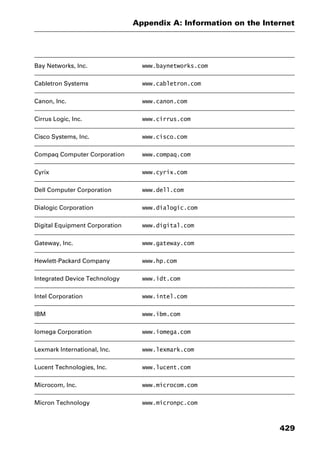
microprocessor from Digital Equipment
Corporation (DEC), first introduced in
1992.
The Alpha is a superscalar, superpipelined
design, which allows the processor to exe-
cute more than one instruction per clock
cycle; it can execute as many as six instruc-
tions per clock cycle and can sustain four
instructions per clock cycle.
It has data and instruction caches, a float-
ing-point processor, 64-bit registers, 64-bit
data and address buses, and a 128-bit data
path between the processor and memory.
The internal architecture is symmetrical
multiprocessing(SMP)compliant,meaning
that it can be used in multiprocessing con-
figurations. The chip is available in several
models with operating frequencies in the
300 to 700MHz range; a 1GHz model is ex-
pected by the year 2000.
decapsulation A process used in net-
working in which the receiving system
looks at the header of an arriving message
to determine if the message contains data. If
the message does contain data, the header is
removed and the data decoded.
See also encapsulation.
decibel Abbreviated dB. One-tenth of a
bel, a unit of measurement common in elec-
tronics that quantifies the loudness or
strength of a signal. A decibel is a relative
measurement derived by comparing a mea-
sured level against a known reference.
decimal The base-10 numbering system
that uses the familiar numbers 0–9; also
known as the base 10 radix or the decimal
radix.
See also binary; hexadecimal.
decimal radix See decimal.
DECnet A series of communications and
networking products from Digital Equip-
ment Corporation (DEC). DECnet is com-
patible with Ethernet, as well as with
WANs using baseband and broadband pri-
vate and public communications channels.
DECnet is built into the VAX VMS operat-
ing system.
See also Digital Network Architecture.
decode 1. To decompress a video file af-
ter receipt so that you can view it. Most de-
coding is done by the client browser.
2. To convert coded data back into its orig-
inal form, usually as readable text.
See also codec; decryption; encode;
uuencode.
decryption The process of converting
encrypted data back into its original form.
See also encryption.
dedicated circuit See dedicated line;
direct connection.
2461book Page 101 Thursday, May 4, 2000 11:59 AM
Copyright © 2000 SYBEX Inc., Alameda, CA. www.sybex.com
dedicated line
102
dedicated line A communications cir-
cuit used for one specific purpose and not
used by or shared between other users. You
need only dial a dedicated line to restore
service after an unscheduled interruption.
Also known as a dedicated circuit.
See also leased line.
dedicated router A router that performs
no functions other than routing tasks.
dedicated server A computer on the
network that functions only as a server per-
forming specific networking tasks, such as
storing files, printing, or managing external
communications.
Dedicated Token Ring An IEEE 802.5r
Token Ring specification that allows for
full-duplex connections at a speed of up to
32Mbps. By enabling full-duplex commu-
nications, the token-passing mechanism is
not used, and communications can take
place between a device and a switch at any
time.
See also 802.x; token-ring network.
default A standard setting, used until an
alternative is chosen. The default server is
the first server that you log on to. The de-
fault drive is the drive that a workstation is
currently using.
A default is usually a relatively safe course
of action to try first; many programs pro-
vide defaults you can use until you know
enough about the program to specify your
own settings.
default directory A standard directory
or set of directories used by the operating
system or by an application.
Some operating systems create several de-
fault directories when the file system is cre-
ated. For example, Novell NetWare creates
the following directories when the SYS vol-
ume is created:
I
SYS:SYSTEM, for the NetWare operating
system files
I
SYS:PUBLIC, for utility and user programs
I
SYS:LOGIN, for programs allowing users
to log in to the server
I
SYS:MAIL, a directory used by NetWare-
compatible electronic-mail applications
default server In Novell NetWare, the
server that responds to the Get Nearest
Server request made as a user starts the
logon process. Novell Directory Services
has replaced the need for the default server
destination with the default context.
See also Context.
default shares In Microsoft Windows
2000, resources shared by default when the
operating system is first installed.
See also common share; hidden share;
share; sharing.
defense in depth A term borrowed
from the military used to describe defensive
measures that reinforce each other, hiding
the defenders activities from view and al-
lowing the defender to respond to an attack
quickly and effectively.
In the network world, defense in depth de-
scribes an approach to network security
that uses several forms of defense against an
intruder and that does not rely on one single
defensive mechanism.
2461book Page 102 Thursday, May 4, 2000 11:59 AM
Copyright © 2000 SYBEX Inc., Alameda, CA. www.sybex.com
103
demand paging
defragmentation The process of reorga-
nizing and rewriting files so that they occu-
py one large area on a hard disk rather than
several smaller areas.
When a file on a hard disk is updated, it may
be written into different areas all over the
disk. This outcome is particularly likely
when the hard disk is continuously updated
over a long period of time. This file frag-
mentation can lead to significant delays in
loading files, but its effect can be reversed
by defragmentation.
See also disk optimizer.
defragmenter Any utility that rewrites
all the parts of a fragmented file into contig-
uous areas on a hard disk. A defragmenter
(such as the Microsoft Windows 98 utility
Disk Defragmenter) can restore perfor-
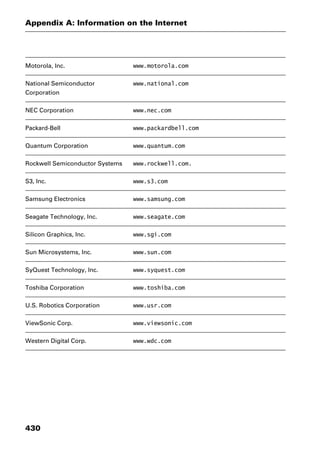
mance lost because of file fragmentation.
See also defragmentation; disk optimizer.
delay In communications, a pause in ac-
tivity, representing the time during which
transmission-related resources are unavail-
able for relaying a message.
See also propagation delay.
delay distortion The distortion of a sig-
nal caused by the relative difference in
speed of the various components of that sig-
nal; in particular, the distortion of the high-
frequency component. Also called envelope
delay.
delete To remove a file from a disk or to
remove an item from a file. Files can be de-
leted using operating system commands or
directly from within an application.
When a file is deleted from a disk, the file
is not physically removed; although it is
hidden, it is still there on the disk until it is
overwritten. In certain circumstances it is
possible to undelete or recover the original
information with utilities designed for that
purpose. If you find you have deleted an
important file by accident, do not write
any other files to that disk so that you do
not overwrite the deleted file. Some net-
work operating systems use a delete inhibit
attribute to prevent accidental deletions;
other operating systems rely on a read-
only attribute.
delimiter 1. Any special character that
separates individual items in a data set or
file. For example, in a comma-delimited
file, the comma is placed between each data
value as the delimiter.
2. In a token-ring network, a delimiter is a
bit pattern that defines the limits of a frame
or token on the network.
Dell Computer Corporation Oneofthe
world’s top five PC manufacturers. Dell pi-
oneered direct sales of the PC using a con-
figure-it-yourself Web site.
Best known for PC and laptop sales, Dell is
also pursuing the server market and has re-
cently expanded into the enterprise storage
market with the PowerVault line of SCSI-
based storage subsystems, tape backup sys-
tems, and scalable disk subsystems.
For more information on Dell, see
www.dell.com.
demand paging A common form of vir-
tual memory management in which pages
of information are read into memory from
disk only when required by the program.
See also swapping.
2461book Page 103 Thursday, May 4, 2000 11:59 AM
Copyright © 2000 SYBEX Inc., Alameda, CA. www.sybex.com
demand priority
104
demand priority A technique used in
100VG-AnyLAN to arbitrate access to the
network and avoid collisions. Demand pri-
ority replaces CSMA/CD, which is used in
slower Ethernet networks.
Demand priority can also prioritize specific
network traffic such as video and other
time-critical data, giving it a higher prece-
dence; if multiple requests are received, the
highest priority is always serviced first.
See also Fast Ethernet.
demodulation In communications, the
process of retrieving the data from a
modulated carrier signal; the reverse of
modulation.
See also modem.
denial of service attack An attack by
an intruder that prevents a computer sys-
tem from providing a service.
A denial-of-service attack will typically in-
volve opening and dropping a large number
of TCP/IP connections very quickly so that
the target system spends all its time dealing
with the connection overhead to the point
that it cannot respond to valid user re-
quests. Other attacks may exploit known
software security holes to crash servers.
A denial-of-service attack is much easier to
execute than an attempt at unauthorized
access, because the denial-of-service attack
never actually requires access to the system.
See also brute-force attack; dictionary at-
tack; mail bombing; social engineering;
Trojan Horse.
departmental LAN A local-area net-
work used by a relatively small group of
people working on common tasks; it pro-
vides shared local resources, such as print-
ers, data, and applications.
DES See Data Encryption Standard.
descendant key InMicrosoftWindows,
all the subkeys that appear when you ex-
pand a key in the Windows Registry.
See also key; Registry.
DeskSet A collection of graphical desk-
top applications bundled with Sun Micro-
system’s Solaris.
DeskSet includes a file manager with op-
tions for copying, moving, renaming, and
deleting files, a terminal emulator, text ed-
itor, calculator, clock, and calendar, as well
as special programs and utilities.
See also Solaris.
desktop management The process of
managing desktop workstation hardware
and software components automatically,
often from a central location.
See also total cost of ownership; Zero Ad-
ministration for Windows.
Desktop Management Interface Ab-
breviated DMI. A standard API for identify-
ing desktop workstation hardware compo-
nents automatically, without intervention
from the user.
At a minimum, DMI identifies the manu-
facturer, component name, version, serial
number (if appropriate), and installation
time and date of any component installed in
anetworkedworkstation.Thisinformation
is designed to help network administrators
resolve configuration problems quickly and
2461book Page 104 Thursday, May 4, 2000 11:59 AM
Copyright © 2000 SYBEX Inc., Alameda, CA. www.sybex.com
105
device name
easily and to indicate when and where sys-
tem upgrades should be applied. PCs, Mac-
intosh computers, and Unix systems are all
covered by DMI.
DMI is backed by Digital Equipment Cor-
poration (DEC), IBM, Intel, Microsoft, No-
vell, Sun, and more than 300 other vendors.
See also Plug and Play; total cost of own-
ership; Web-based Enterprise Manage-
ment; Wired for Management; Zero
Administration for Windows.
desktop video The combination of vid-
eo capture hardware and application soft-
ware that controls the display of video or
television pictures on a desktop PC.
Desktop video is becoming increasingly im-
portant with the sharp increase in video-
conferencing applications now available.
destination address The address por-
tion of a packet or datagram that identifies
the intended recipient station.
See also source address.
destination host A computer system on
the network that is the final destination for
a file transfer or for an e-mail message.
device A general term used to describe
any computer peripheral or hardware ele-
ment that can send or receive data.
Some examples are modems, printers, serial
ports, disk drives, routers, bridges, and con-
centrators. Some devices require special soft-
ware,ordevicedrivers,tocontrolormanage
them; others have built-in intelligence.
In Unix and certain other operating systems,
all peripherals are treated as though they
were files. When Unix writes information to
your terminal, it is actually writing to a spe-
cial file that represents your terminal.
See also device driver.
device dependence The requirement
that a specific hardware component be
present for a program to work. Device-de-
pendent software is often difficult to move
or port to another computer because of its
reliance on specific hardware.
See also device independence.
device driver A small program that al-
lows a computer to communicate with and
control a device. Each operating system con-
tains a standard set of device drivers for the
keyboard,themonitor,andsoon.Whenyou
add specialized peripheral devices, such as a
CD-ROM disk drive or a network interface
card, you must install the appropriate device
driver so that the operating system knows
how to manage the device.
See also Plug and Play.
device independence The ability to
produce similar results in a variety of envi-
ronments, without requiring the presence
of specific hardware.
The Java programming language and the
PostScript page-description language are
examples of device independence. Java runs
on a wide range of computers, from the PC
to a Cray; PostScript is used by many print-
er manufacturers.
See also device dependence.
device name The name used by the
operating system to identify a computer-
system component. For example, COM1 is
the Windows device name for the first
serial port on the PC.
2461book Page 105 Thursday, May 4, 2000 11:59 AM
Copyright © 2000 SYBEX Inc., Alameda, CA. www.sybex.com
device number
106
device number A unique number as-
signed to a device so that it can operate on
the network. Devices are identified by three
numbers:
I
A physical address set by jumpers on the
adapter board
I
A device code determined by the physical
address
I
A logical address determined by the order
in which the drivers are loaded and by the
physical address of the adapter
See also Ethernet address; hardware
address.
Dfs See Distributed file system.
DHCP See Dynamic Host Configuration
Protocol.
diagnostic program A program that
tests computer hardware and peripheral de-
vices for correct operation. Some faults,
known as hard faults, are relatively easy to
find, and the diagnostic program will diag-
nose them correctly every time. Other
faults, called soft faults, can be difficult to
find, because they occur under specific cir-
cumstances rather than every time the
memory location is tested.
Most computers run a simple set of system
checks when the computer is first turned
on. The PC tests are stored in ROM and are
known as power-on self tests (POSTs). If a
POST detects an error condition, the com-
puter stops and displays an error message
on the screen.
dialback modem See callback modem.
dial-in/dial-out server See asynchro-
nous communications server.
Dialogic Corp A major manufacturer of
high-performance telephony products, in-
cluding those used in voice, data, fax,
speech synthesis, ISDN networking, and
call center management applications.
For more information on Dialogic, see
www.dialogic.com.
dialup line A nondedicated communica-
tion line in which a connection is estab-
lished by dialing the destination code and
then broken when the call is complete.
See also dedicated line; leased line.
Dial-Up Networking Softwareprovided
with Microsoft’s Windows products that
allows the clients to dial out and establish
Point-to-Point Protocol (PPP) connections.
dictionary attack An attack by an in-
truder that checks passwords in a password
file against a list of words likely to be used
as passwords. Some versions of this attack
check the entire language lexicon.
See also brute-force attack; denial of ser-
vice attack; mail bombing; social engineer-
ing; Trojan Horse.
differential backup A backup of a hard
disk that includes only the information that
has changed since the last complete backup.
A differential backup assumes that a full
backup already exists and that in the event
of an accident, this complete backup will
be restored before the differential backup
is reloaded.
2461book Page 106 Thursday, May 4, 2000 11:59 AM
Copyright © 2000 SYBEX Inc., Alameda, CA. www.sybex.com
107
digital signal
differential SCSI A Small Computer
System Interface (SCSI) bus wiring scheme
that uses two wires for each signal on the
bus. One wire carries the signal, while the
other carries its inverse. Differential SCSI
minimizes the effects of external interfer-
ence and so allows longer SCSI cable
lengths to be used.
See also single-ended SCSI; Small Com-
puter System Interface.
digest A collection of Internet mailing
list posts collected together and sent out as
a single large message rather than as a num-
ber of smaller messages. Using a digest is a
good way to cut down on the number of
noncritical e-mail messages you receive.
See also LISTSERV; listserver; mailing list.
digital Describes any device that repre-
sents values in the form of binary digits or
bits.
See also analog.
digital audio tape Abbreviated DAT. A
method of recording information in digital
form on a small audio tape cassette, origi-
nally developed by Sony and Hewlett-Pack-
ard. The most common format is a 4-
millimeter, helical-scan drive, which can
hold more than 3GB of information. DATs
can be used as backup media; however, like
all tape devices, they are relatively slow.
Digital Data Communications Mes-
sage Protocol Abbreviated DDCMP. A
byte-oriented, link-layer synchronous pro-
tocol from Digital Equipment Corporation
(DEC), used as the primary data-link com-
ponent of DECnet.
Digital Equipment Corporation Ab-
breviated DEC. A major manufacturer of
minicomputers and mainframe computers,
founded in 1957, long recognized for its
high-quality computer systems. DEC’s
most popular product line, the VAX series,
ranges from small desktop systems to large
mainframes suitable for scientific and com-
mercial processing. DEC was bought by
Compaq Computer Corporation in 1998.
For more information on DEC, see
www.digital.com.
See also DEC Alpha.
Digital Network Architecture Abbre-
viated DNA. The framework within which
Digital Equipment Corporation (DEC) de-
signs and develops all its communications
products.
digital service See digital signal.
digital signal Abbreviated DS; also
known as digital service. There are several
levels of common carrier digital transmis-
sion service:
I
DS-0 64Kbps.
I
DS-1 1.544Mbps (T1).
I
DS-1C Two DS-1 channels are multi-
plexed into a single DS-1C 3.152Mbps
channel.
I
DS-2 Two DS-1C channels are multi-
plexed into one DS-2 6.312Mbps (T2)
channel.
I
DS-3 Seven DS-2 channels are multi-
plexed into a single 44.736Mbps (T3)
channel.
I
DS-4 Six DS-3 channels are multiplexed
into one 274.176Mbps (T4) DS-4 channel.
2461book Page 107 Thursday, May 4, 2000 11:59 AM
Copyright © 2000 SYBEX Inc., Alameda, CA. www.sybex.com
Digital Signal Processing
108
The higher-capacity channels are construct-
ed by multiplexing the lower-bandwidth
channels together, with some additional
framing and administrative overhead.
DS-0 is also referred to as fractional T1,
because it bridges the gap between 56-Kbps
direct dial service (DDS) and a full T1
implementation.
DIGITAL SIGNAL
Digital Signal Processing Abbreviated
DSP. An integrated circuit used in high-
speeddatamanipulation.YouwillfindDSP
chips integrated into sound cards, modems,
and video-conferencing hardware for use in
communications, image manipulation, and
other data-acquisition applications.
See also codec; desktop video.
digital signature An electronic signa-
ture that cannot be forged. A digital signa-
ture confirms that the document or e-mail
in question originated from the individual
or company whose name appears on the
document and that the document has not
been altered or tampered with in any way
since it was signed.
See also certificate.
2461book Page 108 Thursday, May 4, 2000 11:59 AM
Copyright © 2000 SYBEX Inc., Alameda, CA. www.sybex.com
109
DIP switch
Digital Subscriber Line Abbreviated
DSL. A high-speed data transmission tech-
nology originally developed by Bellcore
that delivers high bandwidth over existing
twisted-pair copper telephone lines.
There are several DSL services, providing
data rates from 16Kbps to 52Mbps. The
services can be symmetrical, with the same
datarateinbothupstreamanddownstream
directions, or asymmetrical, with the down-
stream capacity greater than the upstream
capacity. Asymmetric services are particu-
larly suitable for Internet users, because
more information is downloaded than is
uploaded.
As DSL data rates increase, the distance
over which the service is provided decreas-
es; certain users who are located too far
from the telephone company’s central of-
fice may not be able to obtain the higher
speeds or, in some cases, may not be able to
receive the service at all.
See also Asymmetric Digital Subscriber
Line;High-Bit-RateDigitalSubscriberLine;
Rate-Adaptive Digital Subscriber Line;
Single-Line Digital Subscriber Line; Very-
High-Bit-Rate Digital Subscriber Line.
digital versatile disc See digital video
disc.
digital video disc Abbreviated DVD;
sometimes called digital versatile disc. A
compact disc format. A standard single-lay-
er single-sided disc can currently store
4.7GBofinformation;atwo-layerstandard
increases this to 8.5GB, and eventually dou-
ble-sided discs are expected to store 17GB
per disc. DVD drives can also read conven-
tional compact discs.
digital video disc-erasable Abbreviat-
ed DVD-E. An extension to the digital video
disc format to allow multiple re-recordings.
See also digital video disc-recordable.
digital video disc-recordable Abbrevi-
ated DVD-R. An extension to the digital vid-
eo disc format to allow one-time recording.
See also digital video disc-erasable.
digital video disc-ROM Abbreviated
DVD-ROM. A computer-readable form of
digital video disc with either 4.7 or 8.5GB
of storage per side.
dimmed command In a graphical user
interface, a command that is not currently
available. Also known as a grayed com-
mand, because it is often displayed in light
gray rather than the usual black. For exam-
ple, a command to perform a network ac-
tion will be dimmed until you log on to the
network.
DIN connector A connector that meets
the specification of the German national
standards body, Deutsche Industrie Norm
(DIN).
SeveralmodelsofMacintoshcomputersuse
8-pin DIN connectors as the serial port con-
nector. On many IBM-compatible comput-
ers, a 5-pin DIN connector connects the
keyboard to the system unit.
DIP See dual in-line package.
DIP switch A small switch used to select
the operating mode of a device, mounted
2461book Page 109 Thursday, May 4, 2000 11:59 AM
Copyright © 2000 SYBEX Inc., Alameda, CA. www.sybex.com
direct access
110
as a dual in-line package. DIP switches can
be either sliding or rocker switches, and
they are often grouped for convenience.
They are used in printed circuit boards,
dot-matrix printers, modems, and many
other peripheral devices.
DIP SWITCH
direct access See random access.
direct connection A communications
circuit used for one specific purpose and not
used by or shared with other users. Also
known as a dedicated circuit or a direct line.
An ISDN qualifies as a direct connection.
See also Integrated Services Digital
Network.
direct distance dialing Abbreviated
DDD. Use of the normal long-distance tele-
phone system without the need for the in-
tervention of an operator.
direct distance dial network See pub-
lic network.
direct line See direct connection.
direct manipulation In a graphical user
interface, the process of working with ob-
jects using a mouse or other pointing device,
rather than using menu selections to manip-
ulate the objects. Using drag-and-drop to
print a file or using the mouse to adjust the
size of a window are both examples of direct
manipulation.
direct memory access Abbreviated
DMA. A method of transferring informa-
tion directly from a mass-storage device,
such as a hard disk, into memory without
the information passing through the pro-
cessor. Because the processor is not in-
volved in the transfer, DMA is usually fast.
2461book Page 110 Thursday, May 4, 2000 11:59 AM
Copyright © 2000 SYBEX Inc., Alameda, CA. www.sybex.com
111
Directory replica
Directory 1. In Novell Directory Servic-
es (NDS), the Directory database contains
and organizes all the NDS objects.
2. In the Microsoft Active Directory struc-
ture, a Directory contains information
about users, groups of users, computers,
and so on.
See also Active Directory; Directory ob-
ject; Directory Schema; directory tree;
Novell Directory Services.
directory In a hierarchical file system, a
convenient way of organizing and grouping
files and other directories on a disk. Some-
times called a folder. The beginning direc-
tory is known as the root directory, from
which all other directories must branch.
Directories inside another directory are
called subdirectories.
Depending on the operating system, you
can list the files in a directory in a variety of
ways: by name, by creation date and time,
by file size, or by icon if you use a graphical
user interface.
Seealsocurrentdirectory;defaultdirectory;
directory services; file allocation table; par-
ent directory; period and double-period
directories.
Directory Access Protocol Abbreviat-
ed DAP. A mail standard used to access
white page directories containing names,
addresses, e-mail addresses, and telephone
numbers. Because of its complexity, DAP
has been largely replaced by Lightweight
Directory Access Protocol (LDAP).
See also Lightweight Directory Access
Protocol.
directory caching A feature of Novell
NetWare that copies the file allocation
table (FAT) and the directory entry table
into the network server’s memory. When
file requests are made, information is
retrieved from the cache rather than from
the hard disk, thus speeding the retrieval
process significantly. As the directory cache
fills up, the least-used directory entries are
eliminated from the cache.
directory hashing A feature of Novell
NetWare that indexes file locations on disk,
thus speeding file retrieval.
Directory Map object In Novell Direc-
tory Services (NDS), a leaf object that refers
to a directory on a volume. The Directory
Map object allows a drive to be mapped to
an application or to a login script without re-
quiring the actual path and volume where
the application is physically located. This is
done so that login scripts don’t have to be re-
written when a drive path changes; you can
simply change the Directory Map object.
See also Novell Directory Services.
Directory object In Novell Directory
Services (NDS), a set of properties stored in
the Directory database. A Directory object
can represent a physical or a logical net-
work resource, but it does not actually con-
tain the resource.
See also Directory; Novell Directory
Services.
directory path See path.
Directory replica In Novell NetWare, a
copy of the NetWare Directory partition
2461book Page 111 Thursday, May 4, 2000 11:59 AM
Copyright © 2000 SYBEX Inc., Alameda, CA. www.sybex.com
directory replication
112
that allows the NetWare Directory Data-
base to be stored on several servers on the
network without having to duplicate the
entire database on each server. Directory
replicas remove a single point of failure
fromthenetworkandtherebyincreasefault
tolerance.
See also NetWare Directory Database.
directory replication A process that
copies a master set of directories from a
server, called an export server, to other
specified servers or workstations, known as
import computers. This process simplifies
the task of maintaining and synchronizing
identical sets of directories and files, be-
cause only one master copy of the data is
maintained. A file is replicated when it is
added to an exported directory, as well as
when changes are made to the file.
Directory Schema In Novell Directory
Services (NDS), a set of rules that defines
how information can be stored in the Direc-
tory database. The Schema contains four
major definitions:
I
Attribute information Describes the
kinds of information that can be associat-
ed with an object.
I
Inheritance Defines which objects can
inherit the rights and properties of other
objects.
I
Naming Determines the structure of the
Directory tree.
I
Subordination Specifies the location of
objects in the Directory tree.
See also Novell Directory Services.
directory service client Abbreviated
DSCLIENT. In Microsoft Windows 95/98,
an add-on that makes a Windows 95/98 cli-
ent computer aware of Active Directory.
See also Active Directory.
Directory Service log In Microsoft
Windows 2000 Server, a special log that
records any events associated with running
the Directory Service, any problems con-
necting to the global catalog, and any
events associated with Active Directory
(AD) on the network.
See also DNS Server log; Event Viewer;
File Replication Service log.
Directory services In the Microsoft Ac-
tive Directory structure, a directory as well
as the services it provides, such as security
and replication.
See also Active Directory.
directory services A listing of all users
andresourcesonanetwork,designedtohelp
clients locate network users and services.
Some examples are the OSI’s X.500, Novell
Directory Services (NDS), Microsoft’s Ac-
tive Directory, and Banyan’s StreetTalk.
See also domain directory services; global
directory services.
directory structure duplication A
technique that maintains duplicate copies
of the file allocation table (FAT) and direc-
tory entry table in separate areas of a hard
disk. If the first copy is damaged or de-
stroyed, the second copy is immediately
available for use.
See also directory verification.
2461book Page 112 Thursday, May 4, 2000 11:59 AM
Copyright © 2000 SYBEX Inc., Alameda, CA. www.sybex.com
113
disk cache
directory tree A method of representing
the hierarchical structure of the directories,
subdirectories, and files on a disk. The term
is often used in graphical user interfaces. In
object-oriented systems, this structure may
also represent a group of objects, as in No-
vell Directory Services (NDS).
directory verification A process that
performs a consistency check on duplicate
sets of file allocation tables (FATs) and di-
rectory entry tables to verify that they are
identical. The verification occurs every time
the server is started.
See also directory structure duplication.
disable To turn a function off or prevent
something from happening. In a graphical
user interface, disabled menu commands
are often shown in gray to indicate that they
are not available.
See also dimmed command; enable.
disaster recovery The process used to
restore services after a major interruption in
computing or in communications. Large
events such as earthquakes or fires can inter-
rupt networked computing activities, but so
can more mundane events such as hard-disk
failureoraconstructionworkeraccidentally
cutting through a power or telephone line.
The whole point to disaster recovery is to
plan for it before anything happens and then
follow the plan when restoring services.
See also backup; disk duplexing; disk mir-
roring; redundant array of inexpensive
disks.
Discretionary Access Control List Ab-
breviated DACL. In Microsoft Windows
NT, a list of user and group accounts that
have permission to access an object’s ser-
vices. The DACL has as many Access Con-
trol Entries as there are user or group
accounts with access to the object.
disk cache Pronounced “disk cash.” An
area of computer memory where data is tem-
porarily stored on its way to or from a disk.
When an application asks for information
from the hard disk, the cache program first
checks to see if that data is already in the
cache memory. If it is, the disk cache pro-
gram loads the information from the cache
memory rather than from the hard disk. If
the information is not in memory, the cache
program reads the data from the disk, cop-
ies it into the cache memory for future ref-
erence, and then passes the data to the
requesting application. This process is
shown in the accompanying illustration.
Adiskcacheprogramcansignificantlyspeed
most disk operations. Some network operat-
ing systems also cache other often accessed
and important information, such as directo-
ries and the file allocation table (FAT).
See also directory caching.
2461book Page 113 Thursday, May 4, 2000 11:59 AM
Copyright © 2000 SYBEX Inc., Alameda, CA. www.sybex.com
disk controller
114
DISK CACHE
disk controller The electronic circuitry
that controls and manages the operation of
floppy disks and hard disks.
A single disk controller may manage more
than one hard disk. Many disk controllers
also manage floppy disks and compatible
tape drives. In the Macintosh, the disk con-
troller is built into the system. In the PC, the
disk controller may be a printed circuit
board inserted into the expansion bus, or it
may be part of the hard disk drive itself.
disk coprocessor board See host bus
adapter.
disk drive A peripheral storage device
that reads and writes magnetic or optical
disks. When more than one disk drive is in-
stalled on a computer, the operating system
assigns each drive (or logical drive) a unique
name.
Several types of disk drives are in common
use: floppy disk drives, hard disk drives,
compactdiscdrives,digitalvideodiscdrives,
Zip drives, and magneto-optical disc drives.
disk duplexing A fault-tolerant tech-
nique that writes the same information si-
multaneously onto two hard disks.
Each hard disk uses a different disk control-
ler to provide greater redundancy. If one
disk or disk controller fails, information
from the other system can be used to con-
tinue operations. Disk duplexing is offered
by most major network operating systems.
It is designed to protect the system against
a single disk failure, not multiple disk fail-
ures. Disk duplexing is no substitute for a
well-planned series of disk backups.
See also data protection; disk mirroring;
redundant array of inexpensive disks.
2461book Page 114 Thursday, May 4, 2000 11:59 AM
Copyright © 2000 SYBEX Inc., Alameda, CA. www.sybex.com
115
disk striping with parity
Disk Manager In Microsoft Windows
2000, the administrative tool used to man-
age hard disks and other storage media.
Disk Manager replaces NT’s Disk Admin-
istrator.
See also basic disk; dynamic disk.
disk quotas In Microsoft Windows
2000, a feature that allows an administra-
tor to limit the amount of hard disk space
available to a user. You can set quotas only
on NTFS hard disks.
diskless workstation A networked
computer that does not have any local disk
storage capability. The computer boots and
loads all its programs from the network file
server. Diskless workstations are particu-
larly valuable when sensitive information is
processed; information cannot be copied
from the file server onto a local disk, be-
cause the workstation does not have one.
See also dumb terminal; network com-
puter; thin client.
disk mirroring A fault-tolerant tech-
nique that writes the same information si-
multaneously onto two hard disks or two
hard-disk partitions, using the same disk
controller. If one disk or partition fails, in-
formation from the other can be used to
continue operations. Disk mirroring is of-
fered by most major network operating sys-
tems. It is designed to protect the system
against a single disk failure, not multiple
diskfailures.Diskmirroringisnosubstitute
for a well-planned series of disk backups.
See also data protection; disk duplexing;
redundant array of inexpensive disks.
disk optimizer A utility that rearranges
files and directories on a disk for optimum
performance. By reducing or eliminating
file fragmentation (storage in pieces in dif-
ferent locations on the hard disk), a disk
optimizer can restore the original level of
performance of your disk system. Also, it is
usually easier to undelete, or recover, an
unfragmented file than a fragmented one.
Many disk optimizers will not only rewrite
files as contiguous files, but will also place
specific unchanging files in particular loca-
tions on the disk, optimize directories, and
even place specific applications on the disk
so that they load more quickly.
See also defragmentation.
disk striping The technique of combin-
ing a set of disk partitions located on differ-
ent hard disks into a single volume, creating
a virtual “stripe” across the partitions that
the operating system recognizes as a single
drive. Disk striping can occur at the bit level
or at the sector level and allows multiple
concurrent disk accesses that can improve
performance considerably.
See also disk striping with parity; redun-
dant array of inexpensive disks; stripe set.
disk striping with parity The addition
of parity information across a disk stripe so
that if a single disk partition fails, the data
on that disk can be re-created from the in-
formation stored across the remaining par-
titions in the disk stripe.
See also disk striping; redundant array of
inexpensive disks; stripe set.
2461book Page 115 Thursday, May 4, 2000 11:59 AM
Copyright © 2000 SYBEX Inc., Alameda, CA. www.sybex.com
dispersion
116
DISK STRIPING
dispersion The degree of scattering that
takes place as a beam of light travels along
a fiber-optic cable.
See also cladding.
distance vector algorithm A family of
routing algorithms that calculate the best-
path route to use for data transmission
from information present in adjacent nodes
on the network. Routing information is
broadcast periodically rather than only
when a change occurs, which makes the
method bandwidth intensive. For this rea-
son, distance vector algorithm is best used
in relatively small networks with few inter-
router connections.
Distinguished Name In Novell Directo-
ry Services (NDS), the full name of an ob-
ject, including the object’s Common name
and its context. Sometimes called the Full
Distinguished Name.
Seealso Commonname;Context;Relative
Distinguished Name.
Distributed Component Object Model
Abbreviated DCOM. A specification from
Microsoft that enables communications be-
tween distributed objects.
DCOM extends the Component Object
Model (COM) so that clients can commu-
nicate directly with other processes on dif-
ferent computers on a LAN or on the
Internet.
See also ActiveX; Component Object
Model.
distributed computing See distributed
processing.
Distributed Computing Environment
Abbreviated DCE. The Open Software
Foundation’s (OSF) architecture for devel-
oping application software for use on dif-
ferent networks.
2461book Page 116 Thursday, May 4, 2000 11:59 AM
Copyright © 2000 SYBEX Inc., Alameda, CA. www.sybex.com
117
DIX connector
DCEhidesthedifferencesbetweenproducts,
technologies, and standards, providing inde-
pendence from the operating system and un-
derlying network. No particular communi-
cations protocol is specified, so the network
can run on IP (Internet Protocol), IPX (Inter-
network Packet Exchange), or SNA (Sys-
tems Network Architecture).
distributed database A database man-
aged as a single system even though it in-
cludes many clients and many servers at
both local and remote sites. A distributed
database requires that data redundancy is
managed and controlled.
Distributed Director Web site load-bal-
ancing software from Cisco Systems.
A popular Web site can be overwhelmed by
requests from users, and to avoid long wait
times, you can configure additional Web
servers to hold duplicate information. Web
requests are then sent to the Web server best
able to handle the request. Distributed Di-
rector runs on Cisco routers and uses a
routing protocol to send user requests to the
server that is closest to them.
Distributed file system Abbreviated
Dfs. In Microsoft Windows 2000 Server, a
hierarchical file system that combines re-
sources from all over the network into a sin-
gle logical view.
distributed file system Any file system
in which files and programs are located on
more than one computer or server. Users
can access files and applications as though
they were stored on a single local system.
Distributed System Object Model
Abbreviated DSOM. IBM’s extension to
System Object Model (SOM) that allows
objects to communicate in a distributed
processing environment.
distributed processing A computer
system in which processing is performed by
several separate computers linked by a
communications network.
The term often refers to any computer sys-
tem supported by a network, but more
properly refers to a system in which each
computer is chosen to handle a specific
workload and the network supports the
system as a whole. Each computer contrib-
utes to the completion of a common task by
completing one or more subtasks indepen-
dently of its peers and then reporting the re-
sults from these subtasks. All this is totally
transparent to the users; all they see are the
results of the process.
See also client/server architecture.
distribution groups In Microsoft Win-
dows 2000 Server, a collection of recipient
e-mail addresses. Distribution groups have
nothing to do with system security. They do
not have security identifiers, and they do
not appear on access control lists.
See also security groups.
distribution medium The type of data-
storage device used to distribute original
software or software updates.
Tapes used to be the favorite distribution
medium, but compact discs are rapidly
gaining popularity.
DIX connector See Attachment Unit
Interface.
2461book Page 117 Thursday, May 4, 2000 11:59 AM
Copyright © 2000 SYBEX Inc., Alameda, CA. www.sybex.com
DLL
118
DLL See Dynamic Link Library.
DLSw See Data Link Switching.
DMA See direct memory access.
DMI See Desktop Management
Interface.
DNA See Digital Network Architecture.
DNS See Domain Name Service.
DNS alias A host name that the Domain
NameService(DNS)serverknowspointsto
another host. Computers always have one
real name, but they can also have several
aliases. A DNS alias is sometimes called a
CNAME or a canonical name.
See also Domain Name Service.
DNS name server A server containing
information that is part of the Domain
Name Service (DNS) distributed database,
which makes computer names available to
client programs querying for name resolu-
tion on the Internet.
See also Domain Name Service.
DNS Server log In Microsoft Windows
2000 Server, a special log that records any
events associated with running the Domain
Name Service (DNS) Server.
See also Directory Service log; Event View-
er; File Replication Service log.
docking station Ahardwaresysteminto
which a portable computer fits so that it can
be used as a full-fledged desktop computer.
Docking stations vary from simple port rep-
licators that allow you access to parallel
and serial ports and a mouse to complete
systems that give you access to network
connections, CD-ROMs, and even a tape
backup system or PCMCIA ports. The por-
table computer and docking station are de-
signed as two parts of the same system; you
cannot swap computers and docking sta-
tions from different manufacturers or even
from different models.
See also port replicator.
document database A carefully orga-
nized collection of related documents; for
example, a set of technical support bulletins.
document instance In Standard Gener-
alized Markup Language (SGML), the text
component of a document as distinct from
the structure of the document.
See also document type definition; Stan-
dard Generalized Markup Language.
document management The catalog-
ing, storage, and retrieval of documents in
a networked environment. In this context, a
document may be text, scanned graphics, a
spreadsheet, a form, a Web page, or any
other unique file.
Each file is tagged with information that in-
cludes the name of the original author, doc-
ument description, creation date, and the
name of the application used to create the
document.
See also groupware; Lotus Notes; work-
flow software.
document root On a Web server, a di-
rectory that contains the files, images, and
data you want to present to all users who
access the server with a browser.
2461book Page 118 Thursday, May 4, 2000 11:59 AM
Copyright © 2000 SYBEX Inc., Alameda, CA. www.sybex.com
119
domain directory services
document type definition Abbreviat-
ed DTD. In Standard Generalized Markup
Language (SGML), the structural compo-
nent of a document as distinct from the ac-
tual data or content of the document.
See also document instance; Standard
Generalized Markup Language.
documentation The instructions, tuto-
rials, specifications, troubleshooting ad-
vice, and reference guides that accompany a
computer program or a piece of hardware.
Documentation can be in printed or online
format. Early system documentation was
often written by programmers and engi-
neers and was usually filled with technical
jargon. Today’s documentation is generally
better written and easier to understand.
domain A description of a single com-
puter, a whole department, or a complete
site, used for naming and administrative
purposes.
Top-level domains must be registered to re-
ceive mail from outside the organization;
local domains have meaning only inside
their own enterprise. Depending on the
context, the term can have several slightly
different meanings:
I
On the Internet, a domain is part of the
Domain Name Service (DNS).
I
In Novell NetWare, a domain is a special
area of memory where a new NetWare
Loadable Module (NLM) can be tested
without the risk of corrupting the operat-
ing system memory.
I
In IBM’s Systems Network Architecture
(SNA),adomainrepresentsalltheterminals
andothernetworkresourcescontrolledbya
single processor or processor group.
I
In Microsoft Windows NT, a group of
computers, users, and network peripher-
als managed with a single set of account
descriptions and security policies. A user
can log on to the local computer and be
authenticated to access just that one sys-
tem, or a user can log on to a domain and
be authenticated to access other servers
within that domain.
I
In Lotus Notes, a domain is one or more
Notes servers that share the same Public
Name and Address Book database. This
database contains information about the
users within the domain, including their e-
mail addresses and other information.
See also domain name.
domain component In the Microsoft
Active Directory structure, a portion of a
domain name. For example, in computer
.sybex.com, each element of the name—
computer, sybex, and com—is a domain
component.
See also Active Directory.
domain controller In Microsoft
Windows NT, a server that stores and
shares domain information, including the
central database of users, passwords, and
permissions.
A domain controller can be a primary do-
main controller, which stores the master
copy of the domain information, or a back-
up domain controller, which uses a replicat-
ed version of this data to verify user logons
and rights.
domain directory services Directory
services that consist of one or more linked
servers. Each domain within a network must
2461book Page 119 Thursday, May 4, 2000 11:59 AM
Copyright © 2000 SYBEX Inc., Alameda, CA. www.sybex.com
domain name
120
be managed and administered separately.
Windows NT Server and IBM’s LAN Server
both use domain directory services.
See also global directory services.
domain name In the Domain Name Ser-
vice (DNS), an easy-to-remember name
that identifies a specific Internet host, as op-
posed to the hard-to-remember numeric IP
address.
See also bang path.
Domain Name Service Abbreviated
DNS, sometimes referred to as Domain
Naming System. A distributed addressing
system that resolves the domain name into
the numeric IP address. DNS lets you use
the Internet without having to remember
long lists of cryptic numbers.
The most common high-level domains on
the Internet include:
.com A commercial organization
.edu Aneducationalestablishmentsuch
as a university
.gov A branch of the U.S. government
.int An international treaty
organization
.mil A branch of the U.S. military
.net A network provider
.org A nonprofit organization
Most countries also have unique domains
named after their international abbrevia-
tion—for example, .uk for the United King-
dom and .ca for Canada.
See also IP address; name resolution.
DOS Acronym for Disk Operating Sys-
tem. An operating system originally devel-
oped by Microsoft for the IBM PC.
DOS existed in two similar versions:
MS-DOS, developed and marketed by
Microsoft for use with IBM-compatible
computers, and PC-DOS, supported and
sold by IBM for use on computers manu-
factured by IBM.
See also MS-DOS.
DOS client A workstation that boots
MS-DOS and gains access to the network
using either a NetWare shell or the Net-
Ware DOS Requester software.
DOS prompt See MS-DOS prompt.
dot A synonym for the name of the cur-
rent directory, usually invisible as its name
begins with a period.
In Unix, a file whose name begins with a dot
usually contains configuration informa-
tion; you can customize your environment
by creating the appropriate dot file in the
current directory or in your home directory.
See also current directory; dot dot; period
and double-period directories.
dot dot A synonym for the name of the
parent directory to the current directory,
usually invisible as its name begins with a
period.
See also current directory; dot; period and
double-period directories.
dotted decimal A method of represent-
ing an IP address as four decimal numbers
2461book Page 120 Thursday, May 4, 2000 11:59 AM
Copyright © 2000 SYBEX Inc., Alameda, CA. www.sybex.com
121
drag-and-drop
separated by dots, or periods; for example,
194.65.87.3.
See also IP address.
double-byte character set Abbreviat-
ed DBCS. A method that uses two bytes to
hold the definition of the character rather
than the single byte used by the American
Standard Code for Information Interchange
(ASCII) or the Extended Binary Coded Dec-
imal Interchange Code (EBCDIC).
By utilizing two bytes instead one, the many
international character sets in use these
days can be managed much more easily.
See also ASCII standard character set;
ASCII extended character set; Unicode.
double-slash Notation used with a co-
lon to separate the communications proto-
col from the host computer name in a
Uniform Resource Locator (URL) as in
http://www.sybex.com.
See also Uniform Resource Locator.
downlevel trust In Microsoft Windows
2000 Server, a trust explicitly established
between a Windows 2000 domain and a
Windows NT 4 domain.
See also explicit trust; shortcut trust; trust
relationship; two-way transitive trust.
downlink The transmission of informa-
tion from a satellite to an earth station.
See also uplink.
download 1. In communications, to
transfer a file or files from one computer to
another over a network or using a modem.
2. To send information, such as font infor-
mation or a PostScript file, from a computer
to a printer.
downsizing The redesign of mainframe-
based business applications to applica-
tions capable of running on smaller, less-
expensive systems, often PC LANs. Client/
server architecture is the model most often
implemented during downsizing.
When applications are moved from large
computer systems to PCs, security, integri-
ty, and overall control may be compro-
mised, and development and training costs
can be high. However, a collection of ap-
propriately configured PCs, networked to-
gether, can provide more than ten times the
power for the same cost as a mainframe
computer supporting remote terminals.
A more accurate term might be rightsizing,
to match the application requirements of
the corporation to the capabilities of the
hardware and software systems available.
See also outsourcing.
downtime The amount of time during
which a computer system is not available to
users, because of a hardware or software
failure.
downward compatibility See back-
ward compatibility.
DP See data processing.
drag-and-drop In a graphical user inter-
face, to move a selected object onto another
object with the mouse to initiate a process.
For example, if you drag a document icon
and drop it onto a word processor’s icon,
the program will run, and the document
2461book Page 121 Thursday, May 4, 2000 11:59 AM
Copyright © 2000 SYBEX Inc., Alameda, CA. www.sybex.com
DRAM
122
will be opened. To print a file, you can drag
the file to the printer icon using the mouse
and then release the mouse button. You can
also use drag-and-drop to copy a file from
one disk to another or to move a marked
block of text to a new location inside a
word-processed document.
DRAM See dynamic RAM.
drive array The group of hard disk
drives used in one of the RAID (redundant
array of inexpensive disks) configurations.
See also redundant array of inexpensive
disks.
drive letter Adesignationusedtospecify
a PC disk drive. For example, the first flop-
py disk drive is usually referred to as drive
A, and the first hard disk drive is usually re-
ferred to as drive C.
drive mapping The technique of assign-
ing a drive letter to represent a complete
directory path statement. Novell NetWare
supports four types of drive mapping:
I
Local drive mapping Maps drives to lo-
cal hard disk and floppy disk drives
I
Network drive mapping Maps drives to
volumes and directories on the network
I
Network search drive mapping Maps
drives to directories that should be
searched if an application or file is not
found in the current directory
I
Directory map object Maps drives to di-
rectories that contain frequently used
files, such as applications, without having
to specify the actual physical location of
the file
See also Directory Map object.
driver Jargon for device driver.
See also device driver.
drop 1. The location in a multidrop line
where a tap is inserted to allow the connec-
tion of a new device.
2. To lose part of a signal, usually uninten-
tionally, as in dropping bits.
drop cable The cable used in thick Ether-
net to connect a network device to a Multi-
station Access Unit (MAU). The maximum
cable length is 50 meters (165 feet). Some-
times called a transceiver cable.
DS See digital signal.
DSCLIENT See directory service client.
DSL See Digital Subscriber Line.
DSOM See Distributed System Object
Model.
DSP See Digital Signal Processing.
DSR See Data Set Ready.
DSU See Data Service Unit.
DTD See document type definition.
DTE See data terminal equipment.
DTR See Data Terminal Ready; Dedicat-
ed Token Ring.
dual-attached station Abbreviated
DAS. In the Fiber Distributed Data Inter-
face (FDDI), a device attached to both of
the dual, counter-rotating rings. Concen-
trators, bridges, and routers often use DAS
connections to provide fault tolerance. In
contrast, a single attached station (SAS)
connects to only one ring.
2461book Page 122 Thursday, May 4, 2000 11:59 AM
Copyright © 2000 SYBEX Inc., Alameda, CA. www.sybex.com
123
Dynamic Data Exchange
dual-homed host A network server
configured with two network interface
cards, each connected to a different net-
work. Dual-homed hosts are often used
with firewalls to increase network security.
See also firewall; proxy server.
dual homing In Fiber Distributed Data
Interface (FDDI), a method of cabling con-
centrators and stations in a tree configura-
tion, providing an alternative route to the
FDDI network should the primary connec-
tion fail.
dual in-line package Abbreviated DIP.
A standard housing constructed of hard
plastic commonly used to hold an integrat-
ed circuit. The circuit’s leads are connected
to two parallel rows of pins designed to fit
snugly into a socket; these pins may also be
soldered directly to a printed circuit board.
See also DIP switch.
dumb terminal A combination of key-
board and screen that has no local comput-
ing power, used to input information to a
large, remote computer, often a minicom-
puter or a mainframe. The remote comput-
er provides all the processing power for the
system.
See also diskless workstation; intelligent
terminal; network computer; thin client.
duplex In asynchronous transmissions,
the ability to transmit and receive on the
same channel at the same time; also referred
to as full duplex. Half-duplex channels can
transmit only or receive only.
See also communications parameters.
DVD See digital video disc.
DVD-E See digital video disc-erasable.
DVD-R See digital video disc-
recordable.
DVD-ROM See digital video disc-ROM.
dynamic adaptive routing See dy-
namic routing.
dynamic bandwidth allocation A
method of bandwidth allocation that sub-
divides the available bandwidth between
multiple applications almost instanta-
neously, to provide each application with
just the amount of bandwidth that it cur-
rently needs.
Dynamic Data Exchange Abbreviated
DDE. A technique used for application-to-
application communications, available in
several operating systems, including Mi-
crosoft Windows, Macintosh, and OS/2.
When two or more programs that support
DDE are running at the same time, they can
exchange data and commands, by means of
conversations. A DDE conversation is a
two-way connection between two applica-
tions, used to transmit data by each pro-
gram alternately.
DDE is used for low-level communications
that do not need user intervention. For ex-
ample, a communications program might
feed stock market information into a
spreadsheet program, where that data can
be displayed in a meaningful way and recal-
culated automatically as it changes.
DDE has largely been superseded by Object
Linking and Embedding (OLE).
See also Object Linking and Embedding.
2461book Page 123 Thursday, May 4, 2000 11:59 AM
Copyright © 2000 SYBEX Inc., Alameda, CA. www.sybex.com
dynamic disk
124
dynamic disk In Microsoft Windows
2000, a hard disk that is available only to
Windows 2000 and not available from any
other operating system. A dynamic disk
does not use primary and extended parti-
tions to divide the available space into log-
ical units.
To create a dynamic disk, use the Disk
Management utility to convert a basic disk
into a dynamic disk. Dynamic disks allow
you to create, delete, and extend fault-tol-
erant and multidisk volumes without re-
starting the operating system. Windows
2000 RAID (redundant array of inexpen-
sive disks) services are available only on dy-
namic disks.
See also basic disk.
Dynamic DNS Abbreviated DDNS. In
Microsoft Windows 2000 Server, a mecha-
nism that allows Dynamic Host Configura-
tion Protocol (DHCP) and Windows 2000
clients to update Domain Name Service
(DNS) records dynamically, rather than by
the traditional method of manually adding
the new records to static DNS zone files.
See also Domain Name Service.
Dynamic Host Configuration Protocol
Abbreviated DHCP. A system based on net-
work interface card addresses that is used to
allocate IP addresses and other configura-
tion information automatically for net-
worked systems. DHCP is an update of the
Bootstrap Protocol.
See also Bootstrap Protocol; hardware ad-
dress; IP address; Transmission Control
Protocol/Internet Protocol.
Dynamic Link Library Abbreviated
DLL. A program module that contains ex-
ecutable code and data that can be used by
applications, or even by other DLLs, in per-
forming a specific task.
DLLs are used extensively throughout the
family of Microsoft Windows products.
DLLs may have filename extensions of
.DLL, .DRV, or .FON.
The DLL is linked into the application only
when the program runs, and it is unloaded
again when no longer needed. If two DLL
applications are running at the same time
and both perform a particular function, only
one copy of the code for that function is
loaded, for more efficient use of limited
memory. Another benefit of using dynamic
linking is that the .EXE files are not as large
as they would be, because frequently used
routines can be put into a DLL rather than
repeated in each .EXE file that uses them. A
smaller.EXEfilemeanssaveddiskspaceand
faster program loading.
dynamic RAM Abbreviated DRAM,
pronounced “dee-ram.” A common type of
computer memory that uses capacitors and
transistors storing electrical charges to rep-
resent memory states. These capacitors lose
their electrical charge, so they need to be re-
freshed every millisecond, during which
time they cannot be read by the processor.
DRAM chips are small, simple, cheap, easy
to make, and hold approximately four
times as much information as a static RAM
(SRAM) chip of similar complexity. How-
ever, they are slower than SRAM.
dynamic routing A routing technique
that allows the route that a message takes to
2461book Page 124 Thursday, May 4, 2000 11:59 AM
Copyright © 2000 SYBEX Inc., Alameda, CA. www.sybex.com
125
DynaText
change, as the message is in transit through
the network, in response to changing net-
work conditions. Conditions forcing a route
changemightincludeunusuallyheavytraffic
on a particular section of the network or a
cable failure. Also known as dynamic adap-
tive routing.
dynamic volume In Microsoft Win-
dows 2000, a logical hard disk volume cre-
ated by Disk Management.
Dynamic volumes can include simple,
striped, spanned, and RAID-5 components
and can exist only on dynamic disks.
See also basic disk; dynamic disk.
DynaText A form of electronic docu-
ment and viewer used in Novell NetWare
for online manuals. You can use DynaText
directly from the CD, or you can install it on
the server or on a workstation. Replaces
Electrotext.
2461book Page 125 Thursday, May 4, 2000 11:59 AM
Copyright © 2000 SYBEX Inc., Alameda, CA. www.sybex.com
E
126
E
E See exa-.
E1 A point-to-point, dedicated,
2.048Mbps communications circuit capa-
ble of supporting thirty-two 64Kbps chan-
nels used as 30 voice channels, 1 control
channel, and 1 synchronization and fram-
ing channel. The European equivalent of
North America’s T1.
E1 circuits carry more channels than the 24
channels used in T1 systems, and repeaters
are required every 6000 feet when copper
wire is used.
E2 A European point-to-point, dedicat-
ed, 8.848Mbps communications circuit
equivalent to four E1 circuits. E2 is the Eu-
ropean equivalent of North America’s T2
and is rarely used.
E3 AEuropeanpoint-to-point,dedicated,
34.368Mbps communications circuit
equivalent to 16 E1 circuits. The European
equivalent of North America’s T3.
E4 AEuropeanpoint-to-point,dedicated,
139.26Mbps communications circuit
equivalent to 4 E3 or 64 E1 circuits.
E5 AEuropeanpoint-to-point,dedicated,
565.148Mbps communications circuit
equivalent to 4 E4 or 256 E1 circuits.
EAP See Extensible Authentication
Protocol.
eavesdropping Theprocessofgathering
information about a target network by lis-
tening in on transmitted data.
EB See exabyte.
EBCDIC See Extended Binary Coded
Decimal Interchange Code.
echo 1. A transmitted signal that is re-
flectedbacktothesenderstronglyenoughso
that it can be distinguished from the original
signal; often encountered on long-distance
telephone lines and satellite links.
2. A form of repetition, used as a mecha-
nism in testing network nodes, in which
each receiving station on the network ech-
oes a message back to the main server or
host computer.
echo cancellation A mechanism used to
control echoes on communications links
such as satellite links.
The modem checks for a delayed duplica-
tion of the original signal and adds a re-
versed version of this transmission to the
channel on which it receives information.
This process effectively removes the echo
without affecting the incoming signal.
ECNE See Master Certified Novell
Engineer.
EDI See electronic data interchange.
EDO RAM Abbreviation for extended
data out RAM. A type of RAM that keeps
data available to the processor while the
next memory access is being initialized,
thus speeding overall access times. EDO
RAM is significantly faster than conven-
tional dynamic RAM.
2461book Page 126 Thursday, May 4, 2000 11:59 AM
Copyright © 2000 SYBEX Inc., Alameda, CA. www.sybex.com
127
electromagnetic interference
EDP See data processing.
EEMS See Enhanced Expanded Mem-
ory Specification.
effective rights In Novell Directory Ser-
vices (NDS), any rights an object can use to
look at or change a specific directory, file,
or other object.
Effective rights are recalculated every time
an object attempts such an operation and
arecontrolledbytheInheritedRightsFilter,
the trustee assignment, and the specified se-
curity restrictions. Effective rights are of
two types:
I
Object rights determine what a user can
do with an object.
I
Property rights control a user’s access to
that object.
See also Inherited Rights Filter; Novell
Directory Services; rights; trustee
assignments.
EFS See Encrypted File System.
EGP See External Gateway Protocol.
EIA See Electronic Industries
Association.
EIA/TIA 586 A standard, jointly defined
by the Electronic Industries Association
and the Telecommunications Industry As-
sociation (EIA/TIA), for telecommunica-
tions wiring used in commercial buildings.
The standard is designed to do the
following:
I
Specify a generic wiring system for all
commercial buildings
I
Define media types, as well as connections
and terminations
I
Provide a basis for interoperation
between competing products and services
in wiring, design, installation, and
management
I
Allow for the wiring of a building before
the definition of the products that will use
that wiring, and allow for elegant future
expansion
EIA/TIA 586 applies to all unshielded
twisted-pair wiring that works with Ether-
net, Token Ring, ISDN, and other net-
working systems.
See also cabling standards; Category 1–5.
EIDE See Enhanced IDE.
EIGRP See Enhanced Interior Gateway
Routing Protocol.
EISA See Extended Industry Standard
Architecture.
electromagnetic interference Abbre-
viated EMI. Any electromagnetic radiation
released by an electronic device that dis-
rupts the operation or performance of an-
other device.
EMI is produced by many sources com-
monly found in an office environment, in-
cluding fluorescent lights, photocopiers,
and motors such as those used in elevators.
EMI is also produced by natural atmo-
spheric or solar activity.
See also Class A certification; Class B cer-
tification; Federal Communications Com-
mission; radio frequency interference.
2461book Page 127 Thursday, May 4, 2000 11:59 AM
Copyright © 2000 SYBEX Inc., Alameda, CA. www.sybex.com
electronic commerce
128
electronic commerce The buying and
selling of goods and services over the Inter-
net. Electronic commerce may also involve
business-to-business transactions in the ex-
change of purchase orders, invoices, and
other electronic documents.
electronic data interchange Abbrevi-
ated EDI. A method of electronically ex-
changing business documents, including
bills of materials, purchase orders, and
invoices.
Customers and suppliers can establish an
EDI network by means of Open Systems In-
terconnect (OSI) standards or by using pro-
prietary products. Widely accepted
standards include ANSI X.12, ISO 9735,
and CCITT X.435.
electronic data processing See data
processing.
Electronic Industries Association Ab-
breviated EIA. A trade association repre-
senting American manufacturers in
standards organizations. The EIA has
publishedandformalizedseveralimportant
standards, including RS-232-C, RS-422,
RS-423, RS-449, RS-485, and RS-530.
Standards having to do with communica-
tions are produced jointly with the Tele-
communications Industry Association.
For more information on the EIA, see
www.eia.org.
See also EIA/TIA 586.
electronic mail The use of a network to
transmit text messages, memos, and re-
ports; usually referred to as e-mail. Users
can send a message to one or more individ-
uals, to a predefined group, or to all users
on the system. When you receive a message,
you can read, print, forward, answer, or de-
lete it.
An e-mail system may be implemented on a
peer-to-peer network, a client/server archi-
tecture, a mainframe computer, or on a
dial-up service, such as America Online. E-
mail is by far the most popular Internet ap-
plication, with well over 80 percent of In-
ternet users taking advantage of the service.
E-mail has several advantages over conven-
tional mail systems, including:
I
E-mail is fast—very fast when compared
with conventional mail.
I
If something exists on your computer as a
file—text, graphical images, even pro-
gram files and video segments—you can
usually send it as e-mail.
I
E-mail is very extensive. You can now
send e-mail to well over half the countries
in the world.
The problems associated with e-mail are
similar to those associated with online com-
munications in general, such as security,
privacy (always assume that your e-mail is
not private), and the legal status of docu-
ments exchanged via e-mail.
See also mailbox; Multipurpose Internet
Mail Extension; voice mail.
element A unit of structure in Hyper-
Text Markup Language (HTML), such as a
title or a list. Some elements have start and
stop tags; others have only a single tag. Cer-
tain elements can be nested within other
elements.
See also HyperText Markup Language; tag.
2461book Page 128 Thursday, May 4, 2000 11:59 AM
Copyright © 2000 SYBEX Inc., Alameda, CA. www.sybex.com
129
enable
elevator seeking A technique that al-
lows the server hard disk head to access files
in the direction that the head is already trav-
eling across the disk, rather than in the or-
der in which they were requested. This
feature allows the drive heads to operate
continuously and thus improves disk per-
formance and minimizes disk-head seek
times.
ELF See extremely low-frequency
emission.
EMA See Enterprise Memory
Architecture.
emacs A popular Unix editor, written by
Richard Stallman, founder of the Free Soft-
ware Foundation.
The nameemacs is a contraction of “editing
macros,” but it is much more than a simple
text editor and includes extensions for all
sorts of common tasks, ranging from com-
piling and debugging programs to reading
and sending e-mail. You can even extend
emacs yourself as the editing commands are
written in the Lisp programming language.
See also Free Software Foundation; vi.
e-mail See electronic mail.
e-mail address The addressing informa-
tion required for an e-mail message to reach
the correct recipient.
See also bang path; Internet address;
mailbox.
Emergency Repair Disk Abbreviated
ERD. In Microsoft Windows 2000, a flop-
py disk created by the Backup program. An
ERD contains information about the cur-
rent system configuration that can be used
to repair a system that will not restart.
See also Recovery Console; safe mode.
EMI See electromagnetic interference.
EMM See expanded memory manager.
emoticon A collection of text characters
often used in e-mail and posts to news-
groups to signify emotions.
An emoticon can be as simple as including
<g> or <grin> in your text, an indication
that the writer is joking, and as complex as
some of the smiley faces, which are all de-
signed to be read sideways, such as the wink
;-) or the frown :-(.
See also Internet abbreviations.
EMS See Expanded Memory
Specification.
emulator A device built to work exactly
like another device—hardware, software,
or a combination of both.
For example, a terminal emulation pro-
gram lets a PC pretend to be a terminal at-
tached to a mainframe computer or to an
online service by providing the control
codes that the remote system expects to re-
ceive. In printers, some brands emulate
popular models such as Hewlett-Packard’s
LaserJet line.
enable To turn a function on or allow
something to happen. When a function is
enabled, it is available for use. In a graphi-
cal user interface, enabled menu commands
are often shown in black type.
See also disable.
2461book Page 129 Thursday, May 4, 2000 11:59 AM
Copyright © 2000 SYBEX Inc., Alameda, CA. www.sybex.com
Encapsulated PostScript
130
Encapsulated PostScript Abbreviated
EPS. The file format of the PostScript page-
description language.
The EPS standard is device independent, so
images can easily be transferred between
applications, and they can be sized and out-
put to different printers without any loss of
image quality or distortion.
The EPS file contains the PostScript com-
mands needed to recreate the image, but
the image itself cannot be displayed on a
monitor unless the file also contains an op-
tional preview image stored in TIFF or
PICT format.
You can print an EPS file only on a Post-
Script-compatible laser printer, and the
printer itself determines the final printing
resolution. A laser printer might be capable
of 600 dpi, whereas a Linotronic printer is
capable of 2450 dpi.
encapsulation The process of inserting
the frame header and data from a higher-
level protocol into the data frame of a
lower-level protocol.
See also tunneling.
enclosure A term for a file—text, fax, bi-
nary, or image—sent as a part of an e-mail
message. Sometimes called an attachment.
See also Multipurpose Internet Mail
Extension.
encode 1. To compress a video file using
a codec so that the file can be transmitted in
the shortest possible time.
2. To convert a binary file into a form suit-
able for data transmission.
See also codec; decode; decryption;
uuencode.
Encrypted File System In Microsoft
Windows 2000, a feature that lets mobile
users, who are concerned with the security
of their files in the case of unauthorized
access to their computers, encrypt designat-
ed files and directories using a public key
encryption scheme.
Encrypting File System Abbreviated
EFS. In Microsoft Windows 2000, a file sys-
tem used to encrypt files and folders on an
NTFS 5 hard disk.
encryption The process of encoding in-
formation in an attempt to make it secure
from unauthorized access, particularly dur-
ingtransmission.Thereverseofthisprocess
is known as decryption.
Two main encryption schemes are in com-
mon use:
I
Private (Symmetrical) Key An encryp-
tion algorithm based on a private encryp-
tion key known to both the sender and the
recipient of the information. The encrypt-
ed message is unreadable and can be
transmitted over nonsecure systems.
I
Public (Asymmetrical) Key An encryp-
tion scheme based on using the two halves
of a long bit sequence as encryption keys.
Either half of the bit sequence can be used
to encrypt the data, but the other half is re-
quired to decrypt the data.
See also Data Encryption Standard; Pretty
Good Privacy; ROT-13.
2461book Page 130 Thursday, May 4, 2000 11:59 AM
Copyright © 2000 SYBEX Inc., Alameda, CA. www.sybex.com
131
Enhanced Interior Gateway Routing Protocol
encryption key A unique and secret
number used to encrypt data to protect it
from unauthorized access.
end-of-file Abbreviated EOF. A special
code placed after the last byte in a file that
indicates to the operating system that no
more data follows.
An end-of-file code is needed because disk
space is assigned to a file in blocks, and the
file may not always terminate at the end of
a block. In the ASCII system, an EOF is rep-
resented by the decimal value 26 or by the
Ctrl+Z control character.
end node A networked node such as a
PC that can only send and receive informa-
tion for its own use; it cannot route or for-
ward information to another node.
end-of-text Abbreviated ETX. A charac-
ter used in computer communications to in-
dicate the end of a text file.
In the ASCII system, an ETX is represented
by the decimal value 3 or by the Ctrl+C con-
trol character. A different symbol, end-of-
transmission (EOT, ASCII 4, or Ctrl+D)
is used to indicate the end of a complete
transmission.
end-of-transmission Abbreviated
EOT. A character used in computer com-
munications to indicate the end of a trans-
mission. In the ASCII system, an EOT is
represented by the decimal value 4 or by the
Ctrl+D control character.
end user Often refers to people who use
an application to produce their own results
on their own computer or workstation.
During the mainframe computer era, end
users were people who received output
from the computer and used that output in
their work. They rarely, if ever, actually
saw the computer, much less learned to use
it themselves. Today, end users often write
macros to automate complex or repetitive
tasksandsometimeswriteproceduresusing
command languages.
Enhanced Expanded Memory
Specification Abbreviated EEMS. A re-
vised version of the original Lotus-Intel-
MicrosoftExpandedMemorySpecification
(LIM EMS) that lets MS-DOS applications
use more than 640KB memory space.
See also Expanded Memory Specification.
Enhanced IDE An extension to the Inte-
grated Drive Electronics (IDE) interface
standard, which supports hard disks as
large as 8.4GB (IDE supports hard disks of
up to 528MB) and transfer rates of up to
13.3MBps (IDE allows rates of up to
3.3MBps).
See also Integrated Drive Electronics;
Small Computer System Interface.
Enhanced Interior Gateway Routing
Protocol Abbreviated EIGRP. A propri-
etary link-state distance-vector routing pro-
tocol from Cisco, first released in 1994.
EIGRP improves performance by using in-
formation derived from distance-vector
protocols, but also includes an algorithm
for removing transient loops in possible
routes, which reduces the complexity of the
calculations required.
Seealsodistancevectoralgorithm;Interior
Gateway Routing Protocol.
2461book Page 131 Thursday, May 4, 2000 11:59 AM
Copyright © 2000 SYBEX Inc., Alameda, CA. www.sybex.com
Enhanced Small Device Interface
132
Enhanced Small Device Interface Ab-
breviated ESDI. A popular hard disk, flop-
py disk, and tape drive interface standard,
capable of a data-transfer rate of 10 to
20Mbps. ESDI is most often used with large
hard disks.
See also Integrated Drive Electronics;
Small Computer System Interface.
ENS See Enterprise Network Services.
Enter key Also known as the Return key,
short for carriage return. The key that indi-
cates the end of a command or the end of
user input from the keyboard.
enterprise A term used to encompass an
entire business group, organization, or cor-
poration, including all local, remote, and
satellite offices.
Enterprise CNE See Master Certified
Novell Engineer.
Enterprise Memory Architecture Ab-
breviated EMA. In Microsoft Windows
2000, a mechanism that lets applications ad-
dress as much as 64GB of virtual memory.
enterprise network A network that
connects every computer in every location
of a business group, organization, or cor-
poration and runs the company’s mission-
critical applications.
In many cases, an enterprise network in-
cludes several types of computers running
several different operating systems.
Enterprise Network Services Abbre-
viated ENS. A software product based on
Banyan Systems’ StreetTalk Directory Ser-
vice for VINES that brings global directory
service features to other networks. ENS in-
cludes StreetTalk Directory Assistance, the
Banyan Security Service, and Banyan Net-
work Management.
Specific versions of ENS are available for
NovellNetWare,SCOUnix,andHP-UXso
that servers running those operating sys-
tems can interoperate and share manage-
ment in a network with VINES servers.
See also Banyan VINES.
Enterprise Systems Connection Ab-
breviated ESCON. A set of products and ser-
vices from IBM that provide direct channel-
to-channel connections between ES/9000
mainframes and peripheral devices over 10
to 17MBps fiber-optic links.
envelope delay See delay distortion.
environment 1. The complete set of
hardware and software resources made
available to any user of a system.
2. The operating system that a program
needs in order to execute. For example, a
program may be said to be running in the
Unix environment.
EOF See end-of-file.
EOT See end-of-transmission.
EPS See Encapsulated PostScript.
equalization The process of balancing a
circuit by reducing frequency and phase
distortion so that it passes all expected fre-
quencies with equal efficiency.
ERD See Emergency Repair Disk.
error The difference between the expect-
ed and the actual.
2461book Page 132 Thursday, May 4, 2000 11:59 AM
Copyright © 2000 SYBEX Inc., Alameda, CA. www.sybex.com
133
escape sequence
In computing, the way that the operating
system reports unexpected, unusual, im-
possible, or illegal events is by displaying an
error number or error message. Errors
range from trivial, such as an attempt to
write a file to a disk drive that does not con-
tain a disk, to fatal, such as when a serious
operating system bug renders the system
useless.
In communications, errors are often caused
by line noise and signal distortion. Parity or
cyclical redundancy check (CRC) informa-
tion is often added as overhead to the data
stream, and techniques such as error detec-
tion and correction are employed to detect
and correct as many errors as possible.
See also attenuation; crosstalk; error
handling; error message; error rate;
parity error.
error detection and correction A
mechanism used to determine whether
transmission errors have occurred and, if
so, to correct those errors.
Some programs or transmission protocols
simply request a retransmission of the af-
fected block of data if an error is detected.
More complex protocols attempt to both
detect and determine at the receiving end
what the correct transmission should have
been.
See also checksum; cyclical redundancy
check; forward error correction; Hamming
code; parity.
error handling The way that a program
copes with errors or exceptions that occur
as the program is running.
Good error handling manages unexpected
events or wrongly entered data gracefully,
usually by opening a dialog box to prompt
the user to take the appropriate action or to
enterthecorrectinformation.Badlywritten
programs may simply stop running when
the wrong data is entered or when an unan-
ticipated disk error occurs.
error message A message from the pro-
gram or the operating system that contains
information about a condition that requires
some human intervention to solve.
Error messages can indicate relatively triv-
ial problems, such as a disk drive that does
not contain a disk, as well as fatal problems,
such as when a serious operating system
bug renders the system useless and requires
a system reboot.
error rate In communications, the ratio
between the number of bits received incor-
rectly and the total number of bits in the
transmission, also known as bit error rate
(BER).
Somemethodsfordeterminingerrorrateuse
larger or logical units, such as blocks, pack-
ets, or frames. In these cases, the measure-
mentoferrorrateisexpressedintermsofthe
number of units found to be in error out of
the total number of units transmitted.
escape code See escape sequence.
Escape key The key on the keyboard la-
beled Esc. The Escape key generates an es-
cape code, ASCII 27. In most applications,
pressing the Escape key cancels the current
command or operation.
escape sequence A sequence of charac-
ters, beginning with Escape (ASCII 27) and
2461book Page 133 Thursday, May 4, 2000 11:59 AM
Copyright © 2000 SYBEX Inc., Alameda, CA. www.sybex.com
ESCON
134
followed by one or more other characters,
that performs a specific function. Some-
times called an escape code.
Escape sequences are often used to control
printers or monitors, which treat them as
commands and act upon them rather than
processing them as characters to print or
display.
ESCON See Enterprise Systems
Connection.
ESDI See Enhanced Small Device
Interface.
Ethernet A popular network protocol
and cabling scheme with a transfer rate of
10Mbps, originally developed at Xerox in
1970 by Dr. Robert Metcalf. Ethernet uses
a bus topology, and network nodes are con-
nected by either thick or thin coaxial cable,
fiber-optic cable, or twisted-pair cable.
Ethernet uses CSMA/CD (Carrier Sense
Multiple Access/Collision Detection) to
prevent network failures or collisions when
two devices try to access the network at ex-
actly the same time.
The original DIX (Digital Equipment,
Intel, Xerox), or Blue Book, standard has
evolved into the slightly more complex
IEEE 802.3 standard and the ISO’s 8802.3
specification.
The advantages of Ethernet include:
I
It’s easy to install at a moderate cost.
I
Technology is available from many sourc-
es and is very well known.
I
It offers a variety of cabling options.
I
It works very well in networks with only
occasional heavy traffic.
And the disadvantages include:
I
Heavy traffic can slow down the network.
I
A break in the main cable can bring down
large parts of the network.
I
Troubleshooting a bus topology can
prove difficult.
Seealso 10/100;100VG-AnyLAN;10Base2;
10Base5; 10BaseF; 10BaseT; demand pri-
ority; Fast Ethernet; Gigabit Ethernet.
Ethernet address The address assigned
to a network interface card by the original
manufacturer or by the network adminis-
trator if the card is configurable.
This address identifies the local device ad-
dress to the rest of the network and allows
messages to reach the correct destination.
Also known as the media access control
(MAC) or hardware address.
Ethernet meltdown An event that caus-
es saturation on an Ethernet-based system,
often the result of illegal or misdirected
packets. An Ethernet meltdown usually
lasts for only a short period of time.
Ethernet packet A variable-length unit
in which information is transmitted on an
Ethernet network.
An Ethernet packet consists of a synchroni-
zation preamble, a destination address, a
source address, a field that contains a type
code indicator, a data field that can vary
from 46 to 1500 bytes, and a cyclical redun-
dancy check (CRC) that provides a statisti-
cally derived value used to confirm the
accuracy of the data.
2461book Page 134 Thursday, May 4, 2000 11:59 AM
Copyright © 2000 SYBEX Inc., Alameda, CA. www.sybex.com
135
execute
ETHERNET PACKET
EtherTalk An implementation of the
Ethernet LAN developed for Apple com-
puters, designed to work with the Apple-
Share network operating system.
EtherTalkoperatesovercoaxialcableatthe
Ethernet transfer rate of 10Mbps, much
faster than the 230.4Kbps rate available
with AppleTalk. Each networked Macin-
tosh computer must be supplied with a spe-
cial EtherTalk network interface card.
ETX See end-of-text.
Eudora A popular and widely used
e-mail application originally developed by
Steve Dorner at the University of Illinois
and now available from Qualcomm, Inc.
European Laboratory for Particle
Physics See Conseil Européen pour la
Researche Nucléaire.
even parity See parity.
Event Log service A Microsoft Win-
dows 2000 service that logs important ap-
plication, security, and system events into
the event log.
Event Viewer In Microsoft Windows
2000, a utility that displays the contents of
the system logs.
See also application log; Directory Service
log; DNS Server log; File Replication Ser-
vice log; security log; system log.
exa- Abbreviated E. A prefix meaning one
quintillion, or 1018
. In computing, the prefix
means 1,152,921,504,606,846,976, or the
power of 2 closest to one quintillion (260
).
exabyte Abbreviated EB. 1 quintillion
bytes, or 1,152,921,504,606,846,976
bytes.
exclusive container administrator In
Novell NetWare, a special type of container
administrator who is given the rights to a
container and all the objects within that
container. The Inherited Rights Filter pre-
vents other administrators from having
rights in the container.
Seealsocontaineradministrator;Inherited
Rights Filter.
executable file Any file that can be exe-
cuted by the operating system. Some exe-
cutable files contain compiler binary
instructions, and others are text files con-
taining commands or shell scripts.
execute 1. To run a program, com-
mand, or script.
2461book Page 135 Thursday, May 4, 2000 11:59 AM
Copyright © 2000 SYBEX Inc., Alameda, CA. www.sybex.com
execute permission
136
2. One of the permissions assigned to a file
or directory; you can only execute a file
when the execute permission is enabled.
execute permission An access permis-
sion on a file or directory that gives you per-
mission to execute the file or to access the
contents of the directory.
expandability The ability of a system to
accommodate expansion. In hardware, this
may include the addition of more memory,
more or larger disk drives, and new adapt-
ers. In software, expandability may include
the ability of a network to add users, nodes,
or connections to other networks.
expanded memory An MS-DOS mech-
anism by which applications can access
more than the 640KB of memory normally
available to them. The architecture of the
early Intel processors restricted the original
IBM PC to accessing 1MB of memory,
640KB of which was available for applica-
tions; the remaining 384KB was reserved
for system use, the BIOS, and the video sys-
tem. At that time, 640KB was more than ten
times the amount of memory available in
other personal computers. However, as
both applications and MS-DOS grew, they
began to run out of room.
The Expanded Memory Specification LIM
4.0 let programs running on the Intel family
of processors access as much as 32MB of ex-
panded memory. The expanded memory
manager (EMM) creates a block of addresses
into which data (held in memory above the
1MB limit) is swapped in and out as needed
by the program. In other words, a 64KB seg-
ment of addressable memory creates a small
window through which segments of expand-
edmemorycanbeseen,butonlyonesegment
at a time.
expanded memory manager Abbrevi-
ated EMM. A device driver that supports
the software portion of the Expanded
Memory Specification (EMS) in an IBM-
compatible computer.
Expanded Memory Specification Ab-
breviated EMS. The original version of the
Lotus-Intel-Microsoft Expanded Memory
Specification (LIM EMS), which let MS-
DOS applications use more than 640KB of
memory space.
These days Microsoft Windows running in
protected mode on 80386 and later proces-
sors is free of this limitation.
expansion board A printed circuit
board that plugs into a computer’s expan-
sion bus to provide added capabilities. Also
called an adapter.
Common expansion boards include video
adapters, joy-stick controllers, and input/
output (I/O) adapters, as well as other de-
vices, such as internal modems, CD-ROMs,
and network interface cards (NICs). One
expansion board can often support several
different devices. Some current PC designs
incorporate many of the functions previ-
ously performed by these individual adapt-
ers on the motherboard.
expansion bus Anextensionofthemain
computer bus that includes expansion slots
for use by compatible adapters, such as
memory boards, video adapters, hard-disk
2461book Page 136 Thursday, May 4, 2000 11:59 AM
Copyright © 2000 SYBEX Inc., Alameda, CA. www.sybex.com
137
Extended Industry Standard Architecture
controllers, and SCSI (Small Computer Sys-
tem Interface) interface cards.
expansion slot One of the connectors
on the expansion bus that gives an adapter
access to the system bus. You can install as
many additional adapters as there are ex-
pansion slots inside your computer.
For portable computers, an expansion slot
is often supplied by a PCMCIA connection
designed to accept a PC Card.
expansion unit An external housing
available with certain portable computers
designed to contain additional expansion
slots and maintain a connection to the main
expansion bus in the computer’s system unit.
See also port replicator.
explicit rights In Novell Directory Ser-
vices (NDS), any rights granted directly to a
user for a directory or other NDS object.
Explicit rights always override inherited
rights.
See also inherited rights.
explicit security equivalence In Nov-
ell Directory Services (NDS), a technique
used to give one trustee the same rights as
another trustee. Explicit security equiva-
lence can be assigned with group member-
ship, an Organizational Role, or the
trustee’s Security Equal To property.
See also implied security equivalence;
security equivalence.
explicit trust In Microsoft Windows
2000 Server, a trust explicitly established
between two Windows 2000 domains. This
is in addition to the built-in transitive trusts
automatically established if they are in the
same forest
See also downlevel trust; forest; shortcut
trust; trust relationship; two-way transitive
trust.
extended ASCII character set See
ASCII extended character set.
Extended Binary Coded Decimal Inter-
change Code Abbreviated EBCDIC;
pronounced “eb-se-dic.” EBCDIC is the
character set commonly used on large IBM
mainframe computers, most IBM minicom-
puters, and computers from many other
manufacturers.
It is an 8-bit code, allowing 256 different
characters (see Appendix D). Unlike ASCII,
the placement of the letters of the alphabet
in EBCDIC is discontinuous. Also, there is
no direct character-to-character match
when converting from EBCDIC to ASCII;
some characters exist in one set but not in
the other.
See also American Standard Code for In-
formation Interchange; double-byte char-
acter set; ISO 10646; Unicode.
Extended Industry Standard
Architecture Abbreviated EISA, pro-
nounced “ee-sah.” A PC bus standard that
extends the traditional AT-bus to 32 bits
and allows more than one processor to
share the bus.
EISA was developed by the so-called Gang of
Nine (AST Research, Compaq Computer
Corporation,Epson,Hewlett-Packard,NEC,
Olivetti, Tandy, Wyse Technology, and Ze-
nithDataSystems)inreplytoIBM’sintroduc-
tion of its proprietary MCA (Microchannel
2461book Page 137 Thursday, May 4, 2000 11:59 AM
Copyright © 2000 SYBEX Inc., Alameda, CA. www.sybex.com
extended LAN
138
Architecture). EISA maintains compatibility
with the earlier ISA (Industry Standard Archi-
tecture), and it also provides for additional
features introduced by IBM in the MCA stan-
dard. EISA accepts ISA expansion cards and
so, unlike MCA, is compatible with earlier
systems.EISAhasbeeneclipsedbyPeripheral
Control Interconnect-based systems.
See also local bus; PCI local bus; PC Mem-
ory Card International Association.
extended LAN A term used to describe a
network that consists of a series of LANs
connected by bridges.
extended memory Memory beyond
1MB on computers using the Intel 80286
and later processors, not configured for ex-
panded memory.
PCs based on the early Intel processors
could access only 1MB of memory, of
which 640KB was available for applica-
tions, and the remaining 384KB was re-
served for MS-DOS, the BIOS, and video
settings.
Later processors can access more memory,
but it was the 80386 with its ability to ad-
dress 4GB of memory that really made ex-
tended memory usable. Also, Microsoft
Windows and other operating systems run-
ning on Intel processors using the protected
mode of the 80386 and later processors can
access all the available system memory in
the same way.
extended memory manager A device
driver that supports the software portion of
the Extended Memory Specification in an
IBM-compatible computer.
Extended Memory Specification Ab-
breviated XMS. A standard developed by
Microsoft, Intel, Lotus, and AST Research
that became the preferred way of accessing
extended memory in the PC. MS-DOS in-
cludes the extended memory device driver
HIMEM.SYS, and this command or an
equivalent must be present in CONFIG.SYS
to allow you to access extended memory.
Extensible Authentication Protocol
Abbreviated EAP. In Microsoft Windows
2000 Server, a mechanism that allows fu-
ture authentication schemes to be added to
the operating system quickly and easily.
See also Challenge-Handshake Authenti-
cation Protocol.
Extensible Markup Language Abbre-
viated XML. A technology, based on Stan-
dard Generalized Markup Language
(SGML), that allows the data on a Hyper-
Text Markup Language (HTML) page to
be described in terms of the information it
represents.
See also document type definition; Hyper-
Text Markup Language.
external command A command that is
a separate program, and not built in to the
operating system. FORMAT, BACKUP,
and FDISK are examples of external
commands.
See also internal command.
External Gateway Protocol Abbrevi-
ated EGP. A routing protocol used to ex-
change network availability information
among organizational networks. EGP indi-
cates whether a given network is reachable,
2461book Page 138 Thursday, May 4, 2000 11:59 AM
Copyright © 2000 SYBEX Inc., Alameda, CA. www.sybex.com
139
extremely low-frequency emission
but it does not evaluate that information or
make routing or priority decisions.
See also Border Gateway Protocol.
external modem A stand-alone mo-
dem, separate from the computer and con-
nected to it by a serial cable. LEDs on the
front of the chassis indicate the current mo-
dem status. An external modem can be used
with different computers at different times
and also with different types of computers.
external reference In Novell NetWare,
a pointer to a NetWare Directory Services
(NDS) object that is not located on the cur-
rent server.
extranet Originally coined as a term to
describe any network in which part of the
network was protected behind a firewall
and part of the network was accessible from
the Internet.
In current usage, an extranet describes a
technology that allows different corporate
intranets to communicate for the purposes
of electronic commerce and collaboration.
Those parts of an extranet outside the fire-
wall contain their own set of security safe-
guards, allowing only limited access for
specific purposes.
See also intranet.
extremely low-frequency emission
Abbreviated ELF. Radiation emitted by a
computer monitor and other common elec-
trical appliances.
ELF emissions fall into the range of 5 to
2000 hertz and decline with the square of
the distance from the source. Emissions are
not constant around a monitor; they are
higher from the sides and rear and weakest
from the front of the screen. Low-emission
models are available, and laptop computers
with an LCD display do not emit any ELF
fields.
See also electromagnetic interference;
radio frequency interference; very low-
frequency emission.
2461book Page 139 Thursday, May 4, 2000 11:59 AM
Copyright © 2000 SYBEX Inc., Alameda, CA. www.sybex.com
facsimile
140
F
facsimile See fax.
fading In both electrical and wireless sys-
tems, a decrease in a signal’s strength.
Fading may be due to physical obstructions
of the transmitter or receiver, to distance
from the source of the transmission, or to
some form of external interference from oth-
er signals or from atmospheric conditions.
fail-safe system Any computer system
that is designed to keep operating, without
losing data, when part of the system seri-
ously malfunctions or fails completely.
fail-soft system Any computer system
that is designed to fail gracefully, with the
minimum amount of data or program de-
struction, when part of the system malfunc-
tions. Fail-soft systems close down non-
essential functions and operate at a reduced
capacity until the problem is resolved.
fake root A subdirectory that functions
as the root directory.
Fake roots can be useful with network ap-
plications that must be installed in the root
directory. You can install the application in
a subdirectory and then map a fake root on
the file server to the subdirectory contain-
ing the application. Many Web servers use
a fake root.
fall back A technique used by modems to
adjust their data rate in response to chang-
ing line conditions.
FAQ See frequently asked questions.
far-end crosstalk Abbreviated FEXT.
Interference that occurs when signals on
one twisted-pair are coupled with another
pair as they arrive at the far end of a multi-
pair cable system.
FEXT becomes a problem on short loops
supportinghigh-bandwidthservicessuchas
Very-High-Bit-RateDigitalSubscriberLine
(VDSL) because of the high carrier frequen-
cies used.
See also crosstalk; near-end crosstalk.
Fast Ethernet A term applied to the
IEEE 802.3 Higher Speed Ethernet Study
Group proposals, which were originally de-
veloped by Grand Junction Networks,
3Com, SynOptics, Intel, and others. Also
known as 100BaseT.
Fast Ethernet modifies the existing Ethernet
standard to allow speeds of 10Mbps or
100Mbps or both and uses the CSMA/CD
access method.
The official standard defines three physical-
layer specifications for different cabling
types:
I
100BaseTX for two-pair Category 5 un-
shielded twisted-pair
I
100BaseT4 for four-pair Category 3, 4, or
5 unshielded twisted-pair
I
100BaseFX for fiber-optic cable
See also 100VG-AnyLAN; demand priority.
Fast IP A technology from 3Com Corpo-
ration that gives certain types of network
2461book Page 140 Thursday, May 4, 2000 11:59 AM
Copyright © 2000 SYBEX Inc., Alameda, CA. www.sybex.com
141
fault tolerance
traffic, such as real-time video, a higher pri-
ority than other, less urgent network traffic
such as e-mail messages.
3Com achieves this using what it calls pol-
icy management. A workstation requests a
certain level of priority, tags the data ac-
cordingly, and begins the transmission.
When the transmission is complete, the
workstation indicates that to the network,
and previously reserved resources are freed
up for use.
See also IP over ATM; IP switching; quality
of service.
Fast IR A 4Mbps extension to the Serial
Infrared Data Link Standard that provides
wireless data transmission between IrDA-
compliant devices.
See also Infrared Data Association.
Fast SCSI A version of the SCSI-2 inter-
face that can transfer data 8 bits at a time at
data rates of up to 10MBps. The Fast SCSI
connector has 50 pins.
See also Fast/Wide SCSI; SCSI-2; Small
Computer System Interface; Ultra SCSI;
Ultra Wide SCSI; Wide SCSI.
Fast/Wide SCSI A version of the SCSI-2
interface that can transfer data 16 bits at a
time at data rates of up to 20MBps. The
Fast/Wide SCSI connector has 50 pins.
See also Fast SCSI; SCSI-2; Small Comput-
er System Interface; Ultra SCSI; Ultra Wide
SCSI; Wide SCSI.
FAT See file allocation table.
FAT16 In Microsoft Windows, a file
allocation table that uses a 16-bit cluster
addressing scheme which restricts the
maximum hard-disk size to 2.6GB. Also,
FAT16 is inefficient in disk-space utiliza-
tion as the default cluster size can be as
large as 32KB.
See also FAT32; file allocation table.
FAT32 In Microsoft Windows 95 (release
2) and later versions of Windows, a file al-
location table that uses a 32-bit cluster ad-
dressing scheme to support hard disks
larger than 2.6GB, as well as a default clus-
ter size of as small as 4KB. FAT32 can sup-
port hard disks of up to 2 terabytes in size.
See also FAT16; file allocation table.
fatal error An operating system or appli-
cation program error from which there is
no recovery without reloading the program
or rebooting the operating system.
fault management One of the five basic
types of network management defined by
the International Organization for Stan-
dardization (ISO) and CCITT. Fault man-
agement is used in detecting, isolating, and
correcting faults on the network.
fault tolerance A design method that en-
sures continued system operation in the
event of individual failures by providing re-
dundant elements.
At the component level, the design includes
redundant chips and circuits and the capa-
bility to bypass faults automatically. At the
computer-system level, any elements that
are likely to fail, such as processors and
large disk drives, are replicated.
Fault-tolerant operations often require
backup or UPS (uninterruptible power
2461book Page 141 Thursday, May 4, 2000 11:59 AM
Copyright © 2000 SYBEX Inc., Alameda, CA. www.sybex.com
fax
142
supply) systems in the event of a main
power failure. In some cases, the entire
computer system is duplicated in a remote
location to protect against vandalism, acts
of war, or natural disaster.
See also clustering; data protection; disk
duplexing; disk mirroring; redundant ar-
ray of inexpensive disks; System Fault
Tolerance.
fax Short for facsimile. The electronic
transmission of copies of documents for re-
production at a remote location. The term
fax can be used as a verb for the process and
as a noun for the machine that does the
work and also for the item that is actually
transmitted.
The sending fax machine scans a paper im-
age and converts the image into a form suit-
able for transmission over a telephone line.
The receiving fax machine decodes and
prints a copy of the original image. Each fax
machine includes a scanner, modem, and
printer.
Originally, facsimile machines were rotat-
ing drums (CCITT Groups 1 and 2); then
came modems (CCITT Group 3), and even-
tually they will be completely digital
(CCITT Group 4).
See also CCITT Groups 1–4; fax modem.
fax board See fax modem.
fax modem An adapter that fits into a
PC expansion slot providing many of the
capabilities of a full-sized fax machine, but
at a fraction of the cost. Some external mo-
dems also have fax capabilities.
The advantages of a fax modem include
ease of use and convenience; the main dis-
advantage is that the material you want to
fax must be present in digital form in the
computer. Unless you have access to a scan-
ner, you cannot fax handwritten notes, line
art, or certain kinds of graphics. Most faxes
sent directly from a PC using a fax modem
are text files.
fax server A dedicated server that pro-
vides fax sending and receiving services to
users on the network.
FCC See Federal Communications
Commission.
FCC certification Approval by the FCC
(Federal Communications Commission)
that a specific computer model meets its
standards for radio frequency interference
(RFI) emissions. There are two levels of
certification:
I
Class A certification, which is for comput-
ers used in commercial settings, such as
mainframes and minicomputers
I
The more stringent Class B certification,
which is for computers used in the home
and in home offices, such as PCs, laptops,
and portables
See also extremely low-frequency emis-
sion; radio frequency interference; very
low-frequency emission.
FDDI See Fiber Distributed Data
Interface.
FDDI-II A variation of the Fiber Distrib-
uted Data Interface standard. The FDDI-II
version is designed for networks transmit-
ting real-time full-motion video (or other
2461book Page 142 Thursday, May 4, 2000 11:59 AM
Copyright © 2000 SYBEX Inc., Alameda, CA. www.sybex.com
143
Fiber Distributed Data Interface
information that cannot tolerate any de-
lays) and requires that all nodes on the net-
work use FDDI-II; otherwise, the network
automatically reverts to FDDI.
FDDI-II divides the bandwidth into 16 ded-
icated circuits operating at from 6.144Mbps
to a maximum of 99.072Mbps. Each of
these channels can be further subdivided for
a total of 96 separate 64Kbps circuits.
FDDI-II is not widely used because it is in-
compatible with FDDI and because Fast
EthernetandAsynchronousTransferMode
(ATM) both provide better solutions.
FDM See frequency-division
multiplexing.
FDX See full-duplex.
Federal Communications
Commission Abbreviated FCC. A U.S.
government regulatory body for radio,
television, all interstate telecommunica-
tions services, and all international servic-
es that originate inside the United States.
All computer equipment must be certified
by the FCC before it can be offered for sale
in the United States. The certification en-
sures that the equipment meets the legal
limits for conductive and radio frequency
interference, which could otherwise inter-
fere with commercial broadcasts.
For more information on the FCC, see
www.fcc.gov.
See also FCC certification.
female connector Any cable connector
with receptacles designed to receive the pins
on the male connector.
See also male connector.
FEMALE CONNECTOR
FEXT See far-end crosstalk.
FF See form feed.
Fiber Distributed Data Interface Ab-
breviated FDDI. The ANSI X3T9.5 specifi-
cation for fiber-optic networks transmitting
at a speed of up to 100Mbps over a dual,
counter rotating, token-ring topology.
FDDI’s 100Mbps speed is close to the inter-
nal speed of most computers, which makes it
a good choice to serve as a super backbone
for linking two or more LANs or as a fiber-
optic bus connecting high-performance
engineering workstations. FDDI is suited to
systems that require the transfer of large
amounts of information, such as medical
2461book Page 143 Thursday, May 4, 2000 11:59 AM
Copyright © 2000 SYBEX Inc., Alameda, CA. www.sybex.com
fiber-optic cable
144
imaging, three-dimensional seismic process-
ing, and oil reservoir simulation. The FDDI-
II version of the standard is designed for net-
workstransmittingreal-timefull-motionvid-
eo (or other information that cannot tolerate
any delays) and requires that all nodes on the
networkuseFDDI-II;otherwise,thenetwork
automatically reverts to FDDI.
A FDDI network using multimode fiber-
optic cable can include as many as 500 sta-
tions up to 2 kilometers (1.25 miles) apart;
with single-mode fiber, run length increases
up to 60 kilometers (37.2 miles) between
stations. This type of network can also run
over shielded and unshielded twisted-pair
cabling (when it is known as CDDI, or Cop-
per Distributed Data Interface) for shorter
distances.
See also FDDI-II.
FIBER DISTRIBUTED DATA INTERFACE
fiber-optic cable A transmission tech-
nology that sends pulses of light along spe-
cially manufactured optical fibers.
Each fiber consists of a core, thinner than a
human hair, surrounded by a sheath with a
much lower refractive index. Light signals
introduced at one end of the cable are con-
ducted along the cable as the signals are re-
flected from the sheath.
Fiber-optic cable is lighter and smaller
than traditional copper cable, is immune
to electrical interference, offers better se-
curity, and has better signal-transmitting
qualities. However, it is more expensive
than traditional cables and is more diffi-
cult to repair. Fiber-optic cable is often
used for high-speed backbones, but as
prices drop, we may even see fiber-optic
cable running to the desktop.
See also multimode fiber; single-mode
fiber.
2461book Page 144 Thursday, May 4, 2000 11:59 AM
Copyright © 2000 SYBEX Inc., Alameda, CA. www.sybex.com
145
file allocation table
FIBER-OPTIC CABLE
Fibre Channel An interconnection stan-
dard designed to connect peripherals, mass
storage systems, archiving and imaging sys-
tems, and engineering workstations.
Fibre Channel provides bandwidth from
100Mbps to 800Mbps over a variety of ca-
ble types, including multimode fiber, coax-
ial cable, and shielded twisted-pair.
The Fibre Channel Interconnect Stan-
dard was developed by the American Na-
tional Standards Institute (ANSI) X3T9
committee.
file A named collection of information
that appears to the user as a single entity
and is stored on disk.
A file can contain a program or part of a
program, just data, or a user-created docu-
ment. Files may actually be fragmented or
stored in many different places across the
disk. The operating system manages the
task of locating all the pieces when a request
is made to read the file.
file allocation table Abbreviated FAT,
pronounced “fat.” A table, maintained by
the operating systems, that lists all the
blocks of disk space available on a disk.
The FAT includes the location of each
block, as well as whether it is in use, avail-
able for use, or damaged in some way and
therefore unavailable. Because files are not
necessarily stored in consecutive blocks on
2461book Page 145 Thursday, May 4, 2000 11:59 AM
Copyright © 2000 SYBEX Inc., Alameda, CA. www.sybex.com
file compression
146
a disk, the FAT also keeps track of which
pieces belong to which file.
See also FAT16; FAT32; file fragmentation.
file compression A technique that
shrinks program or data files so that they
occupy less disk space. The file must then be
extracted or decompressed before use.
Some types of files, such as word processor
documents, can be compressed by 50 per-
cent or more. Recompressing an already
compressed file usually makes the file
slightly larger because of the compression
overhead.
File compression can be automatic and
performed by the operating system, or it
can be manual and performed by a file-
compression program.
See also file-compression program.
file-compression program An applica-
tion that compresses files so that they take
up less space on the disk. Some file-com-
pression programs are individual, stand-
alone applications; others are built into the
operating system.
Individual file-compression programs can
compress one or more files at a time. The
utilities PKZIP and WinZip (for Microsoft
Windows) and StuffIt (for the Macintosh)
operate that way. When compression is
built into the operating system, it usually
compresses all the files on a specific disk,
disk partition, or volume.
Many of the stand-alone file-compression
programs, such as PKZIP, LHArc, and
StuffIt, are available as shareware, and
many popular utility packages, such as the
Norton Utilities from Symantec, also con-
tain file-compression programs.
file-conversion program An applica-
tion that converts a file from one format to
another without altering the contents of the
file.
The conversion may be between the formats
of two applications that use the same oper-
ating system (such as between two different
Microsoft Windows word processors) or be-
tween the formats of applications from dif-
ferent operating systems. Applications are
also available that convert a graphical image
from one file format to another.
Many of the applications that change a
Macintosh file into a PC-compatible file, or
vice versa, consist of two programs running
simultaneously on two physically connect-
ed computers. MacLink Plus from Data Viz
and LapLink Mac from Traveling Software
are two examples of this type of file-conver-
sion program.
file format A file structure that defines
the way information is stored in the file and
how the file appears on the screen or on the
printer.
The simplest file format is a plain ASCII file.
Some of the more complex formats are
DCA (Document Content Architecture)
and RTF (Rich Text Format), which in-
clude control information for use by a
printer; TIFF (Tagged Image File Format)
and EPS (Encapsulated PostScript), which
hold graphics information; and DBF
(Xbasedatabasefile)andDB(Paradoxfile),
which are database formats. Word process-
ingprograms,suchasMicrosoftWord,also
create files in special formats.
2461book Page 146 Thursday, May 4, 2000 11:59 AM
Copyright © 2000 SYBEX Inc., Alameda, CA. www.sybex.com
147
file permissions
file fragmentation Storage of files in
pieces scattered on a disk. As files grow on
a hard disk, they can be divided into sev-
eral small pieces. By fragmenting files, the
operating system makes reasonable use of
the disk space available. The problem with
file fragmentation is that the disk heads
must move to different locations on the
disk to read or write to a fragmented file.
This process takes more time than reading
the file as a single piece. To speed up file
operations, you can use a disk optimizer or
defragmenter.
See also FAT16; FAT32; defragmenter.
file indexing A technique used in Novell
NetWare to speed up accesses to large files
by indexing file allocation table (FAT)
entries.
file-infecting virus Any virus that in-
fects files on disk, usually executable files
with filename extensions of .COM, .EXE,
and .OVL. An unexpected change in the file
size may indicate an infection. In certain
cases, the original program is replaced with
a new file containing an infected program.
See also antivirus program; boot sector vi-
rus; infection; macro virus; multipart virus;
polymorphic virus; stealth virus; Trojan
Horse; vaccine; virus.
file locking See file and record locking.
filename The name of a file on a disk
used so that both you and the operating sys-
tem can find the file again. Every file in a di-
rectory must have a unique name, but files
in different directories can share the same
name.
In MS-DOS, file and directory names have
two parts. They can have up to eight char-
acters in the name and up to three charac-
ters in the optional filename extension,
separated from the name by a period. Many
applications take over the extension part of
the filename, using specific groups of char-
acters to designate a particular file type.
IntheMacintoshoperatingsystem,filenames
can be up to 32 characters and can contain
anycharacterexceptacolon(:),whichisused
to separate elements of a path name.
Microsoft Windows allows 255-character
filenames including spaces, but the name
cannot include any of the following charac-
ters:  / : * ? ” < > |.
filename extension In the MS-DOS file
allocation table (FAT) file system, an op-
tional three-character suffix added to the
end of a filename and separated from the
name by a period.
file permissions A set of permissions as-
sociated with a file (or a directory) that
specifies who can access the file and in what
way. There are three basic permissions:
I
Read permission lets you read files.
I
Write permission lets you write (or over-
write) files.
I
Execute permission lets you execute files.
Additional file permissions vary according
to the operating system in use and the secu-
rity system in place. For example, Novell
NetWarehasthefollowingfilepermissions:
Access Control, Create, Erase, File Scan,
Modify, Read, Supervisor, and Write. Mi-
crosoft Windows 2000 has Add and Read,
2461book Page 147 Thursday, May 4, 2000 11:59 AM
Copyright © 2000 SYBEX Inc., Alameda, CA. www.sybex.com
File and Print Services for NetWare
148
Change Permissions, Delete, Full Control,
No Access, and Take Ownership.
See also rights.
File and Print Services for NetWare
An add-on product for Microsoft Windows
2000 that allows Novell NetWare clients to
access Windows servers as though they
were NetWare servers.
FILER A Novell NetWare workstation
utility used to manage the NetWare file sys-
tem. Almost any task related to the file sys-
tem can be performed using FILER. Admin-
istrators can view information about files,
directories, and volumes; modify and view
attributes, rights, and trustee assignments
for files and directories; search for files and
directories;copyfiles;andrecoverandpurge
deleted files. In NetWare 3.x, these last two
functions are found in the SALVAGE and
PURGE commands.
file and record locking A method of
controlling file access in a multiuser envi-
ronment, where there is always a possibility
that two users will attempt to update the
same file at the same time but with different
information. The first user to access the file
locks out all the other users, preventing
them from opening the file. After the file is
updated and closed again, the next user can
gain access.
File locking is a simple way to prevent simul-
taneousupdates,butitcanseriouslydegrade
systemperformanceifmanyusersattemptto
access the same files time after time. To pre-
vent this slowdown, many database man-
agement systems use record locking instead.
Record locking limits access to individual
records within the database file.
file recovery The process of recovering
deleted or damaged files from a disk. A file
can be deleted accidentally or can become
inaccessible when part of the file’s control
information is lost. In many operating sys-
tems, a deleted file still exists on disk until
the space it occupies is overwritten with
something else or until the file is purged.
See also undelete.
File Replication Service In Microsoft
Windows 2000 Server, the replacement for
Windows NT Directory Replication.
File Replication Service log In Mi-
crosoft Windows 2000 Server, a special log
that records any events associated with do-
main controller updates.
Seealso DirectoryServicelog;DNSServer
log; Event Viewer; File Replication Service.
file server A networked computer used
to store files for access by other client com-
puters on the network.
On larger networks, the file server runs a
special network operating system. On
smaller installations, the file server may run
a PC operating system supplemented by
peer-to-peer networking software.
See also client; server.
file sharing The sharing of files over a
network or between several applications
running on the same workstation.
Shared files can be read, reviewed, and up-
datedbymorethanoneindividual.Accessto
thefileorfilesisoftenregulatedbypassword
protection, account or security clearance, or
file locking to prevent simultaneous changes
by multiple users.
2461book Page 148 Thursday, May 4, 2000 11:59 AM
Copyright © 2000 SYBEX Inc., Alameda, CA. www.sybex.com
149
finger
See also file and record locking.
filespec A contraction of file specifica-
tion, commonly used to denote the com-
plete drive letter, path name, directory
name, and filename needed to access a spe-
cific file.
file system In an operating system, the
structure by which files are organized,
stored, and named.
Some file systems are built-in components of
the operating system; others are installable.
For example, OS/2, Unix, and Microsoft
Windows are all capable of supporting sev-
eral different file systems at the same time.
Other, installable file systems provide sup-
portforspecificdevicessuchasCD-ROMor
DVD.
File Transfer Access and Manage-
ment Abbreviated FTAM. The Open
Systems Interconnect (OSI) protocol for
transferring and remotely accessing files on
different makes and models of computers
that are also using FTAM.
file-transfer program An application
used to move a file from a computer of one
type to a computer of another type. The file
format itself may also be changed during
this transfer.
Many of the applications that change a
Macintosh file into a PC-compatible file, or
vice versa, consist of two programs running
simultaneously on two physically connect-
ed computers. MacLink Plus from Data Viz
and LapLink Mac from Traveling Software
are two file-transfer programs that also of-
fer a wide variety of popular file-format
conversions.
See also file-conversion program; File
Transfer Protocol; Kermit; Xmodem; Ymo-
dem; Zmodem.
File Transfer Protocol Abbreviated
FTP. The TCP/IP Internet protocol used
when transferring single or multiple files
from one computer system to another.
FTP uses a client/server model, in which a
small client program runs on your comput-
er and accesses a larger FTP server running
on an Internet host. FTP provides all the
tools needed to look at directories and
files, change to other directories, and
transfer text and binary files from one sys-
tem to another.
See also anonymous FTP; ftp; Telnet.
FILTCFG A Novell NetWare 4.x Net-
Ware Loadable Module (NLM) that allows
you to set up and configure filters for Inter-
network Packet eXchange (IPX), TCP/IP,
and AppleTalk protocols. Filters help to
control the type and amount of information
sent to and received by a router, to limit
traffic to certain segments of the network,
and to provide security.
filtering 1. Themechanismthatprevents
certain source and destination addresses
from crossing a bridge or router onto an-
other part of the network.
2. The process of automatically selecting
specific frequencies and discarding others.
finger A utility found on many Internet
systems that displays information about a
specific user, including full name, logon
time, and location. Originated in the Unix
world.
2461book Page 149 Thursday, May 4, 2000 11:59 AM
Copyright © 2000 SYBEX Inc., Alameda, CA. www.sybex.com
FIRE PHASERS
150
The finger utility may also display the con-
tents of the user’s .plan or .profile file, and
there are those who exploit this in novel
ways to display such varied information as
instructions for using a university’s Coke-
vending machine, posting sports scores,
and listing earthquake activity.
FIRE PHASERS ANovellNetWarelogin
script command that makes a noise using
the workstation’s speaker.
The sound is supposed to resemble the
phasers on the USS Enterprise. With fire
phasers, you can have the computer emit up
to nine sounds or blasts.
firewall A barrier established in hard-
ware or in software, or sometimes in both,
that monitors and controls the flow of traf-
fic between two networks, usually a private
LAN and the Internet.
A firewall provides a single point of entry
where security can be concentrated. It al-
lows access to the Internet from within the
organization and provides tightly con-
trolled access from the Internet to resources
on the organization’s internal network.
See also application-level filter; dual-
homed host; Intrusion Detection System;
packet-level filter; proxy server; stateless
filter.
FireWire See 1394.
firmware Any software stored in a form
of read-only memory (ROM), erasable pro-
grammable read-only memory (EPROM),
or electrically erasable programmable read-
only memory (EEPROM) that maintains its
contents when power is removed.
first-layer domain In Microsoft Win-
dows 2000 Server, a Windows 2000 do-
main whose parent domain is the root
domain.
See also domain; parent domain.
flame A deliberately insulting e-mail
message or post to a Usenet newsgroup, of-
ten containing a personal attack on the
writer of an earlier post.
See also flame bait; flame war.
flame bait An insulting or outrageous
e-mailposttoaUsenetnewsgroupspecifically
designed to provoke other users into flaming
the originator.
See also flame; flame war.
flame war In a Usenet newsgroup, a pro-
longed series of flames, which may have be-
gun as a creative exchange of views but
which quickly descended into personal at-
tacks and crude name-calling.
See also flame bait.
flash memory A special form of ROM
that can be erased at signal levels commonly
found inside the PC.
This ability allows the contents to be repro-
grammed without removing the chips from
the computer. Also, once flash memory has
been programmed, you can remove the ex-
pansion board it is mounted on and plug it
into another computer without loss of the
new information.
See also PC Card.
flavor A slang expression meaning type
or kind, as in “Unix comes in a variety of
flavors.”
2461book Page 150 Thursday, May 4, 2000 11:59 AM
Copyright © 2000 SYBEX Inc., Alameda, CA. www.sybex.com
151
forest
floating-point processor A special-
purpose, secondary processor designed to
perform floating-point calculations much
faster than the main processor.
Many processors, such as the Intel 80386,
had matched companion floating-point
processors. However, the current trend in
processor design is to integrate the floating-
point unit into the main processor, as in the
Intel Pentium.
flooding A denial of service attack in
which a huge number of nuisance connec-
tion attempts are made in order to consume
all the available processing time.
See also brute-force attack; denial of ser-
vice attack; dictionary attack; social engi-
neering; Trojan Horse.
flow control 1. In communications,
control of the rate at which information is
exchanged between two computers over a
transmission channel. Flow control is need-
ed when one of the devices cannot receive
the information at the same rate as it can be
sent, usually because some processing is re-
quired on the receiving end before the next
transmission unit can be accepted. Flow
control can be implemented either in hard-
ware or in software.
2. In networking, control of the flow of
data throughout the network, ensuring that
network segments are not congested. A
routercontrolsdataflowbyroutingaround
any trouble spots.
See also handshaking.
followup A reply to a post in a Usenet
newsgroup or to an e-mail message. A fol-
lowup post may quote the original post so
that other readers are reminded of the dis-
cussion so far, and this quoted part of the
post is usually indicated by greater than
symbols (>). If you do quote from a previ-
ous post, only quote the minimum amount
to get your point across; never quote the
whole message as this is considered a waste
of time and resources.
See also thread.
footprint The amount of desktop space
or floor space occupied by a computer,
printer, or monitor.
forced perfect termination A tech-
nique used to terminate a Small Computer
System Interface (SCSI). Forced perfect ter-
mination actively monitors the bus to en-
sure that no signal reflection occurs.
See also active termination; passive
termination.
foreground In an operating system, a
process that runs in the foreground is run-
ning at a higher level of priority than is a
background task.
Only multitasking operating systems
support true foreground and background
processing; however, some application
programs can mimic it. For example, many
word processors will print a document
while still accepting input from the
keyboard.
See also background.
forest In Microsoft Windows 2000, a
collection of Active Directory trees that do
not share a contiguous namespace, but do
share a common schema and global catalog.
2461book Page 151 Thursday, May 4, 2000 11:59 AM
Copyright © 2000 SYBEX Inc., Alameda, CA. www.sybex.com
formatting
152
For example, if acme.com and widget.com
were linked via a trust relationship but
shared a common schema and global cata-
log, they would be considered a forest; in
other words, a forest is a group of trees that
trust each other.
See also Active Directory; Global Catalog;
schema; tree.
formatting The process of initializing a
new, blank floppy disk or hard disk so that
it can be used to store information.
form feed Abbreviated FF. A printer
command that advances the paper in the
printer to the top of the next page. The
Form Feed button on the printer also per-
forms this same function. An application
can also issue the command. In the ASCII
character set, a form feed has the decimal
value of 12.
forward error correction A technique
used to control errors that insert extra or re-
dundant bits into the data stream. The re-
ceiving device uses the redundant bits to
detect and, if possible, correct the errors in
the data.
See also error detection and correction.
forwarding The process of passing data
on to an intermediate or final destination.
Forwarding takes place in network bridges,
routers, and gateways.
four-wire circuit A transmission system
in which two half-duplex circuits, consist-
ing of two wires each, are combined to cre-
ate one full-duplex circuit.
fps See frames per second.
FQDN See fully qualified domain name.
fractional T1 One portion of a T1 circuit.
A T1 circuit has a capacity of 1.544Mbps,
the equivalent of twenty-four 64Kbps chan-
nels. Customers can lease as many of these
64Kbps channels as they need; they are not
required to lease the entire 1.544Mbps
circuit.
fragmentation See file fragmentation.
frame 1. A block of data suitable for
transmission as a single unit; also referred
to as a packet or a block. Some media can
support multiple frame formats.
2. In digital video, one screen of informa-
tion, including both text and graphics.
See also frames per second.
frame relay A CCITT standard for a
packet-switching protocol, running at
speeds of up to 2Mbps, that also provides
for bandwidth on demand. Frame relay is
less robust than X.25 but provides better ef-
ficiency and higher throughput.
Frame relay is available from many compa-
nies, including AT&T, CompuServe,
Sprint, WilTel, and the Bell companies.
See also Asynchronous Transfer Mode.
frames per second Abbreviated fps.
The number of video frames displayed each
second. Although 24fps is considered the
slowest frame rate that provides convincing
motion to the human eye, most Internet vid-
eo runs at between 5 and 15fps. To main-
tain a 15fps rate, you need a fast Pentium-
based system with a 56Kbps modem.
2461book Page 152 Thursday, May 4, 2000 11:59 AM
Copyright © 2000 SYBEX Inc., Alameda, CA. www.sybex.com
153
frequency-division multiplexing
framing The process of dividing data for
transmission into groups of bits and adding
a header as well as a checksum to form a
frame. In asynchronous communications,
framing is the process of inserting start bits
and stop bits before and after the data to be
transmitted.
FreeBSD A free implementation of Unix
for the Intel family of processors, derived
from the 4.4BSD Lite releases.
The distribution is free, but there may be a
smallchargetocoverthedistributionmedia
and packaging. FreeBSD also includes
XFree86, a port of the X Window system to
the Intel processors.
Most of FreeBSD is covered by a license
that allows redistribution as long as the
code acknowledges the copyright of the
Regents of the University of California and
the FreeBSD Project. Those parts of Free-
BSD that include GNU software are cov-
ered separately by the Free Software Foun-
dation license.
See also copy left; Free Software Founda-
tion; freeware; GNU; Linux; open source
software.
free memory Any area of memory not
currently in use. Often refers to the memory
space remaining for applications to use af-
ter the operating system and the system de-
vice drivers have been loaded.
Free Software Foundation Abbreviat-
ed FSF. An organization founded by Rich-
ard Stallman that develops the freely
available GNU software.
The FSF philosophy is that all software
should be free for everyone to use and that
source code should always accompany the
software. The theory being, that if you
make a modification or fix an error, the
change can be sent out to all the other users,
saving time and preventing duplication of
effort.
Also, any software developed under the FSF
General Public License (GPL) must also be
covered by the same terms of the GPL; in
other words, you cannot use the free soft-
ware to develop a commercial product for
sale.
For more information on the Free Software
Foundation, see www.gnu.org/fsf.
See also copy left; FreeBSD; freeware;
GNU; open source software.
freeware A form of software distribu-
tion in which the author retains copyright
to the software, but makes the program
available to others at no cost. The program
cannot be resold by a third party for profit.
See also copy left; Free Software Founda-
tion; GNU; open source software.
frequency-division multiplexing Ab-
breviated FDM. A method of sharing a
transmission channel by dividing the band-
width into several parallel paths, defined
and separated by guard bands of different
frequencies designed to minimize interfer-
ence. All signals are carried simultaneously.
FDM is used in analog transmissions, such
as in communications over a telephone line.
See also inverse multiplexing; statistical
multiplexing; time-division multiplexing;
wavelength division multiplexing.
2461book Page 153 Thursday, May 4, 2000 11:59 AM
Copyright © 2000 SYBEX Inc., Alameda, CA. www.sybex.com
frequently asked questions
154
frequently asked questions Abbrevi-
ated FAQ, pronounced “fack.” A docu-
ment that contains answers to questions
that new users often ask when they first
subscribe to a newsgroup or first access a
Web site.
The FAQ contains answers to common
questions that the seasoned users have
grown tired of answering. New users
should look for and read the FAQ before
posting their question, just in case the FAQ
contains the answer.
fried A slang expression for burned-out
hardware, especially hardware that has suf-
fered from a power surge. Also applied to
people, as in “My brain is fried; I haven’t
slept since last weekend.”
front-end application An application
running on a networked workstation that
works in conjunction with a back-end sys-
tem running on the server. Examples are e-
mail and database programs.
See also client/server architecture.
front-end processor A specialized pro-
cessor that manipulates data before passing
it on to the main processor.
In large computer-to-computer communi-
cations systems, a front-end processor is
often used to manage all aspects of com-
munications, leaving the main computer
free to handle the data processing.
See also back-end processor.
FRS See File Replication Service.
Frye Utilities A package of network man-
agement utilities from Frye Computer Sys-
tems that includes hardware and software
inventory, NetWare server monitoring, traf-
fic monitoring, application metering, and
software distribution.
FSF See Free Software Foundation.
FTAM See File Transfer Access and
Management.
FTP See File Transfer Protocol.
ftp A command used to transfer files to
and from remote computers using the File
Transfer Protocol. You can use ftp to log on
to an Internet computer and transfer text
and binary files.
When you use ftp, you start a client pro-
gram on your computer that connects to a
server program on the Internet computer.
The commands that you give to ftp are
translated into instructions that the server
program executes for you.
The original ftp program started life as a
Unix utility, but versions are now available
for all popular operating systems; ftp is also
built into all the major Web browsers.
See also anonymous ftp; File Transfer
Protocol.
full backup A backup that includes all
files on a hard disk or set of hard disks. A
network administrator must decide how of-
ten to perform a full backup, balancing the
need for security against the time taken for
the backup.
See also differential backup; incremental
backup.
2461book Page 154 Thursday, May 4, 2000 11:59 AM
Copyright © 2000 SYBEX Inc., Alameda, CA. www.sybex.com
155
function keys
full-duplex Abbreviated FDX. The capa-
bility for simultaneous transmission in two
directions so that devices can be sending
and receiving data at the same time.
See also four-wire circuit; half-duplex.
full-page display Any monitor capable
of displaying a whole page of text. Full-
page displays are useful for graphical art
and desktop publishing applications, as
well as medical applications.
fully qualified domain name A host
name with the appropriate domain name ap-
pended.Forexample,onahostwiththehost
name wallaby and the Domain Name Ser-
vice (DNS) domain name my-company.com,
the fully qualified domain name becomes
wallaby.my-company.com.
See also Domain Name Service.
function keys The set of programmable
keys on the keyboard that can perform
special tasks assigned by the current
application.
Most keyboards have 10 or 12 function
keys (F1 to F10 or F1 to F12), some of
which are used by an application as short-
cut keys. For example, many programs use
F1 to gain access to the Help system. In
some programs, the use of function keys is
so complex that special plastic key overlays
are provided as guides for users.
2461book Page 155 Thursday, May 4, 2000 11:59 AM
Copyright © 2000 SYBEX Inc., Alameda, CA. www.sybex.com
G
156
G
G Abbreviation for giga-, meaning 1 bil-
lion, or 109
.
See also gigabyte.
Gartner Group, Inc. An independent
research organization for the computer
hardware, software, communications, and
related industries.
Gartner Group first developed the concept
of total cost of ownership (TCO) and now
provides TCO software tools since the ac-
quisition of Interpose. Gartner Group also
owns Datapro Information Services and the
market analysis company Dataquest.
For more information on Gartner Group,
see www.gartner.com.
See also total cost of ownership.
gate array See application-specific
integrated circuit.
gateway A shared connection between a
LAN and a larger system, such as a main-
frame computer or a large packet-switching
network,whosecommunicationsprotocols
are different. Usually slower than a bridge
or router, a gateway is a combination of
hardware and software with its own pro-
cessor and memory used to perform proto-
col conversions.
See also bridge; brouter; router.
Gateway, Inc. Aleadingdirect-marketer
of PCs, servers, and related peripherals,
originally known as Gateway 2000. Also
an ISP offering Internet access through
gateway.net.
For more information on Gateway, Inc., see
www.gateway.com.
gateway server A communications
server that provides access between net-
works that use different access protocols.
Gateway Services for NetWare A Mi-
crosoft Windows NT Server service that al-
lows an NT server to act as a gateway to a
NetWare network. NT clients can access a
NetWare server using the same methods
used to access an NT server.
gauge A measurement of the physical
size of a cable. Under the American Wire
Gauge (AWG) standards, higher numbers
indicate thinner cable.
See also cabling standards.
GB See gigabyte.
Gb See gigabit.
Gbit See gigabit.
GDS See Global Directory Service.
gender changer A special intermediary
connector for use with two cables that both
have only male connectors or only female
connectors.
2461book Page 156 Thursday, May 4, 2000 11:59 AM
Copyright © 2000 SYBEX Inc., Alameda, CA. www.sybex.com
157
global account
GENDER CHANGER
geostationary Also known as geosyn-
chronous. The type of orbit required to
keep a communications satellite in a fixed
position relative to the earth.
The satellite's angular rate and direction of
rotation are matched to those of the earth,
and the satellite orbits the earth every 24
hours at about 36,000 kilometers (22,350
miles). Three satellites in geostationary or-
bit can cover 95 percent of the earth's sur-
face (the remaining 5 percent is above the
Arctic Circle).
geosynchronous See geostationary.
GIF See Graphics Interchange Format.
giga- A prefix meaning 1 billion, or 109
.
See also gigabyte.
gigabit Abbreviated Gbit and Gb. Usu-
ally 1,073,824 binary digits or bits of data.
Sometimes used as equivalent to one bil-
lion bits.
See also kilobit; megabit.
Gigabit Ethernet A1Gbps(1,000Mbps)
extension of the IEEE 802.3 Ethernet stan-
dard, known as 1000Base-X.
This standard has been developed by the
IEEE 802.3z Task Group and a number of
interested companies collectively known as
the Gigabit Ethernet Alliance. Gigabit
Ethernet runs over multimode fiber-optic
cable and is intended for use as a backbone
and a way to connect high-speed routers,
switches, and hubs.
See also Ethernet; Fast Ethernet.
gigabyte Abbreviated GB. Strictly
speaking, one billion bytes; however, in
computing, in which bytes are most often
counted in powers of 2, a gigabyte becomes
230
, or 1,073,741,824 bytes.
global account In Microsoft Windows
NT Server, a user or group account defined
on a primary domain controller that can be
used from all the computers in the domain.
2461book Page 157 Thursday, May 4, 2000 11:59 AM
Copyright © 2000 SYBEX Inc., Alameda, CA. www.sybex.com
Global Catalog
158
Global Catalog In Microsoft Active Di-
rectory, the storage of selected properties
for all the objects in the Active Directory.
The Global Catalog allows users in an or-
ganization with multiple sites to locate re-
sources quickly, without having to cross
WAN links. In this way, users can examine
a local source to find the location of a net-
work resource.
See also Active Directory; forest; tree.
Global Directory Service Abbreviated
GDS. An implementation of the X.500 di-
rectory service for managing remote users
and addresses.
See also X.500.
global directory services Directory
services that view the entire network as a
single entity. A global directory system al-
lows the network administrator to define
all network resources—users, printers, and
servers—at one time.
Banyan's StreetTalk and Novell's NetWare
Directory Services (NDS) are examples of
global directory services.
See also domain directory services.
global group InMicrosoftWindowsNT
Server, user accounts granted server and
workstation rights in their own and other
domains whose security systems allow ac-
cess. Global groups are a means of provid-
ing rights and permissions to resources
inside and outside the domain to a group of
users within a single domain.
See also local group.
global login A mechanism that permits
users to log on to the network, rather than
repeatedly logging on to individual servers.
A global logon can provide access to all net-
work resources.
globally unique identifier Abbreviated
GUID. In Microsoft Active Directory, a
unique 128-bit number that identifies an
Active Directory object.
See also Active Directory.
global network An international net-
work that spans all departments, offices,
and subsidiaries of the corporation.
Global networks bring their own set of
problems, including those of different time
zones, languages, established standards,
and PTT (Postal Telephone and Telegraph)
companies.
GNU Pronounced “ga-noo.” A Free Soft-
ware Foundation (FSF) project devoted to
developing a complete, freely available
Unix system that contains no AT&T code.
The name GNU is a recursive acronym for
“GNU’s not Unix!”
Many of the tools and utilities developed
for this project have been released and are
very popular with users of 4.4BSD, Free-
BSD, and Linux.
For more information on GNU, see
www.gnu.org.
See also 4.4BSD Lite; FreeBSD; Hurd;
Linux; open source software.
Gopher A client/server application that
presents Internet text resources as a series
of menus, shielding the user from the
2461book Page 158 Thursday, May 4, 2000 11:59 AM
Copyright © 2000 SYBEX Inc., Alameda, CA. www.sybex.com
159
graphics accelerator board
underlying mechanical details of IP
addresses and different access methods.
Gopher menus may contain documents you
can view or download, searches you can
perform, or additional menu selections.
When you choose one of these items, Go-
pher does whatever is necessary to obtain
the resource you requested, either by down-
loading a document or by jumping to the se-
lected Gopher server and presenting its top-
level menu.
Gopher clients are available for most pop-
ular operating systems, including the Mac-
intosh, MS-DOS, Windows, and Unix.
See also Gopherspace; World Wide Web.
Gopherspace A collective term used to
describe all the Internet resources accessible
using Gopher. Gopher is so good at hiding
the mechanical details of the Internet that
this term was coined to represent all the re-
sources reachable using Gopher.
GOSIP Acronym formed from Govern-
ment Open System Interconnection Profile.
A suite of standards intended for use in gov-
ernment projects and based on the Open
Systems Interconnect (OSI) reference mod-
el. Some measure of GOSIP compliance is
required for government networking pur-
chases. GOSIPs exist in many countries,
including the United States, Canada,
France, Germany, Australia, and the Unit-
ed Kingdom.
GPO See group policy object.
grace login Allows a user to finish log-
ging on using an expired password without
changing it. You can set the number of
grace logons a user is allowed.
graphical user interface Abbreviated
GUI, pronounced “gooey.” A graphics-
based user interface that allows users to se-
lect files, programs, and commands by
pointing to pictorial representations on the
screen rather than by typing long, complex
commands from a command prompt.
Applications execute in windows, using a
consistent set of drop-down menus, dialog
boxes, and other graphical elements, such
as scroll bars and icons. This consistency
among interface elements is a major benefit
for the user, because as soon as you learn
how to use the interface in one program,
you can use it in all other programs running
in the same environment.
The use of graphical elements in a user in-
terface was pioneered at Xerox Corpora-
tion's Palo Alto Research Center (PARC) in
the early 1970s. Unfortunately, at that time
the hardware needed to support such a user
interface was well beyond the reach of most
users. In 1979, Steve Jobs of Apple Com-
puter visited PARC and recognized the im-
portance of the user-interface work being
done; this visit led to the development of the
interface for the ill-fated Apple Lisa com-
puter, and eventually to the Apple Macin-
tosh series of computers. Since then, GUIs
have been developed for most computing
environments.
graphics accelerator board A special-
ized expansion board containing a graphics
coprocessor as well as all the other circuitry
found on a video adapter. Sometimes called
a video accelerator board.
2461book Page 159 Thursday, May 4, 2000 11:59 AM
Copyright © 2000 SYBEX Inc., Alameda, CA. www.sybex.com
graphics coprocessor
160
Transferring most of the graphics process-
ing tasks from the main processor to the
graphics accelerator board improves sys-
temperformanceconsiderably,particularly
for Microsoft Windows users.
graphics coprocessor Afixed-function
graphics chip, designed to speed up the
processing and display of high-resolution
images. Popular coprocessors include S3
Inc’s 86C911 and Weitek’s W5086 and
W5186.
Graphics Interchange Format Abbre-
viated GIF; pronounced “gif.” A graphics
file format, originating on CompuServe,
that results in relatively small graphics files.
An image may contain as many as 256 col-
ors, including a transparent color, and a
lossless compression method reduces the
size of the file. A graphic in this format can
be used as an inline image on a Web page.
A revision of this format, known as
GIF89a, adds animation features, transpar-
ent backgrounds, and image interleaving.
See also lossless compression; Joint
Photographic Experts Group.
graphics mode A video adapter mode in
which everything displayed on the screen is
created pixel by pixel. Text mode, by con-
trast, uses ready-made characters from a
built-in character set.
grayed command See dimmed com-
mand.
group A collection of network users
who all have the same level of security and
can all be managed collectively.
group account An account containing
other member accounts. All the rights and
permissions accorded to the group are also
granted to the group members, making
group accounts a convenient way to pro-
vide a common set of capabilities to collec-
tions of user accounts.
group identifiers Security identifiers
containing the set of permissions granted to
the group. If a user account is part of a
group, the group identifier is appended to
that user’s security identifier, granting the
user all the permissions granted to that
group.
See also security identifier.
Group object In Novell NetWare Direc-
tory Services (NDS), an object that contains
a list of user object names.
See also leaf object; NetWare Directory
Services.
group policy In Microsoft Windows
2000 Server, a central point of administra-
tion, allowing administrators to install soft-
ware and apply standard settings to
multiple users and computers throughout
an organization.
group policy object Abbreviated GPO.
In Microsoft Windows 2000 Server, a col-
lection of group policy settings defined at
the local machine, site, domain, or organi-
zational unit level.
groupware Network software designed
for use by a group of people all working on
the same project or who need access to the
same data.
2461book Page 160 Thursday, May 4, 2000 11:59 AM
Copyright © 2000 SYBEX Inc., Alameda, CA. www.sybex.com
161
guru
See also Lotus Notes; workflow software;
workgroup.
guard band A small-frequency band
used to separate multiple bands in a broad-
band transmission and prevent interference
between the communications channels.
guest account In Microsoft Windows
2000, a built-in account available to users
who do not have an account on the system.
Allowing people to use the guest account
may breach company security policies.
GUI See graphical user interface.
GUID See globally unique identifier.
guru An operating system expert with a
reputation for being helpful to other, less
knowledgeable users.
2461book Page 161 Thursday, May 4, 2000 11:59 AM
Copyright © 2000 SYBEX Inc., Alameda, CA. www.sybex.com
H.323
162
H
H.323 A videoconferencing standard de-
veloped by the International Telecommu-
nication Union (ITU) that defines video-
conferencing from the desktop over LANs,
intranets, and the Internet.
H.323 specifies techniques for compressing
and transmitting real-time voice, video, and
data between a pair of videoconferencing
workstations. It also describes signaling
protocols for managing audio and video
streams, as well as procedures for breaking
data into packets and synchronizing trans-
missions across communications channels.
See also Real-time Transport Protocol;
T.120.
hack Originally, an expedient, although
short-term, solution to a programming
problem. This solution often bypassed
some of the more traditional software-
development processes. Now the word
hack is often used to describe a well-craft-
ed piece of work that produces just what is
needed; it does not imply malicious intent
to break into other people’s systems for
gain.
See also hacker; kluge.
hacker In the programming community,
where the term originated, this term de-
scribes a person who pursues knowledge of
computer systems for its own sake—some-
one willing to “hack through” the steps of
putting together a working program.
More recently, in popular culture at large,
the term has come to mean a person who
breaks into other people’s computers with
malicious intent (what programmers call a
“cracker”). Many countries now treat con-
victed crackers in the same way that they
treat conventional breaking-and-entering
criminals.
See also intruder.
HAL See Hardware Abstraction Layer.
half-duplex Abbreviated HDX. In asyn-
chronous transmissions, the ability to
transmit on the same channel in two direc-
tions, but only in one direction at a time.
See also communications parameters; du-
plex; full-duplex.
Hamming code A forward-error correc-
tion technique used to detect and correct
single-bit errors during transmission.
The Hamming code adds three verification
bits to the end of each four bits of data. The
receiving device performs a similar process
to ensure that the four data bits were re-
ceived correctly and to detect any missing
bits.
See also error detection and correction.
hand-held computer A portable com-
puter that is small enough to be held in one
hand, such as the enormously popular
PalmPilot from 3Com Corporation.
2461book Page 162 Thursday, May 4, 2000 11:59 AM
Copyright © 2000 SYBEX Inc., Alameda, CA. www.sybex.com
163
hard disk drive
handshaking The exchange of control
codes or particular characters to maintain
and coordinate data flow between two
devices so that data is only transmitted
when the receiving device is ready to
accept the data.
Handshaking can be implemented in either
hardware or software, and it occurs be-
tween a variety of devices. For example, the
data flow might be from one computer to
another computer or from a computer to a
peripheral device, such as a modem or a
printer.
See also flow control; XON/XOFF.
hang 1. When a program waits for an
event that never occurs, as in “the program
hangs waiting for a character from the
keyboard.”
2. A slang expression used when attaching
a new piece of hardware to a system, usu-
ally an external device attached by one or
more cables, as in “I’m going to hang a new
tape drive on the server this afternoon.”
See also deadlock.
hard-coded A description of software
written in a way that does not allow for
flexibility or future expansion. For exam-
ple, when program variables are placed di-
rectly in the code rather than supplied as
input from the user, the entire program
must be recompiled to change the value, an
obvious waste of resources.
See also hard-wired.
hard disk The part of a hard disk drive
that stores data, rather than the mechanism
for reading and writing to it. Sometimes
called a platter.
hard-disk controller An expansion
board that contains the necessary circuitry
to control and coordinate a hard disk drive.
Many hard-disk controllers can manage
more than one hard disk, as well as floppy
disks and tape drives. On some PCs, the
hard-disk controller is built into the mother-
board, and in the case of an Integrated Drive
Electronics hard disk, the controlling circuit-
ry is mounted on the drive itself, eliminating
the need for a separate controller.
hard disk drive A storage device that
uses a set of rotating, magnetically coated
disks called platters to store data or pro-
grams. In everyday use, the termshard disk,
hard disk drive, and hard drive are used in-
terchangeably, because the disk and the
drive mechanism are a single unit.
A typical hard-disk platter rotates at several
thousand revolutions per minute, and the
read/write heads float on a cushion of air
from 10 to 25 millionths of an inch thick so
that the heads never come into contact with
the recording surface. The whole unit is her-
metically sealed to prevent airborne con-
taminants from entering and interfering
with these close tolerances.
Hard disks range in storage capacity from a
few tens of megabytes to several terabytes.
The more storage space on the disk, the
more important your backup strategy be-
comes. Hard disks are reliable, but they do
2461book Page 163 Thursday, May 4, 2000 11:59 AM
Copyright © 2000 SYBEX Inc., Alameda, CA. www.sybex.com
hard-disk interface
164
fail, and usually at the most inconvenient
moment.
See also high-capacity storage system;
mini-hard disk; redundant array of inex-
pensive disks; single large expensive disk.
hard-disk interface A standard way of
accessing the data stored on a hard disk. Sev-
eral hard-disk interface standards have
evolved over time, including the ST506 In-
terface, the Enhanced Small Device Interface
(ESDI), the Integrated Drive Electronics In-
terface(IDE),andtheSCSI(SmallComputer
System Interface).
See also PC Memory Card International
Association.
hard-disk type A number stored in a
personal computer’s CMOS random access
memory area that defines certain hard-disk
characteristics, such as the number of read/
write heads and the number of cylinders on
the disk. This number is not directly acces-
sible from the operating system. Some PCs
require a special configuration program to
access the hard-disk type; others permit ac-
cess via the computer’s built-in ROM BIOS
setup program.
hard reset A system reset made by press-
ing the computer’s Reset button or by turn-
ing the power off and then on again. A hard
reset is used only when the system has
crashedsobadlythatpressingCtrl+Alt+Del
to reboot does not work.
See also hang; deadlock.
hardware All the physical electronic
components of a computer system, includ-
ing peripheral devices, printed-circuit
boards, displays, and printers. If you can
stub your toe on it, it must be hardware.
See also firmware; liveware; software.
Hardware Abstraction Layer Abbrevi-
ated HAL. The lowest level of the Microsoft
Windows NT operating system, which is
specifically tailored to the type of hardware
used in the server. If the hardware changes,
changes also have to be made to the HAL.
hardware address The address as-
signed to a network interface card (NIC) by
the original manufacturer or by the net-
work administrator if the interface card is
configurable.
This address identifies the local device ad-
dress to the rest of the network and allows
messages to find the correct destination.
Also known as the physical address, media
access control (MAC) address, or Ethernet
address.
Hardware Compatibility List Abbrevi-
ated HCL. A list of all the hardware devic-
es supported by Microsoft Windows NT
and Windows 2000. Items on this list have
actually been tested and verified to work
properly with
Windows.
hardware dependent The requirement
that a specific hardware component be
present for a program to work. Hardware-
dependent software is often difficult to
move or port to another computer.
See also hardware independent.
hardware independent The ability to
produce similar results in a wide variety
of environments, without requiring the
2461book Page 164 Thursday, May 4, 2000 11:59 AM
Copyright © 2000 SYBEX Inc., Alameda, CA. www.sybex.com
165
HDLC
presence of specific hardware. The Java
programming language and the PostScript
page-description language are both exam-
ples of hardware independence. Java runs
on a wide range of computers, from the PC
to a mainframe; PostScript is used by
many printer manufacturers.
See also hardware dependent.
hardware interrupt An interrupt or re-
quest for service generated by a hardware
device, such as a keystroke or a tick from
the clock. Because the processor may re-
ceive several such signals simultaneously,
hardware interrupts are usually assigned a
priority level and processed according to
that priority.
See also interrupt request; software
interrupt.
hard-wired Describes a system designed
in a way that does not allow for flexibility
or future expansion. May also refer to a de-
vice that is connected directly to the net-
work, such as a printer.
See also hard-coded.
hash function A function that maps a
data item to a numeric value by use of a
transformation. A hash function can con-
vert a number that has meaning to a user,
such as a key or other identifier, into a value
for the location of that data in a structure
such as a table.
See also hashing; hash table.
hashing The process of creating or re-
creating a hash table by recalculating the
search index code assigned to each piece of
data in the table.
See also hash function; hash table.
hash table A method of representing
data so that it can be found again very
quickly.
A hash table assigns a special index code to
each piece of data, and specially designed
software uses this code to locate the data,
rather than repeating what might be a very
lengthy search each time the data is
requested.
See also hash function; hashing.
Hayes-compatible modem Any mo-
dem that recognizes the commands in the
industry-standard AT command set, origi-
nally defined by Hayes Microcomputer
Products, Inc.
HBA See host bus adapter.
H-channel A set of ISDN Primary Rate
Interface (PRI) services with predefined
speeds, designed to carry videoconferenc-
ing data streams.
H-channel services are created from multi-
ple 64Kbps B channels. Three service levels
are commonly available:
I
H0 operating at 384Kbps
I
H11 operating at 1,536Kbps
I
H12 operating at 1,920Kbps
See also Integrated Services Digital Net-
work; Primary Rate ISDN.
HCL See Hardware Compatibility List.
HCSS See high-capacity storage
system.
HDLC See High-level Data Link Control.
2461book Page 165 Thursday, May 4, 2000 11:59 AM
Copyright © 2000 SYBEX Inc., Alameda, CA. www.sybex.com
HDSL
166
HDSL See High-Bit-Rate Digital Sub-
scriber Line.
HDX See half-duplex.
header Information placed at the begin-
ning of a file, a data transmission, or an
archive.
In an e-mail message, the header contains
information about the message, including
sender and recipient information, and in-
formation about the route the message took
as it was being delivered.
In a data transmission, the header may con-
tain source and destination address infor-
mation, as well as other control data.
In an archive, the header is a block that con-
tains information describing the contents of
the archive.
Header Error Control In an Asynchro-
nous Transfer Mode (ATM) cell header, an
8-bit field used for detecting errors and cor-
recting single-bit errors.
See also Asynchronous Transfer Mode.
headless server A server computer with
no monitor attached.
heartbeat An Ethernet signal quality test
function. This signal proves that a compo-
nent is working and can detect collisions.
Also known as signal quality error (SQE).
HEC See Header Error Control.
Hello protocol In Asynchronous Trans-
fer Mode (ATM), a link state protocol used
by nodes to determine who and where their
neighbors are.
helper A program launched or used by a
Web browser to process a file type that the
browser cannot handle. Sometimes called a
plug-in.
A helper may view an image, play a sound
file, or expand a compressed file. A helper
that deals with video, graphics, or anima-
tion is called a viewer; a helper that deals
with sound files is called a player.
See also player; viewer; Web browser.
hertz Abbreviated Hz. A unit of frequen-
cy measurement; 1 hertz equals one cycle
per second.
See also megahertz.
heterogeneous network A network
that consists of workstations, servers, net-
workinterfacecards,operatingsystems,and
applications from many vendors, all work-
ing together as a single unit. The network
may also use different media and different
protocols over different network links.
See also enterprise network; homoge-
neous network.
Hewlett-Packard Company Abbreviat-
ed HP. A major manufacturer of hand-held
calculators, personal computers, servers,
minicomputers, mainframes, scientific and
medical equipment, test and measurement
equipment, laser and ink jet printers, plot-
ters, and software.
Founded by William Hewlett and David
Packard in 1939 in a garage, the company
is now headquartered in Palo Alto, Califor-
nia. HP has a widely diversified product line
of more than 10,000 items, and it has a
2461book Page 166 Thursday, May 4, 2000 11:59 AM
Copyright © 2000 SYBEX Inc., Alameda, CA. www.sybex.com
167
High-Bit-Rate Digital Subscriber Line
well-earned reputation for building rugged
and reliable equipment.
For more information on Hewlett-Packard,
see www.hp.com.
hex See hexadecimal.
hexadecimal Abbreviated hex. The
base-16 numbering system that uses the
digits 0 through 9, followed by the letters A
through F, which are equivalent to the dec-
imal numbers 10 through 15.
Hex is a convenient way to represent the bi-
nary numbers that computers use internally
because it fits neatly into the 8-bit byte. All
the 16 hex digits 0 through F can be repre-
sented in 4 bits, and 2 hex digits (1 digit for
each set of 4 bits) can be stored in a single
byte. This means that 1 byte can contain
any one of 256 different hex numbers, from
0 through FF.
See also binary; decimal.
HFS See Hierarchical File System.
hidden file In many operating systems,
any file that has the hidden attribute set,
whichindicatestotheoperatingsystemthat
information about the file should not ap-
pearinnormaldirectorylistings.Theremay
also be further restrictions on a hidden file,
and users may not be able to delete, copy, or
display the contents of such a file.
hidden share In Microsoft Windows
2000, a share whose name contains a dollar
sign as the last character. The names of hid-
den shares are not displayed under normal
circumstances, although they are always
visible in Computer Management.
See also common share; default shares;
share; sharing.
Hierarchical File System Abbreviated
HFS. A tree-structured file system used on
the Macintosh; designed for use with hard
disks.
Hierarchical Storage Management
Abbreviated HSM. A combination of sev-
eral types of file-storage systems, managed
by intelligent software.
In HSM, data is moved from one type of
storage to another depending on how fre-
quently the data is accessed. Active data is
held on hard disks, less frequently used data
is held in near-line storage such as an opti-
cal disk system, and data used only infre-
quently is stored in a tape backup.
See also archive; high-capacity storage
system; jukebox.
High-Bit-Rate Digital Subscriber Line
Abbreviated HDSL. A high-speed data
transmission technology originally devel-
oped by Bellcore that delivers high band-
width over existing twisted-pair copper
telephone lines.
HDSL is the most common Digital Sub-
scriber Line (DSL) service and provides T1
data rates of 1.544Mbps over lines of up to
3.6 kilometers, or 12,000 feet, in length.
HDSL is symmetric, providing the same
data rate in each direction.
The service is not intended for residential
purposes, but is used in the telephone com-
pany’s own private data networks, Internet
servers, and interexchange connections.
See also Asymmetric Digital Subscriber
Line; Digital Subscriber Line; Rate-
Adaptive Digital Subscriber Line; Single-
Line Digital Subscriber Line; Very-High-
Bit-Rate Digital Subscriber Line.
2461book Page 167 Thursday, May 4, 2000 11:59 AM
Copyright © 2000 SYBEX Inc., Alameda, CA. www.sybex.com
high-capacity storage system
168
high-capacity storage system Abbre-
viated HCSS. A data-storage system that
extends the storage capacity of a Novell
NetWare server by integrating an optical-
disk library, or jukebox, into the NetWare
file system.
Network users and applications can access
files and directories on the jukebox with the
same NetWare commands and function
calls used to access files from a hard disk.
The most frequently used HCSS files may
be cached temporarily on the server hard
disk to speed up access times. HCSS can
also access a magnetic tape system.
See also archive.
high-end Anexpensive,full-featuredprod-
uct from the top of a company’s product list.
See also low-end.
High-level Data Link Control Abbrevi-
ated HDLC. An international protocol de-
finedbytheISO(InternationalOrganization
for Standardization), included in CCITT
X.25packet-switchingnetworks.HDLCisa
bit-oriented, synchronous protocol that pro-
vides error correction at the data-link layer.
In HDLC, messages are transmitted in vari-
able-length units known as frames.
See also Synchronous Data Link Control.
high-level language Any machine-
independent programming language that
uses English-like syntax in which each
statement corresponds to many assembly
languageinstructions.High-levellanguages
free programmers from dealing with the un-
derlying machine architecture and allow
them to concentrate on the logic of the
problem at hand.
See also low-level language.
high memory area Abbreviated HMA.
In a computer running MS-DOS, the first
64KB of extended memory above the 1MB
limit of 8086 and 8088 addresses.
Programs that conform to the Extended
Memory Specification (EMS) can use this
memory as an extension of conventional
memory. However, only one program can
use or control HMA at a time. If MS-DOS
is loaded into the HMA, approximately
50KB more conventional memory becomes
available for use by applications.
See also expanded memory; extended
memory; memory management.
High-Performance File System Ab-
breviated HPFS. A file system available in
OS/2 and Microsoft Windows NT that sup-
ports the following:
I
Long, mixed-case filenames of up to 255
characters
I
As much as 64KB of extended attributes
per file
I
Faster disk access with an advanced disk
cache for caching files and directory
information
I
Highly contiguous file allocation that
eliminates file fragmentation
I
Hard disks of up to 64GB in size
MS-DOS does not recognize the HPFS file
structure, it cannot be used on a floppy disk,
and it is not supported in Windows NT 4 or
later.
2461book Page 168 Thursday, May 4, 2000 11:59 AM
Copyright © 2000 SYBEX Inc., Alameda, CA. www.sybex.com
169
hive
HIGH-LEVEL DATA LINK CONTROL FRAME
High-Performance Parallel Interface
Abbreviated HPPI. A parallel interface
standard from the American National Stan-
dards Institute (ANSI) known as X3T9.3,
originally developed as an interface be-
tween supercomputers and fast peripherals
such as disk arrays and frame buffers.
Recently, HPPI has been extended for use in
networked computers and high-end work-
stations. It provides a data rate of 800Mbps
over 32-pair twisted-pair copper wire,
known as single HPPI, and 1,600Mbps over
64 pairs, known as double HPPI. Connec-
tion length is limited to 25 meters (82 feet).
High-Performance Routing Abbreviat-
ed HPR. An internetworking protocol from
IBM, intended as an upgrade to its Ad-
vanced Peer-to-Peer Networking (APPN)
package. HPR provides internetworking
capabilities similar to those of TCP/IP.
See also Advanced Peer-to-Peer Network-
ing; Data Link Switching.
High Sierra specification A specifica-
tion for CD-ROM data that served as the
basis for the ISO (International Organiza-
tion for Standardization) 9660 standard. It
is called High Sierra because it was defined
at a meeting held near Lake Tahoe in No-
vember 1985.
High Speed Serial Interface Abbrevi-
ated HSSI. A serial data communications
interface optimized for speeds of up to
52Mbps. Often used for connecting an
Asynchronous Transfer Mode (ATM)
switch to a T3 Data Service Unit.
See also Asynchronous Transfer Mode;
Data Service Unit; T3.
hijacking An attack on a computer sys-
tem in which an established TCP/IP session
is redirected in mid-session to an unautho-
rized host system.
See also spoofing.
hit On the World Wide Web, a request
from a browser for a file on the server. A hit
on a Web page occurs whenever any file is
accessed, whether it is a text document, a
graphic, a script, or an audio or video clip.
If you access three files on a Web page, you
generate three hits, so a hit is a poor mea-
sure of the number of people visiting a Web
site, as it simply reflects the number of file
requests made.
hive A major logical division within the
Microsoft Windows Registry. The Registry
is divided into several hives:
I
HKEY_CLASSES_ROOT contains infor-
mation about file associations.
2461book Page 169 Thursday, May 4, 2000 11:59 AM
Copyright © 2000 SYBEX Inc., Alameda, CA. www.sybex.com
HMA
170
I
HKEY_CURENT_USER contains infor-
mation about the currently logged on
user.
I
HKEY_LOCAL_MACHINE contains in-
formation about the computer running
Windows, including details of applica-
tions, device drivers, and hardware.
I
HKEY_USERS contains information
about each active user with a user profile.
I
HKEY_CURRENT_CONFIG contains
details about the current system
configuration.
I
HKEY_DYN_DATA contains informa-
tion about plug-and-play devices on the
system.
You can view and edit the Registry using
the regedit.exe program.
See also key; sub-key.
HMA See high memory area.
holy wars A fundamentally unresolv-
able computer-related argument, in which
the participants spend most of their time
trying to establish often wildly personal
choices as carefully thought out and deeply
considered technical evaluations. Topics
might include any version of Unix versus
any other version of Unix, the C program-
ming language versus C++ (or any other
programming language), big endian sys-
tems versus little endian systems, and so on.
home directory InUnix,adirectorythat
contains the files for a specific user. The
name of your home directory is kept in the
password file, and when you log in, your
current directory is always set to be your
home directory.
home page On the World Wide Web, an
initial starting page. A home page may be
prepared by an individual or by a corpora-
tion and is a convenient jumping-off point
to other Web pages or Internet resources.
See also portal.
homogeneous network A network
that consists of one type of workstation,
server, network interface card, and operat-
ing system, with a limited number of appli-
cations, all purchased from a single vendor.
All nodes use the same protocol and the
same control procedures.
See also enterprise network; heteroge-
neous network.
hooked vector An intercepted interrupt
vector that now points to a replacement in-
terrupt service routine (ISR) rather than to
the original service routine.
hop A single link between two computer
systems that an e-mail message must cross
on its way to its destination. A message may
have to pass over many hops to reach its ul-
timate destination; if it must pass between
five computers, it is said to have taken four
hops to reach its destination.
See also hop count.
hop count In routing, the number of
links that must be crossed to get from any
given source node to any given destination
node. Hop count is often used as a metric
for evaluating a route for a least-cost rout-
ing algorithm.
horizontal application Anyapplication
software that is broad in scope and not de-
signed for use in one specific industry or
2461book Page 170 Thursday, May 4, 2000 11:59 AM
Copyright © 2000 SYBEX Inc., Alameda, CA. www.sybex.com
171
HSSI
setting. Word-processing software falls
into this category, but software specifical-
ly designed to manage a medical practice
does not.
See also vertical application.
host The central or controlling computer
in a networked or distributed processing
environment which provides services that
other computers or terminals can access via
the network.
host bus adapter Abbreviated HBA. A
board acting as an interface between the
processor and the hard-disk controller in a
network server, used by Novell NetWare to
relieve the main processor of data-storage
and retrieval tasks. Also known as a disk
coprocessor board (DCB).
The HBA and its disk subsystems make up
a disk channel. NetWare can access five
disk channels, with four controllers on each
channel, and eight hard-disk drives at-
tached to each controller.
Hot Fix A Novell NetWare feature that
marks defective disk blocks dynamically so
that the operating system will not use them.
Data is redirected from any faulty blocks to
a small portion of disk space set aside as the
Hot Fix redirection area. Hot Fix then
marks the defective area as bad, and the
server will not attempt to store data there
again. By default, 2 percent of a disk parti-
tion is set aside as the Hot Fix redirection
area.
See also fault tolerance.
HotJava A highly interactive Web
browser from Sun Microsystems that is
written in the Java programming language.
HP See Hewlett-Packard Company.
HPFS See High-Performance File
System.
HP OpenView Certified Consultant A
certification from Hewlett-Packard that
recognizes technical competency to both
sell and support HP OvenView, a network
management system used to monitor and
manage networks consisting of equipment
and software from multiple vendors.
Three specializations are available:
I
Unix
I
Windows NT
I
Unix and Windows NT combined
HPR See High-Performance Routing.
HP-UX A version of Unix that runs on
Hewlett-Packard computers. HP-UX in-
cludes BSD extensions, including the net-
work commands, the Korn shell, and a
version of emacs. Visual User Environment
(VUE) is HP’s graphical user interface, with
workspaces for different tasks, drag-and-
drop functions, a text editor, a color icon
editor, and other productivity tools.
HP-UX also includes System Administra-
tion Manager (SAM) for common adminis-
trative tasks, such as adding new users,
installing and configuring peripherals,
managing processes, and scheduling jobs.
HSM See Hierarchical Storage
Management.
HSSI See High Speed Serial Interface.
2461book Page 171 Thursday, May 4, 2000 11:59 AM
Copyright © 2000 SYBEX Inc., Alameda, CA. www.sybex.com
HTML
172
HTML See HyperText Markup
Language.
HTTP See Hypertext Transfer Protocol.
hub A device used to extend a network so
that additional workstations can be at-
tached. There are two main types of hubs:
I
Active hubs amplify transmission signals
to extend cable length and ports.
I
Passive hubs split the transmission signal,
allowing additional workstations to be
added, usually at a loss of distance.
In some star networks, a hub is the central
controlling device.
Huffman coding In data compression, a
method of encoding data on the basis of the
relativefrequencyoftheindividualelements.
Huffman coding is often used with text files;
the coding is based on how frequently each
letter occurs, because it is a lossless compres-
sion method. Huffman coding is used in fax
transmissions.
See also data compression; lossless com-
pression; lossy compression.
Hurd A project from the Free Software
Foundation (FSF) to develop and distribute
a free version of the Unix operating system
for many different hardware platforms.
Hurd (or sometimes HURD) is considered a
collection of all the GNU software, compil-
ers, editors, and utilities, as well as the op-
erating system.
See also Free Software Foundation; GNU.
hybrid network A network that uses a
collection of different technologies, such as
frame relay, leased lines, and X.25.
See also homogeneous network; hetero-
geneous network.
hybrid organization In Novell Directo-
ry Services (NDS), an organizational strat-
egy that combines two or more of the
methods—locational, divisional, and
workgroup. A hybrid organization makes
most sense in a large organization.
hypermedia A term used to describe
nonsequential applications that have inter-
active, hypertext links between different
multimedia elements— graphics, sound,
text, animation, and video.
If an application relies heavily on text-
based information, it is known as
hypertext; however, if full-motion video,
animation, graphics, and sound are used,
the application is considered hypermedia.
hypertext A method of presenting infor-
mation so that it can be viewed by the user
in a nonsequential way, regardless of how
the topics were originally organized.
Hypertext was designed to make a comput-
er respond to the nonlinear way that hu-
mans think and access information—by
association, rather than according to the
linear organization of film, books, and
speech.
In a hypertext application, you can browse
through the information with considerable
flexibility, choosing to follow a new path
each time you access the information. When
you click a highlighted word, you activate a
link to another hypertext document, which
may be on the same Internet host or on a
completely different system thousands of
miles away. These links depend on the care
2461book Page 172 Thursday, May 4, 2000 11:59 AM
Copyright © 2000 SYBEX Inc., Alameda, CA. www.sybex.com
173
Hz
that the document originator used when as-
sembling the document; unfortunately,
many links turn into dead-ends.
See also link rot.
HyperText Markup Language Abbre-
viated HTML. A standard document for-
matting language used to create Web pages
and other hypertext documents. HTML is a
subset of Standardized General Markup
Language (SGML).
HTML defines the appearance and place-
ment on the page of elements such as fonts,
graphics, text, links to other Web sites, and
so on; it has nothing to do with the actual
material presented. Hypertext documents
often have the filename extension .htm or
.html.
The published HTML standards have been
revised several times. HTML version 2 was
the first version widely used on the World
Wide Web and supported by the popular
Web browsers of the day. Subsequent revi-
sions to the standard have added new
HTML elements such as tables, text flow
around images, frames, applets, and style
sheets.
Future HTML revisions will be developed
by the World Wide Web Consortium
(W3C), at least in theory; the manufactur-
ers of the most popular browsers have driv-
en this process in the past by creating their
own non-standard HTML elements.
HTML has been vital in the development of
the World Wide Web; however, the func-
tions that it performs via the Web browser
are becoming restrictive. In part, this has
led to the development of other technolo-
gies, such as Java, Virtual Reality Modeling
Language (VRML), and Extensible Mark-
up Language (XML).
See also Extensible Markup Language;
Java; Secure HTTP; Virtual Reality
Modeling Language.
Hypertext Transfer Protocol Abbrevi-
ated HTTP. The command and control pro-
tocol used to manage communications
between a Web browser and a Web server.
When you access a Web page, you see a
mixture of text, graphics, and links to other
documents or other Internet resources.
HTTP is the mechanism that opens the re-
lated document when you select a link, no
matter where that document is located.
Hz See hertz.
2461book Page 173 Thursday, May 4, 2000 11:59 AM
Copyright © 2000 SYBEX Inc., Alameda, CA. www.sybex.com
I2O
174
I
I2O See Intelligent Input/Output.
IAB See Internet Architecture Board.
IAC See Inter-Application
Communication.
IANA See Internet Assigned Numbers
Authority.
IBM See International Business Ma-
chines Corporation.
IBM 3270 A general name for a family of
IBM system components—printers, termi-
nals, and terminal cluster controllers—that
can be used with a mainframe computer by
an SNA (Systems Network Architecture)
link.
Software that emulates a 3270 terminal is
available for all major operating systems.
IBM cabling systems See Type 1-9
cable.
IBM Certified Advanced Technical
Expert One of the many certifications
from IBM, available in many specializa-
tions, including RS/6000 AIX.
IBM Certified AIX User One of the
many certifications from IBM. This one is
available to the AIX user.
IBM Certified Expert One of the many
certifications from IBM, available in a
range of specializations, including OS/2
Warp Server and OS/2 LAN Server.
IBM Certified Specialist One of the
many certifications from IBM, available in
a range of specializations, including:
I
AIX System Administration
I
AIX Support
I
AS/400 Associate System Operator
I
AS/400 Professional System Operator
I
AS/400 Associate System Administrator
I
AS/400 Professional System Administrator
I
OS/2 Warp Server Administration
I
LAN Server 4 Administration
IBM Certified Systems Expert One of
the many certifications from IBM, available
in a range of specializations, including
OS/2 Warp and OS/2 Warp 4.
IBM RS/6000 A set of seven or nine sep-
arate 32-bit chips used in IBM’s line of re-
duced instruction set computing (RISC)
workstations.
With as many as 7.4 million transistors, the
RS/6000usesasuperscalardesignwithfour
separate 16KB data-cache units and an 8KB
instruction cache. The joint venture an-
nounced between IBM, Apple, and Motor-
ola in late 1991 specified the development
of a single-chip version of the RS/6000 ar-
chitecture called the PowerPC.
IBM Suite for Windows NT Asoftware
suite from IBM for Microsoft Windows NT
that includes five major modules:
I
Intel’s LANDesk Manager
2461book Page 174 Thursday, May 4, 2000 11:59 AM
Copyright © 2000 SYBEX Inc., Alameda, CA. www.sybex.com
175
IEEE standards
I
Lotus Domino
I
IBM’s DB2 Universal Database (UDB)
I
IBM’s eNetwork Communications Server
I
IBM’s ADSTAR Distributed Storage
Manager (ADSM)
The suite is available in both department
and enterprise versions.
IBM ThinkPad Aseriesofinnovativeand
popular notebook computers from IBM.
The ThinkPad first introduced the touch-
sensitive dual-button pointing stick (called
a TrackPoint), the pencil-eraser–like de-
vice, found between the G, H, and B keys.
It is now included on many portable com-
puters and replaces the mouse.
The top-of-the-line ThinkPad 770 runs a
300MHz Pentium II processor, an 8.1GB
hard disk, a 56K modem, a 14.1-inch
SVGA screen with resolutions up to 1280 ×
1024, and as much as 320MB of memory.
IC See integrated circuit.
ICA See Independent Computing
Architecture.
ICMP See Internet Control Message
Protocol.
ICP See Internet Content Provider.
Icon A general-purpose high-level pro-
gramming language with a large number of
string-processing functions, developed by
Ralph Griswold at the University of Arizo-
na. Icon has a C-like syntax and is available
both as a compiler and as an interpreter.
icon In a graphical user interface, a small
screenimagerepresentingaspecificelement
that the user can manipulate in some way,
selected by moving a mouse or another
pointing device.
An icon can represent an application, a
document, embedded and linked objects, a
hard disk drive, or several programs col-
lected in a group.
IDE See Integrated Drive Electronics.
identity In Microsoft Outlook Express, a
feature that allows you to create multiple
accounts so that you can keep business and
personal e-mail associated with different
identities.
idle cell In Asynchronous Transfer
Mode, a cell transmitted purely to keep net-
work traffic at a specific level.
See also Asynchronous Transfer Mode.
IDS See Intrusion Detection System.
IDT See Integrated Device Technology,
Inc.
IE See Internet Explorer.
IEC See Interexchange Carrier.
IEEE See Institute of Electrical and Elec-
tronics Engineers.
IEEE standards The Institute of Electri-
cal and Electronics Engineers (IEEE), acting
as a coordinating body, has established a
number of telecommunications standards,
including Group 802 as follows:
I
802.1D An access-control standard for
bridges linking 802.3, 802.4, and 802.5
networks.
I
802.2 A standard that specifies the Data
Link layer for use with 802.3, 802.4, and
802.5 networks.
2461book Page 175 Thursday, May 4, 2000 11:59 AM
Copyright © 2000 SYBEX Inc., Alameda, CA. www.sybex.com
IETF
176
I
802.3 1Base5 A standard matching the
AT&T StarLAN product with a 1Mbps
data transfer rate and a maximum cable-
segment length of 500 meters (1640 feet).
I
802.310Base2 Animplementationofthe
Ethernet standard on thin Ethernet cable
with a data transfer rate of 10Mbps, and a
maximum cable-segment length of 185
meters (600 feet).
I
802.3 10Base-T A standard for Ether-
net over unshielded twisted-pair wiring,
the same wiring and RJ45 connectors
used with telephone systems. The stan-
dard is based on a star topology, in which
each node connects to a central wiring
center, with a cable-length limitation of
100 meters (325 feet).
I
802.3 10Broad36 A standard for long-
distance Ethernet with a 10Mbps data
rate and a maximum cable-segment
length of 3600 meters (11,800 feet).
I
802.4 A standard for bus topology net-
works that use token passing to control
access and network traffic, running at
10Mbps. Not widely implemented.
I
802.5 A standard for ring networks that
use token passing to control access and
network traffic, running at 4Mbps or
16Mbps. It is used by IBM’s Token Ring
network.
I
802.6 An emerging standard for metro-
politan area networks (MANs) transmit-
ting voice, video, and data over two
parallel fiber-optic cables, using signaling
rates of up to 155Mbps.
I
802.7 The Broadband Technical Advi-
sory Committee provides advice on
broadband techniques to other IEEE
subcommittees.
I
802.8 The Fiber-Optic Technical
Advisory Committee provides advice on
fiber-optic technology to other IEEE
subcommittees.
I
802.9 The Integrated Data and Voice
(IDV) Networks group is currently work-
ing to integrate data, voice, and video to
802 LANs and ISDN. Now more com-
monly referred to as Iso-Ethernet.
I
802.10 The Network Security Techni-
cal Advisory Group is developing a stan-
dard definition of a network security
model.
I
802.11 TheWirelessNetworkinggroup
is developing standards for wireless
networks.
I
802.12 The Demand Priority group is
working on standards for the 100Mbps
Ethernet standard.
I
802.14 The Cable Modems group is de-
fining standards for data transport over
traditional cable TV networks.
You will also see many of these standards
referred to by their ISO reference numbers.
IEEE standards 802.1 through 802.11 are
also known as ISO standards 8802.1
through 8802.11.
For more information, see the entries on
the individual standards.
IETF See Internet Engineering Task
Force.
IFS See installable file system.
IGMP See Internet Group Management
Protocol.
2461book Page 176 Thursday, May 4, 2000 11:59 AM
Copyright © 2000 SYBEX Inc., Alameda, CA. www.sybex.com
177
Incumbent Local Exchange Carrier
IGP See Interior Gateway Protocol.
IGRP See Interior Gateway Routing
Protocol.
IIOP See Internet Inter-ORB Protocol.
IKE Abbreviation for Internet Key
Exchange.
See ISAKMP/Oakley.
ILEC See Incumbent Local Exchange
Carrier.
IMA See Inverse Multiplexing over ATM.
image map A graphical inline image on
a Web page that contains more than one
link. Each region of the image map is linked
to a different Web resource; you can click a
part of the image to retrieve the appropriate
resource.
See also inline image.
imaging The process of capturing, stor-
ing, cataloging, displaying, and printing
graphical information, as well as scanning
paper documents for archival storage.
Network users can store and then retrieve
imaged documents from large, centralized
image-storage systems, using applications
such as Lotus Notes or other groupware.
See also document management; high-
capacity storage system; optical character
recognition.
IMAP See Internet Mail Access
Protocol.
impedance An electrical property of a
cable that combines capacitance (the ability
to store an electrical charge), inductance
(the ability to store energy in the form of a
magnetic field), and resistance (the ability
to impede or resist the flow of electric cur-
rent), measured in ohms.
Impedance can be described as the apparent
resistance to the flow of alternating current
at a given frequency. Mismatches in imped-
ance along a cable cause distortions and re-
flections. Each transmission protocol and
network topology specifies its own stan-
dards for impedance.
impersonation attack An attack in
which a hostile computer system masquer-
ades as a trusted computer.
See also brute-force attack; dictionary
attack; social engineering
implied security equivalence In Nov-
ell Directory Services, when an object re-
ceives the rights of the object’s parent, it is
said to be security equivalent. Also known
as container security equivalence. The In-
herited Rights Filter does not affect this.
See also explicit security equivalence; In-
herited Rights Filter; Novell Directory Ser-
vices; security equivalence.
I-Mux See inverse multiplexing.
incremental backup Abackupofahard
disk that consists of only those files created
or modified since the last backup.
See also differential backup; full backup.
Incumbent Local Exchange Carrier
Abbreviated ILEC. A term coined from the
TelecommunicationsActof1996todescribe
the incumbent local telephone company,
2461book Page 177 Thursday, May 4, 2000 11:59 AM
Copyright © 2000 SYBEX Inc., Alameda, CA. www.sybex.com
Independent Computing Architecture
178
providing local transmission and switching
services.
See also Competitive Local Exchange
Carrier.
Independent Computing Architecture
Abbreviated ICA. A presentation service
protocol developed by Citrix that transports
mouseclicks,keystrokes,andscreenupdates
between a thin client and the server. ICA
works with Microsoft Windows, Macin-
tosh, and Unix clients and runs on top of
TCP/IP, IPX/SPX, and NetBIOS.
See also thin client.
Independent Software Vendor Ab-
breviated ISV. A company that develops
and sells computer software but is com-
pletely independent of the makers of the
hardware upon which the software runs.
Industry Standard Architecture Ab-
breviated ISA. The 16-bit bus design first
used in IBM’s PC/AT computer in 1984.
ISA has a bus speed of 8MHz and a maxi-
mum throughput of 8MBps. EISA (Extend-
ed Industry Standard Architecture) is a 32-
bit extension to this bus.
INETCFG A Novell NetWare 4 NLM
used to set up and configure AppleTalk, In-
ternet Protocol (IP) and Internetworking
Packet eXchange (IPX) protocols on the
server.
infection The presence of a virus or a
Trojan Horse within a computer system;
the virus may be active in memory or
present on the hard disk.
The infection may remain hidden from the
user for a considerable length of time. Some
viruses are triggered by particular dates,
others by specific events on the system.
See also antivirus program; boot sector vi-
rus; file-infecting virus; inoculate; macro
virus; multipart virus; polymorphic virus;
stealth virus; Trojan Horse; vaccine; virus.
information node Abbreviated i-node,
sometimes written inode, pronounced
“eye-node.” In Unix, a data structure on
disk that describes a file.
Each directory entry associates a filename
with an i-node; although a single file may
have several filenames, one for each link , a
file has only one i-node. Within a filesys-
tem, the number of i-nodes, and therefore
the number of files, is defined when the sys-
tem is first initialized.
An i-node contains all the information Unix
needs to be able to access the file, including
the file’s length, the times that the file was
last accessed or modified, owner and group
ID information, access permissions, the
number of links to the file, and the disk ad-
dress of the data blocks that contain the file
itself.
See also i-node table.
information warehouse A central
repository containing a company’s current
and historical data in a form that can be
accessed quickly and easily by users to aid
in their business decision making. IBM has
a large number of products for building
fully automated enterprise-wide data
warehouses.
Informix-4GL Certified Professional
A professional certification from Informix
Software aimed at developers proficient in
2461book Page 178 Thursday, May 4, 2000 11:59 AM
Copyright © 2000 SYBEX Inc., Alameda, CA. www.sybex.com
179
initialize
creating custom database applications us-
ing Informix-4GL.
Informix Software, Inc. A major sup-
plier of object-oriented and relational data-
base products, based in Menlo Park,
California.
For more information on Informix Soft-
ware, Inc., see www.informix.com.
Infrared Data Association Abbreviat-
ed IrDA. A trade association of more than
150 computer and telecommunications
hardware and software suppliers, including
Hewlett-Packard, Apple Computer, AST,
Compaq, Dell, IBM, Intel, Motorola, Nov-
ell, and others.
IrDA is concerned with defining stan-
dards for products that use wireless
communications.
For more information on IrDA, see www
.irda.org.
infrared transmission A method of
wireless transmission that uses part of the
infrared spectrum to transmit and receive
signals.
Infrared transmissions take advantage of a
frequency range just below that of visible
light, and they usually require a line-of-
sight connection between transmitter and
receiver.
Infrared transmission can be used to send
documents from portable computers to
printers, to transmit data between portable
computers, to exchange information be-
tween computers and cellular telephones
and faxes, and to connect to home entertain-
ment systems. Almost every manufacturer
of portable devices is implementing infrared
communications at some level.
See also Infrared Data Association; mobile
computing; wireless communications.
inherited rights Rights (in Novell Net-
Ware) or permissions (in Microsoft Win-
dows 2000) received by an object from its
parentobject.InNovellNetWare,inherited
rights can be blocked by the Inherited
Rights Filter or by an explicit assignment.
See also Inherited Rights Filter.
Inherited Rights Filter Abbreviated
IRF. In Novell Directory Services (NDS),
the mechanism that controls the rights a
trustee can inherit from parent directories
or container objects.
Inheritance allows an assignment applied at
one point to apply to everything below that
point in the file and directory structure. The
IRF for any file, directory, or object is a part
of NetWare’s access control information.
In NetWare 3, the IRF was known as the In-
herited Rights Mask and applied only to the
file system.
See also Inherited Rights Mask; NETAD-
MIN; trustee; trustee assignment.
Inherited Rights Mask Abbreviated
IRM. In NetWare 3, the mechanism that
controls the rights a trustee can inherit. By
default, IRM allows all rights to be inherit-
ed. Both files and directories have individ-
ual IRM controls.
See also Inherited Rights Filter; trustee;
trustee assignment.
initialize 1. To start up a computer.
2461book Page 179 Thursday, May 4, 2000 11:59 AM
Copyright © 2000 SYBEX Inc., Alameda, CA. www.sybex.com
inline image
180
2. In the Macintosh, the process of prepar-
ing a new, blank floppy or hard disk for use.
Initializing completely obliterates any in-
formation previously stored on the disk.
3. To assign a beginning value to a variable.
See also formatting.
inline image On a Web page, an image
displayed along with accompanying text.
The process of placing the image on the
page is known as inlining.
inoculate To protect a file against attack
from a virus by recording characteristic in-
formationaboutitandthenmonitoringany
changes.
See also antivirus program; boot sector vi-
rus; file-infecting virus; infection; macro vi-
rus; multipart virus; polymorphic virus;
stealth virus; Trojan Horse; vaccine; virus.
i-node See information node.
i-node table In Unix, a list of all the
i-nodes in a filesystem. Within the i-node
table, each i-node is known by a number—
the i-number, or index number. If a file is
defined by i-node #300, it is said to have an
i-number of 300.
See also information node.
in-place migration In Novell NetWare,
a method of upgrading an existing Net-
Ware server to NetWare 4, which includes
converting the file system and updating the
network operating system.
See also across-the-wire migration.
Inprise Corporation Originally known
as Borland International, the company
changed its name in 1988. Well known for
its dBASE database products, the company
also markets Delphi Client/Server Suite, a
visual rapid applications development envi-
ronment, and JBuilder, a set of Java pro-
gramming language development tools.
For more information on Inprise Corpora-
tion, see www.inprise.com.
input/output Abbreviated I/O. The
transfer of data between the computer and
its peripheral devices, disk drives, termi-
nals, and printers.
input/output bound Abbreviated I/O
bound. A condition in which the speed of
operation of the input/output port limits
thespeedofprogramexecution.Gettingthe
data into and out of the computer is more
time-consuming than actually processing
that same data.
See also computation bound.
INSTALL A Novell NetWare server con-
sole NetWare Loadable Module (NLM)
used for managing, maintaining, and up-
dating NetWare servers. INSTALL can be
used for the following tasks:
I
Creating, deleting, and managing hard-
disk partitions and NetWare volumes on
the server
I
Installing NetWare and other additional
products and updating the license or reg-
istration disk
I
Adding, removing, checking, and unmir-
roring hard disks
I
Changing server startup and configura-
tion files
2461book Page 180 Thursday, May 4, 2000 11:59 AM
Copyright © 2000 SYBEX Inc., Alameda, CA. www.sybex.com
181
Integrated Device Technology, Inc.
install To configure and prepare hard-
ware or software for operation.
Many application packages have their own
installation programs, which copy all the
required files from the original distribution
disks into appropriate directories on your
hard disk and then help to configure the
program to your own operating require-
ments. Microsoft Windows programs are
installed by a program called Setup.
installable file system Abbreviated
IFS. A file system that is loaded dynamically
by the operating system when it is needed.
Different file systems can be installed to
support specific needs, in just the same way
as device drivers are loaded to support spe-
cific hardware.
installation program A program whose
sole function is to install (and sometimes
configure) another program.
The program guides the user through what
might otherwise be a rather complex set of
choices, copying the correct files into the
right directories, decompressing them if
necessary, and asking for the next disk
when appropriate. An installation program
may also ask for a person’s name and a
company name so that the startup screen
can be customized. Microsoft Windows
programs are installed by a program called
Setup.
Installer service In Microsoft Windows
2000, a service that manages all aspects of
application installation, removal, and the
separate configuration of components of
large packages such as Office 2000.
Institute of Electrical and Electronics
Engineers Abbreviated IEEE, pro-
nounced “eye-triple-ee.” A membership or-
ganization, founded in 1963, including
engineers, students, and scientists. IEEE
also acts as a coordinating body for com-
puting and communications standards.
For more information in IEEE, see
www.ieee.org.
See also IEEE standards.
instruction set The set of machine-lan-
guage instructions that a processor recog-
nizes and can execute.
An instruction set for reduced instruction
set computing (RISC) may only contain a
few instructions; a computer that uses
complex instruction set computing (CISC)
may be able to recognize several hundred
instructions.
INT 14 See Interrupt 14.
integrated circuit Abbreviated IC, also
known as a chip. A small semiconductor
circuit that contains many electronic
components.
Integrated Device Technology, Inc.
Abbreviated IDT. An established manufac-
turer of SRAM, specialty memory, and em-
bedded microprocessors, who has recently
moved into producing clones of Intel micro-
processors. IDT’s first WinChip, originally
known as the C6, shipped in limited quan-
tities in 1997 and 1998, and the company
recently announced the WinChip 2 and
WinChip 2+.
For more information on Integrated Device
Technology, see www.idt.com.
2461book Page 181 Thursday, May 4, 2000 11:59 AM
Copyright © 2000 SYBEX Inc., Alameda, CA. www.sybex.com
Integrated Drive Electronics
182
Integrated Drive Electronics Abbrevi-
ated IDE. A popular hard-disk interface
standard, used for disks in the range of
40MB to 1.2GB, requiring medium to fast
data-transfer rates. The electronic control
circuitry is located on the drive itself, thus
eliminating the need for a separate hard-
disk controller card.
See also Enhanced Small Device Interface;
Small Computer System Interface; ST506
Interface.
Integrated On-Demand Network
Abbreviated ION. A new high-capacity
residential and business service from
Sprint that allows customers to simulta-
neously make a phone call, send/receive a
fax, and access the Internet using a single
connection.
The service is based on a mixture of broad-
band technology, such as Asynchronous
Transfer Mode (ATM) and Digital Sub-
scriber Line (DSL). Deployment of the net-
work is based on a partnership with three
other companies—Cisco Systems, Bellcore,
and Radio Shack.
See also Asynchronous Transfer Mode;
Digital Subscriber Line.
Integrated Services Architecture Ab-
breviated ISA. A proposed extension to the
Internet standards that would provide inte-
grated services in support of real-time ap-
plications over the Internet.
Using current standards, real-time applica-
tions do not work well over the Internet
because of variable and unpredictable
queuing delays and other losses. To solve
this problem, ISA suggests that routers be
able to reserve resources for specific data
streams called flows. A flow might be video
data from a source to a destination or from
a source to multiple destinations.
See also IP over ATM; IP switching; quality
of service.
Integrated Services Digital Network
Abbreviated ISDN. A standard for a world-
wide digital communications network orig-
inally designed to replace all current systems
with a completely digital, synchronous, full-
duplex transmission system.
Computers and other devices connect to
ISDN via simple, standardized interfaces.
They can transmit voice, video, and data,
all on the same line.
See also Basic Rate ISDN; Broadband Inte-
grated Services Digital Network; Primary
Rate ISDN.
integrated software Application soft-
ware that combines the functions of several
major applications, such as a spreadsheet, a
database, a word processor, and a commu-
nications program, into a single package.
Microsoft Works is an example of integrat-
ed software.
Integrated software provides a consistent
user interface in all the modules and allows
the user to transfer data from one part of
the system to another quickly and easily. It
is also usually inexpensive. Unfortunately,
integrated software packages do not typi-
callyofferallthecomplexfeaturesavailable
with their stand-alone counterparts.
See also software suite.
2461book Page 182 Thursday, May 4, 2000 11:59 AM
Copyright © 2000 SYBEX Inc., Alameda, CA. www.sybex.com
183
Intel Corporation
INTEGRATED SERVICES DIGITAL NETWORK
Integrated-Private Network-to-
Network Interface Abbreviated I-PNNI.
A routing protocol based on the Asynchro-
nousTransferMode(ATM)Forum’sPrivate
Network-to-Network Interface (PNNI)
standard that allows ATM switches to
communicate.
See also Private Network-to-Network
Interface.
Intel Corporation The world’s largest
manufacturerofmicroprocessors,supplying
the processors used in more than 80 percent
of the world’s personal computers.
Intel has developed a wide range of pro-
cessors and board-level products that are
used in applications as varied as personal
computers, automobiles, robots, and
supercomputers, as well as the multibus
architecture that is used in many industri-
al and proprietary applications. Intel also
manufactures modems, fax modems,
memory chips, flash memory products,
and other peripheral devices. The name
Intel is a contraction of Integrated
Electronics.
2461book Page 183 Thursday, May 4, 2000 11:59 AM
Copyright © 2000 SYBEX Inc., Alameda, CA. www.sybex.com
Intelligent Input/Output
184
For more information on Intel Corpora-
tion, see www.intel.com.
Intelligent Input/Output Abbreviated
I2O; pronounced “eye-two-oh.” A specifi-
cation from Intel Corporation that divides
the traditional device driver into two parts;
I
The part concerned with managing the
device
I
The part concerned with interfacing to the
operating system
By making this distinction, that part of the
driver concerned with managing the device
now becomes portable across operating
systems.
I2O is also designed to work with intelligent
input/output subsystems, with support for
message passing between multiple indepen-
dent processors, so that the host system can
berelievedofalltheinterrupt-intensivetasks
associated with servicing device drivers.
Several operating system vendors, includ-
ing SCO, Microsoft, and Novell, have an-
nounced support for I2O in future
products.
intelligent hub See smart hub.
intelligent terminal A terminal connect-
ed to a large computer, often a mainframe,
thathassomeleveloflocalcomputingpower
and can perform certain operations indepen-
dently from the remote computer, but does
not usually have any local disk-storage
capacity.
See also dumb terminal.
Interactive Unix A version of Unix from
Sun Microsystems based on AT&T’s Sys-
tem V Release 3.2 kernel.
See also Solaris.
Inter-Application Communication
Abbreviated IAC. In the Macintosh operat-
ing system, a feature of the System software
that allows independent applications to
share and exchange information. IAC takes
two main forms:
I
Publish-and-subscribe, which allows us-
ers to create documents made of compo-
nents created by multiple applications.
I
Apple events, which let one application
control another. For example, two pro-
grams can share common data, and one
program can request that the other per-
form some action.
IAC is often referred to as program linking
in the System manuals.
Interexchange Carrier Abbreviated
IXC; sometimes abbreviated IEC. A term
coined from the Telecommunications Act
of 1996 to describe voice and data long-
distance telephone companies, including
AT&T, MCI, Sprint, and Worldcom.
See also Competitive Local Exchange Car-
rier; Incumbent Local Exchange Carrier;
Local Exchange Carrier.
interface Thepointatwhichaconnection
is made between two hardware devices, be-
tween a user and a program or operating sys-
tem, or between two applications.
In hardware, an interface describes the
logical and physical connections, as in
RS-232-C, and is often considered synon-
ymous with the term port.
A user interface consists of the means by
which a program communicates with the us-
2461book Page 184 Thursday, May 4, 2000 11:59 AM
Copyright © 2000 SYBEX Inc., Alameda, CA. www.sybex.com
185
International Business Machines Corporation
er, including a command line, menus, dialog
boxes, online help systems, and so on. User
interfaces can be classified as character-
based, menu-driven, or graphical.
Software interfaces are application pro-
gramming interfaces (APIs) and consist of
the codes and messages used by programs
to communicate behind the scenes.
See also graphical user interface.
interface standard Any standard way
of connecting two devices or elements that
have different functions.
Personal computers use many different in-
terface standards. These include Small
Computer System Interface (SCSI), Inte-
grated Drive Electronics (IDE), and the En-
hanced Small Device Interface (ESDI) for
hard disks; RS-232-C and the Centronics
parallel interface for serial devices and par-
allel printers; and the OSI Reference Model
for LAN communications over a network.
Interior Gateway Protocol Abbreviat-
ed IGP. The protocol used on the Internet
to exchange routing information between
routers within the same domain.
See also Border Gateway Protocol; Exter-
nal Gateway Protocol.
Interior Gateway Routing Protocol
Abbreviated IGRP. A distance-vector rout-
ing protocol from Cisco Systems for use in
large heterogeneous networks.
See also heterogeneous network.
interleaved memory A method of
speeding up access by dividing dynamic
RAM (DRAM) into two (or more) separate
banks.
DRAM requires that its contents be updat-
ed at least every thousandth of a second,
and while this update is taking place, it can-
not be read by the processor. Interleaved
memory divides available memory into
banks so that the processor can read from
one bank while the other is cycling and so
does not have to wait. Because interleaved
memory does not require special hardware,
it is one of the most cost-effective ways of
speeding up system operation.
See also wait state.
internal command Any operating sys-
tem command that is not a separate pro-
gram and is always available to the user. In
MS-DOS, DIR, COPY, and TYPE are ex-
amples of internal commands.
See also external command.
internal modem A modem that plugs
into the expansion bus of a personal com-
puter or into the PCMCIA connector of a
laptop computer.
See also external modem.
internal security Security measures tak-
en to prevent unauthorized computer ac-
cess from within an organization.
See also Intrusion Detection System.
International Business Machines
Corporation Abbreviated IBM, also
known as “Big Blue.” Known originally for
its huge range of mainframe computers,
IBM introduced the IBM PC, which quickly
emerged as an industry standard. Since its
introduction in 1981, the PC has seen many
changes, and an enormous number of com-
panies worldwide now manufacture or
2461book Page 185 Thursday, May 4, 2000 11:59 AM
Copyright © 2000 SYBEX Inc., Alameda, CA. www.sybex.com
International Organization for Standardization
186
market hardware, software, and peripheral
devices for IBM-compatible computers.
IBM also has a huge research effort, owns
thousands of patents, and has introduced
many innovative products, including the
small, touch-sensitive TrackPoint, which
replaces the mouse on many portable com-
puters, a 1000MHz chip, and a 3.5-inch
hard disk drive capable of storing up to
17GB of information.
For more information on IBM, see
www.ibm.com.
See also Advanced Program-to-Program
Communications; Advanced Peer-to-
Peer Networking; Advanced Interactive
Executive; AS/400; Systems Network
Architecture.
International Organization for Stan-
dardization Sometimes mistakenly re-
ferred to as the International Standards
Organization, and commonly referred to as
ISO, which is not an abbreviation but a der-
ivation of the Greek word isos, which
means equal and which is a term that was
adopted by the International Organization
for Standardization. An international stan-
dards-making body, based in Geneva, with
representatives from more than 100 coun-
tries. The ISO establishes global standards
for communications and information ex-
change. ANSI is the U.S. member of the
ISO.
The seven-layer OSI Reference Model for
computer-to-computer communications is
one of the ISO’s most widely accepted rec-
ommendations in the area of networking.
For more information on ISO, see
www.iso.ch.
See also OSI Reference Model.
International Telecommunication
Union Abbreviated ITU. The U.N. um-
brella organization that develops and stan-
dardizes telecommunications worldwide.
The ITU also contains the CCITT, the In-
ternational Frequency Registration Board
(IFRB), and the Consultative Committee
on International Radio (CCIR). In popular
usage, CCITT standards are being referred
to as ITU standards.
For more information on ITU, see
www.itu.ch.
Internet The world’s largest computer
network, consisting of millions of comput-
ers supporting tens of millions of users in
hundreds of countries. The Internet is
growing at such a phenomenal rate that any
size estimates are quickly out of date.
The Internet was originally established to
meet the research needs of the U.S. defense
industry, but it has grown into a huge glo-
bal network serving universities, academic
researchers, commercial interests, govern-
ment agencies, and private individuals,
both in the United States and overseas.
The Internet uses TCP/IP protocols, and In-
ternet computers run many different oper-
ating systems, including VMS, Microsoft
Windows 2000, and many variations of
Unix.
No government agency, single person, or
corporate entity controls the Internet; there
is no Internet Corporation working behind
the scenes. All decisions on methods and
standardsaremadebycommitteesbasedon
input from users.
2461book Page 186 Thursday, May 4, 2000 11:59 AM
Copyright © 2000 SYBEX Inc., Alameda, CA. www.sybex.com
187
Internet abbreviations
Internet use falls into several major areas,
including:
I
E-mail Electronic mail. Well over 80
percent of the people who use the Internet
regularly use it for e-mail. You can send
e-mail to recipients in more than 150
countries, as well as to subscribers of com-
mercial online services, such as America
Online, CompuServe, Delphi, Genie, and
Prodigy.
I
IRC chat A service that connects large
numbers of users in real-time group
discussions.
I
Mailing lists Private discussion groups
accessed by e-mail.
I
Usenet newsgroups Larger public dis-
cussion groups that focus on a specific
subject. Posts and threads in newsgroups
are accessed using a newsreader.
I
World Wide Web Hypertext-based sys-
tem for finding and accessing Internet re-
sources; the World Wide Web is one of the
fastest growing and most exciting of all
Internet applications.
Other Internet applications such as Go-
pher, FTP and anonymous ftp, and Telnet
have either been overshadowed by the
growth of the World Wide Web or have
seen their function absorbed into the pop-
ular Web browsers.
The sheer volume of information available
through the Internet is staggering; however,
because the Internet is a casual grouping of
many networks, there is often no easy way
to determine the location of specific infor-
mation. This has led to the emergence of
severalprominentportalsitesandanumber
of popular search engines.
Internet access can be via a permanent net-
work connection or by dial-up through one
of the many Internet Service Providers (ISP).
See also Internet address; Internet Archi-
tecture Board; Internet Assigned Numbers
Authority; Internet Engineering Task
Force; Internet Research Task Force; Inter-
net Society; portal; Request for Comment;
search engine; Usenet; World Wide Web;
World Wide Web Consortium.
internet See internetwork.
Internet abbreviations Like any cul-
ture, the Internet world has developed a
whole language of abbreviations, acro-
nyms, and slang expressions. The following
list describes some of the common terms
you are likely to encounter in Usenet news-
groups or in your e-mail.
See also emoticon; smiley.
Abbreviation Description
aTdHvAaNnKcSe Thanks in advance
AWTTW A word to the wise
BRB Be right back
2461book Page 187 Thursday, May 4, 2000 11:59 AM
Copyright © 2000 SYBEX Inc., Alameda, CA. www.sybex.com
Internet abbreviations
188
BTW By the way
CU See you
FAQ Frequently asked question
FAQL Frequently asked question list
FOAF Friend of a friend
F2F Face to face
FWIW For what it’s worth
GR&D Grinning, running, and ducking
IMHO In my (sometimes not very) humble opinion
IWBNI It would be nice if
IYFEG Insert your favorite ethnic group
LOL Laughing out loud
MEGO My eyes glaze over
MOTAS Member of the appropriate sex
MOTOS Member of the opposite sex
MOSS Member of the same sex
Ob- Obligatory, as in ob-joke
OTOH On the other hand
PD Public domain
Abbreviation Description
2461book Page 188 Thursday, May 4, 2000 11:59 AM
Copyright © 2000 SYBEX Inc., Alameda, CA. www.sybex.com
189
Internet Architecture Board
Internet address A location on the In-
ternet. An Internet address takes the form
someone@abc.def.xyz, in whichsomeone is
a user’s name or part of a user’s name, @abc
is the network computer of the user, and
def is the name of the host organization.
The last three letters denote the kind of in-
stitution the user belongs to:
edu for educational
com for commercial
gov for government
mil for the military
org for non-profit organizations
net for Internet administrative
organizations
See also bang path; IP address.
Internet Architecture Board Abbrevi-
ated IAB. A technical advisory group of the
Internet Society (ISOC). The IAB manages
the editing and publication of Request for
Comments (RFCs), serves as an appeals
board, and provides other services to the
ISOC.
For more information on the IAB, see
www.iab.org/iab.
PITA Pain in the ass
PMFJI Pardon me for jumping in
RL Real life
ROTFL Rolling on the floor laughing
RTFM Read the (expletive deleted) manual
SO Significant other
TIA Thanks in advance
TTFN Ta ta for now
WRT With respect to
YMMV Your mileage may vary
$0.02 My two cents worth
Abbreviation Description
2461book Page 189 Thursday, May 4, 2000 11:59 AM
Copyright © 2000 SYBEX Inc., Alameda, CA. www.sybex.com
Internet Assigned Numbers Authority
190
Internet Assigned Numbers
Authority Abbreviated IANA. A central
clearinghouse for the assignment and coor-
dination of Internet protocol parameters,
such as Internet addresses, protocol vari-
ables and numbers, and domain names.
For more information on the IANA, see
www.isi.edu/iana.
Internet Connection Sharing In Mi-
crosoft Windows 98 and Windows 2000, a
mechanism that allows networked com-
puters to share a single connection to the
Internet.
Internet Connection Sharing works with
any kind of Internet connection, including
modems, Integrated Services Digital Net-
work (ISDN), cable modem, or Digital Sub-
scriber Line (DSL).
Internet Content Provider Abbreviat-
ed ICP. A company that will design and de-
liver content for your Web site.
See also Internet Service Provider.
Internet Control Message Protocol
Abbreviated ICMP. An error-reporting pro-
tocol that works with Internet Protocol (IP)
and provides the functions used for network-
layer management and control.
Routers send ICMP messages to respond to
undeliverabledatagramsbyplacinganICMP
message in an IP datagram and then sending
the datagram back to the original source.
ICMP is also used by the Ping command.
See also Ping.
Internet Engineering Task Force Ab-
breviated IETF. Provides technical and de-
velopment services for the Internet and
creates, tests, and implements Internet stan-
dards that are then approved and published
by the Internet Society (ISOC). The techni-
cal work is done within the IETF working
groups.
For more information on IETF, see
www.ietf.org.
Internet Explorer Abbreviated IE. In
Microsoft Windows, a Web browser used
to display Internet resources.
See also security zone.
Internet file types The Internet offers
many opportunities for downloading files
from a huge number of Internet hosts.
These files may have been generated on dif-
ferent computer systems, so before you
spend time downloading a file, it is impor-
tant to understand the type of file you are
dealing with. Table I.1 lists many of the
common file types you may encounter.
TABLE I.1 INTERNET FILE TYPES
Filename Extension Description
tar A tape archive created by the tar utility.
Z A file created by the compress utility. You must use uncompress
to restore the file before you can use it.
2461book Page 190 Thursday, May 4, 2000 11:59 AM
Copyright © 2000 SYBEX Inc., Alameda, CA. www.sybex.com
191
Internet file types
tar.z A compressed tape archive file.
z A file created by the pack utility. You must use unpack to restore
the file before you can use it.
zip A file created by PKZIP or WinZip. You must unzip the file before
you can use it.
gz A file created by the GNU gzip utility. You must decompress the
file before you can use it.
hqx A compressed Macintosh file.
sit A Macintosh file compressed by StuffIt.
tif/tiff A graphics file in TIF format.
gif A graphics file in GIF format.
htm/html A Web page in HyperText Markup Language.
jpg/jpeg A graphics file in JPEG format.
mpg/mpeg A video file in MPEG format.
txt A text file.
1 An nroff source file.
ps A PostScript file ready for printing.
uue A uuencoded file. You must use uudecode before you can use
the file.
uue.z A compressed uuencoded file.
shar A Usenet newsgroup archive file created by the shar utility.
shar.z A compressed shar file.
TABLE I.1 INTERNET FILE TYPES (CONTINUED)
2461book Page 191 Thursday, May 4, 2000 11:59 AM
Copyright © 2000 SYBEX Inc., Alameda, CA. www.sybex.com
Internet Group Management Protocol
192
Internet Group Management Pro-
tocol Abbreviated IGMP. An Internet
protocol used in multicasting.
IGMP allows hosts to add or remove
themselves from a multicast group. A mul-
ticast group is a collection of computers re-
ceiving packets from a host that is trans-
mitting multicast packets with IP Class D
addresses. Group members can join the
group and leave the group; when there are
no more members, the group simply ceases
to exist.
See also Class D network; IP Multicast;
multicasting.
Internet Inter-ORB Protocol Abbrevi-
ated IIOP. That part of the Common Object
Request Broker Architecture (CORBA)
that allows CORBA-based interaction over
TCP/IP networks (including the Internet)
by replacing Hypertext Transfer Protocol
(HTTP).
See also Common Object Request Broker
Architecture.
Internet Key Exchange See ISAKMP/
Oakley.
Internet Mail Access Protocol Abbre-
viated IMAP. A protocol that defines how
users can access and store incoming e-mail
messages.
Internet mail servers use Simple Mail
Transfer Protocol (SMTP) to move e-mail
from one server to another and then use
either IMAP or Post Office Protocol (POP)
to manage the e-mail and store messages in
the appropriate mailboxes.
IMAP allows users to download mail selec-
tively, to look at a message header, to
download only part of a message, to store
messages on the server in a hierarchical
structure, and to link to documents and
Usenet newsgroups. IMAP also has strong
authentication features and supports Ker-
beros. Search commands are also available
so that users can locate messages based on
their subject or header or based on content .
See also Kerberos; Post Office Protocol;
Simple Mail Transfer Protocol
Internet Network File System Abbre-
viated Internet NFS. A TCP/IP-based pro-
tocol from Sun Microsystems used for
sharing and accessing files remotely over
the Internet.
See also Network File System.
Internet Network Information Center
Abbreviated InterNIC. A cooperative ven-
ture between AT&T, the National Science
Foundation, and Network Solutions, Inc.,
that provides domain name registration and
assigns IP addresses for use on the Internet.
For more information on InterNIC, see
www.internic.net.
Internet NFS See Internet Network File
System.
Internet Protocol Abbreviated IP, IP
version 4, and IPv4. The session-layer pro-
tocol that regulates packet forwarding by
tracking addresses, routing outgoing mes-
sages, and recognizing incoming messages
in TCP/IP networks and the Internet.
2461book Page 192 Thursday, May 4, 2000 11:59 AM
Copyright © 2000 SYBEX Inc., Alameda, CA. www.sybex.com
193
Internet Relay Chat
TheIPpacketheadercontainsthefollowing
fields:
I
Version Version number of the protocol.
I
IHL (Internet header length) Length of
the header information. The header length
can vary; the default header is five 32-bit
words, and a sixth word is optional.
I
TOS (Type of Service) Various levels or
types of service.
I
Total length Length of the datagram in
bytes, which can be a minimum of 576
bytes to a maximum of 65,535 bytes.
I
Identification Information that the re-
ceiving system can use to reassemble frag-
mented datagrams.
I
Flags Thefirstflagbit(DF)specifiesthat
the datagram should not be fragmented
and must therefore travel over networks
that can handle the size without fragment-
ing it. The second flag bit (MF) indicates
whether this is the last fragment.
I
Fragment Offset An indication of where
this datagram belongs in the set of frag-
ments; is used during reassembly.
I
Time-to-Live (TTL) Originally, the
time in seconds that the datagram could
be in transit; if this time was exceeded,
the datagram was considered lost. Now
interpreted as a hop count and usually set
to the default value 32 (for 32 hops), this
value is decremented by each router
through which the packet passes. Once it
reaches zero, the datagram is discarded.
I
Protocol Identifies the transport-layer
process intended to receive the datagram.
A value of 6 indicates Transmission Con-
trol Protocol (TCP), and a value of 17 in-
dicates User Datagram Protocol (UDP).
I
Header checksum Checksum for the
header.
I
Source address IP address of the sender.
I
Destination address IP address of the
recipient.
I
Options/padding Optionalinformation
and padding.
See also IP multicast; IPv6; Transmission
Control Protocol; Transmission Control
Protocol/Internet Protocol.
Internet Relay Chat Abbreviated IRC.
An Internet client/server application that al-
lows large groups of people to communi-
cate interactively; developed by Jarkko
Oikarinen in Finland.
Specificchannelsaredevotedtoaparticular
subject, from the sacred to the profane, and
channels come and go regularly as interest
levels change. Each channel has its own
name, usually prefaced by the pound sign
(#), as in #hottub.
When you join a channel, you can see what
others have already typed; when you type a
line and press Enter, everyone else sees your
text. Most, but not all, of the conversations
are in English. If someone asks you for a
password during an IRC session, don’t be
tempted to give it; someone is trying to trick
you into divulging important information
about your system.
See also listserver; mailing list; news-
group; Usenet.
2461book Page 193 Thursday, May 4, 2000 11:59 AM
Copyright © 2000 SYBEX Inc., Alameda, CA. www.sybex.com
Internet Research Task Force
194
INTERNET PROTOCOL FIELDS
Internet Research Task Force Abbre-
viated IRTF. An Internet organization that
creates long- and short-term research
groups concentrating on protocols, archi-
tecture, and technology issues.
For more information on IRTF, see
www.irtf.org.
Internet Service Provider Abbreviated
ISP.Acompanythatprovidescommercialor
residential customers access to the Internet
via dedicated or dial-up connections. An ISP
will normally have several servers and a
high-speed connection to an Internet back-
bone. Some ISPs also offer Web site hosting
services and free e-mail to their subscribers.
See also Internet Content Provider
Internet Society Abbreviated ISOC. An
international organization that promotes
cooperation and coordination for the Inter-
net, Internet applications, and internet-
working technologies.
ISOC also coordinates the activities of
many other Internet groups, including the
Internet Architecture Board (IAB), the In-
ternet Engineering Task Force (IETF), the
Internet Assigned Numbers Authority
(IANA), and the Internet Research Task
Force (IRTF).
For more information on ISOC, see
www.isoc.org.
internetwork Abbreviated internet.
Two or more networks using different
networking protocols, connected by means
of a router. Users on an internetwork can
access the resources of all connected
networks.
Internetwork Operating System See
Internetworking Operating System.
2461book Page 194 Thursday, May 4, 2000 11:59 AM
Copyright © 2000 SYBEX Inc., Alameda, CA. www.sybex.com
195
Internetwork Packet eXchange
Internetworking Operating System
Abbreviated IOS; sometimes referred to as
Internetwork Operating System Propri-
etary operating system software that runs
on the Cisco family of routers.
IOS is stored in flash memory or in RAM in
the router and supports remote access and
protocol translation services, with connec-
tivity provided by terminals, modems, com-
puters, printers, or workstations. LAN
terminal support includes Transmission
Control Protocol/Internet Protocol (TCP/
IP) for telnet and rlogin connections to IP
hosts,tn3270forconnectionstoIBMhosts,
and LAT (Local Area Transport) for con-
nections to DEC hosts.
For WANs, IOS supports connections over
a dial-up line supporting AppleTalk Re-
mote Access, Serial Line Internet protocol
(SLIP), Compressed SLIP (CSLIP), and
Point-to-Point protocol (PPP) and supports
asynchronous terminal connections using
terminal emulation software providing tel-
net, rlogin, or IBM 3270 protocols.
IOS also supports Simple Network Man-
agement Protocol (SNMP), Common Man-
agement Information Protocol/Common
Management Information Services (CMIP/
CMIS) and IBM’s Network Management
Vector Transport (NMVP) network man-
agement systems.
You can configure IOS to control which
networking protocols are routed, which
protocols are used to do the actual routing,
which interfaces on the router are used for
specific routed protocols, and which pro-
cesses will execute on the router.
Internetwork Packet eXchange Ab-
breviated IPX. Part of Novell NetWare’s
native protocol stack, used to transfer data
between the server and workstations on the
network. IPX packets are encapsulated and
carried by the packets used in Ethernet and
the frames used in Token Ring networks.
IPX packets consist of a 30-byte header
which includes the network, node, and
socket addresses for the source and the des-
tination, followed by the data area, which
can be from 30 bytes (only the header) to
65,535 bytes in length. Most networks im-
pose a more realistic maximum packet size
of about 1500 bytes.
The IPX packet header contains the follow-
ing fields:
I
Checksum For data integrity checking..
I
Packet length Length of the packet in
bytes
I
Transport control Number of routers a
packet can cross before being discarded
I
Packet type The service that created the
packet
I
Destination network Network address
of the destination network
I
Destination node Media access control
(MAC) address of the destination node
I
Destination socket Address of the pro-
cess running on the destination node
I
Source network Network address of the
source network
I
Source node Media access control
(MAC) address of the source node
I
Source socket Address of the process
running on the source node
See also Sequenced Packet Exchange.
2461book Page 195 Thursday, May 4, 2000 11:59 AM
Copyright © 2000 SYBEX Inc., Alameda, CA. www.sybex.com
Internetwork Packet Exchange Open Data-Link Interface
196
Internetwork Packet Exchange Open
Data-Link Interface Abbreviated
IPXODI. In Novell NetWare, the client
software that accepts data from the DOS
Requester, adds header and address infor-
mation to each data packet, and transmits
the data packet as a datagram.
InterNIC See Internet Network Informa-
tion Center.
interoperability The ability to run appli-
cation programs from different vendors
across LANs, WANs, and MANs, giving
users access to data and applications across
heterogeneous networks. A network user
need not know anything about the operat-
ing system or the configuration of the net-
work hardware to access data from the file
server.
Interoperabilityisboostedbytheincreasing
availability of products that conform to
open standards rather than to specific pro-
prietary protocols. The products work in
accordance with national and internation-
ally accepted standards.
interpreter A programming language
translator that converts high-level program
source code into machine language state-
ments one line at a time.
Unlike a compiler, which must translate the
whole program before execution can begin,
an interpreter translates and then executes
each line one at a time; this usually means
that an interpreted program runs more
slowly than a compiled program.
Java is an interpreted language, BASIC was
often interpreted, although recent releases
have used a compiler instead, and C and
C++ are always compiled.
See also compiler; Java; just-in-time
compiler.
interprocess communication Abbre-
viated IPC. A term that describes all the
methods used to pass information between
two programs running on the same com-
puter in a multitasking operating system or
between two programs running on a net-
work, including pipes, shared memory,
message queues, sockets, semaphores, and
Object Linking and Embedding (OLE).
See also Inter-Application Communication.
Interrupt 14 Abbreviated INT 14. The
PC interrupt used to reroute messages from
the serial port to the network interface card
(NIC); used by some terminal-emulation
programs.
interrupt A signal to the processor gen-
erated by a device under its control, such as
the system clock, that interrupts normal
processing.
An interrupt indicates that an event requir-
ing the processor’s attention has occurred,
causing the processor to suspend and save
its current activity and then branch to an in-
terrupt service routine (ISR).
In the PC, interrupts are often divided into
three classes:
I
Internal hardware
I
External hardware
I
Software
2461book Page 196 Thursday, May 4, 2000 11:59 AM
Copyright © 2000 SYBEX Inc., Alameda, CA. www.sybex.com
197
Intrusion Detection System
The Intel family of processors supports 256
prioritized interrupts, of which the first 64
are reserved for use by the system hardware
or by the operating system.
See also interrupt request.
interrupt controller A chip used to pro-
cess and prioritize hardware interrupts. In
the PC, a programmable interrupt control-
ler responds to each hardware interrupt, as-
signs a priority, and forwards it to the main
processor.
See also interrupt request.
interrupt handler Special software lo-
cated in the operating-system kernel that
manages and processes system interrupts.
Also known as an interrupt service routine
(ISR).
When an interrupt occurs, the processor
suspends and saves its current activity and
then branches to the interrupt handler. This
routine processes the interrupt, whether it
was generated by the system clock, a key-
stroke, or a mouse click. When the ISR is
complete, it returns control to the suspend-
ed process.
Each type of interrupt is processed by its
own specific interrupt handler. A table,
called the interrupt vector table, maintains
a list of addresses for these specific interrupt
handlers.
See also hooked vector.
interrupt request Abbreviated IRQ.
Hardware lines that carry a signal from a
device to the processor.
A hardware interrupt signals that an event
hastakenplacethatrequirestheprocessor’s
attention. The interrupt may come from the
keyboard, the network interface card
(NIC), or the system’s disk drives.
See also interrupt controller.
interrupt service routine See inter-
rupt handler.
interrupt vector table A list of addresses,
maintained by the operating-system kernel,
for specific software routines known as inter-
rupt handlers.
See also interrupt handler.
intranet A private corporate network
that uses Internet software and TCP/IP net-
working protocol standards.
Many companies use intranets for tasks as
simpleasdistributingacompanynewsletter
and for tasks as complex as posting and up-
dating technical support bulletins to service
personnel worldwide. An intranet does not
always include a permanent connection to
the Internet.
See also extranet; Internet; internet.
intruder An unauthorized user of a com-
puter system, usually a person with mali-
cious intent.
See also cracker; firewall; hacker; Intrusion
Detection System.
Intrusion Detection System Abbrevi-
ated IDS. A software package designed to
detect specific actions on a network that are
typical of an intruder or that might indicate
an act of corporate espionage.
An IDS package monitors the network or
the server for specific “attack signatures”
that might indicate an active intruder is
2461book Page 197 Thursday, May 4, 2000 11:59 AM
Copyright © 2000 SYBEX Inc., Alameda, CA. www.sybex.com
inverse multiplexing
198
attempting to gain access to the network;
such actions are carefully documented by
the system.
Specific actions, such as opening or renam-
ing certain important files, opening specific
applications, downloading large amounts of
data from key documents, or sending classi-
fied documents out as e-mail attachments,
are also monitored by the IDS software.
See also firewall.
inverse multiplexing Abbreviated I-
Mux. In communications, a technique that
splits a high-speed data stream into two or
more parts for transmission over multiple
lower-speed channels. Once at the receiving
end of the circuit, the data streams are com-
bined into a single stream.
Inverse multiplexing provides bandwidth on
demand, to avoid the high costs associated
with a leased line that may not be fully uti-
lized at all times and to take advantage of
low-cost low-speed lines.
See also multiplexing.
Inverse Multiplexing over ATM Ab-
breviated IMA. A specification defined by
the Asynchronous Transfer Mode (ATM)
Forum that defines a method of inverse
multiplexing ATM over two or more T1
circuits.
See also Asynchronous Transfer Mode;
inverse multiplexing.
inverted backbone A network architec-
ture in which the wiring hub and routers be-
come the center of the network; all the
network segments attach to this hub.
See also backbone.
INVERSE MULTIPLEXING
I/O See input/output.
I/O bound See input/output bound.
Iomega Corporation A major manufac-
turer of removable storage media, best
known for its popular Zip drive, which has
2461book Page 198 Thursday, May 4, 2000 11:59 AM
Copyright © 2000 SYBEX Inc., Alameda, CA. www.sybex.com
199
IP over ATM
shipped more than 12 million units world-
wide.Iomegaalsomakesthehigher-capacity
Jaz drives, the Ditto line of tape-backup
products, and Clik! storage devices for digi-
tal cameras and hand-held computers.
For more information on Iomega Corpora-
tion, see www.iomega.com.
ION See Integrated On-Demand
Network.
IOS See Internetworking Operating
System.
IP See Internet Protocol.
IP address The unique 32-bit number
that identifies a computer on the Internet or
some other Internet Protocol network.
An IP address is usually written (in decimal)
as four numbers separated by dots or peri-
ods and can be divided into two parts. The
network address is made up from the high-
order bits in the address, and the host ad-
dress comprises the rest. In addition, the
host part of the address can be further sub-
divided to allow for a subnet address.
These numbers are very difficult for most
people to remember, so humans tend to
refer to computers by their domain names
instead.
See also address classes; domain name;
dotted decimal; Internet address; subnet.
IPC See interprocess communication.
ipconfig A utility program used to list
various Internet Protocol configuration in-
formation, including host address, subnet
mask, and gateway addresses.
See also IP address; netstat; Ping; subnet
mask; tracert.
IP datagram See Internet Protocol.
IP Multicast An Internet standard that
allows a single host to distribute data to
multiple recipients.
IP multicasting can deliver audio and video
content in real time so that the person using
the system can interact with the data
stream. A multicast group is created, and
every member of the group receives every
datagram. Membership is dynamic; when
you join a group, you start to receive the
datastream, and when you leave the group,
you no longer receive the datastream.
See also Internet Group Management Pro-
tocol; multicast backbone; multicasting;
streaming.
IPng See IPv6.
I-PNNI See Integrated-Private Network-
to-Network Interface.
IP over ATM A set of proposals that de-
fine general methods of integrating Internet
Protocol over an Asynchronous Transfer
Mode (ATM) network, while preserving
the best features of the connectionless IP
and connection-oriented ATM.
These proposals have a variety of names, in-
cluding layer 3 switching, high-speed rout-
ing, short-cut routing, and multilayer
switching, and come from a variety of
sources, including the ATM Forum, the In-
ternet Engineering Task Force, and a ven-
dor collective known as Layer 3 Switching/
Routing Advocates.
See also IP switching.
2461book Page 199 Thursday, May 4, 2000 11:59 AM
Copyright © 2000 SYBEX Inc., Alameda, CA. www.sybex.com
IPSec
200
IPSec A suite of protocols under develop-
ment by the Internet Engineering Task
Force (IETF) designed to add security pro-
visions to the Internet Protocol (IP). Also
known as IP Security.
The Authentication Header (AH) ensures
that the datagram has not been tampered
with during transmission, and the Encapsu-
lating Security Payload (ESP) defines en-
cryption methods for IP data.
IPSec operates in two modes:
I
Transport mode AH or ESP is placed
immediately after the original IP data-
gram header and provides security be-
tween two end systems such as a server
and a workstation.
I
Tunnel mode The original IP datagram
is placed inside a new datagram, and AH
andESPareinsertedbetweentheIPheader
of the new packet and the original IP dat-
agram. The new header points to the tun-
nel endpoint, and the original header
points to the final destination of the data-
gram. Tunnel mode is best suited to Virtu-
al Private Network (VPN) use, securing
remote access to your corporate network
through the Internet.
See also encapsulation; Internet Protocol;
ISAKMP/Oakley; tunneling; Virtual Private
Network.
IP security See IPSec.
IP switching 1. A switch, developed by
Ipsilon Networks, that combines intelligent
Internet Protocol (IP) routing with high-
speed Asynchronous Transfer Mode (ATM)
switching hardware. The IP protocol stack is
implemented on ATM hardware, allowing
the system to adapt dynamically to the flow
requirements of the network traffic as de-
fined in the packet header.
2. A technique that uses network-layer pro-
tocols which provide routing services to add
capabilitiestolayer2switching.IPswitching
locates paths in a network by using routing
protocols and then forwards packets along
that route at layer 2. IP switching is designed
for networks that use switches rather than
networks built around repeater hubs and
routers.
See also IP over ATM.
IPv4 See Internet Protocol.
IPv6 The next version of the Internet Pro-
tocol, also called IP version 6 or IPng for IP
next generation.
The most striking feature of IPv6 is that it
uses a 128-bit address space rather than the
32-bit system in use today. This provides
for a truly astronomical number of possible
addresses. The address format consists of 8
sections separated by colons. Each section
contains 16 bits expressed as 4 hexadecimal
numbers. An address might look like this:
1234:5678:9ABC:DEF0:1234:5678:9ABC
:DEF0
In any address, one set of leading zeros can
be replaced by two colons.
In addition to the 128-bit address space,
IPv6 designates a 128-bit hierarchical ad-
dress for point-to-point communication
called an Aggregatable Global Unicast Ad-
dress Format (AGUAF). In this format, a
top level aggregator (TLA) is assigned a
block of addresses by bodies such as the In-
ternet Assigned Numbers Authority
2461book Page 200 Thursday, May 4, 2000 11:59 AM
Copyright © 2000 SYBEX Inc., Alameda, CA. www.sybex.com
201
IPX internal network number
(IANA). In turn, the TLA assigns addresses
to a next level aggregator (NLA), which in
turn assigns addresses to the site level ag-
gregator (SLA). In turn, the SLA assigns
blocks of contiguous addresses to its sub-
scribers. The last level is the host interface
ID, which identifies a single host interface.
Companies assign host interface IDs by us-
ing a unique number on the subnet.
IPv6 assigns addresses to interfaces, and be-
cause a node can have multiple interfaces, it
can also have multiple IP addresses. A single
interface can also have multiple addresses.
An address can be multicast, unicast, or
anycast, which is a special case of multicast.
The IP datagram header has been simpli-
fied, by dropping some fields and making
others optional. IPv6 also allows for several
types of optional header extensions, some
of which might be used for specialized han-
dling instructions. In addition, IPv6 in-
cludes the IPSec security extensions.
See also Internet Protocol; IPSec.
IP version 4 See Internet Protocol.
IP version 6 See IPv6.
IPv6
IPX See Internetwork Packet eXchange.
IPX address In Novell NetWare, a net-
work address. Also known as an IPX inter-
network address.
The IPX address includes a 4-byte network
numberassignedtoeverysegmentonaLAN
(the IPX external network number), a 6-
byte node number that identifies a specific
system and is usually derived from the inter-
face card address originally assigned by the
manufacturer, and a 2-byte socket number.
See also IPX external network number.
IPX external network number In Nov-
ell NetWare, a hexadecimal number that
identifies a network cable segment, as-
signed when the NetWare Internetwork
Packet eXchange (IPX) protocol is bound
to a network interface board in the server.
An IPX external network number can have
from one to eight digits (1 to FFFFFFFE).
IPX internal network number In No-
vell NetWare, a hexadecimal number that
identifies a NetWare server. Each server on
the network must have a unique Internet-
work Packet Exchange (IPX) internal
network number. The number can have
from one to eight digits (1 to FFFFFFFE)
and is assigned to the server during Net-
Ware installation.
2461book Page 201 Thursday, May 4, 2000 11:59 AM
Copyright © 2000 SYBEX Inc., Alameda, CA. www.sybex.com
IPX internetwork address
202
IPX internetwork address See IPX
address.
IPXODI See Internetwork Packet Ex-
change Open Data-Link Interface.
IRC See Internet Relay Chat.
IrDA See Infrared Data Association.
IRF See Inherited Rights Filter.
IRM See Inherited Rights Mask.
IRQ See interrupt request.
IRTF See Internet Research Task Force.
ISA SeeIndustryStandardArchitecture;
Integrated Services Architecture.
ISAKMP/Oakley Abbreviation for Inter-
net Security Association and Key Manage-
ment Protocol/Oakley security key man-
agement protocol. Also known as the
Internet Key Exchange (IKE).
A security protocol that automatically
manages the exchange of secret symmetric
keys between sender and receiver.
See also IPSec.
ISDN See Integrated Services Digital
Network.
ISO 10646 A 4-byte character encoding
scheme that includes all the world’s national
standardcharacterencodings,definedbythe
International Organization for Standardiza-
tion (ISO). The 2-byte Unicode characters
set maps into a part of ISO 10646.
See also American Standard Code for In-
formation Interchange; double-byte char-
acter set; Unicode.
ISO See International Organization for
Standardization.
ISOC See Internet Society.
isochronous service A method of trans-
mitting real-time data using preallocated
bandwidth on a communications link, al-
lowing time-synchronized transmissions
with very little delay. Isochronous service is
required for real-time data such as synchro-
nized voice and video, in which delays in
packet delivery would be unacceptable.
Asynchronous Transfer Mode (ATM) can
provide isochronous service because its cells
are always the same size, so it is possible to
guarantee accurate and timely delivery of
packets. Other networks can provide isoch-
ronous service by using a priority scheme to
dedicate bandwidth to video traffic.
Iso-Ethernet The IEEE standard 802.9a,
which describes a combination of Ethernet
and Integrated Services Digital Network
(ISDN) on the same cable.
As well as providing standard 10Mbps
Ethernet connections over Category 3 or
Category 5 unshielded twisted-pair wiring,
Iso-Ethernet also provides up to 96 ISDN
Basic Rate B channels running at 64Kbps
connected to internal or external users or
systems. One D channel is used for control
and signaling information.
The ISDN channels can be accessed over the
network via a single point of connection,
which in turn is connected to the ISDN ser-
vice; this removes the need for each work-
station to have its own ISDN hardware.
See also Integrated Services Digital
Network.
2461book Page 202 Thursday, May 4, 2000 11:59 AM
Copyright © 2000 SYBEX Inc., Alameda, CA. www.sybex.com
203
IXC
ISO/OSI model See OSI Reference
Model.
ISP See Internet Service Provider.
ISR Abbreviation for interrupt service
routine.
See interrupt handler.
ISV See Independent Software Vendor.
ITU See International Telecommunica-
tion Union.
IXC See Interexchange Carrier.
2461book Page 203 Thursday, May 4, 2000 11:59 AM
Copyright © 2000 SYBEX Inc., Alameda, CA. www.sybex.com
jabber
204
J
jabber A continuous and meaningless
transmission generated by a network de-
vice, usually the result of a user error or a
hardware malfunction.
Java A programming language and de-
velopment environment created by Sun
Microsystems, designed to create distrib-
uted executable applications for use with a
Web browser containing a Java runtime
environment.
Java technology has been licensed by liter-
allyhundredsofcompanies,includingIBM,
Microsoft, Oracle, Hewlett-Packard, and
others interested in developing Web-based
and platform-independent applications.
The Java programming language is a porta-
ble, object-oriented language, loosely mod-
eled after C++, with some of the more
troubling C++ constructs such as pointers
removed. This similarity to C and C++ is no
accident; it means that the huge population
of professional programmers can quickly
applytheirpreviousCexperiencetowriting
code in Java.
Java is designed to support networking and
networking operations right from the start
and begins with the assumption that it can
trust no one, implementing several impor-
tant security mechanisms.
Java is architecturally neutral, does not care
about the underlying operating system, and
is portable because it makes no assump-
tions about the size of data types and ex-
plicitly defines arithmetic behavior. Java is
also multithreaded to support different
threads of execution and can adapt to a
changing environment by loading classes as
they are needed, even across a network.
Rather than writing code targeted at a spe-
cific hardware and operating-system plat-
form, Java developers compile their source
code into an intermediate form of bytecode
that can be processed by any computer sys-
tem with a Java runtime environment. The
Java class loader transfers the bytecode to
the Java Virtual Machine (JVM), which in-
terprets the bytecode for that specific plat-
form. Java class libraries, those files that
make up the standard application program-
ming interface (API), are also loaded dy-
namically. The runtime environment then
executes the application, which can run
within a Web browser or as a stand-alone
application.
See also bytecode; interpreter; Java ap-
plet; Java Developer’s Kit; Java Virtual Ma-
chine; just-in-time compiler; sandbox.
2461book Page 204 Thursday, May 4, 2000 11:59 AM
Copyright © 2000 SYBEX Inc., Alameda, CA. www.sybex.com
205
Java Database Connectivity
JAVA
Java applet A small program written in
the Java programming language designed
to add a specific capability to a Web page.
The applet is stored on the Web server and
is downloaded to and executes within the
browser.
Java applets are inserted into a Web page
using the <APPLET> tag, which indicates the
initial window size for the applet, various
parameters for the applet, and the location
from which the browser can download the
bytecode file.
Stand-alone programs written in the Java
programming language that can execute
without needing the browser are known as
Java applications.
See also bytecode; Java; Java Developer’s
Kit; Java Virtual Machine; just-in-time
compiler; sandbox.
Java Database Connectivity Abbrevi-
ated JDBC. An application programming
interface (API) that allows developers to
write Java applications that can access a
database.
2461book Page 205 Thursday, May 4, 2000 11:59 AM
Copyright © 2000 SYBEX Inc., Alameda, CA. www.sybex.com
Java Developer’s Kit
206
See also Open Database Connectivity.
Java Developer’s Kit Abbreviated
JDK. A collection of software-develop-
ment tools provided by Sun Microsystems
for writing Java applications. This kit, dis-
tributed free, contains a Java compiler, an
interpreter, a debugger, an applet viewer,
and documentation.
JavaScript A simple scripting language
created by Netscape Communications and
SunMicrosystemsthatallowsdevelopersto
add a specific capability to a Web page.
JavaScript is relatively easy to write when
compared with the Java programming
language, but it is slower in execution and
has far fewer application programming
interface (API) functions available. A
JavaScript-compliant Web browser, such
as Netscape Navigator, is necessary to run
the JavaScript code.
See also Java; script.
JavaSoft A subsidiary of Sun Micro-
systems responsible for developing and
promoting the Java programming lan-
guage and related products.
For more information on JavaSoft, see
www.javasoft.com.
Java Virtual Machine The runtime en-
vironment for Java applets and applica-
tions; sometimes abbreviated JVM.
The Java Virtual Machine creates a simu-
lated environment that provides the same
interface to applications, no matter what
hardware and operating system combina-
tion is in use.
The Java Virtual Machine consists of two
layers:
I
The top layer is compatible with all Java
applications.
I
The bottom layer is compatible with a
specific computing platform, such as the
Intel family of processors.
See also Java.
JDBC See Java Database Connectivity.
JDK See Java Developer’s Kit.
Jini A technology from Sun Microsys-
tems that is based on Java concepts and that
allows spontaneous networking of a large
variety of network devices.
Jini creates a federation of Java Virtual Ma-
chines on a network and allows users, de-
vices, data, and applications to connect
dynamically to share information and to
perform tasks without prior knowledge of
one another’s capabilities.
See also Java.
JIT compiler See just-in-time compiler.
jitter A type of distortion found on ana-
log communications lines that results in
data-transmission errors.
job A unit of work done by a computer,
usually in a mainframe environment. A job
can be the one-time execution of a single file
or the execution of a whole series of pro-
grams to accomplish a complex task.
See also job control.
job control A mechanism used to man-
age jobs, allowing them to be started,
2461book Page 206 Thursday, May 4, 2000 11:59 AM
Copyright © 2000 SYBEX Inc., Alameda, CA. www.sybex.com
207
JVM
stopped, and moved between the back-
ground and the foreground.
Joint Photographic Experts Group
Abbreviated JPEG; also sometimes abbre-
viated JPG. An image-compression stan-
dard and file format that defines a set of
compression methods for high-quality im-
ages such as photographs, single video
frames, or scanned pictures. JPEG does not
work very well when compressing text, line
art, or vector graphics.
JPEG uses lossy compression methods that
result in some loss of the original data.
When you decompress the original image,
you don’t get exactly the same image that
you started with, although JPEG was spe-
cifically designed to discard information
not easily detected by the human eye.
JPEG can store 24-bit color images in as
many as 16 million colors; files in Graphics
Interchange Format (GIF) form can only
store 256 colors.
See also Graphics Interchange Format;
lossy compression.
JPEG See Joint Photographic Experts
Group.
JPG See Joint Photographic Experts
Group.
jukebox A high-capacity storage device
that uses an autochanger mechanism to
mount or dismount disks automatically. A
jukebox typically contains as many as 50
disks and a mechanism that picks up disks
from a bay and loads them into the drives as
they are needed.
See also high-capacity storage system.
Julian date A method of representing
the date that is often used in computer sys-
tems. The first digit represents the year, and
the remaining digits represent the day of the
year, counting from January 1.
See also Y2K problem.
jumper A small plastic and metal connec-
tor that completes a circuit, usually to select
one option from a set of several user-defin-
able options. Jumpers are often used to se-
lect one particular hardware configuration
from a choice of configurations.
junction point In Microsoft Windows
2000, a drive or disk partition attached to
an empty folder on an NTFS volume. Using
junction points allows you to mount more
than 26 (A–Z) storage volumes.
See also mounted drive.
just-in-time compiler Sometimes ab-
breviated JIT compiler. A compiler that re-
ceives the bytecode of a Java application
and compiles the bytecode on the fly.
Java bytecode processed by a just-in-time
compiler executes faster than the same
bytecode processed by a Java Virtual
Machine.
See also Java; Java Virtual Machine.
JVM See Java Virtual Machine.
2461book Page 207 Thursday, May 4, 2000 11:59 AM
Copyright © 2000 SYBEX Inc., Alameda, CA. www.sybex.com
K
208
K
K See kilo-.
K56Flex A modem technology from
Rockwell Semiconductor Systems and Lu-
cent Technologies that provides up to
56Kbps downstream and up to 40Kbps up-
stream. Replaced by the V.90 standard.
See also V.90; X2.
Kb See kilobit.
KB See kilobyte.
Kbit See kilobit.
Kbps See kilobits per second.
Kbyte See kilobyte.
KCC See Knowledge Consistency
Checker.
keep-alive signal A signal transmitted
to maintain a communications circuit dur-
ing periods of idleness and to prevent the
circuit from timing out and terminating the
connection.
Kerberos A network security system de-
veloped as a part of Project Athena at MIT.
Kerberos is used to authenticate a user who
is asking for permission to use a particular
network service.
Kerberos can be used to control the initial
connection to a server or to authenticate ev-
ery single request between a client and the
server. It grants tickets to a client to allow
the use of a specific service and is secure
even on a nonsecure network.
Kerberos takes the following precautions:
I
Passwords are never sent over the network
unencrypted, making it impossible for net-
work snoopers to capture passwords.
I
AllKerberosmessagesaretimestampedso
that they cannot be captured and then re-
played at a later time; Kerberos does not
accept old messages.
I
When you request access to a service, to
access a file server, for example, Kerberos
gives you a “ticket” that is valid for access
to the file server but not valid for any oth-
er service. When you try to connect to the
server, you send your ticket with the re-
quest. Once the server knows who you
are, the server decides whether to grant
you access. Tickets also expire, and if your
session lasts longer than the predefined
limit, you will have to reauthenticate
yourself to Kerberos to get a new ticket.
Kerberos is named after the three-headed
dog Cerberus, who guards the gates of the
underworld in Greek mythology.
See also authentication; certificate; digital
signature.
Kerberos Distribution Center Abbre-
viated KDC. In Microsoft Windows 2000
Server, a Kerberos function that runs on ev-
ery domain controller and controls the dis-
tribution of Kerberos keys and tickets.
See also Kerberos.
KDC See Kerberos Distribution Center.
2461book Page 208 Thursday, May 4, 2000 11:59 AM
Copyright © 2000 SYBEX Inc., Alameda, CA. www.sybex.com
209
kilo-
Kermit A file-transfer protocol devel-
oped at Columbia University and placed in
the public domain that is used to transfer
files between PCs and mainframe comput-
ers over standard telephone lines.
Data is transmitted in variable-length blocks
up to 96 characters in length, and each block
is checked for transmission errors. Kermit
detects transmission errors and initiates re-
peat transmissions automatically.
See also Xmodem; Ymodem; Zmodem.
kernel The fundamental part of an oper-
ating system. The kernel stays resident in
memory at all times, often hidden from the
user, and manages system memory, the file
system, and disk operations.
The kernel also runs processes and provides
interprocess communications between
those processes, including synchronizing
events, scheduling, passing messages, man-
aging input and output routines, and man-
aging memory.
See also Linux; Mach, microkernel, shell.
key 1. An entry in the Microsoft Win-
dows Registry that contains an element of
configuration information. A key may also
be empty and have no value set.
2. In encryption, a mechanism used to en-
code a message.
3. In a database system, a unique value
used to identify data records. Also known
as a primary key.
See also public key encryption; sub-key.
keyboard buffer A small amount of sys-
tem memory used to store the most recently
typed keys, also known as the type-ahead
buffer. Some utilities or shells let you collect
a number of keystrokes or commands and
edit or reissue them.
keyboard template A plastic card that
fits over certain keys (usually the function
keys) on the keyboard as a reminder of how
to use them. These templates are specific to
an application, and they can be a useful re-
minder for new or occasional users.
key combination In menu-driven and
graphical user interfaces, some menu com-
mands can be executed by certain combina-
tions of keystrokes, also known as shortcut
keystrokes. By using key combinations, us-
ers can bypass the menus and so speed up
operations.
keypass attack See brute-force attack.
keyspace attack See brute-force
attack.
key redefinition The ability of an appli-
cation to assign different functions to spe-
cific keys.
keystroke The action of pressing and
then releasing a key on the keyboard to ini-
tiate some action or enter a character.
keyword Any of the words, sometimes
known as reserved words, that make up the
vocabulary of a particular programming
language or set of operating system com-
mands and utilities.
kilo- A prefix indicating 1000 in the met-
ric system. Because computing is based on
powers of 2, kilo usually means 210
, or
1024. To differentiate between these two
uses, a lowercase k is used to indicate 1000
2461book Page 209 Thursday, May 4, 2000 11:59 AM
Copyright © 2000 SYBEX Inc., Alameda, CA. www.sybex.com
kilobaud
210
(as in kHz), and an uppercase K is used to
indicate 1024 (as in KB).
See also mega-.
kilobaud One thousand baud. A unit of
measurement of the transmission capacity
of a communications channel.
See also baud.
kilobit Abbreviated Kb or Kbit. 1024 bits
(binary digits).
See also gigabit; megabit.
kilobits per second Abbreviated Kbps.
The number of bits, or binary digits, trans-
mitted every second, measured in multiples
of 1024 bits per second. Used as an indica-
tor of communications transmission rates.
See also megabits per second.
kilobyte Abbreviated K, KB, or Kbyte.
1024 bytes.
See also exabyte; gigabyte; megabyte;
petabyte; terabyte.
kluge Pronounced “klooj.” A program
that doesn’t work as well as it should, is not
carefully designed, and is not well written.
A kluge may also be a program that works,
but for all the wrong reasons, or only under
very specific, highly unrealistic conditions.
See also hack.
Knowledge Consistency Checker
Abbreviated KCC. In Microsoft Windows
2000 Server, an Active Directory function
that monitors and configures replication
connection objects between domain con-
trollers.
Korn shell An upward-compatible ex-
tension to the original Unix shell, written
by David Korn and released as part of Sys-
tem V.
The Korn shell is now the default shell on
many Unix systems, particularly those
based on System V, including UnixWare
and many others.
Because the Korn shell is an extension of the
Bourne shell, everything that works in
theBourneshellalsoworksintheKornshell.
The Korn shell also adds the following:
I
Interactive editing of the command line
with either vi or emacs
I
Better function definitions providing local
variables and the ability to create recur-
sive functions
I
Extensive pattern matching for filenames,
similar to regular expressions
Several features were adapted from the C
shell, including:
I
Command history allowing retrieval and
reuse of previous commands
I
Job control and the mechanism for mov-
ing jobs between the background and the
foreground
I
Aliases for abbreviated command names
I
The tilde (~) used as a shorthand for the
name of the home directory
See also Bash shell; Bourne shell; C shell;
Unix shell.
2461book Page 210 Thursday, May 4, 2000 11:59 AM
Copyright © 2000 SYBEX Inc., Alameda, CA. www.sybex.com
211
LAN Emulation
L
L2 Cache See secondary cache.
L2TP See Layer 2 Tunneling Protocol.
LAN See local-area network.
LANalyzer for Windows A Microsoft
Windows-based software product from
Novell used to troubleshoot and monitor
network performance and activity.
The LANalyzer main screen is a dashboard
of gauges displaying real-time statistics, in-
cluding LAN utilization, packets per sec-
ond, and errors per second. User-specified
alarms can also be set on these gauges, and
detailed statistics screens plot frame rate,
utilization, and error rate over time.
LAN-aware An application that con-
tains mechanisms for file and record lock-
ing to prevent multiple simultaneous
access when used on a network. The term
is often applied in a broader sense to any
application capable of running in a net-
worked environment.
LANDesk Management Suite A pack-
age of network management utilities from
Intel Corporation that includes hardware
and software inventory, server monitoring,
client monitoring and control, network
traffic monitoring, virus protection, remote
access, remote control, and print-queue
management.
LANDesk also includes a Desktop Manage-
ment Interface (DMI) remote management
console and DMI desktop agents or service
layers for MS-DOS and Windows clients.
See also Desktop Management Interface.
LAN Distance A hardware/software
combination product from Network Com-
munications Corp. used to troubleshoot
and monitor performance and activity on
Ethernet and token-ring LANs.
The LAN Distance hardware includes an on-
boardprocessorandalargebufferforpacket
capturing. The package can decode most
LAN protocols in common use, including
NetWare, TCP/IP, DECnet, Banyan, Net-
work File System (NFS), AppleTalk Filing
Protocol (AFP), Open Systems Interconnect
(OSI), Systems Network Architecture
(SNA), NetBEUI, Xerox Network Services
(XNS), and Server Message Block (SMB).
LANE See LAN Emulation.
LAN Emulation Abbreviated LANE. An
Asynchronous Transfer Mode (ATM) spec-
ification that defines ways of connecting
legacy local-area networks such as Ethernet
and token ring to an ATM backbone, al-
lowing ATM to replace older and slower
backbone circuits.
LANE provides the translation services
needed between the two types of networks
and is totally transparent to the high-level
protocols. LANE consists of four major
components:
I
Broadcast and unknown server (BUS),
which manages address resolution.
2461book Page 211 Thursday, May 4, 2000 11:59 AM
Copyright © 2000 SYBEX Inc., Alameda, CA. www.sybex.com
LANRover
212
I
LAN Emulation Client (LEC), which runs
on all nodes connected to the ATM net-
work, initiates data transfers between
other clients, and makes mapping re-
quests between MAC (media access con-
trol) addresses and ATM addresses.
I
LAN Emulation Configuration Server
(LECS), which provides configuration
information and tracks on which virtual
LAN each LAN Emulation Client
operates.
I
LAN Emulation Server (LES), which pro-
vides address mapping between MAC ad-
dresses and ATM addresses and usually
runs on the same node as the BUS.
See also Asynchronous Transfer Mode; In-
tegrated-Private Network-to-Network In-
terface; IP over ATM; IP switching.
LANRover A remote access package
from Shiva Corporation that lets network
users log in from their PC or portable com-
puter when away from the office.
LAN Server An IBM network operating
system, based on a version of OS/2, that
runs on Intel processors as well as on the
PowerPC.
LAN Server supports Microsoft Windows,
MS-DOS, OS/2, and Macintosh clients as
well as AppleTalk, IPX/SPX, TCP/IP, and
NetBIOS protocols. LAN Server supports
domain directory services and encrypted
passwords, but does not include C-2 level
certification.
LANtastic A popular peer-to-peer net-
work operating system, from Artisoft, Inc.,
that runs with MS-DOS, OS/2, or Microsoft
Windows and supports Microsoft Win-
dows,MS-DOS,OS/2,Macintosh,andUnix
clients.
The network can be run with all stations
sharing files with all other stations or, for
enhanced performance, with one PC acting
as a dedicated file server. LANtastic sup-
ports an unlimited number of users, in-
cludes built-in CD-ROM, network e-mail,
and network fax support, scheduling and
network management, file-level security,
and Internet access and can connect easily
into the NetWare environment.
LAN WorkGroup Novell’s connectivity
package that is located and managed cen-
trally from the NetWare file server.
The system includes transparent file sharing,
terminal emulation, remote command exe-
cution, and printer-redirection features for
both MS-DOS and Windows clients. The
LAN WorkGroup differs from its stand-
alone counterpart, LAN WorkPlace, in that
it can be managed from the file server.
See also LAN WorkPlace.
LAN WorkPlace Novell’s connectivity
software for MS-DOS and Windows cli-
ents. Features include terminal emulation,
transparent Network File System (NFS) file
sharing, and a Web browser.
See also LAN WorkGroup.
LAP See Link Access Procedure.
LAP-B See Link Access Procedure-
Balanced.
LapLink A popular communications
package from Traveling Software, used to
2461book Page 212 Thursday, May 4, 2000 11:59 AM
Copyright © 2000 SYBEX Inc., Alameda, CA. www.sybex.com
213
Layer 2 Tunneling Protocol
transfer and synchronize files between a
laptop computer and a desktop or net-
worked computer.
LAPM See Link Access Procedure for
Modems.
laptop computer A small, portable
computer that is light enough to carry com-
fortably, with a flat screen and keyboard
that fold together.
Advances in battery technology allow lap-
top computers to run for many hours be-
tween charges. Laptop computers often
have a thin, backlit or sidelit liquid-crystal
display (LCD) or a plasma screen. Some
models can mate with a docking station to
perform as a full-sized desktop system back
at the office, and many new laptop comput-
ers allow direct connection to the network
with PCMCIA network interface cards. In
some laptop computers, a set of business
applications is built in to ROM.
See also hand-held computer; mobile
computing; notebook computer; PC Mem-
ory Card International Association; port
replicator; wireless communications.
Large Internet Packet Abbreviated
LIP. A mechanism that allows the Novell
NetWare internetwork packet size to be in-
creased from the default 576 bytes, thus in-
creasing throughput over bridges and
routers.
LIP allows workstations to determine the
packet size based on the largest packet sup-
ported by the router; the larger packet size
is also supported by Ethernet and token-
ring networks.
last known good configuration In Mi-
crosoft Windows NT, the last configuration
that was used to boot the computer success-
fully. Windows NT saves this configuration
and offers it as a startup option during the
boot process.
last mile A term, not to be taken too lit-
erally, that describes the link between a cus-
tomer site and the telephone company’s
central office. This link is often the most ex-
pensive and least efficient connection in the
telephone company’s system and is often a
barrier to high-speed services.
latency The time delay involved in mov-
ing data traffic through a network. Latency
can arise from several sources:
I
Propagation delay, which is the time it
takes the data to travel the length of the
line.
I
Transmission delay, which is the time it
takes to move the data across the network
media.
I
Processing delay, which is the time it takes
toestablishtheroute,encapsulatethedata,
and take care of other switching tasks.
See also propagation delay.
Layer 2 Tunneling Protocol Abbrevi-
ated L2TP. A proposed standard for a
secure, high-priority, temporary communi-
cations path through the Internet.
L2TP is based on Cisco’s Layer 2 Forward-
ing (L2F) protocol and includes features
from Microsoft’s Point-to-Point Tunneling
Protocol (PPTP). A tunnel is established
from an Internet Service Provider (ISP) to a
corporate site, and information is transmit-
ted through the tunnel. Once L2TP is set up,
2461book Page 213 Thursday, May 4, 2000 11:59 AM
Copyright © 2000 SYBEX Inc., Alameda, CA. www.sybex.com
LCD
214
the user communicates with the corporate
system through what seems to be a direct
dial-up connection; the ISP is effectively re-
moved from the picture.
See also tunneling.
LCD See liquid-crystal display.
LCD monitor A monitor that uses liq-
uid-crystal display (LCD) technology.
Many laptop and notebook computers use
LCD monitors because of their low power
requirements.
LDAP See Lightweight Directory
Access Protocol.
leaf object InNovellNetWareDirectory
Services (NDS), an object that cannot con-
tain any other objects; also known as a non-
container object. Leaf objects can be print-
ers, servers, print queues, or even users.
See also container object.
Learning Tree International A major
provider of training classes and computer-
technology certifications. Learning Tree In-
ternational offers more than 150 network-
ing and computer-related training classes in
the United States, Europe, and Asia, as well
as 27 professional certification programs.
For more information about Learning Tree
International, see www.learningtree.com.
Learning Tree International Certified
Professional Aprofessionalcertification
from Learning Tree International, available
with a large number of subject specializa-
tions, including Local Area Networks,
Wide Area Networks, Internetworking, PC
Service and Support, and Unix Systems.
See also Learning Tree International.
leased line A communications circuit or
telephone line reserved for the permanent
use of a specific customer; also called a pri-
vate line.
See also dedicated line.
LEC See Local Exchange Carrier.
legacy application An application de-
signed to run on what has now become a
legacy system and that continues to be used.
A legacy application may perform admira-
bly and provide little reason to upgrade to
a more up-to-date system, or it may be in-
efficient, perform poorly, and continue in
use because replacing it is simply too
expensive.
See also legacy system; legacy wiring.
legacy system A computer system, de-
veloped to solve a particular business need,
which, due to the passage of time, has be-
come obsolete.
Legacy systems do not conform to the tech-
nical standards or performance standards
of up-to-date systems. There is usually a re-
quirement to maintain backward compati-
bility with or connections to legacy systems.
legacy wiring Preinstalled wiring that
may or may not be suitable for use with a
network.
See also legacy system.
2461book Page 214 Thursday, May 4, 2000 11:59 AM
Copyright © 2000 SYBEX Inc., Alameda, CA. www.sybex.com
215
line adapter
Lempel-Ziv-Welch Abbreviated LZW,
an algorithm used in data compression,
developed by Abraham Lempel, Jacob Ziv,
and Terry Welch.
LZW is a general-purpose compression al-
gorithm suitable for use on almost any type
of data. It is fast in both compressing and
decompressing data and does not require
the use of floating-point operations.
LZW is a lossless compression method and
is used in several image formats such as
Graphics Interchange Format (GIF) and
Tag Image File Format (TIFF), as well as a
part of the V.32 bis modem compression
standard and PostScript Level 2.
The patent for LZW compression is held by
Unisys, which levies a fee on any application
that uses the LZW compression algorithm.
See also lossless compression; lossy
compression.
level 2 cache A secondary static RAM
cache located between the primary cache
and the rest of the system. A level 2 cache is
often larger than the primary cache, and it
is usually slower. In Intel’s Pentium II pro-
cessor, the level 2 cache is implemented as a
part of the package that holds the CPU.
See also cache; memory cache.
Lexmark International, Inc. A major
manufacturer of printers, based in Lexing-
ton, Kentucky; spun off from IBM in 1991.
Lexmark markets laser and ink jet printers
for both home and office use, as well as laser-
printer management software for servers.
For more information on Lexmark Interna-
tional, Inc., see www.lexmark.com
LF See line feed.
light-wave communications Usually
refers to communications using fiber-optic
cables and light generated by light-emitting
diodes (LEDs) or lasers.
Lightweight Directory Access Pro-
tocol Abbreviated LDAP. A directory
services specification that has recently
gained wide acceptance.
A directory service provides “white page”
service for an organization to help people
find other people and network services and
can also be used over the Internet. A direc-
tory service is a database that can be ma-
nipulated in a variety of ways to provide
this information.
LDAP can be used as a directory service by
itself, or it can be used for “lightweight” ac-
cess to an X.500-compliant directory ser-
vice. LDAP is a subset of X.500 that runs
over TCP/IP; X.500 runs on OSI-compliant
systems. Many companies have announced
their intention to support LDAP in upcom-
ing products.
See also Active Directory; Novell Directory
Services; X.500.
LIM EMS See Expanded Memory
Specification.
limited-distance modem See line
driver.
line adapter In communications, a
device that converts a signal into a form
suitable for transmission over a communi-
cations channel.
A modem is a specific type of line adapter
used to convert the computer’s digital
2461book Page 215 Thursday, May 4, 2000 11:59 AM
Copyright © 2000 SYBEX Inc., Alameda, CA. www.sybex.com
line analyzer
216
signals into analog form so that they can be
transmitted over a telephone line.
line analyzer Any device that monitors
and displays information about a transmis-
sion on a communications channel. A line
analyzer is used for troubleshooting and
load monitoring.
line-of-business application See
mission-critical application.
line driver In communications, a hard-
ware device used to extend the transmission
distance between computers that are con-
nected using a serial interface based on the
RS-232 standard. A line driver is required
at each end of the line. Also known as a
baseband modem, limited-distance mo-
dem, or short-haul modem.
See also short-haul modem.
line feed Abbreviated LF. A printer com-
mand that advances the paper in the printer
by one line, leaving the print head in the
same position. In the ASCII character set, a
line feed has a decimal value of 10.
See also American Standard Code for
Information Interchange; carriage return;
Extended Binary Coded Decimal Inter-
change Code.
line printer Anyhigh-volumeprinterthat
prints a complete line at a time, rather than
printing one character at a time (as a dot-ma-
trix printer or a daisy-wheel printer does) or
one page at a time (as a laser printer does).
Line printers are very high-speed print-
ers and are common in mainframe
environments.
line-sharing device A small electronic
mechanism that allows a fax machine and a
telephone answering machine to share the
same phone line. The device answers the
call and listens for the characteristic high-
pitched fax carrier signal. If this signal is
detected, the call is routed to the fax ma-
chine; if it is not present, the call is sent to
a telephone or answering machine.
line-of-sight An unobstructed path be-
tween the transmitter and receiver. Laser,
microwave, and infrared transmissions
usually require a clear line-of-sight.
See also wireless communications.
line speed In communications, the
transmission speed that a line will reliably
support for any given grade of service.
See also connection speed; data-transfer
rate.
link On a Web page or a hypertext docu-
ment, a connection between one element
and another in the same or in a different
document.
Link Access Procedure Abbreviated
LAP. The link-level protocol specified by
the CCITT X.1 recommendation used for
communications between DCE (data com-
munications equipment) and DTE (data
terminal equipment).
See also Consultative Committee for Inter-
national Telephony and Telegraphy; Link
Access Procedure-Balanced.
Link Access Procedure-Balanced Ab-
breviated LAP-B. A common CCITT bit-
oriented, data-link layer protocol used to
2461book Page 216 Thursday, May 4, 2000 11:59 AM
Copyright © 2000 SYBEX Inc., Alameda, CA. www.sybex.com
217
Linux
link terminals and computers to packet-
switched networks. It is equivalent to the
HDLC (High-level Data Link Control)
asynchronous balanced mode, in which a
station can start a transmission without re-
ceiving permission from a control station.
Link Access Procedure for Modems
AbbreviatedLAPM.Thedata-linkprotocol
used by V.32 error-correcting modems.
When two LAPM modems connect, they
transmit data in frames using bit-oriented
synchronous techniques, even though the
attached computer communicates with the
modem as a standard asynchronous device.
See also Link Access Procedure.
link level Part of the CCITT’s X.25 stan-
dard that defines the link protocol. LAP
(Link Access Procedure) and LAP-B (Link
Access Procedure-Balanced) are the link ac-
cess protocols recommended by CCITT.
See also Consultative Committee for Inter-
national Telephony and Telegraphy.
link rot A slang expression used to de-
scribe an out-of-date URL on a Web page.
Link rot occurs when the page indicated by
the link is moved or erased.
See also link; Uniform Resource Locator.
link-state routing algorithm A rout-
ing algorithm in which each router broad-
casts information about the state of the
links to all other nodes on the internetwork.
This algorithm reduces routing loops but
has greater memory requirements than the
distance vector algorithm.
See also distance vector algorithm; Open
Shortest Path First.
link-support layer Abbreviated LSL.
An implementation of the Open Datalink
Interface (ODI) that works between the
NetWare server’s LAN drivers and com-
munications protocols, such as IPX (Inter-
net Packet eXchange) or TCP/IP, allowing
network interface cards to service one or
more protocol stacks. LSL is also used on
workstations.
See also multiple-link interface driver;
Open Data-link Interface/Network Driver
Interface Specification Support.
Linux A free, Unix-compatible, 32-bit
operating system developed in 1991 by Li-
nus Torvalds while at the University of Hel-
sinki in Finland.
Strictly speaking, Linux is the name of the
operating system kernel, the central part of
the operating system that manages system
services, but many people use the name to
refer to the complete operating system
package, including utilities, editors and
compilers, games, and networking compo-
nents. Many of these important elements
are actually part of the Free Software Foun-
dation’sGNUProject,andothershavebeen
written and released by volunteers.
Linux is supported and distributed by com-
panies such as Red Hat Software, Caldera
Software, Workgroup Solutions, Walnut
Creek Software, and S.u.S.E. of Germany.
With the increasing use of Linux in the cor-
porate world, several major companies
have announced some level of support for
the operating system, including Hewlett-
Packard, Silicon Graphics, Sun Microsys-
tems, and Intel, and several major applica-
tions packages have been ported to Linux,
2461book Page 217 Thursday, May 4, 2000 11:59 AM
Copyright © 2000 SYBEX Inc., Alameda, CA. www.sybex.com
LIP
218
including Oracle’s Oracle8, Adaptive Serv-
er Enterprise from Sybase, and IBM’s DB2.
See also Free Software Foundation; open
source software.
LIP See Large Internet Packet.
liquid-crystal display Abbreviated
LCD. A display technology common in por-
table computers that uses electric current to
align crystals in a special liquid.
The rod-shaped crystals are contained
between two parallel, transparent elec-
trodes. When current is applied, the elec-
trodes change their orientation, creating a
dark area. Many LCD screens are also
backlit or sidelit to increase visibility and
reduce eyestrain.
LISTSERV A mailing list product avail-
able from L-Soft International, Inc. LIST-
SERV runs on Unix, Microsoft Windows,
and several other operating systems.
See also listserver; mailing list.
listserver An automatic mailing system
available on the Internet.
Rather than sending e-mail on a particular
topic to a long list of people, you send it to
a special e-mail address, where a program
automatically distributes the e-mail to all
the people who subscribe to the mailing list.
Several programs have been written to au-
tomate a mailing list; the most common is
called LISTSERV, but you may also en-
counter mailserv, majordomo, or almanac.
Mailing lists are usually devoted to a specific
subject, such as training dogs or playing
obscure types of bagpipes, rather than to
general interest communications.
See also LISTSERV; mailing list; news-
group; Usenet.
little endian A computer architecture in
which the least significant byte has the low-
est address and so is stored little end first.
Many processors, including those from In-
tel, the PDP-11, and the VAX family of
computers, are all little endian. The term
comes from Swift’s Gulliver’s Travels, in
which wars were fought over whether
boiled eggs should be opened at the big end
or the little end.
See also big endian; holy wars.
liveware Aslangtermforthepeoplewho
use computers, as distinct from hardware,
firmware, or software.
LLC See logical link control.
loadable module In Novell NetWare, a
program that can be loaded and unloaded
from the server or workstation while the
operating system is running.
Two common types of loadable modules
are NetWare Loadable Modules (NLMs),
which are run on the server, and Virtual
Loadable Modules (VLMs), which run on a
workstation.
See also NetWare Loadable Module; Virtu-
al Loadable Module.
load average Onemeasureofhowmuch
work the CPU is doing; defined as the
average number of jobs in the run queue
plus the number of jobs that are blocked
2461book Page 218 Thursday, May 4, 2000 11:59 AM
Copyright © 2000 SYBEX Inc., Alameda, CA. www.sybex.com
219
Local Procedure Call
while waiting for a disk access. This mea-
surement is usually taken at 1-, 5-, and 15-
minute intervals during a 24-hour period to
give useful information.
See also uptime.
load balancing A technique that dis-
tributes network traffic along parallel
paths to make the most efficient use of the
available bandwidth while also providing
redundancy. Load balancing will automat-
ically move a user’s job from a heavily
loaded network resource to a less-loaded
resource.
See also clustering.
load sharing The ability of two or more
remote bridges to share their load in a par-
allel configuration. If a bridge fails, traffic is
routed to the next parallel bridge.
local-area network Abbreviated LAN.
A group of computers and associated pe-
ripheral devices connected by a communi-
cationschannel,capableofsharingfilesand
other resources among several users.
See also file server; metropolitan-area net-
work; peer-to-peer network; wide-area net-
work; zero-slot LAN.
local bus A PC bus specification that al-
lows peripheral devices to exchange data at
a rate faster than the 8MBps allowed by the
ISA (Industry Standard Architecture) defi-
nition and the 32MBps allowed by the EISA
(Extended Industry Standard Architecture)
definition.
Local bus capability must be built into the
system’s motherboard right from the start;
it is not possible to convert an ISA-, EISA-,
or MCA (Microchannel Architecture)-
based computer into a local-bus system.
local disk In networking, a disk drive on
your workstation or PC, rather than a drive
available to you over the network.
See also network drive.
local drive See local disk.
Local Exchange Carrier Abbreviated
LEC. A term coined from the Telecommu-
nications Act of 1996 to describe the local
telephone company that provides local
transmission and switching services.
See also Competitive Local Exchange Car-
rier; Incumbent Local Exchange Carrier.
local group In Microsoft Windows NT
Server, a group granted rights and permis-
sions to only the resources on the servers of
its own domain.
See also global group.
local loop That part of a communica-
tions circuit that connects subscriber equip-
ment to equipment in a local telephone
exchange. This link is often the most expen-
sive and least efficient connection in the
telephone company’s system and is often a
barrier to high-speed services.
See also last mile.
local printer In networking, a printer at-
tached to a workstation or a PC, rather than
to the file server or a print server.
Local Procedure Call AbbreviatedLPC.
An interprocess communications method
used in multitasking operating systems that
allows tasks running concurrently to talk to
2461book Page 219 Thursday, May 4, 2000 11:59 AM
Copyright © 2000 SYBEX Inc., Alameda, CA. www.sybex.com
local security authority
220
each other. LPCs allow tasks to share mem-
ory space, synchronize tasks, and pass mes-
sages to one another.
See also interprocess communication;
pipe; Remote Procedure Call; socket.
local security authority In Microsoft
Windows NT, a security subsystem that
manages the security policy on the local
computer and provides user authentication
services to other operating system compo-
nents that need access to that information.
LocalTalk Theshieldedtwisted-pair(STP)
wiring and connectors available from Apple
for connecting Macintosh computers using
the built-in AppleTalk network hardware.
See also AppleTalk.
local user profile A user profile that is
specific to the computer upon which it was
created; a local user profile does not follow
the user if he or she logs on to a different
computer.
See also mandatory user profile; roaming
user profile.
locational organization A way of orga-
nizing the Novell Directory Services (NDS)
Directory tree that divides it into Organiza-
tional Units for each geographical location
in a company.
See also Organizational Unit.
locked file A file that you can open and
read, but not write to, delete, move, re-
name, or change in any way.
logical drive The internal division of
a large hard disk into smaller units. One
single physical drive may be organized into
several logical drives for convenience, with
each one appearing to the user as a sepa-
rate drive.
logical link control Abbreviated LLC.
The upper component of the data-link layer
that provides data repackaging functions
for operations between different network
types.
The media access control is the lower com-
ponent that gives access to the transmission
medium itself.
See also data-link layer; media access
control.
logical unit Abbreviated LU. A suite of
protocols developed by IBM to control
communications in an SNA (Systems Net-
work Architecture) network, as follows:
I
LU type 0 Uses SNA transmission con-
trol and flow-control layers.
I
LU type 1, LU type 2, and LU type 3
Control host sessions for IBM 3270 ter-
minals and printers.
I
LU type 4 Supports peer-to-peer and
host-to-device communications between
peripheral nodes.
I
LU type 6.1 Supports a communica-
tions session for IBM databases and trans-
action management systems.
I
LU type 6.2 The peer-to-peer protocol
of Advanced Program-to-Program Com-
munications. It also features comprehen-
sive end-to-end error processing and a
generalizedapplicationprograminterface
(API).
2461book Page 220 Thursday, May 4, 2000 11:59 AM
Copyright © 2000 SYBEX Inc., Alameda, CA. www.sybex.com
221
long filename
I
LU type 7 Data Stream terminals used
on AS/400 systems.
See also Advanced Program-to-Program
Communications; physical unit.
logical unit number Abbreviated LUN.
The logical address of a Small Computer
System Interface (SCSI) device when several
devices are attached to a single SCSI device
ID. The LUN is usually set to zero unless the
SCSI adapter supports multiple LUNs on a
single SCSI device ID.
See also Small Computer System
Interface.
logic bomb A sabotage attack on a sys-
tem timed to go off at some time in the fu-
ture; essentially a Trojan Horse with a fuse.
A logic bomb goes off at a certain time or
when triggered by a certain event and then
performs some operation. It might release a
virus, delete files, or send comments to a
terminal. An unhappy programmer may
plant a logic bomb on a system and time it
to go off long after she has left the company
so as to avoid suspicion.
See also boot sector virus; file-infecting
virus; macro virus; multipart virus; poly-
morphic virus; stealth virus; Trojan Horse;
vaccine.
log in See log on.
LOGIN directory In Novell NetWare,
the SYS:LOGIN directory, created during
the network installation, that contains the
LOGIN and NLISTutilities used to support
users who are not yet authenticated.
login script A small file or macro that
executes the same set of instructions every
time a user logs on to a computer system or
network. Sometimes called a logon script.
Login scripts can map drives, display mes-
sages, set environment variables, and run
programs and are critical for proper config-
uration of each user’s network environment.
A communications script may send the
user-identification information to an online
information service each time a subscriber
dials up the service.
See also script.
log off To terminate a session and sign
off a computer system by sending an ending
message. Also known as logoff and log out.
The computer may respond with its own
message, indicating the resources consumed
during the session or the period between log
on and log off. Logging off is not the same as
shutting down or turning off the computer.
See also log on.
log on To establish a connection to a
computer system or online information ser-
vice; also known as logon and log in. Many
systems require the entry of an identifica-
tion number or a password before the sys-
tem can be accessed.
See also log off; password protection.
logon script See login script.
log out See log off.
long filename Any filename longer than
the eight-character plus three-character
filename extension allowed by MS-DOS.
2461book Page 221 Thursday, May 4, 2000 11:59 AM
Copyright © 2000 SYBEX Inc., Alameda, CA. www.sybex.com
long-haul modem
222
In many of today’s operating systems, in-
cluding Unix, Microsoft Windows, and the
Macintosh, filenames can be more than 200
characters and can include upper- and low-
ercase letters and spaces.
long-haul modem A modem or other
communications device that can transmit
information over long distances.
See also line driver; short-haul modem.
loopback A troubleshooting test in
which a signal is transmitted from a source
to a destination and then back to the source
again so that the signal can be measured
and evaluated or so that the data contained
in the signal can be examined for accuracy
and completeness.
lossless compression Any data-com-
pression method that compresses a file by
rearranging or recoding the data that it con-
tains in a more compact fashion.
With lossless compression, no original data
is lost when the file is decompressed. Loss-
less compression methods are used on pro-
gram files and on images such as medical X
rays, when data loss cannot be tolerated,
and can typically reduce a file to 40 percent
of its original size.
Many lossless compression programs use a
method known as the Lempel-Ziv-Welch
(LZW) algorithm, which searches a file for
redundant strings of data and converts
them to smaller tokens. When the com-
pressed file is decompressed, this process is
reversed.
See also Lempel-Ziv-Welch; lossy
compression.
lossy compression Any data-compres-
sion method that compresses a file by dis-
carding any data that the compression
mechanism decides is not needed.
Original data is lost when the file is decom-
pressed. Lossy compression methods may
be used for shrinking audio or image files
when absolute accuracy is not required
and the loss of data will not be noticed;
however, this technique is unsuitable for
more critical applications in which data
loss cannot be tolerated, such as with med-
ical images or program files. Lossy com-
pression can typically reduce a file to as
little as 5 percent of its original size.
See also Joint Photographic Experts
Group; lossless compression; Moving Pic-
tures Experts Group.
Lotus cc:Mail An e-mail and messaging
package originally developed by Lotus De-
velopment Corporation and now support-
ed by IBM.
cc:Mail works with MS-DOS, Macintosh,
Microsoft Windows, Unix, and OS/2 net-
works and includes built-in discussion
groups and connections to the Internet.
Lotus Domino Aservertechnologyfrom
Lotus Development Corporation that turns
the popular Lotus Notes groupware prod-
uct into an Internet application server.
With Lotus Domino, users can access the
Notes environment, including dynamic
data and applications on Notes servers, and
use a Web browser. Application developers
can use the Notes environment to develop
Web-based applications.
See also Lotus Notes.
2461book Page 222 Thursday, May 4, 2000 11:59 AM
Copyright © 2000 SYBEX Inc., Alameda, CA. www.sybex.com
223
LUN
Lotus Notes A popular groupware
product originally developed by Lotus De-
velopment Corporation and now support-
ed by IBM.
Lotus Notes is the defining force behind the
entire groupware market and is the target to-
ward which all other developers aim. Notes
includes a flexible database that can contain
a variety of data types with none of the re-
strictions that normally apply, such as fixed
field lengths. A Notes field can contain text,
scanned images, OLE embedded objects,
and even hypertext links to other Notes
documents.
This database is closely linked with an
e-mail system that allows users to forward
any document in any Notes database to any
other Notes database; a user can send e-
mail to the database, and an application can
even send e-mail to an individual user.
Notes can also maintain multiple copies of
the database, perhaps on the LAN or on re-
mote workstations, and can synchronize
these copies using background dial-up mo-
dem connections, IPX/SPX, or TCP/IP.
Notes is supported by a large number of
networks, including AppleTalk, Banyan
VINES, IBM APPC, Novell NetWare,
TCP/IP, and X.25.
See also Lotus Domino; workflow software.
Lotus SmartSuite A popular software
suite originally developed by Lotus Devel-
opment Corporation and now supported
by IBM.
SmartSuite consists of the 1-2-3 spread-
sheet, WordPro word processor (previously
known as Ami Pro), Approach database,
Freelance Graphics, and the Organizer per-
sonal information manager.
SmartSuite is also available in a version
called NotesSuite, which is integrated with
Lotus Notes for groupware applications.
low-end Describes any inexpensive
product, from the bottom of a company’s
product list, that includes a reduced set of
capabilities.
See also high-end.
low-level language A hardware-specif-
ic programming language close to machine
language. All assembly languages are con-
sidered low-level languages.
See also high-level language.
LPC See Local Procedure Call.
LPT ports In MS-DOS, the device name
used to denote a parallel communications
port, often used with a printer.
LSL See link-support layer.
LU6.2 See logical unit.
LU See logical unit.
Lucent Technologies, Inc. A major
manufacturer of networking switches and
routing products, spun off from AT&T in
1996.
Lucent Technologies provides products for
the wired, wireless, and voice/data/video
markets, as well as voice and fax messaging
systems, Gigabit Ethernet, and Asynchro-
nous Transfer Mode (ATM) products. In
1999, Lucent bought Ascend Communica-
tions, Inc.
For more information on Lucent Technol-
ogies Inc, see www.lucent.com
LUN See logical unit number.
2461book Page 223 Thursday, May 4, 2000 11:59 AM
Copyright © 2000 SYBEX Inc., Alameda, CA. www.sybex.com
lurking
224
lurking The practice of reading an Inter-
net mailing list or Usenet newsgroup with-
out posting anything yourself. In the online
world, lurking is not considered particular-
ly antisocial; in fact, it is a good idea to lurk
for a while when you first subscribe so that
you can get a feel for the tone of the discus-
sions in the group and come up to speed on
recent history.
LZW See Lempel-Ziv-Welch.
2461book Page 224 Thursday, May 4, 2000 11:59 AM
Copyright © 2000 SYBEX Inc., Alameda, CA. www.sybex.com
225
Macintosh
M
M See mega-.
m See milli-.
MAC See media access control.
Mac See Macintosh.
MacBinary In the Macintosh, a file trans-
fer protocol that ensures a proper transfer
of Macintosh files and related data over a
modem, including the file itself, the file’s re-
source fork, data fork, and Finder informa-
tion block.
Most Macintosh communications pro-
grams support sending and receiving files in
MacBinary, but the protocol is not often
supported in other environments.
Mach An operating system created from
scratch at Carnegie-Mellon University, de-
signed to support advanced features such as
multiprocessing and multitasking.
Mach has its roots in the Unix world and
was originally based on BSD 4.4; however,
its most notable feature is that it employs a
relatively small microkernel rather than a
conventional monolithic kernel.
Themicrokernelisdesignedtomanageonly
the most fundamental operations, includ-
ing interrupts, task scheduling, messaging,
and virtual memory; other modules can be
added as necessary for file management,
network support, and other tasks.
See also microkernel.
machine code See machine language.
machine collating sequence The se-
quence in which the computer orders char-
acters. Because most systems use ASCII,
except the large IBM systems that use
EBCEDIC, the machine collating sequence
is usually based on the ordering of charac-
ters in the ASCII character set; see Appen-
dix C for details.
See also American Standard Code for In-
formation Interchange; Extended Binary
Coded Decimal Interchange Code.
machine language The native binary
language used internally by the computer;
also known as machine code.
Machine language is difficult for humans
to read and understand. Programmers cre-
ate applications using high-level languag-
es, which are translated into a form that
the computer can understand by an assem-
bler, a compiler, or an interpreter. Which-
ever method is used, the result is machine
language.
See also assembly language; compiler; in-
terpreter; microcode.
Macintosh Abbreviated Mac. A range of
personal computers first introduced in
1984 by Apple Computer, Inc., featuring a
popular and easy-to-use graphical user in-
terface. The computer was based on the
Motorola 68000 series of microprocessors
and used a proprietary operating system to
simulate the user’s desktop on the screen.
2461book Page 225 Thursday, May 4, 2000 11:59 AM
Copyright © 2000 SYBEX Inc., Alameda, CA. www.sybex.com
Macintosh client
226
The original Mac was a portable, self-
contained unit with a small monochrome
screen, 128KB of memory, two serial
ports, extended sound capabilities, and a
single 400KB, 3.5-inch floppy disk. The
computer was an instant success, and users
quickly began to demand more power and
additional features.
Apple released many new models over the
years, expanding the range to include Macs
based on the 68020, 68030, and 68040
processors and adding color, more memo-
ry, a built-in SCSI interface, built-in net-
working, a 32-bit bus, and larger and faster
hard disks.
Introduced in 1991, the PowerBook series
of notebook computers offered both power
and convenience in a very small package,
posing a real challenge to the MS-DOS–
based laptops.
During the 1990s, the Mac lost overall mar-
ket share, but remained popular in the desk-
top-publishing,music,andgraphics-related
fields.
The iMac, introduced in 1998, was an in-
stant success with its sleek new shape and
bold color schemes; the one criticism was
that it lacked a floppy disk drive.
Macintosh client Any Macintosh com-
puter attached to a network. A Macintosh
client can store and retrieve information
from a NetWare server running NetWare
for Macintosh modules and can run execut-
able Macintosh network files.
Macintosh File System Abbreviated
MFS. In the Macintosh, an older system
that stored files in a flat structure rather
than the hierarchical system used in more
recent versions. All current Macintosh
models can read disks created using MFS.
See also Hierarchical File System.
MacOS The operating system that runs
on Macintosh computers. MacOS contains
the famous Mac graphical user interface, it
is multithreaded to allow execution of mul-
tiple concurrent tasks, and it includes Inter-
net access in the form of TCP/IP and a Web
browser.
MacOS 8.5 requires a PowerPC processor
and so will not run on Macs based on earlier
Motorola 680x0 processors; you will also
need 16MB of physical RAM and virtual
memory set to at least 24MB.
macro A stored group of keystrokes or
instructions that can automate a complex
or repetitive sequence of application
commands.
Many of the major spreadsheet, word-
processing,anddatabaseprogramsletusers
create and edit macros to speed up opera-
tions. Some macros can incorporate control
structures, such as DO/WHILE loops and
IF/THEN branching statements.
See also login script; script.
macro virus An executable program
that attaches itself to a document created in
Microsoft Word or Excel. When you open
the document and execute the macro, the
virus runs and does whatever damage it was
programmed to do.
See also boot sector virus; file-infecting
virus; multipart virus; polymorphic virus;
stealth virus; vaccine; virus.
2461book Page 226 Thursday, May 4, 2000 11:59 AM
Copyright © 2000 SYBEX Inc., Alameda, CA. www.sybex.com
227
MAIL directory
magic A substance that is sprinkled or a
phrase that is chanted by a guru to make
something work.
A magic character is one with special, often
hard to understand capabilities, used at ev-
ery opportunity by gurus wanting to dem-
onstrate their powers.
A magic number is one that represents a par-
ticular condition, but whose value is unusu-
al, given the conditions, and which would
certainly never be guessed by anyone who is
not a guru.
See also guru.
Magneto-optical storage Abbreviated
MO. A high-capacity network storage de-
vice capable of storing 5.2GB on a 5.25-
inch removable cartridge.
The data on the cartridge is highly stable,
and so MO storage is suitable for use as
backup and archival storage. MO offers
access speeds of 35ms, compared with
CD-RW and DVD-R, which offer speeds
of between 100 and 200ms.
See also CD ReWritable; digital video disc-
recordable.
mail In the networking world, e-mail,
rather than the postal service.
See also electronic mail.
mail-aware application Any applica-
tion with the ability to send and receive
e-mail. Applications in the document man-
agement, groupware, and workflow cate-
gories all use e-mail to interconnect users
and help with the flow of information.
This integration of e-mail is made possible
in part by APIs such as Microsoft’s
Messaging API and Novell’s Message
Handling Service.
Sometimes known as a message-enabled
application.
See also groupware; Lotus Notes; work-
flow software.
mail bombing To send a huge number
of long e-mail messages to the same e-mail
address, effectively bringing the e-mail serv-
er to a halt. A variation on the denial of ser-
vice attack, but one that can be aimed at a
specific person.
This kind of attack is relatively easy to carry
out and does not require actual access to the
server. A malicious person can easily write
a program to send a huge e-mail message to
the same address a few hundred thousand
times, overwhelming the server and annoy-
ing the recipient.
See also denial of service attack.
mailbox In e-mail systems, an area of
hard-disk space used to store e-mail mes-
sages until users can access them. An on-
screen or audio message often tells users
that they have mail.
MAIL directory In Novell NetWare, a
defaultdirectorycreatedduringinstallation
for the use of e-mail applications.
2461book Page 227 Thursday, May 4, 2000 11:59 AM
Copyright © 2000 SYBEX Inc., Alameda, CA. www.sybex.com
mail-enabled application
228
mail-enabled application Any applica-
tion that includes an e-mail function but that
also provides additional services, such as
contact-management software, intelligent
mail handling, and workflow automation.
Also known as message-enabled application.
See also groupware; Lotus Notes; mail-
aware application; workflow software.
mailer A program used for sending and
receiving e-mail.
mailing list On the Internet, a group of
people who share a common interest and
who automatically receive all the e-mail
posted to the listserver or mailing-list man-
ager program.
Contributions are sent as e-mail to the list-
server and then distributed to all subscrib-
ers. Mailing lists are private or by invitation
only; Usenet newsgroups, by contrast, are
open to everyone.
Seealso LISTSERV;listserver;newsgroup;
Usenet.
mail reflector On the Internet, a pro-
gram that manages a mailing list.
Seealso LISTSERV;listserver;newsgroup;
Usenet.
mailslots In Microsoft Windows NT, a
connectionless interprocess communica-
tions mechanism that provides one-to-
many and many-to-one communications,
suitable for broadcasting a message to
multiple processes.
In Windows NT, mailslots are implement-
ed via the Mailslot File System, which
manages all mailslot access and connec-
tions. Mailslots are used for browse re-
quests and logon authentication.
See also named pipe; pipe; semaphore;
shared memory; socket.
mailto An HTML attribute that creates a
link to an e-mail address. If a user clicks on
the mailto link, the browser opens a win-
dow for composing an e-mail message to
this address.
See also HyperText Markup Language.
mail transport agent A program that
manages the transportation and delivery of
e-mail. The mail transport agent accepts the
message from a mail user agent or client,
performs any translations required, and
then routes the message.
See also mail user agent; Simple Mail
Transfer Protocol.
mail user agent A client program that
provides a user interface for sending and re-
ceiving e-mail, as well as all the other fea-
tures required by any e-mail application,
including creating, reading, forwarding,
and deleting messages.
mainframe computer A large, fast,
multiuser computer system, often utilizing
multiple processors, designed to manage
huge amounts of data and complex com-
puting tasks.
Mainframes are normally found in large cor-
porations, universities, or military installa-
tions and can support thousands of users.
2461book Page 228 Thursday, May 4, 2000 11:59 AM
Copyright © 2000 SYBEX Inc., Alameda, CA. www.sybex.com
229
Manchester encoding
The feature that distinguishes mainframe
computers from other types is that they per-
form all processing at one central location;
the terminals accessed by users have no lo-
cal computing power of their own.
See also dumb terminal; minicomputer;
network computer; thin client.
maintenance release A software up-
grade that corrects minor bugs or adds a
few small features. This type of release is
usually distinguished from a major release
by an increase in only the decimal portion
of the version number; for example, from
3.1 to 3.11 rather than from 3.1 to 4.0.
See also service pack.
male connector Any cable connector
with pins designed to engage the sockets on
the female connector.
See also female connector.
MALE CONNECTOR
MAN See metropolitan-area network.
Management Information Base Ab-
breviated MIB. A database of network con-
figuration information used by Simple
Network Management Protocol (SNMP)
and Common Management Information
Protocol (CMIP) to monitor or change net-
work settings. MIB provides a logical nam-
ing of all resources on the network related
to the network’s management.
See also Common Management Informa-
tion Protocol; MIB variables; Simple Net-
work Management Protocol.
Management Information System
Abbreviated MIS. A computer-based infor-
mation system that integrates data from all
the departments that it serves, to provide
company management with the informa-
tion it needs to make timely decisions, track
progress, and solve problems.
Manchester encoding In communica-
tions, a method used to encode data and
timing signals in the same transmitted data
stream. The signal state during the first half
of the bit period indicates its data value (1
is high; 0 is low). A transition to the oppo-
site state in the middle of the bit period acts
as the timing signal.
See also 4B/5B encoding.
2461book Page 229 Thursday, May 4, 2000 11:59 AM
Copyright © 2000 SYBEX Inc., Alameda, CA. www.sybex.com
mandatory user profile
230
mandatory user profile In Microsoft
Windows NT, a user profile created and
managed by the Administrator and stored
on the server and downloaded to the work-
station when the user attempts to log on to
the network.
The profile is saved with a special extension
(.man) so that the user cannot change or al-
ter the profile in any way. Mandatory user
profiles can be assigned to a single user or to
a group of users.
See also local user profile; roaming user
profile.
man pages Short for manual pages. In
Unix, the online documentation.
Each man page treats a single topic; some
are short, and others are quite long. They
are all organized in a standard format using
these headings: Name, Synopsis, Descrip-
tion, Files, See Also, Diagnostics, and Bugs.
See also permuted index.
Manufacturing Automation Protocol
Abbreviated MAP. A protocol that was
originally developed by General Motors
and was designed for use in a manufactur-
ing environment.
See also Technical and Office Protocol.
map 1. To direct a request for a file or a
service to an alternative resource. For ex-
ample, in a virtual memory system, an op-
erating system can translate or map a
virtual memory address into a physical ad-
dress; in a network, drive letters are as-
signed to specific volumes and directories.
2. An expression of the structure of an ob-
ject. For example, a memory map describes
the use and layout of physical memory.
MAP See Manufacturing Automation
Protocol.
MAPI See Messaging API.
mapped drive Any network hard disk
that has been assigned to a drive letter on a
client computer.
Marimba, Inc. A company founded by
four of the original Sun Microsystems Java
team to develop products for the creation
and deployment of network-managed ap-
plications across the Internet and across
corporate intranets.
For more information on Marimba, Inc, see
www.marimba.com.
See also Castanet.
mark parity See parity.
marquee A scrolling banner on a Web
page, usually containing advertising
material.
mask A binary number that is used to re-
move bits from another binary number by
use of one of the logical operators (AND,
OR, NOT, XOR) to combine the binary
number and the mask. Masks are used in IP
addresses and file permissions.
See also IP address; subnet mask.
master browser In Microsoft Windows
2000Server,acomputerthatmaintainsalist
of computers and services available on the
network and makes this information avail-
able to other computers on the network.
2461book Page 230 Thursday, May 4, 2000 11:59 AM
Copyright © 2000 SYBEX Inc., Alameda, CA. www.sybex.comCopyright © 2000 SYBEX Inc., Alameda, CA. www.sybex.com
231
MCA
The master browser provides this list, and
the backup browser distributes it to a work-
group or domain.
See also backup browser; browser.
Master Business Continuity
Professional Abbreviated MBCP. A cer-
tification from Disaster Recovery Institute
International (DRII) that covers advanced
information on business continuity plan-
ning, disaster recovery, and associated
work experience and board certification.
See also Associate Business Continuity
Professional;CertifiedBusinessContinuity
Professional.
Master Certified Novell Engineer Ab-
breviated Master CNE. A Novell certifica-
tion program for CNEs who want to focus
on the support of enterprise-wide networks.
Previously known as Enterprise CNE.
Many consider the Master CNE program
the advanced degree of NetWare certifica-
tion, because candidates must demonstrate
proficiency in specialized networking tech-
nologies, as well as an in-depth knowledge
of the NetWare operating system.
Specializations are available in the general
categories of Management, Connectivity,
Messaging, and Internet/Intranet Solutions
and in the client categories of AS/400 Inte-
gration, Unix Integration, and Windows
NT Integration.
See also Certified Novell Engineer.
Master Certified Novell Instructor
Abbreviated MCNI. An advanced Novell
certificationprogramfortrainerswhowant
to teach Novell courses. An MCNI must
have at least two years of teaching experi-
ence and be certified as a Master CNE; in
addition, an MCNI must also complete an
Annual Update Requirement to keep their
skills up-to-date.
See also Certified Novell Instructor.
Master CNE See Master Certified Nov-
ell Engineer.
master file table Abbreviated MFT. In
MicrosoftWindows2000,asystemfilethat
contains entries for every file and folder on
an NTFS volume. The MFT is always the
first file on the volume, and for backup pur-
poses, two copies are maintained on each
volume.
master replica In Novell NetWare, the
main replica for a partition. The master
replica must be available during major
changes such as partition splitting or merg-
ing. Another replica can be assigned as the
master replica if the original is lost or
damaged.
MAU See medium attachment unit;
Multi-station Access Unit.
MB See megabyte.
Mb See megabit.
MBCP See Master Business Continuity
Professional.
Mbone See multicast backbone.
MBps See megabytes per second.
Mbps See megabits per second.
MCA See Microchannel Architecture.
2461book Page 231 Thursday, May 4, 2000 11:59 AM
Copyright © 2000 SYBEX Inc., Alameda, CA. www.sybex.com
McAfee Associates, Inc.
232
McAfee Associates, Inc. A major pro-
vider of antivirus, help desk, security, and
encryption software. Merged with Network
General Corporation to form Network As-
sociates in 1997.
See also Network Associates, Inc.
MCI See Media Control Interface.
MCNE See Master Certified Novell
Engineer.
MCNI See Master Certified Novell
Instructor.
MCP See Microsoft Certified
Professional.
MCR See Minimum Cell Rate.
MCSD See Microsoft Certified Solu-
tions Developer.
MCSE See Microsoft Certified Systems
Engineer.
MCT See Microsoft Certified Trainer.
MDHCP See Multicast DHCP.
MDI See multiple document interface.
mean time between failures Abbrevi-
ated MTBF. The statistically derived aver-
age length of time for which a system
component operates before failing. MTBF
is expressed in thousands or tens of thou-
sands of hours, also called power-on hours,
or POH.
See also mean time to repair.
mean time to repair Abbreviated
MTTR. The statistically derived average
length of time, expressed in hours, that it
takes to make a system-level repair.
See also mean time between failures.
media access control Abbreviated
MAC. The lower component of the data-
link layer that governs access to the trans-
mission medium. The logical link control
layer is the upper component of the data-
link layer. MAC is used in CSMA/CD and
token-ring LANs as well as in other types of
networks.
media access control protocol See
access control list.
Media Control Interface Abbreviated
MCI. A standard interface used for control-
ling multimedia files and devices. Each de-
vice has its own device driver that
implements a standard set of MCI func-
tions, such as stop, play, and record.
media filter A device used to convert the
output signal from a token-ring adapter
board to work with a specific type of wir-
ing. For example, a media filter can link
16Mbps token-ring network interface
cards with unshielded twisted-pair (UTP)
wiring, thus saving the expense of addition-
al cable runs.
2461book Page 232 Thursday, May 4, 2000 11:59 AM
Copyright © 2000 SYBEX Inc., Alameda, CA. www.sybex.com
233
megahertz
THE MAC SUBLAYER
medium attachment unit Abbreviated
MAU. A transceiver that attaches to the
AUI (Attachment Unit Interface) port on an
Ethernet adapter and provides electrical
and mechanical attachments to fiber-optic
cable, twisted-pair cable (TP), or other me-
dia types.
meg A common abbreviation for
megabyte.
mega- Abbreviated M. A prefix meaning
one million in the metric system. Because
computing is based on powers of 2, mega
usually means 220,
or 1,048,576; the power
of 2 closest to one million.
megabit Abbreviated Mbit. Usually
1,048,576 binary digits or bits of data. Of-
ten used as equivalent to 1 million bits.
See also bit; megabits per second.
megabits per second Abbreviated
Mbps. A measurement of the amount of in-
formation moving across a network or
communications link in one second, mea-
sured in multiples of 1,048,576 bits.
megabyte Abbreviated MB. Usually
1,048,576 bytes. Megabytes are a common
unit of measurement for computer memory
or hard-disk capacity.
megabytes per second Abbreviated
MBps. A measurement of the amount of in-
formation moving across a network or
communications link in one second, mea-
sured in multiples of 1,048,576 bytes.
megahertz Abbreviated MHz. One mil-
lion cycles per second. A processor’s clock
speed is often expressed in megahertz.
The original IBM PC operated an Intel
8088 processor running at 4.77 MHz; to-
day’s Pentium processor runs at 450 MHz;
and IBM has announced an experimental
processor capable of speeds of 1000 MHz.
2461book Page 233 Thursday, May 4, 2000 11:59 AM
Copyright © 2000 SYBEX Inc., Alameda, CA. www.sybex.com
member server
234
member server In Microsoft Windows
NT, a server that participates in a security
domain, but that does not act as a domain
controller and does not store domain user
accounts.
A member server can be used to store
shared data, but a user must be authenticat-
ed by a primary or a backup domain con-
troller before gaining access to the member
server.
memory The primary physical RAM in-
stalled in the computer. The operating sys-
tem copies applications from disk into
memory, where all program execution and
data processing take place, and then writes
the results back to disk. The amount of
memory installed in the computer can de-
termine the size and number of programs
that it can run, as well as the size of the larg-
est data file.
See also dynamic RAM; static RAM; swap-
ping; virtual memory.
memory address The exact location in
memory that stores a particular data item
or program instruction.
memory board A printed circuit board
containing memory chips. When all the
sockets on a memory board are filled and
the board contains the maximum amount
of memory that it can manage, it is said to
be “fully populated.”
memory cache An area of high-speed
memory on the processor that stores com-
monly used code or data obtained from
slower memory, eliminating the need to
access the system’s main memory to fetch
instructions.
The Intel 82385 cache controller chip was
used with fast static RAM on some systems
to increase performance, but more up-to-
date processors include cache-management
functions on the main processor.
The Intel Pentium contains two separate
512KB caches, one each for data and in-
structions.
See also cache; level 2 cache.
memory chip A chip that holds data or
program instructions. A memory chip may
hold its contents temporarily, as in the case
of RAM, or permanently, as in the case of
ROM.
memory leak A programming error that
causes a program to request new areas of
computer memory rather than reusing the
memory already assigned to it. This causes
the amount of memory in use by the pro-
gram to increase as time goes on. In a worst
case, the application may consume all avail-
able memory and stop the computer.
memory management The way in
which the operating system handles the use
of memory, usually as a combination of
physical memory and virtual memory.
When applications are loaded, they are as-
signed space in which to run and store data.
As they are removed, the memory space
they occupied is released for use by the next
program to run.
See also memory leak.
memory management unit Abbrevi-
ated MMU. The part of the processor that
manages the mapping of virtual memory
addresses to actual physical addresses.
2461book Page 234 Thursday, May 4, 2000 11:59 AM
Copyright © 2000 SYBEX Inc., Alameda, CA. www.sybex.com
235
message-enabled application
In some systems, such as those based on ear-
ly Intel or Motorola processors, the MMU
was a separate chip; however, in most of to-
day’s systems, the MMU is integrated into
the processor itself.
memory map The organization and al-
location of memory in a computer. A mem-
ory map indicates the amount of memory
used by the operating system, as well as the
amount remaining for use by applications.
memory-resident Always located in the
computer’s memory and available for use;
not swapped out.
Merge An MS-DOS emulator from Lo-
cus Computing that runs MS-DOS and
Windows applications under Unix.
Merge provides a complete MS-DOS envi-
ronment and acts as though your system is
running only MS-DOS. Merge is available
for UnixWare, SCO, and other systems.
mesh network A network topology in
which every device is connected by a cable
to every other device on the network. Mul-
tiple links to each device are used to provide
network link redundancy.
MESH NETWORK
message channel A form of interpro-
cess communication found in multitasking
operating systems. Interprocess communi-
cations allow two programs running in the
same computer to share information.
See also pipe; queue; semaphore.
message-enabled application See
mail-aware application.
2461book Page 235 Thursday, May 4, 2000 11:59 AM
Copyright © 2000 SYBEX Inc., Alameda, CA. www.sybex.com
Message Handling Service
236
Message Handling Service Abbreviat-
ed MHS. A protocol for e-mail storage,
management, and exchange, originally cre-
ated by Action Technologies and then li-
censed by Novell. MHS can collect, route,
and deliver e-mail and other files by using
store-and-forward technology.
Message Handling System The
CCITT X.400 standard protocol for global
store-and-forward messaging. The X.400
standard specifies everything from the type
of data that a message can contain to rules
for converting between different message
types, such as from fax to text or vice versa.
See also Consultative Committee for Inter-
national Telephony and Telegraphy;
X.500.
message switching A routing method
that uses store-and-forward techniques.
Each message contains a destination ad-
dress and is passed from source to destina-
tion through a series of intermediate nodes.
At each intermediate node, the message is
stored briefly, reviewed, and then forward-
ed to the next node. Message switching al-
lows a network operating system to
regulate traffic and to use the available
communications links effectively.
Messaging API Abbreviated MAPI. An
interface used to add messaging capabilities
to any Microsoft Windows application.
MAPI handles the details of message stor-
age and forwarding and directory services.
Originally developed by Microsoft, MAPI
has become a widely supported industry
standard.
MAPI Version 3.2 provides for cross-plat-
form messaging independent from the op-
erating system.
See also mail-aware application; Vendor
Independent Messaging.
Messenger service In Microsoft Win-
dows NT, a service that sends and receives
messages sent by the system administrator
or by the Alerter service.
See also Alerter service; service.
metafile A file that contains both data
and output control information. For exam-
ple, a graphics metafile contains not only a
graphical image of some kind, but also in-
formation on how the image is to be dis-
played. Use of a metafile allows one single
version of the image to be output to a vari-
ety of display devices.
metering The process of tracking appli-
cationsoftwareuseandavailabilityacrossa
network to ensure that the terms of the li-
cense are being met. Metering can also be
used to predict when a license will expire
and require renewal.
metropolitan-area network Abbrevi-
ated MAN. A public, high-speed network,
capable of voice and data transmission over
a distance of up to 80 kilometers (50 miles).
A MAN is smaller than a wide-area net-
work (WAN) but larger than a local-area
network (LAN).
MFS See Macintosh File System.
MFT See master file table.
MHS See Message Handling Service.
MHz See megahertz.
2461book Page 236 Thursday, May 4, 2000 11:59 AM
Copyright © 2000 SYBEX Inc., Alameda, CA. www.sybex.com
237
Microcom Networking Protocol
MIB See Management Information
Base.
MIB variables Theinformationstoredin
a Management Information Base (MIB) da-
tabase, which can be accessed and managed
by network management protocols such as
Simple Network Management Protocol
(SNMP).
See also Management Information Base;
Simple Network Management Protocol.
Microchannel Architecture Abbreviat-
ed MCA. A 32-bit, proprietary expansion
bus, first introduced by IBM in 1987 for the
IBM PS/2 range of computers and also used
in the IBM RS/6000 series.
MCA was designed for multiprocessing. It
allows expansion boards to identify them-
selves, thus eliminating many of the con-
flicts that arose through the use of manual
settings in the original bus. The MCA bus
can also be driven independently by multi-
ple bus master processors.
MCA is physically and electronically in-
compatible with expansion boards that fol-
low the earlier 16-bit AT bus standard; the
boards are about 50 percent smaller, and
the bus depends on proprietary integrated
circuits.
See also Extended Industry Standard Ar-
chitecture;IndustryStandardArchitecture;
local bus; Peripheral Component Intercon-
nect local bus.
microcode Low-level instructions that
define how a particular microprocessor
works by specifying what the processor
does when it executes a machine-language
instruction.
See also machine language.
Microcom Networking Protocol Ab-
breviated MNP. A set of communications
protocols from Microcom, Inc., that has be-
come the standard for data compression and
error detection and correction, as follows:
I
MNP 1 to 4define hardware error control.
I
MNP 5 describes a method of data com-
pression that achieves a 2-to-1 compres-
sion ratio.
I
MNP 6 describes a communication pro-
tocol that begins with V.22 bis modula-
tion and then switches to V.29 when
possible.
I
MNP 7describes a method of data com-
pression that achieves a 3-to-1 compres-
sion ratio.
I
MNP 8 is based on MNP 7 and adds a
V.29 technique that lets half-duplex de-
vices operate as full-duplex.
I
MNP 9 contains a proprietary technique
that provides good performance over a
wide variety of link types.
I
MNP 10 describes an extremely rigorous
error control protocol that is well suited
for use on extremely noisy links. MNP 10
has been adopted for use in cellular
modems.
These days the CCITT V standards are im-
plemented in modems due to their world-
wide acceptance; however, some modem
manufacturers offer both.
For more information on Microcom, Inc.,
see www.microcom.com
See also Consultative Committee for Inter-
national Telephony and Telegraphy.
2461book Page 237 Thursday, May 4, 2000 11:59 AM
Copyright © 2000 SYBEX Inc., Alameda, CA. www.sybex.com
microcomputer
238
microcomputer Anycomputerbasedon
a single-chip processor. Many of today’s
microcomputers are as powerful as main-
frame models designed just a few years ago;
they are also smaller and cheaper.
See also workstation.
microkernel An alternative operating-
system kernel design developed by re-
searchers at Carnegie-Mellon University
and implemented in the Mach operating
system.
Traditionally, the kernel has been a mono-
lithic piece of the operating system, resident
in memory at all times. It takes care of op-
erations as varied as virtual memory man-
agement, network support, file input/
output, and task scheduling.
The microkernel is a stripped-down kernel
that is only concerned with loading, run-
ning, and scheduling tasks. All other oper-
ating system functions (virtual memory
management, disk input/output, and so on)
are implemented and managed as tasks run-
ning on top of the microkernel.
micron A unit of measurement. One mil-
lionth of a meter, corresponding to approx-
imately 1/25,000 of an inch. The core
diameteroffiber-opticcablefornetworksis
often specified in terms of microns; 62.5 mi-
crons is a common size.
Micron Technology, Inc. A major man-
ufacturer of DRAM (dynamic RAM) com-
ponents, flash memory, synchronous
SRAM (static RAM), and graphics DRAM.
Micron Technology also owns a majority
interest in Micron Electronics, a manufac-
turer of direct-sales PCs and servers for the
consumer, government, business, and edu-
cation markets.
For more information on Micron Technol-
ogy, see www.micronpc.com.
microprocessor A central processor
unit on a single chip, often referred to as the
processor.
The first microprocessor was developed by
Intel in 1969. The microprocessors most
often used in Apple Macintosh computers
are manufactured by Motorola, and Intel
microprocessors are commonly used in
the PC.
microsegmentation The division of a
network into smaller segments, usually
with the aim of increasing bandwidth.
Microsoft Access A popular relational
database program from Microsoft.
Microsoft BackOffice A network soft-
ware suite from Microsoft that runs on
Windows NT Server and consists of Mi-
crosoft Exchange Server, Microsoft SQL
Server, Microsoft Site Server, Microsoft
SNA Server, Microsoft Proxy Server, and
Microsoft System Management Server.
See also Microsoft Office.
Microsoft Certified Product
Specialist See Microsoft Certified
Professional.
Microsoft Certified Professional Ab-
breviated MCP. A basic certification from
Microsoft designed to establish expertise
with at least one Microsoft operating sys-
tem. Previously known as the Microsoft
Certified Product Specialist.
2461book Page 238 Thursday, May 4, 2000 11:59 AM
Copyright © 2000 SYBEX Inc., Alameda, CA. www.sybex.com
239
Microsoft Corporation
An MCP+Internet certification is also avail-
able and covers the use of Internet Explorer,
designing and building a Web site, and con-
figuring and troubleshooting Microsoft’s
implementation of TCP/IP.
Microsoft Certified Solutions
Developer Abbreviated MCSD. An ad-
vanced certification from Microsoft for
computer professionals who develop cus-
tom applications using Microsoft products
and computer programming language
packages. Three core exams focus on oper-
ating system architecture, and two elective
exams concentrate on programming and
database concepts and skills.
Microsoft Certified Systems
Engineer Abbreviated MCSE. An ad-
vanced certification from Microsoft that
requires passing four core and two elective
exams. The core exams cover the basic
concepts and skills involved in installing,
using, maintaining, and troubleshooting a
Windows NT Server network, and the
elective exams cover other server topics
and advanced networking concepts.
An MCSE+Internet certification is also
available and covers the use of Internet Ex-
plorer, designing and building a Web site
using Internet Information Server, and con-
figuring and troubleshooting Microsoft’s
implementation of TCP/IP.
Microsoft Certified Trainer Abbreviat-
ed MCT. A certification from Microsoft for
technical trainers. An MCT certification is
required before you can teach Microsoft
Official Curriculum courses at Microsoft
Authorized Technical Education Centers.
Microsoft Corporation The world’s
largest and most successful software com-
pany, founded in 1975 by Bill Gates and
Paul Allen.
Microsoft’s great initial success was in sup-
plying IBM with the PC-DOS operating sys-
tem for the IBM PC and then providing
versions of MS-DOS to the clone manufac-
turers. Microsoft released Windows 3 in
May 1990 and continued to upgrade Win-
dows regularly. The release of Windows NT
during 1993 consolidated Microsoft’s posi-
tion as a leading developer of operating sys-
tems, and Windows 2000 will continue this
trend.
In addition to operating systems and its ex-
tensive computer language products, Mi-
crosoftmarketsawiderangeofapplications,
including Microsoft Word, a word proces-
sor; Microsoft Excel, a spreadsheet; Mi-
crosoft Access, a database program;
Microsoft Publisher, a desktop publishing
program; and Microsoft Office, an integrat-
edsoftwaresuite.Microsoftalsoprovidesan
extensive set of Internet-related products, in-
cluding Internet Explorer, FrontPage, and
Internet Information Server.
The Microsoft consumer division now has
more than 50 products, including popular
multimedia titles such as Encarta and Cin-
emania, an interactive movie guide. Mi-
crosoft Press publishes and distributes
computer-related books and CD-ROM
products to bookstores.
For more information on Microsoft, see
www.microsoft.com.
2461book Page 239 Thursday, May 4, 2000 11:59 AM
Copyright © 2000 SYBEX Inc., Alameda, CA. www.sybex.com
Microsoft Disk Operating System
240
Microsoft Disk Operating System
Abbreviated MS-DOS. A single-user, sin-
gle-tasking operating system, with either a
command-line or shell interface, for use on
Intel processors, first introduced in 1981.
Microsoft Excel A popular spreadsheet
program from Microsoft.
Microsoft Exchange Server A client/
server message-management system from
Microsoft. Exchange Server provides enter-
prise-wide message exchange by integrating
e-mail, scheduling, document sharing, and
electronic forms and also connects to the
Internet and other networks outside the en-
terprise allowing global messaging. Ex-
change uses Microsoft Outlook as the client.
Exchange Server is a component of Mi-
crosoft BackOffice.
Microsoft FrontPage An HTML editor
from Microsoft that combines Web-page
creation with graphical Web site publica-
tion and management.
Microsoft Internet Explorer A popular
Web browser from Microsoft, which is also
integrated into Windows 98.
Microsoft Internet Information
Server A powerful and capable Web
server package from Microsoft that runs on
Windows NT Server.
See also Microsoft Site Server.
Microsoft Management Console
Abbreviated MMC. In Microsoft Windows
2000, a framework for Microsoft and
third-party management applications that
provides a consistent user interface.
Additional components called snap-ins
provide the management functions.
See also Computer Management; snap-in.
Microsoft LAN Manager A network
operating system, developed by Microsoft
and 3Com, based on a version of OS/2;
client PCs can run OS/2, MS-DOS, Unix, or
Macintosh.Diskmirroring,diskduplexing,
and UPS (uninterruptible power supply)
monitoring functions are available. The
network operating system supports IPX/
SPX, TCP/IP, and NetBEUI. LAN Manager
interoperates with, and has largely been
superseded by, Windows NT Server.
Microsoft NetMeeting An Internet-
based audio- and video-conferencing appli-
cation from Microsoft.
Microsoft NetShow A client/server
streaming audio and video application
from Microsoft. The NetShow server runs
on Windows NT and streams audio, video,
and animation to the client, a multimedia
player.
Microsoft Office A popular business
software suite from Microsoft that runs on
Microsoft Windows and the Macintosh
and includes Microsoft Word, Microsoft
Excel, Microsoft PowerPoint, Microsoft
Outlook, Microsoft Access, Microsoft Pub-
lisher, Microsoft FrontPage, and Microsoft
PhotoDraw.
See also Microsoft BackOffice.
Microsoft Office Expert Abbreviated
MOE. An advanced certification from Mi-
crosoft that demonstrates complete famil-
iarity with the Microsoft Office suite of
2461book Page 240 Thursday, May 4, 2000 11:59 AM
Copyright © 2000 SYBEX Inc., Alameda, CA. www.sybex.com
241
Microsoft Transaction Server
applications, both individually and as a
group.
Microsoft Office Expert Specialist
Abbreviated MOES. A middle-level certifi-
cation from Microsoft that demonstrates
familiarity with more complex tasks in the
Microsoft Office suite of applications.
Microsoft Office Proficient Specialist
Abbreviated MOPS. A basic certification
from Microsoft that demonstrates familiar-
ity with basic tasks in Microsoft Word or
Microsoft Excel.
Microsoft Outlook A popular e-mail ap-
plication from Microsoft, which also in-
cludes scheduling and calendar functions, a
contact-management module, and a simple
project-management tool.
Microsoft Outlook Express An easy-
to-use e-mail application, distributed with
Internet Explorer; both are available from
Microsoft.
Microsoft Services for Macintosh
Software that allows a Macintosh client to
share files on a Windows NT server.
Microsoft Services for NetWare Soft-
ware for NetWare servers that allows Net-
Ware clients to access Windows NT
services.
Microsoft Site Server A Microsoft
package of tools for creating and managing
Internet or intranet Web sites.
Site Server includes Site Analyst, Usage An-
alyst, Personalization System, Commerce
Server, Publishing Solution, Knowledge
Management Solution, and the Analysis
Solution.
See also Microsoft Internet Information
Server.
Microsoft SNA Server A server compo-
nent from Microsoft that provides Win-
dows, Macintosh, MS-DOS, and OS/2
clients with access to IBM’s AS/400 and
mainframe systems using System Network
Architecture (SNA).
Microsoft SQL Server A Windows NT
Server–based relational database manage-
ment system from Microsoft that also in-
cludes development tools, system manage-
ment tools, data replication processes, and
an open development environment.
Microsoft Systems Management
Server A set of network management
tools from Microsoft, designed to provide a
singlepointformanagingnetworkandclient
hardware and software (SMS hardware and
software inventory functions track more
than 200 properties for each desktop),
software distribution, application metering
and licensing, and troubleshooting.
Microsoft Terminal Server A software
package that provides clients with access to
Windows-based applications running on
the server rather than on the local system.
The server receives and processes all key-
strokes and mouse clicks sent from the
client and sends the output back to the
appropriate client. The server manages all
resources for each connected client and
provides each logged-in user with his or
her own environment.
Microsoft Transaction Server Often
abbreviated MTS. A package from
Microsoft for developing and deploying
2461book Page 241 Thursday, May 4, 2000 11:59 AM
Copyright © 2000 SYBEX Inc., Alameda, CA. www.sybex.com
Microsoft Visual Basic
242
distributed transaction-processing
applications.
See also online transaction processing.
Microsoft Visual Basic Often abbreviat-
ed VB. A version of the BASIC programming
language that allows developers to create
Windows applications quickly and easily.
Microsoft Windows Ageneralnamefor
the family of operating systems available
from Microsoft that includes Windows CE,
Windows 95/98, and Windows 2000.
Microsoft Windows 2000 A family of
powerful operating systems from Mi-
crosoft, based on Windows NT, including
Windows 2000 Professional for worksta-
tion users, Windows 2000 Server, and Win-
dows 2000 Advanced Server. Windows
2000 Datacenter Server is a 64-bit version
capable of addressing 64GB of physical
RAM and managing 16 processors.
Microsoft Windows 3.1 A 16-bit graph-
ical operating environment that runs on
top of MS-DOS on Intel-based PCs, featur-
ing overlapping windowed areas, drop-
down menus, and mouse support. The three
main elements of Windows 3.1 are the File
Manager (used to manage files, directories,
and disks), the Program Manager (which
manages applications), and the Print
Manager (which coordinates printers and
printing).
Microsoft Windows 95 A 32-bit, multi-
tasking, multithreaded desktop operating
system capable of running MS-DOS, Win-
dows 3.1, and Windows 95 applications. It
supports Plug and Play (on the appropriate
hardware) and adds an enhanced FAT file
system in the Virtual FAT, which allows
filenames of up to 255 characters while also
supporting the MS-DOS 8.3 filenaming
conventions.
Applets include WordPad (a word proces-
sor), Paint, and WinPad (a personal infor-
mation manager), as well as system tools
such as Backup, ScanDisk, Disk Defrag-
menter, and DriveSpace. The Start button
and desktop Taskbar make application
management easy and straightforward.
Windows 95 supports TCP/IP, IPX/SPX,
NetBEUI, NDIS, FTP, SLIP, and PPP com-
munications and networking protocols.
See also protocol.
Microsoft Windows 98 An evolution-
ary upgrade to Windows 95; includes an in-
tegrated Web browser, several other Web-
based tools for conferencing, e-mail, Web
page creation, and Web publishing.
Windows 98 also includes a complete set of
capable and easy-to-use tools for tasks such
as defragmenting hard disks, compressing
files, testing disks, and monitoring the sys-
tem and supports new multimedia hard-
ware and entertainment technologies.
You can choose between the classic Win-
dows interface familiar to Windows 95 us-
ers and the Active Desktop.
Microsoft Windows CE A small, 32-bit
operating system for hand-held portable
computers and other specialized devices
such as telephones, cable decoder boxes,
and television sets.
Microsoft Windows NT Server Mi-
crosoft’s flagship 32-bit network operating
system,whichprovideshighlevelsofsecurity,
2461book Page 242 Thursday, May 4, 2000 11:59 AM
Copyright © 2000 SYBEX Inc., Alameda, CA. www.sybex.com
243
middleware
manageability, reliability, and performance.
Runs on servers based on Intel, Alpha, and
MIPS processors, includes preemptive multi-
tasking and multiple threads of execution,
and supports all major networking protocols.
NT Server supports fault tolerance with
disk mirroring, disk duplexing, RAID
(redundant array of inexpensive disks),
and UPS (uninterruptible power supply)
monitoring.
The user interface is similar to those avail-
able in other members of the Windows fam-
ily. The latest version of NT Server includes
Internet Information Server (a Web server),
DNS Server, and multiprotocol router sup-
port. All popular interprocess communica-
tions protocols for distributed computing
are available, including Windows Sockets
and Remote Procedure Calls (RPCs).
See also Microsoft Windows 2000.
Microsoft Windows NT Services for
Unix A package from Microsoft Corpo-
ration that provides Unix services on a Win-
dows NT system, including several popular
command-line utilities, the Perl program-
ming language, and a variety of Unix script-
ing tools.
Microsoft Windows NT Workstation
Microsoft’s high-end 32-bit operating sys-
tem, which provides high levels of security,
manageability, reliability, networking, and
performance. Runs on workstations based
on Intel, Alpha, and MIPS processors and
supports preemptive multitasking and mul-
tiple threads of execution. The user inter-
face is similar to those available in other
members of the Windows family.
See also Microsoft Windows 2000.
Microsoft Word A popular and fully
featured word processor from Microsoft.
Wizards help users with tasks such as mail
merge and formatting, and you can custom-
ize the various toolbars and menu bars to
suit your individual needs. Word also sup-
ports a powerful macro language
micro-to-mainframe Any form of con-
nection that attaches a PC to a mainframe-
based network. Often used to describe soft-
ware (called terminal-emulation software)
that allows the microcomputer to access
data and applications on the mainframe
system.
See also terminal emulation.
microwave A method of radio transmis-
sion that uses high-frequency waves (in the
range of 1 to 30 gigahertz) for line-of-sight
broadband communications. It requires a
repeater station every 20 miles or so because
of the curvature of the earth. Microwaves
are used for satellite communications, for
communications between two buildings in a
metropolitan area, and across large open ar-
eas such as lakes and rivers where laying a
cable may be impractical.
See also broadband network; repeater.
middleware A category of software that
shields an application from the underlying
mechanics of a network so that the devel-
opers of an application do not have to know
in advance which network and communi-
cations protocols will be used.
Middleware is often implemented in a client/
server environment in which it allows sys-
tems to exchange information or connect,
even though they use different interfaces.
2461book Page 243 Thursday, May 4, 2000 11:59 AM
Copyright © 2000 SYBEX Inc., Alameda, CA. www.sybex.com
midsplit
244
midsplit A special type of broadband
cable system that divides the available fre-
quencies into two groups: one for trans-
mission and the other for reception.
See also broadband network.
migration In Novell NetWare, the pro-
cess of upgrading bindery and other infor-
mation to a newer version of the network
operating system.
See also bindery.
Migration Tool for NetWare A Mi-
crosoftWindowsNTutilityloadedwiththe
Gateway Service for NetWare that dupli-
cates user account and group and security
information from a NetWare server onto a
Windows NT server, allowing a migration
from NetWare to NT.
milli- Abbreviated m. A prefix meaning
one-thousandth in the metric system, often
expressed as 10-3
.
millisecond Abbreviated ms or msec.
A unit of measurement equal to one-
thousandth of a second. In computing,
hard disk and CD-ROM drive access times
are often described in milliseconds; the
higher the number, the slower the disk
system.
millivolt Abbreviated mv. A unit of mea-
surement equal to one-thousandth of a volt.
MIME See Multipurpose Internet Mail
Extension.
MIME Content Type Information con-
tainedinaMultipurposeInternetMailExten-
sion (MIME) message header indicates the
content type of the data contained in the next
part of the message. Table M.1 lists the seven
major content types as well as the subtypes.
See also Secure MIME.
TABLE M.1 MIME CONTENT TYPES
Content Type Subtype Description
Text Plain Unformatted text.
Rich Text Formatted text.
Multipart Mixed Multiple parts of different types.
Alternative Multiple parts containing the same data in differ-
ent formats.
Digest Message digest with multiple parts all in the same
format.
2461book Page 244 Thursday, May 4, 2000 11:59 AM
Copyright © 2000 SYBEX Inc., Alameda, CA. www.sybex.com
245
Minimum Cell Rate
minicomputer A medium-sized comput-
er running a multitasking operating system
capable of managing more than 100 users
simultaneously, suitable for use in a small
company or a single corporate or govern-
ment department.
See also mainframe computer;
workstation.
mini-hard disk A hard disk mounted on
a Type III PC Card.
See also PC Memory Card International
Association.
Minimum Cell Rate AbbreviatedMCR.
In Asynchronous Transfer Mode (ATM),
the minimum cell rate that must be provid-
ed for a connection to conform to a specific
quality of service (QoS) class.
See also Asynchronous Transfer Mode;
Available Cell Rate; Peak Cell Rate; Sus-
tainable Cell Rate.
Parallel Multiple parts to be viewed simultaneously, such
as audio and video data.
Message RFC822 E-mail message.
Partial Message was fragmented for transmission as the
original was larger than 64Kb.
External-body Externaldatashouldbereferenced,suchasdataat
an ftp site.
Application Octet-stream Binary data associated with no known application.
PostScript PostScript document ready for printing.
SGML SGML data.
Image JPEG JPEG image data.
GIF GIF image data.
Audio Basic Audio data.
Video MPEG MPEG video data.
TABLE M.1 MIME CONTENT TYPES (CONTINUED)
Content Type Subtype Description
2461book Page 245 Thursday, May 4, 2000 11:59 AM
Copyright © 2000 SYBEX Inc., Alameda, CA. www.sybex.com
MIPS
246
MIPS Acronym for millions of instruc-
tions per second. A measure of the process-
ing speed of a computer’s CPU.
See also benchmark program.
mirroring The process of duplicating
stored information in real time to protect vi-
tal data from unexpected hardware failures.
See also clustering; disk duplexing; disk
mirroring; fault tolerance; redundant array
of inexpensive disks.
mirror site 1. A duplicate Web site. A
mirror site contains the same information
as the original Web site and reduces traffic
on that site by providing a local or regional
alternative.
2. A duplicate data center. Large compa-
nies running mission-critical applications
often mirror their entire data center so that
the company can continue to function if the
main center is hit by a natural disaster.
MIS See Management Information
System.
mission-critical application A comput-
er application whose function is vital to the
operation of the corporation using it; also
called line-of-business application.
mixed mode In Microsoft Windows
2000 Server, a domain that contains at least
one Windows NT domain controller. As a
safety precaution, all Windows 2000 do-
mains start up in mixed mode and must be
converted to native mode manually.
See also native mode.
MJ See modular jack.
MLID See multiple-link interface driver.
MMC See Microsoft Management Con-
sole.
MMJ See modified modular jack.
MMU See memory management unit.
mnemonic Pronounced “nee-monic.” A
name or abbreviation used to help you re-
member a long or complex instruction. Pro-
gramming languages use many mnemonics
to represent complex instructions.
MNP See Microcom Networking
Protocol.
MO See Magneto-optical storage.
mobile computing 1. The daily use of a
portable or laptop computer as a normal
part of the workday.
2. Techniques used to establish links to a
network by employees who move from one
remote location to another, such as mem-
bers of a sales staff or telecommuters who
work from home. Once the connection is
made, users log in and access network re-
sources as easily as if they were working
from a computer in the corporate office.
See also docking station; laptop computer;
portable computer; port replicator; wire-
less communications.
mobile IP A mechanism that allows mo-
bility on the Internet by allowing a comput-
er to use the same IP address as it moves
from one location to another. Mobile IP
also allows a user to change from one me-
dium, such as Ethernet, to another, perhaps
a wireless connection.
See also Ethernet; Internet Protocol.
2461book Page 246 Thursday, May 4, 2000 11:59 AM
Copyright © 2000 SYBEX Inc., Alameda, CA. www.sybex.com
247
modulation
modem Contraction of modulator/
demodulator; a device that allows a com-
puter to transmit information over a tele-
phone line.
The modem translates between the digi-
tal signals that the computer uses and
analog signals suitable for transmission
over telephone lines. When transmitting,
the modem modulates the digital data onto
a carrier signal on the telephone line.
When receiving, the modem performs the
reverse process to demodulate the data
from the carrier signal.
Modems usually operate at speeds up to
56Kbps over standard telephone lines and
at higher rates over leased lines.
See also baud rate; external modem; inter-
nal modem.
modem eliminator A device that allows
two computers to be linked without using
modems. In an asynchronous system, in
whichtheserialportsoftwoPCsareconnect-
ed, the modem eliminator is a null-modem
cable. In synchronous systems, a modem
eliminator must also provide timing func-
tions to synchronize communications.
modem server A LAN server that al-
lows a network user to dial out of the net-
work into the Public Switched Telephone
System or to access leased lines for asyn-
chronous communications. Also called an
asynchronous communications server or a
dial-in/dial-out server.
moderated newsgroup On the Inter-
net, a Usenet newsgroup or mailing list that
is managed by one or more people in an at-
tempt to maintain standards.
All posts to the newsgroup are reviewed by
the moderator to make sure they meet the
standards the group has set for subject mat-
ter and commercial content before being
passed on to the whole group. Moderation
is not censorship but an attempt to avoid
some of the more extreme antics of those
who enjoy flame wars.
See also flame war; listserver; mailing list;
moderator.
moderator A person or small group of
people who review the contents of all posts
to a Usenet newsgroup or Internet mailing
list to ensure that the postings meet the
standards set by the group. Moderators are
almost always volunteers, so be nice to
them.
See also moderated newsgroup.
modified modular jack Abbreviated
MMJ. A six-pin connector developed by
Digital Equipment Corporation used to
connect serial lines to terminal devices.
MMJ jacks have a side-locking tab and so
can be distinguished from RJ-11 jacks,
which have a center-mounted tab.
See also modular jack; RJ-11.
modular jack Abbreviated MJ. The jack
used to connect telephone cables to a wall-
mounted face plate.
See also modified modular jack; RJ-11.
modulation In communications, the pro-
cess used by a modem to add the digital sig-
nal onto the carrier signal so that the signal
canbetransmittedoveratelephoneline.The
frequency, amplitude, or phase of a signal
2461book Page 247 Thursday, May 4, 2000 11:59 AM
Copyright © 2000 SYBEX Inc., Alameda, CA. www.sybex.com
module
248
may be modulated to represent a digital or
an analog signal.
See also carrier signal; demodulation.
module Inprogramming,aself-contained
portion of a larger program written, tested,
and compiled separately. Normally, a mod-
ule performs only one specific operation.
See also NetWare Loadable Module;
Virtual Loadable Module.
MOE See Microsoft Office Expert.
MOES See Microsoft Office Expert
Specialist.
MONITOR A Novell NetWare server
utility that displays information about the
server, including the time elapsed since the
server was booted, percent utilization of the
server’s processor, number of disk blocks
available, the number of blocks waiting to
be written to disk, the number of connec-
tions to the server, and the number of files
being accessed. It also provides information
about server disks, LAN drivers, and other
attached mass-storage devices.
See also SERVMAN; SET.
Monitrix for NetWare A package of
network management utilities from Chey-
enne Software, Inc., that includes hardware
and software inventory, server monitoring,
traffic monitoring, and virus protection.
The package also includes automatic task-
scheduling and reporting functions.
Moore’s Law States that the number of
transistors on a chip of a given size doubles
approximately every 18 months. Named
for Intel’s Gordon Moore, who first made
this statement in 1965.
MOPS See Microsoft Office Proficient
Specialist.
Mosaic A Web browser, released on the
Internet in 1993 by the National Center for
Supercomputing Applications (NCSA) at
the University of Illinois, and placed in the
public domain.
Although Mosaic was one of the first
graphical Web browsers and was available
free for most computing platforms, it has
been overtaken by Netscape Navigator and
Microsoft Internet Explorer.
motherboard The main printed circuit
board in a computer, containing the central
processing unit, appropriate coprocessor
and support chips, device controllers, and
memory. It may also include expansion slots
to give access to the computer’s internal bus.
Motorola, Inc. A major manufacturer of
microprocessors, including those used in
Macintosh computers, founded in 1928 in
Chicago. Motorola is also extensively in-
volved in radio and data communications
and in automotive and industrial products.
For more information on Motorola, see
www.motorola.com.
mount 1. The method by which nodes
access network resources in the Network
File System (NFS) and other networks.
2. To load a disk volume or tape archive
so that users can access files and other
resources.
2461book Page 248 Thursday, May 4, 2000 11:59 AM
Copyright © 2000 SYBEX Inc., Alameda, CA. www.sybex.com
249
multicast
mounted drive In Microsoft Windows
2000, a drive or disk partition attached to a
junction point on an NTFS volume.
Mounted drives work just like other drives,
but have a label or a name rather than a sin-
gle drive letter.
See also junction point.
mouse A small input device with one or
more buttons used with graphical user inter-
faces. As the mouse moves, an on-screen
mouse cursor follows; all movements are rel-
ative. Once the pointer is in the correct posi-
tiononthescreen,youpressoneofthemouse
buttons to initiate an action or operation.
See also trackball.
Moving Pictures Experts Group Abbre-
viated MPEG. A set of image-compression
standardsandfileformatsthatdefinesacom-
pression method for desktop audio, anima-
tion, and video.
MPEG is a lossy compression method that
results in some data loss when a video clip
is compressed. The following standards are
available:
I
MPEG-1 The original MPEG standard,
designed for CD-ROM use, with a band-
width of 1.5Mbps, two audio channels,
and non-interlaced video.
I
MPEG-2 An extension to MPEG-1, de-
signed for broadcast television, including
HDTV(High-DefinitionTelevision),with
a bandwidth of up to 40Mbps, five audio
channels, interlaced video, and a wider
range of frame sizes.
I
MPEG-3 A standard designed for
HDTV until it was discovered that
MPEG-2 covered HDTV. This standard is
no longer used.
I
MPEG-4 A standard designed for video
phonesandmultimediaapplications,with
a bandwidth of up to 64Kbps.
See also lossy compression.
MPEG See Moving Pictures Experts
Group.
MPOA See Multiprotocol over ATM.
MPPP See PPP Multilink.
ms See millisecond.
MSAU See Multi-station Access Unit.
MS-DOS See Microsoft Disk Operating
System.
MS-DOS prompt Avisualconfirmation
that MS-DOS is ready to receive input
from the keyboard. The default prompt in-
cludes the current drive letter followed by
a colon and a greater-than symbol, as in
C:>. You can customize the MS-DOS
prompt by using the PROMPT command.
Seealso commandline;commandprompt.
msec See millisecond.
MTBF See mean time between failures.
MTTR See mean time to repair.
multicast 1. A special form of broadcast
in which copies of a message are delivered
to multiple stations but not to all possible
stations.
2. A data stream from a server from which
multiple viewers can simultaneously watch
a video.
2461book Page 249 Thursday, May 4, 2000 11:59 AM
Copyright © 2000 SYBEX Inc., Alameda, CA. www.sybex.com
multicast backbone
250
See also broadcast; multicasting; unicast.
multicast backbone Abbreviated
Mbone. A method of transmitting digital
video over the Internet in real time.
The TCP/IP protocols used for Internet
transmissions are unsuitable for real-time
audio or video; they were designed to deliv-
er text and other files reliably, but with
some delay. MBONE requires the creation
of another backbone service with special
hardware and software to accommodate
video and audio transmissions; the existing
Internet hardware cannot manage time-
critical transmissions.
See also IP Multicast; multicasting; Real-
time Transport Protocol; Resource Reser-
vation Protocol; unicast.
Multicast DHCP AbbreviatedMDHCP.
In Microsoft Windows 2000 Server, an ex-
tension of Dynamic Host Control Protocol
(DHCP) that distributes multicast address
configurations to network clients automat-
ically.
multicasting An Internet standard that
allows a single host to distribute data to
multiple recipients.
Multicasting can deliver audio and video
content in real time so that the person using
the system can interact with the data stream.
A multicast group is created, and every mem-
ber of the group receives every datagram.
Membership is dynamic; when you join a
group, you start to receive the datastream,
andwhenyouleavethegroup,younolonger
receive the datastream.
See also broadcast; IP Multicast; unicast.
multidrop line A circuit connecting sev-
eral stations or nodes on a single logical
link; also called a multipoint line.
A multidrop line is often used in IBM’s SNA
(Systems Network Architecture). It is con-
trolled by a primary station, and the other
nodes are considered secondary.
multihomed computer Any computer
system that contains multiple network inter-
facecardsandisattachedtoseveralphysically
separate networks; also know as a multi-
homed host. The term can also be applied to
a computer configured with multiple IP ad-
dresses for a single network interface card.
multihomed host See multihomed
computer.
multilayer A printed circuit board that
contains several layers of circuitry. The lay-
ers are laminated together to make a single
board, onto which the other discrete com-
ponents are added.
multilink In Microsoft Windows NT
Server Remote Access Server, the ability to
combine several slower data streams into
one network connection. For example, you
can use two 28.8Kbps modems to form a
single 57.6Kbps connection.
Multilink Point-to-Point Protocol See
PPP Multilink.
Multimaster Replication In Microsoft
Active Directory, the process by which Ac-
tive Directory domains replicate and re-
solve conflicting updates as peers.
All Active Directory domain controllers
maintain a writable copy of the domain data-
base,andupdatinganyrecordonanydomain
2461book Page 250 Thursday, May 4, 2000 11:59 AM
Copyright © 2000 SYBEX Inc., Alameda, CA. www.sybex.com
251
multiplexing
controller will ensure that all other domain
controllers are eventually updated.
See also Active Directory.
multimedia A computer technology that
displays information using a combination
of full-motion video, animation, sound,
graphics, and text, with a high degree of
user interaction.
multimode fiber A fiber-optic cable
with a wide core that provides multiple
routes for light waves to travel.
Its wider diameter of between 25 to 200 mi-
crons prevents multimode fiber from carry-
ing signals as far as single-mode fiber due to
modal dispersion.
See also single-mode fiber.
multipart virus A form of virus that in-
fects both the boot sector of a hard disk and
executable files. Multipart viruses are diffi-
cult to locate because they use stealth and
polymorphic techniques to avoid detection.
See also boot sector virus; file-infecting vi-
rus; macro virus; polymorphic virus;
stealth virus; vaccine; virus.
multiple document interface Abbre-
viated MDI. In Microsoft Management
Console, an interface that allows more than
one independently-running snap-in to be
loaded into the management window at the
same time.
See also Microsoft Management Console;
snap-in.
multiple-link interface driver Abbrevi-
ated MLID. A Novell Open Datalink Inter-
face (ODI) device driver that manages the
sending and receiving of packets to and
from the physical network medium.
See also link-support layer; Open Data-link
Interface/Network Driver Interface Specifi-
cation Support.
multiple provider router In Microsoft
Windows 2000, a function that allows two
or more Win32 network application pro-
gram interface (API) providers to exist at
the same time.
Multiple Universal Naming Conven-
tion Provider Abbreviated MUP. In Mi-
crosoft Windows 2000, a function that al-
lows two or more Universal Naming
Convention (UNC) providers to exist at the
same time.
MUP decides which UNC provider should
handle the UNC request and forwards the
request to that provider automatically.
Multiple Virtual Storage Abbreviated
MVS. IBM’s standard operating system for
large mainframe computers.
See also virtual machine.
multiplexer Often abbreviated mux. A
device that merges several lower-speed trans-
missionchannelsintoonehigh-speedchannel
at one end of the link. Another multiplexer
reverses this process at the other end of the
link to reproduce the low-speed channels.
See also frequency-division multiplexing;
inverse multiplexing; statistical multiplex-
ing; time-division multiplexing.
multiplexing A technique that transmits
several signals over a single communica-
tions channel. Frequency-division multi-
plexing separates the signals by modulating
2461book Page 251 Thursday, May 4, 2000 11:59 AM
Copyright © 2000 SYBEX Inc., Alameda, CA. www.sybex.com
multipoint line
252
the data into different carrier frequencies.
Time-division multiplexing divides the
available time among the various signals.
Statistical multiplexing uses statistical tech-
niquestodynamicallyallocatetransmission
space depending on the traffic pattern.
See also inverse multiplexing.
multipoint line See multidrop line.
multiprocessing The ability of an oper-
ating system to use more than one processor
in a single computer.
Symmetrical multiprocessing refers to the
operating system’s ability to assign tasks
dynamically to the next available proces-
sor.Asymmetricalmultiprocessingrequires
that the original program designer choose
the processor to use for a given task when
writing the program.
Multiprotocol over ATM Abbreviated
MPOA. A proposal to allow layer three net-
work routing protocols over an Asynchro-
nous Transfer Mode Switched network.
Multiprotocol over ATM allows corpora-
tions to take advantage of ATM’s benefits
while still maintaining legacy LANs.
See also Integrated-Private Network-to-
Network Interface; IP over ATM; LAN
Emulation.
Multipurpose Internet Mail Extension
Abbreviated MIME. An Internet specifica-
tion that allows users to send multiple-part
and multimedia messages, rather than sim-
ple text messages. A MIME-enabled e-mail
application can send PostScript images, bi-
nary files, audio messages, and digital video
over the Internet.
See also MIME Content Type; Secure
MIME; uudecode; uuencode.
MULTIPLEXER
multiserver network A network that
uses two or more file servers.
Multi-station Access Unit Abbreviat-
ed MAU; sometimes abbreviated MSAU. A
multiport wiring hub for token-ring net-
works that can connect as many as eight
lobes to a ring network. IBM refers to an
MAU that can be managed remotely as a
Controlled Access Unit.
2461book Page 252 Thursday, May 4, 2000 11:59 AM
Copyright © 2000 SYBEX Inc., Alameda, CA. www.sybex.com
253
MVS
multitasking The simultaneous execu-
tion of two or more programs in one
computer.
multithreading The concurrent process-
ing of several tasks or threads inside the
same program. Because several threads can
be processed in parallel, one thread does
not need to wait for another to finish before
starting.
multiuser Describes an operating system
that supports more than one simultaneous
user. MS-DOS and Windows are single-
user operating systems. Unix and its deriv-
atives and networking operating systems
are multiuser systems.
multiuser Windows See Terminal ser-
vices.
MUP See Multiple Universal Naming
Convention Provider.
mutual authentication A feature of au-
thentication schemes such as Kerberos that
requires both the client and the server to
prove their identity to each other before au-
thentication can proceed.
See also Kerberos.
mux See multiplexer.
mv See millivolt.
MVS See Multiple Virtual Storage.
2461book Page 253 Thursday, May 4, 2000 11:59 AM
Copyright © 2000 SYBEX Inc., Alameda, CA. www.sybex.com
n
254
N
n See nano-.
NAEC See Novell Authorized Education
Center.
NAK See negative acknowledgment.
named pipe A communications API
used by applications running on a network.
Named pipes provide connection-oriented
messaging between a client and a server us-
ing routines similar to those used in normal
operations for opening, reading, and writ-
ing to files.
See also mailslots; pipe; semaphore;
shared memory; socket.
name resolution The process of trans-
latingtheappropriatenumericalIPaddress,
which is required by a computer, into a
name that is more easily understood and re-
membered by a person.
In the TCP/IP (Transmission Control Pro-
tocol/Internet Protocol) environment,
names such as www.sybex.com are translat-
ed into their IP equivalents by the Domain
Name Service (DNS). In a Microsoft Win-
dows environment, NetBIOS names are re-
solved into IP addresses by Windows
Internet Naming Service (WINS).
namespace In Microsoft Active Directo-
ry, a collection of unique domain names.
A namespace can be contiguous or dis-
jointed. In a contiguous namespace, a child
domain always contains the name of the
parent, for example, accounting.sybex
.com as a subdomain of sybex.com. In a
disjointed namespace, a child domain does
not share its parent’s name, as in
sybex.com and sybexnet.com.
name space In Novell NetWare, the
ability of a NetWare volume to support files
from non–MS-DOS clients.
Each client sees files on the server in its own
format; a Macintosh client sees files as Mac-
intosh files, and a Unix client sees files as
Unix files. Name space support is enabled
per NetWare volume.
See also name-space NLM.
name-space NLM A specific type of
NetWare Loadable Module (NLM) that
allows non–MS-DOS filenaming conven-
tions, such as those used in OS/2, Unix, or
the Macintosh system, to be stored in Net-
Ware’s directory and filenaming systems.
NAMPS See Narrowband Advanced
Mobile Phone Service.
nano- Abbreviated n. A prefix meaning
one-billionth in the American numbering
scheme, and one thousand millionth in the
British system.
nanosecond Abbreviated ns. One-bil-
lionth of a second. The speed of computer
memory and logic chips is measured in
nanoseconds.
2461book Page 254 Thursday, May 4, 2000 11:59 AM
Copyright © 2000 SYBEX Inc., Alameda, CA. www.sybex.com
255
NCP
narrowband In communications, a
voice-grade transmission channel of 2400
bits per second or less.
Narrowband Advanced Mobile Phone
Service Abbreviated NAMPS. A pro-
posed standard from Motorola that com-
bines the AMPS (Advanced Mobile Phone
Service) cellular standard with digital sig-
naling information. NAMPS is designed to
provide a higher level of performance, re-
duce the number and incidence of dropped
calls, and greatly increase communications
capabilities.
See also Advanced Mobile Phone Service;
Code Division Multiple Access; Time Divi-
sion Multiple Access.
Narrow SCSI A Small Computer System
Interface (SCSI) or SCSI-2 interface capable
of transferring only 8 bits of data at a time
See also Fast SCSI; Fast/Wide SCSI; Wide
SCSI.
NAS See network attached storage.
NAT See network address translation.
National Center for Supercomputing
Applications Abbreviated NCSA. At the
University of Illinois at Urbana-Cham-
paign, NCSA is credited with the creation
of Mosaic, the first ever graphical Web
browser.
National Computer Security Center
Abbreviated NCSC. A branch of the U.S.
National Security Agency that defines
security for computer products. The De-
partment of Defense Standard 5200.28,
also known as the Orange Book, specifies
several levels of increasingly complex se-
curity measures.
See also C2; Orange Book.
National Information Infrastructure
Abbreviated NII. A planned, high-speed,
public-access information service, designed
to reach millions of schools, homes, and
businesses throughout the United States.
National Semiconductor Corp. A ma-
jor manufacturer of semiconductor prod-
ucts based in Santa Clara, California. In
1997, National spun off its Fairchild Semi-
conductor division, and in 1998 acquired
Mediamatics, a manufacturer of audio/vid-
eo decoders, as well as chip maker Cyrix.
For more information on National Semi-
conductor, see www.national.com.
native mode In Microsoft Windows
2000 Server, a domain that contains only
Windows 2000 domain controllers.
See also mixed mode.
nbtstat A utility program used to show
active TCP/IP (Transmission Control Pro-
tocol/Internet Protocol) connections and
statistics for NetBIOS over TCP/IP.
See also ipconfig; netstat; Ping; subnet
mask; tracert.
NC See network computer.
NCB See Network Control Block.
NCIP See Novell Certified Internet
Professional.
NCP See NetWare Core Protocol;
network control program.
2461book Page 255 Thursday, May 4, 2000 11:59 AM
Copyright © 2000 SYBEX Inc., Alameda, CA. www.sybex.com
NCP
256
NCP See Network Control Protocol.
NCP packet signature In Novell Net-
Ware, a security feature that allows each
workstation to add a special signature to
each NetWare Core Protocol (NCP) packet
going to the server. This signature changes
dynamically for each packet, protecting
both the server and the workstation against
unauthorized access or any attempt to
use unauthorized network privileges.
See also NetWare Core Protocol.
NCSA See National Center for Super-
computing Applications.
NCSC See National Computer Security
Center.
NDD See NetWare Directory Database.
NDIS See Network Driver Interface
Specification.
NDPS See Novell Distributed Print
Services.
NDS See Novell Directory Services.
NDS for NT An add-on product from
Novell that allows the management and in-
tegration of Windows NT domains from
within NetWare Administrator.
NDS tree In Novell Directory Services
(NDS) , the container objects and all the leaf
objects that make up the hierarchical struc-
ture of the NDS database. Also known as
the Directory Tree.
See also container object; leaf object;
Novell Directory Services.
NEAP See Novell Education Academic
Partner.
near-end crosstalk AbbreviatedNEXT.
Any interference that occurs close to a
connector at either end of a cable. NEXT is
usually measured near the source of the test
signal.
See also crosstalk; far-end crosstalk.
NEC Corporation Major manufacturer
of a wide range of electronic products, in-
cluding semiconductors, communications
equipment, the MultiSynch line of moni-
tors, LCD flat-panel monitors, plasma dis-
plays, and PCs.
For more information on NEC Corpora-
tion, see www.nec.com.
See also Packard Bell NEC.
negative acknowledgment Abbreviat-
ed NAK. In communications, a control
code, ASCII 21, sent by the receiving com-
puter to indicate that the data was not prop-
erly received and should be sent again.
See also acknowledgment.
nested groups In Microsoft Windows
2000 Server, a group placed inside another
group.
NETADMIN A Novell NetWare 4 utility
used to manage NetWare Directory Servic-
es (NDS) objects. This utility has many of
the same features and controls many of the
same functions as the Windows-based pro-
gram NWADMIN.
NETADMIN replaces the functions found
in several NetWare 3.x utilities, including
2461book Page 256 Thursday, May 4, 2000 11:59 AM
Copyright © 2000 SYBEX Inc., Alameda, CA. www.sybex.com
257
netiquette
DSPACE, SECURITY, SYSCON, and
USERDEF, and has itself been replaced in
NetWare 5 by NetWare Administrator.
See also NetWare Administrator.
NetBEUI See NetBIOS Extended User
Interface.
NETBIOS A Novell NetWare 3.x work-
station utility used to determine if the client
software NETBIOS.EXE is loaded and, if
so, which interrupts it is using.
NetBIOS See network basic input/
output system.
NetBIOS Extended User Interface.
Abbreviated NetBEUI, pronounced “net-
boo-ee.” A network device driver for the
transport layer supplied with Microsoft’s
LAN Manager, Windows for Workgroups,
and Windows NT. NetBEUI communicates
withthenetworkinterfacecardviatheNDIS
(Network Driver Interface Specification).
NetBEUI is a small protocol with no net-
working layer and therefore no routing
capability. It is suitable only for small net-
works; you cannot build internetworks us-
ing NetBEUI, and so it is often replaced
with TCP/IP.
Microsoft has added extensions to Net-
BEUI in Windows NT to remove the limi-
tation of 254 sessions per node and calls
this extended NetBEUI the NetBIOS Frame
(NBF).
See also network basic input/output
system; Transmission Control Protocol/
Internet Protocol.
NetBSD An implementation of Unix
derived from the BSD series of releases;
designed to run on Intel processors. The dis-
tribution is usually free, although there may
be a small charge to cover the distribution
media and packaging.
NetBSD emphasizes multiple platform sup-
port and so has been ported to several non-
Intel systems.
See also FreeBSD; Linux.
netcasting AmethodusedtodeliverWeb
content automatically to the desktop. Net-
casting is referred to as push technology be-
cause content is pushed from a Web site to
those users who requested receipt of the con-
tent. Content can include weather forecasts,
stock market quotes, or software updates.
See also Castanet; Marimba, Inc.; Point-
Cast, Inc.; server push.
NET.CFG A Novell NetWare worksta-
tion configuration file that contains infor-
mationusedtoconfiguretheclientsoftware
on the workstation. The file is read once,
during startup of the network files.
For normal network use, the default values
established in this file usually work. In some
cases, the NET.CFG values must be adjust-
ed to work with particular applications or
in certain configurations.
NetDDE See Network Dynamic Data
Exchange.
netiquette A contraction of network et-
iquette. The set of unwritten rules govern-
ing the use of e-mail and other computer
and network services.
Like any culture, the online world has its
own rules and conventions, and if you un-
derstandandobservetheseconventions,you
2461book Page 257 Thursday, May 4, 2000 11:59 AM
Copyright © 2000 SYBEX Inc., Alameda, CA. www.sybex.com
NetPC
258
can take your place in the online community
without problems. Here are a few tips:
I
Remember that the people reading your
post are human; if you wouldn’t say it to
their face, don’t post it in your e-mail.
I
Lurk before you leap. Spend a few days
reading the posts in a newsgroup or mail-
ing list before you post anything of your
own.
I
If you use a signature file to close your e-
mail, remember to keep it short; people
don’t want to read lots of cute stuff every
time you post.
I
Don’t post messages in uppercase as it is
the e-mail equivalent of YELLING; to add
emphasis, place an asterisk before and af-
ter a word.
I
Don’t flame or mount personal attacks on
other users.
I
Check your grammar and spelling before
you post.
I
Don’t be shy; if you are an expert, share
your knowledge with others.
NetPC An initiative from Compaq, Dell,
Hewlett-Packard, Intel, and Microsoft de-
scribing a networked PC designed to give
system administrators greater control and
security than a traditional PC.
NetPCisbasedonaminimumconfiguration
of a 133MHz Pentium with at least 16MB of
memory, running a Windows operating sys-
tem, with a hard disk and the capability to
run applications locally. The computer case
is sealed and lockable, and floppy disks and
CD-ROM drives are optional. All software
distribution is centralized.
See also network computer; thin client; to-
tal cost of ownership; Zero Administration
for Windows.
Netscape Catalog Server A server for
Microsoft Windows NT and Unix systems
that allows the publication of complex, hi-
erarchicallyorganizeddocumentsstoredon
the Internet or on a corporate intranet;
based on the popular freeware application
Harvest.
Netscape Certificate Management
System A server for Microsoft Windows
NT and Unix systems that manages digital
certificates and allows the server to become
a certificate authority.
See also certificate authority.
Netscape Collabra Server A Network
News Transfer Protocol (NNTP) server for
Microsoft Windows NT and Unix systems
thatallowsthecreationandmanagementof
private and secure newsgroups.
Netscape Commerce Server A server
for Microsoft Windows NT and Unix sys-
tems that manages electronic commerce on
the Internet.
Netscape Communications Corpora-
tion A major publisher of software de-
velopment tools, Web browsers, and Web-
server software; based in Menlo Park, Cal-
ifornia, and founded in 1994 by Jim Clark
and Marc Andreessen. Its Web browser,
Netscape Navigator, was initially very
popular, but later lost market share to
Microsoft’s Internet Explorer.
2461book Page 258 Thursday, May 4, 2000 11:59 AM
Copyright © 2000 SYBEX Inc., Alameda, CA. www.sybex.com
259
Netscape SuiteSpot
In 1998, America Online bought Netscape
Communications and spun off the server-
based products to Sun Microsystems.
For more information on Netscape Com-
munications, see www.netscape.com.
Netscape Communicator A package
that includes the Netscape Navigator Web
browser, e-mail support, a newsreader, and
Netscape Page composer, an HTML editor.
Netscape Communicator is available for
Microsoft Windows, the Macintosh, and
Unix.
Netscape Directory Server A general-
purpose Lightweight Directory Access Pro-
tocol (LADP) directory server that stores,
publishes, and manages user, group, and
other information in one location on a net-
work and makes this information available
to the Netscape SuiteSpot servers.
See also Netscape SuiteSpot.
Netscape Enterprise Server A high-
performance and very popular Web server
for Microsoft Windows NT, Novell Net-
Ware, and Unix systems that is specifically
designed to support large Web sites on the
Internet or on a corporate intranet.
Enterprise Server supports standard CGI
(Common Gateway Interface), and for ap-
plication creation, also offers Netscape
Server API (NSAPI) for in-process server
applications. The LiveWire runtime envi-
ronment supports server-side JavaScript
applications, and for Java developers, the
Sun Java Servlet API is also available.
Enterprise Server is administered using a
Web-based application called Server Man-
ager, giving access to server settings such as
security, users, and groups, as well as Web
site content management.
Netscape FastTrack Server A Web
server for Microsoft Windows NT and
Unix systems. Designed for non-program-
mers, it lets users establish a Web presence
or an intranet quickly and easily.
Netscape Messaging Server An e-
mail server for Microsoft Windows NT and
Unix systems that supports Lightweight Di-
rectory Access Protocol (LADP), Simple
Mail Transfer Protocol (SMTP), as well as
Post Office Protocol 3 (POP3) and Internet
Mail Access Protocol (IMAP).
Netscape Navigator A popular Web
browser that runs under Windows and
Unix and on the Macintosh. Netscape is
distributed free by Netscape Communica-
tions Corporation, and in an unusual move
for a commercial software developer,
Netscape has made the source code to Nav-
igator available on the Internet.
Netscape SuiteSpot Apopularpackage
of integrated server components designed to
provide groupware services, document pub-
lishing and management, messaging and e-
mail, directory services, and security for cor-
porate intranets. SuiteSpot is available in a
Standard Edition and a Professional Edition.
The Standard Edition includes Communi-
cator, Enterprise Server, Messaging Server,
Calendar Server, Collabra Server, and Di-
rectory Server. The Professional Edition in-
cludes all the components found in the
Standard Edition and adds Compass Serv-
er, Certificate Server, Proxy Server, and
Netscape Mission Control Desktop for cen-
tralized network management.
2461book Page 259 Thursday, May 4, 2000 11:59 AM
Copyright © 2000 SYBEX Inc., Alameda, CA. www.sybex.com
netstat
260
netstat A utility program used to show
server connections running over TCP/IP
(Transmission Control Protocol/Internet
Protocol) and statistics, including current
connections, failed connection attempts, re-
set connections, segments received, seg-
ments sent, and segments retransmitted.
See also ipconfig.
NETSYNC In Novell NetWare, two util-
ity programs for NetWare 3 (NETSYNC3)
and NetWare 4 (NETSYNC4) servers that
allow NetWare 3 servers to be managed by
Novell Directory Services (NDS).
See also Novell Directory Services.
NETUSER In Novell NetWare 4.x, a
workstationutilitythatoffersamenusystem
for performing simple user tasks, including
managing print jobs, sending messages to
other users, mapping network drives, cap-
turing ports to printers or print queues, and
changing the login script and password.
NETUSER replaces the NetWare 3.x utility
SESSION and can be invoked from either
the workstation or the server.
This utility has many of the same features
and controls many of the same functions as
the Windows-based program NWUSER.
NetVIEW IBM SNA (Systems Network
Architecture) management software that
provides monitoring and control functions
for SNA and non-SNA devices. This system
relies heavily on mainframe data-collection
programs, but it also incorporates Token
Ring networks, Rolm CBXs, non-IBM mo-
dems, and PC-level products.
NetWare See Novell NetWare.
NetWare Administrator In Novell Net-
Ware, the main utility used for performing
NetWare 4 and higher supervisory and ad-
ministrative tasks. A graphical application,
NetWare Administrator can be run from
within Windows or OS/2.
NetWare Client32 A set of 32-bit client
software packages released with Novell Net-
ware 5. Client32 software is available for
Windows 3.x, Windows 95, Windows 98,
and Windows NT.
See also NetWare DOS Requester;
NETx.COM.
NetWare Client for DOS and MS
Windows Client software that allows
MS-DOS and Windows workstations to
connect to a Novell NetWare server and ac-
cess network resources.
See also NetWare Client32; NetWare DOS
Requester; NETx.COM.
NetWare Client for OS/2 Client soft-
ware that allows OS/2 workstations to con-
nect to a Novell NetWare server and access
network resources.
NetWare command files Text files cre-
ated by the network administrator contain-
ing a series of Novell NetWare commands
and the appropriate modifying parameters.
NetWare command files execute just as
though you typed the commands at the
NetWare console, and they have the
filename extension .NCF. For example,
AUTOEXEC.NCF contains server
2461book Page 260 Thursday, May 4, 2000 11:59 AM
Copyright © 2000 SYBEX Inc., Alameda, CA. www.sybex.com
261
NetWare/IP
configuration information used by
SERVER.EXE when starting the server.
NetWare Connect See NetWare Inter-
net Access Server.
NetWare Core Protocol Abbreviated
NCP. In Novell NetWare, a presentation-
layer procedure used by a server when re-
sponding to workstation requests. It in-
cludes routines for manipulating directories
and files, opening semaphores, printing, and
creating and destroying service connections.
NetWare Directory Database Abbre-
viated NDD. In Novell NetWare, a system
database that holds the information on all
the objects in a Novell Directory Services
(NDS) tree. Often referred to as the Direc-
tory or the Directory tree.
NetWare Directory Services Abbrevi-
ated NDS. In Novell NetWare, a global
naming service that maintains information
on, and provides access to, every resource
on the network, including users, groups,
printers, volumes, and servers.
NDS manages all network resources as ob-
jects in the NetWare Directory Database
(NDD), independent of their actual physi-
cal location, and presents them in a hierar-
chical tree structure. NDS is global to the
network, and information is replicated so
that a local failure cannot bring down the
whole system.
NDD replaces the bindery, the system da-
tabase for earlier releases of NetWare. The
bindery managed the operation of a single
NetWare server; NDS supports the whole
network, including multiserver networks.
Bindery emulation provides compatibility
with previous versions of NetWare.
NDS is based on the 1988 CCITT X.500
standard.
See also Consultative Committee for Inter-
national Telephony and Telegraphy.
NetWare DOS Requester A group of
Virtual Loadable Modules (VLMs) that
provide NetWare 3.x and 4.x support for
MS-DOS and Windows workstations. The
Requester replaces the NetWare shell used
by earlier versions of NetWare.
NetWare Hub Services A software
package from Novell that supports the
management of any hub card that complies
with the NetWare Hub Management Inter-
face (HMI) standard.
NetWare Internet Access Server Ab-
breviated NIAS. In Novell NetWare, the
server software that translates data requests
from a client using Internetwork Packet
eXchange (IPX) into TCP/IP (Transmission
Control Protocol/Internet Protocol) for con-
nection to the Internet or other TCP/IP host.
Previously known as NetWare Connect.
NetWare/IP A set of NetWare Loadable
Modules (NLMs) that provide IP support
for NetWare 3.x and 4.x servers by encap-
sulating the IPX information inside an IP
datagram. Native TCP/IP support is avail-
able in Novell NetWare 5.x, so this capa-
bility is not needed in a pure NetWare 5
environment. NetWare/IP allows a Novell
NetWare server to act as a gateway be-
tween NetWare and a TCP/IP network.
2461book Page 261 Thursday, May 4, 2000 11:59 AM
Copyright © 2000 SYBEX Inc., Alameda, CA. www.sybex.com
NetWare Licensing Services
262
See also Internet Protocol; Internetwork
Packet eXchange; Transmission Control
Protocol/Internet Protocol.
NetWare Licensing Services Abbrevi-
ated NLS. In Novell NetWare, a service that
allows system administrators to monitor
and manage the execution of licensed appli-
cation software.
NetWare Link Services Protocol Ab-
breviated NLSP. The Novell NetWare IPX
(Internetwork Packet eXchange) link-state
protocol used by IPX routers to share in-
formation about their routes with other
devices on the network.
Once the network map is built, information
is transferred between routers only when
the network changes. NLSP allows large or
small internetworks to be connected with-
out causing routing inefficiencies.
See also Routing Information Protocol.
NetWare Loadable Module Abbreviat-
ed NLM. Server management programs
and LAN drivers that run on a server under
Novell NetWare’s network operating sys-
tem. NLMs can be loaded and unloaded dy-
namically, without interrupting the server,
and provide better service than applications
that run outside the core operating system.
Several kinds of NLMs are available:
I
Utilities and application modules allow
you to look at or change various configu-
ration options. These NLMs have the
.NLM filename extension.
I
Name-space modules allow non-DOS
filenaming conventions to be used when
storing files. These NLMs have the .NAM
filename extension.
I
Disk drivers give access to hard disks; they
have the .DSK filename extension.
I
LAN drivers control communications be-
tween the network operating system and
the network interface cards; they have a
.LAN filename extension.
See also NetWare Peripheral Architecture;
Virtual Loadable Module.
NetWare for Macintosh A set of Net-
Ware Loadable Modules (NLMs) used to
provide file handling, printing, and Apple-
Talk routing for Macintosh clients on a
NetWare network.
See also AppleTalk.
NetWare Management System A net-
work management system for Novell Net-
Ware servers that has been replaced by
ManageWise.
See also Novell ManageWise.
NetWare Mobile Services In Novell
NetWare, a dial-in remote access client for
Windows 3.x and Windows 95.
NetWare Multiprotocol Router PC-
based software from Novell that allows
network administrators to connect LANs
using IPX, TCP/IP, or AppleTalk Filing
Protocol (AFP) over a wide range of LANs
and WANs. The NetWare Multiprotocol
Router supports Ethernet, Fast Ethernet,
token ring, FDDI, and ARCnet network
architectures.
See also Fiber Distributed Data Interface;
Internetwork Packet eXchange; PC-based
router; Transmission Control Protocol/
Internet Protocol.
2461book Page 262 Thursday, May 4, 2000 11:59 AM
Copyright © 2000 SYBEX Inc., Alameda, CA. www.sybex.com
263
NetWare Runtime
NetWare Multiprotocol Router Plus
PC-based software from Novell that pro-
vides wide-area connectivity for dispersed
heterogeneous networks over T1, fraction-
al T1, X.25, and low-speed synchronous
leased lines. NetWare Multiprotocol
Router Plus replaces three earlier prod-
ucts: NetWare Link/64, NetWare Link/
T1, and NetWare Link/X.25.
See also PC-based router.
NetWare NFS A Novell NetWare Load-
able Module (NLM) that adds NFS (Net-
work File System) server capability to an
existing NetWare file server. Once loaded,
Unix NFS clients see the NetWare server as
another NFS server.
See also Network File System.
NetWare NFS Gateway A Novell Net-
Ware Loadable Module (NLM) that lets a
NetWare server mount a Unix file system as
a NetWare volume. Complete NetWare se-
curity is maintained, and access to the Unix
system is based on the NetWare client’s
privileges.
NetWare Peripheral Architecture Ab-
breviated NPA or NWPA. A feature of Net-
Ware that allows developers to add and
support new storage devices and their asso-
ciated controllers. NPA consists of the fol-
lowing components:
I
Host Adapter Module (HAM) The
adapter-specific driver that controls the
interaction between the operating system
and the hardware; provided by Novell or
by the manufacturer of the adapter, with
the filename extension .HAM. There will
be one HAM for each adapter on the
server.
I
Host Adapter Interface (HAI) An API
within NPA for communication between
the HAM and the NetWare database that
tracks the storage devices and media
available on the server.
I
Custom Device Module (CDM) The
software that controls the devices at-
tached to the adapter, usually provided by
the manufacturer, with the filename ex-
tension .CDM. There may be multiple
CDMs for a single adapter as each device
connected to the adapter needs its own
CDM.
I
Custom Device Interface (CDI) An API
within NPA for communication between
the CDM and the NetWare database that
tracks the storage devices and media
available on the server.
The NPA replaces many of the functions
found in the NetWare Loadable Module
drivers used to control hard disks; the
.DSK drivers controlled the hard-disk con-
troller and all the devices attached to that
controller.
See also NetWare Loadable Module; Virtu-
al Loadable Module.
NetWare Requester for OS/2 A group
of Virtual Loadable Modules (VLMs) that
provide NetWare 4.x support for OS/2-
based workstations.
NetWare Runtime Asingle-userversion
of Novell NetWare, often used as a commu-
nications server or applications server that
provide its own authentication.
2461book Page 263 Thursday, May 4, 2000 11:59 AM
Copyright © 2000 SYBEX Inc., Alameda, CA. www.sybex.com
NetWare shell
264
NetWare shell The Novell NetWare
program loaded into each workstation’s
memory that allows the workstation to ac-
cess the network.
The shell captures the workstation’s net-
work requests and forwards them to a
NetWare server. In earlier versions of Net-
Ware, the shell program was specific to the
version of MS-DOS or Windows in use.
The term shell is not used in recent versions
of NetWare.
See also NetWare Client32; NetWare DOS
Requester; NetWare Requester for OS/2;
NETx.COM.
NetWare for SNA A set of NetWare
Loadable Modules (NLMs) used to provide
connectivity to an IBM Systems Network
Architecture(SNA)network.Withtheright
access permissions, MS-DOS, Macintosh,
Unix, and Windows clients can run appli-
cations on the IBM mainframe.
NetWare System Fault Tolerance
See System Fault Tolerance.
NetWare Tools Novell NetWare utili-
ties that allow users to perform a variety of
network tasks, such as accessing network
resources, mapping drives, managing print-
ing, and sending messages to other network
users.
NetWare Tools programs are installed sep-
arately from the server installation pro-
gram, and they are available for MS-DOS,
Windows, and OS/2 workstations.
NetWare for Unix A software package
that allows Unix clients to access a Novell
NetWare server.
NetWare Users International Abbre-
viated NUI. An organization created to sup-
port distributed NetWare user groups, first
formed in the mid-1980s.
NUI now has 150 regional chapters and
more than 140,000 members worldwide.
Users can present a united voice to Novell,
giving feedback on new products and how
to support and improve existing products.
Although supported by Novell, NUI is com-
pletely independent from the company.
NetWire Novell’s online information
service accessed through the commercial
service CompuServe. It provides product
information, press releases, technical sup-
port, downloadable patches, upgrades, and
utilities. All the material available through
NetWire on CompuServe is also available
on the Novell ftp site at ftp.novell.com
and on the Web at www.novell.com.
network A group of computers and asso-
ciated peripheral devices connected by a
communications channel capable of shar-
ing files and other resources among several
users.
A network can range from a peer-to-peer
network connecting a small number of us-
ers in an office or department, to a LAN
connecting many users over permanently
installed cables and dial-up lines, to a MAN
or WAN connecting users on several net-
works spread over a wide geographic area.
network adapter See network inter-
face card.
network address translation Abbrevi-
ated NAT. A term used to describe the pro-
cess of converting between IP addresses on
2461book Page 264 Thursday, May 4, 2000 11:59 AM
Copyright © 2000 SYBEX Inc., Alameda, CA. www.sybex.com
265
network attached storage
an intranet or other private network and In-
ternet IP addresses.
See also name resolution.
network administrator The person re-
sponsible for the day-to-day operation and
management of a network; also known as a
system administrator. Duties of the network
administrator can include the following:
I
Planning for future expansion
I
Installing new workstations and network
peripheral devices
I
Adding and removing authorized users
I
Backing up the system and archiving im-
portant files
I
Assigning and changing passwords
I
Troubleshooting network problems
I
Monitoring system performance
I
Evaluating new products
I
Installing hardware and software updates
I
Training users
See also configuration management.
network analyzer Any device that de-
codes and analyzes data transmitted over
the network. A network analyzer may be
hardware, software, or a combination of
the two. Some analyzers troubleshoot net-
work problems by decoding packets; others
create and transmit their own packets.
See also protocol analyzer; sniffer.
Network and Dial-up Connections In
Microsoft Windows 2000, a special folder
containing icons used to configure and man-
age local area network and other connec-
tions. Network and Dial-Up Connections
replaces the Windows NT 4 Dial-up Con-
nections and the Network applet in Control
Panel.
See also Control Panel.
network architecture The design of a
network, including the hardware, software,
access methods, and the protocols in use.
Several well-accepted network architec-
tures have been defined by standards com-
mittees and major vendors. For example,
the International Organization for Stan-
dardization (ISO) developed the seven-lay-
er OSI Reference Model for computer-to-
computer communications, and IBM de-
signed SNA (Systems Network Architec-
ture). Both architectures organize network
functions into layers of hardware and soft-
ware, with each layer building on the func-
tions provided by the previous layer.
The ultimate goal is to allow different com-
puters to exchange information freely in as
transparent a fashion as possible.
Network Associates, Inc. Formed in
1997 by the merger of Network General and
McAfee Associates, Network Associates
provides virus detection and protection soft-
ware, encryption software, help desk sys-
tems, and network management products.
For more information on Network Associ-
ates, see www.networkassociates.com.
network attached storage Abbreviated
NAS. A collection of mass-storage devices
contained in a single chassis with a built-in
operating system.
Ethernet connectors allow the NAS to con-
nect directly to the network. A NAS might
contain a large hard disk as well as a set of
2461book Page 265 Thursday, May 4, 2000 11:59 AM
Copyright © 2000 SYBEX Inc., Alameda, CA. www.sybex.com
network backbone
266
SCSI connectors to attach additional disks,
CD-ROM drives, tape drives, or Iomega
Zip and Jaz drives. Because the NAS is man-
aged by its own embedded operating sys-
tem, adding one to a network adds little in
the way of overhead.
See also storage area network.
network backbone See backbone.
network basic input/output system
Abbreviated NetBIOS, pronounced “net-
bye-os.” A session-layer network protocol,
originally developed in 1984 by IBM and
Sytek to manage data exchange and net-
work access.
NetBIOS provides an API (application pro-
gramming interface) with a consistent set of
commands for requesting lower-level net-
work services to transmit information from
node to node, thus separating applications
from the underlying network operating sys-
tem. Many vendors provide either their
own version of NetBIOS or an emulation of
its communications services in their own
products.
See also WinSock.
network board See network interface
card.
network-centric An imprecise term of-
ten used to describe an approach to software
design and development that includes a
strong client/server component.
Network+ certification A certification
program from the CompTIA (Computer
Technology Industry Association) designed
to measure competence in basic networking
concepts; aimed at the computer technician.
network computer Abbreviated NC.
An initiative from Apple, IBM, Netscape,
Oracle, and Sun Microsystems describing a
networked computer designed to give sys-
tem administrators greater control and se-
curity than a traditional PC provides.
The network computer is based on a mini-
mum configuration of a 25MHz Intel i960
with at least 32MB of memory, running a
Java Virtual Machine, and downloads appli-
cations from the server and runs them local-
ly. Hard disk, floppy disk, and CD-ROM
drives and expansion slots are not required.
The initiative fizzled out, in part at least
because conventional PCs can do the same
job, but also due to Compaq (and other
manufacturers) creating the sub-$1,000 PC.
See also NetPC; thin client; total cost of
ownership; Zero Administration for
Windows.
Network Control Block Abbreviated
NCB. The packet structure used by the Net-
BIOS transport protocol.
network control program Abbreviat-
ed NCP. In an IBM Systems Network Ar-
chitecture (SNA) environment, performs
the routing, error control, testing, and ad-
dressing of SNA devices.
Network Control Protocol Abbreviat-
ed NCP. A protocol that mediates between
network-layerprotocolsandtheunderlying
data link protocols.
network device driver Software that
controls the physical function of a network
interface card, coordinating between the
card and the other workstation hardware
and software.
2461book Page 266 Thursday, May 4, 2000 11:59 AM
Copyright © 2000 SYBEX Inc., Alameda, CA. www.sybex.com
267
network interface card
See also Network Driver Interface
Specification.
network directory A directory located
on a computer other than the one currently
being used. Depending on access privileges,
the rest of the disk may or may not be avail-
able to the user. On the Macintosh, a net-
work directory is often referred to as a
shared folder.
See also network drive; shared folder.
network drive A drive located on a com-
puterotherthantheonecurrentlybeingused
and that is available to users on the network.
See also local disk; network directory.
Network Driver Interface Specifica-
tion Abbreviated NDIS. A device driver
specification, originally developed by Mi-
crosoft and 3Com in 1990, that is indepen-
dent of both the underlying network
interface card hardware and the protocol
being used. NDIS also allows multiple pro-
tocol stacks to be used at the same time in
the same computer.
Windows NT includes the latest version,
NDIS 3, which is backward-compatible
with the original NDIS and NDIS 2.
See also Open Data-link Interface; Open
Data-link Interface/Network Driver Inter-
face Specification Support.
Network Dynamic Data Exchange
Abbreviated NetDDE. A version of Micro-
soft’s DDE that uses NetBIOS to extend
DDE features over a network.
Using NetDDE, two or more applications
running on networked workstations can
dynamically share data.
See also Component Object Model; Dis-
tributed Component Object Model; Dy-
namic Data Exchange; Object Linking and
Embedding.
Network File System Abbreviated
NFS. A distributed file-sharing system de-
veloped well over a decade ago by Sun Mi-
crosystems, Inc.
NFS allows a computer on a network to use
the files and peripheral devices of another
networked computer as if they were local,
subject to certain security restrictions. Us-
ing NFS, you can share files on your system
with other computers running MS-DOS,
MacOS, Unix, Novell NetWare, VMS, and
many other operating systems, in both local
and global environments.
NFS is platform-independent and runs on
mainframes, minicomputers, RISC-based
workstations, diskless workstations, and
personal computers. NFS has been licensed
and implemented by more than 300 vendors.
See also Andrews File System; Common
Internet File System; WebNFS.
Network Information Service Abbre-
viated NIS. A recent name for the security
and file-access databases on Unix systems,
previously known as the Yellow Pages.
The NIS for most Unix systems comprises
the Unix host files /etc/hosts, /etc/passwd,
and /etc/group.
network interface card Abbreviated
NIC. In networking, the PC expansion
board that plugs into a personal computer
or server and works with the network op-
erating system and the appropriate device
2461book Page 267 Thursday, May 4, 2000 11:59 AM
Copyright © 2000 SYBEX Inc., Alameda, CA. www.sybex.com
network layer
268
drivers to control the flow of information
over the network.
The network interface card is connected to
thenetworkmedia(twistedpair,coaxial,or
fiber-optic cable) and is designed for a spe-
cific type of network such as Ethernet, to-
ken ring, FDDI (Fiber Distributed Data
Interface), or ARCnet.
Novell NetWare documentation uses the
term network board rather than the more
common term network interface card.
Network support is built in to Macintosh
computers and does not require an addi-
tional expansion board.
network layer The third of seven layers
of the OSI Reference Model for computer-
to-computer communications. The net-
work layer defines protocols for data rout-
ing to ensure that the information arrives at
the correct destination node and manages
communications errors.
See also OSI Reference Model.
Network Management Protocol Ab-
breviated NMP. A set of protocols devel-
oped by AT&T, designed to control certain
network devices, such as modems and T1
multiplexers.
Network Management Vector
Transport Abbreviated NMVT. A net-
work management protocol from IBM
that provides problem-determination sta-
tistics and other network management
data within Systems Network Architecture
(SNA) services.
Network Monitor In Microsoft Win-
dows NT Server, a graphical utility program
used to monitor and troubleshoot network-
related problems.
Network Monitor tracks information up to
the network layer, filters packets according
to the protocol or the source or the destina-
tion machine, and performs packet analysis.
A more capable version of Network Moni-
tor is available as part of Microsoft’s Sys-
tems Management Server package.
Network News Transfer Protocol Ab-
breviated NNTP. An Internet protocol used
for posting, retrieving, and managing posts
to newsgroups.
network operating system Abbreviat-
edNOS.Intypicalclient/serverarchitecture
LANs, the NOS consists of two parts. The
largest and most complex part is the system
software running on the file server. This
system software coordinates many func-
tions, including user accounts and network
access information, security, resource shar-
ing, administration, UPS and power moni-
toring, data protection, and error detection
and control. A much smaller component of
the NOS runs on each of the networked PCs
or workstations attached to the network.
Network operating systems are available
from Banyan (VINES), IBM (OS/2 Warp
Server),Microsoft(WindowsNTServerand
Windows 2000), Novell (IntraNetWare and
NetWare), and Sun Microsystems (Solaris),
and, of course, many versions of Unix are
available.
2461book Page 268 Thursday, May 4, 2000 11:59 AM
Copyright © 2000 SYBEX Inc., Alameda, CA. www.sybex.com
269
newsgroup
In peer-to-peer networks, a part of the NOS
is installed on each PC or workstation at-
tached to the network and runs on top of
the PC operating system. In some cases, the
NOS may be installed on one PC designated
as a file server, but this PC is not dedicated
to the file-server function; it is also available
to run applications.
network printer A printer attached to
and accessible from the network. A net-
work printer may be attached to a file server
or a printer server, or it may have its own di-
rect connection to the network.
See also local printer.
Network Service Access Point Abbre-
viated NSAP. A 20-octet addressing scheme
used in Asynchronous Transfer Mode
(ATM) networks for private network
addresses.
network topology See topology.
NETx.COM The workstation shell soft-
ware used in Novell NetWare 2.x and 3.x
networks. This program is loaded into
memory on the workstation and begins
transmission when the workstation re-
quests network resources.
In earlier versions of NetWare, NETx.COM
was specific to the version of MS-DOS run-
ning on the workstation. The only way to
unload NETx.COM from memory is to re-
boot the workstation.
See also NetWare Client32; NetWare DOS
Requester.
newsgroup A Usenet e-mail discussion
group devoted to a single topic. Subscribers
to a newsgroup post articles that can be
read by all the other subscribers.
Newsgroup names fit into a formal struc-
ture in which each component of the name
is separated from the next by a period. The
leftmost portion of the name represents the
category of the newsgroup, and the name
gets more specific from left to right.
The major top-level newsgroup categories
are:
I
alt Newsgroups outside the main struc-
ture outlined below
I
comp Computer science and related
topics, including information about oper-
ating systems and hardware, as well as
more advanced topics such as graphics
and robotics
I
misc Anything that does not fit into any
of the other categories
I
news Information on Usenet and
newsgroups
I
rec Recreational activities, such as hob-
bies, the arts, movies, and books
I
sci Discussion groups on scientific top-
ics, including math, physics, and biology
I
soc Groups that address social and cul-
tural issues
I
talk Groups that concentrate on contro-
versial subjects
Private newsgroups are often available on
corporate intranets, where organization,
2461book Page 269 Thursday, May 4, 2000 11:59 AM
Copyright © 2000 SYBEX Inc., Alameda, CA. www.sybex.com
newsreader
270
structure, and subject matter are decided by
the system administrator.
See also newsreader; Usenet.
newsreader An application used to read
articles posted to Usenet newsgroups.
Newsreaders are of two kinds:
I
Threaded newsreaders group the posts
into threads of related articles.
I
Unthreaded newsreaders present articles
in their original order of posting without
regard for the subject.
Of the two, threaded newsreaders are
much easier to use.
See also newsgroup; thread; Usenet.
New Technology File System Abbre-
viated NTFS; sometimes NT File System.
The native file system used by Microsoft
Windows NT, which supports long file-
names, reduced file fragmentation, im-
proved fault tolerance, increased system
security, and much better recovery after a
system crash.
NEXT See near-end crosstalk.
Next Hop Resolution Protocol Abbre-
viated NHRP. An Internet name resolution
protocol designed to route IP datagrams
across nonbroadcast multiple access net-
works such as Asynchronous Transfer
Mode (ATM), frame relay, Switched Mul-
timegabit Data Service (SMDS), and X.25.
See also Asynchronous Transfer Mode ; IP
over ATM; IP switching.
NFS See Network File System.
NHRP See Next Hop Resolution
Protocol.
NIAS See NetWare Internet Access
Server.
NIC See network interface card.
NII See National Information
Infrastructure.
NIS See Network Information Service.
NLM See NetWare Loadable Module.
NLS See NetWare Licensing Services.
NLSP See NetWare Link Services
Protocol.
NMP See Network Management
Protocol.
NMVT See Network Management Vec-
tor Transport.
NNTP See Network News Transfer
Protocol.
node Any device attached to the network
capable of communicating with other net-
work devices. In Novell NetWare docu-
mentation, a workstation is often called a
node.
node number Thenumberthatuniquely
identifies a network interface card and dis-
tinguishes it from all others.
Node numbers can be assigned in different
ways. Ethernet node numbers are factory-
set, so no two Ethernet boards have the
same number. On other network interface
cards, node numbers are set by jumpers or
switches.
2461book Page 270 Thursday, May 4, 2000 11:59 AM
Copyright © 2000 SYBEX Inc., Alameda, CA. www.sybex.com
271
Novell Application Launcher
noise In communications, extraneous
signals on a transmission channel that de-
grade the quality or performance of the
channel. Noise is often caused by interfer-
ence from nearby power lines, electrical
equipment, or spikes in the AC line voltage.
See also crosstalk; far-end crosstalk; near-
end crosstalk.
nominal velocity of propagation The
speed at which a signal moves through a
cable, expressed as a percentage or fraction
of the speed of light in a vacuum. Some
cable testers use this speed, along with the
time it takes for a signal to return to the test-
ing device, to calculate cable lengths.
nondedicated server A server upon
which applications are available, while net-
work management software runs in the
background. Nondedicated servers are
common in peer-to-peer networks.
non-preemptive multitasking Any
form of multitasking in which the operating
system cannot preempt a running task and
move to the next task in the queue.
Programs are easy to write for this environ-
ment; however, a single badly written pro-
gram can take over the whole system. By
refusing to relinquish the processor, such a
program can cause serious problems for
other programs running at the same time.
Poorly written non-preemptive multitask-
ing can produce a kind of stuttering effect
on running applications, depending on how
the programs behave.
See also preemptive multitasking; time-
slice multitasking.
nonvolatile memory Any form of mem-
ory that holds its contents when the power
is removed. ROM (read-only memory),
EPROM (erasable programmable read-
only memory), and EEPROM (electrically
erasableprogrammableread-onlymemory)
are all forms of nonvolatile memory.
no parity See parity.
NOS See network operating system.
notebook computer A small, portable
computer, about the size of a computer
book, with a flat screen and a keyboard that
fold together.
A notebook computer is lighter and smaller
than a laptop computer. Recent advances in
battery technology allow them to run for
many hours between charges. Some models
use flash memory rather than conventional
hard disks for program and data storage;
other models offer a range of business ap-
plications in ROM . Many offer PCMCIA
expansion connections for additional
peripheral devices, such as modems, fax
modems, and network connections.
See also laptop computer; PC Memory
Card International Association.
Novell Application Launcher In Nov-
ell NetWare, a utility used with applica-
tions for NetWare clients.
The NetWare administrator decides which
applications are appropriate and creates an
icon group for the users; additional startup
and shutdown scripts can be used to add
more application control. Novell Applica-
tion Launcher uses the Universal Naming
Convention (UNC) for ease and clarity.
2461book Page 271 Thursday, May 4, 2000 11:59 AM
Copyright © 2000 SYBEX Inc., Alameda, CA. www.sybex.com
Novell Authorized Education Center
272
See also Universal Naming Convention.
Novell Authorized Education Center
Abbreviated NAEC. A private organization
that provides Novell-approved training
courses.
See also NEAP.
Novell BorderManager A network pro-
tectionpackagefromNovellthatprovidesa
firewall, circuit-level gateways, proxy ser-
vices, and Internet access.
Novell Certified Internet Professional
Abbreviated NCIP. A certification system
from Novell structured for professionals
who design, build, and maintain Web sites.
The following specializations are available:
Internet Business Strategist, Web Designer,
Intranet Manager, Internet Architect, and
Web Developer.
Novell Connect An add-on product
from Novell that allows remote users to dial
in and access network resources.
See also Novell Connect Services,
Novell Connect Services A collection
of network products from Novell that are
designed to simplify WAN administration;
includes Novell NetWare, Novell Directory
Services, ManageWise, Novell Connect,
and NetWare Multiprotocol Router.
Novell Directory Services Abbreviated
NDS. A distributed directory system from
Novell, similar in scope and concept to the
X.500 directory services specification.
Originally designed for use with Novell
NetWare, NDS is now available for several
other platforms, including Microsoft Win-
dows NT.
NDS uses a distributed database known as
the NetWare Directory Database (NDD) to
keep track of all network objects, including
servers, users, groups, printers, and other
networked resources. This information is
presented to the user as a collection of con-
tainers, arranged in a hierarchical structure
according to the organization or corpora-
tion structure, and is known as the Direc-
tory Tree or simply as the Directory.
Users no longer log in to a single server; they
are authenticated by the network through
NDS.
See also container object; leaf object; Root
object.
Novell Distributed Print Services Ab-
breviated NDPS. A set of printer services
available for Novell NetWare that stan-
dardizes and centralizes use and manage-
ment of printers and printing on a network.
NDPS was developed jointly by Novell, Xe-
rox, and Hewlett-Packard and allows bidi-
rectional communications with newer
printers, supports drag-and-drop printing
for text and PostScript files without open-
ing the creating application, and supports
ISO 10175 Document Printing Architec-
ture, Simple Network Management Proto-
col (SNMP), Management Information
Base (MIB), and automatically download-
able printer drivers.
Networked printers are administered using
the NetWare Administrator program.
2461book Page 272 Thursday, May 4, 2000 11:59 AM
Copyright © 2000 SYBEX Inc., Alameda, CA. www.sybex.com
273
Novell NetWare 3.x
Novell Education Academic Partner
Abbreviated NEAP. A college or university
that provides Novell-approved training
courses as a part of its standard curriculum.
See also Novell Authorized Education
Center.
Novell GroupWise A groupware soft-
ware package from Novell that includes e-
mail, group scheduling, task management,
personal calendaring, document manage-
ment, workflow routing, and support for
threaded discussions.
GroupWise also includes Internet Mail
Access Protocol (IMAP), Post Office Proto-
col 3 (POP3), and Lightweight Directory
Access Protocol (LDAP) support.
Novell, Inc. A leading developer of net-
work operating system software, group-
ware, network management tools, Internet
and intranet tools, and security products,
based in Orem, Utah.
Best known for its Novell NetWare net-
work operating systems, Novell is moving
toward more open systems, the Internet,
and corporate intranets and sees Novell
Directory Services (NDS) as a significant
advance in this direction.
For more information on Novell, see
www.novell.com.
Novell IntraNetWare An intranet soft-
ware package from Novell that includes the
NetWare operating system, the Netscape
Navigator Web browser, the NetWare Web
server, the Multiprotocol Router (MPR),
Novell Directory Services (NDS), and the
IPX/IP Gateway—also known as Novell
Internet Access Server (NAIS).
Novell LANalizer A network monitor-
ing and analysis package from Novell used
for troubleshooting Ethernet and token-
ring networks.
Novell ManageWise A software pack-
age from Novell for managing NetWare
and Microsoft Windows NT servers.
ManageWise includes server and desk-
top management, network analysis, soft-
ware management, virus protection, and
automatic network inventory. Manage-
Wise replaces NetWare Management Sys-
tem on Novell servers.
See also Novell Z.E.N.works.
Novell NDS for NT An add-on product
for Microsoft Windows NT Server from
Novell that allows the integration of Win-
dows NT domains with Novell Directory
Services (NDS) and their joint management
from within NetWare Administrator.
Novell NetWare A general term for the
family of network operating systems avail-
able from Novell.
Novell NetWare 3.x A 32-bit network
operating system that is designed to take
advantage of the features of the Intel 80386
(and later) processors and is suitable for
larger, multisegment networks, with up to
250 nodes per server.
NetWare 3.x provides enhanced security,
performance, and flexibility and can ac-
cess up to 4GB of RAM and up to 32TB of
storage. A maximum of 100,000 files can
be open concurrently on the file server, and
2461book Page 273 Thursday, May 4, 2000 11:59 AM
Copyright © 2000 SYBEX Inc., Alameda, CA. www.sybex.com
Novell NetWare 4.x
274
the maximum file size is 4GB. Disk mirror-
ing, disk duplexing, support for optical
disks, and UPS-monitoring functions are
all available.
Novell NetWare 4.x A 32-bit network
operating system from Novell announced
in 1993 that builds on the successes of No-
vell NetWare 3.x.
Its most significant feature was the inclusion
of Novell Directory Services (NDS), which
allowed system administrators to organize
users and network resources such as printers
and servers the way people naturally access
them. NDS is based on the CCITT X.500 di-
rectory standard and replaces the bindery
database in earlier versions of NetWare.
NetWare 4.x also adds support for optical
disks, CD-ROMs, data compression, and
improved login security mechanisms. Net-
Ware 4.1 is the first version of NetWare to
integrate Message Handling Service with
the directory, and it also adds System Fault
Tolerance. NetWare 4.x is suitable for larg-
er,multisegmentinternetworks,supporting
up to 1000 nodes per server. It includes a set
of user and administrator utilities featuring
a graphical user interface, and it is available
in several languages.
Novell NetWare 4.x SFT III A network
software package from Novell that pro-
vides fault tolerance and protects against
downtime by integrating two physically
separate servers; if one of the servers fails
for whatever reason, the other takes over
and continues to support users.
Novell NetWare 5 A 32-bit network op-
erating system from Novell. NetWare 5
continues Novell’s transition into open sys-
tems, with native TCP/IP support, a Java
Virtual Machine that runs on the server,
and an enhanced file system.
Improvements have been made to Novell
Directory Services (NDS), including the ad-
dition of Lightweight Directory Access Pro-
tocol (LADP), as well as to the Remote
Access Services for dial-in users. NetWare 5
also includes WAN Traffic Manager, Se-
cure Sockets Layer (SSL), Novell’s Public
Key Infrastructure Services, Storage Man-
agement Services, Netscape’s FastTrack
Web server, DNS/DHCP services, and a
Z.E.N.works starter pack.
Novell NetWare Connect See Net-
Ware Internet Access Server.
Novell NetWare Navigator An auto-
mated software distribution package from
Novell.
Novell Support Connection A techni-
cal information service available by sub-
scription from Novell.
Two update CDs in a searchable format
are issued periodically, containing all the
latest files, patches, device drivers, and
technical information, including product
documentation, Novell Appnotes, Novell
Developer Notes, and Novell Labs Certi-
fication Bulletins.
Novell Z.E.N.works A software man-
agementpackagefromNovellthatprovides
desktop management, including hardware
2461book Page 274 Thursday, May 4, 2000 11:59 AM
Copyright © 2000 SYBEX Inc., Alameda, CA. www.sybex.com
275
NWLink NetBIOS
inventory, and adds flexibility to the desk-
top policy capabilities built into Microsoft
Windows. Z.E.N.works can also control
the applications a client can run and can op-
erate the client remotely.
Z.E.N.works maintains a hardware inven-
tory for each client, which is updated each
time the client logs on to the network, and
includes the desktop operating system, the
amount of RAM in the workstation, the ca-
pacity of the local hard disk, and any con-
nected peripherals.
Z.E.N.works also removes the need to log
on twice—once to the operating system and
once to the network—under Windows.
See also Novell ManageWise.
NPA See NetWare Peripheral
Architecture.
ns See nanosecond.
NSAP See Network Service Access
Point.
NTFS See New Technology File System.
NT File System See New Technology
File System.
NUI See NetWare Users International.
null A character that has all the binary
digits set to zero (ASCII 0) and therefore has
no value.
In programming, a null character is used for
several special purposes, including padding
fields or serving as a delimiter character. In
the C programming language, for example,
a null character indicates the end of a char-
acter string.
null modem A short serial cable that
connects two personal computers so that
they can communicate without the use of
modems.
The cable connects the two computers’ se-
rial ports, and certain lines in the cable are
crossed over so that the wires used for send-
ing by one computer are used for receiving
data by the other computer.
See also modem eliminator.
NWADMIN A Novell NetWare worksta-
tion utility that provides most of the func-
tions needed to administer a Novell
NetWare network.
Referred to as the Network Administrator
in the Novell documentation, NWADMIN
allows you to create users and groups, cre-
ate, move, delete, and rename Novell Direc-
tory Services (NDS) objects, and manage
NDS partitions and volumes.
NWLink IPX/SPX In Microsoft Win-
dows NT, a protocol that implements
Novell’s IPX/SPX protocol.
See also Internetwork Packet eXchange;
Sequenced Packet Exchange.
NWLink NetBIOS In Microsoft Win-
dows NT, a protocol that enables Novell
NetBIOS packets to be sent between a No-
vell server running NetBIOS and a Win-
dows NT computer.
See also network basic input/output
system.
2461book Page 275 Thursday, May 4, 2000 11:59 AM
Copyright © 2000 SYBEX Inc., Alameda, CA. www.sybex.com
NWPA
276
NULL MODEM
NWPA See NetWare Peripheral
Architecture.
NWUSER A Novell NetWare worksta-
tion utility that lets users display or modify
their workstation’s drive mappings, server
attachments, and print queues using a sim-
ple graphical user interface.
2461book Page 276 Thursday, May 4, 2000 11:59 AM
Copyright © 2000 SYBEX Inc., Alameda, CA. www.sybex.com
277
Object Linking and Embedding
O
Object 1. In Novell Directory Services
(NDS), a representation of a logical or
physical network resource, including users,
computers, and printers. An Object has
both properties and values and may be a
Root, leaf, or container object.
2. In Microsoft’s Active Directory, a rep-
resentation of a network resource, includ-
ing users, computers, and printers. Objects
contain properties for definition and
configuration.
SeealsoActiveDirectory;containerobject;
leaf object; Organizational Unit; Root ob-
ject; Schema.
object 1. Any distinct entity. Program
objects can represent applications such as
word processors, spreadsheets, and so on.
Folder objects can represent a directory and
contain a group of files, a group of pro-
grams, or a group of other folders. Data-file
objects can include information such as text,
memos, letters, spreadsheets, video, and
sound. Device objects can be printers, fax
modems, plotters, servers, and CD-ROMS.
2. In Object Linking and Embedding
(OLE), an object can be any user-selected
group of data, such as a block of text, a set
of spreadsheet cells, a chart, a sound, or a
graphical image. This data can be embed-
ded in or linked to another document cre-
ated by a different OLE application.
3. In object-oriented programming, a
program consists of a set of related but
self-contained objects that can contain
both code and data.
See also container object; leaf object; Net-
Ware Directory Services.
object counters In Microsoft Windows
2000, a container built into each service ob-
ject that counts the number of times an
object performs its designated task.
Object Linking and Embedding Ab-
breviated OLE, pronounced “oh-lay.” A
Microsoft protocol for application-to-appli-
cation exchange and communications using
data objects. From a user standpoint, the
main benefit to OLE is that it allows any
OLE-compliant application to display infor-
mation created in a different application.
Data objects can be either embedded or
linked. If the source data in its original form
is actually stored inside the other applica-
tion program’s data file, the data is embed-
ded. In this case, there are two separate
copies of the data: the original data and the
embedded copy. Any changes made to the
original document will not be made in the
compound document unless the embedded
object is updated.
If the data still exists in a separate file and
a set of pointers to this data is stored in the
other application program’s data file, the
data is linked. In this case, only one copy of
2461book Page 277 Thursday, May 4, 2000 11:59 AM
Copyright © 2000 SYBEX Inc., Alameda, CA. www.sybex.com
object-oriented
278
the data exists; any changes made in the
original document will be made automati-
cally in the compound document.
To determine whether an application sup-
ports OLE, check the Edit menu for com-
mands such as Paste Link, Paste Special,
and Insert Object. If these commands are
present, the application supports OLE.
See also OpenDoc.
object-oriented An over-used term that
can be applied to any computer system, op-
erating system, programming language, ap-
plication, or graphical user interface that
supports the use of objects.
See also object-oriented programming.
object-oriented graphics Graphics
that are constructed from individual com-
ponents, such as lines, arcs, circles, and
squares.
The image is defined mathematically rather
than as a set of dots, as in a bitmapped graph-
ic. Object-oriented graphics are used in illus-
tration, drawing, and CAD (computer-aided
design) programs and are also known as vec-
tor graphics or structured graphics.
Object-oriented graphics allow the user to
manipulate a part of an image without re-
drawing. Unlike bitmapped graphics, all or
parts of object-oriented graphics can be re-
sized or rotated without introducing any
distortion.
object-oriented programming Abbre-
viated OOP. A programming model that
views a program as a set of self-contained
objects.
These objects interact with other objects
by passing messages. Object-oriented
programming also lets you create proce-
dures that work with objects whose exact
type may not be known until the program
actually runs.
Inobject-orientedprogramming,eachobject
contains both data and code and is complete-
ly self-contained. The program incorporates
an object by making it part of a layered hi-
erarchy. Object-oriented programming is
the result of many years of theoretical devel-
opment, and many consider it the current ex-
tension of the theory behind modular
programming, in which code is combined
into reusable modules.
Object Request Broker Abbreviated
ORB. A communications mechanism used
in an object-oriented distributed comput-
ing environment in which program mod-
ules can be written in any programming
language and still provide services to other
applications.
An object makes a request and sends it to
the ORB. The ORB locates the requested
object and establishes communications be-
tween client and server. The receiving ob-
ject then responds to the request and sends
a response to the ORB, which, in turn,
sends the response to the original requester.
The physical location of the object that pro-
vides the response is unimportant, and to the
user, the application appears seamless, even
though the various services may be coming
from several different parts of the network.
The ORB standard is defined by the Object
ManagementGroup,anindustryconsortium
2461book Page 278 Thursday, May 4, 2000 11:59 AM
Copyright © 2000 SYBEX Inc., Alameda, CA. www.sybex.com
279
offline reader
developing middleware standards based on
distributed-object architecture.
See also Common Object Request Broker
Architecture; Distributed Component Ob-
ject Model; middleware.
object rights In Novell Directory Servic-
es (NDS), rights granted to a trustee over an
object. For example, the Create object right
for a container object allows a trustee to
create new objects in that container.
See also Object.
OC See Optical Carrier.
occupant In Novell Directory Services
(NDS), a user who has been assigned to an
Organizational Role object. Each Organi-
zational Role object can have multiple
occupants.
OCR See optical character recognition.
octet The Internet’s own term for a unit
of data containing exactly eight bits. Some
of the computer systems attached to the In-
ternet use bytes with more than eight bits;
hence, the need for this term.
See also byte.
ODBC See Open Database Connectivity.
odd parity See parity.
ODI See Open Data-link Interface.
ODI/NDIS Support See Open Data-link
Interface/Network Driver Interface Speci-
fication Support.
ODINSUP See Open Data-link Interface/
Network Driver Interface Specification
Support.
ODSI See Open Directory Services
Interface.
OE See Outlook Express.
OEM See original equipment
manufacturer.
offline Describes any device that is not in
ready mode and is therefore unavailable for
use.
See also online.
offline files In Microsoft Windows
2000, a mechanism that caches frequently
used network files on the client; also known
as client-side caching.
Offline files makes the network seem to re-
spond more quickly to file requests, allows
users to ignore minor network outages, and
provides a way for mobile users to synchro-
nize laptop and server versions of the same
file.
offline reader An application that lets
you read postings to Usenet newsgroups
without having to stay connected to the
Internet.
The program downloads all the newsgroup
postings you have not read and disconnects
from your Internet Service Provider. You
can then read the postings at your conve-
nience without incurring online charges or
tying up your telephone line. If you reply to
any of these postings, the program will au-
tomatically upload them to the correct
2461book Page 279 Thursday, May 4, 2000 11:59 AM
Copyright © 2000 SYBEX Inc., Alameda, CA. www.sybex.com
OLAP
280
newsgroup the next time you connect to
your service provider.
See also newsgroup; newsreader; Usenet.
OLAP See online analytical processing.
OLE See Object Linking and
Embedding.
OLTP See online transaction
processing.
online 1. Most broadly, any work done
on a computer instead of by more tradition-
al manual means.
2. Any function available directly on a com-
puter, such as an application’s help system.
3. Describes a peripheral device, such as a
printer or a modem, when it is directly con-
nected to a computer and ready to operate.
4. In communications, describes a comput-
er connected to a remote computer over a
network or a modem link.
See also offline.
online analytical processing Abbrevi-
ated OLAP. A category of software used to
analyze historical business data to find
previously hidden patterns.
Analysts use OLAP software to view data in
a multidimensional form, rather than in the
more usual two-dimensional row and col-
umn format. In a multidimensional format,
the intersection of important data is much
more obvious, and data is easier to group
and categorize.
See also data mining; data warehousing.
online service A service that provides an
online connection via modem for access to
various services. Online services fall into
these main groups:
I
Commercial services Services such as
America Online charge a monthly mem-
bership fee for access to online forums,
e-mail services, software libraries, and on-
line conferences.
I
Internet The Internet is a worldwide
network of computer systems and is not
always easy to use, but the wealth of in-
formation available is staggering. The
main problem for casual users is that there
is no central listing of everything that is
available.
I
Specialist databases Specific databases
aimed at researchers can be accessed
throughonlineservicessuchasDowJones
News/Retrieval for business news and
Lexis and Nexis for legal information and
news archives.
online transaction processing Abbre-
viated OLTP. A business system that oper-
ates in real time, collecting and posting
transaction-related data and making
changes to shared databases.
A transaction is a single, discrete unit of
work, which is normally part of a business
process. Examples of OLTP systems include
airline and hotel reservation systems, inven-
tory control systems, and banking systems.
See also transaction processing.
OOP See object-oriented programming.
open architecture A vendor-indepen-
dent design that is publicly available and
well understood within the industry.
See also closed architecture.
2461book Page 280 Thursday, May 4, 2000 11:59 AM
Copyright © 2000 SYBEX Inc., Alameda, CA. www.sybex.com
281
Open Data-link Interface/Network Driver Interface Specification
Open Database Connectivity Abbrevi-
ated ODBC. An application program inter-
face (API) from Microsoft that allows a
single application to access many types of
database and file formats.
ODBC uses Structured Query Language
(SQL)foroperationsthataccessadatabase,
and the client does not need to know the lo-
cation of the database or its type or the
method used to access the data; all these de-
tails are managed by ODBC. Data sources
can range from a simple spreadsheet all the
way up to very large relational databases.
Open Data-link Interface Abbreviated
ODI. A Novell specification, released in
1989, that allows multiple network inter-
face card device drivers and protocols to
share a single network interface card with-
out conflict.
ODI defines an interface that separates de-
vice drivers from protocol stacks and lets
multiple protocol stacks share the same
network hardware. Here are the main
components:
I
The multiple-link interface driver (MLID)
manages the sending and receiving of
packets to and from the network.
I
The link-support layer (LSL) is the inter-
face layer between the device driver and
the protocol stacks. Any ODI LAN driver
can communicate with any ODI protocol
stack via the LSL.
I
The MLI (Multiple-Link Interface) com-
municates with the network interface
cards through an MLID and consists of
three main components:
I
The media-support module (MSM),
which manages the details of interfacing
ODI MLIDs to the LSL and to the oper-
ating system.
I
The hardware-specific module (HSM),
which is specific to a particular network
interface card. It handles adapter initial-
ization, reset, shutdown, packet recep-
tion, timeout detection, and multicast
addressing.
I
The topology-specific module (TSM),
which manages operations that are spe-
cific to a particular media type, such as
Ethernet or token ring.
See also Network Driver Interface Specifi-
cation; Open Data-link Interface/Network
Driver Interface Specification Support.
Open Data-link Interface/Network
Driver Interface Specification Support
Abbreviated ODINSUP; also written as
ODI/NDIS Support. A Novell interface that
allows the coexistence of two network driv-
er interfaces:
I
Microsoft’s NDIS (Network Driver Inter-
face Specification)
I
Novell’s ODI (Open Data-link Interface)
ODINSUP allows an MS- DOS or Mi-
crosoft Windows workstation to connect to
dissimilar networks through a single net-
work interface card and to use them as if
they were a single network.
ODINSUP also allows NDIS protocol
stacks to communicate through the ODI’s
link-support layer (LSL) and multiple-link
interface driver (MLID) so that ODI and
NDIS protocol stacks can coexist in the
same system, using a single ODI MLID.
2461book Page 281 Thursday, May 4, 2000 11:59 AM
Copyright © 2000 SYBEX Inc., Alameda, CA. www.sybex.com
Open Desktop
282
OPEN DATA-LINK INTERFACE
Open Desktop Agraphicaluserinterface
from SCO that provides access to files and
systemutilityfunctionsonthedesktop.Files,
directories, and applications are represented
by icons and displayed in windows.
See also OpenServer; Santa Cruz Opera-
tion, Inc.; UnixWare.
Open Directory Services Interface
Abbreviated ODSI. A standard from Mi-
crosoft that enables client software to query
Internet directories by providing a common
API for naming.
OpenDoc A specification for creating
compound documents, from Apple, IBM,
Borland, and Novell. OpenDoc manages
text, spreadsheets, graphics, sound, and
video as objects that can be created in one
application and then inserted into another.
OpenDoc is similar in many respects to
Microsoft’sObjectLinkingandEmbedding
(OLE)specification,butOpenDocprovides
for greater network support and also
includes a certification process to ensure
that applications work together.
OpenGL See Open Graphics Library.
Open Graphics Library Abbreviated
OpenGL. A set of graphics libraries origi-
nally developed by Silicon Graphics and
now supported by IBM, Intel, Microsoft,
and many other companies.
OpenGL lets developers create 3-D graphi-
cal applications for workstations running
the Programmers Hierarchical Interactive
Graphics System (PHiGS) extensions to the
X Window system.
See also X Window.
Open Group An international consor-
tium of vendors, educational institutions,
and government agencies that develops
standards for open systems. Formed in
1996 as an umbrella organization to bring
together the Open Software Foundation
(OSF) and X/Open Company Limited.
2461book Page 282 Thursday, May 4, 2000 11:59 AM
Copyright © 2000 SYBEX Inc., Alameda, CA. www.sybex.com
283
Optical Carrier
For more information on Open Group, see
www.opengroup.com.
OpenServer A scalable set of Unix-
based products from SCO, including the
Desktop System, Host System, and Enter-
prise System, based on SVR2 but contain-
ing many significant SVR4 enhancements.
The Desktop System is a single-user, multi-
tasking system with MS-DOS and Win-
dows emulations, TCP/IP, and Internet
connectivity.
The Host and Enterprise systems provide
high-performance scalable servers for Intel-
based platforms, supporting more than
8,000 applications, and with extensive net-
working support, UPS (uninterruptible
power supply), and advanced power man-
agement support.
See also Open Desktop.
Open Shortest Path First Abbreviated
OSPF. A routing protocol used on TCP/IP
networks that takes into account network
loading and bandwidth when routing infor-
mation over the network. Routers maintain
a map of the network and swap informa-
tion on the current status of each network
link. OSPF incorporates least-cost routing,
equal-cost routing, and load balancing.
See also Routing Information Protocol.
open source software Any software
package that includes the original source
code from which the product was originally
created.
Open source software allows knowledge-
able users to make changes to the way the
software actually works, unlike products
from mainstream software developers
which never include the source code. And
while this mainstream software is certainly
configurable, it is basically a take-it-or-
leave-it package.
See also Free Software Foundation; Linux.
Open Systems Interconnect See OSI
Reference Model.
OpenView A popular network manage-
ment package from Hewlett-Packard that
includes Network Node Manager, Event
Correlation Services, a Java-based Web
user interface, Open Database Connectiv-
ity (ODBC) integration, and other support
services. OpenView is available on HP-
UX, a Unix variant, and on Microsoft
Windows NT.
operating system Abbreviated OS. The
software responsible for allocating system
resources, including memory, processor
time, disk space, and peripheral devices
such as printers, modems, and monitors.
All applications use the operating system to
gain access to these resources as necessary.
The operating system is the first program
loaded into the computer as it boots, and it
remains in memory throughout the session.
See also kernel; microkernel; network
operating system.
Optical Carrier Abbreviated OC. A set
ofSynchronousOpticalNetwork(SONET)
hierarchies that define how digital signals
are multiplexed over fiber-optic cable.
SONET is the physical-layer standard used
by telephone carriers to connect long-
distance services. Table O.1 lists the OC
levels and related data rates.
See also digital signal; Synchronous
Optical Network; Synchronous Digital
Hierarchy.
2461book Page 283 Thursday, May 4, 2000 11:59 AM
Copyright © 2000 SYBEX Inc., Alameda, CA. www.sybex.com
optical character recognition
284
optical character recognition Abbre-
viated OCR. The computer recognition of
printed or typed characters. OCR is usually
performed using a standard optical scanner
and special software, although some sys-
tems use special readers. The text is repro-
duced just as though it had been typed.
Certain advanced systems can even resolve
neatly handwritten characters.
See also document management.
optical drive A high-capacity disk-stor-
age device that uses a laser to read and
write information.
Because optical drives are relatively slow,
they are used for archiving information and
for other applications for which high access
speed is not critical.
See also high-capacity storage system;
jukebox; Magneto-optical storage.
TABLE O.1 OC LEVELS
OC Level Data Rate (Mbps)
OC-1 51.84
OC-3 155.52
OC-6 311.04
OC-9 466.56
OC-12 622.08
OC-18 933.12
OC-24 1244.16
OC-36 1866.24
OC-48 2488.32
OC-96 4976.00
OC-192 9952.00
2461book Page 284 Thursday, May 4, 2000 11:59 AM
Copyright © 2000 SYBEX Inc., Alameda, CA. www.sybex.com
285
Organizational Unit
Oracle Corporation A major developer
of powerful relational database software,
client/server development tools, and other
related products for multiuser enterprise
computing.
For more information on Oracle, see
www.oracle.com.
Oracle NCA See Oracle Network Com-
puting Architecture.
Oracle Network Computing
Architecture Abbreviated Oracle NCA.
A set of technologies from Oracle Corpora-
tion designed to allow clients to access in-
formation from Web servers, database
servers, and other systems. NCA includes
open Internet standards and special compo-
nents called cartridges that provide a con-
nection between proprietary applications.
Orange Book Lay term for the National
Security Agency document called “Trusted
Computer System Evaluation Criteria,” or
TCSEC, which specifies security levels that
vendors must comply with to achieve
Department of Defense security standards;
so called because of the color of its cover.
This publication details standards for secu-
rity levels used to control access to computer
systems from Class A1, the highest verifiable
security level, to Class D, the lowest, which
has no security.
Class C2 is the security level most appropri-
ate to the business world; higher levels of se-
curity tend to intrude too much into normal
commercial working patterns. C2 security
requires that the operating system provide
individual logins with separate accounts and
a verifiable audit trail, that resources have
owners, and that files and other system re-
sources be protected from other processes
that might corrupt them.
According to the standard, a C2 compliant
workstation cannot be connected to a net-
work. Secure networking is defined in
“Trusted Network Interpretation,” which
is known as the Red Book.
See also security.
ORB See Object Request Broker.
Organization object In Novell Directo-
ry Services (NDS), a container object below
the Country object and above the Organi-
zational Unit object that helps to organize
other objects in the tree. You must have at
least one Organization object, usually the
name of your company or department, and
you can use multiple Organization objects
if you wish.
See also leaf object; Novell Directory
Services.
Organizational Role object In Novell
Directory Services (NDS), a container object
used to specify a role within an organization
such as Workgroup Leader or Department
Manager who has access to certain NDS ob-
jects or files. The Organizational Role object
is often used for container administrators.
See also occupant.
Organizational Unit In Microsoft’s Ac-
tive Directory, an object that can contain
other objects, such as other Organizational
Units, users, groups, or Distributed File Sys-
tem (DFS) shares.
See also Active Directory.
2461book Page 285 Thursday, May 4, 2000 11:59 AM
Copyright © 2000 SYBEX Inc., Alameda, CA. www.sybex.com
Organizational Unit object
286
Organizational Unit object In Novell
Directory Services (NDS), a container ob-
ject below the Organization object. The Or-
ganizational Unit object can contain other
Organizational Unit objects or leaf objects.
This container is not a required container,
but its use allows better management of
workgroups or project teams.
original equipment manufacturer
Abbreviated OEM. The original manufac-
turer of a hardware subsystem or compo-
nent. For example, Canon makes the print
engine used in many laser printers, includ-
ing those from Hewlett-Packard (HP); in
this case, Canon is the OEM, and HP is a
value-added reseller (VAR).
OS See operating system.
OS/2 A 32-bit multitasking operating sys-
tem from IBM that runs on Intel processors.
OS/2 was developed jointly by Microsoft
and IBM as the successor to MS-DOS,
with Windows as a stop-gap measure until
OS/2 was ready. When Microsoft chose to
back Windows, placing considerable re-
sources behind the breakthrough release
of Windows 3, IBM took control of OS/2
development.
The current version of OS/2 Warp includes
voice-recognition software, Internet access,
and peer-to-peer networking. It supports
Novell Directory Services (NDS) and in-
cludes IBM Personal Communications/
3270, a package used to communicate with
Systems Network Architecture (SNA) sys-
tems over TCP/IP networks.
IBM’s server for network environments is
OS/2 Warp Server.
OS/2 client Any computer running OS/2
that connects to a network server. OS/2 cli-
ent workstations support TCP/IP, IPX/SPX,
NetBIOS, and named pipes.
OS/2 Warp Server A network operat-
ing system, based on LAN Server 4, from
IBM. It provides network services, system
management services, remote access, stan-
dard file-sharing and network print servic-
es, support for up to 1,000 users, and secure
Internet access.
As an application server, OS/2 Warp Server
supports Microsoft Windows and Windows
NT applications and can support OS/2,
MS-DOS, Windows, Windows NT, AIX,
and Macintosh clients. All the important
network protocols are available, including
TCP/IP, NetBIOS, and IPX.
OSF Abbreviation for Open Software
Foundation. See Open Group.
OSI Reference Model A networking ref-
erence model defined by the ISO (Interna-
tional Organization for Standardization)
that divides computer-to-computer commu-
nications into seven connected layers. Such
layers are known as a protocol stack.
Each successively higher layer builds on the
functions of the layers below, as follows:
I
Application layer 7 The highest level of
the model. It defines the manner in which
applications interact with the network, in-
cluding database management, e-mail,
and terminal-emulation programs.
I
Presentation layer 6 Defines the way in
which data is formatted, presented, con-
verted, and encoded.
2461book Page 286 Thursday, May 4, 2000 11:59 AM
Copyright © 2000 SYBEX Inc., Alameda, CA. www.sybex.com
287
OSx
I
Session layer 5 Coordinates communi-
cations and maintains the session for as
long as it is needed, performing security,
logging, and administrative functions.
I
Transport layer 4 Defines protocols for
structuring messages and supervises the
validity of the transmission by performing
some error checking.
I
Network layer 3 Defines protocols for
data routing to ensure that the information
arrives at the correct destination node.
I
Data-link layer 2 Validates the integrity
of the flow of data from one node to an-
other by synchronizing blocks of data and
controlling the flow of data.
I
Physical layer 1 Defines the mechanism
for communicating with the transmission
medium and interface hardware.
OSPF See Open Shortest Path First.
OSx A version of Unix from Pyramid
Technology that includes elements of both
AT&T and BSD systems.
THE OSI REFERENCE MODEL
2461book Page 287 Thursday, May 4, 2000 11:59 AM
Copyright © 2000 SYBEX Inc., Alameda, CA. www.sybex.com
out-of-band signaling
288
out-of-band signaling The transmis-
sion of control information on frequencies
outside the bandwidth available for a voice
or data transfer. The separation is usually
accomplished by means of a filter.
Outlook Express Abbreviated OE. In
Microsoft Windows, an application used to
create, manage, send, and receive e-mail.
Outlook Express can also access Internet
newsgroups.
output Computer-generated informa-
tion that is displayed on the screen, printed,
written to disk or tape, or sent over a com-
munications link to another computer.
See also input/output.
outsourcing To subcontract a compa-
ny’s data processing operations to outside
contractors rather than maintain corporate
hardware, software, and staff. Outsourcing
is often used as a cost-cutting mechanism,
although the cost savings can be difficult to
quantify.
See also downsizing.
oversampling A time-division multi-
plexing (TDM) technique in which each bit
from each channel is sampled more than
once.
See also time-division multiplexing.
2461book Page 288 Thursday, May 4, 2000 11:59 AM
Copyright © 2000 SYBEX Inc., Alameda, CA. www.sybex.com
289
packet filtering
P
P See peta-.
PABX See private automatic branch
exchange.
PACE See Priority Access Control
Enabled.
Packard Bell NEC Major manufacturer
of PCs and servers; manages all NEC Cor-
poration’s computer manufacturing outside
Japan. Packard Bell has recently established
a configure-it-yourself direct sales promo-
tion known as NEC Now.
For more information on Packard-Bell, see
www.packardbell.com.
See also NEC Corporation.
packet Any block of data sent over a net-
work or communications link.
Each packet may contain sender, receiver,
and error-control information, in addition
to the actual message, which may be data,
connection management controls, or a re-
quest for a service. Packets may be fixed- or
variable-length, and they will be reassem-
bled if necessary when they reach their des-
tination. The actual format of a packet
depends on the protocol that creates the
packet; some protocols use special packets
to control communications functions in ad-
dition to data packets.
See also datagram; frame; packet
switching.
packet assembler/disassembler Ab-
breviated PAD. A device that is connected
to a packet-switched network and that con-
verts a serial data stream from a character-
oriented device, such as a bridge or a router,
into packets suitable for transmission. It
also disassembles packets back into charac-
ters for transmission to the character de-
vice. PADs are often used to connect a
terminal or computer to an X.25 packet-
switched network.
Packet Burst Protocol Abbreviated
PBP. A Novell NetWare protocol built on
top of IPX that speeds up the transfer of
multipacket NetWare Core Protocol (NCP)
data transfers between a workstation and a
server by removing the need to sequence
and acknowledge every packet. Using PBP,
a workstation or server can transmit a burst
of packets before requiring an acknowledg-
ment, thus reducing network traffic.
See also Internetwork Packet eXchange.
packet filtering A process used by bridges
to limit protocol-specific traffic to one seg-
ment of the network, to isolate e-mail do-
mains, and to perform other traffic-control
functions.Thenetworkadministratorsetsthe
packet-filteringspecificationsforeachbridge.
If a packet matches the specifications, the
bridge can either accept it or reject it.
See also application-level filter; firewall.
2461book Page 289 Thursday, May 4, 2000 11:59 AM
Copyright © 2000 SYBEX Inc., Alameda, CA. www.sybex.com
packet-level filter
290
packet-level filter Acategoryoffirewall
that provides a high degree of convenience,
but a relatively low level of security.
A packet-level filter blocks or forwards a
packet solely on its merits, without taking
into account past history; the filter may also
look at the source and destination address
information contained in the packet.
This kind of filter is easy to implement, has
little effect on network operations, but can
be bypassed by encapsulating a blocked
protocol within an allowed protocol.
See also application-level filter; firewall.
Packet-level Procedure Abbreviated
PAP. An X.25 full-duplex protocol for the
transfer of packets between a computer and
a modem.
packet signature See NCP packet
signature.
packet sniffer A program used by an in-
truder to monitor a data stream for a pat-
tern such as a password or credit card
number.
Packet sniffers also have a more salutary pur-
pose when used for network analysis and
troubleshooting by the system administrator.
See also network analyzer; protocol
analyzer.
packet-switched network A network
that consists of a series of interconnected
circuits that route individual packets of
data over one of several routes, offering
flexibility and high reliability.
A packet-switched network may also be
called connectionless because it contains
many different possible connections and
routes that a packet might take to reach its
destination.
The term often refers to networks using the
international standard X.25.
See also packet switching.
packet switching A data-transmission
method that simultaneously routes and
transmits data packets from many custom-
ers over a communications channel or tele-
phone line, thus optimizing use of the line.
An addressed packet is routed from node to
node until it reaches its destination, al-
though related packets may not all follow
the same route to that destination. Because
long messages may be divided into several
packets, packet sequence numbers are used
to reassemble the original message at the
destination node.
The standard for packet-switching net-
works is defined in CCITT recommenda-
tion X.25. The Internet is an example of a
packet-switching network.
See also Consultative Committee for Inter-
national Telephony and Telegraphy; pack-
et-switched network.
PAD Seepacketassembler/disassembler.
page A single document available on the
World Wide Web or on a corporate intra-
net. A page can contain any combination of
text, graphics, animated graphics, audio,
and video and can be static or dynamic.
See also HyperText Markup Language.
page fault In Microsoft Windows, the
fault that occurs when Windows attempts
2461book Page 290 Thursday, May 4, 2000 11:59 AM
Copyright © 2000 SYBEX Inc., Alameda, CA. www.sybex.com
291
parallel processing
to read to or write from a virtual memory
location that is designated not present.
In Microsoft Windows Task Manager, the
number of times information is read from
disk because it was not present in memory.
page-mode RAM A memory-manage-
ment technique used to speed up the perfor-
mance of dynamic RAM (DRAM).
In a page-mode memory system, the mem-
ory is divided into pages by specialized
DRAM chips. Consecutive accesses to
memory addresses in the same page result in
a page-mode cycle that takes about half the
time of a regular DRAM cycle.
paged memory management unit
Abbreviated PMMU. A specialized chip de-
signed to manage virtual memory. High-end
processors, such as the Motorola 68040 and
the Intel Pentium, have all the functions of a
PMMU built into the chip itself.
See also virtual memory.
paging file InMicrosoftWindows2000,
a hidden file used to hold programs and
data files that will not currently fit into
memory. The paging file, along with an
area of physical memory, make up the vir-
tual memory system. In most other operat-
ing systems, the paging file is known as the
swap file.
PalmPilot Thehand-heldcomputerfrom
3Com Corporation, which has proved to be
extremely popular, with more than 1 mil-
lion units sold to date.
See also 3Com Corporation.
PAP See Packet-level Procedure; Pass-
word Authentication Protocol; Printer Ac-
cess Protocol.
parallel communications The trans-
mission of information from computer to
computer or from computer to peripheral
device, in which all the bits that make up the
character are transmitted at the same time
over a multiline cable.
See also serial communications.
parallel port An input/output (I/O) port
that manages information eight bits at a
time; often used to connect a parallel printer.
See also parallel communications; RS-232-
C; serial communications; serial port.
parallel processing A computing meth-
od that can be performed by systems con-
taining two or more processors operating
simultaneously. In parallel processing, all
processors work on different aspects of the
same program at the same time, in order to
share the computational load.
Parallel-processing computers can achieve
incredible speeds. The Cray X-MP48 peaks
at 1000 million floating-point operations
per second (1000 MFLOP) using four ex-
tremely powerful processors, and parallel-
hypercube systems, first marketed by Intel,
can exceed 65,536 processors with speeds
of up to 262 billion floating-point opera-
tions per second (262 GFLOP).
In all but the most trivial parallel-processing
applications, the programmer or the operat-
ing system must assign approximate proces-
sor loads; otherwise, it is possible for non-
optimized systems to fail to take advantage
ofthepoweravailableand,intheworstcase,
2461book Page 291 Thursday, May 4, 2000 11:59 AM
Copyright © 2000 SYBEX Inc., Alameda, CA. www.sybex.com
parent directory
292
run more slowly than on single-processor
systems.
All this speed is used for applications such
as weather forecasting, in which the predic-
tive programs can take as long to run as the
weather actually takes to arrive, 3-D seis-
mic modeling, groundwater and toxic flow
studies, and the modeling of full-motion
dinosaur images used in movies.
See also asymmetrical multiprocessing;
symmetrical multiprocessing.
parent directory In a hierarchical direc-
tory system, such as that used by MS-DOS,
OS/2, Windows, and Unix, the directory
immediately above the current directory.
The special symbol .. is shorthand for the
name of the parent directory.
See also period and double-period
directories.
parent domain In Microsoft Windows
2000 Server, any domain that has another
domain subordinate to it.
See also domain; first-layer domain.
parent object In Novell Directory Ser-
vices (NDS), an object that contains anoth-
er object. This term is relative, because any
particular parent object also has parent ob-
jects of its own and can be considered a
child object from a certain perspective.
parity In communications, a simple form
of error checking that uses an extra or redun-
dantbitafterthedatabitsbutbeforethestop
bit or bits. Parity may be set as follows:
I
Odd Indicates that the sum of all the 1
bits in the byte plus the parity bit must be
odd. If the total is already odd, the parity
bit is set to zero; if it is even, the parity bit
is set to one.
I
Even If the sum of all the 1 bits is even,
the parity bit must be set to zero; if it is
odd, the parity bit must be set to one.
I
Mark The parity bit is always set to one
and is used as the eighth bit.
I
Space The parity bit is set to zero and is
used as the eighth bit.
I
None If parity is set to none, there is
no parity bit, and no parity checking is
performed.
The parity settings used by both communi-
cating computers must match. Most online
services, such as CompuServe or America
Online, use no parity and an 8-bit data word.
See also asynchronous transmission;
parity checking; parity error.
parity bit An extra or redundant bit used
to detect data transmission errors.
See also parity.
parity checking A check mechanism ap-
plied to a character or a series of characters
that uses the addition of extra or redundant
parity bits.
Parity checking is useful for a variety of pur-
poses, including asynchronous communica-
tions and computer memory coordination.
See also parity.
parity error A mismatch in parity bits
that indicates an error in transmitted data.
See also parity.
partition 1. A portion of a hard disk that
the operating system treats as if it were a
2461book Page 292 Thursday, May 4, 2000 11:59 AM
Copyright © 2000 SYBEX Inc., Alameda, CA. www.sybex.com
293
password
separate drive. In Windows, a hard disk can
be divided into several partitions. A prima-
ry partition, generally assigned the drive let-
ter C, might contain files that start the
computer. You could also create a non-
Windows partition and use it for a different
operating system. In Novell NetWare, a
server must have a NetWare partition de-
fined in order to function as a part of the
NetWare file system. Other partitions can
managefilesystemsusedbyotheroperating
systems.
2. In Novell NetWare, a grouping or col-
lection of objects in the Novell Directory
Services (NDS) database. Each partition
consists of a container object, all the ob-
jects in it, and data about all those objects.
Partitions do not include any information
about the file system or the directories or
files contained there. The data in a parti-
tion is also known as a replica.
Seealsodiskmirroring;leafobject;replica;
replication; Root object; volume.
partition table 1. An area of storage on
a hard disk that contains information
about the partitions the disk contains. This
information is usually recorded during the
initial preparation of the hard disk before
it is formatted.
2. In Novell Directory Services (NDS), a
list on each server containing the NDS rep-
licas. For each replica on the server, the par-
tition table contains the partition name,
type, time stamp, and partition state.
passive hub A device used in some
networks to split a transmission signal,
allowing additional hubs to be added to
the network, sometimes at the expense of
distance.
See also active hub.
passive termination A method used to
terminate a Small Computer System Inter-
face (SCSI) chain of devices. Passive termi-
nation is a simple termination method that
works best with four or fewer devices on a
SCSI daisy chain.
See also active termination; forced perfect
termination; Small Computer System
Interface.
pass-through authentication In Mi-
crosoft Windows NT, an authentication
method used when the user account must be
authenticated,butthecomputerusedforthe
logon is neither the domain controller for
the account nor the computer on which the
user account is defined. In such a case, the
computer used for the logon passes the
logon information through to the domain
controller where the user account is defined.
See also domain; domain controller; user
account.
password A security method that identi-
fies a specific, authorized user of a comput-
er system, a network, or a resource by a
unique string of characters.
In general, passwords should be a mixture
of upper- and lowercase letters and num-
bers and should be more than six charac-
ters. Here are some general guidelines:
I
Passwords should be kept secret and
changed frequently. The worst passwords
are the obvious ones: people’s names or
initials, place names, phone numbers,
2461book Page 293 Thursday, May 4, 2000 11:59 AM
Copyright © 2000 SYBEX Inc., Alameda, CA. www.sybex.com
Password Authentication Protocol
294
birth dates, and anything to do with com-
puters or Star Trek. There are a limited
number of words in the English language,
and it is easy for a computer to try them all
relatively quickly.
I
Change all passwords every 90 days, and
change those associated with high-securi-
ty privileges every month. Some network
operating systems require that passwords
expire even more frequently. For exam-
ple, in NetWare 5, passwords expire after
40 days by default.
I
Some systems provide default pass-
words, such as MANAGER, SERVICE,
or GUEST, as part of the installation pro-
cess. These default passwords should be
changed immediately.
I
Limit concurrent sessions to one per
system.
I
Do not allow more than two or three
invalid password attempts before
disconnecting.
I
Do not allow generic accounts.
I
Promptly remove the accounts of trans-
ferred or terminated people, as well as all
unused accounts.
I
Review the security log files periodically.
See also authentication; Challenge-
Handshake Authentication Protocol;
Password Authentication Protocol.
Password Authentication Protocol
Abbreviated PAP. A security protocol that
requires a user to enter a user name and
password before gaining access to a secure
server.
See also Challenge-Handshake Authenti-
cation Protocol.
password encryption In certain operat-
ing systems, the password you enter to gain
access to the system is not stored as ordinary
text, but is encrypted, and this encrypted
form is compared against the encrypted
password stored on the server. If the two
match, the logon continues; if not, the logon
attempt is rejected.
See also Challenge-Handshake Authenti-
cation Protocol; Password Authentication
Protocol.
password protection The use of one or
more passwords to prevent unauthorized
access to computer systems.
patch panel A panel, usually located in a
wiring closet, that contains rows of tele-
phone-type modular jacks. A patch panel
allows the network administrator to con-
nect, disconnect, move, and test network
devices by changing these connections.
path Thecompletelocationofadirectory
or a file in the file system. Also called path-
name or directory path.
See also Universal Naming Convention.
pathname See path.
Payload Type Identifier Abbreviated
PTI. In an Asynchronous Transfer Mode
(ATM) cell, a field contained in the 5-byte
cell header that defines the type of informa-
tion in the payload area, including user, net-
work, and management information.
See also Cell Loss Priority; Header Error
Control; Virtual Channel Identifier; Virtual
Path Identifier.
PB See petabyte.
2461book Page 294 Thursday, May 4, 2000 11:59 AM
Copyright © 2000 SYBEX Inc., Alameda, CA. www.sybex.com
295
PC-DOS
PBP See Packet Burst Protocol.
PBX See private branch exchange.
PC98 A personal computer design guide
for 1998–99 from Intel, Microsoft, and
others, covering the PC system, bus, and de-
vices, including guidelines for various types
of mobile PCs.
PC98 also describes requirements for man-
ageability, remote boot support, and speci-
fications for 1394. The basic PC98 should
have no ISA (Industry Standard Architec-
ture) devices; PC99 is expected to do away
with ISA slots as well.
See also Advanced Configuration and
Power Interface; Web-Based Enterprise
Management; Wired for Management;
Zero Administration for Windows.
PC-based router A router, such as the
NetWare Multiprotocol Router or Multi-
protocol Router Plus, that operates on a
standard Intel-based personal computer.
PC Card A term that describes plug-in
cards that conform to the PCMCIA (Per-
sonal Computer Memory Card Interna-
tional Association) standard. A PC Card is
about the size of a credit card and uses a 68-
pin connector with longer power and
ground pins that will always engage before
the signal pins engage.
Several versions of the standard have been
approved by PCMCIA:
I
Type I The thinnest PC Card, only 3.3
millimeters (0.13 inch) thick, used for
memory enhancements, including dynam-
ic RAM, static RAM, and flash memory.
I
Type II A card used for modems or net-
work interface cards, 5 millimeters (0.2
inch) thick; may also hold a Type I card.
I
Type III A 10.5 millimeter (0.4 inch)
card, used for mini-hard disks and other
devices that need more space, including
wirelessnetworkinterfacecards;mayalso
hold two Type I or Type II cards.
In theory, each PC Card adapter can support
16PCCardsockets(ifthereisenoughspace),
and as many as 255 adapters can be installed
in a PC that follows the PCMCIA standard;
inotherwords,PCMCIAallowsamaximum
of 4080 PC Cards on one computer.
MostPCCarddevicesaremodems,Ethernet
and token-ring network adapters, dynamic
RAM, and flash memory cards, although
mini-harddisks,wirelessLANadapters,and
SCSI adapters are also available.
See also PC Memory Card International
Association.
PC Card slot An opening in the case of a
portablecomputer,intendedtoreceiveaPC
Card; also known as a PCMCIA slot.
PC Connection, Inc. A direct marketer
of PCs, peripherals, accessories, and net-
working products to the home, govern-
ment, business, and educational markets.
PC Connection was one of the first compa-
nies to provide overnight delivery of prod-
ucts and toll-free technical support.
For more information on PC Connection,
see www.pcconnection.com.
PC-DOS See Personal Computer Disk
Operating System.
2461book Page 295 Thursday, May 4, 2000 11:59 AM
Copyright © 2000 SYBEX Inc., Alameda, CA. www.sybex.com
PCI local bus
296
PCI local bus See Peripheral Compo-
nent Interconnect local bus.
PCI-X A revision to the PCI standard pro-
posed by IBM, Hewlett-Packard, and Com-
paq that increases the bus width to 64 bits,
the bus speed to 133MHz, and the maxi-
mum throughput to 1GB per second. This
revision is aimed at future workstation and
server design.
Several vendors also offer hot-plug PCI
slots that allow you to replace a failed com-
ponent without a system reboot.
See also 1394; local bus; Peripheral Com-
ponent Interconnect local bus; Plug and
Play; Universal Serial Bus.
PCMCIA See PC Memory Card Interna-
tional Association.
PCMCIA slot See PC Card slot.
PC Memory Card International
Association Abbreviated PCMCIA. A
nonprofit association, formed in 1989, with
more than 320 members in the computer
and electronics industries, that developed a
standard for credit-card-sized, plug-in
adapters designed for portable computers.
PCONSOLE A Novell NetWare worksta-
tion utility used to set up and manage print
queues and print servers on the network.
See also NetWare Administrator.
PCR See Peak Cell Rate.
PCS See Personal Communications
Services.
PC Service and Support Certified Pro-
fessional A certification from Learning
Tree designed for the technician. Courses
and exams cover basic PC assembly and
troubleshooting, installation and configu-
ration of operating systems and peripher-
als, and optimization of networks.
PDA See personal digital assistant.
PDF See Portable Document Format.
PDN See private data network; public
data network.
Peak Cell Rate Abbreviated PCR. In
Asynchronous Transfer Mode (ATM), the
maximum cell rate that a specific data
source on the network can sustain.
See also Asynchronous Transfer Mode;
Available Cell Rate; Minimum Cell Rate;
Sustainable Cell Rate.
peer-to-peer architecture A network
architecture in which two or more nodes
can communicate with each other directly,
without the need for any intermediary de-
vices. In a peer-to-peer system, a node can
be both a client and a server.
See also peer-to-peer network.
peer-to-peer network A LAN in which
drives, files, and printers on each PC can be
available to every other PC on the network,
eliminating the need for a dedicated file serv-
er. Each PC can still run local applications.
Peer-to-peer networks introduce their own
system management problems, including
administration and responsibility for sys-
tem backup, reliability, and security. Peer-
to-peer systems are often used in relatively
2461book Page 296 Thursday, May 4, 2000 11:59 AM
Copyright © 2000 SYBEX Inc., Alameda, CA. www.sybex.com
297
Pentium Pro
small networks, with two to ten users, and
can be based on MS-DOS, Windows, or
Unix. Performance is not usually as good on
a peer-to-peer network as under the client/
server model, especially under heavy traffic
loads.
See also client/server architecture.
PEM See Privacy Enhanced Mail.
Pentium A family of microprocessors in-
troduced by Intel in 1993. The Pentium rep-
resents the continuing evolution of the
80486 family of microprocessors and adds
several notable features, including instruc-
tion code and data caches and a built-in
floating-point processor and memory man-
agement unit. It also has a superscalar de-
sign and dual pipelining, which allow the
Pentium to execute more than one instruc-
tion per clock cycle, a 32-bit address bus,
and a 64-bit data bus.
Available in a range of clock speeds, from
60MHz all the way up to 233MHz, the Pen-
tium is equivalent to 3.1 million transistors,
more than twice that of the 80486.
See also Intel Corporation; Pentium II;
Pentium III; Pentium Pro.
Pentium II A family of microprocessors
from Intel. The Pentium II represents the
continuing evolution of the Pentium family
of microprocessors and adds several nota-
ble features, including integrated L1/L2
caches of up to 2MB that can be accessed at
the full clock speed and a built-in floating-
point processor and memory management
unit. It also has a superscalar design and
dual pipelining, which allow the Pentium II
to execute more than one instruction per
clock cycle.
Available in a range of clock speeds, from
233MHz all the way up to 450MHz, the
Pentium II can use a 100MHz system bus
and is equivalent to 7.5 million transistors,
more than twice that of the Pentium.
See also Intel Corporation; Pentium;
Pentium Pro.
Pentium III A family of microprocessors
from Intel. The Pentium III represents the
continuing evolution of the Pentium family
of microprocessors and adds several nota-
ble features, including 50 new floating-
point instructions and 8 new registers to
speed up floating-point calculations in sci-
entific and engineering calculations, along
with 12 new multimedia instructions to in-
crease MPEG-2 performance and speech
recognition. The most controversial new
feature is the processor serial number, de-
signed to increase network and online shop-
ping security, but feared by many as a threat
to privacy.
Available in a whole range of clock speeds,
initially from 450MHz to 500MHz ver-
sions, the Pentium III can use the Pentium II
100MHz system bus and is equivalent to
9.5 million transistors.
See also Intel Corporation; Pentium; Pen-
tium II; Streaming SIMD Extensions.
Pentium Pro A family of microprocessors
introducedbyIntelin1995.ThePentiumPro
is optimized for the execution of 32-bit soft-
ware and is available with clock speeds from
150 to 200MHz. With a 32-bit data bus run-
ningat60or66MHz,itsupportssuperscalar
2461book Page 297 Thursday, May 4, 2000 11:59 AM
Copyright © 2000 SYBEX Inc., Alameda, CA. www.sybex.com
PeopleSoft, Inc.
298
architecture and pipelines and contains the
equivalent of 5.5 million transistors.
Dynamic execution (a combination of
branch prediction and speculative execu-
tion) allows the processor to anticipate
and schedule the next instructions for ex-
ecution. Pentium Pro offers up to 1MB of
Level 2 cache that runs at the same speed
as the processor.
See also Intel Corporation; Pentium;
Pentium II.
PeopleSoft, Inc. A major developer of
large enterprise resource planning (ERP)
applications for finance, materials and in-
ventory management, distribution, human
resources, and manufacturing, all within a
single computing environment.
For more information on PeopleSoft, see
www.peoplesoft.com.
Performance Monitor In Microsoft
Windows NT, a network and server moni-
toring tool that displays resource use for se-
lected system-level components; you can
also use Performance Monitor to trouble-
shoot performance problems and assess
hardware upgrade requirements. Informa-
tion can be logged to a file for later analysis.
period The . character; pronounced
“dot.” Used to indicate the name of the cur-
rent directory in a pathname and to sepa-
rate the elements in a domain name, as in
www.sybex.com.
period and double-period directories
In a hierarchical directory system, a short-
hand way of referring to directories. The
period (.) represents the current directory,
and the double period (..) represents the di-
rectory immediately above the current
directory.
See also parent directory; root directory.
Peripheral Component Interconnect
local bus Abbreviated PCI local bus. A
specification introduced by Intel in 1992
for a local bus that allows up to 10 PCI-
compliant expansion cards to be plugged
into the computer. One of these expansion
cards must be the PCI controller card, but
the others can include a video card, net-
work interface card, SCSI interface, or any
other basic function.
The PCI controller exchanges information
with the computer’s processor, either 32 or
64 bits at a time, and allows intelligent PCI
adapters to perform certain tasks concur-
rently with the main processor by using
bus-mastering techniques.
PCI is compatible with ISA (Industry Stan-
dard Architecture), EISA (Extended Indus-
try Standard Architecture), and MCA
(Microchannel Architecture) expansion
buses for backward compatibility with old-
er technologies. PCI can operate at a bus
speed of 32MHz and can manage a maxi-
mum throughput of 132MBps with a 32-bit
data path or a rate of 264MBps with a
64-bit data path.
See also 1394; local bus; PCI-X; Plug and
Play; Universal Serial Bus.
Perl Acronym formed from Practical Ex-
traction and Report Language. Perl is an in-
terpreted programming language devel-
oped by Larry Wall, used to manipulate
text, files, and processes and to print re-
ports on the extracted information.
2461book Page 298 Thursday, May 4, 2000 11:59 AM
Copyright © 2000 SYBEX Inc., Alameda, CA. www.sybex.com
299
Personal Computer Disk Operating System
Perl is rapidly becoming the system admin-
istrator’s answer to all those problems that
a C program does not seem to fit. It does not
have the arbitrary limitations of other lan-
guages, so lines can be of any length, arrays
can be of any size, variable names can be as
long as you care to make them, and binary
data does not cause problems.
permanent swap file A swap file that,
once created, is used over and over again.
This file is used in virtual memory opera-
tions, in which hard-disk space is used in
place of RAM.
See also temporary swap file.
permanent virtual circuit Abbreviated
PVC. A permanent communications cir-
cuit, created and maintained even when no
data is being transmitted.
A PVC has no setup overhead and gives im-
proved performance for periodic transmis-
sionsthatrequireanimmediateconnection.
Packets are transferred in order over a spe-
cific path and arrive at their destination in
the same order.
See also switched virtual circuit.
permissions In a network or multiuser
environment, the ability of a user to access
certain system resources, including files and
directories. Permissions are based on the
rights given to user accounts by the system
administrator.
See also rights.
permuted index A special kind of index
used in several of the Unix system manuals.
Many of the Unix manuals treat each com-
mand on a separate page, and these pages
are not numbered continuously; they are
numbered only within each command. This
makes it easy to add or remove pages as re-
quirements change, but it can make it diffi-
cult to find specific information. The
permuted index is the solution.
Thepermutedindexhasthreecolumns.The
central column, where you start your
search, is in alphabetic order. The column
to the right lists the command that performs
the function and the section number in the
man pages where you will find a detailed
description, and the column on the left con-
tains additional keywords to help confirm
that you have found the correct entry.
See also man pages.
Personal Communications Services
Abbreviated PCS. A digital wireless com-
munications technology that includes
voice, data, and video.
PCS competes with the traditional analog
cellular phone system, but PCS’s digital tech-
nology can provide clearer voice quality, bet-
ter security through encryption, and lower
costs, as well as additional services such as
messaging, voice mail, and caller ID.
Personal Computer Disk Operating
System Abbreviated PC-DOS. The ver-
sion of the DOS operating system supplied
with PCs made by IBM.
PC-DOS and MS-DOS began as virtually
identical operating systems, with only a few
minor differences in device driver names
and file sizes, but after the release of DOS 6
(MS-DOS 6.2 and PC-DOS 6.1), the two
grew much further apart.
See also Microsoft Disk Operating System.
2461book Page 299 Thursday, May 4, 2000 11:59 AM
Copyright © 2000 SYBEX Inc., Alameda, CA. www.sybex.com
personal digital assistant
300
personal digital assistant Abbreviat-
ed PDA. A tiny, pen-based, battery-pow-
ered computer that combines personal
organization software with fax and e-mail
facilities into a unit that fits into your pock-
et. PDAs are available from several manu-
facturers, including Apple’s Newton, and
others from 3Com, Casio, Tandy, Toshiba,
Motorola, Sharp, Sony, GRiD, and AT&T.
Personal Information Manager Ab-
breviated PIM. A multipurpose software
package that combines a word processor,
database, and other accessory modules to
allow the user to manipulate data in a less
structured way than required by conven-
tional programs. A PIM can store notes,
memos, names and addresses, appoint-
ments, and to-do lists, and it may be part of
the software used in a PDA (personal digital
assistant).
Personal NetWare Novell’s peer-to-
peernetworkreplacementforNetWareLite,
released in 1994, that provides MS-DOS
and Microsoft Windows users with the abil-
ity to share files, printers, CD-ROMs, and
other resources, as well as run standard net-
work applications. Other features include
simplified network administration, in-
creased security, and a single login so that
users can view or access all network resourc-
es at once.
Personal NetWare can manage a maximum
of 50 workstations per server and a maxi-
mum of 50 servers on each network, giving
a maximum of 2500 nodes per network.
personalized menus In Microsoft Win-
dows 2000, a feature that hides infrequent-
ly used menu selections.
See also cascading menus.
peta- Abbreviated P. A metric system
prefix for one quadrillion, or 1015
. In com-
puting, based on the binary system, peta has
the value of 1,125,899,906,842,624, or the
power of 2 (250
) closest to 1 quadrillion.
petabyte Abbreviated PB. Usually
1,125,899,906,842,624 bytes (250
), but
may also refer to 1 quadrillion bytes (1015
).
PGP See Pretty Good Privacy.
physical address See hardware
address.
physical device An item of hardware,
such as a disk drive or a tape drive, that is
physically separate from other devices.
physical drive A real drive in the com-
puter that you can see or touch, as opposed
to a conceptual or logical drive. One phys-
ical drive may be divided into several logical
drives, which are parts of the hard disk that
function as if they were separate disk drives.
See also partition; volume.
physical layer The first and lowest of
the seven layers in the OSI Reference Mod-
el for computer-to-computer communica-
tions. The physical layer defines the
physical, electrical, mechanical, and func-
tional procedures used to connect the
equipment.
See also OSI Reference Model.
2461book Page 300 Thursday, May 4, 2000 11:59 AM
Copyright © 2000 SYBEX Inc., Alameda, CA. www.sybex.com
301
pipeline
physical unit Abbreviated PU. The
name used in IBM’s Systems Network Ar-
chitecture (SNA) to indicate a physical de-
vice and its associated resources within the
network.
See also logical unit.
PIM See Personal Information Manager.
pin-compatible A description of a chip
or other electronic component with con-
necting pins exactly equivalent to the con-
necting pins used by a different device. With
a pin-compatible chip, you can easily up-
grade a system by replacing the older chip
with the newer version.
See also plug-compatible.
Ping Acronym formed from packet inter-
net groper. A TCP/IP command used to test
for network connectivity by transmitting a
special ICMP (Internet Control Message
Protocol) diagnostic packet to a specific
node on the network, forcing the node to
acknowledge that the packet reached the
correct destination. If the node responds,
the link is operational; if not, something is
wrong. The word ping is often used as a
verb, as in “ping that workstation to see if
it’s alive.”
Ping is designed for network testing, trou-
bleshooting, and measurement, and be-
cause of the large load it can impose on a
busy, working network, it should not be
used during normal operations, unless the
system administrator is tracing a specific
problem on the network.
ping of death A very large, specially
constructed ICMP packet that violates the
rules for packet size and content, designed
to crash the receiving computer.
See also brute-force attack; denial of ser-
vice attack; dictionary attack.
pinouts The configuration and purpose
of each pin in a multipin connector.
pipe A section of memory that can be
used by a program or a command to pass in-
formation to a second command for pro-
cessing. The information is stored in a first-
in first-out basis and is not altered during
transmission. A pipe is opened like a file
and is read from or written to in the same
way; pipes are also unidirectional in that
one pipe is used to read data and another is
used to write data.
A special form of pipe, known as a named
pipe, originated in the Unix operating sys-
tem. A named pipe allows two processes to
exchange information. This concept has
been extended in several network operating
systems as a method of interprocess commu-
nication, allowing data to be exchanged be-
tween applications running on networked
computers.
See also mailslots; named pipe; sema-
phore; shared memory; socket.
pipeline A mechanism used in micro-
processors that speeds up the processing of
instructions.
The Intel Pentium processor features two
pipelines, one for data and one for instruc-
tions, and can process two instructions per
clock cycle. A processor with two or more
pipelines is said to be superscalar.
See also superscalar.
2461book Page 301 Thursday, May 4, 2000 11:59 AM
Copyright © 2000 SYBEX Inc., Alameda, CA. www.sybex.com
pipeline burst cache
302
pipeline burst cache A secondary or L2
cache associated with a microprocessor
that allows fast data-transfer rates. Pipeline
burst cache requires RAM chips that can
synchronize with the microprocessor’s
clock.
pipeline stall A microprocessor design
error that leads to delays in the processing
of an instruction.
pipelining 1. In processor architecture,
a method of fetching and decoding instruc-
tions that ensures that the processor never
needs to wait; as soon as one instruction is
executed, the next one is ready.
2. In parallel processing, the method used
to pass instructions from one processing
unit to another.
See also parallel processing.
PKI See Public Key Infrastructure.
PKUNZIP A very popular file decompres-
sion utility available as shareware. PKUN-
ZIP uncompresses files or archives created
by PKZIP; both programs are usually avail-
able together.
See also PKZIP; WinZip.
PKZIP A very popular file compression
utility available as shareware. PKZIP not
only compresses files to save disk space or
cut modem transmission times, but also
combines compressed files to create com-
pressed archives.
See also PKUNZIP; WinZip.
plaintext Text that has not been encrypt-
ed in any way and that can be intercepted
and read easily while in transit; usually ap-
plied to an unencrypted password.
See also cleartext.
platform 1. An operating system envi-
ronment, such as a NetWare platform or a
Unix platform.
2. A computer system based on a specific
microprocessor, such as an Intel-based plat-
form or a PowerPC-based platform.
platform-specific routers Routers
based on a specific and proprietary hard-
ware architecture, which is usually vendor-
specific.
player A small program launched or used
by a Web browser to process a specific type
of file that the browser cannot handle. A
player is a program that deals with sound
files.
See also helper; plug-in; viewer.
plenum cable CablewithaspecialTeflon
coating designed for use in suspended ceil-
ings, in inside walls, or between floors.
The Teflon coating provides low flame-
spread and low, nontoxic smoke in the case
of an accident. Plenum cables should meet
theCMR(CommunicationsRiserCable)or
CMP (Communications Plenum Cable)
specifications of the National Electric Code
and are often used for cable runs in air-
return areas.
See also riser cable.
Plug and Play Abbreviated PnP. A stan-
dard from Compaq, Microsoft, Intel, and
Phoenix that defines techniques designed
to make PC configuration simple and
2461book Page 302 Thursday, May 4, 2000 11:59 AM
Copyright © 2000 SYBEX Inc., Alameda, CA. www.sybex.com
303
Point-to-Point Protocol
automatic. A user can plug in a new device,
and the operating system will recognize it
and configure it automatically when the
system is next started.
PnP adapters contain configuration infor-
mation stored in nonvolatile memory,
which includes vendor information, serial
number, and checksum information. The
PnP chipset allows each adapter to be iso-
lated, one at a time, until all cards have been
properly identified by the operating system.
The PnP-compatible BIOS isolates and
identifies PnP cards at boot time, and when
you insert a new card, the BIOS performs an
auto-configuration sequence enabling the
new card with appropriate settings.
New PCs with flash BIOS will be easy to up-
grade so that they can take advantage of
PnP; older systems with ROM-based BIOS
will need a hardware change before they
can take full advantage of PnP.
See also Peripheral Component Intercon-
nect local bus; Plug and Pray.
Plug and Pray What most of us do when
our Plug-and-Play systems do not work
automatically.
plug-compatible Any hardware device
designed to work in exactly the same way
as a device manufactured by a different
company. For example, all external serial
devices are plug-compatible, because you
can replace one with another without
changing the cabling or connector.
See also pin-compatible.
plug-in A small program you can link in
to your Web browser to add a special capa-
bility not originally present or to recognize
new file types or content. Plug-ins are avail-
able from a huge number of companies and
are usually free.
See also helper.
PMMU See paged memory manage-
ment unit.
PNNI See Private Network-to-Network
Interface.
PnP See Plug and Play.
POH See power-on hours.
PointCast, Inc. The largest privately
held media company on the Internet, pro-
viding online news to corporations. The
PointCast broadcast receives more than
120 million hits a day and offers access to a
collection of more than 600 leading busi-
ness sources.
Unlike the World Wide Web and other In-
ternet applications, PointCast uses server
push technology, in which the server auto-
matically sends new data to a client without
a specific request from that client.
For more information on PointCast, see
www.pointcast.com.
point-to-point link A direct connection
between two, and only two, locations or
nodes.
Point-to-Point Protocol Abbreviated
PPP. A TCP/IP protocol used to transmit IP
datagrams over serial lines and dial-up tele-
phone point-to-point connections.
PPP allows a PC to establish a temporary di-
rect connection to the Internet via modem
and appear to the host system as if it were
an Ethernet port on the host’s network.
2461book Page 303 Thursday, May 4, 2000 11:59 AM
Copyright © 2000 SYBEX Inc., Alameda, CA. www.sybex.com
Point-to-Point Tunneling Protocol
304
PPP provides router-to-router, host-to-
router, and host-to-host connections and
also provides an automatic method of as-
signing an IP address so that mobile users
can connect to the network at any point.
See also PPP Multilink; Point-to-Point
Tunneling Protocol; Serial Line Internet
Protocol.
Point-to-Point Tunneling Protocol
Abbreviated PPTP. A proprietary network-
ing protocol proposed by Microsoft that
supports virtual private networks, allowing
remote users to access Windows NT Server
systems across the Internet without compro-
misingsecurity.PPTPallowscorporationsto
use public networks rather than leasing its
own lines for wide area communications.
See also encapsulation; Layer 2 Tunneling
Protocol; PPP Multilink; tunneling.
point of presence Abbreviated POP. A
connection to the telephone company or to
long-distance carrier services.
polling A method of controlling the
transmission sequence of devices on a
shared circuit or multi-drop line by sending
an inquiry to each device asking if it wants
to transmit. If a device has data to send, it
sends back an acknowledgment, and the
transmission begins. Three methods are in
common use:
I
Roll-call A master station uses a polling
list to locate the next node to poll.
I
Hub A node polls the next node in
sequence.
I
Token-passing A token is passed to the
next node in sequence. This node can
transmit or pass the token to the next
device.
polymorphic virus A form of virus that
can change its appearance to avoid detec-
tion. The virus encrypts itself using a special
formula each time an infection occurs.
Virus-detecting software uses special scan-
ning techniques to find and remove poly-
morphic viruses.
See also boot sector virus; file-infecting vi-
rus; macro virus; multipart virus; stealth
virus, vaccine; virus.
POP See point of presence; Post Office
Protocol.
port 1. To move a program or an oper-
ating system from one hardware platform
to another. For example, Windows NT
portability refers to the fact that the same
operating system can run on both Intel and
reduced instruction set computing (RISC)
architectures.
2. The point at which a communications
circuit terminates at a network, serial, or
parallel interface card, usually identified by
a specific port number or name.
3. A number used to identify a connection
point to a specific Internet protocol.
See also portable; port number.
portability The ability to transfer an ap-
plication or operating system from one ven-
dor’s hardware to another, quickly and
easily, without rewriting the software and
without affecting its performance.
This can be achieved in several ways:
I
Write the program in a portable language,
such as C, C++, or Java.
2461book Page 304 Thursday, May 4, 2000 11:59 AM
Copyright © 2000 SYBEX Inc., Alameda, CA. www.sybex.com
305
port number
I
Use only standard programming language
features.
I
Use only standard libraries.
I
Don’t make assumptions about word size
or byte ordering.
I
Use layers of software to distance the ap-
plication from operating system or hard-
ware dependencies.
portable Describes the degree to which a
program can be moved easily to different
computing environments with a minimum
number of changes. Applications written
for the Unix operating system are often de-
scribed as portable applications, as are Java
applets.
See also Java.
portable computer Any computer light
and small enough to be carried easily. There
are two types:
I
Laptop computers, which are small
enough to be used in an airplane seat and
powerful enough to run major operating
systems and popular business applica-
tions. Extended battery life is making the
laptop a serious alternative to the desktop
system.
I
Notebook computers, which are smaller
than laptops and about the size of a
textbook or student notebook, but still
capable of running major applications. A
notebook computer will easily fit into a
briefcase.
Major advances in battery life and the use
of flash memory are part of the continuing
development of portable computers.
See also docking station; port replicator.
Portable Document Format Abbrevi-
ated PDF. A file format standard developed
by Adobe Systems and others for use in elec-
tronic documents. A file in this format usu-
ally has the filename extension of .PDF.
Portable Operating System Interface
Abbreviated POSIX. A collection of IEEE
standards that defines a complete set of por-
table operating system services. POSIX is
based on Unix services, but it can be imple-
mented by many other operating systems.
Each of the standards defines a specific as-
pect of an operating system, including such
areas as system administration, system se-
curity, networking, and the user interface.
When program or operating system service
meets the appropriate POSIX standard, it is
said to be POSIX-compliant.
See also IEEE standards.
port multiplier A concentrator that pro-
vides multiple connections to the network.
port number The default identifier for a
TCP/IP (Transmission Control Protocol/
Internet Protocol) or Internet process.
For example, ftp (File Transport Protocol),
HTML (HyperText Markup Language),
and Telnet are all available at preassigned
unique port numbers so that the computer
knows how to respond when it is contacted
on a specific port; Web servers use port 80,
and SMTP (Simple Mail Transfer Protocol)
e-mail is always delivered to port 25. You
can override these defaults by specifying
different values in a URL, but whether they
will work depends on the configuration on
the target system.
2461book Page 305 Thursday, May 4, 2000 11:59 AM
Copyright © 2000 SYBEX Inc., Alameda, CA. www.sybex.com
port replicator
306
A total of 65,535 port numbers are avail-
able for use with TCP, and the same num-
ber are available for UDP (User Datagram
Protocol).
See also port.
port replicator A device containing
standard computer ports used to avoid con-
stantly connecting and disconnecting pe-
ripherals from a portable computer.
A port replicator duplicates all your com-
puter’s ports and may even add a Small
Computer System Interface (SCSI) port or a
second Universal Serial Bus port. The exter-
nal monitor, full-sized keyboard, and
mouse you use in the office are connected to
the port replicator; when it is time to take
the portable computer on the road, you
simply unplug the port replicator, leaving
everything attached to the replicator for
your return.
See also docking station.
portal A large Web site that acts as a gate-
way to the Internet and may also offer
search facilities, free e-mail, online chat, in-
stant messaging, as well as other services,
including hard news, sports, and personal
finance. Portals make money by selling ad-
vertising space.
POSIX See Portable Operating System
Interface.
POST See power-on self test.
post An individual article or e-mail
message sent to a Usenet newsgroup or
mailing list, rather than a message sent to
an individual.
See also posting; Usenet.
Postal Telephone and Telegraph Ab-
breviated PTT. The official government
body that administers and manages the tele-
communications systems in many European
countries.
posting Sending an article or an e-mail
message to a Usenet newsgroup.
See also post; Usenet.
Post Office Protocol AbbreviatedPOP.
An Internet mail server protocol that
also provides an incoming mail storage
mechanism.
POP works with Simple Mail Transfer Pro-
tocol (SMTP), which actually moves the
e-mail from one system to another, and the
latest version of the standard is POP3.
When a client connects to a POP3 server, all
the messages addressed to that client are
downloaded; there is no ability to download
messages selectively. Once the messages are
downloaded, the user can delete or modify
messages without further interaction with
the server.
In some locations, POP3 is being replaced
by another standard, Internet Mail Access
Protocol (IMAP) version 4.
See also Internet Mail Access Protocol;
Simple Mail Transfer Protocol.
power conditioning The use of protec-
tive and conditioning devices to filter out
2461book Page 306 Thursday, May 4, 2000 11:59 AM
Copyright © 2000 SYBEX Inc., Alameda, CA. www.sybex.com
307
power supply
power surges and spikes and ensure clean
power. There are three main types of
power-conditioning devices:
I
Suppression, which protects against sud-
den destructive transient voltages.
I
Regulation, which modifies the power
waveform back to a clean sine wave. A
UPS (uninterruptible power supply) is a
common form of voltage regulator. It may
be online, actively modifying the power,
or offline and available only after the line
voltage drops below a certain level.
I
Isolation, which protects against noise.
These types of devices are often expensive.
Because power conditioning is expensive,
usuallyonlytheserversorhostsinanetwork
are protected. Surge suppressors may be
used with workstations or other important
network nodes, such as bridges or routers.
Seealsoblackout;brownout;powersurge;
spike; surge.
Power Mac A series of computers from
Apple Computer, Inc., based on the Power-
PC chip. Although Power Macs run on the
PowerPC chip rather than on the tradition-
al Motorola chips, they run a version of the
Macintosh operating system and look and
feel just like 680x0-based computers. They
can also run MS-DOS and Windows soft-
ware under emulation.
power-on hours Abbreviated POH. A
cumulative count of the hours since the last
time the system was started.
See also mean time between failures.
power-on self test Abbreviated POST.
A set of diagnostic programs loaded from
ROMbeforeanyattemptismadetoloadthe
operatingsystem;designedtoensurethatthe
major system components are present and
operating. If a problem is found, the POST
firmware displays an error message on the
screen, sometimes with a diagnostic code
number indicating the type of fault.
PowerPC A family of RISC-based, super-
scalarmicroprocessorsjointlydevelopedby
Apple, Motorola, and IBM, with a 32-bit
address bus and a 64-bit data bus.
I
The 601 houses 2.8 million transistors,
runs at 110MHz, and is designed for use
in high-performance, low-cost PCs.
I
The 66MHz 602 is targeted at the con-
sumer electronics and entry-level comput-
er markets.
I
The low-wattage 603e is aimed at battery-
powered computers.
I
The 604 is for high-end PCs and
workstations.
I
The 64-bit 620 is available in a 133MHz
version capable of executing four instruc-
tionperclockcycleandisdesignedforserv-
ers and high-performance applications.
I
The 750 (also known as the G3) is avail-
able in a range of processors running from
333 to 400MHz with an integrated L2
cache of 1MB and is equivalent to 6.35
million transistors.
power supply A part of the computer
that converts the power from a wall outlet
into the lower voltages, typically 5 to 12
volts DC (direct current), required internally
in the computer. PC power supplies are usu-
ally rated in watts, ranging from 90 to 300
watts. If the power supply in a computer
fails, nothing works—not even the fan.
2461book Page 307 Thursday, May 4, 2000 11:59 AM
Copyright © 2000 SYBEX Inc., Alameda, CA. www.sybex.com
power surge
308
power surge A sudden, brief, and often
destructiveincreaseinlinevoltage.Apower
surge may be caused by an electrical appli-
ance, such as a photocopier or elevator, or
by power being reapplied after an outage.
See also power conditioning; surge; surge
suppressor.
PPP See Point-to-Point Protocol.
PPP Multilink An extension to the Point-
to-Point Protocol that can provide band-
width on demand by combining multiple
links between two systems; a process also
known as bonding. PPP Multilink provides
the negotiation features and protocols that
allow systems to indicate that they can
bond. The links can be of different types
and different speeds.
See also inverse multiplexing; Point-to-
Point Protocol.
PPTP See Point-to-Point Tunneling
Protocol.
preemptive multitasking A form of
multitasking in which the operating system
executes an application for a specific period
of time, according to its assigned priority.
At that time, it is preempted, and another
task is given access to the CPU for its allo-
cated time. Although an application can
give up control before its time is up, such as
during input/output waits, no task is ever
allowed to execute for longer than its allot-
ted time period.
See also cooperative multitasking; time-
slice multitasking.
presentation layer The sixth of seven
layers of the OSI Reference Model for
computer-to-computer communications.
The presentation layer defines the way in
which data is formatted, presented, con-
verted, and encoded.
See also OSI Reference Model.
Pretty Good Privacy Abbreviated PGP.
A popular public-key encryption and digi-
tal certificate program, originally written
by Phil Zimmermann, available at no
charge from certain Internet sites.
PGP uses Diffie-Hellman public-key algo-
rithms, is available for Microsoft Windows
and Macintosh platforms, and works with
most popular messaging applications such
as Microsoft Exchange, Eudora, and Claris
Emailer for the Macintosh.
See also Privacy Enhanced Mail; RSA Data
Security.
PRI See Primary Rate ISDN.
primary domain controller In a Mi-
crosoft Windows NT domain, a computer
running Windows NT Server that authenti-
cates domain logons and manages the direc-
tory database for the domain. All changes
to all accounts in the domain are automat-
ically tracked and sent to the primary do-
main controller. There can be only one
primary domain controller in any domain.
See also backup domain controller; do-
main; domain controller.
primary key See key.
primary member One of two members
of a mirror set. The primary member con-
tains the original data; the shadow member
contains the copy.
2461book Page 308 Thursday, May 4, 2000 11:59 AM
Copyright © 2000 SYBEX Inc., Alameda, CA. www.sybex.com
309
Priority Access Control Enabled
See also disk mirroring; shadow member.
Primary Rate ISDN Abbreviated PRI.
An ISDN (Integrated Services Digital Net-
work) service that provides 23 B (bearer)
channels, capable of speeds of 64Kbps,
and one D (data) channel, also capable
of 64Kbps. The combined capacity of
1.544Mbps is equivalent to one T1 channel.
See also Basic Rate ISDN.
primary time server In Novell Net-
Ware, a server that provides time informa-
tion to secondary time servers and to
workstations.
A primary time server must synchronize
time information with at least one other pri-
mary or reference time server.
See also reference time server; secondary
time server; single reference time server.
PRINTCON A Novell NetWare worksta-
tion utility used to create, view, or modify
print-job configurations on the network.
Configuration options include the printer
to be used, the print queue to process the
job through, the print-device mode, the
printer form number, and the number of
copies.
PRINTDEF A Novell NetWare worksta-
tion utility used to create, view, and modify
printer definitions on the network.
Printer Access Protocol Abbreviated
PAP. The protocol used in AppleTalk net-
works to manage communications between
computers and printers.
See also AppleTalk.
Printer Agent In Novell Distributed
Print Services, a printer object that replac-
es the Print Queue, Printer, and Printer
Server objects used in other Novell print-
ing environments.
printer emulation The ability of a print-
er to change modes so that it behaves like a
printer from another manufacturer. For ex-
ample, many dot-matrix printers offer an
Epson printer emulation in addition to their
own native mode. Most laser printers offer
a Hewlett-Packard LaserJet emulation.
See also emulator; terminal emulation.
print queue A collection of documents
waiting to be printed on a particular net-
work printer.
See also Novell Distributed Print Services.
print server A server that handles print-
ing for all users on the network. A print
server collects print jobs sent by applica-
tions running on other networked PCs,
places them in a print queue on the hard
disk, and routes them to one or more print-
ers attached to the print server.
See also local printer; Novell Distributed
Print Services.
print spooler In an operating system or
network operating system, the software
that coordinates print jobs sent to a shared
printer when that printer is busy. Each print
job is stored in a separate file and is printed
in turn when the printer becomes free.
Priority Access Control Enabled Ab-
breviated PACE. A technology from 3Com
Corporation designed to deliver on-time
multimediaoverswitchedEthernetnetworks
2461book Page 309 Thursday, May 4, 2000 11:59 AM
Copyright © 2000 SYBEX Inc., Alameda, CA. www.sybex.com
Privacy Enhanced Mail
310
with insufficient bandwidth and without the
ability to prioritize traffic. This is accom-
plished by the use of the PACE-enabled
switches that allow the switch port and end
stations to take turns when transmitting.
Privacy Enhanced Mail Abbreviated
PEM. An e-mail standard that uses a pat-
ented RSA encryption scheme to provide a
confidential method of authentication.
PEM is little used due to the proprietary na-
ture of the encryption scheme.
See also Secure MIME; RSA.
private automatic branch exchange
AbbreviatedPABX.Anautomatictelephone
system that serves a particular location, such
as an office, providing connections from one
extension to another, as well as a set of con-
nections to the external telephone network.
Many PABXs handle computer data and
may include X.25 connections to a packet-
switched network.
See also private branch exchange.
private branch exchange Abbreviated
PBX. A telephone system, usually owned by
the customer, that serves a particular loca-
tion, such as an office, providing connec-
tions from one extension to another, as well
as a set of connections to the external tele-
phone network.
See also private automatic branch
exchange.
private data network Abbreviated
PDN. A highly secure and very expensive
networkofleasedlinesbuiltforasingleuser,
usually a corporation.
PDNs are used to transmit highly sensitive
data such as banking and other financial in-
formation. The service provider guarantees
a certain bandwidth will always be avail-
able, although some of that bandwidth may
go unused during periods of light traffic.
See also Virtual Private Network.
private key One of two keys used in
public key encryption. The user keeps the
private key secret and uses it to encrypt
digitalsignaturesonoutgoingmessagesand
to decrypt incoming messages.
See also public key encryption.
private leased circuit A leased commu-
nications circuit, available 24 hours a day,
7 days a week, that connects a company’s
premises with a remote site.
Private Network-to-Network Inter-
face Abbreviated PNNI. A dynamic link-
state routing protocol for Asynchronous
TransferMode(ATM)-basednetworks.Any
given ATM network may include ATM
switches from several vendors; PNNI pro-
vides a routing protocol to communicate
configuration information about the net-
work to these groups of switches.
See also Integrated-Private Network-to-
Network Interface.
privileged mode An operating mode
supported in protected mode in Intel proces-
sors that allows the operating system and
certain classes of device drivers to manipu-
late parts of the system, including memory
and input/output ports. Applications cannot
be executed in privileged mode.
2461book Page 310 Thursday, May 4, 2000 11:59 AM
Copyright © 2000 SYBEX Inc., Alameda, CA. www.sybex.com
311
programming language
See also protected mode; privilege level;
real mode.
privilege level 1. Those rights granted
to a user or a group of users by the network
administrator that determine the functions
the user can execute. Rights form an impor-
tant component of network security and
can include supervisor rights and read,
write, erase, and modify rights, along with
several others.
2. A form of protection built into Intel mi-
croprocessors. The Intel microprocessor ar-
chitecture provides two broad classes of
protection. One is the ability to separate
tasks by giving each task a separate address
space. The other mechanism operates with-
in a task to protect the operating system and
special processor registers from access by
applications. Within a task, four privilege
levels are defined. The innermost ring is as-
signed privilege level 0 (the highest, or most
trusted, level), and the outermost ring is
privilege level 3 (the lowest, or least privi-
leged, level). Rings 1 and 2 are reserved for
the operating system and operating system
extensions; level 3 is available to applica-
tions. This protection is maintained by
complex circuitry in the processor’s memo-
ry management unit.
PRN In MS-DOS, Windows, and OS/2,
the logical device name for a printer, usual-
ly the first parallel port, which is also
known as LPT1.
See also parallel port.
process In a multitasking operating sys-
tem, a program or a part of a program. All
EXE and COM files execute as processes,
and one process can run one or more other
processes.
See also session; thread.
Professional Server Expert Abbreviat-
ed PSE. A certification from IBM that offers
specialization in a specific network operat-
ing system, including Novell NetWare,
OS/2 Warp Server, or Windows NT Server.
See also Professional Server Specialist.
Professional Server Specialist Abbre-
viated PSS. An introductory hardware cer-
tification from IBM designed to assess
knowledge of IBM Netfinity and PC server
architecture, installation, configuration,
and management.
See also Professional Server Expert.
Profile object In Novell NetWare, a spe-
cial Novell Directory Services (NDS) object
used to assign the same login script to a
group of users. A Profile login script is ex-
ecuted after the container login script has
executed, but before the user login script.
programming language A language
used to write a program that the computer
can execute. Almost 200 programming lan-
guages exist. An example is the popular C
language, which is well suited to a variety of
computingtasks.WithC,programmerscan
write anything from a device driver, to an
application, to an operating system.
Certain kinds of tasks, particularly those
involving artificial intelligence (LISP or
Prolog), process control (Forth), or highly
mathematical applications (Fortran and
APL), can benefit from a more specific
language.
2461book Page 311 Thursday, May 4, 2000 11:59 AM
Copyright © 2000 SYBEX Inc., Alameda, CA. www.sybex.com
Project Athena
312
Programming languages are also divided
into low-level languages, such as assembly
language, and high-level languages, such as
C, C++, and Java.
See also assembly language; compiler; in-
terpreter; machine language.
Project Athena A Massachusetts Insti-
tute of Technology project that ran from
1983 to 1991, sponsored by MIT, DEC,
and IBM, and developed the X Window
system and Kerberos authentication, as
well as several other important relational
database and network-related systems.
See also Kerberos; X Window.
promiscuous mode A mode in which a
network device or interface card captures
all the packets on the network, not just
those addressed to it specifically.
Network analyzers work in promiscuous
mode to monitor network traffic and to
perform statistical analyses of the traffic.
See also network analyzer; sniffer.
propagation delay In communications,
any delay between the time a signal enters
the transmission channel and the time it is
received.
This delay is relatively small across a LAN,
but can become considerable in satellite
communications, in which the signal must
travel from one earth station to the satellite
and back to earth again. Unusually long de-
lays may require the use of specialized
hardware to ensure that the link is not bro-
ken prematurely.
property 1. In Novell NetWare, a char-
acteristic of an object in Novell Directory
Services (NDS); also known as an attribute.
User object properties include name, login
name, password restrictions, e-mail address,
and other related information.
2. In Microsoft Windows, a characteristic
of an object or device, accessed via that ob-
ject’s Properties dialog box.
property rights In Novell NetWare,
characteristics of an object in Novell Direc-
tory Services (NDS). Property rights are
Add or Delete Self, Compare, Read, Super-
visor, and Write.
proprietary software Software devel-
oped in-house by a particular business or
government agency and never made avail-
able commercially to the outside world.
The operating systems used in certain
portable computers and PDAs (personal
digital assistants) may also be considered
proprietary, because they are specific to
one system and are not generally available
anywhere else.
protected mode In Intel processors, an
operating state that supports advanced
features. Protected mode in these proces-
sors provides hardware support for multi-
tasking and virtual memory management,
and it prevents programs from accessing
blocks of memory that belong to other ex-
ecuting programs.
In 16-bit protected mode, supported on
80286 and higher processors, the CPU can
address a total of 16MB of memory
directly; in 32-bit protected mode,
supported on 80386 and higher processors,
the CPU can address up to 4GB of memory.
2461book Page 312 Thursday, May 4, 2000 11:59 AM
Copyright © 2000 SYBEX Inc., Alameda, CA. www.sybex.com
313
PU
Microsoft Windows NT, OS/2, and most
versions on Unix running on Intel proces-
sors run in protected mode.
See also real mode.
protocol In networking and communica-
tions, the formal specification that defines
the procedures to follow when transmitting
and receiving data. Protocols define the for-
mat, timing, sequence, and error checking
used on the network.
See also communications protocol; OSI
Reference Model; protocol stack.
protocol analyzer A hardware or com-
bined hardware and software product used
to analyze the performance data of the net-
work and to find and troubleshoot network
problems.
Protocol analyzers vary greatly in complex-
ity. Some use dedicated hardware and can
decode as many as 150 protocols; others
convert an existing networked PC into a
network-specific analyzer.
See also network analyzer; sniffer.
protocol converter A combined hard-
ware and software product that converts
from one network protocol to another;
used when two dissimilar networks are
connected.
See also gateway.
protocol stack The several layers of soft-
ware that define the computer-to-computer
or computer-to-network protocol.
Several companies have developed impor-
tant proprietary protocol stacks, including
Novell NetWare’s IPX/SPX, but the trend
these days is moving toward more open sys-
tems such as TCP/IP (Transmission Control
Protocol/Internet Protocol).
See also OSI Reference Model.
protocol suite See protocol stack.
protocol tunneling See tunneling.
proxy server A software package run-
ning on a server positioned between an in-
ternal network and the Internet.
The proxy server filters all outgoing con-
nections so that they appear to be coming
from the same machine, in an attempt to
conceal the underlying internal network
structure from any intruders. By disguising
the real structure of the network, the proxy
server makes it much more difficult for an
intruder to mount a successful attack.
A proxy server will also forward your re-
quests to the Internet, intercept the re-
sponse, and then forward the response to
you at your network node. A system admin-
istrator can also regulate the external sites
to which users can connect.
See also dual-homed host; firewall.
PSE See Professional Server Expert.
PSS See Professional Server Specialist.
PSTN See Public Switched Telephone
Network.
PTI See Payload Type Identifier.
PTT See Postal Telephone and
Telegraph.
PU See physical unit.
2461book Page 313 Thursday, May 4, 2000 11:59 AM
Copyright © 2000 SYBEX Inc., Alameda, CA. www.sybex.com
public data network
314
public data network AbbreviatedPDN.
Any government-owned or government-
controlled commercial packet-switched net-
work, offering wide-area services to data-
processing users.
public key encryption An encryption
scheme that uses two keys. In an e-mail
transaction, the public key encrypts the
data, and a corresponding private key de-
crypts the data. Because the private key is
never transmitted or publicized, the encryp-
tion scheme is extremely secure.
For digital signatures, the process is re-
versed; the sender uses the private key to
create the digital signature, which can then
be read by anyone who has access to the
corresponding public key. This confirms
that the message really is from the apparent
sender.
See also digital signature; private key.
Public Key Infrastructure A proposal
to provide a structure for verifying and au-
thenticating users involved in transactions
on the Internet or on corporate intranets
and extranets.
The proposal involves a set of trusted certif-
icate authorities (CAs) who would publish a
person’s public key and vouch for the au-
thenticityofthedatausingadigitalsignature
or certificate. Other CAs would then vouch
for those CAs, and they in turn would be
vouched for by other CAs.
See also certificate authority; digital
signature.
public network Normalvoicetelephone
systems; also called the direct distance dial
(DDD) network.
Public Switched Telephone Network
A designation used by the ITU to describe
the local telephone company.
Public trustee In Novell NetWare, a
special trustee, used only for trustee
assignments.
The Public trustee allows objects in Novell
Directory Services (NDS) that do not have
any other rights to have the rights granted
to the Public trustee. This is similar to the
way the user GUEST or the group EVERY-
ONE worked in earlier versions of Novell
NetWare.
punch-down block A connecting device
used for telephone lines; also known as a
quick-connect block. The wires are pushed
into metal teeth that strip the insulation
away and make a good connection.
push See server push.
PVC See permanent virtual circuit.
2461book Page 314 Thursday, May 4, 2000 11:59 AM
Copyright © 2000 SYBEX Inc., Alameda, CA. www.sybex.com
315
quarter-inch cartridge
Q
QIC See quarter-inch cartridge.
QoS See quality of service.
quadrature amplitude modulation In
communications, a data-encoding tech-
nique used by modems. Quadrature ampli-
tude modulation is a combination of phase
and amplitude change that can encode mul-
tiple bits on a single carrier signal. For ex-
ample, the CCITT V.42bis standard uses 4
phase changes and 2 amplitudes to create
16 different signal changes.
See also trellis-coded modulation.
quality of service AbbreviatedQoS.The
network requirements to support a specific
application. Different types of networks and
network traffic have a different QoS.
QoS includes the ability to guarantee the
delivery of time-sensitive data, control the
bandwidth, set priorities for specific net-
work traffic, and provide an appropriate
level of security.
QoS is often associated with the delivery of
data such as live video, while at the same
time maintaining sufficient bandwidth for
the delivery of normal network traffic, per-
haps at a lower data rate.
See also bandwidth on demand; Fast IP;
IP Multicast; IP over ATM; IP switching;
multicast.
Quantum Corporation A major manu-
facturer of disk storage systems. Quantum
now makes a wide variety of disk types, in-
cluding IDE, SCSI, solid-state, and Fibre
Channel.
For more information on Quantum Corpo-
ration, see www.quantum.com.
quarter-inch cartridge Abbreviated
QIC. A set of tape standards defined by the
Quarter-Inch Cartridge Drive Standards
Association, a trade association established
in 1987. Several standards are in use today
as Table Q.1 shows.
TABLE Q.1 QIC CAPACITIES
QIC Standard Capacity Tape Type
QIC-24 60MB full-sized cartridge
QIC-40 40MB mini cartridge
QIC-80 80MB mini cartridge
QIC-100 40MB mini cartridge
2461book Page 315 Thursday, May 4, 2000 11:59 AM
Copyright © 2000 SYBEX Inc., Alameda, CA. www.sybex.com
query language
316
query language In a database manage-
ment system, a programming language that
allows a user to extract and display specific
information from a database.
Structured Query Language (SQL) is an
international database query language
that allows the user to issue high-level
commands or statements, such as SELECT
or INSERT, to create or modify data or the
database structure.
See also Structured Query Language.
question mark A wildcard character
used in many operating systems to repre-
sent a single character in a filename or file-
name extension.
See also asterisk.
queue A temporary list of items waiting
for a particular service, stored on disk in a
special directory. For example, a print
queue is a list of documents waiting to be
printed on a network printer.
See also print queue.
QIC-120 125MB full-sized cartridge
QIC-128 128MB mini cartridge
QIC-150 250MB full-sized cartridge
QIC-380 380MB mini cartridge
QIC-525 525MB full-sized cartridge
QIC-1000 1GB full-sized cartridge
QIC-1350 1.35GB full-sized cartridge
QIC-3010 340MB mini cartridge
QIC-3020 680MB full-sized cartridge
QIC-4GB 4GB full-sized cartridge
QIC-5GB 5GB full-sized cartridge
TABLE Q.1 QIC CAPACITIES (CONTINUED)
QIC Standard Capacity Tape Type
2461book Page 316 Thursday, May 4, 2000 11:59 AM
Copyright © 2000 SYBEX Inc., Alameda, CA. www.sybex.com
317
QuickTime
quick-connect block See punch-down
block.
QuickTime A cross-platform data for-
mat from Apple Computer, Inc., used to
display movies. QuickTime synchronizes as
many as 32 tracks containing time-based
digital data such as sound, video, MIDI, or
other control information. A QuickTime
movie created on one platform can be
played back on another without modifica-
tion; versions are available for Macintosh
and Microsoft Windows.
2461book Page 317 Thursday, May 4, 2000 11:59 AM
Copyright © 2000 SYBEX Inc., Alameda, CA. www.sybex.com
RAD
318
R
RAD See Rapid Application
Development.
radio frequency interference Abbrevi-
ated RFI. Many electronic devices, includ-
ing radios, televisions, computers, and
peripherals, can interfere with other signals
in the radio-frequency range by producing
electromagnetic radiation. The use of radio
frequencies is generally regulated by gov-
ernment agencies.
See also Class A certification; Class B cer-
tification; extremely low-frequency
emission; Federal Communications
Commission.
RADIUS See Remote Authentication
Dial In User Service.
RADSL See Rate-Adaptive Digital
Subscriber Line.
RAID See redundant array of inexpen-
sive disks.
RAM See random-access memory.
RAM chip A semiconductor storage de-
vice, either dynamic RAM or static RAM.
RAM disk An area of memory managed
by a special device driver and used as a sim-
ulated disk; also called virtual drive. Be-
cause the RAM disk operates in memory, it
works much faster than a regular hard disk.
However, anything stored on a RAM disk
will be erased when the computer is turned
off, so contents must be copied onto a real
disk to be saved.
See also disk cache.
random access Describes the ability of
a storage device to go directly to the re-
quired memory address without needing
to read from the beginning every time data
is requested.
In a random-access device, the information
can be read directly by accessing the appro-
priate memory address. There is nothing
random or haphazard about random ac-
cess; a more precise term is direct access.
See also sequential access.
random-access memory Abbreviated
RAM. The main system memory in a com-
puter, used for the operating system, appli-
cations, and data.
See also dynamic RAM; static RAM.
Rapid Application Development Ab-
breviated RAD. A set of client/server appli-
cation-development tools designed to speed
up the development of robust applications
for SQL databases.
See also Structured Query Language.
RARP See Reverse Address Resolution
Protocol.
2461book Page 318 Thursday, May 4, 2000 11:59 AM
Copyright © 2000 SYBEX Inc., Alameda, CA. www.sybex.com
319
read-only memory
RAS See Remote Access Server.
Rate-Adaptive Digital Subscriber
Line Abbreviated RADSL. An Asymmet-
ric Digital Subscriber Line (ADSL) service
with a provision for testing the line length
and quality before starting the service and
adjusting the line speed accordingly.
See also Asymmetric Digital Subscriber
Line;High-Bit-RateDigitalSubscriberLine;
Single-Line Digital Subscriber Line; Very-
High-Bit-Rate Digital Subscriber Line.
RBOC See Regional Bell Operating
Companies.
RCDD See Registered Communications
Distribution Designer.
RCONSOLE A Novell NetWare work-
station utility that allows network admin-
istrators to manage routers and servers
from a remote PC using a modem or from
a workstation on the network. RCON-
SOLE establishes the connection to the
server and converts the PC into a virtual
server console. This function is also avail-
able in NetWare Administrator from the
Tools menu.
In NetWare 3, use ACONSOLE to perform
this function.
See also NetWare Administrator; REMOTE.
RDP See Remote Desktop Protocol.
read-after-write verification Amethod
of checking that data is written to a hard
disk correctly. Data is written to the disk
and then read back and compared with the
original data still held in memory. If the
data read from the disk matches, the data in
memory is released. If the data does not
match, that block on the disk is marked as
bad, and another attempt is made to write
the data elsewhere on the disk.
README file A plain text file that con-
tains information about the software,
placed on the distribution disks by the
manufacturer.
The filename may vary slightly; it might be
READ.ME, README.1ST, README
.TXT, or README.DOC, for example.
README files may contain last-minute,
important information that is not in the
program manuals or online help system.
You should always look for a README file
when installing a new program on your sys-
tem; it may contain information pertinent
to your specific configuration. You can
open a README file in any word processor
or text editor because the file does not con-
tain embedded formatting commands or
program-specific characters.
read-only Describes a file or other collec-
tion of information that can only be read; it
cannot be updated in any way or deleted.
Certain important operating system files
are designated as read-only to prevent their
accidental deletion. Also, certain types of
ROM and some devices such as archive
backup tapes and CD-ROMs can be read
from but not changed.
read-only memory Abbreviated ROM.
Asemiconductor-basedmemorysystemthat
stores information permanently, retaining
its contents when power is switched off.
ROMs are used for firmware, such as the
BIOSinthePC.Insomeportablecomputers,
2461book Page 319 Thursday, May 4, 2000 11:59 AM
Copyright © 2000 SYBEX Inc., Alameda, CA. www.sybex.com
RealAudio
320
applications and even the operating system
are stored in ROM.
See also flash memory.
RealAudio Technology developed by Re-
alNetworks (previously known as Progres-
sive Networks, Inc.) that lets you play audio
files as they are in the process of being
downloaded, rather than waiting until the
complete file has arrived, which gives a
much faster response time. RealAudio uses
UDP (User Datagram Protocol) as the de-
livery mechanism.
See also IP Multicast; multicasting; stream-
ing; User Datagram Protocol.
real mode 1. An operating state support-
ed by all processors in the Intel 80x86 fam-
ily, and the only operating mode supported
by MS-DOS. In real mode, the processor can
directly address 1MB of memory. Unlike
protected mode, real mode does not offer
any advanced hardware features for memo-
ry management or multitasking.
2. In Microsoft Windows, an operating
mode that runs Windows using less than
1MB of extended memory. Real mode is
not used in Windows 3.1 or later.
See also protected mode.
RealNetworks, Inc. Developer of
streaming audio and video technology for
use over the Internet; previously known as
Progressive Networks.
For more information on RealNetworks,
Inc., see www.real.com.
See also RealAudio; streaming.
Realtime Streaming Protocol Abbre-
viated RTSP. A proposed protocol from
Netscape and RealNetworks for streaming
liveandprerecordedaudioandvideoacross
the Internet and corporate intranets. RTSP
also includes features for bidirectional con-
trol, support for IP Multicast, and system
security.
SeealsoIPMulticast;RealAudio;Real-time
Transport Protocol; Resource Reservation
Protocol.
Real-time Transport Protocol Abbre-
viated RTP. A protocol designed for use in
online videoconferencing applications in-
volving multiple participants.
RTP can be used with any continuous data
streamandsoissuitableforuseininteractive
simulators and with control and measure-
ment applications. RTP uses UDP (User Da-
tagram Protocol) as the delivery mechanism.
See also Realtime Streaming Protocol; Re-
source Reservation Protocol; User Data-
gram Protocol.
reboot To restart the computer and re-
load the operating system, usually after a
crash.
In some cases, you may be able to restart the
computer from the keyboard; in more se-
vere crashes, you may have to turn the com-
puter off and then back on again.
See also boot.
Receive Data Abbreviated RXD. A
hardware signal defined by the RS-232-C
standard and used to carry serial data from
one device to another.
See also Transmit Data.
2461book Page 320 Thursday, May 4, 2000 11:59 AM
Copyright © 2000 SYBEX Inc., Alameda, CA. www.sybex.com
321
redirector
record locking A method used to control
access to individual records in a database.
In a multiuser environment, there is always
the possibility that two users will attempt to
update the same record at the same time but
with different information. The initial at-
tempt to solve this problem was to use file
locking in which the first user to access the
file locks out all other users and prevents
them from opening the file. After the file is
updated and closed again, the next user can
gain access.
File locking can seriously degrade overall
system performance as many users attempt
to access the same files time after time. To
avoid this slowdown, many database man-
agement systems use record locking, which
limits access to individual records within
the database files.
See also file and record locking.
Recovery Console In Microsoft Win-
dows 2000, a command-line interface that
gives access to a set of commands used to re-
cover a system that will not restart.
See also Emergency Repair Disk; safe
mode.
recursion In programming, the ability of
a subroutine to call itself.
Recursion is often used when solving prob-
lems that repeat the same processing steps.
However, some limiting factor must be
present; otherwise, the program will never
stop.
Red Hat Software A major distributor
of Linux. Red Hat Linux is a three-CD
package, containing a stable version of the
Linux kernel, a large set of operating system
utilities, source code, Apache HTTP Server,
sendmail, and Perl, as well as trial versions
of commercial software.
SAP, IBM, Compaq, Oracle, Intel, and No-
vell have all made equity investments in Red
Hat Software.
For more information on Red Hat Software,
see www.redhat.com.
See also Apache HTTP Server; Linux; Perl.
Red Horde A nickname for Novell, Inc.,
the leading network operating system soft-
ware company, as well as the NetWare re-
sellers worldwide. Red is Novell’s
corporate color.
redirection 1. In Unix and many other
operating systems, a shell mechanism that
causes the standard input from a program
to come from a file rather than from the ter-
minal; it also causes standard output and
standard error to go to a file rather than to
the terminal. Because Unix is a file-based
operating system, and terminals and other
devices are treated as though they are files,
a program doesn’t care or even know if its
output is going to a terminal or to a file.
2. A mechanism used by most of the pop-
ular Web server software packages that re-
routes clients attempting to access a specific
URL to a different URL, either on the same
or on a different server. Redirection is a
convenient way to avoid dead links.
See also link rot; pipe; Uniform Resource
Locator.
redirector A software module loaded
onto all the workstations on a network that
intercepts application requests for file- and
2461book Page 321 Thursday, May 4, 2000 11:59 AM
Copyright © 2000 SYBEX Inc., Alameda, CA. www.sybex.com
reduced instruction set computing
322
printer-sharing services and diverts them to
the file server for action.
See also NetWare shell; NETx.COM;
requester.
reduced instruction set computing
Abbreviated RISC, pronounced “risk.” A
processor that recognizes only a limited
number of assembly-language instructions.
RISC chips are relatively cheap to produce
and debug because they usually contain
fewer than 128 instructions. RISC proces-
sors are commonly used in workstations,
and they can be designed to run up to 70
percent faster than processors that use com-
plex instruction set computing (CISC).
See also complex instruction set comput-
ing; IBM RS/6000; instruction set.
redundant array of inexpensive
disks Abbreviated RAID. In networking
and mission-critical applications, a method
of using several hard disk drives (often SCSI
or Integrated Drive Electronics [IDE] drives)
in an array to provide fault tolerance in the
event that one or more than one drive fails.
Each level of RAID is designed for a specific
use:
I
RAID 0 Data is striped over one or more
drives, but there is no redundant drive.
RAID 0 provides no fault tolerance be-
cause the loss of a hard disk means a com-
plete loss of data. Some classification
schemes omit RAID 0 for this reason.
I
RAID 1 Two hard disks of equal capac-
ity duplicate or mirror each other’s con-
tents. One disk continuously and
automaticallybacksuptheotherdisk.This
method is also known as disk mirroring or
disk duplexing, depending on whether one
or two independent hard-disk controllers
are used.
I
RAID 2 Bit-interleaved data is written
across several drives, and then parity and
error-correction information is written to
additional separate drives. The specific
number of error-correction drives de-
pends on the allocation algorithm in use.
I
RAID 3 Bit-interleaved data is written
across several drives, but only one parity
drive is used. If an error is detected, the
data is reread to resolve the problem. The
fact that data is reread in the event of an er-
ror may add a small performance penalty.
I
RAID 4 Data is written across drives by
sectors rather than at the bit level, and a
separate drive is used as a parity drive for
error detection. Reads and writes occur
independently.
I
RAID 5 Data is written across drives in
sectors, and parity information is added
as another sector, just as if it were ordi-
nary data. This level of RAID can provide
faster performance as the parity informa-
tion is written across all the drives, rather
than to a single parity drive.
There is not much difference in speed or
quality among these levels. The appropriate
level of RAID for any particular installation
depends on network usage. RAID levels 1, 3,
and 5 are available commercially, and levels
3 and 5 are proving popular for networks.
Several vendors have created their own
RAID levels, including 6, 7,10, 11, and 35.
Some of these are actually combinations of
existing RAID levels, such as Compaq’s
2461book Page 322 Thursday, May 4, 2000 11:59 AM
Copyright © 2000 SYBEX Inc., Alameda, CA. www.sybex.com
323
Registry
Level 0+1, which combines RAID levels 0
and 1.
Seealso backup;diskstriping;diskstriping
with parity; parity; single large expensive
disk.
reentrant Describes a programming
technique that allows one copy of a pro-
gram to be loaded into memory and shared.
When one program is executing reentrant
code, a different program can interrupt and
then start or continue execution of that
same code.
Many operating system service routines use
reentrant code so that only one copy of the
code is needed. The technique is also used in
multithreaded applications, in which differ-
ent events are taking place concurrently in
the computer.
reference time server In Novell Net-
Ware, a server that provides externally de-
rived time data to secondary time servers
and to workstations. Reference time servers
take part in time synchronization, but they
do not change their time except in response
to the external time source.
See also primary time server; secondary
time server; single reference time server.
regedit In Microsoft Windows, an appli-
cation that knowledgeable users can access
to edit the contents of the Registry data-
base. In Windows NT, this application is
called regedit32.
See also Registry.
Regional Bell Operating Companies
Abbreviated RBOC. The telephone compa-
nies formed as a result of the breakup of
AT&T, finalized in 1984.
Each of the RBOCs was assigned a specific
geographical area, and each of these areas
was divided into service areas known as lo-
cal access and transport areas (LATA).
See also Local Exchange Carrier.
Registered Communications Distribu-
tion Designer Abbreviated RCDD. A
certification from BICSI (a telecommunica-
tions association) for those involved in the
design and installation of low-voltage wir-
ing infrastructures in new construction or
in existing buildings. An additional special-
ization, RCDD: Local Area Network, is
available for those involved with designing
and installing LAN cabling.
Registry In the Microsoft Windows fam-
ily of operating systems, a system database
containing configuration information.
The operating system continually referenc-
es the Registry database for information on
users and groups, the applications installed
on the system and the type of document
each can create, what hardware is available
and which ports are in use, and property
sheets for folders and application icons.
Changes to the Registry are usually made
automaticallyasconfigurationinformation
is changed using Control Panel applications
or the Administrative Tools; however,
knowledgeable users can make changes di-
rectly using the application regedit or
regedit32.
2461book Page 323 Thursday, May 4, 2000 11:59 AM
Copyright © 2000 SYBEX Inc., Alameda, CA. www.sybex.com
Registry Editor
324
TheRegistrydatabasereplacesthetext-based
.INI configuration files used in earlier ver-
sions of Windows and replaces the MS-DOS
configuration files AUTOEXEC.BAT and
CONFIG.SYS.
See also regedit.
Registry Editor See regedit.
regular expression In Unix, a sequence
of characters that can match a set of fixed-
text strings used in searching for and replac-
ing text.
Many Unix programs, including vi, ed,
emacs, grep, and awk, use regular
expressions.
relational database A database model
in which the data always appears from the
point of view of the user to be a set of two-
dimensional tables, with the data presented
in rows and columns.
The rows in a table represent records, which
are collections of information about a spe-
cific topic, such as the entries in a doctor’s
patient list. The columns represent fields,
which are the items that make up a record,
such as the name, address, city, state, and zip
code in an address list database.
See also database model.
Relative Distinguished Name In Nov-
ell Directory Services (NDS), a shortened
Distinguished Name that identifies an ob-
ject by its relationship within the current
context.
Relative Distinguished Names do not begin
with a period, but you can use a period at the
end of the name to move up the NDS tree.
See also Common name; Context; Distin-
guished Name; NDS tree.
REMOTE A Novell NetWare server utili-
ty used to access the server console from a
PC or a workstation or by using a modem.
See also RCONSOLE.
remote access A workstation-to-net-
work connection, made using a modem and
a telephone line, that allows data to be sent
and received over large distances. Remote
access and authentication and security for
such access is managed differently in differ-
ent network operating systems.
See also private data network; public data
network; Virtual Private Network.
Remote Access Server Abbreviated
RAS. In Microsoft Windows NT Server, a
software package that allows remote users
to connect to the server via modem and ac-
cess network resources. Users can connect
to the server using a telephone line and an
analog modem, an ISDN connection, or an
X.25 network.
Remote Authentication Dial In User
Service Abbreviated RADIUS. A third-
party authentication server attached to a
network.
Remote users dial in to the server, and the ac-
cess server requests authentication services
from the RADIUS server. The RADIUS serv-
er authenticates users and gives them access
to network resources. The access server is
acting as a client to the RADIUS server.
See also access server; authentication;
challenge-response authentication.
2461book Page 324 Thursday, May 4, 2000 11:59 AM
Copyright © 2000 SYBEX Inc., Alameda, CA. www.sybex.com
325
Remote Storage
remote boot A technique used to boot a
workstation from an image file on the file
server rather than from a local drive at-
tached directly to the workstation.
remote connection See remote access.
remote-control program A program
that allows the user to link two PCs togeth-
er so that one of the computers controls the
operation of the other. The connection may
be over a dedicated serial line, a local-area
network, or a modem-to-modem commu-
nications link. Each computer runs a copy
of the remote-control program.
Remote-control programs are particularly
useful for troubleshooting problems at
computers located far from the technical
support center, for installing or removing
demonstration software without needing to
visit the customer site, for training remote
users, and for telecommuting.
Popular remote control programs include
Symantec’s pcAnywhere, Microcom’s
Carbon Copy, and Traveling Software’s
LapLink for Windows.
See also mobile computing; wireless
communications.
Remote Desktop Protocol Abbreviat-
ed RDP. An extension to the International
Telecommunications Union (ITU) T.120
protocol that provides the connection be-
tween a thin client and the terminal server.
RDP works with Microsoft Windows
workstations using TCP/IP (Transmission
Control Protocol/Internet Protocol).
See also Independent Computing Archi-
tecture; thin client.
remote digital loopback test A capa-
bility of certain modems that allows the
whole circuit to be tested.
See also loopback.
Remote File System Abbreviated RFS.
A distributed file system network protocol
that allows programs running on a comput-
er to use network resources as though they
were local. Originally developed by AT&T,
RFS has been incorporated as a part of Unix
System V Interface Definition.
Remote Installation Services Abbre-
viated RIS. In Microsoft Windows 2000
Server, a service that allows the installation
of a single workstation image of Windows
2000 Professional to any number of com-
puters while at the same time ensuring that
each system has unique security identifiers.
Remote Procedure Call Abbreviated
RPC. A set of procedures used to implement
client/server architecture in distributed
programming.
RPC describes how an application initiates
a process on another network node and
how it retrieves the appropriate result.
RPCs were first implemented by Sun Mi-
crosystems and Hewlett-Packard systems
running the Unix operating system.
See also Common Object Request Broker
Architecture; Distributed Component Ob-
ject Model; Object Request Broker.
remote resource Any device not at-
tached to the local node, but available
through the network.
Remote Storage In Microsoft Win-
dows 2000 Server, a service that moves in-
2461book Page 325 Thursday, May 4, 2000 11:59 AM
Copyright © 2000 SYBEX Inc., Alameda, CA. www.sybex.com
remote user
326
frequently used files from local hard disk
storage to tape when disk resources drop
below a certain level. If a user requests the
file after it has been transferred to tape, the
file is read back, and a dialog box explains
that the file is being retrieved from remote
storage.
remote user A user who logs in to the
network using a modem and telephone line
from a site located some distance from the
main network.
A remote user may always dial in from the
same location, as in the case of a telecom-
muter working from home, or may dial in
from a different location every time, as in
the case of mobile sales people.
See also mobile computing; remote ac-
cess; wireless communications.
repeater A simple hardware device that
moves all packets from one local-area
network segment to another by regenerat-
ing, retiming, and amplifying the electrical
signals.
The main purpose of a repeater is to extend
the length of the network transmission me-
dium beyond the normal maximum cable
lengths.
See also active hub; bridge; brouter;
router.
replica In Novell Directory Services
(NDS), a copy of a directory partition.
Replicas are designed to eliminate a single
point of failure and to provide faster access
to users across a wide-area network.
NetWare contains three major types of
replicas:
I
Master The original replica, created
during system installation. A Master rep-
lica of the Root partition is stored in a hid-
den directory on the first file server
installed.
I
Read-Write Used to read or update No-
vell Directory Database (NDD) informa-
tion. There will be at least two Read-
Write replicas for each partition to ensure
that the NDD will continue to function
even if some of the servers with replicas
are unavailable.
I
Read-Only Used to display but not
modify NDD information.
A fourth replica type, Subordinate Refer-
ence, is important to NDS communica-
tions. This is a link between a parent
partition and a child partition, containing
a list of the servers in which replicas of the
child partition are stored, their addresses,
and replica types, as well as other NDS
partition information. Subordinate Refer-
ence replicas are maintained by the oper-
ating system and cannot be changed by
users or the system administrator.
See also Novell Directory Services; Net-
Ware Directory Database; partition; replica
synchronization.
replica synchronization In Novell Di-
rectory Services (NDS), the process used to
exchangeinformationbetweenapartition’s
replicas to ensure that all information is up-
to-date.
When a change is made to a replica, syn-
chronization ensures that the change is
2461book Page 326 Thursday, May 4, 2000 11:59 AM
Copyright © 2000 SYBEX Inc., Alameda, CA. www.sybex.com
327
Resource Reservation Protocol
made available to all other replicas as soon
as possible.
See also Novell Directory Services; parti-
tion; replica.
replication Theprocessofsynchronizing
data stored on two or more computers ei-
ther for backup purposes or to make the in-
formation more accessible to users at
different locations.
In Microsoft Windows NT Server, replica-
tion is used to duplicate data to another
server; the server holding the master copy of
the data is called the export server, and the
server receiving the data is known as the im-
port server.
In Novell Directory Services (NDS), repli-
cation is used to distribute all or part of the
Novell Directory Database to other servers.
requester Special software loaded onto a
networked workstation to manage commu-
nicationsbetweenthenetworkandthework-
station.Thissoftwaremayalsobereferredto
as a shell, redirector, or client, depending on
the networking system in use.
See also NetWare shell; NetWare DOS Re-
quester; NETx.COM.
Request for Comment Abbreviated
RFC. A document or a set of documents in
which proposed Internet standards are de-
scribed or defined.
Well over a thousand RFCs are in exist-
ence, and they represent a major method of
online publication for Internet technical
standards.
See also Internet Engineering Task Force.
Request to Send Abbreviated RTS. A
hardware signal defined by the RS-232-C
standard to request permission to transmit.
See also Clear to Send.
reserved memory In MS-DOS, a term
used to describe that area of memory
between 640Kb and 1MB, also known as
upper memory. Reserved memory is used
by MS-DOS to store system and video
information.
See also memory management.
reserved word See keyword.
resource 1. Any part of a computer sys-
tem that can be used by a program as it runs.
Resources include memory, hard and floppy
disks, networking components, the operat-
ing system, printers, and other output devic-
es, as well as queues, security features, and
other less well defined data structures.
2. In HTML, any URL, directory, or appli-
cation that the server can access and send to
a requesting client.
See also HyperText Markup Language;
Uniform Resource Locator.
Resource Reservation Protocol Ab-
breviated RSVP. An Internet protocol de-
signedtodeliverdataontimeandintheright
order over TCP/IP (Transmission Control
Protocol/Internet Protocol) networks.
RSVPisacontrolandsignalingprotocol,not
a routing protocol, and it works by reserving
bandwidth from one end system to another;
thisreducesthebandwidthavailabletoother
users.
See also IP switching; Real-time Transport
Protocol.
2461book Page 327 Thursday, May 4, 2000 11:59 AM
Copyright © 2000 SYBEX Inc., Alameda, CA. www.sybex.com
response time
328
response time The time lag between
sending a request and receiving the data.
Response time can be applied to a complete
computer system, as in the time taken to
look up a certain customer record, or to a
system component, as in the time taken to
access a specific cluster on disk or for a
memory circuit to return data requested by
the processor.
restore To copy files from a backup or
archival storage to their normal location,
especially when the files are being copied to
replace files lost by accident.
See also backup.
retensioning A maintenance operation
required by certain tape drives to ensure
correct tape tension; retensioning fast for-
wards and then rewinds the entire tape or
tape cartridge.
Return key See Enter key.
Reverse Address Resolution Protocol
Abbreviated RARP. A part of the TCP/IP
(Transmission Control Protocol/Internet
Protocol) protocol suite that allows a com-
puter, more specifically a diskless worksta-
tion, to obtain an IP address from a server
when only the hardware address is known.
See also Address Resolution Protocol;
hardware address; IP address.
REXX Acronym formed from Restruc-
tured Extended Executor Language. A
scripting language from IBM, originally
written by Mike Cowlishaw of IBM UK in
1979 for the VM mainframe environment
and now available on many operating sys-
tems, including OS/2, Unix, and VMS.
REXX is a general-purpose interpreted lan-
guage and uses English-like words, rather
than the sometimes terse syntax of C or C++.
RFC See Request for Comment.
RFI See radio frequency interference.
RFS See Remote File System.
RG-58 A 50-ohm coaxial cable, used in
Ethernet networks, that conforms to the
IEEE 802.3 10Base2 standard.
RG-59 A 75-ohm coaxial cable used in
ARCnet and in television.
RG-62 A 93-ohm coaxial cable used in
ARCnet LANs or in IBM 3270 applications.
right angle bracket The > symbol that
is used in Unix and other operating systems
to direct the output from a command to a
file or to a device.
Also commonly used in e-mail messages to
indicate the text has been cut from another
e-mail message.
rights In a network or multiuser envi-
ronment, the ability of a user to access cer-
tain system resources, including files and
directories. Permissions are based on the
rights given to user accounts by the system
administrator.
See also inherited rights.
rightsizing The process of matching a
corporation’s goals to the computing and
network solutions available to maximize
business effectiveness in reaching that goal.
See also downsizing; outsourcing; service
bureau.
2461book Page 328 Thursday, May 4, 2000 11:59 AM
Copyright © 2000 SYBEX Inc., Alameda, CA. www.sybex.com
329
RJ-12
ring network A network topology in the
form of a closed loop or circle, with each
node in the network connected to the next.
Messages move in one direction around the
system. When a message arrives at a node,
the node examines the address information
in the message. If the address matches the
node’s address, the message is accepted;
otherwise, the node regenerates the signal
and places the message back on the network
for the next node in the system. It is this re-
generation that allows a ring network to
cover greater distances than star networks
or bus networks. Ring networks normally
use some form of token-passing protocol to
regulate network traffic.
The failure of a single node can disrupt net-
work operations; however, fault tolerant
techniques have been developed to allow
the network to continue to function in the
event one or more nodes fail.
See also token-ring network.
RING NETWORK
RIP See Routing Information Protocol.
RIS See Remote Installation Services.
RISC See reduced instruction set
computing.
riser cable Any cable that runs vertically
between floors in a building. Riser cable
may be run through special conduits or in-
side the elevator shaft.
See also plenum cable.
RJ-11 A commonly used modular tele-
phone connector. RJ-11 is a four-wire (two-
pair) connector most often used for voice
communications.
RJ-12 A commonly used modular tele-
phone connector. RJ-12 is a six-wire (three-
pair) connector most often used for voice
communications.
2461book Page 329 Thursday, May 4, 2000 11:59 AM
Copyright © 2000 SYBEX Inc., Alameda, CA. www.sybex.com
RJ-45
330
RJ-11
RJ-45 A commonly used modular tele-
phone connector. RJ-45 is an eight-wire
(four-pair) connector used for data transmis-
sion over unshielded twisted-pair (UTP) ca-
ble and leased telephone line connections.
RLL encoding An efficient method of
storing information on a hard disk. Com-
pared with older, less-efficient methods,
such as modified frequency modulation en-
coding (MFM), RLL encoding effectively
doubles the storage capacity of a disk.
See also advanced run-length limited
encoding.
rlogin A Unix utility that establishes a
terminal to remote host connection on a
TCP/IP (Transmission Control Protocol/In-
ternet Protocol) network. Once the connec-
tion is established, any commands you
enter will run on the remote system.
roaming user profile In Microsoft Win-
dows NT Server, a user profile stored on the
server and downloaded to a workstation
that follows a user from one computer to
another, allowing users to access their pro-
file from any location on the network.
See also local user profile; mandatory user
profile.
robot Sometimes abbreviated bot. A
World Wide Web application that auto-
matically locates and collects information
about new Web sites. Robots are most often
used to create large databases of Web sites.
See also spider.
Rockwell Semiconductor Systems A
major manufacturer of chip sets for mo-
dems, cellular and cordless telephones, fax
machines, PC-based videoconferencing
systems, and high-speed communications
systems.
For more information on Rockwell Semicon-
ductor Systems, see www.rockwell.com.
roll back The ability of a database man-
agement system to abort a transaction
against the database before the transaction
is complete and return to a previous stable
condition.
See also roll forward; transaction
processing.
2461book Page 330 Thursday, May 4, 2000 11:59 AM
Copyright © 2000 SYBEX Inc., Alameda, CA. www.sybex.com
331
ROT-13
RJ-45
roll forward The ability of a database
management system to re-create the data in
the database by rerunning all the transac-
tions listed in the transaction log.
See also roll back; transaction processing.
ROM See read-only memory.
ROM BIOS See BIOS.
root 1. In many operating systems, the
name of the directory at the top of the di-
rectory tree from which all other directories
are descended.
2. In Unix, the name of the superuser, user
number 0. The system administrator uses
this account for certain administrative
tasks. One of the main objectives of an in-
truder on a Unix system is to gain root user
status. Once achieved, the intruder has un-
limited access to the system.
See also avatar; root directory.
root domain The top-level Domain
Name Service (DNS) domain on the Inter-
net. Also, in Microsoft Windows 2000
Server, the top-level domain in a Windows
2000 domain tree.
See also child domain; first-layer domain;
parent domain
root directory In a hierarchical direc-
tory structure, such as that used in Unix
and many other operating systems, the di-
rectory from which all other directories
must branch. You cannot delete the root
directory.
See also parent directory; period and
double-period directories.
Root object InNovellDirectoryServices
(NDS), the original container object, creat-
ed when NDS is first installed.
The Root object contains all other NDS ob-
jects and cannot be deleted, renamed, or
moved. Sometimes written [Root].
ROT-13 Pronounced “rote-13.”A simple
encoding scheme often used to scramble
posts to Usenet newsgroups.
ROT-13 works by swapping each alphabet-
ic character with another 13 characters re-
moved from its location in the alphabet, so
that a becomes n, and so on; numbers and
punctuation are unaffected.
2461book Page 331 Thursday, May 4, 2000 11:59 AM
Copyright © 2000 SYBEX Inc., Alameda, CA. www.sybex.com
router
332
ROT-13 makes the article unreadable until
the text is decoded and is often used when
the subject matter might be considered of-
fensive. Many newsreaders have a built-in
command to unscramble ROT-13 text, and
if you use it, don’t be surprised by what you
read. If you think you might be offended,
don’t decrypt the post.
You will also find other, inoffensive mate-
rial encoded by ROT-13, including spoilers
that give away the ending of a book or film
and answers to puzzles or riddles.
router An intelligent connecting device
that can send packets to the correct LAN
segment to take them to their destination.
Routers link LAN segments at the network
layer of the OSI Reference Model for com-
puter-to-computer communications. The
networks connected by routers can use sim-
ilar or different networking protocols.
A router may be one or more of the follow-
ing types:
I
Central Acts as a network backbone,
connecting many LANs.
I
Peripheral ConnectsindividualLANsto
either a central router or to another pe-
ripheral router.
I
Local Operates within its LAN driver’s
cable-length limitations.
I
Remote Connects beyond its device
driver limitations, perhaps through a mo-
dem or remote connection.
I
Internal Part of a network file server.
I
External Located in a workstation on
the network.
See also bridge; brouter; gateway.
ROUTER
2461book Page 332 Thursday, May 4, 2000 11:59 AM
Copyright © 2000 SYBEX Inc., Alameda, CA. www.sybex.com
333
RS-232-C
routing The process of directing packets
from a network source node to the destina-
tion node.
Routing and Remote Access Service
Abbreviated RRAS. In Microsoft Windows
2000 Server, the service used by remote users
to access the server. In addition, RRAS pro-
vides routing functions. RRAS replaces the
Windows NT Remote Access Service (RAS).
Routing Information Protocol Abbre-
viated RIP. A routing protocol used on
TCP/IP (Transmission Control Protocol/
Internet Protocol) networks that main-
tains a list of reachable networks and cal-
culates the degree of difficulty involved in
reaching a specific network from a partic-
ular location by determining the lowest
hop count.
The Internet standard routing protocol
Open Shortest Path First (OSPF) is the suc-
cessor to RIP.
See also Open Shortest Path First.
routing protocol The protocol that en-
ables routing by the use of a specific routing
algorithm that determines the most appro-
priate path between the source and destina-
tion nodes.
Routingprotocolsprovidedynamicrouting
configuration; without routing protocols,
system administrators would have to man-
ually configure routing tables.
See also Open Shortest Path First; Routing
Information Protocol; routing table.
routing table A table stored in a router;
used to keep track of routes to specific net-
work destinations.
See also routing protocol.
RPC See Remote Procedure Call.
RPL A Novell NetWare server utility that
allows users to boot diskless workstations
from files on the server.
See also remote boot.
RRAS See Routing and Remote Access
Service.
RS-232-C Arecommendedstandard(RS)
interface established by the Electronic In-
dustries Association (EIA). Also known as
EIA/TIA-232.
The standard defines the specific electrical,
functional, and mechanical characteristics
used in asynchronous transmissions be-
tween a computer (data terminal equip-
ment, or DTE) and a peripheral device (data
communicationsequipment,orDCE).RSis
the abbreviation for recommended stan-
dard, and the C denotes the third revision of
that standard. RS-232-C is compatible with
the CCITT V.24 and V.28 standards, as
well as ISO IS2110.
RS-232-C uses a 25-pin or 9-pin DB con-
nector. The accompanying illustration
shows the pinouts used in a DB-25 male
connector. It is used for serial communica-
tions between a computer and a peripheral
device, such as a printer, modem, or mouse.
The maximum cable limit of 15.25 meters
(50 feet) can be extended by using high-
quality cable, line drivers to boost the sig-
nal, or short-haul modems.
See also 1394; High Speed Serial Interface;
Universal Serial Bus.
2461book Page 333 Thursday, May 4, 2000 11:59 AM
Copyright © 2000 SYBEX Inc., Alameda, CA. www.sybex.com
RS-422
334
RS-232-C INTERFACE
RS-422 A recommended standard (RS)
interface established by the Electronic In-
dustries Association (EIA). Also known as
EIA/TIA-422.
The standard defines the electrical and
functional characteristics used in a bal-
anced serial interface, but does not specify
a connector. Manufacturers who use this
standard use many different types of con-
nectors with nonstandard pin configura-
tions. Serial ports on some Macintosh
computers are RS-422 ports.
RS-423 A recommended standard (RS)
interface established by the Electronic In-
dustries Association (EIA). Also known as
EIA/TIA-423.
The standard defines the electrical and func-
tional characteristics used in an unbalanced
serial interface, but does not specify a con-
nector. Manufacturers who use this stan-
dard use many different types of connectors
with nonstandard pin configurations.
RS-449 A recommended standard (RS)
interface established by the Electronic In-
dustries Association (EIA). Also known as
EIA/TIA-449.
The standard defines the specific electrical,
functional, and mechanical characteristics
used in serial binary data interchange,
and it is often used with synchronous
transmissions.
RS-449 may be implemented using a 37-pin
or 9-pin DB connector; the accompanying
illustration shows a DB-37 male connector.
2461book Page 334 Thursday, May 4, 2000 11:59 AM
Copyright © 2000 SYBEX Inc., Alameda, CA. www.sybex.com
335
RS-530
RS-449 INTERFACE
RS-485 A recommended standard (RS)
interface established by the Electronic In-
dustries Association (EIA). Also known as
EIA/TIA-485.
RS-485 is similar to RS-422, except that the
associated drivers are tri-state rather than
dual-state. RS-485 can be used in multi-
point applications, in which one computer
controls as many as 64 devices.
RS-530 A recommended standard (RS)
interface established by the Electronic In-
dustries Association (EIA). Also known as
EIA/TIA-530.
The standard defines the specific electrical,
functional, and mechanical characteristics
used in transmitting serial binary data, ei-
ther synchronously or asynchronously, us-
ing a 25-pin DB connector.
RS-530 works in conjunction with RS-422
(balanced electrical circuits) or RS-423 (un-
balanced electrical circuits) and allows data
rates from 20Kbps to 2Mbps. The maximum
distance depends on the electrical interface in
use. RS-530 is compatible with CCITT V.10,
V.11, X26; MIL-188/114, and RS-449.
2461book Page 335 Thursday, May 4, 2000 11:59 AM
Copyright © 2000 SYBEX Inc., Alameda, CA. www.sybex.com
RS/6000
336
RS-530 INTERFACE
RS/6000 See IBM RS/6000.
RSA A public key, or asymmetric, en-
cryption scheme invented by and named for
three mathematicians—Ron Rivest, Adi
Shamir, and Len Adleman.
The theoretical background to RSA is that
it is very difficult to find the factors of a very
large number that is the product of two
prime numbers. RSA has been analyzed
closely and is considered very secure pro-
vided a sufficiently long key is used.
RSA Data Security A leading publisher
of encryption software, founded by mathe-
maticians Ron Rivest, Adi Shamir, and Len
Adleman.
The company holds patents on several im-
portant encryption schemes and provides
encryption and security consulting services.
For more information on RSA Data
Security, see www.rsa.com.
RSVP See Resource Reservation
Protocol.
RTP See Real-time Transport Protocol.
RTS See Request to Send.
RTSP See Realtime Streaming Protocol.
run-time version A special, limited-
capability release of software bundled with a
singleproductthatallowsthatproducttorun,
but does not support any of the other applica-
tions capable of running in that same environ-
ment.Therun-timeversionprovidessomebut
not all the features of the full product.
RXD See Receive Data.
2461book Page 336 Thursday, May 4, 2000 11:59 AM
Copyright © 2000 SYBEX Inc., Alameda, CA. www.sybex.com
337
SAN
S
S3 Inc. Aleaderinthefieldofmultimedia
and graphics accelerator chips, S3 Inc. sells
to companies such as Compaq, Dell, and
Diamond Multimedia, who use the chips in
their systems and on add-in cards.
For more information on S3 Inc., see
www.s3.com.
SAA See Systems Application
Architecture.
safe mode In Microsoft Windows, a
special way of starting the operating system
using only the most essential components,
to allow for problem diagnosis and system
troubleshooting.
Seealso EmergencyRepairDisk;Recovery
Console.
sag A short-term drop in line voltage to
between 70 and 90 percent of the nominal
voltage.
See also power conditioning; spike; surge.
salvageable files In Novell NetWare,
files that have been deleted by users, but
that are recoverable.
The FILER utility can display a list of delet-
ed files and can recover the files providing
they have not been overwritten in whole or
in part.
If the directory containing the deleted file is
also deleted, the file is saved in a system di-
rectory called DELETED.SAV in the vol-
ume’s root directory.
SAM See Security Accounts Manager.
SAM database In Microsoft Windows
NT, the Security Accounts Manager data-
base that holds all the user accounts, groups,
policies, and other information relating to
the domain.
The SAM database is maintained by the
User Manager for Domains utility and is ac-
cessed internally by the Security Accounts
Manager.
See also domain; Security Accounts
Manager.
same-server migration In Novell Net-
Ware, one of the methods used to upgrade
from NetWare 2 to NetWare 4.
The process involves upgrading the file sys-
tem to the NetWare 3 format first and then
upgrading to NetWare 4. The server hard-
ware must be capable of running NetWare 4.
See also across-the-wire migration.
Samsung/AST Research The more
than 30 companies in the Samsung Group
manufacture everything from consumer
electronics to notebook PCs and monitors
to ATM switches, and Samsung Electronics
is one of the largest producers of DRAM
and other semiconductors in the world.
For more information on Samsung, see
www.samsung.com, and for more informa-
tion on AST Research, see www.ast.com.
SAN See storage area network.
2461book Page 337 Thursday, May 4, 2000 11:59 AM
Copyright © 2000 SYBEX Inc., Alameda, CA. www.sybex.com
sandbox
338
sandbox In the Java programming sys-
tem, an area within which the Java applet
may execute. The sandbox is created by the
Java Virtual Machine.
The applet can do anything it likes within
the sandbox, but it cannot read or alter any
data outside the sandbox. This security
measure allows users (at least in theory) to
run untrusted code without compromising
the security of their own environment.
See also Java; Java applet; Java Virtual
Machine.
Santa Cruz Operation, Inc. Abbreviat-
ed SCO. Developers of several important
strains of Unix, including XENIX, SCO
UNIX, and the SCO OpenServer series of
products.
SCO began shipping Unix products based
on Intel processors in 1982, and now SCO
accounts for approximately 40 percent of
the Unix market, with more than 8,000 ap-
plications available from various vendors.
In 1995, SCO bought the rights to Unix
from Novell, and recently the company
combined UnixWare and OpenServer into
a single integrated operating system.
For more information on SCO, see
www.sco.com.
See also OpenServer; UnixWare.
Santa Cruz Operation Advanced Certi-
fied Engineer Abbreviated SCO ACE. A
certification from Santa Cruz Operation
based on its SCO Unix products. Three spe-
cializations are available: Server Track,
Open Server Track, and UnixWare Track.
SAP See Service Advertising Protocol.
SAP AG One of the world’s largest inde-
pendent software suppliers, based in Wall-
dorf, Germany.
SAP’s flagship product goes under the un-
assuming name of R/3, but the product
serves a large part of the corporate client/
server world and encompasses accounting
and controlling, production and materials
management, human resources manage-
ment, plant maintenance, workflow soft-
ware, quality management, sales and
distribution, and project management.
For more information on SAP, see
www.sap.com.
SAR See segmentation and reassem-
bly sublayer.
SAS See single-attached station.
SATAN See Security Administrator
Tool for Analyzing Networks.
Scalable Performance Architecture
Abbreviated SPARC. A 32-bit reduced in-
struction set computing (RISC) processor
from Sun Microsystems.
SeealsoSPARCstation;SunMicrosystems,
Inc.
scalablility The ability of an operating
system to add system resources to provide
faster processing or to handle increased
loads in anticipation of future needs.
In practice, this usually means that an op-
erating system is available on a range of in-
creasingly capable hardware, with only
modest increases in price at each level.
Schedule service In Microsoft Win-
dows NT, a system service that performs an
2461book Page 338 Thursday, May 4, 2000 11:59 AM
Copyright © 2000 SYBEX Inc., Alameda, CA. www.sybex.com
339
SCSI-1
automated task at a specific time using the
AT command.
Schema In Microsoft Active Directory,
the definition of the objects and their prop-
erties that can be stored in the Active Direc-
tory database.
The Active Directory Schema is flexible and
allows programmers to add new objects and
to add new properties to existing objects.
See also Active Directory; Global Catalog;
Multimaster Replication; Object
SCO See Santa Cruz Operation, Inc.
SCO ACE See Santa Cruz Operation Ad-
vanced Certified Engineer.
SCOadmin A set of graphical system ad-
ministrator tools provided with Santa Cruz
Operation (SCO) OpenServer.
SCOadmin lets you add or remove users,
manage printers and filesystems, and check
your network configuration quickly and
easily.
SCO OpenServer A set of Unix prod-
ucts from Santa Cruz Operation (SCO).
OpenServer includes a journaling filesys-
tem, integrated symmetrical multiprocess-
ing, a set of graphical administration tools,
and a Web server. You can also run
MS-DOS and Windows applications
under software emulation.
See also Santa Cruz Operation, Inc.; SCO
Unix.
SCO Unix A popular version of Unix
from Santa Cruz Operation (SCO), based
on System V, Release 3.2, with many Sys-
tem V, Release 4 enhancements.
SCO Unix includes the Korn shell, X Win-
dow, Level C2 security, multiprocessor
support, and the ability to run MS-DOS
and Windows applications under software
emulation.
See also Santa Cruz Operation, Inc.
SCR See Sustainable Cell Rate.
script Asmallprogramormacroinvoked
at a particular time.
For example, a login script may execute the
same specific set of instructions every time a
user logs in to a network. A communications
script may send user-identification informa-
tion to an Internet Service Provider (ISP)
each time a subscriber dials up the service.
scripting The process of invoking a
script, written in a scripting language, from
an HTML document on a Web site.
Scripts can be written in a range of languag-
es, including Perl, Tcl, REXX, JavaScript,
JScript, or even Microsoft Visual Basic.
See also Common Gateway Interface;
JavaScript; Perl; REXX; Tcl.
SCSI See Small Computer System
Interface.
SCSI-1 A commonly used name for the
first Small Computer System Interface
(SCSI) definition, published in 1986; has
an 8-bit parallel interface and a maximum
data transfer rate of 5MBps.
See also Fast SCSI; Fast/Wide SCSI; SCSI-
2; SCSI-3; Small Computer System Inter-
face; Ultra SCSI; Ultra2 SCSI; Wide Ultra
SCSI; Wide Ultra2 SCSI.
2461book Page 339 Thursday, May 4, 2000 11:59 AM
Copyright © 2000 SYBEX Inc., Alameda, CA. www.sybex.com
SCSI-2
340
SCSI-2 A 1994 extension to the Small
Computer System Interface (SCSI)
definition.
This standard broadened the 8-bit data bus
to 16 or 32 bits (also known as Wide SCSI),
doubling the data transfer rate to 10 or
20Mbps (also known as Fast SCSI). Wide
SCSI and Fast SCSI can be combined to give
Fast/Wide SCSI, with a 16-bit data bus and
a maximum data-transfer rate of 20Mbps.
SCSI-2isbackwardcompatiblewithSCSI-1,
but for maximum benefit, you should use
SCSI-2 devices with a SCSI-2 controller.
SCSI-2 also adds new commands, and al-
though the connector is physically smaller,
it uses 68 pins rather than the 50 in SCSI-1.
Higher data-transfer rates are achieved by
using synchronous rather than asynchro-
nous transfers.
See also Fast SCSI; Fast/Wide SCSI; SCSI;
SCSI-1; SCSI-3; Small Computer System
Interface; Ultra SCSI; Ultra2 SCSI; Wide Ul-
tra SCSI; Wide Ultra2 SCSI.
SCSI-3 An extension to the Small Com-
puter System Interface (SCSI) standard.
This definition increased the number of
connected peripherals from 7 to 16, in-
creased cable lengths, added support for a
variety of interfaces including a serial inter-
face, a Fibre Channel interface, a 1394 in-
terface, and support for Serial Storage
Architecture and several packet interfaces.
Data-transferratesdependonthehardware
implementation, but data rates in excess of
160Mbps are possible.
See also 1394; Fast SCSI; Fast/Wide SCSI;
Fibre Channel; Small Computer System
Interface; SCSI-1; SCSI-2; Serial Storage
Architecture;UltraSCSI;Ultra2SCSI;Wide
Ultra SCSI; Wide Ultra2 SCSI.
SCSI bus Another name for the Small
Computer System Interface (SCSI) interface
and communications protocol.
SCSI terminator The Small Computer
System Interface (SCSI) interface must be
correctly terminated to prevent signals
echoing on the bus.
Many SCSI devices have built-in termina-
tors that engage when they are needed.
With some older SCSI devices, you must
add an external SCSI terminator that plugs
into the device’s SCSI connector.
See also active termination; forced perfect
termination; passive termination.
scuzzy See Small Computer System
Interface.
SDH See Synchronous Digital
Hierarchy.
SDK See software development kit.
SDLC See Synchronous Data Link
Control.
SDRAM See synchronous DRAM.
SDSL SeeSingle-LineDigitalSubscriber
Line.
Seagate Desktop Management
Suite A package of network manage-
ment utilities from Seagate Software, Inc.,
that includes hardware and software inven-
tory, server monitoring, client monitoring
and control, network traffic monitoring, vi-
rus protection, remote access, remote con-
trol, and print-queue management.
2461book Page 340 Thursday, May 4, 2000 11:59 AM
Copyright © 2000 SYBEX Inc., Alameda, CA. www.sybex.com
341
Secure MIME
The Desktop Management Suite also uses
Seagate’s Crystal Reports and includes
more than 80 standard reports as well as fa-
cilities to create custom reports.
See also Desktop Management Interface.
Seagate Technology, Inc. A major
manufacturer of storage technology solu-
tions, including tape drives, hard disks, as
well as network information management
software and the reporting package, Crys-
tal Reports.
For more information on Seagate Technol-
ogy, Inc., see www.seagate.com.
search drive A drive that the operating
system searches when the requested file is
not located in the current directory.
See also current drive.
search engine A special Web site that
letsyouperformkeywordsearchestolocate
Web pages; see Appendix A for a list of pop-
ular search engines.
To use a search engine, you enter one or
more keywords or, in some cases, a more
complex search string such as a Boolean ex-
pression. The search engine returns a list of
matching Web pages, newsgroups, and FTP
archives taken from its database, usually
ranked in some way, that contain the ex-
pression you are looking for, along with a
brief text description of the material.
Searching this database is much faster than
actually searching the Internet, but the ac-
curacy and relevance of the information it
contains depend on how often the data is
updated and on the proportion of the Web
that is actually searched for new content.
See also portal.
secondary cache Cache memory locat-
ed on the motherboard rather than on the
microprocessor; also known as L2 cache.
Secondary cache can significantly improve
system performance.
second source In computer hardware,
an alternative supplier of an identical prod-
uct. Second sources are a safety net for the
buyer, because there are at least two suppli-
ers for one product.
secondary time server In Novell Net-
Ware, a server that does not determine the
network time, but receives that information
from a primary or single reference time
server.
See also primary time server; reference
time server; single reference time server.
Secure HTTP Abbreviated S-HTTP, S/
HTTP, or HTTP-S. An extension to the Hy-
pertext Transfer Protocol (HTTP), from
Enterprise Integration Technology, that al-
lows Web browsers and servers to sign, au-
thenticate, and encrypt an HTTP packet at
the application layer.
S-HTTP is not widely used and is being re-
placed by Secure Sockets Layer (SSL).
See also Secure Sockets Layer.
Secure MIME Abbreviated S/MIME. An
extension to the Multipurpose Internet
Mail Extension (MIME) e-mail standard
that adds security in the form of the RSA
public-key algorithm.
2461book Page 341 Thursday, May 4, 2000 11:59 AM
Copyright © 2000 SYBEX Inc., Alameda, CA. www.sybex.com
Secure Sockets Layer
342
See also Multipurpose Internet Mail Ex-
tension; Pretty Good Privacy; Privacy En-
hanced Mail.
Secure Sockets Layer Abbreviated
SSL. An interface originally developed by
Netscape that provides encrypted data
transfer between client and server applica-
tions over the Internet.
SSL works at the network level and so can be
used by any SSL-compliant application.
Applications that use SSL use RSA public
key encryption and digital signatures to
establish the identity of the two parties in the
transaction.
See also RSA; Secure HTTP; SOCKS.
Secure WAN Abbreviated S/WAN. An
initiative from RSA Data Security designed
to create secure firewall-to-firewall connec-
tions over the Internet.
S/WAN creates a Virtual Private Network
(VPN) over the Internet, and all data trans-
mitted on this VPN is encrypted to keep it
secure.
See also IPSec; SOCKS; Virtual Private
Network.
security Operating system controls used
by the network administrator to limit users’
access to approved areas.
The National Security Agency document
called “Trusted Computer System Evalua-
tion Criteria” (TCSEC) specifies security lev-
els that vendors must follow to comply with
Department of Defense security standards.
This publication details standards for secu-
rity levels used to control access to comput-
er systems from Class A1, the highest
verifiable security level, to Class D, the low-
est, which has no security.
Class C2 is the security level most appro-
priate to the business world; higher levels of
security tend to intrude too much into nor-
mal commercial working patterns. C2 secu-
rity requires that the operating system
provide individual logins with separate ac-
counts and a verifiable audit trail, that re-
sources have owners, and that files and
other system resources be protected from
other processes that might corrupt them.
An operating system that lets anyone have
unfettered access, such as MS-DOS or the
MacOS, falls into the D category. C1 and
C2 levels can be implemented in a commer-
cial environment. After the B1 level, the
computing environment changes radically,
and many of the mandatory access-control
mechanisms become impractical for nor-
mal commercial operations.
See also intruder.
Security Accounts Manager Abbrevi-
ated SAM. In Microsoft Windows NT, the
security system that manages and provides
access to the account or SAM database.
SAM authenticates a user name and pass-
word against information contained in the
database and creates an access token that
includes the user’s permissions.
See also SAM database; security identifier.
Security Administrator Tool for Ana-
lyzing Networks Abbreviated SATAN.
A software package, available free over the
Internet,thatallowsnetworkadministrators
to identify gaps in their security systems.
2461book Page 342 Thursday, May 4, 2000 11:59 AM
Copyright © 2000 SYBEX Inc., Alameda, CA. www.sybex.com
343
semaphore
Critics of the program argue that SATAN
lets hackers exploit the information con-
tained in the program on how to infiltrate
these security systems, but so far, the pro-
gram seems to have acted as a wake-up call
for network administrators.
See also intruder; security.
security equivalence In Novell Direc-
tory Services (NDS), when an object or
trustee receives the same rights given to an-
other object.
See also implied security equivalence; ex-
plicit security equivalence.
security groups In Microsoft Windows
2000 Server, the groups used to assign
rights and permissions. Security groups re-
place Windows NT’s user groups.
See also distribution groups.
security ID See security identifier.
security identifier Abbreviated security
ID or SID. In Microsoft Windows NT, a
unique name that identifies a logged-on
user to the internal security system.
A SID contains a complete set of permis-
sions and can apply to a single user or to a
group.
See also Security Accounts Manager.
security log In Microsoft Windows
2000, a system log that records changes to
security settings and audited access such as
attempts to open files or folders. You can
use the Event Viewer to look at the contents
of the security log.
See also application log; Event Viewer;
system log.
security zone In Microsoft Internet Ex-
plorer, a set of classifications that control
how a Web-based application can interact
with the browser.
The four zones—Internet, Local intranet,
Trusted sites, and Restricted sites—place
different security restrictions on any Web
sites visited and manage ActiveX controls,
Java applets, cookies, downloads, and
scripting .
segmentation and reassembly
sublayer Abbreviated SAR. One of two
sublayers that make up the ATM Adapta-
tion Layer, the other being the convergence
sublayer (CS).
The SAR is the lower of the two sublayers,
packages variable-sized data packets into
fixed-sizedcellsatthetransmittingend,and
repackages the cells at the receiving end.
SAR is also responsible for locating and
managing lost cells and cells that are re-
ceived out of sequence.
See also ATM Adaptation Layer; conver-
gence sublayer.
semaphore An interprocess communica-
tion signal that indicates the status of a
shared system resource, such as shared mem-
ory, in a multitasking operating system.
There are several types of semaphores:
Event Allows a thread to tell other
threads that an event has occurred and that
it is safe for them to resume execution.
Mutual exclusion (mutex) Protects sys-
tem resources, such as files, data, and pe-
ripheral devices, from simultaneous
access by several processes.
2461book Page 343 Thursday, May 4, 2000 11:59 AM
Copyright © 2000 SYBEX Inc., Alameda, CA. www.sybex.com
sendmail
344
Multiple wait (muxwait) Allows threads
to wait for multiple events to take place or
for multiple resources to become free.
See also mailslots; named pipe; pipe;
shared memory; socket.
sendmail A Unix system utility program
or daemon that acts as a mail transport
agent in an e-mail system, receiving mes-
sages from a user’s e-mail program and
then routing the mail to the correct desti-
nation. Normal users rarely come into
direct contact with sendmail; it is difficult
to administer and is a known security
problem.
See also Post Office Protocol; Simple Mail
Transfer Protocol.
sequel See Structured Query Language.
Sequenced Packet eXchange Abbre-
viated SPX. A set of Novell NetWare pro-
tocols implemented on top of IPX
(Internetwork Packet eXchange) to form a
transport-layer interface.
SPX provides additional capabilities over
IPX. For example, it guarantees packet de-
livery by having the destination node verify
that the data were received correctly. If no
response is received within a specified time,
SPX retransmits the packet. If several re-
transmissions fail to return an acknowledg-
ment, SPX assumes that the connection has
failed and informs the operator. All packets
in the transmission are sent in sequence,
and they all take the same path to their des-
tination node.
See also Internetwork Packet eXchange.
sequential access An access method
used by some storage devices, such as tapes,
that requires them to start at the beginning
to find a specific storage location. If the in-
formation is toward the end of the tape, ac-
cess can take a long time.
See also random access.
serial communications The transmis-
sion of information from computer to com-
puter or from computer to peripheral
device one bit at a time.
Serial communications can be synchronous
and controlled by a clock, or they can be
asynchronous and coordinated by start and
stop bits embedded in the data stream. The
sending and receiving devices must both use
the same baud rate, parity setting, and other
communication parameters.
See also 1394; asynchronous transmis-
sion; High Speed Serial Interface; RS-232-
C; RS-422; RS-423; RS-449; RS-485; RS-
530; Serial Storage Architecture; synchro-
nous transmission; Universal Serial Bus.
Serial Line Internet Protocol Abbrevi-
ated SLIP. A protocol used to run Internet
Protocol over serial lines or telephone con-
nections using modems.
SLIP allows a computer to establish a tem-
porary direct connection to the Internet via
modem and to appear to the host system as
if it were a port on the host’s network.
SLIP is slowly being replaced by PPP (Point-
to-Point Protocol).
See also Internet Protocol; Point-to-Point
Protocol.
2461book Page 344 Thursday, May 4, 2000 11:59 AM
Copyright © 2000 SYBEX Inc., Alameda, CA. www.sybex.com
345
Server Message Block
serial port A computer input/output
port that supports serial communications,
in which information is processed one bit at
a time.
RS-232-C is a common protocol used on se-
rial ports when communicating with mo-
dems, printers, mice, and other peripherals.
See also parallel port.
Serial Storage Architecture Abbrevi-
ated SSA. A high-performance serial inter-
face, originally developed by IBM, used to
connect peripherals, such as scanners, disk
drives, optical disks, and printers, to work-
stations or servers.
A typical SSA interface has two ports with
a total bandwidth of 80Mbps and can man-
age two 20Mbps transmissions simulta-
neously, one in each direction. The shielded
four-wire cable is configured as two pairs,
and the maximum cable length is 25 meters
(82 feet).
SSA is also specified as a physical layer se-
rial interface in SCSI-3.
Seealso1394;FibreChannel;SCSI-3;serial
communications.
server Any computer that makes access
to files, printing, communications, and oth-
er services available to users of the network.
In large networks, a dedicated server runs a
special network operating system; in small-
er installations, a nondedicated server may
run a personal computer operating system
with peer-to-peer networking software run-
ning on top.
A server typically has a more advanced
processor, more memory, a larger cache,
and more disk storage than a single-user
workstation. A server may also have sev-
eral processors rather than just one and
may be dedicated to a specific support
function such as printing, e-mail, or com-
munications. Many servers also have large
power supplies, UPS (uninterruptible pow-
er supply) support, and fault-tolerant fea-
tures, such as RAID technology.
On the Internet, a server responds to re-
quests from a client, usually a Web browser.
See also access server; communications/
modem server; file server; print server;
Web server.
server application In Object Linking
and Embedding (OLE), an application that
creates OLE objects.
See also Object Linking and Embedding.
server-based application An applica-
tion run from the server rather than from a
local hard disk.
See also client application; thin client.
server-based computing See Termi-
nal services.
Server Manager A Microsoft Windows
NT Server utility used to manage domains,
workgroups, and computers.
Server Message Block Abbreviated
SMB. A distributed file-system network
protocol, developed by Microsoft and
adopted by many other vendors, that al-
lows a computer to use the files and other
resources of another computer as though
they were local. For network transfers,
SMBs are encapsulated within the NetBIOS
network control block packet.
2461book Page 345 Thursday, May 4, 2000 11:59 AM
Copyright © 2000 SYBEX Inc., Alameda, CA. www.sybex.com
server push
346
server push A mechanism used on the
Internet whereby a client application, usu-
ally a Web browser, maintains an open con-
nection to a Web site, and the Web server
provides new content to the client automat-
ically, as soon as the new content becomes
available. This process continues until the
server decides to close the connection.
See also client pull.
server root A directory on a Web server
that contains the server program as well as
configuration and information files.
Server service In Microsoft Windows
NT Server, a service that manages access to
and sharing of local resources attached to
the network.
server side include Abbreviated SSI. A
method used to create dynamic Web pages.
The INCLUDE statement is used to embed
commandswithinanHTMLdocumentand
tells the Web server to perform specific
tasks. A common way of using INCLUDE is
to tell the server to load the contents of an-
other external file at a specific point in the
original HTML document.
SSIs can degrade server performance due to
the number of repeated disk accesses they
make, and they can also prove to be a secu-
rity problem.
See also Extensible Markup Language;
HyperText Markup Language.
service In Microsoft Windows NT, a pro-
cess that performs a particular system func-
tion and often provides an API (application
programming interface) so that other pro-
cesses can take advantage of its abilities.
See also Alerter service; Messenger ser-
vice; Server service.
Service Advertising Protocol Abbrevi-
ated SAP. A protocol that provides a meth-
od for servers, printers, and other devices to
advertise their services on a Novell Net-
Ware network and allows routers to create
and maintain a database of current inter-
network server information.
SAP packets are normally broadcast every
60 seconds and include the name, network
address, and type of service offered by a
server.
SAP traffic can be excessive on large net-
works, and SAP filtering is often used to re-
duce the traffic; SAP traffic can be severely
reducedoreveneliminatedfromrarelyused
servers.
service bureau A company that pro-
vides data processing or business software
development services to its customers.
A service bureau might provide typesetting,
prepress production, optical document
scanning, or other services.
By using a service bureau, a company can
avoid the high hardware and personnel costs
associated with running its own in-house
services.
See also outsourcing.
Service Level Agreement Abbreviated
SLA. An agreement between a user and a
service provider that defines the terms and
conditions of the service, as well as being a
means for evaluating the service provided
against the service specified.
2461book Page 346 Thursday, May 4, 2000 11:59 AM
Copyright © 2000 SYBEX Inc., Alameda, CA. www.sybex.com
347
SET
See also Internet Service Provider; service
provider.
service pack A periodic update to the
Microsoft Windows family of operating
systems.
A service pack includes fixes to bugs and
problems reported by both customers and
by Microsoft and may also contain addi-
tional new features or applications.
Service Profile Identifier Abbreviated
SPID. An 8- to 14-character identifier
associated with an ISDN connection that
defines the services available on that
connection.
The SPID is actually stored at the telephone
company central office and is accessed by
and used to identify your ISDN service.
Don’t lose it; your ISDN system will not run
without it.
See also Integrated Services Digital
Network.
service provider A general term used to
describe those companies providing a con-
nection to the Internet or to other commu-
nications services. Access methods vary
from high-speed dedicated access to dialup
using SLIP or PPP.
See also Internet Service Provider.
servlet A small application that is writ-
ten in the Java programming language and
runs on a Web server.
SERVMAN A Novell NetWare utility
used to manage the server and view net-
work information, including operating sys-
tem performance parameters and IPX/SPX
(Internetwork Packet eXchange/Sequenced
Packet eXchange) settings.
It also provides a convenient front end to
the SET command, as well as information
about the number of running processes,
NetWare Loadable Modules (NLMs) in-
stalled, volumes mounted, users logged in,
and name spaces loaded.
In NetWare 5, SERVMAN has been
merged into MONITOR.
See also MONITOR; SET.
session 1. The time during which a pro-
gram is running on either a local or a remote
computer.
2. An MS-DOS or a Microsoft Windows
program run as a separate protected task
under certain multitasking operating sys-
tems, such as OS/2.
3. In communications, the name for the ac-
tive connection between a mainframe ter-
minal (or a personal computer emulating a
terminal) and the computer itself. Many
different transactions or message exchang-
es may take place during a single session.
See also process; thread.
session layer The fifth of seven layers of
the OSI Reference Model for computer-to-
computer communications.
The session layer coordinates communica-
tions and maintains the session for as long
asitisneeded,performingsecurity,logging,
and administrative functions.
See also OSI Reference Model.
SET A Novell NetWare server com-
mand used to establish operating system
parameters, including parameters for
2461book Page 347 Thursday, May 4, 2000 11:59 AM
Copyright © 2000 SYBEX Inc., Alameda, CA. www.sybex.com
setup string
348
communications, the memory pool, file
and directory caching, the disk and file
system, locking, transaction tracking, the
NetWare Core Protocol (NCP), and error
handling.
The SET command is also used by many oth-
er operating systems, including MS-DOS,
OS/2, and Unix, to establish environment
values.
setup string See control code.
SFT See System Fault Tolerance.
sgi See Silicon Graphics, Inc.
SGML See Standard Generalized
Markup Language.
SGRAM See synchronous graphics
RAM.
shadow member One of two members
of a mirror set. The primary member con-
tains the original data; the shadow member
contains the copy. The shadow member is
read only if the primary member cannot be
read.
See also disk mirroring; primary member.
shadow memory The technique of
copying the contents of the BIOS ROM
into faster RAM when the computer first
boots up.
Because RAM is usually two to three times
faster than ROM, and the speedier access
reduces the time required to execute a BIOS
routine, the processor spends more time
working and less time waiting.
share In Microsoft Windows NT, a re-
source such as a printer or a directory,
shared by a server or a peer on the network.
shared folder In a networked Macin-
tosh, a folder that is available to other users,
either without restriction or through a pass-
word. A shared folder in the Macintosh is
comparable to a network directory on a PC.
shared memory An interprocess commu-
nications technique in which the same mem-
ory is accessed by more than one program
running in a multitasking operating system.
Semaphores or other management elements
prevent the applications from colliding or try-
ing to update the same information at the
same time.
See also mailslots; named pipe; pipe;
semaphore; socket.
sharing In Microsoft Windows, the pro-
cess of making a network resource, such as
a file, a folder, or a printer, available to oth-
er network users.
See also share; hidden share.
shell In Unix, the command processor.
The shell accepts commands from the user,
interprets them, and passes them to the op-
erating system for execution.
The three major shells are the Bourne shell
(the original Unix shell from AT&T), the C
shell (developed as a part of the BSD Unix
efforts), and the Korn shell (also developed
by AT&T).
In recent years several public-domain shells
have become popular, including Bash (the
Bourne-again shell), which is often used on
Linux, Tcsh, and Zsh.
See also Bash shell; Bourne shell; C shell;
Korn shell.
2461book Page 348 Thursday, May 4, 2000 11:59 AM
Copyright © 2000 SYBEX Inc., Alameda, CA. www.sybex.com
349
shortcut trust
shielded cable Cable protected against
electromagnetic and radio frequency inter-
ference (RFI) by metal-backed mylar foil
and plastic or PVC.
See also unshielded cable.
shielded twisted-pair cable Abbrevi-
ated STP. Cable with a foil shield and cop-
per braid surrounding the pairs of wires.
The wires have a minimum number of
twists per foot of cable length; the greater
the number of twists, the lower the
crosstalk. STP offers high-speed transmis-
sion for useful distances, and it is often as-
sociated with Token Ring networks, but its
bulk quickly fills up wiring conduits.
See also crosstalk; shielded cable; un-
shielded twisted-pair cable.
short See short circuit.
short circuit Often abbreviated to short.
A circuit that is accidentally completed at a
point too close to its origin to allow normal
or complete operation. In cabling, a short
circuit often occurs when two stripped
wires touch.
shortcut In Microsoft Windows, a link
to an object such as a file, a folder, a Web
page, or an application. You can create an
unlimited number of shortcuts, and you can
place them on the Desktop, on the Start
menu, or in a particular folder.
shortcut keystroke See key
combination.
shortcut trust In Microsoft Windows
2000 Server, an explicit trust used to defeat
the trust referral process between directory
trees.
See also downlevel trust; explicit trust;
two-way transitive trust.
SHIELDED TWISTED-PAIR CABLE
2461book Page 349 Thursday, May 4, 2000 11:59 AM
Copyright © 2000 SYBEX Inc., Alameda, CA. www.sybex.com
shortest-path routing
350
shortest-path routing A routing algo-
rithm in which paths to all network desti-
nations are calculated. The shortest path is
then determined by a cost assigned to each
link.
short-haul modem A simple, low-cost
modem that can transmit information only
over short distances, such as from one side
of a building to the other side.
See also line driver; long-haul modem.
S-HTTP See Secure HTTP.
S/HTTP See Secure HTTP.
SID See security identifier.
SIG See special interest group.
signal-to-noise ratio AbbreviatedSNR.
The ratio between the desired signal and the
unwanted noise at a specific point in a ca-
ble; a measure of signal quality.
SNR is particularly important in networks
using unshielded twisted-pair cable (UTP).
SNR specifications for token-ring networks
are much more stringent than those for
10BaseT or ARCnet.
signature A short text file that is auto-
matically added to the end of your e-mail or
Usenet posts.
A signature file usually contains your name
(or alias) and e-mail address, and some peo-
ple like to add pithy quotes; whatever your
signature file contains, remember to keep it
short.
Silicon Graphics Certified IRIX Net-
work Administrator An advanced certi-
fication from Silicon Graphics designed to
demonstrate proficiency in administering
Silicon Graphics IRIX-based networks.
Silicon Graphics Certified IRIX System
Administrator Abasiccertificationfrom
Silicon Graphics designed to demonstrate
proficiency in administering Silicon Graph-
ics IRIX systems.
Silicon Graphics, Inc. Sometimes ab-
breviated sgi. A major manufacturer of
Unix and RISC-based graphics worksta-
tions and supercomputers.
The company’s workstations are used in
product engineering, computer simulation,
data warehousing, and in Hollywood post-
production facilities to add special effects.
For more information on Silicon Graphics
Inc, see www.sgi.com.
Simple Mail Transfer Protocol Abbre-
viated SMTP. The TCP/IP (Transmission
Control Protocol/Internet Protocol) proto-
col that provides a simple e-mail service and
is responsible for moving e-mail messages
from one e-mail server to another. SMTP
provides a direct end-to-end mail delivery,
which is rather unusual; most mail systems
use store-and-forward protocols.
The e-mail servers run either Post Office
Protocol (POP) or Internet Mail Access Pro-
tocol (IMAP) to distribute e-mail messages
to users.
Many third-party vendors sell host soft-
ware capable of exchanging SMTP e-mail
with proprietary e-mail systems, such as
IBM’s PROFS.
See also Internet Mail Access Protocol;
Post Office Protocol; store-and-forward.
2461book Page 350 Thursday, May 4, 2000 11:59 AM
Copyright © 2000 SYBEX Inc., Alameda, CA. www.sybex.com
351
single-ended SCSI
Simple Network Management
Protocol Abbreviated SNMP. A standard
protocol, part of the TCP/IP (Transmission
Control Protocol/Internet Protocol) suite,
used to manage and monitor nodes on a
network. The accompanying illustration
shows how the SNMP manager and agent
are organized.
SNMP is a communications protocol for
collecting information about devices on the
network, including hubs, routers, and
bridges. Each piece of information to be
collected about a device is defined in a Man-
agement Information Base (MIB). SNMP
uses UDP (User Datagram Protocol) to send
and receive messages on the network.
SIMPLE NETWORK MANAGEMENT PROTOCOL
single-attached station Abbreviated
SAS. In the Fiber Distributed Data Interface
(FDDI), a device attached to only one of the
dual, counter-rotating rings.
Noncritical devices, such as workstations,
are often connected using SASs, because
they are less expensive than dual-attached
stations (DASs).
See also dual-attached station; Fiber Dis-
tributed Data Interface.
single-ended SCSI A Small Computer
System Interface (SCSI) bus-wiring scheme
2461book Page 351 Thursday, May 4, 2000 11:59 AM
Copyright © 2000 SYBEX Inc., Alameda, CA. www.sybex.com
single large expensive disk
352
that uses a single wire for each signal trans-
mitted on the bus. Used more often than dif-
ferential SCSI.
Seealso differentialSCSI;SmallComputer
System Interface.
single large expensive disk Abbrevi-
ated SLED. The traditional alternative to
RAID (redundant array of inexpensive
disks), used by most networks.
Single-Line Digital Subscriber Line Ab-
breviated SDSL; sometimes called Symmetri-
cal Digital Subscriber Line. A symmetrical,
bidirectional Digital Subscriber Line service
that operates on one twisted-pair wire.
SDSL can provide data rates of up to the T1
rate of 1.544Mbps over a cable length of
up to 1,000 feet, and because it operates
above the voice frequency, voice and data
can be carried on the same connection at
the same time.
See also Asymmetric Digital Subscriber
Line;DigitalSubscriberLine;High-Bit-Rate
Digital Subscriber Line; Rate-Adaptive Dig-
ital Subscriber Line; Very-High-Bit-Rate
Digital Subscriber Line.
single login An authentication process
that allows users to log in to a complex net-
work only once rather than requiring them
to log in to each separate network element.
Additionalconnectionsanddrivemappings
are managed in the background as a part of
the authentication process. Also known as
single sign-on.
single-mode fiber Narrow diameter
fiber-optic cable in which lasers rather than
LEDs are used to transmit signals through
the cable.
Single-mode fiber allows only one route for
a light wave to pass through, and it can
transmit signals over considerable distanc-
es. For this reason, it is often used in tele-
phone networks rather than in local-area
networks.
See also multimode fiber.
single reference time server In Novell
NetWare, the server that determines the
network time and provides that informa-
tion to workstations and to secondary time
servers on the network.
Single reference time servers are not compat-
ible with reference or primary time servers.
See also primary time server; reference
time server; secondary time server.
single sign-on See single login.
single-user logon In Microsoft Win-
dows NT, a mechanism that allows a user
to connect to multiple servers, domains,
and applications with a single logon.
See also single login.
single-user system A computer system
designed for use by one person at a time, of-
ten on a personal computer.
Windows95and98,MS-DOS,theMacOS,
OS/2 Warp, and Windows NT Worksta-
tion are all examples of single-user operat-
ing systems. Unix and most network
operating systems are multiuser systems.
Site In Microsoft Active Directory, one
or more TCP/IP (Transmission Control
2461book Page 352 Thursday, May 4, 2000 11:59 AM
Copyright © 2000 SYBEX Inc., Alameda, CA. www.sybex.com
353
Small Computer System Interface
Protocol/Internet Protocol) subnets linked
by reliable network connections.
site license A software license that cov-
ers all the installed copies of a software
package at a specific location or locations.
Some large corporations and government
institutions prefer to negotiate a site li-
cense rather than try to pay for and keep
track of all the individual copies they use.
A site license may allow unlimited copies
for internal use, or it may limit the number
of copies of a program the corporation can
use concurrently.
See also application metering; concurrent
license.
SLA See Service Level Agreement.
slash The / character. In many operating
systems, used to separate command-line
switches that alter the default settings for an
operating system command.
Used in Unix as the name of the root file-
system and also to separate elements (files
and directories) in a directory pathname.
SLED See single large expensive disk.
SLIP See Serial Line Internet Protocol.
Small Computer System Interface
Abbreviated SCSI, which is pronounced
“scuzzy.”
A high-speed parallel interface defined by
the ANSI X3T9.2 committee. SCSI is used
to connect a computer to peripheral devices
using only one port. Devices connected in
this way are said to be “daisy-chained,” and
each device must have a unique identifier or
priority number.
SCSI has been standard on the Macintosh
since the Mac Plus was introduced, and it is
available on personal computers as a single
host adapter, using a special connector.
SCSI is often used to connect hard disks,
tape drives, CD-ROM drives, and other
mass storage media, as well as scanners and
printers.
Features of the SCSI definition include:
I
The bus can manage simultaneous reads
and writes.
I
Theoriginalstandardsupportsasmanyas
7 devices on a single host adapter; new
standards support as many as 16 devices
and a bus length of up to 25 meters (80
feet).
I
SCSI devices have their own control cir-
cuitry and can disconnect from the host
adapter to process tasks on their own,
freeing the bus for other purposes.
Table S.1 lists the various SCSI standards,
along with the bus speed in Mbps, the bus
width in bits, and the maximum number of
devices supported.
SeealsoFastSCSI;Fast/WideSCSI;SCSI-1;
SCSI-2; SCSI-3; Ultra SCSI; Ultra2 SCSI;
Wide Ultra SCSI; Wide Ultra2 SCSI.
TABLE S.1 SCSI STANDARDS
SCSI Standard Maximum Bus Speed Bus Width Maximum Devices
SCSI-1 5 8 8
2461book Page 353 Thursday, May 4, 2000 11:59 AM
Copyright © 2000 SYBEX Inc., Alameda, CA. www.sybex.com
small office/home office
354
small office/home office Abbreviated
SOHO. That portion of the market for
computer services occupied by small offices
and home-based businesses rather than by
large corporate buyers. SOHO is a small
but growing market sector characterized by
very well informed buyers.
The large number of home offices is the re-
sult of many factors in the economy, includ-
ingcorporatedownsizingandcheaper,more
capable computers and office equipment,
and is a trend that is likely to continue.
See also telecommuting.
smart card A credit-card–sized device
that stores public and private keys, pass-
words, and other personal information that
must be kept secure. Several operating sys-
tems, including Windows 2000, can use
smart-card information for certificate-
based authentication and log on.
smart hub A concentrator, used in
Ethernet or ARCnet networks, with certain
network-management facilities built in to
firmware that allow the network adminis-
trator to control and plan network config-
urations; also known as an intelligent hub.
In token-ring networks, a smart hub is
known as a Controlled Access Unit (CAU).
A CAU can determine if nodes are operat-
ing, connect and disconnect nodes, and
monitor node activity.
See also Controlled Access Unit.
smart terminal See intelligent terminal.
SMB See Server Message Block.
SMDS See Switched Multimegabit
Data Services.
smiley A group of text characters used in
e-mail and in Usenet posts to indicate hu-
mor or some other emotion. You must turn
a smiley on its side for it to make sense.
Fast SCSI 10 8 8
Fast/Wide SCSI 20 16 16
Ultra SCSI 20 8 8
Wide Ultra SCSI 40 16 16
Ultra2 SCSI 40 8 8
Wide Ultra2 SCSI 80 16 16
TABLE S.1 SCSI STANDARDS (CONTINUED)
SCSI Standard Maximum Bus Speed Bus Width Maximum Devices
2461book Page 354 Thursday, May 4, 2000 11:59 AM
Copyright © 2000 SYBEX Inc., Alameda, CA. www.sybex.com
355
social engineering
Hundreds of smileys are in common use,
and new ones are invented all the time. Two
popularfavoritesare:-),toindicatesmiling,
and ;-), to indicate winking.
See also emoticon.
S/MIME See Secure MIME.
SMM See system management mode.
SMS See Storage Management
Services.
SMTP See Simple Mail Transfer
Protocol.
SNA See Systems Network
Architecture.
SNA gateway A hardware and software
device that connects an SNA (Systems Net-
work Architecture) mainframe to a local-
area network.
SNA gateway products are available from
Microsoft and from Novell.
See also Microsoft SNA Server; NetWare
for SNA.
snail mail A rude reference to the rela-
tively slow speed of the conventional postal
service when compared with the speed of
online e-mail systems.
snap-in In Microsoft Management Con-
sole (MMC), the software that constitutes
the administrative tool.
MMC provides the user interface, and the
snap-in actually performs the management
or administrative function. Snap-ins can be
provided by Microsoft or can be written by
third-party software developers.
In Windows 2000, Computer Management
is a MMC snap-in.
See also Computer Management; Mi-
crosoft Management Console.
sneakernet An informal method of file
sharing in which a user copies files on to a
floppy disk and then carries the disk to the
office of a co-worker.
sniffer A small program loaded onto a
system by an intruder, designed to monitor
specific traffic on the network.
The sniffer program watches for the first
partofanyremoteloginsessionthatincludes
the user name, password, and host name of
a person logging in to another machine.
Once this information is in the hands of the
intruder, he or she can log on to that system
at will. One weakly secured network can
therefore expose not only the local systems,
but also any remote systems to which the lo-
cal users connect.
Sniffer is also the name of a network ana-
lyzer product from Network General.
See also intruder; network analyzer; spoof-
ing; Trojan Horse.
SNMP See Simple Network Manage-
ment Protocol.
SNR See signal-to-noise ratio.
social engineering A method used by
intruders to collect password information
from genuine users by false pretenses.
Social engineering can take many forms.
For example, a potential intruder tele-
phones a busy technical support depart-
ment, claiming to be a new service engineer
2461book Page 355 Thursday, May 4, 2000 11:59 AM
Copyright © 2000 SYBEX Inc., Alameda, CA. www.sybex.com
socket
356
who has just lost his password. Rather than
go through the appropriate procedures, the
technical support person assigns a new
password over the phone and implements it
on the system so that the new engineer can
use it immediately.
See also brute-force attack; dictionary at-
tack; sniffer.
socket 1. A general-purpose interpro-
cess communication mechanism, original-
ly developed in the Unix world. Sockets
allow processes that are not running at the
same time or on the same system to ex-
change information; pairs of cooperating
sockets manage communications between
the processes on your computer and those
on a remote computer in a networked en-
vironment. You can read data from or
write data to a socket just as you can to a
file. Sockets are now used in many other
environments.
2. That part of an IPX (Internetwork Pack-
et eXchange) internetwork node address
that represents the destination of an IPX
packet. Certain sockets are reserved by Net-
Ware for particular applications. For exam-
ple, IPX delivers all NetWare Core Protocol
(NCP) request packets to socket 451h.
See also mailslots; named pipe; pipe;
semaphore; shared memory; WinSock.
socket services Part of the software
support needed for PCMCIA (PC Memory
Card International Association) hardware
devices in a portable computer, controlling
the interface to the hardware.
Socket services is the lowest layer in the
software that manages PCMCIA cards. It
provides a BIOS-level software interface to
the hardware, effectively hiding the specific
details from higher levels of software. Sock-
et services also detect when you insert or re-
move a PCMCIA card and identify the type
of card.
See also card services.
SOCKS A proxy protocol that provides a
secure channel between two TCP/IP (Trans-
mission Control Protocol/Internet Proto-
col) systems, usually a Web browser
running on an internal corporate intranet
and a Web server on the Internet.
SOCKS provides firewall services, as well
as fault tolerant features, auditing, and
management.
See also firewall; proxy server; Secure
Sockets Layer; Secure WAN.
soft modem See controllerless modem.
software An application program or op-
erating system that a computer can execute.
Software is a broad term that can imply one
or many programs, and it can also refer to
applications that may consist of more than
one program.
software development kit Abbreviat-
ed SDK. A package that contains useful soft-
ware development tools, such as editors,
compilers, debuggers, libraries, and techni-
cal information.
software interrupt An interrupt gener-
ated by an instruction in a program, often
called a trap.
See also hardware interrupt.
2461book Page 356 Thursday, May 4, 2000 11:59 AM
Copyright © 2000 SYBEX Inc., Alameda, CA. www.sybex.com
357
source license
software license A license to use a soft-
ware package subject to certain conditions.
Theseconditionsusuallydefinetherightsof
the purchaser and limit the liability of the
program’s publisher.
See also application metering; site license.
software piracy The illegal copying and
distribution of copyrighted software.
Copying software, like duplicating any
copyrighted material, is illegal.
In an attempt to discourage software pira-
cy, the Software Publishers Association
(SPA) has run several advertising cam-
paigns,includingabillboardshowingapair
of handcuffs and the message “Copy soft-
ware illegally and you could get this hard-
ware absolutely free.” The SPA has been
successful in persuading companies to in-
ventory their software so that corporations
know which software copies they have pur-
chased legally.
Software Publishers Association Ab-
breviated SPA. An association of software
developers and distributors most notable
for their tactics in fighting software piracy,
including extremely blunt advertising cam-
paigns and unannounced visits to compa-
nies suspected of acts of piracy.
software suite A selection of business
applications sold as a single integrated
package.
The standard version of a software suite
usually includes a word processor, a
spreadsheet, presentation graphics, and an
e-mail program, and the professional ver-
sion will often add a database program. The
cost of the suite is significantly less than the
cost of purchasing each application sepa-
rately. Additional benefits include inter-ap-
plicationcommunications,easyinstallation
of the whole package, and reduced training
time.
Microsoft Office and Lotus SmartSuite are
examples of popular software suites.
SOHO See small office/home office.
Solaris A version of Unix from SunSoft
that runs on Intel-based PCs and Sun
workstations; SunSoft is a subsidiary of
Sun Microsystems.
Solaris is based on Unix System V Release 4
and includes networking support, the
OpenWindows graphical user interface,
and DeskSet, an integrated desktop that in-
cludes some 50 productivity tools. Solaris
supports a Java Virtual Machine as well as
the Common Desktop Environment and
WebNFS. Multiprocessor systems are sup-
ported, and Solaris uses symmetrical multi-
processing techniques to take advantage of
the additional processing power.
See also Common Desktop Environment;
Java Virtual Machine; SunOS; WebNFS.
SOM See System Object Model.
SONET See Synchronous Optical
Network
source address The address portion of
a packet or datagram that identifies the
sender.
See also destination address.
source license A software license that
gives the user the right to possess and modify
2461book Page 357 Thursday, May 4, 2000 11:59 AM
Copyright © 2000 SYBEX Inc., Alameda, CA. www.sybex.com
source routing
358
the original source code from which an ap-
plication or operating system is created.
In the past, source licenses have either been
simply impossible to obtain or have been
prohibitively expensive. With the spread of
open source software, things are changing.
See also binary license; open source
software
source routing IBM’s Token Ring
method of routing data frames through a
network consisting of multiple LANs by
specifying the route to be traveled in each
frame. The route is actually determined by
the end stations through a discovery pro-
cess supported by source-bridge routers.
IBM bridges can be of two types:
I
Single-route broadcasting allows certain
bridges to pass the packet so that only a
single copy arrives on each ring in the
network.
I
All-routes broadcasting sends the packet
across all the possible routes in the net-
work, so as many copies of the packet ar-
rive at the destination as there are bridges
in the network.
SPA See Software Publishers
Association.
space parity See parity.
spanning tree A network segment that
is free of logical loops; a network structure
that has a root node and one path, usually
the shortest distance, that connects all the
other nodes.
This tree structure is used in bridged net-
works to make routing decisions, especially
if multiple paths connect nodes, because
these loops could lead to packets looping on
their way to their destination.
SP See switch processor.
spanning tree algorithm A technique
based on the IEEE 802.1 standard that finds
the most desirable path between segments
of a multilooped, bridged network.
If multiple paths exist in the network, the
spanning tree algorithm finds the most effi-
cient path and limits the link between the
two networks to this single active path. If
this path fails because of a cable failure or
other problem, the algorithm reconfigures
the network to activate another path, thus
keeping the network running.
SPARC See Scalable Performance
Architecture.
SPARCstation A Sun Microsystems
family of Unix workstations based on the
SPARC processor.
SPARCstations range from small, diskless
desktop systems to high-performance, tow-
er servers in multiprocessor configurations.
See also Scalable Performance Architec-
ture; Sun Microsystems, Inc.
SPEC benchmarks See Systems
Performance Evaluation Cooperative
benchmarks.
special group InMicrosoftWindowsNT
Server, a group whose membership is pre-
defined and automatically updated.
Special groups provide an easy way to de-
scribe sets of users. For example, the Every-
one group always includes all domain users
and is updated automatically as user ac-
counts are added and deleted.
2461book Page 358 Thursday, May 4, 2000 11:59 AM
Copyright © 2000 SYBEX Inc., Alameda, CA. www.sybex.com
359
ST506 Interface
special interest group Abbreviated
SIG. A group that meets to share informa-
tion about a specific topic, such as particular
hardware, software, programming languag-
es, or operating systems. A SIG is often part
of a user group or other organization.
SPID See Service Profile Identifier.
spider A World Wide Web application
that automatically locates and collects in-
formation about new Web sites. Spiders
are most often used to create large data-
bases of Web sites that in turn are accessed
by search engines responding to user re-
quests for information.
See also robot; search engine.
spike A short, transient electrical signal,
often of very high amplitude.
Seealsopowerconditioning;powersurge;
surge suppressor.
splat A slang expression for the asterisk
character (*) that you can yell across a
crowded room without fear of being mis-
understood.
See also bang.
splitter server In Internet video, a server
that receives a video signal and then re-
broadcasts that signal across a network.
See also IP multicast; multicast; stream
thinning.
spoofing A security breach in which an
intruder logs on to the system by pretending
to be a genuine user.
The intruder may obtain another person’s
user name and password in casual
conversation or, in a more concerted
attack, may use a network analyzer to
monitor and capture network traffic.
See also brute-force attack; dictionary
attack; sniffer; social engineering; Trojan
Horse.
spooler See print spooler.
SPX See Sequenced Packet eXchange.
SQE Abbreviation for signal quality
error. See heartbeat.
SQL See Structured Query Language.
SRAM See static RAM.
SSA See Serial Storage Architecture.
SSE See Streaming SIMD Extensions.
SSI See server side include.
SSL See Secure Sockets Layer.
ST506 Interface A popular hard-disk in-
terface standard developed by Seagate
Technologies, first used in IBM’s PC/XT
computer.
The interface is still used in systems with
disk capacities smaller than about 40MB.
ST506 has a relatively slow data-transfer
rate of 5Mbps.
A later variation of ST506, called ST412,
adds several improvements. Because these
two interfaces are so closely related, they
are often referred to as ST506/412.
See also Enhanced Small Device Interface;
Integrated Drive Electronics; Small Com-
puter System Interface.
2461book Page 359 Thursday, May 4, 2000 11:59 AM
Copyright © 2000 SYBEX Inc., Alameda, CA. www.sybex.com
ST
360
ST See straight-tip connector.
Standard Generalized Markup
Language Abbreviated SGML. A 1986
standard (ISO 8879) for defining the struc-
ture and managing the contents of any dig-
ital document.
The standard specifies a definition for for-
matting a digital document so that it can be
modified, viewed, or output on any com-
puter system. Each SGML document con-
sists of two parts:
I
The DTD (Document Type Definition)
defines the structure of the document.
I
The DI (Document Instance) describes the
data or text of the document.
HTML, used in World Wide Web docu-
ments on the Internet, is a part of SGML.
See also Extensible Markup Language;
HyperText Markup Language; Virtual
Reality Modeling Language.
Standby Monitor In a Token Ring net-
work, a network node that serves as a
backup to the Active Monitor and can take
over in the event that the Active Monitor
fails.
See also Active Monitor.
star network A network topology in the
form of a star.
At the center of the star is a wiring hub or
concentrator, and the nodes or workstations
are arranged around the central point
representing the points of the star. Wiring
coststendtobehigherforstarnetworksthan
for other configurations, because each node
requires its own individual cable. Star
networks do not follow any of the IEEE
standards.
See also bus network; ring network;
topology.
star-dot-star A commonly available file
specification (*.*) that uses the asterisk
wildcard character. It is equivalent to spec-
ifying any combination of filename and file-
name extension.
STAR NETWORK
2461book Page 360 Thursday, May 4, 2000 11:59 AM
Copyright © 2000 SYBEX Inc., Alameda, CA. www.sybex.com
361
stop bit
StarLAN A network operating system
from AT&T that implements CSMA/CD
(Carrier Sense Multiple Access/Collision
Detection) protocols on twisted-pair cable
transmitting at 1Mbps; a subset of 802.3.
In 1988, StarLAN was renamed StarLAN
1, and StarLAN 10 was launched. StarLAN
10 is a 10Mbps Ethernet version that uses
twisted-pair cable or fiber-optic cable.
start bit In asynchronous transmissions,
a start bit is transmitted to indicate the be-
ginning of a new data word.
See also data bits; parity; stop bit.
STARTUP.NCF A Novell NetWare serv-
er configuration boot file that loads the
NetWare server’s disk driver, along with
name spaces and certain SET parameters.
See also SET.
stateless filter See packet-level filter.
static RAM Abbreviated SRAM, pro-
nounced “ess-ram.” A type of computer
memory that retains its contents as long as
power is applied; it does not need constant
refreshment, as required by dynamic RAM
(DRAM) chips.
An SRAM chip can store only about one-
fourth of the information that a DRAM chip
of the same complexity can hold. However,
SRAM, with access times of 10 to 25 nano-
seconds, is much faster than DRAM, at 80
nanoseconds or more, and is often used in
caches. SRAM is four to five times as expen-
sive as DRAM.
static routing A method used to prepro-
gram connecting paths between networks
into a router by a network administrator.
If a connection fails, the administrator must
reprogram the router to use a new path. In
most large networks, the delay that this
causes is unacceptable, and dynamic rout-
ing is used instead. Dynamic routing auto-
matically locates and uses the best available
path and recalculates paths if a connection
fails.
See also dynamic routing.
statistical multiplexing Abbreviated
stat mux. In communications, a method of
sharing a transmission channel by using sta-
tistical techniques to allocate resources.
A statistical multiplexer can analyze traffic
density and dynamically switch to a differ-
ent channel pattern to speed up the trans-
mission. At the receiving end, the different
signals are merged back into individual
streams.
See also frequency-division multiplexing;
inverse multiplexing; time-division
multiplexing.
stat mux See statistical multiplexing.
stealth virus A form of virus that at-
tempts to hide from antivirus software and
from the operating system by remaining in
memory.
See also boot sector virus; file-infecting
virus; macro virus; multipart virus; poly-
morphic virus; Trojan Horse; vaccine.
stop bit In asynchronous transmissions,
a stop bit is transmitted to indicate the end
of the current data word. Depending on the
convention in use, one or two stop bits are
used.
See also data bits; parity; start bit.
2461book Page 361 Thursday, May 4, 2000 11:59 AM
Copyright © 2000 SYBEX Inc., Alameda, CA. www.sybex.com
storage area network
362
storage area network Abbreviated
SAN. A method used to physically separate
the storage function of the network from
the data-processing function.
SANprovidesaseparatenetworkdevotedto
storage and so helps to reduce network traf-
fic by isolating large data transfers such as
backups. Most of the SAN vendors, includ-
ing StorageTek and Compaq, use a Fibre
Channel–based SAN system, although IBM
has proposed a proprietary architecture.
See also network attached storage.
Storage Management Services Ab-
breviated SMS. A set of Novell NetWare
Loadable Modules and other software that
allows data to be backed up and retrieved
from the server and from workstations at-
tached to the network. SMS is independent
of both the hardware used to create the
backup and also the file systems actually be-
ing backed up or restored.
store-and-forward A method that tem-
porarily stores messages at intermediate
nodes before forwarding them to the next
destination. This technique allows routing
over networks that are not available at all
times and lets users take advantage of off-
peak rates when traffic and costs might be
lower.
See also message switching.
STP See shielded twisted-pair cable.
straight-tip connector AbbreviatedST.
A fiber-optic cable connector that main-
tains the perfect alignment of the ends of the
connected fibers, required for efficient light
transmission.
stream In Internet video, an end-to-end
connectionbetweenaclientandaserverthat
lets a user start to look at a video clip before
the whole file has finished downloading.
STRAIGHT-TIP CONNECTOR
2461book Page 362 Thursday, May 4, 2000 11:59 AM
Copyright © 2000 SYBEX Inc., Alameda, CA. www.sybex.com
363
StreetTalk
streaming A method used to deliver au-
dio and video content in real time so that
the person using the system can interact
with the data stream.
A client downloads a portion of the audio/
video file, decompresses it, and starts to
view the video clip before the rest of the file
arrives. Data is built up in a buffer before
the playback begins, and the next part of
the file is downloaded as the first part plays.
See also IP Multicast multicasting.
Streaming SIMD Extensions Abbrevi-
ated SSE. A set of multimedia instructions
introduced with Intel’s Pentium III.
SSE provides four main improvements over
the Pentium II instruction set:
I
Eight new directly addressable 128-bit
floating-point registers.
I
Eight new instructions for streaming data
to and from memory.
I
Twelve new Single Instruction, Multiple
Data (SIMD) integer instructions.
I
Fifty new SMID floating-point
instructions.
SSE can benefit 3-D graphics, 2-D images,
speech recognition, and MPEG-2 encoding,
as well as scientific and engineering applica-
tions. Most standard office and business ap-
plications will see little or no improvement.
See also Pentium III.
Streaming Single Instruction, Mul-
tiple Data Extensions See Streaming
SIMD Extensions.
streaming tape A high-speed tape back-
upsystemdesignedtooptimizethroughput;
the tape is not stopped during a backup. To
use streaming tape, the computer and back-
up software must be fast enough to keep up
with the tape drive.
See also DC-2000; tape cartridge.
STREAMS A Novell NetWare Loadable
Module (NLM) that provides a common in-
terface between NetWare and transport
protocols such as IPX/SPX, TCP/IP, and
SNA.
STREAMS allows services to be provided
across the network regardless of the trans-
port protocol in use, because the protocol is
transparent to the operating system.
streams A function within Unix that
provides flexible communications paths be-
tween processes and device drivers.
stream thinning In Internet video, the
process of removing video frames to protect
the audio feed.
Stream thinning is used to preserve the con-
nection in times of network congestion and
to avoid a forced reconnection and its asso-
ciated disruptive effect on the transmission.
Stream thinning restores the full video sig-
nal once additional bandwidth becomes
available.
StreetTalk The distributed global
naming and directory service for Banyan
VINES network operating system. The
StreetTalk database contains all the neces-
sary information about all nodes and de-
vices on the network, and this database is
updated constantly.
Under StreetTalk, all users, printers, and
servers have a three-part StreetTalk address
in the form of device or user name, domain
2461book Page 363 Thursday, May 4, 2000 11:59 AM
Copyright © 2000 SYBEX Inc., Alameda, CA. www.sybex.com
string
364
name, and organization name. StreetTalk
also allows nicknames for nodes and devices.
SteetTalk is designed to manage a large
number of different environments, includ-
ing Banyan networks, Windows NT, Unix,
and Novell NetWare.
See also domain directory services; Enter-
prise Network Services; global directory
services; NetWare Directory Services;
X.500.
string See character string.
stripe set A single volume created across
multiple hard disk drives and accessed in
parallel to optimize disk-access time.
See also disk striping; disk striping with
parity.
strong password A password that is
specifically designed to be difficult to guess.
Strong passwords are always more than
10 characters and always include punctu-
ation characters and numbers.
See also password; weak password.
structured graphics See object-
oriented graphics.
Structured Query Language Abbrevi-
ated SQL, pronounced “sequel.” In rela-
tional database management systems, a
query language developed by IBM for use in
mainframe applications.
SQL was adopted by Oracle Corporation
for use in its database management systems
running on all platforms, not just main-
frames, and subsequently emerged as a de
facto standard for all database manage-
ment packages.
SQL contains about 60 commands and is
used to create, modify, query, and access
data organized in tables. It can be used ei-
ther as an interactive interface or as embed-
ded commands in an application:
I
Dynamic SQL statements are interactive,
and they can be changed as needed. If you
normally access SQL from a command-
line environment, you are using dynamic
SQL, which is slower than static SQL but
much more flexible.
I
Static SQL statements are coded into ap-
plication programs, and as a result, they
do not change. These statements are usu-
ally processed by a precompiler before be-
ing bound into the application.
Many databases implement SQL queries
behind the scenes, enabling communication
with database servers in systems with client/
server architecture.
SQL is an ANSI standard in the United
States, as well as a worldwide International
Organization for Standardization (ISO)
standard.
See also Open Database Connectivity.
structured wiring A planned cabling
system for enterprise-wide network com-
munications, including both voice and da-
ta. AT&T’s Premises Distribution Systems
and IBM’s Cabling System are both struc-
tured wiring designs.
subdirectory A directory contained
within another directory. The root directo-
ry is the top-level directory, from which all
other directories must branch. In common
use, subdirectory is synonymous with direc-
tory or folder.
2461book Page 364 Thursday, May 4, 2000 11:59 AM
Copyright © 2000 SYBEX Inc., Alameda, CA. www.sybex.com
365
superpipelining
See also current directory; parent directo-
ry; period and double-period directories.
sub-hive An organizational element in
the Microsoft Windows Registry, similar to
a subdirectory on a hard disk.
A sub-hive may contain other sub-hives or
maycontainkeys.Microsoftdocumentation
sometimes refers to sub-hives as sub-keys.
See also hive; key; Registry.
sub-key See sub-hive.
subnet A logical network created from a
single IP address. A mask is used to identify
bits from the host portion of the address to
be used for subnet addresses.
See also address classes; Classless Inter-
Domain Routing; IP address; subnet ad-
dress; subnet mask.
subnet address The subnet portion of
an IP address. In a subnetted network, the
host part of the IP address is divided into a
subnet portion and a host portion by a sub-
net mask.
See also address classes; Classless Inter-
Domain Routing; IP address; subnet; sub-
net mask.
subnet mask A number or, more cor-
rectly, a bit pattern that identifies which
parts of an IP address correspond to the net-
work, subnet, and host portions of the ad-
dress. Also referred to as an address mask.
See also address classes; Classless Inter-
Domain Routing; IP address; subnet; sub-
net address.
subscribe To post to a Usenet news-
group or to join a mailing list. This is not a
subscription in the sense of a magazine sub-
scription; no money ever changes hands.
Sun Certified Solaris Administrator
A basic certification from Sun Microsystems
designed to recognize technical expertise in
installing and administering Solaris-based
systems.
See also Sun Microsystems, Inc.
Sun Certified Solaris Network
Administrator Anadvancedcertification
from Sun Microsystems designed to recog-
nize technical expertise in networking and
administering Solaris-based systems and in
the security aspects of Solaris.
See also Sun Microsystems, Inc.
Sun Microsystems, Inc. A manufactur-
er of high-powered workstations and one of
the major technical forces in the Unix world.
Sun workstations run Solaris, a version of
Unix based on Unix System V Release 4,
and range from small, diskless desktop sys-
tems to high-performance, tower servers in
multiprocessor configurations.
FormoreinformationonSunMicrosystems,
Inc., see www.sun.com.
See also Java; Jini; Network File System;
Solaris.
SunOS A Unix operating system from
Sun Microsystems. SunOS is based on BSD
Unix; Solaris is based on System V Release 4.
See also Solaris; Sun Microsystems, Inc.
superpipelining A preprocessing tech-
nique used by some microprocessors in
2461book Page 365 Thursday, May 4, 2000 11:59 AM
Copyright © 2000 SYBEX Inc., Alameda, CA. www.sybex.com
superscalar
366
which two or more execution stages (such
as fetch, decode, execute, or write back) are
divided into two or more pipelined stages,
giving considerably higher performance.
superscalar A microprocessor architec-
ture that contains more than one execution
unit, or pipeline, allowing the processor to
execute more than one instruction per clock
cycle.
For example, the Pentiumprocessor is super-
scalar, with two side-by-side pipelines for
integer instructions. The processor deter-
mines whether an instruction can be execut-
ed in parallel with the next instruction in
line. If it does not detect any dependencies,
the two instructions are executed.
See also complex instruction set comput-
ing; reduced instruction set computing.
superserver A computer specifically de-
signed for use as a network server.
A superserver is a very high performance sys-
tem, often characterized by scalable input/
output channels, complex multiprocessing
features, and a large price tag. It may have
several processors, large amounts of error-
correcting memory, cache memory, and
hard-disk space, as well as fault-tolerant fea-
tures, such as redundant power supplies.
superuser A special Unix privilege level,
with unlimited access to all files, directo-
ries, and commands.
The system administrator must become the
superuser to perform certain functions, such
as creating new accounts, changing pass-
words, and other administrative tasks that
ordinary users are not allowed to perform
for security reasons. The superuser’s login
name is usually root, with a user ID of 0.
See also avatar.
surfing To browse your way through
various Internet resources, exploring tan-
gents whenever you feel like it.
surge A short, sudden, and often de-
structive increase in line voltage. A voltage-
regulating device, known as a surge
suppressor, can protect computer equip-
ment against surges.
See also power conditioning; spike; surge
suppressor.
surge protector See surge suppressor.
surge suppressor A voltage-regulating
device placed between the computer and
the AC line connection that protects the
computer system from power surges; also
known as a surge protector.
See also power conditioning.
Sustainable Cell Rate Abbreviated
SCR. In Asynchronous Transfer Mode
(ATM), the maximum average cell rate that
can be maintained over a virtual connec-
tion.
See also Asynchronous Transfer Mode;
Available Cell Rate; Minimum Cell Rate;
Peak Cell Rate.
SVC See switched virtual circuit.
SVID See System V Interface Definition.
S/WAN See Secure WAN.
swap To temporarily move a process
from memory to disk, so that another
2461book Page 366 Thursday, May 4, 2000 11:59 AM
Copyright © 2000 SYBEX Inc., Alameda, CA. www.sybex.com
367
symmetrical multiprocessing
process can use that memory space. When
space becomes available again, the process
is swapped back into memory. This allows
more processes to be loaded than there is
physical memory space to run them
simultaneously.
swapping The process of exchanging
one item for another. In a virtual memory
system, swapping occurs when a program
requests a virtual memory location that is
not currently in memory. Swapping may
also refer to changing floppy or compact
disks as needed when using a single disk
drive.
swap space Onaharddisk,afileusedto
store parts of running programs that have
been swapped out of memory temporarily
to make room for other running programs.
A swap file may be permanent, always occu-
pying the same amount of hard-disk space,
even though the application that created it
may not be running, or temporary, created
as and when needed.
See also permanent swap file; temporary
swap file; virtual memory.
switch processor Abbreviated SP. In
Cisco Systems 7000 series routers, the pro-
cessormodulethatactsastheadministrator
for all bus activity; also known as the cisco-
Bus controller.
See also ciscoBus; Cisco Extended Bus.
Switched 56 A switched four-wire digi-
tal data service available from a local ex-
change carrier that operates at 56Kbps.
See also Virtual Private Network.
Switched Multimegabit Data
Services Abbreviated SMDS. A high-
speed metropolitan-area network service
based on the 802.6 standard for use over T1
and T3 circuits. SMDS supports Ethernet,
Token Ring, and FDDI (Fiber Distributed
Data Interface) gateways.
See also Asynchronous Transfer Mode.
switched virtual circuit Abbreviated
SVC. A communications circuit that is es-
tablished for the duration of the session and
then disconnected, much like a normal
voice telephone call. SVCs are used exten-
sively in X.25 networks
See also permanent virtual circuit.
Sybase, Inc. A leading supplier of data-
base management and applications devel-
opment software, including PowerBuilder,
a rapid application development environ-
ment, and PowerJEnterprise, a Java devel-
opment package.
For more information on Sybase, Inc., see
www.sybase.com.
Symantec Corporation A leading de-
veloper of utility programs for the PC and
the Macintosh whose products include ap-
plication and system software, security and
antivirus packages, remote productivity,
and Internet access.
For more information on Symantec Corpo-
ration, see www.symantec.com.
Symmetrical Digital Subscriber Line
See Single-Line Digital Subscriber Line
symmetrical multiprocessing A mul-
tiprocessing design that assigns a task to a
processor in response to system load as the
2461book Page 367 Thursday, May 4, 2000 11:59 AM
Copyright © 2000 SYBEX Inc., Alameda, CA. www.sybex.com
synchronization
368
application starts running. This design
makes for a much more flexible system
than asymmetrical multiprocessing, in
which the programmer matches a specific
task to a certain processor while writing
the program.
In symmetrical multiprocessing, the overall
workload is shared by all processors in the
system; system performance increases as
more processors are added into the system.
The drawback is that symmetrical multi-
processing operating systems are much
harder to design than asymmetrical multi-
processing operating systems.
See also asymmetrical multiprocessing.
synchronization The timing of separate
elements or events to occur simultaneously.
In computer-to-computer communica-
tions, the hardware and software must be
synchronized so that file transfers can take
place.
See also asynchronous transmission; syn-
chronous transmission.
Synchronous Data Link Control Ab-
breviated SDLC. The data-link protocol
most widely used in networks that con-
form to IBM’s SNA (Systems Network
Architecture).
SDLC is a bit-oriented synchronous proto-
col that organizes information into well-de-
fined units known as frames. SDLC is
similar to the HDLC (High-level Data Link
Control) protocol defined by the Interna-
tional Organization for Standardization
(ISO).
See also data-link layer; High-level Data
Link Control; Systems Network
Architecture.
Synchronous Digital Hierarchy Ab-
breviated SDH. A set of fiber-optic–based
standards from the ITU for use with
SONET and ATM in Europe
synchronous DRAM Abbreviated
SDRAM. A high-speed memory technolo-
gy, faster than EDO RAM; used in work-
stations and servers.
synchronous graphics RAM Abbrevi-
ated SGRAM. A type of high-speed dynam-
ic RAM used in video adapters.
Synchronous Optical Network Ab-
breviated SONET. A set of fiber-optic–
based communications standards with
transmission rates from 51.84Mbps to
13.22Gbps.
First proposed by Bellcore in the mid-
1980s, SONET was standardized by ANSI,
and the ITU adapted SONET in creating the
worldwide Synchronous Digital Hierarchy
(SDH) standard.
SONET uses synchronous transmissions in
which individual channels (called tributar-
ies) are merged into higher-level channels
using time-division multiplexing tech-
niques. Data is carried in frames of 810
bytes, which also includes control informa-
tion known as the overhead.
See also Optical Carrier; Synchronous
Digital Hierarchy.
2461book Page 368 Thursday, May 4, 2000 11:59 AM
Copyright © 2000 SYBEX Inc., Alameda, CA. www.sybex.com
369
system administration
SYNCHRONOUS DATA LINK CONTROL
synchronous transmission A trans-
mission method that uses a clock signal to
regulate data flow.
In synchronous transmissions, frames are
separated by equal-sized time intervals.
Timing must be controlled precisely on the
sending and the receiving computers. Spe-
cial characters are embedded in the data
stream to begin synchronization and to
maintain synchronization during the trans-
mission, allowing both computers to check
for and correct any variations in timing.
See also asynchronous transmission.
syntax The formal rules of grammar as
they apply to a specific programming
language or operating system command;
in particular, the exact sequence and
spelling of command elements required for
the command to be interpreted correctly.
syntax error An error in the use of a pro-
gramming language or operating system
command syntax, such as misspelling a key-
word or omitting a required space.
SyQuest Technology, Inc. A leading
manufacturer of removable storage media,
particularly the SCSI-based removable hard
disk available for the PC and the Macintosh.
For more information on SyQuest Technol-
ogy, Inc., see www.syquest.com.
System III The release of Unix from
AT&T prior to the release of System V.
System III was the first version of Unix to
be ported to the Intel family of processors
and formed the basis for SCO’s release of
XENIX.
System IV A version of Unix from
AT&T that was never released outside the
company, mostly to avoid confusion with
the 4.xBSD series of products.
System V The last version of Unix from
AT&T, pronounced “System Five.” The lat-
est release is known as System V Release 4.2,
often abbreviated SVR4 or SVR4.2.
System V Interface Definition Abbre-
viated SVID. A set of documents released by
AT&T that defined the Unix System V in-
terfaces and operating system calls.
system administration Theday-to-day
administrative and management tasks
performed by the system administrator,
including:
I
Starting up and shutting down the system
I
Setting the system time and date
I
Assigning and changing passwords
I
Adding and removing users and groups
2461book Page 369 Thursday, May 4, 2000 11:59 AM
Copyright © 2000 SYBEX Inc., Alameda, CA. www.sybex.com
System Administration: Informix Dynamic Server
370
I
Installing, upgrading, and removing
application packages and installing oper-
ating system upgrades
I
Backing up the system, storing archives
off location, and restoring backups as
needed
I
Installing and configuring new hardware
such as printers, storage devices, and com-
munications systems
I
Monitoring system performance and
making tuning adjustments as necessary
See also system administrator.
System Administration: Informix
Dynamic Server A certification from
Informix designed for individuals who
configure, maintain, and tune Informix
Dynamic Server databases.
See also Database Specialist: Informix-
4GL Certified Professional.
system administrator The person
charged with the responsibility of manag-
ing the system.
In a very large system, the system adminis-
trator may in fact be several people or even
a department; if you are running Linux on
your system at home, you have to be your
own system administrator.
See also system administration.
SYSTEM directory In Novell NetWare,
the SYS:SYSTEM directory created during
installation. This directory contains Net-
Ware operating system files and directories,
as well as NetWare Loadable Modules
(NLMs) and network administrator utilities.
System Fault Tolerance Abbreviated
SFT. In Novell NetWare, a method of du-
plicating data on several hard disks so that
if one disk fails, the data is still available
from another disk.
Several levels of hardware and software
SFT are available in NetWare, with each
level of redundancy decreasing the possibil-
ity of catastrophic data loss. For example,
SFT I includes HotFix redirection, and SFT
II adds disk duplexing and disk mirroring.
SFT III uses duplicate servers so that all
transactions are recorded on both; if one
fails, the other can take over.
See also disk striping; redundant array of
inexpensive disks; Transaction Tracking
System.
System Information In Microsoft Win-
dows 2000, a system utility that reports de-
tailed hardware and software
configuration, hardware resource informa-
tion, and a system summary. System Infor-
mation is a Microsoft Management
Console (MMC) snap-in located in Com-
puter Management.
See also Computer Management; Mi-
crosoft Management Console; snap-in.
system management mode Abbrevi-
ated SMM. In the Intel family of micropro-
cessors, a low power consumption mode
used to conserve battery power. All recent
Intel processors have SMM and so are suit-
able for use in portable, battery-powered
computers.
system log In Microsoft Windows
2000, a default system log that records
events generated by Windows 2000 system
2461book Page 370 Thursday, May 4, 2000 11:59 AM
Copyright © 2000 SYBEX Inc., Alameda, CA. www.sybex.com
371
Systems Performance Evaluation Cooperative benchmarks
services, device drivers, and other system
components. You can use the Event Viewer
to look at the contents of the system log.
See also application log; Event Viewer;
security log.
System Monitor InMicrosoftWindows
2000,anetworkandservermonitoringtool
that displays resource use for selected sys-
tem-level components. Replaces the Win-
dows NT Performance Monitor.
See also alert log; counter log; Perfor-
mance Monitor; trace log.
System Object Model Abbreviated
SOM. A specification from IBM that allows
objects created in different environments to
communicate.
See also Distributed System Object Model.
Systems Application Architecture
Abbreviated SAA. A set of IBM standards,
first introduced in 1987, that defines a con-
sistent set of interfaces for future IBM soft-
ware. Three standards are defined:
I
Common User Access (CUA) A graphi-
cal user interface definition for products
designed for use in an object-oriented op-
erating environment. The OS/2 desktop
follows CUA guidelines in its design, and
Microsoft Windows implements certain
CUA features.
I
Common Programming Interface
(CPI) A set of application programming
interfaces (APIs) designed to encourage
independence from the underlying operat-
ing system. The standard database query
language is Structured Query Language
(SQL).
I
Common Communications Support
(CCS) A common set of communica-
tions protocols that interconnect SAA sys-
tems and devices.
Systems Network Architecture Ab-
breviated SNA. IBM’s proprietary terminal-
to-mainframe protocol, introduced in 1974.
SNA describes a seven-layer system, with
each layer building on the services provided
by the previous layer. Devices on an SNA
system are usually connected using the
SDLC protocol, running over serial lines.
SNA is not compatible with the seven-layer
OSI Reference Model.
Systems Performance Evaluation
Cooperative benchmarks Abbreviated
SPEC benchmarks. A set of ten standard-
ized tests designed to measure workstation
performance.
Six of the tests evaluate floating-point per-
formance, and four tests concentrate on in-
teger performance.
Results are reported as SPECmarks, a geo-
metric mean of all ten scores.
2461book Page 371 Thursday, May 4, 2000 11:59 AM
Copyright © 2000 SYBEX Inc., Alameda, CA. www.sybex.com
Systems Performance Evaluation Cooperative benchmarks
372
SYSTEMS NETWORK ARCHITECTURE
2461book Page 372 Thursday, May 4, 2000 11:59 AM
Copyright © 2000 SYBEX Inc., Alameda, CA. www.sybex.com
373
T3
T
T See tera-.
T1 A long-distance, point-to-point cir-
cuit, providing 24 channels of 64Kbps, giv-
ing a total bandwidth of 1.544Mbps.
The standard T1 frame is 193 bits long,
made up of twenty-four 8-bit voice samples
and one synchronization bit. It transmits
8000 frames per second. When a T1 service
is made available in single 64Kbps incre-
ments, it is known as fractional T1.
In Europe, the comparable circuit is known
as E-1, and it has a speed of 2.054Mbps. T1
has been superseded by the CCITT DS-1
designation.
See also fractional T1; T-carrier.
T1 multiplexer A statistical multiplexer
that divides the 1.544MbpsT1 bandwidth
into 24 separate 64Kbps channels of digi-
tized data or voice.
See also fractional T1; T1.
T1 small aperture terminal Abbreviat-
ed TSAT. A small satellite terminal used for
digital communications that can handle T1
data rates of up to 1.544Mbps.
See also fractional T1; T1.
T.120 A group of communications and
applications protocols that support real-
time, multipoint data communications over
local area networks and ISDN, dial-up, and
Internet connections. T.120 became well
known after Microsoft incorporated it into
the NetMeeting package.
See also H.323; Microsoft NetMeeting.
T2 A long-distance, point-to-point com-
munications service, providing up to 4 T1
channels.
T2 offers 96 channels of 64Kbps, for a total
bandwidth of 6.3Mbps. T2 is not available
commercially, although it is used within
telephone company networks.
See also T1; T-carrier.
T3 A long-distance, point-to-point com-
munications service, providing up to 28 T1
channels.
T3 can carry 672 channels of 64Kbps, for a
total bandwidth of 44.736Mbps, and is usu-
ally available over fiber-optic cable. T3 is
used almost exclusively by AT&T and the
regional telephone operating companies,
although certain large private corporations
are using T3 with digital microwave or fiber-
optic networks.
In Europe, T3 has been superseded by the
CCITT DS-3 designation.
See also T1; T-carrier.
2461book Page 373 Thursday, May 4, 2000 11:59 AM
Copyright © 2000 SYBEX Inc., Alameda, CA. www.sybex.com
T4
374
T4 A long-distance, point-to-point com-
munications service, providing up to 168
T1 channels.
T4 can carry 4032 channels of 64Kbps, for
a total bandwidth of 274.176Mbps. T4 can
be used for both digitized voice and data
transmission.
See also T1; T-carrier.
table In a relational database system, a
table is comparable to a database file, but is
more highly structured.
The organization of a table is logical, not
physical. Each row (or record) in a table
contains a unique key, or primary key, so
that any item of data in the table can be re-
trieved by referring only to that key.
Through the process known as normaliza-
tion, all data items in a row are made to de-
pend only on this primary key. View and
data dictionaries in a relational database
take the form of two-dimensional tables.
tag AnelementinHTMLusedtoannotate
a document. A tag is text enclosed by angle
brackets that tells the client Web browser
how to display each part of the document.
For example, the tag <H1> indicates the start
of a level one heading, and the tag </H1> in-
dicates the end of a level one heading.
See also element; HyperText Markup
Language.
tag switching A technology from Cisco
Systems, Inc., that integrates data-link layer
switching with network layer routing for
large-scale networks, allowing the
integration of ATM switches into the
Internet and implementing routing on top
of those switches.
See also Asynchronous Transfer Mode; IP
over ATM; IP switching.
tap A connector that attaches to a cable
without blocking the passage of informa-
tion along that cable; a connection onto the
main transmission medium of the network.
tape cartridge A self-contained tape
storage module, containing tape much like
that in a video cassette. Tape cartridges are
primarily used to back up hard-disk systems.
See also DC-2000; quarter-inch cartridge;
Zip drive.
tape drive A computer peripheral device
that reads from and writes to magnetic tape.
The drive may use tape on an open reel or
from an enclosed tape cartridge. Because
tape-management software must search
from the beginning of the tape every time it
wants to find a file (a process called sequen-
tial access), tape is too slow to use as a pri-
mary storage system; however, tapes are
frequently used to back up hard disks.
See also streaming tape.
TAPI See Telephony API.
tar In Unix, a utility program that can cre-
ate, list, add to, and retrieve from an archive
file, which is usually stored on tape. The ar-
chive file has the filename extension .tar.
The archive created by tar is not compressed
and can be further processed by the Unix
2461book Page 374 Thursday, May 4, 2000 11:59 AM
Copyright © 2000 SYBEX Inc., Alameda, CA. www.sybex.com
375
T-carrier
compress (extension .Z) or gzip (extension
.gz) utilities to give compound extensions
such as filename.tar.Z or filename.tar.gz.
task Any independent running program
and the set of system resources that it uses.
A task may be an operating system process
or part of an application.
See also context switching; multitasking;
task switching.
Task Manager In Microsoft Windows
NT, an application that allows a user to
manually inspect the tasks running on the
computer and select individual tasks for
shutdown. Task Manager is opened by
pressing Ctrl+Alt+Del.
task switching To change from one run-
ning program to another quickly, either at
the direction of the operating system or at
the request of the user.
TB See terabyte.
T-carrier A digital communications ser-
vice from a common carrier for voice or
data transmission.
The four-level, time-division multiplexing
specification for the U.S. telephone system
allows the bit stream of the smaller carriers
to be multiplexed into the larger ones.
The following are the four service levels:
I
T1 Provides 24 channels of 64Kbps,
giving a total bandwidth of 1.544Mbps.
When a T1 service is made available in
single 64Kbps increments, it is known as
fractional T1.
I
T2 The equivalent of 4 T1 services, T2
offers 96 channels of 64Kbps, for a total
bandwidth of 6.3Mbps.
I
T3 The equivalent of 28 T1 circuits, T3
offers 672 channels of 64Kbps, for a total
bandwidth of 44.736Mbps. T3 is avail-
able commercially, but is not often used
for LANs.
I
T4 The equivalent of 168 T1 circuits,
T4 provides 4,032 channels of 64Kbps,
for a total bandwidth of 274.176Mbps.
See also T1; T2; T3; T4.
2461book Page 375 Thursday, May 4, 2000 11:59 AM
Copyright © 2000 SYBEX Inc., Alameda, CA. www.sybex.com
Tcl
376
T-CARRIER
Tcl See Tool Command Language.
TCM See trellis-coded modulation.
TCO See total cost of ownership.
T-connector A T-shaped device, used
with coaxial cable, that connects two thin
Ethernet cables and also provides a third
connector for the network interface card.
2461book Page 376 Thursday, May 4, 2000 11:59 AM
Copyright © 2000 SYBEX Inc., Alameda, CA. www.sybex.com
377
TCP ports
T-CONNECTOR
TCP See Transmission Control Protocol.
TCP/IP See Transmission Control
Protocol/Internet Protocol.
TCP ports In a TCP/IP network when a
computer connects with another computer
to access a specific service, and end-to-end
connection is established and a socket is set
up at each end of the connection. This sock-
et is created at a particular port number, de-
pending on the application in use. Table T.1
lists the port numbers used for some of the
common protocols.
TABLE T.1 PORT NUMBERS FOR COMMON PROTOCOLS
Port Number Protocol
21 File Transfer Protocol
23 Telnet
25 Simple Mail Transfer Protocol
70 Gopher
79 Finger
80 Hypertext Transfer Protocol
119 Network News Transfer Protocol
2461book Page 377 Thursday, May 4, 2000 11:59 AM
Copyright © 2000 SYBEX Inc., Alameda, CA. www.sybex.com
TDM
378
TDM See time-division multiplexing.
TDMA See Time Division Multiple
Access.
TDR See time-domain reflectometer.
Technical and Office Protocol Abbre-
viated TOP. An Ethernet implementation
for use in an engineering environment,
developed by Boeing Corporation.
See also Manufacturing Automation
Protocol.
telecommunications Ageneraltermfor
the electronic transmission of all forms of
information, including digital data, voice,
fax, sound, and video, from one location to
another over some form of communica-
tions link.
Telecommunications Industry Associ-
ation Abbreviated TIA. An important
trade group, active in the areas of standards
development, trade shows, international
marketing, and legislative efforts.
The TIA often works in close association
with the Electronic Industries Association
(EIA).
For more information on TIA, see www
.tiaonline.org.
See also Electronic Industries Association.
telecommuting Working at home on a
computer connected to the office by mo-
dems and telephone lines instead of com-
muting to the office.
Telecommuting saves time, cuts down on
automobile use and pollution, and decreases
stress. Some local and state governments
actively encourage telecommuting to keep
the number of commuters as low as possible.
Most studies indicate that home workers are
happier and more productive. However,
some jobs do not lend themselves to telecom-
muting; welding and brain surgery are very
difficult to do over the phone.
See also small office/home office.
teleconferencing The use of audio, vid-
eo, animation, and application sharing,
linked by a communications channel, to al-
low widely separated individuals to take
part in a discussion or meeting.
Desktop video and chalkboard programs
such as Microsoft NetMeeting are becom-
ing more and more common, and group-
ware applications such as Lotus Notes are
helping people work together.
Telephony API Abbreviated TAPI. A
standard telephone interface for Microsoft
Windows,developedbyIntelandMicrosoft,
designed to allow applications to set up and
control calls.
TAPI does not define the method of data
transmission used once a call is in progress.
It is completely independent of the tele-
phone network itself and can be used on
public-switchedtelephonenetworks,ISDN,
and IP networks.
See also Telephony Services API.
Telephony Services API Abbreviated
TSAPI. A standard telephone interface de-
veloped by AT&T and Novell, designed to
allow applications to set up and control
calls. TSAPI is available as a NetWare
Loadable Module for NetWare 4.01 and
later.
2461book Page 378 Thursday, May 4, 2000 11:59 AM
Copyright © 2000 SYBEX Inc., Alameda, CA. www.sybex.com
379
terminator
TSAPI requires that the PBX (private
branch exchange) be linked to a server and
so has greater control over the call than
does Telephony API.
See also Telephony API.
Telnet A terminal emulation protocol,
part of the TCP/IP suite of protocols and
common in the Unix world, that provides
remote terminal-connection services.
The most common terminal emulations are
for Digital Equipment Corporation (DEC)
VT-52, VT-100, and VT-220 terminals, al-
though many companies offer additional
add-in emulations.
See also tn3270.
temporary swap file A swap space
that is created every time it is needed. A
temporary swap file can consist of several
discontinuous pieces of hard-disk space. A
temporary swap file does not occupy hard-
disk space if the application that created it
is not running.
Seealso swapspace;permanentswapfile;
virtual memory.
ter A term describing a tertiary CCITT
recommendation, an alternative or exten-
sion to the primary or secondary recom-
mendation.
See also bis.
tera- Abbreviated T. A prefix that means
1012
in the metric system,
1,000,000,000,000; commonly referred to
as one trillion in the American numbering
system, and one million million in the Brit-
ish numbering system.
terabyte Abbreviated TB. In computing,
usually 240
, or 1,099,511,627,776 bytes.
Terabytes are used to represent extremely
large hard-disk capacities.
terminal emulation A method of opera-
tion or software that makes a personal com-
puter or a workstation act like a terminal
attached to a mainframe, usually for the
purpose of telecommunications. Commu-
nications programs often include popular
emulations, such as ANSI, VT-52, VT-100,
VT-200, and TTY.
See also Telnet; tn3270.
Terminal services In Microsoft Win-
dows 2000 Server, an optional component
that provides multiple user sessions from
the same machine; also known as thin-
client computing, multiuser Windows, or
server-based computing.
With Terminal services installed, the major
portion of all application processing takes
place on the server, rather than on the client,
allowing you to use cheaper client hard-
ware, install application software on the
server rather than on every client, and ad-
minister the server from a remote console.
terminate-and-stay-resident
program Abbreviated TSR. A small ac-
cessory or utility program that stays loaded
in memory, even when it is not actually run-
ning. A TSR can be invoked quickly to per-
form a specific task.
TSR’s are often used with single-tasking op-
erating systems such as MS-DOS.
terminator A device attached to the last
peripheral device in a series or the last node
on a network.
2461book Page 379 Thursday, May 4, 2000 11:59 AM
Copyright © 2000 SYBEX Inc., Alameda, CA. www.sybex.com
TEX
380
For example, the last device on a SCSI bus
must terminate the bus; otherwise, the bus
will not perform properly. A 50-ohm resis-
tor is placed at both ends of an Ethernet
cable to prevent signals reflecting and inter-
fering with the transmission.
See also active termination; forced perfect
termination; passive termination.
TEX A typesetting language developed by
Donald E. Knuth of Stanford University,
capableofprofessional-qualitytypesettext,
particularly of mathematical equations and
scientific, Japanese, Chinese, Cyrillic, and
Arabic text.
TEX is not easy for the casual user to mas-
ter, but several packages are available con-
taining macros designed to solve specific
typesetting problems.
text file See ASCII file.
text mode A mode in which the comput-
er displays characters on the screen using
the built-in character set, but does not show
any graphics characters or a mouse pointer.
Also known as character mode.
TFTP See Trivial File Transfer Protocol.
thick Ethernet Connectingcoaxialcable
used on an Ethernet network; also known
as thicknet.
The cable is 1 centimeter (0.4 inch) thick,
almost as thick as your thumb, and can be
used to connect network nodes up to a dis-
tance of approximately 1006 meters (3300
feet). Thick Ethernet is primarily used for
facility-wide installations.
See also thin Ethernet.
thicknet See thick Ethernet.
thin client In a client/server network, a
client that requires relatively small amounts
of local memory and hard-disk space and
leaves most of the processing to the server.
Sometimes called a Windows terminal.
In some cases, the client operating system,
as well as the applications the client runs
and the data it manipulates, all reside on the
server.
See also NetPC; network computer; total
cost of ownership; Zero Administration for
Windows.
thin-client computing See Terminal
services.
thin Ethernet Connecting coaxial cable
used on an Ethernet network; also known
as thinnet.
The cable is 5 millimeters (0.2 inch) thick,
about as thick as your little finger, and can
be used to connect network nodes up to a
distance of approximately 165 meters (500
feet). Thin Ethernet is primarily used for of-
fice installations.
See also thick Ethernet.
thinnet See thin Ethernet.
thrashing An excessive amount of disk
activity that causes a virtual memory sys-
tem to spend all its time swapping pages in
and out of memory, and no time executing
the application.
Thrashing can be caused when poor system
configuration creates a swap file that is too
small or when insufficient memory is in-
stalled in the computer. Increasing the size
of the swap file or adding memory are often
the best ways to reduce thrashing.
2461book Page 380 Thursday, May 4, 2000 11:59 AM
Copyright © 2000 SYBEX Inc., Alameda, CA. www.sybex.com
381
TIA/EIA structured cabling standards
thread 1. A concurrent process that is
part of a larger process or program. In a
multitasking operating system, a single pro-
gram may contain several threads, all run-
ning at the same time. For example, one
part of a program can be making a calcula-
tion while another part is drawing a graph
or a chart.
2. A connected set of postings to a Usenet
newsgroup. Many newsreaders present
postings as threads rather than in strict
chronological order.
See also multiprocessing; newsgroup;
newsreader; Usenet.
threaded newsreader An application
used to read the articles posted to Usenet
newsgroups.
A threaded newsreader groups the news-
group posts into threads of related articles,
whereas unthreaded newsreaders present
them in their original order of posting. Of
the two types, threaded newsreaders are
much more convenient to use.
See also newsgroup; newsreader; Usenet.
throughput A measure of the data-trans-
fer rate through a complex communica-
tions or networking scheme.
Throughput is considered an indication of
the overall performance of the system. For
example, the throughput of a server de-
pends on the processor type, operating sys-
tem in use, hard disk capacity, network
interface card in use, and the size of the data
transfer buffer.
In communications, throughput is usually
measured as the number of bits or packets
processed each second.
See also bandwidth.
TIA See Telecommunications Industry
Association.
TIA/EIA structured cabling
standards Standards specified by
the Electronics Industry Association/
Telecommunications Industries Associa-
tion (EIA/TIA), including:
I
ANSI/EIA/TIA-568-1991 Commercial
Building Telecommunications Wiring.
I
EIA/TIA TSB-36 Additional Cable Speci-
fications for UTP Cables. 1991.
I
EIA/TIA TSB-40 Telecommunications
Systems Bulletin—Additional Transmis-
sion Specifications for UTP Connecting
Hardware. 1992.
I
ANSI/EIA/TIA-568A 1995 revises the
original 568 document and adds material
from TSB-36 and TSB-40.
I
ANSI/EIA/TIA-569-1990 Commercial
Building Standard for Telecommunica-
tions Pathways and Spaces.
I
ANSI/EIA/TIA-570-1991Residentialand
Light Commercial Telecommunications
Wiring Standard.
I
ANSI/EIA/TIA-606-1993Administration
Standard for the Telecommunications In-
frastructure of Commercial Buildings.
I
ANSI/EIA/TIA-607-1994 Commercial
Building Grounding and Bonding Re-
quirements for Telecommunications.
Local codes and standards may impose
additional requirements.
See also cabling standards.
2461book Page 381 Thursday, May 4, 2000 11:59 AM
Copyright © 2000 SYBEX Inc., Alameda, CA. www.sybex.com
ticket
382
ticket A token within the Kerberos
authentication system that contains the us-
er’s name and address, as well as the service
the user requested, security information,
a time deadline, and other authentication
information.
See also authentication; Kerberos.
tie line A private circuit, leased from a
communications carrier, connecting two or
more points in a single organization.
Time Division Multiple Access Abbre-
viated TDMA. A technique used to allocate
multiple channels on the same frequency on
a cellular phone or satellite communica-
tions system.
See also Code Division Multiple Access.
time-division multiplexing Abbreviat-
ed TDM. A method of sharing a transmis-
sion channel by dividing the available time
equally between competing stations. At the
receiving end, the different signals are
merged back into their individual streams.
See also frequency-division multiplex-
ing; inverse multiplexing; statistical
multiplexing.
time-domain reflectometer Abbrevi-
ated TDR. A diagnostic tool used to detect
cabling faults.
A TDR calculates the length of a cable by
measuring the time it takes for a reflected
pulse to return to the TDR and then mul-
tiplying that by the nominal velocity of
propagation.
time to live Abbreviated TTL. A mech-
anism used to ensure that misdirected
information doesn’t end up traveling a
TCP/IP network or the Internet for all
eternity.
Each IP datagram contains a TTL value;
once this value reaches zero, the datagram
is simply assumed to be undeliverable and is
discarded.
timeout Many procedures require a de-
vice to respond or reply to an inquiry within
a certain period of time; if the device does
not respond, a timeout condition occurs,
thus preventing the procedure from hang-
ing up the computer.
Timeouts are also used in communications
to detect transmission failures. Some time-
outs are fixed, such as the amount of time
during which an operating system will at-
tempt to access a modem or printer; others
can be specified by the user.
time-slice multitasking A form of mul-
titasking in which the operating system as-
signs the same small time period to each
process in turn.
See also cooperative multitasking; pre-
emptive multitasking.
time stamp An identification code that
includes the time that an event took place.
Most operating systems add a time stamp to
indicateafile’screatetime.Automaticerror
logging or security auditing processes often
add a time stamp to critical events such as
changes to passwords or accounts.
time synchronization A method of syn-
chronizing time across all servers on the
network so that all servers report the same
time.
2461book Page 382 Thursday, May 4, 2000 11:59 AM
Copyright © 2000 SYBEX Inc., Alameda, CA. www.sybex.com
383
token-ring network
tn3270 A special version of the Telnet
program specifically designed for use with
large IBM computers using 3270 and 327x
series terminals. Most of the computers
on the Internet use Unix, but if you ever
encounter an IBM mainframe, you will
definitely need tn3270.
So how do you know when to use tn3270
rather than Telnet? It’s time to load up
tn3270 if you try to connect to an Internet
host with Telnet and one of the following
happens:
I
The on-screen messages are all in upper-
case letters rather than the usual Unix mix
of uppercase and lowercase letters.
I
You see VM or MVS anywhere in the lo-
gin message. These are both names of IBM
operating systems.
I
Your session is aborted before it really
gets started.
See also Telnet.
token passing A network access meth-
od that uses a circulating electronic token to
prevent multiple nodes from transmitting
on the network simultaneously.
Before a node can transmit, it must be in
possession of the token. Fiber Distributed
Data Interface (FDDI), Token Ring, and
Token Bus networks all use token passing
to avoid packet collisions.
See also Carrier Sense Multiple Access/
Collision Detection; token-ring network.
Token Ring network IBM’s implemen-
tation of the token-ring network architec-
ture, which uses a token-passing protocol
transmitting at 4 or 16Mbps.
Using standard telephone wiring, a Token
Ring network can connect a maximum of
72 devices; with shielded twisted-pair (STP)
wiring, each ring can support a maximum
of 256 nodes. Although it is based on a
closed-loop ring structure, a Token Ring
network uses a star-shaped cluster of as
many as eight nodes, all attached to the
same wiring concentrator or Multistation
Access Unit (MAU). The MAUs are then
connected to the main ring circuit.
A Token Ring network can include person-
al computers, minicomputers, and main-
frames. The IEEE 802.5 standard defines
token-ring networks.
token-ring network A LAN with a ring
structure that uses token passing to regulate
traffic on the network and avoid collisions.
On a token-ring network, the controlling
network interface card generates a token
that controls the right to transmit. This to-
ken is continuously passed from one node to
the next around the network. When a node
has information to transmit, it captures the
token, sets its status to busy, and adds the
message and the destination address. All
other nodes continuously read the token to
determine if they are the recipient of a mes-
sage. If they are, they collect the token, ex-
tract the message, and return the token to
the sender. The sender then removes the
message and sets the token status to free, in-
dicating that it can be used by the next node
in sequence.
See also 802.5; Carrier Sense Multiple
Access/Collision Detection; Token Ring
network.
2461book Page 383 Thursday, May 4, 2000 11:59 AM
Copyright © 2000 SYBEX Inc., Alameda, CA. www.sybex.com
Tool Command Language
384
TOKEN RING NETWORK
Tool Command Language Abbreviat-
ed Tcl, pronounced “tickle.” Developed by
John Ousterhout while at the University of
California at Berkeley, Tcl is a general-pur-
pose extensible scripting language supplied
as a C library on Unix systems.
Tcl is also available in versions for MS-DOS,
Windows, and the Macintosh.
See also Perl; REXX; scripting.
TOP See Technical and Office Protocol.
top-level domains On the Internet, the
highest category of host name, which either
signifies the type of institution or the coun-
try of its origin.
In the United States, the most common top-
level domains include:
I
com A commercial organization. Most
companies end up in this category.
I
edu An educational establishment such
as a university.
I
gov A branch of the U.S. government.
I
int An international organization such
as NATO or the United Nations.
I
mil A branch of the U.S. military.
2461book Page 384 Thursday, May 4, 2000 11:59 AM
Copyright © 2000 SYBEX Inc., Alameda, CA. www.sybex.com
385
traffic
I
net A network organization.
I
org A nonprofit organization.
Most countries also have unique domains
named after their international abbrevia-
tions; for example, ca represents Canada,
uk represents Great Britain, and jp repre-
sents Japan.
See also domain; domain name: Domain
Name Service.
topology The map of a network. Physi-
cal topology describes where the cables are
run and where the workstations, nodes,
routers, and gateways are located. Net-
works are usually configured in bus, ring,
star, or mesh topologies. Logical topology
refers to the paths that messages take to get
from one user on the network to another.
TOPS A local-area network (LAN) from
TOPS Corporation that uses the LocalTalk
protocol to connect Apple computers, PCs,
and Sun workstations.
Toshiba Corporation One of the largest
manufacturers of electrical equipment in
the world, a major supplier of notebook
computers,andaco-developerofthedigital
video disc.
For more information on Toshiba Corpo-
ration, see www.toshiba.com.
total cost of ownership Abbreviated
TCO. A term first used by the Gardener
Group in an attempt to quantify the real
cost of a particular computer solution.
TCO encompasses the direct costs of the
hardware and the software required and
then adds in costs for maintenance and sup-
port, costs for the users performing their
own technical support rather than their of-
ficial job, and system productivity costs.
See also NetPC; network computer; thin
client; Zero Administration for Windows.
TP See twisted-pair cable.
trace log In Microsoft Windows 2000,
a System Monitor log used to monitor
events such as disk input/output or page
faults; when the event occurs, it is logged
into the trace log.
See also alert log; counter log; page fault;
System Monitor.
tracert A utility used on TCP/IP net-
works to trace the route that datagrams
take between the server and another sys-
tem. As tracert also tells you how long each
hop takes, it can be a useful tool in identi-
fying system trouble spots.
trackball A device used for pointing, de-
signed as a space-saving alternative to the
mouse.
A trackball contains a movable ball that
you rotate with your fingers to move the
cursor on the screen. Because it does not
need the area of flat space that a mouse
needs, trackballs are popular with users of
portable computers. The Apple PowerBook
includes a trackball as part of the keyboard
case, Microsoft has released a small track-
ball that clips onto the side of a laptop com-
puter, and IBM has developed a dual-
button,touch-sensitivepointingstickcalled
the TrackPoint.
traffic The flow of messages and data
carried by a communications channel or
link. Traffic on a data network is normally
measured in bits transferred in a given time
period.
2461book Page 385 Thursday, May 4, 2000 11:59 AM
Copyright © 2000 SYBEX Inc., Alameda, CA. www.sybex.com
transaction
386
transaction A single activity within a
computer system, such as an entry into an
airline reservation database, that is executed
in real time rather than as a batch process.
transaction processing A processing
method in which transactions are executed
immediately when they are received by the
system, rather than at some later time as in
batch-processing systems. Airline reserva-
tion databases and automatic teller ma-
chines are examples of transaction-
processing systems.
See also on-line transaction processing;
roll back; roll forward; two-phase commit.
Transaction Tracking System Abbre-
viated TTS. A fault-tolerant feature of No-
vell NetWare that maintains the integrity of
databases by backing out or rolling back in-
complete transactions that result from a
failure in a network component.
transceiver A contraction of transmit-
ter/receiver. A device capable of both trans-
mitting and receiving data.
The data may be located on the network in-
terface card that connects a workstation to
a network, or it may be on a separate de-
vice. A transceiver can convert between an
AUI (Attachment Unit Interface) Ethernet
connection and another type of cabling,
such as fiber-optic, coaxial, or unshielded
twisted pair (UTP).
transfer rate See data-transfer rate.
transient See surge.
transitive trust See two-way transitive
trust.
Transmission Control Protocol Ab-
breviated TCP. The transport-level proto-
col used in the TCP/IP suite of protocols.
It works above IP in the protocol stack
and provides reliable data delivery over
connection-oriented links.
TCP adds a header to the datagram that con-
tains the information needed to get the dat-
agram to its destination. The source port
number and the destination port number al-
low data to be sent back and forth to the cor-
rect processes running on each computer. A
sequencenumberallowsthedatagramstobe
rebuilt in the correct order in the receiving
computer, and a checksum verifies that the
data received is the same as the data sent. In
addition to these fields, the TCP header con-
tains the following information:
I
Acknowledgment number Indicates
that the data was received successfully. If
the datagram is damaged in transit, the re-
ceiver discards the data and does not send
an acknowledgment to the sender. After a
specified timeout expires, the sender re-
transmits data for which no acknowledg-
ment has been received.
I
Offset Specifies the length of the header.
I
Reserved Variables set aside for future
use.
I
Flags Indicate that this packet is the end
of the data or that the data is urgent.
2461book Page 386 Thursday, May 4, 2000 11:59 AM
Copyright © 2000 SYBEX Inc., Alameda, CA. www.sybex.com
387
Transmission Control Protocol/Internet Protocol
I
Window size Provides a way to increase
packet size, which can improve efficiency
in data transfers.
I
Urgent pointer Gives the location of
urgent data.
I
Options Reserved for future use or for
special options as defined by the protocol.
I
Padding Ensuresthattheheaderendson
a 32-bit boundary.
The data immediately follow this header
information.
See also Internet Protocol; Transmission
Control Protocol/Internet Protocol; User
Datagram Protocol.
Transmission Control Protocol/
Internet Protocol Abbreviated TCP/IP.
A set of communications protocols first de-
veloped by the Defense Advanced Research
ProjectsAgency(DARPA)inthelate1970s.
The set of TCP/IP protocols encompasses
media access, packet transport, session
communications, file transfer, e-mail, and
terminal emulation.
TCP/IP is a widely published open stan-
dard, and while completely independent of
any specific hardware or software compa-
ny, it is supported by a huge number of
vendors and is available on many different
computers, from PCs to mainframes, run-
ning many different operating systems.
Many corporations, universities, and gov-
ernment agencies use TCP/IP, and it is also
the basis of the Internet.
TCP/IP is separated from the network hard-
ware and will run over Ethernet, token-ring,
X.25 networks, and dial-up connections. It
is a routable protocol, so datagrams can be
sent over specific routes, and it has reliable
and efficient data-delivery mechanisms.
TCP/IP uses a common expandable address-
ing scheme, so any system can address any
other system, even in a network as large as
theInternet,andnewnetworkscanbeadded
without service disruptions.
The popularity that the TCP/IP family of
protocols enjoys today did not arise just be-
cause the protocols were available or even
because the U.S. government mandated
their use. They are popular because they are
robust, solid protocols that solve many of
the most difficult networking problems and
do so in an elegant and efficient way.
See also Address Resolution Protocol; File
Transfer Protocol; Hypertext Transfer Pro-
tocol; Internet Control Message Protocol;
Internet Mail Access Protocol; Internet Pro-
tocol; Post Office Protocol; Simple Mail
Transfer Protocol; Simple Network Man-
agement Protocol; Telnet; tn3270; User
Datagram Protocol.
2461book Page 387 Thursday, May 4, 2000 11:59 AM
Copyright © 2000 SYBEX Inc., Alameda, CA. www.sybex.com
transmission medium
388
TCP HEADER
TRANSMISSION CONTROL PROTOCOL/INTERNET PROTOCOL
transmission medium The physical
cabling used to carry network information,
such as fiber-optic, coaxial, shielded
twisted-pair (STP), and unshielded twisted-
pair (UTP) cabling.
2461book Page 388 Thursday, May 4, 2000 11:59 AM
Copyright © 2000 SYBEX Inc., Alameda, CA. www.sybex.com
389
trusted domain
transmission mode The manner in
which communications can take place be-
tween a sender and a receiver.
Several modes are defined, as follows:
I
Simplex Communications can go in
only one direction, so the sender can use
the whole of the available bandwidth.
I
Half-duplex Communications can go in
two directions, but only in one direction
at a time.
I
Full-duplex Communications can go in
two directions simultaneously.
I
Echo-plex A rare mode in which charac-
ters are retransmitted to the sender for
error-checking purposes.
Transmit Data Abbreviated TXD. A
hardware signal defined by the RS-232-C
standard that carries information from one
device to another.
See also Receive Data.
transport layer The fourth of seven lay-
ers of the OSI Reference Model for comput-
er-to-computer communications. The
transport layer defines protocols for mes-
sage structure and supervises the validity of
the transmission by performing some error
checking.
See also OSI Reference Model.
trap See software interrupt.
trap door An entry point in a computer
network, through which an intruder can
gain access without authentication.
tree In Microsoft Active Directory, a
hierarchy of domains linked via trust rela-
tionships that share the same namespace,
Directory Schema, and Global Catalog.
See also Active Directory; Directory Sche-
ma; Global Catalog.
Tree object In Novell Directory Services
(NDS), the hierarchical organization of all
the objects on the network into a single
structure.
See also container object; Novell Directory
Services; Organization object.
trellis-coded modulation Abbreviated
TCM. A form of quadrature amplitude
modulation used in modems that operate at
9600 bits per second or higher. TCM en-
codes data as a set of bits associated with
both phase and amplitude changes.
Trivial File Transfer Protocol Abbrevi-
ated TFTP. A little-used and simplified ver-
sion of the TCP/IP file transfer protocol that
does not include password protection.
Because it has no security associated with it,
most system administrators do not support
its use and recommend File Transfer Proto-
col instead.
See also File Transfer Protocol.
Trojan Horse A type of computer virus
that pretends to be a useful program, such
as a game or a utility, to entice you to use it,
when in reality it contains special code that
will intentionally damage any system onto
which it is loaded.
See also logic bomb.
trusted domain In Microsoft Windows
NT Server, a domain that a trusting domain
will allow to authenticate logons.
2461book Page 389 Thursday, May 4, 2000 11:59 AM
Copyright © 2000 SYBEX Inc., Alameda, CA. www.sybex.com
trustee
390
See also trusting domain; trust
relationship.
trustee In Novell NetWare, a user or
group object that has been granted rights to
work with a directory, an object, or a file.
See also Public trustee; trustee assignment.
trustee assignment In Novell Net-
Ware, a mechanism that determines how a
user can access an object, a directory, or a
file. Also known as trustee rights.
For example, trustee rights regulate wheth-
er a user can read a file, change it, change its
name, delete it, or control other users’ trust-
ee rights to it. Trustee rights are assigned to
individual users, and one user’s rights can
be different from another user’s rights to
the same directory
See also Public trustee; trustee.
trustee rights See trustee assignment.
trusting domain In Microsoft Win-
dows NT Server, a domain that lets users
and groups in the trusted domain use its
resources.
See also trusted domain; trust relationship.
trust relationship In Microsoft Win-
dows NT Server, a link between domains
that allows pass-through authentication, in
which a trusting domain allows the logon
authentication of a trusted domain.
With the right trust relationships, a user
with one user account in one domain has
the potential to access the whole network.
Global groups and user accounts defined in
the trusted domain can be assigned rights
and permissions in a trusting domain, even
though those accounts do not exist in the
trusting domain’s directory database.
See also authentication; pass-through
authentication; trusted domain; trusting
domain; user account.
TSAPI See Telephony Services API.
TSAT See T1 small aperture terminal.
TSR See terminate-and-stay-resident
program.
TTL See time to live.
TTS See Transaction Tracking System.
tunneling The encapsulation of one pro-
tocol within another, often used to trans-
port a local-area network protocol across a
backbone that does not support that partic-
ular protocol.
Tunneling is also used to create pseudo-
connections across connectionless net-
works such as the Internet and may be re-
ferred to as protocol encapsulation or
synchronous pass-through.
See also encapsulation; Point-to-Point
Tunneling Protocol.
twinaxial cable A cable with two coaxi-
al cables inside a single insulating shield.
Twinaxial cable is used with IBM AS/400
minicomputers.
2461book Page 390 Thursday, May 4, 2000 11:59 AM
Copyright © 2000 SYBEX Inc., Alameda, CA. www.sybex.com
391
Type 1–9 cable
TWINAXIAL CABLE
twisted-pair cable Abbreviated TP. Ca-
ble that comprises two or more pairs of in-
sulated wires twisted together, at six twists
per inch.
In twisted-pair cable, one wire carries the
signal and the other is grounded. The cable
may be shielded or unshielded. Telephone
wire installed in modern buildings is often
twisted-pair wiring.
two-phase commit A method used in
transaction processing to ensure data is
posted to shared databases correctly by di-
viding the writing of data into two steps.
Each of the steps must receive a verification
of completeness from the shared databases;
otherwise, the transaction-processing sys-
tem rolls back the transaction and tries
again.
Seealsoon-linetransactionprocessing;roll
back; roll forward; transaction processing.
two-way transitive trust In Microsoft
Windows 2000 Server, an automatic trust
relationship created between two Windows
2000 domains.
If domain A trusts domain B, and domain B
trusts domain C, then domain A trusts do-
main C, and domain C also trusts domain
A. In Windows NT, all trust relationships
were created and managed manually.
See also downlevel trust; explicit trust;
shortcut trust;
TXD See Transmit Data.
Type 1–9 cable IBM Cabling System
specifications, as follows:
I
Type 1 Shielded, twisted, dual-pair
cable with 22-gauge solid conductors
2461book Page 391 Thursday, May 4, 2000 11:59 AM
Copyright © 2000 SYBEX Inc., Alameda, CA. www.sybex.com
type-ahead buffer
392
and a braided shield. Used with Token
Ring networks.
I
Type 2 Two-pair, shielded cable with
solid conductors and a braided shield.
Type 2 also includes four pairs of un-
shielded voice-grade lines, giving a total
of six pairs in the same sheath.
I
Type 3 Four unshielded, solid, twisted
pairs, used for voice or data. IBM’s vari-
ant of twisted-pair telephone wire.
I
Type 4 No published specification.
I
Type 5 Dual 100/140 micron fiber-optic
cable; IBM now recommends 125-micron
fiber-optic cable, which is the current in-
dustry standard for fiber-optic cable.
I
Type 6 Shielded, two-pair, braided ca-
ble used for patch cables. Type 6 is more
flexible than Type 1 cable.
I
Type 7 No published specification.
I
Type 8 Shielded, dual-pair cable with
no twists, housed in a flat jacket; com-
monly used under carpets.
I
Type 9 Shielded, dual-pair, plenum ca-
ble with solid or braided conductors and
a fire-resistant outer coating, for use be-
tween floors in a building.
See also American Wire Gauge; cabling
standards; plenum cable; riser cable; struc-
tured wiring.
type-ahead buffer See keyboard buffer.
typefull naming In Novell Directory
Services (NDS), a formal method used to
name objects that includes name types for
each part of the name. For example,
.CN=Gary.OU=Marketing.O=Sybex.
See also typeless naming.
typeless naming In Novell Directory
Services (NDS), a common method used to
name objects that does not include name
types for each part of the name. For exam-
ple, .Gary.Marketing.Sybex.
See also typefull naming.
2461book Page 392 Thursday, May 4, 2000 11:59 AM
Copyright © 2000 SYBEX Inc., Alameda, CA. www.sybex.com
393
unicast
U
UART See universal asynchronous
receiver/transmitter.
UBR See Unspecified Bit Rate.
UDP See User Datagram Protocol.
Ultra SCSI An extension of the SCSI-2
standard that increases the data-transfer
rate to 20Mbps independent of the bus
width. Ultra SCSI supports four to eight de-
vices depending on cable type and length.
See also SCSI-2; Small Computer System
Interface.
Ultra2 SCSI An extension of the SCSI-2
standard that increases the data transfer
rate to 40Mbps over an 8-bit bus. Ultra2
SCSI supports a maximum of 8 devices.
See also SCSI-2; Small Computer System
Interface.
Ultra Wide SCSI An extension of the
SCSI-2 standard that increases the data-
transfer rate to 80Mbps over a 16-bit bus.
Ultra2 SCSI supports a maximum of 16
devices.
See also SCSI-2; Small Computer System
Interface.
Ultrix A version of Unix from Digital
Equipment Corporation that looks and
works like BSD Unix.
See also BSD Unix.
UMB See upper memory block.
unauthorized access To gain entry to a
computer system using a stolen or guessed
password.
See also hacker; intruder.
unbundled software 1. Software sold
with a computer system that is priced sep-
arately, rather than included as part of a
package.
2. A feature in an application repackaged
and sold by itself at a lower price.
See also bundled software.
UNC See Universal Naming
Convention.
uncompress The process of restoring a
compressed file to its original form.
See also unzip.
undelete To recover an accidentally de-
leted file. Many operating systems include
commands you can use to recover a deleted
file; however, once the file has been over-
written on your hard disk by a new file, the
original is lost, and the only way to get it
back is to reload it from a recent backup.
See also file recovery.
unicast The broadcast of individual au-
dio or video signals from a server to indi-
vidual clients to provide an on-demand
video service.
See also IP multicast; multicast.
2461book Page 393 Thursday, May 4, 2000 11:59 AM
Copyright © 2000 SYBEX Inc., Alameda, CA. www.sybex.com
Unicode
394
Unicode A 16-bit character code, de-
fined by the Unicode Consortium and by
ISO 10646, that supports a maximum of
65,536 unique characters rather than the
256 characters available in the current
ASCII character set.
By using two bytes to represent each char-
acter, Unicode allows almost all the world’s
written languages to be represented in a sin-
gle character set; for example, the Chinese
language defines almost 10,000 basic ideo-
graphs. When universally adopted, Uni-
code will make multilingual software much
easier to write and maintain.
Products such as Novell NetWare and
Microsoft Windows NT provide Unicode
support.
See also American Standard Code for In-
formation Interchange; double-byte char-
acter set; Extended Binary Coded Decimal
Interchange Code.
Uniform Resource Characteristic Ab-
breviated URC. A mechanism designed to
provide additional information about an
Internet site or a Web page.
A URC lists pairs of attributes and their val-
ues and might contain author information,
keywords, prices, a copyright statement, or
even a digital certificate, along with their
associated Uniform Resource Identifiers.
See also Uniform Resource Identifier; Uni-
form Resource Locator.
Uniform Resource Identifier Abbrevi-
ated URI. In the HTTP message header, a set
of characters that identifies a resource such
as a file from anywhere on the Internet.
The URI includes Uniform Resource
Names and Uniform Resource Locators to
identify the file by type and location.
See also Uniform Resource Name;
Uniform Resource Locator.
Uniform Resource Locator Abbreviat-
ed URL. An address for a resource on the
Internet.
URLs are used as a linking mechanism be-
tween Web pages and as a method for Web
browsers to access Web pages.
A URL specifies the protocol to be used to
access the resource (such as HTTP or FTP),
the name of the server where the resource is
located (as in www.sybex.com), the path to
thatresource(asin /catalog),andthename
of the document to open (/index.html).
UNIFORM RESOURCE LOCATOR
2461book Page 394 Thursday, May 4, 2000 11:59 AM
Copyright © 2000 SYBEX Inc., Alameda, CA. www.sybex.com
395
Universal Serial Bus
Uniform Resource Name Abbreviated
URN. A proposal from the IETF (Internet
Engineering Task Force) for a naming
scheme that will identify Internet resources
by name, irrespective of where they are
located.
See also Uniform Resource Locator.
UniForum A nonprofit organization
founded in 1980 dedicated to improve Unix
through the open exchange of ideas and in-
formation between users and developers.
Previously known as /usr/group, UniFo-
rum has several hundred thousand mem-
bers in many countries throughout the
world.
uninterruptible power supply Abbre-
viated UPS; pronounced “you-pea-ess.” An
alternativepowersource,usuallyconsisting
of a set of batteries, used to power a com-
puter system if the normal power service is
interrupted or falls below acceptable levels.
A UPS system is usually applied only to the
most critical devices on the network, such
as servers, routers, gateways, and indepen-
dent hard disks. They are of two main
types:
I
An online UPS continuously monitors and
modifies the power flowing through the
unit. If an outage occurs, the UPS contin-
ues to provide regulated power.
I
A standby UPS monitors the AC level, but
only switches in when the power drops be-
low a preset level; it contains circuitry ca-
pable of switching to backup power in 5
milliseconds or less.
See also power conditioning; UPS
monitoring.
universal asynchronous receiver/
transmitter Abbreviated UART; pro-
nounced “you-art.” An electronic module
that combines the transmitting and receiv-
ing circuitry needed for asynchronous com-
munications over a serial line.
See also asynchronous transmission.
Universal Coordinated Time InNovell
NetWare, the standard system time based
on Greenwich Mean Time (GMT).
Local time on a NetWare server is defined
in terms of the difference from GMT; for
example, Pacific Standard Time is GMT
minus eight hours.
Universal Naming Convention Abbre-
viated UNC. In Microsoft Windows NT
Server, a scheme used to gain access to a
shared resource.
The general form of a UNC is:
servernamesharenamepathfilename
The servername portion identifies the
name of the server where the resource is lo-
cated, and sharename identifies the name of
the shared file resource under which the in-
formation has been shared. This is fol-
lowed by the path and filename of the
resource.
Universal Serial Bus Abbreviated USB.
A standard from Intel and Microsoft for a
high-speed peripheral bus designed to re-
move the need for almost all the connectors
on the back of a personal computer.
USB defines the ports and bus characteristics
with data transfer rates of up to 12Mbps
over a single cable of up to 5 meters (16 feet).
USB is capable of supporting a maximum of
2461book Page 395 Thursday, May 4, 2000 11:59 AM
Copyright © 2000 SYBEX Inc., Alameda, CA. www.sybex.com
universal synchronous receiver/transmitter
396
63devicessuchasexternalCD-ROMdrives,
printers, external modems, mice, and the
keyboard and also supplies power to some
devices so there is no need for separate pow-
er cords or batteries. Most personal comput-
ers will have two USB ports.
See also 1394.
universal synchronous receiver/
transmitter Abbreviated USRT. An elec-
tronicmodulethatcombinesthetransmitting
and receiving circuitry needed for synchro-
nous communications over a serial line.
See also synchronous transmission.
Unix Pronounced “yoo-nix.” A multius-
er, multitasking operating system, original-
ly conceived in 1969 at AT&T’s Bell Labs
by Ken Thompson and Dennis Ritchie.
Since then, Unix has gone on to become the
most widely used general purpose operat-
ing system in the world.
Over the last 25 years, there have been three
major strands in Unix development:
I
Original AT&T Unix from Versions 1 to
7, and Systems III to V.
I
Microsoft/SCO XENIX.
I
Berkeley releases from 1BSD to 4.4BSD.
In addition, a large number of commercial
Unix-related systems have been released by
developers such as Apple, Digital Equip-
ment Corporation, Hewlett-Packard, IBM,
SCO, Silicon Graphics, and Sun Microsys-
tems. Unix is available on a huge range of
hardware, from a PC to a supercomputer.
Several free (or almost free) versions of
Unix are available in the Intel world, in-
cludingLinux,FreeBSD,andNetBSD;since
they contain no proprietary code, they are
not affected by licensing agreements other
than the GNU General Public License.
Unix today is a very different animal from
the Unix of the 1980s. A typical system then
consisted of a minicomputer serving a col-
lection of dumb terminals. Unix today is
more likely to be a graphical workstation
on a network or a Web server on the Inter-
net and is a large and complicated commer-
cial offering, serving a wide range of
applications.
See also Advanced Interactive Executive;
A/UX; Berkeley Unix; BSD Unix; FreeBSD;
Interactive Unix; Linux; NetBSD; SCO
Unix; Solaris; System V Interface Defini-
tion; UnixWare.
Unix client Any computer running Unix
that connects to the network.
Unix shell In Unix, a program that acts
as a user interface, interpreting commands
typed at the keyboard and passing them on
to the operating system.
The shell sets up standard input, standard
output, and standard error, lets you cus-
tomize your Unix session environment, and
gives access to a shell programming lan-
guage for creating shell scripts.
Some versions of Unix provide only one
shell, while others provide a selection from
which you can choose to use the one you
like best.
Common shells include the following:
I
Bourne Verycompactandsimpletouse;
the original Unix shell.
I
Korn Perhaps the most popular shell;
an upward compatible extension to the
2461book Page 396 Thursday, May 4, 2000 11:59 AM
Copyright © 2000 SYBEX Inc., Alameda, CA. www.sybex.com
397
unsubscribe
Bourne shell with a history file, command-
line editing, aliases, and job control.
I
C The first BSD shell, the C shell uses
C-like syntax and offers a history mecha-
nism, aliasing, and job control.
I
Bash The Bourne-again shell from the
Free Software Foundation extends the ca-
pabilities of the Bourne shell in a similar
way to the Korn shell.
I
Rc A small, compact, and elegant shell
with a strong C flavor but without com-
mand-line editing and job control.
I
Tcsh An enhanced version of the C
shell.
I
Zsh A large shell that seems to offer all
the features available in all the other
shells.
See also Bash shell; Bourne shell; C shell;
Korn shell.
UnixWare A release of the Unix operat-
ing system, originally from Novell, now
available from SCO.
UnixWare is a 64-bit operating system that
combines SCO’s OpenServer system with
previous versions of UnixWare and in-
cludes Netscape’s FastTrack Server for
Web site creation. A separate software de-
velopment kit, which includes a C/C++
compiler, a debugger, and other develop-
ment tools, is also available.
See also Santa Cruz Operation, Inc.
unmoderated newsgroup A Usenet
newsgroup or mailing list in which posts are
not subject to review before distribution.
You will find the discussions in unmoder-
ated newsgroups to be wildly spontaneous,
but they may also contain more than their
share of flames and flame wars.
See also alt newsgroups; moderated
newsgroup.
unshielded cable Any cable not pro-
tected from electromagnetic interference
or radio frequency interference (RFI) by an
outer foil shield.
unshielded twisted-pair cable Abbre-
viated UTP. Cable that contains two or
more pairs of twisted copper wires.
The greater the number of twists, the lower
the crosstalk. UTP is offered in both voice
grade and data grade. The advantages of
UTPincludeeaseofinstallationandlowcost
of materials. Its drawbacks are limited sig-
naling speeds and shorter maximum cable-
segment lengths.
See also crosstalk; shielded twisted-pair
cable.
Unspecified Bit Rate Abbreviated
UBR. A type of Asynchronous Transfer
Mode (ATM) service that provides spare
bandwidth to noncritical services such as
file transfers.
See also Asynchronous Transfer Mode;
Available Bit Rate; Constant Bit Rate; Vari-
able Bit Rate.
unsubscribe To remove the name of a
Usenet newsgroup from the list of news-
groups maintained by your newsreader. If
you change your mind, you can always sub-
scribe to the newsgroup again in the future.
See also newsgroup; subscribe.
2461book Page 397 Thursday, May 4, 2000 11:59 AM
Copyright © 2000 SYBEX Inc., Alameda, CA. www.sybex.com
unzip
398
UNSHIELDED TWISTED-PAIR CABLE
unzip The process of uncompressing an
archive created by PKZIP, WinZip, com-
press, or gzip.
See also uncompress.
update sequence number Abbreviat-
ed USN. In Microsoft Active Directory, a
unique 16-bit number used to track updates
to Active Directory properties.
upgradable computer A computer sys-
tem specifically designed to be upgraded as
technology advances.
The amount of circuitry that must be
changed when you make the upgrade and
the method of upgrading differ from one
upgradable computer to another. At a min-
imum, you must replace the processor; at
most, you need to change nearly all the cir-
cuitry installed in the computer. In some
systems, the use of a ZIF socket to hold the
main processor makes an upgrade easy; in
other systems, replacing the main processor
can be extremely difficult.
upgrade 1. The process of installing a
newer and more powerful version of a
software or hardware product. For exam-
ple, you may upgrade to a newer and more
capable version of a software package, such
as Microsoft Word, or to a larger hard disk.
In the case of hardware, an upgrade is often
called an upgrade kit.
2. A new and more powerful version of soft-
ware (a noun referring to the improved
software itself).
uplink The transmission of information
from an earth station to a communications
satellite.
See also downlink.
upload Incommunications,sendingafile
or files from one computer to another over
2461book Page 398 Thursday, May 4, 2000 11:59 AM
Copyright © 2000 SYBEX Inc., Alameda, CA. www.sybex.com
399
Usenet newsgroups
a network or via a modem. For example,
you might upload a file to a network server.
See also download.
UPN See user principal name.
upper memory See reserved memory.
upper memory block Abbreviated
UMB. The memory between 640KB and
1MB in a personal computer running
MS-DOS. This area was originally re-
served for system and video use; however,
not all the space is used. The unused por-
tions are the UMBs.
With an Intel 80386 (or later) processor, as
much as 120KB of additional memory can
be gained by accessing UMBs. This space
can be used to load device drivers and
terminate-and-stay-resident programs.
UPS See uninterruptible power supply.
UPS monitoring The process that a
server uses to make sure that an attached
UPS (uninterruptible power supply) system
is functioning properly.
See also power conditioning.
uptime The length or percentage of time
during which a computer system is func-
tioning and available for use.
See also downtime; power-on hours.
upward compatibility The design of
software that incorporates the capability to
function with other, more powerful prod-
ucts likely to become available in the near
future. Adherence to design standards
makes upward compatibility possible.
URC See Uniform Resource
Characteristic.
URI See Uniform Resource Identifier.
URL See Uniform Resource Locator.
URN See Uniform Resource Name.
USB See Universal Serial Bus.
Usenet Contraction of user network;
sometimes written as UseNet or USENET,
pronounced “yooz-net.” An international,
noncommercial network, linking many
thousands of Unix sites.
Although there is a very close relationship
between the Internet and Usenet, they are
not the same thing by any means. Usenet
predates the Internet; in the early days, in-
formation was distributed by dial-up con-
nections and UUCP software. Not every
Internet computer is part of Usenet, and not
every Usenet system can be reached from
the Internet.
Like the Internet, Usenet has no central gov-
erning body; it is run by the people who use
it. With tens of thousands of newsgroups,
Usenet is accessed by millions of people ev-
ery day, in more than 100 countries.
See also Usenet newsgroups.
Usenet articles An individual e-mail
message sent to a Usenet newsgroup.
Usenet newsgroups The individual
discussion groups within Usenet.
Usenet newsgroups contain articles posted
by Internet and Usenet subscribers; very
few of them actually contain hard news.
Most newsgroups are concerned with a
single subject, and the range of subjects
2461book Page 399 Thursday, May 4, 2000 11:59 AM
Copyright © 2000 SYBEX Inc., Alameda, CA. www.sybex.com
user
400
throughout Usenet is simply phenomenal;
if people are interested in a topic, you will
find a newsgroup for that topic.
user Any person allowed to access a com-
puter system or network.
user account A security mechanism
used to control access to a network or to a
multiusercomputersystem,establishedand
maintained by the network administrator.
Elements of a user account include pass-
word information, rights and permissions,
and information about the groups to which
the user belongs.
User Datagram Protocol Abbreviated
UDP. The connectionless, transport-level
protocol used in the TCP/IP suite of proto-
cols, usually bundled with IP-layer soft-
ware. Because UDP does not add overhead,
as does connection-oriented TCP, UDP is
often used with SNMP (Simple Network
Management Protocol) applications.
Multicast applications, such as Mbone and
the Real-time Transport Protocol, that de-
liver audio and video streams use UDP as
their delivery mechanism because the ac-
knowledgment and retransmission services
offered by TCP are not needed and add too
much overhead. If a packet of audio data is
lost, retransmission is neither practical nor
desirable.
See also multicast backbone; Real-time
Transport Protocol; Transmission Control
Protocol.
user group A group of users of a specific
computer or software package who meet to
share tips and listen to industry experts.
Some PC user groups hold large, well-
attended monthly meetings, run their own
Web sites, and publish newsletters of excep-
tional quality.
See also special interest group.
User Manager for Domains In Mi-
crosoft Windows NT Server, an adminis-
trative tool used to manage accounts,
groups, and security policies throughout
the domain.
See also user rights policies.
User object In Novell Directory Services
(NDS), an object that represents a user with
access to the network.
See also Leaf object; Organization object;
Root object; user template.
user principal name Abbreviated
UPN. In Microsoft Active Directory, a
name for a user. UPN consists of the user’s
logon name and the Domain Name Service
(DNS) name of the domain where the user
object resides, separated by an at sign. For
example, billg@microsoft.com.
user rights policies In Microsoft Win-
dows NT Server, a mechanism used to de-
termine the rights that users and groups
possess when trying to perform network
tasks. User rights policies are administered
by the User Manager for Domains tool.
See also User Manager for Domains.
user template In Novell Directory
Services (NDS), a special User object that
assigns default property values and rights
when a new user is created.
2461book Page 400 Thursday, May 4, 2000 11:59 AM
Copyright © 2000 SYBEX Inc., Alameda, CA. www.sybex.com
401
uuencode
A user template speeds up the process of
creating a large number of new users at the
same time, especially if these users share de-
tails such as locations, account restrictions,
and so on.
See also User object.
USN See update sequence number.
U.S. Robotics Corporation A major
manufacturer of modems and creator of the
PalmPilotpersonaldigitalassistant;merged
with 3Com Corporation in 1998 in one of
the largest deals in telecommunications-
industry history.
For more information on U.S. Robotics
Corporation, see www.usr.com.
USRT See universal synchronous
receiver/transmitter.
UTP See unshielded twisted-pair cable.
uucp Pronounced “you-you-cee-pee.” A
standard set of Unix utilities used to manage
the transmission of information between
Unix systems and to Usenet newsgroups, us-
ing serial connections and regular telephone
lines. The name is derived from “Unix-to-
Unix copy.”
These utilities were originally developed by
Mike Lesk at Bell Labs in the 1970s, and a
version known as HoneyDanBer uucp was
developed in the 1980s by P. Honeyman, D.
A. Nowitz, and B. E. Redman. An even
newer version, known as Taylor uucp, is
available on many systems, particularly
Linux.
See also Network News Transport
Protocol.
uudecode Pronounced “you-you-de-
code.”
1. To convert a text file created by the Unix
uuencode utility back into its original bina-
ry form. Graphical images and other binary
files are often sent to Usenet newsgroups in
this form, because the newsgroups can only
handle text and don’t know how to manage
binary files.
2. The name of the utility program that
performs a text-to-binary file conversion.
Originally a Unix utility, uudecode is now
available for most operating systems.
See also uucp; uuencode.
uuencode Pronounced “you-you-
en-code.”
1. To convert a binary file such as a graph-
ical image into a text file so that the file can
be sent over the Internet or to a Usenet
newsgroup as a part of an e-mail message.
When you receive a uuencoded text file, you
must process it through the Unix uudecode
utility to turn it back into a graphical image
that you can view.
2. The name of the utility that performs a
binary-to-text file conversion. Originally a
Unix utility, uuencode is now available for
most operating systems.
See also uucp; uudecode.
2461book Page 401 Thursday, May 4, 2000 11:59 AM
Copyright © 2000 SYBEX Inc., Alameda, CA. www.sybex.com
V.17
402
V
V.17 A CCITT (ITU) Group 3 fax mod-
ulation standard for transmitting fax data
at up to 14,400bps, with a fallback to
12,000bps as line conditions deteriorate.
V.21 A CCITT (ITU) standard for
300bps modems using full-duplex trans-
mission over dial-up lines. This standard is
not compatible with the Bell 103 standard
widely used in the United States.
V.22 A CCITT (ITU) standard for 600bps
and 1200bps full-duplex modems over two-
wire, dial-up, or leased lines. V.22 uses
phase-shift keying modulation.
V.22 bis A CCITT (ITU) standard for
2400bps full-duplex modems over dial-up
and two-wire leased lines, with fallback to
1200bps and then 600bps operation. V.22
bis uses quadrature amplitude modulation.
V.23 A CCITT (ITU) standard for 600bps
or 1200bps synchronous or asynchronous
half-duplex modems used on dial-up lines.
V.24 A CCITT (ITU) definition of the in-
terface between a modem and a computer
system. V.24 is functionally equivalent to
the RS-232-C standard, but does not spec-
ify connectors or pin assignments; those are
defined in ISO 2110.
V.25 A CCITT (ITU) standard for auto-
matic calling and answering circuits over
dial-up lines using a parallel interface. V.25
includes the disabling of echo suppression
on manually dialed calls.
V.25 bis A CCITT (ITU) standard for au-
tomatic calling and answering circuits over
dial-up lines with three modes: asynchro-
nous, character-oriented synchronous, and
bit-oriented synchronous (HDLC/SDLC).
V.25 bis does not include modem configu-
ration commands.
V.26 A CCITT (ITU) standard for
1200bps, full-duplex modems used over
four-wire leased lines.
V.26 bis A CCITT (ITU) standard for
1200bps and 2400bps full-duplex modems
used on dial-up lines.
V.27 A CCITT (ITU) standard for
4800bps, full-duplex modems used with
four-wire leased lines, with a manual
equalizer.
V.27 bis A CCITT (ITU) standard for
2400bps or 4800bps, full-duplex modems
used with four-wire leased lines. The main
advance over V.27 is the addition of an au-
tomatic adaptive equalizer for use on leased
circuits.
V.27 ter A CCITT (ITU) standard for
2400bps or 4800bps, full-duplex modems
used with dial-up lines. Used in some
CCITT Group 3 fax transmissions.
See also CCITT Groups 1–4.
2461book Page 402 Thursday, May 4, 2000 11:59 AM
Copyright © 2000 SYBEX Inc., Alameda, CA. www.sybex.com
403
V.90
V.29 A CCITT (ITU) standard for
9600bps modems used with point-to-
point, four-wire leased lines. This standard
has been adopted for CCITT Group 3 fax
transmissions over dial-up lines at
9600bps and 7200bps.
See also CCITT Groups 1–4.
V.32 A CCITT (ITU) standard for
9600bpsmodems,withfallbackto4800bps,
used over two-wire, dial-up lines or two-
wire or four-wire leased lines, with echo can-
celing to remove any telephone-line echo,
and quadrature amplitude modulation.
V.32 encodes four data bits for each baud to
giveaneffectivethroughputof9600bpsand
includes trellis-coded modulation error-
correcting techniques. V.32 is the first stan-
dard for 9600bps modems using standard
lines anywhere in the world.
V.32 bis A CCITT (ITU) standard ex-
tending V.32 to 7200, 12,000, and 14,400
bits per second. V.32 bis uses trellis-coded
modulation.
V.32 terbo A pseudo-standard proposed
by AT&T and others that supports trans-
mission at up to 19, 200bps.
The name is a pun and does not represent an
ITU standard; the next revision of the V.32
standard after V.32 bis will be V.32 ter, and
V.32 terbo has been replaced by the ITU
standard V.34.
See also V.fast.
V.33 A CCITT (ITU) standard for
12,000bps and 14,400bps modems used
over four-wire, leased circuits, with time-
division multiplexing available for line
sharing.
V.34 A CCITT (ITU) standard for
28.8Kbps modems using trellis-coded
modulation techniques and advanced data
compression.
See also V.fast.
V.42 A CCITT (ITU) standard for error
correction rather than for a modem. V.42
uses LAP-M (Link Access Procedure-
Modem) as the primary error-correcting
protocol, with MNP (Microcom Network-
ing Protocol) classes 2 through 4 as an
alternative.
V.42 can be used with V.22, V.22 bis, V.26
ter, V.32, and V.32 bis.
V.42 bis A CCITT (ITU) standard that
adds a British Telecom Lempel-Ziv data-
compression technique to V.42 error cor-
rection, usually capable of achieving a com-
pression ratio of 3.5 to 1.
V.54 A CCITT (ITU) standard that spec-
ifies the loopback tests incorporated into
modems for testing the telephone circuit
and isolating any transmission problems.
V.56 bis A CCITT (ITU) standard that
defines a network transmission model used
to evaluate modem performance over two-
wire voice-grade circuits.
V.90 A CCITT (ITU) standard for mo-
dems; also known as the 56K modem
standard. V.90 describes an asymmetric
2461book Page 403 Thursday, May 4, 2000 11:59 AM
Copyright © 2000 SYBEX Inc., Alameda, CA. www.sybex.com
V.110
404
connection, with theoretical speeds of up to
56Kbps downstream and an upstream con-
nection rate of up to 33.6Kbps.
V.90 modems attain their high speed by
assuming the circuit is a digital circuit and
reducing the number of analog-to-digital
conversions they perform, except for the
conversion that takes place for outbound
traffic at the user’s modem.
Whether you actually achieve these rates
depends on the quality of the phone line and
the distance to the local telephone company
central office. If the other end of the con-
nection is not digital, the modem switches
into full analog mode at 28.8 or 33.6Kbps.
In order to reduce crosstalk between adja-
cent lines, the FCC has placed restrictions
on maximum signal strength levels, and so
54Kbps is the theoretical maximum data
rate.
See also K56Flex; X2.
V.110 A CCITT (ITU) standard that
specifies how DTE (data terminal equip-
ment) using synchronous or asynchronous
serial interfaces is supported on an ISDN
(Integrated Services Digital Network).
V.120 A CCITT (ITU) standard that
specifies how DTE (data terminal equip-
ment) using synchronous or asynchronous
serial interfaces is supported on an ISDN
(Integrated Services Digital Network) using
a protocol to encapsulate the transmitted
data.
vaccine A utility program designed to
protect files from viruses. By adding a small
amount of code to an existing file, the vac-
cine program causes an alert to be generat-
ed if a virus does attack.
See also antivirus program; boot sector
virus; file-infecting virus; infection; mac-
ro virus; multipart virus; polymorphic
virus; stealth virus; Trojan Horse; virus.
Value Added Network Abbreviated
VAN. Commercially available turn-key
data networks from companies such as
CompuServe,GEInformationServices,and
Infonet Services Corporation.
VANs are available on a leased-line or a
dial-up rate and save an organization the
trouble of setting up the equipment and
contracting for the lines and service. VANs
can also provide additional services such as
message routing, resource management,
and protocol-conversion services.
value-added process Abbreviated
VAP. In Novell NetWare 2.x, an applica-
tion that adds functions to the network op-
erating system, such as print server or
communications server software.
NetWare Loadable Modules (NLMs) pro-
vide a similar function in later versions of
NetWare.
See also Virtual Loadable Module.
value-added reseller Abbreviated
VAR. A company that adds value to a sys-
tem, repackages it, and then resells it to the
public.
This added value can take the form of better
documentation, user support, service sup-
port, system integration, or sometimes just a
2461book Page 404 Thursday, May 4, 2000 11:59 AM
Copyright © 2000 SYBEX Inc., Alameda, CA. www.sybex.com
405
Vendor Independent Messaging
new nameplate on the box. For example,
Canon makes the print engine used in many
laser printers, including those from Hewlett-
Packard(HP);inthiscase,CanonisanOEM
(original equipment manufacturer) and HP
is the VAR.
value entry In Microsoft Windows, the
actual data in the Registry, stored in the
keys. Each value entry has a name, a data
type (which determines the length and the
format of the value), and the value itself.
See also hive; key; Registry; sub-hive;
sub-key; volatile key.
values In Novell Directory Services
(NDS), the actual data stored in the prop-
erties of an NDS object. Properties can have
more than one value; some are required,
and others are optional.
vampire tap Aconnectorusedtoconnect
one cable segment to another. A needle on
the connector pierces the cable insulation to
make a connection to the wire within.
VAN See Value Added Network.
VAP See value-added process.
vaporware A slang term for a product
that has been announced but has missed its
release date, often by a large margin, and so
is not actually available.
VAR See value-added reseller.
Variable Bit Rate Abbreviated VBR. A
connection-oriented Asynchronous Trans-
fer Mode service for real-time applications
for which minor data loss is acceptable, and
for non-real-time VBR applications such as
transaction processing.
See also Asynchronous Transfer Mode;
Available Bit Rate; Constant Bit Rate; Un-
specified Bit Rate.
VAX Digital Equipment Corporation’s
(DEC’s) popular line of minicomputers and
workstations, first introduced in 1977.
See also DECnet; VMS.
VBA See Visual Basic for Applications.
VBR See Variable Bit Rate.
VBScript A version of Microsoft Visual
Basic used as a scripting language in Mi-
crosoft Internet Explorer Web browser and
in Microsoft Internet Information Server.
See also scripting.
VCC See Virtual Channel Connection.
VCI See Virtual Channel Identifier.
VDSL See Very-High-Bit-Rate Digital
Subscriber Line.
vector graphics See object-oriented
graphics.
vendor The person or company that
manufactures, supplies, or sells computer
hardware, software, or related services.
Vendor Independent Messaging
Abbreviated VIM. An e-mail API
originally developed by Lotus, and
supported by Apple, IBM, MCI, Novell,
and Oracle and other e-mail vendors.
Developers use VIM to add e-mail
capabilities to their applications.
2461book Page 405 Thursday, May 4, 2000 11:59 AM
Copyright © 2000 SYBEX Inc., Alameda, CA. www.sybex.com
version number
406
Microsoft supports its own e-mail API,
Messaging API (MAPI), and a VIM-to-
MAPI dynamic link library makes it possi-
ble to exchange messages between the two
interfaces.
See also Messaging API.
version number A method of identify-
ing a particular software or hardware re-
lease, assigned by the developer, that often
includes numbers before and after a deci-
mal point; the higher the number, the more
recent the release.
The number before the decimal point indi-
cates the major revision levels (as in Mi-
crosoftWindowsNT3andWindowsNT4),
and the part after the decimal indicates a mi-
nor revision level (as in Windows NT 3.5
and Windows NT 3.51). In some cases, a mi-
nor revision can produce a significant differ-
ence in performance.
Many people steer clear of any release la-
beled 1.0, because this number implies the
first release of a product that may not have
had extensive real-world use. Microsoft has
avoided this issue with the release of Win-
dows systems tied to the year, as in Win-
dows 98 and Office 2000.
vertical application An application spe-
cifically created for a narrow and special-
ized market or profession. Software
designed for veterinary hospital manage-
ment is an example of a vertical application.
vertical bar The | symbol. Used in Unix
and in other operating systems to pipe the
output of one command into the input of
another.
Very-High-Bit-Rate Digital Subscriber
Line Abbreviated VDSL. A higher-speed
version of Asymmetric Digital Subscriber
Line (ADSL).
VDSL is asymmetrical with a higher down-
stream data-transfer rate than its upstream
rate. Upstream rates can be from 1.6Mbps
to 2.3Mbps, and downstream rates range
from 12.96Mbps to 51.84Mbps, depend-
ing on the distance involved.
See also Asymmetric Digital Subscriber
Line; Digital Subscriber Line; High-
Bit-Rate Digital Subscriber Line; Rate-
Adaptive Digital Subscriber Line; Single-
Line Digital Subscriber Line.
very low-frequency emission Abbre-
viated VLF. Radiation emitted by a com-
puter monitor and other common
household electrical appliances, such as
televisions, hair dryers, electric blankets,
and food processors.
VLF emissions range from 2 to 400kHz and
decline with the square of the distance from
the source. Emissions are not constant
around a computer monitor; they are high-
er from the sides and rear, and weakest
from the front of the screen.
Sweden is the only country to have defined
a set of standards for monitor emissions. In
1990, Mat Oct Provadet (MPR), the Swed-
ish National Board for Meteorology and
Testing,reviseditsguidelinesforacceptable
VLF emissions as less than or equal to 25
nanoTesla (nT). A nanoTesla is a unit of
measurement for small magnetic fields.
See also extremely low-frequency emis-
sion; radio frequency interference.
2461book Page 406 Thursday, May 4, 2000 11:59 AM
Copyright © 2000 SYBEX Inc., Alameda, CA. www.sybex.com
407
Video Electronics Standards Association
very small aperture terminal Abbrevi-
ated VSAT. A small satellite terminal used
for digital communications, from 1 to 3
meters (3.3 to 10 feet) in diameter, capable
of managing digital transmissions of up to
56Kbps. Satellites that can handle T1 data
rates of up to 1.544Mbps are known as
TSATs.
VESA See Video Electronics Standards
Association.
VESA local bus Abbreviated VL bus;
also known as VL local bus. A local bus
architecture introduced by VESA (Video
ElectronicsStandardsAssociation),inwhich
as many as three VL bus adapter slots are
built into the motherboard. The VL bus al-
lows for bus mastering. The most common
VL bus adapters are video adapters, hard-
disk controllers, and network interface
cards.
See also Peripheral Component Intercon-
nect local bus; PC Card.
V.everything A marketing term used by
some modem manufacturers to describe mo-
dems that comply with both the K56Flex
and X2 proposed standards as well as with
the adopted CCITT (ITU) V.90 standard.
A V.everything modem should be compat-
ible with any other modem capable of
operating at the same speed.
V.Fast An interim modem standard for
uncompressed data-transfer rates of up to
28.8Kbps over dial-up voice-grade phone
lines. Made obsolete by the publication of
the CCITT (ITU) V.34 standard.
See also V.34.
vi A popular Unix screen editor, original-
ly written by Bill Joy as part of the BSD
Unix systems. Pronounced “vee-eye.”
video adapter An adapter that provides
the text and graphics output to the moni-
tor. Some later video adapters, such as the
SVGA, are included in the circuitry on the
motherboard rather than as separate plug-
in boards.
video conferencing A method used to
allow people at remote locations to join
in a conference and share information.
Originally done with analog video and ex-
pensive satellite links, video conferencing
is now performed with compressed digital
video transmitted over a local-area net-
work or the Internet.
From an application standpoint, video con-
ferencing has gone way beyond looking at a
picture of a person; users can look at and
update charts, make drawings or sketches
on a chalkboard, update spreadsheets, and
so on, all online.
A video camera and a speakerphone are
linked to a PC at each site, and the PC in
turn is linked to the network.
See also CU-SeeMe; desktop video; H.323;
Microsoft NetMeeting; T.120.
Video Electronics Standards
Association Abbreviated VESA. An as-
sociation of video graphics adapter and
monitor manufacturers that sets standards
for personal computer video. VESA is most
notable for its role in standardizing Super
VGA (SVGA) hardware and the develop-
ment of the VESA local bus.
See also VESA local bus.
2461book Page 407 Thursday, May 4, 2000 11:59 AM
Copyright © 2000 SYBEX Inc., Alameda, CA. www.sybex.com
video RAM
408
video RAM Abbreviated VRAM, pro-
nounced “vee-ram.” Special-purpose RAM
with two data paths for access (convention-
al RAM has just one). These two paths let
a VRAM board manage two functions at
once: refreshing the display and communi-
cating with the processor. VRAM does not
require the system to complete one function
before starting the other, so it allows faster
operation for the whole video system.
viewer An application launched by a
Web browser to view a file that the browser
cannot display by itself. Sometimes called a
helper application.
A viewer displays video clips and animation
files.
See also helper; player; plug-in.
ViewSonic Corp. A manufacturer of
high-performance monitors, flat-panel LCD
and LCD projectors, and professional mon-
itors for CAD/CAM and graphic design.
For more information on ViewSonic Corp.,
see www.viewsonic.com.
VIM See Vendor Independent
Messaging.
VINES See Banyan VINES.
Virtual Channel Connection Abbrevi-
ated VCC. In Asynchronous Transfer
Mode(ATM),alogicalconnectionbetween
two end stations. A VCC can be either
switched or dedicated.
See also Asynchronous Transfer Mode;
Virtual Path Connection.
Virtual Channel Identifier Abbreviat-
ed VCI. In an Asynchronous Transfer
Mode (ATM) cell header, a 16-bit field used
to identify virtual channels between users
or between users and networks.
See also Asynchronous Transfer Mode.
virtual circuit A temporary shared com-
munications path that appears to the user as
a dedicated connection. A virtual circuit is
maintained only for as long as the customer
requires a connection; the next time a call is
placed, a different virtual circuit may be
used.
See also bandwidth on demand; perma-
nent virtual circuit; switched virtual circuit.
virtual console A feature found in
Linux, UnixWare, and other operating sys-
tems that allows you to log on to the same
terminalasthoughyouweredifferentusers.
Also known as a virtual terminal.
To open a new virtual console, hold the Alt
key as you press one of the F1 to F8 function
keys; as you press each function key, you
see a new screen complete with its own lo-
gin prompt. Each virtual console displays
its output on its own virtual screen.
virtual data network A method used to
provide full interconnection of all LAN seg-
ments without using dedicated circuits so
that customers pay only for the services
they actually use. Also known as a virtual
LAN.
See also bandwidth on demand; virtual
circuit.
2461book Page 408 Thursday, May 4, 2000 11:59 AM
Copyright © 2000 SYBEX Inc., Alameda, CA. www.sybex.com
409
Virtual Path Identifier
virtual directory A directory that ap-
pears to a user to be located on the service
they are accessing, but which is actually lo-
cated on a linked server. Virtual directories
areoftenusedonWebserverswheretheyare
used to balance the overall load, but still
present a single, simple view of the informa-
tion present.
virtual drive See RAM disk.
virtual LAN See virtual data network.
Virtual Loadable Module Abbreviated
VLM. A Novell NetWare modular pro-
gram that runs on each MS-DOS client and
allows that workstation to communicate
with the server.
The NetWare DOS Requester consists of
several VLMs that replace and provide
backward compatibility with the NetWare
shells used in earlier versions of NetWare.
See also NetWare DOS Requester; Net-
Ware Loadable Module.
virtual machine An environment creat-
ed by the operating system that gives each
executing application the illusion that it has
complete control of an independent com-
puter and can access all the system resourc-
es that it needs.
For example, the Intel 80386 (and higher)
processor can run multiple MS-DOS appli-
cations in completely separate and protect-
ed address spaces using virtual 8086 mode.
In the Java environment, a Java applet ex-
ecutes inside the Java Virtual Machine.
See also Java Virtual Machine.
virtual memory A memory-manage-
ment technique that allows information in
physical memory to be swapped out to a
hard disk if necessary.
This technique provides applications with
more memory space than is actually avail-
able in the computer. True virtual-memory
management requires specialized hardware
in the processor for the operating system to
use; it is not just a matter of writing infor-
mation out to a swap area on the hard disk
at the application level.
In a virtual memory system, programs and
their data are divided into smaller pieces
calledpages.Whenmorememoryisneeded,
the operating system decides which pages
are least likely to be needed soon (using an
algorithm based on frequency of use, most
recent use, and program priority), and it
writes these pages out to disk. The memory
space that they used is now available to the
rest of the system for other applications.
When these pages are needed again, they are
loaded back into real memory, displacing
other pages.
See also permanent swap file; swapping;
swap space.
Virtual Path Connection Abbreviated
VPC. In Asynchronous Transfer Mode
(ATM), a set of logical Virtual Channel
Connections (VCCs) between two end sta-
tions. All channels in a specific VPC con-
nect the same two end stations.
See also Asynchronous Transfer Mode;
Virtual Channel Connection.
Virtual Path Identifier Abbreviated
VPI. In an Asynchronous Transfer Mode
2461book Page 409 Thursday, May 4, 2000 11:59 AM
Copyright © 2000 SYBEX Inc., Alameda, CA. www.sybex.com
Virtual Private Network
410
(ATM) cell header, an 8-bit field used to
identify virtual paths between users or be-
tween users and networks.
See also Asynchronous Transfer Mode.
Virtual Private Network Abbreviated
VPN.Originally,aprivatenetworkforvoice
and data built from traditional carrier ser-
vices. More recently, a VPN is an encrypted
private tunnel across the Internet.
Virtual Reality Modeling Language
Abbreviated VRML. A specification and
file format for three-dimensional rendering
usedinconjunctionwithWebbrowsersand
that uses existing Web protocols and works
within the Internet framework.
VRML is a subset of Silicon Graphics’ In-
ventor File Format, created by Mark Pesce
and Tony Parisi in 1994.
virtual root The root directory that a
user sees when connected to a Web server.
The virtual root is an alias to an actual lo-
cation on a hard disk, either on the Web
server or on a different server. This tech-
nique allows one URL to represent the Web
site, while, at the same time, allowing the
Webmaster to change the root directory
without affecting the URL.
See also Uniform Resource Locator.
Virtual Telecommunications Access
Method Abbreviated VTAM. IBM soft-
ware that runs on a mainframe computer
running the MVS or VM operating system.
VTAM controls communications in an
SNA (Systems Network Architecture)
environment. VTAM supports a range of
network protocols, including SDLC (Syn-
chronous Data Link Control) and Token
Ring.
virtual terminal See virtual console.
virus A program intended to damage a
computer system without the user’s knowl-
edge or permission.
A virus clones itself from disk to disk or
from system to system over a network.
Numbers are hard to come by, but certain
authorities claim that there are approxi-
mately 30,000 known viruses, with 400
new ones appearing each month.
A virus may attach itself to a program or to
the partition table or boot track on a hard
disk. When a certain event occurs, a date
passes, or a specific program executes, the
virus is triggered into action.
See also boot sector virus; file-infecting vi-
rus; macro virus; multipart virus; polymor-
phic virus; stealth virus; Trojan Horse;
vaccine.
Visual Basic for Applications Abbrevi-
ated VBA. A version of Microsoft Visual Ba-
sic included with Microsoft Windows 98
applications such as Excel; it is used to write
everything from simple macros to complex
custom applications.
VL bus See VESA local bus.
VLF See very low-frequency emission.
VL local bus See VESA local bus.
VLM See Virtual Loadable Module.
VM See virtual machine.
2461book Page 410 Thursday, May 4, 2000 11:59 AM
Copyright © 2000 SYBEX Inc., Alameda, CA. www.sybex.com
411
VSAT
VMS A 32-bit, multiuser, multitasking,
virtual memory operating system from Dig-
ital Equipment Corporation (DEC) for the
VAX line of computers.
See also DECnet; VAX.
voice mail A computerized store-and-
forward system for voice messages.
A voice-mail system uses prerecorded mes-
sagestoroutethecallertothecorrectperson,
department, or mailbox and then digitizes
the incoming messages and stores them on
disk for review by the recipient. Users can of-
ten forward voice-mail messages to another
department or person after attaching their
own comments.
See also electronic mail.
volatile key In Microsoft Windows, a
Registry key whose contents are construct-
ed at the time the system boots, rather than
being permanently stored in a hive file.
See also hive; key; Registry; sub-hive; sub-
key; value entry.
volume In the Novell networking world,
a volume is the highest level of the file server
directory and file structure.
Large hard disks can be divided into several
volumes when the network operating sys-
tem is first installed, and with volume span-
ning, volumes can include multiple physical
drives.
volume label In many operating sys-
tems, the name assigned to a disk by the us-
er, displayed on the first line of a directory
listing. The Macintosh, on which disks are
often referred to by name, uses the termvol-
ume name instead.
volume name See volume label.
volume reference number See
volume serial number.
volume serial number In several oper-
ating systems, a unique number assigned to
a disk during the formatting process. This
number is displayed at the beginning of a di-
rectorylisting.TheMacOSassignsasimilar
number, known as a volume reference num-
ber, that programs can use when referring
to disks.
volume spanning In Novell NetWare, a
mechanism that allows a volume to include
several physical hard disks.
See also volume.
VPC See Virtual Path Connection.
VPI See Virtual Path Identifier.
VP/ix An MS-DOS emulation package
from Sun Microsystems that allows you to
access programs and data files under the MS-
DOS partition and use them in the Unix en-
vironment as a task under Unix. To the user,
thesessionslookexactlyastheywouldifyou
changed partitions and booted MS-DOS.
VPN See Virtual Private Network.
VRAM See video RAM.
VRML See Virtual Reality Modeling
Language.
VSAT See very small aperture terminal.
2461book Page 411 Thursday, May 4, 2000 11:59 AM
Copyright © 2000 SYBEX Inc., Alameda, CA. www.sybex.com
VT-52, VT-100, VT-200
412
VT-52, VT-100, VT-200 A series of asyn-
chronous terminals manufactured by Digi-
talEquipmentCorporation(DEC)thatuses
a specific set of control codes for display
management. Many communications and
terminal-emulation packages include emu-
lations of these terminals.
VTAM SeeVirtualTelecommunications
Access Method.
2461book Page 412 Thursday, May 4, 2000 11:59 AM
Copyright © 2000 SYBEX Inc., Alameda, CA. www.sybex.com
413
weak password
W
W3 See World Wide Web.
W3C See World Wide Web Consortium.
WABI See Windows Application Binary
Interface.
WAIS See Wide Area Information
Service.
wait state A clock cycle during which no
instructions are executed, because the pro-
cessor is waiting for data from memory.
Static RAM chips and paged-mode RAM
chips are becoming popular because they
can store information without being con-
stantly refreshed by the processor, thus
eliminating the wait state. A computer that
canprocessinformationwithoutwaitstates
is known as a zero-wait-state computer.
WAN See wide-area network.
warm boot A reboot performed after
the operating system has been running for
some period of time, by pressing Ctrl+
Alt+Del rather than cycling the power to
the computer.
Warp See OS/2.
WATS See Wide Area Telephone
Service.
wavelength division multiple access
Abbreviated WDMA. A technique that
manages multiple transmissions on a fiber-
optic cable system using wavelength divi-
sion multiplexing (WDM).
WDMA divides each channel into a set of
time slots using time-division multiplexing,
and data from different sources is assigned
to a repeating set of time slots.
See also time-division multiplexing; wave-
length division multiplexing.
wavelength division multiplexing
Abbreviated WDM. A frequency-division
multiplexing (FDM) technique that allows
a single fiber-optic cable to carry multiple
light signals rather than a single light signal.
WDM places each signal on a different
frequency.
See also frequency-division multiplexing;
inverse multiplexing; time-division multi-
plexing; statistical multiplexing.
WBEM See Web-Based Enterprise
Management.
WDM See wavelength division
multiplexing.
WDMA See wavelength division multi-
ple access.
weak password A password that is
easy to guess, such as an English word, any
reference to Star Trek or Star Wars, or a
word or number that relates to the user,
such as the name of a family member or a
birth date.
See also password; strong password.
2461book Page 413 Thursday, May 4, 2000 11:59 AM
Copyright © 2000 SYBEX Inc., Alameda, CA. www.sybex.com
Web
414
Web See World Wide Web.
Web-Based Enterprise Management
Abbreviated WBEM. A platform-indepen-
dent management standard, originally pro-
posed by BMC Software, Cisco Systems,
Compaq, Intel, and Microsoft and now
supported by more than 70 companies, to
allow network, systems, and applications
software data from a variety of sources to
be accessed and reported by management
applications regardless of the original
source of that data.
See also Desktop Management Interface;
Simple Network Management Protocol;
total cost of ownership; Wired for
Management.
Web browser A client application that
lets you look at hypertext documents, fol-
low links to other HTML documents, and
download files on the Internet or on a cor-
porate intranet.
When you find something that interests you
as you browse through a hypertext docu-
ment, you can click on that object, and the
system automatically takes care of access-
ing the Internet host that holds the docu-
ment you requested; you don’t need to
know the IP address, the name of the host
system, or any other details.
A Web browser will also display the graph-
ics in a Web page, play audio and video
clips, and execute small Java or ActiveX
programs called applets, although certain
older Web browsers may need helper, or
plug-in, applications to perform some of
these tasks.
Netscape Navigator and Microsoft Internet
Explorer are examples of popular Web
browsers.
See also ActiveX; helper; HyperText Mark-
up Language; player; plug-in; Uniform Re-
source Locator; viewer; World Wide Web.
Webmaster The person responsible for
maintaining and administering a Web site.
WebNFS A technology from Sun Micro-
systems that extends the Network File Sys-
tem (NFS) to the Internet.
WebNFS makes file access across the Inter-
net as easy as local file access, provides en-
hanced download performance, and can
automatically resume a file transfer after a
broken connection is restored.
Web page Information placed on a Web
server for viewing with a Web browser. A
Web page can contain text, graphics, audio
or video clips, and links to other Web pages.
See also Web browser.
Web portal See portal.
Web server A hardware and software
package that provides services to client
computers running Web browsers.
Clients make requests in the form of HTTP
messages; the server responds to these mes-
sages, returning Web pages or other re-
quested documents to the client. Most Web
servers run a version of Unix or Microsoft
Windows NT Server.
See also Hypertext Transfer Protocol; Web
browser; Web page; World Wide Web.
2461book Page 414 Thursday, May 4, 2000 11:59 AM
Copyright © 2000 SYBEX Inc., Alameda, CA. www.sybex.com
415
wideband
Web site A group of HTML documents
and associated scripts supported by a Web
server on the World Wide Web.
Most Web sites have a home page used as a
starting point or index into the site, with
other Web pages or even other Web sites
connected by links. To connect to a Web
site, you need an Internet connection and a
Web browser.
See also HyperText Markup Language;
Web browser; Web page; World Wide
Web.
wedged A slang expression for a frozen
or hung terminal.
Western Digital Corp A major manu-
facturer of storage systems, including 3.5-
inch Enhanced IDE drives for PCs, high-
capacity SCSI drives for workstations and
servers, and RAID systems.
For more information on Western Digital
Corp, see www.wdc.com.
WfM See Wired for Management.
whiteboard An application that lets sev-
eral network users look at and share imag-
es, data, and text simultaneously, as they all
participate in a common conference call.
Each person’s comments and suggestions
are labeled and separated from the com-
ments made by others participating in the
call.
White Pine Software Distributors of
the popular Cu-SeeMe application, a video
conferencing and videophone product that
works over the Internet.
For more information on White Pine Soft-
ware, see www.wpine.com.
whitespace A collective name used for
groups of spaces, tabs, and newlines, those
printable characters that only produce
blank spaces.
Wide Area Information Service Ab-
breviated WAIS, pronounced “ways.” A
service used to access text databases or li-
braries on the Internet.
WAIS uses simple natural-language queries
and takes advantage of index searches for
fast retrieval. Unlike Gopher, which search-
es only the names of Gopher resources,
WAIS can search the content of all docu-
ments retrievable from WAIS databases.
WAIS is particularly adept at searching
through collections of Usenet newsgroups,
electronic texts, and newspaper archives.
WAIS has largely been replaced by the
search engines now available on the World
Wide Web.
See also search engine.
wide-area network AbbreviatedWAN.
A network that connects users across large
distances, often crossing the geographical
boundaries of cities or states.
See also local-area network; metropolitan-
area network.
Wide Area Telephone Service Abbre-
viated WATS. A discounted toll service
available from all long-distance and local
telephone companies that provides unlimit-
ed use of a telephone circuit for a fixed
charge.
wideband Incommunications,achannel
capable of handling more frequencies than
a standard 3kHz voice channel.
2461book Page 415 Thursday, May 4, 2000 11:59 AM
Copyright © 2000 SYBEX Inc., Alameda, CA. www.sybex.com
wideband transmission
416
wideband transmission See broad-
band network.
Wide SCSI A version of the SCSI-2 stan-
dard that provides data transfer rates of up
to 20MBps over a 16-bit data bus.
See also Fast SCSI; Fast/Wide SCSI;
SCSI-1; SCSI-2; SCSI-3; Small Computer
System Interface; Ultra SCSI; Ultra2
SCSI; Wide Ultra SCSI; Wide Ultra2 SCSI.
Wide Ultra SCSI AversionoftheSCSI-2
standardthatprovidesdatatransferratesof
up to 40MBps over a 16-bit data bus.
See also Fast SCSI; Fast/Wide SCSI; SCSI-
1; SCSI-2; SCSI-3; Small Computer System
Interface; Ultra SCSI; Ultra2 SCSI; Wide
SCSI.
Wide Ultra2 SCSI A version of the SCSI-
2 standard that provides data transfer rates
of up to 80MBps over a 16-bit data bus.
See also Fast SCSI; Fast/Wide SCSI; SCSI-
1; SCSI-2; SCSI-3; Small Computer System
Interface; Ultra SCSI; Ultra2 SCSI; Wide
SCSI; Wide Ultra SCSI.
wildcard character A character that
represents one or more unknown charac-
ters. In many operating systems, a question
mark (?) represents a single unknown char-
acter in a filename or filename extension,
and an asterisk (*) represents any number
of unknown characters.
See also star-dot-star.
WinCGI A Common Gateway Interface
(CGI) that allows HTTP applications to be
written in Visual Basic. WinCGI has largely
been replaced by other types of Web server
extensions.
See also Common Gateway Interface;
Hypertext Transfer Protocol.
window In a graphical user interface, a
rectangular portion of the screen that acts
as a viewing area for applications.
Windows can be tiled so that they are dis-
played side by side, or they can be cascaded
so that their individual title bars are always
visible. They then can be individually
moved and sized on the screen. Some pro-
grams can open multiple document win-
dows inside their application window to
display several word-processing or spread-
sheet data files at the same time.
See also X Window.
Windows See Microsoft Windows.
Windows 3.1 See Microsoft
Windows 3.1.
Windows 95 See Microsoft
Windows 95.
Windows 98 See Microsoft
Windows 98.
Windows Application Binary
Interface Abbreviated WABI. A specifi-
cation developed by Sun Microsystems that
defines how Microsoft Windows applica-
tions run on Unix workstations. The WABI
interfacetranslatesthesystemcallsmadeby
the application into system calls that the un-
derlying Unix system can provide.
Windows CE See Microsoft
Windows CE.
2461book Page 416 Thursday, May 4, 2000 11:59 AM
Copyright © 2000 SYBEX Inc., Alameda, CA. www.sybex.com
417
Wired for Management
Windows client Any computer running
Windows that connects to the network.
Windows Internet Naming Service
Abbreviated WINS. A Microsoft Windows
NT Server service that maps NetBIOS
computer names used in Windows net-
works to IP addresses used in TCP/IP-
based networks. WINS is almost com-
pletely automated; it builds its own data-
base and manages updates to the database.
See also network basic input/output
system; IP address.
Windows Network Transit Protocol
See WinSock.
Windows NT Diagnostics A utility
program from Microsoft that is used to
look at and troubleshoot a Windows NT
Server system; also known as winmsd.
Windows NT Diagnostics details transport
information and network statistics, as well
as service, resource, environment, and de-
vice driver information.
Windows NT Server See Microsoft
Windows NT Server.
Windows NT Workstation See Mi-
crosoft Windows NT Workstation.
Windows Sockets See WinSock.
Windows terminal See thin client.
winmsd See Windows NT Diagnostics.
WINS See Windows Internet Naming
Service.
WinSock An API for writers of TCP/IP-
related software. Also known as Windows
Sockets or Windows Network Transit
Protocol.
WinSock is designed to provide the same
kinds of services that Berkeley sockets pro-
vide in the Unix world. In Windows, Win-
Sock is implemented as a dynamic link
library (DLL) that sits below the application
but above the TCP/IP stack. Developers
write programs that communicate with the
DLL, which converts the commands and
messages and passes them to the TCP/IP pro-
tocol stack below.
The latest version, WinSock 2, supports mul-
tiple communications protocols, including
IPX (Internetwork Packet eXchange), DEC-
net, and XNS (Xerox Network Services), as
well as real-time multimedia communica-
tionsacrossawiderangeofcommunications
circuits.
Wintel A contraction of Windows and
Intel. Pertaining to an Intel-based computer
that runs Microsoft Windows.
WinZip A popular Windows file com-
pression and decompression program from
Nico Mak Computing, Inc.
Wired for Management Abbreviated
WfM. A specification from Intel to make
Intel-based systems more manageable.
WfM supports the Desktop Management
Interface (DMI) and includes asset manage-
ment, remote wake-up, power manage-
ment, and system configuration and
reconfiguration.
See also Advanced Configuration and
Power Interface; Web-Based Enterprise
Management.
2461book Page 417 Thursday, May 4, 2000 11:59 AM
Copyright © 2000 SYBEX Inc., Alameda, CA. www.sybex.com
wireless communications
418
wireless communications A method
of connecting a node or a group of nodes
into the main network using a technology
other than conventional cabling.
The following methods are in use:
I
Infrared line of sight High-frequency
light waves are used to transmit data
between nodes up to 24.4 meters (80 feet)
apart using an unobstructed path; infra-
red beams cannot pass through masonry
walls. Data rates are relatively high, in the
tens of megabits per second range.
I
High-frequency radio High-frequency
radio signals transmit data to nodes from
12.2 to 39.6 meters (40 to 130 feet) apart,
depending on the nature of obstructions
separating them; the signal can penetrate
thin walls but not supporting masonry.
Data rates are usually less than 1Mbps.
I
Spread-spectrum radio A small set of fre-
quencies are available for wireless LANs
withoutFCCapproval.The902to928Mhz
band is known as the Industrial, Scientific,
Medical (ISM) band and is not regulated.
The 2.4 to 2.483Ghz band is regulated and
requires an FCC license for use. Spread-
spectrum nodes can be up to 243.8 meters
(800 feet) apart in an open environment,
and these radio waves can pass through ma-
sonry walls. However, in an environment
withfullyenclosedoffices,distancesarelim-
itedto33.5meters(110feet).Dataratesare
usually less than 1Mbps.
Wireless LANs are not always completely
wireless and may be used to replace the ca-
bling on certain network segments or to
connect groups of networks that use con-
ventional cabling.
See also mobile computing.
wiring closet A location where cables
are gathered together to connect to the cen-
tral wiring in an office or building.
word length 1. The standard data unit
in a particular computer. The most com-
mon words are 8, 16, 32, or 64 bits in
length.
2. In communications, the number of data
bits in a data word.
workflow software Software that al-
lows users to move and manage informa-
tion among themselves, combining the
functions of e-mail, imaging, and document
management.
A document moves through various stages
of processing as it is edited, signed, or vali-
dated by the various members of the work-
group. Each stage is orchestrated and
validated by the workflow software.
See also workgroup.
workgroup A group of individuals who
work together and share the same files and
databases over a local-area network. Spe-
cial software coordinates the workgroup
and allows users to edit and exchange files
and update databases as a group.
See also workflow software.
WorkGroup Director A Simple Net-
work Management Protocol (SNMP) soft-
ware package from Cisco Systems.
2461book Page 418 Thursday, May 4, 2000 11:59 AM
Copyright © 2000 SYBEX Inc., Alameda, CA. www.sybex.com
419
Write Once Read Many
WorkGroup Director runs on Unix systems
either as a stand-alone application or as an
element in a larger SNMP-based network
management system.
working directory Jargon for the cur-
rent working directory; also known as the
current directory.
workstation 1. In networking, any per-
sonal computer attached to the network.
2. A high-performance computer optimized
for graphics applications, such as computer-
aided design (CAD), computer-aided engi-
neering (CAE), or scientific applications.
World Wide Web Abbreviated WWW,
W3, or simply the Web. A huge collection
of hypertext pages on the Internet.
World Wide Web concepts were developed
in Switzerland by the European Laboratory
for Particle Physics (known as CERN), but
the Web is not just a tool for scientists; it is
one of the most flexible and exciting tools in
existence.
Hypertext links connect pieces of informa-
tion (text, graphics, animation, audio, and
video) in separate HTML pages located at
the same or at different Internet sites, and
you explore these pages and links using a
Web browser such as Netscape Navigator
or Microsoft Internet Explorer.
You can also access a Web resource directly
if you specify the appropriate URL (Uni-
form Resource Locator).
World Wide Web traffic is growing faster
than most other Internet services, and the
reason for this becomes obvious once you
try a capable Web browser; it is very easy
and a lot of fun to access World Wide Web
information.
See also HyperText Markup Language;
Internet; portal; search engine; Web
browser.
World Wide Web Consortium Abbre-
viated W3C. An international consortium
founded in 1994 to develop protocols for
the continuing evolution of the World Wide
Web.
For more information on the World Wide
Web Consortium, see www.w3.org.
WORM Acronym for Write Once Read
Many. A high-capacity optical storage de-
vice that can only be written to once, but
that can be read a number of times.
WORM devices can store huge amounts of
data, as much as 1 terabyte, are highly reli-
able, and are well suited to archival and
other nonchanging storage.
write-back cache A technique used in
cache design for writing information back
into main memory.
In a write-back cache, the cache stores the
changed block of data, but only updates
main memory under certain conditions,
such as when the whole block must be over-
written because a newer block must be
loaded into the cache or when the control-
ling algorithm determines that too much
time has elapsed since the last update. This
method is rather complex to implement,
but is much faster than other designs.
See also cache; write-through cache.
Write Once Read Many See WORM.
2461book Page 419 Thursday, May 4, 2000 11:59 AM
Copyright © 2000 SYBEX Inc., Alameda, CA. www.sybex.com
write-through cache
420
write-through cache A technique used
in cache design for writing information
back into main memory.
In a write-through cache, each time the pro-
cessor returns a changed bit of data to the
cache, the cache updates that information in
both the cache and in main memory. This
method is simple to implement, but is not as
fastasotherdesigns;delayscanbeintroduced
when the processor must wait to complete
write operations to slower main memory.
See also cache; write-back cache.
WWW See World Wide Web.
2461book Page 420 Thursday, May 4, 2000 11:59 AM
Copyright © 2000 SYBEX Inc., Alameda, CA. www.sybex.com
421
X.500
X
X See X Window.
X2 A modem technology from U.S. Ro-
botics (now part of 3COM) that provides a
data rate of up to 56Kbps downstream and
up to 40Kbps upstream. Replaced by the
V.90 standard.
See also K56Flex; V.90.
X.21 A CCITT (ITU) standard that de-
fines a protocol used in a circuit-switching
network.
X.25 A CCITT (ITU) standard, devel-
oped in 1976, that defines the connection
between a terminal and a public packet-
switched network.
X.25 describes the electrical connections,
the transmission protocol, error detection
and correction, and other aspects of the
link. X.25 standards parallel the lowest
three levels of the OSI Reference Model for
computer-to-computer communications:
the physical layer, data-link layer, and net-
work layer.
X.25 gateway See X.75.
X.28 A CCITT (ITU) standard, devel-
oped in 1977, that defines a DTE/DCE
(data terminal equipment/data communi-
cations equipment) interface for accessing a
PAD (packet assembler/disassembler) in a
public data network that does not cross an
international boundary but is confined
within one country.
X.29 A CCITT (ITU) standard, devel-
oped in 1977, for user data and the ex-
change of control information between a
PAD (packet assembler/disassembler) and
packet-mode DTE (data terminal equip-
ment) or another PAD.
X.75 A CCITT (ITU) standard that de-
fines the procedures used to connect two
separate packet-switched networks, such as
those located in separate countries; often
referred to as an X.25 gateway.
X.200 A CCITT (ITU) standard that
documents the seven-layer OSI Reference
Model for computer-to-computer
communications.
X.400 A CCITT (ITU) recommended
standard, released in 1984 and revised sev-
eral times since then, for public or private
international e-mail distribution systems,
defining how messages will be transferred
across the network or between two or more
connected heterogeneous networks.
X.400 defines the components of an elec-
tronic address as well as the details of the
envelope surrounding the message and the
rules to follow when converting between
message types, such as text or fax.
See also X.500; X.509.
X.500 A CCITT (ITU) recommended
standard, first released in 1988 and revised
several times since then, for a global direc-
tory system for locating e-mail users, to be
used with the X.400 e-mail services. X.500
2461book Page 421 Thursday, May 4, 2000 11:59 AM
Copyright © 2000 SYBEX Inc., Alameda, CA. www.sybex.com
X.509
422
is similar to a hierarchical worldwide tele-
phone book.
The Lightweight Directory Access Protocol
(LDAP), now widely accepted in the Inter-
net community, is a subset of X.500, and
products such as Novell Directory Services
(NDS) are based on X.500.
See also Lightweight Directory Access Pro-
tocol; Novell Directory Services; X.400;
X.509.
X.509 A CCITT (ITU) suggested stan-
dard for authentication services, including
digital signatures, based on X.500.
X Consortium A group of vendors that
develops products based on the X Window
specifications.
Originally formed in 1988 at MIT by Apple,
AT&T, Digital Equipment Corporation,
Hewlett-Packard, and Sun Microsystems, in
1993 the X Consortium became an indepen-
dent, nonprofit organization.
XCSE See Xylan Certified Switching
Expert.
XCSS See Xylan Certified Switching
Specialist.
XENIX A version of Unix developed from
AT&T Version 7 as a joint venture between
Microsoft and Santa Cruz Operation
(SCO) and released in 1980.
XENIX was intended to support commer-
cial applications on the IBM PC—versions
werealsodevelopedfortheMotorola68000
and Zilog Z8000 processors—and for a
while XENIX was the most successful Unix
in terms of sheer numbers sold. Microsoft
sold its interest in XENIX to SCO in 1987.
Xerox Network Services Abbreviated
XNS. A multilayer communications proto-
col, first developed by Xerox, and later used
by Novell and other network software sup-
pliers. XNS also supports a distributed file
system that lets users access other comput-
ers’ files and printers as if they were local.
XFree86 A version of the X11R6 X Win-
dow system freely available for Intel-based
Unix systems such as Linux and FreeBSD.
XML See Extensible Markup Language.
Xmodem A popular file transfer proto-
col available in many off-the-shelf and
shareware communications packages.
Xmodem was originally developed by
Ward Christiansen for early PCs using the
CP/M operating system. Xmodem divides
the data for a transmission into blocks.
Each block consists of the start-of-header
character, a block number, 128 bytes of da-
ta, and a checksum. An acknowledgment
byte is returned to the sender if the check-
sum calculation is identical to the sender’s
checksum; however, this requirement to ac-
knowledge every transmitted block can
lead to poor performance.
An extension to Xmodem, called Xmodem-
CRC, adds a more stringent error-checking
method by using a cyclical redundancy
check (CRC) to detect transmission errors
rather than Xmodem’s simple additive
checksum.
Another variation is Xmodem-1K, which
transfers data in 1024-byte blocks.
See also Kermit; Ymodem; Zmodem.
2461book Page 422 Thursday, May 4, 2000 11:59 AM
Copyright © 2000 SYBEX Inc., Alameda, CA. www.sybex.com
423
Xylan Certified Switching Specialist
XMS See Extended Memory
Specification.
XNS See Xerox Network Services.
XON/XOFF In asynchronous transmis-
sions between two PCs, a simple method of
flow control.
The receiving PC sends an XOFF control
character (ASCII 19, Ctrl+S) to pause the
transmission of data when the receive buff-
er is full and then sends an XON character
(ASCII 17, Ctrl+Q) when it is ready to con-
tinue the transmission.
See also flow control; handshaking.
X/Open See Open Group.
XT See crosstalk.
X terminal A high-quality graphics ter-
minal with a large amount of memory; de-
signed for use with the X Window system.
X terminals usually contain X server soft-
ware in read-only memory.
See also X Window.
X Window A windowing environment
developed at MIT for Unix workstations.
Often referred to simply as X.
X Window is an open and nonproprietary
bit-mapped graphics system, designed to be
independent of both the display hardware
and the underlying operating system. It is
supported by all the major workstation
vendors.
X Window implements a client/server envi-
ronment, but with the sense of the terms re-
versed from today’s common usage.
See also X terminal.
Xylan Certified Switching Expert Ab-
breviated XCSE. An advanced certification
from Xylan for system professionals who
design, maintain, and troubleshoot
switched networks.
See also Xylan Certified Switching
Specialist.
Xylan Certified Switching Specialist
Abbreviated XCSS. A basic certification
from Xylan for system professionals who
develop solutions for switched networks
that covers basic concepts of frame and cells
switching.
See also Xylan Certified Switching Expert.
2461book Page 423 Thursday, May 4, 2000 11:59 AM
Copyright © 2000 SYBEX Inc., Alameda, CA. www.sybex.com
Y2K problem
424
Y
Y2K problem The inability of some old-
er computer programs to process dates cor-
rectly after midnight on December 31,
1999.
Computer programmers in the 1960s and
‘70s abbreviated the date field to two digits,
partly to save space and partly because they
were convinced that the software would be
rewritten before the abbreviated date ever
became a problem. So Y2K isn’t really a
bug; the programmers and designers did it
on purpose.
This means that older software reads 99 as
1999, and as the year 2000 begins, it will in-
terpret 00 as the first day of 1900.
Dates and calculations based on dates are
used in almost all business, sales, account-
ing, and commercial software, much of
whichwaswrittenincomputerlanguagesno
longer in common use. Without expensive
and time-consuming modifications and test-
ing, these systems will at best provide unpre-
dictable results after January 1, 2000; at
worst, they will simply fail to operate.
Year 2000 bug See Y2K problem.
Yellow Pages A name for the security
and file-access databases on Unix systems.
These databases are now known as the Net-
work Information Service (NIS).
See also Network Information Service.
Ymodem A popular file transfer proto-
col available in many off-the-shelf and
shareware communications packages.
Ymodem, a variation of the Xmodem pro-
tocol, divides the data to be transmitted
into blocks; each block consists of the start-
of-header character, a block number, 1KB
of data, and a checksum. Ymodem’s larger
data block means less overhead for error
control when compared with Xmodem, but
if the block has to be retransmitted because
the protocol detects an error, there is more
data to resend. Ymodem also incorporates
the capabilities to send multiple files in the
same session and to abort file transfer dur-
ing the transmission.
See also Kermit; Zmodem.
2461book Page 424 Thursday, May 4, 2000 11:59 AM
Copyright © 2000 SYBEX Inc., Alameda, CA. www.sybex.com
425
zero-slot LAN
Z
.Z Filename extension that identifies a
Unix file compressed by the gzip or the
compact utility.
.z Filename extension that identifies a
Unix file compressed by the compress
utility.
ZAK See Zero Administration Kit.
ZAW See Zero Administration for
Windows.
Z.E.N.works See Novell Z.E.N.works.
Zero Administration Kit Abbreviated
ZAK. A collection of tools, scripts, and
methodologies used by system administra-
tors to simplify the implementation of se-
cure management on the Windows family
of operating systems.
ZAK allows system administrators to
perform three main functions quickly and
easily:
I
To centralize configuration
I
To eliminate local access to the desktop
computer
I
To allow storage of data and applications
on the server rather than on the client
See also Advanced Configuration and
Power Interface; Desktop Management In-
terface; NetPC; network computer; thin cli-
ent; total cost of ownership; Wired for
Management; Zero Administration for
Windows.
Zero Administration for Windows
Abbreviated ZAWS. A Microsoft-led initia-
tive designed to lower the total cost of own-
ership of Windows-based network clients
in the corporate world.
ZAWhasevolvedovertimeandnowfocuses
on three main areas:
I
Installing an operating system on a new
computer or on a new hard disk in an
existing computer
I
Deploying applications from central
servers to the desktop
I
Distributing modifications or upgrades to
applications
See also NetPC; network computer; thin
client; total cost of ownership.
Zero Insertion Force socket A special-
ly designed chip socket that makes replac-
ing a chip easier and safer.
To change a chip in a ZIF socket, you raise
a lever beside the socket to free the original
chip’s pins from the socket. You then slide
the old chip out and slide in the replacement
chip, taking care to align the pins and holes.
Finally, you lower the lever again. A ZIF
socket minimizes damage to the delicate
pins that connect the chip to the rest of the
system.
zero-slot LAN Alocal-areanetworkthat
uses one of the existing serial or parallel
ports on the computer rather than a special
network interface card plugged in to the
computer’s expansion bus.
2461book Page 425 Thursday, May 4, 2000 11:59 AM
Copyright © 2000 SYBEX Inc., Alameda, CA. www.sybex.com
zero-wait-state computer
426
Because zero-slot LANs can only transmit
as fast as the computer’s output port, they
are considerably slower than networks that
use network-specific hardware and soft-
ware. The maximum length of each cable
segment is also severely limited, so zero-slot
LANs can network only two or three com-
puters. The advantage of a zero-slot LAN is
its low cost compared with dedicated net-
work systems.
See also peer-to-peer network.
zero-wait-state computer A computer
that can process information without pro-
cessor wait states, which are clock cycles
during which no instructions are executed
because the processor is waiting for data
from a device or from memory.
Static RAM chips and paged-mode RAM
chips are becoming popular because they
can store information without being con-
stantly refreshed by the processor, thus
eliminating the wait state.
See also wait state.
ZIF socket See Zero Insertion Force
socket.
.ZIP Filename extension that identifies a
file compressed by the PKZIP or WinZip
utilities.
See also PKZIP; WinZip; ZIP file.
Zip Drive A popular removable storage
device from Iomega Corporation, capable
of storing 100MB on relatively cheap, por-
table, 3.5-inch disks.
Zip Drives have emerged as the de facto
standard personal computer backup device.
See also Iomega Corporation.
ZIP file A file whose contents have been
compressed by one of the popular file-com-
pression utilities, such as PKZIP, WinZip,
or other comparable program; the filename
extension is .ZIP.
A ZIP file can contain a single compressed
file or a whole collection of archives. A file
compressed in this way is said to have been
zipped.
To uncompress a ZIP file, use the same util-
ity that compressed it originally. Some ZIP
files are self-extracting and can uncompress
themselves when you click their icon.
See also file compression; PKZIP; WinZip;
.ZIP.
zipped See ZIP file.
Zmodem A popular file transfer proto-
col available in many off-the-shelf and
shareware communications packages.
Zmodem is similar to Xmodem and Ymo-
dem but is designed to handle larger data
transfers with fewer errors. Zmodem also
includes a feature called checkpoint restart,
which allows an interrupted transmission
to resume at the point of interruption, rath-
er than starting again at the beginning of the
transmission.
See also Kermit; Xmodem; Ymodem.
zombie In Unix and other operating sys-
tems, a dead process that has not yet been
deleted from the process table.
Most zombies disappear almost immedi-
ately, although from time to time, you may
find one that is impossible to delete with-
out rebooting the system. Zombies do not
2461book Page 426 Thursday, May 4, 2000 11:59 AM
Copyright © 2000 SYBEX Inc., Alameda, CA. www.sybex.com
427
zone
consume any system resources, other than
their slot in the process table.
zone On a local-area network such as
AppleTalk, a logical subgroup of users
within a larger group of interconnected
netw
Dictionary of networking

Dictionary of networking

  • 1.
    Introduction Networks are currentlyone of the fastest growing and most important developments in the computer industry. Not only are more and more PCs becoming parts of networks, but networked PCs are being incorporated into larger enterprise-wide applications so that ev- eryone in a company can access and share data. With the expanding technology of networking comes the terminology to describe it. This Dictionary of Networking provides definitions for all the terms you will encounter when dealing with networks of any type. Who Should Use This Book? This book is designed to meet the needs of people who work with networks, communica- tions, and mobile computing systems. Whether you are networking previously uncon- nected computers or downsizing from a mainframe, this book is for you. And if you are studying for one of the network certification exams, you will find this book to be an es- sential reference. Network users of all levels are barraged with an almost bewildering array of terms, ab- breviations, and acronyms in books, magazine and newspaper articles, advertisements, and their day-to-day conversations. Jargon is a useful shorthand, but it can easily become incomprehensible and unmanageable, even to the most seasoned network administrator. What You’ll Find in This Book Along with clear explanations of the jargon and slang associated with networking, you’ll find definitions of more than 3,000 networking technical terms, abbreviations, and acro- nyms. The list that follows gives you a brief overview of the topics that this book covers: I Acronyms and abbreviations I Active Directory I ActiveX I Application software I Cables, cards, and connectors I Certification schemes I Chips, memory, and adapters I Communications 2461book Page i Thursday, May 4, 2000 11:59 AM Copyright © 2000 SYBEX Inc., Alameda, CA. www.sybex.com
  • 2.
    Introduction ii I Connectivity tools, products,and equipment I Disks and storage media I E-mail I Hardware I File systems I Industry standards I Internet organizations I Internet terms and abbreviations I Intranet terms and abbreviations I Java I Leading hardware and software companies I Linux, Free Software Foundation, GNU I Microprocessors I Microsoft Windows I Microsoft Windows NT and NT Server I Microsoft Windows 2000 I Mobile computing I Networking theory and concepts I Novell NetWare I Novell Directory Services I Operating systems and environments I The OSI Reference Model I Popular networking products I Protocols and interfaces I Security and network administration I System architectures I Trade associations 2461book Page ii Thursday, May 4, 2000 11:59 AM Copyright © 2000 SYBEX Inc., Alameda, CA. www.sybex.com
  • 3.
    iii Introduction I Unix shells, tools,and utilities I The World Wide Web I Workstations How This Book Is Organized This book is organized for easy reference. Entries are arranged in letter-by-letter alphabetic order, ignoring punctuation and spaces, with terms that begin with an uppercase letter (or are all in uppercase) before those in all lowercase letters. So Internet comes before internet, and link level comes before link-state routing algorithm. Numbers and symbols are listed at the beginning of the book in ascending numeric order. If an entry begins with a letter or letters, but contains a number, it is listed alphabetically according to the letter, and then ac- cording to numerical order, so V.42 bis comes between V.42 and V.54. The information within each entry is always presented in the following order: I Entry name I Abbreviation or acronym I Pronunciation, if it isn’t obvious I Definition, written in clear standard English I URL pointing to further resources available on the Internet. I Cross-references to other entries that provide additional or related information on the topic; more on the cross references in a moment. If an entry has multiple definitions, each one is numbered to separate it from the next, and some of the entries also contain illustrations. Extensive Cross-Referencing The Dictionary of Networking is the most extensively cross-referenced dictionary of com- puting and networking terms available today. It contains two kinds of cross references: I A See reference points to another entry that contains the information you are looking for. Thus, you can start with an abbreviation, such asPPTP, or with the complete term, such as Point-to-Point Tunneling Protocol, and be sure that you will arrive at the cor- rect definition. You don’t have to know what an abbreviation stands for to be able to look up a term. Some terms or concepts can be referred to by more than one name, such as dialback modem and callback modem; you will find both here, so you can always find your way to the appropriate definition. 2461book Page iii Thursday, May 4, 2000 11:59 AM Copyright © 2000 SYBEX Inc., Alameda, CA. www.sybex.com
  • 4.
    Introduction iv I A See alsoreference points to one or more entries that contain additional information about a topic. This kind of cross-reference allows you to follow through a related set of entries, broadening your search as you move from entry to entry. We have also added an extra element in this dictionary to help you find information, and that is the pronunciation of an acronym or abbreviation that is pronounced differ- ently from the way it is spelled. For example, if you are reading a magazine article and come across the abbreviation SCSI, you can look up the abbreviation, which will point to the main entry term, Small Computer System Interface. But if you are discussing hard disk interfaces with a colleague and hear the term scuzzy, you can look that up too, and you will also find your way to the main entry, Small Computer System Interface. The Appendices This book contains four appendices to provide additional reference material: Appendix A: Internet Resources Collects together URLs under a wide variety of head- ings to cut down on the amount of time you have to spend with your favorite search en- gine. Using this appendix, you can go straight to the right Web site every time. Appendix B: Certification Resources Provides a guide through the complex and con- fusing world of computer and networking certification programs. Appendix C: ASCII Charts Contains both the standard and the extended American Standard Code for Information Interchange charts. Appendix D: EBCDIC Chart Contains the most widely accepted Extended Binary Coded Decimal Interchange Code chart. A Note about the URLs in This Book Nothing is more annoying than a dead URL, and link rot is all pervasive. (If you don’t know what link rot is, go look it up.) All the URLs in this book have been individually checked by our Technical Editor; and at the time of writing, they are all active, they all work, and they all contain the information that I say they contain. But that is not to say that some of them won’t have changed by the time you try them out. The better-organized sites will simply post a link to the new site if they make substantive changes, and you can use that new link to go right to the new or reorganized site. Other sites, such as the Microsoft Web site, reorganize themselves periodically as a part of their housekeeping; the information you want is still available, but you have to look in another place to find it, or use the site’s built-in search engine to find it. 2461book Page iv Thursday, May 4, 2000 11:59 AM Copyright © 2000 SYBEX Inc., Alameda, CA. www.sybex.com
  • 5.
    v Introduction Some of thesites that contain the most advanced technical information belong to the .edu domain and are usually computer science departments at the major universities. I have tried to keep the number of such sites to a minimum in this book. Although they can be ex- tremely useful, they usually have a lifespan that closely resembles that of the average grad- uate student. Once the student maintaining the information graduates, the site becomes neglected and is usually removed soon after. Another dead URL. To be consistent with current usage, I have not specified the protocol used to access each Web site; unless a different protocol is specified, you can simply assume that HTTP will work in all cases. Just add http:// to the beginning of each Web address in your browser when you access a site. And finally, we have tried very carefully not to break a URL across a line; you should be able to type the characters you see without having to worry about whether to type that hyphen. If a URL has to break, the break is before a period (.) or after a slash (/). About the Companion CD The companion CD contains an electronic version of this entire book. You can use it to find entries quickly and follow cross-references without a great deal of page flipping. And Finally… Through more than 25 years of hands-on involvement in practical computer applications, including the management of minicomputer systems, PC-based networks, large-scale data communications systems, software development, and technical support, I have become in- timately familiar with computer and networking terminology. TheDictionary of Network- ing is a direct result of that experience, and it represents a practical and down-to-earth approach to computers and computing. Everyone who has worked on this dictionary has tried to make sure that it is as complete and accurate as possible. But if you think that we have missed a word or two that should be included in a future edition, or if you think that an entry doesn’t contain enough infor- mation, please write to the following address: Dictionary of Networking c/o SYBEX Inc. 1151 Marina Village Parkway Alameda, CA 94501-1044 USA 2461book Page v Thursday, May 4, 2000 11:59 AM Copyright © 2000 SYBEX Inc., Alameda, CA. www.sybex.com
  • 6.
    1 4.4BSD Lite Symbols andNumbers ! See bang. & See ampersand. * See asterisk. *.* See star-dot-star. . See period and double-period directories. .. See period and double-period directories. / See slash. // See double-slash. : See colon. <> See angle brackets. > See right angle bracket. ? See question mark. @ See at symbol. See backslash. | See vertical bar. 1/4-inch cartridge See quarter-inch cartridge. 2B+D Common abbreviation for Basic Rate ISDN, which has two B, or bearer, channels and one D, or data, channel. See also 23B+D; Basic Rate ISDN. 3+ A network operating system, originally developed by 3Com, that implemented Xe- rox Network System (XNS) transport pro- tocols and Microsoft MS-Net file sharing. 3Com Corporation One of the largest manufacturers of network hardware in the world, particularly known for LAN and WAN products, including remote access products, hubs, network interface cards, Gigabit Ethernet, and multimedia over net- works. The company’s PalmPilot hand- held computer has proved to be extremely popular, with more than one million units sold to date. In 1997, 3Com merged with U.S. Robotics in a deal worth $6.6 billion. For more information on 3Com, see www.3com.com. 4B/5B encoding A data-translation scheme used to precede signal encoding in FDDI (Fiber Distributed Data Interface) networks. In 4B/5B, each group of four bits is represented as a five-bit symbol, which is then associated with a bit pattern, which in turn is encoded using a standard method, often NRZI (non-return to zero inverted). See also Manchester encoding. 4.4BSD Lite A version of the 4.4 Berke- ley Software Distribution (BSD) Unix from which all the AT&T code has been re- moved in an attempt to avoid licensing conflicts. It is not possible to compile and then run 4.4BSD Lite without a preexisting system because several important utilities and other files from the operating system are missing. The 4.4BSD Lite version has served as the basis for several other important Unix implementations, including FreeBSD and NetBSD. 2461book Page 1 Thursday, May 4, 2000 11:59 AM Copyright © 2000 SYBEX Inc., Alameda, CA. www.sybex.com
  • 7.
    5B/6B encoding 2 See alsoBerkeley Software Distribution Unix; FreeBSD; NetBSD; Unix. 5B/6B encoding A data-translation scheme used to precede signal encoding in 100BaseVG networks. In 5B/6B, each group of five bits is represented as a six-bit symbol, which is then associated with a bit pattern, which in turn is encoded using a standard method, often NRZI (non-return to zero inverted). See also Manchester encoding. 9-track tape A tape storage format that uses nine parallel tracks on 1/2-inch, reel- to-reel magnetic tape. Eight tracks are used for data, and one track is used for parity in- formation. These tapes are often used as backup systems on minicomputer and mainframe systems; digital audio tapes (DATs) are more common on networks. See also quarter-inch cartridge. 10/100 A term used to indicate that a de- vice can support both Ethernet (at a data transfer rate of 10Mbps) and Fast Ethernet (at a data transfer rate of 100Mbps). See also Ethernet. 10Base2 An implementation of the 802.3 Ethernet standard on thin Ethernet (RG-58) coaxial cable; sometimes called thinnet or cheapernet wire. The 10Base2 specification has a data-transfer rate of 10Mbps and a maximum cable-segment length of 185 meters (610.5 feet). A T-connector attaches the thin coaxial cable to the BNC connector on the Ethernet adapter. 10Base5 An implementation of the 802.3 Ethernet standard on thick Ethernet coaxial cable; sometimes called thicknet. The 10Base5 specification has a data-trans- fer rate of 10Mbps and a maximum cable- segment length of 500 meters (1650 feet), over a bus topology. The cable attaches to the Ethernet adapter with a vampire, or piercing, connector and a transceiver. See also bus network. 10BaseF An implementation of the 802.3 Ethernet standard over fiber-optic cable. This specification allows throughput of a maximum of 10Mbps and is separated into these three categories: I 10BaseFP (fiber passive) Used for desk- top connections I 10BaseFL (fiber link) For intermediate hubs and workgroups I 10BaseFB (fiber backbone) Used for central facility lines between buildings 10BaseT An implementation of the 802.3 Ethernet standard over UTP wir- ing—the same wiring and RJ-45 connectors used with telephone systems. The standard is based on a star topology, with each node connected to a central wiring center and a maximum cable-segment length of 100 meters (330 feet). See also star network. 23B+D Common abbreviation for Prima- ry Rate ISDN, which has 23 B, or bearer, channels and 1 D, or data, channel. See also 2B+D; Primary Rate ISDN. 24/7 Abbreviation for round-the-clock availability, implying that the service is available 24 hours a day, 7 days a week. 2461book Page 2 Thursday, May 4, 2000 11:59 AM Copyright © 2000 SYBEX Inc., Alameda, CA. www.sybex.com
  • 8.
    3 802.x 56K modem standardSee V.90. 100Base-FX A specification for Fast Ethernet over fiber-optic cable. See also Fast Ethernet 100Base-T4 A specification for Fast Ethernet over four pairs of Category 3, 4, or 5 untwisted-pair wiring. See also Fast Ethernet 100Base-TX A specification for Fast Ethernet over two pairs of Category 5 unshielded twisted-pair or Category 1 shielded twisted-pair cable. The 100Base- TX specification requires two pairs of wires. See also Fast Ethernet 100VG-AnyLAN A term applied to the IEEE 802.12 standard, originally developed by Hewlett-Packard and supported by Nov- ell, Microsoft, AT&T, and many others. The 100VG-AnyLAN specification modi- fies the existing Ethernet standard to allow speeds of 10 or 100Mbps and uses the demand priority access method rather than Carrier Sense Multiple Access/Colli- sion Detection (CSMA/CD). A speed of 100Mbps transmission is supported over Category 3 four-pair unshielded twisted- pair cabling. See also demand priority; Fast Ethernet. 680x0 A family of 32-bit microproces- sors from Motorola, used in Macintosh computers and many advanced worksta- tions. The 680x0 is popular with program- mers, because it uses a linear-addressing mode to access memory, rather than the segmented-addressing scheme used by Intel coprocessors. Several models have been developed: I 68000 The first microprocessor in this family, which used a 32-bit data word with a 16-bit data bus and could address 16MB of memory. It was used in the first Apple Macintosh computers as well as in Hewlett-Packard’s LaserJet printers. I 68020 A 32-bit microprocessor that runs at 16MHz, 20MHz, 25MHz, or 33MHz and is capable of addressing as much as 4GB of memory. The 68020 was used in the Macintosh II computer, but has been replaced by the 68030. I 68030 Has a paged memory manage- ment unit built-in and, therefore, does not need external hardware to handle this function. The 68030 is used in the Mac- intosh II and SE computers. I 68040 Incorporates a built-in floating- point processor and memory manage- ment unit, along with independent 4KB data and instruction caches. It can per- form parallel execution by using multiple, independent instruction queues. The 68040 is used in the Macintosh Quadra line of computers. See also PowerPC. 802.x A set of communications standards defining the physical and electrical connec- tions in LANs, originally defined by the In- stitute of Electrical and Electronics Engineers (IEEE). A number followed by an uppercase letter indicates a stand-alone standard; a num- ber followed by a lowercase letter indicates 2461book Page 3 Thursday, May 4, 2000 11:59 AM Copyright © 2000 SYBEX Inc., Alameda, CA. www.sybex.com
  • 9.
    802.1 4 either a supplementto a standard or a part of a multiple-number standard. Many of the IEEE standards have also been adopted by the International Organization for Standardization(ISO), whose standards are accepted all over the world; IEEE stan- dards 802.1 to 802.11 are now also known as ISO 8802.1 to 8802.11. You will see both designations in networking books and magazines; it will take a while for everyone to get used to these numbers. See also IEEE standards. 802.1 An IEEE standard that specifies the media-access-control level for bridges linking 802.3, 802.4, and 802.5 networks. It includes a spanning-tree algorithm for Ethernet media-access-control layer bridg- es and the heterogeneous LAN manage- ment specification for Ethernet and token- ring hubs. See also IEEE standards. 802.2 An IEEE standard that specifies the logical linksublayerof the data-link layer in the OSI protocol stack. The data-link layer in the OSI protocol stack is divided into the logical link layer and the media-access-con- trol layer. The logical link layer provides framing, addressing, and error-control functions. See also IEEE standards. 802.3 An IEEE standard for CSMA/CD (Carrier Sense Multiple Access/Collision De- tection) LANs, including both baseband and broadband networks. The baseband version is based on the Ethernet network, originally developed by Xerox Corporation. The 802.3 standard includes the following: I 10Base2 An implementation of the Ethernet standard on thin Ethernet cable, with a data-transfer rate of 10Mbps and a maximum cable-segment length of 185 meters (600 feet). I 10Base5 An802.3Ethernetstandardon thick Ethernet cable, with a 10Mbps data- transfer rate and a cable-segment length of a maximum of 500 meters (1650 feet), over a bus topology. I 10BaseT Establishes a standard for Ethernet over UTP wiring, the same wir- ing and RJ-45 connectors used with tele- phone systems. The standard is based on a star topology. Each node is connected to a wiring center, with a cable-length limi- tation of 100 meters (330 feet). I 1Base5 A 1Mbps network standard with twisted-pair cable based on AT&T’s StarLAN. I 10Broad36 Defines a long-distance Ethernet with a 10Mbps data-transfer rate and a maximum cable-segment length of 3600 meters (11,880 feet). I 10BaseF Explicitly specifies fiber-optic cable in three settings; 10Base-FP (fiber passive) for desktops, 10Base-FL (fiber link) for intermediate hubs and work- groups, and 10Base-FB (fiber backbone) for central facility lines between buildings. I 100BaseVG A 100Mbps Ethernet net- work developed by Hewlett-Packard and AT&T Microelectrics. I 100BaseT A 100Mbps Ethernet devel- oped by Grand Junction Networks. See also 100VG-AnyLAN; Ethernet; Fast Ethernet; Gigabit Ethernet; IEEE standards. 2461book Page 4 Thursday, May 4, 2000 11:59 AM Copyright © 2000 SYBEX Inc., Alameda, CA. www.sybex.com
  • 10.
    5 1394 802.4 An IEEEstandard for bus topolo- gy networks that use token passing to con- trol access and network traffic, running at 10Mbps a second. Token-bus networks are sometimes used in manufacturing set- tings, but they are not often found in office networks. See also ARCnet; IEEE standards; Techni- cal and Office Protocol. 802.5 An IEEE standard that defines ring networks using token passing to control ac- cess and network traffic, running at 4 or 16Mbps. It is used by IBM's Token Ring network over STP, UTP, or fiber-optic cabling. Also known as ANSI 802.1-1985. See also IEEE standards. 802.6 An IEEE standard for metropoli- tan-area networks (MANs). It describes a DQDB (Distributed Queue Dual Bus) used for transmitting voice, video, and data over two parallel fiber-optic cables, with signal- ing rates in excess of 100Mbps per second. See also IEEE standards; Switched Multi- megabit Data Services. 802.7 An IEEE Technical Advisory Group (TAG) report on broadband networks car- rying voice, data, and video traffic. See also IEEE standards. 802.8 An IEEE Technical Advisory Group (TAG) report on the use of fiber op- tics as alternatives to copper-based cable in LANs. See also IEEE standards. 802.9 An IEEE advisory committee on in- tegrated data, voice, and video networking. The specification has been called IVD (In- tegrated Voice and Data), but is now more commonly referred to as Iso-Ethernet. See also IEEE standards; Iso-Ethernet. 802.10 An IEEE Technical Advisory Group (TAG) working on the definition of a standard security model for use over a va- riety of network types that incorporates au- thentication and encryption methods. See also IEEE standards. 802.11 A proposed IEEE standard that will define wireless LANs, including spread-spectrum radio, narrowband radio, infrared transmission, and transmission over power lines. See also IEEE standards. 802.12 An IEEE working group defining the 100Mbps Ethernet 100VG-AnyLAN originally developed by Hewlett-Packard and several other vendors. See also 100VG-AnyLAN; IEEE standards. 802.14 An IEEE working group defining standards for data transmission over tra- ditional cable TV networks using cable modems. See also IEEE standards. 1394 An IEEE standard for a digital plug- and-playbus,originallyconceivedbyApple Computer in 1986. The 1394 standard sup- ports a maximum of 63 nodes per bus and a maximum of 1023 buses. Three speeds for device connections are available: I 100Mbps 2461book Page 5 Thursday, May 4, 2000 11:59 AM Copyright © 2000 SYBEX Inc., Alameda, CA. www.sybex.com
  • 11.
    3270 6 I 200Mbps I 400Mbps All devices arehot pluggable, and both self- powered and bus-powered devices can be attached to the same bus. Also known as FireWire, 1394 uses six-pair shielded twisted-pair cable and is intended for high- end applications such as digitized video. See also Universal Serial Bus. 3270 A general description for the family of products from IBM that includes termi- nals, printers, and terminal cluster control- lers.Theseproductsallcommunicatewitha mainframe computer using the SNA (Sys- tems Network Architecture) protocol. 80286 Also called the 286. A 16-bit mi- croprocessor from Intel, first released in February 1982, used by IBM in the IBM PC/ AT computer in 1984. Since then, it has been used in many other IBM-compatible computers. The 80286 uses a 16-bit data word and a 16-bit data bus, with 24 bits to address memory. It has two modes: I Real mode effectively limits performance to that of an 8086 microprocessor and can address 1MB of memory. I Protected mode prevents an application from stopping the operating system be- cause of an error and can address 16MB of memory. 80386 Also called the 386DX and the 386. A full 32-bit microprocessor intro- duced by Intel in October 1985 and used in many IBM and IBM-compatible comput- ers. The 80386 has a 32-bit data word, can transfer information 32 bits at a time over the data bus, and can use 32 bits in address- ing memory. It has the following modes: I Real mode effectively limits performance to that of an 8086 microprocessor and can address 1MB of memory. I Protected mode prevents an application from stopping the operating system be- cause of an error, and it can address 4GB of memory. I Virtual 8086 mode allows the operating system to divide the 80386 into several virtual 8086 microprocessors, all running with their own 1MB of space, and all run- ning a separate program. 80486 Also called the 486 or i486. A 32- bit microprocessor introduced by Intel in April1989.The80486addsseveralnotable features to the 80386, including an on- board cache, a built-in floating-point pro- cessor, and a memory management unit (MMU), as well as advanced provisions for multiprocessing and a pipelined execution scheme. 2461book Page 6 Thursday, May 4, 2000 11:59 AM Copyright © 2000 SYBEX Inc., Alameda, CA. www.sybex.com
  • 12.
    7 accelerator board A A+ CertificationAcertificationprogram from the CompTIA (Computer Technology Industry Association) designed to measure competence in basic computer repair and aimed at the computer technician. Certifi- cation requires passing two tests: a core exam to test general knowledge of PCs, in- cluding configuration, installation and up- grading, diagnosis, repair, maintenance, customer interaction, and safety, and at least one specialty exam that tests operating system knowledge. A+B signaling A type of in-band signal- ing used in T1 transmission; 1 bit from each of the 24 subchannels in every sixth frame is used to carry dialing and other control infor- mation. A+B signaling reduces the T1 band- width from 1.544Mbps to 1.536 Mbps. See also T1. a-b box A switching box that allows two or more computers to share a peripheral de- vice such as a printer. It can be switched manually or through software. A/UX A version of the Unix operating system that runs on the Macintosh. A/UX is based on the System V release 2 of Unix and includes a number of Apple features, such assupportfortheMacintoshToolbox.This support allows applications running under A/UX to use the familiar Macintosh user in- terface. You need a Macintosh II with a Motorola 68020 or higher microprocessor and at least 4MB of memory to use A/UX. See also Unix. AAL See ATM Adaptation Layer. AASE See Associate Accredited Systems Engineer. ABCP See Associate Business Continuity Professional. abend Contraction of abnormal end. A message issued by an operating system when it detects a serious problem, such as a hard- ware failure or major software damage. ABI See Application Binary Interface. ABR See Available Bit Rate. ABUI See Association of Banyan Users International. accelerator board An add-in, printed circuit board that replaces the main proces- sor with a higher-performance processor. Using an accelerator board can reduce up- grading costs substantially, because you don’t need to replace the monitor, case, keyboard, and so on. However, the main processor is not the only component that af- fects the overall performance of your sys- tem. Other factors, such as disk-access time and video speed, contribute to a system’s performance. See also graphics accelerator board. 2461book Page 7 Thursday, May 4, 2000 11:59 AM Copyright © 2000 SYBEX Inc., Alameda, CA. www.sybex.com
  • 13.
    access 8 access To use,write to, or read from a file, or to log in to a computer system or network. AccessBuilder Remote access software from 3Com Corporation that lets you ac- cess network resources over a dial-up con- nection from a remote location. access control entry Abbreviated ACE. The basic unit of security in Mi- crosoft Windows 2000 that controls access to the file system, to Active Directory ob- jects, to printers and other network re- sources, and to the Registry. An ACE consists of a security identifier (SID) and an access mask that defines the access rights of that SID. A collection of ACEs that control access to an object is known as an access control list. See also access control list; security identifier. access control list Abbreviated ACL. A list or table containing information about the users, processes, and objects that can ac- cess a specific file or object. ACLs are usu- ally attached to file-system directories, and they specify access permissions such as read, write, execute, delete, and so on. ACLs are implemented in Novell NetWare, Microsoft Windows 2000, and Unix: I In Novell Directory Services, ACLs are as- sociated with every object in the NDS tree, storing the list of rights for each trustee that can access the object. I In the Unix Network File System, ACLs include the name of the user or group, along with the rights granted to that user or group. I InWindows2000, everythingisanobject, and every object has an associated ACL. See also Active Directory; authentication; NDStree;NovellDirectoryServices;rights; security. access method The set of rules that de- termines which node in a network has ac- cess to the transmission media at any moment. Attempts at simultaneous access are either managed by a collision detection mecha- nism such as CSMA/CD or prevented by use of a token-passing method. access protocol The set of rules that workstations use to avoid collisions when sending information over shared network media. Also known as the media access con- trol protocol. access rights See rights. access server A computer that provides access for remote users who dial in to the system and access network resources as though their computers were directly at- tached to the network. See also communications/modem server; mobile computing. access time The period of time that elapses between a request for information from disk or memory and the arrival of that information at the requesting device. Memory-access time refers to the time it takes to transfer a character between mem- ory and the processor. Disk-access time 2461book Page 8 Thursday, May 4, 2000 11:59 AM Copyright © 2000 SYBEX Inc., Alameda, CA. www.sybex.com
  • 14.
    9 ACF refers to thetime it takes to place the read/ write heads over the requested data. RAM may have an access time of 80 nanoseconds or less, while hard-disk access time could be 10 milliseconds or less. access token In Microsoft Windows 2000, an object that contains the security identifier (SID) of a running process. When a process is started by another pro- cess, the second process inherits the starting process’s access token. This access token is then checked against each object’s access control list to confirm that the appropriate permissions are in place to permit any ser- vices requested by the process. See also access control list; permissions; process; rights. account OnLANsormultiuseroperating systems, an account is set up for each user. Accounts are usually kept for administrative or security reasons. For communications and online services, accounts identify a sub- scriber for billing purposes. See also user account. accounting The process of tracking the resources on a network. The network ad- ministrator can charge for files accessed, connect time, disk space used for file stor- age, and service requests by assigning ac- count balances to users. The users can then draw from their account balances as they use network services. account lockout In Microsoft Windows 2000 and other operating systems, a count of the number of invalid logon attempts al- lowed before a user is locked out. See also authentication; user account. account policy On networks and mul- tiuser operating systems, the set of rules that defines whether a new user is permitted access to the system and whether an exist- ing user is granted additional rights or ex- panded access to other system resources. Account policy also specifies the minimum length of passwords, the frequency with which passwords must be changed, and whether users can recycle old passwords and use them again. Accredited Systems Engineer Abbre- viated ASE. A certification from Compaq designed to evaluate and recognize exper- tise in installing and administering Compaq workstations and servers running both Mi- crosoft Windows 2000 and Novell Net- Ware network operating systems. See also Associate Accredited Systems Engineer. ACE See access control entry. Acer Group One of the top five PC mak- ers in the world, with factories in Malaysia, the Netherlands, the Philippines, Taiwan, and the United States. The Acer Group bought Texas Instrument’s notebook com- puter business in 1997 and has formed busi- ness alliances with companies, including 3Com and Hitachi, for the development of advanced digital consumer products such as PC-ready televisions and DVD systems. For more information on the Acer Group, see www.acer.com.tw. ACF See Advanced Communications Function. 2461book Page 9 Thursday, May 4, 2000 11:59 AM Copyright © 2000 SYBEX Inc., Alameda, CA. www.sybex.com
  • 15.
    ACK 10 ACK See acknowledgment. acknowledgmentAbbreviated ACK. In communications, ACK is a control code, ASCII 06, sent by the receiving computer to indicate that the data has been received without error and that the next part of the transmission may be sent. See also NAK. ACL See access control list. ACONSOLE A Novell NetWare 3.x workstation utility that controls a modem attached to the workstation. ACONSOLE is used to establish an asynchronous remote console connection to a server. The RS232 NetWare Loadable Module (NLM) must be loaded on the server to which you want to connect. In NetWare 4.x, use RCONSOLE to perform this function. acoustic coupler A modem that in- cludes a pair of rubber cups that fit over the mouthpiece and earpiece of a standard tele- phone handset (to prevent external noise from being picked up). An acoustic coupler allows you to connect your computer to a telephone system that does not have the standard RJ-11 connections used with con- ventional modems. ACPI See Advanced Configuration and Power Interface. ACR See Available Cell Rate. across-the-wire migration A method of migrating file-server data, trustee rights, and other information to a Novell Net- Ware server using the NetWare Migration utility. You can also use across-the-wire migration to upgrade from LAN Manager, LAN Server, and earlier versions of Net- Ware; a similar process known as BMI- GRATE allows users to migrate from Banyan VINES. ACS See Advanced Communications Service. ACTE See Ascend Certified Technical Expert. Active Desktop In Microsoft Windows, a user interface feature that makes the Desk- top look and behave just like a Web page, with underlined icons and a hand mouse pointer. Active Desktop is offered as an al- ternative to the classic Windows user inter- face; you can use Active Desktop, you can use the classic Windows interface, or you can swap back and forth between the two. Active Directory InMicrosoftWindows 2000, a system for large-scale network management that views the network as a hi- erarchy of objects. Active Directory does the following: I Provides a hierarchy for the management of all network objects, including users, servers, services, file shares, Web pages, printers, and so on. I Divides administration and security into subdomains, domains, and trees of domains. I Scales to 10 million users per domain. I ImplementsMIT’sKerberosauthentication systembasedonprivatekeyencryptionand also supports public key encryption for authentication of clients and business partners. 2461book Page 10 Thursday, May 4, 2000 11:59 AM Copyright © 2000 SYBEX Inc., Alameda, CA. www.sybex.com
  • 16.
    11 active termination I Emulates WindowsNT 4.x directory ser- vices for backward compatibility. I Uses DNS rather than WINS, and requires all user and host names to be in DNS form. I Uses LDAP rather than a proprietary pro- tocol so that non-Microsoft applications can query the name database. I Interoperates with Novell NetWare Di- rectory Services. See also forest; Kerberos; Lightweight Di- rectory Access Protocol; NetWare Directo- ry Services; Microsoft Windows 2000; tree. Active Directory Service Interface Abbreviated ADSI. In Microsoft Active Di- rectory, an application programming inter- face (API) designed to simplify access to Active Directory objects. See also Active Directory; application pro- gramming interface. Active Directory Users and Computers Abbreviated ADUC. In Mi- crosoft Windows 2000 Server, the main ad- ministrative tool used to manage user accounts, security groups, organizational units, and policies. ADUC is a Microsoft Management Con- sole (MMC) snap-in and replaces Windows NT User Manager. See also Active Directory; Microsoft Man- agement Console; snap-in. active hub A device that amplifies trans- mission signals in a network, allowing sig- nals to be sent over a much greater distance than is possible with a passive hub. An active hub may have ports for coaxial, twisted-pair, or fiber-optic cable connec- tions, as well as LEDs to show that each port is operating correctly. See also repeater. Active Monitor The first station to be started on a Token Ring network. The Ac- tive Monitor is responsible for passing and maintaining the token and detects error con- ditions. The Active Monitor’s performance is constantly monitored by the Standby Monitor See also Standby Monitor. Active Server Pages Abbreviated ASP. In Microsoft Internet Information Server, a script interpreter and execution environ- ment that supports VBScript and Java- Script and is compatible with other script- ing languages such as Perl, REXX, Tcl, and Python through add-ins from third-party developers. ASP allows you to combine HTML, scripts, and ActiveX components on the same Web server; all the code runs on the server and presents the results of this dynamic process to the client browser as a standard HTML page. See also JavaScript; Perl; Tcl; VBScript. active termination A technique used to terminate a SCSI. Active termination reduc- es electrical interference in a long string of SCSI devices. See also forced perfect termination; pas- sive termination. 2461book Page 11 Thursday, May 4, 2000 11:59 AM Copyright © 2000 SYBEX Inc., Alameda, CA. www.sybex.com
  • 17.
    active window 12 active windowThe window currently accepting mouse clicks and keyboard input. The title bar of the active window is always a different color from that of the other open windows. ActiveX The latest development of Mi- crosoft’s COM, the foundation that sup- ported OLE. By adding network capabilities (and so creating DCOM, or Distributed COM) and by reducing the scope of OLE to create ActiveX, Microsoft has created a comprehensive set of component-based Internet- and intranet-oriented applications. In an attempt to promote ActiveX as a stan- dard, in 1996 Microsoft turned over con- trol of ActiveX to the Open Group to manage future developments. See also ActiveX control; Distributed Com- ponent Object Model; Java. ActiveX control The basic building block of Microsoft’s ActiveX specification. An ActiveX control is a software module that cannot run by itself, but requires an Ac- tiveX container such as a Web browser, a word processor, or a spreadsheet. Each control delivers a specific function such as database access, user-interface elements, or file access and can communicate with an- other ActiveX control, an ActiveX contain- er, or the underlying Windows operating system. Unlike Java applets, which for security rea- sons run in a sandbox designed to protect the file system from unauthorized access, ActiveXcandirectlyaccessfiles.Toprovide a measure of security, ActiveX controls are packagedwithdigitalcertificatesthatprove the origin of the control. See also ActiveX; certificate; Java; Java applet; Java Virtual Machine; sandbox. AD See Active Directory. Adaptec, Inc. A leading manufacturer of high-performance networking and connec- tivity products, including SCSI adapters, RAID products, Fast Ethernet adapters, ATM network interface cards, and server management software. In 1998, Adaptec acquired Ridge Technologies, a manufac- turer of RAID and other storage solutions for Microsoft Windows 2000. For more information on Adaptec, see www.adaptec.com. adapter A printed circuit board that plugs into a computer’s expansion bus to provide added capabilities. Common adapters include video adapters, joy-stick controllers, and I/O adapters, as well as other devices, such as internal mo- dems, CD-ROMs, and network interface cards. One adapter can often support sev- eral different devices. Some of today’s PC designs incorporate many of the functions previously performed by these individual adapters on the motherboard. adaptive equalization See adaptive speed leveling. adaptive routing A mechanism that al- lows a network to reroute messages dynam- ically, using the best available path, if a portion of the network fails. See also alternative route. adaptive speed leveling A modem technology that allows a modem to respond 2461book Page 12 Thursday, May 4, 2000 11:59 AM Copyright © 2000 SYBEX Inc., Alameda, CA. www.sybex.com
  • 18.
    13 address classes to changingline conditions by changing its data rate. As line quality improves, the mo- dem attempts to increase the data rate; as line quality declines, the modem compen- sates by lowering the data rate. Also known as adaptive equalization. ADCCP See Advanced Data Communi- cations Control Procedures. address 1. The precise location in mem- ory or on disk where a piece of information is stored. Each byte in memory and each sector on a disk has its own unique address. 2. The unique identifier for a specific node on a network. An address may be a physical address specified by switches or jumpers on the network interface card hardware, or it can be a logical address established by the network operating system. 3. To reference or manage a storage location. 4. In Unix, an IP address as specified in the /etc/hosts file. 5. Information used by a network or the In- ternet to specify a specific location in the form username@hostname; username is your user name, logon name, or account name or number, and hostname is the name of the Internet Service Provider (ISP) or computer system you use. The hostname may consist of several parts, each separated from the next by a period. See also address bus; Domain Name Ser- vice; e-mail address; Internet Service Pro- vider; IP address; memory address. address bus The electronic channel, usually from 20 to 64 lines wide, used to transmit the signals that specify locations in memory. The number of lines in the address bus de- termines the number of memory locations that the processor can access, because each line carries one bit of the address. A 20-line address bus (used in early Intel 8086/8088 processors) can access 1MB of memory, a 24-line address bus can access 16MB, and a 32-line address bus can access more than 4GB. A 64-line address bus (used in the DEC Alpha APX) can access 16EB. address classes In a 32-bit IP address, which is shown in the accompanying illus- tration, the number of bits used to identify the network and the host vary according to the network class of the address, as follows: I Class A is used only for very large net- works. The high-order bit in a Class A network is always zero, leaving 7 bits available to define 127 networks. The re- maining 24 bits of the address allow each Class A network to hold as many as 16,777,216 hosts. Examples of Class A networks include General Electric, IBM, Hewlett-Packard, Apple Computer, Xerox, Digital Equipment Corporation, and MIT. All the Class A networks are in use, and no more are available. I Class B is used for medium-sized net- works. The 2 high-order bits are always 10, and the remaining bits are used to de- fine 16,384 networks, each with as many as 65,535 hosts attached. Examples of Class B networks include Microsoft and Exxon. All Class B networks are in use, and no more are available. 2461book Page 13 Thursday, May 4, 2000 11:59 AM Copyright © 2000 SYBEX Inc., Alameda, CA. www.sybex.com
  • 19.
    addressing space 14 I Class Cis for smaller networks. The 3 high-order bits are always 110, and the re- maining bits are used to define 2,097,152 networks, but each network can have a maximum of only 254 hosts. Class C net- works are still available. I Class D is a special multicast address and cannot be used for networks. The 4 high- order bits are always 1110, and the re- maining 28 bits allow for more than 268 million possible addresses. I Class E is reserved for experimental pur- poses. The first four bits in the address are always 1111. See also Classless Inter-Domain Routing; IP address; subnet mask. IP ADDRESS STRUCTURE addressing space The amount of RAM available to the operating system running on a server. address mask See subnet mask. Address Resolution Protocol Abbrevi- ated ARP. A protocol within TCP/IP (Transmission Control Protocol/Internet Protocol) and AppleTalk networks that al- lows a host to find the physical address of a node on the same network when it knows only the target’s logical or IP address. Under ARP, a network interface card con- tains a table (known as the address resolu- tion cache) that maps logical addresses to the hardware addresses of nodes on the net- work. When a node needs to send a packet, it first checks the address resolution cache to see if the physical address information is already present. If so, that address is used, and network traffic is reduced; otherwise, a 2461book Page 14 Thursday, May 4, 2000 11:59 AM Copyright © 2000 SYBEX Inc., Alameda, CA. www.sybex.com
  • 20.
    15 Advanced Communications Service normalARP request is made to determine the address. See also IP address. address translation gateway Abbrevi- ated ATG. A function in Cisco DECnet routing software capable of establishing a user-specified address translation mecha- nism for certain selected nodes on the net- work. adjacency A term describing the rela- tionship formed between certain neighbor- ing routers for the purpose of swapping routing information. Adjacency is based on the use of a common network segment. administrative alerts In Windows 2000, informational messages sent to spe- cific accounts, groups, or computers to an- nounce security events, impending shutdown due to loss of server power, per- formance problems, and printer errors. When a server generates an administrative alert, the appropriate message is sent to a predefined list of users and computers. See also Alerter service. administrative distance A term used by Cisco Systems, Inc., to express the integrity of a routing-information source. Administrative distance is expressed as a value in the range 0 through 255; the higher the value, the lower the quality of the rout- ing information. Administrator account In Microsoft Windows 2000, a special account with the maximum authority and permissions that can assign any permission to any user or group. The Administrator account cannot be delet- ed, but it can be renamed, which is probably a good security policy. See also permissions. ADMIN object A NetWare Directory Services User object, created during the in- stallation of NetWare, that has special priv- ileges, including the supervisory rights to create and manage other objects. ADMIN has Supervisor rights and can, therefore, manage the NetWare Directory Services tree and add or delete Directory objects. ADSI See Active Directory Service Interface. ADSL See Asymmetric Digital Sub- scriber Line. ADUC See Active Directory Users and Computers. Advanced Communications Function Abbreviated ACF. A set of program packages from IBM that allows computer resources to be shared over communications links using the concepts of SAA (Systems Application Architecture). For example, ACF/TCAM (Advanced Com- munications Functions/Telecommunica- tions Access Method) and ACF/VTAM (Advanced Communications Functions/Vir- tual Telecommunications Access Method) allow the interconnection of two or more do- mains into one multiple-domain network. Advanced Communications Service Abbreviated ACS. A large data-communi- cations network established by AT&T. 2461book Page 15 Thursday, May 4, 2000 11:59 AM Copyright © 2000 SYBEX Inc., Alameda, CA. www.sybex.com
  • 21.
    Advanced Configuration andPower Interface 16 Advanced Configuration and Power Interface Abbreviated ACPI. An inter- face specification developed by Intel, Mi- crosoft, and Toshiba for controlling power use on the PC and all other devices at- tached to the system. A BIOS-level hard- ware specification, ACPI depends on specific hardware that allows the operat- ing system to direct power management and system configuration. See also Advanced Power Management. Advanced Data Communications Con- trol Procedures Abbreviated ADCCP. A bit-oriented, link-layer, ANSI-standard communications protocol. See also High-level Data Link Control. Advanced Interactive Executive Abbreviated AIX. A version of Unix from IBM that runs on its RS/6000 workstations and on minicomputers and mainframes. Although AIX is based on Unix System V Release 3, it contains many of the features available in System V Release 4, is POSIX-compliant, and meets the Trusted Computer Base (TCB) Level C2 security. One of the major enhancements of AIX is Visual Systems Management (VSM), a graphical interface into the older Systems Management Interface Tool (SMIT). VSM contains four main elements: Print Manag- er, Device Manager, Storage Manager, and Users and Groups Manager. Advanced Micro Devices, Inc. Abbre- viated AMD. The fifth largest manufactur- er of integrated circuits, flash memory, and microprocessors, specializing in clones of Intel’s popular PC chips, including the AMD386, AMD486, AMDK5, and the AMDK6. For more information about AMD, see www.amd.com. See also Cyrix; Intel Corporation; Pentium; Pentium II; Pentium III. Advanced Mobile Phone Service Ab- breviated AMPS. Currently the cellular telephone standard in the United States; an analog, cellular communications system de- veloped by AT&T. AMPS uses frequency- division multiplexing (FDM) and operates in the 825 to 890MHz range. See also Cellular Digital Packet Data. Advanced Peer-to-Peer Internet- working An SNA routing scheme pro- posed by Cisco Systems and eventually abandoned. Advanced Peer-to-Peer Networking Abbreviated APPN. IBM’s SNA (Systems Network Architecture) protocol, based on APPC (Advanced Program-to-Program Communications). APPN allows nodes on the network to interact without a main- frame host computer and implements dy- namic network directories and dynamic routing in an SNA network. APPN can run over a variety of network me- dia, including Ethernet, token ring, FDDI, ISDN, X.25, SDLC, and higher-speed links such as B-ISDN or ATM. See also Asynchronous Transfer Mode; Customer Information Control System; Systems Network Architecture. Advanced Power Management Ab- breviated APM. An API specification from 2461book Page 16 Thursday, May 4, 2000 11:59 AM Copyright © 2000 SYBEX Inc., Alameda, CA. www.sybex.com
  • 22.
    17 Aggregate Route-Based IPSwitching Microsoft and Intel intended to monitor and extend battery life on a laptop comput- er by shutting down certain system compo- nents after a period of inactivity. See also Advanced Configuration and Power Interface. Advanced Program-to-Program Communications AbbreviatedAPPC.A set of protocols developed by IBM as a part ofitsSNA(SystemsNetworkArchitecture), designed to allow applications running on PCs and mid-range hosts to exchange data easily and directly with mainframes. APPC can be used over an SNA, Ethernet, X.25, or Token Ring network and is an open, published communications protocol. APPC/PC is a PC-based version of APPC used over a Token Ring network. advanced run-length limited encoding Abbreviated ARLL. A tech- nique used to store information on a hard disk that increases the capacity of run- length limited (RLL) storage by more than 25 percent and increases the data-transfer rate to 9Mbps. See also RLL encoding. Advanced Technology Attachment Abbreviated ATA. The ANSI X3T10 stan- dard for the disk-drive interface usually known as Integrated Drive Electronics (IDE). See also Integrated Drive Electronics. advertising The process by which servic- es on a network inform other devices on the network of their availability. Novell Net- Ware uses the Service Advertising Protocol (SAP) for this purpose. AFP See AppleTalk Filing Protocol. AFS See Andrews File System. aftermarket The market for related hardware, software, and peripheral devices created by the sale of a large number of computers of a specific type. agent 1. A program that performs a task in the background and informs the user when the task reaches a certain milestone or is complete. 2. A program that searches through ar- chives looking for information specified by the user. A good example is a spider that searches Usenet articles. Sometimes called an intelligent agent. 3. In SNMP (Simple Network Manage- ment Protocol), a program that monitors network traffic. 4. In client-server applications, a program that mediates between the client and the server. Aggregate Route-Based IP Switching Abbreviated ARIS. A scheme from IBM used to establish switched paths through networks that act as virtual cir- cuits, transmitting data packets through the network without the need to make routing decisions at every step. ARIS uses tagging techniques to add information to the data packets that can be used to guide the pack- ets through the virtual circuits based on in- formation already established by protocols such as Open Shortest Path First (OSPF) and Border Gateway Protocol (BGP). 2461book Page 17 Thursday, May 4, 2000 11:59 AM Copyright © 2000 SYBEX Inc., Alameda, CA. www.sybex.com
  • 23.
    AIX 18 AIX See AdvancedInteractive Executive. alert log In Microsoft Windows 2000, a System Monitor log used to monitor counters that exceed user-specified limits. When such a limit is exceeded, the event is logged into the alert log. See also counter log; System Monitor; trace log. Alerter service A Microsoft Windows 2000 service that warns a predefined list of users and computers of an administrative alert. The Alerter service is used by the Server service and requires the Messenger service. See also administrative alerts; Messenger service; service. Alias object In Novell NetWare, a leaf object that references the original location of an object in the directory. Using Alias ob- jects, one object can appear in several con- tainers at the same time, allowing users to locate and use the object quickly and easily. See also leaf object. Allowed Cell Rate See Available Cell Rate. alphanumeric Consisting of letters, numbers, and sometimes special control characters, spaces, and other punctuation characters. See also American Standard Code for Information Interchange; Extended Binary Coded Decimal Interchange Code; Unicode. alpha testing The first stage in testing a new hardware or software product, usually performed by the in-house developers or programmers. See also beta testing. alternative route A secondary commu- nications path to a specific destination. An alternative route is used when the primary path is not available. See also adaptive routing. alt newsgroups A set of Usenet news- groups containing articles on controversial subjects often considered outside the main- stream. Alt is an abbreviation for alternative. These newsgroups were originally created to avoid the rigorous process required to create an ordinary newsgroup. Some alt newsgroups contain valuable discussions on subjects ranging from agriculture to wolves, others contains sexually explicit material, and others are just for fun. Not all ISPs and online services give access to the complete set of alt newsgroups. See also mailing list; moderated newsgroup; newsgroup; unmoderated newsgroup. AMD See Advanced Micro Devices, Inc. American National Standards Institute AbbreviatedANSI.Anonprofit organization of more than 1000 business and industry groups, founded in 1918, devoted to the development of voluntary standards. ANSI represents the United States in the In- ternational Organization for Standardiza- tion (ISO) and is affiliated with CCITT. 2461book Page 18 Thursday, May 4, 2000 11:59 AM Copyright © 2000 SYBEX Inc., Alameda, CA. www.sybex.com
  • 24.
    19 analog ANSI committees havedeveloped many im- portant standards, including the following: I ANSI X3J11: Standard for the C pro- gramming language, including language semantics, syntax, execution environ- ment, and the definition of the library and header files. I ANSI X3J16: Standard for the C++ pro- gramming language. I ANSI X3J3: Definition of the Fortran pro- gramming language compiler. I ANSI X3.131-1986: Definition of the SCSI standard. The X3T9.2 standard con- tains the extensions for SCSI-2. I ANSI X3T9.5: The working group for the FDDI definition. American Standard Code for Informa- tion Interchange Abbreviated ASCII, pronounced “as-kee.” A standard coding scheme that assigns numeric values to let- ters, numbers, punctuation characters, and control characters to achieve compatibility among different computers and peripheral devices. In ASCII, each character is repre- sented by a unique integer value in the range 0 through 255. See Appendix C. See also ASCII extended character set; ASCII file; ASCII standard character set; double-byte character set; Extended Binary Coded Decimal Interchange Code; Unicode. American Wire Gauge Abbreviated AWG. A measurement system that specifies copper wire by thickness; as thickness increases, the AWG number decreases. Some common conductor gauges are: I RS-232-C: 22 or 24 AWG I Thick Ethernet: 12 AWG I Thin Ethernet: 20 AWG See also cabling standards; EIA/TIA 586; Type 1–9 cable. America Online, Inc. Abbreviated AOL. The world’s largest online service, headquartered in Vienna, Virginia, with more than 15 million subscribers. AOL provides a gateway to the Internet, as well as its own news, sports, e-mail, chat rooms, and other fee-based services. In 1997, AOL bought CompuServe, and in 1998, Netscape Communications. For more information about America On- line, see www.aol.com. ampersand (&) 1. In Unix, a command suffix used to indicate that the preceding command should be run in the background. 2. In Unix, a root user command used to start a daemon that is to keep running after logout. 3. In HTML, a special character entry in a document. See also daemon; HyperText Markup Language. AMPS See Advanced Mobile Phone Service. analog Describes any device that repre- sents changing values by a continuously variable physical property, such as a volt- age in a circuit. Analog often refers to trans- mission methods developed to transmit voice signals rather than high-speed digital signals. 2461book Page 19 Thursday, May 4, 2000 11:59 AM Copyright © 2000 SYBEX Inc., Alameda, CA. www.sybex.com
  • 25.
    Andrews File System 20 AndrewsFile System Abbreviated AFS. A protocol developed at Carnegie Mellon University; used to share remote files across systems using TCP/IP. AFS has certain advantages over NFS in that it only allows users to access files linked to AFS rather than giving access to all files, it has a built-in cache that helps to reduce the demands made on the system, and system administrators can allocate disk space on the fly as required. See also Distributed File System; Network File System; Transmission Control Proto- col/Internet Protocol. angle brackets The less-than (<) and greater-than (>) symbols used to identify a tag in an HTML document. Also used to identify the return address in an e-mail message header. See also HyperText Markup Language; tag. ANI See automatic number identification. anonymous FTP A method used to ac- cess an Internet computer that does not re- quire you to have an account on the target computer system. Simply log on to the In- ternet computer with the user name anon- ymous, and use your e-mail address as your password. This access method was original- ly provided as a courtesy so that system ad- ministrators could see who had logged on to their systems, but now it is often required to gain access to an Internet computer that has FTP service. You cannot use anonymous FTP with every computer on the Internet, only with those systems set up to offer the service. The sys- tem administrator decides which files and directories will be open to public access, and the rest of the system is considered off limits and cannot be accessed by anony- mous FTP users. Some sites only allow you to download files; as a security precaution, you are not allowed to upload files. See also File Transfer Protocol; Telnet. anonymous posting In a Usenet news- group, a public message posted via an anon- ymous server in order to conceal the identity of the original sender. anonymous remailer See anonymous server. anonymous server A special Usenet service that removes from a Usenet post all header information that could identify the original sender and then forwards the mes- sage to its final destination. If you use an anonymous server, be sure to remove your signature from the end of the message; not all anonymous servers look for and then strip a signature. Also known as an anony- mous remailer. ANSI SeeAmericanNationalStandards Institute. answer mode A function that allows a modem to answer an incoming call, detect the protocol being used by the calling mo- dem, and synchronize with that protocol. See also auto-answer; auto-dial. 2461book Page 20 Thursday, May 4, 2000 11:59 AM Copyright © 2000 SYBEX Inc., Alameda, CA. www.sybex.com
  • 26.
    21 Apple Computer, Inc. antivirusprogram A program that de- tects or eliminates a computer virus. Some antivirus programs can detect suspicious activity on your computer as it happens; others must be run periodically as part of your normal housekeeping activities. An antivirus program locates and identifies a virus by looking for characteristic pat- terns or suspicious activity in the system, such as unexpected disk access or .EXE files changing in some unusual way. It recogniz- es the virus by comparing information from the system against a database of known vi- ruses, which is kept on disk. Be sure you test an antivirus program care- fully on your network before you employ it everywhere; some programs impose an enormous overhead on normal network operations. See also file-infecting virus; macro virus; multipart virus; polymorphic virus; stealth virus; Trojan Horse; vaccine; virus. AnyNet A family of gateway products from IBM used to integrate SNA, TCP/IP, and NetBIOS networks with products run- ning on IBM’s AIX/6000, OS/2, and OS/ 400 and with Microsoft Windows. AOL See America Online, Inc. Apache HTTP Server A freeware Web server, supported by the Unix community, in use on almost half of the Web sites on the Internet. So called because the original uni- versity-lab software was patched with new features and fixes until it became known as “a patchy server.” Apache dominates the Web because of its low cost, excellent performance, good scal- ability, and great flexibility. Don’t expect easy graphical configuration programs and hypertext help; you’ll get the command line and the man pages instead, so it certainly helps to have staff with Unix experience. Apache Server is available as part of the Red Hat Software Linux distribution, which also provides developers with full support for CGI, Perl, Tcl, a C or C++ compiler, an Apache server API, and a SQL database. For more information on Apache Server, see The Apache Group Web site at www.apache.org. See also Linux; Red Hat Software. API See application programming interface. APM See Advanced Power Management. app See application. APPC See Advanced Program-to-Pro- gram Communications. APPI See Advanced Peer-to-Peer Inter- networking. Apple Computer, Inc. Manufacturer of the successful Macintosh and Quadra series of computers based on Motorola chips. The company was founded by Steve Wozniak and Steve Jobs in a garage on April 1, 1976. In 1993, Apple entered the consumer elec- tronics marketplace with a personal digital assistant known as Newton, combining fax, electronic mail, and other functions into a unit small enough to fit into a pocket. 2461book Page 21 Thursday, May 4, 2000 11:59 AM Copyright © 2000 SYBEX Inc., Alameda, CA. www.sybex.com
  • 27.
    Apple Desktop Bus 22 In1994, Apple launched a new series of computers called the Power Macintosh (or Power Mac), based on the PowerPC, capa- ble of running either the Macintosh operat- ing system or Windows programs under software emulation. Apple always kept the architecture of the Mac proprietary, a move that has cost the company considerable market share; never- theless, Apple has always had a strong fol- lowing among musicians and graphical designers. In 1997, Steve Jobs rejoined Apple and, af- ter realigning Apple’s product line, led the development and launch of the popular and capable Internet-ready iMac computer. For more information on Apple Computer, Inc., see www.apple.com. Apple Desktop Bus A serial communi- cations link that connects low-speed input devices, such as a mouse or a keyboard, to the computer on the Macintosh SE, II, IIx, IIcx, and SE/30. Light pens, trackballs, and drawing tablets may also be connected via the Apple Desk- top Bus. Most Apple Desktop Bus devices allow one device to be daisy-chained to the next, up to a maximum of 16 devices. Apple Macintosh See Macintosh. AppleShare Network software from Apple Computer that requires a dedicated Macintosh computer acting as a central- ized server and includes both server and workstation software. AppleShare uses the AppleTalk Filing Protocol (AFP). AppleTalk AnAppleMacintoshnetwork protocol, based on the OSI Reference Mod- el, which gives every Macintosh network- ing capabilities. AppleTalk can run under several network operating systems, includ- ing Apple Computer’s AppleShare, Novell NetWare for the Macintosh, and TOPS from Sun Microsystems. AppleTalk includes specifications for the data-link layer as LocalTalk, EtherTalk, FDDI-Talk, or TokenTalk, and the network layer as Datagram Delivery Protocol. The transport layer contains four protocols: I Routing Table Maintenance Protocol (RTMP) I AppleTalk Echo Protocol (AEP) I AppleTalk Transaction Protocol (ATP) I Name Binding Protocol (NBP) The session layer includes I AppleTalk Data Stream Protocol (ADSP) I AppleTalk Session Protocol (ASP) I Printer Access Protocol (PAP) I Zone Information Protocol (ZIP) The presentation layer adds the AppleTalk Filing Protocol (AFP) for access to remote files on shared disks. AppleTalk Filing Protocol Abbreviat- ed AFP. AFP is located in the presentation and application layers of the AppleTalk protocol stack. AFP lets users access remote files as though they were local, as well as providing security features that can restrict user access to certain files. 2461book Page 22 Thursday, May 4, 2000 11:59 AM Copyright © 2000 SYBEX Inc., Alameda, CA. www.sybex.com
  • 28.
    23 application APPLETALK PROTOCOL STACK applicationAbbreviated app, or if the application is a small one, it is referred to as an applet. A computer program designed to perform a specific task, such as accounting, scientific analysis, word processing, or desktop publishing. In general, applications can be distinguished from system software, system utilities, and computer language compilers, and they can be categorized as either stand-alone or network applications. Stand-alone applica- tions run from the hard disk in an indepen- dentcomputer,soonlyoneuseratatimecan access the application. Network applica- tions run on networked computers and can be shared by many users. Advanced applica- tions such as groupware and e-mail allow communications between network users. See also application metering; client/ server architecture; LAN-aware. 2461book Page 23 Thursday, May 4, 2000 11:59 AM Copyright © 2000 SYBEX Inc., Alameda, CA. www.sybex.com
  • 29.
    Application Binary Interface 24 ApplicationBinary Interface Abbrevi- ated ABI. A specification that aims to ensure binary compatibility between applications running on the same family of processors or CPUs using Unix System V Release 4. Applications developed using ABI can run on hardware from different manufacturers without being recompiled; any system calls needed for specific hardware are main- tained in libraries. The specification was originally developed by AT&T and Sun Microsystems and in- cludes a test and verification suite used to determine if a system complies with the standard. See also application programming interface. application layer The seventh, or high- est, layer in the OSI Reference Model for computer-to-computer communications. This layer uses services provided by the lower layers but is completely insulated from the details of the network hardware. It describes how applications interact with the network operating system, including database management, electronic mail, and terminal emulation programs. See also OSI Reference Model. application-level filter A category of firewall that provides a high degree of secu- rity but at the cost of lower speed and great- er complexity. Typical application-level filters can provide proxy services for appli- cations and protocols such as Telnet, FTP, HTTP, and SMTP. See also firewall; packet-level filter; state- less filter. application log In Microsoft Windows 2000, a system log that contains events gen- erated by applications or by alert logs. You can use the Event Viewer to display the con- tents of the application log. See also Event Viewer; security log; sys- tem log. application metering The process of counting the number of executions of the copies of an application in use on the net- work at any given time and ensuring that the number does not exceed preset limits. Application metering is usually performed by a network management application run- ning on the file server. Most application metering software will allow only a certain number of copies (usually that number specified in the application software li- cense) of an application to run at any one time and will send a message to any users who try to exceed this limit. See also concurrent license. Application object In Novell Directory Services (NDS), a leaf object that represents a network application in a NetWare Direc- tory tree. See also Computer object; container ob- ject; leaf object; Novell Directory Services. application programming interface Abbreviated API. The complete set of all operating system functions that an applica- tion can use to perform such tasks as man- aging files and displaying information. An API provides a standard way to write an application, and it also describes how the application should use the functions it pro- vides. Using an API is quicker and easier 2461book Page 24 Thursday, May 4, 2000 11:59 AM Copyright © 2000 SYBEX Inc., Alameda, CA. www.sybex.com
  • 30.
    25 archive file than developingfunctions from scratch and helps to ensure some level of consistency among all the applications developed for a specific operating system. In operating systems that support a graphi- cal user interface, the API also defines func- tionstosupportwindows,icons,drop-down menus, and other components of the inter- face. In network operating systems, an API defines a standard method that applications can use to take advantage of all the network features. application server A special-purpose file server that is optimized for a specific task, such as communications or a database application, and that uses higher-end hard- ware than a typical file server. See also superserver. application-specific integrated circuit Abbreviated ASIC. A computer chip developed for a specific purpose, de- signed by incorporating standard cells from a library rather than created from scratch. Also known as gate arrays, ASICs are found in all sorts of appliances, including mo- dems,securitysystems,digitalcameras,and even microwave ovens and automobiles. APPN See Advanced Peer-to-Peer Net- working. ARB See Area Border router. arbitration The set of rules used to man- age competing demands for a computer resource, such as memory or peripheral de- vices, made by multiple processes or users. See also contention. Archie A system used on the Internet to locate files available by anonymous FTP. Once a week, special programs connect to all the known anonymous FTP sites on the Internet and collect a complete listing of all the publicly available files. This listing of files is kept in an Internet Archive Database, and when you ask Archie to look for a file, it searches this database rather than the whole Internet; you then use anonymous FTP to retrieve the file. See also anonymous FTP. architecture 1. The overall design and construction of all or part of a computer, particularlytheprocessorhardwareandthe size and ordering sequence of its bytes. 2. Theoveralldesignofsoftware,including interfaces to other software, the operating system, and to the network. See also client/server architecture; closed architecture; complex instruction set com- puting; open architecture; reduced instruc- tion set computing. archive 1. To transfer files to some form of long-term storage, such as magnetic tape or large-capacity disk, when the files are no longer needed regularly but must be main- tained for periodic reference. 2. On the Internet, a site containing a collection of files available via anonymous FTP. 3. A compressed file. archive file A single file that contains one or more files or directories that may have been compressed to save space. Archives are often used as a way to transport large num- bers of related files across the Internet. 2461book Page 25 Thursday, May 4, 2000 11:59 AM Copyright © 2000 SYBEX Inc., Alameda, CA. www.sybex.com
  • 31.
    ARCNet 26 An archive filecreated under Unix may have the filename extension .TAR (for tape ar- chive), .GZ (for gzip), or .Z (for compress or pack). Those created in Windows may have the filename extension .ZIP from the PKZIP or WinZip programs. Archive files created on a Macintosh will have the filename exten- sion .SAE or .SIT from the StuffIt program. An Internet host that provides access to large numbers of archive files is known as an archive site. ARCNet Acronym for Attached Resourc- es Computing Network. A network avail- able from the Datapoint Corporation and other vendors that can connect a wide vari- ety of PCs and workstations (up to a maxi- mum of 255) on coaxial, twisted-pair, or fiber-optic cable. ARCnet uses a proprietary token-passing access method at speeds of 2.5Mbps. ARCNet Plus is Datapoint’s pro- prietary product that runs at 20Mbps. ARCNetwaspopularforsmallernetworks, because it is relatively easy to set up and to operate and also because the components are inexpensive and widely available. These days, however, it is showing its age and is no longer sold by the major vendors. See also Token Ring network. Area Border router Abbreviated ARB. In an internetwork that uses link state rout- ing protocols such as Open Shortest Path First (OSPF) protocols, a router that has at least one connection to another router in a different part of the internetwork. Also known as a Border router. See also Autonomous System Border router; Open Shortest Path First. ARIS See Aggregate Route-Based IP Switching. ARLL See advanced run-length limited encoding. ARP See Address Resolution Protocol. ARPAnet Acronym for Advanced Re- search Projects Agency Network. A re- search network funded by the Defense Advanced Research Projects Agency (DARPA) to link universities and govern- ment research agencies, originally built by BBN, Inc., in 1969. It was the backbone for the now huge Internet. TCP/IP proto- cols were pioneered on ARPAnet. In 1983, the military communications portion was split off into the MILnet. article An e-mail message posted to one of the Usenet newsgroups, accessible by anyone with a newsreader and a connection to the Internet. Also called a post. See also newsreader. AS/400 A series of mid-range mini- computers from IBM, first introduced in 1988, that replaces the System/36 and Sys- tem/38 series of computers. The AS/400 can serve in a wide variety of network con- figurations: as a host or an intermediate node to other AS/400 and System/3x com- puters, as a remote system to System/370- controlled networks, or as a network serv- er to a group of PCs. ASBR See Autonomous System Bor- der router. Ascend Certified Technical Expert Abbreviated ACTE. A certification scheme from Ascend Communications, Inc., aimed 2461book Page 26 Thursday, May 4, 2000 11:59 AM Copyright © 2000 SYBEX Inc., Alameda, CA. www.sybex.com
  • 32.
    27 ASP at technical professionalswith experience in installing, configuring, and trouble- shooting Ascend remote-access products. Two written exams, the Networking and Telecommunications exam, and the Re- mote Access exam, are followed by a hands- on lab test administered at Ascend’s head- quarters in Alameda, CA. Ascend Communications, Inc. A lead- ing provider of solutions for telecommuni- cations carriers, ISPs, and corporate customers, Ascend manufactures products for remote access, for wide area network- ing, and for linking telephone switches, net- work connections, and videoconferencing facilities to phone company networks. Ascend recently acquired Cascade Commu- nications, establishing the company as one of the largest suppliers of frame-relay and ATM equipment. In 1999, Ascend was bought by Lucent Technologies. For more information on Ascend, see www.ascend.com. ASCII See American Standard Code for Information Interchange. ASCII extended character set The sec- ond group of characters, from 128 through 255, in the ASCII character set. The extend- ed ASCII character set is assigned variable sets of characters by computer hardware manufacturersandsoftwaredevelopers,and it is not necessarily compatible between dif- ferent computers. The IBM extended char- acter set used in the PC (see Appendix C) includes mathematics symbols and charac- ters from the PC line-drawing set. See also American Standard Code for In- formation Interchange; ASCII file; ASCII standard character set; double-byte char- acter set; Extended Binary Coded Decimal Interchange Code; Unicode. ASCII file A file that contains only text characters from the ASCII character set. An ASCII file can include letters, numbers, and punctuation symbols, but does not contain any hidden text-formatting codes. Also known as a text file or an ASCII text file. See also American Standard Code for In- formation Interchange; ASCII extended characterset;ASCIIstandardcharacterset; binary file. ASCII standard character set A char- acter set that consists of the first 128 (from 0 through 127) ASCII characters. The val- ues 0 through 31 are used for nonprinting control codes (see Appendix C), and the range 32 through 127 is used to represent the letters of the alphabet and common punctuation symbols. The entire set from 0 through 127 is referred to as the standard ASCII character set. All computers that use ASCII can understand the standard ASCII character set. See also American Standard Code for In- formation Interchange; ASCII file; ASCII ex- tended character set; double-byte character set; Extended Binary Coded Dec- imal Interchange Code; Unicode. ASCII text file See ASCII file. ASE See Accredited Systems Engineer. ASIC See application-specific integrated circuit. ASP See Active Server Pages. 2461book Page 27 Thursday, May 4, 2000 11:59 AM Copyright © 2000 SYBEX Inc., Alameda, CA. www.sybex.com
  • 33.
    assembly language 28 assembly languageA low-level pro- gramming language in which each program statement must correspond to a single ma- chine language instruction that the proces- sor can execute. Assembly languages are specific to a given microprocessor and, as such, are not porta- ble; programs written for one type of pro- cessor must be rewritten before they can be used on another type of processor. You use assembly language for two reasons: I To wring as much performance out of the processor as possible I To gain access to specific characteristics of the hardware that might not be possible from a higher-level language See also compiler; interpreter; machine language; microcode Associate Business Continuity Professional Abbreviated ABCP. A cer- tification from Disaster Recovery Institute International (DRII) that covers basic in- formation on business continuity planning and disaster recovery. See also Certified Business Continuity Professional; Master Business Continu- ity Professional. Associated Accredited Systems Engineer Abbreviated AASE. A certifica- tionfromCompaqdesignedtoevaluateand recognize basic knowledge of PC architec- ture and operations. An AASE may choose tospecializeinMicrosoftWindows2000or Novell NetWare operation. See also Accredited Systems Engineer. Association of Banyan Users International Abbreviated ABUI. The Banyan user group, with 1700 members worldwide, concerned with all hardware and software related to the Banyan system, including Banyan VINES. See also Banyan VINES. asterisk In several operating systems, you can use the asterisk (*) as a wildcard character to represent one or more un- known characters in a filename or filename extension. See also question mark; star-dot-star. AST Research One of the world’s top ten computer manufacturers, AST Re- search makes desktop, laptop, notebook, and hand-held computers, as well as moni- tors, graphics cards, and memory products. A subsidiary of Samsung Electronics Com- pany Limited. FormoreinformationonASTResearch,see www.ast.com. asymmetrical multiprocessing A mul- tiprocessing design in which the program- mer matches a specific task to a certain processor when writing the program. This design makes for a much less flexible system than SMP (symmetrical multipro- cessing) and may result in one processor be- ing overworked while another stands idle. SMP allocates tasks to processors as the program starts up, on the basis of current system load and available resources. Need- less to say, asymmetrical multiprocessing systems are easier to design, code, and test than symmetrical multiprocessing systems. 2461book Page 28 Thursday, May 4, 2000 11:59 AM Copyright © 2000 SYBEX Inc., Alameda, CA. www.sybex.com
  • 34.
    29 asynchronous transmission Asymmetric DigitalSubscriber Line Abbreviated ADSL. A high-speed data transmission technology originally devel- oped by Bellcore and now standardized by ANSI as T1.413. ADSL delivers high band- width over existing twisted-pair copper telephone lines. Also called Asymmetric Digital Subscriber Loop. ADSL supports speeds in the range of 1.5 to 9Mbps in the downstream direction (from the network to the subscriber) and supports upstream speeds in the range of 16 Kbps to 640 Kbps; hence, the term asymmetric. See also Digital Subscriber Line; High-Bit- Rate Digital Subscriber Line; Rate-Adaptive Digital Subscriber Line; Single-Line Digi- tal Subscriber Line; Very-High-Bit-Rate Digital Subscriber Line. Assymetric Digital Subscriber Loop See Assymetric Digital Subscriber Line. asynchronous communications See asynchronous transmission. asynchronous communications server A LAN server that allows a net- work user to dial out of the network into the public switched telephone system or to access leased lines for asynchronous com- munications. Asynchronous communica- tions servers may also be called dial-in/dial- out servers or modem servers. asynchronous time-division multiplexing Abbreviated ATDM. An asynchronous and adaptive version of time- division multiplexing in which time slots are allocated dynamically based on demand. See also time-division multiplexing. Asynchronous Transfer Mode Abbre- viated ATM. A method used for transmit- ting voice, video, and data over high-speed LANs and WANs. ATM uses continuous bursts of fixed-length packets called cells to transmit data. The basic packet consists of 53 bytes, 5 of which are used for control functions and 48 for data. ATM is a connection-oriented protocol, and two kinds of connections are possible: I Permanent virtual circuits (PVCs), in which connections are created manually I Switched virtual circuits (SVCs), in which connections are made automatically Speeds of up to 2.488Gbps have been achieved in testing. ATM will find wide ac- ceptance in the LAN and WAN arenas as a solution to integrating disparate networks over large geographical distances. Also known as cell relay. See also permanent virtual circuit; switched virtual circuit. asynchronous transmission Amethod of data transmission that uses start bits and stop bits to coordinate the flow of data so that the time intervals between individual characters do not need to be equal. Parity also may be used to check the accuracy of the data received. See also communications parameters; data bits; synchronous transmission. 2461book Page 29 Thursday, May 4, 2000 11:59 AM Copyright © 2000 SYBEX Inc., Alameda, CA. www.sybex.com
  • 35.
    ATA 30 ASYNCHRONOUS TRANSMISSION ATA SeeAdvanced Technology Attachment. AT command set A set of standard in- structions used to activate features on a mo- dem. Originally developed by Hayes Microcomputer Products, the AT com- mand set is now used by almost all modem manufacturers. See also modem. ATDM See asynchronous time-division multiplexing. ATG See address translation gateway. ATM See Asynchronous Transfer Mode. ATM25 A low-cost version of Asynchro- nous Transfer Mode (ATM) that runs on Category 3 unshielded twisted-pair cable and provides 25Mbps transmissions in both directions. See also Asynchronous Transfer Mode; IP over ATM; LAN Emulation; Multiprotocol over ATM. ATM Adaptation Layer Abbreviated AAL. A service-dependent layer in Asyn- chronous Transfer Mode (ATM) that pro- vides the protocol translation between ATM and the other communications servic- es involved in a transmission. AAL has several service types and classes of operation to handle different kinds of traf- fic, depending on how data is transmitted, the bandwidth required, and the types of connection involved. See also convergence sublayer; segmen- tation and reassembly sublayer. ATM LAN Emulation An Asynchro- nous Transfer Mode (ATM) variation that uses software to make the network operat- ing system see an ATM adapter as an Ether- net or Token Ring adapter. See also IP over ATM; LAN Emulation; Multiprotocol over ATM. 2461book Page 30 Thursday, May 4, 2000 11:59 AM Copyright © 2000 SYBEX Inc., Alameda, CA. www.sybex.com
  • 36.
    31 AUDITCON at symbol Theseparating character (@) betweenaccountnameanddomainnamein an Internet e-mail address. See also bang path. AT&T The parent company of Bell Labo- ratories, the original developers of Unix. For many years Bell Labs was one of the two major development centers for Unix (the other being the Computer Systems Re- search Group at the University of Califor- nia at Berkeley), but in 1990, AT&T formed Unix Systems Laboratories, or USL, to continue the development of Unix. In 1993, USL was sold to Novell, and in 1995, Novell sold the rights to SCO (Santa Cruz Operation). See also Baby Bells; Regional Bell Operat- ing Companies. attach To establish a connection be- tween a workstation and a network file server; particularly, to access additional servers after logging on to one server. attachment See enclosure. Attachment Unit Interface Abbreviat- ed AUI. A 15-pin socket used by some Ethernet devices. AUI connections adapt between two different cabling types and work with a wide range of wiring schemes. Also known as a DIX (for Digital, Intel, Xerox) connector. attack An attempt to circumvent the se- curity measures in place on a network either to gain unauthorized access to the system or to force a denial of service. See also brute-force attack; dictionary at- tack; social engineering. attenuation The decrease in power of a signal with increasing distance. Attenua- tion is measured in decibels, and it increases as the power of the signal decreases. The best cables (those exhibiting the least atten- uation) are fiber-optic lines, and the worst cables are unshielded, untwisted-pair lines, such as the silver, flat-satin cables used in short-run telephone and modem lines. In a LAN, attenuation can become a prob- lem when cable lengths exceed the stated network specification; however, the useful length of a cable may be extended by the use of a repeater. attribute 1. A file attribute is a tech- nique for describing access to and proper- ties of files and directories within a file system. You may see the termattribute used interchangeably with the term property. 2. A screen attribute controls a character’s background and foreground colors, as well as other characteristics, such as underlining, reverse video, and blinking or animation. 3. In operating systems, a characteristic that indicates whether a file is a read-only file, a hidden file, or a system file or has changed in some way since it was last backed up. 4. InmarkuplanguagessuchasHTMLand SGML, a name-value pair within a tagged element that modifies certain characteris- tics of that element. 5. In a database record, the name or struc- ture of a field. See also tag. AUDITCON A Novell NetWare and In- tranetWare workstation utility that creates 2461book Page 31 Thursday, May 4, 2000 11:59 AM Copyright © 2000 SYBEX Inc., Alameda, CA. www.sybex.com
  • 37.
    audit policy 32 a logfile to allow an independent auditor to verify that network transactions are accu- rate and that confidential information is se- cure. When auditing is enabled, an auditor can track when files or directories are cre- ated, deleted, modified, salvaged, moved, or renamed. Changes to security rights can also be tracked. audit policy In Microsoft Windows 2000, the policy that defines the security events to track and report to the network administrator. See also security log. audit trail An automatic feature of cer- tain programs or operating systems that creates a running record of all transactions. An audit trail allows you to track a piece of data from the moment it enters the system to the moment it leaves and to determine the origin of any changes to that data. auditing The process of scrutinizing net- work security-related events and transac- tions to ensure that they are accurate, particularly reviewing attempts to create, access, and delete files and directories and reviewing security violations. Records of these events are usually stored in a security log file, which can only be examined by us- ers with special permissions. AUI See Attachment Unit Interface. authentication In a network operating system or multiuser system, the process that validates a user’s logon information. Authentication may involve comparing the user name and password to a list of autho- rized users. If a match is found, the user can log on and access the system in accordance with the rights or permissions assigned to his or her user account. See also authorization; Kerberos; pass- word; user; user account. authoring The process of preparing a multimedia presentation or a Web page. This involves not only writing the text of the presentation or Web page, but also the production of the slides, sound, video, and graphical components. authorization The provision of rights or permissions based on identity. Authoriza- tion and authentication go hand in hand in networking; your access to services is based on your identity, and the authentication processes confirm that you are who you say you are. See also authentication. auto-answer A feature of a modem that allows it to answer incoming calls automatically. See also answer mode; dialback modem. auto-dial A feature of a modem that al- lows it to open a telephone line and start a call. To auto-dial, the modem sends a series of pulses or tones that represent a stored telephone number. See also callback modem. AUTOEXEC.BAT A contraction of Au- tomatically Executed Batch. A special MS-DOS batch file, located in the root di- rectory of the startup disk, that runs auto- matically every time you start or restart your computer. The commands contained 2461book Page 32 Thursday, May 4, 2000 11:59 AM Copyright © 2000 SYBEX Inc., Alameda, CA. www.sybex.com
  • 38.
    33 Available Cell Rate inAUTOEXEC.BAT are executed one by one, just as if you typed them at the system prompt. An AUTOEXEC.BAT file can be used to load hardware device drivers, set the system prompt, change the default drive to the first network drive, and log the user in to the file server. In OS/2, you can select any batch file to be used as AUTOEXEC.BAT for a specific MS-DOS session, so you can tailor specific environments for separate MS-DOS sessions, each using a different AUTOEXEC.BAT file. SeealsoAUTOEXEC.NCF;boot;bootstrap; CONFIG.SYS. AUTOEXEC.NCF A Novell NetWare batch file usually located on the NetWare partition of the server’s hard disk, used to set the NetWare operating system configu- ration. AUTOEXEC.NCF loads the LAN drivers, the NLMs, and the settings for the network interface boards and then binds the protocols to the installed drivers. Automatic Client Upgrade A mecha- nismusedtoupgradeNovellclientsoftware during the logon process by executing four separate programs called by the logon script. Automatic Client Upgrade can be very useful when all client workstations use standard configurations. automatic forwarding A feature of many e-mail programs that automatically retransmits incoming messages to another e-mail address. automatic number identification Ab- breviated ANI. A method of passing a call- er’s telephone number over the network to the recipient so that the caller can be iden- tified. ANI is often associated with ISDN and is sometimes known as caller ID. automatic rollback In a Novell Net- Ware network, a feature of the Transaction Tracking System (TTS) that abandons the current transaction and returns a database to its original condition if the network fails in the middle of a transaction. Automatic rollback prevents the database from being corrupted by information from incomplete transactions. See also backing out. Autonomous System Border router Abbreviated ASBR. In an internetwork that uses link state routing protocols such as Open Shortest Path First (OSPF) protocols, a router that has at least one connection to a router in an external network. See also Area Border router; Open Short- est Path First. AutoPlay A feature of Microsoft Win- dows that automatically executes an appli- cation from a CD-ROM or automatically plays an audio CD when the disk is inserted into the CD-ROM drive. Available Bit Rate A Type 3 or Type 4 Asynchronous Transfer Mode Adaption Layer (AAL) service designed for non–time- criticalapplicationssuchasLANemulation and LAN internetworking. See also Constant Bit Rate; Unspecified Bit Rate; Variable Bit Rate. Available Cell Rate Abbreviated ACR. A measure of the bandwidth in Asynchro- nous Transfer Mode (ATM) networks. The ACR value represents the number of ATM 2461book Page 33 Thursday, May 4, 2000 11:59 AM Copyright © 2000 SYBEX Inc., Alameda, CA. www.sybex.com
  • 39.
    avatar 34 cells available orallowed per second for a specific quality of service (QoS) class. Available Cell Rate is also known as Al- lowed Cell Rate. See also Asynchronous Transfer Mode; Minimum Cell Rate; Peak Cell Rate; Sus- tainable Cell Rate. avatar 1. In Unix, another name for the superuser account; an alternative to the name root. 2. A visual representation of a user in a shared virtual-reality environment. AWG See American Wire Gauge. 2461book Page 34 Thursday, May 4, 2000 11:59 AM Copyright © 2000 SYBEX Inc., Alameda, CA. www.sybex.com
  • 40.
    35 back-end system B Baan AdvancedCertification Abbrevi- ated BAC. A certification from Baan avail- able in four specialties covering the Baan IV suite of products: Enterprise Logistics, Enterprise Finance, Enterprise Tools, and Enterprise Modeler. See also Baan Basic Certification. Baan Basic Certification Abbreviated BBC. A certification from Baan designed to evaluate basic proficiency with the Baan IV suite of products; a prerequisite qualifica- tion to taking the Baan Advanced Certifica- tion exams. See also Baan Advanced Certification. Baan Company A leading provider of enterprise and inter-enterprise business software used for managing finance, man- ufacturing, inventory, distribution, trans- portation, and administrative functions for large companies. For more information on Baan, see www2.baan.com. Baby Bells A slang term for the 22 Re- gional Bell Operating Companies (RBOC), formed when AT&T was broken up in 1984. See also Bell Labs. BAC See Baan Advanced Certification. backbone That portion of the network that manages the bulk of the traffic. The backbone may connect several locations or buildings, and other, smaller networks may be attached to it. The backbone often uses a higher-speed protocol than the individual LAN segments. back-end processor A secondary pro- cessor that performs one specialized task very effectively, freeing the main processor for other, more important work. back-end system The server part of a client/server system that runs on one or more file servers and provides services to the front-end applications running on net- workedworkstations.Theback-endsystem accepts query requests sent from a front- end application, processes those requests, and returns the results to the workstation. Back-end systems may be PC-based serv- ers, superservers, midrange systems, or mainframes. See also client/server architecture. 2461book Page 35 Thursday, May 4, 2000 11:59 AM Copyright © 2000 SYBEX Inc., Alameda, CA. www.sybex.com
  • 41.
    background 36 BACKBONE background 1. Ona computer screen, thecoloronwhichcharactersaredisplayed; for example, white characters may appear on a blue background. 2. In an operating system, a process that runs in the background generally runs at a lower level of priority than a foreground task and does not accept input from the us- er. Only multitasking operating systems support true background and foreground processing, but some applications can mim- ic it. For example, many word processors can print a document while still accepting input from the keyboard. In older systems, a process spends its entire existence in either thebackgroundortheforeground;innewer systems, you can change the processing en- vironment and move foreground programs into the background, and vice versa. See also ampersand; foreground; multitasking. background authentication The pro- cess used to give a workstation access to a particular server. For example, in Novell 2461book Page 36 Thursday, May 4, 2000 11:59 AM Copyright © 2000 SYBEX Inc., Alameda, CA. www.sybex.com
  • 42.
    37 backup NetWare, password authenticationuses a public key encryption scheme to protect password information before it is transmit- ted over the network. All this activity takes place in the background, and all the user has to do is enter his or her password. background noise Any unwanted sig- nal that enters a line, channel, or circuit; for example, electrical interference on a tele- phone circuit. See also noise. backing out The process of abandoning the current transaction and returning a da- tabase to its original condition if the net- work fails during the transaction. This process prevents the database from being corrupted by information from the incom- plete transaction. See also automatic rollback; Transaction Tracking System. backlink In Novell Directory Services, an attribute used by a directory to indicate the external references to a property. backslash 1. In MS-DOS, OS/2, and other operating systems, you must use the backslash character () to separate directory or subdirectory names in a path statement or when changing to another directory. 2. A shorthand name for the root directory. Sometimes called the reverse slash or backslant. See also slash. backup An up-to-date copy of all your files. You make a backup for several reasons: I Insurance against possible hard-disk or file-server failure. Hard disks often fail completely, taking all your work with them. If this failure occurs, you can reload your files and directories from the backup copy. A backup is your insurance against disk failure affecting the thousands or possibly tens of thousands of files you might have on your file server. I Protection against accidental deletion of files or directories. Again, if you mistak- enly delete a file or directory, you can re- trieve a copy from your last backup. I Protection against the new version of soft- ware you are about to install not working to your expectations; make a backup be- fore installing new software. I As an archive at the end of a project, when a person leaves your company, or at the end of a financial period such as year-end close. Your decision when or how often to make a backup depends on how frequently im- portant data on your system changes. If you rely on certain files always being available on your system, it is crucial that you make regular, consistent backups. Here are some backup tips: I Keep multiple copies; redundancy should be a part of your backup plan. I Test your backups to make sure they are what you think they are before you bring the server into service, and make sure you can reload the information you need. I Store your backups in a secure off-site lo- cation; do not leave them right next to the computer (if the computer is damaged by an accident, the backup may be damaged as well). I Replace your backup media on a regular basis. 2461book Page 37 Thursday, May 4, 2000 11:59 AM Copyright © 2000 SYBEX Inc., Alameda, CA. www.sybex.com
  • 43.
    backup browser 38 I Consider makingincremental backups of critical data at more frequent intervals. It all comes down to one very simple rule: back up all the files that you cannot afford to lose. Do it now. See also archive; differential backup; disk duplexing; disk mirroring; full backup; in- cremental backup. backup browser InMicrosoftWindows 2000 Server, a computer that maintains a list of computers and services available on the network. This list is provided by the master browser and distributed to a work- group or a domain by the backup browser. See also browser; master browser. backup domain controller In Micro- soft Windows NT, a server containing ac- curate replications of the security and user databases. The backup domain controller receives a copy of the domain’s directory database, containing all the account and security infor- mation for the domain, from the primary do- main controller. This copy is periodically synchronized with the original master data- base. A domain can contain several backup domain controllers. See also domain controller; primary do- main controller. backup program An application that you use to make archive or backup copies of important data files. Most operating systems offer commands for making backups, but many are limited in capability. The most cost-effective back- up programs are from third-party vendors. Seealsodiskduplexing;diskmirroring;full backup; incremental backup; tape car- tridge; tape drive. backward compatibility Full compati- bility with earlier versions of the same ap- plication or computer system. Backward Error Correction Abbreviat- ed BEC. An error-correction method in which an error can be detected by the recip- ient, which immediately requests a retrans- mission of the affected data. See also error detection and correction. BACP See Bandwidth Allocation Con- trol Protocol. bad sector An area on a hard disk or floppy disk that cannot be used to store data because of a manufacturing defect or accidental damage. The operating system will find, mark, and isolate bad sectors. Almost all hard disks have some bad sectors, often listed in the bad track table. Usually, bad sectors are a result of the manufacturing process and not a concern; the operating system will mark them as bad, and you will never even know they are there. bad track table A list of the defective ar- eas on a hard disk, usually determined dur- ing final testing of the disk at the factory. Some disk-preparation programs ask you to enter information from this list to reduce the time that a low-level format takes to prepare the disk for use by the operating system. balun A contraction of balanced unbalanced. A small device used to connect 2461book Page 38 Thursday, May 4, 2000 11:59 AM Copyright © 2000 SYBEX Inc., Alameda, CA. www.sybex.com
  • 44.
    39 Banyan VINES a balancedline (such as a twisted-pair cable) to an unbalanced line (such as a coaxial cable). The balun matches impedances between the two media. bandwidth 1. In communications, the difference between the highest and lowest frequencies available for transmission in any given range. 2. In networking, the transmission capaci- ty of a computer or a communications channel, stated in megabits per second (Mbps). For example, FDDI (Fiber Distrib- uted Data Interface) has a bandwidth of 100Mbps. To relate this to a real-world ex- ample, a complete page of text, in English, is approximately 16,000 bits. Bandwidth Allocation Control Protocol Abbreviated BACP. A pro- posedInternetprotocoldesignedtomanage a combination of dial-up links, usually over ISDN connections. BACP provides bandwidth on demand and can combine two or more circuits into a sin- gle circuit with a higher data rate. See also bandwidth on demand. bandwidth on demand A technique that allows the user to add additional band- width as the application requires it. Most network traffic does not flow in steady and easily predictable streams, but in short bursts, separated by longer periods of inac- tivity. This pattern makes it difficult to pre- dict peak loads. Bandwidth on demand is useful for applications such as backups and videoconferencingandallowstheusertopay for only the amount of bandwidth used. See also virtual data network. bandwidth reservation A technique used to reserve channel capacity for special time-sensitive transmissions such as videoconferencing and real-time audio transmissions. bandwidth throttling Afeatureinsome Web server software that allows the system administrator to control or alter the pro- portions of bandwidth available to the ser- vices that the server provides. bang A name given in the Unix and Inter- net worlds to the exclamation point (!) character; also known aspling in the United Kingdom. See also bang path. bang path An old-style uucp e-mail ad- dress that uses exclamation points to sepa- rate the sequence of computer names needed to get to the addressee. Bang paths list addresses—general to spe- cific—from left to right, which is the reverse of the sequence used by other addressing schemes. See also at symbol; domain name; e-mail address; uucp. Banyan Systems, Inc. A leading pro- vider of enterprise network products, in- cluding the Banyan VINES network operating system, products based on the Banyan StreetTalk Directory, and Beyond- Mail messaging technologies. For more information on Banyan, see www.banyan.com. Banyan VINES A network operating sys- tem from Banyan Systems. VINES (a con- traction of Virtual Networking Software) is 2461book Page 39 Thursday, May 4, 2000 11:59 AM Copyright © 2000 SYBEX Inc., Alameda, CA. www.sybex.com
  • 45.
    Banyan VINES 40 based ona special version of the Unix Sys- tem V operating system. The following illustration shows the internal organization of VINES. The Unix layer is hidden from view by VINES and is not avail- able for other applications. VINES provides all server functions, including those of a com- munications/modemserver,andoffersmany options for connecting to minicomputers, mainframes, and other network file servers. VINES automatically manages protocol binding and translations required between the network interface cards for routing to different LAN segments. A complete set of network management tools is also available. Workstations can run MS-DOS, Microsoft Windows, Unix, or OS/2, and they can store native-form files on the server. Macintosh computers can also attach to the network. VINES offers special support for very large LANs and WANs with multiple file servers. VINES also allows PCs that support multi- ple processors to use multiprocessing to di- vide the file-server processing load. See also Enterprise Network Services; StreetTalk. BANYAN VINES 2461book Page 40 Thursday, May 4, 2000 11:59 AM Copyright © 2000 SYBEX Inc., Alameda, CA. www.sybex.com
  • 46.
    41 Basic Rate ISDN base10 radix See decimal. base64 An encoding scheme used by MIME-compliant mail systems to convert binary files into a text format that can be processed and sent as e-mail. See also binary file; Multipurpose Internet Mail Extension. baseband modem See line driver. baseband network A technique for transmitting signals as direct-current pulses ratherthanasmodulatedsignals.Theentire bandwidth of the transmission medium is used by a single digital signal, so computers in a baseband network can transmit only when the channel is not busy. However, the network can use techniques such as multi- plexing to allow channel sharing. A baseband network can operate over rela- tively short distances (up to 2 miles if net- work traffic is light) at speeds from 50Kbps to 100Mbps. Ethernet, AppleTalk, and most PC local-area networks (LANs) use baseband techniques. See also bandwidth; broadband network; frequency-divisionmultiplexing;statistical multiplexing; time-division multiplexing. baseline The process of determining and documenting network throughput and oth- er performance information when the net- work is operating under what is considered a normal load. Measured performance characteristics might include error-rate and data-transfer information, along with information about the most active users and their applications. Bash In Unix, a popular command inter- preter. Bash, the Bourne-Again Shell, was first released in 1989 by Brian Fox and Chet Ramey, as part of the Free Software Foun- dation GNU Project. Bash provides features found in the other Unix shells, particularly the Bourne shell, the C shell, and the Korn shell, and includes Bourne shell syntax, redirection and quot- ing, C-shell command-line editing and tilde expansion, job control, and command his- tory. Bash also includes built-in commands and variables, as well as aliases from the Korn shell. See also Bourne shell; C shell; Korn shell; Linux; Unix shell. basic disk In Microsoft Windows 2000 Server, a normal hard disk, available from any operating system, that uses primary and extended partitions to divide the avail- able space into logical units. See also dynamic disk. Basic Rate ISDN Abbreviated BRI. An ISDN service that offers two 64Kbps B channels used for data transfer and one 16Kbps D channel used for signaling and control information. Each B channel can carry a single digital voice call or can be used as a data channel; the B channels can also be combined into a single 128Kbps data channel. See also 23B+D; 2B+D; Primary Rate ISDN. 2461book Page 41 Thursday, May 4, 2000 11:59 AM Copyright © 2000 SYBEX Inc., Alameda, CA. www.sybex.com
  • 47.
    bastion host 42 BASIC RATEISDN bastion host A computer system that acts as the main connection to the Internet for users of a LAN. A bastion host is usually configured in such a way as to minimize the risk of intruders gaining access to the main LAN. It gets its name from the fortified pro- jections on the outer walls of medieval Eu- ropean castles. See also firewall; proxy server. batch file An ASCII file that contains operating system commands and other commands supported by the batch proces- sor. Batch files are used to automate repet- itive tasks. The commands in the file are executed one line at a time, just as if you had typed them at the system prompt. baud A measurement of data-transmis- sion speed. Originally used in measuring the speed of telegraph equipment, it now usually refers to the data-transmission speed of a modem or other serial device. See also baud rate. baud rate In communications equip- ment, a measurement of the number of state changes (from 0 to 1 or vice versa) per sec- ond on an asynchronous communications channel. Baud rate is often assumed to correspond to the number of bits transmitted per second, but baud rate and bits per second (bps) are not always the same. In high-speed digital communications systems, one state change can be made to represent more than one data bit. See also baud; bits per second. Bay Networks Certified Expert A cer- tification from Bay Networks, Inc., de- signed to recognize technical expertise in constructing enterprise-wide networking solutions. Currently, this certification is available in Router, Hub, and Network Management technologies. Bay Networks Certified Specialist A certification from Bay Networks, Inc., de- signed to evaluate a basic level of technical expertise in one or more Bay Networks product areas. Currently, this certification is available in Router, Hub, Network Man- agement, Remote Access, and Switching technologies. 2461book Page 42 Thursday, May 4, 2000 11:59 AM Copyright © 2000 SYBEX Inc., Alameda, CA. www.sybex.com
  • 48.
    43 Berkeley Software DistributionUnix Bay Networks, Inc. A leading manufac- turer of networking products such as hubs, routers, and switches, now venturing into the areas of network management and vir- tual private networks. In 1998, the compa- ny announced a merger with Northern Telecom. For more information on Bay Networks, see www.baynetworks.com. BBC See Baan Basic Certification. BBS See bulletin board system. bcc See blind carbon copy. BCD See binary coded decimal. beaconing In a token-ring network, the process of informing other nodes that token passing has been suspended because of a se- vere error condition, such as a broken cable. Communication cannot resume until the condition is resolved. BEC See Backward Error Correction. Bell communications standards A set of data-transmission standards developed by AT&T in the 1980s that rapidly became the de facto standard for modem manufac- turers. Although several of these standards are still widely used in the United States, the CCITT V series definitions are now gener- ally accepted as the defining standards for modem use, data compression, and associ- ated hardware. Bell Labs The research arm of AT&T and the birthplace of the Unix operating system and the C programming language in the 1970s. See also Berkeley Software Distribution Unix; Computer Systems Research Group. benchmark A specific standard against which some aspect of computer perfor- mance can be compared. A benchmark is a test that attempts to quantify hardware, software, or system performance—usually in terms of speed, re- liability, or accuracy. One of the major problems in determining performance is de- ciding which of the many benchmarks available actually reflects the way you in- tend to use the system. See also benchmark program. benchmark program A program that attempts to provide a consistent measure- mentofsystemperformance.Herearesome examples: I Dhrystone, which measures microproces- sor and memory performance I Whetstone, which measures speed of arithmetic operations I Khornerstone, which measures overall system performance, including disk-drive access speed, memory access speed, and processor performance The Systems Performance Evaluation Co- operative (SPEC) developed a set of ten tests to measure performance in actual ap- plication environments. The results of these tests are known as SPECmarks. BER See bit error rate; error rate. Berkeley Software Distribution Unix Abbreviated BSD Unix, and also known as Berkeley Unix. BSD Unix was developed at the University of California at Berkeley by 2461book Page 43 Thursday, May 4, 2000 11:59 AM Copyright © 2000 SYBEX Inc., Alameda, CA. www.sybex.com
  • 49.
    Berkeley Unix 44 researchers workingin the Computer Sys- tems Research Group (CSRG) from the 1970s to 1993 when the group finally closed its doors. BSD added many signifi- cant advanced features to Unix, including the C shell, the vi editor, TCP/IP network- ing additions, and virtual memory. Because the CSRG was an academic group producing state-of-the-art software with no support obligations, BSD Unix was not sup- ported in the normal way; bug fixes were sometimes made available, but it was a hit- and-miss process at best. For this reason, BSD Unix appealed to the research commu- nity and scientific users rather than to com- mercial users who tended to use Unix from AT&T. BSD Unix 4.1 through to the last release, version 4.4, and the related commercial products, including those from Sun Micro- systems, DEC, and Mt Xinu, are still popular and in use in universities and com- mercial institutions all over the world. See also FreeBSD; Linux; NetBSD; Unix. Berkeley Unix See Berkeley Software Distribution Unix. beta site A location where beta testing is performed before a hardware or software product is formally released for commercial distribution. See also beta software; beta testing. beta software Software that has been released to a cross-section of typical users for testing before the commercial release of the package. See also beta testing. beta testing The process of field testing new hardware or software products before the product’s commercial or formal release. Beta testing is usually done by a cross-sec- tion of users, not just programmers. The purpose of beta testing is to expose the new product to as many real-life operating con- ditions as possible. If the beta tests indicate a higher-than- expected number of bugs, the developer usually fixes the problems and sends the product out again for another round of beta testing. Preliminary versions of the product documentation are also circulated for re- view during the beta testing. See also alpha testing. BGP See Border Gateway Protocol. Big Blue A nickname for International Business Machine Corporation (IBM), which uses blue as its corporate color. big endian A computer architecture in which the most significant byte has the low- est address and so is stored big end first. Many processors, including those from Motorola and Sun, certain RISC proces- sors, the PDP-11, and the IBM 3270 series are all big endian. The term comes from Jonathan Swift’s Gulliver’s Travels, in which wars were fought over whether boiled eggs should be opened at the big end or the little end. See also holy wars; little endian. binaries A slang term for a group of bi- nary files. 2461book Page 44 Thursday, May 4, 2000 11:59 AM Copyright © 2000 SYBEX Inc., Alameda, CA. www.sybex.com
  • 50.
    45 bindery emulation binary Anyscheme that uses two differ- ent states, components, conditions, or conclusions. In mathematics, the binary or base-2 num- bering system uses combinations of the digits 0 and 1 to represent all values. The more familiar decimal system has a base of 10 (0–9). Unlike computers, people find binary num- bers that consist of long strings of zeros and ones difficult to read, so most programmers use hexadecimal (base-16) or octal (base-8) numbers instead. Binary also refers to an executable file con- taining a program. binary coded decimal Abbreviated BCD. A simple system for converting deci- mal numbers into binary form, in which each decimal digit is converted into binary and then stored as a single character. binary file A file consisting of binary in- formation. Usually, a binary file is a pro- gram or data file in machine-readable form rather than in human-readable ASCII text. You can convert a binary file into a text- based form so that you can transmit it over the Internet. See also base64; Multipurpose Internet Mail Extension. binary license A license granted to a user by a software developer, entitling the user to run a specific software package un- der well-defined circumstances, using the binary files provided by the developer. A binary license does not entitle the user to a copy of the source code for the package, although a certain level of configuration can be done, and the user does not have the right to modify the software in any way be- yond this simple configuration. See also open source software; source license. BIND 1. A Novell NetWare server utility used to bind a protocol to a network inter- face card or device driver. 2. Abbreviation for Berkeley Internet Name Domain, a BSD client/server pro- gram that manages host and IP addresses by matching the host name with the IP dotted decimal address. See also Domain Name Service; dotted decimal. bindery A database maintained by older Novell NetWare network operating sys- tems. The bindery contains information about users, servers, and other important network configuration details in a flat da- tabase. The bindery is crucial to NetWare’s operation and is constantly consulted by the operating system. In NetWare 4.x and later systems, the bind- ery is replaced by NetWare Directory Ser- vices (NDS). See also NetWare Directory Services. bindery emulation A NetWare 4.x and later feature that allows bindery-based util- ities to work with NetWare Directory Ser- vices (NDS) on the same network. Bindery emulation applies only to leaf objects with- in the Organizational container object. See also container object; leaf object; Net- Ware Directory Services. 2461book Page 45 Thursday, May 4, 2000 11:59 AM Copyright © 2000 SYBEX Inc., Alameda, CA. www.sybex.com
  • 51.
    Bindery object 46 Bindery objectA leaf object that repre- sents an object placed in the Directory tree by an upgrade utility, but that cannot be further identified by NetWare Directory Services (NDS). The Bindery object is avail- able for the purposes of backward compat- ibility with older, bindery-based utilities and applications. See also leaf object; NetWare Directory Services. bindery services See bindery emulation. binding The process of establishing com- munications between the protocol device driver and the network interface card driver. BIOS Acronym for basic input/output system, pronounced “bye-os.” In the PC, the BIOS is a set of instructions that tests the hardware when the computer is first turned on, starts to load the operating system, and lets the computer’s hardware and operating system communicate with applications and peripheral devices, such as hard disks, printers, and video adapters. These instruc- tions are stored in ROM as a permanent part of the computer. As new hardware is developed, new BIOS routines must be created to service those de- vices. For example, BIOS support has been added for power management and for ever- larger hard disks. If you are experiencing problems accessing such devices after add- ing them to an existing system, your com- puter's BIOS may be out of date. Contact your computer supplier for information about BIOS updates. bis A term describing a secondary CCITT (Consultative Committee for International Telephony and Telegraphy) recommenda- tion that is an alternative or extension to the primary recommendation. For example, the CCITT V.42 standard refers to error correction, and the V.42 bis standard refers to data compression. See also ter. B-ISDN See Broadband Integrated Ser- vices Digital Network. bisynchronous communications A protocol used extensively in mainframe computer networks. With bisynchronous communications, both the sending and re- ceiving devices must be synchronized be- fore data transmission begins. Data is collected into a package known as a frame. Each frame contains leading and trailing characters that allow the computers tosynchronizetheirclocks.Thestructureof a bisynchronous communications frame is shown in the accompanying illustration. The STX and ETX control characters mark the beginning and end of the message. BCC is a set of characters used to verify the ac- curacy of the transmission. A more modern form of this kind of proto- col is SDLC (Synchronous Data Link Con- trol), which is used in IBM’s proprietary networking scheme, SNA. See also asynchronous transmission; Syn- chronous Data Link Control. 2461book Page 46 Thursday, May 4, 2000 11:59 AM Copyright © 2000 SYBEX Inc., Alameda, CA. www.sybex.com
  • 52.
    47 bit stuffing BISYNCHRONOUS COMMUNICATIONS bitContraction of binary digit. A bit is the basic unit of information in the binary numbering system, representing either 0 (off) or 1 (on). Bits can be grouped to form larger storage units; the most common grouping is the 7- or 8-bit byte. See also octet. bit error rate Abbreviated BRI. The number of erroneous bits in a data trans- mission or in a data transfer, such as from CD-ROM to memory. bit-oriented protocol A communica- tions protocol in which data is transmitted as a stream of bits rather than as a stream of bytes. A bit-oriented protocol uses specific se- quences of bits as control codes, unlike a byte-oriented protocol, which uses reserved characters. HDLC (High-level Data Link Control) and IBM's SDLC (Synchronous Data Link Control) are both bit-oriented protocols. See also byte-oriented protocol. bit rate The rate at which bits are trans- mitted over a communications channel, de- scribed in terms of bits per second (bps). See also baud rate. bits per inch Abbreviated bpi. The num- ber of bits that a tape or tape cartridge can store per inch of length. bits per second Abbreviated bps. The numberofbinarydigits,orbits,transmitted every second during a data-transfer proce- dure. Bits per second is a measurement of the speed of operation of equipment, such as a computer’s data bus or a modem that connects a computer to a communications circuit. bit stuffing A technique used to ensure that a specific bit pattern never occurs in 2461book Page 47 Thursday, May 4, 2000 11:59 AM Copyright © 2000 SYBEX Inc., Alameda, CA. www.sybex.com
  • 53.
    blackout 48 the data transmittedover a communica- tions channel. Additional bits are added at the transmitting end and removed at the receiving end of the channel as the data is processed. blackout A total loss of commercial elec- tric power. To avoid loss of computer data due to a blackout, use a battery-backed UPS (uninterruptible power supply). See also brownout; power conditioning. blind carbon copy Abbreviated bcc. A list of recipients of an e-mail message whose names do not appear in the normal message header, so the original recipient of the mes- sage does not know that copies have been forwarded to other locations. Sometimes called blind courtesy copy. block In communications, a unit of trans- mitted information that includes header codes (such as addresses), data, and error- checking codes. See also checksum; error; error detection and correction. blocks Sections of a tape or disk that are read or written at the same time; units of storage that are transferred as single units. block size The largest contiguous amount of disk space allocated by the file system. Files larger than the file system’s block size may be broken into smaller frag- ments when they are stored, with sections of the file being stored in different loca- tions across the disk. This is known as fragmentation and, in some cases when taken to an extreme, can severely limit sys- tem performance. The file system’s block size is often different from the hard disk’s physical block size. See also fragmentation. block suballocation A mechanism used in Novell NetWare that allows files to share the same block space by dividing each 8K hard-disk block into smaller 512-byte seg- ments. Files needing extra space can use these smaller segments rather than wasting a whole new disk block, making for more efficient disk-space use. blue screen of death Abbreviated BSOD. An affectionate name for the screen displayed when Microsoft Windows en- counters an error so serious that the oper- ating system cannot continue to run. Windows may also display information about the failure and may perform a mem- ory dump and an automatic system restart. BNC connector A small connector with a half-turn locking shell for coaxial cable, used with thin Ethernet and RG-62 cabling. The accompanying illustration shows both male and female connectors. BNCE See Bay Networks Certified Expert. BNCS See Bay Networks Certified Specialist. 2461book Page 48 Thursday, May 4, 2000 11:59 AM Copyright © 2000 SYBEX Inc., Alameda, CA. www.sybex.com
  • 54.
    49 boot BNC CONNECTOR bookmark 1.In the Microsoft Win- dows NT Performance Monitor, a feature that allows you to mark a point of interest in a log file and then return to that same point in the file at a later time. 2. An option available in a Web browser that lets you mark a Web page so that you can identify and return to a favorite site quickly and easily without having to retype the URL or even remember how you got there. Boolean Any variable that can have a logical value of true or false. Named after George Boole, the developer of a branch of algebra based on the values of true and false, Boolean works with logical rather than numeric relationships. Boolean operators include AND (logical conjunction), OR (logical inclusion), XOR (exclusive or), and NOT (logical negation) and are sometimes described as logical operators. Many popular Internet search engines al- low Boolean searches. See also search engine. boot To load an operating system into memory, usually from a hard disk, although occasionally from a floppy disk. Booting is generally an automatic procedure that be- gins when you turn on or reset your comput- er. A set of instructions contained in ROM begins executing. The instructions run a se- ries of power-on self tests (POSTs) to check that devices such as hard disks are in work- ing order, locate and load the operating sys- tem, and finally pass control over to that operating system. Boot may be derived from the expression “pulling yourself up by your own boot- straps” and is sometimes called bootstrap. See also BIOS; cold boot; warm boot. 2461book Page 49 Thursday, May 4, 2000 11:59 AM Copyright © 2000 SYBEX Inc., Alameda, CA. www.sybex.com
  • 55.
    bootable disk 50 bootable diskAny disk capable of load- ing and starting the operating system. Boot- able floppy disks are becoming less common because operating systems are growing larg- er. In some cases, all the files needed to start the operating system will not fit on even the largest-capacity floppy disk, which makes it impossible to boot from a floppy disk. BOOTCONF.SYS A Novell NetWare configuration file that specifies how a disk- less workstation boots the operating system from the file server. If the file server con- tains several remote boot image files, BOOTCONF.SYS determines which one will be loaded onto the workstation. See also diskless workstation. BOOTP See Bootstrap Protocol. boot ROM A type of ROM that allows a workstation to communicate with the net- work file server and to read an image file containinganoperatingsystemprogram.In this way, a workstation without a local disk can boot the operating system from the file server. See also diskless workstation. boot sector virus A virus that infects the master boot record of a computer by overwriting the original boot code with in- fected boot code. This kind of virus is usu- ally spread to a hard disk from an infected floppy disk being used as a boot disk. See also antivirus program; file-infecting virus; macro virus; multipart virus; poly- morphic virus; stealth virus; Trojan Horse; vaccine; virus. bootstrap See boot. Bootstrap Protocol Abbreviated BOOTP.AnInternetprotocolthatprovides network configuration information to a diskless workstation. When the workstation first boots, it sends out a BOOTP message on the network. This message is received by the server, which ob- tains the appropriate configuration informa- tion and returns that information to the workstation. This information includes the workstation’s IP address, the IP address of the server, the host name of the server, and the IP address of a default router. See also Dynamic Host Configuration Protocol. border A security perimeter formed by logical boundaries that can only be crossed at specifically defined locations known as border gateways. See also border gateway. border gateway Arouterthatconnectsa private LAN to the Internet. A border gate- way is a security checkpoint used to force all network traffic, either inbound or out- bound, through a single point of control. See also border; firewall; Novell Border- Manager; router. Border Gateway Protocol Abbreviat- ed BGP. A routing protocol designed to re- place EGP (External Gateway Protocol) and interconnect organizational networks. BGP, unlike EGP, evaluates each of the pos- sible routes for the best one. Border router See Area Border router. 2461book Page 50 Thursday, May 4, 2000 11:59 AM Copyright © 2000 SYBEX Inc., Alameda, CA. www.sybex.com
  • 56.
    51 bridge Borland International, Inc.See Inprise Corporation. bot See robot. bounce The return of an e-mail message to its original sender due to an error in de- livery. You may have made a simple spelling mistake in the e-mail address, the recipient’s computer system may be down, or the recip- ient may no longer subscribe to or have an account on the system. A returned e-mail message will usually contain a description of why the message bounced. Bourne shell In Unix, a popular com- mand interpreter with a built-in program- ming language. The Bourne shell, developed by Dr. Steven Bourne of Bell Labs, is the oldest Unix shell still in popular use and features a built-in command set for writing shell scripts, background execution of commands, in- put and output redirection, job control, and a set of shell variables to allow envi- ronment customization. See also Bash; C shell; Korn shell; Linux; Unix shell. bpi See bits per inch. bps See bits per second. brain damaged An expression used to describe any poorly designed program or piece of hardware that does not include those features most users would consider essential. The implication is that the design- er should have known better than to leave those features out of the product. breach A loss of network security as a re- sult of a successful attack. See also brute-force attack; dictionary at- tack; social engineering. breakout box A small device that can be connected into a multicore cable for testing the signals in a transmission. Small LEDs in the breakout box indicate when a signal is transmitted over one of the lines. Switches or short jumper cables can be used to re- route these signals to other pins as required for troubleshooting. See also sniffer. BRI See Basic Rate ISDN. bridge A hardware device used to con- nect LANs so that they can exchange data. Bridges can work with networks that use different wiring or network protocols, join- ing two or more LAN segments to form what appears to be a single network. A bridge operates at the data-link layer of the OSI Reference Model for computer-to- computer communications. It manages the flow of traffic between the two LANs by reading the address of every packet of data that it receives. See also brouter; gateway; OSI Reference Model; router. 2461book Page 51 Thursday, May 4, 2000 11:59 AM Copyright © 2000 SYBEX Inc., Alameda, CA. www.sybex.com
  • 57.
    BrightWorks 52 BRIDGE BrightWorks A packageof network management utilities from McAfee Associ- ates that includes hardware and software inventory, application metering, remote control of clients, virus detection, and a help-desk utility. Broadband Integrated Services Digital Network Abbreviated B-ISDN. A high- speed communications standard for WANs that handles high-bandwidth applications, such as video, voice, data, and graphics. SMDS (Switched Multimegabit Data Ser- vices) and ATM (Asynchronous Transfer Mode) are two BISDN services that can provide a huge bandwidth. See also Asynchronous Transfer Mode; SONET; Switched Multimegabit Data Services. BROADBAND INTEGRATED SERVICES DIGITAL NETWORK broadband network A technique for transmitting a large amount of information, including voice, data, and video, over long distances using the same communications channel. Sometimes called wideband trans- mission, it is based on the same technology used by cable television. 2461book Page 52 Thursday, May 4, 2000 11:59 AM Copyright © 2000 SYBEX Inc., Alameda, CA. www.sybex.com
  • 58.
    53 brouter The transmission capacityis divided into several distinct channels that can be used concurrently by different networks, nor- mally by frequency-division multiplexing (FDM). The individual channels are pro- tected from each other by guard channels of unused frequencies. A broadband network can operate at speeds of up to 20Mbps. See also baseband network; multiplexer. BROADBAND NETWORK broadcast To send a message to all users currently logged in to the network. See also multicast. broadcast storm Congestion on a net- work that occurs when a large number of frames are transmitted by many worksta- tions in response to a transmission from one workstation. broker A Novell Distributed Print Servic- es (NDPS) service providing management services for network printers, including event notification and storage of printer re- sources such as device drivers. brouter A networking device that com- bines the attributes of a bridge and a router. A brouter can route one or more specific protocols, such as TCP/IP, and bridge all 2461book Page 53 Thursday, May 4, 2000 11:59 AM Copyright © 2000 SYBEX Inc., Alameda, CA. www.sybex.com
  • 59.
    brownout 54 others, for example,and can operate at ei- ther the data-link layer or the network layer of the OSI Reference Model. See also gateway. brownout A short period of low volt- age, often the result of an unusually heavy demand for power, that may cause your computer to crash. If your area experienc- es frequent brownouts, consider using a UPS (uninterruptible power supply) as a battery backup system. browse list A list of computers and ser- vices available on a network. browser 1. Anapplicationprogramused to explore Internet resources. A browser lets you wander from Web site to Web site with- out concern for the technical details of the links between them or the specific methods used to access them and presents the infor- mation—text,graphics,sound,orvideo—as a document on the screen. 2. A small application used to scan a data- base or a list of files. 3. In Windows NT networking, a mecha- nism used as a name service. See also Web browser; World Wide Web. brute-force attack A technique em- ployed by intruders that checks every pass- word in a password file against every possible password generated sequentially. A brute-force attack is very clumsy, is usu- ally considered the last resort in an attack, takes a long time to run, and is easily de- tected by even the most modest security pre- cautions. Also called a keyspace attack. Seealso denialofserviceattack;dictionary attack; social engineering; Trojan Horse. BSD Unix See Berkeley Software Distri- bution Unix. BSOD See blue screen of death. buffer An area of memory set aside for temporary storage of data. Often, the data remains in the buffer until some external event finishes. A buffer can compensate for the differences in transmission or process- ing speed between two devices or between a computer and a peripheral device, such as a printer. Buffersareimplementedinavarietyofways, including first-in-first-out (FIFO) used for pipes and last-in-last-out used for stacks and circular buffers such as event logs. See also pipe. buffered repeater Any device that am- plifies and retransmits a signal so that it can travel greater distances. A buffered repeater can also control the flow of information to prevent collisions. See also repeater. bug A logical or programming error in hardware or software that causes a mal- function of some sort. If the problem is in software, it can be fixed by changes to the program. If the fault is in hardware, new circuits must be designed and constructed. Some bugs are fatal and may cause a pro- gram to stop responding or cause data loss, others are just annoying, and many are not even noticeable. The term apparently orig- inates from the days of the first electrome- chanical computers, when a problem was 2461book Page 54 Thursday, May 4, 2000 11:59 AM Copyright © 2000 SYBEX Inc., Alameda, CA. www.sybex.com
  • 60.
    55 bus mastering traced toa moth caught between two con- tacts inside the machinery. See also bug fix. bug fix A release of hardware or soft- ware that corrects known bugs but does not contain new features. Such releases are usu- ally designated by an increase in the decimal portion of the revision number; for exam- ple, the revision level may advance from 2.0 to 2.01 or 2.1, rather than from 2.0 to 3.0. built-in groups The default groups pro- vided with some operating systems that de- fine a collection of rights and permissions for members. Using built-in groups is an easy way of providing access to commonly used network resources. bulletin board system Abbreviated BBS. A computer system equipped with one or more modems, serving as a message- passing system or centralized information source, usually for a particular special in- terest group. Bulletin board systems were often established by software vendors and by PC user groups in the past, but have been replaced in recent times by Web sites. bundled software Programs combined into a single package sold for a single price. Sales aimed at a specific target, such as the medical profession, usually bundle hard- ware with application-specific software suited to that profession. See also unbundled software. burned-in address The hardware ad- dress on a network interface card (NIC). This address is assigned by the manufacturer of the interface card, which ensures that ev- ery card has a unique address. See also hardware address. burst mode A method of data transmis- sion in which information is collected and then sent in one single high-speed transmis- sion, rather than one packet or character at a time. Systems that use multiplexers to serve sever- al channels often use burst mode to service each channel in turn. Much LAN traffic can beconsideredburstmodetransmission:long periods of inactivity punctuated by short bursts of intense activity. In Novell Net- Ware, burst mode is known as packet burst. bus An electronic pathway along which signals are sent from one part of a computer to another. A PC contains several buses, each used for a different purpose: I The address bus allocates memory addresses. I The data bus carries data between the pro- cessor and memory. I The control bus carries signals from the control unit. See also architecture; Extended Industry Standard Architecture; Industry Standard Architecture; local bus; Microchannel Architecture; Peripheral Component Interconnect local bus. bus mastering A technique that allows certain advanced bus architectures to dele- gate control of data transfers between the CPU and associated peripheral devices to an add-in board. This technique gives network 2461book Page 55 Thursday, May 4, 2000 11:59 AM Copyright © 2000 SYBEX Inc., Alameda, CA. www.sybex.com
  • 61.
    bus network 56 interface cards(NICs) greater system bus access and higher data-transfer speeds. In the PC, bus mastering is supported by all the common architectures except for the older Industry Standard Architecture. See also Extended Industry Standard Ar- chitecture;IndustryStandardArchitecture; local bus; MicroChannel Architecture; Peripheral Component Interconnect local bus. bus network In networking, a topology that allows all network nodes to receive the same message through the network cable at the same time. See also ring network; star network; token- ring network. BUS NETWORK byte Contraction of binary digit eight. A group of bits. In computer storage terms, a byte usually holds a single character, such as a number, letter, or symbol. A byte usu- ally contains 8 bits, but on some older sys- tems, a byte may only have 7 bits or may have as many as 11. Because bytes represent a very small amount of storage, they are usually grouped into kilobytes (1,024 bytes), megabytes (1,048,576 bytes), and gi- gabytes (1,073,741,824 bytes) for conve- nience when describing hard-disk capacity or computer memory size. See also octet. bytecode An intermediate form of com- puter code produced by Java and other pro- gramming languages. Most language compilers create code that is ready to run on a specific kind of pro- cessor. Java creates the bytecode in an ab- stract, processor-independent form, which requires further processing before it can actually execute on a computer. When a byte-code file is downloaded into your computer from a Web page, it provides 70 to 80 percent of the data needed to run the Java applet; the other 20 to 30 percent is provided by the Java run-time environ- ment, which tells the applet how to per- form on the target computer system. 2461book Page 56 Thursday, May 4, 2000 11:59 AM Copyright © 2000 SYBEX Inc., Alameda, CA. www.sybex.com
  • 62.
    57 byte-oriented protocol See alsoJava; Java applet; just-in-time compiler; sandbox. byte-oriented protocol A communica- tions protocol in which data is transmitted as a series of bytes, or characters. In order to distinguish the data from the control in- formation, the protocol uses control char- acters that have a special meaning for the transmittingandreceivingstations.Mostof the common asynchronous communica- tions protocols used in conjunction with modems are byte-oriented protocols. See also bit-oriented protocol. 2461book Page 57 Thursday, May 4, 2000 11:59 AM Copyright © 2000 SYBEX Inc., Alameda, CA. www.sybex.com
  • 63.
    C2 58 C C2 One ofa series of seven levels of com- puter security defined by the National Se- curity Agency. C2-level security requires that users are logged in and tracked during their session, that all resources have owners, that objects such as files be protected from processes that might damage them, that events can be audited, and that the system has adequate protection against intrusion. C2 security applies to a stand-alone system, so in theory a networked computer cannot be C2-compliant; following the guidelines can certainly help you to set up a more se- cure system. CA See certificate authority. cable modem A modem that sends and receives signals through a coaxial cable connected to a cable-television system, rather than through conventional tele- phone lines. Cable modems, with speeds of up to 500Kbps, are faster than current conven- tional modems, but are subject to perfor- mance changes as system load increases. Theoretical data rates are much higher than those achieved with conventional modems; downstream rates of up to 36Mbps are pos- sible, with 3Mbps to 10Mbps likely, and upstream rates up to 10Mbps. Cabletron Systems A leading producer of Internet and intranet hardware and management solutions, Cabletron is also moving into Gigabit Ethernet and data, voice, and video systems. For more information about Cabletron, see www.cabletron.com. cabling standards National cabling standards, concerned with the performance of cables and connectors under conditions of actual use, are specified by the National Electric Code, American National Stan- dards Institute, and Underwriters Labora- tories. Other standards have been specified by the Electronics Industry Association/ Telecommunications Industries Associa- tion (EIA/TIA). Standards include: I ANSI/EIA/TIA-568-1991 Commercial Building Telecommunications Wiring. I EIA/TIA TSB-36 Additional Cable Speci- fications for UTP Cables. 1991. I EIA/TIA TSB-40 Telecommunications Systems Bulletin—Additional Transmis- sion Specifications for UTP Connecting Hardware. 1992. I ANSI/EIA/TIA-568A 1995 revises the original 568 document and adds material from TSB-36 and TSB-40. I ANSI/EIA/TIA-569-1990 Commercial Building Standard for Telecommunica- tions Pathways and Spaces. I ANSI/EIA/TIA-570-1991Residentialand Light Commercial Telecommunications Wiring Standard. 2461book Page 58 Thursday, May 4, 2000 11:59 AM Copyright © 2000 SYBEX Inc., Alameda, CA. www.sybex.com
  • 64.
    59 cache buffer I ANSI/EIA/TIA-606-1993Administration Standard forthe Telecommunications In- frastructure of Commercial Buildings. I ANSI/EIA/TIA-607-1994 Commercial Building Grounding and Bonding Re- quirements for Telecommunications. Local codes and standards may impose ad- ditional requirements. Underwriters Laboratories (UL) tests cable and other devices to determine the condi- tions under which the device will function safely. Two important tests for cable per- formance are: I UL-910, which tests smoke emission and flame spread for plenum cable I UL-1666, which tests smoke emission and flame spread for riser cable CAC See Connection Admission Control. cache Pronounced “cash.” A special area of memory, managed by a cache controller, that improves performance by storing the contents of frequently accessed memory lo- cations and their addresses. A memory cache and a disk cache are not the same. A memory cache is implemented in hardware and speeds up access to mem- ory. A disk cache is software that improves hard-disk performance. When the processor references a memory address, the cache checks to see if it holds that address. If it does, the information is passed directly to the processor, so RAM access is not necessary. A cache can speed up operations in a computer whose RAM access is slow compared with its processor speed, because cache memory is always faster than normal RAM. There are several types of caches: I Direct-mapped cache A location in the cache corresponds to several specific loca- tions in memory, so when the processor calls for certain data, the cache can locate it quickly. However, since several blocks in RAM correspond to that same location in the cache, the cache may spend its time refreshing itself and calling main memory. I Fully associative cache Information from RAM may be placed in any free blocks in the cache so that the most re- cently accessed data is usually present; however, the search to find that informa- tion may be slow because the cache has to index the data in order to find it. I Set-associative cache Information from RAM is kept in sets, and these sets may have multiple locations, each holding a block of data; each block may be in any of the sets, but it will only be in one location within that set. Search time is shortened, and frequently used data are less likely to be overwritten. A set-associative cache may use two, four, or eight sets. See also disk cache; wait state; write-back cache; write-through cache. cache buffer A Novell NetWare imple- mentation of a disk cache used to speed server disk accesses, thereby allowing workstations to access data more quickly. Reading data from cache memory is much faster than reading data from the hard disk. NetWare uses cache buffers for a variety of purposes: I For use by NetWare Loadable Modules (NLMs), such as LAN drivers, database servers, communications servers, and print servers 2461book Page 59 Thursday, May 4, 2000 11:59 AM Copyright © 2000 SYBEX Inc., Alameda, CA. www.sybex.com
  • 65.
    cache buffer pool 60 I Tocache each volume’s FAT I To cache files currently in use I To build a hash table of directory information See also disk cache. cache buffer pool In Novell NetWare, the amount of memory available for use af- ter the SERVER.EXE file has been loaded into memory. Memory in the pool can be used for a variety of purposes, including caching the file allocation tables for each volume and creating a hash table of direc- tory information. See also hash table. cache controller Pronounced “cash controller.” A special-purpose processor whose sole task is to manage cache memo- ry. On newer processors, such as the Intel Pentium II, cache management is integrated directly into the processor. See also cache. cache memory Pronounced “cash memory.” A relatively small section of very fast memory (often static RAM) reserved for the temporary storage of the data or in- structions likely to be needed next by the processor. Cache memory integrated directly onto the microprocessor is called primary cache or L1 cache, and cache memory located in an external circuit is known as secondary cache or L2 cache. See also cache. caddy The flat plastic container used to load a compact disc into certain CD-ROM disk drives. Most current CD-ROM drives do not require a caddy. CAE See Common Application Environment. CAI See Computer Associates International. Caldera, Inc. A software company in Provo, Utah, that repackages one of the most popular versions of Linux under the name of OpenLinux. For more information on Caldera, see www.caldera.com. callback modem Also known as a dial- back modem. A special modem that does not answer an incoming call, but instead re- quires the caller to enter a code and hang up so that the modem can return the call. As long as the entered code matches a previ- ously authorized number, the modem dials the number. Callback modems are useful in installations for which communications lines must be available for remote users but data must be protected from intruders. caller ID See automatic number identification. call packet A block of data that carries addressing information, as well as any oth- er information needed to establish an X.25 switched virtual circuit. campus network A network that con- nects LANs from multiple departments in- side a single building or set of buildings. Campus networks are LANs because they do not include WAN services, even though they may extend for several miles. canonical The usual standard Unix way of doing something. This term has a more 2461book Page 60 Thursday, May 4, 2000 11:59 AM Copyright © 2000 SYBEX Inc., Alameda, CA. www.sybex.com
  • 66.
    61 carrier signal precise meaningin mathematics, in which rules dictate the way that formulas are writ- ten, but in Unix, it tends to mean “accord- ing to ancient or religious law.” See also holy wars. Canon, Inc. One of the world’s leading suppliers of imaging products, electronic equipment, computer printers, fax ma- chines, and scanners. For more information on Canon, see www.canon.com. CAPI See Cryptography API. card A printed circuit board or adapter that you plug into a computer to add sup- port for a specific piece of hardware. See also expansion board; expansion bus. card services Part of the software sup- port needed for PCMCIA hardware devices in a portable computer. Card services con- trol the use of system interrupts, memory, and power management. When an application wants to access a PC- MCIA card, it always goes through the card services software and never communicates directly with the underlying hardware. For example, if you use a PCMCIA modem, it is the card services, not the applications pro- gram, that establishes which communica- tions port and which interrupts and I/O addresses are in use. See also device driver; PC Memory Card International Association; socket services. carriage return A control character (ASCII 13) that signals the print head or display cursor to return to the first position of the current line. See also line feed. carrier An analog signal of fixed ampli- tude and frequency that is combined with a data-carrying signal to produce an output signal suitable for transmitting data. See also carrier signal. carrier detect Abbreviated CD. An elec- trical signal sent from a modem to the at- tached computer to indicate that the modem is online. See also Data Carrier Detect; RS-232-C. Carrier Sense Multiple Access/ Collision Detection Abbreviated CSMA/CD. A baseband protocol with a built-in collision-detection technique. Each node on the network listens first and trans- mits only when the line is free. If two nodes transmit at exactly the same time and a col- lision occurs, both nodes stop transmitting. Then, to avoid a subsequent collision, each node waits for a different random length of time before attempting to transmit again. Ethernet and 802.3 LANs use CSMA/CD access methods. See also collision; demand priority; Fast Ethernet; token passing. carrier signal A signal of chosen fre- quency generated to carry data; often used for long-distance transmissions. A carrier signal does not convey any information until the data is added to the signal by modulation and then decoded on the re- ceiving end by demodulation. 2461book Page 61 Thursday, May 4, 2000 11:59 AM Copyright © 2000 SYBEX Inc., Alameda, CA. www.sybex.com
  • 67.
    cascaded star 62 cascaded starA network topology in which multiple hubs or data centers are con- nectedinasuccessionoflevels,whichpermits many more connections than a single level. CASCADED STAR cascading menus In Microsoft Win- dows 2000, a function that presents the contents of network drives or special fold- ers such as Control Panel as menu items that can be selected by name. See also personalized menus. Castanet Acollectionofsoftware-update tools from Marimba, Inc. that operate over the Internet. Based on Java technology, Cas- tanet can automatically deliver software up- dates not only for Java programs, but also for those written in C, C++, and Visual Basic, and because only the updated content is downloaded, performance is optimized. For more information on Castanet, see www.marimba.com. See also server push. Category 1–5 The Electronics Industry Association/Telecommunications Industry Association (EIA/TIA) 586 cabling stan- dards, sometimes abbreviated CAT 1-5, as follows: I Category 1 For unshielded twisted-pair (UTP) telephone cable. This cable may be used for voice, but is not suitable for data transmissions. 2461book Page 62 Thursday, May 4, 2000 11:59 AM Copyright © 2000 SYBEX Inc., Alameda, CA. www.sybex.com
  • 68.
    63 CCITT V Series I Category2 For UTP cable use at speeds up to 4Mbps. Category 2 cable is similar to IBM Cabling System Type 3 cable. I Category 3 For UTP cable use at speeds up to 10Mbps. Category 3 cable is the minimum requirement for 10BaseT and is required for Token Ring. This cable has four pairs of conductors and three twists per foot. I Category 4 For the lowest acceptable grade of UTP cable for use with 16Mbps Token Ring. I Category 5 For 100-ohm, four-wire twisted-pair copper cable for use at speeds up to 100Mbps with Ethernet or ATM (Asynchronous Transfer Mode). This ca- ble is low-capacitance and shows low crosstalk when installed according to specifications. See also cabling standards; Type 1–9 cable. CAU See Controlled Access Unit. CAV See constant angular velocity. CBCP See Certified Business Continuity Professional. CBE See Certified Banyan Engineer. CBR See Constant Bit Rate. CBS See Certified Banyan Specialist. CCDA See Cisco Certified Design Associate. CCDP See Cisco Certified Design Professional. CCIE See Cisco Certified Internetwork- ing Expert. CCITT See Consultative Committee for International Telephony and Telegraphy. CCITT Groups 1–4 A set of four stan- dards for facsimile transmissions. Groups 1 and 2, which are no longer used, define an- alog facsimile transmissions. Groups 3 and 4 describe digital systems, as follows: I CCITT Group 3 Specifies a 9600bps modem to transmit standard images of 203 dpi horizontally by 98 dpi vertically in standard mode, and 203 dpi by 198 dpi in fine mode. I CCITT Group 4 Supports images up to 400 dpi for high-speed transmission over a digital data network (for example, IS- DN), rather than over a dial-up telephone line. I CCITT is now known as the International Telecommunication Union. Seealso InternationalTelecommunication Union. CCITT V Series A set of recommended standards for data communications, in- cluding transmission speeds and operation- al modes, issued by CCITT, now known as the International Telecommunication Union. Each standard is assigned a number, al- though not in chronological order. Higher numbers do not always indicate a newer standard. A second or revised version is indicated by bis, and ter indicates a third version. Seealso InternationalTelecommunication Union. 2461book Page 63 Thursday, May 4, 2000 11:59 AM Copyright © 2000 SYBEX Inc., Alameda, CA. www.sybex.com
  • 69.
    CCITT X Series 64 CCITTX Series A set of recommended standards issued by CCITT to standardize protocols and equipment used in public and private computer networks. The standards include transmission speeds, interfaces to and between networks, and operation of user hardware. CCITT is now known as the International Telecommunication Union. Seealso InternationalTelecommunication Union. CCNA See Cisco Certified Network Associate. CCNP See Cisco Certified Network Professional. CCP See Certified Computing Professional. CCP See Compression Control Protocol. CD See carrier detect. CDA See Certified Database Administrator. CDDI See Copper Distributed Data Interface. CDE See Common Desktop Environment. CD-I See Compact Disc-Interactive. CDIA See Certified Document Imaging Architect. CDMA See Code Division Multiple Access. CDP See Cisco Discovery Protocol. CDPD See Cellular Digital Packet Data. CD-R See CD-Recordable. CD-Recordable Abbreviated CD-R. Us- ing CD-R, you can write to the disc only once; after that, the disc can only be read from and not written to. From a functional point of view, a CD-R and a CD-ROM are identical; you can read CD-R discs using almost any CD-ROM drive, although the processes that create the discs are slightly different. Low-cost CD-R drives are available from several manu- facturers, including Kao, Kodak, Mitsui, Phillips, Ricoh, Sony, TDK, 3M, and Verbatim. See also CD ReWritable; digital video disc; Magneto-optical storage; WORM. CD ReWritable Abbreviated CD-RW. A CD format that can be written to and erased as many as 1000 times. From a functional point of view, a CD-RW and a CD-ROM are identical, but not all CD-ROM drives can read CD-RW discs. Low-cost CD-RW drives are available from several manufacturers, including Kodak, Mitsui, Phillips, and Sony. See also CD-Recordable; digital video disc; Magneto-optical storage; WORM. CD-ROM See Compact Disc—Read- Only Memory. CD-ROM disk drive A disk device that uses compact disc technology for informa- tion storage. Many CD-ROM disk drives also have headphone jacks, external speak- er jacks, and a volume control. CD-ROM disk drives designed for com- puter use are more expensive than audio CD players, because CD-ROM disk drives 2461book Page 64 Thursday, May 4, 2000 11:59 AM Copyright © 2000 SYBEX Inc., Alameda, CA. www.sybex.com
  • 70.
    65 central processing unit aremanufactured to much higher toler- ances. If a CD player misreads a small amount of data, the human ear probably will not detect the difference; if a CD- ROM disk drive misreads a few bytes of a program, the program will not run. The two most popular CD-ROM drive in- terface cards are SCSI and ATAPI (AT At- tachment Packet Interface). ATAPI is part of the Enhanced IDE specification introduced by Western Digital in 1994 and lets you plug an IDE CD-ROM directly into an IDE con- troller on the system’s motherboard. Other CD-ROM drives may use the computer’s parallel port or a PCMCIA connection. See also Compact Disc—Read-Only Memory. CD-ROM Extended Architecture Ab- breviated CD-ROM/XA. An extension to the CD-ROM format, developed by Mi- crosoft, Phillips, and Sony, that allows for the storage of audio and visual information on compact disc so that you can play the au- dio at the same time you view the visual data. CD-ROM/XA is compatible with the High Sierra specification, also known as ISO standard 9660. CD-ROM/XA See CD-ROM Extended Architecture. CD-RW See CD ReWritable. cell Any fixed-length data packet. For example, Asynchronous Transfer Mode (ATM) uses 53-byte cells, consisting of 48 bytes of data and 5 bytes of header information. Cell Loss Priority Abbreviated CLP. In an Asynchronous Transfer Mode (ATM) cell, a field contained in the 5-byte cell header that defines how to drop a cell if net- work congestion occurs. The value holds priority values, with 0 indicating a cell with the highest priority. See also Header Error Control; Payload Type Identifier; Virtual Channel Identifier; Virtual Path Identifier. cell relay A form of packet transmission used in Broadcast Integrated Services Dig- ital Network (B-ISDN) networks that uses a fixed-length, 53-byte cell over a packet- switched network. Also known as Asyn- chronous Transfer Mode (ATM). cell switching A term that describes how a cellular telephone system switches from one cell to the next as the signal strength fades. The switch takes about 300 milliseconds to complete and is not notice- able by the user. Cellular Digital Packet Data Abbrevi- ated CDPD. A method used in cellular com- munications and wireless modems for sending data more efficiently by using any idle cellular channel. Capacity becomes available for data transmissions when a voice call is terminated or when a call is switched from cell to cell. CDPD uses voice channels, but can switch to a new frequency if a voice transmission begins in the cell currently in use. central processing unit Abbreviated CPU. The computing and control part of the computer. The CPU in a mainframe comput- er may be contained on many printed circuit 2461book Page 65 Thursday, May 4, 2000 11:59 AM Copyright © 2000 SYBEX Inc., Alameda, CA. www.sybex.com
  • 71.
    Centrex 66 boards. In aminicomputer, the CPU may be contained on several boards. The CPU in a PCisusuallycontainedinasingle,extremely powerful microprocessor. Centrex Acronym formed from Central Exchange. Services provided to a company by the local telephone company. All the switching takes place at the telephone com- pany’s central office rather than at the cus- tomer site, so Centrex services are easy to expand. Centronics parallel interface A stan- dard36-pininterfaceusedtoconnectaPCto a peripheral device, such as a printer; origi- nally developed by the printer manufacturer Centronics, Inc. The standard defines eight parallel data lines, plus additional lines for status and control information. See also parallel port. CERN See Conseil Européen pour la Researche Nucléaire. CERT See Computer Emergency Response Team. certificate An encrypted digital signa- ture used for authentication to prove that you are who you claim to be, either as an in- dividual, the provider of a service, the ven- dor of a product, or a corporation, or to guarantee that an e-mail message is actually from the person you think it is from and that it has not been altered in any way dur- ing transmission. See also authentication; certificate author- ity; Secure Sockets Layer. certificate authority Abbreviated CA. A trusted organization that validates and issues certificates; often called a “trusted authority.” Certified Application Developer for Developer/2000 A certification from Oracle consisting of a set of exams covering Structured Query Language, the creation of procedures using Oracle Procedure Builder, using Developer/2000, and managing the user interface. Certified Banyan Engineer Abbreviat- ed CBE. A premium certification from Banyan designed to evaluate technical knowledge of the Banyan VINES network operating system. A candidate must com- plete two required courses and pass two exams. Certified Banyan Specialist Abbrevi- atedCBS.AbasiccertificationfromBanyan designed to evaluate technical knowledge of the Banyan VINES network operating system. A candidate must complete one re- quired course and pass three exams. An ad- ditional certification concentrates on the integration of Banyan’s StreetTalk onto Microsoft Windows 2000 servers; to com- plete this certification, you must first be- come a Microsoft Certified Professional. Certified Business Continuity Professional Abbreviated CBCP. A certi- fication from Disaster Recovery Institute In- ternational (DRII) that covers intermediate informationonbusinesscontinuityplanning and disaster recovery and associated work experience and board certification. See also Associate Business Continuity Professional; Master Business Continu- ity Professional. 2461book Page 66 Thursday, May 4, 2000 11:59 AM Copyright © 2000 SYBEX Inc., Alameda, CA. www.sybex.com
  • 72.
    67 Certified Lotus Specialist CertifiedComputing Professional Abbreviated CCP. A certification from the Institute for Certification of Computing Professionals designed for experienced pro- fessionals with more than four years expe- rience in a wide variety of computing and related tasks. Certified Database Administrator 1. Abbreviated CDA. A certification from Oracle that covers knowledge of Structured Query Language, administration of Oracle products, along with backup and recovery, and system performance tuning. 2. Abbreviated CDA. A certification from Sybase that covers designing, building, and supporting Sybase SQL Server databases. See also Certified Performance and Tun- ing Specialist. Certified Document Imaging Architect Abbreviated CDIA. A certification from the Computer Technology Industry Association (CompTIA) that assesses skills in document management, including scanning and stor- ing documents in digital form and using op- tical character recognition software. Certified Information System Auditor Abbreviated CISA. A certification from the Information Systems Audit and Control As- sociation (ISACA) that covers ethics, secu- rity, system organization and management, and system development, acquisition, and maintenance. Certified Information Systems Secu- rity Professional Abbreviated CISSP. A certification from the International In- formation System Security Certification Consortium (ISC)2 designed for system secu- rity experts with at least three years of prac- tical experience. The exam covers access control systems, operations security, cryp- tography, applications and systems plan- ning, business continuity and disaster planning, telecommunications and network security, ethics, and the law. Certified Java Developer Abbreviated CJD. An advanced certification from Sun Microsystems designed to evaluate Java programming language skills. See also Certified Java Programmer. Certified Java Programmer Abbrevi- ated CJP. A certification from Sun Microsystems designed to evaluate Java programming language skills. See also Certified Java Developer. Certified Lotus Professional Abbrevi- ated CLP. A certification from Lotus de- signed to evaluate a wide range of skills and knowledge of Lotus products. Several certifi- cations are available, including CLP: Applica- tion Developer, CLP: Principal Application Developer,CLP:SystemAdministrator,CLP: Principal System Administrator, CLP: cc:Mail System Administrator. See also Certified Lotus Specialist. Certified Lotus Specialist Abbreviated CLS. A certification from Lotus designed to evaluate knowledge of a single Lotus prod- uct. Options include certification in Lotus Domino, Lotus 1-2-3, Lotus Notes, and cc:Mail. See also Certified Lotus Professional. 2461book Page 67 Thursday, May 4, 2000 11:59 AM Copyright © 2000 SYBEX Inc., Alameda, CA. www.sybex.com
  • 73.
    Certified Network Professional 68 CertifiedNetwork Professional Ab- breviated CNP. A certification from the Network Professional Association (NPA) that involves meeting requirements in the areas of client operating systems, network- ing hardware, network operating systems, communications protocols, and network topologies. Two years of relevant work ex- perience and two vendor-based certifica- tions are required to complete the program. Certified Novell Administrator Abbre- viated CNA. A Novell certification program for network administrators responsible for the day-to-day operation of a network. Within the CNA program, a candidate can specialize in one or more Novell products, including IntranetWare, NetWare, or GroupWise. See also Certified Novell Engineer; Master Certified Novell Engineer. Certified Novell Engineer Abbreviated CNE. A Novell certification program for technical professionals concerned with net- work system design, implementation, and maintenance. Within the CNE program, a candidate can specialize in one or more No- vell products, including IntranetWare, Net- Ware, or GroupWise. See also Certified Novell Administrator; Master Certified Novell Engineer. Certified Novell Engineer Professional Association Abbreviated CNEPA. An association of Certified Novell Engineers (CNEs) that provides benefits, such as workshops demonstrating how to config- ure and troubleshoot Novell products, as well as admission to network-related events and complementary subscriptions. See also Certified Novell Engineer. Certified Novell Instructor Abbreviat- ed CNI. A Novell certification program for trainers who want to teach Novell courses. Once certified, by passing the appropriate exam at the instructor level, a CNI can teach any instructor-led Novell course, in- cluding those for Certified Novell Admin- istrator (CNA), Certified Novell Engineer (CNE), and Master CNE (MCNE). See also Master Certified Novell Instructor. Certified Performance and Tuning Specialist Abbreviated CPTS. A certifi- cationfromSybasethattestsforproficiency across a wide range of database administra- tion, tuning, and performance concepts. See also Certified Database Administrator. Certified PowerBuilder Developer Associate Abbreviated CPDA. A certifi- cation from Sybase designed for experi- enced PowerBuilder developers that tests knowledge in the areas of client/server ar- chitecture, object-oriented programming, relational databases, and Structured Query Language. Seealso CertifiedPowerBuilderDeveloper Professional. Certified PowerBuilder Developer Professional Abbreviated CPDP. A certi- fication from Sybase designed for experi- encedPowerBuilderdevelopersthatrequires hands-on experience building PowerBuilder applications as well as a demonstration of good development practices. 2461book Page 68 Thursday, May 4, 2000 11:59 AM Copyright © 2000 SYBEX Inc., Alameda, CA. www.sybex.com
  • 74.
    69 character Seealso CertifiedPowerBuilderDeveloper Associate. Certified SolutionsExpert Abbreviat- ed CSE. A pair of Internet certifications from IBM. CSE: Net.Commerce is aimed at the developers of Internet store fronts and other financial transactions over the Internet. CSE: Firewall is a security-related certification. Certified Unicenter Engineer Abbrevi- ated CUE. A certification from Computer Associates designed to evaluate expertise in the Unicenter TNG product line. CGI See Common Gateway Interface. Challenge-Handshake Authentication Protocol Abbreviated CHAP. A method of authentication that you can use when connecting to an ISP that allows you to log on automatically. See also Password Authentication Protocol. challenge-response authentication A method of authentication used by Microsoft Windows 2000 and other operating systems. When a user contacts a server, the server re- sponds with a challenge, upon which the user then performs a cryptographic opera- tion and returns the result to the server. The server then performs the same operation, and if the two results are the same, the user is considered authentic. See also clear text authentication. channel 1. In communications, any con- necting path that carries information from a sending device to a receiving device. A channel may refer to a physical medium (for example, a coaxial cable) or to a specific frequency within a larger channel. 2. In Internet Relay Chat (IRC), a named forum where you can chat in real time with other users; also known as a chat room. channelization The process of dividing the bandwidth of a communications circuit into smaller increments. See also T1. channelized T1 See T1. Channel Service Unit Abbreviated CSU. A device that functions as a certified safe electrical circuit, acting as a buffer between the customer’s equipment and a public carrier’s WAN. A CSU prevents faulty CPE (customer-pre- mises equipment), such as DSUs (data ser- vice units), from affecting a public carrier’s transmission systems and ensures that all signals placed on the line are appropriately timed and formed. All CSU designs must be approved and certified by the FCC. See also Data Service Unit. CHAP See Challenge-Handshake Authentication Protocol. character A symbol that corresponds to a key on the keyboard. A character can be a let- ter, a number, punctuation, or a special sym- bol and is usually stored as a single byte. A collection of related characters is known as a character set, and the most common charac- ter set on PC systems is the American Stan- dard Code for Information Interchange (ASCII). Some larger IBM systems still use ExtendedBinaryCodedDecimalInterchange 2461book Page 69 Thursday, May 4, 2000 11:59 AM Copyright © 2000 SYBEX Inc., Alameda, CA. www.sybex.com
  • 75.
    character-based interface 70 Code (EBCDIC).In an attempt to rationalize the many international character sets in use these days, some systems use more than one byte to store a character. See also American Standard Code for Information Interchange; Extended Bi- nary Coded Decimal Interchange Code; Unicode. character-based interface An operat- ing system or application that uses text characters rather than graphical techniques for the user interface. See also command line; graphical user interface. character code A code that represents one specific alphanumeric or control char- acter in a set of characters. See also American Standard Code for Information Interchange; Extended Binary Coded Decimal Interchange Code; Unicode. character mode A mode in which the computer displays characters on the screen using the built-in character set, but does not show any graphics characters or a mouse pointer. Also known as text mode. character set A standard group of let- ters, numbers, punctuation marks, special symbols, and control characters used by a computer. See also American Standard Code for Information Interchange; Extended Binary Coded Decimal Interchange Code; Unicode. characters per second Abbreviated cps. The number of characters, or bytes, transmitted every second during a data transfer. A measurement of the speed of op- eration of equipment, such as serial printers and terminals. character string Any group of alphanu- meric characters treated as a single unit. Also known as a string. cheapernet wire See thin Ethernet. checkpointing The process of moving transactions from the transaction log to their permanent disk location. checksum A method of providing infor- mation for error detection, usually calculat- ed by summing a set of values. The checksum is usually appended to the end of the data that it is calculated from so that they can be compared. For example, Xmodem, a popular file-transfer protocol, uses a 1-byte checksum calculated by add- ing all the ASCII values for all 128 data bytes and ignoring any numeric overflow. The checksum is added to the end of the Xmodem data packet. This type of check- sum does not always detect all errors. In lat- er versions of the Xmodem protocol, cyclical redundancy check (CRC) is used in- stead for more rigorous error control. See also cyclical redundancy check; error detection and correction. child domain In Microsoft Windows 2000 Server, a secondary domain beneath the top-level domain in a Windows 2000 domain tree. 2461book Page 70 Thursday, May 4, 2000 11:59 AM Copyright © 2000 SYBEX Inc., Alameda, CA. www.sybex.com
  • 76.
    71 Cisco Certified InternetworkingExpert See also first-layer domain; parent do- main; root domain. chip A slang expression for integrated circuit. See also integrated circuit. choke packet A packet used for flow control. A node that notices congestion on the network generates a choke packet and sends it toward the source of the conges- tion, which is then required to reduce its sending rate. CHRP See Common Hardware Refer- ence Platform. CICS See Customer Information Con- trol System. CIDR See Classless Inter-Domain Routing. CIFS See Common Internet File System. CIOS See Internetworking Operating System. circuit 1. A communications channel or path between two devices capable of carry- ing electrical current. 2. A set of components connected to per- form a specific task. circuit switching A temporary commu- nications connection established as re- quired between the sending and receiving nodes. Circuit switching is often used in modem communications over dial-up tele- phone lines. It is also used in some privately maintained communications networks. See also message switching; packet switching; virtual circuit. Cirrus Logic, Inc. A leading manufac- turer of integrated circuits, particularly semiconductor wafers, Cirrus Logic has also moved into the areas of 56K modem chip sets and sound-card chip sets. For more information on Cirrus Logic, see www.cirrus.com. CIS See CompuServe. CISA See Certified Information System Auditor. CISC See complex instruction set computing. ciscoBus The bus used in routers from Cisco Systems, Inc. See also Cisco Extended Bus; switch processor. ciscoBus controller See switch processor. Cisco Certified Design Associate Ab- breviated CCDA. A certification from Cisco designed to evaluate knowledge of relatively simple networks. See also Cisco Certified Design Professional. Cisco Certified Design Professional Abbreviated CCDP. A certification from Cisco designed to evaluate knowledge of complex networks based on Cisco LAN and WAN routers and LAN switches. See also Cisco Certified Design Associate. Cisco Certified Internetworking Expert Abbreviated CCIE. An advanced certification from Cisco offered in three 2461book Page 71 Thursday, May 4, 2000 11:59 AM Copyright © 2000 SYBEX Inc., Alameda, CA. www.sybex.com
  • 77.
    Cisco Certified NetworkAssociate 72 areas: CCIE-Routing and Switching, CCIE- Internet Service Provider (ISP) Dial, and CCIE-WAN Switching. Cisco Certified Network Associate Abbreviated CCNA. A certification from Ciscodesignedtoevaluatenetworksupport knowledge. See also Cisco Certified Network Professional. Cisco Certified Network Professional Abbreviated CCNP. An advanced certifica- tion from Cisco designed to evaluate net- work support knowledge. See also Cisco Certified Network Associate. Cisco Discovery Protocol Abbreviated CDP. A proprietary Cisco protocol that runs on all hardware made by Cisco, in- cluding routers, switches, access servers, and bridges. CDP is both protocol- and media- independent. A router running CDP can advertise its existence to other routers and can discover a directly connected neigh- bor’s port and hostname information, as well as hardware model number and sys- tem capabilities. Cisco Extended Bus Abbreviated Cx- Bus. The extended bus used in routers from Cisco Systems, Inc. See also ciscoBus; switch processor Cisco Systems, Inc. The world’s lead- ing manufacturer of routers and internet- working hardware and software products. More than 80 percent of the backbone rout- ers currently in use on the Internet were made by Cisco, and its Internetwork Oper- ating System (IOS) is quickly becoming an industry standard that other vendors are in- corporating into their own products. For more information on Cisco, see www.cisco.com. CiscoView Device management soft- ware for Cisco networking devices. Cisco- View provides troubleshooting and device monitoring functions and can be used in conjunction with Simple Network Manage- ment Protocol (SNMP) products. See also Simple Network Management Protocol. Ciscoworks A set of management appli- cations from Cisco Systems, Inc., designed for use with Cisco routers. CISSP See Certified Information Sys- tems Security Professional. CIX See Commercial Internet Exchange. CJD See Certified Java Developer. CJP See Certified Java Programmer. cladding The transparent material, usu- ally glass, that surrounds the core of an op- tical fiber. Cladding has a lower refractive index than the core and so prevents the light signal from spreading out due to modal dis- persion, by reflecting the signal back into the central core. This helps to maintain the signal strength over long distances. See also dispersion. Class A certification An FCC certifica- tion for computer equipment, including mainframe computers and minicomputers 2461book Page 72 Thursday, May 4, 2000 11:59 AM Copyright © 2000 SYBEX Inc., Alameda, CA. www.sybex.com
  • 78.
    73 Classless Inter-Domain Routing destinedfor industrial, commercial, or of- fice use, rather than for personal use at home. The Class A commercial certifica- tion is less restrictive than the Class B certification for residential use, because it assumes that most residential areas are more than 30 feet from any commercial computer equipment. See also Class B certification. Class A network In the IP addressing scheme, a very large network. The high-or- der bit in a Class A network is always zero, leaving 7 bits available to define 127 net- works. The remaining 24 bits of the address allow each Class A network to hold as many as 16,777,216 hosts. Examples of Class A networks include General Electric, IBM, Hewlett-Packard, Apple Computer, Xerox, Digital Equipment Corporation, and MIT. All the Class A networks are in use, and no more are available. See also address classes; IP address. Class B certification An FCC certifica- tion for computer equipment, including PCs, laptops, and portables destined for use in the home rather than in a commercial set- ting. Class B levels of radio frequency inter- ference (RFI) must be low enough so that they do not interfere with radio or televi- sion reception when there is more than one wall and 30 feet separating the computer from the receiver. Class B certification is more restrictive than the commercial Class A certification. See also Class A certification. Class B network In the IP addressing scheme,amedium-sizednetwork.The2high- order bits are always 10, and the remaining bits are used to define 16,384 networks, each with as many as 65,535 hosts attached. Ex- amplesofClassBnetworksincludeMicrosoft and Exxon. All Class B networks are in use, and no more are available. See also address classes; IP address. Class C network In the IP addressing scheme, a smaller network. The 3 high-or- der bits are always 110, and the remaining bits are used to define 2,097,152 networks, but each network can have a maximum of only 254 hosts. Class C networks are still available. See also address classes; IP address. Class D network In the IP addressing scheme, a special multicast address that cannot be used for networks. The 4 high-or- der bits are always 1110, and the remaining 28 bits allow access to more than 268 mil- lion possible addresses. See also address classes; IP address. Class E network In the IP addressing scheme, a special address reserved for ex- perimental purposes. The first 4 bits in the address are always 1111. See also address classes; IP address. classes In Novell Directory Services, an object can be defined as an instance of an object class. Classes include User, Group, Printer, Print Server, Computer, and so on. Classless Inter-Domain Routing Ab- breviated CIDR, pronounced “cider.” An interim solution to the problem that the In- ternet is running out of addresses. 2461book Page 73 Thursday, May 4, 2000 11:59 AM Copyright © 2000 SYBEX Inc., Alameda, CA. www.sybex.com
  • 79.
    cleartext 74 Blocks of ClassC addresses are assigned to a site based on the number of addresses that site requires, to prevent wasted addresses. Also, the Class C address space is divided into four major areas—Europe, North America, Central and South America, and Asia and the Pacific—and each zone is as- signed 32 million addresses. CIDR networks are often described as “slash x” networks; the x represents the number of bits in the IP address range con- trolled by the granting authority. For exam- ple, a Class C network in CIDR terms becomes a slash 24 network. See also address classes; IP address. cleartext Text that has not been encrypt- ed in any way and that can be intercepted and read easily while in transit; usually ap- plied to an unencrypted password. See also plaintext. clear text authentication An authenti- cation method that encodes user name and password information according to a freely available 64-bit encoding utility. See also challenge-response authentica- tion; encryption. Clear to Send Abbreviated CTS. A hardware signal defined by the RS-232-C standard that indicates that the transmis- sion can proceed. See also RS-232-C; Request to Send. CLEC See Competitive Local Exchange Carrier. client A device or application that uses the services provided by a server. A client may be a PC or a workstation on a network using services provided from the network file server, or it may be that part of an application program that runs on the workstation supported by additional soft- ware running on the server. One of the most familiar clients is the Web browser. See also client/server architecture; DOS cli- ent; Macintosh client; OS/2 client; Unix client; Windows client. client application In OLE, the applica- tion that starts a server application to ma- nipulate linked or embedded information. client pull A mechanism used on the In- ternet whereby a client application, usually a Web browser, initiates a request for ser- vices from a Web site. See also server push. Client Services for NetWare A soft- ware package included with Microsoft Windows 2000 that connects a Windows 2000 client to a Novell NetWare file server. client/server architecture A comput- ing architecture that distributes processing between clients and servers on the network. In the past, traditional computing has relied on a hierarchical architecture based on non- programmable dumb terminals connected to a mainframe computer. In this scheme, the database was on the same computer that was running the application. A client/ server approach replaces this structure by dividing the application into two separate parts: a front-end client and a back-end 2461book Page 74 Thursday, May 4, 2000 11:59 AM Copyright © 2000 SYBEX Inc., Alameda, CA. www.sybex.com
  • 80.
    75 clock server, usually referredto as a client and a server. The client component provides the user with the power to run the data-entry part of the application, and this part of the client is usually optimized for user interaction with the system. The server component, which can be either local or remote, provides the data manage- ment, administration, and system security features and manages information sharing with the rest of the network. In other words, clients request information from the servers, and the servers store data andprogramsandprovidenetworkservices to clients. Client/server architecture can sustain sever- al levels of organizational complexity, in- cluding the following: I Stand-alone (non-networked) client ap- plications, such as local word processors I Applications that run on the client but request data from the server, such as spreadsheets I Programs that use server capabilities to share information among network users, such as electronic mail systems I Programs in which the physical search of records takes place on the server, while a much smaller program running on the cli- ent handles all user-interface functions, such as database applications Client/server computing lightens the pro- cessing load for the client PCs, but increases the load on the server. For this reason, serv- er computers tend to have larger and faster hard-disk drives and much more memory installed than conventional file servers. The server may also be a minicomputer or a mainframe computer. Typically, a client/server approach reduces network traffic, because relatively small amounts of data are moved over the net- work. This is in sharp contrast to the typical network, in which entire files are constantly being transmitted between the workstation and the file server. Database applications were some of the first to embrace the client/server concept, particularly those using Structured Query Language (SQL). SQL has grown into an in- dustry standard database language; it is rel- atively easy to implement, it is robust and powerful, and it is easy for users to learn. See also network computer; thin client. client-side caching See offline files. Clipper chip A low-cost encryption de- vice backed by the U.S. federal government. The chip would allow businesses to trans- mit encoded messages, but at the same time, allow certain government agencies to inter- cept and decode the messages if criminal ac- tivities were suspected. Needless to say, this proposal has generated a lot of intense dis- cussion, particularly from civil rights groups concerned with an individual’s right to privacy and other ethical issues; other potential users want access to the best avail- able encryption systems, not just those put forward by the government. CLNP See Connectionless Network Protocol. clock An electronic circuit that generates regularly spaced timing pulses at speeds up 2461book Page 75 Thursday, May 4, 2000 11:59 AM Copyright © 2000 SYBEX Inc., Alameda, CA. www.sybex.com
  • 81.
    clock-multiplying 76 to millions ofcycles per second. These puls- es are used to synchronize the flow of infor- mation through the computer’s internal communications channels. See also clock speed. clock-multiplying Amechanismusedby some Intel processors that allows the chip to process data and instructions internally at a speed different from that used by the rest of the system. clock speed The internal speed of a com- puter or processor, normally expressed in megahertz (MHz). Also known as clock rate. The faster the clock speed, the faster the computer will perform a specific operation (assuming the other components in the system, such as disk drives, can keep up with the increased speed). The Intel 8088 processor used in the original IBM PC had a clock speed of 4.77MHz— painfully slow when compared with speeds used by current processors, which can run at clock speeds of several hundred MHz. clone Hardware that is identical in func- tion to an original. For example, an IBM clone is a PC that uses an Intel (or similar) microprocessor and functions in the same way as the IBM PC standard. A Macintosh clone functions in the same way as a computer manufactured by Apple Computer, Inc. Although most clones do perform as in- tended, small internal differences can cause problems in some cases. It can be difficult to ensure consistency of components and level of operation when using a number of clones purchased over a long period of time. See also Advanced Micro Devices, Inc.; Cyrix. closed architecture A design that does not allow for easy, user-supplied additions. This term is often used to describe some of the early Macintosh computers, which did not allow easy expansion of the system with add-in cards. Closed architecture can also refer to a computer design whose specifica- tions are not published or generally avail- able, making it impossible for third-party companies to provide products that work with the computer. See also open architecture. CLP See Cell Loss Priority; Certified Lotus Professional. CLS See Certified Lotus Specialist. CLTP See Connectionless Transport Protocol. cluster controller An IBM or IBM-com- patible device located between a group of 3270 terminals and the mainframe comput- er. The cluster controller communicates be- tween the computer and the terminals using SDLC (Synchronous Data Link Control) or a bisynchronous communications protocol. clustering A fault-tolerant technology designed to keep server availability at a very high level. Clustering groups servers and other net- work resources into a single system; if one of the servers in the cluster fails, the other servers can take over the workload. Clus- tering software also adds a load-balancing feature to make sure that processing is 2461book Page 76 Thursday, May 4, 2000 11:59 AM Copyright © 2000 SYBEX Inc., Alameda, CA. www.sybex.com
  • 82.
    77 codec distributed in suchas way as to optimize system throughput. CLV See constant linear velocity. CMIP See Common Management Infor- mation Protocol. CMIS See Common Management Infor- mation Services. CMOS See Complementary Metal- Oxide Semiconductor. CNA See Certified Novell Administrator. CNE See Certified Novell Engineer. CNEPA See Certified Novell Engineer Professional Association. CNI See Certified Novell Instructor. CNP See Certified Network Professional. coax See coaxial cable. coaxial cable Abbreviated coax, pro- nounced “co-ax.” A high-capacity cable used in networking that contains a solid in- nercopperconductorsurroundedbyplastic insulation, and an outer braided copper or foil shield. Coaxial cable is used for broadband and baseband communications networks (and for cable television), because the cable is usually free from external interference and permits high transmission rates over long distances. See also fiber-optic cable; RG-58; RG-59; RG-62; thick Ethernet; thin Ethernet. COAXIAL CABLE codec 1. Acronym for coder/decoder, pronounced “coe-deck.” A device that converts analog signals (such as voice or video) into a digital bit stream suitable for transmission and then converts those dig- ital signals back into analog signals at the receiving end. 2461book Page 77 Thursday, May 4, 2000 11:59 AM Copyright © 2000 SYBEX Inc., Alameda, CA. www.sybex.com
  • 83.
    Code Division MultipleAccess 78 2. Acronym for compression/decompres- sion, pronounced “coe-deck.” An overall term to describe the hardware and software used in processing animation, digital video, and stereo-quality audio. See also lossless compression; lossy compression. Code Division Multiple Access Abbre- viated CDMA, also known as spread spec- trum. A digital cellular standard approved by the Telecommunications Industry Asso- ciation (TIA) in 1993 and known as IS-95. CDMA combines both data and voice into a single wireless network and can provide users with digital voice services, voice mail, text messaging, and caller ID. CDMA also increases system capacity up to 10 times that of analog systems. See also Advanced Mobile Phone Service; Cellular Digital Packet Data; wireless communications. cold boot The computer startup process that begins when you turn on power to the computer. You are doing a cold boot when you first turn on your computer. A cold boot might also be necessary if a program or the operating system crashes and freezes entirely. If your keyboard is operational, a warm boot may suffice. See also boot; warm boot. collaboration software A set of net- work-basedapplicationsthatletusersshare information quickly and easily. See also whiteboard. collision In networking or communica- tions, an attempt by two nodes to send a message on the same channel at exactly the same moment. See also Carrier Sense Multiple Access/ Collision Detection; token-ring network. colon The symbol used after the protocol name in a URL. See also Uniform Resource Locator. COM See Common Object Model; Com- ponent Object Model. COM 1–4 See COM port. command interpreter See command processor. command line Any interface between the user and the command processor that allows you to enter commands from the keyboard for execution by the operating system. See also graphical user interface; shell; text mode. command-line argument A parameter that alters the default mode of a command. In many operating systems, a command- line argument is one or more letters or numbers preceded by the / (slash) charac- ter. In Unix, a command-line argument may be called an option or a flag and is usually a single character preceded by a hy- phen (as in -r). With some commands, you can group several switches. Sometimes called a command-line switch. See also command line. command processor The part of the operating system that displays the com- mand prompt on the screen, interprets and 2461book Page 78 Thursday, May 4, 2000 11:59 AM Copyright © 2000 SYBEX Inc., Alameda, CA. www.sybex.com
  • 84.
    79 Common Hardware ReferencePlatform executes all the commands and filenames that you enter, and displays error messages when appropriate. Also called the com- mand interpreter. The command processor also contains the system environment. command prompt A symbol (character or group of characters) on the screen that lets you know that the operating system is available and ready to receive input. Commercial Internet Exchange Ab- breviated CIX, pronounced “kicks.” A con- nection point between ISPs. A location where top-tier ISPs maintain the routers used to route packets between their respective network segments. Common Application Environment Abbreviated CAE. A set of standards, devel- oped by X/Open for application develop- ment, including standards for the operating system, compilers, software development tools, data management, networking, and the graphical user interface. common carrier A communications company, such as AT&T or MCI, that pro- vides data and voice telecommunication services to the general public. See also Postal Telephone and Telegraph. Common Desktop Environment Ab- breviated CDE. A set of specifications de- veloped by the Common Open Software Environment (COSE) that defines an API for a common Unix graphical user inter- face. The specifications cover the interop- erability of applications across different hardware platforms, multimedia and networking operations, as well as object- oriented technology and system adminis- tration issues. Common Gateway Interface Abbrevi- ated CGI. A standard way that programs can interface with Web servers and allow them to run applications such as search en- gines and to access databases and other back-end applications. CGI defines the field specifics and control tags to be placed in an HTML document, the environment variables where the Web server places information for use by scripts, and the flow of information between client Web browser, the server, and the Web serv- er scripts. CGI is platform-independent. See also HyperText Markup Language; script; Web server. Common Internet File System Abbre- viated CIFS. A file system supported by Mi- crosoft, DEC, Data General, SCO, and others, which allows users and organiza- tions to run file systems over the Internet. CIFS is an extension to Microsoft’s Server Message Blocks (SMB) file-sharing proto- col and allows users to share files over the Internet in the same way that they share files using networking services on Windows clients. See also WebNFS. Common Hardware Reference Platform Abbreviated CHRP. An open hardware architecture, based on the Power- PC and originally defined by IBM, that en- sures compatibility between systems made by different manufacturers. 2461book Page 79 Thursday, May 4, 2000 11:59 AM Copyright © 2000 SYBEX Inc., Alameda, CA. www.sybex.com
  • 85.
    Common Management InformationProtocol 80 Common Management Information Protocol Abbreviated CMIP. The Open Systems Interconnection (OSI) manage- ment information protocol for network monitoring and control information, desig- nated ISO 9596. CMIP includes fault management, configu- ration management, performance manage- ment, and security and accounting management. It is not widely available. See also Common Management Informa- tion Services; Simple Network Manage- ment Protocol. Common Management Information Services Abbreviated CMIS. The Open Systems Interconnect (OSI) standard func- tions for network monitoring and control. See also Common Management Informa- tion Protocol. Common name In Novell Directory Services, every object has a name that is unique within its context in the directory structure. This name is known as the Com- mon name when it refers to users, nodes, or servers. See also Distinguished Name. Common Object Model Abbreviated COM. A specification from Microsoft and DEC to provide cross-platform interopera- bility across non-Windows platforms. COM was developed to allow networks us- ing Microsoft’s OLE technology to commu- nicate with networks using DEC’s Object- Broker technology. Common Object Request Broker Architecture Abbreviated CORBA. A standard from the Object Management Group (OMG), whose members include SunMicrosystems,Hewlett-Packard,DEC, and IBM, that enables communications be- tween distributed object-oriented applica- tions, regardless of the language they are written in and the hardware platform on which they run. CORBA uses Object Request Brokers to set up communications between objects and to invoke methods on behalf of these objects. CORBA competes with Microsoft’s Dis- tributed Component Object Model (DCOM) and ActiveX technology. See also Distributed Component Object Model. Common Open Software Environ- ment Abbreviated COSE, pronounced “cosy.” An industry group consisting of al- most 100 members, organized to develop a standard graphical user interface for Unix, known as the Common Desktop Environ- ment, or CDE. Original members included Sun Microsystems, Hewlett-Packard, IBM, SCO, and the UNIX Systems Group. Common Programming Interface for Communications Abbreviated CPI-C. A cross-platform API from IBM that inter- faces to the Advanced Program-to-Program Communications (APPC) environment. CPI-C is designed to support a common en- vironment for application execution across several IBM operating systems, including MVS, VS, OS/400, and OS/2-based systems. 2461book Page 80 Thursday, May 4, 2000 11:59 AM Copyright © 2000 SYBEX Inc., Alameda, CA. www.sybex.com
  • 86.
    81 Compact Disc-Interactive See alsoAdvanced Peer-to-Peer Network- ing; Advanced Program-to-Program Communications; Advanced Interactive Executive; Multiple Virtual Storage. common share In Microsoft Windows 2000, system elements automatically shared by default when the operating sys- tem is installed or upgraded. Many com- mon shares are also hidden shares. See also default shares; hidden share; share; sharing. communications/modem server In a network, a server equipped with a bank of modems, which can be shared by users for outgoing calls. See also access server. communications parameters Any of several settings required to allow comput- ers to communicate successfully. In asyn- chronous transmissions, commonly used in modem communications, the settings for baud rate, number of data bits, number of stop bits, and parity parameters must all be correct. communications protocol 1. A stan- dard way of communicating between com- puters or between computers and terminals. Communications protocols vary in com- plexity, ranging from Xmodem, a simple file-transfer protocol used to transfer files from one PC to another, to the seven-layer OSI Reference Model used as the theoretical basis for many large, complex computer networks. 2. A hardware interface standard, such as RS-232-C. communications satellite A satellite in geostationary orbit, acting as a microwave relay station. The satellite receives signals from a groundstation, amplifies them, and retransmits them on a different frequency to another groundstation. See also downlink; propagation delay; uplink. compact disc Abbreviated CD. A non- magnetic, polished, optical disc used to store large amounts of digital information. A CD can store approximately 650MB of informa- tion, equivalent to more than 1700 low- density floppy disks. This storage capacity translatesintoapproximately300,000pages of text or 72 minutes of music, all on a single 4.72-inch disc. Digital information is stored on the com- pact disc as a series of microscopic pits and smooth areas that have different reflective properties. A beam of laser light shines on the disc so that the reflections can be detect- ed and converted into digital data. See also CD-Recordable; CD ReWritable; CD-ROM Extended Architecture; Compact Disc-Interactive; Compact Disc—Read- Only Memory; digital video disc. Compact Disc-Interactive Abbreviat- ed CD-I. A hardware and software stan- dard disc format for data, text, audio, still video images, and animated graphics. The standard also defines methods of encoding and decoding compressed data, as well as displaying data. See also compact disc; Compact Disc— Read-Only Memory. 2461book Page 81 Thursday, May 4, 2000 11:59 AM Copyright © 2000 SYBEX Inc., Alameda, CA. www.sybex.com
  • 87.
    Compact Disc—Read-Only Memory 82 CompactDisc—Read-Only Memory Abbreviated CD-ROM. A high-capacity, optical storage device that uses the same technology used to make ordinary music discs to store large amounts of information. A single 4.72-inch disc can hold up to 650MB. CD-ROMs are important components of multimedia applications. They are also used to store encyclopedias, dictionaries, and other large reference works, as well as libraries of fonts and clip art for desktop publishing. CD-ROMs have replaced flop- py disks as the distribution mechanism for software packages, including network op- erating systems and large applications; you can load the whole package from a single compact disc, and you can load an operat- ing system from a set of discs. A CD-ROM uses the constant linear veloc- ity data encoding scheme to store informa- tion in a single, spiral track, divided into many equal-length segments. To read data, the CD-ROM disk drive must increase the rotational speed as the read head gets closer to the center of the disk and must decrease as the head moves back out. See also CD-Recordable; Compact Disc-In- teractive; constant angular velocity; High Sierra specification. Compaq Computer Corporation One of the world’s largest computer manufac- turers, Compaq recently acquired the Digi- tal Equipment Corporation (DEC), which boosted the company into the top three along with IBM and Hewlett-Packard. By acquiring DEC, Compaq gained a world-wide service and support structure, as well as access to DEC’s highly regarded hardware and software products. Compaq also shook up the computer indus- try when it introduced the first PC that cost less than $1,000. For more information about Compaq, see www.compaq.com. compatibility The extent to which a giv- en piece of hardware or software conforms to an accepted standard, regardless of the original manufacturer. In hardware, compatibility is often ex- pressed in terms of widely accepted mod- els—this designation implies that the device will perform in the same way as the stan- dard device. In software, compatibility is usually de- scribed as the ability to read data file formats created by another vendor’s software or the ability to work together and share data. See also plug-compatible. Competitive Local Exchange Carrier Abbreviated CLEC. A term coined from the Telecommunications Act of 1996 to de- scribe the deregulated, competitive phone companies that will be able to offer local ex- change service as well as long distance and international services, Internet access, and cable and video on-demand services. See also Incumbent Local Exchange Carri- er; Local Exchange Carrier. compiler A program that converts a set of program language source code state- ments into a machine-readable form suit- able for execution by a computer. 2461book Page 82 Thursday, May 4, 2000 11:59 AM Copyright © 2000 SYBEX Inc., Alameda, CA. www.sybex.com
  • 88.
    83 compressed file Most compilersdo much more than this, however; they translate the entire program into machine language, while at the same time, they check your source code syntax for errors and then post error messages or warnings as appropriate. See also just-in-time compiler. Complementary Metal-Oxide Semiconductor Abbreviated CMOS, pronounced “See-moss.” A type of inte- grated circuit used in processors and for memory. Because CMOS devices operate at very high speeds and use little power, they generate little heat. In the PC, battery- backed CMOS memory is used to store op- erating parameters, such as the hard disk type, when the computer is switched off. complex instruction set computing Abbreviated CISC, pronounced “sisk.” A processor that can recognize and execute more than 100 different assembly-language, or low-level, instructions. CISC processors can be powerful, but the instructions take a high number of clock cycles to execute. This complexity is in contrast to the sim- plicity of reduced instruction set computing (RISC) processors, in which the number of available instructions has been cut to a min- imum. RISC processors are common in workstations and can be designed to run up to 70 percent faster than CISC processors. See also assembly language; reduced instruction set computing. Component Object Model Abbreviat- ed COM. A specification from Microsoft that defines how objects interact in the Windows environment. COM components can be written in any programming language and can be added to or removed from a program without requiring recompilation. COM is the foun- dation of the Object Linking and Embed- ding (OLE) and ActiveX specifications. See also ActiveX; Common Object Re- quest Broker Architecture; Distributed Component Object Model. COM port In MS-DOS and Microsoft Windows, the device name used to denote a serial communications port. In versions of MS-DOS after 3.3, four COM ports are supported: COM1, COM2, COM3, and COM4. Earlier versions support only COM1 and COM2. compound document A document file that consists of information created by two or more applications, for example, a data- base document embedded within a word- processing document. Object Linking and Embedding (OLE) can link and embed documents and can be used to start the appropriate application program. See also Object Linking and Embedding. compressed file A file that has been processed by a special utility so that it oc- cupies as little hard-disk space as possible. When the file is needed, the same program decompresses the file back into its original form so that it can be read by the computer. Popular compression techniques include schemes that replace commonly occurring sequences of characters by tokens that take up less space. Some utilities use Huffman 2461book Page 83 Thursday, May 4, 2000 11:59 AM Copyright © 2000 SYBEX Inc., Alameda, CA. www.sybex.com
  • 89.
    Compression Control Protocol 84 codingto shrink a file, and others use adap- tive Lempel-Ziv coding. See also data compression; file compres- sion; PKZip; WinZip; ZIP file. Compression Control Protocol Ab- breviated CCP. A protocol used with Point- to-Point Protocol (PPP) to configure, en- able, and disable data compression algo- rithms at both ends of the point-to-point connection. CCP can support different compressionalgorithmsineachdirectionof the connection. See also Point-to-Point Protocol. CompuServe Abbreviated CIS. A major provider of online services including e-mail, file downloading, forums on a variety of top- ics, chat rooms, and Internet access, as well as commercial services offered to a large number of business users. In 1998, Compu- Serve was bought by America Online. For more information on CompuServe, see www.compuserve.com. computation bound A condition in which the speed of operation of the proces- sor actually limits the speed of program ex- ecution. The processor is limited by the number of arithmetic operations it can perform. See also input/output bound. computer account In Microsoft Win- dows 2000, an object in the Security Ac- counts Manager that describes a specific computer within a network domain. A computer account is added for each node added to the domain. Computer Associates International Abbreviated CAI. A leading supplier of en- terprise applications and services to the cor- porateworld,includingdefensecontractors and Fortune 500 companies. CAI’s rapid expansion in recent years has been due to an aggressive acquisitions pol- icy that has led to the incorporation of Legent and Cheyenne Software and to a joint venture with Fujitsu that created the object-oriented database Jasmine. CAI currently enjoys success with Unicenter TNG, a collection of applications and tools used to manage enterprise computing. For more information on CAI, see www.cai.com. Computer Emergency Response Team Abbreviated CERT. Founded in 1988 at Carnegie-Mellon University, CERT works with the Internet community to increase awareness of security issues; it conducts research into improving existing systems and provides 24-hour technical as- sistance service for responding to security incidents. Computer Management In Microsoft Windows 2000, the administrative tool used to manage a local or remote computer. Computer Management is a Microsoft Management Console (MMC) snap-in and replaces several Windows NT administra- tive tools, including Server Manager, User Manager for Domains, and Disk Adminis- trator. See also Active Directory; Microsoft Man- agement Console; snap-in. 2461book Page 84 Thursday, May 4, 2000 11:59 AM Copyright © 2000 SYBEX Inc., Alameda, CA. www.sybex.com
  • 90.
    85 concurrent license computer name1. In Microsoft Win- dows NT, a name of up to 15 uppercase let- ters that identifies a specific computer to the other computers on the network. The com- puter name is created during installation and must be unique within the workgroup or domain; you can change the computer name using the Network applet in Control Panel. 2. In NetBIOS, a name of up to 15 char- acters that uniquely identifies a worksta- tion to computers and users. Once a computer is named, NetBIOS can establish sessions between computers and use those links to exchange data between systems. These exchanges can be either NetBIOS requests or Server Message Block (SMB) data. Network applications use NetBIOS names to locate resources, although the Windows Sockets API is now more com- monly used. See also NetBIOS; WinSock. Computer object In NetWare Directory Services, a leaf object representing a comput- er on the network. The Computer object’s properties can contain information such as the computer’s physical serial number and the name of the person to whom the com- puter is currently assigned. See also leaf object; Novell Directory Services. Computer Systems Research Group Abbreviated CSRG. The University of Cal- ifornia, Berkeley, group responsible for the development of the Berkeley Software Dis- tribution (BSD). CSRG was home to some remarkable pro- grammers over the years and introduced into Unix many of the fundamental features we take for granted. The last BSD release, 4.4BSD, was made during 1993, and the group was disbanded shortly afterward. concentrator A repeater or hub that joins communications channels from sever- al network nodes. Concentrators are not just simple wire-concentration centers, but also provide bridging, routing, and other management functions. concurrent Whentwoormoreprograms (processes) have access to the processor at the same time and must share the system re- sources, they are said to be “running con- currently.” Because a computer can perform operations so quickly, the process- es seem to be occurring at the same time, al- though actually they are not. See also multiprocessing; task; task switching; thread. concurrent license A software license that allows more than one person at a com- pany to share an application over a net- work, providing that, at any given time, only one person is using it. Different versions of concurrent licensing allow a fixed number of people in an office to share one copy of an application and al- low the application to be used on both desk- top and portable PCs, rather than run only from the file server. See also application metering. 2461book Page 85 Thursday, May 4, 2000 11:59 AM Copyright © 2000 SYBEX Inc., Alameda, CA. www.sybex.com
  • 91.
    CONFIG.SYS 86 CONFIG.SYS In MS-DOSand OS/2, a special text file containing settings that con- trol the way the operating system works. In MS-DOS, the CONFIG.SYS file may con- tain 10 to 20 lines of entries. In OS/2, it is likely to contain between 70 and 100 lines of configuration information. CONFIG.SYS must be in the root directory of the default boot disk, normally drive C, and is read once as the system starts running. configuration The process of establish- ing your own preferred setup for an appli- cation, expansion board, computer system, or network. Most current software can es- tablish a configuration for you automati- cally, although you may need to adjust that configuration to get the best results. See also Desktop Management Interface; Plug and Play. configuration file A file, created by an application or an operating system, con- taining configuration information specific to your own computing environment. Ap- plication configuration files may have a file- name extension of CFG or SET; Windows configuration files use the INI filename extension. If you accidentally erase an application’s configuration file, the program will return to using its default settings. Although the program will continue to function, its con- figuration settings may not be suitable for your system. See also AUTOEXEC.BAT; CONFIG.SYS; NET.CFG. configuration management A term covering a wide range of network administration tasks, often performed by the network administrator, including: I Maintaining a hardware database contain- ing details of routers, bridges, and connec- tions so that changes in the network can be made quickly in the event of a failure I Adding and removing workstations and users to the network as needed I Adding and configuring new servers and cabling systems as the network expands See also Desktop Management Interface. configuration register A 16-bit, user- configurable value that determines how a Cisco router functions during router initial- ization. You can configure information in hardware by using jumpers and in software by specifying a hexadecimal number in con- figuration commands. congestion An excessive amount of traf- fic on the network, causing messages to be blocked for long periods of time and ad- versely affecting network performance. You may see a very slow response from a server, or you may see an error message tell- ing you that no ports are available at the present time for the service or host you are requesting. See also Ethernet meltdown. connectionless A protocol in which the source and destination addresses are in- cluded inside each packet so that a direct connection between sender and receiver or an established session between nodes is not required for communications. In a connec- tionless service, data packets may not reach their destination in the same order in which 2461book Page 86 Thursday, May 4, 2000 11:59 AM Copyright © 2000 SYBEX Inc., Alameda, CA. www.sybex.com
  • 92.
    87 connection speed they weresent. UDP is a connectionless transport service. See also connection-oriented; User Data- gram Protocol. Connectionless Network Protocol Abbreviated CLNP. An Open Systems In- terconnect (OSI) protocol that provides the OSI Connectionless Network Service for the delivery of data. It uses datagrams that include addressing information to route network messages. CLNP is used for LANs rather than WANs. CLNP is the OSI equiv- alent of IP (Internet Protocol). See also Connection-Oriented Network Service. Connectionless Transport Protocol Abbreviated CLTP. An Open Systems In- terconnect (OSI) protocol that provides end-to-end transport data addressing and error correction, but does not guarantee de- livery or provide any flow control. CLTP is the OSI equivalent of UDP. See also Connection-Oriented Network Service; User Datagram Protocol. Connection Admission Control Ab- breviated CAC. An Asynchronous Transfer Mode (ATM) function that determines whether a virtual circuit connection request will be accepted. See also Asynchronous Transfer Mode. connection number Anumberassigned to a workstation that attaches to a server; it may be a different number each time the workstation attaches. Connection numbers are also assigned to print servers, as well as other applications and processes that use the server connections. connection-oriented A term used to de- scribe a communications model that goes through three well-defined stages: estab- lishing the connection, transferring the da- ta, and releasing the connection. Analogous to a voice telephone call. In a connection- oriented service, data packets always reach their destination in the same order in which they were sent. TCP is a connection-orient- ed transport service. See also connectionless; Transmission Control Protocol. Connection-Oriented Network Service Abbreviated CONS. A data transmission service in which data is only transmitted once a connection has been es- tablished. Asynchronous Transfer Mode (ATM) is a connection-oriented service. See also Connectionless Network Proto- col; Connectionless Transport Protocol. connection speed The speed of a data communications circuit. Some circuits are symmetrical and can maintain the same speed in both directions; others are asym- metrical and use a faster speed in one direc- tion,usuallythedownstreamside.TableC.1 compares the connection speeds available for several technologies. See also Asymmetric Digital Subscriber Line; cable modem; High-Bit-Rate Digital Subscriber Line; Integrated Services Digi- tal Network; modem; Single-Line Digital SubscriberLine;Very-High-Bit-RateDigital Subscriber Line. 2461book Page 87 Thursday, May 4, 2000 11:59 AM Copyright © 2000 SYBEX Inc., Alameda, CA. www.sybex.com
  • 93.
    connectivity 88 connectivity The degreeto which any given computer or application can cooper- ate with other network components pur- chased from other vendors, in a network environment in which resources are shared. connect time The period of time during which a user is logged on to the network. ConnectView An application with a graphical user interface used to manage NetWare Connect and Novell Internet Ac- cess Server (NIAS) communication servers. CONS See Connection-Oriented Net- work Service. cons See console. Conseil Européen pour la Researche Nucléaire Abbreviated CERN. The Eu- ropean Laboratory for Particle Physics lo- cated in Geneva, Switzerland, where Tim Berners-Lee and associates created the com- municationsprotocolsthatledtotheWorld Wide Web. For more information on CERN, see www.cern.ch. console Sometimes abbreviated cons. The monitor and keyboard from which the server or host computer activity can be monitored. Certain operating system commands and utilities must be executed from the console TABLE C.1 CONNECTION SPEEDS Technology Speed Distance Limitation Conventional modem 56Kbps downstream, up to 33.6Kbps upstream None ISDN Up to 128Kbps symmetric 18,000 ft Cable modem Up to 30Mbps downstream, to 10Mbps upstream 30 mi ADSL 1.5 to 8Mbps downstream, to 1.544Mbps upstream 18,000 ft SDSL 1.544 to 2.048Mbps symmetric 10,000 ft HDSL 1.544 to 2.048Mbps symmetric (over 3 phone lines) 15,000 ft VDSL 13 to 52Mbps downstream, 1.5 to 2.3Mbps upstream 4,500 ft 2461book Page 88 Thursday, May 4, 2000 11:59 AM Copyright © 2000 SYBEX Inc., Alameda, CA. www.sybex.com
  • 94.
    89 container administrator device; theywill not operate from a work- station. In some systems, the console is a virtual device that can be invoked from any workstation by a network administrator with the appropriate rights and privileges. constant angular velocity Abbreviat- ed CAV. An unchanging speed of rotation. Hard disks use a CAV encoding scheme. The constant rate of rotation means that sectors on the disk are at the maximum den- sity along the inside track of the disk. As the read/write heads move outward, the sectors must spread out to cover the increased track circumference, and therefore the data- transfer rate falls off. See also constant linear velocity. Constant Bit Rate Abbreviated CBR. A type of Asynchronous Transfer Mode (ATM) service reserved for voice or video or other data that must be transmitted at a constant rate and are intolerant of data loss. See also Asynchronous Transfer Mode; Available Bit Rate; Unspecified Bit Rate; Variable Bit Rate. constant linear velocity Abbreviated CLV. A changing speed of rotation. CD- ROM disk drives use a CLV encoding scheme to make sure that the data density remains constant. Information on a com- pact disc is stored in a single, spiral track, divided into many equal-length segments. To read the data, the CD-ROM disk drive must increase the rotational speed as the read head gets closer to the center of the disc and decrease as the head moves back out. See also constant angular velocity. Consultative Committee for Interna- tional Telephony and Telegraphy Ab- breviated CCITT. An organization based in Geneva that develops worldwide data com- munications standards. Three main sets of standards have been established: I CCITT Groups 1–4 standards apply to facsimile transmissions. I CCITT V series of standards apply to mo- dems and error detection and correction methods. I CCITT X series standards apply to LANs. Recommendations are published every four years. In 1993, after a reorganization, the name was changed to International Tele- communication Union (ITU), and even though ITU now creates recommendations and standards, you will still hear the CCITT standards mentioned. Seealso InternationalTelecommunication Union. container One of the Java programming language classes that can contain graphical user interface components. Components in a container usually appear within the boundaries of that container. For example, the classes Dialog, Frame, and Window are all containers. See also Java. container administrator In Novell Di- rectory Services, an administrator who is granted rights to a container object and all the objects that the container holds. A con- tainer administrator can be exclusive, indi- cating that no other administrator is allowed access to that container. See also container object; leaf object. 2461book Page 89 Thursday, May 4, 2000 11:59 AM Copyright © 2000 SYBEX Inc., Alameda, CA. www.sybex.com
  • 95.
    container object 90 container objectIn Novell Directory Services, an object that can contain other objects and that is used to represent a logi- cal or physical organizational element with- in a company, such as a department or a division. The Tree, Country, Organization, and Organizational Unit objects are all con- tainer objects. See also container administrator; Country object; leaf object; Organization object; Or- ganizational Unit object; Tree object. container security equivalence See implied security equivalence. contention The competition between transmitting nodes for access to communi- cations lines or network resources. The first device to gain access to a channel takes con- trol of the channel. In the event of a colli- sion, when two nodes attempt to transmit at the same time, some arbitration scheme must be invoked. See also Carrier Sense Multiple Access/ Collision Detection; token passing. context In Novell Directory Services, an object’s location within the Directory tree. The context is the full path to the container object in which the object is placed. If an object is moved from one container to an- other, it has changed contexts. See also container object; leaf object. context switching Switching from one program to another without ending the first program. Context switching allows you to operate several programs at the same time; but it differs from true multitasking in that when you are using one program, all the other programs loaded onto your system must halt. control character A nonprinting char- acter with a special meaning. Control characters, such as Carriage Re- turn, Line Feed, Bell, or Escape, perform a specific operation on a terminal, printer, or communications line. They are grouped to- gether as the first 32 characters in the ASCII character set; see Appendix C for details. You can type a control character from the keyboard by pressing and holding the Ctrl key while you simultaneously press anoth- er key. For example, if you press and hold the Ctrl key and then press C, you generate Ctrl+C, also known as Break. Control character sequences are often used inside application programs as menu command shortcuts. See also American Standard Code for Information Interchange; Extended Binary Coded Decimal Interchange Code; Unicode. control code A sequence of one or more characters used for hardware control; also known as setup strings or escape sequences. Control codes are used with printers, mo- dems, and displays. Printer control codes often begin with an escape character, fol- lowed by one or more characters that the printer interprets as commands it must per- form rather than as text it must print. Control Panel InMicrosoftWindows,a special system folder that contains applets used to look at or change configuration in- formation. Each applet manages a single task such as adding or removing a program 2461book Page 90 Thursday, May 4, 2000 11:59 AM Copyright © 2000 SYBEX Inc., Alameda, CA. www.sybex.com
  • 96.
    91 cooperative multitasking from yoursystem, setting up a connection to the Internet, or changing display settings. See also Network and Dial-up Connections. Controlled Access Unit Abbreviated CAU. An intelligent Multistation Access Unit (MAU) or multiport wiring hub for a token-ring network that allows ports to be switched on and off. controllerless modem A modem that shifts all the protocol management, error de- tection and correction, and data compres- sion onto software running on the system’s CPU. This allows the modem manufacturer to make a much cheaper modem that does not require the memory or processing power ofatraditionalmodem.Alsoknownasasoft modem. control set That portion of the Micro- soft Windows Registry that contains infor- mation required to boot the operating sys- tem and restore the last known good configuration. conventional memory The amount of memory accessible by MS-DOS in PCs using an Intel processor operating in real mode; normally the first 640KB. The designers of the original IBM PC made 640KB available to the operating system and applications and reserved the remain- ing space for internal system use, the BIOS, and video buffers. Although 640KB may not seem like much memory space now, it was ten times the amount of memory avail- able in other leading personal computers available at the time. Since then, applica- tions have increased in size to the point that 640KB is inadequate. See also expanded memory; extended memory; high memory area; memory management; protected mode. convergence The synchronization pro- cess that a network must go through imme- diately after a routing change takes place on the network. Convergence time is the time required to update all the routers on the net- work with routing information changes. See also routing table. convergence sublayer Abbreviated CS. OneoftwosublayersthatmakeuptheATM Adaptation Layer; the other being the seg- mentation and reassembly sublayer (SAR). The convergence sublayer is the upper layer that provides the interface for the various ATM services, pads the cells, and adds headers and trailers before passing the cell to the SAR. See also ATM Adaptation Layer; segmen- tation and reassembly sublayer. cookie 1. A block of data sent from a server to a client in response to a request by the client. 2. On the World Wide Web, a block of data stored by the server on the system running the browser or client software, which can be retrieved by the server during a future session. A cookie contains information that can identify the user for administrative rea- sons or to prepare a custom Web page. cooperative multitasking A form of multitasking in which all running applica- tions must work together to share system resources. 2461book Page 91 Thursday, May 4, 2000 11:59 AM Copyright © 2000 SYBEX Inc., Alameda, CA. www.sybex.com
  • 97.
    Copper Distributed DataInterface 92 The operating system supports cooperative multitasking by maintaining a list of the ac- tive applications and the order in which they execute. When control is transferred to an application, the other applications cannot run until that application returns control back to the operating system once again. A cooperative multitasking system differs from a preemptive multitasking system, in which the operating system executes each application in turn for a specific period of time (depending on priority) before switch- ing to the next application, regardless of whether the applications themselves return control to the operating system. See also context switching; time-slice multitasking. Copper Distributed Data Interface Abbreviated CDDI. A version of the FDDI standard designed to run on shielded and unshielded twisted-pair cable rather than on fiber-optic cable. CDDI is capable of 100Mbps data transfer rates. See also Fiber Distributed Data Interface. coprocessor A secondary processor used to speed up operations by taking over a specific part of the main processor’s work. The most common type of coprocessor is the math, or floating-point, coprocessor, which is designed to manage arithmetic cal- culations many times faster than does the main processor. copy left The copyright or General Pub- lic License of the Free Software Foundation (FSF), which states that any of the software developed using free software from the FSF must be distributed to others without charge. See also open source software. CORBA See Common Object Request Broker Architecture. COSE See Common Open Software Environment. counter log In Microsoft Windows 2000, a System Monitor log used to moni- tor data from local or remote computers about hardware use and system service ac- tivity. See also alert log; System Monitor; trace log. Country object In Novell Directory Ser- vices, a container object placed directly un- der the Root object in the Directory tree that defines the country for a specific part of your network. Country object names are defined by the International Organization for Standardization (ISO) and follow a standard naming convention. You must specify the Country object if you want to connect to external networks using X.500 directory services. CPDA See Certified PowerBuilder De- veloper Associate. CPDP See Certified PowerBuilder De- veloper Professional. CPE See customer-premises equipment. CPI-C See Common Programming In- terface for Communications. cps See characters per second. 2461book Page 92 Thursday, May 4, 2000 11:59 AM Copyright © 2000 SYBEX Inc., Alameda, CA. www.sybex.com
  • 98.
    93 Ctrl+Alt+Del CPTS See CertifiedPerformance and Tuning Specialist. CPU See central processing unit. cracker An unauthorized person who breaks into a computer system planning to do harm or damage or with criminal intent. The popular press often portrays crackers as people with exceptional talent for elud- ing detection, and some of them are, but most of them use a set of well-worn tricks to exploit common security weaknesses in the systems they target. See also attack; hacker; intruder. crash An unexpected program halt, some- times due to a hardware failure but most of- tenduetoasoftwareerror,fromwhichthere is no recovery. You usually need to reboot the computer to recover after a crash. See also blue screen of death. CRC See cyclical redundancy check. critical error An error in a program that forces the program to stop until the user corrects the error condition. Examples of this kind of error are attempts to write to a floppy disk when there is no disk in the drive or to print to a printer that has run out of paper. crosstalk In communications, any inter- ference from a physically adjacent channel that corrupts the signal and causes trans- mission errors. See also far-end crosstalk; near-end crosstalk. Cryptography API Abbreviated CAPI. An API first introduced in Microsoft Windows NT 4 that provides encryption and decryption functions for application developers. CS See convergence sublayer. CSE See Certified Solutions Expert. C shell In Unix, a popular command in- terpreter; pronounced “sea shell.” Developed at the University of California at Berkeley as part of the BSD development as an alternative to the Bourne shell. In addi- tion to the features found in the Bourne shell, the C shell adds integer arithmetic, a history mechanism that can recall past com- mands in whole or in part, aliasing of fre- quently used commands, job control, and a built-in set of operators based on the C pro- gramming language used for writing shell scripts. See also Bash; Bourne shell; Korn shell; Linux; Unix shell. CSMA/CD See Carrier Sense Multiple Access/Collision Detection. CSRG See Computer Systems Re- search Group. CSU See Channel Service Unit. Ctrl+Alt+Del A three-key combination used to reset the machine and reload the op- erating system. By pressing Ctrl+Alt+Del, you initiate a warm boot, which restarts the computer without going through the pow- er-on self tests (POSTs) normally run when the computer goes through a cold boot. In Windows 98 and 2000, the sequence opens a dialog box from which you can either end a task or shut down the 2461book Page 93 Thursday, May 4, 2000 11:59 AM Copyright © 2000 SYBEX Inc., Alameda, CA. www.sybex.com
  • 99.
    Ctrl+Break 94 computer. Sometimes calledthe three- finger salute. See also warm boot. Ctrl+Break See Ctrl+C. Ctrl+C 1. A key combination recognized by Unix, MS-DOS, and other operating sys- tems as a user-initiated interruption. Press- ing Ctrl+C stops a batch file, macro, or command (for example, a directory listing, a search, or a sort). 2. A keyboard shortcut recognized by many programs as the instruction to copy the selected item. Ctrl key A key on the keyboard that, when pressed at the same time as another key, generates a nonprinting control character. On some keyboards, this key is labeled Control rather than Ctrl, but it produces the same function. CTS See Clear to Send. CUE See Certified Unicenter Engineer. current directory In many operating systems, the directory that will be searched first for any file you request, and the direc- tory in which any new files will be stored (unless you specifically designate another directory). The current directory is not the same as the default directory, which is the directory that an application uses unless you specify another. See also dot; dot dot; period and double- period directories. current drive In many operating sys- tems, the disk drive that is being used for reading and writing files. The current drive is not the same as the default drive, which is the drive that an application uses unless you specify another. See also drive mapping. cursor A special character displayed on a monitor to indicate where the next charac- ter will appear when it is typed. In text or character mode, the cursor is usually a blinking rectangle or underline. In a graph- ical user interface, the mouse cursor can takemanyshapes,dependingonthecurrent operation and its screen location. cursor-movement keys The keys on the keyboard that move the cursor; also called cursor-control keys. These keys in- clude the four labeled with arrows and the Home, Pg Up, End, and Pg Dn keys. On full-size keyboards, cursor-movement keys are often found on the numeric key- pad; laptops and notebooks often have sep- arate cursor-movement keys. CU-SeeMe Apopularvideoconferencing and videophone product that works over the Internet. CU-SeeMe was originally developed at Cornell University and is available free for the PC and the Macintosh. An enhanced commercial version that adds an electronic chalkboard is available from White Pine Software. The software is designed for per- sonal use and for use in instruction and in business communications. See also White Pine Software. 2461book Page 94 Thursday, May 4, 2000 11:59 AM Copyright © 2000 SYBEX Inc., Alameda, CA. www.sybex.com
  • 100.
    95 Cyrix Customer Information Control SystemAbbreviated CICS. An IBM- mainframe client/server program that man- ages transaction processing in IBM’s VM and MVS operating systems and that is scal- able to thousands of users. It also provides password security, transaction logging for backup and recovery, and an activity log that can be used to analyze session perfor- mance, as well as facilities for creating, us- ing, and maintaining databases. customer-premises equipment Ab- breviated CPE. Communications equip- ment, either leased or owned, used at a customer site. cut through A technique used by some Ethernet hardware to speed up packet for- warding. Only the first few bytes of the packet are examined before it is forwarded or filtered. This process is much faster than looking at the whole packet, but it does al- low some bad packets to be forwarded. See also store-and-forward. cut-through switching Atypeofswitch- ing used on a Token Ring network in which data is forwarded as soon as the first 20 or 30 bytes in a data frame have been read. After the header information has been read, the connection is established between input and output ports, and the transmission be- gins immediately. Sometimes known as on- the-fly switching. See also store-and-forward. CxBus See Cisco Extended Bus. cyclical redundancy check Abbreviat- ed CRC. A complex calculation method used to check the accuracy of a digital trans- mission over a communications link or to ensure the integrity of a file stored on a hard disk. The sending computer uses one of several formulas to calculate a value from the information contained in the data, and this value is appended to the message block be- fore it is sent. The receiving computer per- forms the same calculation on the same data and compares this number with the received CRC. If the two CRCs do not match, indicating a transmission error, the receiving computer asks the sending com- puter to retransmit the data. This procedure is known as a redundancy check because each transmission includes extra or redundant error-checking values as well as the data itself. As a security check, a CRC may be used to compare the current size of an executable file against the original size to determine if the file has been tampered with or changed in some way. See also checksum; Kermit; Xmodem; Ymodem; Zmodem. Cyrix A designer of microprocessors, in- cluding clones of popular Intel chips such as the 6x86MX and the MII (pronounced M- two). Cyrix was bought by National Semi- conductor in 1998. For more information about Cyrix, see www.cyrix.com. See also Advanced Micro Devices, Inc.; Pentium; Pentium II; Pentium III. 2461book Page 95 Thursday, May 4, 2000 11:59 AM Copyright © 2000 SYBEX Inc., Alameda, CA. www.sybex.com
  • 101.
    DACL 96 D DACL See DiscretionaryAccess Control List. daemon Pronounced “dee-mon.” A background program that runs unattended and is usually invisible to the user, provid- ing important system services. Daemons manage all sorts of tasks, includ- ing e-mail, networking, and Internet services. Some daemons are triggered au- tomatically by events to perform their work; others operate at timed intervals. Because daemons spend so much of their time idle, waiting for something to hap- pen, they do not consume large amounts of system resources. DAP See Directory Access Protocol. DAS See dual-attached station. DAT See digital audio tape. data Information in a form suitable for processing by a computer, such as the digi- tal representation of text, numbers, graphic images, or sounds. Strictly speaking, data is the plural of the Latin word datum, mean- ing an item of information; but the term is commonly used in both plural and singular constructions. database A collection of related objects, includingtables,forms,reports,queries,and scripts, created and organized by a database management system (DBMS). A database can contain information of almost any type, such as a list of magazine subscribers, personal data on the space shuttle astro- nauts, or a collection of graphical images and video clips. See also database management system; database model; table. database management system Ab- breviated DBMS. Software that controls the data in a database, including overall or- ganization, storage, retrieval, security, and data integrity. A DBMS can also format re- ports for printed output and can import and export data from other applications using standard file formats. A data-manipulation language is usually provided to support database queries. See also database; database model; query language. database model The method used by a database management system (DBMS) to organize the structure of the database. The most common database model is the rela- tional database. See also relational database. database server Any database applica- tion that follows the client/server architec- ture model, which divides the application into two parts: a front-end running on the user’s workstation and a back-end running on a server or host computer. The front-end interacts with the user and collects and dis- plays the data. The back-end performs all 2461book Page 96 Thursday, May 4, 2000 11:59 AM Copyright © 2000 SYBEX Inc., Alameda, CA. www.sybex.com
  • 102.
    97 Data Encryption Standard thecomputer-intensive tasks, including data analysis, storage, and manipulation. Database Specialist: Informix Dynamic Server A certification from Informix de- signed for computer professionals who im- plement and manage Informix Dynamic Server databases. The associated exams cov- er relational database design, Structured Query Language (SQL), and management and optimization of Informix Dynamic Serv- er databases. See also Informix-4GL Certified Profes- sional; system administration. data bits In asynchronous transmis- sions, the bits that actually make up the da- ta. Usually, seven or eight data bits are grouped together. Each group of data bits in a transmission is preceded by a start bit and followed by an optional parity bit as well as one or more stop bits. See also communications parameters; parity; start bit; stop bit(s). Data Carrier Detect Abbreviated DCD. A hardware signal defined by the RS-232-C standard that indicates that the device, usually a modem, is online and ready for transmission. data communication The transfer of information from one computer to another over a communications link. The transfer can be occasional, continuous, or a combi- nation of both. data communications equipment Abbreviated DCE. In communications, any device that connects a computer or terminal to a communications channel or public net- work; usually a modem. See also data terminal equipment. data compression Any method of en- coding data so that it occupies less space than it did in its original form, thus allow- ing that data to be stored, backed up, re- trieved, or transmitted more efficiently. Data compression is used in fax and many other forms of data transmission, CD- ROM publishing, still-image and video-im- age manipulation, and database manage- ment systems. See also Huffman coding; Joint Photo- graphic Experts Group; lossless compres- sion; lossy compression; Moving Pictures Experts Group. data connector (Type 1) A connector for use with Type 1 cable, designed by IBM for use in Token Ring network wiring centers. data-encoding scheme The method used by a hard-disk controller to store infor- mation onto a hard disk or a floppy disk. Common encoding schemes include the run-length limited (RLL) and advanced run- length limited (ARLL) methods. See also advanced run-length limited en- coding; RLL encoding. Data Encryption Standard Abbreviat- ed DES. A standard method of encrypting and decrypting data, developed by the U.S. National Bureau of Standards. DES works by a combination of transposition and sub- stitution. It is used by the federal govern- ment and most banks and money-transfer 2461book Page 97 Thursday, May 4, 2000 11:59 AM Copyright © 2000 SYBEX Inc., Alameda, CA. www.sybex.com
  • 103.
    data file 98 systems toprotect all sensitive computer information. See also encryption; Pretty Good Privacy. data file A file that contains informa- tion—text, graphics, or numbers—rather than executable program code. datagram A message unit that contains source and destination address informa- tion, as well as the data itself, which is rout- ed through a packet-switching network. The data held in the datagram is often re- ferred to as the payload, and the addressing information is usually contained in the header. Because the destination address is contained in all datagrams, they do not have to arrive in consecutive order. Data- gramsarecommonlyusedinconnectionless transmission systems. IP (Internet Protocol) and IPX (Internetwork Packet Exchange) are both datagram services. See also frame; data packet. Datagram Delivery Protocol Abbrevi- ated DDP. A routing protocol developed by Apple Computer as a part of its AppleTalk network. data-link layer The second of seven lay- ers of the OSI Reference Model for comput- er-to-computer communications. The data- link layer validates the integrity of the flow of data from one node to another by syn- chronizing blocks of data and controlling the flow of data. The Institute of Electrical and Electronic Engineers (IEEE) has divided the data-link layer into two other layers—the logical link control (LLC) layer sits above the media ac- cess control (MAC) layer. See also OSI Reference Model. Data Link Switching Abbreviated DLSw. A standard for encapsulating or tun- neling IBM Systems Network Architecture (SNA) and NetBIOS applications across IP networks. See also Advanced Peer-to-Peer Network- ing; Systems Network Architecture. data mining The process of displaying historical commercial data in a multidimen- sional form so that previously hidden rela- tionships are exposed through the use of advanced statistical tools, making them easier to group and summarize. See also data warehousing; online ana- lytical processing; online transaction processing. data packet One unit of information transmitted as a discrete entity from one node on the network to another. More spe- cifically, a packet is a transmission unit of a fixed maximum length that contains a header with the destination address, a set of data, and error control information. See also frame. data processing Abbreviated DP. Also called electronic data processing (EDP). A term used to describe work done by mini- computers and mainframe computers in a data center or business environment. data protection Techniques used by network operating systems to ensure the in- tegrity of data on the network, including 2461book Page 98 Thursday, May 4, 2000 11:59 AM Copyright © 2000 SYBEX Inc., Alameda, CA. www.sybex.com
  • 104.
    99 DB connector protecting dataagainst surface defects de- veloping on the disk and storing redundant copies of important system data, such as file indices and file allocation tables (FATs). Disk duplexing, disk mirroring, a well thought out backup scheme, and RAID techniques all provide different levels of data protection. See also diskless workstation; disk strip- ing; disk striping with parity; fault toler- ance; Hot Fix; intruder; redundant array of inexpensive disks; virus. Data Service Unit Abbreviated DSU. A device that connects DTE (data terminal equipment) to digital communications lines. A DSU formats the data for transmis- sion on the public carrier WANs and en- sures that the carrier’s requirements for data formats are met. See also Channel Service Unit. Data Set Ready Abbreviated DSR. A hardware signal defined by the RS-232-C standard to indicate that the device is ready to operate. See also Clear to Send. data terminal equipment Abbreviated DTE. In communications, any device, such as a terminal or a computer, connected to a communications device, channel, or public network. See also data communications equipment. Data Terminal Ready Abbreviated DTR. A hardware signal defined by the RS-232-C standard sent from a computer to a modem to indicate that the computer is ready to receive a transmission. data-transfer rate 1. The speed at which a disk drive can transfer information from the drive to the processor, usually mea- sured in megabits or megabytes per second. 2. The rate of information exchange be- tween two systems. For example, an Ether- net LAN may achieve 10Mbps, and a Fiber Distributed Data Interface (FDDI) system may reach 100Mbps. See also connection speed. data warehousing A method of storing very large amounts of data, usually histor- ical transaction processing data, for later analysis and reporting. The data warehouse is accessed by software capable of extracting trends from the raw data and creating comparative reports. See also data mining. dB See decibel. DB connector Any of several types of ca- ble connectors used for parallel or serial ca- bles. The number following the letters DB (for data bus) indicates the number of pins that the connector usually has; a DB-25 connector can have a maximum of 25 pins, and a DB-9 connector can have as many as 9. In practice, not all the pins (and not all the lines in the cable) may be present in the larger connectors. If your situation de- mands that all the lines be present, make sure you buy the right cable. Common DB connectors include the following: I DB-9 Defined by the RS-449 standard as well as the ISO (International Organi- zation for Standardization). 2461book Page 99 Thursday, May 4, 2000 11:59 AM Copyright © 2000 SYBEX Inc., Alameda, CA. www.sybex.com
  • 105.
    DBCS 100 I DB-25 A standardconnector used with RS-232-C wiring, with 25 pins (13 on the top row and 12 on the bottom). I DB-37 Defined as the RS-449 primary channel connector. DB-15, DB-19, and DB-50 connectors are also available. The accompanying illustra- tion shows a male and female DB-25 connector. DB CONNECTOR DBCS See double-byte character set. DBMS See database management system. DC-2000 Aquarter-inchtapeminicartridge used in some tape backup systems. DC-2000 has a capacity of up to 250MB when some form of data compression is used. See also quarter-inch cartridge. DCD See Data Carrier Detect. DCE See data communications equipment. DCE See Distributed Computing Environment. D channel The channel in ISDN that is used for control signals and customer data. In the Base Rate ISDN (BRI), the D channel operates at 16Kbps; in the Primary Rate ISDN (PRI), it operates at 64Kbps. DCOM See Distributed Component Object Model. DCPROMO InMicrosoftWindows2000 Server, the Active Directory Installation Wizard that promotes a member server or stand-alone server to a domain controller. When run on a domain controller, this pro- gram can demote the computer to a mem- ber server or a stand-alone server. DDCMP See Digital Data Communica- tions Message Protocol. DDD See direct distance dialing. DDE See Dynamic Data Exchange. 2461book Page 100 Thursday, May 4, 2000 11:59 AM Copyright © 2000 SYBEX Inc., Alameda, CA. www.sybex.com
  • 106.
    101 dedicated circuit DDNS SeeDynamic DNS. DDP See Datagram Delivery Protocol. deadlock An error condition or stale- mate that occurs when two programs or de- vices are each waiting for a signal from the other before they can continue. DEC See Digital Equipment Corporation. DEC Alpha Also called the DEC Alpha AXP or the DECchip 21264. A 64-bit, RISC (reduced instruction set computing) microprocessor from Digital Equipment Corporation (DEC), first introduced in 1992. The Alpha is a superscalar, superpipelined design, which allows the processor to exe- cute more than one instruction per clock cycle; it can execute as many as six instruc- tions per clock cycle and can sustain four instructions per clock cycle. It has data and instruction caches, a float- ing-point processor, 64-bit registers, 64-bit data and address buses, and a 128-bit data path between the processor and memory. The internal architecture is symmetrical multiprocessing(SMP)compliant,meaning that it can be used in multiprocessing con- figurations. The chip is available in several models with operating frequencies in the 300 to 700MHz range; a 1GHz model is ex- pected by the year 2000. decapsulation A process used in net- working in which the receiving system looks at the header of an arriving message to determine if the message contains data. If the message does contain data, the header is removed and the data decoded. See also encapsulation. decibel Abbreviated dB. One-tenth of a bel, a unit of measurement common in elec- tronics that quantifies the loudness or strength of a signal. A decibel is a relative measurement derived by comparing a mea- sured level against a known reference. decimal The base-10 numbering system that uses the familiar numbers 0–9; also known as the base 10 radix or the decimal radix. See also binary; hexadecimal. decimal radix See decimal. DECnet A series of communications and networking products from Digital Equip- ment Corporation (DEC). DECnet is com- patible with Ethernet, as well as with WANs using baseband and broadband pri- vate and public communications channels. DECnet is built into the VAX VMS operat- ing system. See also Digital Network Architecture. decode 1. To decompress a video file af- ter receipt so that you can view it. Most de- coding is done by the client browser. 2. To convert coded data back into its orig- inal form, usually as readable text. See also codec; decryption; encode; uuencode. decryption The process of converting encrypted data back into its original form. See also encryption. dedicated circuit See dedicated line; direct connection. 2461book Page 101 Thursday, May 4, 2000 11:59 AM Copyright © 2000 SYBEX Inc., Alameda, CA. www.sybex.com
  • 107.
    dedicated line 102 dedicated lineA communications cir- cuit used for one specific purpose and not used by or shared between other users. You need only dial a dedicated line to restore service after an unscheduled interruption. Also known as a dedicated circuit. See also leased line. dedicated router A router that performs no functions other than routing tasks. dedicated server A computer on the network that functions only as a server per- forming specific networking tasks, such as storing files, printing, or managing external communications. Dedicated Token Ring An IEEE 802.5r Token Ring specification that allows for full-duplex connections at a speed of up to 32Mbps. By enabling full-duplex commu- nications, the token-passing mechanism is not used, and communications can take place between a device and a switch at any time. See also 802.x; token-ring network. default A standard setting, used until an alternative is chosen. The default server is the first server that you log on to. The de- fault drive is the drive that a workstation is currently using. A default is usually a relatively safe course of action to try first; many programs pro- vide defaults you can use until you know enough about the program to specify your own settings. default directory A standard directory or set of directories used by the operating system or by an application. Some operating systems create several de- fault directories when the file system is cre- ated. For example, Novell NetWare creates the following directories when the SYS vol- ume is created: I SYS:SYSTEM, for the NetWare operating system files I SYS:PUBLIC, for utility and user programs I SYS:LOGIN, for programs allowing users to log in to the server I SYS:MAIL, a directory used by NetWare- compatible electronic-mail applications default server In Novell NetWare, the server that responds to the Get Nearest Server request made as a user starts the logon process. Novell Directory Services has replaced the need for the default server destination with the default context. See also Context. default shares In Microsoft Windows 2000, resources shared by default when the operating system is first installed. See also common share; hidden share; share; sharing. defense in depth A term borrowed from the military used to describe defensive measures that reinforce each other, hiding the defenders activities from view and al- lowing the defender to respond to an attack quickly and effectively. In the network world, defense in depth de- scribes an approach to network security that uses several forms of defense against an intruder and that does not rely on one single defensive mechanism. 2461book Page 102 Thursday, May 4, 2000 11:59 AM Copyright © 2000 SYBEX Inc., Alameda, CA. www.sybex.com
  • 108.
    103 demand paging defragmentation Theprocess of reorga- nizing and rewriting files so that they occu- py one large area on a hard disk rather than several smaller areas. When a file on a hard disk is updated, it may be written into different areas all over the disk. This outcome is particularly likely when the hard disk is continuously updated over a long period of time. This file frag- mentation can lead to significant delays in loading files, but its effect can be reversed by defragmentation. See also disk optimizer. defragmenter Any utility that rewrites all the parts of a fragmented file into contig- uous areas on a hard disk. A defragmenter (such as the Microsoft Windows 98 utility Disk Defragmenter) can restore perfor- mance lost because of file fragmentation. See also defragmentation; disk optimizer. delay In communications, a pause in ac- tivity, representing the time during which transmission-related resources are unavail- able for relaying a message. See also propagation delay. delay distortion The distortion of a sig- nal caused by the relative difference in speed of the various components of that sig- nal; in particular, the distortion of the high- frequency component. Also called envelope delay. delete To remove a file from a disk or to remove an item from a file. Files can be de- leted using operating system commands or directly from within an application. When a file is deleted from a disk, the file is not physically removed; although it is hidden, it is still there on the disk until it is overwritten. In certain circumstances it is possible to undelete or recover the original information with utilities designed for that purpose. If you find you have deleted an important file by accident, do not write any other files to that disk so that you do not overwrite the deleted file. Some net- work operating systems use a delete inhibit attribute to prevent accidental deletions; other operating systems rely on a read- only attribute. delimiter 1. Any special character that separates individual items in a data set or file. For example, in a comma-delimited file, the comma is placed between each data value as the delimiter. 2. In a token-ring network, a delimiter is a bit pattern that defines the limits of a frame or token on the network. Dell Computer Corporation Oneofthe world’s top five PC manufacturers. Dell pi- oneered direct sales of the PC using a con- figure-it-yourself Web site. Best known for PC and laptop sales, Dell is also pursuing the server market and has re- cently expanded into the enterprise storage market with the PowerVault line of SCSI- based storage subsystems, tape backup sys- tems, and scalable disk subsystems. For more information on Dell, see www.dell.com. demand paging A common form of vir- tual memory management in which pages of information are read into memory from disk only when required by the program. See also swapping. 2461book Page 103 Thursday, May 4, 2000 11:59 AM Copyright © 2000 SYBEX Inc., Alameda, CA. www.sybex.com
  • 109.
    demand priority 104 demand priorityA technique used in 100VG-AnyLAN to arbitrate access to the network and avoid collisions. Demand pri- ority replaces CSMA/CD, which is used in slower Ethernet networks. Demand priority can also prioritize specific network traffic such as video and other time-critical data, giving it a higher prece- dence; if multiple requests are received, the highest priority is always serviced first. See also Fast Ethernet. demodulation In communications, the process of retrieving the data from a modulated carrier signal; the reverse of modulation. See also modem. denial of service attack An attack by an intruder that prevents a computer sys- tem from providing a service. A denial-of-service attack will typically in- volve opening and dropping a large number of TCP/IP connections very quickly so that the target system spends all its time dealing with the connection overhead to the point that it cannot respond to valid user re- quests. Other attacks may exploit known software security holes to crash servers. A denial-of-service attack is much easier to execute than an attempt at unauthorized access, because the denial-of-service attack never actually requires access to the system. See also brute-force attack; dictionary at- tack; mail bombing; social engineering; Trojan Horse. departmental LAN A local-area net- work used by a relatively small group of people working on common tasks; it pro- vides shared local resources, such as print- ers, data, and applications. DES See Data Encryption Standard. descendant key InMicrosoftWindows, all the subkeys that appear when you ex- pand a key in the Windows Registry. See also key; Registry. DeskSet A collection of graphical desk- top applications bundled with Sun Micro- system’s Solaris. DeskSet includes a file manager with op- tions for copying, moving, renaming, and deleting files, a terminal emulator, text ed- itor, calculator, clock, and calendar, as well as special programs and utilities. See also Solaris. desktop management The process of managing desktop workstation hardware and software components automatically, often from a central location. See also total cost of ownership; Zero Ad- ministration for Windows. Desktop Management Interface Ab- breviated DMI. A standard API for identify- ing desktop workstation hardware compo- nents automatically, without intervention from the user. At a minimum, DMI identifies the manu- facturer, component name, version, serial number (if appropriate), and installation time and date of any component installed in anetworkedworkstation.Thisinformation is designed to help network administrators resolve configuration problems quickly and 2461book Page 104 Thursday, May 4, 2000 11:59 AM Copyright © 2000 SYBEX Inc., Alameda, CA. www.sybex.com
  • 110.
    105 device name easily andto indicate when and where sys- tem upgrades should be applied. PCs, Mac- intosh computers, and Unix systems are all covered by DMI. DMI is backed by Digital Equipment Cor- poration (DEC), IBM, Intel, Microsoft, No- vell, Sun, and more than 300 other vendors. See also Plug and Play; total cost of own- ership; Web-based Enterprise Manage- ment; Wired for Management; Zero Administration for Windows. desktop video The combination of vid- eo capture hardware and application soft- ware that controls the display of video or television pictures on a desktop PC. Desktop video is becoming increasingly im- portant with the sharp increase in video- conferencing applications now available. destination address The address por- tion of a packet or datagram that identifies the intended recipient station. See also source address. destination host A computer system on the network that is the final destination for a file transfer or for an e-mail message. device A general term used to describe any computer peripheral or hardware ele- ment that can send or receive data. Some examples are modems, printers, serial ports, disk drives, routers, bridges, and con- centrators. Some devices require special soft- ware,ordevicedrivers,tocontrolormanage them; others have built-in intelligence. In Unix and certain other operating systems, all peripherals are treated as though they were files. When Unix writes information to your terminal, it is actually writing to a spe- cial file that represents your terminal. See also device driver. device dependence The requirement that a specific hardware component be present for a program to work. Device-de- pendent software is often difficult to move or port to another computer because of its reliance on specific hardware. See also device independence. device driver A small program that al- lows a computer to communicate with and control a device. Each operating system con- tains a standard set of device drivers for the keyboard,themonitor,andsoon.Whenyou add specialized peripheral devices, such as a CD-ROM disk drive or a network interface card, you must install the appropriate device driver so that the operating system knows how to manage the device. See also Plug and Play. device independence The ability to produce similar results in a variety of envi- ronments, without requiring the presence of specific hardware. The Java programming language and the PostScript page-description language are examples of device independence. Java runs on a wide range of computers, from the PC to a Cray; PostScript is used by many print- er manufacturers. See also device dependence. device name The name used by the operating system to identify a computer- system component. For example, COM1 is the Windows device name for the first serial port on the PC. 2461book Page 105 Thursday, May 4, 2000 11:59 AM Copyright © 2000 SYBEX Inc., Alameda, CA. www.sybex.com
  • 111.
    device number 106 device numberA unique number as- signed to a device so that it can operate on the network. Devices are identified by three numbers: I A physical address set by jumpers on the adapter board I A device code determined by the physical address I A logical address determined by the order in which the drivers are loaded and by the physical address of the adapter See also Ethernet address; hardware address. Dfs See Distributed file system. DHCP See Dynamic Host Configuration Protocol. diagnostic program A program that tests computer hardware and peripheral de- vices for correct operation. Some faults, known as hard faults, are relatively easy to find, and the diagnostic program will diag- nose them correctly every time. Other faults, called soft faults, can be difficult to find, because they occur under specific cir- cumstances rather than every time the memory location is tested. Most computers run a simple set of system checks when the computer is first turned on. The PC tests are stored in ROM and are known as power-on self tests (POSTs). If a POST detects an error condition, the com- puter stops and displays an error message on the screen. dialback modem See callback modem. dial-in/dial-out server See asynchro- nous communications server. Dialogic Corp A major manufacturer of high-performance telephony products, in- cluding those used in voice, data, fax, speech synthesis, ISDN networking, and call center management applications. For more information on Dialogic, see www.dialogic.com. dialup line A nondedicated communica- tion line in which a connection is estab- lished by dialing the destination code and then broken when the call is complete. See also dedicated line; leased line. Dial-Up Networking Softwareprovided with Microsoft’s Windows products that allows the clients to dial out and establish Point-to-Point Protocol (PPP) connections. dictionary attack An attack by an in- truder that checks passwords in a password file against a list of words likely to be used as passwords. Some versions of this attack check the entire language lexicon. See also brute-force attack; denial of ser- vice attack; mail bombing; social engineer- ing; Trojan Horse. differential backup A backup of a hard disk that includes only the information that has changed since the last complete backup. A differential backup assumes that a full backup already exists and that in the event of an accident, this complete backup will be restored before the differential backup is reloaded. 2461book Page 106 Thursday, May 4, 2000 11:59 AM Copyright © 2000 SYBEX Inc., Alameda, CA. www.sybex.com
  • 112.
    107 digital signal differential SCSIA Small Computer System Interface (SCSI) bus wiring scheme that uses two wires for each signal on the bus. One wire carries the signal, while the other carries its inverse. Differential SCSI minimizes the effects of external interfer- ence and so allows longer SCSI cable lengths to be used. See also single-ended SCSI; Small Com- puter System Interface. digest A collection of Internet mailing list posts collected together and sent out as a single large message rather than as a num- ber of smaller messages. Using a digest is a good way to cut down on the number of noncritical e-mail messages you receive. See also LISTSERV; listserver; mailing list. digital Describes any device that repre- sents values in the form of binary digits or bits. See also analog. digital audio tape Abbreviated DAT. A method of recording information in digital form on a small audio tape cassette, origi- nally developed by Sony and Hewlett-Pack- ard. The most common format is a 4- millimeter, helical-scan drive, which can hold more than 3GB of information. DATs can be used as backup media; however, like all tape devices, they are relatively slow. Digital Data Communications Mes- sage Protocol Abbreviated DDCMP. A byte-oriented, link-layer synchronous pro- tocol from Digital Equipment Corporation (DEC), used as the primary data-link com- ponent of DECnet. Digital Equipment Corporation Ab- breviated DEC. A major manufacturer of minicomputers and mainframe computers, founded in 1957, long recognized for its high-quality computer systems. DEC’s most popular product line, the VAX series, ranges from small desktop systems to large mainframes suitable for scientific and com- mercial processing. DEC was bought by Compaq Computer Corporation in 1998. For more information on DEC, see www.digital.com. See also DEC Alpha. Digital Network Architecture Abbre- viated DNA. The framework within which Digital Equipment Corporation (DEC) de- signs and develops all its communications products. digital service See digital signal. digital signal Abbreviated DS; also known as digital service. There are several levels of common carrier digital transmis- sion service: I DS-0 64Kbps. I DS-1 1.544Mbps (T1). I DS-1C Two DS-1 channels are multi- plexed into a single DS-1C 3.152Mbps channel. I DS-2 Two DS-1C channels are multi- plexed into one DS-2 6.312Mbps (T2) channel. I DS-3 Seven DS-2 channels are multi- plexed into a single 44.736Mbps (T3) channel. I DS-4 Six DS-3 channels are multiplexed into one 274.176Mbps (T4) DS-4 channel. 2461book Page 107 Thursday, May 4, 2000 11:59 AM Copyright © 2000 SYBEX Inc., Alameda, CA. www.sybex.com
  • 113.
    Digital Signal Processing 108 Thehigher-capacity channels are construct- ed by multiplexing the lower-bandwidth channels together, with some additional framing and administrative overhead. DS-0 is also referred to as fractional T1, because it bridges the gap between 56-Kbps direct dial service (DDS) and a full T1 implementation. DIGITAL SIGNAL Digital Signal Processing Abbreviated DSP. An integrated circuit used in high- speeddatamanipulation.YouwillfindDSP chips integrated into sound cards, modems, and video-conferencing hardware for use in communications, image manipulation, and other data-acquisition applications. See also codec; desktop video. digital signature An electronic signa- ture that cannot be forged. A digital signa- ture confirms that the document or e-mail in question originated from the individual or company whose name appears on the document and that the document has not been altered or tampered with in any way since it was signed. See also certificate. 2461book Page 108 Thursday, May 4, 2000 11:59 AM Copyright © 2000 SYBEX Inc., Alameda, CA. www.sybex.com
  • 114.
    109 DIP switch Digital SubscriberLine Abbreviated DSL. A high-speed data transmission tech- nology originally developed by Bellcore that delivers high bandwidth over existing twisted-pair copper telephone lines. There are several DSL services, providing data rates from 16Kbps to 52Mbps. The services can be symmetrical, with the same datarateinbothupstreamanddownstream directions, or asymmetrical, with the down- stream capacity greater than the upstream capacity. Asymmetric services are particu- larly suitable for Internet users, because more information is downloaded than is uploaded. As DSL data rates increase, the distance over which the service is provided decreas- es; certain users who are located too far from the telephone company’s central of- fice may not be able to obtain the higher speeds or, in some cases, may not be able to receive the service at all. See also Asymmetric Digital Subscriber Line;High-Bit-RateDigitalSubscriberLine; Rate-Adaptive Digital Subscriber Line; Single-Line Digital Subscriber Line; Very- High-Bit-Rate Digital Subscriber Line. digital versatile disc See digital video disc. digital video disc Abbreviated DVD; sometimes called digital versatile disc. A compact disc format. A standard single-lay- er single-sided disc can currently store 4.7GBofinformation;atwo-layerstandard increases this to 8.5GB, and eventually dou- ble-sided discs are expected to store 17GB per disc. DVD drives can also read conven- tional compact discs. digital video disc-erasable Abbreviat- ed DVD-E. An extension to the digital video disc format to allow multiple re-recordings. See also digital video disc-recordable. digital video disc-recordable Abbrevi- ated DVD-R. An extension to the digital vid- eo disc format to allow one-time recording. See also digital video disc-erasable. digital video disc-ROM Abbreviated DVD-ROM. A computer-readable form of digital video disc with either 4.7 or 8.5GB of storage per side. dimmed command In a graphical user interface, a command that is not currently available. Also known as a grayed com- mand, because it is often displayed in light gray rather than the usual black. For exam- ple, a command to perform a network ac- tion will be dimmed until you log on to the network. DIN connector A connector that meets the specification of the German national standards body, Deutsche Industrie Norm (DIN). SeveralmodelsofMacintoshcomputersuse 8-pin DIN connectors as the serial port con- nector. On many IBM-compatible comput- ers, a 5-pin DIN connector connects the keyboard to the system unit. DIP See dual in-line package. DIP switch A small switch used to select the operating mode of a device, mounted 2461book Page 109 Thursday, May 4, 2000 11:59 AM Copyright © 2000 SYBEX Inc., Alameda, CA. www.sybex.com
  • 115.
    direct access 110 as adual in-line package. DIP switches can be either sliding or rocker switches, and they are often grouped for convenience. They are used in printed circuit boards, dot-matrix printers, modems, and many other peripheral devices. DIP SWITCH direct access See random access. direct connection A communications circuit used for one specific purpose and not used by or shared with other users. Also known as a dedicated circuit or a direct line. An ISDN qualifies as a direct connection. See also Integrated Services Digital Network. direct distance dialing Abbreviated DDD. Use of the normal long-distance tele- phone system without the need for the in- tervention of an operator. direct distance dial network See pub- lic network. direct line See direct connection. direct manipulation In a graphical user interface, the process of working with ob- jects using a mouse or other pointing device, rather than using menu selections to manip- ulate the objects. Using drag-and-drop to print a file or using the mouse to adjust the size of a window are both examples of direct manipulation. direct memory access Abbreviated DMA. A method of transferring informa- tion directly from a mass-storage device, such as a hard disk, into memory without the information passing through the pro- cessor. Because the processor is not in- volved in the transfer, DMA is usually fast. 2461book Page 110 Thursday, May 4, 2000 11:59 AM Copyright © 2000 SYBEX Inc., Alameda, CA. www.sybex.com
  • 116.
    111 Directory replica Directory 1.In Novell Directory Servic- es (NDS), the Directory database contains and organizes all the NDS objects. 2. In the Microsoft Active Directory struc- ture, a Directory contains information about users, groups of users, computers, and so on. See also Active Directory; Directory ob- ject; Directory Schema; directory tree; Novell Directory Services. directory In a hierarchical file system, a convenient way of organizing and grouping files and other directories on a disk. Some- times called a folder. The beginning direc- tory is known as the root directory, from which all other directories must branch. Directories inside another directory are called subdirectories. Depending on the operating system, you can list the files in a directory in a variety of ways: by name, by creation date and time, by file size, or by icon if you use a graphical user interface. Seealsocurrentdirectory;defaultdirectory; directory services; file allocation table; par- ent directory; period and double-period directories. Directory Access Protocol Abbreviat- ed DAP. A mail standard used to access white page directories containing names, addresses, e-mail addresses, and telephone numbers. Because of its complexity, DAP has been largely replaced by Lightweight Directory Access Protocol (LDAP). See also Lightweight Directory Access Protocol. directory caching A feature of Novell NetWare that copies the file allocation table (FAT) and the directory entry table into the network server’s memory. When file requests are made, information is retrieved from the cache rather than from the hard disk, thus speeding the retrieval process significantly. As the directory cache fills up, the least-used directory entries are eliminated from the cache. directory hashing A feature of Novell NetWare that indexes file locations on disk, thus speeding file retrieval. Directory Map object In Novell Direc- tory Services (NDS), a leaf object that refers to a directory on a volume. The Directory Map object allows a drive to be mapped to an application or to a login script without re- quiring the actual path and volume where the application is physically located. This is done so that login scripts don’t have to be re- written when a drive path changes; you can simply change the Directory Map object. See also Novell Directory Services. Directory object In Novell Directory Services (NDS), a set of properties stored in the Directory database. A Directory object can represent a physical or a logical net- work resource, but it does not actually con- tain the resource. See also Directory; Novell Directory Services. directory path See path. Directory replica In Novell NetWare, a copy of the NetWare Directory partition 2461book Page 111 Thursday, May 4, 2000 11:59 AM Copyright © 2000 SYBEX Inc., Alameda, CA. www.sybex.com
  • 117.
    directory replication 112 that allowsthe NetWare Directory Data- base to be stored on several servers on the network without having to duplicate the entire database on each server. Directory replicas remove a single point of failure fromthenetworkandtherebyincreasefault tolerance. See also NetWare Directory Database. directory replication A process that copies a master set of directories from a server, called an export server, to other specified servers or workstations, known as import computers. This process simplifies the task of maintaining and synchronizing identical sets of directories and files, be- cause only one master copy of the data is maintained. A file is replicated when it is added to an exported directory, as well as when changes are made to the file. Directory Schema In Novell Directory Services (NDS), a set of rules that defines how information can be stored in the Direc- tory database. The Schema contains four major definitions: I Attribute information Describes the kinds of information that can be associat- ed with an object. I Inheritance Defines which objects can inherit the rights and properties of other objects. I Naming Determines the structure of the Directory tree. I Subordination Specifies the location of objects in the Directory tree. See also Novell Directory Services. directory service client Abbreviated DSCLIENT. In Microsoft Windows 95/98, an add-on that makes a Windows 95/98 cli- ent computer aware of Active Directory. See also Active Directory. Directory Service log In Microsoft Windows 2000 Server, a special log that records any events associated with running the Directory Service, any problems con- necting to the global catalog, and any events associated with Active Directory (AD) on the network. See also DNS Server log; Event Viewer; File Replication Service log. Directory services In the Microsoft Ac- tive Directory structure, a directory as well as the services it provides, such as security and replication. See also Active Directory. directory services A listing of all users andresourcesonanetwork,designedtohelp clients locate network users and services. Some examples are the OSI’s X.500, Novell Directory Services (NDS), Microsoft’s Ac- tive Directory, and Banyan’s StreetTalk. See also domain directory services; global directory services. directory structure duplication A technique that maintains duplicate copies of the file allocation table (FAT) and direc- tory entry table in separate areas of a hard disk. If the first copy is damaged or de- stroyed, the second copy is immediately available for use. See also directory verification. 2461book Page 112 Thursday, May 4, 2000 11:59 AM Copyright © 2000 SYBEX Inc., Alameda, CA. www.sybex.com
  • 118.
    113 disk cache directory treeA method of representing the hierarchical structure of the directories, subdirectories, and files on a disk. The term is often used in graphical user interfaces. In object-oriented systems, this structure may also represent a group of objects, as in No- vell Directory Services (NDS). directory verification A process that performs a consistency check on duplicate sets of file allocation tables (FATs) and di- rectory entry tables to verify that they are identical. The verification occurs every time the server is started. See also directory structure duplication. disable To turn a function off or prevent something from happening. In a graphical user interface, disabled menu commands are often shown in gray to indicate that they are not available. See also dimmed command; enable. disaster recovery The process used to restore services after a major interruption in computing or in communications. Large events such as earthquakes or fires can inter- rupt networked computing activities, but so can more mundane events such as hard-disk failureoraconstructionworkeraccidentally cutting through a power or telephone line. The whole point to disaster recovery is to plan for it before anything happens and then follow the plan when restoring services. See also backup; disk duplexing; disk mir- roring; redundant array of inexpensive disks. Discretionary Access Control List Ab- breviated DACL. In Microsoft Windows NT, a list of user and group accounts that have permission to access an object’s ser- vices. The DACL has as many Access Con- trol Entries as there are user or group accounts with access to the object. disk cache Pronounced “disk cash.” An area of computer memory where data is tem- porarily stored on its way to or from a disk. When an application asks for information from the hard disk, the cache program first checks to see if that data is already in the cache memory. If it is, the disk cache pro- gram loads the information from the cache memory rather than from the hard disk. If the information is not in memory, the cache program reads the data from the disk, cop- ies it into the cache memory for future ref- erence, and then passes the data to the requesting application. This process is shown in the accompanying illustration. Adiskcacheprogramcansignificantlyspeed most disk operations. Some network operat- ing systems also cache other often accessed and important information, such as directo- ries and the file allocation table (FAT). See also directory caching. 2461book Page 113 Thursday, May 4, 2000 11:59 AM Copyright © 2000 SYBEX Inc., Alameda, CA. www.sybex.com
  • 119.
    disk controller 114 DISK CACHE diskcontroller The electronic circuitry that controls and manages the operation of floppy disks and hard disks. A single disk controller may manage more than one hard disk. Many disk controllers also manage floppy disks and compatible tape drives. In the Macintosh, the disk con- troller is built into the system. In the PC, the disk controller may be a printed circuit board inserted into the expansion bus, or it may be part of the hard disk drive itself. disk coprocessor board See host bus adapter. disk drive A peripheral storage device that reads and writes magnetic or optical disks. When more than one disk drive is in- stalled on a computer, the operating system assigns each drive (or logical drive) a unique name. Several types of disk drives are in common use: floppy disk drives, hard disk drives, compactdiscdrives,digitalvideodiscdrives, Zip drives, and magneto-optical disc drives. disk duplexing A fault-tolerant tech- nique that writes the same information si- multaneously onto two hard disks. Each hard disk uses a different disk control- ler to provide greater redundancy. If one disk or disk controller fails, information from the other system can be used to con- tinue operations. Disk duplexing is offered by most major network operating systems. It is designed to protect the system against a single disk failure, not multiple disk fail- ures. Disk duplexing is no substitute for a well-planned series of disk backups. See also data protection; disk mirroring; redundant array of inexpensive disks. 2461book Page 114 Thursday, May 4, 2000 11:59 AM Copyright © 2000 SYBEX Inc., Alameda, CA. www.sybex.com
  • 120.
    115 disk striping withparity Disk Manager In Microsoft Windows 2000, the administrative tool used to man- age hard disks and other storage media. Disk Manager replaces NT’s Disk Admin- istrator. See also basic disk; dynamic disk. disk quotas In Microsoft Windows 2000, a feature that allows an administra- tor to limit the amount of hard disk space available to a user. You can set quotas only on NTFS hard disks. diskless workstation A networked computer that does not have any local disk storage capability. The computer boots and loads all its programs from the network file server. Diskless workstations are particu- larly valuable when sensitive information is processed; information cannot be copied from the file server onto a local disk, be- cause the workstation does not have one. See also dumb terminal; network com- puter; thin client. disk mirroring A fault-tolerant tech- nique that writes the same information si- multaneously onto two hard disks or two hard-disk partitions, using the same disk controller. If one disk or partition fails, in- formation from the other can be used to continue operations. Disk mirroring is of- fered by most major network operating sys- tems. It is designed to protect the system against a single disk failure, not multiple diskfailures.Diskmirroringisnosubstitute for a well-planned series of disk backups. See also data protection; disk duplexing; redundant array of inexpensive disks. disk optimizer A utility that rearranges files and directories on a disk for optimum performance. By reducing or eliminating file fragmentation (storage in pieces in dif- ferent locations on the hard disk), a disk optimizer can restore the original level of performance of your disk system. Also, it is usually easier to undelete, or recover, an unfragmented file than a fragmented one. Many disk optimizers will not only rewrite files as contiguous files, but will also place specific unchanging files in particular loca- tions on the disk, optimize directories, and even place specific applications on the disk so that they load more quickly. See also defragmentation. disk striping The technique of combin- ing a set of disk partitions located on differ- ent hard disks into a single volume, creating a virtual “stripe” across the partitions that the operating system recognizes as a single drive. Disk striping can occur at the bit level or at the sector level and allows multiple concurrent disk accesses that can improve performance considerably. See also disk striping with parity; redun- dant array of inexpensive disks; stripe set. disk striping with parity The addition of parity information across a disk stripe so that if a single disk partition fails, the data on that disk can be re-created from the in- formation stored across the remaining par- titions in the disk stripe. See also disk striping; redundant array of inexpensive disks; stripe set. 2461book Page 115 Thursday, May 4, 2000 11:59 AM Copyright © 2000 SYBEX Inc., Alameda, CA. www.sybex.com
  • 121.
    dispersion 116 DISK STRIPING dispersion Thedegree of scattering that takes place as a beam of light travels along a fiber-optic cable. See also cladding. distance vector algorithm A family of routing algorithms that calculate the best- path route to use for data transmission from information present in adjacent nodes on the network. Routing information is broadcast periodically rather than only when a change occurs, which makes the method bandwidth intensive. For this rea- son, distance vector algorithm is best used in relatively small networks with few inter- router connections. Distinguished Name In Novell Directo- ry Services (NDS), the full name of an ob- ject, including the object’s Common name and its context. Sometimes called the Full Distinguished Name. Seealso Commonname;Context;Relative Distinguished Name. Distributed Component Object Model Abbreviated DCOM. A specification from Microsoft that enables communications be- tween distributed objects. DCOM extends the Component Object Model (COM) so that clients can commu- nicate directly with other processes on dif- ferent computers on a LAN or on the Internet. See also ActiveX; Component Object Model. distributed computing See distributed processing. Distributed Computing Environment Abbreviated DCE. The Open Software Foundation’s (OSF) architecture for devel- oping application software for use on dif- ferent networks. 2461book Page 116 Thursday, May 4, 2000 11:59 AM Copyright © 2000 SYBEX Inc., Alameda, CA. www.sybex.com
  • 122.
    117 DIX connector DCEhidesthedifferencesbetweenproducts, technologies, andstandards, providing inde- pendence from the operating system and un- derlying network. No particular communi- cations protocol is specified, so the network can run on IP (Internet Protocol), IPX (Inter- network Packet Exchange), or SNA (Sys- tems Network Architecture). distributed database A database man- aged as a single system even though it in- cludes many clients and many servers at both local and remote sites. A distributed database requires that data redundancy is managed and controlled. Distributed Director Web site load-bal- ancing software from Cisco Systems. A popular Web site can be overwhelmed by requests from users, and to avoid long wait times, you can configure additional Web servers to hold duplicate information. Web requests are then sent to the Web server best able to handle the request. Distributed Di- rector runs on Cisco routers and uses a routing protocol to send user requests to the server that is closest to them. Distributed file system Abbreviated Dfs. In Microsoft Windows 2000 Server, a hierarchical file system that combines re- sources from all over the network into a sin- gle logical view. distributed file system Any file system in which files and programs are located on more than one computer or server. Users can access files and applications as though they were stored on a single local system. Distributed System Object Model Abbreviated DSOM. IBM’s extension to System Object Model (SOM) that allows objects to communicate in a distributed processing environment. distributed processing A computer system in which processing is performed by several separate computers linked by a communications network. The term often refers to any computer sys- tem supported by a network, but more properly refers to a system in which each computer is chosen to handle a specific workload and the network supports the system as a whole. Each computer contrib- utes to the completion of a common task by completing one or more subtasks indepen- dently of its peers and then reporting the re- sults from these subtasks. All this is totally transparent to the users; all they see are the results of the process. See also client/server architecture. distribution groups In Microsoft Win- dows 2000 Server, a collection of recipient e-mail addresses. Distribution groups have nothing to do with system security. They do not have security identifiers, and they do not appear on access control lists. See also security groups. distribution medium The type of data- storage device used to distribute original software or software updates. Tapes used to be the favorite distribution medium, but compact discs are rapidly gaining popularity. DIX connector See Attachment Unit Interface. 2461book Page 117 Thursday, May 4, 2000 11:59 AM Copyright © 2000 SYBEX Inc., Alameda, CA. www.sybex.com
  • 123.
    DLL 118 DLL See DynamicLink Library. DLSw See Data Link Switching. DMA See direct memory access. DMI See Desktop Management Interface. DNA See Digital Network Architecture. DNS See Domain Name Service. DNS alias A host name that the Domain NameService(DNS)serverknowspointsto another host. Computers always have one real name, but they can also have several aliases. A DNS alias is sometimes called a CNAME or a canonical name. See also Domain Name Service. DNS name server A server containing information that is part of the Domain Name Service (DNS) distributed database, which makes computer names available to client programs querying for name resolu- tion on the Internet. See also Domain Name Service. DNS Server log In Microsoft Windows 2000 Server, a special log that records any events associated with running the Domain Name Service (DNS) Server. See also Directory Service log; Event View- er; File Replication Service log. docking station Ahardwaresysteminto which a portable computer fits so that it can be used as a full-fledged desktop computer. Docking stations vary from simple port rep- licators that allow you access to parallel and serial ports and a mouse to complete systems that give you access to network connections, CD-ROMs, and even a tape backup system or PCMCIA ports. The por- table computer and docking station are de- signed as two parts of the same system; you cannot swap computers and docking sta- tions from different manufacturers or even from different models. See also port replicator. document database A carefully orga- nized collection of related documents; for example, a set of technical support bulletins. document instance In Standard Gener- alized Markup Language (SGML), the text component of a document as distinct from the structure of the document. See also document type definition; Stan- dard Generalized Markup Language. document management The catalog- ing, storage, and retrieval of documents in a networked environment. In this context, a document may be text, scanned graphics, a spreadsheet, a form, a Web page, or any other unique file. Each file is tagged with information that in- cludes the name of the original author, doc- ument description, creation date, and the name of the application used to create the document. See also groupware; Lotus Notes; work- flow software. document root On a Web server, a di- rectory that contains the files, images, and data you want to present to all users who access the server with a browser. 2461book Page 118 Thursday, May 4, 2000 11:59 AM Copyright © 2000 SYBEX Inc., Alameda, CA. www.sybex.com
  • 124.
    119 domain directory services documenttype definition Abbreviat- ed DTD. In Standard Generalized Markup Language (SGML), the structural compo- nent of a document as distinct from the ac- tual data or content of the document. See also document instance; Standard Generalized Markup Language. documentation The instructions, tuto- rials, specifications, troubleshooting ad- vice, and reference guides that accompany a computer program or a piece of hardware. Documentation can be in printed or online format. Early system documentation was often written by programmers and engi- neers and was usually filled with technical jargon. Today’s documentation is generally better written and easier to understand. domain A description of a single com- puter, a whole department, or a complete site, used for naming and administrative purposes. Top-level domains must be registered to re- ceive mail from outside the organization; local domains have meaning only inside their own enterprise. Depending on the context, the term can have several slightly different meanings: I On the Internet, a domain is part of the Domain Name Service (DNS). I In Novell NetWare, a domain is a special area of memory where a new NetWare Loadable Module (NLM) can be tested without the risk of corrupting the operat- ing system memory. I In IBM’s Systems Network Architecture (SNA),adomainrepresentsalltheterminals andothernetworkresourcescontrolledbya single processor or processor group. I In Microsoft Windows NT, a group of computers, users, and network peripher- als managed with a single set of account descriptions and security policies. A user can log on to the local computer and be authenticated to access just that one sys- tem, or a user can log on to a domain and be authenticated to access other servers within that domain. I In Lotus Notes, a domain is one or more Notes servers that share the same Public Name and Address Book database. This database contains information about the users within the domain, including their e- mail addresses and other information. See also domain name. domain component In the Microsoft Active Directory structure, a portion of a domain name. For example, in computer .sybex.com, each element of the name— computer, sybex, and com—is a domain component. See also Active Directory. domain controller In Microsoft Windows NT, a server that stores and shares domain information, including the central database of users, passwords, and permissions. A domain controller can be a primary do- main controller, which stores the master copy of the domain information, or a back- up domain controller, which uses a replicat- ed version of this data to verify user logons and rights. domain directory services Directory services that consist of one or more linked servers. Each domain within a network must 2461book Page 119 Thursday, May 4, 2000 11:59 AM Copyright © 2000 SYBEX Inc., Alameda, CA. www.sybex.com
  • 125.
    domain name 120 be managedand administered separately. Windows NT Server and IBM’s LAN Server both use domain directory services. See also global directory services. domain name In the Domain Name Ser- vice (DNS), an easy-to-remember name that identifies a specific Internet host, as op- posed to the hard-to-remember numeric IP address. See also bang path. Domain Name Service Abbreviated DNS, sometimes referred to as Domain Naming System. A distributed addressing system that resolves the domain name into the numeric IP address. DNS lets you use the Internet without having to remember long lists of cryptic numbers. The most common high-level domains on the Internet include: .com A commercial organization .edu Aneducationalestablishmentsuch as a university .gov A branch of the U.S. government .int An international treaty organization .mil A branch of the U.S. military .net A network provider .org A nonprofit organization Most countries also have unique domains named after their international abbrevia- tion—for example, .uk for the United King- dom and .ca for Canada. See also IP address; name resolution. DOS Acronym for Disk Operating Sys- tem. An operating system originally devel- oped by Microsoft for the IBM PC. DOS existed in two similar versions: MS-DOS, developed and marketed by Microsoft for use with IBM-compatible computers, and PC-DOS, supported and sold by IBM for use on computers manu- factured by IBM. See also MS-DOS. DOS client A workstation that boots MS-DOS and gains access to the network using either a NetWare shell or the Net- Ware DOS Requester software. DOS prompt See MS-DOS prompt. dot A synonym for the name of the cur- rent directory, usually invisible as its name begins with a period. In Unix, a file whose name begins with a dot usually contains configuration informa- tion; you can customize your environment by creating the appropriate dot file in the current directory or in your home directory. See also current directory; dot dot; period and double-period directories. dot dot A synonym for the name of the parent directory to the current directory, usually invisible as its name begins with a period. See also current directory; dot; period and double-period directories. dotted decimal A method of represent- ing an IP address as four decimal numbers 2461book Page 120 Thursday, May 4, 2000 11:59 AM Copyright © 2000 SYBEX Inc., Alameda, CA. www.sybex.com
  • 126.
    121 drag-and-drop separated by dots,or periods; for example, 194.65.87.3. See also IP address. double-byte character set Abbreviat- ed DBCS. A method that uses two bytes to hold the definition of the character rather than the single byte used by the American Standard Code for Information Interchange (ASCII) or the Extended Binary Coded Dec- imal Interchange Code (EBCDIC). By utilizing two bytes instead one, the many international character sets in use these days can be managed much more easily. See also ASCII standard character set; ASCII extended character set; Unicode. double-slash Notation used with a co- lon to separate the communications proto- col from the host computer name in a Uniform Resource Locator (URL) as in http://www.sybex.com. See also Uniform Resource Locator. downlevel trust In Microsoft Windows 2000 Server, a trust explicitly established between a Windows 2000 domain and a Windows NT 4 domain. See also explicit trust; shortcut trust; trust relationship; two-way transitive trust. downlink The transmission of informa- tion from a satellite to an earth station. See also uplink. download 1. In communications, to transfer a file or files from one computer to another over a network or using a modem. 2. To send information, such as font infor- mation or a PostScript file, from a computer to a printer. downsizing The redesign of mainframe- based business applications to applica- tions capable of running on smaller, less- expensive systems, often PC LANs. Client/ server architecture is the model most often implemented during downsizing. When applications are moved from large computer systems to PCs, security, integri- ty, and overall control may be compro- mised, and development and training costs can be high. However, a collection of ap- propriately configured PCs, networked to- gether, can provide more than ten times the power for the same cost as a mainframe computer supporting remote terminals. A more accurate term might be rightsizing, to match the application requirements of the corporation to the capabilities of the hardware and software systems available. See also outsourcing. downtime The amount of time during which a computer system is not available to users, because of a hardware or software failure. downward compatibility See back- ward compatibility. DP See data processing. drag-and-drop In a graphical user inter- face, to move a selected object onto another object with the mouse to initiate a process. For example, if you drag a document icon and drop it onto a word processor’s icon, the program will run, and the document 2461book Page 121 Thursday, May 4, 2000 11:59 AM Copyright © 2000 SYBEX Inc., Alameda, CA. www.sybex.com
  • 127.
    DRAM 122 will be opened.To print a file, you can drag the file to the printer icon using the mouse and then release the mouse button. You can also use drag-and-drop to copy a file from one disk to another or to move a marked block of text to a new location inside a word-processed document. DRAM See dynamic RAM. drive array The group of hard disk drives used in one of the RAID (redundant array of inexpensive disks) configurations. See also redundant array of inexpensive disks. drive letter Adesignationusedtospecify a PC disk drive. For example, the first flop- py disk drive is usually referred to as drive A, and the first hard disk drive is usually re- ferred to as drive C. drive mapping The technique of assign- ing a drive letter to represent a complete directory path statement. Novell NetWare supports four types of drive mapping: I Local drive mapping Maps drives to lo- cal hard disk and floppy disk drives I Network drive mapping Maps drives to volumes and directories on the network I Network search drive mapping Maps drives to directories that should be searched if an application or file is not found in the current directory I Directory map object Maps drives to di- rectories that contain frequently used files, such as applications, without having to specify the actual physical location of the file See also Directory Map object. driver Jargon for device driver. See also device driver. drop 1. The location in a multidrop line where a tap is inserted to allow the connec- tion of a new device. 2. To lose part of a signal, usually uninten- tionally, as in dropping bits. drop cable The cable used in thick Ether- net to connect a network device to a Multi- station Access Unit (MAU). The maximum cable length is 50 meters (165 feet). Some- times called a transceiver cable. DS See digital signal. DSCLIENT See directory service client. DSL See Digital Subscriber Line. DSOM See Distributed System Object Model. DSP See Digital Signal Processing. DSR See Data Set Ready. DSU See Data Service Unit. DTD See document type definition. DTE See data terminal equipment. DTR See Data Terminal Ready; Dedicat- ed Token Ring. dual-attached station Abbreviated DAS. In the Fiber Distributed Data Inter- face (FDDI), a device attached to both of the dual, counter-rotating rings. Concen- trators, bridges, and routers often use DAS connections to provide fault tolerance. In contrast, a single attached station (SAS) connects to only one ring. 2461book Page 122 Thursday, May 4, 2000 11:59 AM Copyright © 2000 SYBEX Inc., Alameda, CA. www.sybex.com
  • 128.
    123 Dynamic Data Exchange dual-homedhost A network server configured with two network interface cards, each connected to a different net- work. Dual-homed hosts are often used with firewalls to increase network security. See also firewall; proxy server. dual homing In Fiber Distributed Data Interface (FDDI), a method of cabling con- centrators and stations in a tree configura- tion, providing an alternative route to the FDDI network should the primary connec- tion fail. dual in-line package Abbreviated DIP. A standard housing constructed of hard plastic commonly used to hold an integrat- ed circuit. The circuit’s leads are connected to two parallel rows of pins designed to fit snugly into a socket; these pins may also be soldered directly to a printed circuit board. See also DIP switch. dumb terminal A combination of key- board and screen that has no local comput- ing power, used to input information to a large, remote computer, often a minicom- puter or a mainframe. The remote comput- er provides all the processing power for the system. See also diskless workstation; intelligent terminal; network computer; thin client. duplex In asynchronous transmissions, the ability to transmit and receive on the same channel at the same time; also referred to as full duplex. Half-duplex channels can transmit only or receive only. See also communications parameters. DVD See digital video disc. DVD-E See digital video disc-erasable. DVD-R See digital video disc- recordable. DVD-ROM See digital video disc-ROM. dynamic adaptive routing See dy- namic routing. dynamic bandwidth allocation A method of bandwidth allocation that sub- divides the available bandwidth between multiple applications almost instanta- neously, to provide each application with just the amount of bandwidth that it cur- rently needs. Dynamic Data Exchange Abbreviated DDE. A technique used for application-to- application communications, available in several operating systems, including Mi- crosoft Windows, Macintosh, and OS/2. When two or more programs that support DDE are running at the same time, they can exchange data and commands, by means of conversations. A DDE conversation is a two-way connection between two applica- tions, used to transmit data by each pro- gram alternately. DDE is used for low-level communications that do not need user intervention. For ex- ample, a communications program might feed stock market information into a spreadsheet program, where that data can be displayed in a meaningful way and recal- culated automatically as it changes. DDE has largely been superseded by Object Linking and Embedding (OLE). See also Object Linking and Embedding. 2461book Page 123 Thursday, May 4, 2000 11:59 AM Copyright © 2000 SYBEX Inc., Alameda, CA. www.sybex.com
  • 129.
    dynamic disk 124 dynamic diskIn Microsoft Windows 2000, a hard disk that is available only to Windows 2000 and not available from any other operating system. A dynamic disk does not use primary and extended parti- tions to divide the available space into log- ical units. To create a dynamic disk, use the Disk Management utility to convert a basic disk into a dynamic disk. Dynamic disks allow you to create, delete, and extend fault-tol- erant and multidisk volumes without re- starting the operating system. Windows 2000 RAID (redundant array of inexpen- sive disks) services are available only on dy- namic disks. See also basic disk. Dynamic DNS Abbreviated DDNS. In Microsoft Windows 2000 Server, a mecha- nism that allows Dynamic Host Configura- tion Protocol (DHCP) and Windows 2000 clients to update Domain Name Service (DNS) records dynamically, rather than by the traditional method of manually adding the new records to static DNS zone files. See also Domain Name Service. Dynamic Host Configuration Protocol Abbreviated DHCP. A system based on net- work interface card addresses that is used to allocate IP addresses and other configura- tion information automatically for net- worked systems. DHCP is an update of the Bootstrap Protocol. See also Bootstrap Protocol; hardware ad- dress; IP address; Transmission Control Protocol/Internet Protocol. Dynamic Link Library Abbreviated DLL. A program module that contains ex- ecutable code and data that can be used by applications, or even by other DLLs, in per- forming a specific task. DLLs are used extensively throughout the family of Microsoft Windows products. DLLs may have filename extensions of .DLL, .DRV, or .FON. The DLL is linked into the application only when the program runs, and it is unloaded again when no longer needed. If two DLL applications are running at the same time and both perform a particular function, only one copy of the code for that function is loaded, for more efficient use of limited memory. Another benefit of using dynamic linking is that the .EXE files are not as large as they would be, because frequently used routines can be put into a DLL rather than repeated in each .EXE file that uses them. A smaller.EXEfilemeanssaveddiskspaceand faster program loading. dynamic RAM Abbreviated DRAM, pronounced “dee-ram.” A common type of computer memory that uses capacitors and transistors storing electrical charges to rep- resent memory states. These capacitors lose their electrical charge, so they need to be re- freshed every millisecond, during which time they cannot be read by the processor. DRAM chips are small, simple, cheap, easy to make, and hold approximately four times as much information as a static RAM (SRAM) chip of similar complexity. How- ever, they are slower than SRAM. dynamic routing A routing technique that allows the route that a message takes to 2461book Page 124 Thursday, May 4, 2000 11:59 AM Copyright © 2000 SYBEX Inc., Alameda, CA. www.sybex.com
  • 130.
    125 DynaText change, as themessage is in transit through the network, in response to changing net- work conditions. Conditions forcing a route changemightincludeunusuallyheavytraffic on a particular section of the network or a cable failure. Also known as dynamic adap- tive routing. dynamic volume In Microsoft Win- dows 2000, a logical hard disk volume cre- ated by Disk Management. Dynamic volumes can include simple, striped, spanned, and RAID-5 components and can exist only on dynamic disks. See also basic disk; dynamic disk. DynaText A form of electronic docu- ment and viewer used in Novell NetWare for online manuals. You can use DynaText directly from the CD, or you can install it on the server or on a workstation. Replaces Electrotext. 2461book Page 125 Thursday, May 4, 2000 11:59 AM Copyright © 2000 SYBEX Inc., Alameda, CA. www.sybex.com
  • 131.
    E 126 E E See exa-. E1A point-to-point, dedicated, 2.048Mbps communications circuit capa- ble of supporting thirty-two 64Kbps chan- nels used as 30 voice channels, 1 control channel, and 1 synchronization and fram- ing channel. The European equivalent of North America’s T1. E1 circuits carry more channels than the 24 channels used in T1 systems, and repeaters are required every 6000 feet when copper wire is used. E2 A European point-to-point, dedicat- ed, 8.848Mbps communications circuit equivalent to four E1 circuits. E2 is the Eu- ropean equivalent of North America’s T2 and is rarely used. E3 AEuropeanpoint-to-point,dedicated, 34.368Mbps communications circuit equivalent to 16 E1 circuits. The European equivalent of North America’s T3. E4 AEuropeanpoint-to-point,dedicated, 139.26Mbps communications circuit equivalent to 4 E3 or 64 E1 circuits. E5 AEuropeanpoint-to-point,dedicated, 565.148Mbps communications circuit equivalent to 4 E4 or 256 E1 circuits. EAP See Extensible Authentication Protocol. eavesdropping Theprocessofgathering information about a target network by lis- tening in on transmitted data. EB See exabyte. EBCDIC See Extended Binary Coded Decimal Interchange Code. echo 1. A transmitted signal that is re- flectedbacktothesenderstronglyenoughso that it can be distinguished from the original signal; often encountered on long-distance telephone lines and satellite links. 2. A form of repetition, used as a mecha- nism in testing network nodes, in which each receiving station on the network ech- oes a message back to the main server or host computer. echo cancellation A mechanism used to control echoes on communications links such as satellite links. The modem checks for a delayed duplica- tion of the original signal and adds a re- versed version of this transmission to the channel on which it receives information. This process effectively removes the echo without affecting the incoming signal. ECNE See Master Certified Novell Engineer. EDI See electronic data interchange. EDO RAM Abbreviation for extended data out RAM. A type of RAM that keeps data available to the processor while the next memory access is being initialized, thus speeding overall access times. EDO RAM is significantly faster than conven- tional dynamic RAM. 2461book Page 126 Thursday, May 4, 2000 11:59 AM Copyright © 2000 SYBEX Inc., Alameda, CA. www.sybex.com
  • 132.
    127 electromagnetic interference EDP Seedata processing. EEMS See Enhanced Expanded Mem- ory Specification. effective rights In Novell Directory Ser- vices (NDS), any rights an object can use to look at or change a specific directory, file, or other object. Effective rights are recalculated every time an object attempts such an operation and arecontrolledbytheInheritedRightsFilter, the trustee assignment, and the specified se- curity restrictions. Effective rights are of two types: I Object rights determine what a user can do with an object. I Property rights control a user’s access to that object. See also Inherited Rights Filter; Novell Directory Services; rights; trustee assignments. EFS See Encrypted File System. EGP See External Gateway Protocol. EIA See Electronic Industries Association. EIA/TIA 586 A standard, jointly defined by the Electronic Industries Association and the Telecommunications Industry As- sociation (EIA/TIA), for telecommunica- tions wiring used in commercial buildings. The standard is designed to do the following: I Specify a generic wiring system for all commercial buildings I Define media types, as well as connections and terminations I Provide a basis for interoperation between competing products and services in wiring, design, installation, and management I Allow for the wiring of a building before the definition of the products that will use that wiring, and allow for elegant future expansion EIA/TIA 586 applies to all unshielded twisted-pair wiring that works with Ether- net, Token Ring, ISDN, and other net- working systems. See also cabling standards; Category 1–5. EIDE See Enhanced IDE. EIGRP See Enhanced Interior Gateway Routing Protocol. EISA See Extended Industry Standard Architecture. electromagnetic interference Abbre- viated EMI. Any electromagnetic radiation released by an electronic device that dis- rupts the operation or performance of an- other device. EMI is produced by many sources com- monly found in an office environment, in- cluding fluorescent lights, photocopiers, and motors such as those used in elevators. EMI is also produced by natural atmo- spheric or solar activity. See also Class A certification; Class B cer- tification; Federal Communications Com- mission; radio frequency interference. 2461book Page 127 Thursday, May 4, 2000 11:59 AM Copyright © 2000 SYBEX Inc., Alameda, CA. www.sybex.com
  • 133.
    electronic commerce 128 electronic commerceThe buying and selling of goods and services over the Inter- net. Electronic commerce may also involve business-to-business transactions in the ex- change of purchase orders, invoices, and other electronic documents. electronic data interchange Abbrevi- ated EDI. A method of electronically ex- changing business documents, including bills of materials, purchase orders, and invoices. Customers and suppliers can establish an EDI network by means of Open Systems In- terconnect (OSI) standards or by using pro- prietary products. Widely accepted standards include ANSI X.12, ISO 9735, and CCITT X.435. electronic data processing See data processing. Electronic Industries Association Ab- breviated EIA. A trade association repre- senting American manufacturers in standards organizations. The EIA has publishedandformalizedseveralimportant standards, including RS-232-C, RS-422, RS-423, RS-449, RS-485, and RS-530. Standards having to do with communica- tions are produced jointly with the Tele- communications Industry Association. For more information on the EIA, see www.eia.org. See also EIA/TIA 586. electronic mail The use of a network to transmit text messages, memos, and re- ports; usually referred to as e-mail. Users can send a message to one or more individ- uals, to a predefined group, or to all users on the system. When you receive a message, you can read, print, forward, answer, or de- lete it. An e-mail system may be implemented on a peer-to-peer network, a client/server archi- tecture, a mainframe computer, or on a dial-up service, such as America Online. E- mail is by far the most popular Internet ap- plication, with well over 80 percent of In- ternet users taking advantage of the service. E-mail has several advantages over conven- tional mail systems, including: I E-mail is fast—very fast when compared with conventional mail. I If something exists on your computer as a file—text, graphical images, even pro- gram files and video segments—you can usually send it as e-mail. I E-mail is very extensive. You can now send e-mail to well over half the countries in the world. The problems associated with e-mail are similar to those associated with online com- munications in general, such as security, privacy (always assume that your e-mail is not private), and the legal status of docu- ments exchanged via e-mail. See also mailbox; Multipurpose Internet Mail Extension; voice mail. element A unit of structure in Hyper- Text Markup Language (HTML), such as a title or a list. Some elements have start and stop tags; others have only a single tag. Cer- tain elements can be nested within other elements. See also HyperText Markup Language; tag. 2461book Page 128 Thursday, May 4, 2000 11:59 AM Copyright © 2000 SYBEX Inc., Alameda, CA. www.sybex.com
  • 134.
    129 enable elevator seeking Atechnique that al- lows the server hard disk head to access files in the direction that the head is already trav- eling across the disk, rather than in the or- der in which they were requested. This feature allows the drive heads to operate continuously and thus improves disk per- formance and minimizes disk-head seek times. ELF See extremely low-frequency emission. EMA See Enterprise Memory Architecture. emacs A popular Unix editor, written by Richard Stallman, founder of the Free Soft- ware Foundation. The nameemacs is a contraction of “editing macros,” but it is much more than a simple text editor and includes extensions for all sorts of common tasks, ranging from com- piling and debugging programs to reading and sending e-mail. You can even extend emacs yourself as the editing commands are written in the Lisp programming language. See also Free Software Foundation; vi. e-mail See electronic mail. e-mail address The addressing informa- tion required for an e-mail message to reach the correct recipient. See also bang path; Internet address; mailbox. Emergency Repair Disk Abbreviated ERD. In Microsoft Windows 2000, a flop- py disk created by the Backup program. An ERD contains information about the cur- rent system configuration that can be used to repair a system that will not restart. See also Recovery Console; safe mode. EMI See electromagnetic interference. EMM See expanded memory manager. emoticon A collection of text characters often used in e-mail and posts to news- groups to signify emotions. An emoticon can be as simple as including <g> or <grin> in your text, an indication that the writer is joking, and as complex as some of the smiley faces, which are all de- signed to be read sideways, such as the wink ;-) or the frown :-(. See also Internet abbreviations. EMS See Expanded Memory Specification. emulator A device built to work exactly like another device—hardware, software, or a combination of both. For example, a terminal emulation pro- gram lets a PC pretend to be a terminal at- tached to a mainframe computer or to an online service by providing the control codes that the remote system expects to re- ceive. In printers, some brands emulate popular models such as Hewlett-Packard’s LaserJet line. enable To turn a function on or allow something to happen. When a function is enabled, it is available for use. In a graphi- cal user interface, enabled menu commands are often shown in black type. See also disable. 2461book Page 129 Thursday, May 4, 2000 11:59 AM Copyright © 2000 SYBEX Inc., Alameda, CA. www.sybex.com
  • 135.
    Encapsulated PostScript 130 Encapsulated PostScriptAbbreviated EPS. The file format of the PostScript page- description language. The EPS standard is device independent, so images can easily be transferred between applications, and they can be sized and out- put to different printers without any loss of image quality or distortion. The EPS file contains the PostScript com- mands needed to recreate the image, but the image itself cannot be displayed on a monitor unless the file also contains an op- tional preview image stored in TIFF or PICT format. You can print an EPS file only on a Post- Script-compatible laser printer, and the printer itself determines the final printing resolution. A laser printer might be capable of 600 dpi, whereas a Linotronic printer is capable of 2450 dpi. encapsulation The process of inserting the frame header and data from a higher- level protocol into the data frame of a lower-level protocol. See also tunneling. enclosure A term for a file—text, fax, bi- nary, or image—sent as a part of an e-mail message. Sometimes called an attachment. See also Multipurpose Internet Mail Extension. encode 1. To compress a video file using a codec so that the file can be transmitted in the shortest possible time. 2. To convert a binary file into a form suit- able for data transmission. See also codec; decode; decryption; uuencode. Encrypted File System In Microsoft Windows 2000, a feature that lets mobile users, who are concerned with the security of their files in the case of unauthorized access to their computers, encrypt designat- ed files and directories using a public key encryption scheme. Encrypting File System Abbreviated EFS. In Microsoft Windows 2000, a file sys- tem used to encrypt files and folders on an NTFS 5 hard disk. encryption The process of encoding in- formation in an attempt to make it secure from unauthorized access, particularly dur- ingtransmission.Thereverseofthisprocess is known as decryption. Two main encryption schemes are in com- mon use: I Private (Symmetrical) Key An encryp- tion algorithm based on a private encryp- tion key known to both the sender and the recipient of the information. The encrypt- ed message is unreadable and can be transmitted over nonsecure systems. I Public (Asymmetrical) Key An encryp- tion scheme based on using the two halves of a long bit sequence as encryption keys. Either half of the bit sequence can be used to encrypt the data, but the other half is re- quired to decrypt the data. See also Data Encryption Standard; Pretty Good Privacy; ROT-13. 2461book Page 130 Thursday, May 4, 2000 11:59 AM Copyright © 2000 SYBEX Inc., Alameda, CA. www.sybex.com
  • 136.
    131 Enhanced Interior GatewayRouting Protocol encryption key A unique and secret number used to encrypt data to protect it from unauthorized access. end-of-file Abbreviated EOF. A special code placed after the last byte in a file that indicates to the operating system that no more data follows. An end-of-file code is needed because disk space is assigned to a file in blocks, and the file may not always terminate at the end of a block. In the ASCII system, an EOF is rep- resented by the decimal value 26 or by the Ctrl+Z control character. end node A networked node such as a PC that can only send and receive informa- tion for its own use; it cannot route or for- ward information to another node. end-of-text Abbreviated ETX. A charac- ter used in computer communications to in- dicate the end of a text file. In the ASCII system, an ETX is represented by the decimal value 3 or by the Ctrl+C con- trol character. A different symbol, end-of- transmission (EOT, ASCII 4, or Ctrl+D) is used to indicate the end of a complete transmission. end-of-transmission Abbreviated EOT. A character used in computer com- munications to indicate the end of a trans- mission. In the ASCII system, an EOT is represented by the decimal value 4 or by the Ctrl+D control character. end user Often refers to people who use an application to produce their own results on their own computer or workstation. During the mainframe computer era, end users were people who received output from the computer and used that output in their work. They rarely, if ever, actually saw the computer, much less learned to use it themselves. Today, end users often write macros to automate complex or repetitive tasksandsometimeswriteproceduresusing command languages. Enhanced Expanded Memory Specification Abbreviated EEMS. A re- vised version of the original Lotus-Intel- MicrosoftExpandedMemorySpecification (LIM EMS) that lets MS-DOS applications use more than 640KB memory space. See also Expanded Memory Specification. Enhanced IDE An extension to the Inte- grated Drive Electronics (IDE) interface standard, which supports hard disks as large as 8.4GB (IDE supports hard disks of up to 528MB) and transfer rates of up to 13.3MBps (IDE allows rates of up to 3.3MBps). See also Integrated Drive Electronics; Small Computer System Interface. Enhanced Interior Gateway Routing Protocol Abbreviated EIGRP. A propri- etary link-state distance-vector routing pro- tocol from Cisco, first released in 1994. EIGRP improves performance by using in- formation derived from distance-vector protocols, but also includes an algorithm for removing transient loops in possible routes, which reduces the complexity of the calculations required. Seealsodistancevectoralgorithm;Interior Gateway Routing Protocol. 2461book Page 131 Thursday, May 4, 2000 11:59 AM Copyright © 2000 SYBEX Inc., Alameda, CA. www.sybex.com
  • 137.
    Enhanced Small DeviceInterface 132 Enhanced Small Device Interface Ab- breviated ESDI. A popular hard disk, flop- py disk, and tape drive interface standard, capable of a data-transfer rate of 10 to 20Mbps. ESDI is most often used with large hard disks. See also Integrated Drive Electronics; Small Computer System Interface. ENS See Enterprise Network Services. Enter key Also known as the Return key, short for carriage return. The key that indi- cates the end of a command or the end of user input from the keyboard. enterprise A term used to encompass an entire business group, organization, or cor- poration, including all local, remote, and satellite offices. Enterprise CNE See Master Certified Novell Engineer. Enterprise Memory Architecture Ab- breviated EMA. In Microsoft Windows 2000, a mechanism that lets applications ad- dress as much as 64GB of virtual memory. enterprise network A network that connects every computer in every location of a business group, organization, or cor- poration and runs the company’s mission- critical applications. In many cases, an enterprise network in- cludes several types of computers running several different operating systems. Enterprise Network Services Abbre- viated ENS. A software product based on Banyan Systems’ StreetTalk Directory Ser- vice for VINES that brings global directory service features to other networks. ENS in- cludes StreetTalk Directory Assistance, the Banyan Security Service, and Banyan Net- work Management. Specific versions of ENS are available for NovellNetWare,SCOUnix,andHP-UXso that servers running those operating sys- tems can interoperate and share manage- ment in a network with VINES servers. See also Banyan VINES. Enterprise Systems Connection Ab- breviated ESCON. A set of products and ser- vices from IBM that provide direct channel- to-channel connections between ES/9000 mainframes and peripheral devices over 10 to 17MBps fiber-optic links. envelope delay See delay distortion. environment 1. The complete set of hardware and software resources made available to any user of a system. 2. The operating system that a program needs in order to execute. For example, a program may be said to be running in the Unix environment. EOF See end-of-file. EOT See end-of-transmission. EPS See Encapsulated PostScript. equalization The process of balancing a circuit by reducing frequency and phase distortion so that it passes all expected fre- quencies with equal efficiency. ERD See Emergency Repair Disk. error The difference between the expect- ed and the actual. 2461book Page 132 Thursday, May 4, 2000 11:59 AM Copyright © 2000 SYBEX Inc., Alameda, CA. www.sybex.com
  • 138.
    133 escape sequence In computing,the way that the operating system reports unexpected, unusual, im- possible, or illegal events is by displaying an error number or error message. Errors range from trivial, such as an attempt to write a file to a disk drive that does not con- tain a disk, to fatal, such as when a serious operating system bug renders the system useless. In communications, errors are often caused by line noise and signal distortion. Parity or cyclical redundancy check (CRC) informa- tion is often added as overhead to the data stream, and techniques such as error detec- tion and correction are employed to detect and correct as many errors as possible. See also attenuation; crosstalk; error handling; error message; error rate; parity error. error detection and correction A mechanism used to determine whether transmission errors have occurred and, if so, to correct those errors. Some programs or transmission protocols simply request a retransmission of the af- fected block of data if an error is detected. More complex protocols attempt to both detect and determine at the receiving end what the correct transmission should have been. See also checksum; cyclical redundancy check; forward error correction; Hamming code; parity. error handling The way that a program copes with errors or exceptions that occur as the program is running. Good error handling manages unexpected events or wrongly entered data gracefully, usually by opening a dialog box to prompt the user to take the appropriate action or to enterthecorrectinformation.Badlywritten programs may simply stop running when the wrong data is entered or when an unan- ticipated disk error occurs. error message A message from the pro- gram or the operating system that contains information about a condition that requires some human intervention to solve. Error messages can indicate relatively triv- ial problems, such as a disk drive that does not contain a disk, as well as fatal problems, such as when a serious operating system bug renders the system useless and requires a system reboot. error rate In communications, the ratio between the number of bits received incor- rectly and the total number of bits in the transmission, also known as bit error rate (BER). Somemethodsfordeterminingerrorrateuse larger or logical units, such as blocks, pack- ets, or frames. In these cases, the measure- mentoferrorrateisexpressedintermsofthe number of units found to be in error out of the total number of units transmitted. escape code See escape sequence. Escape key The key on the keyboard la- beled Esc. The Escape key generates an es- cape code, ASCII 27. In most applications, pressing the Escape key cancels the current command or operation. escape sequence A sequence of charac- ters, beginning with Escape (ASCII 27) and 2461book Page 133 Thursday, May 4, 2000 11:59 AM Copyright © 2000 SYBEX Inc., Alameda, CA. www.sybex.com
  • 139.
    ESCON 134 followed by oneor more other characters, that performs a specific function. Some- times called an escape code. Escape sequences are often used to control printers or monitors, which treat them as commands and act upon them rather than processing them as characters to print or display. ESCON See Enterprise Systems Connection. ESDI See Enhanced Small Device Interface. Ethernet A popular network protocol and cabling scheme with a transfer rate of 10Mbps, originally developed at Xerox in 1970 by Dr. Robert Metcalf. Ethernet uses a bus topology, and network nodes are con- nected by either thick or thin coaxial cable, fiber-optic cable, or twisted-pair cable. Ethernet uses CSMA/CD (Carrier Sense Multiple Access/Collision Detection) to prevent network failures or collisions when two devices try to access the network at ex- actly the same time. The original DIX (Digital Equipment, Intel, Xerox), or Blue Book, standard has evolved into the slightly more complex IEEE 802.3 standard and the ISO’s 8802.3 specification. The advantages of Ethernet include: I It’s easy to install at a moderate cost. I Technology is available from many sourc- es and is very well known. I It offers a variety of cabling options. I It works very well in networks with only occasional heavy traffic. And the disadvantages include: I Heavy traffic can slow down the network. I A break in the main cable can bring down large parts of the network. I Troubleshooting a bus topology can prove difficult. Seealso 10/100;100VG-AnyLAN;10Base2; 10Base5; 10BaseF; 10BaseT; demand pri- ority; Fast Ethernet; Gigabit Ethernet. Ethernet address The address assigned to a network interface card by the original manufacturer or by the network adminis- trator if the card is configurable. This address identifies the local device ad- dress to the rest of the network and allows messages to reach the correct destination. Also known as the media access control (MAC) or hardware address. Ethernet meltdown An event that caus- es saturation on an Ethernet-based system, often the result of illegal or misdirected packets. An Ethernet meltdown usually lasts for only a short period of time. Ethernet packet A variable-length unit in which information is transmitted on an Ethernet network. An Ethernet packet consists of a synchroni- zation preamble, a destination address, a source address, a field that contains a type code indicator, a data field that can vary from 46 to 1500 bytes, and a cyclical redun- dancy check (CRC) that provides a statisti- cally derived value used to confirm the accuracy of the data. 2461book Page 134 Thursday, May 4, 2000 11:59 AM Copyright © 2000 SYBEX Inc., Alameda, CA. www.sybex.com
  • 140.
    135 execute ETHERNET PACKET EtherTalk Animplementation of the Ethernet LAN developed for Apple com- puters, designed to work with the Apple- Share network operating system. EtherTalkoperatesovercoaxialcableatthe Ethernet transfer rate of 10Mbps, much faster than the 230.4Kbps rate available with AppleTalk. Each networked Macin- tosh computer must be supplied with a spe- cial EtherTalk network interface card. ETX See end-of-text. Eudora A popular and widely used e-mail application originally developed by Steve Dorner at the University of Illinois and now available from Qualcomm, Inc. European Laboratory for Particle Physics See Conseil Européen pour la Researche Nucléaire. even parity See parity. Event Log service A Microsoft Win- dows 2000 service that logs important ap- plication, security, and system events into the event log. Event Viewer In Microsoft Windows 2000, a utility that displays the contents of the system logs. See also application log; Directory Service log; DNS Server log; File Replication Ser- vice log; security log; system log. exa- Abbreviated E. A prefix meaning one quintillion, or 1018 . In computing, the prefix means 1,152,921,504,606,846,976, or the power of 2 closest to one quintillion (260 ). exabyte Abbreviated EB. 1 quintillion bytes, or 1,152,921,504,606,846,976 bytes. exclusive container administrator In Novell NetWare, a special type of container administrator who is given the rights to a container and all the objects within that container. The Inherited Rights Filter pre- vents other administrators from having rights in the container. Seealsocontaineradministrator;Inherited Rights Filter. executable file Any file that can be exe- cuted by the operating system. Some exe- cutable files contain compiler binary instructions, and others are text files con- taining commands or shell scripts. execute 1. To run a program, com- mand, or script. 2461book Page 135 Thursday, May 4, 2000 11:59 AM Copyright © 2000 SYBEX Inc., Alameda, CA. www.sybex.com
  • 141.
    execute permission 136 2. Oneof the permissions assigned to a file or directory; you can only execute a file when the execute permission is enabled. execute permission An access permis- sion on a file or directory that gives you per- mission to execute the file or to access the contents of the directory. expandability The ability of a system to accommodate expansion. In hardware, this may include the addition of more memory, more or larger disk drives, and new adapt- ers. In software, expandability may include the ability of a network to add users, nodes, or connections to other networks. expanded memory An MS-DOS mech- anism by which applications can access more than the 640KB of memory normally available to them. The architecture of the early Intel processors restricted the original IBM PC to accessing 1MB of memory, 640KB of which was available for applica- tions; the remaining 384KB was reserved for system use, the BIOS, and the video sys- tem. At that time, 640KB was more than ten times the amount of memory available in other personal computers. However, as both applications and MS-DOS grew, they began to run out of room. The Expanded Memory Specification LIM 4.0 let programs running on the Intel family of processors access as much as 32MB of ex- panded memory. The expanded memory manager (EMM) creates a block of addresses into which data (held in memory above the 1MB limit) is swapped in and out as needed by the program. In other words, a 64KB seg- ment of addressable memory creates a small window through which segments of expand- edmemorycanbeseen,butonlyonesegment at a time. expanded memory manager Abbrevi- ated EMM. A device driver that supports the software portion of the Expanded Memory Specification (EMS) in an IBM- compatible computer. Expanded Memory Specification Ab- breviated EMS. The original version of the Lotus-Intel-Microsoft Expanded Memory Specification (LIM EMS), which let MS- DOS applications use more than 640KB of memory space. These days Microsoft Windows running in protected mode on 80386 and later proces- sors is free of this limitation. expansion board A printed circuit board that plugs into a computer’s expan- sion bus to provide added capabilities. Also called an adapter. Common expansion boards include video adapters, joy-stick controllers, and input/ output (I/O) adapters, as well as other de- vices, such as internal modems, CD-ROMs, and network interface cards (NICs). One expansion board can often support several different devices. Some current PC designs incorporate many of the functions previ- ously performed by these individual adapt- ers on the motherboard. expansion bus Anextensionofthemain computer bus that includes expansion slots for use by compatible adapters, such as memory boards, video adapters, hard-disk 2461book Page 136 Thursday, May 4, 2000 11:59 AM Copyright © 2000 SYBEX Inc., Alameda, CA. www.sybex.com
  • 142.
    137 Extended Industry StandardArchitecture controllers, and SCSI (Small Computer Sys- tem Interface) interface cards. expansion slot One of the connectors on the expansion bus that gives an adapter access to the system bus. You can install as many additional adapters as there are ex- pansion slots inside your computer. For portable computers, an expansion slot is often supplied by a PCMCIA connection designed to accept a PC Card. expansion unit An external housing available with certain portable computers designed to contain additional expansion slots and maintain a connection to the main expansion bus in the computer’s system unit. See also port replicator. explicit rights In Novell Directory Ser- vices (NDS), any rights granted directly to a user for a directory or other NDS object. Explicit rights always override inherited rights. See also inherited rights. explicit security equivalence In Nov- ell Directory Services (NDS), a technique used to give one trustee the same rights as another trustee. Explicit security equiva- lence can be assigned with group member- ship, an Organizational Role, or the trustee’s Security Equal To property. See also implied security equivalence; security equivalence. explicit trust In Microsoft Windows 2000 Server, a trust explicitly established between two Windows 2000 domains. This is in addition to the built-in transitive trusts automatically established if they are in the same forest See also downlevel trust; forest; shortcut trust; trust relationship; two-way transitive trust. extended ASCII character set See ASCII extended character set. Extended Binary Coded Decimal Inter- change Code Abbreviated EBCDIC; pronounced “eb-se-dic.” EBCDIC is the character set commonly used on large IBM mainframe computers, most IBM minicom- puters, and computers from many other manufacturers. It is an 8-bit code, allowing 256 different characters (see Appendix D). Unlike ASCII, the placement of the letters of the alphabet in EBCDIC is discontinuous. Also, there is no direct character-to-character match when converting from EBCDIC to ASCII; some characters exist in one set but not in the other. See also American Standard Code for In- formation Interchange; double-byte char- acter set; ISO 10646; Unicode. Extended Industry Standard Architecture Abbreviated EISA, pro- nounced “ee-sah.” A PC bus standard that extends the traditional AT-bus to 32 bits and allows more than one processor to share the bus. EISA was developed by the so-called Gang of Nine (AST Research, Compaq Computer Corporation,Epson,Hewlett-Packard,NEC, Olivetti, Tandy, Wyse Technology, and Ze- nithDataSystems)inreplytoIBM’sintroduc- tion of its proprietary MCA (Microchannel 2461book Page 137 Thursday, May 4, 2000 11:59 AM Copyright © 2000 SYBEX Inc., Alameda, CA. www.sybex.com
  • 143.
    extended LAN 138 Architecture). EISAmaintains compatibility with the earlier ISA (Industry Standard Archi- tecture), and it also provides for additional features introduced by IBM in the MCA stan- dard. EISA accepts ISA expansion cards and so, unlike MCA, is compatible with earlier systems.EISAhasbeeneclipsedbyPeripheral Control Interconnect-based systems. See also local bus; PCI local bus; PC Mem- ory Card International Association. extended LAN A term used to describe a network that consists of a series of LANs connected by bridges. extended memory Memory beyond 1MB on computers using the Intel 80286 and later processors, not configured for ex- panded memory. PCs based on the early Intel processors could access only 1MB of memory, of which 640KB was available for applica- tions, and the remaining 384KB was re- served for MS-DOS, the BIOS, and video settings. Later processors can access more memory, but it was the 80386 with its ability to ad- dress 4GB of memory that really made ex- tended memory usable. Also, Microsoft Windows and other operating systems run- ning on Intel processors using the protected mode of the 80386 and later processors can access all the available system memory in the same way. extended memory manager A device driver that supports the software portion of the Extended Memory Specification in an IBM-compatible computer. Extended Memory Specification Ab- breviated XMS. A standard developed by Microsoft, Intel, Lotus, and AST Research that became the preferred way of accessing extended memory in the PC. MS-DOS in- cludes the extended memory device driver HIMEM.SYS, and this command or an equivalent must be present in CONFIG.SYS to allow you to access extended memory. Extensible Authentication Protocol Abbreviated EAP. In Microsoft Windows 2000 Server, a mechanism that allows fu- ture authentication schemes to be added to the operating system quickly and easily. See also Challenge-Handshake Authenti- cation Protocol. Extensible Markup Language Abbre- viated XML. A technology, based on Stan- dard Generalized Markup Language (SGML), that allows the data on a Hyper- Text Markup Language (HTML) page to be described in terms of the information it represents. See also document type definition; Hyper- Text Markup Language. external command A command that is a separate program, and not built in to the operating system. FORMAT, BACKUP, and FDISK are examples of external commands. See also internal command. External Gateway Protocol Abbrevi- ated EGP. A routing protocol used to ex- change network availability information among organizational networks. EGP indi- cates whether a given network is reachable, 2461book Page 138 Thursday, May 4, 2000 11:59 AM Copyright © 2000 SYBEX Inc., Alameda, CA. www.sybex.com
  • 144.
    139 extremely low-frequency emission butit does not evaluate that information or make routing or priority decisions. See also Border Gateway Protocol. external modem A stand-alone mo- dem, separate from the computer and con- nected to it by a serial cable. LEDs on the front of the chassis indicate the current mo- dem status. An external modem can be used with different computers at different times and also with different types of computers. external reference In Novell NetWare, a pointer to a NetWare Directory Services (NDS) object that is not located on the cur- rent server. extranet Originally coined as a term to describe any network in which part of the network was protected behind a firewall and part of the network was accessible from the Internet. In current usage, an extranet describes a technology that allows different corporate intranets to communicate for the purposes of electronic commerce and collaboration. Those parts of an extranet outside the fire- wall contain their own set of security safe- guards, allowing only limited access for specific purposes. See also intranet. extremely low-frequency emission Abbreviated ELF. Radiation emitted by a computer monitor and other common elec- trical appliances. ELF emissions fall into the range of 5 to 2000 hertz and decline with the square of the distance from the source. Emissions are not constant around a monitor; they are higher from the sides and rear and weakest from the front of the screen. Low-emission models are available, and laptop computers with an LCD display do not emit any ELF fields. See also electromagnetic interference; radio frequency interference; very low- frequency emission. 2461book Page 139 Thursday, May 4, 2000 11:59 AM Copyright © 2000 SYBEX Inc., Alameda, CA. www.sybex.com
  • 145.
    facsimile 140 F facsimile See fax. fadingIn both electrical and wireless sys- tems, a decrease in a signal’s strength. Fading may be due to physical obstructions of the transmitter or receiver, to distance from the source of the transmission, or to some form of external interference from oth- er signals or from atmospheric conditions. fail-safe system Any computer system that is designed to keep operating, without losing data, when part of the system seri- ously malfunctions or fails completely. fail-soft system Any computer system that is designed to fail gracefully, with the minimum amount of data or program de- struction, when part of the system malfunc- tions. Fail-soft systems close down non- essential functions and operate at a reduced capacity until the problem is resolved. fake root A subdirectory that functions as the root directory. Fake roots can be useful with network ap- plications that must be installed in the root directory. You can install the application in a subdirectory and then map a fake root on the file server to the subdirectory contain- ing the application. Many Web servers use a fake root. fall back A technique used by modems to adjust their data rate in response to chang- ing line conditions. FAQ See frequently asked questions. far-end crosstalk Abbreviated FEXT. Interference that occurs when signals on one twisted-pair are coupled with another pair as they arrive at the far end of a multi- pair cable system. FEXT becomes a problem on short loops supportinghigh-bandwidthservicessuchas Very-High-Bit-RateDigitalSubscriberLine (VDSL) because of the high carrier frequen- cies used. See also crosstalk; near-end crosstalk. Fast Ethernet A term applied to the IEEE 802.3 Higher Speed Ethernet Study Group proposals, which were originally de- veloped by Grand Junction Networks, 3Com, SynOptics, Intel, and others. Also known as 100BaseT. Fast Ethernet modifies the existing Ethernet standard to allow speeds of 10Mbps or 100Mbps or both and uses the CSMA/CD access method. The official standard defines three physical- layer specifications for different cabling types: I 100BaseTX for two-pair Category 5 un- shielded twisted-pair I 100BaseT4 for four-pair Category 3, 4, or 5 unshielded twisted-pair I 100BaseFX for fiber-optic cable See also 100VG-AnyLAN; demand priority. Fast IP A technology from 3Com Corpo- ration that gives certain types of network 2461book Page 140 Thursday, May 4, 2000 11:59 AM Copyright © 2000 SYBEX Inc., Alameda, CA. www.sybex.com
  • 146.
    141 fault tolerance traffic, suchas real-time video, a higher pri- ority than other, less urgent network traffic such as e-mail messages. 3Com achieves this using what it calls pol- icy management. A workstation requests a certain level of priority, tags the data ac- cordingly, and begins the transmission. When the transmission is complete, the workstation indicates that to the network, and previously reserved resources are freed up for use. See also IP over ATM; IP switching; quality of service. Fast IR A 4Mbps extension to the Serial Infrared Data Link Standard that provides wireless data transmission between IrDA- compliant devices. See also Infrared Data Association. Fast SCSI A version of the SCSI-2 inter- face that can transfer data 8 bits at a time at data rates of up to 10MBps. The Fast SCSI connector has 50 pins. See also Fast/Wide SCSI; SCSI-2; Small Computer System Interface; Ultra SCSI; Ultra Wide SCSI; Wide SCSI. Fast/Wide SCSI A version of the SCSI-2 interface that can transfer data 16 bits at a time at data rates of up to 20MBps. The Fast/Wide SCSI connector has 50 pins. See also Fast SCSI; SCSI-2; Small Comput- er System Interface; Ultra SCSI; Ultra Wide SCSI; Wide SCSI. FAT See file allocation table. FAT16 In Microsoft Windows, a file allocation table that uses a 16-bit cluster addressing scheme which restricts the maximum hard-disk size to 2.6GB. Also, FAT16 is inefficient in disk-space utiliza- tion as the default cluster size can be as large as 32KB. See also FAT32; file allocation table. FAT32 In Microsoft Windows 95 (release 2) and later versions of Windows, a file al- location table that uses a 32-bit cluster ad- dressing scheme to support hard disks larger than 2.6GB, as well as a default clus- ter size of as small as 4KB. FAT32 can sup- port hard disks of up to 2 terabytes in size. See also FAT16; file allocation table. fatal error An operating system or appli- cation program error from which there is no recovery without reloading the program or rebooting the operating system. fault management One of the five basic types of network management defined by the International Organization for Stan- dardization (ISO) and CCITT. Fault man- agement is used in detecting, isolating, and correcting faults on the network. fault tolerance A design method that en- sures continued system operation in the event of individual failures by providing re- dundant elements. At the component level, the design includes redundant chips and circuits and the capa- bility to bypass faults automatically. At the computer-system level, any elements that are likely to fail, such as processors and large disk drives, are replicated. Fault-tolerant operations often require backup or UPS (uninterruptible power 2461book Page 141 Thursday, May 4, 2000 11:59 AM Copyright © 2000 SYBEX Inc., Alameda, CA. www.sybex.com
  • 147.
    fax 142 supply) systems inthe event of a main power failure. In some cases, the entire computer system is duplicated in a remote location to protect against vandalism, acts of war, or natural disaster. See also clustering; data protection; disk duplexing; disk mirroring; redundant ar- ray of inexpensive disks; System Fault Tolerance. fax Short for facsimile. The electronic transmission of copies of documents for re- production at a remote location. The term fax can be used as a verb for the process and as a noun for the machine that does the work and also for the item that is actually transmitted. The sending fax machine scans a paper im- age and converts the image into a form suit- able for transmission over a telephone line. The receiving fax machine decodes and prints a copy of the original image. Each fax machine includes a scanner, modem, and printer. Originally, facsimile machines were rotat- ing drums (CCITT Groups 1 and 2); then came modems (CCITT Group 3), and even- tually they will be completely digital (CCITT Group 4). See also CCITT Groups 1–4; fax modem. fax board See fax modem. fax modem An adapter that fits into a PC expansion slot providing many of the capabilities of a full-sized fax machine, but at a fraction of the cost. Some external mo- dems also have fax capabilities. The advantages of a fax modem include ease of use and convenience; the main dis- advantage is that the material you want to fax must be present in digital form in the computer. Unless you have access to a scan- ner, you cannot fax handwritten notes, line art, or certain kinds of graphics. Most faxes sent directly from a PC using a fax modem are text files. fax server A dedicated server that pro- vides fax sending and receiving services to users on the network. FCC See Federal Communications Commission. FCC certification Approval by the FCC (Federal Communications Commission) that a specific computer model meets its standards for radio frequency interference (RFI) emissions. There are two levels of certification: I Class A certification, which is for comput- ers used in commercial settings, such as mainframes and minicomputers I The more stringent Class B certification, which is for computers used in the home and in home offices, such as PCs, laptops, and portables See also extremely low-frequency emis- sion; radio frequency interference; very low-frequency emission. FDDI See Fiber Distributed Data Interface. FDDI-II A variation of the Fiber Distrib- uted Data Interface standard. The FDDI-II version is designed for networks transmit- ting real-time full-motion video (or other 2461book Page 142 Thursday, May 4, 2000 11:59 AM Copyright © 2000 SYBEX Inc., Alameda, CA. www.sybex.com
  • 148.
    143 Fiber Distributed DataInterface information that cannot tolerate any de- lays) and requires that all nodes on the net- work use FDDI-II; otherwise, the network automatically reverts to FDDI. FDDI-II divides the bandwidth into 16 ded- icated circuits operating at from 6.144Mbps to a maximum of 99.072Mbps. Each of these channels can be further subdivided for a total of 96 separate 64Kbps circuits. FDDI-II is not widely used because it is in- compatible with FDDI and because Fast EthernetandAsynchronousTransferMode (ATM) both provide better solutions. FDM See frequency-division multiplexing. FDX See full-duplex. Federal Communications Commission Abbreviated FCC. A U.S. government regulatory body for radio, television, all interstate telecommunica- tions services, and all international servic- es that originate inside the United States. All computer equipment must be certified by the FCC before it can be offered for sale in the United States. The certification en- sures that the equipment meets the legal limits for conductive and radio frequency interference, which could otherwise inter- fere with commercial broadcasts. For more information on the FCC, see www.fcc.gov. See also FCC certification. female connector Any cable connector with receptacles designed to receive the pins on the male connector. See also male connector. FEMALE CONNECTOR FEXT See far-end crosstalk. FF See form feed. Fiber Distributed Data Interface Ab- breviated FDDI. The ANSI X3T9.5 specifi- cation for fiber-optic networks transmitting at a speed of up to 100Mbps over a dual, counter rotating, token-ring topology. FDDI’s 100Mbps speed is close to the inter- nal speed of most computers, which makes it a good choice to serve as a super backbone for linking two or more LANs or as a fiber- optic bus connecting high-performance engineering workstations. FDDI is suited to systems that require the transfer of large amounts of information, such as medical 2461book Page 143 Thursday, May 4, 2000 11:59 AM Copyright © 2000 SYBEX Inc., Alameda, CA. www.sybex.com
  • 149.
    fiber-optic cable 144 imaging, three-dimensionalseismic process- ing, and oil reservoir simulation. The FDDI- II version of the standard is designed for net- workstransmittingreal-timefull-motionvid- eo (or other information that cannot tolerate any delays) and requires that all nodes on the networkuseFDDI-II;otherwise,thenetwork automatically reverts to FDDI. A FDDI network using multimode fiber- optic cable can include as many as 500 sta- tions up to 2 kilometers (1.25 miles) apart; with single-mode fiber, run length increases up to 60 kilometers (37.2 miles) between stations. This type of network can also run over shielded and unshielded twisted-pair cabling (when it is known as CDDI, or Cop- per Distributed Data Interface) for shorter distances. See also FDDI-II. FIBER DISTRIBUTED DATA INTERFACE fiber-optic cable A transmission tech- nology that sends pulses of light along spe- cially manufactured optical fibers. Each fiber consists of a core, thinner than a human hair, surrounded by a sheath with a much lower refractive index. Light signals introduced at one end of the cable are con- ducted along the cable as the signals are re- flected from the sheath. Fiber-optic cable is lighter and smaller than traditional copper cable, is immune to electrical interference, offers better se- curity, and has better signal-transmitting qualities. However, it is more expensive than traditional cables and is more diffi- cult to repair. Fiber-optic cable is often used for high-speed backbones, but as prices drop, we may even see fiber-optic cable running to the desktop. See also multimode fiber; single-mode fiber. 2461book Page 144 Thursday, May 4, 2000 11:59 AM Copyright © 2000 SYBEX Inc., Alameda, CA. www.sybex.com
  • 150.
    145 file allocation table FIBER-OPTICCABLE Fibre Channel An interconnection stan- dard designed to connect peripherals, mass storage systems, archiving and imaging sys- tems, and engineering workstations. Fibre Channel provides bandwidth from 100Mbps to 800Mbps over a variety of ca- ble types, including multimode fiber, coax- ial cable, and shielded twisted-pair. The Fibre Channel Interconnect Stan- dard was developed by the American Na- tional Standards Institute (ANSI) X3T9 committee. file A named collection of information that appears to the user as a single entity and is stored on disk. A file can contain a program or part of a program, just data, or a user-created docu- ment. Files may actually be fragmented or stored in many different places across the disk. The operating system manages the task of locating all the pieces when a request is made to read the file. file allocation table Abbreviated FAT, pronounced “fat.” A table, maintained by the operating systems, that lists all the blocks of disk space available on a disk. The FAT includes the location of each block, as well as whether it is in use, avail- able for use, or damaged in some way and therefore unavailable. Because files are not necessarily stored in consecutive blocks on 2461book Page 145 Thursday, May 4, 2000 11:59 AM Copyright © 2000 SYBEX Inc., Alameda, CA. www.sybex.com
  • 151.
    file compression 146 a disk,the FAT also keeps track of which pieces belong to which file. See also FAT16; FAT32; file fragmentation. file compression A technique that shrinks program or data files so that they occupy less disk space. The file must then be extracted or decompressed before use. Some types of files, such as word processor documents, can be compressed by 50 per- cent or more. Recompressing an already compressed file usually makes the file slightly larger because of the compression overhead. File compression can be automatic and performed by the operating system, or it can be manual and performed by a file- compression program. See also file-compression program. file-compression program An applica- tion that compresses files so that they take up less space on the disk. Some file-com- pression programs are individual, stand- alone applications; others are built into the operating system. Individual file-compression programs can compress one or more files at a time. The utilities PKZIP and WinZip (for Microsoft Windows) and StuffIt (for the Macintosh) operate that way. When compression is built into the operating system, it usually compresses all the files on a specific disk, disk partition, or volume. Many of the stand-alone file-compression programs, such as PKZIP, LHArc, and StuffIt, are available as shareware, and many popular utility packages, such as the Norton Utilities from Symantec, also con- tain file-compression programs. file-conversion program An applica- tion that converts a file from one format to another without altering the contents of the file. The conversion may be between the formats of two applications that use the same oper- ating system (such as between two different Microsoft Windows word processors) or be- tween the formats of applications from dif- ferent operating systems. Applications are also available that convert a graphical image from one file format to another. Many of the applications that change a Macintosh file into a PC-compatible file, or vice versa, consist of two programs running simultaneously on two physically connect- ed computers. MacLink Plus from Data Viz and LapLink Mac from Traveling Software are two examples of this type of file-conver- sion program. file format A file structure that defines the way information is stored in the file and how the file appears on the screen or on the printer. The simplest file format is a plain ASCII file. Some of the more complex formats are DCA (Document Content Architecture) and RTF (Rich Text Format), which in- clude control information for use by a printer; TIFF (Tagged Image File Format) and EPS (Encapsulated PostScript), which hold graphics information; and DBF (Xbasedatabasefile)andDB(Paradoxfile), which are database formats. Word process- ingprograms,suchasMicrosoftWord,also create files in special formats. 2461book Page 146 Thursday, May 4, 2000 11:59 AM Copyright © 2000 SYBEX Inc., Alameda, CA. www.sybex.com
  • 152.
    147 file permissions file fragmentationStorage of files in pieces scattered on a disk. As files grow on a hard disk, they can be divided into sev- eral small pieces. By fragmenting files, the operating system makes reasonable use of the disk space available. The problem with file fragmentation is that the disk heads must move to different locations on the disk to read or write to a fragmented file. This process takes more time than reading the file as a single piece. To speed up file operations, you can use a disk optimizer or defragmenter. See also FAT16; FAT32; defragmenter. file indexing A technique used in Novell NetWare to speed up accesses to large files by indexing file allocation table (FAT) entries. file-infecting virus Any virus that in- fects files on disk, usually executable files with filename extensions of .COM, .EXE, and .OVL. An unexpected change in the file size may indicate an infection. In certain cases, the original program is replaced with a new file containing an infected program. See also antivirus program; boot sector vi- rus; infection; macro virus; multipart virus; polymorphic virus; stealth virus; Trojan Horse; vaccine; virus. file locking See file and record locking. filename The name of a file on a disk used so that both you and the operating sys- tem can find the file again. Every file in a di- rectory must have a unique name, but files in different directories can share the same name. In MS-DOS, file and directory names have two parts. They can have up to eight char- acters in the name and up to three charac- ters in the optional filename extension, separated from the name by a period. Many applications take over the extension part of the filename, using specific groups of char- acters to designate a particular file type. IntheMacintoshoperatingsystem,filenames can be up to 32 characters and can contain anycharacterexceptacolon(:),whichisused to separate elements of a path name. Microsoft Windows allows 255-character filenames including spaces, but the name cannot include any of the following charac- ters: / : * ? ” < > |. filename extension In the MS-DOS file allocation table (FAT) file system, an op- tional three-character suffix added to the end of a filename and separated from the name by a period. file permissions A set of permissions as- sociated with a file (or a directory) that specifies who can access the file and in what way. There are three basic permissions: I Read permission lets you read files. I Write permission lets you write (or over- write) files. I Execute permission lets you execute files. Additional file permissions vary according to the operating system in use and the secu- rity system in place. For example, Novell NetWarehasthefollowingfilepermissions: Access Control, Create, Erase, File Scan, Modify, Read, Supervisor, and Write. Mi- crosoft Windows 2000 has Add and Read, 2461book Page 147 Thursday, May 4, 2000 11:59 AM Copyright © 2000 SYBEX Inc., Alameda, CA. www.sybex.com
  • 153.
    File and PrintServices for NetWare 148 Change Permissions, Delete, Full Control, No Access, and Take Ownership. See also rights. File and Print Services for NetWare An add-on product for Microsoft Windows 2000 that allows Novell NetWare clients to access Windows servers as though they were NetWare servers. FILER A Novell NetWare workstation utility used to manage the NetWare file sys- tem. Almost any task related to the file sys- tem can be performed using FILER. Admin- istrators can view information about files, directories, and volumes; modify and view attributes, rights, and trustee assignments for files and directories; search for files and directories;copyfiles;andrecoverandpurge deleted files. In NetWare 3.x, these last two functions are found in the SALVAGE and PURGE commands. file and record locking A method of controlling file access in a multiuser envi- ronment, where there is always a possibility that two users will attempt to update the same file at the same time but with different information. The first user to access the file locks out all the other users, preventing them from opening the file. After the file is updated and closed again, the next user can gain access. File locking is a simple way to prevent simul- taneousupdates,butitcanseriouslydegrade systemperformanceifmanyusersattemptto access the same files time after time. To pre- vent this slowdown, many database man- agement systems use record locking instead. Record locking limits access to individual records within the database file. file recovery The process of recovering deleted or damaged files from a disk. A file can be deleted accidentally or can become inaccessible when part of the file’s control information is lost. In many operating sys- tems, a deleted file still exists on disk until the space it occupies is overwritten with something else or until the file is purged. See also undelete. File Replication Service In Microsoft Windows 2000 Server, the replacement for Windows NT Directory Replication. File Replication Service log In Mi- crosoft Windows 2000 Server, a special log that records any events associated with do- main controller updates. Seealso DirectoryServicelog;DNSServer log; Event Viewer; File Replication Service. file server A networked computer used to store files for access by other client com- puters on the network. On larger networks, the file server runs a special network operating system. On smaller installations, the file server may run a PC operating system supplemented by peer-to-peer networking software. See also client; server. file sharing The sharing of files over a network or between several applications running on the same workstation. Shared files can be read, reviewed, and up- datedbymorethanoneindividual.Accessto thefileorfilesisoftenregulatedbypassword protection, account or security clearance, or file locking to prevent simultaneous changes by multiple users. 2461book Page 148 Thursday, May 4, 2000 11:59 AM Copyright © 2000 SYBEX Inc., Alameda, CA. www.sybex.com
  • 154.
    149 finger See also fileand record locking. filespec A contraction of file specifica- tion, commonly used to denote the com- plete drive letter, path name, directory name, and filename needed to access a spe- cific file. file system In an operating system, the structure by which files are organized, stored, and named. Some file systems are built-in components of the operating system; others are installable. For example, OS/2, Unix, and Microsoft Windows are all capable of supporting sev- eral different file systems at the same time. Other, installable file systems provide sup- portforspecificdevicessuchasCD-ROMor DVD. File Transfer Access and Manage- ment Abbreviated FTAM. The Open Systems Interconnect (OSI) protocol for transferring and remotely accessing files on different makes and models of computers that are also using FTAM. file-transfer program An application used to move a file from a computer of one type to a computer of another type. The file format itself may also be changed during this transfer. Many of the applications that change a Macintosh file into a PC-compatible file, or vice versa, consist of two programs running simultaneously on two physically connect- ed computers. MacLink Plus from Data Viz and LapLink Mac from Traveling Software are two file-transfer programs that also of- fer a wide variety of popular file-format conversions. See also file-conversion program; File Transfer Protocol; Kermit; Xmodem; Ymo- dem; Zmodem. File Transfer Protocol Abbreviated FTP. The TCP/IP Internet protocol used when transferring single or multiple files from one computer system to another. FTP uses a client/server model, in which a small client program runs on your comput- er and accesses a larger FTP server running on an Internet host. FTP provides all the tools needed to look at directories and files, change to other directories, and transfer text and binary files from one sys- tem to another. See also anonymous FTP; ftp; Telnet. FILTCFG A Novell NetWare 4.x Net- Ware Loadable Module (NLM) that allows you to set up and configure filters for Inter- network Packet eXchange (IPX), TCP/IP, and AppleTalk protocols. Filters help to control the type and amount of information sent to and received by a router, to limit traffic to certain segments of the network, and to provide security. filtering 1. Themechanismthatprevents certain source and destination addresses from crossing a bridge or router onto an- other part of the network. 2. The process of automatically selecting specific frequencies and discarding others. finger A utility found on many Internet systems that displays information about a specific user, including full name, logon time, and location. Originated in the Unix world. 2461book Page 149 Thursday, May 4, 2000 11:59 AM Copyright © 2000 SYBEX Inc., Alameda, CA. www.sybex.com
  • 155.
    FIRE PHASERS 150 The fingerutility may also display the con- tents of the user’s .plan or .profile file, and there are those who exploit this in novel ways to display such varied information as instructions for using a university’s Coke- vending machine, posting sports scores, and listing earthquake activity. FIRE PHASERS ANovellNetWarelogin script command that makes a noise using the workstation’s speaker. The sound is supposed to resemble the phasers on the USS Enterprise. With fire phasers, you can have the computer emit up to nine sounds or blasts. firewall A barrier established in hard- ware or in software, or sometimes in both, that monitors and controls the flow of traf- fic between two networks, usually a private LAN and the Internet. A firewall provides a single point of entry where security can be concentrated. It al- lows access to the Internet from within the organization and provides tightly con- trolled access from the Internet to resources on the organization’s internal network. See also application-level filter; dual- homed host; Intrusion Detection System; packet-level filter; proxy server; stateless filter. FireWire See 1394. firmware Any software stored in a form of read-only memory (ROM), erasable pro- grammable read-only memory (EPROM), or electrically erasable programmable read- only memory (EEPROM) that maintains its contents when power is removed. first-layer domain In Microsoft Win- dows 2000 Server, a Windows 2000 do- main whose parent domain is the root domain. See also domain; parent domain. flame A deliberately insulting e-mail message or post to a Usenet newsgroup, of- ten containing a personal attack on the writer of an earlier post. See also flame bait; flame war. flame bait An insulting or outrageous e-mailposttoaUsenetnewsgroupspecifically designed to provoke other users into flaming the originator. See also flame; flame war. flame war In a Usenet newsgroup, a pro- longed series of flames, which may have be- gun as a creative exchange of views but which quickly descended into personal at- tacks and crude name-calling. See also flame bait. flash memory A special form of ROM that can be erased at signal levels commonly found inside the PC. This ability allows the contents to be repro- grammed without removing the chips from the computer. Also, once flash memory has been programmed, you can remove the ex- pansion board it is mounted on and plug it into another computer without loss of the new information. See also PC Card. flavor A slang expression meaning type or kind, as in “Unix comes in a variety of flavors.” 2461book Page 150 Thursday, May 4, 2000 11:59 AM Copyright © 2000 SYBEX Inc., Alameda, CA. www.sybex.com
  • 156.
    151 forest floating-point processor Aspecial- purpose, secondary processor designed to perform floating-point calculations much faster than the main processor. Many processors, such as the Intel 80386, had matched companion floating-point processors. However, the current trend in processor design is to integrate the floating- point unit into the main processor, as in the Intel Pentium. flooding A denial of service attack in which a huge number of nuisance connec- tion attempts are made in order to consume all the available processing time. See also brute-force attack; denial of ser- vice attack; dictionary attack; social engi- neering; Trojan Horse. flow control 1. In communications, control of the rate at which information is exchanged between two computers over a transmission channel. Flow control is need- ed when one of the devices cannot receive the information at the same rate as it can be sent, usually because some processing is re- quired on the receiving end before the next transmission unit can be accepted. Flow control can be implemented either in hard- ware or in software. 2. In networking, control of the flow of data throughout the network, ensuring that network segments are not congested. A routercontrolsdataflowbyroutingaround any trouble spots. See also handshaking. followup A reply to a post in a Usenet newsgroup or to an e-mail message. A fol- lowup post may quote the original post so that other readers are reminded of the dis- cussion so far, and this quoted part of the post is usually indicated by greater than symbols (>). If you do quote from a previ- ous post, only quote the minimum amount to get your point across; never quote the whole message as this is considered a waste of time and resources. See also thread. footprint The amount of desktop space or floor space occupied by a computer, printer, or monitor. forced perfect termination A tech- nique used to terminate a Small Computer System Interface (SCSI). Forced perfect ter- mination actively monitors the bus to en- sure that no signal reflection occurs. See also active termination; passive termination. foreground In an operating system, a process that runs in the foreground is run- ning at a higher level of priority than is a background task. Only multitasking operating systems support true foreground and background processing; however, some application programs can mimic it. For example, many word processors will print a document while still accepting input from the keyboard. See also background. forest In Microsoft Windows 2000, a collection of Active Directory trees that do not share a contiguous namespace, but do share a common schema and global catalog. 2461book Page 151 Thursday, May 4, 2000 11:59 AM Copyright © 2000 SYBEX Inc., Alameda, CA. www.sybex.com
  • 157.
    formatting 152 For example, ifacme.com and widget.com were linked via a trust relationship but shared a common schema and global cata- log, they would be considered a forest; in other words, a forest is a group of trees that trust each other. See also Active Directory; Global Catalog; schema; tree. formatting The process of initializing a new, blank floppy disk or hard disk so that it can be used to store information. form feed Abbreviated FF. A printer command that advances the paper in the printer to the top of the next page. The Form Feed button on the printer also per- forms this same function. An application can also issue the command. In the ASCII character set, a form feed has the decimal value of 12. forward error correction A technique used to control errors that insert extra or re- dundant bits into the data stream. The re- ceiving device uses the redundant bits to detect and, if possible, correct the errors in the data. See also error detection and correction. forwarding The process of passing data on to an intermediate or final destination. Forwarding takes place in network bridges, routers, and gateways. four-wire circuit A transmission system in which two half-duplex circuits, consist- ing of two wires each, are combined to cre- ate one full-duplex circuit. fps See frames per second. FQDN See fully qualified domain name. fractional T1 One portion of a T1 circuit. A T1 circuit has a capacity of 1.544Mbps, the equivalent of twenty-four 64Kbps chan- nels. Customers can lease as many of these 64Kbps channels as they need; they are not required to lease the entire 1.544Mbps circuit. fragmentation See file fragmentation. frame 1. A block of data suitable for transmission as a single unit; also referred to as a packet or a block. Some media can support multiple frame formats. 2. In digital video, one screen of informa- tion, including both text and graphics. See also frames per second. frame relay A CCITT standard for a packet-switching protocol, running at speeds of up to 2Mbps, that also provides for bandwidth on demand. Frame relay is less robust than X.25 but provides better ef- ficiency and higher throughput. Frame relay is available from many compa- nies, including AT&T, CompuServe, Sprint, WilTel, and the Bell companies. See also Asynchronous Transfer Mode. frames per second Abbreviated fps. The number of video frames displayed each second. Although 24fps is considered the slowest frame rate that provides convincing motion to the human eye, most Internet vid- eo runs at between 5 and 15fps. To main- tain a 15fps rate, you need a fast Pentium- based system with a 56Kbps modem. 2461book Page 152 Thursday, May 4, 2000 11:59 AM Copyright © 2000 SYBEX Inc., Alameda, CA. www.sybex.com
  • 158.
    153 frequency-division multiplexing framing Theprocess of dividing data for transmission into groups of bits and adding a header as well as a checksum to form a frame. In asynchronous communications, framing is the process of inserting start bits and stop bits before and after the data to be transmitted. FreeBSD A free implementation of Unix for the Intel family of processors, derived from the 4.4BSD Lite releases. The distribution is free, but there may be a smallchargetocoverthedistributionmedia and packaging. FreeBSD also includes XFree86, a port of the X Window system to the Intel processors. Most of FreeBSD is covered by a license that allows redistribution as long as the code acknowledges the copyright of the Regents of the University of California and the FreeBSD Project. Those parts of Free- BSD that include GNU software are cov- ered separately by the Free Software Foun- dation license. See also copy left; Free Software Founda- tion; freeware; GNU; Linux; open source software. free memory Any area of memory not currently in use. Often refers to the memory space remaining for applications to use af- ter the operating system and the system de- vice drivers have been loaded. Free Software Foundation Abbreviat- ed FSF. An organization founded by Rich- ard Stallman that develops the freely available GNU software. The FSF philosophy is that all software should be free for everyone to use and that source code should always accompany the software. The theory being, that if you make a modification or fix an error, the change can be sent out to all the other users, saving time and preventing duplication of effort. Also, any software developed under the FSF General Public License (GPL) must also be covered by the same terms of the GPL; in other words, you cannot use the free soft- ware to develop a commercial product for sale. For more information on the Free Software Foundation, see www.gnu.org/fsf. See also copy left; FreeBSD; freeware; GNU; open source software. freeware A form of software distribu- tion in which the author retains copyright to the software, but makes the program available to others at no cost. The program cannot be resold by a third party for profit. See also copy left; Free Software Founda- tion; GNU; open source software. frequency-division multiplexing Ab- breviated FDM. A method of sharing a transmission channel by dividing the band- width into several parallel paths, defined and separated by guard bands of different frequencies designed to minimize interfer- ence. All signals are carried simultaneously. FDM is used in analog transmissions, such as in communications over a telephone line. See also inverse multiplexing; statistical multiplexing; time-division multiplexing; wavelength division multiplexing. 2461book Page 153 Thursday, May 4, 2000 11:59 AM Copyright © 2000 SYBEX Inc., Alameda, CA. www.sybex.com
  • 159.
    frequently asked questions 154 frequentlyasked questions Abbrevi- ated FAQ, pronounced “fack.” A docu- ment that contains answers to questions that new users often ask when they first subscribe to a newsgroup or first access a Web site. The FAQ contains answers to common questions that the seasoned users have grown tired of answering. New users should look for and read the FAQ before posting their question, just in case the FAQ contains the answer. fried A slang expression for burned-out hardware, especially hardware that has suf- fered from a power surge. Also applied to people, as in “My brain is fried; I haven’t slept since last weekend.” front-end application An application running on a networked workstation that works in conjunction with a back-end sys- tem running on the server. Examples are e- mail and database programs. See also client/server architecture. front-end processor A specialized pro- cessor that manipulates data before passing it on to the main processor. In large computer-to-computer communi- cations systems, a front-end processor is often used to manage all aspects of com- munications, leaving the main computer free to handle the data processing. See also back-end processor. FRS See File Replication Service. Frye Utilities A package of network man- agement utilities from Frye Computer Sys- tems that includes hardware and software inventory, NetWare server monitoring, traf- fic monitoring, application metering, and software distribution. FSF See Free Software Foundation. FTAM See File Transfer Access and Management. FTP See File Transfer Protocol. ftp A command used to transfer files to and from remote computers using the File Transfer Protocol. You can use ftp to log on to an Internet computer and transfer text and binary files. When you use ftp, you start a client pro- gram on your computer that connects to a server program on the Internet computer. The commands that you give to ftp are translated into instructions that the server program executes for you. The original ftp program started life as a Unix utility, but versions are now available for all popular operating systems; ftp is also built into all the major Web browsers. See also anonymous ftp; File Transfer Protocol. full backup A backup that includes all files on a hard disk or set of hard disks. A network administrator must decide how of- ten to perform a full backup, balancing the need for security against the time taken for the backup. See also differential backup; incremental backup. 2461book Page 154 Thursday, May 4, 2000 11:59 AM Copyright © 2000 SYBEX Inc., Alameda, CA. www.sybex.com
  • 160.
    155 function keys full-duplex AbbreviatedFDX. The capa- bility for simultaneous transmission in two directions so that devices can be sending and receiving data at the same time. See also four-wire circuit; half-duplex. full-page display Any monitor capable of displaying a whole page of text. Full- page displays are useful for graphical art and desktop publishing applications, as well as medical applications. fully qualified domain name A host name with the appropriate domain name ap- pended.Forexample,onahostwiththehost name wallaby and the Domain Name Ser- vice (DNS) domain name my-company.com, the fully qualified domain name becomes wallaby.my-company.com. See also Domain Name Service. function keys The set of programmable keys on the keyboard that can perform special tasks assigned by the current application. Most keyboards have 10 or 12 function keys (F1 to F10 or F1 to F12), some of which are used by an application as short- cut keys. For example, many programs use F1 to gain access to the Help system. In some programs, the use of function keys is so complex that special plastic key overlays are provided as guides for users. 2461book Page 155 Thursday, May 4, 2000 11:59 AM Copyright © 2000 SYBEX Inc., Alameda, CA. www.sybex.com
  • 161.
    G 156 G G Abbreviation forgiga-, meaning 1 bil- lion, or 109 . See also gigabyte. Gartner Group, Inc. An independent research organization for the computer hardware, software, communications, and related industries. Gartner Group first developed the concept of total cost of ownership (TCO) and now provides TCO software tools since the ac- quisition of Interpose. Gartner Group also owns Datapro Information Services and the market analysis company Dataquest. For more information on Gartner Group, see www.gartner.com. See also total cost of ownership. gate array See application-specific integrated circuit. gateway A shared connection between a LAN and a larger system, such as a main- frame computer or a large packet-switching network,whosecommunicationsprotocols are different. Usually slower than a bridge or router, a gateway is a combination of hardware and software with its own pro- cessor and memory used to perform proto- col conversions. See also bridge; brouter; router. Gateway, Inc. Aleadingdirect-marketer of PCs, servers, and related peripherals, originally known as Gateway 2000. Also an ISP offering Internet access through gateway.net. For more information on Gateway, Inc., see www.gateway.com. gateway server A communications server that provides access between net- works that use different access protocols. Gateway Services for NetWare A Mi- crosoft Windows NT Server service that al- lows an NT server to act as a gateway to a NetWare network. NT clients can access a NetWare server using the same methods used to access an NT server. gauge A measurement of the physical size of a cable. Under the American Wire Gauge (AWG) standards, higher numbers indicate thinner cable. See also cabling standards. GB See gigabyte. Gb See gigabit. Gbit See gigabit. GDS See Global Directory Service. gender changer A special intermediary connector for use with two cables that both have only male connectors or only female connectors. 2461book Page 156 Thursday, May 4, 2000 11:59 AM Copyright © 2000 SYBEX Inc., Alameda, CA. www.sybex.com
  • 162.
    157 global account GENDER CHANGER geostationaryAlso known as geosyn- chronous. The type of orbit required to keep a communications satellite in a fixed position relative to the earth. The satellite's angular rate and direction of rotation are matched to those of the earth, and the satellite orbits the earth every 24 hours at about 36,000 kilometers (22,350 miles). Three satellites in geostationary or- bit can cover 95 percent of the earth's sur- face (the remaining 5 percent is above the Arctic Circle). geosynchronous See geostationary. GIF See Graphics Interchange Format. giga- A prefix meaning 1 billion, or 109 . See also gigabyte. gigabit Abbreviated Gbit and Gb. Usu- ally 1,073,824 binary digits or bits of data. Sometimes used as equivalent to one bil- lion bits. See also kilobit; megabit. Gigabit Ethernet A1Gbps(1,000Mbps) extension of the IEEE 802.3 Ethernet stan- dard, known as 1000Base-X. This standard has been developed by the IEEE 802.3z Task Group and a number of interested companies collectively known as the Gigabit Ethernet Alliance. Gigabit Ethernet runs over multimode fiber-optic cable and is intended for use as a backbone and a way to connect high-speed routers, switches, and hubs. See also Ethernet; Fast Ethernet. gigabyte Abbreviated GB. Strictly speaking, one billion bytes; however, in computing, in which bytes are most often counted in powers of 2, a gigabyte becomes 230 , or 1,073,741,824 bytes. global account In Microsoft Windows NT Server, a user or group account defined on a primary domain controller that can be used from all the computers in the domain. 2461book Page 157 Thursday, May 4, 2000 11:59 AM Copyright © 2000 SYBEX Inc., Alameda, CA. www.sybex.com
  • 163.
    Global Catalog 158 Global CatalogIn Microsoft Active Di- rectory, the storage of selected properties for all the objects in the Active Directory. The Global Catalog allows users in an or- ganization with multiple sites to locate re- sources quickly, without having to cross WAN links. In this way, users can examine a local source to find the location of a net- work resource. See also Active Directory; forest; tree. Global Directory Service Abbreviated GDS. An implementation of the X.500 di- rectory service for managing remote users and addresses. See also X.500. global directory services Directory services that view the entire network as a single entity. A global directory system al- lows the network administrator to define all network resources—users, printers, and servers—at one time. Banyan's StreetTalk and Novell's NetWare Directory Services (NDS) are examples of global directory services. See also domain directory services. global group InMicrosoftWindowsNT Server, user accounts granted server and workstation rights in their own and other domains whose security systems allow ac- cess. Global groups are a means of provid- ing rights and permissions to resources inside and outside the domain to a group of users within a single domain. See also local group. global login A mechanism that permits users to log on to the network, rather than repeatedly logging on to individual servers. A global logon can provide access to all net- work resources. globally unique identifier Abbreviated GUID. In Microsoft Active Directory, a unique 128-bit number that identifies an Active Directory object. See also Active Directory. global network An international net- work that spans all departments, offices, and subsidiaries of the corporation. Global networks bring their own set of problems, including those of different time zones, languages, established standards, and PTT (Postal Telephone and Telegraph) companies. GNU Pronounced “ga-noo.” A Free Soft- ware Foundation (FSF) project devoted to developing a complete, freely available Unix system that contains no AT&T code. The name GNU is a recursive acronym for “GNU’s not Unix!” Many of the tools and utilities developed for this project have been released and are very popular with users of 4.4BSD, Free- BSD, and Linux. For more information on GNU, see www.gnu.org. See also 4.4BSD Lite; FreeBSD; Hurd; Linux; open source software. Gopher A client/server application that presents Internet text resources as a series of menus, shielding the user from the 2461book Page 158 Thursday, May 4, 2000 11:59 AM Copyright © 2000 SYBEX Inc., Alameda, CA. www.sybex.com
  • 164.
    159 graphics accelerator board underlyingmechanical details of IP addresses and different access methods. Gopher menus may contain documents you can view or download, searches you can perform, or additional menu selections. When you choose one of these items, Go- pher does whatever is necessary to obtain the resource you requested, either by down- loading a document or by jumping to the se- lected Gopher server and presenting its top- level menu. Gopher clients are available for most pop- ular operating systems, including the Mac- intosh, MS-DOS, Windows, and Unix. See also Gopherspace; World Wide Web. Gopherspace A collective term used to describe all the Internet resources accessible using Gopher. Gopher is so good at hiding the mechanical details of the Internet that this term was coined to represent all the re- sources reachable using Gopher. GOSIP Acronym formed from Govern- ment Open System Interconnection Profile. A suite of standards intended for use in gov- ernment projects and based on the Open Systems Interconnect (OSI) reference mod- el. Some measure of GOSIP compliance is required for government networking pur- chases. GOSIPs exist in many countries, including the United States, Canada, France, Germany, Australia, and the Unit- ed Kingdom. GPO See group policy object. grace login Allows a user to finish log- ging on using an expired password without changing it. You can set the number of grace logons a user is allowed. graphical user interface Abbreviated GUI, pronounced “gooey.” A graphics- based user interface that allows users to se- lect files, programs, and commands by pointing to pictorial representations on the screen rather than by typing long, complex commands from a command prompt. Applications execute in windows, using a consistent set of drop-down menus, dialog boxes, and other graphical elements, such as scroll bars and icons. This consistency among interface elements is a major benefit for the user, because as soon as you learn how to use the interface in one program, you can use it in all other programs running in the same environment. The use of graphical elements in a user in- terface was pioneered at Xerox Corpora- tion's Palo Alto Research Center (PARC) in the early 1970s. Unfortunately, at that time the hardware needed to support such a user interface was well beyond the reach of most users. In 1979, Steve Jobs of Apple Com- puter visited PARC and recognized the im- portance of the user-interface work being done; this visit led to the development of the interface for the ill-fated Apple Lisa com- puter, and eventually to the Apple Macin- tosh series of computers. Since then, GUIs have been developed for most computing environments. graphics accelerator board A special- ized expansion board containing a graphics coprocessor as well as all the other circuitry found on a video adapter. Sometimes called a video accelerator board. 2461book Page 159 Thursday, May 4, 2000 11:59 AM Copyright © 2000 SYBEX Inc., Alameda, CA. www.sybex.com
  • 165.
    graphics coprocessor 160 Transferring mostof the graphics process- ing tasks from the main processor to the graphics accelerator board improves sys- temperformanceconsiderably,particularly for Microsoft Windows users. graphics coprocessor Afixed-function graphics chip, designed to speed up the processing and display of high-resolution images. Popular coprocessors include S3 Inc’s 86C911 and Weitek’s W5086 and W5186. Graphics Interchange Format Abbre- viated GIF; pronounced “gif.” A graphics file format, originating on CompuServe, that results in relatively small graphics files. An image may contain as many as 256 col- ors, including a transparent color, and a lossless compression method reduces the size of the file. A graphic in this format can be used as an inline image on a Web page. A revision of this format, known as GIF89a, adds animation features, transpar- ent backgrounds, and image interleaving. See also lossless compression; Joint Photographic Experts Group. graphics mode A video adapter mode in which everything displayed on the screen is created pixel by pixel. Text mode, by con- trast, uses ready-made characters from a built-in character set. grayed command See dimmed com- mand. group A collection of network users who all have the same level of security and can all be managed collectively. group account An account containing other member accounts. All the rights and permissions accorded to the group are also granted to the group members, making group accounts a convenient way to pro- vide a common set of capabilities to collec- tions of user accounts. group identifiers Security identifiers containing the set of permissions granted to the group. If a user account is part of a group, the group identifier is appended to that user’s security identifier, granting the user all the permissions granted to that group. See also security identifier. Group object In Novell NetWare Direc- tory Services (NDS), an object that contains a list of user object names. See also leaf object; NetWare Directory Services. group policy In Microsoft Windows 2000 Server, a central point of administra- tion, allowing administrators to install soft- ware and apply standard settings to multiple users and computers throughout an organization. group policy object Abbreviated GPO. In Microsoft Windows 2000 Server, a col- lection of group policy settings defined at the local machine, site, domain, or organi- zational unit level. groupware Network software designed for use by a group of people all working on the same project or who need access to the same data. 2461book Page 160 Thursday, May 4, 2000 11:59 AM Copyright © 2000 SYBEX Inc., Alameda, CA. www.sybex.com
  • 166.
    161 guru See also LotusNotes; workflow software; workgroup. guard band A small-frequency band used to separate multiple bands in a broad- band transmission and prevent interference between the communications channels. guest account In Microsoft Windows 2000, a built-in account available to users who do not have an account on the system. Allowing people to use the guest account may breach company security policies. GUI See graphical user interface. GUID See globally unique identifier. guru An operating system expert with a reputation for being helpful to other, less knowledgeable users. 2461book Page 161 Thursday, May 4, 2000 11:59 AM Copyright © 2000 SYBEX Inc., Alameda, CA. www.sybex.com
  • 167.
    H.323 162 H H.323 A videoconferencingstandard de- veloped by the International Telecommu- nication Union (ITU) that defines video- conferencing from the desktop over LANs, intranets, and the Internet. H.323 specifies techniques for compressing and transmitting real-time voice, video, and data between a pair of videoconferencing workstations. It also describes signaling protocols for managing audio and video streams, as well as procedures for breaking data into packets and synchronizing trans- missions across communications channels. See also Real-time Transport Protocol; T.120. hack Originally, an expedient, although short-term, solution to a programming problem. This solution often bypassed some of the more traditional software- development processes. Now the word hack is often used to describe a well-craft- ed piece of work that produces just what is needed; it does not imply malicious intent to break into other people’s systems for gain. See also hacker; kluge. hacker In the programming community, where the term originated, this term de- scribes a person who pursues knowledge of computer systems for its own sake—some- one willing to “hack through” the steps of putting together a working program. More recently, in popular culture at large, the term has come to mean a person who breaks into other people’s computers with malicious intent (what programmers call a “cracker”). Many countries now treat con- victed crackers in the same way that they treat conventional breaking-and-entering criminals. See also intruder. HAL See Hardware Abstraction Layer. half-duplex Abbreviated HDX. In asyn- chronous transmissions, the ability to transmit on the same channel in two direc- tions, but only in one direction at a time. See also communications parameters; du- plex; full-duplex. Hamming code A forward-error correc- tion technique used to detect and correct single-bit errors during transmission. The Hamming code adds three verification bits to the end of each four bits of data. The receiving device performs a similar process to ensure that the four data bits were re- ceived correctly and to detect any missing bits. See also error detection and correction. hand-held computer A portable com- puter that is small enough to be held in one hand, such as the enormously popular PalmPilot from 3Com Corporation. 2461book Page 162 Thursday, May 4, 2000 11:59 AM Copyright © 2000 SYBEX Inc., Alameda, CA. www.sybex.com
  • 168.
    163 hard disk drive handshakingThe exchange of control codes or particular characters to maintain and coordinate data flow between two devices so that data is only transmitted when the receiving device is ready to accept the data. Handshaking can be implemented in either hardware or software, and it occurs be- tween a variety of devices. For example, the data flow might be from one computer to another computer or from a computer to a peripheral device, such as a modem or a printer. See also flow control; XON/XOFF. hang 1. When a program waits for an event that never occurs, as in “the program hangs waiting for a character from the keyboard.” 2. A slang expression used when attaching a new piece of hardware to a system, usu- ally an external device attached by one or more cables, as in “I’m going to hang a new tape drive on the server this afternoon.” See also deadlock. hard-coded A description of software written in a way that does not allow for flexibility or future expansion. For exam- ple, when program variables are placed di- rectly in the code rather than supplied as input from the user, the entire program must be recompiled to change the value, an obvious waste of resources. See also hard-wired. hard disk The part of a hard disk drive that stores data, rather than the mechanism for reading and writing to it. Sometimes called a platter. hard-disk controller An expansion board that contains the necessary circuitry to control and coordinate a hard disk drive. Many hard-disk controllers can manage more than one hard disk, as well as floppy disks and tape drives. On some PCs, the hard-disk controller is built into the mother- board, and in the case of an Integrated Drive Electronics hard disk, the controlling circuit- ry is mounted on the drive itself, eliminating the need for a separate controller. hard disk drive A storage device that uses a set of rotating, magnetically coated disks called platters to store data or pro- grams. In everyday use, the termshard disk, hard disk drive, and hard drive are used in- terchangeably, because the disk and the drive mechanism are a single unit. A typical hard-disk platter rotates at several thousand revolutions per minute, and the read/write heads float on a cushion of air from 10 to 25 millionths of an inch thick so that the heads never come into contact with the recording surface. The whole unit is her- metically sealed to prevent airborne con- taminants from entering and interfering with these close tolerances. Hard disks range in storage capacity from a few tens of megabytes to several terabytes. The more storage space on the disk, the more important your backup strategy be- comes. Hard disks are reliable, but they do 2461book Page 163 Thursday, May 4, 2000 11:59 AM Copyright © 2000 SYBEX Inc., Alameda, CA. www.sybex.com
  • 169.
    hard-disk interface 164 fail, andusually at the most inconvenient moment. See also high-capacity storage system; mini-hard disk; redundant array of inex- pensive disks; single large expensive disk. hard-disk interface A standard way of accessing the data stored on a hard disk. Sev- eral hard-disk interface standards have evolved over time, including the ST506 In- terface, the Enhanced Small Device Interface (ESDI), the Integrated Drive Electronics In- terface(IDE),andtheSCSI(SmallComputer System Interface). See also PC Memory Card International Association. hard-disk type A number stored in a personal computer’s CMOS random access memory area that defines certain hard-disk characteristics, such as the number of read/ write heads and the number of cylinders on the disk. This number is not directly acces- sible from the operating system. Some PCs require a special configuration program to access the hard-disk type; others permit ac- cess via the computer’s built-in ROM BIOS setup program. hard reset A system reset made by press- ing the computer’s Reset button or by turn- ing the power off and then on again. A hard reset is used only when the system has crashedsobadlythatpressingCtrl+Alt+Del to reboot does not work. See also hang; deadlock. hardware All the physical electronic components of a computer system, includ- ing peripheral devices, printed-circuit boards, displays, and printers. If you can stub your toe on it, it must be hardware. See also firmware; liveware; software. Hardware Abstraction Layer Abbrevi- ated HAL. The lowest level of the Microsoft Windows NT operating system, which is specifically tailored to the type of hardware used in the server. If the hardware changes, changes also have to be made to the HAL. hardware address The address as- signed to a network interface card (NIC) by the original manufacturer or by the net- work administrator if the interface card is configurable. This address identifies the local device ad- dress to the rest of the network and allows messages to find the correct destination. Also known as the physical address, media access control (MAC) address, or Ethernet address. Hardware Compatibility List Abbrevi- ated HCL. A list of all the hardware devic- es supported by Microsoft Windows NT and Windows 2000. Items on this list have actually been tested and verified to work properly with Windows. hardware dependent The requirement that a specific hardware component be present for a program to work. Hardware- dependent software is often difficult to move or port to another computer. See also hardware independent. hardware independent The ability to produce similar results in a wide variety of environments, without requiring the 2461book Page 164 Thursday, May 4, 2000 11:59 AM Copyright © 2000 SYBEX Inc., Alameda, CA. www.sybex.com
  • 170.
    165 HDLC presence of specifichardware. The Java programming language and the PostScript page-description language are both exam- ples of hardware independence. Java runs on a wide range of computers, from the PC to a mainframe; PostScript is used by many printer manufacturers. See also hardware dependent. hardware interrupt An interrupt or re- quest for service generated by a hardware device, such as a keystroke or a tick from the clock. Because the processor may re- ceive several such signals simultaneously, hardware interrupts are usually assigned a priority level and processed according to that priority. See also interrupt request; software interrupt. hard-wired Describes a system designed in a way that does not allow for flexibility or future expansion. May also refer to a de- vice that is connected directly to the net- work, such as a printer. See also hard-coded. hash function A function that maps a data item to a numeric value by use of a transformation. A hash function can con- vert a number that has meaning to a user, such as a key or other identifier, into a value for the location of that data in a structure such as a table. See also hashing; hash table. hashing The process of creating or re- creating a hash table by recalculating the search index code assigned to each piece of data in the table. See also hash function; hash table. hash table A method of representing data so that it can be found again very quickly. A hash table assigns a special index code to each piece of data, and specially designed software uses this code to locate the data, rather than repeating what might be a very lengthy search each time the data is requested. See also hash function; hashing. Hayes-compatible modem Any mo- dem that recognizes the commands in the industry-standard AT command set, origi- nally defined by Hayes Microcomputer Products, Inc. HBA See host bus adapter. H-channel A set of ISDN Primary Rate Interface (PRI) services with predefined speeds, designed to carry videoconferenc- ing data streams. H-channel services are created from multi- ple 64Kbps B channels. Three service levels are commonly available: I H0 operating at 384Kbps I H11 operating at 1,536Kbps I H12 operating at 1,920Kbps See also Integrated Services Digital Net- work; Primary Rate ISDN. HCL See Hardware Compatibility List. HCSS See high-capacity storage system. HDLC See High-level Data Link Control. 2461book Page 165 Thursday, May 4, 2000 11:59 AM Copyright © 2000 SYBEX Inc., Alameda, CA. www.sybex.com
  • 171.
    HDSL 166 HDSL See High-Bit-RateDigital Sub- scriber Line. HDX See half-duplex. header Information placed at the begin- ning of a file, a data transmission, or an archive. In an e-mail message, the header contains information about the message, including sender and recipient information, and in- formation about the route the message took as it was being delivered. In a data transmission, the header may con- tain source and destination address infor- mation, as well as other control data. In an archive, the header is a block that con- tains information describing the contents of the archive. Header Error Control In an Asynchro- nous Transfer Mode (ATM) cell header, an 8-bit field used for detecting errors and cor- recting single-bit errors. See also Asynchronous Transfer Mode. headless server A server computer with no monitor attached. heartbeat An Ethernet signal quality test function. This signal proves that a compo- nent is working and can detect collisions. Also known as signal quality error (SQE). HEC See Header Error Control. Hello protocol In Asynchronous Trans- fer Mode (ATM), a link state protocol used by nodes to determine who and where their neighbors are. helper A program launched or used by a Web browser to process a file type that the browser cannot handle. Sometimes called a plug-in. A helper may view an image, play a sound file, or expand a compressed file. A helper that deals with video, graphics, or anima- tion is called a viewer; a helper that deals with sound files is called a player. See also player; viewer; Web browser. hertz Abbreviated Hz. A unit of frequen- cy measurement; 1 hertz equals one cycle per second. See also megahertz. heterogeneous network A network that consists of workstations, servers, net- workinterfacecards,operatingsystems,and applications from many vendors, all work- ing together as a single unit. The network may also use different media and different protocols over different network links. See also enterprise network; homoge- neous network. Hewlett-Packard Company Abbreviat- ed HP. A major manufacturer of hand-held calculators, personal computers, servers, minicomputers, mainframes, scientific and medical equipment, test and measurement equipment, laser and ink jet printers, plot- ters, and software. Founded by William Hewlett and David Packard in 1939 in a garage, the company is now headquartered in Palo Alto, Califor- nia. HP has a widely diversified product line of more than 10,000 items, and it has a 2461book Page 166 Thursday, May 4, 2000 11:59 AM Copyright © 2000 SYBEX Inc., Alameda, CA. www.sybex.com
  • 172.
    167 High-Bit-Rate Digital SubscriberLine well-earned reputation for building rugged and reliable equipment. For more information on Hewlett-Packard, see www.hp.com. hex See hexadecimal. hexadecimal Abbreviated hex. The base-16 numbering system that uses the digits 0 through 9, followed by the letters A through F, which are equivalent to the dec- imal numbers 10 through 15. Hex is a convenient way to represent the bi- nary numbers that computers use internally because it fits neatly into the 8-bit byte. All the 16 hex digits 0 through F can be repre- sented in 4 bits, and 2 hex digits (1 digit for each set of 4 bits) can be stored in a single byte. This means that 1 byte can contain any one of 256 different hex numbers, from 0 through FF. See also binary; decimal. HFS See Hierarchical File System. hidden file In many operating systems, any file that has the hidden attribute set, whichindicatestotheoperatingsystemthat information about the file should not ap- pearinnormaldirectorylistings.Theremay also be further restrictions on a hidden file, and users may not be able to delete, copy, or display the contents of such a file. hidden share In Microsoft Windows 2000, a share whose name contains a dollar sign as the last character. The names of hid- den shares are not displayed under normal circumstances, although they are always visible in Computer Management. See also common share; default shares; share; sharing. Hierarchical File System Abbreviated HFS. A tree-structured file system used on the Macintosh; designed for use with hard disks. Hierarchical Storage Management Abbreviated HSM. A combination of sev- eral types of file-storage systems, managed by intelligent software. In HSM, data is moved from one type of storage to another depending on how fre- quently the data is accessed. Active data is held on hard disks, less frequently used data is held in near-line storage such as an opti- cal disk system, and data used only infre- quently is stored in a tape backup. See also archive; high-capacity storage system; jukebox. High-Bit-Rate Digital Subscriber Line Abbreviated HDSL. A high-speed data transmission technology originally devel- oped by Bellcore that delivers high band- width over existing twisted-pair copper telephone lines. HDSL is the most common Digital Sub- scriber Line (DSL) service and provides T1 data rates of 1.544Mbps over lines of up to 3.6 kilometers, or 12,000 feet, in length. HDSL is symmetric, providing the same data rate in each direction. The service is not intended for residential purposes, but is used in the telephone com- pany’s own private data networks, Internet servers, and interexchange connections. See also Asymmetric Digital Subscriber Line; Digital Subscriber Line; Rate- Adaptive Digital Subscriber Line; Single- Line Digital Subscriber Line; Very-High- Bit-Rate Digital Subscriber Line. 2461book Page 167 Thursday, May 4, 2000 11:59 AM Copyright © 2000 SYBEX Inc., Alameda, CA. www.sybex.com
  • 173.
    high-capacity storage system 168 high-capacitystorage system Abbre- viated HCSS. A data-storage system that extends the storage capacity of a Novell NetWare server by integrating an optical- disk library, or jukebox, into the NetWare file system. Network users and applications can access files and directories on the jukebox with the same NetWare commands and function calls used to access files from a hard disk. The most frequently used HCSS files may be cached temporarily on the server hard disk to speed up access times. HCSS can also access a magnetic tape system. See also archive. high-end Anexpensive,full-featuredprod- uct from the top of a company’s product list. See also low-end. High-level Data Link Control Abbrevi- ated HDLC. An international protocol de- finedbytheISO(InternationalOrganization for Standardization), included in CCITT X.25packet-switchingnetworks.HDLCisa bit-oriented, synchronous protocol that pro- vides error correction at the data-link layer. In HDLC, messages are transmitted in vari- able-length units known as frames. See also Synchronous Data Link Control. high-level language Any machine- independent programming language that uses English-like syntax in which each statement corresponds to many assembly languageinstructions.High-levellanguages free programmers from dealing with the un- derlying machine architecture and allow them to concentrate on the logic of the problem at hand. See also low-level language. high memory area Abbreviated HMA. In a computer running MS-DOS, the first 64KB of extended memory above the 1MB limit of 8086 and 8088 addresses. Programs that conform to the Extended Memory Specification (EMS) can use this memory as an extension of conventional memory. However, only one program can use or control HMA at a time. If MS-DOS is loaded into the HMA, approximately 50KB more conventional memory becomes available for use by applications. See also expanded memory; extended memory; memory management. High-Performance File System Ab- breviated HPFS. A file system available in OS/2 and Microsoft Windows NT that sup- ports the following: I Long, mixed-case filenames of up to 255 characters I As much as 64KB of extended attributes per file I Faster disk access with an advanced disk cache for caching files and directory information I Highly contiguous file allocation that eliminates file fragmentation I Hard disks of up to 64GB in size MS-DOS does not recognize the HPFS file structure, it cannot be used on a floppy disk, and it is not supported in Windows NT 4 or later. 2461book Page 168 Thursday, May 4, 2000 11:59 AM Copyright © 2000 SYBEX Inc., Alameda, CA. www.sybex.com
  • 174.
    169 hive HIGH-LEVEL DATA LINKCONTROL FRAME High-Performance Parallel Interface Abbreviated HPPI. A parallel interface standard from the American National Stan- dards Institute (ANSI) known as X3T9.3, originally developed as an interface be- tween supercomputers and fast peripherals such as disk arrays and frame buffers. Recently, HPPI has been extended for use in networked computers and high-end work- stations. It provides a data rate of 800Mbps over 32-pair twisted-pair copper wire, known as single HPPI, and 1,600Mbps over 64 pairs, known as double HPPI. Connec- tion length is limited to 25 meters (82 feet). High-Performance Routing Abbreviat- ed HPR. An internetworking protocol from IBM, intended as an upgrade to its Ad- vanced Peer-to-Peer Networking (APPN) package. HPR provides internetworking capabilities similar to those of TCP/IP. See also Advanced Peer-to-Peer Network- ing; Data Link Switching. High Sierra specification A specifica- tion for CD-ROM data that served as the basis for the ISO (International Organiza- tion for Standardization) 9660 standard. It is called High Sierra because it was defined at a meeting held near Lake Tahoe in No- vember 1985. High Speed Serial Interface Abbrevi- ated HSSI. A serial data communications interface optimized for speeds of up to 52Mbps. Often used for connecting an Asynchronous Transfer Mode (ATM) switch to a T3 Data Service Unit. See also Asynchronous Transfer Mode; Data Service Unit; T3. hijacking An attack on a computer sys- tem in which an established TCP/IP session is redirected in mid-session to an unautho- rized host system. See also spoofing. hit On the World Wide Web, a request from a browser for a file on the server. A hit on a Web page occurs whenever any file is accessed, whether it is a text document, a graphic, a script, or an audio or video clip. If you access three files on a Web page, you generate three hits, so a hit is a poor mea- sure of the number of people visiting a Web site, as it simply reflects the number of file requests made. hive A major logical division within the Microsoft Windows Registry. The Registry is divided into several hives: I HKEY_CLASSES_ROOT contains infor- mation about file associations. 2461book Page 169 Thursday, May 4, 2000 11:59 AM Copyright © 2000 SYBEX Inc., Alameda, CA. www.sybex.com
  • 175.
    HMA 170 I HKEY_CURENT_USER contains infor- mationabout the currently logged on user. I HKEY_LOCAL_MACHINE contains in- formation about the computer running Windows, including details of applica- tions, device drivers, and hardware. I HKEY_USERS contains information about each active user with a user profile. I HKEY_CURRENT_CONFIG contains details about the current system configuration. I HKEY_DYN_DATA contains informa- tion about plug-and-play devices on the system. You can view and edit the Registry using the regedit.exe program. See also key; sub-key. HMA See high memory area. holy wars A fundamentally unresolv- able computer-related argument, in which the participants spend most of their time trying to establish often wildly personal choices as carefully thought out and deeply considered technical evaluations. Topics might include any version of Unix versus any other version of Unix, the C program- ming language versus C++ (or any other programming language), big endian sys- tems versus little endian systems, and so on. home directory InUnix,adirectorythat contains the files for a specific user. The name of your home directory is kept in the password file, and when you log in, your current directory is always set to be your home directory. home page On the World Wide Web, an initial starting page. A home page may be prepared by an individual or by a corpora- tion and is a convenient jumping-off point to other Web pages or Internet resources. See also portal. homogeneous network A network that consists of one type of workstation, server, network interface card, and operat- ing system, with a limited number of appli- cations, all purchased from a single vendor. All nodes use the same protocol and the same control procedures. See also enterprise network; heteroge- neous network. hooked vector An intercepted interrupt vector that now points to a replacement in- terrupt service routine (ISR) rather than to the original service routine. hop A single link between two computer systems that an e-mail message must cross on its way to its destination. A message may have to pass over many hops to reach its ul- timate destination; if it must pass between five computers, it is said to have taken four hops to reach its destination. See also hop count. hop count In routing, the number of links that must be crossed to get from any given source node to any given destination node. Hop count is often used as a metric for evaluating a route for a least-cost rout- ing algorithm. horizontal application Anyapplication software that is broad in scope and not de- signed for use in one specific industry or 2461book Page 170 Thursday, May 4, 2000 11:59 AM Copyright © 2000 SYBEX Inc., Alameda, CA. www.sybex.com
  • 176.
    171 HSSI setting. Word-processing softwarefalls into this category, but software specifical- ly designed to manage a medical practice does not. See also vertical application. host The central or controlling computer in a networked or distributed processing environment which provides services that other computers or terminals can access via the network. host bus adapter Abbreviated HBA. A board acting as an interface between the processor and the hard-disk controller in a network server, used by Novell NetWare to relieve the main processor of data-storage and retrieval tasks. Also known as a disk coprocessor board (DCB). The HBA and its disk subsystems make up a disk channel. NetWare can access five disk channels, with four controllers on each channel, and eight hard-disk drives at- tached to each controller. Hot Fix A Novell NetWare feature that marks defective disk blocks dynamically so that the operating system will not use them. Data is redirected from any faulty blocks to a small portion of disk space set aside as the Hot Fix redirection area. Hot Fix then marks the defective area as bad, and the server will not attempt to store data there again. By default, 2 percent of a disk parti- tion is set aside as the Hot Fix redirection area. See also fault tolerance. HotJava A highly interactive Web browser from Sun Microsystems that is written in the Java programming language. HP See Hewlett-Packard Company. HPFS See High-Performance File System. HP OpenView Certified Consultant A certification from Hewlett-Packard that recognizes technical competency to both sell and support HP OvenView, a network management system used to monitor and manage networks consisting of equipment and software from multiple vendors. Three specializations are available: I Unix I Windows NT I Unix and Windows NT combined HPR See High-Performance Routing. HP-UX A version of Unix that runs on Hewlett-Packard computers. HP-UX in- cludes BSD extensions, including the net- work commands, the Korn shell, and a version of emacs. Visual User Environment (VUE) is HP’s graphical user interface, with workspaces for different tasks, drag-and- drop functions, a text editor, a color icon editor, and other productivity tools. HP-UX also includes System Administra- tion Manager (SAM) for common adminis- trative tasks, such as adding new users, installing and configuring peripherals, managing processes, and scheduling jobs. HSM See Hierarchical Storage Management. HSSI See High Speed Serial Interface. 2461book Page 171 Thursday, May 4, 2000 11:59 AM Copyright © 2000 SYBEX Inc., Alameda, CA. www.sybex.com
  • 177.
    HTML 172 HTML See HyperTextMarkup Language. HTTP See Hypertext Transfer Protocol. hub A device used to extend a network so that additional workstations can be at- tached. There are two main types of hubs: I Active hubs amplify transmission signals to extend cable length and ports. I Passive hubs split the transmission signal, allowing additional workstations to be added, usually at a loss of distance. In some star networks, a hub is the central controlling device. Huffman coding In data compression, a method of encoding data on the basis of the relativefrequencyoftheindividualelements. Huffman coding is often used with text files; the coding is based on how frequently each letter occurs, because it is a lossless compres- sion method. Huffman coding is used in fax transmissions. See also data compression; lossless com- pression; lossy compression. Hurd A project from the Free Software Foundation (FSF) to develop and distribute a free version of the Unix operating system for many different hardware platforms. Hurd (or sometimes HURD) is considered a collection of all the GNU software, compil- ers, editors, and utilities, as well as the op- erating system. See also Free Software Foundation; GNU. hybrid network A network that uses a collection of different technologies, such as frame relay, leased lines, and X.25. See also homogeneous network; hetero- geneous network. hybrid organization In Novell Directo- ry Services (NDS), an organizational strat- egy that combines two or more of the methods—locational, divisional, and workgroup. A hybrid organization makes most sense in a large organization. hypermedia A term used to describe nonsequential applications that have inter- active, hypertext links between different multimedia elements— graphics, sound, text, animation, and video. If an application relies heavily on text- based information, it is known as hypertext; however, if full-motion video, animation, graphics, and sound are used, the application is considered hypermedia. hypertext A method of presenting infor- mation so that it can be viewed by the user in a nonsequential way, regardless of how the topics were originally organized. Hypertext was designed to make a comput- er respond to the nonlinear way that hu- mans think and access information—by association, rather than according to the linear organization of film, books, and speech. In a hypertext application, you can browse through the information with considerable flexibility, choosing to follow a new path each time you access the information. When you click a highlighted word, you activate a link to another hypertext document, which may be on the same Internet host or on a completely different system thousands of miles away. These links depend on the care 2461book Page 172 Thursday, May 4, 2000 11:59 AM Copyright © 2000 SYBEX Inc., Alameda, CA. www.sybex.com
  • 178.
    173 Hz that the documentoriginator used when as- sembling the document; unfortunately, many links turn into dead-ends. See also link rot. HyperText Markup Language Abbre- viated HTML. A standard document for- matting language used to create Web pages and other hypertext documents. HTML is a subset of Standardized General Markup Language (SGML). HTML defines the appearance and place- ment on the page of elements such as fonts, graphics, text, links to other Web sites, and so on; it has nothing to do with the actual material presented. Hypertext documents often have the filename extension .htm or .html. The published HTML standards have been revised several times. HTML version 2 was the first version widely used on the World Wide Web and supported by the popular Web browsers of the day. Subsequent revi- sions to the standard have added new HTML elements such as tables, text flow around images, frames, applets, and style sheets. Future HTML revisions will be developed by the World Wide Web Consortium (W3C), at least in theory; the manufactur- ers of the most popular browsers have driv- en this process in the past by creating their own non-standard HTML elements. HTML has been vital in the development of the World Wide Web; however, the func- tions that it performs via the Web browser are becoming restrictive. In part, this has led to the development of other technolo- gies, such as Java, Virtual Reality Modeling Language (VRML), and Extensible Mark- up Language (XML). See also Extensible Markup Language; Java; Secure HTTP; Virtual Reality Modeling Language. Hypertext Transfer Protocol Abbrevi- ated HTTP. The command and control pro- tocol used to manage communications between a Web browser and a Web server. When you access a Web page, you see a mixture of text, graphics, and links to other documents or other Internet resources. HTTP is the mechanism that opens the re- lated document when you select a link, no matter where that document is located. Hz See hertz. 2461book Page 173 Thursday, May 4, 2000 11:59 AM Copyright © 2000 SYBEX Inc., Alameda, CA. www.sybex.com
  • 179.
    I2O 174 I I2O See IntelligentInput/Output. IAB See Internet Architecture Board. IAC See Inter-Application Communication. IANA See Internet Assigned Numbers Authority. IBM See International Business Ma- chines Corporation. IBM 3270 A general name for a family of IBM system components—printers, termi- nals, and terminal cluster controllers—that can be used with a mainframe computer by an SNA (Systems Network Architecture) link. Software that emulates a 3270 terminal is available for all major operating systems. IBM cabling systems See Type 1-9 cable. IBM Certified Advanced Technical Expert One of the many certifications from IBM, available in many specializa- tions, including RS/6000 AIX. IBM Certified AIX User One of the many certifications from IBM. This one is available to the AIX user. IBM Certified Expert One of the many certifications from IBM, available in a range of specializations, including OS/2 Warp Server and OS/2 LAN Server. IBM Certified Specialist One of the many certifications from IBM, available in a range of specializations, including: I AIX System Administration I AIX Support I AS/400 Associate System Operator I AS/400 Professional System Operator I AS/400 Associate System Administrator I AS/400 Professional System Administrator I OS/2 Warp Server Administration I LAN Server 4 Administration IBM Certified Systems Expert One of the many certifications from IBM, available in a range of specializations, including OS/2 Warp and OS/2 Warp 4. IBM RS/6000 A set of seven or nine sep- arate 32-bit chips used in IBM’s line of re- duced instruction set computing (RISC) workstations. With as many as 7.4 million transistors, the RS/6000usesasuperscalardesignwithfour separate 16KB data-cache units and an 8KB instruction cache. The joint venture an- nounced between IBM, Apple, and Motor- ola in late 1991 specified the development of a single-chip version of the RS/6000 ar- chitecture called the PowerPC. IBM Suite for Windows NT Asoftware suite from IBM for Microsoft Windows NT that includes five major modules: I Intel’s LANDesk Manager 2461book Page 174 Thursday, May 4, 2000 11:59 AM Copyright © 2000 SYBEX Inc., Alameda, CA. www.sybex.com
  • 180.
    175 IEEE standards I Lotus Domino I IBM’sDB2 Universal Database (UDB) I IBM’s eNetwork Communications Server I IBM’s ADSTAR Distributed Storage Manager (ADSM) The suite is available in both department and enterprise versions. IBM ThinkPad Aseriesofinnovativeand popular notebook computers from IBM. The ThinkPad first introduced the touch- sensitive dual-button pointing stick (called a TrackPoint), the pencil-eraser–like de- vice, found between the G, H, and B keys. It is now included on many portable com- puters and replaces the mouse. The top-of-the-line ThinkPad 770 runs a 300MHz Pentium II processor, an 8.1GB hard disk, a 56K modem, a 14.1-inch SVGA screen with resolutions up to 1280 × 1024, and as much as 320MB of memory. IC See integrated circuit. ICA See Independent Computing Architecture. ICMP See Internet Control Message Protocol. ICP See Internet Content Provider. Icon A general-purpose high-level pro- gramming language with a large number of string-processing functions, developed by Ralph Griswold at the University of Arizo- na. Icon has a C-like syntax and is available both as a compiler and as an interpreter. icon In a graphical user interface, a small screenimagerepresentingaspecificelement that the user can manipulate in some way, selected by moving a mouse or another pointing device. An icon can represent an application, a document, embedded and linked objects, a hard disk drive, or several programs col- lected in a group. IDE See Integrated Drive Electronics. identity In Microsoft Outlook Express, a feature that allows you to create multiple accounts so that you can keep business and personal e-mail associated with different identities. idle cell In Asynchronous Transfer Mode, a cell transmitted purely to keep net- work traffic at a specific level. See also Asynchronous Transfer Mode. IDS See Intrusion Detection System. IDT See Integrated Device Technology, Inc. IE See Internet Explorer. IEC See Interexchange Carrier. IEEE See Institute of Electrical and Elec- tronics Engineers. IEEE standards The Institute of Electri- cal and Electronics Engineers (IEEE), acting as a coordinating body, has established a number of telecommunications standards, including Group 802 as follows: I 802.1D An access-control standard for bridges linking 802.3, 802.4, and 802.5 networks. I 802.2 A standard that specifies the Data Link layer for use with 802.3, 802.4, and 802.5 networks. 2461book Page 175 Thursday, May 4, 2000 11:59 AM Copyright © 2000 SYBEX Inc., Alameda, CA. www.sybex.com
  • 181.
    IETF 176 I 802.3 1Base5 Astandard matching the AT&T StarLAN product with a 1Mbps data transfer rate and a maximum cable- segment length of 500 meters (1640 feet). I 802.310Base2 Animplementationofthe Ethernet standard on thin Ethernet cable with a data transfer rate of 10Mbps, and a maximum cable-segment length of 185 meters (600 feet). I 802.3 10Base-T A standard for Ether- net over unshielded twisted-pair wiring, the same wiring and RJ45 connectors used with telephone systems. The stan- dard is based on a star topology, in which each node connects to a central wiring center, with a cable-length limitation of 100 meters (325 feet). I 802.3 10Broad36 A standard for long- distance Ethernet with a 10Mbps data rate and a maximum cable-segment length of 3600 meters (11,800 feet). I 802.4 A standard for bus topology net- works that use token passing to control access and network traffic, running at 10Mbps. Not widely implemented. I 802.5 A standard for ring networks that use token passing to control access and network traffic, running at 4Mbps or 16Mbps. It is used by IBM’s Token Ring network. I 802.6 An emerging standard for metro- politan area networks (MANs) transmit- ting voice, video, and data over two parallel fiber-optic cables, using signaling rates of up to 155Mbps. I 802.7 The Broadband Technical Advi- sory Committee provides advice on broadband techniques to other IEEE subcommittees. I 802.8 The Fiber-Optic Technical Advisory Committee provides advice on fiber-optic technology to other IEEE subcommittees. I 802.9 The Integrated Data and Voice (IDV) Networks group is currently work- ing to integrate data, voice, and video to 802 LANs and ISDN. Now more com- monly referred to as Iso-Ethernet. I 802.10 The Network Security Techni- cal Advisory Group is developing a stan- dard definition of a network security model. I 802.11 TheWirelessNetworkinggroup is developing standards for wireless networks. I 802.12 The Demand Priority group is working on standards for the 100Mbps Ethernet standard. I 802.14 The Cable Modems group is de- fining standards for data transport over traditional cable TV networks. You will also see many of these standards referred to by their ISO reference numbers. IEEE standards 802.1 through 802.11 are also known as ISO standards 8802.1 through 8802.11. For more information, see the entries on the individual standards. IETF See Internet Engineering Task Force. IFS See installable file system. IGMP See Internet Group Management Protocol. 2461book Page 176 Thursday, May 4, 2000 11:59 AM Copyright © 2000 SYBEX Inc., Alameda, CA. www.sybex.com
  • 182.
    177 Incumbent Local ExchangeCarrier IGP See Interior Gateway Protocol. IGRP See Interior Gateway Routing Protocol. IIOP See Internet Inter-ORB Protocol. IKE Abbreviation for Internet Key Exchange. See ISAKMP/Oakley. ILEC See Incumbent Local Exchange Carrier. IMA See Inverse Multiplexing over ATM. image map A graphical inline image on a Web page that contains more than one link. Each region of the image map is linked to a different Web resource; you can click a part of the image to retrieve the appropriate resource. See also inline image. imaging The process of capturing, stor- ing, cataloging, displaying, and printing graphical information, as well as scanning paper documents for archival storage. Network users can store and then retrieve imaged documents from large, centralized image-storage systems, using applications such as Lotus Notes or other groupware. See also document management; high- capacity storage system; optical character recognition. IMAP See Internet Mail Access Protocol. impedance An electrical property of a cable that combines capacitance (the ability to store an electrical charge), inductance (the ability to store energy in the form of a magnetic field), and resistance (the ability to impede or resist the flow of electric cur- rent), measured in ohms. Impedance can be described as the apparent resistance to the flow of alternating current at a given frequency. Mismatches in imped- ance along a cable cause distortions and re- flections. Each transmission protocol and network topology specifies its own stan- dards for impedance. impersonation attack An attack in which a hostile computer system masquer- ades as a trusted computer. See also brute-force attack; dictionary attack; social engineering implied security equivalence In Nov- ell Directory Services, when an object re- ceives the rights of the object’s parent, it is said to be security equivalent. Also known as container security equivalence. The In- herited Rights Filter does not affect this. See also explicit security equivalence; In- herited Rights Filter; Novell Directory Ser- vices; security equivalence. I-Mux See inverse multiplexing. incremental backup Abackupofahard disk that consists of only those files created or modified since the last backup. See also differential backup; full backup. Incumbent Local Exchange Carrier Abbreviated ILEC. A term coined from the TelecommunicationsActof1996todescribe the incumbent local telephone company, 2461book Page 177 Thursday, May 4, 2000 11:59 AM Copyright © 2000 SYBEX Inc., Alameda, CA. www.sybex.com
  • 183.
    Independent Computing Architecture 178 providinglocal transmission and switching services. See also Competitive Local Exchange Carrier. Independent Computing Architecture Abbreviated ICA. A presentation service protocol developed by Citrix that transports mouseclicks,keystrokes,andscreenupdates between a thin client and the server. ICA works with Microsoft Windows, Macin- tosh, and Unix clients and runs on top of TCP/IP, IPX/SPX, and NetBIOS. See also thin client. Independent Software Vendor Ab- breviated ISV. A company that develops and sells computer software but is com- pletely independent of the makers of the hardware upon which the software runs. Industry Standard Architecture Ab- breviated ISA. The 16-bit bus design first used in IBM’s PC/AT computer in 1984. ISA has a bus speed of 8MHz and a maxi- mum throughput of 8MBps. EISA (Extend- ed Industry Standard Architecture) is a 32- bit extension to this bus. INETCFG A Novell NetWare 4 NLM used to set up and configure AppleTalk, In- ternet Protocol (IP) and Internetworking Packet eXchange (IPX) protocols on the server. infection The presence of a virus or a Trojan Horse within a computer system; the virus may be active in memory or present on the hard disk. The infection may remain hidden from the user for a considerable length of time. Some viruses are triggered by particular dates, others by specific events on the system. See also antivirus program; boot sector vi- rus; file-infecting virus; inoculate; macro virus; multipart virus; polymorphic virus; stealth virus; Trojan Horse; vaccine; virus. information node Abbreviated i-node, sometimes written inode, pronounced “eye-node.” In Unix, a data structure on disk that describes a file. Each directory entry associates a filename with an i-node; although a single file may have several filenames, one for each link , a file has only one i-node. Within a filesys- tem, the number of i-nodes, and therefore the number of files, is defined when the sys- tem is first initialized. An i-node contains all the information Unix needs to be able to access the file, including the file’s length, the times that the file was last accessed or modified, owner and group ID information, access permissions, the number of links to the file, and the disk ad- dress of the data blocks that contain the file itself. See also i-node table. information warehouse A central repository containing a company’s current and historical data in a form that can be accessed quickly and easily by users to aid in their business decision making. IBM has a large number of products for building fully automated enterprise-wide data warehouses. Informix-4GL Certified Professional A professional certification from Informix Software aimed at developers proficient in 2461book Page 178 Thursday, May 4, 2000 11:59 AM Copyright © 2000 SYBEX Inc., Alameda, CA. www.sybex.com
  • 184.
    179 initialize creating custom databaseapplications us- ing Informix-4GL. Informix Software, Inc. A major sup- plier of object-oriented and relational data- base products, based in Menlo Park, California. For more information on Informix Soft- ware, Inc., see www.informix.com. Infrared Data Association Abbreviat- ed IrDA. A trade association of more than 150 computer and telecommunications hardware and software suppliers, including Hewlett-Packard, Apple Computer, AST, Compaq, Dell, IBM, Intel, Motorola, Nov- ell, and others. IrDA is concerned with defining stan- dards for products that use wireless communications. For more information on IrDA, see www .irda.org. infrared transmission A method of wireless transmission that uses part of the infrared spectrum to transmit and receive signals. Infrared transmissions take advantage of a frequency range just below that of visible light, and they usually require a line-of- sight connection between transmitter and receiver. Infrared transmission can be used to send documents from portable computers to printers, to transmit data between portable computers, to exchange information be- tween computers and cellular telephones and faxes, and to connect to home entertain- ment systems. Almost every manufacturer of portable devices is implementing infrared communications at some level. See also Infrared Data Association; mobile computing; wireless communications. inherited rights Rights (in Novell Net- Ware) or permissions (in Microsoft Win- dows 2000) received by an object from its parentobject.InNovellNetWare,inherited rights can be blocked by the Inherited Rights Filter or by an explicit assignment. See also Inherited Rights Filter. Inherited Rights Filter Abbreviated IRF. In Novell Directory Services (NDS), the mechanism that controls the rights a trustee can inherit from parent directories or container objects. Inheritance allows an assignment applied at one point to apply to everything below that point in the file and directory structure. The IRF for any file, directory, or object is a part of NetWare’s access control information. In NetWare 3, the IRF was known as the In- herited Rights Mask and applied only to the file system. See also Inherited Rights Mask; NETAD- MIN; trustee; trustee assignment. Inherited Rights Mask Abbreviated IRM. In NetWare 3, the mechanism that controls the rights a trustee can inherit. By default, IRM allows all rights to be inherit- ed. Both files and directories have individ- ual IRM controls. See also Inherited Rights Filter; trustee; trustee assignment. initialize 1. To start up a computer. 2461book Page 179 Thursday, May 4, 2000 11:59 AM Copyright © 2000 SYBEX Inc., Alameda, CA. www.sybex.com
  • 185.
    inline image 180 2. Inthe Macintosh, the process of prepar- ing a new, blank floppy or hard disk for use. Initializing completely obliterates any in- formation previously stored on the disk. 3. To assign a beginning value to a variable. See also formatting. inline image On a Web page, an image displayed along with accompanying text. The process of placing the image on the page is known as inlining. inoculate To protect a file against attack from a virus by recording characteristic in- formationaboutitandthenmonitoringany changes. See also antivirus program; boot sector vi- rus; file-infecting virus; infection; macro vi- rus; multipart virus; polymorphic virus; stealth virus; Trojan Horse; vaccine; virus. i-node See information node. i-node table In Unix, a list of all the i-nodes in a filesystem. Within the i-node table, each i-node is known by a number— the i-number, or index number. If a file is defined by i-node #300, it is said to have an i-number of 300. See also information node. in-place migration In Novell NetWare, a method of upgrading an existing Net- Ware server to NetWare 4, which includes converting the file system and updating the network operating system. See also across-the-wire migration. Inprise Corporation Originally known as Borland International, the company changed its name in 1988. Well known for its dBASE database products, the company also markets Delphi Client/Server Suite, a visual rapid applications development envi- ronment, and JBuilder, a set of Java pro- gramming language development tools. For more information on Inprise Corpora- tion, see www.inprise.com. input/output Abbreviated I/O. The transfer of data between the computer and its peripheral devices, disk drives, termi- nals, and printers. input/output bound Abbreviated I/O bound. A condition in which the speed of operation of the input/output port limits thespeedofprogramexecution.Gettingthe data into and out of the computer is more time-consuming than actually processing that same data. See also computation bound. INSTALL A Novell NetWare server con- sole NetWare Loadable Module (NLM) used for managing, maintaining, and up- dating NetWare servers. INSTALL can be used for the following tasks: I Creating, deleting, and managing hard- disk partitions and NetWare volumes on the server I Installing NetWare and other additional products and updating the license or reg- istration disk I Adding, removing, checking, and unmir- roring hard disks I Changing server startup and configura- tion files 2461book Page 180 Thursday, May 4, 2000 11:59 AM Copyright © 2000 SYBEX Inc., Alameda, CA. www.sybex.com
  • 186.
    181 Integrated Device Technology,Inc. install To configure and prepare hard- ware or software for operation. Many application packages have their own installation programs, which copy all the required files from the original distribution disks into appropriate directories on your hard disk and then help to configure the program to your own operating require- ments. Microsoft Windows programs are installed by a program called Setup. installable file system Abbreviated IFS. A file system that is loaded dynamically by the operating system when it is needed. Different file systems can be installed to support specific needs, in just the same way as device drivers are loaded to support spe- cific hardware. installation program A program whose sole function is to install (and sometimes configure) another program. The program guides the user through what might otherwise be a rather complex set of choices, copying the correct files into the right directories, decompressing them if necessary, and asking for the next disk when appropriate. An installation program may also ask for a person’s name and a company name so that the startup screen can be customized. Microsoft Windows programs are installed by a program called Setup. Installer service In Microsoft Windows 2000, a service that manages all aspects of application installation, removal, and the separate configuration of components of large packages such as Office 2000. Institute of Electrical and Electronics Engineers Abbreviated IEEE, pro- nounced “eye-triple-ee.” A membership or- ganization, founded in 1963, including engineers, students, and scientists. IEEE also acts as a coordinating body for com- puting and communications standards. For more information in IEEE, see www.ieee.org. See also IEEE standards. instruction set The set of machine-lan- guage instructions that a processor recog- nizes and can execute. An instruction set for reduced instruction set computing (RISC) may only contain a few instructions; a computer that uses complex instruction set computing (CISC) may be able to recognize several hundred instructions. INT 14 See Interrupt 14. integrated circuit Abbreviated IC, also known as a chip. A small semiconductor circuit that contains many electronic components. Integrated Device Technology, Inc. Abbreviated IDT. An established manufac- turer of SRAM, specialty memory, and em- bedded microprocessors, who has recently moved into producing clones of Intel micro- processors. IDT’s first WinChip, originally known as the C6, shipped in limited quan- tities in 1997 and 1998, and the company recently announced the WinChip 2 and WinChip 2+. For more information on Integrated Device Technology, see www.idt.com. 2461book Page 181 Thursday, May 4, 2000 11:59 AM Copyright © 2000 SYBEX Inc., Alameda, CA. www.sybex.com
  • 187.
    Integrated Drive Electronics 182 IntegratedDrive Electronics Abbrevi- ated IDE. A popular hard-disk interface standard, used for disks in the range of 40MB to 1.2GB, requiring medium to fast data-transfer rates. The electronic control circuitry is located on the drive itself, thus eliminating the need for a separate hard- disk controller card. See also Enhanced Small Device Interface; Small Computer System Interface; ST506 Interface. Integrated On-Demand Network Abbreviated ION. A new high-capacity residential and business service from Sprint that allows customers to simulta- neously make a phone call, send/receive a fax, and access the Internet using a single connection. The service is based on a mixture of broad- band technology, such as Asynchronous Transfer Mode (ATM) and Digital Sub- scriber Line (DSL). Deployment of the net- work is based on a partnership with three other companies—Cisco Systems, Bellcore, and Radio Shack. See also Asynchronous Transfer Mode; Digital Subscriber Line. Integrated Services Architecture Ab- breviated ISA. A proposed extension to the Internet standards that would provide inte- grated services in support of real-time ap- plications over the Internet. Using current standards, real-time applica- tions do not work well over the Internet because of variable and unpredictable queuing delays and other losses. To solve this problem, ISA suggests that routers be able to reserve resources for specific data streams called flows. A flow might be video data from a source to a destination or from a source to multiple destinations. See also IP over ATM; IP switching; quality of service. Integrated Services Digital Network Abbreviated ISDN. A standard for a world- wide digital communications network orig- inally designed to replace all current systems with a completely digital, synchronous, full- duplex transmission system. Computers and other devices connect to ISDN via simple, standardized interfaces. They can transmit voice, video, and data, all on the same line. See also Basic Rate ISDN; Broadband Inte- grated Services Digital Network; Primary Rate ISDN. integrated software Application soft- ware that combines the functions of several major applications, such as a spreadsheet, a database, a word processor, and a commu- nications program, into a single package. Microsoft Works is an example of integrat- ed software. Integrated software provides a consistent user interface in all the modules and allows the user to transfer data from one part of the system to another quickly and easily. It is also usually inexpensive. Unfortunately, integrated software packages do not typi- callyofferallthecomplexfeaturesavailable with their stand-alone counterparts. See also software suite. 2461book Page 182 Thursday, May 4, 2000 11:59 AM Copyright © 2000 SYBEX Inc., Alameda, CA. www.sybex.com
  • 188.
    183 Intel Corporation INTEGRATED SERVICESDIGITAL NETWORK Integrated-Private Network-to- Network Interface Abbreviated I-PNNI. A routing protocol based on the Asynchro- nousTransferMode(ATM)Forum’sPrivate Network-to-Network Interface (PNNI) standard that allows ATM switches to communicate. See also Private Network-to-Network Interface. Intel Corporation The world’s largest manufacturerofmicroprocessors,supplying the processors used in more than 80 percent of the world’s personal computers. Intel has developed a wide range of pro- cessors and board-level products that are used in applications as varied as personal computers, automobiles, robots, and supercomputers, as well as the multibus architecture that is used in many industri- al and proprietary applications. Intel also manufactures modems, fax modems, memory chips, flash memory products, and other peripheral devices. The name Intel is a contraction of Integrated Electronics. 2461book Page 183 Thursday, May 4, 2000 11:59 AM Copyright © 2000 SYBEX Inc., Alameda, CA. www.sybex.com
  • 189.
    Intelligent Input/Output 184 For moreinformation on Intel Corpora- tion, see www.intel.com. Intelligent Input/Output Abbreviated I2O; pronounced “eye-two-oh.” A specifi- cation from Intel Corporation that divides the traditional device driver into two parts; I The part concerned with managing the device I The part concerned with interfacing to the operating system By making this distinction, that part of the driver concerned with managing the device now becomes portable across operating systems. I2O is also designed to work with intelligent input/output subsystems, with support for message passing between multiple indepen- dent processors, so that the host system can berelievedofalltheinterrupt-intensivetasks associated with servicing device drivers. Several operating system vendors, includ- ing SCO, Microsoft, and Novell, have an- nounced support for I2O in future products. intelligent hub See smart hub. intelligent terminal A terminal connect- ed to a large computer, often a mainframe, thathassomeleveloflocalcomputingpower and can perform certain operations indepen- dently from the remote computer, but does not usually have any local disk-storage capacity. See also dumb terminal. Interactive Unix A version of Unix from Sun Microsystems based on AT&T’s Sys- tem V Release 3.2 kernel. See also Solaris. Inter-Application Communication Abbreviated IAC. In the Macintosh operat- ing system, a feature of the System software that allows independent applications to share and exchange information. IAC takes two main forms: I Publish-and-subscribe, which allows us- ers to create documents made of compo- nents created by multiple applications. I Apple events, which let one application control another. For example, two pro- grams can share common data, and one program can request that the other per- form some action. IAC is often referred to as program linking in the System manuals. Interexchange Carrier Abbreviated IXC; sometimes abbreviated IEC. A term coined from the Telecommunications Act of 1996 to describe voice and data long- distance telephone companies, including AT&T, MCI, Sprint, and Worldcom. See also Competitive Local Exchange Car- rier; Incumbent Local Exchange Carrier; Local Exchange Carrier. interface Thepointatwhichaconnection is made between two hardware devices, be- tween a user and a program or operating sys- tem, or between two applications. In hardware, an interface describes the logical and physical connections, as in RS-232-C, and is often considered synon- ymous with the term port. A user interface consists of the means by which a program communicates with the us- 2461book Page 184 Thursday, May 4, 2000 11:59 AM Copyright © 2000 SYBEX Inc., Alameda, CA. www.sybex.com
  • 190.
    185 International Business MachinesCorporation er, including a command line, menus, dialog boxes, online help systems, and so on. User interfaces can be classified as character- based, menu-driven, or graphical. Software interfaces are application pro- gramming interfaces (APIs) and consist of the codes and messages used by programs to communicate behind the scenes. See also graphical user interface. interface standard Any standard way of connecting two devices or elements that have different functions. Personal computers use many different in- terface standards. These include Small Computer System Interface (SCSI), Inte- grated Drive Electronics (IDE), and the En- hanced Small Device Interface (ESDI) for hard disks; RS-232-C and the Centronics parallel interface for serial devices and par- allel printers; and the OSI Reference Model for LAN communications over a network. Interior Gateway Protocol Abbreviat- ed IGP. The protocol used on the Internet to exchange routing information between routers within the same domain. See also Border Gateway Protocol; Exter- nal Gateway Protocol. Interior Gateway Routing Protocol Abbreviated IGRP. A distance-vector rout- ing protocol from Cisco Systems for use in large heterogeneous networks. See also heterogeneous network. interleaved memory A method of speeding up access by dividing dynamic RAM (DRAM) into two (or more) separate banks. DRAM requires that its contents be updat- ed at least every thousandth of a second, and while this update is taking place, it can- not be read by the processor. Interleaved memory divides available memory into banks so that the processor can read from one bank while the other is cycling and so does not have to wait. Because interleaved memory does not require special hardware, it is one of the most cost-effective ways of speeding up system operation. See also wait state. internal command Any operating sys- tem command that is not a separate pro- gram and is always available to the user. In MS-DOS, DIR, COPY, and TYPE are ex- amples of internal commands. See also external command. internal modem A modem that plugs into the expansion bus of a personal com- puter or into the PCMCIA connector of a laptop computer. See also external modem. internal security Security measures tak- en to prevent unauthorized computer ac- cess from within an organization. See also Intrusion Detection System. International Business Machines Corporation Abbreviated IBM, also known as “Big Blue.” Known originally for its huge range of mainframe computers, IBM introduced the IBM PC, which quickly emerged as an industry standard. Since its introduction in 1981, the PC has seen many changes, and an enormous number of com- panies worldwide now manufacture or 2461book Page 185 Thursday, May 4, 2000 11:59 AM Copyright © 2000 SYBEX Inc., Alameda, CA. www.sybex.com
  • 191.
    International Organization forStandardization 186 market hardware, software, and peripheral devices for IBM-compatible computers. IBM also has a huge research effort, owns thousands of patents, and has introduced many innovative products, including the small, touch-sensitive TrackPoint, which replaces the mouse on many portable com- puters, a 1000MHz chip, and a 3.5-inch hard disk drive capable of storing up to 17GB of information. For more information on IBM, see www.ibm.com. See also Advanced Program-to-Program Communications; Advanced Peer-to- Peer Networking; Advanced Interactive Executive; AS/400; Systems Network Architecture. International Organization for Stan- dardization Sometimes mistakenly re- ferred to as the International Standards Organization, and commonly referred to as ISO, which is not an abbreviation but a der- ivation of the Greek word isos, which means equal and which is a term that was adopted by the International Organization for Standardization. An international stan- dards-making body, based in Geneva, with representatives from more than 100 coun- tries. The ISO establishes global standards for communications and information ex- change. ANSI is the U.S. member of the ISO. The seven-layer OSI Reference Model for computer-to-computer communications is one of the ISO’s most widely accepted rec- ommendations in the area of networking. For more information on ISO, see www.iso.ch. See also OSI Reference Model. International Telecommunication Union Abbreviated ITU. The U.N. um- brella organization that develops and stan- dardizes telecommunications worldwide. The ITU also contains the CCITT, the In- ternational Frequency Registration Board (IFRB), and the Consultative Committee on International Radio (CCIR). In popular usage, CCITT standards are being referred to as ITU standards. For more information on ITU, see www.itu.ch. Internet The world’s largest computer network, consisting of millions of comput- ers supporting tens of millions of users in hundreds of countries. The Internet is growing at such a phenomenal rate that any size estimates are quickly out of date. The Internet was originally established to meet the research needs of the U.S. defense industry, but it has grown into a huge glo- bal network serving universities, academic researchers, commercial interests, govern- ment agencies, and private individuals, both in the United States and overseas. The Internet uses TCP/IP protocols, and In- ternet computers run many different oper- ating systems, including VMS, Microsoft Windows 2000, and many variations of Unix. No government agency, single person, or corporate entity controls the Internet; there is no Internet Corporation working behind the scenes. All decisions on methods and standardsaremadebycommitteesbasedon input from users. 2461book Page 186 Thursday, May 4, 2000 11:59 AM Copyright © 2000 SYBEX Inc., Alameda, CA. www.sybex.com
  • 192.
    187 Internet abbreviations Internet usefalls into several major areas, including: I E-mail Electronic mail. Well over 80 percent of the people who use the Internet regularly use it for e-mail. You can send e-mail to recipients in more than 150 countries, as well as to subscribers of com- mercial online services, such as America Online, CompuServe, Delphi, Genie, and Prodigy. I IRC chat A service that connects large numbers of users in real-time group discussions. I Mailing lists Private discussion groups accessed by e-mail. I Usenet newsgroups Larger public dis- cussion groups that focus on a specific subject. Posts and threads in newsgroups are accessed using a newsreader. I World Wide Web Hypertext-based sys- tem for finding and accessing Internet re- sources; the World Wide Web is one of the fastest growing and most exciting of all Internet applications. Other Internet applications such as Go- pher, FTP and anonymous ftp, and Telnet have either been overshadowed by the growth of the World Wide Web or have seen their function absorbed into the pop- ular Web browsers. The sheer volume of information available through the Internet is staggering; however, because the Internet is a casual grouping of many networks, there is often no easy way to determine the location of specific infor- mation. This has led to the emergence of severalprominentportalsitesandanumber of popular search engines. Internet access can be via a permanent net- work connection or by dial-up through one of the many Internet Service Providers (ISP). See also Internet address; Internet Archi- tecture Board; Internet Assigned Numbers Authority; Internet Engineering Task Force; Internet Research Task Force; Inter- net Society; portal; Request for Comment; search engine; Usenet; World Wide Web; World Wide Web Consortium. internet See internetwork. Internet abbreviations Like any cul- ture, the Internet world has developed a whole language of abbreviations, acro- nyms, and slang expressions. The following list describes some of the common terms you are likely to encounter in Usenet news- groups or in your e-mail. See also emoticon; smiley. Abbreviation Description aTdHvAaNnKcSe Thanks in advance AWTTW A word to the wise BRB Be right back 2461book Page 187 Thursday, May 4, 2000 11:59 AM Copyright © 2000 SYBEX Inc., Alameda, CA. www.sybex.com
  • 193.
    Internet abbreviations 188 BTW Bythe way CU See you FAQ Frequently asked question FAQL Frequently asked question list FOAF Friend of a friend F2F Face to face FWIW For what it’s worth GR&D Grinning, running, and ducking IMHO In my (sometimes not very) humble opinion IWBNI It would be nice if IYFEG Insert your favorite ethnic group LOL Laughing out loud MEGO My eyes glaze over MOTAS Member of the appropriate sex MOTOS Member of the opposite sex MOSS Member of the same sex Ob- Obligatory, as in ob-joke OTOH On the other hand PD Public domain Abbreviation Description 2461book Page 188 Thursday, May 4, 2000 11:59 AM Copyright © 2000 SYBEX Inc., Alameda, CA. www.sybex.com
  • 194.
    189 Internet Architecture Board Internetaddress A location on the In- ternet. An Internet address takes the form someone@abc.def.xyz, in whichsomeone is a user’s name or part of a user’s name, @abc is the network computer of the user, and def is the name of the host organization. The last three letters denote the kind of in- stitution the user belongs to: edu for educational com for commercial gov for government mil for the military org for non-profit organizations net for Internet administrative organizations See also bang path; IP address. Internet Architecture Board Abbrevi- ated IAB. A technical advisory group of the Internet Society (ISOC). The IAB manages the editing and publication of Request for Comments (RFCs), serves as an appeals board, and provides other services to the ISOC. For more information on the IAB, see www.iab.org/iab. PITA Pain in the ass PMFJI Pardon me for jumping in RL Real life ROTFL Rolling on the floor laughing RTFM Read the (expletive deleted) manual SO Significant other TIA Thanks in advance TTFN Ta ta for now WRT With respect to YMMV Your mileage may vary $0.02 My two cents worth Abbreviation Description 2461book Page 189 Thursday, May 4, 2000 11:59 AM Copyright © 2000 SYBEX Inc., Alameda, CA. www.sybex.com
  • 195.
    Internet Assigned NumbersAuthority 190 Internet Assigned Numbers Authority Abbreviated IANA. A central clearinghouse for the assignment and coor- dination of Internet protocol parameters, such as Internet addresses, protocol vari- ables and numbers, and domain names. For more information on the IANA, see www.isi.edu/iana. Internet Connection Sharing In Mi- crosoft Windows 98 and Windows 2000, a mechanism that allows networked com- puters to share a single connection to the Internet. Internet Connection Sharing works with any kind of Internet connection, including modems, Integrated Services Digital Net- work (ISDN), cable modem, or Digital Sub- scriber Line (DSL). Internet Content Provider Abbreviat- ed ICP. A company that will design and de- liver content for your Web site. See also Internet Service Provider. Internet Control Message Protocol Abbreviated ICMP. An error-reporting pro- tocol that works with Internet Protocol (IP) and provides the functions used for network- layer management and control. Routers send ICMP messages to respond to undeliverabledatagramsbyplacinganICMP message in an IP datagram and then sending the datagram back to the original source. ICMP is also used by the Ping command. See also Ping. Internet Engineering Task Force Ab- breviated IETF. Provides technical and de- velopment services for the Internet and creates, tests, and implements Internet stan- dards that are then approved and published by the Internet Society (ISOC). The techni- cal work is done within the IETF working groups. For more information on IETF, see www.ietf.org. Internet Explorer Abbreviated IE. In Microsoft Windows, a Web browser used to display Internet resources. See also security zone. Internet file types The Internet offers many opportunities for downloading files from a huge number of Internet hosts. These files may have been generated on dif- ferent computer systems, so before you spend time downloading a file, it is impor- tant to understand the type of file you are dealing with. Table I.1 lists many of the common file types you may encounter. TABLE I.1 INTERNET FILE TYPES Filename Extension Description tar A tape archive created by the tar utility. Z A file created by the compress utility. You must use uncompress to restore the file before you can use it. 2461book Page 190 Thursday, May 4, 2000 11:59 AM Copyright © 2000 SYBEX Inc., Alameda, CA. www.sybex.com
  • 196.
    191 Internet file types tar.zA compressed tape archive file. z A file created by the pack utility. You must use unpack to restore the file before you can use it. zip A file created by PKZIP or WinZip. You must unzip the file before you can use it. gz A file created by the GNU gzip utility. You must decompress the file before you can use it. hqx A compressed Macintosh file. sit A Macintosh file compressed by StuffIt. tif/tiff A graphics file in TIF format. gif A graphics file in GIF format. htm/html A Web page in HyperText Markup Language. jpg/jpeg A graphics file in JPEG format. mpg/mpeg A video file in MPEG format. txt A text file. 1 An nroff source file. ps A PostScript file ready for printing. uue A uuencoded file. You must use uudecode before you can use the file. uue.z A compressed uuencoded file. shar A Usenet newsgroup archive file created by the shar utility. shar.z A compressed shar file. TABLE I.1 INTERNET FILE TYPES (CONTINUED) 2461book Page 191 Thursday, May 4, 2000 11:59 AM Copyright © 2000 SYBEX Inc., Alameda, CA. www.sybex.com
  • 197.
    Internet Group ManagementProtocol 192 Internet Group Management Pro- tocol Abbreviated IGMP. An Internet protocol used in multicasting. IGMP allows hosts to add or remove themselves from a multicast group. A mul- ticast group is a collection of computers re- ceiving packets from a host that is trans- mitting multicast packets with IP Class D addresses. Group members can join the group and leave the group; when there are no more members, the group simply ceases to exist. See also Class D network; IP Multicast; multicasting. Internet Inter-ORB Protocol Abbrevi- ated IIOP. That part of the Common Object Request Broker Architecture (CORBA) that allows CORBA-based interaction over TCP/IP networks (including the Internet) by replacing Hypertext Transfer Protocol (HTTP). See also Common Object Request Broker Architecture. Internet Key Exchange See ISAKMP/ Oakley. Internet Mail Access Protocol Abbre- viated IMAP. A protocol that defines how users can access and store incoming e-mail messages. Internet mail servers use Simple Mail Transfer Protocol (SMTP) to move e-mail from one server to another and then use either IMAP or Post Office Protocol (POP) to manage the e-mail and store messages in the appropriate mailboxes. IMAP allows users to download mail selec- tively, to look at a message header, to download only part of a message, to store messages on the server in a hierarchical structure, and to link to documents and Usenet newsgroups. IMAP also has strong authentication features and supports Ker- beros. Search commands are also available so that users can locate messages based on their subject or header or based on content . See also Kerberos; Post Office Protocol; Simple Mail Transfer Protocol Internet Network File System Abbre- viated Internet NFS. A TCP/IP-based pro- tocol from Sun Microsystems used for sharing and accessing files remotely over the Internet. See also Network File System. Internet Network Information Center Abbreviated InterNIC. A cooperative ven- ture between AT&T, the National Science Foundation, and Network Solutions, Inc., that provides domain name registration and assigns IP addresses for use on the Internet. For more information on InterNIC, see www.internic.net. Internet NFS See Internet Network File System. Internet Protocol Abbreviated IP, IP version 4, and IPv4. The session-layer pro- tocol that regulates packet forwarding by tracking addresses, routing outgoing mes- sages, and recognizing incoming messages in TCP/IP networks and the Internet. 2461book Page 192 Thursday, May 4, 2000 11:59 AM Copyright © 2000 SYBEX Inc., Alameda, CA. www.sybex.com
  • 198.
    193 Internet Relay Chat TheIPpacketheadercontainsthefollowing fields: I VersionVersion number of the protocol. I IHL (Internet header length) Length of the header information. The header length can vary; the default header is five 32-bit words, and a sixth word is optional. I TOS (Type of Service) Various levels or types of service. I Total length Length of the datagram in bytes, which can be a minimum of 576 bytes to a maximum of 65,535 bytes. I Identification Information that the re- ceiving system can use to reassemble frag- mented datagrams. I Flags Thefirstflagbit(DF)specifiesthat the datagram should not be fragmented and must therefore travel over networks that can handle the size without fragment- ing it. The second flag bit (MF) indicates whether this is the last fragment. I Fragment Offset An indication of where this datagram belongs in the set of frag- ments; is used during reassembly. I Time-to-Live (TTL) Originally, the time in seconds that the datagram could be in transit; if this time was exceeded, the datagram was considered lost. Now interpreted as a hop count and usually set to the default value 32 (for 32 hops), this value is decremented by each router through which the packet passes. Once it reaches zero, the datagram is discarded. I Protocol Identifies the transport-layer process intended to receive the datagram. A value of 6 indicates Transmission Con- trol Protocol (TCP), and a value of 17 in- dicates User Datagram Protocol (UDP). I Header checksum Checksum for the header. I Source address IP address of the sender. I Destination address IP address of the recipient. I Options/padding Optionalinformation and padding. See also IP multicast; IPv6; Transmission Control Protocol; Transmission Control Protocol/Internet Protocol. Internet Relay Chat Abbreviated IRC. An Internet client/server application that al- lows large groups of people to communi- cate interactively; developed by Jarkko Oikarinen in Finland. Specificchannelsaredevotedtoaparticular subject, from the sacred to the profane, and channels come and go regularly as interest levels change. Each channel has its own name, usually prefaced by the pound sign (#), as in #hottub. When you join a channel, you can see what others have already typed; when you type a line and press Enter, everyone else sees your text. Most, but not all, of the conversations are in English. If someone asks you for a password during an IRC session, don’t be tempted to give it; someone is trying to trick you into divulging important information about your system. See also listserver; mailing list; news- group; Usenet. 2461book Page 193 Thursday, May 4, 2000 11:59 AM Copyright © 2000 SYBEX Inc., Alameda, CA. www.sybex.com
  • 199.
    Internet Research TaskForce 194 INTERNET PROTOCOL FIELDS Internet Research Task Force Abbre- viated IRTF. An Internet organization that creates long- and short-term research groups concentrating on protocols, archi- tecture, and technology issues. For more information on IRTF, see www.irtf.org. Internet Service Provider Abbreviated ISP.Acompanythatprovidescommercialor residential customers access to the Internet via dedicated or dial-up connections. An ISP will normally have several servers and a high-speed connection to an Internet back- bone. Some ISPs also offer Web site hosting services and free e-mail to their subscribers. See also Internet Content Provider Internet Society Abbreviated ISOC. An international organization that promotes cooperation and coordination for the Inter- net, Internet applications, and internet- working technologies. ISOC also coordinates the activities of many other Internet groups, including the Internet Architecture Board (IAB), the In- ternet Engineering Task Force (IETF), the Internet Assigned Numbers Authority (IANA), and the Internet Research Task Force (IRTF). For more information on ISOC, see www.isoc.org. internetwork Abbreviated internet. Two or more networks using different networking protocols, connected by means of a router. Users on an internetwork can access the resources of all connected networks. Internetwork Operating System See Internetworking Operating System. 2461book Page 194 Thursday, May 4, 2000 11:59 AM Copyright © 2000 SYBEX Inc., Alameda, CA. www.sybex.com
  • 200.
    195 Internetwork Packet eXchange InternetworkingOperating System Abbreviated IOS; sometimes referred to as Internetwork Operating System Propri- etary operating system software that runs on the Cisco family of routers. IOS is stored in flash memory or in RAM in the router and supports remote access and protocol translation services, with connec- tivity provided by terminals, modems, com- puters, printers, or workstations. LAN terminal support includes Transmission Control Protocol/Internet Protocol (TCP/ IP) for telnet and rlogin connections to IP hosts,tn3270forconnectionstoIBMhosts, and LAT (Local Area Transport) for con- nections to DEC hosts. For WANs, IOS supports connections over a dial-up line supporting AppleTalk Re- mote Access, Serial Line Internet protocol (SLIP), Compressed SLIP (CSLIP), and Point-to-Point protocol (PPP) and supports asynchronous terminal connections using terminal emulation software providing tel- net, rlogin, or IBM 3270 protocols. IOS also supports Simple Network Man- agement Protocol (SNMP), Common Man- agement Information Protocol/Common Management Information Services (CMIP/ CMIS) and IBM’s Network Management Vector Transport (NMVP) network man- agement systems. You can configure IOS to control which networking protocols are routed, which protocols are used to do the actual routing, which interfaces on the router are used for specific routed protocols, and which pro- cesses will execute on the router. Internetwork Packet eXchange Ab- breviated IPX. Part of Novell NetWare’s native protocol stack, used to transfer data between the server and workstations on the network. IPX packets are encapsulated and carried by the packets used in Ethernet and the frames used in Token Ring networks. IPX packets consist of a 30-byte header which includes the network, node, and socket addresses for the source and the des- tination, followed by the data area, which can be from 30 bytes (only the header) to 65,535 bytes in length. Most networks im- pose a more realistic maximum packet size of about 1500 bytes. The IPX packet header contains the follow- ing fields: I Checksum For data integrity checking.. I Packet length Length of the packet in bytes I Transport control Number of routers a packet can cross before being discarded I Packet type The service that created the packet I Destination network Network address of the destination network I Destination node Media access control (MAC) address of the destination node I Destination socket Address of the pro- cess running on the destination node I Source network Network address of the source network I Source node Media access control (MAC) address of the source node I Source socket Address of the process running on the source node See also Sequenced Packet Exchange. 2461book Page 195 Thursday, May 4, 2000 11:59 AM Copyright © 2000 SYBEX Inc., Alameda, CA. www.sybex.com
  • 201.
    Internetwork Packet ExchangeOpen Data-Link Interface 196 Internetwork Packet Exchange Open Data-Link Interface Abbreviated IPXODI. In Novell NetWare, the client software that accepts data from the DOS Requester, adds header and address infor- mation to each data packet, and transmits the data packet as a datagram. InterNIC See Internet Network Informa- tion Center. interoperability The ability to run appli- cation programs from different vendors across LANs, WANs, and MANs, giving users access to data and applications across heterogeneous networks. A network user need not know anything about the operat- ing system or the configuration of the net- work hardware to access data from the file server. Interoperabilityisboostedbytheincreasing availability of products that conform to open standards rather than to specific pro- prietary protocols. The products work in accordance with national and internation- ally accepted standards. interpreter A programming language translator that converts high-level program source code into machine language state- ments one line at a time. Unlike a compiler, which must translate the whole program before execution can begin, an interpreter translates and then executes each line one at a time; this usually means that an interpreted program runs more slowly than a compiled program. Java is an interpreted language, BASIC was often interpreted, although recent releases have used a compiler instead, and C and C++ are always compiled. See also compiler; Java; just-in-time compiler. interprocess communication Abbre- viated IPC. A term that describes all the methods used to pass information between two programs running on the same com- puter in a multitasking operating system or between two programs running on a net- work, including pipes, shared memory, message queues, sockets, semaphores, and Object Linking and Embedding (OLE). See also Inter-Application Communication. Interrupt 14 Abbreviated INT 14. The PC interrupt used to reroute messages from the serial port to the network interface card (NIC); used by some terminal-emulation programs. interrupt A signal to the processor gen- erated by a device under its control, such as the system clock, that interrupts normal processing. An interrupt indicates that an event requir- ing the processor’s attention has occurred, causing the processor to suspend and save its current activity and then branch to an in- terrupt service routine (ISR). In the PC, interrupts are often divided into three classes: I Internal hardware I External hardware I Software 2461book Page 196 Thursday, May 4, 2000 11:59 AM Copyright © 2000 SYBEX Inc., Alameda, CA. www.sybex.com
  • 202.
    197 Intrusion Detection System TheIntel family of processors supports 256 prioritized interrupts, of which the first 64 are reserved for use by the system hardware or by the operating system. See also interrupt request. interrupt controller A chip used to pro- cess and prioritize hardware interrupts. In the PC, a programmable interrupt control- ler responds to each hardware interrupt, as- signs a priority, and forwards it to the main processor. See also interrupt request. interrupt handler Special software lo- cated in the operating-system kernel that manages and processes system interrupts. Also known as an interrupt service routine (ISR). When an interrupt occurs, the processor suspends and saves its current activity and then branches to the interrupt handler. This routine processes the interrupt, whether it was generated by the system clock, a key- stroke, or a mouse click. When the ISR is complete, it returns control to the suspend- ed process. Each type of interrupt is processed by its own specific interrupt handler. A table, called the interrupt vector table, maintains a list of addresses for these specific interrupt handlers. See also hooked vector. interrupt request Abbreviated IRQ. Hardware lines that carry a signal from a device to the processor. A hardware interrupt signals that an event hastakenplacethatrequirestheprocessor’s attention. The interrupt may come from the keyboard, the network interface card (NIC), or the system’s disk drives. See also interrupt controller. interrupt service routine See inter- rupt handler. interrupt vector table A list of addresses, maintained by the operating-system kernel, for specific software routines known as inter- rupt handlers. See also interrupt handler. intranet A private corporate network that uses Internet software and TCP/IP net- working protocol standards. Many companies use intranets for tasks as simpleasdistributingacompanynewsletter and for tasks as complex as posting and up- dating technical support bulletins to service personnel worldwide. An intranet does not always include a permanent connection to the Internet. See also extranet; Internet; internet. intruder An unauthorized user of a com- puter system, usually a person with mali- cious intent. See also cracker; firewall; hacker; Intrusion Detection System. Intrusion Detection System Abbrevi- ated IDS. A software package designed to detect specific actions on a network that are typical of an intruder or that might indicate an act of corporate espionage. An IDS package monitors the network or the server for specific “attack signatures” that might indicate an active intruder is 2461book Page 197 Thursday, May 4, 2000 11:59 AM Copyright © 2000 SYBEX Inc., Alameda, CA. www.sybex.com
  • 203.
    inverse multiplexing 198 attempting togain access to the network; such actions are carefully documented by the system. Specific actions, such as opening or renam- ing certain important files, opening specific applications, downloading large amounts of data from key documents, or sending classi- fied documents out as e-mail attachments, are also monitored by the IDS software. See also firewall. inverse multiplexing Abbreviated I- Mux. In communications, a technique that splits a high-speed data stream into two or more parts for transmission over multiple lower-speed channels. Once at the receiving end of the circuit, the data streams are com- bined into a single stream. Inverse multiplexing provides bandwidth on demand, to avoid the high costs associated with a leased line that may not be fully uti- lized at all times and to take advantage of low-cost low-speed lines. See also multiplexing. Inverse Multiplexing over ATM Ab- breviated IMA. A specification defined by the Asynchronous Transfer Mode (ATM) Forum that defines a method of inverse multiplexing ATM over two or more T1 circuits. See also Asynchronous Transfer Mode; inverse multiplexing. inverted backbone A network architec- ture in which the wiring hub and routers be- come the center of the network; all the network segments attach to this hub. See also backbone. INVERSE MULTIPLEXING I/O See input/output. I/O bound See input/output bound. Iomega Corporation A major manufac- turer of removable storage media, best known for its popular Zip drive, which has 2461book Page 198 Thursday, May 4, 2000 11:59 AM Copyright © 2000 SYBEX Inc., Alameda, CA. www.sybex.com
  • 204.
    199 IP over ATM shippedmore than 12 million units world- wide.Iomegaalsomakesthehigher-capacity Jaz drives, the Ditto line of tape-backup products, and Clik! storage devices for digi- tal cameras and hand-held computers. For more information on Iomega Corpora- tion, see www.iomega.com. ION See Integrated On-Demand Network. IOS See Internetworking Operating System. IP See Internet Protocol. IP address The unique 32-bit number that identifies a computer on the Internet or some other Internet Protocol network. An IP address is usually written (in decimal) as four numbers separated by dots or peri- ods and can be divided into two parts. The network address is made up from the high- order bits in the address, and the host ad- dress comprises the rest. In addition, the host part of the address can be further sub- divided to allow for a subnet address. These numbers are very difficult for most people to remember, so humans tend to refer to computers by their domain names instead. See also address classes; domain name; dotted decimal; Internet address; subnet. IPC See interprocess communication. ipconfig A utility program used to list various Internet Protocol configuration in- formation, including host address, subnet mask, and gateway addresses. See also IP address; netstat; Ping; subnet mask; tracert. IP datagram See Internet Protocol. IP Multicast An Internet standard that allows a single host to distribute data to multiple recipients. IP multicasting can deliver audio and video content in real time so that the person using the system can interact with the data stream. A multicast group is created, and every member of the group receives every datagram. Membership is dynamic; when you join a group, you start to receive the datastream, and when you leave the group, you no longer receive the datastream. See also Internet Group Management Pro- tocol; multicast backbone; multicasting; streaming. IPng See IPv6. I-PNNI See Integrated-Private Network- to-Network Interface. IP over ATM A set of proposals that de- fine general methods of integrating Internet Protocol over an Asynchronous Transfer Mode (ATM) network, while preserving the best features of the connectionless IP and connection-oriented ATM. These proposals have a variety of names, in- cluding layer 3 switching, high-speed rout- ing, short-cut routing, and multilayer switching, and come from a variety of sources, including the ATM Forum, the In- ternet Engineering Task Force, and a ven- dor collective known as Layer 3 Switching/ Routing Advocates. See also IP switching. 2461book Page 199 Thursday, May 4, 2000 11:59 AM Copyright © 2000 SYBEX Inc., Alameda, CA. www.sybex.com
  • 205.
    IPSec 200 IPSec A suiteof protocols under develop- ment by the Internet Engineering Task Force (IETF) designed to add security pro- visions to the Internet Protocol (IP). Also known as IP Security. The Authentication Header (AH) ensures that the datagram has not been tampered with during transmission, and the Encapsu- lating Security Payload (ESP) defines en- cryption methods for IP data. IPSec operates in two modes: I Transport mode AH or ESP is placed immediately after the original IP data- gram header and provides security be- tween two end systems such as a server and a workstation. I Tunnel mode The original IP datagram is placed inside a new datagram, and AH andESPareinsertedbetweentheIPheader of the new packet and the original IP dat- agram. The new header points to the tun- nel endpoint, and the original header points to the final destination of the data- gram. Tunnel mode is best suited to Virtu- al Private Network (VPN) use, securing remote access to your corporate network through the Internet. See also encapsulation; Internet Protocol; ISAKMP/Oakley; tunneling; Virtual Private Network. IP security See IPSec. IP switching 1. A switch, developed by Ipsilon Networks, that combines intelligent Internet Protocol (IP) routing with high- speed Asynchronous Transfer Mode (ATM) switching hardware. The IP protocol stack is implemented on ATM hardware, allowing the system to adapt dynamically to the flow requirements of the network traffic as de- fined in the packet header. 2. A technique that uses network-layer pro- tocols which provide routing services to add capabilitiestolayer2switching.IPswitching locates paths in a network by using routing protocols and then forwards packets along that route at layer 2. IP switching is designed for networks that use switches rather than networks built around repeater hubs and routers. See also IP over ATM. IPv4 See Internet Protocol. IPv6 The next version of the Internet Pro- tocol, also called IP version 6 or IPng for IP next generation. The most striking feature of IPv6 is that it uses a 128-bit address space rather than the 32-bit system in use today. This provides for a truly astronomical number of possible addresses. The address format consists of 8 sections separated by colons. Each section contains 16 bits expressed as 4 hexadecimal numbers. An address might look like this: 1234:5678:9ABC:DEF0:1234:5678:9ABC :DEF0 In any address, one set of leading zeros can be replaced by two colons. In addition to the 128-bit address space, IPv6 designates a 128-bit hierarchical ad- dress for point-to-point communication called an Aggregatable Global Unicast Ad- dress Format (AGUAF). In this format, a top level aggregator (TLA) is assigned a block of addresses by bodies such as the In- ternet Assigned Numbers Authority 2461book Page 200 Thursday, May 4, 2000 11:59 AM Copyright © 2000 SYBEX Inc., Alameda, CA. www.sybex.com
  • 206.
    201 IPX internal networknumber (IANA). In turn, the TLA assigns addresses to a next level aggregator (NLA), which in turn assigns addresses to the site level ag- gregator (SLA). In turn, the SLA assigns blocks of contiguous addresses to its sub- scribers. The last level is the host interface ID, which identifies a single host interface. Companies assign host interface IDs by us- ing a unique number on the subnet. IPv6 assigns addresses to interfaces, and be- cause a node can have multiple interfaces, it can also have multiple IP addresses. A single interface can also have multiple addresses. An address can be multicast, unicast, or anycast, which is a special case of multicast. The IP datagram header has been simpli- fied, by dropping some fields and making others optional. IPv6 also allows for several types of optional header extensions, some of which might be used for specialized han- dling instructions. In addition, IPv6 in- cludes the IPSec security extensions. See also Internet Protocol; IPSec. IP version 4 See Internet Protocol. IP version 6 See IPv6. IPv6 IPX See Internetwork Packet eXchange. IPX address In Novell NetWare, a net- work address. Also known as an IPX inter- network address. The IPX address includes a 4-byte network numberassignedtoeverysegmentonaLAN (the IPX external network number), a 6- byte node number that identifies a specific system and is usually derived from the inter- face card address originally assigned by the manufacturer, and a 2-byte socket number. See also IPX external network number. IPX external network number In Nov- ell NetWare, a hexadecimal number that identifies a network cable segment, as- signed when the NetWare Internetwork Packet eXchange (IPX) protocol is bound to a network interface board in the server. An IPX external network number can have from one to eight digits (1 to FFFFFFFE). IPX internal network number In No- vell NetWare, a hexadecimal number that identifies a NetWare server. Each server on the network must have a unique Internet- work Packet Exchange (IPX) internal network number. The number can have from one to eight digits (1 to FFFFFFFE) and is assigned to the server during Net- Ware installation. 2461book Page 201 Thursday, May 4, 2000 11:59 AM Copyright © 2000 SYBEX Inc., Alameda, CA. www.sybex.com
  • 207.
    IPX internetwork address 202 IPXinternetwork address See IPX address. IPXODI See Internetwork Packet Ex- change Open Data-Link Interface. IRC See Internet Relay Chat. IrDA See Infrared Data Association. IRF See Inherited Rights Filter. IRM See Inherited Rights Mask. IRQ See interrupt request. IRTF See Internet Research Task Force. ISA SeeIndustryStandardArchitecture; Integrated Services Architecture. ISAKMP/Oakley Abbreviation for Inter- net Security Association and Key Manage- ment Protocol/Oakley security key man- agement protocol. Also known as the Internet Key Exchange (IKE). A security protocol that automatically manages the exchange of secret symmetric keys between sender and receiver. See also IPSec. ISDN See Integrated Services Digital Network. ISO 10646 A 4-byte character encoding scheme that includes all the world’s national standardcharacterencodings,definedbythe International Organization for Standardiza- tion (ISO). The 2-byte Unicode characters set maps into a part of ISO 10646. See also American Standard Code for In- formation Interchange; double-byte char- acter set; Unicode. ISO See International Organization for Standardization. ISOC See Internet Society. isochronous service A method of trans- mitting real-time data using preallocated bandwidth on a communications link, al- lowing time-synchronized transmissions with very little delay. Isochronous service is required for real-time data such as synchro- nized voice and video, in which delays in packet delivery would be unacceptable. Asynchronous Transfer Mode (ATM) can provide isochronous service because its cells are always the same size, so it is possible to guarantee accurate and timely delivery of packets. Other networks can provide isoch- ronous service by using a priority scheme to dedicate bandwidth to video traffic. Iso-Ethernet The IEEE standard 802.9a, which describes a combination of Ethernet and Integrated Services Digital Network (ISDN) on the same cable. As well as providing standard 10Mbps Ethernet connections over Category 3 or Category 5 unshielded twisted-pair wiring, Iso-Ethernet also provides up to 96 ISDN Basic Rate B channels running at 64Kbps connected to internal or external users or systems. One D channel is used for control and signaling information. The ISDN channels can be accessed over the network via a single point of connection, which in turn is connected to the ISDN ser- vice; this removes the need for each work- station to have its own ISDN hardware. See also Integrated Services Digital Network. 2461book Page 202 Thursday, May 4, 2000 11:59 AM Copyright © 2000 SYBEX Inc., Alameda, CA. www.sybex.com
  • 208.
    203 IXC ISO/OSI model SeeOSI Reference Model. ISP See Internet Service Provider. ISR Abbreviation for interrupt service routine. See interrupt handler. ISV See Independent Software Vendor. ITU See International Telecommunica- tion Union. IXC See Interexchange Carrier. 2461book Page 203 Thursday, May 4, 2000 11:59 AM Copyright © 2000 SYBEX Inc., Alameda, CA. www.sybex.com
  • 209.
    jabber 204 J jabber A continuousand meaningless transmission generated by a network de- vice, usually the result of a user error or a hardware malfunction. Java A programming language and de- velopment environment created by Sun Microsystems, designed to create distrib- uted executable applications for use with a Web browser containing a Java runtime environment. Java technology has been licensed by liter- allyhundredsofcompanies,includingIBM, Microsoft, Oracle, Hewlett-Packard, and others interested in developing Web-based and platform-independent applications. The Java programming language is a porta- ble, object-oriented language, loosely mod- eled after C++, with some of the more troubling C++ constructs such as pointers removed. This similarity to C and C++ is no accident; it means that the huge population of professional programmers can quickly applytheirpreviousCexperiencetowriting code in Java. Java is designed to support networking and networking operations right from the start and begins with the assumption that it can trust no one, implementing several impor- tant security mechanisms. Java is architecturally neutral, does not care about the underlying operating system, and is portable because it makes no assump- tions about the size of data types and ex- plicitly defines arithmetic behavior. Java is also multithreaded to support different threads of execution and can adapt to a changing environment by loading classes as they are needed, even across a network. Rather than writing code targeted at a spe- cific hardware and operating-system plat- form, Java developers compile their source code into an intermediate form of bytecode that can be processed by any computer sys- tem with a Java runtime environment. The Java class loader transfers the bytecode to the Java Virtual Machine (JVM), which in- terprets the bytecode for that specific plat- form. Java class libraries, those files that make up the standard application program- ming interface (API), are also loaded dy- namically. The runtime environment then executes the application, which can run within a Web browser or as a stand-alone application. See also bytecode; interpreter; Java ap- plet; Java Developer’s Kit; Java Virtual Ma- chine; just-in-time compiler; sandbox. 2461book Page 204 Thursday, May 4, 2000 11:59 AM Copyright © 2000 SYBEX Inc., Alameda, CA. www.sybex.com
  • 210.
    205 Java Database Connectivity JAVA Javaapplet A small program written in the Java programming language designed to add a specific capability to a Web page. The applet is stored on the Web server and is downloaded to and executes within the browser. Java applets are inserted into a Web page using the <APPLET> tag, which indicates the initial window size for the applet, various parameters for the applet, and the location from which the browser can download the bytecode file. Stand-alone programs written in the Java programming language that can execute without needing the browser are known as Java applications. See also bytecode; Java; Java Developer’s Kit; Java Virtual Machine; just-in-time compiler; sandbox. Java Database Connectivity Abbrevi- ated JDBC. An application programming interface (API) that allows developers to write Java applications that can access a database. 2461book Page 205 Thursday, May 4, 2000 11:59 AM Copyright © 2000 SYBEX Inc., Alameda, CA. www.sybex.com
  • 211.
    Java Developer’s Kit 206 Seealso Open Database Connectivity. Java Developer’s Kit Abbreviated JDK. A collection of software-develop- ment tools provided by Sun Microsystems for writing Java applications. This kit, dis- tributed free, contains a Java compiler, an interpreter, a debugger, an applet viewer, and documentation. JavaScript A simple scripting language created by Netscape Communications and SunMicrosystemsthatallowsdevelopersto add a specific capability to a Web page. JavaScript is relatively easy to write when compared with the Java programming language, but it is slower in execution and has far fewer application programming interface (API) functions available. A JavaScript-compliant Web browser, such as Netscape Navigator, is necessary to run the JavaScript code. See also Java; script. JavaSoft A subsidiary of Sun Micro- systems responsible for developing and promoting the Java programming lan- guage and related products. For more information on JavaSoft, see www.javasoft.com. Java Virtual Machine The runtime en- vironment for Java applets and applica- tions; sometimes abbreviated JVM. The Java Virtual Machine creates a simu- lated environment that provides the same interface to applications, no matter what hardware and operating system combina- tion is in use. The Java Virtual Machine consists of two layers: I The top layer is compatible with all Java applications. I The bottom layer is compatible with a specific computing platform, such as the Intel family of processors. See also Java. JDBC See Java Database Connectivity. JDK See Java Developer’s Kit. Jini A technology from Sun Microsys- tems that is based on Java concepts and that allows spontaneous networking of a large variety of network devices. Jini creates a federation of Java Virtual Ma- chines on a network and allows users, de- vices, data, and applications to connect dynamically to share information and to perform tasks without prior knowledge of one another’s capabilities. See also Java. JIT compiler See just-in-time compiler. jitter A type of distortion found on ana- log communications lines that results in data-transmission errors. job A unit of work done by a computer, usually in a mainframe environment. A job can be the one-time execution of a single file or the execution of a whole series of pro- grams to accomplish a complex task. See also job control. job control A mechanism used to man- age jobs, allowing them to be started, 2461book Page 206 Thursday, May 4, 2000 11:59 AM Copyright © 2000 SYBEX Inc., Alameda, CA. www.sybex.com
  • 212.
    207 JVM stopped, and movedbetween the back- ground and the foreground. Joint Photographic Experts Group Abbreviated JPEG; also sometimes abbre- viated JPG. An image-compression stan- dard and file format that defines a set of compression methods for high-quality im- ages such as photographs, single video frames, or scanned pictures. JPEG does not work very well when compressing text, line art, or vector graphics. JPEG uses lossy compression methods that result in some loss of the original data. When you decompress the original image, you don’t get exactly the same image that you started with, although JPEG was spe- cifically designed to discard information not easily detected by the human eye. JPEG can store 24-bit color images in as many as 16 million colors; files in Graphics Interchange Format (GIF) form can only store 256 colors. See also Graphics Interchange Format; lossy compression. JPEG See Joint Photographic Experts Group. JPG See Joint Photographic Experts Group. jukebox A high-capacity storage device that uses an autochanger mechanism to mount or dismount disks automatically. A jukebox typically contains as many as 50 disks and a mechanism that picks up disks from a bay and loads them into the drives as they are needed. See also high-capacity storage system. Julian date A method of representing the date that is often used in computer sys- tems. The first digit represents the year, and the remaining digits represent the day of the year, counting from January 1. See also Y2K problem. jumper A small plastic and metal connec- tor that completes a circuit, usually to select one option from a set of several user-defin- able options. Jumpers are often used to se- lect one particular hardware configuration from a choice of configurations. junction point In Microsoft Windows 2000, a drive or disk partition attached to an empty folder on an NTFS volume. Using junction points allows you to mount more than 26 (A–Z) storage volumes. See also mounted drive. just-in-time compiler Sometimes ab- breviated JIT compiler. A compiler that re- ceives the bytecode of a Java application and compiles the bytecode on the fly. Java bytecode processed by a just-in-time compiler executes faster than the same bytecode processed by a Java Virtual Machine. See also Java; Java Virtual Machine. JVM See Java Virtual Machine. 2461book Page 207 Thursday, May 4, 2000 11:59 AM Copyright © 2000 SYBEX Inc., Alameda, CA. www.sybex.com
  • 213.
    K 208 K K See kilo-. K56FlexA modem technology from Rockwell Semiconductor Systems and Lu- cent Technologies that provides up to 56Kbps downstream and up to 40Kbps up- stream. Replaced by the V.90 standard. See also V.90; X2. Kb See kilobit. KB See kilobyte. Kbit See kilobit. Kbps See kilobits per second. Kbyte See kilobyte. KCC See Knowledge Consistency Checker. keep-alive signal A signal transmitted to maintain a communications circuit dur- ing periods of idleness and to prevent the circuit from timing out and terminating the connection. Kerberos A network security system de- veloped as a part of Project Athena at MIT. Kerberos is used to authenticate a user who is asking for permission to use a particular network service. Kerberos can be used to control the initial connection to a server or to authenticate ev- ery single request between a client and the server. It grants tickets to a client to allow the use of a specific service and is secure even on a nonsecure network. Kerberos takes the following precautions: I Passwords are never sent over the network unencrypted, making it impossible for net- work snoopers to capture passwords. I AllKerberosmessagesaretimestampedso that they cannot be captured and then re- played at a later time; Kerberos does not accept old messages. I When you request access to a service, to access a file server, for example, Kerberos gives you a “ticket” that is valid for access to the file server but not valid for any oth- er service. When you try to connect to the server, you send your ticket with the re- quest. Once the server knows who you are, the server decides whether to grant you access. Tickets also expire, and if your session lasts longer than the predefined limit, you will have to reauthenticate yourself to Kerberos to get a new ticket. Kerberos is named after the three-headed dog Cerberus, who guards the gates of the underworld in Greek mythology. See also authentication; certificate; digital signature. Kerberos Distribution Center Abbre- viated KDC. In Microsoft Windows 2000 Server, a Kerberos function that runs on ev- ery domain controller and controls the dis- tribution of Kerberos keys and tickets. See also Kerberos. KDC See Kerberos Distribution Center. 2461book Page 208 Thursday, May 4, 2000 11:59 AM Copyright © 2000 SYBEX Inc., Alameda, CA. www.sybex.com
  • 214.
    209 kilo- Kermit A file-transferprotocol devel- oped at Columbia University and placed in the public domain that is used to transfer files between PCs and mainframe comput- ers over standard telephone lines. Data is transmitted in variable-length blocks up to 96 characters in length, and each block is checked for transmission errors. Kermit detects transmission errors and initiates re- peat transmissions automatically. See also Xmodem; Ymodem; Zmodem. kernel The fundamental part of an oper- ating system. The kernel stays resident in memory at all times, often hidden from the user, and manages system memory, the file system, and disk operations. The kernel also runs processes and provides interprocess communications between those processes, including synchronizing events, scheduling, passing messages, man- aging input and output routines, and man- aging memory. See also Linux; Mach, microkernel, shell. key 1. An entry in the Microsoft Win- dows Registry that contains an element of configuration information. A key may also be empty and have no value set. 2. In encryption, a mechanism used to en- code a message. 3. In a database system, a unique value used to identify data records. Also known as a primary key. See also public key encryption; sub-key. keyboard buffer A small amount of sys- tem memory used to store the most recently typed keys, also known as the type-ahead buffer. Some utilities or shells let you collect a number of keystrokes or commands and edit or reissue them. keyboard template A plastic card that fits over certain keys (usually the function keys) on the keyboard as a reminder of how to use them. These templates are specific to an application, and they can be a useful re- minder for new or occasional users. key combination In menu-driven and graphical user interfaces, some menu com- mands can be executed by certain combina- tions of keystrokes, also known as shortcut keystrokes. By using key combinations, us- ers can bypass the menus and so speed up operations. keypass attack See brute-force attack. keyspace attack See brute-force attack. key redefinition The ability of an appli- cation to assign different functions to spe- cific keys. keystroke The action of pressing and then releasing a key on the keyboard to ini- tiate some action or enter a character. keyword Any of the words, sometimes known as reserved words, that make up the vocabulary of a particular programming language or set of operating system com- mands and utilities. kilo- A prefix indicating 1000 in the met- ric system. Because computing is based on powers of 2, kilo usually means 210 , or 1024. To differentiate between these two uses, a lowercase k is used to indicate 1000 2461book Page 209 Thursday, May 4, 2000 11:59 AM Copyright © 2000 SYBEX Inc., Alameda, CA. www.sybex.com
  • 215.
    kilobaud 210 (as in kHz),and an uppercase K is used to indicate 1024 (as in KB). See also mega-. kilobaud One thousand baud. A unit of measurement of the transmission capacity of a communications channel. See also baud. kilobit Abbreviated Kb or Kbit. 1024 bits (binary digits). See also gigabit; megabit. kilobits per second Abbreviated Kbps. The number of bits, or binary digits, trans- mitted every second, measured in multiples of 1024 bits per second. Used as an indica- tor of communications transmission rates. See also megabits per second. kilobyte Abbreviated K, KB, or Kbyte. 1024 bytes. See also exabyte; gigabyte; megabyte; petabyte; terabyte. kluge Pronounced “klooj.” A program that doesn’t work as well as it should, is not carefully designed, and is not well written. A kluge may also be a program that works, but for all the wrong reasons, or only under very specific, highly unrealistic conditions. See also hack. Knowledge Consistency Checker Abbreviated KCC. In Microsoft Windows 2000 Server, an Active Directory function that monitors and configures replication connection objects between domain con- trollers. Korn shell An upward-compatible ex- tension to the original Unix shell, written by David Korn and released as part of Sys- tem V. The Korn shell is now the default shell on many Unix systems, particularly those based on System V, including UnixWare and many others. Because the Korn shell is an extension of the Bourne shell, everything that works in theBourneshellalsoworksintheKornshell. The Korn shell also adds the following: I Interactive editing of the command line with either vi or emacs I Better function definitions providing local variables and the ability to create recur- sive functions I Extensive pattern matching for filenames, similar to regular expressions Several features were adapted from the C shell, including: I Command history allowing retrieval and reuse of previous commands I Job control and the mechanism for mov- ing jobs between the background and the foreground I Aliases for abbreviated command names I The tilde (~) used as a shorthand for the name of the home directory See also Bash shell; Bourne shell; C shell; Unix shell. 2461book Page 210 Thursday, May 4, 2000 11:59 AM Copyright © 2000 SYBEX Inc., Alameda, CA. www.sybex.com
  • 216.
    211 LAN Emulation L L2 CacheSee secondary cache. L2TP See Layer 2 Tunneling Protocol. LAN See local-area network. LANalyzer for Windows A Microsoft Windows-based software product from Novell used to troubleshoot and monitor network performance and activity. The LANalyzer main screen is a dashboard of gauges displaying real-time statistics, in- cluding LAN utilization, packets per sec- ond, and errors per second. User-specified alarms can also be set on these gauges, and detailed statistics screens plot frame rate, utilization, and error rate over time. LAN-aware An application that con- tains mechanisms for file and record lock- ing to prevent multiple simultaneous access when used on a network. The term is often applied in a broader sense to any application capable of running in a net- worked environment. LANDesk Management Suite A pack- age of network management utilities from Intel Corporation that includes hardware and software inventory, server monitoring, client monitoring and control, network traffic monitoring, virus protection, remote access, remote control, and print-queue management. LANDesk also includes a Desktop Manage- ment Interface (DMI) remote management console and DMI desktop agents or service layers for MS-DOS and Windows clients. See also Desktop Management Interface. LAN Distance A hardware/software combination product from Network Com- munications Corp. used to troubleshoot and monitor performance and activity on Ethernet and token-ring LANs. The LAN Distance hardware includes an on- boardprocessorandalargebufferforpacket capturing. The package can decode most LAN protocols in common use, including NetWare, TCP/IP, DECnet, Banyan, Net- work File System (NFS), AppleTalk Filing Protocol (AFP), Open Systems Interconnect (OSI), Systems Network Architecture (SNA), NetBEUI, Xerox Network Services (XNS), and Server Message Block (SMB). LANE See LAN Emulation. LAN Emulation Abbreviated LANE. An Asynchronous Transfer Mode (ATM) spec- ification that defines ways of connecting legacy local-area networks such as Ethernet and token ring to an ATM backbone, al- lowing ATM to replace older and slower backbone circuits. LANE provides the translation services needed between the two types of networks and is totally transparent to the high-level protocols. LANE consists of four major components: I Broadcast and unknown server (BUS), which manages address resolution. 2461book Page 211 Thursday, May 4, 2000 11:59 AM Copyright © 2000 SYBEX Inc., Alameda, CA. www.sybex.com
  • 217.
    LANRover 212 I LAN Emulation Client(LEC), which runs on all nodes connected to the ATM net- work, initiates data transfers between other clients, and makes mapping re- quests between MAC (media access con- trol) addresses and ATM addresses. I LAN Emulation Configuration Server (LECS), which provides configuration information and tracks on which virtual LAN each LAN Emulation Client operates. I LAN Emulation Server (LES), which pro- vides address mapping between MAC ad- dresses and ATM addresses and usually runs on the same node as the BUS. See also Asynchronous Transfer Mode; In- tegrated-Private Network-to-Network In- terface; IP over ATM; IP switching. LANRover A remote access package from Shiva Corporation that lets network users log in from their PC or portable com- puter when away from the office. LAN Server An IBM network operating system, based on a version of OS/2, that runs on Intel processors as well as on the PowerPC. LAN Server supports Microsoft Windows, MS-DOS, OS/2, and Macintosh clients as well as AppleTalk, IPX/SPX, TCP/IP, and NetBIOS protocols. LAN Server supports domain directory services and encrypted passwords, but does not include C-2 level certification. LANtastic A popular peer-to-peer net- work operating system, from Artisoft, Inc., that runs with MS-DOS, OS/2, or Microsoft Windows and supports Microsoft Win- dows,MS-DOS,OS/2,Macintosh,andUnix clients. The network can be run with all stations sharing files with all other stations or, for enhanced performance, with one PC acting as a dedicated file server. LANtastic sup- ports an unlimited number of users, in- cludes built-in CD-ROM, network e-mail, and network fax support, scheduling and network management, file-level security, and Internet access and can connect easily into the NetWare environment. LAN WorkGroup Novell’s connectivity package that is located and managed cen- trally from the NetWare file server. The system includes transparent file sharing, terminal emulation, remote command exe- cution, and printer-redirection features for both MS-DOS and Windows clients. The LAN WorkGroup differs from its stand- alone counterpart, LAN WorkPlace, in that it can be managed from the file server. See also LAN WorkPlace. LAN WorkPlace Novell’s connectivity software for MS-DOS and Windows cli- ents. Features include terminal emulation, transparent Network File System (NFS) file sharing, and a Web browser. See also LAN WorkGroup. LAP See Link Access Procedure. LAP-B See Link Access Procedure- Balanced. LapLink A popular communications package from Traveling Software, used to 2461book Page 212 Thursday, May 4, 2000 11:59 AM Copyright © 2000 SYBEX Inc., Alameda, CA. www.sybex.com
  • 218.
    213 Layer 2 TunnelingProtocol transfer and synchronize files between a laptop computer and a desktop or net- worked computer. LAPM See Link Access Procedure for Modems. laptop computer A small, portable computer that is light enough to carry com- fortably, with a flat screen and keyboard that fold together. Advances in battery technology allow lap- top computers to run for many hours be- tween charges. Laptop computers often have a thin, backlit or sidelit liquid-crystal display (LCD) or a plasma screen. Some models can mate with a docking station to perform as a full-sized desktop system back at the office, and many new laptop comput- ers allow direct connection to the network with PCMCIA network interface cards. In some laptop computers, a set of business applications is built in to ROM. See also hand-held computer; mobile computing; notebook computer; PC Mem- ory Card International Association; port replicator; wireless communications. Large Internet Packet Abbreviated LIP. A mechanism that allows the Novell NetWare internetwork packet size to be in- creased from the default 576 bytes, thus in- creasing throughput over bridges and routers. LIP allows workstations to determine the packet size based on the largest packet sup- ported by the router; the larger packet size is also supported by Ethernet and token- ring networks. last known good configuration In Mi- crosoft Windows NT, the last configuration that was used to boot the computer success- fully. Windows NT saves this configuration and offers it as a startup option during the boot process. last mile A term, not to be taken too lit- erally, that describes the link between a cus- tomer site and the telephone company’s central office. This link is often the most ex- pensive and least efficient connection in the telephone company’s system and is often a barrier to high-speed services. latency The time delay involved in mov- ing data traffic through a network. Latency can arise from several sources: I Propagation delay, which is the time it takes the data to travel the length of the line. I Transmission delay, which is the time it takes to move the data across the network media. I Processing delay, which is the time it takes toestablishtheroute,encapsulatethedata, and take care of other switching tasks. See also propagation delay. Layer 2 Tunneling Protocol Abbrevi- ated L2TP. A proposed standard for a secure, high-priority, temporary communi- cations path through the Internet. L2TP is based on Cisco’s Layer 2 Forward- ing (L2F) protocol and includes features from Microsoft’s Point-to-Point Tunneling Protocol (PPTP). A tunnel is established from an Internet Service Provider (ISP) to a corporate site, and information is transmit- ted through the tunnel. Once L2TP is set up, 2461book Page 213 Thursday, May 4, 2000 11:59 AM Copyright © 2000 SYBEX Inc., Alameda, CA. www.sybex.com
  • 219.
    LCD 214 the user communicateswith the corporate system through what seems to be a direct dial-up connection; the ISP is effectively re- moved from the picture. See also tunneling. LCD See liquid-crystal display. LCD monitor A monitor that uses liq- uid-crystal display (LCD) technology. Many laptop and notebook computers use LCD monitors because of their low power requirements. LDAP See Lightweight Directory Access Protocol. leaf object InNovellNetWareDirectory Services (NDS), an object that cannot con- tain any other objects; also known as a non- container object. Leaf objects can be print- ers, servers, print queues, or even users. See also container object. Learning Tree International A major provider of training classes and computer- technology certifications. Learning Tree In- ternational offers more than 150 network- ing and computer-related training classes in the United States, Europe, and Asia, as well as 27 professional certification programs. For more information about Learning Tree International, see www.learningtree.com. Learning Tree International Certified Professional Aprofessionalcertification from Learning Tree International, available with a large number of subject specializa- tions, including Local Area Networks, Wide Area Networks, Internetworking, PC Service and Support, and Unix Systems. See also Learning Tree International. leased line A communications circuit or telephone line reserved for the permanent use of a specific customer; also called a pri- vate line. See also dedicated line. LEC See Local Exchange Carrier. legacy application An application de- signed to run on what has now become a legacy system and that continues to be used. A legacy application may perform admira- bly and provide little reason to upgrade to a more up-to-date system, or it may be in- efficient, perform poorly, and continue in use because replacing it is simply too expensive. See also legacy system; legacy wiring. legacy system A computer system, de- veloped to solve a particular business need, which, due to the passage of time, has be- come obsolete. Legacy systems do not conform to the tech- nical standards or performance standards of up-to-date systems. There is usually a re- quirement to maintain backward compati- bility with or connections to legacy systems. legacy wiring Preinstalled wiring that may or may not be suitable for use with a network. See also legacy system. 2461book Page 214 Thursday, May 4, 2000 11:59 AM Copyright © 2000 SYBEX Inc., Alameda, CA. www.sybex.com
  • 220.
    215 line adapter Lempel-Ziv-Welch AbbreviatedLZW, an algorithm used in data compression, developed by Abraham Lempel, Jacob Ziv, and Terry Welch. LZW is a general-purpose compression al- gorithm suitable for use on almost any type of data. It is fast in both compressing and decompressing data and does not require the use of floating-point operations. LZW is a lossless compression method and is used in several image formats such as Graphics Interchange Format (GIF) and Tag Image File Format (TIFF), as well as a part of the V.32 bis modem compression standard and PostScript Level 2. The patent for LZW compression is held by Unisys, which levies a fee on any application that uses the LZW compression algorithm. See also lossless compression; lossy compression. level 2 cache A secondary static RAM cache located between the primary cache and the rest of the system. A level 2 cache is often larger than the primary cache, and it is usually slower. In Intel’s Pentium II pro- cessor, the level 2 cache is implemented as a part of the package that holds the CPU. See also cache; memory cache. Lexmark International, Inc. A major manufacturer of printers, based in Lexing- ton, Kentucky; spun off from IBM in 1991. Lexmark markets laser and ink jet printers for both home and office use, as well as laser- printer management software for servers. For more information on Lexmark Interna- tional, Inc., see www.lexmark.com LF See line feed. light-wave communications Usually refers to communications using fiber-optic cables and light generated by light-emitting diodes (LEDs) or lasers. Lightweight Directory Access Pro- tocol Abbreviated LDAP. A directory services specification that has recently gained wide acceptance. A directory service provides “white page” service for an organization to help people find other people and network services and can also be used over the Internet. A direc- tory service is a database that can be ma- nipulated in a variety of ways to provide this information. LDAP can be used as a directory service by itself, or it can be used for “lightweight” ac- cess to an X.500-compliant directory ser- vice. LDAP is a subset of X.500 that runs over TCP/IP; X.500 runs on OSI-compliant systems. Many companies have announced their intention to support LDAP in upcom- ing products. See also Active Directory; Novell Directory Services; X.500. LIM EMS See Expanded Memory Specification. limited-distance modem See line driver. line adapter In communications, a device that converts a signal into a form suitable for transmission over a communi- cations channel. A modem is a specific type of line adapter used to convert the computer’s digital 2461book Page 215 Thursday, May 4, 2000 11:59 AM Copyright © 2000 SYBEX Inc., Alameda, CA. www.sybex.com
  • 221.
    line analyzer 216 signals intoanalog form so that they can be transmitted over a telephone line. line analyzer Any device that monitors and displays information about a transmis- sion on a communications channel. A line analyzer is used for troubleshooting and load monitoring. line-of-business application See mission-critical application. line driver In communications, a hard- ware device used to extend the transmission distance between computers that are con- nected using a serial interface based on the RS-232 standard. A line driver is required at each end of the line. Also known as a baseband modem, limited-distance mo- dem, or short-haul modem. See also short-haul modem. line feed Abbreviated LF. A printer com- mand that advances the paper in the printer by one line, leaving the print head in the same position. In the ASCII character set, a line feed has a decimal value of 10. See also American Standard Code for Information Interchange; carriage return; Extended Binary Coded Decimal Inter- change Code. line printer Anyhigh-volumeprinterthat prints a complete line at a time, rather than printing one character at a time (as a dot-ma- trix printer or a daisy-wheel printer does) or one page at a time (as a laser printer does). Line printers are very high-speed print- ers and are common in mainframe environments. line-sharing device A small electronic mechanism that allows a fax machine and a telephone answering machine to share the same phone line. The device answers the call and listens for the characteristic high- pitched fax carrier signal. If this signal is detected, the call is routed to the fax ma- chine; if it is not present, the call is sent to a telephone or answering machine. line-of-sight An unobstructed path be- tween the transmitter and receiver. Laser, microwave, and infrared transmissions usually require a clear line-of-sight. See also wireless communications. line speed In communications, the transmission speed that a line will reliably support for any given grade of service. See also connection speed; data-transfer rate. link On a Web page or a hypertext docu- ment, a connection between one element and another in the same or in a different document. Link Access Procedure Abbreviated LAP. The link-level protocol specified by the CCITT X.1 recommendation used for communications between DCE (data com- munications equipment) and DTE (data terminal equipment). See also Consultative Committee for Inter- national Telephony and Telegraphy; Link Access Procedure-Balanced. Link Access Procedure-Balanced Ab- breviated LAP-B. A common CCITT bit- oriented, data-link layer protocol used to 2461book Page 216 Thursday, May 4, 2000 11:59 AM Copyright © 2000 SYBEX Inc., Alameda, CA. www.sybex.com
  • 222.
    217 Linux link terminals andcomputers to packet- switched networks. It is equivalent to the HDLC (High-level Data Link Control) asynchronous balanced mode, in which a station can start a transmission without re- ceiving permission from a control station. Link Access Procedure for Modems AbbreviatedLAPM.Thedata-linkprotocol used by V.32 error-correcting modems. When two LAPM modems connect, they transmit data in frames using bit-oriented synchronous techniques, even though the attached computer communicates with the modem as a standard asynchronous device. See also Link Access Procedure. link level Part of the CCITT’s X.25 stan- dard that defines the link protocol. LAP (Link Access Procedure) and LAP-B (Link Access Procedure-Balanced) are the link ac- cess protocols recommended by CCITT. See also Consultative Committee for Inter- national Telephony and Telegraphy. link rot A slang expression used to de- scribe an out-of-date URL on a Web page. Link rot occurs when the page indicated by the link is moved or erased. See also link; Uniform Resource Locator. link-state routing algorithm A rout- ing algorithm in which each router broad- casts information about the state of the links to all other nodes on the internetwork. This algorithm reduces routing loops but has greater memory requirements than the distance vector algorithm. See also distance vector algorithm; Open Shortest Path First. link-support layer Abbreviated LSL. An implementation of the Open Datalink Interface (ODI) that works between the NetWare server’s LAN drivers and com- munications protocols, such as IPX (Inter- net Packet eXchange) or TCP/IP, allowing network interface cards to service one or more protocol stacks. LSL is also used on workstations. See also multiple-link interface driver; Open Data-link Interface/Network Driver Interface Specification Support. Linux A free, Unix-compatible, 32-bit operating system developed in 1991 by Li- nus Torvalds while at the University of Hel- sinki in Finland. Strictly speaking, Linux is the name of the operating system kernel, the central part of the operating system that manages system services, but many people use the name to refer to the complete operating system package, including utilities, editors and compilers, games, and networking compo- nents. Many of these important elements are actually part of the Free Software Foun- dation’sGNUProject,andothershavebeen written and released by volunteers. Linux is supported and distributed by com- panies such as Red Hat Software, Caldera Software, Workgroup Solutions, Walnut Creek Software, and S.u.S.E. of Germany. With the increasing use of Linux in the cor- porate world, several major companies have announced some level of support for the operating system, including Hewlett- Packard, Silicon Graphics, Sun Microsys- tems, and Intel, and several major applica- tions packages have been ported to Linux, 2461book Page 217 Thursday, May 4, 2000 11:59 AM Copyright © 2000 SYBEX Inc., Alameda, CA. www.sybex.com
  • 223.
    LIP 218 including Oracle’s Oracle8,Adaptive Serv- er Enterprise from Sybase, and IBM’s DB2. See also Free Software Foundation; open source software. LIP See Large Internet Packet. liquid-crystal display Abbreviated LCD. A display technology common in por- table computers that uses electric current to align crystals in a special liquid. The rod-shaped crystals are contained between two parallel, transparent elec- trodes. When current is applied, the elec- trodes change their orientation, creating a dark area. Many LCD screens are also backlit or sidelit to increase visibility and reduce eyestrain. LISTSERV A mailing list product avail- able from L-Soft International, Inc. LIST- SERV runs on Unix, Microsoft Windows, and several other operating systems. See also listserver; mailing list. listserver An automatic mailing system available on the Internet. Rather than sending e-mail on a particular topic to a long list of people, you send it to a special e-mail address, where a program automatically distributes the e-mail to all the people who subscribe to the mailing list. Several programs have been written to au- tomate a mailing list; the most common is called LISTSERV, but you may also en- counter mailserv, majordomo, or almanac. Mailing lists are usually devoted to a specific subject, such as training dogs or playing obscure types of bagpipes, rather than to general interest communications. See also LISTSERV; mailing list; news- group; Usenet. little endian A computer architecture in which the least significant byte has the low- est address and so is stored little end first. Many processors, including those from In- tel, the PDP-11, and the VAX family of computers, are all little endian. The term comes from Swift’s Gulliver’s Travels, in which wars were fought over whether boiled eggs should be opened at the big end or the little end. See also big endian; holy wars. liveware Aslangtermforthepeoplewho use computers, as distinct from hardware, firmware, or software. LLC See logical link control. loadable module In Novell NetWare, a program that can be loaded and unloaded from the server or workstation while the operating system is running. Two common types of loadable modules are NetWare Loadable Modules (NLMs), which are run on the server, and Virtual Loadable Modules (VLMs), which run on a workstation. See also NetWare Loadable Module; Virtu- al Loadable Module. load average Onemeasureofhowmuch work the CPU is doing; defined as the average number of jobs in the run queue plus the number of jobs that are blocked 2461book Page 218 Thursday, May 4, 2000 11:59 AM Copyright © 2000 SYBEX Inc., Alameda, CA. www.sybex.com
  • 224.
    219 Local Procedure Call whilewaiting for a disk access. This mea- surement is usually taken at 1-, 5-, and 15- minute intervals during a 24-hour period to give useful information. See also uptime. load balancing A technique that dis- tributes network traffic along parallel paths to make the most efficient use of the available bandwidth while also providing redundancy. Load balancing will automat- ically move a user’s job from a heavily loaded network resource to a less-loaded resource. See also clustering. load sharing The ability of two or more remote bridges to share their load in a par- allel configuration. If a bridge fails, traffic is routed to the next parallel bridge. local-area network Abbreviated LAN. A group of computers and associated pe- ripheral devices connected by a communi- cationschannel,capableofsharingfilesand other resources among several users. See also file server; metropolitan-area net- work; peer-to-peer network; wide-area net- work; zero-slot LAN. local bus A PC bus specification that al- lows peripheral devices to exchange data at a rate faster than the 8MBps allowed by the ISA (Industry Standard Architecture) defi- nition and the 32MBps allowed by the EISA (Extended Industry Standard Architecture) definition. Local bus capability must be built into the system’s motherboard right from the start; it is not possible to convert an ISA-, EISA-, or MCA (Microchannel Architecture)- based computer into a local-bus system. local disk In networking, a disk drive on your workstation or PC, rather than a drive available to you over the network. See also network drive. local drive See local disk. Local Exchange Carrier Abbreviated LEC. A term coined from the Telecommu- nications Act of 1996 to describe the local telephone company that provides local transmission and switching services. See also Competitive Local Exchange Car- rier; Incumbent Local Exchange Carrier. local group In Microsoft Windows NT Server, a group granted rights and permis- sions to only the resources on the servers of its own domain. See also global group. local loop That part of a communica- tions circuit that connects subscriber equip- ment to equipment in a local telephone exchange. This link is often the most expen- sive and least efficient connection in the telephone company’s system and is often a barrier to high-speed services. See also last mile. local printer In networking, a printer at- tached to a workstation or a PC, rather than to the file server or a print server. Local Procedure Call AbbreviatedLPC. An interprocess communications method used in multitasking operating systems that allows tasks running concurrently to talk to 2461book Page 219 Thursday, May 4, 2000 11:59 AM Copyright © 2000 SYBEX Inc., Alameda, CA. www.sybex.com
  • 225.
    local security authority 220 eachother. LPCs allow tasks to share mem- ory space, synchronize tasks, and pass mes- sages to one another. See also interprocess communication; pipe; Remote Procedure Call; socket. local security authority In Microsoft Windows NT, a security subsystem that manages the security policy on the local computer and provides user authentication services to other operating system compo- nents that need access to that information. LocalTalk Theshieldedtwisted-pair(STP) wiring and connectors available from Apple for connecting Macintosh computers using the built-in AppleTalk network hardware. See also AppleTalk. local user profile A user profile that is specific to the computer upon which it was created; a local user profile does not follow the user if he or she logs on to a different computer. See also mandatory user profile; roaming user profile. locational organization A way of orga- nizing the Novell Directory Services (NDS) Directory tree that divides it into Organiza- tional Units for each geographical location in a company. See also Organizational Unit. locked file A file that you can open and read, but not write to, delete, move, re- name, or change in any way. logical drive The internal division of a large hard disk into smaller units. One single physical drive may be organized into several logical drives for convenience, with each one appearing to the user as a sepa- rate drive. logical link control Abbreviated LLC. The upper component of the data-link layer that provides data repackaging functions for operations between different network types. The media access control is the lower com- ponent that gives access to the transmission medium itself. See also data-link layer; media access control. logical unit Abbreviated LU. A suite of protocols developed by IBM to control communications in an SNA (Systems Net- work Architecture) network, as follows: I LU type 0 Uses SNA transmission con- trol and flow-control layers. I LU type 1, LU type 2, and LU type 3 Control host sessions for IBM 3270 ter- minals and printers. I LU type 4 Supports peer-to-peer and host-to-device communications between peripheral nodes. I LU type 6.1 Supports a communica- tions session for IBM databases and trans- action management systems. I LU type 6.2 The peer-to-peer protocol of Advanced Program-to-Program Com- munications. It also features comprehen- sive end-to-end error processing and a generalizedapplicationprograminterface (API). 2461book Page 220 Thursday, May 4, 2000 11:59 AM Copyright © 2000 SYBEX Inc., Alameda, CA. www.sybex.com
  • 226.
    221 long filename I LU type7 Data Stream terminals used on AS/400 systems. See also Advanced Program-to-Program Communications; physical unit. logical unit number Abbreviated LUN. The logical address of a Small Computer System Interface (SCSI) device when several devices are attached to a single SCSI device ID. The LUN is usually set to zero unless the SCSI adapter supports multiple LUNs on a single SCSI device ID. See also Small Computer System Interface. logic bomb A sabotage attack on a sys- tem timed to go off at some time in the fu- ture; essentially a Trojan Horse with a fuse. A logic bomb goes off at a certain time or when triggered by a certain event and then performs some operation. It might release a virus, delete files, or send comments to a terminal. An unhappy programmer may plant a logic bomb on a system and time it to go off long after she has left the company so as to avoid suspicion. See also boot sector virus; file-infecting virus; macro virus; multipart virus; poly- morphic virus; stealth virus; Trojan Horse; vaccine. log in See log on. LOGIN directory In Novell NetWare, the SYS:LOGIN directory, created during the network installation, that contains the LOGIN and NLISTutilities used to support users who are not yet authenticated. login script A small file or macro that executes the same set of instructions every time a user logs on to a computer system or network. Sometimes called a logon script. Login scripts can map drives, display mes- sages, set environment variables, and run programs and are critical for proper config- uration of each user’s network environment. A communications script may send the user-identification information to an online information service each time a subscriber dials up the service. See also script. log off To terminate a session and sign off a computer system by sending an ending message. Also known as logoff and log out. The computer may respond with its own message, indicating the resources consumed during the session or the period between log on and log off. Logging off is not the same as shutting down or turning off the computer. See also log on. log on To establish a connection to a computer system or online information ser- vice; also known as logon and log in. Many systems require the entry of an identifica- tion number or a password before the sys- tem can be accessed. See also log off; password protection. logon script See login script. log out See log off. long filename Any filename longer than the eight-character plus three-character filename extension allowed by MS-DOS. 2461book Page 221 Thursday, May 4, 2000 11:59 AM Copyright © 2000 SYBEX Inc., Alameda, CA. www.sybex.com
  • 227.
    long-haul modem 222 In manyof today’s operating systems, in- cluding Unix, Microsoft Windows, and the Macintosh, filenames can be more than 200 characters and can include upper- and low- ercase letters and spaces. long-haul modem A modem or other communications device that can transmit information over long distances. See also line driver; short-haul modem. loopback A troubleshooting test in which a signal is transmitted from a source to a destination and then back to the source again so that the signal can be measured and evaluated or so that the data contained in the signal can be examined for accuracy and completeness. lossless compression Any data-com- pression method that compresses a file by rearranging or recoding the data that it con- tains in a more compact fashion. With lossless compression, no original data is lost when the file is decompressed. Loss- less compression methods are used on pro- gram files and on images such as medical X rays, when data loss cannot be tolerated, and can typically reduce a file to 40 percent of its original size. Many lossless compression programs use a method known as the Lempel-Ziv-Welch (LZW) algorithm, which searches a file for redundant strings of data and converts them to smaller tokens. When the com- pressed file is decompressed, this process is reversed. See also Lempel-Ziv-Welch; lossy compression. lossy compression Any data-compres- sion method that compresses a file by dis- carding any data that the compression mechanism decides is not needed. Original data is lost when the file is decom- pressed. Lossy compression methods may be used for shrinking audio or image files when absolute accuracy is not required and the loss of data will not be noticed; however, this technique is unsuitable for more critical applications in which data loss cannot be tolerated, such as with med- ical images or program files. Lossy com- pression can typically reduce a file to as little as 5 percent of its original size. See also Joint Photographic Experts Group; lossless compression; Moving Pic- tures Experts Group. Lotus cc:Mail An e-mail and messaging package originally developed by Lotus De- velopment Corporation and now support- ed by IBM. cc:Mail works with MS-DOS, Macintosh, Microsoft Windows, Unix, and OS/2 net- works and includes built-in discussion groups and connections to the Internet. Lotus Domino Aservertechnologyfrom Lotus Development Corporation that turns the popular Lotus Notes groupware prod- uct into an Internet application server. With Lotus Domino, users can access the Notes environment, including dynamic data and applications on Notes servers, and use a Web browser. Application developers can use the Notes environment to develop Web-based applications. See also Lotus Notes. 2461book Page 222 Thursday, May 4, 2000 11:59 AM Copyright © 2000 SYBEX Inc., Alameda, CA. www.sybex.com
  • 228.
    223 LUN Lotus Notes Apopular groupware product originally developed by Lotus De- velopment Corporation and now support- ed by IBM. Lotus Notes is the defining force behind the entire groupware market and is the target to- ward which all other developers aim. Notes includes a flexible database that can contain a variety of data types with none of the re- strictions that normally apply, such as fixed field lengths. A Notes field can contain text, scanned images, OLE embedded objects, and even hypertext links to other Notes documents. This database is closely linked with an e-mail system that allows users to forward any document in any Notes database to any other Notes database; a user can send e- mail to the database, and an application can even send e-mail to an individual user. Notes can also maintain multiple copies of the database, perhaps on the LAN or on re- mote workstations, and can synchronize these copies using background dial-up mo- dem connections, IPX/SPX, or TCP/IP. Notes is supported by a large number of networks, including AppleTalk, Banyan VINES, IBM APPC, Novell NetWare, TCP/IP, and X.25. See also Lotus Domino; workflow software. Lotus SmartSuite A popular software suite originally developed by Lotus Devel- opment Corporation and now supported by IBM. SmartSuite consists of the 1-2-3 spread- sheet, WordPro word processor (previously known as Ami Pro), Approach database, Freelance Graphics, and the Organizer per- sonal information manager. SmartSuite is also available in a version called NotesSuite, which is integrated with Lotus Notes for groupware applications. low-end Describes any inexpensive product, from the bottom of a company’s product list, that includes a reduced set of capabilities. See also high-end. low-level language A hardware-specif- ic programming language close to machine language. All assembly languages are con- sidered low-level languages. See also high-level language. LPC See Local Procedure Call. LPT ports In MS-DOS, the device name used to denote a parallel communications port, often used with a printer. LSL See link-support layer. LU6.2 See logical unit. LU See logical unit. Lucent Technologies, Inc. A major manufacturer of networking switches and routing products, spun off from AT&T in 1996. Lucent Technologies provides products for the wired, wireless, and voice/data/video markets, as well as voice and fax messaging systems, Gigabit Ethernet, and Asynchro- nous Transfer Mode (ATM) products. In 1999, Lucent bought Ascend Communica- tions, Inc. For more information on Lucent Technol- ogies Inc, see www.lucent.com LUN See logical unit number. 2461book Page 223 Thursday, May 4, 2000 11:59 AM Copyright © 2000 SYBEX Inc., Alameda, CA. www.sybex.com
  • 229.
    lurking 224 lurking The practiceof reading an Inter- net mailing list or Usenet newsgroup with- out posting anything yourself. In the online world, lurking is not considered particular- ly antisocial; in fact, it is a good idea to lurk for a while when you first subscribe so that you can get a feel for the tone of the discus- sions in the group and come up to speed on recent history. LZW See Lempel-Ziv-Welch. 2461book Page 224 Thursday, May 4, 2000 11:59 AM Copyright © 2000 SYBEX Inc., Alameda, CA. www.sybex.com
  • 230.
    225 Macintosh M M See mega-. mSee milli-. MAC See media access control. Mac See Macintosh. MacBinary In the Macintosh, a file trans- fer protocol that ensures a proper transfer of Macintosh files and related data over a modem, including the file itself, the file’s re- source fork, data fork, and Finder informa- tion block. Most Macintosh communications pro- grams support sending and receiving files in MacBinary, but the protocol is not often supported in other environments. Mach An operating system created from scratch at Carnegie-Mellon University, de- signed to support advanced features such as multiprocessing and multitasking. Mach has its roots in the Unix world and was originally based on BSD 4.4; however, its most notable feature is that it employs a relatively small microkernel rather than a conventional monolithic kernel. Themicrokernelisdesignedtomanageonly the most fundamental operations, includ- ing interrupts, task scheduling, messaging, and virtual memory; other modules can be added as necessary for file management, network support, and other tasks. See also microkernel. machine code See machine language. machine collating sequence The se- quence in which the computer orders char- acters. Because most systems use ASCII, except the large IBM systems that use EBCEDIC, the machine collating sequence is usually based on the ordering of charac- ters in the ASCII character set; see Appen- dix C for details. See also American Standard Code for In- formation Interchange; Extended Binary Coded Decimal Interchange Code. machine language The native binary language used internally by the computer; also known as machine code. Machine language is difficult for humans to read and understand. Programmers cre- ate applications using high-level languag- es, which are translated into a form that the computer can understand by an assem- bler, a compiler, or an interpreter. Which- ever method is used, the result is machine language. See also assembly language; compiler; in- terpreter; microcode. Macintosh Abbreviated Mac. A range of personal computers first introduced in 1984 by Apple Computer, Inc., featuring a popular and easy-to-use graphical user in- terface. The computer was based on the Motorola 68000 series of microprocessors and used a proprietary operating system to simulate the user’s desktop on the screen. 2461book Page 225 Thursday, May 4, 2000 11:59 AM Copyright © 2000 SYBEX Inc., Alameda, CA. www.sybex.com
  • 231.
    Macintosh client 226 The originalMac was a portable, self- contained unit with a small monochrome screen, 128KB of memory, two serial ports, extended sound capabilities, and a single 400KB, 3.5-inch floppy disk. The computer was an instant success, and users quickly began to demand more power and additional features. Apple released many new models over the years, expanding the range to include Macs based on the 68020, 68030, and 68040 processors and adding color, more memo- ry, a built-in SCSI interface, built-in net- working, a 32-bit bus, and larger and faster hard disks. Introduced in 1991, the PowerBook series of notebook computers offered both power and convenience in a very small package, posing a real challenge to the MS-DOS– based laptops. During the 1990s, the Mac lost overall mar- ket share, but remained popular in the desk- top-publishing,music,andgraphics-related fields. The iMac, introduced in 1998, was an in- stant success with its sleek new shape and bold color schemes; the one criticism was that it lacked a floppy disk drive. Macintosh client Any Macintosh com- puter attached to a network. A Macintosh client can store and retrieve information from a NetWare server running NetWare for Macintosh modules and can run execut- able Macintosh network files. Macintosh File System Abbreviated MFS. In the Macintosh, an older system that stored files in a flat structure rather than the hierarchical system used in more recent versions. All current Macintosh models can read disks created using MFS. See also Hierarchical File System. MacOS The operating system that runs on Macintosh computers. MacOS contains the famous Mac graphical user interface, it is multithreaded to allow execution of mul- tiple concurrent tasks, and it includes Inter- net access in the form of TCP/IP and a Web browser. MacOS 8.5 requires a PowerPC processor and so will not run on Macs based on earlier Motorola 680x0 processors; you will also need 16MB of physical RAM and virtual memory set to at least 24MB. macro A stored group of keystrokes or instructions that can automate a complex or repetitive sequence of application commands. Many of the major spreadsheet, word- processing,anddatabaseprogramsletusers create and edit macros to speed up opera- tions. Some macros can incorporate control structures, such as DO/WHILE loops and IF/THEN branching statements. See also login script; script. macro virus An executable program that attaches itself to a document created in Microsoft Word or Excel. When you open the document and execute the macro, the virus runs and does whatever damage it was programmed to do. See also boot sector virus; file-infecting virus; multipart virus; polymorphic virus; stealth virus; vaccine; virus. 2461book Page 226 Thursday, May 4, 2000 11:59 AM Copyright © 2000 SYBEX Inc., Alameda, CA. www.sybex.com
  • 232.
    227 MAIL directory magic Asubstance that is sprinkled or a phrase that is chanted by a guru to make something work. A magic character is one with special, often hard to understand capabilities, used at ev- ery opportunity by gurus wanting to dem- onstrate their powers. A magic number is one that represents a par- ticular condition, but whose value is unusu- al, given the conditions, and which would certainly never be guessed by anyone who is not a guru. See also guru. Magneto-optical storage Abbreviated MO. A high-capacity network storage de- vice capable of storing 5.2GB on a 5.25- inch removable cartridge. The data on the cartridge is highly stable, and so MO storage is suitable for use as backup and archival storage. MO offers access speeds of 35ms, compared with CD-RW and DVD-R, which offer speeds of between 100 and 200ms. See also CD ReWritable; digital video disc- recordable. mail In the networking world, e-mail, rather than the postal service. See also electronic mail. mail-aware application Any applica- tion with the ability to send and receive e-mail. Applications in the document man- agement, groupware, and workflow cate- gories all use e-mail to interconnect users and help with the flow of information. This integration of e-mail is made possible in part by APIs such as Microsoft’s Messaging API and Novell’s Message Handling Service. Sometimes known as a message-enabled application. See also groupware; Lotus Notes; work- flow software. mail bombing To send a huge number of long e-mail messages to the same e-mail address, effectively bringing the e-mail serv- er to a halt. A variation on the denial of ser- vice attack, but one that can be aimed at a specific person. This kind of attack is relatively easy to carry out and does not require actual access to the server. A malicious person can easily write a program to send a huge e-mail message to the same address a few hundred thousand times, overwhelming the server and annoy- ing the recipient. See also denial of service attack. mailbox In e-mail systems, an area of hard-disk space used to store e-mail mes- sages until users can access them. An on- screen or audio message often tells users that they have mail. MAIL directory In Novell NetWare, a defaultdirectorycreatedduringinstallation for the use of e-mail applications. 2461book Page 227 Thursday, May 4, 2000 11:59 AM Copyright © 2000 SYBEX Inc., Alameda, CA. www.sybex.com
  • 233.
    mail-enabled application 228 mail-enabled applicationAny applica- tion that includes an e-mail function but that also provides additional services, such as contact-management software, intelligent mail handling, and workflow automation. Also known as message-enabled application. See also groupware; Lotus Notes; mail- aware application; workflow software. mailer A program used for sending and receiving e-mail. mailing list On the Internet, a group of people who share a common interest and who automatically receive all the e-mail posted to the listserver or mailing-list man- ager program. Contributions are sent as e-mail to the list- server and then distributed to all subscrib- ers. Mailing lists are private or by invitation only; Usenet newsgroups, by contrast, are open to everyone. Seealso LISTSERV;listserver;newsgroup; Usenet. mail reflector On the Internet, a pro- gram that manages a mailing list. Seealso LISTSERV;listserver;newsgroup; Usenet. mailslots In Microsoft Windows NT, a connectionless interprocess communica- tions mechanism that provides one-to- many and many-to-one communications, suitable for broadcasting a message to multiple processes. In Windows NT, mailslots are implement- ed via the Mailslot File System, which manages all mailslot access and connec- tions. Mailslots are used for browse re- quests and logon authentication. See also named pipe; pipe; semaphore; shared memory; socket. mailto An HTML attribute that creates a link to an e-mail address. If a user clicks on the mailto link, the browser opens a win- dow for composing an e-mail message to this address. See also HyperText Markup Language. mail transport agent A program that manages the transportation and delivery of e-mail. The mail transport agent accepts the message from a mail user agent or client, performs any translations required, and then routes the message. See also mail user agent; Simple Mail Transfer Protocol. mail user agent A client program that provides a user interface for sending and re- ceiving e-mail, as well as all the other fea- tures required by any e-mail application, including creating, reading, forwarding, and deleting messages. mainframe computer A large, fast, multiuser computer system, often utilizing multiple processors, designed to manage huge amounts of data and complex com- puting tasks. Mainframes are normally found in large cor- porations, universities, or military installa- tions and can support thousands of users. 2461book Page 228 Thursday, May 4, 2000 11:59 AM Copyright © 2000 SYBEX Inc., Alameda, CA. www.sybex.com
  • 234.
    229 Manchester encoding The featurethat distinguishes mainframe computers from other types is that they per- form all processing at one central location; the terminals accessed by users have no lo- cal computing power of their own. See also dumb terminal; minicomputer; network computer; thin client. maintenance release A software up- grade that corrects minor bugs or adds a few small features. This type of release is usually distinguished from a major release by an increase in only the decimal portion of the version number; for example, from 3.1 to 3.11 rather than from 3.1 to 4.0. See also service pack. male connector Any cable connector with pins designed to engage the sockets on the female connector. See also female connector. MALE CONNECTOR MAN See metropolitan-area network. Management Information Base Ab- breviated MIB. A database of network con- figuration information used by Simple Network Management Protocol (SNMP) and Common Management Information Protocol (CMIP) to monitor or change net- work settings. MIB provides a logical nam- ing of all resources on the network related to the network’s management. See also Common Management Informa- tion Protocol; MIB variables; Simple Net- work Management Protocol. Management Information System Abbreviated MIS. A computer-based infor- mation system that integrates data from all the departments that it serves, to provide company management with the informa- tion it needs to make timely decisions, track progress, and solve problems. Manchester encoding In communica- tions, a method used to encode data and timing signals in the same transmitted data stream. The signal state during the first half of the bit period indicates its data value (1 is high; 0 is low). A transition to the oppo- site state in the middle of the bit period acts as the timing signal. See also 4B/5B encoding. 2461book Page 229 Thursday, May 4, 2000 11:59 AM Copyright © 2000 SYBEX Inc., Alameda, CA. www.sybex.com
  • 235.
    mandatory user profile 230 mandatoryuser profile In Microsoft Windows NT, a user profile created and managed by the Administrator and stored on the server and downloaded to the work- station when the user attempts to log on to the network. The profile is saved with a special extension (.man) so that the user cannot change or al- ter the profile in any way. Mandatory user profiles can be assigned to a single user or to a group of users. See also local user profile; roaming user profile. man pages Short for manual pages. In Unix, the online documentation. Each man page treats a single topic; some are short, and others are quite long. They are all organized in a standard format using these headings: Name, Synopsis, Descrip- tion, Files, See Also, Diagnostics, and Bugs. See also permuted index. Manufacturing Automation Protocol Abbreviated MAP. A protocol that was originally developed by General Motors and was designed for use in a manufactur- ing environment. See also Technical and Office Protocol. map 1. To direct a request for a file or a service to an alternative resource. For ex- ample, in a virtual memory system, an op- erating system can translate or map a virtual memory address into a physical ad- dress; in a network, drive letters are as- signed to specific volumes and directories. 2. An expression of the structure of an ob- ject. For example, a memory map describes the use and layout of physical memory. MAP See Manufacturing Automation Protocol. MAPI See Messaging API. mapped drive Any network hard disk that has been assigned to a drive letter on a client computer. Marimba, Inc. A company founded by four of the original Sun Microsystems Java team to develop products for the creation and deployment of network-managed ap- plications across the Internet and across corporate intranets. For more information on Marimba, Inc, see www.marimba.com. See also Castanet. mark parity See parity. marquee A scrolling banner on a Web page, usually containing advertising material. mask A binary number that is used to re- move bits from another binary number by use of one of the logical operators (AND, OR, NOT, XOR) to combine the binary number and the mask. Masks are used in IP addresses and file permissions. See also IP address; subnet mask. master browser In Microsoft Windows 2000Server,acomputerthatmaintainsalist of computers and services available on the network and makes this information avail- able to other computers on the network. 2461book Page 230 Thursday, May 4, 2000 11:59 AM Copyright © 2000 SYBEX Inc., Alameda, CA. www.sybex.comCopyright © 2000 SYBEX Inc., Alameda, CA. www.sybex.com
  • 236.
    231 MCA The master browserprovides this list, and the backup browser distributes it to a work- group or domain. See also backup browser; browser. Master Business Continuity Professional Abbreviated MBCP. A cer- tification from Disaster Recovery Institute International (DRII) that covers advanced information on business continuity plan- ning, disaster recovery, and associated work experience and board certification. See also Associate Business Continuity Professional;CertifiedBusinessContinuity Professional. Master Certified Novell Engineer Ab- breviated Master CNE. A Novell certifica- tion program for CNEs who want to focus on the support of enterprise-wide networks. Previously known as Enterprise CNE. Many consider the Master CNE program the advanced degree of NetWare certifica- tion, because candidates must demonstrate proficiency in specialized networking tech- nologies, as well as an in-depth knowledge of the NetWare operating system. Specializations are available in the general categories of Management, Connectivity, Messaging, and Internet/Intranet Solutions and in the client categories of AS/400 Inte- gration, Unix Integration, and Windows NT Integration. See also Certified Novell Engineer. Master Certified Novell Instructor Abbreviated MCNI. An advanced Novell certificationprogramfortrainerswhowant to teach Novell courses. An MCNI must have at least two years of teaching experi- ence and be certified as a Master CNE; in addition, an MCNI must also complete an Annual Update Requirement to keep their skills up-to-date. See also Certified Novell Instructor. Master CNE See Master Certified Nov- ell Engineer. master file table Abbreviated MFT. In MicrosoftWindows2000,asystemfilethat contains entries for every file and folder on an NTFS volume. The MFT is always the first file on the volume, and for backup pur- poses, two copies are maintained on each volume. master replica In Novell NetWare, the main replica for a partition. The master replica must be available during major changes such as partition splitting or merg- ing. Another replica can be assigned as the master replica if the original is lost or damaged. MAU See medium attachment unit; Multi-station Access Unit. MB See megabyte. Mb See megabit. MBCP See Master Business Continuity Professional. Mbone See multicast backbone. MBps See megabytes per second. Mbps See megabits per second. MCA See Microchannel Architecture. 2461book Page 231 Thursday, May 4, 2000 11:59 AM Copyright © 2000 SYBEX Inc., Alameda, CA. www.sybex.com
  • 237.
    McAfee Associates, Inc. 232 McAfeeAssociates, Inc. A major pro- vider of antivirus, help desk, security, and encryption software. Merged with Network General Corporation to form Network As- sociates in 1997. See also Network Associates, Inc. MCI See Media Control Interface. MCNE See Master Certified Novell Engineer. MCNI See Master Certified Novell Instructor. MCP See Microsoft Certified Professional. MCR See Minimum Cell Rate. MCSD See Microsoft Certified Solu- tions Developer. MCSE See Microsoft Certified Systems Engineer. MCT See Microsoft Certified Trainer. MDHCP See Multicast DHCP. MDI See multiple document interface. mean time between failures Abbrevi- ated MTBF. The statistically derived aver- age length of time for which a system component operates before failing. MTBF is expressed in thousands or tens of thou- sands of hours, also called power-on hours, or POH. See also mean time to repair. mean time to repair Abbreviated MTTR. The statistically derived average length of time, expressed in hours, that it takes to make a system-level repair. See also mean time between failures. media access control Abbreviated MAC. The lower component of the data- link layer that governs access to the trans- mission medium. The logical link control layer is the upper component of the data- link layer. MAC is used in CSMA/CD and token-ring LANs as well as in other types of networks. media access control protocol See access control list. Media Control Interface Abbreviated MCI. A standard interface used for control- ling multimedia files and devices. Each de- vice has its own device driver that implements a standard set of MCI func- tions, such as stop, play, and record. media filter A device used to convert the output signal from a token-ring adapter board to work with a specific type of wir- ing. For example, a media filter can link 16Mbps token-ring network interface cards with unshielded twisted-pair (UTP) wiring, thus saving the expense of addition- al cable runs. 2461book Page 232 Thursday, May 4, 2000 11:59 AM Copyright © 2000 SYBEX Inc., Alameda, CA. www.sybex.com
  • 238.
    233 megahertz THE MAC SUBLAYER mediumattachment unit Abbreviated MAU. A transceiver that attaches to the AUI (Attachment Unit Interface) port on an Ethernet adapter and provides electrical and mechanical attachments to fiber-optic cable, twisted-pair cable (TP), or other me- dia types. meg A common abbreviation for megabyte. mega- Abbreviated M. A prefix meaning one million in the metric system. Because computing is based on powers of 2, mega usually means 220, or 1,048,576; the power of 2 closest to one million. megabit Abbreviated Mbit. Usually 1,048,576 binary digits or bits of data. Of- ten used as equivalent to 1 million bits. See also bit; megabits per second. megabits per second Abbreviated Mbps. A measurement of the amount of in- formation moving across a network or communications link in one second, mea- sured in multiples of 1,048,576 bits. megabyte Abbreviated MB. Usually 1,048,576 bytes. Megabytes are a common unit of measurement for computer memory or hard-disk capacity. megabytes per second Abbreviated MBps. A measurement of the amount of in- formation moving across a network or communications link in one second, mea- sured in multiples of 1,048,576 bytes. megahertz Abbreviated MHz. One mil- lion cycles per second. A processor’s clock speed is often expressed in megahertz. The original IBM PC operated an Intel 8088 processor running at 4.77 MHz; to- day’s Pentium processor runs at 450 MHz; and IBM has announced an experimental processor capable of speeds of 1000 MHz. 2461book Page 233 Thursday, May 4, 2000 11:59 AM Copyright © 2000 SYBEX Inc., Alameda, CA. www.sybex.com
  • 239.
    member server 234 member serverIn Microsoft Windows NT, a server that participates in a security domain, but that does not act as a domain controller and does not store domain user accounts. A member server can be used to store shared data, but a user must be authenticat- ed by a primary or a backup domain con- troller before gaining access to the member server. memory The primary physical RAM in- stalled in the computer. The operating sys- tem copies applications from disk into memory, where all program execution and data processing take place, and then writes the results back to disk. The amount of memory installed in the computer can de- termine the size and number of programs that it can run, as well as the size of the larg- est data file. See also dynamic RAM; static RAM; swap- ping; virtual memory. memory address The exact location in memory that stores a particular data item or program instruction. memory board A printed circuit board containing memory chips. When all the sockets on a memory board are filled and the board contains the maximum amount of memory that it can manage, it is said to be “fully populated.” memory cache An area of high-speed memory on the processor that stores com- monly used code or data obtained from slower memory, eliminating the need to access the system’s main memory to fetch instructions. The Intel 82385 cache controller chip was used with fast static RAM on some systems to increase performance, but more up-to- date processors include cache-management functions on the main processor. The Intel Pentium contains two separate 512KB caches, one each for data and in- structions. See also cache; level 2 cache. memory chip A chip that holds data or program instructions. A memory chip may hold its contents temporarily, as in the case of RAM, or permanently, as in the case of ROM. memory leak A programming error that causes a program to request new areas of computer memory rather than reusing the memory already assigned to it. This causes the amount of memory in use by the pro- gram to increase as time goes on. In a worst case, the application may consume all avail- able memory and stop the computer. memory management The way in which the operating system handles the use of memory, usually as a combination of physical memory and virtual memory. When applications are loaded, they are as- signed space in which to run and store data. As they are removed, the memory space they occupied is released for use by the next program to run. See also memory leak. memory management unit Abbrevi- ated MMU. The part of the processor that manages the mapping of virtual memory addresses to actual physical addresses. 2461book Page 234 Thursday, May 4, 2000 11:59 AM Copyright © 2000 SYBEX Inc., Alameda, CA. www.sybex.com
  • 240.
    235 message-enabled application In somesystems, such as those based on ear- ly Intel or Motorola processors, the MMU was a separate chip; however, in most of to- day’s systems, the MMU is integrated into the processor itself. memory map The organization and al- location of memory in a computer. A mem- ory map indicates the amount of memory used by the operating system, as well as the amount remaining for use by applications. memory-resident Always located in the computer’s memory and available for use; not swapped out. Merge An MS-DOS emulator from Lo- cus Computing that runs MS-DOS and Windows applications under Unix. Merge provides a complete MS-DOS envi- ronment and acts as though your system is running only MS-DOS. Merge is available for UnixWare, SCO, and other systems. mesh network A network topology in which every device is connected by a cable to every other device on the network. Mul- tiple links to each device are used to provide network link redundancy. MESH NETWORK message channel A form of interpro- cess communication found in multitasking operating systems. Interprocess communi- cations allow two programs running in the same computer to share information. See also pipe; queue; semaphore. message-enabled application See mail-aware application. 2461book Page 235 Thursday, May 4, 2000 11:59 AM Copyright © 2000 SYBEX Inc., Alameda, CA. www.sybex.com
  • 241.
    Message Handling Service 236 MessageHandling Service Abbreviat- ed MHS. A protocol for e-mail storage, management, and exchange, originally cre- ated by Action Technologies and then li- censed by Novell. MHS can collect, route, and deliver e-mail and other files by using store-and-forward technology. Message Handling System The CCITT X.400 standard protocol for global store-and-forward messaging. The X.400 standard specifies everything from the type of data that a message can contain to rules for converting between different message types, such as from fax to text or vice versa. See also Consultative Committee for Inter- national Telephony and Telegraphy; X.500. message switching A routing method that uses store-and-forward techniques. Each message contains a destination ad- dress and is passed from source to destina- tion through a series of intermediate nodes. At each intermediate node, the message is stored briefly, reviewed, and then forward- ed to the next node. Message switching al- lows a network operating system to regulate traffic and to use the available communications links effectively. Messaging API Abbreviated MAPI. An interface used to add messaging capabilities to any Microsoft Windows application. MAPI handles the details of message stor- age and forwarding and directory services. Originally developed by Microsoft, MAPI has become a widely supported industry standard. MAPI Version 3.2 provides for cross-plat- form messaging independent from the op- erating system. See also mail-aware application; Vendor Independent Messaging. Messenger service In Microsoft Win- dows NT, a service that sends and receives messages sent by the system administrator or by the Alerter service. See also Alerter service; service. metafile A file that contains both data and output control information. For exam- ple, a graphics metafile contains not only a graphical image of some kind, but also in- formation on how the image is to be dis- played. Use of a metafile allows one single version of the image to be output to a vari- ety of display devices. metering The process of tracking appli- cationsoftwareuseandavailabilityacrossa network to ensure that the terms of the li- cense are being met. Metering can also be used to predict when a license will expire and require renewal. metropolitan-area network Abbrevi- ated MAN. A public, high-speed network, capable of voice and data transmission over a distance of up to 80 kilometers (50 miles). A MAN is smaller than a wide-area net- work (WAN) but larger than a local-area network (LAN). MFS See Macintosh File System. MFT See master file table. MHS See Message Handling Service. MHz See megahertz. 2461book Page 236 Thursday, May 4, 2000 11:59 AM Copyright © 2000 SYBEX Inc., Alameda, CA. www.sybex.com
  • 242.
    237 Microcom Networking Protocol MIBSee Management Information Base. MIB variables Theinformationstoredin a Management Information Base (MIB) da- tabase, which can be accessed and managed by network management protocols such as Simple Network Management Protocol (SNMP). See also Management Information Base; Simple Network Management Protocol. Microchannel Architecture Abbreviat- ed MCA. A 32-bit, proprietary expansion bus, first introduced by IBM in 1987 for the IBM PS/2 range of computers and also used in the IBM RS/6000 series. MCA was designed for multiprocessing. It allows expansion boards to identify them- selves, thus eliminating many of the con- flicts that arose through the use of manual settings in the original bus. The MCA bus can also be driven independently by multi- ple bus master processors. MCA is physically and electronically in- compatible with expansion boards that fol- low the earlier 16-bit AT bus standard; the boards are about 50 percent smaller, and the bus depends on proprietary integrated circuits. See also Extended Industry Standard Ar- chitecture;IndustryStandardArchitecture; local bus; Peripheral Component Intercon- nect local bus. microcode Low-level instructions that define how a particular microprocessor works by specifying what the processor does when it executes a machine-language instruction. See also machine language. Microcom Networking Protocol Ab- breviated MNP. A set of communications protocols from Microcom, Inc., that has be- come the standard for data compression and error detection and correction, as follows: I MNP 1 to 4define hardware error control. I MNP 5 describes a method of data com- pression that achieves a 2-to-1 compres- sion ratio. I MNP 6 describes a communication pro- tocol that begins with V.22 bis modula- tion and then switches to V.29 when possible. I MNP 7describes a method of data com- pression that achieves a 3-to-1 compres- sion ratio. I MNP 8 is based on MNP 7 and adds a V.29 technique that lets half-duplex de- vices operate as full-duplex. I MNP 9 contains a proprietary technique that provides good performance over a wide variety of link types. I MNP 10 describes an extremely rigorous error control protocol that is well suited for use on extremely noisy links. MNP 10 has been adopted for use in cellular modems. These days the CCITT V standards are im- plemented in modems due to their world- wide acceptance; however, some modem manufacturers offer both. For more information on Microcom, Inc., see www.microcom.com See also Consultative Committee for Inter- national Telephony and Telegraphy. 2461book Page 237 Thursday, May 4, 2000 11:59 AM Copyright © 2000 SYBEX Inc., Alameda, CA. www.sybex.com
  • 243.
    microcomputer 238 microcomputer Anycomputerbasedon a single-chipprocessor. Many of today’s microcomputers are as powerful as main- frame models designed just a few years ago; they are also smaller and cheaper. See also workstation. microkernel An alternative operating- system kernel design developed by re- searchers at Carnegie-Mellon University and implemented in the Mach operating system. Traditionally, the kernel has been a mono- lithic piece of the operating system, resident in memory at all times. It takes care of op- erations as varied as virtual memory man- agement, network support, file input/ output, and task scheduling. The microkernel is a stripped-down kernel that is only concerned with loading, run- ning, and scheduling tasks. All other oper- ating system functions (virtual memory management, disk input/output, and so on) are implemented and managed as tasks run- ning on top of the microkernel. micron A unit of measurement. One mil- lionth of a meter, corresponding to approx- imately 1/25,000 of an inch. The core diameteroffiber-opticcablefornetworksis often specified in terms of microns; 62.5 mi- crons is a common size. Micron Technology, Inc. A major man- ufacturer of DRAM (dynamic RAM) com- ponents, flash memory, synchronous SRAM (static RAM), and graphics DRAM. Micron Technology also owns a majority interest in Micron Electronics, a manufac- turer of direct-sales PCs and servers for the consumer, government, business, and edu- cation markets. For more information on Micron Technol- ogy, see www.micronpc.com. microprocessor A central processor unit on a single chip, often referred to as the processor. The first microprocessor was developed by Intel in 1969. The microprocessors most often used in Apple Macintosh computers are manufactured by Motorola, and Intel microprocessors are commonly used in the PC. microsegmentation The division of a network into smaller segments, usually with the aim of increasing bandwidth. Microsoft Access A popular relational database program from Microsoft. Microsoft BackOffice A network soft- ware suite from Microsoft that runs on Windows NT Server and consists of Mi- crosoft Exchange Server, Microsoft SQL Server, Microsoft Site Server, Microsoft SNA Server, Microsoft Proxy Server, and Microsoft System Management Server. See also Microsoft Office. Microsoft Certified Product Specialist See Microsoft Certified Professional. Microsoft Certified Professional Ab- breviated MCP. A basic certification from Microsoft designed to establish expertise with at least one Microsoft operating sys- tem. Previously known as the Microsoft Certified Product Specialist. 2461book Page 238 Thursday, May 4, 2000 11:59 AM Copyright © 2000 SYBEX Inc., Alameda, CA. www.sybex.com
  • 244.
    239 Microsoft Corporation An MCP+Internetcertification is also avail- able and covers the use of Internet Explorer, designing and building a Web site, and con- figuring and troubleshooting Microsoft’s implementation of TCP/IP. Microsoft Certified Solutions Developer Abbreviated MCSD. An ad- vanced certification from Microsoft for computer professionals who develop cus- tom applications using Microsoft products and computer programming language packages. Three core exams focus on oper- ating system architecture, and two elective exams concentrate on programming and database concepts and skills. Microsoft Certified Systems Engineer Abbreviated MCSE. An ad- vanced certification from Microsoft that requires passing four core and two elective exams. The core exams cover the basic concepts and skills involved in installing, using, maintaining, and troubleshooting a Windows NT Server network, and the elective exams cover other server topics and advanced networking concepts. An MCSE+Internet certification is also available and covers the use of Internet Ex- plorer, designing and building a Web site using Internet Information Server, and con- figuring and troubleshooting Microsoft’s implementation of TCP/IP. Microsoft Certified Trainer Abbreviat- ed MCT. A certification from Microsoft for technical trainers. An MCT certification is required before you can teach Microsoft Official Curriculum courses at Microsoft Authorized Technical Education Centers. Microsoft Corporation The world’s largest and most successful software com- pany, founded in 1975 by Bill Gates and Paul Allen. Microsoft’s great initial success was in sup- plying IBM with the PC-DOS operating sys- tem for the IBM PC and then providing versions of MS-DOS to the clone manufac- turers. Microsoft released Windows 3 in May 1990 and continued to upgrade Win- dows regularly. The release of Windows NT during 1993 consolidated Microsoft’s posi- tion as a leading developer of operating sys- tems, and Windows 2000 will continue this trend. In addition to operating systems and its ex- tensive computer language products, Mi- crosoftmarketsawiderangeofapplications, including Microsoft Word, a word proces- sor; Microsoft Excel, a spreadsheet; Mi- crosoft Access, a database program; Microsoft Publisher, a desktop publishing program; and Microsoft Office, an integrat- edsoftwaresuite.Microsoftalsoprovidesan extensive set of Internet-related products, in- cluding Internet Explorer, FrontPage, and Internet Information Server. The Microsoft consumer division now has more than 50 products, including popular multimedia titles such as Encarta and Cin- emania, an interactive movie guide. Mi- crosoft Press publishes and distributes computer-related books and CD-ROM products to bookstores. For more information on Microsoft, see www.microsoft.com. 2461book Page 239 Thursday, May 4, 2000 11:59 AM Copyright © 2000 SYBEX Inc., Alameda, CA. www.sybex.com
  • 245.
    Microsoft Disk OperatingSystem 240 Microsoft Disk Operating System Abbreviated MS-DOS. A single-user, sin- gle-tasking operating system, with either a command-line or shell interface, for use on Intel processors, first introduced in 1981. Microsoft Excel A popular spreadsheet program from Microsoft. Microsoft Exchange Server A client/ server message-management system from Microsoft. Exchange Server provides enter- prise-wide message exchange by integrating e-mail, scheduling, document sharing, and electronic forms and also connects to the Internet and other networks outside the en- terprise allowing global messaging. Ex- change uses Microsoft Outlook as the client. Exchange Server is a component of Mi- crosoft BackOffice. Microsoft FrontPage An HTML editor from Microsoft that combines Web-page creation with graphical Web site publica- tion and management. Microsoft Internet Explorer A popular Web browser from Microsoft, which is also integrated into Windows 98. Microsoft Internet Information Server A powerful and capable Web server package from Microsoft that runs on Windows NT Server. See also Microsoft Site Server. Microsoft Management Console Abbreviated MMC. In Microsoft Windows 2000, a framework for Microsoft and third-party management applications that provides a consistent user interface. Additional components called snap-ins provide the management functions. See also Computer Management; snap-in. Microsoft LAN Manager A network operating system, developed by Microsoft and 3Com, based on a version of OS/2; client PCs can run OS/2, MS-DOS, Unix, or Macintosh.Diskmirroring,diskduplexing, and UPS (uninterruptible power supply) monitoring functions are available. The network operating system supports IPX/ SPX, TCP/IP, and NetBEUI. LAN Manager interoperates with, and has largely been superseded by, Windows NT Server. Microsoft NetMeeting An Internet- based audio- and video-conferencing appli- cation from Microsoft. Microsoft NetShow A client/server streaming audio and video application from Microsoft. The NetShow server runs on Windows NT and streams audio, video, and animation to the client, a multimedia player. Microsoft Office A popular business software suite from Microsoft that runs on Microsoft Windows and the Macintosh and includes Microsoft Word, Microsoft Excel, Microsoft PowerPoint, Microsoft Outlook, Microsoft Access, Microsoft Pub- lisher, Microsoft FrontPage, and Microsoft PhotoDraw. See also Microsoft BackOffice. Microsoft Office Expert Abbreviated MOE. An advanced certification from Mi- crosoft that demonstrates complete famil- iarity with the Microsoft Office suite of 2461book Page 240 Thursday, May 4, 2000 11:59 AM Copyright © 2000 SYBEX Inc., Alameda, CA. www.sybex.com
  • 246.
    241 Microsoft Transaction Server applications,both individually and as a group. Microsoft Office Expert Specialist Abbreviated MOES. A middle-level certifi- cation from Microsoft that demonstrates familiarity with more complex tasks in the Microsoft Office suite of applications. Microsoft Office Proficient Specialist Abbreviated MOPS. A basic certification from Microsoft that demonstrates familiar- ity with basic tasks in Microsoft Word or Microsoft Excel. Microsoft Outlook A popular e-mail ap- plication from Microsoft, which also in- cludes scheduling and calendar functions, a contact-management module, and a simple project-management tool. Microsoft Outlook Express An easy- to-use e-mail application, distributed with Internet Explorer; both are available from Microsoft. Microsoft Services for Macintosh Software that allows a Macintosh client to share files on a Windows NT server. Microsoft Services for NetWare Soft- ware for NetWare servers that allows Net- Ware clients to access Windows NT services. Microsoft Site Server A Microsoft package of tools for creating and managing Internet or intranet Web sites. Site Server includes Site Analyst, Usage An- alyst, Personalization System, Commerce Server, Publishing Solution, Knowledge Management Solution, and the Analysis Solution. See also Microsoft Internet Information Server. Microsoft SNA Server A server compo- nent from Microsoft that provides Win- dows, Macintosh, MS-DOS, and OS/2 clients with access to IBM’s AS/400 and mainframe systems using System Network Architecture (SNA). Microsoft SQL Server A Windows NT Server–based relational database manage- ment system from Microsoft that also in- cludes development tools, system manage- ment tools, data replication processes, and an open development environment. Microsoft Systems Management Server A set of network management tools from Microsoft, designed to provide a singlepointformanagingnetworkandclient hardware and software (SMS hardware and software inventory functions track more than 200 properties for each desktop), software distribution, application metering and licensing, and troubleshooting. Microsoft Terminal Server A software package that provides clients with access to Windows-based applications running on the server rather than on the local system. The server receives and processes all key- strokes and mouse clicks sent from the client and sends the output back to the appropriate client. The server manages all resources for each connected client and provides each logged-in user with his or her own environment. Microsoft Transaction Server Often abbreviated MTS. A package from Microsoft for developing and deploying 2461book Page 241 Thursday, May 4, 2000 11:59 AM Copyright © 2000 SYBEX Inc., Alameda, CA. www.sybex.com
  • 247.
    Microsoft Visual Basic 242 distributedtransaction-processing applications. See also online transaction processing. Microsoft Visual Basic Often abbreviat- ed VB. A version of the BASIC programming language that allows developers to create Windows applications quickly and easily. Microsoft Windows Ageneralnamefor the family of operating systems available from Microsoft that includes Windows CE, Windows 95/98, and Windows 2000. Microsoft Windows 2000 A family of powerful operating systems from Mi- crosoft, based on Windows NT, including Windows 2000 Professional for worksta- tion users, Windows 2000 Server, and Win- dows 2000 Advanced Server. Windows 2000 Datacenter Server is a 64-bit version capable of addressing 64GB of physical RAM and managing 16 processors. Microsoft Windows 3.1 A 16-bit graph- ical operating environment that runs on top of MS-DOS on Intel-based PCs, featur- ing overlapping windowed areas, drop- down menus, and mouse support. The three main elements of Windows 3.1 are the File Manager (used to manage files, directories, and disks), the Program Manager (which manages applications), and the Print Manager (which coordinates printers and printing). Microsoft Windows 95 A 32-bit, multi- tasking, multithreaded desktop operating system capable of running MS-DOS, Win- dows 3.1, and Windows 95 applications. It supports Plug and Play (on the appropriate hardware) and adds an enhanced FAT file system in the Virtual FAT, which allows filenames of up to 255 characters while also supporting the MS-DOS 8.3 filenaming conventions. Applets include WordPad (a word proces- sor), Paint, and WinPad (a personal infor- mation manager), as well as system tools such as Backup, ScanDisk, Disk Defrag- menter, and DriveSpace. The Start button and desktop Taskbar make application management easy and straightforward. Windows 95 supports TCP/IP, IPX/SPX, NetBEUI, NDIS, FTP, SLIP, and PPP com- munications and networking protocols. See also protocol. Microsoft Windows 98 An evolution- ary upgrade to Windows 95; includes an in- tegrated Web browser, several other Web- based tools for conferencing, e-mail, Web page creation, and Web publishing. Windows 98 also includes a complete set of capable and easy-to-use tools for tasks such as defragmenting hard disks, compressing files, testing disks, and monitoring the sys- tem and supports new multimedia hard- ware and entertainment technologies. You can choose between the classic Win- dows interface familiar to Windows 95 us- ers and the Active Desktop. Microsoft Windows CE A small, 32-bit operating system for hand-held portable computers and other specialized devices such as telephones, cable decoder boxes, and television sets. Microsoft Windows NT Server Mi- crosoft’s flagship 32-bit network operating system,whichprovideshighlevelsofsecurity, 2461book Page 242 Thursday, May 4, 2000 11:59 AM Copyright © 2000 SYBEX Inc., Alameda, CA. www.sybex.com
  • 248.
    243 middleware manageability, reliability, andperformance. Runs on servers based on Intel, Alpha, and MIPS processors, includes preemptive multi- tasking and multiple threads of execution, and supports all major networking protocols. NT Server supports fault tolerance with disk mirroring, disk duplexing, RAID (redundant array of inexpensive disks), and UPS (uninterruptible power supply) monitoring. The user interface is similar to those avail- able in other members of the Windows fam- ily. The latest version of NT Server includes Internet Information Server (a Web server), DNS Server, and multiprotocol router sup- port. All popular interprocess communica- tions protocols for distributed computing are available, including Windows Sockets and Remote Procedure Calls (RPCs). See also Microsoft Windows 2000. Microsoft Windows NT Services for Unix A package from Microsoft Corpo- ration that provides Unix services on a Win- dows NT system, including several popular command-line utilities, the Perl program- ming language, and a variety of Unix script- ing tools. Microsoft Windows NT Workstation Microsoft’s high-end 32-bit operating sys- tem, which provides high levels of security, manageability, reliability, networking, and performance. Runs on workstations based on Intel, Alpha, and MIPS processors and supports preemptive multitasking and mul- tiple threads of execution. The user inter- face is similar to those available in other members of the Windows family. See also Microsoft Windows 2000. Microsoft Word A popular and fully featured word processor from Microsoft. Wizards help users with tasks such as mail merge and formatting, and you can custom- ize the various toolbars and menu bars to suit your individual needs. Word also sup- ports a powerful macro language micro-to-mainframe Any form of con- nection that attaches a PC to a mainframe- based network. Often used to describe soft- ware (called terminal-emulation software) that allows the microcomputer to access data and applications on the mainframe system. See also terminal emulation. microwave A method of radio transmis- sion that uses high-frequency waves (in the range of 1 to 30 gigahertz) for line-of-sight broadband communications. It requires a repeater station every 20 miles or so because of the curvature of the earth. Microwaves are used for satellite communications, for communications between two buildings in a metropolitan area, and across large open ar- eas such as lakes and rivers where laying a cable may be impractical. See also broadband network; repeater. middleware A category of software that shields an application from the underlying mechanics of a network so that the devel- opers of an application do not have to know in advance which network and communi- cations protocols will be used. Middleware is often implemented in a client/ server environment in which it allows sys- tems to exchange information or connect, even though they use different interfaces. 2461book Page 243 Thursday, May 4, 2000 11:59 AM Copyright © 2000 SYBEX Inc., Alameda, CA. www.sybex.com
  • 249.
    midsplit 244 midsplit A specialtype of broadband cable system that divides the available fre- quencies into two groups: one for trans- mission and the other for reception. See also broadband network. migration In Novell NetWare, the pro- cess of upgrading bindery and other infor- mation to a newer version of the network operating system. See also bindery. Migration Tool for NetWare A Mi- crosoftWindowsNTutilityloadedwiththe Gateway Service for NetWare that dupli- cates user account and group and security information from a NetWare server onto a Windows NT server, allowing a migration from NetWare to NT. milli- Abbreviated m. A prefix meaning one-thousandth in the metric system, often expressed as 10-3 . millisecond Abbreviated ms or msec. A unit of measurement equal to one- thousandth of a second. In computing, hard disk and CD-ROM drive access times are often described in milliseconds; the higher the number, the slower the disk system. millivolt Abbreviated mv. A unit of mea- surement equal to one-thousandth of a volt. MIME See Multipurpose Internet Mail Extension. MIME Content Type Information con- tainedinaMultipurposeInternetMailExten- sion (MIME) message header indicates the content type of the data contained in the next part of the message. Table M.1 lists the seven major content types as well as the subtypes. See also Secure MIME. TABLE M.1 MIME CONTENT TYPES Content Type Subtype Description Text Plain Unformatted text. Rich Text Formatted text. Multipart Mixed Multiple parts of different types. Alternative Multiple parts containing the same data in differ- ent formats. Digest Message digest with multiple parts all in the same format. 2461book Page 244 Thursday, May 4, 2000 11:59 AM Copyright © 2000 SYBEX Inc., Alameda, CA. www.sybex.com
  • 250.
    245 Minimum Cell Rate minicomputerA medium-sized comput- er running a multitasking operating system capable of managing more than 100 users simultaneously, suitable for use in a small company or a single corporate or govern- ment department. See also mainframe computer; workstation. mini-hard disk A hard disk mounted on a Type III PC Card. See also PC Memory Card International Association. Minimum Cell Rate AbbreviatedMCR. In Asynchronous Transfer Mode (ATM), the minimum cell rate that must be provid- ed for a connection to conform to a specific quality of service (QoS) class. See also Asynchronous Transfer Mode; Available Cell Rate; Peak Cell Rate; Sus- tainable Cell Rate. Parallel Multiple parts to be viewed simultaneously, such as audio and video data. Message RFC822 E-mail message. Partial Message was fragmented for transmission as the original was larger than 64Kb. External-body Externaldatashouldbereferenced,suchasdataat an ftp site. Application Octet-stream Binary data associated with no known application. PostScript PostScript document ready for printing. SGML SGML data. Image JPEG JPEG image data. GIF GIF image data. Audio Basic Audio data. Video MPEG MPEG video data. TABLE M.1 MIME CONTENT TYPES (CONTINUED) Content Type Subtype Description 2461book Page 245 Thursday, May 4, 2000 11:59 AM Copyright © 2000 SYBEX Inc., Alameda, CA. www.sybex.com
  • 251.
    MIPS 246 MIPS Acronym formillions of instruc- tions per second. A measure of the process- ing speed of a computer’s CPU. See also benchmark program. mirroring The process of duplicating stored information in real time to protect vi- tal data from unexpected hardware failures. See also clustering; disk duplexing; disk mirroring; fault tolerance; redundant array of inexpensive disks. mirror site 1. A duplicate Web site. A mirror site contains the same information as the original Web site and reduces traffic on that site by providing a local or regional alternative. 2. A duplicate data center. Large compa- nies running mission-critical applications often mirror their entire data center so that the company can continue to function if the main center is hit by a natural disaster. MIS See Management Information System. mission-critical application A comput- er application whose function is vital to the operation of the corporation using it; also called line-of-business application. mixed mode In Microsoft Windows 2000 Server, a domain that contains at least one Windows NT domain controller. As a safety precaution, all Windows 2000 do- mains start up in mixed mode and must be converted to native mode manually. See also native mode. MJ See modular jack. MLID See multiple-link interface driver. MMC See Microsoft Management Con- sole. MMJ See modified modular jack. MMU See memory management unit. mnemonic Pronounced “nee-monic.” A name or abbreviation used to help you re- member a long or complex instruction. Pro- gramming languages use many mnemonics to represent complex instructions. MNP See Microcom Networking Protocol. MO See Magneto-optical storage. mobile computing 1. The daily use of a portable or laptop computer as a normal part of the workday. 2. Techniques used to establish links to a network by employees who move from one remote location to another, such as mem- bers of a sales staff or telecommuters who work from home. Once the connection is made, users log in and access network re- sources as easily as if they were working from a computer in the corporate office. See also docking station; laptop computer; portable computer; port replicator; wire- less communications. mobile IP A mechanism that allows mo- bility on the Internet by allowing a comput- er to use the same IP address as it moves from one location to another. Mobile IP also allows a user to change from one me- dium, such as Ethernet, to another, perhaps a wireless connection. See also Ethernet; Internet Protocol. 2461book Page 246 Thursday, May 4, 2000 11:59 AM Copyright © 2000 SYBEX Inc., Alameda, CA. www.sybex.com
  • 252.
    247 modulation modem Contraction ofmodulator/ demodulator; a device that allows a com- puter to transmit information over a tele- phone line. The modem translates between the digi- tal signals that the computer uses and analog signals suitable for transmission over telephone lines. When transmitting, the modem modulates the digital data onto a carrier signal on the telephone line. When receiving, the modem performs the reverse process to demodulate the data from the carrier signal. Modems usually operate at speeds up to 56Kbps over standard telephone lines and at higher rates over leased lines. See also baud rate; external modem; inter- nal modem. modem eliminator A device that allows two computers to be linked without using modems. In an asynchronous system, in whichtheserialportsoftwoPCsareconnect- ed, the modem eliminator is a null-modem cable. In synchronous systems, a modem eliminator must also provide timing func- tions to synchronize communications. modem server A LAN server that al- lows a network user to dial out of the net- work into the Public Switched Telephone System or to access leased lines for asyn- chronous communications. Also called an asynchronous communications server or a dial-in/dial-out server. moderated newsgroup On the Inter- net, a Usenet newsgroup or mailing list that is managed by one or more people in an at- tempt to maintain standards. All posts to the newsgroup are reviewed by the moderator to make sure they meet the standards the group has set for subject mat- ter and commercial content before being passed on to the whole group. Moderation is not censorship but an attempt to avoid some of the more extreme antics of those who enjoy flame wars. See also flame war; listserver; mailing list; moderator. moderator A person or small group of people who review the contents of all posts to a Usenet newsgroup or Internet mailing list to ensure that the postings meet the standards set by the group. Moderators are almost always volunteers, so be nice to them. See also moderated newsgroup. modified modular jack Abbreviated MMJ. A six-pin connector developed by Digital Equipment Corporation used to connect serial lines to terminal devices. MMJ jacks have a side-locking tab and so can be distinguished from RJ-11 jacks, which have a center-mounted tab. See also modular jack; RJ-11. modular jack Abbreviated MJ. The jack used to connect telephone cables to a wall- mounted face plate. See also modified modular jack; RJ-11. modulation In communications, the pro- cess used by a modem to add the digital sig- nal onto the carrier signal so that the signal canbetransmittedoveratelephoneline.The frequency, amplitude, or phase of a signal 2461book Page 247 Thursday, May 4, 2000 11:59 AM Copyright © 2000 SYBEX Inc., Alameda, CA. www.sybex.com
  • 253.
    module 248 may be modulatedto represent a digital or an analog signal. See also carrier signal; demodulation. module Inprogramming,aself-contained portion of a larger program written, tested, and compiled separately. Normally, a mod- ule performs only one specific operation. See also NetWare Loadable Module; Virtual Loadable Module. MOE See Microsoft Office Expert. MOES See Microsoft Office Expert Specialist. MONITOR A Novell NetWare server utility that displays information about the server, including the time elapsed since the server was booted, percent utilization of the server’s processor, number of disk blocks available, the number of blocks waiting to be written to disk, the number of connec- tions to the server, and the number of files being accessed. It also provides information about server disks, LAN drivers, and other attached mass-storage devices. See also SERVMAN; SET. Monitrix for NetWare A package of network management utilities from Chey- enne Software, Inc., that includes hardware and software inventory, server monitoring, traffic monitoring, and virus protection. The package also includes automatic task- scheduling and reporting functions. Moore’s Law States that the number of transistors on a chip of a given size doubles approximately every 18 months. Named for Intel’s Gordon Moore, who first made this statement in 1965. MOPS See Microsoft Office Proficient Specialist. Mosaic A Web browser, released on the Internet in 1993 by the National Center for Supercomputing Applications (NCSA) at the University of Illinois, and placed in the public domain. Although Mosaic was one of the first graphical Web browsers and was available free for most computing platforms, it has been overtaken by Netscape Navigator and Microsoft Internet Explorer. motherboard The main printed circuit board in a computer, containing the central processing unit, appropriate coprocessor and support chips, device controllers, and memory. It may also include expansion slots to give access to the computer’s internal bus. Motorola, Inc. A major manufacturer of microprocessors, including those used in Macintosh computers, founded in 1928 in Chicago. Motorola is also extensively in- volved in radio and data communications and in automotive and industrial products. For more information on Motorola, see www.motorola.com. mount 1. The method by which nodes access network resources in the Network File System (NFS) and other networks. 2. To load a disk volume or tape archive so that users can access files and other resources. 2461book Page 248 Thursday, May 4, 2000 11:59 AM Copyright © 2000 SYBEX Inc., Alameda, CA. www.sybex.com
  • 254.
    249 multicast mounted drive InMicrosoft Windows 2000, a drive or disk partition attached to a junction point on an NTFS volume. Mounted drives work just like other drives, but have a label or a name rather than a sin- gle drive letter. See also junction point. mouse A small input device with one or more buttons used with graphical user inter- faces. As the mouse moves, an on-screen mouse cursor follows; all movements are rel- ative. Once the pointer is in the correct posi- tiononthescreen,youpressoneofthemouse buttons to initiate an action or operation. See also trackball. Moving Pictures Experts Group Abbre- viated MPEG. A set of image-compression standardsandfileformatsthatdefinesacom- pression method for desktop audio, anima- tion, and video. MPEG is a lossy compression method that results in some data loss when a video clip is compressed. The following standards are available: I MPEG-1 The original MPEG standard, designed for CD-ROM use, with a band- width of 1.5Mbps, two audio channels, and non-interlaced video. I MPEG-2 An extension to MPEG-1, de- signed for broadcast television, including HDTV(High-DefinitionTelevision),with a bandwidth of up to 40Mbps, five audio channels, interlaced video, and a wider range of frame sizes. I MPEG-3 A standard designed for HDTV until it was discovered that MPEG-2 covered HDTV. This standard is no longer used. I MPEG-4 A standard designed for video phonesandmultimediaapplications,with a bandwidth of up to 64Kbps. See also lossy compression. MPEG See Moving Pictures Experts Group. MPOA See Multiprotocol over ATM. MPPP See PPP Multilink. ms See millisecond. MSAU See Multi-station Access Unit. MS-DOS See Microsoft Disk Operating System. MS-DOS prompt Avisualconfirmation that MS-DOS is ready to receive input from the keyboard. The default prompt in- cludes the current drive letter followed by a colon and a greater-than symbol, as in C:>. You can customize the MS-DOS prompt by using the PROMPT command. Seealso commandline;commandprompt. msec See millisecond. MTBF See mean time between failures. MTTR See mean time to repair. multicast 1. A special form of broadcast in which copies of a message are delivered to multiple stations but not to all possible stations. 2. A data stream from a server from which multiple viewers can simultaneously watch a video. 2461book Page 249 Thursday, May 4, 2000 11:59 AM Copyright © 2000 SYBEX Inc., Alameda, CA. www.sybex.com
  • 255.
    multicast backbone 250 See alsobroadcast; multicasting; unicast. multicast backbone Abbreviated Mbone. A method of transmitting digital video over the Internet in real time. The TCP/IP protocols used for Internet transmissions are unsuitable for real-time audio or video; they were designed to deliv- er text and other files reliably, but with some delay. MBONE requires the creation of another backbone service with special hardware and software to accommodate video and audio transmissions; the existing Internet hardware cannot manage time- critical transmissions. See also IP Multicast; multicasting; Real- time Transport Protocol; Resource Reser- vation Protocol; unicast. Multicast DHCP AbbreviatedMDHCP. In Microsoft Windows 2000 Server, an ex- tension of Dynamic Host Control Protocol (DHCP) that distributes multicast address configurations to network clients automat- ically. multicasting An Internet standard that allows a single host to distribute data to multiple recipients. Multicasting can deliver audio and video content in real time so that the person using the system can interact with the data stream. A multicast group is created, and every mem- ber of the group receives every datagram. Membership is dynamic; when you join a group, you start to receive the datastream, andwhenyouleavethegroup,younolonger receive the datastream. See also broadcast; IP Multicast; unicast. multidrop line A circuit connecting sev- eral stations or nodes on a single logical link; also called a multipoint line. A multidrop line is often used in IBM’s SNA (Systems Network Architecture). It is con- trolled by a primary station, and the other nodes are considered secondary. multihomed computer Any computer system that contains multiple network inter- facecardsandisattachedtoseveralphysically separate networks; also know as a multi- homed host. The term can also be applied to a computer configured with multiple IP ad- dresses for a single network interface card. multihomed host See multihomed computer. multilayer A printed circuit board that contains several layers of circuitry. The lay- ers are laminated together to make a single board, onto which the other discrete com- ponents are added. multilink In Microsoft Windows NT Server Remote Access Server, the ability to combine several slower data streams into one network connection. For example, you can use two 28.8Kbps modems to form a single 57.6Kbps connection. Multilink Point-to-Point Protocol See PPP Multilink. Multimaster Replication In Microsoft Active Directory, the process by which Ac- tive Directory domains replicate and re- solve conflicting updates as peers. All Active Directory domain controllers maintain a writable copy of the domain data- base,andupdatinganyrecordonanydomain 2461book Page 250 Thursday, May 4, 2000 11:59 AM Copyright © 2000 SYBEX Inc., Alameda, CA. www.sybex.com
  • 256.
    251 multiplexing controller will ensurethat all other domain controllers are eventually updated. See also Active Directory. multimedia A computer technology that displays information using a combination of full-motion video, animation, sound, graphics, and text, with a high degree of user interaction. multimode fiber A fiber-optic cable with a wide core that provides multiple routes for light waves to travel. Its wider diameter of between 25 to 200 mi- crons prevents multimode fiber from carry- ing signals as far as single-mode fiber due to modal dispersion. See also single-mode fiber. multipart virus A form of virus that in- fects both the boot sector of a hard disk and executable files. Multipart viruses are diffi- cult to locate because they use stealth and polymorphic techniques to avoid detection. See also boot sector virus; file-infecting vi- rus; macro virus; polymorphic virus; stealth virus; vaccine; virus. multiple document interface Abbre- viated MDI. In Microsoft Management Console, an interface that allows more than one independently-running snap-in to be loaded into the management window at the same time. See also Microsoft Management Console; snap-in. multiple-link interface driver Abbrevi- ated MLID. A Novell Open Datalink Inter- face (ODI) device driver that manages the sending and receiving of packets to and from the physical network medium. See also link-support layer; Open Data-link Interface/Network Driver Interface Specifi- cation Support. multiple provider router In Microsoft Windows 2000, a function that allows two or more Win32 network application pro- gram interface (API) providers to exist at the same time. Multiple Universal Naming Conven- tion Provider Abbreviated MUP. In Mi- crosoft Windows 2000, a function that al- lows two or more Universal Naming Convention (UNC) providers to exist at the same time. MUP decides which UNC provider should handle the UNC request and forwards the request to that provider automatically. Multiple Virtual Storage Abbreviated MVS. IBM’s standard operating system for large mainframe computers. See also virtual machine. multiplexer Often abbreviated mux. A device that merges several lower-speed trans- missionchannelsintoonehigh-speedchannel at one end of the link. Another multiplexer reverses this process at the other end of the link to reproduce the low-speed channels. See also frequency-division multiplexing; inverse multiplexing; statistical multiplex- ing; time-division multiplexing. multiplexing A technique that transmits several signals over a single communica- tions channel. Frequency-division multi- plexing separates the signals by modulating 2461book Page 251 Thursday, May 4, 2000 11:59 AM Copyright © 2000 SYBEX Inc., Alameda, CA. www.sybex.com
  • 257.
    multipoint line 252 the datainto different carrier frequencies. Time-division multiplexing divides the available time among the various signals. Statistical multiplexing uses statistical tech- niquestodynamicallyallocatetransmission space depending on the traffic pattern. See also inverse multiplexing. multipoint line See multidrop line. multiprocessing The ability of an oper- ating system to use more than one processor in a single computer. Symmetrical multiprocessing refers to the operating system’s ability to assign tasks dynamically to the next available proces- sor.Asymmetricalmultiprocessingrequires that the original program designer choose the processor to use for a given task when writing the program. Multiprotocol over ATM Abbreviated MPOA. A proposal to allow layer three net- work routing protocols over an Asynchro- nous Transfer Mode Switched network. Multiprotocol over ATM allows corpora- tions to take advantage of ATM’s benefits while still maintaining legacy LANs. See also Integrated-Private Network-to- Network Interface; IP over ATM; LAN Emulation. Multipurpose Internet Mail Extension Abbreviated MIME. An Internet specifica- tion that allows users to send multiple-part and multimedia messages, rather than sim- ple text messages. A MIME-enabled e-mail application can send PostScript images, bi- nary files, audio messages, and digital video over the Internet. See also MIME Content Type; Secure MIME; uudecode; uuencode. MULTIPLEXER multiserver network A network that uses two or more file servers. Multi-station Access Unit Abbreviat- ed MAU; sometimes abbreviated MSAU. A multiport wiring hub for token-ring net- works that can connect as many as eight lobes to a ring network. IBM refers to an MAU that can be managed remotely as a Controlled Access Unit. 2461book Page 252 Thursday, May 4, 2000 11:59 AM Copyright © 2000 SYBEX Inc., Alameda, CA. www.sybex.com
  • 258.
    253 MVS multitasking The simultaneousexecu- tion of two or more programs in one computer. multithreading The concurrent process- ing of several tasks or threads inside the same program. Because several threads can be processed in parallel, one thread does not need to wait for another to finish before starting. multiuser Describes an operating system that supports more than one simultaneous user. MS-DOS and Windows are single- user operating systems. Unix and its deriv- atives and networking operating systems are multiuser systems. multiuser Windows See Terminal ser- vices. MUP See Multiple Universal Naming Convention Provider. mutual authentication A feature of au- thentication schemes such as Kerberos that requires both the client and the server to prove their identity to each other before au- thentication can proceed. See also Kerberos. mux See multiplexer. mv See millivolt. MVS See Multiple Virtual Storage. 2461book Page 253 Thursday, May 4, 2000 11:59 AM Copyright © 2000 SYBEX Inc., Alameda, CA. www.sybex.com
  • 259.
    n 254 N n See nano-. NAECSee Novell Authorized Education Center. NAK See negative acknowledgment. named pipe A communications API used by applications running on a network. Named pipes provide connection-oriented messaging between a client and a server us- ing routines similar to those used in normal operations for opening, reading, and writ- ing to files. See also mailslots; pipe; semaphore; shared memory; socket. name resolution The process of trans- latingtheappropriatenumericalIPaddress, which is required by a computer, into a name that is more easily understood and re- membered by a person. In the TCP/IP (Transmission Control Pro- tocol/Internet Protocol) environment, names such as www.sybex.com are translat- ed into their IP equivalents by the Domain Name Service (DNS). In a Microsoft Win- dows environment, NetBIOS names are re- solved into IP addresses by Windows Internet Naming Service (WINS). namespace In Microsoft Active Directo- ry, a collection of unique domain names. A namespace can be contiguous or dis- jointed. In a contiguous namespace, a child domain always contains the name of the parent, for example, accounting.sybex .com as a subdomain of sybex.com. In a disjointed namespace, a child domain does not share its parent’s name, as in sybex.com and sybexnet.com. name space In Novell NetWare, the ability of a NetWare volume to support files from non–MS-DOS clients. Each client sees files on the server in its own format; a Macintosh client sees files as Mac- intosh files, and a Unix client sees files as Unix files. Name space support is enabled per NetWare volume. See also name-space NLM. name-space NLM A specific type of NetWare Loadable Module (NLM) that allows non–MS-DOS filenaming conven- tions, such as those used in OS/2, Unix, or the Macintosh system, to be stored in Net- Ware’s directory and filenaming systems. NAMPS See Narrowband Advanced Mobile Phone Service. nano- Abbreviated n. A prefix meaning one-billionth in the American numbering scheme, and one thousand millionth in the British system. nanosecond Abbreviated ns. One-bil- lionth of a second. The speed of computer memory and logic chips is measured in nanoseconds. 2461book Page 254 Thursday, May 4, 2000 11:59 AM Copyright © 2000 SYBEX Inc., Alameda, CA. www.sybex.com
  • 260.
    255 NCP narrowband In communications,a voice-grade transmission channel of 2400 bits per second or less. Narrowband Advanced Mobile Phone Service Abbreviated NAMPS. A pro- posed standard from Motorola that com- bines the AMPS (Advanced Mobile Phone Service) cellular standard with digital sig- naling information. NAMPS is designed to provide a higher level of performance, re- duce the number and incidence of dropped calls, and greatly increase communications capabilities. See also Advanced Mobile Phone Service; Code Division Multiple Access; Time Divi- sion Multiple Access. Narrow SCSI A Small Computer System Interface (SCSI) or SCSI-2 interface capable of transferring only 8 bits of data at a time See also Fast SCSI; Fast/Wide SCSI; Wide SCSI. NAS See network attached storage. NAT See network address translation. National Center for Supercomputing Applications Abbreviated NCSA. At the University of Illinois at Urbana-Cham- paign, NCSA is credited with the creation of Mosaic, the first ever graphical Web browser. National Computer Security Center Abbreviated NCSC. A branch of the U.S. National Security Agency that defines security for computer products. The De- partment of Defense Standard 5200.28, also known as the Orange Book, specifies several levels of increasingly complex se- curity measures. See also C2; Orange Book. National Information Infrastructure Abbreviated NII. A planned, high-speed, public-access information service, designed to reach millions of schools, homes, and businesses throughout the United States. National Semiconductor Corp. A ma- jor manufacturer of semiconductor prod- ucts based in Santa Clara, California. In 1997, National spun off its Fairchild Semi- conductor division, and in 1998 acquired Mediamatics, a manufacturer of audio/vid- eo decoders, as well as chip maker Cyrix. For more information on National Semi- conductor, see www.national.com. native mode In Microsoft Windows 2000 Server, a domain that contains only Windows 2000 domain controllers. See also mixed mode. nbtstat A utility program used to show active TCP/IP (Transmission Control Pro- tocol/Internet Protocol) connections and statistics for NetBIOS over TCP/IP. See also ipconfig; netstat; Ping; subnet mask; tracert. NC See network computer. NCB See Network Control Block. NCIP See Novell Certified Internet Professional. NCP See NetWare Core Protocol; network control program. 2461book Page 255 Thursday, May 4, 2000 11:59 AM Copyright © 2000 SYBEX Inc., Alameda, CA. www.sybex.com
  • 261.
    NCP 256 NCP See NetworkControl Protocol. NCP packet signature In Novell Net- Ware, a security feature that allows each workstation to add a special signature to each NetWare Core Protocol (NCP) packet going to the server. This signature changes dynamically for each packet, protecting both the server and the workstation against unauthorized access or any attempt to use unauthorized network privileges. See also NetWare Core Protocol. NCSA See National Center for Super- computing Applications. NCSC See National Computer Security Center. NDD See NetWare Directory Database. NDIS See Network Driver Interface Specification. NDPS See Novell Distributed Print Services. NDS See Novell Directory Services. NDS for NT An add-on product from Novell that allows the management and in- tegration of Windows NT domains from within NetWare Administrator. NDS tree In Novell Directory Services (NDS) , the container objects and all the leaf objects that make up the hierarchical struc- ture of the NDS database. Also known as the Directory Tree. See also container object; leaf object; Novell Directory Services. NEAP See Novell Education Academic Partner. near-end crosstalk AbbreviatedNEXT. Any interference that occurs close to a connector at either end of a cable. NEXT is usually measured near the source of the test signal. See also crosstalk; far-end crosstalk. NEC Corporation Major manufacturer of a wide range of electronic products, in- cluding semiconductors, communications equipment, the MultiSynch line of moni- tors, LCD flat-panel monitors, plasma dis- plays, and PCs. For more information on NEC Corpora- tion, see www.nec.com. See also Packard Bell NEC. negative acknowledgment Abbreviat- ed NAK. In communications, a control code, ASCII 21, sent by the receiving com- puter to indicate that the data was not prop- erly received and should be sent again. See also acknowledgment. nested groups In Microsoft Windows 2000 Server, a group placed inside another group. NETADMIN A Novell NetWare 4 utility used to manage NetWare Directory Servic- es (NDS) objects. This utility has many of the same features and controls many of the same functions as the Windows-based pro- gram NWADMIN. NETADMIN replaces the functions found in several NetWare 3.x utilities, including 2461book Page 256 Thursday, May 4, 2000 11:59 AM Copyright © 2000 SYBEX Inc., Alameda, CA. www.sybex.com
  • 262.
    257 netiquette DSPACE, SECURITY, SYSCON,and USERDEF, and has itself been replaced in NetWare 5 by NetWare Administrator. See also NetWare Administrator. NetBEUI See NetBIOS Extended User Interface. NETBIOS A Novell NetWare 3.x work- station utility used to determine if the client software NETBIOS.EXE is loaded and, if so, which interrupts it is using. NetBIOS See network basic input/ output system. NetBIOS Extended User Interface. Abbreviated NetBEUI, pronounced “net- boo-ee.” A network device driver for the transport layer supplied with Microsoft’s LAN Manager, Windows for Workgroups, and Windows NT. NetBEUI communicates withthenetworkinterfacecardviatheNDIS (Network Driver Interface Specification). NetBEUI is a small protocol with no net- working layer and therefore no routing capability. It is suitable only for small net- works; you cannot build internetworks us- ing NetBEUI, and so it is often replaced with TCP/IP. Microsoft has added extensions to Net- BEUI in Windows NT to remove the limi- tation of 254 sessions per node and calls this extended NetBEUI the NetBIOS Frame (NBF). See also network basic input/output system; Transmission Control Protocol/ Internet Protocol. NetBSD An implementation of Unix derived from the BSD series of releases; designed to run on Intel processors. The dis- tribution is usually free, although there may be a small charge to cover the distribution media and packaging. NetBSD emphasizes multiple platform sup- port and so has been ported to several non- Intel systems. See also FreeBSD; Linux. netcasting AmethodusedtodeliverWeb content automatically to the desktop. Net- casting is referred to as push technology be- cause content is pushed from a Web site to those users who requested receipt of the con- tent. Content can include weather forecasts, stock market quotes, or software updates. See also Castanet; Marimba, Inc.; Point- Cast, Inc.; server push. NET.CFG A Novell NetWare worksta- tion configuration file that contains infor- mationusedtoconfiguretheclientsoftware on the workstation. The file is read once, during startup of the network files. For normal network use, the default values established in this file usually work. In some cases, the NET.CFG values must be adjust- ed to work with particular applications or in certain configurations. NetDDE See Network Dynamic Data Exchange. netiquette A contraction of network et- iquette. The set of unwritten rules govern- ing the use of e-mail and other computer and network services. Like any culture, the online world has its own rules and conventions, and if you un- derstandandobservetheseconventions,you 2461book Page 257 Thursday, May 4, 2000 11:59 AM Copyright © 2000 SYBEX Inc., Alameda, CA. www.sybex.com
  • 263.
    NetPC 258 can take yourplace in the online community without problems. Here are a few tips: I Remember that the people reading your post are human; if you wouldn’t say it to their face, don’t post it in your e-mail. I Lurk before you leap. Spend a few days reading the posts in a newsgroup or mail- ing list before you post anything of your own. I If you use a signature file to close your e- mail, remember to keep it short; people don’t want to read lots of cute stuff every time you post. I Don’t post messages in uppercase as it is the e-mail equivalent of YELLING; to add emphasis, place an asterisk before and af- ter a word. I Don’t flame or mount personal attacks on other users. I Check your grammar and spelling before you post. I Don’t be shy; if you are an expert, share your knowledge with others. NetPC An initiative from Compaq, Dell, Hewlett-Packard, Intel, and Microsoft de- scribing a networked PC designed to give system administrators greater control and security than a traditional PC. NetPCisbasedonaminimumconfiguration of a 133MHz Pentium with at least 16MB of memory, running a Windows operating sys- tem, with a hard disk and the capability to run applications locally. The computer case is sealed and lockable, and floppy disks and CD-ROM drives are optional. All software distribution is centralized. See also network computer; thin client; to- tal cost of ownership; Zero Administration for Windows. Netscape Catalog Server A server for Microsoft Windows NT and Unix systems that allows the publication of complex, hi- erarchicallyorganizeddocumentsstoredon the Internet or on a corporate intranet; based on the popular freeware application Harvest. Netscape Certificate Management System A server for Microsoft Windows NT and Unix systems that manages digital certificates and allows the server to become a certificate authority. See also certificate authority. Netscape Collabra Server A Network News Transfer Protocol (NNTP) server for Microsoft Windows NT and Unix systems thatallowsthecreationandmanagementof private and secure newsgroups. Netscape Commerce Server A server for Microsoft Windows NT and Unix sys- tems that manages electronic commerce on the Internet. Netscape Communications Corpora- tion A major publisher of software de- velopment tools, Web browsers, and Web- server software; based in Menlo Park, Cal- ifornia, and founded in 1994 by Jim Clark and Marc Andreessen. Its Web browser, Netscape Navigator, was initially very popular, but later lost market share to Microsoft’s Internet Explorer. 2461book Page 258 Thursday, May 4, 2000 11:59 AM Copyright © 2000 SYBEX Inc., Alameda, CA. www.sybex.com
  • 264.
    259 Netscape SuiteSpot In 1998,America Online bought Netscape Communications and spun off the server- based products to Sun Microsystems. For more information on Netscape Com- munications, see www.netscape.com. Netscape Communicator A package that includes the Netscape Navigator Web browser, e-mail support, a newsreader, and Netscape Page composer, an HTML editor. Netscape Communicator is available for Microsoft Windows, the Macintosh, and Unix. Netscape Directory Server A general- purpose Lightweight Directory Access Pro- tocol (LADP) directory server that stores, publishes, and manages user, group, and other information in one location on a net- work and makes this information available to the Netscape SuiteSpot servers. See also Netscape SuiteSpot. Netscape Enterprise Server A high- performance and very popular Web server for Microsoft Windows NT, Novell Net- Ware, and Unix systems that is specifically designed to support large Web sites on the Internet or on a corporate intranet. Enterprise Server supports standard CGI (Common Gateway Interface), and for ap- plication creation, also offers Netscape Server API (NSAPI) for in-process server applications. The LiveWire runtime envi- ronment supports server-side JavaScript applications, and for Java developers, the Sun Java Servlet API is also available. Enterprise Server is administered using a Web-based application called Server Man- ager, giving access to server settings such as security, users, and groups, as well as Web site content management. Netscape FastTrack Server A Web server for Microsoft Windows NT and Unix systems. Designed for non-program- mers, it lets users establish a Web presence or an intranet quickly and easily. Netscape Messaging Server An e- mail server for Microsoft Windows NT and Unix systems that supports Lightweight Di- rectory Access Protocol (LADP), Simple Mail Transfer Protocol (SMTP), as well as Post Office Protocol 3 (POP3) and Internet Mail Access Protocol (IMAP). Netscape Navigator A popular Web browser that runs under Windows and Unix and on the Macintosh. Netscape is distributed free by Netscape Communica- tions Corporation, and in an unusual move for a commercial software developer, Netscape has made the source code to Nav- igator available on the Internet. Netscape SuiteSpot Apopularpackage of integrated server components designed to provide groupware services, document pub- lishing and management, messaging and e- mail, directory services, and security for cor- porate intranets. SuiteSpot is available in a Standard Edition and a Professional Edition. The Standard Edition includes Communi- cator, Enterprise Server, Messaging Server, Calendar Server, Collabra Server, and Di- rectory Server. The Professional Edition in- cludes all the components found in the Standard Edition and adds Compass Serv- er, Certificate Server, Proxy Server, and Netscape Mission Control Desktop for cen- tralized network management. 2461book Page 259 Thursday, May 4, 2000 11:59 AM Copyright © 2000 SYBEX Inc., Alameda, CA. www.sybex.com
  • 265.
    netstat 260 netstat A utilityprogram used to show server connections running over TCP/IP (Transmission Control Protocol/Internet Protocol) and statistics, including current connections, failed connection attempts, re- set connections, segments received, seg- ments sent, and segments retransmitted. See also ipconfig. NETSYNC In Novell NetWare, two util- ity programs for NetWare 3 (NETSYNC3) and NetWare 4 (NETSYNC4) servers that allow NetWare 3 servers to be managed by Novell Directory Services (NDS). See also Novell Directory Services. NETUSER In Novell NetWare 4.x, a workstationutilitythatoffersamenusystem for performing simple user tasks, including managing print jobs, sending messages to other users, mapping network drives, cap- turing ports to printers or print queues, and changing the login script and password. NETUSER replaces the NetWare 3.x utility SESSION and can be invoked from either the workstation or the server. This utility has many of the same features and controls many of the same functions as the Windows-based program NWUSER. NetVIEW IBM SNA (Systems Network Architecture) management software that provides monitoring and control functions for SNA and non-SNA devices. This system relies heavily on mainframe data-collection programs, but it also incorporates Token Ring networks, Rolm CBXs, non-IBM mo- dems, and PC-level products. NetWare See Novell NetWare. NetWare Administrator In Novell Net- Ware, the main utility used for performing NetWare 4 and higher supervisory and ad- ministrative tasks. A graphical application, NetWare Administrator can be run from within Windows or OS/2. NetWare Client32 A set of 32-bit client software packages released with Novell Net- ware 5. Client32 software is available for Windows 3.x, Windows 95, Windows 98, and Windows NT. See also NetWare DOS Requester; NETx.COM. NetWare Client for DOS and MS Windows Client software that allows MS-DOS and Windows workstations to connect to a Novell NetWare server and ac- cess network resources. See also NetWare Client32; NetWare DOS Requester; NETx.COM. NetWare Client for OS/2 Client soft- ware that allows OS/2 workstations to con- nect to a Novell NetWare server and access network resources. NetWare command files Text files cre- ated by the network administrator contain- ing a series of Novell NetWare commands and the appropriate modifying parameters. NetWare command files execute just as though you typed the commands at the NetWare console, and they have the filename extension .NCF. For example, AUTOEXEC.NCF contains server 2461book Page 260 Thursday, May 4, 2000 11:59 AM Copyright © 2000 SYBEX Inc., Alameda, CA. www.sybex.com
  • 266.
    261 NetWare/IP configuration information usedby SERVER.EXE when starting the server. NetWare Connect See NetWare Inter- net Access Server. NetWare Core Protocol Abbreviated NCP. In Novell NetWare, a presentation- layer procedure used by a server when re- sponding to workstation requests. It in- cludes routines for manipulating directories and files, opening semaphores, printing, and creating and destroying service connections. NetWare Directory Database Abbre- viated NDD. In Novell NetWare, a system database that holds the information on all the objects in a Novell Directory Services (NDS) tree. Often referred to as the Direc- tory or the Directory tree. NetWare Directory Services Abbrevi- ated NDS. In Novell NetWare, a global naming service that maintains information on, and provides access to, every resource on the network, including users, groups, printers, volumes, and servers. NDS manages all network resources as ob- jects in the NetWare Directory Database (NDD), independent of their actual physi- cal location, and presents them in a hierar- chical tree structure. NDS is global to the network, and information is replicated so that a local failure cannot bring down the whole system. NDD replaces the bindery, the system da- tabase for earlier releases of NetWare. The bindery managed the operation of a single NetWare server; NDS supports the whole network, including multiserver networks. Bindery emulation provides compatibility with previous versions of NetWare. NDS is based on the 1988 CCITT X.500 standard. See also Consultative Committee for Inter- national Telephony and Telegraphy. NetWare DOS Requester A group of Virtual Loadable Modules (VLMs) that provide NetWare 3.x and 4.x support for MS-DOS and Windows workstations. The Requester replaces the NetWare shell used by earlier versions of NetWare. NetWare Hub Services A software package from Novell that supports the management of any hub card that complies with the NetWare Hub Management Inter- face (HMI) standard. NetWare Internet Access Server Ab- breviated NIAS. In Novell NetWare, the server software that translates data requests from a client using Internetwork Packet eXchange (IPX) into TCP/IP (Transmission Control Protocol/Internet Protocol) for con- nection to the Internet or other TCP/IP host. Previously known as NetWare Connect. NetWare/IP A set of NetWare Loadable Modules (NLMs) that provide IP support for NetWare 3.x and 4.x servers by encap- sulating the IPX information inside an IP datagram. Native TCP/IP support is avail- able in Novell NetWare 5.x, so this capa- bility is not needed in a pure NetWare 5 environment. NetWare/IP allows a Novell NetWare server to act as a gateway be- tween NetWare and a TCP/IP network. 2461book Page 261 Thursday, May 4, 2000 11:59 AM Copyright © 2000 SYBEX Inc., Alameda, CA. www.sybex.com
  • 267.
    NetWare Licensing Services 262 Seealso Internet Protocol; Internetwork Packet eXchange; Transmission Control Protocol/Internet Protocol. NetWare Licensing Services Abbrevi- ated NLS. In Novell NetWare, a service that allows system administrators to monitor and manage the execution of licensed appli- cation software. NetWare Link Services Protocol Ab- breviated NLSP. The Novell NetWare IPX (Internetwork Packet eXchange) link-state protocol used by IPX routers to share in- formation about their routes with other devices on the network. Once the network map is built, information is transferred between routers only when the network changes. NLSP allows large or small internetworks to be connected with- out causing routing inefficiencies. See also Routing Information Protocol. NetWare Loadable Module Abbreviat- ed NLM. Server management programs and LAN drivers that run on a server under Novell NetWare’s network operating sys- tem. NLMs can be loaded and unloaded dy- namically, without interrupting the server, and provide better service than applications that run outside the core operating system. Several kinds of NLMs are available: I Utilities and application modules allow you to look at or change various configu- ration options. These NLMs have the .NLM filename extension. I Name-space modules allow non-DOS filenaming conventions to be used when storing files. These NLMs have the .NAM filename extension. I Disk drivers give access to hard disks; they have the .DSK filename extension. I LAN drivers control communications be- tween the network operating system and the network interface cards; they have a .LAN filename extension. See also NetWare Peripheral Architecture; Virtual Loadable Module. NetWare for Macintosh A set of Net- Ware Loadable Modules (NLMs) used to provide file handling, printing, and Apple- Talk routing for Macintosh clients on a NetWare network. See also AppleTalk. NetWare Management System A net- work management system for Novell Net- Ware servers that has been replaced by ManageWise. See also Novell ManageWise. NetWare Mobile Services In Novell NetWare, a dial-in remote access client for Windows 3.x and Windows 95. NetWare Multiprotocol Router PC- based software from Novell that allows network administrators to connect LANs using IPX, TCP/IP, or AppleTalk Filing Protocol (AFP) over a wide range of LANs and WANs. The NetWare Multiprotocol Router supports Ethernet, Fast Ethernet, token ring, FDDI, and ARCnet network architectures. See also Fiber Distributed Data Interface; Internetwork Packet eXchange; PC-based router; Transmission Control Protocol/ Internet Protocol. 2461book Page 262 Thursday, May 4, 2000 11:59 AM Copyright © 2000 SYBEX Inc., Alameda, CA. www.sybex.com
  • 268.
    263 NetWare Runtime NetWare MultiprotocolRouter Plus PC-based software from Novell that pro- vides wide-area connectivity for dispersed heterogeneous networks over T1, fraction- al T1, X.25, and low-speed synchronous leased lines. NetWare Multiprotocol Router Plus replaces three earlier prod- ucts: NetWare Link/64, NetWare Link/ T1, and NetWare Link/X.25. See also PC-based router. NetWare NFS A Novell NetWare Load- able Module (NLM) that adds NFS (Net- work File System) server capability to an existing NetWare file server. Once loaded, Unix NFS clients see the NetWare server as another NFS server. See also Network File System. NetWare NFS Gateway A Novell Net- Ware Loadable Module (NLM) that lets a NetWare server mount a Unix file system as a NetWare volume. Complete NetWare se- curity is maintained, and access to the Unix system is based on the NetWare client’s privileges. NetWare Peripheral Architecture Ab- breviated NPA or NWPA. A feature of Net- Ware that allows developers to add and support new storage devices and their asso- ciated controllers. NPA consists of the fol- lowing components: I Host Adapter Module (HAM) The adapter-specific driver that controls the interaction between the operating system and the hardware; provided by Novell or by the manufacturer of the adapter, with the filename extension .HAM. There will be one HAM for each adapter on the server. I Host Adapter Interface (HAI) An API within NPA for communication between the HAM and the NetWare database that tracks the storage devices and media available on the server. I Custom Device Module (CDM) The software that controls the devices at- tached to the adapter, usually provided by the manufacturer, with the filename ex- tension .CDM. There may be multiple CDMs for a single adapter as each device connected to the adapter needs its own CDM. I Custom Device Interface (CDI) An API within NPA for communication between the CDM and the NetWare database that tracks the storage devices and media available on the server. The NPA replaces many of the functions found in the NetWare Loadable Module drivers used to control hard disks; the .DSK drivers controlled the hard-disk con- troller and all the devices attached to that controller. See also NetWare Loadable Module; Virtu- al Loadable Module. NetWare Requester for OS/2 A group of Virtual Loadable Modules (VLMs) that provide NetWare 4.x support for OS/2- based workstations. NetWare Runtime Asingle-userversion of Novell NetWare, often used as a commu- nications server or applications server that provide its own authentication. 2461book Page 263 Thursday, May 4, 2000 11:59 AM Copyright © 2000 SYBEX Inc., Alameda, CA. www.sybex.com
  • 269.
    NetWare shell 264 NetWare shellThe Novell NetWare program loaded into each workstation’s memory that allows the workstation to ac- cess the network. The shell captures the workstation’s net- work requests and forwards them to a NetWare server. In earlier versions of Net- Ware, the shell program was specific to the version of MS-DOS or Windows in use. The term shell is not used in recent versions of NetWare. See also NetWare Client32; NetWare DOS Requester; NetWare Requester for OS/2; NETx.COM. NetWare for SNA A set of NetWare Loadable Modules (NLMs) used to provide connectivity to an IBM Systems Network Architecture(SNA)network.Withtheright access permissions, MS-DOS, Macintosh, Unix, and Windows clients can run appli- cations on the IBM mainframe. NetWare System Fault Tolerance See System Fault Tolerance. NetWare Tools Novell NetWare utili- ties that allow users to perform a variety of network tasks, such as accessing network resources, mapping drives, managing print- ing, and sending messages to other network users. NetWare Tools programs are installed sep- arately from the server installation pro- gram, and they are available for MS-DOS, Windows, and OS/2 workstations. NetWare for Unix A software package that allows Unix clients to access a Novell NetWare server. NetWare Users International Abbre- viated NUI. An organization created to sup- port distributed NetWare user groups, first formed in the mid-1980s. NUI now has 150 regional chapters and more than 140,000 members worldwide. Users can present a united voice to Novell, giving feedback on new products and how to support and improve existing products. Although supported by Novell, NUI is com- pletely independent from the company. NetWire Novell’s online information service accessed through the commercial service CompuServe. It provides product information, press releases, technical sup- port, downloadable patches, upgrades, and utilities. All the material available through NetWire on CompuServe is also available on the Novell ftp site at ftp.novell.com and on the Web at www.novell.com. network A group of computers and asso- ciated peripheral devices connected by a communications channel capable of shar- ing files and other resources among several users. A network can range from a peer-to-peer network connecting a small number of us- ers in an office or department, to a LAN connecting many users over permanently installed cables and dial-up lines, to a MAN or WAN connecting users on several net- works spread over a wide geographic area. network adapter See network inter- face card. network address translation Abbrevi- ated NAT. A term used to describe the pro- cess of converting between IP addresses on 2461book Page 264 Thursday, May 4, 2000 11:59 AM Copyright © 2000 SYBEX Inc., Alameda, CA. www.sybex.com
  • 270.
    265 network attached storage anintranet or other private network and In- ternet IP addresses. See also name resolution. network administrator The person re- sponsible for the day-to-day operation and management of a network; also known as a system administrator. Duties of the network administrator can include the following: I Planning for future expansion I Installing new workstations and network peripheral devices I Adding and removing authorized users I Backing up the system and archiving im- portant files I Assigning and changing passwords I Troubleshooting network problems I Monitoring system performance I Evaluating new products I Installing hardware and software updates I Training users See also configuration management. network analyzer Any device that de- codes and analyzes data transmitted over the network. A network analyzer may be hardware, software, or a combination of the two. Some analyzers troubleshoot net- work problems by decoding packets; others create and transmit their own packets. See also protocol analyzer; sniffer. Network and Dial-up Connections In Microsoft Windows 2000, a special folder containing icons used to configure and man- age local area network and other connec- tions. Network and Dial-Up Connections replaces the Windows NT 4 Dial-up Con- nections and the Network applet in Control Panel. See also Control Panel. network architecture The design of a network, including the hardware, software, access methods, and the protocols in use. Several well-accepted network architec- tures have been defined by standards com- mittees and major vendors. For example, the International Organization for Stan- dardization (ISO) developed the seven-lay- er OSI Reference Model for computer-to- computer communications, and IBM de- signed SNA (Systems Network Architec- ture). Both architectures organize network functions into layers of hardware and soft- ware, with each layer building on the func- tions provided by the previous layer. The ultimate goal is to allow different com- puters to exchange information freely in as transparent a fashion as possible. Network Associates, Inc. Formed in 1997 by the merger of Network General and McAfee Associates, Network Associates provides virus detection and protection soft- ware, encryption software, help desk sys- tems, and network management products. For more information on Network Associ- ates, see www.networkassociates.com. network attached storage Abbreviated NAS. A collection of mass-storage devices contained in a single chassis with a built-in operating system. Ethernet connectors allow the NAS to con- nect directly to the network. A NAS might contain a large hard disk as well as a set of 2461book Page 265 Thursday, May 4, 2000 11:59 AM Copyright © 2000 SYBEX Inc., Alameda, CA. www.sybex.com
  • 271.
    network backbone 266 SCSI connectorsto attach additional disks, CD-ROM drives, tape drives, or Iomega Zip and Jaz drives. Because the NAS is man- aged by its own embedded operating sys- tem, adding one to a network adds little in the way of overhead. See also storage area network. network backbone See backbone. network basic input/output system Abbreviated NetBIOS, pronounced “net- bye-os.” A session-layer network protocol, originally developed in 1984 by IBM and Sytek to manage data exchange and net- work access. NetBIOS provides an API (application pro- gramming interface) with a consistent set of commands for requesting lower-level net- work services to transmit information from node to node, thus separating applications from the underlying network operating sys- tem. Many vendors provide either their own version of NetBIOS or an emulation of its communications services in their own products. See also WinSock. network board See network interface card. network-centric An imprecise term of- ten used to describe an approach to software design and development that includes a strong client/server component. Network+ certification A certification program from the CompTIA (Computer Technology Industry Association) designed to measure competence in basic networking concepts; aimed at the computer technician. network computer Abbreviated NC. An initiative from Apple, IBM, Netscape, Oracle, and Sun Microsystems describing a networked computer designed to give sys- tem administrators greater control and se- curity than a traditional PC provides. The network computer is based on a mini- mum configuration of a 25MHz Intel i960 with at least 32MB of memory, running a Java Virtual Machine, and downloads appli- cations from the server and runs them local- ly. Hard disk, floppy disk, and CD-ROM drives and expansion slots are not required. The initiative fizzled out, in part at least because conventional PCs can do the same job, but also due to Compaq (and other manufacturers) creating the sub-$1,000 PC. See also NetPC; thin client; total cost of ownership; Zero Administration for Windows. Network Control Block Abbreviated NCB. The packet structure used by the Net- BIOS transport protocol. network control program Abbreviat- ed NCP. In an IBM Systems Network Ar- chitecture (SNA) environment, performs the routing, error control, testing, and ad- dressing of SNA devices. Network Control Protocol Abbreviat- ed NCP. A protocol that mediates between network-layerprotocolsandtheunderlying data link protocols. network device driver Software that controls the physical function of a network interface card, coordinating between the card and the other workstation hardware and software. 2461book Page 266 Thursday, May 4, 2000 11:59 AM Copyright © 2000 SYBEX Inc., Alameda, CA. www.sybex.com
  • 272.
    267 network interface card Seealso Network Driver Interface Specification. network directory A directory located on a computer other than the one currently being used. Depending on access privileges, the rest of the disk may or may not be avail- able to the user. On the Macintosh, a net- work directory is often referred to as a shared folder. See also network drive; shared folder. network drive A drive located on a com- puterotherthantheonecurrentlybeingused and that is available to users on the network. See also local disk; network directory. Network Driver Interface Specifica- tion Abbreviated NDIS. A device driver specification, originally developed by Mi- crosoft and 3Com in 1990, that is indepen- dent of both the underlying network interface card hardware and the protocol being used. NDIS also allows multiple pro- tocol stacks to be used at the same time in the same computer. Windows NT includes the latest version, NDIS 3, which is backward-compatible with the original NDIS and NDIS 2. See also Open Data-link Interface; Open Data-link Interface/Network Driver Inter- face Specification Support. Network Dynamic Data Exchange Abbreviated NetDDE. A version of Micro- soft’s DDE that uses NetBIOS to extend DDE features over a network. Using NetDDE, two or more applications running on networked workstations can dynamically share data. See also Component Object Model; Dis- tributed Component Object Model; Dy- namic Data Exchange; Object Linking and Embedding. Network File System Abbreviated NFS. A distributed file-sharing system de- veloped well over a decade ago by Sun Mi- crosystems, Inc. NFS allows a computer on a network to use the files and peripheral devices of another networked computer as if they were local, subject to certain security restrictions. Us- ing NFS, you can share files on your system with other computers running MS-DOS, MacOS, Unix, Novell NetWare, VMS, and many other operating systems, in both local and global environments. NFS is platform-independent and runs on mainframes, minicomputers, RISC-based workstations, diskless workstations, and personal computers. NFS has been licensed and implemented by more than 300 vendors. See also Andrews File System; Common Internet File System; WebNFS. Network Information Service Abbre- viated NIS. A recent name for the security and file-access databases on Unix systems, previously known as the Yellow Pages. The NIS for most Unix systems comprises the Unix host files /etc/hosts, /etc/passwd, and /etc/group. network interface card Abbreviated NIC. In networking, the PC expansion board that plugs into a personal computer or server and works with the network op- erating system and the appropriate device 2461book Page 267 Thursday, May 4, 2000 11:59 AM Copyright © 2000 SYBEX Inc., Alameda, CA. www.sybex.com
  • 273.
    network layer 268 drivers tocontrol the flow of information over the network. The network interface card is connected to thenetworkmedia(twistedpair,coaxial,or fiber-optic cable) and is designed for a spe- cific type of network such as Ethernet, to- ken ring, FDDI (Fiber Distributed Data Interface), or ARCnet. Novell NetWare documentation uses the term network board rather than the more common term network interface card. Network support is built in to Macintosh computers and does not require an addi- tional expansion board. network layer The third of seven layers of the OSI Reference Model for computer- to-computer communications. The net- work layer defines protocols for data rout- ing to ensure that the information arrives at the correct destination node and manages communications errors. See also OSI Reference Model. Network Management Protocol Ab- breviated NMP. A set of protocols devel- oped by AT&T, designed to control certain network devices, such as modems and T1 multiplexers. Network Management Vector Transport Abbreviated NMVT. A net- work management protocol from IBM that provides problem-determination sta- tistics and other network management data within Systems Network Architecture (SNA) services. Network Monitor In Microsoft Win- dows NT Server, a graphical utility program used to monitor and troubleshoot network- related problems. Network Monitor tracks information up to the network layer, filters packets according to the protocol or the source or the destina- tion machine, and performs packet analysis. A more capable version of Network Moni- tor is available as part of Microsoft’s Sys- tems Management Server package. Network News Transfer Protocol Ab- breviated NNTP. An Internet protocol used for posting, retrieving, and managing posts to newsgroups. network operating system Abbreviat- edNOS.Intypicalclient/serverarchitecture LANs, the NOS consists of two parts. The largest and most complex part is the system software running on the file server. This system software coordinates many func- tions, including user accounts and network access information, security, resource shar- ing, administration, UPS and power moni- toring, data protection, and error detection and control. A much smaller component of the NOS runs on each of the networked PCs or workstations attached to the network. Network operating systems are available from Banyan (VINES), IBM (OS/2 Warp Server),Microsoft(WindowsNTServerand Windows 2000), Novell (IntraNetWare and NetWare), and Sun Microsystems (Solaris), and, of course, many versions of Unix are available. 2461book Page 268 Thursday, May 4, 2000 11:59 AM Copyright © 2000 SYBEX Inc., Alameda, CA. www.sybex.com
  • 274.
    269 newsgroup In peer-to-peer networks,a part of the NOS is installed on each PC or workstation at- tached to the network and runs on top of the PC operating system. In some cases, the NOS may be installed on one PC designated as a file server, but this PC is not dedicated to the file-server function; it is also available to run applications. network printer A printer attached to and accessible from the network. A net- work printer may be attached to a file server or a printer server, or it may have its own di- rect connection to the network. See also local printer. Network Service Access Point Abbre- viated NSAP. A 20-octet addressing scheme used in Asynchronous Transfer Mode (ATM) networks for private network addresses. network topology See topology. NETx.COM The workstation shell soft- ware used in Novell NetWare 2.x and 3.x networks. This program is loaded into memory on the workstation and begins transmission when the workstation re- quests network resources. In earlier versions of NetWare, NETx.COM was specific to the version of MS-DOS run- ning on the workstation. The only way to unload NETx.COM from memory is to re- boot the workstation. See also NetWare Client32; NetWare DOS Requester. newsgroup A Usenet e-mail discussion group devoted to a single topic. Subscribers to a newsgroup post articles that can be read by all the other subscribers. Newsgroup names fit into a formal struc- ture in which each component of the name is separated from the next by a period. The leftmost portion of the name represents the category of the newsgroup, and the name gets more specific from left to right. The major top-level newsgroup categories are: I alt Newsgroups outside the main struc- ture outlined below I comp Computer science and related topics, including information about oper- ating systems and hardware, as well as more advanced topics such as graphics and robotics I misc Anything that does not fit into any of the other categories I news Information on Usenet and newsgroups I rec Recreational activities, such as hob- bies, the arts, movies, and books I sci Discussion groups on scientific top- ics, including math, physics, and biology I soc Groups that address social and cul- tural issues I talk Groups that concentrate on contro- versial subjects Private newsgroups are often available on corporate intranets, where organization, 2461book Page 269 Thursday, May 4, 2000 11:59 AM Copyright © 2000 SYBEX Inc., Alameda, CA. www.sybex.com
  • 275.
    newsreader 270 structure, and subjectmatter are decided by the system administrator. See also newsreader; Usenet. newsreader An application used to read articles posted to Usenet newsgroups. Newsreaders are of two kinds: I Threaded newsreaders group the posts into threads of related articles. I Unthreaded newsreaders present articles in their original order of posting without regard for the subject. Of the two, threaded newsreaders are much easier to use. See also newsgroup; thread; Usenet. New Technology File System Abbre- viated NTFS; sometimes NT File System. The native file system used by Microsoft Windows NT, which supports long file- names, reduced file fragmentation, im- proved fault tolerance, increased system security, and much better recovery after a system crash. NEXT See near-end crosstalk. Next Hop Resolution Protocol Abbre- viated NHRP. An Internet name resolution protocol designed to route IP datagrams across nonbroadcast multiple access net- works such as Asynchronous Transfer Mode (ATM), frame relay, Switched Mul- timegabit Data Service (SMDS), and X.25. See also Asynchronous Transfer Mode ; IP over ATM; IP switching. NFS See Network File System. NHRP See Next Hop Resolution Protocol. NIAS See NetWare Internet Access Server. NIC See network interface card. NII See National Information Infrastructure. NIS See Network Information Service. NLM See NetWare Loadable Module. NLS See NetWare Licensing Services. NLSP See NetWare Link Services Protocol. NMP See Network Management Protocol. NMVT See Network Management Vec- tor Transport. NNTP See Network News Transfer Protocol. node Any device attached to the network capable of communicating with other net- work devices. In Novell NetWare docu- mentation, a workstation is often called a node. node number Thenumberthatuniquely identifies a network interface card and dis- tinguishes it from all others. Node numbers can be assigned in different ways. Ethernet node numbers are factory- set, so no two Ethernet boards have the same number. On other network interface cards, node numbers are set by jumpers or switches. 2461book Page 270 Thursday, May 4, 2000 11:59 AM Copyright © 2000 SYBEX Inc., Alameda, CA. www.sybex.com
  • 276.
    271 Novell Application Launcher noiseIn communications, extraneous signals on a transmission channel that de- grade the quality or performance of the channel. Noise is often caused by interfer- ence from nearby power lines, electrical equipment, or spikes in the AC line voltage. See also crosstalk; far-end crosstalk; near- end crosstalk. nominal velocity of propagation The speed at which a signal moves through a cable, expressed as a percentage or fraction of the speed of light in a vacuum. Some cable testers use this speed, along with the time it takes for a signal to return to the test- ing device, to calculate cable lengths. nondedicated server A server upon which applications are available, while net- work management software runs in the background. Nondedicated servers are common in peer-to-peer networks. non-preemptive multitasking Any form of multitasking in which the operating system cannot preempt a running task and move to the next task in the queue. Programs are easy to write for this environ- ment; however, a single badly written pro- gram can take over the whole system. By refusing to relinquish the processor, such a program can cause serious problems for other programs running at the same time. Poorly written non-preemptive multitask- ing can produce a kind of stuttering effect on running applications, depending on how the programs behave. See also preemptive multitasking; time- slice multitasking. nonvolatile memory Any form of mem- ory that holds its contents when the power is removed. ROM (read-only memory), EPROM (erasable programmable read- only memory), and EEPROM (electrically erasableprogrammableread-onlymemory) are all forms of nonvolatile memory. no parity See parity. NOS See network operating system. notebook computer A small, portable computer, about the size of a computer book, with a flat screen and a keyboard that fold together. A notebook computer is lighter and smaller than a laptop computer. Recent advances in battery technology allow them to run for many hours between charges. Some models use flash memory rather than conventional hard disks for program and data storage; other models offer a range of business ap- plications in ROM . Many offer PCMCIA expansion connections for additional peripheral devices, such as modems, fax modems, and network connections. See also laptop computer; PC Memory Card International Association. Novell Application Launcher In Nov- ell NetWare, a utility used with applica- tions for NetWare clients. The NetWare administrator decides which applications are appropriate and creates an icon group for the users; additional startup and shutdown scripts can be used to add more application control. Novell Applica- tion Launcher uses the Universal Naming Convention (UNC) for ease and clarity. 2461book Page 271 Thursday, May 4, 2000 11:59 AM Copyright © 2000 SYBEX Inc., Alameda, CA. www.sybex.com
  • 277.
    Novell Authorized EducationCenter 272 See also Universal Naming Convention. Novell Authorized Education Center Abbreviated NAEC. A private organization that provides Novell-approved training courses. See also NEAP. Novell BorderManager A network pro- tectionpackagefromNovellthatprovidesa firewall, circuit-level gateways, proxy ser- vices, and Internet access. Novell Certified Internet Professional Abbreviated NCIP. A certification system from Novell structured for professionals who design, build, and maintain Web sites. The following specializations are available: Internet Business Strategist, Web Designer, Intranet Manager, Internet Architect, and Web Developer. Novell Connect An add-on product from Novell that allows remote users to dial in and access network resources. See also Novell Connect Services, Novell Connect Services A collection of network products from Novell that are designed to simplify WAN administration; includes Novell NetWare, Novell Directory Services, ManageWise, Novell Connect, and NetWare Multiprotocol Router. Novell Directory Services Abbreviated NDS. A distributed directory system from Novell, similar in scope and concept to the X.500 directory services specification. Originally designed for use with Novell NetWare, NDS is now available for several other platforms, including Microsoft Win- dows NT. NDS uses a distributed database known as the NetWare Directory Database (NDD) to keep track of all network objects, including servers, users, groups, printers, and other networked resources. This information is presented to the user as a collection of con- tainers, arranged in a hierarchical structure according to the organization or corpora- tion structure, and is known as the Direc- tory Tree or simply as the Directory. Users no longer log in to a single server; they are authenticated by the network through NDS. See also container object; leaf object; Root object. Novell Distributed Print Services Ab- breviated NDPS. A set of printer services available for Novell NetWare that stan- dardizes and centralizes use and manage- ment of printers and printing on a network. NDPS was developed jointly by Novell, Xe- rox, and Hewlett-Packard and allows bidi- rectional communications with newer printers, supports drag-and-drop printing for text and PostScript files without open- ing the creating application, and supports ISO 10175 Document Printing Architec- ture, Simple Network Management Proto- col (SNMP), Management Information Base (MIB), and automatically download- able printer drivers. Networked printers are administered using the NetWare Administrator program. 2461book Page 272 Thursday, May 4, 2000 11:59 AM Copyright © 2000 SYBEX Inc., Alameda, CA. www.sybex.com
  • 278.
    273 Novell NetWare 3.x NovellEducation Academic Partner Abbreviated NEAP. A college or university that provides Novell-approved training courses as a part of its standard curriculum. See also Novell Authorized Education Center. Novell GroupWise A groupware soft- ware package from Novell that includes e- mail, group scheduling, task management, personal calendaring, document manage- ment, workflow routing, and support for threaded discussions. GroupWise also includes Internet Mail Access Protocol (IMAP), Post Office Proto- col 3 (POP3), and Lightweight Directory Access Protocol (LDAP) support. Novell, Inc. A leading developer of net- work operating system software, group- ware, network management tools, Internet and intranet tools, and security products, based in Orem, Utah. Best known for its Novell NetWare net- work operating systems, Novell is moving toward more open systems, the Internet, and corporate intranets and sees Novell Directory Services (NDS) as a significant advance in this direction. For more information on Novell, see www.novell.com. Novell IntraNetWare An intranet soft- ware package from Novell that includes the NetWare operating system, the Netscape Navigator Web browser, the NetWare Web server, the Multiprotocol Router (MPR), Novell Directory Services (NDS), and the IPX/IP Gateway—also known as Novell Internet Access Server (NAIS). Novell LANalizer A network monitor- ing and analysis package from Novell used for troubleshooting Ethernet and token- ring networks. Novell ManageWise A software pack- age from Novell for managing NetWare and Microsoft Windows NT servers. ManageWise includes server and desk- top management, network analysis, soft- ware management, virus protection, and automatic network inventory. Manage- Wise replaces NetWare Management Sys- tem on Novell servers. See also Novell Z.E.N.works. Novell NDS for NT An add-on product for Microsoft Windows NT Server from Novell that allows the integration of Win- dows NT domains with Novell Directory Services (NDS) and their joint management from within NetWare Administrator. Novell NetWare A general term for the family of network operating systems avail- able from Novell. Novell NetWare 3.x A 32-bit network operating system that is designed to take advantage of the features of the Intel 80386 (and later) processors and is suitable for larger, multisegment networks, with up to 250 nodes per server. NetWare 3.x provides enhanced security, performance, and flexibility and can ac- cess up to 4GB of RAM and up to 32TB of storage. A maximum of 100,000 files can be open concurrently on the file server, and 2461book Page 273 Thursday, May 4, 2000 11:59 AM Copyright © 2000 SYBEX Inc., Alameda, CA. www.sybex.com
  • 279.
    Novell NetWare 4.x 274 themaximum file size is 4GB. Disk mirror- ing, disk duplexing, support for optical disks, and UPS-monitoring functions are all available. Novell NetWare 4.x A 32-bit network operating system from Novell announced in 1993 that builds on the successes of No- vell NetWare 3.x. Its most significant feature was the inclusion of Novell Directory Services (NDS), which allowed system administrators to organize users and network resources such as printers and servers the way people naturally access them. NDS is based on the CCITT X.500 di- rectory standard and replaces the bindery database in earlier versions of NetWare. NetWare 4.x also adds support for optical disks, CD-ROMs, data compression, and improved login security mechanisms. Net- Ware 4.1 is the first version of NetWare to integrate Message Handling Service with the directory, and it also adds System Fault Tolerance. NetWare 4.x is suitable for larg- er,multisegmentinternetworks,supporting up to 1000 nodes per server. It includes a set of user and administrator utilities featuring a graphical user interface, and it is available in several languages. Novell NetWare 4.x SFT III A network software package from Novell that pro- vides fault tolerance and protects against downtime by integrating two physically separate servers; if one of the servers fails for whatever reason, the other takes over and continues to support users. Novell NetWare 5 A 32-bit network op- erating system from Novell. NetWare 5 continues Novell’s transition into open sys- tems, with native TCP/IP support, a Java Virtual Machine that runs on the server, and an enhanced file system. Improvements have been made to Novell Directory Services (NDS), including the ad- dition of Lightweight Directory Access Pro- tocol (LADP), as well as to the Remote Access Services for dial-in users. NetWare 5 also includes WAN Traffic Manager, Se- cure Sockets Layer (SSL), Novell’s Public Key Infrastructure Services, Storage Man- agement Services, Netscape’s FastTrack Web server, DNS/DHCP services, and a Z.E.N.works starter pack. Novell NetWare Connect See Net- Ware Internet Access Server. Novell NetWare Navigator An auto- mated software distribution package from Novell. Novell Support Connection A techni- cal information service available by sub- scription from Novell. Two update CDs in a searchable format are issued periodically, containing all the latest files, patches, device drivers, and technical information, including product documentation, Novell Appnotes, Novell Developer Notes, and Novell Labs Certi- fication Bulletins. Novell Z.E.N.works A software man- agementpackagefromNovellthatprovides desktop management, including hardware 2461book Page 274 Thursday, May 4, 2000 11:59 AM Copyright © 2000 SYBEX Inc., Alameda, CA. www.sybex.com
  • 280.
    275 NWLink NetBIOS inventory, andadds flexibility to the desk- top policy capabilities built into Microsoft Windows. Z.E.N.works can also control the applications a client can run and can op- erate the client remotely. Z.E.N.works maintains a hardware inven- tory for each client, which is updated each time the client logs on to the network, and includes the desktop operating system, the amount of RAM in the workstation, the ca- pacity of the local hard disk, and any con- nected peripherals. Z.E.N.works also removes the need to log on twice—once to the operating system and once to the network—under Windows. See also Novell ManageWise. NPA See NetWare Peripheral Architecture. ns See nanosecond. NSAP See Network Service Access Point. NTFS See New Technology File System. NT File System See New Technology File System. NUI See NetWare Users International. null A character that has all the binary digits set to zero (ASCII 0) and therefore has no value. In programming, a null character is used for several special purposes, including padding fields or serving as a delimiter character. In the C programming language, for example, a null character indicates the end of a char- acter string. null modem A short serial cable that connects two personal computers so that they can communicate without the use of modems. The cable connects the two computers’ se- rial ports, and certain lines in the cable are crossed over so that the wires used for send- ing by one computer are used for receiving data by the other computer. See also modem eliminator. NWADMIN A Novell NetWare worksta- tion utility that provides most of the func- tions needed to administer a Novell NetWare network. Referred to as the Network Administrator in the Novell documentation, NWADMIN allows you to create users and groups, cre- ate, move, delete, and rename Novell Direc- tory Services (NDS) objects, and manage NDS partitions and volumes. NWLink IPX/SPX In Microsoft Win- dows NT, a protocol that implements Novell’s IPX/SPX protocol. See also Internetwork Packet eXchange; Sequenced Packet Exchange. NWLink NetBIOS In Microsoft Win- dows NT, a protocol that enables Novell NetBIOS packets to be sent between a No- vell server running NetBIOS and a Win- dows NT computer. See also network basic input/output system. 2461book Page 275 Thursday, May 4, 2000 11:59 AM Copyright © 2000 SYBEX Inc., Alameda, CA. www.sybex.com
  • 281.
    NWPA 276 NULL MODEM NWPA SeeNetWare Peripheral Architecture. NWUSER A Novell NetWare worksta- tion utility that lets users display or modify their workstation’s drive mappings, server attachments, and print queues using a sim- ple graphical user interface. 2461book Page 276 Thursday, May 4, 2000 11:59 AM Copyright © 2000 SYBEX Inc., Alameda, CA. www.sybex.com
  • 282.
    277 Object Linking andEmbedding O Object 1. In Novell Directory Services (NDS), a representation of a logical or physical network resource, including users, computers, and printers. An Object has both properties and values and may be a Root, leaf, or container object. 2. In Microsoft’s Active Directory, a rep- resentation of a network resource, includ- ing users, computers, and printers. Objects contain properties for definition and configuration. SeealsoActiveDirectory;containerobject; leaf object; Organizational Unit; Root ob- ject; Schema. object 1. Any distinct entity. Program objects can represent applications such as word processors, spreadsheets, and so on. Folder objects can represent a directory and contain a group of files, a group of pro- grams, or a group of other folders. Data-file objects can include information such as text, memos, letters, spreadsheets, video, and sound. Device objects can be printers, fax modems, plotters, servers, and CD-ROMS. 2. In Object Linking and Embedding (OLE), an object can be any user-selected group of data, such as a block of text, a set of spreadsheet cells, a chart, a sound, or a graphical image. This data can be embed- ded in or linked to another document cre- ated by a different OLE application. 3. In object-oriented programming, a program consists of a set of related but self-contained objects that can contain both code and data. See also container object; leaf object; Net- Ware Directory Services. object counters In Microsoft Windows 2000, a container built into each service ob- ject that counts the number of times an object performs its designated task. Object Linking and Embedding Ab- breviated OLE, pronounced “oh-lay.” A Microsoft protocol for application-to-appli- cation exchange and communications using data objects. From a user standpoint, the main benefit to OLE is that it allows any OLE-compliant application to display infor- mation created in a different application. Data objects can be either embedded or linked. If the source data in its original form is actually stored inside the other applica- tion program’s data file, the data is embed- ded. In this case, there are two separate copies of the data: the original data and the embedded copy. Any changes made to the original document will not be made in the compound document unless the embedded object is updated. If the data still exists in a separate file and a set of pointers to this data is stored in the other application program’s data file, the data is linked. In this case, only one copy of 2461book Page 277 Thursday, May 4, 2000 11:59 AM Copyright © 2000 SYBEX Inc., Alameda, CA. www.sybex.com
  • 283.
    object-oriented 278 the data exists;any changes made in the original document will be made automati- cally in the compound document. To determine whether an application sup- ports OLE, check the Edit menu for com- mands such as Paste Link, Paste Special, and Insert Object. If these commands are present, the application supports OLE. See also OpenDoc. object-oriented An over-used term that can be applied to any computer system, op- erating system, programming language, ap- plication, or graphical user interface that supports the use of objects. See also object-oriented programming. object-oriented graphics Graphics that are constructed from individual com- ponents, such as lines, arcs, circles, and squares. The image is defined mathematically rather than as a set of dots, as in a bitmapped graph- ic. Object-oriented graphics are used in illus- tration, drawing, and CAD (computer-aided design) programs and are also known as vec- tor graphics or structured graphics. Object-oriented graphics allow the user to manipulate a part of an image without re- drawing. Unlike bitmapped graphics, all or parts of object-oriented graphics can be re- sized or rotated without introducing any distortion. object-oriented programming Abbre- viated OOP. A programming model that views a program as a set of self-contained objects. These objects interact with other objects by passing messages. Object-oriented programming also lets you create proce- dures that work with objects whose exact type may not be known until the program actually runs. Inobject-orientedprogramming,eachobject contains both data and code and is complete- ly self-contained. The program incorporates an object by making it part of a layered hi- erarchy. Object-oriented programming is the result of many years of theoretical devel- opment, and many consider it the current ex- tension of the theory behind modular programming, in which code is combined into reusable modules. Object Request Broker Abbreviated ORB. A communications mechanism used in an object-oriented distributed comput- ing environment in which program mod- ules can be written in any programming language and still provide services to other applications. An object makes a request and sends it to the ORB. The ORB locates the requested object and establishes communications be- tween client and server. The receiving ob- ject then responds to the request and sends a response to the ORB, which, in turn, sends the response to the original requester. The physical location of the object that pro- vides the response is unimportant, and to the user, the application appears seamless, even though the various services may be coming from several different parts of the network. The ORB standard is defined by the Object ManagementGroup,anindustryconsortium 2461book Page 278 Thursday, May 4, 2000 11:59 AM Copyright © 2000 SYBEX Inc., Alameda, CA. www.sybex.com
  • 284.
    279 offline reader developing middlewarestandards based on distributed-object architecture. See also Common Object Request Broker Architecture; Distributed Component Ob- ject Model; middleware. object rights In Novell Directory Servic- es (NDS), rights granted to a trustee over an object. For example, the Create object right for a container object allows a trustee to create new objects in that container. See also Object. OC See Optical Carrier. occupant In Novell Directory Services (NDS), a user who has been assigned to an Organizational Role object. Each Organi- zational Role object can have multiple occupants. OCR See optical character recognition. octet The Internet’s own term for a unit of data containing exactly eight bits. Some of the computer systems attached to the In- ternet use bytes with more than eight bits; hence, the need for this term. See also byte. ODBC See Open Database Connectivity. odd parity See parity. ODI See Open Data-link Interface. ODI/NDIS Support See Open Data-link Interface/Network Driver Interface Speci- fication Support. ODINSUP See Open Data-link Interface/ Network Driver Interface Specification Support. ODSI See Open Directory Services Interface. OE See Outlook Express. OEM See original equipment manufacturer. offline Describes any device that is not in ready mode and is therefore unavailable for use. See also online. offline files In Microsoft Windows 2000, a mechanism that caches frequently used network files on the client; also known as client-side caching. Offline files makes the network seem to re- spond more quickly to file requests, allows users to ignore minor network outages, and provides a way for mobile users to synchro- nize laptop and server versions of the same file. offline reader An application that lets you read postings to Usenet newsgroups without having to stay connected to the Internet. The program downloads all the newsgroup postings you have not read and disconnects from your Internet Service Provider. You can then read the postings at your conve- nience without incurring online charges or tying up your telephone line. If you reply to any of these postings, the program will au- tomatically upload them to the correct 2461book Page 279 Thursday, May 4, 2000 11:59 AM Copyright © 2000 SYBEX Inc., Alameda, CA. www.sybex.com
  • 285.
    OLAP 280 newsgroup the nexttime you connect to your service provider. See also newsgroup; newsreader; Usenet. OLAP See online analytical processing. OLE See Object Linking and Embedding. OLTP See online transaction processing. online 1. Most broadly, any work done on a computer instead of by more tradition- al manual means. 2. Any function available directly on a com- puter, such as an application’s help system. 3. Describes a peripheral device, such as a printer or a modem, when it is directly con- nected to a computer and ready to operate. 4. In communications, describes a comput- er connected to a remote computer over a network or a modem link. See also offline. online analytical processing Abbrevi- ated OLAP. A category of software used to analyze historical business data to find previously hidden patterns. Analysts use OLAP software to view data in a multidimensional form, rather than in the more usual two-dimensional row and col- umn format. In a multidimensional format, the intersection of important data is much more obvious, and data is easier to group and categorize. See also data mining; data warehousing. online service A service that provides an online connection via modem for access to various services. Online services fall into these main groups: I Commercial services Services such as America Online charge a monthly mem- bership fee for access to online forums, e-mail services, software libraries, and on- line conferences. I Internet The Internet is a worldwide network of computer systems and is not always easy to use, but the wealth of in- formation available is staggering. The main problem for casual users is that there is no central listing of everything that is available. I Specialist databases Specific databases aimed at researchers can be accessed throughonlineservicessuchasDowJones News/Retrieval for business news and Lexis and Nexis for legal information and news archives. online transaction processing Abbre- viated OLTP. A business system that oper- ates in real time, collecting and posting transaction-related data and making changes to shared databases. A transaction is a single, discrete unit of work, which is normally part of a business process. Examples of OLTP systems include airline and hotel reservation systems, inven- tory control systems, and banking systems. See also transaction processing. OOP See object-oriented programming. open architecture A vendor-indepen- dent design that is publicly available and well understood within the industry. See also closed architecture. 2461book Page 280 Thursday, May 4, 2000 11:59 AM Copyright © 2000 SYBEX Inc., Alameda, CA. www.sybex.com
  • 286.
    281 Open Data-link Interface/NetworkDriver Interface Specification Open Database Connectivity Abbrevi- ated ODBC. An application program inter- face (API) from Microsoft that allows a single application to access many types of database and file formats. ODBC uses Structured Query Language (SQL)foroperationsthataccessadatabase, and the client does not need to know the lo- cation of the database or its type or the method used to access the data; all these de- tails are managed by ODBC. Data sources can range from a simple spreadsheet all the way up to very large relational databases. Open Data-link Interface Abbreviated ODI. A Novell specification, released in 1989, that allows multiple network inter- face card device drivers and protocols to share a single network interface card with- out conflict. ODI defines an interface that separates de- vice drivers from protocol stacks and lets multiple protocol stacks share the same network hardware. Here are the main components: I The multiple-link interface driver (MLID) manages the sending and receiving of packets to and from the network. I The link-support layer (LSL) is the inter- face layer between the device driver and the protocol stacks. Any ODI LAN driver can communicate with any ODI protocol stack via the LSL. I The MLI (Multiple-Link Interface) com- municates with the network interface cards through an MLID and consists of three main components: I The media-support module (MSM), which manages the details of interfacing ODI MLIDs to the LSL and to the oper- ating system. I The hardware-specific module (HSM), which is specific to a particular network interface card. It handles adapter initial- ization, reset, shutdown, packet recep- tion, timeout detection, and multicast addressing. I The topology-specific module (TSM), which manages operations that are spe- cific to a particular media type, such as Ethernet or token ring. See also Network Driver Interface Specifi- cation; Open Data-link Interface/Network Driver Interface Specification Support. Open Data-link Interface/Network Driver Interface Specification Support Abbreviated ODINSUP; also written as ODI/NDIS Support. A Novell interface that allows the coexistence of two network driv- er interfaces: I Microsoft’s NDIS (Network Driver Inter- face Specification) I Novell’s ODI (Open Data-link Interface) ODINSUP allows an MS- DOS or Mi- crosoft Windows workstation to connect to dissimilar networks through a single net- work interface card and to use them as if they were a single network. ODINSUP also allows NDIS protocol stacks to communicate through the ODI’s link-support layer (LSL) and multiple-link interface driver (MLID) so that ODI and NDIS protocol stacks can coexist in the same system, using a single ODI MLID. 2461book Page 281 Thursday, May 4, 2000 11:59 AM Copyright © 2000 SYBEX Inc., Alameda, CA. www.sybex.com
  • 287.
    Open Desktop 282 OPEN DATA-LINKINTERFACE Open Desktop Agraphicaluserinterface from SCO that provides access to files and systemutilityfunctionsonthedesktop.Files, directories, and applications are represented by icons and displayed in windows. See also OpenServer; Santa Cruz Opera- tion, Inc.; UnixWare. Open Directory Services Interface Abbreviated ODSI. A standard from Mi- crosoft that enables client software to query Internet directories by providing a common API for naming. OpenDoc A specification for creating compound documents, from Apple, IBM, Borland, and Novell. OpenDoc manages text, spreadsheets, graphics, sound, and video as objects that can be created in one application and then inserted into another. OpenDoc is similar in many respects to Microsoft’sObjectLinkingandEmbedding (OLE)specification,butOpenDocprovides for greater network support and also includes a certification process to ensure that applications work together. OpenGL See Open Graphics Library. Open Graphics Library Abbreviated OpenGL. A set of graphics libraries origi- nally developed by Silicon Graphics and now supported by IBM, Intel, Microsoft, and many other companies. OpenGL lets developers create 3-D graphi- cal applications for workstations running the Programmers Hierarchical Interactive Graphics System (PHiGS) extensions to the X Window system. See also X Window. Open Group An international consor- tium of vendors, educational institutions, and government agencies that develops standards for open systems. Formed in 1996 as an umbrella organization to bring together the Open Software Foundation (OSF) and X/Open Company Limited. 2461book Page 282 Thursday, May 4, 2000 11:59 AM Copyright © 2000 SYBEX Inc., Alameda, CA. www.sybex.com
  • 288.
    283 Optical Carrier For moreinformation on Open Group, see www.opengroup.com. OpenServer A scalable set of Unix- based products from SCO, including the Desktop System, Host System, and Enter- prise System, based on SVR2 but contain- ing many significant SVR4 enhancements. The Desktop System is a single-user, multi- tasking system with MS-DOS and Win- dows emulations, TCP/IP, and Internet connectivity. The Host and Enterprise systems provide high-performance scalable servers for Intel- based platforms, supporting more than 8,000 applications, and with extensive net- working support, UPS (uninterruptible power supply), and advanced power man- agement support. See also Open Desktop. Open Shortest Path First Abbreviated OSPF. A routing protocol used on TCP/IP networks that takes into account network loading and bandwidth when routing infor- mation over the network. Routers maintain a map of the network and swap informa- tion on the current status of each network link. OSPF incorporates least-cost routing, equal-cost routing, and load balancing. See also Routing Information Protocol. open source software Any software package that includes the original source code from which the product was originally created. Open source software allows knowledge- able users to make changes to the way the software actually works, unlike products from mainstream software developers which never include the source code. And while this mainstream software is certainly configurable, it is basically a take-it-or- leave-it package. See also Free Software Foundation; Linux. Open Systems Interconnect See OSI Reference Model. OpenView A popular network manage- ment package from Hewlett-Packard that includes Network Node Manager, Event Correlation Services, a Java-based Web user interface, Open Database Connectiv- ity (ODBC) integration, and other support services. OpenView is available on HP- UX, a Unix variant, and on Microsoft Windows NT. operating system Abbreviated OS. The software responsible for allocating system resources, including memory, processor time, disk space, and peripheral devices such as printers, modems, and monitors. All applications use the operating system to gain access to these resources as necessary. The operating system is the first program loaded into the computer as it boots, and it remains in memory throughout the session. See also kernel; microkernel; network operating system. Optical Carrier Abbreviated OC. A set ofSynchronousOpticalNetwork(SONET) hierarchies that define how digital signals are multiplexed over fiber-optic cable. SONET is the physical-layer standard used by telephone carriers to connect long- distance services. Table O.1 lists the OC levels and related data rates. See also digital signal; Synchronous Optical Network; Synchronous Digital Hierarchy. 2461book Page 283 Thursday, May 4, 2000 11:59 AM Copyright © 2000 SYBEX Inc., Alameda, CA. www.sybex.com
  • 289.
    optical character recognition 284 opticalcharacter recognition Abbre- viated OCR. The computer recognition of printed or typed characters. OCR is usually performed using a standard optical scanner and special software, although some sys- tems use special readers. The text is repro- duced just as though it had been typed. Certain advanced systems can even resolve neatly handwritten characters. See also document management. optical drive A high-capacity disk-stor- age device that uses a laser to read and write information. Because optical drives are relatively slow, they are used for archiving information and for other applications for which high access speed is not critical. See also high-capacity storage system; jukebox; Magneto-optical storage. TABLE O.1 OC LEVELS OC Level Data Rate (Mbps) OC-1 51.84 OC-3 155.52 OC-6 311.04 OC-9 466.56 OC-12 622.08 OC-18 933.12 OC-24 1244.16 OC-36 1866.24 OC-48 2488.32 OC-96 4976.00 OC-192 9952.00 2461book Page 284 Thursday, May 4, 2000 11:59 AM Copyright © 2000 SYBEX Inc., Alameda, CA. www.sybex.com
  • 290.
    285 Organizational Unit Oracle CorporationA major developer of powerful relational database software, client/server development tools, and other related products for multiuser enterprise computing. For more information on Oracle, see www.oracle.com. Oracle NCA See Oracle Network Com- puting Architecture. Oracle Network Computing Architecture Abbreviated Oracle NCA. A set of technologies from Oracle Corpora- tion designed to allow clients to access in- formation from Web servers, database servers, and other systems. NCA includes open Internet standards and special compo- nents called cartridges that provide a con- nection between proprietary applications. Orange Book Lay term for the National Security Agency document called “Trusted Computer System Evaluation Criteria,” or TCSEC, which specifies security levels that vendors must comply with to achieve Department of Defense security standards; so called because of the color of its cover. This publication details standards for secu- rity levels used to control access to computer systems from Class A1, the highest verifiable security level, to Class D, the lowest, which has no security. Class C2 is the security level most appropri- ate to the business world; higher levels of se- curity tend to intrude too much into normal commercial working patterns. C2 security requires that the operating system provide individual logins with separate accounts and a verifiable audit trail, that resources have owners, and that files and other system re- sources be protected from other processes that might corrupt them. According to the standard, a C2 compliant workstation cannot be connected to a net- work. Secure networking is defined in “Trusted Network Interpretation,” which is known as the Red Book. See also security. ORB See Object Request Broker. Organization object In Novell Directo- ry Services (NDS), a container object below the Country object and above the Organi- zational Unit object that helps to organize other objects in the tree. You must have at least one Organization object, usually the name of your company or department, and you can use multiple Organization objects if you wish. See also leaf object; Novell Directory Services. Organizational Role object In Novell Directory Services (NDS), a container object used to specify a role within an organization such as Workgroup Leader or Department Manager who has access to certain NDS ob- jects or files. The Organizational Role object is often used for container administrators. See also occupant. Organizational Unit In Microsoft’s Ac- tive Directory, an object that can contain other objects, such as other Organizational Units, users, groups, or Distributed File Sys- tem (DFS) shares. See also Active Directory. 2461book Page 285 Thursday, May 4, 2000 11:59 AM Copyright © 2000 SYBEX Inc., Alameda, CA. www.sybex.com
  • 291.
    Organizational Unit object 286 OrganizationalUnit object In Novell Directory Services (NDS), a container ob- ject below the Organization object. The Or- ganizational Unit object can contain other Organizational Unit objects or leaf objects. This container is not a required container, but its use allows better management of workgroups or project teams. original equipment manufacturer Abbreviated OEM. The original manufac- turer of a hardware subsystem or compo- nent. For example, Canon makes the print engine used in many laser printers, includ- ing those from Hewlett-Packard (HP); in this case, Canon is the OEM, and HP is a value-added reseller (VAR). OS See operating system. OS/2 A 32-bit multitasking operating sys- tem from IBM that runs on Intel processors. OS/2 was developed jointly by Microsoft and IBM as the successor to MS-DOS, with Windows as a stop-gap measure until OS/2 was ready. When Microsoft chose to back Windows, placing considerable re- sources behind the breakthrough release of Windows 3, IBM took control of OS/2 development. The current version of OS/2 Warp includes voice-recognition software, Internet access, and peer-to-peer networking. It supports Novell Directory Services (NDS) and in- cludes IBM Personal Communications/ 3270, a package used to communicate with Systems Network Architecture (SNA) sys- tems over TCP/IP networks. IBM’s server for network environments is OS/2 Warp Server. OS/2 client Any computer running OS/2 that connects to a network server. OS/2 cli- ent workstations support TCP/IP, IPX/SPX, NetBIOS, and named pipes. OS/2 Warp Server A network operat- ing system, based on LAN Server 4, from IBM. It provides network services, system management services, remote access, stan- dard file-sharing and network print servic- es, support for up to 1,000 users, and secure Internet access. As an application server, OS/2 Warp Server supports Microsoft Windows and Windows NT applications and can support OS/2, MS-DOS, Windows, Windows NT, AIX, and Macintosh clients. All the important network protocols are available, including TCP/IP, NetBIOS, and IPX. OSF Abbreviation for Open Software Foundation. See Open Group. OSI Reference Model A networking ref- erence model defined by the ISO (Interna- tional Organization for Standardization) that divides computer-to-computer commu- nications into seven connected layers. Such layers are known as a protocol stack. Each successively higher layer builds on the functions of the layers below, as follows: I Application layer 7 The highest level of the model. It defines the manner in which applications interact with the network, in- cluding database management, e-mail, and terminal-emulation programs. I Presentation layer 6 Defines the way in which data is formatted, presented, con- verted, and encoded. 2461book Page 286 Thursday, May 4, 2000 11:59 AM Copyright © 2000 SYBEX Inc., Alameda, CA. www.sybex.com
  • 292.
    287 OSx I Session layer 5Coordinates communi- cations and maintains the session for as long as it is needed, performing security, logging, and administrative functions. I Transport layer 4 Defines protocols for structuring messages and supervises the validity of the transmission by performing some error checking. I Network layer 3 Defines protocols for data routing to ensure that the information arrives at the correct destination node. I Data-link layer 2 Validates the integrity of the flow of data from one node to an- other by synchronizing blocks of data and controlling the flow of data. I Physical layer 1 Defines the mechanism for communicating with the transmission medium and interface hardware. OSPF See Open Shortest Path First. OSx A version of Unix from Pyramid Technology that includes elements of both AT&T and BSD systems. THE OSI REFERENCE MODEL 2461book Page 287 Thursday, May 4, 2000 11:59 AM Copyright © 2000 SYBEX Inc., Alameda, CA. www.sybex.com
  • 293.
    out-of-band signaling 288 out-of-band signalingThe transmis- sion of control information on frequencies outside the bandwidth available for a voice or data transfer. The separation is usually accomplished by means of a filter. Outlook Express Abbreviated OE. In Microsoft Windows, an application used to create, manage, send, and receive e-mail. Outlook Express can also access Internet newsgroups. output Computer-generated informa- tion that is displayed on the screen, printed, written to disk or tape, or sent over a com- munications link to another computer. See also input/output. outsourcing To subcontract a compa- ny’s data processing operations to outside contractors rather than maintain corporate hardware, software, and staff. Outsourcing is often used as a cost-cutting mechanism, although the cost savings can be difficult to quantify. See also downsizing. oversampling A time-division multi- plexing (TDM) technique in which each bit from each channel is sampled more than once. See also time-division multiplexing. 2461book Page 288 Thursday, May 4, 2000 11:59 AM Copyright © 2000 SYBEX Inc., Alameda, CA. www.sybex.com
  • 294.
    289 packet filtering P P Seepeta-. PABX See private automatic branch exchange. PACE See Priority Access Control Enabled. Packard Bell NEC Major manufacturer of PCs and servers; manages all NEC Cor- poration’s computer manufacturing outside Japan. Packard Bell has recently established a configure-it-yourself direct sales promo- tion known as NEC Now. For more information on Packard-Bell, see www.packardbell.com. See also NEC Corporation. packet Any block of data sent over a net- work or communications link. Each packet may contain sender, receiver, and error-control information, in addition to the actual message, which may be data, connection management controls, or a re- quest for a service. Packets may be fixed- or variable-length, and they will be reassem- bled if necessary when they reach their des- tination. The actual format of a packet depends on the protocol that creates the packet; some protocols use special packets to control communications functions in ad- dition to data packets. See also datagram; frame; packet switching. packet assembler/disassembler Ab- breviated PAD. A device that is connected to a packet-switched network and that con- verts a serial data stream from a character- oriented device, such as a bridge or a router, into packets suitable for transmission. It also disassembles packets back into charac- ters for transmission to the character de- vice. PADs are often used to connect a terminal or computer to an X.25 packet- switched network. Packet Burst Protocol Abbreviated PBP. A Novell NetWare protocol built on top of IPX that speeds up the transfer of multipacket NetWare Core Protocol (NCP) data transfers between a workstation and a server by removing the need to sequence and acknowledge every packet. Using PBP, a workstation or server can transmit a burst of packets before requiring an acknowledg- ment, thus reducing network traffic. See also Internetwork Packet eXchange. packet filtering A process used by bridges to limit protocol-specific traffic to one seg- ment of the network, to isolate e-mail do- mains, and to perform other traffic-control functions.Thenetworkadministratorsetsthe packet-filteringspecificationsforeachbridge. If a packet matches the specifications, the bridge can either accept it or reject it. See also application-level filter; firewall. 2461book Page 289 Thursday, May 4, 2000 11:59 AM Copyright © 2000 SYBEX Inc., Alameda, CA. www.sybex.com
  • 295.
    packet-level filter 290 packet-level filterAcategoryoffirewall that provides a high degree of convenience, but a relatively low level of security. A packet-level filter blocks or forwards a packet solely on its merits, without taking into account past history; the filter may also look at the source and destination address information contained in the packet. This kind of filter is easy to implement, has little effect on network operations, but can be bypassed by encapsulating a blocked protocol within an allowed protocol. See also application-level filter; firewall. Packet-level Procedure Abbreviated PAP. An X.25 full-duplex protocol for the transfer of packets between a computer and a modem. packet signature See NCP packet signature. packet sniffer A program used by an in- truder to monitor a data stream for a pat- tern such as a password or credit card number. Packet sniffers also have a more salutary pur- pose when used for network analysis and troubleshooting by the system administrator. See also network analyzer; protocol analyzer. packet-switched network A network that consists of a series of interconnected circuits that route individual packets of data over one of several routes, offering flexibility and high reliability. A packet-switched network may also be called connectionless because it contains many different possible connections and routes that a packet might take to reach its destination. The term often refers to networks using the international standard X.25. See also packet switching. packet switching A data-transmission method that simultaneously routes and transmits data packets from many custom- ers over a communications channel or tele- phone line, thus optimizing use of the line. An addressed packet is routed from node to node until it reaches its destination, al- though related packets may not all follow the same route to that destination. Because long messages may be divided into several packets, packet sequence numbers are used to reassemble the original message at the destination node. The standard for packet-switching net- works is defined in CCITT recommenda- tion X.25. The Internet is an example of a packet-switching network. See also Consultative Committee for Inter- national Telephony and Telegraphy; pack- et-switched network. PAD Seepacketassembler/disassembler. page A single document available on the World Wide Web or on a corporate intra- net. A page can contain any combination of text, graphics, animated graphics, audio, and video and can be static or dynamic. See also HyperText Markup Language. page fault In Microsoft Windows, the fault that occurs when Windows attempts 2461book Page 290 Thursday, May 4, 2000 11:59 AM Copyright © 2000 SYBEX Inc., Alameda, CA. www.sybex.com
  • 296.
    291 parallel processing to readto or write from a virtual memory location that is designated not present. In Microsoft Windows Task Manager, the number of times information is read from disk because it was not present in memory. page-mode RAM A memory-manage- ment technique used to speed up the perfor- mance of dynamic RAM (DRAM). In a page-mode memory system, the mem- ory is divided into pages by specialized DRAM chips. Consecutive accesses to memory addresses in the same page result in a page-mode cycle that takes about half the time of a regular DRAM cycle. paged memory management unit Abbreviated PMMU. A specialized chip de- signed to manage virtual memory. High-end processors, such as the Motorola 68040 and the Intel Pentium, have all the functions of a PMMU built into the chip itself. See also virtual memory. paging file InMicrosoftWindows2000, a hidden file used to hold programs and data files that will not currently fit into memory. The paging file, along with an area of physical memory, make up the vir- tual memory system. In most other operat- ing systems, the paging file is known as the swap file. PalmPilot Thehand-heldcomputerfrom 3Com Corporation, which has proved to be extremely popular, with more than 1 mil- lion units sold to date. See also 3Com Corporation. PAP See Packet-level Procedure; Pass- word Authentication Protocol; Printer Ac- cess Protocol. parallel communications The trans- mission of information from computer to computer or from computer to peripheral device, in which all the bits that make up the character are transmitted at the same time over a multiline cable. See also serial communications. parallel port An input/output (I/O) port that manages information eight bits at a time; often used to connect a parallel printer. See also parallel communications; RS-232- C; serial communications; serial port. parallel processing A computing meth- od that can be performed by systems con- taining two or more processors operating simultaneously. In parallel processing, all processors work on different aspects of the same program at the same time, in order to share the computational load. Parallel-processing computers can achieve incredible speeds. The Cray X-MP48 peaks at 1000 million floating-point operations per second (1000 MFLOP) using four ex- tremely powerful processors, and parallel- hypercube systems, first marketed by Intel, can exceed 65,536 processors with speeds of up to 262 billion floating-point opera- tions per second (262 GFLOP). In all but the most trivial parallel-processing applications, the programmer or the operat- ing system must assign approximate proces- sor loads; otherwise, it is possible for non- optimized systems to fail to take advantage ofthepoweravailableand,intheworstcase, 2461book Page 291 Thursday, May 4, 2000 11:59 AM Copyright © 2000 SYBEX Inc., Alameda, CA. www.sybex.com
  • 297.
    parent directory 292 run moreslowly than on single-processor systems. All this speed is used for applications such as weather forecasting, in which the predic- tive programs can take as long to run as the weather actually takes to arrive, 3-D seis- mic modeling, groundwater and toxic flow studies, and the modeling of full-motion dinosaur images used in movies. See also asymmetrical multiprocessing; symmetrical multiprocessing. parent directory In a hierarchical direc- tory system, such as that used by MS-DOS, OS/2, Windows, and Unix, the directory immediately above the current directory. The special symbol .. is shorthand for the name of the parent directory. See also period and double-period directories. parent domain In Microsoft Windows 2000 Server, any domain that has another domain subordinate to it. See also domain; first-layer domain. parent object In Novell Directory Ser- vices (NDS), an object that contains anoth- er object. This term is relative, because any particular parent object also has parent ob- jects of its own and can be considered a child object from a certain perspective. parity In communications, a simple form of error checking that uses an extra or redun- dantbitafterthedatabitsbutbeforethestop bit or bits. Parity may be set as follows: I Odd Indicates that the sum of all the 1 bits in the byte plus the parity bit must be odd. If the total is already odd, the parity bit is set to zero; if it is even, the parity bit is set to one. I Even If the sum of all the 1 bits is even, the parity bit must be set to zero; if it is odd, the parity bit must be set to one. I Mark The parity bit is always set to one and is used as the eighth bit. I Space The parity bit is set to zero and is used as the eighth bit. I None If parity is set to none, there is no parity bit, and no parity checking is performed. The parity settings used by both communi- cating computers must match. Most online services, such as CompuServe or America Online, use no parity and an 8-bit data word. See also asynchronous transmission; parity checking; parity error. parity bit An extra or redundant bit used to detect data transmission errors. See also parity. parity checking A check mechanism ap- plied to a character or a series of characters that uses the addition of extra or redundant parity bits. Parity checking is useful for a variety of pur- poses, including asynchronous communica- tions and computer memory coordination. See also parity. parity error A mismatch in parity bits that indicates an error in transmitted data. See also parity. partition 1. A portion of a hard disk that the operating system treats as if it were a 2461book Page 292 Thursday, May 4, 2000 11:59 AM Copyright © 2000 SYBEX Inc., Alameda, CA. www.sybex.com
  • 298.
    293 password separate drive. InWindows, a hard disk can be divided into several partitions. A prima- ry partition, generally assigned the drive let- ter C, might contain files that start the computer. You could also create a non- Windows partition and use it for a different operating system. In Novell NetWare, a server must have a NetWare partition de- fined in order to function as a part of the NetWare file system. Other partitions can managefilesystemsusedbyotheroperating systems. 2. In Novell NetWare, a grouping or col- lection of objects in the Novell Directory Services (NDS) database. Each partition consists of a container object, all the ob- jects in it, and data about all those objects. Partitions do not include any information about the file system or the directories or files contained there. The data in a parti- tion is also known as a replica. Seealsodiskmirroring;leafobject;replica; replication; Root object; volume. partition table 1. An area of storage on a hard disk that contains information about the partitions the disk contains. This information is usually recorded during the initial preparation of the hard disk before it is formatted. 2. In Novell Directory Services (NDS), a list on each server containing the NDS rep- licas. For each replica on the server, the par- tition table contains the partition name, type, time stamp, and partition state. passive hub A device used in some networks to split a transmission signal, allowing additional hubs to be added to the network, sometimes at the expense of distance. See also active hub. passive termination A method used to terminate a Small Computer System Inter- face (SCSI) chain of devices. Passive termi- nation is a simple termination method that works best with four or fewer devices on a SCSI daisy chain. See also active termination; forced perfect termination; Small Computer System Interface. pass-through authentication In Mi- crosoft Windows NT, an authentication method used when the user account must be authenticated,butthecomputerusedforthe logon is neither the domain controller for the account nor the computer on which the user account is defined. In such a case, the computer used for the logon passes the logon information through to the domain controller where the user account is defined. See also domain; domain controller; user account. password A security method that identi- fies a specific, authorized user of a comput- er system, a network, or a resource by a unique string of characters. In general, passwords should be a mixture of upper- and lowercase letters and num- bers and should be more than six charac- ters. Here are some general guidelines: I Passwords should be kept secret and changed frequently. The worst passwords are the obvious ones: people’s names or initials, place names, phone numbers, 2461book Page 293 Thursday, May 4, 2000 11:59 AM Copyright © 2000 SYBEX Inc., Alameda, CA. www.sybex.com
  • 299.
    Password Authentication Protocol 294 birthdates, and anything to do with com- puters or Star Trek. There are a limited number of words in the English language, and it is easy for a computer to try them all relatively quickly. I Change all passwords every 90 days, and change those associated with high-securi- ty privileges every month. Some network operating systems require that passwords expire even more frequently. For exam- ple, in NetWare 5, passwords expire after 40 days by default. I Some systems provide default pass- words, such as MANAGER, SERVICE, or GUEST, as part of the installation pro- cess. These default passwords should be changed immediately. I Limit concurrent sessions to one per system. I Do not allow more than two or three invalid password attempts before disconnecting. I Do not allow generic accounts. I Promptly remove the accounts of trans- ferred or terminated people, as well as all unused accounts. I Review the security log files periodically. See also authentication; Challenge- Handshake Authentication Protocol; Password Authentication Protocol. Password Authentication Protocol Abbreviated PAP. A security protocol that requires a user to enter a user name and password before gaining access to a secure server. See also Challenge-Handshake Authenti- cation Protocol. password encryption In certain operat- ing systems, the password you enter to gain access to the system is not stored as ordinary text, but is encrypted, and this encrypted form is compared against the encrypted password stored on the server. If the two match, the logon continues; if not, the logon attempt is rejected. See also Challenge-Handshake Authenti- cation Protocol; Password Authentication Protocol. password protection The use of one or more passwords to prevent unauthorized access to computer systems. patch panel A panel, usually located in a wiring closet, that contains rows of tele- phone-type modular jacks. A patch panel allows the network administrator to con- nect, disconnect, move, and test network devices by changing these connections. path Thecompletelocationofadirectory or a file in the file system. Also called path- name or directory path. See also Universal Naming Convention. pathname See path. Payload Type Identifier Abbreviated PTI. In an Asynchronous Transfer Mode (ATM) cell, a field contained in the 5-byte cell header that defines the type of informa- tion in the payload area, including user, net- work, and management information. See also Cell Loss Priority; Header Error Control; Virtual Channel Identifier; Virtual Path Identifier. PB See petabyte. 2461book Page 294 Thursday, May 4, 2000 11:59 AM Copyright © 2000 SYBEX Inc., Alameda, CA. www.sybex.com
  • 300.
    295 PC-DOS PBP See PacketBurst Protocol. PBX See private branch exchange. PC98 A personal computer design guide for 1998–99 from Intel, Microsoft, and others, covering the PC system, bus, and de- vices, including guidelines for various types of mobile PCs. PC98 also describes requirements for man- ageability, remote boot support, and speci- fications for 1394. The basic PC98 should have no ISA (Industry Standard Architec- ture) devices; PC99 is expected to do away with ISA slots as well. See also Advanced Configuration and Power Interface; Web-Based Enterprise Management; Wired for Management; Zero Administration for Windows. PC-based router A router, such as the NetWare Multiprotocol Router or Multi- protocol Router Plus, that operates on a standard Intel-based personal computer. PC Card A term that describes plug-in cards that conform to the PCMCIA (Per- sonal Computer Memory Card Interna- tional Association) standard. A PC Card is about the size of a credit card and uses a 68- pin connector with longer power and ground pins that will always engage before the signal pins engage. Several versions of the standard have been approved by PCMCIA: I Type I The thinnest PC Card, only 3.3 millimeters (0.13 inch) thick, used for memory enhancements, including dynam- ic RAM, static RAM, and flash memory. I Type II A card used for modems or net- work interface cards, 5 millimeters (0.2 inch) thick; may also hold a Type I card. I Type III A 10.5 millimeter (0.4 inch) card, used for mini-hard disks and other devices that need more space, including wirelessnetworkinterfacecards;mayalso hold two Type I or Type II cards. In theory, each PC Card adapter can support 16PCCardsockets(ifthereisenoughspace), and as many as 255 adapters can be installed in a PC that follows the PCMCIA standard; inotherwords,PCMCIAallowsamaximum of 4080 PC Cards on one computer. MostPCCarddevicesaremodems,Ethernet and token-ring network adapters, dynamic RAM, and flash memory cards, although mini-harddisks,wirelessLANadapters,and SCSI adapters are also available. See also PC Memory Card International Association. PC Card slot An opening in the case of a portablecomputer,intendedtoreceiveaPC Card; also known as a PCMCIA slot. PC Connection, Inc. A direct marketer of PCs, peripherals, accessories, and net- working products to the home, govern- ment, business, and educational markets. PC Connection was one of the first compa- nies to provide overnight delivery of prod- ucts and toll-free technical support. For more information on PC Connection, see www.pcconnection.com. PC-DOS See Personal Computer Disk Operating System. 2461book Page 295 Thursday, May 4, 2000 11:59 AM Copyright © 2000 SYBEX Inc., Alameda, CA. www.sybex.com
  • 301.
    PCI local bus 296 PCIlocal bus See Peripheral Compo- nent Interconnect local bus. PCI-X A revision to the PCI standard pro- posed by IBM, Hewlett-Packard, and Com- paq that increases the bus width to 64 bits, the bus speed to 133MHz, and the maxi- mum throughput to 1GB per second. This revision is aimed at future workstation and server design. Several vendors also offer hot-plug PCI slots that allow you to replace a failed com- ponent without a system reboot. See also 1394; local bus; Peripheral Com- ponent Interconnect local bus; Plug and Play; Universal Serial Bus. PCMCIA See PC Memory Card Interna- tional Association. PCMCIA slot See PC Card slot. PC Memory Card International Association Abbreviated PCMCIA. A nonprofit association, formed in 1989, with more than 320 members in the computer and electronics industries, that developed a standard for credit-card-sized, plug-in adapters designed for portable computers. PCONSOLE A Novell NetWare worksta- tion utility used to set up and manage print queues and print servers on the network. See also NetWare Administrator. PCR See Peak Cell Rate. PCS See Personal Communications Services. PC Service and Support Certified Pro- fessional A certification from Learning Tree designed for the technician. Courses and exams cover basic PC assembly and troubleshooting, installation and configu- ration of operating systems and peripher- als, and optimization of networks. PDA See personal digital assistant. PDF See Portable Document Format. PDN See private data network; public data network. Peak Cell Rate Abbreviated PCR. In Asynchronous Transfer Mode (ATM), the maximum cell rate that a specific data source on the network can sustain. See also Asynchronous Transfer Mode; Available Cell Rate; Minimum Cell Rate; Sustainable Cell Rate. peer-to-peer architecture A network architecture in which two or more nodes can communicate with each other directly, without the need for any intermediary de- vices. In a peer-to-peer system, a node can be both a client and a server. See also peer-to-peer network. peer-to-peer network A LAN in which drives, files, and printers on each PC can be available to every other PC on the network, eliminating the need for a dedicated file serv- er. Each PC can still run local applications. Peer-to-peer networks introduce their own system management problems, including administration and responsibility for sys- tem backup, reliability, and security. Peer- to-peer systems are often used in relatively 2461book Page 296 Thursday, May 4, 2000 11:59 AM Copyright © 2000 SYBEX Inc., Alameda, CA. www.sybex.com
  • 302.
    297 Pentium Pro small networks,with two to ten users, and can be based on MS-DOS, Windows, or Unix. Performance is not usually as good on a peer-to-peer network as under the client/ server model, especially under heavy traffic loads. See also client/server architecture. PEM See Privacy Enhanced Mail. Pentium A family of microprocessors in- troduced by Intel in 1993. The Pentium rep- resents the continuing evolution of the 80486 family of microprocessors and adds several notable features, including instruc- tion code and data caches and a built-in floating-point processor and memory man- agement unit. It also has a superscalar de- sign and dual pipelining, which allow the Pentium to execute more than one instruc- tion per clock cycle, a 32-bit address bus, and a 64-bit data bus. Available in a range of clock speeds, from 60MHz all the way up to 233MHz, the Pen- tium is equivalent to 3.1 million transistors, more than twice that of the 80486. See also Intel Corporation; Pentium II; Pentium III; Pentium Pro. Pentium II A family of microprocessors from Intel. The Pentium II represents the continuing evolution of the Pentium family of microprocessors and adds several nota- ble features, including integrated L1/L2 caches of up to 2MB that can be accessed at the full clock speed and a built-in floating- point processor and memory management unit. It also has a superscalar design and dual pipelining, which allow the Pentium II to execute more than one instruction per clock cycle. Available in a range of clock speeds, from 233MHz all the way up to 450MHz, the Pentium II can use a 100MHz system bus and is equivalent to 7.5 million transistors, more than twice that of the Pentium. See also Intel Corporation; Pentium; Pentium Pro. Pentium III A family of microprocessors from Intel. The Pentium III represents the continuing evolution of the Pentium family of microprocessors and adds several nota- ble features, including 50 new floating- point instructions and 8 new registers to speed up floating-point calculations in sci- entific and engineering calculations, along with 12 new multimedia instructions to in- crease MPEG-2 performance and speech recognition. The most controversial new feature is the processor serial number, de- signed to increase network and online shop- ping security, but feared by many as a threat to privacy. Available in a whole range of clock speeds, initially from 450MHz to 500MHz ver- sions, the Pentium III can use the Pentium II 100MHz system bus and is equivalent to 9.5 million transistors. See also Intel Corporation; Pentium; Pen- tium II; Streaming SIMD Extensions. Pentium Pro A family of microprocessors introducedbyIntelin1995.ThePentiumPro is optimized for the execution of 32-bit soft- ware and is available with clock speeds from 150 to 200MHz. With a 32-bit data bus run- ningat60or66MHz,itsupportssuperscalar 2461book Page 297 Thursday, May 4, 2000 11:59 AM Copyright © 2000 SYBEX Inc., Alameda, CA. www.sybex.com
  • 303.
    PeopleSoft, Inc. 298 architecture andpipelines and contains the equivalent of 5.5 million transistors. Dynamic execution (a combination of branch prediction and speculative execu- tion) allows the processor to anticipate and schedule the next instructions for ex- ecution. Pentium Pro offers up to 1MB of Level 2 cache that runs at the same speed as the processor. See also Intel Corporation; Pentium; Pentium II. PeopleSoft, Inc. A major developer of large enterprise resource planning (ERP) applications for finance, materials and in- ventory management, distribution, human resources, and manufacturing, all within a single computing environment. For more information on PeopleSoft, see www.peoplesoft.com. Performance Monitor In Microsoft Windows NT, a network and server moni- toring tool that displays resource use for se- lected system-level components; you can also use Performance Monitor to trouble- shoot performance problems and assess hardware upgrade requirements. Informa- tion can be logged to a file for later analysis. period The . character; pronounced “dot.” Used to indicate the name of the cur- rent directory in a pathname and to sepa- rate the elements in a domain name, as in www.sybex.com. period and double-period directories In a hierarchical directory system, a short- hand way of referring to directories. The period (.) represents the current directory, and the double period (..) represents the di- rectory immediately above the current directory. See also parent directory; root directory. Peripheral Component Interconnect local bus Abbreviated PCI local bus. A specification introduced by Intel in 1992 for a local bus that allows up to 10 PCI- compliant expansion cards to be plugged into the computer. One of these expansion cards must be the PCI controller card, but the others can include a video card, net- work interface card, SCSI interface, or any other basic function. The PCI controller exchanges information with the computer’s processor, either 32 or 64 bits at a time, and allows intelligent PCI adapters to perform certain tasks concur- rently with the main processor by using bus-mastering techniques. PCI is compatible with ISA (Industry Stan- dard Architecture), EISA (Extended Indus- try Standard Architecture), and MCA (Microchannel Architecture) expansion buses for backward compatibility with old- er technologies. PCI can operate at a bus speed of 32MHz and can manage a maxi- mum throughput of 132MBps with a 32-bit data path or a rate of 264MBps with a 64-bit data path. See also 1394; local bus; PCI-X; Plug and Play; Universal Serial Bus. Perl Acronym formed from Practical Ex- traction and Report Language. Perl is an in- terpreted programming language devel- oped by Larry Wall, used to manipulate text, files, and processes and to print re- ports on the extracted information. 2461book Page 298 Thursday, May 4, 2000 11:59 AM Copyright © 2000 SYBEX Inc., Alameda, CA. www.sybex.com
  • 304.
    299 Personal Computer DiskOperating System Perl is rapidly becoming the system admin- istrator’s answer to all those problems that a C program does not seem to fit. It does not have the arbitrary limitations of other lan- guages, so lines can be of any length, arrays can be of any size, variable names can be as long as you care to make them, and binary data does not cause problems. permanent swap file A swap file that, once created, is used over and over again. This file is used in virtual memory opera- tions, in which hard-disk space is used in place of RAM. See also temporary swap file. permanent virtual circuit Abbreviated PVC. A permanent communications cir- cuit, created and maintained even when no data is being transmitted. A PVC has no setup overhead and gives im- proved performance for periodic transmis- sionsthatrequireanimmediateconnection. Packets are transferred in order over a spe- cific path and arrive at their destination in the same order. See also switched virtual circuit. permissions In a network or multiuser environment, the ability of a user to access certain system resources, including files and directories. Permissions are based on the rights given to user accounts by the system administrator. See also rights. permuted index A special kind of index used in several of the Unix system manuals. Many of the Unix manuals treat each com- mand on a separate page, and these pages are not numbered continuously; they are numbered only within each command. This makes it easy to add or remove pages as re- quirements change, but it can make it diffi- cult to find specific information. The permuted index is the solution. Thepermutedindexhasthreecolumns.The central column, where you start your search, is in alphabetic order. The column to the right lists the command that performs the function and the section number in the man pages where you will find a detailed description, and the column on the left con- tains additional keywords to help confirm that you have found the correct entry. See also man pages. Personal Communications Services Abbreviated PCS. A digital wireless com- munications technology that includes voice, data, and video. PCS competes with the traditional analog cellular phone system, but PCS’s digital tech- nology can provide clearer voice quality, bet- ter security through encryption, and lower costs, as well as additional services such as messaging, voice mail, and caller ID. Personal Computer Disk Operating System Abbreviated PC-DOS. The ver- sion of the DOS operating system supplied with PCs made by IBM. PC-DOS and MS-DOS began as virtually identical operating systems, with only a few minor differences in device driver names and file sizes, but after the release of DOS 6 (MS-DOS 6.2 and PC-DOS 6.1), the two grew much further apart. See also Microsoft Disk Operating System. 2461book Page 299 Thursday, May 4, 2000 11:59 AM Copyright © 2000 SYBEX Inc., Alameda, CA. www.sybex.com
  • 305.
    personal digital assistant 300 personaldigital assistant Abbreviat- ed PDA. A tiny, pen-based, battery-pow- ered computer that combines personal organization software with fax and e-mail facilities into a unit that fits into your pock- et. PDAs are available from several manu- facturers, including Apple’s Newton, and others from 3Com, Casio, Tandy, Toshiba, Motorola, Sharp, Sony, GRiD, and AT&T. Personal Information Manager Ab- breviated PIM. A multipurpose software package that combines a word processor, database, and other accessory modules to allow the user to manipulate data in a less structured way than required by conven- tional programs. A PIM can store notes, memos, names and addresses, appoint- ments, and to-do lists, and it may be part of the software used in a PDA (personal digital assistant). Personal NetWare Novell’s peer-to- peernetworkreplacementforNetWareLite, released in 1994, that provides MS-DOS and Microsoft Windows users with the abil- ity to share files, printers, CD-ROMs, and other resources, as well as run standard net- work applications. Other features include simplified network administration, in- creased security, and a single login so that users can view or access all network resourc- es at once. Personal NetWare can manage a maximum of 50 workstations per server and a maxi- mum of 50 servers on each network, giving a maximum of 2500 nodes per network. personalized menus In Microsoft Win- dows 2000, a feature that hides infrequent- ly used menu selections. See also cascading menus. peta- Abbreviated P. A metric system prefix for one quadrillion, or 1015 . In com- puting, based on the binary system, peta has the value of 1,125,899,906,842,624, or the power of 2 (250 ) closest to 1 quadrillion. petabyte Abbreviated PB. Usually 1,125,899,906,842,624 bytes (250 ), but may also refer to 1 quadrillion bytes (1015 ). PGP See Pretty Good Privacy. physical address See hardware address. physical device An item of hardware, such as a disk drive or a tape drive, that is physically separate from other devices. physical drive A real drive in the com- puter that you can see or touch, as opposed to a conceptual or logical drive. One phys- ical drive may be divided into several logical drives, which are parts of the hard disk that function as if they were separate disk drives. See also partition; volume. physical layer The first and lowest of the seven layers in the OSI Reference Mod- el for computer-to-computer communica- tions. The physical layer defines the physical, electrical, mechanical, and func- tional procedures used to connect the equipment. See also OSI Reference Model. 2461book Page 300 Thursday, May 4, 2000 11:59 AM Copyright © 2000 SYBEX Inc., Alameda, CA. www.sybex.com
  • 306.
    301 pipeline physical unit AbbreviatedPU. The name used in IBM’s Systems Network Ar- chitecture (SNA) to indicate a physical de- vice and its associated resources within the network. See also logical unit. PIM See Personal Information Manager. pin-compatible A description of a chip or other electronic component with con- necting pins exactly equivalent to the con- necting pins used by a different device. With a pin-compatible chip, you can easily up- grade a system by replacing the older chip with the newer version. See also plug-compatible. Ping Acronym formed from packet inter- net groper. A TCP/IP command used to test for network connectivity by transmitting a special ICMP (Internet Control Message Protocol) diagnostic packet to a specific node on the network, forcing the node to acknowledge that the packet reached the correct destination. If the node responds, the link is operational; if not, something is wrong. The word ping is often used as a verb, as in “ping that workstation to see if it’s alive.” Ping is designed for network testing, trou- bleshooting, and measurement, and be- cause of the large load it can impose on a busy, working network, it should not be used during normal operations, unless the system administrator is tracing a specific problem on the network. ping of death A very large, specially constructed ICMP packet that violates the rules for packet size and content, designed to crash the receiving computer. See also brute-force attack; denial of ser- vice attack; dictionary attack. pinouts The configuration and purpose of each pin in a multipin connector. pipe A section of memory that can be used by a program or a command to pass in- formation to a second command for pro- cessing. The information is stored in a first- in first-out basis and is not altered during transmission. A pipe is opened like a file and is read from or written to in the same way; pipes are also unidirectional in that one pipe is used to read data and another is used to write data. A special form of pipe, known as a named pipe, originated in the Unix operating sys- tem. A named pipe allows two processes to exchange information. This concept has been extended in several network operating systems as a method of interprocess commu- nication, allowing data to be exchanged be- tween applications running on networked computers. See also mailslots; named pipe; sema- phore; shared memory; socket. pipeline A mechanism used in micro- processors that speeds up the processing of instructions. The Intel Pentium processor features two pipelines, one for data and one for instruc- tions, and can process two instructions per clock cycle. A processor with two or more pipelines is said to be superscalar. See also superscalar. 2461book Page 301 Thursday, May 4, 2000 11:59 AM Copyright © 2000 SYBEX Inc., Alameda, CA. www.sybex.com
  • 307.
    pipeline burst cache 302 pipelineburst cache A secondary or L2 cache associated with a microprocessor that allows fast data-transfer rates. Pipeline burst cache requires RAM chips that can synchronize with the microprocessor’s clock. pipeline stall A microprocessor design error that leads to delays in the processing of an instruction. pipelining 1. In processor architecture, a method of fetching and decoding instruc- tions that ensures that the processor never needs to wait; as soon as one instruction is executed, the next one is ready. 2. In parallel processing, the method used to pass instructions from one processing unit to another. See also parallel processing. PKI See Public Key Infrastructure. PKUNZIP A very popular file decompres- sion utility available as shareware. PKUN- ZIP uncompresses files or archives created by PKZIP; both programs are usually avail- able together. See also PKZIP; WinZip. PKZIP A very popular file compression utility available as shareware. PKZIP not only compresses files to save disk space or cut modem transmission times, but also combines compressed files to create com- pressed archives. See also PKUNZIP; WinZip. plaintext Text that has not been encrypt- ed in any way and that can be intercepted and read easily while in transit; usually ap- plied to an unencrypted password. See also cleartext. platform 1. An operating system envi- ronment, such as a NetWare platform or a Unix platform. 2. A computer system based on a specific microprocessor, such as an Intel-based plat- form or a PowerPC-based platform. platform-specific routers Routers based on a specific and proprietary hard- ware architecture, which is usually vendor- specific. player A small program launched or used by a Web browser to process a specific type of file that the browser cannot handle. A player is a program that deals with sound files. See also helper; plug-in; viewer. plenum cable CablewithaspecialTeflon coating designed for use in suspended ceil- ings, in inside walls, or between floors. The Teflon coating provides low flame- spread and low, nontoxic smoke in the case of an accident. Plenum cables should meet theCMR(CommunicationsRiserCable)or CMP (Communications Plenum Cable) specifications of the National Electric Code and are often used for cable runs in air- return areas. See also riser cable. Plug and Play Abbreviated PnP. A stan- dard from Compaq, Microsoft, Intel, and Phoenix that defines techniques designed to make PC configuration simple and 2461book Page 302 Thursday, May 4, 2000 11:59 AM Copyright © 2000 SYBEX Inc., Alameda, CA. www.sybex.com
  • 308.
    303 Point-to-Point Protocol automatic. Auser can plug in a new device, and the operating system will recognize it and configure it automatically when the system is next started. PnP adapters contain configuration infor- mation stored in nonvolatile memory, which includes vendor information, serial number, and checksum information. The PnP chipset allows each adapter to be iso- lated, one at a time, until all cards have been properly identified by the operating system. The PnP-compatible BIOS isolates and identifies PnP cards at boot time, and when you insert a new card, the BIOS performs an auto-configuration sequence enabling the new card with appropriate settings. New PCs with flash BIOS will be easy to up- grade so that they can take advantage of PnP; older systems with ROM-based BIOS will need a hardware change before they can take full advantage of PnP. See also Peripheral Component Intercon- nect local bus; Plug and Pray. Plug and Pray What most of us do when our Plug-and-Play systems do not work automatically. plug-compatible Any hardware device designed to work in exactly the same way as a device manufactured by a different company. For example, all external serial devices are plug-compatible, because you can replace one with another without changing the cabling or connector. See also pin-compatible. plug-in A small program you can link in to your Web browser to add a special capa- bility not originally present or to recognize new file types or content. Plug-ins are avail- able from a huge number of companies and are usually free. See also helper. PMMU See paged memory manage- ment unit. PNNI See Private Network-to-Network Interface. PnP See Plug and Play. POH See power-on hours. PointCast, Inc. The largest privately held media company on the Internet, pro- viding online news to corporations. The PointCast broadcast receives more than 120 million hits a day and offers access to a collection of more than 600 leading busi- ness sources. Unlike the World Wide Web and other In- ternet applications, PointCast uses server push technology, in which the server auto- matically sends new data to a client without a specific request from that client. For more information on PointCast, see www.pointcast.com. point-to-point link A direct connection between two, and only two, locations or nodes. Point-to-Point Protocol Abbreviated PPP. A TCP/IP protocol used to transmit IP datagrams over serial lines and dial-up tele- phone point-to-point connections. PPP allows a PC to establish a temporary di- rect connection to the Internet via modem and appear to the host system as if it were an Ethernet port on the host’s network. 2461book Page 303 Thursday, May 4, 2000 11:59 AM Copyright © 2000 SYBEX Inc., Alameda, CA. www.sybex.com
  • 309.
    Point-to-Point Tunneling Protocol 304 PPPprovides router-to-router, host-to- router, and host-to-host connections and also provides an automatic method of as- signing an IP address so that mobile users can connect to the network at any point. See also PPP Multilink; Point-to-Point Tunneling Protocol; Serial Line Internet Protocol. Point-to-Point Tunneling Protocol Abbreviated PPTP. A proprietary network- ing protocol proposed by Microsoft that supports virtual private networks, allowing remote users to access Windows NT Server systems across the Internet without compro- misingsecurity.PPTPallowscorporationsto use public networks rather than leasing its own lines for wide area communications. See also encapsulation; Layer 2 Tunneling Protocol; PPP Multilink; tunneling. point of presence Abbreviated POP. A connection to the telephone company or to long-distance carrier services. polling A method of controlling the transmission sequence of devices on a shared circuit or multi-drop line by sending an inquiry to each device asking if it wants to transmit. If a device has data to send, it sends back an acknowledgment, and the transmission begins. Three methods are in common use: I Roll-call A master station uses a polling list to locate the next node to poll. I Hub A node polls the next node in sequence. I Token-passing A token is passed to the next node in sequence. This node can transmit or pass the token to the next device. polymorphic virus A form of virus that can change its appearance to avoid detec- tion. The virus encrypts itself using a special formula each time an infection occurs. Virus-detecting software uses special scan- ning techniques to find and remove poly- morphic viruses. See also boot sector virus; file-infecting vi- rus; macro virus; multipart virus; stealth virus, vaccine; virus. POP See point of presence; Post Office Protocol. port 1. To move a program or an oper- ating system from one hardware platform to another. For example, Windows NT portability refers to the fact that the same operating system can run on both Intel and reduced instruction set computing (RISC) architectures. 2. The point at which a communications circuit terminates at a network, serial, or parallel interface card, usually identified by a specific port number or name. 3. A number used to identify a connection point to a specific Internet protocol. See also portable; port number. portability The ability to transfer an ap- plication or operating system from one ven- dor’s hardware to another, quickly and easily, without rewriting the software and without affecting its performance. This can be achieved in several ways: I Write the program in a portable language, such as C, C++, or Java. 2461book Page 304 Thursday, May 4, 2000 11:59 AM Copyright © 2000 SYBEX Inc., Alameda, CA. www.sybex.com
  • 310.
    305 port number I Use onlystandard programming language features. I Use only standard libraries. I Don’t make assumptions about word size or byte ordering. I Use layers of software to distance the ap- plication from operating system or hard- ware dependencies. portable Describes the degree to which a program can be moved easily to different computing environments with a minimum number of changes. Applications written for the Unix operating system are often de- scribed as portable applications, as are Java applets. See also Java. portable computer Any computer light and small enough to be carried easily. There are two types: I Laptop computers, which are small enough to be used in an airplane seat and powerful enough to run major operating systems and popular business applica- tions. Extended battery life is making the laptop a serious alternative to the desktop system. I Notebook computers, which are smaller than laptops and about the size of a textbook or student notebook, but still capable of running major applications. A notebook computer will easily fit into a briefcase. Major advances in battery life and the use of flash memory are part of the continuing development of portable computers. See also docking station; port replicator. Portable Document Format Abbrevi- ated PDF. A file format standard developed by Adobe Systems and others for use in elec- tronic documents. A file in this format usu- ally has the filename extension of .PDF. Portable Operating System Interface Abbreviated POSIX. A collection of IEEE standards that defines a complete set of por- table operating system services. POSIX is based on Unix services, but it can be imple- mented by many other operating systems. Each of the standards defines a specific as- pect of an operating system, including such areas as system administration, system se- curity, networking, and the user interface. When program or operating system service meets the appropriate POSIX standard, it is said to be POSIX-compliant. See also IEEE standards. port multiplier A concentrator that pro- vides multiple connections to the network. port number The default identifier for a TCP/IP (Transmission Control Protocol/ Internet Protocol) or Internet process. For example, ftp (File Transport Protocol), HTML (HyperText Markup Language), and Telnet are all available at preassigned unique port numbers so that the computer knows how to respond when it is contacted on a specific port; Web servers use port 80, and SMTP (Simple Mail Transfer Protocol) e-mail is always delivered to port 25. You can override these defaults by specifying different values in a URL, but whether they will work depends on the configuration on the target system. 2461book Page 305 Thursday, May 4, 2000 11:59 AM Copyright © 2000 SYBEX Inc., Alameda, CA. www.sybex.com
  • 311.
    port replicator 306 A totalof 65,535 port numbers are avail- able for use with TCP, and the same num- ber are available for UDP (User Datagram Protocol). See also port. port replicator A device containing standard computer ports used to avoid con- stantly connecting and disconnecting pe- ripherals from a portable computer. A port replicator duplicates all your com- puter’s ports and may even add a Small Computer System Interface (SCSI) port or a second Universal Serial Bus port. The exter- nal monitor, full-sized keyboard, and mouse you use in the office are connected to the port replicator; when it is time to take the portable computer on the road, you simply unplug the port replicator, leaving everything attached to the replicator for your return. See also docking station. portal A large Web site that acts as a gate- way to the Internet and may also offer search facilities, free e-mail, online chat, in- stant messaging, as well as other services, including hard news, sports, and personal finance. Portals make money by selling ad- vertising space. POSIX See Portable Operating System Interface. POST See power-on self test. post An individual article or e-mail message sent to a Usenet newsgroup or mailing list, rather than a message sent to an individual. See also posting; Usenet. Postal Telephone and Telegraph Ab- breviated PTT. The official government body that administers and manages the tele- communications systems in many European countries. posting Sending an article or an e-mail message to a Usenet newsgroup. See also post; Usenet. Post Office Protocol AbbreviatedPOP. An Internet mail server protocol that also provides an incoming mail storage mechanism. POP works with Simple Mail Transfer Pro- tocol (SMTP), which actually moves the e-mail from one system to another, and the latest version of the standard is POP3. When a client connects to a POP3 server, all the messages addressed to that client are downloaded; there is no ability to download messages selectively. Once the messages are downloaded, the user can delete or modify messages without further interaction with the server. In some locations, POP3 is being replaced by another standard, Internet Mail Access Protocol (IMAP) version 4. See also Internet Mail Access Protocol; Simple Mail Transfer Protocol. power conditioning The use of protec- tive and conditioning devices to filter out 2461book Page 306 Thursday, May 4, 2000 11:59 AM Copyright © 2000 SYBEX Inc., Alameda, CA. www.sybex.com
  • 312.
    307 power supply power surgesand spikes and ensure clean power. There are three main types of power-conditioning devices: I Suppression, which protects against sud- den destructive transient voltages. I Regulation, which modifies the power waveform back to a clean sine wave. A UPS (uninterruptible power supply) is a common form of voltage regulator. It may be online, actively modifying the power, or offline and available only after the line voltage drops below a certain level. I Isolation, which protects against noise. These types of devices are often expensive. Because power conditioning is expensive, usuallyonlytheserversorhostsinanetwork are protected. Surge suppressors may be used with workstations or other important network nodes, such as bridges or routers. Seealsoblackout;brownout;powersurge; spike; surge. Power Mac A series of computers from Apple Computer, Inc., based on the Power- PC chip. Although Power Macs run on the PowerPC chip rather than on the tradition- al Motorola chips, they run a version of the Macintosh operating system and look and feel just like 680x0-based computers. They can also run MS-DOS and Windows soft- ware under emulation. power-on hours Abbreviated POH. A cumulative count of the hours since the last time the system was started. See also mean time between failures. power-on self test Abbreviated POST. A set of diagnostic programs loaded from ROMbeforeanyattemptismadetoloadthe operatingsystem;designedtoensurethatthe major system components are present and operating. If a problem is found, the POST firmware displays an error message on the screen, sometimes with a diagnostic code number indicating the type of fault. PowerPC A family of RISC-based, super- scalarmicroprocessorsjointlydevelopedby Apple, Motorola, and IBM, with a 32-bit address bus and a 64-bit data bus. I The 601 houses 2.8 million transistors, runs at 110MHz, and is designed for use in high-performance, low-cost PCs. I The 66MHz 602 is targeted at the con- sumer electronics and entry-level comput- er markets. I The low-wattage 603e is aimed at battery- powered computers. I The 604 is for high-end PCs and workstations. I The 64-bit 620 is available in a 133MHz version capable of executing four instruc- tionperclockcycleandisdesignedforserv- ers and high-performance applications. I The 750 (also known as the G3) is avail- able in a range of processors running from 333 to 400MHz with an integrated L2 cache of 1MB and is equivalent to 6.35 million transistors. power supply A part of the computer that converts the power from a wall outlet into the lower voltages, typically 5 to 12 volts DC (direct current), required internally in the computer. PC power supplies are usu- ally rated in watts, ranging from 90 to 300 watts. If the power supply in a computer fails, nothing works—not even the fan. 2461book Page 307 Thursday, May 4, 2000 11:59 AM Copyright © 2000 SYBEX Inc., Alameda, CA. www.sybex.com
  • 313.
    power surge 308 power surgeA sudden, brief, and often destructiveincreaseinlinevoltage.Apower surge may be caused by an electrical appli- ance, such as a photocopier or elevator, or by power being reapplied after an outage. See also power conditioning; surge; surge suppressor. PPP See Point-to-Point Protocol. PPP Multilink An extension to the Point- to-Point Protocol that can provide band- width on demand by combining multiple links between two systems; a process also known as bonding. PPP Multilink provides the negotiation features and protocols that allow systems to indicate that they can bond. The links can be of different types and different speeds. See also inverse multiplexing; Point-to- Point Protocol. PPTP See Point-to-Point Tunneling Protocol. preemptive multitasking A form of multitasking in which the operating system executes an application for a specific period of time, according to its assigned priority. At that time, it is preempted, and another task is given access to the CPU for its allo- cated time. Although an application can give up control before its time is up, such as during input/output waits, no task is ever allowed to execute for longer than its allot- ted time period. See also cooperative multitasking; time- slice multitasking. presentation layer The sixth of seven layers of the OSI Reference Model for computer-to-computer communications. The presentation layer defines the way in which data is formatted, presented, con- verted, and encoded. See also OSI Reference Model. Pretty Good Privacy Abbreviated PGP. A popular public-key encryption and digi- tal certificate program, originally written by Phil Zimmermann, available at no charge from certain Internet sites. PGP uses Diffie-Hellman public-key algo- rithms, is available for Microsoft Windows and Macintosh platforms, and works with most popular messaging applications such as Microsoft Exchange, Eudora, and Claris Emailer for the Macintosh. See also Privacy Enhanced Mail; RSA Data Security. PRI See Primary Rate ISDN. primary domain controller In a Mi- crosoft Windows NT domain, a computer running Windows NT Server that authenti- cates domain logons and manages the direc- tory database for the domain. All changes to all accounts in the domain are automat- ically tracked and sent to the primary do- main controller. There can be only one primary domain controller in any domain. See also backup domain controller; do- main; domain controller. primary key See key. primary member One of two members of a mirror set. The primary member con- tains the original data; the shadow member contains the copy. 2461book Page 308 Thursday, May 4, 2000 11:59 AM Copyright © 2000 SYBEX Inc., Alameda, CA. www.sybex.com
  • 314.
    309 Priority Access ControlEnabled See also disk mirroring; shadow member. Primary Rate ISDN Abbreviated PRI. An ISDN (Integrated Services Digital Net- work) service that provides 23 B (bearer) channels, capable of speeds of 64Kbps, and one D (data) channel, also capable of 64Kbps. The combined capacity of 1.544Mbps is equivalent to one T1 channel. See also Basic Rate ISDN. primary time server In Novell Net- Ware, a server that provides time informa- tion to secondary time servers and to workstations. A primary time server must synchronize time information with at least one other pri- mary or reference time server. See also reference time server; secondary time server; single reference time server. PRINTCON A Novell NetWare worksta- tion utility used to create, view, or modify print-job configurations on the network. Configuration options include the printer to be used, the print queue to process the job through, the print-device mode, the printer form number, and the number of copies. PRINTDEF A Novell NetWare worksta- tion utility used to create, view, and modify printer definitions on the network. Printer Access Protocol Abbreviated PAP. The protocol used in AppleTalk net- works to manage communications between computers and printers. See also AppleTalk. Printer Agent In Novell Distributed Print Services, a printer object that replac- es the Print Queue, Printer, and Printer Server objects used in other Novell print- ing environments. printer emulation The ability of a print- er to change modes so that it behaves like a printer from another manufacturer. For ex- ample, many dot-matrix printers offer an Epson printer emulation in addition to their own native mode. Most laser printers offer a Hewlett-Packard LaserJet emulation. See also emulator; terminal emulation. print queue A collection of documents waiting to be printed on a particular net- work printer. See also Novell Distributed Print Services. print server A server that handles print- ing for all users on the network. A print server collects print jobs sent by applica- tions running on other networked PCs, places them in a print queue on the hard disk, and routes them to one or more print- ers attached to the print server. See also local printer; Novell Distributed Print Services. print spooler In an operating system or network operating system, the software that coordinates print jobs sent to a shared printer when that printer is busy. Each print job is stored in a separate file and is printed in turn when the printer becomes free. Priority Access Control Enabled Ab- breviated PACE. A technology from 3Com Corporation designed to deliver on-time multimediaoverswitchedEthernetnetworks 2461book Page 309 Thursday, May 4, 2000 11:59 AM Copyright © 2000 SYBEX Inc., Alameda, CA. www.sybex.com
  • 315.
    Privacy Enhanced Mail 310 withinsufficient bandwidth and without the ability to prioritize traffic. This is accom- plished by the use of the PACE-enabled switches that allow the switch port and end stations to take turns when transmitting. Privacy Enhanced Mail Abbreviated PEM. An e-mail standard that uses a pat- ented RSA encryption scheme to provide a confidential method of authentication. PEM is little used due to the proprietary na- ture of the encryption scheme. See also Secure MIME; RSA. private automatic branch exchange AbbreviatedPABX.Anautomatictelephone system that serves a particular location, such as an office, providing connections from one extension to another, as well as a set of con- nections to the external telephone network. Many PABXs handle computer data and may include X.25 connections to a packet- switched network. See also private branch exchange. private branch exchange Abbreviated PBX. A telephone system, usually owned by the customer, that serves a particular loca- tion, such as an office, providing connec- tions from one extension to another, as well as a set of connections to the external tele- phone network. See also private automatic branch exchange. private data network Abbreviated PDN. A highly secure and very expensive networkofleasedlinesbuiltforasingleuser, usually a corporation. PDNs are used to transmit highly sensitive data such as banking and other financial in- formation. The service provider guarantees a certain bandwidth will always be avail- able, although some of that bandwidth may go unused during periods of light traffic. See also Virtual Private Network. private key One of two keys used in public key encryption. The user keeps the private key secret and uses it to encrypt digitalsignaturesonoutgoingmessagesand to decrypt incoming messages. See also public key encryption. private leased circuit A leased commu- nications circuit, available 24 hours a day, 7 days a week, that connects a company’s premises with a remote site. Private Network-to-Network Inter- face Abbreviated PNNI. A dynamic link- state routing protocol for Asynchronous TransferMode(ATM)-basednetworks.Any given ATM network may include ATM switches from several vendors; PNNI pro- vides a routing protocol to communicate configuration information about the net- work to these groups of switches. See also Integrated-Private Network-to- Network Interface. privileged mode An operating mode supported in protected mode in Intel proces- sors that allows the operating system and certain classes of device drivers to manipu- late parts of the system, including memory and input/output ports. Applications cannot be executed in privileged mode. 2461book Page 310 Thursday, May 4, 2000 11:59 AM Copyright © 2000 SYBEX Inc., Alameda, CA. www.sybex.com
  • 316.
    311 programming language See alsoprotected mode; privilege level; real mode. privilege level 1. Those rights granted to a user or a group of users by the network administrator that determine the functions the user can execute. Rights form an impor- tant component of network security and can include supervisor rights and read, write, erase, and modify rights, along with several others. 2. A form of protection built into Intel mi- croprocessors. The Intel microprocessor ar- chitecture provides two broad classes of protection. One is the ability to separate tasks by giving each task a separate address space. The other mechanism operates with- in a task to protect the operating system and special processor registers from access by applications. Within a task, four privilege levels are defined. The innermost ring is as- signed privilege level 0 (the highest, or most trusted, level), and the outermost ring is privilege level 3 (the lowest, or least privi- leged, level). Rings 1 and 2 are reserved for the operating system and operating system extensions; level 3 is available to applica- tions. This protection is maintained by complex circuitry in the processor’s memo- ry management unit. PRN In MS-DOS, Windows, and OS/2, the logical device name for a printer, usual- ly the first parallel port, which is also known as LPT1. See also parallel port. process In a multitasking operating sys- tem, a program or a part of a program. All EXE and COM files execute as processes, and one process can run one or more other processes. See also session; thread. Professional Server Expert Abbreviat- ed PSE. A certification from IBM that offers specialization in a specific network operat- ing system, including Novell NetWare, OS/2 Warp Server, or Windows NT Server. See also Professional Server Specialist. Professional Server Specialist Abbre- viated PSS. An introductory hardware cer- tification from IBM designed to assess knowledge of IBM Netfinity and PC server architecture, installation, configuration, and management. See also Professional Server Expert. Profile object In Novell NetWare, a spe- cial Novell Directory Services (NDS) object used to assign the same login script to a group of users. A Profile login script is ex- ecuted after the container login script has executed, but before the user login script. programming language A language used to write a program that the computer can execute. Almost 200 programming lan- guages exist. An example is the popular C language, which is well suited to a variety of computingtasks.WithC,programmerscan write anything from a device driver, to an application, to an operating system. Certain kinds of tasks, particularly those involving artificial intelligence (LISP or Prolog), process control (Forth), or highly mathematical applications (Fortran and APL), can benefit from a more specific language. 2461book Page 311 Thursday, May 4, 2000 11:59 AM Copyright © 2000 SYBEX Inc., Alameda, CA. www.sybex.com
  • 317.
    Project Athena 312 Programming languagesare also divided into low-level languages, such as assembly language, and high-level languages, such as C, C++, and Java. See also assembly language; compiler; in- terpreter; machine language. Project Athena A Massachusetts Insti- tute of Technology project that ran from 1983 to 1991, sponsored by MIT, DEC, and IBM, and developed the X Window system and Kerberos authentication, as well as several other important relational database and network-related systems. See also Kerberos; X Window. promiscuous mode A mode in which a network device or interface card captures all the packets on the network, not just those addressed to it specifically. Network analyzers work in promiscuous mode to monitor network traffic and to perform statistical analyses of the traffic. See also network analyzer; sniffer. propagation delay In communications, any delay between the time a signal enters the transmission channel and the time it is received. This delay is relatively small across a LAN, but can become considerable in satellite communications, in which the signal must travel from one earth station to the satellite and back to earth again. Unusually long de- lays may require the use of specialized hardware to ensure that the link is not bro- ken prematurely. property 1. In Novell NetWare, a char- acteristic of an object in Novell Directory Services (NDS); also known as an attribute. User object properties include name, login name, password restrictions, e-mail address, and other related information. 2. In Microsoft Windows, a characteristic of an object or device, accessed via that ob- ject’s Properties dialog box. property rights In Novell NetWare, characteristics of an object in Novell Direc- tory Services (NDS). Property rights are Add or Delete Self, Compare, Read, Super- visor, and Write. proprietary software Software devel- oped in-house by a particular business or government agency and never made avail- able commercially to the outside world. The operating systems used in certain portable computers and PDAs (personal digital assistants) may also be considered proprietary, because they are specific to one system and are not generally available anywhere else. protected mode In Intel processors, an operating state that supports advanced features. Protected mode in these proces- sors provides hardware support for multi- tasking and virtual memory management, and it prevents programs from accessing blocks of memory that belong to other ex- ecuting programs. In 16-bit protected mode, supported on 80286 and higher processors, the CPU can address a total of 16MB of memory directly; in 32-bit protected mode, supported on 80386 and higher processors, the CPU can address up to 4GB of memory. 2461book Page 312 Thursday, May 4, 2000 11:59 AM Copyright © 2000 SYBEX Inc., Alameda, CA. www.sybex.com
  • 318.
    313 PU Microsoft Windows NT,OS/2, and most versions on Unix running on Intel proces- sors run in protected mode. See also real mode. protocol In networking and communica- tions, the formal specification that defines the procedures to follow when transmitting and receiving data. Protocols define the for- mat, timing, sequence, and error checking used on the network. See also communications protocol; OSI Reference Model; protocol stack. protocol analyzer A hardware or com- bined hardware and software product used to analyze the performance data of the net- work and to find and troubleshoot network problems. Protocol analyzers vary greatly in complex- ity. Some use dedicated hardware and can decode as many as 150 protocols; others convert an existing networked PC into a network-specific analyzer. See also network analyzer; sniffer. protocol converter A combined hard- ware and software product that converts from one network protocol to another; used when two dissimilar networks are connected. See also gateway. protocol stack The several layers of soft- ware that define the computer-to-computer or computer-to-network protocol. Several companies have developed impor- tant proprietary protocol stacks, including Novell NetWare’s IPX/SPX, but the trend these days is moving toward more open sys- tems such as TCP/IP (Transmission Control Protocol/Internet Protocol). See also OSI Reference Model. protocol suite See protocol stack. protocol tunneling See tunneling. proxy server A software package run- ning on a server positioned between an in- ternal network and the Internet. The proxy server filters all outgoing con- nections so that they appear to be coming from the same machine, in an attempt to conceal the underlying internal network structure from any intruders. By disguising the real structure of the network, the proxy server makes it much more difficult for an intruder to mount a successful attack. A proxy server will also forward your re- quests to the Internet, intercept the re- sponse, and then forward the response to you at your network node. A system admin- istrator can also regulate the external sites to which users can connect. See also dual-homed host; firewall. PSE See Professional Server Expert. PSS See Professional Server Specialist. PSTN See Public Switched Telephone Network. PTI See Payload Type Identifier. PTT See Postal Telephone and Telegraph. PU See physical unit. 2461book Page 313 Thursday, May 4, 2000 11:59 AM Copyright © 2000 SYBEX Inc., Alameda, CA. www.sybex.com
  • 319.
    public data network 314 publicdata network AbbreviatedPDN. Any government-owned or government- controlled commercial packet-switched net- work, offering wide-area services to data- processing users. public key encryption An encryption scheme that uses two keys. In an e-mail transaction, the public key encrypts the data, and a corresponding private key de- crypts the data. Because the private key is never transmitted or publicized, the encryp- tion scheme is extremely secure. For digital signatures, the process is re- versed; the sender uses the private key to create the digital signature, which can then be read by anyone who has access to the corresponding public key. This confirms that the message really is from the apparent sender. See also digital signature; private key. Public Key Infrastructure A proposal to provide a structure for verifying and au- thenticating users involved in transactions on the Internet or on corporate intranets and extranets. The proposal involves a set of trusted certif- icate authorities (CAs) who would publish a person’s public key and vouch for the au- thenticityofthedatausingadigitalsignature or certificate. Other CAs would then vouch for those CAs, and they in turn would be vouched for by other CAs. See also certificate authority; digital signature. public network Normalvoicetelephone systems; also called the direct distance dial (DDD) network. Public Switched Telephone Network A designation used by the ITU to describe the local telephone company. Public trustee In Novell NetWare, a special trustee, used only for trustee assignments. The Public trustee allows objects in Novell Directory Services (NDS) that do not have any other rights to have the rights granted to the Public trustee. This is similar to the way the user GUEST or the group EVERY- ONE worked in earlier versions of Novell NetWare. punch-down block A connecting device used for telephone lines; also known as a quick-connect block. The wires are pushed into metal teeth that strip the insulation away and make a good connection. push See server push. PVC See permanent virtual circuit. 2461book Page 314 Thursday, May 4, 2000 11:59 AM Copyright © 2000 SYBEX Inc., Alameda, CA. www.sybex.com
  • 320.
    315 quarter-inch cartridge Q QIC Seequarter-inch cartridge. QoS See quality of service. quadrature amplitude modulation In communications, a data-encoding tech- nique used by modems. Quadrature ampli- tude modulation is a combination of phase and amplitude change that can encode mul- tiple bits on a single carrier signal. For ex- ample, the CCITT V.42bis standard uses 4 phase changes and 2 amplitudes to create 16 different signal changes. See also trellis-coded modulation. quality of service AbbreviatedQoS.The network requirements to support a specific application. Different types of networks and network traffic have a different QoS. QoS includes the ability to guarantee the delivery of time-sensitive data, control the bandwidth, set priorities for specific net- work traffic, and provide an appropriate level of security. QoS is often associated with the delivery of data such as live video, while at the same time maintaining sufficient bandwidth for the delivery of normal network traffic, per- haps at a lower data rate. See also bandwidth on demand; Fast IP; IP Multicast; IP over ATM; IP switching; multicast. Quantum Corporation A major manu- facturer of disk storage systems. Quantum now makes a wide variety of disk types, in- cluding IDE, SCSI, solid-state, and Fibre Channel. For more information on Quantum Corpo- ration, see www.quantum.com. quarter-inch cartridge Abbreviated QIC. A set of tape standards defined by the Quarter-Inch Cartridge Drive Standards Association, a trade association established in 1987. Several standards are in use today as Table Q.1 shows. TABLE Q.1 QIC CAPACITIES QIC Standard Capacity Tape Type QIC-24 60MB full-sized cartridge QIC-40 40MB mini cartridge QIC-80 80MB mini cartridge QIC-100 40MB mini cartridge 2461book Page 315 Thursday, May 4, 2000 11:59 AM Copyright © 2000 SYBEX Inc., Alameda, CA. www.sybex.com
  • 321.
    query language 316 query languageIn a database manage- ment system, a programming language that allows a user to extract and display specific information from a database. Structured Query Language (SQL) is an international database query language that allows the user to issue high-level commands or statements, such as SELECT or INSERT, to create or modify data or the database structure. See also Structured Query Language. question mark A wildcard character used in many operating systems to repre- sent a single character in a filename or file- name extension. See also asterisk. queue A temporary list of items waiting for a particular service, stored on disk in a special directory. For example, a print queue is a list of documents waiting to be printed on a network printer. See also print queue. QIC-120 125MB full-sized cartridge QIC-128 128MB mini cartridge QIC-150 250MB full-sized cartridge QIC-380 380MB mini cartridge QIC-525 525MB full-sized cartridge QIC-1000 1GB full-sized cartridge QIC-1350 1.35GB full-sized cartridge QIC-3010 340MB mini cartridge QIC-3020 680MB full-sized cartridge QIC-4GB 4GB full-sized cartridge QIC-5GB 5GB full-sized cartridge TABLE Q.1 QIC CAPACITIES (CONTINUED) QIC Standard Capacity Tape Type 2461book Page 316 Thursday, May 4, 2000 11:59 AM Copyright © 2000 SYBEX Inc., Alameda, CA. www.sybex.com
  • 322.
    317 QuickTime quick-connect block Seepunch-down block. QuickTime A cross-platform data for- mat from Apple Computer, Inc., used to display movies. QuickTime synchronizes as many as 32 tracks containing time-based digital data such as sound, video, MIDI, or other control information. A QuickTime movie created on one platform can be played back on another without modifica- tion; versions are available for Macintosh and Microsoft Windows. 2461book Page 317 Thursday, May 4, 2000 11:59 AM Copyright © 2000 SYBEX Inc., Alameda, CA. www.sybex.com
  • 323.
    RAD 318 R RAD See RapidApplication Development. radio frequency interference Abbrevi- ated RFI. Many electronic devices, includ- ing radios, televisions, computers, and peripherals, can interfere with other signals in the radio-frequency range by producing electromagnetic radiation. The use of radio frequencies is generally regulated by gov- ernment agencies. See also Class A certification; Class B cer- tification; extremely low-frequency emission; Federal Communications Commission. RADIUS See Remote Authentication Dial In User Service. RADSL See Rate-Adaptive Digital Subscriber Line. RAID See redundant array of inexpen- sive disks. RAM See random-access memory. RAM chip A semiconductor storage de- vice, either dynamic RAM or static RAM. RAM disk An area of memory managed by a special device driver and used as a sim- ulated disk; also called virtual drive. Be- cause the RAM disk operates in memory, it works much faster than a regular hard disk. However, anything stored on a RAM disk will be erased when the computer is turned off, so contents must be copied onto a real disk to be saved. See also disk cache. random access Describes the ability of a storage device to go directly to the re- quired memory address without needing to read from the beginning every time data is requested. In a random-access device, the information can be read directly by accessing the appro- priate memory address. There is nothing random or haphazard about random ac- cess; a more precise term is direct access. See also sequential access. random-access memory Abbreviated RAM. The main system memory in a com- puter, used for the operating system, appli- cations, and data. See also dynamic RAM; static RAM. Rapid Application Development Ab- breviated RAD. A set of client/server appli- cation-development tools designed to speed up the development of robust applications for SQL databases. See also Structured Query Language. RARP See Reverse Address Resolution Protocol. 2461book Page 318 Thursday, May 4, 2000 11:59 AM Copyright © 2000 SYBEX Inc., Alameda, CA. www.sybex.com
  • 324.
    319 read-only memory RAS SeeRemote Access Server. Rate-Adaptive Digital Subscriber Line Abbreviated RADSL. An Asymmet- ric Digital Subscriber Line (ADSL) service with a provision for testing the line length and quality before starting the service and adjusting the line speed accordingly. See also Asymmetric Digital Subscriber Line;High-Bit-RateDigitalSubscriberLine; Single-Line Digital Subscriber Line; Very- High-Bit-Rate Digital Subscriber Line. RBOC See Regional Bell Operating Companies. RCDD See Registered Communications Distribution Designer. RCONSOLE A Novell NetWare work- station utility that allows network admin- istrators to manage routers and servers from a remote PC using a modem or from a workstation on the network. RCON- SOLE establishes the connection to the server and converts the PC into a virtual server console. This function is also avail- able in NetWare Administrator from the Tools menu. In NetWare 3, use ACONSOLE to perform this function. See also NetWare Administrator; REMOTE. RDP See Remote Desktop Protocol. read-after-write verification Amethod of checking that data is written to a hard disk correctly. Data is written to the disk and then read back and compared with the original data still held in memory. If the data read from the disk matches, the data in memory is released. If the data does not match, that block on the disk is marked as bad, and another attempt is made to write the data elsewhere on the disk. README file A plain text file that con- tains information about the software, placed on the distribution disks by the manufacturer. The filename may vary slightly; it might be READ.ME, README.1ST, README .TXT, or README.DOC, for example. README files may contain last-minute, important information that is not in the program manuals or online help system. You should always look for a README file when installing a new program on your sys- tem; it may contain information pertinent to your specific configuration. You can open a README file in any word processor or text editor because the file does not con- tain embedded formatting commands or program-specific characters. read-only Describes a file or other collec- tion of information that can only be read; it cannot be updated in any way or deleted. Certain important operating system files are designated as read-only to prevent their accidental deletion. Also, certain types of ROM and some devices such as archive backup tapes and CD-ROMs can be read from but not changed. read-only memory Abbreviated ROM. Asemiconductor-basedmemorysystemthat stores information permanently, retaining its contents when power is switched off. ROMs are used for firmware, such as the BIOSinthePC.Insomeportablecomputers, 2461book Page 319 Thursday, May 4, 2000 11:59 AM Copyright © 2000 SYBEX Inc., Alameda, CA. www.sybex.com
  • 325.
    RealAudio 320 applications and eventhe operating system are stored in ROM. See also flash memory. RealAudio Technology developed by Re- alNetworks (previously known as Progres- sive Networks, Inc.) that lets you play audio files as they are in the process of being downloaded, rather than waiting until the complete file has arrived, which gives a much faster response time. RealAudio uses UDP (User Datagram Protocol) as the de- livery mechanism. See also IP Multicast; multicasting; stream- ing; User Datagram Protocol. real mode 1. An operating state support- ed by all processors in the Intel 80x86 fam- ily, and the only operating mode supported by MS-DOS. In real mode, the processor can directly address 1MB of memory. Unlike protected mode, real mode does not offer any advanced hardware features for memo- ry management or multitasking. 2. In Microsoft Windows, an operating mode that runs Windows using less than 1MB of extended memory. Real mode is not used in Windows 3.1 or later. See also protected mode. RealNetworks, Inc. Developer of streaming audio and video technology for use over the Internet; previously known as Progressive Networks. For more information on RealNetworks, Inc., see www.real.com. See also RealAudio; streaming. Realtime Streaming Protocol Abbre- viated RTSP. A proposed protocol from Netscape and RealNetworks for streaming liveandprerecordedaudioandvideoacross the Internet and corporate intranets. RTSP also includes features for bidirectional con- trol, support for IP Multicast, and system security. SeealsoIPMulticast;RealAudio;Real-time Transport Protocol; Resource Reservation Protocol. Real-time Transport Protocol Abbre- viated RTP. A protocol designed for use in online videoconferencing applications in- volving multiple participants. RTP can be used with any continuous data streamandsoissuitableforuseininteractive simulators and with control and measure- ment applications. RTP uses UDP (User Da- tagram Protocol) as the delivery mechanism. See also Realtime Streaming Protocol; Re- source Reservation Protocol; User Data- gram Protocol. reboot To restart the computer and re- load the operating system, usually after a crash. In some cases, you may be able to restart the computer from the keyboard; in more se- vere crashes, you may have to turn the com- puter off and then back on again. See also boot. Receive Data Abbreviated RXD. A hardware signal defined by the RS-232-C standard and used to carry serial data from one device to another. See also Transmit Data. 2461book Page 320 Thursday, May 4, 2000 11:59 AM Copyright © 2000 SYBEX Inc., Alameda, CA. www.sybex.com
  • 326.
    321 redirector record locking Amethod used to control access to individual records in a database. In a multiuser environment, there is always the possibility that two users will attempt to update the same record at the same time but with different information. The initial at- tempt to solve this problem was to use file locking in which the first user to access the file locks out all other users and prevents them from opening the file. After the file is updated and closed again, the next user can gain access. File locking can seriously degrade overall system performance as many users attempt to access the same files time after time. To avoid this slowdown, many database man- agement systems use record locking, which limits access to individual records within the database files. See also file and record locking. Recovery Console In Microsoft Win- dows 2000, a command-line interface that gives access to a set of commands used to re- cover a system that will not restart. See also Emergency Repair Disk; safe mode. recursion In programming, the ability of a subroutine to call itself. Recursion is often used when solving prob- lems that repeat the same processing steps. However, some limiting factor must be present; otherwise, the program will never stop. Red Hat Software A major distributor of Linux. Red Hat Linux is a three-CD package, containing a stable version of the Linux kernel, a large set of operating system utilities, source code, Apache HTTP Server, sendmail, and Perl, as well as trial versions of commercial software. SAP, IBM, Compaq, Oracle, Intel, and No- vell have all made equity investments in Red Hat Software. For more information on Red Hat Software, see www.redhat.com. See also Apache HTTP Server; Linux; Perl. Red Horde A nickname for Novell, Inc., the leading network operating system soft- ware company, as well as the NetWare re- sellers worldwide. Red is Novell’s corporate color. redirection 1. In Unix and many other operating systems, a shell mechanism that causes the standard input from a program to come from a file rather than from the ter- minal; it also causes standard output and standard error to go to a file rather than to the terminal. Because Unix is a file-based operating system, and terminals and other devices are treated as though they are files, a program doesn’t care or even know if its output is going to a terminal or to a file. 2. A mechanism used by most of the pop- ular Web server software packages that re- routes clients attempting to access a specific URL to a different URL, either on the same or on a different server. Redirection is a convenient way to avoid dead links. See also link rot; pipe; Uniform Resource Locator. redirector A software module loaded onto all the workstations on a network that intercepts application requests for file- and 2461book Page 321 Thursday, May 4, 2000 11:59 AM Copyright © 2000 SYBEX Inc., Alameda, CA. www.sybex.com
  • 327.
    reduced instruction setcomputing 322 printer-sharing services and diverts them to the file server for action. See also NetWare shell; NETx.COM; requester. reduced instruction set computing Abbreviated RISC, pronounced “risk.” A processor that recognizes only a limited number of assembly-language instructions. RISC chips are relatively cheap to produce and debug because they usually contain fewer than 128 instructions. RISC proces- sors are commonly used in workstations, and they can be designed to run up to 70 percent faster than processors that use com- plex instruction set computing (CISC). See also complex instruction set comput- ing; IBM RS/6000; instruction set. redundant array of inexpensive disks Abbreviated RAID. In networking and mission-critical applications, a method of using several hard disk drives (often SCSI or Integrated Drive Electronics [IDE] drives) in an array to provide fault tolerance in the event that one or more than one drive fails. Each level of RAID is designed for a specific use: I RAID 0 Data is striped over one or more drives, but there is no redundant drive. RAID 0 provides no fault tolerance be- cause the loss of a hard disk means a com- plete loss of data. Some classification schemes omit RAID 0 for this reason. I RAID 1 Two hard disks of equal capac- ity duplicate or mirror each other’s con- tents. One disk continuously and automaticallybacksuptheotherdisk.This method is also known as disk mirroring or disk duplexing, depending on whether one or two independent hard-disk controllers are used. I RAID 2 Bit-interleaved data is written across several drives, and then parity and error-correction information is written to additional separate drives. The specific number of error-correction drives de- pends on the allocation algorithm in use. I RAID 3 Bit-interleaved data is written across several drives, but only one parity drive is used. If an error is detected, the data is reread to resolve the problem. The fact that data is reread in the event of an er- ror may add a small performance penalty. I RAID 4 Data is written across drives by sectors rather than at the bit level, and a separate drive is used as a parity drive for error detection. Reads and writes occur independently. I RAID 5 Data is written across drives in sectors, and parity information is added as another sector, just as if it were ordi- nary data. This level of RAID can provide faster performance as the parity informa- tion is written across all the drives, rather than to a single parity drive. There is not much difference in speed or quality among these levels. The appropriate level of RAID for any particular installation depends on network usage. RAID levels 1, 3, and 5 are available commercially, and levels 3 and 5 are proving popular for networks. Several vendors have created their own RAID levels, including 6, 7,10, 11, and 35. Some of these are actually combinations of existing RAID levels, such as Compaq’s 2461book Page 322 Thursday, May 4, 2000 11:59 AM Copyright © 2000 SYBEX Inc., Alameda, CA. www.sybex.com
  • 328.
    323 Registry Level 0+1, whichcombines RAID levels 0 and 1. Seealso backup;diskstriping;diskstriping with parity; parity; single large expensive disk. reentrant Describes a programming technique that allows one copy of a pro- gram to be loaded into memory and shared. When one program is executing reentrant code, a different program can interrupt and then start or continue execution of that same code. Many operating system service routines use reentrant code so that only one copy of the code is needed. The technique is also used in multithreaded applications, in which differ- ent events are taking place concurrently in the computer. reference time server In Novell Net- Ware, a server that provides externally de- rived time data to secondary time servers and to workstations. Reference time servers take part in time synchronization, but they do not change their time except in response to the external time source. See also primary time server; secondary time server; single reference time server. regedit In Microsoft Windows, an appli- cation that knowledgeable users can access to edit the contents of the Registry data- base. In Windows NT, this application is called regedit32. See also Registry. Regional Bell Operating Companies Abbreviated RBOC. The telephone compa- nies formed as a result of the breakup of AT&T, finalized in 1984. Each of the RBOCs was assigned a specific geographical area, and each of these areas was divided into service areas known as lo- cal access and transport areas (LATA). See also Local Exchange Carrier. Registered Communications Distribu- tion Designer Abbreviated RCDD. A certification from BICSI (a telecommunica- tions association) for those involved in the design and installation of low-voltage wir- ing infrastructures in new construction or in existing buildings. An additional special- ization, RCDD: Local Area Network, is available for those involved with designing and installing LAN cabling. Registry In the Microsoft Windows fam- ily of operating systems, a system database containing configuration information. The operating system continually referenc- es the Registry database for information on users and groups, the applications installed on the system and the type of document each can create, what hardware is available and which ports are in use, and property sheets for folders and application icons. Changes to the Registry are usually made automaticallyasconfigurationinformation is changed using Control Panel applications or the Administrative Tools; however, knowledgeable users can make changes di- rectly using the application regedit or regedit32. 2461book Page 323 Thursday, May 4, 2000 11:59 AM Copyright © 2000 SYBEX Inc., Alameda, CA. www.sybex.com
  • 329.
    Registry Editor 324 TheRegistrydatabasereplacesthetext-based .INI configurationfiles used in earlier ver- sions of Windows and replaces the MS-DOS configuration files AUTOEXEC.BAT and CONFIG.SYS. See also regedit. Registry Editor See regedit. regular expression In Unix, a sequence of characters that can match a set of fixed- text strings used in searching for and replac- ing text. Many Unix programs, including vi, ed, emacs, grep, and awk, use regular expressions. relational database A database model in which the data always appears from the point of view of the user to be a set of two- dimensional tables, with the data presented in rows and columns. The rows in a table represent records, which are collections of information about a spe- cific topic, such as the entries in a doctor’s patient list. The columns represent fields, which are the items that make up a record, such as the name, address, city, state, and zip code in an address list database. See also database model. Relative Distinguished Name In Nov- ell Directory Services (NDS), a shortened Distinguished Name that identifies an ob- ject by its relationship within the current context. Relative Distinguished Names do not begin with a period, but you can use a period at the end of the name to move up the NDS tree. See also Common name; Context; Distin- guished Name; NDS tree. REMOTE A Novell NetWare server utili- ty used to access the server console from a PC or a workstation or by using a modem. See also RCONSOLE. remote access A workstation-to-net- work connection, made using a modem and a telephone line, that allows data to be sent and received over large distances. Remote access and authentication and security for such access is managed differently in differ- ent network operating systems. See also private data network; public data network; Virtual Private Network. Remote Access Server Abbreviated RAS. In Microsoft Windows NT Server, a software package that allows remote users to connect to the server via modem and ac- cess network resources. Users can connect to the server using a telephone line and an analog modem, an ISDN connection, or an X.25 network. Remote Authentication Dial In User Service Abbreviated RADIUS. A third- party authentication server attached to a network. Remote users dial in to the server, and the ac- cess server requests authentication services from the RADIUS server. The RADIUS serv- er authenticates users and gives them access to network resources. The access server is acting as a client to the RADIUS server. See also access server; authentication; challenge-response authentication. 2461book Page 324 Thursday, May 4, 2000 11:59 AM Copyright © 2000 SYBEX Inc., Alameda, CA. www.sybex.com
  • 330.
    325 Remote Storage remote bootA technique used to boot a workstation from an image file on the file server rather than from a local drive at- tached directly to the workstation. remote connection See remote access. remote-control program A program that allows the user to link two PCs togeth- er so that one of the computers controls the operation of the other. The connection may be over a dedicated serial line, a local-area network, or a modem-to-modem commu- nications link. Each computer runs a copy of the remote-control program. Remote-control programs are particularly useful for troubleshooting problems at computers located far from the technical support center, for installing or removing demonstration software without needing to visit the customer site, for training remote users, and for telecommuting. Popular remote control programs include Symantec’s pcAnywhere, Microcom’s Carbon Copy, and Traveling Software’s LapLink for Windows. See also mobile computing; wireless communications. Remote Desktop Protocol Abbreviat- ed RDP. An extension to the International Telecommunications Union (ITU) T.120 protocol that provides the connection be- tween a thin client and the terminal server. RDP works with Microsoft Windows workstations using TCP/IP (Transmission Control Protocol/Internet Protocol). See also Independent Computing Archi- tecture; thin client. remote digital loopback test A capa- bility of certain modems that allows the whole circuit to be tested. See also loopback. Remote File System Abbreviated RFS. A distributed file system network protocol that allows programs running on a comput- er to use network resources as though they were local. Originally developed by AT&T, RFS has been incorporated as a part of Unix System V Interface Definition. Remote Installation Services Abbre- viated RIS. In Microsoft Windows 2000 Server, a service that allows the installation of a single workstation image of Windows 2000 Professional to any number of com- puters while at the same time ensuring that each system has unique security identifiers. Remote Procedure Call Abbreviated RPC. A set of procedures used to implement client/server architecture in distributed programming. RPC describes how an application initiates a process on another network node and how it retrieves the appropriate result. RPCs were first implemented by Sun Mi- crosystems and Hewlett-Packard systems running the Unix operating system. See also Common Object Request Broker Architecture; Distributed Component Ob- ject Model; Object Request Broker. remote resource Any device not at- tached to the local node, but available through the network. Remote Storage In Microsoft Win- dows 2000 Server, a service that moves in- 2461book Page 325 Thursday, May 4, 2000 11:59 AM Copyright © 2000 SYBEX Inc., Alameda, CA. www.sybex.com
  • 331.
    remote user 326 frequently usedfiles from local hard disk storage to tape when disk resources drop below a certain level. If a user requests the file after it has been transferred to tape, the file is read back, and a dialog box explains that the file is being retrieved from remote storage. remote user A user who logs in to the network using a modem and telephone line from a site located some distance from the main network. A remote user may always dial in from the same location, as in the case of a telecom- muter working from home, or may dial in from a different location every time, as in the case of mobile sales people. See also mobile computing; remote ac- cess; wireless communications. repeater A simple hardware device that moves all packets from one local-area network segment to another by regenerat- ing, retiming, and amplifying the electrical signals. The main purpose of a repeater is to extend the length of the network transmission me- dium beyond the normal maximum cable lengths. See also active hub; bridge; brouter; router. replica In Novell Directory Services (NDS), a copy of a directory partition. Replicas are designed to eliminate a single point of failure and to provide faster access to users across a wide-area network. NetWare contains three major types of replicas: I Master The original replica, created during system installation. A Master rep- lica of the Root partition is stored in a hid- den directory on the first file server installed. I Read-Write Used to read or update No- vell Directory Database (NDD) informa- tion. There will be at least two Read- Write replicas for each partition to ensure that the NDD will continue to function even if some of the servers with replicas are unavailable. I Read-Only Used to display but not modify NDD information. A fourth replica type, Subordinate Refer- ence, is important to NDS communica- tions. This is a link between a parent partition and a child partition, containing a list of the servers in which replicas of the child partition are stored, their addresses, and replica types, as well as other NDS partition information. Subordinate Refer- ence replicas are maintained by the oper- ating system and cannot be changed by users or the system administrator. See also Novell Directory Services; Net- Ware Directory Database; partition; replica synchronization. replica synchronization In Novell Di- rectory Services (NDS), the process used to exchangeinformationbetweenapartition’s replicas to ensure that all information is up- to-date. When a change is made to a replica, syn- chronization ensures that the change is 2461book Page 326 Thursday, May 4, 2000 11:59 AM Copyright © 2000 SYBEX Inc., Alameda, CA. www.sybex.com
  • 332.
    327 Resource Reservation Protocol madeavailable to all other replicas as soon as possible. See also Novell Directory Services; parti- tion; replica. replication Theprocessofsynchronizing data stored on two or more computers ei- ther for backup purposes or to make the in- formation more accessible to users at different locations. In Microsoft Windows NT Server, replica- tion is used to duplicate data to another server; the server holding the master copy of the data is called the export server, and the server receiving the data is known as the im- port server. In Novell Directory Services (NDS), repli- cation is used to distribute all or part of the Novell Directory Database to other servers. requester Special software loaded onto a networked workstation to manage commu- nicationsbetweenthenetworkandthework- station.Thissoftwaremayalsobereferredto as a shell, redirector, or client, depending on the networking system in use. See also NetWare shell; NetWare DOS Re- quester; NETx.COM. Request for Comment Abbreviated RFC. A document or a set of documents in which proposed Internet standards are de- scribed or defined. Well over a thousand RFCs are in exist- ence, and they represent a major method of online publication for Internet technical standards. See also Internet Engineering Task Force. Request to Send Abbreviated RTS. A hardware signal defined by the RS-232-C standard to request permission to transmit. See also Clear to Send. reserved memory In MS-DOS, a term used to describe that area of memory between 640Kb and 1MB, also known as upper memory. Reserved memory is used by MS-DOS to store system and video information. See also memory management. reserved word See keyword. resource 1. Any part of a computer sys- tem that can be used by a program as it runs. Resources include memory, hard and floppy disks, networking components, the operat- ing system, printers, and other output devic- es, as well as queues, security features, and other less well defined data structures. 2. In HTML, any URL, directory, or appli- cation that the server can access and send to a requesting client. See also HyperText Markup Language; Uniform Resource Locator. Resource Reservation Protocol Ab- breviated RSVP. An Internet protocol de- signedtodeliverdataontimeandintheright order over TCP/IP (Transmission Control Protocol/Internet Protocol) networks. RSVPisacontrolandsignalingprotocol,not a routing protocol, and it works by reserving bandwidth from one end system to another; thisreducesthebandwidthavailabletoother users. See also IP switching; Real-time Transport Protocol. 2461book Page 327 Thursday, May 4, 2000 11:59 AM Copyright © 2000 SYBEX Inc., Alameda, CA. www.sybex.com
  • 333.
    response time 328 response timeThe time lag between sending a request and receiving the data. Response time can be applied to a complete computer system, as in the time taken to look up a certain customer record, or to a system component, as in the time taken to access a specific cluster on disk or for a memory circuit to return data requested by the processor. restore To copy files from a backup or archival storage to their normal location, especially when the files are being copied to replace files lost by accident. See also backup. retensioning A maintenance operation required by certain tape drives to ensure correct tape tension; retensioning fast for- wards and then rewinds the entire tape or tape cartridge. Return key See Enter key. Reverse Address Resolution Protocol Abbreviated RARP. A part of the TCP/IP (Transmission Control Protocol/Internet Protocol) protocol suite that allows a com- puter, more specifically a diskless worksta- tion, to obtain an IP address from a server when only the hardware address is known. See also Address Resolution Protocol; hardware address; IP address. REXX Acronym formed from Restruc- tured Extended Executor Language. A scripting language from IBM, originally written by Mike Cowlishaw of IBM UK in 1979 for the VM mainframe environment and now available on many operating sys- tems, including OS/2, Unix, and VMS. REXX is a general-purpose interpreted lan- guage and uses English-like words, rather than the sometimes terse syntax of C or C++. RFC See Request for Comment. RFI See radio frequency interference. RFS See Remote File System. RG-58 A 50-ohm coaxial cable, used in Ethernet networks, that conforms to the IEEE 802.3 10Base2 standard. RG-59 A 75-ohm coaxial cable used in ARCnet and in television. RG-62 A 93-ohm coaxial cable used in ARCnet LANs or in IBM 3270 applications. right angle bracket The > symbol that is used in Unix and other operating systems to direct the output from a command to a file or to a device. Also commonly used in e-mail messages to indicate the text has been cut from another e-mail message. rights In a network or multiuser envi- ronment, the ability of a user to access cer- tain system resources, including files and directories. Permissions are based on the rights given to user accounts by the system administrator. See also inherited rights. rightsizing The process of matching a corporation’s goals to the computing and network solutions available to maximize business effectiveness in reaching that goal. See also downsizing; outsourcing; service bureau. 2461book Page 328 Thursday, May 4, 2000 11:59 AM Copyright © 2000 SYBEX Inc., Alameda, CA. www.sybex.com
  • 334.
    329 RJ-12 ring network Anetwork topology in the form of a closed loop or circle, with each node in the network connected to the next. Messages move in one direction around the system. When a message arrives at a node, the node examines the address information in the message. If the address matches the node’s address, the message is accepted; otherwise, the node regenerates the signal and places the message back on the network for the next node in the system. It is this re- generation that allows a ring network to cover greater distances than star networks or bus networks. Ring networks normally use some form of token-passing protocol to regulate network traffic. The failure of a single node can disrupt net- work operations; however, fault tolerant techniques have been developed to allow the network to continue to function in the event one or more nodes fail. See also token-ring network. RING NETWORK RIP See Routing Information Protocol. RIS See Remote Installation Services. RISC See reduced instruction set computing. riser cable Any cable that runs vertically between floors in a building. Riser cable may be run through special conduits or in- side the elevator shaft. See also plenum cable. RJ-11 A commonly used modular tele- phone connector. RJ-11 is a four-wire (two- pair) connector most often used for voice communications. RJ-12 A commonly used modular tele- phone connector. RJ-12 is a six-wire (three- pair) connector most often used for voice communications. 2461book Page 329 Thursday, May 4, 2000 11:59 AM Copyright © 2000 SYBEX Inc., Alameda, CA. www.sybex.com
  • 335.
    RJ-45 330 RJ-11 RJ-45 A commonlyused modular tele- phone connector. RJ-45 is an eight-wire (four-pair) connector used for data transmis- sion over unshielded twisted-pair (UTP) ca- ble and leased telephone line connections. RLL encoding An efficient method of storing information on a hard disk. Com- pared with older, less-efficient methods, such as modified frequency modulation en- coding (MFM), RLL encoding effectively doubles the storage capacity of a disk. See also advanced run-length limited encoding. rlogin A Unix utility that establishes a terminal to remote host connection on a TCP/IP (Transmission Control Protocol/In- ternet Protocol) network. Once the connec- tion is established, any commands you enter will run on the remote system. roaming user profile In Microsoft Win- dows NT Server, a user profile stored on the server and downloaded to a workstation that follows a user from one computer to another, allowing users to access their pro- file from any location on the network. See also local user profile; mandatory user profile. robot Sometimes abbreviated bot. A World Wide Web application that auto- matically locates and collects information about new Web sites. Robots are most often used to create large databases of Web sites. See also spider. Rockwell Semiconductor Systems A major manufacturer of chip sets for mo- dems, cellular and cordless telephones, fax machines, PC-based videoconferencing systems, and high-speed communications systems. For more information on Rockwell Semicon- ductor Systems, see www.rockwell.com. roll back The ability of a database man- agement system to abort a transaction against the database before the transaction is complete and return to a previous stable condition. See also roll forward; transaction processing. 2461book Page 330 Thursday, May 4, 2000 11:59 AM Copyright © 2000 SYBEX Inc., Alameda, CA. www.sybex.com
  • 336.
    331 ROT-13 RJ-45 roll forward Theability of a database management system to re-create the data in the database by rerunning all the transac- tions listed in the transaction log. See also roll back; transaction processing. ROM See read-only memory. ROM BIOS See BIOS. root 1. In many operating systems, the name of the directory at the top of the di- rectory tree from which all other directories are descended. 2. In Unix, the name of the superuser, user number 0. The system administrator uses this account for certain administrative tasks. One of the main objectives of an in- truder on a Unix system is to gain root user status. Once achieved, the intruder has un- limited access to the system. See also avatar; root directory. root domain The top-level Domain Name Service (DNS) domain on the Inter- net. Also, in Microsoft Windows 2000 Server, the top-level domain in a Windows 2000 domain tree. See also child domain; first-layer domain; parent domain root directory In a hierarchical direc- tory structure, such as that used in Unix and many other operating systems, the di- rectory from which all other directories must branch. You cannot delete the root directory. See also parent directory; period and double-period directories. Root object InNovellDirectoryServices (NDS), the original container object, creat- ed when NDS is first installed. The Root object contains all other NDS ob- jects and cannot be deleted, renamed, or moved. Sometimes written [Root]. ROT-13 Pronounced “rote-13.”A simple encoding scheme often used to scramble posts to Usenet newsgroups. ROT-13 works by swapping each alphabet- ic character with another 13 characters re- moved from its location in the alphabet, so that a becomes n, and so on; numbers and punctuation are unaffected. 2461book Page 331 Thursday, May 4, 2000 11:59 AM Copyright © 2000 SYBEX Inc., Alameda, CA. www.sybex.com
  • 337.
    router 332 ROT-13 makes thearticle unreadable until the text is decoded and is often used when the subject matter might be considered of- fensive. Many newsreaders have a built-in command to unscramble ROT-13 text, and if you use it, don’t be surprised by what you read. If you think you might be offended, don’t decrypt the post. You will also find other, inoffensive mate- rial encoded by ROT-13, including spoilers that give away the ending of a book or film and answers to puzzles or riddles. router An intelligent connecting device that can send packets to the correct LAN segment to take them to their destination. Routers link LAN segments at the network layer of the OSI Reference Model for com- puter-to-computer communications. The networks connected by routers can use sim- ilar or different networking protocols. A router may be one or more of the follow- ing types: I Central Acts as a network backbone, connecting many LANs. I Peripheral ConnectsindividualLANsto either a central router or to another pe- ripheral router. I Local Operates within its LAN driver’s cable-length limitations. I Remote Connects beyond its device driver limitations, perhaps through a mo- dem or remote connection. I Internal Part of a network file server. I External Located in a workstation on the network. See also bridge; brouter; gateway. ROUTER 2461book Page 332 Thursday, May 4, 2000 11:59 AM Copyright © 2000 SYBEX Inc., Alameda, CA. www.sybex.com
  • 338.
    333 RS-232-C routing The processof directing packets from a network source node to the destina- tion node. Routing and Remote Access Service Abbreviated RRAS. In Microsoft Windows 2000 Server, the service used by remote users to access the server. In addition, RRAS pro- vides routing functions. RRAS replaces the Windows NT Remote Access Service (RAS). Routing Information Protocol Abbre- viated RIP. A routing protocol used on TCP/IP (Transmission Control Protocol/ Internet Protocol) networks that main- tains a list of reachable networks and cal- culates the degree of difficulty involved in reaching a specific network from a partic- ular location by determining the lowest hop count. The Internet standard routing protocol Open Shortest Path First (OSPF) is the suc- cessor to RIP. See also Open Shortest Path First. routing protocol The protocol that en- ables routing by the use of a specific routing algorithm that determines the most appro- priate path between the source and destina- tion nodes. Routingprotocolsprovidedynamicrouting configuration; without routing protocols, system administrators would have to man- ually configure routing tables. See also Open Shortest Path First; Routing Information Protocol; routing table. routing table A table stored in a router; used to keep track of routes to specific net- work destinations. See also routing protocol. RPC See Remote Procedure Call. RPL A Novell NetWare server utility that allows users to boot diskless workstations from files on the server. See also remote boot. RRAS See Routing and Remote Access Service. RS-232-C Arecommendedstandard(RS) interface established by the Electronic In- dustries Association (EIA). Also known as EIA/TIA-232. The standard defines the specific electrical, functional, and mechanical characteristics used in asynchronous transmissions be- tween a computer (data terminal equip- ment, or DTE) and a peripheral device (data communicationsequipment,orDCE).RSis the abbreviation for recommended stan- dard, and the C denotes the third revision of that standard. RS-232-C is compatible with the CCITT V.24 and V.28 standards, as well as ISO IS2110. RS-232-C uses a 25-pin or 9-pin DB con- nector. The accompanying illustration shows the pinouts used in a DB-25 male connector. It is used for serial communica- tions between a computer and a peripheral device, such as a printer, modem, or mouse. The maximum cable limit of 15.25 meters (50 feet) can be extended by using high- quality cable, line drivers to boost the sig- nal, or short-haul modems. See also 1394; High Speed Serial Interface; Universal Serial Bus. 2461book Page 333 Thursday, May 4, 2000 11:59 AM Copyright © 2000 SYBEX Inc., Alameda, CA. www.sybex.com
  • 339.
    RS-422 334 RS-232-C INTERFACE RS-422 Arecommended standard (RS) interface established by the Electronic In- dustries Association (EIA). Also known as EIA/TIA-422. The standard defines the electrical and functional characteristics used in a bal- anced serial interface, but does not specify a connector. Manufacturers who use this standard use many different types of con- nectors with nonstandard pin configura- tions. Serial ports on some Macintosh computers are RS-422 ports. RS-423 A recommended standard (RS) interface established by the Electronic In- dustries Association (EIA). Also known as EIA/TIA-423. The standard defines the electrical and func- tional characteristics used in an unbalanced serial interface, but does not specify a con- nector. Manufacturers who use this stan- dard use many different types of connectors with nonstandard pin configurations. RS-449 A recommended standard (RS) interface established by the Electronic In- dustries Association (EIA). Also known as EIA/TIA-449. The standard defines the specific electrical, functional, and mechanical characteristics used in serial binary data interchange, and it is often used with synchronous transmissions. RS-449 may be implemented using a 37-pin or 9-pin DB connector; the accompanying illustration shows a DB-37 male connector. 2461book Page 334 Thursday, May 4, 2000 11:59 AM Copyright © 2000 SYBEX Inc., Alameda, CA. www.sybex.com
  • 340.
    335 RS-530 RS-449 INTERFACE RS-485 Arecommended standard (RS) interface established by the Electronic In- dustries Association (EIA). Also known as EIA/TIA-485. RS-485 is similar to RS-422, except that the associated drivers are tri-state rather than dual-state. RS-485 can be used in multi- point applications, in which one computer controls as many as 64 devices. RS-530 A recommended standard (RS) interface established by the Electronic In- dustries Association (EIA). Also known as EIA/TIA-530. The standard defines the specific electrical, functional, and mechanical characteristics used in transmitting serial binary data, ei- ther synchronously or asynchronously, us- ing a 25-pin DB connector. RS-530 works in conjunction with RS-422 (balanced electrical circuits) or RS-423 (un- balanced electrical circuits) and allows data rates from 20Kbps to 2Mbps. The maximum distance depends on the electrical interface in use. RS-530 is compatible with CCITT V.10, V.11, X26; MIL-188/114, and RS-449. 2461book Page 335 Thursday, May 4, 2000 11:59 AM Copyright © 2000 SYBEX Inc., Alameda, CA. www.sybex.com
  • 341.
    RS/6000 336 RS-530 INTERFACE RS/6000 SeeIBM RS/6000. RSA A public key, or asymmetric, en- cryption scheme invented by and named for three mathematicians—Ron Rivest, Adi Shamir, and Len Adleman. The theoretical background to RSA is that it is very difficult to find the factors of a very large number that is the product of two prime numbers. RSA has been analyzed closely and is considered very secure pro- vided a sufficiently long key is used. RSA Data Security A leading publisher of encryption software, founded by mathe- maticians Ron Rivest, Adi Shamir, and Len Adleman. The company holds patents on several im- portant encryption schemes and provides encryption and security consulting services. For more information on RSA Data Security, see www.rsa.com. RSVP See Resource Reservation Protocol. RTP See Real-time Transport Protocol. RTS See Request to Send. RTSP See Realtime Streaming Protocol. run-time version A special, limited- capability release of software bundled with a singleproductthatallowsthatproducttorun, but does not support any of the other applica- tions capable of running in that same environ- ment.Therun-timeversionprovidessomebut not all the features of the full product. RXD See Receive Data. 2461book Page 336 Thursday, May 4, 2000 11:59 AM Copyright © 2000 SYBEX Inc., Alameda, CA. www.sybex.com
  • 342.
    337 SAN S S3 Inc. Aleaderinthefieldofmultimedia andgraphics accelerator chips, S3 Inc. sells to companies such as Compaq, Dell, and Diamond Multimedia, who use the chips in their systems and on add-in cards. For more information on S3 Inc., see www.s3.com. SAA See Systems Application Architecture. safe mode In Microsoft Windows, a special way of starting the operating system using only the most essential components, to allow for problem diagnosis and system troubleshooting. Seealso EmergencyRepairDisk;Recovery Console. sag A short-term drop in line voltage to between 70 and 90 percent of the nominal voltage. See also power conditioning; spike; surge. salvageable files In Novell NetWare, files that have been deleted by users, but that are recoverable. The FILER utility can display a list of delet- ed files and can recover the files providing they have not been overwritten in whole or in part. If the directory containing the deleted file is also deleted, the file is saved in a system di- rectory called DELETED.SAV in the vol- ume’s root directory. SAM See Security Accounts Manager. SAM database In Microsoft Windows NT, the Security Accounts Manager data- base that holds all the user accounts, groups, policies, and other information relating to the domain. The SAM database is maintained by the User Manager for Domains utility and is ac- cessed internally by the Security Accounts Manager. See also domain; Security Accounts Manager. same-server migration In Novell Net- Ware, one of the methods used to upgrade from NetWare 2 to NetWare 4. The process involves upgrading the file sys- tem to the NetWare 3 format first and then upgrading to NetWare 4. The server hard- ware must be capable of running NetWare 4. See also across-the-wire migration. Samsung/AST Research The more than 30 companies in the Samsung Group manufacture everything from consumer electronics to notebook PCs and monitors to ATM switches, and Samsung Electronics is one of the largest producers of DRAM and other semiconductors in the world. For more information on Samsung, see www.samsung.com, and for more informa- tion on AST Research, see www.ast.com. SAN See storage area network. 2461book Page 337 Thursday, May 4, 2000 11:59 AM Copyright © 2000 SYBEX Inc., Alameda, CA. www.sybex.com
  • 343.
    sandbox 338 sandbox In theJava programming sys- tem, an area within which the Java applet may execute. The sandbox is created by the Java Virtual Machine. The applet can do anything it likes within the sandbox, but it cannot read or alter any data outside the sandbox. This security measure allows users (at least in theory) to run untrusted code without compromising the security of their own environment. See also Java; Java applet; Java Virtual Machine. Santa Cruz Operation, Inc. Abbreviat- ed SCO. Developers of several important strains of Unix, including XENIX, SCO UNIX, and the SCO OpenServer series of products. SCO began shipping Unix products based on Intel processors in 1982, and now SCO accounts for approximately 40 percent of the Unix market, with more than 8,000 ap- plications available from various vendors. In 1995, SCO bought the rights to Unix from Novell, and recently the company combined UnixWare and OpenServer into a single integrated operating system. For more information on SCO, see www.sco.com. See also OpenServer; UnixWare. Santa Cruz Operation Advanced Certi- fied Engineer Abbreviated SCO ACE. A certification from Santa Cruz Operation based on its SCO Unix products. Three spe- cializations are available: Server Track, Open Server Track, and UnixWare Track. SAP See Service Advertising Protocol. SAP AG One of the world’s largest inde- pendent software suppliers, based in Wall- dorf, Germany. SAP’s flagship product goes under the un- assuming name of R/3, but the product serves a large part of the corporate client/ server world and encompasses accounting and controlling, production and materials management, human resources manage- ment, plant maintenance, workflow soft- ware, quality management, sales and distribution, and project management. For more information on SAP, see www.sap.com. SAR See segmentation and reassem- bly sublayer. SAS See single-attached station. SATAN See Security Administrator Tool for Analyzing Networks. Scalable Performance Architecture Abbreviated SPARC. A 32-bit reduced in- struction set computing (RISC) processor from Sun Microsystems. SeealsoSPARCstation;SunMicrosystems, Inc. scalablility The ability of an operating system to add system resources to provide faster processing or to handle increased loads in anticipation of future needs. In practice, this usually means that an op- erating system is available on a range of in- creasingly capable hardware, with only modest increases in price at each level. Schedule service In Microsoft Win- dows NT, a system service that performs an 2461book Page 338 Thursday, May 4, 2000 11:59 AM Copyright © 2000 SYBEX Inc., Alameda, CA. www.sybex.com
  • 344.
    339 SCSI-1 automated task ata specific time using the AT command. Schema In Microsoft Active Directory, the definition of the objects and their prop- erties that can be stored in the Active Direc- tory database. The Active Directory Schema is flexible and allows programmers to add new objects and to add new properties to existing objects. See also Active Directory; Global Catalog; Multimaster Replication; Object SCO See Santa Cruz Operation, Inc. SCO ACE See Santa Cruz Operation Ad- vanced Certified Engineer. SCOadmin A set of graphical system ad- ministrator tools provided with Santa Cruz Operation (SCO) OpenServer. SCOadmin lets you add or remove users, manage printers and filesystems, and check your network configuration quickly and easily. SCO OpenServer A set of Unix prod- ucts from Santa Cruz Operation (SCO). OpenServer includes a journaling filesys- tem, integrated symmetrical multiprocess- ing, a set of graphical administration tools, and a Web server. You can also run MS-DOS and Windows applications under software emulation. See also Santa Cruz Operation, Inc.; SCO Unix. SCO Unix A popular version of Unix from Santa Cruz Operation (SCO), based on System V, Release 3.2, with many Sys- tem V, Release 4 enhancements. SCO Unix includes the Korn shell, X Win- dow, Level C2 security, multiprocessor support, and the ability to run MS-DOS and Windows applications under software emulation. See also Santa Cruz Operation, Inc. SCR See Sustainable Cell Rate. script Asmallprogramormacroinvoked at a particular time. For example, a login script may execute the same specific set of instructions every time a user logs in to a network. A communications script may send user-identification informa- tion to an Internet Service Provider (ISP) each time a subscriber dials up the service. scripting The process of invoking a script, written in a scripting language, from an HTML document on a Web site. Scripts can be written in a range of languag- es, including Perl, Tcl, REXX, JavaScript, JScript, or even Microsoft Visual Basic. See also Common Gateway Interface; JavaScript; Perl; REXX; Tcl. SCSI See Small Computer System Interface. SCSI-1 A commonly used name for the first Small Computer System Interface (SCSI) definition, published in 1986; has an 8-bit parallel interface and a maximum data transfer rate of 5MBps. See also Fast SCSI; Fast/Wide SCSI; SCSI- 2; SCSI-3; Small Computer System Inter- face; Ultra SCSI; Ultra2 SCSI; Wide Ultra SCSI; Wide Ultra2 SCSI. 2461book Page 339 Thursday, May 4, 2000 11:59 AM Copyright © 2000 SYBEX Inc., Alameda, CA. www.sybex.com
  • 345.
    SCSI-2 340 SCSI-2 A 1994extension to the Small Computer System Interface (SCSI) definition. This standard broadened the 8-bit data bus to 16 or 32 bits (also known as Wide SCSI), doubling the data transfer rate to 10 or 20Mbps (also known as Fast SCSI). Wide SCSI and Fast SCSI can be combined to give Fast/Wide SCSI, with a 16-bit data bus and a maximum data-transfer rate of 20Mbps. SCSI-2isbackwardcompatiblewithSCSI-1, but for maximum benefit, you should use SCSI-2 devices with a SCSI-2 controller. SCSI-2 also adds new commands, and al- though the connector is physically smaller, it uses 68 pins rather than the 50 in SCSI-1. Higher data-transfer rates are achieved by using synchronous rather than asynchro- nous transfers. See also Fast SCSI; Fast/Wide SCSI; SCSI; SCSI-1; SCSI-3; Small Computer System Interface; Ultra SCSI; Ultra2 SCSI; Wide Ul- tra SCSI; Wide Ultra2 SCSI. SCSI-3 An extension to the Small Com- puter System Interface (SCSI) standard. This definition increased the number of connected peripherals from 7 to 16, in- creased cable lengths, added support for a variety of interfaces including a serial inter- face, a Fibre Channel interface, a 1394 in- terface, and support for Serial Storage Architecture and several packet interfaces. Data-transferratesdependonthehardware implementation, but data rates in excess of 160Mbps are possible. See also 1394; Fast SCSI; Fast/Wide SCSI; Fibre Channel; Small Computer System Interface; SCSI-1; SCSI-2; Serial Storage Architecture;UltraSCSI;Ultra2SCSI;Wide Ultra SCSI; Wide Ultra2 SCSI. SCSI bus Another name for the Small Computer System Interface (SCSI) interface and communications protocol. SCSI terminator The Small Computer System Interface (SCSI) interface must be correctly terminated to prevent signals echoing on the bus. Many SCSI devices have built-in termina- tors that engage when they are needed. With some older SCSI devices, you must add an external SCSI terminator that plugs into the device’s SCSI connector. See also active termination; forced perfect termination; passive termination. scuzzy See Small Computer System Interface. SDH See Synchronous Digital Hierarchy. SDK See software development kit. SDLC See Synchronous Data Link Control. SDRAM See synchronous DRAM. SDSL SeeSingle-LineDigitalSubscriber Line. Seagate Desktop Management Suite A package of network manage- ment utilities from Seagate Software, Inc., that includes hardware and software inven- tory, server monitoring, client monitoring and control, network traffic monitoring, vi- rus protection, remote access, remote con- trol, and print-queue management. 2461book Page 340 Thursday, May 4, 2000 11:59 AM Copyright © 2000 SYBEX Inc., Alameda, CA. www.sybex.com
  • 346.
    341 Secure MIME The DesktopManagement Suite also uses Seagate’s Crystal Reports and includes more than 80 standard reports as well as fa- cilities to create custom reports. See also Desktop Management Interface. Seagate Technology, Inc. A major manufacturer of storage technology solu- tions, including tape drives, hard disks, as well as network information management software and the reporting package, Crys- tal Reports. For more information on Seagate Technol- ogy, Inc., see www.seagate.com. search drive A drive that the operating system searches when the requested file is not located in the current directory. See also current drive. search engine A special Web site that letsyouperformkeywordsearchestolocate Web pages; see Appendix A for a list of pop- ular search engines. To use a search engine, you enter one or more keywords or, in some cases, a more complex search string such as a Boolean ex- pression. The search engine returns a list of matching Web pages, newsgroups, and FTP archives taken from its database, usually ranked in some way, that contain the ex- pression you are looking for, along with a brief text description of the material. Searching this database is much faster than actually searching the Internet, but the ac- curacy and relevance of the information it contains depend on how often the data is updated and on the proportion of the Web that is actually searched for new content. See also portal. secondary cache Cache memory locat- ed on the motherboard rather than on the microprocessor; also known as L2 cache. Secondary cache can significantly improve system performance. second source In computer hardware, an alternative supplier of an identical prod- uct. Second sources are a safety net for the buyer, because there are at least two suppli- ers for one product. secondary time server In Novell Net- Ware, a server that does not determine the network time, but receives that information from a primary or single reference time server. See also primary time server; reference time server; single reference time server. Secure HTTP Abbreviated S-HTTP, S/ HTTP, or HTTP-S. An extension to the Hy- pertext Transfer Protocol (HTTP), from Enterprise Integration Technology, that al- lows Web browsers and servers to sign, au- thenticate, and encrypt an HTTP packet at the application layer. S-HTTP is not widely used and is being re- placed by Secure Sockets Layer (SSL). See also Secure Sockets Layer. Secure MIME Abbreviated S/MIME. An extension to the Multipurpose Internet Mail Extension (MIME) e-mail standard that adds security in the form of the RSA public-key algorithm. 2461book Page 341 Thursday, May 4, 2000 11:59 AM Copyright © 2000 SYBEX Inc., Alameda, CA. www.sybex.com
  • 347.
    Secure Sockets Layer 342 Seealso Multipurpose Internet Mail Ex- tension; Pretty Good Privacy; Privacy En- hanced Mail. Secure Sockets Layer Abbreviated SSL. An interface originally developed by Netscape that provides encrypted data transfer between client and server applica- tions over the Internet. SSL works at the network level and so can be used by any SSL-compliant application. Applications that use SSL use RSA public key encryption and digital signatures to establish the identity of the two parties in the transaction. See also RSA; Secure HTTP; SOCKS. Secure WAN Abbreviated S/WAN. An initiative from RSA Data Security designed to create secure firewall-to-firewall connec- tions over the Internet. S/WAN creates a Virtual Private Network (VPN) over the Internet, and all data trans- mitted on this VPN is encrypted to keep it secure. See also IPSec; SOCKS; Virtual Private Network. security Operating system controls used by the network administrator to limit users’ access to approved areas. The National Security Agency document called “Trusted Computer System Evalua- tion Criteria” (TCSEC) specifies security lev- els that vendors must follow to comply with Department of Defense security standards. This publication details standards for secu- rity levels used to control access to comput- er systems from Class A1, the highest verifiable security level, to Class D, the low- est, which has no security. Class C2 is the security level most appro- priate to the business world; higher levels of security tend to intrude too much into nor- mal commercial working patterns. C2 secu- rity requires that the operating system provide individual logins with separate ac- counts and a verifiable audit trail, that re- sources have owners, and that files and other system resources be protected from other processes that might corrupt them. An operating system that lets anyone have unfettered access, such as MS-DOS or the MacOS, falls into the D category. C1 and C2 levels can be implemented in a commer- cial environment. After the B1 level, the computing environment changes radically, and many of the mandatory access-control mechanisms become impractical for nor- mal commercial operations. See also intruder. Security Accounts Manager Abbrevi- ated SAM. In Microsoft Windows NT, the security system that manages and provides access to the account or SAM database. SAM authenticates a user name and pass- word against information contained in the database and creates an access token that includes the user’s permissions. See also SAM database; security identifier. Security Administrator Tool for Ana- lyzing Networks Abbreviated SATAN. A software package, available free over the Internet,thatallowsnetworkadministrators to identify gaps in their security systems. 2461book Page 342 Thursday, May 4, 2000 11:59 AM Copyright © 2000 SYBEX Inc., Alameda, CA. www.sybex.com
  • 348.
    343 semaphore Critics of theprogram argue that SATAN lets hackers exploit the information con- tained in the program on how to infiltrate these security systems, but so far, the pro- gram seems to have acted as a wake-up call for network administrators. See also intruder; security. security equivalence In Novell Direc- tory Services (NDS), when an object or trustee receives the same rights given to an- other object. See also implied security equivalence; ex- plicit security equivalence. security groups In Microsoft Windows 2000 Server, the groups used to assign rights and permissions. Security groups re- place Windows NT’s user groups. See also distribution groups. security ID See security identifier. security identifier Abbreviated security ID or SID. In Microsoft Windows NT, a unique name that identifies a logged-on user to the internal security system. A SID contains a complete set of permis- sions and can apply to a single user or to a group. See also Security Accounts Manager. security log In Microsoft Windows 2000, a system log that records changes to security settings and audited access such as attempts to open files or folders. You can use the Event Viewer to look at the contents of the security log. See also application log; Event Viewer; system log. security zone In Microsoft Internet Ex- plorer, a set of classifications that control how a Web-based application can interact with the browser. The four zones—Internet, Local intranet, Trusted sites, and Restricted sites—place different security restrictions on any Web sites visited and manage ActiveX controls, Java applets, cookies, downloads, and scripting . segmentation and reassembly sublayer Abbreviated SAR. One of two sublayers that make up the ATM Adapta- tion Layer, the other being the convergence sublayer (CS). The SAR is the lower of the two sublayers, packages variable-sized data packets into fixed-sizedcellsatthetransmittingend,and repackages the cells at the receiving end. SAR is also responsible for locating and managing lost cells and cells that are re- ceived out of sequence. See also ATM Adaptation Layer; conver- gence sublayer. semaphore An interprocess communica- tion signal that indicates the status of a shared system resource, such as shared mem- ory, in a multitasking operating system. There are several types of semaphores: Event Allows a thread to tell other threads that an event has occurred and that it is safe for them to resume execution. Mutual exclusion (mutex) Protects sys- tem resources, such as files, data, and pe- ripheral devices, from simultaneous access by several processes. 2461book Page 343 Thursday, May 4, 2000 11:59 AM Copyright © 2000 SYBEX Inc., Alameda, CA. www.sybex.com
  • 349.
    sendmail 344 Multiple wait (muxwait)Allows threads to wait for multiple events to take place or for multiple resources to become free. See also mailslots; named pipe; pipe; shared memory; socket. sendmail A Unix system utility program or daemon that acts as a mail transport agent in an e-mail system, receiving mes- sages from a user’s e-mail program and then routing the mail to the correct desti- nation. Normal users rarely come into direct contact with sendmail; it is difficult to administer and is a known security problem. See also Post Office Protocol; Simple Mail Transfer Protocol. sequel See Structured Query Language. Sequenced Packet eXchange Abbre- viated SPX. A set of Novell NetWare pro- tocols implemented on top of IPX (Internetwork Packet eXchange) to form a transport-layer interface. SPX provides additional capabilities over IPX. For example, it guarantees packet de- livery by having the destination node verify that the data were received correctly. If no response is received within a specified time, SPX retransmits the packet. If several re- transmissions fail to return an acknowledg- ment, SPX assumes that the connection has failed and informs the operator. All packets in the transmission are sent in sequence, and they all take the same path to their des- tination node. See also Internetwork Packet eXchange. sequential access An access method used by some storage devices, such as tapes, that requires them to start at the beginning to find a specific storage location. If the in- formation is toward the end of the tape, ac- cess can take a long time. See also random access. serial communications The transmis- sion of information from computer to com- puter or from computer to peripheral device one bit at a time. Serial communications can be synchronous and controlled by a clock, or they can be asynchronous and coordinated by start and stop bits embedded in the data stream. The sending and receiving devices must both use the same baud rate, parity setting, and other communication parameters. See also 1394; asynchronous transmis- sion; High Speed Serial Interface; RS-232- C; RS-422; RS-423; RS-449; RS-485; RS- 530; Serial Storage Architecture; synchro- nous transmission; Universal Serial Bus. Serial Line Internet Protocol Abbrevi- ated SLIP. A protocol used to run Internet Protocol over serial lines or telephone con- nections using modems. SLIP allows a computer to establish a tem- porary direct connection to the Internet via modem and to appear to the host system as if it were a port on the host’s network. SLIP is slowly being replaced by PPP (Point- to-Point Protocol). See also Internet Protocol; Point-to-Point Protocol. 2461book Page 344 Thursday, May 4, 2000 11:59 AM Copyright © 2000 SYBEX Inc., Alameda, CA. www.sybex.com
  • 350.
    345 Server Message Block serialport A computer input/output port that supports serial communications, in which information is processed one bit at a time. RS-232-C is a common protocol used on se- rial ports when communicating with mo- dems, printers, mice, and other peripherals. See also parallel port. Serial Storage Architecture Abbrevi- ated SSA. A high-performance serial inter- face, originally developed by IBM, used to connect peripherals, such as scanners, disk drives, optical disks, and printers, to work- stations or servers. A typical SSA interface has two ports with a total bandwidth of 80Mbps and can man- age two 20Mbps transmissions simulta- neously, one in each direction. The shielded four-wire cable is configured as two pairs, and the maximum cable length is 25 meters (82 feet). SSA is also specified as a physical layer se- rial interface in SCSI-3. Seealso1394;FibreChannel;SCSI-3;serial communications. server Any computer that makes access to files, printing, communications, and oth- er services available to users of the network. In large networks, a dedicated server runs a special network operating system; in small- er installations, a nondedicated server may run a personal computer operating system with peer-to-peer networking software run- ning on top. A server typically has a more advanced processor, more memory, a larger cache, and more disk storage than a single-user workstation. A server may also have sev- eral processors rather than just one and may be dedicated to a specific support function such as printing, e-mail, or com- munications. Many servers also have large power supplies, UPS (uninterruptible pow- er supply) support, and fault-tolerant fea- tures, such as RAID technology. On the Internet, a server responds to re- quests from a client, usually a Web browser. See also access server; communications/ modem server; file server; print server; Web server. server application In Object Linking and Embedding (OLE), an application that creates OLE objects. See also Object Linking and Embedding. server-based application An applica- tion run from the server rather than from a local hard disk. See also client application; thin client. server-based computing See Termi- nal services. Server Manager A Microsoft Windows NT Server utility used to manage domains, workgroups, and computers. Server Message Block Abbreviated SMB. A distributed file-system network protocol, developed by Microsoft and adopted by many other vendors, that al- lows a computer to use the files and other resources of another computer as though they were local. For network transfers, SMBs are encapsulated within the NetBIOS network control block packet. 2461book Page 345 Thursday, May 4, 2000 11:59 AM Copyright © 2000 SYBEX Inc., Alameda, CA. www.sybex.com
  • 351.
    server push 346 server pushA mechanism used on the Internet whereby a client application, usu- ally a Web browser, maintains an open con- nection to a Web site, and the Web server provides new content to the client automat- ically, as soon as the new content becomes available. This process continues until the server decides to close the connection. See also client pull. server root A directory on a Web server that contains the server program as well as configuration and information files. Server service In Microsoft Windows NT Server, a service that manages access to and sharing of local resources attached to the network. server side include Abbreviated SSI. A method used to create dynamic Web pages. The INCLUDE statement is used to embed commandswithinanHTMLdocumentand tells the Web server to perform specific tasks. A common way of using INCLUDE is to tell the server to load the contents of an- other external file at a specific point in the original HTML document. SSIs can degrade server performance due to the number of repeated disk accesses they make, and they can also prove to be a secu- rity problem. See also Extensible Markup Language; HyperText Markup Language. service In Microsoft Windows NT, a pro- cess that performs a particular system func- tion and often provides an API (application programming interface) so that other pro- cesses can take advantage of its abilities. See also Alerter service; Messenger ser- vice; Server service. Service Advertising Protocol Abbrevi- ated SAP. A protocol that provides a meth- od for servers, printers, and other devices to advertise their services on a Novell Net- Ware network and allows routers to create and maintain a database of current inter- network server information. SAP packets are normally broadcast every 60 seconds and include the name, network address, and type of service offered by a server. SAP traffic can be excessive on large net- works, and SAP filtering is often used to re- duce the traffic; SAP traffic can be severely reducedoreveneliminatedfromrarelyused servers. service bureau A company that pro- vides data processing or business software development services to its customers. A service bureau might provide typesetting, prepress production, optical document scanning, or other services. By using a service bureau, a company can avoid the high hardware and personnel costs associated with running its own in-house services. See also outsourcing. Service Level Agreement Abbreviated SLA. An agreement between a user and a service provider that defines the terms and conditions of the service, as well as being a means for evaluating the service provided against the service specified. 2461book Page 346 Thursday, May 4, 2000 11:59 AM Copyright © 2000 SYBEX Inc., Alameda, CA. www.sybex.com
  • 352.
    347 SET See also InternetService Provider; service provider. service pack A periodic update to the Microsoft Windows family of operating systems. A service pack includes fixes to bugs and problems reported by both customers and by Microsoft and may also contain addi- tional new features or applications. Service Profile Identifier Abbreviated SPID. An 8- to 14-character identifier associated with an ISDN connection that defines the services available on that connection. The SPID is actually stored at the telephone company central office and is accessed by and used to identify your ISDN service. Don’t lose it; your ISDN system will not run without it. See also Integrated Services Digital Network. service provider A general term used to describe those companies providing a con- nection to the Internet or to other commu- nications services. Access methods vary from high-speed dedicated access to dialup using SLIP or PPP. See also Internet Service Provider. servlet A small application that is writ- ten in the Java programming language and runs on a Web server. SERVMAN A Novell NetWare utility used to manage the server and view net- work information, including operating sys- tem performance parameters and IPX/SPX (Internetwork Packet eXchange/Sequenced Packet eXchange) settings. It also provides a convenient front end to the SET command, as well as information about the number of running processes, NetWare Loadable Modules (NLMs) in- stalled, volumes mounted, users logged in, and name spaces loaded. In NetWare 5, SERVMAN has been merged into MONITOR. See also MONITOR; SET. session 1. The time during which a pro- gram is running on either a local or a remote computer. 2. An MS-DOS or a Microsoft Windows program run as a separate protected task under certain multitasking operating sys- tems, such as OS/2. 3. In communications, the name for the ac- tive connection between a mainframe ter- minal (or a personal computer emulating a terminal) and the computer itself. Many different transactions or message exchang- es may take place during a single session. See also process; thread. session layer The fifth of seven layers of the OSI Reference Model for computer-to- computer communications. The session layer coordinates communica- tions and maintains the session for as long asitisneeded,performingsecurity,logging, and administrative functions. See also OSI Reference Model. SET A Novell NetWare server com- mand used to establish operating system parameters, including parameters for 2461book Page 347 Thursday, May 4, 2000 11:59 AM Copyright © 2000 SYBEX Inc., Alameda, CA. www.sybex.com
  • 353.
    setup string 348 communications, thememory pool, file and directory caching, the disk and file system, locking, transaction tracking, the NetWare Core Protocol (NCP), and error handling. The SET command is also used by many oth- er operating systems, including MS-DOS, OS/2, and Unix, to establish environment values. setup string See control code. SFT See System Fault Tolerance. sgi See Silicon Graphics, Inc. SGML See Standard Generalized Markup Language. SGRAM See synchronous graphics RAM. shadow member One of two members of a mirror set. The primary member con- tains the original data; the shadow member contains the copy. The shadow member is read only if the primary member cannot be read. See also disk mirroring; primary member. shadow memory The technique of copying the contents of the BIOS ROM into faster RAM when the computer first boots up. Because RAM is usually two to three times faster than ROM, and the speedier access reduces the time required to execute a BIOS routine, the processor spends more time working and less time waiting. share In Microsoft Windows NT, a re- source such as a printer or a directory, shared by a server or a peer on the network. shared folder In a networked Macin- tosh, a folder that is available to other users, either without restriction or through a pass- word. A shared folder in the Macintosh is comparable to a network directory on a PC. shared memory An interprocess commu- nications technique in which the same mem- ory is accessed by more than one program running in a multitasking operating system. Semaphores or other management elements prevent the applications from colliding or try- ing to update the same information at the same time. See also mailslots; named pipe; pipe; semaphore; socket. sharing In Microsoft Windows, the pro- cess of making a network resource, such as a file, a folder, or a printer, available to oth- er network users. See also share; hidden share. shell In Unix, the command processor. The shell accepts commands from the user, interprets them, and passes them to the op- erating system for execution. The three major shells are the Bourne shell (the original Unix shell from AT&T), the C shell (developed as a part of the BSD Unix efforts), and the Korn shell (also developed by AT&T). In recent years several public-domain shells have become popular, including Bash (the Bourne-again shell), which is often used on Linux, Tcsh, and Zsh. See also Bash shell; Bourne shell; C shell; Korn shell. 2461book Page 348 Thursday, May 4, 2000 11:59 AM Copyright © 2000 SYBEX Inc., Alameda, CA. www.sybex.com
  • 354.
    349 shortcut trust shielded cableCable protected against electromagnetic and radio frequency inter- ference (RFI) by metal-backed mylar foil and plastic or PVC. See also unshielded cable. shielded twisted-pair cable Abbrevi- ated STP. Cable with a foil shield and cop- per braid surrounding the pairs of wires. The wires have a minimum number of twists per foot of cable length; the greater the number of twists, the lower the crosstalk. STP offers high-speed transmis- sion for useful distances, and it is often as- sociated with Token Ring networks, but its bulk quickly fills up wiring conduits. See also crosstalk; shielded cable; un- shielded twisted-pair cable. short See short circuit. short circuit Often abbreviated to short. A circuit that is accidentally completed at a point too close to its origin to allow normal or complete operation. In cabling, a short circuit often occurs when two stripped wires touch. shortcut In Microsoft Windows, a link to an object such as a file, a folder, a Web page, or an application. You can create an unlimited number of shortcuts, and you can place them on the Desktop, on the Start menu, or in a particular folder. shortcut keystroke See key combination. shortcut trust In Microsoft Windows 2000 Server, an explicit trust used to defeat the trust referral process between directory trees. See also downlevel trust; explicit trust; two-way transitive trust. SHIELDED TWISTED-PAIR CABLE 2461book Page 349 Thursday, May 4, 2000 11:59 AM Copyright © 2000 SYBEX Inc., Alameda, CA. www.sybex.com
  • 355.
    shortest-path routing 350 shortest-path routingA routing algo- rithm in which paths to all network desti- nations are calculated. The shortest path is then determined by a cost assigned to each link. short-haul modem A simple, low-cost modem that can transmit information only over short distances, such as from one side of a building to the other side. See also line driver; long-haul modem. S-HTTP See Secure HTTP. S/HTTP See Secure HTTP. SID See security identifier. SIG See special interest group. signal-to-noise ratio AbbreviatedSNR. The ratio between the desired signal and the unwanted noise at a specific point in a ca- ble; a measure of signal quality. SNR is particularly important in networks using unshielded twisted-pair cable (UTP). SNR specifications for token-ring networks are much more stringent than those for 10BaseT or ARCnet. signature A short text file that is auto- matically added to the end of your e-mail or Usenet posts. A signature file usually contains your name (or alias) and e-mail address, and some peo- ple like to add pithy quotes; whatever your signature file contains, remember to keep it short. Silicon Graphics Certified IRIX Net- work Administrator An advanced certi- fication from Silicon Graphics designed to demonstrate proficiency in administering Silicon Graphics IRIX-based networks. Silicon Graphics Certified IRIX System Administrator Abasiccertificationfrom Silicon Graphics designed to demonstrate proficiency in administering Silicon Graph- ics IRIX systems. Silicon Graphics, Inc. Sometimes ab- breviated sgi. A major manufacturer of Unix and RISC-based graphics worksta- tions and supercomputers. The company’s workstations are used in product engineering, computer simulation, data warehousing, and in Hollywood post- production facilities to add special effects. For more information on Silicon Graphics Inc, see www.sgi.com. Simple Mail Transfer Protocol Abbre- viated SMTP. The TCP/IP (Transmission Control Protocol/Internet Protocol) proto- col that provides a simple e-mail service and is responsible for moving e-mail messages from one e-mail server to another. SMTP provides a direct end-to-end mail delivery, which is rather unusual; most mail systems use store-and-forward protocols. The e-mail servers run either Post Office Protocol (POP) or Internet Mail Access Pro- tocol (IMAP) to distribute e-mail messages to users. Many third-party vendors sell host soft- ware capable of exchanging SMTP e-mail with proprietary e-mail systems, such as IBM’s PROFS. See also Internet Mail Access Protocol; Post Office Protocol; store-and-forward. 2461book Page 350 Thursday, May 4, 2000 11:59 AM Copyright © 2000 SYBEX Inc., Alameda, CA. www.sybex.com
  • 356.
    351 single-ended SCSI Simple NetworkManagement Protocol Abbreviated SNMP. A standard protocol, part of the TCP/IP (Transmission Control Protocol/Internet Protocol) suite, used to manage and monitor nodes on a network. The accompanying illustration shows how the SNMP manager and agent are organized. SNMP is a communications protocol for collecting information about devices on the network, including hubs, routers, and bridges. Each piece of information to be collected about a device is defined in a Man- agement Information Base (MIB). SNMP uses UDP (User Datagram Protocol) to send and receive messages on the network. SIMPLE NETWORK MANAGEMENT PROTOCOL single-attached station Abbreviated SAS. In the Fiber Distributed Data Interface (FDDI), a device attached to only one of the dual, counter-rotating rings. Noncritical devices, such as workstations, are often connected using SASs, because they are less expensive than dual-attached stations (DASs). See also dual-attached station; Fiber Dis- tributed Data Interface. single-ended SCSI A Small Computer System Interface (SCSI) bus-wiring scheme 2461book Page 351 Thursday, May 4, 2000 11:59 AM Copyright © 2000 SYBEX Inc., Alameda, CA. www.sybex.com
  • 357.
    single large expensivedisk 352 that uses a single wire for each signal trans- mitted on the bus. Used more often than dif- ferential SCSI. Seealso differentialSCSI;SmallComputer System Interface. single large expensive disk Abbrevi- ated SLED. The traditional alternative to RAID (redundant array of inexpensive disks), used by most networks. Single-Line Digital Subscriber Line Ab- breviated SDSL; sometimes called Symmetri- cal Digital Subscriber Line. A symmetrical, bidirectional Digital Subscriber Line service that operates on one twisted-pair wire. SDSL can provide data rates of up to the T1 rate of 1.544Mbps over a cable length of up to 1,000 feet, and because it operates above the voice frequency, voice and data can be carried on the same connection at the same time. See also Asymmetric Digital Subscriber Line;DigitalSubscriberLine;High-Bit-Rate Digital Subscriber Line; Rate-Adaptive Dig- ital Subscriber Line; Very-High-Bit-Rate Digital Subscriber Line. single login An authentication process that allows users to log in to a complex net- work only once rather than requiring them to log in to each separate network element. Additionalconnectionsanddrivemappings are managed in the background as a part of the authentication process. Also known as single sign-on. single-mode fiber Narrow diameter fiber-optic cable in which lasers rather than LEDs are used to transmit signals through the cable. Single-mode fiber allows only one route for a light wave to pass through, and it can transmit signals over considerable distanc- es. For this reason, it is often used in tele- phone networks rather than in local-area networks. See also multimode fiber. single reference time server In Novell NetWare, the server that determines the network time and provides that informa- tion to workstations and to secondary time servers on the network. Single reference time servers are not compat- ible with reference or primary time servers. See also primary time server; reference time server; secondary time server. single sign-on See single login. single-user logon In Microsoft Win- dows NT, a mechanism that allows a user to connect to multiple servers, domains, and applications with a single logon. See also single login. single-user system A computer system designed for use by one person at a time, of- ten on a personal computer. Windows95and98,MS-DOS,theMacOS, OS/2 Warp, and Windows NT Worksta- tion are all examples of single-user operat- ing systems. Unix and most network operating systems are multiuser systems. Site In Microsoft Active Directory, one or more TCP/IP (Transmission Control 2461book Page 352 Thursday, May 4, 2000 11:59 AM Copyright © 2000 SYBEX Inc., Alameda, CA. www.sybex.com
  • 358.
    353 Small Computer SystemInterface Protocol/Internet Protocol) subnets linked by reliable network connections. site license A software license that cov- ers all the installed copies of a software package at a specific location or locations. Some large corporations and government institutions prefer to negotiate a site li- cense rather than try to pay for and keep track of all the individual copies they use. A site license may allow unlimited copies for internal use, or it may limit the number of copies of a program the corporation can use concurrently. See also application metering; concurrent license. SLA See Service Level Agreement. slash The / character. In many operating systems, used to separate command-line switches that alter the default settings for an operating system command. Used in Unix as the name of the root file- system and also to separate elements (files and directories) in a directory pathname. SLED See single large expensive disk. SLIP See Serial Line Internet Protocol. Small Computer System Interface Abbreviated SCSI, which is pronounced “scuzzy.” A high-speed parallel interface defined by the ANSI X3T9.2 committee. SCSI is used to connect a computer to peripheral devices using only one port. Devices connected in this way are said to be “daisy-chained,” and each device must have a unique identifier or priority number. SCSI has been standard on the Macintosh since the Mac Plus was introduced, and it is available on personal computers as a single host adapter, using a special connector. SCSI is often used to connect hard disks, tape drives, CD-ROM drives, and other mass storage media, as well as scanners and printers. Features of the SCSI definition include: I The bus can manage simultaneous reads and writes. I Theoriginalstandardsupportsasmanyas 7 devices on a single host adapter; new standards support as many as 16 devices and a bus length of up to 25 meters (80 feet). I SCSI devices have their own control cir- cuitry and can disconnect from the host adapter to process tasks on their own, freeing the bus for other purposes. Table S.1 lists the various SCSI standards, along with the bus speed in Mbps, the bus width in bits, and the maximum number of devices supported. SeealsoFastSCSI;Fast/WideSCSI;SCSI-1; SCSI-2; SCSI-3; Ultra SCSI; Ultra2 SCSI; Wide Ultra SCSI; Wide Ultra2 SCSI. TABLE S.1 SCSI STANDARDS SCSI Standard Maximum Bus Speed Bus Width Maximum Devices SCSI-1 5 8 8 2461book Page 353 Thursday, May 4, 2000 11:59 AM Copyright © 2000 SYBEX Inc., Alameda, CA. www.sybex.com
  • 359.
    small office/home office 354 smalloffice/home office Abbreviated SOHO. That portion of the market for computer services occupied by small offices and home-based businesses rather than by large corporate buyers. SOHO is a small but growing market sector characterized by very well informed buyers. The large number of home offices is the re- sult of many factors in the economy, includ- ingcorporatedownsizingandcheaper,more capable computers and office equipment, and is a trend that is likely to continue. See also telecommuting. smart card A credit-card–sized device that stores public and private keys, pass- words, and other personal information that must be kept secure. Several operating sys- tems, including Windows 2000, can use smart-card information for certificate- based authentication and log on. smart hub A concentrator, used in Ethernet or ARCnet networks, with certain network-management facilities built in to firmware that allow the network adminis- trator to control and plan network config- urations; also known as an intelligent hub. In token-ring networks, a smart hub is known as a Controlled Access Unit (CAU). A CAU can determine if nodes are operat- ing, connect and disconnect nodes, and monitor node activity. See also Controlled Access Unit. smart terminal See intelligent terminal. SMB See Server Message Block. SMDS See Switched Multimegabit Data Services. smiley A group of text characters used in e-mail and in Usenet posts to indicate hu- mor or some other emotion. You must turn a smiley on its side for it to make sense. Fast SCSI 10 8 8 Fast/Wide SCSI 20 16 16 Ultra SCSI 20 8 8 Wide Ultra SCSI 40 16 16 Ultra2 SCSI 40 8 8 Wide Ultra2 SCSI 80 16 16 TABLE S.1 SCSI STANDARDS (CONTINUED) SCSI Standard Maximum Bus Speed Bus Width Maximum Devices 2461book Page 354 Thursday, May 4, 2000 11:59 AM Copyright © 2000 SYBEX Inc., Alameda, CA. www.sybex.com
  • 360.
    355 social engineering Hundreds ofsmileys are in common use, and new ones are invented all the time. Two popularfavoritesare:-),toindicatesmiling, and ;-), to indicate winking. See also emoticon. S/MIME See Secure MIME. SMM See system management mode. SMS See Storage Management Services. SMTP See Simple Mail Transfer Protocol. SNA See Systems Network Architecture. SNA gateway A hardware and software device that connects an SNA (Systems Net- work Architecture) mainframe to a local- area network. SNA gateway products are available from Microsoft and from Novell. See also Microsoft SNA Server; NetWare for SNA. snail mail A rude reference to the rela- tively slow speed of the conventional postal service when compared with the speed of online e-mail systems. snap-in In Microsoft Management Con- sole (MMC), the software that constitutes the administrative tool. MMC provides the user interface, and the snap-in actually performs the management or administrative function. Snap-ins can be provided by Microsoft or can be written by third-party software developers. In Windows 2000, Computer Management is a MMC snap-in. See also Computer Management; Mi- crosoft Management Console. sneakernet An informal method of file sharing in which a user copies files on to a floppy disk and then carries the disk to the office of a co-worker. sniffer A small program loaded onto a system by an intruder, designed to monitor specific traffic on the network. The sniffer program watches for the first partofanyremoteloginsessionthatincludes the user name, password, and host name of a person logging in to another machine. Once this information is in the hands of the intruder, he or she can log on to that system at will. One weakly secured network can therefore expose not only the local systems, but also any remote systems to which the lo- cal users connect. Sniffer is also the name of a network ana- lyzer product from Network General. See also intruder; network analyzer; spoof- ing; Trojan Horse. SNMP See Simple Network Manage- ment Protocol. SNR See signal-to-noise ratio. social engineering A method used by intruders to collect password information from genuine users by false pretenses. Social engineering can take many forms. For example, a potential intruder tele- phones a busy technical support depart- ment, claiming to be a new service engineer 2461book Page 355 Thursday, May 4, 2000 11:59 AM Copyright © 2000 SYBEX Inc., Alameda, CA. www.sybex.com
  • 361.
    socket 356 who has justlost his password. Rather than go through the appropriate procedures, the technical support person assigns a new password over the phone and implements it on the system so that the new engineer can use it immediately. See also brute-force attack; dictionary at- tack; sniffer. socket 1. A general-purpose interpro- cess communication mechanism, original- ly developed in the Unix world. Sockets allow processes that are not running at the same time or on the same system to ex- change information; pairs of cooperating sockets manage communications between the processes on your computer and those on a remote computer in a networked en- vironment. You can read data from or write data to a socket just as you can to a file. Sockets are now used in many other environments. 2. That part of an IPX (Internetwork Pack- et eXchange) internetwork node address that represents the destination of an IPX packet. Certain sockets are reserved by Net- Ware for particular applications. For exam- ple, IPX delivers all NetWare Core Protocol (NCP) request packets to socket 451h. See also mailslots; named pipe; pipe; semaphore; shared memory; WinSock. socket services Part of the software support needed for PCMCIA (PC Memory Card International Association) hardware devices in a portable computer, controlling the interface to the hardware. Socket services is the lowest layer in the software that manages PCMCIA cards. It provides a BIOS-level software interface to the hardware, effectively hiding the specific details from higher levels of software. Sock- et services also detect when you insert or re- move a PCMCIA card and identify the type of card. See also card services. SOCKS A proxy protocol that provides a secure channel between two TCP/IP (Trans- mission Control Protocol/Internet Proto- col) systems, usually a Web browser running on an internal corporate intranet and a Web server on the Internet. SOCKS provides firewall services, as well as fault tolerant features, auditing, and management. See also firewall; proxy server; Secure Sockets Layer; Secure WAN. soft modem See controllerless modem. software An application program or op- erating system that a computer can execute. Software is a broad term that can imply one or many programs, and it can also refer to applications that may consist of more than one program. software development kit Abbreviat- ed SDK. A package that contains useful soft- ware development tools, such as editors, compilers, debuggers, libraries, and techni- cal information. software interrupt An interrupt gener- ated by an instruction in a program, often called a trap. See also hardware interrupt. 2461book Page 356 Thursday, May 4, 2000 11:59 AM Copyright © 2000 SYBEX Inc., Alameda, CA. www.sybex.com
  • 362.
    357 source license software licenseA license to use a soft- ware package subject to certain conditions. Theseconditionsusuallydefinetherightsof the purchaser and limit the liability of the program’s publisher. See also application metering; site license. software piracy The illegal copying and distribution of copyrighted software. Copying software, like duplicating any copyrighted material, is illegal. In an attempt to discourage software pira- cy, the Software Publishers Association (SPA) has run several advertising cam- paigns,includingabillboardshowingapair of handcuffs and the message “Copy soft- ware illegally and you could get this hard- ware absolutely free.” The SPA has been successful in persuading companies to in- ventory their software so that corporations know which software copies they have pur- chased legally. Software Publishers Association Ab- breviated SPA. An association of software developers and distributors most notable for their tactics in fighting software piracy, including extremely blunt advertising cam- paigns and unannounced visits to compa- nies suspected of acts of piracy. software suite A selection of business applications sold as a single integrated package. The standard version of a software suite usually includes a word processor, a spreadsheet, presentation graphics, and an e-mail program, and the professional ver- sion will often add a database program. The cost of the suite is significantly less than the cost of purchasing each application sepa- rately. Additional benefits include inter-ap- plicationcommunications,easyinstallation of the whole package, and reduced training time. Microsoft Office and Lotus SmartSuite are examples of popular software suites. SOHO See small office/home office. Solaris A version of Unix from SunSoft that runs on Intel-based PCs and Sun workstations; SunSoft is a subsidiary of Sun Microsystems. Solaris is based on Unix System V Release 4 and includes networking support, the OpenWindows graphical user interface, and DeskSet, an integrated desktop that in- cludes some 50 productivity tools. Solaris supports a Java Virtual Machine as well as the Common Desktop Environment and WebNFS. Multiprocessor systems are sup- ported, and Solaris uses symmetrical multi- processing techniques to take advantage of the additional processing power. See also Common Desktop Environment; Java Virtual Machine; SunOS; WebNFS. SOM See System Object Model. SONET See Synchronous Optical Network source address The address portion of a packet or datagram that identifies the sender. See also destination address. source license A software license that gives the user the right to possess and modify 2461book Page 357 Thursday, May 4, 2000 11:59 AM Copyright © 2000 SYBEX Inc., Alameda, CA. www.sybex.com
  • 363.
    source routing 358 the originalsource code from which an ap- plication or operating system is created. In the past, source licenses have either been simply impossible to obtain or have been prohibitively expensive. With the spread of open source software, things are changing. See also binary license; open source software source routing IBM’s Token Ring method of routing data frames through a network consisting of multiple LANs by specifying the route to be traveled in each frame. The route is actually determined by the end stations through a discovery pro- cess supported by source-bridge routers. IBM bridges can be of two types: I Single-route broadcasting allows certain bridges to pass the packet so that only a single copy arrives on each ring in the network. I All-routes broadcasting sends the packet across all the possible routes in the net- work, so as many copies of the packet ar- rive at the destination as there are bridges in the network. SPA See Software Publishers Association. space parity See parity. spanning tree A network segment that is free of logical loops; a network structure that has a root node and one path, usually the shortest distance, that connects all the other nodes. This tree structure is used in bridged net- works to make routing decisions, especially if multiple paths connect nodes, because these loops could lead to packets looping on their way to their destination. SP See switch processor. spanning tree algorithm A technique based on the IEEE 802.1 standard that finds the most desirable path between segments of a multilooped, bridged network. If multiple paths exist in the network, the spanning tree algorithm finds the most effi- cient path and limits the link between the two networks to this single active path. If this path fails because of a cable failure or other problem, the algorithm reconfigures the network to activate another path, thus keeping the network running. SPARC See Scalable Performance Architecture. SPARCstation A Sun Microsystems family of Unix workstations based on the SPARC processor. SPARCstations range from small, diskless desktop systems to high-performance, tow- er servers in multiprocessor configurations. See also Scalable Performance Architec- ture; Sun Microsystems, Inc. SPEC benchmarks See Systems Performance Evaluation Cooperative benchmarks. special group InMicrosoftWindowsNT Server, a group whose membership is pre- defined and automatically updated. Special groups provide an easy way to de- scribe sets of users. For example, the Every- one group always includes all domain users and is updated automatically as user ac- counts are added and deleted. 2461book Page 358 Thursday, May 4, 2000 11:59 AM Copyright © 2000 SYBEX Inc., Alameda, CA. www.sybex.com
  • 364.
    359 ST506 Interface special interestgroup Abbreviated SIG. A group that meets to share informa- tion about a specific topic, such as particular hardware, software, programming languag- es, or operating systems. A SIG is often part of a user group or other organization. SPID See Service Profile Identifier. spider A World Wide Web application that automatically locates and collects in- formation about new Web sites. Spiders are most often used to create large data- bases of Web sites that in turn are accessed by search engines responding to user re- quests for information. See also robot; search engine. spike A short, transient electrical signal, often of very high amplitude. Seealsopowerconditioning;powersurge; surge suppressor. splat A slang expression for the asterisk character (*) that you can yell across a crowded room without fear of being mis- understood. See also bang. splitter server In Internet video, a server that receives a video signal and then re- broadcasts that signal across a network. See also IP multicast; multicast; stream thinning. spoofing A security breach in which an intruder logs on to the system by pretending to be a genuine user. The intruder may obtain another person’s user name and password in casual conversation or, in a more concerted attack, may use a network analyzer to monitor and capture network traffic. See also brute-force attack; dictionary attack; sniffer; social engineering; Trojan Horse. spooler See print spooler. SPX See Sequenced Packet eXchange. SQE Abbreviation for signal quality error. See heartbeat. SQL See Structured Query Language. SRAM See static RAM. SSA See Serial Storage Architecture. SSE See Streaming SIMD Extensions. SSI See server side include. SSL See Secure Sockets Layer. ST506 Interface A popular hard-disk in- terface standard developed by Seagate Technologies, first used in IBM’s PC/XT computer. The interface is still used in systems with disk capacities smaller than about 40MB. ST506 has a relatively slow data-transfer rate of 5Mbps. A later variation of ST506, called ST412, adds several improvements. Because these two interfaces are so closely related, they are often referred to as ST506/412. See also Enhanced Small Device Interface; Integrated Drive Electronics; Small Com- puter System Interface. 2461book Page 359 Thursday, May 4, 2000 11:59 AM Copyright © 2000 SYBEX Inc., Alameda, CA. www.sybex.com
  • 365.
    ST 360 ST See straight-tipconnector. Standard Generalized Markup Language Abbreviated SGML. A 1986 standard (ISO 8879) for defining the struc- ture and managing the contents of any dig- ital document. The standard specifies a definition for for- matting a digital document so that it can be modified, viewed, or output on any com- puter system. Each SGML document con- sists of two parts: I The DTD (Document Type Definition) defines the structure of the document. I The DI (Document Instance) describes the data or text of the document. HTML, used in World Wide Web docu- ments on the Internet, is a part of SGML. See also Extensible Markup Language; HyperText Markup Language; Virtual Reality Modeling Language. Standby Monitor In a Token Ring net- work, a network node that serves as a backup to the Active Monitor and can take over in the event that the Active Monitor fails. See also Active Monitor. star network A network topology in the form of a star. At the center of the star is a wiring hub or concentrator, and the nodes or workstations are arranged around the central point representing the points of the star. Wiring coststendtobehigherforstarnetworksthan for other configurations, because each node requires its own individual cable. Star networks do not follow any of the IEEE standards. See also bus network; ring network; topology. star-dot-star A commonly available file specification (*.*) that uses the asterisk wildcard character. It is equivalent to spec- ifying any combination of filename and file- name extension. STAR NETWORK 2461book Page 360 Thursday, May 4, 2000 11:59 AM Copyright © 2000 SYBEX Inc., Alameda, CA. www.sybex.com
  • 366.
    361 stop bit StarLAN Anetwork operating system from AT&T that implements CSMA/CD (Carrier Sense Multiple Access/Collision Detection) protocols on twisted-pair cable transmitting at 1Mbps; a subset of 802.3. In 1988, StarLAN was renamed StarLAN 1, and StarLAN 10 was launched. StarLAN 10 is a 10Mbps Ethernet version that uses twisted-pair cable or fiber-optic cable. start bit In asynchronous transmissions, a start bit is transmitted to indicate the be- ginning of a new data word. See also data bits; parity; stop bit. STARTUP.NCF A Novell NetWare serv- er configuration boot file that loads the NetWare server’s disk driver, along with name spaces and certain SET parameters. See also SET. stateless filter See packet-level filter. static RAM Abbreviated SRAM, pro- nounced “ess-ram.” A type of computer memory that retains its contents as long as power is applied; it does not need constant refreshment, as required by dynamic RAM (DRAM) chips. An SRAM chip can store only about one- fourth of the information that a DRAM chip of the same complexity can hold. However, SRAM, with access times of 10 to 25 nano- seconds, is much faster than DRAM, at 80 nanoseconds or more, and is often used in caches. SRAM is four to five times as expen- sive as DRAM. static routing A method used to prepro- gram connecting paths between networks into a router by a network administrator. If a connection fails, the administrator must reprogram the router to use a new path. In most large networks, the delay that this causes is unacceptable, and dynamic rout- ing is used instead. Dynamic routing auto- matically locates and uses the best available path and recalculates paths if a connection fails. See also dynamic routing. statistical multiplexing Abbreviated stat mux. In communications, a method of sharing a transmission channel by using sta- tistical techniques to allocate resources. A statistical multiplexer can analyze traffic density and dynamically switch to a differ- ent channel pattern to speed up the trans- mission. At the receiving end, the different signals are merged back into individual streams. See also frequency-division multiplexing; inverse multiplexing; time-division multiplexing. stat mux See statistical multiplexing. stealth virus A form of virus that at- tempts to hide from antivirus software and from the operating system by remaining in memory. See also boot sector virus; file-infecting virus; macro virus; multipart virus; poly- morphic virus; Trojan Horse; vaccine. stop bit In asynchronous transmissions, a stop bit is transmitted to indicate the end of the current data word. Depending on the convention in use, one or two stop bits are used. See also data bits; parity; start bit. 2461book Page 361 Thursday, May 4, 2000 11:59 AM Copyright © 2000 SYBEX Inc., Alameda, CA. www.sybex.com
  • 367.
    storage area network 362 storagearea network Abbreviated SAN. A method used to physically separate the storage function of the network from the data-processing function. SANprovidesaseparatenetworkdevotedto storage and so helps to reduce network traf- fic by isolating large data transfers such as backups. Most of the SAN vendors, includ- ing StorageTek and Compaq, use a Fibre Channel–based SAN system, although IBM has proposed a proprietary architecture. See also network attached storage. Storage Management Services Ab- breviated SMS. A set of Novell NetWare Loadable Modules and other software that allows data to be backed up and retrieved from the server and from workstations at- tached to the network. SMS is independent of both the hardware used to create the backup and also the file systems actually be- ing backed up or restored. store-and-forward A method that tem- porarily stores messages at intermediate nodes before forwarding them to the next destination. This technique allows routing over networks that are not available at all times and lets users take advantage of off- peak rates when traffic and costs might be lower. See also message switching. STP See shielded twisted-pair cable. straight-tip connector AbbreviatedST. A fiber-optic cable connector that main- tains the perfect alignment of the ends of the connected fibers, required for efficient light transmission. stream In Internet video, an end-to-end connectionbetweenaclientandaserverthat lets a user start to look at a video clip before the whole file has finished downloading. STRAIGHT-TIP CONNECTOR 2461book Page 362 Thursday, May 4, 2000 11:59 AM Copyright © 2000 SYBEX Inc., Alameda, CA. www.sybex.com
  • 368.
    363 StreetTalk streaming A methodused to deliver au- dio and video content in real time so that the person using the system can interact with the data stream. A client downloads a portion of the audio/ video file, decompresses it, and starts to view the video clip before the rest of the file arrives. Data is built up in a buffer before the playback begins, and the next part of the file is downloaded as the first part plays. See also IP Multicast multicasting. Streaming SIMD Extensions Abbrevi- ated SSE. A set of multimedia instructions introduced with Intel’s Pentium III. SSE provides four main improvements over the Pentium II instruction set: I Eight new directly addressable 128-bit floating-point registers. I Eight new instructions for streaming data to and from memory. I Twelve new Single Instruction, Multiple Data (SIMD) integer instructions. I Fifty new SMID floating-point instructions. SSE can benefit 3-D graphics, 2-D images, speech recognition, and MPEG-2 encoding, as well as scientific and engineering applica- tions. Most standard office and business ap- plications will see little or no improvement. See also Pentium III. Streaming Single Instruction, Mul- tiple Data Extensions See Streaming SIMD Extensions. streaming tape A high-speed tape back- upsystemdesignedtooptimizethroughput; the tape is not stopped during a backup. To use streaming tape, the computer and back- up software must be fast enough to keep up with the tape drive. See also DC-2000; tape cartridge. STREAMS A Novell NetWare Loadable Module (NLM) that provides a common in- terface between NetWare and transport protocols such as IPX/SPX, TCP/IP, and SNA. STREAMS allows services to be provided across the network regardless of the trans- port protocol in use, because the protocol is transparent to the operating system. streams A function within Unix that provides flexible communications paths be- tween processes and device drivers. stream thinning In Internet video, the process of removing video frames to protect the audio feed. Stream thinning is used to preserve the con- nection in times of network congestion and to avoid a forced reconnection and its asso- ciated disruptive effect on the transmission. Stream thinning restores the full video sig- nal once additional bandwidth becomes available. StreetTalk The distributed global naming and directory service for Banyan VINES network operating system. The StreetTalk database contains all the neces- sary information about all nodes and de- vices on the network, and this database is updated constantly. Under StreetTalk, all users, printers, and servers have a three-part StreetTalk address in the form of device or user name, domain 2461book Page 363 Thursday, May 4, 2000 11:59 AM Copyright © 2000 SYBEX Inc., Alameda, CA. www.sybex.com
  • 369.
    string 364 name, and organizationname. StreetTalk also allows nicknames for nodes and devices. SteetTalk is designed to manage a large number of different environments, includ- ing Banyan networks, Windows NT, Unix, and Novell NetWare. See also domain directory services; Enter- prise Network Services; global directory services; NetWare Directory Services; X.500. string See character string. stripe set A single volume created across multiple hard disk drives and accessed in parallel to optimize disk-access time. See also disk striping; disk striping with parity. strong password A password that is specifically designed to be difficult to guess. Strong passwords are always more than 10 characters and always include punctu- ation characters and numbers. See also password; weak password. structured graphics See object- oriented graphics. Structured Query Language Abbrevi- ated SQL, pronounced “sequel.” In rela- tional database management systems, a query language developed by IBM for use in mainframe applications. SQL was adopted by Oracle Corporation for use in its database management systems running on all platforms, not just main- frames, and subsequently emerged as a de facto standard for all database manage- ment packages. SQL contains about 60 commands and is used to create, modify, query, and access data organized in tables. It can be used ei- ther as an interactive interface or as embed- ded commands in an application: I Dynamic SQL statements are interactive, and they can be changed as needed. If you normally access SQL from a command- line environment, you are using dynamic SQL, which is slower than static SQL but much more flexible. I Static SQL statements are coded into ap- plication programs, and as a result, they do not change. These statements are usu- ally processed by a precompiler before be- ing bound into the application. Many databases implement SQL queries behind the scenes, enabling communication with database servers in systems with client/ server architecture. SQL is an ANSI standard in the United States, as well as a worldwide International Organization for Standardization (ISO) standard. See also Open Database Connectivity. structured wiring A planned cabling system for enterprise-wide network com- munications, including both voice and da- ta. AT&T’s Premises Distribution Systems and IBM’s Cabling System are both struc- tured wiring designs. subdirectory A directory contained within another directory. The root directo- ry is the top-level directory, from which all other directories must branch. In common use, subdirectory is synonymous with direc- tory or folder. 2461book Page 364 Thursday, May 4, 2000 11:59 AM Copyright © 2000 SYBEX Inc., Alameda, CA. www.sybex.com
  • 370.
    365 superpipelining See also currentdirectory; parent directo- ry; period and double-period directories. sub-hive An organizational element in the Microsoft Windows Registry, similar to a subdirectory on a hard disk. A sub-hive may contain other sub-hives or maycontainkeys.Microsoftdocumentation sometimes refers to sub-hives as sub-keys. See also hive; key; Registry. sub-key See sub-hive. subnet A logical network created from a single IP address. A mask is used to identify bits from the host portion of the address to be used for subnet addresses. See also address classes; Classless Inter- Domain Routing; IP address; subnet ad- dress; subnet mask. subnet address The subnet portion of an IP address. In a subnetted network, the host part of the IP address is divided into a subnet portion and a host portion by a sub- net mask. See also address classes; Classless Inter- Domain Routing; IP address; subnet; sub- net mask. subnet mask A number or, more cor- rectly, a bit pattern that identifies which parts of an IP address correspond to the net- work, subnet, and host portions of the ad- dress. Also referred to as an address mask. See also address classes; Classless Inter- Domain Routing; IP address; subnet; sub- net address. subscribe To post to a Usenet news- group or to join a mailing list. This is not a subscription in the sense of a magazine sub- scription; no money ever changes hands. Sun Certified Solaris Administrator A basic certification from Sun Microsystems designed to recognize technical expertise in installing and administering Solaris-based systems. See also Sun Microsystems, Inc. Sun Certified Solaris Network Administrator Anadvancedcertification from Sun Microsystems designed to recog- nize technical expertise in networking and administering Solaris-based systems and in the security aspects of Solaris. See also Sun Microsystems, Inc. Sun Microsystems, Inc. A manufactur- er of high-powered workstations and one of the major technical forces in the Unix world. Sun workstations run Solaris, a version of Unix based on Unix System V Release 4, and range from small, diskless desktop sys- tems to high-performance, tower servers in multiprocessor configurations. FormoreinformationonSunMicrosystems, Inc., see www.sun.com. See also Java; Jini; Network File System; Solaris. SunOS A Unix operating system from Sun Microsystems. SunOS is based on BSD Unix; Solaris is based on System V Release 4. See also Solaris; Sun Microsystems, Inc. superpipelining A preprocessing tech- nique used by some microprocessors in 2461book Page 365 Thursday, May 4, 2000 11:59 AM Copyright © 2000 SYBEX Inc., Alameda, CA. www.sybex.com
  • 371.
    superscalar 366 which two ormore execution stages (such as fetch, decode, execute, or write back) are divided into two or more pipelined stages, giving considerably higher performance. superscalar A microprocessor architec- ture that contains more than one execution unit, or pipeline, allowing the processor to execute more than one instruction per clock cycle. For example, the Pentiumprocessor is super- scalar, with two side-by-side pipelines for integer instructions. The processor deter- mines whether an instruction can be execut- ed in parallel with the next instruction in line. If it does not detect any dependencies, the two instructions are executed. See also complex instruction set comput- ing; reduced instruction set computing. superserver A computer specifically de- signed for use as a network server. A superserver is a very high performance sys- tem, often characterized by scalable input/ output channels, complex multiprocessing features, and a large price tag. It may have several processors, large amounts of error- correcting memory, cache memory, and hard-disk space, as well as fault-tolerant fea- tures, such as redundant power supplies. superuser A special Unix privilege level, with unlimited access to all files, directo- ries, and commands. The system administrator must become the superuser to perform certain functions, such as creating new accounts, changing pass- words, and other administrative tasks that ordinary users are not allowed to perform for security reasons. The superuser’s login name is usually root, with a user ID of 0. See also avatar. surfing To browse your way through various Internet resources, exploring tan- gents whenever you feel like it. surge A short, sudden, and often de- structive increase in line voltage. A voltage- regulating device, known as a surge suppressor, can protect computer equip- ment against surges. See also power conditioning; spike; surge suppressor. surge protector See surge suppressor. surge suppressor A voltage-regulating device placed between the computer and the AC line connection that protects the computer system from power surges; also known as a surge protector. See also power conditioning. Sustainable Cell Rate Abbreviated SCR. In Asynchronous Transfer Mode (ATM), the maximum average cell rate that can be maintained over a virtual connec- tion. See also Asynchronous Transfer Mode; Available Cell Rate; Minimum Cell Rate; Peak Cell Rate. SVC See switched virtual circuit. SVID See System V Interface Definition. S/WAN See Secure WAN. swap To temporarily move a process from memory to disk, so that another 2461book Page 366 Thursday, May 4, 2000 11:59 AM Copyright © 2000 SYBEX Inc., Alameda, CA. www.sybex.com
  • 372.
    367 symmetrical multiprocessing process canuse that memory space. When space becomes available again, the process is swapped back into memory. This allows more processes to be loaded than there is physical memory space to run them simultaneously. swapping The process of exchanging one item for another. In a virtual memory system, swapping occurs when a program requests a virtual memory location that is not currently in memory. Swapping may also refer to changing floppy or compact disks as needed when using a single disk drive. swap space Onaharddisk,afileusedto store parts of running programs that have been swapped out of memory temporarily to make room for other running programs. A swap file may be permanent, always occu- pying the same amount of hard-disk space, even though the application that created it may not be running, or temporary, created as and when needed. See also permanent swap file; temporary swap file; virtual memory. switch processor Abbreviated SP. In Cisco Systems 7000 series routers, the pro- cessormodulethatactsastheadministrator for all bus activity; also known as the cisco- Bus controller. See also ciscoBus; Cisco Extended Bus. Switched 56 A switched four-wire digi- tal data service available from a local ex- change carrier that operates at 56Kbps. See also Virtual Private Network. Switched Multimegabit Data Services Abbreviated SMDS. A high- speed metropolitan-area network service based on the 802.6 standard for use over T1 and T3 circuits. SMDS supports Ethernet, Token Ring, and FDDI (Fiber Distributed Data Interface) gateways. See also Asynchronous Transfer Mode. switched virtual circuit Abbreviated SVC. A communications circuit that is es- tablished for the duration of the session and then disconnected, much like a normal voice telephone call. SVCs are used exten- sively in X.25 networks See also permanent virtual circuit. Sybase, Inc. A leading supplier of data- base management and applications devel- opment software, including PowerBuilder, a rapid application development environ- ment, and PowerJEnterprise, a Java devel- opment package. For more information on Sybase, Inc., see www.sybase.com. Symantec Corporation A leading de- veloper of utility programs for the PC and the Macintosh whose products include ap- plication and system software, security and antivirus packages, remote productivity, and Internet access. For more information on Symantec Corpo- ration, see www.symantec.com. Symmetrical Digital Subscriber Line See Single-Line Digital Subscriber Line symmetrical multiprocessing A mul- tiprocessing design that assigns a task to a processor in response to system load as the 2461book Page 367 Thursday, May 4, 2000 11:59 AM Copyright © 2000 SYBEX Inc., Alameda, CA. www.sybex.com
  • 373.
    synchronization 368 application starts running.This design makes for a much more flexible system than asymmetrical multiprocessing, in which the programmer matches a specific task to a certain processor while writing the program. In symmetrical multiprocessing, the overall workload is shared by all processors in the system; system performance increases as more processors are added into the system. The drawback is that symmetrical multi- processing operating systems are much harder to design than asymmetrical multi- processing operating systems. See also asymmetrical multiprocessing. synchronization The timing of separate elements or events to occur simultaneously. In computer-to-computer communica- tions, the hardware and software must be synchronized so that file transfers can take place. See also asynchronous transmission; syn- chronous transmission. Synchronous Data Link Control Ab- breviated SDLC. The data-link protocol most widely used in networks that con- form to IBM’s SNA (Systems Network Architecture). SDLC is a bit-oriented synchronous proto- col that organizes information into well-de- fined units known as frames. SDLC is similar to the HDLC (High-level Data Link Control) protocol defined by the Interna- tional Organization for Standardization (ISO). See also data-link layer; High-level Data Link Control; Systems Network Architecture. Synchronous Digital Hierarchy Ab- breviated SDH. A set of fiber-optic–based standards from the ITU for use with SONET and ATM in Europe synchronous DRAM Abbreviated SDRAM. A high-speed memory technolo- gy, faster than EDO RAM; used in work- stations and servers. synchronous graphics RAM Abbrevi- ated SGRAM. A type of high-speed dynam- ic RAM used in video adapters. Synchronous Optical Network Ab- breviated SONET. A set of fiber-optic– based communications standards with transmission rates from 51.84Mbps to 13.22Gbps. First proposed by Bellcore in the mid- 1980s, SONET was standardized by ANSI, and the ITU adapted SONET in creating the worldwide Synchronous Digital Hierarchy (SDH) standard. SONET uses synchronous transmissions in which individual channels (called tributar- ies) are merged into higher-level channels using time-division multiplexing tech- niques. Data is carried in frames of 810 bytes, which also includes control informa- tion known as the overhead. See also Optical Carrier; Synchronous Digital Hierarchy. 2461book Page 368 Thursday, May 4, 2000 11:59 AM Copyright © 2000 SYBEX Inc., Alameda, CA. www.sybex.com
  • 374.
    369 system administration SYNCHRONOUS DATALINK CONTROL synchronous transmission A trans- mission method that uses a clock signal to regulate data flow. In synchronous transmissions, frames are separated by equal-sized time intervals. Timing must be controlled precisely on the sending and the receiving computers. Spe- cial characters are embedded in the data stream to begin synchronization and to maintain synchronization during the trans- mission, allowing both computers to check for and correct any variations in timing. See also asynchronous transmission. syntax The formal rules of grammar as they apply to a specific programming language or operating system command; in particular, the exact sequence and spelling of command elements required for the command to be interpreted correctly. syntax error An error in the use of a pro- gramming language or operating system command syntax, such as misspelling a key- word or omitting a required space. SyQuest Technology, Inc. A leading manufacturer of removable storage media, particularly the SCSI-based removable hard disk available for the PC and the Macintosh. For more information on SyQuest Technol- ogy, Inc., see www.syquest.com. System III The release of Unix from AT&T prior to the release of System V. System III was the first version of Unix to be ported to the Intel family of processors and formed the basis for SCO’s release of XENIX. System IV A version of Unix from AT&T that was never released outside the company, mostly to avoid confusion with the 4.xBSD series of products. System V The last version of Unix from AT&T, pronounced “System Five.” The lat- est release is known as System V Release 4.2, often abbreviated SVR4 or SVR4.2. System V Interface Definition Abbre- viated SVID. A set of documents released by AT&T that defined the Unix System V in- terfaces and operating system calls. system administration Theday-to-day administrative and management tasks performed by the system administrator, including: I Starting up and shutting down the system I Setting the system time and date I Assigning and changing passwords I Adding and removing users and groups 2461book Page 369 Thursday, May 4, 2000 11:59 AM Copyright © 2000 SYBEX Inc., Alameda, CA. www.sybex.com
  • 375.
    System Administration: InformixDynamic Server 370 I Installing, upgrading, and removing application packages and installing oper- ating system upgrades I Backing up the system, storing archives off location, and restoring backups as needed I Installing and configuring new hardware such as printers, storage devices, and com- munications systems I Monitoring system performance and making tuning adjustments as necessary See also system administrator. System Administration: Informix Dynamic Server A certification from Informix designed for individuals who configure, maintain, and tune Informix Dynamic Server databases. See also Database Specialist: Informix- 4GL Certified Professional. system administrator The person charged with the responsibility of manag- ing the system. In a very large system, the system adminis- trator may in fact be several people or even a department; if you are running Linux on your system at home, you have to be your own system administrator. See also system administration. SYSTEM directory In Novell NetWare, the SYS:SYSTEM directory created during installation. This directory contains Net- Ware operating system files and directories, as well as NetWare Loadable Modules (NLMs) and network administrator utilities. System Fault Tolerance Abbreviated SFT. In Novell NetWare, a method of du- plicating data on several hard disks so that if one disk fails, the data is still available from another disk. Several levels of hardware and software SFT are available in NetWare, with each level of redundancy decreasing the possibil- ity of catastrophic data loss. For example, SFT I includes HotFix redirection, and SFT II adds disk duplexing and disk mirroring. SFT III uses duplicate servers so that all transactions are recorded on both; if one fails, the other can take over. See also disk striping; redundant array of inexpensive disks; Transaction Tracking System. System Information In Microsoft Win- dows 2000, a system utility that reports de- tailed hardware and software configuration, hardware resource informa- tion, and a system summary. System Infor- mation is a Microsoft Management Console (MMC) snap-in located in Com- puter Management. See also Computer Management; Mi- crosoft Management Console; snap-in. system management mode Abbrevi- ated SMM. In the Intel family of micropro- cessors, a low power consumption mode used to conserve battery power. All recent Intel processors have SMM and so are suit- able for use in portable, battery-powered computers. system log In Microsoft Windows 2000, a default system log that records events generated by Windows 2000 system 2461book Page 370 Thursday, May 4, 2000 11:59 AM Copyright © 2000 SYBEX Inc., Alameda, CA. www.sybex.com
  • 376.
    371 Systems Performance EvaluationCooperative benchmarks services, device drivers, and other system components. You can use the Event Viewer to look at the contents of the system log. See also application log; Event Viewer; security log. System Monitor InMicrosoftWindows 2000,anetworkandservermonitoringtool that displays resource use for selected sys- tem-level components. Replaces the Win- dows NT Performance Monitor. See also alert log; counter log; Perfor- mance Monitor; trace log. System Object Model Abbreviated SOM. A specification from IBM that allows objects created in different environments to communicate. See also Distributed System Object Model. Systems Application Architecture Abbreviated SAA. A set of IBM standards, first introduced in 1987, that defines a con- sistent set of interfaces for future IBM soft- ware. Three standards are defined: I Common User Access (CUA) A graphi- cal user interface definition for products designed for use in an object-oriented op- erating environment. The OS/2 desktop follows CUA guidelines in its design, and Microsoft Windows implements certain CUA features. I Common Programming Interface (CPI) A set of application programming interfaces (APIs) designed to encourage independence from the underlying operat- ing system. The standard database query language is Structured Query Language (SQL). I Common Communications Support (CCS) A common set of communica- tions protocols that interconnect SAA sys- tems and devices. Systems Network Architecture Ab- breviated SNA. IBM’s proprietary terminal- to-mainframe protocol, introduced in 1974. SNA describes a seven-layer system, with each layer building on the services provided by the previous layer. Devices on an SNA system are usually connected using the SDLC protocol, running over serial lines. SNA is not compatible with the seven-layer OSI Reference Model. Systems Performance Evaluation Cooperative benchmarks Abbreviated SPEC benchmarks. A set of ten standard- ized tests designed to measure workstation performance. Six of the tests evaluate floating-point per- formance, and four tests concentrate on in- teger performance. Results are reported as SPECmarks, a geo- metric mean of all ten scores. 2461book Page 371 Thursday, May 4, 2000 11:59 AM Copyright © 2000 SYBEX Inc., Alameda, CA. www.sybex.com
  • 377.
    Systems Performance EvaluationCooperative benchmarks 372 SYSTEMS NETWORK ARCHITECTURE 2461book Page 372 Thursday, May 4, 2000 11:59 AM Copyright © 2000 SYBEX Inc., Alameda, CA. www.sybex.com
  • 378.
    373 T3 T T See tera-. T1A long-distance, point-to-point cir- cuit, providing 24 channels of 64Kbps, giv- ing a total bandwidth of 1.544Mbps. The standard T1 frame is 193 bits long, made up of twenty-four 8-bit voice samples and one synchronization bit. It transmits 8000 frames per second. When a T1 service is made available in single 64Kbps incre- ments, it is known as fractional T1. In Europe, the comparable circuit is known as E-1, and it has a speed of 2.054Mbps. T1 has been superseded by the CCITT DS-1 designation. See also fractional T1; T-carrier. T1 multiplexer A statistical multiplexer that divides the 1.544MbpsT1 bandwidth into 24 separate 64Kbps channels of digi- tized data or voice. See also fractional T1; T1. T1 small aperture terminal Abbreviat- ed TSAT. A small satellite terminal used for digital communications that can handle T1 data rates of up to 1.544Mbps. See also fractional T1; T1. T.120 A group of communications and applications protocols that support real- time, multipoint data communications over local area networks and ISDN, dial-up, and Internet connections. T.120 became well known after Microsoft incorporated it into the NetMeeting package. See also H.323; Microsoft NetMeeting. T2 A long-distance, point-to-point com- munications service, providing up to 4 T1 channels. T2 offers 96 channels of 64Kbps, for a total bandwidth of 6.3Mbps. T2 is not available commercially, although it is used within telephone company networks. See also T1; T-carrier. T3 A long-distance, point-to-point com- munications service, providing up to 28 T1 channels. T3 can carry 672 channels of 64Kbps, for a total bandwidth of 44.736Mbps, and is usu- ally available over fiber-optic cable. T3 is used almost exclusively by AT&T and the regional telephone operating companies, although certain large private corporations are using T3 with digital microwave or fiber- optic networks. In Europe, T3 has been superseded by the CCITT DS-3 designation. See also T1; T-carrier. 2461book Page 373 Thursday, May 4, 2000 11:59 AM Copyright © 2000 SYBEX Inc., Alameda, CA. www.sybex.com
  • 379.
    T4 374 T4 A long-distance,point-to-point com- munications service, providing up to 168 T1 channels. T4 can carry 4032 channels of 64Kbps, for a total bandwidth of 274.176Mbps. T4 can be used for both digitized voice and data transmission. See also T1; T-carrier. table In a relational database system, a table is comparable to a database file, but is more highly structured. The organization of a table is logical, not physical. Each row (or record) in a table contains a unique key, or primary key, so that any item of data in the table can be re- trieved by referring only to that key. Through the process known as normaliza- tion, all data items in a row are made to de- pend only on this primary key. View and data dictionaries in a relational database take the form of two-dimensional tables. tag AnelementinHTMLusedtoannotate a document. A tag is text enclosed by angle brackets that tells the client Web browser how to display each part of the document. For example, the tag <H1> indicates the start of a level one heading, and the tag </H1> in- dicates the end of a level one heading. See also element; HyperText Markup Language. tag switching A technology from Cisco Systems, Inc., that integrates data-link layer switching with network layer routing for large-scale networks, allowing the integration of ATM switches into the Internet and implementing routing on top of those switches. See also Asynchronous Transfer Mode; IP over ATM; IP switching. tap A connector that attaches to a cable without blocking the passage of informa- tion along that cable; a connection onto the main transmission medium of the network. tape cartridge A self-contained tape storage module, containing tape much like that in a video cassette. Tape cartridges are primarily used to back up hard-disk systems. See also DC-2000; quarter-inch cartridge; Zip drive. tape drive A computer peripheral device that reads from and writes to magnetic tape. The drive may use tape on an open reel or from an enclosed tape cartridge. Because tape-management software must search from the beginning of the tape every time it wants to find a file (a process called sequen- tial access), tape is too slow to use as a pri- mary storage system; however, tapes are frequently used to back up hard disks. See also streaming tape. TAPI See Telephony API. tar In Unix, a utility program that can cre- ate, list, add to, and retrieve from an archive file, which is usually stored on tape. The ar- chive file has the filename extension .tar. The archive created by tar is not compressed and can be further processed by the Unix 2461book Page 374 Thursday, May 4, 2000 11:59 AM Copyright © 2000 SYBEX Inc., Alameda, CA. www.sybex.com
  • 380.
    375 T-carrier compress (extension .Z)or gzip (extension .gz) utilities to give compound extensions such as filename.tar.Z or filename.tar.gz. task Any independent running program and the set of system resources that it uses. A task may be an operating system process or part of an application. See also context switching; multitasking; task switching. Task Manager In Microsoft Windows NT, an application that allows a user to manually inspect the tasks running on the computer and select individual tasks for shutdown. Task Manager is opened by pressing Ctrl+Alt+Del. task switching To change from one run- ning program to another quickly, either at the direction of the operating system or at the request of the user. TB See terabyte. T-carrier A digital communications ser- vice from a common carrier for voice or data transmission. The four-level, time-division multiplexing specification for the U.S. telephone system allows the bit stream of the smaller carriers to be multiplexed into the larger ones. The following are the four service levels: I T1 Provides 24 channels of 64Kbps, giving a total bandwidth of 1.544Mbps. When a T1 service is made available in single 64Kbps increments, it is known as fractional T1. I T2 The equivalent of 4 T1 services, T2 offers 96 channels of 64Kbps, for a total bandwidth of 6.3Mbps. I T3 The equivalent of 28 T1 circuits, T3 offers 672 channels of 64Kbps, for a total bandwidth of 44.736Mbps. T3 is avail- able commercially, but is not often used for LANs. I T4 The equivalent of 168 T1 circuits, T4 provides 4,032 channels of 64Kbps, for a total bandwidth of 274.176Mbps. See also T1; T2; T3; T4. 2461book Page 375 Thursday, May 4, 2000 11:59 AM Copyright © 2000 SYBEX Inc., Alameda, CA. www.sybex.com
  • 381.
    Tcl 376 T-CARRIER Tcl See ToolCommand Language. TCM See trellis-coded modulation. TCO See total cost of ownership. T-connector A T-shaped device, used with coaxial cable, that connects two thin Ethernet cables and also provides a third connector for the network interface card. 2461book Page 376 Thursday, May 4, 2000 11:59 AM Copyright © 2000 SYBEX Inc., Alameda, CA. www.sybex.com
  • 382.
    377 TCP ports T-CONNECTOR TCP SeeTransmission Control Protocol. TCP/IP See Transmission Control Protocol/Internet Protocol. TCP ports In a TCP/IP network when a computer connects with another computer to access a specific service, and end-to-end connection is established and a socket is set up at each end of the connection. This sock- et is created at a particular port number, de- pending on the application in use. Table T.1 lists the port numbers used for some of the common protocols. TABLE T.1 PORT NUMBERS FOR COMMON PROTOCOLS Port Number Protocol 21 File Transfer Protocol 23 Telnet 25 Simple Mail Transfer Protocol 70 Gopher 79 Finger 80 Hypertext Transfer Protocol 119 Network News Transfer Protocol 2461book Page 377 Thursday, May 4, 2000 11:59 AM Copyright © 2000 SYBEX Inc., Alameda, CA. www.sybex.com
  • 383.
    TDM 378 TDM See time-divisionmultiplexing. TDMA See Time Division Multiple Access. TDR See time-domain reflectometer. Technical and Office Protocol Abbre- viated TOP. An Ethernet implementation for use in an engineering environment, developed by Boeing Corporation. See also Manufacturing Automation Protocol. telecommunications Ageneraltermfor the electronic transmission of all forms of information, including digital data, voice, fax, sound, and video, from one location to another over some form of communica- tions link. Telecommunications Industry Associ- ation Abbreviated TIA. An important trade group, active in the areas of standards development, trade shows, international marketing, and legislative efforts. The TIA often works in close association with the Electronic Industries Association (EIA). For more information on TIA, see www .tiaonline.org. See also Electronic Industries Association. telecommuting Working at home on a computer connected to the office by mo- dems and telephone lines instead of com- muting to the office. Telecommuting saves time, cuts down on automobile use and pollution, and decreases stress. Some local and state governments actively encourage telecommuting to keep the number of commuters as low as possible. Most studies indicate that home workers are happier and more productive. However, some jobs do not lend themselves to telecom- muting; welding and brain surgery are very difficult to do over the phone. See also small office/home office. teleconferencing The use of audio, vid- eo, animation, and application sharing, linked by a communications channel, to al- low widely separated individuals to take part in a discussion or meeting. Desktop video and chalkboard programs such as Microsoft NetMeeting are becom- ing more and more common, and group- ware applications such as Lotus Notes are helping people work together. Telephony API Abbreviated TAPI. A standard telephone interface for Microsoft Windows,developedbyIntelandMicrosoft, designed to allow applications to set up and control calls. TAPI does not define the method of data transmission used once a call is in progress. It is completely independent of the tele- phone network itself and can be used on public-switchedtelephonenetworks,ISDN, and IP networks. See also Telephony Services API. Telephony Services API Abbreviated TSAPI. A standard telephone interface de- veloped by AT&T and Novell, designed to allow applications to set up and control calls. TSAPI is available as a NetWare Loadable Module for NetWare 4.01 and later. 2461book Page 378 Thursday, May 4, 2000 11:59 AM Copyright © 2000 SYBEX Inc., Alameda, CA. www.sybex.com
  • 384.
    379 terminator TSAPI requires thatthe PBX (private branch exchange) be linked to a server and so has greater control over the call than does Telephony API. See also Telephony API. Telnet A terminal emulation protocol, part of the TCP/IP suite of protocols and common in the Unix world, that provides remote terminal-connection services. The most common terminal emulations are for Digital Equipment Corporation (DEC) VT-52, VT-100, and VT-220 terminals, al- though many companies offer additional add-in emulations. See also tn3270. temporary swap file A swap space that is created every time it is needed. A temporary swap file can consist of several discontinuous pieces of hard-disk space. A temporary swap file does not occupy hard- disk space if the application that created it is not running. Seealso swapspace;permanentswapfile; virtual memory. ter A term describing a tertiary CCITT recommendation, an alternative or exten- sion to the primary or secondary recom- mendation. See also bis. tera- Abbreviated T. A prefix that means 1012 in the metric system, 1,000,000,000,000; commonly referred to as one trillion in the American numbering system, and one million million in the Brit- ish numbering system. terabyte Abbreviated TB. In computing, usually 240 , or 1,099,511,627,776 bytes. Terabytes are used to represent extremely large hard-disk capacities. terminal emulation A method of opera- tion or software that makes a personal com- puter or a workstation act like a terminal attached to a mainframe, usually for the purpose of telecommunications. Commu- nications programs often include popular emulations, such as ANSI, VT-52, VT-100, VT-200, and TTY. See also Telnet; tn3270. Terminal services In Microsoft Win- dows 2000 Server, an optional component that provides multiple user sessions from the same machine; also known as thin- client computing, multiuser Windows, or server-based computing. With Terminal services installed, the major portion of all application processing takes place on the server, rather than on the client, allowing you to use cheaper client hard- ware, install application software on the server rather than on every client, and ad- minister the server from a remote console. terminate-and-stay-resident program Abbreviated TSR. A small ac- cessory or utility program that stays loaded in memory, even when it is not actually run- ning. A TSR can be invoked quickly to per- form a specific task. TSR’s are often used with single-tasking op- erating systems such as MS-DOS. terminator A device attached to the last peripheral device in a series or the last node on a network. 2461book Page 379 Thursday, May 4, 2000 11:59 AM Copyright © 2000 SYBEX Inc., Alameda, CA. www.sybex.com
  • 385.
    TEX 380 For example, thelast device on a SCSI bus must terminate the bus; otherwise, the bus will not perform properly. A 50-ohm resis- tor is placed at both ends of an Ethernet cable to prevent signals reflecting and inter- fering with the transmission. See also active termination; forced perfect termination; passive termination. TEX A typesetting language developed by Donald E. Knuth of Stanford University, capableofprofessional-qualitytypesettext, particularly of mathematical equations and scientific, Japanese, Chinese, Cyrillic, and Arabic text. TEX is not easy for the casual user to mas- ter, but several packages are available con- taining macros designed to solve specific typesetting problems. text file See ASCII file. text mode A mode in which the comput- er displays characters on the screen using the built-in character set, but does not show any graphics characters or a mouse pointer. Also known as character mode. TFTP See Trivial File Transfer Protocol. thick Ethernet Connectingcoaxialcable used on an Ethernet network; also known as thicknet. The cable is 1 centimeter (0.4 inch) thick, almost as thick as your thumb, and can be used to connect network nodes up to a dis- tance of approximately 1006 meters (3300 feet). Thick Ethernet is primarily used for facility-wide installations. See also thin Ethernet. thicknet See thick Ethernet. thin client In a client/server network, a client that requires relatively small amounts of local memory and hard-disk space and leaves most of the processing to the server. Sometimes called a Windows terminal. In some cases, the client operating system, as well as the applications the client runs and the data it manipulates, all reside on the server. See also NetPC; network computer; total cost of ownership; Zero Administration for Windows. thin-client computing See Terminal services. thin Ethernet Connecting coaxial cable used on an Ethernet network; also known as thinnet. The cable is 5 millimeters (0.2 inch) thick, about as thick as your little finger, and can be used to connect network nodes up to a distance of approximately 165 meters (500 feet). Thin Ethernet is primarily used for of- fice installations. See also thick Ethernet. thinnet See thin Ethernet. thrashing An excessive amount of disk activity that causes a virtual memory sys- tem to spend all its time swapping pages in and out of memory, and no time executing the application. Thrashing can be caused when poor system configuration creates a swap file that is too small or when insufficient memory is in- stalled in the computer. Increasing the size of the swap file or adding memory are often the best ways to reduce thrashing. 2461book Page 380 Thursday, May 4, 2000 11:59 AM Copyright © 2000 SYBEX Inc., Alameda, CA. www.sybex.com
  • 386.
    381 TIA/EIA structured cablingstandards thread 1. A concurrent process that is part of a larger process or program. In a multitasking operating system, a single pro- gram may contain several threads, all run- ning at the same time. For example, one part of a program can be making a calcula- tion while another part is drawing a graph or a chart. 2. A connected set of postings to a Usenet newsgroup. Many newsreaders present postings as threads rather than in strict chronological order. See also multiprocessing; newsgroup; newsreader; Usenet. threaded newsreader An application used to read the articles posted to Usenet newsgroups. A threaded newsreader groups the news- group posts into threads of related articles, whereas unthreaded newsreaders present them in their original order of posting. Of the two types, threaded newsreaders are much more convenient to use. See also newsgroup; newsreader; Usenet. throughput A measure of the data-trans- fer rate through a complex communica- tions or networking scheme. Throughput is considered an indication of the overall performance of the system. For example, the throughput of a server de- pends on the processor type, operating sys- tem in use, hard disk capacity, network interface card in use, and the size of the data transfer buffer. In communications, throughput is usually measured as the number of bits or packets processed each second. See also bandwidth. TIA See Telecommunications Industry Association. TIA/EIA structured cabling standards Standards specified by the Electronics Industry Association/ Telecommunications Industries Associa- tion (EIA/TIA), including: I ANSI/EIA/TIA-568-1991 Commercial Building Telecommunications Wiring. I EIA/TIA TSB-36 Additional Cable Speci- fications for UTP Cables. 1991. I EIA/TIA TSB-40 Telecommunications Systems Bulletin—Additional Transmis- sion Specifications for UTP Connecting Hardware. 1992. I ANSI/EIA/TIA-568A 1995 revises the original 568 document and adds material from TSB-36 and TSB-40. I ANSI/EIA/TIA-569-1990 Commercial Building Standard for Telecommunica- tions Pathways and Spaces. I ANSI/EIA/TIA-570-1991Residentialand Light Commercial Telecommunications Wiring Standard. I ANSI/EIA/TIA-606-1993Administration Standard for the Telecommunications In- frastructure of Commercial Buildings. I ANSI/EIA/TIA-607-1994 Commercial Building Grounding and Bonding Re- quirements for Telecommunications. Local codes and standards may impose additional requirements. See also cabling standards. 2461book Page 381 Thursday, May 4, 2000 11:59 AM Copyright © 2000 SYBEX Inc., Alameda, CA. www.sybex.com
  • 387.
    ticket 382 ticket A tokenwithin the Kerberos authentication system that contains the us- er’s name and address, as well as the service the user requested, security information, a time deadline, and other authentication information. See also authentication; Kerberos. tie line A private circuit, leased from a communications carrier, connecting two or more points in a single organization. Time Division Multiple Access Abbre- viated TDMA. A technique used to allocate multiple channels on the same frequency on a cellular phone or satellite communica- tions system. See also Code Division Multiple Access. time-division multiplexing Abbreviat- ed TDM. A method of sharing a transmis- sion channel by dividing the available time equally between competing stations. At the receiving end, the different signals are merged back into their individual streams. See also frequency-division multiplex- ing; inverse multiplexing; statistical multiplexing. time-domain reflectometer Abbrevi- ated TDR. A diagnostic tool used to detect cabling faults. A TDR calculates the length of a cable by measuring the time it takes for a reflected pulse to return to the TDR and then mul- tiplying that by the nominal velocity of propagation. time to live Abbreviated TTL. A mech- anism used to ensure that misdirected information doesn’t end up traveling a TCP/IP network or the Internet for all eternity. Each IP datagram contains a TTL value; once this value reaches zero, the datagram is simply assumed to be undeliverable and is discarded. timeout Many procedures require a de- vice to respond or reply to an inquiry within a certain period of time; if the device does not respond, a timeout condition occurs, thus preventing the procedure from hang- ing up the computer. Timeouts are also used in communications to detect transmission failures. Some time- outs are fixed, such as the amount of time during which an operating system will at- tempt to access a modem or printer; others can be specified by the user. time-slice multitasking A form of mul- titasking in which the operating system as- signs the same small time period to each process in turn. See also cooperative multitasking; pre- emptive multitasking. time stamp An identification code that includes the time that an event took place. Most operating systems add a time stamp to indicateafile’screatetime.Automaticerror logging or security auditing processes often add a time stamp to critical events such as changes to passwords or accounts. time synchronization A method of syn- chronizing time across all servers on the network so that all servers report the same time. 2461book Page 382 Thursday, May 4, 2000 11:59 AM Copyright © 2000 SYBEX Inc., Alameda, CA. www.sybex.com
  • 388.
    383 token-ring network tn3270 Aspecial version of the Telnet program specifically designed for use with large IBM computers using 3270 and 327x series terminals. Most of the computers on the Internet use Unix, but if you ever encounter an IBM mainframe, you will definitely need tn3270. So how do you know when to use tn3270 rather than Telnet? It’s time to load up tn3270 if you try to connect to an Internet host with Telnet and one of the following happens: I The on-screen messages are all in upper- case letters rather than the usual Unix mix of uppercase and lowercase letters. I You see VM or MVS anywhere in the lo- gin message. These are both names of IBM operating systems. I Your session is aborted before it really gets started. See also Telnet. token passing A network access meth- od that uses a circulating electronic token to prevent multiple nodes from transmitting on the network simultaneously. Before a node can transmit, it must be in possession of the token. Fiber Distributed Data Interface (FDDI), Token Ring, and Token Bus networks all use token passing to avoid packet collisions. See also Carrier Sense Multiple Access/ Collision Detection; token-ring network. Token Ring network IBM’s implemen- tation of the token-ring network architec- ture, which uses a token-passing protocol transmitting at 4 or 16Mbps. Using standard telephone wiring, a Token Ring network can connect a maximum of 72 devices; with shielded twisted-pair (STP) wiring, each ring can support a maximum of 256 nodes. Although it is based on a closed-loop ring structure, a Token Ring network uses a star-shaped cluster of as many as eight nodes, all attached to the same wiring concentrator or Multistation Access Unit (MAU). The MAUs are then connected to the main ring circuit. A Token Ring network can include person- al computers, minicomputers, and main- frames. The IEEE 802.5 standard defines token-ring networks. token-ring network A LAN with a ring structure that uses token passing to regulate traffic on the network and avoid collisions. On a token-ring network, the controlling network interface card generates a token that controls the right to transmit. This to- ken is continuously passed from one node to the next around the network. When a node has information to transmit, it captures the token, sets its status to busy, and adds the message and the destination address. All other nodes continuously read the token to determine if they are the recipient of a mes- sage. If they are, they collect the token, ex- tract the message, and return the token to the sender. The sender then removes the message and sets the token status to free, in- dicating that it can be used by the next node in sequence. See also 802.5; Carrier Sense Multiple Access/Collision Detection; Token Ring network. 2461book Page 383 Thursday, May 4, 2000 11:59 AM Copyright © 2000 SYBEX Inc., Alameda, CA. www.sybex.com
  • 389.
    Tool Command Language 384 TOKENRING NETWORK Tool Command Language Abbreviat- ed Tcl, pronounced “tickle.” Developed by John Ousterhout while at the University of California at Berkeley, Tcl is a general-pur- pose extensible scripting language supplied as a C library on Unix systems. Tcl is also available in versions for MS-DOS, Windows, and the Macintosh. See also Perl; REXX; scripting. TOP See Technical and Office Protocol. top-level domains On the Internet, the highest category of host name, which either signifies the type of institution or the coun- try of its origin. In the United States, the most common top- level domains include: I com A commercial organization. Most companies end up in this category. I edu An educational establishment such as a university. I gov A branch of the U.S. government. I int An international organization such as NATO or the United Nations. I mil A branch of the U.S. military. 2461book Page 384 Thursday, May 4, 2000 11:59 AM Copyright © 2000 SYBEX Inc., Alameda, CA. www.sybex.com
  • 390.
    385 traffic I net A networkorganization. I org A nonprofit organization. Most countries also have unique domains named after their international abbrevia- tions; for example, ca represents Canada, uk represents Great Britain, and jp repre- sents Japan. See also domain; domain name: Domain Name Service. topology The map of a network. Physi- cal topology describes where the cables are run and where the workstations, nodes, routers, and gateways are located. Net- works are usually configured in bus, ring, star, or mesh topologies. Logical topology refers to the paths that messages take to get from one user on the network to another. TOPS A local-area network (LAN) from TOPS Corporation that uses the LocalTalk protocol to connect Apple computers, PCs, and Sun workstations. Toshiba Corporation One of the largest manufacturers of electrical equipment in the world, a major supplier of notebook computers,andaco-developerofthedigital video disc. For more information on Toshiba Corpo- ration, see www.toshiba.com. total cost of ownership Abbreviated TCO. A term first used by the Gardener Group in an attempt to quantify the real cost of a particular computer solution. TCO encompasses the direct costs of the hardware and the software required and then adds in costs for maintenance and sup- port, costs for the users performing their own technical support rather than their of- ficial job, and system productivity costs. See also NetPC; network computer; thin client; Zero Administration for Windows. TP See twisted-pair cable. trace log In Microsoft Windows 2000, a System Monitor log used to monitor events such as disk input/output or page faults; when the event occurs, it is logged into the trace log. See also alert log; counter log; page fault; System Monitor. tracert A utility used on TCP/IP net- works to trace the route that datagrams take between the server and another sys- tem. As tracert also tells you how long each hop takes, it can be a useful tool in identi- fying system trouble spots. trackball A device used for pointing, de- signed as a space-saving alternative to the mouse. A trackball contains a movable ball that you rotate with your fingers to move the cursor on the screen. Because it does not need the area of flat space that a mouse needs, trackballs are popular with users of portable computers. The Apple PowerBook includes a trackball as part of the keyboard case, Microsoft has released a small track- ball that clips onto the side of a laptop com- puter, and IBM has developed a dual- button,touch-sensitivepointingstickcalled the TrackPoint. traffic The flow of messages and data carried by a communications channel or link. Traffic on a data network is normally measured in bits transferred in a given time period. 2461book Page 385 Thursday, May 4, 2000 11:59 AM Copyright © 2000 SYBEX Inc., Alameda, CA. www.sybex.com
  • 391.
    transaction 386 transaction A singleactivity within a computer system, such as an entry into an airline reservation database, that is executed in real time rather than as a batch process. transaction processing A processing method in which transactions are executed immediately when they are received by the system, rather than at some later time as in batch-processing systems. Airline reserva- tion databases and automatic teller ma- chines are examples of transaction- processing systems. See also on-line transaction processing; roll back; roll forward; two-phase commit. Transaction Tracking System Abbre- viated TTS. A fault-tolerant feature of No- vell NetWare that maintains the integrity of databases by backing out or rolling back in- complete transactions that result from a failure in a network component. transceiver A contraction of transmit- ter/receiver. A device capable of both trans- mitting and receiving data. The data may be located on the network in- terface card that connects a workstation to a network, or it may be on a separate de- vice. A transceiver can convert between an AUI (Attachment Unit Interface) Ethernet connection and another type of cabling, such as fiber-optic, coaxial, or unshielded twisted pair (UTP). transfer rate See data-transfer rate. transient See surge. transitive trust See two-way transitive trust. Transmission Control Protocol Ab- breviated TCP. The transport-level proto- col used in the TCP/IP suite of protocols. It works above IP in the protocol stack and provides reliable data delivery over connection-oriented links. TCP adds a header to the datagram that con- tains the information needed to get the dat- agram to its destination. The source port number and the destination port number al- low data to be sent back and forth to the cor- rect processes running on each computer. A sequencenumberallowsthedatagramstobe rebuilt in the correct order in the receiving computer, and a checksum verifies that the data received is the same as the data sent. In addition to these fields, the TCP header con- tains the following information: I Acknowledgment number Indicates that the data was received successfully. If the datagram is damaged in transit, the re- ceiver discards the data and does not send an acknowledgment to the sender. After a specified timeout expires, the sender re- transmits data for which no acknowledg- ment has been received. I Offset Specifies the length of the header. I Reserved Variables set aside for future use. I Flags Indicate that this packet is the end of the data or that the data is urgent. 2461book Page 386 Thursday, May 4, 2000 11:59 AM Copyright © 2000 SYBEX Inc., Alameda, CA. www.sybex.com
  • 392.
    387 Transmission Control Protocol/InternetProtocol I Window size Provides a way to increase packet size, which can improve efficiency in data transfers. I Urgent pointer Gives the location of urgent data. I Options Reserved for future use or for special options as defined by the protocol. I Padding Ensuresthattheheaderendson a 32-bit boundary. The data immediately follow this header information. See also Internet Protocol; Transmission Control Protocol/Internet Protocol; User Datagram Protocol. Transmission Control Protocol/ Internet Protocol Abbreviated TCP/IP. A set of communications protocols first de- veloped by the Defense Advanced Research ProjectsAgency(DARPA)inthelate1970s. The set of TCP/IP protocols encompasses media access, packet transport, session communications, file transfer, e-mail, and terminal emulation. TCP/IP is a widely published open stan- dard, and while completely independent of any specific hardware or software compa- ny, it is supported by a huge number of vendors and is available on many different computers, from PCs to mainframes, run- ning many different operating systems. Many corporations, universities, and gov- ernment agencies use TCP/IP, and it is also the basis of the Internet. TCP/IP is separated from the network hard- ware and will run over Ethernet, token-ring, X.25 networks, and dial-up connections. It is a routable protocol, so datagrams can be sent over specific routes, and it has reliable and efficient data-delivery mechanisms. TCP/IP uses a common expandable address- ing scheme, so any system can address any other system, even in a network as large as theInternet,andnewnetworkscanbeadded without service disruptions. The popularity that the TCP/IP family of protocols enjoys today did not arise just be- cause the protocols were available or even because the U.S. government mandated their use. They are popular because they are robust, solid protocols that solve many of the most difficult networking problems and do so in an elegant and efficient way. See also Address Resolution Protocol; File Transfer Protocol; Hypertext Transfer Pro- tocol; Internet Control Message Protocol; Internet Mail Access Protocol; Internet Pro- tocol; Post Office Protocol; Simple Mail Transfer Protocol; Simple Network Man- agement Protocol; Telnet; tn3270; User Datagram Protocol. 2461book Page 387 Thursday, May 4, 2000 11:59 AM Copyright © 2000 SYBEX Inc., Alameda, CA. www.sybex.com
  • 393.
    transmission medium 388 TCP HEADER TRANSMISSIONCONTROL PROTOCOL/INTERNET PROTOCOL transmission medium The physical cabling used to carry network information, such as fiber-optic, coaxial, shielded twisted-pair (STP), and unshielded twisted- pair (UTP) cabling. 2461book Page 388 Thursday, May 4, 2000 11:59 AM Copyright © 2000 SYBEX Inc., Alameda, CA. www.sybex.com
  • 394.
    389 trusted domain transmission modeThe manner in which communications can take place be- tween a sender and a receiver. Several modes are defined, as follows: I Simplex Communications can go in only one direction, so the sender can use the whole of the available bandwidth. I Half-duplex Communications can go in two directions, but only in one direction at a time. I Full-duplex Communications can go in two directions simultaneously. I Echo-plex A rare mode in which charac- ters are retransmitted to the sender for error-checking purposes. Transmit Data Abbreviated TXD. A hardware signal defined by the RS-232-C standard that carries information from one device to another. See also Receive Data. transport layer The fourth of seven lay- ers of the OSI Reference Model for comput- er-to-computer communications. The transport layer defines protocols for mes- sage structure and supervises the validity of the transmission by performing some error checking. See also OSI Reference Model. trap See software interrupt. trap door An entry point in a computer network, through which an intruder can gain access without authentication. tree In Microsoft Active Directory, a hierarchy of domains linked via trust rela- tionships that share the same namespace, Directory Schema, and Global Catalog. See also Active Directory; Directory Sche- ma; Global Catalog. Tree object In Novell Directory Services (NDS), the hierarchical organization of all the objects on the network into a single structure. See also container object; Novell Directory Services; Organization object. trellis-coded modulation Abbreviated TCM. A form of quadrature amplitude modulation used in modems that operate at 9600 bits per second or higher. TCM en- codes data as a set of bits associated with both phase and amplitude changes. Trivial File Transfer Protocol Abbrevi- ated TFTP. A little-used and simplified ver- sion of the TCP/IP file transfer protocol that does not include password protection. Because it has no security associated with it, most system administrators do not support its use and recommend File Transfer Proto- col instead. See also File Transfer Protocol. Trojan Horse A type of computer virus that pretends to be a useful program, such as a game or a utility, to entice you to use it, when in reality it contains special code that will intentionally damage any system onto which it is loaded. See also logic bomb. trusted domain In Microsoft Windows NT Server, a domain that a trusting domain will allow to authenticate logons. 2461book Page 389 Thursday, May 4, 2000 11:59 AM Copyright © 2000 SYBEX Inc., Alameda, CA. www.sybex.com
  • 395.
    trustee 390 See also trustingdomain; trust relationship. trustee In Novell NetWare, a user or group object that has been granted rights to work with a directory, an object, or a file. See also Public trustee; trustee assignment. trustee assignment In Novell Net- Ware, a mechanism that determines how a user can access an object, a directory, or a file. Also known as trustee rights. For example, trustee rights regulate wheth- er a user can read a file, change it, change its name, delete it, or control other users’ trust- ee rights to it. Trustee rights are assigned to individual users, and one user’s rights can be different from another user’s rights to the same directory See also Public trustee; trustee. trustee rights See trustee assignment. trusting domain In Microsoft Win- dows NT Server, a domain that lets users and groups in the trusted domain use its resources. See also trusted domain; trust relationship. trust relationship In Microsoft Win- dows NT Server, a link between domains that allows pass-through authentication, in which a trusting domain allows the logon authentication of a trusted domain. With the right trust relationships, a user with one user account in one domain has the potential to access the whole network. Global groups and user accounts defined in the trusted domain can be assigned rights and permissions in a trusting domain, even though those accounts do not exist in the trusting domain’s directory database. See also authentication; pass-through authentication; trusted domain; trusting domain; user account. TSAPI See Telephony Services API. TSAT See T1 small aperture terminal. TSR See terminate-and-stay-resident program. TTL See time to live. TTS See Transaction Tracking System. tunneling The encapsulation of one pro- tocol within another, often used to trans- port a local-area network protocol across a backbone that does not support that partic- ular protocol. Tunneling is also used to create pseudo- connections across connectionless net- works such as the Internet and may be re- ferred to as protocol encapsulation or synchronous pass-through. See also encapsulation; Point-to-Point Tunneling Protocol. twinaxial cable A cable with two coaxi- al cables inside a single insulating shield. Twinaxial cable is used with IBM AS/400 minicomputers. 2461book Page 390 Thursday, May 4, 2000 11:59 AM Copyright © 2000 SYBEX Inc., Alameda, CA. www.sybex.com
  • 396.
    391 Type 1–9 cable TWINAXIALCABLE twisted-pair cable Abbreviated TP. Ca- ble that comprises two or more pairs of in- sulated wires twisted together, at six twists per inch. In twisted-pair cable, one wire carries the signal and the other is grounded. The cable may be shielded or unshielded. Telephone wire installed in modern buildings is often twisted-pair wiring. two-phase commit A method used in transaction processing to ensure data is posted to shared databases correctly by di- viding the writing of data into two steps. Each of the steps must receive a verification of completeness from the shared databases; otherwise, the transaction-processing sys- tem rolls back the transaction and tries again. Seealsoon-linetransactionprocessing;roll back; roll forward; transaction processing. two-way transitive trust In Microsoft Windows 2000 Server, an automatic trust relationship created between two Windows 2000 domains. If domain A trusts domain B, and domain B trusts domain C, then domain A trusts do- main C, and domain C also trusts domain A. In Windows NT, all trust relationships were created and managed manually. See also downlevel trust; explicit trust; shortcut trust; TXD See Transmit Data. Type 1–9 cable IBM Cabling System specifications, as follows: I Type 1 Shielded, twisted, dual-pair cable with 22-gauge solid conductors 2461book Page 391 Thursday, May 4, 2000 11:59 AM Copyright © 2000 SYBEX Inc., Alameda, CA. www.sybex.com
  • 397.
    type-ahead buffer 392 and abraided shield. Used with Token Ring networks. I Type 2 Two-pair, shielded cable with solid conductors and a braided shield. Type 2 also includes four pairs of un- shielded voice-grade lines, giving a total of six pairs in the same sheath. I Type 3 Four unshielded, solid, twisted pairs, used for voice or data. IBM’s vari- ant of twisted-pair telephone wire. I Type 4 No published specification. I Type 5 Dual 100/140 micron fiber-optic cable; IBM now recommends 125-micron fiber-optic cable, which is the current in- dustry standard for fiber-optic cable. I Type 6 Shielded, two-pair, braided ca- ble used for patch cables. Type 6 is more flexible than Type 1 cable. I Type 7 No published specification. I Type 8 Shielded, dual-pair cable with no twists, housed in a flat jacket; com- monly used under carpets. I Type 9 Shielded, dual-pair, plenum ca- ble with solid or braided conductors and a fire-resistant outer coating, for use be- tween floors in a building. See also American Wire Gauge; cabling standards; plenum cable; riser cable; struc- tured wiring. type-ahead buffer See keyboard buffer. typefull naming In Novell Directory Services (NDS), a formal method used to name objects that includes name types for each part of the name. For example, .CN=Gary.OU=Marketing.O=Sybex. See also typeless naming. typeless naming In Novell Directory Services (NDS), a common method used to name objects that does not include name types for each part of the name. For exam- ple, .Gary.Marketing.Sybex. See also typefull naming. 2461book Page 392 Thursday, May 4, 2000 11:59 AM Copyright © 2000 SYBEX Inc., Alameda, CA. www.sybex.com
  • 398.
    393 unicast U UART See universalasynchronous receiver/transmitter. UBR See Unspecified Bit Rate. UDP See User Datagram Protocol. Ultra SCSI An extension of the SCSI-2 standard that increases the data-transfer rate to 20Mbps independent of the bus width. Ultra SCSI supports four to eight de- vices depending on cable type and length. See also SCSI-2; Small Computer System Interface. Ultra2 SCSI An extension of the SCSI-2 standard that increases the data transfer rate to 40Mbps over an 8-bit bus. Ultra2 SCSI supports a maximum of 8 devices. See also SCSI-2; Small Computer System Interface. Ultra Wide SCSI An extension of the SCSI-2 standard that increases the data- transfer rate to 80Mbps over a 16-bit bus. Ultra2 SCSI supports a maximum of 16 devices. See also SCSI-2; Small Computer System Interface. Ultrix A version of Unix from Digital Equipment Corporation that looks and works like BSD Unix. See also BSD Unix. UMB See upper memory block. unauthorized access To gain entry to a computer system using a stolen or guessed password. See also hacker; intruder. unbundled software 1. Software sold with a computer system that is priced sep- arately, rather than included as part of a package. 2. A feature in an application repackaged and sold by itself at a lower price. See also bundled software. UNC See Universal Naming Convention. uncompress The process of restoring a compressed file to its original form. See also unzip. undelete To recover an accidentally de- leted file. Many operating systems include commands you can use to recover a deleted file; however, once the file has been over- written on your hard disk by a new file, the original is lost, and the only way to get it back is to reload it from a recent backup. See also file recovery. unicast The broadcast of individual au- dio or video signals from a server to indi- vidual clients to provide an on-demand video service. See also IP multicast; multicast. 2461book Page 393 Thursday, May 4, 2000 11:59 AM Copyright © 2000 SYBEX Inc., Alameda, CA. www.sybex.com
  • 399.
    Unicode 394 Unicode A 16-bitcharacter code, de- fined by the Unicode Consortium and by ISO 10646, that supports a maximum of 65,536 unique characters rather than the 256 characters available in the current ASCII character set. By using two bytes to represent each char- acter, Unicode allows almost all the world’s written languages to be represented in a sin- gle character set; for example, the Chinese language defines almost 10,000 basic ideo- graphs. When universally adopted, Uni- code will make multilingual software much easier to write and maintain. Products such as Novell NetWare and Microsoft Windows NT provide Unicode support. See also American Standard Code for In- formation Interchange; double-byte char- acter set; Extended Binary Coded Decimal Interchange Code. Uniform Resource Characteristic Ab- breviated URC. A mechanism designed to provide additional information about an Internet site or a Web page. A URC lists pairs of attributes and their val- ues and might contain author information, keywords, prices, a copyright statement, or even a digital certificate, along with their associated Uniform Resource Identifiers. See also Uniform Resource Identifier; Uni- form Resource Locator. Uniform Resource Identifier Abbrevi- ated URI. In the HTTP message header, a set of characters that identifies a resource such as a file from anywhere on the Internet. The URI includes Uniform Resource Names and Uniform Resource Locators to identify the file by type and location. See also Uniform Resource Name; Uniform Resource Locator. Uniform Resource Locator Abbreviat- ed URL. An address for a resource on the Internet. URLs are used as a linking mechanism be- tween Web pages and as a method for Web browsers to access Web pages. A URL specifies the protocol to be used to access the resource (such as HTTP or FTP), the name of the server where the resource is located (as in www.sybex.com), the path to thatresource(asin /catalog),andthename of the document to open (/index.html). UNIFORM RESOURCE LOCATOR 2461book Page 394 Thursday, May 4, 2000 11:59 AM Copyright © 2000 SYBEX Inc., Alameda, CA. www.sybex.com
  • 400.
    395 Universal Serial Bus UniformResource Name Abbreviated URN. A proposal from the IETF (Internet Engineering Task Force) for a naming scheme that will identify Internet resources by name, irrespective of where they are located. See also Uniform Resource Locator. UniForum A nonprofit organization founded in 1980 dedicated to improve Unix through the open exchange of ideas and in- formation between users and developers. Previously known as /usr/group, UniFo- rum has several hundred thousand mem- bers in many countries throughout the world. uninterruptible power supply Abbre- viated UPS; pronounced “you-pea-ess.” An alternativepowersource,usuallyconsisting of a set of batteries, used to power a com- puter system if the normal power service is interrupted or falls below acceptable levels. A UPS system is usually applied only to the most critical devices on the network, such as servers, routers, gateways, and indepen- dent hard disks. They are of two main types: I An online UPS continuously monitors and modifies the power flowing through the unit. If an outage occurs, the UPS contin- ues to provide regulated power. I A standby UPS monitors the AC level, but only switches in when the power drops be- low a preset level; it contains circuitry ca- pable of switching to backup power in 5 milliseconds or less. See also power conditioning; UPS monitoring. universal asynchronous receiver/ transmitter Abbreviated UART; pro- nounced “you-art.” An electronic module that combines the transmitting and receiv- ing circuitry needed for asynchronous com- munications over a serial line. See also asynchronous transmission. Universal Coordinated Time InNovell NetWare, the standard system time based on Greenwich Mean Time (GMT). Local time on a NetWare server is defined in terms of the difference from GMT; for example, Pacific Standard Time is GMT minus eight hours. Universal Naming Convention Abbre- viated UNC. In Microsoft Windows NT Server, a scheme used to gain access to a shared resource. The general form of a UNC is: servernamesharenamepathfilename The servername portion identifies the name of the server where the resource is lo- cated, and sharename identifies the name of the shared file resource under which the in- formation has been shared. This is fol- lowed by the path and filename of the resource. Universal Serial Bus Abbreviated USB. A standard from Intel and Microsoft for a high-speed peripheral bus designed to re- move the need for almost all the connectors on the back of a personal computer. USB defines the ports and bus characteristics with data transfer rates of up to 12Mbps over a single cable of up to 5 meters (16 feet). USB is capable of supporting a maximum of 2461book Page 395 Thursday, May 4, 2000 11:59 AM Copyright © 2000 SYBEX Inc., Alameda, CA. www.sybex.com
  • 401.
    universal synchronous receiver/transmitter 396 63devicessuchasexternalCD-ROMdrives, printers,external modems, mice, and the keyboard and also supplies power to some devices so there is no need for separate pow- er cords or batteries. Most personal comput- ers will have two USB ports. See also 1394. universal synchronous receiver/ transmitter Abbreviated USRT. An elec- tronicmodulethatcombinesthetransmitting and receiving circuitry needed for synchro- nous communications over a serial line. See also synchronous transmission. Unix Pronounced “yoo-nix.” A multius- er, multitasking operating system, original- ly conceived in 1969 at AT&T’s Bell Labs by Ken Thompson and Dennis Ritchie. Since then, Unix has gone on to become the most widely used general purpose operat- ing system in the world. Over the last 25 years, there have been three major strands in Unix development: I Original AT&T Unix from Versions 1 to 7, and Systems III to V. I Microsoft/SCO XENIX. I Berkeley releases from 1BSD to 4.4BSD. In addition, a large number of commercial Unix-related systems have been released by developers such as Apple, Digital Equip- ment Corporation, Hewlett-Packard, IBM, SCO, Silicon Graphics, and Sun Microsys- tems. Unix is available on a huge range of hardware, from a PC to a supercomputer. Several free (or almost free) versions of Unix are available in the Intel world, in- cludingLinux,FreeBSD,andNetBSD;since they contain no proprietary code, they are not affected by licensing agreements other than the GNU General Public License. Unix today is a very different animal from the Unix of the 1980s. A typical system then consisted of a minicomputer serving a col- lection of dumb terminals. Unix today is more likely to be a graphical workstation on a network or a Web server on the Inter- net and is a large and complicated commer- cial offering, serving a wide range of applications. See also Advanced Interactive Executive; A/UX; Berkeley Unix; BSD Unix; FreeBSD; Interactive Unix; Linux; NetBSD; SCO Unix; Solaris; System V Interface Defini- tion; UnixWare. Unix client Any computer running Unix that connects to the network. Unix shell In Unix, a program that acts as a user interface, interpreting commands typed at the keyboard and passing them on to the operating system. The shell sets up standard input, standard output, and standard error, lets you cus- tomize your Unix session environment, and gives access to a shell programming lan- guage for creating shell scripts. Some versions of Unix provide only one shell, while others provide a selection from which you can choose to use the one you like best. Common shells include the following: I Bourne Verycompactandsimpletouse; the original Unix shell. I Korn Perhaps the most popular shell; an upward compatible extension to the 2461book Page 396 Thursday, May 4, 2000 11:59 AM Copyright © 2000 SYBEX Inc., Alameda, CA. www.sybex.com
  • 402.
    397 unsubscribe Bourne shell witha history file, command- line editing, aliases, and job control. I C The first BSD shell, the C shell uses C-like syntax and offers a history mecha- nism, aliasing, and job control. I Bash The Bourne-again shell from the Free Software Foundation extends the ca- pabilities of the Bourne shell in a similar way to the Korn shell. I Rc A small, compact, and elegant shell with a strong C flavor but without com- mand-line editing and job control. I Tcsh An enhanced version of the C shell. I Zsh A large shell that seems to offer all the features available in all the other shells. See also Bash shell; Bourne shell; C shell; Korn shell. UnixWare A release of the Unix operat- ing system, originally from Novell, now available from SCO. UnixWare is a 64-bit operating system that combines SCO’s OpenServer system with previous versions of UnixWare and in- cludes Netscape’s FastTrack Server for Web site creation. A separate software de- velopment kit, which includes a C/C++ compiler, a debugger, and other develop- ment tools, is also available. See also Santa Cruz Operation, Inc. unmoderated newsgroup A Usenet newsgroup or mailing list in which posts are not subject to review before distribution. You will find the discussions in unmoder- ated newsgroups to be wildly spontaneous, but they may also contain more than their share of flames and flame wars. See also alt newsgroups; moderated newsgroup. unshielded cable Any cable not pro- tected from electromagnetic interference or radio frequency interference (RFI) by an outer foil shield. unshielded twisted-pair cable Abbre- viated UTP. Cable that contains two or more pairs of twisted copper wires. The greater the number of twists, the lower the crosstalk. UTP is offered in both voice grade and data grade. The advantages of UTPincludeeaseofinstallationandlowcost of materials. Its drawbacks are limited sig- naling speeds and shorter maximum cable- segment lengths. See also crosstalk; shielded twisted-pair cable. Unspecified Bit Rate Abbreviated UBR. A type of Asynchronous Transfer Mode (ATM) service that provides spare bandwidth to noncritical services such as file transfers. See also Asynchronous Transfer Mode; Available Bit Rate; Constant Bit Rate; Vari- able Bit Rate. unsubscribe To remove the name of a Usenet newsgroup from the list of news- groups maintained by your newsreader. If you change your mind, you can always sub- scribe to the newsgroup again in the future. See also newsgroup; subscribe. 2461book Page 397 Thursday, May 4, 2000 11:59 AM Copyright © 2000 SYBEX Inc., Alameda, CA. www.sybex.com
  • 403.
    unzip 398 UNSHIELDED TWISTED-PAIR CABLE unzipThe process of uncompressing an archive created by PKZIP, WinZip, com- press, or gzip. See also uncompress. update sequence number Abbreviat- ed USN. In Microsoft Active Directory, a unique 16-bit number used to track updates to Active Directory properties. upgradable computer A computer sys- tem specifically designed to be upgraded as technology advances. The amount of circuitry that must be changed when you make the upgrade and the method of upgrading differ from one upgradable computer to another. At a min- imum, you must replace the processor; at most, you need to change nearly all the cir- cuitry installed in the computer. In some systems, the use of a ZIF socket to hold the main processor makes an upgrade easy; in other systems, replacing the main processor can be extremely difficult. upgrade 1. The process of installing a newer and more powerful version of a software or hardware product. For exam- ple, you may upgrade to a newer and more capable version of a software package, such as Microsoft Word, or to a larger hard disk. In the case of hardware, an upgrade is often called an upgrade kit. 2. A new and more powerful version of soft- ware (a noun referring to the improved software itself). uplink The transmission of information from an earth station to a communications satellite. See also downlink. upload Incommunications,sendingafile or files from one computer to another over 2461book Page 398 Thursday, May 4, 2000 11:59 AM Copyright © 2000 SYBEX Inc., Alameda, CA. www.sybex.com
  • 404.
    399 Usenet newsgroups a networkor via a modem. For example, you might upload a file to a network server. See also download. UPN See user principal name. upper memory See reserved memory. upper memory block Abbreviated UMB. The memory between 640KB and 1MB in a personal computer running MS-DOS. This area was originally re- served for system and video use; however, not all the space is used. The unused por- tions are the UMBs. With an Intel 80386 (or later) processor, as much as 120KB of additional memory can be gained by accessing UMBs. This space can be used to load device drivers and terminate-and-stay-resident programs. UPS See uninterruptible power supply. UPS monitoring The process that a server uses to make sure that an attached UPS (uninterruptible power supply) system is functioning properly. See also power conditioning. uptime The length or percentage of time during which a computer system is func- tioning and available for use. See also downtime; power-on hours. upward compatibility The design of software that incorporates the capability to function with other, more powerful prod- ucts likely to become available in the near future. Adherence to design standards makes upward compatibility possible. URC See Uniform Resource Characteristic. URI See Uniform Resource Identifier. URL See Uniform Resource Locator. URN See Uniform Resource Name. USB See Universal Serial Bus. Usenet Contraction of user network; sometimes written as UseNet or USENET, pronounced “yooz-net.” An international, noncommercial network, linking many thousands of Unix sites. Although there is a very close relationship between the Internet and Usenet, they are not the same thing by any means. Usenet predates the Internet; in the early days, in- formation was distributed by dial-up con- nections and UUCP software. Not every Internet computer is part of Usenet, and not every Usenet system can be reached from the Internet. Like the Internet, Usenet has no central gov- erning body; it is run by the people who use it. With tens of thousands of newsgroups, Usenet is accessed by millions of people ev- ery day, in more than 100 countries. See also Usenet newsgroups. Usenet articles An individual e-mail message sent to a Usenet newsgroup. Usenet newsgroups The individual discussion groups within Usenet. Usenet newsgroups contain articles posted by Internet and Usenet subscribers; very few of them actually contain hard news. Most newsgroups are concerned with a single subject, and the range of subjects 2461book Page 399 Thursday, May 4, 2000 11:59 AM Copyright © 2000 SYBEX Inc., Alameda, CA. www.sybex.com
  • 405.
    user 400 throughout Usenet issimply phenomenal; if people are interested in a topic, you will find a newsgroup for that topic. user Any person allowed to access a com- puter system or network. user account A security mechanism used to control access to a network or to a multiusercomputersystem,establishedand maintained by the network administrator. Elements of a user account include pass- word information, rights and permissions, and information about the groups to which the user belongs. User Datagram Protocol Abbreviated UDP. The connectionless, transport-level protocol used in the TCP/IP suite of proto- cols, usually bundled with IP-layer soft- ware. Because UDP does not add overhead, as does connection-oriented TCP, UDP is often used with SNMP (Simple Network Management Protocol) applications. Multicast applications, such as Mbone and the Real-time Transport Protocol, that de- liver audio and video streams use UDP as their delivery mechanism because the ac- knowledgment and retransmission services offered by TCP are not needed and add too much overhead. If a packet of audio data is lost, retransmission is neither practical nor desirable. See also multicast backbone; Real-time Transport Protocol; Transmission Control Protocol. user group A group of users of a specific computer or software package who meet to share tips and listen to industry experts. Some PC user groups hold large, well- attended monthly meetings, run their own Web sites, and publish newsletters of excep- tional quality. See also special interest group. User Manager for Domains In Mi- crosoft Windows NT Server, an adminis- trative tool used to manage accounts, groups, and security policies throughout the domain. See also user rights policies. User object In Novell Directory Services (NDS), an object that represents a user with access to the network. See also Leaf object; Organization object; Root object; user template. user principal name Abbreviated UPN. In Microsoft Active Directory, a name for a user. UPN consists of the user’s logon name and the Domain Name Service (DNS) name of the domain where the user object resides, separated by an at sign. For example, billg@microsoft.com. user rights policies In Microsoft Win- dows NT Server, a mechanism used to de- termine the rights that users and groups possess when trying to perform network tasks. User rights policies are administered by the User Manager for Domains tool. See also User Manager for Domains. user template In Novell Directory Services (NDS), a special User object that assigns default property values and rights when a new user is created. 2461book Page 400 Thursday, May 4, 2000 11:59 AM Copyright © 2000 SYBEX Inc., Alameda, CA. www.sybex.com
  • 406.
    401 uuencode A user templatespeeds up the process of creating a large number of new users at the same time, especially if these users share de- tails such as locations, account restrictions, and so on. See also User object. USN See update sequence number. U.S. Robotics Corporation A major manufacturer of modems and creator of the PalmPilotpersonaldigitalassistant;merged with 3Com Corporation in 1998 in one of the largest deals in telecommunications- industry history. For more information on U.S. Robotics Corporation, see www.usr.com. USRT See universal synchronous receiver/transmitter. UTP See unshielded twisted-pair cable. uucp Pronounced “you-you-cee-pee.” A standard set of Unix utilities used to manage the transmission of information between Unix systems and to Usenet newsgroups, us- ing serial connections and regular telephone lines. The name is derived from “Unix-to- Unix copy.” These utilities were originally developed by Mike Lesk at Bell Labs in the 1970s, and a version known as HoneyDanBer uucp was developed in the 1980s by P. Honeyman, D. A. Nowitz, and B. E. Redman. An even newer version, known as Taylor uucp, is available on many systems, particularly Linux. See also Network News Transport Protocol. uudecode Pronounced “you-you-de- code.” 1. To convert a text file created by the Unix uuencode utility back into its original bina- ry form. Graphical images and other binary files are often sent to Usenet newsgroups in this form, because the newsgroups can only handle text and don’t know how to manage binary files. 2. The name of the utility program that performs a text-to-binary file conversion. Originally a Unix utility, uudecode is now available for most operating systems. See also uucp; uuencode. uuencode Pronounced “you-you- en-code.” 1. To convert a binary file such as a graph- ical image into a text file so that the file can be sent over the Internet or to a Usenet newsgroup as a part of an e-mail message. When you receive a uuencoded text file, you must process it through the Unix uudecode utility to turn it back into a graphical image that you can view. 2. The name of the utility that performs a binary-to-text file conversion. Originally a Unix utility, uuencode is now available for most operating systems. See also uucp; uudecode. 2461book Page 401 Thursday, May 4, 2000 11:59 AM Copyright © 2000 SYBEX Inc., Alameda, CA. www.sybex.com
  • 407.
    V.17 402 V V.17 A CCITT(ITU) Group 3 fax mod- ulation standard for transmitting fax data at up to 14,400bps, with a fallback to 12,000bps as line conditions deteriorate. V.21 A CCITT (ITU) standard for 300bps modems using full-duplex trans- mission over dial-up lines. This standard is not compatible with the Bell 103 standard widely used in the United States. V.22 A CCITT (ITU) standard for 600bps and 1200bps full-duplex modems over two- wire, dial-up, or leased lines. V.22 uses phase-shift keying modulation. V.22 bis A CCITT (ITU) standard for 2400bps full-duplex modems over dial-up and two-wire leased lines, with fallback to 1200bps and then 600bps operation. V.22 bis uses quadrature amplitude modulation. V.23 A CCITT (ITU) standard for 600bps or 1200bps synchronous or asynchronous half-duplex modems used on dial-up lines. V.24 A CCITT (ITU) definition of the in- terface between a modem and a computer system. V.24 is functionally equivalent to the RS-232-C standard, but does not spec- ify connectors or pin assignments; those are defined in ISO 2110. V.25 A CCITT (ITU) standard for auto- matic calling and answering circuits over dial-up lines using a parallel interface. V.25 includes the disabling of echo suppression on manually dialed calls. V.25 bis A CCITT (ITU) standard for au- tomatic calling and answering circuits over dial-up lines with three modes: asynchro- nous, character-oriented synchronous, and bit-oriented synchronous (HDLC/SDLC). V.25 bis does not include modem configu- ration commands. V.26 A CCITT (ITU) standard for 1200bps, full-duplex modems used over four-wire leased lines. V.26 bis A CCITT (ITU) standard for 1200bps and 2400bps full-duplex modems used on dial-up lines. V.27 A CCITT (ITU) standard for 4800bps, full-duplex modems used with four-wire leased lines, with a manual equalizer. V.27 bis A CCITT (ITU) standard for 2400bps or 4800bps, full-duplex modems used with four-wire leased lines. The main advance over V.27 is the addition of an au- tomatic adaptive equalizer for use on leased circuits. V.27 ter A CCITT (ITU) standard for 2400bps or 4800bps, full-duplex modems used with dial-up lines. Used in some CCITT Group 3 fax transmissions. See also CCITT Groups 1–4. 2461book Page 402 Thursday, May 4, 2000 11:59 AM Copyright © 2000 SYBEX Inc., Alameda, CA. www.sybex.com
  • 408.
    403 V.90 V.29 A CCITT(ITU) standard for 9600bps modems used with point-to- point, four-wire leased lines. This standard has been adopted for CCITT Group 3 fax transmissions over dial-up lines at 9600bps and 7200bps. See also CCITT Groups 1–4. V.32 A CCITT (ITU) standard for 9600bpsmodems,withfallbackto4800bps, used over two-wire, dial-up lines or two- wire or four-wire leased lines, with echo can- celing to remove any telephone-line echo, and quadrature amplitude modulation. V.32 encodes four data bits for each baud to giveaneffectivethroughputof9600bpsand includes trellis-coded modulation error- correcting techniques. V.32 is the first stan- dard for 9600bps modems using standard lines anywhere in the world. V.32 bis A CCITT (ITU) standard ex- tending V.32 to 7200, 12,000, and 14,400 bits per second. V.32 bis uses trellis-coded modulation. V.32 terbo A pseudo-standard proposed by AT&T and others that supports trans- mission at up to 19, 200bps. The name is a pun and does not represent an ITU standard; the next revision of the V.32 standard after V.32 bis will be V.32 ter, and V.32 terbo has been replaced by the ITU standard V.34. See also V.fast. V.33 A CCITT (ITU) standard for 12,000bps and 14,400bps modems used over four-wire, leased circuits, with time- division multiplexing available for line sharing. V.34 A CCITT (ITU) standard for 28.8Kbps modems using trellis-coded modulation techniques and advanced data compression. See also V.fast. V.42 A CCITT (ITU) standard for error correction rather than for a modem. V.42 uses LAP-M (Link Access Procedure- Modem) as the primary error-correcting protocol, with MNP (Microcom Network- ing Protocol) classes 2 through 4 as an alternative. V.42 can be used with V.22, V.22 bis, V.26 ter, V.32, and V.32 bis. V.42 bis A CCITT (ITU) standard that adds a British Telecom Lempel-Ziv data- compression technique to V.42 error cor- rection, usually capable of achieving a com- pression ratio of 3.5 to 1. V.54 A CCITT (ITU) standard that spec- ifies the loopback tests incorporated into modems for testing the telephone circuit and isolating any transmission problems. V.56 bis A CCITT (ITU) standard that defines a network transmission model used to evaluate modem performance over two- wire voice-grade circuits. V.90 A CCITT (ITU) standard for mo- dems; also known as the 56K modem standard. V.90 describes an asymmetric 2461book Page 403 Thursday, May 4, 2000 11:59 AM Copyright © 2000 SYBEX Inc., Alameda, CA. www.sybex.com
  • 409.
    V.110 404 connection, with theoreticalspeeds of up to 56Kbps downstream and an upstream con- nection rate of up to 33.6Kbps. V.90 modems attain their high speed by assuming the circuit is a digital circuit and reducing the number of analog-to-digital conversions they perform, except for the conversion that takes place for outbound traffic at the user’s modem. Whether you actually achieve these rates depends on the quality of the phone line and the distance to the local telephone company central office. If the other end of the con- nection is not digital, the modem switches into full analog mode at 28.8 or 33.6Kbps. In order to reduce crosstalk between adja- cent lines, the FCC has placed restrictions on maximum signal strength levels, and so 54Kbps is the theoretical maximum data rate. See also K56Flex; X2. V.110 A CCITT (ITU) standard that specifies how DTE (data terminal equip- ment) using synchronous or asynchronous serial interfaces is supported on an ISDN (Integrated Services Digital Network). V.120 A CCITT (ITU) standard that specifies how DTE (data terminal equip- ment) using synchronous or asynchronous serial interfaces is supported on an ISDN (Integrated Services Digital Network) using a protocol to encapsulate the transmitted data. vaccine A utility program designed to protect files from viruses. By adding a small amount of code to an existing file, the vac- cine program causes an alert to be generat- ed if a virus does attack. See also antivirus program; boot sector virus; file-infecting virus; infection; mac- ro virus; multipart virus; polymorphic virus; stealth virus; Trojan Horse; virus. Value Added Network Abbreviated VAN. Commercially available turn-key data networks from companies such as CompuServe,GEInformationServices,and Infonet Services Corporation. VANs are available on a leased-line or a dial-up rate and save an organization the trouble of setting up the equipment and contracting for the lines and service. VANs can also provide additional services such as message routing, resource management, and protocol-conversion services. value-added process Abbreviated VAP. In Novell NetWare 2.x, an applica- tion that adds functions to the network op- erating system, such as print server or communications server software. NetWare Loadable Modules (NLMs) pro- vide a similar function in later versions of NetWare. See also Virtual Loadable Module. value-added reseller Abbreviated VAR. A company that adds value to a sys- tem, repackages it, and then resells it to the public. This added value can take the form of better documentation, user support, service sup- port, system integration, or sometimes just a 2461book Page 404 Thursday, May 4, 2000 11:59 AM Copyright © 2000 SYBEX Inc., Alameda, CA. www.sybex.com
  • 410.
    405 Vendor Independent Messaging newnameplate on the box. For example, Canon makes the print engine used in many laser printers, including those from Hewlett- Packard(HP);inthiscase,CanonisanOEM (original equipment manufacturer) and HP is the VAR. value entry In Microsoft Windows, the actual data in the Registry, stored in the keys. Each value entry has a name, a data type (which determines the length and the format of the value), and the value itself. See also hive; key; Registry; sub-hive; sub-key; volatile key. values In Novell Directory Services (NDS), the actual data stored in the prop- erties of an NDS object. Properties can have more than one value; some are required, and others are optional. vampire tap Aconnectorusedtoconnect one cable segment to another. A needle on the connector pierces the cable insulation to make a connection to the wire within. VAN See Value Added Network. VAP See value-added process. vaporware A slang term for a product that has been announced but has missed its release date, often by a large margin, and so is not actually available. VAR See value-added reseller. Variable Bit Rate Abbreviated VBR. A connection-oriented Asynchronous Trans- fer Mode service for real-time applications for which minor data loss is acceptable, and for non-real-time VBR applications such as transaction processing. See also Asynchronous Transfer Mode; Available Bit Rate; Constant Bit Rate; Un- specified Bit Rate. VAX Digital Equipment Corporation’s (DEC’s) popular line of minicomputers and workstations, first introduced in 1977. See also DECnet; VMS. VBA See Visual Basic for Applications. VBR See Variable Bit Rate. VBScript A version of Microsoft Visual Basic used as a scripting language in Mi- crosoft Internet Explorer Web browser and in Microsoft Internet Information Server. See also scripting. VCC See Virtual Channel Connection. VCI See Virtual Channel Identifier. VDSL See Very-High-Bit-Rate Digital Subscriber Line. vector graphics See object-oriented graphics. vendor The person or company that manufactures, supplies, or sells computer hardware, software, or related services. Vendor Independent Messaging Abbreviated VIM. An e-mail API originally developed by Lotus, and supported by Apple, IBM, MCI, Novell, and Oracle and other e-mail vendors. Developers use VIM to add e-mail capabilities to their applications. 2461book Page 405 Thursday, May 4, 2000 11:59 AM Copyright © 2000 SYBEX Inc., Alameda, CA. www.sybex.com
  • 411.
    version number 406 Microsoft supportsits own e-mail API, Messaging API (MAPI), and a VIM-to- MAPI dynamic link library makes it possi- ble to exchange messages between the two interfaces. See also Messaging API. version number A method of identify- ing a particular software or hardware re- lease, assigned by the developer, that often includes numbers before and after a deci- mal point; the higher the number, the more recent the release. The number before the decimal point indi- cates the major revision levels (as in Mi- crosoftWindowsNT3andWindowsNT4), and the part after the decimal indicates a mi- nor revision level (as in Windows NT 3.5 and Windows NT 3.51). In some cases, a mi- nor revision can produce a significant differ- ence in performance. Many people steer clear of any release la- beled 1.0, because this number implies the first release of a product that may not have had extensive real-world use. Microsoft has avoided this issue with the release of Win- dows systems tied to the year, as in Win- dows 98 and Office 2000. vertical application An application spe- cifically created for a narrow and special- ized market or profession. Software designed for veterinary hospital manage- ment is an example of a vertical application. vertical bar The | symbol. Used in Unix and in other operating systems to pipe the output of one command into the input of another. Very-High-Bit-Rate Digital Subscriber Line Abbreviated VDSL. A higher-speed version of Asymmetric Digital Subscriber Line (ADSL). VDSL is asymmetrical with a higher down- stream data-transfer rate than its upstream rate. Upstream rates can be from 1.6Mbps to 2.3Mbps, and downstream rates range from 12.96Mbps to 51.84Mbps, depend- ing on the distance involved. See also Asymmetric Digital Subscriber Line; Digital Subscriber Line; High- Bit-Rate Digital Subscriber Line; Rate- Adaptive Digital Subscriber Line; Single- Line Digital Subscriber Line. very low-frequency emission Abbre- viated VLF. Radiation emitted by a com- puter monitor and other common household electrical appliances, such as televisions, hair dryers, electric blankets, and food processors. VLF emissions range from 2 to 400kHz and decline with the square of the distance from the source. Emissions are not constant around a computer monitor; they are high- er from the sides and rear, and weakest from the front of the screen. Sweden is the only country to have defined a set of standards for monitor emissions. In 1990, Mat Oct Provadet (MPR), the Swed- ish National Board for Meteorology and Testing,reviseditsguidelinesforacceptable VLF emissions as less than or equal to 25 nanoTesla (nT). A nanoTesla is a unit of measurement for small magnetic fields. See also extremely low-frequency emis- sion; radio frequency interference. 2461book Page 406 Thursday, May 4, 2000 11:59 AM Copyright © 2000 SYBEX Inc., Alameda, CA. www.sybex.com
  • 412.
    407 Video Electronics StandardsAssociation very small aperture terminal Abbrevi- ated VSAT. A small satellite terminal used for digital communications, from 1 to 3 meters (3.3 to 10 feet) in diameter, capable of managing digital transmissions of up to 56Kbps. Satellites that can handle T1 data rates of up to 1.544Mbps are known as TSATs. VESA See Video Electronics Standards Association. VESA local bus Abbreviated VL bus; also known as VL local bus. A local bus architecture introduced by VESA (Video ElectronicsStandardsAssociation),inwhich as many as three VL bus adapter slots are built into the motherboard. The VL bus al- lows for bus mastering. The most common VL bus adapters are video adapters, hard- disk controllers, and network interface cards. See also Peripheral Component Intercon- nect local bus; PC Card. V.everything A marketing term used by some modem manufacturers to describe mo- dems that comply with both the K56Flex and X2 proposed standards as well as with the adopted CCITT (ITU) V.90 standard. A V.everything modem should be compat- ible with any other modem capable of operating at the same speed. V.Fast An interim modem standard for uncompressed data-transfer rates of up to 28.8Kbps over dial-up voice-grade phone lines. Made obsolete by the publication of the CCITT (ITU) V.34 standard. See also V.34. vi A popular Unix screen editor, original- ly written by Bill Joy as part of the BSD Unix systems. Pronounced “vee-eye.” video adapter An adapter that provides the text and graphics output to the moni- tor. Some later video adapters, such as the SVGA, are included in the circuitry on the motherboard rather than as separate plug- in boards. video conferencing A method used to allow people at remote locations to join in a conference and share information. Originally done with analog video and ex- pensive satellite links, video conferencing is now performed with compressed digital video transmitted over a local-area net- work or the Internet. From an application standpoint, video con- ferencing has gone way beyond looking at a picture of a person; users can look at and update charts, make drawings or sketches on a chalkboard, update spreadsheets, and so on, all online. A video camera and a speakerphone are linked to a PC at each site, and the PC in turn is linked to the network. See also CU-SeeMe; desktop video; H.323; Microsoft NetMeeting; T.120. Video Electronics Standards Association Abbreviated VESA. An as- sociation of video graphics adapter and monitor manufacturers that sets standards for personal computer video. VESA is most notable for its role in standardizing Super VGA (SVGA) hardware and the develop- ment of the VESA local bus. See also VESA local bus. 2461book Page 407 Thursday, May 4, 2000 11:59 AM Copyright © 2000 SYBEX Inc., Alameda, CA. www.sybex.com
  • 413.
    video RAM 408 video RAMAbbreviated VRAM, pro- nounced “vee-ram.” Special-purpose RAM with two data paths for access (convention- al RAM has just one). These two paths let a VRAM board manage two functions at once: refreshing the display and communi- cating with the processor. VRAM does not require the system to complete one function before starting the other, so it allows faster operation for the whole video system. viewer An application launched by a Web browser to view a file that the browser cannot display by itself. Sometimes called a helper application. A viewer displays video clips and animation files. See also helper; player; plug-in. ViewSonic Corp. A manufacturer of high-performance monitors, flat-panel LCD and LCD projectors, and professional mon- itors for CAD/CAM and graphic design. For more information on ViewSonic Corp., see www.viewsonic.com. VIM See Vendor Independent Messaging. VINES See Banyan VINES. Virtual Channel Connection Abbrevi- ated VCC. In Asynchronous Transfer Mode(ATM),alogicalconnectionbetween two end stations. A VCC can be either switched or dedicated. See also Asynchronous Transfer Mode; Virtual Path Connection. Virtual Channel Identifier Abbreviat- ed VCI. In an Asynchronous Transfer Mode (ATM) cell header, a 16-bit field used to identify virtual channels between users or between users and networks. See also Asynchronous Transfer Mode. virtual circuit A temporary shared com- munications path that appears to the user as a dedicated connection. A virtual circuit is maintained only for as long as the customer requires a connection; the next time a call is placed, a different virtual circuit may be used. See also bandwidth on demand; perma- nent virtual circuit; switched virtual circuit. virtual console A feature found in Linux, UnixWare, and other operating sys- tems that allows you to log on to the same terminalasthoughyouweredifferentusers. Also known as a virtual terminal. To open a new virtual console, hold the Alt key as you press one of the F1 to F8 function keys; as you press each function key, you see a new screen complete with its own lo- gin prompt. Each virtual console displays its output on its own virtual screen. virtual data network A method used to provide full interconnection of all LAN seg- ments without using dedicated circuits so that customers pay only for the services they actually use. Also known as a virtual LAN. See also bandwidth on demand; virtual circuit. 2461book Page 408 Thursday, May 4, 2000 11:59 AM Copyright © 2000 SYBEX Inc., Alameda, CA. www.sybex.com
  • 414.
    409 Virtual Path Identifier virtualdirectory A directory that ap- pears to a user to be located on the service they are accessing, but which is actually lo- cated on a linked server. Virtual directories areoftenusedonWebserverswheretheyare used to balance the overall load, but still present a single, simple view of the informa- tion present. virtual drive See RAM disk. virtual LAN See virtual data network. Virtual Loadable Module Abbreviated VLM. A Novell NetWare modular pro- gram that runs on each MS-DOS client and allows that workstation to communicate with the server. The NetWare DOS Requester consists of several VLMs that replace and provide backward compatibility with the NetWare shells used in earlier versions of NetWare. See also NetWare DOS Requester; Net- Ware Loadable Module. virtual machine An environment creat- ed by the operating system that gives each executing application the illusion that it has complete control of an independent com- puter and can access all the system resourc- es that it needs. For example, the Intel 80386 (and higher) processor can run multiple MS-DOS appli- cations in completely separate and protect- ed address spaces using virtual 8086 mode. In the Java environment, a Java applet ex- ecutes inside the Java Virtual Machine. See also Java Virtual Machine. virtual memory A memory-manage- ment technique that allows information in physical memory to be swapped out to a hard disk if necessary. This technique provides applications with more memory space than is actually avail- able in the computer. True virtual-memory management requires specialized hardware in the processor for the operating system to use; it is not just a matter of writing infor- mation out to a swap area on the hard disk at the application level. In a virtual memory system, programs and their data are divided into smaller pieces calledpages.Whenmorememoryisneeded, the operating system decides which pages are least likely to be needed soon (using an algorithm based on frequency of use, most recent use, and program priority), and it writes these pages out to disk. The memory space that they used is now available to the rest of the system for other applications. When these pages are needed again, they are loaded back into real memory, displacing other pages. See also permanent swap file; swapping; swap space. Virtual Path Connection Abbreviated VPC. In Asynchronous Transfer Mode (ATM), a set of logical Virtual Channel Connections (VCCs) between two end sta- tions. All channels in a specific VPC con- nect the same two end stations. See also Asynchronous Transfer Mode; Virtual Channel Connection. Virtual Path Identifier Abbreviated VPI. In an Asynchronous Transfer Mode 2461book Page 409 Thursday, May 4, 2000 11:59 AM Copyright © 2000 SYBEX Inc., Alameda, CA. www.sybex.com
  • 415.
    Virtual Private Network 410 (ATM)cell header, an 8-bit field used to identify virtual paths between users or be- tween users and networks. See also Asynchronous Transfer Mode. Virtual Private Network Abbreviated VPN.Originally,aprivatenetworkforvoice and data built from traditional carrier ser- vices. More recently, a VPN is an encrypted private tunnel across the Internet. Virtual Reality Modeling Language Abbreviated VRML. A specification and file format for three-dimensional rendering usedinconjunctionwithWebbrowsersand that uses existing Web protocols and works within the Internet framework. VRML is a subset of Silicon Graphics’ In- ventor File Format, created by Mark Pesce and Tony Parisi in 1994. virtual root The root directory that a user sees when connected to a Web server. The virtual root is an alias to an actual lo- cation on a hard disk, either on the Web server or on a different server. This tech- nique allows one URL to represent the Web site, while, at the same time, allowing the Webmaster to change the root directory without affecting the URL. See also Uniform Resource Locator. Virtual Telecommunications Access Method Abbreviated VTAM. IBM soft- ware that runs on a mainframe computer running the MVS or VM operating system. VTAM controls communications in an SNA (Systems Network Architecture) environment. VTAM supports a range of network protocols, including SDLC (Syn- chronous Data Link Control) and Token Ring. virtual terminal See virtual console. virus A program intended to damage a computer system without the user’s knowl- edge or permission. A virus clones itself from disk to disk or from system to system over a network. Numbers are hard to come by, but certain authorities claim that there are approxi- mately 30,000 known viruses, with 400 new ones appearing each month. A virus may attach itself to a program or to the partition table or boot track on a hard disk. When a certain event occurs, a date passes, or a specific program executes, the virus is triggered into action. See also boot sector virus; file-infecting vi- rus; macro virus; multipart virus; polymor- phic virus; stealth virus; Trojan Horse; vaccine. Visual Basic for Applications Abbrevi- ated VBA. A version of Microsoft Visual Ba- sic included with Microsoft Windows 98 applications such as Excel; it is used to write everything from simple macros to complex custom applications. VL bus See VESA local bus. VLF See very low-frequency emission. VL local bus See VESA local bus. VLM See Virtual Loadable Module. VM See virtual machine. 2461book Page 410 Thursday, May 4, 2000 11:59 AM Copyright © 2000 SYBEX Inc., Alameda, CA. www.sybex.com
  • 416.
    411 VSAT VMS A 32-bit,multiuser, multitasking, virtual memory operating system from Dig- ital Equipment Corporation (DEC) for the VAX line of computers. See also DECnet; VAX. voice mail A computerized store-and- forward system for voice messages. A voice-mail system uses prerecorded mes- sagestoroutethecallertothecorrectperson, department, or mailbox and then digitizes the incoming messages and stores them on disk for review by the recipient. Users can of- ten forward voice-mail messages to another department or person after attaching their own comments. See also electronic mail. volatile key In Microsoft Windows, a Registry key whose contents are construct- ed at the time the system boots, rather than being permanently stored in a hive file. See also hive; key; Registry; sub-hive; sub- key; value entry. volume In the Novell networking world, a volume is the highest level of the file server directory and file structure. Large hard disks can be divided into several volumes when the network operating sys- tem is first installed, and with volume span- ning, volumes can include multiple physical drives. volume label In many operating sys- tems, the name assigned to a disk by the us- er, displayed on the first line of a directory listing. The Macintosh, on which disks are often referred to by name, uses the termvol- ume name instead. volume name See volume label. volume reference number See volume serial number. volume serial number In several oper- ating systems, a unique number assigned to a disk during the formatting process. This number is displayed at the beginning of a di- rectorylisting.TheMacOSassignsasimilar number, known as a volume reference num- ber, that programs can use when referring to disks. volume spanning In Novell NetWare, a mechanism that allows a volume to include several physical hard disks. See also volume. VPC See Virtual Path Connection. VPI See Virtual Path Identifier. VP/ix An MS-DOS emulation package from Sun Microsystems that allows you to access programs and data files under the MS- DOS partition and use them in the Unix en- vironment as a task under Unix. To the user, thesessionslookexactlyastheywouldifyou changed partitions and booted MS-DOS. VPN See Virtual Private Network. VRAM See video RAM. VRML See Virtual Reality Modeling Language. VSAT See very small aperture terminal. 2461book Page 411 Thursday, May 4, 2000 11:59 AM Copyright © 2000 SYBEX Inc., Alameda, CA. www.sybex.com
  • 417.
    VT-52, VT-100, VT-200 412 VT-52,VT-100, VT-200 A series of asyn- chronous terminals manufactured by Digi- talEquipmentCorporation(DEC)thatuses a specific set of control codes for display management. Many communications and terminal-emulation packages include emu- lations of these terminals. VTAM SeeVirtualTelecommunications Access Method. 2461book Page 412 Thursday, May 4, 2000 11:59 AM Copyright © 2000 SYBEX Inc., Alameda, CA. www.sybex.com
  • 418.
    413 weak password W W3 SeeWorld Wide Web. W3C See World Wide Web Consortium. WABI See Windows Application Binary Interface. WAIS See Wide Area Information Service. wait state A clock cycle during which no instructions are executed, because the pro- cessor is waiting for data from memory. Static RAM chips and paged-mode RAM chips are becoming popular because they can store information without being con- stantly refreshed by the processor, thus eliminating the wait state. A computer that canprocessinformationwithoutwaitstates is known as a zero-wait-state computer. WAN See wide-area network. warm boot A reboot performed after the operating system has been running for some period of time, by pressing Ctrl+ Alt+Del rather than cycling the power to the computer. Warp See OS/2. WATS See Wide Area Telephone Service. wavelength division multiple access Abbreviated WDMA. A technique that manages multiple transmissions on a fiber- optic cable system using wavelength divi- sion multiplexing (WDM). WDMA divides each channel into a set of time slots using time-division multiplexing, and data from different sources is assigned to a repeating set of time slots. See also time-division multiplexing; wave- length division multiplexing. wavelength division multiplexing Abbreviated WDM. A frequency-division multiplexing (FDM) technique that allows a single fiber-optic cable to carry multiple light signals rather than a single light signal. WDM places each signal on a different frequency. See also frequency-division multiplexing; inverse multiplexing; time-division multi- plexing; statistical multiplexing. WBEM See Web-Based Enterprise Management. WDM See wavelength division multiplexing. WDMA See wavelength division multi- ple access. weak password A password that is easy to guess, such as an English word, any reference to Star Trek or Star Wars, or a word or number that relates to the user, such as the name of a family member or a birth date. See also password; strong password. 2461book Page 413 Thursday, May 4, 2000 11:59 AM Copyright © 2000 SYBEX Inc., Alameda, CA. www.sybex.com
  • 419.
    Web 414 Web See WorldWide Web. Web-Based Enterprise Management Abbreviated WBEM. A platform-indepen- dent management standard, originally pro- posed by BMC Software, Cisco Systems, Compaq, Intel, and Microsoft and now supported by more than 70 companies, to allow network, systems, and applications software data from a variety of sources to be accessed and reported by management applications regardless of the original source of that data. See also Desktop Management Interface; Simple Network Management Protocol; total cost of ownership; Wired for Management. Web browser A client application that lets you look at hypertext documents, fol- low links to other HTML documents, and download files on the Internet or on a cor- porate intranet. When you find something that interests you as you browse through a hypertext docu- ment, you can click on that object, and the system automatically takes care of access- ing the Internet host that holds the docu- ment you requested; you don’t need to know the IP address, the name of the host system, or any other details. A Web browser will also display the graph- ics in a Web page, play audio and video clips, and execute small Java or ActiveX programs called applets, although certain older Web browsers may need helper, or plug-in, applications to perform some of these tasks. Netscape Navigator and Microsoft Internet Explorer are examples of popular Web browsers. See also ActiveX; helper; HyperText Mark- up Language; player; plug-in; Uniform Re- source Locator; viewer; World Wide Web. Webmaster The person responsible for maintaining and administering a Web site. WebNFS A technology from Sun Micro- systems that extends the Network File Sys- tem (NFS) to the Internet. WebNFS makes file access across the Inter- net as easy as local file access, provides en- hanced download performance, and can automatically resume a file transfer after a broken connection is restored. Web page Information placed on a Web server for viewing with a Web browser. A Web page can contain text, graphics, audio or video clips, and links to other Web pages. See also Web browser. Web portal See portal. Web server A hardware and software package that provides services to client computers running Web browsers. Clients make requests in the form of HTTP messages; the server responds to these mes- sages, returning Web pages or other re- quested documents to the client. Most Web servers run a version of Unix or Microsoft Windows NT Server. See also Hypertext Transfer Protocol; Web browser; Web page; World Wide Web. 2461book Page 414 Thursday, May 4, 2000 11:59 AM Copyright © 2000 SYBEX Inc., Alameda, CA. www.sybex.com
  • 420.
    415 wideband Web site Agroup of HTML documents and associated scripts supported by a Web server on the World Wide Web. Most Web sites have a home page used as a starting point or index into the site, with other Web pages or even other Web sites connected by links. To connect to a Web site, you need an Internet connection and a Web browser. See also HyperText Markup Language; Web browser; Web page; World Wide Web. wedged A slang expression for a frozen or hung terminal. Western Digital Corp A major manu- facturer of storage systems, including 3.5- inch Enhanced IDE drives for PCs, high- capacity SCSI drives for workstations and servers, and RAID systems. For more information on Western Digital Corp, see www.wdc.com. WfM See Wired for Management. whiteboard An application that lets sev- eral network users look at and share imag- es, data, and text simultaneously, as they all participate in a common conference call. Each person’s comments and suggestions are labeled and separated from the com- ments made by others participating in the call. White Pine Software Distributors of the popular Cu-SeeMe application, a video conferencing and videophone product that works over the Internet. For more information on White Pine Soft- ware, see www.wpine.com. whitespace A collective name used for groups of spaces, tabs, and newlines, those printable characters that only produce blank spaces. Wide Area Information Service Ab- breviated WAIS, pronounced “ways.” A service used to access text databases or li- braries on the Internet. WAIS uses simple natural-language queries and takes advantage of index searches for fast retrieval. Unlike Gopher, which search- es only the names of Gopher resources, WAIS can search the content of all docu- ments retrievable from WAIS databases. WAIS is particularly adept at searching through collections of Usenet newsgroups, electronic texts, and newspaper archives. WAIS has largely been replaced by the search engines now available on the World Wide Web. See also search engine. wide-area network AbbreviatedWAN. A network that connects users across large distances, often crossing the geographical boundaries of cities or states. See also local-area network; metropolitan- area network. Wide Area Telephone Service Abbre- viated WATS. A discounted toll service available from all long-distance and local telephone companies that provides unlimit- ed use of a telephone circuit for a fixed charge. wideband Incommunications,achannel capable of handling more frequencies than a standard 3kHz voice channel. 2461book Page 415 Thursday, May 4, 2000 11:59 AM Copyright © 2000 SYBEX Inc., Alameda, CA. www.sybex.com
  • 421.
    wideband transmission 416 wideband transmissionSee broad- band network. Wide SCSI A version of the SCSI-2 stan- dard that provides data transfer rates of up to 20MBps over a 16-bit data bus. See also Fast SCSI; Fast/Wide SCSI; SCSI-1; SCSI-2; SCSI-3; Small Computer System Interface; Ultra SCSI; Ultra2 SCSI; Wide Ultra SCSI; Wide Ultra2 SCSI. Wide Ultra SCSI AversionoftheSCSI-2 standardthatprovidesdatatransferratesof up to 40MBps over a 16-bit data bus. See also Fast SCSI; Fast/Wide SCSI; SCSI- 1; SCSI-2; SCSI-3; Small Computer System Interface; Ultra SCSI; Ultra2 SCSI; Wide SCSI. Wide Ultra2 SCSI A version of the SCSI- 2 standard that provides data transfer rates of up to 80MBps over a 16-bit data bus. See also Fast SCSI; Fast/Wide SCSI; SCSI- 1; SCSI-2; SCSI-3; Small Computer System Interface; Ultra SCSI; Ultra2 SCSI; Wide SCSI; Wide Ultra SCSI. wildcard character A character that represents one or more unknown charac- ters. In many operating systems, a question mark (?) represents a single unknown char- acter in a filename or filename extension, and an asterisk (*) represents any number of unknown characters. See also star-dot-star. WinCGI A Common Gateway Interface (CGI) that allows HTTP applications to be written in Visual Basic. WinCGI has largely been replaced by other types of Web server extensions. See also Common Gateway Interface; Hypertext Transfer Protocol. window In a graphical user interface, a rectangular portion of the screen that acts as a viewing area for applications. Windows can be tiled so that they are dis- played side by side, or they can be cascaded so that their individual title bars are always visible. They then can be individually moved and sized on the screen. Some pro- grams can open multiple document win- dows inside their application window to display several word-processing or spread- sheet data files at the same time. See also X Window. Windows See Microsoft Windows. Windows 3.1 See Microsoft Windows 3.1. Windows 95 See Microsoft Windows 95. Windows 98 See Microsoft Windows 98. Windows Application Binary Interface Abbreviated WABI. A specifi- cation developed by Sun Microsystems that defines how Microsoft Windows applica- tions run on Unix workstations. The WABI interfacetranslatesthesystemcallsmadeby the application into system calls that the un- derlying Unix system can provide. Windows CE See Microsoft Windows CE. 2461book Page 416 Thursday, May 4, 2000 11:59 AM Copyright © 2000 SYBEX Inc., Alameda, CA. www.sybex.com
  • 422.
    417 Wired for Management Windowsclient Any computer running Windows that connects to the network. Windows Internet Naming Service Abbreviated WINS. A Microsoft Windows NT Server service that maps NetBIOS computer names used in Windows net- works to IP addresses used in TCP/IP- based networks. WINS is almost com- pletely automated; it builds its own data- base and manages updates to the database. See also network basic input/output system; IP address. Windows Network Transit Protocol See WinSock. Windows NT Diagnostics A utility program from Microsoft that is used to look at and troubleshoot a Windows NT Server system; also known as winmsd. Windows NT Diagnostics details transport information and network statistics, as well as service, resource, environment, and de- vice driver information. Windows NT Server See Microsoft Windows NT Server. Windows NT Workstation See Mi- crosoft Windows NT Workstation. Windows Sockets See WinSock. Windows terminal See thin client. winmsd See Windows NT Diagnostics. WINS See Windows Internet Naming Service. WinSock An API for writers of TCP/IP- related software. Also known as Windows Sockets or Windows Network Transit Protocol. WinSock is designed to provide the same kinds of services that Berkeley sockets pro- vide in the Unix world. In Windows, Win- Sock is implemented as a dynamic link library (DLL) that sits below the application but above the TCP/IP stack. Developers write programs that communicate with the DLL, which converts the commands and messages and passes them to the TCP/IP pro- tocol stack below. The latest version, WinSock 2, supports mul- tiple communications protocols, including IPX (Internetwork Packet eXchange), DEC- net, and XNS (Xerox Network Services), as well as real-time multimedia communica- tionsacrossawiderangeofcommunications circuits. Wintel A contraction of Windows and Intel. Pertaining to an Intel-based computer that runs Microsoft Windows. WinZip A popular Windows file com- pression and decompression program from Nico Mak Computing, Inc. Wired for Management Abbreviated WfM. A specification from Intel to make Intel-based systems more manageable. WfM supports the Desktop Management Interface (DMI) and includes asset manage- ment, remote wake-up, power manage- ment, and system configuration and reconfiguration. See also Advanced Configuration and Power Interface; Web-Based Enterprise Management. 2461book Page 417 Thursday, May 4, 2000 11:59 AM Copyright © 2000 SYBEX Inc., Alameda, CA. www.sybex.com
  • 423.
    wireless communications 418 wireless communicationsA method of connecting a node or a group of nodes into the main network using a technology other than conventional cabling. The following methods are in use: I Infrared line of sight High-frequency light waves are used to transmit data between nodes up to 24.4 meters (80 feet) apart using an unobstructed path; infra- red beams cannot pass through masonry walls. Data rates are relatively high, in the tens of megabits per second range. I High-frequency radio High-frequency radio signals transmit data to nodes from 12.2 to 39.6 meters (40 to 130 feet) apart, depending on the nature of obstructions separating them; the signal can penetrate thin walls but not supporting masonry. Data rates are usually less than 1Mbps. I Spread-spectrum radio A small set of fre- quencies are available for wireless LANs withoutFCCapproval.The902to928Mhz band is known as the Industrial, Scientific, Medical (ISM) band and is not regulated. The 2.4 to 2.483Ghz band is regulated and requires an FCC license for use. Spread- spectrum nodes can be up to 243.8 meters (800 feet) apart in an open environment, and these radio waves can pass through ma- sonry walls. However, in an environment withfullyenclosedoffices,distancesarelim- itedto33.5meters(110feet).Dataratesare usually less than 1Mbps. Wireless LANs are not always completely wireless and may be used to replace the ca- bling on certain network segments or to connect groups of networks that use con- ventional cabling. See also mobile computing. wiring closet A location where cables are gathered together to connect to the cen- tral wiring in an office or building. word length 1. The standard data unit in a particular computer. The most com- mon words are 8, 16, 32, or 64 bits in length. 2. In communications, the number of data bits in a data word. workflow software Software that al- lows users to move and manage informa- tion among themselves, combining the functions of e-mail, imaging, and document management. A document moves through various stages of processing as it is edited, signed, or vali- dated by the various members of the work- group. Each stage is orchestrated and validated by the workflow software. See also workgroup. workgroup A group of individuals who work together and share the same files and databases over a local-area network. Spe- cial software coordinates the workgroup and allows users to edit and exchange files and update databases as a group. See also workflow software. WorkGroup Director A Simple Net- work Management Protocol (SNMP) soft- ware package from Cisco Systems. 2461book Page 418 Thursday, May 4, 2000 11:59 AM Copyright © 2000 SYBEX Inc., Alameda, CA. www.sybex.com
  • 424.
    419 Write Once ReadMany WorkGroup Director runs on Unix systems either as a stand-alone application or as an element in a larger SNMP-based network management system. working directory Jargon for the cur- rent working directory; also known as the current directory. workstation 1. In networking, any per- sonal computer attached to the network. 2. A high-performance computer optimized for graphics applications, such as computer- aided design (CAD), computer-aided engi- neering (CAE), or scientific applications. World Wide Web Abbreviated WWW, W3, or simply the Web. A huge collection of hypertext pages on the Internet. World Wide Web concepts were developed in Switzerland by the European Laboratory for Particle Physics (known as CERN), but the Web is not just a tool for scientists; it is one of the most flexible and exciting tools in existence. Hypertext links connect pieces of informa- tion (text, graphics, animation, audio, and video) in separate HTML pages located at the same or at different Internet sites, and you explore these pages and links using a Web browser such as Netscape Navigator or Microsoft Internet Explorer. You can also access a Web resource directly if you specify the appropriate URL (Uni- form Resource Locator). World Wide Web traffic is growing faster than most other Internet services, and the reason for this becomes obvious once you try a capable Web browser; it is very easy and a lot of fun to access World Wide Web information. See also HyperText Markup Language; Internet; portal; search engine; Web browser. World Wide Web Consortium Abbre- viated W3C. An international consortium founded in 1994 to develop protocols for the continuing evolution of the World Wide Web. For more information on the World Wide Web Consortium, see www.w3.org. WORM Acronym for Write Once Read Many. A high-capacity optical storage de- vice that can only be written to once, but that can be read a number of times. WORM devices can store huge amounts of data, as much as 1 terabyte, are highly reli- able, and are well suited to archival and other nonchanging storage. write-back cache A technique used in cache design for writing information back into main memory. In a write-back cache, the cache stores the changed block of data, but only updates main memory under certain conditions, such as when the whole block must be over- written because a newer block must be loaded into the cache or when the control- ling algorithm determines that too much time has elapsed since the last update. This method is rather complex to implement, but is much faster than other designs. See also cache; write-through cache. Write Once Read Many See WORM. 2461book Page 419 Thursday, May 4, 2000 11:59 AM Copyright © 2000 SYBEX Inc., Alameda, CA. www.sybex.com
  • 425.
    write-through cache 420 write-through cacheA technique used in cache design for writing information back into main memory. In a write-through cache, each time the pro- cessor returns a changed bit of data to the cache, the cache updates that information in both the cache and in main memory. This method is simple to implement, but is not as fastasotherdesigns;delayscanbeintroduced when the processor must wait to complete write operations to slower main memory. See also cache; write-back cache. WWW See World Wide Web. 2461book Page 420 Thursday, May 4, 2000 11:59 AM Copyright © 2000 SYBEX Inc., Alameda, CA. www.sybex.com
  • 426.
    421 X.500 X X See XWindow. X2 A modem technology from U.S. Ro- botics (now part of 3COM) that provides a data rate of up to 56Kbps downstream and up to 40Kbps upstream. Replaced by the V.90 standard. See also K56Flex; V.90. X.21 A CCITT (ITU) standard that de- fines a protocol used in a circuit-switching network. X.25 A CCITT (ITU) standard, devel- oped in 1976, that defines the connection between a terminal and a public packet- switched network. X.25 describes the electrical connections, the transmission protocol, error detection and correction, and other aspects of the link. X.25 standards parallel the lowest three levels of the OSI Reference Model for computer-to-computer communications: the physical layer, data-link layer, and net- work layer. X.25 gateway See X.75. X.28 A CCITT (ITU) standard, devel- oped in 1977, that defines a DTE/DCE (data terminal equipment/data communi- cations equipment) interface for accessing a PAD (packet assembler/disassembler) in a public data network that does not cross an international boundary but is confined within one country. X.29 A CCITT (ITU) standard, devel- oped in 1977, for user data and the ex- change of control information between a PAD (packet assembler/disassembler) and packet-mode DTE (data terminal equip- ment) or another PAD. X.75 A CCITT (ITU) standard that de- fines the procedures used to connect two separate packet-switched networks, such as those located in separate countries; often referred to as an X.25 gateway. X.200 A CCITT (ITU) standard that documents the seven-layer OSI Reference Model for computer-to-computer communications. X.400 A CCITT (ITU) recommended standard, released in 1984 and revised sev- eral times since then, for public or private international e-mail distribution systems, defining how messages will be transferred across the network or between two or more connected heterogeneous networks. X.400 defines the components of an elec- tronic address as well as the details of the envelope surrounding the message and the rules to follow when converting between message types, such as text or fax. See also X.500; X.509. X.500 A CCITT (ITU) recommended standard, first released in 1988 and revised several times since then, for a global direc- tory system for locating e-mail users, to be used with the X.400 e-mail services. X.500 2461book Page 421 Thursday, May 4, 2000 11:59 AM Copyright © 2000 SYBEX Inc., Alameda, CA. www.sybex.com
  • 427.
    X.509 422 is similar toa hierarchical worldwide tele- phone book. The Lightweight Directory Access Protocol (LDAP), now widely accepted in the Inter- net community, is a subset of X.500, and products such as Novell Directory Services (NDS) are based on X.500. See also Lightweight Directory Access Pro- tocol; Novell Directory Services; X.400; X.509. X.509 A CCITT (ITU) suggested stan- dard for authentication services, including digital signatures, based on X.500. X Consortium A group of vendors that develops products based on the X Window specifications. Originally formed in 1988 at MIT by Apple, AT&T, Digital Equipment Corporation, Hewlett-Packard, and Sun Microsystems, in 1993 the X Consortium became an indepen- dent, nonprofit organization. XCSE See Xylan Certified Switching Expert. XCSS See Xylan Certified Switching Specialist. XENIX A version of Unix developed from AT&T Version 7 as a joint venture between Microsoft and Santa Cruz Operation (SCO) and released in 1980. XENIX was intended to support commer- cial applications on the IBM PC—versions werealsodevelopedfortheMotorola68000 and Zilog Z8000 processors—and for a while XENIX was the most successful Unix in terms of sheer numbers sold. Microsoft sold its interest in XENIX to SCO in 1987. Xerox Network Services Abbreviated XNS. A multilayer communications proto- col, first developed by Xerox, and later used by Novell and other network software sup- pliers. XNS also supports a distributed file system that lets users access other comput- ers’ files and printers as if they were local. XFree86 A version of the X11R6 X Win- dow system freely available for Intel-based Unix systems such as Linux and FreeBSD. XML See Extensible Markup Language. Xmodem A popular file transfer proto- col available in many off-the-shelf and shareware communications packages. Xmodem was originally developed by Ward Christiansen for early PCs using the CP/M operating system. Xmodem divides the data for a transmission into blocks. Each block consists of the start-of-header character, a block number, 128 bytes of da- ta, and a checksum. An acknowledgment byte is returned to the sender if the check- sum calculation is identical to the sender’s checksum; however, this requirement to ac- knowledge every transmitted block can lead to poor performance. An extension to Xmodem, called Xmodem- CRC, adds a more stringent error-checking method by using a cyclical redundancy check (CRC) to detect transmission errors rather than Xmodem’s simple additive checksum. Another variation is Xmodem-1K, which transfers data in 1024-byte blocks. See also Kermit; Ymodem; Zmodem. 2461book Page 422 Thursday, May 4, 2000 11:59 AM Copyright © 2000 SYBEX Inc., Alameda, CA. www.sybex.com
  • 428.
    423 Xylan Certified SwitchingSpecialist XMS See Extended Memory Specification. XNS See Xerox Network Services. XON/XOFF In asynchronous transmis- sions between two PCs, a simple method of flow control. The receiving PC sends an XOFF control character (ASCII 19, Ctrl+S) to pause the transmission of data when the receive buff- er is full and then sends an XON character (ASCII 17, Ctrl+Q) when it is ready to con- tinue the transmission. See also flow control; handshaking. X/Open See Open Group. XT See crosstalk. X terminal A high-quality graphics ter- minal with a large amount of memory; de- signed for use with the X Window system. X terminals usually contain X server soft- ware in read-only memory. See also X Window. X Window A windowing environment developed at MIT for Unix workstations. Often referred to simply as X. X Window is an open and nonproprietary bit-mapped graphics system, designed to be independent of both the display hardware and the underlying operating system. It is supported by all the major workstation vendors. X Window implements a client/server envi- ronment, but with the sense of the terms re- versed from today’s common usage. See also X terminal. Xylan Certified Switching Expert Ab- breviated XCSE. An advanced certification from Xylan for system professionals who design, maintain, and troubleshoot switched networks. See also Xylan Certified Switching Specialist. Xylan Certified Switching Specialist Abbreviated XCSS. A basic certification from Xylan for system professionals who develop solutions for switched networks that covers basic concepts of frame and cells switching. See also Xylan Certified Switching Expert. 2461book Page 423 Thursday, May 4, 2000 11:59 AM Copyright © 2000 SYBEX Inc., Alameda, CA. www.sybex.com
  • 429.
    Y2K problem 424 Y Y2K problemThe inability of some old- er computer programs to process dates cor- rectly after midnight on December 31, 1999. Computer programmers in the 1960s and ‘70s abbreviated the date field to two digits, partly to save space and partly because they were convinced that the software would be rewritten before the abbreviated date ever became a problem. So Y2K isn’t really a bug; the programmers and designers did it on purpose. This means that older software reads 99 as 1999, and as the year 2000 begins, it will in- terpret 00 as the first day of 1900. Dates and calculations based on dates are used in almost all business, sales, account- ing, and commercial software, much of whichwaswrittenincomputerlanguagesno longer in common use. Without expensive and time-consuming modifications and test- ing, these systems will at best provide unpre- dictable results after January 1, 2000; at worst, they will simply fail to operate. Year 2000 bug See Y2K problem. Yellow Pages A name for the security and file-access databases on Unix systems. These databases are now known as the Net- work Information Service (NIS). See also Network Information Service. Ymodem A popular file transfer proto- col available in many off-the-shelf and shareware communications packages. Ymodem, a variation of the Xmodem pro- tocol, divides the data to be transmitted into blocks; each block consists of the start- of-header character, a block number, 1KB of data, and a checksum. Ymodem’s larger data block means less overhead for error control when compared with Xmodem, but if the block has to be retransmitted because the protocol detects an error, there is more data to resend. Ymodem also incorporates the capabilities to send multiple files in the same session and to abort file transfer dur- ing the transmission. See also Kermit; Zmodem. 2461book Page 424 Thursday, May 4, 2000 11:59 AM Copyright © 2000 SYBEX Inc., Alameda, CA. www.sybex.com
  • 430.
    425 zero-slot LAN Z .Z Filenameextension that identifies a Unix file compressed by the gzip or the compact utility. .z Filename extension that identifies a Unix file compressed by the compress utility. ZAK See Zero Administration Kit. ZAW See Zero Administration for Windows. Z.E.N.works See Novell Z.E.N.works. Zero Administration Kit Abbreviated ZAK. A collection of tools, scripts, and methodologies used by system administra- tors to simplify the implementation of se- cure management on the Windows family of operating systems. ZAK allows system administrators to perform three main functions quickly and easily: I To centralize configuration I To eliminate local access to the desktop computer I To allow storage of data and applications on the server rather than on the client See also Advanced Configuration and Power Interface; Desktop Management In- terface; NetPC; network computer; thin cli- ent; total cost of ownership; Wired for Management; Zero Administration for Windows. Zero Administration for Windows Abbreviated ZAWS. A Microsoft-led initia- tive designed to lower the total cost of own- ership of Windows-based network clients in the corporate world. ZAWhasevolvedovertimeandnowfocuses on three main areas: I Installing an operating system on a new computer or on a new hard disk in an existing computer I Deploying applications from central servers to the desktop I Distributing modifications or upgrades to applications See also NetPC; network computer; thin client; total cost of ownership. Zero Insertion Force socket A special- ly designed chip socket that makes replac- ing a chip easier and safer. To change a chip in a ZIF socket, you raise a lever beside the socket to free the original chip’s pins from the socket. You then slide the old chip out and slide in the replacement chip, taking care to align the pins and holes. Finally, you lower the lever again. A ZIF socket minimizes damage to the delicate pins that connect the chip to the rest of the system. zero-slot LAN Alocal-areanetworkthat uses one of the existing serial or parallel ports on the computer rather than a special network interface card plugged in to the computer’s expansion bus. 2461book Page 425 Thursday, May 4, 2000 11:59 AM Copyright © 2000 SYBEX Inc., Alameda, CA. www.sybex.com
  • 431.
    zero-wait-state computer 426 Because zero-slotLANs can only transmit as fast as the computer’s output port, they are considerably slower than networks that use network-specific hardware and soft- ware. The maximum length of each cable segment is also severely limited, so zero-slot LANs can network only two or three com- puters. The advantage of a zero-slot LAN is its low cost compared with dedicated net- work systems. See also peer-to-peer network. zero-wait-state computer A computer that can process information without pro- cessor wait states, which are clock cycles during which no instructions are executed because the processor is waiting for data from a device or from memory. Static RAM chips and paged-mode RAM chips are becoming popular because they can store information without being con- stantly refreshed by the processor, thus eliminating the wait state. See also wait state. ZIF socket See Zero Insertion Force socket. .ZIP Filename extension that identifies a file compressed by the PKZIP or WinZip utilities. See also PKZIP; WinZip; ZIP file. Zip Drive A popular removable storage device from Iomega Corporation, capable of storing 100MB on relatively cheap, por- table, 3.5-inch disks. Zip Drives have emerged as the de facto standard personal computer backup device. See also Iomega Corporation. ZIP file A file whose contents have been compressed by one of the popular file-com- pression utilities, such as PKZIP, WinZip, or other comparable program; the filename extension is .ZIP. A ZIP file can contain a single compressed file or a whole collection of archives. A file compressed in this way is said to have been zipped. To uncompress a ZIP file, use the same util- ity that compressed it originally. Some ZIP files are self-extracting and can uncompress themselves when you click their icon. See also file compression; PKZIP; WinZip; .ZIP. zipped See ZIP file. Zmodem A popular file transfer proto- col available in many off-the-shelf and shareware communications packages. Zmodem is similar to Xmodem and Ymo- dem but is designed to handle larger data transfers with fewer errors. Zmodem also includes a feature called checkpoint restart, which allows an interrupted transmission to resume at the point of interruption, rath- er than starting again at the beginning of the transmission. See also Kermit; Xmodem; Ymodem. zombie In Unix and other operating sys- tems, a dead process that has not yet been deleted from the process table. Most zombies disappear almost immedi- ately, although from time to time, you may find one that is impossible to delete with- out rebooting the system. Zombies do not 2461book Page 426 Thursday, May 4, 2000 11:59 AM Copyright © 2000 SYBEX Inc., Alameda, CA. www.sybex.com
  • 432.
    427 zone consume any systemresources, other than their slot in the process table. zone On a local-area network such as AppleTalk, a logical subgroup of users within a larger group of interconnected netw