Diarrhea
-Dr. Goutham Valapala
MD (General Medicine),PGDip.Diab&endo,FIME,FICCM,MBA(Hospital Management)
Associate Professor (head of unit V)
Department Of General Medicine, GIMSR
GITAM
Definition
 Diarrhea is the reversal of the normal net absorptive status of water and
electrolyte absorption to secretion. The augmented water content in the
stools (200 g/d in the adult) is due to an imbalance in the physiology of
the small and large intestinal processes involved in the absorption of
ions, organic substrates, and thus water.
Types
 Acute diarrhea is defined as the abrupt onset of 3 or more loose stools per day
and lasts no longer than 14 days.
 chronic or persistent diarrhea is defined as an episode that lasts longer than
14 days.
Causes of Clinical Presentation
▪ Stool characteristics
▪ Presence of associated enteric symptoms
▪ (Common pathogens: rotavirus, astrovirus, calicivirus;Campylobacter,
Shigella, Giardia, and Cryptosporidium species )
▪ Food ingestion history
▪ Water exposure
▪ Camping history
▪ Travel history
▪ Animal exposure
▪ Predisposing conditions
Treatment of Acute Diarrhea
▪ Minimal or no dehydration
▪ Replacement of losses
▪ Less than 10 kg body weight - 60-120 mL oral rehydration
solution for each diarrhea stool or vomiting episode
▪ More than 10 kg body weight - 120-140 mL oral rehydration
solution for each diarrhea stool or vomiting episode
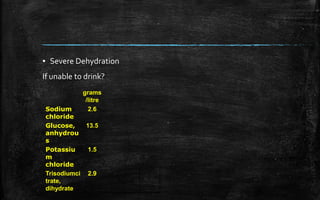
▪ Severe Dehydration
If unable to drink?
grams
/litre
Sodium
chloride
2.6
Glucose,
anhydrou
s
13.5
Potassiu
m
chloride
1.5
Trisodiumci
trate,
dihydrate
2.9
▪ Antimotility agents are not indicated for infectious diarrhea, except for
refractory cases of Cryptosporidium infection.
▪ Antimicrobial therapy is indicated for some nonviral diarrhea because most is
self-limiting and does not require therapy.
▪ Aeromonas species: Use cefixime and most third-generation and fourth-
generation cephalosporins
▪ Campylobacter species: Erythromycin shortens illness duration and shedding.
▪ C difficile: Discontinue potential causative antibiotics. If antibiotics cannot be
stopped or this does not result in resolution, use oral metronidazole or
vancomycin. Vancomycin is reserved for the child who is seriously ill.
▪ C perfringens: Do not treat with antibiotics.
▪ Cryptosporidium parvum: Administer paromomycin; however,
effectiveness is not proven. Nitazoxanide, a newer anthelmintic,
is effective against C parvum.
▪ Entamoeba histolytica: Metronidazole followed by iodoquinol or
paromomycin is administered in symptomatic patients.
Asymptomatic carriers in nonendemic areas should receive
iodoquinol or paromomycin.
▪ E coli:Trimethoprim-sulfamethoxazole (TMP-SMX) should
▪ be administered if moderate or severe diarrhea is noted; antibiotic treatment
may increase likelihood of hemolytic-uremic syndrome (HUS). Parenteral
second-generation or third-generation cephalosporin is indicated for
systemic complications.
▪ G lamblia: Metronidazole or nitazoxanide can be used.
▪ Plesiomonas species: UseTMP-SMX or any cephalosporin.
▪ Salmonella species: high-risk patients (eg, immunocompromised, sickle cell
disease). TMP-SMX is first-line medication; however, resistance occurs. Use
ceftriaxone and cefotaxime for invasive disease.
▪ Shigella species: Treatment shortens illness duration and shedding but does
not prevent complications. TMP-SMX is first-line medication; however,
resistance occurs. Cefixime, ceftriaxone, and cefotaxime are recommended
for invasive disease.
▪ V cholerae: Treat infected individuals and contacts. Doxycycline is the first-
line antibiotic, and erythromycin is second-line antibiotic.
▪ Yersinia species: TMP-SMX, cefixime, ceftriaxone, and cefotaxime are used.
Treatment does not shorten disease duration; reserve for complicated cases.
Side Effects
▪ Cefixime-Abdominal Pain,candidiasis,elevated
transaminases,increased
creatinine,eosinophilia,flatulence,thrombocytopenia,steven
johnson syndrome
▪ Ceftriaxone-elevated transaminases,increased
creatinine,eosinophilia,flatulence,thrombocytosis
▪ Cefotaxime-nausea,pruritis, transaminases,increased
creatinine,eosinophilia,flatulence,thrombocytopenia
▪ Erythromycin similar to cefixime
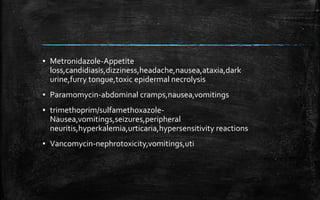
▪ Metronidazole-Appetite
loss,candidiasis,dizziness,headache,nausea,ataxia,dark
urine,furry tongue,toxic epidermal necrolysis
▪ Paramomycin-abdominal cramps,nausea,vomitings
▪ trimethoprim/sulfamethoxazole-
Nausea,vomitings,seizures,peripheral
neuritis,hyperkalemia,urticaria,hypersensitivity reactions
▪ Vancomycin-nephrotoxicity,vomitings,uti
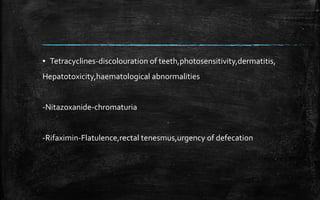
▪ Tetracyclines-discolouration of teeth,photosensitivity,dermatitis,
Hepatotoxicity,haematological abnormalities
-Nitazoxanide-chromaturia
-Rifaximin-Flatulence,rectal tenesmus,urgency of defecation
Thank You

Diarrhea.pptx

  • 1.
    Diarrhea -Dr. Goutham Valapala MD(General Medicine),PGDip.Diab&endo,FIME,FICCM,MBA(Hospital Management) Associate Professor (head of unit V) Department Of General Medicine, GIMSR GITAM
  • 2.
    Definition  Diarrhea isthe reversal of the normal net absorptive status of water and electrolyte absorption to secretion. The augmented water content in the stools (200 g/d in the adult) is due to an imbalance in the physiology of the small and large intestinal processes involved in the absorption of ions, organic substrates, and thus water.
  • 3.
    Types  Acute diarrheais defined as the abrupt onset of 3 or more loose stools per day and lasts no longer than 14 days.  chronic or persistent diarrhea is defined as an episode that lasts longer than 14 days.
  • 4.
    Causes of ClinicalPresentation ▪ Stool characteristics ▪ Presence of associated enteric symptoms ▪ (Common pathogens: rotavirus, astrovirus, calicivirus;Campylobacter, Shigella, Giardia, and Cryptosporidium species ) ▪ Food ingestion history ▪ Water exposure
  • 5.
    ▪ Camping history ▪Travel history ▪ Animal exposure ▪ Predisposing conditions
  • 6.
    Treatment of AcuteDiarrhea ▪ Minimal or no dehydration ▪ Replacement of losses ▪ Less than 10 kg body weight - 60-120 mL oral rehydration solution for each diarrhea stool or vomiting episode ▪ More than 10 kg body weight - 120-140 mL oral rehydration solution for each diarrhea stool or vomiting episode
  • 7.
    ▪ Severe Dehydration Ifunable to drink? grams /litre Sodium chloride 2.6 Glucose, anhydrou s 13.5 Potassiu m chloride 1.5 Trisodiumci trate, dihydrate 2.9
  • 8.
    ▪ Antimotility agentsare not indicated for infectious diarrhea, except for refractory cases of Cryptosporidium infection. ▪ Antimicrobial therapy is indicated for some nonviral diarrhea because most is self-limiting and does not require therapy. ▪ Aeromonas species: Use cefixime and most third-generation and fourth- generation cephalosporins ▪ Campylobacter species: Erythromycin shortens illness duration and shedding. ▪ C difficile: Discontinue potential causative antibiotics. If antibiotics cannot be stopped or this does not result in resolution, use oral metronidazole or vancomycin. Vancomycin is reserved for the child who is seriously ill. ▪ C perfringens: Do not treat with antibiotics.
  • 9.
    ▪ Cryptosporidium parvum:Administer paromomycin; however, effectiveness is not proven. Nitazoxanide, a newer anthelmintic, is effective against C parvum. ▪ Entamoeba histolytica: Metronidazole followed by iodoquinol or paromomycin is administered in symptomatic patients. Asymptomatic carriers in nonendemic areas should receive iodoquinol or paromomycin. ▪ E coli:Trimethoprim-sulfamethoxazole (TMP-SMX) should
  • 10.
    ▪ be administeredif moderate or severe diarrhea is noted; antibiotic treatment may increase likelihood of hemolytic-uremic syndrome (HUS). Parenteral second-generation or third-generation cephalosporin is indicated for systemic complications. ▪ G lamblia: Metronidazole or nitazoxanide can be used. ▪ Plesiomonas species: UseTMP-SMX or any cephalosporin. ▪ Salmonella species: high-risk patients (eg, immunocompromised, sickle cell disease). TMP-SMX is first-line medication; however, resistance occurs. Use ceftriaxone and cefotaxime for invasive disease.
  • 11.
    ▪ Shigella species:Treatment shortens illness duration and shedding but does not prevent complications. TMP-SMX is first-line medication; however, resistance occurs. Cefixime, ceftriaxone, and cefotaxime are recommended for invasive disease. ▪ V cholerae: Treat infected individuals and contacts. Doxycycline is the first- line antibiotic, and erythromycin is second-line antibiotic. ▪ Yersinia species: TMP-SMX, cefixime, ceftriaxone, and cefotaxime are used. Treatment does not shorten disease duration; reserve for complicated cases.
  • 12.
    Side Effects ▪ Cefixime-AbdominalPain,candidiasis,elevated transaminases,increased creatinine,eosinophilia,flatulence,thrombocytopenia,steven johnson syndrome ▪ Ceftriaxone-elevated transaminases,increased creatinine,eosinophilia,flatulence,thrombocytosis ▪ Cefotaxime-nausea,pruritis, transaminases,increased creatinine,eosinophilia,flatulence,thrombocytopenia ▪ Erythromycin similar to cefixime
  • 13.
    ▪ Metronidazole-Appetite loss,candidiasis,dizziness,headache,nausea,ataxia,dark urine,furry tongue,toxicepidermal necrolysis ▪ Paramomycin-abdominal cramps,nausea,vomitings ▪ trimethoprim/sulfamethoxazole- Nausea,vomitings,seizures,peripheral neuritis,hyperkalemia,urticaria,hypersensitivity reactions ▪ Vancomycin-nephrotoxicity,vomitings,uti
  • 14.
    ▪ Tetracyclines-discolouration ofteeth,photosensitivity,dermatitis, Hepatotoxicity,haematological abnormalities -Nitazoxanide-chromaturia -Rifaximin-Flatulence,rectal tenesmus,urgency of defecation
  • 15.