Understanding
Understanding
psychrometric
psychrometric charts
charts
Produced by GT
Produced by GT-
-ED
ED-
-KE , 2012
KE , 2012
2
2
Contents
Contents
1.
1. Air
Air-
-conditioning process and
conditioning process and status of the
status of the air
air
2.
2. The p
The practical us
ractical use
e of
of p
psych
sychr
rometric
ometric chart
charts
s (
( c
calculation of equipment capacity )
alculation of equipment capacity )
3.
3. Prevention of similar troubles based on customer complaint cases
Prevention of similar troubles based on customer complaint cases
3
3
3. Prevention of similar troubles based on customer complaint cases
[Circumstances/conditions]
Case 1:The carrying-over of vapor caused by humidification
(Quality complaint information No. 62-013)
In a factory, the setting of the air-supply dew point temperature was changed from 60% ±10% to 65% ± 10%.
Humidified vapor was saturated and carried over. The carried-over vapor wetted the ceiling of the HEPA outlet and
dropped from the ceiling. HEPA is the acronym of High Efficiency Particulate Air.
In addition, defective products were produced due to the abnormal deterioration of the room pressure.
[Backgrounds]
The room, where the trouble occurred, was an explosion-protective area. It had an air-conditioning system
operated by a once-through type outdoor air-conditioner.
The setting of the relative humidity of the room was raised to reduce the generation of static electricity.
[Countermeasures to prevent recurrence]
Key factor 1
Key factor 1
Before changing the settings of the room humidity (the settings of the dew point temperature of the supply air) under the steam
humidification method, check the condition of the air after humidification on the psychrometric chart to see whether the
relative humidity is over 85%*.
*Consider that the air is not always humidified uniformly. Set the relative humidity at 85% or lower.
Key factor 2
Key factor 2
Heat generated from manufacturing equipment may have increased due to some reasons, for example, because of increased
products compared to the originally planned number. In advance, measure the current temperature and quantity of the supply
air, and know the room loads (caused by heat generation from equipment).
Check whether the air flow is reduced by filter clogging or not.
Key factor 3
Key factor 3
Note that under humidification at a lower temperature (the air is humidified at 15℃ or lower), the vapor absorption must be
longer than that under the humidification room temperature. If the air is humidified at a lower temperature, consider using
standpipe-equipped air-conditioners.
*See “Engineering data: Selection of humidifiers”.
4
4
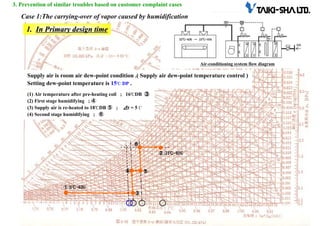
①(0℃-40%)
②(23℃-60%)
③
④ ⑤
⑥
3. Prevention of similar troubles based on customer complaint cases
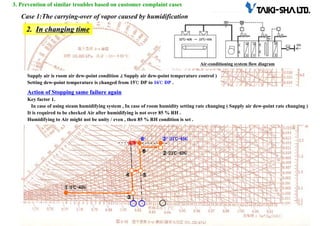
Supply air is room air dew-point condition .( Supply air dew-point temperature control )
Setting dew-point temperature is 15℃ DP .
Air-conditioning system flow diagram
(1) Air temperature after pre-heating coil ; 16℃DB ③
(2) First stage humidifying ; ④
(3) Supply air is re-heated to 18℃DB ⑤ ; ⊿t = 5℃
(4) Second stage humidifying ; ⑥
1.
1. In Primary design time
In Primary design time
Case 1:The carrying-over of vapor caused by humidification
5
5
②’(23℃-65%)
③
④ ⑤
⑥’
⑥
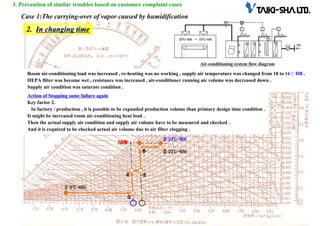
Supply air is room air dew-point condition .( Supply air dew-point temperature control )
Setting dew-point temperature is changed from 15℃ DP to 16℃ DP .
Air-conditioning system flow diagram
2.
2. In changing time
In changing time
Action of Stopping same failure again
Key factor 1.
In case of using steam humidifying system , In case of room humidity setting rate changing ( Supply air dew-point rate changing )
It is required to be checked Air after humidifying is not over 85 % RH .
Humidifying to Air might not be unity / even , then 85 % RH condition is set .
①(0℃-40%)
②(23℃-60%)
90%
90%
3. Prevention of similar troubles based on customer complaint cases
Case 1:The carrying-over of vapor caused by humidification
6
6
②(23℃-65%)
Room air-conditioning load was increased , re-heating was no working , supply air temperature was changed from 18 to 16℃ DB .
HEPA filter was become wet , resistance was increased , air-conditioner running air volume was decreased down .
Supply air condition was saturate condition .
Air-conditioning system flow diagram
2.
2. In changing time
In changing time
Action of Stopping same failure again
Key factor 2.
In factory / production , it is possible to be expanded production volume than primary design time condition .
It might be increased room air-conditioning heat load .
Then the actual supply air condition and supply air volume have to be measured and checked .
And it is required to be checked actual air volume due to air filter clogging .
③
④ ⑤
①(0℃-40%)
⑥ ②(23℃-60%)
100%
100%
3. Prevention of similar troubles based on customer complaint cases
Case 1:The carrying-over of vapor caused by humidification
7
7
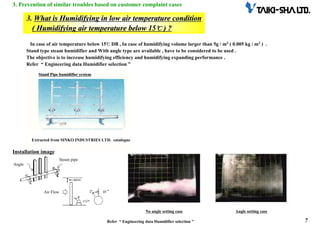
Extracted from SINKO INDUSTRIES LTD. catalogue
Stand Pipe humidifier system
In case of air temperature below 15℃ DB , In case of humidifying volume larger than 5g / m3 ( 0.005 kg / m3 ) .
Stand type steam humidifier and With angle type are available , have to be considered to be used .
The objective is to increase humidifying efficiency and humidifying expanding performance .
Refer “ Engineering data Humidifier selection ”
3.
3. What is Humidifying in low air temperature condition
What is Humidifying in low air temperature condition
( Humidifying air temperature below 15
( Humidifying air temperature below 15℃
℃ ) ?
) ?
No angle setting case Angle setting case
Installation image
Angle
Steam pipe
Air Flow 45 °
Refer “ Engineering data Humidifier selection ”
3. Prevention of similar troubles based on customer complaint cases
8
8
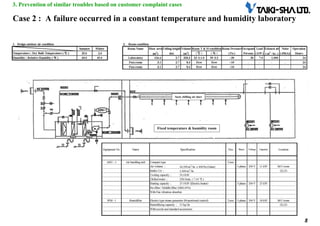
,1500Pa(全静圧)
Sock chilling air duct
Fixed temperature & humidity room
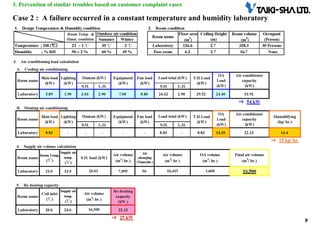
Case 2 : A failure occurred in a constant temperature and humidity laboratory
3. Prevention of similar troubles based on customer complaint cases
9
9
Case 2 : A failure occurred in a constant temperature and humidity laboratory
3. Prevention of similar troubles based on customer complaint cases
10
10
Fixed Temperature & Humidity room , Key point of air
Fixed Temperature & Humidity room , Key point of air-
-conditioning system
conditioning system
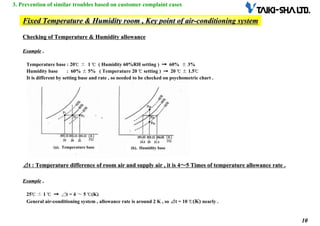
Checking of Temperature & Humidity allowance
(a). Temperature base (b). Humidity base
Example
Example ,
Temperature base : 20℃ ± 1 ℃ ( Humidity 60%RH setting ) → 60% ± 3%
Humidity base : 60% ± 5% ( Temperature 20 ℃ setting ) → 20 ℃ ± 1.5℃
It is different by setting base and rate , so needed to be checked on psychometric chart .
⊿
⊿t : Temperature difference of room air and supply air , it is 4
t : Temperature difference of room air and supply air , it is 4~
~5 Times of temperature allowance rate .
5 Times of temperature allowance rate .
Example
Example ,
25℃ ± 1 ℃ → ⊿t = 4 ~ 5 ℃(K)
General air-conditioning system , allowance rate is around 2 K , so ⊿t = 10 ℃(K) nearly .
3. Prevention of similar troubles based on customer complaint cases
11
11
45.2
91.0
0.0013
0.0088
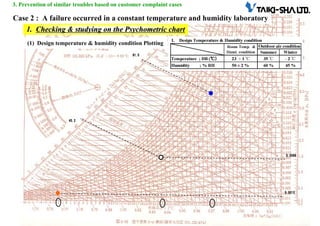
(1) Design temperature & humidity condition Plotting
1.
1. Checking & studying on the Psychometric chart
Checking & studying on the Psychometric chart
3. Prevention of similar troubles based on customer complaint cases
Case 2 : A failure occurred in a constant temperature and humidity laboratory
12
12
45.2
91.0
0.0013
0.0088
39.9
Room Load (TH)
Room Load (SH)
Room Load (LH)
O
A
L
o
a
d
(
I
n
t
a
k
e
O
A
v
o
l
u
m
e
)
49.6
0.0081
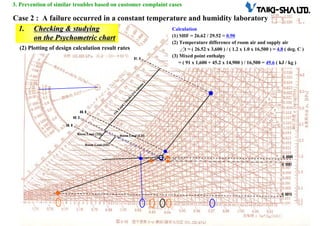
(2) Plotting of design calculation result rates
1.
1. Checking & studying
Checking & studying
on the Psychometric chart
Calculation
(1) SHF = 26.62 / 29.52 = 0.90
(2) Temperature difference of room air and supply air
⊿t = ( 26.52 x 3,600 ) / ( 1.2 x 1.0 x 16,500 ) = 4.8 ( deg. C )
(3) Mixed point enthalpy
= ( 91 x 1,600 + 45.2 x 14,900 ) / 16,500 = 49.6 ( kJ / kg )
3. Prevention of similar troubles based on customer complaint cases
Case 2 : A failure occurred in a constant temperature and humidity laboratory
13
13
0.0013
0.0088
45.2
91.0
39.9
Room Load (TH)
Room Load (SH)
Room Load (LH)
49.6
Outdoor Air Load
18.2 23.0
24.2
35.0
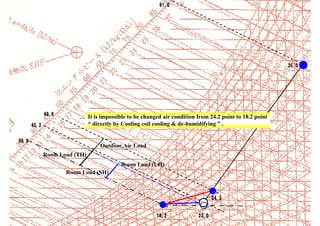
It is impossible to be changed air condition from 24.2 point to 18.2 point
“ directly by Cooling coil cooling & de-humidifying ” .
14
14
0.0013
0.0088
45.2
91.0
39.9
49.6
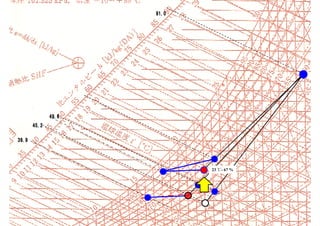
23 ℃- 67 %
15
15
Room Load (TH)
Room Load (SH)
Room Load (LH)
Outdoor Air Load
18.2 23.0
24.2
35.0
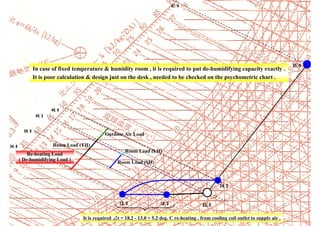
In case of fixed temperature & humidity room , it is required to
In case of fixed temperature & humidity room , it is required to put de
put de-
-humidifying capacity exactly .
humidifying capacity exactly .
It is poor calculation & design just on the desk , needed to be
It is poor calculation & design just on the desk , needed to be checked on the psychometric chart .
checked on the psychometric chart .
13.0
34.6
Re-heating Load
( De-humidifying Load )
It is required
It is required ⊿
⊿t = 18.2
t = 18.2 -
- 13.0 = 5.2 deg. C re
13.0 = 5.2 deg. C re-
-heating , from cooling coil outlet to supply air .
heating , from cooling coil outlet to supply air .
45.2
91.0
39.9
46.9
16
16
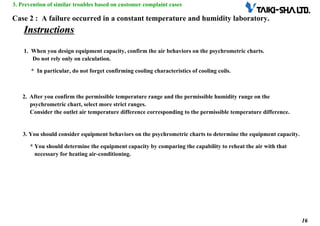
Case 2 : A failure occurred in a constant temperature and humidity laboratory.
1. When you design equipment capacity, confirm the air behaviors on the psychrometric charts.
Do not rely only on calculation.
* In particular, do not forget confirming cooling characteristics of cooling coils.
Instructions
Instructions
2. After you confirm the permissible temperature range and the permissible humidity range on the
psychrometric chart, select more strict ranges.
Consider the outlet air temperature difference corresponding to the permissible temperature difference.
3. You should consider equipment behaviors on the psychrometric charts to determine the equipment capacity.
* You should determine the equipment capacity by comparing the capability to reheat the air with that
necessary for heating air-conditioning.
3. Prevention of similar troubles based on customer complaint cases
17
17
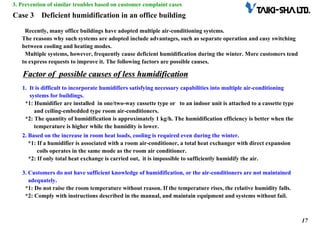
Case 3 Deficient humidification in an office building
Recently, many office buildings have adopted multiple air-conditioning systems.
The reasons why such systems are adopted include advantages, such as separate operation and easy switching
between cooling and heating modes.
Multiple systems, however, frequently cause deficient humidification during the winter. More customers tend
to express requests to improve it. The following factors are possible causes.
Factor of possible causes of less humidification
1. It is difficult to incorporate humidifiers satisfying necessary capabilities into multiple air-conditioning
systems for buildings.
*1: Humidifier are installed in one/two-way cassette type or to an indoor unit is attached to a cassette type
and ceiling-embedded type room air-conditioners.
*2: The quantity of humidification is approximately 1 kg/h. The humidification efficiency is better when the
temperature is higher while the humidity is lower.
2. Based on the increase in room heat loads, cooling is required even during the winter.
*1: If a humidifier is associated with a room air-conditioner, a total heat exchanger with direct expansion
coils operates in the same mode as the room air conditioner.
*2: If only total heat exchange is carried out, it is impossible to sufficiently humidify the air.
3. Customers do not have sufficient knowledge of humidification, or the air-conditioners are not maintained
adequately.
*1: Do not raise the room temperature without reason. If the temperature rises, the relative humidity falls.
*2: Comply with instructions described in the manual, and maintain equipment and systems without fail.
3. Prevention of similar troubles based on customer complaint cases
18
18
(2) Plotting of design calculation result rates
Exp.
Room condition ; 22 ℃ - 45%
Outdoor air ; 0 ℃ - 50%
Heat exchanger efficiency ; 50%
Humidifier
Air-conditioner
indoor unit
Heat exchanger
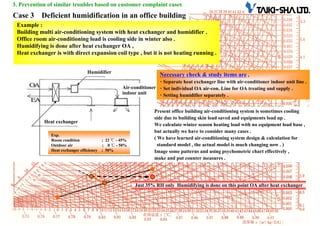
Example :
Building multi air-conditioning system with heat exchanger and humidifier .
Office room air-conditioning load is cooling side in winter also .
Humidifying is done after heat exchanger OA ,
Heat exchanger is with direct expansion coil type , but it is not heating running .
Necessary check & study items are ,
・ Separate heat exchanger line with air-conditioner indoor unit line .
・ Set individual OA air-con. Line for OA treating and supply .
・ Setting humidifier separately .
Present office building air-conditioning system is sometimes cooling
side due to building skin load saved and equipments load up .
We calculate winter season heating load with no equipment load base ,
but actually we have to consider many cases .
( We have learned air-conditioning system design & calculation for
standard model , the actual model is much changing now . )
Image some patterns and using psychometric chart effectively ,
make and put counter measures .
Just 35% RH only Humidifying is done on this point OA after heat exchanger
Case 3 Deficient humidification in an office building
3. Prevention of similar troubles based on customer complaint cases
19
19
19
Thank you all for listening so attentively.
This is the end of the explanation of
“
“Prevention of similar trouble based on customer complaint cases
Prevention of similar trouble based on customer complaint cases”
”
for
for “
“Understanding
Understanding psychrometric
psychrometric charts
charts“
“

Diagram Psychometric Chart System HVAC pdf.

  • 1.
  • 2.
    2 2 Contents Contents 1. 1. Air Air- -conditioning processand conditioning process and status of the status of the air air 2. 2. The p The practical us ractical use e of of p psych sychr rometric ometric chart charts s ( ( c calculation of equipment capacity ) alculation of equipment capacity ) 3. 3. Prevention of similar troubles based on customer complaint cases Prevention of similar troubles based on customer complaint cases
  • 3.
    3 3 3. Prevention ofsimilar troubles based on customer complaint cases [Circumstances/conditions] Case 1:The carrying-over of vapor caused by humidification (Quality complaint information No. 62-013) In a factory, the setting of the air-supply dew point temperature was changed from 60% ±10% to 65% ± 10%. Humidified vapor was saturated and carried over. The carried-over vapor wetted the ceiling of the HEPA outlet and dropped from the ceiling. HEPA is the acronym of High Efficiency Particulate Air. In addition, defective products were produced due to the abnormal deterioration of the room pressure. [Backgrounds] The room, where the trouble occurred, was an explosion-protective area. It had an air-conditioning system operated by a once-through type outdoor air-conditioner. The setting of the relative humidity of the room was raised to reduce the generation of static electricity. [Countermeasures to prevent recurrence] Key factor 1 Key factor 1 Before changing the settings of the room humidity (the settings of the dew point temperature of the supply air) under the steam humidification method, check the condition of the air after humidification on the psychrometric chart to see whether the relative humidity is over 85%*. *Consider that the air is not always humidified uniformly. Set the relative humidity at 85% or lower. Key factor 2 Key factor 2 Heat generated from manufacturing equipment may have increased due to some reasons, for example, because of increased products compared to the originally planned number. In advance, measure the current temperature and quantity of the supply air, and know the room loads (caused by heat generation from equipment). Check whether the air flow is reduced by filter clogging or not. Key factor 3 Key factor 3 Note that under humidification at a lower temperature (the air is humidified at 15℃ or lower), the vapor absorption must be longer than that under the humidification room temperature. If the air is humidified at a lower temperature, consider using standpipe-equipped air-conditioners. *See “Engineering data: Selection of humidifiers”.
  • 4.
    4 4 ①(0℃-40%) ②(23℃-60%) ③ ④ ⑤ ⑥ 3. Preventionof similar troubles based on customer complaint cases Supply air is room air dew-point condition .( Supply air dew-point temperature control ) Setting dew-point temperature is 15℃ DP . Air-conditioning system flow diagram (1) Air temperature after pre-heating coil ; 16℃DB ③ (2) First stage humidifying ; ④ (3) Supply air is re-heated to 18℃DB ⑤ ; ⊿t = 5℃ (4) Second stage humidifying ; ⑥ 1. 1. In Primary design time In Primary design time Case 1:The carrying-over of vapor caused by humidification
  • 5.
    5 5 ②’(23℃-65%) ③ ④ ⑤ ⑥’ ⑥ Supply airis room air dew-point condition .( Supply air dew-point temperature control ) Setting dew-point temperature is changed from 15℃ DP to 16℃ DP . Air-conditioning system flow diagram 2. 2. In changing time In changing time Action of Stopping same failure again Action of Stopping same failure again Key factor 1. In case of using steam humidifying system , In case of room humidity setting rate changing ( Supply air dew-point rate changing ) It is required to be checked Air after humidifying is not over 85 % RH . Humidifying to Air might not be unity / even , then 85 % RH condition is set . ①(0℃-40%) ②(23℃-60%) 90% 90% 3. Prevention of similar troubles based on customer complaint cases Case 1:The carrying-over of vapor caused by humidification
  • 6.
    6 6 ②(23℃-65%) Room air-conditioning loadwas increased , re-heating was no working , supply air temperature was changed from 18 to 16℃ DB . HEPA filter was become wet , resistance was increased , air-conditioner running air volume was decreased down . Supply air condition was saturate condition . Air-conditioning system flow diagram 2. 2. In changing time In changing time Action of Stopping same failure again Action of Stopping same failure again Key factor 2. In factory / production , it is possible to be expanded production volume than primary design time condition . It might be increased room air-conditioning heat load . Then the actual supply air condition and supply air volume have to be measured and checked . And it is required to be checked actual air volume due to air filter clogging . ③ ④ ⑤ ①(0℃-40%) ⑥ ②(23℃-60%) 100% 100% 3. Prevention of similar troubles based on customer complaint cases Case 1:The carrying-over of vapor caused by humidification
  • 7.
    7 7 Extracted from SINKOINDUSTRIES LTD. catalogue Stand Pipe humidifier system Stand Pipe humidifier system In case of air temperature below 15℃ DB , In case of humidifying volume larger than 5g / m3 ( 0.005 kg / m3 ) . Stand type steam humidifier and With angle type are available , have to be considered to be used . The objective is to increase humidifying efficiency and humidifying expanding performance . Refer “ Engineering data Humidifier selection ” 3. 3. What is Humidifying in low air temperature condition What is Humidifying in low air temperature condition ( Humidifying air temperature below 15 ( Humidifying air temperature below 15℃ ℃ ) ? ) ? No angle setting case Angle setting case Installation image Angle Steam pipe Air Flow 45 ° Refer “ Engineering data Humidifier selection ” 3. Prevention of similar troubles based on customer complaint cases
  • 8.
    8 8 ,1500Pa(全静圧) Sock chilling airduct Fixed temperature & humidity room Case 2 : A failure occurred in a constant temperature and humidity laboratory 3. Prevention of similar troubles based on customer complaint cases
  • 9.
    9 9 Case 2 :A failure occurred in a constant temperature and humidity laboratory 3. Prevention of similar troubles based on customer complaint cases
  • 10.
    10 10 Fixed Temperature &Humidity room , Key point of air Fixed Temperature & Humidity room , Key point of air- -conditioning system conditioning system Checking of Temperature & Humidity allowance Checking of Temperature & Humidity allowance (a). Temperature base (b). Humidity base Example Example , Temperature base : 20℃ ± 1 ℃ ( Humidity 60%RH setting ) → 60% ± 3% Humidity base : 60% ± 5% ( Temperature 20 ℃ setting ) → 20 ℃ ± 1.5℃ It is different by setting base and rate , so needed to be checked on psychometric chart . ⊿ ⊿t : Temperature difference of room air and supply air , it is 4 t : Temperature difference of room air and supply air , it is 4~ ~5 Times of temperature allowance rate . 5 Times of temperature allowance rate . Example Example , 25℃ ± 1 ℃ → ⊿t = 4 ~ 5 ℃(K) General air-conditioning system , allowance rate is around 2 K , so ⊿t = 10 ℃(K) nearly . 3. Prevention of similar troubles based on customer complaint cases
  • 11.
    11 11 45.2 91.0 0.0013 0.0088 (1) Design temperature& humidity condition Plotting 1. 1. Checking & studying on the Psychometric chart Checking & studying on the Psychometric chart 3. Prevention of similar troubles based on customer complaint cases Case 2 : A failure occurred in a constant temperature and humidity laboratory
  • 12.
    12 12 45.2 91.0 0.0013 0.0088 39.9 Room Load (TH) RoomLoad (SH) Room Load (LH) O A L o a d ( I n t a k e O A v o l u m e ) 49.6 0.0081 (2) Plotting of design calculation result rates 1. 1. Checking & studying Checking & studying on the Psychometric chart on the Psychometric chart Calculation (1) SHF = 26.62 / 29.52 = 0.90 (2) Temperature difference of room air and supply air ⊿t = ( 26.52 x 3,600 ) / ( 1.2 x 1.0 x 16,500 ) = 4.8 ( deg. C ) (3) Mixed point enthalpy = ( 91 x 1,600 + 45.2 x 14,900 ) / 16,500 = 49.6 ( kJ / kg ) 3. Prevention of similar troubles based on customer complaint cases Case 2 : A failure occurred in a constant temperature and humidity laboratory
  • 13.
    13 13 0.0013 0.0088 45.2 91.0 39.9 Room Load (TH) RoomLoad (SH) Room Load (LH) 49.6 Outdoor Air Load 18.2 23.0 24.2 35.0 It is impossible to be changed air condition from 24.2 point to 18.2 point “ directly by Cooling coil cooling & de-humidifying ” .
  • 14.
  • 15.
    15 15 Room Load (TH) RoomLoad (SH) Room Load (LH) Outdoor Air Load 18.2 23.0 24.2 35.0 In case of fixed temperature & humidity room , it is required to In case of fixed temperature & humidity room , it is required to put de put de- -humidifying capacity exactly . humidifying capacity exactly . It is poor calculation & design just on the desk , needed to be It is poor calculation & design just on the desk , needed to be checked on the psychometric chart . checked on the psychometric chart . 13.0 34.6 Re-heating Load ( De-humidifying Load ) It is required It is required ⊿ ⊿t = 18.2 t = 18.2 - - 13.0 = 5.2 deg. C re 13.0 = 5.2 deg. C re- -heating , from cooling coil outlet to supply air . heating , from cooling coil outlet to supply air . 45.2 91.0 39.9 46.9
  • 16.
    16 16 Case 2 :A failure occurred in a constant temperature and humidity laboratory. 1. When you design equipment capacity, confirm the air behaviors on the psychrometric charts. Do not rely only on calculation. * In particular, do not forget confirming cooling characteristics of cooling coils. Instructions Instructions 2. After you confirm the permissible temperature range and the permissible humidity range on the psychrometric chart, select more strict ranges. Consider the outlet air temperature difference corresponding to the permissible temperature difference. 3. You should consider equipment behaviors on the psychrometric charts to determine the equipment capacity. * You should determine the equipment capacity by comparing the capability to reheat the air with that necessary for heating air-conditioning. 3. Prevention of similar troubles based on customer complaint cases
  • 17.
    17 17 Case 3 Deficienthumidification in an office building Recently, many office buildings have adopted multiple air-conditioning systems. The reasons why such systems are adopted include advantages, such as separate operation and easy switching between cooling and heating modes. Multiple systems, however, frequently cause deficient humidification during the winter. More customers tend to express requests to improve it. The following factors are possible causes. Factor of possible causes of less humidification Factor of possible causes of less humidification 1. It is difficult to incorporate humidifiers satisfying necessary capabilities into multiple air-conditioning systems for buildings. *1: Humidifier are installed in one/two-way cassette type or to an indoor unit is attached to a cassette type and ceiling-embedded type room air-conditioners. *2: The quantity of humidification is approximately 1 kg/h. The humidification efficiency is better when the temperature is higher while the humidity is lower. 2. Based on the increase in room heat loads, cooling is required even during the winter. *1: If a humidifier is associated with a room air-conditioner, a total heat exchanger with direct expansion coils operates in the same mode as the room air conditioner. *2: If only total heat exchange is carried out, it is impossible to sufficiently humidify the air. 3. Customers do not have sufficient knowledge of humidification, or the air-conditioners are not maintained adequately. *1: Do not raise the room temperature without reason. If the temperature rises, the relative humidity falls. *2: Comply with instructions described in the manual, and maintain equipment and systems without fail. 3. Prevention of similar troubles based on customer complaint cases
  • 18.
    18 18 (2) Plotting ofdesign calculation result rates Exp. Room condition ; 22 ℃ - 45% Outdoor air ; 0 ℃ - 50% Heat exchanger efficiency ; 50% Humidifier Air-conditioner indoor unit Heat exchanger Example : Building multi air-conditioning system with heat exchanger and humidifier . Office room air-conditioning load is cooling side in winter also . Humidifying is done after heat exchanger OA , Heat exchanger is with direct expansion coil type , but it is not heating running . Necessary check & study items are , ・ Separate heat exchanger line with air-conditioner indoor unit line . ・ Set individual OA air-con. Line for OA treating and supply . ・ Setting humidifier separately . Present office building air-conditioning system is sometimes cooling side due to building skin load saved and equipments load up . We calculate winter season heating load with no equipment load base , but actually we have to consider many cases . ( We have learned air-conditioning system design & calculation for standard model , the actual model is much changing now . ) Image some patterns and using psychometric chart effectively , make and put counter measures . Just 35% RH only Humidifying is done on this point OA after heat exchanger Case 3 Deficient humidification in an office building 3. Prevention of similar troubles based on customer complaint cases
  • 19.
    19 19 19 Thank you allfor listening so attentively. Thank you all for listening so attentively. This is the end of the explanation of This is the end of the explanation of “ “Prevention of similar trouble based on customer complaint cases Prevention of similar trouble based on customer complaint cases” ” for for “ “Understanding Understanding psychrometric psychrometric charts charts“ “