
CLASSIFICATION OF DIABETES MELLITUS
Several forms due to different causes.
DIABETES
Primary Secondary
Unrelated to
another disease.
Damage or disease of
pancreas by another
disease or factor.
DIABETES MELLITUS
Primary Secondary
Type I Type II
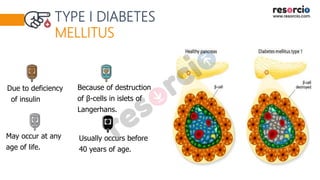
TYPE I DIABETES
MELLITUS
Due to deficiency
of insulin
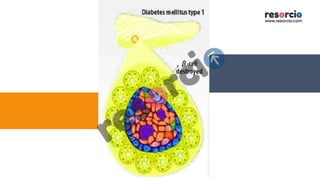
Because of destruction
of β-cells in islets of
Langerhans.
May occur at any
age of life.
Usually occurs before
40 years of age.
TYPE I DIABETES MELLITUS
May be associated with
acidosis or ketosis.
Affected persons require insulin
injection.
Also called insulin-dependent
diabetes mellitus (IDDM).
It develops at infancy or
childhood, it is called juvenile
diabetes.
Develops rapidly and progresses
at a rapid phase.
Not associated with obesity
01
02
03
04
05
06
CAUSES OF TYPE I
DIABETES MELLITUS
Degeneration of β-cells in islets
of Langerhans of pancreas.
Destruction of β-cells by viral
infection
Congenital disorder of β-cells
Destruction of β-cells during
autoimmune diseases due to
development of antibodies
against β-cells
OTHER FORMS OF TYPE 1 DIABETES
MELLITUS
Latent autoimmune
diabetes in adults
Maturity onset diabetes in
young individuals (MODY):
01
02
LATENT AUTOIMMUNE DIABETES IN ADULTS
Since pancreas takes
longer period to stop
secreting insulin.
LADA or slow onset
diabetes
Slow onset and slow
progress than IDDM
It occurs in later
life after 35 years.
Difficult to distinguish
LADA from type II
diabetes mellitus
01 02 03 04 05
02
03
01
MATURITY ONSET DIABETES IN
YOUNG INDIVIDUALS (MODY):
Due to hereditary defects
in insulin secretion.
Rare inherited form
of diabetes mellitus
Occurs before 25
years.
TYPE
II
DIABETES
MELLITUS
 Insulin resistance (failure of insulin
receptors to give response to insulin).
 Body is unable to use insulin.
 About 90% of diabetic patients have
type II diabetes mellitus
Only some forms of
Type II diabetes
require insulin.
Can be controlled by
oral hypoglycemic
drugs.
Also called non
insulin dependent
diabetes mellitus
(NIDDM).
May or may not be
associated with
ketosis.
Often it is associated
with obesity.
TYPE II DIABETES
MELLITUS
Structure and function of β-cells and
blood level of insulin are normal.
TYPE II DIABETES
MELLITUS
Insulin receptors may be less, absent
or abnormal, resulting in insulin
resistance.
Genetic
disorders
COMMON CAUSES OF INSULIN RESISTANCE
Lifestyle changes such
as bad eating habits
and physical inactivity,
leading to obesity
Stress.
01
02
03
Gestational diabetes
OTHER FORMS OF TYPE II DIABETES MELLITUS
01
02
01
Pre-diabetes
Secondary Diabetes Mellitus
1
2
3
4
Due to
Hormones secreted during pregnancy
Obesity and lifestyle before and
during pregnancy.
GESTATIONAL DIABETES
Occurs during pregnancy.
Usually, diabetes disappears after
delivery of child.
High risk of development of type
II diabetes later.
1
2
3
PRE-DIABETES
Also called chemical, subclinical,
latent or borderline diabetes.
Stage between normal condition and
diabetes.
Person does not show overt
(observable) symptoms of diabetes
PRE-
DIABETES
There is an
increase in
blood glucose
level.
Affected persons
are at a high risk
of developing
type II diabetes
mellitus.
Though pre-
diabetes is
reversible
SECONDARY DIABETES
MELLITUS
Rare and only about 2% of diabetic
patients have secondary diabetes.
It may be temporary or may become
permanent.
CAUSES OF
SECONDARY
DIABETES
MELLITUS
HYPERGLYCEMIA :-
excess stimulation of β-cells
01
Constant and excess stimulation, in turn causes
burning out and degeneration of β-cells.
β-cell exhaustion leads to permanent diabetes
mellitus.
CAUSES OF SECONDARY DIABETES MELLITUS
(high iron content in body causing
damage of organs)
02 DAMAGE OF PANCREAS DUE TO DISORDERS
Cystic fibrosis
Chronic
pancreatitis
Hemochromatosis
CAUSES OF SECONDARY DIABETES
MELLITUS
Pancreatectomy (surgical removal)
Liver diseases such as hepatitis C
and fatty liver
Autoimmune diseases such as celiac
disease
Excessive use of drugs like antihypertensive
drugs (beta blockers and diuretics), steroids,
oral contraceptives, chemotherapy drugs, etc.
Excessive intake of alcohol and
opiates.
CAUSES OF SECONDARY DIABETES MELLITUS
Increased blood glucose level (300 to 400
mg/dL) due to reduced utilization by tissue.
Mobilization of fats from adipose
tissue for energy purpose, leading to
elevated fatty acid content in blood.
This causes deposition of fat on
wall of arteries and development
of atherosclerosis.
Depletion of proteins from
tissues.
01
03 02
SIGNS AND SYMPTOMS OF DIABETES
MELLITUS
Glucosuria
01
Osmotic diuresis
02
03
Polyuria
Polydipsia
04
05
Polyphagia
Asthenia 06
SIGNS AND SYMPTOMS OF DIABETES
MELLITUS
Acidosis
07
08
09
10
11
Acetone breathing
Kussmaul Breathing
Circulatory shock
Coma
GLUCOSURIA
Loss of glucose in urine. Normally, glucose does
not appear in urine.
Glucose level rises above 180
mg/dL in blood, glucose appears
in urine.
It is renal threshold level
for glucose.
01
OSMOTIC
DIURESIS
Diuresis caused by osmotic effects.
02
It leads to polyuria and polydipsia.
Excess glucose in renal tubules develops osmotic effect.
Osmotic effect decreases reabsorption of water from renal
tubules, resulting in diuresis.
Contents Here
POLYURIA
Excess urine
formation with
increase in frequency
of voiding urine is
called polyuria.
03
Due to osmotic
diuresis caused by
increase in blood
glucose level.
POLYDIPSIA
 Increase in water intake.
 Excess loss of water decreases water content
and increases salt content in body.
 This stimulates thirst center in hypothalamus.
 Thirst center, in turn increases intake of water.
04
POLYPHAGIA
 Intake of excess food.
 Very common in diabetes
mellitus.
05
ASTHENIA
It also occurs due to utilization of proteins for
energy in absence of glucose utilization.
06 Loss of strength.
Body becomes very weak because of this.
Protein depletion caused by lack of insulin.
Decrease in protein synthesis and increase in
protein breakdown, resulting in protein depletion.
1
3
2
4
5
ACIDOSIS 07
During insulin deficiency,
glucose cannot be utilized by
peripheral tissues for energy.
So, a large amount of
fat is broken down to
release energy.
01
02
03
ACIDOSIS 07
It causes formation of excess
ketoacids, leading to acidosis.
One more reason for acidosis is
that ketoacids are excreted in
combination with sodium ions
through urine (ketonuria).
Sodium is exchanged for hydrogen
ions, which diffuse from renal
tubules into ECF adding to acidosis.
ACETONE BREATHING
08
 In cases of severe ketoacidosis, acetone is
expired in expiratory air, giving
characteristic acetone or fruity breath odor.
 It is a life-threatening condition of severe
diabetes.
KUSSMAUL
BREATHING
09
Increase in rate and depth of
respiration caused by severe
acidosis.
CIRCULATORY
SHOCK
10
Osmotic diuresis leads to
dehydration
It occurs only in severe diabetes.
COMA 11
Due to Kussmaul breathing,
large amount of carbon dioxide
is lost during expiration.
It leads to drastic reduction in
concentration of bicarbonate ions
causing severe acidosis and coma.
COMA 11
It occurs in severe cases of
diabetes mellitus.
Increase in blood glucose level
develops hyperosmolarity of plasma
which also leads to coma.
Hyperosmolar
coma :
severe cases
COMPLICATIONS OF DIABETES MELLITUS
Prolonged hyperglycemia cause
dysfunction and injury of many
tissues, resulting in some
complications.
Development of complications is
directly proportional to degree and
duration of hyperglycemia.
Patients with well controlled diabetes
can postpone onset or reduce rate of
progression of these complications.
Chronic hyperglycemia affects
blood vessels, resulting in vascular
complications like atherosclerosis.
COMPLICATIONS OF DIABETES MELLITUS
Vascular complications are responsible for development of most of
complications of diabetes such as:
VASCULAR COMPLICATIONS
Cardiovascular complications
Diabetic Retinopathy
Diabetic Nephropathy
Diabetic Neuropathy
Hypertension
VASCULAR COMPLICATIONS
Myocardial
infarction.
Cardiovascular
complications
Degenerative
changes in retina
called diabetic
retinopathy
VASCULAR COMPLICATIONS
Degenerative
changes in kidney
known as diabetic
nephropathy
Diabetic Retinopathy Diabetic Nephropathy
Degeneration of
autonomic and
peripheral nerves
called diabetic
neuropathy.
Diabetic Neuropathy.
A B
C D
Fasting blood glucose
DIAGNOSTIC TESTS FOR DIABETES MELLITUS
Postprandial blood
glucose
Glucose tolerance
test (GTT)
Glycosylated
(glycated) hemoglobin.
Monitor glycemic control of persons
already diagnosed with diabetes mellitus.
Occurs in conditions
like pre-diabetes
ABNORMAL RESPONSE IN
DIAGNOSTIC TESTS
There is an increased fasting
blood glucose level or impaired
(decreased) glucose tolerance.
01 02
TREATMENT FOR DIABETES
MELLITUS
Treated by exogenous
insulin.
TYPE I DIABETES
MELLITUS
Since insulin is a polypeptide, it is
degraded in GI tract if taken orally.
So, it is generally administered
by subcutaneous injection.
Patients with
longstanding severe
diabetes mellitus may
require a combination
of oral hypoglycemic
drugs with insulin to
control hyperglycemia.
TYPE II DIABETES
MELLITUS
Treated by oral
hypoglycemic drugs.
01
02
03
ORAL
HYPOGLYCEMIC
DRUGS
Insulin secretagogues
Alpha glucosidase inhibitors
Insulin sensitizers
INSULIN SECRETAGOGUES
These drugs decrease blood glucose level by
stimulating insulin secretion from β-cells.
Sulfonylureas (tolbutamide, gluburide,
glipizide, etc.) are commonly available insulin
secretagogues.
INSULIN
SENSITIZERS
These drugs decrease blood glucose level by
facilitating insulin action in target tissues.
Examples are
 Biguanides (metformin)
 Thiazolidinediones (pioglitazone and rosiglitazone)
ALPHA GLUCOSIDASE INHIBITORS
These drugs
control blood
glucose level by
inhibiting α-
glucosidase.
This intestinal enzyme
is responsible for
conversion of dietary
and other complex
carbohydrates into
glucose and other
monosaccharides,
which can be absorbed
from intestine.
Examples of α-
glucosidase inhibitors
are acarbose and
meglitol
THANK
YOU

Diabetes Mellites

  • 6.
    CLASSIFICATION OF DIABETESMELLITUS Several forms due to different causes. DIABETES Primary Secondary Unrelated to another disease. Damage or disease of pancreas by another disease or factor.
  • 7.
  • 8.
    TYPE I DIABETES MELLITUS Dueto deficiency of insulin Because of destruction of β-cells in islets of Langerhans. May occur at any age of life. Usually occurs before 40 years of age.
  • 9.
    TYPE I DIABETESMELLITUS May be associated with acidosis or ketosis. Affected persons require insulin injection. Also called insulin-dependent diabetes mellitus (IDDM). It develops at infancy or childhood, it is called juvenile diabetes. Develops rapidly and progresses at a rapid phase. Not associated with obesity 01 02 03 04 05 06
  • 10.
    CAUSES OF TYPEI DIABETES MELLITUS Degeneration of β-cells in islets of Langerhans of pancreas. Destruction of β-cells by viral infection Congenital disorder of β-cells Destruction of β-cells during autoimmune diseases due to development of antibodies against β-cells
  • 12.
    OTHER FORMS OFTYPE 1 DIABETES MELLITUS Latent autoimmune diabetes in adults Maturity onset diabetes in young individuals (MODY): 01 02
  • 13.
    LATENT AUTOIMMUNE DIABETESIN ADULTS Since pancreas takes longer period to stop secreting insulin. LADA or slow onset diabetes Slow onset and slow progress than IDDM It occurs in later life after 35 years. Difficult to distinguish LADA from type II diabetes mellitus 01 02 03 04 05
  • 14.
    02 03 01 MATURITY ONSET DIABETESIN YOUNG INDIVIDUALS (MODY): Due to hereditary defects in insulin secretion. Rare inherited form of diabetes mellitus Occurs before 25 years.
  • 15.
    TYPE II DIABETES MELLITUS  Insulin resistance(failure of insulin receptors to give response to insulin).  Body is unable to use insulin.  About 90% of diabetic patients have type II diabetes mellitus
  • 16.
    Only some formsof Type II diabetes require insulin. Can be controlled by oral hypoglycemic drugs. Also called non insulin dependent diabetes mellitus (NIDDM). May or may not be associated with ketosis. Often it is associated with obesity. TYPE II DIABETES MELLITUS
  • 17.
    Structure and functionof β-cells and blood level of insulin are normal. TYPE II DIABETES MELLITUS Insulin receptors may be less, absent or abnormal, resulting in insulin resistance.
  • 18.
    Genetic disorders COMMON CAUSES OFINSULIN RESISTANCE Lifestyle changes such as bad eating habits and physical inactivity, leading to obesity Stress. 01 02 03
  • 19.
    Gestational diabetes OTHER FORMSOF TYPE II DIABETES MELLITUS 01 02 01 Pre-diabetes Secondary Diabetes Mellitus
  • 20.
    1 2 3 4 Due to Hormones secretedduring pregnancy Obesity and lifestyle before and during pregnancy. GESTATIONAL DIABETES Occurs during pregnancy. Usually, diabetes disappears after delivery of child. High risk of development of type II diabetes later.
  • 21.
    1 2 3 PRE-DIABETES Also called chemical,subclinical, latent or borderline diabetes. Stage between normal condition and diabetes. Person does not show overt (observable) symptoms of diabetes
  • 22.
    PRE- DIABETES There is an increasein blood glucose level. Affected persons are at a high risk of developing type II diabetes mellitus. Though pre- diabetes is reversible
  • 23.
    SECONDARY DIABETES MELLITUS Rare andonly about 2% of diabetic patients have secondary diabetes. It may be temporary or may become permanent.
  • 24.
    CAUSES OF SECONDARY DIABETES MELLITUS HYPERGLYCEMIA :- excessstimulation of β-cells 01 Constant and excess stimulation, in turn causes burning out and degeneration of β-cells. β-cell exhaustion leads to permanent diabetes mellitus.
  • 25.
    CAUSES OF SECONDARYDIABETES MELLITUS (high iron content in body causing damage of organs) 02 DAMAGE OF PANCREAS DUE TO DISORDERS Cystic fibrosis Chronic pancreatitis Hemochromatosis
  • 26.
    CAUSES OF SECONDARYDIABETES MELLITUS Pancreatectomy (surgical removal) Liver diseases such as hepatitis C and fatty liver Autoimmune diseases such as celiac disease Excessive use of drugs like antihypertensive drugs (beta blockers and diuretics), steroids, oral contraceptives, chemotherapy drugs, etc. Excessive intake of alcohol and opiates.
  • 27.
    CAUSES OF SECONDARYDIABETES MELLITUS Increased blood glucose level (300 to 400 mg/dL) due to reduced utilization by tissue. Mobilization of fats from adipose tissue for energy purpose, leading to elevated fatty acid content in blood. This causes deposition of fat on wall of arteries and development of atherosclerosis. Depletion of proteins from tissues. 01 03 02
  • 28.
    SIGNS AND SYMPTOMSOF DIABETES MELLITUS Glucosuria 01 Osmotic diuresis 02 03 Polyuria Polydipsia 04 05 Polyphagia Asthenia 06
  • 29.
    SIGNS AND SYMPTOMSOF DIABETES MELLITUS Acidosis 07 08 09 10 11 Acetone breathing Kussmaul Breathing Circulatory shock Coma
  • 30.
    GLUCOSURIA Loss of glucosein urine. Normally, glucose does not appear in urine. Glucose level rises above 180 mg/dL in blood, glucose appears in urine. It is renal threshold level for glucose. 01
  • 32.
    OSMOTIC DIURESIS Diuresis caused byosmotic effects. 02 It leads to polyuria and polydipsia. Excess glucose in renal tubules develops osmotic effect. Osmotic effect decreases reabsorption of water from renal tubules, resulting in diuresis.
  • 34.
    Contents Here POLYURIA Excess urine formationwith increase in frequency of voiding urine is called polyuria. 03 Due to osmotic diuresis caused by increase in blood glucose level.
  • 35.
    POLYDIPSIA  Increase inwater intake.  Excess loss of water decreases water content and increases salt content in body.  This stimulates thirst center in hypothalamus.  Thirst center, in turn increases intake of water. 04
  • 36.
    POLYPHAGIA  Intake ofexcess food.  Very common in diabetes mellitus. 05
  • 37.
    ASTHENIA It also occursdue to utilization of proteins for energy in absence of glucose utilization. 06 Loss of strength. Body becomes very weak because of this. Protein depletion caused by lack of insulin. Decrease in protein synthesis and increase in protein breakdown, resulting in protein depletion. 1 3 2 4 5
  • 38.
    ACIDOSIS 07 During insulindeficiency, glucose cannot be utilized by peripheral tissues for energy. So, a large amount of fat is broken down to release energy.
  • 39.
    01 02 03 ACIDOSIS 07 It causesformation of excess ketoacids, leading to acidosis. One more reason for acidosis is that ketoacids are excreted in combination with sodium ions through urine (ketonuria). Sodium is exchanged for hydrogen ions, which diffuse from renal tubules into ECF adding to acidosis.
  • 40.
    ACETONE BREATHING 08  Incases of severe ketoacidosis, acetone is expired in expiratory air, giving characteristic acetone or fruity breath odor.  It is a life-threatening condition of severe diabetes.
  • 42.
    KUSSMAUL BREATHING 09 Increase in rateand depth of respiration caused by severe acidosis. CIRCULATORY SHOCK 10 Osmotic diuresis leads to dehydration It occurs only in severe diabetes.
  • 44.
    COMA 11 Due toKussmaul breathing, large amount of carbon dioxide is lost during expiration. It leads to drastic reduction in concentration of bicarbonate ions causing severe acidosis and coma.
  • 45.
    COMA 11 It occursin severe cases of diabetes mellitus. Increase in blood glucose level develops hyperosmolarity of plasma which also leads to coma. Hyperosmolar coma : severe cases
  • 46.
    COMPLICATIONS OF DIABETESMELLITUS Prolonged hyperglycemia cause dysfunction and injury of many tissues, resulting in some complications. Development of complications is directly proportional to degree and duration of hyperglycemia.
  • 47.
    Patients with wellcontrolled diabetes can postpone onset or reduce rate of progression of these complications. Chronic hyperglycemia affects blood vessels, resulting in vascular complications like atherosclerosis. COMPLICATIONS OF DIABETES MELLITUS
  • 48.
    Vascular complications areresponsible for development of most of complications of diabetes such as: VASCULAR COMPLICATIONS Cardiovascular complications Diabetic Retinopathy Diabetic Nephropathy Diabetic Neuropathy
  • 49.
  • 50.
    Degenerative changes in retina calleddiabetic retinopathy VASCULAR COMPLICATIONS Degenerative changes in kidney known as diabetic nephropathy Diabetic Retinopathy Diabetic Nephropathy Degeneration of autonomic and peripheral nerves called diabetic neuropathy. Diabetic Neuropathy.
  • 51.
    A B C D Fastingblood glucose DIAGNOSTIC TESTS FOR DIABETES MELLITUS Postprandial blood glucose Glucose tolerance test (GTT) Glycosylated (glycated) hemoglobin. Monitor glycemic control of persons already diagnosed with diabetes mellitus.
  • 52.
    Occurs in conditions likepre-diabetes ABNORMAL RESPONSE IN DIAGNOSTIC TESTS There is an increased fasting blood glucose level or impaired (decreased) glucose tolerance. 01 02
  • 53.
  • 54.
    Treated by exogenous insulin. TYPEI DIABETES MELLITUS Since insulin is a polypeptide, it is degraded in GI tract if taken orally. So, it is generally administered by subcutaneous injection.
  • 55.
    Patients with longstanding severe diabetesmellitus may require a combination of oral hypoglycemic drugs with insulin to control hyperglycemia. TYPE II DIABETES MELLITUS Treated by oral hypoglycemic drugs.
  • 56.
  • 57.
    INSULIN SECRETAGOGUES These drugsdecrease blood glucose level by stimulating insulin secretion from β-cells. Sulfonylureas (tolbutamide, gluburide, glipizide, etc.) are commonly available insulin secretagogues.
  • 58.
    INSULIN SENSITIZERS These drugs decreaseblood glucose level by facilitating insulin action in target tissues. Examples are  Biguanides (metformin)  Thiazolidinediones (pioglitazone and rosiglitazone)
  • 59.
    ALPHA GLUCOSIDASE INHIBITORS Thesedrugs control blood glucose level by inhibiting α- glucosidase. This intestinal enzyme is responsible for conversion of dietary and other complex carbohydrates into glucose and other monosaccharides, which can be absorbed from intestine. Examples of α- glucosidase inhibitors are acarbose and meglitol
  • 60.