









Challenges
of
Small Business
Introduction
 Business which functions on a small scale level is called Small
Business.
 Less Capital Investment, less labor cost and less infrastructures
are the main features of Small Business.
 In small business, the production of goods and services are
functioning through private owned corporations, partnerships or
sole proprietorships.
“
“A small business, is one marked by a limited
number of employees and a limited flow of
finances and materials.”
-Unknown
Characteristics of
Small Business
Profit and Revenue
✘ Revenue of small-scale business is
lesser than medium and large
scale businesses.
✘ Lower revenue is not a measuring
scale of lower profitability.
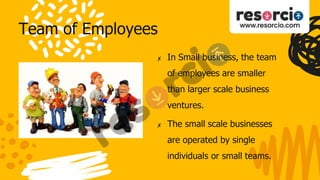
Team of Employees
✘ In Small business, the team
of employees are smaller
than larger scale business
ventures.
✘ The small scale businesses
are operated by single
individuals or small teams.
Market Area
✘ The market area of a small
businesses is smaller than
corporations and private
companies.
✘ The small scale business units
perform in local areas or
communities and will be growing
their scale of operations there.
Ownership and Taxes
The ownership of a small scale business are of different
types:
 Proprietorships
 Partnerships or limited liability companies
They are taxed using different methods.
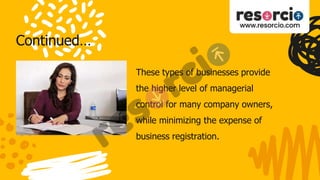
Continued…
These types of businesses provide
the higher level of managerial
control for many company owners,
while minimizing the expense of
business registration.
Continued…
The institution owners can
report business income and
expenses on their personal tax
returns.
Limited Area
✘ These companies need no sales outlets in multiple states or
countries.
✘ They can operate from a single office, retail store or service outlet.
✘ It is possible to run a small business directly from home, without any
company infrastructures making it less complex.
Types of Small Business
✘ Small Scale Industry (Before 2006)
✘ Ancillary Small Industrial Unit
✘ Export Oriented Units
✘ Small Scale Industries Owned by Women
✘ Tiny Industrial Units
Continued…
✘ Small Scale Service
and Business
✘ Micro Business Enterprises
✘ Village Industries
✘ Cottage Industries
Scope of Small Business
✘ Manufacturing sectors
✘ Servicing/repairing sectors
✘ Retailing sectors
✘ Financial sectors
Scope of Small Business
✘ Whole-sale sectors
✘ Construction sectors
✘ Infrastructural sectors like transport,
communication, etc.
Objectives of Small Business
✘ To generate large employment
opportunities but with low investment
✘ Reducing unemployment to a certain
extent
✘ Spreading the business units into small
towns, villages and economically slow
regions
Objectives of Small Business
✘ Helps in a much more balanced regional development
✘ It assures that the national income is distributed
equally
✘ It will help in promoting the mobilization of resources
✘ It will help to improve the standard of living of people
associated with it
Importance of Small Business
✘ Small businesses play an important role in competition
and challenge the economic power of large companies.
✘ Small business units provide more choice to the
consumer.
✘ Large ventures are concentrated in mass market, but
smaller firms can satisfy specialized needs.
Importance of Small Business
✘ Expands the distribution of economic
strength
✘ Expands the development in local areas
✘ They are sources of innovation and creativity
✘ Provide large scale of employment
✘ Provide the ancillary support to large
industries
Role of Small Business
They Promote:
✘ Employment
✘ Latent Resources
✘ Equality
✘ Decentralization
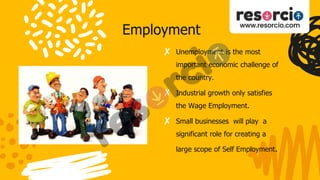
Employment
✘ Unemployment is the most
important economic challenge of
the country.
✘ Industrial growth only satisfies
the Wage Employment.
✘ Small businesses will play a
significant role for creating a
large scope of Self Employment.
Latent Resources
• Small scale industries are capable of washing out hidden and unutilized
resources.
• It presupposes that there are a large number of small and potential
entrepreneurs who are capable of executing industrial units efficiently
if proper help is given to them.
Equality
• A small scale business leads an equitable distribution of produce
of industry.
• The income generated in a large number of small enterprises is
dispersed more widely in a community than income generated in
a few large enterprises.
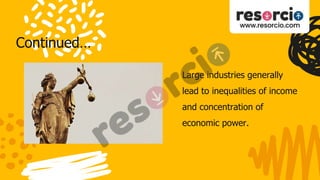
Continued…
Large industries generally
lead to inequalities of income
and concentration of
economic power.
Continued…
• The income benefit of small enterprises is derived by a large
population while large enterprises encourage more concentration of
economic power.
• In this way, small enterprises bring about greater equality of income
distribution.
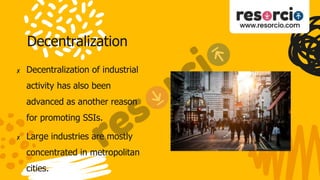
Decentralization
✘ Decentralization of industrial
activity has also been
advanced as another reason
for promoting SSIs.
✘ Large industries are mostly
concentrated in metropolitan
cities.
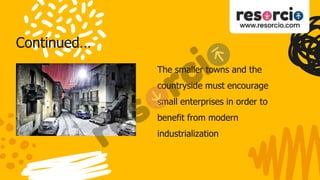
Continued…
The smaller towns and the
countryside must encourage
small enterprises in order to
benefit from modern
industrialization
Decentralization
• Industrialization of the country can become complete only if it is
penetrated into the remote corners of the country.
• Small industries overcome the difficulties of territorial immobility
by carrying the job to the workers.
Financing of of Small
Business
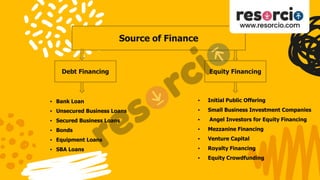
Source of Finance
Debt Financing Equity Financing
▪ Initial Public Offering
▪ Small Business Investment Companies
▪ Angel Investors for Equity Financing
▪ Mezzanine Financing
▪ Venture Capital
▪ Royalty Financing
▪ Equity Crowdfunding
▪ Bank Loan
▪ Unsecured Business Loans
▪ Secured Business Loans
▪ Bonds
▪ Equipment Loans
▪ SBA Loans
Challenges of Small
Business
Major Challenges
✘ General Challenges
✘ Financial Challenges
✘ Government
Challenges
They are:
✘ Shortage of Funds
✘ Lack of Latest
Technology
✘ Shortage of Raw
Materials
✘ Shortage of Power
✘ Labor Problem
Continued..
✘ Marketing Problem
✘ Lack of Managerial
Skills
✘ Lack of Quality
✘ Production Problems
Continued..
✘ Out-Dated
Technology
✘ Poor Project Planning
✘ Inadequate
Infrastructure
✘ Absence of Vertical
Growth
Shortage of Funds:
• Small business entrepreneurs
don’t have enough long- term
or short-term funds.
• These are, therefore, short of
both fixed assets as well as
working capital.
Lack of Latest Technology
• Due to the lack of funds. Latest
technology is not used because it is
expensive.
• Only old methods and techniques
are being used.
• Due to this they earn less margin of
profit.
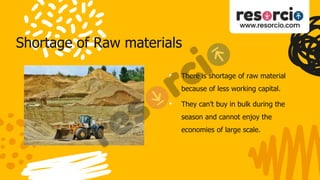
Shortage of Raw materials
• There is shortage of raw material
because of less working capital.
• They can’t buy in bulk during the
season and cannot enjoy the
economies of large scale.
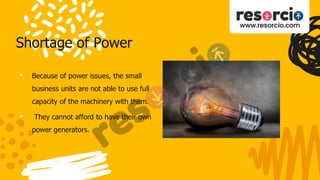
Shortage of Power
• Because of power issues, the small
business units are not able to use full
capacity of the machinery with them.
• They cannot afford to have their own
power generators.
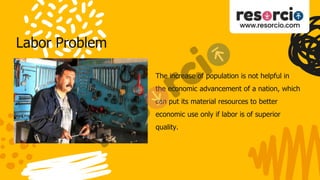
Labor Problem
The increase of population is not helpful in
the economic advancement of a nation, which
can put its material resources to better
economic use only if labor is of superior
quality.
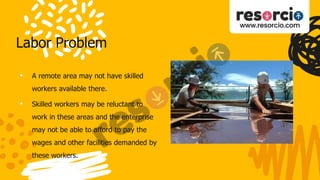
Labor Problem
• A remote area may not have skilled
workers available there.
• Skilled workers may be reluctant to
work in these areas and the enterprise
may not be able to afford to pay the
wages and other facilities demanded by
these workers.
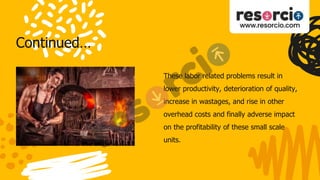
Continued…
These labor related problems result in
lower productivity, deterioration of quality,
increase in wastages, and rise in other
overhead costs and finally adverse impact
on the profitability of these small scale
units.
Marketing Problems
✘ Small business cannot jump into a competition with large scale units
in marketing and selling.
✘ They will not be able to afford spending much on advertising and
proper distribution of goods.
✘ They have to depend on middlemen, who will only pay low prices.
Continued…
• Units with strong marketing set-up grow
better even in tough weather.
• The organizational strategy should be
planned to meet any marketing situation.
Continued…
The marketing problems of the small units
are identified as competition from large-scale
industries, slackness in demand, price
competition and competition from
established brands.
Managerial Skills
• Only individuals or a small group of
people own and operate the small
business units.
• They don’t possess professional
managerial skills required to run a
business successfully.
Quality
• Small business don’t have funds for research in order to improve upon the quality.
• The product quality is their weakest point as compared to the standards of the large
scale units.
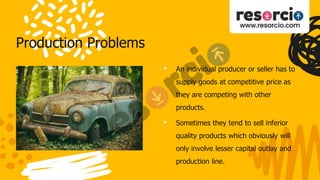
Production Problems
• An individual producer or seller has to
supply goods at competitive price as
they are competing with other
products.
• Sometimes they tend to sell inferior
quality products which obviously will
only involve lesser capital outlay and
production line.
Outdated Technology
• Most of the small scale units depend upon old techniques and equipment.
• Due to limited capacity and capital, they find it very difficult to modernize their plant
and machinery.
• In the absence of modern technology, the quality of products and productivity tend
to be low.
• Cost of production per unit remains high.
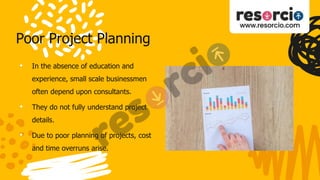
Poor Project Planning
• In the absence of education and
experience, small scale businessmen
often depend upon consultants.
• They do not fully understand project
details.
• Due to poor planning of projects, cost
and time overruns arise.
Inadequate Infrastructure
Lack of quality of basic services
particularly in backward areas is another
problem:
• Bad road conditions
• Instability of voltage
• Unscheduled power cuts
• Long delays in getting power
connections
Absence of vertical Growth
• Lack of ancillarisation and sub-contracting which can help small scale units to grow
with large units
• Small Scale Industrial Policies has not identified the industries which are suitable for
ancillarisation and subcontracting to exploit economies of scale and to enhance the
competitiveness of small scale units.
2. Financial Challenges
Summary
• Industrial finance has been one of the most important problems of the small scale
industrial producers who require short-term and medium-term finance to meet their
business obligations.
• The success of the small-scale producers is largely affected by their ability to arrange
adequate money in time.
The Challenges are:
✘ Lack of Sources for Finance other than Capital
✘ Acquiring Loans
✘ Inter-Sectorial Payments
✘ Bank Credit
✘ Lack of Strategies for MSMEs in a Rapidly Changing Macroeconomic
Environment
Lack of other sources of finance
Most of the small enterprises see shortage of finance or capital as the most important
factor responsible to start a problem. They depend on two kinds of capital
a. equity or own capital
b. borrowed (capital consisting of – (a) long term capital for investment in equipment
and other capital assets, and (b) short-term capital to meet current needs of the
industry)
Acquiring Loans
• Banks always prefer industries who could repay regularly without failure and small
units fail to repay on time.
• It is hard for small units to get loans and therefore, there is hardly any profit that can
be reinvested in future.
• Most of the small units remain small due to lack of profits to plough back.
Intersectoral Payments
• One of the major problems of the smaller industrial units is that the smaller the unit,
the larger their problem is in collecting the receivables their clients owe.
• This is true with the government (Central and State) projects also.
Bank Credits
Most of the private banks are reluctant
to lend to small units as this segment
has high non-performing assets
(NPAs).
Strategies for MSMEs
• The economical and political scenario is not steady and will change rapidly every few
years and MSMEs have to prepare themselves to face the turbulence.
• Dealing with these problems is easier when one's survival kit already has developed
optimal strategies for their operations.
• But most of the times many SMEs doesn't have that kind of strategy.
3. Government Policies
Challenges due to Government Policies
✘ Policy as a Market Catalyst
✘ Political Stability and Political Culture
✘ Government Taxation and Spending
✘ Regulations and Permits
Policy as a Market Catalyst
• The Government doesn’t have stable policies for MSMEs.
• They need to build policies that will help them to become a catalyst in the market and
therefore get the prominence they need in the society.
Political Stability and Political Culture
• The governments that come and go have different political opinions and would not
therefore stick onto the policies implemented by the latter.
• Political stability always affects the policy stability.
Government Taxation and Spending
Liberal Tax policies for MSMEs will surely help them, but the governments needs to
provide relaxations in taxes for small business industries which happens in only certain
industries but not to all.
Regulations and Permits
• Regulations and permits for certain industries are also not achievable in an easy
manner but has to go through many red tapes before it could be achieved.
• This situation makes it hard for starters and often causes a negative vibe.
Thank You

Challenges of Small Businesses

  • 1.
  • 2.
    Introduction  Business whichfunctions on a small scale level is called Small Business.  Less Capital Investment, less labor cost and less infrastructures are the main features of Small Business.  In small business, the production of goods and services are functioning through private owned corporations, partnerships or sole proprietorships.
  • 3.
    “ “A small business,is one marked by a limited number of employees and a limited flow of finances and materials.” -Unknown
  • 4.
  • 5.
    Profit and Revenue ✘Revenue of small-scale business is lesser than medium and large scale businesses. ✘ Lower revenue is not a measuring scale of lower profitability.
  • 6.
    Team of Employees ✘In Small business, the team of employees are smaller than larger scale business ventures. ✘ The small scale businesses are operated by single individuals or small teams.
  • 7.
    Market Area ✘ Themarket area of a small businesses is smaller than corporations and private companies. ✘ The small scale business units perform in local areas or communities and will be growing their scale of operations there.
  • 8.
    Ownership and Taxes Theownership of a small scale business are of different types:  Proprietorships  Partnerships or limited liability companies They are taxed using different methods.
  • 9.
    Continued… These types ofbusinesses provide the higher level of managerial control for many company owners, while minimizing the expense of business registration.
  • 10.
    Continued… The institution ownerscan report business income and expenses on their personal tax returns.
  • 11.
    Limited Area ✘ Thesecompanies need no sales outlets in multiple states or countries. ✘ They can operate from a single office, retail store or service outlet. ✘ It is possible to run a small business directly from home, without any company infrastructures making it less complex.
  • 12.
    Types of SmallBusiness ✘ Small Scale Industry (Before 2006) ✘ Ancillary Small Industrial Unit ✘ Export Oriented Units ✘ Small Scale Industries Owned by Women ✘ Tiny Industrial Units
  • 13.
    Continued… ✘ Small ScaleService and Business ✘ Micro Business Enterprises ✘ Village Industries ✘ Cottage Industries
  • 14.
    Scope of SmallBusiness ✘ Manufacturing sectors ✘ Servicing/repairing sectors ✘ Retailing sectors ✘ Financial sectors
  • 15.
    Scope of SmallBusiness ✘ Whole-sale sectors ✘ Construction sectors ✘ Infrastructural sectors like transport, communication, etc.
  • 16.
    Objectives of SmallBusiness ✘ To generate large employment opportunities but with low investment ✘ Reducing unemployment to a certain extent ✘ Spreading the business units into small towns, villages and economically slow regions
  • 17.
    Objectives of SmallBusiness ✘ Helps in a much more balanced regional development ✘ It assures that the national income is distributed equally ✘ It will help in promoting the mobilization of resources ✘ It will help to improve the standard of living of people associated with it
  • 18.
    Importance of SmallBusiness ✘ Small businesses play an important role in competition and challenge the economic power of large companies. ✘ Small business units provide more choice to the consumer. ✘ Large ventures are concentrated in mass market, but smaller firms can satisfy specialized needs.
  • 19.
    Importance of SmallBusiness ✘ Expands the distribution of economic strength ✘ Expands the development in local areas ✘ They are sources of innovation and creativity ✘ Provide large scale of employment ✘ Provide the ancillary support to large industries
  • 20.
    Role of SmallBusiness
  • 21.
    They Promote: ✘ Employment ✘Latent Resources ✘ Equality ✘ Decentralization
  • 22.
    Employment ✘ Unemployment isthe most important economic challenge of the country. ✘ Industrial growth only satisfies the Wage Employment. ✘ Small businesses will play a significant role for creating a large scope of Self Employment.
  • 23.
    Latent Resources • Smallscale industries are capable of washing out hidden and unutilized resources. • It presupposes that there are a large number of small and potential entrepreneurs who are capable of executing industrial units efficiently if proper help is given to them.
  • 24.
    Equality • A smallscale business leads an equitable distribution of produce of industry. • The income generated in a large number of small enterprises is dispersed more widely in a community than income generated in a few large enterprises.
  • 25.
    Continued… Large industries generally leadto inequalities of income and concentration of economic power.
  • 26.
    Continued… • The incomebenefit of small enterprises is derived by a large population while large enterprises encourage more concentration of economic power. • In this way, small enterprises bring about greater equality of income distribution.
  • 27.
    Decentralization ✘ Decentralization ofindustrial activity has also been advanced as another reason for promoting SSIs. ✘ Large industries are mostly concentrated in metropolitan cities.
  • 28.
    Continued… The smaller townsand the countryside must encourage small enterprises in order to benefit from modern industrialization
  • 29.
    Decentralization • Industrialization ofthe country can become complete only if it is penetrated into the remote corners of the country. • Small industries overcome the difficulties of territorial immobility by carrying the job to the workers.
  • 30.
    Financing of ofSmall Business
  • 31.
    Source of Finance DebtFinancing Equity Financing ▪ Initial Public Offering ▪ Small Business Investment Companies ▪ Angel Investors for Equity Financing ▪ Mezzanine Financing ▪ Venture Capital ▪ Royalty Financing ▪ Equity Crowdfunding ▪ Bank Loan ▪ Unsecured Business Loans ▪ Secured Business Loans ▪ Bonds ▪ Equipment Loans ▪ SBA Loans
  • 32.
  • 33.
    Major Challenges ✘ GeneralChallenges ✘ Financial Challenges ✘ Government Challenges
  • 35.
    They are: ✘ Shortageof Funds ✘ Lack of Latest Technology ✘ Shortage of Raw Materials ✘ Shortage of Power ✘ Labor Problem
  • 36.
    Continued.. ✘ Marketing Problem ✘Lack of Managerial Skills ✘ Lack of Quality ✘ Production Problems
  • 37.
    Continued.. ✘ Out-Dated Technology ✘ PoorProject Planning ✘ Inadequate Infrastructure ✘ Absence of Vertical Growth
  • 38.
    Shortage of Funds: •Small business entrepreneurs don’t have enough long- term or short-term funds. • These are, therefore, short of both fixed assets as well as working capital.
  • 39.
    Lack of LatestTechnology • Due to the lack of funds. Latest technology is not used because it is expensive. • Only old methods and techniques are being used. • Due to this they earn less margin of profit.
  • 40.
    Shortage of Rawmaterials • There is shortage of raw material because of less working capital. • They can’t buy in bulk during the season and cannot enjoy the economies of large scale.
  • 41.
    Shortage of Power •Because of power issues, the small business units are not able to use full capacity of the machinery with them. • They cannot afford to have their own power generators.
  • 42.
    Labor Problem The increaseof population is not helpful in the economic advancement of a nation, which can put its material resources to better economic use only if labor is of superior quality.
  • 43.
    Labor Problem • Aremote area may not have skilled workers available there. • Skilled workers may be reluctant to work in these areas and the enterprise may not be able to afford to pay the wages and other facilities demanded by these workers.
  • 44.
    Continued… These labor relatedproblems result in lower productivity, deterioration of quality, increase in wastages, and rise in other overhead costs and finally adverse impact on the profitability of these small scale units.
  • 45.
    Marketing Problems ✘ Smallbusiness cannot jump into a competition with large scale units in marketing and selling. ✘ They will not be able to afford spending much on advertising and proper distribution of goods. ✘ They have to depend on middlemen, who will only pay low prices.
  • 46.
    Continued… • Units withstrong marketing set-up grow better even in tough weather. • The organizational strategy should be planned to meet any marketing situation.
  • 47.
    Continued… The marketing problemsof the small units are identified as competition from large-scale industries, slackness in demand, price competition and competition from established brands.
  • 48.
    Managerial Skills • Onlyindividuals or a small group of people own and operate the small business units. • They don’t possess professional managerial skills required to run a business successfully.
  • 49.
    Quality • Small businessdon’t have funds for research in order to improve upon the quality. • The product quality is their weakest point as compared to the standards of the large scale units.
  • 50.
    Production Problems • Anindividual producer or seller has to supply goods at competitive price as they are competing with other products. • Sometimes they tend to sell inferior quality products which obviously will only involve lesser capital outlay and production line.
  • 51.
    Outdated Technology • Mostof the small scale units depend upon old techniques and equipment. • Due to limited capacity and capital, they find it very difficult to modernize their plant and machinery. • In the absence of modern technology, the quality of products and productivity tend to be low. • Cost of production per unit remains high.
  • 52.
    Poor Project Planning •In the absence of education and experience, small scale businessmen often depend upon consultants. • They do not fully understand project details. • Due to poor planning of projects, cost and time overruns arise.
  • 53.
    Inadequate Infrastructure Lack ofquality of basic services particularly in backward areas is another problem: • Bad road conditions • Instability of voltage • Unscheduled power cuts • Long delays in getting power connections
  • 54.
    Absence of verticalGrowth • Lack of ancillarisation and sub-contracting which can help small scale units to grow with large units • Small Scale Industrial Policies has not identified the industries which are suitable for ancillarisation and subcontracting to exploit economies of scale and to enhance the competitiveness of small scale units.
  • 55.
  • 56.
    Summary • Industrial financehas been one of the most important problems of the small scale industrial producers who require short-term and medium-term finance to meet their business obligations. • The success of the small-scale producers is largely affected by their ability to arrange adequate money in time.
  • 57.
    The Challenges are: ✘Lack of Sources for Finance other than Capital ✘ Acquiring Loans ✘ Inter-Sectorial Payments ✘ Bank Credit ✘ Lack of Strategies for MSMEs in a Rapidly Changing Macroeconomic Environment
  • 58.
    Lack of othersources of finance Most of the small enterprises see shortage of finance or capital as the most important factor responsible to start a problem. They depend on two kinds of capital a. equity or own capital b. borrowed (capital consisting of – (a) long term capital for investment in equipment and other capital assets, and (b) short-term capital to meet current needs of the industry)
  • 59.
    Acquiring Loans • Banksalways prefer industries who could repay regularly without failure and small units fail to repay on time. • It is hard for small units to get loans and therefore, there is hardly any profit that can be reinvested in future. • Most of the small units remain small due to lack of profits to plough back.
  • 60.
    Intersectoral Payments • Oneof the major problems of the smaller industrial units is that the smaller the unit, the larger their problem is in collecting the receivables their clients owe. • This is true with the government (Central and State) projects also.
  • 61.
    Bank Credits Most ofthe private banks are reluctant to lend to small units as this segment has high non-performing assets (NPAs).
  • 62.
    Strategies for MSMEs •The economical and political scenario is not steady and will change rapidly every few years and MSMEs have to prepare themselves to face the turbulence. • Dealing with these problems is easier when one's survival kit already has developed optimal strategies for their operations. • But most of the times many SMEs doesn't have that kind of strategy.
  • 63.
  • 64.
    Challenges due toGovernment Policies ✘ Policy as a Market Catalyst ✘ Political Stability and Political Culture ✘ Government Taxation and Spending ✘ Regulations and Permits
  • 65.
    Policy as aMarket Catalyst • The Government doesn’t have stable policies for MSMEs. • They need to build policies that will help them to become a catalyst in the market and therefore get the prominence they need in the society.
  • 66.
    Political Stability andPolitical Culture • The governments that come and go have different political opinions and would not therefore stick onto the policies implemented by the latter. • Political stability always affects the policy stability.
  • 67.
    Government Taxation andSpending Liberal Tax policies for MSMEs will surely help them, but the governments needs to provide relaxations in taxes for small business industries which happens in only certain industries but not to all.
  • 68.
    Regulations and Permits •Regulations and permits for certain industries are also not achievable in an easy manner but has to go through many red tapes before it could be achieved. • This situation makes it hard for starters and often causes a negative vibe.
  • 69.