Turning Research into Papers:
Navigating the Writing & Publishing
Journey
A practical seminar for Academic Publishing
• Aniruddha Maram – Chief Executive Officer
• Aravind Ganessin – Managing Director
Dextrose Technologies Pvt. Ltd.
Original Research Writing • Publication Pathways
Session outline
 Why is publishing challenging?
 Basics of scientific article structure (IMRaD) — clear and
superficial but useful
 Common mistakes and quick fixes
 Publication assistance services: what we offer and how it helps
Why is publishing challenging
Context before craft
The Reality for Student Authors
 Balancing research, course work, and writing time is tough
 High rejection rates and opaque feedback processes
 Uncertainty around journal selection and scope fit
 Formatting & language issues delaying review
 Lack of pre-submission peer review or mentorship
Top Pain Points in Research Institutes
 Lack of mentorship on writing
 Language and formatting issues
 Journal selection confusion
 Rejection fatigue
 No pre submission peer review
‑
Basics of research article structure
IMRaD without the pain
IMRaD at a Glance
 Title & Keywords → Accurate, searchable, concise
 Abstract → 150–300 words; what was done, why, how, and key
results
 Introduction → WHY the study matters + what gap you’re
addressing
 Methods → What you did, so others can reproduce it
 Results → What you found, without interpretation
 Discussion/Conclusion → What it means, limitations, next
steps
Title, Abstract & Keywords — Quick Wins
 Title: Specific + informative; avoid abbreviations, jargon and
claims
 Abstract: Single paragraph or structured; stick to essentials
(aim, methods, core results, and conclusion)
 Keywords: Use field standard terms to improve discoverability
‑
Introduction — Answer the WHY
 Open with importance of the problem
 Summarize what is already known (briefly)
 Identify the gap or problem your study addresses (novelty)
 End with the explicit aim/objective of your study
Methods — Make It Reproducible
 Describe materials, organisms, and procedures in logical order
 Detail experimental design: controls, variables, sample size
 State statistical tests and alpha level (e.g., 0.05)
 Include manufacturer details where pertinent (e.g., instrument
model, city)
 Should be concise but include all critical information for
reproducibility
Methods — Example
 Avoid: The petri dish was placed on the turntable. The lid was
then raised slightly. An inoculating loop was used to transfer
culture to the agar surface. The turntable was rotated 90
degrees by hand. The loop was moved lightly back and forth
over the agar to spread the culture. The bacteria were then
incubated at 37° C for 24 hr.
 Better: Each plate was placed on a turntable and streaked at
opposing angles with fresh overnight E. coli culture using an
inoculating loop. The bacteria were then incubated at 37° C for
24 hr.
 Ideal: Each plate was streaked with fresh overnight E. coli
culture and incubated at 37° C for 24 h.
Results — Present, Don’t Interpret
 Report findings in a logical sequence guided by tables/figures
 Summarize statistics clearly (mean ± SD for normal; median
[IQR] for skewed)
 Report important negative results as well
 Keep interpretation for the Discussion
Discussion & Conclusion — Make Sense of It
 Interpret results in the context of existing literature
 Explain what’s new and why it matters
 Acknowledge limitations and propose next steps
 Conclusion: concise take home message; avoid repeating the
‑
abstract
Figures, Tables & Data — Essentials
• Design for clarity: readable
labels, units on axes,
consistent scales
• Figure legends tell a
mini story (what/where/how)
‑
• Tables for exact values; figures
for trends and comparisons
• Report p values with effect
‑
sizes where possible
• Follow journal image
guidelines (resolution,
formats)
• Data availability statements
and basic FAIR practices
Ethics & Transparency (Checklist)
 IRB/IEC approvals and consent where applicable
 Trial registration/reporting guidelines (e.g., CONSORT, PRISMA)
 Authorship criteria, conflicts of interest
 Acknowledgements, funding, ORCID IDs
Writing plan
 Brainstorm, structure, and restructure the content.
 Write the Methods.
 Draft the Results.
 Write the Discussion.
 Write a clear and succinct concluding remark.
 Write the Introduction.
 Add a concise abstract (200-300 words).
 Add the title.
Common mistakes & quick fixes
What to avoid — and how
Language & Style — Quick Fixes
• Overuse of passive voice;
write active where clearer
• Ambiguous terms; define all
abbreviations on first use
• Inconsistent tense: present
for general facts; past for your
work
• Wordy sentences — aim for
brevity and precision
• Numbers/units: two
significant digits unless
needed; unit after error value
(10 ± 2.3 m)
• Avoid percentages for tiny
samples (‘two of four’ not
50%)
• Inclusive language:
person first, accurate
‑
terminology
• Proofread with tools +
colleague review
Academic conventions: Common errors ace
• Formal language: Introductory words, contractions, personal
pronouns,
• Abbreviations
• Numbers
• Tense
• Common errors: “which” vs “that”, “alternate” vs “alternative”,
“comprise of”
• Serial comma
• Comma splice
Structure & Submission — Quick Fixes
• Mismatch with journal scope
or instructions
• Missing key sections or poor
figure/table referencing
• Lack of narrative flow
(jumping between ideas)
• Insufficient description in
Methods to reproduce
• Journal selection: match
aims/scope and audience
• Cover letter: state novelty and
fit in 4–6 sentences
• Pre submission checks:
‑
conflicts, ethics, data
statements
• Ask for a pre submission
‑
review from a peer/mentor
Publication assistance services
How Dextrose can help
How We Help
 End to end assistance from draft to submission
‑ ‑
 Subject matter expert editors and statisticians
‑
 Journal targeting and scope fit guidance
‑
 Reviewer style feedback before submission
‑
 Campus workshops and mentorship programs
Services we offer (Typical TAT, 3–4 Weeks)
 End-to-end publication support
 Research article writing assistance
 Review article writing assistance
 Statistical analysis
 Systematic review assistance
 Case report (short articles) writing
assistance
 Thesis writing assistance
 Thesis-to-paper conversion
assistance
 Paraphrasing services (per word)
 Proofreading
 In-depth editing
 Formatting
 Poster designing (conferences, etc.)
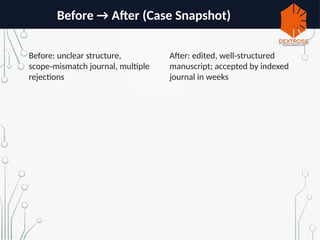
Before → After (Case Snapshot)
Before: unclear structure,
scope mismatch journal, multiple
‑
rejections
After: edited, well structured
‑
manuscript; accepted by indexed
journal in weeks
Testimony
Dear Dextrose Team,
Greetings!
As a researcher, I had valuable data but struggled to transform it into a presentable manuscript suitable for
submitting to a journal for publication. The professional publication assistance team, particularly Mr. Arjun,
helped me to refine the structure, improve the clarity of my arguments, and align the information to convert it
to a manuscript with the target journal’s requirements. Their attention to detail, grammar and flow, formatting
and reference style, everything was outstanding and commendable.
I also got many research and manuscript improvement inputs from Mr. Arjun, which I am sure, has improved
my manuscript considerably.
Thanks to the team’s support, now my paper was accepted by a peer-reviewed journal.
While expressing my sincere appreciation and gratitude, I highly recommend their services to any scientist
who wants to focus on research while ensuring his work gets the visibility it deserves.
Thanking you,
Best Regards,
G. Mohamed Arif
Partner with Dextrose
 On campus starter workshop for students
‑
 Additional institutional discounts for group submissions
Thank You — Let’s Get Your Work Published
Arjun • arjun@dextrosetech.com
Dextrose Technologies—Research Editing & Publication Support
Your research deserves to be read.

Scientific Writing Seminar Redesigned

  • 1.
    Turning Research intoPapers: Navigating the Writing & Publishing Journey A practical seminar for Academic Publishing • Aniruddha Maram – Chief Executive Officer • Aravind Ganessin – Managing Director Dextrose Technologies Pvt. Ltd. Original Research Writing • Publication Pathways
  • 2.
    Session outline  Whyis publishing challenging?  Basics of scientific article structure (IMRaD) — clear and superficial but useful  Common mistakes and quick fixes  Publication assistance services: what we offer and how it helps
  • 3.
    Why is publishingchallenging Context before craft
  • 4.
    The Reality forStudent Authors  Balancing research, course work, and writing time is tough  High rejection rates and opaque feedback processes  Uncertainty around journal selection and scope fit  Formatting & language issues delaying review  Lack of pre-submission peer review or mentorship
  • 5.
    Top Pain Pointsin Research Institutes  Lack of mentorship on writing  Language and formatting issues  Journal selection confusion  Rejection fatigue  No pre submission peer review ‑
  • 6.
    Basics of researcharticle structure IMRaD without the pain
  • 7.
    IMRaD at aGlance  Title & Keywords → Accurate, searchable, concise  Abstract → 150–300 words; what was done, why, how, and key results  Introduction → WHY the study matters + what gap you’re addressing  Methods → What you did, so others can reproduce it  Results → What you found, without interpretation  Discussion/Conclusion → What it means, limitations, next steps
  • 8.
    Title, Abstract &Keywords — Quick Wins  Title: Specific + informative; avoid abbreviations, jargon and claims  Abstract: Single paragraph or structured; stick to essentials (aim, methods, core results, and conclusion)  Keywords: Use field standard terms to improve discoverability ‑
  • 9.
    Introduction — Answerthe WHY  Open with importance of the problem  Summarize what is already known (briefly)  Identify the gap or problem your study addresses (novelty)  End with the explicit aim/objective of your study
  • 10.
    Methods — MakeIt Reproducible  Describe materials, organisms, and procedures in logical order  Detail experimental design: controls, variables, sample size  State statistical tests and alpha level (e.g., 0.05)  Include manufacturer details where pertinent (e.g., instrument model, city)  Should be concise but include all critical information for reproducibility
  • 11.
    Methods — Example Avoid: The petri dish was placed on the turntable. The lid was then raised slightly. An inoculating loop was used to transfer culture to the agar surface. The turntable was rotated 90 degrees by hand. The loop was moved lightly back and forth over the agar to spread the culture. The bacteria were then incubated at 37° C for 24 hr.  Better: Each plate was placed on a turntable and streaked at opposing angles with fresh overnight E. coli culture using an inoculating loop. The bacteria were then incubated at 37° C for 24 hr.  Ideal: Each plate was streaked with fresh overnight E. coli culture and incubated at 37° C for 24 h.
  • 12.
    Results — Present,Don’t Interpret  Report findings in a logical sequence guided by tables/figures  Summarize statistics clearly (mean ± SD for normal; median [IQR] for skewed)  Report important negative results as well  Keep interpretation for the Discussion
  • 13.
    Discussion & Conclusion— Make Sense of It  Interpret results in the context of existing literature  Explain what’s new and why it matters  Acknowledge limitations and propose next steps  Conclusion: concise take home message; avoid repeating the ‑ abstract
  • 14.
    Figures, Tables &Data — Essentials • Design for clarity: readable labels, units on axes, consistent scales • Figure legends tell a mini story (what/where/how) ‑ • Tables for exact values; figures for trends and comparisons • Report p values with effect ‑ sizes where possible • Follow journal image guidelines (resolution, formats) • Data availability statements and basic FAIR practices
  • 15.
    Ethics & Transparency(Checklist)  IRB/IEC approvals and consent where applicable  Trial registration/reporting guidelines (e.g., CONSORT, PRISMA)  Authorship criteria, conflicts of interest  Acknowledgements, funding, ORCID IDs
  • 16.
    Writing plan  Brainstorm,structure, and restructure the content.  Write the Methods.  Draft the Results.  Write the Discussion.  Write a clear and succinct concluding remark.  Write the Introduction.  Add a concise abstract (200-300 words).  Add the title.
  • 17.
    Common mistakes &quick fixes What to avoid — and how
  • 18.
    Language & Style— Quick Fixes • Overuse of passive voice; write active where clearer • Ambiguous terms; define all abbreviations on first use • Inconsistent tense: present for general facts; past for your work • Wordy sentences — aim for brevity and precision • Numbers/units: two significant digits unless needed; unit after error value (10 ± 2.3 m) • Avoid percentages for tiny samples (‘two of four’ not 50%) • Inclusive language: person first, accurate ‑ terminology • Proofread with tools + colleague review
  • 19.
    Academic conventions: Commonerrors ace • Formal language: Introductory words, contractions, personal pronouns, • Abbreviations • Numbers • Tense • Common errors: “which” vs “that”, “alternate” vs “alternative”, “comprise of” • Serial comma • Comma splice
  • 20.
    Structure & Submission— Quick Fixes • Mismatch with journal scope or instructions • Missing key sections or poor figure/table referencing • Lack of narrative flow (jumping between ideas) • Insufficient description in Methods to reproduce • Journal selection: match aims/scope and audience • Cover letter: state novelty and fit in 4–6 sentences • Pre submission checks: ‑ conflicts, ethics, data statements • Ask for a pre submission ‑ review from a peer/mentor
  • 21.
  • 22.
    How We Help End to end assistance from draft to submission ‑ ‑  Subject matter expert editors and statisticians ‑  Journal targeting and scope fit guidance ‑  Reviewer style feedback before submission ‑  Campus workshops and mentorship programs
  • 23.
    Services we offer(Typical TAT, 3–4 Weeks)  End-to-end publication support  Research article writing assistance  Review article writing assistance  Statistical analysis  Systematic review assistance  Case report (short articles) writing assistance  Thesis writing assistance  Thesis-to-paper conversion assistance  Paraphrasing services (per word)  Proofreading  In-depth editing  Formatting  Poster designing (conferences, etc.)
  • 24.
    Before → After(Case Snapshot) Before: unclear structure, scope mismatch journal, multiple ‑ rejections After: edited, well structured ‑ manuscript; accepted by indexed journal in weeks
  • 25.
    Testimony Dear Dextrose Team, Greetings! Asa researcher, I had valuable data but struggled to transform it into a presentable manuscript suitable for submitting to a journal for publication. The professional publication assistance team, particularly Mr. Arjun, helped me to refine the structure, improve the clarity of my arguments, and align the information to convert it to a manuscript with the target journal’s requirements. Their attention to detail, grammar and flow, formatting and reference style, everything was outstanding and commendable. I also got many research and manuscript improvement inputs from Mr. Arjun, which I am sure, has improved my manuscript considerably. Thanks to the team’s support, now my paper was accepted by a peer-reviewed journal. While expressing my sincere appreciation and gratitude, I highly recommend their services to any scientist who wants to focus on research while ensuring his work gets the visibility it deserves. Thanking you, Best Regards, G. Mohamed Arif
  • 26.
    Partner with Dextrose On campus starter workshop for students ‑  Additional institutional discounts for group submissions
  • 27.
    Thank You —Let’s Get Your Work Published Arjun • arjun@dextrosetech.com Dextrose Technologies—Research Editing & Publication Support Your research deserves to be read.

Editor's Notes

  • #1 Welcome everyone. Today we'll cover the mechanics of writing an original research article at a practical, useful level, then I’ll share a concise overview of publication assistance services we offer.
  • #2 Set expectations: this is not a deep writing workshop; we’ll focus on what matters for students to get started and avoid common pitfalls.
  • #3 Frame the problem first so students see the value of structure and support.
  • #4 Explain that these are common and not a reflection of ability. Normalize the struggle; connect it to why a process helps.
  • #5 Highlight that these are solvable with structure, tools, and the right support.
  • #6 We’ll do a quick tour through IMRaD — enough to write a solid first draft.
  • #7 Explain the purpose of each section, emphasizing clarity and reproducibility.
  • #8 Students often over‑promise in titles and over‑stuff abstracts. Keep it precise and honest.
  • #9 A good introduction funnels from broad context to the specific research question. Keep it tight and relevant.
  • #10 Emphasize clarity and completeness. Another lab should be able to replicate your work from the description.
  • #11 Emphasize clarity and completeness. Another lab should be able to replicate your work from the description.
  • #12 Encourage visual storytelling with well‑designed figures and minimal text clutter.
  • #13 Tie back to the research question; avoid meandering literature reviews in the discussion.
  • #14 Students often neglect figure quality; stress that visuals are often the first thing reviewers scan.
  • #15 A quick compliance checklist reduces post‑submission delays and protects research integrity.
  • #16 A quick compliance checklist reduces post‑submission delays and protects research integrity.
  • #17 Give students time‑saving fixes they can act on immediately.
  • #18 These fixes come up in most reviews; adopting them lifts perceived quality immediately.
  • #19 These fixes come up in most reviews; adopting them lifts perceived quality immediately.
  • #20 Encourage students to use the journal’s author guidelines as a pre‑submission checklist.
  • #21 Transition to services with a focus on solving the challenges we just discussed.
  • #22 Briefly describe each offering and how it maps to specific pain points students face.
  • #23 Adapt timelines to student schedules. Stress transparency and clear deliverables.
  • #24 Use a short anonymized example to show tangible outcomes; emphasize improved clarity and fit, not guaranteed acceptance.
  • #25 Transition to services with a focus on solving the challenges we just discussed.
  • #26 Invite departments to schedule workshops; share how to get started today.
  • #27 End confidently; invite questions.