The Numbers
in Nonfiction
We have learned the
recipe for making a
nonfiction call number.

  numbers (for the subject)
first three letters of
the author’s last name
Now let’s learn more
about the numbers in
  a nonfiction call
      number.

How do we know
  what number goes
 with each subject ?
By using something cool called
 The Dewey Decimal
     System !!
The Dewey Decimal
System is a tool used
  to sort books into
     groups or
     categories
This system was
  invented by a man
named Melvil Dewey.
        He was a
        librarian who
        lived long ago.
Sorting books by
subject, what a
brilliant idea!!


I think I’ve got it !!
10 general groups
for sorting all of the
      subjects
  General means broad,
 lots of subjects will fit
     into each group.
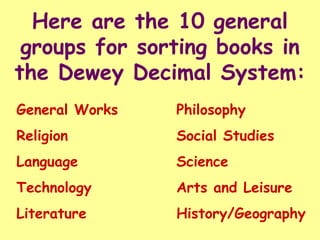
Here are the 10 general
 groups for sorting books in
the Dewey Decimal System:
General Works   Philosophy
Religion        Social Studies
Language        Science
Technology      Arts and Leisure
Literature      History/Geography
This seems like a
lot to remember,
 but don’t worry
 you’ll learn it all
quickly.
 So let’s get going !!!!
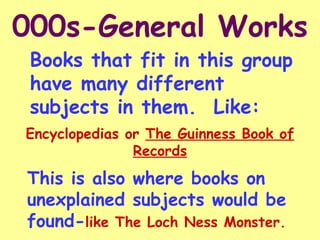
000s-General Works
 Books that fit in this group
 have many different
 subjects in them. Like:
Encyclopedias or The Guinness Book of
               Records

This is also where books on
unexplained subjects would be
found-like The Loch Ness Monster.
100s-Philosophy
Books that fit in this group
tell about how we think and
feel.
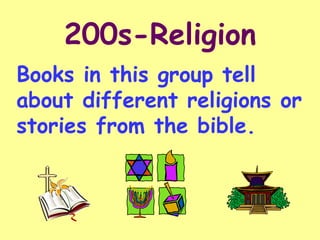
200s-Religion
Books in this group tell
about different religions or
stories from the bible.
300s-Social Studies
 Books in this group tell
  about how people live
        together.


holidays and customs
government, military
Fairy tales and folk tales
are also placed in the 300s.
  Many were written to teach a
  lesson about behavior and..

 That’s social studies.
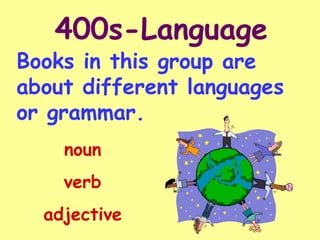
400s-Language
Books in this group are
about different languages
or grammar.
    noun
    verb
  adjective
500s-Science
 Books in this group are
about things from nature.
600s-Technology
This group has books that are
about man-made things.
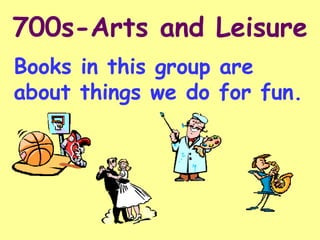
700s-Arts and Leisure
Books in this group are
about things we do for fun.
800s-Literature
 Books in this group are
stories, plays, or poetry.
This is the group fiction
books were put in long ago
when The Dewey Decimal
System was first invented.
Today we have too many
fiction books in our
libraries to organize them
in this way, so fiction
books have their own way
of being organized.
You know, in ABC order, by
         author !
900s-
 History/Geography
Books in this group tell
about events of the past
and countries of the world.
Biography- 92
Don’t forget this group.
It contains books about
famous people’s lives.
Knowing these big
groups will help make
it easier to find the
books you want in the
nonfiction section.
Remember, nonfiction call
numbers are placed in
number order first, so
that means all of the
books about the same
subject end up near each
other on the shelf.
That’s Smart !!!!
Let’s See What You’ve
       Learned

 Call numbers
  help us find
 the books we
want to read !!!
1. What is the recipe
for a nonfiction call
number?
Numbers   (for the subject)

First three letters in
the author’s last name
2. What system tells us
what numbers go with
each subject?

Dewey Decimal System
3. Who is responsible
for inventing the Dewey
Decimal System?

    Melvil Dewey
4. Mr. Dewey matched
 a number with each
 _____________.
b) author
c) subject
d) title
5. All school libraries
 use the Dewey
 Decimal System.
b) false
c) true

Deweydecimal

  • 1.
  • 2.
    We have learnedthe recipe for making a nonfiction call number. numbers (for the subject) first three letters of the author’s last name

  • 3.
    Now let’s learnmore about the numbers in a nonfiction call number.

  • 4.
    How do weknow what number goes with each subject ? By using something cool called The Dewey Decimal System !!
  • 5.
    The Dewey Decimal Systemis a tool used to sort books into groups or categories
  • 6.
    This system was invented by a man named Melvil Dewey. He was a librarian who lived long ago.
  • 7.
    Sorting books by subject,what a brilliant idea!! I think I’ve got it !!
  • 8.
    10 general groups forsorting all of the subjects General means broad, lots of subjects will fit into each group.
  • 9.
    Here are the10 general groups for sorting books in the Dewey Decimal System: General Works Philosophy Religion Social Studies Language Science Technology Arts and Leisure Literature History/Geography
  • 10.
    This seems likea lot to remember, but don’t worry you’ll learn it all quickly. So let’s get going !!!!
  • 11.
    000s-General Works Booksthat fit in this group have many different subjects in them. Like: Encyclopedias or The Guinness Book of Records This is also where books on unexplained subjects would be found-like The Loch Ness Monster.
  • 12.
    100s-Philosophy Books that fitin this group tell about how we think and feel.
  • 13.
    200s-Religion Books in thisgroup tell about different religions or stories from the bible.
  • 14.
    300s-Social Studies Booksin this group tell about how people live together. holidays and customs government, military
  • 15.
    Fairy tales andfolk tales are also placed in the 300s. Many were written to teach a lesson about behavior and.. That’s social studies.
  • 16.
    400s-Language Books in thisgroup are about different languages or grammar. noun verb adjective
  • 17.
    500s-Science Books inthis group are about things from nature.
  • 18.
    600s-Technology This group hasbooks that are about man-made things.
  • 19.
    700s-Arts and Leisure Booksin this group are about things we do for fun.
  • 20.
    800s-Literature Books inthis group are stories, plays, or poetry. This is the group fiction books were put in long ago when The Dewey Decimal System was first invented.
  • 21.
    Today we havetoo many fiction books in our libraries to organize them in this way, so fiction books have their own way of being organized. You know, in ABC order, by author !
  • 22.
    900s- History/Geography Books inthis group tell about events of the past and countries of the world.
  • 23.
    Biography- 92 Don’t forgetthis group. It contains books about famous people’s lives.
  • 24.
    Knowing these big groupswill help make it easier to find the books you want in the nonfiction section.
  • 25.
    Remember, nonfiction call numbersare placed in number order first, so that means all of the books about the same subject end up near each other on the shelf. That’s Smart !!!!
  • 26.
    Let’s See WhatYou’ve Learned Call numbers help us find the books we want to read !!!
  • 27.
    1. What isthe recipe for a nonfiction call number? Numbers (for the subject) First three letters in the author’s last name
  • 28.
    2. What systemtells us what numbers go with each subject? Dewey Decimal System
  • 29.
    3. Who isresponsible for inventing the Dewey Decimal System? Melvil Dewey
  • 30.
    4. Mr. Deweymatched a number with each _____________. b) author c) subject d) title
  • 31.
    5. All schoollibraries use the Dewey Decimal System. b) false c) true

Editor's Notes

  • #8 In Melvil’s day there was no set way for library books to be organized. This made it hard for people to find the books they wanted, so Melvil started thinking and came up with a brilliant idea!!
  • #9 He decided it would make it easier to find books if they were grouped by subject, so first he came up with 10 general groups to use for sorting all subjects.
  • #22 Today we have too many fiction books in our libraries to organize them in this way, so fiction books have their own way of being organized.