DevOps Transformation
Flow -> Feedback -> Continuous Experimentation &
Learning
Danielson Samuel
WHAT IS DEVOPS:
• Set of principles combining
software development and IT
operations.
• Beyond checklists and tools
• Complimentary to agile
practices
• Movement from project to
product
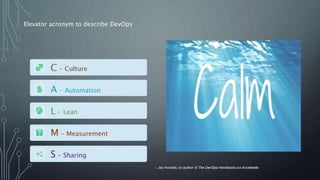
A - Automation
L - Lean
M - Measurement
S - Sharing
Elevator acronym to describe DevOps
--- Jez Humble, co-author of The DevOps Handbook and Accelerate
HOW DOES DEVOPS ENABLE
ORGANIZATIONS
TECHNICAL
CAPABILITIES
PROCESS
CAPABILITIES
MEASUREMENT
CAPABILITIES
CULTURAL
CAPABILITIES
TECHNICAL CAPABILITIES
Version Control (Code
and Infrastructure) helps
with reproducibility and
traceability
Trunk Based
development prevents
merge-conflict
Continuous integration |
testing | delivery
Deployment Automation
and reducing manual
intervention in the
release process
Service Oriented and
Microservice
architecture
Empower teams to make
decisions on tools and
technologies
Security without
compromising delivery
speed
PROCESS CAPABILITIES
• Faster innovation with empowered teams that
take on new ideas and methodologies.
• Peer review opens opportunities for more
reliable, compliant release process.
• Improve organizational outcomes by gathering
customer feedback and incorporating them
into product and feature design.
• Visibility of work from idea to customer
outcome creating a value stream
• Working in small batches enables shorter lead
times and faster feedback
MEASUREMENT CAPABILITIES
• Monitoring across code and
infrastructure for informed business
decisions.
• Understand and debug production
systems through better tooling.
• Identity critical issues and swarming on
problems before they arise.
• Prioritize work and identify process
limits to improve efficiency.
• Promote information gathering and get
a common understanding through
visual management capabilities
CULTURAL CAPABILITIES
• Drive better organizational and software delivery
performance through generative, high trust
culture (Westrum Organizational culture).
• Develop a culture of learning, enhancing
organizational performance.
• Increase job satisfaction ensuring people have
the tools and resources to do their job and
making good use of their skills and abilities.
• Drive the adoption of effective technical and
product management capabilities.
Additional Resources
https://azure.microsoft.com/en-us/overview/what-is-devops/
https://www.ibm.com/cloud/learn/devops-a-complete-guide
https://devops.com/

DevOps transformation flow - feedback - continuous experimentation & learning

  • 1.
    DevOps Transformation Flow ->Feedback -> Continuous Experimentation & Learning Danielson Samuel
  • 2.
    WHAT IS DEVOPS: •Set of principles combining software development and IT operations. • Beyond checklists and tools • Complimentary to agile practices • Movement from project to product
  • 3.
    A - Automation L- Lean M - Measurement S - Sharing Elevator acronym to describe DevOps --- Jez Humble, co-author of The DevOps Handbook and Accelerate
  • 4.
    HOW DOES DEVOPSENABLE ORGANIZATIONS TECHNICAL CAPABILITIES PROCESS CAPABILITIES MEASUREMENT CAPABILITIES CULTURAL CAPABILITIES
  • 5.
    TECHNICAL CAPABILITIES Version Control(Code and Infrastructure) helps with reproducibility and traceability Trunk Based development prevents merge-conflict Continuous integration | testing | delivery Deployment Automation and reducing manual intervention in the release process Service Oriented and Microservice architecture Empower teams to make decisions on tools and technologies Security without compromising delivery speed
  • 6.
    PROCESS CAPABILITIES • Fasterinnovation with empowered teams that take on new ideas and methodologies. • Peer review opens opportunities for more reliable, compliant release process. • Improve organizational outcomes by gathering customer feedback and incorporating them into product and feature design. • Visibility of work from idea to customer outcome creating a value stream • Working in small batches enables shorter lead times and faster feedback
  • 7.
    MEASUREMENT CAPABILITIES • Monitoringacross code and infrastructure for informed business decisions. • Understand and debug production systems through better tooling. • Identity critical issues and swarming on problems before they arise. • Prioritize work and identify process limits to improve efficiency. • Promote information gathering and get a common understanding through visual management capabilities
  • 8.
    CULTURAL CAPABILITIES • Drivebetter organizational and software delivery performance through generative, high trust culture (Westrum Organizational culture). • Develop a culture of learning, enhancing organizational performance. • Increase job satisfaction ensuring people have the tools and resources to do their job and making good use of their skills and abilities. • Drive the adoption of effective technical and product management capabilities.
  • 9.