Development & Gender
Development 
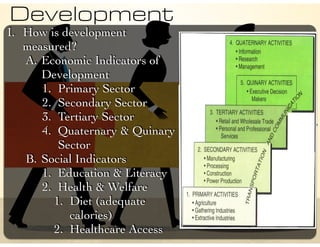
I. How is development 
measured? 
A. Economic Indicators of 
Development 
1. Primary Sector 
2. Secondary Sector 
3. Tertiary Sector 
4. Quaternary & Quinary 
Sector 
B. Social Indicators 
1. Education & Literacy 
2. Health & Welfare 
1. Diet (adequate 
calories) 
2. Healthcare Access
Development 
C. Demographic Indicators of Development 
1. Life Expectancy 
2. Infant Mortality 
3. Natural Increase 
4. Crude Birth Rate
Human Development Index (HDI)
Multidimensional Poverty Index (MPI)
MPI: India
Development Theory 
II.Models of Development 
A. Self Sufficiency 
1. Modest pace of development 
2. Even distribution of development 
3. Barriers established to protect local bus. 
(tariffs, quotas, restrictions on imports) 
4. Two problems: 
a. inefficient businesses are protected. 
b. Large bureaucracy develops
II. Rostow: International Trade 
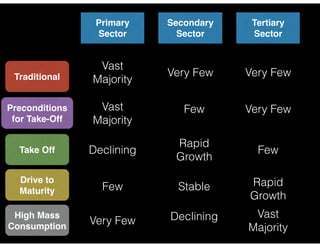
Traditional 
Preconditions 
for Take-Off 
Take Off 
Time 
Drive to 
Maturity 
High Mass 
Consumption
Traditional 
Preconditions 
for Take-Off 
Take Off 
Drive to 
Maturity 
High Mass 
Consumption 
Primary 
Sector 
Secondary 
Sector 
Tertiary 
Sector 
Vast 
Majority 
Vast 
Majority 
Declining 
Few 
Very Few 
Very Few 
Few 
Rapid 
Growth 
Stable 
Declining 
Very Few 
Very Few 
Few 
Rapid 
Growth 
Vast 
Majority
Traditional 
•Subsidence economy based on 
effort intensive Farming. 
- High effort, low output 
•Producers consume the output. 
Little available for trade 
•Limited technology to process raw 
materials or advance industry 
•Informal Markets. Barter is king
Preconditions 
for Take-Off 
•Transportation infrastructure = 
surplus from trade 
•Tech improvement = Ag 
Improvement, commercialized 
•Amount of Capital & savings/ 
investment grows 
•Single industry emerges 
(textile)
Take Off 
•Industrialization & Urbanization 
•Growth = 1-2 regions & Handful of 
Industries 
•Amount of Capital & savings/ 
investment grows 
•New political, social, and 
infrastructure improvements to 
support industry
Drive to 
Maturity 
•Diverse, self-sustained growth 
of multiple industries 
•New, diverse transportation 
systems 
•Econ development spreads to 
all parts 
•Advanced Manufacturing 
develops
High Mass 
Consumption 
•Rapid expansion of tertiary 
industries 
•Industries shift to durable 
consumer goods
II. Rostow: Criticisms 
•Too Simple 
•Necessitates Financial infrastructure for 
success, relying on investment 
•How will leaders use investment? 
Palaces or infrastructure 
•Ignores other necessary infrastructures: 
Education, roads/rail, communication 
•Assumes countries learn from others 
experiences.
Development Theory 
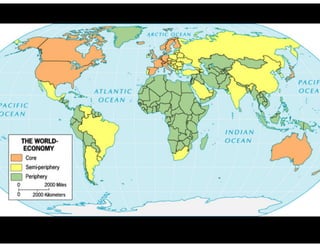
III.Wallerstein’s World System Analysis 
A. Periphery: Low Income 
1. Low tech use 
2. High % Primary Activity 
3. Low levels of Ed 
B. Semi-Periphery 
1. Former Periphery 
2. Increased Econ Dev 
3. Example: BRICS 
C. Core: High Income 
1. High Tech Use 
2. High % Tertiary Activity 
3. High levels of Ed, majority population 
4. Examples: OECD, G8
Development Theory 
IV.Structuralist Theory 
A. Regional disparities are assumed, part of system 
B. Geography determines economy, changes are 
not easy. 
V. Dependency Theory 
A. Dominant areas rule over weak (imperialism) 
B. Rich areas keep the poor areas down 
1. Rich extract resources from poor 
2. Rich loan $ to poor, keeps in debt
Development
Development
Development
Development

Development

  • 1.
  • 2.
    Development I. Howis development measured? A. Economic Indicators of Development 1. Primary Sector 2. Secondary Sector 3. Tertiary Sector 4. Quaternary & Quinary Sector B. Social Indicators 1. Education & Literacy 2. Health & Welfare 1. Diet (adequate calories) 2. Healthcare Access
  • 3.
    Development C. DemographicIndicators of Development 1. Life Expectancy 2. Infant Mortality 3. Natural Increase 4. Crude Birth Rate
  • 4.
  • 5.
  • 6.
  • 8.
  • 9.
    Development Theory II.Modelsof Development A. Self Sufficiency 1. Modest pace of development 2. Even distribution of development 3. Barriers established to protect local bus. (tariffs, quotas, restrictions on imports) 4. Two problems: a. inefficient businesses are protected. b. Large bureaucracy develops
  • 10.
    II. Rostow: InternationalTrade Traditional Preconditions for Take-Off Take Off Time Drive to Maturity High Mass Consumption
  • 11.
    Traditional Preconditions forTake-Off Take Off Drive to Maturity High Mass Consumption Primary Sector Secondary Sector Tertiary Sector Vast Majority Vast Majority Declining Few Very Few Very Few Few Rapid Growth Stable Declining Very Few Very Few Few Rapid Growth Vast Majority
  • 12.
    Traditional •Subsidence economybased on effort intensive Farming. - High effort, low output •Producers consume the output. Little available for trade •Limited technology to process raw materials or advance industry •Informal Markets. Barter is king
  • 13.
    Preconditions for Take-Off •Transportation infrastructure = surplus from trade •Tech improvement = Ag Improvement, commercialized •Amount of Capital & savings/ investment grows •Single industry emerges (textile)
  • 14.
    Take Off •Industrialization& Urbanization •Growth = 1-2 regions & Handful of Industries •Amount of Capital & savings/ investment grows •New political, social, and infrastructure improvements to support industry
  • 15.
    Drive to Maturity •Diverse, self-sustained growth of multiple industries •New, diverse transportation systems •Econ development spreads to all parts •Advanced Manufacturing develops
  • 16.
    High Mass Consumption •Rapid expansion of tertiary industries •Industries shift to durable consumer goods
  • 17.
    II. Rostow: Criticisms •Too Simple •Necessitates Financial infrastructure for success, relying on investment •How will leaders use investment? Palaces or infrastructure •Ignores other necessary infrastructures: Education, roads/rail, communication •Assumes countries learn from others experiences.
  • 18.
    Development Theory III.Wallerstein’sWorld System Analysis A. Periphery: Low Income 1. Low tech use 2. High % Primary Activity 3. Low levels of Ed B. Semi-Periphery 1. Former Periphery 2. Increased Econ Dev 3. Example: BRICS C. Core: High Income 1. High Tech Use 2. High % Tertiary Activity 3. High levels of Ed, majority population 4. Examples: OECD, G8
  • 21.
    Development Theory IV.StructuralistTheory A. Regional disparities are assumed, part of system B. Geography determines economy, changes are not easy. V. Dependency Theory A. Dominant areas rule over weak (imperialism) B. Rich areas keep the poor areas down 1. Rich extract resources from poor 2. Rich loan $ to poor, keeps in debt