Developing a Questionnaire
What is a Questionnaire?
 A tool for collecting information to describe,
compare, or explain an event or situation, as
well as, knowledge, attitudes, behaviors,
and/or sociodemographic characteristics on a
particular target group.
Before the Design of Quetionnaire
Your approach should take consideration of:
 Your topic
 Who you want survey
 The type of information you want
 Your budget
 How quickly you need the information
Questionnaire Design
 Questionnaire design is a systematic process
in which the researcher contemplates various
question formats, considers a number of
factors characterizing the survey at hand,
ultimately words the various questions very
carefully, and organizes the questionnaire’s
layout.
Procedure for Development
 Specify what information will be sought
 Determine the type of questionnaire and method of
administration
 Determine the content of individual questions
 Determine the form of response to each question
 Determine the wording of each question
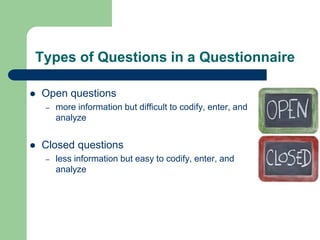
Types of Questions in a Questionnaire
 Open questions
– more information but difficult to codify, enter, and
analyze
 Closed questions
– less information but easy to codify, enter, and
analyze
Open-ended questions
 Help collect qualitative data in a questionnaire
where the respondent can answer in a free
form with little to no restrictions.
– What are your expectations/ requirements for this
product (Information gathering)
– What do you see as the next action steps?
(Qualifying)
– What’s the most important priority to you with this?
Why? (Establishing rapport)
Close-ended questions
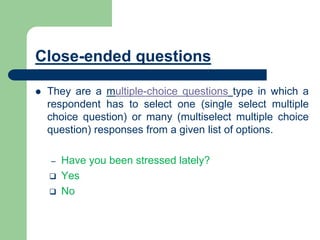
 They are a multiple-choice questions type in which a
respondent has to select one (single select multiple
choice question) or many (multiselect multiple choice
question) responses from a given list of options.
– Have you been stressed lately?
 Yes
 No
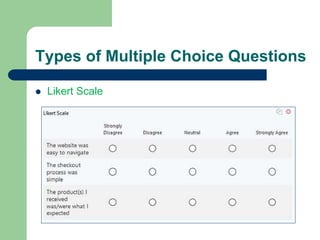
Types of Multiple Choice Questions
 Likert Scale
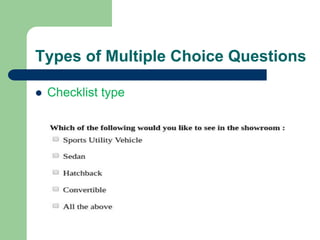
Types of Multiple Choice Questions
 Checklist type
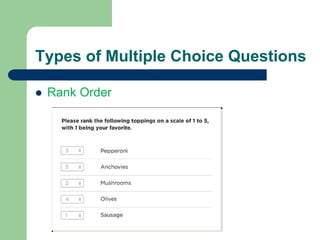
Types of Multiple Choice Questions
 Rank Order
Types of Multiple Choice Questions
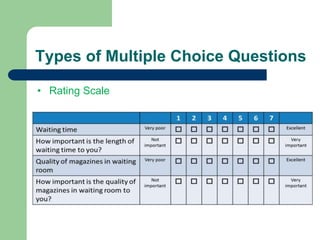
• Rating Scale
Common mistakes
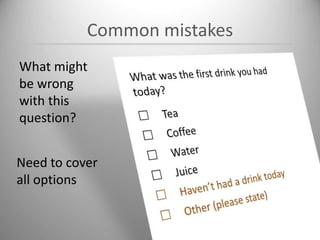
What might
be wrong
with this
question?
Need to cover
all options
Common mistakes
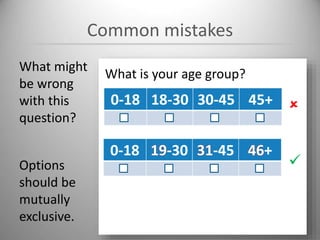
What might
be wrong
with this
question?
What is your age group?
0-18 18-30 30-45 45+
0-18 19-30 31-45 46+


Options
should be
mutually
exclusive.
Common mistakes
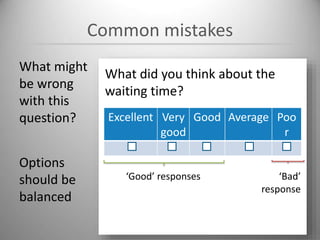
What might
be wrong
with this
question?
What did you think about the
waiting time?
Excellent Very
good
Good Average Poo
r
‘Good’ responses ‘Bad’
response
Options
should be
balanced
Common mistakes
What might
be wrong
with this
question?
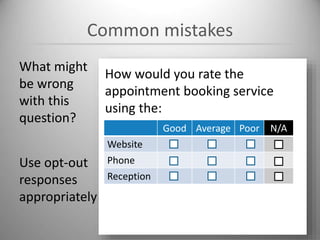
How would you rate the
appointment booking service
using the:
Good Average Poor
Website
Phone
Reception
Use opt-out
responses
appropriately
N/A
Demographics
 Need to know how opinions and behaviors vary
across different categories of people
 Such things as
– Gender, age,
– Income, education levels
– Political beliefs
 Put at end of instrument
– Easy to answer
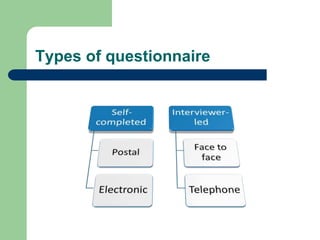
Types of questionnaire
Self-Completed
 Respondents complete on their own
 Best designed for
– Measuring variables with numerous values or
response categories
– Investigating attitudes and opinions not usually
observable
– Describing characteristics of a large population
– Studying ‘private’ or ‘difficult’ behaviors
Self-Completed
 Closed-ended items limit the researcher
– Adjust for differences in respondents
– Clarify misunderstood items
– Explain ambiguity
 Not suitable for all audiences
– Young children
– Visually impaired
– Learning/reading disabilities
How To Obtain Valid Information
 Ask purposeful questions
 Ask concrete questions
 Use time periods based on importance of the
questions
 Use conventional language
 Use complete sentences
 Use shorter questions
How To Obtain Valid Information
 Avoid abbreviations
 Avoid two-edged questions
 Avoid negative questions
 Adopt/adapt questions used successfully in
other questionnaires
Words to Avoid in Questionnaire Development
 These words: all, any, anybody, best, ever, every,
never, etc. are all EXTREME ABSOLUTES…
 They place respondents in a situation where they must
either fully agree or they must completely disagree with
the extreme position in the question.
– Do you always observe traffic signs?
– Would you say all cats have four legs?
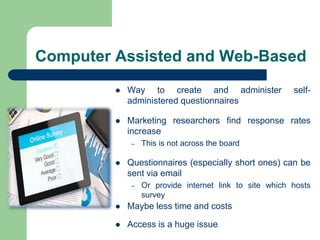
Computer Assisted and Web-Based
 Way to create and administer self-
administered questionnaires
 Marketing researchers find response rates
increase
– This is not across the board
 Questionnaires (especially short ones) can be
sent via email
– Or provide internet link to site which hosts
survey
 Maybe less time and costs
 Access is a huge issue
Interviews
 Reading questionnaire items in a face-to-face
or telephone situation
 Unstructured or in-depth
– Suited for exploratory research
– Either with one person or in focus groups
– Open-ended items
– Cannot standardize
– Good for complex situations
Interviews
 Response rates tend to be highest with face-to-
face interviews
 Issues
– More time
– Smaller samples
– Higher cost
Telephone
 Most popular
– Less costly
– Less time
– Less subjective to interviewer
 As compared to face-to-face
 Often conducted with computers
 Can probe for information/clarification
 Threshold about 20 minutes
Constructions
 Regardless of survey type, construct in a way
– Allows for candid answers
– Accurately
– Consistently
– Addresses goals, hypotheses, research
questions
Instructions
 Beginning of each section, should include clear
instructions
 Disclose needed information for respondents to decide
whether to complete the survey
 Tell whether
– Anonymous: no names or IDs
– Confidential: names or IDs, not attached responses
Instructions
 Give an information about questionnaire time
 Be consistent with instructions and format
– A little variation might break up ‘routine’
 Avoid ambiguity, confusion, and vagueness.
– Make sure it is absolutely clear what you are asking
and how you want it answered.
– Avoid indefinite words or response categories.
Instructions
 Avoid asking questions beyond a respondent's
capabilities
– People have cognitive limitations, especially when it
comes to memory of past events.
– It is pointless to ask people about things that are not
natural ways for them to think.
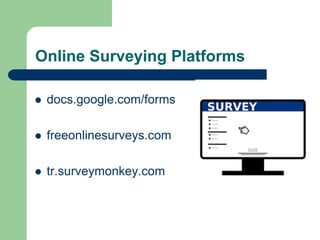
Online Surveying Platforms
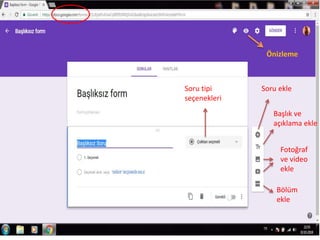
 docs.google.com/forms
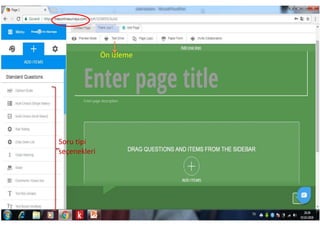
 freeonlinesurveys.com
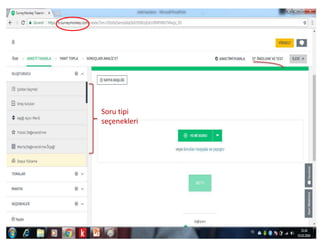
 tr.surveymonkey.com
Soru tipi
seçenekleri
Soru ekle
Başlık ve
açıklama ekle
Fotoğraf
ve video
ekle
Bölüm
ekle
Önizleme
Ön izleme
Soru tipi
seçenekleri
Soru tipi
seçenekleri

developing a questionnaire brm 1nfz what is a questionnaire

  • 1.
  • 2.
    What is aQuestionnaire?  A tool for collecting information to describe, compare, or explain an event or situation, as well as, knowledge, attitudes, behaviors, and/or sociodemographic characteristics on a particular target group.
  • 3.
    Before the Designof Quetionnaire Your approach should take consideration of:  Your topic  Who you want survey  The type of information you want  Your budget  How quickly you need the information
  • 4.
    Questionnaire Design  Questionnairedesign is a systematic process in which the researcher contemplates various question formats, considers a number of factors characterizing the survey at hand, ultimately words the various questions very carefully, and organizes the questionnaire’s layout.
  • 6.
    Procedure for Development Specify what information will be sought  Determine the type of questionnaire and method of administration  Determine the content of individual questions  Determine the form of response to each question  Determine the wording of each question
  • 7.
    Types of Questionsin a Questionnaire  Open questions – more information but difficult to codify, enter, and analyze  Closed questions – less information but easy to codify, enter, and analyze
  • 8.
    Open-ended questions  Helpcollect qualitative data in a questionnaire where the respondent can answer in a free form with little to no restrictions. – What are your expectations/ requirements for this product (Information gathering) – What do you see as the next action steps? (Qualifying) – What’s the most important priority to you with this? Why? (Establishing rapport)
  • 9.
    Close-ended questions  Theyare a multiple-choice questions type in which a respondent has to select one (single select multiple choice question) or many (multiselect multiple choice question) responses from a given list of options. – Have you been stressed lately?  Yes  No
  • 10.
    Types of MultipleChoice Questions  Likert Scale
  • 11.
    Types of MultipleChoice Questions  Checklist type
  • 12.
    Types of MultipleChoice Questions  Rank Order
  • 13.
    Types of MultipleChoice Questions • Rating Scale
  • 14.
    Common mistakes What might bewrong with this question? Need to cover all options
  • 15.
    Common mistakes What might bewrong with this question? What is your age group? 0-18 18-30 30-45 45+ 0-18 19-30 31-45 46+   Options should be mutually exclusive.
  • 16.
    Common mistakes What might bewrong with this question? What did you think about the waiting time? Excellent Very good Good Average Poo r ‘Good’ responses ‘Bad’ response Options should be balanced
  • 17.
    Common mistakes What might bewrong with this question? How would you rate the appointment booking service using the: Good Average Poor Website Phone Reception Use opt-out responses appropriately N/A
  • 18.
    Demographics  Need toknow how opinions and behaviors vary across different categories of people  Such things as – Gender, age, – Income, education levels – Political beliefs  Put at end of instrument – Easy to answer
  • 19.
  • 20.
    Self-Completed  Respondents completeon their own  Best designed for – Measuring variables with numerous values or response categories – Investigating attitudes and opinions not usually observable – Describing characteristics of a large population – Studying ‘private’ or ‘difficult’ behaviors
  • 21.
    Self-Completed  Closed-ended itemslimit the researcher – Adjust for differences in respondents – Clarify misunderstood items – Explain ambiguity  Not suitable for all audiences – Young children – Visually impaired – Learning/reading disabilities
  • 22.
    How To ObtainValid Information  Ask purposeful questions  Ask concrete questions  Use time periods based on importance of the questions  Use conventional language  Use complete sentences  Use shorter questions
  • 23.
    How To ObtainValid Information  Avoid abbreviations  Avoid two-edged questions  Avoid negative questions  Adopt/adapt questions used successfully in other questionnaires
  • 24.
    Words to Avoidin Questionnaire Development  These words: all, any, anybody, best, ever, every, never, etc. are all EXTREME ABSOLUTES…  They place respondents in a situation where they must either fully agree or they must completely disagree with the extreme position in the question. – Do you always observe traffic signs? – Would you say all cats have four legs?
  • 25.
    Computer Assisted andWeb-Based  Way to create and administer self- administered questionnaires  Marketing researchers find response rates increase – This is not across the board  Questionnaires (especially short ones) can be sent via email – Or provide internet link to site which hosts survey  Maybe less time and costs  Access is a huge issue
  • 26.
    Interviews  Reading questionnaireitems in a face-to-face or telephone situation  Unstructured or in-depth – Suited for exploratory research – Either with one person or in focus groups – Open-ended items – Cannot standardize – Good for complex situations
  • 27.
    Interviews  Response ratestend to be highest with face-to- face interviews  Issues – More time – Smaller samples – Higher cost
  • 28.
    Telephone  Most popular –Less costly – Less time – Less subjective to interviewer  As compared to face-to-face  Often conducted with computers  Can probe for information/clarification  Threshold about 20 minutes
  • 29.
    Constructions  Regardless ofsurvey type, construct in a way – Allows for candid answers – Accurately – Consistently – Addresses goals, hypotheses, research questions
  • 30.
    Instructions  Beginning ofeach section, should include clear instructions  Disclose needed information for respondents to decide whether to complete the survey  Tell whether – Anonymous: no names or IDs – Confidential: names or IDs, not attached responses
  • 31.
    Instructions  Give aninformation about questionnaire time  Be consistent with instructions and format – A little variation might break up ‘routine’  Avoid ambiguity, confusion, and vagueness. – Make sure it is absolutely clear what you are asking and how you want it answered. – Avoid indefinite words or response categories.
  • 32.
    Instructions  Avoid askingquestions beyond a respondent's capabilities – People have cognitive limitations, especially when it comes to memory of past events. – It is pointless to ask people about things that are not natural ways for them to think.
  • 33.
    Online Surveying Platforms docs.google.com/forms  freeonlinesurveys.com  tr.surveymonkey.com
  • 34.
    Soru tipi seçenekleri Soru ekle Başlıkve açıklama ekle Fotoğraf ve video ekle Bölüm ekle Önizleme
  • 35.
  • 36.

Editor's Notes

  • #15 What might be wrong with this closed question? When writing closed questions ensure you cover all options or it could bias the analysis. – if unsure whether you have covered everything add an Other option to capture that data. The answers from closed questions are easier to analyse BUT you are not leaving it open to allow respondents to raise unexpected, or missed, issues. OR to explain their answers. Other tip for closed questions is : Research has shown that in self completion questionnaires the first options on a list are chosen most often – whereas in interview situations the latter options are chosen most often. Additional information * There is evidence that openin
  • #16 Sometimes it can be better to appear pedantic than to risk skewing the responses.
  • #17 You’re giving many more good options than poor ones – this is unbalanced. Number of points used: Recommend to use either five or seven point scales. Generally, three-point scales are too narrow to be effective, and there is no evidence that nine points gives greater precision than a seven point scale. Stick to using the same range of options for all questions where possible. Or at least for each section If necessary re-phrase your questions so that they work with the ratings.
  • #18 Consider whether an opt out is needed. Don’t feel qualified Never considered the subject before Haven’t used You need to ensure you are not forcing an answer when an opt out is appropriate. You need to weigh up the options of giving someone an easy way out of not answering a question and a genuine need for an opt out. Are you asking the question to everyone who booked, will everyone have used all options. This is fine IF everyone answering has used all of the booking systems, and you’ve chosen your sample on that basis. Respondents tend to try and be useful and answer all questions are even if they haven’t used a service so are likely to use a default response of ‘average’ as their equivalent of an opt out. When you come to analyse the results you will then have no real idea of who found the service ‘Average’ and those who did not actually use the service. This isn't just for attitude questions it is for any question – even with NICE guidelines there are still often cases where exceptions are allowable. Feel free if you need to get them to justify WHY it’s not applicable – but don’t force, and therefore skew an answer.