2018
Developer Skills Report
The tools and trends that define how
software developers work today.
2.
Contents
1. Introduction & Demographics
2. Work & Community
3. Learning & Training
4. App Development
5. Web Development
6. Security & System Administration
7. Data
8. Final Thoughts
- 3
- 8
- 14
- 16
- 24
- 32
- 38
- 43
3.
Introduction
1.
Only one thing is certain in the world of tech: change.
Working in development is about navigating a constantly evolving
industry, keeping up to date with the skills you need to succeed.
The Packt Skill Up Developer Skills Report is dedicated to ensuring
developers make the right learning choices. Based on an annual
survey of thousands of professional developers, it aims to keep track
of the trends and tools of the industry.
In particular, we wanted to know:
»» What were the most popular tools developers used every day
»» What did developers think was really worth spending
	 time learning
»» How did developers feel about working in tech, and the wider
	 tech community
The Skill Up 2018 survey streamed developers into four broad
disciplines: application development, web development, security
and systems administration, and data. It captured a snapshot of
each section of the industry in 2018 to discover the state of the
modern tech community in your industry.
4.
Developer Demographics
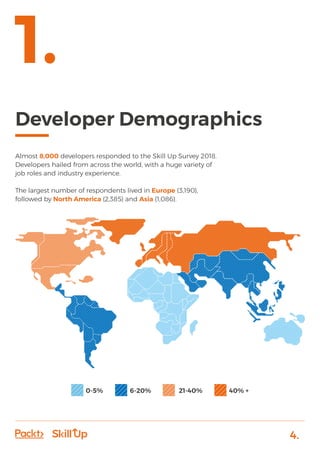
Almost 8,000 developers responded to the Skill Up Survey 2018.
Developers hailed from across the world, with a huge variety of
job roles and industry experience.
The largest number of respondents lived in Europe (3,190),
followed by North America (2,385) and Asia (1,086).
0-5% 6-20% 21-40% 40% +
1.
5.
> Developer Job Roles
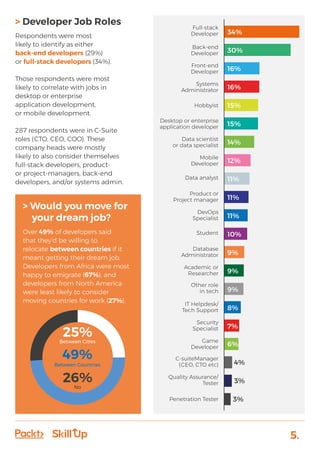
Respondents were most
likely to identify as either
back-end developers (29%)
or full-stack developers (34%).
Those respondents were most
likely to correlate with jobs in
desktop or enterprise
application development,
or mobile development.
287 respondents were in C-Suite
roles (CTO, CEO, COO). These
company heads were mostly
likely to also consider themselves
full-stack developers, product-
or project-managers, back-end
developers, and/or systems admin.
Full-stack
Developer 34%
Back-end
Developer 30%
Front-end
Developer 16%
Systems
Administrator 16%
Hobbyist 15%
Desktop or enterprise
application developer 15%
Data scientist
or data specialist 14%
Mobile
Developer 12%
Data analyst 11%
Product or
Project manager 11%
DevOps
Specialist 11%
Student 10%
Database
Administrator 9%
Academic or
Researcher 9%
Other role
in tech 9%
IT Helpdesk/
Tech Support 8%
Security
Specialist 7%
Game
Developer 6%
C-suiteManager
(CEO, CTO etc) 4%
Quality Assurance/
Tester 3%
Penetration Tester 3%
> Would you move for
your dream job?
Over 49% of developers said
that they’d be willing to
relocate between countries if it
meant getting their dream job.
Developers from Africa were most
happy to emigrate (67%), and
developers from North America
were least likely to consider
moving countries for work (27%).
25%
26%
49%
Between Cities
No
Between Countries
6.
> Industry Experience
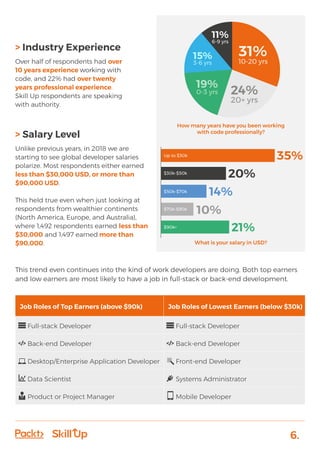
Over half of respondents had over
10 years experience working with
code, and 22% had over twenty
years professional experience.
Skill Up respondents are speaking
with authority.
> Salary Level
Unlike previous years, in 2018 we are
starting to see global developer salaries
polarize. Most respondents either earned
less than $30,000 USD, or more than
$90,000 USD.
This held true even when just looking at
respondents from wealthier continents
(North America, Europe, and Australia),
where 1,492 respondents earned less than
$30,000 and 1,497 earned more than
$90,000.
31%
24%
19%
15%
11%
10-20 yrs
20+ yrs
0-3 yrs
3-6 yrs
6-9 yrs
Up to $30k
35%
20%
14%
10%
21%
$30k-$50k
$50k-$70k
$70k-$90k
$90k+
This trend even continues into the kind of work developers are doing. Both top earners
and low earners are most likely to have a job in full-stack or back-end development.
Job Roles of Top Earners (above $90k) Job Roles of Lowest Earners (below $30k)
Full-stack Developer Full-stack Developer
Back-end Developer Back-end Developer
Desktop/Enterprise Application Developer Front-end Developer
Data Scientist Systems Administrator
Product or Project Manager Mobile Developer
How many years have you been working
with code professionally?
What is your salary in USD?
7.
> Personal Characteristics
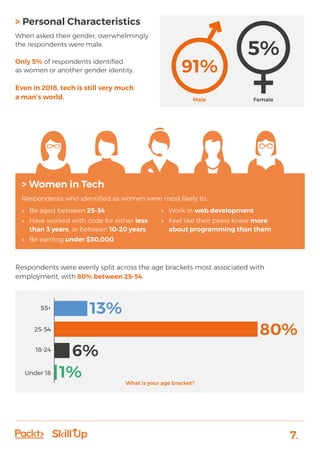
When asked their gender, overwhelmingly
the respondents were male.
Only 5% of respondents identified
as women or another gender identity.
Even in 2018, tech is still very much
a man’s world.
91%
5%
Respondents were evenly split across the age brackets most associated with
employment, with 80% between 25-54.
55+
25-54
18-24
Under 18
80%
6%
13%
1%
> Women in Tech
Respondents who identified as women were most likely to:
»» Be aged between 25-34
»» Have worked with code for either less
	 than 3 years, or between 10-20 years
»» Be earning under $30,000
»» Work in web development
»» Feel like their peers knew more
	 about programming than them
What is your age bracket?
Male Female
8.
Work and Community
2.
Is tech like any other job or industry - or is there a community built
around the development experience? Are there common barriers
developers face at work? Are developers unhappy code monkeys, or
do they love their jobs?
72%
Yes
54%
Yes
> Community and Peers
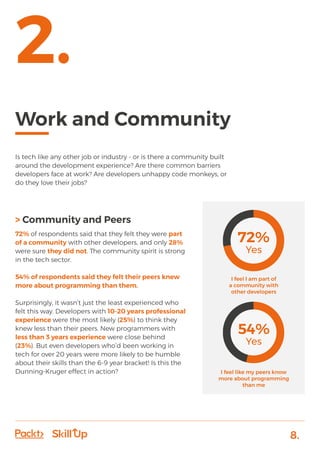
72% of respondents said that they felt they were part
of a community with other developers, and only 28%
were sure they did not. The community spirit is strong
in the tech sector.
54% of respondents said they felt their peers knew
more about programming than them.
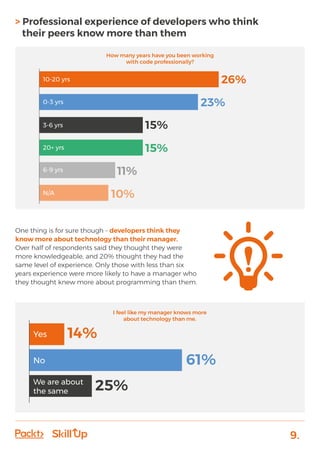
Surprisingly, it wasn’t just the least experienced who
felt this way. Developers with 10-20 years professional
experience were the most likely (25%) to think they
knew less than their peers. New programmers with
less than 3 years experience were close behind
(23%). But even developers who’d been working in
tech for over 20 years were more likely to be humble
about their skills than the 6-9 year bracket! Is this the
Dunning-Kruger effect in action? I feel like my peers know
more about programming
than me
I feel I am part of
a community with
other developers
9.
> Professional experience of developers who think
their peers know more than them
One thing is for sure though - developers think they
know more about technology than their manager.
Over half of respondents said they thought they were
more knowledgeable, and 20% thought they had the
same level of experience. Only those with less than six
years experience were more likely to have a manager who
they thought knew more about programming than them.
Yes 14%
25%
61%No
We are about
the same
26%10-20 yrs
23%0-3 yrs
15%3-6 yrs
15%20+ yrs
11%6-9 yrs
10%N/A
How many years have you been working
with code professionally?
I feel like my manager knows more
about technology than me.
10.
> Working Environment
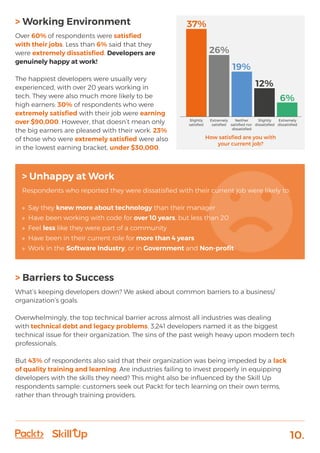
Over 60% of respondents were satisfied
with their jobs. Less than 6% said that they
were extremely dissatisfied. Developers are
genuinely happy at work!
The happiest developers were usually very
experienced, with over 20 years working in
tech. They were also much more likely to be
high earners: 30% of respondents who were
extremely satisfied with their job were earning
over $90,000. However, that doesn’t mean only
the big earners are pleased with their work. 23%
of those who were extremely satisfied were also
in the lowest earning bracket, under $30,000.
> Barriers to Success
What’s keeping developers down? We asked about common barriers to a business/
organization’s goals.
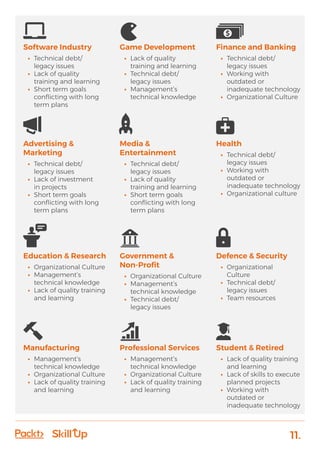
Overwhelmingly, the top technical barrier across almost all industries was dealing
with technical debt and legacy problems. 3,241 developers named it as the biggest
technical issue for their organization. The sins of the past weigh heavy upon modern tech
professionals.
But 43% of respondents also said that their organization was being impeded by a lack
of quality training and learning. Are industries failing to invest properly in equipping
developers with the skills they need? This might also be influenced by the Skill Up
respondents sample: customers seek out Packt for tech learning on their own terms,
rather than through training providers.
> Unhappy at Work
Respondents who reported they were dissatisfied with their current job were likely to:
»» Say they knew more about technology than their manager
»» Have been working with code for over 10 years, but less than 20
»» Feel less like they were part of a community
»» Have been in their current role for more than 4 years
»» Work in the Software Industry, or in Government and Non-profit
Slightly
satisfied
Extremely
satisfied
Neither
satisfied nor
dissatisfied
Slightly
dissatisfied
Extremely
dissatisfied
37%
26%
19%
12%
6%
How satisfied are you with
your current job?
11.
Software Industry
•	 Technical debt/
	 legacy issues
•	 Lack of quality
	 training and learning
•	 Short term goals
	 conflicting with long
	 term plans
Advertising &
Marketing
•	 Technical debt/
	 legacy issues
•	 Lack of investment
	 in projects
•	 Short term goals
	 conflicting with long
	 term plans
Education & Research
•	 Organizational Culture
•	 Management’s
	 technical knowledge
•	 Lack of quality training
	 and learning
Manufacturing
•	 Management’s
	 technical knowledge
•	 Organizational Culture
•	 Lack of quality training
	 and learning
Game Development
•	 Lack of quality
	 training and learning
•	 Technical debt/
	 legacy issues
•	 Management’s
	 technical knowledge
Media &
Entertainment
•	 Technical debt/
	 legacy issues
•	 Lack of quality
	 training and learning
•	 Short term goals
	 conflicting with long
	 term plans
Government &
Non-Profit
•	 Organizational Culture
•	 Management’s
	 technical knowledge
•	 Technical debt/
	 legacy issues
Professional Services
•	 Management’s
	 technical knowledge
•	 Organizational Culture
•	 Lack of quality training
	 and learning
Finance and Banking
•	 Technical debt/
	 legacy issues
•	 Working with
	 outdated or
	 inadequate technology
•	 Organizational Culture
Health
•	 Technical debt/
	 legacy issues
•	 Working with
	 outdated or
	 inadequate technology
•	 Organizational culture
Defence & Security
•	 Organizational
	Culture
•	 Technical debt/
	 legacy issues
•	 Team resources
Student & Retired
•	 Lack of quality training
	 and learning
•	 Lack of skills to execute
	 planned projects
•	 Working with
	 outdated or
	 inadequate technology
12.
When asked about organizational barriers faced by their business, over half of respondents
said that ‘short term goals conflicting with long term plans’ was a problem. This was
named as one of the biggest issues by developers working directly in the Software industry,
as well as in Marketing and Advertising. Is the monthly drive to hit sales targets or deliver on
the next sprint negatively impacting an organization’s long term health?
Other common organizational barriers were ‘organizational culture’ and ‘management’s
lack of technical knowledge’. These two issues tended to go hand in hand - and were
named as the biggest problems in the Education, Government, Manufacturing and
Professional Services industries.
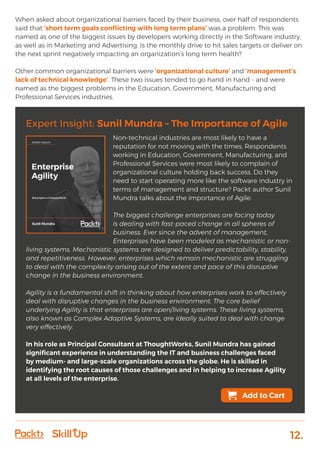
Expert Insight: Sunil Mundra – The Importance of Agile
Non-technical industries are most likely to have a
reputation for not moving with the times. Respondents
working in Education, Government, Manufacturing, and
Professional Services were most likely to complain of
organizational culture holding back success. Do they
need to start operating more like the software industry in
terms of management and structure? Packt author Sunil
Mundra talks about the importance of Agile.
The biggest challenge enterprises are facing today
is dealing with fast-paced change in all spheres of
business. Ever since the advent of management,
Enterprises have been modeled as mechanistic or non-
living systems. Mechanistic systems are designed to deliver predictability, stability,
and repetitiveness. However, enterprises which remain mechanistic are struggling
to deal with the complexity arising out of the extent and pace of this disruptive
change in the business environment.
Agility is a fundamental shift in thinking about how enterprises work to effectively
deal with disruptive changes in the business environment. The core belief
underlying Agility is that enterprises are open/living systems. These living systems,
also known as Complex Adaptive Systems, are ideally suited to deal with change
very effectively.
In his role as Principal Consultant at ThoughtWorks, Sunil Mundra has gained
significant experience in understanding the IT and business challenges faced
by medium- and large-scale organizations across the globe. He is skilled in
identifying the root causes of those challenges and in helping to increase Agility
at all levels of the enterprise.
Add to Cart
13.
> Developer Culture
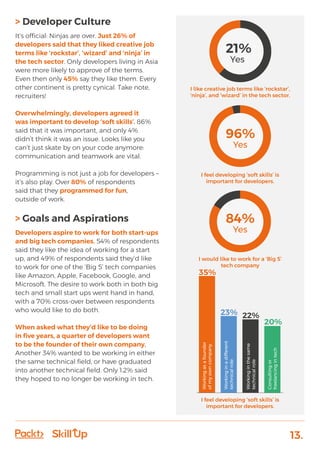
It’s official: Ninjas are over. Just 26% of
developers said that they liked creative job
terms like ‘rockstar’, ‘wizard’ and ‘ninja’ in
the tech sector. Only developers living in Asia
were more likely to approve of the terms.
Even then only 45% say they like them. Every
other continent is pretty cynical. Take note,
recruiters!
Overwhelmingly, developers agreed it
was important to develop ‘soft skills’. 86%
said that it was important, and only 4%
didn’t think it was an issue. Looks like you
can’t just skate by on your code anymore:
communication and teamwork are vital.
Programming is not just a job for developers –
it’s also play. Over 80% of respondents
said that they programmed for fun,
outside of work.
> Goals and Aspirations
Developers aspire to work for both start-ups
and big tech companies. 54% of respondents
said they like the idea of working for a start
up, and 49% of respondents said they’d like
to work for one of the ‘Big 5’ tech companies
like Amazon, Apple, Facebook, Google, and
Microsoft. The desire to work both in both big
tech and small start ups went hand in hand,
with a 70% cross-over between respondents
who would like to do both.
When asked what they’d like to be doing
in five years, a quarter of developers want
to be the founder of their own company.
Another 34% wanted to be working in either
the same technical field, or have graduated
into another technical field. Only 1.2% said
they hoped to no longer be working in tech.
84%
Yes
96%
Yes
21%
Yes
I like creative job terms like ‘rockstar’,
‘ninja’, and ‘wizard’ in the tech sector.
I would like to work for a ‘Big 5’
tech company
I feel developing ‘soft skills’ is
important for developers.
I feel developing ‘soft skills’ is
important for developers.
35%
23% 22%
20%
Workingasafounder
ofmyowncompany
Workinginadifferent
technicalrole
Workinginthesame
technicalrole
Consultingor
freelancingintech
14.
Learning and Training
3.
Effective learning is vital to success as a developer. But how do
developers learn, and how often? We asked about our respondents’
education and training.
> Formal Education
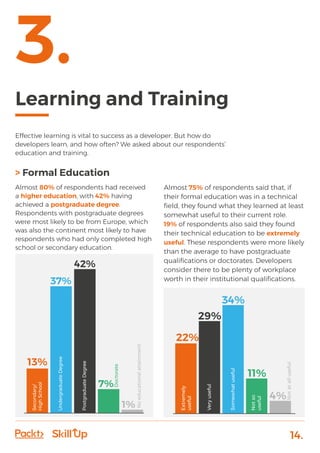
Almost 80% of respondents had received
a higher education, with 42% having
achieved a postgraduate degree.
Respondents with postgraduate degrees
were most likely to be from Europe, which
was also the continent most likely to have
respondents who had only completed high
school or secondary education.
Almost 75% of respondents said that, if
their formal education was in a technical
field, they found what they learned at least
somewhat useful to their current role.
19% of respondents also said they found
their technical education to be extremely
useful. These respondents were more likely
than the average to have postgraduate
qualifications or doctorates. Developers
consider there to be plenty of workplace
worth in their institutional qualifications.
Secondary/
HighSchool
UndergraduateDegree
PostgraduateDegree
Doctorate
Noeducationalattainment
13%
37%
42%
7%
1%
Extremely
useful
Veryuseful
Somewhatuseful
Notso
useful
Notatalluseful
22%
29%
34%
11%
4%
15.
> Ongoing Education
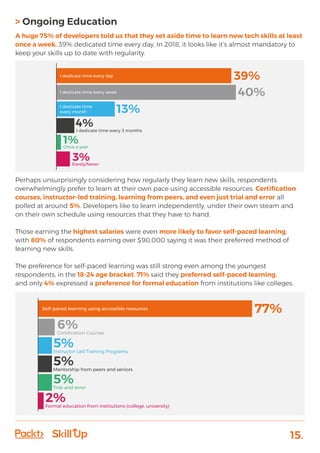
A huge 75% of developers told us that they set aside time to learn new tech skills at least
once a week. 39% dedicated time every day. In 2018, it looks like it’s almost mandatory to
keep your skills up to date with regularity.
Perhaps unsurprisingly considering how regularly they learn new skills, respondents
overwhelmingly prefer to learn at their own pace using accessible resources. Certification
courses, instructor-led training, learning from peers, and even just trial and error all
polled at around 5%. Developers like to learn independently, under their own steam and
on their own schedule using resources that they have to hand.
Those earning the highest salaries were even more likely to favor self-paced learning,
with 80% of respondents earning over $90,000 saying it was their preferred method of
learning new skills.
The preference for self-paced learning was still strong even among the youngest
respondents, in the 18-24 age bracket. 71% said they preferred self-paced learning,
and only 4% expressed a preference for formal education from institutions like colleges.
39%
13%
4%
1%
3%
40%
I dedicate time every day
I dedicate time
every month
I dedicate time every week
I dedicate time every 3 months
Once a year
Rarely/Never
77%
6%
Self-paced learning using accessible resources
Certification Courses
5%Instructor Led Training Programs
5%Mentorship from peers and seniors
5%Trial-and-error
2%Formal education from institutions (college, university)
16.
App Development
4.
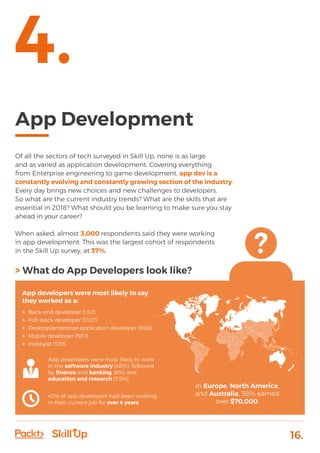
Of all the sectors of tech surveyed in Skill Up, none is as large
and as varied as application development. Covering everything
from Enterprise engineering to game development, app dev is a
constantly evolving and constantly growing section of the industry.
Every day brings new choices and new challenges to developers.
So what are the current industry trends? What are the skills that are
essential in 2018? What should you be learning to make sure you stay
ahead in your career?
When asked, almost 3,000 respondents said they were working
in app development. This was the largest cohort of respondents
in the Skill Up survey, at 37%.
> What do App Developers look like?
App developers were most likely to say
they worked as a:
»» Back-end developer (1,112)
»» Full-stack developer (1,107)
»» Desktop/enterprise application developer (806)
»» Mobile developer (587)
»» Hobbyist (535)
In Europe, North America,
and Australia, 38% earned
over $70,000.
App developers were most likely to work
in the software industry (48%), followed
by finance and banking (8%) and
education and research (7.5%)
42% of app developers had been working
in their current job for over 4 years
17.
Elite Level Java
Add to Cart
> Top Languages
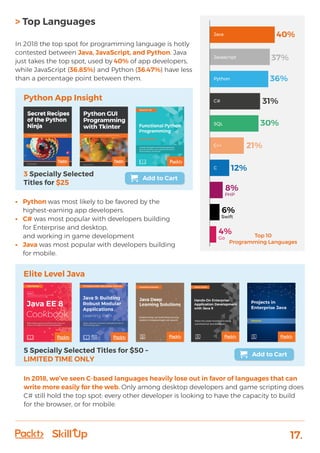
In 2018 the top spot for programming language is hotly
contested between Java, JavaScript, and Python. Java
just takes the top spot, used by 40% of app developers,
while JavaScript (36.85%) and Python (36.47%) have less
than a percentage point between them.
•	 Python was most likely to be favored by the
	 highest-earning app developers.
•	 C# was most popular with developers building
	 for Enterprise and desktop,
	 and working in game development
•	 Java was most popular with developers building
	 for mobile.
In 2018, we’ve seen C-based languages heavily lose out in favor of languages that can
write more easily for the web. Only among desktop developers and game scripting does
C# still hold the top spot: every other developer is looking to have the capacity to build
for the browser, or for mobile.
Python App Insight
Add to Cart
40%Java
37%Javascript
36%Python
31%C#
30%SQL
21%C++
12%C
8%
PHP
6%
Swift
4%
Go Top 10
Programming Languages
5 Specially Selected Titles for $50 –
LIMITED TIME ONLY
18.
> Top Tools for Mobile
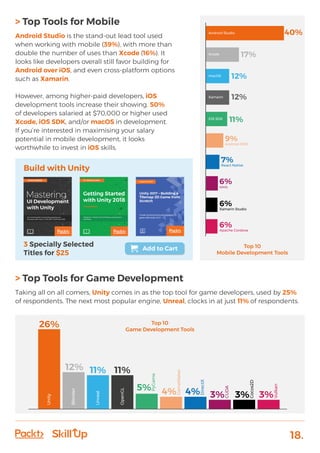
Android Studio is the stand-out lead tool used
when working with mobile (39%), with more than
double the number of uses than Xcode (16%). It
looks like developers overall still favor building for
Android over iOS, and even cross-platform options
such as Xamarin.
However, among higher-paid developers, iOS
development tools increase their showing. 50%
of developers salaried at $70,000 or higher used
Xcode, iOS SDK, and/or macOS in development.
If you’re interested in maximising your salary
potential in mobile development, it looks
worthwhile to invest in iOS skills.
> Top Tools for Game Development
Taking all on all comers, Unity comes in as the top tool for game developers, used by 25%
of respondents. The next most popular engine, Unreal, clocks in at just 11% of respondents.
Build with Unity
Add to Cart
40%Android Studio
17%Xcode
12%macOS
12%Xamarin
Apache Cordova
6%
Xamarin Studio
6%
Ionic
6%
React Native
7%
Android NDK
9%
11%iOS SDK
Vulkan
3%
Cocos2D
3%
CUDA
3%
DirectX
4%
GameMaker
Unity
Blender
Unreal
OpenGL
4%
PyGame
5%
26%
12% 11% 11%
Top 10
Mobile Development Tools
Top 10
Game Development Tools
19.
> Top Tools for Enterprise
and Desktop
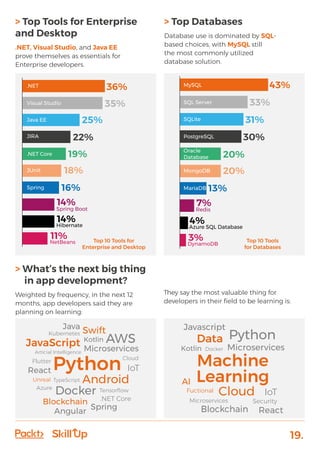
.NET, Visual Studio, and Java EE
prove themselves as essentials for
Enterprise developers.
> Top Databases
Database use is dominated by SQL-
based choices, with MySQL still
the most commonly utilized
database solution.
> What’s the next big thing
in app development?
Weighted by frequency, in the next 12
months, app developers said they are
planning on learning:
36%.NET
35%Visual Studio
25%Java EE
22%JIRA
19%.NET Core
18%JUnit
16%Spring
14%
Spring Boot
14%
Hibernate
11%
NetBeans
43%MySQL
33%SQL Server
31%SQLite
30%PostgreSQL
20%
Oracle
Database
20%MongoDB
13%MariaDB
7%
Redis
4%
Azure SQL Database
3%
DynamoDB
Top 10 Tools for
Enterprise and Desktop
Top 10 Tools
for Databases
They say the most valuable thing for
developers in their field to be learning is:
JavaScript Microservices
Blockchain
Spring
Android
AWS
Python
Docker
Angular
React
Java
Kotlin
Swift
Articial Intelligence
Azure
Flutter
.NET Core
Unreal
Cloud
Kubernetes
Tensorflow
TypeScript
IoT
Data
Microservices
AI
Cloud
Python
Machine
Learning
Blockchain React
Javascript
Kotlin Docker
Security
Fuctional
Microservices
IoT
20.
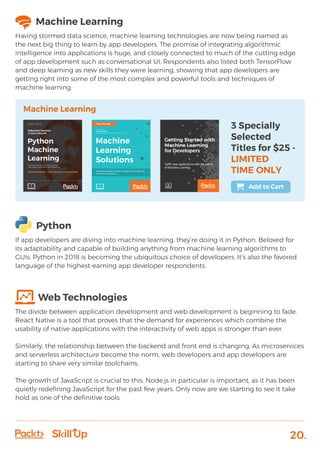
Machine Learning
Having stormed data science, machine learning technologies are now being named as
the next big thing to learn by app developers. The promise of integrating algorithmic
intelligence into applications is huge, and closely connected to much of the cutting edge
of app development such as conversational UI. Respondents also listed both TensorFlow
and deep learning as new skills they were learning, showing that app developers are
getting right into some of the most complex and powerful tools and techniques of
machine learning.
Python
If app developers are diving into machine learning, they’re doing it in Python. Beloved for
its adaptability and capable of building anything from machine learning algorithms to
GUIs, Python in 2018 is becoming the ubiquitous choice of developers. It’s also the favored
language of the highest-earning app developer respondents.
Web Technologies
The divide between application development and web development is beginning to fade.
React Native is a tool that proves that the demand for experiences which combine the
usability of native applications with the interactivity of web apps is stronger than ever.
Similarly, the relationship between the backend and front end is changing. As microservices
and serverless architecture become the norm, web developers and app developers are
starting to share very similar toolchains.
The growth of JavaScript is crucial to this. Node.js in particular is important, as it has been
quietly redefining JavaScript for the past few years. Only now are we starting to see it take
hold as one of the definitive tools.
Machine Learning
3 Specially
Selected
Titles for $25 -
LIMITED
TIME ONLY
Add to Cart
21.
Blockchain
App developers were split on how transformational Blockchain is going to be in this year’s
survey. But it is still viewed as one of the trends app developers feel they should be paying
attention to. The types of applications you’re building will be critical here.
While it remains to be seen
whether Blockchain has
an impact on mainstream
applications, like eCommerce,
it will be interesting to see
some of the more niche uses of
Blockchain in the near future.
Although it may take some
time to disrupt the status quo,
we could see a huge rise in
Blockchain startups aiming to
disrupt legal contracts, asset
and identity management, and
maybe even democracy.
Kotlin & Rust
Kotlin and Rust are two languages that are set to define the future of development for the
years to come. Kotlin has been around since 2011, but only recently has it started to really
capture the imagination of engineers. Google has done a lot to reinforce its reputation - the
fact that it was fully supported in Android Studio 3.0 in 2017 has ensured it is now one of
the most popular Android development languages. We expect to see it competing closely
with Java by the end of the year.
Rust has also been around for
some time, but the Mozilla
team have honed their strategy
carefully in the last year. The
organization wants to position
Rust as a key language for linking
front and back ends - wasm-
bindgen, which made Rust
interoperable with JavaScript
code is clear evidence of this.
Having been confirmed as the
‘most loved language’ in the
Stack Overflow survey in 2016,
2017 and 2018, it has undoubtedly got usability and productivity built into its design.
22.
> Hot Topics
Do you think Kotlin is a serious contender for Java?
Java beware: respondents say that Kotlin might just topple
you from your throne. With adoption by Google for Android
development, is this the beginning of the end of Java
for mobile?
Is virtual reality here to stay in game development?
VR isn’t going anywhere. Developers overwhelmingly say
that it’s a new paradigm for games and game development.
Only 13% thought it might be a fad.
Does Swift have potential outside of mobile?
There’s more to Swift than just building for mobile and
OSX. With the language now open-sourced, and picked
up as one of IBM’s core languages for its cloud platform,
60% of developers said they thought it had potential
outside of mobile.
Do you use, or plan to use, microservices in
your application architecture?
Microservices are here, and everyone’s using them. Over
80% of respondents said they were using or planning to
include microservices in their application architecture.
Which new architectural approach are you
most excited about?
With the strength of extentability and customizations,
developers say they love the potential of API Driven
Architecture. Less popular is the prospect of Chaos
Engineering - deliberately adding bugs to your systems
to test its durability looks like a hard sell!
Do you think Blockchain technology will
be revolutionary?
We asked each section of developers what they thought
about the potential of Blockchain technology. App
developers were split 60/40, with 60% thinking Blockchain
meant a revolution for technology. However, they were less
sure than their peers in web development and in data.
59%
Yes
69%
Yes
86%
Yes
67%
API
71%
Yes
84%
Yes
23.
Expert Insight: Imran Bashir –
The Blockchain Revolution
Packt author Imran Bashir shares his thoughts on
Blockchain technology and what it means to modern
developers.
I agree with the Skill Up respondents that Blockchain will
be revolutionary. The fundamental issue that blockchain
solves is that of trust. It enables two or more mutually
distrusting parties to transact with each other without
the need of establishing trust and a trusted third party.
This phenomenon alone is enough to start a revolution.
This paradigm fundamentally changes the way we conduct business and results in
significant improvements such as cost saving, security and transparency.
Any developer should learn blockchain technology because in the next year or
so there will be a high demand for skilled blockchain developers/engineers. Even
now there are many unfilled jobs: it is said that there are 14 jobs open for every
Blockchain developer.
Blockchain platforms such as Ethereum and Hyperledger Fabric are the most
commonly used for development. As such, developers should focus on at least one of
these platforms.
Imran Bashir has an M.Sc. in Information Security from Royal Holloway, University
of London, and has a background in software development, solution architecture,
infrastructure management, and IT service management. He is also a member
of the Institute of Electrical and Electronics Engineers (IEEE) and the British
Computer Society (BCS). Imran has sixteen years’ of experience in the public and
financial sectors.
Add to Cart
24.
Web Development
5.
In 2018, working in tech almost always means working with the
web. As more and more applications migrate to the browser and
the cloud and as sites become ever more sophisticated, web
development knowledge becomes a greater and greater priority.
So what do you need to know to stay ahead in web development?
Has a winner emerged in the battle of the JavaScript frameworks?
Are people even still using JavaScript?
When asked, almost 2,000 respondents said they were working in
web development.
> What do Web Developers look like?
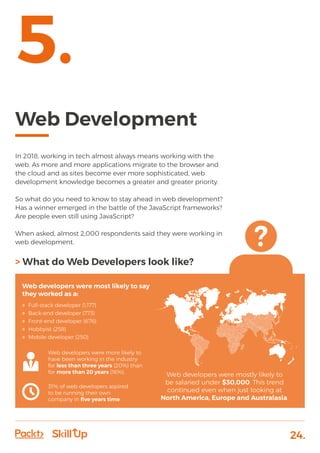
Web developers were most likely to say
they worked as a:
»» Full-stack developer (1,177)
»» Back-end developer (773)
»» Front-end developer (676)
»» Hobbyist (258)
»» Mobile developer (250)
Web developers were mostly likely to
be salaried under $30,000. This trend
continued even when just looking at
North America, Europe and Australasia.
Web developers were more likely to
have been working in the industry
for less than three years (20%) than
for more than 20 years (16%).
31% of web developers aspired
to be running their own
company in five years time.
25.
> Top Languages
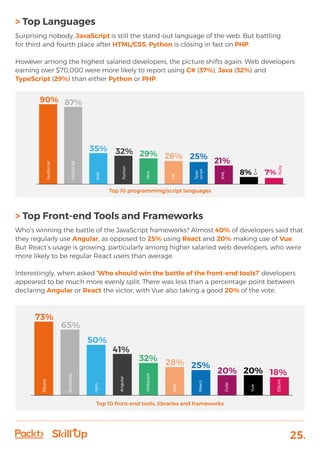
Surprising nobody, JavaScript is still the stand-out language of the web. But battling
for third and fourth place after HTML/CSS, Python is closing in fast on PHP.
However among the highest salaried developers, the picture shifts again. Web developers
earning over $70,000 were more likely to report using C# (37%), Java (32%) and
TypeScript (29%) than either Python or PHP.
> Top Front-end Tools and Frameworks
Who’s winning the battle of the JavaScript frameworks? Almost 40% of developers said that
they regularly use Angular, as opposed to 25% using React and 20% making use of Vue.
But React’s usage is growing, particularly among higher salaried web developers, who were
more likely to be regular React users than average.
Interestingly, when asked ‘Who should win the battle of the front-end tools?’ developers
appeared to be much more evenly split. There was less than a percentage point between
declaring Angular or React the victor, with Vue also taking a good 20% of the vote.
Top 10 programming/script languages
Top 10 front-end tools, libraries and frameworks
JavaScript
90%
HTML/CSS
87%
PHP
35%
Python
32%
Java
29%
C#
26%
Type-
script
25%
XML
21%
C++
8%
Ruby
7%
JQuery
73%
Bootstrap
65%
npm
50%
Angular
41%
Webpack
32%
Sass
28%
React
25%
Gulp
20%
Vue
20%
ESLint
18%
26.
> Top Front-end Tools and Frameworks
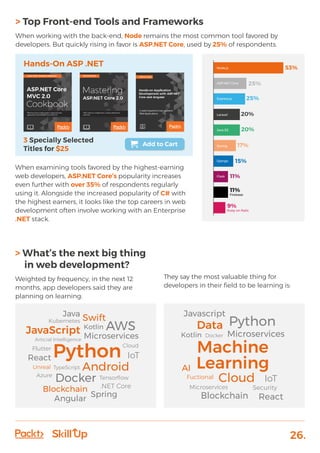
When working with the back-end, Node remains the most common tool favored by
developers. But quickly rising in favor is ASP.NET Core, used by 25% of respondents.
When examining tools favored by the highest-earning
web developers, ASP.NET Core’s popularity increases
even further with over 35% of respondents regularly
using it. Alongside the increased popularity of C# with
the highest earners, it looks like the top careers in web
development often involve working with an Enterprise
.NET stack.
Hands-On ASP .NET
Add to Cart
53%Node.js
25%ASP.NET Core
Express.js 25%
20%Laravel
20%Java EE
17%Spring
Flask
15%Django
11%
11%
Firebase
9%
Ruby on Rails
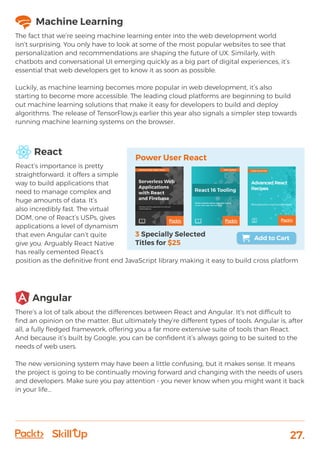
> What’s the next big thing
in web development?
Weighted by frequency, in the next 12
months, app developers said they are
planning on learning:
They say the most valuable thing for
developers in their field to be learning is:
JavaScript Microservices
Blockchain
Spring
Android
AWS
Python
Docker
Angular
React
Java
Kotlin
Swift
Articial Intelligence
Azure
Flutter
.NET Core
Unreal
Cloud
Kubernetes
Tensorflow
TypeScript
IoT
Data
Microservices
AI
Cloud
Python
Machine
Learning
Blockchain React
Javascript
Kotlin Docker
Security
Fuctional
Microservices
IoT
27.
React
React’s importance is pretty
straightforward: it offers a simple
way to build applications that
need to manage complex and
huge amounts of data. It’s
also incredibly fast. The virtual
DOM, one of React’s USPs, gives
applications a level of dynamism
that even Angular can’t quite
give you. Arguably React Native
has really cemented React’s
position as the definitive front end JavaScript library making it easy to build cross platform
Machine Learning
The fact that we’re seeing machine learning enter into the web development world
isn’t surprising. You only have to look at some of the most popular websites to see that
personalization and recommendations are shaping the future of UX. Similarly, with
chatbots and conversational UI emerging quickly as a big part of digital experiences, it’s
essential that web developers get to know it as soon as possible.
Luckily, as machine learning becomes more popular in web development, it’s also
starting to become more accessible. The leading cloud platforms are beginning to build
out machine learning solutions that make it easy for developers to build and deploy
algorithms. The release of TensorFlow.js earlier this year also signals a simpler step towards
running machine learning systems on the browser.
Angular
There’s a lot of talk about the differences between React and Angular. It’s not difficult to
find an opinion on the matter. But ultimately they’re different types of tools. Angular is, after
all, a fully fledged framework, offering you a far more extensive suite of tools than React.
And because it’s built by Google, you can be confident it’s always going to be suited to the
needs of web users.
The new versioning system may have been a little confusing, but it makes sense. It means
the project is going to be continually moving forward and changing with the needs of users
and developers. Make sure you pay attention - you never know when you might want it back
in your life...
28.
Golang
Go is part of an intriguing wave of new languages. It’s part of the same generation as Kotlin
and Rust in that it’s a language that is incredibly performant and quite easy to use once you
get past the early learning curve.
It’s a language that takes away some of the pain of modern web development, and is well
suited to meeting some of the latest challenges that have emerged, like single page web
applications and deploying on cloud.
AWS
It’s this shift to cloud that is the key reason why AWS is becoming more and more
important to web developers. In 2018 cloud isn’t a new or emerging trend - it is now well
and truly mainstream.
One of the reasons that AWS in particular has caught the attention of developers is its
impressive suite of developer tools. It’s a cloud platform that is designed with continuous
delivery and DevOps in mind.
GraphQL
We touted GraphQL as one of the most important tools in 2018 back at the end of
the year. We’re not surprised to see web developers starting to pay attention to it and
adopt - Facebook’s data query language is helping to shape the future of API design.
With React’s popularity continuing to rise, GraphQL is going to fit neatly into the web
developer toolchain.
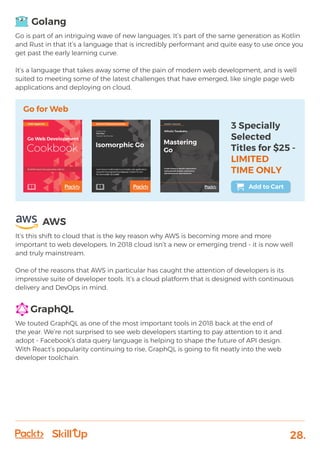
Go for Web
3 Specially
Selected
Titles for $25 -
LIMITED
TIME ONLY
Add to Cart
29.
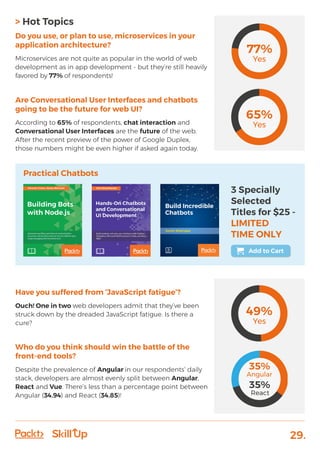
> Hot Topics
Do you use, or plan to use, microservices in your
application architecture?
Microservices are not quite as popular in the world of web
development as in app development - but they’re still heavily
favored by 77% of respondents!
Are Conversational User Interfaces and chatbots
going to be the future for web UI?
According to 65% of respondents, chat interaction and
Conversational User Interfaces are the future of the web.
After the recent preview of the power of Google Duplex,
those numbers might be even higher if asked again today.
Have you suffered from ‘JavaScript fatigue’?
Ouch! One in two web developers admit that they’ve been
struck down by the dreaded JavaScript fatigue. Is there a
cure?
65%
Yes
49%
Yes
77%
Yes
35%
35%
Angular
React
Who do you think should win the battle of the
front-end tools?
Despite the prevalence of Angular in our respondents’ daily
stack, developers are almost evenly split between Angular,
React and Vue. There’s less than a percentage point between
Angular (34.94) and React (34.85)!
Practical Chatbots
3 Specially
Selected
Titles for $25 -
LIMITED
TIME ONLY
Add to Cart
30.
86%
Yes
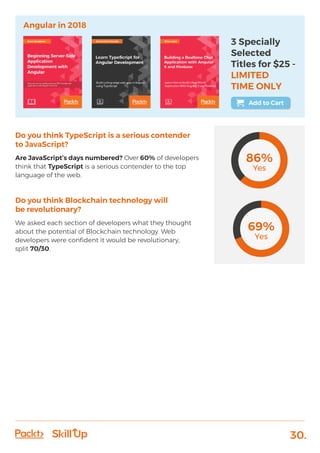
Do you think TypeScript is a serious contender
to JavaScript?
Are JavaScript’s days numbered? Over 60% of developers
think that TypeScript is a serious contender to the top
language of the web.
Do you think Blockchain technology will
be revolutionary?
We asked each section of developers what they thought
about the potential of Blockchain technology. Web
developers were confident it would be revolutionary,
split 70/30.
69%
Yes
Angular in 2018
3 Specially
Selected
Titles for $25 -
LIMITED
TIME ONLY
Add to Cart
31.
Expert Insight: Minko Gechev –
Modern Web Development
Packt author Minko Gechev shares his thoughts on the
battle of the frameworks, and what modern developers
should be investing their time in.
Angular, React and Vue are all unique and interesting
ideas which are worth exploring. I truly believe that
learning all the major frameworks can help developers
go to the next level! Having a high-level understanding
of how the frameworks work and how to use them will
allow you to adapt according to a project’s requirements.
My recommendation would be to understand how to manage the state of our
applications because that’s probably the most complex problem in our day to day
development. Once we have a solid understanding of this, we can easily switch
between different frameworks depending on the problems we’re solving, what the
rest of the team is using, and the project’s requirements.
Over the past couple of years I’ve seen a strong increase in the excitement around
TypeScript, not only in the Angular world but also in React and Vue. I’m personally
using TypeScript for a few projects – a platform that we built with React and an
educational application written in Angular. Recently I haven’t started any project
with JavaScript – for everything new I’m using TypeScript and I’m trying to migrate, as
many of my existing projects as possible.
If you’re choosing what to learn in the next 12 months, there are a lot of exciting
things happening! Web browsers are getting more and more powerful, exposing
hundreds of APIs and opportunities. WebAssembly is moving very quickly and I
believe that together with Rust it has a lot of potential in future.
On the other hand, Google recently announced TensorFlow.js. This is a library which
allows us to use machine learning (ML) in the browser. In the next few years, ML is
going to take a larger portion of our development process. I’m really excited about
what’s coming up in the near future!
Minko Gechev is a Google Developer Expert for the Angular team and a presenter
at over 40 worldwide conferences, including ng-conf, AngularConnect, AngularUP,
and many others. Minko is co-author of the official Angular style guide, and
has developed codelyzer – a tool for static analysis of Angular applications and
best practices, which is part of the Angular CLI, and currently has over a million
downloads each month.
Add to Cart
32.
Security and Systems
Administration
6.
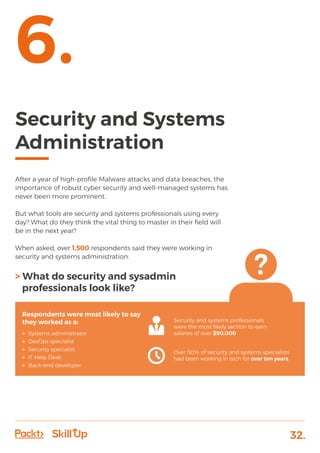
After a year of high-profile Malware attacks and data breaches, the
importance of robust cyber security and well-managed systems has
never been more prominent.
But what tools are security and systems professionals using every
day? What do they think the vital thing to master in their field will
be in the next year?
When asked, over 1,500 respondents said they were working in
security and systems administration.
> What do security and sysadmin
professionals look like?
Respondents were most likely to say
they worked as a:
»» Systems administrator
»» DevOps specialist
»» Security specialist
»» IT Help Desk
»» Back-end developer
Security and systems professionals
were the most likely section to earn
salaries of over $90,000
Over 50% of security and systems specialists
had been working in tech for over ten years.
33.
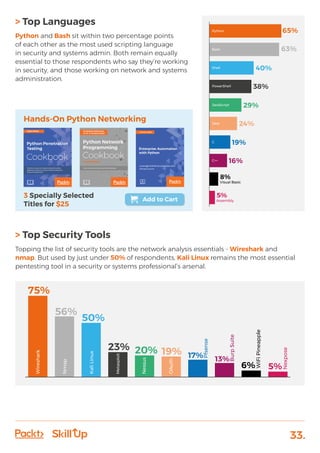
> Top Languages
Python and Bash sit within two percentage points
of each other as the most used scripting language
in security and systems admin. Both remain equally
essential to those respondents who say they’re working
in security, and those working on network and systems
administration.
> Top Security Tools
Topping the list of security tools are the network analysis essentials - Wireshark and
nmap. But used by just under 50% of respondents, Kali Linux remains the most essential
pentesting tool in a security or systems professional’s arsenal.
Hands-On Python Networking
Add to Cart
65%Python
63%Bash
40%Shell
38%PowerShell
29%JavaScript
24%Java
19%C
16%C++
5%
Assembly
8%
Visual Basic
75%
Wireshark
56%
Nmap
50%
KaliLinux
23% 20% 19%
Metasploit
Nessus
OAuth
13%
BurpSuite
17%
Pfsense
6%
WiFiPineapple
5%
Nexpose
34.
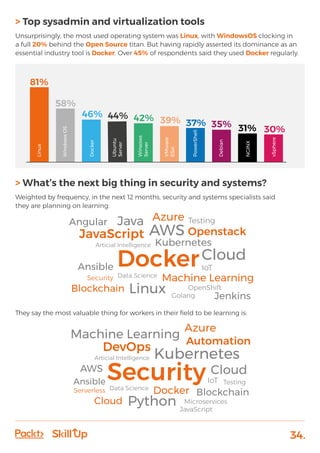
> Top sysadmin and virtualization tools
Unsurprisingly, the most used operating system was Linux, with WindowsOS clocking in
a full 20% behind the Open Source titan. But having rapidly asserted its dominance as an
essential industry tool is Docker. Over 45% of respondents said they used Docker regularly.
> What’s the next big thing in security and systems?
Weighted by frequency, in the next 12 months, security and systems specialists said
they are planning on learning:
They say the most valuable thing for workers in their field to be learning is:
81%
Linux
58%
WindowsOS
46%
Docker
44%Ubuntu
Server 42%
Winsows
Server
39%
VMware
ESxi
37%
PowerShell
35%
Debian
31%
NGINX
30%
vSphere
JavaScript Openstack
Kubernetes
Blockchain
Jenkins
Machine Learning
AWS
Docker
Linux
Angular
Ansible
Java Azure
Articial Intelligence
Golang
Testing
Security
Cloud
OpenShift
Data Science
IoT
DevOps
Automation
Cloud
BlockchainDocker
Kubernetes
Security
Python
AWS
Ansible
Machine Learning
Azure
Articial Intelligence
JavaScript
Testing
Serverless
Cloud
Microservices
Data Science
IoT
35.
Machine Learning
Unsurprisingly, machine learning makes an appearance once again. As if it wasn’t clear
already, the applications of machine learning are so diverse that just about every technical
role could be impacted - empowered, maybe - by it. For security professionals, machine
learning is already providing a useful way to identify vulnerabilities and security threats.
For sysadmins, machine learning might look like a threat, but in fact it’s going to reshape
the role. Yes, sysadmins may need to upskill, but as software infrastructure becomes more
complex, it’s going to need human intelligence to manage its integration and maintenance
successfully.
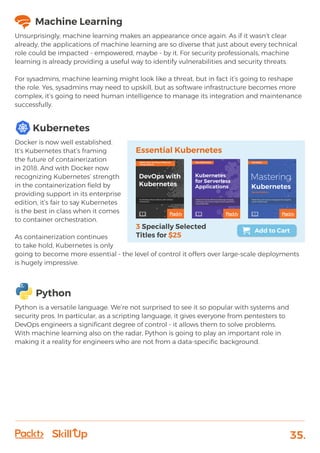
Kubernetes
Docker is now well established.
It’s Kubernetes that’s framing
the future of containerization
in 2018. And with Docker now
recognizing Kubernetes’ strength
in the containerization field by
providing support in its enterprise
edition, it’s fair to say Kubernetes
is the best in class when it comes
to container orchestration.
As containerization continues
to take hold, Kubernetes is only
going to become more essential - the level of control it offers over large-scale deployments
is hugely impressive.
Python
Python is a versatile language. We’re not surprised to see it so popular with systems and
security pros. In particular, as a scripting language, it gives everyone from pentesters to
DevOps engineers a significant degree of control - it allows them to solve problems.
With machine learning also on the radar, Python is going to play an important role in
making it a reality for engineers who are not from a data-specific background.
36.
AWS and Cloud
Once again AWS rears its head.
Of course, the cloud space is
incredibly competitive with
Google and Microsoft bustling for
market share alongside Amazon.
But it does seem that AWS is
becoming the cloud solution
of choice for many. Whether
it can maintain its popularity
remains to be seen - we may
start to see hybrid and polycloud
solutions coming to the fore as
organizations and engineers look
for more bespoke and custom cloud platforms.
Ansible
Ansible is perhaps the definitive configuration management tool. Chef and Puppet may
have got there first, but Ansible’s rise over the last couple of years is largely down to its
impressive automation capabilities. And with the demands on operations engineers and
sysadmins facing constant time pressures, the need to automate isn’t a useful extra, but a
necessity.
Ansible’s tagline is “allowing smart people to do smart things.” It’s hard to argue that any
software should aim to do much more than that.
37.
> Hot Topics
Do you think IoT is being held back by
security issues?
Over two-thirds of security and systems specialists say that
the potential of the Internet of Things is being held back
by issues of security. A lack of universal security standards
- or even no security at all - is really taking the shine off this
much-hyped area of development.
Do most organizations treat cyber security with
the seriousness it deserves?
Despite a series of high-profile Malware attacks and shut-
downs in the past year, respondents overwhelmingly say
that organizations still don’t treat cyber security seriously
enough. Over 80% say it’s an issue.
Is your business/organization ‘Cloud Native’ or
planning on integrating operations with the cloud?
Over 75% of respondents now say that their business or
organization has switched to the Cloud, or is planning to.
Are the days of crowded server rooms soon to vanish entirely?
Does the future of virtualization lie in Open
Source or Enterprise technologies?
Respondents strongly feel that Open Source is the way
forward for virtualization technologies.
Do you think Azure and Google Cloud are a
serious contender to AWS?
Despite the huge market share that Amazon Web Services
hold over the Cloud industry, respondents have high hopes
for Microsoft and Google Cloud’s offerings.
Is Kali Linux still one of the most relevant tools
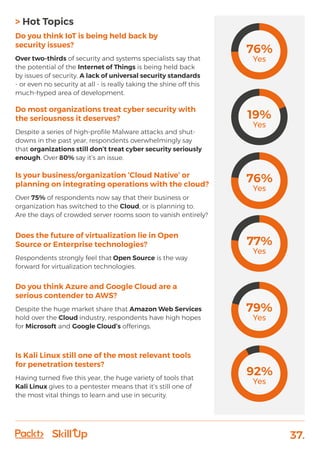
for penetration testers?
Having turned five this year, the huge variety of tools that
Kali Linux gives to a pentester means that it’s still one of
the most vital things to learn and use in security.
19%
Yes
79%
Yes
76%
Yes
76%
Yes
77%
Yes
92%
Yes
38.
Data
7.
Is 2018 the year that data analysis invades development as a whole?
In the Skill Up Survey, both app developers and web developers
have spoken of the importance of machine learning and other
cutting edge data techniques to their future success.
So what language rules for data? What are the most common
libraries and tools in the data analyst’s arsenal? What do data
analysts hate most about the process?
When asked, over 1,450 respondents said they were working in data.
This was the smallest cohort of the Skill Up survey.
> What do security and sysadmin
professionals look like?
Respondents were most likely to say
they worked as a:
»» Data scientist or data specialist
»» Data analyst
»» Academic or Researcher
»» Back-end developer
»» Hobbyist
Data workers were less likely to feel that their peers knew more about
programming than them than other sections.
In five years, respondents were most
likely to want to be running their
own company or doing consulting
and freelancing.
Respondents were most likely to
have been working in the industry
for over 10 years.
39.
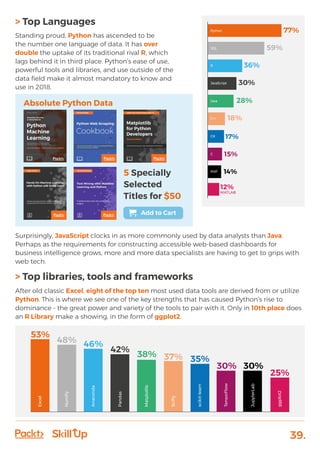
> Top Languages
Standing proud, Python has ascended to be
the number one language of data. It has over
double the uptake of its traditional rival R, which
lags behind it in third place. Python’s ease of use,
powerful tools and libraries, and use outside of the
data field make it almost mandatory to know and
use in 2018.
Surprisingly, JavaScript clocks in as more commonly used by data analysts than Java.
Perhaps as the requirements for constructing accessible web-based dashboards for
business intelligence grows, more and more data specialists are having to get to grips with
web tech.
> Top libraries, tools and frameworks
After old classic Excel, eight of the top ten most used data tools are derived from or utilize
Python. This is where we see one of the key strengths that has caused Python’s rise to
dominance - the great power and variety of the tools to pair with it. Only in 10th place does
an R Library make a showing, in the form of ggplot2.
Absolute Python Data
5 Specially
Selected
Titles for $50
Add to Cart
77%
12%
MATLAB
14%
15%
17%
Python
59%SQL
36%R
30%JavaScript
28%Java
18%C++
C#
C
PHP
53%
Excel
48%
NumPy
46%
Anaconda
42%
Pandas
38%
Matplotlib
37%
SciPy
35%
scikit-learn
30%
TensorFlow
30%
JupyterLab
25%
ggplot2
40.
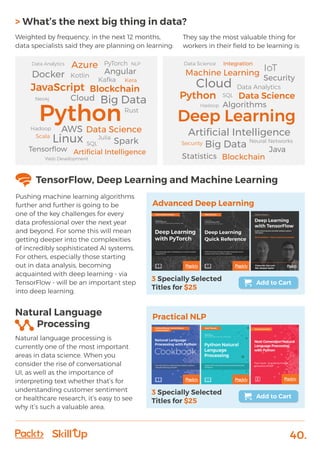
> What’s the next big thing in data?
They say the most valuable thing for
workers in their field to be learning is:
JavaScript Blockchain
Cloud
Artificial Intelligence
Spark
Data ScienceAWS
Python
Linux
Angular
Tensorflow
Docker
Azure
Neo4j
SQL
Kafka
PyTorch NLP
Kotlin
Data Analytics
Web Development
Scala
Kera
Big Data
Julia
Hadoop
Rust
Python Data Science
Algorithms
Blockchain
Java
Machine Learning
Cloud
Deep Learning
Big Data
Security
Statistics
Artificial Intelligence
Integration
Hadoop
SQL
Data Analytics
Security Neural Networks
Data Science
IoT
Weighted by frequency, in the next 12 months,
data specialists said they are planning on learning:
TensorFlow, Deep Learning and Machine Learning
Natural Language
Processing
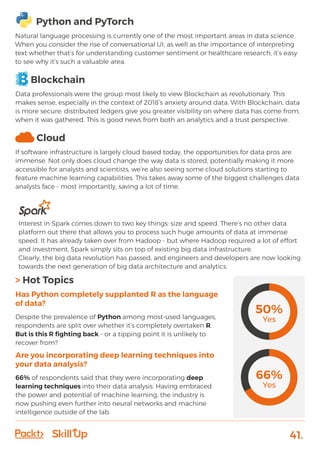
Natural language processing is
currently one of the most important
areas in data science. When you
consider the rise of conversational
UI, as well as the importance of
interpreting text whether that’s for
understanding customer sentiment
or healthcare research, it’s easy to see
why it’s such a valuable area.
Pushing machine learning algorithms
further and further is going to be
one of the key challenges for every
data professional over the next year
and beyond. For some this will mean
getting deeper into the complexities
of incredibly sophisticated AI systems.
For others, especially those starting
out in data analysis, becoming
acquainted with deep learning - via
TensorFlow - will be an important step
into deep learning.
Advanced Deep Learning
Practical NLP
41.
Python and PyTorch
Natural language processing is currently one of the most important areas in data science.
When you consider the rise of conversational UI, as well as the importance of interpreting
text whether that’s for understanding customer sentiment or healthcare research, it’s easy
to see why it’s such a valuable area.
Blockchain
Data professionals were the group most likely to view Blockchain as revolutionary. This
makes sense, especially in the context of 2018’s anxiety around data. With Blockchain, data
is more secure; distributed ledgers give you greater visibility on where data has come from,
when it was gathered. This is good news from both an analytics and a trust perspective.
Cloud
If software infrastructure is largely cloud based today, the opportunities for data pros are
immense. Not only does cloud change the way data is stored, potentially making it more
accessible for analysts and scientists, we’re also seeing some cloud solutions starting to
feature machine learning capabilities. This takes away some of the biggest challenges data
analysts face - most importantly, saving a lot of time.
Interest in Spark comes down to two key things: size and speed. There’s no other data
platform out there that allows you to process such huge amounts of data at immense
speed. It has already taken over from Hadoop - but where Hadoop required a lot of effort
and investment, Spark simply sits on top of existing big data infrastructure.
Clearly, the big data revolution has passed, and engineers and developers are now looking
towards the next generation of big data architecture and analytics.
> Hot Topics
Has Python completely supplanted R as the language
of data?
Despite the prevalence of Python among most-used languages,
respondents are split over whether it’s completely overtaken R.
But is this R fighting back - or a tipping point it is unlikely to
recover from?
Are you incorporating deep learning techniques into
your data analysis?
66% of respondents said that they were incorporating deep
learning techniques into their data analysis. Having embraced
the power and potential of machine learning, the industry is
now pushing even further into neural networks and machine
intelligence outside of the lab.
66%
Yes
50%
Yes
42.
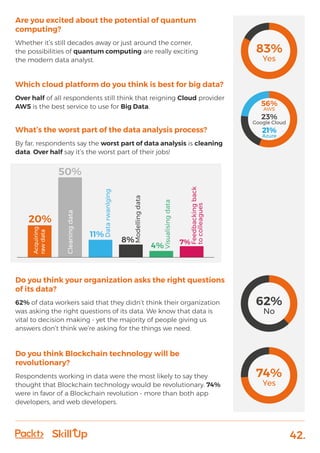
Are you excited about the potential of quantum
computing?
Whether it’s still decades away or just around the corner,
the possibilities of quantum computing are really exciting
the modern data analyst.
Which cloud platform do you think is best for big data?
Over half of all respondents still think that reigning Cloud provider
AWS is the best service to use for Big Data.
What’s the worst part of the data analysis process?
By far, respondents say the worst part of data analysis is cleaning
data. Over half say it’s the worst part of their jobs!
Do you think your organization asks the right questions
of its data?
62% of data workers said that they didn’t think their organization
was asking the right questions of its data. We know that data is
vital to decision making - yet the majority of people giving us
answers don’t think we’re asking for the things we need.
Do you think Blockchain technology will be
revolutionary?
Respondents working in data were the most likely to say they
thought that Blockchain technology would be revolutionary. 74%
were in favor of a Blockchain revolution - more than both app
developers, and web developers.
62%
No
74%
Yes
83%
Yes
56%
23%
21%
AWS
Google Cloud
Azure
20%
Acquiring
rawdata
11%
Datarwanlging
8%
Modellingdata
4%
Visualisingdata
7%
Feedbackingback
tocolleagues
50%
Cleaningdata
43.
Final Thoughts
When the first Skill Up survey ran in 2015, two words were
everywhere: Big Data. Four surveys later, we’ve seen another two
words rise to prominence across all tech disciplines. Machine
learning crops up again and again as one of the most vital things
for developers to be adding to their skills portfolio. With the recent
preview of advanced AI assistants like Google Duplex, it feels like
we might be on the brink of another real big revolution in tech.
Machine learning: is it the next Big Data? The next mobile?
Perhaps one of the most heartening things in the Skill Up survey
is the strength of community developers feel with their peers, and
how much they genuinely seem to love working in tech. As the
industry matures, it’s great to see that passion and a communal
spirit remains and grows.
Packt are proud to support the developer community. When
developers need the skills to respond quickly and reliably to change,
we strive to be there with the insight they need to skill up. However
you work, whatever tools you use, Packt will be there on demand
with answers.
Thanks to all those who took part in this year’s survey, and to you
for reading this report. Follow @PacktPub on Twitter, find us on
Facebook, or check out the Packt Hub for more insights and
discussion.
8.
What do you think about our report findings?
Tweet us @packtpub using the hashtag #Skillup2018
ANALYSIS
Sam Wood
EDITOR
Sam Wood
Rich Gall
DESIGN
Clare Bowyer
PROJECT
MANAGEMENT
Sarah Hennah
2018

Developer Skills Report

  • 1.
    2018 Developer Skills Report Thetools and trends that define how software developers work today.
  • 2.
    2. Contents 1. Introduction &Demographics 2. Work & Community 3. Learning & Training 4. App Development 5. Web Development 6. Security & System Administration 7. Data 8. Final Thoughts - 3 - 8 - 14 - 16 - 24 - 32 - 38 - 43
  • 3.
    3. Introduction 1. Only one thingis certain in the world of tech: change. Working in development is about navigating a constantly evolving industry, keeping up to date with the skills you need to succeed. The Packt Skill Up Developer Skills Report is dedicated to ensuring developers make the right learning choices. Based on an annual survey of thousands of professional developers, it aims to keep track of the trends and tools of the industry. In particular, we wanted to know: »» What were the most popular tools developers used every day »» What did developers think was really worth spending time learning »» How did developers feel about working in tech, and the wider tech community The Skill Up 2018 survey streamed developers into four broad disciplines: application development, web development, security and systems administration, and data. It captured a snapshot of each section of the industry in 2018 to discover the state of the modern tech community in your industry.
  • 4.
    4. Developer Demographics Almost 8,000developers responded to the Skill Up Survey 2018. Developers hailed from across the world, with a huge variety of job roles and industry experience. The largest number of respondents lived in Europe (3,190), followed by North America (2,385) and Asia (1,086). 0-5% 6-20% 21-40% 40% + 1.
  • 5.
    5. > Developer JobRoles Respondents were most likely to identify as either back-end developers (29%) or full-stack developers (34%). Those respondents were most likely to correlate with jobs in desktop or enterprise application development, or mobile development. 287 respondents were in C-Suite roles (CTO, CEO, COO). These company heads were mostly likely to also consider themselves full-stack developers, product- or project-managers, back-end developers, and/or systems admin. Full-stack Developer 34% Back-end Developer 30% Front-end Developer 16% Systems Administrator 16% Hobbyist 15% Desktop or enterprise application developer 15% Data scientist or data specialist 14% Mobile Developer 12% Data analyst 11% Product or Project manager 11% DevOps Specialist 11% Student 10% Database Administrator 9% Academic or Researcher 9% Other role in tech 9% IT Helpdesk/ Tech Support 8% Security Specialist 7% Game Developer 6% C-suiteManager (CEO, CTO etc) 4% Quality Assurance/ Tester 3% Penetration Tester 3% > Would you move for your dream job? Over 49% of developers said that they’d be willing to relocate between countries if it meant getting their dream job. Developers from Africa were most happy to emigrate (67%), and developers from North America were least likely to consider moving countries for work (27%). 25% 26% 49% Between Cities No Between Countries
  • 6.
    6. > Industry Experience Overhalf of respondents had over 10 years experience working with code, and 22% had over twenty years professional experience. Skill Up respondents are speaking with authority. > Salary Level Unlike previous years, in 2018 we are starting to see global developer salaries polarize. Most respondents either earned less than $30,000 USD, or more than $90,000 USD. This held true even when just looking at respondents from wealthier continents (North America, Europe, and Australia), where 1,492 respondents earned less than $30,000 and 1,497 earned more than $90,000. 31% 24% 19% 15% 11% 10-20 yrs 20+ yrs 0-3 yrs 3-6 yrs 6-9 yrs Up to $30k 35% 20% 14% 10% 21% $30k-$50k $50k-$70k $70k-$90k $90k+ This trend even continues into the kind of work developers are doing. Both top earners and low earners are most likely to have a job in full-stack or back-end development. Job Roles of Top Earners (above $90k) Job Roles of Lowest Earners (below $30k) Full-stack Developer Full-stack Developer Back-end Developer Back-end Developer Desktop/Enterprise Application Developer Front-end Developer Data Scientist Systems Administrator Product or Project Manager Mobile Developer How many years have you been working with code professionally? What is your salary in USD?
  • 7.
    7. > Personal Characteristics Whenasked their gender, overwhelmingly the respondents were male. Only 5% of respondents identified as women or another gender identity. Even in 2018, tech is still very much a man’s world. 91% 5% Respondents were evenly split across the age brackets most associated with employment, with 80% between 25-54. 55+ 25-54 18-24 Under 18 80% 6% 13% 1% > Women in Tech Respondents who identified as women were most likely to: »» Be aged between 25-34 »» Have worked with code for either less than 3 years, or between 10-20 years »» Be earning under $30,000 »» Work in web development »» Feel like their peers knew more about programming than them What is your age bracket? Male Female
  • 8.
    8. Work and Community 2. Istech like any other job or industry - or is there a community built around the development experience? Are there common barriers developers face at work? Are developers unhappy code monkeys, or do they love their jobs? 72% Yes 54% Yes > Community and Peers 72% of respondents said that they felt they were part of a community with other developers, and only 28% were sure they did not. The community spirit is strong in the tech sector. 54% of respondents said they felt their peers knew more about programming than them. Surprisingly, it wasn’t just the least experienced who felt this way. Developers with 10-20 years professional experience were the most likely (25%) to think they knew less than their peers. New programmers with less than 3 years experience were close behind (23%). But even developers who’d been working in tech for over 20 years were more likely to be humble about their skills than the 6-9 year bracket! Is this the Dunning-Kruger effect in action? I feel like my peers know more about programming than me I feel I am part of a community with other developers
  • 9.
    9. > Professional experienceof developers who think their peers know more than them One thing is for sure though - developers think they know more about technology than their manager. Over half of respondents said they thought they were more knowledgeable, and 20% thought they had the same level of experience. Only those with less than six years experience were more likely to have a manager who they thought knew more about programming than them. Yes 14% 25% 61%No We are about the same 26%10-20 yrs 23%0-3 yrs 15%3-6 yrs 15%20+ yrs 11%6-9 yrs 10%N/A How many years have you been working with code professionally? I feel like my manager knows more about technology than me.
  • 10.
    10. > Working Environment Over60% of respondents were satisfied with their jobs. Less than 6% said that they were extremely dissatisfied. Developers are genuinely happy at work! The happiest developers were usually very experienced, with over 20 years working in tech. They were also much more likely to be high earners: 30% of respondents who were extremely satisfied with their job were earning over $90,000. However, that doesn’t mean only the big earners are pleased with their work. 23% of those who were extremely satisfied were also in the lowest earning bracket, under $30,000. > Barriers to Success What’s keeping developers down? We asked about common barriers to a business/ organization’s goals. Overwhelmingly, the top technical barrier across almost all industries was dealing with technical debt and legacy problems. 3,241 developers named it as the biggest technical issue for their organization. The sins of the past weigh heavy upon modern tech professionals. But 43% of respondents also said that their organization was being impeded by a lack of quality training and learning. Are industries failing to invest properly in equipping developers with the skills they need? This might also be influenced by the Skill Up respondents sample: customers seek out Packt for tech learning on their own terms, rather than through training providers. > Unhappy at Work Respondents who reported they were dissatisfied with their current job were likely to: »» Say they knew more about technology than their manager »» Have been working with code for over 10 years, but less than 20 »» Feel less like they were part of a community »» Have been in their current role for more than 4 years »» Work in the Software Industry, or in Government and Non-profit Slightly satisfied Extremely satisfied Neither satisfied nor dissatisfied Slightly dissatisfied Extremely dissatisfied 37% 26% 19% 12% 6% How satisfied are you with your current job?
  • 11.
    11. Software Industry • Technicaldebt/ legacy issues • Lack of quality training and learning • Short term goals conflicting with long term plans Advertising & Marketing • Technical debt/ legacy issues • Lack of investment in projects • Short term goals conflicting with long term plans Education & Research • Organizational Culture • Management’s technical knowledge • Lack of quality training and learning Manufacturing • Management’s technical knowledge • Organizational Culture • Lack of quality training and learning Game Development • Lack of quality training and learning • Technical debt/ legacy issues • Management’s technical knowledge Media & Entertainment • Technical debt/ legacy issues • Lack of quality training and learning • Short term goals conflicting with long term plans Government & Non-Profit • Organizational Culture • Management’s technical knowledge • Technical debt/ legacy issues Professional Services • Management’s technical knowledge • Organizational Culture • Lack of quality training and learning Finance and Banking • Technical debt/ legacy issues • Working with outdated or inadequate technology • Organizational Culture Health • Technical debt/ legacy issues • Working with outdated or inadequate technology • Organizational culture Defence & Security • Organizational Culture • Technical debt/ legacy issues • Team resources Student & Retired • Lack of quality training and learning • Lack of skills to execute planned projects • Working with outdated or inadequate technology
  • 12.
    12. When asked aboutorganizational barriers faced by their business, over half of respondents said that ‘short term goals conflicting with long term plans’ was a problem. This was named as one of the biggest issues by developers working directly in the Software industry, as well as in Marketing and Advertising. Is the monthly drive to hit sales targets or deliver on the next sprint negatively impacting an organization’s long term health? Other common organizational barriers were ‘organizational culture’ and ‘management’s lack of technical knowledge’. These two issues tended to go hand in hand - and were named as the biggest problems in the Education, Government, Manufacturing and Professional Services industries. Expert Insight: Sunil Mundra – The Importance of Agile Non-technical industries are most likely to have a reputation for not moving with the times. Respondents working in Education, Government, Manufacturing, and Professional Services were most likely to complain of organizational culture holding back success. Do they need to start operating more like the software industry in terms of management and structure? Packt author Sunil Mundra talks about the importance of Agile. The biggest challenge enterprises are facing today is dealing with fast-paced change in all spheres of business. Ever since the advent of management, Enterprises have been modeled as mechanistic or non- living systems. Mechanistic systems are designed to deliver predictability, stability, and repetitiveness. However, enterprises which remain mechanistic are struggling to deal with the complexity arising out of the extent and pace of this disruptive change in the business environment. Agility is a fundamental shift in thinking about how enterprises work to effectively deal with disruptive changes in the business environment. The core belief underlying Agility is that enterprises are open/living systems. These living systems, also known as Complex Adaptive Systems, are ideally suited to deal with change very effectively. In his role as Principal Consultant at ThoughtWorks, Sunil Mundra has gained significant experience in understanding the IT and business challenges faced by medium- and large-scale organizations across the globe. He is skilled in identifying the root causes of those challenges and in helping to increase Agility at all levels of the enterprise. Add to Cart
  • 13.
    13. > Developer Culture It’sofficial: Ninjas are over. Just 26% of developers said that they liked creative job terms like ‘rockstar’, ‘wizard’ and ‘ninja’ in the tech sector. Only developers living in Asia were more likely to approve of the terms. Even then only 45% say they like them. Every other continent is pretty cynical. Take note, recruiters! Overwhelmingly, developers agreed it was important to develop ‘soft skills’. 86% said that it was important, and only 4% didn’t think it was an issue. Looks like you can’t just skate by on your code anymore: communication and teamwork are vital. Programming is not just a job for developers – it’s also play. Over 80% of respondents said that they programmed for fun, outside of work. > Goals and Aspirations Developers aspire to work for both start-ups and big tech companies. 54% of respondents said they like the idea of working for a start up, and 49% of respondents said they’d like to work for one of the ‘Big 5’ tech companies like Amazon, Apple, Facebook, Google, and Microsoft. The desire to work both in both big tech and small start ups went hand in hand, with a 70% cross-over between respondents who would like to do both. When asked what they’d like to be doing in five years, a quarter of developers want to be the founder of their own company. Another 34% wanted to be working in either the same technical field, or have graduated into another technical field. Only 1.2% said they hoped to no longer be working in tech. 84% Yes 96% Yes 21% Yes I like creative job terms like ‘rockstar’, ‘ninja’, and ‘wizard’ in the tech sector. I would like to work for a ‘Big 5’ tech company I feel developing ‘soft skills’ is important for developers. I feel developing ‘soft skills’ is important for developers. 35% 23% 22% 20% Workingasafounder ofmyowncompany Workinginadifferent technicalrole Workinginthesame technicalrole Consultingor freelancingintech
  • 14.
    14. Learning and Training 3. Effectivelearning is vital to success as a developer. But how do developers learn, and how often? We asked about our respondents’ education and training. > Formal Education Almost 80% of respondents had received a higher education, with 42% having achieved a postgraduate degree. Respondents with postgraduate degrees were most likely to be from Europe, which was also the continent most likely to have respondents who had only completed high school or secondary education. Almost 75% of respondents said that, if their formal education was in a technical field, they found what they learned at least somewhat useful to their current role. 19% of respondents also said they found their technical education to be extremely useful. These respondents were more likely than the average to have postgraduate qualifications or doctorates. Developers consider there to be plenty of workplace worth in their institutional qualifications. Secondary/ HighSchool UndergraduateDegree PostgraduateDegree Doctorate Noeducationalattainment 13% 37% 42% 7% 1% Extremely useful Veryuseful Somewhatuseful Notso useful Notatalluseful 22% 29% 34% 11% 4%
  • 15.
    15. > Ongoing Education Ahuge 75% of developers told us that they set aside time to learn new tech skills at least once a week. 39% dedicated time every day. In 2018, it looks like it’s almost mandatory to keep your skills up to date with regularity. Perhaps unsurprisingly considering how regularly they learn new skills, respondents overwhelmingly prefer to learn at their own pace using accessible resources. Certification courses, instructor-led training, learning from peers, and even just trial and error all polled at around 5%. Developers like to learn independently, under their own steam and on their own schedule using resources that they have to hand. Those earning the highest salaries were even more likely to favor self-paced learning, with 80% of respondents earning over $90,000 saying it was their preferred method of learning new skills. The preference for self-paced learning was still strong even among the youngest respondents, in the 18-24 age bracket. 71% said they preferred self-paced learning, and only 4% expressed a preference for formal education from institutions like colleges. 39% 13% 4% 1% 3% 40% I dedicate time every day I dedicate time every month I dedicate time every week I dedicate time every 3 months Once a year Rarely/Never 77% 6% Self-paced learning using accessible resources Certification Courses 5%Instructor Led Training Programs 5%Mentorship from peers and seniors 5%Trial-and-error 2%Formal education from institutions (college, university)
  • 16.
    16. App Development 4. Of allthe sectors of tech surveyed in Skill Up, none is as large and as varied as application development. Covering everything from Enterprise engineering to game development, app dev is a constantly evolving and constantly growing section of the industry. Every day brings new choices and new challenges to developers. So what are the current industry trends? What are the skills that are essential in 2018? What should you be learning to make sure you stay ahead in your career? When asked, almost 3,000 respondents said they were working in app development. This was the largest cohort of respondents in the Skill Up survey, at 37%. > What do App Developers look like? App developers were most likely to say they worked as a: »» Back-end developer (1,112) »» Full-stack developer (1,107) »» Desktop/enterprise application developer (806) »» Mobile developer (587) »» Hobbyist (535) In Europe, North America, and Australia, 38% earned over $70,000. App developers were most likely to work in the software industry (48%), followed by finance and banking (8%) and education and research (7.5%) 42% of app developers had been working in their current job for over 4 years
  • 17.
    17. Elite Level Java Addto Cart > Top Languages In 2018 the top spot for programming language is hotly contested between Java, JavaScript, and Python. Java just takes the top spot, used by 40% of app developers, while JavaScript (36.85%) and Python (36.47%) have less than a percentage point between them. • Python was most likely to be favored by the highest-earning app developers. • C# was most popular with developers building for Enterprise and desktop, and working in game development • Java was most popular with developers building for mobile. In 2018, we’ve seen C-based languages heavily lose out in favor of languages that can write more easily for the web. Only among desktop developers and game scripting does C# still hold the top spot: every other developer is looking to have the capacity to build for the browser, or for mobile. Python App Insight Add to Cart 40%Java 37%Javascript 36%Python 31%C# 30%SQL 21%C++ 12%C 8% PHP 6% Swift 4% Go Top 10 Programming Languages 5 Specially Selected Titles for $50 – LIMITED TIME ONLY
  • 18.
    18. > Top Toolsfor Mobile Android Studio is the stand-out lead tool used when working with mobile (39%), with more than double the number of uses than Xcode (16%). It looks like developers overall still favor building for Android over iOS, and even cross-platform options such as Xamarin. However, among higher-paid developers, iOS development tools increase their showing. 50% of developers salaried at $70,000 or higher used Xcode, iOS SDK, and/or macOS in development. If you’re interested in maximising your salary potential in mobile development, it looks worthwhile to invest in iOS skills. > Top Tools for Game Development Taking all on all comers, Unity comes in as the top tool for game developers, used by 25% of respondents. The next most popular engine, Unreal, clocks in at just 11% of respondents. Build with Unity Add to Cart 40%Android Studio 17%Xcode 12%macOS 12%Xamarin Apache Cordova 6% Xamarin Studio 6% Ionic 6% React Native 7% Android NDK 9% 11%iOS SDK Vulkan 3% Cocos2D 3% CUDA 3% DirectX 4% GameMaker Unity Blender Unreal OpenGL 4% PyGame 5% 26% 12% 11% 11% Top 10 Mobile Development Tools Top 10 Game Development Tools
  • 19.
    19. > Top Toolsfor Enterprise and Desktop .NET, Visual Studio, and Java EE prove themselves as essentials for Enterprise developers. > Top Databases Database use is dominated by SQL- based choices, with MySQL still the most commonly utilized database solution. > What’s the next big thing in app development? Weighted by frequency, in the next 12 months, app developers said they are planning on learning: 36%.NET 35%Visual Studio 25%Java EE 22%JIRA 19%.NET Core 18%JUnit 16%Spring 14% Spring Boot 14% Hibernate 11% NetBeans 43%MySQL 33%SQL Server 31%SQLite 30%PostgreSQL 20% Oracle Database 20%MongoDB 13%MariaDB 7% Redis 4% Azure SQL Database 3% DynamoDB Top 10 Tools for Enterprise and Desktop Top 10 Tools for Databases They say the most valuable thing for developers in their field to be learning is: JavaScript Microservices Blockchain Spring Android AWS Python Docker Angular React Java Kotlin Swift Articial Intelligence Azure Flutter .NET Core Unreal Cloud Kubernetes Tensorflow TypeScript IoT Data Microservices AI Cloud Python Machine Learning Blockchain React Javascript Kotlin Docker Security Fuctional Microservices IoT
  • 20.
    20. Machine Learning Having stormeddata science, machine learning technologies are now being named as the next big thing to learn by app developers. The promise of integrating algorithmic intelligence into applications is huge, and closely connected to much of the cutting edge of app development such as conversational UI. Respondents also listed both TensorFlow and deep learning as new skills they were learning, showing that app developers are getting right into some of the most complex and powerful tools and techniques of machine learning. Python If app developers are diving into machine learning, they’re doing it in Python. Beloved for its adaptability and capable of building anything from machine learning algorithms to GUIs, Python in 2018 is becoming the ubiquitous choice of developers. It’s also the favored language of the highest-earning app developer respondents. Web Technologies The divide between application development and web development is beginning to fade. React Native is a tool that proves that the demand for experiences which combine the usability of native applications with the interactivity of web apps is stronger than ever. Similarly, the relationship between the backend and front end is changing. As microservices and serverless architecture become the norm, web developers and app developers are starting to share very similar toolchains. The growth of JavaScript is crucial to this. Node.js in particular is important, as it has been quietly redefining JavaScript for the past few years. Only now are we starting to see it take hold as one of the definitive tools. Machine Learning 3 Specially Selected Titles for $25 - LIMITED TIME ONLY Add to Cart
  • 21.
    21. Blockchain App developers weresplit on how transformational Blockchain is going to be in this year’s survey. But it is still viewed as one of the trends app developers feel they should be paying attention to. The types of applications you’re building will be critical here. While it remains to be seen whether Blockchain has an impact on mainstream applications, like eCommerce, it will be interesting to see some of the more niche uses of Blockchain in the near future. Although it may take some time to disrupt the status quo, we could see a huge rise in Blockchain startups aiming to disrupt legal contracts, asset and identity management, and maybe even democracy. Kotlin & Rust Kotlin and Rust are two languages that are set to define the future of development for the years to come. Kotlin has been around since 2011, but only recently has it started to really capture the imagination of engineers. Google has done a lot to reinforce its reputation - the fact that it was fully supported in Android Studio 3.0 in 2017 has ensured it is now one of the most popular Android development languages. We expect to see it competing closely with Java by the end of the year. Rust has also been around for some time, but the Mozilla team have honed their strategy carefully in the last year. The organization wants to position Rust as a key language for linking front and back ends - wasm- bindgen, which made Rust interoperable with JavaScript code is clear evidence of this. Having been confirmed as the ‘most loved language’ in the Stack Overflow survey in 2016, 2017 and 2018, it has undoubtedly got usability and productivity built into its design.
  • 22.
    22. > Hot Topics Doyou think Kotlin is a serious contender for Java? Java beware: respondents say that Kotlin might just topple you from your throne. With adoption by Google for Android development, is this the beginning of the end of Java for mobile? Is virtual reality here to stay in game development? VR isn’t going anywhere. Developers overwhelmingly say that it’s a new paradigm for games and game development. Only 13% thought it might be a fad. Does Swift have potential outside of mobile? There’s more to Swift than just building for mobile and OSX. With the language now open-sourced, and picked up as one of IBM’s core languages for its cloud platform, 60% of developers said they thought it had potential outside of mobile. Do you use, or plan to use, microservices in your application architecture? Microservices are here, and everyone’s using them. Over 80% of respondents said they were using or planning to include microservices in their application architecture. Which new architectural approach are you most excited about? With the strength of extentability and customizations, developers say they love the potential of API Driven Architecture. Less popular is the prospect of Chaos Engineering - deliberately adding bugs to your systems to test its durability looks like a hard sell! Do you think Blockchain technology will be revolutionary? We asked each section of developers what they thought about the potential of Blockchain technology. App developers were split 60/40, with 60% thinking Blockchain meant a revolution for technology. However, they were less sure than their peers in web development and in data. 59% Yes 69% Yes 86% Yes 67% API 71% Yes 84% Yes
  • 23.
    23. Expert Insight: ImranBashir – The Blockchain Revolution Packt author Imran Bashir shares his thoughts on Blockchain technology and what it means to modern developers. I agree with the Skill Up respondents that Blockchain will be revolutionary. The fundamental issue that blockchain solves is that of trust. It enables two or more mutually distrusting parties to transact with each other without the need of establishing trust and a trusted third party. This phenomenon alone is enough to start a revolution. This paradigm fundamentally changes the way we conduct business and results in significant improvements such as cost saving, security and transparency. Any developer should learn blockchain technology because in the next year or so there will be a high demand for skilled blockchain developers/engineers. Even now there are many unfilled jobs: it is said that there are 14 jobs open for every Blockchain developer. Blockchain platforms such as Ethereum and Hyperledger Fabric are the most commonly used for development. As such, developers should focus on at least one of these platforms. Imran Bashir has an M.Sc. in Information Security from Royal Holloway, University of London, and has a background in software development, solution architecture, infrastructure management, and IT service management. He is also a member of the Institute of Electrical and Electronics Engineers (IEEE) and the British Computer Society (BCS). Imran has sixteen years’ of experience in the public and financial sectors. Add to Cart
  • 24.
    24. Web Development 5. In 2018,working in tech almost always means working with the web. As more and more applications migrate to the browser and the cloud and as sites become ever more sophisticated, web development knowledge becomes a greater and greater priority. So what do you need to know to stay ahead in web development? Has a winner emerged in the battle of the JavaScript frameworks? Are people even still using JavaScript? When asked, almost 2,000 respondents said they were working in web development. > What do Web Developers look like? Web developers were most likely to say they worked as a: »» Full-stack developer (1,177) »» Back-end developer (773) »» Front-end developer (676) »» Hobbyist (258) »» Mobile developer (250) Web developers were mostly likely to be salaried under $30,000. This trend continued even when just looking at North America, Europe and Australasia. Web developers were more likely to have been working in the industry for less than three years (20%) than for more than 20 years (16%). 31% of web developers aspired to be running their own company in five years time.
  • 25.
    25. > Top Languages Surprisingnobody, JavaScript is still the stand-out language of the web. But battling for third and fourth place after HTML/CSS, Python is closing in fast on PHP. However among the highest salaried developers, the picture shifts again. Web developers earning over $70,000 were more likely to report using C# (37%), Java (32%) and TypeScript (29%) than either Python or PHP. > Top Front-end Tools and Frameworks Who’s winning the battle of the JavaScript frameworks? Almost 40% of developers said that they regularly use Angular, as opposed to 25% using React and 20% making use of Vue. But React’s usage is growing, particularly among higher salaried web developers, who were more likely to be regular React users than average. Interestingly, when asked ‘Who should win the battle of the front-end tools?’ developers appeared to be much more evenly split. There was less than a percentage point between declaring Angular or React the victor, with Vue also taking a good 20% of the vote. Top 10 programming/script languages Top 10 front-end tools, libraries and frameworks JavaScript 90% HTML/CSS 87% PHP 35% Python 32% Java 29% C# 26% Type- script 25% XML 21% C++ 8% Ruby 7% JQuery 73% Bootstrap 65% npm 50% Angular 41% Webpack 32% Sass 28% React 25% Gulp 20% Vue 20% ESLint 18%
  • 26.
    26. > Top Front-endTools and Frameworks When working with the back-end, Node remains the most common tool favored by developers. But quickly rising in favor is ASP.NET Core, used by 25% of respondents. When examining tools favored by the highest-earning web developers, ASP.NET Core’s popularity increases even further with over 35% of respondents regularly using it. Alongside the increased popularity of C# with the highest earners, it looks like the top careers in web development often involve working with an Enterprise .NET stack. Hands-On ASP .NET Add to Cart 53%Node.js 25%ASP.NET Core Express.js 25% 20%Laravel 20%Java EE 17%Spring Flask 15%Django 11% 11% Firebase 9% Ruby on Rails > What’s the next big thing in web development? Weighted by frequency, in the next 12 months, app developers said they are planning on learning: They say the most valuable thing for developers in their field to be learning is: JavaScript Microservices Blockchain Spring Android AWS Python Docker Angular React Java Kotlin Swift Articial Intelligence Azure Flutter .NET Core Unreal Cloud Kubernetes Tensorflow TypeScript IoT Data Microservices AI Cloud Python Machine Learning Blockchain React Javascript Kotlin Docker Security Fuctional Microservices IoT
  • 27.
    27. React React’s importance ispretty straightforward: it offers a simple way to build applications that need to manage complex and huge amounts of data. It’s also incredibly fast. The virtual DOM, one of React’s USPs, gives applications a level of dynamism that even Angular can’t quite give you. Arguably React Native has really cemented React’s position as the definitive front end JavaScript library making it easy to build cross platform Machine Learning The fact that we’re seeing machine learning enter into the web development world isn’t surprising. You only have to look at some of the most popular websites to see that personalization and recommendations are shaping the future of UX. Similarly, with chatbots and conversational UI emerging quickly as a big part of digital experiences, it’s essential that web developers get to know it as soon as possible. Luckily, as machine learning becomes more popular in web development, it’s also starting to become more accessible. The leading cloud platforms are beginning to build out machine learning solutions that make it easy for developers to build and deploy algorithms. The release of TensorFlow.js earlier this year also signals a simpler step towards running machine learning systems on the browser. Angular There’s a lot of talk about the differences between React and Angular. It’s not difficult to find an opinion on the matter. But ultimately they’re different types of tools. Angular is, after all, a fully fledged framework, offering you a far more extensive suite of tools than React. And because it’s built by Google, you can be confident it’s always going to be suited to the needs of web users. The new versioning system may have been a little confusing, but it makes sense. It means the project is going to be continually moving forward and changing with the needs of users and developers. Make sure you pay attention - you never know when you might want it back in your life...
  • 28.
    28. Golang Go is partof an intriguing wave of new languages. It’s part of the same generation as Kotlin and Rust in that it’s a language that is incredibly performant and quite easy to use once you get past the early learning curve. It’s a language that takes away some of the pain of modern web development, and is well suited to meeting some of the latest challenges that have emerged, like single page web applications and deploying on cloud. AWS It’s this shift to cloud that is the key reason why AWS is becoming more and more important to web developers. In 2018 cloud isn’t a new or emerging trend - it is now well and truly mainstream. One of the reasons that AWS in particular has caught the attention of developers is its impressive suite of developer tools. It’s a cloud platform that is designed with continuous delivery and DevOps in mind. GraphQL We touted GraphQL as one of the most important tools in 2018 back at the end of the year. We’re not surprised to see web developers starting to pay attention to it and adopt - Facebook’s data query language is helping to shape the future of API design. With React’s popularity continuing to rise, GraphQL is going to fit neatly into the web developer toolchain. Go for Web 3 Specially Selected Titles for $25 - LIMITED TIME ONLY Add to Cart
  • 29.
    29. > Hot Topics Doyou use, or plan to use, microservices in your application architecture? Microservices are not quite as popular in the world of web development as in app development - but they’re still heavily favored by 77% of respondents! Are Conversational User Interfaces and chatbots going to be the future for web UI? According to 65% of respondents, chat interaction and Conversational User Interfaces are the future of the web. After the recent preview of the power of Google Duplex, those numbers might be even higher if asked again today. Have you suffered from ‘JavaScript fatigue’? Ouch! One in two web developers admit that they’ve been struck down by the dreaded JavaScript fatigue. Is there a cure? 65% Yes 49% Yes 77% Yes 35% 35% Angular React Who do you think should win the battle of the front-end tools? Despite the prevalence of Angular in our respondents’ daily stack, developers are almost evenly split between Angular, React and Vue. There’s less than a percentage point between Angular (34.94) and React (34.85)! Practical Chatbots 3 Specially Selected Titles for $25 - LIMITED TIME ONLY Add to Cart
  • 30.
    30. 86% Yes Do you thinkTypeScript is a serious contender to JavaScript? Are JavaScript’s days numbered? Over 60% of developers think that TypeScript is a serious contender to the top language of the web. Do you think Blockchain technology will be revolutionary? We asked each section of developers what they thought about the potential of Blockchain technology. Web developers were confident it would be revolutionary, split 70/30. 69% Yes Angular in 2018 3 Specially Selected Titles for $25 - LIMITED TIME ONLY Add to Cart
  • 31.
    31. Expert Insight: MinkoGechev – Modern Web Development Packt author Minko Gechev shares his thoughts on the battle of the frameworks, and what modern developers should be investing their time in. Angular, React and Vue are all unique and interesting ideas which are worth exploring. I truly believe that learning all the major frameworks can help developers go to the next level! Having a high-level understanding of how the frameworks work and how to use them will allow you to adapt according to a project’s requirements. My recommendation would be to understand how to manage the state of our applications because that’s probably the most complex problem in our day to day development. Once we have a solid understanding of this, we can easily switch between different frameworks depending on the problems we’re solving, what the rest of the team is using, and the project’s requirements. Over the past couple of years I’ve seen a strong increase in the excitement around TypeScript, not only in the Angular world but also in React and Vue. I’m personally using TypeScript for a few projects – a platform that we built with React and an educational application written in Angular. Recently I haven’t started any project with JavaScript – for everything new I’m using TypeScript and I’m trying to migrate, as many of my existing projects as possible. If you’re choosing what to learn in the next 12 months, there are a lot of exciting things happening! Web browsers are getting more and more powerful, exposing hundreds of APIs and opportunities. WebAssembly is moving very quickly and I believe that together with Rust it has a lot of potential in future. On the other hand, Google recently announced TensorFlow.js. This is a library which allows us to use machine learning (ML) in the browser. In the next few years, ML is going to take a larger portion of our development process. I’m really excited about what’s coming up in the near future! Minko Gechev is a Google Developer Expert for the Angular team and a presenter at over 40 worldwide conferences, including ng-conf, AngularConnect, AngularUP, and many others. Minko is co-author of the official Angular style guide, and has developed codelyzer – a tool for static analysis of Angular applications and best practices, which is part of the Angular CLI, and currently has over a million downloads each month. Add to Cart
  • 32.
    32. Security and Systems Administration 6. Aftera year of high-profile Malware attacks and data breaches, the importance of robust cyber security and well-managed systems has never been more prominent. But what tools are security and systems professionals using every day? What do they think the vital thing to master in their field will be in the next year? When asked, over 1,500 respondents said they were working in security and systems administration. > What do security and sysadmin professionals look like? Respondents were most likely to say they worked as a: »» Systems administrator »» DevOps specialist »» Security specialist »» IT Help Desk »» Back-end developer Security and systems professionals were the most likely section to earn salaries of over $90,000 Over 50% of security and systems specialists had been working in tech for over ten years.
  • 33.
    33. > Top Languages Pythonand Bash sit within two percentage points of each other as the most used scripting language in security and systems admin. Both remain equally essential to those respondents who say they’re working in security, and those working on network and systems administration. > Top Security Tools Topping the list of security tools are the network analysis essentials - Wireshark and nmap. But used by just under 50% of respondents, Kali Linux remains the most essential pentesting tool in a security or systems professional’s arsenal. Hands-On Python Networking Add to Cart 65%Python 63%Bash 40%Shell 38%PowerShell 29%JavaScript 24%Java 19%C 16%C++ 5% Assembly 8% Visual Basic 75% Wireshark 56% Nmap 50% KaliLinux 23% 20% 19% Metasploit Nessus OAuth 13% BurpSuite 17% Pfsense 6% WiFiPineapple 5% Nexpose
  • 34.
    34. > Top sysadminand virtualization tools Unsurprisingly, the most used operating system was Linux, with WindowsOS clocking in a full 20% behind the Open Source titan. But having rapidly asserted its dominance as an essential industry tool is Docker. Over 45% of respondents said they used Docker regularly. > What’s the next big thing in security and systems? Weighted by frequency, in the next 12 months, security and systems specialists said they are planning on learning: They say the most valuable thing for workers in their field to be learning is: 81% Linux 58% WindowsOS 46% Docker 44%Ubuntu Server 42% Winsows Server 39% VMware ESxi 37% PowerShell 35% Debian 31% NGINX 30% vSphere JavaScript Openstack Kubernetes Blockchain Jenkins Machine Learning AWS Docker Linux Angular Ansible Java Azure Articial Intelligence Golang Testing Security Cloud OpenShift Data Science IoT DevOps Automation Cloud BlockchainDocker Kubernetes Security Python AWS Ansible Machine Learning Azure Articial Intelligence JavaScript Testing Serverless Cloud Microservices Data Science IoT
  • 35.
    35. Machine Learning Unsurprisingly, machinelearning makes an appearance once again. As if it wasn’t clear already, the applications of machine learning are so diverse that just about every technical role could be impacted - empowered, maybe - by it. For security professionals, machine learning is already providing a useful way to identify vulnerabilities and security threats. For sysadmins, machine learning might look like a threat, but in fact it’s going to reshape the role. Yes, sysadmins may need to upskill, but as software infrastructure becomes more complex, it’s going to need human intelligence to manage its integration and maintenance successfully. Kubernetes Docker is now well established. It’s Kubernetes that’s framing the future of containerization in 2018. And with Docker now recognizing Kubernetes’ strength in the containerization field by providing support in its enterprise edition, it’s fair to say Kubernetes is the best in class when it comes to container orchestration. As containerization continues to take hold, Kubernetes is only going to become more essential - the level of control it offers over large-scale deployments is hugely impressive. Python Python is a versatile language. We’re not surprised to see it so popular with systems and security pros. In particular, as a scripting language, it gives everyone from pentesters to DevOps engineers a significant degree of control - it allows them to solve problems. With machine learning also on the radar, Python is going to play an important role in making it a reality for engineers who are not from a data-specific background.
  • 36.
    36. AWS and Cloud Onceagain AWS rears its head. Of course, the cloud space is incredibly competitive with Google and Microsoft bustling for market share alongside Amazon. But it does seem that AWS is becoming the cloud solution of choice for many. Whether it can maintain its popularity remains to be seen - we may start to see hybrid and polycloud solutions coming to the fore as organizations and engineers look for more bespoke and custom cloud platforms. Ansible Ansible is perhaps the definitive configuration management tool. Chef and Puppet may have got there first, but Ansible’s rise over the last couple of years is largely down to its impressive automation capabilities. And with the demands on operations engineers and sysadmins facing constant time pressures, the need to automate isn’t a useful extra, but a necessity. Ansible’s tagline is “allowing smart people to do smart things.” It’s hard to argue that any software should aim to do much more than that.
  • 37.
    37. > Hot Topics Doyou think IoT is being held back by security issues? Over two-thirds of security and systems specialists say that the potential of the Internet of Things is being held back by issues of security. A lack of universal security standards - or even no security at all - is really taking the shine off this much-hyped area of development. Do most organizations treat cyber security with the seriousness it deserves? Despite a series of high-profile Malware attacks and shut- downs in the past year, respondents overwhelmingly say that organizations still don’t treat cyber security seriously enough. Over 80% say it’s an issue. Is your business/organization ‘Cloud Native’ or planning on integrating operations with the cloud? Over 75% of respondents now say that their business or organization has switched to the Cloud, or is planning to. Are the days of crowded server rooms soon to vanish entirely? Does the future of virtualization lie in Open Source or Enterprise technologies? Respondents strongly feel that Open Source is the way forward for virtualization technologies. Do you think Azure and Google Cloud are a serious contender to AWS? Despite the huge market share that Amazon Web Services hold over the Cloud industry, respondents have high hopes for Microsoft and Google Cloud’s offerings. Is Kali Linux still one of the most relevant tools for penetration testers? Having turned five this year, the huge variety of tools that Kali Linux gives to a pentester means that it’s still one of the most vital things to learn and use in security. 19% Yes 79% Yes 76% Yes 76% Yes 77% Yes 92% Yes
  • 38.
    38. Data 7. Is 2018 theyear that data analysis invades development as a whole? In the Skill Up Survey, both app developers and web developers have spoken of the importance of machine learning and other cutting edge data techniques to their future success. So what language rules for data? What are the most common libraries and tools in the data analyst’s arsenal? What do data analysts hate most about the process? When asked, over 1,450 respondents said they were working in data. This was the smallest cohort of the Skill Up survey. > What do security and sysadmin professionals look like? Respondents were most likely to say they worked as a: »» Data scientist or data specialist »» Data analyst »» Academic or Researcher »» Back-end developer »» Hobbyist Data workers were less likely to feel that their peers knew more about programming than them than other sections. In five years, respondents were most likely to want to be running their own company or doing consulting and freelancing. Respondents were most likely to have been working in the industry for over 10 years.
  • 39.
    39. > Top Languages Standingproud, Python has ascended to be the number one language of data. It has over double the uptake of its traditional rival R, which lags behind it in third place. Python’s ease of use, powerful tools and libraries, and use outside of the data field make it almost mandatory to know and use in 2018. Surprisingly, JavaScript clocks in as more commonly used by data analysts than Java. Perhaps as the requirements for constructing accessible web-based dashboards for business intelligence grows, more and more data specialists are having to get to grips with web tech. > Top libraries, tools and frameworks After old classic Excel, eight of the top ten most used data tools are derived from or utilize Python. This is where we see one of the key strengths that has caused Python’s rise to dominance - the great power and variety of the tools to pair with it. Only in 10th place does an R Library make a showing, in the form of ggplot2. Absolute Python Data 5 Specially Selected Titles for $50 Add to Cart 77% 12% MATLAB 14% 15% 17% Python 59%SQL 36%R 30%JavaScript 28%Java 18%C++ C# C PHP 53% Excel 48% NumPy 46% Anaconda 42% Pandas 38% Matplotlib 37% SciPy 35% scikit-learn 30% TensorFlow 30% JupyterLab 25% ggplot2
  • 40.
    40. > What’s thenext big thing in data? They say the most valuable thing for workers in their field to be learning is: JavaScript Blockchain Cloud Artificial Intelligence Spark Data ScienceAWS Python Linux Angular Tensorflow Docker Azure Neo4j SQL Kafka PyTorch NLP Kotlin Data Analytics Web Development Scala Kera Big Data Julia Hadoop Rust Python Data Science Algorithms Blockchain Java Machine Learning Cloud Deep Learning Big Data Security Statistics Artificial Intelligence Integration Hadoop SQL Data Analytics Security Neural Networks Data Science IoT Weighted by frequency, in the next 12 months, data specialists said they are planning on learning: TensorFlow, Deep Learning and Machine Learning Natural Language Processing Natural language processing is currently one of the most important areas in data science. When you consider the rise of conversational UI, as well as the importance of interpreting text whether that’s for understanding customer sentiment or healthcare research, it’s easy to see why it’s such a valuable area. Pushing machine learning algorithms further and further is going to be one of the key challenges for every data professional over the next year and beyond. For some this will mean getting deeper into the complexities of incredibly sophisticated AI systems. For others, especially those starting out in data analysis, becoming acquainted with deep learning - via TensorFlow - will be an important step into deep learning. Advanced Deep Learning Practical NLP
  • 41.
    41. Python and PyTorch Naturallanguage processing is currently one of the most important areas in data science. When you consider the rise of conversational UI, as well as the importance of interpreting text whether that’s for understanding customer sentiment or healthcare research, it’s easy to see why it’s such a valuable area. Blockchain Data professionals were the group most likely to view Blockchain as revolutionary. This makes sense, especially in the context of 2018’s anxiety around data. With Blockchain, data is more secure; distributed ledgers give you greater visibility on where data has come from, when it was gathered. This is good news from both an analytics and a trust perspective. Cloud If software infrastructure is largely cloud based today, the opportunities for data pros are immense. Not only does cloud change the way data is stored, potentially making it more accessible for analysts and scientists, we’re also seeing some cloud solutions starting to feature machine learning capabilities. This takes away some of the biggest challenges data analysts face - most importantly, saving a lot of time. Interest in Spark comes down to two key things: size and speed. There’s no other data platform out there that allows you to process such huge amounts of data at immense speed. It has already taken over from Hadoop - but where Hadoop required a lot of effort and investment, Spark simply sits on top of existing big data infrastructure. Clearly, the big data revolution has passed, and engineers and developers are now looking towards the next generation of big data architecture and analytics. > Hot Topics Has Python completely supplanted R as the language of data? Despite the prevalence of Python among most-used languages, respondents are split over whether it’s completely overtaken R. But is this R fighting back - or a tipping point it is unlikely to recover from? Are you incorporating deep learning techniques into your data analysis? 66% of respondents said that they were incorporating deep learning techniques into their data analysis. Having embraced the power and potential of machine learning, the industry is now pushing even further into neural networks and machine intelligence outside of the lab. 66% Yes 50% Yes
  • 42.
    42. Are you excitedabout the potential of quantum computing? Whether it’s still decades away or just around the corner, the possibilities of quantum computing are really exciting the modern data analyst. Which cloud platform do you think is best for big data? Over half of all respondents still think that reigning Cloud provider AWS is the best service to use for Big Data. What’s the worst part of the data analysis process? By far, respondents say the worst part of data analysis is cleaning data. Over half say it’s the worst part of their jobs! Do you think your organization asks the right questions of its data? 62% of data workers said that they didn’t think their organization was asking the right questions of its data. We know that data is vital to decision making - yet the majority of people giving us answers don’t think we’re asking for the things we need. Do you think Blockchain technology will be revolutionary? Respondents working in data were the most likely to say they thought that Blockchain technology would be revolutionary. 74% were in favor of a Blockchain revolution - more than both app developers, and web developers. 62% No 74% Yes 83% Yes 56% 23% 21% AWS Google Cloud Azure 20% Acquiring rawdata 11% Datarwanlging 8% Modellingdata 4% Visualisingdata 7% Feedbackingback tocolleagues 50% Cleaningdata
  • 43.
    43. Final Thoughts When thefirst Skill Up survey ran in 2015, two words were everywhere: Big Data. Four surveys later, we’ve seen another two words rise to prominence across all tech disciplines. Machine learning crops up again and again as one of the most vital things for developers to be adding to their skills portfolio. With the recent preview of advanced AI assistants like Google Duplex, it feels like we might be on the brink of another real big revolution in tech. Machine learning: is it the next Big Data? The next mobile? Perhaps one of the most heartening things in the Skill Up survey is the strength of community developers feel with their peers, and how much they genuinely seem to love working in tech. As the industry matures, it’s great to see that passion and a communal spirit remains and grows. Packt are proud to support the developer community. When developers need the skills to respond quickly and reliably to change, we strive to be there with the insight they need to skill up. However you work, whatever tools you use, Packt will be there on demand with answers. Thanks to all those who took part in this year’s survey, and to you for reading this report. Follow @PacktPub on Twitter, find us on Facebook, or check out the Packt Hub for more insights and discussion. 8. What do you think about our report findings? Tweet us @packtpub using the hashtag #Skillup2018
  • 44.
    ANALYSIS Sam Wood EDITOR Sam Wood RichGall DESIGN Clare Bowyer PROJECT MANAGEMENT Sarah Hennah 2018