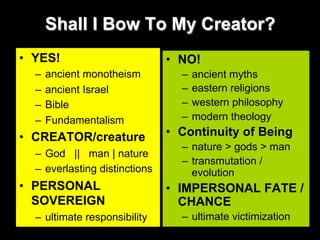
Shall I Bow To My Creator?
•  YES!                         •  NO!
  –  ancient monotheism           –  ancient myths
  –  ancient Israel               –  eastern religions
  –  Bible                        –  western philosophy
  –  Fundamentalism               –  modern theology
•  CREATOR/creature             •  Continuity of Being
                                  –  nature > gods > man
  –  God || man | nature
                                  –  transmutation /
  –  everlasting distinctions        evolution
•  PERSONAL                     •  IMPERSONAL FATE /
   SOVEREIGN                       CHANCE
  –  ultimate responsibility      –  ultimate victimization
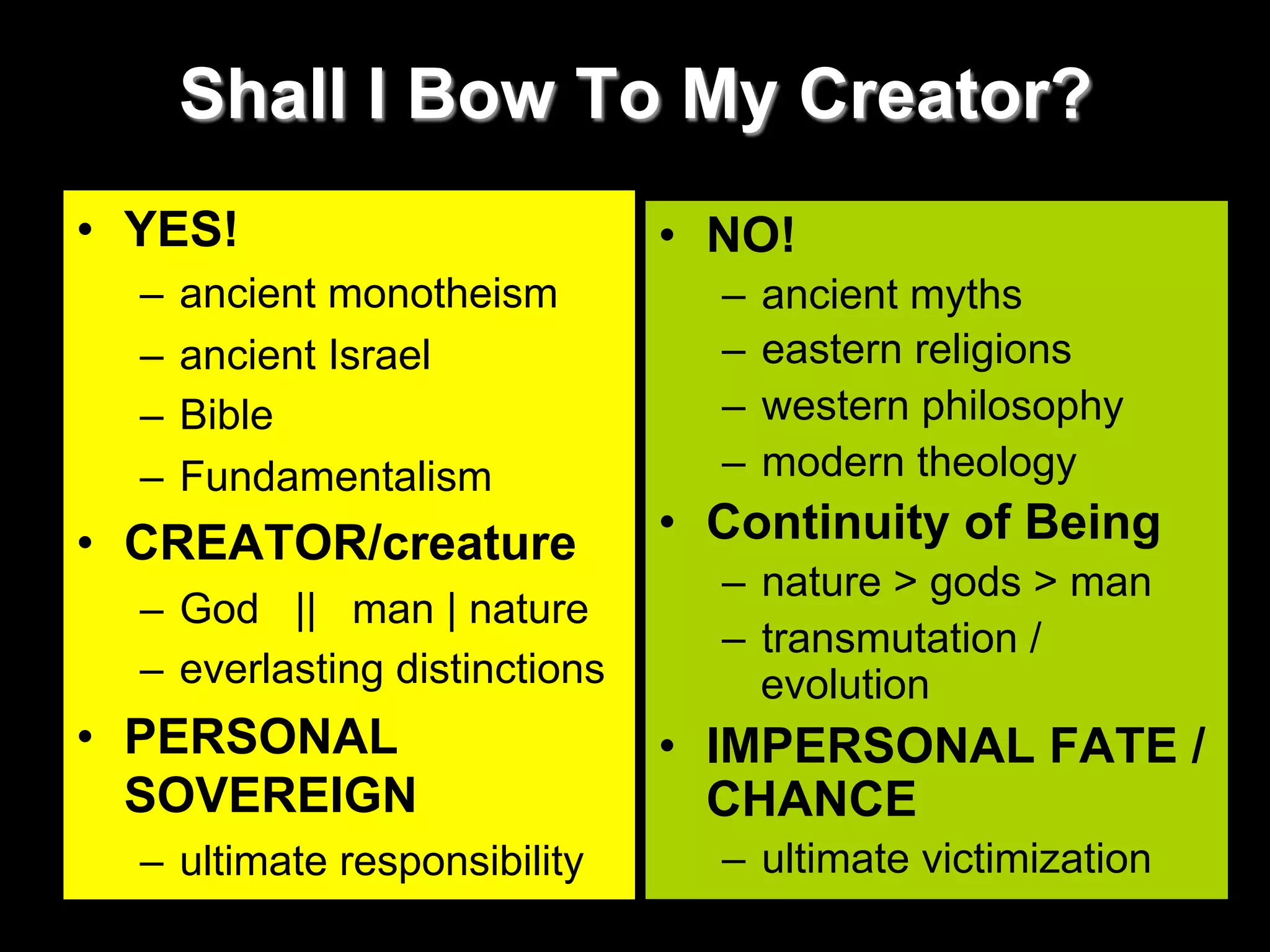
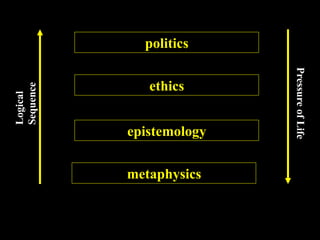
politics


                          Pressure of Life
              ethics
Sequence
Logical


           epistemology


           metaphysics
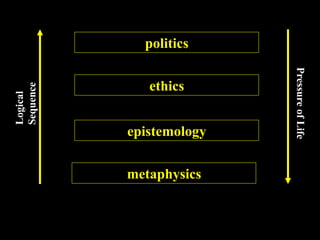
Justice Lifts the
Nations
(1905) in old Supreme Court
Building, Lausanne,
Switzerland


Cited in Francis Schaeffer, How Shall We
Then Live?, p107.
politics


                          Pressure of Life
              ethics
Sequence
Logical


           epistemology


           metaphysics
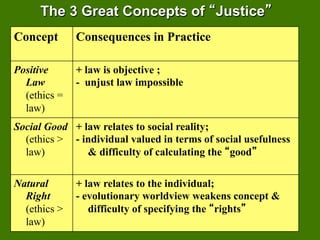
The 3 Great Concepts of Justice
Concept       Consequences in Practice

Positive      + law is objective ;
  Law         - unjust law impossible
  (ethics =
  law)
Social Good + law relates to social reality;
  (ethics > - individual valued in terms of social usefulness
  law)         & difficulty of calculating the good

Natural       + law relates to the individual;
  Right       - evolutionary worldview weakens concept &
  (ethics >      difficulty of specifying the rights
  law)
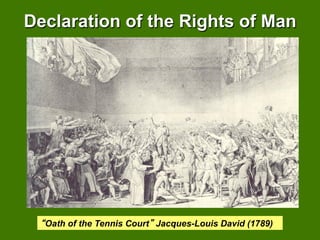
Declaration of the Rights of Man


  Oath of the Tennis Court Jacques-Louis David (1789)
"What makes the history of Israelite
prophecy sui generis is the succession of
apostles of God that come to the people
through the ages. Such a line of apostle-
prophets is unknown in paganism. . . .[The
pagan prophet] incorporated a unique, self-
contained divine power; there his "mission"
ended with him.
    Yehezkel Kaufmann, The Religion of Israel
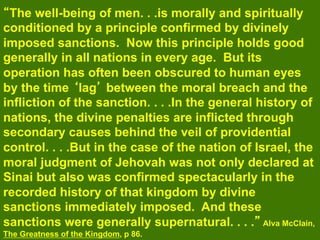
The well-being of men. . .is morally and spiritually
conditioned by a principle confirmed by divinely
imposed sanctions. Now this principle holds good
generally in all nations in every age. But its
operation has often been obscured to human eyes
by the time lag between the moral breach and the
infliction of the sanction. . . .In the general history of
nations, the divine penalties are inflicted through
secondary causes behind the veil of providential
control. . . .But in the case of the nation of Israel, the
moral judgment of Jehovah was not only declared at
Sinai but also was confirmed spectacularly in the
recorded history of that kingdom by divine
sanctions immediately imposed. And these
sanctions were generally supernatural. . . . Alva McClain,
The Greatness of the Kingdom, p 86.

Deut 011-slides

  • 1.
    Shall I BowTo My Creator? •  YES! •  NO! –  ancient monotheism –  ancient myths –  ancient Israel –  eastern religions –  Bible –  western philosophy –  Fundamentalism –  modern theology •  CREATOR/creature •  Continuity of Being –  nature > gods > man –  God || man | nature –  transmutation / –  everlasting distinctions evolution •  PERSONAL •  IMPERSONAL FATE / SOVEREIGN CHANCE –  ultimate responsibility –  ultimate victimization
  • 2.
    politics Pressure of Life ethics Sequence Logical epistemology metaphysics
  • 3.
    Justice Lifts the Nations (1905)in old Supreme Court Building, Lausanne, Switzerland Cited in Francis Schaeffer, How Shall We Then Live?, p107.
  • 4.
    politics Pressure of Life ethics Sequence Logical epistemology metaphysics
  • 5.
    The 3 GreatConcepts of Justice Concept Consequences in Practice Positive + law is objective ; Law - unjust law impossible (ethics = law) Social Good + law relates to social reality; (ethics > - individual valued in terms of social usefulness law) & difficulty of calculating the good Natural + law relates to the individual; Right - evolutionary worldview weakens concept & (ethics > difficulty of specifying the rights law)
  • 6.
    Declaration of theRights of Man Oath of the Tennis Court Jacques-Louis David (1789)
  • 7.
    "What makes thehistory of Israelite prophecy sui generis is the succession of apostles of God that come to the people through the ages. Such a line of apostle- prophets is unknown in paganism. . . .[The pagan prophet] incorporated a unique, self- contained divine power; there his "mission" ended with him. Yehezkel Kaufmann, The Religion of Israel
  • 8.
    The well-being ofmen. . .is morally and spiritually conditioned by a principle confirmed by divinely imposed sanctions. Now this principle holds good generally in all nations in every age. But its operation has often been obscured to human eyes by the time lag between the moral breach and the infliction of the sanction. . . .In the general history of nations, the divine penalties are inflicted through secondary causes behind the veil of providential control. . . .But in the case of the nation of Israel, the moral judgment of Jehovah was not only declared at Sinai but also was confirmed spectacularly in the recorded history of that kingdom by divine sanctions immediately imposed. And these sanctions were generally supernatural. . . . Alva McClain, The Greatness of the Kingdom, p 86.