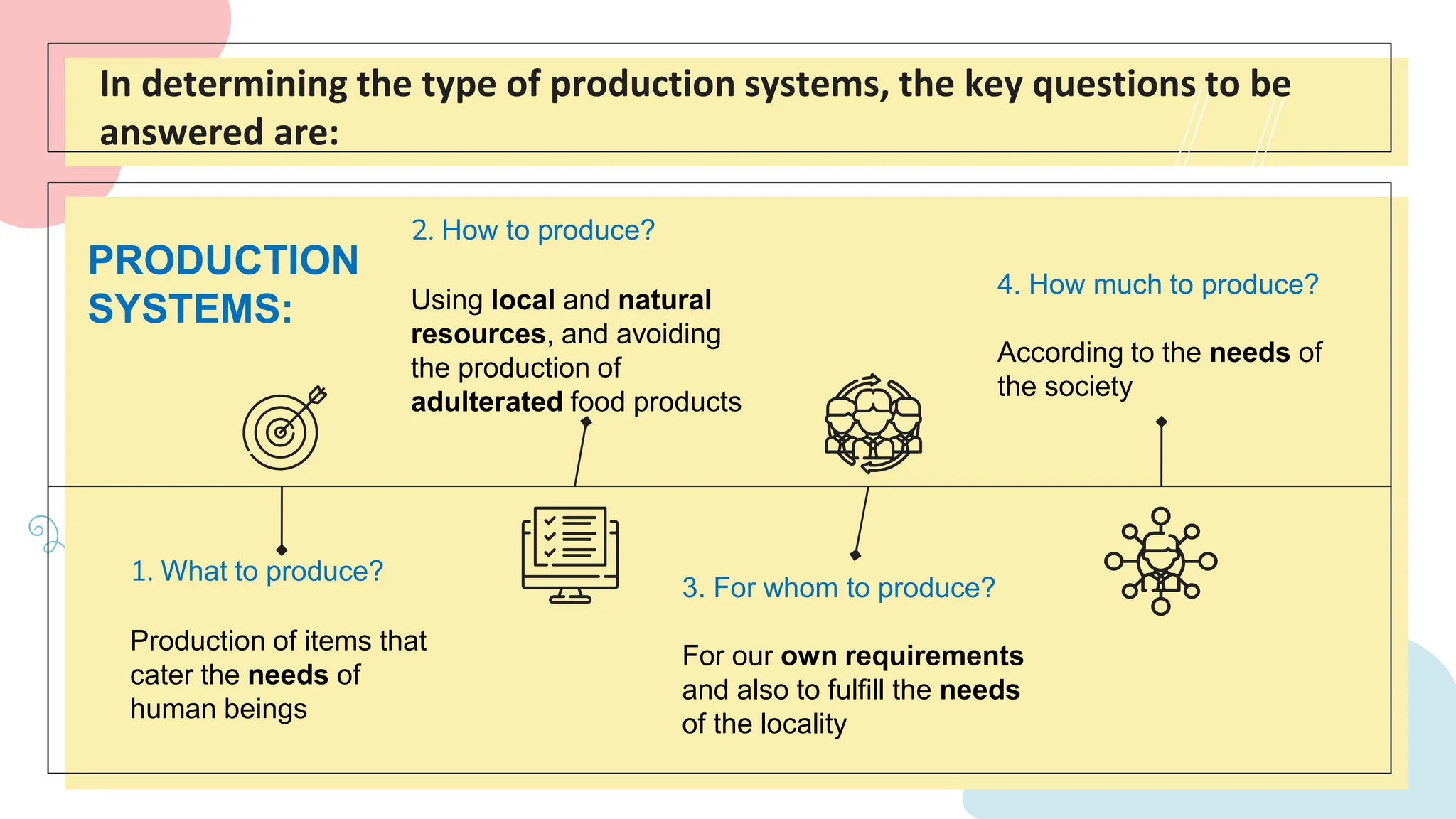
In determining the type of production systems, the key questions to be
answered are:
1. What to produce?
Production of items that
cater the needs of
human beings
3. For whom to produce?
For our own requirements
and also to fulfill the needs
of the locality
4. How much to produce?
According to the needs of
the society
2. How to produce?
Using local and natural
resources, and avoiding
the production of
adulterated food products
PRODUCTION
SYSTEMS:
All these will be decided in the context of availability of local natural resources and the needs of
the people for any given community.
The specific criteria to judge the appropriateness of the production systems may include the
following:
 Optimal utilization of local resources and expertise
Effective utilization of the local resources and skills of the people
 Economic viability and sustainability
Reduces cost
Environment friendly
 Priority for local consumption
Needs of the local community must be fulfilled first
 Matching the pattern of production with the availability/ producibility in the local environment
and the pattern of consumption
Survey on products that are produced and consumed in the local area
 Decentralized systems capable of meaningful employment of people in the community
Ensuring employment at local level
 Facilitating production by masses and not mass production in a centralized mode
Production activities must be distributed among the masses, but must not be under the control of one
person
 Promoting individual creativity and sense of accomplishment
Utilizing the expertise of local community
 Using people-friendly and eco-friendly technologies
 Ensure quality of production
 Safe and conducive to the health of persons involved in production as well as others
The production process or the product must not harm the health of the people
CASE STUDY
Organic/natural farming techniques including
technologies for:
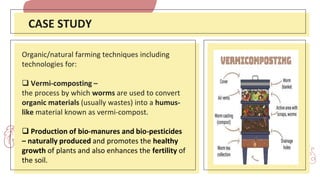
 Vermi-composting –
the process by which worms are used to convert
organic materials (usually wastes) into a humus-
like material known as vermi-compost.
 Production of bio-manures and bio-pesticides
– naturally produced and promotes the healthy
growth of plants and also enhances the fertility of
the soil.
Low cost and energy efficient technologies for small scale
production systems such as
 Systems for food processing –
flour mills, fish processing units, fruit and vegetable
processing units, milk product units, sugar mills, rice mills
 Systems for production of herbal, forest-based and
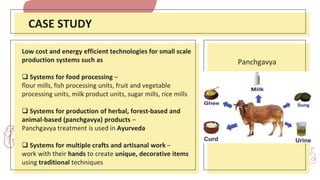
animal-based (panchgavya) products –
Panchgavya treatment is used in Ayurveda
 Systems for multiple crafts and artisanal work –
work with their hands to create unique, decorative items
using traditional techniques
CASE STUDY
Panchgavya

determining the type of production systems.pptx

  • 1.
    In determining thetype of production systems, the key questions to be answered are: 1. What to produce? Production of items that cater the needs of human beings 3. For whom to produce? For our own requirements and also to fulfill the needs of the locality 4. How much to produce? According to the needs of the society 2. How to produce? Using local and natural resources, and avoiding the production of adulterated food products PRODUCTION SYSTEMS:
  • 2.
    All these willbe decided in the context of availability of local natural resources and the needs of the people for any given community. The specific criteria to judge the appropriateness of the production systems may include the following:  Optimal utilization of local resources and expertise Effective utilization of the local resources and skills of the people  Economic viability and sustainability Reduces cost Environment friendly  Priority for local consumption Needs of the local community must be fulfilled first  Matching the pattern of production with the availability/ producibility in the local environment and the pattern of consumption Survey on products that are produced and consumed in the local area
  • 3.
     Decentralized systemscapable of meaningful employment of people in the community Ensuring employment at local level  Facilitating production by masses and not mass production in a centralized mode Production activities must be distributed among the masses, but must not be under the control of one person  Promoting individual creativity and sense of accomplishment Utilizing the expertise of local community  Using people-friendly and eco-friendly technologies  Ensure quality of production  Safe and conducive to the health of persons involved in production as well as others The production process or the product must not harm the health of the people
  • 4.
    CASE STUDY Organic/natural farmingtechniques including technologies for:  Vermi-composting – the process by which worms are used to convert organic materials (usually wastes) into a humus- like material known as vermi-compost.  Production of bio-manures and bio-pesticides – naturally produced and promotes the healthy growth of plants and also enhances the fertility of the soil.
  • 5.
    Low cost andenergy efficient technologies for small scale production systems such as  Systems for food processing – flour mills, fish processing units, fruit and vegetable processing units, milk product units, sugar mills, rice mills  Systems for production of herbal, forest-based and animal-based (panchgavya) products – Panchgavya treatment is used in Ayurveda  Systems for multiple crafts and artisanal work – work with their hands to create unique, decorative items using traditional techniques CASE STUDY Panchgavya