Chap. 2
Determinants
Dr. Litan Kumar Saha
Associate Professor
Department of Applied Mathematics
University of Dhaka
Chap. 2
Determinants
2.1 The Determinants of a Matrix by cofactor expansion
2.2 Evaluation of a Determinant Using Elementary Operations
2.3 Properties of Determinants
Dr. Litan Kumar Saha, MAT125
3-3
 Every square matrix can be associated with a real number
called its determinant.
 Definition: The determinant of the matrix
is given by
 Example 1:
2.1 The Determinant of a Matrix
+

?
4
2
3
0
?
2
4
1
2
?
2
1
3
2




?
]
2
[ 


 A
A
12
21
22
11
22
21
12
11
)
det( a
a
a
a
a
a
a
a
A
A 










22
21
12
11
a
a
a
a
A
Dr. Litan Kumar Saha, MAT125
3-5
Minors and Cofactors of a Matrix
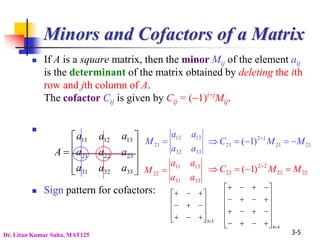
 If A is a square matrix, then the minor Mij of the element aij
is the determinant of the matrix obtained by deleting the ith
row and jth column of A.
The cofactor Cij is given by Cij = (1)i+j
Mij.

 Sign pattern for cofactors:











33
32
31
23
22
21
13
12
11
a
a
a
a
a
a
a
a
a
A 33
32
13
12
21
a
a
a
a
M  21
21
1
2
21 )
1
( M
M
C 



 
33
31
13
11
22
a
a
a
a
M  22
22
2
2
22 )
1
( M
M
C 


 
4
4
3
3

 














































Dr. Litan Kumar Saha, MAT125
3-6
Theorem 2.1
Expansion by Cofactors
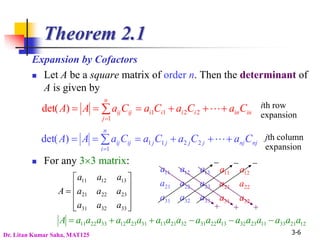
 Let A be a square matrix of order n. Then the determinant of
A is given by
 For any 33 matrix:
in
in
i
i
i
i
n
j
ij
ij C
a
C
a
C
a
C
a
A
A 




 


2
2
1
1
1
)
det(
nj
nj
j
j
j
j
n
i
ij
ij C
a
C
a
C
a
C
a
A
A 




 


2
2
1
1
1
)
det(
ith row
expansion
jth column
expansion











33
32
31
23
22
21
13
12
11
a
a
a
a
a
a
a
a
a
A
12
21
33
11
23
32
13
22
31
32
21
13
31
23
12
33
22
11 a
a
a
a
a
a
a
a
a
a
a
a
a
a
a
a
a
a
A 





33
32
31
23
22
21
13
12
11
a
a
a
a
a
a
a
a
a
32
31
22
21
12
11
a
a
a
a
a
a
+

+ +
 
Dr. Litan Kumar Saha, MAT125
3-7
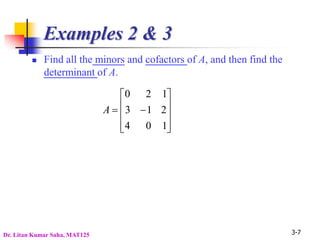
Examples 2 & 3
 Find all the minors and cofactors of A, and then find the
determinant of A.












1
0
4
2
1
3
1
2
0
A
Dr. Litan Kumar Saha, MAT125
3-9
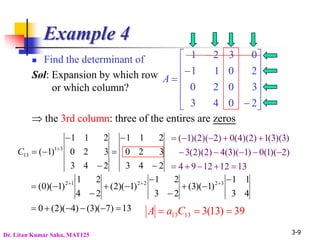
Example 4
 Find the determinant of
Sol: Expansion by which row
or which column?
 the 3rd column: three of the entires are zeros
















2
0
4
3
3
0
2
0
2
0
1
1
0
3
2
1
A
2
4
3
3
2
0
2
1
1
2
4
3
3
2
0
2
1
1
)
1
( 3
1
13






 
C
13
)
7
)(
3
(
)
4
)(
2
(
0
4
3
1
1
)
1
)(
3
(
2
3
2
1
)
1
)(
2
(
2
4
2
1
)
1
)(
0
( 3
2
2
2
1
2















 


13
12
12
9
4
)
2
)(
1
(
0
)
1
)(
3
(
4
)
2
)(
2
(
3
)
3
)(
3
(
1
)
2
)(
4
(
0
)
2
)(
2
)(
1
(















39
)
13
(
3
13
13 

 C
a
A
Dr. Litan Kumar Saha, MAT125
3-10
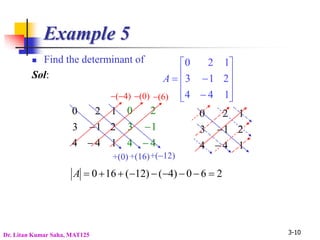
Example 5
 Find the determinant of
Sol:













1
4
4
2
1
3
1
2
0
A
1
4
4
2
1
3
1
2
0


4
4
1
3
2
0


+(0) +(16)
(4)
+(12)
(6)
(0)
2
6
0
)
4
(
)
12
(
16
0 








A
1
4
4
2
1
3
1
2
0


Dr. Litan Kumar Saha, MAT125
3-11
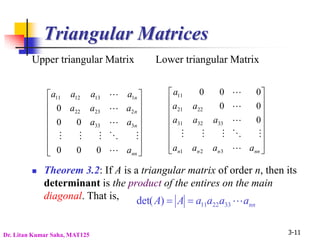
Triangular Matrices
Upper triangular Matrix Lower triangular Matrix
 Theorem 3.2: If A is a triangular matrix of order n, then its
determinant is the product of the entires on the main
diagonal. That is,
















nn
n
n
n
a
a
a
a
a
a
a
a
a
a









0
0
0
0
0
0
3
33
2
23
22
1
13
12
11
















nn
n
n
n a
a
a
a
a
a
a
a
a
a









3
2
1
33
32
31
22
21
11
0
0
0
0
0
0
nn
a
a
a
a
A
A 
33
22
11
)
det( 

Dr. Litan Kumar Saha, MAT125
3-12
Example
?
3
0
0
2
1
0
1
3
2



3
0
2
1
)
1
(
2 1
1 
 
6
)]
2
(
0
)
3
)(
1
[(
2 




?
2
0
0
0
0
0
4
0
0
0
0
0
2
0
0
0
0
0
3
0
0
0
0
0
1
?
3
3
5
1
0
1
6
5
0
0
2
4
0
0
0
2






12
)
3
)(
1
)(
2
(
2




48
)
2
)(
4
)(
2
)(
3
)(
1
(




Dr. Litan Kumar Saha, MAT125

determinant1.pdf

  • 1.
    Chap. 2 Determinants Dr. LitanKumar Saha Associate Professor Department of Applied Mathematics University of Dhaka
  • 2.
    Chap. 2 Determinants 2.1 TheDeterminants of a Matrix by cofactor expansion 2.2 Evaluation of a Determinant Using Elementary Operations 2.3 Properties of Determinants Dr. Litan Kumar Saha, MAT125
  • 3.
    3-3  Every squarematrix can be associated with a real number called its determinant.  Definition: The determinant of the matrix is given by  Example 1: 2.1 The Determinant of a Matrix +  ? 4 2 3 0 ? 2 4 1 2 ? 2 1 3 2     ? ] 2 [     A A 12 21 22 11 22 21 12 11 ) det( a a a a a a a a A A            22 21 12 11 a a a a A Dr. Litan Kumar Saha, MAT125
  • 4.
    3-5 Minors and Cofactorsof a Matrix  If A is a square matrix, then the minor Mij of the element aij is the determinant of the matrix obtained by deleting the ith row and jth column of A. The cofactor Cij is given by Cij = (1)i+j Mij.   Sign pattern for cofactors:            33 32 31 23 22 21 13 12 11 a a a a a a a a a A 33 32 13 12 21 a a a a M  21 21 1 2 21 ) 1 ( M M C       33 31 13 11 22 a a a a M  22 22 2 2 22 ) 1 ( M M C      4 4 3 3                                                  Dr. Litan Kumar Saha, MAT125
  • 5.
    3-6 Theorem 2.1 Expansion byCofactors  Let A be a square matrix of order n. Then the determinant of A is given by  For any 33 matrix: in in i i i i n j ij ij C a C a C a C a A A          2 2 1 1 1 ) det( nj nj j j j j n i ij ij C a C a C a C a A A          2 2 1 1 1 ) det( ith row expansion jth column expansion            33 32 31 23 22 21 13 12 11 a a a a a a a a a A 12 21 33 11 23 32 13 22 31 32 21 13 31 23 12 33 22 11 a a a a a a a a a a a a a a a a a a A       33 32 31 23 22 21 13 12 11 a a a a a a a a a 32 31 22 21 12 11 a a a a a a +  + +   Dr. Litan Kumar Saha, MAT125
  • 6.
    3-7 Examples 2 &3  Find all the minors and cofactors of A, and then find the determinant of A.             1 0 4 2 1 3 1 2 0 A Dr. Litan Kumar Saha, MAT125
  • 7.
    3-9 Example 4  Findthe determinant of Sol: Expansion by which row or which column?  the 3rd column: three of the entires are zeros                 2 0 4 3 3 0 2 0 2 0 1 1 0 3 2 1 A 2 4 3 3 2 0 2 1 1 2 4 3 3 2 0 2 1 1 ) 1 ( 3 1 13         C 13 ) 7 )( 3 ( ) 4 )( 2 ( 0 4 3 1 1 ) 1 )( 3 ( 2 3 2 1 ) 1 )( 2 ( 2 4 2 1 ) 1 )( 0 ( 3 2 2 2 1 2                    13 12 12 9 4 ) 2 )( 1 ( 0 ) 1 )( 3 ( 4 ) 2 )( 2 ( 3 ) 3 )( 3 ( 1 ) 2 )( 4 ( 0 ) 2 )( 2 )( 1 (                39 ) 13 ( 3 13 13    C a A Dr. Litan Kumar Saha, MAT125
  • 8.
    3-10 Example 5  Findthe determinant of Sol:              1 4 4 2 1 3 1 2 0 A 1 4 4 2 1 3 1 2 0   4 4 1 3 2 0   +(0) +(16) (4) +(12) (6) (0) 2 6 0 ) 4 ( ) 12 ( 16 0          A 1 4 4 2 1 3 1 2 0   Dr. Litan Kumar Saha, MAT125
  • 9.
    3-11 Triangular Matrices Upper triangularMatrix Lower triangular Matrix  Theorem 3.2: If A is a triangular matrix of order n, then its determinant is the product of the entires on the main diagonal. That is,                 nn n n n a a a a a a a a a a          0 0 0 0 0 0 3 33 2 23 22 1 13 12 11                 nn n n n a a a a a a a a a a          3 2 1 33 32 31 22 21 11 0 0 0 0 0 0 nn a a a a A A  33 22 11 ) det(   Dr. Litan Kumar Saha, MAT125
  • 10.
    3-12 Example ? 3 0 0 2 1 0 1 3 2    3 0 2 1 ) 1 ( 2 1 1   6 )] 2 ( 0 ) 3 )( 1 [( 2      ? 2 0 0 0 0 0 4 0 0 0 0 0 2 0 0 0 0 0 3 0 0 0 0 0 1 ? 3 3 5 1 0 1 6 5 0 0 2 4 0 0 0 2       12 ) 3 )( 1 )( 2 ( 2     48 ) 2 )( 4 )( 2 )( 3 )( 1 (     Dr. Litan Kumar Saha, MAT125