Detection of Drugs With Cantilever-Enhanced
Photoacoustic Spectroscopy
Dr. Jaakko Lehtinen, Client Partner, Gasera Ltd.
Pittcon 2017, 6.3.2017, 09:30 AM
Gasera Ltd. Lemminkäisenkatu 59, 20520 Turku, Finland
Projects overview
- 2 -
Two projects in FP7 program: CUSTOM and DOGGIES
One project in H2020 program: IRON
Some work is also done outside these projects
•  Photoacoustic effect was discovered
in 1880 by Alexander Graham Bell
•  This theoretical potential has not
been reached, since conventional
microphones have been used for
sensing the pressure pulses
•  Gasera’s novel cantilever sensor
technology allows the use of the full
potential of the photoacoustic
phenomena
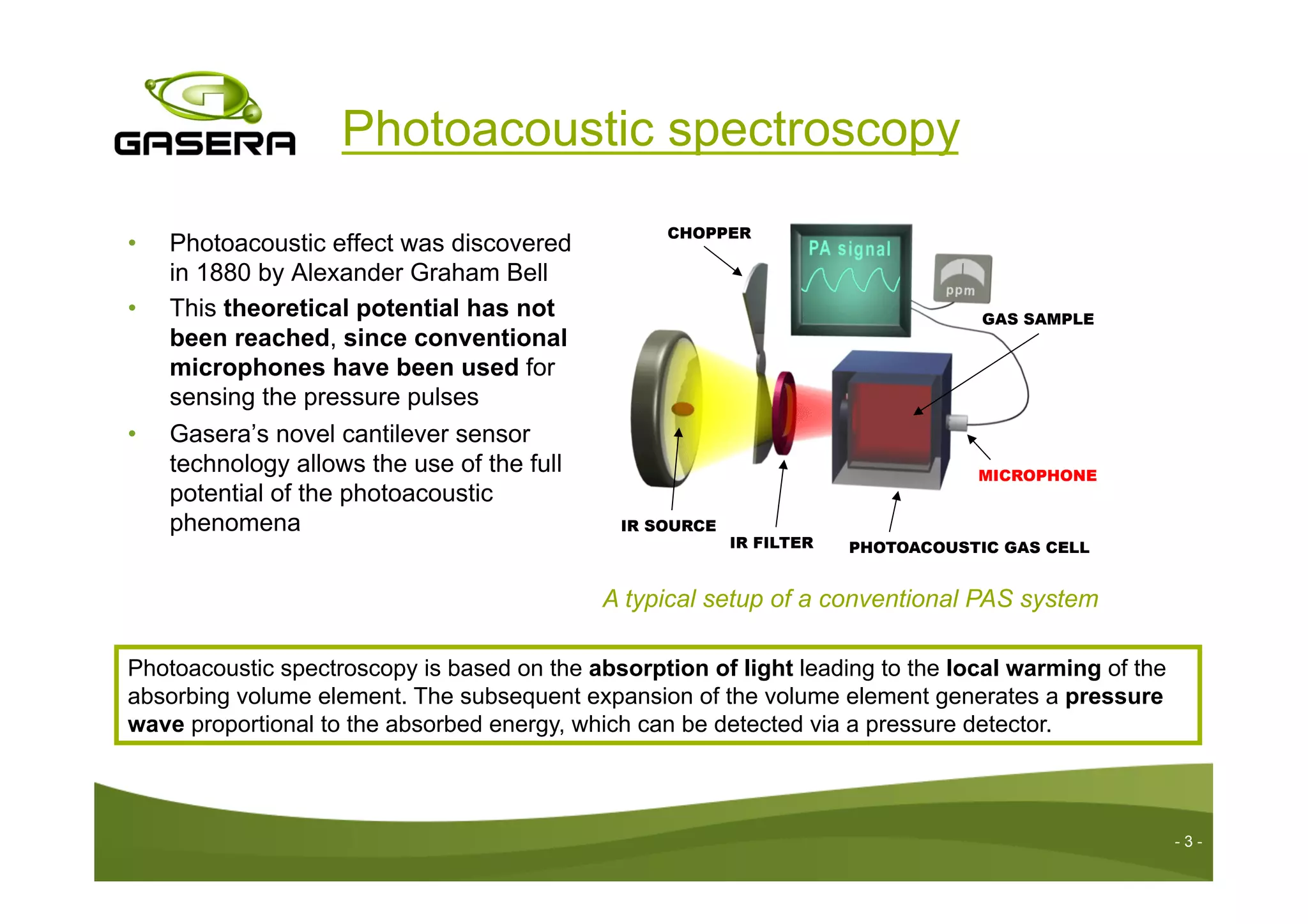
Photoacoustic spectroscopy is based on the absorption of light leading to the local warming of the
absorbing volume element. The subsequent expansion of the volume element generates a pressure
wave proportional to the absorbed energy, which can be detected via a pressure detector.
Photoacoustic spectroscopy
PHOTOACOUSTIC GAS CELL
IR SOURCE
MICROPHONE
IR FILTER
CHOPPER
A typical setup of a conventional PAS system
GAS SAMPLE
- 3 -
Key inventions
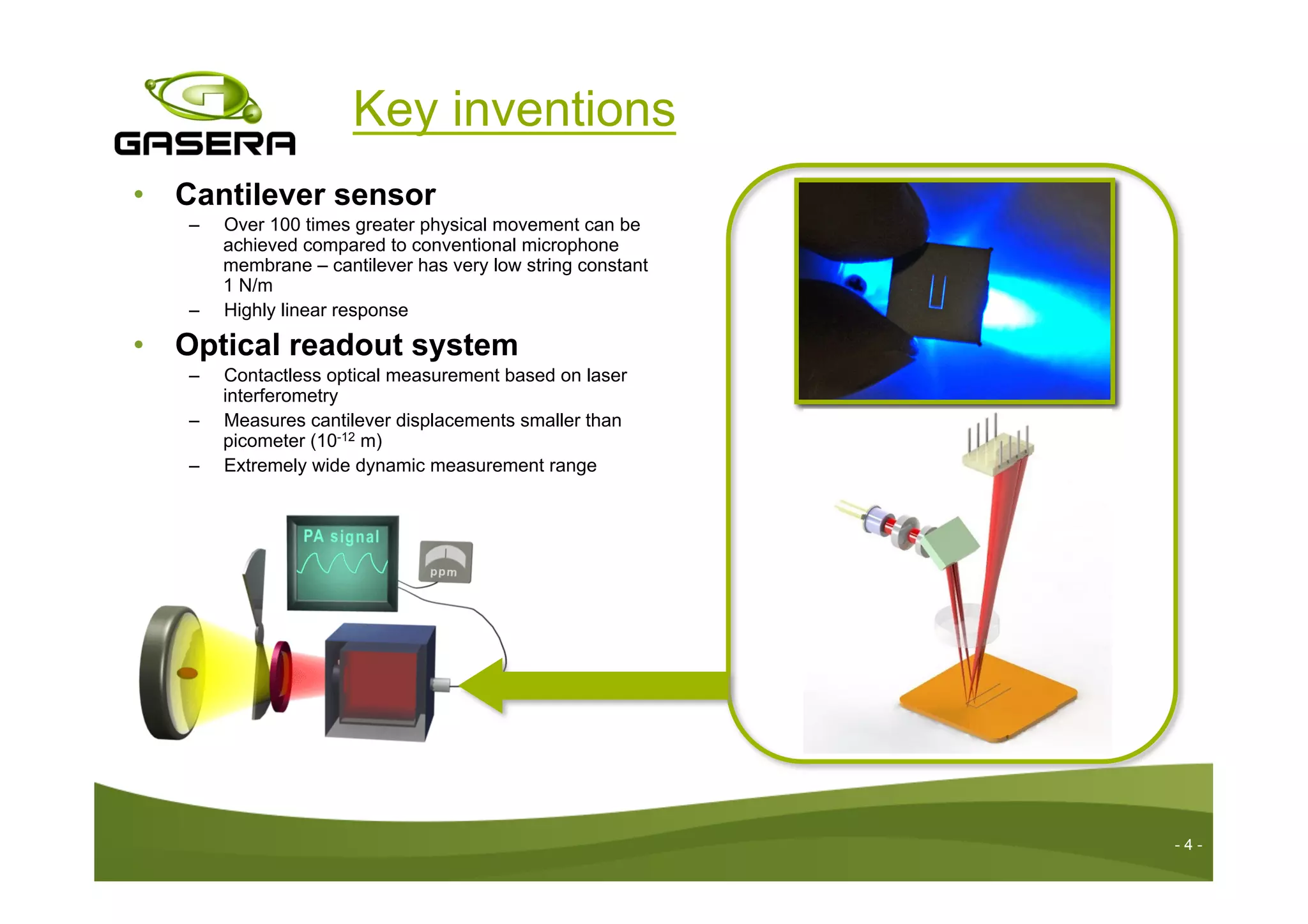
•  Cantilever sensor
–  Over 100 times greater physical movement can be
achieved compared to conventional microphone
membrane – cantilever has very low string constant
1 N/m
–  Highly linear response
•  Optical readout system
–  Contactless optical measurement based on laser
interferometry
–  Measures cantilever displacements smaller than
picometer (10-12 m)
–  Extremely wide dynamic measurement range
- 4 -
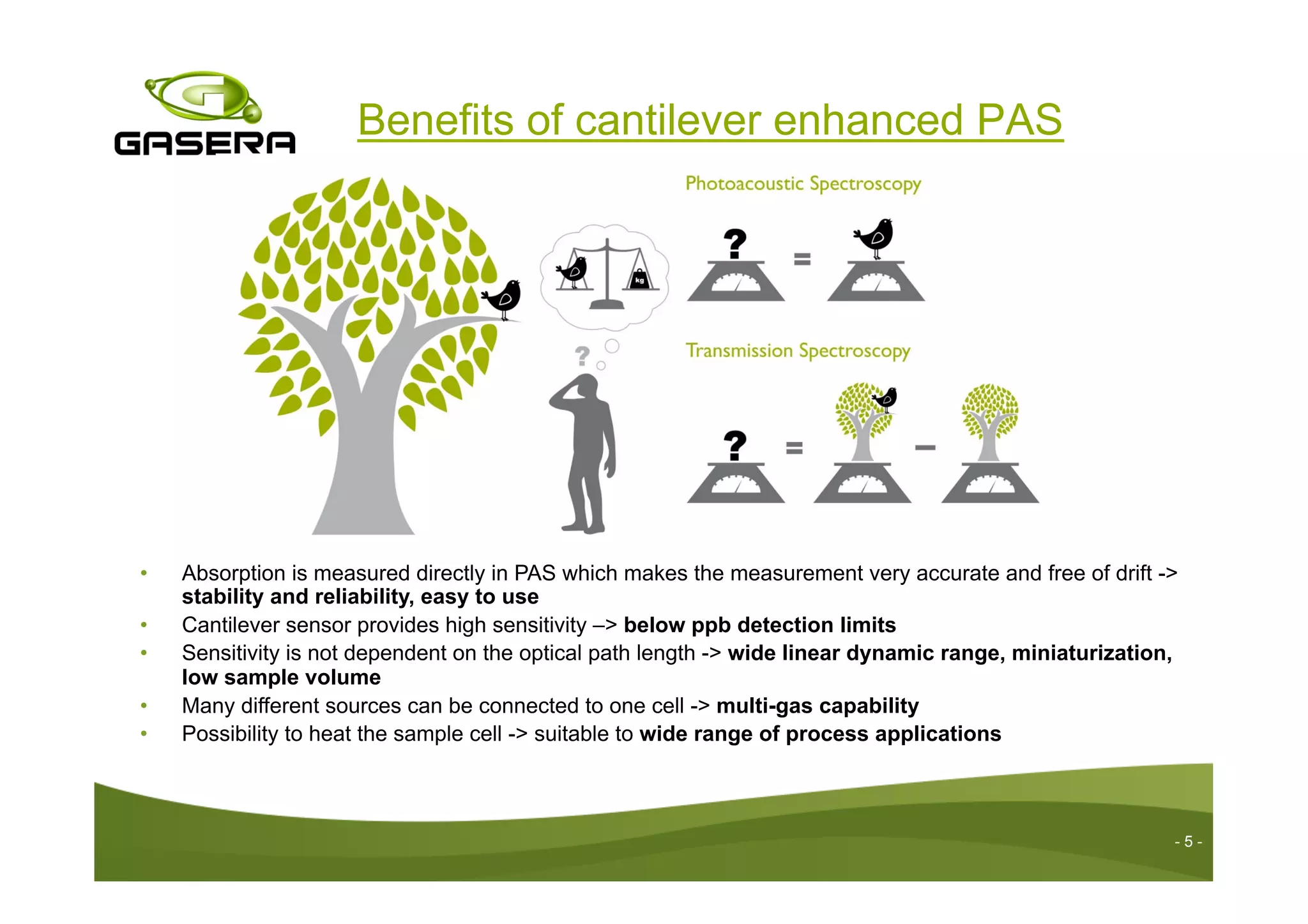
Benefits of cantilever enhanced PAS
- 5 -
•  Absorption is measured directly in PAS which makes the measurement very accurate and free of drift ->
stability and reliability, easy to use
•  Cantilever sensor provides high sensitivity –> below ppb detection limits
•  Sensitivity is not dependent on the optical path length -> wide linear dynamic range, miniaturization,
low sample volume
•  Many different sources can be connected to one cell -> multi-gas capability
•  Possibility to heat the sample cell -> suitable to wide range of process applications
CUSTOM-project
- 6 -
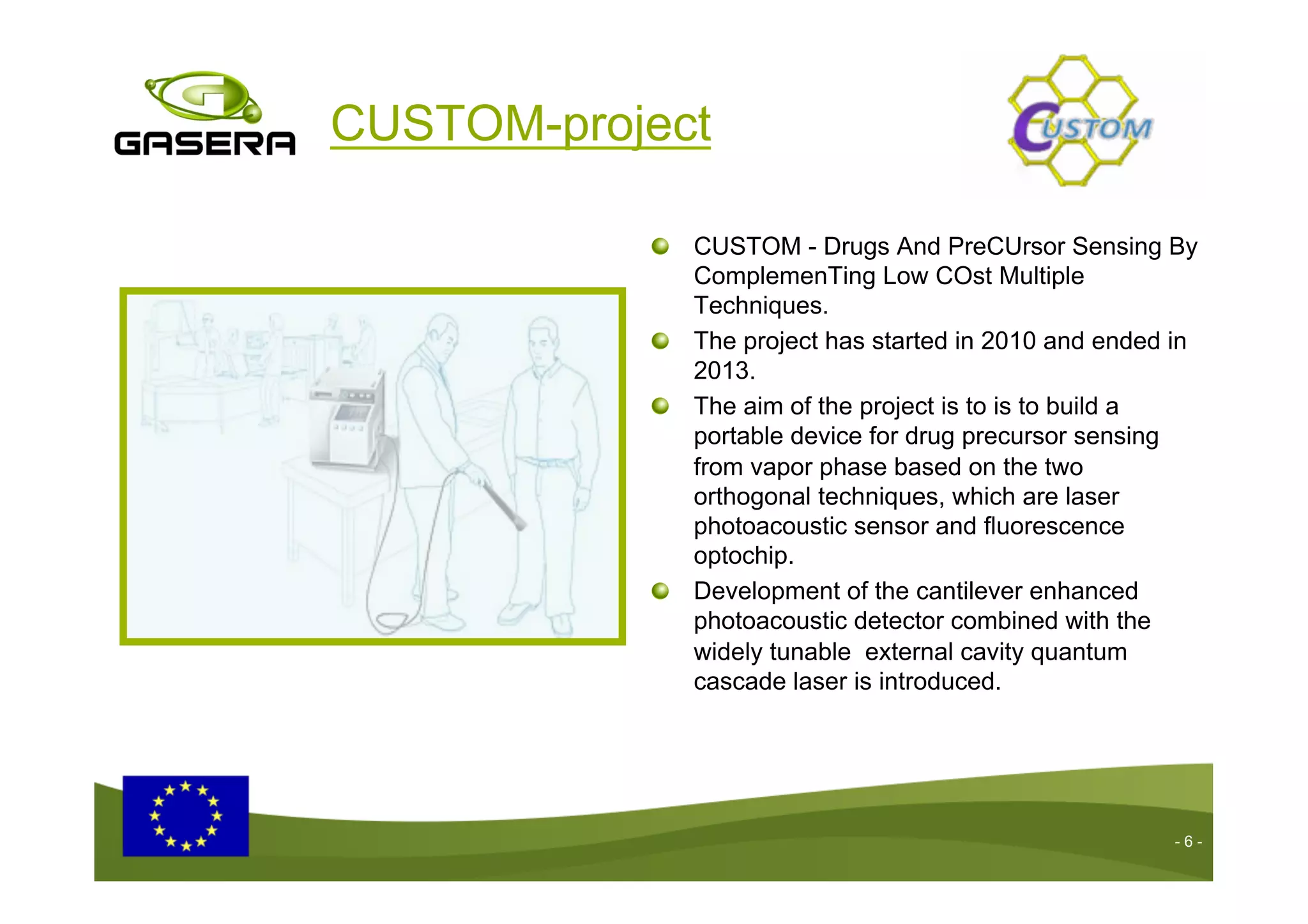
CUSTOM - Drugs And PreCUrsor Sensing By
ComplemenTing Low COst Multiple
Techniques.
The project has started in 2010 and ended in
2013.
The aim of the project is to is to build a
portable device for drug precursor sensing
from vapor phase based on the two
orthogonal techniques, which are laser
photoacoustic sensor and fluorescence
optochip.
Development of the cantilever enhanced
photoacoustic detector combined with the
widely tunable external cavity quantum
cascade laser is introduced.
Example measurement with
CW EC QCL - setup
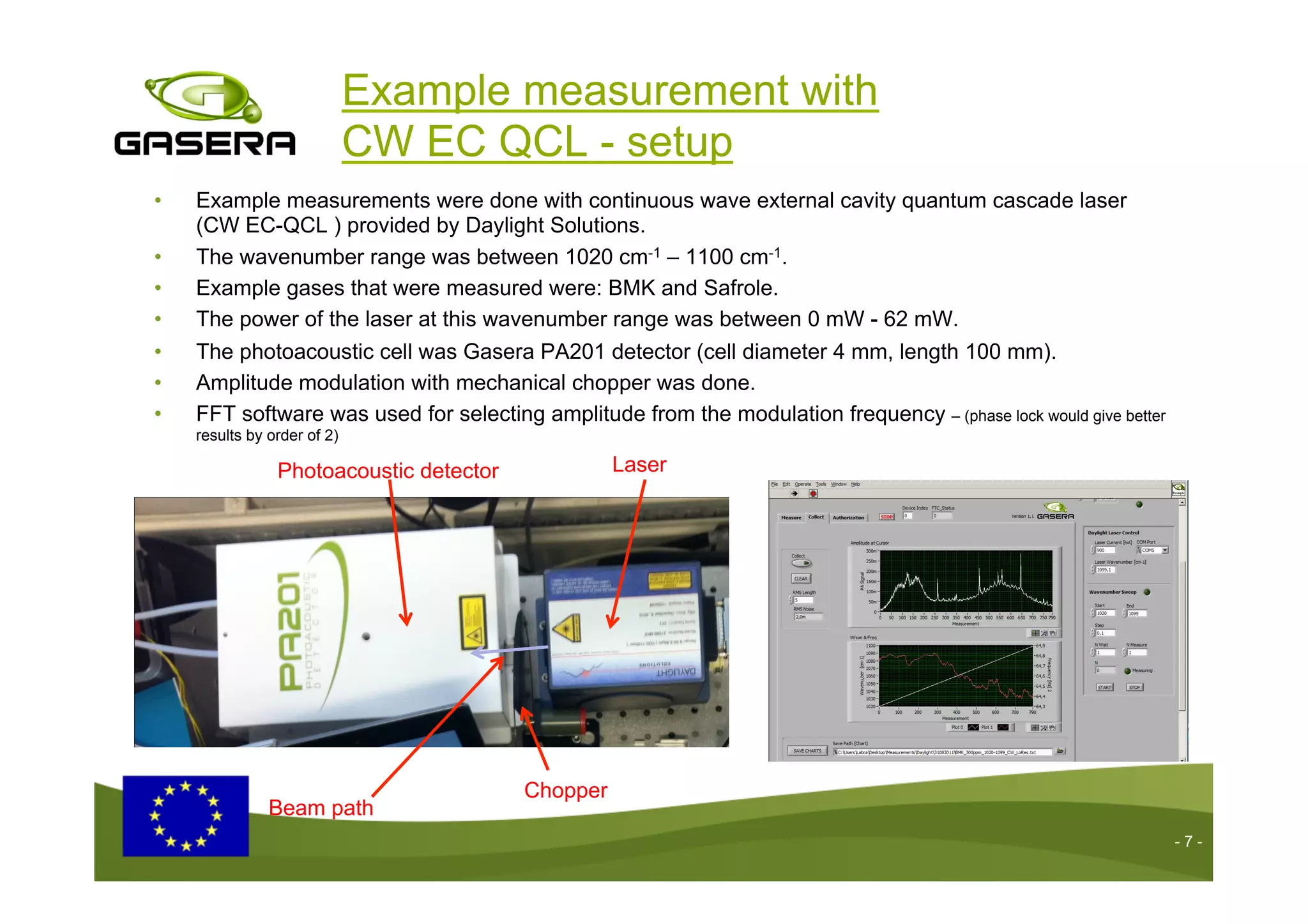
•  Example measurements were done with continuous wave external cavity quantum cascade laser
(CW EC-QCL ) provided by Daylight Solutions.
•  The wavenumber range was between 1020 cm-1 – 1100 cm-1.
•  Example gases that were measured were: BMK and Safrole.
•  The power of the laser at this wavenumber range was between 0 mW - 62 mW.
•  The photoacoustic cell was Gasera PA201 detector (cell diameter 4 mm, length 100 mm).
•  Amplitude modulation with mechanical chopper was done.
•  FFT software was used for selecting amplitude from the modulation frequency – (phase lock would give better
results by order of 2)
- 7 -
Laser
Chopper
Photoacoustic detector
Beam path
Example measurement -
BMK and Safrole
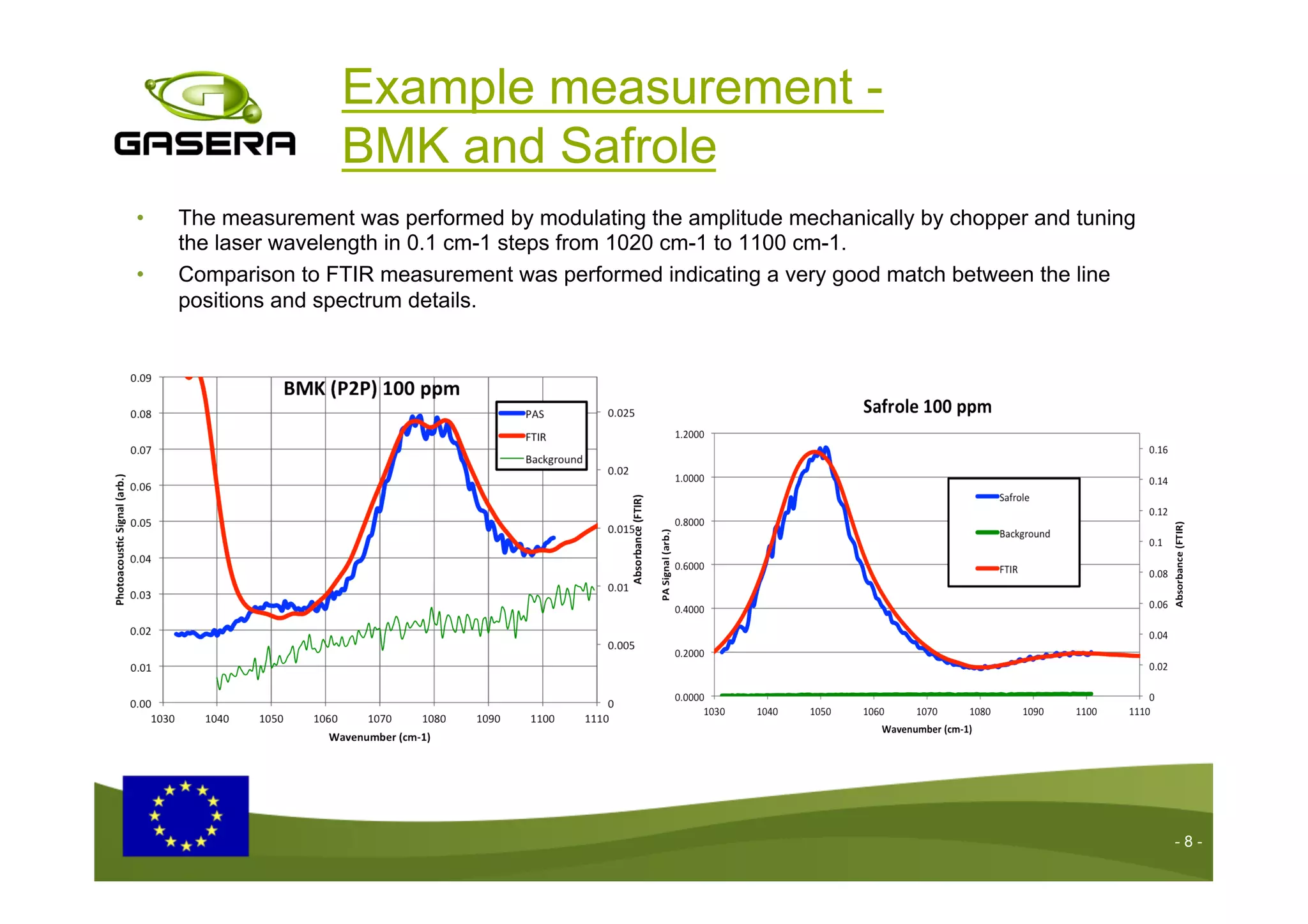
•  The measurement was performed by modulating the amplitude mechanically by chopper and tuning
the laser wavelength in 0.1 cm-1 steps from 1020 cm-1 to 1100 cm-1.
•  Comparison to FTIR measurement was performed indicating a very good match between the line
positions and spectrum details.
- 8 -
DOGGIES'financed'by'the'European'Community’s'Seventh'Framework'Programme'(FP7CSECC2011C1)'''
Figure 3. The IR spectra of several drug precursors. Courtesy of CUSTOM project.
The sample of 100 ppm of phenylpropanone (BMK) was measured with a detection
limit 2xRMS of 160 ppb (total response time about 60 s).
Figure 4. PAS measurement of BMK and FTIR measurement in comparison.
D3.8%Sensitivity%Evaluation%of%Different%Target%Molecules%
CLASSIFIED)RESTRAINT)UE)
' ' ' ' ' ' '''''''''' '''''''''' ' ' Page' 11' of'
20'
The sample of 100 ppm of safrole was determined to have a detection limit of 24 ppb
(total response time about 60 s)
Figure 5. PAS measurement of Safrole with FTIR comparison measurement.
Table 6. Sensitivity of PAS with EC-QCL to BMK and Safrole.
BMK
(100 ppm)
Safrole (100 ppm)
Wavenumber (cm-1) 1084.5 1059.0
Laser power (mW) 7.08 4.01
9
• Funded by the European Commission under the FP7-Security
programme
•  Project started in 2012, ended in November 2015
• The Consortium of 14 partners from 5 EU countries
DOGGIES project aims at demonstrating:
• An operational movable stand-alone sensor for an efficient
detection of hidden persons, drugs & explosives
• “Orthogonal” trace detection
• Mid-Infrared spectroscopy, based on photoacoustic detection
(PAS) with widely tunable integrated MIR source i.e. MIRPAS
• Ion Mobility Spectrometry (IMS), with non-radioactive ionization
source
• Using specific pre-concentrators and advanced software to provide
reliable detection in real environments
DOGGIES =
Detection of Olfactory traces by
orthoGonal Gas identification technologIES
DOGGIES-project
10
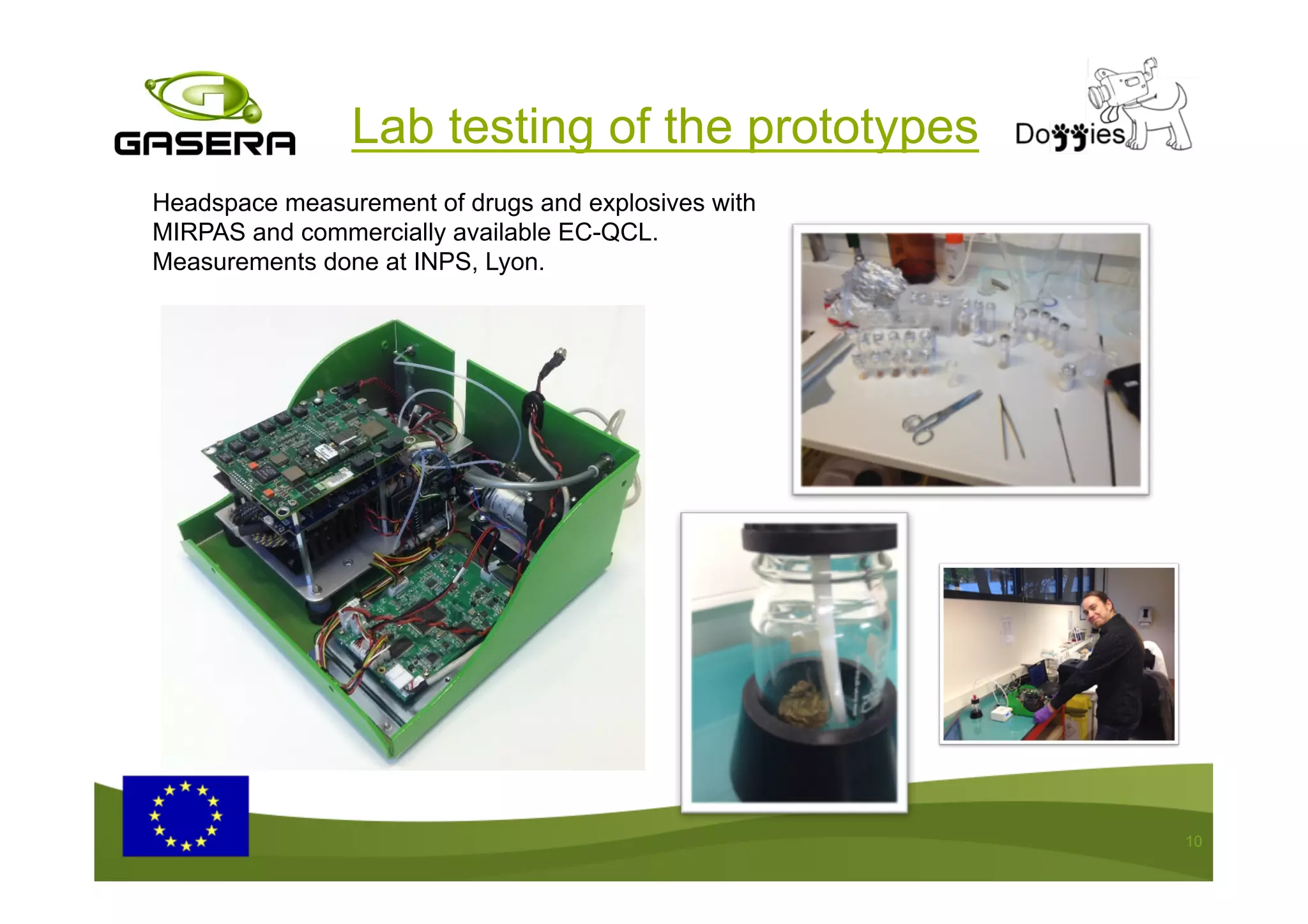
Lab testing of the prototypes
Headspace measurement of drugs and explosives with
MIRPAS and commercially available EC-QCL.
Measurements done at INPS, Lyon.
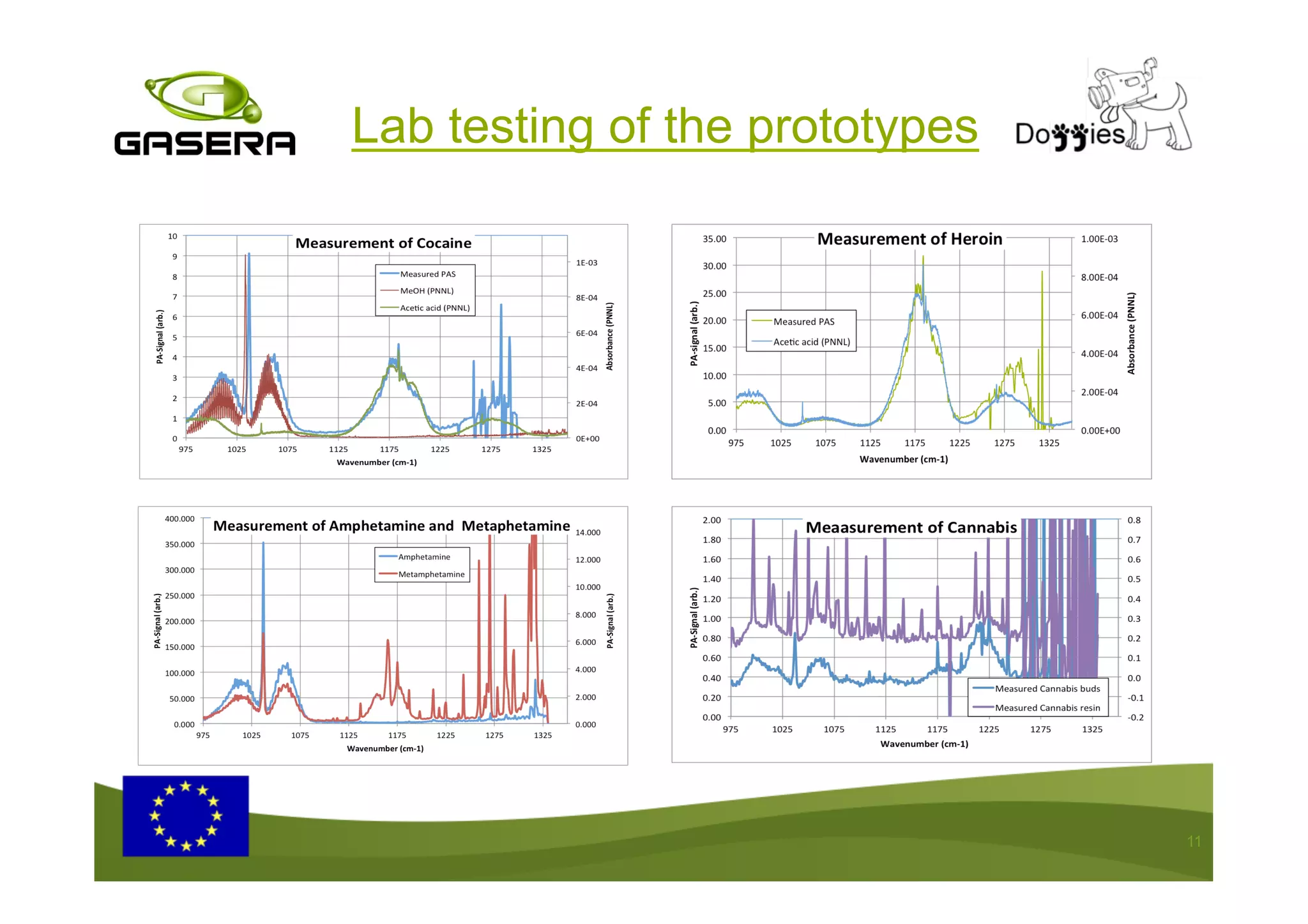
11
Lab testing of the prototypes
Multi-gas analysis with EC-QCL PAS
Multi-gas analysis for air
quality measurements
Tuning range: 1000 – 1250
cm-1
Resolution: 1 cm-1
3 minutes response time
ppb-level detection limits
(1 – 26 ppb with analysis)
- 12 -
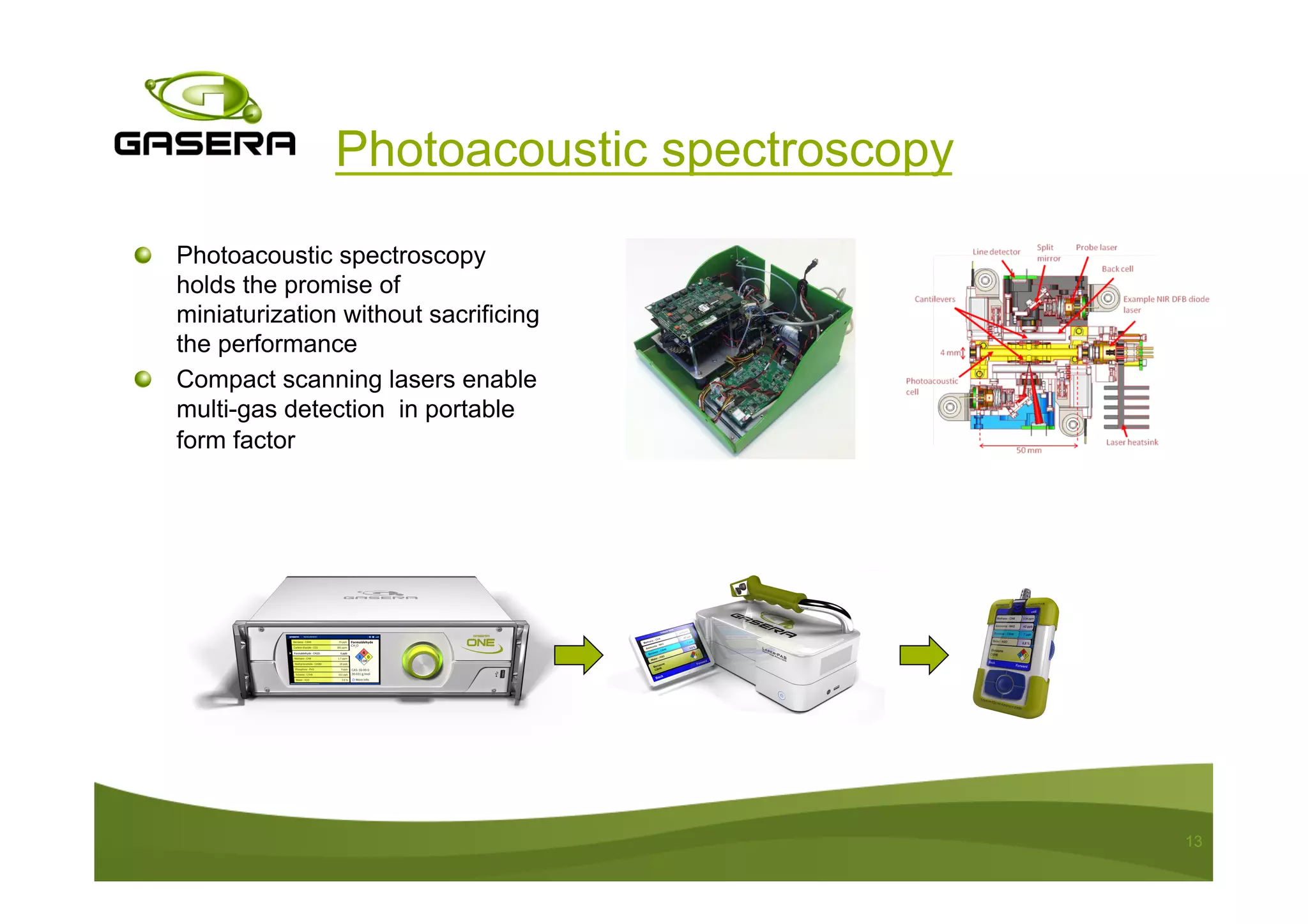
13
Photoacoustic spectroscopy
holds the promise of
miniaturization without sacrificing
the performance
Compact scanning lasers enable
multi-gas detection in portable
form factor
Measurements with hair samples
- 14 -
• A non-invasive drug-testing application
• Drugs enter hair via circulation
• A longer detection window of drugs in hair
• Occasional, random or constant abuse can be detected
• Drugs concentrate to the center of hair
Benefits of photoacoustic
spectroscopy:
• Measurement does not
consume sample material
• No sample preparation needed
• Depth profiling
Detection of drugs in hair
•  FTIR-PAS measurement without
sample pre-processing
•  Hair samples from cocaine
overdose patients were measured
(12 samples)
•  Hair samples from a clean
reference group were also
measured (12 samples)
•  20-30 mg sample material was
used per measurement
•  90 s measurement time
•  Cocaine content was previously
measured with MS to be between
1,5 and 38 ng/mg in different
samples
- 16 -
Detection of drugs in hair
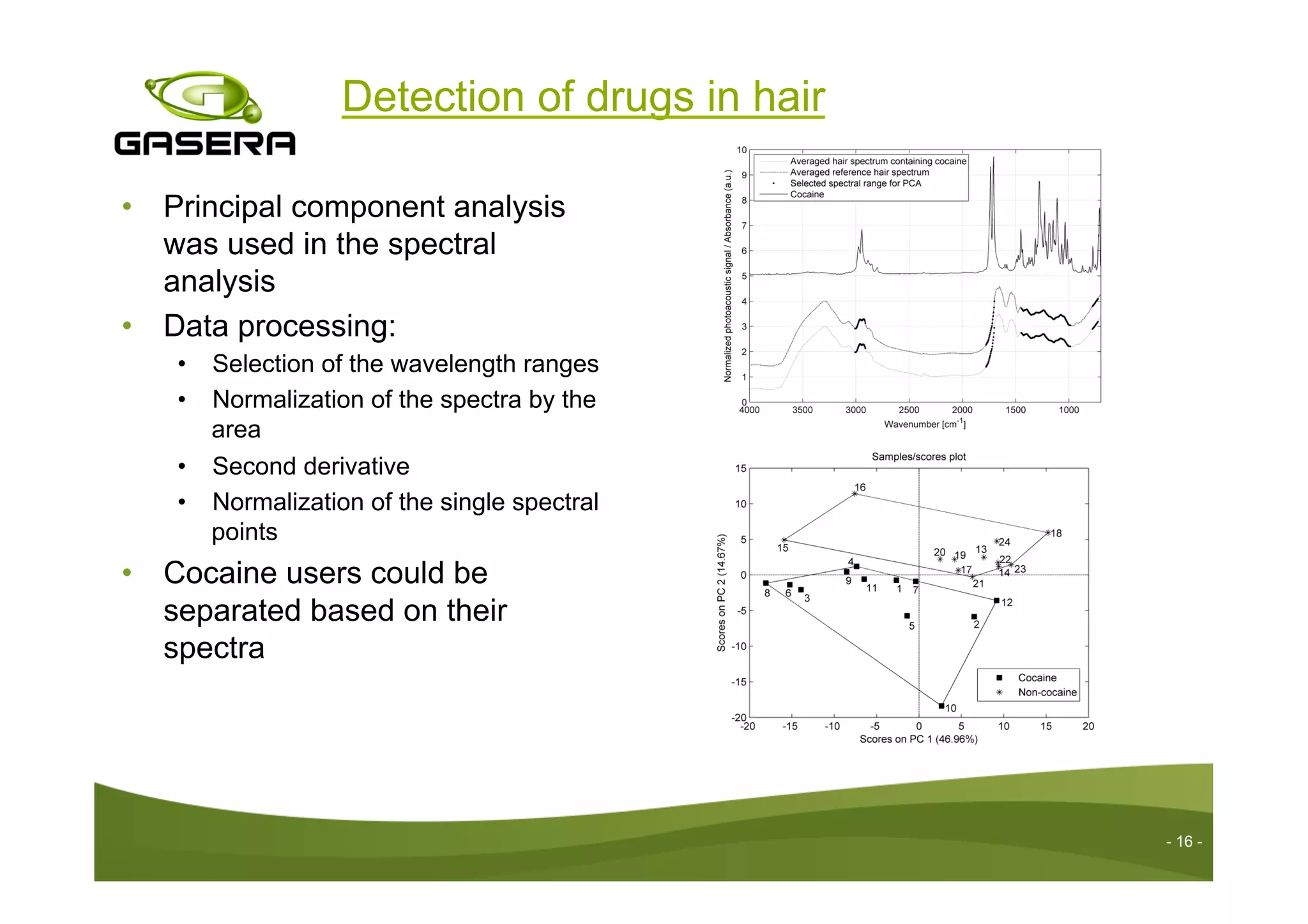
•  Principal component analysis
was used in the spectral
analysis
•  Data processing:
•  Selection of the wavelength ranges
•  Normalization of the spectra by the
area
•  Second derivative
•  Normalization of the single spectral
points
•  Cocaine users could be
separated based on their
spectra
Micro-sample studies
- 17 -
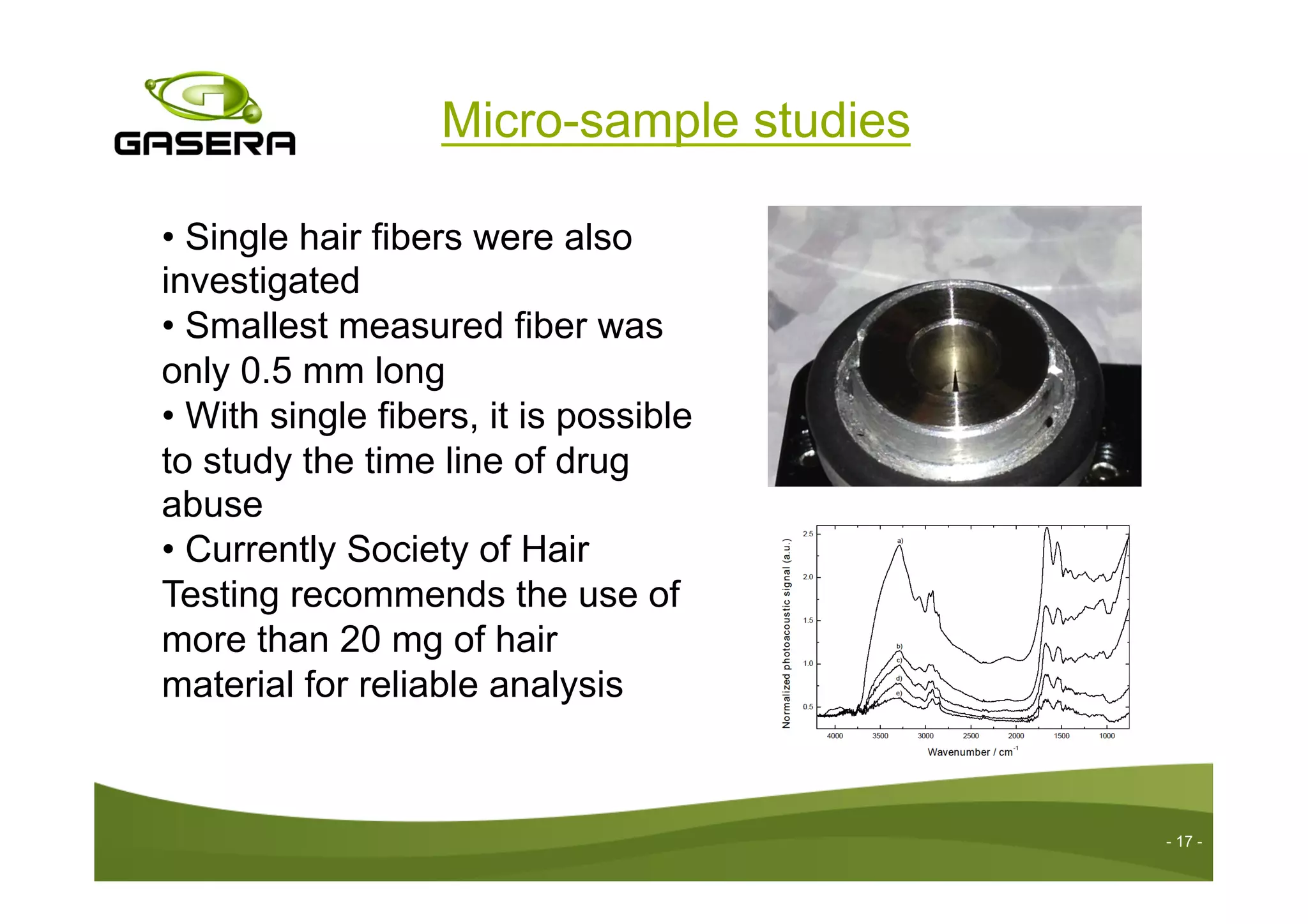
• Single hair fibers were also
investigated
• Smallest measured fiber was
only 0.5 mm long
• With single fibers, it is possible
to study the time line of drug
abuse
• Currently Society of Hair
Testing recommends the use of
more than 20 mg of hair
material for reliable analysis
Solid phase drug measurement
•  FTIR-PAS measurement of
different drugs
•  Study made in collaboration with
Crime Lab of Finnish Police
Forces
•  No sample preparation
•  Fast contactless measurement
FTIR-PAS measurement of cannabis
•  Police wants to know the THC-level of the cannabis
plant
•  Different parts of the cannabis plant were measured
•  Chemometry can be used to define the concentrations
of the different compounds
Miniaturization
- 20 -
• FTIR -> scanning EC-QCL
• Photoacoustic spectroscopy can be utilized in field use
for solid samples as well

Detection of Drugs with Cantilever-Enhanced Photoacoustic Spectroscopy

  • 1.
    Detection of DrugsWith Cantilever-Enhanced Photoacoustic Spectroscopy Dr. Jaakko Lehtinen, Client Partner, Gasera Ltd. Pittcon 2017, 6.3.2017, 09:30 AM Gasera Ltd. Lemminkäisenkatu 59, 20520 Turku, Finland
  • 2.
    Projects overview - 2- Two projects in FP7 program: CUSTOM and DOGGIES One project in H2020 program: IRON Some work is also done outside these projects
  • 3.
    •  Photoacoustic effectwas discovered in 1880 by Alexander Graham Bell •  This theoretical potential has not been reached, since conventional microphones have been used for sensing the pressure pulses •  Gasera’s novel cantilever sensor technology allows the use of the full potential of the photoacoustic phenomena Photoacoustic spectroscopy is based on the absorption of light leading to the local warming of the absorbing volume element. The subsequent expansion of the volume element generates a pressure wave proportional to the absorbed energy, which can be detected via a pressure detector. Photoacoustic spectroscopy PHOTOACOUSTIC GAS CELL IR SOURCE MICROPHONE IR FILTER CHOPPER A typical setup of a conventional PAS system GAS SAMPLE - 3 -
  • 4.
    Key inventions •  Cantileversensor –  Over 100 times greater physical movement can be achieved compared to conventional microphone membrane – cantilever has very low string constant 1 N/m –  Highly linear response •  Optical readout system –  Contactless optical measurement based on laser interferometry –  Measures cantilever displacements smaller than picometer (10-12 m) –  Extremely wide dynamic measurement range - 4 -
  • 5.
    Benefits of cantileverenhanced PAS - 5 - •  Absorption is measured directly in PAS which makes the measurement very accurate and free of drift -> stability and reliability, easy to use •  Cantilever sensor provides high sensitivity –> below ppb detection limits •  Sensitivity is not dependent on the optical path length -> wide linear dynamic range, miniaturization, low sample volume •  Many different sources can be connected to one cell -> multi-gas capability •  Possibility to heat the sample cell -> suitable to wide range of process applications
  • 6.
    CUSTOM-project - 6 - CUSTOM- Drugs And PreCUrsor Sensing By ComplemenTing Low COst Multiple Techniques. The project has started in 2010 and ended in 2013. The aim of the project is to is to build a portable device for drug precursor sensing from vapor phase based on the two orthogonal techniques, which are laser photoacoustic sensor and fluorescence optochip. Development of the cantilever enhanced photoacoustic detector combined with the widely tunable external cavity quantum cascade laser is introduced.
  • 7.
    Example measurement with CWEC QCL - setup •  Example measurements were done with continuous wave external cavity quantum cascade laser (CW EC-QCL ) provided by Daylight Solutions. •  The wavenumber range was between 1020 cm-1 – 1100 cm-1. •  Example gases that were measured were: BMK and Safrole. •  The power of the laser at this wavenumber range was between 0 mW - 62 mW. •  The photoacoustic cell was Gasera PA201 detector (cell diameter 4 mm, length 100 mm). •  Amplitude modulation with mechanical chopper was done. •  FFT software was used for selecting amplitude from the modulation frequency – (phase lock would give better results by order of 2) - 7 - Laser Chopper Photoacoustic detector Beam path
  • 8.
    Example measurement - BMKand Safrole •  The measurement was performed by modulating the amplitude mechanically by chopper and tuning the laser wavelength in 0.1 cm-1 steps from 1020 cm-1 to 1100 cm-1. •  Comparison to FTIR measurement was performed indicating a very good match between the line positions and spectrum details. - 8 - DOGGIES'financed'by'the'European'Community’s'Seventh'Framework'Programme'(FP7CSECC2011C1)''' Figure 3. The IR spectra of several drug precursors. Courtesy of CUSTOM project. The sample of 100 ppm of phenylpropanone (BMK) was measured with a detection limit 2xRMS of 160 ppb (total response time about 60 s). Figure 4. PAS measurement of BMK and FTIR measurement in comparison. D3.8%Sensitivity%Evaluation%of%Different%Target%Molecules% CLASSIFIED)RESTRAINT)UE) ' ' ' ' ' ' '''''''''' '''''''''' ' ' Page' 11' of' 20' The sample of 100 ppm of safrole was determined to have a detection limit of 24 ppb (total response time about 60 s) Figure 5. PAS measurement of Safrole with FTIR comparison measurement. Table 6. Sensitivity of PAS with EC-QCL to BMK and Safrole. BMK (100 ppm) Safrole (100 ppm) Wavenumber (cm-1) 1084.5 1059.0 Laser power (mW) 7.08 4.01
  • 9.
    9 • Funded by theEuropean Commission under the FP7-Security programme •  Project started in 2012, ended in November 2015 • The Consortium of 14 partners from 5 EU countries DOGGIES project aims at demonstrating: • An operational movable stand-alone sensor for an efficient detection of hidden persons, drugs & explosives • “Orthogonal” trace detection • Mid-Infrared spectroscopy, based on photoacoustic detection (PAS) with widely tunable integrated MIR source i.e. MIRPAS • Ion Mobility Spectrometry (IMS), with non-radioactive ionization source • Using specific pre-concentrators and advanced software to provide reliable detection in real environments DOGGIES = Detection of Olfactory traces by orthoGonal Gas identification technologIES DOGGIES-project
  • 10.
    10 Lab testing ofthe prototypes Headspace measurement of drugs and explosives with MIRPAS and commercially available EC-QCL. Measurements done at INPS, Lyon.
  • 11.
    11 Lab testing ofthe prototypes
  • 12.
    Multi-gas analysis withEC-QCL PAS Multi-gas analysis for air quality measurements Tuning range: 1000 – 1250 cm-1 Resolution: 1 cm-1 3 minutes response time ppb-level detection limits (1 – 26 ppb with analysis) - 12 -
  • 13.
    13 Photoacoustic spectroscopy Photoacoustic spectroscopy holdsthe promise of miniaturization without sacrificing the performance Compact scanning lasers enable multi-gas detection in portable form factor
  • 14.
    Measurements with hairsamples - 14 - • A non-invasive drug-testing application • Drugs enter hair via circulation • A longer detection window of drugs in hair • Occasional, random or constant abuse can be detected • Drugs concentrate to the center of hair Benefits of photoacoustic spectroscopy: • Measurement does not consume sample material • No sample preparation needed • Depth profiling
  • 15.
    Detection of drugsin hair •  FTIR-PAS measurement without sample pre-processing •  Hair samples from cocaine overdose patients were measured (12 samples) •  Hair samples from a clean reference group were also measured (12 samples) •  20-30 mg sample material was used per measurement •  90 s measurement time •  Cocaine content was previously measured with MS to be between 1,5 and 38 ng/mg in different samples
  • 16.
    - 16 - Detectionof drugs in hair •  Principal component analysis was used in the spectral analysis •  Data processing: •  Selection of the wavelength ranges •  Normalization of the spectra by the area •  Second derivative •  Normalization of the single spectral points •  Cocaine users could be separated based on their spectra
  • 17.
    Micro-sample studies - 17- • Single hair fibers were also investigated • Smallest measured fiber was only 0.5 mm long • With single fibers, it is possible to study the time line of drug abuse • Currently Society of Hair Testing recommends the use of more than 20 mg of hair material for reliable analysis
  • 18.
    Solid phase drugmeasurement •  FTIR-PAS measurement of different drugs •  Study made in collaboration with Crime Lab of Finnish Police Forces •  No sample preparation •  Fast contactless measurement
  • 19.
    FTIR-PAS measurement ofcannabis •  Police wants to know the THC-level of the cannabis plant •  Different parts of the cannabis plant were measured •  Chemometry can be used to define the concentrations of the different compounds
  • 20.
    Miniaturization - 20 - • FTIR-> scanning EC-QCL • Photoacoustic spectroscopy can be utilized in field use for solid samples as well