1
2
3
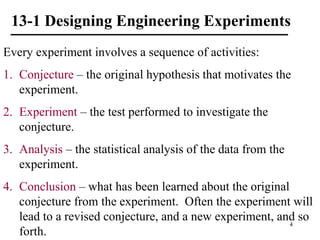
13-1 Designing Engineering Experiments
Every experiment involves a sequence of activities:
1. Conjecture – the original hypothesis that motivates the
experiment.
2. Experiment – the test performed to investigate the
conjecture.
3. Analysis – the statistical analysis of the data from the
experiment.
4. Conclusion – what has been learned about the original
conjecture from the experiment. Often the experiment will
lead to a revised conjecture, and a new experiment, and so
forth.
4
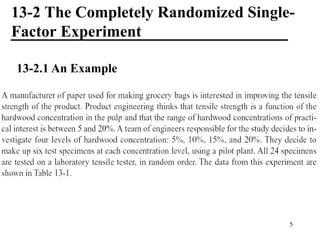
13-2 The Completely Randomized Single-
Factor Experiment
13-2.1 An Example
5
13-2 The Completely Randomized Single-
Factor Experiment
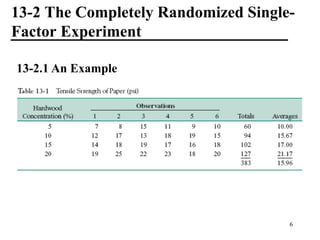
13-2.1 An Example
6
13-2 The Completely Randomized Single-
Factor Experiment
13-2.1 An Example
• The levels of the factor are sometimes called
treatments.
• Each treatment has six observations or replicates.
• The runs are run in random order.
7
13-2 The Completely Randomized Single-
Factor Experiment
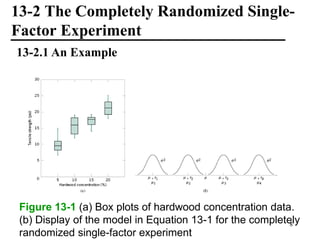
Figure 13-1 (a) Box plots of hardwood concentration data.
(b) Display of the model in Equation 13-1 for the completely
randomized single-factor experiment
13-2.1 An Example
8
13-2 The Completely Randomized Single-
Factor Experiment
13-2.2 The Analysis of Variance
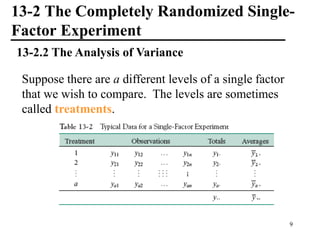
Suppose there are a different levels of a single factor
that we wish to compare. The levels are sometimes
called treatments.
9
13-2 The Completely Randomized Single-
Factor Experiment
13-2.2 The Analysis of Variance
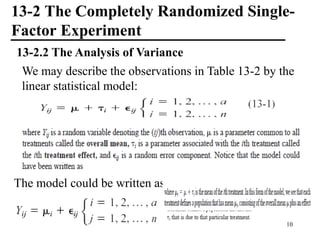
We may describe the observations in Table 13-2 by the
linear statistical model:
The model could be written as
10
13-2 The Completely Randomized Single-
Factor Experiment
13-2.2 The Analysis of Variance
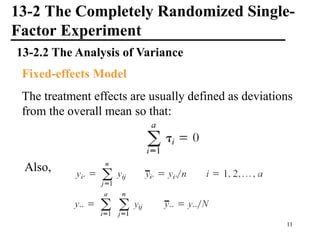
Fixed-effects Model
The treatment effects are usually defined as deviations
from the overall mean so that:
Also,
11
13-2 The Completely Randomized Single-
Factor Experiment
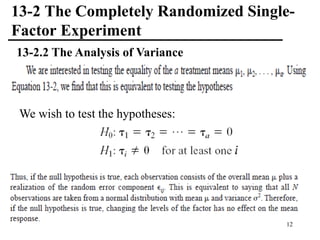
13-2.2 The Analysis of Variance
We wish to test the hypotheses:
12
13-2 The Completely Randomized Single-
Factor Experiment
13-2.2 The Analysis of Variance
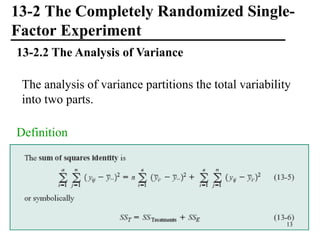
Definition
The analysis of variance partitions the total variability
into two parts.
13
13-2 The Completely Randomized Single-
Factor Experiment
13-2.2 The Analysis of Variance
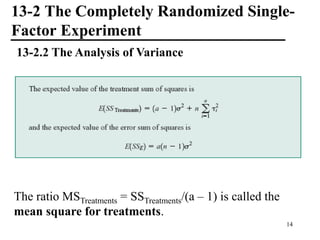
The ratio MSTreatments = SSTreatments/(a – 1) is called the
mean square for treatments.
14
13-2 The Completely Randomized Single-
Factor Experiment
13-2.2 The Analysis of Variance
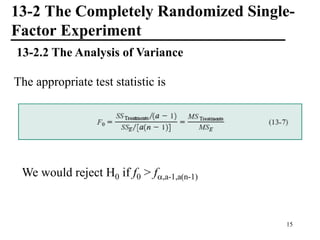
The appropriate test statistic is
We would reject H0 if f0 > f,a-1,a(n-1)
15
13-2 The Completely Randomized Single-
Factor Experiment
13-2.2 The Analysis of Variance
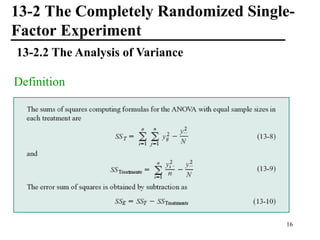
Definition
16
13-2 The Completely Randomized Single-
Factor Experiment
13-2.2 The Analysis of Variance
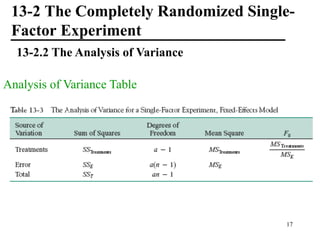
Analysis of Variance Table
17
13-2 The Completely Randomized Single-
Factor Experiment
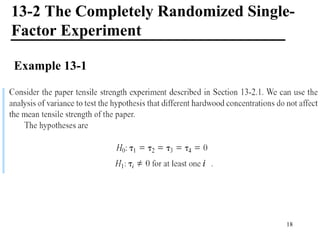
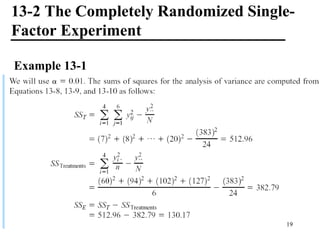
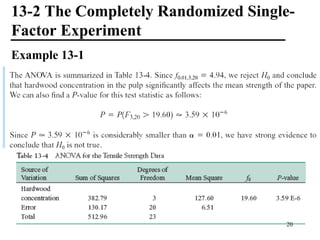
Example 13-1
18
13-2 The Completely Randomized Single-
Factor Experiment
Example 13-1
19
13-2 The Completely Randomized Single-
Factor Experiment
Example 13-1
20
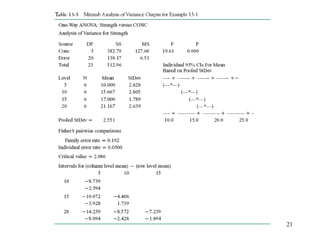
21
13-2 The Completely Randomized Single-
Factor Experiment
Definition
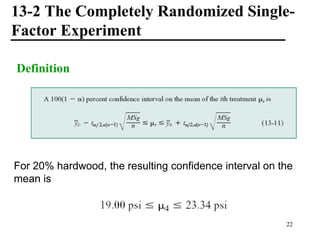
For 20% hardwood, the resulting confidence interval on the
mean is
22
13-2 The Completely Randomized Single-
Factor Experiment
Definition
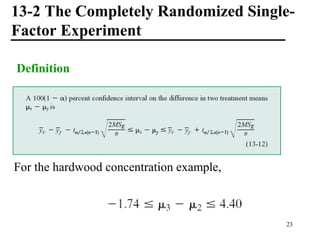
For the hardwood concentration example,
23
13-2 The Completely Randomized Single-
Factor Experiment
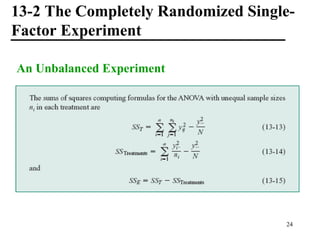
An Unbalanced Experiment
24
13-2 The Completely Randomized Single-
Factor Experiment
13-2.3 Multiple Comparisons Following the ANOVA
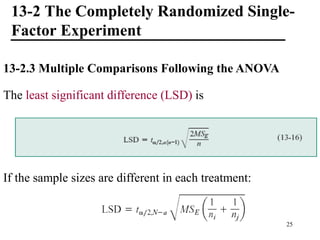
The least significant difference (LSD) is
If the sample sizes are different in each treatment:
25
13-2 The Completely Randomized Single-
Factor Experiment
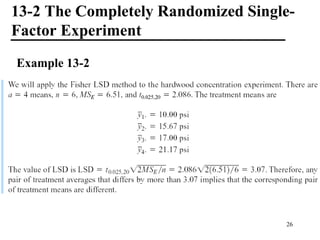
Example 13-2
26
13-2 The Completely Randomized Single-
Factor Experiment
Example 13-2
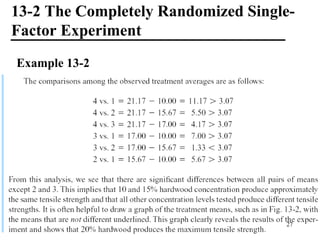
27
13-2 The Completely Randomized Single-
Factor Experiment
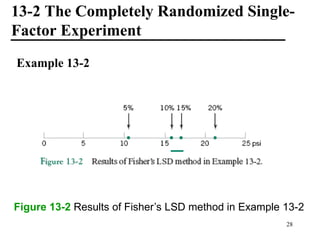
Example 13-2
Figure 13-2 Results of Fisher’s LSD method in Example 13-2
28
13-2 The Completely Randomized Single-
Factor Experiment
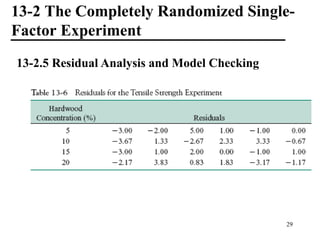
13-2.5 Residual Analysis and Model Checking
29
13-2 The Completely Randomized Single-
Factor Experiment
13-2.5 Residual Analysis and Model Checking
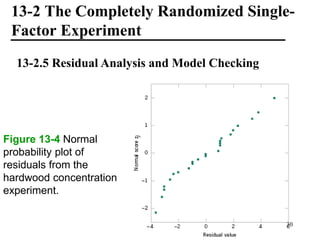
Figure 13-4 Normal
probability plot of
residuals from the
hardwood concentration
experiment.
30
13-2 The Completely Randomized Single-
Factor Experiment
13-2.5 Residual Analysis and Model Checking
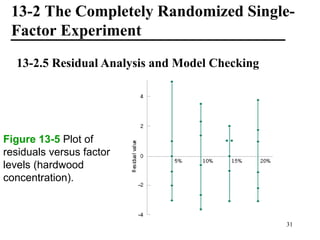
Figure 13-5 Plot of
residuals versus factor
levels (hardwood
concentration).
31
13-2 The Completely Randomized Single-
Factor Experiment
13-2.5 Residual Analysis and Model Checking
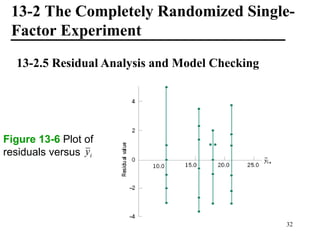
Figure 13-6 Plot of
residuals versus i
y
32
13-3 The Random-Effects Model
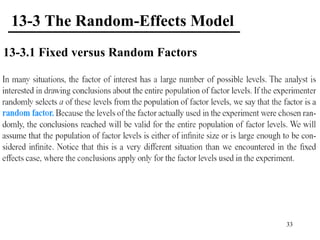
13-3.1 Fixed versus Random Factors
33
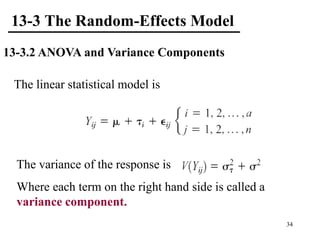
13-3 The Random-Effects Model
13-3.2 ANOVA and Variance Components
The linear statistical model is
The variance of the response is
Where each term on the right hand side is called a
variance component.
34
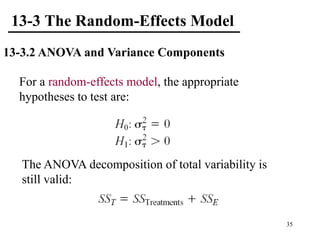
13-3 The Random-Effects Model
13-3.2 ANOVA and Variance Components
For a random-effects model, the appropriate
hypotheses to test are:
The ANOVA decomposition of total variability is
still valid:
35
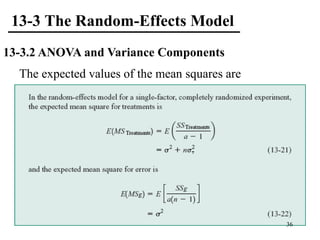
13-3 The Random-Effects Model
13-3.2 ANOVA and Variance Components
The expected values of the mean squares are
36
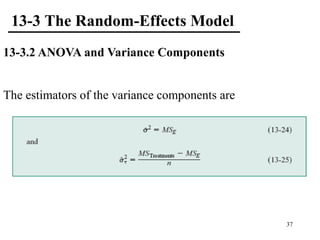
13-3 The Random-Effects Model
13-3.2 ANOVA and Variance Components
The estimators of the variance components are
37
13-3 The Random-Effects Model
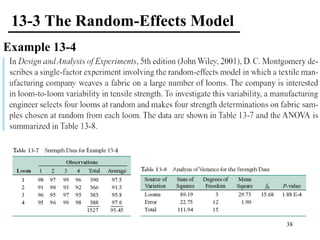
Example 13-4
38
13-3 The Random-Effects Model
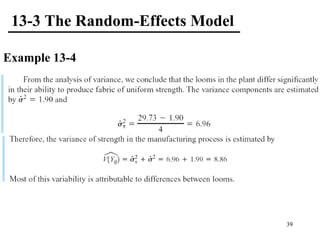
Example 13-4
39
13-3 The Random-Effects Model
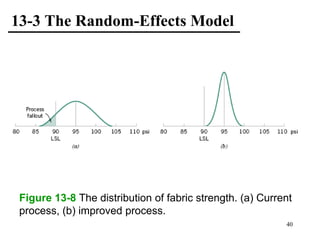
Figure 13-8 The distribution of fabric strength. (a) Current
process, (b) improved process.
40
13-4 Randomized Complete Block Designs
13-4.1 Design and Statistical Analyses
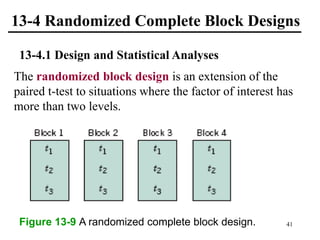
The randomized block design is an extension of the
paired t-test to situations where the factor of interest has
more than two levels.
Figure 13-9 A randomized complete block design. 41
13-4 Randomized Complete Block Designs
13-4.1 Design and Statistical Analyses
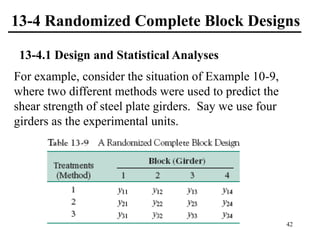
For example, consider the situation of Example 10-9,
where two different methods were used to predict the
shear strength of steel plate girders. Say we use four
girders as the experimental units.
42
13-4 Randomized Complete Block Designs
13-4.1 Design and Statistical Analyses
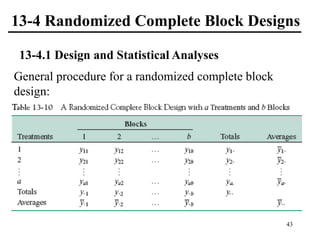
General procedure for a randomized complete block
design:
43
13-4 Randomized Complete Block Designs
13-4.1 Design and Statistical Analyses
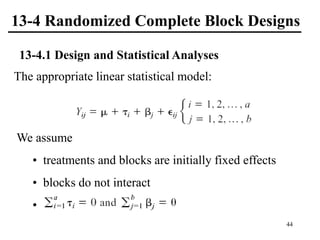
The appropriate linear statistical model:
We assume
• treatments and blocks are initially fixed effects
• blocks do not interact
•
44
13-4 Randomized Complete Block Designs
13-4.1 Design and Statistical Analyses
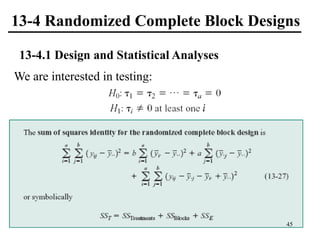
We are interested in testing:
45
13-4 Randomized Complete Block Designs
13-4.1 Design and Statistical Analyses
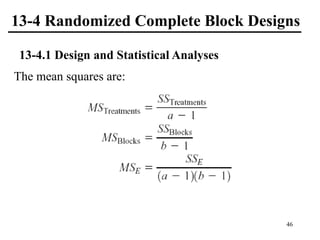
The mean squares are:
46
13-4 Randomized Complete Block Designs
13-4.1 Design and Statistical Analyses
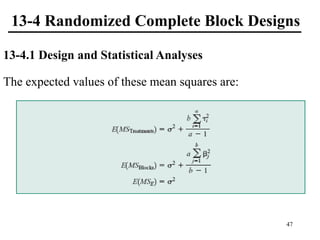
The expected values of these mean squares are:
47
13-4 Randomized Complete Block Designs
13-4.1 Design and Statistical Analyses
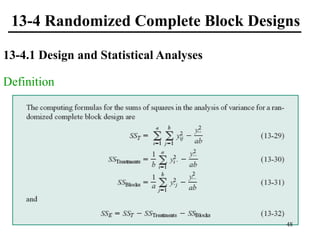
Definition
48
13-4 Randomized Complete Block Designs
13-4.1 Design and Statistical Analyses
49
13-4 Randomized Complete Block Designs
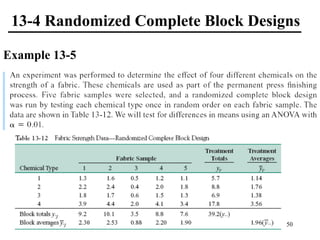
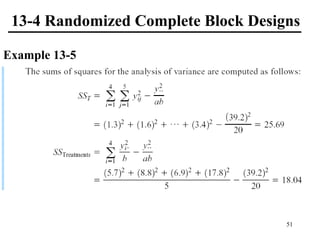
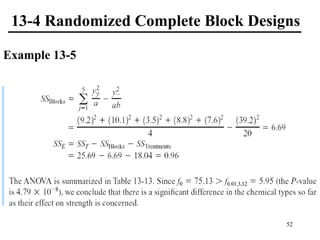
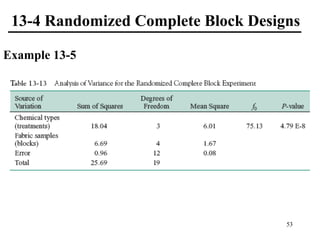
Example 13-5
50
13-4 Randomized Complete Block Designs
Example 13-5
51
13-4 Randomized Complete Block Designs
Example 13-5
52
13-4 Randomized Complete Block Designs
Example 13-5
53
13-4 Randomized Complete Block Designs
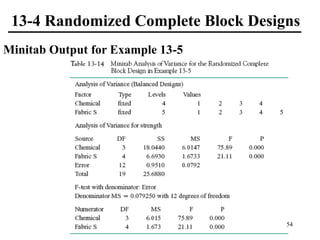
Minitab Output for Example 13-5
54
13-4 Randomized Complete Block Designs
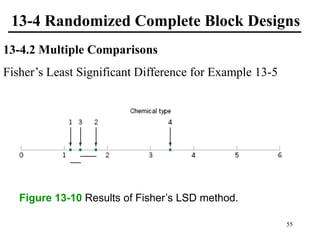
13-4.2 Multiple Comparisons
Fisher’s Least Significant Difference for Example 13-5
Figure 13-10 Results of Fisher’s LSD method.
55
13-4 Randomized Complete Block Designs
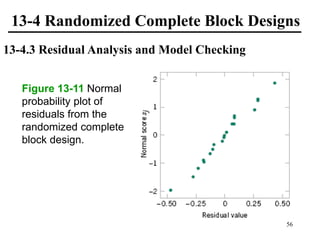
13-4.3 Residual Analysis and Model Checking
Figure 13-11 Normal
probability plot of
residuals from the
randomized complete
block design.
56
13-4 Randomized Complete Block Designs
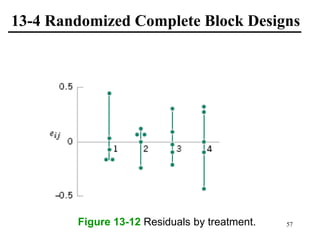
Figure 13-12 Residuals by treatment. 57
13-4 Randomized Complete Block Designs
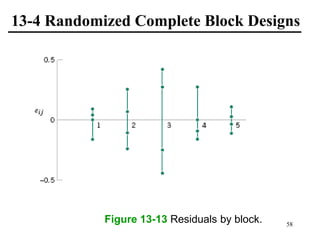
Figure 13-13 Residuals by block. 58
13-4 Randomized Complete Block Designs
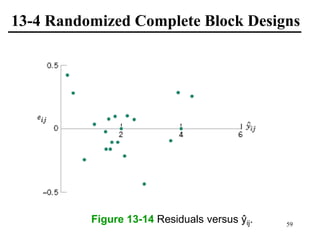
Figure 13-14 Residuals versus ŷij. 59
60

design and analysis of single factor experiments

  • 1.
  • 2.
  • 3.
  • 4.
    13-1 Designing EngineeringExperiments Every experiment involves a sequence of activities: 1. Conjecture – the original hypothesis that motivates the experiment. 2. Experiment – the test performed to investigate the conjecture. 3. Analysis – the statistical analysis of the data from the experiment. 4. Conclusion – what has been learned about the original conjecture from the experiment. Often the experiment will lead to a revised conjecture, and a new experiment, and so forth. 4
  • 5.
    13-2 The CompletelyRandomized Single- Factor Experiment 13-2.1 An Example 5
  • 6.
    13-2 The CompletelyRandomized Single- Factor Experiment 13-2.1 An Example 6
  • 7.
    13-2 The CompletelyRandomized Single- Factor Experiment 13-2.1 An Example • The levels of the factor are sometimes called treatments. • Each treatment has six observations or replicates. • The runs are run in random order. 7
  • 8.
    13-2 The CompletelyRandomized Single- Factor Experiment Figure 13-1 (a) Box plots of hardwood concentration data. (b) Display of the model in Equation 13-1 for the completely randomized single-factor experiment 13-2.1 An Example 8
  • 9.
    13-2 The CompletelyRandomized Single- Factor Experiment 13-2.2 The Analysis of Variance Suppose there are a different levels of a single factor that we wish to compare. The levels are sometimes called treatments. 9
  • 10.
    13-2 The CompletelyRandomized Single- Factor Experiment 13-2.2 The Analysis of Variance We may describe the observations in Table 13-2 by the linear statistical model: The model could be written as 10
  • 11.
    13-2 The CompletelyRandomized Single- Factor Experiment 13-2.2 The Analysis of Variance Fixed-effects Model The treatment effects are usually defined as deviations from the overall mean so that: Also, 11
  • 12.
    13-2 The CompletelyRandomized Single- Factor Experiment 13-2.2 The Analysis of Variance We wish to test the hypotheses: 12
  • 13.
    13-2 The CompletelyRandomized Single- Factor Experiment 13-2.2 The Analysis of Variance Definition The analysis of variance partitions the total variability into two parts. 13
  • 14.
    13-2 The CompletelyRandomized Single- Factor Experiment 13-2.2 The Analysis of Variance The ratio MSTreatments = SSTreatments/(a – 1) is called the mean square for treatments. 14
  • 15.
    13-2 The CompletelyRandomized Single- Factor Experiment 13-2.2 The Analysis of Variance The appropriate test statistic is We would reject H0 if f0 > f,a-1,a(n-1) 15
  • 16.
    13-2 The CompletelyRandomized Single- Factor Experiment 13-2.2 The Analysis of Variance Definition 16
  • 17.
    13-2 The CompletelyRandomized Single- Factor Experiment 13-2.2 The Analysis of Variance Analysis of Variance Table 17
  • 18.
    13-2 The CompletelyRandomized Single- Factor Experiment Example 13-1 18
  • 19.
    13-2 The CompletelyRandomized Single- Factor Experiment Example 13-1 19
  • 20.
    13-2 The CompletelyRandomized Single- Factor Experiment Example 13-1 20
  • 21.
  • 22.
    13-2 The CompletelyRandomized Single- Factor Experiment Definition For 20% hardwood, the resulting confidence interval on the mean is 22
  • 23.
    13-2 The CompletelyRandomized Single- Factor Experiment Definition For the hardwood concentration example, 23
  • 24.
    13-2 The CompletelyRandomized Single- Factor Experiment An Unbalanced Experiment 24
  • 25.
    13-2 The CompletelyRandomized Single- Factor Experiment 13-2.3 Multiple Comparisons Following the ANOVA The least significant difference (LSD) is If the sample sizes are different in each treatment: 25
  • 26.
    13-2 The CompletelyRandomized Single- Factor Experiment Example 13-2 26
  • 27.
    13-2 The CompletelyRandomized Single- Factor Experiment Example 13-2 27
  • 28.
    13-2 The CompletelyRandomized Single- Factor Experiment Example 13-2 Figure 13-2 Results of Fisher’s LSD method in Example 13-2 28
  • 29.
    13-2 The CompletelyRandomized Single- Factor Experiment 13-2.5 Residual Analysis and Model Checking 29
  • 30.
    13-2 The CompletelyRandomized Single- Factor Experiment 13-2.5 Residual Analysis and Model Checking Figure 13-4 Normal probability plot of residuals from the hardwood concentration experiment. 30
  • 31.
    13-2 The CompletelyRandomized Single- Factor Experiment 13-2.5 Residual Analysis and Model Checking Figure 13-5 Plot of residuals versus factor levels (hardwood concentration). 31
  • 32.
    13-2 The CompletelyRandomized Single- Factor Experiment 13-2.5 Residual Analysis and Model Checking Figure 13-6 Plot of residuals versus i y 32
  • 33.
    13-3 The Random-EffectsModel 13-3.1 Fixed versus Random Factors 33
  • 34.
    13-3 The Random-EffectsModel 13-3.2 ANOVA and Variance Components The linear statistical model is The variance of the response is Where each term on the right hand side is called a variance component. 34
  • 35.
    13-3 The Random-EffectsModel 13-3.2 ANOVA and Variance Components For a random-effects model, the appropriate hypotheses to test are: The ANOVA decomposition of total variability is still valid: 35
  • 36.
    13-3 The Random-EffectsModel 13-3.2 ANOVA and Variance Components The expected values of the mean squares are 36
  • 37.
    13-3 The Random-EffectsModel 13-3.2 ANOVA and Variance Components The estimators of the variance components are 37
  • 38.
    13-3 The Random-EffectsModel Example 13-4 38
  • 39.
    13-3 The Random-EffectsModel Example 13-4 39
  • 40.
    13-3 The Random-EffectsModel Figure 13-8 The distribution of fabric strength. (a) Current process, (b) improved process. 40
  • 41.
    13-4 Randomized CompleteBlock Designs 13-4.1 Design and Statistical Analyses The randomized block design is an extension of the paired t-test to situations where the factor of interest has more than two levels. Figure 13-9 A randomized complete block design. 41
  • 42.
    13-4 Randomized CompleteBlock Designs 13-4.1 Design and Statistical Analyses For example, consider the situation of Example 10-9, where two different methods were used to predict the shear strength of steel plate girders. Say we use four girders as the experimental units. 42
  • 43.
    13-4 Randomized CompleteBlock Designs 13-4.1 Design and Statistical Analyses General procedure for a randomized complete block design: 43
  • 44.
    13-4 Randomized CompleteBlock Designs 13-4.1 Design and Statistical Analyses The appropriate linear statistical model: We assume • treatments and blocks are initially fixed effects • blocks do not interact • 44
  • 45.
    13-4 Randomized CompleteBlock Designs 13-4.1 Design and Statistical Analyses We are interested in testing: 45
  • 46.
    13-4 Randomized CompleteBlock Designs 13-4.1 Design and Statistical Analyses The mean squares are: 46
  • 47.
    13-4 Randomized CompleteBlock Designs 13-4.1 Design and Statistical Analyses The expected values of these mean squares are: 47
  • 48.
    13-4 Randomized CompleteBlock Designs 13-4.1 Design and Statistical Analyses Definition 48
  • 49.
    13-4 Randomized CompleteBlock Designs 13-4.1 Design and Statistical Analyses 49
  • 50.
    13-4 Randomized CompleteBlock Designs Example 13-5 50
  • 51.
    13-4 Randomized CompleteBlock Designs Example 13-5 51
  • 52.
    13-4 Randomized CompleteBlock Designs Example 13-5 52
  • 53.
    13-4 Randomized CompleteBlock Designs Example 13-5 53
  • 54.
    13-4 Randomized CompleteBlock Designs Minitab Output for Example 13-5 54
  • 55.
    13-4 Randomized CompleteBlock Designs 13-4.2 Multiple Comparisons Fisher’s Least Significant Difference for Example 13-5 Figure 13-10 Results of Fisher’s LSD method. 55
  • 56.
    13-4 Randomized CompleteBlock Designs 13-4.3 Residual Analysis and Model Checking Figure 13-11 Normal probability plot of residuals from the randomized complete block design. 56
  • 57.
    13-4 Randomized CompleteBlock Designs Figure 13-12 Residuals by treatment. 57
  • 58.
    13-4 Randomized CompleteBlock Designs Figure 13-13 Residuals by block. 58
  • 59.
    13-4 Randomized CompleteBlock Designs Figure 13-14 Residuals versus ŷij. 59
  • 60.