1
DEPRESSION AND HOW YOU CAN MANAGE IT
Overview
Depression has been found to be a serious medical condition that can become worse in people
who do not manage it or seek for treatment early. Those who seek for treatment for their
conditions often see improvements in their symptoms in few weeks. Usually, depression occurs
when there is a persistent feeling of sadness, gloominess, and having a loss of interest or pleasure
in daily activities.
Depression is a condition that affects approximately one in every 15 adults in any given
year in most countries and according to Global Burden of Disease Study, one in six people can
experience depression at some time in their lives. It can happen at any time in a person’s life but
on the average, the first incidence of depression can appear during the late teens to mid-20s.
With regards to gender, women are more likely than men to experience depression within this
period and one-third of women experience major depressive episodes in their lifetime than what
occurs in men.
In most situations also, the depressive condition can become a mood disorder that can
cause a persistent feeling of grief and loss of concentration. However, depression is not a
weakness and one cannot do away with it when it comes. But when it arises, one does not have
2
to be discouraged. This means that depression can affect anyone. Even a person who appears to
live in relatively ideal circumstances can experience this condition.
What is Depression
Depression is a common and serious condition that negatively affects the feeling, the thinking,
and the actions of a person. It is a condition that causes feelings of sadness and/or a loss of
interest in activities that one used to enjoy in. When this condition occurs, it leads to a variety of
emotional and physical problems and decreases the ability of a person to function at workplace
and at home.
Again, people experience depression in different ways. It is therefore important to realize
that feeling down and sad at times is a normal part of life but when these conditions occur on a
regular basis, it then becomes a depression.
Prevalence of Depression
According to Global Burden of Disease Study, about 300
million people around the world had depression in various
forms in 2017 alone. Again, data from the National
Survey on Drug Use and Health indicated that
17.3 million adults in the US which
translates into 7.1 percent of all adults in that country
experienced major depressive episodes in 2016. This makes the US one of the most depressed
countries in the world according to the World Health Organization. On the whole, India is the
most depressed country followed by China before the US. This shows that major depressive
disorder is one of the common mental health conditions in the world. World Health Organization
indicated that most teenagers who experience severe forms of depression happen to fall on
alcohol or drugs in an abusive manner. One thing is that, depression can begin in a person at any
age and across all socioeconomic statuses. Across the globe, the median age that many people
experience depression is 32.5 years and highest episodes occur to individuals who are between
18 and 25 years. Research has shown that women experience depressive conditions at roughly
twice the rate as men and the exact causes of this gender disparity are not clear. From this
3
perspective, the increased prevalence of depression in women is often attributed to such factors
as female hormonal influences and stress.
Types of Depression
The type of depression that a person can experience depends on the number and severity of
symptoms. A depressive episode can therefore be categorized as mild, moderate or severe. Those
who have mild depressive episodes usually have some difficulty in continuing with ordinary
work and social activities but they probably do not stop to function completely. Those with
depression who are unable to continue with social, workplace, or domestic activities are those
who have severe depressive episodes. This type of depression is characterized by persistent
feelings of sadness, hopelessness, and worthlessness that do not go away on their own. In effect,
there are various types of depression and among them are the following:
Recurrent Depression
This is a disorder that involves repeated depressive episodes in the person. When this condition
becomes evident, the person experiences miserable mood, loss of interest in normal activities
that brings happiness, as well as reduced energy which can lead to diminished activity for at least
two weeks. Many people with this type of depression also experience disturbed sleep, loss of
appetite, and may have feelings of guilt or low self-worth, poor concentration, and sometimes
unexplainable medical conditions.
Bipolar Depression
This type of depression involves both overexcited and depressive episodes which are usually
separated by periods of normal moods. Overexcited incidents involve exalted or irritable mood
or exaggerated self-esteem as well as a decreased need for sleep.
Seasonal Depression
Those whose moods are affected seasonally and the effect is associated with irritable moods are
those who experience seasonal depression. This condition usually starts in some people when
autumn starts and it can linger in them until winter but it does not occur often during summer and
spring.
Postpartum Depression
This type of depression occurs in women when hormonal changes set in after childbirth. This condition
comes with mood swings, sadness, and fatigue and it usually passes within a week or two due to lack of
4
sleep and the pressures of taking care of a new baby. According to the American Psychological
Association, about 10 to 15 percent of women in the US have this kind of depression after three months
of childbirth.
Psychotic Depression
This kind of depression occurs when the depression is accompanied by hallucinations,
misconceptions, or fear and mistrust. It causes people to see, hear, believe, or smell things that
are not real. People with this type of depression may also experience feelings of sadness,
hopelessness, and irritability. The combination of two of any of these conditions is very
dangerous because it causes people to have thoughts of suicide or to take unusual risks.
Complications of Depression
Cognitive behavioral theorists argue that depression comes as a result of
distorted thoughts and judgments that a person entertains. These thoughts
and judgments can be learnt from others in the society. Children in a
dysfunctional family for example can learn it through the observation
of their parents as they fail to successfully survive stressful
experiences or traumatic events that they encounter. In other
situations, lack of skills that can lead to the development of
adaptive abilities for managing adverse situations can also make
people susceptible to depression. Cognitive behavioral theory claims
that persons with depression think and behave differently than
persons who are not depressed because these persons view
themselves, their environment, and the future in a negative way.
As a result, these persons tend to misunderstand facts and they
interpret facts in negative ways. They also tend to criticize
themselves for all the negative things that happen to them. This
makes them to see situations as being worse than they really are which increases their risk of
developing symptoms of depression.
Theorists explain that negative thinking and judgment style of life that are generated by
dysfunctional beliefs are the main cause of depressive symptoms. This is because there is a direct
relationship between the amount and severity of a person’s negative thoughts and the severity of
5
his/her depressive symptoms. This implies that, the more negative thoughts a person experience,
the more depressed he/she will become. Meanwhile, there are three main dysfunctional belief
themes that control the thinking of a person with depression. These themes are:
I am inadequate.
All of my experiences result in failures.
The future is hopeless.
It is maintained that when these beliefs are present in a person’s thoughts, depression is very
likely to arise if it had not already come about. For example, when a person is laid off from a job,
the normal person will understand that the situation could be as a result of the economic position
of the employer and he/she will endeavor to look for another job. However, in the person who
has depression and with a thinking process that is controlled by the dysfunctional themes, this lay
off will be understood as a personal failure. This person will also believe that all other jobs will
be lost and that the situation is a hopeless one. The worst forms of depression will then arise
when the situation is not corrected or managed.
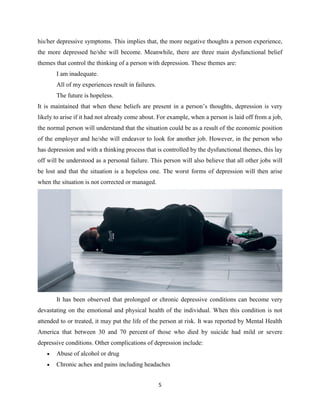
It has been observed that prolonged or chronic depressive conditions can become very
devastating on the emotional and physical health of the individual. When this condition is not
attended to or treated, it may put the life of the person at risk. It was reported by Mental Health
America that between 30 and 70 percent of those who died by suicide had mild or severe
depressive conditions. Other complications of depression include:
 Abuse of alcohol or drug
 Chronic aches and pains including headaches
6
 Anxiety attacks
 Trouble with the performance of normal activities at home, workplace, or at school
 Relationship problems with family and friends
 Self-mutilation such as cutting
 Premature death from medical conditions or suicide thoughts
Symptoms of Depression
Major forms of depression can cause a variety of symptoms. Some of them affect one’s mood
and others affect the body. While some symptoms may be ongoing, others can come and go. The
symptoms can also be experienced differently among men, women, and children and these
include:
 Having a dejected mood or the feeling of sadness
 Loss of interest or pleasure in activities that were once enjoyed
 Reduced appetite and weight loss, or increased cravings for food and weight gain
 Problems with sleeping or sleeping too much
 Tiredness and lack of energy which makes even small tasks take extra effort
 Increase in purposeless physical activities such as inability to sit still or pace along the
path
 Feelings of worthlessness or guilt and preoccupying oneself with past failures or self-
blame
 Difficulty in thinking, concentrating, speaking, or making decisions
 Frequent or recurrent thoughts of death, suicidal thoughts, and suicide attempts.
 Angry outbursts, irritability or frustration even over small matters towards others
 Unexplained physical problems such as back pain or headaches.
 Self-mutilation such as cutting
Symptoms of Depression in Females
According to the Center of Disease Control and Prevention (CDC) of the US, the effects of
depression can be different in males and females. After women give birth or when they are going
to have their menstruation, their hormone levels readjust and this changes their mood which
7
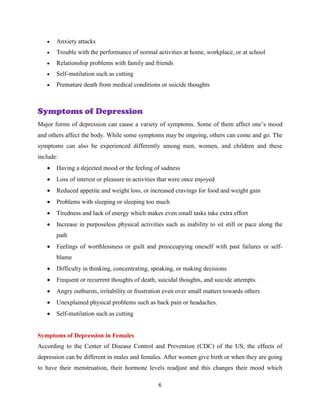
causes depression in some of them. Some of the
symptoms of depression that are exclusive to females
are:
 Irritability
 Anxiety
 Mood swings
 Fatigue
 ruminating or dwelling on negative thoughts
Symptoms of Depression in Males
Males who have depression are more likely to drink alcohol in excess, display anger, and engage
in risk-taking as a result of the disorder. Other symptoms of depression in males include:
 avoiding families and social situations
 working without a break
 having difficulty keeping up with work and family responsibilities
 displaying abusive or controlling behavior in relationships
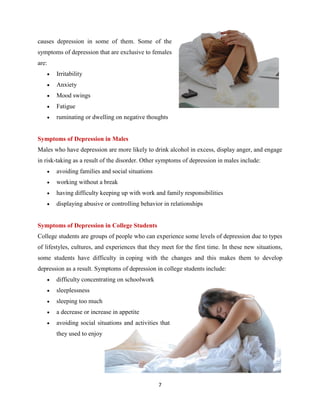
Symptoms of Depression in College Students
College students are groups of people who can experience some levels of depression due to types
of lifestyles, cultures, and experiences that they meet for the first time. In these new situations,
some students have difficulty in coping with the changes and this makes them to develop
depression as a result. Symptoms of depression in college students include:
 difficulty concentrating on schoolwork
 sleeplessness
 sleeping too much
 a decrease or increase in appetite
 avoiding social situations and activities that
they used to enjoy
8
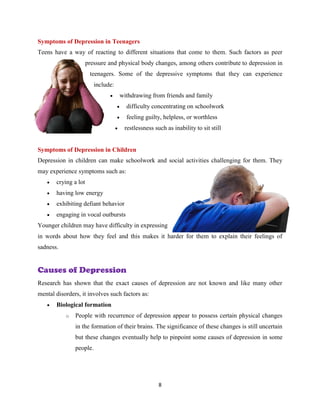
Symptoms of Depression in Teenagers
Teens have a way of reacting to different situations that come to them. Such factors as peer
pressure and physical body changes, among others contribute to depression in
teenagers. Some of the depressive symptoms that they can experience
include:
 withdrawing from friends and family
 difficulty concentrating on schoolwork
 feeling guilty, helpless, or worthless
 restlessness such as inability to sit still
Symptoms of Depression in Children
Depression in children can make schoolwork and social activities challenging for them. They
may experience symptoms such as:
 crying a lot
 having low energy
 exhibiting defiant behavior
 engaging in vocal outbursts
Younger children may have difficulty in expressing
in words about how they feel and this makes it harder for them to explain their feelings of
sadness.
Causes of Depression
Research has shown that the exact causes of depression are not known and like many other
mental disorders, it involves such factors as:
 Biological formation
o People with recurrence of depression appear to possess certain physical changes
in the formation of their brains. The significance of these changes is still uncertain
but these changes eventually help to pinpoint some causes of depression in some
people.
9
 Brain chemistry
o Brain chemistry that involves the activities of neurotransmitters has been found to
cause some levels of depression in some people. Neurotransmitters are naturally
occurring brain chemicals that usually play a role in the occurrence of depression.
Research has indicated that changes in the function and effect of these
neurotransmitters and how they interact with neurocircuits that are involved in
maintaining the stability of one’s mood also play a significant role in depression
and its treatment.
 Brain structure
o There is a greater risk for depression when the structure of the frontal lobe of the
brain changes or is less active. However, scientists do not know if this happens
before or after the onset of depressive symptoms.
 Hormones
o Changes in the balance of the levels of some hormones in the body are also
associated with the trigger of depression. Hormone changes that are associated
with depression are those that become active with pregnancy and during the
weeks or months after child delivery, as well as from thyroid problems,
menopause, or a number of other health conditions.
 Inherited traits
o Research has identified that depression is more common in people whose blood
relatives also have this condition.
 Personality
o People with low self-esteem who are easily overwhelmed by stress or who have
negative inclinations, or depend too much on others, or are self-critical appear to
be more likely to experience depression.
 Environmental factors
o Continuous exposure to violence, neglect, abuse, or poverty may make some
people to become more vulnerable to depression. Traumatic or stressful events
such as physical or sexual abuse, the death or loss of a loved one, a difficult
relationship, or financial problems are other factors that can bring about
10
depression. Being a lesbian, gay, bisexual, or transgender in an unsupportive
situation or environment can also cause depression.
 Early childhood trauma
o Some childhood events can affect the body’s reaction to fear and stressful
situations and this can have continuous effect in bringing about depression even in
one’s adult life.
 Medical conditions
o Serious or chronic illnesses including cancer, stroke, chronic pain or heart disease
and the intake of their respective medications can put people at higher risk of
depression.
 Drug use or misuse
o A history of drug or alcohol use or misuse can also bring about occurrences of
depression. Certain uses of medications such as some high blood pressure
medications or sleeping pills can also result in depressive conditions.
Risk Factors that can Result in Depression
Depression is a condition that can affect anyone and at any time. Even those who live in
relatively favorable circumstances can experience depression in one way or the other. Some of
the several factors that can contribute to the onset of depression in people include:
 Biochemistry
o This is where the differences in the composition of certain chemicals in the brain
may contribute to the onset of the symptoms of depression.
 Genetics
o Depression can be a running symptom in families. For example, if one identical
twin has depression, the likelihood of the other twin having similar conditions is
about 70 percent in his/her life.
 Personality traits
o Personality traits that make people exhibit low self-esteem, become easily
overpowered by stress, or are generally gloomy or self-critical which make people
to be more likely to experience depression.
11
 Environmental factors
o When people are continuously exposed to violence, neglect, abuse or poverty,
these conditions may make them more vulnerable to depression.
 Traumatic or stressful events
o Such traumatic or stressful events as sexual abuse, the death or loss of a loved
one, going through difficult relationship, or financial problems are conditions that
trigger depression in people.
 Lifestyle
o Being lesbian, gay, bisexual or transgender, or having variations in the
development of genital organs that are not clearly male or female (intersex) in an
unaccommodating environment is a sure way of being depressed.
 Serious health conditions
o Serious or chronic illnesses that include cancer, stroke, chronic pain or heart
disease are conditions that can result in depressive conditions that can last for a
very long time.
How to Manage Depression
Depression can be temporary or it can be a long-term challenge in many people and treatment
often makes symptoms more manageable. The management of the condition includes the finding
of the right combination of medications and therapies. When one treatment does work, other
treatment plans can be used which can help to manage the condition. The management patterns
include natural and medical methods as well as the use of supplements.
Natural Methods for the Management of Depression
 Exercise
o A period of physical exercise for 30 minutes for 3 to 5 days within a week is
encouraged for the management of depression. This can increase the body’s
production of endorphins which are hormones that improve the mood.
 Avoidance of alcohol and drugs
o One has to avoid the misuse of alcohol and illicit drugs in order to manage
depression. This is because these substances can worsen the symptoms of
depression.
12
 Learn how to say no
o You have to learn how to say no to or avoid certain demands of life. Feeling
overwhelmed can worsen depression symptoms. The setting of boundaries in your
personal and professional life can help you to manage your life well and feel
better at most times.
 Take care of the body
o The symptoms of depression can be improved upon when you take good care of
yourself by getting plenty of sleep, eating healthy diet, avoiding negative people,
and participating in enjoyable activities.
 The use of Essential oils
o Essential oils are a popular natural remedy for many conditions but research into
their effects on depression is limited. However, people with depression can find
relief in their symptoms with the following essential oils:
 Wild ginger oil: The inhalation of this strong scented oil can activate
serotonin receptors in the brain which can slow the release of stress-
inducing hormones in the body.
 Bergamot: This is a citrusy essential oil which has been shown to reduce
anxiety in patients awaiting surgery. In a similar manner, it helps those
who have depression but there is no research to support this claim.
 Chamomile/Rose oil: The inhalation of this oil may have a calming effect
on the body which helps manage depression.
 Vitamins
o Vitamins are important to many body functions. Research suggests that the
two vitamins that are especially useful for easing symptoms of depression
include:
 Vitamin B
 Vitamin B-12 and B-6 are important to the health of the brain
and when their levels are low, there can be the development of
depression.
13
 Vitamin D
 This vitamin is sometimes called the sunshine vitamin because
exposure to the sun supplies this vitamin to the body. This
Vitamin D is important for the brain, heart, and bone health.
Those who have low levels of this vitamin in the body are
likely to have depression and improving its presence in the
body can also help to manage it.
 Food items
o Studies have also found that eating more of the following foods can help
reduce symptoms of depression:
 fruits
 vegetables
 fish
 olive oil
Medical Methods for the Treatment of Depression
A healthcare provider may prescribe:
 Antidepressants
o These are medicines that treat depression. They may help improve the way the
brain uses certain chemicals that control mood or stress even though they have
some manageable side-effects. Several different antidepressants may need to be
tried before you can improve on your symptoms. These medications take about 2
to 4 weeks to work on the depression.
 Antianxiety
o These are medicines that have physical effect on the brain and the body which can
help reduce the symptoms of depression.
 Antipsychotic
o This medication is used as a short or long-term treatment for bipolar disorder and
depression.
14
 Light therapy
o This involves an exposure to doses of white light which can help regulate one’s
mood and improve symptoms of depression. Light therapy is commonly used in
seasonal affective disorder which is now called major depressive disorder that has
seasonal pattern.
The Use of Supplements for the Treatment of Depression
Several types of food supplements have been identified as good sources of ingredients that have
some positive effects on depression symptoms even though most of them are not approved by the
Food and Drug Administration (FDA) of the US. Some of the important supplements that have
had good results with some people include:
 St. John’s wort
o The use of this supplement is common in Europe as it is known as a natural way
of providing the body with good antidepressant.
 S-adenosyl-L-methionine (SAMe)
o This is a type of traditional compound that provides antidepressant components
for the body.
 5-hydroxytryptophan (5-HTP)
o Those with mild forms of depression can make good use of this compound when
they consume a protein building supplement called tryptophan along with their
food. The body produces this kind of compound when tryptophan, which is a
protein supplement, is consumed. This compound has the ability to raise
serotonin levels in the brain which helps to ease symptoms of depression.
 Omega-3 fatty acids
o The addition of omega-3 fatty acids to meals helps the body to improve on its
neurological and brain health development and reduces symptoms of depression.
Conclusion
Depression is a real illness and it can be managed when it is properly diagnosed. With proper
diagnosis and treatment, the vast majority of people with depression happen to overcome it. The
experience of the symptoms of depression is a first step for finding help by seeing a physician or
15
psychiatrist. Talk about your concerns and request a thorough evaluation. This is a start to
addressing this condition. Moreover, the knowledge about depression that has been provided
here can help you understand depressive situations and enable you to avoid it or make a move
towards the management of your depressive condition.
Sources:
Beck, A. T., & Bredemeier, K. (2016). Beck proposes an integrative theory of depression.
Observer, 29(4).
Global Burden of Disease Study, (2019). Major depressive disorder. Front Psychology,
13:789305.
Katz, M. M. (2013). Depression and drugs: The neurobehavioral structure of a psychological
storm. New York: Springer.
World Health Organization, (2017). Depression and other common mental disorders: Global
health estimates. https://apps.who.int/iris/handle/10665/254610.

DEPRESSION AND HOW YOU CAN MANAGE IT.pdf

  • 1.
    1 DEPRESSION AND HOWYOU CAN MANAGE IT Overview Depression has been found to be a serious medical condition that can become worse in people who do not manage it or seek for treatment early. Those who seek for treatment for their conditions often see improvements in their symptoms in few weeks. Usually, depression occurs when there is a persistent feeling of sadness, gloominess, and having a loss of interest or pleasure in daily activities. Depression is a condition that affects approximately one in every 15 adults in any given year in most countries and according to Global Burden of Disease Study, one in six people can experience depression at some time in their lives. It can happen at any time in a person’s life but on the average, the first incidence of depression can appear during the late teens to mid-20s. With regards to gender, women are more likely than men to experience depression within this period and one-third of women experience major depressive episodes in their lifetime than what occurs in men. In most situations also, the depressive condition can become a mood disorder that can cause a persistent feeling of grief and loss of concentration. However, depression is not a weakness and one cannot do away with it when it comes. But when it arises, one does not have
  • 2.
    2 to be discouraged.This means that depression can affect anyone. Even a person who appears to live in relatively ideal circumstances can experience this condition. What is Depression Depression is a common and serious condition that negatively affects the feeling, the thinking, and the actions of a person. It is a condition that causes feelings of sadness and/or a loss of interest in activities that one used to enjoy in. When this condition occurs, it leads to a variety of emotional and physical problems and decreases the ability of a person to function at workplace and at home. Again, people experience depression in different ways. It is therefore important to realize that feeling down and sad at times is a normal part of life but when these conditions occur on a regular basis, it then becomes a depression. Prevalence of Depression According to Global Burden of Disease Study, about 300 million people around the world had depression in various forms in 2017 alone. Again, data from the National Survey on Drug Use and Health indicated that 17.3 million adults in the US which translates into 7.1 percent of all adults in that country experienced major depressive episodes in 2016. This makes the US one of the most depressed countries in the world according to the World Health Organization. On the whole, India is the most depressed country followed by China before the US. This shows that major depressive disorder is one of the common mental health conditions in the world. World Health Organization indicated that most teenagers who experience severe forms of depression happen to fall on alcohol or drugs in an abusive manner. One thing is that, depression can begin in a person at any age and across all socioeconomic statuses. Across the globe, the median age that many people experience depression is 32.5 years and highest episodes occur to individuals who are between 18 and 25 years. Research has shown that women experience depressive conditions at roughly twice the rate as men and the exact causes of this gender disparity are not clear. From this
  • 3.
    3 perspective, the increasedprevalence of depression in women is often attributed to such factors as female hormonal influences and stress. Types of Depression The type of depression that a person can experience depends on the number and severity of symptoms. A depressive episode can therefore be categorized as mild, moderate or severe. Those who have mild depressive episodes usually have some difficulty in continuing with ordinary work and social activities but they probably do not stop to function completely. Those with depression who are unable to continue with social, workplace, or domestic activities are those who have severe depressive episodes. This type of depression is characterized by persistent feelings of sadness, hopelessness, and worthlessness that do not go away on their own. In effect, there are various types of depression and among them are the following: Recurrent Depression This is a disorder that involves repeated depressive episodes in the person. When this condition becomes evident, the person experiences miserable mood, loss of interest in normal activities that brings happiness, as well as reduced energy which can lead to diminished activity for at least two weeks. Many people with this type of depression also experience disturbed sleep, loss of appetite, and may have feelings of guilt or low self-worth, poor concentration, and sometimes unexplainable medical conditions. Bipolar Depression This type of depression involves both overexcited and depressive episodes which are usually separated by periods of normal moods. Overexcited incidents involve exalted or irritable mood or exaggerated self-esteem as well as a decreased need for sleep. Seasonal Depression Those whose moods are affected seasonally and the effect is associated with irritable moods are those who experience seasonal depression. This condition usually starts in some people when autumn starts and it can linger in them until winter but it does not occur often during summer and spring. Postpartum Depression This type of depression occurs in women when hormonal changes set in after childbirth. This condition comes with mood swings, sadness, and fatigue and it usually passes within a week or two due to lack of
  • 4.
    4 sleep and thepressures of taking care of a new baby. According to the American Psychological Association, about 10 to 15 percent of women in the US have this kind of depression after three months of childbirth. Psychotic Depression This kind of depression occurs when the depression is accompanied by hallucinations, misconceptions, or fear and mistrust. It causes people to see, hear, believe, or smell things that are not real. People with this type of depression may also experience feelings of sadness, hopelessness, and irritability. The combination of two of any of these conditions is very dangerous because it causes people to have thoughts of suicide or to take unusual risks. Complications of Depression Cognitive behavioral theorists argue that depression comes as a result of distorted thoughts and judgments that a person entertains. These thoughts and judgments can be learnt from others in the society. Children in a dysfunctional family for example can learn it through the observation of their parents as they fail to successfully survive stressful experiences or traumatic events that they encounter. In other situations, lack of skills that can lead to the development of adaptive abilities for managing adverse situations can also make people susceptible to depression. Cognitive behavioral theory claims that persons with depression think and behave differently than persons who are not depressed because these persons view themselves, their environment, and the future in a negative way. As a result, these persons tend to misunderstand facts and they interpret facts in negative ways. They also tend to criticize themselves for all the negative things that happen to them. This makes them to see situations as being worse than they really are which increases their risk of developing symptoms of depression. Theorists explain that negative thinking and judgment style of life that are generated by dysfunctional beliefs are the main cause of depressive symptoms. This is because there is a direct relationship between the amount and severity of a person’s negative thoughts and the severity of
  • 5.
    5 his/her depressive symptoms.This implies that, the more negative thoughts a person experience, the more depressed he/she will become. Meanwhile, there are three main dysfunctional belief themes that control the thinking of a person with depression. These themes are: I am inadequate. All of my experiences result in failures. The future is hopeless. It is maintained that when these beliefs are present in a person’s thoughts, depression is very likely to arise if it had not already come about. For example, when a person is laid off from a job, the normal person will understand that the situation could be as a result of the economic position of the employer and he/she will endeavor to look for another job. However, in the person who has depression and with a thinking process that is controlled by the dysfunctional themes, this lay off will be understood as a personal failure. This person will also believe that all other jobs will be lost and that the situation is a hopeless one. The worst forms of depression will then arise when the situation is not corrected or managed. It has been observed that prolonged or chronic depressive conditions can become very devastating on the emotional and physical health of the individual. When this condition is not attended to or treated, it may put the life of the person at risk. It was reported by Mental Health America that between 30 and 70 percent of those who died by suicide had mild or severe depressive conditions. Other complications of depression include:  Abuse of alcohol or drug  Chronic aches and pains including headaches
  • 6.
    6  Anxiety attacks Trouble with the performance of normal activities at home, workplace, or at school  Relationship problems with family and friends  Self-mutilation such as cutting  Premature death from medical conditions or suicide thoughts Symptoms of Depression Major forms of depression can cause a variety of symptoms. Some of them affect one’s mood and others affect the body. While some symptoms may be ongoing, others can come and go. The symptoms can also be experienced differently among men, women, and children and these include:  Having a dejected mood or the feeling of sadness  Loss of interest or pleasure in activities that were once enjoyed  Reduced appetite and weight loss, or increased cravings for food and weight gain  Problems with sleeping or sleeping too much  Tiredness and lack of energy which makes even small tasks take extra effort  Increase in purposeless physical activities such as inability to sit still or pace along the path  Feelings of worthlessness or guilt and preoccupying oneself with past failures or self- blame  Difficulty in thinking, concentrating, speaking, or making decisions  Frequent or recurrent thoughts of death, suicidal thoughts, and suicide attempts.  Angry outbursts, irritability or frustration even over small matters towards others  Unexplained physical problems such as back pain or headaches.  Self-mutilation such as cutting Symptoms of Depression in Females According to the Center of Disease Control and Prevention (CDC) of the US, the effects of depression can be different in males and females. After women give birth or when they are going to have their menstruation, their hormone levels readjust and this changes their mood which
  • 7.
    7 causes depression insome of them. Some of the symptoms of depression that are exclusive to females are:  Irritability  Anxiety  Mood swings  Fatigue  ruminating or dwelling on negative thoughts Symptoms of Depression in Males Males who have depression are more likely to drink alcohol in excess, display anger, and engage in risk-taking as a result of the disorder. Other symptoms of depression in males include:  avoiding families and social situations  working without a break  having difficulty keeping up with work and family responsibilities  displaying abusive or controlling behavior in relationships Symptoms of Depression in College Students College students are groups of people who can experience some levels of depression due to types of lifestyles, cultures, and experiences that they meet for the first time. In these new situations, some students have difficulty in coping with the changes and this makes them to develop depression as a result. Symptoms of depression in college students include:  difficulty concentrating on schoolwork  sleeplessness  sleeping too much  a decrease or increase in appetite  avoiding social situations and activities that they used to enjoy
  • 8.
    8 Symptoms of Depressionin Teenagers Teens have a way of reacting to different situations that come to them. Such factors as peer pressure and physical body changes, among others contribute to depression in teenagers. Some of the depressive symptoms that they can experience include:  withdrawing from friends and family  difficulty concentrating on schoolwork  feeling guilty, helpless, or worthless  restlessness such as inability to sit still Symptoms of Depression in Children Depression in children can make schoolwork and social activities challenging for them. They may experience symptoms such as:  crying a lot  having low energy  exhibiting defiant behavior  engaging in vocal outbursts Younger children may have difficulty in expressing in words about how they feel and this makes it harder for them to explain their feelings of sadness. Causes of Depression Research has shown that the exact causes of depression are not known and like many other mental disorders, it involves such factors as:  Biological formation o People with recurrence of depression appear to possess certain physical changes in the formation of their brains. The significance of these changes is still uncertain but these changes eventually help to pinpoint some causes of depression in some people.
  • 9.
    9  Brain chemistry oBrain chemistry that involves the activities of neurotransmitters has been found to cause some levels of depression in some people. Neurotransmitters are naturally occurring brain chemicals that usually play a role in the occurrence of depression. Research has indicated that changes in the function and effect of these neurotransmitters and how they interact with neurocircuits that are involved in maintaining the stability of one’s mood also play a significant role in depression and its treatment.  Brain structure o There is a greater risk for depression when the structure of the frontal lobe of the brain changes or is less active. However, scientists do not know if this happens before or after the onset of depressive symptoms.  Hormones o Changes in the balance of the levels of some hormones in the body are also associated with the trigger of depression. Hormone changes that are associated with depression are those that become active with pregnancy and during the weeks or months after child delivery, as well as from thyroid problems, menopause, or a number of other health conditions.  Inherited traits o Research has identified that depression is more common in people whose blood relatives also have this condition.  Personality o People with low self-esteem who are easily overwhelmed by stress or who have negative inclinations, or depend too much on others, or are self-critical appear to be more likely to experience depression.  Environmental factors o Continuous exposure to violence, neglect, abuse, or poverty may make some people to become more vulnerable to depression. Traumatic or stressful events such as physical or sexual abuse, the death or loss of a loved one, a difficult relationship, or financial problems are other factors that can bring about
  • 10.
    10 depression. Being alesbian, gay, bisexual, or transgender in an unsupportive situation or environment can also cause depression.  Early childhood trauma o Some childhood events can affect the body’s reaction to fear and stressful situations and this can have continuous effect in bringing about depression even in one’s adult life.  Medical conditions o Serious or chronic illnesses including cancer, stroke, chronic pain or heart disease and the intake of their respective medications can put people at higher risk of depression.  Drug use or misuse o A history of drug or alcohol use or misuse can also bring about occurrences of depression. Certain uses of medications such as some high blood pressure medications or sleeping pills can also result in depressive conditions. Risk Factors that can Result in Depression Depression is a condition that can affect anyone and at any time. Even those who live in relatively favorable circumstances can experience depression in one way or the other. Some of the several factors that can contribute to the onset of depression in people include:  Biochemistry o This is where the differences in the composition of certain chemicals in the brain may contribute to the onset of the symptoms of depression.  Genetics o Depression can be a running symptom in families. For example, if one identical twin has depression, the likelihood of the other twin having similar conditions is about 70 percent in his/her life.  Personality traits o Personality traits that make people exhibit low self-esteem, become easily overpowered by stress, or are generally gloomy or self-critical which make people to be more likely to experience depression.
  • 11.
    11  Environmental factors oWhen people are continuously exposed to violence, neglect, abuse or poverty, these conditions may make them more vulnerable to depression.  Traumatic or stressful events o Such traumatic or stressful events as sexual abuse, the death or loss of a loved one, going through difficult relationship, or financial problems are conditions that trigger depression in people.  Lifestyle o Being lesbian, gay, bisexual or transgender, or having variations in the development of genital organs that are not clearly male or female (intersex) in an unaccommodating environment is a sure way of being depressed.  Serious health conditions o Serious or chronic illnesses that include cancer, stroke, chronic pain or heart disease are conditions that can result in depressive conditions that can last for a very long time. How to Manage Depression Depression can be temporary or it can be a long-term challenge in many people and treatment often makes symptoms more manageable. The management of the condition includes the finding of the right combination of medications and therapies. When one treatment does work, other treatment plans can be used which can help to manage the condition. The management patterns include natural and medical methods as well as the use of supplements. Natural Methods for the Management of Depression  Exercise o A period of physical exercise for 30 minutes for 3 to 5 days within a week is encouraged for the management of depression. This can increase the body’s production of endorphins which are hormones that improve the mood.  Avoidance of alcohol and drugs o One has to avoid the misuse of alcohol and illicit drugs in order to manage depression. This is because these substances can worsen the symptoms of depression.
  • 12.
    12  Learn howto say no o You have to learn how to say no to or avoid certain demands of life. Feeling overwhelmed can worsen depression symptoms. The setting of boundaries in your personal and professional life can help you to manage your life well and feel better at most times.  Take care of the body o The symptoms of depression can be improved upon when you take good care of yourself by getting plenty of sleep, eating healthy diet, avoiding negative people, and participating in enjoyable activities.  The use of Essential oils o Essential oils are a popular natural remedy for many conditions but research into their effects on depression is limited. However, people with depression can find relief in their symptoms with the following essential oils:  Wild ginger oil: The inhalation of this strong scented oil can activate serotonin receptors in the brain which can slow the release of stress- inducing hormones in the body.  Bergamot: This is a citrusy essential oil which has been shown to reduce anxiety in patients awaiting surgery. In a similar manner, it helps those who have depression but there is no research to support this claim.  Chamomile/Rose oil: The inhalation of this oil may have a calming effect on the body which helps manage depression.  Vitamins o Vitamins are important to many body functions. Research suggests that the two vitamins that are especially useful for easing symptoms of depression include:  Vitamin B  Vitamin B-12 and B-6 are important to the health of the brain and when their levels are low, there can be the development of depression.
  • 13.
    13  Vitamin D This vitamin is sometimes called the sunshine vitamin because exposure to the sun supplies this vitamin to the body. This Vitamin D is important for the brain, heart, and bone health. Those who have low levels of this vitamin in the body are likely to have depression and improving its presence in the body can also help to manage it.  Food items o Studies have also found that eating more of the following foods can help reduce symptoms of depression:  fruits  vegetables  fish  olive oil Medical Methods for the Treatment of Depression A healthcare provider may prescribe:  Antidepressants o These are medicines that treat depression. They may help improve the way the brain uses certain chemicals that control mood or stress even though they have some manageable side-effects. Several different antidepressants may need to be tried before you can improve on your symptoms. These medications take about 2 to 4 weeks to work on the depression.  Antianxiety o These are medicines that have physical effect on the brain and the body which can help reduce the symptoms of depression.  Antipsychotic o This medication is used as a short or long-term treatment for bipolar disorder and depression.
  • 14.
    14  Light therapy oThis involves an exposure to doses of white light which can help regulate one’s mood and improve symptoms of depression. Light therapy is commonly used in seasonal affective disorder which is now called major depressive disorder that has seasonal pattern. The Use of Supplements for the Treatment of Depression Several types of food supplements have been identified as good sources of ingredients that have some positive effects on depression symptoms even though most of them are not approved by the Food and Drug Administration (FDA) of the US. Some of the important supplements that have had good results with some people include:  St. John’s wort o The use of this supplement is common in Europe as it is known as a natural way of providing the body with good antidepressant.  S-adenosyl-L-methionine (SAMe) o This is a type of traditional compound that provides antidepressant components for the body.  5-hydroxytryptophan (5-HTP) o Those with mild forms of depression can make good use of this compound when they consume a protein building supplement called tryptophan along with their food. The body produces this kind of compound when tryptophan, which is a protein supplement, is consumed. This compound has the ability to raise serotonin levels in the brain which helps to ease symptoms of depression.  Omega-3 fatty acids o The addition of omega-3 fatty acids to meals helps the body to improve on its neurological and brain health development and reduces symptoms of depression. Conclusion Depression is a real illness and it can be managed when it is properly diagnosed. With proper diagnosis and treatment, the vast majority of people with depression happen to overcome it. The experience of the symptoms of depression is a first step for finding help by seeing a physician or
  • 15.
    15 psychiatrist. Talk aboutyour concerns and request a thorough evaluation. This is a start to addressing this condition. Moreover, the knowledge about depression that has been provided here can help you understand depressive situations and enable you to avoid it or make a move towards the management of your depressive condition. Sources: Beck, A. T., & Bredemeier, K. (2016). Beck proposes an integrative theory of depression. Observer, 29(4). Global Burden of Disease Study, (2019). Major depressive disorder. Front Psychology, 13:789305. Katz, M. M. (2013). Depression and drugs: The neurobehavioral structure of a psychological storm. New York: Springer. World Health Organization, (2017). Depression and other common mental disorders: Global health estimates. https://apps.who.int/iris/handle/10665/254610.