Keywords:
• mass
• volume
•density
State the meanings of mass,
volume, and density.
Explain why the same
substance has different
densities in each of its three
states.
Explain why different solids
have different densities.
Density!
Learning Objective: How does the particle model explain density?
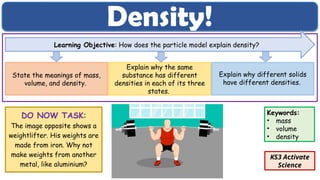
DO NOW TASK:
The image opposite shows a
weightlifter. His weights are
made from iron. Why not
make weights from another
metal, like aluminium?
KS3 Activate
Science
2.
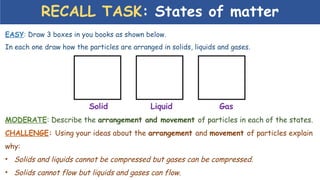
EASY: Draw 3boxes in you books as shown below.
In each one draw how the particles are arranged in solids, liquids and gases.
Solid Liquid Gas
MODERATE: Describe the arrangement and movement of particles in each of the states.
CHALLENGE: Using your ideas about the arrangement and movement of particles explain
why:
• Solids and liquids cannot be compressed but gases can be compressed.
• Solids cannot flow but liquids and gases can flow.
RECALL TASK: States of matter
3.
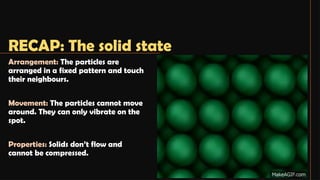
RECAP: The solidstate
Arrangement: The particles are
arranged in a fixed pattern and touch
their neighbours.
Movement: The particles cannot move
around. They can only vibrate on the
spot.
Properties: Solids don’t flow and
cannot be compressed.
4.
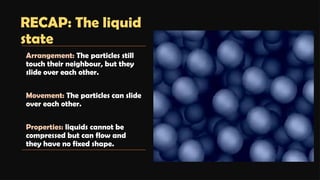
Arrangement: The particlesstill
touch their neighbour, but they
slide over each other.
Movement: The particles can slide
over each other.
Properties: liquids cannot be
compressed but can flow and
they have no fixed shape.
RECAP: The liquid
state
5.
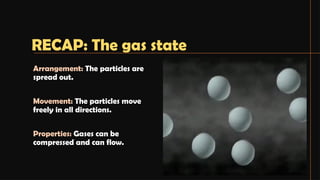
Arrangement: The particlesare
spread out.
Movement: The particles move
freely in all directions.
Properties: Gases can be
compressed and can flow.
RECAP: The gas state
6.
What is density?
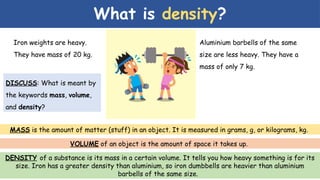
Ironweights are heavy.
They have mass of 20 kg.
Aluminium barbells of the same
size are less heavy. They have a
mass of only 7 kg.
MASS is the amount of matter (stuff) in an object. It is measured in grams, g, or kilograms, kg.
VOLUME of an object is the amount of space it takes up.
DENSITY of a substance is its mass in a certain volume. It tells you how heavy something is for its
size. Iron has a greater density than aluminium, so iron dumbbells are heavier than aluminium
barbells of the same size.
DISCUSS: What is meant by
the keywords mass, volume,
and density?
7.
How does theparticle model explain
density?
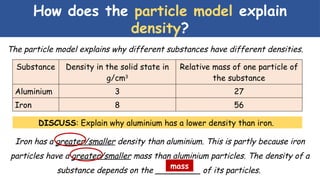
The particle model explains why different substances have different densities.
Substance Density in the solid state in
g/cm3
Relative mass of one particle of
the substance
Aluminium 3 27
Iron 8 56
DISCUSS: Explain why aluminium has a lower density than iron.
Iron has a greater/smaller density than aluminium. This is partly because iron
particles have a greater/smaller mass than aluminium particles. The density of a
substance depends on the _________ of its particles.
mass
8.
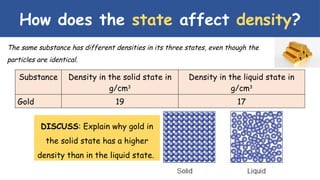
How does thestate affect density?
The same substance has different densities in its three states, even though the
particles are identical.
Substance Density in the solid state in
g/cm3
Density in the liquid state in
g/cm3
Gold 19 17
DISCUSS: Explain why gold in
the solid state has a higher
density than in the liquid state.
9.
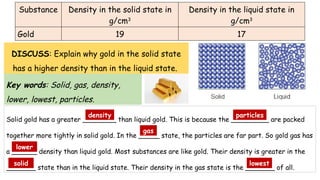
Substance Density inthe solid state in
g/cm3
Density in the liquid state in
g/cm3
Gold 19 17
DISCUSS: Explain why gold in the solid state
has a higher density than in the liquid state.
Solid gold has a greater ________ than liquid gold. This is because the _________ are packed
together more tightly in solid gold. In the _____ state, the particles are far part. So gold gas has
a ______ density than liquid gold. Most substances are like gold. Their density is greater in the
_______ state than in the liquid state. Their density in the gas state is the _______ of all.
Key words: Solid, gas, density,
lower, lowest, particles.
density particles
gas
lower
solid lowest
10.
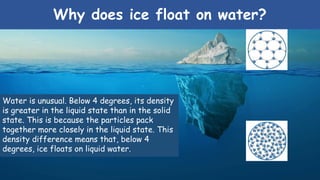
Why does icefloat on water?
Water is unusual. Below 4 degrees, its density
is greater in the liquid state than in the solid
state. This is because the particles pack
together more closely in the liquid state. This
density difference means that, below 4
degrees, ice floats on liquid water.
11.
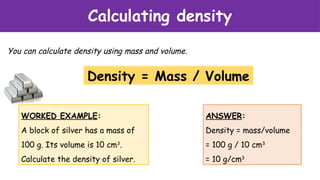
Calculating density
You cancalculate density using mass and volume.
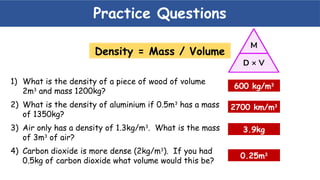
Density = Mass / Volume
WORKED EXAMPLE:
A block of silver has a mass of
100 g. Its volume is 10 cm3
.
Calculate the density of silver.
ANSWER:
Density = mass/volume
= 100 g / 10 cm3
= 10 g/cm3
12.
Practice Questions
1) Whatis the density of a piece of wood of volume
2m3
and mass 1200kg?
2) What is the density of aluminium if 0.5m3
has a mass
of 1350kg?
3) Air only has a density of 1.3kg/m3
. What is the mass
of 3m3
of air?
4) Carbon dioxide is more dense (2kg/m3
). If you had
0.5kg of carbon dioxide what volume would this be?
600 kg/m3
3.9kg
0.25m3
2700 km/m3
Density = Mass / Volume
13.
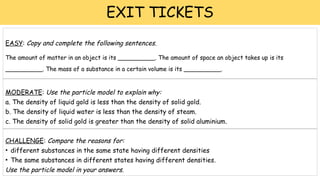
EXIT TICKETS
EASY: Copyand complete the following sentences.
The amount of matter in an object is its __________. The amount of space an object takes up is its
__________. The mass of a substance in a certain volume is its __________.
MODERATE: Use the particle model to explain why:
a. The density of liquid gold is less than the density of solid gold.
b. The density of liquid water is less than the density of steam.
c. The density of solid gold is greater than the density of solid aluminium.
CHALLENGE: Compare the reasons for:
• different substances in the same state having different densities
• The same substances in different states having different densities.
Use the particle model in your answers.