POLYGONS
The word polygon is a
Greek word. POLY
means many and GON
means angles
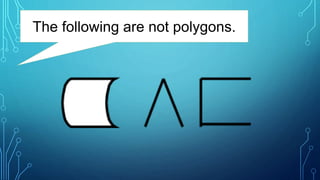
The following are not polygons.
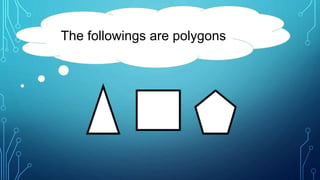
The followings are polygons
At the end of the lesson you are expected to:
 Define Polygons;
 Identify the different kinds of Polygon
according to the number of sides and
number of angles;
 Actively participate in the class discussion
with 95% mastery level.
What have you notice in
the given groups of
polygons?
They are close figure
What have you
notice on their side?
Their side is made up of
line segments joined at
their endpoints.
have you notice, how many
minimum number of line
segment does a polygons have?
There are three or
more line segments.
Define polygons?
Polygons are close figure
made up of three or more
line segments joined at their
endpoint.
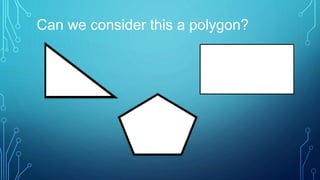
Can we consider this a polygon?
Always remember that a
polygons that having equal angle
is called regular polygon, and to
those who have not is called
Irregular polygons.
What is a polygon?
A polygon is a close plane figure made up of three
or more line segment joined at their endpoints.
What were the different types of polygon that
we already discuss?
Triangle, quadrilateral, pentagon, hexagon,
heptagon, octagon, nonagon and decagon.
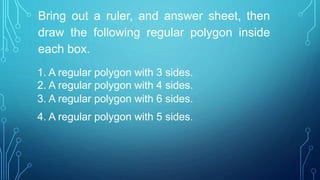
Bring out a ruler, and answer sheet, then
draw the following regular polygon inside
each box.
1. A regular polygon with 3 sides.
2. A regular polygon with 4 sides.
3. A regular polygon with 6 sides.
4. A regular polygon with 5 sides.
polygon No. Of sides No. Of angles prefix
1.
2.
3.
4
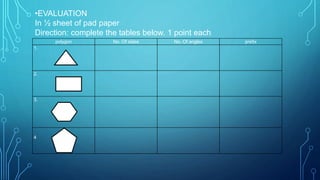
•EVALUATION
In ½ sheet of pad paper
Direction: complete the tables below. 1 point each.
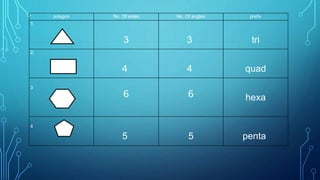
polygon No. Of sides No. Of angles prefix
1.
3 3 tri
2.
4 4 quad
3
6 6 hexa
4
5 5 penta
ASSIGNMENT
(in a short bond paper)
Make an art or scenario that
represent the different polygons seen
in real-life.
Thank you for today and have a
nice day

demonstration math.pptx

  • 1.
    POLYGONS The word polygonis a Greek word. POLY means many and GON means angles
  • 2.
    The following arenot polygons.
  • 3.
  • 4.
    At the endof the lesson you are expected to:  Define Polygons;  Identify the different kinds of Polygon according to the number of sides and number of angles;  Actively participate in the class discussion with 95% mastery level.
  • 5.
    What have younotice in the given groups of polygons? They are close figure What have you notice on their side? Their side is made up of line segments joined at their endpoints.
  • 6.
    have you notice,how many minimum number of line segment does a polygons have? There are three or more line segments. Define polygons?
  • 7.
    Polygons are closefigure made up of three or more line segments joined at their endpoint.
  • 8.
    Can we considerthis a polygon?
  • 9.
    Always remember thata polygons that having equal angle is called regular polygon, and to those who have not is called Irregular polygons.
  • 10.
    What is apolygon? A polygon is a close plane figure made up of three or more line segment joined at their endpoints. What were the different types of polygon that we already discuss? Triangle, quadrilateral, pentagon, hexagon, heptagon, octagon, nonagon and decagon.
  • 11.
    Bring out aruler, and answer sheet, then draw the following regular polygon inside each box. 1. A regular polygon with 3 sides. 2. A regular polygon with 4 sides. 3. A regular polygon with 6 sides. 4. A regular polygon with 5 sides.
  • 12.
    polygon No. Ofsides No. Of angles prefix 1. 2. 3. 4 •EVALUATION In ½ sheet of pad paper Direction: complete the tables below. 1 point each.
  • 13.
    polygon No. Ofsides No. Of angles prefix 1. 3 3 tri 2. 4 4 quad 3 6 6 hexa 4 5 5 penta
  • 14.
    ASSIGNMENT (in a shortbond paper) Make an art or scenario that represent the different polygons seen in real-life.
  • 15.
    Thank you fortoday and have a nice day