Demand for Penetration
Testing Services
Web Application Penetration Test
Web applications have become an integral part of modern businesses, offering a
wide range of functionalities and conveniences. However, with the increasing
complexity and ubiquity of these applications, they have become prime targets
for cyber attackers. A Web Application Penetration Test is a crucial step in
identifying and rectifying potential vulnerabilities before they can be exploited.
Read on to find out how a web application pen test is executed, and how it can
benefit your business.
What is a Web Application Penetration Test?
A web application penetration test is part of an ethical hacking engagement
designed to highlight issues resulting from insecure coding practices and
configuration of web applications. The types of issues discovered are
categorised against the OWASP top 10 vulnerabilities list, these are:
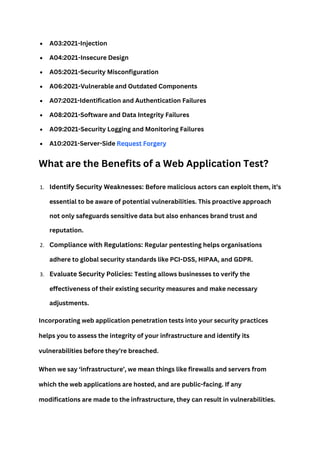
 A01:2021-Broken Access Control
 A02:2021-Cryptographic Failures
 A03:2021-Injection
 A04:2021-Insecure Design
 A05:2021-Security Misconfiguration
 A06:2021-Vulnerable and Outdated Components
 A07:2021-Identification and Authentication Failures
 A08:2021-Software and Data Integrity Failures
 A09:2021-Security Logging and Monitoring Failures
 A10:2021-Server-Side Request Forgery
What are the Benefits of a Web Application Test?
1. Identify Security Weaknesses: Before malicious actors can exploit them, it’s
essential to be aware of potential vulnerabilities. This proactive approach
not only safeguards sensitive data but also enhances brand trust and
reputation.
2. Compliance with Regulations: Regular pentesting helps organisations
adhere to global security standards like PCI-DSS, HIPAA, and GDPR.
3. Evaluate Security Policies: Testing allows businesses to verify the
effectiveness of their existing security measures and make necessary
adjustments.
Incorporating web application penetration tests into your security practices
helps you to assess the integrity of your infrastructure and identify its
vulnerabilities before they’re breached.
When we say ‘infrastructure’, we mean things like firewalls and servers from
which the web applications are hosted, and are public-facing. If any
modifications are made to the infrastructure, they can result in vulnerabilities.
Web application pen testing can identify any existing or potential weaknesses,
so they can be reinforced before a hacker has chance to abuse them.
This kind of security testing can also help you meet compliance requirements,
and validate existing policies around web security. Depending on your industry,
penetration testing is required to keep sensitive information safe from
exploitation. Web application pen testing also ensures that any security policies
are being met and, if not, are rectified.
Understanding Web Application Penetration
Testing
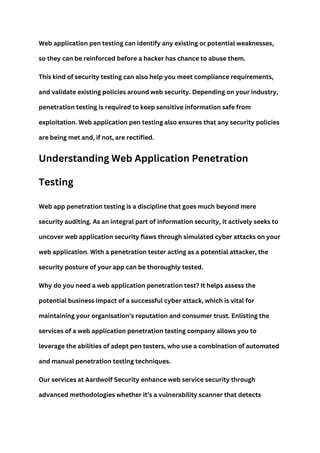
Web app penetration testing is a discipline that goes much beyond mere
security auditing. As an integral part of information security, it actively seeks to
uncover web application security flaws through simulated cyber attacks on your
web application. With a penetration tester acting as a potential attacker, the
security posture of your app can be thoroughly tested.
Why do you need a web application penetration test? It helps assess the
potential business impact of a successful cyber attack, which is vital for
maintaining your organisation’s reputation and consumer trust. Enlisting the
services of a web application penetration testing company allows you to
leverage the abilities of adept pen testers, who use a combination of automated
and manual penetration testing techniques.
Our services at Aardwolf Security enhance web service security through
advanced methodologies whether it’s a vulnerability scanner that detects
security flaws or a manual penetration testing technique used in API
penetration testing.
The Significance of Web Application Penetration
Testing
As a consultancy who has worked in this landscape for years, we’ve seen
firsthand how conducting a pen test can greatly improve web application
security. It’s built not only on the skills of the pen tester but also on the apt use
of web application penetration testing tools. Manual and automated
penetration testing work together, like DNA strands coiling around each other,
to offer in-depth insight into security vulnerability.
Web app penetration testing also offers valuable insight into the effects of
potential security breaches. Understanding the potential business impact of
these breaches, evaluating any likely data compromise, and formulating a
response plan are all crucial tasks. This helps companies anticipate and prepare
for potential security incidents and minimize their damage.
You might still have lingering questions, and I understand your concerns.
Therefore, I urge you to reach out to us at Aardwolf Security for further
elucidation on web application penetration testing. We will be more than happy
to advise you on the most effective path forward to ensure your web application
is secured and the integrity of your data is preserved.
Who Could Benefit from a Web Application
Security Test?
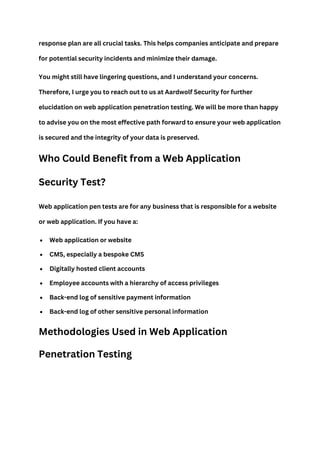
Web application pen tests are for any business that is responsible for a website
or web application. If you have a:
 Web application or website
 CMS, especially a bespoke CMS
 Digitally hosted client accounts
 Employee accounts with a hierarchy of access privileges
 Back-end log of sensitive payment information
 Back-end log of other sensitive personal information
Methodologies Used in Web Application
Penetration Testing
Here at Aardwolf Security, our team of penetration testing experts have
established an effective 6-step system for performing a web application
security test:
1. Reconnaissance
To get an idea of the client’s security level, a pen testing expert will first conduct
an analysis, assessing the potential requirements, using Open Source
Intelligence (OSINT).
2. Scanning
Using automated scanners, the consultant will delve deeper into the
infrastructure of the client’s servers, picking up any surface-level weaknesses.
3. Manual assessment
This step is where most of the consultant’s time is utilised, and involves specific
manual penetration testing on the following areas:
 Authentication
 Authorisation
 Session management
 Input validation and sanitisation
 Server configuration
 Encryption
 Information leakage
 Application workflow
 Application logic
4. Exploitation
Next, the vulnerabilities unveiled in the scanning and manual probing stages are
raised to the client. Depending on the client’s business operations and the
severity of the vulnerabilities, the client may give the consultant the go-ahead
to subject certain issues to exploitation attempts.
5. Reporting
After the exploitation attempts have been made, the pen testing consultant will
produce a comprehensive report to highlight the impact likelihood of all system
defects, and recommend solutions.
6. Retesting
The sixth and final step of the process, offered exclusively at Aardwolf Security,
is a free retesting, once the client has actioned their software system solutions,
to make sure that their infrastructure weaknesses have been resolved correctly
and completely.
Essential Tools in Web Application Penetration
Testing
High quality web application penetration testing relies heavily on efficient
usage of specialised tools. As a pen tester, I’ve found tools such as Invicti, Burp
Suite, and nmap to be indispensable. The right penetration tool can transform
the way your web application withstands threats.
A variety of tools are employed in the pentesting process, each serving a
specific purpose:
1. Acunetix: A popular web vulnerability scanner.
2. Burp Suite: An integrated platform for performing security testing of web
applications.
3. Browser’s Developer Tools: Useful for inspecting elements, viewing source
code, and debugging.
4. NMap & Zenmap: Tools for network discovery and security auditing.
5. ReconDog & Nikto: These tools assist in the reconnaissance phase, gathering
information about target web applications.
Acunetix: A Popular Web Vulnerability Scanner
Acunetix is a widely used web vulnerability scanner designed to discover a
broad spectrum of vulnerabilities, ranging from SQL injections to weak
passwords. It’s favoured for its comprehensive scanning abilities, speed, and
detailed reporting. Acunetix has the power to crawl JavaScript-heavy sites, thus
allowing a depth of analysis that many other tools may miss. Integration
capabilities also make it a versatile choice, as you can easily plug it into existing
development and security workflows.
Burp Suite: An Integrated Platform for Performing
Security Testing
Burp Suite is a comprehensive toolset designed for web application security
testing. It combines a variety of features, from crawling and scanning to more
advanced functionalities like session manipulation and intrusion. It’s
particularly useful for manual testers, providing a rich interface that allows for
detailed inspection and modification of HTTP requests and responses. Burp
Suite offers both a free community edition and a more feature-rich professional
version, catering to different needs and budgets.
Browser’s Developer Tools: Useful for Inspecting
Elements, Viewing Source Code, and Debugging
While not strictly a security tool, browser developer tools can be invaluable in
the penetration testing process. They offer real-time insights into the DOM
(Document Object Model), allow for the inspection of network requests, and can
even simulate mobile devices. These tools are particularly helpful for debugging
client-side code, tracing JavaScript execution, and understanding how external
resources are loaded and interacted with on a web page.
NMap & Zenmap: Tools for Network Discovery and
Security Auditing
NMap (Network Mapper) is a highly versatile tool used for network discovery
and security auditing. Its GUI-based counterpart, Zenmap, offers the same
functionality in a more user-friendly interface. These tools can identify devices
running on a network and discover open ports along with various attributes of
the network. NMap is invaluable for understanding the ‘lay of the land’ before
launching a more targeted attack or scan.
ReconDog & Nikto: Tools for Reconnaissance and
Information Gathering
ReconDog is a straightforward Python script that provides an array of useful
reconnaissance features, allowing you to gather DNS information, conduct
subdomain mapping, and more. Nikto is another reconnaissance tool that is
focused more on web server configurations, aiming to uncover issues like
outdated software and potential vulnerabilities. Both tools are often used in the
early phases of a penetration test to paint a detailed picture of the target
environment.
How to Implement Web Application Penetration
Tests Effectively
when it comes to securing your web application, a one-off measure simply won’t
suffice. Security is a continuous, multi-layered effort that requires both in-
depth expertise and an understanding of your specific business needs. That’s
precisely where we, at Aardwolf Security, come into play.
We start our engagement with comprehensive planning. Understanding your
specific objectives—be it compliance mandates or a general security review—
helps us tailor our approach. We’ll define the scope in granular detail, deciding
which applications and functionalities to test, and set a realistic yet effective
timeline. At this stage, we’ll also allocate the appropriate resources from our
expert team to ensure a blend of technical and strategic skills.
Following this initial groundwork, we delve into information gathering and
reconnaissance. Our specialists will use an arsenal of tools and manual
techniques to identify the technology stack of your application, map out related
subdomains, and unearth any publicly accessible information. This
comprehensive survey acts as the springboard for our threat modelling. We
identify and prioritise possible attack vectors specific to your application, such
as SQL injection, CSRF, or XSS vulnerabilities.
Execution is the crux of our engagement. Our experts employ an array of
sophisticated tools, both automated and manual, to carry out the penetration
tests. Automated scans provide a broad overview, but we believe that manual
inspection is where we truly add value. Our team delves into the complexities of
your application, scrutinising session management, business logic, and other
intricate functionalities. We also simulate real-world attack scenarios to see how
your system stands up under genuine threat conditions.
But our job doesn’t end at identifying vulnerabilities; we take it several steps
further. Our meticulous analysis leads to a comprehensive report that details
our findings and classifies vulnerabilities based on their severity. Importantly,
we provide you with a roadmap of actionable remediation steps. This isn’t a
generic report; it’s a tactical guide that enables your internal teams to prioritise
and implement fixes effectively.
Post-remediation, we’ll revisit your application to ensure all vulnerabilities have
been adequately mitigated. At the same time, we’ll update our documentation
to incorporate any changes. This ensures that you’re not just secure today, but
are also prepared for tomorrow.
Finally, we advocate for regular security assessments. The cybersecurity
landscape is ever-changing, with new vulnerabilities emerging frequently. Our
periodic reassessments will help you stay ahead of potential threats.
Additionally, our ongoing monitoring services can provide real-time insights
into your security posture, enabling you to take immediate corrective actions if
required.
Case Study: Successful Web Application
Penetration Testing
The following case study that highlights the value of thorough web application
penetration testing. Our client was a well-known e-commerce site, looking for a
comprehensive security audit of their website. The task was to analyse their web
application for potential vulnerabilities and suggest countermeasures.
Our web application penetration testing methodology began with an extensive
understanding of their application. We analysed their programming language,
ran thorough vulnerability scans using Burp Suite, and spent a large amount of
time using manual penetration testing techniques.
Contact us
Website: www.aardwolfsecurity.com
Contact no: +44 01908 733540
Address: Midsummer Court 314 Midsummer
Boulevard Milton Keynes Buckinghamshire MK9
2UB
Demand for Penetration Testing Services.docx

Demand for Penetration Testing Services.docx

  • 1.
    Demand for Penetration TestingServices Web Application Penetration Test Web applications have become an integral part of modern businesses, offering a wide range of functionalities and conveniences. However, with the increasing complexity and ubiquity of these applications, they have become prime targets for cyber attackers. A Web Application Penetration Test is a crucial step in identifying and rectifying potential vulnerabilities before they can be exploited. Read on to find out how a web application pen test is executed, and how it can benefit your business. What is a Web Application Penetration Test? A web application penetration test is part of an ethical hacking engagement designed to highlight issues resulting from insecure coding practices and configuration of web applications. The types of issues discovered are categorised against the OWASP top 10 vulnerabilities list, these are:  A01:2021-Broken Access Control  A02:2021-Cryptographic Failures
  • 2.
     A03:2021-Injection  A04:2021-InsecureDesign  A05:2021-Security Misconfiguration  A06:2021-Vulnerable and Outdated Components  A07:2021-Identification and Authentication Failures  A08:2021-Software and Data Integrity Failures  A09:2021-Security Logging and Monitoring Failures  A10:2021-Server-Side Request Forgery What are the Benefits of a Web Application Test? 1. Identify Security Weaknesses: Before malicious actors can exploit them, it’s essential to be aware of potential vulnerabilities. This proactive approach not only safeguards sensitive data but also enhances brand trust and reputation. 2. Compliance with Regulations: Regular pentesting helps organisations adhere to global security standards like PCI-DSS, HIPAA, and GDPR. 3. Evaluate Security Policies: Testing allows businesses to verify the effectiveness of their existing security measures and make necessary adjustments. Incorporating web application penetration tests into your security practices helps you to assess the integrity of your infrastructure and identify its vulnerabilities before they’re breached. When we say ‘infrastructure’, we mean things like firewalls and servers from which the web applications are hosted, and are public-facing. If any modifications are made to the infrastructure, they can result in vulnerabilities.
  • 3.
    Web application pentesting can identify any existing or potential weaknesses, so they can be reinforced before a hacker has chance to abuse them. This kind of security testing can also help you meet compliance requirements, and validate existing policies around web security. Depending on your industry, penetration testing is required to keep sensitive information safe from exploitation. Web application pen testing also ensures that any security policies are being met and, if not, are rectified. Understanding Web Application Penetration Testing Web app penetration testing is a discipline that goes much beyond mere security auditing. As an integral part of information security, it actively seeks to uncover web application security flaws through simulated cyber attacks on your web application. With a penetration tester acting as a potential attacker, the security posture of your app can be thoroughly tested. Why do you need a web application penetration test? It helps assess the potential business impact of a successful cyber attack, which is vital for maintaining your organisation’s reputation and consumer trust. Enlisting the services of a web application penetration testing company allows you to leverage the abilities of adept pen testers, who use a combination of automated and manual penetration testing techniques. Our services at Aardwolf Security enhance web service security through advanced methodologies whether it’s a vulnerability scanner that detects
  • 4.
    security flaws ora manual penetration testing technique used in API penetration testing. The Significance of Web Application Penetration Testing As a consultancy who has worked in this landscape for years, we’ve seen firsthand how conducting a pen test can greatly improve web application security. It’s built not only on the skills of the pen tester but also on the apt use of web application penetration testing tools. Manual and automated penetration testing work together, like DNA strands coiling around each other, to offer in-depth insight into security vulnerability. Web app penetration testing also offers valuable insight into the effects of potential security breaches. Understanding the potential business impact of these breaches, evaluating any likely data compromise, and formulating a
  • 5.
    response plan areall crucial tasks. This helps companies anticipate and prepare for potential security incidents and minimize their damage. You might still have lingering questions, and I understand your concerns. Therefore, I urge you to reach out to us at Aardwolf Security for further elucidation on web application penetration testing. We will be more than happy to advise you on the most effective path forward to ensure your web application is secured and the integrity of your data is preserved. Who Could Benefit from a Web Application Security Test? Web application pen tests are for any business that is responsible for a website or web application. If you have a:  Web application or website  CMS, especially a bespoke CMS  Digitally hosted client accounts  Employee accounts with a hierarchy of access privileges  Back-end log of sensitive payment information  Back-end log of other sensitive personal information Methodologies Used in Web Application Penetration Testing
  • 6.
    Here at AardwolfSecurity, our team of penetration testing experts have established an effective 6-step system for performing a web application security test: 1. Reconnaissance To get an idea of the client’s security level, a pen testing expert will first conduct an analysis, assessing the potential requirements, using Open Source Intelligence (OSINT). 2. Scanning
  • 7.
    Using automated scanners,the consultant will delve deeper into the infrastructure of the client’s servers, picking up any surface-level weaknesses. 3. Manual assessment This step is where most of the consultant’s time is utilised, and involves specific manual penetration testing on the following areas:  Authentication  Authorisation  Session management  Input validation and sanitisation  Server configuration  Encryption  Information leakage  Application workflow  Application logic 4. Exploitation Next, the vulnerabilities unveiled in the scanning and manual probing stages are raised to the client. Depending on the client’s business operations and the
  • 8.
    severity of thevulnerabilities, the client may give the consultant the go-ahead to subject certain issues to exploitation attempts. 5. Reporting After the exploitation attempts have been made, the pen testing consultant will produce a comprehensive report to highlight the impact likelihood of all system defects, and recommend solutions. 6. Retesting The sixth and final step of the process, offered exclusively at Aardwolf Security, is a free retesting, once the client has actioned their software system solutions, to make sure that their infrastructure weaknesses have been resolved correctly and completely. Essential Tools in Web Application Penetration Testing
  • 9.
    High quality webapplication penetration testing relies heavily on efficient usage of specialised tools. As a pen tester, I’ve found tools such as Invicti, Burp Suite, and nmap to be indispensable. The right penetration tool can transform the way your web application withstands threats. A variety of tools are employed in the pentesting process, each serving a specific purpose: 1. Acunetix: A popular web vulnerability scanner. 2. Burp Suite: An integrated platform for performing security testing of web applications. 3. Browser’s Developer Tools: Useful for inspecting elements, viewing source code, and debugging. 4. NMap & Zenmap: Tools for network discovery and security auditing. 5. ReconDog & Nikto: These tools assist in the reconnaissance phase, gathering information about target web applications. Acunetix: A Popular Web Vulnerability Scanner Acunetix is a widely used web vulnerability scanner designed to discover a broad spectrum of vulnerabilities, ranging from SQL injections to weak passwords. It’s favoured for its comprehensive scanning abilities, speed, and detailed reporting. Acunetix has the power to crawl JavaScript-heavy sites, thus allowing a depth of analysis that many other tools may miss. Integration capabilities also make it a versatile choice, as you can easily plug it into existing development and security workflows.
  • 10.
    Burp Suite: AnIntegrated Platform for Performing Security Testing Burp Suite is a comprehensive toolset designed for web application security testing. It combines a variety of features, from crawling and scanning to more advanced functionalities like session manipulation and intrusion. It’s particularly useful for manual testers, providing a rich interface that allows for detailed inspection and modification of HTTP requests and responses. Burp Suite offers both a free community edition and a more feature-rich professional version, catering to different needs and budgets. Browser’s Developer Tools: Useful for Inspecting Elements, Viewing Source Code, and Debugging While not strictly a security tool, browser developer tools can be invaluable in the penetration testing process. They offer real-time insights into the DOM (Document Object Model), allow for the inspection of network requests, and can even simulate mobile devices. These tools are particularly helpful for debugging client-side code, tracing JavaScript execution, and understanding how external resources are loaded and interacted with on a web page. NMap & Zenmap: Tools for Network Discovery and Security Auditing NMap (Network Mapper) is a highly versatile tool used for network discovery and security auditing. Its GUI-based counterpart, Zenmap, offers the same
  • 11.
    functionality in amore user-friendly interface. These tools can identify devices running on a network and discover open ports along with various attributes of the network. NMap is invaluable for understanding the ‘lay of the land’ before launching a more targeted attack or scan. ReconDog & Nikto: Tools for Reconnaissance and Information Gathering ReconDog is a straightforward Python script that provides an array of useful reconnaissance features, allowing you to gather DNS information, conduct subdomain mapping, and more. Nikto is another reconnaissance tool that is focused more on web server configurations, aiming to uncover issues like outdated software and potential vulnerabilities. Both tools are often used in the early phases of a penetration test to paint a detailed picture of the target environment. How to Implement Web Application Penetration Tests Effectively
  • 12.
    when it comesto securing your web application, a one-off measure simply won’t suffice. Security is a continuous, multi-layered effort that requires both in- depth expertise and an understanding of your specific business needs. That’s precisely where we, at Aardwolf Security, come into play. We start our engagement with comprehensive planning. Understanding your specific objectives—be it compliance mandates or a general security review— helps us tailor our approach. We’ll define the scope in granular detail, deciding which applications and functionalities to test, and set a realistic yet effective timeline. At this stage, we’ll also allocate the appropriate resources from our expert team to ensure a blend of technical and strategic skills. Following this initial groundwork, we delve into information gathering and reconnaissance. Our specialists will use an arsenal of tools and manual techniques to identify the technology stack of your application, map out related subdomains, and unearth any publicly accessible information. This comprehensive survey acts as the springboard for our threat modelling. We identify and prioritise possible attack vectors specific to your application, such as SQL injection, CSRF, or XSS vulnerabilities. Execution is the crux of our engagement. Our experts employ an array of sophisticated tools, both automated and manual, to carry out the penetration tests. Automated scans provide a broad overview, but we believe that manual inspection is where we truly add value. Our team delves into the complexities of your application, scrutinising session management, business logic, and other
  • 13.
    intricate functionalities. Wealso simulate real-world attack scenarios to see how your system stands up under genuine threat conditions. But our job doesn’t end at identifying vulnerabilities; we take it several steps further. Our meticulous analysis leads to a comprehensive report that details our findings and classifies vulnerabilities based on their severity. Importantly, we provide you with a roadmap of actionable remediation steps. This isn’t a generic report; it’s a tactical guide that enables your internal teams to prioritise and implement fixes effectively. Post-remediation, we’ll revisit your application to ensure all vulnerabilities have been adequately mitigated. At the same time, we’ll update our documentation to incorporate any changes. This ensures that you’re not just secure today, but are also prepared for tomorrow. Finally, we advocate for regular security assessments. The cybersecurity landscape is ever-changing, with new vulnerabilities emerging frequently. Our periodic reassessments will help you stay ahead of potential threats. Additionally, our ongoing monitoring services can provide real-time insights into your security posture, enabling you to take immediate corrective actions if required. Case Study: Successful Web Application Penetration Testing The following case study that highlights the value of thorough web application penetration testing. Our client was a well-known e-commerce site, looking for a
  • 14.
    comprehensive security auditof their website. The task was to analyse their web application for potential vulnerabilities and suggest countermeasures. Our web application penetration testing methodology began with an extensive understanding of their application. We analysed their programming language, ran thorough vulnerability scans using Burp Suite, and spent a large amount of time using manual penetration testing techniques. Contact us Website: www.aardwolfsecurity.com Contact no: +44 01908 733540 Address: Midsummer Court 314 Midsummer Boulevard Milton Keynes Buckinghamshire MK9 2UB