High-Performance Computing
Dell Intel EE Lustre Storage
Melbourne Big Data User Group
January 2016
Andrew Underwood
Lead HPC Technologist
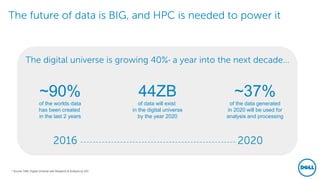
The future of data is BIG, and HPC is needed to power it
The digital universe is growing 40%* a year into the next decade…
2016 --------------------------------------------------- 2020
~90%
of the worlds data
has been created
in the last 2 years
* Source: EMC Digital Universe with Research & Analysis by IDC
44ZB
of data will exist
in the digital universe
by the year 2020
~37%
of the data generated
in 2020 will be used for
analysis and processing
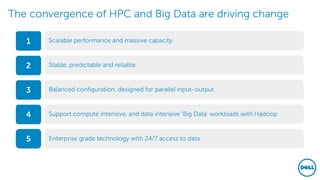
The convergence of HPC and Big Data are driving change
Scalable performance and massive capacity
Stable, predictable and reliable
Balanced configuration, designed for parallel input-output
Support compute intensive, and data intensive ‘Big Data’ workloads with Hadoop
1
2
3
4
Enterprise grade technology with 24/7 access to data5
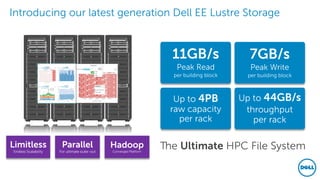
Introducing our latest generation Dell EE Lustre Storage
Limitless
Endless Scalability
11GB/s
Peak Read
per building block
Up to 4PB
raw capacity
per rack
Up to 44GB/s
throughput
per rack
The Ultimate HPC File SystemParallel
For ultimate scale-out
Hadoop
Converged Platform
7GB/s
Peak Write
per building block
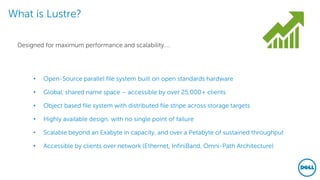
What is Lustre?
Designed for maximum performance and scalability….
• Open-Source parallel file system built on open standards hardware
• Global, shared name space – accessible by over 25,000+ clients
• Object based file system with distributed file stripe across storage targets
• Highly available design, with no single point of failure
• Scalable beyond an Exabyte in capacity, and over a Petabyte of sustained throughput
• Accessible by clients over network (Ethernet, InfiniBand, Omni-Path Architecture)
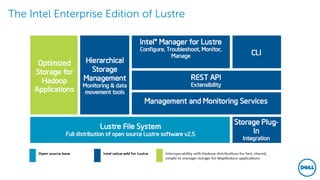
The Intel Enterprise Edition of Lustre
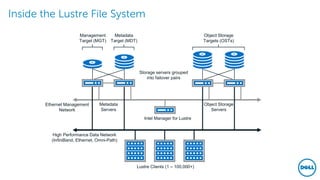
Inside the Lustre File System
Ethernet Management
Network
High Performance Data Network
(InfiniBand, Ethernet, Omni-Path)
Metadata
Servers
Object Storage
Servers
Intel Manager for Lustre
Lustre Clients (1 – 100,000+)
Object Storage
Targets (OSTs)
Metadata
Target (MDT)
Management
Target (MGT)
Storage servers grouped
into failover pairs
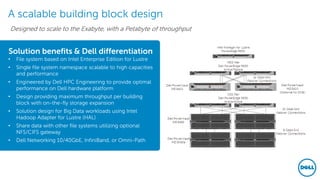
A scalable building block design
Designed to scale to the Exabyte, with a Petabyte of throughput
Solution benefits & Dell differentiation
• File system based on Intel Enterprise Edition for Lustre
• Single file system namespace scalable to high capacities
and performance
• Engineered by Dell HPC Engineering to provide optimal
performance on Dell hardware platform
• Design providing maximum throughput per building
block with on-the-fly storage expansion
• Solution design for Big Data workloads using Intel
Hadoop Adapter for Lustre (HAL)
• Share data with other file systems utilizing optional
NFS/CIFS gateway
• Dell Networking 10/40GbE, InfiniBand, or Omni-Path
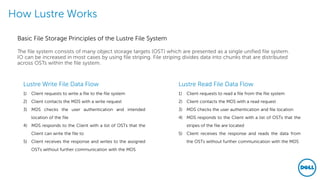
How Lustre Works
Basic File Storage Principles of the Lustre File System
The file system consists of many object storage targets (OST) which are presented as a single unified file system.
IO can be increased in most cases by using file striping. File striping divides data into chunks that are distributed
across OSTs within the file system.
Lustre Write File Data Flow
1) Client requests to write a file to the file system
2) Client contacts the MDS with a write request
3) MDS checks the user authentication and intended
location of the file
4) MDS responds to the Client with a list of OSTs that the
Client can write the file to
5) Client receives the response and writes to the assigned
OSTs without further communication with the MDS
Lustre Read File Data Flow
1) Client requests to read a file from the file system
2) Client contacts the MDS with a read request
3) MDS checks the user authentication and file location
4) MDS responds to the Client with a list of OSTs that the
stripes of the file are located
5) Client receives the response and reads the data from
the OSTs without further communication with the MDS
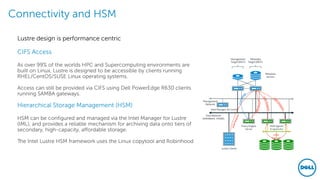
Connectivity and HSM
Lustre design is performance centric
CIFS Access
As over 99% of the worlds HPC and Supercomputing environments are
built on Linux, Lustre is designed to be accessible by clients running
RHEL/CentOS/SUSE Linux operating systems.
Access can still be provided via CIFS using Dell PowerEdge R630 clients
running SAMBA gateways.
Hierarchical Storage Management (HSM)
HSM can be configured and managed via the Intel Manager for Lustre
(IML), and provides a reliable mechanism for archiving data onto tiers of
secondary, high-capacity, affordable storage.
The Intel Lustre HSM framework uses the Linux copytool and Robinhood
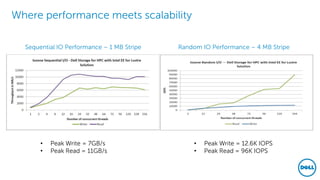
Where performance meets scalability
• Peak Write = 7GB/s
• Peak Read = 11GB/s
• Peak Write = 12.6K IOPS
• Peak Read = 96K IOPS
Sequential IO Performance – 1 MB Stripe Random IO Performance – 4 MB Stripe
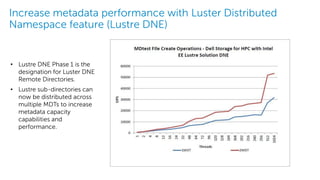
Increase metadata performance with Luster Distributed
Namespace feature (Lustre DNE)
• Lustre DNE Phase 1 is the
designation for Luster DNE
Remote Directories.
• Lustre sub-directories can
now be distributed across
multiple MDTs to increase
metadata capacity
capabilities and
performance.
Configure, optimize and manage using Intel Manager for Lustre
IML simplifies your management workflow:
• UI driven configuration, monitoring, and
overall management lowers complexity
and cost
• Advanced charting options illustrate
storage performance in near-real time
• Automated configuration of storage
servers pairs for increased high-availability
• Configure and manage power distribution
units for automated fail-over
• Smart, intuitive alerts and logs help storage
administrators monitor storage
performance
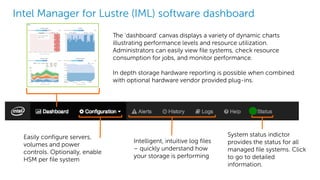
Intel Manager for Lustre (IML) software dashboard
The ‘dashboard’ canvas displays a variety of dynamic charts
illustrating performance levels and resource utilization.
Administrators can easily view file systems, check resource
consumption for jobs, and monitor performance.
In depth storage hardware reporting is possible when combined
with optional hardware vendor provided plug-ins.
System status indictor
provides the status for all
managed file systems. Click
to go to detailed
information.
Easily configure servers,
volumes and power
controls. Optionally, enable
HSM per file system
Intelligent, intuitive log files
– quickly understand how
your storage is performing
Where Big Data meets high-performance computing
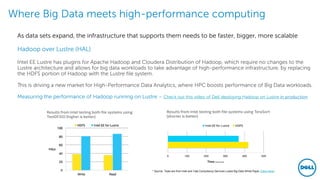
As data sets expand, the infrastructure that supports them needs to be faster, bigger, more scalable
Hadoop over Lustre (HAL)
Intel EE Lustre has plugins for Apache Hadoop and Cloudera Distribution of Hadoop, which require no changes to the
Lustre architecture and allows for big data workloads to take advantage of high-performance infrastructure, by replacing
the HDFS portion of Hadoop with the Lustre file system.
This is driving a new market for High-Performance Data Analytics, where HPC boosts performance of Big Data workloads.
Measuring the performance of Hadoop running on Lustre – Check out this video of Dell deploying Hadoop on Lustre in production
* Source: Tests are from Intel and Tata Consultancy Services Lustre Big Data White Paper (Click Here)
Start by making your data future ready!
Contact your local Dell Account Executive for a free HPC workshop, and we can help identify
bottlenecks, opportunities for optimization, and provide a plan for how Lustre can boost your
performance, and build a future ready architecture for the convergence of HPC and Big Data
19
Dell - Internal Use - Confidential

Dell Lustre Storage Architecture Presentation - MBUG 2016

  • 1.
    High-Performance Computing Dell IntelEE Lustre Storage Melbourne Big Data User Group January 2016 Andrew Underwood Lead HPC Technologist
  • 2.
    The future ofdata is BIG, and HPC is needed to power it The digital universe is growing 40%* a year into the next decade… 2016 --------------------------------------------------- 2020 ~90% of the worlds data has been created in the last 2 years * Source: EMC Digital Universe with Research & Analysis by IDC 44ZB of data will exist in the digital universe by the year 2020 ~37% of the data generated in 2020 will be used for analysis and processing
  • 3.
    The convergence ofHPC and Big Data are driving change Scalable performance and massive capacity Stable, predictable and reliable Balanced configuration, designed for parallel input-output Support compute intensive, and data intensive ‘Big Data’ workloads with Hadoop 1 2 3 4 Enterprise grade technology with 24/7 access to data5
  • 4.
    Introducing our latestgeneration Dell EE Lustre Storage Limitless Endless Scalability 11GB/s Peak Read per building block Up to 4PB raw capacity per rack Up to 44GB/s throughput per rack The Ultimate HPC File SystemParallel For ultimate scale-out Hadoop Converged Platform 7GB/s Peak Write per building block
  • 5.
    What is Lustre? Designedfor maximum performance and scalability…. • Open-Source parallel file system built on open standards hardware • Global, shared name space – accessible by over 25,000+ clients • Object based file system with distributed file stripe across storage targets • Highly available design, with no single point of failure • Scalable beyond an Exabyte in capacity, and over a Petabyte of sustained throughput • Accessible by clients over network (Ethernet, InfiniBand, Omni-Path Architecture)
  • 6.
    The Intel EnterpriseEdition of Lustre
  • 7.
    Inside the LustreFile System Ethernet Management Network High Performance Data Network (InfiniBand, Ethernet, Omni-Path) Metadata Servers Object Storage Servers Intel Manager for Lustre Lustre Clients (1 – 100,000+) Object Storage Targets (OSTs) Metadata Target (MDT) Management Target (MGT) Storage servers grouped into failover pairs
  • 8.
    A scalable buildingblock design Designed to scale to the Exabyte, with a Petabyte of throughput Solution benefits & Dell differentiation • File system based on Intel Enterprise Edition for Lustre • Single file system namespace scalable to high capacities and performance • Engineered by Dell HPC Engineering to provide optimal performance on Dell hardware platform • Design providing maximum throughput per building block with on-the-fly storage expansion • Solution design for Big Data workloads using Intel Hadoop Adapter for Lustre (HAL) • Share data with other file systems utilizing optional NFS/CIFS gateway • Dell Networking 10/40GbE, InfiniBand, or Omni-Path
  • 9.
    How Lustre Works BasicFile Storage Principles of the Lustre File System The file system consists of many object storage targets (OST) which are presented as a single unified file system. IO can be increased in most cases by using file striping. File striping divides data into chunks that are distributed across OSTs within the file system. Lustre Write File Data Flow 1) Client requests to write a file to the file system 2) Client contacts the MDS with a write request 3) MDS checks the user authentication and intended location of the file 4) MDS responds to the Client with a list of OSTs that the Client can write the file to 5) Client receives the response and writes to the assigned OSTs without further communication with the MDS Lustre Read File Data Flow 1) Client requests to read a file from the file system 2) Client contacts the MDS with a read request 3) MDS checks the user authentication and file location 4) MDS responds to the Client with a list of OSTs that the stripes of the file are located 5) Client receives the response and reads the data from the OSTs without further communication with the MDS
  • 10.
    Connectivity and HSM Lustredesign is performance centric CIFS Access As over 99% of the worlds HPC and Supercomputing environments are built on Linux, Lustre is designed to be accessible by clients running RHEL/CentOS/SUSE Linux operating systems. Access can still be provided via CIFS using Dell PowerEdge R630 clients running SAMBA gateways. Hierarchical Storage Management (HSM) HSM can be configured and managed via the Intel Manager for Lustre (IML), and provides a reliable mechanism for archiving data onto tiers of secondary, high-capacity, affordable storage. The Intel Lustre HSM framework uses the Linux copytool and Robinhood
  • 11.
    Where performance meetsscalability • Peak Write = 7GB/s • Peak Read = 11GB/s • Peak Write = 12.6K IOPS • Peak Read = 96K IOPS Sequential IO Performance – 1 MB Stripe Random IO Performance – 4 MB Stripe
  • 12.
    Increase metadata performancewith Luster Distributed Namespace feature (Lustre DNE) • Lustre DNE Phase 1 is the designation for Luster DNE Remote Directories. • Lustre sub-directories can now be distributed across multiple MDTs to increase metadata capacity capabilities and performance.
  • 13.
    Configure, optimize andmanage using Intel Manager for Lustre IML simplifies your management workflow: • UI driven configuration, monitoring, and overall management lowers complexity and cost • Advanced charting options illustrate storage performance in near-real time • Automated configuration of storage servers pairs for increased high-availability • Configure and manage power distribution units for automated fail-over • Smart, intuitive alerts and logs help storage administrators monitor storage performance
  • 14.
    Intel Manager forLustre (IML) software dashboard The ‘dashboard’ canvas displays a variety of dynamic charts illustrating performance levels and resource utilization. Administrators can easily view file systems, check resource consumption for jobs, and monitor performance. In depth storage hardware reporting is possible when combined with optional hardware vendor provided plug-ins. System status indictor provides the status for all managed file systems. Click to go to detailed information. Easily configure servers, volumes and power controls. Optionally, enable HSM per file system Intelligent, intuitive log files – quickly understand how your storage is performing
  • 15.
    Where Big Datameets high-performance computing As data sets expand, the infrastructure that supports them needs to be faster, bigger, more scalable Hadoop over Lustre (HAL) Intel EE Lustre has plugins for Apache Hadoop and Cloudera Distribution of Hadoop, which require no changes to the Lustre architecture and allows for big data workloads to take advantage of high-performance infrastructure, by replacing the HDFS portion of Hadoop with the Lustre file system. This is driving a new market for High-Performance Data Analytics, where HPC boosts performance of Big Data workloads. Measuring the performance of Hadoop running on Lustre – Check out this video of Dell deploying Hadoop on Lustre in production * Source: Tests are from Intel and Tata Consultancy Services Lustre Big Data White Paper (Click Here)
  • 16.
    Start by makingyour data future ready! Contact your local Dell Account Executive for a free HPC workshop, and we can help identify bottlenecks, opportunities for optimization, and provide a plan for how Lustre can boost your performance, and build a future ready architecture for the convergence of HPC and Big Data
  • 17.
    19 Dell - InternalUse - Confidential