Design
is not just pretty products,
it’s a Strategy for 			
										 change.
B.I.S. Design Strategy
Lauren Magrisso
Copyright © 2011 by Lauren Magrisso
All rights reserved.
Second Edition.
WHAT   WHY   HOW
WHAT
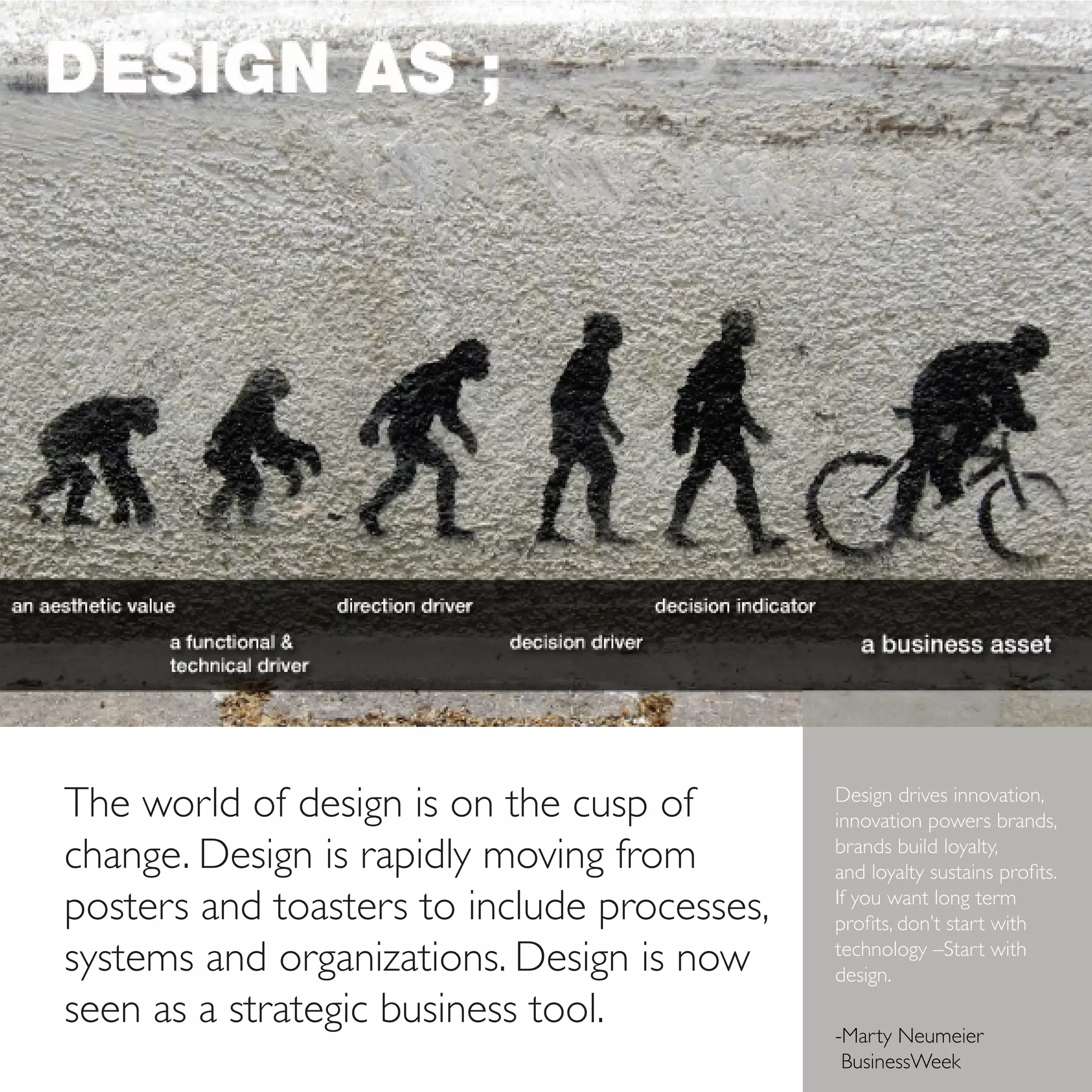
The world of design is on the cusp of        Design drives innovation,
                                             innovation powers brands,
change. Design is rapidly moving from        brands build loyalty,
                                             and loyalty sustains profits.
posters and toasters to include processes,   If you want long term
                                             profits, don’t start with
systems and organizations. Design is now     technology –Start with
                                             design.
seen as a strategic business tool.           	
                                             -Marty Neumeier
                                              BusinessWeek
“Designers need to be more than
ambassadors, they need to be
fully functioning and fully aware
members of strategic decision
making teams in a company.”


               -Nathan Shedroff
 Chair, MBA Design Strategy, CCA
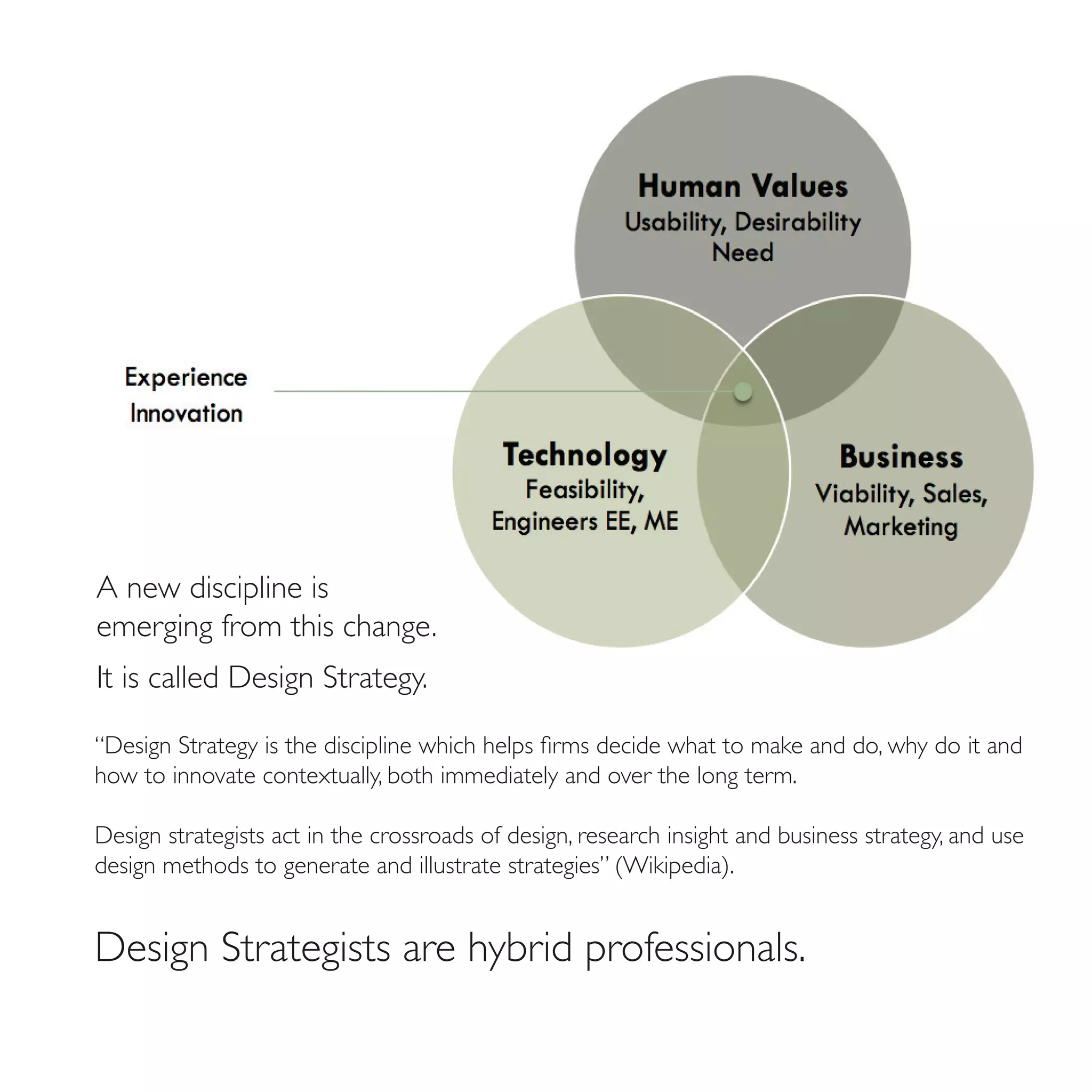
A new discipline is
emerging from this change.
It is called Design Strategy.

“Design Strategy is the discipline which helps firms decide what to make and do, why do it and
how to innovate contextually, both immediately and over the long term.

Design strategists act in the crossroads of design, research insight and business strategy, and use
design methods to generate and illustrate strategies” (Wikipedia).


Design Strategists are hybrid professionals.
WHY
Your time is limited, so don’t waste it living
someone else’s life. Don’t be trapped by
dogma - which is living with the results of
other people’s thinking. Don’t let the noise
of other’s opinions drown out your own
inner voice. And most important, have the
courage to follow your heart and intuition.
They somehow already know what you
truly want to become. Everything else is
secondary.”
												

								                         -Steve Jobs
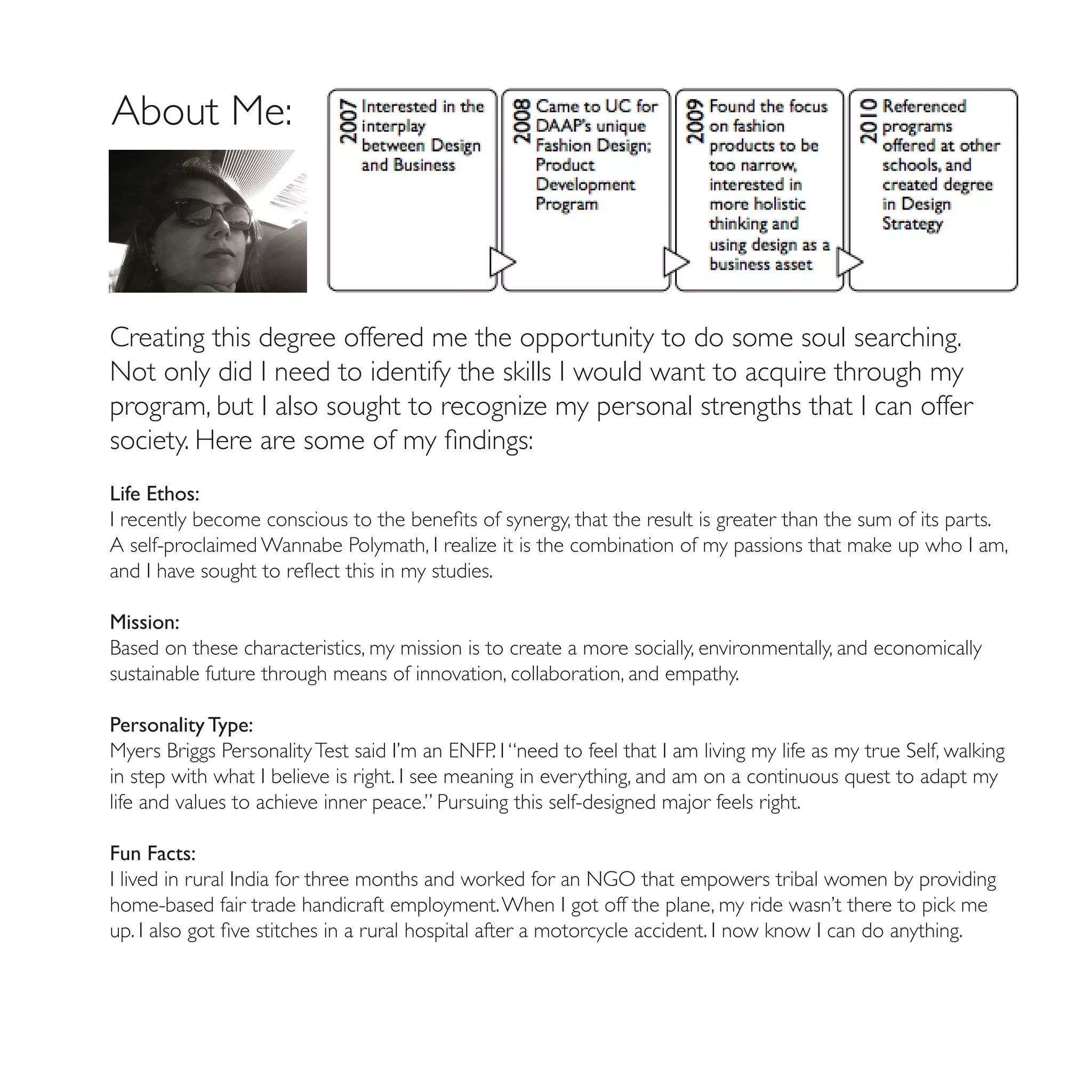
About Me:


Creating this degree offered me the opportunity to do some soul searching.
Not only did I need to identify the skills I would want to acquire through my
program, but I also sought to recognize my personal strengths that I can offer
society. Here are some of my findings:
Life Ethos:
I recently become conscious to the benefits of synergy, that the result is greater than the sum of its parts.
A self-proclaimed Wannabe Polymath, I realize it is the combination of my passions that make up who I am,
and I have sought to reflect this in my studies.

Mission:
Based on these characteristics, my mission is to create a more socially, environmentally, and economically
sustainable future through means of innovation, collaboration, and empathy.

Personality Type:
Myers Briggs Personality Test said I’m an ENFP. I “need to feel that I am living my life as my true Self, walking
in step with what I believe is right. I see meaning in everything, and am on a continuous quest to adapt my
life and values to achieve inner peace.” Pursuing this self-designed major feels right.

Fun Facts:
I lived in rural India for three months and worked for an NGO that empowers tribal women by providing
home-based fair trade handicraft employment. When I got off the plane, my ride wasn’t there to pick me
up. I also got five stitches in a rural hospital after a motorcycle accident. I now know I can do anything.
The University of Cincinnati has a world-renowned
design school. Why would I leave it to start my own
major?
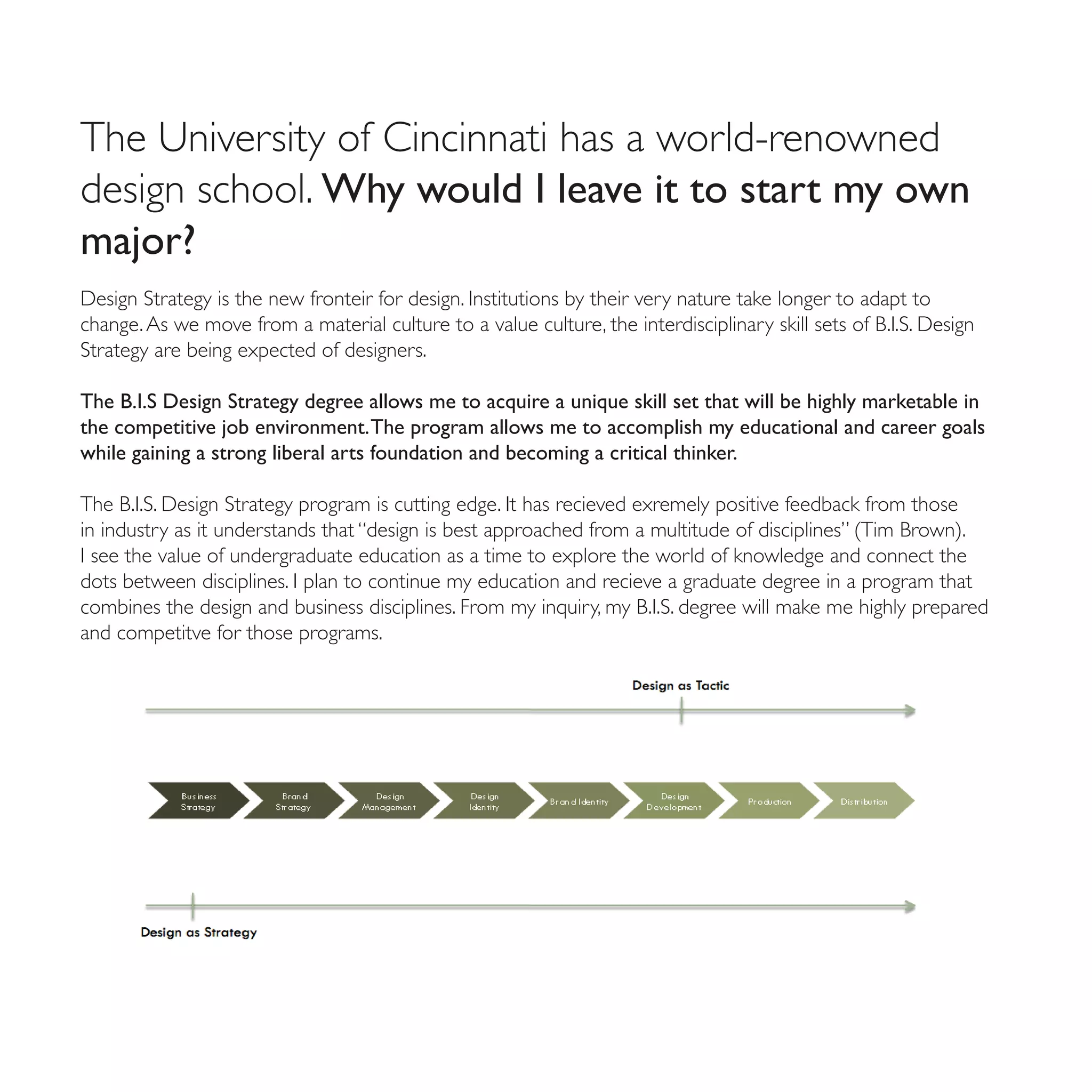
Design Strategy is the new fronteir for design. Institutions by their very nature take longer to adapt to
change. As we move from a material culture to a value culture, the interdisciplinary skill sets of B.I.S. Design
Strategy are being expected of designers.

The B.I.S Design Strategy degree allows me to acquire a unique skill set that will be highly marketable in
the competitive job environment. The program allows me to accomplish my educational and career goals
while gaining a strong liberal arts foundation and becoming a critical thinker.

The B.I.S. Design Strategy program is cutting edge. It has recieved exremely positive feedback from those
in industry as it understands that “design is best approached from a multitude of disciplines” (Tim Brown).
I see the value of undergraduate education as a time to explore the world of knowledge and connect the
dots between disciplines. I plan to continue my education and recieve a graduate degree in a program that
combines the design and business disciplines. From my inquiry, my B.I.S. degree will make me highly prepared
and competitve for those programs.
HOW
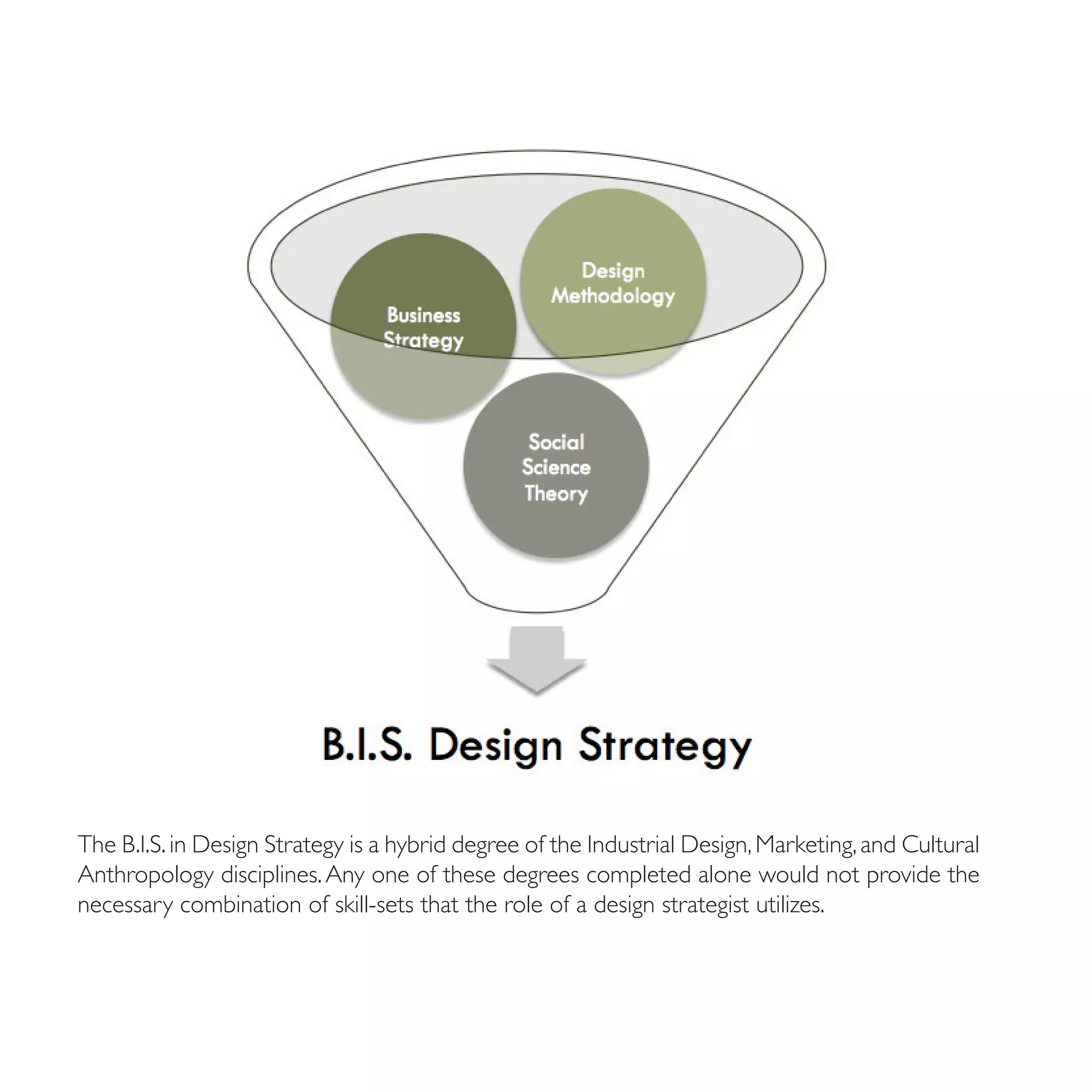
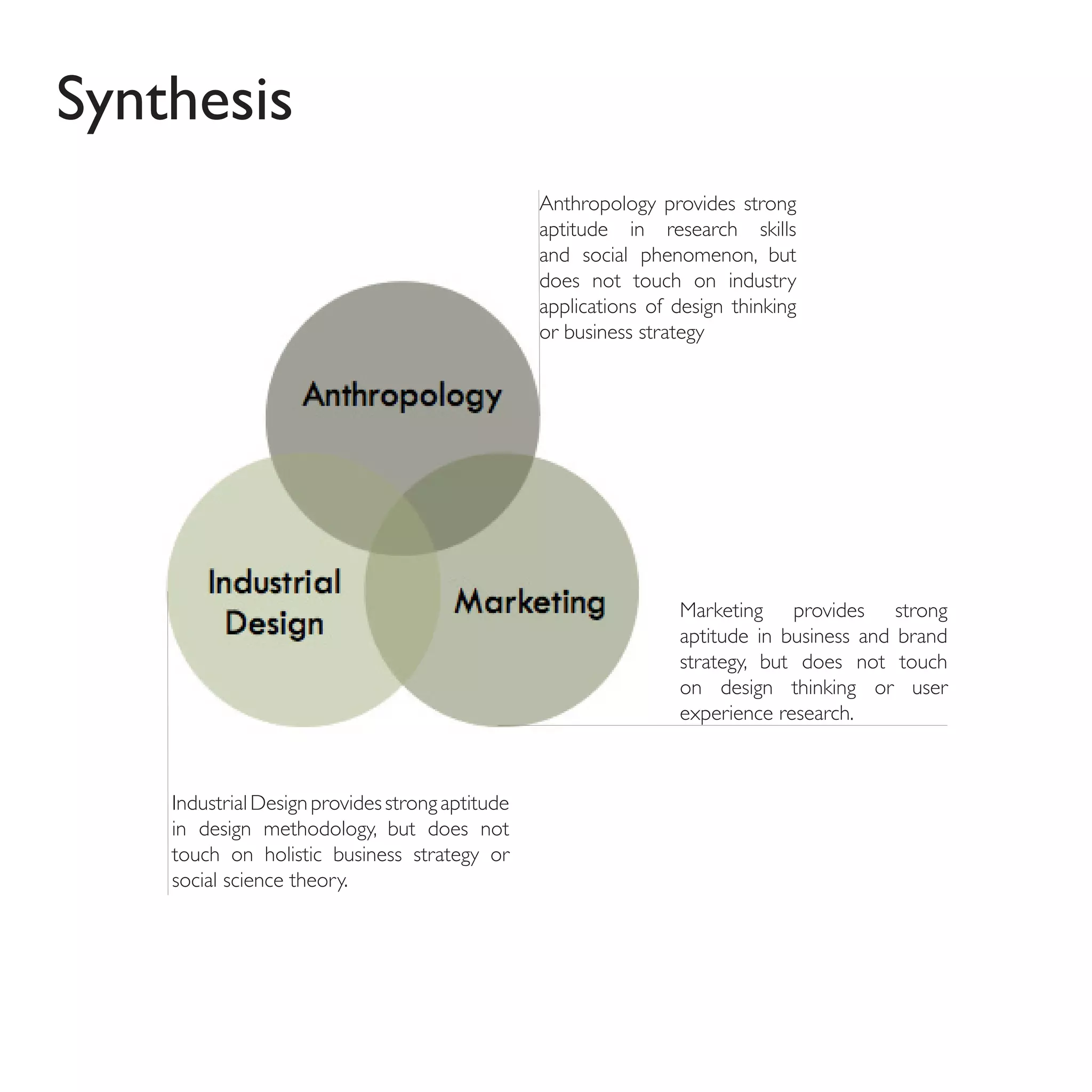
The B.I.S. in Design Strategy is a hybrid degree of the Industrial Design, Marketing, and Cultural
Anthropology disciplines. Any one of these degrees completed alone would not provide the
necessary combination of skill-sets that the role of a design strategist utilizes.
Synthesis
                                                 Anthropology provides strong
                                                 aptitude in research skills
                                                 and social phenomenon, but
                                                 does not touch on industry
                                                 applications of design thinking
                                                 or business strategy


                                                                 Marketing provides strong
                                                                 aptitude in business and brand
                                                                 strategy, but does not touch
                                                                 on design thinking or user
                                                                 experience research.


    Industrial Design provides strong aptitude
    in design methodology, but does not
    touch on holistic business strategy or
    social science theory.
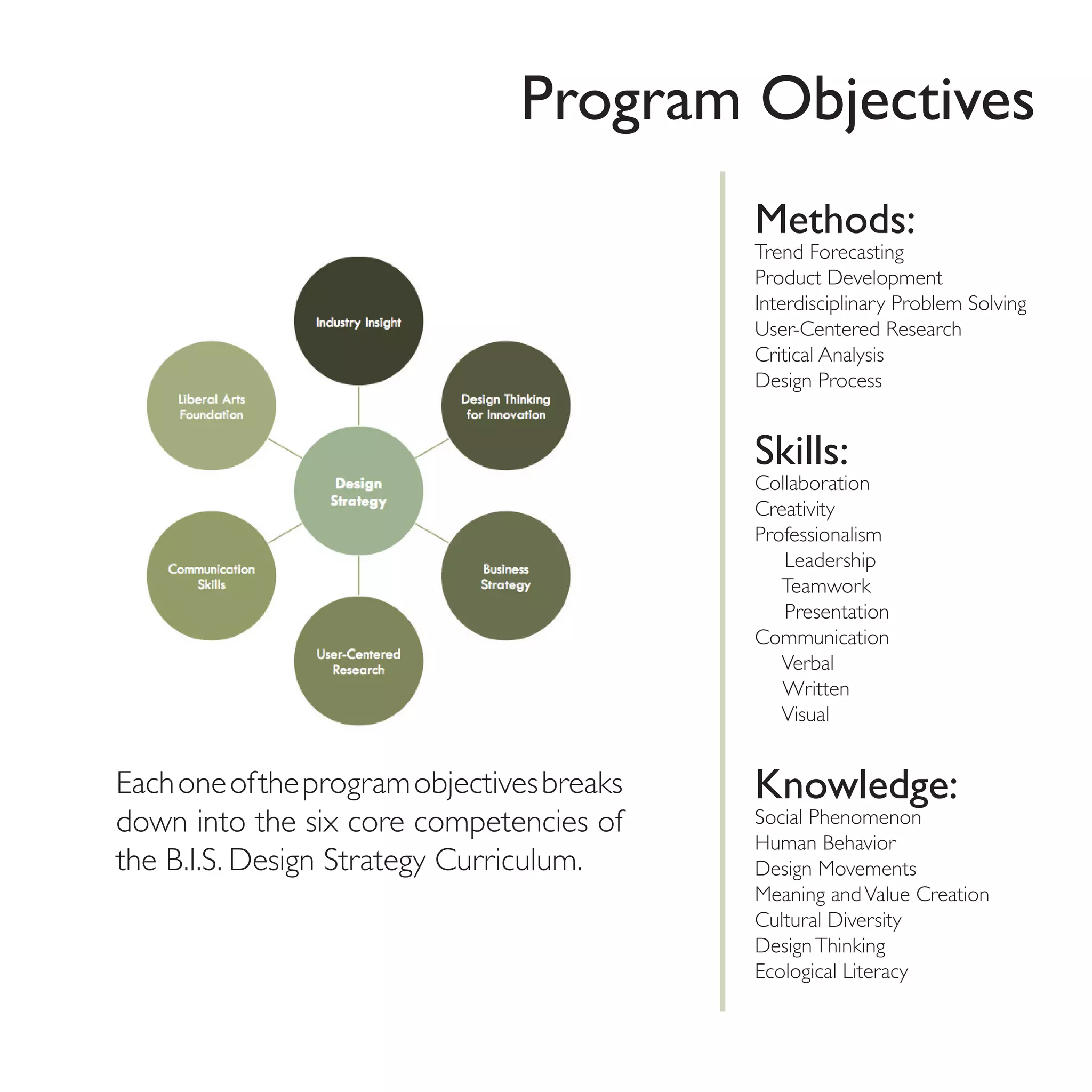
Program Objectives
                                            Methods:
                                            Trend Forecasting
                                            Product Development
                                            Interdisciplinary Problem Solving
                                            User-Centered Research
                                            Critical Analysis
                                            Design Process


                                            Skills:
                                            Collaboration
                                            Creativity
                                            Professionalism
                                               Leadership
                                               Teamwork
                                               Presentation
                                            Communication
                                               Verbal
                                               Written
                                               Visual


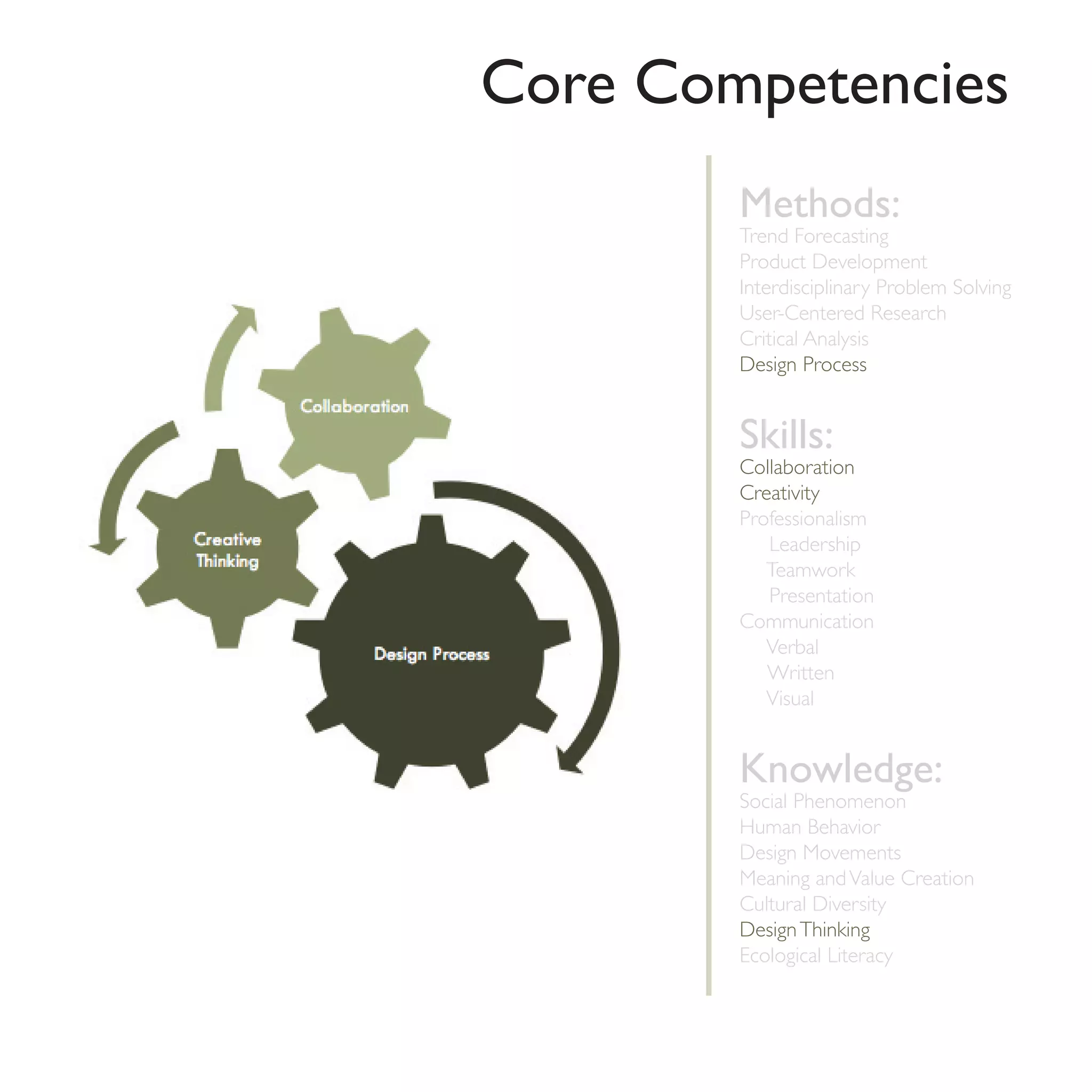
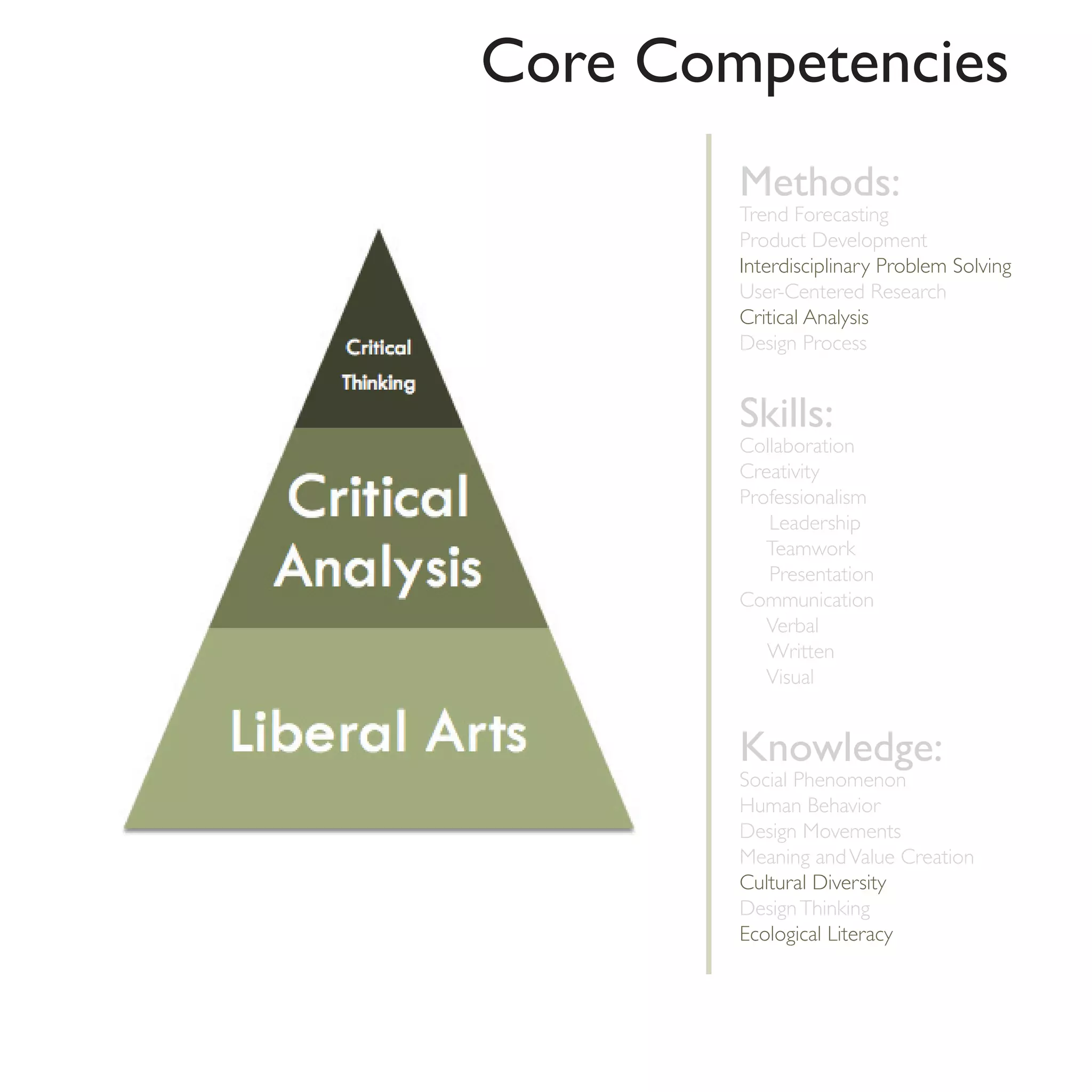
Each one of the program objectives breaks   Knowledge:
down into the six core competencies of      Social Phenomenon
                                            Human Behavior
the B.I.S. Design Strategy Curriculum.      Design Movements
                                            Meaning and Value Creation
                                            Cultural Diversity
                                            Design Thinking
                                            Ecological Literacy
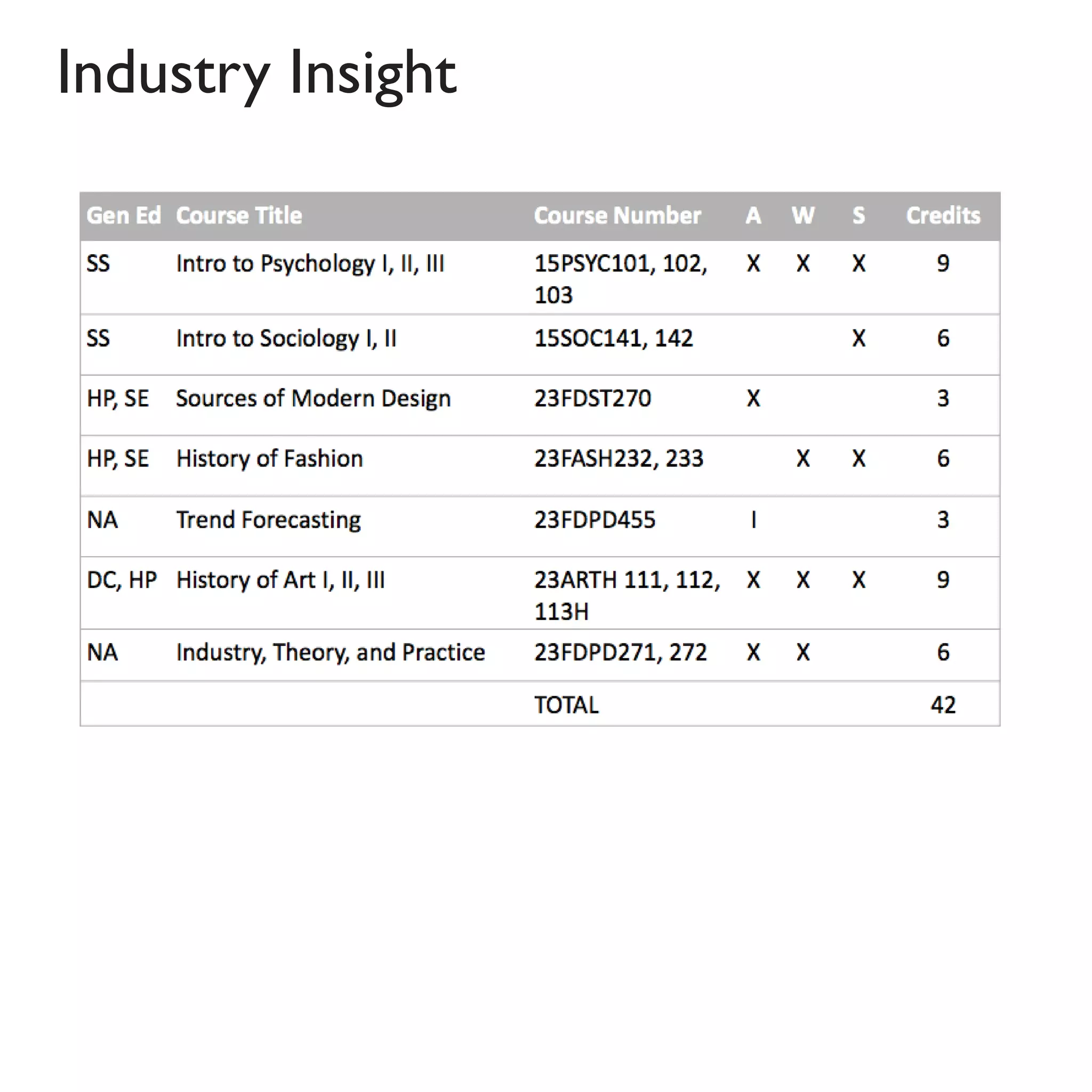
Industry Insight
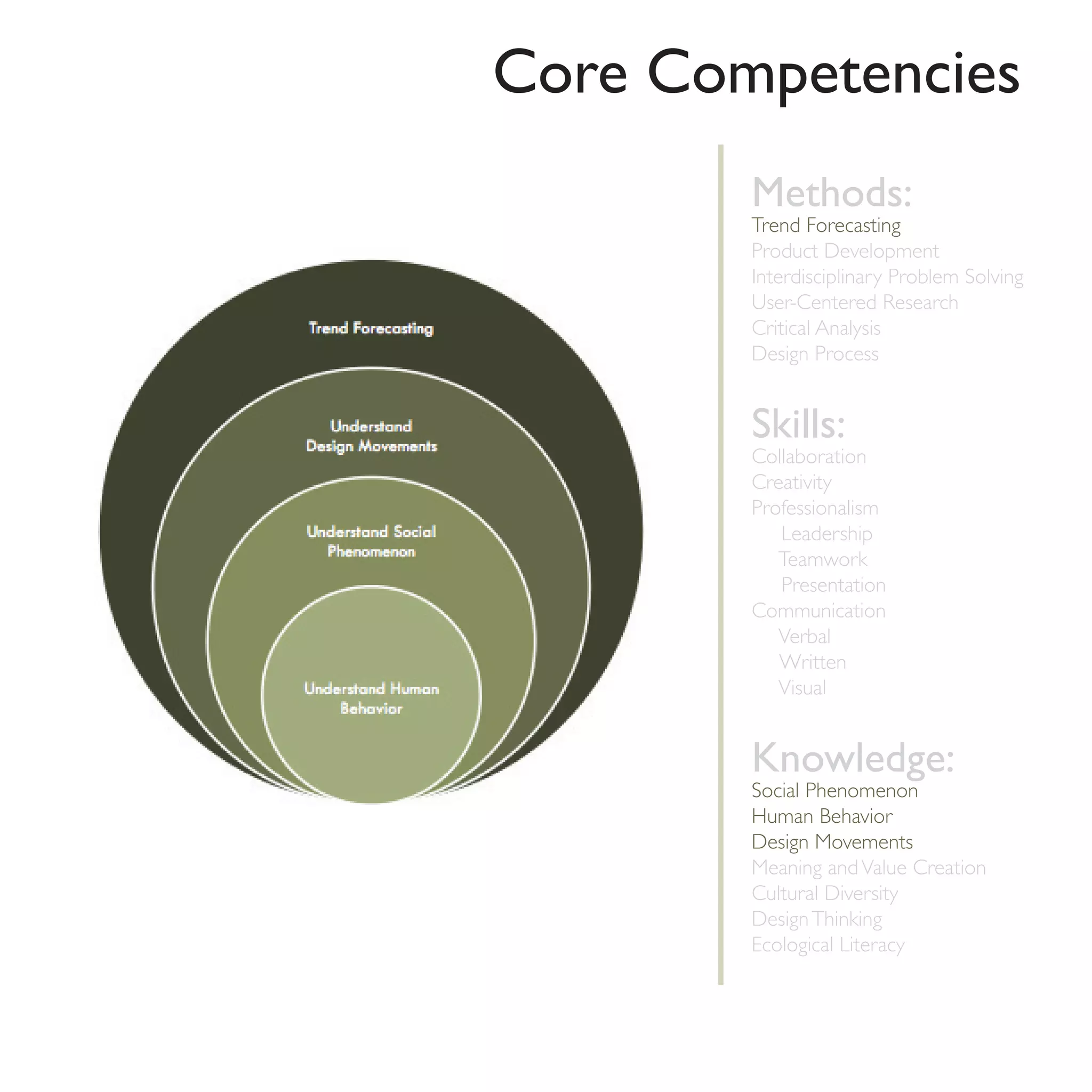
Core Competencies
        Methods:
        Trend Forecasting
        Product Development
        Interdisciplinary Problem Solving
        User-Centered Research
        Critical Analysis
        Design Process


        Skills:
        Collaboration
        Creativity
        Professionalism
           Leadership
           Teamwork
           Presentation
        Communication
           Verbal
           Written
           Visual


        Knowledge:
        Social Phenomenon
        Human Behavior
        Design Movements
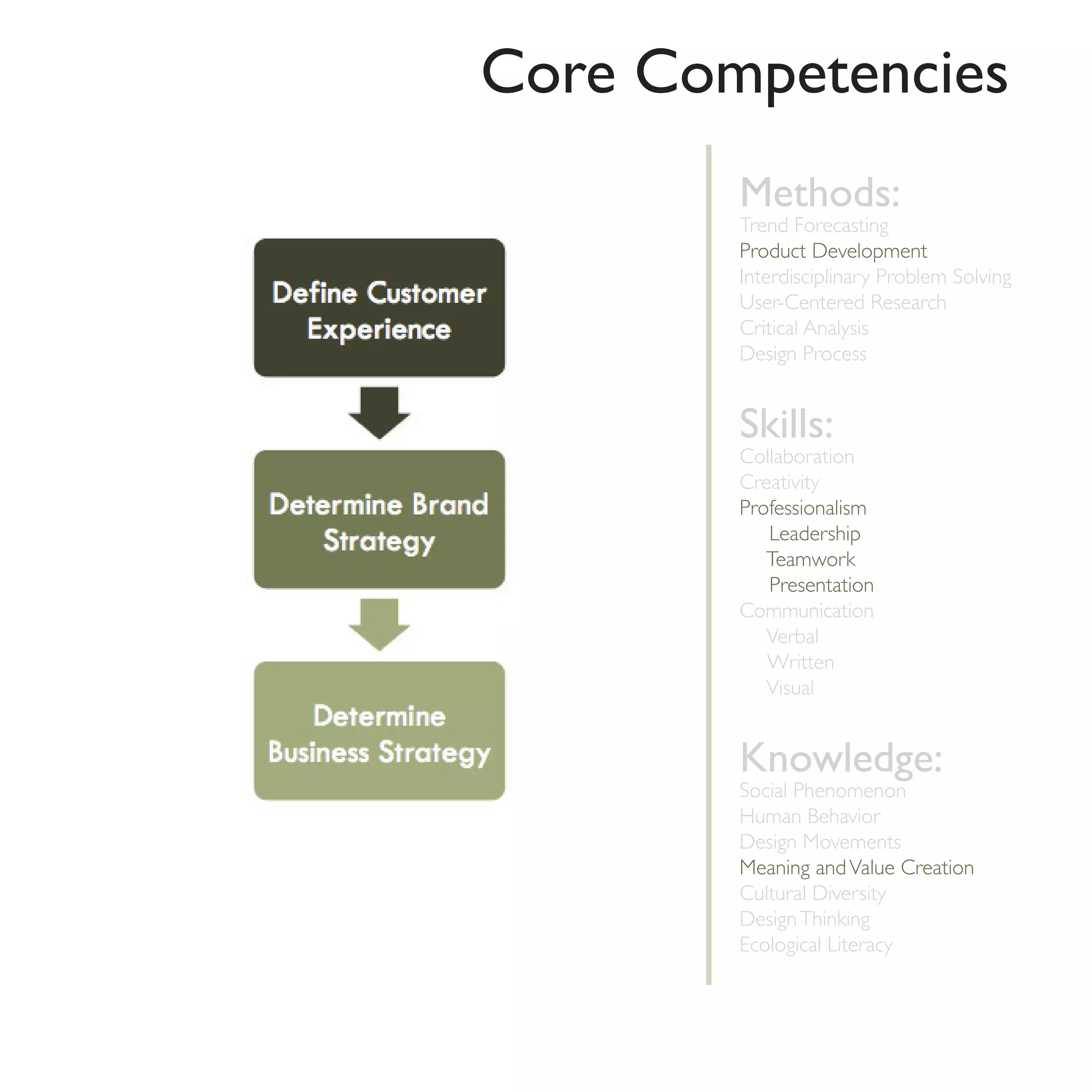
        Meaning and Value Creation
        Cultural Diversity
        Design Thinking
        Ecological Literacy
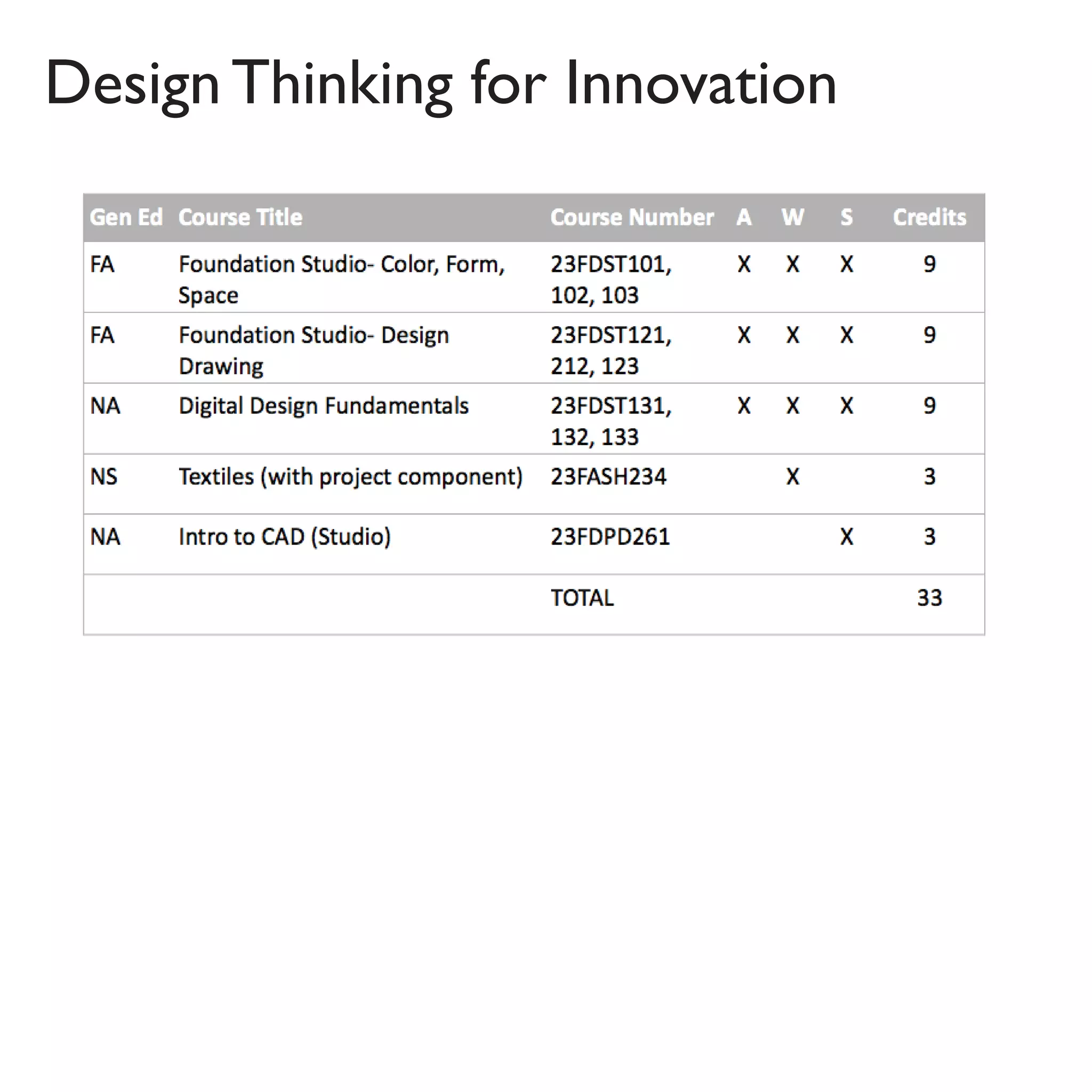
Design Thinking for Innovation
Core Competencies
        Methods:
        Trend Forecasting
        Product Development
        Interdisciplinary Problem Solving
        User-Centered Research
        Critical Analysis
        Design Process


        Skills:
        Collaboration
        Creativity
        Professionalism
           Leadership
           Teamwork
           Presentation
        Communication
           Verbal
           Written
           Visual


        Knowledge:
        Social Phenomenon
        Human Behavior
        Design Movements
        Meaning and Value Creation
        Cultural Diversity
        Design Thinking
        Ecological Literacy
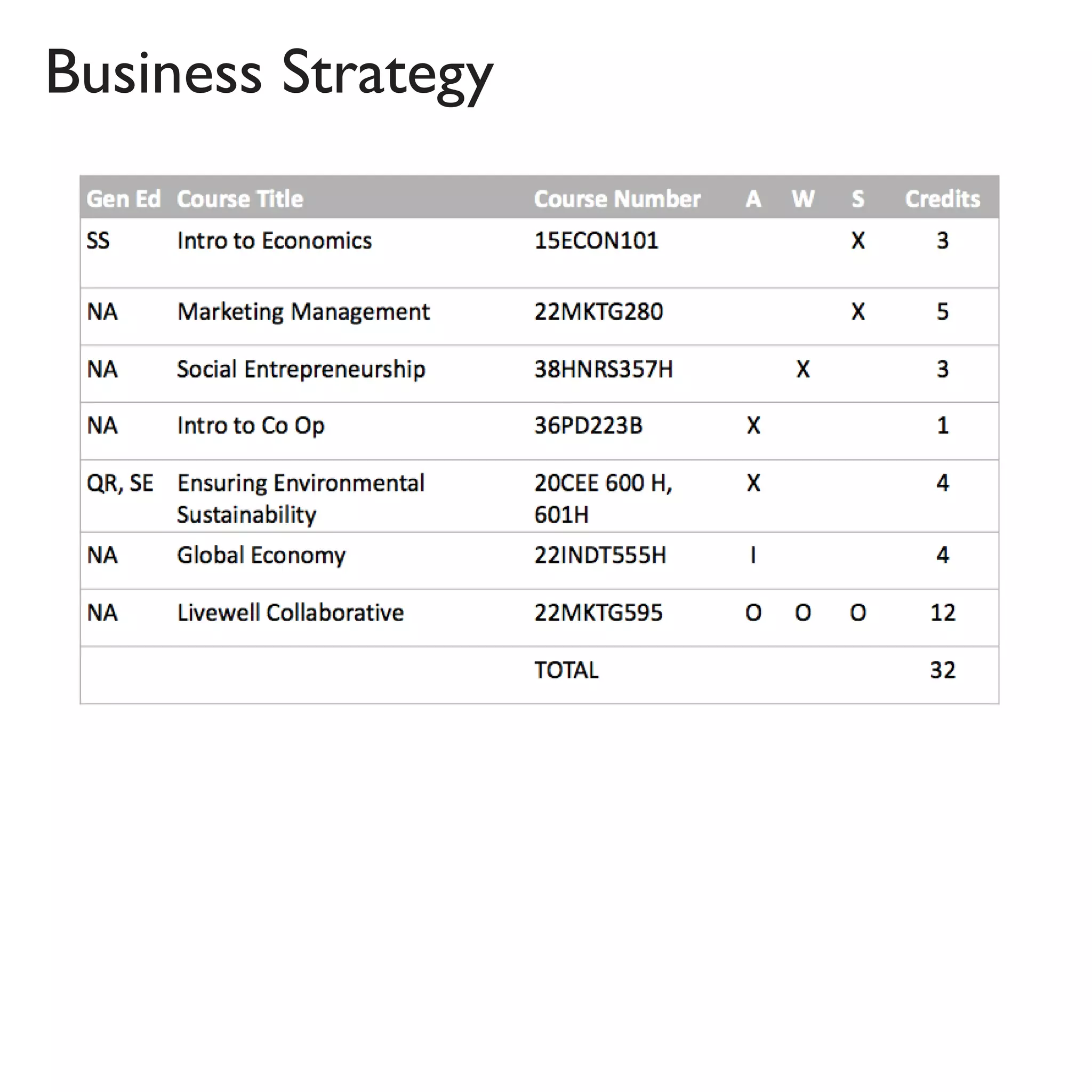
Business Strategy
Core Competencies
        Methods:
        Trend Forecasting
        Product Development
        Interdisciplinary Problem Solving
        User-Centered Research
        Critical Analysis
        Design Process


        Skills:
        Collaboration
        Creativity
        Professionalism
           Leadership
           Teamwork
           Presentation
        Communication
           Verbal
           Written
           Visual


        Knowledge:
        Social Phenomenon
        Human Behavior
        Design Movements
        Meaning and Value Creation
        Cultural Diversity
        Design Thinking
        Ecological Literacy
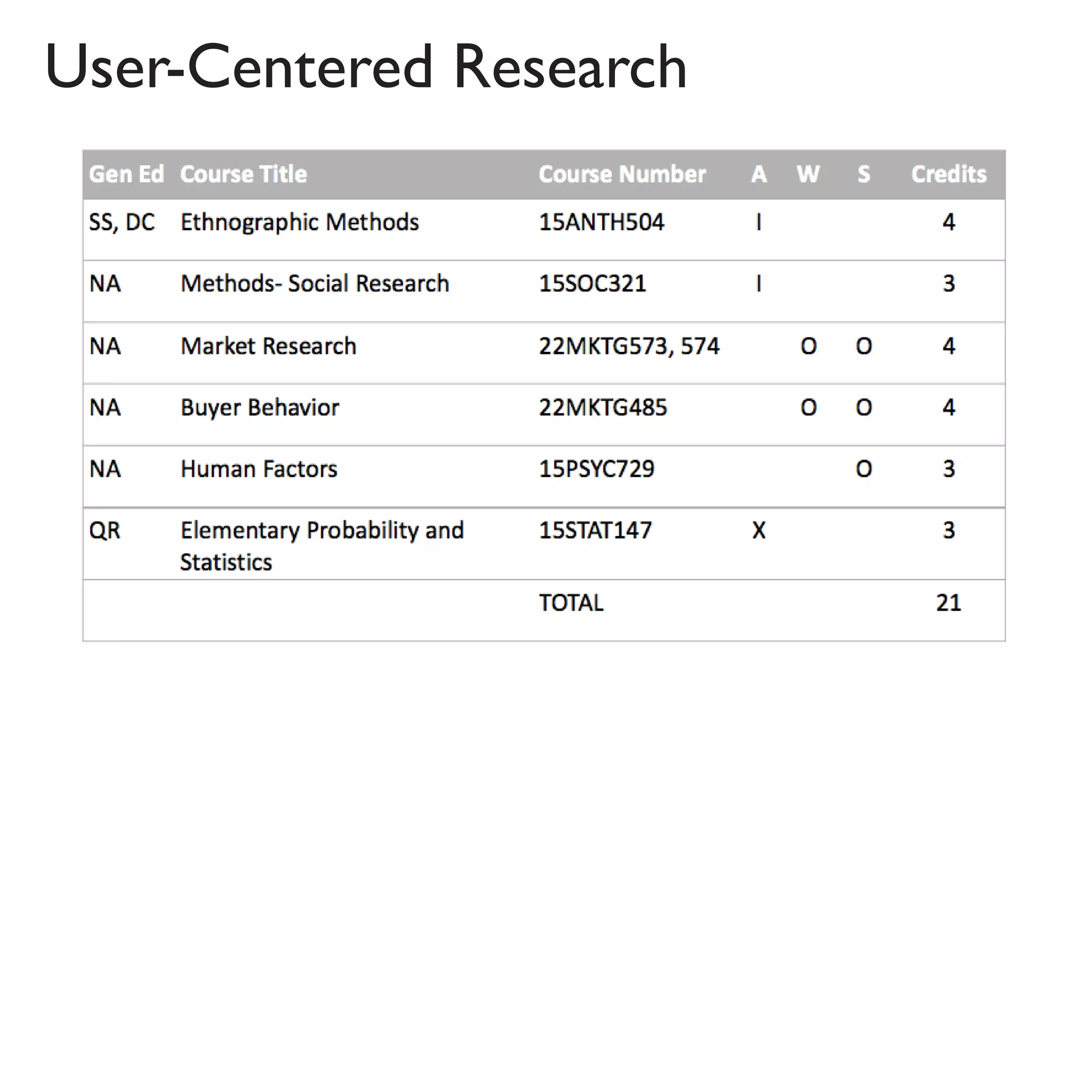
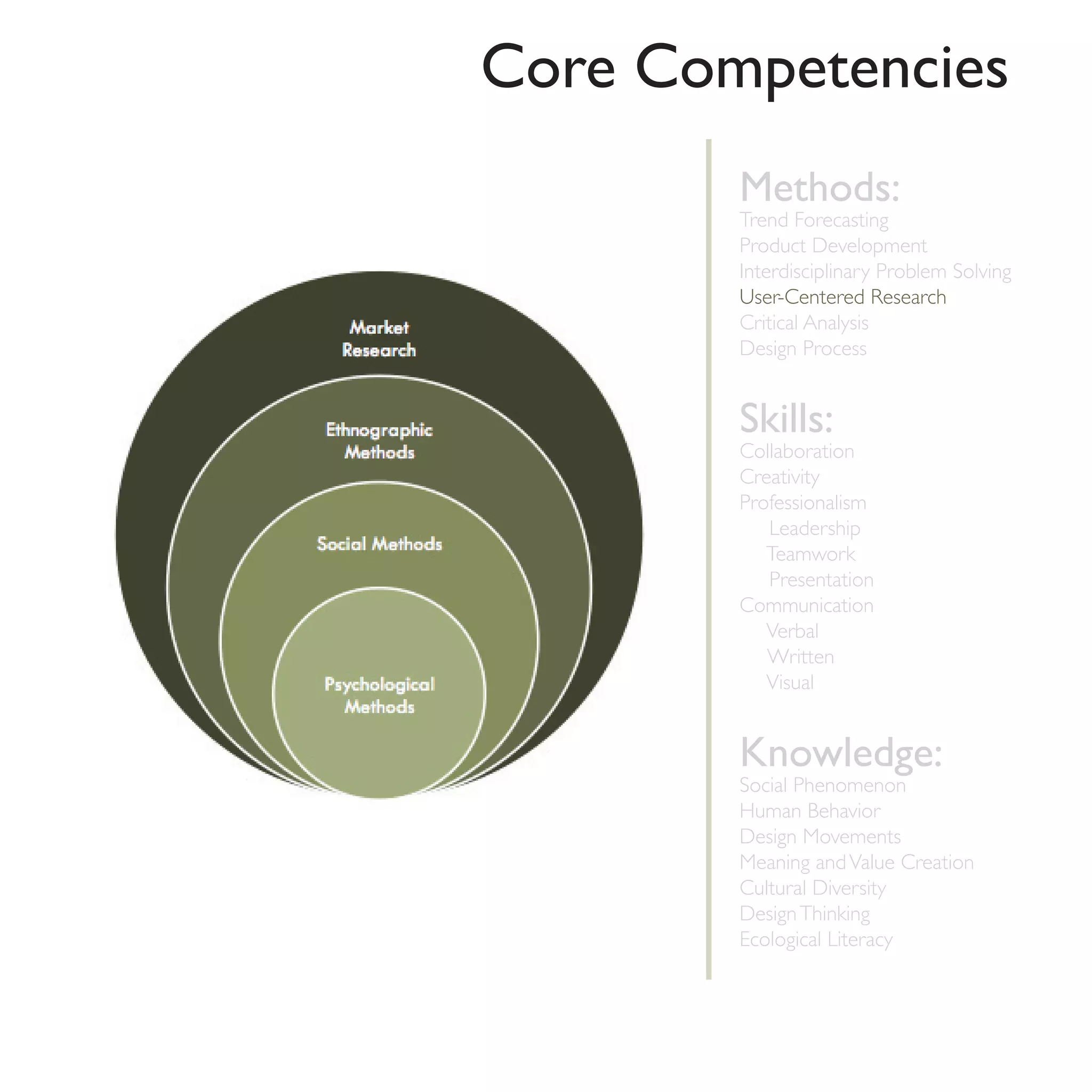
User-Centered Research
Core Competencies
        Methods:
        Trend Forecasting
        Product Development
        Interdisciplinary Problem Solving
        User-Centered Research
        Critical Analysis
        Design Process


        Skills:
        Collaboration
        Creativity
        Professionalism
           Leadership
           Teamwork
           Presentation
        Communication
           Verbal
           Written
           Visual


        Knowledge:
        Social Phenomenon
        Human Behavior
        Design Movements
        Meaning and Value Creation
        Cultural Diversity
        Design Thinking
        Ecological Literacy
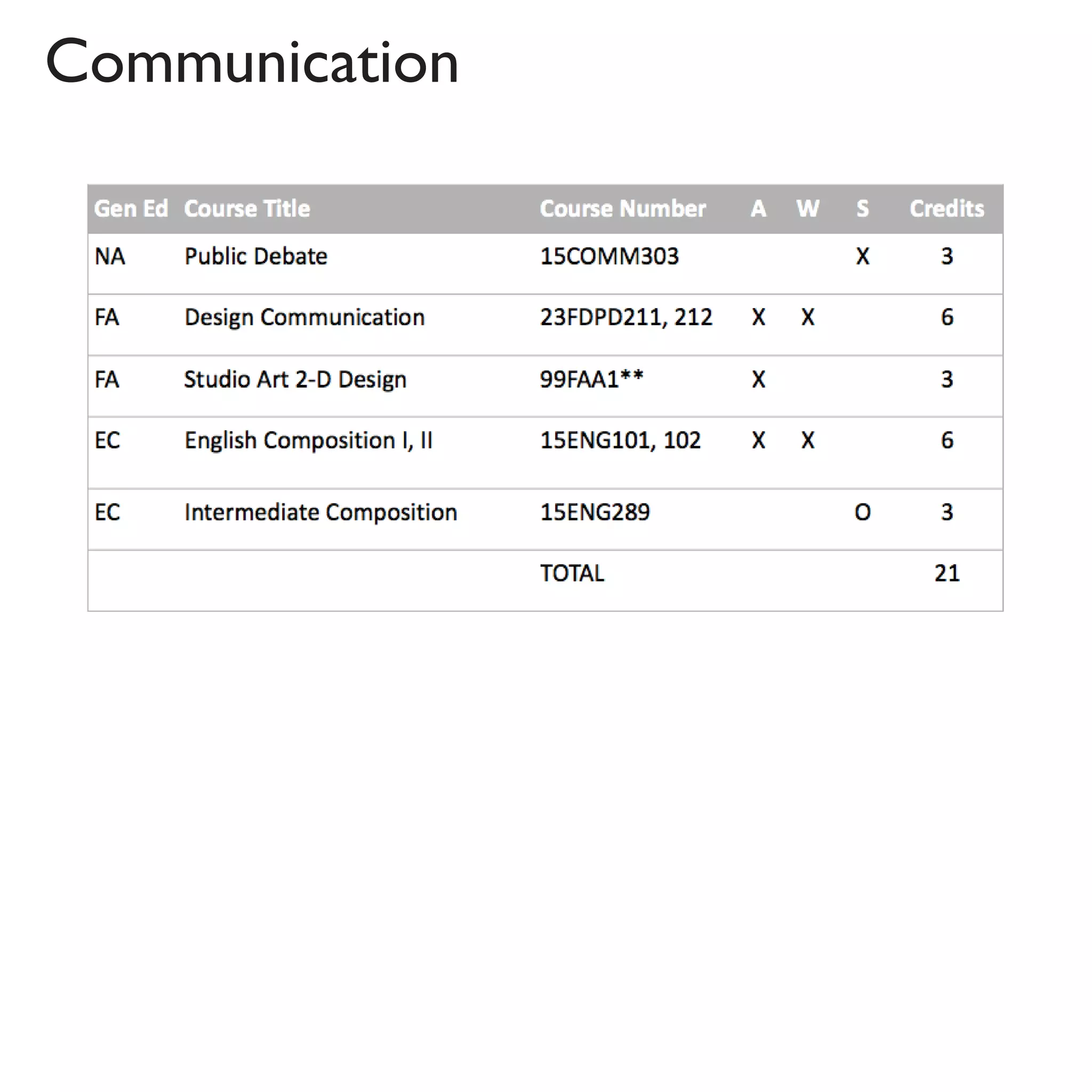
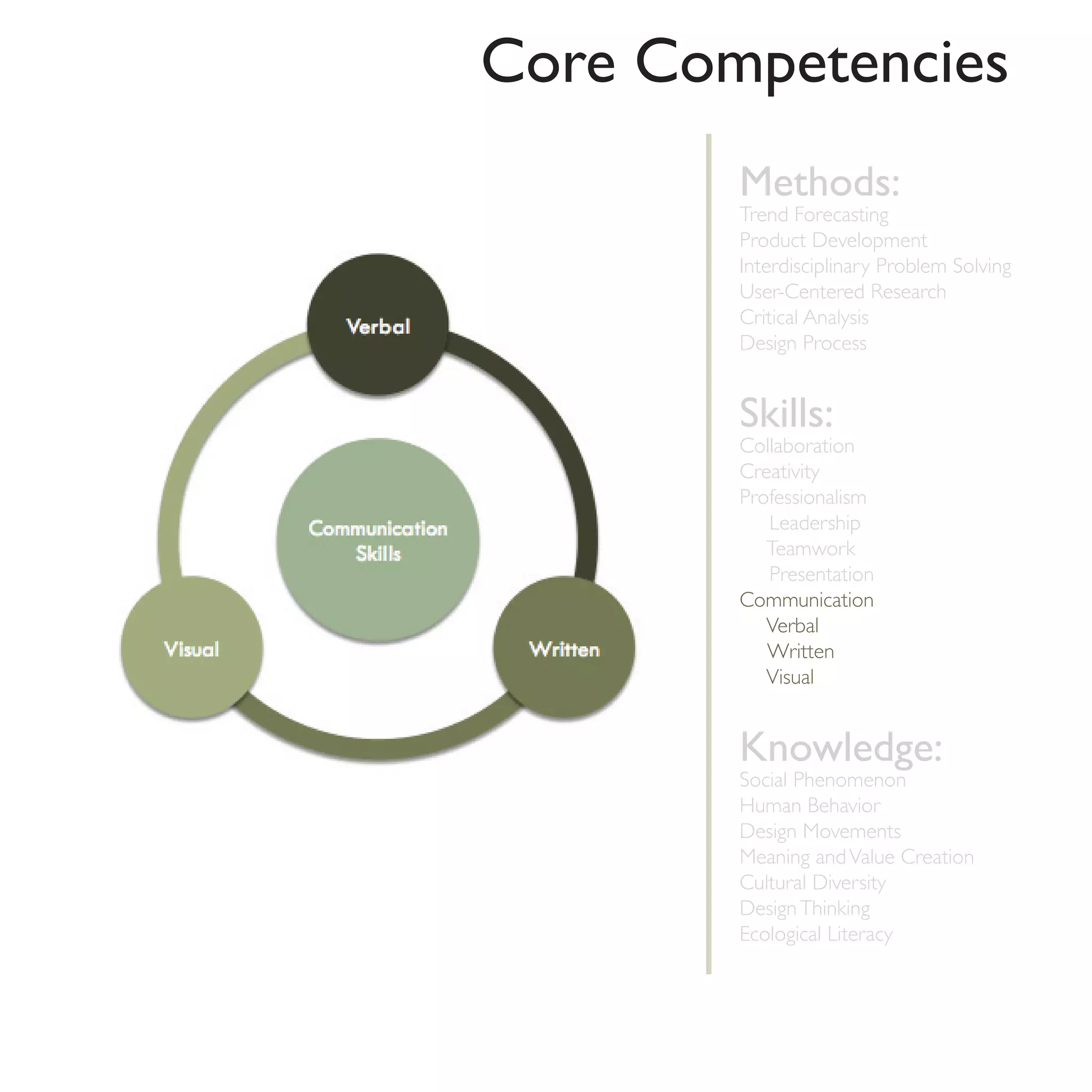
Communication
Core Competencies
        Methods:
        Trend Forecasting
        Product Development
        Interdisciplinary Problem Solving
        User-Centered Research
        Critical Analysis
        Design Process


        Skills:
        Collaboration
        Creativity
        Professionalism
           Leadership
           Teamwork
           Presentation
        Communication
           Verbal
           Written
           Visual


        Knowledge:
        Social Phenomenon
        Human Behavior
        Design Movements
        Meaning and Value Creation
        Cultural Diversity
        Design Thinking
        Ecological Literacy
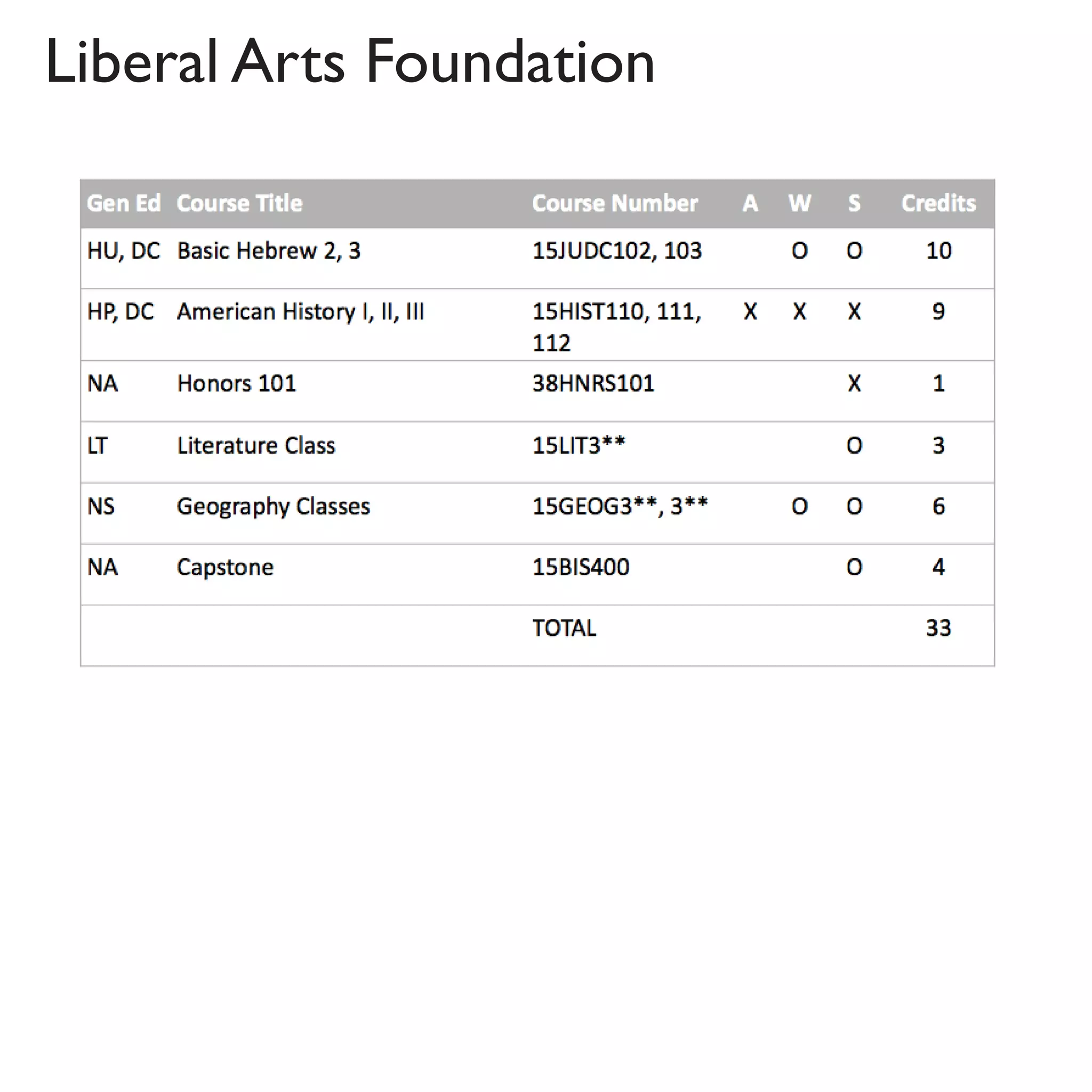
Liberal Arts Foundation
Core Competencies
        Methods:
        Trend Forecasting
        Product Development
        Interdisciplinary Problem Solving
        User-Centered Research
        Critical Analysis
        Design Process


        Skills:
        Collaboration
        Creativity
        Professionalism
           Leadership
           Teamwork
           Presentation
        Communication
           Verbal
           Written
           Visual


        Knowledge:
        Social Phenomenon
        Human Behavior
        Design Movements
        Meaning and Value Creation
        Cultural Diversity
        Design Thinking
        Ecological Literacy
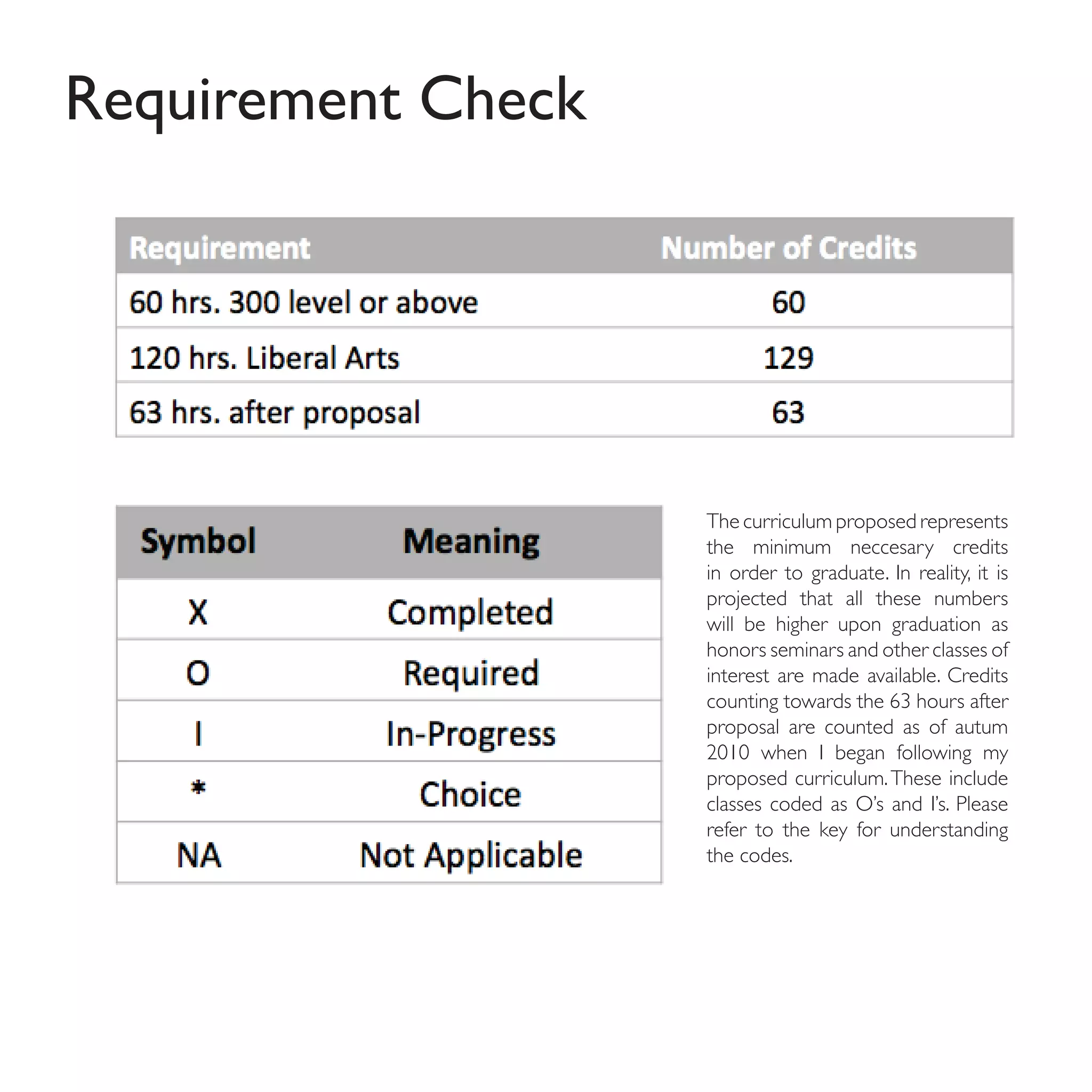
Requirement Check


                    The curriculum proposed represents
                    the minimum neccesary credits
                    in order to graduate. In reality, it is
                    projected that all these numbers
                    will be higher upon graduation as
                    honors seminars and other classes of
                    interest are made available. Credits
                    counting towards the 63 hours after
                    proposal are counted as of autum
                    2010 when I began following my
                    proposed curriculum. These include
                    classes coded as O’s and I’s. Please
                    refer to the key for understanding
                    the codes.
“
Discoveries are often
made by not following
instructions, by going off
the main road, by trying
the untried.”	 				
					 -Frank Tyger
Thank you.

Degree in Design Strategy

  • 1.
    Design is not justpretty products, it’s a Strategy for change. B.I.S. Design Strategy Lauren Magrisso
  • 2.
    Copyright © 2011by Lauren Magrisso All rights reserved. Second Edition.
  • 3.
    WHAT WHY HOW
  • 4.
  • 5.
    The world ofdesign is on the cusp of Design drives innovation, innovation powers brands, change. Design is rapidly moving from brands build loyalty, and loyalty sustains profits. posters and toasters to include processes, If you want long term profits, don’t start with systems and organizations. Design is now technology –Start with design. seen as a strategic business tool. -Marty Neumeier BusinessWeek
  • 6.
    “Designers need tobe more than ambassadors, they need to be fully functioning and fully aware members of strategic decision making teams in a company.” -Nathan Shedroff Chair, MBA Design Strategy, CCA
  • 7.
    A new disciplineis emerging from this change. It is called Design Strategy. “Design Strategy is the discipline which helps firms decide what to make and do, why do it and how to innovate contextually, both immediately and over the long term. Design strategists act in the crossroads of design, research insight and business strategy, and use design methods to generate and illustrate strategies” (Wikipedia). Design Strategists are hybrid professionals.
  • 8.
  • 9.
    Your time islimited, so don’t waste it living someone else’s life. Don’t be trapped by dogma - which is living with the results of other people’s thinking. Don’t let the noise of other’s opinions drown out your own inner voice. And most important, have the courage to follow your heart and intuition. They somehow already know what you truly want to become. Everything else is secondary.” -Steve Jobs
  • 10.
    About Me: Creating thisdegree offered me the opportunity to do some soul searching. Not only did I need to identify the skills I would want to acquire through my program, but I also sought to recognize my personal strengths that I can offer society. Here are some of my findings: Life Ethos: I recently become conscious to the benefits of synergy, that the result is greater than the sum of its parts. A self-proclaimed Wannabe Polymath, I realize it is the combination of my passions that make up who I am, and I have sought to reflect this in my studies. Mission: Based on these characteristics, my mission is to create a more socially, environmentally, and economically sustainable future through means of innovation, collaboration, and empathy. Personality Type: Myers Briggs Personality Test said I’m an ENFP. I “need to feel that I am living my life as my true Self, walking in step with what I believe is right. I see meaning in everything, and am on a continuous quest to adapt my life and values to achieve inner peace.” Pursuing this self-designed major feels right. Fun Facts: I lived in rural India for three months and worked for an NGO that empowers tribal women by providing home-based fair trade handicraft employment. When I got off the plane, my ride wasn’t there to pick me up. I also got five stitches in a rural hospital after a motorcycle accident. I now know I can do anything.
  • 11.
    The University ofCincinnati has a world-renowned design school. Why would I leave it to start my own major? Design Strategy is the new fronteir for design. Institutions by their very nature take longer to adapt to change. As we move from a material culture to a value culture, the interdisciplinary skill sets of B.I.S. Design Strategy are being expected of designers. The B.I.S Design Strategy degree allows me to acquire a unique skill set that will be highly marketable in the competitive job environment. The program allows me to accomplish my educational and career goals while gaining a strong liberal arts foundation and becoming a critical thinker. The B.I.S. Design Strategy program is cutting edge. It has recieved exremely positive feedback from those in industry as it understands that “design is best approached from a multitude of disciplines” (Tim Brown). I see the value of undergraduate education as a time to explore the world of knowledge and connect the dots between disciplines. I plan to continue my education and recieve a graduate degree in a program that combines the design and business disciplines. From my inquiry, my B.I.S. degree will make me highly prepared and competitve for those programs.
  • 12.
  • 13.
    The B.I.S. inDesign Strategy is a hybrid degree of the Industrial Design, Marketing, and Cultural Anthropology disciplines. Any one of these degrees completed alone would not provide the necessary combination of skill-sets that the role of a design strategist utilizes.
  • 14.
    Synthesis Anthropology provides strong aptitude in research skills and social phenomenon, but does not touch on industry applications of design thinking or business strategy Marketing provides strong aptitude in business and brand strategy, but does not touch on design thinking or user experience research. Industrial Design provides strong aptitude in design methodology, but does not touch on holistic business strategy or social science theory.
  • 15.
    Program Objectives Methods: Trend Forecasting Product Development Interdisciplinary Problem Solving User-Centered Research Critical Analysis Design Process Skills: Collaboration Creativity Professionalism Leadership Teamwork Presentation Communication Verbal Written Visual Each one of the program objectives breaks Knowledge: down into the six core competencies of Social Phenomenon Human Behavior the B.I.S. Design Strategy Curriculum. Design Movements Meaning and Value Creation Cultural Diversity Design Thinking Ecological Literacy
  • 16.
  • 17.
    Core Competencies Methods: Trend Forecasting Product Development Interdisciplinary Problem Solving User-Centered Research Critical Analysis Design Process Skills: Collaboration Creativity Professionalism Leadership Teamwork Presentation Communication Verbal Written Visual Knowledge: Social Phenomenon Human Behavior Design Movements Meaning and Value Creation Cultural Diversity Design Thinking Ecological Literacy
  • 18.
  • 19.
    Core Competencies Methods: Trend Forecasting Product Development Interdisciplinary Problem Solving User-Centered Research Critical Analysis Design Process Skills: Collaboration Creativity Professionalism Leadership Teamwork Presentation Communication Verbal Written Visual Knowledge: Social Phenomenon Human Behavior Design Movements Meaning and Value Creation Cultural Diversity Design Thinking Ecological Literacy
  • 20.
  • 21.
    Core Competencies Methods: Trend Forecasting Product Development Interdisciplinary Problem Solving User-Centered Research Critical Analysis Design Process Skills: Collaboration Creativity Professionalism Leadership Teamwork Presentation Communication Verbal Written Visual Knowledge: Social Phenomenon Human Behavior Design Movements Meaning and Value Creation Cultural Diversity Design Thinking Ecological Literacy
  • 22.
  • 23.
    Core Competencies Methods: Trend Forecasting Product Development Interdisciplinary Problem Solving User-Centered Research Critical Analysis Design Process Skills: Collaboration Creativity Professionalism Leadership Teamwork Presentation Communication Verbal Written Visual Knowledge: Social Phenomenon Human Behavior Design Movements Meaning and Value Creation Cultural Diversity Design Thinking Ecological Literacy
  • 24.
  • 25.
    Core Competencies Methods: Trend Forecasting Product Development Interdisciplinary Problem Solving User-Centered Research Critical Analysis Design Process Skills: Collaboration Creativity Professionalism Leadership Teamwork Presentation Communication Verbal Written Visual Knowledge: Social Phenomenon Human Behavior Design Movements Meaning and Value Creation Cultural Diversity Design Thinking Ecological Literacy
  • 26.
  • 27.
    Core Competencies Methods: Trend Forecasting Product Development Interdisciplinary Problem Solving User-Centered Research Critical Analysis Design Process Skills: Collaboration Creativity Professionalism Leadership Teamwork Presentation Communication Verbal Written Visual Knowledge: Social Phenomenon Human Behavior Design Movements Meaning and Value Creation Cultural Diversity Design Thinking Ecological Literacy
  • 28.
    Requirement Check The curriculum proposed represents the minimum neccesary credits in order to graduate. In reality, it is projected that all these numbers will be higher upon graduation as honors seminars and other classes of interest are made available. Credits counting towards the 63 hours after proposal are counted as of autum 2010 when I began following my proposed curriculum. These include classes coded as O’s and I’s. Please refer to the key for understanding the codes.
  • 29.
    “ Discoveries are often madeby not following instructions, by going off the main road, by trying the untried.” -Frank Tyger
  • 30.