Defending theDefending the
Wing -T OffenseWing -T Offense
““The Wash. U. Way”The Wash. U. Way”
Washington
University
in St. Louis
DefensingDefensing thethe
Delaware Wing - TDelaware Wing - T
1.1. Self Scout learn from your previous games /Self Scout learn from your previous games /
know what types of plays your opponent likes toknow what types of plays your opponent likes to
run (Runs / Passes)run (Runs / Passes)
2.2. Know what to defend:Know what to defend:
- Formations- Formations
- Plays- Plays
- Package (Is it a true Wing-T)- Package (Is it a true Wing-T)
- All Wing-T Packages are different / most are- All Wing-T Packages are different / most are
tailored to emphasize what their personneltailored to emphasize what their personnel
do best.do best.
3.3. Adjust your Defensive Keys: Coach what youAdjust your Defensive Keys: Coach what you
know / do what you do, adjust.know / do what you do, adjust.
- Tweak your keys / reads (i.e. more emphasis- Tweak your keys / reads (i.e. more emphasis
on the Offensive Guards)on the Offensive Guards)
4.4. Coach up your scout team.Coach up your scout team.
- You must be able to time up the offense- You must be able to time up the offense
(Motions / Shifts / Trades)(Motions / Shifts / Trades)
5.5. Blocking Scheme Drills focusing on the underBlocking Scheme Drills focusing on the under
key (Offensive lineman) (Focus on Offensivekey (Offensive lineman) (Focus on Offensive
Guards)Guards)
6.6. Utilize your base defense with a fewUtilize your base defense with a few
adjustments, do not try and do too much. Youadjustments, do not try and do too much. You
must match:must match:
- All of their Formations- All of their Formations
- All of their Motions- All of their Motions
- All of their Shifts- All of their Shifts
- All of their Trades- All of their Trades
- All of their Unbalanced- All of their Unbalanced
7.7. Have the ability to Force from the outside – DOHave the ability to Force from the outside – DO
not lose outside leverage (Wing side or SE side)not lose outside leverage (Wing side or SE side)
StrengthsStrengths of theof the
WingWing --TT
1.1. Familiarity, depending on where you are coaching youFamiliarity, depending on where you are coaching you
may only see it once a year. This causes defenses tomay only see it once a year. This causes defenses to
utilize adjustments that they normally do not use.utilize adjustments that they normally do not use.
2.2. Can get by with smaller players because of the schemesCan get by with smaller players because of the schemes
employed. Wing-T scheme is based on trapping, angleemployed. Wing-T scheme is based on trapping, angle
or down blocking, pulling and the double team.or down blocking, pulling and the double team.
3.3. Wing set gives you an extra gap on the offensive line.Wing set gives you an extra gap on the offensive line.
4.4. Wing set presents the defense with the immediate threatWing set presents the defense with the immediate threat
of 3 quick receivers: Wing, TE and SE. The nearness ofof 3 quick receivers: Wing, TE and SE. The nearness of
the wing to the TE can create switching problems forthe wing to the TE can create switching problems for
man to man secondary coverage when they run crossingman to man secondary coverage when they run crossing
patterns. (Waggle / Boot)patterns. (Waggle / Boot)
5.5. Slot set establishes in essence a double tight endSlot set establishes in essence a double tight end
formation and gives the offense the ability to run offformation and gives the offense the ability to run off
tackle to both sides.tackle to both sides.
Strengths of theStrengths of the
Wing -TWing -T
6.6. The Slot set also establishes 3 quick receivers: SE, SlotThe Slot set also establishes 3 quick receivers: SE, Slot
and the TE.and the TE.
7.7. The Wing -T employs 3 running backs that may be usedThe Wing -T employs 3 running backs that may be used
with equal frequency. This is similar to the oldwith equal frequency. This is similar to the old
Wishbone offenses. In theory they are all expected toWishbone offenses. In theory they are all expected to
have the same abilities at blocking, receiving, andhave the same abilities at blocking, receiving, and
rushing. Depending on the versatility of the backs thisrushing. Depending on the versatility of the backs this
gives the offense the flexibility to use multiple backfieldgives the offense the flexibility to use multiple backfield
sets, as well as multiple formations.sets, as well as multiple formations.
8.8. Series Offense: The Wing T uses several differentSeries Offense: The Wing T uses several different
series, each having a base play accompanied byseries, each having a base play accompanied by
companion plays. (Sweep, FB gut, Trap, I Trap) Whencompanion plays. (Sweep, FB gut, Trap, I Trap) When
you take away one play they have a counter to what youyou take away one play they have a counter to what you
are doing.are doing.
9.9. Misdirection game.Misdirection game.
10.10. Play action-passing game.Play action-passing game.
Weakness of theWeakness of the
Wing - TWing - T
1.1. Strong Formation TendenciesStrong Formation Tendencies . The Wing-T Offense uses. The Wing-T Offense uses
many pre-snap looks but at the time the ball is snappedmany pre-snap looks but at the time the ball is snapped
there are only 6 basic formations + unbalanced. Fromthere are only 6 basic formations + unbalanced. From
each of those formations they only run certain plays.each of those formations they only run certain plays.
The plays from the 6 basic formations make up the largeThe plays from the 6 basic formations make up the large
percentage of their offense. (Diagram #1)percentage of their offense. (Diagram #1)
2.2. There are 2 basic formationsThere are 2 basic formations : The Wing and the Slot,: The Wing and the Slot,
when you add in the different motions and shifts you stillwhen you add in the different motions and shifts you still
end up in Wing or Slot most of the time. (Diagram #2)end up in Wing or Slot most of the time. (Diagram #2)
3.3. Need to have athletic offensive linemanNeed to have athletic offensive lineman ,, alongalong withwith
versatile backsversatile backs . Ideally they would all perform their. Ideally they would all perform their
assignments equally well. The reality is that all backsassignments equally well. The reality is that all backs
are not equal. One of the backs will run the ball betterare not equal. One of the backs will run the ball better
than the other or have more carries. Both of the Guardsthan the other or have more carries. Both of the Guards
will not be equal, someone will be a better trapper orwill not be equal, someone will be a better trapper or
puller.puller.
These are all Tendencies that will help youThese are all Tendencies that will help you game plan.game plan.
My Perceptions of theMy Perceptions of the
Wing - TWing - T
1.1. It is all EYE WASH!!! it is a deceptive way to mirror orIt is all EYE WASH!!! it is a deceptive way to mirror or
hide what they do. Look over here while we run overhide what they do. Look over here while we run over
there.there.
-- They present multiple formations with motionsThey present multiple formations with motions / All of/ All of
their motions put them back into a formation that youtheir motions put them back into a formation that you
have already seenhave already seen
-- They present multiple shiftsThey present multiple shifts / All of their shifts put them/ All of their shifts put them
back into a formation that you have already seenback into a formation that you have already seen
-- All of this multiplicity boils down to 6 formationsAll of this multiplicity boils down to 6 formations
excluding unbalanced.excluding unbalanced.
2.2. Must be somewhat balanced in your front so that you canMust be somewhat balanced in your front so that you can
handle TE trades, formation change of strength. Stayhandle TE trades, formation change of strength. Stay
simple with your defensive front. If you must adjust,simple with your defensive front. If you must adjust,
handle it on the back end. (They have more time forhandle it on the back end. (They have more time for
recognition and adjusting)recognition and adjusting)
3.3. The 3 BACK ATTACK / if they had one good back theyThe 3 BACK ATTACK / if they had one good back they
would be in the “I”.would be in the “I”.
My Perceptions of theMy Perceptions of the
Wing - TWing - T
4.4. Inevitably you must stop the Fullback – it is the same asInevitably you must stop the Fullback – it is the same as
when you play on option team. Their offense will go aswhen you play on option team. Their offense will go as
their FB goes. Take away the inside runs (Trap) – theytheir FB goes. Take away the inside runs (Trap) – they
usually will not beat you running sweep.usually will not beat you running sweep.
5.5. In my experience we shut down the sweep game strongIn my experience we shut down the sweep game strong
and we force the offense into their Belly series or weakand we force the offense into their Belly series or weak
side running game. Now it becomes one dimensionalside running game. Now it becomes one dimensional
attack. This will not happen if you do not take theattack. This will not happen if you do not take the
Fullback out of the game.Fullback out of the game.
6.6. Ultimately it does not matter what defense you run. YouUltimately it does not matter what defense you run. You
must believe in what you are doing and get your kids tomust believe in what you are doing and get your kids to
believe. Have a simple plan and a change up or two.believe. Have a simple plan and a change up or two.
Use your defense and tweak your reads, don’t try andUse your defense and tweak your reads, don’t try and
insert a new scheme just for the Wing – T. If you knowinsert a new scheme just for the Wing – T. If you know
you want to run a certain front vs. Wing-T, use it vs.you want to run a certain front vs. Wing-T, use it vs.
other opponents so that you can build up repetitions asother opponents so that you can build up repetitions as
you go through the season.you go through the season.
7.7. Your players must be comfortable and they must seeYour players must be comfortable and they must see
what you tell them to see. They must have awhat you tell them to see. They must have a
progression that they can follow. Start small and expandprogression that they can follow. Start small and expand
your vision. If you start big it becomes paralysis byyour vision. If you start big it becomes paralysis by
analysis.analysis.
Diagram #1Diagram #1 (Formations w/Motions)(Formations w/Motions)
Y
L
B R
X
Y
L
B R
X
Y
L
B R
X
Y
L B
R
X
Y
L B
R
X
Y
B
R
X
Y
L
B
R
X Y
L
B
R
X
Y
L
B
R
X Y
L
B
R
X
L
FB Trap
Wing
Waggle
Wing Sweep Belly Pass
R (Hb) Ctr Pass
Belly Pass
Pwr
Waggle Pass / Run
Sprint Pass
R (Tb)Counter FB Trap
L (Wing) Ctr
Belly
Belly Option
L (Wing) Trap / Ctr
WING Hit Chart SLOT Hit Chart
(NO Mo) Belly
Half/Half
Speed Option
Slot
R Bu Sweep
R Lead Sweep
Sweep Pass
TO Pass
Sprint Pass
(NO Mo) Belly
Half / Half
Speed Option
FB Trap Speed Option
Trap Option
L Buck Sweep
Waggle Pass / Run
Sprint Pass
Waggle Pass / Run
Fb Trap
Belly Pass
L (Hb) Ctr Pass
L (Hb) CtrR (Slot) Ctr
Belly
Belly Opt
R (Slot) Sweep
Belly
Belly Opt.
Belly Pass
R (Slot) Trap/CtrBelly G
Belly Opt.
Yellow Wing (L Fly)
Wing (Blue)
Wing (Red) Slot (Red)
Slot (Blue)
Fb Trap(5)R Bu Sweep Half/Half (R ctr)
Fb Trap
L Fly(sweep)
PA Belly G-
Yellow Wing (R Fly)
Bu Tr+R Fly (sweep) Half/Half (L Ctr)
Yellow Wing (L Fuzzy)
Yellow Wing (R Fuzzy)
R TCtr+
B Ctr+
Belly Iso-
Belly Iso+
Diagram #2 Motion Hit ChartDiagram #2 Motion Hit Chart
Y
L
B R
X
Y
L
B R
X
Y
L
B R
X
Y
L B
R
X
Y
L B
R
X
Y
B
R
X
WING
L
SLOT
WING RED SLOT RED
WING
SLOT
WING BLUE SLOT BLUE
RED Motion = Long Arc Motion
NO MOTION
- Waggle Pass / Run
- Sprint Pass
- NO MO (Belly)
- Half / Half
- R Buck Sweep
- R Lead Sweep
- PWR - TRAP
- Waggle
- R Counter - Trap - L Counter
- Belly / Belly Iso
- Belly Opt.
- Belly Pass
- R Ctr Pass
- Belly Pass
- Belly G
- Belly Opt.
- L Counter
Blue Motion = TB motion = Belly (Series)
- Waggle Pass / Run
- Sprint Pass
- Sw Pass
- TO Pass
- Sprint Pass
- Waggle
Pass / Run
- Belly Pass
- L Counter Pass
- R Counter
- Belly
- Belly Opt.
- R Sweep
- Trap - L Counter
- Belly Pass
- Belly
- Belly Opt.
- R Counter
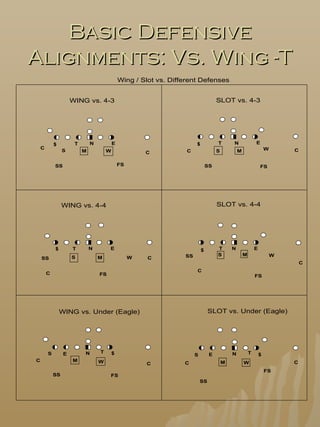
Basic DefensiveBasic Defensive
Alignments: Vs. Wing -TAlignments: Vs. Wing -T
T N E$
S M W
C
C
FSSS
T N E$
S M WC C
FSSS
T N E$
S M W
C
C
FS
SS
T N E$
S M W
C
C
FS
SS
TNE $S
M WC
C
FSSS
TNE $S
M WC C
FS
SS
Wing / Slot vs. Different Defenses
WING vs. 4-3 SLOT vs. 4-3
SLOT vs. 4-4WING vs. 4-4
WING vs. Under (Eagle) SLOT vs. Under (Eagle)
Defending the Wing – T:Defending the Wing – T:
“In a Nut – Shell”“In a Nut – Shell”
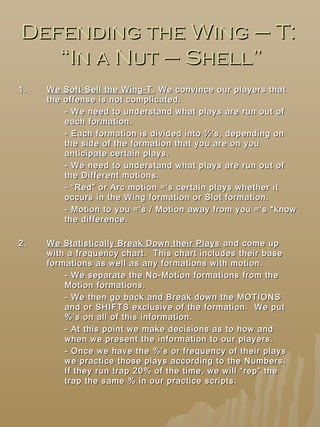
1.1. We Soft-Sell the Wing-TWe Soft-Sell the Wing-T , We convince our players that, We convince our players that
the offense is not complicated.the offense is not complicated.
- We need to understand what plays are run out of- We need to understand what plays are run out of
each formation.each formation.
- Each formation is divided into ½’s, depending on- Each formation is divided into ½’s, depending on
the side of the formation that you are on youthe side of the formation that you are on you
anticipate certain plays.anticipate certain plays.
- We need to understand what plays are run out of- We need to understand what plays are run out of
the Different motions.the Different motions.
- “Red” or Arc motion =‘s certain plays whether it- “Red” or Arc motion =‘s certain plays whether it
occurs in the Wing formation or Slot formation.occurs in the Wing formation or Slot formation.
- Motion to you =‘s / Motion away from you =‘s *know- Motion to you =‘s / Motion away from you =‘s *know
the difference.the difference.
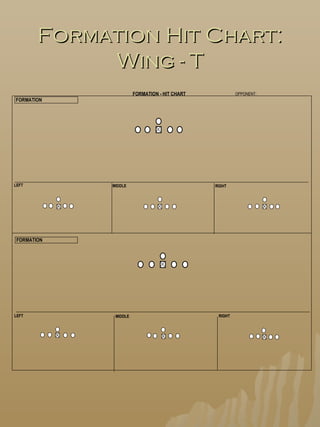
2.2. We Statistically Break Down their PlaysWe Statistically Break Down their Plays and come upand come up
with a frequency chart. This chart includes their basewith a frequency chart. This chart includes their base
formations as well as any formations with motion.formations as well as any formations with motion.
- We separate the No-Motion formations from the- We separate the No-Motion formations from the
Motion formations.Motion formations.
- We then go back and Break down the MOTIONS- We then go back and Break down the MOTIONS
and or SHIFTS exclusive of the formation. We putand or SHIFTS exclusive of the formation. We put
%’s on all of this information.%’s on all of this information.
- At this point we make decisions as to how and- At this point we make decisions as to how and
when we present the information to our players.when we present the information to our players.
- Once we have the %’s or frequency of their plays- Once we have the %’s or frequency of their plays
we practice those plays according to the Numbers.we practice those plays according to the Numbers.
If they run trap 20% of the time, we will “rep” theIf they run trap 20% of the time, we will “rep” the
trap the same % in our practice scripts.trap the same % in our practice scripts.
Down and Distance: ChartDown and Distance: Chart
0-10 -11-30 -31-50 +49+30 +29+15 +14+4 +4+GL
Down & Distance Tendency Opponent:
D
S
1
&
10
2
&
11+
2
&
10-7
2
&
6-4
2
&
3-1
3
&
11+
3
&
10-7
3
&
6-4
3
&
3-1
4
&
__
WASHINGTON UNIVERSITY
Formation Hit Chart:Formation Hit Chart:
Wing - TWing - T
LEFT MIDDLE RIGHT
RIGHTMIDDLELEFT
FORMATION
FORMATION
FORMATION - HIT CHART OPPONENT:
Defending the Wing – T:Defending the Wing – T:
“In a Nut – Shell” (Cont.)“In a Nut – Shell” (Cont.)
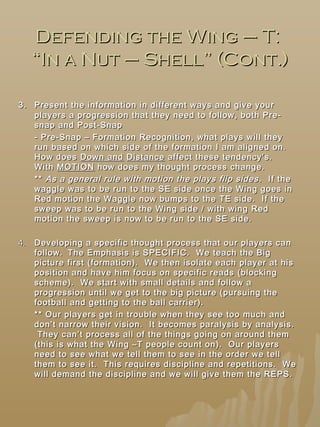
33.. Present the information in different ways and give yourPresent the information in different ways and give your
players a progression that they need to follow, both Pre-players a progression that they need to follow, both Pre-
snap and Post-Snapsnap and Post-Snap
- Pre-Snap – Formation Recognition, what plays will they- Pre-Snap – Formation Recognition, what plays will they
run based on which side of the formation I am aligned on.run based on which side of the formation I am aligned on.
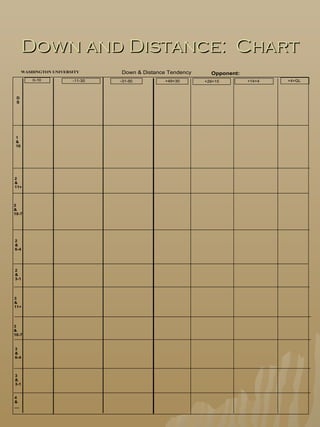
How doesHow does Down andDown and DistanceDistance affect these tendency’s.affect these tendency’s.
WithWith MOTIONMOTION how does my thought process change.how does my thought process change.
**** As a general rule with motion the plays flip sidesAs a general rule with motion the plays flip sides . If the. If the
waggle was to be run to the SE side once the Wing goes inwaggle was to be run to the SE side once the Wing goes in
Red motion the Waggle now bumps to the TE side. If theRed motion the Waggle now bumps to the TE side. If the
sweep was to be run to the Wing side / with wing Redsweep was to be run to the Wing side / with wing Red
motion the sweep is now to be run to the SE side.motion the sweep is now to be run to the SE side.
4.4. Developing a specific thought process that our players canDeveloping a specific thought process that our players can
follow.follow. The Emphasis is SPECIFIC. We teach the BigThe Emphasis is SPECIFIC. We teach the Big
picture first (formation). We then isolate each player at hispicture first (formation). We then isolate each player at his
position and have him focus on specific reads (blockingposition and have him focus on specific reads (blocking
scheme). We start with small details and follow ascheme). We start with small details and follow a
progression until we get to the big picture (pursuing theprogression until we get to the big picture (pursuing the
football and getting to the ball carrier).football and getting to the ball carrier).
** Our players get in trouble when they see too much and** Our players get in trouble when they see too much and
don’t narrow their vision. It becomes paralysis by analysis.don’t narrow their vision. It becomes paralysis by analysis.
They can’t process all of the things going on around themThey can’t process all of the things going on around them
(this is what the Wing –T people count on). Our players(this is what the Wing –T people count on). Our players
need to see what we tell them to see in the order we tellneed to see what we tell them to see in the order we tell
them to see it. This requires discipline and repetitions. Wethem to see it. This requires discipline and repetitions. We
will demand the discipline and we will give them the REPS.will demand the discipline and we will give them the REPS.
Defensive ProgressionDefensive Progression
Based on Tech.Based on Tech.
(No Motion)(No Motion)
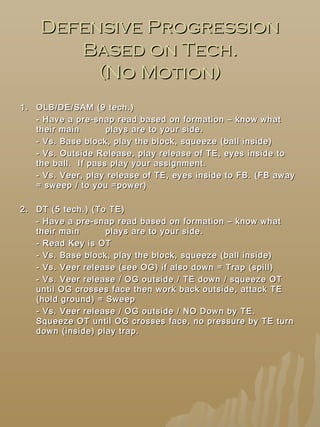
1.1. OLB/DE/SAM (9 tech.)OLB/DE/SAM (9 tech.)
- Have a pre-snap read based on formation – know what- Have a pre-snap read based on formation – know what
their maintheir main plays are to your side.plays are to your side.
- Vs. Base block, play the block, squeeze (ball inside)- Vs. Base block, play the block, squeeze (ball inside)
- Vs. Outside Release, play release of TE, eyes inside to- Vs. Outside Release, play release of TE, eyes inside to
the ball. If pass play your assignment.the ball. If pass play your assignment.
- Vs. Veer, play release of TE, eyes inside to FB. (FB away- Vs. Veer, play release of TE, eyes inside to FB. (FB away
= sweep / to you =power)= sweep / to you =power)
2.2. DT (5 tech.) (To TE)DT (5 tech.) (To TE)
- Have a pre-snap read based on formation – know what- Have a pre-snap read based on formation – know what
their maintheir main plays are to your side.plays are to your side.
- Read Key is OT- Read Key is OT
- Vs. Base block, play the block, squeeze (ball inside)- Vs. Base block, play the block, squeeze (ball inside)
- Vs. Veer release (see OG) if also down = Trap (spill)- Vs. Veer release (see OG) if also down = Trap (spill)
- Vs. Veer release / OG outside / TE down / squeeze OT- Vs. Veer release / OG outside / TE down / squeeze OT
until OG crosses face then work back outside, attack TEuntil OG crosses face then work back outside, attack TE
(hold ground) = Sweep(hold ground) = Sweep
- Vs. Veer release / OG outside / NO Down by TE.- Vs. Veer release / OG outside / NO Down by TE.
Squeeze OT until OG crosses face, no pressure by TE turnSqueeze OT until OG crosses face, no pressure by TE turn
down (inside) play trap.down (inside) play trap.
Defensive ProgressionDefensive Progression
Based on Tech.Based on Tech.
(No Motion)(No Motion)
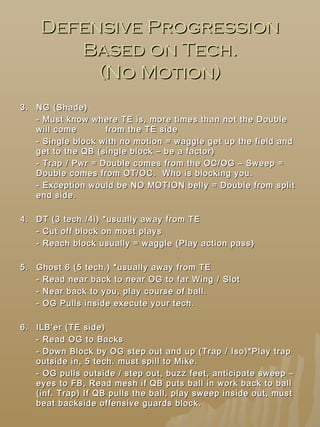
3.3. NG (Shade)NG (Shade)
- Must know where TE is, more times than not the Double- Must know where TE is, more times than not the Double
will comewill come from the TE sidefrom the TE side
- Single block with no motion = waggle get up the field and- Single block with no motion = waggle get up the field and
get to the QB (single block – be a factor)get to the QB (single block – be a factor)
- Trap / Pwr = Double comes from the OC/OG – Sweep =- Trap / Pwr = Double comes from the OC/OG – Sweep =
Double comes from OT/OC. Who is blocking you.Double comes from OT/OC. Who is blocking you.
- Exception would be NO MOTION belly = Double from split- Exception would be NO MOTION belly = Double from split
end side.end side.
4.4. DT (3 tech./4i) *usually away from TEDT (3 tech./4i) *usually away from TE
- Cut off block on most plays- Cut off block on most plays
- Reach block usually = waggle (Play action pass)- Reach block usually = waggle (Play action pass)
5.5. Ghost 6 (5 tech.) *usually away from TEGhost 6 (5 tech.) *usually away from TE
- Read near back to near OG to far Wing / Slot- Read near back to near OG to far Wing / Slot
- Near back to you, play course of ball.- Near back to you, play course of ball.
- OG Pulls inside execute your tech.- OG Pulls inside execute your tech.
6.6. ILB’er (TE side)ILB’er (TE side)
- Read OG to Backs- Read OG to Backs
- Down Block by OG step out and up (Trap / Iso)*Play trap- Down Block by OG step out and up (Trap / Iso)*Play trap
outside in, 5 tech. must spill to Mike.outside in, 5 tech. must spill to Mike.
- OG pulls outside / step out, buzz feet, anticipate sweep –- OG pulls outside / step out, buzz feet, anticipate sweep –
eyes to FB, Read mesh if QB puts ball in work back to balleyes to FB, Read mesh if QB puts ball in work back to ball
(inf. Trap) If QB pulls the ball, play sweep inside out, must(inf. Trap) If QB pulls the ball, play sweep inside out, must
beat backside offensive guards block.beat backside offensive guards block.
Defensive ProgressionDefensive Progression
Based on Tech.Based on Tech.
(No Motion)(No Motion)
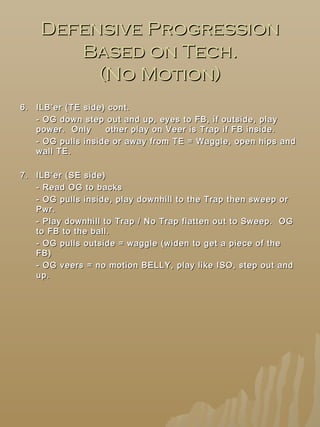
6.6. ILB’er (TE side) cont.ILB’er (TE side) cont.
- OG down step out and up, eyes to FB, if outside, play- OG down step out and up, eyes to FB, if outside, play
power. Onlypower. Only other play on Veer is Trap if FB inside.other play on Veer is Trap if FB inside.
- OG pulls inside or away from TE = Waggle, open hips and- OG pulls inside or away from TE = Waggle, open hips and
wall TE.wall TE.
7.7. ILB’er (SE side)ILB’er (SE side)
- Read OG to backs- Read OG to backs
- OG pulls inside, play downhill to the Trap then sweep or- OG pulls inside, play downhill to the Trap then sweep or
Pwr.Pwr.
- Play downhill to Trap / No Trap flatten out to Sweep. OG- Play downhill to Trap / No Trap flatten out to Sweep. OG
to FB to the ball.to FB to the ball.
- OG pulls outside = waggle (widen to get a piece of the- OG pulls outside = waggle (widen to get a piece of the
FB)FB)
- OG veers = no motion BELLY, play like ISO, step out and- OG veers = no motion BELLY, play like ISO, step out and
up.up.
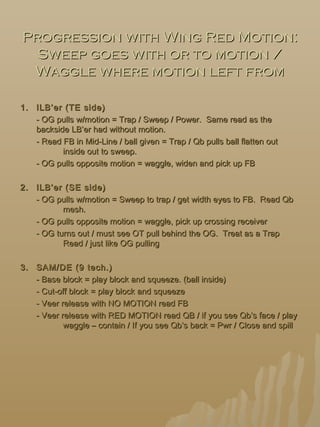
Progression with Wing Red Motion:Progression with Wing Red Motion:
Sweep goes with or to motion /Sweep goes with or to motion /
Waggle where motion left fromWaggle where motion left from
1.1. ILB’er (TE side)ILB’er (TE side)
- OG pulls w/motion = Trap / Sweep / Power. Same read as the- OG pulls w/motion = Trap / Sweep / Power. Same read as the
backside LB’er had without motion.backside LB’er had without motion.
- Read FB in Mid-Line / ball given = Trap / Qb pulls ball flatten out- Read FB in Mid-Line / ball given = Trap / Qb pulls ball flatten out
inside out to sweep.inside out to sweep.
- OG pulls opposite motion = waggle, widen and pick up FB- OG pulls opposite motion = waggle, widen and pick up FB
2.2. ILB’er (SE side)ILB’er (SE side)
- OG pulls w/motion = Sweep to trap / get width eyes to FB. Read Qb- OG pulls w/motion = Sweep to trap / get width eyes to FB. Read Qb
mesh.mesh.
- OG pulls opposite motion = waggle, pick up crossing receiver- OG pulls opposite motion = waggle, pick up crossing receiver
- OG turns out / must see OT pull behind the OG. Treat as a Trap- OG turns out / must see OT pull behind the OG. Treat as a Trap
Read / just like OG pullingRead / just like OG pulling
3.3. SAM/DE (9 tech.)SAM/DE (9 tech.)
- Base block = play block and squeeze. (ball inside)- Base block = play block and squeeze. (ball inside)
- Cut-off block = play block and squeeze- Cut-off block = play block and squeeze
- Veer release with NO MOTION read FB- Veer release with NO MOTION read FB
- Veer release with RED MOTION read QB / if you see Qb’s face / play- Veer release with RED MOTION read QB / if you see Qb’s face / play
waggle – contain / If you see Qb’s back = Pwr / Close and spillwaggle – contain / If you see Qb’s back = Pwr / Close and spill
Progression with Wing Red Motion:Progression with Wing Red Motion:
Sweep goes with or to motion /Sweep goes with or to motion /
Waggle where motion left fromWaggle where motion left from
4.4. DT (5 tech.) (To TE)DT (5 tech.) (To TE)
- Vs. Base block, Play block and squeeze. (Ball inside)- Vs. Base block, Play block and squeeze. (Ball inside)
- Vs. Cut-off block, play block and squeeze. (Ball away)- Vs. Cut-off block, play block and squeeze. (Ball away)
- Vs. Veer release T-Trap- Vs. Veer release T-Trap
- Red call tells the DT – NO inf. Trap your way / NO Sweep your way.- Red call tells the DT – NO inf. Trap your way / NO Sweep your way.
5.5. NG (Shade)NG (Shade)
- Single reach block to TE side = Waggle (be a factor get up the field)- Single reach block to TE side = Waggle (be a factor get up the field)
- Red call tells NG that the Double now coming away from TE.- Red call tells NG that the Double now coming away from TE.
6.6. DT (3 tech. / 4i)DT (3 tech. / 4i)
- Wing Red call = anticipate ball your way. (Sweep / Belly)- Wing Red call = anticipate ball your way. (Sweep / Belly)
Shap BoydShap Boyd
Defensive CoordinatorDefensive Coordinator
Washington Univ. in St. LouisWashington Univ. in St. Louis
Campus Box 1067Campus Box 1067
One Brookings DriveOne Brookings Drive
St. Louis, MO 63130St. Louis, MO 63130
314-935-4710314-935-4710

Defending the wing t offense

  • 1.
    Defending theDefending the Wing-T OffenseWing -T Offense ““The Wash. U. Way”The Wash. U. Way” Washington University in St. Louis
  • 2.
    DefensingDefensing thethe Delaware Wing- TDelaware Wing - T 1.1. Self Scout learn from your previous games /Self Scout learn from your previous games / know what types of plays your opponent likes toknow what types of plays your opponent likes to run (Runs / Passes)run (Runs / Passes) 2.2. Know what to defend:Know what to defend: - Formations- Formations - Plays- Plays - Package (Is it a true Wing-T)- Package (Is it a true Wing-T) - All Wing-T Packages are different / most are- All Wing-T Packages are different / most are tailored to emphasize what their personneltailored to emphasize what their personnel do best.do best. 3.3. Adjust your Defensive Keys: Coach what youAdjust your Defensive Keys: Coach what you know / do what you do, adjust.know / do what you do, adjust. - Tweak your keys / reads (i.e. more emphasis- Tweak your keys / reads (i.e. more emphasis on the Offensive Guards)on the Offensive Guards) 4.4. Coach up your scout team.Coach up your scout team. - You must be able to time up the offense- You must be able to time up the offense (Motions / Shifts / Trades)(Motions / Shifts / Trades) 5.5. Blocking Scheme Drills focusing on the underBlocking Scheme Drills focusing on the under key (Offensive lineman) (Focus on Offensivekey (Offensive lineman) (Focus on Offensive Guards)Guards) 6.6. Utilize your base defense with a fewUtilize your base defense with a few adjustments, do not try and do too much. Youadjustments, do not try and do too much. You must match:must match: - All of their Formations- All of their Formations - All of their Motions- All of their Motions - All of their Shifts- All of their Shifts - All of their Trades- All of their Trades - All of their Unbalanced- All of their Unbalanced 7.7. Have the ability to Force from the outside – DOHave the ability to Force from the outside – DO not lose outside leverage (Wing side or SE side)not lose outside leverage (Wing side or SE side)
  • 3.
    StrengthsStrengths of theofthe WingWing --TT 1.1. Familiarity, depending on where you are coaching youFamiliarity, depending on where you are coaching you may only see it once a year. This causes defenses tomay only see it once a year. This causes defenses to utilize adjustments that they normally do not use.utilize adjustments that they normally do not use. 2.2. Can get by with smaller players because of the schemesCan get by with smaller players because of the schemes employed. Wing-T scheme is based on trapping, angleemployed. Wing-T scheme is based on trapping, angle or down blocking, pulling and the double team.or down blocking, pulling and the double team. 3.3. Wing set gives you an extra gap on the offensive line.Wing set gives you an extra gap on the offensive line. 4.4. Wing set presents the defense with the immediate threatWing set presents the defense with the immediate threat of 3 quick receivers: Wing, TE and SE. The nearness ofof 3 quick receivers: Wing, TE and SE. The nearness of the wing to the TE can create switching problems forthe wing to the TE can create switching problems for man to man secondary coverage when they run crossingman to man secondary coverage when they run crossing patterns. (Waggle / Boot)patterns. (Waggle / Boot) 5.5. Slot set establishes in essence a double tight endSlot set establishes in essence a double tight end formation and gives the offense the ability to run offformation and gives the offense the ability to run off tackle to both sides.tackle to both sides.
  • 4.
    Strengths of theStrengthsof the Wing -TWing -T 6.6. The Slot set also establishes 3 quick receivers: SE, SlotThe Slot set also establishes 3 quick receivers: SE, Slot and the TE.and the TE. 7.7. The Wing -T employs 3 running backs that may be usedThe Wing -T employs 3 running backs that may be used with equal frequency. This is similar to the oldwith equal frequency. This is similar to the old Wishbone offenses. In theory they are all expected toWishbone offenses. In theory they are all expected to have the same abilities at blocking, receiving, andhave the same abilities at blocking, receiving, and rushing. Depending on the versatility of the backs thisrushing. Depending on the versatility of the backs this gives the offense the flexibility to use multiple backfieldgives the offense the flexibility to use multiple backfield sets, as well as multiple formations.sets, as well as multiple formations. 8.8. Series Offense: The Wing T uses several differentSeries Offense: The Wing T uses several different series, each having a base play accompanied byseries, each having a base play accompanied by companion plays. (Sweep, FB gut, Trap, I Trap) Whencompanion plays. (Sweep, FB gut, Trap, I Trap) When you take away one play they have a counter to what youyou take away one play they have a counter to what you are doing.are doing. 9.9. Misdirection game.Misdirection game. 10.10. Play action-passing game.Play action-passing game.
  • 5.
    Weakness of theWeaknessof the Wing - TWing - T 1.1. Strong Formation TendenciesStrong Formation Tendencies . The Wing-T Offense uses. The Wing-T Offense uses many pre-snap looks but at the time the ball is snappedmany pre-snap looks but at the time the ball is snapped there are only 6 basic formations + unbalanced. Fromthere are only 6 basic formations + unbalanced. From each of those formations they only run certain plays.each of those formations they only run certain plays. The plays from the 6 basic formations make up the largeThe plays from the 6 basic formations make up the large percentage of their offense. (Diagram #1)percentage of their offense. (Diagram #1) 2.2. There are 2 basic formationsThere are 2 basic formations : The Wing and the Slot,: The Wing and the Slot, when you add in the different motions and shifts you stillwhen you add in the different motions and shifts you still end up in Wing or Slot most of the time. (Diagram #2)end up in Wing or Slot most of the time. (Diagram #2) 3.3. Need to have athletic offensive linemanNeed to have athletic offensive lineman ,, alongalong withwith versatile backsversatile backs . Ideally they would all perform their. Ideally they would all perform their assignments equally well. The reality is that all backsassignments equally well. The reality is that all backs are not equal. One of the backs will run the ball betterare not equal. One of the backs will run the ball better than the other or have more carries. Both of the Guardsthan the other or have more carries. Both of the Guards will not be equal, someone will be a better trapper orwill not be equal, someone will be a better trapper or puller.puller. These are all Tendencies that will help youThese are all Tendencies that will help you game plan.game plan.
  • 6.
    My Perceptions oftheMy Perceptions of the Wing - TWing - T 1.1. It is all EYE WASH!!! it is a deceptive way to mirror orIt is all EYE WASH!!! it is a deceptive way to mirror or hide what they do. Look over here while we run overhide what they do. Look over here while we run over there.there. -- They present multiple formations with motionsThey present multiple formations with motions / All of/ All of their motions put them back into a formation that youtheir motions put them back into a formation that you have already seenhave already seen -- They present multiple shiftsThey present multiple shifts / All of their shifts put them/ All of their shifts put them back into a formation that you have already seenback into a formation that you have already seen -- All of this multiplicity boils down to 6 formationsAll of this multiplicity boils down to 6 formations excluding unbalanced.excluding unbalanced. 2.2. Must be somewhat balanced in your front so that you canMust be somewhat balanced in your front so that you can handle TE trades, formation change of strength. Stayhandle TE trades, formation change of strength. Stay simple with your defensive front. If you must adjust,simple with your defensive front. If you must adjust, handle it on the back end. (They have more time forhandle it on the back end. (They have more time for recognition and adjusting)recognition and adjusting) 3.3. The 3 BACK ATTACK / if they had one good back theyThe 3 BACK ATTACK / if they had one good back they would be in the “I”.would be in the “I”.
  • 7.
    My Perceptions oftheMy Perceptions of the Wing - TWing - T 4.4. Inevitably you must stop the Fullback – it is the same asInevitably you must stop the Fullback – it is the same as when you play on option team. Their offense will go aswhen you play on option team. Their offense will go as their FB goes. Take away the inside runs (Trap) – theytheir FB goes. Take away the inside runs (Trap) – they usually will not beat you running sweep.usually will not beat you running sweep. 5.5. In my experience we shut down the sweep game strongIn my experience we shut down the sweep game strong and we force the offense into their Belly series or weakand we force the offense into their Belly series or weak side running game. Now it becomes one dimensionalside running game. Now it becomes one dimensional attack. This will not happen if you do not take theattack. This will not happen if you do not take the Fullback out of the game.Fullback out of the game. 6.6. Ultimately it does not matter what defense you run. YouUltimately it does not matter what defense you run. You must believe in what you are doing and get your kids tomust believe in what you are doing and get your kids to believe. Have a simple plan and a change up or two.believe. Have a simple plan and a change up or two. Use your defense and tweak your reads, don’t try andUse your defense and tweak your reads, don’t try and insert a new scheme just for the Wing – T. If you knowinsert a new scheme just for the Wing – T. If you know you want to run a certain front vs. Wing-T, use it vs.you want to run a certain front vs. Wing-T, use it vs. other opponents so that you can build up repetitions asother opponents so that you can build up repetitions as you go through the season.you go through the season. 7.7. Your players must be comfortable and they must seeYour players must be comfortable and they must see what you tell them to see. They must have awhat you tell them to see. They must have a progression that they can follow. Start small and expandprogression that they can follow. Start small and expand your vision. If you start big it becomes paralysis byyour vision. If you start big it becomes paralysis by analysis.analysis.
  • 8.
    Diagram #1Diagram #1(Formations w/Motions)(Formations w/Motions) Y L B R X Y L B R X Y L B R X Y L B R X Y L B R X Y B R X Y L B R X Y L B R X Y L B R X Y L B R X L FB Trap Wing Waggle Wing Sweep Belly Pass R (Hb) Ctr Pass Belly Pass Pwr Waggle Pass / Run Sprint Pass R (Tb)Counter FB Trap L (Wing) Ctr Belly Belly Option L (Wing) Trap / Ctr WING Hit Chart SLOT Hit Chart (NO Mo) Belly Half/Half Speed Option Slot R Bu Sweep R Lead Sweep Sweep Pass TO Pass Sprint Pass (NO Mo) Belly Half / Half Speed Option FB Trap Speed Option Trap Option L Buck Sweep Waggle Pass / Run Sprint Pass Waggle Pass / Run Fb Trap Belly Pass L (Hb) Ctr Pass L (Hb) CtrR (Slot) Ctr Belly Belly Opt R (Slot) Sweep Belly Belly Opt. Belly Pass R (Slot) Trap/CtrBelly G Belly Opt. Yellow Wing (L Fly) Wing (Blue) Wing (Red) Slot (Red) Slot (Blue) Fb Trap(5)R Bu Sweep Half/Half (R ctr) Fb Trap L Fly(sweep) PA Belly G- Yellow Wing (R Fly) Bu Tr+R Fly (sweep) Half/Half (L Ctr) Yellow Wing (L Fuzzy) Yellow Wing (R Fuzzy) R TCtr+ B Ctr+ Belly Iso- Belly Iso+
  • 9.
    Diagram #2 MotionHit ChartDiagram #2 Motion Hit Chart Y L B R X Y L B R X Y L B R X Y L B R X Y L B R X Y B R X WING L SLOT WING RED SLOT RED WING SLOT WING BLUE SLOT BLUE RED Motion = Long Arc Motion NO MOTION - Waggle Pass / Run - Sprint Pass - NO MO (Belly) - Half / Half - R Buck Sweep - R Lead Sweep - PWR - TRAP - Waggle - R Counter - Trap - L Counter - Belly / Belly Iso - Belly Opt. - Belly Pass - R Ctr Pass - Belly Pass - Belly G - Belly Opt. - L Counter Blue Motion = TB motion = Belly (Series) - Waggle Pass / Run - Sprint Pass - Sw Pass - TO Pass - Sprint Pass - Waggle Pass / Run - Belly Pass - L Counter Pass - R Counter - Belly - Belly Opt. - R Sweep - Trap - L Counter - Belly Pass - Belly - Belly Opt. - R Counter
  • 10.
    Basic DefensiveBasic Defensive Alignments:Vs. Wing -TAlignments: Vs. Wing -T T N E$ S M W C C FSSS T N E$ S M WC C FSSS T N E$ S M W C C FS SS T N E$ S M W C C FS SS TNE $S M WC C FSSS TNE $S M WC C FS SS Wing / Slot vs. Different Defenses WING vs. 4-3 SLOT vs. 4-3 SLOT vs. 4-4WING vs. 4-4 WING vs. Under (Eagle) SLOT vs. Under (Eagle)
  • 11.
    Defending the Wing– T:Defending the Wing – T: “In a Nut – Shell”“In a Nut – Shell” 1.1. We Soft-Sell the Wing-TWe Soft-Sell the Wing-T , We convince our players that, We convince our players that the offense is not complicated.the offense is not complicated. - We need to understand what plays are run out of- We need to understand what plays are run out of each formation.each formation. - Each formation is divided into ½’s, depending on- Each formation is divided into ½’s, depending on the side of the formation that you are on youthe side of the formation that you are on you anticipate certain plays.anticipate certain plays. - We need to understand what plays are run out of- We need to understand what plays are run out of the Different motions.the Different motions. - “Red” or Arc motion =‘s certain plays whether it- “Red” or Arc motion =‘s certain plays whether it occurs in the Wing formation or Slot formation.occurs in the Wing formation or Slot formation. - Motion to you =‘s / Motion away from you =‘s *know- Motion to you =‘s / Motion away from you =‘s *know the difference.the difference. 2.2. We Statistically Break Down their PlaysWe Statistically Break Down their Plays and come upand come up with a frequency chart. This chart includes their basewith a frequency chart. This chart includes their base formations as well as any formations with motion.formations as well as any formations with motion. - We separate the No-Motion formations from the- We separate the No-Motion formations from the Motion formations.Motion formations. - We then go back and Break down the MOTIONS- We then go back and Break down the MOTIONS and or SHIFTS exclusive of the formation. We putand or SHIFTS exclusive of the formation. We put %’s on all of this information.%’s on all of this information. - At this point we make decisions as to how and- At this point we make decisions as to how and when we present the information to our players.when we present the information to our players. - Once we have the %’s or frequency of their plays- Once we have the %’s or frequency of their plays we practice those plays according to the Numbers.we practice those plays according to the Numbers. If they run trap 20% of the time, we will “rep” theIf they run trap 20% of the time, we will “rep” the trap the same % in our practice scripts.trap the same % in our practice scripts.
  • 12.
    Down and Distance:ChartDown and Distance: Chart 0-10 -11-30 -31-50 +49+30 +29+15 +14+4 +4+GL Down & Distance Tendency Opponent: D S 1 & 10 2 & 11+ 2 & 10-7 2 & 6-4 2 & 3-1 3 & 11+ 3 & 10-7 3 & 6-4 3 & 3-1 4 & __ WASHINGTON UNIVERSITY
  • 13.
    Formation Hit Chart:FormationHit Chart: Wing - TWing - T LEFT MIDDLE RIGHT RIGHTMIDDLELEFT FORMATION FORMATION FORMATION - HIT CHART OPPONENT:
  • 14.
    Defending the Wing– T:Defending the Wing – T: “In a Nut – Shell” (Cont.)“In a Nut – Shell” (Cont.) 33.. Present the information in different ways and give yourPresent the information in different ways and give your players a progression that they need to follow, both Pre-players a progression that they need to follow, both Pre- snap and Post-Snapsnap and Post-Snap - Pre-Snap – Formation Recognition, what plays will they- Pre-Snap – Formation Recognition, what plays will they run based on which side of the formation I am aligned on.run based on which side of the formation I am aligned on. How doesHow does Down andDown and DistanceDistance affect these tendency’s.affect these tendency’s. WithWith MOTIONMOTION how does my thought process change.how does my thought process change. **** As a general rule with motion the plays flip sidesAs a general rule with motion the plays flip sides . If the. If the waggle was to be run to the SE side once the Wing goes inwaggle was to be run to the SE side once the Wing goes in Red motion the Waggle now bumps to the TE side. If theRed motion the Waggle now bumps to the TE side. If the sweep was to be run to the Wing side / with wing Redsweep was to be run to the Wing side / with wing Red motion the sweep is now to be run to the SE side.motion the sweep is now to be run to the SE side. 4.4. Developing a specific thought process that our players canDeveloping a specific thought process that our players can follow.follow. The Emphasis is SPECIFIC. We teach the BigThe Emphasis is SPECIFIC. We teach the Big picture first (formation). We then isolate each player at hispicture first (formation). We then isolate each player at his position and have him focus on specific reads (blockingposition and have him focus on specific reads (blocking scheme). We start with small details and follow ascheme). We start with small details and follow a progression until we get to the big picture (pursuing theprogression until we get to the big picture (pursuing the football and getting to the ball carrier).football and getting to the ball carrier). ** Our players get in trouble when they see too much and** Our players get in trouble when they see too much and don’t narrow their vision. It becomes paralysis by analysis.don’t narrow their vision. It becomes paralysis by analysis. They can’t process all of the things going on around themThey can’t process all of the things going on around them (this is what the Wing –T people count on). Our players(this is what the Wing –T people count on). Our players need to see what we tell them to see in the order we tellneed to see what we tell them to see in the order we tell them to see it. This requires discipline and repetitions. Wethem to see it. This requires discipline and repetitions. We will demand the discipline and we will give them the REPS.will demand the discipline and we will give them the REPS.
  • 15.
    Defensive ProgressionDefensive Progression Basedon Tech.Based on Tech. (No Motion)(No Motion) 1.1. OLB/DE/SAM (9 tech.)OLB/DE/SAM (9 tech.) - Have a pre-snap read based on formation – know what- Have a pre-snap read based on formation – know what their maintheir main plays are to your side.plays are to your side. - Vs. Base block, play the block, squeeze (ball inside)- Vs. Base block, play the block, squeeze (ball inside) - Vs. Outside Release, play release of TE, eyes inside to- Vs. Outside Release, play release of TE, eyes inside to the ball. If pass play your assignment.the ball. If pass play your assignment. - Vs. Veer, play release of TE, eyes inside to FB. (FB away- Vs. Veer, play release of TE, eyes inside to FB. (FB away = sweep / to you =power)= sweep / to you =power) 2.2. DT (5 tech.) (To TE)DT (5 tech.) (To TE) - Have a pre-snap read based on formation – know what- Have a pre-snap read based on formation – know what their maintheir main plays are to your side.plays are to your side. - Read Key is OT- Read Key is OT - Vs. Base block, play the block, squeeze (ball inside)- Vs. Base block, play the block, squeeze (ball inside) - Vs. Veer release (see OG) if also down = Trap (spill)- Vs. Veer release (see OG) if also down = Trap (spill) - Vs. Veer release / OG outside / TE down / squeeze OT- Vs. Veer release / OG outside / TE down / squeeze OT until OG crosses face then work back outside, attack TEuntil OG crosses face then work back outside, attack TE (hold ground) = Sweep(hold ground) = Sweep - Vs. Veer release / OG outside / NO Down by TE.- Vs. Veer release / OG outside / NO Down by TE. Squeeze OT until OG crosses face, no pressure by TE turnSqueeze OT until OG crosses face, no pressure by TE turn down (inside) play trap.down (inside) play trap.
  • 16.
    Defensive ProgressionDefensive Progression Basedon Tech.Based on Tech. (No Motion)(No Motion) 3.3. NG (Shade)NG (Shade) - Must know where TE is, more times than not the Double- Must know where TE is, more times than not the Double will comewill come from the TE sidefrom the TE side - Single block with no motion = waggle get up the field and- Single block with no motion = waggle get up the field and get to the QB (single block – be a factor)get to the QB (single block – be a factor) - Trap / Pwr = Double comes from the OC/OG – Sweep =- Trap / Pwr = Double comes from the OC/OG – Sweep = Double comes from OT/OC. Who is blocking you.Double comes from OT/OC. Who is blocking you. - Exception would be NO MOTION belly = Double from split- Exception would be NO MOTION belly = Double from split end side.end side. 4.4. DT (3 tech./4i) *usually away from TEDT (3 tech./4i) *usually away from TE - Cut off block on most plays- Cut off block on most plays - Reach block usually = waggle (Play action pass)- Reach block usually = waggle (Play action pass) 5.5. Ghost 6 (5 tech.) *usually away from TEGhost 6 (5 tech.) *usually away from TE - Read near back to near OG to far Wing / Slot- Read near back to near OG to far Wing / Slot - Near back to you, play course of ball.- Near back to you, play course of ball. - OG Pulls inside execute your tech.- OG Pulls inside execute your tech. 6.6. ILB’er (TE side)ILB’er (TE side) - Read OG to Backs- Read OG to Backs - Down Block by OG step out and up (Trap / Iso)*Play trap- Down Block by OG step out and up (Trap / Iso)*Play trap outside in, 5 tech. must spill to Mike.outside in, 5 tech. must spill to Mike. - OG pulls outside / step out, buzz feet, anticipate sweep –- OG pulls outside / step out, buzz feet, anticipate sweep – eyes to FB, Read mesh if QB puts ball in work back to balleyes to FB, Read mesh if QB puts ball in work back to ball (inf. Trap) If QB pulls the ball, play sweep inside out, must(inf. Trap) If QB pulls the ball, play sweep inside out, must beat backside offensive guards block.beat backside offensive guards block.
  • 17.
    Defensive ProgressionDefensive Progression Basedon Tech.Based on Tech. (No Motion)(No Motion) 6.6. ILB’er (TE side) cont.ILB’er (TE side) cont. - OG down step out and up, eyes to FB, if outside, play- OG down step out and up, eyes to FB, if outside, play power. Onlypower. Only other play on Veer is Trap if FB inside.other play on Veer is Trap if FB inside. - OG pulls inside or away from TE = Waggle, open hips and- OG pulls inside or away from TE = Waggle, open hips and wall TE.wall TE. 7.7. ILB’er (SE side)ILB’er (SE side) - Read OG to backs- Read OG to backs - OG pulls inside, play downhill to the Trap then sweep or- OG pulls inside, play downhill to the Trap then sweep or Pwr.Pwr. - Play downhill to Trap / No Trap flatten out to Sweep. OG- Play downhill to Trap / No Trap flatten out to Sweep. OG to FB to the ball.to FB to the ball. - OG pulls outside = waggle (widen to get a piece of the- OG pulls outside = waggle (widen to get a piece of the FB)FB) - OG veers = no motion BELLY, play like ISO, step out and- OG veers = no motion BELLY, play like ISO, step out and up.up.
  • 18.
    Progression with WingRed Motion:Progression with Wing Red Motion: Sweep goes with or to motion /Sweep goes with or to motion / Waggle where motion left fromWaggle where motion left from 1.1. ILB’er (TE side)ILB’er (TE side) - OG pulls w/motion = Trap / Sweep / Power. Same read as the- OG pulls w/motion = Trap / Sweep / Power. Same read as the backside LB’er had without motion.backside LB’er had without motion. - Read FB in Mid-Line / ball given = Trap / Qb pulls ball flatten out- Read FB in Mid-Line / ball given = Trap / Qb pulls ball flatten out inside out to sweep.inside out to sweep. - OG pulls opposite motion = waggle, widen and pick up FB- OG pulls opposite motion = waggle, widen and pick up FB 2.2. ILB’er (SE side)ILB’er (SE side) - OG pulls w/motion = Sweep to trap / get width eyes to FB. Read Qb- OG pulls w/motion = Sweep to trap / get width eyes to FB. Read Qb mesh.mesh. - OG pulls opposite motion = waggle, pick up crossing receiver- OG pulls opposite motion = waggle, pick up crossing receiver - OG turns out / must see OT pull behind the OG. Treat as a Trap- OG turns out / must see OT pull behind the OG. Treat as a Trap Read / just like OG pullingRead / just like OG pulling 3.3. SAM/DE (9 tech.)SAM/DE (9 tech.) - Base block = play block and squeeze. (ball inside)- Base block = play block and squeeze. (ball inside) - Cut-off block = play block and squeeze- Cut-off block = play block and squeeze - Veer release with NO MOTION read FB- Veer release with NO MOTION read FB - Veer release with RED MOTION read QB / if you see Qb’s face / play- Veer release with RED MOTION read QB / if you see Qb’s face / play waggle – contain / If you see Qb’s back = Pwr / Close and spillwaggle – contain / If you see Qb’s back = Pwr / Close and spill
  • 19.
    Progression with WingRed Motion:Progression with Wing Red Motion: Sweep goes with or to motion /Sweep goes with or to motion / Waggle where motion left fromWaggle where motion left from 4.4. DT (5 tech.) (To TE)DT (5 tech.) (To TE) - Vs. Base block, Play block and squeeze. (Ball inside)- Vs. Base block, Play block and squeeze. (Ball inside) - Vs. Cut-off block, play block and squeeze. (Ball away)- Vs. Cut-off block, play block and squeeze. (Ball away) - Vs. Veer release T-Trap- Vs. Veer release T-Trap - Red call tells the DT – NO inf. Trap your way / NO Sweep your way.- Red call tells the DT – NO inf. Trap your way / NO Sweep your way. 5.5. NG (Shade)NG (Shade) - Single reach block to TE side = Waggle (be a factor get up the field)- Single reach block to TE side = Waggle (be a factor get up the field) - Red call tells NG that the Double now coming away from TE.- Red call tells NG that the Double now coming away from TE. 6.6. DT (3 tech. / 4i)DT (3 tech. / 4i) - Wing Red call = anticipate ball your way. (Sweep / Belly)- Wing Red call = anticipate ball your way. (Sweep / Belly)
  • 20.
    Shap BoydShap Boyd DefensiveCoordinatorDefensive Coordinator Washington Univ. in St. LouisWashington Univ. in St. Louis Campus Box 1067Campus Box 1067 One Brookings DriveOne Brookings Drive St. Louis, MO 63130St. Louis, MO 63130 314-935-4710314-935-4710