Hacking With Monads
F U N CT I O N A L P R O G R A M M I N G F O R T H E B LU E T E A M
!2
Functional Programming:

Why?
There are two tribes of programming philosophy:
• Engineers
• Mathematicians
!3
Engineers
• Built the hardware
• Focus on practical results
• Deal with real-world constraints
• time
• materials
• tools
• Will create memes like this:
!4
Mathematicians
• Created the language
• Focus on theoretical truth
• Deal with ideas and possibilities
• proofs
• equations
• logic
• Will tell jokes like this:
A physicist, a biologist, and a mathematician are sitting in a
cafe. Across the street is a house. As they sit talking, two
people go into the house. Momentarily, three people come
back out.

The physicist says, "our initial count must have been incorrect."

The biologist says, "they must have reproduced."

The mathematician says, "now... if one person goes back in,
the house will be empty."
!5
Programming Languages
• Fortran
• ALGOL
• COBOL
• Pascal
• C, C++, Java, et al.
From The Engineering Tribe:
Languages from the Engineering tribe are
designed to let you, the programmer, tell
the machine exactly what, how and when
to do something.
!6
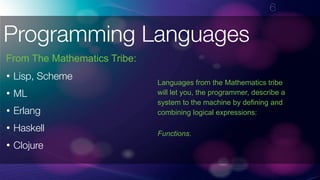
Programming Languages
• Lisp, Scheme
• ML
• Erlang
• Haskell
• Clojure
From The Mathematics Tribe:
Languages from the Mathematics tribe
will let you, the programmer, describe a
system to the machine by defining and
combining logical expressions:
Functions.
!7
Thinking Mathematically
The rest of us can say:
Let a = 10
and then, later:
a = a + 10
A mathematician will be fine with the first statement.
But they will not tolerate the second one.
Mathematicians play by different rules than engineers.
!8
Variables
To a mathematician, variables are just unknown values. We don't
know what they are yet, so we represent them with symbols.
To a software engineer, variables are locations for storing data.
They exist in the real world.
Their contents can change.
!9
Programs
Programs don't exist in mathematics.
Symbols exist.

Expressions exist.
Programs are real-world entities. They have behavior that
changes based on their internal state.
A program, just like the computer it runs on, is a state machine.
!10
State Machines
A state machine will change behavior based on its rules and input.
Programmers define those rules.
Failing to anticipate any input for any program state can create
behavior that is unwanted or undefined.
!11
Program Complexity
The complexity of a program arises from the total number of
internal states it can have.
Managing complexity becomes harder as the total number of
possible states rises.
This number rises as you add features.
!12
What Have We Tried?
• 1930s: Turing machine and lambda calculus created
• 1950s: COBOL and Fortran introduced
• 1960s: Simula, the first object-oriented language

Edsger Dijkstra writes "GOTO Considered Harmful"
• 1970s: Alan Kay and team, inspired by Simula, create and refine

Smalltalk at Xerox Palo Alto Research Center
!13
• 1980s: 4th Generation Language builders try to eliminate programmers.
• 1995: Design Patterns by Gamma, Helm, Johnson, Vlissides
• 1995-2005: ZOMG, DESIGN PATTERNS
• 2005-06: We can't make the CPU faster without burning down your office, so
here's multiple cores. Learn concurrency. Good luck. -- AMD and Intel
What Have We Tried?
!14
• Object-oriented design tries to manage complexity by breaking apart a
program into a community of miniature programs, each of which contains its
own data and methods for doing its job.
• Objects in a system communicate by passing messages to each other. This
was Alan Kay's main idea, but people focused on everything else.
• Multiple cores?? I'm supposed to do multithreaded everything now??
What Have We Tried?
!15
• Objects were supposed to be simple, robust and easy to test.
• In reality, managing the complexity of objects turns out to be non-trivial.
• Data that can be changed can also be corrupted.
• Code turns out to be just another kind of data.
What Have We Tried?
!16
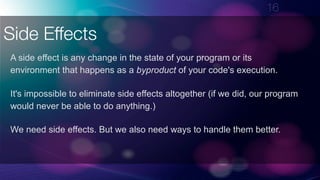
Side Effects
A side effect is any change in the state of your program or its
environment that happens as a byproduct of your code's execution.
It's impossible to eliminate side effects altogether (if we did, our program
would never be able to do anything.)
We need side effects. But we also need ways to handle them better.
!17
Reducing Side Effects
Each part of your program that creates or manipulates state will become
harder to understand and debug as complexity increases.
Every bit of code that creates or changes program state expands the
potential attack surface of your program.
Minimizing the creation and manipulation of internal state is not trivial.
But if you can do it, it will yield more predictable, more reliable code.
!18
A Taste of Pure Functions
A function is an expression that describes a unit of logic in our program.

A pure function is one that does its job without creating any side effects.
factorial 0 = 1

factorial n = n * factorial(n - 1)
The above code computes a result from its input, and returns it, without affecting
anything else. No matter what happens, it will always behave the same way.
!19
A Word About Types
Strictly speaking, a type is a set.
The type Integer is the set of all integers.
The type String is the set of all possible combinations of characters, up
to the maximum allowed string length.
Over time, it's very common to grow accustomed to the meaning of
"data type" as a flavor of data.
!20
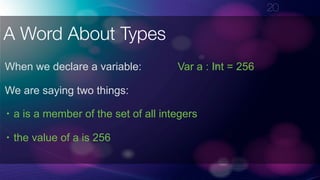
A Word About Types
When we declare a variable: Var a : Int = 256
We are saying two things:
• a is a member of the set of all integers
• the value of a is 256
!21
Functional Concept: Immutability
A variable or data structure that cannot be changed
is one that cannot easily be corrupted.
Immutable Items in Python:
• int
• float
• bool
• str
• tuple
• frozenset
Mutable Items in Python:
• list
• set
• dict
!22
Functional Concept: Immutability
One big caveat here: Everything in Python is an object.
This can be a rude awakening if you aren't aware of the implications.
If you say:
a = 'abcd'
and then say:
a = a + 'efgh'
and finally,
print(a)
you will see the output 'abcdefgh'.
!23
Functional Concept: Immutability
How can we re-assign a value to an immutable object?
We didn't. We had a reference (a) that pointed to an immutable object ('abcd').
Then we created a new immutable object (a + 'efgh') and pointed our reference (a) at it.
Strings are immutable objects. References can be reassigned to point to some other object.
Or, to use another set of terms:
• a is a name.
• 'abcd' is an immutable object.
• a = 'abcd' creates a binding of the name a to the object 'abcd'.
• we can bind a to a new object with the statement a = a + 'efgh'.
!24
Functional Concept: Monoid
Imagine a pair of rules that form a group.
add(a, b) = a + b where a and b are always integers
identity = 0
With these rules, the following things are true:
add(10, 10) == 20 or 10 `add` 10 == 20
add(10, identity) == 10 or 10 `add` `identity` == 10
!25
Functional Concept: Monoid
Here's an example with strings. But why do we need the second of these two rules?
concat(a, b) = a + b
identity() = ''
The easiest answer is that whatever kind of data we are computing with, we
need something that does the equivalent job of zero in addition, or one in
multiplication, or an empty string in concatenation. Applying our monoid
function to some value A and our identity function will always yield the same
value A.
'abc' `concat` 'def' == 'abcdef'
'abc' `concat` `identity` == 'abc'
!26
Functional Concept: Monoid
m :: a -> a
u :: a
Monoids are the building blocks of functional programming. They are key to
implementing features like recursion and iteration.
They are also excellent for building function pipelines, a practice of mixing
and matching functions that is more commonly called composition.
m takes something of type a and returns
something of type a.
u applied to any a returns that same a.
!27
Functional Concept: Monad
m :: a -> Ma
The monad transformation can be computation, but it doesn't have to be. It
can be literally anything, including something that has side effects.
m takes an a, and returns some transformation
of an a.
Monads are the tool that we use in functional programming to perform side
effects. They allow a more controlled, rigorous way of working with the real
world.
!28
Functional Concept: Monad
Some of the most common uses of monads in a functional language:
• Print to the console
• Perform file or network I/O
• Interact with a database
• Control a device
• Basically, do anything that creates or
maintains state somewhere
!29
Functional Programming: Conclusions
Is it magic or sorcery? No.
Is it a perfect answer to the increasing complexity of software systems
and the increasing inability of humans to design and build bug-free,
vulnerability-free software? Probably not.
But it's a step forward, and the fact that it's showing up more and more in
mainstream languages is evidence that it has merits.

DEF CON 27 - workshop - EIGENTOURIST - hacking with monads

  • 1.
    Hacking With Monads FU N CT I O N A L P R O G R A M M I N G F O R T H E B LU E T E A M
  • 2.
    !2 Functional Programming:
 Why? There aretwo tribes of programming philosophy: • Engineers • Mathematicians
  • 3.
    !3 Engineers • Built thehardware • Focus on practical results • Deal with real-world constraints • time • materials • tools • Will create memes like this:
  • 4.
    !4 Mathematicians • Created thelanguage • Focus on theoretical truth • Deal with ideas and possibilities • proofs • equations • logic • Will tell jokes like this: A physicist, a biologist, and a mathematician are sitting in a cafe. Across the street is a house. As they sit talking, two people go into the house. Momentarily, three people come back out. The physicist says, "our initial count must have been incorrect."
 The biologist says, "they must have reproduced." The mathematician says, "now... if one person goes back in, the house will be empty."
  • 5.
    !5 Programming Languages • Fortran •ALGOL • COBOL • Pascal • C, C++, Java, et al. From The Engineering Tribe: Languages from the Engineering tribe are designed to let you, the programmer, tell the machine exactly what, how and when to do something.
  • 6.
    !6 Programming Languages • Lisp,Scheme • ML • Erlang • Haskell • Clojure From The Mathematics Tribe: Languages from the Mathematics tribe will let you, the programmer, describe a system to the machine by defining and combining logical expressions: Functions.
  • 7.
    !7 Thinking Mathematically The restof us can say: Let a = 10 and then, later: a = a + 10 A mathematician will be fine with the first statement. But they will not tolerate the second one. Mathematicians play by different rules than engineers.
  • 8.
    !8 Variables To a mathematician,variables are just unknown values. We don't know what they are yet, so we represent them with symbols. To a software engineer, variables are locations for storing data. They exist in the real world. Their contents can change.
  • 9.
    !9 Programs Programs don't existin mathematics. Symbols exist.
 Expressions exist. Programs are real-world entities. They have behavior that changes based on their internal state. A program, just like the computer it runs on, is a state machine.
  • 10.
    !10 State Machines A statemachine will change behavior based on its rules and input. Programmers define those rules. Failing to anticipate any input for any program state can create behavior that is unwanted or undefined.
  • 11.
    !11 Program Complexity The complexityof a program arises from the total number of internal states it can have. Managing complexity becomes harder as the total number of possible states rises. This number rises as you add features.
  • 12.
    !12 What Have WeTried? • 1930s: Turing machine and lambda calculus created • 1950s: COBOL and Fortran introduced • 1960s: Simula, the first object-oriented language
 Edsger Dijkstra writes "GOTO Considered Harmful" • 1970s: Alan Kay and team, inspired by Simula, create and refine
 Smalltalk at Xerox Palo Alto Research Center
  • 13.
    !13 • 1980s: 4thGeneration Language builders try to eliminate programmers. • 1995: Design Patterns by Gamma, Helm, Johnson, Vlissides • 1995-2005: ZOMG, DESIGN PATTERNS • 2005-06: We can't make the CPU faster without burning down your office, so here's multiple cores. Learn concurrency. Good luck. -- AMD and Intel What Have We Tried?
  • 14.
    !14 • Object-oriented designtries to manage complexity by breaking apart a program into a community of miniature programs, each of which contains its own data and methods for doing its job. • Objects in a system communicate by passing messages to each other. This was Alan Kay's main idea, but people focused on everything else. • Multiple cores?? I'm supposed to do multithreaded everything now?? What Have We Tried?
  • 15.
    !15 • Objects weresupposed to be simple, robust and easy to test. • In reality, managing the complexity of objects turns out to be non-trivial. • Data that can be changed can also be corrupted. • Code turns out to be just another kind of data. What Have We Tried?
  • 16.
    !16 Side Effects A sideeffect is any change in the state of your program or its environment that happens as a byproduct of your code's execution. It's impossible to eliminate side effects altogether (if we did, our program would never be able to do anything.) We need side effects. But we also need ways to handle them better.
  • 17.
    !17 Reducing Side Effects Eachpart of your program that creates or manipulates state will become harder to understand and debug as complexity increases. Every bit of code that creates or changes program state expands the potential attack surface of your program. Minimizing the creation and manipulation of internal state is not trivial. But if you can do it, it will yield more predictable, more reliable code.
  • 18.
    !18 A Taste ofPure Functions A function is an expression that describes a unit of logic in our program.
 A pure function is one that does its job without creating any side effects. factorial 0 = 1
 factorial n = n * factorial(n - 1) The above code computes a result from its input, and returns it, without affecting anything else. No matter what happens, it will always behave the same way.
  • 19.
    !19 A Word AboutTypes Strictly speaking, a type is a set. The type Integer is the set of all integers. The type String is the set of all possible combinations of characters, up to the maximum allowed string length. Over time, it's very common to grow accustomed to the meaning of "data type" as a flavor of data.
  • 20.
    !20 A Word AboutTypes When we declare a variable: Var a : Int = 256 We are saying two things: • a is a member of the set of all integers • the value of a is 256
  • 21.
    !21 Functional Concept: Immutability Avariable or data structure that cannot be changed is one that cannot easily be corrupted. Immutable Items in Python: • int • float • bool • str • tuple • frozenset Mutable Items in Python: • list • set • dict
  • 22.
    !22 Functional Concept: Immutability Onebig caveat here: Everything in Python is an object. This can be a rude awakening if you aren't aware of the implications. If you say: a = 'abcd' and then say: a = a + 'efgh' and finally, print(a) you will see the output 'abcdefgh'.
  • 23.
    !23 Functional Concept: Immutability Howcan we re-assign a value to an immutable object? We didn't. We had a reference (a) that pointed to an immutable object ('abcd'). Then we created a new immutable object (a + 'efgh') and pointed our reference (a) at it. Strings are immutable objects. References can be reassigned to point to some other object. Or, to use another set of terms: • a is a name. • 'abcd' is an immutable object. • a = 'abcd' creates a binding of the name a to the object 'abcd'. • we can bind a to a new object with the statement a = a + 'efgh'.
  • 24.
    !24 Functional Concept: Monoid Imaginea pair of rules that form a group. add(a, b) = a + b where a and b are always integers identity = 0 With these rules, the following things are true: add(10, 10) == 20 or 10 `add` 10 == 20 add(10, identity) == 10 or 10 `add` `identity` == 10
  • 25.
    !25 Functional Concept: Monoid Here'san example with strings. But why do we need the second of these two rules? concat(a, b) = a + b identity() = '' The easiest answer is that whatever kind of data we are computing with, we need something that does the equivalent job of zero in addition, or one in multiplication, or an empty string in concatenation. Applying our monoid function to some value A and our identity function will always yield the same value A. 'abc' `concat` 'def' == 'abcdef' 'abc' `concat` `identity` == 'abc'
  • 26.
    !26 Functional Concept: Monoid m:: a -> a u :: a Monoids are the building blocks of functional programming. They are key to implementing features like recursion and iteration. They are also excellent for building function pipelines, a practice of mixing and matching functions that is more commonly called composition. m takes something of type a and returns something of type a. u applied to any a returns that same a.
  • 27.
    !27 Functional Concept: Monad m:: a -> Ma The monad transformation can be computation, but it doesn't have to be. It can be literally anything, including something that has side effects. m takes an a, and returns some transformation of an a. Monads are the tool that we use in functional programming to perform side effects. They allow a more controlled, rigorous way of working with the real world.
  • 28.
    !28 Functional Concept: Monad Someof the most common uses of monads in a functional language: • Print to the console • Perform file or network I/O • Interact with a database • Control a device • Basically, do anything that creates or maintains state somewhere
  • 29.
    !29 Functional Programming: Conclusions Isit magic or sorcery? No. Is it a perfect answer to the increasing complexity of software systems and the increasing inability of humans to design and build bug-free, vulnerability-free software? Probably not. But it's a step forward, and the fact that it's showing up more and more in mainstream languages is evidence that it has merits.