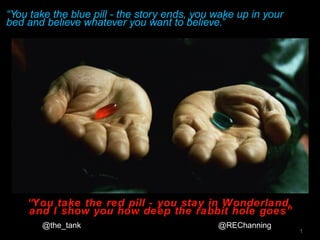
“You take the blue pill - the story ends, you wake up in your
bed and believe whatever you want to believe.”
1
“You take the red pill - you stay in Wonderland,
and I show you how deep the rabbit hole goes”
@the_tank @REChanning
What are the kinds of deep
thinking?
About how pupils are
learning
About what
pupils are
learning
Encourages them
to evaluate their
own progress
Assessment for
Learning
Encourages them
to refuse to take
learning at face
value
What are the kinds of deep
thinking?
About what
pupils are
learning
Encourages them
to refuse to take
learning at face
value
A perfect circle
A perfect circle
A perfect circle
A stimulus can be anything
Initial reactions
Themes?
Turn these into
questions
Best-guesses
9
Question rotation
10
Lego pieces
Stops the same pupils
dominating the
dialogue
Ensures pupils make
their point count
Gives them a visual
prompt to build on
ideas of others
Scribes
Can be
used
throughout
a lesson, a
discussion
or at the
end
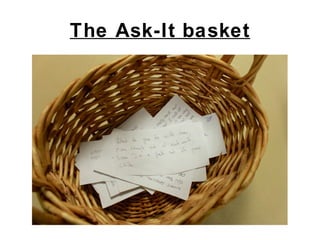
The Ask-It basket
The Opinion line
14
Works well when it is
hard for pupils to come
to a decision for one
side or the other
Presents the opportunity
to lean towards a certain
point of view without
committing to it
What are the kinds of deep
thinking?
About how pupils are
learning
Encourages them
to evaluate their
own progress
Assessment for
Learning
The Concept Wall
What makes an excellent philosophy
student?
An ability to build onAn ability to build on
arguments of othersarguments of others
An ability to questionAn ability to question
everythingeverything
A desire to learn forA desire to learn for
learninglearning’s sake’s sake
An appreciation ofAn appreciation of
other thoughtsother thoughts
To spot themes andTo spot themes and
ideasideas
To remove personalTo remove personal
allegiancesallegiances
Someone who canSomeone who can
argue in an academicargue in an academic
mannermanner
To refrain fromTo refrain from
drifting into irrelevantdrifting into irrelevant
personal anecdotespersonal anecdotes
Split screen objectives
What will we find out?
To research the Hindu
Caste system
To investigate how
Gandhi became involved in
the system
What will we do with
this?
To assess the viability of
such a system in today’s
world
To examine the ethics
behind this tradition
To evaluate whether
Gandhi’s personal
struggle was worth it
Thought diaries
Unmarked
Allows pupils to record
their thoughts/progress
in a creative, rough way
The Four Cs
In Philosophy -
Co-operative
Critical
Creative
Caring
History: Analysis, Synthesis, Evaluation,
Comparison?
“You take the blue pill - the story ends, you wake up in your
bed and believe whatever you want to believe.”
21
“You take the red pill - you stay in Wonderland,
and I show you how deep the rabbit hole goes”
@the_tank @REChanning
Further reading
de A’Echevarria, Anne, and Patience, Ian: Teaching thinking
Pocketbook
Hymer, Barry: Gifted and Talented Pocketbook
thinkingeducation.co.uk
saphere.org.uk
p4c.com
Ginnis, Paul: The Teacher’s Toolkit
22
@the_tank
@REChanning

Deep thinking briefing

  • 1.
    “You take theblue pill - the story ends, you wake up in your bed and believe whatever you want to believe.” 1 “You take the red pill - you stay in Wonderland, and I show you how deep the rabbit hole goes” @the_tank @REChanning
  • 2.
    What are thekinds of deep thinking? About how pupils are learning About what pupils are learning Encourages them to evaluate their own progress Assessment for Learning Encourages them to refuse to take learning at face value
  • 3.
    What are thekinds of deep thinking? About what pupils are learning Encourages them to refuse to take learning at face value
  • 4.
  • 5.
  • 6.
  • 7.
    A stimulus canbe anything
  • 8.
  • 9.
  • 10.
  • 11.
    Lego pieces Stops thesame pupils dominating the dialogue Ensures pupils make their point count Gives them a visual prompt to build on ideas of others
  • 12.
    Scribes Can be used throughout a lesson,a discussion or at the end
  • 13.
  • 14.
    The Opinion line 14 Workswell when it is hard for pupils to come to a decision for one side or the other Presents the opportunity to lean towards a certain point of view without committing to it
  • 15.
    What are thekinds of deep thinking? About how pupils are learning Encourages them to evaluate their own progress Assessment for Learning
  • 16.
    The Concept Wall Whatmakes an excellent philosophy student? An ability to build onAn ability to build on arguments of othersarguments of others An ability to questionAn ability to question everythingeverything A desire to learn forA desire to learn for learninglearning’s sake’s sake An appreciation ofAn appreciation of other thoughtsother thoughts To spot themes andTo spot themes and ideasideas To remove personalTo remove personal allegiancesallegiances Someone who canSomeone who can argue in an academicargue in an academic mannermanner To refrain fromTo refrain from drifting into irrelevantdrifting into irrelevant personal anecdotespersonal anecdotes
  • 18.
    Split screen objectives Whatwill we find out? To research the Hindu Caste system To investigate how Gandhi became involved in the system What will we do with this? To assess the viability of such a system in today’s world To examine the ethics behind this tradition To evaluate whether Gandhi’s personal struggle was worth it
  • 19.
    Thought diaries Unmarked Allows pupilsto record their thoughts/progress in a creative, rough way
  • 20.
    The Four Cs InPhilosophy - Co-operative Critical Creative Caring History: Analysis, Synthesis, Evaluation, Comparison?
  • 21.
    “You take theblue pill - the story ends, you wake up in your bed and believe whatever you want to believe.” 21 “You take the red pill - you stay in Wonderland, and I show you how deep the rabbit hole goes” @the_tank @REChanning
  • 22.
    Further reading de A’Echevarria,Anne, and Patience, Ian: Teaching thinking Pocketbook Hymer, Barry: Gifted and Talented Pocketbook thinkingeducation.co.uk saphere.org.uk p4c.com Ginnis, Paul: The Teacher’s Toolkit 22 @the_tank @REChanning

Editor's Notes

  • #2 Former Head of RE used this to describe taking an RE GCSE. This presentation is about facilitating deep thinking, and exploring the rabbit holes which lie beneath the issues, concepts and phenomenons they study. Whilst not all subjects will directly allow pupils to explore the nature of reality, an absolute ethical theory or the existence of an all powerful deity, we can take steps to let them question, and refuse to take what they learn at face value.
  • #3 Deep thinking, for me, involves two areas - first of all, what they are learning encourages them to dig a little deeper. Deep thinking on how they are learning encourages them to evaluate their own progress, methods, work ethic etc, and provides excellent AfL.
  • #4 Deep thinking, for me, involves two areas - first of all, what they are learning encourages them to dig a little deeper. Deep thinking on how they are learning encourages them to evaluate their own progress, methods, work ethic etc, and provides excellent AfL.
  • #5 Crucial to any enquiry is a perfect circle, or as close to as possible within the dimensions of a classroom. It is very easy for some to sit even slightly in front of others, which will leave the quieter pupils feeling isolated. Even the smallest difference in angle towards the teacher can influence whether a pupil becomes involved or not.
  • #6 An enquiry must not look like this - it is not a game of please the teacher. Nor are they to direct their questions and answers to you. Instead...
  • #7 They should be engaging in dialogue with each other, and it works well to show them these two diagrams before they start out on a discussion.
  • #8 An enquiry begins with a stimulus (a video works well) which can be related to the lesson you are teaching.
  • #9 Pupils can then be invited to go through several stages before reaching a discussion. These build up thoughts gradually and give them the best possible preparation for a dialogue later in the lesson. Begin with initial reactions - in their heads first, and then in partners, and then in fours. Following a sharing of initial reactions (unpacking the stimulus, if you like), they can then think of themes that can be drawn from the stimulus. For example, themes from this video: BLACK HOLE included greed, abuse of power and curiosity to name a few. Guidance can be provided when first facilitating an enquiry on how questions start. Rules can be laid down, such as ‘the answer cannot be Googled’ and ‘can be asked to anyone.’ Pupils then pick their best question that they came up with and offer it to the whole class.
  • #10 Another technique in philosophy is to allow them to investigate a concept (restorative justice here, for example, or the American dream was used in another) without knowing about it. They can use the words in it as clues and try to guess what it means. They can then add, in another colour, what it actually means and see if answers of different colours are similar in meaning. Again, this gives them ownership over the lesson and allows them to postulate on a concept before being given an explanation of what it is.
  • #11 Put the questions around the room and in groups of three or four rotate around to a new one every few minutes, writing down their reactions.
  • #12 Giving each pupil a lego piece also works well for the reasons above.
  • #13 Scribes provide a way of giving responsibility over to pupils to record what they have done. It allows you to come back and visually review the progress that they say they have made.
  • #14 These enquiries produce not only answers, but other questions. For this, a feature popular in year 7 is the ‘Ask-it basket.’ This can be used when pupils feel that before we answer a question, another question must be asked, to narrow the focus of the enquiry. The ‘Ask-it Basket’ assures pupils that their questions are valued and gives something to reflect the group’s efforts.
  • #15 In debates it can be very hard for some pupils to come to a decision for one side or the other. An opinion line, where one end represents one belief, and the other the opposite, allows them to place themselves somewhere in between, and also provides them the opportunity to lean toward a certain side without committing to it.
  • #16 Deep thinking, for me, involves two areas - first of all, what they are learning encourages them to dig a little deeper. Deep thinking on how they are learning encourages them to evaluate their own progress, methods, work ethic etc, and provides excellent AfL.
  • #17 Concept walls are a good way to start and end a lesson - a question such as this focusses them on your subject - crucial, given that they are changing disciplines up to six times a day. It also provides excellent AfL if you return to it at the end and try and knock the wall down.
  • #19 Split screen objectives put an emphasis on both the acquisition of knowledge and the thinking they will apply to it. This can also work with thinking skills being placed on the right.
  • #20 The thought diaries are used in philosophy and are unmarked - so pupils aren ’t constrained by rules of tidiness or trying to please the teacher, and can record notes freely or creatively. Doodling can be a problem (which can happen if pupils aren’t engaged in a discussion - yet can also reflect deep thought. The look on their face often gives away which one it is. And how detailed the shell of the snail they are drawing is).
  • #21 This can also be expanded to other skills for other subjects...
  • #22 Former Head of RE used this to describe taking an RE GCSE. This presentation is about facilitating deep thinking, and exploring the rabbit holes which lie beneath the issues, concepts and phenomenons they study. Whilst not all subjects will directly allow pupils to explore the nature of reality, an absolute ethical theory or the existence of an all powerful deity, we can take steps to let them question, and refuse to take what they learn at face value.