http://multimedialab.elis.ugent.be
Ghent University – iMinds, ELIS Department/Multimedia Lab
Gaston Crommenlaan 8 bus 201
B-9050 Ledeberg – Ghent, Belgium
Jasper Zuallaert, Wesley De Neve, Erik Mannens
FEA Research Symposium 2015
{jasper.zuallaert, wesley.deneve, erik.mannens}@ugent.be
DEEP MACHINE LEARNING FOR AUTOMATING BIOTECH TASKS
THROUGH SELF-LEARNED EXPERT SKILLSETS
9th December | Ghent | Belgium
Biotechnology Deep Learning
Biggest successes achieved on
supervised learning,
requiring huge amounts of annotated data
Unsupervised learning = Holy Grail
Still images (e.g., whale photographs)
Genomics/
Proteomics
Moving images (e.g., parasite videos)
How do we cope with a lack of
available data and/or annotations?
How can we exploit unsupervised
learning to automate even more?
To what extent can we automate
cumbersome biotech tasks?
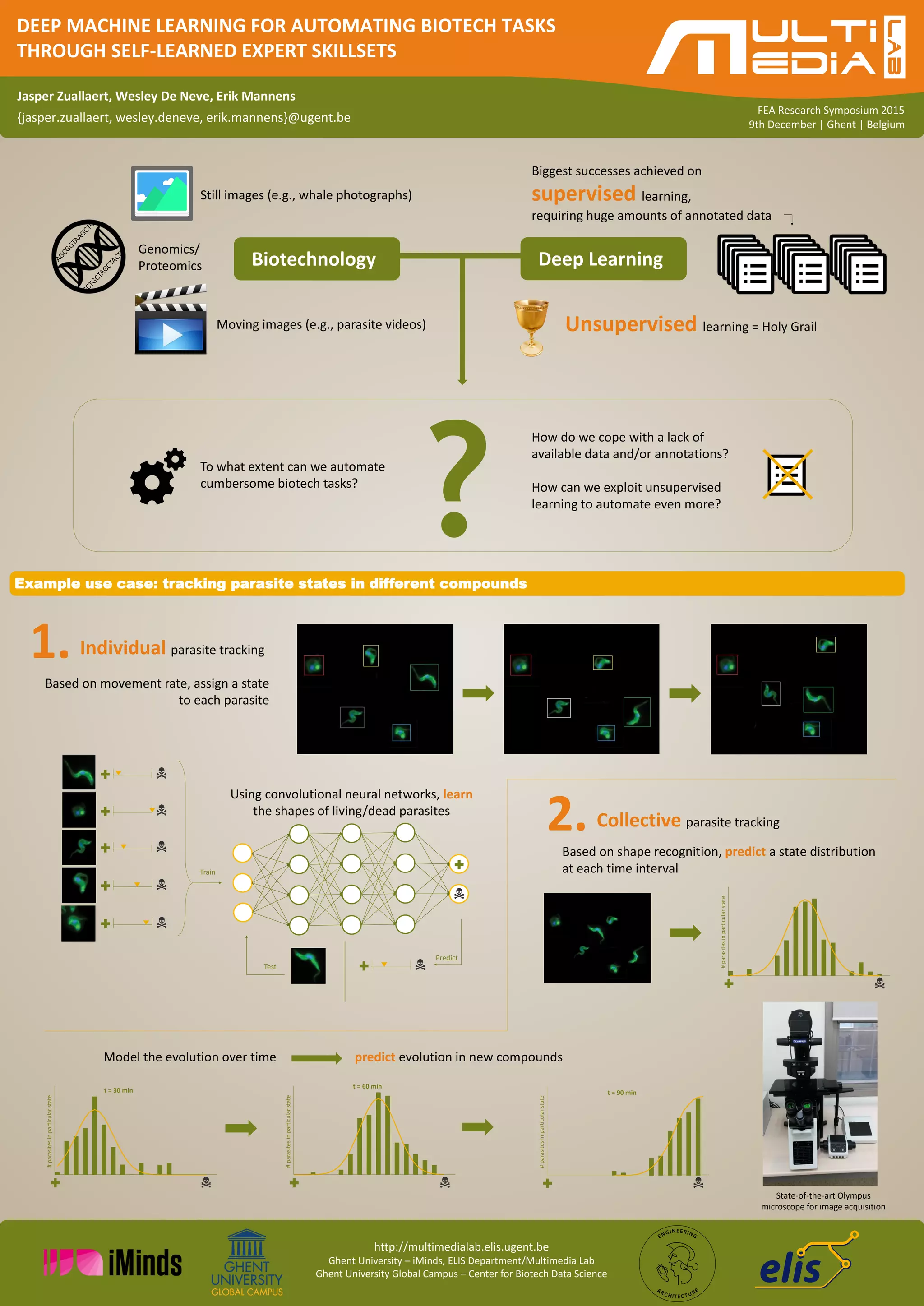
Example use case: tracking parasite states in different compounds
Train
Test
Predict
#parasitesinparticularstate
t = 30 min
#parasitesinparticularstate
t = 60 min
#parasitesinparticularstate
t = 90 min
Individual parasite tracking1.
Based on movement rate, assign a state
to each parasite
Using convolutional neural networks, learn
the shapes of living/dead parasites
Collective parasite tracking2.Based on shape recognition, predict a state distribution
at each time interval
Model the evolution over time predict evolution in new compounds
State-of-the-art Olympus
microscope for image acquisition
http://multimedialab.elis.ugent.be
Ghent University – iMinds, ELIS Department/Multimedia Lab
Ghent University Global Campus – Center for Biotech Data Science

Deep Machine Learning for Automating Biotech Tasks Through Self-Learning Expert Skillsets

  • 1.
    http://multimedialab.elis.ugent.be Ghent University –iMinds, ELIS Department/Multimedia Lab Gaston Crommenlaan 8 bus 201 B-9050 Ledeberg – Ghent, Belgium Jasper Zuallaert, Wesley De Neve, Erik Mannens FEA Research Symposium 2015 {jasper.zuallaert, wesley.deneve, erik.mannens}@ugent.be DEEP MACHINE LEARNING FOR AUTOMATING BIOTECH TASKS THROUGH SELF-LEARNED EXPERT SKILLSETS 9th December | Ghent | Belgium Biotechnology Deep Learning Biggest successes achieved on supervised learning, requiring huge amounts of annotated data Unsupervised learning = Holy Grail Still images (e.g., whale photographs) Genomics/ Proteomics Moving images (e.g., parasite videos) How do we cope with a lack of available data and/or annotations? How can we exploit unsupervised learning to automate even more? To what extent can we automate cumbersome biotech tasks? Example use case: tracking parasite states in different compounds Train Test Predict #parasitesinparticularstate #parasitesinparticularstate t = 30 min #parasitesinparticularstate t = 60 min #parasitesinparticularstate t = 90 min Individual parasite tracking1. Based on movement rate, assign a state to each parasite Using convolutional neural networks, learn the shapes of living/dead parasites Collective parasite tracking2.Based on shape recognition, predict a state distribution at each time interval Model the evolution over time predict evolution in new compounds State-of-the-art Olympus microscope for image acquisition http://multimedialab.elis.ugent.be Ghent University – iMinds, ELIS Department/Multimedia Lab Ghent University Global Campus – Center for Biotech Data Science