Deep Learning
Deep Learning
• Deep learning is part of a broader family of machine learning methods
based on artificial neural networks with representation learning.
Learning can be supervised, semi-supervised or unsupervised.
• A type of machine learning based on artificial neural networks in
which multiple layers of processing are used to
extract progressively higher level features from data.
• Deep learning is a subset of machine learning, which is
essentially a neural network with three or more layers. These
neural networks attempt to simulate the behavior of the human brain
—albeit far from matching its ability—allowing it to “learn” from large
amounts of data.
Deep Learning
• Deep Learning is a subset of machine learning that uses
vast volumes of data and complex algorithms to train a
model.
• Deep learning makes it faster and easier to interpret large
amounts of data and form them into meaningful information. It is
used in multiple industries, including automatic driving and
medical devices.
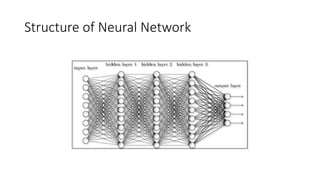
Structure of Neural Network
What is Tenserflow and Keras
• The TensorFlow platform helps you implement best practices for
data automation, model tracking, performance monitoring, and
model retraining. Using production-level tools to automate and
track model training over the lifetime of a product, service, or
business process is critical to success.
• Keras is a high-level, deep learning API developed by Google
for implementing neural networks. It is written in Python and is
used to make the implementation of neural networks easy. It also
supports multiple backend neural network computation.
• Keras is a deep learning API written in Python, running on top of
the machine learning platform TensorFlow.
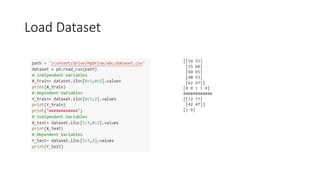
Load Dataset
Deep Learning Model
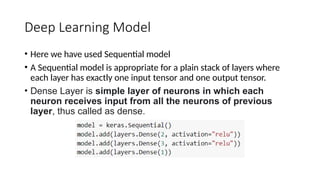
• Here we have used Sequential model
• A Sequential model is appropriate for a plain stack of layers where
each layer has exactly one input tensor and one output tensor.
• Dense Layer is simple layer of neurons in which each
neuron receives input from all the neurons of previous
layer, thus called as dense.
Deep Learning Model
• Tensor can be defined as a data container. It can be thought of
as a multi-dimensional array. Numpy np. array can be used to
create tensor of different dimensions such as 1D, 2D, 3D etc. A
vector is a 1D tensor, a matrix is a 2D tensor.
• The number of neurons in the input layer is equal to the
number of features in the data and in very rare cases, there
will be one input layer for bias. Whereas the number of neurons
in the output depends on whether is the model is used as a
regressor or classifier.
Dense Function
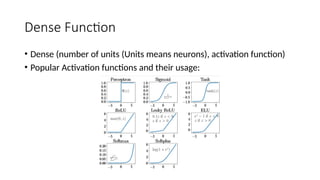
• Dense (number of units (Units means neurons), activation function)
• Popular Activation functions and their usage:
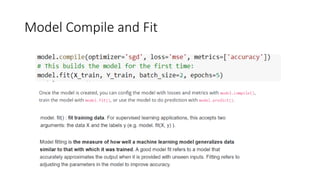
Model Compile and Fit
Optimizer
• We have already discussed these in the previous lecture:
1.Gradient Descent
2.Stochastic Gradient Descent
3.Stochastic Gradient descent with momentum
4.Mini-Batch Gradient Descent
5.Adagrad
6.RMSProp
7.AdaDelta
8.Adam
Loss Functions
• Mean Absolute Error (L1 Loss)
• Mean Squared Error (L2 Loss)
• Huber Loss.
• Cross-Entropy(a.k.a Log loss)
• Relative Entropy(a.k.a Kullback–Leibler divergence)
• Squared Hinge.
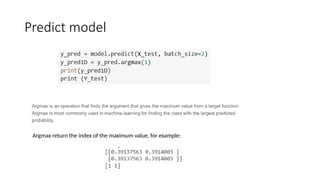
Predict model
Argmax return the index of the maximum value, for example:
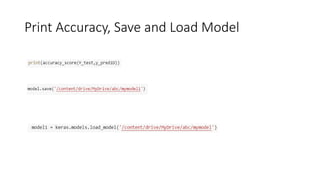
Print Accuracy, Save and Load Model
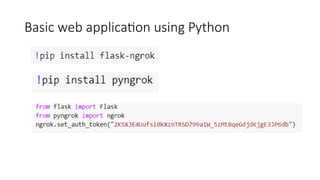
Basic web application using Python
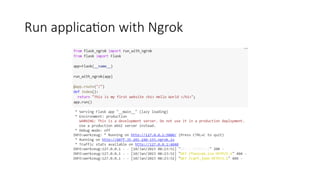
Run application with Ngrok
• Thanks

Deep Learning Structure of Neural Network.pptx

  • 1.
  • 2.
    Deep Learning • Deeplearning is part of a broader family of machine learning methods based on artificial neural networks with representation learning. Learning can be supervised, semi-supervised or unsupervised. • A type of machine learning based on artificial neural networks in which multiple layers of processing are used to extract progressively higher level features from data. • Deep learning is a subset of machine learning, which is essentially a neural network with three or more layers. These neural networks attempt to simulate the behavior of the human brain —albeit far from matching its ability—allowing it to “learn” from large amounts of data.
  • 3.
    Deep Learning • DeepLearning is a subset of machine learning that uses vast volumes of data and complex algorithms to train a model. • Deep learning makes it faster and easier to interpret large amounts of data and form them into meaningful information. It is used in multiple industries, including automatic driving and medical devices.
  • 4.
  • 5.
    What is Tenserflowand Keras • The TensorFlow platform helps you implement best practices for data automation, model tracking, performance monitoring, and model retraining. Using production-level tools to automate and track model training over the lifetime of a product, service, or business process is critical to success. • Keras is a high-level, deep learning API developed by Google for implementing neural networks. It is written in Python and is used to make the implementation of neural networks easy. It also supports multiple backend neural network computation. • Keras is a deep learning API written in Python, running on top of the machine learning platform TensorFlow.
  • 6.
  • 7.
    Deep Learning Model •Here we have used Sequential model • A Sequential model is appropriate for a plain stack of layers where each layer has exactly one input tensor and one output tensor. • Dense Layer is simple layer of neurons in which each neuron receives input from all the neurons of previous layer, thus called as dense.
  • 8.
    Deep Learning Model •Tensor can be defined as a data container. It can be thought of as a multi-dimensional array. Numpy np. array can be used to create tensor of different dimensions such as 1D, 2D, 3D etc. A vector is a 1D tensor, a matrix is a 2D tensor. • The number of neurons in the input layer is equal to the number of features in the data and in very rare cases, there will be one input layer for bias. Whereas the number of neurons in the output depends on whether is the model is used as a regressor or classifier.
  • 9.
    Dense Function • Dense(number of units (Units means neurons), activation function) • Popular Activation functions and their usage:
  • 10.
  • 11.
    Optimizer • We havealready discussed these in the previous lecture: 1.Gradient Descent 2.Stochastic Gradient Descent 3.Stochastic Gradient descent with momentum 4.Mini-Batch Gradient Descent 5.Adagrad 6.RMSProp 7.AdaDelta 8.Adam
  • 12.
    Loss Functions • MeanAbsolute Error (L1 Loss) • Mean Squared Error (L2 Loss) • Huber Loss. • Cross-Entropy(a.k.a Log loss) • Relative Entropy(a.k.a Kullback–Leibler divergence) • Squared Hinge.
  • 13.
    Predict model Argmax returnthe index of the maximum value, for example:
  • 14.
    Print Accuracy, Saveand Load Model
  • 15.
  • 16.
  • 17.