
MODULE 5Deductible Expenses & Record Keeping
FREQUENTLY ASKED QUESTIONSWhat am I allowed to deduct?How should I keep track of expenses
FREQUENTLY ASKED QUESTIONSAutomobile ExpensesShould I buy or lease a vehicle in the company name or personally?Should I buy or lease the vehicle? What’s better for tax purposes?How should I pay my vehicle expenses?Do I have to keep a kilometer log?
FREQUENTLY ASKED QUESTIONSHome Office ExpensesAm I allowed to write off any home office expenses?If so, what expenses are deductible and how much?How do I keep track of the expenses?
FREQUENTLY ASKED QUESTIONSTravel ExpensesCan I write off any of my trips?What about meals and entertaining clients? Can I do anything with those?
AUTO EXPENSESDeductibility and how to deduct will depend on a number of factorsProprietorship, partnership or corporationWho owns the vehicle – company or personalLease or purchased
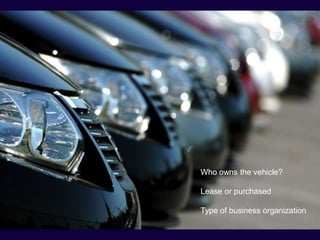
Who owns the vehicle?Lease or purchasedType of business organization
AUTO – PROPRIETORSHIPGas and oilRepairs and maintenance InsuranceLease costs or depreciationLicense fees Business use:  You can only write off the proportion of expenses used for business purposes
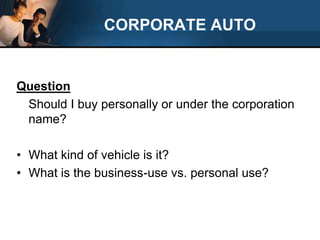
CORPORATE AUTO Question	Should I buy personally or under the corporation name?What kind of vehicle is it?What is the business-use vs. personal use?
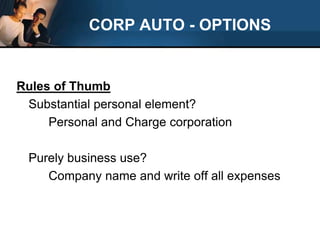
CORP AUTO - OPTIONS Rules of Thumb	Substantial personal element?		Personal and Charge corporation	Purely business use?		Company name and write off all expenses
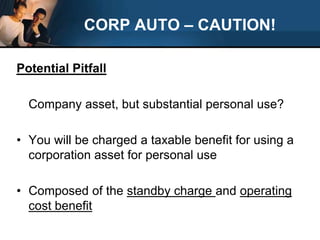
CORP AUTO – CAUTION! Potential Pitfall	Company asset, but substantial personal use?You will be charged a taxable benefit for using a corporation asset for personal useComposed of the standby charge and operating cost benefit
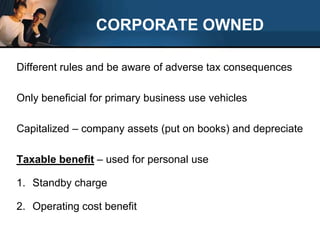
CORPORATE OWNEDDifferent rules and be aware of adverse tax consequencesOnly beneficial for primary business use vehiclesCapitalized – company assets (put on books) and depreciateTaxable benefit– used for personal use	Standby chargeOperating cost benefit
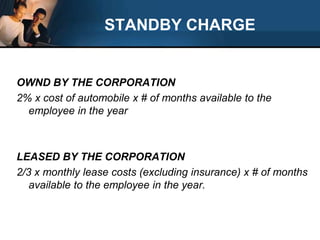
STANDBY CHARGEOWND BY THE CORPORATION2% x cost of automobile x # of months available to the employee in the yearLEASED BY THE CORPORATION2/3 x monthly lease costs (excluding insurance) x # of months available to the employee in the year.
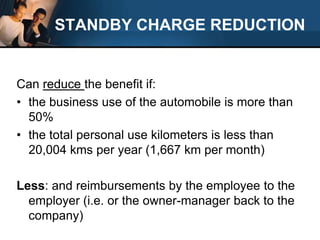
STANDBY CHARGE REDUCTIONCan reduce the benefit if:the business use of the automobile is more than 50%the total personal use kilometers is less than 20,004 kms per year (1,667 km per month)Less: and reimbursements by the employee to the employer (i.e. or the owner-manager back to the company)
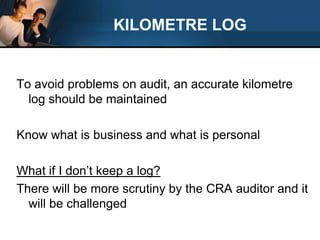
KILOMETRE LOGTo avoid problems on audit, an accurate kilometre log should be maintainedKnow what is business and what is personalWhat if I don’t keep a log?There will be more scrutiny by the CRA auditor and it will be challenged
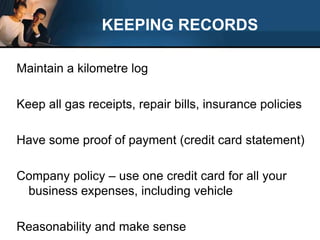
KEEPING RECORDSMaintain a kilometre logKeep all gas receipts, repair bills, insurance policiesHave some proof of payment (credit card statement)Company policy – use one credit card for all your business expenses, including vehicleReasonability and make sense
BUY VS. LEASEShould I buy or lease my car – What is better for me tax-wise?Tax implications – there is not a significant difference (either write off lease payments or take CCA on the vehicle)If charging company based on prescribed rates then it won’t matter
HOME OFFICE EXPENSESCan only deduct (as a proprietorship) if:Predominant place where you meet clientsPrimary place where you operate your businessDetermine expenses, then multiply by % of total square feet used for businessFor proprietor, cannot use home office expenses to create or increase a loss – carryforward unused
HOME OFFICE - CORPORATIONStep 1: Determine the monthly amount that will cover the business proportionStep 2: As part of your expense reports, reimburse yourself for these expensesStep 3: At the end of the year, declare the rental income with the proportionate expense on your tax return
OTHER EXPENSESTravel Expense – be aware of the personal element and do some due diligence in writing-offMeals & Entertainment – Keep receipts, write down who you entertained, again due diligence on any personal componentClothing & Grooming – non-deductible in all cases unless specific to the job and not personal in nature
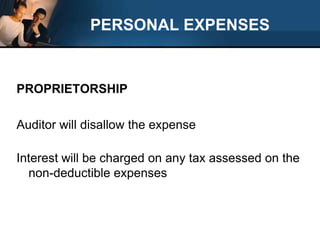
PERSONAL EXPENSESPROPRIETORSHIPAuditor will disallow the expenseInterest will be charged on any tax assessed on the non-deductible expenses
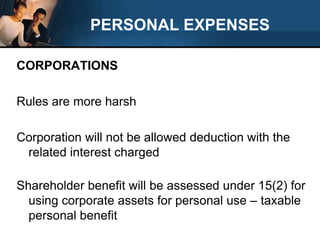
PERSONAL EXPENSESCORPORATIONSRules are more harshCorporation will not be allowed deduction with the related interest chargedShareholder benefit will be assessed under 15(2) for using corporate assets for personal use – taxable personal benefit
Canadian Small Business Coursewww.sbclearnbusiness.com Visit us online and take the Canadian Small Business Course for the in-depth video tutorials related to this presentation
Canadian Small Business Coursewww.sbclearnbusiness.com Or take individual modules such as this presentation:Module 1:  Forms of business organizationModule 2:  Starting a business step-by-stepModule 3:  Compensation strategiesModule 4:  Tax planning and strategiesModule 5:  Expenses and deductions

Deductible expenses & record keeping

  • 1.
  • 2.
    FREQUENTLY ASKED QUESTIONSWhatam I allowed to deduct?How should I keep track of expenses
  • 3.
    FREQUENTLY ASKED QUESTIONSAutomobileExpensesShould I buy or lease a vehicle in the company name or personally?Should I buy or lease the vehicle? What’s better for tax purposes?How should I pay my vehicle expenses?Do I have to keep a kilometer log?
  • 4.
    FREQUENTLY ASKED QUESTIONSHomeOffice ExpensesAm I allowed to write off any home office expenses?If so, what expenses are deductible and how much?How do I keep track of the expenses?
  • 5.
    FREQUENTLY ASKED QUESTIONSTravelExpensesCan I write off any of my trips?What about meals and entertaining clients? Can I do anything with those?
  • 6.
    AUTO EXPENSESDeductibility andhow to deduct will depend on a number of factorsProprietorship, partnership or corporationWho owns the vehicle – company or personalLease or purchased
  • 7.
    Who owns thevehicle?Lease or purchasedType of business organization
  • 8.
    AUTO – PROPRIETORSHIPGasand oilRepairs and maintenance InsuranceLease costs or depreciationLicense fees Business use: You can only write off the proportion of expenses used for business purposes
  • 9.
    CORPORATE AUTO Question ShouldI buy personally or under the corporation name?What kind of vehicle is it?What is the business-use vs. personal use?
  • 10.
    CORP AUTO -OPTIONS Rules of Thumb Substantial personal element? Personal and Charge corporation Purely business use? Company name and write off all expenses
  • 11.
    CORP AUTO –CAUTION! Potential Pitfall Company asset, but substantial personal use?You will be charged a taxable benefit for using a corporation asset for personal useComposed of the standby charge and operating cost benefit
  • 12.
    CORPORATE OWNEDDifferent rulesand be aware of adverse tax consequencesOnly beneficial for primary business use vehiclesCapitalized – company assets (put on books) and depreciateTaxable benefit– used for personal use Standby chargeOperating cost benefit
  • 13.
    STANDBY CHARGEOWND BYTHE CORPORATION2% x cost of automobile x # of months available to the employee in the yearLEASED BY THE CORPORATION2/3 x monthly lease costs (excluding insurance) x # of months available to the employee in the year.
  • 14.
    STANDBY CHARGE REDUCTIONCanreduce the benefit if:the business use of the automobile is more than 50%the total personal use kilometers is less than 20,004 kms per year (1,667 km per month)Less: and reimbursements by the employee to the employer (i.e. or the owner-manager back to the company)
  • 15.
    KILOMETRE LOGTo avoidproblems on audit, an accurate kilometre log should be maintainedKnow what is business and what is personalWhat if I don’t keep a log?There will be more scrutiny by the CRA auditor and it will be challenged
  • 16.
    KEEPING RECORDSMaintain akilometre logKeep all gas receipts, repair bills, insurance policiesHave some proof of payment (credit card statement)Company policy – use one credit card for all your business expenses, including vehicleReasonability and make sense
  • 17.
    BUY VS. LEASEShouldI buy or lease my car – What is better for me tax-wise?Tax implications – there is not a significant difference (either write off lease payments or take CCA on the vehicle)If charging company based on prescribed rates then it won’t matter
  • 18.
    HOME OFFICE EXPENSESCanonly deduct (as a proprietorship) if:Predominant place where you meet clientsPrimary place where you operate your businessDetermine expenses, then multiply by % of total square feet used for businessFor proprietor, cannot use home office expenses to create or increase a loss – carryforward unused
  • 19.
    HOME OFFICE -CORPORATIONStep 1: Determine the monthly amount that will cover the business proportionStep 2: As part of your expense reports, reimburse yourself for these expensesStep 3: At the end of the year, declare the rental income with the proportionate expense on your tax return
  • 20.
    OTHER EXPENSESTravel Expense– be aware of the personal element and do some due diligence in writing-offMeals & Entertainment – Keep receipts, write down who you entertained, again due diligence on any personal componentClothing & Grooming – non-deductible in all cases unless specific to the job and not personal in nature
  • 21.
    PERSONAL EXPENSESPROPRIETORSHIPAuditor willdisallow the expenseInterest will be charged on any tax assessed on the non-deductible expenses
  • 22.
    PERSONAL EXPENSESCORPORATIONSRules aremore harshCorporation will not be allowed deduction with the related interest chargedShareholder benefit will be assessed under 15(2) for using corporate assets for personal use – taxable personal benefit
  • 23.
    Canadian Small BusinessCoursewww.sbclearnbusiness.com Visit us online and take the Canadian Small Business Course for the in-depth video tutorials related to this presentation
  • 24.
    Canadian Small BusinessCoursewww.sbclearnbusiness.com Or take individual modules such as this presentation:Module 1: Forms of business organizationModule 2: Starting a business step-by-stepModule 3: Compensation strategiesModule 4: Tax planning and strategiesModule 5: Expenses and deductions