Decision making
Outline
Why decision making?
Ways of doing it
Unfolding case study
Example of case study
Preparation of case study
2
Decision Making/Critical Thinking
3
Decision making is
the process of making choices by
identifying a decision, gathering
information, and assessing alternative
resolutions.
 Benner (2014): pedagogy to facilitate
the development of “thinking-in-
action.”
Ways of doing decision making
4
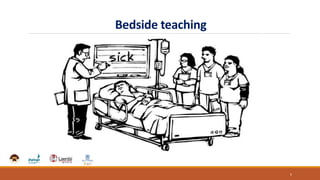
Bedside teaching
5
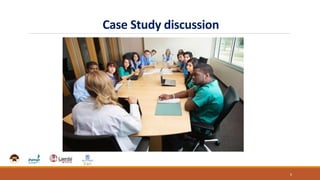
Case Study discussion
6
Unfolding the case study
An unfolding case study is one that evolves over time in a manner
that is unpredictable to the learner.
New situations develop and are revealed with each encounter
7
Unfolding the case study
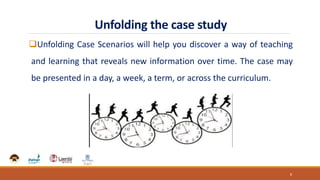
Unfolding Case Scenarios will help you discover a way of teaching
and learning that reveals new information over time. The case may
be presented in a day, a week, a term, or across the curriculum.
8
How to do unfolding?
Individual scenarios can stand alone
Used with one group over a period of time
Used with a large group with different participants
entering into the scenarios
9
Benefits
Learners get to “know” the patient
Experience emotions
Reflect on known patient information
Reflects reality of patient care
10
Mrs. S. is a 25-year-primi gravida with 38 weeks of pregnancy, admitted in early labor ward in this morning.
On admission her cervix was 4cm dilated, vertex presentation, descent of the head was 2/5 and intact
membrane. The FHR was 132b/min.
After 4 hours the per vaginal examination showed that cervical dilation is 5cm and uterine contraction was
mild to moderate in four hour period and head descent is 1/5 . So obstetrician planed for ARM and
agumentation with syntocin (2.5 unit in 500ml of RL).
After an hour of agumentation there are FHR deceleration down to 90b/min noted following contraction
with slow recovery to baseline. Therefore Mrs S. is kept under continue external fetal monitoring.
11
Case Study
Assessment
What will you include in your assessment of Mrs. S., and why?
You have completed your assessment of Mrs. S. and your main
findings include the following:
 Her uterine contraction strong and coming frequently every 2 minutes.
 In CTG, there is variabledeceleration with reduced variability.
 On her perineal pad there is mild meuconiumstained liquor seen.
 Her vital signs seem normal.
Based on these findings, what is Mrs. S.’s diagnosis, and why?
Care provision (planning and intervention)
Based on your diagnosis, what is your plan of care for Mrs. S., and
why?
Evaluation
 After intervention, her FHS is regular and there is no more
deceleration in CTG and baseline Variability is 15-20
 She has 3 contractions in 10 minutes (2 strong and one mild)
Based on these findings, what is your continuing plan of
care for Mrs. S., and why?
Designing the case study
Select the content areas and cognitive skills you want to address, building on
student’s prior knowledge. Review the literature and any pertinent clinical
guidelines.
Identify the learning objectives you hope to facilitate.
Create the story based on a realistic situation in clinical practice, including
changing or developing conditions over time.
Identify the woman’s characteristics, demographics, and setting. Create a
detailed picture of the woman, including some history, perhaps family
involvement, cultural aspects, and/or psychosocial factors.
18
19

Decision making.pptx in which we learn to take decision

  • 1.
  • 2.
    Outline Why decision making? Waysof doing it Unfolding case study Example of case study Preparation of case study 2
  • 3.
    Decision Making/Critical Thinking 3 Decisionmaking is the process of making choices by identifying a decision, gathering information, and assessing alternative resolutions.  Benner (2014): pedagogy to facilitate the development of “thinking-in- action.”
  • 4.
    Ways of doingdecision making 4
  • 5.
  • 6.
  • 7.
    Unfolding the casestudy An unfolding case study is one that evolves over time in a manner that is unpredictable to the learner. New situations develop and are revealed with each encounter 7
  • 8.
    Unfolding the casestudy Unfolding Case Scenarios will help you discover a way of teaching and learning that reveals new information over time. The case may be presented in a day, a week, a term, or across the curriculum. 8
  • 9.
    How to dounfolding? Individual scenarios can stand alone Used with one group over a period of time Used with a large group with different participants entering into the scenarios 9
  • 10.
    Benefits Learners get to“know” the patient Experience emotions Reflect on known patient information Reflects reality of patient care 10
  • 11.
    Mrs. S. isa 25-year-primi gravida with 38 weeks of pregnancy, admitted in early labor ward in this morning. On admission her cervix was 4cm dilated, vertex presentation, descent of the head was 2/5 and intact membrane. The FHR was 132b/min. After 4 hours the per vaginal examination showed that cervical dilation is 5cm and uterine contraction was mild to moderate in four hour period and head descent is 1/5 . So obstetrician planed for ARM and agumentation with syntocin (2.5 unit in 500ml of RL). After an hour of agumentation there are FHR deceleration down to 90b/min noted following contraction with slow recovery to baseline. Therefore Mrs S. is kept under continue external fetal monitoring. 11 Case Study
  • 12.
    Assessment What will youinclude in your assessment of Mrs. S., and why?
  • 13.
    You have completedyour assessment of Mrs. S. and your main findings include the following:  Her uterine contraction strong and coming frequently every 2 minutes.  In CTG, there is variabledeceleration with reduced variability.  On her perineal pad there is mild meuconiumstained liquor seen.  Her vital signs seem normal.
  • 14.
    Based on thesefindings, what is Mrs. S.’s diagnosis, and why?
  • 15.
    Care provision (planningand intervention) Based on your diagnosis, what is your plan of care for Mrs. S., and why?
  • 16.
    Evaluation  After intervention,her FHS is regular and there is no more deceleration in CTG and baseline Variability is 15-20  She has 3 contractions in 10 minutes (2 strong and one mild)
  • 17.
    Based on thesefindings, what is your continuing plan of care for Mrs. S., and why?
  • 18.
    Designing the casestudy Select the content areas and cognitive skills you want to address, building on student’s prior knowledge. Review the literature and any pertinent clinical guidelines. Identify the learning objectives you hope to facilitate. Create the story based on a realistic situation in clinical practice, including changing or developing conditions over time. Identify the woman’s characteristics, demographics, and setting. Create a detailed picture of the woman, including some history, perhaps family involvement, cultural aspects, and/or psychosocial factors. 18
  • 19.