San Jose, Oct 13-15, 2014 
Building Domain-Specific Decision Models 
Jacob Feldman, PhD 
OpenRules, Inc., CTO 
www.openrules.com 
1
Outline 
•Transformation from Domain-specific programming languages (DSL) to business- oriented Domain-Specific Decision Models 
–Motivation 
–General Approach 
•Real-world examples of domain-specific models 
–Decision Modeling in Constraint Programming 
–Decision Modeling in Geospatial Domain 
–Decision Modeling for Dynamic Web Interaction 
2 
© OpenRules, Inc. 2014
Domain-Specific Decision Models 
•Motivation 
–There are many solid Java (C++,…) libraries that support a Domain-Specific Languages (DSL) with their own Java API, e.g. 350+ JSRs 
–DSLs provide specialized concepts and methods for a particular problem domain 
–DSLs are oriented to software developers 
•However, we cannot offer such APIs to business users: they need some kind of a “Business DSL”! 
3 
© OpenRules, Inc. 2014
General Purpose vs Domain-Specific 
•General Purpose BRMS is similar to General Purpose Language (e.g. Java, C++): 
–Forces its users to define all concepts, relationships, and methods from scratch 
–Real Value of Java is in surrounding libraries not in language; 
–What is an analogy for BRMS? 
•Domain-Specific Decision Model is similar to DSL: 
–Provide specialized concepts, relationships, and methods for a particular problem domain 
–A subject matter expert feels “at home” 
–Real Value in modeling facilities not in an engine 
4 
© OpenRules, Inc. 2014
Domain-Specific Decision Models 
• Objective 
– Given: a domain-specific language with an API 
– Goal: create a domain-specific decision modeling 
“language“ oriented to business users 
© OpenRules, Inc. 2014 5 
Decision 
Modeling 
Constructs 
(Diagrams & 
Decision Table) 
Software 
Developers 
Business 
Analysts 
DSL 
(API)
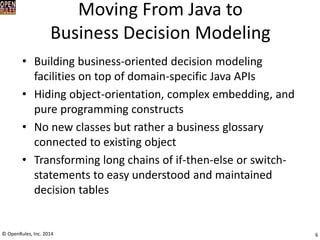
Moving From Java to Business Decision Modeling 
•Building business-oriented decision modeling facilities on top of domain-specific Java APIs 
•Hiding object-orientation, complex embedding, and pure programming constructs 
•No new classes but rather a business glossary connected to existing object 
•Transforming long chains of if-then-else or switch- statements to easy understood and maintained decision tables 
6 
© OpenRules, Inc. 2014
General Purpose Decision Modeling 
•OpenRules provides a powerful templatization mechanism that allowed us to implement generic decision modeling approaches such as DMN and TDM 
•The standard templates are provided in Excel and allow a business user to create concrete Excel tables of the type Decision, DecisionTable, DecisionTableMultiHit, Glossary, and more 
•No coding is required – users just construct tables using predefined column types 
7
Business-oriented Decision Table and its Technical Template 
8
From DSL to Decision Models 
9 
© OpenRules, Inc. 2014 
Decision Modeling Constructs (Diagrams & Decision Table) 
1.Domain-Specific Glossary 
•Business Concepts 
•Decision Variables 
2.Domain-Specific Decision Tables 
•Conditions 
•Actions 
•Hit Policies 
•Aggregation 
•… 
3.Process Diagrams 
DSL (API) 
1.Domain-Specific Classes 
•Classes/Sub-classes 
•Attributes 
2.Domain-Specific Classes 
•Methods 
•If/Then/Else 
•Loops 
•… 
3.Navigating through graphs and collections
DSL Examples 
•Decision Modeling in Constraint Programming 
•Decision Modeling in Geospatial Domain 
•Decision Modeling for Dynamic Web Interaction 
10 
© OpenRules, Inc. 2014
DSL Example “Constraint Programming API” 
•JSR-331 “Java Constraint Programming API” – an official Java Community Process (JCP) standard www.jcp.org 
•JSR-331 covers key concepts for representation and resolution of constraint satisfaction and optimization problems: 
–Class Var for constraint variables and all operators on them 
–Class Constraint for different constraints such as “var1 I greater than var2” or “all variables in the array are different” 
11 
© OpenRules, Inc., 2012
Use Case “Staff Rostering” 
•As the manager, you are required to hire and set the weekly schedule for your employees as follows: 
–Total employees required 
Mon 
Tue 
Wed 
Thu 
Fri 
Sat 
Sun 
5 
8 
9 
10 
16 
18 
12 
–Available employees: 
Employee Type 
Total 
Cost per Day 
F/T 
14 
$100 
P/T 
4 
$150 
•What is the minimal staffing cost? 
12 
© OpenRules, Inc., 2012
Solution using Java API (1) 
13 
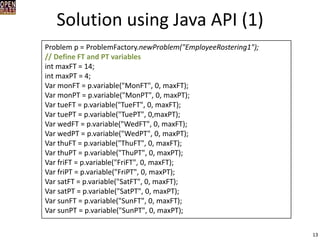
Problem p = ProblemFactory.newProblem("EmployeeRostering1"); 
// Define FT and PT variables 
int maxFT = 14; 
int maxPT = 4; 
Var monFT = p.variable("MonFT", 0, maxFT); 
Var monPT = p.variable("MonPT", 0, maxPT); 
Var tueFT = p.variable("TueFT", 0, maxFT); 
Var tuePT = p.variable("TuePT", 0,maxPT); 
Var wedFT = p.variable("WedFT", 0, maxFT); 
Var wedPT = p.variable("WedPT", 0, maxPT); 
Var thuFT = p.variable("ThuFT", 0, maxFT); 
Var thuPT = p.variable("ThuPT", 0, maxPT); 
Var friFT = p.variable("FriFT", 0, maxFT); 
Var friPT = p.variable("FriPT", 0, maxPT); 
Var satFT = p.variable("SatFT", 0, maxFT); 
Var satPT = p.variable("SatPT", 0, maxPT); 
Var sunFT = p.variable("SunFT", 0, maxFT); 
Var sunPT = p.variable("SunPT", 0, maxPT);
Solution using Java API (2) 
14 
// Define costs int[] costs = {100,150,100,150,100,150,100,150,100,150,100,150,100,150}; Var[] vars = {monFT,monPT,tueFT,tuePT,wedFT,wedPT,thuFT,thuPT,friFT,friPT,satFT,satPT,sunFT,sunPT}; Var totalCost = p.scalProd(costs, vars); p.add("TotalCost",totalCost); 
// Post daily constraints 
p.post(monFT.plus(monPT),"=",5); // monFT + monPT = 5 
p.post(tueFT.plus(tuePT),"=",8); 
p.post(wedFT.plus(wedPT),"=",9); 
p.post(thuFT.plus(thuPT),"=",10); 
p.post(friFT.plus(friPT),"=",16); 
p.post(satFT.plus(satPT),"=",18); 
p.post(sunFT.plus(sunPT),"=",12);
Solution using Decision Model (1) 
15 
Problem p = ProblemFactory.newProblem("EmployeeRostering1"); // Define FT and PT variables int maxFT = 14; int maxPT = 4; Var monFT = p.variable("MonFT", 0, maxFT); Var monPT = p.variable("MonPT", 0, maxPT); Var tueFT = p.variable("TueFT", 0, maxFT); Var tuePT = p.variable("TuePT", 0,maxPT); Var wedFT = p.variable("WedFT", 0, maxFT); Var wedPT = p.variable("WedPT", 0, maxPT); Var thuFT = p.variable("ThuFT", 0, maxFT); Var thuPT = p.variable("ThuPT", 0, maxPT); Var friFT = p.variable("FriFT", 0, maxFT); Var friPT = p.variable("FriPT", 0, maxPT); Var satFT = p.variable("SatFT", 0, maxFT); Var satPT = p.variable("SatPT", 0, maxPT); Var sunFT = p.variable("SunFT", 0, maxFT); Var sunPT = p.variable("SunPT", 0, maxPT);
Solution using Decision Model (2) 
16 
// Post daily constraints p.post(monFT.plus(monPT),"=",5); // monFT + monPT = 5 p.post(tueFT.plus(tuePT),"=",8); p.post(wedFT.plus(wedPT),"=",9); p.post(thuFT.plus(thuPT),"=",10); p.post(friFT.plus(friPT),"=",16); p.post(satFT.plus(satPT),"=",18); p.post(sunFT.plus(sunPT),"=",12); 
Mon 
Tue 
Wed 
Thu 
Fri 
Sat 
Sun 
5 
8 
9 
10 
16 
18 
12
Solution using Decision Model (3) 
17 
// Define costs int[] costs = {100,150,100,150,100,150,100,150,100,150,100,150,100,150}; Var[] vars = {monFT,monPT,tueFT,tuePT,wedFT,wedPT,thuFT,thuPT,friFT,friPT,satFT,satPT,sunFT,sunPT}; Var totalCost = p.scalProd(costs, vars); p.add("TotalCost",totalCost); 
Employee Type 
Total 
Cost per Day 
F/T 
14 
$100 
P/T 
4 
$150
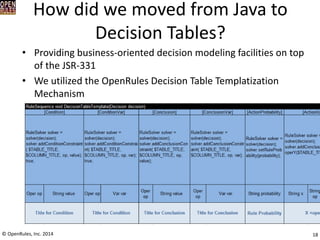
How did we moved from Java to Decision Tables? 
•Providing business-oriented decision modeling facilities on top of the JSR-331 
•We utilized the OpenRules Decision Table Templatization Mechanism 
18 
© OpenRules, Inc. 2014
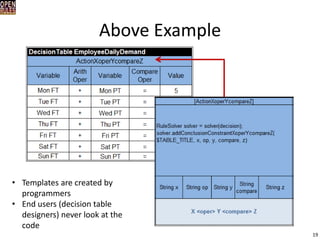
Above Example 
19 
•Templates are created by programmers 
•End users (decision table designers) never look at the code
How to create a Domain-Specific Decision Modeling Framework? 
1.Start with a domain-specific language (Java API) 
2.Design Decision Tables oriented to a subject matter expert in this particular domain 
3.Implement new decision templates with conditions and actions that support such domain-specific decision tables 
•Usually it requires a creation of another layer of Java that hides the complexity of the original API 
•For example, OpenRules developed a special component (Rule Solver) built on the top of the JSR-331 standard 
20 
© OpenRules, Inc. 2014
DSL Examples 
•Decision Modeling in Constraint Programming 
•Decision Modeling in Geospatial Domain 
•Decision Modeling for Dynamic Web Interaction 
21 
© OpenRules, Inc. 2014
Decision Modeling Framework for Geospatial Applications 
•Domain: Geospatial Applications 
–Deals with objects and algorithms for processing linear geometries (points, lines, areas, etc.) on the 2-dimensional Cartesian plane 
–A real-world application will be described by Alex Karman (Revolutionary Machines) 
22
JTS (Java Topology Suite) 
•JTS is a de-facto standard open source Java library with a complete, consistent, and robust Java API 
•It covers various spatial predicates and operators (see on the right): 
•But JTS is too complex for business users 
23
Domain-Specific Business Expressions 
•Typical business conditions expressed by end users as: 
HRR – Hospital Referral Region 
HSA – Hospital Service Area 
•How to present such rules in a “human” way that still can be executed by a computer? 
24
Decision Modeling Example 
25 
New Custom Type of Decision Tables 
New Custom Condition 
JTS Operators 
New Custom Expression (mini DSL)
Implementation Template 
26
DSL Examples 
•Decision Modeling in Constraint Programming 
•Decision Modeling in Geospatial Domain 
•Decision Modeling for Dynamic Web Interaction 
27 
© OpenRules, Inc. 2014
Decision Modeling Framework for Web Questionnaires 
•Domain: Dynamic Web Applications with complex interaction logic 
•Allows non-technical people to develop and maintain web-based questionnaires (dialogs) using only Excel and without a need to learn complex web programming techniques 
•A real-world web application for a large US bank will be described tomorrow by Erik Marutian 
28
OpenRules Dialog™ 
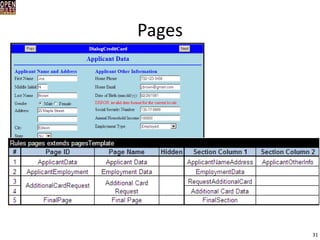
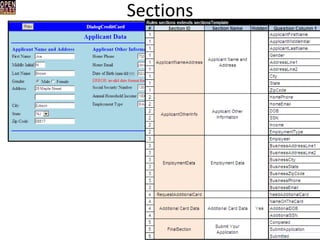
•A questionnaire is described by a subject matter expert in terms of Pages, Sections, and different types of Questions and Answers 
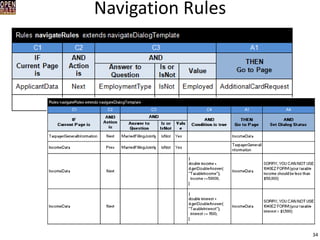
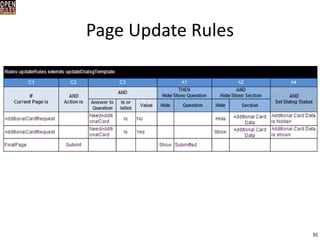
•Layouts of pages, sections, questions, and complex relationships between them can be expressed in a very natural way using simple and intuitive Excel tables. 
29
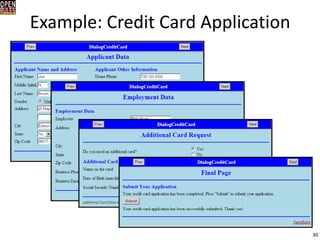
Example: Credit Card Application 
30
Pages 
31
Sections 
32
Questions 
33
Navigation Rules 
34
Page Update Rules 
35
Answers 
36
Auto-Responses 
37
Many More Domain-Specific Features 
•Custom Layouts for Pages, Sections, Questions 
•Problem-specific question properties 
•Support for child-parent relationships 
•E.g. Hide all children of the question 
•Saving/Loading dialog to/from external sources 
•Embedded Support for HTML, Style Sheets, and Java Scripts 
38
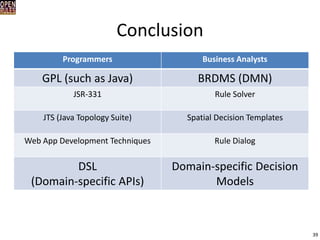
Conclusion 
39 
Programmers 
Business Analysts 
GPL (such as Java) 
BRDMS (DMN) 
JSR-331 
Rule Solver 
JTS (Java Topology Suite) 
Spatial Decision Templates 
Web App Development Techniques 
Rule Dialog 
DSL 
(Domain-specific APIs) 
Domain-specific Decision Models
Q&A 
Web: www.OpenRules.com 
Email: 
support@openrules.com 
jacobfeldman@openrules.com 
40

Building Domain-Specific Decision Models

  • 1.
    San Jose, Oct13-15, 2014 Building Domain-Specific Decision Models Jacob Feldman, PhD OpenRules, Inc., CTO www.openrules.com 1
  • 2.
    Outline •Transformation fromDomain-specific programming languages (DSL) to business- oriented Domain-Specific Decision Models –Motivation –General Approach •Real-world examples of domain-specific models –Decision Modeling in Constraint Programming –Decision Modeling in Geospatial Domain –Decision Modeling for Dynamic Web Interaction 2 © OpenRules, Inc. 2014
  • 3.
    Domain-Specific Decision Models •Motivation –There are many solid Java (C++,…) libraries that support a Domain-Specific Languages (DSL) with their own Java API, e.g. 350+ JSRs –DSLs provide specialized concepts and methods for a particular problem domain –DSLs are oriented to software developers •However, we cannot offer such APIs to business users: they need some kind of a “Business DSL”! 3 © OpenRules, Inc. 2014
  • 4.
    General Purpose vsDomain-Specific •General Purpose BRMS is similar to General Purpose Language (e.g. Java, C++): –Forces its users to define all concepts, relationships, and methods from scratch –Real Value of Java is in surrounding libraries not in language; –What is an analogy for BRMS? •Domain-Specific Decision Model is similar to DSL: –Provide specialized concepts, relationships, and methods for a particular problem domain –A subject matter expert feels “at home” –Real Value in modeling facilities not in an engine 4 © OpenRules, Inc. 2014
  • 5.
    Domain-Specific Decision Models • Objective – Given: a domain-specific language with an API – Goal: create a domain-specific decision modeling “language“ oriented to business users © OpenRules, Inc. 2014 5 Decision Modeling Constructs (Diagrams & Decision Table) Software Developers Business Analysts DSL (API)
  • 6.
    Moving From Javato Business Decision Modeling •Building business-oriented decision modeling facilities on top of domain-specific Java APIs •Hiding object-orientation, complex embedding, and pure programming constructs •No new classes but rather a business glossary connected to existing object •Transforming long chains of if-then-else or switch- statements to easy understood and maintained decision tables 6 © OpenRules, Inc. 2014
  • 7.
    General Purpose DecisionModeling •OpenRules provides a powerful templatization mechanism that allowed us to implement generic decision modeling approaches such as DMN and TDM •The standard templates are provided in Excel and allow a business user to create concrete Excel tables of the type Decision, DecisionTable, DecisionTableMultiHit, Glossary, and more •No coding is required – users just construct tables using predefined column types 7
  • 8.
    Business-oriented Decision Tableand its Technical Template 8
  • 9.
    From DSL toDecision Models 9 © OpenRules, Inc. 2014 Decision Modeling Constructs (Diagrams & Decision Table) 1.Domain-Specific Glossary •Business Concepts •Decision Variables 2.Domain-Specific Decision Tables •Conditions •Actions •Hit Policies •Aggregation •… 3.Process Diagrams DSL (API) 1.Domain-Specific Classes •Classes/Sub-classes •Attributes 2.Domain-Specific Classes •Methods •If/Then/Else •Loops •… 3.Navigating through graphs and collections
  • 10.
    DSL Examples •DecisionModeling in Constraint Programming •Decision Modeling in Geospatial Domain •Decision Modeling for Dynamic Web Interaction 10 © OpenRules, Inc. 2014
  • 11.
    DSL Example “ConstraintProgramming API” •JSR-331 “Java Constraint Programming API” – an official Java Community Process (JCP) standard www.jcp.org •JSR-331 covers key concepts for representation and resolution of constraint satisfaction and optimization problems: –Class Var for constraint variables and all operators on them –Class Constraint for different constraints such as “var1 I greater than var2” or “all variables in the array are different” 11 © OpenRules, Inc., 2012
  • 12.
    Use Case “StaffRostering” •As the manager, you are required to hire and set the weekly schedule for your employees as follows: –Total employees required Mon Tue Wed Thu Fri Sat Sun 5 8 9 10 16 18 12 –Available employees: Employee Type Total Cost per Day F/T 14 $100 P/T 4 $150 •What is the minimal staffing cost? 12 © OpenRules, Inc., 2012
  • 13.
    Solution using JavaAPI (1) 13 Problem p = ProblemFactory.newProblem("EmployeeRostering1"); // Define FT and PT variables int maxFT = 14; int maxPT = 4; Var monFT = p.variable("MonFT", 0, maxFT); Var monPT = p.variable("MonPT", 0, maxPT); Var tueFT = p.variable("TueFT", 0, maxFT); Var tuePT = p.variable("TuePT", 0,maxPT); Var wedFT = p.variable("WedFT", 0, maxFT); Var wedPT = p.variable("WedPT", 0, maxPT); Var thuFT = p.variable("ThuFT", 0, maxFT); Var thuPT = p.variable("ThuPT", 0, maxPT); Var friFT = p.variable("FriFT", 0, maxFT); Var friPT = p.variable("FriPT", 0, maxPT); Var satFT = p.variable("SatFT", 0, maxFT); Var satPT = p.variable("SatPT", 0, maxPT); Var sunFT = p.variable("SunFT", 0, maxFT); Var sunPT = p.variable("SunPT", 0, maxPT);
  • 14.
    Solution using JavaAPI (2) 14 // Define costs int[] costs = {100,150,100,150,100,150,100,150,100,150,100,150,100,150}; Var[] vars = {monFT,monPT,tueFT,tuePT,wedFT,wedPT,thuFT,thuPT,friFT,friPT,satFT,satPT,sunFT,sunPT}; Var totalCost = p.scalProd(costs, vars); p.add("TotalCost",totalCost); // Post daily constraints p.post(monFT.plus(monPT),"=",5); // monFT + monPT = 5 p.post(tueFT.plus(tuePT),"=",8); p.post(wedFT.plus(wedPT),"=",9); p.post(thuFT.plus(thuPT),"=",10); p.post(friFT.plus(friPT),"=",16); p.post(satFT.plus(satPT),"=",18); p.post(sunFT.plus(sunPT),"=",12);
  • 15.
    Solution using DecisionModel (1) 15 Problem p = ProblemFactory.newProblem("EmployeeRostering1"); // Define FT and PT variables int maxFT = 14; int maxPT = 4; Var monFT = p.variable("MonFT", 0, maxFT); Var monPT = p.variable("MonPT", 0, maxPT); Var tueFT = p.variable("TueFT", 0, maxFT); Var tuePT = p.variable("TuePT", 0,maxPT); Var wedFT = p.variable("WedFT", 0, maxFT); Var wedPT = p.variable("WedPT", 0, maxPT); Var thuFT = p.variable("ThuFT", 0, maxFT); Var thuPT = p.variable("ThuPT", 0, maxPT); Var friFT = p.variable("FriFT", 0, maxFT); Var friPT = p.variable("FriPT", 0, maxPT); Var satFT = p.variable("SatFT", 0, maxFT); Var satPT = p.variable("SatPT", 0, maxPT); Var sunFT = p.variable("SunFT", 0, maxFT); Var sunPT = p.variable("SunPT", 0, maxPT);
  • 16.
    Solution using DecisionModel (2) 16 // Post daily constraints p.post(monFT.plus(monPT),"=",5); // monFT + monPT = 5 p.post(tueFT.plus(tuePT),"=",8); p.post(wedFT.plus(wedPT),"=",9); p.post(thuFT.plus(thuPT),"=",10); p.post(friFT.plus(friPT),"=",16); p.post(satFT.plus(satPT),"=",18); p.post(sunFT.plus(sunPT),"=",12); Mon Tue Wed Thu Fri Sat Sun 5 8 9 10 16 18 12
  • 17.
    Solution using DecisionModel (3) 17 // Define costs int[] costs = {100,150,100,150,100,150,100,150,100,150,100,150,100,150}; Var[] vars = {monFT,monPT,tueFT,tuePT,wedFT,wedPT,thuFT,thuPT,friFT,friPT,satFT,satPT,sunFT,sunPT}; Var totalCost = p.scalProd(costs, vars); p.add("TotalCost",totalCost); Employee Type Total Cost per Day F/T 14 $100 P/T 4 $150
  • 18.
    How did wemoved from Java to Decision Tables? •Providing business-oriented decision modeling facilities on top of the JSR-331 •We utilized the OpenRules Decision Table Templatization Mechanism 18 © OpenRules, Inc. 2014
  • 19.
    Above Example 19 •Templates are created by programmers •End users (decision table designers) never look at the code
  • 20.
    How to createa Domain-Specific Decision Modeling Framework? 1.Start with a domain-specific language (Java API) 2.Design Decision Tables oriented to a subject matter expert in this particular domain 3.Implement new decision templates with conditions and actions that support such domain-specific decision tables •Usually it requires a creation of another layer of Java that hides the complexity of the original API •For example, OpenRules developed a special component (Rule Solver) built on the top of the JSR-331 standard 20 © OpenRules, Inc. 2014
  • 21.
    DSL Examples •DecisionModeling in Constraint Programming •Decision Modeling in Geospatial Domain •Decision Modeling for Dynamic Web Interaction 21 © OpenRules, Inc. 2014
  • 22.
    Decision Modeling Frameworkfor Geospatial Applications •Domain: Geospatial Applications –Deals with objects and algorithms for processing linear geometries (points, lines, areas, etc.) on the 2-dimensional Cartesian plane –A real-world application will be described by Alex Karman (Revolutionary Machines) 22
  • 23.
    JTS (Java TopologySuite) •JTS is a de-facto standard open source Java library with a complete, consistent, and robust Java API •It covers various spatial predicates and operators (see on the right): •But JTS is too complex for business users 23
  • 24.
    Domain-Specific Business Expressions •Typical business conditions expressed by end users as: HRR – Hospital Referral Region HSA – Hospital Service Area •How to present such rules in a “human” way that still can be executed by a computer? 24
  • 25.
    Decision Modeling Example 25 New Custom Type of Decision Tables New Custom Condition JTS Operators New Custom Expression (mini DSL)
  • 26.
  • 27.
    DSL Examples •DecisionModeling in Constraint Programming •Decision Modeling in Geospatial Domain •Decision Modeling for Dynamic Web Interaction 27 © OpenRules, Inc. 2014
  • 28.
    Decision Modeling Frameworkfor Web Questionnaires •Domain: Dynamic Web Applications with complex interaction logic •Allows non-technical people to develop and maintain web-based questionnaires (dialogs) using only Excel and without a need to learn complex web programming techniques •A real-world web application for a large US bank will be described tomorrow by Erik Marutian 28
  • 29.
    OpenRules Dialog™ •Aquestionnaire is described by a subject matter expert in terms of Pages, Sections, and different types of Questions and Answers •Layouts of pages, sections, questions, and complex relationships between them can be expressed in a very natural way using simple and intuitive Excel tables. 29
  • 30.
    Example: Credit CardApplication 30
  • 31.
  • 32.
  • 33.
  • 34.
  • 35.
  • 36.
  • 37.
  • 38.
    Many More Domain-SpecificFeatures •Custom Layouts for Pages, Sections, Questions •Problem-specific question properties •Support for child-parent relationships •E.g. Hide all children of the question •Saving/Loading dialog to/from external sources •Embedded Support for HTML, Style Sheets, and Java Scripts 38
  • 39.
    Conclusion 39 Programmers Business Analysts GPL (such as Java) BRDMS (DMN) JSR-331 Rule Solver JTS (Java Topology Suite) Spatial Decision Templates Web App Development Techniques Rule Dialog DSL (Domain-specific APIs) Domain-specific Decision Models
  • 40.
    Q&A Web: www.OpenRules.com Email: support@openrules.com jacobfeldman@openrules.com 40