THINK INDIA JOURNAL
ISSN:0971-1260
Vol-22-Issue-10-November-2019
P a g e | 9022
Deciding Project Management Methodology
for E-Governance Projects in India
Ashish Karan, PhD student :2017RHS9002, Dept. Of Humanities and Social Sciences,
Malviya National Institute of Technology, Jaipur, India
ABSTRACT
The UN E-Government Survey 2018 has ranked India under top 100 at 98th position, a jump of
22 places from the last survey in 2016. The index reflects the magnitude of E-Governance
initiatives rolled out by the country. E-Governance is the use of Information and Communication
Technology to improve the relationship between the government and its citizens. The country has
taken a number of initiatives to computerize various processes that were previously done
manually. Each conversion process is accomplished in a form of a Project which requires
planning and execution in the most professional manner to avoid failures and wastage of
national resources. The success of the project depends on government officials, the suppliers and
the users. An important aspect of the project management is the use of best practices available in
the market. PMP, Prince2 and SCRUM (also called project methodologies) are some of the best
practices available in the market. The paper brings out the preferred attributes sought by project
managers in a project management methodology in India through an online survey taken by 52
project managers.
KEYWORDS: PMP, PROJECT MANAGEMENT, E-GOVERNANCE, PRINCE2, AGILE,
SCRUM, PM METHODS, PMBOK, AGELOS, PMI
INTRODUCTION
1. E-Governance is the usage of internet technology as a means for exchanging information,
delivering services and transacting with citizens, business organisations, and other segments of
government. E-Governance provides a full proof strategy to effective overall governance. It
definitely improves accountability, transparency and efficiency of government processes, but in
addition to it, it also facilitates sustainable and inclusive growth. E-Governance also provides a
mechanism of direct delivery of citizen centric services to all segments of the society including
those in the remotest corners, without having to deal with intermediaries. The computerization
process is rolled out in the form of project which requires application off skills and knowledge to
make it a success. Ineffective project management has led to failure of E-Governance projects
across the world. This has led various governments and IT organizations to implement proven
frameworks of project management.
THINK INDIA JOURNAL
ISSN:0971-1260
Vol-22-Issue-10-November-2019
P a g e | 9023
BACKGROUND
2. Governance. The art of managing the functioning of an organization by the people who
are authorized to do so is called governance.
3. E-Government. It is the use of ICT by the government to offer its citizens and
businesses organizations the opportunity to interact and conduct operations with government by
making use of different communication media such as telephones, fax, smart cards, e-mail /
Internet etc. It is also about how government administers, rules, regulates and frameworks to
carry out service delivery and the coordination, communication and integration of processes
takes place within itself.
4. E-Governance. E-Governance is the use of IT infrastructure comprising of
IT hardware, software and Internet to computerize the mundane manual processes.
“Sambandhta”, which led to computerization of affiliation process of schools by Central Board
of Secondary Education, MHRD, Government of India.
5. Project: A project is a temporary (start and end date) endeavor undertaken to create
a unique (not repetitive/ routine) product, service or a result and it ceases when the objective has
been achieved. Project team (a set of people) is therefore temporary who come together (may be
spread across different geographical locations) to finish the project and the team is disbanded
once the project is over.
6. Project management: Application of knowledge, skills, methods, experience, tools and
techniques on project activities that make up the project. It is the function within the
organization.
7. Project Management Requirement. The need for Project Management in E-Governance
can be summarized in following points
 Monopolistic in nature.
 Lack of adequate and appropriate skills within the public sector.
 Larger number of stakeholders, often with conflicting interests.
 Elaborate bureaucratic processes of projects approval, funds release, reporting, and
monitoring.
 Larger, and more complex, projects.
 Sometimes ambiguous goals or goals not properly linked with organizational (i.e.
national development) goals.
THINK INDIA JOURNAL
ISSN:0971-1260
Vol-22-Issue-10-November-2019
P a g e | 9024
 Extensive external dependencies and influences, i.e. from politicians, citizens, external
funding agencies etc.
 Diluted personal responsibilities and accountability, sometimes driven by attitude of
„passing the buck‟.
 Shorter planning and financial horizons (or perspectives).
 Subject to laws, regulations and oversight that exceed those on private organizations
8. Project Management Methods practiced in India. Most often used project management
methodologies, practiced in managing E-governance projects in India are as follows:
 PMP which is presented as a compendium of best practices and is published by the
Project Management Institute (PMI) based in the USA.
 PRINCE2 by the Organization of Government Commerce (OGC), UK, as a standard
for project management by the UK Government.
 SCRUM which follows the AGILE framework.
9. Research Hypothesis. PMP, PRINCE2 and SCRUM are the three best Project
Management methodologies in practice in India.
PROJECT MANAGEMENT METHODOLGIES
10. Project Management Methodologies. Project Management Methodology can be
considered as a well defined set of proven management practices, methods and processes that
determine how best the project functions of planning, developing, controlling, delivering etc can
should be carried out for successful completion and termination of project. It‟s a tested and
proven to project design, execution and completion.
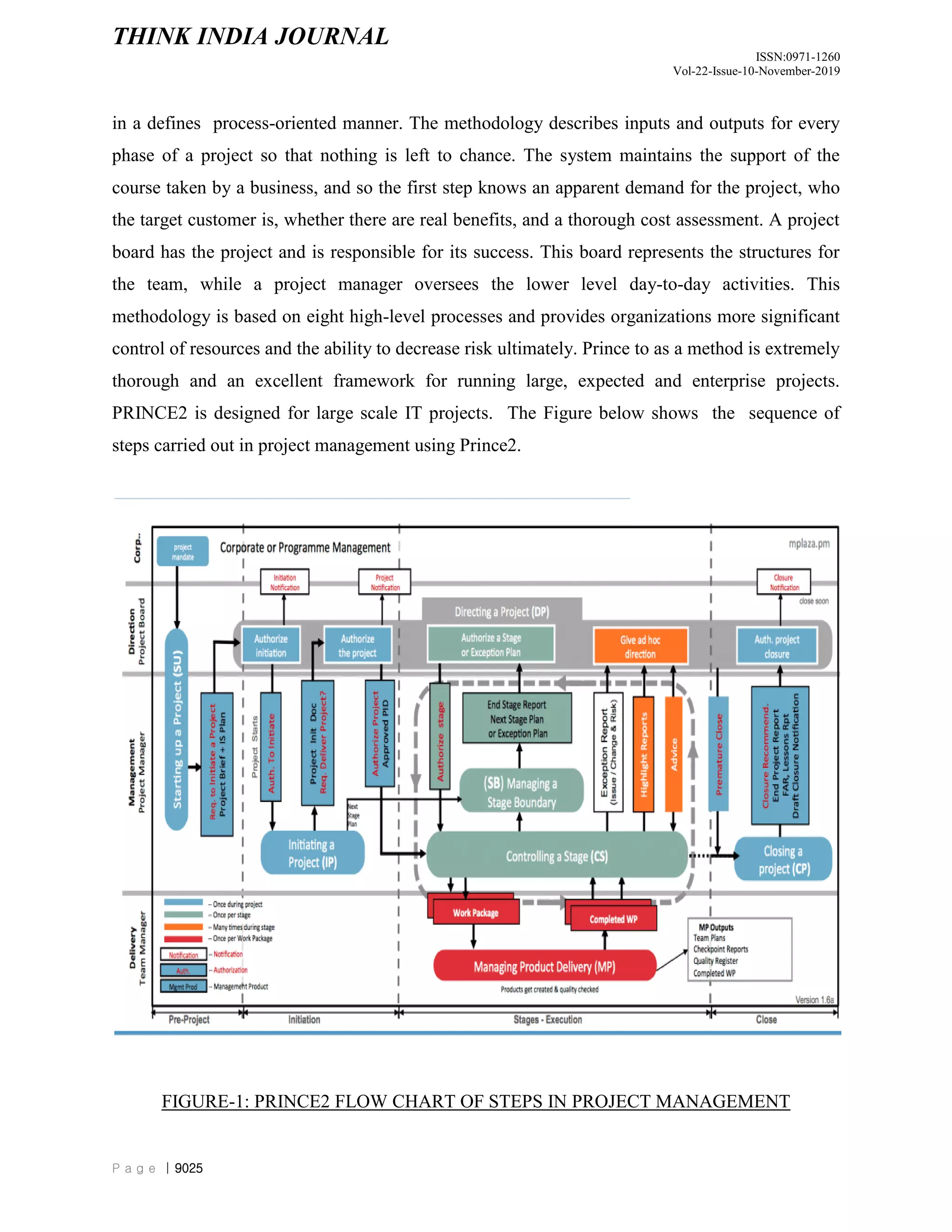
11. Prince2 Methodology. It is a full stack waterfall project management methodology
that combines principles, themes, and processes. It was designed by the UK government in 1996
basically for IT projects. „PRINCE‟ stands for Projects IN Controlled Environments. Prince2
divided the entire project into stages and each stage into various work pages. The project is done
THINK INDIA JOURNAL
ISSN:0971-1260
Vol-22-Issue-10-November-2019
P a g e | 9025
in a defines process-oriented manner. The methodology describes inputs and outputs for every
phase of a project so that nothing is left to chance. The system maintains the support of the
course taken by a business, and so the first step knows an apparent demand for the project, who
the target customer is, whether there are real benefits, and a thorough cost assessment. A project
board has the project and is responsible for its success. This board represents the structures for
the team, while a project manager oversees the lower level day-to-day activities. This
methodology is based on eight high-level processes and provides organizations more significant
control of resources and the ability to decrease risk ultimately. Prince to as a method is extremely
thorough and an excellent framework for running large, expected and enterprise projects.
PRINCE2 is designed for large scale IT projects. The Figure below shows the sequence of
steps carried out in project management using Prince2.
FIGURE-1: PRINCE2 FLOW CHART OF STEPS IN PROJECT MANAGEMENT
THINK INDIA JOURNAL
ISSN:0971-1260
Vol-22-Issue-10-November-2019
P a g e | 9026
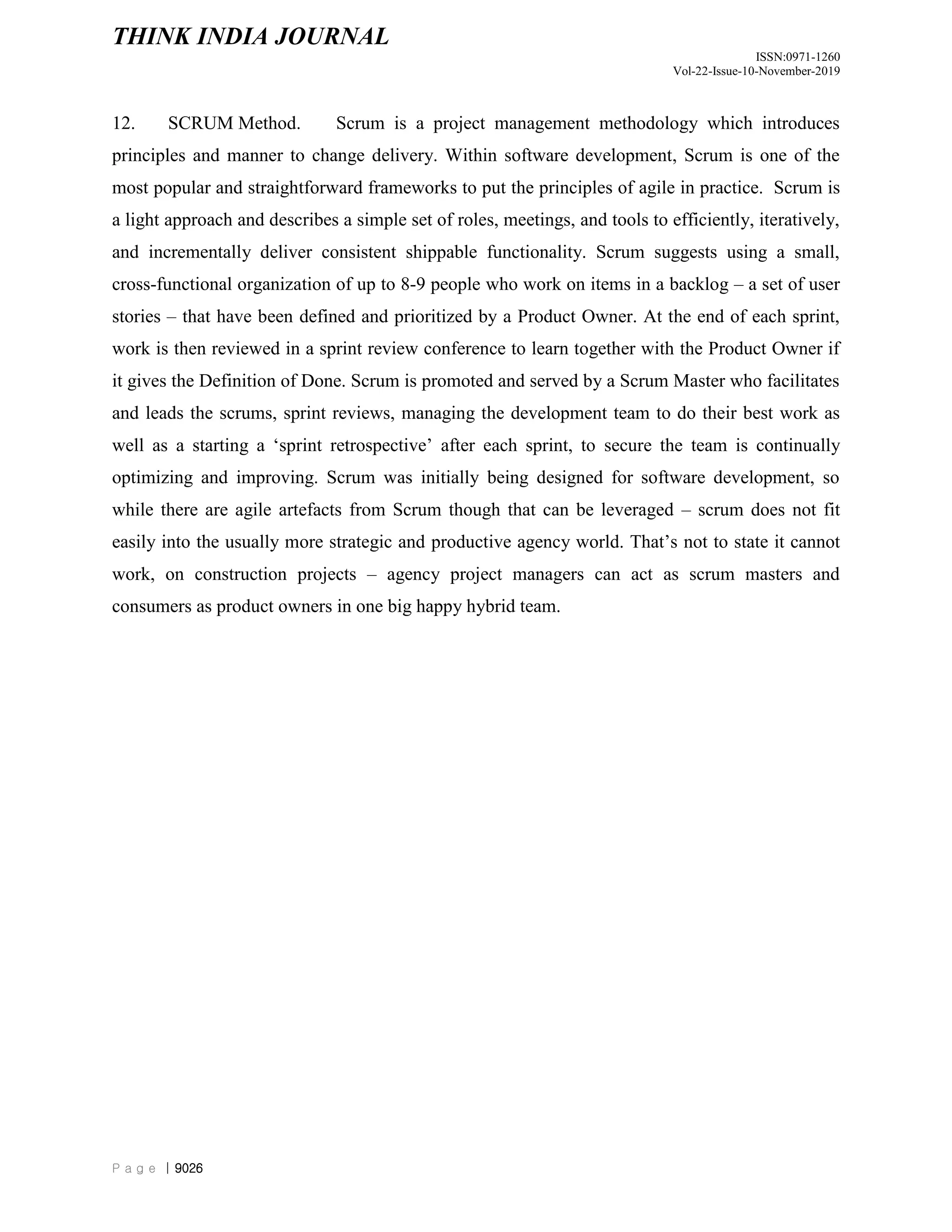
12. SCRUM Method. Scrum is a project management methodology which introduces
principles and manner to change delivery. Within software development, Scrum is one of the
most popular and straightforward frameworks to put the principles of agile in practice. Scrum is
a light approach and describes a simple set of roles, meetings, and tools to efficiently, iteratively,
and incrementally deliver consistent shippable functionality. Scrum suggests using a small,
cross-functional organization of up to 8-9 people who work on items in a backlog – a set of user
stories – that have been defined and prioritized by a Product Owner. At the end of each sprint,
work is then reviewed in a sprint review conference to learn together with the Product Owner if
it gives the Definition of Done. Scrum is promoted and served by a Scrum Master who facilitates
and leads the scrums, sprint reviews, managing the development team to do their best work as
well as a starting a „sprint retrospective‟ after each sprint, to secure the team is continually
optimizing and improving. Scrum was initially being designed for software development, so
while there are agile artefacts from Scrum though that can be leveraged – scrum does not fit
easily into the usually more strategic and productive agency world. That‟s not to state it cannot
work, on construction projects – agency project managers can act as scrum masters and
consumers as product owners in one big happy hybrid team.
THINK INDIA JOURNAL
ISSN:0971-1260
Vol-22-Issue-10-November-2019
P a g e | 9027
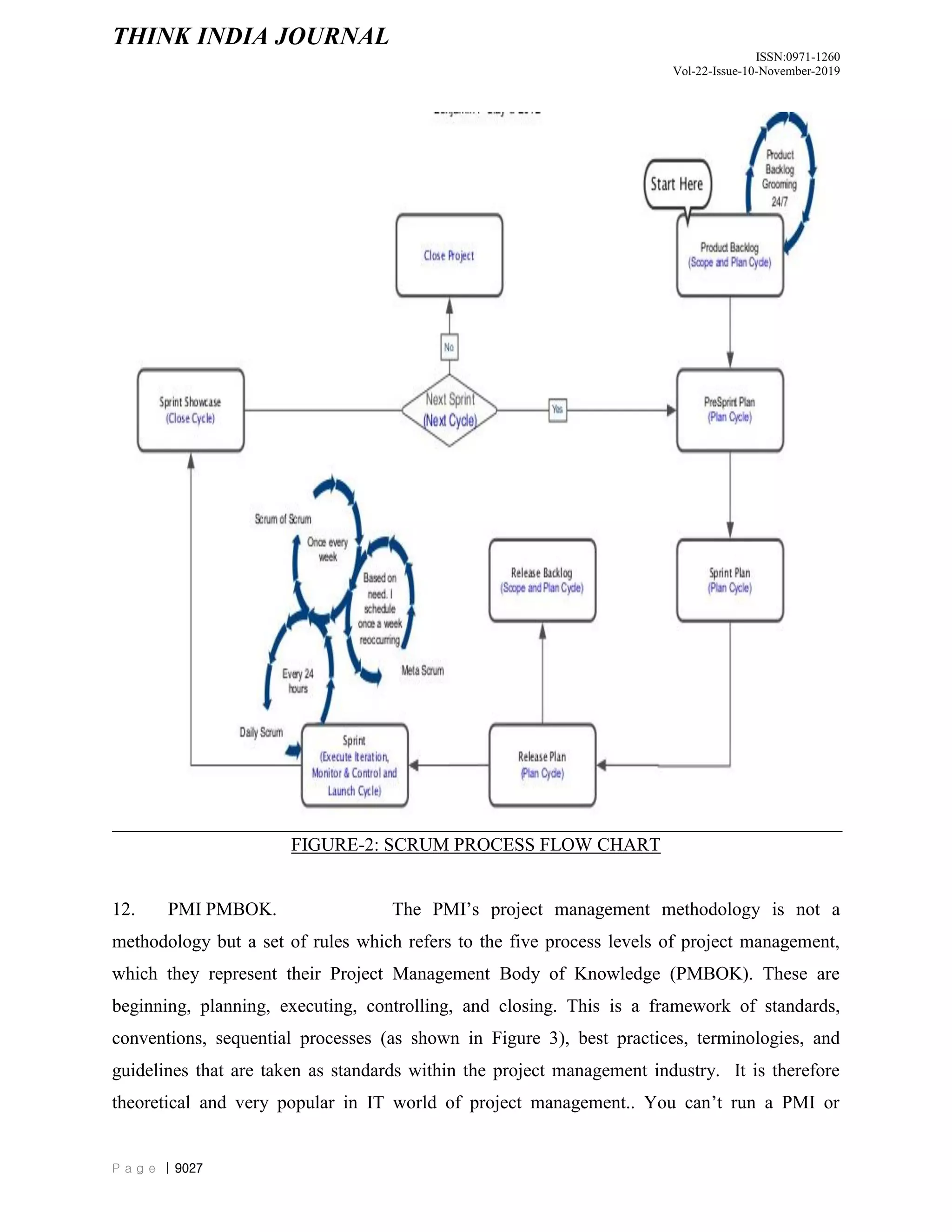
FIGURE-2: SCRUM PROCESS FLOW CHART
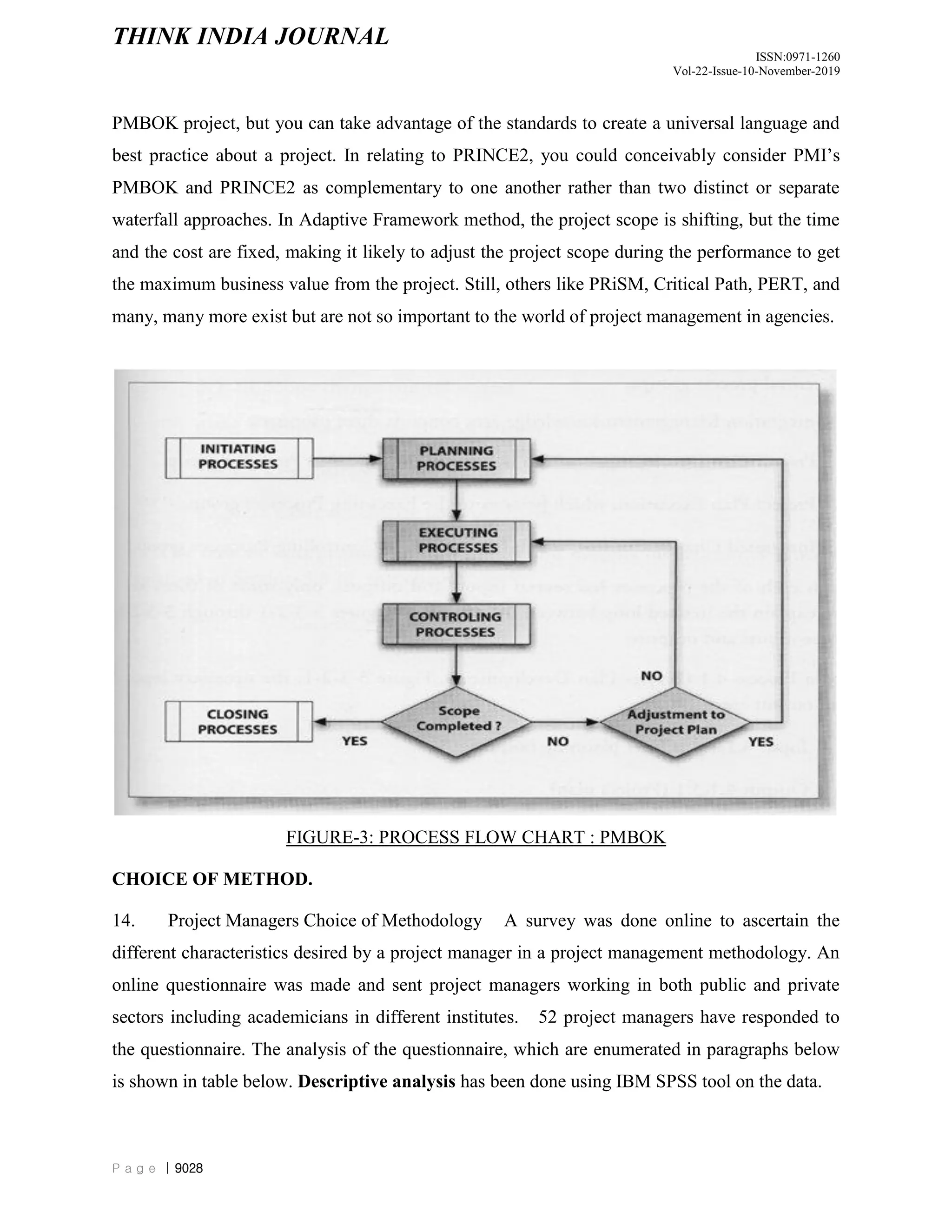
12. PMI PMBOK. The PMI‟s project management methodology is not a
methodology but a set of rules which refers to the five process levels of project management,
which they represent their Project Management Body of Knowledge (PMBOK). These are
beginning, planning, executing, controlling, and closing. This is a framework of standards,
conventions, sequential processes (as shown in Figure 3), best practices, terminologies, and
guidelines that are taken as standards within the project management industry. It is therefore
theoretical and very popular in IT world of project management.. You can‟t run a PMI or
THINK INDIA JOURNAL
ISSN:0971-1260
Vol-22-Issue-10-November-2019
P a g e | 9028
PMBOK project, but you can take advantage of the standards to create a universal language and
best practice about a project. In relating to PRINCE2, you could conceivably consider PMI‟s
PMBOK and PRINCE2 as complementary to one another rather than two distinct or separate
waterfall approaches. In Adaptive Framework method, the project scope is shifting, but the time
and the cost are fixed, making it likely to adjust the project scope during the performance to get
the maximum business value from the project. Still, others like PRiSM, Critical Path, PERT, and
many, many more exist but are not so important to the world of project management in agencies.
FIGURE-3: PROCESS FLOW CHART : PMBOK
CHOICE OF METHOD.
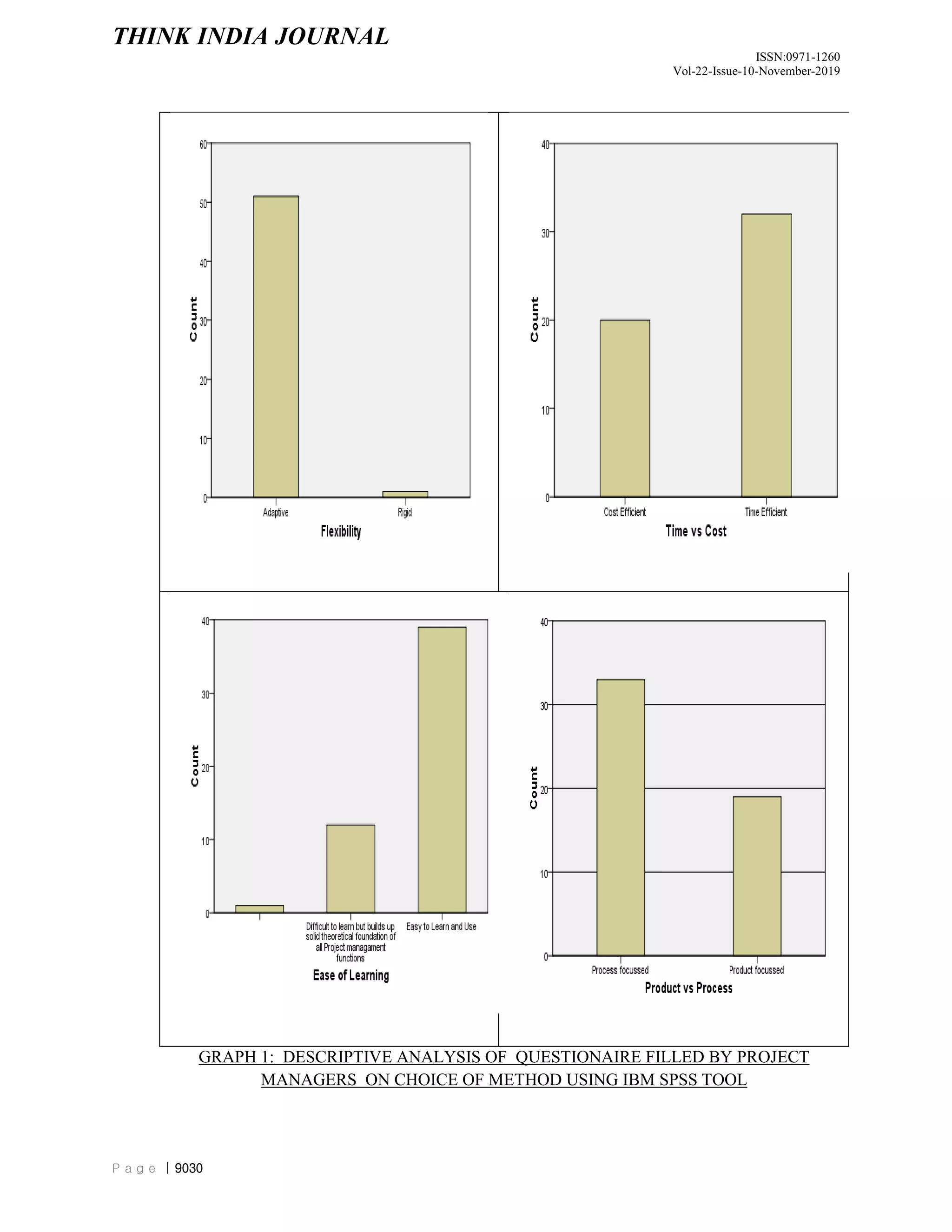
14. Project Managers Choice of Methodology A survey was done online to ascertain the
different characteristics desired by a project manager in a project management methodology. An
online questionnaire was made and sent project managers working in both public and private
sectors including academicians in different institutes. 52 project managers have responded to
the questionnaire. The analysis of the questionnaire, which are enumerated in paragraphs below
is shown in table below. Descriptive analysis has been done using IBM SPSS tool on the data.
THINK INDIA JOURNAL
ISSN:0971-1260
Vol-22-Issue-10-November-2019
P a g e | 9029
15. Adaptive vs Rigid More than 95% of project managers preferred an adaptive method
over rigid one. This basically means that they prefer a method which allows project managers to
make permissible changes in the project scope during its execution. Project management
methods based strictly on waterfall model (sequential) have the requirement/ scope frozen at the
beginning itself and the final product is visible at the end only. This kind of PM method has the
disadvantage of running into complete failure as the customer is shown the final product at the
end only. PM like PMBOK and Prince2 follow the waterfall method to greater extent with little
or no scope for change of scope during execution. SCRUM follows the adaptive framework
where the project is executed in form of sprints (iterative process of 30 days). The user has the
benefit of witnessing the product evolving after every sprint and therefore the chance of
catastrophic failure is less.
16. Time vs Cost Around 60% of the project managers would like to choose a time efficient
method over a cost efficient one.
17. Ease of Learning More than 80% of the project mangers choose to learn a method
which is easy to learn and use. This makes sense when we look at the other option of choosing
time efficiency over cost. I today‟s world an easily deployed method which can be quickly learnt
and put to use is the choice of project managers.
18. Delegation of authority. A project is driven by the mandate of the business owner
(private sector) or a senior official ( public sector) . The project manager is a middle level
management reporting to the Project Director/ Steering Committee. As per the survey more than
75% are in favour to delegate only limited power o the project manager , enough to meet the day
to day requirement of the project. The maximum power stays with the Director/ Steering
Committee.
19. Product vs Process. Around 70% of project managers favored a process oriented
method as it ensures nothing is left . It is a slow but steady way of achieving the target which
mitigates the risk of project failure.
THINK INDIA JOURNAL
ISSN:0971-1260
Vol-22-Issue-10-November-2019
P a g e | 9030
GRAPH 1: DESCRIPTIVE ANALYSIS OF QUESTIONAIRE FILLED BY PROJECT
MANAGERS ON CHOICE OF METHOD USING IBM SPSS TOOL
THINK INDIA JOURNAL
ISSN:0971-1260
Vol-22-Issue-10-November-2019
P a g e | 9031
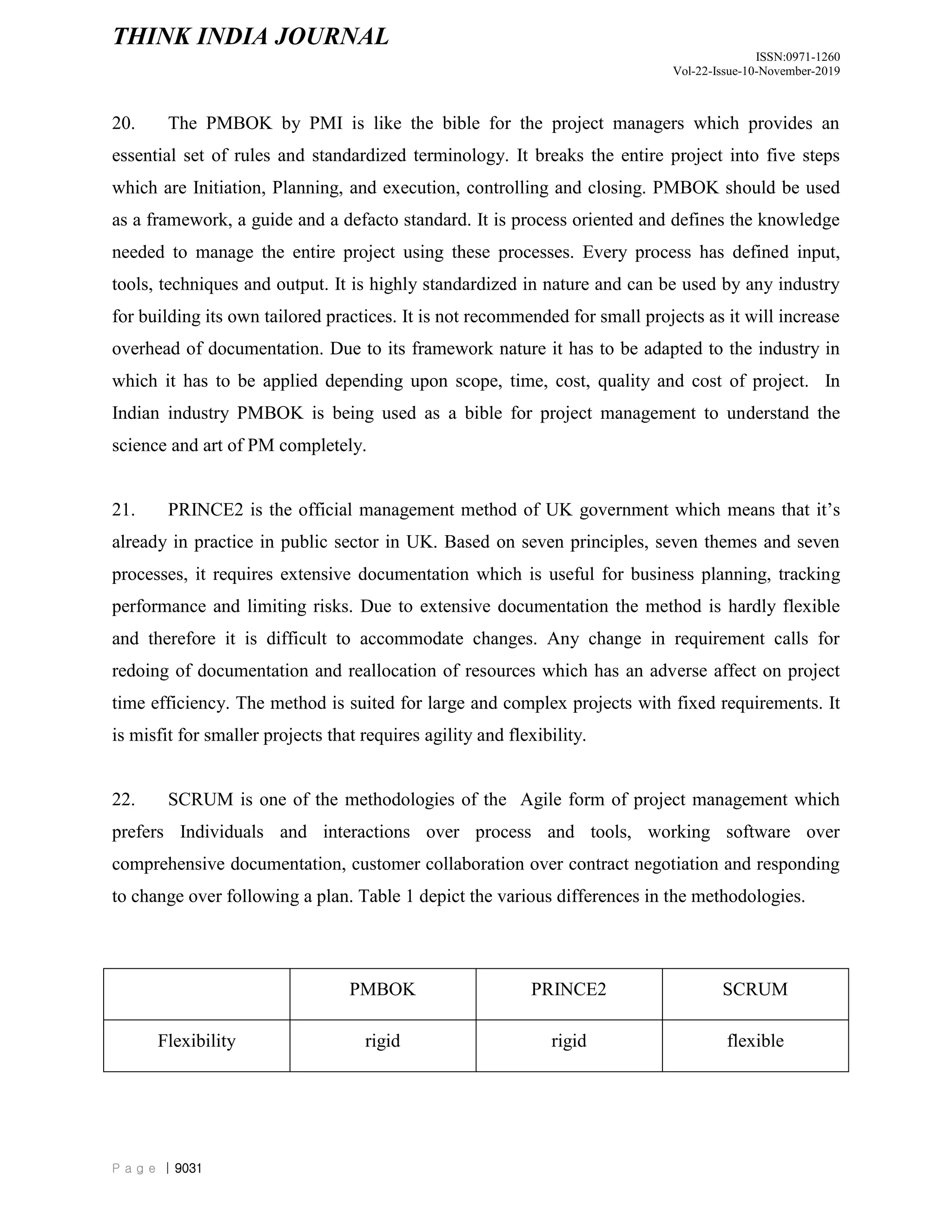
20. The PMBOK by PMI is like the bible for the project managers which provides an
essential set of rules and standardized terminology. It breaks the entire project into five steps
which are Initiation, Planning, and execution, controlling and closing. PMBOK should be used
as a framework, a guide and a defacto standard. It is process oriented and defines the knowledge
needed to manage the entire project using these processes. Every process has defined input,
tools, techniques and output. It is highly standardized in nature and can be used by any industry
for building its own tailored practices. It is not recommended for small projects as it will increase
overhead of documentation. Due to its framework nature it has to be adapted to the industry in
which it has to be applied depending upon scope, time, cost, quality and cost of project. In
Indian industry PMBOK is being used as a bible for project management to understand the
science and art of PM completely.
21. PRINCE2 is the official management method of UK government which means that it‟s
already in practice in public sector in UK. Based on seven principles, seven themes and seven
processes, it requires extensive documentation which is useful for business planning, tracking
performance and limiting risks. Due to extensive documentation the method is hardly flexible
and therefore it is difficult to accommodate changes. Any change in requirement calls for
redoing of documentation and reallocation of resources which has an adverse affect on project
time efficiency. The method is suited for large and complex projects with fixed requirements. It
is misfit for smaller projects that requires agility and flexibility.
22. SCRUM is one of the methodologies of the Agile form of project management which
prefers Individuals and interactions over process and tools, working software over
comprehensive documentation, customer collaboration over contract negotiation and responding
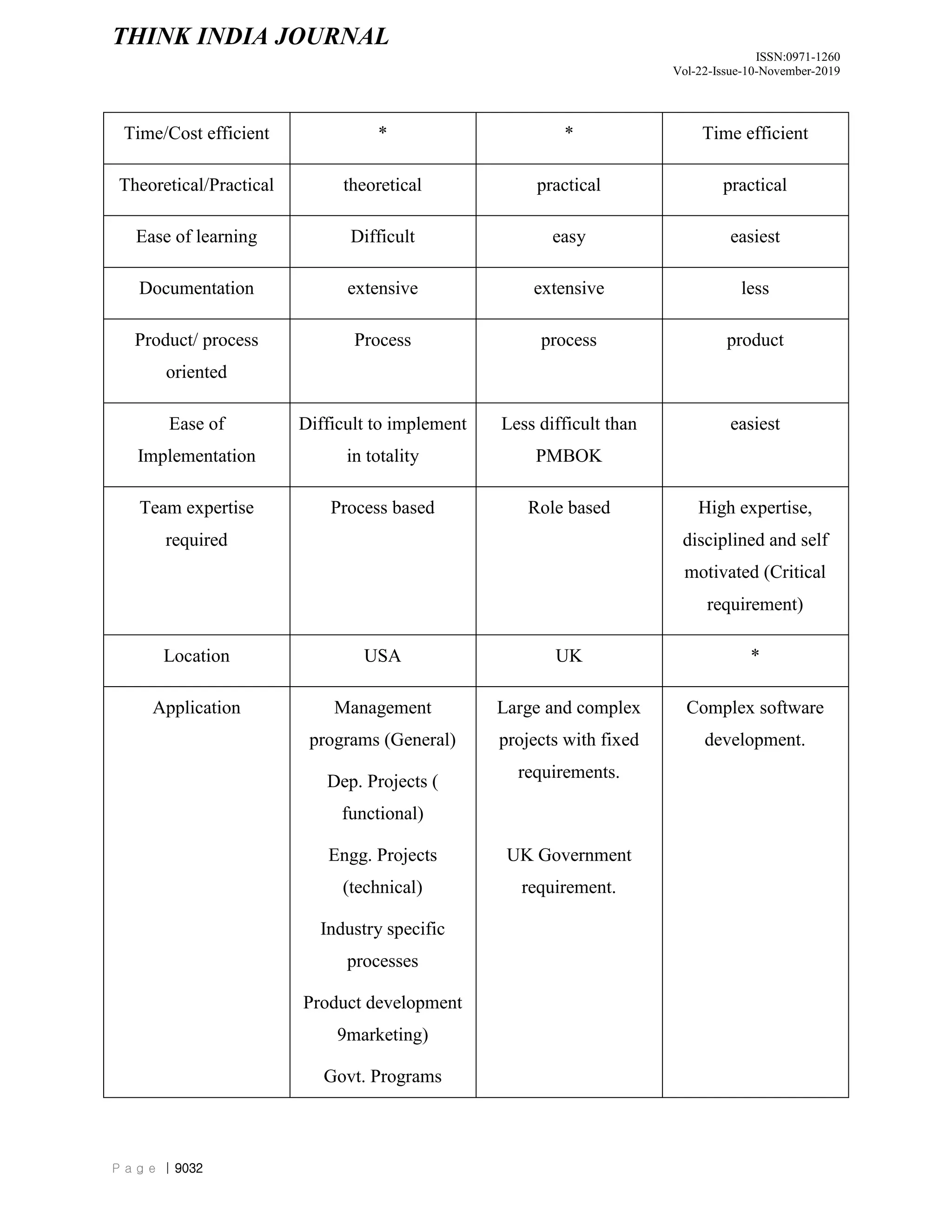
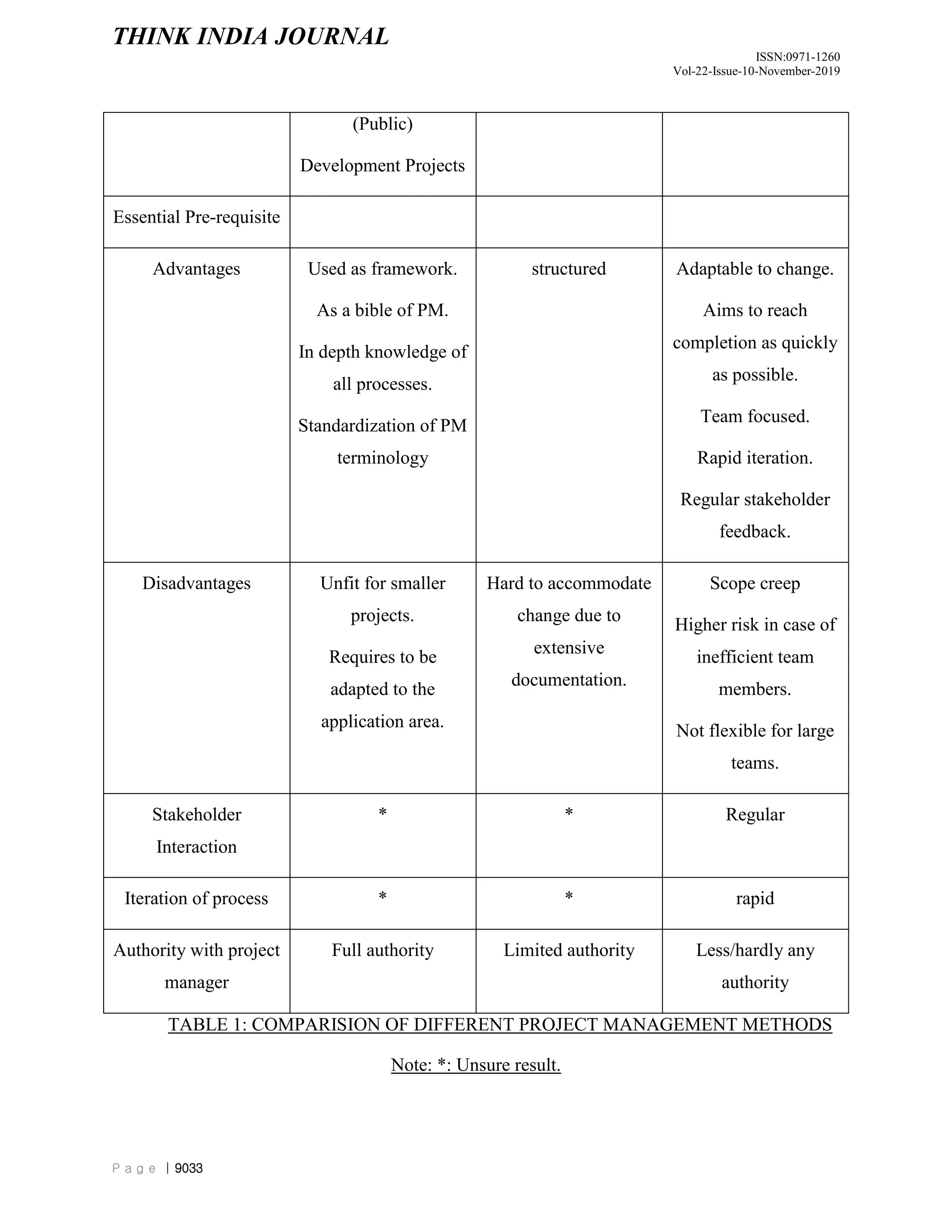
to change over following a plan. Table 1 depict the various differences in the methodologies.
PMBOK PRINCE2 SCRUM
Flexibility rigid rigid flexible
THINK INDIA JOURNAL
ISSN:0971-1260
Vol-22-Issue-10-November-2019
P a g e | 9032
Time/Cost efficient * * Time efficient
Theoretical/Practical theoretical practical practical
Ease of learning Difficult easy easiest
Documentation extensive extensive less
Product/ process
oriented
Process process product
Ease of
Implementation
Difficult to implement
in totality
Less difficult than
PMBOK
easiest
Team expertise
required
Process based Role based High expertise,
disciplined and self
motivated (Critical
requirement)
Location USA UK *
Application Management
programs (General)
Dep. Projects (
functional)
Engg. Projects
(technical)
Industry specific
processes
Product development
9marketing)
Govt. Programs
Large and complex
projects with fixed
requirements.
UK Government
requirement.
Complex software
development.
THINK INDIA JOURNAL
ISSN:0971-1260
Vol-22-Issue-10-November-2019
P a g e | 9033
(Public)
Development Projects
Essential Pre-requisite
Advantages Used as framework.
As a bible of PM.
In depth knowledge of
all processes.
Standardization of PM
terminology
structured Adaptable to change.
Aims to reach
completion as quickly
as possible.
Team focused.
Rapid iteration.
Regular stakeholder
feedback.
Disadvantages Unfit for smaller
projects.
Requires to be
adapted to the
application area.
Hard to accommodate
change due to
extensive
documentation.
Scope creep
Higher risk in case of
inefficient team
members.
Not flexible for large
teams.
Stakeholder
Interaction
* * Regular
Iteration of process * * rapid
Authority with project
manager
Full authority Limited authority Less/hardly any
authority
TABLE 1: COMPARISION OF DIFFERENT PROJECT MANAGEMENT METHODS
Note: *: Unsure result.
THINK INDIA JOURNAL
ISSN:0971-1260
Vol-22-Issue-10-November-2019
P a g e | 9034
RECOMMENDATION: DECIDING THE PROJECT MANAGEMENT METHOD
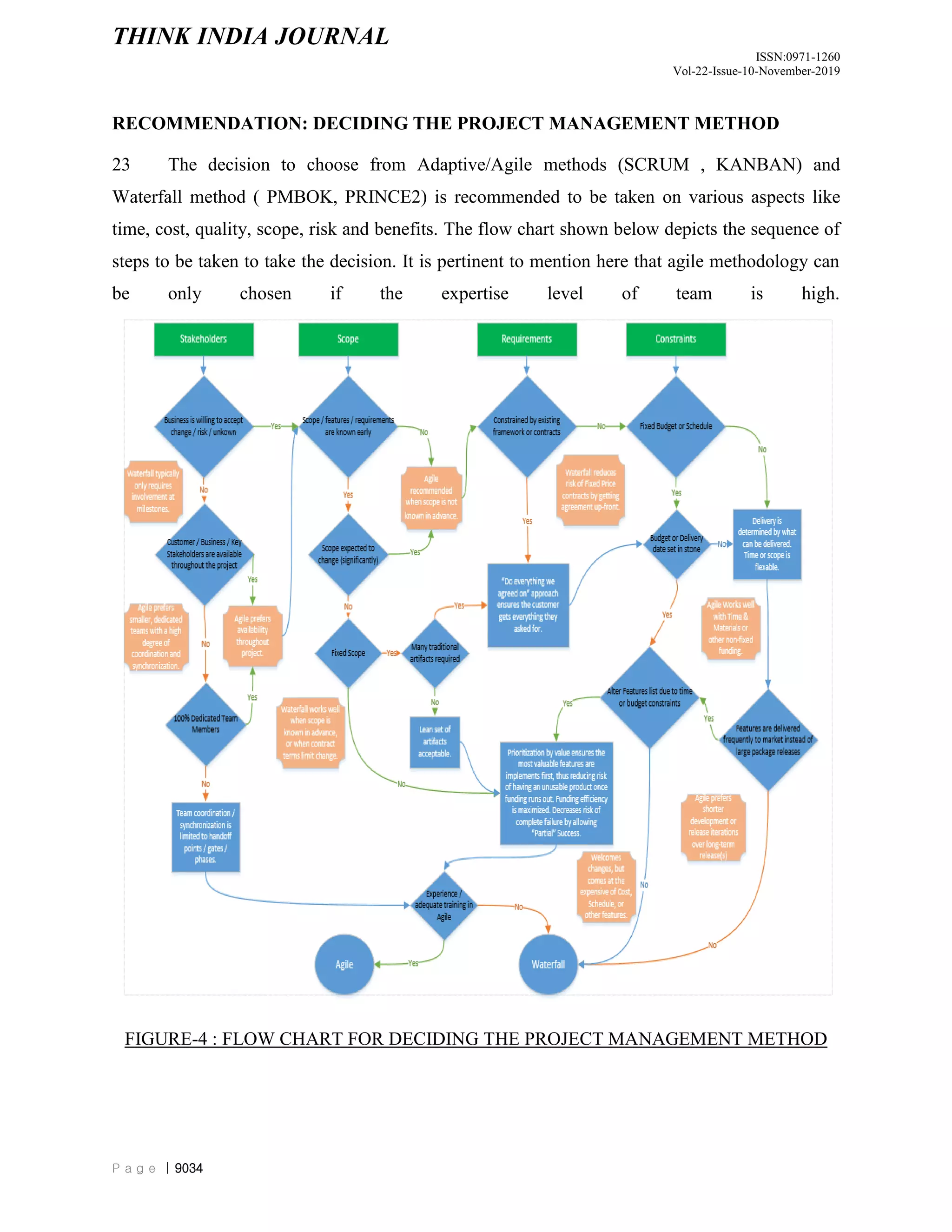
23 The decision to choose from Adaptive/Agile methods (SCRUM , KANBAN) and
Waterfall method ( PMBOK, PRINCE2) is recommended to be taken on various aspects like
time, cost, quality, scope, risk and benefits. The flow chart shown below depicts the sequence of
steps to be taken to take the decision. It is pertinent to mention here that agile methodology can
be only chosen if the expertise level of team is high.
FIGURE-4 : FLOW CHART FOR DECIDING THE PROJECT MANAGEMENT METHOD
THINK INDIA JOURNAL
ISSN:0971-1260
Vol-22-Issue-10-November-2019
P a g e | 9035
CONCLUSION
24. There is no one method of project management which can be said to suit for the entire
spectrum of projects. It is therefore very important to choose the project methodology correctly
for the success of your project. Choosing the right method depends on many factors like location
(Prince2 if it‟s UK), type of requirement (fixed / changing), project size, project complexity,
time, availability of stakeholders and expertise in hand etc.
REFERENCES
Journal article:
Karan, Ashish (2017). Cybercrime analysis using criminal information management system: An
e-governance measure by ministry of home affair. International Journal of Advanced
Research,Ideas and Innovations in Technology), V4I3-1548 , 1-6
Karan, Ashish (2017). Project Management Challenges in Implementation of e-Governance in
India. International Journal of Advanced Research, Ideas and Innovations in Technology, V4I3-
1548 , 1-3
Karan, Ashish (2017). E-Governance: Project Management Practices through Information
Technology Infrastructure Library. International Journal of Advanced Research, Ideas and
Innovations in Technology, V4I3-1548 , 1-4
Books:
PMBOK 6Th
Edition, by PMI, USA
Prince2 Study Guide by David Hinde
Websites
http://www.maxwideman.com
https://www.slideshare.net

Deciding project management methodology for e governance projects in india

  • 1.
    THINK INDIA JOURNAL ISSN:0971-1260 Vol-22-Issue-10-November-2019 Pa g e | 9022 Deciding Project Management Methodology for E-Governance Projects in India Ashish Karan, PhD student :2017RHS9002, Dept. Of Humanities and Social Sciences, Malviya National Institute of Technology, Jaipur, India ABSTRACT The UN E-Government Survey 2018 has ranked India under top 100 at 98th position, a jump of 22 places from the last survey in 2016. The index reflects the magnitude of E-Governance initiatives rolled out by the country. E-Governance is the use of Information and Communication Technology to improve the relationship between the government and its citizens. The country has taken a number of initiatives to computerize various processes that were previously done manually. Each conversion process is accomplished in a form of a Project which requires planning and execution in the most professional manner to avoid failures and wastage of national resources. The success of the project depends on government officials, the suppliers and the users. An important aspect of the project management is the use of best practices available in the market. PMP, Prince2 and SCRUM (also called project methodologies) are some of the best practices available in the market. The paper brings out the preferred attributes sought by project managers in a project management methodology in India through an online survey taken by 52 project managers. KEYWORDS: PMP, PROJECT MANAGEMENT, E-GOVERNANCE, PRINCE2, AGILE, SCRUM, PM METHODS, PMBOK, AGELOS, PMI INTRODUCTION 1. E-Governance is the usage of internet technology as a means for exchanging information, delivering services and transacting with citizens, business organisations, and other segments of government. E-Governance provides a full proof strategy to effective overall governance. It definitely improves accountability, transparency and efficiency of government processes, but in addition to it, it also facilitates sustainable and inclusive growth. E-Governance also provides a mechanism of direct delivery of citizen centric services to all segments of the society including those in the remotest corners, without having to deal with intermediaries. The computerization process is rolled out in the form of project which requires application off skills and knowledge to make it a success. Ineffective project management has led to failure of E-Governance projects across the world. This has led various governments and IT organizations to implement proven frameworks of project management.
  • 2.
    THINK INDIA JOURNAL ISSN:0971-1260 Vol-22-Issue-10-November-2019 Pa g e | 9023 BACKGROUND 2. Governance. The art of managing the functioning of an organization by the people who are authorized to do so is called governance. 3. E-Government. It is the use of ICT by the government to offer its citizens and businesses organizations the opportunity to interact and conduct operations with government by making use of different communication media such as telephones, fax, smart cards, e-mail / Internet etc. It is also about how government administers, rules, regulates and frameworks to carry out service delivery and the coordination, communication and integration of processes takes place within itself. 4. E-Governance. E-Governance is the use of IT infrastructure comprising of IT hardware, software and Internet to computerize the mundane manual processes. “Sambandhta”, which led to computerization of affiliation process of schools by Central Board of Secondary Education, MHRD, Government of India. 5. Project: A project is a temporary (start and end date) endeavor undertaken to create a unique (not repetitive/ routine) product, service or a result and it ceases when the objective has been achieved. Project team (a set of people) is therefore temporary who come together (may be spread across different geographical locations) to finish the project and the team is disbanded once the project is over. 6. Project management: Application of knowledge, skills, methods, experience, tools and techniques on project activities that make up the project. It is the function within the organization. 7. Project Management Requirement. The need for Project Management in E-Governance can be summarized in following points  Monopolistic in nature.  Lack of adequate and appropriate skills within the public sector.  Larger number of stakeholders, often with conflicting interests.  Elaborate bureaucratic processes of projects approval, funds release, reporting, and monitoring.  Larger, and more complex, projects.  Sometimes ambiguous goals or goals not properly linked with organizational (i.e. national development) goals.
  • 3.
    THINK INDIA JOURNAL ISSN:0971-1260 Vol-22-Issue-10-November-2019 Pa g e | 9024  Extensive external dependencies and influences, i.e. from politicians, citizens, external funding agencies etc.  Diluted personal responsibilities and accountability, sometimes driven by attitude of „passing the buck‟.  Shorter planning and financial horizons (or perspectives).  Subject to laws, regulations and oversight that exceed those on private organizations 8. Project Management Methods practiced in India. Most often used project management methodologies, practiced in managing E-governance projects in India are as follows:  PMP which is presented as a compendium of best practices and is published by the Project Management Institute (PMI) based in the USA.  PRINCE2 by the Organization of Government Commerce (OGC), UK, as a standard for project management by the UK Government.  SCRUM which follows the AGILE framework. 9. Research Hypothesis. PMP, PRINCE2 and SCRUM are the three best Project Management methodologies in practice in India. PROJECT MANAGEMENT METHODOLGIES 10. Project Management Methodologies. Project Management Methodology can be considered as a well defined set of proven management practices, methods and processes that determine how best the project functions of planning, developing, controlling, delivering etc can should be carried out for successful completion and termination of project. It‟s a tested and proven to project design, execution and completion. 11. Prince2 Methodology. It is a full stack waterfall project management methodology that combines principles, themes, and processes. It was designed by the UK government in 1996 basically for IT projects. „PRINCE‟ stands for Projects IN Controlled Environments. Prince2 divided the entire project into stages and each stage into various work pages. The project is done
  • 4.
    THINK INDIA JOURNAL ISSN:0971-1260 Vol-22-Issue-10-November-2019 Pa g e | 9025 in a defines process-oriented manner. The methodology describes inputs and outputs for every phase of a project so that nothing is left to chance. The system maintains the support of the course taken by a business, and so the first step knows an apparent demand for the project, who the target customer is, whether there are real benefits, and a thorough cost assessment. A project board has the project and is responsible for its success. This board represents the structures for the team, while a project manager oversees the lower level day-to-day activities. This methodology is based on eight high-level processes and provides organizations more significant control of resources and the ability to decrease risk ultimately. Prince to as a method is extremely thorough and an excellent framework for running large, expected and enterprise projects. PRINCE2 is designed for large scale IT projects. The Figure below shows the sequence of steps carried out in project management using Prince2. FIGURE-1: PRINCE2 FLOW CHART OF STEPS IN PROJECT MANAGEMENT
  • 5.
    THINK INDIA JOURNAL ISSN:0971-1260 Vol-22-Issue-10-November-2019 Pa g e | 9026 12. SCRUM Method. Scrum is a project management methodology which introduces principles and manner to change delivery. Within software development, Scrum is one of the most popular and straightforward frameworks to put the principles of agile in practice. Scrum is a light approach and describes a simple set of roles, meetings, and tools to efficiently, iteratively, and incrementally deliver consistent shippable functionality. Scrum suggests using a small, cross-functional organization of up to 8-9 people who work on items in a backlog – a set of user stories – that have been defined and prioritized by a Product Owner. At the end of each sprint, work is then reviewed in a sprint review conference to learn together with the Product Owner if it gives the Definition of Done. Scrum is promoted and served by a Scrum Master who facilitates and leads the scrums, sprint reviews, managing the development team to do their best work as well as a starting a „sprint retrospective‟ after each sprint, to secure the team is continually optimizing and improving. Scrum was initially being designed for software development, so while there are agile artefacts from Scrum though that can be leveraged – scrum does not fit easily into the usually more strategic and productive agency world. That‟s not to state it cannot work, on construction projects – agency project managers can act as scrum masters and consumers as product owners in one big happy hybrid team.
  • 6.
    THINK INDIA JOURNAL ISSN:0971-1260 Vol-22-Issue-10-November-2019 Pa g e | 9027 FIGURE-2: SCRUM PROCESS FLOW CHART 12. PMI PMBOK. The PMI‟s project management methodology is not a methodology but a set of rules which refers to the five process levels of project management, which they represent their Project Management Body of Knowledge (PMBOK). These are beginning, planning, executing, controlling, and closing. This is a framework of standards, conventions, sequential processes (as shown in Figure 3), best practices, terminologies, and guidelines that are taken as standards within the project management industry. It is therefore theoretical and very popular in IT world of project management.. You can‟t run a PMI or
  • 7.
    THINK INDIA JOURNAL ISSN:0971-1260 Vol-22-Issue-10-November-2019 Pa g e | 9028 PMBOK project, but you can take advantage of the standards to create a universal language and best practice about a project. In relating to PRINCE2, you could conceivably consider PMI‟s PMBOK and PRINCE2 as complementary to one another rather than two distinct or separate waterfall approaches. In Adaptive Framework method, the project scope is shifting, but the time and the cost are fixed, making it likely to adjust the project scope during the performance to get the maximum business value from the project. Still, others like PRiSM, Critical Path, PERT, and many, many more exist but are not so important to the world of project management in agencies. FIGURE-3: PROCESS FLOW CHART : PMBOK CHOICE OF METHOD. 14. Project Managers Choice of Methodology A survey was done online to ascertain the different characteristics desired by a project manager in a project management methodology. An online questionnaire was made and sent project managers working in both public and private sectors including academicians in different institutes. 52 project managers have responded to the questionnaire. The analysis of the questionnaire, which are enumerated in paragraphs below is shown in table below. Descriptive analysis has been done using IBM SPSS tool on the data.
  • 8.
    THINK INDIA JOURNAL ISSN:0971-1260 Vol-22-Issue-10-November-2019 Pa g e | 9029 15. Adaptive vs Rigid More than 95% of project managers preferred an adaptive method over rigid one. This basically means that they prefer a method which allows project managers to make permissible changes in the project scope during its execution. Project management methods based strictly on waterfall model (sequential) have the requirement/ scope frozen at the beginning itself and the final product is visible at the end only. This kind of PM method has the disadvantage of running into complete failure as the customer is shown the final product at the end only. PM like PMBOK and Prince2 follow the waterfall method to greater extent with little or no scope for change of scope during execution. SCRUM follows the adaptive framework where the project is executed in form of sprints (iterative process of 30 days). The user has the benefit of witnessing the product evolving after every sprint and therefore the chance of catastrophic failure is less. 16. Time vs Cost Around 60% of the project managers would like to choose a time efficient method over a cost efficient one. 17. Ease of Learning More than 80% of the project mangers choose to learn a method which is easy to learn and use. This makes sense when we look at the other option of choosing time efficiency over cost. I today‟s world an easily deployed method which can be quickly learnt and put to use is the choice of project managers. 18. Delegation of authority. A project is driven by the mandate of the business owner (private sector) or a senior official ( public sector) . The project manager is a middle level management reporting to the Project Director/ Steering Committee. As per the survey more than 75% are in favour to delegate only limited power o the project manager , enough to meet the day to day requirement of the project. The maximum power stays with the Director/ Steering Committee. 19. Product vs Process. Around 70% of project managers favored a process oriented method as it ensures nothing is left . It is a slow but steady way of achieving the target which mitigates the risk of project failure.
  • 9.
    THINK INDIA JOURNAL ISSN:0971-1260 Vol-22-Issue-10-November-2019 Pa g e | 9030 GRAPH 1: DESCRIPTIVE ANALYSIS OF QUESTIONAIRE FILLED BY PROJECT MANAGERS ON CHOICE OF METHOD USING IBM SPSS TOOL
  • 10.
    THINK INDIA JOURNAL ISSN:0971-1260 Vol-22-Issue-10-November-2019 Pa g e | 9031 20. The PMBOK by PMI is like the bible for the project managers which provides an essential set of rules and standardized terminology. It breaks the entire project into five steps which are Initiation, Planning, and execution, controlling and closing. PMBOK should be used as a framework, a guide and a defacto standard. It is process oriented and defines the knowledge needed to manage the entire project using these processes. Every process has defined input, tools, techniques and output. It is highly standardized in nature and can be used by any industry for building its own tailored practices. It is not recommended for small projects as it will increase overhead of documentation. Due to its framework nature it has to be adapted to the industry in which it has to be applied depending upon scope, time, cost, quality and cost of project. In Indian industry PMBOK is being used as a bible for project management to understand the science and art of PM completely. 21. PRINCE2 is the official management method of UK government which means that it‟s already in practice in public sector in UK. Based on seven principles, seven themes and seven processes, it requires extensive documentation which is useful for business planning, tracking performance and limiting risks. Due to extensive documentation the method is hardly flexible and therefore it is difficult to accommodate changes. Any change in requirement calls for redoing of documentation and reallocation of resources which has an adverse affect on project time efficiency. The method is suited for large and complex projects with fixed requirements. It is misfit for smaller projects that requires agility and flexibility. 22. SCRUM is one of the methodologies of the Agile form of project management which prefers Individuals and interactions over process and tools, working software over comprehensive documentation, customer collaboration over contract negotiation and responding to change over following a plan. Table 1 depict the various differences in the methodologies. PMBOK PRINCE2 SCRUM Flexibility rigid rigid flexible
  • 11.
    THINK INDIA JOURNAL ISSN:0971-1260 Vol-22-Issue-10-November-2019 Pa g e | 9032 Time/Cost efficient * * Time efficient Theoretical/Practical theoretical practical practical Ease of learning Difficult easy easiest Documentation extensive extensive less Product/ process oriented Process process product Ease of Implementation Difficult to implement in totality Less difficult than PMBOK easiest Team expertise required Process based Role based High expertise, disciplined and self motivated (Critical requirement) Location USA UK * Application Management programs (General) Dep. Projects ( functional) Engg. Projects (technical) Industry specific processes Product development 9marketing) Govt. Programs Large and complex projects with fixed requirements. UK Government requirement. Complex software development.
  • 12.
    THINK INDIA JOURNAL ISSN:0971-1260 Vol-22-Issue-10-November-2019 Pa g e | 9033 (Public) Development Projects Essential Pre-requisite Advantages Used as framework. As a bible of PM. In depth knowledge of all processes. Standardization of PM terminology structured Adaptable to change. Aims to reach completion as quickly as possible. Team focused. Rapid iteration. Regular stakeholder feedback. Disadvantages Unfit for smaller projects. Requires to be adapted to the application area. Hard to accommodate change due to extensive documentation. Scope creep Higher risk in case of inefficient team members. Not flexible for large teams. Stakeholder Interaction * * Regular Iteration of process * * rapid Authority with project manager Full authority Limited authority Less/hardly any authority TABLE 1: COMPARISION OF DIFFERENT PROJECT MANAGEMENT METHODS Note: *: Unsure result.
  • 13.
    THINK INDIA JOURNAL ISSN:0971-1260 Vol-22-Issue-10-November-2019 Pa g e | 9034 RECOMMENDATION: DECIDING THE PROJECT MANAGEMENT METHOD 23 The decision to choose from Adaptive/Agile methods (SCRUM , KANBAN) and Waterfall method ( PMBOK, PRINCE2) is recommended to be taken on various aspects like time, cost, quality, scope, risk and benefits. The flow chart shown below depicts the sequence of steps to be taken to take the decision. It is pertinent to mention here that agile methodology can be only chosen if the expertise level of team is high. FIGURE-4 : FLOW CHART FOR DECIDING THE PROJECT MANAGEMENT METHOD
  • 14.
    THINK INDIA JOURNAL ISSN:0971-1260 Vol-22-Issue-10-November-2019 Pa g e | 9035 CONCLUSION 24. There is no one method of project management which can be said to suit for the entire spectrum of projects. It is therefore very important to choose the project methodology correctly for the success of your project. Choosing the right method depends on many factors like location (Prince2 if it‟s UK), type of requirement (fixed / changing), project size, project complexity, time, availability of stakeholders and expertise in hand etc. REFERENCES Journal article: Karan, Ashish (2017). Cybercrime analysis using criminal information management system: An e-governance measure by ministry of home affair. International Journal of Advanced Research,Ideas and Innovations in Technology), V4I3-1548 , 1-6 Karan, Ashish (2017). Project Management Challenges in Implementation of e-Governance in India. International Journal of Advanced Research, Ideas and Innovations in Technology, V4I3- 1548 , 1-3 Karan, Ashish (2017). E-Governance: Project Management Practices through Information Technology Infrastructure Library. International Journal of Advanced Research, Ideas and Innovations in Technology, V4I3-1548 , 1-4 Books: PMBOK 6Th Edition, by PMI, USA Prince2 Study Guide by David Hinde Websites http://www.maxwideman.com https://www.slideshare.net