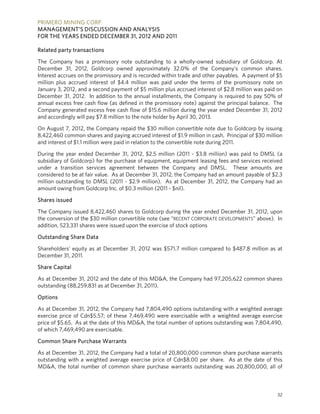
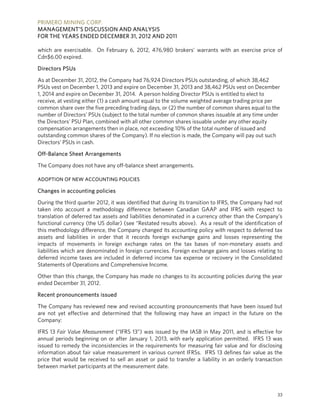
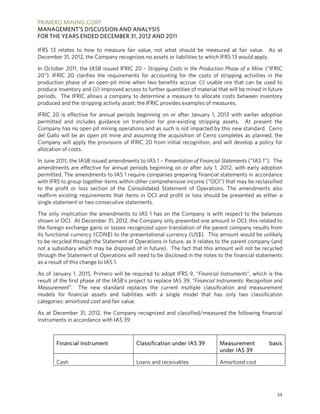
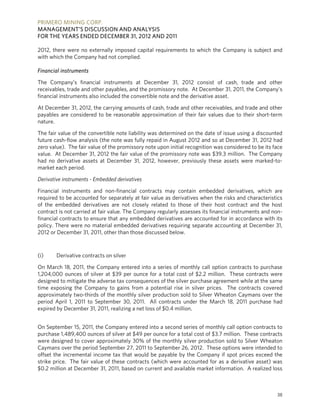
YEAR END AND FOURTH QUARTER REPORT 2012
                R         R           2
PRIMERO MINING CORP.
DECEMBER 31, 2012


Table of contents

Management’s discussion and analysis of financial condition and results of operations………….………1-48

Management’s Responsibility for Financial Reporting ......................................................................................... 49

Independent Auditor’s Report .................................................................................................................................... 50

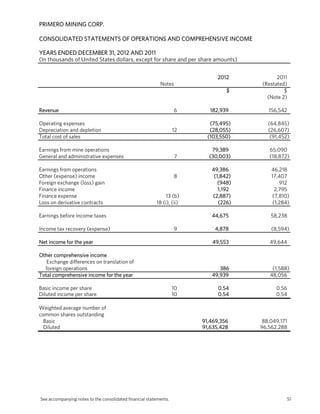
Consolidated statements of operations and comprehensive income ............................................................. 51

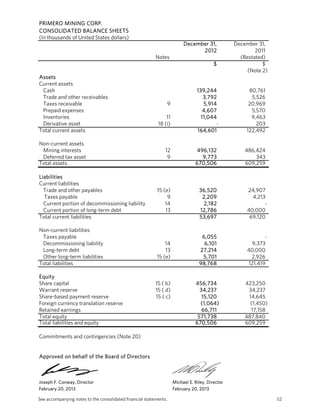
Consolidated balance sheets .......................................................................................................................................52

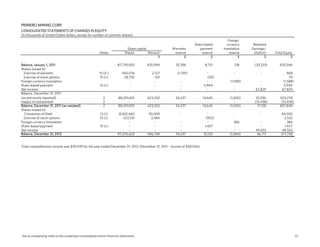
Consolidated statements of changes in equity ....................................................................................................... 53

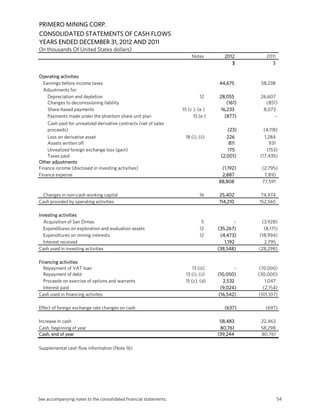
Consolidated statements of cash flows ................................................................................................................... 54

Notes to the consolidated financial statements .............................................................................................. 55-93
PRIMERO MINING CORP.
MANAGEMENT’S DISCUSSION AND ANALYSIS
OF FINANCIAL CONDITION AND RESULTS OF OPERATIONS
FOR THE YEARS ENDED DECEMBER 31, 2012 AND 2011

This management’s discussion and analysis (“MD&A”) of the financial condition and results of
operations of Primero Mining Corp. (“Primero” or the “Company”) should be read in conjunction with
the consolidated financial statements of the Company as at and for the year ended December 31, 2012.
Additional information on the Company, including its Annual Information Form for the year ended
December 31, 2012, which is expected to be filed by March 31, 2013, can be found under Primero’s
profile at www.sedar.com.

Management is responsible for the preparation of the financial statements and MD&A. The financial
statements have been prepared in accordance with International Financial Reporting Standards
(“IFRS”) as issued by the International Accounting Standards Board. All dollar figures in this MD&A
are expressed in US dollars, unless stated otherwise.

This MD&A contains forward-looking statements and should be read in conjunction with the risk
factors described in the “Risks and uncertainties” and “Cautionary statement on forward-looking
information” sections at the end of this MD&A.

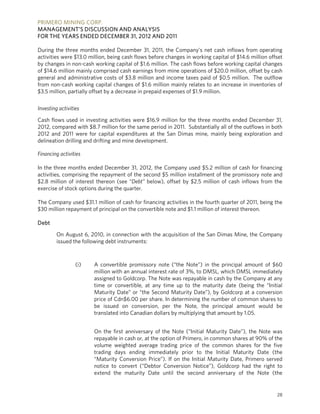
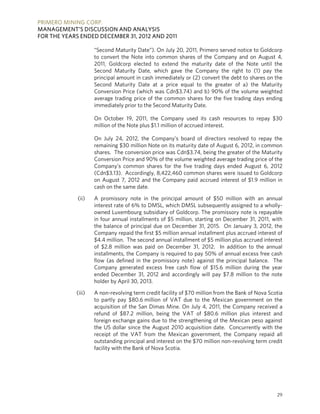
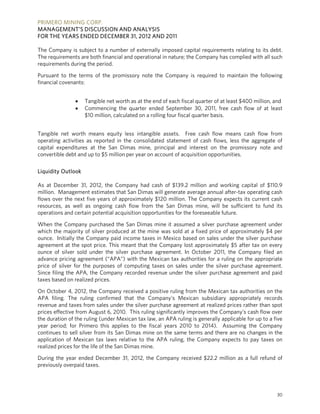
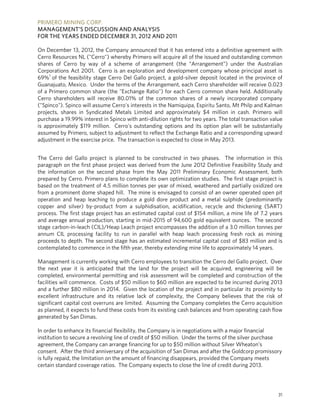
This MD&A has been prepared as of February 20, 2013.


2012 HIGHLIGHTS
2012 was a very successful year for Primero. There were significant improvements in the operating
metrics at San Dimas and the Company met its revised upward guidance. The Company received a
favourable tax ruling regarding the tax treatment of its silver revenue. In the fourth quarter, the
Company also announced that it had entered into a definitive agreement to acquire the Cerro Del Gallo
development project with the acquisition of Cerro Resources NL (“Cerro”) which, upon closing in 2013,
will diversify Primero’s asset base and marks an important step in becoming a mid-tier producer.
These events had a very positive impact on Primero’s stock price, which increased 97% in 2012, far
out-performing the industry and general market indices. The specific highlights for 2012 are:

      Produced 26,310 gold equivalent ounces1 in the fourth quarter and 111,132 gold equivalent
       ounces in 2012, compared to 23,115 and 102,224 gold equivalent ounces, respectively, in 2011;
      Produced 23,143 ounces of gold in the fourth quarter and 87,900 ounces of gold in 2012,
       compared to 20,191 ounces and 79,564 ounces, respectively, in 2011;
      Produced 1.32 million ounces of silver in the fourth quarter and 5.13 million ounces in 2012,
       compared to 1.20 million ounces and 4.6 million ounces, respectively, in 2011. In total the
       Company sold 716,229 ounces of silver at spot prices in 2012, compared to 511,752 ounces in
       2011.
      Lowered total cash costs per gold equivalent ounce2 to $677 for the fourth quarter and $636
       for 2012 from $719 and $640, respectively, in 2011. On a by-product basis, total cash costs per
       gold ounce were $535 for the fourth quarter and $366 for 2012, compared to $580 and $384
       per gold ounce for, respectively, 2011;
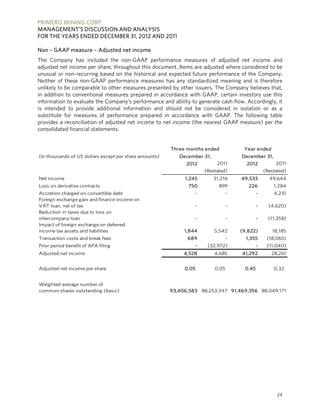
      Earned net income of $1.2 million ($0.01 per share) for the fourth quarter and $49.6 million
       ($0.54 per share) for 2012, compared to $31.2 million ($0.35 per share) and $49.6 million
       ($0.56 per share), respectively, in 2011. Adjusted net income³ was $4.5 million ($0.05 per


                                                                                                     1
PRIMERO MINING CORP.
MANAGEMENT’S DISCUSSION AND ANALYSIS
OF FINANCIAL CONDITION AND RESULTS OF OPERATIONS
FOR THE YEARS ENDED DECEMBER 31, 2012 AND 2011

      share) for the fourth quarter and $41.3 million ($0.45 per share) for 2012, compared to $4.7
      million ($0.05 per share) and $28.3 million ($0.32 per share), respectively, in 2011.
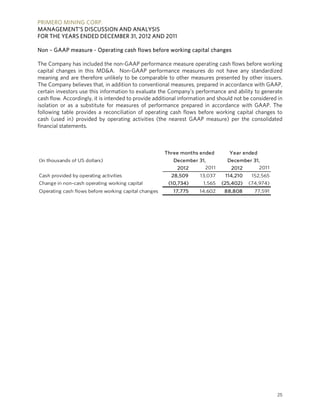
     Generated operating cash flows before working capital changes of $17.8 million in the fourth
      quarter, and $88.8 million in 2012, compared to $14.6 million and $77.6 million, respectively,
      in 2011;
     Received a ruling from the Mexican tax authorities in October 2012 confirming that the
      Company’s Mexican subsidiary appropriately records revenue and taxes from sales of silver
      under the silver purchase agreement at realized rather than spot prices;
     Entered into a definitive agreement to acquire Cerro in December 2012, which after spinning
      out various exploration assets, will result in the Company owning 69% of the feasibility stage
      Cerro Del Gallo project, a gold-silver deposit with approximately 1.0 million ounces of gold
      equivalent proven and probable reserves and 2.3 million ounces of gold equivalent measured
      and indicated resources (inclusive of reserves), located in the province of Guanajuato, Mexico;
     Repaid the remaining $30 million convertible note on its maturity date of August 6, 2012 by
      issuing 8,422,460 common shares to Goldcorp. On October 10, 2012, Goldcorp sold these
      shares by way of a secondary offering.


  1   “Gold equivalent ounces” includes silver ounces produced, and converted to a gold equivalent based on a ratio of the average
      commodity prices received for each period. The ratio for 2012 was based on realized prices of $1,662 per ounce of gold and $7.52
      per ounce of silver.
  2   Total cash costs per gold equivalent ounce and total cash costs per gold ounce on a by-product basis are non-GAAP measures.
      Total cash costs per gold equivalent ounce are defined as costs of production (including refining costs) divided by the total
      number of gold equivalent ounces produced. Total cash costs per gold ounce on a by-product basis are calculated by deducting
      the by-product silver credits from operating costs and dividing by the total number of gold ounces produced. The Company
      reports total cash costs on a production basis. In the gold mining industry, these are common performance measures but do not
      have any standardized meaning, and are non-GAAP measures. As such, they are unlikely to be comparable to similar measures
      presented by other issuers. In reporting total cash costs per gold equivalent and total cash costs per gold ounce on a by-product
      basis, the Company follows the recommendations of the Gold Institute standard. The Company believes that, in addition to
      conventional measures, prepared in accordance with GAAP, certain investors use this information to evaluate the Company’s
      performance and ability to generate cash flow. Accordingly, it is intended to provide additional information and should not be
      considered in isolation or as a substitute for measures of performance prepared in accordance with GAAP. Refer to “Non-GAAP
      measure – Total cash costs per gold ounce” below for a reconciliation of cash costs per gold ounce on both a by-product and gold
      equivalent basis to reported operating expenses (the most directly comparable GAAP measure).

  3   Adjusted net income and adjusted net income per share are non-GAAP measures. Adjusted net income is net income adjusted for
      unusual items. Neither of these non-GAAP performance measures has any standardized meaning and is therefore unlikely to be
      comparable to other measures presented by other issuers. The Company believes that, in addition to conventional measures
      prepared in accordance with GAAP, certain investors use this information to evaluate the Company’s performance. Accordingly, it
      is intended to provide additional information and should not be considered in isolation or as a substitute for measures of
      performance prepared in accordance with GAAP. Refer to “Non-GAAP measure – Adjusted net income” below for a reconciliation of
      adjusted net income to reported net income.


                                                                                                                                     2
PRIMERO MINING CORP.
MANAGEMENT’S DISCUSSION AND ANALYSIS
FOR THE YEARS ENDED DECEMBER 31, 2012 AND 2011

OVERVIEW

Primero is a Canadian-based precious metals producer with operations in Mexico. The Company is
focused on building a portfolio of high quality, low cost precious metals assets in the Americas through
acquiring, exploring, developing and operating mineral resource properties. Primero currently has one
producing property – the San Dimas mine, which it acquired on August 6, 2010.

The Company’s shares are listed on the Toronto Stock Exchange (“TSX”) under the symbol “P” and on
the New York Stock Exchange (“NYSE”) under the symbol “PPP”. In addition, Primero has common
share purchase warrants which trade on the TSX under the symbol “P.WT”.

The Company is transitioning from a single-asset gold producer to an intermediate gold producer. The
Company believes that the San Dimas mine provides a solid production base with short-term
opportunities to optimize mine capacity, increase mill throughput and expand production.
Furthermore, cash flow generated by the San Dimas mine provides funding for acquisition
opportunities.

RECENT CORPORATE DEVELOPMENTS

Agreement to acquire Cerro del Gallo1

On December 13, 2012, the Company announced that it has entered into a definitive agreement with
Cerro whereby Primero will acquire all of the issued and outstanding common shares of Cerro by way
of a scheme of arrangement (the "Arrangement") under the Australian Corporations Act 2001. Cerro
is an exploration and development company whose principal asset is 69% of the feasibility stage Cerro
Del Gallo project, a gold-silver deposit with approximately 1.0 million ounces of gold equivalent proven
and probable reserves and 2.3 million ounces of gold equivalent measured and indicated resources
(inclusive of reserves), located in the province of Guanajuato, Mexico.

Cerro del Gallo is an attractive long-life project that will diversify Primero’s near-term production with
an anticipated additional 95,000 gold equivalent ounces per year (expected to begin in mid-2015), a
58% increase in currently estimated near-term production. The project will double Primero’s current
reserves and triple its measured and indicated resources. Furthermore it will leverage on Primero's
regional expertise and solidify its presence in Mexico, one of the world's most supportive mining
districts, with further consolidation opportunities.


1
  The information on the Cerro del Gallo project in this and other sections of this MD&A assumes Goldcorp Inc.
converts its 30.8% position in Cerro del Gallo to a Net Profit Interest and that resources include reserves. Cerro
Resources NL has filed a technical report under National Instrument 43-101 - Standards of Disclosure for Mineral
Projects (“NI 43-101”) entitled “Technical Report, First Stage Heap Leach Feasibility Study, Cerro del Gallo Gold
Silver Project, Guanajuato, Mexico” (the “Technical Report”) with an effective date of May 11, 2012. Mr. Gabriel
Voicu, Vice President, Geology and Exploration, who is a “qualified person” for the purposes of NI 43-101, has
reviewed the Technical Report on behalf of Primero. To the best of Primero’s knowledge, information and belief,
there is no new material scientific or technical information that would make the Technical Report inaccurate or
misleading. Primero plans to file a technical report on the Cerro del Gallo project within 180 days of December
13, 2012 in accordance with the requirements of NI 43-101.


                                                                                                                3
PRIMERO MINING CORP.
MANAGEMENT’S DISCUSSION AND ANALYSIS
FOR THE YEARS ENDED DECEMBER 31, 2012 AND 2011

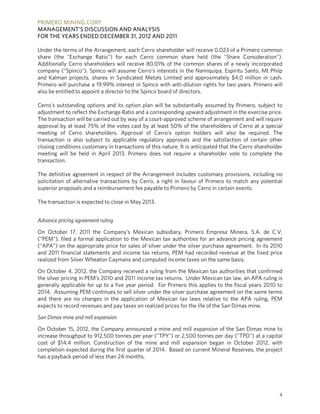
Under the terms of the Arrangement, each Cerro shareholder will receive 0.023 of a Primero common
share (the "Exchange Ratio") for each Cerro common share held (the "Share Consideration").
Additionally Cerro shareholders will receive 80.01% of the common shares of a newly incorporated
company ("Spinco"). Spinco will assume Cerro's interests in the Namiquipa, Espiritu Santo, Mt Philp
and Kalman projects, shares in Syndicated Metals Limited and approximately $4.0 million in cash.
Primero will purchase a 19.99% interest in Spinco with anti-dilution rights for two years. Primero will
also be entitled to appoint a director to the Spinco board of directors.

Cerro's outstanding options and its option plan will be substantially assumed by Primero, subject to
adjustment to reflect the Exchange Ratio and a corresponding upward adjustment in the exercise price.
The transaction will be carried out by way of a court-approved scheme of arrangement and will require
approval by at least 75% of the votes cast by at least 50% of the shareholders of Cerro at a special
meeting of Cerro shareholders. Approval of Cerro's option holders will also be required. The
transaction is also subject to applicable regulatory approvals and the satisfaction of certain other
closing conditions customary in transactions of this nature. It is anticipated that the Cerro shareholder
meeting will be held in April 2013. Primero does not require a shareholder vote to complete the
transaction.

The definitive agreement in respect of the Arrangement includes customary provisions, including no
solicitation of alternative transactions by Cerro, a right in favour of Primero to match any potential
superior proposals and a reimbursement fee payable to Primero by Cerro in certain events.

The transaction is expected to close in May 2013.


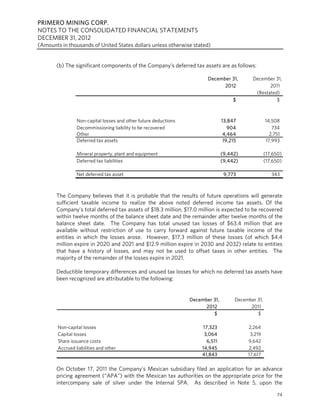
Advance pricing agreement ruling

On October 17, 2011 the Company’s Mexican subsidiary, Primero Empresa Minera, S.A. de C.V.
(“PEM”), filed a formal application to the Mexican tax authorities for an advance pricing agreement
(“APA”) on the appropriate price for sales of silver under the silver purchase agreement. In its 2010
and 2011 financial statements and income tax returns, PEM had recorded revenue at the fixed price
realized from Silver Wheaton Caymans and computed income taxes on the same basis.

On October 4, 2012, the Company received a ruling from the Mexican tax authorities that confirmed
the silver pricing in PEM’s 2010 and 2011 income tax returns. Under Mexican tax law, an APA ruling is
generally applicable for up to a five year period. For Primero this applies to the fiscal years 2010 to
2014. Assuming PEM continues to sell silver under the silver purchase agreement on the same terms
and there are no changes in the application of Mexican tax laws relative to the APA ruling, PEM
expects to record revenues and pay taxes on realized prices for the life of the San Dimas mine.

San Dimas mine and mill expansion

On October 15, 2012, the Company announced a mine and mill expansion of the San Dimas mine to
increase throughput to 912,500 tonnes per year ("TPY") or 2,500 tonnes per day ("TPD") at a capital
cost of $14.4 million. Construction of the mine and mill expansion began in October 2012, with
completion expected during the first quarter of 2014. Based on current Mineral Reserves, the project
has a payback period of less than 24 months.


                                                                                                       4
PRIMERO MINING CORP.
MANAGEMENT’S DISCUSSION AND ANALYSIS
FOR THE YEARS ENDED DECEMBER 31, 2012 AND 2011

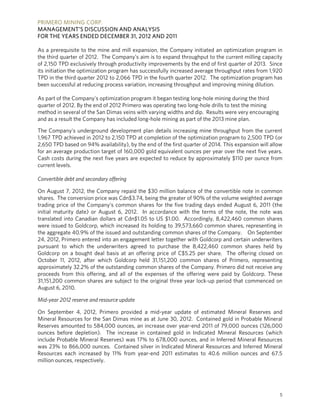
As a prerequisite to the mine and mill expansion, the Company initiated an optimization program in
the third quarter of 2012. The Company’s aim is to expand throughput to the current milling capacity
of 2,150 TPD exclusively through productivity improvements by the end of first quarter of 2013. Since
its initiation the optimization program has successfully increased average throughput rates from 1,920
TPD in the third quarter 2012 to 2,066 TPD in the fourth quarter 2012. The optimization program has
been successful at reducing process variation, increasing throughput and improving mining dilution.

As part of the Company's optimization program it began testing long-hole mining during the third
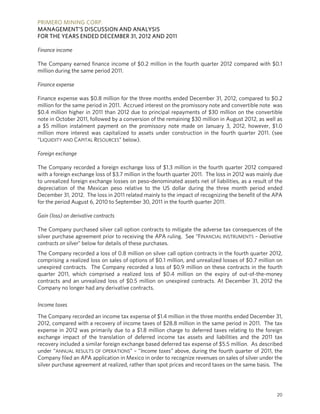
quarter of 2012. By the end of 2012 Primero was operating two long-hole drills to test the mining
method in several of the San Dimas veins with varying widths and dip. Results were very encouraging
and as a result the Company has included long-hole mining as part of the 2013 mine plan.

The Company's underground development plan details increasing mine throughput from the current
1,967 TPD achieved in 2012 to 2,150 TPD at completion of the optimization program to 2,500 TPD (or
2,650 TPD based on 94% availability), by the end of the first quarter of 2014. This expansion will allow
for an average production target of 160,000 gold equivalent ounces per year over the next five years.
Cash costs during the next five years are expected to reduce by approximately $110 per ounce from
current levels.

Convertible debt and secondary offering

On August 7, 2012, the Company repaid the $30 million balance of the convertible note in common
shares. The conversion price was Cdn$3.74, being the greater of 90% of the volume weighted average
trading price of the Company’s common shares for the five trading days ended August 6, 2011 (the
initial maturity date) or August 6, 2012. In accordance with the terms of the note, the note was
translated into Canadian dollars at Cdn$1.05 to US $1.00. Accordingly, 8,422,460 common shares
were issued to Goldcorp, which increased its holding to 39,573,660 common shares, representing in
the aggregate 40.9% of the issued and outstanding common shares of the Company. On September
24, 2012, Primero entered into an engagement letter together with Goldcorp and certain underwriters
pursuant to which the underwriters agreed to purchase the 8,422,460 common shares held by
Goldcorp on a bought deal basis at an offering price of C$5.25 per share. The offering closed on
October 11, 2012, after which Goldcorp held 31,151,200 common shares of Primero, representing
approximately 32.2% of the outstanding common shares of the Company. Primero did not receive any
proceeds from this offering, and all of the expenses of the offering were paid by Goldcorp. These
31,151,200 common shares are subject to the original three year lock-up period that commenced on
August 6, 2010.

Mid-year 2012 reserve and resource update

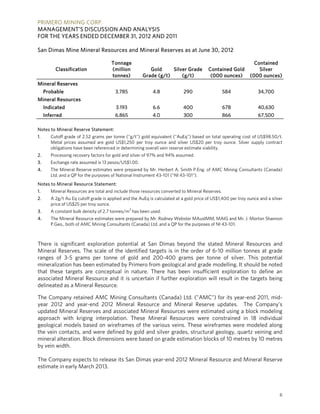
On September 4, 2012, Primero provided a mid-year update of estimated Mineral Reserves and
Mineral Resources for the San Dimas mine as at June 30, 2012. Contained gold in Probable Mineral
Reserves amounted to 584,000 ounces, an increase over year-end 2011 of 79,000 ounces (126,000
ounces before depletion). The increase in contained gold in Indicated Mineral Resources (which
include Probable Mineral Reserves) was 17% to 678,000 ounces, and in Inferred Mineral Resources
was 23% to 866,000 ounces. Contained silver in Indicated Mineral Resources and Inferred Mineral
Resources each increased by 11% from year-end 2011 estimates to 40.6 million ounces and 67.5
million ounces, respectively.


                                                                                                      5
PRIMERO MINING CORP.
MANAGEMENT’S DISCUSSION AND ANALYSIS
FOR THE YEARS ENDED DECEMBER 31, 2012 AND 2011

San Dimas Mine Mineral Resources and Mineral Reserves as at June 30, 2012

                                    Tonnage                                                                  Contained
        Classification              (million           Gold     Silver Grade          Contained Gold           Silver
                                    tonnes)         Grade (g/t)     (g/t)              (000 ounces)        (000 ounces)
Mineral Reserves
 Probable                             3.785              4.8             290                  584              34,700
Mineral Resources
 Indicated                            3.193              6.6             400                  678              40,630
 Inferred                             6.865              4.0             300                  866              67,500

Notes to Mineral Reserve Statement:
1.   Cutoff grade of 2.52 grams per tonne ("g/t") gold equivalent ("AuEq") based on total operating cost of US$98.50/t.
     Metal prices assumed are gold US$1,250 per troy ounce and silver US$20 per troy ounce. Silver supply contract
     obligations have been referenced in determining overall vein reserve estimate viability.
2.   Processing recovery factors for gold and silver of 97% and 94% assumed.
3.   Exchange rate assumed is 13 pesos/US$1.00.
4.   The Mineral Reserve estimates were prepared by Mr. Herbert A. Smith P.Eng. of AMC Mining Consultants (Canada)
     Ltd. and a QP for the purposes of National Instrument 43-101 ("NI 43-101").
Notes to Mineral Resource Statement:
1.   Mineral Resources are total and include those resources converted to Mineral Reserves.
2.   A 2g/t Au Eq cutoff grade is applied and the AuEq is calculated at a gold price of US$1,400 per troy ounce and a silver
     price of US$25 per troy ounce.
3.   A constant bulk density of 2.7 tonnes/m3 has been used.
4.   The Mineral Resource estimates were prepared by Mr. Rodney Webster MAusIMM, MAIG and Mr. J. Morton Shannon
     P.Geo., both of AMC Mining Consultants (Canada) Ltd. and a QP for the purposes of NI 43-101.


There is significant exploration potential at San Dimas beyond the stated Mineral Resources and
Mineral Reserves. The scale of the identified targets is in the order of 6-10 million tonnes at grade
ranges of 3-5 grams per tonne of gold and 200-400 grams per tonne of silver. This potential
mineralization has been estimated by Primero from geological and grade modelling. It should be noted
that these targets are conceptual in nature. There has been insufficient exploration to define an
associated Mineral Resource and it is uncertain if further exploration will result in the targets being
delineated as a Mineral Resource.

The Company retained AMC Mining Consultants (Canada) Ltd. ("AMC") for its year-end 2011, mid-
year 2012 and year-end 2012 Mineral Resource and Mineral Reserve updates. The Company’s
updated Mineral Reserves and associated Mineral Resources were estimated using a block modeling
approach with kriging interpolation. These Mineral Resources were constrained in 18 individual
geological models based on wireframes of the various veins. These wireframes were modeled along
the vein contacts, and were defined by gold and silver grades, structural geology, quartz veining and
mineral alteration. Block dimensions were based on grade estimation blocks of 10 metres by 10 metres
by vein width.

The Company expects to release its San Dimas year-end 2012 Mineral Resource and Mineral Reserve
estimate in early March 2013.


                                                                                                                          6
PRIMERO MINING CORP.
MANAGEMENT’S DISCUSSION AND ANALYSIS
FOR THE YEARS ENDED DECEMBER 31, 2012 AND 2011

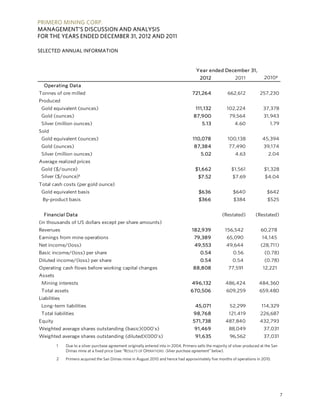
SELECTED ANNUAL INFORMATION


                                                                                          Year ended December 31,
                                                                                            2012                 2011             2010²
  Operating Data
Tonnes of ore milled                                                                    721,264             662,612            257,230
Produced
 Gold equivalent (ounces)                                                                 111,132           102,224              37,378
 Gold (ounces)                                                                          87,900               79,564              31,943
 Silver (million ounces)                                                                     5.13               4.60                 1.79
Sold
 Gold equivalent (ounces)                                                               110,078             100,138              45,394
 Gold (ounces)                                                                           87,384              77,490              39,174
 Silver (million ounces)                                                                     5.02                4.63               2.04
Average realized prices
 Gold ($/ounce)                                                                          $1,662               $1,561              $1,328
 Silver ($/ounce)¹                                                                         $7.52               $7.69              $4.04
Total cash costs (per gold ounce)
 Gold equivalent basis                                                                     $636                $640                $642
 By-product basis                                                                          $366                 $384                $525


  Financial Data                                                                                         (Restated)          (Restated)
(in thousands of US dollars except per share amounts)
Revenues                                                                               182,939             156,542              60,278
Earnings from mine operations                                                            79,389             65,090              14,145
Net income/(loss)                                                                        49,553             49,644              (28,711)
Basic income/(loss) per share                                                               0.54               0.56               (0.78)
Diluted income/(loss) per share                                                             0.54               0.54               (0.78)
Operating cash flows before working capital changes                                     88,808               77,591              12,221
Assets
 Mining interests                                                                      496,132             486,424             484,360
 Total assets                                                                          670,506              609,259            659,480
Liabilities
 Long-term liabilities                                                                   45,071               52,299            114,329
 Total liabilities                                                                      98,768               121,419           226,687
Equity                                                                                  571,738            487,840             432,793
Weighted average shares outstanding (basic)(000's)                                       91,469              88,049              37,031
Weighted average shares outstanding (diluted)(000's)                                     91,635               96,562             37,031
         1    Due to a silver purchase agreement originally entered into in 2004, Primero sells the majority of silver produced at the San
              Dimas mine at a fixed price (see “RESULTS OF OPERATIONS -Silver purchase agreement” below).
         2    Primero acquired the San Dimas mine in August 2010 and hence had approximately five months of operations in 2010.


                                                                                                                                             7
PRIMERO MINING CORP.
MANAGEMENT’S DISCUSSION AND ANALYSIS
FOR THE YEARS ENDED DECEMBER 31, 2012 AND 2011

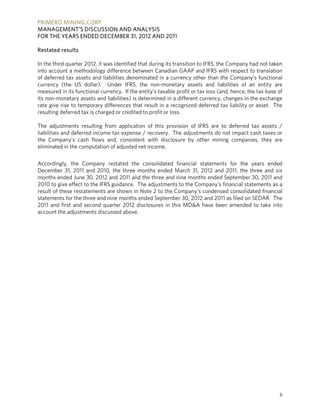
Restated results

In the third quarter 2012, it was identified that during its transition to IFRS, the Company had not taken
into account a methodology difference between Canadian GAAP and IFRS with respect to translation
of deferred tax assets and liabilities denominated in a currency other than the Company’s functional
currency (the US dollar). Under IFRS, the non-monetary assets and liabilities of an entity are
measured in its functional currency. If the entity’s taxable profit or tax loss (and, hence, the tax base of
its non-monetary assets and liabilities) is determined in a different currency, changes in the exchange
rate give rise to temporary differences that result in a recognized deferred tax liability or asset. The
resulting deferred tax is charged or credited to profit or loss.

The adjustments resulting from application of this provision of IFRS are to deferred tax assets /
liabilities and deferred income tax expense / recovery. The adjustments do not impact cash taxes or
the Company’s cash flows and, consistent with disclosure by other mining companies, they are
eliminated in the computation of adjusted net income.

Accordingly, the Company restated the consolidated financial statements for the years ended
December 31, 2011 and 2010, the three months ended March 31, 2012 and 2011, the three and six
months ended June 30, 2012 and 2011 and the three and nine months ended September 30, 2011 and
2010 to give effect to the IFRS guidance. The adjustments to the Company’s financial statements as a
result of these restatements are shown in Note 2 to the Company’s condensed consolidated financial
statements for the three and nine months ended September 30, 2012 and 2011 as filed on SEDAR. The
2011 and first and second quarter 2012 disclosures in this MD&A have been amended to take into
account the adjustments discussed above.


                                                                                                          8
PRIMERO MINING CORP.
MANAGEMENT’S DISCUSSION AND ANALYSIS
FOR THE YEARS ENDED DECEMBER 31, 2012 AND 2011

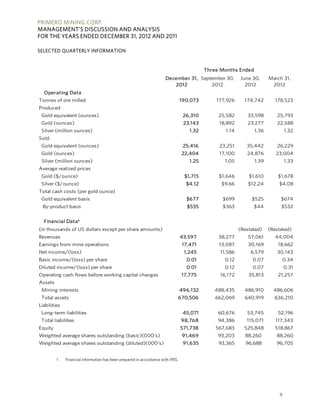
SELECTED QUARTERLY INFORMATION


                                                                                           Three Months Ended
                                                                      December 31, September 30,         June 30,      March 31,
                                                                         2012          2012                2012         2012
  Operating Data
Tonnes of ore milled                                                             190,073       177,926     174,742        178,523
Produced
 Gold equivalent (ounces)                                                         26,310        25,582      33,598        25,793
 Gold (ounces)                                                                    23,143        18,892      23,277        22,588
 Silver (million ounces)                                                            1.32          1.14          1.36           1.32
Sold:
 Gold equivalent (ounces)                                                         25,416        23,251      35,442        26,229
 Gold (ounces)                                                                   22,404         17,100      24,876        23,004
 Silver (million ounces)                                                            1.25          1.05          1.39           1.33
Average realized prices
 Gold ($/ounce)                                                                   $1,715        $1,646       $1,610        $1,678
 Silver ($/ounce)                                                                  $4.12         $9.66       $12.24        $4.08
Total cash costs (per gold ounce)
 Gold equivalent basis                                                             $677          $699         $525          $674
 By-product basis                                                                  $535          $363           $44         $532


  Financial Data ¹
(in thousands of US dollars except per share amounts)                                                    (Restated)    (Restated)
Revenues                                                                         43,597         38,277       57,061       44,004
Earnings from mine operations                                                    17,471         13,087       30,169        18,662
Net income/(loss)                                                                 1,245         11,586        6,579       30,143
Basic income/(loss) per share                                                      0.01           0.12         0.07          0.34
Diluted income/(loss) per share                                                    0.01           0.12         0.07            0.31
Operating cash flows before working capital changes                              17,775         16,172       35,813        21,257
Assets
 Mining interests                                                                496,132      488,435      486,910       486,606
 Total assets                                                                670,506           662,069     640,919       636,210
Liabilities
 Long-term liabilities                                                            45,071        60,676      53,745         52,196
 Total liabilities                                                               98,768         94,386      115,071       117,343
Equity                                                                           571,738       567,683     525,848        518,867
Weighted average shares outstanding (basic)(000's)                               91,469         93,203     88,260         88,260
Weighted average shares outstanding (diluted)(000's)                              91,635        93,365      96,688        96,705


         1    Financial information has been prepared in accordance with IFRS.


                                                                                                                           9
PRIMERO MINING CORP.
MANAGEMENT’S DISCUSSION AND ANALYSIS
FOR THE YEARS ENDED DECEMBER 31, 2012 AND 2011

OUTLOOK FOR 2013

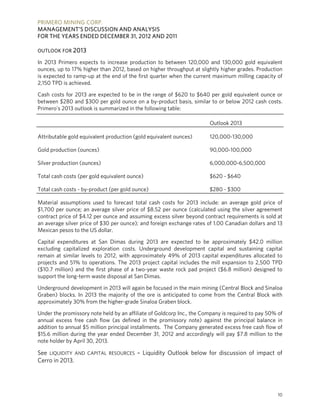
In 2013 Primero expects to increase production to between 120,000 and 130,000 gold equivalent
ounces, up to 17% higher than 2012, based on higher throughput at slightly higher grades. Production
is expected to ramp-up at the end of the first quarter when the current maximum milling capacity of
2,150 TPD is achieved.

Cash costs for 2013 are expected to be in the range of $620 to $640 per gold equivalent ounce or
between $280 and $300 per gold ounce on a by-product basis, similar to or below 2012 cash costs.
Primero's 2013 outlook is summarized in the following table:

                                                                       Outlook 2013

Attributable gold equivalent production (gold equivalent ounces)       120,000-130,000

Gold production (ounces)                                               90,000-100,000

Silver production (ounces)                                             6,000,000-6,500,000

Total cash costs (per gold equivalent ounce)                           $620 - $640

Total cash costs - by-product (per gold ounce)                         $280 - $300

Material assumptions used to forecast total cash costs for 2013 include: an average gold price of
$1,700 per ounce; an average silver price of $8.52 per ounce (calculated using the silver agreement
contract price of $4.12 per ounce and assuming excess silver beyond contract requirements is sold at
an average silver price of $30 per ounce); and foreign exchange rates of 1.00 Canadian dollars and 13
Mexican pesos to the US dollar.

Capital expenditures at San Dimas during 2013 are expected to be approximately $42.0 million
excluding capitalized exploration costs. Underground development capital and sustaining capital
remain at similar levels to 2012, with approximately 49% of 2013 capital expenditures allocated to
projects and 51% to operations. The 2013 project capital includes the mill expansion to 2,500 TPD
($10.7 million) and the first phase of a two-year waste rock pad project ($6.8 million) designed to
support the long-term waste disposal at San Dimas.
Underground development in 2013 will again be focused in the main mining (Central Block and Sinaloa
Graben) blocks. In 2013 the majority of the ore is anticipated to come from the Central Block with
approximately 30% from the higher-grade Sinaloa Graben block.
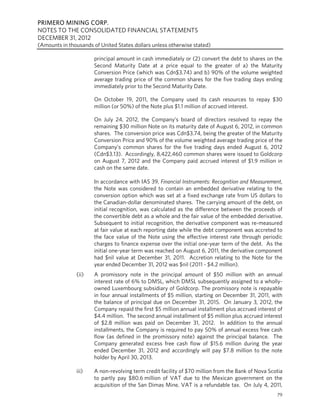
Under the promissory note held by an affiliate of Goldcorp Inc., the Company is required to pay 50% of
annual excess free cash flow (as defined in the promissory note) against the principal balance in
addition to annual $5 million principal installments. The Company generated excess free cash flow of
$15.6 million during the year ended December 31, 2012 and accordingly will pay $7.8 million to the
note holder by April 30, 2013.

See LIQUIDITY AND   CAPITAL RESOURCES    – Liquidity Outlook below for discussion of impact of
Cerro in 2013.


                                                                                                    10
PRIMERO MINING CORP.
MANAGEMENT’S DISCUSSION AND ANALYSIS
FOR THE YEARS ENDED DECEMBER 31, 2012 AND 2011

REVIEW OF OPERATIONS

San Dimas mine
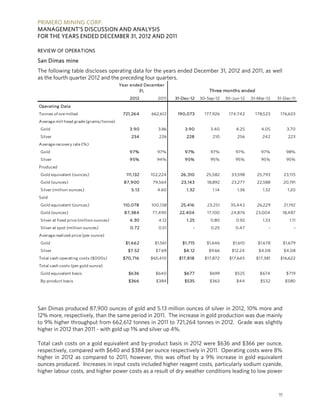
The following table discloses operating data for the years ended December 31, 2012 and 2011, as well
as the fourth quarter 2012 and the preceding four quarters.
                                          Year ended December
                                                   31,                            Three months ended
                                              2012        2011    31-Dec-12   30-Sep-12   30-Jun-12   31-Mar-12   31-Dec-11
Operating Data
Tonnes of ore milled                       721,264     662,612     190,073      177,926    174,742      178,523    176,633
Average mill head grade (grams/tonne)
 Gold                                         3.90        3.86        3.90        3.40        4.25        4.05          3.70
 Silver                                        234         226         228         210         256         242           223
Average recovery rate (%)
 Gold                                         97%         97%         97%         97%         97%         97%           98%
 Silver                                       95%         94%         95%         95%         95%         95%           95%
Produced
 Gold equivalent (ounces)                    111,132   102,224      26,310       25,582     33,598      25,793         23,115
 Gold (ounces)                              87,900      79,564      23,143       18,892     23,277      22,588         20,191
 Silver (million ounces)                       5.13       4.60         1.32        1.14        1.36        1.32          1.20
Sold
 Gold equivalent (ounces)                  110,078     100,138      25,416       23,251     35,442      26,229         21,192
 Gold (ounces)                              87,384     77,490       22,404       17,100     24,876      23,004         18,487
 Silver at fixed price (million ounces)       4.30        4.12         1.25       0.80        0.92         1.33           1.11
 Silver at spot (million ounces)               0.72       0.51            -        0.25       0.47            -             -
Average realized price (per ounce)
 Gold                                       $1,662       $1,561      $1,715      $1,646      $1,610      $1,678        $1,679
 Silver                                      $7.52       $7.69        $4.12       $9.66      $12.24      $4.08         $4.08
Total cash operating costs ($000s)         $70,716     $65,410     $17,818      $17,872    $17,645      $17,381    $16,622
Total cash costs (per gold ounce)
 Gold equivalent basis                        $636       $640         $677        $699        $525        $674          $719
 By-product basis                             $366       $384         $535        $363         $44        $532          $580


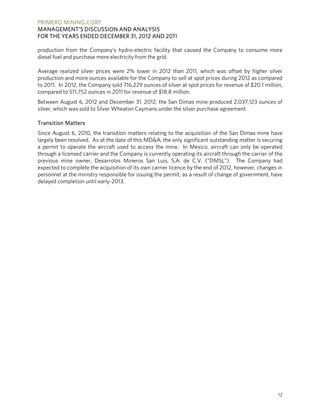
San Dimas produced 87,900 ounces of gold and 5.13 million ounces of silver in 2012, 10% more and
12% more, respectively, than the same period in 2011. The increase in gold production was due mainly
to 9% higher throughput from 662,612 tonnes in 2011 to 721,264 tonnes in 2012. Grade was slightly
higher in 2012 than 2011 - with gold up 1% and silver up 4%.

Total cash costs on a gold equivalent and by-product basis in 2012 were $636 and $366 per ounce,
respectively, compared with $640 and $384 per ounce respectively in 2011. Operating costs were 8%
higher in 2012 as compared to 2011, however, this was offset by a 9% increase in gold equivalent
ounces produced. Increases in input costs included higher reagent costs, particularly sodium cyanide,
higher labour costs, and higher power costs as a result of dry weather conditions leading to low power


                                                                                                                  11
PRIMERO MINING CORP.
MANAGEMENT’S DISCUSSION AND ANALYSIS
FOR THE YEARS ENDED DECEMBER 31, 2012 AND 2011

production from the Company’s hydro-electric facility that caused the Company to consume more
diesel fuel and purchase more electricity from the grid.

Average realized silver prices were 2% lower in 2012 than 2011, which was offset by higher silver
production and more ounces available for the Company to sell at spot prices during 2012 as compared
to 2011. In 2012, the Company sold 716,229 ounces of silver at spot prices for revenue of $20.1 million,
compared to 511,752 ounces in 2011 for revenue of $18.8 million.
Between August 6, 2012 and December 31, 2012, the San Dimas mine produced 2,037,123 ounces of
silver, which was sold to Silver Wheaton Caymans under the silver purchase agreement.

Transition Matters
Since August 6, 2010, the transition matters relating to the acquisition of the San Dimas mine have
largely been resolved. As at the date of this MD&A, the only significant outstanding matter is securing
a permit to operate the aircraft used to access the mine. In Mexico, aircraft can only be operated
through a licensed carrier and the Company is currently operating its aircraft through the carrier of the
previous mine owner, Desarrolos Mineros San Luis, S.A. de C.V. (“DMSL”). The Company had
expected to complete the acquisition of its own carrier licence by the end of 2012, however, changes in
personnel at the ministry responsible for issuing the permit, as a result of change of government, have
delayed completion until early-2013.


                                                                                                       12
PRIMERO MINING CORP.
MANAGEMENT’S DISCUSSION AND ANALYSIS
FOR THE YEARS ENDED DECEMBER 31, 2012 AND 2011

ANNUAL RESULTS OF OPERATIONS

In thousands of US dollars except per share amounts         December 31
                                                           2012                2011
                                                                          (Restated)
                                                              $                   $
Revenue                                                 182,939            156,542
Operating expenses                                      (75,495)           (64,845)
Depreciation and depletion                              (28,055)           (26,607)
Total cost of sales                                    (103,550)           (91,452)
Earnings from mine operations                           79,389             65,090
General and administrative                              (30,003)           (18,872)
Other income (expense)                                   (1,842)            17,407
Foreign exchange gain (loss)                              (948)                912
Finance income                                            1,192              2,795
Finance expense                                          (2,887)            (7,810)
Loss on derivative contracts                               (226)            (1,284)
Earnings before income taxes                            44,675              58,238
Income tax (expense) recovery                             4,878             (8,594)
Net income for the period                                49,553            49,644
Basic income per share                                     0.54               0.56
Diluted income per share                                   0.54               0.54

Weighted average number of common shares
outstanding - basic                                   91,469,356         88,049,171

Weighted average number of common shares
outstanding - diluted                                 91,635,428        96,562,288


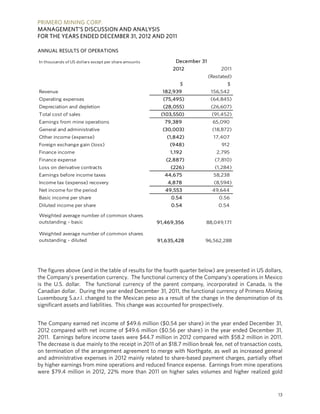
The figures above (and in the table of results for the fourth quarter below) are presented in US dollars,
the Company’s presentation currency. The functional currency of the Company’s operations in Mexico
is the U.S. dollar. The functional currency of the parent company, incorporated in Canada, is the
Canadian dollar. During the year ended December 31, 2011, the functional currency of Primero Mining
Luxembourg S.a.r.l. changed to the Mexican peso as a result of the change in the denomination of its
significant assets and liabilities. This change was accounted for prospectively.


The Company earned net income of $49.6 million ($0.54 per share) in the year ended December 31,
2012 compared with net income of $49.6 million ($0.56 per share) in the year ended December 31,
2011. Earnings before income taxes were $44.7 million in 2012 compared with $58.2 million in 2011.
The decrease is due mainly to the receipt in 2011 of an $18.7 million break fee, net of transaction costs,
on termination of the arrangement agreement to merge with Northgate, as well as increased general
and administrative expenses in 2012 mainly related to share-based payment charges, partially offset
by higher earnings from mine operations and reduced finance expense. Earnings from mine operations
were $79.4 million in 2012, 22% more than 2011 on higher sales volumes and higher realized gold


                                                                                                        13
PRIMERO MINING CORP.
MANAGEMENT’S DISCUSSION AND ANALYSIS
FOR THE YEARS ENDED DECEMBER 31, 2012 AND 2011

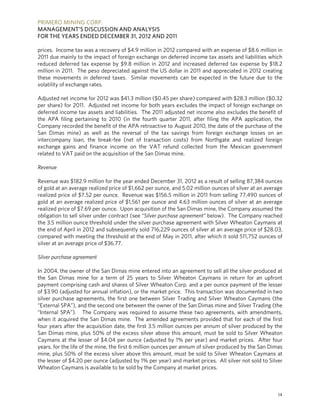
prices. Income tax was a recovery of $4.9 million in 2012 compared with an expense of $8.6 million in
2011 due mainly to the impact of foreign exchange on deferred income tax assets and liabilities which
reduced deferred tax expense by $9.8 million in 2012 and increased deferred tax expense by $18.2
million in 2011. The peso depreciated against the US dollar in 2011 and appreciated in 2012 creating
these movements in deferred taxes. Similar movements can be expected in the future due to the
volatility of exchange rates.

Adjusted net income for 2012 was $41.3 million ($0.45 per share) compared with $28.3 million ($0.32
per share) for 2011. Adjusted net income for both years excludes the impact of foreign exchange on
deferred income tax assets and liabilities. The 2011 adjusted net income also excludes the benefit of
the APA filing pertaining to 2010 (in the fourth quarter 2011, after filing the APA application, the
Company recorded the benefit of the APA retroactive to August 2010, the date of the purchase of the
San Dimas mine) as well as the reversal of the tax savings from foreign exchange losses on an
intercompany loan, the break-fee (net of transaction costs) from Northgate and realized foreign
exchange gains and finance income on the VAT refund collected from the Mexican government
related to VAT paid on the acquisition of the San Dimas mine.

Revenue

Revenue was $182.9 million for the year ended December 31, 2012 as a result of selling 87,384 ounces
of gold at an average realized price of $1,662 per ounce, and 5.02 million ounces of silver at an average
realized price of $7.52 per ounce. Revenue was $156.5 million in 2011 from selling 77,490 ounces of
gold at an average realized price of $1,561 per ounce and 4.63 million ounces of silver at an average
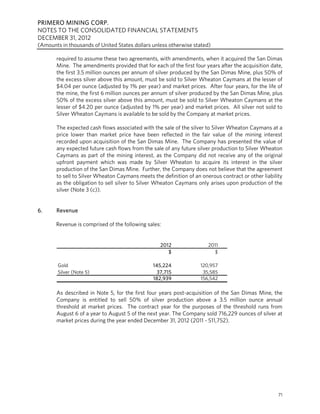
realized price of $7.69 per ounce. Upon acquisition of the San Dimas mine, the Company assumed the
obligation to sell silver under contract (see “Silver purchase agreement” below). The Company reached
the 3.5 million ounce threshold under the silver purchase agreement with Silver Wheaton Caymans at
the end of April in 2012 and subsequently sold 716,229 ounces of silver at an average price of $28.03,
compared with meeting the threshold at the end of May in 2011, after which it sold 511,752 ounces of
silver at an average price of $36.77.

Silver purchase agreement

In 2004, the owner of the San Dimas mine entered into an agreement to sell all the silver produced at
the San Dimas mine for a term of 25 years to Silver Wheaton Caymans in return for an upfront
payment comprising cash and shares of Silver Wheaton Corp. and a per ounce payment of the lesser
of $3.90 (adjusted for annual inflation), or the market price. This transaction was documented in two
silver purchase agreements, the first one between Silver Trading and Silver Wheaton Caymans (the
“External SPA”), and the second one between the owner of the San Dimas mine and Silver Trading (the
“Internal SPA”). The Company was required to assume these two agreements, with amendments,
when it acquired the San Dimas mine. The amended agreements provided that for each of the first
four years after the acquisition date, the first 3.5 million ounces per annum of silver produced by the
San Dimas mine, plus 50% of the excess silver above this amount, must be sold to Silver Wheaton
Caymans at the lesser of $4.04 per ounce (adjusted by 1% per year) and market prices. After four
years, for the life of the mine, the first 6 million ounces per annum of silver produced by the San Dimas
mine, plus 50% of the excess silver above this amount, must be sold to Silver Wheaton Caymans at
the lesser of $4.20 per ounce (adjusted by 1% per year) and market prices. All silver not sold to Silver
Wheaton Caymans is available to be sold by the Company at market prices.


                                                                                                       14
PRIMERO MINING CORP.
MANAGEMENT’S DISCUSSION AND ANALYSIS
FOR THE YEARS ENDED DECEMBER 31, 2012 AND 2011


The expected cash flows associated with the sale of the silver to Silver Wheaton Caymans at a price
lower than the market price have been reflected in the fair value of the mining interests recorded upon
acquisition of the San Dimas mine. The Company has presented the obligation to sell any silver
production to Silver Wheaton Caymans as part of the mining interests, as the Company did not receive
any of the original upfront payment which was made by Silver Wheaton to acquire its interest in the
silver production of the San Dimas mine. Further, the Company does not believe that the obligation
meets the definition of a liability as the obligation to sell silver to Silver Wheaton Caymans only arises
upon production of the silver.

Until October, 2011, the Company computed income taxes in Mexico based on selling all silver
produced at the San Dimas mine at market prices (the price in the Internal SPA that it was required to
assume on the acquisition of the San Dimas mine). From a consolidated perspective, therefore, the
silver sales to Silver Wheaton Caymans realized approximately $4 per ounce, however, the Company
recorded income taxes based on sales at market prices. On October 11, 2011, as part of its
restructuring initiatives and based on recognized transfer pricing methodology, the Company amended
the Internal SPA to provide that the price payable by Silver Trading to purchase silver is the same price
as the fixed price charged by Silver Trading under the External SPA. On October 17, 2011, the
Company’s Mexican subsidiary filed an application to the Mexican tax authorities for an advance
pricing agreement (“APA”) on the appropriate price for the intercompany sale of silver under the
Internal SPA.

On October 4, 2012, the Mexican tax authorities ruled on the APA. The ruling confirmed that the
Company's Mexican subsidiary appropriately recorded revenue and taxes from sales under the silver
purchase agreement at realized prices rather than spot prices effective from August 6, 2010.

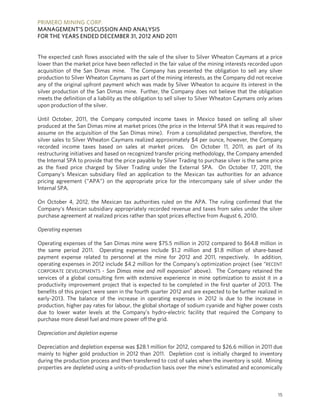
Operating expenses

Operating expenses of the San Dimas mine were $75.5 million in 2012 compared to $64.8 million in
the same period 2011. Operating expenses include $1.2 million and $1.8 million of share-based
payment expense related to personnel at the mine for 2012 and 2011, respectively. In addition,
operating expenses in 2012 include $4.2 million for the Company’s optimization project (see “RECENT
CORPORATE DEVELOPMENTS - San Dimas mine and mill expansion” above). The Company retained the
services of a global consulting firm with extensive experience in mine optimization to assist it in a
productivity improvement project that is expected to be completed in the first quarter of 2013. The
benefits of this project were seen in the fourth quarter 2012 and are expected to be further realized in
early-2013. The balance of the increase in operating expenses in 2012 is due to the increase in
production, higher pay rates for labour, the global shortage of sodium cyanide and higher power costs
due to lower water levels at the Company’s hydro-electric facility that required the Company to
purchase more diesel fuel and more power off the grid.

Depreciation and depletion expense

Depreciation and depletion expense was $28.1 million for 2012, compared to $26.6 million in 2011 due
mainly to higher gold production in 2012 than 2011. Depletion cost is initially charged to inventory
during the production process and then transferred to cost of sales when the inventory is sold. Mining
properties are depleted using a units-of-production basis over the mine’s estimated and economically


                                                                                                        15
PRIMERO MINING CORP.
MANAGEMENT’S DISCUSSION AND ANALYSIS
FOR THE YEARS ENDED DECEMBER 31, 2012 AND 2011

proven and probable gold reserves and an estimate of the portion of mineralization expected to be
classified as reserves. Historically, over the past 30 years, the San Dimas mine has converted
approximately 90% of resources into reserves.

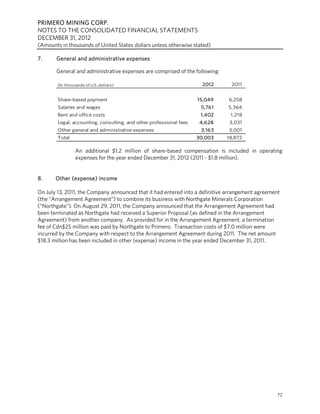
General and administrative expenses

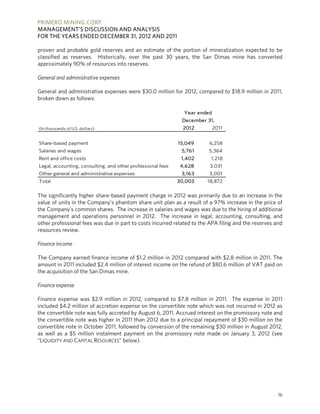
General and administrative expenses were $30.0 million for 2012, compared to $18.9 million in 2011,
broken down as follows:

                                                               Year ended
                                                              December 31,
(In thousands of U.S. dollars)                                 2012         2011


Share-based payment                                          15,049      6,258
Salaries and wages                                            5,761     5,364
Rent and office costs                                         1,402      1,218
Legal, accounting, consulting, and other professional fees    4,628      3,031
Other general and administrative expenses                     3,163      3,001
Total                                                        30,003     18,872

The significantly higher share-based payment charge in 2012 was primarily due to an increase in the
value of units in the Company’s phantom share unit plan as a result of a 97% increase in the price of
the Company’s common shares. The increase in salaries and wages was due to the hiring of additional
management and operations personnel in 2012. The increase in legal, accounting, consulting, and
other professional fees was due in part to costs incurred related to the APA filing and the reserves and
resources review.

Finance income

The Company earned finance income of $1.2 million in 2012 compared with $2.8 million in 2011. The
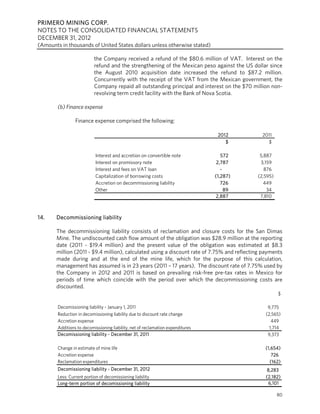
amount in 2011 included $2.4 million of interest income on the refund of $80.6 million of VAT paid on
the acquisition of the San Dimas mine.

Finance expense

Finance expense was $2.9 million in 2012, compared to $7.8 million in 2011. The expense in 2011
included $4.2 million of accretion expense on the convertible note which was not incurred in 2012 as
the convertible note was fully accreted by August 6, 2011. Accrued interest on the promissory note and
the convertible note was higher in 2011 than 2012 due to a principal repayment of $30 million on the
convertible note in October 2011, followed by conversion of the remaining $30 million in August 2012,
as well as a $5 million instalment payment on the promissory note made on January 3, 2012 (see
“LIQUIDITY AND CAPITAL RESOURCES” below).


                                                                                                      16
PRIMERO MINING CORP.
MANAGEMENT’S DISCUSSION AND ANALYSIS
FOR THE YEARS ENDED DECEMBER 31, 2012 AND 2011

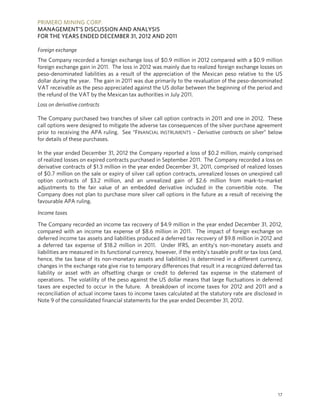
Foreign exchange
The Company recorded a foreign exchange loss of $0.9 million in 2012 compared with a $0.9 million
foreign exchange gain in 2011. The loss in 2012 was mainly due to realized foreign exchange losses on
peso-denominated liabilities as a result of the appreciation of the Mexican peso relative to the US
dollar during the year. The gain in 2011 was due primarily to the revaluation of the peso-denominated
VAT receivable as the peso appreciated against the US dollar between the beginning of the period and
the refund of the VAT by the Mexican tax authorities in July 2011.
Loss on derivative contracts

The Company purchased two tranches of silver call option contracts in 2011 and one in 2012. These
call options were designed to mitigate the adverse tax consequences of the silver purchase agreement
prior to receiving the APA ruling. See “FINANCIAL INSTRUMENTS – Derivative contracts on silver” below
for details of these purchases.

In the year ended December 31, 2012 the Company reported a loss of $0.2 million, mainly comprised
of realized losses on expired contracts purchased in September 2011. The Company recorded a loss on
derivative contracts of $1.3 million in the year ended December 31, 2011, comprised of realized losses
of $0.7 million on the sale or expiry of silver call option contracts, unrealized losses on unexpired call
option contracts of $3.2 million, and an unrealized gain of $2.6 million from mark-to-market
adjustments to the fair value of an embedded derivative included in the convertible note. The
Company does not plan to purchase more silver call options in the future as a result of receiving the
favourable APA ruling.

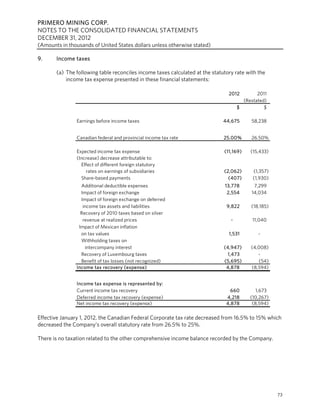
Income taxes

The Company recorded an income tax recovery of $4.9 million in the year ended December 31, 2012,
compared with an income tax expense of $8.6 million in 2011. The impact of foreign exchange on
deferred income tax assets and liabilities produced a deferred tax recovery of $9.8 million in 2012 and
a deferred tax expense of $18.2 million in 2011. Under IFRS, an entity’s non-monetary assets and
liabilities are measured in its functional currency, however, if the entity’s taxable profit or tax loss (and,
hence, the tax base of its non-monetary assets and liabilities) is determined in a different currency,
changes in the exchange rate give rise to temporary differences that result in a recognized deferred tax
liability or asset with an offsetting charge or credit to deferred tax expense in the statement of
operations. The volatility of the peso against the US dollar means that large fluctuations in deferred
taxes are expected to occur in the future. A breakdown of income taxes for 2012 and 2011 and a
reconciliation of actual income taxes to income taxes calculated at the statutory rate are disclosed in
Note 9 of the consolidated financial statements for the year ended December 31, 2012.


                                                                                                            17
PRIMERO MINING CORP.
MANAGEMENT’S DISCUSSION AND ANALYSIS
FOR THE YEARS ENDED DECEMBER 31, 2012 AND 2011

THREE MONTHS ENDED          D ECEMBER 31, 2012 COMPARED WITH THREE MONTHS ENDED D ECEMBER 31,
2011
                                                        For the three months ended
In thousands of US dollars except per share amounts   Three months ended December 31,
                                                               2012              2011
                                                                            (Restated)
                                                                  $                  $
Revenue                                                     43,597            35,645
Operating expenses                                          (19,328)          (15,825)
Depreciation and depletion                                  (6,798)           (6,534)
Total cost of sales                                         (26,126)         (22,359)
Earnings from mine operations                                17,471            13,286
General and administrative                                  (11,064)          (5,066)
Other income (expense)                                       (1,129)           (1,129)
Foreign exchange loss                                        (1,250)           (3,723)
Finance income                                                  172              139
Finance expense                                               (769)              (181)
Loss on derivative contracts                                  (750)             (899)
Earnings before income taxes                                  2,681            2,427
Income tax (expense) recovery                                (1,436)          28,789
Net income for the period                                     1,245            31,216
Basic income per share                                         0.01             0.35
Diluted income per share                                       0.01             0.32

Weighted average number of common shares
outstanding - basic                                      93,406,583        88,253,347

Weighted average number of common shares
outstanding - diluted                                    94,784,589        96,719,907


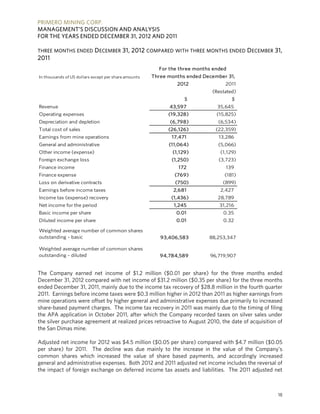
The Company earned net income of $1.2 million ($0.01 per share) for the three months ended
December 31, 2012 compared with net income of $31.2 million ($0.35 per share) for the three months
ended December 31, 2011, mainly due to the income tax recovery of $28.8 million in the fourth quarter
2011. Earnings before income taxes were $0.3 million higher in 2012 than 2011 as higher earnings from
mine operations were offset by higher general and administrative expenses due primarily to increased
share-based payment charges. The income tax recovery in 2011 was mainly due to the timing of filing
the APA application in October 2011, after which the Company recorded taxes on silver sales under
the silver purchase agreement at realized prices retroactive to August 2010, the date of acquisition of
the San Dimas mine.

Adjusted net income for 2012 was $4.5 million ($0.05 per share) compared with $4.7 million ($0.05
per share) for 2011. The decline was due mainly to the increase in the value of the Company’s
common shares which increased the value of share based payments, and accordingly increased
general and administrative expenses. Both 2012 and 2011 adjusted net income includes the reversal of
the impact of foreign exchange on deferred income tax assets and liabilities. The 2011 adjusted net


                                                                                                     18
PRIMERO MINING CORP.
MANAGEMENT’S DISCUSSION AND ANALYSIS
FOR THE YEARS ENDED DECEMBER 31, 2012 AND 2011

income also excludes the benefit of the APA ruling that relates to the period from August 6, 2010 to
September 30, 2011.

Revenue

Revenue was $43.6 million for the three months ended December 31, 2012 as a result of selling 22,404
ounces of gold at an average realized price of $1,715 per ounce, and 1.25 million ounces of silver at an
average realized price of $4.12 per ounce. Revenue was $35.6 million for the same period in 2011 from
selling 18,487 ounces of gold at an average realized price of $1,679 per ounce and 1.11 million ounces of
silver at an average realized price of $4.08 per ounce.

Operating expenses

Operating expenses of the San Dimas mine were $19.3 million in the fourth quarter 2012 compared to
$15.8 million in the same period 2011, due mainly to the increased sales and the cost of the Company’s
optimization project, which added $2.7 million to operating expenses in the three months ended
December 31 2012 (see “RECENT CORPORATE DEVELOPMENTS - San Dimas mine and mill expansion above).
Cash production costs per gold ounce were $677 and $535, respectively, on a gold equivalent and by-
product basis for 2012, compared with $719 and $580, respectively, for 2011. Cash operating costs
were 7% higher in 2012 than 2011, however, these increased cash costs were offset by a 14% increase
in gold equivalent ounces produced and an 11% increase in by-product silver credits.


Depreciation and depletion expense

The depreciation and depletion expense was $6.8 million for the three months ended December 31,
2012 compared to $6.5 million in the same period 2011 due mainly to the increase in production.


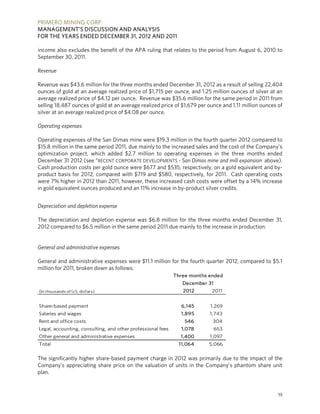
General and administrative expenses

General and administrative expenses were $11.1 million for the fourth quarter 2012, compared to $5.1
million for 2011, broken down as follows:
                                                             Three months ended
                                                                December 31
(In thousands of U.S. dollars)                                  2012       2011


Share-based payment                                            6,145      1,269
Salaries and wages                                             1,895      1,743
Rent and office costs                                            546       304
Legal, accounting, consulting, and other professional fees     1,078          653
Other general and administrative expenses                      1,400      1,097
Total                                                         11,064     5,066

The significantly higher share-based payment charge in 2012 was primarily due to the impact of the
Company’s appreciating share price on the valuation of units in the Company’s phantom share unit
plan.


                                                                                                       19
PRIMERO MINING CORP.
MANAGEMENT’S DISCUSSION AND ANALYSIS
FOR THE YEARS ENDED DECEMBER 31, 2012 AND 2011

Finance income

The Company earned finance income of $0.2 million in the fourth quarter 2012 compared with $0.1
million during the same period 2011.

Finance expense

Finance expense was $0.8 million for the three months ended December 31, 2012, compared to $0.2
million for the same period in 2011. Accrued interest on the promissory note and convertible note was
$0.4 million higher in 2011 than 2012 due to principal repayments of $30 million on the convertible
note in October 2011, followed by a conversion of the remaining $30 million in August 2012, as well as
a $5 million instalment payment on the promissory note made on January 3, 2012, however, $1.0
million more interest was capitalized to assets under construction in the fourth quarter 2011. (see
“LIQUIDITY AND CAPITAL RESOURCES” below).

Foreign exchange

The Company recorded a foreign exchange loss of $1.3 million in the fourth quarter 2012 compared
with a foreign exchange loss of $3.7 million in the fourth quarter 2011. The loss in 2012 was mainly due
to unrealized foreign exchange losses on peso-denominated assets net of liabilities, as a result of the
depreciation of the Mexican peso relative to the US dollar during the three month period ended
December 31, 2012. The loss in 2011 related mainly to the impact of recognizing the benefit of the APA
for the period August 6, 2010 to September 30, 2011 in the fourth quarter 2011.

Gain (loss) on derivative contracts

The Company purchased silver call option contracts to mitigate the adverse tax consequences of the
silver purchase agreement prior to receiving the APA ruling. See “FINANCIAL INSTRUMENTS – Derivative
contracts on silver” below for details of these purchases.
The Company recorded a loss of 0.8 million on silver call option contracts in the fourth quarter 2012,
comprising a realized loss on sales of options of $0.1 million, and unrealized losses of $0.7 million on
unexpired contracts. The Company recorded a loss of $0.9 million on these contracts in the fourth
quarter 2011, which comprised a realized loss of $0.4 million on the expiry of out-of-the-money
contracts and an unrealized loss of $0.5 million on unexpired contracts. At December 31, 2012 the
Company no longer had any derivative contracts.

Income taxes

The Company recorded an income tax expense of $1.4 million in the three months ended December 31,
2012, compared with a recovery of income taxes of $28.8 million in the same period in 2011. The tax
expense in 2012 was primarily due to a $1.8 million charge to deferred taxes relating to the foreign
exchange impact of the translation of deferred income tax assets and liabilities and the 2011 tax
recovery included a similar foreign exchange based deferred tax expense of $5.5 million. As described
under “ANNUAL RESULTS OF OPERATIONS” – “Income taxes” above, during the fourth quarter of 2011, the
Company filed an APA application in Mexico in order to recognize revenues on sales of silver under the
silver purchase agreement at realized, rather than spot prices and record taxes on the same basis. The


                                                                                                     20
PRIMERO MINING CORP.
MANAGEMENT’S DISCUSSION AND ANALYSIS
FOR THE YEARS ENDED DECEMBER 31, 2012 AND 2011

total impact of this filing retroactive to August 6, 2010, the date the Company became a party to the
silver purchase agreement, was recognized in the fourth quarter 2011 (a recovery of $33.0 million).

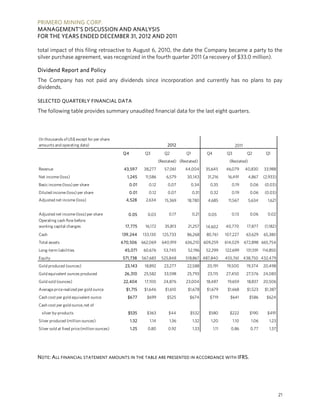
Dividend Report and Policy
The Company has not paid any dividends since incorporation and currently has no plans to pay
dividends.

SELECTED QUARTERLY FINANCIAL DATA

The following table provides summary unaudited financial data for the last eight quarters.


(In thousands of US$ except for per share
amounts and operating data)                                              2012                                     2011
                                               Q4           Q3          Q2         Q1          Q4           Q3            Q2        Q1
                                                                     (Restated) (Restated)                   (Restated)
Revenue                                        43,597       38,277      57,061     44,004      35,645      46,079        40,830    33,988
Net income (loss)                               1,245       11,586       6,579      30,143     31,216       16,491        4,867    (2,933)
Basic income (loss) per share                       0.01      0.12        0.07          0.34     0.35         0.19         0.06    (0.03)
Diluted income (loss) per share                     0.01      0.12        0.07          0.31     0.32         0.19         0.06    (0.03)
Adjusted net income (loss)                      4,528        2,634      15,369      18,780      4,685       11,567        5,634      1,621


Adjusted net income (loss) per share             0.05         0.03        0.17          0.21    0.05          0.13         0.06      0.02
Operating cash flow before
working capital changes                        17,775       16,172      35,813      21,257     14,602      40,770         17,877   (1,182)
Cash                                          139,244      133,130     125,733      86,268     80,761      107,227        63,629   65,380
Total assets                                  670,506      662,069    640,919      636,210 609,259         614,029       672,898 665,754
Long-term liabilities                          45,071       60,676     53,745       52,196     52,299      122,699        131,591 114,850
Equity                                        571,738      567,683    525,848      518,867 487,840         455,761 438,750 432,479
Gold produced (ounces)                         23,143       18,892      23,277      22,588     20,191       19,500        19,374   20,498
Gold equivalent ounces produced                26,310       25,582      33,598      25,793     23,115      27,450         27,576   24,083
Gold sold (ounces)                             22,404       17,100     24,876      23,004      18,487       19,659        18,837   20,506
Average price realized per gold ounce           $1,715      $1,646      $1,610      $1,678     $1,679       $1,668        $1,523   $1,387
Cash cost per gold equivalent ounce             $677         $699        $525        $674       $719         $641          $586     $624
Cash cost per gold ounce, net of
 silver by-products                              $535        $363         $44        $532       $580         $222          $190      $491
Silver produced (million ounces)                    1.32      1.14        1.36          1.32     1.20            1.10       1.06      1.23
Silver sold at fixed price (million ounces)         1.25      0.80        0.92          1.33        1.11      0.86          0.77      1.37


NOTE: ALL FINANCIAL STATEMENT AMOUNTS IN THE TABLE ARE PRESENTED IN ACCORDANCE WITH IFRS.


                                                                                                                                             21
PRIMERO MINING CORP.
MANAGEMENT’S DISCUSSION AND ANALYSIS
FOR THE YEARS ENDED DECEMBER 31, 2012 AND 2011

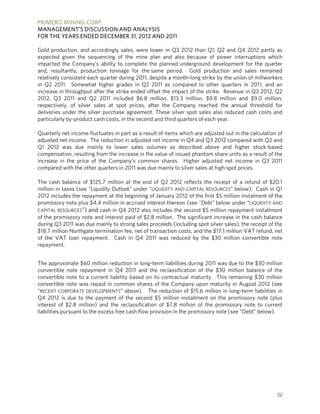
Gold production, and accordingly sales, were lower in Q3 2012 than Q1, Q2 and Q4 2012 partly as
expected given the sequencing of the mine plan and also because of power interruptions which
impacted the Company’s ability to complete the planned underground development for the quarter
and, resultantly, production tonnage for the same period. Gold production and sales remained
relatively consistent each quarter during 2011, despite a month-long strike by the union of millworkers
in Q2 2011. Somewhat higher grades in Q2 2011 as compared to other quarters in 2011, and an
increase in throughput after the strike ended offset the impact of the strike. Revenue in Q3 2012, Q2
2012, Q3 2011 and Q2 2011 included $6.8 million, $13.3 million, $9.8 million and $9.0 million,
respectively, of silver sales at spot prices, after the Company reached the annual threshold for
deliveries under the silver purchase agreement. These silver spot sales also reduced cash costs and
particularly by-product cash costs, in the second and third quarters of each year.

Quarterly net income fluctuates in part as a result of items which are adjusted out in the calculation of
adjusted net income. The reduction in adjusted net income in Q4 and Q3 2012 compared with Q2 and
Q1 2012 was due mainly to lower sales volumes as described above and higher stock-based
compensation, resulting from the increase in the value of issued phantom share units as a result of the
increase in the price of the Company’s common shares. Higher adjusted net income in Q3 2011
compared with the other quarters in 2011 was due mainly to silver sales at high spot prices.

The cash balance of $125.7 million at the end of Q2 2012 reflects the receipt of a refund of $20.1
million in taxes (see “Liquidity Outlook” under “LIQUIDITY AND CAPITAL RESOURCES” below). Cash in Q1
2012 includes the repayment at the beginning of January 2012 of the first $5 million instalment of the
promissory note plus $4.4 million in accrued interest thereon (see “Debt” below under “LIQUIDITY AND
CAPITAL RESOURCES”) and cash in Q4 2012 also includes the second $5 million repayment installment
of the promissory note and interest paid of $2.8 million. The significant increase in the cash balance
during Q3 2011 was due mainly to strong sales proceeds (including spot silver sales), the receipt of the
$18.7 million Northgate termination fee, net of transaction costs, and the $17.1 million VAT refund, net
of the VAT loan repayment. Cash in Q4 2011 was reduced by the $30 million convertible note
repayment.


The approximate $60 million reduction in long-term liabilities during 2011 was due to the $30 million
convertible note repayment in Q4 2011 and the reclassification of the $30 million balance of the
convertible note to a current liability based on its contractual maturity. This remaining $30 million
convertible note was repaid in common shares of the Company upon maturity in August 2012 (see
“RECENT CORPORATE DEVELOPMENTS” above). The reduction of $15.6 million in long-term liabilities in
Q4 2012 is due to the payment of the second $5 million installment on the promissory note (plus
interest of $2.8 million) and the reclassification of $7.8 million of the promissory note to current
liabilities pursuant to the excess free cash flow provision in the promissory note (see “Debt” below).


                                                                                                      22
PRIMERO MINING CORP.
MANAGEMENT’S DISCUSSION AND ANALYSIS
FOR THE YEARS ENDED DECEMBER 31, 2012 AND 2011

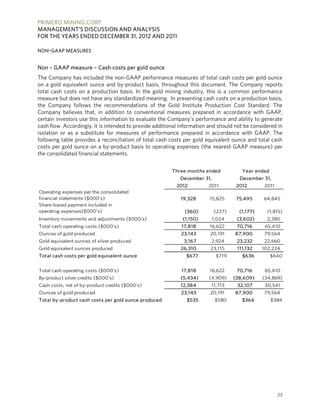
NON- GAAP MEASURES


Non – GAAP measure – Cash costs per gold ounce
The Company has included the non-GAAP performance measures of total cash costs per gold ounce
on a gold equivalent ounce and by-product basis, throughout this document. The Company reports
total cash costs on a production basis. In the gold mining industry, this is a common performance
measure but does not have any standardized meaning. In presenting cash costs on a production basis,
the Company follows the recommendations of the Gold Institute Production Cost Standard. The
Company believes that, in addition to conventional measures prepared in accordance with GAAP,
certain investors use this information to evaluate the Company’s performance and ability to generate
cash flow. Accordingly, it is intended to provide additional information and should not be considered in
isolation or as a substitute for measures of performance prepared in accordance with GAAP. The
following table provides a reconciliation of total cash costs per gold equivalent ounce and total cash
costs per gold ounce on a by-product basis to operating expenses (the nearest GAAP measure) per
the consolidated financial statements.

                                                         Three months ended           Year ended
                                                            December 31,             December 31,
                                                           2012         2011        2012        2011
Operating expenses per the consolidated
financial statements ($000's)                               19,328       15,825     75,495      64,845
Share-based payment included in
operating expenses($000's)                                    (360)        (227)     (1,177)     (1,815)
Inventory movements and adjustments ($000's)                 (1,150)       1,024    (3,602)      2,380
Total cash operating costs ($000's)                          17,818      16,622     70,716      65,410
Ounces of gold produced                                     23,143       20,191    87,900       79,564
Gold equivalent ounces of silver produced                     3,167      2,924      23,232      22,660
Gold equivalent ounces produced                             26,310       23,115     111,132    102,224
Total cash costs per gold equivalent ounce                     $677         $719      $636         $640


Total cash operating costs ($000's)                          17,818      16,622     70,716      65,410
By-product silver credits ($000's)                          (5,434)     (4,909)    (38,609)    (34,869)
Cash costs, net of by-product credits ($000's)              12,384       11,713     32,107      30,541
Ounces of gold produced                                     23,143       20,191    87,900       79,564
Total by-product cash costs per gold ounce produced            $535         $580      $366         $384


                                                                                                       23
PRIMERO MINING CORP.
MANAGEMENT’S DISCUSSION AND ANALYSIS
FOR THE YEARS ENDED DECEMBER 31, 2012 AND 2011

Non – GAAP measure – Adjusted net income
The Company has included the non-GAAP performance measures of adjusted net income and
adjusted net income per share, throughout this document. Items are adjusted where considered to be
unusual or non-recurring based on the historical and expected future performance of the Company.
Neither of these non-GAAP performance measures has any standardized meaning and is therefore
unlikely to be comparable to other measures presented by other issuers. The Company believes that,
in addition to conventional measures prepared in accordance with GAAP, certain investors use this
information to evaluate the Company’s performance and ability to generate cash flow. Accordingly, it
is intended to provide additional information and should not be considered in isolation or as a
substitute for measures of performance prepared in accordance with GAAP. The following table
provides a reconciliation of adjusted net income to net income (the nearest GAAP measure) per the
consolidated financial statements.


                                                        Three months ended              Year ended
(In thousands of US dollars except per share amounts)      December 31,                December 31,
                                                              2012           2011        2012           2011
                                                                        (Restated)                 (Restated)
Net income                                                   1,245         31,216      49,533        49,644
Loss on derivative contracts                                  750             899         226          1,284
Accretion charged on convertible debt                               -              -           -       4,231
Foreign exchange gain and finance income on
VAT loan, net of tax                                                -              -           -     (4,620)
Reduction in taxes due to loss on
intercompany loan                                                   -              -           -     (11,358)
Impact of foreign exchange on deferred
income tax assets and liabilities                            1,844          5,542      (9,822)        18,185
Transaction costs and break fees                              689                  -     1,355      (18,065)
Prior period benefit of APA filing                                  -    (32,972)              -    (11,040)
Adjusted net income                                          4,528          4,685      41,292         28,261


Adjusted net income per share                                0.05           0.05        0.45           0.32


Weighted average number of
common shares outstanding (basic)                       93,406,583 88,253,347 91,469,356 88,049,171


                                                                                                         24
PRIMERO MINING CORP.
MANAGEMENT’S DISCUSSION AND ANALYSIS
FOR THE YEARS ENDED DECEMBER 31, 2012 AND 2011

Non – GAAP measure - Operating cash flows before working capital changes

The Company has included the non-GAAP performance measure operating cash flows before working
capital changes in this MD&A. Non-GAAP performance measures do not have any standardized
meaning and are therefore unlikely to be comparable to other measures presented by other issuers.
The Company believes that, in addition to conventional measures, prepared in accordance with GAAP,
certain investors use this information to evaluate the Company’s performance and ability to generate
cash flow. Accordingly, it is intended to provide additional information and should not be considered in
isolation or as a substitute for measures of performance prepared in accordance with GAAP. The
following table provides a reconciliation of operating cash flows before working capital changes to
cash (used in) provided by operating activities (the nearest GAAP measure) per the consolidated
financial statements.


                                                      Three months ended         Year ended
(In thousands of US dollars)                             December 31,           December 31,
                                                          2012      2011         2012      2011
Cash provided by operating activities                   28,509      13,037     114,210    152,565
Change in non-cash operating working capital           (10,734)       1,565   (25,402)   (74,974)
Operating cash flows before working capital changes      17,775     14,602     88,808       77,591


                                                                                                     25
PRIMERO MINING CORP.
MANAGEMENT’S DISCUSSION AND ANALYSIS
FOR THE YEARS ENDED DECEMBER 31, 2012 AND 2011

LIQUIDITY AND CAPITAL RESOURCES

YEAR ENDED D ECEMBER 31, 2012 COMPARED WITH YEAR ENDED D ECEMBER 31, 2011
As at December 31, 2012, the Company had cash of $139.2 million (December 31, 2011 - $80.8
million), and working capital of $110.9 million (December 31, 2011 – $53.4 million).


Net cash flows for the year ended December 31, 2012 and 2011 were as follows:


(In thousands of US dollars)                        Year ended December 31,
                                                             2012                2011
Cash Flow:                                                      $                   $
Provided by operating activities                         114,210            152,565
Used in investing activities                            (38,548)            (28,298)
Used in financing activities                             (16,542)           (101,107)
Effect of exchange rate changes on cash                     (637)               (697)
Increase in cash                                         58,483              22,463
Cash, beginning of period                                80,761              58,298
Cash, end of period                                     139,244               80,761


Operating activities

During the year ended December 31, 2012, the Company’s net cash flows provided by operating
activities were $114.2 million, being cash flows before changes in working capital of $88.8 million and
changes in non-cash working capital of $25.4 million. The cash flows before changes in working capital
primarily comprised cash earnings from mine operations of $108.6 million, offset by cash general and
administrative costs of $14.9 million, income taxes paid of $2.0 million and realized foreign exchange
losses of $0.9 million. The change in non-cash working capital of $25.4 million resulted primarily from
a decrease in taxes receivable of $14.6 million as a result of the collection of taxes after filing the APA
application in October 2011, as well as an increase of $7.6 million in payables.

During the year ended December 31, 2011, the Company’s net cash flows provided by operating
activities were $152.6 million, comprising cash flows before changes in working capital of $77.6 million
and changes in non-cash working capital of $75.0 million. Cash flows before changes in working
capital primarily comprised cash earnings from mine operations of $93.5 million and the break-fee
from the termination of the Northgate arrangement agreement, net of transaction costs, of $18.3
million, offset by cash general and administrative costs of $12.6 million, income taxes paid of $17.4
million, and cash (net of sales proceeds) to purchase silver call option contracts of $4.1 million. The
change in non-cash working capital was an inflow of $75.0 million mainly due to the collection of VAT
receivable from the Mexican government of $87.2 million, offset by a decrease in payables of $9.2
million and a decrease in inventory of $4.4 million.


                                                                                                        26
PRIMERO MINING CORP.
MANAGEMENT’S DISCUSSION AND ANALYSIS
FOR THE YEARS ENDED DECEMBER 31, 2012 AND 2011

Investing activities

Cash flows used in investing activities were $38.5 million in 2012, compared with $28.3 million in 2011.
Substantially all of the outflows in both 2012 and 2011 were for capital expenditures at the San Dimas
mine, mainly being exploration and delineation drilling and drifting and mine development. Interest
received in the year ended December 31, 2012 was $1.2 million and $2.8 million for the same period in
2011; both amounts primarily related to interest earned on tax refunds in Mexico.

Financing activities

The Company used $16.5 million of cash for financing activities in 2012, being the repayment of the
first and second $5 million instalments under the promissory note and $7.2 million of interest thereon,
as well as $1.9 million of interest paid on the convertible note prior to conversion (see “Debt” below).
These payments were offset by cash inflows of $2.5 million upon the exercise of stock options. The
Company used $101.1 million of cash for financing activities in 2011, being the repayment of the $70.0
million VAT loan, $30 million of the convertible note and $2.2 million of interest thereon, offset by $1.0
million of proceeds on the exercise of options and warrants.


THREE MONTHS ENDED DECEMBER 31, 2012 COMPARED WITH THREE MONTHS ENDED DECEMBER 31,
2011
Net cash flows for the three months ended December 31, 2012 and 2011 were as follows:


                                                      Three months ended
(In thousands of US dollars)                             December 31
                                                            2012               2011
Cash Flow:                                                     $                   $
Provided by operating activities                        28,509              13,037
Used in investing activities                            (16,915)             (8,691)
Used in financing activities                             (5,228)           (31,077)
Effect of exchange rate changes on cash                    (252)               265
Increase in cash                                          6,114            (26,466)
Cash, beginning of period                               133,130            107,227
Cash, end of period                                    139,244              80,761


Operating activities

During the three months ended December 31, 2012, the Company’s net cash flows provided by
operating activities were $28.5 million, being cash flows before changes in working capital of $17.8
million and changes in non-cash working capital of $10.7 million. The cash flows before working
capital changes primarily comprised cash earnings from mine operations of $24.7 million, offset by
cash general and administrative costs of $4.9 million and income taxes paid of $0.5 million. Non-cash
working capital changes of $10.7 million mainly relate to an increase in payables.


                                                                                                       27
PRIMERO MINING CORP.
MANAGEMENT’S DISCUSSION AND ANALYSIS
FOR THE YEARS ENDED DECEMBER 31, 2012 AND 2011

During the three months ended December 31, 2011, the Company’s net cash inflows from operating
activities were $13.0 million, being cash flows before changes in working capital of $14.6 million offset
by changes in non-cash working capital of $1.6 million. The cash flows before working capital changes
of $14.6 million mainly comprised cash earnings from mine operations of $20.0 million, offset by cash
general and administrative costs of $3.8 million and income taxes paid of $0.5 million. The outflow
from non-cash working capital changes of $1.6 million mainly relates to an increase in inventories of
$3.5 million, partially offset by a decrease in prepaid expenses of $1.9 million.

Investing activities

Cash flows used in investing activities were $16.9 million for the three months ended December 31,
2012, compared with $8.7 million for the same period in 2011. Substantially all of the outflows in both
2012 and 2011 were for capital expenditures at the San Dimas mine, mainly being exploration and
delineation drilling and drifting and mine development.

Financing activities

In the three months ended December 31, 2012, the Company used $5.2 million of cash for financing
activities, comprising the repayment of the second $5 million installment of the promissory note and
$2.8 million of interest thereon (see “Debt” below), offset by $2.5 million of cash inflows from the
exercise of stock options during the quarter.

The Company used $31.1 million of cash for financing activities in the fourth quarter of 2011, being the
$30 million repayment of principal on the convertible note and $1.1 million of interest thereon.

Debt

         On August 6, 2010, in connection with the acquisition of the San Dimas Mine, the Company
         issued the following debt instruments:


                  (i)   A convertible promissory note (“the Note”) in the principal amount of $60
                        million with an annual interest rate of 3%, to DMSL, which DMSL immediately
                        assigned to Goldcorp. The Note was repayable in cash by the Company at any
                        time or convertible, at any time up to the maturity date (being the “Initial
                        Maturity Date” or “the Second Maturity Date”), by Goldcorp at a conversion
                        price of Cdn$6.00 per share. In determining the number of common shares to
                        be issued on conversion, per the Note, the principal amount would be
                        translated into Canadian dollars by multiplying that amount by 1.05.


                        On the first anniversary of the Note (“Initial Maturity Date”), the Note was
                        repayable in cash or, at the option of Primero, in common shares at 90% of the
                        volume weighted average trading price of the common shares for the five
                        trading days ending immediately prior to the Initial Maturity Date (the
                        “Maturity Conversion Price”). If on the Initial Maturity Date, Primero served
                        notice to convert (“Debtor Conversion Notice”), Goldcorp had the right to
                        extend the maturity Date until the second anniversary of the Note (the


                                                                                                      28
PRIMERO MINING CORP.
MANAGEMENT’S DISCUSSION AND ANALYSIS
FOR THE YEARS ENDED DECEMBER 31, 2012 AND 2011

                    “Second Maturity Date”). On July 20, 2011, Primero served notice to Goldcorp
                    to convert the Note into common shares of the Company and on August 4,
                    2011, Goldcorp elected to extend the maturity date of the Note until the
                    Second Maturity Date, which gave the Company the right to (1) pay the
                    principal amount in cash immediately or (2) convert the debt to shares on the
                    Second Maturity Date at a price equal to the greater of a) the Maturity
                    Conversion Price (which was Cdn$3.74) and b) 90% of the volume weighted
                    average trading price of the common shares for the five trading days ending
                    immediately prior to the Second Maturity Date.

                    On October 19, 2011, the Company used its cash resources to repay $30
                    million of the Note plus $1.1 million of accrued interest.

                    On July 24, 2012, the Company’s board of directors resolved to repay the
                    remaining $30 million Note on its maturity date of August 6, 2012, in common
                    shares. The conversion price was Cdn$3.74, being the greater of the Maturity
                    Conversion Price and 90% of the volume weighted average trading price of the
                    Company’s common shares for the five trading days ended August 6, 2012
                    (Cdn$3.13). Accordingly, 8,422,460 common shares were issued to Goldcorp
                    on August 7, 2012 and the Company paid accrued interest of $1.9 million in
                    cash on the same date.

             (ii)   A promissory note in the principal amount of $50 million with an annual
                    interest rate of 6% to DMSL, which DMSL subsequently assigned to a wholly-
                    owned Luxembourg subsidiary of Goldcorp. The promissory note is repayable
                    in four annual installments of $5 million, starting on December 31, 2011, with
                    the balance of principal due on December 31, 2015. On January 3, 2012, the
                    Company repaid the first $5 million annual installment plus accrued interest of
                    $4.4 million. The second annual installment of $5 million plus accrued interest
                    of $2.8 million was paid on December 31, 2012. In addition to the annual
                    installments, the Company is required to pay 50% of annual excess free cash
                    flow (as defined in the promissory note) against the principal balance. The
                    Company generated excess free cash flow of $15.6 million during the year
                    ended December 31, 2012 and accordingly will pay $7.8 million to the note
                    holder by April 30, 2013.

            (iii)   A non-revolving term credit facility of $70 million from the Bank of Nova Scotia
                    to partly pay $80.6 million of VAT due to the Mexican government on the
                    acquisition of the San Dimas Mine. On July 4, 2011, the Company received a
                    refund of $87.2 million, being the VAT of $80.6 million plus interest and
                    foreign exchange gains due to the strengthening of the Mexican peso against
                    the US dollar since the August 2010 acquisition date. Concurrently with the
                    receipt of the VAT from the Mexican government, the Company repaid all
                    outstanding principal and interest on the $70 million non-revolving term credit
                    facility with the Bank of Nova Scotia.


                                                                                                 29
PRIMERO MINING CORP.
MANAGEMENT’S DISCUSSION AND ANALYSIS
FOR THE YEARS ENDED DECEMBER 31, 2012 AND 2011

The Company is subject to a number of externally imposed capital requirements relating to its debt.
The requirements are both financial and operational in nature; the Company has complied with all such
requirements during the period.

Pursuant to the terms of the promissory note the Company is required to maintain the following
financial covenants:


                   Tangible net worth as at the end of each fiscal quarter of at least $400 million, and
                   Commencing the quarter ended September 30, 2011, free cash flow of at least
                    $10 million, calculated on a rolling four fiscal quarter basis.


Tangible net worth means equity less intangible assets. Free cash flow means cash flow from
operating activities as reported in the consolidated statement of cash flows, less the aggregate of
capital expenditures at the San Dimas mine, principal and interest on the promissory note and
convertible debt and up to $5 million per year on account of acquisition opportunities.

Liquidity Outlook

As at December 31, 2012, the Company had cash of $139.2 million and working capital of $110.9
million. Management estimates that San Dimas will generate average annual after-tax operating cash
flows over the next five years of approximately $120 million. The Company expects its current cash
resources, as well as ongoing cash flow from the San Dimas mine, will be sufficient to fund its
operations and certain potential acquisition opportunities for the foreseeable future.

When the Company purchased the San Dimas mine it assumed a silver purchase agreement under
which the majority of silver produced at the mine was sold at a fixed price of approximately $4 per
ounce. Initially the Company paid income taxes in Mexico based on sales under the silver purchase
agreement at the spot price. This meant that the Company lost approximately $5 after tax on every
ounce of silver sold under the silver purchase agreement. In October 2011, the Company filed an
advance pricing agreement (“APA”) with the Mexican tax authorities for a ruling on the appropriate
price of silver for the purposes of computing taxes on sales under the silver purchase agreement.
Since filing the APA, the Company recorded revenue under the silver purchase agreement and paid
taxes based on realized prices.

On October 4, 2012, the Company received a positive ruling from the Mexican tax authorities on the
APA filing. The ruling confirmed that the Company's Mexican subsidiary appropriately records
revenue and taxes from sales under the silver purchase agreement at realized prices rather than spot
prices effective from August 6, 2010. This ruling significantly improves the Company’s cash flow over
the duration of the ruling (under Mexican tax law, an APA ruling is generally applicable for up to a five
year period; for Primero this applies to the fiscal years 2010 to 2014). Assuming the Company
continues to sell silver from its San Dimas mine on the same terms and there are no changes in the
application of Mexican tax laws relative to the APA ruling, the Company expects to pay taxes on
realized prices for the life of the San Dimas mine.

During the year ended December 31, 2012, the Company received $22.2 million as a full refund of
previously overpaid taxes.


                                                                                                      30
PRIMERO MINING CORP.
MANAGEMENT’S DISCUSSION AND ANALYSIS
FOR THE YEARS ENDED DECEMBER 31, 2012 AND 2011

On December 13, 2012, the Company announced that it has entered into a definitive agreement with
Cerro Resources NL ("Cerro") whereby Primero will acquire all of the issued and outstanding common
shares of Cerro by way of a scheme of arrangement (the “Arrangement”) under the Australian
Corporations Act 2001. Cerro is an exploration and development company whose principal asset is
69%1 of the feasibility stage Cerro Del Gallo project, a gold-silver deposit located in the province of
Guanajuato, Mexico. Under the terms of the Arrangement, each Cerro shareholder will receive 0.023
of a Primero common share (the "Exchange Ratio") for each Cerro common share held. Additionally
Cerro shareholders will receive 80.01% of the common shares of a newly incorporated company
("Spinco"). Spinco will assume Cerro's interests in the Namiquipa, Espiritu Santo, Mt Philp and Kalman
projects, shares in Syndicated Metals Limited and approximately $4 million in cash. Primero will
purchase a 19.99% interest in Spinco with anti-dilution rights for two years. The total transaction value
is approximately $119 million. Cerro's outstanding options and its option plan will be substantially
assumed by Primero, subject to adjustment to reflect the Exchange Ratio and a corresponding upward
adjustment in the exercise price. The transaction is expected to close in May 2013.


The Cerro del Gallo project is planned to be constructed in two phases. The information in this
paragraph on the first phase project was derived from the June 2012 Definitive Feasibility Study and
the information on the second phase from the May 2011 Preliminary Economic Assessment, both
prepared by Cerro. Primero plans to complete its own optimization studies. The first stage project is
based on the treatment of 4.5 million tonnes per year of mixed, weathered and partially oxidized ore
from a prominent dome shaped hill. The mine is envisaged to consist of an owner operated open pit
operation and heap leaching to produce a gold dore product and a metal sulphide (predominantly
copper and silver) by-product from a sulphidisation, acidification, recycle and thickening (SART)
process. The first stage project has an estimated capital cost of $154 million, a mine life of 7.2 years
and average annual production, starting in mid-2015 of 94,600 gold equivalent ounces. The second
stage carbon-in-leach (CIL)/Heap Leach project encompasses the addition of a 3.0 million tonnes per
annum CIL processing facility to run in parallel with heap leach processing fresh rock as mining
proceeds to depth. The second stage has an estimated incremental capital cost of $83 million and is
contemplated to commence in the fifth year, thereby extending mine life to approximately 14 years.

Management is currently working with Cerro employees to transition the Cerro del Gallo project. Over
the next year it is anticipated that the land for the project will be acquired, engineering will be
completed, environmental permitting and risk assessment will be completed and construction of the
facilities will commence. Costs of $50 million to $60 million are expected to be incurred during 2013
and a further $80 million in 2014. Given the location of the project and in particular its proximity to
excellent infrastructure and its relative lack of complexity, the Company believes that the risk of
significant capital cost overruns are limited. Assuming the Company completes the Cerro acquisition
as planned, it expects to fund these costs from its existing cash balances and from operating cash flow
generated by San Dimas.
In order to enhance its financial flexibility, the Company is in negotiations with a major financial
institution to secure a revolving line of credit of $50 million. Under the terms of the silver purchase
agreement, the Company can arrange financing for up to $50 million without Silver Wheaton’s
consent. After the third anniversary of the acquisition of San Dimas and after the Goldcorp promissory
is fully repaid, the limitation on the amount of financing disappears, provided the Company meets
certain standard coverage ratios. The Company expects to close the line of credit during 2013.



                                                                                                       31
PRIMERO MINING CORP.
MANAGEMENT’S DISCUSSION AND ANALYSIS
FOR THE YEARS ENDED DECEMBER 31, 2012 AND 2011

Related party transactions

The Company has a promissory note outstanding to a wholly-owned subsidiary of Goldcorp. At
December 31, 2012, Goldcorp owned approximately 32.0% of the Company’s common shares.
Interest accrues on the promissory and is recorded within trade and other payables. A payment of $5
million plus accrued interest of $4.4 million was paid under the terms of the promissory note on
January 3, 2012, and a second payment of $5 million plus accrued interest of $2.8 million was paid on
December 31, 2012. In addition to the annual installments, the Company is required to pay 50% of
annual excess free cash flow (as defined in the promissory note) against the principal balance. The
Company generated excess free cash flow of $15.6 million during the year ended December 31, 2012
and accordingly will pay $7.8 million to the note holder by April 30, 2013.

On August 7, 2012, the Company repaid the $30 million convertible note due to Goldcorp by issuing
8,422,460 common shares and paying accrued interest of $1.9 million in cash. Principal of $30 million
and interest of $1.1 million were paid in relation to the convertible note during 2011.

During the year ended December 31, 2012, $2.5 million (2011 - $3.8 million) was paid to DMSL (a
subsidiary of Goldcorp) for the purchase of equipment, equipment leasing fees and services received
under a transition services agreement between the Company and DMSL. These amounts are
considered to be at fair value. As at December 31, 2012, the Company had an amount payable of $2.3
million outstanding to DMSL (2011 - $2.9 million). As at December 31, 2012, the Company had an
amount owing from Goldcorp Inc. of $0.3 million (2011 - $nil).

Shares issued

The Company issued 8,422,460 shares to Goldcorp during the year ended December 31, 2012, upon
the conversion of the $30 million convertible note (see “RECENT CORPORATE DEVELOPMENTS” above). In
addition, 523,331 shares were issued upon the exercise of stock options

Outstanding Share Data

Shareholders’ equity as at December 31, 2012 was $571.7 million compared to $487.8 million as at
December 31, 2011.

Share Capital

As at December 31, 2012 and the date of this MD&A, the Company had 97,205,622 common shares
outstanding (88,259,831 as at December 31, 2011).

Options

As at December 31, 2012, the Company had 7,804,490 options outstanding with a weighted average
exercise price of Cdn$5.57; of these 7,469,490 were exercisable with a weighted average exercise
price of $5.65. As at the date of this MD&A, the total number of options outstanding was 7,804,490,
of which 7,469,490 are exercisable.

Common Share Purchase Warrants

As at December 31, 2012, the Company had a total of 20,800,000 common share purchase warrants
outstanding with a weighted average exercise price of Cdn$8.00 per share. As at the date of this
MD&A, the total number of common share purchase warrants outstanding was 20,800,000, all of


                                                                                                  32
PRIMERO MINING CORP.
MANAGEMENT’S DISCUSSION AND ANALYSIS
FOR THE YEARS ENDED DECEMBER 31, 2012 AND 2011

which are exercisable. On February 6, 2012, 476,980 brokers’ warrants with an exercise price of
Cdn$6.00 expired.

Directors PSUs

As at December 31, 2012, the Company had 76,924 Directors PSUs outstanding, of which 38,462
PSUs vest on December 1, 2013 and expire on December 31, 2013 and 38,462 PSUs vest on December
1, 2014 and expire on December 31, 2014. A person holding Director PSUs is entitled to elect to
receive, at vesting either (1) a cash amount equal to the volume weighted average trading price per
common share over the five preceding trading days, or (2) the number of common shares equal to the
number of Directors’ PSUs (subject to the total number of common shares issuable at any time under
the Directors’ PSU Plan, combined with all other common shares issuable under any other equity
compensation arrangements then in place, not exceeding 10% of the total number of issued and
outstanding common shares of the Company). If no election is made, the Company will pay out such
Directors’ PSUs in cash.

Off-Balance Sheet Arrangements

The Company does not have any off-balance sheet arrangements.

ADOPTION OF NEW ACCOUNTING POLICIES

Changes in accounting policies

During the third quarter 2012, it was identified that during its transition to IFRS, the Company had not
taken into account a methodology difference between Canadian GAAP and IFRS with respect to
translation of deferred tax assets and liabilities denominated in a currency other than the Company’s
functional currency (the US dollar) (see “Restated results above). As a result of the identification of
this methodology difference, the Company changed its accounting policy with respect to deferred tax
assets and liabilities in order that it records foreign exchange gains and losses representing the
impacts of movements in foreign exchange rates on the tax bases of non-monetary assets and
liabilities which are denominated in foreign currencies. Foreign exchange gains and losses relating to
deferred income taxes are included in deferred income tax expense or recovery in the Consolidated
Statements of Operations and Comprehensive Income.

Other than this change, the Company has made no changes to its accounting policies during the year
ended December 31, 2012.

Recent pronouncements issued

The Company has reviewed new and revised accounting pronouncements that have been issued but
are not yet effective and determined that the following may have an impact in the future on the
Company:

IFRS 13 Fair Value Measurement (“IFRS 13”) was issued by the IASB in May 2011, and is effective for
annual periods beginning on or after January 1, 2013, with early application permitted. IFRS 13 was
issued to remedy the inconsistencies in the requirements for measuring fair value and for disclosing
information about fair value measurement in various current IFRSs. IFRS 13 defines fair value as the
price that would be received to sell an asset or paid to transfer a liability in an orderly transaction
between market participants at the measurement date.


                                                                                                     33
PRIMERO MINING CORP.
MANAGEMENT’S DISCUSSION AND ANALYSIS
FOR THE YEARS ENDED DECEMBER 31, 2012 AND 2011

IFRS 13 relates to how to measure fair value, not what should be measured at fair value. As at
December 31, 2012, the Company recognizes no assets or liabilities to which IFRS 13 would apply.

In October 2011, the IASB issued IFRIC 20 - Stripping Costs in the Production Phase of a Mine (“IFRIC
20”). IFRIC 20 clarifies the requirements for accounting for the costs of stripping activities in the
production phase of an open-pit mine when two benefits accrue: (i) usable ore that can be used to
produce inventory and (ii) improved access to further quantities of material that will be mined in future
periods. The IFRIC allows a company to determine a measure to allocate costs between inventory
produced and the stripping activity asset; the IFRIC provides examples of measures.

IFRIC 20 is effective for annual periods beginning on or after January 1, 2013 with earlier adoption
permitted and includes guidance on transition for pre-existing stripping assets. At present the
Company has no open pit mining operations and as such is not impacted by this new standard. Cerro
del Gallo will be an open pit mine and assuming the acquisition of Cerro completes as planned, the
Company will apply the provisions of IFRIC 20 from initial recognition, and will develop a policy for
allocation of costs.

In June 2011, the IASB issued amendments to IAS 1 – Presentation of Financial Statements (“IAS 1”). The
amendments are effective for annual periods beginning on or after July 1, 2012, with early adoption
permitted. The amendments to IAS 1 require companies preparing financial statements in accordance
with IFRS to group together items within other comprehensive income (“OCI”) that may be reclassified
to the profit or loss section of the Consolidated Statement of Operations. The amendments also
reaffirm existing requirements that items in OCI and profit or loss should be presented as either a
single statement or two consecutive statements.

The only implication the amendments to IAS 1 has on the Company is with respect to the balances
shown in OCI. At December 31, 2012, the Company only presented one amount in OCI; this related to
the foreign exchange gains or losses recognized upon translation of the parent company results from
its functional currency (CDN$) to the presentational currency (US$). This amount would be unlikely
to be recycled through the Statement of Operations in future, as it relates to the parent company (and
not a subsidiary which may be disposed of in future). The fact that this amount will not be recycled
through the Statement of Operations will need to be disclosed in the notes to the financial statements
as a result of this change to IAS 1.

As of January 1, 2015, Primero will be required to adopt IFRS 9, “Financial Instruments”, which is the
result of the first phase of the IASB’s project to replace IAS 39, “Financial Instruments: Recognition and
Measurement”. The new standard replaces the current multiple classification and measurement
models for financial assets and liabilities with a single model that has only two classification
categories: amortized cost and fair value.

As at December 31, 2012, the Company recognized and classified/measured the following financial
instruments in accordance with IAS 39:


        Financial instrument              Classification under IAS 39         Measurement           basis
                                                                              under IAS 39

        Cash                              Loans and receivables               Amortized cost


                                                                                                       34
PRIMERO MINING CORP.
MANAGEMENT’S DISCUSSION AND ANALYSIS
FOR THE YEARS ENDED DECEMBER 31, 2012 AND 2011


        Trade and other receivables       Loans and receivables               Amortized cost

        Trade and other payables          Other financial liabilities         Amortized cost

        Promissory note                   Other financial liabilities         Amortized cost

Under the current version of IFRS 9, each of these financial instruments will have to be classified as
either, amortized cost or fair value. The Company would retain the same classifications as above, and
based on an analysis of the current version of IFRS 9, there would be no change to the recognition of
these financial instruments as a result of the adoption of IFRS 9.

There will likely be some disclosure differences for the Company as a result of the transition from IAS
39 to IFRS 9.


CRITICAL ACCOUNTING ESTIMATES AND JUDGEMENTS

The preparation of financial statements in conformity with IFRS requires management to make
estimates, judgements and assumptions that affect the reported amounts of assets and liabilities and
disclosure of contingent liabilities at the date of the financial statements, and the reported amounts of
revenues and expenses during the reporting period. Management has identified the following critical
accounting policies and estimates.

Inventories

Finished goods, work-in-process and stockpiled ore are valued at the lower of average production cost
and net realizable value.

The Company records the costs of mining ore in process as work-in-process inventories measured at
the lower of cost and estimated net realizable value. These costs are charged to income and included
in operating expenses on the basis of ounces of gold recovered. The estimates and assumptions used
in the measurement of work-in-process inventories include quantities of recoverable ounces of gold
and silver in the mill processing circuits and the price per gold ounce expected to be realized when the
ounces of gold are recovered. If these estimates or assumptions prove to be inaccurate, the Company
could be required to write down the carrying amounts of its work-in-process inventories, which would
reduce the Company’s income and working capital. At December 31, 2012, the average costs of
inventories are significantly below their net realizable values.

Mining interests and impairment testing

The Company records mining interests at cost. Exploration costs are capitalized where they meet the
Company’s criteria for capitalization.

A significant portion of the Company’s mining properties are depleted using the units-of-production
method. Under the units-of-production method, depletion of mining properties is based on the
amount of reserves and the portion of mineralization expected to be recovered from the mines. If
estimates of reserves and mineralization expected to be recovered prove to be inaccurate, or if the


                                                                                                      35
PRIMERO MINING CORP.
MANAGEMENT’S DISCUSSION AND ANALYSIS
FOR THE YEARS ENDED DECEMBER 31, 2012 AND 2011

Company revises its mining plan for a location, due to reductions in the metal price forecasts or
otherwise, to reduce the amount of reserves and mineralization expected to be recovered, the
Company could be required to write down the carrying amounts of its mining properties, or to increase
the amount of future depletion expense, both of which would reduce the Company’s income and net
assets.

The Company reviews and evaluates its mining properties for impairment when events or changes in
circumstances indicate that the related carrying amounts may not be recoverable. For the year ended
December 31, 2012, no events or changes in circumstances were identified which would indicate an
impairment and as such no impairment review was performed. If the Company determines there has
been an impairment because its prior estimates of future net cash flows have proven to be inaccurate,
due to the Mexican tax authorities changing their position with respect to their views on the
appropriate price for the sale of silver under the silver purchase agreement, reductions in the metal
price forecasts, increases in the costs of production, reductions in the amount of reserves or
mineralization expected to be recovered or otherwise, or because the Company has determined that
the deferred costs may not be recovered based on current economics or permitting considerations, the
Company would be required to write down the carrying amounts of its mining properties, which would
reduce the Company’s income and net assets.


Plant and equipment are depreciated over their estimated useful lives. If estimates of useful lives
including the economic lives of mines prove to be inaccurate, the Company could be required to write
down the carrying amounts of its plant and equipment, or increase the amount of future depreciation
expense, both of which would reduce the Company’s income and net assets.

Fair value of assets purchased in a business combination

The Company’s business combinations are accounted for using the acquisition method of accounting
whereby assets acquired and liabilities assumed are recorded at their fair values as of the date of
acquisition and any excess of the purchase price over such fair values is recorded as goodwill. No
goodwill has been recorded to date.

Assumptions underlying fair value estimates are subject to significant risks and uncertainties, which if
incorrect could lead to an overstatement of the mineral properties of the Company which would then
be subject to an impairment test as described above.

Reclamation and closure cost obligations

The Company has an obligation to reclaim its mining properties after the minerals have been mined
from the site, and has estimated the costs necessary to comply with existing reclamation standards.
IFRS requires the Company to recognize the fair value of a decommissioning liability, such as site
closure and reclamation costs, in the period in which it is incurred if a reasonable estimate of fair value
can be made. The Company records the estimated present value of future cash flows associated with
site closure and reclamation as liabilities when the liabilities are incurred and increases the carrying
values of the related assets by the same amount. At the end of each reporting period, the liabilities are
increased to reflect the passage of time (accretion expense). Adjustments to the liabilities are also
made for changes in the estimated future cash outflows underlying the initial fair value measurements,
and changes to the discount rate used to present value the cash flows, both of which may result in a


                                                                                                        36
PRIMERO MINING CORP.
MANAGEMENT’S DISCUSSION AND ANALYSIS
FOR THE YEARS ENDED DECEMBER 31, 2012 AND 2011

corresponding change to the carrying values of the related assets. The capitalized asset retirement
costs are amortized to income over the life of the related assets using the units-of-production method.
Should the estimation of the reclamation and closure cost obligations be incorrect, additional amounts
may need to be provided for in future which could lead to an increase in both the liability and
associated asset. Should the reported asset and liability increase, the amortization expense in the
statement of operations of the capitalized asset retirement cost would increase.

Taxation

The Company recognizes the future tax benefit related to deferred income tax assets to the extent that
it is probable that future taxable profits will be available against which they can be utilized. Assessing
the recoverability of deferred income tax assets requires management to make significant estimates
related to expectations of future taxable income, applicable tax strategies and the expected timing of
the reversals of existing temporary differences. In making its assessments, management gives
additional weight to positive and negative evidence that can be objectively verified. Estimates of future
taxable income are based on forecasted cash flows from operations and the application of existing tax
laws in each jurisdiction. Forecasted cash flows from operations are based on life of mine projections
internally developed and reviewed by management.

The Company recognizes current income tax benefits when it is more likely than not, based on
technical merits, that the relevant tax position will be sustained upon examination by applicable tax
authorities. The more likely than not criteria is a matter of judgment based on the individual facts and
circumstances of the relevant tax position evaluated in light of all available evidence.

The recoverability of deferred income tax assets and the recognition and measurement of uncertain
tax positions are subject to various assumptions and management judgment. Actual results may differ
from these estimates. In circumstances where the applicable tax laws and regulations are either
unclear or subject to ongoing varying interpretations, it is reasonably possible that changes in these
estimates could occur that materially affect the amounts of current and deferred income taxes
recognized by the Company, as well as deferred income tax assets and liabilities recorded at
December 31, 2012.

Share-based payments

For equity-settled awards, the fair value of the award is charged to the statement of operations and
credited to the share-based payment reserve rateably over the vesting period, after adjusting for the
number of awards that are expected to vest. The fair value of the awards is determined at the date of
grant using the Black-Scholes option pricing model. To the extent that the inputs into the Black-
Scholes pricing model are inaccurate, there could be an increase or decrease to the share-based
payment charge to the statement of operations.

Capital management

There have been no significant changes in the Company’s objectives, policies and processes for
managing its capital, including items the Company regards as capital, during the year ended December
31, 2012. At December 31, 2012, the Company expects its capital resources and projected cash flows
from continuing operations to support its normal operating requirements on an ongoing basis, planned
development and exploration of its mineral properties, and other expansionary plans. At December 31,


                                                                                                       37
PRIMERO MINING CORP.
MANAGEMENT’S DISCUSSION AND ANALYSIS
FOR THE YEARS ENDED DECEMBER 31, 2012 AND 2011

2012, there were no externally imposed capital requirements to which the Company is subject and
with which the Company had not complied.

Financial instruments

The Company’s financial instruments at December 31, 2012 consist of cash, trade and other
receivables, trade and other payables, and the promissory note. At December 31, 2011, the Company’s
financial instruments also included the convertible note and the derivative asset.

At December 31, 2012, the carrying amounts of cash, trade and other receivables, and trade and other
payables are considered to be reasonable approximation of their fair values due to their short-term
nature.

The fair value of the convertible note liability was determined on the date of issue using a discounted
future cash-flow analysis (the note was fully repaid in August 2012 and so at December 31, 2012 had
zero value). The fair value of the promissory note upon initial recognition was considered to be its face
value. At December 31, 2012 the fair value of the promissory note was $39.3 million. The Company
had no derivative assets at December 31, 2012, however, previously these assets were marked-to-
market each period.

Derivative instruments - Embedded derivatives

Financial instruments and non-financial contracts may contain embedded derivatives, which are
required to be accounted for separately at fair value as derivatives when the risks and characteristics
of the embedded derivatives are not closely related to those of their host contract and the host
contract is not carried at fair value. The Company regularly assesses its financial instruments and non-
financial contracts to ensure that any embedded derivatives are accounted for in accordance with its
policy. There were no material embedded derivatives requiring separate accounting at December 31,
2012 or December 31, 2011, other than those discussed below.


(i)     Derivative contracts on silver

On March 18, 2011, the Company entered into a series of monthly call option contracts to purchase
1,204,000 ounces of silver at $39 per ounce for a total cost of $2.2 million. These contracts were
designed to mitigate the adverse tax consequences of the silver purchase agreement while at the same
time exposing the Company to gains from a potential rise in silver prices. The contracts covered
approximately two-thirds of the monthly silver production sold to Silver Wheaton Caymans over the
period April 1, 2011 to September 30, 2011. All contracts under the March 18, 2011 purchase had
expired by December 31, 2011, realizing a net loss of $0.4 million.


On September 15, 2011, the Company entered into a second series of monthly call option contracts to
purchase 1,489,400 ounces of silver at $49 per ounce for a total cost of $3.7 million. These contracts
were designed to cover approximately 30% of the monthly silver production sold to Silver Wheaton
Caymans over the period September 27, 2011 to September 26, 2012. These options were intended to
offset the incremental income tax that would be payable by the Company if spot prices exceed the
strike price. The fair value of these contracts (which were accounted for as a derivative asset) was
$0.2 million at December 31, 2011, based on current and available market information. A realized loss


                                                                                                      38
PRIMERO MINING CORP.
MANAGEMENT’S DISCUSSION AND ANALYSIS
FOR THE YEARS ENDED DECEMBER 31, 2012 AND 2011

on expired contracts of $0.4 million and an unrealized marked-to-market loss on unexpired contracts
of $3.2 million were recognized by the Company in the year ended December 31, 2011. In the year
ended December 31, 2012, the Company recognized a further loss on these contracts of $0.2 million.

On August 30, 2012, the Company entered into a third series of monthly call option contracts to
purchase 548,000 ounces of silver at $33 per ounce for a total cost of $0.5 million. These contracts
were designed to cover approximately 30% of the monthly silver production sold to Silver Wheaton
Caymans over the period August 30, 2012 to December 31, 2012. and were intended to offset the
incremental income tax that would be payable by the Company if spot prices exceed the strike price.
In the year ended December 31, 2012, the Company realized a loss on the sale of contracts of $23.

All silver call option contracts had expired by December 31, 2012. As a result of the APA ruling, the
Company does not expect to purchase silver call option contracts in the future.


(ii)    Convertible note and promissory note

At both December 31, 2011 and 2012, the fair value of the conversion feature of the convertible note
was $nil. This resulted in a $nil gain or loss on this non-hedge derivative during 2012, and an
unrealized gain of $2.6 million during 2011.

The fair value of the convertible note liability was determined using a statistical model, which
contained quoted prices and market-corroborated inputs. The fair value of the promissory note upon
initial recognition was considered to be its face value.

RISKS AND UNCERTAINTIES

Financial instrument risk exposure


The following describes the types of financial instrument risks to which the Company is exposed and
its objectives and policies for managing those risk exposures:

(a)     Credit risk

Credit risk is the risk that the counterparty to a financial instrument will cause a financial loss for the
Company by failing to discharge its obligations. Credit risk is primarily associated with trade and other
receivables; however, it also arises on cash. To mitigate exposure to credit risk on financial assets, the
Company limits the concentration of credit risk, ensures non-related counterparties demonstrate
minimum acceptable credit worthiness and ensures liquidity of available funds.

The Company closely monitors its financial assets, invests its cash in highly rated financial institutions
and sells its products exclusively to organizations with strong credit ratings. The credit risk associated
with trade receivables at December 31, 2012 is considered to be negligible.


                                                                                                        39
PRIMERO MINING CORP.
MANAGEMENT’S DISCUSSION AND ANALYSIS
FOR THE YEARS ENDED DECEMBER 31, 2012 AND 2011

The Company’s maximum exposure to credit risk at December 31, 2012 and 2011 was as follows:


                                                                 2012                2011
                                                                    $                  $

Cash                                                          139,244              80,761
Trade and other receivables                                     3,792               5,526
Taxes receivable                                                5,914              20,969


(b)     Liquidity risk

Liquidity risk is the risk that the Company will encounter difficulty in meeting obligations associated
with its financial liabilities that are settled by delivering cash or another financial asset. The Company
has developed a planning, budgeting and forecasting process to help determine the funds required to
support its normal operating requirements on an ongoing basis and its expansionary plans.

In the normal course of business, the Company enters into contracts and performs business activities
that give rise to commitments for future minimum payments. The following table summarizes the
contractual maturities of the Company’s financial liabilities and operating and capital commitments at
December 31, 2012:

                                                                                      December
                                                                                            31
                                                December 31, 2012                         2011
                                   Within                     Over
                                   1 year       2-5 years    5 years       Total       Total
                                          $             $            $          $           $
Trade and other payables             23,645          -           -         23,645      20,553
Share-based compensation
  payable (PSUP)                     12,874        3,990                   16,864       2,926
Taxes payable                         2,209          -          6,055       8,264       4,213
Convertible debt and interest           -            -            -           -        31,846
Promissory note and interest         14,933       30,263          -        45,196      63,900
Minimum rental and operating
  lease payments                        941         1,895         -         2,836           1,115
Reclamation and closure cost
  obligations                         2,352        2,283       24,234     28,869        19,362
Commitment to purchase plant
    and equipment                    3,694           -            -        3,694          694
                                    60,648        38,431       30,289    129,368      144,609

The Company expects to discharge its commitments as they come due from its existing cash balances,
cash flow from operations and collection of receivables.


                                                                                                       40
PRIMERO MINING CORP.
MANAGEMENT’S DISCUSSION AND ANALYSIS
FOR THE YEARS ENDED DECEMBER 31, 2012 AND 2011

The total operating lease expense during the year ended December 31, 2012 was $0.6 million (2011 -
$1.5 million).

(c)    Market risk

       (i)     Currency risk

               Currency risk is the risk that the fair values or future cash flows of the Company’s
               financial instruments will fluctuate because of changes in foreign currency exchange
               rates. Exchange rate fluctuations may affect the costs incurred in the operations. Gold
               is sold in U.S. dollars and costs are incurred principally in U.S. dollars and Mexican
               pesos. The appreciation of the Mexican peso against the U.S. dollar can increase the
               costs of gold production and capital expenditures in U.S. dollar terms. The Company
               also holds cash that is denominated in Canadian dollars and Mexican pesos which are
               subject to currency risk. The Company’s head office general and administrative
               expenses are mainly denominated in Canadian dollars and are translated to US dollars
               at the average rate during the period, as such if the US dollar appreciates as compared
               to the Canadian dollar, the costs of the Company would decrease in US dollar terms.
               The Company’s equity is denominated in Canadian dollars and as such the Company is
               subject to currency risk if the Canadian dollar depreciates against the U.S. dollar.

               During the year ended December 31, 2012, the Company recognized a loss of $0.9
               million on foreign exchange (2011 - gain of $0.9 million). Based on the above net
               exposures at December 31, 2012, a 10% depreciation or appreciation of the Mexican
               peso against the U.S. dollar would result in a $4.5 million increase or decrease in the
               Company’s after-tax net earnings (loss) (2011 - $4.1 million); and a 10% depreciation
               or appreciation of the Canadian dollar against the U.S. dollar would result in a $2.7
               million increase or decrease in the Company’s after-tax net earnings (2011: $0.3
               million).

               The Company does not currently use derivative instruments to reduce its exposure to
               currency risk, however, management monitors its differing currency needs and tries to
               reduce its exposure to currency risks through exchanging currencies at what are
               considered to be optimal times.

       (ii)    Interest rate risk

               Interest rate risk is the risk that the fair values and future cash flows of the financial
               instruments will fluctuate because of changes in market interest rates. The exposure to
               interest rates is monitored. The Company has very limited interest rate risk as the net
               exposure of financial instruments subject to floating interest rates is not material.

       (iii)   Price risk

               Price risk is the risk that the fair value or future cash flows of the Company’s financial
               instruments will fluctuate because of changes in commodity prices. Profitability
               depends on sales prices for gold and silver. Metal prices are affected by numerous
               factors such as the sale or purchase of gold and silver by various central banks and
               financial institutions, interest rates, exchange rates, inflation or deflation, fluctuations
               in the value of the U.S. dollar and foreign currencies, global and regional supply and


                                                                                                         41
PRIMERO MINING CORP.
MANAGEMENT’S DISCUSSION AND ANALYSIS
FOR THE YEARS ENDED DECEMBER 31, 2012 AND 2011

                demand, and the political and economic conditions of major producing countries
                throughout the world.

                The table below summarizes the impact on after-tax earnings of a 10% change in the
                average commodity price achieved by the Company during the year. The analysis is
                based on the assumption that the gold and silver prices move 10% with all other
                variables held constant.
                                           Increase (decrease) in income after taxes
                                                      for the year ended
                                            December 31, 2012         December 31, 2011
                                                       $000s                    $000s
                    Gold prices
                    10% increase                       10,166                   8,467
                    10% decrease                      (10,166)                 (8,467)

                    Silver prices
                    10% increase                        1,405                    1,317
                    10% decrease                       (1,405)                  (1,317)


Other risks and uncertainties

The Company’s business contains significant risk due to the nature of mining, exploration, and
development activities. For additional discussion of these and other risk factors, please refer to the
Company’s Annual Information Form for the year ended December 31, 2011, which is available on the
Company’s website at www.primeromining.com or on SEDAR at www.sedar.com, or to the Company’s
Annual Information Form for the year ended December 31, 2012, which is expected to be filed by
March 31, 2013 and will be found under the Company’s profile at www.sedar.com.

APA ruling

Under Mexican tax law, an APA ruling is generally applicable for up to a five year period. For Primero
this applies to the fiscal years 2010 to 2014. Assuming Primero continues to sell silver under the silver
purchase agreement on the same terms and there are no changes in the application of Mexican tax
laws relative to the APA ruling, the Company expects to record revenues and pay taxes on realized
prices for the life of the San Dimas mine. There can be no assurance that Mexican tax laws applicable
to the APA ruling will not change or that the Mexican tax authorities will not change their views on the
appropriate price for the sale of silver under the silver purchase agreement. If the Mexican tax
authorities determine that the appropriate price of silver sales under the silver purchase agreement is
different than the realized price, Primero’s cash flows and earnings could be significantly adversely
impacted.

Risks related to Cerro

On December 13, 2012, The Company announced that it has entered into a definitive agreement with
Cerro whereby Primero will acquire all of the issued and outstanding common shares of Cerro by way
of a scheme of arrangement under the Australian Corporations Act 2001. The transaction will be
carried out by way of a court-approved scheme of arrangement and will require approval by at least


                                                                                                      42
PRIMERO MINING CORP.
MANAGEMENT’S DISCUSSION AND ANALYSIS
FOR THE YEARS ENDED DECEMBER 31, 2012 AND 2011

75% of the votes cast by at least 50% of the shareholders of Cerro at a special meeting of Cerro
shareholders. Approval of Cerro's option holders will also be required. The transaction is also subject
to applicable regulatory approvals and the satisfaction of certain other closing conditions customary in
transactions of this nature. There can be no assurance Cerro shareholders will approve the transaction
or that the applicable regulatory approvals will be attained or that the necessary closing conditions will
be satisfied.

Assuming the Cerro acquisition is completed as planned, there can be no assurance that the
assumptions underlying the acquisition will not be impacted by unanticipated changes in the business,
industry or general economic conditions. Furthermore, permitting for and construction of the Cerro
del Gallo mine might be delayed, which could reduce or delay cash flows from the project. In addition,
Goldcorp, which owns a 31% interest in the Cerro del Gallo project might not convert its interest into a
10% net profit interest, which could affect Primero’s future returns from the project.

Effectiveness of internal control over financial reporting

The Company is required to maintain and evaluate the effectiveness of its internal control over
financial reporting under National Instrument 52-109 in Canada (“NI 52-109”) and under the Securities
Exchange Act of 1934, as amended, in the United States. There is no assurance that the Company will
be able to achieve and maintain the adequacy of its internal control over financial reporting as such
standards are modified, supplemented, or amended from time to time, and the Company may not be
able to ensure that it can conclude on an ongoing basis that its internal control over financial reporting
is effective. The Company’s failure to establish and maintain effective internal control over financial
reporting could result in the loss of investor confidence in the reliability of its financial statements. In
addition, any failure to implement required new or improved controls, or difficulties encountered in
their implementation, could result in the Company’s inability to meet its reporting obligations. There
can be no assurance that the Company will be able to remediate material weaknesses, if any, identified
in future periods, or maintain all of the controls necessary for continued compliance, and there can be
no assurance that the Company will be able to retain sufficient skilled finance and accounting
personnel. No evaluation can provide complete assurance that the Company’s internal control over
financial reporting will detect or uncover all failures of persons within the Company to disclose
material information otherwise required to be reported.

Restatement of consolidated financial statements

The Company restated its consolidated financial statements and other financial information for the
years ended December 31, 2011 and 2010, the three months ended March 31, 2012 and 2011, the three
and six months ended June 30, 2012 and 2011 and the three and nine months ended September 30,
2011 and 2010 with respect to accounting for deferred income taxes in accordance with IFRS. The
restatement of prior financial statements may expose the Company to risks associated with litigation,
regulatory proceedings and government enforcement actions, including the risk that securities
regulators may disagree with the manner in which the Company has accounted for and reported the
financial impact.

Disclosure controls and procedures

Disclosure controls and procedures form a framework designed to provide reasonable assurance that
information disclosed publicly fairly presents in all material respects the financial condition, results of


                                                                                                         43
PRIMERO MINING CORP.
MANAGEMENT’S DISCUSSION AND ANALYSIS
FOR THE YEARS ENDED DECEMBER 31, 2012 AND 2011

operations and cash flows of the Company for the periods presented in this MD&A. The Company’s
disclosure controls and procedures framework includes processes designed to ensure that material
information relating to the Company, including its consolidated subsidiaries, is made known to
management by others within those entities to allow timely decisions regarding required disclosure.

The Company’s management, with the participation of its CEO and CFO, has evaluated the design,
operation and effectiveness of the Company’s disclosure controls and procedures as at December 31,
2012. Based on the results of that evaluation, the Company’s CEO and CFO have concluded that, as of
the end of the period covered by this report, the Company’s disclosure controls and procedures were
effective to provide reasonable assurance that the information required to be disclosed by the
Company in its annual filings, interim filings or other reports filed or submitted by it under securities
legislation is recorded, processed, summarized and reported, within the time periods specified in the
securities legislation, and is accumulated and communicated to the Company’s management,
including the CEO and CFO, as appropriate to allow timely decisions regarding required disclosure.

INTERNAL CONTROLS OVER FINANCIAL REPORTING

The Company’s management, with the participation of its CEO and CFO is responsible for establishing
and maintaining adequate internal control over financial reporting. The Company’s internal control
over financial reporting is a process designed to provide reasonable assurance regarding the reliability
of financial reporting and the preparation of financial statements for external purposes in accordance
with IFRS. The Company’s internal control over financial reporting includes policies and procedures
that:

• pertain to the maintenance of records that accurately and fairly reflect, in reasonable detail, the
transactions and dispositions of assets of the Company;
• provide reasonable assurance that transactions are recorded as necessary to permit preparation of
financial statements in accordance with IFRS and that the Company’s receipts and expenditures are
made only in accordance with authorizations of management and the Company’s Directors; and
• provide reasonable assurance regarding prevention or timely detection of unauthorized acquisition,
use, or disposition of the Company’s assets that could have a material effect on the Company’s
consolidated financial statements.

During the third quarter ended September 30, 2012, the Company engaged an external tax consultant
to perform a review of its third quarter 2012 taxation working papers to ensure compliance with IFRS.
Management also amended its period close procedures to include procedures to more closely monitor
accounting for deferred income taxes in accordance with IFRS. On an ongoing basis, these amended
close procedures will include the review of the Company’s taxation working papers at the end of every
quarter by the external tax consultant or by an in-house tax expert if one is hired. This was the only
material change in internal control over financial reporting of the Company during the year ended
December 31, 2012.

As a result of the engagement, the Company identified a deficiency in internal control over financial
reporting that led to the Company restating its audited financial statements for the years ended
December 31, 2011 and 2010 and its unaudited financial statements for the three months ended March
31, 2012 and 2011, the three and six months ended June 30, 2012 and 2011 and the three and nine
months ended September 30, 2011 and 2010. The Company’s restated consolidated financial


                                                                                                      44
PRIMERO MINING CORP.
MANAGEMENT’S DISCUSSION AND ANALYSIS
FOR THE YEARS ENDED DECEMBER 31, 2012 AND 2011

statements for the years ended December 31, 2011 and 2010 and its amended and restated MD&A for
the year ended December 31, 2011 have been filed on SEDAR. The restatements related to the
financial statements for the three months ended March 31, 2012 and 2011, the three and six months
ended June 30, 2012 and2011 and the three and nine months ended September 30, 2011 and 2010
were disclosed in the notes to the financial statements for the three and none months ended
September 30, 2012. Additional disclosure as to the effectiveness of the Company’s internal control
over financial reporting as at December 31, 2011 and remedial measures undertaken by the Company
with respect to internal control over financial reporting are provided in the amended and restated
MD&A for the year ended December 31, 2011 under “Internal control over financial reporting, as
restated”.

As of December 31, 2012, an evaluation was carried out, under the supervision of the CEO and CFO, of
the design and operating effectiveness of the Company’s internal controls over financial reporting.
Based on this evaluation, the CEO and CFO concluded that the internal controls over financial
reporting are designed and were operating effectively as at December 31, 2012 to provide reasonable
assurance that the Company’s financial reporting is reliable and that the preparation of the Company’s
financial statements for external purposes were prepared in accordance with IFRS.

Readers are cautioned that any controls and procedures, no matter how well conceived and operated,
can provide only reasonable, not absolute, assurance that the objectives of the control system are met.
Due to the inherent limitations in all controls systems, they cannot provide absolute assurance that all
control issues and instances of fraud, if any, within the Company have been prevented or detected.
These inherent limitations include the realities that judgments in decision-making can be faulty, and
that breakdowns can occur because of simple error or mistake. Additionally, controls can be
circumvented by the individual acts of some persons, by collusion of two or more people, or by
unauthorized override of the control. The design of any control system also is based in part upon
certain assumptions about the likelihood of future events, and there can be no assurance that any
design will succeed in achieving its stated goals under all potential future conditions. Accordingly,
because of the inherent limitations in a cost effective control system, misstatements due to error or
fraud may occur and not be detected.

Cautionary Statement on Forward-Looking Statement Information
Certain statements made and information contained in this MD&A constitute “forward-looking
information” within the meaning of Canadian securities laws, for example, references to the possibility
of acquiring producing or near-term producing precious metals assets, future gold and silver
production and the requirement for future financings. Forward –looking information and statements in
this MD&A include those that relate to:

      the ability of the Company to expand production at the San Dimas mine,
      the ability of the Company to complete the acquisition of Cerro,
      the ability of the Company to identify appropriate future acquisition opportunities, or if an
       opportunity is identified, to conclude a transaction on satisfactory terms,
      the actual results of exploration activities, including the ability of the Company to continue the
       historical conversion of resources to reserves at the San Dimas mine,
      actual results of reclamation activities at the San Dimas mine,
      the estimation or realization of Mineral Reserves and Resources,


                                                                                                       45
PRIMERO MINING CORP.
MANAGEMENT’S DISCUSSION AND ANALYSIS
FOR THE YEARS ENDED DECEMBER 31, 2012 AND 2011

      the timing and amount of estimated future production (including from Cerro del Gallo), capital
       expenditures and costs (including in relation to Cerro del Gallo), including forecasted cash
       costs,
      the timing of the development of new mineral deposits,
      the Company’s requirements for additional capital and ability to complete future financings,
      future prices of precious and base metals,
      expected ore grades, recovery rates, and throughput
      that plant, equipment or processes will operate as anticipated,
      the occurrence of accidents, labour disputes, road blocks and other risks of the mining
       industry,
      the ability of the Company to obtain governmental approvals or permits in connection with the
       continued operation and development of the San Dimas mine and the Cerro del Gallo mine,
       after completion of the acquisition of Cerro,
      the continuation of Mexican tax laws relative to the APA ruling,
      the ability of the Company to continue to pay taxes in Mexico based on realized prices of
       silver,
      the ability of the Company to comply with environmental, safety and other regulatory
       requirements,
      the completion of development or construction activities, including the construction of the
       Cerro del Gallo mine, after completion of the acquisition of Cerro,
      expectations regarding currency fluctuations,
      title disputes relating to the Company’s properties,
      the timing and possible outcome of pending litigation,
      the ability of the Company to maintain effective control over financial reporting.

Such forward-looking information is necessarily based upon a number of factors and assumptions that,
while considered reasonable by the Company as of the date of such statements, are inherently subject
to significant business, economic and competitive uncertainties and contingencies. The assumptions
made by the Company in preparing the forward looking information contained in this MD&A, which
may prove to be incorrect, include, but are not limited to: the expectations and beliefs of management;
the specific assumptions set forth above in this MD&A; assumptions relating to the existence of
companies that may wish to dispose of producing or near-term producing precious metals assets; that
there are no significant disruptions affecting operations, whether due to labour disruptions, supply
disruptions, damage to or loss of equipment, whether as a result of natural occurrences including
flooding, political changes, title issues, intervention by local landowners, loss of permits, or
environmental concerns or otherwise; that there are no disruptions in the supply of power from the Las
Truchas power generation facility, whether as a result of damage to the facility or unusually limited
amounts of precipitation; that development and expansion at San Dimas proceeds on a basis
consistent with current expectations and the Company does not change its development and
exploration plans; that the Company will close the Cerro acquisition and that the Cerro del Gallo mine
will be developed in accordance with the Company’s plans; that the exchange rate between the
Canadian dollar, Mexican peso and the United States dollar remains consistent with current levels;
that prices for gold and silver remain consistent with the Company's expectations; that prices for key
mining supplies, including labour costs and consumables, remain consistent with the Company's
current expectations; that production meets expectations; that the Company’s current estimates of
mineral reserves, mineral resources, exploration potential, mineral grades and mineral recovery are
accurate; that the Company identifies higher grade veins in sufficient quantities of minable ore in the


                                                                                                    46
PRIMERO MINING CORP.
MANAGEMENT’S DISCUSSION AND ANALYSIS
FOR THE YEARS ENDED DECEMBER 31, 2012 AND 2011

Central Block and Sinaloa Graben; that the geology and vein structures in the Sinaloa Graben are as
expected; that the Company completes the Sinaloa Graben/Central Block tunnel; that the ratio of gold
to silver price is maintained in accordance with the Company’s expectations; that there are no material
variations in the current tax and regulatory environment, including the imposition of mining royalties;
that Mexican tax laws relative to the APA ruling remain unchanged; that the Company will continue to
pay taxes in Mexico based on realized prices of silver; that the Company will receive required permits
and access to surface rights; that the Company can access financing, appropriate equipment and
sufficient labour and that the political environment within Mexico will continue to support the
development of environmentally safe mining projects.

No assurance can be given as to whether these assumptions will prove to be correct. These
assumptions should be considered carefully by investors. Investors are cautioned not to place undue
reliance on the forward-looking information and statements or the assumptions on which the
Company’s forward-looking information and statements are based.

Forward-looking information is subject to a variety of risks and uncertainties which could cause actual
events or results to differ from those reflected in the forward-looking statements. Such risks include,
but are not limited to: the volatility of prices of gold and other metals; uncertainty of mineral reserves,
mineral resources, exploration potential, mineral grades and mineral recovery estimates; uncertainty of
future production, delays in completion of the mill expansion, exploration and development plans;
insufficient capital to complete mill expansion, development and exploration plans; risks associated
with completing the Cerro acquisition and developing the Cerro del Gallo mine; currency fluctuations;
financing of additional capital requirements; cost of exploration and development programs; inability
to complete the Sinaloa Graben/Central Block tunnel or other development; mining risks, including
unexpected formations and cave-ins, which delay operations or prevent extraction of material; risks
associated with foreign operations; governmental and environmental regulation; tax law changes; the
ability of the Company to continue to pay taxes based on the realized price of silver; the volatility of the
Company's stock price; landowner dissatisfaction and disputes; delays in permitting; damage to
equipment; labour disruptions; interruptions. Should one or more of these risks and uncertainties
materialize, or should underlying assumptions prove incorrect, actual results may vary materially from
those described in forward-looking statements.

Investors are advised to carefully review and consider the risk factors identified in this MD&A under
the heading “Risk and uncertainties”, and in the Company’s Annual Information Form for the year ended
December 31, 2011 as filed on SEDAR, as well as the Company’s Annual Information Form for the year
ended December 31, 2012, which is expected to be filed by March 31, 2013, under the heading “Risk
Factors” for a discussion of the factors that could cause the Company’s actual results, performance and
achievements to be materially different from any anticipated future results, performance or
achievements expressed or implied by the forward-looking statements. Investors are further cautioned
that the foregoing list of assumptions and risk factors is not exhaustive and it is recommended that
prospective investors consult the more complete discussion of the Company’s business, financial
condition and prospects that is included in this MD&A. The forward-looking information and
statements contained in this MD&A are made as of the date hereof and, accordingly, are subject to
change after such date.


                                                                                                         47
PRIMERO MINING CORP.
      O         C
MANAGEMENT’S DISCUSSION AND ANALY
                        A         YSIS
FOR THE YEARS END DECEMBER 31, 2012 AND 2011
      E         DED               2

The Company does not undertake to update any forward-
                                   e            a           -looking infor
                                                                         rmation, exce as, and t the
                                                                                     ept         to
extent, re
         equired by appplicable seccurities laws. The forward
                                                            d-looking staatements conntained herei are
                                                                                                 in
expressly qualified by this cautiona statement.
         y                         ary


Cautiona Note for United State Investors
       ary                   es

As a Brit  tish Columbia corporatio and a “re
                                     on             eporting issu
                                                                uer” under C   Canadian securities laws the s,
Company is subject to certain rules and regulat
          y             o                          tions issued b Canadian Securities Ad
                                                                by                            dministrators The
                                                                                                            s.
Company is required to provide de
          y              t            etailed inform
                                                   mation regardding its prope  erties includi mineralization,
                                                                                             ing
drilling, saampling and analysis, on security of samples and mineral rese
                                                   s                          erve estimate under Can
                                                                                             es            nadian
National Instrument 43-101 (“NI 43-101”). Th United Sta
                        4             4            he            ates Securities and Exchange Commission
applies di ifferent stand
                        dards than th standards under NI 43 -101 in order to classify m
                                     he                                        r             mineralization as a
                                                                                                            n
reserve. Accordingly, mineral rese
            A                        erve estimates contained iin this MD&A may not qu
                                                                               A             ualify as “rese
                                                                                                           erves”
under SEC standards. Further, th Company describes a mineral resources as
                                      he           y            any                           ssociated with its
properties utilizing te erminology such as “measured resou
                                     s                           urces”. “indicated resources” or “inf      ferred
resources which are terms recogn
           s”            t           nized by Canadian regulat   tors under NI 43-101 but not recogniz by  zed
the United States’ Sec  curities and Exchange Com
                                     E             mmission. U United States investors are cautioned n to
                                                                                              e             not
assume that any part or all of the mineral de
           t            t                          eposits in the categorie will ever be converted into
                                                                ese            es                           d
mineral reserves. Th
           r            hese terms have a greater amount of uncertain as to their existence and
                                                                               nty                          e
feasibility than reserves recogniz
          y                          zed by the United State Securities and Excha
                                                                es             s            ange Commission.
Further, “inferred resources” have a great am
           “                          e            mount of un certainty as to their exi      istence and as to
whether they can be mined lega or econo
                        e            ally           omically. Th erefore, United States investors are also e
cautioned not to assume that all or any part of the “inferre resources” exist. United States inve
          d                          o              f           ed             ”                           estors
are also cautioned that disclosure of exploration potential is conceptu in nature by definition and
           c                         e                           l             ual                          n
there is no assurance that exploration of the mineral poten
          n                                        m            ntial identified will result in any catego of
                                                                                d                           ory
NI 43-101 mineral reso
           1            ources being identified.


On behalf of the Board
        f            d


_____________________
                    __
Joseph F. Conway
President CEO and Di
        t,          irector


                                                                                                               48
NAGEMENT’S RESPONSIBILITY FOR FINANCIAL REPORTIN G
         MAN                                     L


The consolidated financial statements of Primero M
                                      o          Mining Corp. (the “Compan are the
                                                                             ny”)
re
 esponsibility of the Compa
                          any’s manage ement. The cconsolidated financial stat
                                                                             tements are
prepared in acccordance wit Internation Financial Reporting Standards as is
                          th          nal                                    ssued by the
In
 nternational Accounting Standards Boa and refle management’s best estimates and
              A                       ard,        ect
ju
 udgment base on informa
              ed          ation current available.
                                      tly

Management has develope and maintains a system of internal c
M                           ed                   m            controls to en
                                                                           nsure that the
Company’s assets are safeguarded, tran
C                                    nsactions are authorized a properly recorded, an
                                                 e            and                      nd
financial inform
               mation is reliable.

The Board of Directors is re
             D             esponsible fo ensuring m
                                        or           management f                  ponsibilities. The
                                                                   fulfills its resp
Audit Commit
A             ttee reviews the results of the audit an d the annual consolidated financial
                           t            f                                          d
st                         ubmission to the Board of Directors for approval. T financial
 tatements prior to their su                          f                           The
 tatements of the Company were autho
st                                      orized for issu in accorda
                                                      ue          ance with a directors’
re
 esolution on February 20, 2013.
              F

The consolidated financial statements have been au
                                       h           udited by Delo
                                                                oitte LLP and their report
                                                                            d            t
outlines the sc
              cope of their examination and gives the opinion on the financia statements
                                                    eir         n           al           s.


Jo
 oseph F. Conw
             way                                                    D
                                                                    David C. Blaik
                                                                                 klock

President & Ch Executive Officer
             hief      e                                            C
                                                                    Chief Financia Officer
                                                                                 al

Fe
 ebruary 20, 2013
             2                                                      F
                                                                    February 20, 2
                                                                                 2013


                                                                                                    49
Independent Auditor’s Report
To the Shareholders of Primero Mining Corp.

We have audited the accompanying consolidated financial statements of Primero Mining Corp., which
comprise the consolidated balance sheets as at December 31, 2012 and 2011 and the consolidated
statements of operations and comprehensive income, changes in equity, and cash flows for the years
then ended and a summary of significant accounting policies and other explanatory information.

Management’s Responsibility for the Consolidated Financial Statements

Management is responsible for the preparation and fair presentation of these consolidated financial
statements in accordance with International Financial Reporting Standards as issued by the International
Accounting Standards Board, and for such internal control as management determines is necessary to
enable the preparation of consolidated financial statements that are free from material misstatement,
whether due to fraud or error.

Auditor’s Responsibility

Our responsibility is to express an opinion on these consolidated financial statements based on our
audits. We conducted our audits in accordance with Canadian generally accepted auditing standards and
the standards of the Public Company Accounting Oversight Board (United States). Those standards
require that we comply with ethical requirements and plan and perform the audit to obtain reasonable
assurance about whether the consolidated financial statements are free from material misstatement.

An audit involves performing procedures to obtain audit evidence about the amounts and disclosures in
the consolidated financial statements. The procedures selected depend on the auditor’s judgment,
including the assessment of the risks of material misstatement of the consolidated financial statements,
whether due to fraud or error. In making those risk assessments, the auditor considers internal control
relevant to the entity’s preparation and fair presentation of the consolidated financial statements in order
to design audit procedures that are appropriate in the circumstances, but not for the purpose of
expressing an opinion on the effectiveness of the entity’s internal control. An audit also includes
evaluating the appropriateness of accounting policies used and the reasonableness of accounting
estimates made by management, as well as evaluating the overall presentation of the consolidated
financial statements.

We believe that the audit evidence we have obtained in our audits is sufficient and
appropriate to provide a basis for our audit opinion.

Opinion

In our opinion, the consolidated financial statements present fairly, in all material respects, the financial
position of Primero Mining Corp. as at December 31, 2012 and 2011 and its financial performance and its
cash flows for the years then ended in accordance with International Financial Reporting Standards as
issued by the International Accounting Standards Board.


/s/ Deloitte LLP
Independent Registered Chartered Accountants
February 20, 2013
Vancouver, Canada


                                                                                                           50
PRIMERO MINING CORP.

CONSOLIDATED STATEMENTS OF OPERATIONS AND COMPREHENSIVE INCOME

YEARS ENDED DECEMBER 31, 2012 AND 2011
(In thousands of United States dollars, except for share and per share amounts)

                                                                              2012          2011
                                                           Notes                      (Restated)
                                                                                 $             $
                                                                                        (Note 2)

Revenue                                                            6       182,939       156,542

Operating expenses                                                         (75,495)      (64,845)
Depreciation and depletion                                         12      (28,055)      (26,607)
Total cost of sales                                                       (103,550)       (91,452)

Earnings from mine operations                                              79,389        65,090
General and administrative expenses                                7      (30,003)       (18,872)

Earnings from operations                                                   49,386         46,218
Other (expense) income                                             8        (1,842)       17,407
Foreign exchange (loss) gain                                                  (948)           912
Finance income                                                                1,192         2,795
Finance expense                                               13 (b)       (2,887)        (7,810)
Loss on derivative contracts                             18 (i), (ii)         (226)        (1,284)

Earnings before income taxes                                               44,675         58,238

Income tax recovery (expense)                                      9        4,878         (8,594)

Net income for the year                                                    49,553        49,644

Other comprehensive income
   Exchange differences on translation of
  foreign operations                                                          386          (1,588)
Total comprehensive income for the year                                    49,939         48,056

Basic income per share                                             10         0.54          0.56
Diluted income per share                                           10         0.54          0.54

Weighted average number of
common shares outstanding
  Basic                                                                 91,469,356     88,049,171
  Diluted                                                               91,635,428    96,562,288


See accompanying notes to the consolidated financial statements.                                 51
PRIMERO MINING CORP.
CONSOLIDATED BALANCE SHEETS
(In thousands of United States dollars)
                                                                            December 31,            December 31,
                                                                                  2012                      2011
                                                          Notes                                       (Restated)
                                                                                            $                  $
                                                                                                         (Note 2)
Assets
Current assets
 Cash                                                                              139,244               80,761
 Trade and other receivables                                                          3,792               5,526
 Taxes receivable                                                  9                  5,914              20,969
 Prepaid expenses                                                                     4,607               5,570
 Inventories                                                   11                    11,044               9,463
 Derivative asset                                          18 (i)                            -              203
Total current assets                                                               164,601              122,492

Non-current assets
 Mining interests                                              12                 496,132               486,424
 Deferred tax asset                                             9                   9,773                   343
Total assets                                                                      670,506               609,259

Liabilities
Current liabilities
  Trade and other payables                                15 (e)                    36,520               24,907
  Taxes payable                                                9                     2,209                4,213
  Current portion of decommissioning liability                14                     2,182                     -
  Current portion of long-term debt                           13                    12,786               40,000
Total current liabilities                                                           53,697                69,120

Non-current liabilities
 Taxes payable                                                                       6,055                     -
 Decommissioning liability                                    14                      6,101                9,373
 Long-term debt                                               13                    27,214               40,000
 Other long-term liabilities                              15 (e)                     5,701                2,926
Total liabilities                                                                   98,768               121,419

Equity
Share capital                                             15 ( b)                 456,734               423,250
Warrant reserve                                           15 ( d)                   34,237               34,237
Share-based payment reserve                               15 ( c)                    15,120              14,645
Foreign currency translation reserve                                                (1,064)               (1,450)
Retained earnings                                                                    66,711               17,158
Total equity                                                                       571,738              487,840
Total liabilities and equity                                                      670,506               609,259

Commitments and contingencies (Note 20)


Approved on behalf of the Board of Directors


Joseph F. Conway, Director                                             Michael E. Riley, Director
February 20, 2013                                                      February 20, 2013

See accompanying notes to the consolidated financial statements.                                                    52
PRIMERO MINING CORP.
CONSOLIDATED STATEMENTS OF CHANGES IN EQUITY
(In thousands of United States dollars, except for number of common shares)
                                                                                                                                    Foreign
                                                                                                                Share-based        currency     Retained
                                                                            Share capital          Warrants        payment       translation   Earnings/
                                                        Notes             Shares          Amount    reserve          reserve         reserve    (Deficit)   Total Equity
                                                                                               $          $                $               $           $               $

Balance, January 1, 2011                                             87,739,005        420,994       35,396             8,751           138      (35,233)      430,046
Shares issued for
  Exercise of warrants                                  15 (d )         492,076            2,127      (1,159)            -              -            -              968
  Exercise of stock options                             15 (c)           28,750              129                         (50)                                        79
Foreign currency translation                                                -               -           -                -           (1,588)        -            (1,588)
Share-based payment                                     15 (c)              -               -           -              5,944            -           -            5,944
Net income                                                                  -               -           -                -              -        67,829         67,829
Balance, December 31, 2011
(as previously reported)                                  2          88,259,831         423,250      34,237            14,645        (1,450)      32,596       503,278
Impact of restatement                                     2                -                -           -                 -             -        (15,438)       (15,438)
Balance, December 31, 2011 (as restated)                  2          88,259,831         423,250      34,237            14,645        (1,450)       17,158      487,840
Shares issued for
  Conversion of Debt                                    13 (i)        8,422,460          30,000         -                 -             -            -          30,000
  Exercise of stock options                             15 (c)           523,331          3,484                          (952)                                    2,532
Foreign currency translation                                                -               -           -                 -             386         -               386
Share-based payment                                     15 (c)              -               -           -               1,427           -           -             1,427
Net income                                                                  -               -           -                 -             -        49,553          49,553
Balance, December 31, 2012                                           97,205,622         456,734      34,237            15,120        (1,064)      66,711        571,738


Total comprehensive income was $49,939 for the year ended December 31, 2012 (December 31, 2011 - income of $48,056).


See accompanying notes to the condensed consolidated interim financial statements.                                                                                         53
PRIMERO MINING CORP.
CONSOLIDATED STATEMENTS OF CASH FLOWS
YEARS ENDED DECEMBER 31, 2012 AND 2011
(In thousands Of United States dollars)
                                                                        Notes         2012         2011
                                                                                         $            $

Operating activities
  Earnings before income taxes                                                     44,675       58,238
  Adjustments for:
    Depreciation and depletion                                              12     28,055       26,607
    Changes to decomissioning liability                                                (161)      (851)
    Share-based payments                                           15 (c ), (e )    16,233       8,073
    Payments made under the phantom share unit plan                      15 (e )      (877)           -
    Cash paid for unrealized derivative contracts (net of sales
    proceeds)                                                                          (23)       (4,118)
    Loss on derivative asset                                        18 (i), (ii)       226         1,284
    Assets written off                                                                  811          931
    Unrealized foreign exchange loss (gain)                                            175          (153)
    Taxes paid                                                                      (2,001)     (17,435)
Other adjustments
Finance income (disclosed in investing activities)                                  (1,192)     (2,795)
Finance expense                                                                     2,887        7,810
                                                                                   88,808       77,591

  Changes in non-cash working capital                                       16     25,402       74,974
Cash provided by operating activities                                              114,210     152,565

Investing activities
  Acquisition of San Dimas                                                   5             -    (3,928)
  Expenditures on exploration and evaluation assets                         12     (35,267)      (8,171)
  Expenditures on mining interests                                          12      (4,473)    (18,994)
  Interest received                                                                   1,192      2,795
Cash used in investing activities                                                  (38,548)    (28,298)

Financing activities
  Repayment of VAT loan                                                 13 (iii)           -   (70,000)
  Repayment of debt                                                 13 (i), (ii)   (10,050)    (30,000)
  Proceeds on exercise of options and warrants                      15 (c), (d)      2,532        1,047
  Interest paid                                                                     (9,024)      (2,154)
Cash used in financing activites                                                   (16,542)    (101,107)

Effect of foreign exchange rate changes on cash                                       (637)       (697)

Increase in cash                                                                    58,483      22,463
Cash, beginning of year                                                             80,761      58,298
Cash, end of year                                                                  139,244      80,761

Supplemental cash flow information (Note 16)


See accompanying notes to the consolidated financial statements.                                          54
PRIMERO MINING CORP.
NOTES TO THE CONSOLIDATED FINANCIAL STATEMENTS
DECEMBER 31, 2012
(Amounts in thousands of United States dollars unless otherwise stated)


1.     Nature of operations

       Primero Mining Corp. (“Primero” or the “Company”) was incorporated in Canada on
       November 26, 2007 under the Business Corporations Act (British Columbia). The Company’s
       registered office is Suite 1500, 1055 West Georgia Street, Vancouver, British Columbia.
       Primero is a publicly traded company, listed on both the Toronto and New York Stock
       Exchanges; Primero has no parent company.

       Primero is a Canadian-based precious metals producer with mining operations in Mexico. The
       Company is focused on building a portfolio of high-quality, low-cost precious metals assets in
       the Americas through acquiring, exploring, developing and operating mineral resource
       properties. Primero currently has one reportable operating segment.

       On August 6, 2010, the Company completed the acquisition of the San Dimas gold-silver mine,
       mill and related assets (the “San Dimas Mine”), located in Mexico’s San Dimas district, on the
       border of Durango and Sinaloa states. In addition to the San Dimas Mine, the Company
       acquired all of the shares of Silver Trading (Barbados) Ltd., which is party to a silver purchase
       agreement with Silver Wheaton Corp. (“Silver Wheaton”) and Silver Wheaton Caymans, as
       well as all of the rights to the Ventanas exploration property, located in Durango state, Mexico.

2.     Restatement

       In the third quarter 2012, it was identified that during the transition to International Financial
       Reporting Standards (IFRS) as issued by the International Accounting Standards Board (IASB),
       the Company had not taken into account a methodology difference between Canadian GAAP
       and IFRS with respect to translation of deferred tax assets and liabilities denominated in a
       currency other than the Company’s functional currency (the US dollar). The comparative
       information in these financial statements was restated and refiled in the third quarter, 2012 in
       order to give effect to the IFRS guidance with the following impacts:

       As at and for the year-ended December 31, 2011

                                As previously            Adjustment               As restated
                                reported
       Deferred tax asset       15,781                   (15,438)                 343
       Total assets             624,697                  (15,438)                 609,259
       Deferred tax             7,918                    (18,185)                 (10,267)
       recovery (expense)
       Retained earnings        32,596                   (15,438)                 17,158
       (including net
       income impact for
       same period)
       Total equity             503,278                  (15,438)                 487,840
       Total equity and         624,697                  (15,438)                 609,259
       liabilities
       Net income               67,829                   (18,185)                 49,644
       Earnings per share -     $0.77                    ($0.21)                  $0.56
                                                                                                       55
PRIMERO MINING CORP.
NOTES TO THE CONSOLIDATED FINANCIAL STATEMENTS
DECEMBER 31, 2012
(Amounts in thousands of United States dollars unless otherwise stated)

       basic
       Earnings per share -     $0.73                   ($0.19)                 $0.54
       diluted

       None of the adjustments related to the restatement affect cash taxes payable/receivable or
       the Company’s consolidated statement of cash flows.

3.      Significant accounting policies

       Statement of Compliance
       The consolidated financial statements of the Company have been prepared in accordance and
       full compliance with IFRS as issued by the IASB.

       Basis of measurement
       These consolidated financial statements have been prepared on a historical cost basis other
       than the derivative assets and liabilities and the phantom share units (the “units”) which are
       accounted for at fair value through profit or loss.

       The preparation of these financial statements requires management to make estimates and
       assumptions that affect the reported amounts of revenues, expenses, assets, and liabilities at
       the date of the financial statements. If in future such estimates and assumptions, which are
       based on management’s best judgment at the date of the financial statements, deviate
       materially from actual circumstances, the original estimates and assumptions will be modified
       as appropriate in the period in which the circumstances change.

       In the opinion of management, all adjustments necessary to present fairly the financial position
       of the Company as at December 31, 2012 and 2011 and the results of its operations and cash
       flows for the years then ended have been made.


       (a)     Basis of consolidation

               These consolidated financial statements include the accounts of the Company and its
               wholly-owned subsidiaries from their respective dates of acquisition. All intercompany
               transactions and balances, revenues and expenses have been eliminated. The
               Company’s significant subsidiaries are: Primero Empresa Minera, S.A. de C.V., which
               owns the San Dimas Mine, Silver Trading (Barbados) Limited and Primero Mining
               Luxembourg S.a.r.l.

       (b)     Functional and presentation currency

               The functional currency of the Company’s operations in Mexico is the U.S. dollar. The
               functional currency of the parent company, incorporated in Canada, is the Canadian
               dollar. During the year ended December 31, 2011, the functional currency of Primero
               Mining Luxembourg S.a.r.l. changed to the Mexican peso as a result of the change in
               the denomination of its significant assets and liabilities. This change was accounted
               for prospectively.


                                                                                                    56
PRIMERO MINING CORP.
NOTES TO THE CONSOLIDATED FINANCIAL STATEMENTS
DECEMBER 31, 2012
(Amounts in thousands of United States dollars unless otherwise stated)

               Monetary assets and liabilities denominated in currencies other than the entity’s
               functional currency are translated into the functional currency at the exchange rates
               prevailing at the balance sheet date; non-monetary assets denominated in foreign
               currencies (and not measured at fair value) are translated using the rates of exchange
               at the transaction dates. Non- monetary assets denominated in foreign currencies that
               are measured at fair value are translated using the rates of exchange at the dates that
               those fair values are determined. The resulting foreign exchange gains and losses are
               included in the determination of earnings.

               Statement of operations items denominated in currencies other than the presentation
               currency are translated at the period average exchange rates. With the exception of
               foreign exchange differences on an intercompany loan between Primero Mining
               Luxembourg S.a.r.l. and Primero Empresa, S.A. de C.V., for which exchange differences
               are recorded in other comprehensive income (“OCI”), the resulting foreign exchange
               gains and losses are included in the determination of earnings.

               The presentation currency of the Company is the U.S. dollar. The results of the
               Canadian parent company and Primero Mining Luxembourg S.a.r.l are translated into
               the U.S. dollar presentation currency as follows: all assets and liabilities are translated
               at the exchange rate prevailing at the balance sheet date; equity balances are
               translated at the rates of exchange at the transaction dates, and all items included in
               the statement of operations are translated using the period average exchange rates
               unless there are significant fluctuations in the exchange rate, in which case the rate at
               the date of transaction is used. All differences arising upon the translation to the
               presentation currency are recorded in the foreign currency translation reserve within
               OCI; there is no tax impact of this translation.

       (c)     Measurement uncertainties

               Significant estimates used in the preparation of these financial statements include:

               (i)     asset carrying values and impairment charges;

               (ii)    long-term commodity prices, discount rates, length of mine life, future
                       production levels, future operating costs, future capital expenditures, tax
                       positions taken (including the assumptions that the Mexican tax authorities
                       will not change their position with respect to their views on the appropriate
                       price for the sale of silver under the silver purchase agreement), and other
                       assumptions contained within the Company’s mine models used for assessing
                       possible impairment;

               (iii)   the economic recoverability of exploration expenditures incurred and the
                       probability of future economic benefits from development expenditures
                       incurred;


                                                                                                       57
PRIMERO MINING CORP.
NOTES TO THE CONSOLIDATED FINANCIAL STATEMENTS
DECEMBER 31, 2012
(Amounts in thousands of United States dollars unless otherwise stated)

               (iv)     the valuation of inventories;

               (v)      the recoverable mineralization from the mine and related depreciation and
                        depletion of mining interests;

               (vi)     the proven and probable mineral reserves and resources, as well as exploration
                        potential associated with the mining properties, the expected economic life of
                        the mining properties, the future operating results and net cash flows from the
                        mining property and the recoverability of the mining properties;

               (vii)    the expected costs of reclamation and closure cost obligations;

               (viii)   the assumptions used in accounting for share-based payments;

               (ix)     the provision for income and mining taxes including expected recovery and
                        periods of reversals of timing differences and composition of deferred income
                        and mining tax assets and liabilities; and

               (x)      the fair values of assets and liabilities acquired in business combinations.


               Significant judgments used in the preparation of these financial statements include:

               (i)      accounting and presentation relating to the agreement to sell silver to Silver
                        Wheaton Caymans (Note 5) assumed upon the Company’s acquisition of the
                        San Dimas Mine;

               (ii)     the componentization of buildings, plant and equipment, and the useful lives
                        and related depreciation of these assets;

               (iii)    the grouping of the San Dimas assets into a Cash Generating Unit (“CGU”) and
                        the determination that the Company has just one CGU;

               (iv)     the classification and fair value hierarchy of financial instruments (Note 18);
                        and

               (v)      the functional currency of the entities within the consolidated group.

               Actual results may differ from these estimates and judgments as the estimation
               process is inherently uncertain. Actual future outcomes could differ from present
               estimates and assumptions, and could potentially have material effects on the
               Company’s’ consolidated financial statements. Revisions to estimates and judgments
               and the resulting effects on the carrying amounts of the Company’s assets and
               liabilities are accounted for prospectively.


                                                                                                       58
PRIMERO MINING CORP.
NOTES TO THE CONSOLIDATED FINANCIAL STATEMENTS
DECEMBER 31, 2012
(Amounts in thousands of United States dollars unless otherwise stated)

       (d)     Business combinations

               Business combinations are accounted for using the acquisition method. At the
               acquisition date, the Company recognizes at fair value: (i) all of the identifiable assets
               acquired, the liabilities assumed and any non-controlling interest in the acquiree; and
               (ii) the consideration transferred to the vendor. Those mineral reserves, resources and
               other assets that are able to be reliably valued are recognized in the assessment of fair
               values on acquisition. Other potential reserves, resources, mineral rights and other
               assets, which in management’s opinion values cannot be reliably determined, are not
               recognized.

               When the fair value of the consideration transferred exceeds the net of the acquisition
               date amounts of the identifiable assets acquired and the liabilities assumed measured
               at fair value, the difference is treated as goodwill. This goodwill is not amortized, and is
               reviewed for impairment annually or when there is an indication of impairment. If the
               fair value attributable to the Company’s share of the identifiable net assets exceeds the
               cost of acquisition, the difference is immediately recognized in the statement of
               operations and comprehensive income.

               Costs, such as advisory, legal, accounting, valuation and other professional or
               consulting fees related to a business combination are expensed as incurred. Costs
               associated with the issuance of equity and debt instruments are charged to the
               relevant account on the balance sheet.

       (e)     Revenue recognition

               Revenue is derived from the sale of gold and silver. Revenue is recognized on individual
               contracts when there is persuasive evidence that all of the following criteria are met:

               (i)     the significant risks and rewards of ownership have been transferred to the
                       buyer;

               (ii)    neither continuing managerial involvement to the degree usually associated
                       with ownership nor effective control over the goods sold has been retained;

               (iii)   the amount of revenue can be measured reliably;

               (iv)    it is probable that the economic benefits associated with the transaction will
                       flow to the Company and collectability of proceeds is reasonably assured; and

               (v)     the costs incurred or to be incurred in respect of the transaction can be
                       measured reliably.

               Revenue is recorded at the time of transfer of title. Sales prices are fixed based on the
               terms of the contract or at spot prices.


                                                                                                        59
PRIMERO MINING CORP.
NOTES TO THE CONSOLIDATED FINANCIAL STATEMENTS
DECEMBER 31, 2012
(Amounts in thousands of United States dollars unless otherwise stated)

       (f)     Cash

               Cash and cash equivalents consist of cash on hand, deposits in banks and highly liquid
               investments with an original maturity of 90 days or less.

       (g)     Inventories

               Finished goods (gold and silver in doré), work-in-progress, and stockpiled ore are
               valued at the lower of average production cost and net realizable value. Net realizable
               value is calculated as the estimated price at the time of sale less estimated future
               production costs to convert the inventories into saleable form.

               Ore extracted from the mine is stockpiled and subsequently processed into finished
               goods. Production costs are capitalized and included in the work-in-process inventory
               based on the current mining cost incurred up to the refining process, including
               applicable overhead, depreciation and depletion relating to mining interest, and
               expensed at the average production cost per recoverable ounce of gold or silver. The
               average production cost of finished goods represents the average cost of work-in-
               process inventories incurred prior to the refining process, plus applicable refining cost.
               Supplies are valued at the lower of average cost or replacement cost.

       (h)     Mining interests

               Mining interests include mining and exploration properties and related plant and
               equipment.

               (i)     Land, buildings, plant and equipment

                       Upon initial acquisition, land, buildings, plant and equipment are valued at cost,
                       being the purchase price and the directly attributable costs of acquisition or
                       construction required to bring the asset to the location and condition
                       necessary for the asset to be capable of operating in the manner intended by
                       management.

                       In subsequent periods, buildings, plant and equipment are stated at cost less
                       accumulated depreciation and any impairment in value. Land is stated at cost
                       less any impairment in value and is not depreciated.

               (ii)    Exploration and evaluation expenditure on exploration properties

                       Exploration and evaluation expenditure is charged to the statement of
                       operations and comprehensive income unless both of the following conditions
                       are met, in which case it is deferred under “mining interests”:

                                 it is expected that the expenditure will be recouped by future
                                  exploitation or sale; and


                                                                                                      60
PRIMERO MINING CORP.
NOTES TO THE CONSOLIDATED FINANCIAL STATEMENTS
DECEMBER 31, 2012
(Amounts in thousands of United States dollars unless otherwise stated)

                              substantial exploration and evaluation activities have identified a
                               mineral resource with sufficient certainty that permits a reasonable
                               assessment of the existence of commercially recoverable reserves.

                       General and administrative expenditures relating to exploration and evaluation
                       activities are capitalized where they can be directly attributed to the site
                       undergoing exploration and evaluation. Exploration and evaluation assets are
                       classified as tangible or intangible according to the nature of the assets
                       acquired. At December 31, 2012, all capitalized exploration and evaluation
                       costs of the Company were classified as tangible assets.

                       Capitalization of costs incurred ceases when the related mining property has
                       reached operating levels intended by management. Once the property is
                       brought into production, the deferred costs are transferred to mining
                       properties and are amortized on a units-of-production basis.

                       Purchased exploration and evaluation assets are recognized as assets at their
                       cost of acquisition or at fair value if purchased as part of a business
                       combination.

                       The Company reviews and evaluates its exploration properties for impairment
                       prior to reclassification, and when events and changes in circumstances
                       indicate that the related carrying amounts may not be recoverable. The
                       recoverable amount is the higher of value in use and fair value less costs to sell.
                       In assessing value in use, the estimated future cash flows are discounted to
                       their present value using a pre-tax discount rate that reflects current market
                       assessments of the time value of money and the risks specific to the asset for
                       which the estimates of future cash flows have not been adjusted.

                       If the recoverable amount of an asset or a CGU is estimated to be less than its
                       carrying amount, the carrying amount is reduced to its recoverable amount.
                       An impairment is recognized immediately as an expense. The Company
                       considers the San Dimas Mine to be a CGU.

                       Where an impairment subsequently reverses, the carrying amount of the asset
                       (or CGU) is increased to the revised estimate of its recoverable amount,
                       subject to the amount not exceeding the carrying amount that would have
                       been determined had no impairment been recognized for the asset (or CGU) in
                       prior years. A reversal of impairment is recognized immediately in the
                       statement of operations and comprehensive income.

               (iii)   Mining properties and mine development expenditure

                       The cost of acquiring mineral reserves and mineral resources is capitalized on
                       the balance sheet as incurred.

                       Mine development costs incurred to maintain current production are included
                       in the statement of operations and comprehensive income. These costs include
                                                                                                        61
PRIMERO MINING CORP.
NOTES TO THE CONSOLIDATED FINANCIAL STATEMENTS
DECEMBER 31, 2012
(Amounts in thousands of United States dollars unless otherwise stated)

                       the development and access costs (tunneling) of production drifts to develop
                       the ore body in the current production cycle. The distinction between mining
                       expenditures incurred to develop new ore bodies and to develop mine areas in
                       advance of current production is mainly the production timeframe of the
                       mining areas. For those areas being developed which will be mined in future
                       periods, the costs incurred are capitalized and depleted when the related
                       mining area is mined as compared to current production areas, where
                       development costs are considered as costs of sales and included in operating
                       expenses given that the short-term nature of these expenditures matches the
                       economic benefit of the ore being mined.

                       The Company reviews and evaluates its mining properties for impairment
                       when events and changes in circumstances indicate that the related carrying
                       amounts may not be recoverable. The carrying amounts of the assets are
                       compared to the recoverable amount of the assets whenever events or
                       changes in circumstances indicate that the net book value may not be
                       recoverable. The recoverable amount is the higher of value in use and fair
                       value less costs to sell. In assessing value in use, the estimated future cash
                       flows are discounted to their present value using a pre-tax discount rate that
                       reflects current market assessments of the time value of money and the risks
                       specific to the asset for which the estimates of future cash flows have not been
                       adjusted.

                       The Company bases its impairment calculation on detailed budgets and
                       forecasts which are prepared separately for each of the Company’s CGUs to
                       which the individual assets are allocated (the Company currently has one
                       CGU, the San Dimas Mine). These budgets and forecasts generally cover the
                       life of the mine.

                       If the recoverable amount of an asset (or CGU) is estimated to be less than its
                       carrying amount, the carrying amount is reduced to its recoverable amount.
                       An impairment is recognized immediately as an expense.

                       Where an impairment subsequently reverses, the carrying amount of the asset
                       (or CGU) is increased to the revised estimate of its recoverable amount,
                       subject to the amount not exceeding the carrying amount that would have
                       been determined had no impairment been recognized for the asset (or CGU) in
                       prior years. A reversal of impairment is recognized immediately in the
                       statement of operations and comprehensive income.

               (iv)    Borrowing costs

                       Borrowing costs directly relating to the financing of qualifying assets are added
                       to the capitalized cost of those projects until such time as the assets are
                       substantially ready for their intended use or sale which, in the case of mining
                       properties, is when they are capable of commercial production. Where funds
                       have been borrowed specifically to finance a project, the amount capitalized
                       represents the actual borrowing costs incurred. Where the funds used to
                                                                                                     62
PRIMERO MINING CORP.
NOTES TO THE CONSOLIDATED FINANCIAL STATEMENTS
DECEMBER 31, 2012
(Amounts in thousands of United States dollars unless otherwise stated)

                       finance a project form part of general borrowings, the amount capitalized is
                       calculated using a weighted average of rates applicable to relevant general
                       borrowings of the Company during the period.

                       All other borrowing costs are recognized in the statement of operations and
                       comprehensive income in the period in which they are incurred. Borrowing
                       costs are included as part of interest paid in the statement of cash flows.

               (v)     Major maintenance and repairs

                       Expenditure on major maintenance and repairs includes the cost of
                       replacement parts of assets and overhaul costs. Where an asset or part of an
                       asset is replaced and it is probable that future economic benefits associated
                       with the item will be available to the Company, that expenditure is capitalized
                       and the carrying amount of the item replaced derecognized. Similarly, overhaul
                       costs associated with major maintenance are capitalized where it is probable
                       that future economic benefits will be available and any remaining carrying
                       amounts of the cost of previous overhauls are derecognized. All other costs are
                       expensed as incurred.

               (vi)    Depreciation and depletion

                       Depreciation and depletion is provided so as to write off the cost less
                       estimated residual values of mining properties, buildings, plant and equipment
                       on the following bases:

                       Mining properties are depleted using a units-of-production basis over the
                       mine’s estimated and economically proven and probable reserves and an
                       estimate of the portion of mineralization expected to be classified as reserves.
                       Construction in progress is not depreciated until construction is complete.
                       Buildings, plant and equipment unrelated to production are depreciated using
                       the straight-line method based on estimated useful lives.

                       Where significant parts of an asset have differing useful lives, depreciation is
                       calculated on each separate component. The estimated useful life of each item
                       or part has due regard to both its own physical life limitations and the present
                       assessment of economically recoverable reserves of the mine property at
                       which the item is located, and to possible future variations in those
                       assessments. Estimates of remaining useful lives and residual values are
                       reviewed annually. Changes in estimates which affect depreciation are
                       accounted for prospectively.

                       The expected useful lives are as follows:

                       Mining properties and leases are based on estimated life of reserves and a
                       portion of mineralization expected to be classified as reserves on a units-of-
                       production basis.


                                                                                                    63
PRIMERO MINING CORP.
NOTES TO THE CONSOLIDATED FINANCIAL STATEMENTS
DECEMBER 31, 2012
(Amounts in thousands of United States dollars unless otherwise stated)


                         Plant and buildings                8 years to life of mine
                         Construction equipment and vehicles4 years
                         Computer equipment                 3 years

               (vii)     Disposal

                         Upon disposition, an item within mining interests is derecognized, and the
                         difference between its carrying value and net sales proceeds is disclosed as a
                         profit or loss on disposal in the statement of operations and comprehensive
                         income.


       (i)     Provisions

               General

               Provisions are recognised when the Company has a present obligation (legal or
               constructive) as a result of a past event, it is probable that an outflow of resources
               embodying economic benefits will be required to settle the obligation and a reliable
               estimate can be made of the amount of the obligation. Where the Company expects
               some or all of a provision to be reimbursed, for example under an insurance contract,
               the reimbursement is recognised as a separate asset, but only when the
               reimbursement is virtually certain. The expense relating to any provision is presented
               in the statement of operations and comprehensive income net of any reimbursement.
               If the effect of the time value of money is material, provisions are discounted using a
               current pre-tax rate that reflects where appropriate, the risks specific to the liability.
               Where discounting is used, the increase in the provision due to the passage of time is
               recognised as finance expense in the statement of operations and comprehensive
               income.

               Decommissioning liability

               The Company records a liability for the estimated reclamation and closure of a mine,
               including site rehabilitation and long-term treatment and monitoring costs, discounted
               to net present value. The net present value is determined using the liability-specific
               risk-free interest rate. The estimated net present value of reclamation and closure cost
               obligations is re-measured on an annual basis or when changes in circumstances occur
               and/or new material information becomes available. Increases or decreases to the
               obligations arise due to changes in legal or regulatory requirements, the extent of
               environmental remediation required, cost estimates and the discount rate applied to
               the obligation. The net present value of the estimated cost of these changes is
               recorded in the period in which the change is identified and quantifiable. Reclamation
               and closure cost obligations relating to operating mine and development projects are
               recorded with a corresponding increase to the carrying amounts of related assets.


                                                                                                      64
PRIMERO MINING CORP.
NOTES TO THE CONSOLIDATED FINANCIAL STATEMENTS
DECEMBER 31, 2012
(Amounts in thousands of United States dollars unless otherwise stated)

       (j)     Leases

               The Company holds leases for office space and equipment. Leases are classified as
               either finance or operating leases.
               Assets held under finance leases, where substantially all of the risks and rewards of
               ownership have passed to the Company, are capitalized on the balance sheet at the
               lower of the fair value of the leased property and the present value of the minimum
               lease payments during the lease term calculated using the interest rate implicit in the
               lease agreement. The corresponding liability to the lessor is included in the balance
               sheet as a finance lease obligation. Capitalized amounts are determined at the
               inception of the lease and are depreciated over the shorter of their useful economic
               lives or the lease term. Lease payments are apportioned between finance charges and
               reduction of the lease obligation so as to achieve a constant rate of interest on the
               remaining balance of the liability. Finance charges are recognized in the statement of
               operations and comprehensive income unless they are directly attributable to
               qualifying assets, in which case they are capitalized in accordance with the Company’s
               accounting policy on borrowing costs.

               Leases where substantially all of the risks and rewards of ownership have not passed
               to the Company are classified as operating leases. Rentals payable under operating
               leases are charged to the statement of operations and comprehensive income on a
               straight-line basis over the lease term.

       (k)     Income taxes

               Income tax expense comprises current and deferred tax. Current tax and deferred tax
               are recognized in the statement of operations and comprehensive income except to
               the extent they relate to items recognized directly in equity or in other comprehensive
               income (“OCI”), in which case the related taxes are recognized in equity or OCI.

               Current income tax is the expected cash tax payable or receivable on the taxable
               income or loss for the year, which may differ from earnings reported in the statement
               of operations and comprehensive income due to items of income or expenses that are
               not currently taxable or deductible for tax purposes, using tax rates substantively
               enacted at the reporting date, and any adjustment to tax payable in respect of previous
               years.

               Deferred income tax is recognized in respect of unused tax losses, tax credits and
               temporary differences between the carrying amounts of assets and liabilities for
               financial reporting purposes and the amounts used for taxation purposes. Deferred tax
               is measured at the tax rates that are expected to be applied to temporary differences
               when they reverse, based on the tax rates that have been substantively enacted at the
               reporting date. Deferred tax assets and liabilities are offset if there is a legally
               enforceable right to offset current tax liabilities and assets, and they relate to income
               taxes levied by the same tax authority on the same taxable entity, or on different tax
               entities, but they intend to settle current tax liabilities and assets on a net basis or their
               tax assets and liabilities will be realized simultaneously.


                                                                                                          65
PRIMERO MINING CORP.
NOTES TO THE CONSOLIDATED FINANCIAL STATEMENTS
DECEMBER 31, 2012
(Amounts in thousands of United States dollars unless otherwise stated)

               A deferred tax asset is recognized for unused tax losses, tax credits and deductible
               temporary differences, to the extent that it is probable that future taxable profits will
               be available against which they can be utilized. Deferred tax assets are reviewed at
               each reporting date and are reduced to the extent that it is no longer probable that the
               related tax benefit will be realized.

               The Company records foreign exchange gains and losses representing the impacts of
               movements in foreign exchange rates on the tax bases of non-monetary assets and
               liabilities which are denominated in foreign currencies. Foreign exchange gains and
               losses relating to deferred income taxes are included in deferred income tax expense
               or recovery in the statements of operations and comprehensive income.

               The Company recognizes uncertain tax positions in its financial statements when it is
               considered more likely than not that the tax position shall be sustained.

       (l)     Income per share

               Basic income per share is computed by dividing net income by the weighted average
               number of common shares outstanding during the period. The computation of diluted
               income per share assumes the conversion, exercise or contingent issuance of
               securities only when such conversion, exercise or issuance would have a dilutive effect
               on income per share. For this purpose, the treasury stock method is used for the
               assumed proceeds upon the exercise of stock options and warrants that are used to
               purchase common shares at the average market price during the period.

       (m)     Share–based payments

               (i)     Equity-settled awards to employees and others providing similar services

                       For equity-settled awards, the fair value of the award is charged to the
                       statement of operations and comprehensive income and credited to share-
                       based payment reserve (within equity in the consolidated balance sheet)
                       ratably over the vesting period, after adjusting for the number of awards that
                       are expected to vest. The fair value of the awards is determined at the date of
                       grant using the Black-Scholes option pricing model. At each balance sheet date
                       prior to vesting, the cumulative expense representing the extent to which the
                       vesting period has expired and management’s best estimate of the awards that
                       are ultimately expected to vest, is computed and charged to the statement of
                       operations and comprehensive income.

                       No expense is recognized for awards that ultimately do not vest. For any
                       awards that are cancelled, any expense not yet recognized is recognized
                       immediately in the statement of operations and comprehensive income.

                       Where the terms of an equity-settled award are modified, as a minimum an
                       expense is recognized as if the terms had not been modified over the original
                       vesting period. In addition, an expense is recognized for any modification
                       which increases the total fair value of the share-based payment arrangement
                                                                                                     66
PRIMERO MINING CORP.
NOTES TO THE CONSOLIDATED FINANCIAL STATEMENTS
DECEMBER 31, 2012
(Amounts in thousands of United States dollars unless otherwise stated)

                       as measured at the date of modification, over the remainder of the vesting
                       period.

               (ii)    Cash-settled awards to employees and others providing similar services
                       (Phantom Share Unit Plan)

                       For cash-settled awards, the fair value is re-calculated at each balance sheet
                       date until the awards are settled, using the Black-Scholes option pricing model
                       (with any changes in fair value recognized in the statement of operations and
                       comprehensive income). During the vesting period, a liability is recognized
                       representing the portion of the vesting period which has expired at the balance
                       sheet date multiplied by the fair value of the awards at that date. After vesting,
                       the full fair value of the unsettled awards at each balance sheet date is
                       recognized as a liability. Movements in value are recognized in the statement
                       of operations and comprehensive income.

       (n)     Financial instruments

               All financial instruments are required to be measured at fair value on initial
               recognition. Measurement in subsequent periods depends upon whether the financial
               instrument is classified as fair value through profit or loss (“FVTPL”), available-for-
               sale, held-to-maturity, loans and receivables, or other liabilities. Financial instruments
               classified as FVTPL are measured at fair value with unrealized gains and losses
               recognized in the statement of operations and comprehensive income. Available-for-
               sale financial assets are measured at fair value with unrealized gains and losses
               recognized in other comprehensive income. Financial assets classified as held-to-
               maturity, loans and receivables, and financial liabilities classified as other financial
               liabilities, are measured at amortized cost. Transaction costs in respect of financial
               assets and liabilities which are measured as FVTPL are recognized in the statement of
               operations and comprehensive income immediately. Transaction costs in respect of
               other financial instruments are included in the initial fair value measurement of the
               financial instrument.

               The Company may enter into derivative contracts or financial instruments and non-
               financial contracts containing embedded derivatives. Embedded derivatives are
               required to be accounted for separately at fair value as derivatives when the risks and
               characteristics of the embedded derivatives are not closely related to those of their
               host contract, and the host contract is not designated as fair value through profit or
               loss. These embedded derivatives are measured at fair value with changes in fair value
               recognized in other comprehensive income.

               The Company has designated its derivative instruments and the phantom share units
               as FVTPL, which are measured at fair value. Trade and other receivables and cash are
               classified as loans and receivables, which are measured at amortized cost. Trade and
               other payables, the convertible note, and the promissory note are classified as other
               financial liabilities, which are measured at amortized cost.


                                                                                                      67
PRIMERO MINING CORP.
NOTES TO THE CONSOLIDATED FINANCIAL STATEMENTS
DECEMBER 31, 2012
(Amounts in thousands of United States dollars unless otherwise stated)

               Derecognition

               A financial asset (or, where applicable, a part of a financial asset or part of a group of
               similar financial assets) is derecognised when:

                      The rights to receive cash flows from the asset have expired, or
                      The Company has transferred its rights to receive cash flows from the asset or
                       has assumed an obligation to pay the received cash flows in full without
                       material delay to a third party under a ‘pass-through ‘arrangement; and either
                       (a) the Company has transferred substantially all the risks and rewards of the
                       asset, or (b) the Company has neither transferred nor retained substantially all
                       the risks and rewards of the asset, but has transferred control of the asset.

               When the Company has transferred its rights to receive cash flows from an asset or
               has entered into a pass-through arrangement, and has neither transferred nor retained
               substantially all of the risks and rewards of the asset, nor transferred control of it, the
               asset is recognised to the extent of the Company’s continuing involvement in it. In that
               case, the Company also recognises an associated liability. The transferred asset and
               the associated liability are measured on a basis that reflects the rights and obligations
               that the Company has retained.

               Continuing involvement that takes the form of a guarantee over the transferred asset is
               measured at the lower of the original carrying amount of the asset and the maximum
               amount of consideration that the Company could be required to pay under the
               guarantee.


4.     Changes in accounting policies and recent pronouncements issued

       Changes in accounting policies

       During the third quarter 2012, it was identified that during its transition to IFRS, the Company
       had not taken into account a methodology difference between Canadian GAAP and IFRS with
       respect to translation of deferred tax assets and liabilities denominated in a currency other
       than the Company’s functional currency (the US dollar). As a result of the identification of this
       methodology difference, the Company changed its accounting policy with respect to deferred
       tax assets and liabilities in order that it records foreign exchange gains and losses representing
       the impacts of movements in foreign exchange rates on the tax bases of non-monetary assets
       and liabilities which are denominated in foreign currencies. Foreign exchange gains and losses
       relating to deferred income taxes are included in deferred income tax expense or recovery in
       the Consolidated Statements of Operations and Comprehensive Income.

       Other than this change, the Company has made no changes to its accounting policies during
       the year ended December 31, 2012.


                                                                                                       68
PRIMERO MINING CORP.
NOTES TO THE CONSOLIDATED FINANCIAL STATEMENTS
DECEMBER 31, 2012
(Amounts in thousands of United States dollars unless otherwise stated)

       Recent pronouncements issued

       The Company has reviewed new and revised accounting pronouncements that have been
       issued but are not yet effective and determined that the following may have an impact in the
       future on the Company:

       IFRS 13 Fair Value Measurement (“IFRS 13”) was issued by the IASB in May 2011, and is effective
       for annual periods beginning on or after January 1, 2013, with early application permitted. IFRS
       13 was issued to remedy the inconsistencies in the requirements for measuring fair value and
       for disclosing information about fair value measurement in various current IFRSs. IFRS 13
       defines fair value as the price that would be received to sell an asset or paid to transfer a
       liability in an orderly transaction between market participants at the measurement date.

       IFRS 13 relates to how to measure fair value, not what should be measured at fair value. As at
       December 31, 2012, the Company recognizes no assets or liabilities to which IFRS 13 would
       apply.

       In October 2011, the IASB issued IFRIC 20 - Stripping Costs in the Production Phase of a Mine
       (“IFRIC 20”). IFRIC 20 clarifies the requirements for accounting for the costs of stripping
       activities in the production phase of an open-pit mine when two benefits accrue: (i) usable ore
       that can be used to produce inventory and (ii) improved access to further quantities of
       material that will be mined in future periods. The IFRIC allows a company to determine a
       measure to allocate costs between inventory produced and the stripping activity asset; the
       IFRIC provides examples of measures.

       IFRIC 20 is effective for annual periods beginning on or after January 1, 2013 with earlier
       adoption permitted and includes guidance on transition for pre-existing stripping assets. At
       present the Company has no open pit mining operations and as such is not impacted by this
       new standard. Cerro del Gallo will be an open pit mine and assuming the acquisition of Cerro
       completes as planned, the Company will apply the provisions of IFRIC 20 from initial
       recognition, and will develop a policy for allocation of costs (Note 21).

       In June 2011, the IASB issued amendments to IAS 1 – Presentation of Financial Statements (“IAS
       1”). The amendments are effective for annual periods beginning on or after July 1, 2012, with
       early adoption permitted. The amendments to IAS 1 require companies preparing financial
       statements in accordance with IFRS to group together items within other comprehensive
       income (“OCI”) that may be reclassified to the profit or loss section of the Consolidated
       Statement of Operations. The amendments also reaffirm existing requirements that items in
       OCI and profit or loss should be presented as either a single statement or two consecutive
       statements.

       The only implication the amendments to IAS 1 has on the Company is with respect to the
       balances shown in OCI. At December 31, 2012, the Company only presented one amount in
       OCI; this related to the foreign exchange gains or losses recognized upon translation of the
       parent company results from its functional currency (CDN$) to the presentation currency
       (US$). This amount would be unlikely to be recycled through the Statement of Operations in
       future, as it relates to the parent company (and not a subsidiary which may be disposed of in
       future). The fact that this amount will not be recycled through the Statement of Operations
                                                                                                    69
PRIMERO MINING CORP.
NOTES TO THE CONSOLIDATED FINANCIAL STATEMENTS
DECEMBER 31, 2012
(Amounts in thousands of United States dollars unless otherwise stated)

       will need to be disclosed in the notes to the financial statements as a result of this change to
       IAS 1.

       As of January 1, 2015, Primero will be required to adopt IFRS 9, “Financial Instruments”, which is
       the result of the first phase of the IASB’s project to replace IAS 39, “Financial Instruments:
       Recognition and Measurement”. The new standard replaces the current multiple classification
       and measurement models for financial assets and liabilities with a single model that has only
       two classification categories: amortized cost and fair value.
       As at December 31, 2012, the Company recognized and classified/measured the following
       financial instruments in accordance with IAS 39:

       Financial instrument              Classification under IAS 39         Measurement basis
                                                                             under IAS 39
       Cash                              Loans and receivables               Amortized cost
       Trade and other receivables       Loans and receivables               Amortized cost
       Trade and other payables          Other financial liabilities         Amortized cost
       Promissory note                   Other financial liabilities         Amortized cost

       Under the current version of IFRS 9, each of these financial instruments will have to be
       classified as either, amortized cost or fair value. The Company would retain the same
       classifications as above, and based on an analysis of the current version of IFRS 9, there would
       be no change to the recognition of these financial instruments as a result of the adoption of
       IFRS 9.

       There will likely be some disclosure differences for the Company as a result of the transition
       from IAS 39 to IFRS 9.


5.     Silver purchase agreement

       On August 6, 2010, the Company obtained control of the San Dimas Mine, located in Mexico’s
       San Dimas district, on the border of Durango and Sinaloa states. This was achieved by
       acquiring 100% of the assets and liabilities of the operations from Desarrolos Mineros San
       Luis, S.A. de C.V. (“DMSL”), a subsidiary of Goldcorp Inc. (“Goldcorp”). The purchase was part
       of the Company’s strategy of building a portfolio of high-quality, low-cost precious metal
       assets.

       In addition to the San Dimas Mine, the Company acquired all of the shares of Silver Trading
       (Barbados) Limited. (“Silver Trading”), which is party to a silver purchase agreement with
       Silver Wheaton Corp. and Silver Wheaton Caymans (“the silver purchase agreement”).

       In 2004, the owner of the San Dimas Mine entered into an agreement to sell all the silver
       produced at the San Dimas Mine for a term of 25 years to Silver Wheaton Caymans in return
       for an upfront payment comprising cash and shares of Silver Wheaton Corp. and a per ounce
       payment of the lesser of $3.90 (adjusted for annual inflation), or the market price. This
       transaction was documented in two silver purchase agreements, the first one between Silver
       Trading and Silver Wheaton Caymans (the “External SPA”), and the second one between the
       owner of the San Dimas Mine and Silver Trading (the “Internal SPA”). The Company was
                                                                                                        70
PRIMERO MINING CORP.
NOTES TO THE CONSOLIDATED FINANCIAL STATEMENTS
DECEMBER 31, 2012
(Amounts in thousands of United States dollars unless otherwise stated)

       required to assume these two agreements, with amendments, when it acquired the San Dimas
       Mine. The amendments provided that for each of the first four years after the acquisition date,
       the first 3.5 million ounces per annum of silver produced by the San Dimas Mine, plus 50% of
       the excess silver above this amount, must be sold to Silver Wheaton Caymans at the lesser of
       $4.04 per ounce (adjusted by 1% per year) and market prices. After four years, for the life of
       the mine, the first 6 million ounces per annum of silver produced by the San Dimas Mine, plus
       50% of the excess silver above this amount, must be sold to Silver Wheaton Caymans at the
       lesser of $4.20 per ounce (adjusted by 1% per year) and market prices. All silver not sold to
       Silver Wheaton Caymans is available to be sold by the Company at market prices.

       The expected cash flows associated with the sale of the silver to Silver Wheaton Caymans at a
       price lower than market price have been reflected in the fair value of the mining interest
       recorded upon acquisition of the San Dimas Mine. The Company has presented the value of
       any expected future cash flows from the sale of any future silver production to Silver Wheaton
       Caymans as part of the mining interest, as the Company did not receive any of the original
       upfront payment which was made by Silver Wheaton to acquire its interest in the silver
       production of the San Dimas Mine. Further, the Company does not believe that the agreement
       to sell to Silver Wheaton Caymans meets the definition of an onerous contract or other liability
       as the obligation to sell silver to Silver Wheaton Caymans only arises upon production of the
       silver (Note 3 (c)).


6.     Revenue

       Revenue is comprised of the following sales:


                                                   2012                2011
                                                      $                  $

        Gold                                    145,224             120,957
        Silver (Note 5)                           37,715             35,585
                                                182,939             156,542

       As described in Note 5, for the first four years post-acquisition of the San Dimas Mine, the
       Company is entitled to sell 50% of silver production above a 3.5 million ounce annual
       threshold at market prices. The contract year for the purposes of the threshold runs from
       August 6 of a year to August 5 of the next year. The Company sold 716,229 ounces of silver at
       market prices during the year ended December 31, 2012 (2011 - 511,752).


                                                                                                     71
PRIMERO MINING CORP.
NOTES TO THE CONSOLIDATED FINANCIAL STATEMENTS
DECEMBER 31, 2012
(Amounts in thousands of United States dollars unless otherwise stated)

7.     General and administrative expenses

       General and administrative expenses are comprised of the following:

        (In thousands of U.S. dollars)                                 2012    2011


        Share-based payment                                          15,049   6,258
        Salaries and wages                                            5,761   5,364
        Rent and office costs                                         1,402    1,218
        Legal, accounting, consulting, and other professional fees    4,628    3,031
        Other general and administrative expenses                     3,163   3,001
        Total                                                        30,003   18,872

                 An additional $1.2 million of share-based compensation is included in operating
                 expenses for the year ended December 31, 2012 (2011 - $1.8 million).


8.     Other (expense) income

On July 13, 2011, the Company announced that it had entered into a definitive arrangement agreement
(the “Arrangement Agreement”) to combine its business with Northgate Minerals Corporation
(“Northgate”). On August 29, 2011, the Company announced that the Arrangement Agreement had
been terminated as Northgate had received a Superior Proposal (as defined in the Arrangement
Agreement) from another company. As provided for in the Arrangement Agreement, a termination
fee of Cdn$25 million was paid by Northgate to Primero. Transaction costs of $7.0 million were
incurred by the Company with respect to the Arrangement Agreement during 2011. The net amount
$18.3 million has been included in other (expense) income in the year ended December 31, 2011.


                                                                                                  72
PRIMERO MINING CORP.
NOTES TO THE CONSOLIDATED FINANCIAL STATEMENTS
DECEMBER 31, 2012
(Amounts in thousands of United States dollars unless otherwise stated)

9.     Income taxes

       (a) The following table reconciles income taxes calculated at the statutory rate with the
           income tax expense presented in these financial statements:

                                                                                2012         2011
                                                                                       (Restated)
                                                                                     $          $

                Earnings before income taxes                                  44,675      58,238


                Canadian federal and provincial income tax rate               25.00%      26.50%

                Expected income tax expense                                   (11,169)    (15,433)
                (Increase) decrease attributable to:
                  Effect of different foreign statutory
                    rates on earnings of subsidiaries                         (2,062)      (1,357)
                  Share-based payments                                          (407)      (1,930)
                  Additional deductible expenses                              13,778       7,299
                  Impact of foreign exchange                                   2,554      14,034
                  Impact of foreign exchange on deferred
                   income tax assets and liabilities                           9,822      (18,185)
                  Recovery of 2010 taxes based on silver
                   revenue at realized prices                                    -         11,040
                 Impact of Mexican inflation
                  on tax values                                                 1,531        -
                  Withholding taxes on
                    intercompany interest                                     (4,947)     (4,008)
                  Recovery of Luxembourg taxes                                 1,473         -
                  Benefit of tax losses (not recognized)                      (5,695)        (54)
                Income tax recovery (expense)                                  4,878      (8,594)


                Income tax expense is represented by:
                Current income tax recovery                                      660         1,673
                Deferred income tax recovery (expense)                         4,218      (10,267)
                Net income tax recovery (expense)                              4,878       (8,594)

Effective January 1, 2012, the Canadian Federal Corporate tax rate decreased from 16.5% to 15% which
decreased the Company’s overall statutory rate from 26.5% to 25%.

There is no taxation related to the other comprehensive income balance recorded by the Company.


                                                                                                     73
PRIMERO MINING CORP.
NOTES TO THE CONSOLIDATED FINANCIAL STATEMENTS
DECEMBER 31, 2012
(Amounts in thousands of United States dollars unless otherwise stated)


       (b) The significant components of the Company’s deferred tax assets are as follows:

                                                                          December 31,         December 31,
                                                                                2012                  2011
                                                                                                (Restated)
                                                                                       $                 $


                 Non-capital losses and other future deductions                   13,847               14,508
                 Decommissioning liability to be recovered                           904                  734
                 Other                                                             4,464                 2,751
                 Deferred tax assets                                               19,215              17,993

                 Mineral property, plant and equipment                            (9,442)              (17,650)
                 Deferred tax liabilities                                         (9,442)              (17,650)

                 Net deferred tax asset                                            9,773                  343


       The Company believes that it is probable that the results of future operations will generate
       sufficient taxable income to realize the above noted deferred income tax assets. Of the
       Company’s total deferred tax assets of $18.3 million, $17.0 million is expected to be recovered
       within twelve months of the balance sheet date and the remainder after twelve months of the
       balance sheet date. The Company has total unused tax losses of $63.4 million that are
       available without restriction of use to carry forward against future taxable income of the
       entities in which the losses arose. However, $17.3 million of these losses (of which $4.4
       million expire in 2020 and 2021 and $12.9 million expire in 2030 and 2032) relate to entities
       that have a history of losses, and may not be used to offset taxes in other entities. The
       majority of the remainder of the losses expire in 2021.

       Deductible temporary differences and unused tax losses for which no deferred tax assets have
       been recognized are attributable to the following:


                                                                  December 31,          December 31,
                                                                        2012                  2011
                                                                           $                     $

        Non-capital losses                                              17,323               2,264
        Capital losses                                                  3,064                 3,219
        Share issuance costs                                              6,511              9,642
        Accrued liabilities and other                                  14,945                2,492
                                                                       41,843                17,617

       On October 17, 2011 the Company’s Mexican subsidiary filed an application for an advance
       pricing agreement (“APA”) with the Mexican tax authorities on the appropriate price for the
       intercompany sale of silver under the Internal SPA. As described in Note 5, upon the

                                                                                                            74
PRIMERO MINING CORP.
NOTES TO THE CONSOLIDATED FINANCIAL STATEMENTS
DECEMBER 31, 2012
(Amounts in thousands of United States dollars unless otherwise stated)

       acquisition of the San Dimas Mine, the Company assumed the obligation to sell silver at below
       market prices according to a silver purchase agreement. Silver sales under the silver purchase
       agreement realize approximately $4 per ounce; however, the Company’s provision for income
       taxes until filing the APA was based on sales at market prices.

       For the duration of the APA process, under Mexican tax law, the taxpayer can record its
       revenues and intercompany pricing under the terms that the taxpayer considers reasonable
       (given that they are compliant with applicable transfer pricing requirements). As such, the
       Company’s Mexican subsidiary recorded revenues from sales of silver under the silver
       purchase agreement (and taxes thereon) at the contracted price of approximately $4 since the
       acquisition of the San Dimas Mine and in addition claimed a refund for the previous
       overpayment of taxes. During the year ended December 31, 2012 the Company received $22.2
       million as a full refund for this overpayment of taxes.

       On October 4, 2012, the Mexican tax authorities ruled on the APA. The ruling confirmed that
       the Company's Mexican subsidiary appropriately recorded revenue and taxes from sales under
       the Internal SPA at realized prices rather than spot prices effective from August 6, 2010.

       Under Mexican tax law, an APA ruling is generally applicable for up to a five year period. For
       Primero this applies to the fiscal years 2010 to 2014. Assuming the Company continues to sell
       silver from its San Dimas Mine on the same terms and there are no changes in the application
       of Mexican tax laws relative to the APA ruling, the Company expects to pay taxes on realized
       prices for the life of the San Dimas Mine.


10.    Income per share (EPS)
       Basic income per share amounts are calculated by dividing the net income for the year by the
       weighted average number of common shares outstanding during the year.


                                                                                2012           2011
                                                                                          (Restated)


            Net income attributable to shareholders (basic)                   49,553        49,644
            Net income attributable to shareholders (diluted)                 49,553         52,368
            Weighted average number of shares (basic)                     91,469,356     88,049,171
            Weighted average number of shares (diluted)                   91,635,428     96,562,288
            Basic income per share ($s)                                         0.54           0.56
            Diluted income per share ($s)                                       0.54           0.54


                                                                                                      75
PRIMERO MINING CORP.
NOTES TO THE CONSOLIDATED FINANCIAL STATEMENTS
DECEMBER 31, 2012
(Amounts in thousands of United States dollars unless otherwise stated)

       The following is a reconciliation of the basic and diluted net income attributable to
       shareholders:
                                                                                2012               2011
                                                                                             (Restated)

            Net income attributable to shareholders- basic                    49,553            49,644
            Accretion on convertible debt                                              -          2,116
            Interest on convertible debt                                               -           608
            Net income attributable to shareholders - diluted                 49,553            52,368


       The following is a reconciliation of the basic and diluted weighted average number of common
       shares:
                                                                                2012                2011


            Weighted average number of ordinary shares - basic           91,469,356        88,049,171
            Potentially dilutive options                                    166,072            90,657
            Potentially dilutive convertible debt                               -           8,422,460
            Weighted average number of ordinary shares - diluted         91,635,428        96,562,288


       For the year ended December 31, 2012, certain of the outstanding stock options had a dilutive
       effect, which had a minor impact on basic income per share. For the year ended December 31,
       2011, certain of the outstanding stock options and warrants, as well as the conversion feature
       attached to the convertible note did have a dilutive effect, which had a minor impact on basic
       income per share.
       There have been no transactions involving shares or potential shares between the reporting
       date and the date of completion of these financial statements.

11.    Inventories

                                                                       2012                 2011
                                                                          $                    $

                  Supplies                                            4,929                4,408
                  Finished goods                                      3,759                 4,215
                  Work-in-progress                                    2,356                  840
                                                                     11,044                9,463

       The total amount of inventory expensed during the year was $97.1 million (2011 - $86.5
       million). No inventory is carried at fair value less costs to sell.

       All inventory is expected to be recovered within 12 months of the balance sheet date.


                                                                                                           76
PRIMERO MINING CORP.
NOTES TO THE CONSOLIDATED FINANCIAL STATEMENTS
DECEMBER 31, 2012
(Amounts in thousands of United States dollars unless otherwise stated)

12.    Mining interests

       Mining interests include mining and exploration properties and related plant and equipment:

                                      Mining     Exploration and       Plant, Construction       Construction
                                  properties          evaluation    Land and      equipment                  in   Computer
                                   and leases             assets    buildings    and vehicles        progress     equipment         Total
                                             $                  $            $             $                 $             $           $
        Cost


        At January 1, 2011            383,718             4,744       46,599         49,977            9,884           792       495,714
        Additions                      2,995             10,766          765           4,517           14,131           291       33,465
        Reclassifications and
        Adjustments                   31,470             (15,510)       3,198             94          (21,607)         555        (1,800)
        Assets written off             (1,718)              -            -             (1,172)           -                 (1)     (2,891)
        At December 31, 2011         416,465                -         50,562          53,416           2,408          1,637      524,488
        Additions                        -               13,537          167           4,028          23,022           278        41,032
        Reclassifications and
        Adjustments                   26,569             (13,537)        577           1,868           (17,131)        -           (1,654)
        Assets written off               -                  -           (100)           (909)            -                 (6)     (1,015)
        At December 31, 2012         443,034                -         51,206         58,403             8,299         1,909      562,851


        Depreciation
        and depletion


        At January 1, 2011             8,629                -            710           1,947             -                 68      11,354
        Depreciation and depletion
          charged for the year         17,735               -           2,161          6,656             -             354        26,906
        Accumulated depreciation
          on assets written off          -                  -            -              (195)            -                 (1)      (196)
        At December 31, 2011          26,364                -           2,871          8,408             -              421       38,064
        Depreciation and depletion
          charged for the year         18,865               -          2,283           7,303             -             408        28,859
        Accumulated depreciation
          on assets written off          -                  -            (10)            (191)           -                 (3)      (204)
        At December 31, 2012          45,229                -          5,144          15,520             -             826        66,719


        Carrying amount


        At December 31, 2011          390,101               -         47,691         45,008            2,408           1,216     486,424
        At December 31, 2012         397,805                -         46,062         42,883             8,299         1,083      496,132


                                                                                                                            77
PRIMERO MINING CORP.
NOTES TO THE CONSOLIDATED FINANCIAL STATEMENTS
DECEMBER 31, 2012
(Amounts in thousands of United States dollars unless otherwise stated)

       All property of the Company acquired as part of the San Dimas Mine or since that point in time
       is pledged as security for the Company’s obligations under the silver purchase agreement and
       the promissory note entered into upon the acquisition of the San Dimas Mine (Notes 5 and 13).

       Depreciation and depletion expense for the year ended December 31, 2012 was $28.1 million
       (2011 - $26.6 million) and in addition $0.8 million of depletion cost was included in the
       inventories balance at December 31, 2012 (2011 - $0.3 million). Borrowing costs of $1.3 million
       were capitalized during 2012 (2011 - $2.6 million) at a weighted average borrowing rate of
       4.7% (2011 – 4.37%). Included within mining properties for the year ended December 31, 2012
       is a $1.7 million reduction of the decommissioning liability (2011 - $1.7 million addition).


13.    Current and long-term debt

               a)                                     December 31,        December 31,
                                                            2012                 2011
                                                                $                   $

               Convertible debt (i)                                -           30,000
               Promissory note (ii)                        40,000              50,000
               Total                                       40,000              80,000
               Less: Current portion of debt               (12,786)           (40,000)
               Long-term debt                               27,214             40,000


       On August 6, 2010, in connection with the acquisition of the San Dimas Mine, the Company
       issued the following debt instruments:

               (i)     A convertible promissory note (“the Note”) in the principal amount of $60
                       million with an annual interest rate of 3%, to DMSL, which DMSL immediately
                       assigned to Goldcorp. The Note was repayable in cash by the Company at any
                       time or convertible, at any time up to the maturity date (being the “Initial
                       Maturity Date” or “the Second Maturity Date”), by Goldcorp at a conversion
                       price of Cdn$6.00 per share. In determining the number of common shares to
                       be issued on conversion, per the Note, the principal amount would be
                       translated into Canadian dollars by multiplying that amount by 1.05.

                       On the first anniversary of the Note (“Initial Maturity Date”), the Note was
                       repayable in cash or, at the option of Primero, in common shares at 90% of the
                       volume weighted average trading price of the common shares for the five
                       trading days ending immediately prior to the Initial Maturity Date (the
                       “Maturity Conversion Price”). If on the Initial Maturity Date, Primero served
                       notice to convert (“Debtor Conversion Notice”), Goldcorp had the right to
                       extend the maturity Date until the second anniversary of the Note (the
                       “Second Maturity Date”). On July 20, 2011, Primero served notice to Goldcorp
                       to convert the Note into common shares of the Company and on August 4,
                       2011, Goldcorp elected to extend the Maturity date of the Note until the
                       Second Maturity Date, which gave the Company the right to (1) pay the

                                                                                                   78
PRIMERO MINING CORP.
NOTES TO THE CONSOLIDATED FINANCIAL STATEMENTS
DECEMBER 31, 2012
(Amounts in thousands of United States dollars unless otherwise stated)

                       principal amount in cash immediately or (2) convert the debt to shares on the
                       Second Maturity Date at a price equal to the greater of a) the Maturity
                       Conversion Price (which was Cdn$3.74) and b) 90% of the volume weighted
                       average trading price of the common shares for the five trading days ending
                       immediately prior to the Second Maturity Date.

                       On October 19, 2011, the Company used its cash resources to repay $30
                       million (or 50%) of the Note plus $1.1 million of accrued interest.

                       On July 24, 2012, the Company’s board of directors resolved to repay the
                       remaining $30 million Note on its maturity date of August 6, 2012, in common
                       shares. The conversion price was Cdn$3.74, being the greater of the Maturity
                       Conversion Price and 90% of the volume weighted average trading price of the
                       Company’s common shares for the five trading days ended August 6, 2012
                       (Cdn$3.13). Accordingly, 8,422,460 common shares were issued to Goldcorp
                       on August 7, 2012 and the Company paid accrued interest of $1.9 million in
                       cash on the same date.

                       In accordance with IAS 39, Financial Instruments: Recognition and Measurement,
                       the Note was considered to contain an embedded derivative relating to the
                       conversion option which was set at a fixed exchange rate from US dollars to
                       the Canadian-dollar denominated shares. The carrying amount of the debt, on
                       initial recognition, was calculated as the difference between the proceeds of
                       the convertible debt as a whole and the fair value of the embedded derivative.
                       Subsequent to initial recognition, the derivative component was re-measured
                       at fair value at each reporting date while the debt component was accreted to
                       the face value of the Note using the effective interest rate through periodic
                       charges to finance expense over the initial one-year term of the debt. As the
                       initial one-year term was reached on August 6, 2011, the derivative component
                       had $nil value at December 31, 2011. Accretion relating to the Note for the
                       year ended December 31, 2012 was $nil (2011 - $4.2 million).
               (ii)    A promissory note in the principal amount of $50 million with an annual
                       interest rate of 6% to DMSL, which DMSL subsequently assigned to a wholly-
                       owned Luxembourg subsidiary of Goldcorp. The promissory note is repayable
                       in four annual installments of $5 million, starting on December 31, 2011, with
                       the balance of principal due on December 31, 2015. On January 3, 2012, the
                       Company repaid the first $5 million annual installment plus accrued interest of
                       $4.4 million. The second annual installment of $5 million plus accrued interest
                       of $2.8 million was paid on December 31, 2012. In addition to the annual
                       installments, the Company is required to pay 50% of annual excess free cash
                       flow (as defined in the promissory note) against the principal balance. The
                       Company generated excess free cash flow of $15.6 million during the year
                       ended December 31, 2012 and accordingly will pay $7.8 million to the note
                       holder by April 30, 2013.

               iii)    A non-revolving term credit facility of $70 million from the Bank of Nova Scotia
                       to partly pay $80.6 million of VAT due to the Mexican government on the
                       acquisition of the San Dimas Mine. VAT is a refundable tax. On July 4, 2011,
                                                                                                    79
PRIMERO MINING CORP.
NOTES TO THE CONSOLIDATED FINANCIAL STATEMENTS
DECEMBER 31, 2012
(Amounts in thousands of United States dollars unless otherwise stated)

                           the Company received a refund of the $80.6 million of VAT. Interest on the
                           refund and the strengthening of the Mexican peso against the US dollar since
                           the August 2010 acquisition date increased the refund to $87.2 million.
                           Concurrently with the receipt of the VAT from the Mexican government, the
                           Company repaid all outstanding principal and interest on the $70 million non-
                           revolving term credit facility with the Bank of Nova Scotia.

        (b) Finance expense

                 Finance expense comprised the following:

                                                                                  2012          2011
                                                                                     $            $

                            Interest and accretion on convertible note              572        5,887
                            Interest on promissory note                           2,787        3,159
                            Interest and fees on VAT loan                           -            876
                            Capitalization of borrowing costs                    (1,287)      (2,595)
                            Accretion on decommissioning liability                  726          449
                            Other                                                     89          34
                                                                                 2,887         7,810


14.    Decommissioning liability

       The decommissioning liability consists of reclamation and closure costs for the San Dimas
       Mine. The undiscounted cash flow amount of the obligation was $28.9 million at the reporting
       date (2011 - $19.4 million) and the present value of the obligation was estimated at $8.3
       million (2011 - $9.4 million), calculated using a discount rate of 7.75% and reflecting payments
       made during and at the end of the mine life, which for the purpose of this calculation,
       management has assumed is in 23 years (2011 – 17 years). The discount rate of 7.75% used by
       the Company in 2012 and 2011 is based on prevailing risk-free pre-tax rates in Mexico for
       periods of time which coincide with the period over which the decommissioning costs are
       discounted.
                                                                                                        $

        Decomissioning liability - January 1, 2011                                                9,775
        Reduction in decomissioning liability due to discount rate change                        (2,565)
        Accretion expense                                                                           449
        Additions to decomissioning liability, net of reclamation expenditures                     1,714
        Decomissioning liability - December 31, 2011                                              9,373

        Change in estimate of mine life                                                          (1,654)
        Accretion expense                                                                           726
        Reclamation expenditures                                                                   (162)
        Decomissioning liability - December 31, 2012                                              8,283
        Less: Current portion of decomissioning liability                                        (2,182)
        Long-term portion of decomissioning liability                                             6,101

                                                                                                        80
PRIMERO MINING CORP.
NOTES TO THE CONSOLIDATED FINANCIAL STATEMENTS
DECEMBER 31, 2012
(Amounts in thousands of United States dollars unless otherwise stated)

       The change in the estimate of the mine life will have minimal impact on the net income of the
       Company in future periods.


15.    Share capital

       (a)      Authorized share capital consists of unlimited common shares without par value and
                unlimited preferred shares, issuable in series with special rights and restrictions
                attached.

                                                                        2012               2011
        Common shares issued and fully paid

        At January 1                                             88,259,831         87,739,005
        Issued during period (Note 15 (b))                        8,945,791            520,826
        At December 31                                           97,205,622         88,259,831


       (b)      Common shares issuance

                Share capital is recorded in the share capital reserve within Equity in the consolidated
                balance sheet.


                (i)      On August 7, 2012 the Company issued 8,422,460 common shares to
                         Goldcorp Inc. upon the conversion of the remaining $30 million of the
                         Convertible Note (Note 13(i)).

                (ii)     During the year ended December 31, 2012 the Company issued 523,331
                         common shares upon the exercise of stock options.

                (ii)     During the year ended December 31 2011, the Company issued 492,076
                         common shares upon the exercise of common share purchase warrants and
                         28,750 common shares upon the exercise of stock options.


       (c)      Stock options

                Under the Company’s stock option plan (“the Rolling Plan”), the number of common
                shares that may be issued on the exercise of options granted under the plan is equal to
                10% of the issued and outstanding shares of the Company at the time an option is
                granted (less any common shares reserved for issuance under other share
                compensation arrangements). The majority of options issued typically vest over two
                years; one third upon the date of grant, one third a year from the grant date, and one
                third two years from the grant date, however, this is at the discretion of the Board of
                Directors upon grant. All options are equity-settled and have a maximum term of ten
                years when granted. Vested options granted under the Rolling Plan will generally
                                                                                                      81
PRIMERO MINING CORP.
NOTES TO THE CONSOLIDATED FINANCIAL STATEMENTS
DECEMBER 31, 2012
(Amounts in thousands of United States dollars unless otherwise stated)

               expire 90 days after the date that the optionee ceases to be employed by, provide
               services to, or be a director or officer of, the Company, and any unvested options will
               terminate immediately. Each employee share option converts into one ordinary share
               of the Company on exercise. No amounts are paid or payable by the recipient upon
               receipt of the option. The options carry neither rights to dividends nor voting rights.
               Options may be exercised at any time from the date of vesting to the date of their
               expiry.

               As at December 31, 2012, the following stock options were outstanding and
               exercisable:

                                                 Outstanding                                Exercisable
                                      Number                    Remaining       Number                       Remaining
                                    of options      Exercise   contractual    of options      Exercise      contractual
               Expiry date         outstanding         price   life (years)   exercisable        price      life (years)
                                                      Cdn$                                       Cdn$

               July 29, 2013          125,000          4.20            0.6       125,000          4.20              0.6
               July 9, 2014            10,000          2.70            1.5        10,000          2.70              1.5
               July 9, 2019          275,000           2.70            6.5      275,000           2.70              6.5
               August 6, 2015      4,609,490           6.00            2.6    4,609,490           6.00              2.6
               August 25, 2015     1,890,000           5.26            2.7    1,890,000           5.26              2.7
               November 12, 2015     460,000           6.43            2.9      460,000           6.43              2.9
               November 8, 2016      300,000           3.47            3.9      100,000           3.47              3.9
               March 31, 2017          75,000          2.60            4.2           -             -                  -
               November 7, 2017        60,000          6.74            4.9           -             -                  -
                                   7,804,490           5.57            2.8    7,469,490           5.65              2.8


               The following is a continuity schedule of the options outstanding for the year:

                                                                                                          Weighted
                                                                                                          average
                                                                                  Number of               exercise
                                                                                   options                 price
                                                                                                              Cdn$

               Outstanding at January 1, 2011                                        8,158,240                  5.64
               Exercised                                                               (28,750)                 2.74
               Granted                                                                475,000                   3.66
               Cancelled                                                              (30,000)                  5.26
               Outstanding at December 31, 2011                                     8,574,490                   5.54
               Exercised                                                              (523,331)                  5.12
               Granted                                                                 135,000                  4.44
               Cancelled                                                               (35,000)                 4.20
               Forfeited                                                             (346,669)                   5.21
               Outstanding at December 31, 2012                                     7,804,490                   5.57

               The weighted average share price on the date options were exercised during 2012 was
               Cdn$6.31 (2011 – Cdn $3.23).


                                                                                                                    82
PRIMERO MINING CORP.
NOTES TO THE CONSOLIDATED FINANCIAL STATEMENTS
DECEMBER 31, 2012
(Amounts in thousands of United States dollars unless otherwise stated)

               The fair value of the options granted in 2012 and 2011 was calculated using the Black-
               Scholes option pricing model. For all grants, the assumed dividend yield and forfeiture
               rate were nil and 5% respectively. Other conditions and assumptions were as follows:

                                                   Average                                                      Weighted
                                                    expected                                                     average
                                    Number of    life of options   Exercise     Risk free      Volatility     Black-Scholes
               Issue date            options         (years)        price     interest rate             (i)   value assigned
                                                                      Cdn$                %            %                Cdn$
               November 7, 2012         60,000               3.5       6.74             1.19           51                2.56
               March 31, 2012           75,000               3.5       2.60             1.39          47                 0.92
               November 8, 2011       300,000                3.5       3.47             1.19          47                  1.22
               March 7, 2011           175,000               3.5       3.99            2.34           48                  1.39


               (i) Volatility was determined based upon the average historic volatility of a number of
                   comparable companies, where sufficient history of the Company was not available,
                   calculated over the same period as the expected life of the option. Where
                   sufficient history was available, the volatility was determined based upon the
                   historic volatility of the Company’s share price over the same period of time as the
                   expected life of the option.

       d)      Warrants

               As at December 31, 2012, the Company had 20.8 million warrants outstanding which
               were exercisable to purchase 20.8 million common shares at a price of Cdn $8.00 until
               July 20, 2015.

               The following is a continuity schedule of the warrants outstanding for the period:

                                                                                                                Weighted
                                                                                                                 average
                                                                                       Number of                 exercise
                                                                                        warrants                    price
                                                                                                                    Cdn$

               Outstanding and exercisable at January 1, 2011                        21,775,692                       7.82
               Exercised                                                              (492,076)                        1.92
               Expired                                                                   (6,636)                      2.00
               Outstanding and exercisable at December 31, 2011                      21,276,980                       7.96
               Expired                                                                (476,980)                       6.00
               Outstanding and exercisable at December 31, 2012                     20,800,000                        8.00


               Where warrants were issued as part of a unit or subscription receipt comprised of
               common shares and warrants, the value assigned to the warrants was based on their
               relative fair value (as compared to the shares issued), determined using the Black-
               Scholes pricing model. This value is assigned to the warrant reserve within equity in
               the consolidated balance sheet.

                                                                                                                         83
PRIMERO MINING CORP.
NOTES TO THE CONSOLIDATED FINANCIAL STATEMENTS
DECEMBER 31, 2012
(Amounts in thousands of United States dollars unless otherwise stated)

       (e)     Phantom Share Unit Plan

               On May 29, 2010, the Board of Directors approved the establishment of the
               Company’s Phantom Share Unit Plan (“PSUP”); this is a cash-settled plan and the
               exercise price of all units is $nil. The amount to be paid out in respect of units which
               vest under the plan is the volume weighted average price per share of the Company
               traded on the Toronto Stock Exchange over the last twenty trading days preceding the
               vesting date.

               On May 28, 2012 the Company’s shareholders approved the establishment of the
               Directors PSU plan. A person holding Director PSUs is entitled to elect to receive, at
               vesting either (1) a cash amount equal to the volume weighted average trading price
               per common share over the five preceding trading days, or (2) the number of common
               shares equal to the number of Directors’ PSUs (subject to the total number of common
               shares issuable at any time under the Directors’ PSU Plan, combined with all other
               common shares issuable under any other equity compensation arrangements then in
               place, not exceeding 10% of the total number of issued and outstanding common
               shares of the Company). If no election is made, the Company will pay out such
               Directors’ PSUs in cash. The following units were issued and outstanding as at
               December 31, 2012:

                                           Number of
                                              units
               Date of issue              outstanding              Vesting date           Expiry date
               August 6, 2010               1,528,076            August 6, 2013      December 31, 2013
               February 27, 2011               95,666         February 27, 2013      December 31, 2013
               February 27, 2011               95,667         February 27, 2014      December 31, 2014
               May 19, 2011                    36,748             May 19, 2013       December 31, 2013
               May 19, 2011                    36,749             May 19, 2014       December 31, 2014
               November 8, 2011                 33,333        November 8, 2013       December 31, 2013
               November 8, 2011                33,334         November 8, 2014       December 31, 2014
               March 31, 2012                 792,610           March 31, 2013       December 31, 2013
               March 31, 2012                 792,610           March 31, 2014       December 31, 2014
               March 31, 2012                 792,610           March 31, 2015       December 31, 2015
               March 31, 2012                  38,462         December 1, 2013       December 31, 2013
               March 31, 2012                  38,462         December 1, 2014       December 31, 2014
               May 25, 2012                     31,410            May 25, 2013       December 31, 2013
               May 25, 2012                     31,410            May 25, 2014       December 31, 2014
               May 25, 2012                      31,411           May 25, 2015       December 31, 2015
               August 3, 2012                    3,008           August 3, 2013      December 31, 2013
               August 3, 2012                    3,009          August 3, 2014       December 31, 2014
               August 3, 2012                    3,009           August 3, 2015      December 31, 2015
               November 7, 2012                28,902         November 7, 2013       December 31, 2013
               November 7, 2012                28,902         November 7, 2014       December 31, 2014
               November 7, 2012                28,902         November 7, 2015       December 31, 2015
               Total                       4,504,290


                                                                                                    84
PRIMERO MINING CORP.
NOTES TO THE CONSOLIDATED FINANCIAL STATEMENTS
DECEMBER 31, 2012
(Amounts in thousands of United States dollars unless otherwise stated)

               All of these units have been measured at the reporting date using their fair values. The
               total amount of expense recognized in the statement of operations and comprehensive
               income during 2012 in relation to the PSUP was $14.7 million ( 2011 - $1.8 million). The
               total liability recognized at December 31, 2012 in respect of the PSUP was $16.9
               million, of which $12.9 million is classified as a current liability, reported within trade
               and other payables, with the remaining $4.0 million classified as a long-term liability,
               reported within other long-term liabilities. None of these cash-settled units was
               vested at December 31, 2012, but all remain outstanding.

               The fair value of the units as at December 31, 2012 was calculated using the Black-
               Scholes option pricing model with an assumed dividend yield and forfeiture rate of nil
               and 0% respectively. Other conditions and assumptions were as follows:

                                    Number of      Remaining     Exercise       Risk free        Volatility   Black-Scholes
                    Issue date        units       Term (years)    price       interest rate         (i)       value assigned
                                                                     Cdn$                %                %            Cdn$

               August 6, 2010        1,528,076            0.7        0.00              1.14              62            6.40
               February 27, 2011        191,333           0.2        0.00              1.14              41            6.40
               May 19, 2011             73,497            0.4        0.00              1.14              64            6.40
               November 8, 2011         66,667            0.9        0.00              1.14              59            6.40
               March 31, 2012        2,377,830             1.2       0.00              1.14              56            6.40
               March 31, 2012           76,924            0.9        0.00              1.14              57            6.40
               May 25th, 2012            94,231           1.4        0.00              1.14              59            6.40
               August 3, 2012            9,026            1.6        0.00              1.14              59            6.40
               November 7, 2012         86,706            1.9        0.00              1.14              58            6.40


               (i) Volatility was determined based upon the average historic volatility of a number of
                   comparable companies, where sufficient history of the Company was not available,
                   calculated over the same period as the expected life of the unit. Where sufficient
                   history was available, the volatility was determined based upon the historic
                   volatility of the Company’s share price over the same period of time as the
                   expected life of the unit.


16.    Supplementary cash flow information

       Changes in non-cash working capital comprise the following:


                                                                            2012                2011
                                                                               $                  $

               Trade and other receivables                              2,985                 24,227
               Taxes receivable                                        14,636                 64,774
               Prepaid expenses                                           974                   (405)
               Inventories                                               (782)                 (4,431)
               Trade and other payables                                 5,823                  (1,390)
               Taxes payable                                            1,766                  (7,801)
                                                                       25,402                 74,974
                                                                                                                        85
PRIMERO MINING CORP.
NOTES TO THE CONSOLIDATED FINANCIAL STATEMENTS
DECEMBER 31, 2012
(Amounts in thousands of United States dollars unless otherwise stated)

17.    Capital management

       There have been no significant changes in the Company’s objectives, policies and processes
       for managing its capital, including items the Company regards as capital, during the year ended
       December 31, 2012. The Company manages its common shares, stock options, warrants and
       debt as capital. The Company’s objectives in managing capital are to safeguard its ability to
       continue as a going concern in order to provide returns for shareholders and benefits for other
       stakeholders. To meet this objective, the Company will ensure it has sufficient cash resources
       to pursue the exploration and development of its mining properties, to fund potential
       acquisitions and future production in the San Dimas mine.

       To support these objectives the Company manages its capital structure and makes
       adjustments to it in light of changes in economic conditions and risk characteristics of its
       underlying assets. To maintain or adjust its capital structure, the Company may attempt to
       issue shares, issue debt, acquire or dispose of assets or adjust the amount of cash held. The
       Company does not currently pay out dividends.

       The Company’s investment policy is to invest its cash in highly liquid short-term interest-
       bearing investments with maturities of 90 days or less from the original date of acquisition,
       selected with regards to the expected timing of expenditures from continuing operations. The
       Company is subject to a number of externally imposed capital requirements relating to its debt
       (Note 13).The requirements are both financial and operational in nature; the Company has
       complied with all such requirements during the year.

       Pursuant to the terms of the promissory note (Note 13), the Company is required to maintain
       the following financial covenants:

                  Tangible net worth as at the end of each fiscal quarter of at least $400 million, and
                  Commencing on the quarter ended September 30, 2011, free cash flow of at least
                   $10 million, calculated on a rolling four fiscal quarter basis.

       Tangible net worth means equity less intangible assets. Free cash flow means cash flow from
       operating activities as reported in the consolidated statement of cash flows, less the aggregate
       of capital expenditures at the San Dimas Mine, principal and interest on the promissory note
       and convertible debt and up to $5 million per year on account of acquisition opportunities.


18.    Financial instruments

       The Company’s financial instruments at December 31, 2012 consist of cash, trade and other
       receivables, trade and other payables, and debt.

       At December 31, 2012, the carrying amounts of cash, trade and other receivables, and trade
       and other payables are considered to be reasonable approximation of their fair values due to
       their short-term nature.

       The fair value of the convertible note liability (Note 13) was determined on the date of issue
       using a discounted future cash-flow analysis. The fair value of the promissory note upon initial
                                                                                                      86
PRIMERO MINING CORP.
NOTES TO THE CONSOLIDATED FINANCIAL STATEMENTS
DECEMBER 31, 2012
(Amounts in thousands of United States dollars unless otherwise stated)

       recognition was considered to be its face value. At December 31, 2012 the fair value of the
       promissory note was $39.3 million. The Company had no derivative assets at December 31,
       2012, however, previously these assets were marked-to-market each period.

       Fair value measurements of financial assets and liabilities recognized in the balance sheet

       IFRS requires that financial instruments are assigned to a fair value hierarchy that reflects the
       significance of inputs used in making fair value measurements as follows:

            Level 1 - quoted (unadjusted) prices in active markets for identical assets or liabilities;

            Level 2 - inputs other than quoted prices included in Level 1 that are observable for the
             asset or liability, either directly (i.e. as prices) or indirectly (i.e. derived from prices); and

            Level 3 - inputs for the asset or liability that are not based on observable market data.

       At December 31, 2012, the Company does not have any financial assets or liabilities measured
       at fair value.

       Derivative instruments - Embedded derivatives

       Financial instruments and non-financial contracts may contain embedded derivatives, which
       are required to be accounted for separately at fair value as derivatives when the risks and
       characteristics of the embedded derivatives are not closely related to those of their host
       contract and the host contract is not carried at fair value. The Company regularly assesses its
       financial instruments and non-financial contracts to ensure that any embedded derivatives are
       accounted for in accordance with its policy. There were no material embedded derivatives
       requiring separate accounting at December 31, 2012 or 2011, other than those discussed below.

       (i)       Derivative contracts on silver

                 On March 18, 2011, the Company entered into a series of monthly call option contracts
                 to purchase 1,204,000 ounces of silver at $39 per ounce for a total cost of $2.2 million.
                 These contracts were designed to mitigate the adverse tax consequences of the silver
                 purchase agreement while at the same time exposing the Company to gains from a
                 potential rise in silver prices (Note 9). The contracts covered approximately two-
                 thirds of the monthly silver production sold to Silver Wheaton Caymans over the
                 period April 1, 2011 to September 30, 2011. All contracts under the March 18, 2011
                 purchase had expired by December 31, 2011, realizing a net loss of $0.4 million.

                 On September 15, 2011, the Company entered into a second series of monthly call
                 option contracts to purchase 1,489,400 ounces of silver at $49 per ounce for a total
                 cost of $3.7 million. These contracts were designed to cover approximately 30% of
                 the monthly silver production sold to Silver Wheaton Caymans over the period
                 September 27, 2011 to September 26, 2012. These options were intended to offset the
                 incremental income tax that would be payable by the Company if spot prices exceed
                 the strike price. The fair value of these contracts (which are accounted for as a
                 derivative asset) was $0.2 million at December 31, 2011, based on current and
                                                                                                            87
PRIMERO MINING CORP.
NOTES TO THE CONSOLIDATED FINANCIAL STATEMENTS
DECEMBER 31, 2012
(Amounts in thousands of United States dollars unless otherwise stated)

               available market information. A realized loss on expired contracts of $0.4 million and
               an unrealized marked-to-market loss on unexpired contracts of $3.2 million were
               recognized by the Company in the year ended December 31, 2011. In the year ended
               December 31, 2012, the Company recognized a further loss on these contracts of $0.2
               million.

               On August 30, 2012, the Company entered into a third series of monthly call option
               contracts to purchase 548,000 ounces of silver at $33 per ounce for a total cost of
               $0.5 million. These contracts were designed to cover approximately 30% of the
               monthly silver production sold to Silver Wheaton Caymans over the period August 30,
               2012 to December 31, 2012. and were intended to offset the incremental income tax
               that would be payable by the Company if spot prices exceed the strike price (Note 9).
               In the year ended December 31, 2012, the Company recognized a realized loss on the
               sale of contracts of $23.

               All silver call option contracts had expired by December 31, 2012.

       (ii)    Convertible note and promissory note

               At both December 31, 2011 and 2012, the fair value of the conversion feature of the
               convertible note was $nil. This resulted in a $nil gain or loss on this non-hedge
               derivative during 2012, and an unrealized gain of $2.6 million during 2011.

               The fair value of the convertible note liability was determined using a statistical model,
               which contained quoted prices and market-corroborated inputs. The fair value of the
               promissory note upon initial recognition was considered to be its face value.

       Financial instrument risk exposure

       The following describes the types of financial instrument risks to which the Company is
       exposed and its objectives and policies for managing those risk exposures:

       (a)     Credit risk

               Credit risk is the risk that the counterparty to a financial instrument will cause a
               financial loss for the Company by failing to discharge its obligations. Credit risk is
               primarily associated with trade and other receivables; however, it also arises on cash.
               To mitigate exposure to credit risk on financial assets, the Company ensures non-
               related counterparties demonstrate minimum acceptable credit worthiness and
               ensures liquidity of available funds.

               The Company closely monitors its financial assets and does not have any significant
               concentration of credit risk with non-related parties. The Company invests its cash in
               highly rated financial institutions and sells its products exclusively to organizations
               with strong credit ratings. The credit risk associated with trade receivables at
               December 31, 2012 is considered to be negligible.


                                                                                                      88
PRIMERO MINING CORP.
NOTES TO THE CONSOLIDATED FINANCIAL STATEMENTS
DECEMBER 31, 2012
(Amounts in thousands of United States dollars unless otherwise stated)

                        The Company’s maximum exposure to credit risk at December 31, 2012 and
               2011 is as follows:

                                                                                  2012                   2011
                                                                                     $                     $

               Cash                                                            139,244               80,761
               Trade and other receivables                                       3,792                5,526
               Taxes receivable                                                  5,914               20,969


       (b)     Liquidity risk

               Liquidity risk is the risk that the Company will encounter difficulty in meeting
               obligations associated with its financial liabilities that are settled by delivering cash or
               another financial asset. The Company has developed a planning, budgeting and
               forecasting process to help determine the funds required to support its normal
               operating requirements on an ongoing basis and its expansionary plans.

               In the normal course of business, the Company enters into contracts and performs
               business activities that give rise to commitments for future minimum payments. The
               following table summarizes the contractual maturities of the Company’s financial
               liabilities and operating and capital commitments at December 31, 2012:

                                                                                                         December
                                                                                                               31
                                                                 December 31, 2012                           2011
                                                   Within                      Over
                                                   1 year        2-5 years    5 years        Total         Total
                                                            $            $            $              $             $

               Trade and other payables              23,645           -             -        23,645        20,553
               Share-based compensation
                 payable (PSUP)                       12,874        3,990                    16,864         2,926
                 Taxes payable                         2,209          -           6,055       8,264         4,213
               Convertible debt and interest             -            -             -           -          31,846
               Promissory note and interest           14,933       30,263           -        45,196        63,900
               Minimum rental and operating
                 lease payments                          941         1,895          -         2,836             1,115
               Reclamation and closure cost
                 obligations                           2,352        2,283        24,234      28,869         19,362
               Commitment to purchase plant
                   and equipment                      3,694           -             -         3,694           694
                                                     60,648        38,431        30,289     129,368       144,609


                                                                                                           89
PRIMERO MINING CORP.
NOTES TO THE CONSOLIDATED FINANCIAL STATEMENTS
DECEMBER 31, 2012
(Amounts in thousands of United States dollars unless otherwise stated)

               The Company expects to discharge its commitments as they come due from its
               existing cash balances, cash flow from operations and collection of receivables.

               The total operating lease expense during the year ended December 31, 2012 was $0.6
               million (2011 - $1.5 million).

       (c)     Market risk

               (i)     Currency risk

                       Currency risk is the risk that the fair values or future cash flows of the
                       Company’s financial instruments will fluctuate because of changes in foreign
                       currency exchange rates. Exchange rate fluctuations may affect the costs
                       incurred in the operations. Gold is sold in U.S. dollars and costs are incurred
                       principally in U.S. dollars and Mexican pesos. The appreciation of the Mexican
                       peso against the U.S. dollar can increase the costs of gold production and
                       capital expenditures in U.S. dollar terms. The Company also holds cash that is
                       denominated in Canadian dollars and Mexican pesos which are subject to
                       currency risk. The Company’s head office general and administrative expenses
                       are mainly denominated in Canadian dollars and are translated to US dollars at
                       the average rate during the period, as such if the US dollar appreciates as
                       compared to the Canadian dollar, the costs of the Company would decrease in
                       US dollar terms. The Company’s equity is denominated in Canadian dollars
                       and as such the Company is subject to currency risk if the Canadian dollar
                       depreciates against the U.S. dollar. The Company is further exposed to
                       currency risk through non-monetary assets and liabilities of it’s Mexican entity
                       whose taxable profit or loss is denominated in a non-US dollar currency.
                       Changes in exchange rates give rise to temporary differences resulting in a
                       deferred tax liability or asset with the resulting deferred tax charged or
                       credited to income tax expense.

                       During the year ended December 31, 2012, the Company recognized a loss of
                       $0.9 million on foreign exchange (2011 - gain of $0.9 million). Based on the
                       above net exposures at December 31, 2012, a 10% depreciation or appreciation
                       of the Mexican peso against the U.S. dollar would result in a $4.5 million
                       increase or decrease in the Company’s after-tax net earnings (loss) (2011 -
                       $4.1 million); and a 10% depreciation or appreciation of the Canadian dollar
                       against the U.S. dollar would result in a $2.7 million increase or decrease in the
                       Company’s after-tax net earnings (loss) (2011: $0.3 million).

                       The Company does not currently use derivative instruments to reduce its
                       exposure to currency risk, however, management monitors its differing
                       currency needs and tries to reduce its exposure to currency risks through
                       exchanging currencies at what are considered to be optimal times.


                                                                                                      90
PRIMERO MINING CORP.
NOTES TO THE CONSOLIDATED FINANCIAL STATEMENTS
DECEMBER 31, 2012
(Amounts in thousands of United States dollars unless otherwise stated)

               (ii)    Interest rate risk

                       Interest rate risk is the risk that the fair values and future cash flows of the
                       financial instruments will fluctuate because of changes in market interest rates.
                       The exposure to interest rates is monitored. The Company has very limited
                       interest rate risk as the net exposure of financial instruments subject to
                       floating interest rates is not material.

               (iii)   Price risk

                       Price risk is the risk that the fair value or future cash flows of the Company’s
                       financial instruments will fluctuate because of changes in commodity prices.
                       Profitability depends on sales prices for gold and silver. Metal prices are
                       affected by numerous factors such as the sale or purchase of gold and silver by
                       various central banks and financial institutions, interest rates, exchange rates,
                       inflation or deflation, fluctuations in the value of the U.S. dollar and foreign
                       currencies, global and regional supply and demand, and the political and
                       economic conditions of major producing countries throughout the world.

                       The table below summarizes the impact on profit after tax for a 10% change in
                       the average commodity price achieved by the Company during the year. The
                       analysis is based on the assumption that the gold and silver prices move 10%
                       with all other variables held constant.

                                              Increase (decrease) in income after taxes
                                                         for the year ended
                                               December 31, 2012         December 31, 2011
                                                          $000s                    $000s
                       Gold prices
                       10% increase                       10,166                   8,467
                       10% decrease                      (10,166)                 (8,467)

                       Silver prices
                       10% increase                        1,405                    1,317
                       10% decrease                       (1,405)                  (1,317)


19.    Related party transactions

       Transactions with Goldcorp Inc.

       The Company has a promissory note outstanding to a wholly-owned subsidiary of Goldcorp.
       At December 31, 2012, Goldcorp owned approximately 32% of the Company’s common
       shares. Interest accrues on the promissory note and is recorded within trade and other
       payables. A payment of $5 million plus accrued interest of $4.4 million was paid under the
       terms of the Promissory note on January 3, 2012 (Notes 13 and 18), and a second payment of
       $5 million plus accrued interest of $2.8 million was paid on December 31, 2012.


                                                                                                      91
PRIMERO MINING CORP.
NOTES TO THE CONSOLIDATED FINANCIAL STATEMENTS
DECEMBER 31, 2012
(Amounts in thousands of United States dollars unless otherwise stated)

       On August 7, 2012, the Company repaid the $30 million convertible note due to Goldcorp by
       issuing 8,422,460 common shares and paying accrued interest of $1.9 million in cash (Note
       13). Principal of $30 million and interest of $1.1 million were paid in relation to the convertible
       note during 2011.

       During the year ended December 31, 2012, $2.5 million (2011 - $3.8 million) was paid to DMSL
       for the purchase of equipment, equipment leasing fees and services received under a transition
       services agreement between the Company and DMSL. These amounts are considered to be at
       fair value. As at December 31, 2012, the Company had an amount payable of $2.3 million
       outstanding to DMSL (2011 - $2.9 million). As at December 31, 2012, the Company had an
       amount owing from Goldcorp Inc. of $0.3 million (2011 - $nil).

       Compensation of key management personnel of the Company

       Aggregate compensation recognized in respect of key management personnel of the Company
       including directors is as follows:

                                                                         2012               2011
                                                                            $                 $

        Short-term employee benefits                                    2,868              2,906
        Share-based payment                                             9,730              5,338
        Total                                                          12,598              8,244

       The Company does not offer any post-employment benefits with respect to key management
       personnel.


20.    Commitments and contingencies

           (a) An Ejido is a communal ownership of land recognized by the federal laws in Mexico.
               While mineral rights are administered by the federal government through federally
               issued mining concessions, an Ejido controls surface rights over communal property
               through a Board of Directors which is headed by a president. An Ejido may also allow
               individual members of the Ejido to obtain title to specific parcels of land and thus the
               right to rent or sell the land. Three of the properties included in the San Dimas Mine
               are subject to legal proceedings commenced by local Ejidos. None of the proceedings
               name the Company as a defendant; in all cases, the defendants are previous owners of
               the properties, either deceased individuals who, according to certain public deeds,
               owned the properties more than 80 years ago, corporate entities that are no longer in
               existence, or Goldcorp companies. In addition, the proceedings name the Tayoltita
               Property Public Registry as co-defendant. In all three proceedings, the local Ejido is
               seeking title to the property. In one case, which was commenced before the
               Company’s acquisition of the mine and was brought without the knowledge of DMSL,
               the court initially ruled in favour of the Ejido. Proceedings will be initiated in an
               attempt to annul this order on the basis that the initial proceeding was brought without
               the knowledge of DMSL and other legal arguments. With respect to the other
               properties, since Primero is not a party to the proceeding, the Company has been

                                                                                                       92
PRIMERO MINING CORP.
NOTES TO THE CONSOLIDATED FINANCIAL STATEMENTS
DECEMBER 31, 2012
(Amounts in thousands of United States dollars unless otherwise stated)

               advised to allow the proceeding to conclude and, in the event that the decision is in
               favour of the Ejido, to seek an annulment on the basis that it is in possession of the
               property and is the legitimate owner. If these legal proceedings (or any subsequent
               challenges to them) are not decided in favour of the Company, then the San Dimas
               Mine could face higher operating costs associated with agreed or mandated payments
               that would be payable to the local Ejidos in respect of use of the properties. No
               provision has been made in the consolidated financial statements in respect of these
               proceedings.

               On June 6, 2012 the Agrarian Unitarian Court ruled that an Ejido claim in respect of a
               fourth property in the San Dimas Mine was invalid and that the defendants (of which
               the Company was not one) comprehensively demonstrated their rights over this land.

           (b) As at December 31, 2012, the Company had entered into commitments to purchase
               plant and equipment totaling $3.7 million (2011 - $0.7 million).

           (c) Due to the size, complexity and nature of the Company’s operations, various legal and
               tax matters arise in the ordinary course of business. The Company accrues for such
               items when a liability is both probable and the amount can be reasonably estimated. In
               the opinion of management, any potential charges not yet accrued will not have a
               material effect on the consolidated financial statements of the Company.


21.    Announcement of acquisition of Cerro Resources NL

       On December 13, 2012, the Company announced that it has entered into a definitive
       agreement with Cerro Resources NL ("Cerro") to acquire all of the issued and outstanding
       common shares of Cerro by way of a scheme of arrangement (the "Arrangement") under the
       Australian Corporations Act 2001. Cerro is an exploration and development company whose
       principal asset is 69% of the feasibility stage Cerro Del Gallo project, a gold-silver deposit
       located in the province of Guanajuato, Mexico.

       Under the terms of the Arrangement, each Cerro shareholder will receive 0.023 of a Primero
       common share for each Cerro common share held. Additionally Cerro shareholders will receive
       80.01% of the common shares of a newly incorporated company ("Spinco"). Spinco will
       assume Cerro's interests in the Namiquipa, Espiritu Santo, Mt Philp and Kalman projects,
       shares in Syndicated Metals Limited and approximately $4 million in cash. The Company will
       purchase a 19.99% interest in Spinco.

       The transaction will be carried out by way of a court-approved scheme of arrangement and will
       require approval by at least 75% of the votes cast by at least 50% of the shareholders of Cerro
       at a special meeting of Cerro shareholders. The transaction is also subject to applicable
       regulatory approvals and the satisfaction of certain other closing conditions customary in
       transactions of this nature. It is anticipated that the Cerro shareholder meeting will be held in
       April 2013 and that the transaction will close in May 2013.


                                                                                                     93
Directors and Officers
Directors                                            Officers
Wade Nesmith                                         Joseph F. Conway
Chairman                                             President & Chief Executive Officer
Vancouver, BC
                                                     Renaud Adams
Joseph F. Conway 1                                   Chief Operating Officer
President & Chief Executive Officer,
Primero Mining Corp.                                 David Blaiklock
Toronto, ON                                          Chief Financial Officer

David Demers2, 3, 4                                  Tamara Brown
Chief Executive Officer, Westport Innovations Inc.   Vice President, Investor Relations
Vancouver, BC
                                                     H. Maura Lendon
Grant Edey3, 5                                       Vice President, Chief General Counsel
Corporate Director                                   and Corporate Secretary
Oakville, ON
                                                     David Sandison
Rohan Hazelton1, 5                                   Vice President, Corporate Development
Vice President Strategy, Goldcorp Inc.
Vancouver, BC
                                                     Board Committees
Timo Jauristo2
                                                     1
Executive Vice President Corporate Development,       Member of the Health, Safety and Environment
Goldcorp Inc.                                        Committee
Vancouver, BC
                                                     2
                                                         Member of the Human Resources Committee
              1
Eduardo Luna
                                                     3
Corporate Director                                    Member of the Governance and Nominating
Mexico City, Mexico                                  Committee
                                                     4
Robert A. Quartermain 2, 3                               Lead Director
President & Chief Executive Officer, Pretium
                                                     5
Resources Inc.                                           Member of the Audit Committee
Vancouver, BC

Michael Riley5
Corporate Director
Vancouver, BC
Corporate and Shareholder Information
Transfer Agent and Registrar
Computershare Trust Company of Canada        Toronto
100 University Avenue                        20 Queen Street West
9th Floor, North Tower                       Suite 2301
Toronto, Ontario, M5J 2Y1                    Toronto, Ontario M5H 3R3 
T: 514 982 7555                              Canada
www.computershare.com                        T: 416 814 3160
E: service@computershare.com                 F: 416 814 3170
                                             TF: 1877 619 3160
Auditors
Deloitte & Touche LLP                        Operation Offices
                                             Mexico City
Legal Counsel                                Arquimedes 33, 2nd Floor
McMillan LLP                                 Colonia Polanco
Royal Centre, Suite 1500                     11560 Mexico, D. F.
1055 W. Georgia St., PO Box 11117            Mexico
Vancouver, BC V6E 4N7                        T: +52 55 52 80 6083

Shares Listed                                Investor Inquiries
Toronto Stock Exchange                       Tamara Brown
TSX:P                                        Vice President, Investor Relations
TSX:P.WT (Warrants - Cdn$8 exercise price,   T: 416 814 3168
expire 07/20/15)
                                             Tania Shaw 
New York Stock Exchange                      Manager, Investor Relations
NYSE:PPP                                     T: 416 814 3179

Shares Issued                                F: 416 814 3170
At December 31, 2012                         E: info@primeromining.com 
Total issued and outstanding: 97 million
Fully diluted: 126 million                   Website 
                                             www.primeromining.com
Company Filings                               
www.sedar.com 
www.edgar.com                                 

Corporate Offices                             
Vancouver
One Bentall Centre                            
Suite 1640
505 Burrard Street, Box 24                    
Vancouver, BC V7X 1M6
Canada                                        
T: 604 669 0040
F: 604 669 0014                               


    www.pr
         rimeromining.com
                    g

Q4 and Full Year 2012

  • 1.
    YEAR END ANDFOURTH QUARTER REPORT 2012 R R 2
  • 2.
    PRIMERO MINING CORP. DECEMBER31, 2012 Table of contents Management’s discussion and analysis of financial condition and results of operations………….………1-48 Management’s Responsibility for Financial Reporting ......................................................................................... 49 Independent Auditor’s Report .................................................................................................................................... 50 Consolidated statements of operations and comprehensive income ............................................................. 51 Consolidated balance sheets .......................................................................................................................................52 Consolidated statements of changes in equity ....................................................................................................... 53 Consolidated statements of cash flows ................................................................................................................... 54 Notes to the consolidated financial statements .............................................................................................. 55-93
  • 3.
    PRIMERO MINING CORP. MANAGEMENT’SDISCUSSION AND ANALYSIS OF FINANCIAL CONDITION AND RESULTS OF OPERATIONS FOR THE YEARS ENDED DECEMBER 31, 2012 AND 2011 This management’s discussion and analysis (“MD&A”) of the financial condition and results of operations of Primero Mining Corp. (“Primero” or the “Company”) should be read in conjunction with the consolidated financial statements of the Company as at and for the year ended December 31, 2012. Additional information on the Company, including its Annual Information Form for the year ended December 31, 2012, which is expected to be filed by March 31, 2013, can be found under Primero’s profile at www.sedar.com. Management is responsible for the preparation of the financial statements and MD&A. The financial statements have been prepared in accordance with International Financial Reporting Standards (“IFRS”) as issued by the International Accounting Standards Board. All dollar figures in this MD&A are expressed in US dollars, unless stated otherwise. This MD&A contains forward-looking statements and should be read in conjunction with the risk factors described in the “Risks and uncertainties” and “Cautionary statement on forward-looking information” sections at the end of this MD&A. This MD&A has been prepared as of February 20, 2013. 2012 HIGHLIGHTS 2012 was a very successful year for Primero. There were significant improvements in the operating metrics at San Dimas and the Company met its revised upward guidance. The Company received a favourable tax ruling regarding the tax treatment of its silver revenue. In the fourth quarter, the Company also announced that it had entered into a definitive agreement to acquire the Cerro Del Gallo development project with the acquisition of Cerro Resources NL (“Cerro”) which, upon closing in 2013, will diversify Primero’s asset base and marks an important step in becoming a mid-tier producer. These events had a very positive impact on Primero’s stock price, which increased 97% in 2012, far out-performing the industry and general market indices. The specific highlights for 2012 are:  Produced 26,310 gold equivalent ounces1 in the fourth quarter and 111,132 gold equivalent ounces in 2012, compared to 23,115 and 102,224 gold equivalent ounces, respectively, in 2011;  Produced 23,143 ounces of gold in the fourth quarter and 87,900 ounces of gold in 2012, compared to 20,191 ounces and 79,564 ounces, respectively, in 2011;  Produced 1.32 million ounces of silver in the fourth quarter and 5.13 million ounces in 2012, compared to 1.20 million ounces and 4.6 million ounces, respectively, in 2011. In total the Company sold 716,229 ounces of silver at spot prices in 2012, compared to 511,752 ounces in 2011.  Lowered total cash costs per gold equivalent ounce2 to $677 for the fourth quarter and $636 for 2012 from $719 and $640, respectively, in 2011. On a by-product basis, total cash costs per gold ounce were $535 for the fourth quarter and $366 for 2012, compared to $580 and $384 per gold ounce for, respectively, 2011;  Earned net income of $1.2 million ($0.01 per share) for the fourth quarter and $49.6 million ($0.54 per share) for 2012, compared to $31.2 million ($0.35 per share) and $49.6 million ($0.56 per share), respectively, in 2011. Adjusted net income³ was $4.5 million ($0.05 per 1
  • 4.
    PRIMERO MINING CORP. MANAGEMENT’SDISCUSSION AND ANALYSIS OF FINANCIAL CONDITION AND RESULTS OF OPERATIONS FOR THE YEARS ENDED DECEMBER 31, 2012 AND 2011 share) for the fourth quarter and $41.3 million ($0.45 per share) for 2012, compared to $4.7 million ($0.05 per share) and $28.3 million ($0.32 per share), respectively, in 2011.  Generated operating cash flows before working capital changes of $17.8 million in the fourth quarter, and $88.8 million in 2012, compared to $14.6 million and $77.6 million, respectively, in 2011;  Received a ruling from the Mexican tax authorities in October 2012 confirming that the Company’s Mexican subsidiary appropriately records revenue and taxes from sales of silver under the silver purchase agreement at realized rather than spot prices;  Entered into a definitive agreement to acquire Cerro in December 2012, which after spinning out various exploration assets, will result in the Company owning 69% of the feasibility stage Cerro Del Gallo project, a gold-silver deposit with approximately 1.0 million ounces of gold equivalent proven and probable reserves and 2.3 million ounces of gold equivalent measured and indicated resources (inclusive of reserves), located in the province of Guanajuato, Mexico;  Repaid the remaining $30 million convertible note on its maturity date of August 6, 2012 by issuing 8,422,460 common shares to Goldcorp. On October 10, 2012, Goldcorp sold these shares by way of a secondary offering. 1 “Gold equivalent ounces” includes silver ounces produced, and converted to a gold equivalent based on a ratio of the average commodity prices received for each period. The ratio for 2012 was based on realized prices of $1,662 per ounce of gold and $7.52 per ounce of silver. 2 Total cash costs per gold equivalent ounce and total cash costs per gold ounce on a by-product basis are non-GAAP measures. Total cash costs per gold equivalent ounce are defined as costs of production (including refining costs) divided by the total number of gold equivalent ounces produced. Total cash costs per gold ounce on a by-product basis are calculated by deducting the by-product silver credits from operating costs and dividing by the total number of gold ounces produced. The Company reports total cash costs on a production basis. In the gold mining industry, these are common performance measures but do not have any standardized meaning, and are non-GAAP measures. As such, they are unlikely to be comparable to similar measures presented by other issuers. In reporting total cash costs per gold equivalent and total cash costs per gold ounce on a by-product basis, the Company follows the recommendations of the Gold Institute standard. The Company believes that, in addition to conventional measures, prepared in accordance with GAAP, certain investors use this information to evaluate the Company’s performance and ability to generate cash flow. Accordingly, it is intended to provide additional information and should not be considered in isolation or as a substitute for measures of performance prepared in accordance with GAAP. Refer to “Non-GAAP measure – Total cash costs per gold ounce” below for a reconciliation of cash costs per gold ounce on both a by-product and gold equivalent basis to reported operating expenses (the most directly comparable GAAP measure). 3 Adjusted net income and adjusted net income per share are non-GAAP measures. Adjusted net income is net income adjusted for unusual items. Neither of these non-GAAP performance measures has any standardized meaning and is therefore unlikely to be comparable to other measures presented by other issuers. The Company believes that, in addition to conventional measures prepared in accordance with GAAP, certain investors use this information to evaluate the Company’s performance. Accordingly, it is intended to provide additional information and should not be considered in isolation or as a substitute for measures of performance prepared in accordance with GAAP. Refer to “Non-GAAP measure – Adjusted net income” below for a reconciliation of adjusted net income to reported net income. 2
  • 5.
    PRIMERO MINING CORP. MANAGEMENT’SDISCUSSION AND ANALYSIS FOR THE YEARS ENDED DECEMBER 31, 2012 AND 2011 OVERVIEW Primero is a Canadian-based precious metals producer with operations in Mexico. The Company is focused on building a portfolio of high quality, low cost precious metals assets in the Americas through acquiring, exploring, developing and operating mineral resource properties. Primero currently has one producing property – the San Dimas mine, which it acquired on August 6, 2010. The Company’s shares are listed on the Toronto Stock Exchange (“TSX”) under the symbol “P” and on the New York Stock Exchange (“NYSE”) under the symbol “PPP”. In addition, Primero has common share purchase warrants which trade on the TSX under the symbol “P.WT”. The Company is transitioning from a single-asset gold producer to an intermediate gold producer. The Company believes that the San Dimas mine provides a solid production base with short-term opportunities to optimize mine capacity, increase mill throughput and expand production. Furthermore, cash flow generated by the San Dimas mine provides funding for acquisition opportunities. RECENT CORPORATE DEVELOPMENTS Agreement to acquire Cerro del Gallo1 On December 13, 2012, the Company announced that it has entered into a definitive agreement with Cerro whereby Primero will acquire all of the issued and outstanding common shares of Cerro by way of a scheme of arrangement (the "Arrangement") under the Australian Corporations Act 2001. Cerro is an exploration and development company whose principal asset is 69% of the feasibility stage Cerro Del Gallo project, a gold-silver deposit with approximately 1.0 million ounces of gold equivalent proven and probable reserves and 2.3 million ounces of gold equivalent measured and indicated resources (inclusive of reserves), located in the province of Guanajuato, Mexico. Cerro del Gallo is an attractive long-life project that will diversify Primero’s near-term production with an anticipated additional 95,000 gold equivalent ounces per year (expected to begin in mid-2015), a 58% increase in currently estimated near-term production. The project will double Primero’s current reserves and triple its measured and indicated resources. Furthermore it will leverage on Primero's regional expertise and solidify its presence in Mexico, one of the world's most supportive mining districts, with further consolidation opportunities. 1 The information on the Cerro del Gallo project in this and other sections of this MD&A assumes Goldcorp Inc. converts its 30.8% position in Cerro del Gallo to a Net Profit Interest and that resources include reserves. Cerro Resources NL has filed a technical report under National Instrument 43-101 - Standards of Disclosure for Mineral Projects (“NI 43-101”) entitled “Technical Report, First Stage Heap Leach Feasibility Study, Cerro del Gallo Gold Silver Project, Guanajuato, Mexico” (the “Technical Report”) with an effective date of May 11, 2012. Mr. Gabriel Voicu, Vice President, Geology and Exploration, who is a “qualified person” for the purposes of NI 43-101, has reviewed the Technical Report on behalf of Primero. To the best of Primero’s knowledge, information and belief, there is no new material scientific or technical information that would make the Technical Report inaccurate or misleading. Primero plans to file a technical report on the Cerro del Gallo project within 180 days of December 13, 2012 in accordance with the requirements of NI 43-101. 3
  • 6.
    PRIMERO MINING CORP. MANAGEMENT’SDISCUSSION AND ANALYSIS FOR THE YEARS ENDED DECEMBER 31, 2012 AND 2011 Under the terms of the Arrangement, each Cerro shareholder will receive 0.023 of a Primero common share (the "Exchange Ratio") for each Cerro common share held (the "Share Consideration"). Additionally Cerro shareholders will receive 80.01% of the common shares of a newly incorporated company ("Spinco"). Spinco will assume Cerro's interests in the Namiquipa, Espiritu Santo, Mt Philp and Kalman projects, shares in Syndicated Metals Limited and approximately $4.0 million in cash. Primero will purchase a 19.99% interest in Spinco with anti-dilution rights for two years. Primero will also be entitled to appoint a director to the Spinco board of directors. Cerro's outstanding options and its option plan will be substantially assumed by Primero, subject to adjustment to reflect the Exchange Ratio and a corresponding upward adjustment in the exercise price. The transaction will be carried out by way of a court-approved scheme of arrangement and will require approval by at least 75% of the votes cast by at least 50% of the shareholders of Cerro at a special meeting of Cerro shareholders. Approval of Cerro's option holders will also be required. The transaction is also subject to applicable regulatory approvals and the satisfaction of certain other closing conditions customary in transactions of this nature. It is anticipated that the Cerro shareholder meeting will be held in April 2013. Primero does not require a shareholder vote to complete the transaction. The definitive agreement in respect of the Arrangement includes customary provisions, including no solicitation of alternative transactions by Cerro, a right in favour of Primero to match any potential superior proposals and a reimbursement fee payable to Primero by Cerro in certain events. The transaction is expected to close in May 2013. Advance pricing agreement ruling On October 17, 2011 the Company’s Mexican subsidiary, Primero Empresa Minera, S.A. de C.V. (“PEM”), filed a formal application to the Mexican tax authorities for an advance pricing agreement (“APA”) on the appropriate price for sales of silver under the silver purchase agreement. In its 2010 and 2011 financial statements and income tax returns, PEM had recorded revenue at the fixed price realized from Silver Wheaton Caymans and computed income taxes on the same basis. On October 4, 2012, the Company received a ruling from the Mexican tax authorities that confirmed the silver pricing in PEM’s 2010 and 2011 income tax returns. Under Mexican tax law, an APA ruling is generally applicable for up to a five year period. For Primero this applies to the fiscal years 2010 to 2014. Assuming PEM continues to sell silver under the silver purchase agreement on the same terms and there are no changes in the application of Mexican tax laws relative to the APA ruling, PEM expects to record revenues and pay taxes on realized prices for the life of the San Dimas mine. San Dimas mine and mill expansion On October 15, 2012, the Company announced a mine and mill expansion of the San Dimas mine to increase throughput to 912,500 tonnes per year ("TPY") or 2,500 tonnes per day ("TPD") at a capital cost of $14.4 million. Construction of the mine and mill expansion began in October 2012, with completion expected during the first quarter of 2014. Based on current Mineral Reserves, the project has a payback period of less than 24 months. 4
  • 7.
    PRIMERO MINING CORP. MANAGEMENT’SDISCUSSION AND ANALYSIS FOR THE YEARS ENDED DECEMBER 31, 2012 AND 2011 As a prerequisite to the mine and mill expansion, the Company initiated an optimization program in the third quarter of 2012. The Company’s aim is to expand throughput to the current milling capacity of 2,150 TPD exclusively through productivity improvements by the end of first quarter of 2013. Since its initiation the optimization program has successfully increased average throughput rates from 1,920 TPD in the third quarter 2012 to 2,066 TPD in the fourth quarter 2012. The optimization program has been successful at reducing process variation, increasing throughput and improving mining dilution. As part of the Company's optimization program it began testing long-hole mining during the third quarter of 2012. By the end of 2012 Primero was operating two long-hole drills to test the mining method in several of the San Dimas veins with varying widths and dip. Results were very encouraging and as a result the Company has included long-hole mining as part of the 2013 mine plan. The Company's underground development plan details increasing mine throughput from the current 1,967 TPD achieved in 2012 to 2,150 TPD at completion of the optimization program to 2,500 TPD (or 2,650 TPD based on 94% availability), by the end of the first quarter of 2014. This expansion will allow for an average production target of 160,000 gold equivalent ounces per year over the next five years. Cash costs during the next five years are expected to reduce by approximately $110 per ounce from current levels. Convertible debt and secondary offering On August 7, 2012, the Company repaid the $30 million balance of the convertible note in common shares. The conversion price was Cdn$3.74, being the greater of 90% of the volume weighted average trading price of the Company’s common shares for the five trading days ended August 6, 2011 (the initial maturity date) or August 6, 2012. In accordance with the terms of the note, the note was translated into Canadian dollars at Cdn$1.05 to US $1.00. Accordingly, 8,422,460 common shares were issued to Goldcorp, which increased its holding to 39,573,660 common shares, representing in the aggregate 40.9% of the issued and outstanding common shares of the Company. On September 24, 2012, Primero entered into an engagement letter together with Goldcorp and certain underwriters pursuant to which the underwriters agreed to purchase the 8,422,460 common shares held by Goldcorp on a bought deal basis at an offering price of C$5.25 per share. The offering closed on October 11, 2012, after which Goldcorp held 31,151,200 common shares of Primero, representing approximately 32.2% of the outstanding common shares of the Company. Primero did not receive any proceeds from this offering, and all of the expenses of the offering were paid by Goldcorp. These 31,151,200 common shares are subject to the original three year lock-up period that commenced on August 6, 2010. Mid-year 2012 reserve and resource update On September 4, 2012, Primero provided a mid-year update of estimated Mineral Reserves and Mineral Resources for the San Dimas mine as at June 30, 2012. Contained gold in Probable Mineral Reserves amounted to 584,000 ounces, an increase over year-end 2011 of 79,000 ounces (126,000 ounces before depletion). The increase in contained gold in Indicated Mineral Resources (which include Probable Mineral Reserves) was 17% to 678,000 ounces, and in Inferred Mineral Resources was 23% to 866,000 ounces. Contained silver in Indicated Mineral Resources and Inferred Mineral Resources each increased by 11% from year-end 2011 estimates to 40.6 million ounces and 67.5 million ounces, respectively. 5
  • 8.
    PRIMERO MINING CORP. MANAGEMENT’SDISCUSSION AND ANALYSIS FOR THE YEARS ENDED DECEMBER 31, 2012 AND 2011 San Dimas Mine Mineral Resources and Mineral Reserves as at June 30, 2012 Tonnage Contained Classification (million Gold Silver Grade Contained Gold Silver tonnes) Grade (g/t) (g/t) (000 ounces) (000 ounces) Mineral Reserves Probable 3.785 4.8 290 584 34,700 Mineral Resources Indicated 3.193 6.6 400 678 40,630 Inferred 6.865 4.0 300 866 67,500 Notes to Mineral Reserve Statement: 1. Cutoff grade of 2.52 grams per tonne ("g/t") gold equivalent ("AuEq") based on total operating cost of US$98.50/t. Metal prices assumed are gold US$1,250 per troy ounce and silver US$20 per troy ounce. Silver supply contract obligations have been referenced in determining overall vein reserve estimate viability. 2. Processing recovery factors for gold and silver of 97% and 94% assumed. 3. Exchange rate assumed is 13 pesos/US$1.00. 4. The Mineral Reserve estimates were prepared by Mr. Herbert A. Smith P.Eng. of AMC Mining Consultants (Canada) Ltd. and a QP for the purposes of National Instrument 43-101 ("NI 43-101"). Notes to Mineral Resource Statement: 1. Mineral Resources are total and include those resources converted to Mineral Reserves. 2. A 2g/t Au Eq cutoff grade is applied and the AuEq is calculated at a gold price of US$1,400 per troy ounce and a silver price of US$25 per troy ounce. 3. A constant bulk density of 2.7 tonnes/m3 has been used. 4. The Mineral Resource estimates were prepared by Mr. Rodney Webster MAusIMM, MAIG and Mr. J. Morton Shannon P.Geo., both of AMC Mining Consultants (Canada) Ltd. and a QP for the purposes of NI 43-101. There is significant exploration potential at San Dimas beyond the stated Mineral Resources and Mineral Reserves. The scale of the identified targets is in the order of 6-10 million tonnes at grade ranges of 3-5 grams per tonne of gold and 200-400 grams per tonne of silver. This potential mineralization has been estimated by Primero from geological and grade modelling. It should be noted that these targets are conceptual in nature. There has been insufficient exploration to define an associated Mineral Resource and it is uncertain if further exploration will result in the targets being delineated as a Mineral Resource. The Company retained AMC Mining Consultants (Canada) Ltd. ("AMC") for its year-end 2011, mid- year 2012 and year-end 2012 Mineral Resource and Mineral Reserve updates. The Company’s updated Mineral Reserves and associated Mineral Resources were estimated using a block modeling approach with kriging interpolation. These Mineral Resources were constrained in 18 individual geological models based on wireframes of the various veins. These wireframes were modeled along the vein contacts, and were defined by gold and silver grades, structural geology, quartz veining and mineral alteration. Block dimensions were based on grade estimation blocks of 10 metres by 10 metres by vein width. The Company expects to release its San Dimas year-end 2012 Mineral Resource and Mineral Reserve estimate in early March 2013. 6
  • 9.
    PRIMERO MINING CORP. MANAGEMENT’SDISCUSSION AND ANALYSIS FOR THE YEARS ENDED DECEMBER 31, 2012 AND 2011 SELECTED ANNUAL INFORMATION Year ended December 31, 2012 2011 2010² Operating Data Tonnes of ore milled 721,264 662,612 257,230 Produced Gold equivalent (ounces) 111,132 102,224 37,378 Gold (ounces) 87,900 79,564 31,943 Silver (million ounces) 5.13 4.60 1.79 Sold Gold equivalent (ounces) 110,078 100,138 45,394 Gold (ounces) 87,384 77,490 39,174 Silver (million ounces) 5.02 4.63 2.04 Average realized prices Gold ($/ounce) $1,662 $1,561 $1,328 Silver ($/ounce)¹ $7.52 $7.69 $4.04 Total cash costs (per gold ounce) Gold equivalent basis $636 $640 $642 By-product basis $366 $384 $525 Financial Data (Restated) (Restated) (in thousands of US dollars except per share amounts) Revenues 182,939 156,542 60,278 Earnings from mine operations 79,389 65,090 14,145 Net income/(loss) 49,553 49,644 (28,711) Basic income/(loss) per share 0.54 0.56 (0.78) Diluted income/(loss) per share 0.54 0.54 (0.78) Operating cash flows before working capital changes 88,808 77,591 12,221 Assets Mining interests 496,132 486,424 484,360 Total assets 670,506 609,259 659,480 Liabilities Long-term liabilities 45,071 52,299 114,329 Total liabilities 98,768 121,419 226,687 Equity 571,738 487,840 432,793 Weighted average shares outstanding (basic)(000's) 91,469 88,049 37,031 Weighted average shares outstanding (diluted)(000's) 91,635 96,562 37,031 1 Due to a silver purchase agreement originally entered into in 2004, Primero sells the majority of silver produced at the San Dimas mine at a fixed price (see “RESULTS OF OPERATIONS -Silver purchase agreement” below). 2 Primero acquired the San Dimas mine in August 2010 and hence had approximately five months of operations in 2010. 7
  • 10.
    PRIMERO MINING CORP. MANAGEMENT’SDISCUSSION AND ANALYSIS FOR THE YEARS ENDED DECEMBER 31, 2012 AND 2011 Restated results In the third quarter 2012, it was identified that during its transition to IFRS, the Company had not taken into account a methodology difference between Canadian GAAP and IFRS with respect to translation of deferred tax assets and liabilities denominated in a currency other than the Company’s functional currency (the US dollar). Under IFRS, the non-monetary assets and liabilities of an entity are measured in its functional currency. If the entity’s taxable profit or tax loss (and, hence, the tax base of its non-monetary assets and liabilities) is determined in a different currency, changes in the exchange rate give rise to temporary differences that result in a recognized deferred tax liability or asset. The resulting deferred tax is charged or credited to profit or loss. The adjustments resulting from application of this provision of IFRS are to deferred tax assets / liabilities and deferred income tax expense / recovery. The adjustments do not impact cash taxes or the Company’s cash flows and, consistent with disclosure by other mining companies, they are eliminated in the computation of adjusted net income. Accordingly, the Company restated the consolidated financial statements for the years ended December 31, 2011 and 2010, the three months ended March 31, 2012 and 2011, the three and six months ended June 30, 2012 and 2011 and the three and nine months ended September 30, 2011 and 2010 to give effect to the IFRS guidance. The adjustments to the Company’s financial statements as a result of these restatements are shown in Note 2 to the Company’s condensed consolidated financial statements for the three and nine months ended September 30, 2012 and 2011 as filed on SEDAR. The 2011 and first and second quarter 2012 disclosures in this MD&A have been amended to take into account the adjustments discussed above. 8
  • 11.
    PRIMERO MINING CORP. MANAGEMENT’SDISCUSSION AND ANALYSIS FOR THE YEARS ENDED DECEMBER 31, 2012 AND 2011 SELECTED QUARTERLY INFORMATION Three Months Ended December 31, September 30, June 30, March 31, 2012 2012 2012 2012 Operating Data Tonnes of ore milled 190,073 177,926 174,742 178,523 Produced Gold equivalent (ounces) 26,310 25,582 33,598 25,793 Gold (ounces) 23,143 18,892 23,277 22,588 Silver (million ounces) 1.32 1.14 1.36 1.32 Sold: Gold equivalent (ounces) 25,416 23,251 35,442 26,229 Gold (ounces) 22,404 17,100 24,876 23,004 Silver (million ounces) 1.25 1.05 1.39 1.33 Average realized prices Gold ($/ounce) $1,715 $1,646 $1,610 $1,678 Silver ($/ounce) $4.12 $9.66 $12.24 $4.08 Total cash costs (per gold ounce) Gold equivalent basis $677 $699 $525 $674 By-product basis $535 $363 $44 $532 Financial Data ¹ (in thousands of US dollars except per share amounts) (Restated) (Restated) Revenues 43,597 38,277 57,061 44,004 Earnings from mine operations 17,471 13,087 30,169 18,662 Net income/(loss) 1,245 11,586 6,579 30,143 Basic income/(loss) per share 0.01 0.12 0.07 0.34 Diluted income/(loss) per share 0.01 0.12 0.07 0.31 Operating cash flows before working capital changes 17,775 16,172 35,813 21,257 Assets Mining interests 496,132 488,435 486,910 486,606 Total assets 670,506 662,069 640,919 636,210 Liabilities Long-term liabilities 45,071 60,676 53,745 52,196 Total liabilities 98,768 94,386 115,071 117,343 Equity 571,738 567,683 525,848 518,867 Weighted average shares outstanding (basic)(000's) 91,469 93,203 88,260 88,260 Weighted average shares outstanding (diluted)(000's) 91,635 93,365 96,688 96,705 1 Financial information has been prepared in accordance with IFRS. 9
  • 12.
    PRIMERO MINING CORP. MANAGEMENT’SDISCUSSION AND ANALYSIS FOR THE YEARS ENDED DECEMBER 31, 2012 AND 2011 OUTLOOK FOR 2013 In 2013 Primero expects to increase production to between 120,000 and 130,000 gold equivalent ounces, up to 17% higher than 2012, based on higher throughput at slightly higher grades. Production is expected to ramp-up at the end of the first quarter when the current maximum milling capacity of 2,150 TPD is achieved. Cash costs for 2013 are expected to be in the range of $620 to $640 per gold equivalent ounce or between $280 and $300 per gold ounce on a by-product basis, similar to or below 2012 cash costs. Primero's 2013 outlook is summarized in the following table: Outlook 2013 Attributable gold equivalent production (gold equivalent ounces) 120,000-130,000 Gold production (ounces) 90,000-100,000 Silver production (ounces) 6,000,000-6,500,000 Total cash costs (per gold equivalent ounce) $620 - $640 Total cash costs - by-product (per gold ounce) $280 - $300 Material assumptions used to forecast total cash costs for 2013 include: an average gold price of $1,700 per ounce; an average silver price of $8.52 per ounce (calculated using the silver agreement contract price of $4.12 per ounce and assuming excess silver beyond contract requirements is sold at an average silver price of $30 per ounce); and foreign exchange rates of 1.00 Canadian dollars and 13 Mexican pesos to the US dollar. Capital expenditures at San Dimas during 2013 are expected to be approximately $42.0 million excluding capitalized exploration costs. Underground development capital and sustaining capital remain at similar levels to 2012, with approximately 49% of 2013 capital expenditures allocated to projects and 51% to operations. The 2013 project capital includes the mill expansion to 2,500 TPD ($10.7 million) and the first phase of a two-year waste rock pad project ($6.8 million) designed to support the long-term waste disposal at San Dimas. Underground development in 2013 will again be focused in the main mining (Central Block and Sinaloa Graben) blocks. In 2013 the majority of the ore is anticipated to come from the Central Block with approximately 30% from the higher-grade Sinaloa Graben block. Under the promissory note held by an affiliate of Goldcorp Inc., the Company is required to pay 50% of annual excess free cash flow (as defined in the promissory note) against the principal balance in addition to annual $5 million principal installments. The Company generated excess free cash flow of $15.6 million during the year ended December 31, 2012 and accordingly will pay $7.8 million to the note holder by April 30, 2013. See LIQUIDITY AND CAPITAL RESOURCES – Liquidity Outlook below for discussion of impact of Cerro in 2013. 10
  • 13.
    PRIMERO MINING CORP. MANAGEMENT’SDISCUSSION AND ANALYSIS FOR THE YEARS ENDED DECEMBER 31, 2012 AND 2011 REVIEW OF OPERATIONS San Dimas mine The following table discloses operating data for the years ended December 31, 2012 and 2011, as well as the fourth quarter 2012 and the preceding four quarters. Year ended December 31, Three months ended 2012 2011 31-Dec-12 30-Sep-12 30-Jun-12 31-Mar-12 31-Dec-11 Operating Data Tonnes of ore milled 721,264 662,612 190,073 177,926 174,742 178,523 176,633 Average mill head grade (grams/tonne) Gold 3.90 3.86 3.90 3.40 4.25 4.05 3.70 Silver 234 226 228 210 256 242 223 Average recovery rate (%) Gold 97% 97% 97% 97% 97% 97% 98% Silver 95% 94% 95% 95% 95% 95% 95% Produced Gold equivalent (ounces) 111,132 102,224 26,310 25,582 33,598 25,793 23,115 Gold (ounces) 87,900 79,564 23,143 18,892 23,277 22,588 20,191 Silver (million ounces) 5.13 4.60 1.32 1.14 1.36 1.32 1.20 Sold Gold equivalent (ounces) 110,078 100,138 25,416 23,251 35,442 26,229 21,192 Gold (ounces) 87,384 77,490 22,404 17,100 24,876 23,004 18,487 Silver at fixed price (million ounces) 4.30 4.12 1.25 0.80 0.92 1.33 1.11 Silver at spot (million ounces) 0.72 0.51 - 0.25 0.47 - - Average realized price (per ounce) Gold $1,662 $1,561 $1,715 $1,646 $1,610 $1,678 $1,679 Silver $7.52 $7.69 $4.12 $9.66 $12.24 $4.08 $4.08 Total cash operating costs ($000s) $70,716 $65,410 $17,818 $17,872 $17,645 $17,381 $16,622 Total cash costs (per gold ounce) Gold equivalent basis $636 $640 $677 $699 $525 $674 $719 By-product basis $366 $384 $535 $363 $44 $532 $580 San Dimas produced 87,900 ounces of gold and 5.13 million ounces of silver in 2012, 10% more and 12% more, respectively, than the same period in 2011. The increase in gold production was due mainly to 9% higher throughput from 662,612 tonnes in 2011 to 721,264 tonnes in 2012. Grade was slightly higher in 2012 than 2011 - with gold up 1% and silver up 4%. Total cash costs on a gold equivalent and by-product basis in 2012 were $636 and $366 per ounce, respectively, compared with $640 and $384 per ounce respectively in 2011. Operating costs were 8% higher in 2012 as compared to 2011, however, this was offset by a 9% increase in gold equivalent ounces produced. Increases in input costs included higher reagent costs, particularly sodium cyanide, higher labour costs, and higher power costs as a result of dry weather conditions leading to low power 11
  • 14.
    PRIMERO MINING CORP. MANAGEMENT’SDISCUSSION AND ANALYSIS FOR THE YEARS ENDED DECEMBER 31, 2012 AND 2011 production from the Company’s hydro-electric facility that caused the Company to consume more diesel fuel and purchase more electricity from the grid. Average realized silver prices were 2% lower in 2012 than 2011, which was offset by higher silver production and more ounces available for the Company to sell at spot prices during 2012 as compared to 2011. In 2012, the Company sold 716,229 ounces of silver at spot prices for revenue of $20.1 million, compared to 511,752 ounces in 2011 for revenue of $18.8 million. Between August 6, 2012 and December 31, 2012, the San Dimas mine produced 2,037,123 ounces of silver, which was sold to Silver Wheaton Caymans under the silver purchase agreement. Transition Matters Since August 6, 2010, the transition matters relating to the acquisition of the San Dimas mine have largely been resolved. As at the date of this MD&A, the only significant outstanding matter is securing a permit to operate the aircraft used to access the mine. In Mexico, aircraft can only be operated through a licensed carrier and the Company is currently operating its aircraft through the carrier of the previous mine owner, Desarrolos Mineros San Luis, S.A. de C.V. (“DMSL”). The Company had expected to complete the acquisition of its own carrier licence by the end of 2012, however, changes in personnel at the ministry responsible for issuing the permit, as a result of change of government, have delayed completion until early-2013. 12
  • 15.
    PRIMERO MINING CORP. MANAGEMENT’SDISCUSSION AND ANALYSIS FOR THE YEARS ENDED DECEMBER 31, 2012 AND 2011 ANNUAL RESULTS OF OPERATIONS In thousands of US dollars except per share amounts December 31 2012 2011 (Restated) $ $ Revenue 182,939 156,542 Operating expenses (75,495) (64,845) Depreciation and depletion (28,055) (26,607) Total cost of sales (103,550) (91,452) Earnings from mine operations 79,389 65,090 General and administrative (30,003) (18,872) Other income (expense) (1,842) 17,407 Foreign exchange gain (loss) (948) 912 Finance income 1,192 2,795 Finance expense (2,887) (7,810) Loss on derivative contracts (226) (1,284) Earnings before income taxes 44,675 58,238 Income tax (expense) recovery 4,878 (8,594) Net income for the period 49,553 49,644 Basic income per share 0.54 0.56 Diluted income per share 0.54 0.54 Weighted average number of common shares outstanding - basic 91,469,356 88,049,171 Weighted average number of common shares outstanding - diluted 91,635,428 96,562,288 The figures above (and in the table of results for the fourth quarter below) are presented in US dollars, the Company’s presentation currency. The functional currency of the Company’s operations in Mexico is the U.S. dollar. The functional currency of the parent company, incorporated in Canada, is the Canadian dollar. During the year ended December 31, 2011, the functional currency of Primero Mining Luxembourg S.a.r.l. changed to the Mexican peso as a result of the change in the denomination of its significant assets and liabilities. This change was accounted for prospectively. The Company earned net income of $49.6 million ($0.54 per share) in the year ended December 31, 2012 compared with net income of $49.6 million ($0.56 per share) in the year ended December 31, 2011. Earnings before income taxes were $44.7 million in 2012 compared with $58.2 million in 2011. The decrease is due mainly to the receipt in 2011 of an $18.7 million break fee, net of transaction costs, on termination of the arrangement agreement to merge with Northgate, as well as increased general and administrative expenses in 2012 mainly related to share-based payment charges, partially offset by higher earnings from mine operations and reduced finance expense. Earnings from mine operations were $79.4 million in 2012, 22% more than 2011 on higher sales volumes and higher realized gold 13
  • 16.
    PRIMERO MINING CORP. MANAGEMENT’SDISCUSSION AND ANALYSIS FOR THE YEARS ENDED DECEMBER 31, 2012 AND 2011 prices. Income tax was a recovery of $4.9 million in 2012 compared with an expense of $8.6 million in 2011 due mainly to the impact of foreign exchange on deferred income tax assets and liabilities which reduced deferred tax expense by $9.8 million in 2012 and increased deferred tax expense by $18.2 million in 2011. The peso depreciated against the US dollar in 2011 and appreciated in 2012 creating these movements in deferred taxes. Similar movements can be expected in the future due to the volatility of exchange rates. Adjusted net income for 2012 was $41.3 million ($0.45 per share) compared with $28.3 million ($0.32 per share) for 2011. Adjusted net income for both years excludes the impact of foreign exchange on deferred income tax assets and liabilities. The 2011 adjusted net income also excludes the benefit of the APA filing pertaining to 2010 (in the fourth quarter 2011, after filing the APA application, the Company recorded the benefit of the APA retroactive to August 2010, the date of the purchase of the San Dimas mine) as well as the reversal of the tax savings from foreign exchange losses on an intercompany loan, the break-fee (net of transaction costs) from Northgate and realized foreign exchange gains and finance income on the VAT refund collected from the Mexican government related to VAT paid on the acquisition of the San Dimas mine. Revenue Revenue was $182.9 million for the year ended December 31, 2012 as a result of selling 87,384 ounces of gold at an average realized price of $1,662 per ounce, and 5.02 million ounces of silver at an average realized price of $7.52 per ounce. Revenue was $156.5 million in 2011 from selling 77,490 ounces of gold at an average realized price of $1,561 per ounce and 4.63 million ounces of silver at an average realized price of $7.69 per ounce. Upon acquisition of the San Dimas mine, the Company assumed the obligation to sell silver under contract (see “Silver purchase agreement” below). The Company reached the 3.5 million ounce threshold under the silver purchase agreement with Silver Wheaton Caymans at the end of April in 2012 and subsequently sold 716,229 ounces of silver at an average price of $28.03, compared with meeting the threshold at the end of May in 2011, after which it sold 511,752 ounces of silver at an average price of $36.77. Silver purchase agreement In 2004, the owner of the San Dimas mine entered into an agreement to sell all the silver produced at the San Dimas mine for a term of 25 years to Silver Wheaton Caymans in return for an upfront payment comprising cash and shares of Silver Wheaton Corp. and a per ounce payment of the lesser of $3.90 (adjusted for annual inflation), or the market price. This transaction was documented in two silver purchase agreements, the first one between Silver Trading and Silver Wheaton Caymans (the “External SPA”), and the second one between the owner of the San Dimas mine and Silver Trading (the “Internal SPA”). The Company was required to assume these two agreements, with amendments, when it acquired the San Dimas mine. The amended agreements provided that for each of the first four years after the acquisition date, the first 3.5 million ounces per annum of silver produced by the San Dimas mine, plus 50% of the excess silver above this amount, must be sold to Silver Wheaton Caymans at the lesser of $4.04 per ounce (adjusted by 1% per year) and market prices. After four years, for the life of the mine, the first 6 million ounces per annum of silver produced by the San Dimas mine, plus 50% of the excess silver above this amount, must be sold to Silver Wheaton Caymans at the lesser of $4.20 per ounce (adjusted by 1% per year) and market prices. All silver not sold to Silver Wheaton Caymans is available to be sold by the Company at market prices. 14
  • 17.
    PRIMERO MINING CORP. MANAGEMENT’SDISCUSSION AND ANALYSIS FOR THE YEARS ENDED DECEMBER 31, 2012 AND 2011 The expected cash flows associated with the sale of the silver to Silver Wheaton Caymans at a price lower than the market price have been reflected in the fair value of the mining interests recorded upon acquisition of the San Dimas mine. The Company has presented the obligation to sell any silver production to Silver Wheaton Caymans as part of the mining interests, as the Company did not receive any of the original upfront payment which was made by Silver Wheaton to acquire its interest in the silver production of the San Dimas mine. Further, the Company does not believe that the obligation meets the definition of a liability as the obligation to sell silver to Silver Wheaton Caymans only arises upon production of the silver. Until October, 2011, the Company computed income taxes in Mexico based on selling all silver produced at the San Dimas mine at market prices (the price in the Internal SPA that it was required to assume on the acquisition of the San Dimas mine). From a consolidated perspective, therefore, the silver sales to Silver Wheaton Caymans realized approximately $4 per ounce, however, the Company recorded income taxes based on sales at market prices. On October 11, 2011, as part of its restructuring initiatives and based on recognized transfer pricing methodology, the Company amended the Internal SPA to provide that the price payable by Silver Trading to purchase silver is the same price as the fixed price charged by Silver Trading under the External SPA. On October 17, 2011, the Company’s Mexican subsidiary filed an application to the Mexican tax authorities for an advance pricing agreement (“APA”) on the appropriate price for the intercompany sale of silver under the Internal SPA. On October 4, 2012, the Mexican tax authorities ruled on the APA. The ruling confirmed that the Company's Mexican subsidiary appropriately recorded revenue and taxes from sales under the silver purchase agreement at realized prices rather than spot prices effective from August 6, 2010. Operating expenses Operating expenses of the San Dimas mine were $75.5 million in 2012 compared to $64.8 million in the same period 2011. Operating expenses include $1.2 million and $1.8 million of share-based payment expense related to personnel at the mine for 2012 and 2011, respectively. In addition, operating expenses in 2012 include $4.2 million for the Company’s optimization project (see “RECENT CORPORATE DEVELOPMENTS - San Dimas mine and mill expansion” above). The Company retained the services of a global consulting firm with extensive experience in mine optimization to assist it in a productivity improvement project that is expected to be completed in the first quarter of 2013. The benefits of this project were seen in the fourth quarter 2012 and are expected to be further realized in early-2013. The balance of the increase in operating expenses in 2012 is due to the increase in production, higher pay rates for labour, the global shortage of sodium cyanide and higher power costs due to lower water levels at the Company’s hydro-electric facility that required the Company to purchase more diesel fuel and more power off the grid. Depreciation and depletion expense Depreciation and depletion expense was $28.1 million for 2012, compared to $26.6 million in 2011 due mainly to higher gold production in 2012 than 2011. Depletion cost is initially charged to inventory during the production process and then transferred to cost of sales when the inventory is sold. Mining properties are depleted using a units-of-production basis over the mine’s estimated and economically 15
  • 18.
    PRIMERO MINING CORP. MANAGEMENT’SDISCUSSION AND ANALYSIS FOR THE YEARS ENDED DECEMBER 31, 2012 AND 2011 proven and probable gold reserves and an estimate of the portion of mineralization expected to be classified as reserves. Historically, over the past 30 years, the San Dimas mine has converted approximately 90% of resources into reserves. General and administrative expenses General and administrative expenses were $30.0 million for 2012, compared to $18.9 million in 2011, broken down as follows: Year ended December 31, (In thousands of U.S. dollars) 2012 2011 Share-based payment 15,049 6,258 Salaries and wages 5,761 5,364 Rent and office costs 1,402 1,218 Legal, accounting, consulting, and other professional fees 4,628 3,031 Other general and administrative expenses 3,163 3,001 Total 30,003 18,872 The significantly higher share-based payment charge in 2012 was primarily due to an increase in the value of units in the Company’s phantom share unit plan as a result of a 97% increase in the price of the Company’s common shares. The increase in salaries and wages was due to the hiring of additional management and operations personnel in 2012. The increase in legal, accounting, consulting, and other professional fees was due in part to costs incurred related to the APA filing and the reserves and resources review. Finance income The Company earned finance income of $1.2 million in 2012 compared with $2.8 million in 2011. The amount in 2011 included $2.4 million of interest income on the refund of $80.6 million of VAT paid on the acquisition of the San Dimas mine. Finance expense Finance expense was $2.9 million in 2012, compared to $7.8 million in 2011. The expense in 2011 included $4.2 million of accretion expense on the convertible note which was not incurred in 2012 as the convertible note was fully accreted by August 6, 2011. Accrued interest on the promissory note and the convertible note was higher in 2011 than 2012 due to a principal repayment of $30 million on the convertible note in October 2011, followed by conversion of the remaining $30 million in August 2012, as well as a $5 million instalment payment on the promissory note made on January 3, 2012 (see “LIQUIDITY AND CAPITAL RESOURCES” below). 16
  • 19.
    PRIMERO MINING CORP. MANAGEMENT’SDISCUSSION AND ANALYSIS FOR THE YEARS ENDED DECEMBER 31, 2012 AND 2011 Foreign exchange The Company recorded a foreign exchange loss of $0.9 million in 2012 compared with a $0.9 million foreign exchange gain in 2011. The loss in 2012 was mainly due to realized foreign exchange losses on peso-denominated liabilities as a result of the appreciation of the Mexican peso relative to the US dollar during the year. The gain in 2011 was due primarily to the revaluation of the peso-denominated VAT receivable as the peso appreciated against the US dollar between the beginning of the period and the refund of the VAT by the Mexican tax authorities in July 2011. Loss on derivative contracts The Company purchased two tranches of silver call option contracts in 2011 and one in 2012. These call options were designed to mitigate the adverse tax consequences of the silver purchase agreement prior to receiving the APA ruling. See “FINANCIAL INSTRUMENTS – Derivative contracts on silver” below for details of these purchases. In the year ended December 31, 2012 the Company reported a loss of $0.2 million, mainly comprised of realized losses on expired contracts purchased in September 2011. The Company recorded a loss on derivative contracts of $1.3 million in the year ended December 31, 2011, comprised of realized losses of $0.7 million on the sale or expiry of silver call option contracts, unrealized losses on unexpired call option contracts of $3.2 million, and an unrealized gain of $2.6 million from mark-to-market adjustments to the fair value of an embedded derivative included in the convertible note. The Company does not plan to purchase more silver call options in the future as a result of receiving the favourable APA ruling. Income taxes The Company recorded an income tax recovery of $4.9 million in the year ended December 31, 2012, compared with an income tax expense of $8.6 million in 2011. The impact of foreign exchange on deferred income tax assets and liabilities produced a deferred tax recovery of $9.8 million in 2012 and a deferred tax expense of $18.2 million in 2011. Under IFRS, an entity’s non-monetary assets and liabilities are measured in its functional currency, however, if the entity’s taxable profit or tax loss (and, hence, the tax base of its non-monetary assets and liabilities) is determined in a different currency, changes in the exchange rate give rise to temporary differences that result in a recognized deferred tax liability or asset with an offsetting charge or credit to deferred tax expense in the statement of operations. The volatility of the peso against the US dollar means that large fluctuations in deferred taxes are expected to occur in the future. A breakdown of income taxes for 2012 and 2011 and a reconciliation of actual income taxes to income taxes calculated at the statutory rate are disclosed in Note 9 of the consolidated financial statements for the year ended December 31, 2012. 17
  • 20.
    PRIMERO MINING CORP. MANAGEMENT’SDISCUSSION AND ANALYSIS FOR THE YEARS ENDED DECEMBER 31, 2012 AND 2011 THREE MONTHS ENDED D ECEMBER 31, 2012 COMPARED WITH THREE MONTHS ENDED D ECEMBER 31, 2011 For the three months ended In thousands of US dollars except per share amounts Three months ended December 31, 2012 2011 (Restated) $ $ Revenue 43,597 35,645 Operating expenses (19,328) (15,825) Depreciation and depletion (6,798) (6,534) Total cost of sales (26,126) (22,359) Earnings from mine operations 17,471 13,286 General and administrative (11,064) (5,066) Other income (expense) (1,129) (1,129) Foreign exchange loss (1,250) (3,723) Finance income 172 139 Finance expense (769) (181) Loss on derivative contracts (750) (899) Earnings before income taxes 2,681 2,427 Income tax (expense) recovery (1,436) 28,789 Net income for the period 1,245 31,216 Basic income per share 0.01 0.35 Diluted income per share 0.01 0.32 Weighted average number of common shares outstanding - basic 93,406,583 88,253,347 Weighted average number of common shares outstanding - diluted 94,784,589 96,719,907 The Company earned net income of $1.2 million ($0.01 per share) for the three months ended December 31, 2012 compared with net income of $31.2 million ($0.35 per share) for the three months ended December 31, 2011, mainly due to the income tax recovery of $28.8 million in the fourth quarter 2011. Earnings before income taxes were $0.3 million higher in 2012 than 2011 as higher earnings from mine operations were offset by higher general and administrative expenses due primarily to increased share-based payment charges. The income tax recovery in 2011 was mainly due to the timing of filing the APA application in October 2011, after which the Company recorded taxes on silver sales under the silver purchase agreement at realized prices retroactive to August 2010, the date of acquisition of the San Dimas mine. Adjusted net income for 2012 was $4.5 million ($0.05 per share) compared with $4.7 million ($0.05 per share) for 2011. The decline was due mainly to the increase in the value of the Company’s common shares which increased the value of share based payments, and accordingly increased general and administrative expenses. Both 2012 and 2011 adjusted net income includes the reversal of the impact of foreign exchange on deferred income tax assets and liabilities. The 2011 adjusted net 18
  • 21.
    PRIMERO MINING CORP. MANAGEMENT’SDISCUSSION AND ANALYSIS FOR THE YEARS ENDED DECEMBER 31, 2012 AND 2011 income also excludes the benefit of the APA ruling that relates to the period from August 6, 2010 to September 30, 2011. Revenue Revenue was $43.6 million for the three months ended December 31, 2012 as a result of selling 22,404 ounces of gold at an average realized price of $1,715 per ounce, and 1.25 million ounces of silver at an average realized price of $4.12 per ounce. Revenue was $35.6 million for the same period in 2011 from selling 18,487 ounces of gold at an average realized price of $1,679 per ounce and 1.11 million ounces of silver at an average realized price of $4.08 per ounce. Operating expenses Operating expenses of the San Dimas mine were $19.3 million in the fourth quarter 2012 compared to $15.8 million in the same period 2011, due mainly to the increased sales and the cost of the Company’s optimization project, which added $2.7 million to operating expenses in the three months ended December 31 2012 (see “RECENT CORPORATE DEVELOPMENTS - San Dimas mine and mill expansion above). Cash production costs per gold ounce were $677 and $535, respectively, on a gold equivalent and by- product basis for 2012, compared with $719 and $580, respectively, for 2011. Cash operating costs were 7% higher in 2012 than 2011, however, these increased cash costs were offset by a 14% increase in gold equivalent ounces produced and an 11% increase in by-product silver credits. Depreciation and depletion expense The depreciation and depletion expense was $6.8 million for the three months ended December 31, 2012 compared to $6.5 million in the same period 2011 due mainly to the increase in production. General and administrative expenses General and administrative expenses were $11.1 million for the fourth quarter 2012, compared to $5.1 million for 2011, broken down as follows: Three months ended December 31 (In thousands of U.S. dollars) 2012 2011 Share-based payment 6,145 1,269 Salaries and wages 1,895 1,743 Rent and office costs 546 304 Legal, accounting, consulting, and other professional fees 1,078 653 Other general and administrative expenses 1,400 1,097 Total 11,064 5,066 The significantly higher share-based payment charge in 2012 was primarily due to the impact of the Company’s appreciating share price on the valuation of units in the Company’s phantom share unit plan. 19
  • 22.
    PRIMERO MINING CORP. MANAGEMENT’SDISCUSSION AND ANALYSIS FOR THE YEARS ENDED DECEMBER 31, 2012 AND 2011 Finance income The Company earned finance income of $0.2 million in the fourth quarter 2012 compared with $0.1 million during the same period 2011. Finance expense Finance expense was $0.8 million for the three months ended December 31, 2012, compared to $0.2 million for the same period in 2011. Accrued interest on the promissory note and convertible note was $0.4 million higher in 2011 than 2012 due to principal repayments of $30 million on the convertible note in October 2011, followed by a conversion of the remaining $30 million in August 2012, as well as a $5 million instalment payment on the promissory note made on January 3, 2012, however, $1.0 million more interest was capitalized to assets under construction in the fourth quarter 2011. (see “LIQUIDITY AND CAPITAL RESOURCES” below). Foreign exchange The Company recorded a foreign exchange loss of $1.3 million in the fourth quarter 2012 compared with a foreign exchange loss of $3.7 million in the fourth quarter 2011. The loss in 2012 was mainly due to unrealized foreign exchange losses on peso-denominated assets net of liabilities, as a result of the depreciation of the Mexican peso relative to the US dollar during the three month period ended December 31, 2012. The loss in 2011 related mainly to the impact of recognizing the benefit of the APA for the period August 6, 2010 to September 30, 2011 in the fourth quarter 2011. Gain (loss) on derivative contracts The Company purchased silver call option contracts to mitigate the adverse tax consequences of the silver purchase agreement prior to receiving the APA ruling. See “FINANCIAL INSTRUMENTS – Derivative contracts on silver” below for details of these purchases. The Company recorded a loss of 0.8 million on silver call option contracts in the fourth quarter 2012, comprising a realized loss on sales of options of $0.1 million, and unrealized losses of $0.7 million on unexpired contracts. The Company recorded a loss of $0.9 million on these contracts in the fourth quarter 2011, which comprised a realized loss of $0.4 million on the expiry of out-of-the-money contracts and an unrealized loss of $0.5 million on unexpired contracts. At December 31, 2012 the Company no longer had any derivative contracts. Income taxes The Company recorded an income tax expense of $1.4 million in the three months ended December 31, 2012, compared with a recovery of income taxes of $28.8 million in the same period in 2011. The tax expense in 2012 was primarily due to a $1.8 million charge to deferred taxes relating to the foreign exchange impact of the translation of deferred income tax assets and liabilities and the 2011 tax recovery included a similar foreign exchange based deferred tax expense of $5.5 million. As described under “ANNUAL RESULTS OF OPERATIONS” – “Income taxes” above, during the fourth quarter of 2011, the Company filed an APA application in Mexico in order to recognize revenues on sales of silver under the silver purchase agreement at realized, rather than spot prices and record taxes on the same basis. The 20
  • 23.
    PRIMERO MINING CORP. MANAGEMENT’SDISCUSSION AND ANALYSIS FOR THE YEARS ENDED DECEMBER 31, 2012 AND 2011 total impact of this filing retroactive to August 6, 2010, the date the Company became a party to the silver purchase agreement, was recognized in the fourth quarter 2011 (a recovery of $33.0 million). Dividend Report and Policy The Company has not paid any dividends since incorporation and currently has no plans to pay dividends. SELECTED QUARTERLY FINANCIAL DATA The following table provides summary unaudited financial data for the last eight quarters. (In thousands of US$ except for per share amounts and operating data) 2012 2011 Q4 Q3 Q2 Q1 Q4 Q3 Q2 Q1 (Restated) (Restated) (Restated) Revenue 43,597 38,277 57,061 44,004 35,645 46,079 40,830 33,988 Net income (loss) 1,245 11,586 6,579 30,143 31,216 16,491 4,867 (2,933) Basic income (loss) per share 0.01 0.12 0.07 0.34 0.35 0.19 0.06 (0.03) Diluted income (loss) per share 0.01 0.12 0.07 0.31 0.32 0.19 0.06 (0.03) Adjusted net income (loss) 4,528 2,634 15,369 18,780 4,685 11,567 5,634 1,621 Adjusted net income (loss) per share 0.05 0.03 0.17 0.21 0.05 0.13 0.06 0.02 Operating cash flow before working capital changes 17,775 16,172 35,813 21,257 14,602 40,770 17,877 (1,182) Cash 139,244 133,130 125,733 86,268 80,761 107,227 63,629 65,380 Total assets 670,506 662,069 640,919 636,210 609,259 614,029 672,898 665,754 Long-term liabilities 45,071 60,676 53,745 52,196 52,299 122,699 131,591 114,850 Equity 571,738 567,683 525,848 518,867 487,840 455,761 438,750 432,479 Gold produced (ounces) 23,143 18,892 23,277 22,588 20,191 19,500 19,374 20,498 Gold equivalent ounces produced 26,310 25,582 33,598 25,793 23,115 27,450 27,576 24,083 Gold sold (ounces) 22,404 17,100 24,876 23,004 18,487 19,659 18,837 20,506 Average price realized per gold ounce $1,715 $1,646 $1,610 $1,678 $1,679 $1,668 $1,523 $1,387 Cash cost per gold equivalent ounce $677 $699 $525 $674 $719 $641 $586 $624 Cash cost per gold ounce, net of silver by-products $535 $363 $44 $532 $580 $222 $190 $491 Silver produced (million ounces) 1.32 1.14 1.36 1.32 1.20 1.10 1.06 1.23 Silver sold at fixed price (million ounces) 1.25 0.80 0.92 1.33 1.11 0.86 0.77 1.37 NOTE: ALL FINANCIAL STATEMENT AMOUNTS IN THE TABLE ARE PRESENTED IN ACCORDANCE WITH IFRS. 21
  • 24.
    PRIMERO MINING CORP. MANAGEMENT’SDISCUSSION AND ANALYSIS FOR THE YEARS ENDED DECEMBER 31, 2012 AND 2011 Gold production, and accordingly sales, were lower in Q3 2012 than Q1, Q2 and Q4 2012 partly as expected given the sequencing of the mine plan and also because of power interruptions which impacted the Company’s ability to complete the planned underground development for the quarter and, resultantly, production tonnage for the same period. Gold production and sales remained relatively consistent each quarter during 2011, despite a month-long strike by the union of millworkers in Q2 2011. Somewhat higher grades in Q2 2011 as compared to other quarters in 2011, and an increase in throughput after the strike ended offset the impact of the strike. Revenue in Q3 2012, Q2 2012, Q3 2011 and Q2 2011 included $6.8 million, $13.3 million, $9.8 million and $9.0 million, respectively, of silver sales at spot prices, after the Company reached the annual threshold for deliveries under the silver purchase agreement. These silver spot sales also reduced cash costs and particularly by-product cash costs, in the second and third quarters of each year. Quarterly net income fluctuates in part as a result of items which are adjusted out in the calculation of adjusted net income. The reduction in adjusted net income in Q4 and Q3 2012 compared with Q2 and Q1 2012 was due mainly to lower sales volumes as described above and higher stock-based compensation, resulting from the increase in the value of issued phantom share units as a result of the increase in the price of the Company’s common shares. Higher adjusted net income in Q3 2011 compared with the other quarters in 2011 was due mainly to silver sales at high spot prices. The cash balance of $125.7 million at the end of Q2 2012 reflects the receipt of a refund of $20.1 million in taxes (see “Liquidity Outlook” under “LIQUIDITY AND CAPITAL RESOURCES” below). Cash in Q1 2012 includes the repayment at the beginning of January 2012 of the first $5 million instalment of the promissory note plus $4.4 million in accrued interest thereon (see “Debt” below under “LIQUIDITY AND CAPITAL RESOURCES”) and cash in Q4 2012 also includes the second $5 million repayment installment of the promissory note and interest paid of $2.8 million. The significant increase in the cash balance during Q3 2011 was due mainly to strong sales proceeds (including spot silver sales), the receipt of the $18.7 million Northgate termination fee, net of transaction costs, and the $17.1 million VAT refund, net of the VAT loan repayment. Cash in Q4 2011 was reduced by the $30 million convertible note repayment. The approximate $60 million reduction in long-term liabilities during 2011 was due to the $30 million convertible note repayment in Q4 2011 and the reclassification of the $30 million balance of the convertible note to a current liability based on its contractual maturity. This remaining $30 million convertible note was repaid in common shares of the Company upon maturity in August 2012 (see “RECENT CORPORATE DEVELOPMENTS” above). The reduction of $15.6 million in long-term liabilities in Q4 2012 is due to the payment of the second $5 million installment on the promissory note (plus interest of $2.8 million) and the reclassification of $7.8 million of the promissory note to current liabilities pursuant to the excess free cash flow provision in the promissory note (see “Debt” below). 22
  • 25.
    PRIMERO MINING CORP. MANAGEMENT’SDISCUSSION AND ANALYSIS FOR THE YEARS ENDED DECEMBER 31, 2012 AND 2011 NON- GAAP MEASURES Non – GAAP measure – Cash costs per gold ounce The Company has included the non-GAAP performance measures of total cash costs per gold ounce on a gold equivalent ounce and by-product basis, throughout this document. The Company reports total cash costs on a production basis. In the gold mining industry, this is a common performance measure but does not have any standardized meaning. In presenting cash costs on a production basis, the Company follows the recommendations of the Gold Institute Production Cost Standard. The Company believes that, in addition to conventional measures prepared in accordance with GAAP, certain investors use this information to evaluate the Company’s performance and ability to generate cash flow. Accordingly, it is intended to provide additional information and should not be considered in isolation or as a substitute for measures of performance prepared in accordance with GAAP. The following table provides a reconciliation of total cash costs per gold equivalent ounce and total cash costs per gold ounce on a by-product basis to operating expenses (the nearest GAAP measure) per the consolidated financial statements. Three months ended Year ended December 31, December 31, 2012 2011 2012 2011 Operating expenses per the consolidated financial statements ($000's) 19,328 15,825 75,495 64,845 Share-based payment included in operating expenses($000's) (360) (227) (1,177) (1,815) Inventory movements and adjustments ($000's) (1,150) 1,024 (3,602) 2,380 Total cash operating costs ($000's) 17,818 16,622 70,716 65,410 Ounces of gold produced 23,143 20,191 87,900 79,564 Gold equivalent ounces of silver produced 3,167 2,924 23,232 22,660 Gold equivalent ounces produced 26,310 23,115 111,132 102,224 Total cash costs per gold equivalent ounce $677 $719 $636 $640 Total cash operating costs ($000's) 17,818 16,622 70,716 65,410 By-product silver credits ($000's) (5,434) (4,909) (38,609) (34,869) Cash costs, net of by-product credits ($000's) 12,384 11,713 32,107 30,541 Ounces of gold produced 23,143 20,191 87,900 79,564 Total by-product cash costs per gold ounce produced $535 $580 $366 $384 23
  • 26.
    PRIMERO MINING CORP. MANAGEMENT’SDISCUSSION AND ANALYSIS FOR THE YEARS ENDED DECEMBER 31, 2012 AND 2011 Non – GAAP measure – Adjusted net income The Company has included the non-GAAP performance measures of adjusted net income and adjusted net income per share, throughout this document. Items are adjusted where considered to be unusual or non-recurring based on the historical and expected future performance of the Company. Neither of these non-GAAP performance measures has any standardized meaning and is therefore unlikely to be comparable to other measures presented by other issuers. The Company believes that, in addition to conventional measures prepared in accordance with GAAP, certain investors use this information to evaluate the Company’s performance and ability to generate cash flow. Accordingly, it is intended to provide additional information and should not be considered in isolation or as a substitute for measures of performance prepared in accordance with GAAP. The following table provides a reconciliation of adjusted net income to net income (the nearest GAAP measure) per the consolidated financial statements. Three months ended Year ended (In thousands of US dollars except per share amounts) December 31, December 31, 2012 2011 2012 2011 (Restated) (Restated) Net income 1,245 31,216 49,533 49,644 Loss on derivative contracts 750 899 226 1,284 Accretion charged on convertible debt - - - 4,231 Foreign exchange gain and finance income on VAT loan, net of tax - - - (4,620) Reduction in taxes due to loss on intercompany loan - - - (11,358) Impact of foreign exchange on deferred income tax assets and liabilities 1,844 5,542 (9,822) 18,185 Transaction costs and break fees 689 - 1,355 (18,065) Prior period benefit of APA filing - (32,972) - (11,040) Adjusted net income 4,528 4,685 41,292 28,261 Adjusted net income per share 0.05 0.05 0.45 0.32 Weighted average number of common shares outstanding (basic) 93,406,583 88,253,347 91,469,356 88,049,171 24
  • 27.
    PRIMERO MINING CORP. MANAGEMENT’SDISCUSSION AND ANALYSIS FOR THE YEARS ENDED DECEMBER 31, 2012 AND 2011 Non – GAAP measure - Operating cash flows before working capital changes The Company has included the non-GAAP performance measure operating cash flows before working capital changes in this MD&A. Non-GAAP performance measures do not have any standardized meaning and are therefore unlikely to be comparable to other measures presented by other issuers. The Company believes that, in addition to conventional measures, prepared in accordance with GAAP, certain investors use this information to evaluate the Company’s performance and ability to generate cash flow. Accordingly, it is intended to provide additional information and should not be considered in isolation or as a substitute for measures of performance prepared in accordance with GAAP. The following table provides a reconciliation of operating cash flows before working capital changes to cash (used in) provided by operating activities (the nearest GAAP measure) per the consolidated financial statements. Three months ended Year ended (In thousands of US dollars) December 31, December 31, 2012 2011 2012 2011 Cash provided by operating activities 28,509 13,037 114,210 152,565 Change in non-cash operating working capital (10,734) 1,565 (25,402) (74,974) Operating cash flows before working capital changes 17,775 14,602 88,808 77,591 25
  • 28.
    PRIMERO MINING CORP. MANAGEMENT’SDISCUSSION AND ANALYSIS FOR THE YEARS ENDED DECEMBER 31, 2012 AND 2011 LIQUIDITY AND CAPITAL RESOURCES YEAR ENDED D ECEMBER 31, 2012 COMPARED WITH YEAR ENDED D ECEMBER 31, 2011 As at December 31, 2012, the Company had cash of $139.2 million (December 31, 2011 - $80.8 million), and working capital of $110.9 million (December 31, 2011 – $53.4 million). Net cash flows for the year ended December 31, 2012 and 2011 were as follows: (In thousands of US dollars) Year ended December 31, 2012 2011 Cash Flow: $ $ Provided by operating activities 114,210 152,565 Used in investing activities (38,548) (28,298) Used in financing activities (16,542) (101,107) Effect of exchange rate changes on cash (637) (697) Increase in cash 58,483 22,463 Cash, beginning of period 80,761 58,298 Cash, end of period 139,244 80,761 Operating activities During the year ended December 31, 2012, the Company’s net cash flows provided by operating activities were $114.2 million, being cash flows before changes in working capital of $88.8 million and changes in non-cash working capital of $25.4 million. The cash flows before changes in working capital primarily comprised cash earnings from mine operations of $108.6 million, offset by cash general and administrative costs of $14.9 million, income taxes paid of $2.0 million and realized foreign exchange losses of $0.9 million. The change in non-cash working capital of $25.4 million resulted primarily from a decrease in taxes receivable of $14.6 million as a result of the collection of taxes after filing the APA application in October 2011, as well as an increase of $7.6 million in payables. During the year ended December 31, 2011, the Company’s net cash flows provided by operating activities were $152.6 million, comprising cash flows before changes in working capital of $77.6 million and changes in non-cash working capital of $75.0 million. Cash flows before changes in working capital primarily comprised cash earnings from mine operations of $93.5 million and the break-fee from the termination of the Northgate arrangement agreement, net of transaction costs, of $18.3 million, offset by cash general and administrative costs of $12.6 million, income taxes paid of $17.4 million, and cash (net of sales proceeds) to purchase silver call option contracts of $4.1 million. The change in non-cash working capital was an inflow of $75.0 million mainly due to the collection of VAT receivable from the Mexican government of $87.2 million, offset by a decrease in payables of $9.2 million and a decrease in inventory of $4.4 million. 26
  • 29.
    PRIMERO MINING CORP. MANAGEMENT’SDISCUSSION AND ANALYSIS FOR THE YEARS ENDED DECEMBER 31, 2012 AND 2011 Investing activities Cash flows used in investing activities were $38.5 million in 2012, compared with $28.3 million in 2011. Substantially all of the outflows in both 2012 and 2011 were for capital expenditures at the San Dimas mine, mainly being exploration and delineation drilling and drifting and mine development. Interest received in the year ended December 31, 2012 was $1.2 million and $2.8 million for the same period in 2011; both amounts primarily related to interest earned on tax refunds in Mexico. Financing activities The Company used $16.5 million of cash for financing activities in 2012, being the repayment of the first and second $5 million instalments under the promissory note and $7.2 million of interest thereon, as well as $1.9 million of interest paid on the convertible note prior to conversion (see “Debt” below). These payments were offset by cash inflows of $2.5 million upon the exercise of stock options. The Company used $101.1 million of cash for financing activities in 2011, being the repayment of the $70.0 million VAT loan, $30 million of the convertible note and $2.2 million of interest thereon, offset by $1.0 million of proceeds on the exercise of options and warrants. THREE MONTHS ENDED DECEMBER 31, 2012 COMPARED WITH THREE MONTHS ENDED DECEMBER 31, 2011 Net cash flows for the three months ended December 31, 2012 and 2011 were as follows: Three months ended (In thousands of US dollars) December 31 2012 2011 Cash Flow: $ $ Provided by operating activities 28,509 13,037 Used in investing activities (16,915) (8,691) Used in financing activities (5,228) (31,077) Effect of exchange rate changes on cash (252) 265 Increase in cash 6,114 (26,466) Cash, beginning of period 133,130 107,227 Cash, end of period 139,244 80,761 Operating activities During the three months ended December 31, 2012, the Company’s net cash flows provided by operating activities were $28.5 million, being cash flows before changes in working capital of $17.8 million and changes in non-cash working capital of $10.7 million. The cash flows before working capital changes primarily comprised cash earnings from mine operations of $24.7 million, offset by cash general and administrative costs of $4.9 million and income taxes paid of $0.5 million. Non-cash working capital changes of $10.7 million mainly relate to an increase in payables. 27
  • 30.
    PRIMERO MINING CORP. MANAGEMENT’SDISCUSSION AND ANALYSIS FOR THE YEARS ENDED DECEMBER 31, 2012 AND 2011 During the three months ended December 31, 2011, the Company’s net cash inflows from operating activities were $13.0 million, being cash flows before changes in working capital of $14.6 million offset by changes in non-cash working capital of $1.6 million. The cash flows before working capital changes of $14.6 million mainly comprised cash earnings from mine operations of $20.0 million, offset by cash general and administrative costs of $3.8 million and income taxes paid of $0.5 million. The outflow from non-cash working capital changes of $1.6 million mainly relates to an increase in inventories of $3.5 million, partially offset by a decrease in prepaid expenses of $1.9 million. Investing activities Cash flows used in investing activities were $16.9 million for the three months ended December 31, 2012, compared with $8.7 million for the same period in 2011. Substantially all of the outflows in both 2012 and 2011 were for capital expenditures at the San Dimas mine, mainly being exploration and delineation drilling and drifting and mine development. Financing activities In the three months ended December 31, 2012, the Company used $5.2 million of cash for financing activities, comprising the repayment of the second $5 million installment of the promissory note and $2.8 million of interest thereon (see “Debt” below), offset by $2.5 million of cash inflows from the exercise of stock options during the quarter. The Company used $31.1 million of cash for financing activities in the fourth quarter of 2011, being the $30 million repayment of principal on the convertible note and $1.1 million of interest thereon. Debt On August 6, 2010, in connection with the acquisition of the San Dimas Mine, the Company issued the following debt instruments: (i) A convertible promissory note (“the Note”) in the principal amount of $60 million with an annual interest rate of 3%, to DMSL, which DMSL immediately assigned to Goldcorp. The Note was repayable in cash by the Company at any time or convertible, at any time up to the maturity date (being the “Initial Maturity Date” or “the Second Maturity Date”), by Goldcorp at a conversion price of Cdn$6.00 per share. In determining the number of common shares to be issued on conversion, per the Note, the principal amount would be translated into Canadian dollars by multiplying that amount by 1.05. On the first anniversary of the Note (“Initial Maturity Date”), the Note was repayable in cash or, at the option of Primero, in common shares at 90% of the volume weighted average trading price of the common shares for the five trading days ending immediately prior to the Initial Maturity Date (the “Maturity Conversion Price”). If on the Initial Maturity Date, Primero served notice to convert (“Debtor Conversion Notice”), Goldcorp had the right to extend the maturity Date until the second anniversary of the Note (the 28
  • 31.
    PRIMERO MINING CORP. MANAGEMENT’SDISCUSSION AND ANALYSIS FOR THE YEARS ENDED DECEMBER 31, 2012 AND 2011 “Second Maturity Date”). On July 20, 2011, Primero served notice to Goldcorp to convert the Note into common shares of the Company and on August 4, 2011, Goldcorp elected to extend the maturity date of the Note until the Second Maturity Date, which gave the Company the right to (1) pay the principal amount in cash immediately or (2) convert the debt to shares on the Second Maturity Date at a price equal to the greater of a) the Maturity Conversion Price (which was Cdn$3.74) and b) 90% of the volume weighted average trading price of the common shares for the five trading days ending immediately prior to the Second Maturity Date. On October 19, 2011, the Company used its cash resources to repay $30 million of the Note plus $1.1 million of accrued interest. On July 24, 2012, the Company’s board of directors resolved to repay the remaining $30 million Note on its maturity date of August 6, 2012, in common shares. The conversion price was Cdn$3.74, being the greater of the Maturity Conversion Price and 90% of the volume weighted average trading price of the Company’s common shares for the five trading days ended August 6, 2012 (Cdn$3.13). Accordingly, 8,422,460 common shares were issued to Goldcorp on August 7, 2012 and the Company paid accrued interest of $1.9 million in cash on the same date. (ii) A promissory note in the principal amount of $50 million with an annual interest rate of 6% to DMSL, which DMSL subsequently assigned to a wholly- owned Luxembourg subsidiary of Goldcorp. The promissory note is repayable in four annual installments of $5 million, starting on December 31, 2011, with the balance of principal due on December 31, 2015. On January 3, 2012, the Company repaid the first $5 million annual installment plus accrued interest of $4.4 million. The second annual installment of $5 million plus accrued interest of $2.8 million was paid on December 31, 2012. In addition to the annual installments, the Company is required to pay 50% of annual excess free cash flow (as defined in the promissory note) against the principal balance. The Company generated excess free cash flow of $15.6 million during the year ended December 31, 2012 and accordingly will pay $7.8 million to the note holder by April 30, 2013. (iii) A non-revolving term credit facility of $70 million from the Bank of Nova Scotia to partly pay $80.6 million of VAT due to the Mexican government on the acquisition of the San Dimas Mine. On July 4, 2011, the Company received a refund of $87.2 million, being the VAT of $80.6 million plus interest and foreign exchange gains due to the strengthening of the Mexican peso against the US dollar since the August 2010 acquisition date. Concurrently with the receipt of the VAT from the Mexican government, the Company repaid all outstanding principal and interest on the $70 million non-revolving term credit facility with the Bank of Nova Scotia. 29
  • 32.
    PRIMERO MINING CORP. MANAGEMENT’SDISCUSSION AND ANALYSIS FOR THE YEARS ENDED DECEMBER 31, 2012 AND 2011 The Company is subject to a number of externally imposed capital requirements relating to its debt. The requirements are both financial and operational in nature; the Company has complied with all such requirements during the period. Pursuant to the terms of the promissory note the Company is required to maintain the following financial covenants:  Tangible net worth as at the end of each fiscal quarter of at least $400 million, and  Commencing the quarter ended September 30, 2011, free cash flow of at least $10 million, calculated on a rolling four fiscal quarter basis. Tangible net worth means equity less intangible assets. Free cash flow means cash flow from operating activities as reported in the consolidated statement of cash flows, less the aggregate of capital expenditures at the San Dimas mine, principal and interest on the promissory note and convertible debt and up to $5 million per year on account of acquisition opportunities. Liquidity Outlook As at December 31, 2012, the Company had cash of $139.2 million and working capital of $110.9 million. Management estimates that San Dimas will generate average annual after-tax operating cash flows over the next five years of approximately $120 million. The Company expects its current cash resources, as well as ongoing cash flow from the San Dimas mine, will be sufficient to fund its operations and certain potential acquisition opportunities for the foreseeable future. When the Company purchased the San Dimas mine it assumed a silver purchase agreement under which the majority of silver produced at the mine was sold at a fixed price of approximately $4 per ounce. Initially the Company paid income taxes in Mexico based on sales under the silver purchase agreement at the spot price. This meant that the Company lost approximately $5 after tax on every ounce of silver sold under the silver purchase agreement. In October 2011, the Company filed an advance pricing agreement (“APA”) with the Mexican tax authorities for a ruling on the appropriate price of silver for the purposes of computing taxes on sales under the silver purchase agreement. Since filing the APA, the Company recorded revenue under the silver purchase agreement and paid taxes based on realized prices. On October 4, 2012, the Company received a positive ruling from the Mexican tax authorities on the APA filing. The ruling confirmed that the Company's Mexican subsidiary appropriately records revenue and taxes from sales under the silver purchase agreement at realized prices rather than spot prices effective from August 6, 2010. This ruling significantly improves the Company’s cash flow over the duration of the ruling (under Mexican tax law, an APA ruling is generally applicable for up to a five year period; for Primero this applies to the fiscal years 2010 to 2014). Assuming the Company continues to sell silver from its San Dimas mine on the same terms and there are no changes in the application of Mexican tax laws relative to the APA ruling, the Company expects to pay taxes on realized prices for the life of the San Dimas mine. During the year ended December 31, 2012, the Company received $22.2 million as a full refund of previously overpaid taxes. 30
  • 33.
    PRIMERO MINING CORP. MANAGEMENT’SDISCUSSION AND ANALYSIS FOR THE YEARS ENDED DECEMBER 31, 2012 AND 2011 On December 13, 2012, the Company announced that it has entered into a definitive agreement with Cerro Resources NL ("Cerro") whereby Primero will acquire all of the issued and outstanding common shares of Cerro by way of a scheme of arrangement (the “Arrangement”) under the Australian Corporations Act 2001. Cerro is an exploration and development company whose principal asset is 69%1 of the feasibility stage Cerro Del Gallo project, a gold-silver deposit located in the province of Guanajuato, Mexico. Under the terms of the Arrangement, each Cerro shareholder will receive 0.023 of a Primero common share (the "Exchange Ratio") for each Cerro common share held. Additionally Cerro shareholders will receive 80.01% of the common shares of a newly incorporated company ("Spinco"). Spinco will assume Cerro's interests in the Namiquipa, Espiritu Santo, Mt Philp and Kalman projects, shares in Syndicated Metals Limited and approximately $4 million in cash. Primero will purchase a 19.99% interest in Spinco with anti-dilution rights for two years. The total transaction value is approximately $119 million. Cerro's outstanding options and its option plan will be substantially assumed by Primero, subject to adjustment to reflect the Exchange Ratio and a corresponding upward adjustment in the exercise price. The transaction is expected to close in May 2013. The Cerro del Gallo project is planned to be constructed in two phases. The information in this paragraph on the first phase project was derived from the June 2012 Definitive Feasibility Study and the information on the second phase from the May 2011 Preliminary Economic Assessment, both prepared by Cerro. Primero plans to complete its own optimization studies. The first stage project is based on the treatment of 4.5 million tonnes per year of mixed, weathered and partially oxidized ore from a prominent dome shaped hill. The mine is envisaged to consist of an owner operated open pit operation and heap leaching to produce a gold dore product and a metal sulphide (predominantly copper and silver) by-product from a sulphidisation, acidification, recycle and thickening (SART) process. The first stage project has an estimated capital cost of $154 million, a mine life of 7.2 years and average annual production, starting in mid-2015 of 94,600 gold equivalent ounces. The second stage carbon-in-leach (CIL)/Heap Leach project encompasses the addition of a 3.0 million tonnes per annum CIL processing facility to run in parallel with heap leach processing fresh rock as mining proceeds to depth. The second stage has an estimated incremental capital cost of $83 million and is contemplated to commence in the fifth year, thereby extending mine life to approximately 14 years. Management is currently working with Cerro employees to transition the Cerro del Gallo project. Over the next year it is anticipated that the land for the project will be acquired, engineering will be completed, environmental permitting and risk assessment will be completed and construction of the facilities will commence. Costs of $50 million to $60 million are expected to be incurred during 2013 and a further $80 million in 2014. Given the location of the project and in particular its proximity to excellent infrastructure and its relative lack of complexity, the Company believes that the risk of significant capital cost overruns are limited. Assuming the Company completes the Cerro acquisition as planned, it expects to fund these costs from its existing cash balances and from operating cash flow generated by San Dimas. In order to enhance its financial flexibility, the Company is in negotiations with a major financial institution to secure a revolving line of credit of $50 million. Under the terms of the silver purchase agreement, the Company can arrange financing for up to $50 million without Silver Wheaton’s consent. After the third anniversary of the acquisition of San Dimas and after the Goldcorp promissory is fully repaid, the limitation on the amount of financing disappears, provided the Company meets certain standard coverage ratios. The Company expects to close the line of credit during 2013. 31
  • 34.
    PRIMERO MINING CORP. MANAGEMENT’SDISCUSSION AND ANALYSIS FOR THE YEARS ENDED DECEMBER 31, 2012 AND 2011 Related party transactions The Company has a promissory note outstanding to a wholly-owned subsidiary of Goldcorp. At December 31, 2012, Goldcorp owned approximately 32.0% of the Company’s common shares. Interest accrues on the promissory and is recorded within trade and other payables. A payment of $5 million plus accrued interest of $4.4 million was paid under the terms of the promissory note on January 3, 2012, and a second payment of $5 million plus accrued interest of $2.8 million was paid on December 31, 2012. In addition to the annual installments, the Company is required to pay 50% of annual excess free cash flow (as defined in the promissory note) against the principal balance. The Company generated excess free cash flow of $15.6 million during the year ended December 31, 2012 and accordingly will pay $7.8 million to the note holder by April 30, 2013. On August 7, 2012, the Company repaid the $30 million convertible note due to Goldcorp by issuing 8,422,460 common shares and paying accrued interest of $1.9 million in cash. Principal of $30 million and interest of $1.1 million were paid in relation to the convertible note during 2011. During the year ended December 31, 2012, $2.5 million (2011 - $3.8 million) was paid to DMSL (a subsidiary of Goldcorp) for the purchase of equipment, equipment leasing fees and services received under a transition services agreement between the Company and DMSL. These amounts are considered to be at fair value. As at December 31, 2012, the Company had an amount payable of $2.3 million outstanding to DMSL (2011 - $2.9 million). As at December 31, 2012, the Company had an amount owing from Goldcorp Inc. of $0.3 million (2011 - $nil). Shares issued The Company issued 8,422,460 shares to Goldcorp during the year ended December 31, 2012, upon the conversion of the $30 million convertible note (see “RECENT CORPORATE DEVELOPMENTS” above). In addition, 523,331 shares were issued upon the exercise of stock options Outstanding Share Data Shareholders’ equity as at December 31, 2012 was $571.7 million compared to $487.8 million as at December 31, 2011. Share Capital As at December 31, 2012 and the date of this MD&A, the Company had 97,205,622 common shares outstanding (88,259,831 as at December 31, 2011). Options As at December 31, 2012, the Company had 7,804,490 options outstanding with a weighted average exercise price of Cdn$5.57; of these 7,469,490 were exercisable with a weighted average exercise price of $5.65. As at the date of this MD&A, the total number of options outstanding was 7,804,490, of which 7,469,490 are exercisable. Common Share Purchase Warrants As at December 31, 2012, the Company had a total of 20,800,000 common share purchase warrants outstanding with a weighted average exercise price of Cdn$8.00 per share. As at the date of this MD&A, the total number of common share purchase warrants outstanding was 20,800,000, all of 32
  • 35.
    PRIMERO MINING CORP. MANAGEMENT’SDISCUSSION AND ANALYSIS FOR THE YEARS ENDED DECEMBER 31, 2012 AND 2011 which are exercisable. On February 6, 2012, 476,980 brokers’ warrants with an exercise price of Cdn$6.00 expired. Directors PSUs As at December 31, 2012, the Company had 76,924 Directors PSUs outstanding, of which 38,462 PSUs vest on December 1, 2013 and expire on December 31, 2013 and 38,462 PSUs vest on December 1, 2014 and expire on December 31, 2014. A person holding Director PSUs is entitled to elect to receive, at vesting either (1) a cash amount equal to the volume weighted average trading price per common share over the five preceding trading days, or (2) the number of common shares equal to the number of Directors’ PSUs (subject to the total number of common shares issuable at any time under the Directors’ PSU Plan, combined with all other common shares issuable under any other equity compensation arrangements then in place, not exceeding 10% of the total number of issued and outstanding common shares of the Company). If no election is made, the Company will pay out such Directors’ PSUs in cash. Off-Balance Sheet Arrangements The Company does not have any off-balance sheet arrangements. ADOPTION OF NEW ACCOUNTING POLICIES Changes in accounting policies During the third quarter 2012, it was identified that during its transition to IFRS, the Company had not taken into account a methodology difference between Canadian GAAP and IFRS with respect to translation of deferred tax assets and liabilities denominated in a currency other than the Company’s functional currency (the US dollar) (see “Restated results above). As a result of the identification of this methodology difference, the Company changed its accounting policy with respect to deferred tax assets and liabilities in order that it records foreign exchange gains and losses representing the impacts of movements in foreign exchange rates on the tax bases of non-monetary assets and liabilities which are denominated in foreign currencies. Foreign exchange gains and losses relating to deferred income taxes are included in deferred income tax expense or recovery in the Consolidated Statements of Operations and Comprehensive Income. Other than this change, the Company has made no changes to its accounting policies during the year ended December 31, 2012. Recent pronouncements issued The Company has reviewed new and revised accounting pronouncements that have been issued but are not yet effective and determined that the following may have an impact in the future on the Company: IFRS 13 Fair Value Measurement (“IFRS 13”) was issued by the IASB in May 2011, and is effective for annual periods beginning on or after January 1, 2013, with early application permitted. IFRS 13 was issued to remedy the inconsistencies in the requirements for measuring fair value and for disclosing information about fair value measurement in various current IFRSs. IFRS 13 defines fair value as the price that would be received to sell an asset or paid to transfer a liability in an orderly transaction between market participants at the measurement date. 33
  • 36.
    PRIMERO MINING CORP. MANAGEMENT’SDISCUSSION AND ANALYSIS FOR THE YEARS ENDED DECEMBER 31, 2012 AND 2011 IFRS 13 relates to how to measure fair value, not what should be measured at fair value. As at December 31, 2012, the Company recognizes no assets or liabilities to which IFRS 13 would apply. In October 2011, the IASB issued IFRIC 20 - Stripping Costs in the Production Phase of a Mine (“IFRIC 20”). IFRIC 20 clarifies the requirements for accounting for the costs of stripping activities in the production phase of an open-pit mine when two benefits accrue: (i) usable ore that can be used to produce inventory and (ii) improved access to further quantities of material that will be mined in future periods. The IFRIC allows a company to determine a measure to allocate costs between inventory produced and the stripping activity asset; the IFRIC provides examples of measures. IFRIC 20 is effective for annual periods beginning on or after January 1, 2013 with earlier adoption permitted and includes guidance on transition for pre-existing stripping assets. At present the Company has no open pit mining operations and as such is not impacted by this new standard. Cerro del Gallo will be an open pit mine and assuming the acquisition of Cerro completes as planned, the Company will apply the provisions of IFRIC 20 from initial recognition, and will develop a policy for allocation of costs. In June 2011, the IASB issued amendments to IAS 1 – Presentation of Financial Statements (“IAS 1”). The amendments are effective for annual periods beginning on or after July 1, 2012, with early adoption permitted. The amendments to IAS 1 require companies preparing financial statements in accordance with IFRS to group together items within other comprehensive income (“OCI”) that may be reclassified to the profit or loss section of the Consolidated Statement of Operations. The amendments also reaffirm existing requirements that items in OCI and profit or loss should be presented as either a single statement or two consecutive statements. The only implication the amendments to IAS 1 has on the Company is with respect to the balances shown in OCI. At December 31, 2012, the Company only presented one amount in OCI; this related to the foreign exchange gains or losses recognized upon translation of the parent company results from its functional currency (CDN$) to the presentational currency (US$). This amount would be unlikely to be recycled through the Statement of Operations in future, as it relates to the parent company (and not a subsidiary which may be disposed of in future). The fact that this amount will not be recycled through the Statement of Operations will need to be disclosed in the notes to the financial statements as a result of this change to IAS 1. As of January 1, 2015, Primero will be required to adopt IFRS 9, “Financial Instruments”, which is the result of the first phase of the IASB’s project to replace IAS 39, “Financial Instruments: Recognition and Measurement”. The new standard replaces the current multiple classification and measurement models for financial assets and liabilities with a single model that has only two classification categories: amortized cost and fair value. As at December 31, 2012, the Company recognized and classified/measured the following financial instruments in accordance with IAS 39: Financial instrument Classification under IAS 39 Measurement basis under IAS 39 Cash Loans and receivables Amortized cost 34
  • 37.
    PRIMERO MINING CORP. MANAGEMENT’SDISCUSSION AND ANALYSIS FOR THE YEARS ENDED DECEMBER 31, 2012 AND 2011 Trade and other receivables Loans and receivables Amortized cost Trade and other payables Other financial liabilities Amortized cost Promissory note Other financial liabilities Amortized cost Under the current version of IFRS 9, each of these financial instruments will have to be classified as either, amortized cost or fair value. The Company would retain the same classifications as above, and based on an analysis of the current version of IFRS 9, there would be no change to the recognition of these financial instruments as a result of the adoption of IFRS 9. There will likely be some disclosure differences for the Company as a result of the transition from IAS 39 to IFRS 9. CRITICAL ACCOUNTING ESTIMATES AND JUDGEMENTS The preparation of financial statements in conformity with IFRS requires management to make estimates, judgements and assumptions that affect the reported amounts of assets and liabilities and disclosure of contingent liabilities at the date of the financial statements, and the reported amounts of revenues and expenses during the reporting period. Management has identified the following critical accounting policies and estimates. Inventories Finished goods, work-in-process and stockpiled ore are valued at the lower of average production cost and net realizable value. The Company records the costs of mining ore in process as work-in-process inventories measured at the lower of cost and estimated net realizable value. These costs are charged to income and included in operating expenses on the basis of ounces of gold recovered. The estimates and assumptions used in the measurement of work-in-process inventories include quantities of recoverable ounces of gold and silver in the mill processing circuits and the price per gold ounce expected to be realized when the ounces of gold are recovered. If these estimates or assumptions prove to be inaccurate, the Company could be required to write down the carrying amounts of its work-in-process inventories, which would reduce the Company’s income and working capital. At December 31, 2012, the average costs of inventories are significantly below their net realizable values. Mining interests and impairment testing The Company records mining interests at cost. Exploration costs are capitalized where they meet the Company’s criteria for capitalization. A significant portion of the Company’s mining properties are depleted using the units-of-production method. Under the units-of-production method, depletion of mining properties is based on the amount of reserves and the portion of mineralization expected to be recovered from the mines. If estimates of reserves and mineralization expected to be recovered prove to be inaccurate, or if the 35
  • 38.
    PRIMERO MINING CORP. MANAGEMENT’SDISCUSSION AND ANALYSIS FOR THE YEARS ENDED DECEMBER 31, 2012 AND 2011 Company revises its mining plan for a location, due to reductions in the metal price forecasts or otherwise, to reduce the amount of reserves and mineralization expected to be recovered, the Company could be required to write down the carrying amounts of its mining properties, or to increase the amount of future depletion expense, both of which would reduce the Company’s income and net assets. The Company reviews and evaluates its mining properties for impairment when events or changes in circumstances indicate that the related carrying amounts may not be recoverable. For the year ended December 31, 2012, no events or changes in circumstances were identified which would indicate an impairment and as such no impairment review was performed. If the Company determines there has been an impairment because its prior estimates of future net cash flows have proven to be inaccurate, due to the Mexican tax authorities changing their position with respect to their views on the appropriate price for the sale of silver under the silver purchase agreement, reductions in the metal price forecasts, increases in the costs of production, reductions in the amount of reserves or mineralization expected to be recovered or otherwise, or because the Company has determined that the deferred costs may not be recovered based on current economics or permitting considerations, the Company would be required to write down the carrying amounts of its mining properties, which would reduce the Company’s income and net assets. Plant and equipment are depreciated over their estimated useful lives. If estimates of useful lives including the economic lives of mines prove to be inaccurate, the Company could be required to write down the carrying amounts of its plant and equipment, or increase the amount of future depreciation expense, both of which would reduce the Company’s income and net assets. Fair value of assets purchased in a business combination The Company’s business combinations are accounted for using the acquisition method of accounting whereby assets acquired and liabilities assumed are recorded at their fair values as of the date of acquisition and any excess of the purchase price over such fair values is recorded as goodwill. No goodwill has been recorded to date. Assumptions underlying fair value estimates are subject to significant risks and uncertainties, which if incorrect could lead to an overstatement of the mineral properties of the Company which would then be subject to an impairment test as described above. Reclamation and closure cost obligations The Company has an obligation to reclaim its mining properties after the minerals have been mined from the site, and has estimated the costs necessary to comply with existing reclamation standards. IFRS requires the Company to recognize the fair value of a decommissioning liability, such as site closure and reclamation costs, in the period in which it is incurred if a reasonable estimate of fair value can be made. The Company records the estimated present value of future cash flows associated with site closure and reclamation as liabilities when the liabilities are incurred and increases the carrying values of the related assets by the same amount. At the end of each reporting period, the liabilities are increased to reflect the passage of time (accretion expense). Adjustments to the liabilities are also made for changes in the estimated future cash outflows underlying the initial fair value measurements, and changes to the discount rate used to present value the cash flows, both of which may result in a 36
  • 39.
    PRIMERO MINING CORP. MANAGEMENT’SDISCUSSION AND ANALYSIS FOR THE YEARS ENDED DECEMBER 31, 2012 AND 2011 corresponding change to the carrying values of the related assets. The capitalized asset retirement costs are amortized to income over the life of the related assets using the units-of-production method. Should the estimation of the reclamation and closure cost obligations be incorrect, additional amounts may need to be provided for in future which could lead to an increase in both the liability and associated asset. Should the reported asset and liability increase, the amortization expense in the statement of operations of the capitalized asset retirement cost would increase. Taxation The Company recognizes the future tax benefit related to deferred income tax assets to the extent that it is probable that future taxable profits will be available against which they can be utilized. Assessing the recoverability of deferred income tax assets requires management to make significant estimates related to expectations of future taxable income, applicable tax strategies and the expected timing of the reversals of existing temporary differences. In making its assessments, management gives additional weight to positive and negative evidence that can be objectively verified. Estimates of future taxable income are based on forecasted cash flows from operations and the application of existing tax laws in each jurisdiction. Forecasted cash flows from operations are based on life of mine projections internally developed and reviewed by management. The Company recognizes current income tax benefits when it is more likely than not, based on technical merits, that the relevant tax position will be sustained upon examination by applicable tax authorities. The more likely than not criteria is a matter of judgment based on the individual facts and circumstances of the relevant tax position evaluated in light of all available evidence. The recoverability of deferred income tax assets and the recognition and measurement of uncertain tax positions are subject to various assumptions and management judgment. Actual results may differ from these estimates. In circumstances where the applicable tax laws and regulations are either unclear or subject to ongoing varying interpretations, it is reasonably possible that changes in these estimates could occur that materially affect the amounts of current and deferred income taxes recognized by the Company, as well as deferred income tax assets and liabilities recorded at December 31, 2012. Share-based payments For equity-settled awards, the fair value of the award is charged to the statement of operations and credited to the share-based payment reserve rateably over the vesting period, after adjusting for the number of awards that are expected to vest. The fair value of the awards is determined at the date of grant using the Black-Scholes option pricing model. To the extent that the inputs into the Black- Scholes pricing model are inaccurate, there could be an increase or decrease to the share-based payment charge to the statement of operations. Capital management There have been no significant changes in the Company’s objectives, policies and processes for managing its capital, including items the Company regards as capital, during the year ended December 31, 2012. At December 31, 2012, the Company expects its capital resources and projected cash flows from continuing operations to support its normal operating requirements on an ongoing basis, planned development and exploration of its mineral properties, and other expansionary plans. At December 31, 37
  • 40.
    PRIMERO MINING CORP. MANAGEMENT’SDISCUSSION AND ANALYSIS FOR THE YEARS ENDED DECEMBER 31, 2012 AND 2011 2012, there were no externally imposed capital requirements to which the Company is subject and with which the Company had not complied. Financial instruments The Company’s financial instruments at December 31, 2012 consist of cash, trade and other receivables, trade and other payables, and the promissory note. At December 31, 2011, the Company’s financial instruments also included the convertible note and the derivative asset. At December 31, 2012, the carrying amounts of cash, trade and other receivables, and trade and other payables are considered to be reasonable approximation of their fair values due to their short-term nature. The fair value of the convertible note liability was determined on the date of issue using a discounted future cash-flow analysis (the note was fully repaid in August 2012 and so at December 31, 2012 had zero value). The fair value of the promissory note upon initial recognition was considered to be its face value. At December 31, 2012 the fair value of the promissory note was $39.3 million. The Company had no derivative assets at December 31, 2012, however, previously these assets were marked-to- market each period. Derivative instruments - Embedded derivatives Financial instruments and non-financial contracts may contain embedded derivatives, which are required to be accounted for separately at fair value as derivatives when the risks and characteristics of the embedded derivatives are not closely related to those of their host contract and the host contract is not carried at fair value. The Company regularly assesses its financial instruments and non- financial contracts to ensure that any embedded derivatives are accounted for in accordance with its policy. There were no material embedded derivatives requiring separate accounting at December 31, 2012 or December 31, 2011, other than those discussed below. (i) Derivative contracts on silver On March 18, 2011, the Company entered into a series of monthly call option contracts to purchase 1,204,000 ounces of silver at $39 per ounce for a total cost of $2.2 million. These contracts were designed to mitigate the adverse tax consequences of the silver purchase agreement while at the same time exposing the Company to gains from a potential rise in silver prices. The contracts covered approximately two-thirds of the monthly silver production sold to Silver Wheaton Caymans over the period April 1, 2011 to September 30, 2011. All contracts under the March 18, 2011 purchase had expired by December 31, 2011, realizing a net loss of $0.4 million. On September 15, 2011, the Company entered into a second series of monthly call option contracts to purchase 1,489,400 ounces of silver at $49 per ounce for a total cost of $3.7 million. These contracts were designed to cover approximately 30% of the monthly silver production sold to Silver Wheaton Caymans over the period September 27, 2011 to September 26, 2012. These options were intended to offset the incremental income tax that would be payable by the Company if spot prices exceed the strike price. The fair value of these contracts (which were accounted for as a derivative asset) was $0.2 million at December 31, 2011, based on current and available market information. A realized loss 38
  • 41.
    PRIMERO MINING CORP. MANAGEMENT’SDISCUSSION AND ANALYSIS FOR THE YEARS ENDED DECEMBER 31, 2012 AND 2011 on expired contracts of $0.4 million and an unrealized marked-to-market loss on unexpired contracts of $3.2 million were recognized by the Company in the year ended December 31, 2011. In the year ended December 31, 2012, the Company recognized a further loss on these contracts of $0.2 million. On August 30, 2012, the Company entered into a third series of monthly call option contracts to purchase 548,000 ounces of silver at $33 per ounce for a total cost of $0.5 million. These contracts were designed to cover approximately 30% of the monthly silver production sold to Silver Wheaton Caymans over the period August 30, 2012 to December 31, 2012. and were intended to offset the incremental income tax that would be payable by the Company if spot prices exceed the strike price. In the year ended December 31, 2012, the Company realized a loss on the sale of contracts of $23. All silver call option contracts had expired by December 31, 2012. As a result of the APA ruling, the Company does not expect to purchase silver call option contracts in the future. (ii) Convertible note and promissory note At both December 31, 2011 and 2012, the fair value of the conversion feature of the convertible note was $nil. This resulted in a $nil gain or loss on this non-hedge derivative during 2012, and an unrealized gain of $2.6 million during 2011. The fair value of the convertible note liability was determined using a statistical model, which contained quoted prices and market-corroborated inputs. The fair value of the promissory note upon initial recognition was considered to be its face value. RISKS AND UNCERTAINTIES Financial instrument risk exposure The following describes the types of financial instrument risks to which the Company is exposed and its objectives and policies for managing those risk exposures: (a) Credit risk Credit risk is the risk that the counterparty to a financial instrument will cause a financial loss for the Company by failing to discharge its obligations. Credit risk is primarily associated with trade and other receivables; however, it also arises on cash. To mitigate exposure to credit risk on financial assets, the Company limits the concentration of credit risk, ensures non-related counterparties demonstrate minimum acceptable credit worthiness and ensures liquidity of available funds. The Company closely monitors its financial assets, invests its cash in highly rated financial institutions and sells its products exclusively to organizations with strong credit ratings. The credit risk associated with trade receivables at December 31, 2012 is considered to be negligible. 39
  • 42.
    PRIMERO MINING CORP. MANAGEMENT’SDISCUSSION AND ANALYSIS FOR THE YEARS ENDED DECEMBER 31, 2012 AND 2011 The Company’s maximum exposure to credit risk at December 31, 2012 and 2011 was as follows: 2012 2011 $ $ Cash 139,244 80,761 Trade and other receivables 3,792 5,526 Taxes receivable 5,914 20,969 (b) Liquidity risk Liquidity risk is the risk that the Company will encounter difficulty in meeting obligations associated with its financial liabilities that are settled by delivering cash or another financial asset. The Company has developed a planning, budgeting and forecasting process to help determine the funds required to support its normal operating requirements on an ongoing basis and its expansionary plans. In the normal course of business, the Company enters into contracts and performs business activities that give rise to commitments for future minimum payments. The following table summarizes the contractual maturities of the Company’s financial liabilities and operating and capital commitments at December 31, 2012: December 31 December 31, 2012 2011 Within Over 1 year 2-5 years 5 years Total Total $ $ $ $ $ Trade and other payables 23,645 - - 23,645 20,553 Share-based compensation payable (PSUP) 12,874 3,990 16,864 2,926 Taxes payable 2,209 - 6,055 8,264 4,213 Convertible debt and interest - - - - 31,846 Promissory note and interest 14,933 30,263 - 45,196 63,900 Minimum rental and operating lease payments 941 1,895 - 2,836 1,115 Reclamation and closure cost obligations 2,352 2,283 24,234 28,869 19,362 Commitment to purchase plant and equipment 3,694 - - 3,694 694 60,648 38,431 30,289 129,368 144,609 The Company expects to discharge its commitments as they come due from its existing cash balances, cash flow from operations and collection of receivables. 40
  • 43.
    PRIMERO MINING CORP. MANAGEMENT’SDISCUSSION AND ANALYSIS FOR THE YEARS ENDED DECEMBER 31, 2012 AND 2011 The total operating lease expense during the year ended December 31, 2012 was $0.6 million (2011 - $1.5 million). (c) Market risk (i) Currency risk Currency risk is the risk that the fair values or future cash flows of the Company’s financial instruments will fluctuate because of changes in foreign currency exchange rates. Exchange rate fluctuations may affect the costs incurred in the operations. Gold is sold in U.S. dollars and costs are incurred principally in U.S. dollars and Mexican pesos. The appreciation of the Mexican peso against the U.S. dollar can increase the costs of gold production and capital expenditures in U.S. dollar terms. The Company also holds cash that is denominated in Canadian dollars and Mexican pesos which are subject to currency risk. The Company’s head office general and administrative expenses are mainly denominated in Canadian dollars and are translated to US dollars at the average rate during the period, as such if the US dollar appreciates as compared to the Canadian dollar, the costs of the Company would decrease in US dollar terms. The Company’s equity is denominated in Canadian dollars and as such the Company is subject to currency risk if the Canadian dollar depreciates against the U.S. dollar. During the year ended December 31, 2012, the Company recognized a loss of $0.9 million on foreign exchange (2011 - gain of $0.9 million). Based on the above net exposures at December 31, 2012, a 10% depreciation or appreciation of the Mexican peso against the U.S. dollar would result in a $4.5 million increase or decrease in the Company’s after-tax net earnings (loss) (2011 - $4.1 million); and a 10% depreciation or appreciation of the Canadian dollar against the U.S. dollar would result in a $2.7 million increase or decrease in the Company’s after-tax net earnings (2011: $0.3 million). The Company does not currently use derivative instruments to reduce its exposure to currency risk, however, management monitors its differing currency needs and tries to reduce its exposure to currency risks through exchanging currencies at what are considered to be optimal times. (ii) Interest rate risk Interest rate risk is the risk that the fair values and future cash flows of the financial instruments will fluctuate because of changes in market interest rates. The exposure to interest rates is monitored. The Company has very limited interest rate risk as the net exposure of financial instruments subject to floating interest rates is not material. (iii) Price risk Price risk is the risk that the fair value or future cash flows of the Company’s financial instruments will fluctuate because of changes in commodity prices. Profitability depends on sales prices for gold and silver. Metal prices are affected by numerous factors such as the sale or purchase of gold and silver by various central banks and financial institutions, interest rates, exchange rates, inflation or deflation, fluctuations in the value of the U.S. dollar and foreign currencies, global and regional supply and 41
  • 44.
    PRIMERO MINING CORP. MANAGEMENT’SDISCUSSION AND ANALYSIS FOR THE YEARS ENDED DECEMBER 31, 2012 AND 2011 demand, and the political and economic conditions of major producing countries throughout the world. The table below summarizes the impact on after-tax earnings of a 10% change in the average commodity price achieved by the Company during the year. The analysis is based on the assumption that the gold and silver prices move 10% with all other variables held constant. Increase (decrease) in income after taxes for the year ended December 31, 2012 December 31, 2011 $000s $000s Gold prices 10% increase 10,166 8,467 10% decrease (10,166) (8,467) Silver prices 10% increase 1,405 1,317 10% decrease (1,405) (1,317) Other risks and uncertainties The Company’s business contains significant risk due to the nature of mining, exploration, and development activities. For additional discussion of these and other risk factors, please refer to the Company’s Annual Information Form for the year ended December 31, 2011, which is available on the Company’s website at www.primeromining.com or on SEDAR at www.sedar.com, or to the Company’s Annual Information Form for the year ended December 31, 2012, which is expected to be filed by March 31, 2013 and will be found under the Company’s profile at www.sedar.com. APA ruling Under Mexican tax law, an APA ruling is generally applicable for up to a five year period. For Primero this applies to the fiscal years 2010 to 2014. Assuming Primero continues to sell silver under the silver purchase agreement on the same terms and there are no changes in the application of Mexican tax laws relative to the APA ruling, the Company expects to record revenues and pay taxes on realized prices for the life of the San Dimas mine. There can be no assurance that Mexican tax laws applicable to the APA ruling will not change or that the Mexican tax authorities will not change their views on the appropriate price for the sale of silver under the silver purchase agreement. If the Mexican tax authorities determine that the appropriate price of silver sales under the silver purchase agreement is different than the realized price, Primero’s cash flows and earnings could be significantly adversely impacted. Risks related to Cerro On December 13, 2012, The Company announced that it has entered into a definitive agreement with Cerro whereby Primero will acquire all of the issued and outstanding common shares of Cerro by way of a scheme of arrangement under the Australian Corporations Act 2001. The transaction will be carried out by way of a court-approved scheme of arrangement and will require approval by at least 42
  • 45.
    PRIMERO MINING CORP. MANAGEMENT’SDISCUSSION AND ANALYSIS FOR THE YEARS ENDED DECEMBER 31, 2012 AND 2011 75% of the votes cast by at least 50% of the shareholders of Cerro at a special meeting of Cerro shareholders. Approval of Cerro's option holders will also be required. The transaction is also subject to applicable regulatory approvals and the satisfaction of certain other closing conditions customary in transactions of this nature. There can be no assurance Cerro shareholders will approve the transaction or that the applicable regulatory approvals will be attained or that the necessary closing conditions will be satisfied. Assuming the Cerro acquisition is completed as planned, there can be no assurance that the assumptions underlying the acquisition will not be impacted by unanticipated changes in the business, industry or general economic conditions. Furthermore, permitting for and construction of the Cerro del Gallo mine might be delayed, which could reduce or delay cash flows from the project. In addition, Goldcorp, which owns a 31% interest in the Cerro del Gallo project might not convert its interest into a 10% net profit interest, which could affect Primero’s future returns from the project. Effectiveness of internal control over financial reporting The Company is required to maintain and evaluate the effectiveness of its internal control over financial reporting under National Instrument 52-109 in Canada (“NI 52-109”) and under the Securities Exchange Act of 1934, as amended, in the United States. There is no assurance that the Company will be able to achieve and maintain the adequacy of its internal control over financial reporting as such standards are modified, supplemented, or amended from time to time, and the Company may not be able to ensure that it can conclude on an ongoing basis that its internal control over financial reporting is effective. The Company’s failure to establish and maintain effective internal control over financial reporting could result in the loss of investor confidence in the reliability of its financial statements. In addition, any failure to implement required new or improved controls, or difficulties encountered in their implementation, could result in the Company’s inability to meet its reporting obligations. There can be no assurance that the Company will be able to remediate material weaknesses, if any, identified in future periods, or maintain all of the controls necessary for continued compliance, and there can be no assurance that the Company will be able to retain sufficient skilled finance and accounting personnel. No evaluation can provide complete assurance that the Company’s internal control over financial reporting will detect or uncover all failures of persons within the Company to disclose material information otherwise required to be reported. Restatement of consolidated financial statements The Company restated its consolidated financial statements and other financial information for the years ended December 31, 2011 and 2010, the three months ended March 31, 2012 and 2011, the three and six months ended June 30, 2012 and 2011 and the three and nine months ended September 30, 2011 and 2010 with respect to accounting for deferred income taxes in accordance with IFRS. The restatement of prior financial statements may expose the Company to risks associated with litigation, regulatory proceedings and government enforcement actions, including the risk that securities regulators may disagree with the manner in which the Company has accounted for and reported the financial impact. Disclosure controls and procedures Disclosure controls and procedures form a framework designed to provide reasonable assurance that information disclosed publicly fairly presents in all material respects the financial condition, results of 43
  • 46.
    PRIMERO MINING CORP. MANAGEMENT’SDISCUSSION AND ANALYSIS FOR THE YEARS ENDED DECEMBER 31, 2012 AND 2011 operations and cash flows of the Company for the periods presented in this MD&A. The Company’s disclosure controls and procedures framework includes processes designed to ensure that material information relating to the Company, including its consolidated subsidiaries, is made known to management by others within those entities to allow timely decisions regarding required disclosure. The Company’s management, with the participation of its CEO and CFO, has evaluated the design, operation and effectiveness of the Company’s disclosure controls and procedures as at December 31, 2012. Based on the results of that evaluation, the Company’s CEO and CFO have concluded that, as of the end of the period covered by this report, the Company’s disclosure controls and procedures were effective to provide reasonable assurance that the information required to be disclosed by the Company in its annual filings, interim filings or other reports filed or submitted by it under securities legislation is recorded, processed, summarized and reported, within the time periods specified in the securities legislation, and is accumulated and communicated to the Company’s management, including the CEO and CFO, as appropriate to allow timely decisions regarding required disclosure. INTERNAL CONTROLS OVER FINANCIAL REPORTING The Company’s management, with the participation of its CEO and CFO is responsible for establishing and maintaining adequate internal control over financial reporting. The Company’s internal control over financial reporting is a process designed to provide reasonable assurance regarding the reliability of financial reporting and the preparation of financial statements for external purposes in accordance with IFRS. The Company’s internal control over financial reporting includes policies and procedures that: • pertain to the maintenance of records that accurately and fairly reflect, in reasonable detail, the transactions and dispositions of assets of the Company; • provide reasonable assurance that transactions are recorded as necessary to permit preparation of financial statements in accordance with IFRS and that the Company’s receipts and expenditures are made only in accordance with authorizations of management and the Company’s Directors; and • provide reasonable assurance regarding prevention or timely detection of unauthorized acquisition, use, or disposition of the Company’s assets that could have a material effect on the Company’s consolidated financial statements. During the third quarter ended September 30, 2012, the Company engaged an external tax consultant to perform a review of its third quarter 2012 taxation working papers to ensure compliance with IFRS. Management also amended its period close procedures to include procedures to more closely monitor accounting for deferred income taxes in accordance with IFRS. On an ongoing basis, these amended close procedures will include the review of the Company’s taxation working papers at the end of every quarter by the external tax consultant or by an in-house tax expert if one is hired. This was the only material change in internal control over financial reporting of the Company during the year ended December 31, 2012. As a result of the engagement, the Company identified a deficiency in internal control over financial reporting that led to the Company restating its audited financial statements for the years ended December 31, 2011 and 2010 and its unaudited financial statements for the three months ended March 31, 2012 and 2011, the three and six months ended June 30, 2012 and 2011 and the three and nine months ended September 30, 2011 and 2010. The Company’s restated consolidated financial 44
  • 47.
    PRIMERO MINING CORP. MANAGEMENT’SDISCUSSION AND ANALYSIS FOR THE YEARS ENDED DECEMBER 31, 2012 AND 2011 statements for the years ended December 31, 2011 and 2010 and its amended and restated MD&A for the year ended December 31, 2011 have been filed on SEDAR. The restatements related to the financial statements for the three months ended March 31, 2012 and 2011, the three and six months ended June 30, 2012 and2011 and the three and nine months ended September 30, 2011 and 2010 were disclosed in the notes to the financial statements for the three and none months ended September 30, 2012. Additional disclosure as to the effectiveness of the Company’s internal control over financial reporting as at December 31, 2011 and remedial measures undertaken by the Company with respect to internal control over financial reporting are provided in the amended and restated MD&A for the year ended December 31, 2011 under “Internal control over financial reporting, as restated”. As of December 31, 2012, an evaluation was carried out, under the supervision of the CEO and CFO, of the design and operating effectiveness of the Company’s internal controls over financial reporting. Based on this evaluation, the CEO and CFO concluded that the internal controls over financial reporting are designed and were operating effectively as at December 31, 2012 to provide reasonable assurance that the Company’s financial reporting is reliable and that the preparation of the Company’s financial statements for external purposes were prepared in accordance with IFRS. Readers are cautioned that any controls and procedures, no matter how well conceived and operated, can provide only reasonable, not absolute, assurance that the objectives of the control system are met. Due to the inherent limitations in all controls systems, they cannot provide absolute assurance that all control issues and instances of fraud, if any, within the Company have been prevented or detected. These inherent limitations include the realities that judgments in decision-making can be faulty, and that breakdowns can occur because of simple error or mistake. Additionally, controls can be circumvented by the individual acts of some persons, by collusion of two or more people, or by unauthorized override of the control. The design of any control system also is based in part upon certain assumptions about the likelihood of future events, and there can be no assurance that any design will succeed in achieving its stated goals under all potential future conditions. Accordingly, because of the inherent limitations in a cost effective control system, misstatements due to error or fraud may occur and not be detected. Cautionary Statement on Forward-Looking Statement Information Certain statements made and information contained in this MD&A constitute “forward-looking information” within the meaning of Canadian securities laws, for example, references to the possibility of acquiring producing or near-term producing precious metals assets, future gold and silver production and the requirement for future financings. Forward –looking information and statements in this MD&A include those that relate to:  the ability of the Company to expand production at the San Dimas mine,  the ability of the Company to complete the acquisition of Cerro,  the ability of the Company to identify appropriate future acquisition opportunities, or if an opportunity is identified, to conclude a transaction on satisfactory terms,  the actual results of exploration activities, including the ability of the Company to continue the historical conversion of resources to reserves at the San Dimas mine,  actual results of reclamation activities at the San Dimas mine,  the estimation or realization of Mineral Reserves and Resources, 45
  • 48.
    PRIMERO MINING CORP. MANAGEMENT’SDISCUSSION AND ANALYSIS FOR THE YEARS ENDED DECEMBER 31, 2012 AND 2011  the timing and amount of estimated future production (including from Cerro del Gallo), capital expenditures and costs (including in relation to Cerro del Gallo), including forecasted cash costs,  the timing of the development of new mineral deposits,  the Company’s requirements for additional capital and ability to complete future financings,  future prices of precious and base metals,  expected ore grades, recovery rates, and throughput  that plant, equipment or processes will operate as anticipated,  the occurrence of accidents, labour disputes, road blocks and other risks of the mining industry,  the ability of the Company to obtain governmental approvals or permits in connection with the continued operation and development of the San Dimas mine and the Cerro del Gallo mine, after completion of the acquisition of Cerro,  the continuation of Mexican tax laws relative to the APA ruling,  the ability of the Company to continue to pay taxes in Mexico based on realized prices of silver,  the ability of the Company to comply with environmental, safety and other regulatory requirements,  the completion of development or construction activities, including the construction of the Cerro del Gallo mine, after completion of the acquisition of Cerro,  expectations regarding currency fluctuations,  title disputes relating to the Company’s properties,  the timing and possible outcome of pending litigation,  the ability of the Company to maintain effective control over financial reporting. Such forward-looking information is necessarily based upon a number of factors and assumptions that, while considered reasonable by the Company as of the date of such statements, are inherently subject to significant business, economic and competitive uncertainties and contingencies. The assumptions made by the Company in preparing the forward looking information contained in this MD&A, which may prove to be incorrect, include, but are not limited to: the expectations and beliefs of management; the specific assumptions set forth above in this MD&A; assumptions relating to the existence of companies that may wish to dispose of producing or near-term producing precious metals assets; that there are no significant disruptions affecting operations, whether due to labour disruptions, supply disruptions, damage to or loss of equipment, whether as a result of natural occurrences including flooding, political changes, title issues, intervention by local landowners, loss of permits, or environmental concerns or otherwise; that there are no disruptions in the supply of power from the Las Truchas power generation facility, whether as a result of damage to the facility or unusually limited amounts of precipitation; that development and expansion at San Dimas proceeds on a basis consistent with current expectations and the Company does not change its development and exploration plans; that the Company will close the Cerro acquisition and that the Cerro del Gallo mine will be developed in accordance with the Company’s plans; that the exchange rate between the Canadian dollar, Mexican peso and the United States dollar remains consistent with current levels; that prices for gold and silver remain consistent with the Company's expectations; that prices for key mining supplies, including labour costs and consumables, remain consistent with the Company's current expectations; that production meets expectations; that the Company’s current estimates of mineral reserves, mineral resources, exploration potential, mineral grades and mineral recovery are accurate; that the Company identifies higher grade veins in sufficient quantities of minable ore in the 46
  • 49.
    PRIMERO MINING CORP. MANAGEMENT’SDISCUSSION AND ANALYSIS FOR THE YEARS ENDED DECEMBER 31, 2012 AND 2011 Central Block and Sinaloa Graben; that the geology and vein structures in the Sinaloa Graben are as expected; that the Company completes the Sinaloa Graben/Central Block tunnel; that the ratio of gold to silver price is maintained in accordance with the Company’s expectations; that there are no material variations in the current tax and regulatory environment, including the imposition of mining royalties; that Mexican tax laws relative to the APA ruling remain unchanged; that the Company will continue to pay taxes in Mexico based on realized prices of silver; that the Company will receive required permits and access to surface rights; that the Company can access financing, appropriate equipment and sufficient labour and that the political environment within Mexico will continue to support the development of environmentally safe mining projects. No assurance can be given as to whether these assumptions will prove to be correct. These assumptions should be considered carefully by investors. Investors are cautioned not to place undue reliance on the forward-looking information and statements or the assumptions on which the Company’s forward-looking information and statements are based. Forward-looking information is subject to a variety of risks and uncertainties which could cause actual events or results to differ from those reflected in the forward-looking statements. Such risks include, but are not limited to: the volatility of prices of gold and other metals; uncertainty of mineral reserves, mineral resources, exploration potential, mineral grades and mineral recovery estimates; uncertainty of future production, delays in completion of the mill expansion, exploration and development plans; insufficient capital to complete mill expansion, development and exploration plans; risks associated with completing the Cerro acquisition and developing the Cerro del Gallo mine; currency fluctuations; financing of additional capital requirements; cost of exploration and development programs; inability to complete the Sinaloa Graben/Central Block tunnel or other development; mining risks, including unexpected formations and cave-ins, which delay operations or prevent extraction of material; risks associated with foreign operations; governmental and environmental regulation; tax law changes; the ability of the Company to continue to pay taxes based on the realized price of silver; the volatility of the Company's stock price; landowner dissatisfaction and disputes; delays in permitting; damage to equipment; labour disruptions; interruptions. Should one or more of these risks and uncertainties materialize, or should underlying assumptions prove incorrect, actual results may vary materially from those described in forward-looking statements. Investors are advised to carefully review and consider the risk factors identified in this MD&A under the heading “Risk and uncertainties”, and in the Company’s Annual Information Form for the year ended December 31, 2011 as filed on SEDAR, as well as the Company’s Annual Information Form for the year ended December 31, 2012, which is expected to be filed by March 31, 2013, under the heading “Risk Factors” for a discussion of the factors that could cause the Company’s actual results, performance and achievements to be materially different from any anticipated future results, performance or achievements expressed or implied by the forward-looking statements. Investors are further cautioned that the foregoing list of assumptions and risk factors is not exhaustive and it is recommended that prospective investors consult the more complete discussion of the Company’s business, financial condition and prospects that is included in this MD&A. The forward-looking information and statements contained in this MD&A are made as of the date hereof and, accordingly, are subject to change after such date. 47
  • 50.
    PRIMERO MINING CORP. O C MANAGEMENT’S DISCUSSION AND ANALY A YSIS FOR THE YEARS END DECEMBER 31, 2012 AND 2011 E DED 2 The Company does not undertake to update any forward- e a -looking infor rmation, exce as, and t the ept to extent, re equired by appplicable seccurities laws. The forward d-looking staatements conntained herei are in expressly qualified by this cautiona statement. y ary Cautiona Note for United State Investors ary es As a Brit tish Columbia corporatio and a “re on eporting issu uer” under C Canadian securities laws the s, Company is subject to certain rules and regulat y o tions issued b Canadian Securities Ad by dministrators The s. Company is required to provide de y t etailed inform mation regardding its prope erties includi mineralization, ing drilling, saampling and analysis, on security of samples and mineral rese s erve estimate under Can es nadian National Instrument 43-101 (“NI 43-101”). Th United Sta 4 4 he ates Securities and Exchange Commission applies di ifferent stand dards than th standards under NI 43 -101 in order to classify m he r mineralization as a n reserve. Accordingly, mineral rese A erve estimates contained iin this MD&A may not qu A ualify as “rese erves” under SEC standards. Further, th Company describes a mineral resources as he y any ssociated with its properties utilizing te erminology such as “measured resou s urces”. “indicated resources” or “inf ferred resources which are terms recogn s” t nized by Canadian regulat tors under NI 43-101 but not recogniz by zed the United States’ Sec curities and Exchange Com E mmission. U United States investors are cautioned n to e not assume that any part or all of the mineral de t t eposits in the categorie will ever be converted into ese es d mineral reserves. Th r hese terms have a greater amount of uncertain as to their existence and nty e feasibility than reserves recogniz y zed by the United State Securities and Excha es s ange Commission. Further, “inferred resources” have a great am “ e mount of un certainty as to their exi istence and as to whether they can be mined lega or econo e ally omically. Th erefore, United States investors are also e cautioned not to assume that all or any part of the “inferre resources” exist. United States inve d o f ed ” estors are also cautioned that disclosure of exploration potential is conceptu in nature by definition and c e l ual n there is no assurance that exploration of the mineral poten n m ntial identified will result in any catego of d ory NI 43-101 mineral reso 1 ources being identified. On behalf of the Board f d _____________________ __ Joseph F. Conway President CEO and Di t, irector 48
  • 51.
    NAGEMENT’S RESPONSIBILITY FORFINANCIAL REPORTIN G MAN L The consolidated financial statements of Primero M o Mining Corp. (the “Compan are the ny”) re esponsibility of the Compa any’s manage ement. The cconsolidated financial stat tements are prepared in acccordance wit Internation Financial Reporting Standards as is th nal ssued by the In nternational Accounting Standards Boa and refle management’s best estimates and A ard, ect ju udgment base on informa ed ation current available. tly Management has develope and maintains a system of internal c M ed m controls to en nsure that the Company’s assets are safeguarded, tran C nsactions are authorized a properly recorded, an e and nd financial inform mation is reliable. The Board of Directors is re D esponsible fo ensuring m or management f ponsibilities. The fulfills its resp Audit Commit A ttee reviews the results of the audit an d the annual consolidated financial t f d st ubmission to the Board of Directors for approval. T financial tatements prior to their su f The tatements of the Company were autho st orized for issu in accorda ue ance with a directors’ re esolution on February 20, 2013. F The consolidated financial statements have been au h udited by Delo oitte LLP and their report d t outlines the sc cope of their examination and gives the opinion on the financia statements eir n al s. Jo oseph F. Conw way D David C. Blaik klock President & Ch Executive Officer hief e C Chief Financia Officer al Fe ebruary 20, 2013 2 F February 20, 2 2013 49
  • 52.
    Independent Auditor’s Report Tothe Shareholders of Primero Mining Corp. We have audited the accompanying consolidated financial statements of Primero Mining Corp., which comprise the consolidated balance sheets as at December 31, 2012 and 2011 and the consolidated statements of operations and comprehensive income, changes in equity, and cash flows for the years then ended and a summary of significant accounting policies and other explanatory information. Management’s Responsibility for the Consolidated Financial Statements Management is responsible for the preparation and fair presentation of these consolidated financial statements in accordance with International Financial Reporting Standards as issued by the International Accounting Standards Board, and for such internal control as management determines is necessary to enable the preparation of consolidated financial statements that are free from material misstatement, whether due to fraud or error. Auditor’s Responsibility Our responsibility is to express an opinion on these consolidated financial statements based on our audits. We conducted our audits in accordance with Canadian generally accepted auditing standards and the standards of the Public Company Accounting Oversight Board (United States). Those standards require that we comply with ethical requirements and plan and perform the audit to obtain reasonable assurance about whether the consolidated financial statements are free from material misstatement. An audit involves performing procedures to obtain audit evidence about the amounts and disclosures in the consolidated financial statements. The procedures selected depend on the auditor’s judgment, including the assessment of the risks of material misstatement of the consolidated financial statements, whether due to fraud or error. In making those risk assessments, the auditor considers internal control relevant to the entity’s preparation and fair presentation of the consolidated financial statements in order to design audit procedures that are appropriate in the circumstances, but not for the purpose of expressing an opinion on the effectiveness of the entity’s internal control. An audit also includes evaluating the appropriateness of accounting policies used and the reasonableness of accounting estimates made by management, as well as evaluating the overall presentation of the consolidated financial statements. We believe that the audit evidence we have obtained in our audits is sufficient and appropriate to provide a basis for our audit opinion. Opinion In our opinion, the consolidated financial statements present fairly, in all material respects, the financial position of Primero Mining Corp. as at December 31, 2012 and 2011 and its financial performance and its cash flows for the years then ended in accordance with International Financial Reporting Standards as issued by the International Accounting Standards Board. /s/ Deloitte LLP Independent Registered Chartered Accountants February 20, 2013 Vancouver, Canada 50
  • 53.
    PRIMERO MINING CORP. CONSOLIDATEDSTATEMENTS OF OPERATIONS AND COMPREHENSIVE INCOME YEARS ENDED DECEMBER 31, 2012 AND 2011 (In thousands of United States dollars, except for share and per share amounts) 2012 2011 Notes (Restated) $ $ (Note 2) Revenue 6 182,939 156,542 Operating expenses (75,495) (64,845) Depreciation and depletion 12 (28,055) (26,607) Total cost of sales (103,550) (91,452) Earnings from mine operations 79,389 65,090 General and administrative expenses 7 (30,003) (18,872) Earnings from operations 49,386 46,218 Other (expense) income 8 (1,842) 17,407 Foreign exchange (loss) gain (948) 912 Finance income 1,192 2,795 Finance expense 13 (b) (2,887) (7,810) Loss on derivative contracts 18 (i), (ii) (226) (1,284) Earnings before income taxes 44,675 58,238 Income tax recovery (expense) 9 4,878 (8,594) Net income for the year 49,553 49,644 Other comprehensive income Exchange differences on translation of foreign operations 386 (1,588) Total comprehensive income for the year 49,939 48,056 Basic income per share 10 0.54 0.56 Diluted income per share 10 0.54 0.54 Weighted average number of common shares outstanding Basic 91,469,356 88,049,171 Diluted 91,635,428 96,562,288 See accompanying notes to the consolidated financial statements. 51
  • 54.
    PRIMERO MINING CORP. CONSOLIDATEDBALANCE SHEETS (In thousands of United States dollars) December 31, December 31, 2012 2011 Notes (Restated) $ $ (Note 2) Assets Current assets Cash 139,244 80,761 Trade and other receivables 3,792 5,526 Taxes receivable 9 5,914 20,969 Prepaid expenses 4,607 5,570 Inventories 11 11,044 9,463 Derivative asset 18 (i) - 203 Total current assets 164,601 122,492 Non-current assets Mining interests 12 496,132 486,424 Deferred tax asset 9 9,773 343 Total assets 670,506 609,259 Liabilities Current liabilities Trade and other payables 15 (e) 36,520 24,907 Taxes payable 9 2,209 4,213 Current portion of decommissioning liability 14 2,182 - Current portion of long-term debt 13 12,786 40,000 Total current liabilities 53,697 69,120 Non-current liabilities Taxes payable 6,055 - Decommissioning liability 14 6,101 9,373 Long-term debt 13 27,214 40,000 Other long-term liabilities 15 (e) 5,701 2,926 Total liabilities 98,768 121,419 Equity Share capital 15 ( b) 456,734 423,250 Warrant reserve 15 ( d) 34,237 34,237 Share-based payment reserve 15 ( c) 15,120 14,645 Foreign currency translation reserve (1,064) (1,450) Retained earnings 66,711 17,158 Total equity 571,738 487,840 Total liabilities and equity 670,506 609,259 Commitments and contingencies (Note 20) Approved on behalf of the Board of Directors Joseph F. Conway, Director Michael E. Riley, Director February 20, 2013 February 20, 2013 See accompanying notes to the consolidated financial statements. 52
  • 55.
    PRIMERO MINING CORP. CONSOLIDATEDSTATEMENTS OF CHANGES IN EQUITY (In thousands of United States dollars, except for number of common shares) Foreign Share-based currency Retained Share capital Warrants payment translation Earnings/ Notes Shares Amount reserve reserve reserve (Deficit) Total Equity $ $ $ $ $ $ Balance, January 1, 2011 87,739,005 420,994 35,396 8,751 138 (35,233) 430,046 Shares issued for Exercise of warrants 15 (d ) 492,076 2,127 (1,159) - - - 968 Exercise of stock options 15 (c) 28,750 129 (50) 79 Foreign currency translation - - - - (1,588) - (1,588) Share-based payment 15 (c) - - - 5,944 - - 5,944 Net income - - - - - 67,829 67,829 Balance, December 31, 2011 (as previously reported) 2 88,259,831 423,250 34,237 14,645 (1,450) 32,596 503,278 Impact of restatement 2 - - - - - (15,438) (15,438) Balance, December 31, 2011 (as restated) 2 88,259,831 423,250 34,237 14,645 (1,450) 17,158 487,840 Shares issued for Conversion of Debt 13 (i) 8,422,460 30,000 - - - - 30,000 Exercise of stock options 15 (c) 523,331 3,484 (952) 2,532 Foreign currency translation - - - - 386 - 386 Share-based payment 15 (c) - - - 1,427 - - 1,427 Net income - - - - - 49,553 49,553 Balance, December 31, 2012 97,205,622 456,734 34,237 15,120 (1,064) 66,711 571,738 Total comprehensive income was $49,939 for the year ended December 31, 2012 (December 31, 2011 - income of $48,056). See accompanying notes to the condensed consolidated interim financial statements. 53
  • 56.
    PRIMERO MINING CORP. CONSOLIDATEDSTATEMENTS OF CASH FLOWS YEARS ENDED DECEMBER 31, 2012 AND 2011 (In thousands Of United States dollars) Notes 2012 2011 $ $ Operating activities Earnings before income taxes 44,675 58,238 Adjustments for: Depreciation and depletion 12 28,055 26,607 Changes to decomissioning liability (161) (851) Share-based payments 15 (c ), (e ) 16,233 8,073 Payments made under the phantom share unit plan 15 (e ) (877) - Cash paid for unrealized derivative contracts (net of sales proceeds) (23) (4,118) Loss on derivative asset 18 (i), (ii) 226 1,284 Assets written off 811 931 Unrealized foreign exchange loss (gain) 175 (153) Taxes paid (2,001) (17,435) Other adjustments Finance income (disclosed in investing activities) (1,192) (2,795) Finance expense 2,887 7,810 88,808 77,591 Changes in non-cash working capital 16 25,402 74,974 Cash provided by operating activities 114,210 152,565 Investing activities Acquisition of San Dimas 5 - (3,928) Expenditures on exploration and evaluation assets 12 (35,267) (8,171) Expenditures on mining interests 12 (4,473) (18,994) Interest received 1,192 2,795 Cash used in investing activities (38,548) (28,298) Financing activities Repayment of VAT loan 13 (iii) - (70,000) Repayment of debt 13 (i), (ii) (10,050) (30,000) Proceeds on exercise of options and warrants 15 (c), (d) 2,532 1,047 Interest paid (9,024) (2,154) Cash used in financing activites (16,542) (101,107) Effect of foreign exchange rate changes on cash (637) (697) Increase in cash 58,483 22,463 Cash, beginning of year 80,761 58,298 Cash, end of year 139,244 80,761 Supplemental cash flow information (Note 16) See accompanying notes to the consolidated financial statements. 54
  • 57.
    PRIMERO MINING CORP. NOTESTO THE CONSOLIDATED FINANCIAL STATEMENTS DECEMBER 31, 2012 (Amounts in thousands of United States dollars unless otherwise stated) 1. Nature of operations Primero Mining Corp. (“Primero” or the “Company”) was incorporated in Canada on November 26, 2007 under the Business Corporations Act (British Columbia). The Company’s registered office is Suite 1500, 1055 West Georgia Street, Vancouver, British Columbia. Primero is a publicly traded company, listed on both the Toronto and New York Stock Exchanges; Primero has no parent company. Primero is a Canadian-based precious metals producer with mining operations in Mexico. The Company is focused on building a portfolio of high-quality, low-cost precious metals assets in the Americas through acquiring, exploring, developing and operating mineral resource properties. Primero currently has one reportable operating segment. On August 6, 2010, the Company completed the acquisition of the San Dimas gold-silver mine, mill and related assets (the “San Dimas Mine”), located in Mexico’s San Dimas district, on the border of Durango and Sinaloa states. In addition to the San Dimas Mine, the Company acquired all of the shares of Silver Trading (Barbados) Ltd., which is party to a silver purchase agreement with Silver Wheaton Corp. (“Silver Wheaton”) and Silver Wheaton Caymans, as well as all of the rights to the Ventanas exploration property, located in Durango state, Mexico. 2. Restatement In the third quarter 2012, it was identified that during the transition to International Financial Reporting Standards (IFRS) as issued by the International Accounting Standards Board (IASB), the Company had not taken into account a methodology difference between Canadian GAAP and IFRS with respect to translation of deferred tax assets and liabilities denominated in a currency other than the Company’s functional currency (the US dollar). The comparative information in these financial statements was restated and refiled in the third quarter, 2012 in order to give effect to the IFRS guidance with the following impacts: As at and for the year-ended December 31, 2011 As previously Adjustment As restated reported Deferred tax asset 15,781 (15,438) 343 Total assets 624,697 (15,438) 609,259 Deferred tax 7,918 (18,185) (10,267) recovery (expense) Retained earnings 32,596 (15,438) 17,158 (including net income impact for same period) Total equity 503,278 (15,438) 487,840 Total equity and 624,697 (15,438) 609,259 liabilities Net income 67,829 (18,185) 49,644 Earnings per share - $0.77 ($0.21) $0.56 55
  • 58.
    PRIMERO MINING CORP. NOTESTO THE CONSOLIDATED FINANCIAL STATEMENTS DECEMBER 31, 2012 (Amounts in thousands of United States dollars unless otherwise stated) basic Earnings per share - $0.73 ($0.19) $0.54 diluted None of the adjustments related to the restatement affect cash taxes payable/receivable or the Company’s consolidated statement of cash flows. 3. Significant accounting policies Statement of Compliance The consolidated financial statements of the Company have been prepared in accordance and full compliance with IFRS as issued by the IASB. Basis of measurement These consolidated financial statements have been prepared on a historical cost basis other than the derivative assets and liabilities and the phantom share units (the “units”) which are accounted for at fair value through profit or loss. The preparation of these financial statements requires management to make estimates and assumptions that affect the reported amounts of revenues, expenses, assets, and liabilities at the date of the financial statements. If in future such estimates and assumptions, which are based on management’s best judgment at the date of the financial statements, deviate materially from actual circumstances, the original estimates and assumptions will be modified as appropriate in the period in which the circumstances change. In the opinion of management, all adjustments necessary to present fairly the financial position of the Company as at December 31, 2012 and 2011 and the results of its operations and cash flows for the years then ended have been made. (a) Basis of consolidation These consolidated financial statements include the accounts of the Company and its wholly-owned subsidiaries from their respective dates of acquisition. All intercompany transactions and balances, revenues and expenses have been eliminated. The Company’s significant subsidiaries are: Primero Empresa Minera, S.A. de C.V., which owns the San Dimas Mine, Silver Trading (Barbados) Limited and Primero Mining Luxembourg S.a.r.l. (b) Functional and presentation currency The functional currency of the Company’s operations in Mexico is the U.S. dollar. The functional currency of the parent company, incorporated in Canada, is the Canadian dollar. During the year ended December 31, 2011, the functional currency of Primero Mining Luxembourg S.a.r.l. changed to the Mexican peso as a result of the change in the denomination of its significant assets and liabilities. This change was accounted for prospectively. 56
  • 59.
    PRIMERO MINING CORP. NOTESTO THE CONSOLIDATED FINANCIAL STATEMENTS DECEMBER 31, 2012 (Amounts in thousands of United States dollars unless otherwise stated) Monetary assets and liabilities denominated in currencies other than the entity’s functional currency are translated into the functional currency at the exchange rates prevailing at the balance sheet date; non-monetary assets denominated in foreign currencies (and not measured at fair value) are translated using the rates of exchange at the transaction dates. Non- monetary assets denominated in foreign currencies that are measured at fair value are translated using the rates of exchange at the dates that those fair values are determined. The resulting foreign exchange gains and losses are included in the determination of earnings. Statement of operations items denominated in currencies other than the presentation currency are translated at the period average exchange rates. With the exception of foreign exchange differences on an intercompany loan between Primero Mining Luxembourg S.a.r.l. and Primero Empresa, S.A. de C.V., for which exchange differences are recorded in other comprehensive income (“OCI”), the resulting foreign exchange gains and losses are included in the determination of earnings. The presentation currency of the Company is the U.S. dollar. The results of the Canadian parent company and Primero Mining Luxembourg S.a.r.l are translated into the U.S. dollar presentation currency as follows: all assets and liabilities are translated at the exchange rate prevailing at the balance sheet date; equity balances are translated at the rates of exchange at the transaction dates, and all items included in the statement of operations are translated using the period average exchange rates unless there are significant fluctuations in the exchange rate, in which case the rate at the date of transaction is used. All differences arising upon the translation to the presentation currency are recorded in the foreign currency translation reserve within OCI; there is no tax impact of this translation. (c) Measurement uncertainties Significant estimates used in the preparation of these financial statements include: (i) asset carrying values and impairment charges; (ii) long-term commodity prices, discount rates, length of mine life, future production levels, future operating costs, future capital expenditures, tax positions taken (including the assumptions that the Mexican tax authorities will not change their position with respect to their views on the appropriate price for the sale of silver under the silver purchase agreement), and other assumptions contained within the Company’s mine models used for assessing possible impairment; (iii) the economic recoverability of exploration expenditures incurred and the probability of future economic benefits from development expenditures incurred; 57
  • 60.
    PRIMERO MINING CORP. NOTESTO THE CONSOLIDATED FINANCIAL STATEMENTS DECEMBER 31, 2012 (Amounts in thousands of United States dollars unless otherwise stated) (iv) the valuation of inventories; (v) the recoverable mineralization from the mine and related depreciation and depletion of mining interests; (vi) the proven and probable mineral reserves and resources, as well as exploration potential associated with the mining properties, the expected economic life of the mining properties, the future operating results and net cash flows from the mining property and the recoverability of the mining properties; (vii) the expected costs of reclamation and closure cost obligations; (viii) the assumptions used in accounting for share-based payments; (ix) the provision for income and mining taxes including expected recovery and periods of reversals of timing differences and composition of deferred income and mining tax assets and liabilities; and (x) the fair values of assets and liabilities acquired in business combinations. Significant judgments used in the preparation of these financial statements include: (i) accounting and presentation relating to the agreement to sell silver to Silver Wheaton Caymans (Note 5) assumed upon the Company’s acquisition of the San Dimas Mine; (ii) the componentization of buildings, plant and equipment, and the useful lives and related depreciation of these assets; (iii) the grouping of the San Dimas assets into a Cash Generating Unit (“CGU”) and the determination that the Company has just one CGU; (iv) the classification and fair value hierarchy of financial instruments (Note 18); and (v) the functional currency of the entities within the consolidated group. Actual results may differ from these estimates and judgments as the estimation process is inherently uncertain. Actual future outcomes could differ from present estimates and assumptions, and could potentially have material effects on the Company’s’ consolidated financial statements. Revisions to estimates and judgments and the resulting effects on the carrying amounts of the Company’s assets and liabilities are accounted for prospectively. 58
  • 61.
    PRIMERO MINING CORP. NOTESTO THE CONSOLIDATED FINANCIAL STATEMENTS DECEMBER 31, 2012 (Amounts in thousands of United States dollars unless otherwise stated) (d) Business combinations Business combinations are accounted for using the acquisition method. At the acquisition date, the Company recognizes at fair value: (i) all of the identifiable assets acquired, the liabilities assumed and any non-controlling interest in the acquiree; and (ii) the consideration transferred to the vendor. Those mineral reserves, resources and other assets that are able to be reliably valued are recognized in the assessment of fair values on acquisition. Other potential reserves, resources, mineral rights and other assets, which in management’s opinion values cannot be reliably determined, are not recognized. When the fair value of the consideration transferred exceeds the net of the acquisition date amounts of the identifiable assets acquired and the liabilities assumed measured at fair value, the difference is treated as goodwill. This goodwill is not amortized, and is reviewed for impairment annually or when there is an indication of impairment. If the fair value attributable to the Company’s share of the identifiable net assets exceeds the cost of acquisition, the difference is immediately recognized in the statement of operations and comprehensive income. Costs, such as advisory, legal, accounting, valuation and other professional or consulting fees related to a business combination are expensed as incurred. Costs associated with the issuance of equity and debt instruments are charged to the relevant account on the balance sheet. (e) Revenue recognition Revenue is derived from the sale of gold and silver. Revenue is recognized on individual contracts when there is persuasive evidence that all of the following criteria are met: (i) the significant risks and rewards of ownership have been transferred to the buyer; (ii) neither continuing managerial involvement to the degree usually associated with ownership nor effective control over the goods sold has been retained; (iii) the amount of revenue can be measured reliably; (iv) it is probable that the economic benefits associated with the transaction will flow to the Company and collectability of proceeds is reasonably assured; and (v) the costs incurred or to be incurred in respect of the transaction can be measured reliably. Revenue is recorded at the time of transfer of title. Sales prices are fixed based on the terms of the contract or at spot prices. 59
  • 62.
    PRIMERO MINING CORP. NOTESTO THE CONSOLIDATED FINANCIAL STATEMENTS DECEMBER 31, 2012 (Amounts in thousands of United States dollars unless otherwise stated) (f) Cash Cash and cash equivalents consist of cash on hand, deposits in banks and highly liquid investments with an original maturity of 90 days or less. (g) Inventories Finished goods (gold and silver in doré), work-in-progress, and stockpiled ore are valued at the lower of average production cost and net realizable value. Net realizable value is calculated as the estimated price at the time of sale less estimated future production costs to convert the inventories into saleable form. Ore extracted from the mine is stockpiled and subsequently processed into finished goods. Production costs are capitalized and included in the work-in-process inventory based on the current mining cost incurred up to the refining process, including applicable overhead, depreciation and depletion relating to mining interest, and expensed at the average production cost per recoverable ounce of gold or silver. The average production cost of finished goods represents the average cost of work-in- process inventories incurred prior to the refining process, plus applicable refining cost. Supplies are valued at the lower of average cost or replacement cost. (h) Mining interests Mining interests include mining and exploration properties and related plant and equipment. (i) Land, buildings, plant and equipment Upon initial acquisition, land, buildings, plant and equipment are valued at cost, being the purchase price and the directly attributable costs of acquisition or construction required to bring the asset to the location and condition necessary for the asset to be capable of operating in the manner intended by management. In subsequent periods, buildings, plant and equipment are stated at cost less accumulated depreciation and any impairment in value. Land is stated at cost less any impairment in value and is not depreciated. (ii) Exploration and evaluation expenditure on exploration properties Exploration and evaluation expenditure is charged to the statement of operations and comprehensive income unless both of the following conditions are met, in which case it is deferred under “mining interests”:  it is expected that the expenditure will be recouped by future exploitation or sale; and 60
  • 63.
    PRIMERO MINING CORP. NOTESTO THE CONSOLIDATED FINANCIAL STATEMENTS DECEMBER 31, 2012 (Amounts in thousands of United States dollars unless otherwise stated)  substantial exploration and evaluation activities have identified a mineral resource with sufficient certainty that permits a reasonable assessment of the existence of commercially recoverable reserves. General and administrative expenditures relating to exploration and evaluation activities are capitalized where they can be directly attributed to the site undergoing exploration and evaluation. Exploration and evaluation assets are classified as tangible or intangible according to the nature of the assets acquired. At December 31, 2012, all capitalized exploration and evaluation costs of the Company were classified as tangible assets. Capitalization of costs incurred ceases when the related mining property has reached operating levels intended by management. Once the property is brought into production, the deferred costs are transferred to mining properties and are amortized on a units-of-production basis. Purchased exploration and evaluation assets are recognized as assets at their cost of acquisition or at fair value if purchased as part of a business combination. The Company reviews and evaluates its exploration properties for impairment prior to reclassification, and when events and changes in circumstances indicate that the related carrying amounts may not be recoverable. The recoverable amount is the higher of value in use and fair value less costs to sell. In assessing value in use, the estimated future cash flows are discounted to their present value using a pre-tax discount rate that reflects current market assessments of the time value of money and the risks specific to the asset for which the estimates of future cash flows have not been adjusted. If the recoverable amount of an asset or a CGU is estimated to be less than its carrying amount, the carrying amount is reduced to its recoverable amount. An impairment is recognized immediately as an expense. The Company considers the San Dimas Mine to be a CGU. Where an impairment subsequently reverses, the carrying amount of the asset (or CGU) is increased to the revised estimate of its recoverable amount, subject to the amount not exceeding the carrying amount that would have been determined had no impairment been recognized for the asset (or CGU) in prior years. A reversal of impairment is recognized immediately in the statement of operations and comprehensive income. (iii) Mining properties and mine development expenditure The cost of acquiring mineral reserves and mineral resources is capitalized on the balance sheet as incurred. Mine development costs incurred to maintain current production are included in the statement of operations and comprehensive income. These costs include 61
  • 64.
    PRIMERO MINING CORP. NOTESTO THE CONSOLIDATED FINANCIAL STATEMENTS DECEMBER 31, 2012 (Amounts in thousands of United States dollars unless otherwise stated) the development and access costs (tunneling) of production drifts to develop the ore body in the current production cycle. The distinction between mining expenditures incurred to develop new ore bodies and to develop mine areas in advance of current production is mainly the production timeframe of the mining areas. For those areas being developed which will be mined in future periods, the costs incurred are capitalized and depleted when the related mining area is mined as compared to current production areas, where development costs are considered as costs of sales and included in operating expenses given that the short-term nature of these expenditures matches the economic benefit of the ore being mined. The Company reviews and evaluates its mining properties for impairment when events and changes in circumstances indicate that the related carrying amounts may not be recoverable. The carrying amounts of the assets are compared to the recoverable amount of the assets whenever events or changes in circumstances indicate that the net book value may not be recoverable. The recoverable amount is the higher of value in use and fair value less costs to sell. In assessing value in use, the estimated future cash flows are discounted to their present value using a pre-tax discount rate that reflects current market assessments of the time value of money and the risks specific to the asset for which the estimates of future cash flows have not been adjusted. The Company bases its impairment calculation on detailed budgets and forecasts which are prepared separately for each of the Company’s CGUs to which the individual assets are allocated (the Company currently has one CGU, the San Dimas Mine). These budgets and forecasts generally cover the life of the mine. If the recoverable amount of an asset (or CGU) is estimated to be less than its carrying amount, the carrying amount is reduced to its recoverable amount. An impairment is recognized immediately as an expense. Where an impairment subsequently reverses, the carrying amount of the asset (or CGU) is increased to the revised estimate of its recoverable amount, subject to the amount not exceeding the carrying amount that would have been determined had no impairment been recognized for the asset (or CGU) in prior years. A reversal of impairment is recognized immediately in the statement of operations and comprehensive income. (iv) Borrowing costs Borrowing costs directly relating to the financing of qualifying assets are added to the capitalized cost of those projects until such time as the assets are substantially ready for their intended use or sale which, in the case of mining properties, is when they are capable of commercial production. Where funds have been borrowed specifically to finance a project, the amount capitalized represents the actual borrowing costs incurred. Where the funds used to 62
  • 65.
    PRIMERO MINING CORP. NOTESTO THE CONSOLIDATED FINANCIAL STATEMENTS DECEMBER 31, 2012 (Amounts in thousands of United States dollars unless otherwise stated) finance a project form part of general borrowings, the amount capitalized is calculated using a weighted average of rates applicable to relevant general borrowings of the Company during the period. All other borrowing costs are recognized in the statement of operations and comprehensive income in the period in which they are incurred. Borrowing costs are included as part of interest paid in the statement of cash flows. (v) Major maintenance and repairs Expenditure on major maintenance and repairs includes the cost of replacement parts of assets and overhaul costs. Where an asset or part of an asset is replaced and it is probable that future economic benefits associated with the item will be available to the Company, that expenditure is capitalized and the carrying amount of the item replaced derecognized. Similarly, overhaul costs associated with major maintenance are capitalized where it is probable that future economic benefits will be available and any remaining carrying amounts of the cost of previous overhauls are derecognized. All other costs are expensed as incurred. (vi) Depreciation and depletion Depreciation and depletion is provided so as to write off the cost less estimated residual values of mining properties, buildings, plant and equipment on the following bases: Mining properties are depleted using a units-of-production basis over the mine’s estimated and economically proven and probable reserves and an estimate of the portion of mineralization expected to be classified as reserves. Construction in progress is not depreciated until construction is complete. Buildings, plant and equipment unrelated to production are depreciated using the straight-line method based on estimated useful lives. Where significant parts of an asset have differing useful lives, depreciation is calculated on each separate component. The estimated useful life of each item or part has due regard to both its own physical life limitations and the present assessment of economically recoverable reserves of the mine property at which the item is located, and to possible future variations in those assessments. Estimates of remaining useful lives and residual values are reviewed annually. Changes in estimates which affect depreciation are accounted for prospectively. The expected useful lives are as follows: Mining properties and leases are based on estimated life of reserves and a portion of mineralization expected to be classified as reserves on a units-of- production basis. 63
  • 66.
    PRIMERO MINING CORP. NOTESTO THE CONSOLIDATED FINANCIAL STATEMENTS DECEMBER 31, 2012 (Amounts in thousands of United States dollars unless otherwise stated) Plant and buildings 8 years to life of mine Construction equipment and vehicles4 years Computer equipment 3 years (vii) Disposal Upon disposition, an item within mining interests is derecognized, and the difference between its carrying value and net sales proceeds is disclosed as a profit or loss on disposal in the statement of operations and comprehensive income. (i) Provisions General Provisions are recognised when the Company has a present obligation (legal or constructive) as a result of a past event, it is probable that an outflow of resources embodying economic benefits will be required to settle the obligation and a reliable estimate can be made of the amount of the obligation. Where the Company expects some or all of a provision to be reimbursed, for example under an insurance contract, the reimbursement is recognised as a separate asset, but only when the reimbursement is virtually certain. The expense relating to any provision is presented in the statement of operations and comprehensive income net of any reimbursement. If the effect of the time value of money is material, provisions are discounted using a current pre-tax rate that reflects where appropriate, the risks specific to the liability. Where discounting is used, the increase in the provision due to the passage of time is recognised as finance expense in the statement of operations and comprehensive income. Decommissioning liability The Company records a liability for the estimated reclamation and closure of a mine, including site rehabilitation and long-term treatment and monitoring costs, discounted to net present value. The net present value is determined using the liability-specific risk-free interest rate. The estimated net present value of reclamation and closure cost obligations is re-measured on an annual basis or when changes in circumstances occur and/or new material information becomes available. Increases or decreases to the obligations arise due to changes in legal or regulatory requirements, the extent of environmental remediation required, cost estimates and the discount rate applied to the obligation. The net present value of the estimated cost of these changes is recorded in the period in which the change is identified and quantifiable. Reclamation and closure cost obligations relating to operating mine and development projects are recorded with a corresponding increase to the carrying amounts of related assets. 64
  • 67.
    PRIMERO MINING CORP. NOTESTO THE CONSOLIDATED FINANCIAL STATEMENTS DECEMBER 31, 2012 (Amounts in thousands of United States dollars unless otherwise stated) (j) Leases The Company holds leases for office space and equipment. Leases are classified as either finance or operating leases. Assets held under finance leases, where substantially all of the risks and rewards of ownership have passed to the Company, are capitalized on the balance sheet at the lower of the fair value of the leased property and the present value of the minimum lease payments during the lease term calculated using the interest rate implicit in the lease agreement. The corresponding liability to the lessor is included in the balance sheet as a finance lease obligation. Capitalized amounts are determined at the inception of the lease and are depreciated over the shorter of their useful economic lives or the lease term. Lease payments are apportioned between finance charges and reduction of the lease obligation so as to achieve a constant rate of interest on the remaining balance of the liability. Finance charges are recognized in the statement of operations and comprehensive income unless they are directly attributable to qualifying assets, in which case they are capitalized in accordance with the Company’s accounting policy on borrowing costs. Leases where substantially all of the risks and rewards of ownership have not passed to the Company are classified as operating leases. Rentals payable under operating leases are charged to the statement of operations and comprehensive income on a straight-line basis over the lease term. (k) Income taxes Income tax expense comprises current and deferred tax. Current tax and deferred tax are recognized in the statement of operations and comprehensive income except to the extent they relate to items recognized directly in equity or in other comprehensive income (“OCI”), in which case the related taxes are recognized in equity or OCI. Current income tax is the expected cash tax payable or receivable on the taxable income or loss for the year, which may differ from earnings reported in the statement of operations and comprehensive income due to items of income or expenses that are not currently taxable or deductible for tax purposes, using tax rates substantively enacted at the reporting date, and any adjustment to tax payable in respect of previous years. Deferred income tax is recognized in respect of unused tax losses, tax credits and temporary differences between the carrying amounts of assets and liabilities for financial reporting purposes and the amounts used for taxation purposes. Deferred tax is measured at the tax rates that are expected to be applied to temporary differences when they reverse, based on the tax rates that have been substantively enacted at the reporting date. Deferred tax assets and liabilities are offset if there is a legally enforceable right to offset current tax liabilities and assets, and they relate to income taxes levied by the same tax authority on the same taxable entity, or on different tax entities, but they intend to settle current tax liabilities and assets on a net basis or their tax assets and liabilities will be realized simultaneously. 65
  • 68.
    PRIMERO MINING CORP. NOTESTO THE CONSOLIDATED FINANCIAL STATEMENTS DECEMBER 31, 2012 (Amounts in thousands of United States dollars unless otherwise stated) A deferred tax asset is recognized for unused tax losses, tax credits and deductible temporary differences, to the extent that it is probable that future taxable profits will be available against which they can be utilized. Deferred tax assets are reviewed at each reporting date and are reduced to the extent that it is no longer probable that the related tax benefit will be realized. The Company records foreign exchange gains and losses representing the impacts of movements in foreign exchange rates on the tax bases of non-monetary assets and liabilities which are denominated in foreign currencies. Foreign exchange gains and losses relating to deferred income taxes are included in deferred income tax expense or recovery in the statements of operations and comprehensive income. The Company recognizes uncertain tax positions in its financial statements when it is considered more likely than not that the tax position shall be sustained. (l) Income per share Basic income per share is computed by dividing net income by the weighted average number of common shares outstanding during the period. The computation of diluted income per share assumes the conversion, exercise or contingent issuance of securities only when such conversion, exercise or issuance would have a dilutive effect on income per share. For this purpose, the treasury stock method is used for the assumed proceeds upon the exercise of stock options and warrants that are used to purchase common shares at the average market price during the period. (m) Share–based payments (i) Equity-settled awards to employees and others providing similar services For equity-settled awards, the fair value of the award is charged to the statement of operations and comprehensive income and credited to share- based payment reserve (within equity in the consolidated balance sheet) ratably over the vesting period, after adjusting for the number of awards that are expected to vest. The fair value of the awards is determined at the date of grant using the Black-Scholes option pricing model. At each balance sheet date prior to vesting, the cumulative expense representing the extent to which the vesting period has expired and management’s best estimate of the awards that are ultimately expected to vest, is computed and charged to the statement of operations and comprehensive income. No expense is recognized for awards that ultimately do not vest. For any awards that are cancelled, any expense not yet recognized is recognized immediately in the statement of operations and comprehensive income. Where the terms of an equity-settled award are modified, as a minimum an expense is recognized as if the terms had not been modified over the original vesting period. In addition, an expense is recognized for any modification which increases the total fair value of the share-based payment arrangement 66
  • 69.
    PRIMERO MINING CORP. NOTESTO THE CONSOLIDATED FINANCIAL STATEMENTS DECEMBER 31, 2012 (Amounts in thousands of United States dollars unless otherwise stated) as measured at the date of modification, over the remainder of the vesting period. (ii) Cash-settled awards to employees and others providing similar services (Phantom Share Unit Plan) For cash-settled awards, the fair value is re-calculated at each balance sheet date until the awards are settled, using the Black-Scholes option pricing model (with any changes in fair value recognized in the statement of operations and comprehensive income). During the vesting period, a liability is recognized representing the portion of the vesting period which has expired at the balance sheet date multiplied by the fair value of the awards at that date. After vesting, the full fair value of the unsettled awards at each balance sheet date is recognized as a liability. Movements in value are recognized in the statement of operations and comprehensive income. (n) Financial instruments All financial instruments are required to be measured at fair value on initial recognition. Measurement in subsequent periods depends upon whether the financial instrument is classified as fair value through profit or loss (“FVTPL”), available-for- sale, held-to-maturity, loans and receivables, or other liabilities. Financial instruments classified as FVTPL are measured at fair value with unrealized gains and losses recognized in the statement of operations and comprehensive income. Available-for- sale financial assets are measured at fair value with unrealized gains and losses recognized in other comprehensive income. Financial assets classified as held-to- maturity, loans and receivables, and financial liabilities classified as other financial liabilities, are measured at amortized cost. Transaction costs in respect of financial assets and liabilities which are measured as FVTPL are recognized in the statement of operations and comprehensive income immediately. Transaction costs in respect of other financial instruments are included in the initial fair value measurement of the financial instrument. The Company may enter into derivative contracts or financial instruments and non- financial contracts containing embedded derivatives. Embedded derivatives are required to be accounted for separately at fair value as derivatives when the risks and characteristics of the embedded derivatives are not closely related to those of their host contract, and the host contract is not designated as fair value through profit or loss. These embedded derivatives are measured at fair value with changes in fair value recognized in other comprehensive income. The Company has designated its derivative instruments and the phantom share units as FVTPL, which are measured at fair value. Trade and other receivables and cash are classified as loans and receivables, which are measured at amortized cost. Trade and other payables, the convertible note, and the promissory note are classified as other financial liabilities, which are measured at amortized cost. 67
  • 70.
    PRIMERO MINING CORP. NOTESTO THE CONSOLIDATED FINANCIAL STATEMENTS DECEMBER 31, 2012 (Amounts in thousands of United States dollars unless otherwise stated) Derecognition A financial asset (or, where applicable, a part of a financial asset or part of a group of similar financial assets) is derecognised when:  The rights to receive cash flows from the asset have expired, or  The Company has transferred its rights to receive cash flows from the asset or has assumed an obligation to pay the received cash flows in full without material delay to a third party under a ‘pass-through ‘arrangement; and either (a) the Company has transferred substantially all the risks and rewards of the asset, or (b) the Company has neither transferred nor retained substantially all the risks and rewards of the asset, but has transferred control of the asset. When the Company has transferred its rights to receive cash flows from an asset or has entered into a pass-through arrangement, and has neither transferred nor retained substantially all of the risks and rewards of the asset, nor transferred control of it, the asset is recognised to the extent of the Company’s continuing involvement in it. In that case, the Company also recognises an associated liability. The transferred asset and the associated liability are measured on a basis that reflects the rights and obligations that the Company has retained. Continuing involvement that takes the form of a guarantee over the transferred asset is measured at the lower of the original carrying amount of the asset and the maximum amount of consideration that the Company could be required to pay under the guarantee. 4. Changes in accounting policies and recent pronouncements issued Changes in accounting policies During the third quarter 2012, it was identified that during its transition to IFRS, the Company had not taken into account a methodology difference between Canadian GAAP and IFRS with respect to translation of deferred tax assets and liabilities denominated in a currency other than the Company’s functional currency (the US dollar). As a result of the identification of this methodology difference, the Company changed its accounting policy with respect to deferred tax assets and liabilities in order that it records foreign exchange gains and losses representing the impacts of movements in foreign exchange rates on the tax bases of non-monetary assets and liabilities which are denominated in foreign currencies. Foreign exchange gains and losses relating to deferred income taxes are included in deferred income tax expense or recovery in the Consolidated Statements of Operations and Comprehensive Income. Other than this change, the Company has made no changes to its accounting policies during the year ended December 31, 2012. 68
  • 71.
    PRIMERO MINING CORP. NOTESTO THE CONSOLIDATED FINANCIAL STATEMENTS DECEMBER 31, 2012 (Amounts in thousands of United States dollars unless otherwise stated) Recent pronouncements issued The Company has reviewed new and revised accounting pronouncements that have been issued but are not yet effective and determined that the following may have an impact in the future on the Company: IFRS 13 Fair Value Measurement (“IFRS 13”) was issued by the IASB in May 2011, and is effective for annual periods beginning on or after January 1, 2013, with early application permitted. IFRS 13 was issued to remedy the inconsistencies in the requirements for measuring fair value and for disclosing information about fair value measurement in various current IFRSs. IFRS 13 defines fair value as the price that would be received to sell an asset or paid to transfer a liability in an orderly transaction between market participants at the measurement date. IFRS 13 relates to how to measure fair value, not what should be measured at fair value. As at December 31, 2012, the Company recognizes no assets or liabilities to which IFRS 13 would apply. In October 2011, the IASB issued IFRIC 20 - Stripping Costs in the Production Phase of a Mine (“IFRIC 20”). IFRIC 20 clarifies the requirements for accounting for the costs of stripping activities in the production phase of an open-pit mine when two benefits accrue: (i) usable ore that can be used to produce inventory and (ii) improved access to further quantities of material that will be mined in future periods. The IFRIC allows a company to determine a measure to allocate costs between inventory produced and the stripping activity asset; the IFRIC provides examples of measures. IFRIC 20 is effective for annual periods beginning on or after January 1, 2013 with earlier adoption permitted and includes guidance on transition for pre-existing stripping assets. At present the Company has no open pit mining operations and as such is not impacted by this new standard. Cerro del Gallo will be an open pit mine and assuming the acquisition of Cerro completes as planned, the Company will apply the provisions of IFRIC 20 from initial recognition, and will develop a policy for allocation of costs (Note 21). In June 2011, the IASB issued amendments to IAS 1 – Presentation of Financial Statements (“IAS 1”). The amendments are effective for annual periods beginning on or after July 1, 2012, with early adoption permitted. The amendments to IAS 1 require companies preparing financial statements in accordance with IFRS to group together items within other comprehensive income (“OCI”) that may be reclassified to the profit or loss section of the Consolidated Statement of Operations. The amendments also reaffirm existing requirements that items in OCI and profit or loss should be presented as either a single statement or two consecutive statements. The only implication the amendments to IAS 1 has on the Company is with respect to the balances shown in OCI. At December 31, 2012, the Company only presented one amount in OCI; this related to the foreign exchange gains or losses recognized upon translation of the parent company results from its functional currency (CDN$) to the presentation currency (US$). This amount would be unlikely to be recycled through the Statement of Operations in future, as it relates to the parent company (and not a subsidiary which may be disposed of in future). The fact that this amount will not be recycled through the Statement of Operations 69
  • 72.
    PRIMERO MINING CORP. NOTESTO THE CONSOLIDATED FINANCIAL STATEMENTS DECEMBER 31, 2012 (Amounts in thousands of United States dollars unless otherwise stated) will need to be disclosed in the notes to the financial statements as a result of this change to IAS 1. As of January 1, 2015, Primero will be required to adopt IFRS 9, “Financial Instruments”, which is the result of the first phase of the IASB’s project to replace IAS 39, “Financial Instruments: Recognition and Measurement”. The new standard replaces the current multiple classification and measurement models for financial assets and liabilities with a single model that has only two classification categories: amortized cost and fair value. As at December 31, 2012, the Company recognized and classified/measured the following financial instruments in accordance with IAS 39: Financial instrument Classification under IAS 39 Measurement basis under IAS 39 Cash Loans and receivables Amortized cost Trade and other receivables Loans and receivables Amortized cost Trade and other payables Other financial liabilities Amortized cost Promissory note Other financial liabilities Amortized cost Under the current version of IFRS 9, each of these financial instruments will have to be classified as either, amortized cost or fair value. The Company would retain the same classifications as above, and based on an analysis of the current version of IFRS 9, there would be no change to the recognition of these financial instruments as a result of the adoption of IFRS 9. There will likely be some disclosure differences for the Company as a result of the transition from IAS 39 to IFRS 9. 5. Silver purchase agreement On August 6, 2010, the Company obtained control of the San Dimas Mine, located in Mexico’s San Dimas district, on the border of Durango and Sinaloa states. This was achieved by acquiring 100% of the assets and liabilities of the operations from Desarrolos Mineros San Luis, S.A. de C.V. (“DMSL”), a subsidiary of Goldcorp Inc. (“Goldcorp”). The purchase was part of the Company’s strategy of building a portfolio of high-quality, low-cost precious metal assets. In addition to the San Dimas Mine, the Company acquired all of the shares of Silver Trading (Barbados) Limited. (“Silver Trading”), which is party to a silver purchase agreement with Silver Wheaton Corp. and Silver Wheaton Caymans (“the silver purchase agreement”). In 2004, the owner of the San Dimas Mine entered into an agreement to sell all the silver produced at the San Dimas Mine for a term of 25 years to Silver Wheaton Caymans in return for an upfront payment comprising cash and shares of Silver Wheaton Corp. and a per ounce payment of the lesser of $3.90 (adjusted for annual inflation), or the market price. This transaction was documented in two silver purchase agreements, the first one between Silver Trading and Silver Wheaton Caymans (the “External SPA”), and the second one between the owner of the San Dimas Mine and Silver Trading (the “Internal SPA”). The Company was 70
  • 73.
    PRIMERO MINING CORP. NOTESTO THE CONSOLIDATED FINANCIAL STATEMENTS DECEMBER 31, 2012 (Amounts in thousands of United States dollars unless otherwise stated) required to assume these two agreements, with amendments, when it acquired the San Dimas Mine. The amendments provided that for each of the first four years after the acquisition date, the first 3.5 million ounces per annum of silver produced by the San Dimas Mine, plus 50% of the excess silver above this amount, must be sold to Silver Wheaton Caymans at the lesser of $4.04 per ounce (adjusted by 1% per year) and market prices. After four years, for the life of the mine, the first 6 million ounces per annum of silver produced by the San Dimas Mine, plus 50% of the excess silver above this amount, must be sold to Silver Wheaton Caymans at the lesser of $4.20 per ounce (adjusted by 1% per year) and market prices. All silver not sold to Silver Wheaton Caymans is available to be sold by the Company at market prices. The expected cash flows associated with the sale of the silver to Silver Wheaton Caymans at a price lower than market price have been reflected in the fair value of the mining interest recorded upon acquisition of the San Dimas Mine. The Company has presented the value of any expected future cash flows from the sale of any future silver production to Silver Wheaton Caymans as part of the mining interest, as the Company did not receive any of the original upfront payment which was made by Silver Wheaton to acquire its interest in the silver production of the San Dimas Mine. Further, the Company does not believe that the agreement to sell to Silver Wheaton Caymans meets the definition of an onerous contract or other liability as the obligation to sell silver to Silver Wheaton Caymans only arises upon production of the silver (Note 3 (c)). 6. Revenue Revenue is comprised of the following sales: 2012 2011 $ $ Gold 145,224 120,957 Silver (Note 5) 37,715 35,585 182,939 156,542 As described in Note 5, for the first four years post-acquisition of the San Dimas Mine, the Company is entitled to sell 50% of silver production above a 3.5 million ounce annual threshold at market prices. The contract year for the purposes of the threshold runs from August 6 of a year to August 5 of the next year. The Company sold 716,229 ounces of silver at market prices during the year ended December 31, 2012 (2011 - 511,752). 71
  • 74.
    PRIMERO MINING CORP. NOTESTO THE CONSOLIDATED FINANCIAL STATEMENTS DECEMBER 31, 2012 (Amounts in thousands of United States dollars unless otherwise stated) 7. General and administrative expenses General and administrative expenses are comprised of the following: (In thousands of U.S. dollars) 2012 2011 Share-based payment 15,049 6,258 Salaries and wages 5,761 5,364 Rent and office costs 1,402 1,218 Legal, accounting, consulting, and other professional fees 4,628 3,031 Other general and administrative expenses 3,163 3,001 Total 30,003 18,872 An additional $1.2 million of share-based compensation is included in operating expenses for the year ended December 31, 2012 (2011 - $1.8 million). 8. Other (expense) income On July 13, 2011, the Company announced that it had entered into a definitive arrangement agreement (the “Arrangement Agreement”) to combine its business with Northgate Minerals Corporation (“Northgate”). On August 29, 2011, the Company announced that the Arrangement Agreement had been terminated as Northgate had received a Superior Proposal (as defined in the Arrangement Agreement) from another company. As provided for in the Arrangement Agreement, a termination fee of Cdn$25 million was paid by Northgate to Primero. Transaction costs of $7.0 million were incurred by the Company with respect to the Arrangement Agreement during 2011. The net amount $18.3 million has been included in other (expense) income in the year ended December 31, 2011. 72
  • 75.
    PRIMERO MINING CORP. NOTESTO THE CONSOLIDATED FINANCIAL STATEMENTS DECEMBER 31, 2012 (Amounts in thousands of United States dollars unless otherwise stated) 9. Income taxes (a) The following table reconciles income taxes calculated at the statutory rate with the income tax expense presented in these financial statements: 2012 2011 (Restated) $ $ Earnings before income taxes 44,675 58,238 Canadian federal and provincial income tax rate 25.00% 26.50% Expected income tax expense (11,169) (15,433) (Increase) decrease attributable to: Effect of different foreign statutory rates on earnings of subsidiaries (2,062) (1,357) Share-based payments (407) (1,930) Additional deductible expenses 13,778 7,299 Impact of foreign exchange 2,554 14,034 Impact of foreign exchange on deferred income tax assets and liabilities 9,822 (18,185) Recovery of 2010 taxes based on silver revenue at realized prices - 11,040 Impact of Mexican inflation on tax values 1,531 - Withholding taxes on intercompany interest (4,947) (4,008) Recovery of Luxembourg taxes 1,473 - Benefit of tax losses (not recognized) (5,695) (54) Income tax recovery (expense) 4,878 (8,594) Income tax expense is represented by: Current income tax recovery 660 1,673 Deferred income tax recovery (expense) 4,218 (10,267) Net income tax recovery (expense) 4,878 (8,594) Effective January 1, 2012, the Canadian Federal Corporate tax rate decreased from 16.5% to 15% which decreased the Company’s overall statutory rate from 26.5% to 25%. There is no taxation related to the other comprehensive income balance recorded by the Company. 73
  • 76.
    PRIMERO MINING CORP. NOTESTO THE CONSOLIDATED FINANCIAL STATEMENTS DECEMBER 31, 2012 (Amounts in thousands of United States dollars unless otherwise stated) (b) The significant components of the Company’s deferred tax assets are as follows: December 31, December 31, 2012 2011 (Restated) $ $ Non-capital losses and other future deductions 13,847 14,508 Decommissioning liability to be recovered 904 734 Other 4,464 2,751 Deferred tax assets 19,215 17,993 Mineral property, plant and equipment (9,442) (17,650) Deferred tax liabilities (9,442) (17,650) Net deferred tax asset 9,773 343 The Company believes that it is probable that the results of future operations will generate sufficient taxable income to realize the above noted deferred income tax assets. Of the Company’s total deferred tax assets of $18.3 million, $17.0 million is expected to be recovered within twelve months of the balance sheet date and the remainder after twelve months of the balance sheet date. The Company has total unused tax losses of $63.4 million that are available without restriction of use to carry forward against future taxable income of the entities in which the losses arose. However, $17.3 million of these losses (of which $4.4 million expire in 2020 and 2021 and $12.9 million expire in 2030 and 2032) relate to entities that have a history of losses, and may not be used to offset taxes in other entities. The majority of the remainder of the losses expire in 2021. Deductible temporary differences and unused tax losses for which no deferred tax assets have been recognized are attributable to the following: December 31, December 31, 2012 2011 $ $ Non-capital losses 17,323 2,264 Capital losses 3,064 3,219 Share issuance costs 6,511 9,642 Accrued liabilities and other 14,945 2,492 41,843 17,617 On October 17, 2011 the Company’s Mexican subsidiary filed an application for an advance pricing agreement (“APA”) with the Mexican tax authorities on the appropriate price for the intercompany sale of silver under the Internal SPA. As described in Note 5, upon the 74
  • 77.
    PRIMERO MINING CORP. NOTESTO THE CONSOLIDATED FINANCIAL STATEMENTS DECEMBER 31, 2012 (Amounts in thousands of United States dollars unless otherwise stated) acquisition of the San Dimas Mine, the Company assumed the obligation to sell silver at below market prices according to a silver purchase agreement. Silver sales under the silver purchase agreement realize approximately $4 per ounce; however, the Company’s provision for income taxes until filing the APA was based on sales at market prices. For the duration of the APA process, under Mexican tax law, the taxpayer can record its revenues and intercompany pricing under the terms that the taxpayer considers reasonable (given that they are compliant with applicable transfer pricing requirements). As such, the Company’s Mexican subsidiary recorded revenues from sales of silver under the silver purchase agreement (and taxes thereon) at the contracted price of approximately $4 since the acquisition of the San Dimas Mine and in addition claimed a refund for the previous overpayment of taxes. During the year ended December 31, 2012 the Company received $22.2 million as a full refund for this overpayment of taxes. On October 4, 2012, the Mexican tax authorities ruled on the APA. The ruling confirmed that the Company's Mexican subsidiary appropriately recorded revenue and taxes from sales under the Internal SPA at realized prices rather than spot prices effective from August 6, 2010. Under Mexican tax law, an APA ruling is generally applicable for up to a five year period. For Primero this applies to the fiscal years 2010 to 2014. Assuming the Company continues to sell silver from its San Dimas Mine on the same terms and there are no changes in the application of Mexican tax laws relative to the APA ruling, the Company expects to pay taxes on realized prices for the life of the San Dimas Mine. 10. Income per share (EPS) Basic income per share amounts are calculated by dividing the net income for the year by the weighted average number of common shares outstanding during the year. 2012 2011 (Restated) Net income attributable to shareholders (basic) 49,553 49,644 Net income attributable to shareholders (diluted) 49,553 52,368 Weighted average number of shares (basic) 91,469,356 88,049,171 Weighted average number of shares (diluted) 91,635,428 96,562,288 Basic income per share ($s) 0.54 0.56 Diluted income per share ($s) 0.54 0.54 75
  • 78.
    PRIMERO MINING CORP. NOTESTO THE CONSOLIDATED FINANCIAL STATEMENTS DECEMBER 31, 2012 (Amounts in thousands of United States dollars unless otherwise stated) The following is a reconciliation of the basic and diluted net income attributable to shareholders: 2012 2011 (Restated) Net income attributable to shareholders- basic 49,553 49,644 Accretion on convertible debt - 2,116 Interest on convertible debt - 608 Net income attributable to shareholders - diluted 49,553 52,368 The following is a reconciliation of the basic and diluted weighted average number of common shares: 2012 2011 Weighted average number of ordinary shares - basic 91,469,356 88,049,171 Potentially dilutive options 166,072 90,657 Potentially dilutive convertible debt - 8,422,460 Weighted average number of ordinary shares - diluted 91,635,428 96,562,288 For the year ended December 31, 2012, certain of the outstanding stock options had a dilutive effect, which had a minor impact on basic income per share. For the year ended December 31, 2011, certain of the outstanding stock options and warrants, as well as the conversion feature attached to the convertible note did have a dilutive effect, which had a minor impact on basic income per share. There have been no transactions involving shares or potential shares between the reporting date and the date of completion of these financial statements. 11. Inventories 2012 2011 $ $ Supplies 4,929 4,408 Finished goods 3,759 4,215 Work-in-progress 2,356 840 11,044 9,463 The total amount of inventory expensed during the year was $97.1 million (2011 - $86.5 million). No inventory is carried at fair value less costs to sell. All inventory is expected to be recovered within 12 months of the balance sheet date. 76
  • 79.
    PRIMERO MINING CORP. NOTESTO THE CONSOLIDATED FINANCIAL STATEMENTS DECEMBER 31, 2012 (Amounts in thousands of United States dollars unless otherwise stated) 12. Mining interests Mining interests include mining and exploration properties and related plant and equipment: Mining Exploration and Plant, Construction Construction properties evaluation Land and equipment in Computer and leases assets buildings and vehicles progress equipment Total $ $ $ $ $ $ $ Cost At January 1, 2011 383,718 4,744 46,599 49,977 9,884 792 495,714 Additions 2,995 10,766 765 4,517 14,131 291 33,465 Reclassifications and Adjustments 31,470 (15,510) 3,198 94 (21,607) 555 (1,800) Assets written off (1,718) - - (1,172) - (1) (2,891) At December 31, 2011 416,465 - 50,562 53,416 2,408 1,637 524,488 Additions - 13,537 167 4,028 23,022 278 41,032 Reclassifications and Adjustments 26,569 (13,537) 577 1,868 (17,131) - (1,654) Assets written off - - (100) (909) - (6) (1,015) At December 31, 2012 443,034 - 51,206 58,403 8,299 1,909 562,851 Depreciation and depletion At January 1, 2011 8,629 - 710 1,947 - 68 11,354 Depreciation and depletion charged for the year 17,735 - 2,161 6,656 - 354 26,906 Accumulated depreciation on assets written off - - - (195) - (1) (196) At December 31, 2011 26,364 - 2,871 8,408 - 421 38,064 Depreciation and depletion charged for the year 18,865 - 2,283 7,303 - 408 28,859 Accumulated depreciation on assets written off - - (10) (191) - (3) (204) At December 31, 2012 45,229 - 5,144 15,520 - 826 66,719 Carrying amount At December 31, 2011 390,101 - 47,691 45,008 2,408 1,216 486,424 At December 31, 2012 397,805 - 46,062 42,883 8,299 1,083 496,132 77
  • 80.
    PRIMERO MINING CORP. NOTESTO THE CONSOLIDATED FINANCIAL STATEMENTS DECEMBER 31, 2012 (Amounts in thousands of United States dollars unless otherwise stated) All property of the Company acquired as part of the San Dimas Mine or since that point in time is pledged as security for the Company’s obligations under the silver purchase agreement and the promissory note entered into upon the acquisition of the San Dimas Mine (Notes 5 and 13). Depreciation and depletion expense for the year ended December 31, 2012 was $28.1 million (2011 - $26.6 million) and in addition $0.8 million of depletion cost was included in the inventories balance at December 31, 2012 (2011 - $0.3 million). Borrowing costs of $1.3 million were capitalized during 2012 (2011 - $2.6 million) at a weighted average borrowing rate of 4.7% (2011 – 4.37%). Included within mining properties for the year ended December 31, 2012 is a $1.7 million reduction of the decommissioning liability (2011 - $1.7 million addition). 13. Current and long-term debt a) December 31, December 31, 2012 2011 $ $ Convertible debt (i) - 30,000 Promissory note (ii) 40,000 50,000 Total 40,000 80,000 Less: Current portion of debt (12,786) (40,000) Long-term debt 27,214 40,000 On August 6, 2010, in connection with the acquisition of the San Dimas Mine, the Company issued the following debt instruments: (i) A convertible promissory note (“the Note”) in the principal amount of $60 million with an annual interest rate of 3%, to DMSL, which DMSL immediately assigned to Goldcorp. The Note was repayable in cash by the Company at any time or convertible, at any time up to the maturity date (being the “Initial Maturity Date” or “the Second Maturity Date”), by Goldcorp at a conversion price of Cdn$6.00 per share. In determining the number of common shares to be issued on conversion, per the Note, the principal amount would be translated into Canadian dollars by multiplying that amount by 1.05. On the first anniversary of the Note (“Initial Maturity Date”), the Note was repayable in cash or, at the option of Primero, in common shares at 90% of the volume weighted average trading price of the common shares for the five trading days ending immediately prior to the Initial Maturity Date (the “Maturity Conversion Price”). If on the Initial Maturity Date, Primero served notice to convert (“Debtor Conversion Notice”), Goldcorp had the right to extend the maturity Date until the second anniversary of the Note (the “Second Maturity Date”). On July 20, 2011, Primero served notice to Goldcorp to convert the Note into common shares of the Company and on August 4, 2011, Goldcorp elected to extend the Maturity date of the Note until the Second Maturity Date, which gave the Company the right to (1) pay the 78
  • 81.
    PRIMERO MINING CORP. NOTESTO THE CONSOLIDATED FINANCIAL STATEMENTS DECEMBER 31, 2012 (Amounts in thousands of United States dollars unless otherwise stated) principal amount in cash immediately or (2) convert the debt to shares on the Second Maturity Date at a price equal to the greater of a) the Maturity Conversion Price (which was Cdn$3.74) and b) 90% of the volume weighted average trading price of the common shares for the five trading days ending immediately prior to the Second Maturity Date. On October 19, 2011, the Company used its cash resources to repay $30 million (or 50%) of the Note plus $1.1 million of accrued interest. On July 24, 2012, the Company’s board of directors resolved to repay the remaining $30 million Note on its maturity date of August 6, 2012, in common shares. The conversion price was Cdn$3.74, being the greater of the Maturity Conversion Price and 90% of the volume weighted average trading price of the Company’s common shares for the five trading days ended August 6, 2012 (Cdn$3.13). Accordingly, 8,422,460 common shares were issued to Goldcorp on August 7, 2012 and the Company paid accrued interest of $1.9 million in cash on the same date. In accordance with IAS 39, Financial Instruments: Recognition and Measurement, the Note was considered to contain an embedded derivative relating to the conversion option which was set at a fixed exchange rate from US dollars to the Canadian-dollar denominated shares. The carrying amount of the debt, on initial recognition, was calculated as the difference between the proceeds of the convertible debt as a whole and the fair value of the embedded derivative. Subsequent to initial recognition, the derivative component was re-measured at fair value at each reporting date while the debt component was accreted to the face value of the Note using the effective interest rate through periodic charges to finance expense over the initial one-year term of the debt. As the initial one-year term was reached on August 6, 2011, the derivative component had $nil value at December 31, 2011. Accretion relating to the Note for the year ended December 31, 2012 was $nil (2011 - $4.2 million). (ii) A promissory note in the principal amount of $50 million with an annual interest rate of 6% to DMSL, which DMSL subsequently assigned to a wholly- owned Luxembourg subsidiary of Goldcorp. The promissory note is repayable in four annual installments of $5 million, starting on December 31, 2011, with the balance of principal due on December 31, 2015. On January 3, 2012, the Company repaid the first $5 million annual installment plus accrued interest of $4.4 million. The second annual installment of $5 million plus accrued interest of $2.8 million was paid on December 31, 2012. In addition to the annual installments, the Company is required to pay 50% of annual excess free cash flow (as defined in the promissory note) against the principal balance. The Company generated excess free cash flow of $15.6 million during the year ended December 31, 2012 and accordingly will pay $7.8 million to the note holder by April 30, 2013. iii) A non-revolving term credit facility of $70 million from the Bank of Nova Scotia to partly pay $80.6 million of VAT due to the Mexican government on the acquisition of the San Dimas Mine. VAT is a refundable tax. On July 4, 2011, 79
  • 82.
    PRIMERO MINING CORP. NOTESTO THE CONSOLIDATED FINANCIAL STATEMENTS DECEMBER 31, 2012 (Amounts in thousands of United States dollars unless otherwise stated) the Company received a refund of the $80.6 million of VAT. Interest on the refund and the strengthening of the Mexican peso against the US dollar since the August 2010 acquisition date increased the refund to $87.2 million. Concurrently with the receipt of the VAT from the Mexican government, the Company repaid all outstanding principal and interest on the $70 million non- revolving term credit facility with the Bank of Nova Scotia. (b) Finance expense Finance expense comprised the following: 2012 2011 $ $ Interest and accretion on convertible note 572 5,887 Interest on promissory note 2,787 3,159 Interest and fees on VAT loan - 876 Capitalization of borrowing costs (1,287) (2,595) Accretion on decommissioning liability 726 449 Other 89 34 2,887 7,810 14. Decommissioning liability The decommissioning liability consists of reclamation and closure costs for the San Dimas Mine. The undiscounted cash flow amount of the obligation was $28.9 million at the reporting date (2011 - $19.4 million) and the present value of the obligation was estimated at $8.3 million (2011 - $9.4 million), calculated using a discount rate of 7.75% and reflecting payments made during and at the end of the mine life, which for the purpose of this calculation, management has assumed is in 23 years (2011 – 17 years). The discount rate of 7.75% used by the Company in 2012 and 2011 is based on prevailing risk-free pre-tax rates in Mexico for periods of time which coincide with the period over which the decommissioning costs are discounted. $ Decomissioning liability - January 1, 2011 9,775 Reduction in decomissioning liability due to discount rate change (2,565) Accretion expense 449 Additions to decomissioning liability, net of reclamation expenditures 1,714 Decomissioning liability - December 31, 2011 9,373 Change in estimate of mine life (1,654) Accretion expense 726 Reclamation expenditures (162) Decomissioning liability - December 31, 2012 8,283 Less: Current portion of decomissioning liability (2,182) Long-term portion of decomissioning liability 6,101 80
  • 83.
    PRIMERO MINING CORP. NOTESTO THE CONSOLIDATED FINANCIAL STATEMENTS DECEMBER 31, 2012 (Amounts in thousands of United States dollars unless otherwise stated) The change in the estimate of the mine life will have minimal impact on the net income of the Company in future periods. 15. Share capital (a) Authorized share capital consists of unlimited common shares without par value and unlimited preferred shares, issuable in series with special rights and restrictions attached. 2012 2011 Common shares issued and fully paid At January 1 88,259,831 87,739,005 Issued during period (Note 15 (b)) 8,945,791 520,826 At December 31 97,205,622 88,259,831 (b) Common shares issuance Share capital is recorded in the share capital reserve within Equity in the consolidated balance sheet. (i) On August 7, 2012 the Company issued 8,422,460 common shares to Goldcorp Inc. upon the conversion of the remaining $30 million of the Convertible Note (Note 13(i)). (ii) During the year ended December 31, 2012 the Company issued 523,331 common shares upon the exercise of stock options. (ii) During the year ended December 31 2011, the Company issued 492,076 common shares upon the exercise of common share purchase warrants and 28,750 common shares upon the exercise of stock options. (c) Stock options Under the Company’s stock option plan (“the Rolling Plan”), the number of common shares that may be issued on the exercise of options granted under the plan is equal to 10% of the issued and outstanding shares of the Company at the time an option is granted (less any common shares reserved for issuance under other share compensation arrangements). The majority of options issued typically vest over two years; one third upon the date of grant, one third a year from the grant date, and one third two years from the grant date, however, this is at the discretion of the Board of Directors upon grant. All options are equity-settled and have a maximum term of ten years when granted. Vested options granted under the Rolling Plan will generally 81
  • 84.
    PRIMERO MINING CORP. NOTESTO THE CONSOLIDATED FINANCIAL STATEMENTS DECEMBER 31, 2012 (Amounts in thousands of United States dollars unless otherwise stated) expire 90 days after the date that the optionee ceases to be employed by, provide services to, or be a director or officer of, the Company, and any unvested options will terminate immediately. Each employee share option converts into one ordinary share of the Company on exercise. No amounts are paid or payable by the recipient upon receipt of the option. The options carry neither rights to dividends nor voting rights. Options may be exercised at any time from the date of vesting to the date of their expiry. As at December 31, 2012, the following stock options were outstanding and exercisable: Outstanding Exercisable Number Remaining Number Remaining of options Exercise contractual of options Exercise contractual Expiry date outstanding price life (years) exercisable price life (years) Cdn$ Cdn$ July 29, 2013 125,000 4.20 0.6 125,000 4.20 0.6 July 9, 2014 10,000 2.70 1.5 10,000 2.70 1.5 July 9, 2019 275,000 2.70 6.5 275,000 2.70 6.5 August 6, 2015 4,609,490 6.00 2.6 4,609,490 6.00 2.6 August 25, 2015 1,890,000 5.26 2.7 1,890,000 5.26 2.7 November 12, 2015 460,000 6.43 2.9 460,000 6.43 2.9 November 8, 2016 300,000 3.47 3.9 100,000 3.47 3.9 March 31, 2017 75,000 2.60 4.2 - - - November 7, 2017 60,000 6.74 4.9 - - - 7,804,490 5.57 2.8 7,469,490 5.65 2.8 The following is a continuity schedule of the options outstanding for the year: Weighted average Number of exercise options price Cdn$ Outstanding at January 1, 2011 8,158,240 5.64 Exercised (28,750) 2.74 Granted 475,000 3.66 Cancelled (30,000) 5.26 Outstanding at December 31, 2011 8,574,490 5.54 Exercised (523,331) 5.12 Granted 135,000 4.44 Cancelled (35,000) 4.20 Forfeited (346,669) 5.21 Outstanding at December 31, 2012 7,804,490 5.57 The weighted average share price on the date options were exercised during 2012 was Cdn$6.31 (2011 – Cdn $3.23). 82
  • 85.
    PRIMERO MINING CORP. NOTESTO THE CONSOLIDATED FINANCIAL STATEMENTS DECEMBER 31, 2012 (Amounts in thousands of United States dollars unless otherwise stated) The fair value of the options granted in 2012 and 2011 was calculated using the Black- Scholes option pricing model. For all grants, the assumed dividend yield and forfeiture rate were nil and 5% respectively. Other conditions and assumptions were as follows: Average Weighted expected average Number of life of options Exercise Risk free Volatility Black-Scholes Issue date options (years) price interest rate (i) value assigned Cdn$ % % Cdn$ November 7, 2012 60,000 3.5 6.74 1.19 51 2.56 March 31, 2012 75,000 3.5 2.60 1.39 47 0.92 November 8, 2011 300,000 3.5 3.47 1.19 47 1.22 March 7, 2011 175,000 3.5 3.99 2.34 48 1.39 (i) Volatility was determined based upon the average historic volatility of a number of comparable companies, where sufficient history of the Company was not available, calculated over the same period as the expected life of the option. Where sufficient history was available, the volatility was determined based upon the historic volatility of the Company’s share price over the same period of time as the expected life of the option. d) Warrants As at December 31, 2012, the Company had 20.8 million warrants outstanding which were exercisable to purchase 20.8 million common shares at a price of Cdn $8.00 until July 20, 2015. The following is a continuity schedule of the warrants outstanding for the period: Weighted average Number of exercise warrants price Cdn$ Outstanding and exercisable at January 1, 2011 21,775,692 7.82 Exercised (492,076) 1.92 Expired (6,636) 2.00 Outstanding and exercisable at December 31, 2011 21,276,980 7.96 Expired (476,980) 6.00 Outstanding and exercisable at December 31, 2012 20,800,000 8.00 Where warrants were issued as part of a unit or subscription receipt comprised of common shares and warrants, the value assigned to the warrants was based on their relative fair value (as compared to the shares issued), determined using the Black- Scholes pricing model. This value is assigned to the warrant reserve within equity in the consolidated balance sheet. 83
  • 86.
    PRIMERO MINING CORP. NOTESTO THE CONSOLIDATED FINANCIAL STATEMENTS DECEMBER 31, 2012 (Amounts in thousands of United States dollars unless otherwise stated) (e) Phantom Share Unit Plan On May 29, 2010, the Board of Directors approved the establishment of the Company’s Phantom Share Unit Plan (“PSUP”); this is a cash-settled plan and the exercise price of all units is $nil. The amount to be paid out in respect of units which vest under the plan is the volume weighted average price per share of the Company traded on the Toronto Stock Exchange over the last twenty trading days preceding the vesting date. On May 28, 2012 the Company’s shareholders approved the establishment of the Directors PSU plan. A person holding Director PSUs is entitled to elect to receive, at vesting either (1) a cash amount equal to the volume weighted average trading price per common share over the five preceding trading days, or (2) the number of common shares equal to the number of Directors’ PSUs (subject to the total number of common shares issuable at any time under the Directors’ PSU Plan, combined with all other common shares issuable under any other equity compensation arrangements then in place, not exceeding 10% of the total number of issued and outstanding common shares of the Company). If no election is made, the Company will pay out such Directors’ PSUs in cash. The following units were issued and outstanding as at December 31, 2012: Number of units Date of issue outstanding Vesting date Expiry date August 6, 2010 1,528,076 August 6, 2013 December 31, 2013 February 27, 2011 95,666 February 27, 2013 December 31, 2013 February 27, 2011 95,667 February 27, 2014 December 31, 2014 May 19, 2011 36,748 May 19, 2013 December 31, 2013 May 19, 2011 36,749 May 19, 2014 December 31, 2014 November 8, 2011 33,333 November 8, 2013 December 31, 2013 November 8, 2011 33,334 November 8, 2014 December 31, 2014 March 31, 2012 792,610 March 31, 2013 December 31, 2013 March 31, 2012 792,610 March 31, 2014 December 31, 2014 March 31, 2012 792,610 March 31, 2015 December 31, 2015 March 31, 2012 38,462 December 1, 2013 December 31, 2013 March 31, 2012 38,462 December 1, 2014 December 31, 2014 May 25, 2012 31,410 May 25, 2013 December 31, 2013 May 25, 2012 31,410 May 25, 2014 December 31, 2014 May 25, 2012 31,411 May 25, 2015 December 31, 2015 August 3, 2012 3,008 August 3, 2013 December 31, 2013 August 3, 2012 3,009 August 3, 2014 December 31, 2014 August 3, 2012 3,009 August 3, 2015 December 31, 2015 November 7, 2012 28,902 November 7, 2013 December 31, 2013 November 7, 2012 28,902 November 7, 2014 December 31, 2014 November 7, 2012 28,902 November 7, 2015 December 31, 2015 Total 4,504,290 84
  • 87.
    PRIMERO MINING CORP. NOTESTO THE CONSOLIDATED FINANCIAL STATEMENTS DECEMBER 31, 2012 (Amounts in thousands of United States dollars unless otherwise stated) All of these units have been measured at the reporting date using their fair values. The total amount of expense recognized in the statement of operations and comprehensive income during 2012 in relation to the PSUP was $14.7 million ( 2011 - $1.8 million). The total liability recognized at December 31, 2012 in respect of the PSUP was $16.9 million, of which $12.9 million is classified as a current liability, reported within trade and other payables, with the remaining $4.0 million classified as a long-term liability, reported within other long-term liabilities. None of these cash-settled units was vested at December 31, 2012, but all remain outstanding. The fair value of the units as at December 31, 2012 was calculated using the Black- Scholes option pricing model with an assumed dividend yield and forfeiture rate of nil and 0% respectively. Other conditions and assumptions were as follows: Number of Remaining Exercise Risk free Volatility Black-Scholes Issue date units Term (years) price interest rate (i) value assigned Cdn$ % % Cdn$ August 6, 2010 1,528,076 0.7 0.00 1.14 62 6.40 February 27, 2011 191,333 0.2 0.00 1.14 41 6.40 May 19, 2011 73,497 0.4 0.00 1.14 64 6.40 November 8, 2011 66,667 0.9 0.00 1.14 59 6.40 March 31, 2012 2,377,830 1.2 0.00 1.14 56 6.40 March 31, 2012 76,924 0.9 0.00 1.14 57 6.40 May 25th, 2012 94,231 1.4 0.00 1.14 59 6.40 August 3, 2012 9,026 1.6 0.00 1.14 59 6.40 November 7, 2012 86,706 1.9 0.00 1.14 58 6.40 (i) Volatility was determined based upon the average historic volatility of a number of comparable companies, where sufficient history of the Company was not available, calculated over the same period as the expected life of the unit. Where sufficient history was available, the volatility was determined based upon the historic volatility of the Company’s share price over the same period of time as the expected life of the unit. 16. Supplementary cash flow information Changes in non-cash working capital comprise the following: 2012 2011 $ $ Trade and other receivables 2,985 24,227 Taxes receivable 14,636 64,774 Prepaid expenses 974 (405) Inventories (782) (4,431) Trade and other payables 5,823 (1,390) Taxes payable 1,766 (7,801) 25,402 74,974 85
  • 88.
    PRIMERO MINING CORP. NOTESTO THE CONSOLIDATED FINANCIAL STATEMENTS DECEMBER 31, 2012 (Amounts in thousands of United States dollars unless otherwise stated) 17. Capital management There have been no significant changes in the Company’s objectives, policies and processes for managing its capital, including items the Company regards as capital, during the year ended December 31, 2012. The Company manages its common shares, stock options, warrants and debt as capital. The Company’s objectives in managing capital are to safeguard its ability to continue as a going concern in order to provide returns for shareholders and benefits for other stakeholders. To meet this objective, the Company will ensure it has sufficient cash resources to pursue the exploration and development of its mining properties, to fund potential acquisitions and future production in the San Dimas mine. To support these objectives the Company manages its capital structure and makes adjustments to it in light of changes in economic conditions and risk characteristics of its underlying assets. To maintain or adjust its capital structure, the Company may attempt to issue shares, issue debt, acquire or dispose of assets or adjust the amount of cash held. The Company does not currently pay out dividends. The Company’s investment policy is to invest its cash in highly liquid short-term interest- bearing investments with maturities of 90 days or less from the original date of acquisition, selected with regards to the expected timing of expenditures from continuing operations. The Company is subject to a number of externally imposed capital requirements relating to its debt (Note 13).The requirements are both financial and operational in nature; the Company has complied with all such requirements during the year. Pursuant to the terms of the promissory note (Note 13), the Company is required to maintain the following financial covenants:  Tangible net worth as at the end of each fiscal quarter of at least $400 million, and  Commencing on the quarter ended September 30, 2011, free cash flow of at least $10 million, calculated on a rolling four fiscal quarter basis. Tangible net worth means equity less intangible assets. Free cash flow means cash flow from operating activities as reported in the consolidated statement of cash flows, less the aggregate of capital expenditures at the San Dimas Mine, principal and interest on the promissory note and convertible debt and up to $5 million per year on account of acquisition opportunities. 18. Financial instruments The Company’s financial instruments at December 31, 2012 consist of cash, trade and other receivables, trade and other payables, and debt. At December 31, 2012, the carrying amounts of cash, trade and other receivables, and trade and other payables are considered to be reasonable approximation of their fair values due to their short-term nature. The fair value of the convertible note liability (Note 13) was determined on the date of issue using a discounted future cash-flow analysis. The fair value of the promissory note upon initial 86
  • 89.
    PRIMERO MINING CORP. NOTESTO THE CONSOLIDATED FINANCIAL STATEMENTS DECEMBER 31, 2012 (Amounts in thousands of United States dollars unless otherwise stated) recognition was considered to be its face value. At December 31, 2012 the fair value of the promissory note was $39.3 million. The Company had no derivative assets at December 31, 2012, however, previously these assets were marked-to-market each period. Fair value measurements of financial assets and liabilities recognized in the balance sheet IFRS requires that financial instruments are assigned to a fair value hierarchy that reflects the significance of inputs used in making fair value measurements as follows:  Level 1 - quoted (unadjusted) prices in active markets for identical assets or liabilities;  Level 2 - inputs other than quoted prices included in Level 1 that are observable for the asset or liability, either directly (i.e. as prices) or indirectly (i.e. derived from prices); and  Level 3 - inputs for the asset or liability that are not based on observable market data. At December 31, 2012, the Company does not have any financial assets or liabilities measured at fair value. Derivative instruments - Embedded derivatives Financial instruments and non-financial contracts may contain embedded derivatives, which are required to be accounted for separately at fair value as derivatives when the risks and characteristics of the embedded derivatives are not closely related to those of their host contract and the host contract is not carried at fair value. The Company regularly assesses its financial instruments and non-financial contracts to ensure that any embedded derivatives are accounted for in accordance with its policy. There were no material embedded derivatives requiring separate accounting at December 31, 2012 or 2011, other than those discussed below. (i) Derivative contracts on silver On March 18, 2011, the Company entered into a series of monthly call option contracts to purchase 1,204,000 ounces of silver at $39 per ounce for a total cost of $2.2 million. These contracts were designed to mitigate the adverse tax consequences of the silver purchase agreement while at the same time exposing the Company to gains from a potential rise in silver prices (Note 9). The contracts covered approximately two- thirds of the monthly silver production sold to Silver Wheaton Caymans over the period April 1, 2011 to September 30, 2011. All contracts under the March 18, 2011 purchase had expired by December 31, 2011, realizing a net loss of $0.4 million. On September 15, 2011, the Company entered into a second series of monthly call option contracts to purchase 1,489,400 ounces of silver at $49 per ounce for a total cost of $3.7 million. These contracts were designed to cover approximately 30% of the monthly silver production sold to Silver Wheaton Caymans over the period September 27, 2011 to September 26, 2012. These options were intended to offset the incremental income tax that would be payable by the Company if spot prices exceed the strike price. The fair value of these contracts (which are accounted for as a derivative asset) was $0.2 million at December 31, 2011, based on current and 87
  • 90.
    PRIMERO MINING CORP. NOTESTO THE CONSOLIDATED FINANCIAL STATEMENTS DECEMBER 31, 2012 (Amounts in thousands of United States dollars unless otherwise stated) available market information. A realized loss on expired contracts of $0.4 million and an unrealized marked-to-market loss on unexpired contracts of $3.2 million were recognized by the Company in the year ended December 31, 2011. In the year ended December 31, 2012, the Company recognized a further loss on these contracts of $0.2 million. On August 30, 2012, the Company entered into a third series of monthly call option contracts to purchase 548,000 ounces of silver at $33 per ounce for a total cost of $0.5 million. These contracts were designed to cover approximately 30% of the monthly silver production sold to Silver Wheaton Caymans over the period August 30, 2012 to December 31, 2012. and were intended to offset the incremental income tax that would be payable by the Company if spot prices exceed the strike price (Note 9). In the year ended December 31, 2012, the Company recognized a realized loss on the sale of contracts of $23. All silver call option contracts had expired by December 31, 2012. (ii) Convertible note and promissory note At both December 31, 2011 and 2012, the fair value of the conversion feature of the convertible note was $nil. This resulted in a $nil gain or loss on this non-hedge derivative during 2012, and an unrealized gain of $2.6 million during 2011. The fair value of the convertible note liability was determined using a statistical model, which contained quoted prices and market-corroborated inputs. The fair value of the promissory note upon initial recognition was considered to be its face value. Financial instrument risk exposure The following describes the types of financial instrument risks to which the Company is exposed and its objectives and policies for managing those risk exposures: (a) Credit risk Credit risk is the risk that the counterparty to a financial instrument will cause a financial loss for the Company by failing to discharge its obligations. Credit risk is primarily associated with trade and other receivables; however, it also arises on cash. To mitigate exposure to credit risk on financial assets, the Company ensures non- related counterparties demonstrate minimum acceptable credit worthiness and ensures liquidity of available funds. The Company closely monitors its financial assets and does not have any significant concentration of credit risk with non-related parties. The Company invests its cash in highly rated financial institutions and sells its products exclusively to organizations with strong credit ratings. The credit risk associated with trade receivables at December 31, 2012 is considered to be negligible. 88
  • 91.
    PRIMERO MINING CORP. NOTESTO THE CONSOLIDATED FINANCIAL STATEMENTS DECEMBER 31, 2012 (Amounts in thousands of United States dollars unless otherwise stated) The Company’s maximum exposure to credit risk at December 31, 2012 and 2011 is as follows: 2012 2011 $ $ Cash 139,244 80,761 Trade and other receivables 3,792 5,526 Taxes receivable 5,914 20,969 (b) Liquidity risk Liquidity risk is the risk that the Company will encounter difficulty in meeting obligations associated with its financial liabilities that are settled by delivering cash or another financial asset. The Company has developed a planning, budgeting and forecasting process to help determine the funds required to support its normal operating requirements on an ongoing basis and its expansionary plans. In the normal course of business, the Company enters into contracts and performs business activities that give rise to commitments for future minimum payments. The following table summarizes the contractual maturities of the Company’s financial liabilities and operating and capital commitments at December 31, 2012: December 31 December 31, 2012 2011 Within Over 1 year 2-5 years 5 years Total Total $ $ $ $ $ Trade and other payables 23,645 - - 23,645 20,553 Share-based compensation payable (PSUP) 12,874 3,990 16,864 2,926 Taxes payable 2,209 - 6,055 8,264 4,213 Convertible debt and interest - - - - 31,846 Promissory note and interest 14,933 30,263 - 45,196 63,900 Minimum rental and operating lease payments 941 1,895 - 2,836 1,115 Reclamation and closure cost obligations 2,352 2,283 24,234 28,869 19,362 Commitment to purchase plant and equipment 3,694 - - 3,694 694 60,648 38,431 30,289 129,368 144,609 89
  • 92.
    PRIMERO MINING CORP. NOTESTO THE CONSOLIDATED FINANCIAL STATEMENTS DECEMBER 31, 2012 (Amounts in thousands of United States dollars unless otherwise stated) The Company expects to discharge its commitments as they come due from its existing cash balances, cash flow from operations and collection of receivables. The total operating lease expense during the year ended December 31, 2012 was $0.6 million (2011 - $1.5 million). (c) Market risk (i) Currency risk Currency risk is the risk that the fair values or future cash flows of the Company’s financial instruments will fluctuate because of changes in foreign currency exchange rates. Exchange rate fluctuations may affect the costs incurred in the operations. Gold is sold in U.S. dollars and costs are incurred principally in U.S. dollars and Mexican pesos. The appreciation of the Mexican peso against the U.S. dollar can increase the costs of gold production and capital expenditures in U.S. dollar terms. The Company also holds cash that is denominated in Canadian dollars and Mexican pesos which are subject to currency risk. The Company’s head office general and administrative expenses are mainly denominated in Canadian dollars and are translated to US dollars at the average rate during the period, as such if the US dollar appreciates as compared to the Canadian dollar, the costs of the Company would decrease in US dollar terms. The Company’s equity is denominated in Canadian dollars and as such the Company is subject to currency risk if the Canadian dollar depreciates against the U.S. dollar. The Company is further exposed to currency risk through non-monetary assets and liabilities of it’s Mexican entity whose taxable profit or loss is denominated in a non-US dollar currency. Changes in exchange rates give rise to temporary differences resulting in a deferred tax liability or asset with the resulting deferred tax charged or credited to income tax expense. During the year ended December 31, 2012, the Company recognized a loss of $0.9 million on foreign exchange (2011 - gain of $0.9 million). Based on the above net exposures at December 31, 2012, a 10% depreciation or appreciation of the Mexican peso against the U.S. dollar would result in a $4.5 million increase or decrease in the Company’s after-tax net earnings (loss) (2011 - $4.1 million); and a 10% depreciation or appreciation of the Canadian dollar against the U.S. dollar would result in a $2.7 million increase or decrease in the Company’s after-tax net earnings (loss) (2011: $0.3 million). The Company does not currently use derivative instruments to reduce its exposure to currency risk, however, management monitors its differing currency needs and tries to reduce its exposure to currency risks through exchanging currencies at what are considered to be optimal times. 90
  • 93.
    PRIMERO MINING CORP. NOTESTO THE CONSOLIDATED FINANCIAL STATEMENTS DECEMBER 31, 2012 (Amounts in thousands of United States dollars unless otherwise stated) (ii) Interest rate risk Interest rate risk is the risk that the fair values and future cash flows of the financial instruments will fluctuate because of changes in market interest rates. The exposure to interest rates is monitored. The Company has very limited interest rate risk as the net exposure of financial instruments subject to floating interest rates is not material. (iii) Price risk Price risk is the risk that the fair value or future cash flows of the Company’s financial instruments will fluctuate because of changes in commodity prices. Profitability depends on sales prices for gold and silver. Metal prices are affected by numerous factors such as the sale or purchase of gold and silver by various central banks and financial institutions, interest rates, exchange rates, inflation or deflation, fluctuations in the value of the U.S. dollar and foreign currencies, global and regional supply and demand, and the political and economic conditions of major producing countries throughout the world. The table below summarizes the impact on profit after tax for a 10% change in the average commodity price achieved by the Company during the year. The analysis is based on the assumption that the gold and silver prices move 10% with all other variables held constant. Increase (decrease) in income after taxes for the year ended December 31, 2012 December 31, 2011 $000s $000s Gold prices 10% increase 10,166 8,467 10% decrease (10,166) (8,467) Silver prices 10% increase 1,405 1,317 10% decrease (1,405) (1,317) 19. Related party transactions Transactions with Goldcorp Inc. The Company has a promissory note outstanding to a wholly-owned subsidiary of Goldcorp. At December 31, 2012, Goldcorp owned approximately 32% of the Company’s common shares. Interest accrues on the promissory note and is recorded within trade and other payables. A payment of $5 million plus accrued interest of $4.4 million was paid under the terms of the Promissory note on January 3, 2012 (Notes 13 and 18), and a second payment of $5 million plus accrued interest of $2.8 million was paid on December 31, 2012. 91
  • 94.
    PRIMERO MINING CORP. NOTESTO THE CONSOLIDATED FINANCIAL STATEMENTS DECEMBER 31, 2012 (Amounts in thousands of United States dollars unless otherwise stated) On August 7, 2012, the Company repaid the $30 million convertible note due to Goldcorp by issuing 8,422,460 common shares and paying accrued interest of $1.9 million in cash (Note 13). Principal of $30 million and interest of $1.1 million were paid in relation to the convertible note during 2011. During the year ended December 31, 2012, $2.5 million (2011 - $3.8 million) was paid to DMSL for the purchase of equipment, equipment leasing fees and services received under a transition services agreement between the Company and DMSL. These amounts are considered to be at fair value. As at December 31, 2012, the Company had an amount payable of $2.3 million outstanding to DMSL (2011 - $2.9 million). As at December 31, 2012, the Company had an amount owing from Goldcorp Inc. of $0.3 million (2011 - $nil). Compensation of key management personnel of the Company Aggregate compensation recognized in respect of key management personnel of the Company including directors is as follows: 2012 2011 $ $ Short-term employee benefits 2,868 2,906 Share-based payment 9,730 5,338 Total 12,598 8,244 The Company does not offer any post-employment benefits with respect to key management personnel. 20. Commitments and contingencies (a) An Ejido is a communal ownership of land recognized by the federal laws in Mexico. While mineral rights are administered by the federal government through federally issued mining concessions, an Ejido controls surface rights over communal property through a Board of Directors which is headed by a president. An Ejido may also allow individual members of the Ejido to obtain title to specific parcels of land and thus the right to rent or sell the land. Three of the properties included in the San Dimas Mine are subject to legal proceedings commenced by local Ejidos. None of the proceedings name the Company as a defendant; in all cases, the defendants are previous owners of the properties, either deceased individuals who, according to certain public deeds, owned the properties more than 80 years ago, corporate entities that are no longer in existence, or Goldcorp companies. In addition, the proceedings name the Tayoltita Property Public Registry as co-defendant. In all three proceedings, the local Ejido is seeking title to the property. In one case, which was commenced before the Company’s acquisition of the mine and was brought without the knowledge of DMSL, the court initially ruled in favour of the Ejido. Proceedings will be initiated in an attempt to annul this order on the basis that the initial proceeding was brought without the knowledge of DMSL and other legal arguments. With respect to the other properties, since Primero is not a party to the proceeding, the Company has been 92
  • 95.
    PRIMERO MINING CORP. NOTESTO THE CONSOLIDATED FINANCIAL STATEMENTS DECEMBER 31, 2012 (Amounts in thousands of United States dollars unless otherwise stated) advised to allow the proceeding to conclude and, in the event that the decision is in favour of the Ejido, to seek an annulment on the basis that it is in possession of the property and is the legitimate owner. If these legal proceedings (or any subsequent challenges to them) are not decided in favour of the Company, then the San Dimas Mine could face higher operating costs associated with agreed or mandated payments that would be payable to the local Ejidos in respect of use of the properties. No provision has been made in the consolidated financial statements in respect of these proceedings. On June 6, 2012 the Agrarian Unitarian Court ruled that an Ejido claim in respect of a fourth property in the San Dimas Mine was invalid and that the defendants (of which the Company was not one) comprehensively demonstrated their rights over this land. (b) As at December 31, 2012, the Company had entered into commitments to purchase plant and equipment totaling $3.7 million (2011 - $0.7 million). (c) Due to the size, complexity and nature of the Company’s operations, various legal and tax matters arise in the ordinary course of business. The Company accrues for such items when a liability is both probable and the amount can be reasonably estimated. In the opinion of management, any potential charges not yet accrued will not have a material effect on the consolidated financial statements of the Company. 21. Announcement of acquisition of Cerro Resources NL On December 13, 2012, the Company announced that it has entered into a definitive agreement with Cerro Resources NL ("Cerro") to acquire all of the issued and outstanding common shares of Cerro by way of a scheme of arrangement (the "Arrangement") under the Australian Corporations Act 2001. Cerro is an exploration and development company whose principal asset is 69% of the feasibility stage Cerro Del Gallo project, a gold-silver deposit located in the province of Guanajuato, Mexico. Under the terms of the Arrangement, each Cerro shareholder will receive 0.023 of a Primero common share for each Cerro common share held. Additionally Cerro shareholders will receive 80.01% of the common shares of a newly incorporated company ("Spinco"). Spinco will assume Cerro's interests in the Namiquipa, Espiritu Santo, Mt Philp and Kalman projects, shares in Syndicated Metals Limited and approximately $4 million in cash. The Company will purchase a 19.99% interest in Spinco. The transaction will be carried out by way of a court-approved scheme of arrangement and will require approval by at least 75% of the votes cast by at least 50% of the shareholders of Cerro at a special meeting of Cerro shareholders. The transaction is also subject to applicable regulatory approvals and the satisfaction of certain other closing conditions customary in transactions of this nature. It is anticipated that the Cerro shareholder meeting will be held in April 2013 and that the transaction will close in May 2013. 93
  • 96.
    Directors and Officers Directors Officers Wade Nesmith Joseph F. Conway Chairman President & Chief Executive Officer Vancouver, BC Renaud Adams Joseph F. Conway 1 Chief Operating Officer President & Chief Executive Officer, Primero Mining Corp. David Blaiklock Toronto, ON Chief Financial Officer David Demers2, 3, 4 Tamara Brown Chief Executive Officer, Westport Innovations Inc. Vice President, Investor Relations Vancouver, BC H. Maura Lendon Grant Edey3, 5 Vice President, Chief General Counsel Corporate Director and Corporate Secretary Oakville, ON David Sandison Rohan Hazelton1, 5 Vice President, Corporate Development Vice President Strategy, Goldcorp Inc. Vancouver, BC Board Committees Timo Jauristo2 1 Executive Vice President Corporate Development, Member of the Health, Safety and Environment Goldcorp Inc. Committee Vancouver, BC 2 Member of the Human Resources Committee 1 Eduardo Luna 3 Corporate Director Member of the Governance and Nominating Mexico City, Mexico Committee 4 Robert A. Quartermain 2, 3 Lead Director President & Chief Executive Officer, Pretium 5 Resources Inc. Member of the Audit Committee Vancouver, BC Michael Riley5 Corporate Director Vancouver, BC
  • 97.
    Corporate and ShareholderInformation Transfer Agent and Registrar Computershare Trust Company of Canada Toronto 100 University Avenue 20 Queen Street West 9th Floor, North Tower Suite 2301 Toronto, Ontario, M5J 2Y1 Toronto, Ontario M5H 3R3  T: 514 982 7555 Canada www.computershare.com T: 416 814 3160 E: service@computershare.com F: 416 814 3170 TF: 1877 619 3160 Auditors Deloitte & Touche LLP Operation Offices Mexico City Legal Counsel Arquimedes 33, 2nd Floor McMillan LLP Colonia Polanco Royal Centre, Suite 1500 11560 Mexico, D. F. 1055 W. Georgia St., PO Box 11117 Mexico Vancouver, BC V6E 4N7 T: +52 55 52 80 6083 Shares Listed Investor Inquiries Toronto Stock Exchange Tamara Brown TSX:P Vice President, Investor Relations TSX:P.WT (Warrants - Cdn$8 exercise price, T: 416 814 3168 expire 07/20/15) Tania Shaw  New York Stock Exchange Manager, Investor Relations NYSE:PPP T: 416 814 3179 Shares Issued F: 416 814 3170 At December 31, 2012 E: info@primeromining.com  Total issued and outstanding: 97 million Fully diluted: 126 million Website  www.primeromining.com Company Filings   www.sedar.com  www.edgar.com    Corporate Offices   Vancouver One Bentall Centre   Suite 1640 505 Burrard Street, Box 24   Vancouver, BC V7X 1M6 Canada   T: 604 669 0040 F: 604 669 0014  
  • 98.
                                                      www.pr rimeromining.com g