GNU Debugger
goakley123@gmail.com
Glen Oakley
What is a debugger?
The Four Things
●
●
●
●

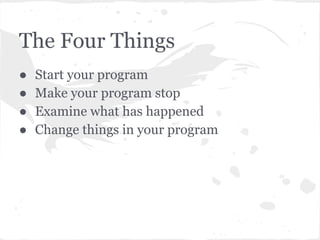
Start your program
Make your program stop
Examine what has happened
Change things in your program
Your Things
●
●
●
●
●
●

Start your program
Break / Watch
Checkpoint
Next / Step / Continue
Backtrace
Print
ZEROTH...
https://sourceware.org/gdb/current/onlinedocs/gdb/
Debugging Flow
●
●
●
●
●
●
●

Testing Brute-forcing
Identify symptom - what happened?
Identify problem - why?
Locate problem
Blame someone (else)
Fix problem
Repeat with the new problems
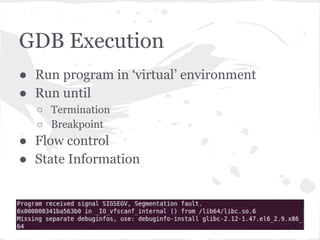
GDB Execution
● Run program in ‘virtual’ environment
● Run until
○ Termination
○ Breakpoint

● Flow control
● State Information
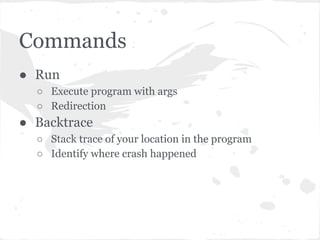
Commands
● Run
○ Execute program with args
○ Redirection

● Backtrace
○ Stack trace of your location in the program
○ Identify where crash happened
Example
verbose_array.c
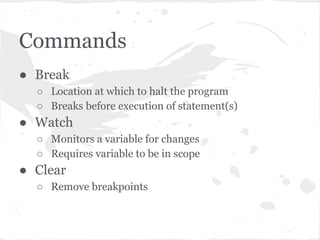
Commands
● Break
○ Location at which to halt the program
○ Breaks before execution of statement(s)

● Watch
○ Monitors a variable for changes
○ Requires variable to be in scope

● Clear
○ Remove breakpoints
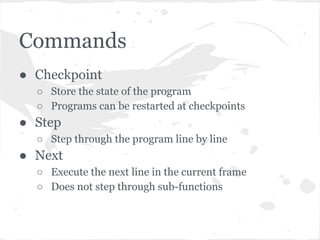
Commands
● Checkpoint
○ Store the state of the program
○ Programs can be restarted at checkpoints

● Step
○ Step through the program line by line

● Next
○ Execute the next line in the current frame
○ Does not step through sub-functions
Example
osh.c
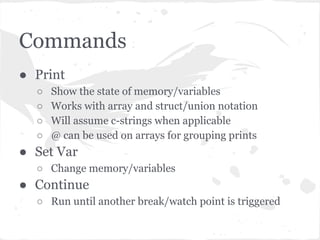
Commands
● Print
○
○
○
○

Show the state of memory/variables
Works with array and struct/union notation
Will assume c-strings when applicable
@ can be used on arrays for grouping prints

● Set Var
○ Change memory/variables

● Continue
○ Run until another break/watch point is triggered
Example
sudoku.c
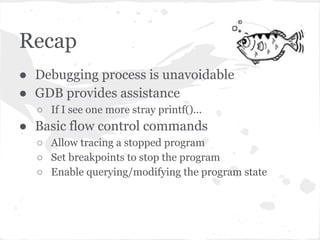
Recap
● Debugging process is unavoidable
● GDB provides assistance
○ If I see one more stray printf()...

● Basic flow control commands
○ Allow tracing a stopped program
○ Set breakpoints to stop the program
○ Enable querying/modifying the program state
Thanks!

http://glenoakley.com/
@goakley123
goakley123@gmail.com

Debugging With the GNU Debugger