ACM DEBS 2023
Neuchâtel, Switzerland
Faculty of Science, University of Neuchâtel
Opening Remarks
Valerio Schiavoni, General Chair
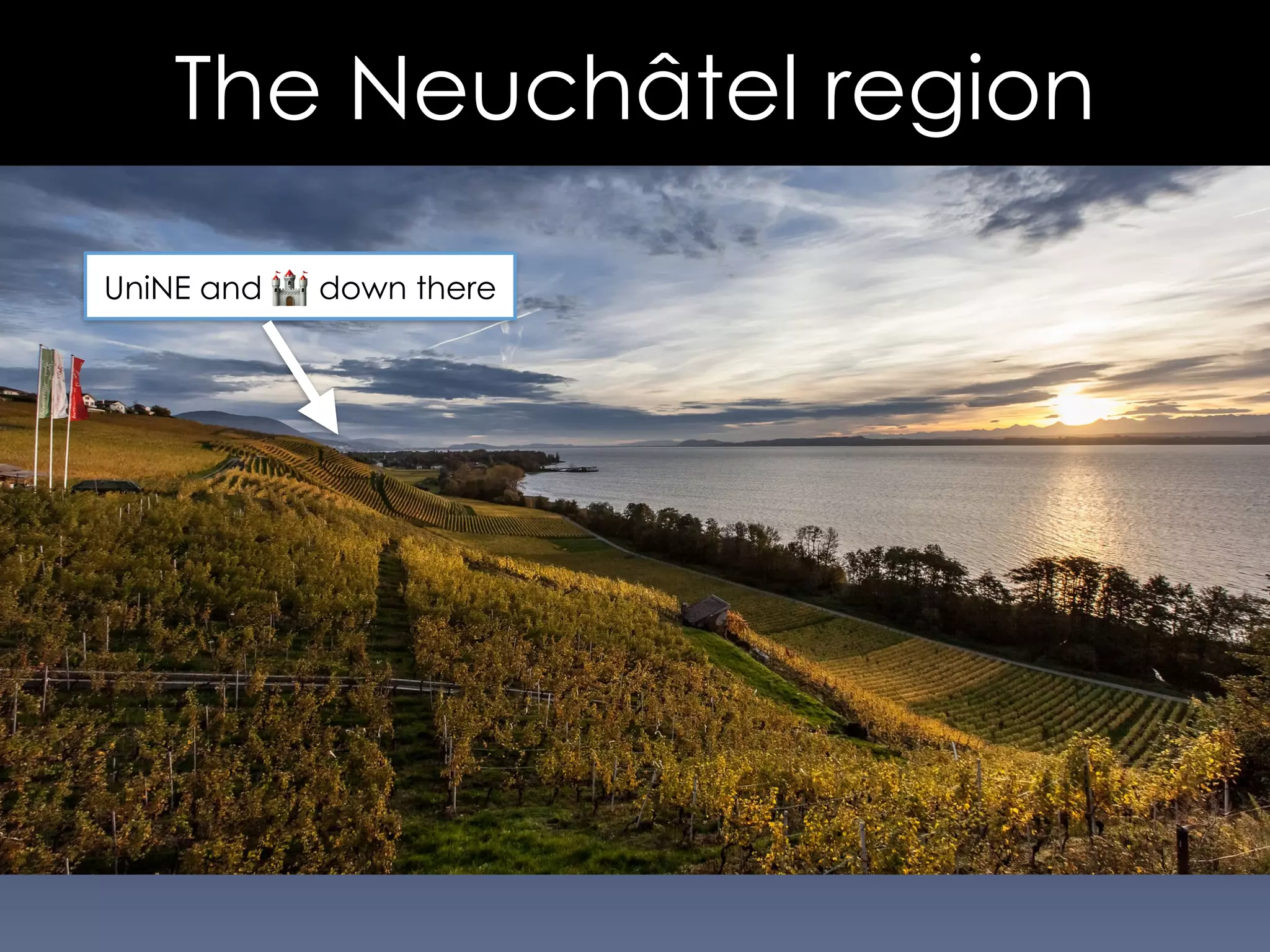
The Neuchâtel region
UniNE and 🏰 down there
Faculty of Science, UniMail
Former prison
1867
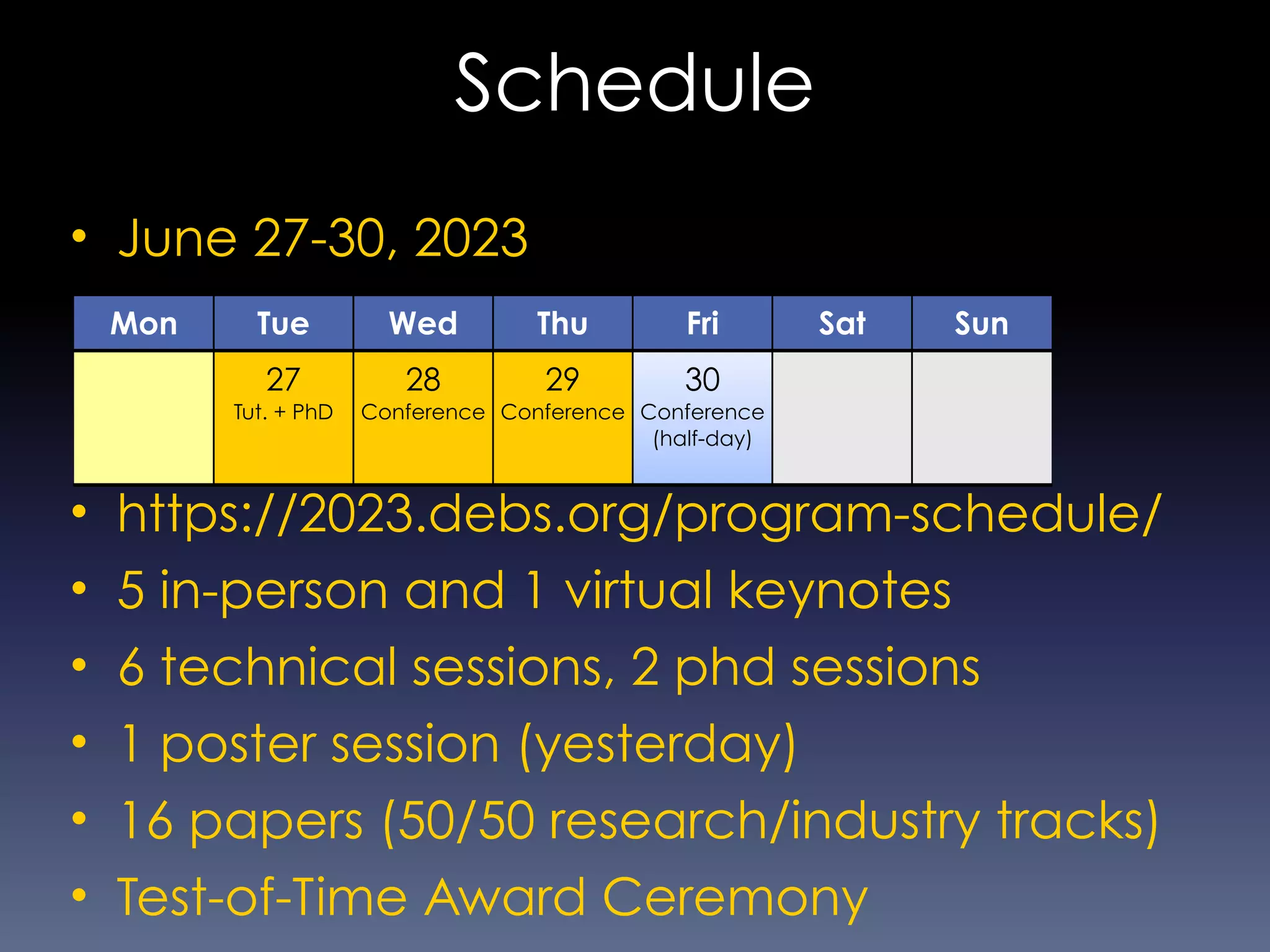
Schedule
• June 27-30, 2023
• https://2023.debs.org/program-schedule/
• 5 in-person and 1 virtual keynotes
• 6 technical sessions, 2 phd sessions
• 1 poster session (yesterday)
• 16 papers (50/50 research/industry tracks)
• Test-of-Time Award Ceremony
Mon Tue Wed Thu Fri Sat Sun
27
Tut. + PhD
28
Conference
29
Conference
30
Conference
(half-day)
Hot Spots
Old town
MAHN
UniMail
Train station
All scientific
events here
Social
activity
DuPeyrou
Gala
Dinner
Neuchâtel
Gare
Social Activity
Museum MAHN
Jaquet-Droz automata
Guided tour
Tomorrow at 17:30
“ChatGPT
of the 18th
century”
Gala Dinner
• Hotel DuPeyrou, tomorrow at 19:00
• Included in your registration
• Ticket inside your badge
Organising Team
• Finance Chairs: Alain Sandoz, Pascal Felber (UniNE)
• Proceedings Chair: Marcelo Pasin (UniNE & HES-SO)
• Research Track Chairs: Bettina Kemme (McGill, Canada),
Etienne Rivière (UCLouvain, Belgium)
• Industry & Application Co-Chairs: Mandana Vaziri (IBM
Research, US), Josef Spillner (ZHAW, Switzerland)
• Publication Chairs: Vania Maranzova (U. Grenoble Alpes,
France), Naohiro Hayashibara (Kyoto Sangyo Univ., Japan)
• Posters and Demo Chair: Baptiste Lepers (UniNE)
• PhD Forum Chairs: Riccardo Tommasini (U. Lyon), Senjuti Basu
Roy (NJIT, US)
• Web Chair: Jämes Ménétrey (UniNE)
Local Team 👏
Pasquale De Rosa, Panagiotis Gkikopoulos, Jämes Ménétrey, Sebastien Vaucher
A word from the
Industry and Application
Program Chairs
Mandana Vaziri, IBM Research, US
Josef Spillner, Zurich University of Applied Sciences, CH
Industry & Applications Track
2 PC Chairs: Mandana Vaziri, IBM Research, US
& Josef Spillner, Zurich University of
Applied Sciences, CH
+ 9 PC members (all strictly industry)
+ 4 extended PC members (academia)
↓ reviewing:
13 paper submissions
by authors from 7 countries [CA CH DE FR GR SE US]
Industry & Applications Track
Acceptance: 6 full + 1 short paper
Topic cloud:
Best Industry & Application Paper
Award
international Industry-academia collaboration –
HelloFresh, Univ. of Copenhagen, UERJ. The award
goes to:
João V.A. Esteves, Rosa M.M. Costa, Yongluan Zhou,
Ana Carolina Almeida
for their paper titled:
«An exploratory analysis of methods for real-time
data deduplication in streaming processes»
A word from the PC chairs
Etienne Rivière, UCLouvain, Belgium
Bettina Kemme, McGill, Canada
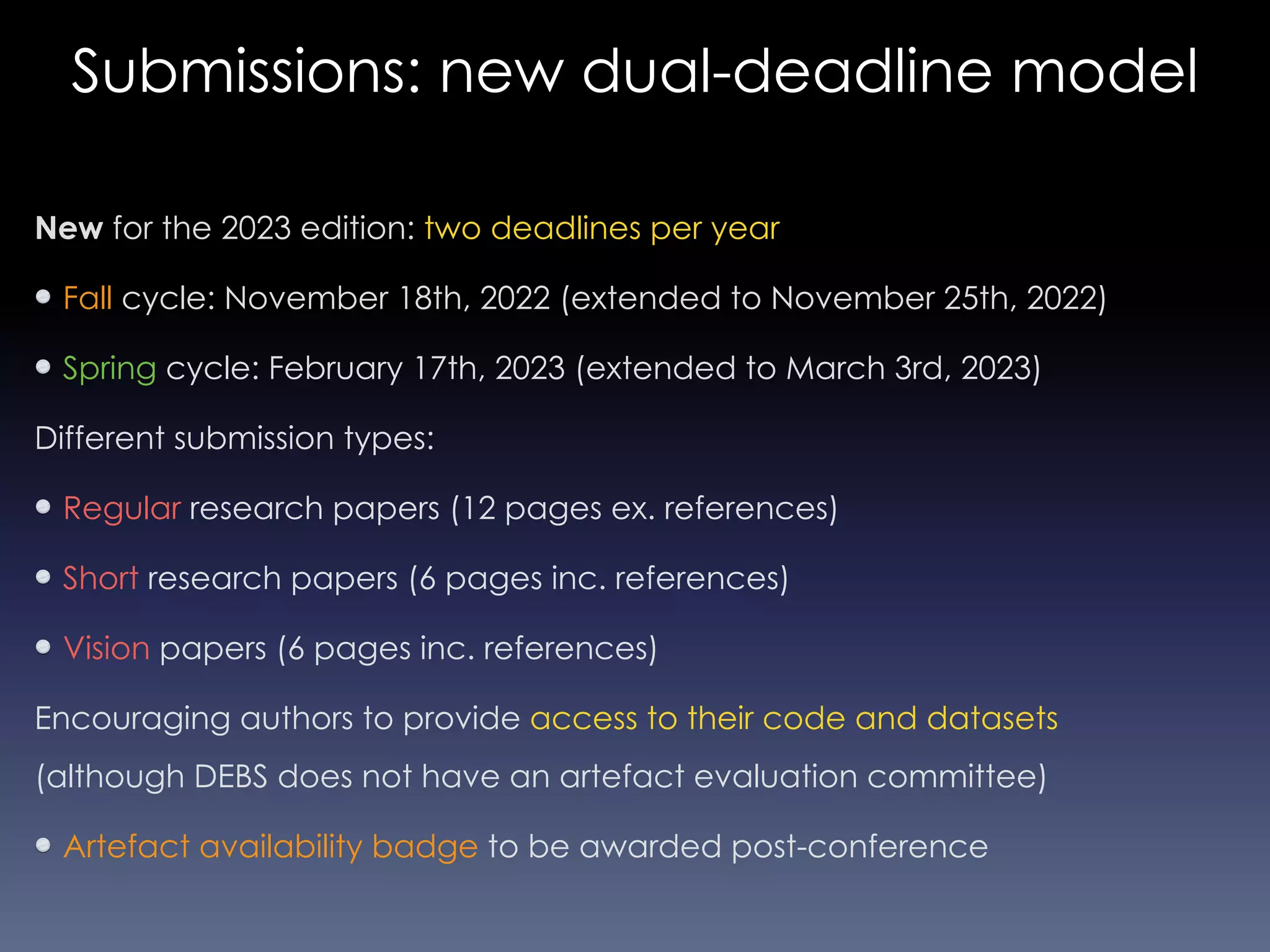
Submissions: new dual-deadline model
New for the 2023 edition: two deadlines per year
Fall cycle: November 18th, 2022 (extended to November 25th, 2022)
Spring cycle: February 17th, 2023 (extended to March 3rd, 2023)
Different submission types:
Regular research papers (12 pages ex. references)
Short research papers (6 pages inc. references)
Vision papers (6 pages inc. references)
Encouraging authors to provide access to their code and datasets
(although DEBS does not have an artefact evaluation committee)
Artefact availability badge to be awarded post-conference
Research track TPC
Alexander Artikis, University of Piraeus,
Greece
Ivona Brandić, Vienna University of
Technology, Austria
Andrey Brito, Universidade Federal de
Campina Grande, Brazil
Paris Carbone, KTH Royal Institute of
Technology, Sweden
Stéphane Delbruel, LaBRI, University of
Bordeaux, France
Schahram Dustdar, TU Wien, Austria
David Eyers, University of Otago, New
Zealand
Davide Frey, INRIA Rennes, France
Vera Goebel, University of Oslo, Norway
Vincenzo Gulisano, Chalmers University of
Technology, Sweden
Suyash Gupta, Purdue University, USA
Jelle Hellings, McMaster University, Canada
Hans-Arno Jacobsen, University of Toronto,
Canada
Wouter Joosen, KU Leuven, Belgium
Vasiliki Kalavri, Boston University, USA
Asterios Katsifodimos, Delft University of
Technology
Boris Koldehofe, University of Groningen,
The Netherlands
Michał Krol, City, University of London, UK
Danh Le Phuoc, TU Berlin, Germany
Manisha Luthra, TU Darmstadt, Germany
Emanuel Onica, Alexandru Ioan Cuza
University of Iaşi, Romania
André Martin, TU Dresden, Germany
Kishore Ramachandran, Georgia Tech, USA
Mohammad Sadoghi, University of California,
Davis, USA
Alexandre da Silva Veith, Nokia Bell-Labs,
Belgium
Kia Teymourian, UT Austin, USA
Nalini Venkatasubramanian, UC Irvine, USA
Roman Vitenberg, University of Oslo, Norway
Spyros Voulgaris, Athens University of
Economics and Business, Greece
Matthias Weidlich, Humboldt-Universität zu
Berlin, Germany
Kaiwen Zhang, École de technologie
supérieure de Montréal, Canada
Yongluan Zhou, University of Copenhagen,
Denmark
Thanks to all of them!
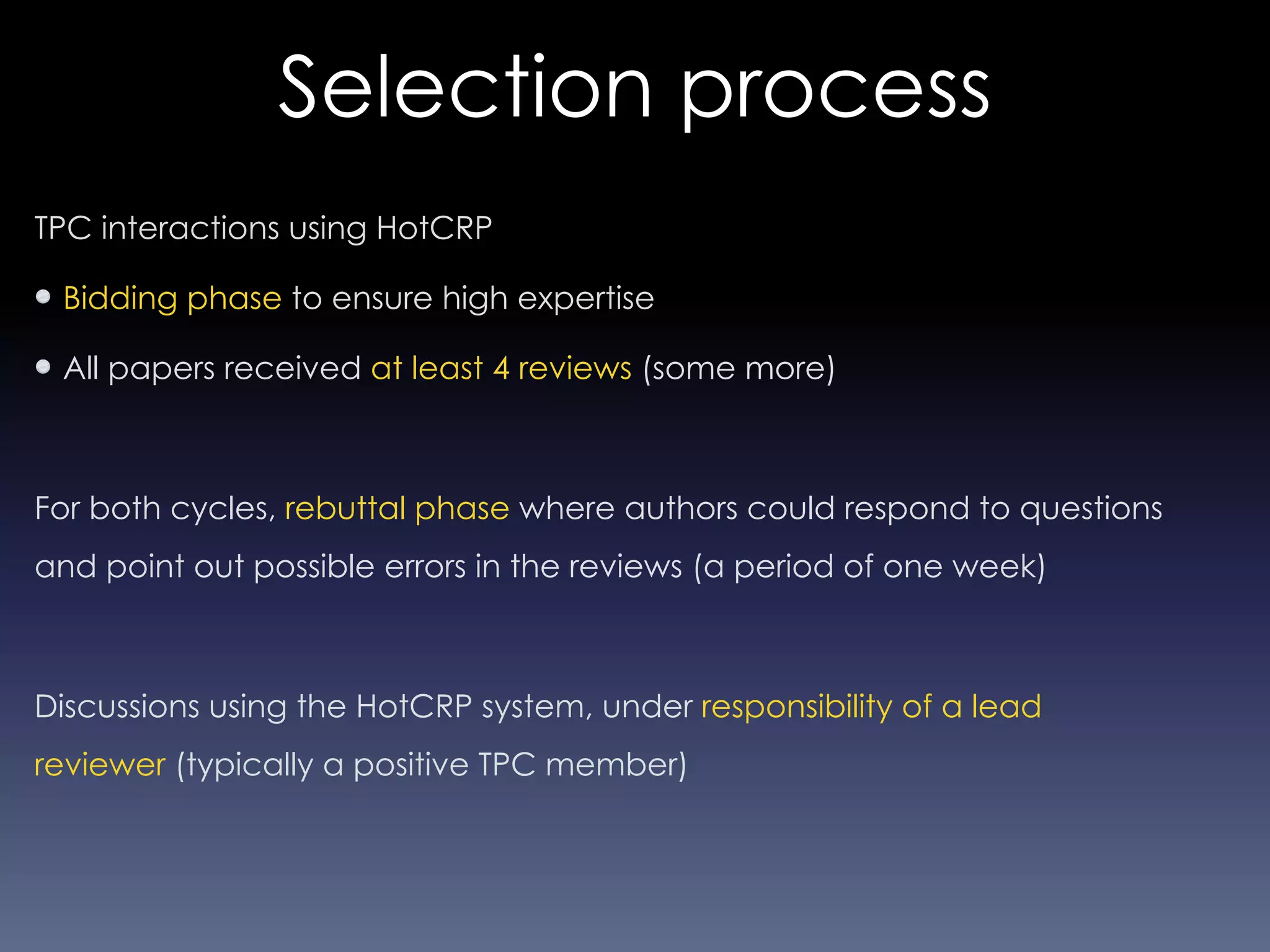
Selection process
TPC interactions using HotCRP
Bidding phase to ensure high expertise
All papers received at least 4 reviews (some more)
For both cycles, rebuttal phase where authors could respond to questions
and point out possible errors in the reviews (a period of one week)
Discussions using the HotCRP system, under responsibility of a lead
reviewer (typically a positive TPC member)
Statistics
Fall cycle: 6 submissions, 3 accepted
3 regular long papers: 1 accepted, 2 rejected
1 regular short paper: 1 rejected
2 vision papers: 2 accepted
Spring cycle: 15 submissions, 6 accepted
11 regular long papers: 5 accepted, 6 rejected
3 regular short paper: 3 rejected
1 vision paper: 1 accepted
Some papers went through shepherding, but we did not have to use the
option to ask for a revision between the Fall and Spring cycles.
Authors origin (w/out duplicates)
Best paper award
The best paper award for the research track goes to
Kristo Raun, Riccardo Tommasini, Ahmed Awad
For their regular, long paper
“I Will Survive: An Event-driven Conformance Checking Approach
Over Process Streams”
Attend the presentation in session 2 at 13:30 today!
I Will Survive: An Event-driven Conformance Checking
Approach Over Process Streams
Kristo Raun
University of Tartu
Tartu, Estonia
kristo.raun@ut.ee
Riccardo Tommassini
LIRIS Lab, INSA de Lyon, France
University of Tartu, Estonia
riccardo.tommasini@liris.cnrs.fr
Ahmed Awad
University of Tartu, Tartu, Estonia
Cairo University, Giza, Egypt
ahmed.awad@ut.ee
ABSTRACT
Online conformance checking deals with �nding discrepancies be-
tween real-life and modeled behavior on data streams. The current
state-of-the-art output of online conformance checking is a pre�x-
alignment, which is used for pinpointing the exact deviations in
terms of the trace and the model while accommodating a trace’s
unknown termination in an online setting. Current methods for
producing pre�x-alignments are computationally expensive and
hinder the applicability in real-life settings.
This paper introduces a new approximate algorithm – I Will
Survive (IWS). The algorithm utilizes the trie data structure to
improve the calculation speed, while remaining memory-e�cient.
Comparative analysis on real-life and synthetic datasets shows
that the IWS algorithm can achieve an order of magnitude faster
execution time while having a smaller error cost, compared to the
current state of the art. In extreme cases, the IWS �nds pre�x-
alignments roughly three orders of magnitude faster than previous
approximate methods. The IWS algorithm includes a discounted
decay time setting for more e�cient memory usage and a look-
ahead limit for improving computation time. Finally, the algorithm
1 INTRODUCTION
Process mining [23] is a data-driven approach for analyzing process
execution data. The process execution data is commonly collected
in event logs. In its simplest form, an event log is a sequence of
events characterized by a case identi�er, indicating the unique
process instance, the label of the executed activity, and a timestamp
(Table 2). The sequence of events having the same case identi�er is
called a trace.
An important aspect of business systems is the ability to detect
anomalies and report them in a human-readable form [17]. Confor-
mance checking [9] is the sub-area of process mining that attempts
to discover and quantify deviations in business process executions.
Conformance checking assumes the prior knowledge of how the
world should work – i.e., we have a process model – and examples
of how the world is working – i.e., we have process traces. We then
compare the traces to the model to analyze the conformance of the
process. The state-of-the-art output from conformance checking, in
terms of explainability, is an alignment [20]. Importantly, anomalies
and non-conformance may not necessarily indicate wrongly exe-
cuted processes. Deviations may also be a sign of possible process
Enjoy the Conference!

DEBS-2023.pdf

  • 1.
    ACM DEBS 2023 Neuchâtel,Switzerland Faculty of Science, University of Neuchâtel Opening Remarks Valerio Schiavoni, General Chair
  • 2.
    The Neuchâtel region UniNEand 🏰 down there
  • 3.
    Faculty of Science,UniMail Former prison 1867
  • 4.
    Schedule • June 27-30,2023 • https://2023.debs.org/program-schedule/ • 5 in-person and 1 virtual keynotes • 6 technical sessions, 2 phd sessions • 1 poster session (yesterday) • 16 papers (50/50 research/industry tracks) • Test-of-Time Award Ceremony Mon Tue Wed Thu Fri Sat Sun 27 Tut. + PhD 28 Conference 29 Conference 30 Conference (half-day)
  • 5.
    Hot Spots Old town MAHN UniMail Trainstation All scientific events here Social activity DuPeyrou Gala Dinner Neuchâtel Gare
  • 6.
    Social Activity Museum MAHN Jaquet-Drozautomata Guided tour Tomorrow at 17:30 “ChatGPT of the 18th century”
  • 7.
    Gala Dinner • HotelDuPeyrou, tomorrow at 19:00 • Included in your registration • Ticket inside your badge
  • 8.
    Organising Team • FinanceChairs: Alain Sandoz, Pascal Felber (UniNE) • Proceedings Chair: Marcelo Pasin (UniNE & HES-SO) • Research Track Chairs: Bettina Kemme (McGill, Canada), Etienne Rivière (UCLouvain, Belgium) • Industry & Application Co-Chairs: Mandana Vaziri (IBM Research, US), Josef Spillner (ZHAW, Switzerland) • Publication Chairs: Vania Maranzova (U. Grenoble Alpes, France), Naohiro Hayashibara (Kyoto Sangyo Univ., Japan) • Posters and Demo Chair: Baptiste Lepers (UniNE) • PhD Forum Chairs: Riccardo Tommasini (U. Lyon), Senjuti Basu Roy (NJIT, US) • Web Chair: Jämes Ménétrey (UniNE)
  • 9.
    Local Team 👏 PasqualeDe Rosa, Panagiotis Gkikopoulos, Jämes Ménétrey, Sebastien Vaucher
  • 10.
    A word fromthe Industry and Application Program Chairs Mandana Vaziri, IBM Research, US Josef Spillner, Zurich University of Applied Sciences, CH
  • 11.
    Industry & ApplicationsTrack 2 PC Chairs: Mandana Vaziri, IBM Research, US & Josef Spillner, Zurich University of Applied Sciences, CH + 9 PC members (all strictly industry) + 4 extended PC members (academia) ↓ reviewing: 13 paper submissions by authors from 7 countries [CA CH DE FR GR SE US]
  • 12.
    Industry & ApplicationsTrack Acceptance: 6 full + 1 short paper Topic cloud:
  • 13.
    Best Industry &Application Paper Award international Industry-academia collaboration – HelloFresh, Univ. of Copenhagen, UERJ. The award goes to: João V.A. Esteves, Rosa M.M. Costa, Yongluan Zhou, Ana Carolina Almeida for their paper titled: «An exploratory analysis of methods for real-time data deduplication in streaming processes»
  • 14.
    A word fromthe PC chairs Etienne Rivière, UCLouvain, Belgium Bettina Kemme, McGill, Canada
  • 15.
    Submissions: new dual-deadlinemodel New for the 2023 edition: two deadlines per year Fall cycle: November 18th, 2022 (extended to November 25th, 2022) Spring cycle: February 17th, 2023 (extended to March 3rd, 2023) Different submission types: Regular research papers (12 pages ex. references) Short research papers (6 pages inc. references) Vision papers (6 pages inc. references) Encouraging authors to provide access to their code and datasets (although DEBS does not have an artefact evaluation committee) Artefact availability badge to be awarded post-conference
  • 16.
    Research track TPC AlexanderArtikis, University of Piraeus, Greece Ivona Brandić, Vienna University of Technology, Austria Andrey Brito, Universidade Federal de Campina Grande, Brazil Paris Carbone, KTH Royal Institute of Technology, Sweden Stéphane Delbruel, LaBRI, University of Bordeaux, France Schahram Dustdar, TU Wien, Austria David Eyers, University of Otago, New Zealand Davide Frey, INRIA Rennes, France Vera Goebel, University of Oslo, Norway Vincenzo Gulisano, Chalmers University of Technology, Sweden Suyash Gupta, Purdue University, USA Jelle Hellings, McMaster University, Canada Hans-Arno Jacobsen, University of Toronto, Canada Wouter Joosen, KU Leuven, Belgium Vasiliki Kalavri, Boston University, USA Asterios Katsifodimos, Delft University of Technology Boris Koldehofe, University of Groningen, The Netherlands Michał Krol, City, University of London, UK Danh Le Phuoc, TU Berlin, Germany Manisha Luthra, TU Darmstadt, Germany Emanuel Onica, Alexandru Ioan Cuza University of Iaşi, Romania André Martin, TU Dresden, Germany André Martin, TU Dresden, Germany Kishore Ramachandran, Georgia Tech, USA Mohammad Sadoghi, University of California, Davis, USA Alexandre da Silva Veith, Nokia Bell-Labs, Belgium Kia Teymourian, UT Austin, USA Nalini Venkatasubramanian, UC Irvine, USA Roman Vitenberg, University of Oslo, Norway Spyros Voulgaris, Athens University of Economics and Business, Greece Matthias Weidlich, Humboldt-Universität zu Berlin, Germany Kaiwen Zhang, École de technologie supérieure de Montréal, Canada Yongluan Zhou, University of Copenhagen, Denmark Thanks to all of them!
  • 17.
    Selection process TPC interactionsusing HotCRP Bidding phase to ensure high expertise All papers received at least 4 reviews (some more) For both cycles, rebuttal phase where authors could respond to questions and point out possible errors in the reviews (a period of one week) Discussions using the HotCRP system, under responsibility of a lead reviewer (typically a positive TPC member)
  • 18.
    Statistics Fall cycle: 6submissions, 3 accepted 3 regular long papers: 1 accepted, 2 rejected 1 regular short paper: 1 rejected 2 vision papers: 2 accepted Spring cycle: 15 submissions, 6 accepted 11 regular long papers: 5 accepted, 6 rejected 3 regular short paper: 3 rejected 1 vision paper: 1 accepted Some papers went through shepherding, but we did not have to use the option to ask for a revision between the Fall and Spring cycles.
  • 19.
  • 20.
    Best paper award Thebest paper award for the research track goes to Kristo Raun, Riccardo Tommasini, Ahmed Awad For their regular, long paper “I Will Survive: An Event-driven Conformance Checking Approach Over Process Streams” Attend the presentation in session 2 at 13:30 today! I Will Survive: An Event-driven Conformance Checking Approach Over Process Streams Kristo Raun University of Tartu Tartu, Estonia kristo.raun@ut.ee Riccardo Tommassini LIRIS Lab, INSA de Lyon, France University of Tartu, Estonia riccardo.tommasini@liris.cnrs.fr Ahmed Awad University of Tartu, Tartu, Estonia Cairo University, Giza, Egypt ahmed.awad@ut.ee ABSTRACT Online conformance checking deals with �nding discrepancies be- tween real-life and modeled behavior on data streams. The current state-of-the-art output of online conformance checking is a pre�x- alignment, which is used for pinpointing the exact deviations in terms of the trace and the model while accommodating a trace’s unknown termination in an online setting. Current methods for producing pre�x-alignments are computationally expensive and hinder the applicability in real-life settings. This paper introduces a new approximate algorithm – I Will Survive (IWS). The algorithm utilizes the trie data structure to improve the calculation speed, while remaining memory-e�cient. Comparative analysis on real-life and synthetic datasets shows that the IWS algorithm can achieve an order of magnitude faster execution time while having a smaller error cost, compared to the current state of the art. In extreme cases, the IWS �nds pre�x- alignments roughly three orders of magnitude faster than previous approximate methods. The IWS algorithm includes a discounted decay time setting for more e�cient memory usage and a look- ahead limit for improving computation time. Finally, the algorithm 1 INTRODUCTION Process mining [23] is a data-driven approach for analyzing process execution data. The process execution data is commonly collected in event logs. In its simplest form, an event log is a sequence of events characterized by a case identi�er, indicating the unique process instance, the label of the executed activity, and a timestamp (Table 2). The sequence of events having the same case identi�er is called a trace. An important aspect of business systems is the ability to detect anomalies and report them in a human-readable form [17]. Confor- mance checking [9] is the sub-area of process mining that attempts to discover and quantify deviations in business process executions. Conformance checking assumes the prior knowledge of how the world should work – i.e., we have a process model – and examples of how the world is working – i.e., we have process traces. We then compare the traces to the model to analyze the conformance of the process. The state-of-the-art output from conformance checking, in terms of explainability, is an alignment [20]. Importantly, anomalies and non-conformance may not necessarily indicate wrongly exe- cuted processes. Deviations may also be a sign of possible process
  • 21.