DDEMAP
Digital Document Editing Management
Programming
1- struttura del corso e risorse utilizzate
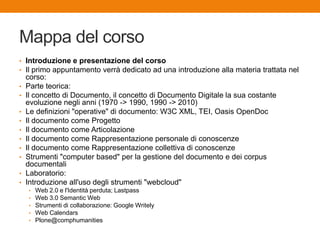
Mappa del corso
• Introduzione e presentazione del corso
• Il primo appuntamento verrà dedicato ad una introduzione alla materia trattata nel
corso:
• Parte teorica:
• Il concetto di Documento, il concetto di Documento Digitale la sua costante
evoluzione negli anni (1970 -> 1990, 1990 -> 2010)
• Le definizioni "operative" di documento: W3C XML, TEI, Oasis OpenDoc
• Il documento come Progetto
• Il documento come Articolazione
• Il documento come Rappresentazione personale di conoscenze
• Il documento come Rappresentazione collettiva di conoscenze
• Strumenti "computer based" per la gestione del documento e dei corpus
documentali
• Laboratorio:
• Introduzione all'uso degli strumenti "webcloud"
• Web 2.0 e l'Identità perduta; Lastpass
• Web 3.0 Semantic Web
• Strumenti di collaborazione: Google Writely
• Web Calendars
• Plone@comphumanities
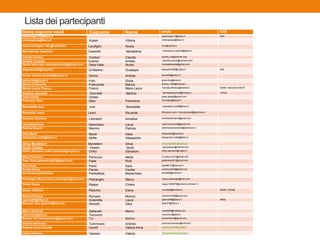
Lista dei partecipanti
Nome cognome email Cognome Nome email CdS
pablomagic13@libero.it pablomagic13@libero.it E&S
vittoriaarpaia@libero.it Arpaia Vittoria vittoriaarpaia@libero.it
nicola Carofiglio <nkl-@hotmail.it> Carofiglio Nicola nkl-@hotmail.it
Mariaelena Casaretti Casaretti Mariaelena mariaelena.casaretti@libero.it
Claudio Cordoni Cordoni Claudio brando_cla@hotmail.com
Amelia Cosimo Cosimo Amelia <amelia.cosimo@hotmail.com>
Muriel Della Valle <murieldellavalle@gmail.com> Della Valle Muriel murieldellavalle@gmail.com
peppedima88@virgilio.it Di Martino Giuseppe peppedima88@virgilio.it E&S
Donini, Andrea (donini85@yahoo.it) Donini, Andrea donini85@yahoo.it
giulia.foto@tiscali.it Foto Giulia giulia.foto@tiscali.it
Bianca Francavilla Francavilla Bianca bianca_1990@hotmail.it
Maria Laura Franco Franco Maria Laura marialaurafranco@hotmail.it SSAB, matricola 1549147
martina giannetti Giannetti Martina atimetobesosmall@hotmail.it SSAB
Paolo Gresta Gresta paolo.gresta@gmail.com
Francesca Ielpo Ielpo Francesca francielpo@tiscali.it
Benedetta Izzo Izzo Benedetta benedetta.izzo88@libero.it
Riccarda Leoni Leoni Riccarda Riccarda Leoni <riccarda.leoni@gmail.com>
Annalisa Liberatori Liberatori Annalisa annalisaliberatori@gmail.com
Laura Mammana Mammana Laura mammana.laura@gmail.com
Patrizia Mancini Mancini Patrizia shortmanconsultants@shortman.it
Delia Miceli Miceli Delia deliamiceli@hotmail.it
alessandra.moffa@libero.it Moffa Alessandra alessandra.moffa@libero.it
Silvia Monteferri Monteferri Silvia silvia.monteferri@yahoo.it
Giulio Olesen Olesen Giulio giulioolesen@hotmail.com
Orifici, Salvatore (orifici.salvatore@virgilio.it) Orifici Salvatore orifici.salvatore@virgilio.it
Marta Panicucci Panicucci Marta m.panicucci17@gmail.com
Papa, Rudi (goldenboy501@gmail.com) Papa Rudi goldenboy501@gmail.com
Sara Parisi Parisi Sara sara88147@hotmail.it
Cecilia Parola Parola Cecilia cecilia.parola@gmail.com
mariachiara pierbattista Pierbattista Mariachiara emsi888@hotmail.it
Pietrangeli, Marco (marco.pietrangeli@msn.com) Pietrangeli, Marco marco.pietrangeli@msn.com
Chiara Rappa Rappa Chiara rappa.1493679@studenti.uniroma1.it
elena ribichini Ribichini Elena mende88@hotmail.it SSAB 1195398
Monica Romano Romano Monica romanom036@gmail.com,
sparrow88@libero.it Sciarretta Laura sparrow88@libero.it A&Sp
Silvestri, Sara (sasil.87@libero.it) Silvestri Sara sasil.87@libero.it
Marco Stefanelli Stefanelli Marco marste90@hotmail.com
t.tercovich@alice.it Tercovich t.tercovich@alice.it
Martina Tini <tinimartina.tr@gmail.com> Tini Martina tinimartina.tr@gmail.com
antonio tumminaro Tumminaro Antonio antoniotumminaro@hotmail.it
Valeria Anna Uccelli Uccelli Valeria Anna valeria.uccelli@hotmail.it
Valeria Vanesio Vanesio Valeria blackeagle89vv@hotmail.it
Risorse del corso – risorse web
• Comphumanities:
• http://www.comphumanities.org
• Elearning Sapienza
• http://elearning2.uniroma1.it
• Editoria e Scrittura
• http://editoriaescrittura.eu
Risorse del corso – software tools di
riferimento
• OpenOffice / LibreOffice
• http://libreoffice.org ; http://openoffice.org
• Microsoft Office
• http://office.microsoft.com
• NLTK
• http://nltk.org
OpenOffice / LibreOffice
• OpenOffice / LibreOffice: quali sono le differenze?
• http://libreoffice.org ; http://openoffice.org
• Quali sono le differenze tra LibreOffice, Apache OpenOffice, Oracle Open Office? Michael Meeks – che
lavora su GNOME per SuSE – ha riassunto le caratteristiche dei derivati di OpenOffice.org in quella che
chiameremmo un’infografica. Certo la versione 3.4 della suite di Apache non è ancora stata rilasciata, ma il
confronto è valido.
• Meeks ritiene, come altri utenti, che i progetti – a eccezione della suite proprietaria di Oracle – dovrebbero
riunirsi, ovviamente sotto The Document Foundation. Un’auto-contraddizione, perché l’unica possibilità
(ammesso che sia credibile) sarebbe creare una fondazione ex novo da LibreOffice e Apache OpenOffice.
Molto improbabile.
• Soprattutto considerando che IBM ha donato il codice sorgente di Lotus Symphony ad Apache, proprio per
contribuire alla ―rinascita‖ di OpenOffice. LibreOffice resterebbe tagliato fuori dall’incompatibilità delle
licenze: AL 2.0 rispetto a LGPLv3 e presto MPL 2.0. Meeks riconosce che agli utenti questo aspetto non
interessa granché.
• La questione delle licenze è primaria per chi contribuisce al codice: agli utenti importa, tutt’al più, della
gratuità del prodotto. Confrontando le caratteristiche, LibreOffice include quasi tutte le funzionalità che
saranno presenti in Apache OpenOffice e ha molti più filtri d’importazione — quanto ai formati di Microsoft
Office.
• Nonostante i 107 traduttori, rispetto ai 16 di Apache OpenOffice, LibreOffice non ha ancora un contatore
delle parole per le lingue asiatiche: questa sarebbe l’unica carenza della suite di TDF — insieme al
rendering via Cairo che, però, è escluso da entrambe. Al momento, la vera differenza è nella compatibilità
con Microsoft Office.
• Apache OpenOffice, infatti, garantirebbe soltanto l’importazione – e non l’esportazione – dei formati
proprietari di Redmond. Nell’utilizzo quotidiano, è una mancanza che gli utenti avvertiranno
immediatamente: purtroppo, tra istituzioni pubbliche e società private, i formati di Microsoft Office
resteranno comunque imprescindibili.
Microsoft OfficeOpen vs OpenDocument
• http://it.wikipedia.org/wiki/Office_Open_XML
• Office Open XML
• Da Wikipedia, l'enciclopedia libera.
• Office Open XML (comunemente abbreviato in OOXML) è un formato di file basato sul linguaggio XML per la memorizzazione di documenti
informatici, come documenti di testo, fogli di calcolo, presentazioni, grafici ed altri tipi.
• Il formato è stato sviluppato da Microsoft come formato di memorizzazione per i prodotti Office, ed è in seguito stato proposto come standard
ISO/IEC (DIS 29500), tuttavia in una sessione di votazione tenutasi il 2 settembre 2007[1][2] non ha ottenuto voti a sufficienza per essere
approvato. Nei mesi successivi è seguito un ballot resolution meeting che ha portato ad una seconda votazione, conclusasi il 29 marzo
2008, dove l'OOXML è diventato standard ISO[3]. Il 15 agosto 2008, ISO[4] conferma la pubblicazione dello standard ISO/IEC DIS 29500,
dopo aver respinto il ricorso di quattro paesi afferenti alla commissione di valutazione (Brasile, India, Venezuela, Sudafrica), contrari al
giudizio positivo espresso durante il final ballot resolution meeting di Ginevra.
• Lo standard ha definito due differenti set di specifiche: Transitional e Strict. Il primo set contiene una serie di funzionalità che sono state
definite "deprecate" ed "incluse solo per retrocompatibilità", mentre il secondo è un set "più pulito", che è stato approvato allo scopo di
diventare lo standard effettivo. Ma la versione beta di Microsoft Office 2010, rilasciata ad un paio di anni di distanza dall'approvazione dello
standard, supporta ancora solo la variante Transitional e non la Strict.[5]
•
• Le estensioni dei file:
• .docx per un file di testo,
• .xlsx per un foglio di calcolo,
• .pptx per una presentazione.
• Note
•
• ^ Battuta d'arresto per lo standard Office Open XML. Tom's hardware, 05-09-2007. URL consultato in data 18-02-2008.
• ^ (EN) Vote closes on draft ISO/IEC DIS 29500 standard. ISO, 4 settembre 2007. URL consultato in data 2 aprile 2008.
• ^ (EN) ISO/IEC DIS 29500 receives necessary votes for approval as an International Standard. ISO, 2 aprile 2008. URL consultato in data 2
aprile 2008.
• ^ (EN) ISO and IEC members give go ahead on ISO/IEC DIS 29500. ISO, 15 agosto 2008. URL consultato in data 15 agosto 2008.
• ^ OOXML, Microsoft ignora ISO?. 06-04-2010. URL consultato in data 07-04-2010.
• Voci correlate
•
• OpenDocument (ODF)
• XML
Calibre
• http://http://calibre-ebook.com/about
• OpenSource eBook Manager
Calibre is a free and open source e-book library management application developed by users of e-books for users
of e-books. It has a cornucopia of features divided into the following main categories:
• Library Management
• E-book conversion
• Syncing to e-book reader devices
• Downloading news from the web and converting it into e-book form
• Comprehensive e-book viewer
• Content server for online access to your book collection
• Riferimenti:
• Calibre Quick Start Guide
• By: John Schember
• Copyright © 2010, 2011, 2012 John Schember
• Licensed under a Creative Commons Attribution-ShareAlike 3.0 Unported License.
Calibre
• http://http://calibre-ebook.com/about
• OpenSource eBook Manager
• calibre started life on 31 October, 2006, soon after the release of the SONY PRS-500, the
first e-ink based reader to be sold commercially in the US. At the time, I was a graduate
student, with a lot of time on my hands. The PRS-500 did not work at all with Linux, my
operating system of choice, so I decided to reverse engineer the USB protocol that it used, to
get it working on Linux. This was accomplished with the help of the fine folks over
at mobileread.com and calibre was born, albeit named libprs500.
• At the time there were no satisfactory tools to convert content into the LRF format, used by
the SONY reader, so I decided to implement a converter to convert the most popular e-book
formats to LRF. This converter proved to be wildly popular and far better than the (mostly
non-existent) offerings from SONY. It was picked up and used by various publishing houses
and content digitizers to produce the first generation of books in the LRF format.
• As my e-book collection grew, I realized that managing it was quickly becoming unwieldy, so
I decided to write a graphical interface to libprs500 to make it easier. This became calibre, in
its present form, as a comprehensive e-book management tool. libprs500 was renamed to
calibre in mid-2008. The name calibre was chosen by my wife, Krittika. The libre in calibre
stands for freedom, indicating that calibre is a free and open source product, modifiable by
all. Nonetheless, calibre should be pronounced as cali-ber, not ca-libre.
• Riferimenti:
• Calibre Quick Start Guide
• By: John Schember
• Copyright © 2010, 2011, 2012 John Schember
• Licensed under a Creative Commons Attribution-ShareAlike 3.0 Unported License.
Calibre
• http://http://calibre-ebook.com/about
• OpenSource eBook Manager
• The news downloading feature, one of calibre's most popular, has an interesting story behind
it. I used to subscribe to Newsweek, back when it was still a real news magazine. But one
fine day, Newsweek simply stopped being delivered to my house and no matter how much
time I spent on the phone with various sales reps, it simply would not start again. Since I'd
just got my first e-book reader at the time, I decided to add the ability to download and
convert websites to calibre. From the beginning, I decided to make it as modular as possible,
so that other people could contribute "recipes" for different news sites. The calibre cookbook
has kept on growing and now calibre has recipes for over three hundred news sources in
many different languages.
• Today calibre is a vibrant open-source community with half a dozen developers and many,
many testers and bug reporters. It is used in over 200 countries and has been translated into
a dozen different languages by volunteers. calibre has become a comprehensive tool for the
management of digital texts, allowing you to do whatever you could possibly imagine with
your e-book library. Reading is very important to me and one of my goals has always been to
prevent either the fragmentation or the monopolization of the e-book market by entities that
care solely for short-term goals. As the calibre community continues to grow, driven by book
lovers, for book lovers, hopefully it will always present an alternative for people that love to
read e-books and want to be in control of their own digital libraries.
• Riferimenti:
• Calibre Quick Start Guide
• By: John Schember
• Copyright © 2010, 2011, 2012 John Schember
• Licensed under a Creative Commons Attribution-ShareAlike 3.0 Unported License.
Calibre
• http://http://calibre-ebook.com/about
• OpenSource eBook Manager
• calibre is an open source application that uses a large number of other open source libraries and is developed on Linux, an open source
platform, and as such, it has benefited from the work of large numbers of people, some of whom are listed below. I've tried to be as
exhaustive as possible, but, if I have omitted your contribution, please let me know.
• Contributors of code/bug fixes
• In no particular order:
• Marshall Vandegrift: For epub2lrf, lit2oeb, oeb2mobi and various improvements in the html2lrf code, as well as the basic framework for the conversion pipeline in the
0.6.x series
• John Schember: For the new calibre device driver framework, various GUI enhancements and several input and output format plugins and the "Get Books" feature
• Charles Haley: For custom columns, saved searches, restrictions, the wireless device driver, lots of other help/ideas
• Gregory Riker: For MOBI indexing, catalogs, the iPad driver
• Roger Critchlow: For the initial implementation of lrs2lrf
• Anatoly Shipitsin: For fb2lrf and fb2-meta
• Ori Avtalion and WayneD for various bug fixes
• Tijmen Ruizendaal for the Be Book driver
• Igor Skochinsky (for various bits of reverse engineering without which calibre would never have gotten off the ground)
• Darko Miletic: For a large number of news recipes
• Grant Drake: For various plugins including Open with, search the internet and goodreads integration
• Timothy Legge and David Forrester: For Kobo support in calibre
• Graphics and design
• Nicholas Holland and the guys at Centresource for the website design
• diaboNL for the reader icon
• Caleb Avery and Kamil Tatara for the calibre logo
• The Oxygen project and Kamil Tatara for various icons
• Recipe writers
• Too many people have contributed recipes to list here, but their contributions are a big part of calibre.
• Translators
• The list of translators is available here
• Riferimenti:
• Calibre Quick Start Guide
• By: John Schember
• Copyright © 2010, 2011, 2012 John Schember
• Licensed under a Creative Commons Attribution-ShareAlike 3.0 Unported License.
Calibre
• http://http://calibre-ebook.com/about
• OpenSource eBook Manager
• Other projects whose code/libraries calibre uses/links against
• Python
• Qt
• PyQt
• rtf2xml
• poppler
• feedparser
• pylrs
• BeautifulSoup
• mechanize
• pictureflow
• lxml
• cssselect
• Hyphenator
• sqlite
• chardet
• podofo
• imagemagick
• libmtp
• Python Imaging Library
• Sphinx
• django
• odfpy
• cssutils
• bzr
• ICU
• CherryPy
• python routes
• dateutil
• dnspython
• pywin32
• python-dbus
• QtCurve
• The Launchpad, Google Code and Sourceforge.net services for providing file and code hosting for calibre releases.
• Last, but not least I'd like to thank the folks at mobileread.com for creating a wonderful community for us e-book lovers to gather round.
• Riferimenti:
• Calibre Quick Start Guide
• By: John Schember
• Copyright © 2010, 2011, 2012 John Schember
• Licensed under a Creative Commons Attribution-ShareAlike3.0 Unported License.
Calibre
• http://http://calibre-ebook.com/about
• OpenSource eBook Manager
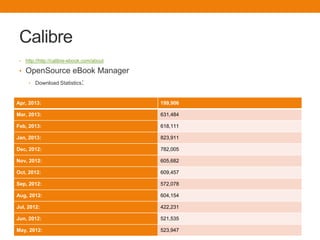
• Download Statistics:
• Riferimenti:
• Calibre Quick Start Guide
• By: John Schember
• Copyright © 2010, 2011, 2012 John Schember
• Licensed under a Creative Commons Attribution-ShareAlike 3.0 Unported License.
Apr, 2013: 199,906
Mar, 2013: 631,484
Feb, 2013: 618,111
Jan, 2013: 823,911
Dec, 2012: 782,005
Nov, 2012: 605,682
Oct, 2012: 609,457
Sep, 2012: 572,078
Aug, 2012: 604,154
Jul, 2012: 422,231
Jun, 2012: 521,535
May, 2012: 523,947
Calibre
• http://http://calibre-ebook.com/about
• OpenSource eBook Manager
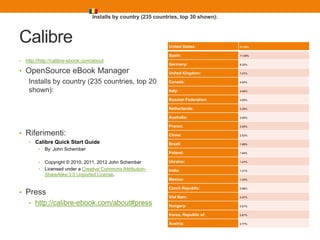
Installs by country (235 countries, top 20
shown):
• Riferimenti:
• Calibre Quick Start Guide
• By: John Schember
• Copyright © 2010, 2011, 2012 John Schember
• Licensed under a Creative Commons Attribution-
ShareAlike 3.0 Unported License.
• Press
• http://calibre-ebook.com/about#press
Installs by country (235 countries, top 30 shown):
United States: 21.20%
Spain: 11.08%
Germany: 8.32%
United Kingdom: 7.27%
Canada: 4.60%
Italy: 4.46%
Russian Federation: 3.85%
Netherlands: 3.28%
Australia: 2.80%
France: 2.65%
China: 2.53%
Brazil: 1.89%
Poland: 1.64%
Ukraine: 1.47%
India: 1.21%
Mexico: 1.04%
Czech Republic: 0.98%
Viet Nam: 0.97%
Hungary: 0.81%
Korea, Republic of: 0.81%
Austria: 0.77%
Bibliografia del corso
• Monografie consigliate:
• OpenDocument
• J. David Eisenberg, OASIS OpenDocument Essentials Using OASIS OpenDocument XML
• eBook
• John Schember, Calibre Quick Start Guide
• Vedi aggiornamenti anche in: Comphumanities:
• http://www.comphumanities.org/didattica-2012-2013/materiali-
didattici
• Elearning Sapienza
• http://elearning2.uniroma1.it
• Editoria e Scrittura
• http://editoriaescrittura.eu

Ddemap

  • 1.
    DDEMAP Digital Document EditingManagement Programming 1- struttura del corso e risorse utilizzate
  • 2.
    Mappa del corso •Introduzione e presentazione del corso • Il primo appuntamento verrà dedicato ad una introduzione alla materia trattata nel corso: • Parte teorica: • Il concetto di Documento, il concetto di Documento Digitale la sua costante evoluzione negli anni (1970 -> 1990, 1990 -> 2010) • Le definizioni "operative" di documento: W3C XML, TEI, Oasis OpenDoc • Il documento come Progetto • Il documento come Articolazione • Il documento come Rappresentazione personale di conoscenze • Il documento come Rappresentazione collettiva di conoscenze • Strumenti "computer based" per la gestione del documento e dei corpus documentali • Laboratorio: • Introduzione all'uso degli strumenti "webcloud" • Web 2.0 e l'Identità perduta; Lastpass • Web 3.0 Semantic Web • Strumenti di collaborazione: Google Writely • Web Calendars • Plone@comphumanities
  • 3.
    Lista dei partecipanti Nomecognome email Cognome Nome email CdS pablomagic13@libero.it pablomagic13@libero.it E&S vittoriaarpaia@libero.it Arpaia Vittoria vittoriaarpaia@libero.it nicola Carofiglio <nkl-@hotmail.it> Carofiglio Nicola nkl-@hotmail.it Mariaelena Casaretti Casaretti Mariaelena mariaelena.casaretti@libero.it Claudio Cordoni Cordoni Claudio brando_cla@hotmail.com Amelia Cosimo Cosimo Amelia <amelia.cosimo@hotmail.com> Muriel Della Valle <murieldellavalle@gmail.com> Della Valle Muriel murieldellavalle@gmail.com peppedima88@virgilio.it Di Martino Giuseppe peppedima88@virgilio.it E&S Donini, Andrea (donini85@yahoo.it) Donini, Andrea donini85@yahoo.it giulia.foto@tiscali.it Foto Giulia giulia.foto@tiscali.it Bianca Francavilla Francavilla Bianca bianca_1990@hotmail.it Maria Laura Franco Franco Maria Laura marialaurafranco@hotmail.it SSAB, matricola 1549147 martina giannetti Giannetti Martina atimetobesosmall@hotmail.it SSAB Paolo Gresta Gresta paolo.gresta@gmail.com Francesca Ielpo Ielpo Francesca francielpo@tiscali.it Benedetta Izzo Izzo Benedetta benedetta.izzo88@libero.it Riccarda Leoni Leoni Riccarda Riccarda Leoni <riccarda.leoni@gmail.com> Annalisa Liberatori Liberatori Annalisa annalisaliberatori@gmail.com Laura Mammana Mammana Laura mammana.laura@gmail.com Patrizia Mancini Mancini Patrizia shortmanconsultants@shortman.it Delia Miceli Miceli Delia deliamiceli@hotmail.it alessandra.moffa@libero.it Moffa Alessandra alessandra.moffa@libero.it Silvia Monteferri Monteferri Silvia silvia.monteferri@yahoo.it Giulio Olesen Olesen Giulio giulioolesen@hotmail.com Orifici, Salvatore (orifici.salvatore@virgilio.it) Orifici Salvatore orifici.salvatore@virgilio.it Marta Panicucci Panicucci Marta m.panicucci17@gmail.com Papa, Rudi (goldenboy501@gmail.com) Papa Rudi goldenboy501@gmail.com Sara Parisi Parisi Sara sara88147@hotmail.it Cecilia Parola Parola Cecilia cecilia.parola@gmail.com mariachiara pierbattista Pierbattista Mariachiara emsi888@hotmail.it Pietrangeli, Marco (marco.pietrangeli@msn.com) Pietrangeli, Marco marco.pietrangeli@msn.com Chiara Rappa Rappa Chiara rappa.1493679@studenti.uniroma1.it elena ribichini Ribichini Elena mende88@hotmail.it SSAB 1195398 Monica Romano Romano Monica romanom036@gmail.com, sparrow88@libero.it Sciarretta Laura sparrow88@libero.it A&Sp Silvestri, Sara (sasil.87@libero.it) Silvestri Sara sasil.87@libero.it Marco Stefanelli Stefanelli Marco marste90@hotmail.com t.tercovich@alice.it Tercovich t.tercovich@alice.it Martina Tini <tinimartina.tr@gmail.com> Tini Martina tinimartina.tr@gmail.com antonio tumminaro Tumminaro Antonio antoniotumminaro@hotmail.it Valeria Anna Uccelli Uccelli Valeria Anna valeria.uccelli@hotmail.it Valeria Vanesio Vanesio Valeria blackeagle89vv@hotmail.it
  • 4.
    Risorse del corso– risorse web • Comphumanities: • http://www.comphumanities.org • Elearning Sapienza • http://elearning2.uniroma1.it • Editoria e Scrittura • http://editoriaescrittura.eu
  • 5.
    Risorse del corso– software tools di riferimento • OpenOffice / LibreOffice • http://libreoffice.org ; http://openoffice.org • Microsoft Office • http://office.microsoft.com • NLTK • http://nltk.org
  • 6.
    OpenOffice / LibreOffice •OpenOffice / LibreOffice: quali sono le differenze? • http://libreoffice.org ; http://openoffice.org • Quali sono le differenze tra LibreOffice, Apache OpenOffice, Oracle Open Office? Michael Meeks – che lavora su GNOME per SuSE – ha riassunto le caratteristiche dei derivati di OpenOffice.org in quella che chiameremmo un’infografica. Certo la versione 3.4 della suite di Apache non è ancora stata rilasciata, ma il confronto è valido. • Meeks ritiene, come altri utenti, che i progetti – a eccezione della suite proprietaria di Oracle – dovrebbero riunirsi, ovviamente sotto The Document Foundation. Un’auto-contraddizione, perché l’unica possibilità (ammesso che sia credibile) sarebbe creare una fondazione ex novo da LibreOffice e Apache OpenOffice. Molto improbabile. • Soprattutto considerando che IBM ha donato il codice sorgente di Lotus Symphony ad Apache, proprio per contribuire alla ―rinascita‖ di OpenOffice. LibreOffice resterebbe tagliato fuori dall’incompatibilità delle licenze: AL 2.0 rispetto a LGPLv3 e presto MPL 2.0. Meeks riconosce che agli utenti questo aspetto non interessa granché. • La questione delle licenze è primaria per chi contribuisce al codice: agli utenti importa, tutt’al più, della gratuità del prodotto. Confrontando le caratteristiche, LibreOffice include quasi tutte le funzionalità che saranno presenti in Apache OpenOffice e ha molti più filtri d’importazione — quanto ai formati di Microsoft Office. • Nonostante i 107 traduttori, rispetto ai 16 di Apache OpenOffice, LibreOffice non ha ancora un contatore delle parole per le lingue asiatiche: questa sarebbe l’unica carenza della suite di TDF — insieme al rendering via Cairo che, però, è escluso da entrambe. Al momento, la vera differenza è nella compatibilità con Microsoft Office. • Apache OpenOffice, infatti, garantirebbe soltanto l’importazione – e non l’esportazione – dei formati proprietari di Redmond. Nell’utilizzo quotidiano, è una mancanza che gli utenti avvertiranno immediatamente: purtroppo, tra istituzioni pubbliche e società private, i formati di Microsoft Office resteranno comunque imprescindibili.
  • 7.
    Microsoft OfficeOpen vsOpenDocument • http://it.wikipedia.org/wiki/Office_Open_XML • Office Open XML • Da Wikipedia, l'enciclopedia libera. • Office Open XML (comunemente abbreviato in OOXML) è un formato di file basato sul linguaggio XML per la memorizzazione di documenti informatici, come documenti di testo, fogli di calcolo, presentazioni, grafici ed altri tipi. • Il formato è stato sviluppato da Microsoft come formato di memorizzazione per i prodotti Office, ed è in seguito stato proposto come standard ISO/IEC (DIS 29500), tuttavia in una sessione di votazione tenutasi il 2 settembre 2007[1][2] non ha ottenuto voti a sufficienza per essere approvato. Nei mesi successivi è seguito un ballot resolution meeting che ha portato ad una seconda votazione, conclusasi il 29 marzo 2008, dove l'OOXML è diventato standard ISO[3]. Il 15 agosto 2008, ISO[4] conferma la pubblicazione dello standard ISO/IEC DIS 29500, dopo aver respinto il ricorso di quattro paesi afferenti alla commissione di valutazione (Brasile, India, Venezuela, Sudafrica), contrari al giudizio positivo espresso durante il final ballot resolution meeting di Ginevra. • Lo standard ha definito due differenti set di specifiche: Transitional e Strict. Il primo set contiene una serie di funzionalità che sono state definite "deprecate" ed "incluse solo per retrocompatibilità", mentre il secondo è un set "più pulito", che è stato approvato allo scopo di diventare lo standard effettivo. Ma la versione beta di Microsoft Office 2010, rilasciata ad un paio di anni di distanza dall'approvazione dello standard, supporta ancora solo la variante Transitional e non la Strict.[5] • • Le estensioni dei file: • .docx per un file di testo, • .xlsx per un foglio di calcolo, • .pptx per una presentazione. • Note • • ^ Battuta d'arresto per lo standard Office Open XML. Tom's hardware, 05-09-2007. URL consultato in data 18-02-2008. • ^ (EN) Vote closes on draft ISO/IEC DIS 29500 standard. ISO, 4 settembre 2007. URL consultato in data 2 aprile 2008. • ^ (EN) ISO/IEC DIS 29500 receives necessary votes for approval as an International Standard. ISO, 2 aprile 2008. URL consultato in data 2 aprile 2008. • ^ (EN) ISO and IEC members give go ahead on ISO/IEC DIS 29500. ISO, 15 agosto 2008. URL consultato in data 15 agosto 2008. • ^ OOXML, Microsoft ignora ISO?. 06-04-2010. URL consultato in data 07-04-2010. • Voci correlate • • OpenDocument (ODF) • XML
  • 8.
    Calibre • http://http://calibre-ebook.com/about • OpenSourceeBook Manager Calibre is a free and open source e-book library management application developed by users of e-books for users of e-books. It has a cornucopia of features divided into the following main categories: • Library Management • E-book conversion • Syncing to e-book reader devices • Downloading news from the web and converting it into e-book form • Comprehensive e-book viewer • Content server for online access to your book collection • Riferimenti: • Calibre Quick Start Guide • By: John Schember • Copyright © 2010, 2011, 2012 John Schember • Licensed under a Creative Commons Attribution-ShareAlike 3.0 Unported License.
  • 9.
    Calibre • http://http://calibre-ebook.com/about • OpenSourceeBook Manager • calibre started life on 31 October, 2006, soon after the release of the SONY PRS-500, the first e-ink based reader to be sold commercially in the US. At the time, I was a graduate student, with a lot of time on my hands. The PRS-500 did not work at all with Linux, my operating system of choice, so I decided to reverse engineer the USB protocol that it used, to get it working on Linux. This was accomplished with the help of the fine folks over at mobileread.com and calibre was born, albeit named libprs500. • At the time there were no satisfactory tools to convert content into the LRF format, used by the SONY reader, so I decided to implement a converter to convert the most popular e-book formats to LRF. This converter proved to be wildly popular and far better than the (mostly non-existent) offerings from SONY. It was picked up and used by various publishing houses and content digitizers to produce the first generation of books in the LRF format. • As my e-book collection grew, I realized that managing it was quickly becoming unwieldy, so I decided to write a graphical interface to libprs500 to make it easier. This became calibre, in its present form, as a comprehensive e-book management tool. libprs500 was renamed to calibre in mid-2008. The name calibre was chosen by my wife, Krittika. The libre in calibre stands for freedom, indicating that calibre is a free and open source product, modifiable by all. Nonetheless, calibre should be pronounced as cali-ber, not ca-libre. • Riferimenti: • Calibre Quick Start Guide • By: John Schember • Copyright © 2010, 2011, 2012 John Schember • Licensed under a Creative Commons Attribution-ShareAlike 3.0 Unported License.
  • 10.
    Calibre • http://http://calibre-ebook.com/about • OpenSourceeBook Manager • The news downloading feature, one of calibre's most popular, has an interesting story behind it. I used to subscribe to Newsweek, back when it was still a real news magazine. But one fine day, Newsweek simply stopped being delivered to my house and no matter how much time I spent on the phone with various sales reps, it simply would not start again. Since I'd just got my first e-book reader at the time, I decided to add the ability to download and convert websites to calibre. From the beginning, I decided to make it as modular as possible, so that other people could contribute "recipes" for different news sites. The calibre cookbook has kept on growing and now calibre has recipes for over three hundred news sources in many different languages. • Today calibre is a vibrant open-source community with half a dozen developers and many, many testers and bug reporters. It is used in over 200 countries and has been translated into a dozen different languages by volunteers. calibre has become a comprehensive tool for the management of digital texts, allowing you to do whatever you could possibly imagine with your e-book library. Reading is very important to me and one of my goals has always been to prevent either the fragmentation or the monopolization of the e-book market by entities that care solely for short-term goals. As the calibre community continues to grow, driven by book lovers, for book lovers, hopefully it will always present an alternative for people that love to read e-books and want to be in control of their own digital libraries. • Riferimenti: • Calibre Quick Start Guide • By: John Schember • Copyright © 2010, 2011, 2012 John Schember • Licensed under a Creative Commons Attribution-ShareAlike 3.0 Unported License.
  • 11.
    Calibre • http://http://calibre-ebook.com/about • OpenSourceeBook Manager • calibre is an open source application that uses a large number of other open source libraries and is developed on Linux, an open source platform, and as such, it has benefited from the work of large numbers of people, some of whom are listed below. I've tried to be as exhaustive as possible, but, if I have omitted your contribution, please let me know. • Contributors of code/bug fixes • In no particular order: • Marshall Vandegrift: For epub2lrf, lit2oeb, oeb2mobi and various improvements in the html2lrf code, as well as the basic framework for the conversion pipeline in the 0.6.x series • John Schember: For the new calibre device driver framework, various GUI enhancements and several input and output format plugins and the "Get Books" feature • Charles Haley: For custom columns, saved searches, restrictions, the wireless device driver, lots of other help/ideas • Gregory Riker: For MOBI indexing, catalogs, the iPad driver • Roger Critchlow: For the initial implementation of lrs2lrf • Anatoly Shipitsin: For fb2lrf and fb2-meta • Ori Avtalion and WayneD for various bug fixes • Tijmen Ruizendaal for the Be Book driver • Igor Skochinsky (for various bits of reverse engineering without which calibre would never have gotten off the ground) • Darko Miletic: For a large number of news recipes • Grant Drake: For various plugins including Open with, search the internet and goodreads integration • Timothy Legge and David Forrester: For Kobo support in calibre • Graphics and design • Nicholas Holland and the guys at Centresource for the website design • diaboNL for the reader icon • Caleb Avery and Kamil Tatara for the calibre logo • The Oxygen project and Kamil Tatara for various icons • Recipe writers • Too many people have contributed recipes to list here, but their contributions are a big part of calibre. • Translators • The list of translators is available here • Riferimenti: • Calibre Quick Start Guide • By: John Schember • Copyright © 2010, 2011, 2012 John Schember • Licensed under a Creative Commons Attribution-ShareAlike 3.0 Unported License.
  • 12.
    Calibre • http://http://calibre-ebook.com/about • OpenSourceeBook Manager • Other projects whose code/libraries calibre uses/links against • Python • Qt • PyQt • rtf2xml • poppler • feedparser • pylrs • BeautifulSoup • mechanize • pictureflow • lxml • cssselect • Hyphenator • sqlite • chardet • podofo • imagemagick • libmtp • Python Imaging Library • Sphinx • django • odfpy • cssutils • bzr • ICU • CherryPy • python routes • dateutil • dnspython • pywin32 • python-dbus • QtCurve • The Launchpad, Google Code and Sourceforge.net services for providing file and code hosting for calibre releases. • Last, but not least I'd like to thank the folks at mobileread.com for creating a wonderful community for us e-book lovers to gather round. • Riferimenti: • Calibre Quick Start Guide • By: John Schember • Copyright © 2010, 2011, 2012 John Schember • Licensed under a Creative Commons Attribution-ShareAlike3.0 Unported License.
  • 13.
    Calibre • http://http://calibre-ebook.com/about • OpenSourceeBook Manager • Download Statistics: • Riferimenti: • Calibre Quick Start Guide • By: John Schember • Copyright © 2010, 2011, 2012 John Schember • Licensed under a Creative Commons Attribution-ShareAlike 3.0 Unported License. Apr, 2013: 199,906 Mar, 2013: 631,484 Feb, 2013: 618,111 Jan, 2013: 823,911 Dec, 2012: 782,005 Nov, 2012: 605,682 Oct, 2012: 609,457 Sep, 2012: 572,078 Aug, 2012: 604,154 Jul, 2012: 422,231 Jun, 2012: 521,535 May, 2012: 523,947
  • 14.
    Calibre • http://http://calibre-ebook.com/about • OpenSourceeBook Manager Installs by country (235 countries, top 20 shown): • Riferimenti: • Calibre Quick Start Guide • By: John Schember • Copyright © 2010, 2011, 2012 John Schember • Licensed under a Creative Commons Attribution- ShareAlike 3.0 Unported License. • Press • http://calibre-ebook.com/about#press Installs by country (235 countries, top 30 shown): United States: 21.20% Spain: 11.08% Germany: 8.32% United Kingdom: 7.27% Canada: 4.60% Italy: 4.46% Russian Federation: 3.85% Netherlands: 3.28% Australia: 2.80% France: 2.65% China: 2.53% Brazil: 1.89% Poland: 1.64% Ukraine: 1.47% India: 1.21% Mexico: 1.04% Czech Republic: 0.98% Viet Nam: 0.97% Hungary: 0.81% Korea, Republic of: 0.81% Austria: 0.77%
  • 15.
    Bibliografia del corso •Monografie consigliate: • OpenDocument • J. David Eisenberg, OASIS OpenDocument Essentials Using OASIS OpenDocument XML • eBook • John Schember, Calibre Quick Start Guide • Vedi aggiornamenti anche in: Comphumanities: • http://www.comphumanities.org/didattica-2012-2013/materiali- didattici • Elearning Sapienza • http://elearning2.uniroma1.it • Editoria e Scrittura • http://editoriaescrittura.eu