DCMI-IEEE LTSC Task force Mikael Nilsson < [email_address] > DC 2007, Singapore Aug 27, 2007
Scope & Purpose This Recommended Practice describes IEEE LTSC P1484.12.1 Learning Object Metadata instances in the Dublin Core Metadata Initiative Abstract Model. The Recommended Practice will include  the specification of DCMI Abstract Model terms, including properties, vocabularies, syntax encoding schemes and vocabulary encoding schemes, that may be used for expressing metadata conforming to the IEEE LOM Standard in Dublin Core metadata . The recommendation will include the specification of  URIs  to use for the terms, as well as a  description of how to combine  the specified terms so that metadata instances conforming to this Recommended Practice conform to the IEEE LOM Standard.
Resources Wiki: http://dublincore.org/educationwiki/DCMIIEEELTSCTaskforce  Mailing list: http://www.jiscmail.ac.uk/lists/DC-IEEELTSC-TASKFORCE.html 38 subscribers currently
Progress Existing documents: Initial LOM-in-DCAM analysis Set of classes and properties Examples Work has been on hold waiting for New version of DCAM New version of DC-RDF Domains & ranges for DC properties
Status New DCAM:  Recommendation! Makes Vocabulary encoding scheme != value type Distinguishes Literals and Nonliteral New DC-RDF:  Proposed Recommendation! Domains & ranges:  In progress!
Workplan Update: Initial LOM-in-DCAM analysis Set of classes and properties Examples Create: Application Profile based on LOM Including Description Set Profile GRDDL transformation from LOM-XML to LOM-DCAM-in-RDF
Background LOM elements  not usable in combination  with DCMI elements (e.g. in Dublin Core APs) RDF a way  to combine LOM and DC First  LOM/RDF draft  September 2002 Not generalizable to other DC formats / DCAPs Other alternative:  ad-hoc  mapping March 2005:  DCMI Abstract Model => New possibilities for interoperability!
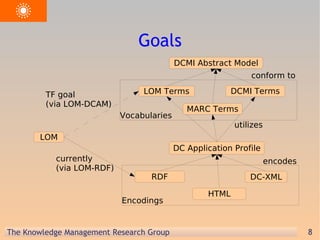
Goals conform to utilizes encodes TF goal (via LOM-DCAM) currently (via LOM-RDF) DCMI Abstract Model DCMI Terms LOM Terms DC Application Profile MARC Terms DC-XML RDF HTML Vocabularies Encodings LOM
Joint DCMI/IEEE LTSC Task Force Initiated at DC2005 in Madrid, Sep 2005 Chairs: Mikael Nilsson & Jon Mason Participation  open to all  (18 subscribers ATM) Wiki  hosted @ Dublin Core,  mailing list  @ JISCmail In what sense  Joint ? Collaborative work on drafts Joint consensus Co-publishing of results Reports to DC-Ed & LTSC
Task Force Formalities Task Force charter approval by DCMI Advisory Board and LTSC SEC  [DONE] Withdrawal of P1484.12.4 RDF binding of LOM  [DONE] Start work on PAR  [proposal exists] Next steps: Agree on  PAR , set up WG (NOTE: joint work still in TF) Start working on the process issues
PAR proposal Scope: This Recommended Practice describes IEEE LTSC P1484.12.1 Learning Object Metadata instances in the Dublin Core Metadata Initiative Abstract Model. The Recommended Practice will include the specification of DCMI Abstract Model terms, including properties, vocabularies, syntax encoding schemes and vocabulary encoding schemes, that may be used for expressing metadata conforming to the IEEE LOM Standard in Dublin Core metadata. The recommendation will include the specification of URIs to use for the terms, as well as a description of how to combine the specified terms so that metadata instances conforming to this Recommended Practice conform to the IEEE LOM Standard.
PAR proposal (cont.) Purpose: There is an increasing demand for interoperable definitions of Dublin Core metadata terms and IEEE LOM data elements which allow these to be used together in metadata instances. This Recommended Practice will approach part of this situation by describing how to use IEEE LOM and Dublin Core terms together in Dublin Core metadata instances. This represents a partial and short-term solution to the overall issue, which will still be of great value in the short to medium term for implementers that are struggling with these metadata interoperability issues. The Recommended Practice will also be of great value in the longer-term process of trying to align the abstract models of IEEE LOM and Dublin Core, as it will provide an analysis of fundamental incompatibilities between the two models.
Process issues Both an IEEE “Recommended Practice” and a DCMI “Recommendation” Consensus in both communities Both communities can contribute Both communities can participate in ballot If no consensus reached, none will be published Timing and commenting issues DCMI very flexible, IEEE more rigid Follow IEEE procedure, adjust DCMI schedule & process?
Task Force Progress “strawman” in Wiki a first outline of what the work involves a complex example Draft properties and classes Stage now set for open discussions on particular mapping issues draft formatting supporting documents (schemas, tuturials?, etc...) process issues
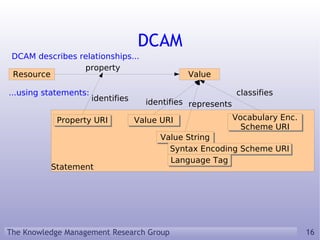
DCMI Abstract Model DC is much more than 15 terms (>80 in fact) DCAM: DCMI recommendation in March 2005 Specifies the relationship between  properties, values, encoding schemes   etc. High level of compatibility with the RDF model Used by  bindings  (XML, RDF, XHTML) DCMI terms  are instances of the concepts in the DCAM DCAPs  are based on the concepts in the DCAM
DCAM property DCAM describes relationships... ...using statements: identifies identifies represents classifies Resource Value Statement Property URI Value URI Value String Syntax Encoding Scheme URI Language Tag Vocabulary Enc. Scheme URI
LOM => DCAM mapping Recommendation for using LOM metadata in Dublin Core descriptions A mapping “LOM elements” => “instances of DCAM concepts” Not  a binding, but a  translation  (lossy in part) All constructs are used: properties, value strings, value URIs, [vocabulary|syntax] encoding schemes, related descriptions,  except rich representations
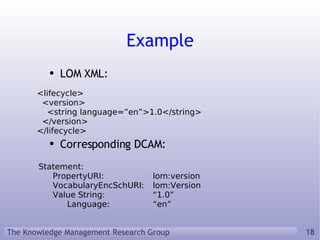
LOM XML: Corresponding DCAM: Example <lifecycle> <version> <string language=”en”>1.0</string> </version> </lifecycle> Statement: PropertyURI:  lom:version VocabularyEncSchURI: lom:Version Value String: “1.0” Language: “en”
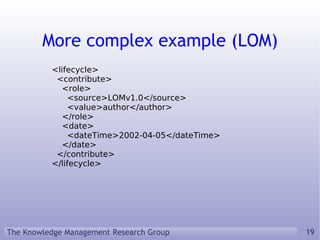
More complex example (LOM) <lifecycle> <contribute> <role> <source>LOMv1.0</source> <value>author</author> </role> <date> <dateTime>2002-04-05</dateTime> </date> </contribute> </lifecycle>
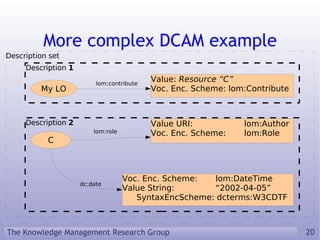
More complex DCAM example lom:contribute lom:role dc:date Description  1 Description  2 Description set
Consequences for LOM LOM elements  reusable in DCAPs LOM may be viewed as a  basic DCAP RDF binding  of LOM for free First step towards  better alignment of abstract models? Most work already done  within LOM RDF binding Separates LOM=>DC translation from the specific RDF binding.
DC and RDF abstract models Both DC and RDF use a resource – property – value  model DC has more high-level “values” than RDF value URIs value strings rich values, etc. The LOM RDF binding uses the RDF model (of course) It also tries to be compatible with the DC model.
Work in Progress at DCMI DCAM (March 2005) is leading to many changes: Improved DCMI Terms definitions Total remake of DC RDF expression Total remake of DC XML expression Shift from Terms to Model: Refocus on APs.
Looking forward to LOMNext... Lesson from Task Force work: What is LOM??? To understand LOM, we need: an Abstract Model (=elements-in-elements) a set of terms (the LOM Elements) a set of rules for combining them (the LOM AP) Which is the  real  business of LOM?
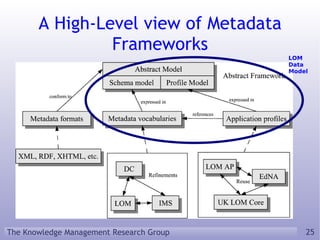
A High-Level view of Metadata Frameworks LOM Data Model
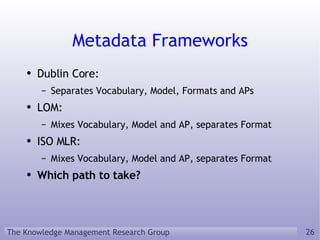
Metadata Frameworks Dublin Core: Separates Vocabulary, Model, Formats and APs LOM: Mixes Vocabulary, Model and AP, separates Format ISO MLR: Mixes Vocabulary, Model and AP, separates Format Which path to take?
Comments?
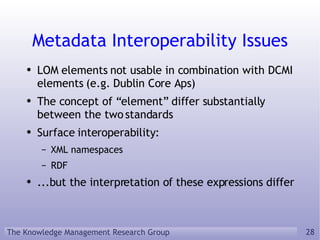
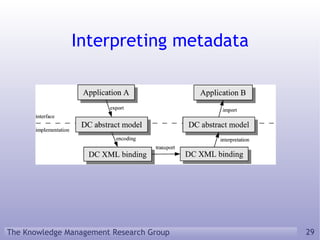
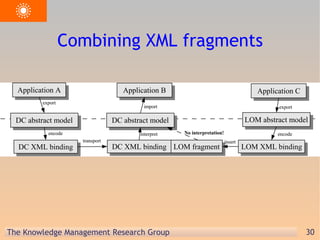
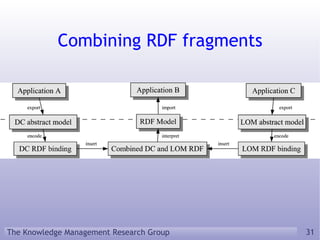
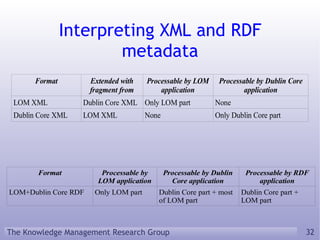
Metadata Interoperability Issues LOM elements not usable in combination with DCMI elements (e.g. Dublin Core Aps) The concept of “element” differ substantially between the two standards Surface interoperability: XML namespaces RDF ...but the interpretation of these expressions differ
Interpreting metadata
Combining XML fragments
Combining RDF fragments
Interpreting XML and RDF metadata
Requirements for Reusability The components must be  unambiguously identified The components must adhere to  compatible abstract models.  A  metadata format  must be used that allows for  consistent interpretation  of the components with respect to their respective abstract models.

DCMI IEEE LTSC Joint taskforce at DC2007

  • 1.
    DCMI-IEEE LTSC Taskforce Mikael Nilsson < [email_address] > DC 2007, Singapore Aug 27, 2007
  • 2.
    Scope & PurposeThis Recommended Practice describes IEEE LTSC P1484.12.1 Learning Object Metadata instances in the Dublin Core Metadata Initiative Abstract Model. The Recommended Practice will include the specification of DCMI Abstract Model terms, including properties, vocabularies, syntax encoding schemes and vocabulary encoding schemes, that may be used for expressing metadata conforming to the IEEE LOM Standard in Dublin Core metadata . The recommendation will include the specification of URIs to use for the terms, as well as a description of how to combine the specified terms so that metadata instances conforming to this Recommended Practice conform to the IEEE LOM Standard.
  • 3.
    Resources Wiki: http://dublincore.org/educationwiki/DCMIIEEELTSCTaskforce Mailing list: http://www.jiscmail.ac.uk/lists/DC-IEEELTSC-TASKFORCE.html 38 subscribers currently
  • 4.
    Progress Existing documents:Initial LOM-in-DCAM analysis Set of classes and properties Examples Work has been on hold waiting for New version of DCAM New version of DC-RDF Domains & ranges for DC properties
  • 5.
    Status New DCAM: Recommendation! Makes Vocabulary encoding scheme != value type Distinguishes Literals and Nonliteral New DC-RDF: Proposed Recommendation! Domains & ranges: In progress!
  • 6.
    Workplan Update: InitialLOM-in-DCAM analysis Set of classes and properties Examples Create: Application Profile based on LOM Including Description Set Profile GRDDL transformation from LOM-XML to LOM-DCAM-in-RDF
  • 7.
    Background LOM elements not usable in combination with DCMI elements (e.g. in Dublin Core APs) RDF a way to combine LOM and DC First LOM/RDF draft September 2002 Not generalizable to other DC formats / DCAPs Other alternative: ad-hoc mapping March 2005: DCMI Abstract Model => New possibilities for interoperability!
  • 8.
    Goals conform toutilizes encodes TF goal (via LOM-DCAM) currently (via LOM-RDF) DCMI Abstract Model DCMI Terms LOM Terms DC Application Profile MARC Terms DC-XML RDF HTML Vocabularies Encodings LOM
  • 9.
    Joint DCMI/IEEE LTSCTask Force Initiated at DC2005 in Madrid, Sep 2005 Chairs: Mikael Nilsson & Jon Mason Participation open to all (18 subscribers ATM) Wiki hosted @ Dublin Core, mailing list @ JISCmail In what sense Joint ? Collaborative work on drafts Joint consensus Co-publishing of results Reports to DC-Ed & LTSC
  • 10.
    Task Force FormalitiesTask Force charter approval by DCMI Advisory Board and LTSC SEC [DONE] Withdrawal of P1484.12.4 RDF binding of LOM [DONE] Start work on PAR [proposal exists] Next steps: Agree on PAR , set up WG (NOTE: joint work still in TF) Start working on the process issues
  • 11.
    PAR proposal Scope:This Recommended Practice describes IEEE LTSC P1484.12.1 Learning Object Metadata instances in the Dublin Core Metadata Initiative Abstract Model. The Recommended Practice will include the specification of DCMI Abstract Model terms, including properties, vocabularies, syntax encoding schemes and vocabulary encoding schemes, that may be used for expressing metadata conforming to the IEEE LOM Standard in Dublin Core metadata. The recommendation will include the specification of URIs to use for the terms, as well as a description of how to combine the specified terms so that metadata instances conforming to this Recommended Practice conform to the IEEE LOM Standard.
  • 12.
    PAR proposal (cont.)Purpose: There is an increasing demand for interoperable definitions of Dublin Core metadata terms and IEEE LOM data elements which allow these to be used together in metadata instances. This Recommended Practice will approach part of this situation by describing how to use IEEE LOM and Dublin Core terms together in Dublin Core metadata instances. This represents a partial and short-term solution to the overall issue, which will still be of great value in the short to medium term for implementers that are struggling with these metadata interoperability issues. The Recommended Practice will also be of great value in the longer-term process of trying to align the abstract models of IEEE LOM and Dublin Core, as it will provide an analysis of fundamental incompatibilities between the two models.
  • 13.
    Process issues Bothan IEEE “Recommended Practice” and a DCMI “Recommendation” Consensus in both communities Both communities can contribute Both communities can participate in ballot If no consensus reached, none will be published Timing and commenting issues DCMI very flexible, IEEE more rigid Follow IEEE procedure, adjust DCMI schedule & process?
  • 14.
    Task Force Progress“strawman” in Wiki a first outline of what the work involves a complex example Draft properties and classes Stage now set for open discussions on particular mapping issues draft formatting supporting documents (schemas, tuturials?, etc...) process issues
  • 15.
    DCMI Abstract ModelDC is much more than 15 terms (>80 in fact) DCAM: DCMI recommendation in March 2005 Specifies the relationship between properties, values, encoding schemes etc. High level of compatibility with the RDF model Used by bindings (XML, RDF, XHTML) DCMI terms are instances of the concepts in the DCAM DCAPs are based on the concepts in the DCAM
  • 16.
    DCAM property DCAMdescribes relationships... ...using statements: identifies identifies represents classifies Resource Value Statement Property URI Value URI Value String Syntax Encoding Scheme URI Language Tag Vocabulary Enc. Scheme URI
  • 17.
    LOM => DCAMmapping Recommendation for using LOM metadata in Dublin Core descriptions A mapping “LOM elements” => “instances of DCAM concepts” Not a binding, but a translation (lossy in part) All constructs are used: properties, value strings, value URIs, [vocabulary|syntax] encoding schemes, related descriptions, except rich representations
  • 18.
    LOM XML: CorrespondingDCAM: Example <lifecycle> <version> <string language=”en”>1.0</string> </version> </lifecycle> Statement: PropertyURI: lom:version VocabularyEncSchURI: lom:Version Value String: “1.0” Language: “en”
  • 19.
    More complex example(LOM) <lifecycle> <contribute> <role> <source>LOMv1.0</source> <value>author</author> </role> <date> <dateTime>2002-04-05</dateTime> </date> </contribute> </lifecycle>
  • 20.
    More complex DCAMexample lom:contribute lom:role dc:date Description 1 Description 2 Description set
  • 21.
    Consequences for LOMLOM elements reusable in DCAPs LOM may be viewed as a basic DCAP RDF binding of LOM for free First step towards better alignment of abstract models? Most work already done within LOM RDF binding Separates LOM=>DC translation from the specific RDF binding.
  • 22.
    DC and RDFabstract models Both DC and RDF use a resource – property – value model DC has more high-level “values” than RDF value URIs value strings rich values, etc. The LOM RDF binding uses the RDF model (of course) It also tries to be compatible with the DC model.
  • 23.
    Work in Progressat DCMI DCAM (March 2005) is leading to many changes: Improved DCMI Terms definitions Total remake of DC RDF expression Total remake of DC XML expression Shift from Terms to Model: Refocus on APs.
  • 24.
    Looking forward toLOMNext... Lesson from Task Force work: What is LOM??? To understand LOM, we need: an Abstract Model (=elements-in-elements) a set of terms (the LOM Elements) a set of rules for combining them (the LOM AP) Which is the real business of LOM?
  • 25.
    A High-Level viewof Metadata Frameworks LOM Data Model
  • 26.
    Metadata Frameworks DublinCore: Separates Vocabulary, Model, Formats and APs LOM: Mixes Vocabulary, Model and AP, separates Format ISO MLR: Mixes Vocabulary, Model and AP, separates Format Which path to take?
  • 27.
  • 28.
    Metadata Interoperability IssuesLOM elements not usable in combination with DCMI elements (e.g. Dublin Core Aps) The concept of “element” differ substantially between the two standards Surface interoperability: XML namespaces RDF ...but the interpretation of these expressions differ
  • 29.
  • 30.
  • 31.
  • 32.
  • 33.
    Requirements for ReusabilityThe components must be unambiguously identified The components must adhere to compatible abstract models. A metadata format must be used that allows for consistent interpretation of the components with respect to their respective abstract models.