Early brain developmentcreates
the foundation for a child’s
academic, social, and emotional
well-being and individual and
collective success.
4.
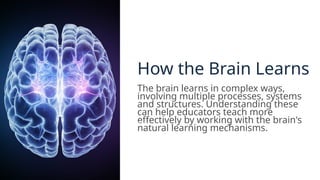
How the BrainLearns
The brain learns in complex ways,
involving multiple processes, systems
and structures. Understanding these
can help educators teach more
effectively by working with the brain's
natural learning mechanisms.
5.
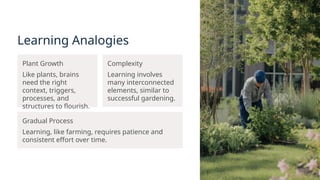
Learning Analogies
Plant Growth
Likeplants, brains
need the right
context, triggers,
processes, and
structures to flourish.
Complexity
Learning involves
many interconnected
elements, similar to
successful gardening.
Gradual Process
Learning, like farming, requires patience and
consistent effort over time.
6.
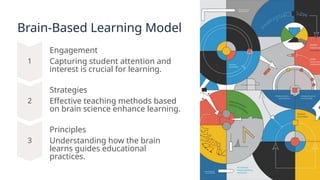
Brain-Based Learning Model
Engagement
Capturingstudent attention and
interest is crucial for learning.
Strategies
Effective teaching methods based
on brain science enhance learning.
Principles
Understanding how the brain
learns guides educational
practices.
7.
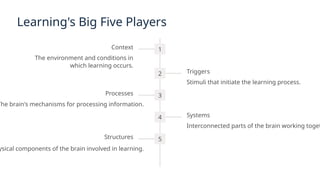
Learning's Big FivePlayers
1
Context
The environment and conditions in
which learning occurs.
2 Triggers
Stimuli that initiate the learning process.
3
Processes
The brain's mechanisms for processing information.
4 Systems
Interconnected parts of the brain working toget
5
Structures
ysical components of the brain involved in learning.
8.
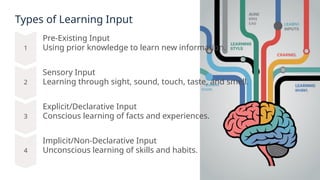
Types of LearningInput
Pre-Existing Input
Using prior knowledge to learn new information.
Sensory Input
Learning through sight, sound, touch, taste, and smell.
Explicit/Declarative Input
Conscious learning of facts and experiences.
Implicit/Non-Declarative Input
Unconscious learning of skills and habits.
9.
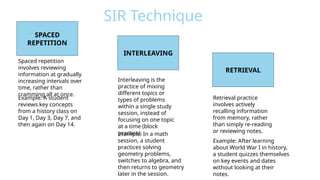
SPACED
REPETITION
INTERLEAVING
RETRIEVAL
SIR Technique
Spaced repetition
involvesreviewing
information at gradually
increasing intervals over
time, rather than
cramming all at once.
Example: A student
reviews key concepts
from a history class on
Day 1, Day 3, Day 7, and
then again on Day 14.
Interleaving is the
practice of mixing
different topics or
types of problems
within a single study
session, instead of
focusing on one topic
at a time (block
practice).
Example: In a math
session, a student
practices solving
geometry problems,
switches to algebra, and
then returns to geometry
later in the session.
Retrieval practice
involves actively
recalling information
from memory, rather
than simply re-reading
or reviewing notes.
Example: After learning
about World War I in history,
a student quizzes themselves
on key events and dates
without looking at their
notes.
10.
USING INTERLEAVING
METHOD TOTEACH READING
oIntegrate reading skills in teaching different learning areas
(subjects) in KS1.
oUse the Content-Based Language Instruction (CBLI) in developing
reading skills in other learning areas.
oMake a sample learning plan for learning areas in KS1 that
integrates the development of reading/literacy skills.
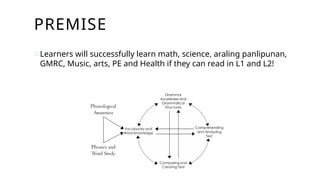
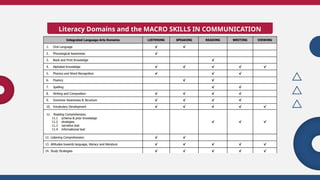
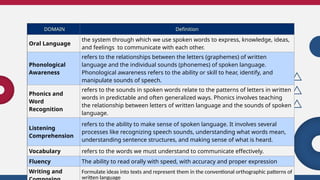
DOMAIN Definition
Oral Language
thesystem through which we use spoken words to express, knowledge, ideas,
and feelings to communicate with each other.
Phonological
Awareness
refers to the relationships between the letters (graphemes) of written
language and the individual sounds (phonemes) of spoken language.
Phonological awareness refers to the ability or skill to hear, identify, and
manipulate sounds of speech.
Phonics and
Word
Recognition
refers to the sounds in spoken words relate to the patterns of letters in written
words in predictable and often generalized ways. Phonics involves teaching
the relationship between letters of written language and the sounds of spoken
language.
Listening
Comprehension
refers to the ability to make sense of spoken language. It involves several
processes like recognizing speech sounds, understanding what words mean,
understanding sentence structures, and making sense of what is heard.
Vocabulary refers to the words we must understand to communicate effectively.
Fluency The ability to read orally with speed, with accuracy and proper expression
Writing and Formulate ideas into texts and represent them in the conventional orthographic patterns of
written language
25.
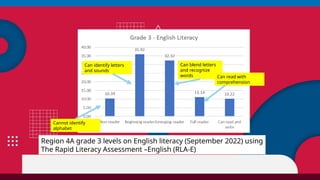
Region 4A grade3 levels on English literacy (September 2022) using
The Rapid Literacy Assessment –English (RLA-E)
Cannot identify
alphabet
Can identify letters
and sounds
Can blend letters
and recognize
words Can read with
comprehension
26.
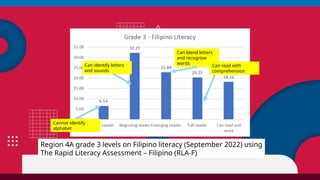
Region 4A grade3 levels on Filipino literacy (September 2022) using
The Rapid Literacy Assessment – Filipino (RLA-F)
Cannot identify
alphabet
Can identify letters
and sounds
Can blend letters
and recognize
words
Can read with
comprehension
27.
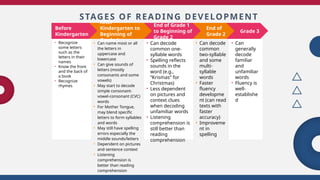
• Recognize
some letters
suchas the
letters in their
names
• Know the front
and the back of
a book
• Recognize
rhymes
• Can name most or all
the letters in
uppercase and
lowercase
• Can give sounds of
letters (mostly
consonants and some
vowels)
• May start to decode
simple consonant-
vowel-consonant (CVC)
words
• For Mother Tongue,
may blend specific
letters to form syllables
and words
• May still have spelling
errors especially the
middle sounds/letters
• Dependent on pictures
and sentence context
• Listening
comprehension is
better than reading
comprehension
• Can decode
common
two-syllable
and some
multi-
syllable
words
• Faster
fluency
developme
nt (can read
texts with
faster
accuracy)
• Improveme
nt in
spelling
• Can
generally
decode
familiar
and
unfamiliar
words
• Fluency is
well-
establishe
d
• Can decode
common one-
syllable words
• Spelling reflects
sounds in the
word (e.g.,
“Krismas” for
Christmas)
• Less dependent
on pictures and
context clues
when decoding
unfamiliar words
• Listening
comprehension is
still better than
reading
comprehension
Grade 3
End of
Grade 2
End of Grade 1
to Beginning of
Grade 2
After
Kindergarten to
Beginning of
Grade 1
STAGES OF READING DEVELOPMENT
Before
Kindergarten
HOW DO YOUTEACH THE
SUBJECT WHILE TEACHING
READING?
oContent-Based Language Instruction or CBLI is a pedagogical
approach to language teaching.
o"people learn a second language more successfully when they use
the language as a means of acquiring information, rather than as
an end in itself" (Richards & Rodgers, 2001, p. 207). – interleaving
approach
oTherefore, language is best learned when taught in the context of
learning other learning areas.
THERE ARE 3MODELS OF CBLI:
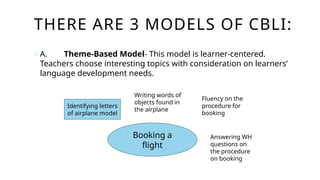
oA. Theme-Based Model- This model is learner-centered.
Teachers choose interesting topics with consideration on learners’
language development needs.
Booking a
flight
Identifying letters
of airplane model
Writing words of
objects found in
the airplane
Fluency on the
procedure for
booking
Answering WH
questions on
the procedure
on booking
32.
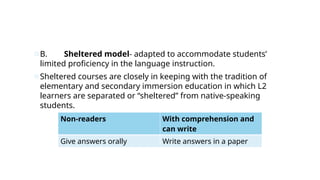
oB. Sheltered model-adapted to accommodate students’
limited proficiency in the language instruction.
oSheltered courses are closely in keeping with the tradition of
elementary and secondary immersion education in which L2
learners are separated or “sheltered” from native-speaking
students.
Non-readers With comprehension and
can write
Give answers orally Write answers in a paper
33.
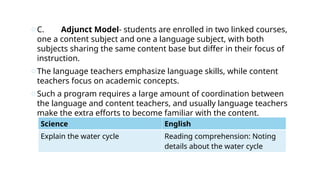
oC. Adjunct Model-students are enrolled in two linked courses,
one a content subject and one a language subject, with both
subjects sharing the same content base but differ in their focus of
instruction.
oThe language teachers emphasize language skills, while content
teachers focus on academic concepts.
oSuch a program requires a large amount of coordination between
the language and content teachers, and usually language teachers
make the extra efforts to become familiar with the content.
Science English
Explain the water cycle Reading comprehension: Noting
details about the water cycle
34.
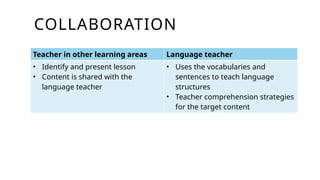
COLLABORATION
Teacher in otherlearning areas Language teacher
• Identify and present lesson
• Content is shared with the
language teacher
• Uses the vocabularies and
sentences to teach language
structures
• Teacher comprehension strategies
for the target content
35.
MAKABANSA G2Q3
oNaipaliliwanag angtungkulin ng mga taong bumubuo sa
paaralan tulad ng punongguro, guro, doctor, nars, dyanitor,
mag-aaral at iba pa
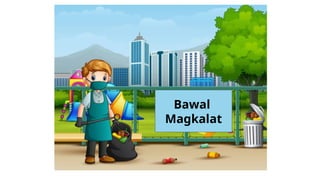
oP: Magpakita nglarawan ng dyanitor na naglilinis ng bakuran ng
paaralan. Naglalagay ng babala ang isa pang dyanitor sa larawan.
oSino ang makikita sa larawan?
oAno ano ang ginagawa nila?
oBakit mahalaga ang kanilang Gawain?
oAno ang nakasulat sa babala?
oIsulat sa pisara ang nakasaad sa babala
oIturo ang letra mula kaliwa papuntang kanan at sabay sabay
basahin.
38.
o T: Anoang dapat gawin pag Nakita itong babala?
o Sino sino pa ang ibang mga nagtatrabaho sa paaralan?
o Ano ang kanilang Gawain?
o Magbigay ng salitang kasingkahulugan ng “Gawain”
o Isulat sa pisara ang salitang “Gawain”
o Isulat ang nakuhang kasingkahulugan
o Kung babala ang ginagawa ng dyanitor, ano naman ang itinatala ng guro?
o Ituro ang itinala ng guro dito sa loob ng paaralan.
o Sino sino pa ang mga nagtatrabaho sa paaralan?
o Ibigay ang mga tungkulin.
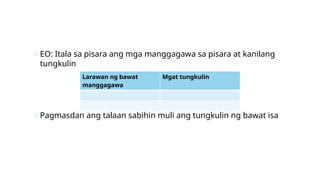
oEO: Itala sapisara ang mga manggagawa sa pisara at kanilang
tungkulin
oPagmasdan ang talaan sabihin muli ang tungkulin ng bawat isa
Larawan ng bawat
manggagawa
Mgat tungkulin
41.
oT: Magpakita ngtalaan ng mga manggagawa sa pisara at kanilang
tungkulin pero mga salita ang nakalagay (hindi na larawan)
oIpabasa ng sabay sabay sa mga mag-aaral.
oMagbigay ng mga salitang kasingkahulugan nga mga salitang
nakatala
42.
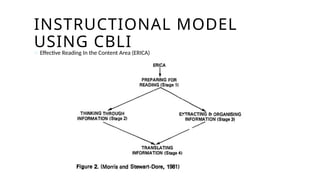
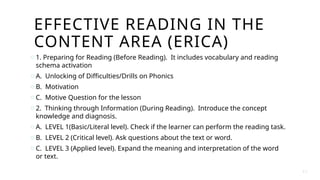
EFFECTIVE READING INTHE
CONTENT AREA (ERICA)
o 1. Preparing for Reading (Before Reading). It includes vocabulary and reading
schema activation
o A. Unlocking of Difficulties/Drills on Phonics
o B. Motivation
o C. Motive Question for the lesson
o 2. Thinking through Information (During Reading). Introduce the concept
knowledge and diagnosis.
o A. LEVEL 1(Basic/Literal level). Check if the learner can perform the reading task.
o B. LEVEL 2 (Critical level). Ask questions about the text or word.
o C. LEVEL 3 (Applied level). Expand the meaning and interpretation of the word
or text.
4 2
43.
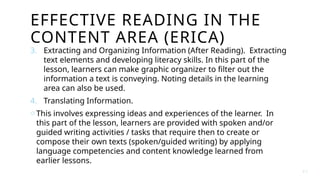
EFFECTIVE READING INTHE
CONTENT AREA (ERICA)
3. Extracting and Organizing Information (After Reading). Extracting
text elements and developing literacy skills. In this part of the
lesson, learners can make graphic organizer to filter out the
information a text is conveying. Noting details in the learning
area can also be used.
4. Translating Information.
o This involves expressing ideas and experiences of the learner. In
this part of the lesson, learners are provided with spoken and/or
guided writing activities / tasks that require then to create or
compose their own texts (spoken/guided writing) by applying
language competencies and content knowledge learned from
earlier lessons.
4 3
44.
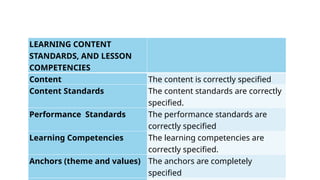
LEARNING CONTENT
STANDARDS, ANDLESSON
COMPETENCIES
Content The content is correctly specified
Content Standards The content standards are correctly
specified.
Performance Standards The performance standards are
correctly specified
Learning Competencies The learning competencies are
correctly specified.
Anchors (theme and values) The anchors are completely
specified
45.
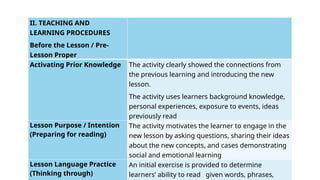
II. TEACHING AND
LEARNINGPROCEDURES
Before the Lesson / Pre-
Lesson Proper
Activating Prior Knowledge The activity clearly showed the connections from
the previous learning and introducing the new
lesson.
The activity uses learners background knowledge,
personal experiences, exposure to events, ideas
previously read
Lesson Purpose / Intention
(Preparing for reading)
The activity motivates the learner to engage in the
new lesson by asking questions, sharing their ideas
about the new concepts, and cases demonstrating
social and emotional learning
Lesson Language Practice
(Thinking through)
An initial exercise is provided to determine
learners’ ability to read given words, phrases,
46.
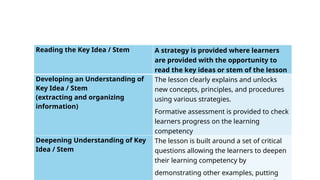
Reading the KeyIdea / Stem A strategy is provided where learners
are provided with the opportunity to
read the key ideas or stem of the lesson
Developing an Understanding of
Key Idea / Stem
(extracting and organizing
information)
The lesson clearly explains and unlocks
new concepts, principles, and procedures
using various strategies.
Formative assessment is provided to check
learners progress on the learning
competency
Deepening Understanding of Key
Idea / Stem
The lesson is built around a set of critical
questions allowing the learners to deepen
their learning competency by
demonstrating other examples, putting
47.
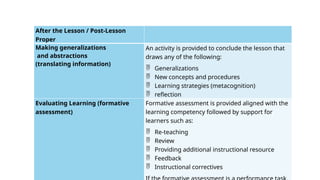
After the Lesson/ Post-Lesson
Proper
Making generalizations
and abstractions
(translating information)
An activity is provided to conclude the lesson that
draws any of the following:
Generalizations
New concepts and procedures
Learning strategies (metacognition)
reflection
Evaluating Learning (formative
assessment)
Formative assessment is provided aligned with the
learning competency followed by support for
learners such as:
Re-teaching
Review
Providing additional instructional resource
Feedback
Instructional correctives
48.
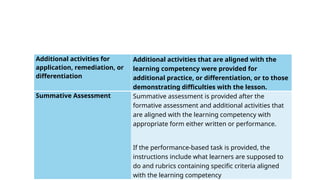
Additional activities for
application,remediation, or
differentiation
Additional activities that are aligned with the
learning competency were provided for
additional practice, or differentiation, or to those
demonstrating difficulties with the lesson.
Summative Assessment Summative assessment is provided after the
formative assessment and additional activities that
are aligned with the learning competency with
appropriate form either written or performance.
If the performance-based task is provided, the
instructions include what learners are supposed to
do and rubrics containing specific criteria aligned
with the learning competency
49.
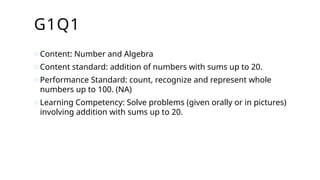
G1Q1
oContent: Number andAlgebra
oContent standard: addition of numbers with sums up to 20.
oPerformance Standard: count, recognize and represent whole
numbers up to 100. (NA)
oLearning Competency: Solve problems (given orally or in pictures)
involving addition with sums up to 20.
50.
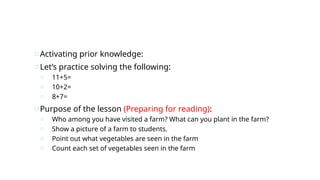
oActivating prior knowledge:
oLet’spractice solving the following:
o 11+5=
o 10+2=
o 8+7=
oPurpose of the lesson (Preparing for reading):
o Who among you have visited a farm? What can you plant in the farm?
o Show a picture of a farm to students.
o Point out what vegetables are seen in the farm
o Count each set of vegetables seen in the farm
51.
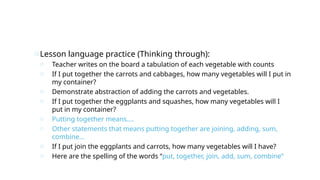
oLesson language practice(Thinking through):
o Teacher writes on the board a tabulation of each vegetable with counts
o If I put together the carrots and cabbages, how many vegetables will I put in
my container?
o Demonstrate abstraction of adding the carrots and vegetables.
o If I put together the eggplants and squashes, how many vegetables will I
put in my container?
o Putting together means….
o Other statements that means putting together are joining, adding, sum,
combine…
o If I put join the eggplants and carrots, how many vegetables will I have?
o Here are the spelling of the words “put, together, join, add, sum, combine”
52.
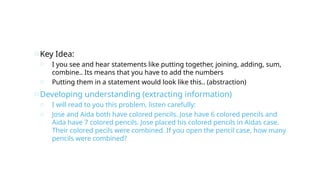
oKey Idea:
o Iyou see and hear statements like putting together, joining, adding, sum,
combine.. Its means that you have to add the numbers
o Putting them in a statement would look like this.. (abstraction)
oDeveloping understanding (extracting information)
o I will read to you this problem, listen carefully:
o Jose and Aida both have colored pencils. Jose have 6 colored pencils and
Aida have 7 colored pencils. Jose placed his colored pencils in Aidas case.
Their colored pecils were combined. If you open the pencil case, how many
pencils were combined?
53.
CONT. EXTRACTING
INFORMATION
o Showhow colored pencils and a pencil case look like.
o How many colored pencils does Jose have?
o How many colored pencils does Aida have?
o Draw the colored pencils of Jose and Aida then count each.
o Write the number of each colored pencil.
o Add the two numbers?
o What is being asked in the problem?
o What procedure should you use to obtain the sum?
o What will the number statement look like?
o What is the answer?
54.
oDeepening understanding
o Readanother problem to the students
o Demonstrate another way of solving the problem
oAbstraction (translating information)
o What are the different ways how we solve problems involving combining
numbers?
o When you have a money and you will combine it with your sibling’s money to
buy a toy, what method will you use and why?
o When you have old clothes and you classmates also combined their clothes
to be donated to charity, what method will you use and why?
o What type of problems can you use counters?
o What type of problems can you use the graphical method?
55.
oEvaluating (formative)
o Give5 items of problems to be solved and check
oReteaching
o Show other methods to solve the problem
oSummative assessment
o Give 5 items of problems to be solved
56.
WORKSHOP
oSelect one learningcompetency other than language, reading,
English, filipino
oIntegrate the reading in the learning competency in the DLL
Editor's Notes
#14 Say, what you see on the screen are the 14 domains of literacy as exhibited in the English Curriculum Guide. The Literacy Domains addresses the skills of listening, speaking, reading, writing and viewing.
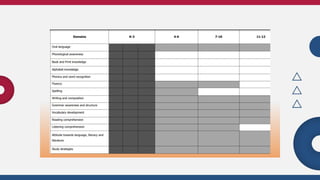
#15 These 14 domains are built during the key stage 1 years and applied by the learner from grade 4 to 12. Among the 14, there are 6-7 key areas of concern in beginning reading.
#16 Let’s see how well you know the literacy skills. Call one particpants and assume that he/she is a grade 1 student.
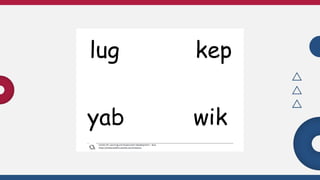
Tell me what letter this is? (point to letters t and r)
#17 Tell me what letter is this? (point to letters E and A)
What do you think is the literacy skill that I am determining here?
Answer: alphabet knowledge
#18 Tell me what is the sound of this letter? (point to letters b and p)
#19 Tell me what is the sound of this letter? (point to letters u and s)
What do you think is the literacy skill that I am determining here?
Answer: Phonemic awareness
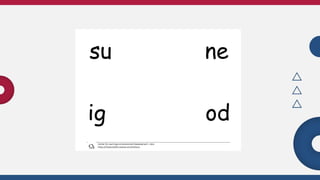
#20 I want you to give me the sound when you combine the following letters (point the letters moving from left to right)
What do you think is the literacy skill that I am determining here?
Answer: CV and VC blending or decoding
#21 I want you to give me the sound when you combine the following letters (point the letters moving from left to right)
What do you think is the literacy skill that I am determining here?
AnswerL CVC blending or decoding
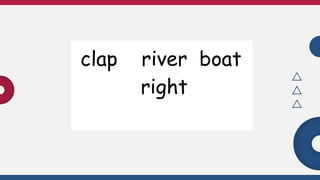
#22 I am going to point to a word and I want you to read it. (point to each of the words)
What do you think is the literacy skill that I am determining here?
Answer: Word recognition
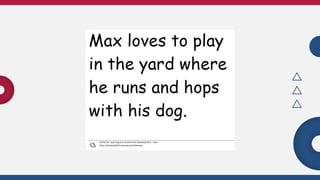
#23 Ok now read this sentence.
What do you think is the literacy skill that I am determining here?
Answer: Fluency
Who loves to play in the yard?
Who does Max play with in the yard?
Where do max and his dog run and hop?
What are the other things that Max and his dog do in the yard?
Can you retell the sentence having the same idea?
What do you think is the literacy skill that I am determining here?
Answer: reading comprehension
What specific reading comprehension are determined?
Answer: noting details, inference, determining the main idea
#24 Say, As we have discussed, these are the domains we need to focus on because these are the foundational skills that our learners need to master so that they can progress. . These are the domains that were used in teacher training 1 and 2.
#25 This is the rapid literacy assessment in English in selected divisions in Region 4A. The same pattern occurs where only 11.14% are full readers and 10.12% can white what they have read. Majority still did not reach the standard where all learners should be full readers by grade 3. The 10.39% of non readers in grade 3 is alarming.
#26 This is the result in the rapid literacy assessment in Filipino of grade 3 learners. The same pattern occurs where full readers and those that can read and write are 8% to 10% mire in Filipino literacy than in English. The majority still did not reach the standard that by grade 3, all learners should be full readers.
#27 Children’s literacy development is wholly based on their language development which begins in infancy. Once they have enough oral language to represent their experiences, they will then be ready to learn symbols that are used to represent language in printed form. It is best that children learn to read in their Mother Tongue first, as this is where they can expertly express their experiences in oral language and thus, transfer it to printed form. Once they have the basic literacy skills in reading in their mother tongue, transitioning to literacy learning in the second and third language will be easier. You will learn strategies in teaching reading from L1 to L2 and L3 during this training too, so don’t worry!